EP3923890B1 - Absorbent article - Google Patents
Absorbent article Download PDFInfo
- Publication number
- EP3923890B1 EP3923890B1 EP19915083.0A EP19915083A EP3923890B1 EP 3923890 B1 EP3923890 B1 EP 3923890B1 EP 19915083 A EP19915083 A EP 19915083A EP 3923890 B1 EP3923890 B1 EP 3923890B1
- Authority
- EP
- European Patent Office
- Prior art keywords
- surface layer
- absorbent article
- intermediate layer
- layer
- nonwoven
- Prior art date
- Legal status (The legal status is an assumption and is not a legal conclusion. Google has not performed a legal analysis and makes no representation as to the accuracy of the status listed.)
- Active
Links
Images

Classifications
-
- A—HUMAN NECESSITIES
- A61—MEDICAL OR VETERINARY SCIENCE; HYGIENE
- A61F—FILTERS IMPLANTABLE INTO BLOOD VESSELS; PROSTHESES; DEVICES PROVIDING PATENCY TO, OR PREVENTING COLLAPSING OF, TUBULAR STRUCTURES OF THE BODY, e.g. STENTS; ORTHOPAEDIC, NURSING OR CONTRACEPTIVE DEVICES; FOMENTATION; TREATMENT OR PROTECTION OF EYES OR EARS; BANDAGES, DRESSINGS OR ABSORBENT PADS; FIRST-AID KITS
- A61F13/00—Bandages or dressings; Absorbent pads
- A61F13/15—Absorbent pads, e.g. sanitary towels, swabs or tampons for external or internal application to the body; Supporting or fastening means therefor; Tampon applicators
- A61F13/51—Absorbent pads, e.g. sanitary towels, swabs or tampons for external or internal application to the body; Supporting or fastening means therefor; Tampon applicators characterised by the outer layers of the pads
- A61F13/511—Topsheet, i.e. the permeable cover or layer facing the skin
- A61F13/51104—Topsheet, i.e. the permeable cover or layer facing the skin the top sheet having a three-dimensional cross-section, e.g. corrugations, embossments, recesses or projections
-
- A—HUMAN NECESSITIES
- A61—MEDICAL OR VETERINARY SCIENCE; HYGIENE
- A61F—FILTERS IMPLANTABLE INTO BLOOD VESSELS; PROSTHESES; DEVICES PROVIDING PATENCY TO, OR PREVENTING COLLAPSING OF, TUBULAR STRUCTURES OF THE BODY, e.g. STENTS; ORTHOPAEDIC, NURSING OR CONTRACEPTIVE DEVICES; FOMENTATION; TREATMENT OR PROTECTION OF EYES OR EARS; BANDAGES, DRESSINGS OR ABSORBENT PADS; FIRST-AID KITS
- A61F13/00—Bandages or dressings; Absorbent pads
- A61F13/15—Absorbent pads, e.g. sanitary towels, swabs or tampons for external or internal application to the body; Supporting or fastening means therefor; Tampon applicators
- A61F13/51—Absorbent pads, e.g. sanitary towels, swabs or tampons for external or internal application to the body; Supporting or fastening means therefor; Tampon applicators characterised by the outer layers of the pads
- A61F13/511—Topsheet, i.e. the permeable cover or layer facing the skin
- A61F13/51104—Topsheet, i.e. the permeable cover or layer facing the skin the top sheet having a three-dimensional cross-section, e.g. corrugations, embossments, recesses or projections
- A61F13/51108—Topsheet, i.e. the permeable cover or layer facing the skin the top sheet having a three-dimensional cross-section, e.g. corrugations, embossments, recesses or projections the top sheet having corrugations or embossments having one axis relatively longer than the other axis, e.g. forming channels or grooves in a longitudinal direction
-
- A—HUMAN NECESSITIES
- A61—MEDICAL OR VETERINARY SCIENCE; HYGIENE
- A61F—FILTERS IMPLANTABLE INTO BLOOD VESSELS; PROSTHESES; DEVICES PROVIDING PATENCY TO, OR PREVENTING COLLAPSING OF, TUBULAR STRUCTURES OF THE BODY, e.g. STENTS; ORTHOPAEDIC, NURSING OR CONTRACEPTIVE DEVICES; FOMENTATION; TREATMENT OR PROTECTION OF EYES OR EARS; BANDAGES, DRESSINGS OR ABSORBENT PADS; FIRST-AID KITS
- A61F13/00—Bandages or dressings; Absorbent pads
- A61F13/15—Absorbent pads, e.g. sanitary towels, swabs or tampons for external or internal application to the body; Supporting or fastening means therefor; Tampon applicators
- A61F13/51—Absorbent pads, e.g. sanitary towels, swabs or tampons for external or internal application to the body; Supporting or fastening means therefor; Tampon applicators characterised by the outer layers of the pads
- A61F13/511—Topsheet, i.e. the permeable cover or layer facing the skin
- A61F13/513—Topsheet, i.e. the permeable cover or layer facing the skin characterised by its function or properties, e.g. stretchability, breathability, rewet, visual effect; having areas of different permeability
-
- A—HUMAN NECESSITIES
- A61—MEDICAL OR VETERINARY SCIENCE; HYGIENE
- A61F—FILTERS IMPLANTABLE INTO BLOOD VESSELS; PROSTHESES; DEVICES PROVIDING PATENCY TO, OR PREVENTING COLLAPSING OF, TUBULAR STRUCTURES OF THE BODY, e.g. STENTS; ORTHOPAEDIC, NURSING OR CONTRACEPTIVE DEVICES; FOMENTATION; TREATMENT OR PROTECTION OF EYES OR EARS; BANDAGES, DRESSINGS OR ABSORBENT PADS; FIRST-AID KITS
- A61F13/00—Bandages or dressings; Absorbent pads
- A61F13/15—Absorbent pads, e.g. sanitary towels, swabs or tampons for external or internal application to the body; Supporting or fastening means therefor; Tampon applicators
- A61F13/53—Absorbent pads, e.g. sanitary towels, swabs or tampons for external or internal application to the body; Supporting or fastening means therefor; Tampon applicators characterised by the absorbing medium
- A61F13/534—Absorbent pads, e.g. sanitary towels, swabs or tampons for external or internal application to the body; Supporting or fastening means therefor; Tampon applicators characterised by the absorbing medium having an inhomogeneous composition through the thickness of the pad
- A61F13/537—Absorbent pads, e.g. sanitary towels, swabs or tampons for external or internal application to the body; Supporting or fastening means therefor; Tampon applicators characterised by the absorbing medium having an inhomogeneous composition through the thickness of the pad characterised by a layer facilitating or inhibiting flow in one direction or plane, e.g. a wicking layer
-
- A—HUMAN NECESSITIES
- A61—MEDICAL OR VETERINARY SCIENCE; HYGIENE
- A61F—FILTERS IMPLANTABLE INTO BLOOD VESSELS; PROSTHESES; DEVICES PROVIDING PATENCY TO, OR PREVENTING COLLAPSING OF, TUBULAR STRUCTURES OF THE BODY, e.g. STENTS; ORTHOPAEDIC, NURSING OR CONTRACEPTIVE DEVICES; FOMENTATION; TREATMENT OR PROTECTION OF EYES OR EARS; BANDAGES, DRESSINGS OR ABSORBENT PADS; FIRST-AID KITS
- A61F13/00—Bandages or dressings; Absorbent pads
- A61F13/15—Absorbent pads, e.g. sanitary towels, swabs or tampons for external or internal application to the body; Supporting or fastening means therefor; Tampon applicators
- A61F13/53—Absorbent pads, e.g. sanitary towels, swabs or tampons for external or internal application to the body; Supporting or fastening means therefor; Tampon applicators characterised by the absorbing medium
- A61F13/539—Absorbent pads, e.g. sanitary towels, swabs or tampons for external or internal application to the body; Supporting or fastening means therefor; Tampon applicators characterised by the absorbing medium characterised by the connection of the absorbent layers with each other or with the outer layers
-
- A—HUMAN NECESSITIES
- A61—MEDICAL OR VETERINARY SCIENCE; HYGIENE
- A61F—FILTERS IMPLANTABLE INTO BLOOD VESSELS; PROSTHESES; DEVICES PROVIDING PATENCY TO, OR PREVENTING COLLAPSING OF, TUBULAR STRUCTURES OF THE BODY, e.g. STENTS; ORTHOPAEDIC, NURSING OR CONTRACEPTIVE DEVICES; FOMENTATION; TREATMENT OR PROTECTION OF EYES OR EARS; BANDAGES, DRESSINGS OR ABSORBENT PADS; FIRST-AID KITS
- A61F13/00—Bandages or dressings; Absorbent pads
- A61F13/15—Absorbent pads, e.g. sanitary towels, swabs or tampons for external or internal application to the body; Supporting or fastening means therefor; Tampon applicators
- A61F13/15577—Apparatus or processes for manufacturing
- A61F2013/15821—Apparatus or processes for manufacturing characterized by the apparatus for manufacturing
- A61F2013/15861—Apparatus or processes for manufacturing characterized by the apparatus for manufacturing for bonding
- A61F2013/15869—Apparatus or processes for manufacturing characterized by the apparatus for manufacturing for bonding with ultrasonic energy
-
- A—HUMAN NECESSITIES
- A61—MEDICAL OR VETERINARY SCIENCE; HYGIENE
- A61F—FILTERS IMPLANTABLE INTO BLOOD VESSELS; PROSTHESES; DEVICES PROVIDING PATENCY TO, OR PREVENTING COLLAPSING OF, TUBULAR STRUCTURES OF THE BODY, e.g. STENTS; ORTHOPAEDIC, NURSING OR CONTRACEPTIVE DEVICES; FOMENTATION; TREATMENT OR PROTECTION OF EYES OR EARS; BANDAGES, DRESSINGS OR ABSORBENT PADS; FIRST-AID KITS
- A61F13/00—Bandages or dressings; Absorbent pads
- A61F13/15—Absorbent pads, e.g. sanitary towels, swabs or tampons for external or internal application to the body; Supporting or fastening means therefor; Tampon applicators
- A61F13/15577—Apparatus or processes for manufacturing
- A61F2013/15821—Apparatus or processes for manufacturing characterized by the apparatus for manufacturing
- A61F2013/15861—Apparatus or processes for manufacturing characterized by the apparatus for manufacturing for bonding
- A61F2013/15878—Apparatus or processes for manufacturing characterized by the apparatus for manufacturing for bonding by thermal bonding
-
- A—HUMAN NECESSITIES
- A61—MEDICAL OR VETERINARY SCIENCE; HYGIENE
- A61F—FILTERS IMPLANTABLE INTO BLOOD VESSELS; PROSTHESES; DEVICES PROVIDING PATENCY TO, OR PREVENTING COLLAPSING OF, TUBULAR STRUCTURES OF THE BODY, e.g. STENTS; ORTHOPAEDIC, NURSING OR CONTRACEPTIVE DEVICES; FOMENTATION; TREATMENT OR PROTECTION OF EYES OR EARS; BANDAGES, DRESSINGS OR ABSORBENT PADS; FIRST-AID KITS
- A61F13/00—Bandages or dressings; Absorbent pads
- A61F13/15—Absorbent pads, e.g. sanitary towels, swabs or tampons for external or internal application to the body; Supporting or fastening means therefor; Tampon applicators
- A61F13/15577—Apparatus or processes for manufacturing
- A61F2013/15821—Apparatus or processes for manufacturing characterized by the apparatus for manufacturing
- A61F2013/15861—Apparatus or processes for manufacturing characterized by the apparatus for manufacturing for bonding
- A61F2013/1591—Apparatus or processes for manufacturing characterized by the apparatus for manufacturing for bonding via adhesive
-
- A—HUMAN NECESSITIES
- A61—MEDICAL OR VETERINARY SCIENCE; HYGIENE
- A61F—FILTERS IMPLANTABLE INTO BLOOD VESSELS; PROSTHESES; DEVICES PROVIDING PATENCY TO, OR PREVENTING COLLAPSING OF, TUBULAR STRUCTURES OF THE BODY, e.g. STENTS; ORTHOPAEDIC, NURSING OR CONTRACEPTIVE DEVICES; FOMENTATION; TREATMENT OR PROTECTION OF EYES OR EARS; BANDAGES, DRESSINGS OR ABSORBENT PADS; FIRST-AID KITS
- A61F13/00—Bandages or dressings; Absorbent pads
- A61F13/15—Absorbent pads, e.g. sanitary towels, swabs or tampons for external or internal application to the body; Supporting or fastening means therefor; Tampon applicators
- A61F13/51—Absorbent pads, e.g. sanitary towels, swabs or tampons for external or internal application to the body; Supporting or fastening means therefor; Tampon applicators characterised by the outer layers of the pads
- A61F13/511—Topsheet, i.e. the permeable cover or layer facing the skin
- A61F13/5116—Topsheet, i.e. the permeable cover or layer facing the skin being formed of multiple layers
- A61F2013/51178—Topsheet, i.e. the permeable cover or layer facing the skin being formed of multiple layers with the combination of nonwoven webs
Definitions
- the present invention relates to an absorbent article.
- the present invention in particular relates to an absorbent article having a low-friction surface layer.
- Absorbent articles of the kind to which this disclosure relates are worn against the skin and include a topsheet, an absorbent core and a backsheet layer. All uses of products which are applied in direct contact with the skin may lead to unwanted side-effects. These may occur as a result of occlusion, moisture and mechanical factors, such as friction, between the skin and the absorbent article. These factors which all, to different degrees, interact and amplify the influence of each other and may cause different forms of skin irritation to users of said articles. Skin problems can be caused by forces arising from physical/mechanical interaction between the product and the user's skin. Thus, for example chafing is caused due to extra friction between the absorbent article and the skin of the user.
- Creams, lotions, or ointments can be used to provide an artificial hydrophobic barrier on the skin and to treat skin conditions such as diaper rash.
- the use of such hydrophobic compositions has a negative impact on the absorbency performance of the articles.
- US 2016/220421 A1 discloses an absorbent article.
- a compression resistant and durable concavo-convex shape providing an uneven feeling, and excellent absorption performance
- a sanitary napkin is provided that includes an absorber interposed between a permeable front surface sheet embossed into a concavo-convex shape and a back surface sheet and a hydrophilic third sheet disposed between the permeable front surface sheet and the absorber.
- the permeable front surface sheet is a laminate structure that includes a fine fiber skin contact surface layer made of fine fibers having a fineness of less than 2.0 dtex and a crimped fiber layer laminated on the non-skin contact surface of the fine fiber layer and the crimped fibers have a fineness of from 3.0 to 5.0 dtex.
- EP 1 290 995 A2 discloses an absorbent article elongated to have longitudinally opposed front and rear edges and transversely opposed left and right edges.
- the absorbent article includes a stack of: a backsheet having a liquid barrier effect; a liquid absorbent layer; a hydrophilic intermediate sheet including fibers; and a hydrophilic topsheet including fibers.
- the absorbent article has a central region of a predetermined width, which is spaced apart from the left and right edges and formed with a plurality of liquid passage holes continuously extending from the topsheet to the intermediate sheet.
- JP H04 53554 A aims at obtaining the surface material of an absorptive article which is provided with an absorbing function and satisfies high strength and feeling by composing the surface material of the absorptive article of a surface layer that makes contact with the skin and another layer integrated with the surface layer, and specifying the absorbing function, strength and feeling of nonwoven fabric used as the surface material.
- the surface material of an absorptive article consists of a surface layer that makes contact with the skin and another layer integrated with the surface layer, and contains thermoplastic fibers.
- the fineness of more than 40% of the fibers composing the surface layer exceeds 3 denier and the coefficient of feeling of the article is 2 to 15 which is expressed by the product of the fiber adhesion point peeling force (g) of the surface layer and the fineness (denier) of the fibers.
- the breaking strength of the surface material is more than 200g/50mm and the weight of the surface material is 15 to 100g/m 2 and also the depth of the surface material at the application of a load of 100g/50mm is less than 30%.
- the surface material of the absorptive article is capable of restraining a liquid having wide properties from flowing on the surface and is provided with an absorbing function and satisfies high strength and feeling.
- WO 2010/074208 A1 discloses a non-woven fabric which comprises composite fibers each comprising a first component and a second component having different melting points from each other, and which has, formed therein, many thermally fused points produced by thermally fusing the intersection points of the composite fibers.
- the percentage of change in thickness of the non-woven fabric is 15% or more.
- the composite fibers is fibers each comprising a polypropylene resin or a polyethylene terephthalate resin as the first component and a resin having a lower melting point from that of the first component as the second component and has a Young's modulus of 0.2 to 1.0 GPa.
- WO 2011/155284 A1 discloses a sanitary napkin comprising a topsheet, a backsheet, an absorbent, and a second sheet, the absorbent and the second sheet being disposed between the topsheet and backsheet.
- the topsheet and the second sheet have been partly bonded to each other.
- the topsheet has regions separated by linear grooves formed by embossing, and is a sheet that satisfies a given requirement in an examination for pore diameter distribution with a mercury porosimeter.
- the second sheet is constituted of synthetic fibers and is a sheet having a thickness and a liquid-holding capacity that satisfy respective given requirements.
- US 2003/187417 A1 discloses an absorbent article including a liquid-permeable top layer, a backsheet, and an absorbent layer disposed between the top layer and the backsheet. Fibers constituting the absorbent layer are bonded together.
- the absorbent layer includes hydrophilic fibers.
- the top layer and the absorbent layer are embossed together to have recesses in which fibers constituting the absorbent layer are bonded to the top layer.
- the absorbent article as disclosed herein has longitudinal side edges extending in a longitudinal direction and transverse front and rear end edges extending in a transverse direction.
- the absorbent article comprises a fluid permeable surface layer, a backsheet and an intermediate layer located between the fluid permeable surface layer and the backsheet.
- the surface layer has a wearer-facing portion facing the user during use.
- the surface layer is an air through bonded fibrous nonwoven surface layer that may have a basis weight of from 14 to 30 g/m 2 and a density of from 20 to 90 kg/m 3 .
- the intermediate layer may extend under from 70 to 100% of the wearer-facing portion of the surface layer.
- the intermediate layer and the surface layer may have a respective elongation at 10 N/50mm, wherein the elongation at 10 N/50mm of the intermediate layer is lower than the elongation at 10 N/50mm of the surface layer.
- the elongation is measured according to the test method NWSP 110.4.RO (15). The elongation is measured in the machine direction of the material.
- the intermediate layer may also cover from 50 to 100% of the wearer-facing portion of the surface layer.
- the absorbent article may comprise wings or flaps provided with attachment means, such as adhesive.
- the wearer-facing portion of the surface layer means the portion of the surface layer facing the user during use and is not intended to include wings or flap as these are not intended to face the user during use.
- absorbent articles refers to products that are placed against the skin of the wearer to absorb and contain body exudates, like urine, faeces and menstrual fluid.
- the disclosure mainly refers to disposable absorbent articles, which means articles that are not intended to be laundered or otherwise restored or reused as an absorbent article.
- disposable absorbent articles include feminine hygiene products such as sanitary napkins and panty liners, incontinence pads and diapers and the like.
- the air through bonded fibrous nonwoven surface layer having a basis weight of from 14 to 30 g/m 2 and a density of from 20 to 90 kg/m 3 has been found to provide the surface layer with surprisingly low friction values against the skin both under dry and wet conditions.
- a low friction between the wearer-facing surface layer and the skin decreases the risk for chafing of the skin against the napkin which otherwise may lead to skin irritation and itchiness.
- the air through bonded fibrous nonwoven surface layer additionally provides the absorbent article with a rapid inlet with a reduced liquid spreading surface, keeping the skin dryer and reducing the wet friction.
- Air through bonded fibrous nonwoven are known for use in absorbent articles as intermediate layers, such as acquisition layers, due to its bulky and airy structure.
- the material has been found by the present inventors to provide surprisingly low friction values when used as a surface layer in an absorbent article.
- the fact that the material has a low-density structure with relatively low amount of bonding points between the fibers gives a structure with lower integrity.
- Surface layer materials for absorbent articles are exerted to stretching and rubbing against the skin during use, to use a material with a lower integrity may risk the integrity of the material during use.
- the air through bonded fibrous nonwoven surface layer integrity is increased.
- the air through bonded fibrous nonwoven surface layer and the intermediate layer are attached to each other. This may increase the integrity of the surface layer.
- the air through bonded fibrous nonwoven surface layer and the intermediate layer are attached to each other by adhesive, by thermo welding, mechanical welding or a combination thereof.
- the elongation of the intermediate layer may be at least 5% lower or at least 20% lower than the elongation of the surface layer, or at least 50% lower than the elongation of the surface layer.
- the elongation of the intermediate layer may be from 5% to 80 % lower, or 20% to 80% lower than the elongation of the surface layer. This provides for an improved integrity for the air through bonded fibrous nonwoven and a low-friction surface layer for the absorbent article.
- the through-air bonding process hot air is passed through the fibrous web to heat and melt polymer fibers. Molten polymer subsequently flows to the point of contact between any two fibers to produce a bond.
- the fibers in the nonwoven surface layer are thermoplastic polymeric fibers.
- the air through bonded fibrous nonwoven may comprise bicomponent fibers. At least 50%, or at least 80% of the fibers in the air through bonded fibrous nonwoven may be bicomponent fibers, such as from 50% to 95% of the fibers may be bicomponent fibers. Optionally all the fibers in the air through bonded fibrous nonwoven may be bicomponent fibers.
- the bi-component fibers may be sheath-core bicomponent fibers, wherein the sheath may be of polyethylene or polypropylene.
- the core in the sheath-core bicomponent fibers may be of polyester. Such fibers have been found to provide nonwoven material with high resiliency and recovery.
- the bicomponent fibers may be sheath-core bicomponent fibers wherein the core is a polyester core and the sheath is a polyethylene sheath.
- Bicomponent fibers wherein the core is a polyester core and the sheath is a polyethylene sheath have been found to provide resilient structures with low friction and high drapability. A resilient structure gives the air through bonded fibrous nonwoven high bulk which improves the liquid absorption into the fabric.
- the intermediate layer may be airlaid nonwoven, high loft nonwoven such as for example air-through bonded nonwoven or hydroentangled nonwoven.
- the intermediate layer may have a basis weight of from 30 to 120 gsm or 30 to 80 gsm, or 40 to 80 gsm.
- the intermediate layer may be a laminate, such as a laminate of two or more nonwoven materials.
- the fibers of the air through bonded nonwoven may have a coarseness of from 1.8 to 10 dTex, or 2 to 7 dTex. Such fibers may provide a reduced friction also when only a very small amount of moisture is present originating from for example perspiration.
- the intermediate layer may cover from 80% to 100% of the wearer-facing portion of the surface layer, such as from 95% to 100% of the wearer-facing portion of the surface layer. If the absorbent article does not contain any wings, the intermediate layer may extend under from 85% to 100% of the total surface area of the surface layer.
- the surface layer and the intermediate layer are adhesively attached to each other, or attached to each other by thermo -or mechanical welding, such as for example ultra sonic welding or a combination thereof.
- An adhesive layer may for example be provided by spraying or by slot coating.
- the laminated area may correspond to 10% or more, or 15% or more of the surface area of the intermediate layer, such as for example 10% to 50% of the surface area of the intermediate layer.
- the surface layer may be attached to the backsheet along the longitudinal side edges and along the transverse end edges in a border attachment portion and wherein the intermediate layer extends between the surface layer and the backsheet in the border attachment portion.
- the surface layer may be embossed with an embossing pattern.
- the embossing pattern may cover from 3% to 20% of the wearer-facing portion of the surface layer. This has been found to provide a soft and compliant surface sheet with a good visibility of the embossed elements.
- the surface layer may be free from lotions and/or lubricating agents. As the surface layer in it-self has been found to provide the surface layer with surprisingly low friction values both under dry and wet conditions, lotions and lubricant agents may not be needed to decrease the friction between the nonwoven and the user's skin.
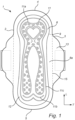
- Figure 1 is a top plan view of a sanitary article 1 having longitudinal side edges 2,3 extending in a longitudinal direction L and transverse front and rear end edges 4,5 extending in a transverse direction T.
- the sanitary article 1 comprising a fluid permeable surface layer 8 and a backsheet 9.
- the surface layer is an air through bonded fibrous nonwoven surface layer having a basis weight of from 14 to 30 g/m 2 and a density of from 20 to 90 kg/m 3 .
- the nonwoven layer comprises bicomponent fibers and may constitute of from 50% or more, such as 80% to 100% or from 95% or more, of bicomponent fibers.
- the bicomponent fibers may be sheath-core bicomponent fibers wherein the core is a polyester core and the sheath is a polyethylene sheath.
- the absorbent article 1 Under the surface layer 8 the absorbent article 1 is provided with a fibrous intermediate layer 10 (see Fig. 2 ).
- the intermediate layer 10 extends under 100% of the wearer-facing portion 8a of the surface layer 8, the border of the wearer-facing portion being indicated with a dotted line 15.
- the intermediate layer 10 and the surface layer 8 have a respective elongation at 10 N/50mm, wherein the elongation of the intermediate layer 10 is lower than the elongation of the surface layer 8.
- the fluid permeable surface layer 8 comprises an embossed pattern 11.
- the embossed pattern 11 comprises individual embossed elements 11a in the form of dots forming a pattern covering from 3 % to 20% of the wearer-facing portion of the surface layer 8.
- the surface layer 8 is provided with an embossed wing-shaped continuous line 11b and a continuous embossed line extends along a contour of the absorbent article 1 framing the embossed pattern 11.
- the absorbent article 1 in fig. 1 is a sanitary napkin provided with a pair of lateral wings 13 extending outward from the transversely opposite side edges 2,3 of the napkin.
- the wings are provided with attachment means, such as with an adhesive, on their garment facing surface so that the wings 13 can be folded back under the undergarment and attached to the undergarment. In this way, the wings 13 serve to keep the napkin 1 properly positioned in the undergarment.
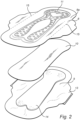
- Fig. 2 is an exploded view of the sanitary napkin 1 shown in Fig. 2 and illustrates the sanitary napkin 1 with the individual layers of the sanitary napkin 1 separated.
- the sanitary napkin 1 comprises the fluid permeable surface layer 8 and the backsheet 9.
- the intermediate fibrous layer 10 is located between the surface layer 8 and the backsheet 9 and is in direct contact with the surface layer 8.
- the intermediate layer 10 and the surface layer 8 has a respective elongation at 10 N/50mm.
- the elongation at 10 N/50mm of the intermediate layer 10 is lower than the elongation at 10 N/50mm of the surface layer 8.
- the intermediate layer is provided under about 100% of the total surface area of the wearer-facing portion 8a of the surface layer 8 and is adhesively attached to the surface layer 8.
- An absorbent core 14 is arranged between the intermediate layer 10 and the backsheet 9.
- the backsheet may be a breathable or non-breathable plastic film.
- the plastic film may be of polyolefine.
- the backsheet may be a laminate of a breathable or non-breathable plastic film and a nonwoven material.
- the absorbent core may be of any conventional kind.
- Examples of commonly occurring absorbent materials are cellulosic fluff pulp, tissue layers, highly absorbent polymers (so called superabsorbents), absorbent foam materials, absorbent nonwoven materials or the like. It is common to combine cellulosic fluff pulp with superabsorbents in an absorbent structure. It is also common to have absorbent structures comprising layers of different material with different properties with respect to liquid acquisition capacity, liquid distribution capacity and storage capacity. This is well-known to the person skilled in the art and does therefore not have to be described in detail.
- the thin absorbent bodies which are common in today's sanitary articles, often comprise a compressed mixed or layered structure of cellulosic fluff pulp and superabsorbent. The size and absorbent capacity of the absorbent structure may be varied to be suited for different uses such as sanitary articles, pantyliners, adult incontinence pads and diapers, baby diapers, pant diapers, etc.
- the intermediate layer may be a nonwoven layer, for example a laminate of two or more nonwoven materials.
- the intermediate layer may be composed of for example airlaid nonwoven, spunlace nonwoven, carded air-through bonded nonwoven, high loft nonwoven or foam materials.
- the nonwoven material may be hydrophilic.
- a hydrophilic material may be obtained by adding a surfactant.
- An air laid nonwoven can be produced with fluff, wood pulp, and here the fluff fibres are dispersed into a fast-moving air stream and condensed onto a moving screen by means of pressure and vacuum.
- the web can be bonded with resin and/or thermal plastic resin dispersed within the pulp.
- the web can be thermobonded (by heat), latex bonded (with adhesive) or multibonded (a combination of thermo and latex bonding) or mechanically bonded (high compression and temperature, bonding by hydrogen).
- the grammage of the airlaid nonwoven can suitably be from 50 to 100 gsm.
- the grammage of the carded air-through bonded nonwoven can suitably be from 40 to 100 gsm.
- High loft is a nonwoven material and may be substantially free from absorbing fibres and superabsorbent material.
- the high loft nonwoven material may comprise thermoplastic polymer fibres, and may be selected from but not limited to, polyesters, polyamides and polyolefins such as polyethylenes (PE) and polypropylenes (PP), and may be a mixture of any of these.
- the "high loft” refers to low density bulky fabrics, as compared to flat, paper-like fabrics. High loft webs are characterized by a relatively low density. This means that there is a relatively high amount of void space between the fibres.
- the high loft nonwoven fibrous layer of the invention may typically have a density below 0.200 g/cc (200 kg/m 3 ), in particular ranging from 0.015 g/cc to 0.150 g/cc (15 kg/m 3 to 150 kg/m 3 ), in particular from 0.030 g/cc to 0.100 g/cc (30 to 100 kg/m 3 ), for example 0.065 g/cc (65 kg/m 3 ).
- the average density can be calculated by dividing the basis weight of the high loft layer by its thickness measured at a pressure of 0.5 kPa.
- the thickness of high loft materials is more than about 0.5 mm, such as more than 1 mm or suitably 1.5 - 2.0 mm, and the solid content is low, usually less than 15 % by volume.
- the high loft nonwoven layer may advantageously be a spunmelt nonwoven. Spunmelt is a generic term describing the manufacturing of nonwoven webs directly from thermoplastic polymersThe high loft nonwoven layer may in particular have a thickness ranging from 0.30 mm to 2.00 mm, for example 1.0 mm as measured at a pressure of 0.5 kPa.
- the intermediate layer may comprise or constitute of a spunlace nonwoven material.
- a spunlace nonwoven product is derived from a process of entangling a web of loose fibres through multiple rows of jets of water at high pressure; this process entangles the fabrics and interlinks the fibres.
- the raw material for the acquisition sheet can be polypropylene (PP), polyethylene (PE) polyester (PET), polyamide (PA), cellulosic fibres or a combination of these and different weights and compositions are possible, such as viscose, polyester, cotton, nylon and microfibre.
- PP polypropylene
- PE polyethylene
- PET PET
- PA polyamide
- PP/PE bi-component fibres or PP/PE copolymers e.g. PP/PE bi-component fibres or PP/PE copolymers.
- the grammage of the spunlace nonwoven material can be typically from 40-90 gsm.
- the surface layer and the intermediate layer may be adhesively attached to each other. This may increase the integrity of the surface layer.
- the air-through-bonded fibrous nonwoven surface layer When combining the air-through-bonded fibrous nonwoven surface layer with an intermediate layer having a lower elongation than the air-through-bonded fibrous nonwoven, the air-through-bonded fibrous nonwoven surface layer integrity is increased. Both during use of the absorbent product as well as during manufacturing it is advantageous that a structure(s) has a sufficient integrity.
- thermo- and or mechanical welding for example by ultrasonic welding.
- FIG 3 shows the friction curves for test sample, CEx 1 and CEx2.
- FIG 4 is the number of runs on the x-axis and the friction force in gmf on the y-axis.
- a friction curve comprises a first slope having a positive coefficient illustrating increase in the friction values, a plateau, and a second slope having a negative coefficient illustrating decrease in friction values.
- the friction values are substantially constant over the extension of the plateau. Small variations at the plateau as well as along the slopes are possible between individual values, but with a positive coefficient is meant that all individual values in the first slope together creates a positive coefficient, as well as all individual values in the second slope together creates a negative coefficient, as well as all individual values in the plateau together creates a plateau.
- the density is calculated by dividing the basis weight of the fibrous nonwoven surface layer by its thickness measured at a pressure of 0.5 kPa.
- the thickness is determined by means of a measuring foot with affixed load of 0.5 k Pa having a foot area of 50x50 mm 2 .
- the thickness is read off at the digital thickness gauge/tester after 10 seconds when the measuring foot has touched the surface of the sample.
- Elongation is measured according to the EDANA/INDA standard procedure NWSP 110.4.R0 (15), method option B (dry testing). The test is performed on a conventional tensile tester (constant rate of extension), available from the Instron or Lloyd corporations. Samples having the width 50 mm and the length of at least 200 mm are punched out from the material. The machine direction (MD) is in the same direction as the length of the sample. The material is extended in the machine direction in a rate of 100 mm/min. When a load of 10 Newtons has been obtained, the extension of the material is read.
- the initial spreading for a surface layer material according to the present disclosure was compared with a conventional spunbond surface layer 20 g/m 2 .
- the method used was the FLOW method and a sanitary napkin according to the present invention and comprising an air through bonded nonwoven 20 g/m 2 from TWE, loft 286, as surface layer and combined with an intermediate layer in the form of an airlaid nonwoven material 65-70 g/m 2 , was compared with a sanitary napkin comprising a surface layer of a spunbonded nonwoven material combined with an intermediate layer in the form of an airlaid nonwoven material 65-70 g/m 2 .
- Each of the test articles included a pulp core and a liquid impermeable polyolefin plastic film backsheet.
- the test samples are conditioned in 24 ⁇ 4h at 50 ⁇ 10% r.h. and 23 ⁇ 1 °C.
- the number of samples for each test type is 6.
- the samples are placed on a Plexiglas table with an angle of 25°.
- test liquid synthetic menstrual fluid
- test liquid is added in a dose 1, 2 and 3 with an interval of 15 seconds and with a flow speed of 20/min.
- the spreading length (mm) of the liquid was measured for each of the materials and is shown in the Table 1 below.
- Table 1 Test sample Air through bonded nonwoven (TWE) CEx 2, Spunbond nonwoven (Union) Dose 1 51 mm 71 mm Dose 2 74 mm 88 mm Dose 3 94 mm 113 mm
- a fluid permeable surface layer according to claim 1 has a wet friction reducing property. Friction occurring between a nonwoven material and the skin of the user is different in the presence of liquid/moisture than when no liquid/moisture is present. Even a very small amount of moisture present originating from perspiration, sweat or other body fluids has an impact on the friction forces occurred between the nonwoven material and the skin of the user. It has therefore been discovered that it is important to carefully choose the nonwoven characteristics, so that the nonwoven is able to minimize the mechanical discomfort during the overall use of the product.
- the method used is called Stick and slip measurement method for measuring the wet friction and the method measures the static friction, sns value (stick and slip value) in gram force, gmf, between a material and the human skin.
- the test material is an air-through-bonded nonwoven according to the present disclosure comprising bicomponent fibers of core-sheath type with a polyester core and a polyethylene sheath.
- the first Comparative Example is a spunbond nonwoven with polypropylene fibers and the second Comparative Example is spunbond nonwoven with polypropylene fibers.
- Table 2 below provides specifications of the materials tested.
- Table 2 Material Type Supplier Material no Basis weight (gsm) Test sample Air-though bonded nw TWE 255272 20 CEx 1 Spunbond nonwoven Texbond 2436701 18 CEx 2 Spunbond nonwoven Union 272119 18
- Figure 3 shows the friction curves for test sample, CEx 1 and CEx2.
- figure 4 is the number of runs on the x-axis and the friction force in gmf on the y-axis and the result shows that the friction curve for the test sample, the air-through-bonded nonwoven surface material, has a lower mean friction plateau value (gmf) than the friction curves for CEx 1 and CEx.
Landscapes
- Health & Medical Sciences (AREA)
- Epidemiology (AREA)
- Engineering & Computer Science (AREA)
- Biomedical Technology (AREA)
- Heart & Thoracic Surgery (AREA)
- Vascular Medicine (AREA)
- Life Sciences & Earth Sciences (AREA)
- Animal Behavior & Ethology (AREA)
- General Health & Medical Sciences (AREA)
- Public Health (AREA)
- Veterinary Medicine (AREA)
- Absorbent Articles And Supports Therefor (AREA)
- Nonwoven Fabrics (AREA)
Description
- The present invention relates to an absorbent article. The present invention in particular relates to an absorbent article having a low-friction surface layer.
- Absorbent articles of the kind to which this disclosure relates are worn against the skin and include a topsheet, an absorbent core and a backsheet layer. All uses of products which are applied in direct contact with the skin may lead to unwanted side-effects. These may occur as a result of occlusion, moisture and mechanical factors, such as friction, between the skin and the absorbent article. These factors which all, to different degrees, interact and amplify the influence of each other and may cause different forms of skin irritation to users of said articles. Skin problems can be caused by forces arising from physical/mechanical interaction between the product and the user's skin. Thus, for example chafing is caused due to extra friction between the absorbent article and the skin of the user.
- During frequent use of disposable absorbent articles, the skin can become irritated, appear red, and be sore to the touch. Creams, lotions, or ointments can be used to provide an artificial hydrophobic barrier on the skin and to treat skin conditions such as diaper rash. However, the use of such hydrophobic compositions has a negative impact on the absorbency performance of the articles.
-
US 2016/220421 A1 discloses an absorbent article. To provide excellent skin touch feeling, a compression resistant and durable concavo-convex shape providing an uneven feeling, and excellent absorption performance, a sanitary napkin is provided that includes an absorber interposed between a permeable front surface sheet embossed into a concavo-convex shape and a back surface sheet and a hydrophilic third sheet disposed between the permeable front surface sheet and the absorber. The permeable front surface sheet is a laminate structure that includes a fine fiber skin contact surface layer made of fine fibers having a fineness of less than 2.0 dtex and a crimped fiber layer laminated on the non-skin contact surface of the fine fiber layer and the crimped fibers have a fineness of from 3.0 to 5.0 dtex. -
EP 1 290 995 A2 -
JP H04 53554 A -
WO 2010/074208 A1 discloses a non-woven fabric which comprises composite fibers each comprising a first component and a second component having different melting points from each other, and which has, formed therein, many thermally fused points produced by thermally fusing the intersection points of the composite fibers. When the state of the non-woven fabric is changed from dried state to wet state, the percentage of change in thickness of the non-woven fabric is 15% or more. In a non-woven fabric which is an embodiment of the non-woven fabric, the composite fibers is fibers each comprising a polypropylene resin or a polyethylene terephthalate resin as the first component and a resin having a lower melting point from that of the first component as the second component and has a Young's modulus of 0.2 to 1.0 GPa. -
WO 2011/155284 A1 discloses a sanitary napkin comprising a topsheet, a backsheet, an absorbent, and a second sheet, the absorbent and the second sheet being disposed between the topsheet and backsheet. The topsheet and the second sheet have been partly bonded to each other. The topsheet has regions separated by linear grooves formed by embossing, and is a sheet that satisfies a given requirement in an examination for pore diameter distribution with a mercury porosimeter. The second sheet is constituted of synthetic fibers and is a sheet having a thickness and a liquid-holding capacity that satisfy respective given requirements. -
US 2003/187417 A1 discloses an absorbent article including a liquid-permeable top layer, a backsheet, and an absorbent layer disposed between the top layer and the backsheet. Fibers constituting the absorbent layer are bonded together. The absorbent layer includes hydrophilic fibers. The top layer and the absorbent layer are embossed together to have recesses in which fibers constituting the absorbent layer are bonded to the top layer. - It is an object of the present invention to provide an absorbent article having improved skin benefits, over the entire period of use.
- One or more of the above objects may be achieved with an absorbent article in accordance with
claim 1. Further embodiments are set out in the dependent claims, in the following description and in the drawings. - The absorbent article as disclosed herein has longitudinal side edges extending in a longitudinal direction and transverse front and rear end edges extending in a transverse direction. The absorbent article comprises a fluid permeable surface layer, a backsheet and an intermediate layer located between the fluid permeable surface layer and the backsheet. The surface layer has a wearer-facing portion facing the user during use. The surface layer is an air through bonded fibrous nonwoven surface layer that may have a basis weight of from 14 to 30 g/m2 and a density of from 20 to 90 kg/m3. The intermediate layer may extend under from 70 to 100% of the wearer-facing portion of the surface layer. The intermediate layer and the surface layer may have a respective elongation at 10 N/50mm, wherein the elongation at 10 N/50mm of the intermediate layer is lower than the elongation at 10 N/50mm of the surface layer. The elongation is measured according to the test method NWSP 110.4.RO (15). The elongation is measured in the machine direction of the material.
- The intermediate layer may also cover from 50 to 100% of the wearer-facing portion of the surface layer.
- The absorbent article may comprise wings or flaps provided with attachment means, such as adhesive. The wearer-facing portion of the surface layer means the portion of the surface layer facing the user during use and is not intended to include wings or flap as these are not intended to face the user during use.
- The term "absorbent articles" refers to products that are placed against the skin of the wearer to absorb and contain body exudates, like urine, faeces and menstrual fluid. The disclosure mainly refers to disposable absorbent articles, which means articles that are not intended to be laundered or otherwise restored or reused as an absorbent article. Examples of disposable absorbent articles include feminine hygiene products such as sanitary napkins and panty liners, incontinence pads and diapers and the like.
- The air through bonded fibrous nonwoven surface layer having a basis weight of from 14 to 30 g/m2 and a density of from 20 to 90 kg/m3 has been found to provide the surface layer with surprisingly low friction values against the skin both under dry and wet conditions. A low friction between the wearer-facing surface layer and the skin decreases the risk for chafing of the skin against the napkin which otherwise may lead to skin irritation and itchiness.
- The air through bonded fibrous nonwoven surface layer additionally provides the absorbent article with a rapid inlet with a reduced liquid spreading surface, keeping the skin dryer and reducing the wet friction.
- Air through bonded fibrous nonwoven are known for use in absorbent articles as intermediate layers, such as acquisition layers, due to its bulky and airy structure. However, the material has been found by the present inventors to provide surprisingly low friction values when used as a surface layer in an absorbent article. However, the fact that the material has a low-density structure with relatively low amount of bonding points between the fibers gives a structure with lower integrity. Surface layer materials for absorbent articles are exerted to stretching and rubbing against the skin during use, to use a material with a lower integrity may risk the integrity of the material during use. To have a certain integrity is also important during the manufacturing of the absorbent articles and when combining the air through bonded fibrous nonwoven surface layer with an intermediate layer having a lower elongation than the air through bonded fibrous nonwoven, the air through bonded fibrous nonwoven surface layer integrity is increased.
- The air through bonded fibrous nonwoven surface layer and the intermediate layer are attached to each other. This may increase the integrity of the surface layer. The air through bonded fibrous nonwoven surface layer and the intermediate layer are attached to each other by adhesive, by thermo welding, mechanical welding or a combination thereof.
- The elongation of the intermediate layer may be at least 5% lower or at least 20% lower than the elongation of the surface layer, or at least 50% lower than the elongation of the surface layer. The elongation of the intermediate layer may be from 5% to 80 % lower, or 20% to 80% lower than the elongation of the surface layer. This provides for an improved integrity for the air through bonded fibrous nonwoven and a low-friction surface layer for the absorbent article.
- In the through-air bonding process, hot air is passed through the fibrous web to heat and melt polymer fibers. Molten polymer subsequently flows to the point of contact between any two fibers to produce a bond. The fibers in the nonwoven surface layer are thermoplastic polymeric fibers. One reason behind the surprisingly low friction of the material may be that the through-air bonding process enables a reduced number if binding points between the fibers.
- The air through bonded fibrous nonwoven may comprise bicomponent fibers. At least 50%, or at least 80% of the fibers in the air through bonded fibrous nonwoven may be bicomponent fibers, such as from 50% to 95% of the fibers may be bicomponent fibers. Optionally all the fibers in the air through bonded fibrous nonwoven may be bicomponent fibers.
- The bi-component fibers may be sheath-core bicomponent fibers, wherein the sheath may be of polyethylene or polypropylene. The core in the sheath-core bicomponent fibers may be of polyester. Such fibers have been found to provide nonwoven material with high resiliency and recovery. The bicomponent fibers may be sheath-core bicomponent fibers wherein the core is a polyester core and the sheath is a polyethylene sheath. Bicomponent fibers wherein the core is a polyester core and the sheath is a polyethylene sheath have been found to provide resilient structures with low friction and high drapability. A resilient structure gives the air through bonded fibrous nonwoven high bulk which improves the liquid absorption into the fabric.
- The intermediate layer may be airlaid nonwoven, high loft nonwoven such as for example air-through bonded nonwoven or hydroentangled nonwoven. The intermediate layer may have a basis weight of from 30 to 120 gsm or 30 to 80 gsm, or 40 to 80 gsm.
- The intermediate layer may be a laminate, such as a laminate of two or more nonwoven materials.
- The fibers of the air through bonded nonwoven may have a coarseness of from 1.8 to 10 dTex, or 2 to 7 dTex. Such fibers may provide a reduced friction also when only a very small amount of moisture is present originating from for example perspiration.
- The intermediate layer may cover from 80% to 100% of the wearer-facing portion of the surface layer, such as from 95% to 100% of the wearer-facing portion of the surface layer. If the absorbent article does not contain any wings, the intermediate layer may extend under from 85% to 100% of the total surface area of the surface layer.
- The surface layer and the intermediate layer are adhesively attached to each other, or attached to each other by thermo -or mechanical welding, such as for example ultra sonic welding or a combination thereof.
- If the surface layer and the intermediate layer is adhesively attached to each other over an evenly spread adhesive area corresponding to 50% or more of the surface area of the intermediate layer. An adhesive layer may for example be provided by spraying or by slot coating.
- If the surface layer and the intermediate layer is attached to each other by thermo- or mechanical welding, such as for example ultra sonic welding the laminated area may correspond to 10% or more, or 15% or more of the surface area of the intermediate layer, such as for example 10% to 50% of the surface area of the intermediate layer.
- The surface layer may be attached to the backsheet along the longitudinal side edges and along the transverse end edges in a border attachment portion and wherein the intermediate layer extends between the surface layer and the backsheet in the border attachment portion.
- The surface layer may be embossed with an embossing pattern. The embossing pattern may cover from 3% to 20% of the wearer-facing portion of the surface layer. This has been found to provide a soft and compliant surface sheet with a good visibility of the embossed elements.
- The surface layer may be free from lotions and/or lubricating agents. As the surface layer in it-self has been found to provide the surface layer with surprisingly low friction values both under dry and wet conditions, lotions and lubricant agents may not be needed to decrease the friction between the nonwoven and the user's skin.
- The present invention will be further explained hereinafter by means of non-limiting examples and with reference to the appended drawings wherein:
- Fig. 1
- shows a top plan view of a sanitary napkin as disclosed herein and as seen from a topsheet side; and
- Fig. 2
- shows an exploded perspective view the sanitary napkin of
Fig. 1 . - Fig 3
- shows friction measurement result on surface materials
- The invention will be described more closely below by reference to an exemplary embodiment. The invention may however be embodied in many different forms and should not be construed as limited to the embodiments set forth in the drawings and the description thereto.
-
Figure 1 is a top plan view of asanitary article 1 having longitudinal side edges 2,3 extending in a longitudinal direction L and transverse front and rear end edges 4,5 extending in a transverse direction T. Thesanitary article 1 comprising a fluidpermeable surface layer 8 and abacksheet 9. The surface layer is an air through bonded fibrous nonwoven surface layer having a basis weight of from 14 to 30 g/m2 and a density of from 20 to 90 kg/m3. The nonwoven layer comprises bicomponent fibers and may constitute of from 50% or more, such as 80% to 100% or from 95% or more, of bicomponent fibers. The bicomponent fibers may be sheath-core bicomponent fibers wherein the core is a polyester core and the sheath is a polyethylene sheath. Under thesurface layer 8 theabsorbent article 1 is provided with a fibrous intermediate layer 10 (seeFig. 2 ). Theintermediate layer 10 extends under 100% of the wearer-facingportion 8a of thesurface layer 8, the border of the wearer-facing portion being indicated with a dottedline 15. Theintermediate layer 10 and thesurface layer 8 have a respective elongation at 10 N/50mm, wherein the elongation of theintermediate layer 10 is lower than the elongation of thesurface layer 8. - The fluid
permeable surface layer 8 comprises anembossed pattern 11. Theembossed pattern 11 comprises individualembossed elements 11a in the form of dots forming a pattern covering from 3 % to 20% of the wearer-facing portion of thesurface layer 8. At arear end 12 of theabsorbent article 1, thesurface layer 8 is provided with an embossed wing-shapedcontinuous line 11b and a continuous embossed line extends along a contour of theabsorbent article 1 framing theembossed pattern 11. - The
absorbent article 1 infig. 1 is a sanitary napkin provided with a pair oflateral wings 13 extending outward from the transversely opposite side edges 2,3 of the napkin. The wings are provided with attachment means, such as with an adhesive, on their garment facing surface so that thewings 13 can be folded back under the undergarment and attached to the undergarment. In this way, thewings 13 serve to keep thenapkin 1 properly positioned in the undergarment. -
Fig. 2 is an exploded view of thesanitary napkin 1 shown inFig. 2 and illustrates thesanitary napkin 1 with the individual layers of thesanitary napkin 1 separated. Thesanitary napkin 1 comprises the fluidpermeable surface layer 8 and thebacksheet 9. Theintermediate fibrous layer 10 is located between thesurface layer 8 and thebacksheet 9 and is in direct contact with thesurface layer 8. Theintermediate layer 10 and thesurface layer 8 has a respective elongation at 10 N/50mm. The elongation at 10 N/50mm of theintermediate layer 10 is lower than the elongation at 10 N/50mm of thesurface layer 8. In this figure the intermediate layer is provided under about 100% of the total surface area of the wearer-facingportion 8a of thesurface layer 8 and is adhesively attached to thesurface layer 8. Anabsorbent core 14 is arranged between theintermediate layer 10 and thebacksheet 9. - The backsheet may be a breathable or non-breathable plastic film. The plastic film may be of polyolefine. The backsheet may be a laminate of a breathable or non-breathable plastic film and a nonwoven material.
- The absorbent core may be of any conventional kind. Examples of commonly occurring absorbent materials are cellulosic fluff pulp, tissue layers, highly absorbent polymers (so called superabsorbents), absorbent foam materials, absorbent nonwoven materials or the like. It is common to combine cellulosic fluff pulp with superabsorbents in an absorbent structure. It is also common to have absorbent structures comprising layers of different material with different properties with respect to liquid acquisition capacity, liquid distribution capacity and storage capacity. This is well-known to the person skilled in the art and does therefore not have to be described in detail. The thin absorbent bodies, which are common in today's sanitary articles, often comprise a compressed mixed or layered structure of cellulosic fluff pulp and superabsorbent. The size and absorbent capacity of the absorbent structure may be varied to be suited for different uses such as sanitary articles, pantyliners, adult incontinence pads and diapers, baby diapers, pant diapers, etc.
- The intermediate layer may be a nonwoven layer, for example a laminate of two or more nonwoven materials. The intermediate layer may be composed of for example airlaid nonwoven, spunlace nonwoven, carded air-through bonded nonwoven, high loft nonwoven or foam materials. The nonwoven material may be hydrophilic. A hydrophilic material may be obtained by adding a surfactant. An air laid nonwoven can be produced with fluff, wood pulp, and here the fluff fibres are dispersed into a fast-moving air stream and condensed onto a moving screen by means of pressure and vacuum. The web can be bonded with resin and/or thermal plastic resin dispersed within the pulp. The web can be thermobonded (by heat), latex bonded (with adhesive) or multibonded (a combination of thermo and latex bonding) or mechanically bonded (high compression and temperature, bonding by hydrogen). The grammage of the airlaid nonwoven can suitably be from 50 to 100 gsm. The grammage of the carded air-through bonded nonwoven can suitably be from 40 to 100 gsm.
- High loft is a nonwoven material and may be substantially free from absorbing fibres and superabsorbent material. The high loft nonwoven material may comprise thermoplastic polymer fibres, and may be selected from but not limited to, polyesters, polyamides and polyolefins such as polyethylenes (PE) and polypropylenes (PP), and may be a mixture of any of these. The "high loft" refers to low density bulky fabrics, as compared to flat, paper-like fabrics. High loft webs are characterized by a relatively low density. This means that there is a relatively high amount of void space between the fibres. The high loft nonwoven fibrous layer of the invention may typically have a density below 0.200 g/cc (200 kg/m3), in particular ranging from 0.015 g/cc to 0.150 g/cc (15 kg/m3 to 150 kg/m3), in particular from 0.030 g/cc to 0.100 g/cc (30 to 100 kg/m3), for example 0.065 g/cc (65 kg/m3). The average density can be calculated by dividing the basis weight of the high loft layer by its thickness measured at a pressure of 0.5 kPa. Normally the thickness of high loft materials is more than about 0.5 mm, such as more than 1 mm or suitably 1.5 - 2.0 mm, and the solid content is low, usually less than 15 % by volume. The high loft nonwoven layer may advantageously be a spunmelt nonwoven. Spunmelt is a generic term describing the manufacturing of nonwoven webs directly from thermoplastic polymersThe high loft nonwoven layer may in particular have a thickness ranging from 0.30 mm to 2.00 mm, for example 1.0 mm as measured at a pressure of 0.5 kPa.
- The intermediate layer may comprise or constitute of a spunlace nonwoven material. A spunlace nonwoven product is derived from a process of entangling a web of loose fibres through multiple rows of jets of water at high pressure; this process entangles the fabrics and interlinks the fibres.
- The raw material for the acquisition sheet can be polypropylene (PP), polyethylene (PE) polyester (PET), polyamide (PA), cellulosic fibres or a combination of these and different weights and compositions are possible, such as viscose, polyester, cotton, nylon and microfibre. Thus, if a combination of different fibres is used, this can be a mixture of fibres from different polymers, although each fibre can also include different polymers (e.g. PP/PE bi-component fibres or PP/PE copolymers). The grammage of the spunlace nonwoven material can be typically from 40-90 gsm.
- The surface layer and the intermediate layer may be adhesively attached to each other. This may increase the integrity of the surface layer. When combining the air-through-bonded fibrous nonwoven surface layer with an intermediate layer having a lower elongation than the air-through-bonded fibrous nonwoven, the air-through-bonded fibrous nonwoven surface layer integrity is increased. Both during use of the absorbent product as well as during manufacturing it is advantageous that a structure(s) has a sufficient integrity.
- Both during use of the absorbent product as well as during manufacturing it is advantageous that a structure(s) has a sufficient integrity.
- It is also possible to laminate the liquid surface material together with the intermediate layer through thermo- and or mechanical welding, for example by ultrasonic welding.
- In
Figure 3 shows the friction curves for test sample,CEx 1 and CEx2. In figure 4 is the number of runs on the x-axis and the friction force in gmf on the y-axis. A friction curve comprises a first slope having a positive coefficient illustrating increase in the friction values, a plateau, and a second slope having a negative coefficient illustrating decrease in friction values. At the plateau, the friction values are substantially constant over the extension of the plateau. Small variations at the plateau as well as along the slopes are possible between individual values, but with a positive coefficient is meant that all individual values in the first slope together creates a positive coefficient, as well as all individual values in the second slope together creates a negative coefficient, as well as all individual values in the plateau together creates a plateau. Lower friction values render the absorbent article more skin friendly and skin problems arising with the use of the absorbent article can be reduced. For some materials a clear peak can be seen in a curve of friction values before the second slope creating a negative coefficient. Such a peak is caused by clinging, which may occur when only a small amount of moisture is present. The result shows that the test sample, the air-through-bonded nonwoven surface material has a lower mean friction plateau value (gmf) thanCEx 1 andCEx 2. - The density is calculated by dividing the basis weight of the fibrous nonwoven surface layer by its thickness measured at a pressure of 0.5 kPa. The thickness is determined by means of a measuring foot with affixed load of 0.5 k Pa having a foot area of 50x50 mm2. The thickness is read off at the digital thickness gauge/tester after 10 seconds when the measuring foot has touched the surface of the sample.
- Elongation is measured according to the EDANA/INDA standard procedure NWSP 110.4.R0 (15), method option B (dry testing). The test is performed on a conventional tensile tester (constant rate of extension), available from the Instron or Lloyd corporations. Samples having the width 50 mm and the length of at least 200 mm are punched out from the material. The machine direction (MD) is in the same direction as the length of the sample. The material is extended in the machine direction in a rate of 100 mm/min. When a load of 10 Newtons has been obtained, the extension of the material is read.
- Five individual samples are tested, and the mean value is reported, which is the value of the elongation at 10N/50 mm.
- The initial spreading for a surface layer material according to the present disclosure was compared with a conventional spunbond surface layer 20 g/m2. The method used was the FLOW method and a sanitary napkin according to the present invention and comprising an air through bonded nonwoven 20 g/m2 from TWE, loft 286, as surface layer and combined with an intermediate layer in the form of an airlaid nonwoven material 65-70 g/m2, was compared with a sanitary napkin comprising a surface layer of a spunbonded nonwoven material combined with an intermediate layer in the form of an airlaid nonwoven material 65-70 g/m2. Each of the test articles included a pulp core and a liquid impermeable polyolefin plastic film backsheet. The test samples are conditioned in 24 ± 4h at 50 ± 10% r.h. and 23 ± 1 °C. The number of samples for each test type is 6. The samples are placed on a Plexiglas table with an angle of 25°.
- According to the FLOW method, 5 ml of test liquid, synthetic menstrual fluid, is added to the sanitary napkins provided with the respective materials as surface layers, the test liquid is added in a
dose Table 1 Test sample, Air through bonded nonwoven (TWE) CEx 2, Spunbond nonwoven (Union)Dose 151 mm 71 mm Dose 2 74 mm 88 mm Dose 3 94 mm 113 mm - As illustrated in table 1, the spreading length of the liquid and thereby the wetted surface area is lower for the surface material according to the present invention. Details for the materials tested is shown below in Table 2.
- A fluid permeable surface layer according to
claim 1 has a wet friction reducing property. Friction occurring between a nonwoven material and the skin of the user is different in the presence of liquid/moisture than when no liquid/moisture is present. Even a very small amount of moisture present originating from perspiration, sweat or other body fluids has an impact on the friction forces occurred between the nonwoven material and the skin of the user. It has therefore been discovered that it is important to carefully choose the nonwoven characteristics, so that the nonwoven is able to minimize the mechanical discomfort during the overall use of the product. The method used is called Stick and slip measurement method for measuring the wet friction and the method measures the static friction, sns value (stick and slip value) in gram force, gmf, between a material and the human skin. Repeatedly runs are made using the same material strip. First the sns value for the dry state (dry material and skin) is measured followed by wet state at different liquid levels (from completely wetted material, to moist and to almost dry) until the sns value is back to the skin-material interaction level measured in the first dry run, which mean that the material is dry again. The method is thus called a repeated stick and slip method or sns dry-wet-dry. The stick and slip value is defined as the point on the force curve (gmf) where the material starts gliding over the arm. The sns values from all single force curves are then put together in a new graph, sns values as a function of number of runs. - Three different nonwoven materials were tested and compared in terms of dry friction and wet friction. The test material is an air-through-bonded nonwoven according to the present disclosure comprising bicomponent fibers of core-sheath type with a polyester core and a polyethylene sheath. The first Comparative Example is a spunbond nonwoven with polypropylene fibers and the second Comparative Example is spunbond nonwoven with polypropylene fibers. Table 2 below provides specifications of the materials tested.
Table 2 Material Type Supplier Material no Basis weight (gsm) Test sample Air-though bonded nw TWE 255272 20 CEx 1Spunbond nonwoven Texbond 2436701 18 CEx 2Spunbond nonwoven Union 272119 18 - In table 3 below shows result of the mean friction plateau values measured in gmf. By gmf is meant gram-force and one gram-force is 9.80665 mN and the result shows that the test sample, the air-through-bonded nonwoven surface material has a lower mean friction plateau value (gmf) than
CEx 1 andCEx 2.Table 3 Material Mean friction plateau value, (gmf) Test sample 300 CEx 1480 CEx 2420 - Also in
Figure 3 shows the friction curves for test sample,CEx 1 and CEx2. In figure 4 is the number of runs on the x-axis and the friction force in gmf on the y-axis and the result shows that the friction curve for the test sample, the air-through-bonded nonwoven surface material, has a lower mean friction plateau value (gmf) than the friction curves forCEx 1 and CEx.
Claims (13)
- An absorbent article (1) having longitudinal side edges (2,3) extending in a longitudinal direction (L) and transverse end edges (4,5), and comprising a fluid permeable surface layer (8), a backsheet (9) and an intermediate layer (10) being located between said surface layer (8) and said backsheet (9), the fluid permeable surface layer (8) having a wearer-facing portion (8a) facing the user during use of said article (1), characterized in that said surface layer (8) is an air through bonded fibrous nonwoven surface layer comprising synthetic fibers and having a basis weight of from 14 to 30 g/m2 and a density of from 20 to 90 kg/m3, the density being calculated by dividing the basis weight of the fibrous nonwoven surface layer by its thickness measured at a pressure of 0.5 kPa, and in that said intermediate layer (10) is provided under from 70% to 100% of a total surface area of the wearer-facing portion (8a) of the surface layer (8), wherein said intermediate layer (10) and said surface layer (8) has a respective elongation at 10 N/50mm, wherein said elongation of said intermediate layer (10) is lower than said elongation of said surface layer (8), wherein the surface layer is laminated to the intermediate layer and the lamination is made by adhesive, thermo or mechanical welding, such as for example ultra sonic welding, or a combination thereof.
- The absorbent article (1) according to claim 1, wherein said surface layer of air through bonded fibrous nonwoven comprises bicomponent fibers.
- The absorbent article (1) according to claim 2, wherein said bi-component fibers are sheath-core bicomponent fibers, wherein said sheath is a polyethylene sheath.
- The absorbent article (1) according to claim 3, wherein said bi-component fibers are sheath-core bicomponent fibers, preferably wherein said core is a polyester core and said sheath is a polyethylene sheath.
- The absorbent article (1) according to any one of the preceding claims, wherein said elongation of said intermediate layer (10) is at least 5% or at least 20% lower than said elongation of said surface layer (8).
- The absorbent article (1) according to any one of the preceding claims, wherein said intermediate layer (10) has a basis weight higher than the basis weight of the surface layer (8).
- The absorbent article (1) according to any one of the preceding claims, wherein said intermediate layer (10) is a nonwoven material.
- The absorbent article (1) according to any one of the preceding claims, wherein said fibers of said air through bonded nonwoven have a coarseness of from 1.8 to 10 dTex, or 2 to 7 dTex.
- The absorbent article (1) according to any one of the preceding claims, wherein said intermediate layer (10) extends under from 70% to 100% of said surface layer (8).
- The absorbent article (1) according to any one of the preceding claims, wherein said surface layer (8) and said intermediate layer (10) are adhesively attached to each other.
- The absorbent article (1) according to any one of the preceding claims, wherein said surface layer (8) is attached to said backsheet (9) along said longitudinal side edges (2,3) and along said transverse end edges (4,5) in a border attachment portion and wherein said intermediate layer (10) extends between said surface layer (8) and said backsheet (9) in said border attachment portion.
- The absorbent article (1) according to any one of the preceding claims, wherein said backsheet (9) has a garment facing side and wherein an adhesive is arranged on said garment facing side.
- The absorbent article (1) according to any one of the preceding claims, wherein at least said surface layer (8) is embossed with an embossing pattern.
Applications Claiming Priority (1)
| Application Number | Priority Date | Filing Date | Title |
|---|---|---|---|
| PCT/SE2019/050130 WO2020167171A1 (en) | 2019-02-15 | 2019-02-15 | Absorbent article |
Publications (3)
| Publication Number | Publication Date |
|---|---|
| EP3923890A1 EP3923890A1 (en) | 2021-12-22 |
| EP3923890A4 EP3923890A4 (en) | 2022-09-07 |
| EP3923890B1 true EP3923890B1 (en) | 2025-04-02 |
Family
ID=72044967
Family Applications (1)
| Application Number | Title | Priority Date | Filing Date |
|---|---|---|---|
| EP19915083.0A Active EP3923890B1 (en) | 2019-02-15 | 2019-02-15 | Absorbent article |
Country Status (10)
| Country | Link |
|---|---|
| US (1) | US12569377B2 (en) |
| EP (1) | EP3923890B1 (en) |
| CN (2) | CN113260343A (en) |
| AR (1) | AR118093A1 (en) |
| AU (1) | AU2019429634B2 (en) |
| CO (1) | CO2021010210A2 (en) |
| EC (1) | ECSP21067607A (en) |
| MX (1) | MX2021009794A (en) |
| MY (1) | MY208644A (en) |
| WO (1) | WO2020167171A1 (en) |
Families Citing this family (3)
| Publication number | Priority date | Publication date | Assignee | Title |
|---|---|---|---|---|
| EP3923890B1 (en) | 2019-02-15 | 2025-04-02 | Essity Hygiene and Health Aktiebolag | Absorbent article |
| USD1092727S1 (en) * | 2021-06-21 | 2025-09-09 | Essity Hygiene And Health Aktiebolag | Sanitary napkin |
| USD1051370S1 (en) * | 2022-07-11 | 2024-11-12 | Essity Hygiene And Health Aktiebolag | Sanitary towel |
Citations (19)
| Publication number | Priority date | Publication date | Assignee | Title |
|---|---|---|---|---|
| DE3145398A1 (en) | 1980-11-17 | 1982-09-16 | Johnson & Johnson Baby Products Co., 08903 New Brunswick, N.J. | MATERIAL FOR ABSORBING BODY LIQUIDS |
| JPH0453554A (en) | 1990-06-22 | 1992-02-21 | Kao Corp | Surface material of absorptive article |
| EP0359501B1 (en) | 1988-09-12 | 1994-12-07 | JOHNSON & JOHNSON INC. | Unitized sanitary napkin |
| EP1035818B1 (en) | 1997-12-03 | 2002-04-10 | SCA Hygiene Products AB | Absorbent article |
| DE69215465T3 (en) | 1991-09-11 | 2002-10-02 | Kimberly-Clark Worldwide, Inc. | Absorbent object |
| US20020143312A1 (en) | 2001-04-03 | 2002-10-03 | Graeme Robert J. | Discrete absorbent article |
| EP1290995A2 (en) | 2001-09-11 | 2003-03-12 | Uni-Charm Corporation | Absorbent article |
| DE60019856T2 (en) | 1999-08-16 | 2006-01-26 | Johnson & Johnson Inc., Montreal | Compression resistant sanitary napkin |
| US7267860B2 (en) | 2002-11-19 | 2007-09-11 | Kao Corporation | Topsheet of absorbent article |
| DE60312404T2 (en) | 2002-01-16 | 2007-11-29 | Kao Corp. | Absorbent article |
| WO2011155284A1 (en) | 2010-06-10 | 2011-12-15 | 花王株式会社 | Absorbent article |
| WO2012176656A1 (en) | 2011-06-23 | 2012-12-27 | 花王株式会社 | Absorbent article |
| US20160220421A1 (en) | 2013-09-30 | 2016-08-04 | Daio Paper Corporation | Absorbent article |
| JP2017029494A (en) | 2015-08-04 | 2017-02-09 | 花王株式会社 | Absorbent article |
| DE102015010105A1 (en) | 2015-08-03 | 2017-02-09 | Sandler Ag | A stretchable nonwoven fabric, process for making a stretchable nonwoven fabric and use thereof |
| US9566761B2 (en) | 2011-09-30 | 2017-02-14 | Unicharm Corporation | Layered nonwoven fabric, and method for producing layered nonwoven fabric |
| EP3238680A1 (en) | 2016-04-28 | 2017-11-01 | Sandler AG | Fluid retention and distribution fabric for hygiene articles |
| WO2018226131A1 (en) | 2017-06-09 | 2018-12-13 | Essity Hygiene And Health Aktiebolag | Disposable hygiene article with improved fit |
| AU2015412559B2 (en) | 2015-10-20 | 2019-02-14 | Essity Hygiene And Health Aktiebolag | Absorbent article, absorbent core and method for manufacturing said absorbent article |
Family Cites Families (83)
| Publication number | Priority date | Publication date | Assignee | Title |
|---|---|---|---|---|
| US3315677A (en) | 1964-01-29 | 1967-04-25 | Tyrrell Ind Inc | Disposable shield having transfer tape along side edges |
| US3512530A (en) | 1967-10-16 | 1970-05-19 | Jones Sr John L | Multiple ply sanitary napkin with regenerated cellulose sponge |
| US3595237A (en) | 1969-10-06 | 1971-07-27 | Personal Products Co | Adhesive attachment of removable protective liners for nether garments |
| US3643662A (en) | 1969-11-04 | 1972-02-22 | Personal Products Co | Removable protective liner for nether garments |
| ZA805309B (en) | 1979-08-29 | 1981-08-26 | Smith & Nephew Ass | Protective devices and methods |
| EP0171806A3 (en) | 1984-08-16 | 1987-06-16 | Chicopee | An entangled nonwoven fabric including bicomponent fibers and the method of making same |
| GB2171016B (en) | 1985-02-15 | 1989-02-01 | Kao Corp | Absorbent article |
| US4690680A (en) | 1986-06-27 | 1987-09-01 | The Procter & Gamble Company | Adhesive attachment means for absorbent articles |
| EP0304617B1 (en) | 1987-07-30 | 1995-01-11 | Kao Corporation | Sanitary article |
| US5009651A (en) | 1988-09-06 | 1991-04-23 | Kao Corporation | Surface material for sanitary articles and its preparing method |
| JP2765910B2 (en) | 1989-01-30 | 1998-06-18 | 株式会社日立製作所 | Rotating head device and magnetic recording / reproducing device using the same |
| EP0705585A1 (en) | 1994-10-07 | 1996-04-10 | The Procter & Gamble Company | Flexible absorbent articles and their fixation to undergarments |
| USH1602H (en) | 1995-03-31 | 1996-10-01 | Brock; Cheryl K. | Self-adhering disposable absorbent article |
| SE508206C2 (en) | 1995-09-06 | 1998-09-14 | Moelnlycke Ab | Absorbent articles for absorbing body fluids |
| US6187699B1 (en) | 1996-09-06 | 2001-02-13 | Chisso Corporation | Laminated nonwoven fabric and method of manufacturing same |
| EP0923921A1 (en) | 1997-12-20 | 1999-06-23 | The Procter & Gamble Company | Absorbent articles having construction adhesives applied at differing adhesive zones |
| US7223900B1 (en) | 1999-08-16 | 2007-05-29 | Johnson & Johnson Inc. | Thin sanitary napkin allowing for controlled deformation when in use |
| CA2280396C (en) | 1999-08-16 | 2007-12-04 | Johnson & Johnson Inc. | A sanitary absorbent napkin |
| JP3748014B2 (en) | 1999-08-27 | 2006-02-22 | ユニ・チャーム株式会社 | Absorbent articles |
| US6617490B1 (en) | 1999-10-14 | 2003-09-09 | Kimberly-Clark Worldwide, Inc. | Absorbent articles with molded cellulosic webs |
| GB2358588B (en) | 2000-01-25 | 2004-04-21 | Samantha Kelly Winstone | Feminine hygiene pad |
| EP1181917B1 (en) | 2000-08-25 | 2009-05-06 | McNEIL-PPC, INC. | Sanitary absorbent article having flaps and an improved adhesive pattern |
| JP3875009B2 (en) | 2000-09-01 | 2007-01-31 | ユニ・チャーム株式会社 | Absorbent articles using continuous filament surface material |
| JP3922895B2 (en) | 2001-06-29 | 2007-05-30 | ユニ・チャーム株式会社 | Sanitary napkin |
| JP3971136B2 (en) | 2001-07-12 | 2007-09-05 | ユニ・チャーム株式会社 | Absorbent articles |
| DE10144128A1 (en) | 2001-09-08 | 2003-03-27 | Hartmann Paul Ag | Absorbent body for hygiene articles |
| US8211074B2 (en) | 2002-02-22 | 2012-07-03 | The Procter And Gamble Company | Absorbent article including undergarment fastener adhesive having improved adhesive pattern |
| EP1338262B1 (en) | 2002-02-25 | 2005-10-12 | Kao Corporation | Topsheet for absorbent article |
| JP4359020B2 (en) | 2002-03-28 | 2009-11-04 | 大王製紙株式会社 | Sanitary napkin |
| JP3993452B2 (en) | 2002-03-29 | 2007-10-17 | ユニ・チャーム株式会社 | Thin absorbent article and method for manufacturing the same |
| RU24771U1 (en) | 2002-04-19 | 2002-08-27 | Окульская Татьяна Анатольевна | DISPOSABLE PANTS |
| US7132585B2 (en) | 2002-12-05 | 2006-11-07 | Uni-Charm Corporation | Absorbent article with liquid acquisition layer |
| US7067711B2 (en) | 2002-12-05 | 2006-06-27 | Uni-Charm Corporation | Elongated absorbent article |
| US20040267220A1 (en) | 2003-06-30 | 2004-12-30 | Hull Raymond J. | Embossed absorbent article |
| DE50304289D1 (en) | 2003-08-08 | 2006-08-31 | Reifenhaeuser Gmbh & Co Kg | Spunbonded web and method for producing a spunbonded web |
| KR100925571B1 (en) | 2004-11-30 | 2009-11-06 | 더 프록터 앤드 갬블 캄파니 | Absorbent article with a pair of rear side flaps |
| JP4648698B2 (en) * | 2004-12-28 | 2011-03-09 | ユニ・チャーム株式会社 | Sanitary napkin |
| JP4599227B2 (en) | 2005-05-27 | 2010-12-15 | ユニ・チャーム株式会社 | Sanitary napkin |
| US10123920B2 (en) | 2005-08-19 | 2018-11-13 | The Procter & Gamble Company | Absorbent article having asymmetric absorbent core component |
| JP4913381B2 (en) | 2005-09-26 | 2012-04-11 | ユニ・チャーム株式会社 | Absorbent articles |
| JP4851169B2 (en) | 2005-11-25 | 2012-01-11 | 大王製紙株式会社 | Absorbent article and manufacturing method thereof |
| CN101325939A (en) | 2005-12-16 | 2008-12-17 | Sca卫生产品股份公司 | absorbent product |
| US20080281287A1 (en) | 2007-05-08 | 2008-11-13 | Marcelo Ana Maria Elena R | Sanitary napkin including body-facing protrusions for preventing side leakage and obliquely arranged embossed channels |
| US20080319411A1 (en) | 2007-06-22 | 2008-12-25 | Advanced Materials, Inc. | Adhesive undergarment |
| US7942858B2 (en) | 2007-07-03 | 2011-05-17 | Mcneil-Ppc, Inc. | Sanitary napkin including body-facing protrusions and arcuately arranged embossed channels |
| JP5197147B2 (en) | 2008-05-15 | 2013-05-15 | ユニ・チャーム株式会社 | Absorbent articles |
| US20100035014A1 (en) | 2008-08-08 | 2010-02-11 | John Lee Hammons | Zoned Topsheet |
| WO2010074208A1 (en) | 2008-12-25 | 2010-07-01 | 花王株式会社 | Non-woven fabric |
| CN103993428B (en) | 2008-12-25 | 2017-10-24 | 花王株式会社 | The manufacture method of non-woven fabrics |
| JP5543268B2 (en) | 2010-05-10 | 2014-07-09 | 大王製紙株式会社 | Disposable absorbent article |
| EP2399557B2 (en) | 2010-06-25 | 2017-03-29 | The Procter and Gamble Company | Disposable diaper with reduced bulk |
| JP5765910B2 (en) | 2010-09-30 | 2015-08-19 | ユニ・チャーム株式会社 | Absorbent articles |
| US8496775B2 (en) | 2010-10-28 | 2013-07-30 | The Procter And Gamble Company | Method for embossing an absorbent article |
| JP5679777B2 (en) * | 2010-11-19 | 2015-03-04 | ユニ・チャーム株式会社 | Absorbent articles |
| US8658852B2 (en) | 2011-03-14 | 2014-02-25 | The Procter & Gamble Company | Disposable absorbent articles with an embossed topsheet |
| JP5404967B2 (en) | 2011-05-11 | 2014-02-05 | 三井化学株式会社 | Crimped composite fiber and nonwoven fabric made of the fiber |
| JP5684046B2 (en) * | 2011-05-20 | 2015-03-11 | ユニ・チャーム株式会社 | Absorbent articles |
| JP5726120B2 (en) | 2012-03-30 | 2015-05-27 | ユニ・チャーム株式会社 | Absorbent articles |
| IN2015DN00901A (en) | 2012-08-01 | 2015-06-12 | Procter & Gamble | |
| US10064767B2 (en) | 2012-08-01 | 2018-09-04 | The Procter & Gamble Company | Diaper structure with enhanced tactile softness attributes and providing relatively low humidity |
| JP2014094200A (en) * | 2012-11-12 | 2014-05-22 | Kao Corp | Absorbent article |
| GB2508619A (en) * | 2012-12-05 | 2014-06-11 | Concepts For Success C4S | Absorbent article with split core and passageway |
| JP6219573B2 (en) | 2013-01-31 | 2017-10-25 | ユニ・チャーム株式会社 | Absorbent articles |
| US9205006B2 (en) | 2013-03-15 | 2015-12-08 | The Procter & Gamble Company | Absorbent articles with nonwoven substrates having fibrils |
| US9173786B2 (en) | 2013-05-20 | 2015-11-03 | Kimberly-Clark Worldwide, Inc. | Absorbent personal care article having wings and protective strips |
| JP5579337B1 (en) | 2013-06-11 | 2014-08-27 | ユニ・チャーム株式会社 | Absorber and absorbent article including the absorber |
| WO2015190547A1 (en) | 2014-06-13 | 2015-12-17 | 大王製紙株式会社 | Absorbent product |
| JP5938438B2 (en) | 2014-06-13 | 2016-06-22 | 大王製紙株式会社 | Absorbent articles |
| JP6478495B2 (en) | 2014-06-30 | 2019-03-06 | ユニ・チャーム株式会社 | Absorbent articles |
| CN106572929A (en) | 2014-08-28 | 2017-04-19 | 金伯利-克拉克环球有限公司 | Extendable absorbent article |
| US10285873B2 (en) | 2014-09-30 | 2019-05-14 | Johnson & Johnson Consumer Inc. | Absorbent article demonstrating controlled deformation and longitudinal fluid distribution |
| US10307308B2 (en) | 2014-09-30 | 2019-06-04 | Johnson & Johnson Consumer Inc. | Absorbent article demonstrating controlled deformation and longitudinal fluid distribution |
| WO2016114692A1 (en) | 2015-01-14 | 2016-07-21 | Sca Hygiene Products Ab | Absorbent product comprising a nonwoven material |
| CN107405224B (en) | 2015-03-18 | 2021-02-05 | 宝洁公司 | Absorbent article with leg cuffs |
| US20170065460A1 (en) * | 2015-09-03 | 2017-03-09 | The Procter & Gamble Company | Absorbent article comprising a three-dimensional substrate |
| MX393047B (en) | 2015-11-20 | 2025-03-24 | Essity Hygiene & Health Ab | AN ABSORBENT MATERIAL. |
| CN118880491A (en) | 2016-04-29 | 2024-11-01 | 博优国际集团股份有限公司 | Trilobal bicomponent staple or chopped fibers and their use |
| JP6877430B2 (en) | 2016-07-29 | 2021-05-26 | ユニ・チャーム株式会社 | Use of laminated non-woven fabrics for liquid-permeable sheets of absorbent articles and the above-mentioned laminated non-woven fabrics for liquid-permeable sheets of absorbent articles |
| US10772768B2 (en) | 2017-01-31 | 2020-09-15 | The Procter & Gamble Company | Shaped nonwoven |
| CN114161783A (en) | 2017-04-26 | 2022-03-11 | 博爱(中国)膨化芯材有限公司 | A kind of thermal composite fast-seepage flow-conducting material and its application |
| EP3923893B1 (en) | 2019-02-15 | 2026-01-14 | Essity Hygiene and Health Aktiebolag | Sanitary article |
| EP3923890B1 (en) | 2019-02-15 | 2025-04-02 | Essity Hygiene and Health Aktiebolag | Absorbent article |
| CN113301877A (en) | 2019-02-15 | 2021-08-24 | 易希提卫生与保健公司 | Absorbent article with embossed surface layer |
-
2019
- 2019-02-15 EP EP19915083.0A patent/EP3923890B1/en active Active
- 2019-02-15 AU AU2019429634A patent/AU2019429634B2/en active Active
- 2019-02-15 MX MX2021009794A patent/MX2021009794A/en unknown
- 2019-02-15 US US17/429,508 patent/US12569377B2/en active Active
- 2019-02-15 CN CN201980088038.XA patent/CN113260343A/en active Pending
- 2019-02-15 CN CN202511642210.5A patent/CN121313389A/en active Pending
- 2019-02-15 MY MYPI2021004004A patent/MY208644A/en unknown
- 2019-02-15 WO PCT/SE2019/050130 patent/WO2020167171A1/en not_active Ceased
-
2020
- 2020-02-14 AR ARP200100408A patent/AR118093A1/en active IP Right Grant
-
2021
- 2021-08-02 CO CONC2021/0010210A patent/CO2021010210A2/en unknown
- 2021-09-14 EC ECSENADI202167607A patent/ECSP21067607A/en unknown
Patent Citations (19)
| Publication number | Priority date | Publication date | Assignee | Title |
|---|---|---|---|---|
| DE3145398A1 (en) | 1980-11-17 | 1982-09-16 | Johnson & Johnson Baby Products Co., 08903 New Brunswick, N.J. | MATERIAL FOR ABSORBING BODY LIQUIDS |
| EP0359501B1 (en) | 1988-09-12 | 1994-12-07 | JOHNSON & JOHNSON INC. | Unitized sanitary napkin |
| JPH0453554A (en) | 1990-06-22 | 1992-02-21 | Kao Corp | Surface material of absorptive article |
| DE69215465T3 (en) | 1991-09-11 | 2002-10-02 | Kimberly-Clark Worldwide, Inc. | Absorbent object |
| EP1035818B1 (en) | 1997-12-03 | 2002-04-10 | SCA Hygiene Products AB | Absorbent article |
| DE60019856T2 (en) | 1999-08-16 | 2006-01-26 | Johnson & Johnson Inc., Montreal | Compression resistant sanitary napkin |
| US20020143312A1 (en) | 2001-04-03 | 2002-10-03 | Graeme Robert J. | Discrete absorbent article |
| EP1290995A2 (en) | 2001-09-11 | 2003-03-12 | Uni-Charm Corporation | Absorbent article |
| DE60312404T2 (en) | 2002-01-16 | 2007-11-29 | Kao Corp. | Absorbent article |
| US7267860B2 (en) | 2002-11-19 | 2007-09-11 | Kao Corporation | Topsheet of absorbent article |
| WO2011155284A1 (en) | 2010-06-10 | 2011-12-15 | 花王株式会社 | Absorbent article |
| WO2012176656A1 (en) | 2011-06-23 | 2012-12-27 | 花王株式会社 | Absorbent article |
| US9566761B2 (en) | 2011-09-30 | 2017-02-14 | Unicharm Corporation | Layered nonwoven fabric, and method for producing layered nonwoven fabric |
| US20160220421A1 (en) | 2013-09-30 | 2016-08-04 | Daio Paper Corporation | Absorbent article |
| DE102015010105A1 (en) | 2015-08-03 | 2017-02-09 | Sandler Ag | A stretchable nonwoven fabric, process for making a stretchable nonwoven fabric and use thereof |
| JP2017029494A (en) | 2015-08-04 | 2017-02-09 | 花王株式会社 | Absorbent article |
| AU2015412559B2 (en) | 2015-10-20 | 2019-02-14 | Essity Hygiene And Health Aktiebolag | Absorbent article, absorbent core and method for manufacturing said absorbent article |
| EP3238680A1 (en) | 2016-04-28 | 2017-11-01 | Sandler AG | Fluid retention and distribution fabric for hygiene articles |
| WO2018226131A1 (en) | 2017-06-09 | 2018-12-13 | Essity Hygiene And Health Aktiebolag | Disposable hygiene article with improved fit |
Non-Patent Citations (1)
| Title |
|---|
| "Textiles - Test methods for nonwovens. Part 2: Determination of thickness", INTERNATIONAL STANDARD - ISO, ZUERICH, CH, vol. 9073-2, 1 January 1995 (1995-01-01), CH , pages 1 - 6, XP009179084 |
Also Published As
| Publication number | Publication date |
|---|---|
| AU2019429634A1 (en) | 2021-06-10 |
| MX2021009794A (en) | 2021-09-08 |
| AU2019429634B2 (en) | 2022-03-10 |
| CN113260343A (en) | 2021-08-13 |
| AR118093A1 (en) | 2021-09-15 |
| EP3923890A1 (en) | 2021-12-22 |
| CO2021010210A2 (en) | 2021-08-09 |
| EP3923890A4 (en) | 2022-09-07 |
| BR112021012893A2 (en) | 2021-09-14 |
| WO2020167171A1 (en) | 2020-08-20 |
| MY208644A (en) | 2025-05-21 |
| US20220047433A1 (en) | 2022-02-17 |
| US12569377B2 (en) | 2026-03-10 |
| ECSP21067607A (en) | 2021-11-18 |
| CN121313389A (en) | 2026-01-13 |
Similar Documents
| Publication | Publication Date | Title |
|---|---|---|
| CA2593642C (en) | Sealed core for an absorbent article | |
| EP1035817B1 (en) | Absorbent article | |
| CA2602911C (en) | End seal for an absorbent core | |
| CN101327156B (en) | absorbent product | |
| AU2015416315B2 (en) | Improved acquisition distribution laminate | |
| US6765125B2 (en) | Distribution—Retention material for personal care products | |
| US20260033998A1 (en) | Absorbent article with embossed surface layer | |
| EP3923890B1 (en) | Absorbent article | |
| CN114432045A (en) | Absorbent article with hybrid nonwoven web | |
| JP2008161584A (en) | Absorbent articles | |
| JP2023504164A (en) | Flexible, conformable, mechanically deformed nonwoven fabric for use in absorbent articles | |
| CN117425459B (en) | Sanitary article comprising a shaping element | |
| JP2025169410A (en) | Absorbent article including multi-layer cushioning layer | |
| CN117460484B (en) | Sanitary article comprising a shaping element | |
| EP3923893B1 (en) | Sanitary article | |
| US20210251821A1 (en) | Three-dimensional substrate and absorbent articles comprising the same | |
| KR20250150577A (en) | Nonwoven material having hollow spunbond multicomponent fibers | |
| JP2022007626A (en) | Absorbent article | |
| BR112021012893B1 (en) | ABSORBENT ARTICLE | |
| JP2020081536A (en) | Absorbent article | |
| JP2021065412A (en) | Absorbent article | |
| JP2020103397A (en) | Absorbent article |
Legal Events
| Date | Code | Title | Description |
|---|---|---|---|
| STAA | Information on the status of an ep patent application or granted ep patent |
Free format text: STATUS: THE INTERNATIONAL PUBLICATION HAS BEEN MADE |
|
| PUAI | Public reference made under article 153(3) epc to a published international application that has entered the european phase |
Free format text: ORIGINAL CODE: 0009012 |
|
| STAA | Information on the status of an ep patent application or granted ep patent |
Free format text: STATUS: REQUEST FOR EXAMINATION WAS MADE |
|
| 17P | Request for examination filed |
Effective date: 20210708 |
|
| AK | Designated contracting states |
Kind code of ref document: A1 Designated state(s): AL AT BE BG CH CY CZ DE DK EE ES FI FR GB GR HR HU IE IS IT LI LT LU LV MC MK MT NL NO PL PT RO RS SE SI SK SM TR |
|
| DAV | Request for validation of the european patent (deleted) | ||
| DAX | Request for extension of the european patent (deleted) | ||
| A4 | Supplementary search report drawn up and despatched |
Effective date: 20220805 |
|
| RIC1 | Information provided on ipc code assigned before grant |
Ipc: A61F 13/51 20060101ALI20220801BHEP Ipc: A61F 13/47 20060101ALI20220801BHEP Ipc: A61F 13/511 20060101AFI20220801BHEP |
|
| STAA | Information on the status of an ep patent application or granted ep patent |
Free format text: STATUS: EXAMINATION IS IN PROGRESS |
|
| 17Q | First examination report despatched |
Effective date: 20230922 |
|
| GRAP | Despatch of communication of intention to grant a patent |
Free format text: ORIGINAL CODE: EPIDOSNIGR1 |
|
| STAA | Information on the status of an ep patent application or granted ep patent |
Free format text: STATUS: GRANT OF PATENT IS INTENDED |
|
| INTG | Intention to grant announced |
Effective date: 20241008 |
|
| TPAC | Observations filed by third parties |
Free format text: ORIGINAL CODE: EPIDOSNTIPA |
|
| GRAS | Grant fee paid |
Free format text: ORIGINAL CODE: EPIDOSNIGR3 |
|
| GRAA | (expected) grant |
Free format text: ORIGINAL CODE: 0009210 |
|
| STAA | Information on the status of an ep patent application or granted ep patent |
Free format text: STATUS: THE PATENT HAS BEEN GRANTED |
|
| AK | Designated contracting states |
Kind code of ref document: B1 Designated state(s): AL AT BE BG CH CY CZ DE DK EE ES FI FR GB GR HR HU IE IS IT LI LT LU LV MC MK MT NL NO PL PT RO RS SE SI SK SM TR |
|
| REG | Reference to a national code |
Ref country code: GB Ref legal event code: FG4D |
|
| REG | Reference to a national code |
Ref country code: CH Ref legal event code: EP |
|
| REG | Reference to a national code |
Ref country code: IE Ref legal event code: FG4D |
|
| REG | Reference to a national code |
Ref country code: DE Ref legal event code: R096 Ref document number: 602019068269 Country of ref document: DE |
|
| REG | Reference to a national code |
Ref country code: NL Ref legal event code: MP Effective date: 20250402 |
|
| PG25 | Lapsed in a contracting state [announced via postgrant information from national office to epo] |
Ref country code: NL Free format text: LAPSE BECAUSE OF FAILURE TO SUBMIT A TRANSLATION OF THE DESCRIPTION OR TO PAY THE FEE WITHIN THE PRESCRIBED TIME-LIMIT Effective date: 20250402 |
|
| REG | Reference to a national code |
Ref country code: AT Ref legal event code: MK05 Ref document number: 1780585 Country of ref document: AT Kind code of ref document: T Effective date: 20250402 |
|
| PG25 | Lapsed in a contracting state [announced via postgrant information from national office to epo] |
Ref country code: PT Free format text: LAPSE BECAUSE OF FAILURE TO SUBMIT A TRANSLATION OF THE DESCRIPTION OR TO PAY THE FEE WITHIN THE PRESCRIBED TIME-LIMIT Effective date: 20250804 Ref country code: FI Free format text: LAPSE BECAUSE OF FAILURE TO SUBMIT A TRANSLATION OF THE DESCRIPTION OR TO PAY THE FEE WITHIN THE PRESCRIBED TIME-LIMIT Effective date: 20250402 Ref country code: ES Free format text: LAPSE BECAUSE OF FAILURE TO SUBMIT A TRANSLATION OF THE DESCRIPTION OR TO PAY THE FEE WITHIN THE PRESCRIBED TIME-LIMIT Effective date: 20250402 |
|
| REG | Reference to a national code |
Ref country code: LT Ref legal event code: MG9D |
|
| PG25 | Lapsed in a contracting state [announced via postgrant information from national office to epo] |
Ref country code: GR Free format text: LAPSE BECAUSE OF FAILURE TO SUBMIT A TRANSLATION OF THE DESCRIPTION OR TO PAY THE FEE WITHIN THE PRESCRIBED TIME-LIMIT Effective date: 20250703 Ref country code: NO Free format text: LAPSE BECAUSE OF FAILURE TO SUBMIT A TRANSLATION OF THE DESCRIPTION OR TO PAY THE FEE WITHIN THE PRESCRIBED TIME-LIMIT Effective date: 20250702 |
|
| PG25 | Lapsed in a contracting state [announced via postgrant information from national office to epo] |
Ref country code: PL Free format text: LAPSE BECAUSE OF FAILURE TO SUBMIT A TRANSLATION OF THE DESCRIPTION OR TO PAY THE FEE WITHIN THE PRESCRIBED TIME-LIMIT Effective date: 20250402 |
|
| PG25 | Lapsed in a contracting state [announced via postgrant information from national office to epo] |
Ref country code: BG Free format text: LAPSE BECAUSE OF FAILURE TO SUBMIT A TRANSLATION OF THE DESCRIPTION OR TO PAY THE FEE WITHIN THE PRESCRIBED TIME-LIMIT Effective date: 20250402 |
|
| PG25 | Lapsed in a contracting state [announced via postgrant information from national office to epo] |
Ref country code: HR Free format text: LAPSE BECAUSE OF FAILURE TO SUBMIT A TRANSLATION OF THE DESCRIPTION OR TO PAY THE FEE WITHIN THE PRESCRIBED TIME-LIMIT Effective date: 20250402 |
|
| PG25 | Lapsed in a contracting state [announced via postgrant information from national office to epo] |
Ref country code: AT Free format text: LAPSE BECAUSE OF FAILURE TO SUBMIT A TRANSLATION OF THE DESCRIPTION OR TO PAY THE FEE WITHIN THE PRESCRIBED TIME-LIMIT Effective date: 20250402 |
|
| PG25 | Lapsed in a contracting state [announced via postgrant information from national office to epo] |
Ref country code: RS Free format text: LAPSE BECAUSE OF FAILURE TO SUBMIT A TRANSLATION OF THE DESCRIPTION OR TO PAY THE FEE WITHIN THE PRESCRIBED TIME-LIMIT Effective date: 20250702 |
|
| PG25 | Lapsed in a contracting state [announced via postgrant information from national office to epo] |
Ref country code: IS Free format text: LAPSE BECAUSE OF FAILURE TO SUBMIT A TRANSLATION OF THE DESCRIPTION OR TO PAY THE FEE WITHIN THE PRESCRIBED TIME-LIMIT Effective date: 20250802 |
|
| PG25 | Lapsed in a contracting state [announced via postgrant information from national office to epo] |
Ref country code: LV Free format text: LAPSE BECAUSE OF FAILURE TO SUBMIT A TRANSLATION OF THE DESCRIPTION OR TO PAY THE FEE WITHIN THE PRESCRIBED TIME-LIMIT Effective date: 20250402 |
|
| REG | Reference to a national code |
Ref country code: DE Ref legal event code: R026 Ref document number: 602019068269 Country of ref document: DE |
|
| PLBI | Opposition filed |
Free format text: ORIGINAL CODE: 0009260 |
|
| PG25 | Lapsed in a contracting state [announced via postgrant information from national office to epo] |
Ref country code: DK Free format text: LAPSE BECAUSE OF FAILURE TO SUBMIT A TRANSLATION OF THE DESCRIPTION OR TO PAY THE FEE WITHIN THE PRESCRIBED TIME-LIMIT Effective date: 20250402 Ref country code: SM Free format text: LAPSE BECAUSE OF FAILURE TO SUBMIT A TRANSLATION OF THE DESCRIPTION OR TO PAY THE FEE WITHIN THE PRESCRIBED TIME-LIMIT Effective date: 20250402 |
|
| REG | Reference to a national code |
Ref country code: CH Ref legal event code: L10 Free format text: ST27 STATUS EVENT CODE: U-0-0-L10-L00 (AS PROVIDED BY THE NATIONAL OFFICE) Effective date: 20260114 |
|
| PG25 | Lapsed in a contracting state [announced via postgrant information from national office to epo] |
Ref country code: CZ Free format text: LAPSE BECAUSE OF FAILURE TO SUBMIT A TRANSLATION OF THE DESCRIPTION OR TO PAY THE FEE WITHIN THE PRESCRIBED TIME-LIMIT Effective date: 20250402 |
|
| PG25 | Lapsed in a contracting state [announced via postgrant information from national office to epo] |
Ref country code: EE Free format text: LAPSE BECAUSE OF FAILURE TO SUBMIT A TRANSLATION OF THE DESCRIPTION OR TO PAY THE FEE WITHIN THE PRESCRIBED TIME-LIMIT Effective date: 20250402 |
|
| PG25 | Lapsed in a contracting state [announced via postgrant information from national office to epo] |
Ref country code: SK Free format text: LAPSE BECAUSE OF FAILURE TO SUBMIT A TRANSLATION OF THE DESCRIPTION OR TO PAY THE FEE WITHIN THE PRESCRIBED TIME-LIMIT Effective date: 20250402 Ref country code: RO Free format text: LAPSE BECAUSE OF FAILURE TO SUBMIT A TRANSLATION OF THE DESCRIPTION OR TO PAY THE FEE WITHIN THE PRESCRIBED TIME-LIMIT Effective date: 20250402 |
|
| PG25 | Lapsed in a contracting state [announced via postgrant information from national office to epo] |
Ref country code: IT Free format text: LAPSE BECAUSE OF FAILURE TO SUBMIT A TRANSLATION OF THE DESCRIPTION OR TO PAY THE FEE WITHIN THE PRESCRIBED TIME-LIMIT Effective date: 20250402 |
|
| 26 | Opposition filed |
Opponent name: TORUNSKIE ZAKLADY MATERIALOW OPATRUNKOWYCHSPOLKA AKCYJNA Effective date: 20251223 Opponent name: THE PROCTER & GAMBLE COMPANY Effective date: 20260102 |