EP3923117B1 - Operation apparatus - Google Patents
Operation apparatus Download PDFInfo
- Publication number
- EP3923117B1 EP3923117B1 EP21174579.9A EP21174579A EP3923117B1 EP 3923117 B1 EP3923117 B1 EP 3923117B1 EP 21174579 A EP21174579 A EP 21174579A EP 3923117 B1 EP3923117 B1 EP 3923117B1
- Authority
- EP
- European Patent Office
- Prior art keywords
- support member
- restriction
- coupling
- operation unit
- unit
- Prior art date
- Legal status (The legal status is an assumption and is not a legal conclusion. Google has not performed a legal analysis and makes no representation as to the accuracy of the status listed.)
- Active
Links
Images








Classifications
-
- G—PHYSICS
- G06—COMPUTING OR CALCULATING; COUNTING
- G06F—ELECTRIC DIGITAL DATA PROCESSING
- G06F3/00—Input arrangements for transferring data to be processed into a form capable of being handled by the computer; Output arrangements for transferring data from processing unit to output unit, e.g. interface arrangements
- G06F3/01—Input arrangements or combined input and output arrangements for interaction between user and computer
- G06F3/016—Input arrangements with force or tactile feedback as computer generated output to the user
-
- G—PHYSICS
- G06—COMPUTING OR CALCULATING; COUNTING
- G06F—ELECTRIC DIGITAL DATA PROCESSING
- G06F3/00—Input arrangements for transferring data to be processed into a form capable of being handled by the computer; Output arrangements for transferring data from processing unit to output unit, e.g. interface arrangements
- G06F3/01—Input arrangements or combined input and output arrangements for interaction between user and computer
- G06F3/03—Arrangements for converting the position or the displacement of a member into a coded form
- G06F3/041—Digitisers, e.g. for touch screens or touch pads, characterised by the transducing means
- G06F3/0414—Digitisers, e.g. for touch screens or touch pads, characterised by the transducing means using force sensing means to determine a position
- G06F3/04144—Digitisers, e.g. for touch screens or touch pads, characterised by the transducing means using force sensing means to determine a position using an array of force sensing means
-
- B—PERFORMING OPERATIONS; TRANSPORTING
- B60—VEHICLES IN GENERAL
- B60R—VEHICLES, VEHICLE FITTINGS, OR VEHICLE PARTS, NOT OTHERWISE PROVIDED FOR
- B60R11/00—Arrangements for holding or mounting articles, not otherwise provided for
- B60R11/02—Arrangements for holding or mounting articles, not otherwise provided for for radio sets, television sets, telephones, or the like; Arrangement of controls thereof
- B60R11/0229—Arrangements for holding or mounting articles, not otherwise provided for for radio sets, television sets, telephones, or the like; Arrangement of controls thereof for displays, e.g. cathodic tubes
-
- B—PERFORMING OPERATIONS; TRANSPORTING
- B60—VEHICLES IN GENERAL
- B60K—ARRANGEMENT OR MOUNTING OF PROPULSION UNITS OR OF TRANSMISSIONS IN VEHICLES; ARRANGEMENT OR MOUNTING OF PLURAL DIVERSE PRIME-MOVERS IN VEHICLES; AUXILIARY DRIVES FOR VEHICLES; INSTRUMENTATION OR DASHBOARDS FOR VEHICLES; ARRANGEMENTS IN CONNECTION WITH COOLING, AIR INTAKE, GAS EXHAUST OR FUEL SUPPLY OF PROPULSION UNITS IN VEHICLES
- B60K35/00—Instruments specially adapted for vehicles; Arrangement of instruments in or on vehicles
- B60K35/10—Input arrangements, i.e. from user to vehicle, associated with vehicle functions or specially adapted therefor
-
- B—PERFORMING OPERATIONS; TRANSPORTING
- B60—VEHICLES IN GENERAL
- B60K—ARRANGEMENT OR MOUNTING OF PROPULSION UNITS OR OF TRANSMISSIONS IN VEHICLES; ARRANGEMENT OR MOUNTING OF PLURAL DIVERSE PRIME-MOVERS IN VEHICLES; AUXILIARY DRIVES FOR VEHICLES; INSTRUMENTATION OR DASHBOARDS FOR VEHICLES; ARRANGEMENTS IN CONNECTION WITH COOLING, AIR INTAKE, GAS EXHAUST OR FUEL SUPPLY OF PROPULSION UNITS IN VEHICLES
- B60K35/00—Instruments specially adapted for vehicles; Arrangement of instruments in or on vehicles
- B60K35/20—Output arrangements, i.e. from vehicle to user, associated with vehicle functions or specially adapted therefor
- B60K35/21—Output arrangements, i.e. from vehicle to user, associated with vehicle functions or specially adapted therefor using visual output, e.g. blinking lights or matrix displays
- B60K35/22—Display screens
-
- B—PERFORMING OPERATIONS; TRANSPORTING
- B60—VEHICLES IN GENERAL
- B60K—ARRANGEMENT OR MOUNTING OF PROPULSION UNITS OR OF TRANSMISSIONS IN VEHICLES; ARRANGEMENT OR MOUNTING OF PLURAL DIVERSE PRIME-MOVERS IN VEHICLES; AUXILIARY DRIVES FOR VEHICLES; INSTRUMENTATION OR DASHBOARDS FOR VEHICLES; ARRANGEMENTS IN CONNECTION WITH COOLING, AIR INTAKE, GAS EXHAUST OR FUEL SUPPLY OF PROPULSION UNITS IN VEHICLES
- B60K35/00—Instruments specially adapted for vehicles; Arrangement of instruments in or on vehicles
- B60K35/50—Instruments characterised by their means of attachment to or integration in the vehicle
-
- G—PHYSICS
- G06—COMPUTING OR CALCULATING; COUNTING
- G06F—ELECTRIC DIGITAL DATA PROCESSING
- G06F1/00—Details not covered by groups G06F3/00 - G06F13/00 and G06F21/00
- G06F1/16—Constructional details or arrangements
- G06F1/1601—Constructional details related to the housing of computer displays, e.g. of CRT monitors, of flat displays
-
- G—PHYSICS
- G06—COMPUTING OR CALCULATING; COUNTING
- G06F—ELECTRIC DIGITAL DATA PROCESSING
- G06F1/00—Details not covered by groups G06F3/00 - G06F13/00 and G06F21/00
- G06F1/16—Constructional details or arrangements
- G06F1/1613—Constructional details or arrangements for portable computers
- G06F1/1633—Constructional details or arrangements of portable computers not specific to the type of enclosures covered by groups G06F1/1615 - G06F1/1626
- G06F1/1637—Details related to the display arrangement, including those related to the mounting of the display in the housing
-
- G—PHYSICS
- G06—COMPUTING OR CALCULATING; COUNTING
- G06F—ELECTRIC DIGITAL DATA PROCESSING
- G06F1/00—Details not covered by groups G06F3/00 - G06F13/00 and G06F21/00
- G06F1/16—Constructional details or arrangements
- G06F1/1613—Constructional details or arrangements for portable computers
- G06F1/1633—Constructional details or arrangements of portable computers not specific to the type of enclosures covered by groups G06F1/1615 - G06F1/1626
- G06F1/1637—Details related to the display arrangement, including those related to the mounting of the display in the housing
- G06F1/1643—Details related to the display arrangement, including those related to the mounting of the display in the housing the display being associated to a digitizer, e.g. laptops that can be used as penpads
-
- B—PERFORMING OPERATIONS; TRANSPORTING
- B60—VEHICLES IN GENERAL
- B60K—ARRANGEMENT OR MOUNTING OF PROPULSION UNITS OR OF TRANSMISSIONS IN VEHICLES; ARRANGEMENT OR MOUNTING OF PLURAL DIVERSE PRIME-MOVERS IN VEHICLES; AUXILIARY DRIVES FOR VEHICLES; INSTRUMENTATION OR DASHBOARDS FOR VEHICLES; ARRANGEMENTS IN CONNECTION WITH COOLING, AIR INTAKE, GAS EXHAUST OR FUEL SUPPLY OF PROPULSION UNITS IN VEHICLES
- B60K2360/00—Indexing scheme associated with groups B60K35/00 or B60K37/00 relating to details of instruments or dashboards
- B60K2360/143—Touch sensitive instrument input devices
- B60K2360/1438—Touch screens
-
- B—PERFORMING OPERATIONS; TRANSPORTING
- B60—VEHICLES IN GENERAL
- B60K—ARRANGEMENT OR MOUNTING OF PROPULSION UNITS OR OF TRANSMISSIONS IN VEHICLES; ARRANGEMENT OR MOUNTING OF PLURAL DIVERSE PRIME-MOVERS IN VEHICLES; AUXILIARY DRIVES FOR VEHICLES; INSTRUMENTATION OR DASHBOARDS FOR VEHICLES; ARRANGEMENTS IN CONNECTION WITH COOLING, AIR INTAKE, GAS EXHAUST OR FUEL SUPPLY OF PROPULSION UNITS IN VEHICLES
- B60K2360/00—Indexing scheme associated with groups B60K35/00 or B60K37/00 relating to details of instruments or dashboards
- B60K2360/1523—Matrix displays
-
- B—PERFORMING OPERATIONS; TRANSPORTING
- B60—VEHICLES IN GENERAL
- B60K—ARRANGEMENT OR MOUNTING OF PROPULSION UNITS OR OF TRANSMISSIONS IN VEHICLES; ARRANGEMENT OR MOUNTING OF PLURAL DIVERSE PRIME-MOVERS IN VEHICLES; AUXILIARY DRIVES FOR VEHICLES; INSTRUMENTATION OR DASHBOARDS FOR VEHICLES; ARRANGEMENTS IN CONNECTION WITH COOLING, AIR INTAKE, GAS EXHAUST OR FUEL SUPPLY OF PROPULSION UNITS IN VEHICLES
- B60K2360/00—Indexing scheme associated with groups B60K35/00 or B60K37/00 relating to details of instruments or dashboards
- B60K2360/60—Structural details of dashboards or instruments
- B60K2360/68—Features of instruments
- B60K2360/691—Housings
-
- B—PERFORMING OPERATIONS; TRANSPORTING
- B60—VEHICLES IN GENERAL
- B60K—ARRANGEMENT OR MOUNTING OF PROPULSION UNITS OR OF TRANSMISSIONS IN VEHICLES; ARRANGEMENT OR MOUNTING OF PLURAL DIVERSE PRIME-MOVERS IN VEHICLES; AUXILIARY DRIVES FOR VEHICLES; INSTRUMENTATION OR DASHBOARDS FOR VEHICLES; ARRANGEMENTS IN CONNECTION WITH COOLING, AIR INTAKE, GAS EXHAUST OR FUEL SUPPLY OF PROPULSION UNITS IN VEHICLES
- B60K2360/00—Indexing scheme associated with groups B60K35/00 or B60K37/00 relating to details of instruments or dashboards
- B60K2360/60—Structural details of dashboards or instruments
- B60K2360/68—Features of instruments
- B60K2360/693—Cover plate features
-
- B—PERFORMING OPERATIONS; TRANSPORTING
- B60—VEHICLES IN GENERAL
- B60K—ARRANGEMENT OR MOUNTING OF PROPULSION UNITS OR OF TRANSMISSIONS IN VEHICLES; ARRANGEMENT OR MOUNTING OF PLURAL DIVERSE PRIME-MOVERS IN VEHICLES; AUXILIARY DRIVES FOR VEHICLES; INSTRUMENTATION OR DASHBOARDS FOR VEHICLES; ARRANGEMENTS IN CONNECTION WITH COOLING, AIR INTAKE, GAS EXHAUST OR FUEL SUPPLY OF PROPULSION UNITS IN VEHICLES
- B60K2360/00—Indexing scheme associated with groups B60K35/00 or B60K37/00 relating to details of instruments or dashboards
- B60K2360/816—Fastening of displays or touch screens
-
- B—PERFORMING OPERATIONS; TRANSPORTING
- B60—VEHICLES IN GENERAL
- B60K—ARRANGEMENT OR MOUNTING OF PROPULSION UNITS OR OF TRANSMISSIONS IN VEHICLES; ARRANGEMENT OR MOUNTING OF PLURAL DIVERSE PRIME-MOVERS IN VEHICLES; AUXILIARY DRIVES FOR VEHICLES; INSTRUMENTATION OR DASHBOARDS FOR VEHICLES; ARRANGEMENTS IN CONNECTION WITH COOLING, AIR INTAKE, GAS EXHAUST OR FUEL SUPPLY OF PROPULSION UNITS IN VEHICLES
- B60K35/00—Instruments specially adapted for vehicles; Arrangement of instruments in or on vehicles
- B60K35/20—Output arrangements, i.e. from vehicle to user, associated with vehicle functions or specially adapted therefor
- B60K35/25—Output arrangements, i.e. from vehicle to user, associated with vehicle functions or specially adapted therefor using haptic output
-
- G—PHYSICS
- G06—COMPUTING OR CALCULATING; COUNTING
- G06F—ELECTRIC DIGITAL DATA PROCESSING
- G06F2200/00—Indexing scheme relating to G06F1/04 - G06F1/32
- G06F2200/16—Indexing scheme relating to G06F1/16 - G06F1/18
- G06F2200/161—Indexing scheme relating to constructional details of the monitor
- G06F2200/1612—Flat panel monitor
-
- G—PHYSICS
- G06—COMPUTING OR CALCULATING; COUNTING
- G06F—ELECTRIC DIGITAL DATA PROCESSING
- G06F2203/00—Indexing scheme relating to G06F3/00 - G06F3/048
- G06F2203/01—Indexing scheme relating to G06F3/01
- G06F2203/014—Force feedback applied to GUI
Definitions
- the present invention relates to an operation apparatus in which an operation unit including an operation detector and a response force application mechanism is supported by a support member with a coupling support portion interposed therebetween.
- JP 2017-194886 A discloses an invention relating to an operation apparatus including a feedback mechanism.
- the operation apparatus is provided with an apparatus body including a touch sensor on a surface thereof and on which a feedback mechanism is mounted, and the apparatus body is supported at a base with a support metal plate interposed therebetween.
- a detection member configured to detect that the apparatus body is pressed is provided between the apparatus body and the base.
- the support metal plate is elastically deformable in both of the direction of action of a feedback force exerted by the feedback mechanism and the direction of a movement in which the apparatus body is pressed.
- the operation apparatus is operated through the touch sensor while an image displayed on the apparatus body is referred.
- the detection member is operated to enable an input operation.
- the feedback mechanism starts. At this time, elastic deformation of the support metal plate can cause the apparatus body to vibrate in a feedback direction and cause the finger that has touched the apparatus body to feel a feedback force.
- the apparatus body described in JP 2017-194886 A includes a panel portion and a housing portion integral with each other and thus has a large mass. Therefore, the apparatus body easily vibrates when being subjected to an external force, such as vehicle-body vibration.
- the apparatus body is installed at an inner portion of an opening portion of an instrument panel such that the inner surface of the opening portion face the apparatus body with a gap interposed therebetween to thereby enable restriction of the movement of the apparatus body.
- the apparatus body when the apparatus body is installed at a place other than an opening portion of an instrument panel, it is not possible to restrict the apparatus body by the instrument panel and the like. It is thus required to newly provide a stopper mechanism that restricts the movement of the apparatus body.
- the stopper mechanism becomes more complex to restrict the apparatus body from moving in the front-rear, left-right, and up-down directions.
- WO 2018/225569 A1 relates to a display device comprising a display substrate having an operating face, a support body disposed away from the display substrate with a space there between and on the side opposite the operating face thereof, an oscillating body disposed between the display substrate and the support body, for causing the display substrate to oscillate, and an elastic support member extending so as to surround the support body, spanning both the face of the support body which is toward the display substrate and the face which is opposite the display substrate, with one end part of said elastic support member being anchored to the face opposite the display substrate and the other end part elastically supporting the display substrate.
- the support body has a displacement-limiting part which is abutted by a portion of the elastic support member and which limits the displacement of the elastic support member in the direction perpendicular to the operating face.
- the invention relates to an operation apparatus according to the appended claims. Embodiments are disclosed in the dependent claims.
- the support member is provided with a restriction portion facing the coupling support portion with a gap interposed therebetween, and the coupling support portion is configured to restrict a movement of the operation unit by coming into contact with the restriction portion when the elastic deformation portion is deformed in response to an external force acting on the operation unit.
- the support member is formed of a metal plate, and the coupling support portion is a portion of the support member.
- the coupling support portion is formed of a metal plate to be a separate body from the support member, and the coupling support portion is fixed to the support member.
- the coupling support portion is configured to restrict a movement of the operation unit in a direction away from the support member by coming into contact with the restriction portion.
- a recess portion is formed at one of the support member and the coupling support portion, and another one of the support member and the coupling support portion is positioned at an inner portion of the recess portion, thereby constituting the plurality of restriction portions.
- the response force application mechanism is configured to apply a response force to the operation unit, and an elastic modulus of the elastic deformation portion in deformation in a direction in which the response force acts thereon is smaller than an elastic modulus thereof in deformation in a direction orthogonal to the direction.
- the operation apparatus further includes a pressure detector configured to detect that the operation unit is pressed toward the support member, and an elastic modulus of the elastic deformation portion in deformation in a direction along a pressed direction is larger than an elastic modulus thereof in deformation in an application direction of a response force.
- FIG. 1 and Fig. 2 an overall structure of an operation apparatus 1 according to a first embodiment of the present invention is illustrated.
- the operation apparatus 1 is to be used as an on-vehicle display apparatus.
- the front-rear direction of the operation apparatus 1 is the Z1-Z2 direction.
- the Z1 direction is the front side and the near side, and the Z2 direction is the rear side.
- the Z1 direction is directed to the vehicle interior, and the Z2 direction is directed to the traveling direction of the vehicle.
- the X1-X2 direction is the left-right direction.
- the X1 direction is the left direction, and the X2 direction is the right direction.
- the Y1-Y2 direction is the up-down direction, the Y1 direction is the up direction, and the Y2 direction is the down direction.
- the operation apparatus 1 includes an operation unit 10 and a support member 30 that supports the operation unit 10 from the rear side (Z2 direction).
- a support cover member 50 is fixed to the rear of the support member 30.
- the support member 30 and the support cover member 50 are fixed to a portion of the vehicle body positioned in the inner portion of, for example, an instrument panel, and the operation unit 10 fixed to the support member 30 is installed at a position slightly away from the instrument panel toward the near side (Z1 side), that is, a position floating out toward the inside of the vehicle compartment.
- the operation unit 10 includes a unit chassis 11.
- the unit chassis 11 is formed of a light metal, such as a magnesium alloy or an aluminum alloy by die cast molding.
- the unit chassis 11 has a cavity portion in the inner portion thereof and, as illustrated in Fig. 1 , has an opening portion 11a formed on the near side (Z1 side) to open in a rectangular large area.
- a display unit 3 is housed in the inner portion of the unit chassis 11. As illustrated in the sectional views in Fig. 5 and Fig. 6 , the display unit 3 is constituted by a plurality of stacked members. In the display unit 3, a transparent cover panel 4 is provided on the nearest side (Z1 side). The cover panel 4 is formed of a glass sheet or a transparent resin material, such as an acrylic resin. The near side surface of the cover panel 4 serves as an operation surface 3a.
- An operation detector 5 is bonded to the surface of the cover panel 4 directed to the rear side (Z2 direction).
- the operation detector 5 is a capacitive touch panel.
- the operation detector 5 is constituted by a transparent substrate, such as a PET sheet, bonded to the rear surface of the cover panel 4, and a plurality of transparent electrodes provided on a surface of the transparent substrate.
- the operation detector 5 may be a resistance-type sensor panel installed at the near side (Z1 side) surface of the cover panel 4.
- a transparent substrate on which a transparent electrode is formed at the entire surface thereof is bonded to a surface of the cover panel 4
- a transparent film on which a transparent electrode is formed at the entire surface thereof is stacked on the near side of the transparent substrate, and the near side surface of the transparent film serves as the operation surface 3a.
- a portion of the operation surface 3a is pressed, a short circuit occurs between the transparent electrode formed on the transparent film and the transparent electrode formed on the transparent substrate.
- a change in the resistance value from an electrode portion provided at an edge portion of the transparent electrode to a short circuit portion is detected, and a coordinate location touched by the finger is determined.
- a state in which the operation unit 10 and the support member 30 are separated from each other is illustrated.
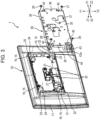
- Two response force application mechanisms 20 are fixed to the surface of the unit chassis 11, which constitutes the operation unit 10, directed to the rear side (Z2 direction).
- the response force application mechanisms 20 each include a metal case 21 fixed to the surface of the unit chassis 11 directed to the rear side.
- a movable yoke made of a magnetic material and having a predetermined mass, and a coil wound around the movable yoke are housed.
- the movable yoke is supported in the inner portion of the case 21 by a spring member so as to be reciprocable in the left-right direction (X1-X2 direction).
- a magnet facing the movable yoke is fixed in the inner portion of the case 21.
- the movable yoke When the coil is energized, the movable yoke is magnetized, and the polarity thereof changes at a predetermined period. Due to the polarity of the movable yoke and the polarity of the magnet, an attractive force and a repulsive force are alternately act on the movable yoke and vibrate the movable yoke.
- a reaction force of the vibration of the movable yoke having a predetermined mass is transmitted from the case 21 to the unit chassis 11, and a response force in the left-right direction (X1-X2 direction) is applied to the operation unit 10.
- the response force can be felt by the finger that touches the operation surface 3a.
- the direction of the action of the response force applied from the response force application mechanisms 20 to the operation unit 10 is the left-right direction (X1-X2 direction).
- the support member 30 is made of a sheet metal.
- a circuit board is fixed to the surface of the support member 30 directed to the near side (Z1 side).
- a pressure detector 15 is provided between the unit chassis 11 and the circuit board.
- detection projections 16 constituting one side of the pressure detector 15 are provided at four locations on the surface of the unit chassis 11 directed to the rear side (Z2 direction).
- the detection projections 16 are integral with the unit chassis 11 and formed of a magnesium alloy or an aluminum alloy.
- Detection elements constituting the other side of the pressure detector 15 are mounted on the surface of the circuit board directed to the near side (Z1 side). The detection elements are provided at four locations and face the detection projections 16 corresponding thereto.
- the detection elements are each provided with a detection coil.
- the detection coils emit an AC magnetic field, and the detection elements detect a change in impedance due to an eddy current loss when the AC magnetic field is applied to the detection projections 16, and measure a change in the distance between the detection projections 16 and the detection elements.
- an optical distance sensor may be used, or a mechanical switch, a piezoelectric element, or the like that is to be pressed by the detection projections 16 may be provided at the support member 30.
- the unit chassis 11, which constitutes the operation unit 10, and the support member 30 are coupled to each other by unit coupling portions 31, 32, 33, and 34 at four locations.
- the unit coupling portion 31 is positioned on the right lower side
- the unit coupling portion 32 is positioned on the left lower side
- the unit coupling portion 33 is positioned on the right upper side
- the unit coupling portion 34 is positioned on the left upper portion.
- Each of the unit coupling portions 31, 32, 33, and 34 is provided at a location close to the pressure detector 15 having the detection projections 16.
- Fig. 4 to Fig. 6 the structure of the unit coupling portion 31 positioned at the IV part on the right lower side is illustrated.
- the support member 30 is formed by pressing a sheet metal, such as a rolled steel plate.
- the support member 30 has a rear plate portion 35 parallel to the X-Y plane.
- An upper plate portion 36 is integrally bent from the upper side of the rear plate portion 35 toward the near side (Z1 side), and a lower plate portion 37 is integrally bent from the lower side of the rear plate portion 35 toward the near side.
- a left plate portion 38 and a right plate portion 39 are integrally bent from the left side and the right side of the rear plate portion 35, respectively, toward the near side.
- the unit coupling portion 31 is provided at a corner portion between the lower plate portion 37 and the right plate portion 39, and the unit coupling portion 32 is provided at a corner portion between the lower plate portion 37 and the left plate portion 38.
- the unit coupling portion 33 is provided at a corner portion between the upper plate portion 36 and the right plate portion 39, and the unit coupling portion 34 is provided at a corner portion between the upper plate portion 36 and the left plate portion 38.
- female screw holes 22, 23, 24, and 25 are formed at four locations on the surface of the unit chassis 11 directed to the rear side.
- the female screw holes 22, 23, 24, and 25 are formed at locations close to the detection projections 16 constituting the pressure detector 15.
- a fixing screw 26 is inserted into the fixing hole 43a opening in the fixing piece 43 at a tip of the coupling support portion 40 and screwed into the female screw hole 22, and the fixing piece 43 is fixed to the unit chassis 11.
- the coupling support portion 40 is also formed integrally with the support member 30 in each of the other unit coupling portions 32, 33, and 34.
- the fixing piece 43 is fixed to the unit chassis 11 by a fixing screw 27.
- the fixing piece 43 is fixed to the unit chassis 11 by a fixing screw 28.
- the fixing piece 43 is fixed to the unit chassis 11 by a fixing screw 29.
- the first elastic deformation portion 41 of the coupling support portion 40 is mainly bent and deformed in the front-rear direction in each of the unit coupling portions 31, 32, 33, and 34.
- the second elastic deformation portion 42 is mainly bent and deformed in the left-right direction.
- the elastic modulus (elastic modulus of bending) of each of the coupling support portions 40 when the second elastic deformation portion 42 is bent and deformed in the left-right direction (X1-X2 direction) is smaller than either of the elastic modulus thereof in deformation in the up-down direction (Y1-Y2 direction) and the elastic modulus thereof in deformation in the front-rear direction (Z1-Z2 direction).
- the elastic modulus of each of the coupling support portions 40 in deformation in the left-right direction which is the direction of the action of a response force applied from the response force application mechanisms 20 to the operation unit 10, is smaller than the elastic modulus thereof in deformation in either directions orthogonal to the left-right direction.
- the elastic modulus of each of the coupling support portions 40 when the first elastic deformation portion 41 is deformed in the front-rear direction (Z1-Z2 direction) is larger than the elastic modulus thereof when the second elastic deformation portion 42 is deformed in the left-right direction (X1-X2 direction).
- the elastic modulus of each of the coupling support portions 40 when the operation unit 10 is moved in the front-rear direction is larger than the elastic modulus thereof in deformation in the left-right direction, which is the application direction of a response force.
- a restriction piece 44 is integrally formed at a lower side (Y2 side) end portion of the right plate portion 39 of the support member 30.
- An edge surface of the restriction piece 44 directed to the rear side (Z2 direction) serves as a front restriction portion 44a.
- a portion of the fixing piece 43 provided at the coupling support portion 40 serves as a front contact portion 43b.
- the front restriction portion 44a and the front contact portion 43b face each other to be spaced apart by a distance 81 in the front-rear direction (Z1-Z2 direction).
- Fig. 5 with no external force acting on the operation unit 10
- the edge surface of the restriction piece 44 directed to the lower side (Y2 direction) serves as an upper restriction portion 44b.
- an upper contact portion 45 directed to the upper side (Y1 direction) is formed in the vicinity of the female screw hole 22 into which the fixing screw 26 is screwed. With no external force acting on the operation unit 10, the upper restriction portion 44b and the upper contact portion 45 face each other to be spaced apart by a distance ⁇ 2 in the up-down direction (Y1-Y2 direction).
- Fig. 6 is a sectional view taken along line VI-VI from Fig. 4 .
- the right end portion of the lower plate portion 37 of the support member 30 serves as a restriction piece 46.
- the edge surface of the restriction piece 46 directed to the front side (Z1 direction) serves as a rear restriction portion 46a
- the edge surface of the restriction piece 46 directed to the right direction (X2 direction) serves as a left restriction portion 46b.
- a rear contact portion 47a directed to the rear side (Z2 direction) and a left contact portion 47b directed to the left direction (X1 direction) are provided in the vicinity of the female screw hole 22 into which the fixing screw 26 is screwed.
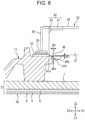
- the rear restriction portion 46a and the rear contact portion 47a face each other to be spaced apart by a distance ⁇ 3 in the front-rear direction (Z1-Z2 direction), and the left restriction portion 46b and the left contact portion 47b face each other to be spaced apart by a distance ⁇ 4 in the left-right direction (X1-X2 direction).
- the unit coupling portion 31 and the unit coupling portion 32 have structures symmetrical in the X1-X2 direction. In other words, the unit coupling portion 31 and the unit coupling portion 32 have structures that are line symmetrical about an imaginary center line extending in the Y1-Y2 direction.
- a front restriction portion 44a and an upper restriction portion 44b which are the same as those illustrated in Fig. 4 , are provided at a lower part of the left plate portion 38 provided at the support member 30.
- the unit coupling portion 32 similarly to those in Fig.
- the front contact portion 43b and the front restriction portion 44a face each other to be spaced apart by the distance ⁇ 1
- the upper restriction portion 44b and the upper contact portion 45 face each other to be spaced apart by the distance ⁇ 2.
- the rear restriction portion 46a and the rear contact portion 47a face each other to be spaced apart by the distance ⁇ 3. Due to the unit coupling portion 31 and the unit coupling portion 32 having the structures that are line symmetrical in the left-right direction, a right restriction portion and a right contact portion, instead of the left restriction portion 46b and the left contact portion 47b in Fig. 6 , having structures that are left-right symmetrical to the left restriction portion 46b and the left contact portion 47b in Fig. 6 face each other to be spaced apart by the distance ⁇ 4 in the unit coupling portion 32.
- the coupling support portion 40 is also integrally formed with the support member 30 in each of the unit coupling portion 33 positioned on the right upper side and the unit coupling portion 34 positioned on the left upper side.
- the first elastic deformation portions 41 and the second elastic deformation portion 42 are also formed continuously, and the fixing piece 43 is bent at a tip portion of the second elastic deformation portion 42.
- the fixing piece 43 is fixed to the unit chassis 11 by the fixing screw 28.
- the fixing piece 43 is fixed to the unit chassis 11 by the fixing screw 29.
- the front restriction portion 44a, the front contact portion 43b, the upper restriction portion 44b, and the upper contact portion 45 illustrated in Fig. 5 are not provided.
- the rear restriction portion 46a, the rear contact portion 47a, the left restriction portion 46b and, the left contact portion 47b illustrated in Fig. 6 are also not provided.
- the right restriction portion and the right contact portion are also not provided. These restriction portions and the contact portions, however, may be provided in the unit coupling portions 33 and 34.
- a lower restriction portion be provided at a portion of the support member, a lower contact portion be provided at a portion of the unit chassis 11, and the lower restriction portion and the lower contact portion face each other to be spaced apart by a distance in the up-down direction (Y1-Y2 direction).
- the support cover member 50 is fixed to the rear of the support member 30.
- the support cover member 50 is formed of a light metal material by die cast molding or formed of a hard resin material by injection molding.
- female screw holes 51 are formed at five locations.
- five fixing screws 52 inserted into the support cover member 50 are screwed into respective female screw holes 51, and the support cover member 50 is thereby fixed to the support member 30.
- the support member 30 and the support cover member 50 are fixed to a portion of a vehicle body positioned in an inner portion of, for example, an instrument panel.
- the inside of the opening portion 11a is a display screen, and a surface of the cover panel 4 positioned at the opening portion 11a serves as the operation surface 3a.
- a display image generated by the display unit 3 is displayed on the display screen.
- the operation detector 5 provided at the display unit 3 illustrated in Fig. 5 , and an operation that, for example, changes the display image is performed.
- the operation unit 10 When the operation unit 10 is pressed toward the rear side (Z2 direction) by the finger touching an image or the like of an operation button displayed on the operation surface 3a, the first elastic deformation portions 41 of the coupling support portions 40 are bent and deformed in the unit coupling portions 31, 32, 33, and 34 at the four locations illustrated in Fig. 2 , and the operation unit 10 moves toward the rear side.
- the pressure detector 15 detects that the operation unit 10 is pressed and operated.
- the predetermined value is set to be shorter than a facing distance ⁇ 3 between the rear restriction portion 46a and the rear contact portion 47a illustrated in Fig. 6 .
- a drive signal is given to the response force application mechanisms 20 illustrated in Fig. 3 , and the response force application mechanisms 20 is operated.
- the response force application mechanisms 20 is operated, a response force in the left-right direction (X1-X2 direction) is applied to the operation unit 10.
- the second elastic deformation portion 42 of the coupling support portion 40 illustrated in Fig. 4 is bent and deformed, and the movement of the operation unit 10 in the left-right direction is allowed.
- the left and right vibrations of the operation unit 10 can cause the finger of an operator touching the operation surface 3a to feel the response force.
- the elastic modulus of the coupling support portions 40 in deformation in the left-right direction (X1-X2 direction) is smaller than the elastic modulus thereof in deformation in the up-down direction (Y1-Y2 direction). Therefore, when the response force application mechanisms 20 is operated, the operation unit 10 easily moves in the left-right direction, and a response force having a large amplitude can be felt by the finger touching the operation surface 3a.
- the length dimension of the first elastic deformation portions 41 in the left-right direction (X1-X2 direction) is shorter than the length dimension of the second elastic deformation portion 42 in the front-rear direction (Z1-Z2 direction).
- the elastic modulus of the coupling support portions 40 in deformation in the front-rear direction (Z1-Z2 direction) is larger than the elastic modulus thereof in deformation in the left-right direction (X1-X2 direction). Therefore, when the finger touching the operation surface 3a presses the operation unit 10 toward the rear side (Z2 direction), the finger can feel a sufficient pressing resistance force.
- the left restriction portion 46b provided at the support member 30 and the left contact portion 47b which is a portion of the unit chassis 11, face each other to be spaced apart by the distance ⁇ 4.
- a right restriction portion and a right contact portion face each other to be spaced apart by the distance ⁇ 4.
- the distance ⁇ 4 is larger than the amplitude in the left-right direction applied to the operation unit 10 by the driving force of the response force application mechanisms 20.
- the operation apparatus 1 is installed at an orientation in which the operation unit 10 slightly floats out toward the near side (Z1 side) from an instrument panel or the like with the support member 30 and the support cover member 50 fixed to a portion of a vehicle. Therefore, there is a likelihood of a large external force in the near direction (Z1 direction), that is, a direction away from the support member 30 acting on the operation unit 10 as a result of, for example, the operation unit 10 being pulled unintentionally by the hand toward the near side (Z1 side).
- the front contact portion 43b integral with the fixing piece 43 of the support member 30 comes into contact with the front restriction portion 44a formed at the right plate portion 39 in each of the unit coupling portion 31 and the unit coupling portion 32. Consequently, the movement of the operation unit 10 toward the near side is restricted, and the coupling support portions 40 can be suppressed from being excessively deformed and plastically deformed.
- the front contact portion 43b and the front restriction portion 44a are formed at the same support member 30 in the operation apparatus 1 according to the first embodiment.
- the front restriction portion 44a it is not necessary to provide the front restriction portion 44a as a separate member from the support member 30, which can reduce the number of components.
- work of positioning and fixing the front restriction portion 44a with respect to the unit chassis 11 is not necessary to be performed independently from work of fixing the support member 30, which can reduce the number of assembly steps.
- Fig. 7 is a perspective view of an operation apparatus 101 according to a second embodiment of the present invention, as viewed from the rear side.
- Fig. 7 corresponds to a diagram in which illustration of the support cover member 50 is omitted in the perspective view of the first embodiment illustrated in Fig. 2 .
- the operation unit 10 illustrated in Fig. 7 is the same as that of the first embodiment illustrated in Fig. 1 , Fig. 2 , and the like.
- the operation unit 10 includes a unit chassis 11 formed by die cast molding.
- the display unit 3 is housed in the operation unit 10, and a sectional structure thereof is illustrated in Fig. 9 .
- the response force application mechanisms 20 configured to apply a response force in the left-right direction (X1-X2 direction) is also mounted on the operation unit 10 in Fig. 7 .
- the detection projections 16 are integrally formed at four locations at the unit chassis 11, and the pressure detector 15 is constituted by detection elements mounted on the circuit board of the support member 30 and the detection projections 16.
- the support member 30 illustrated in Fig. 7 is formed of a rolled steel plate and includes the rear plate portion 35, the upper plate portion 36, the lower plate portion 37, the left plate portion 38, and the right plate portion 39.
- the unit chassis 11 and the support member 30 are coupled to each other in each of unit coupling portions 131, 132, 133, and 134.
- the unit coupling portion 131 is positioned at the right lower-side corner portion of the support member 30, and the unit coupling portion 132 is positioned at the left lower-side corner portion of the support member 30.
- the unit coupling portion 133 is positioned at the right upper-side corner portion of the support member 30, and the unit coupling portion 134 is positioned at the left upper-side corner portion of the support member 30.
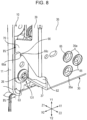
- Fig. 8 is an enlarged view of the VIII part in Fig. 7 , and a structure of the unit coupling portion 131 on the right lower side is illustrated.
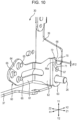
- Fig. 10 and Fig. 11 a structure of the support member 30 as viewed from the side (X side in Fig. 9 ) of the unit chassis 11 in the unit coupling portion 131 is illustrated.
- a coupling support portion 60 is fixed to the inner side of the support member 30 directed to the near side (Z1 side).
- the coupling support portion 60 is formed of a metal plate that is superior to the support member 30 in spring characteristics.
- Fig. 12 is a sectional view taken along line XII-XII from Fig. 11 .
- bulge portions 35a projecting toward the near side (Z1 side) are press formed at three locations on the rear plate portion 35 of the support member 30 in the unit coupling portion 131.
- the end portion of the coupling support portion 60 on the left side (X1 side) serves as a base fixing piece 64.
- the base fixing piece 64 is disposed on the bulge portions 35a.
- Three portions of the base fixing pieces 64 and the bulge portions 35a are fixed to each other at a spot welding portion 65.
- the base fixing piece 64 and the bulge portions 35a may be fixed to each other by a caulk portion, instead of the spot welding portion 65.
- the coupling support portion 60 includes a first elastic deformation portion 61, a second elastic deformation portion 62, and a fixing piece 63 that are integral with the base fixing piece 64.
- the first elastic deformation portion 61 is parallel to the X-Y plane and extends in the right direction (X2 direction).
- the second elastic deformation portion 62 is bent at the right angle from the first elastic deformation portion 61 toward the near side (Z1 side), is parallel to the Y-Z plane, and extends toward the near side (Z1 side).
- the fixing piece 63 is bent at the right angle from a tip portion of the second elastic deformation portion 62 toward the right direction (X2 direction).
- the coupling support portion 60 is also fixed and provided at the support member 30 in each of the unit coupling portion 132 on the left lower side, the unit coupling portion 133 on the right upper side, and the unit coupling portion 134 on the left upper side illustrated in Fig. 7 .
- the fixing piece 63 of the unit coupling portion 131 is fixed to the unit chassis 11 by the fixing screw 26, and the fixing piece 63 of the unit coupling portion 132 is fixed to the unit chassis 11 by the fixing screw 27.
- the fixing piece 63 of the unit coupling portion 133 is fixed to the unit chassis 11 by the fixing screw 28, and the fixing piece 63 of the unit coupling portion 134 is fixed to the unit chassis 11 by the fixing screw 29.
- a portion on the lower side (Y2 direction) of the right plate portion 39 of the support member 30 serves as a restriction piece 70.
- a front restriction portion 71 directed to the rear side (Z2 direction) and an upper restriction portion 72 directed to the lower side (Y2 direction) are formed at the restriction piece 70.
- the front restriction portion 71 and the upper restriction portion 72 are edge surfaces of the restriction piece 70.
- the front restriction portion 71 and the upper restriction portion 72 are continuous to each other and form the right angle therebetween.
- the support member 30 in the unit coupling portion 131 is illustrated from the X direction indicated in Fig. 9 .
- the surface of the restriction piece 70 directed to the left direction (X1 direction) serves as a right restriction portion 73, and the surface thereof directed to the right direction (X2 direction) serves as a left restriction portion 74.
Landscapes
- Engineering & Computer Science (AREA)
- General Engineering & Computer Science (AREA)
- Theoretical Computer Science (AREA)
- Mechanical Engineering (AREA)
- Transportation (AREA)
- Chemical & Material Sciences (AREA)
- Combustion & Propulsion (AREA)
- Human Computer Interaction (AREA)
- Physics & Mathematics (AREA)
- General Physics & Mathematics (AREA)
- Computer Hardware Design (AREA)
- Fittings On The Vehicle Exterior For Carrying Loads, And Devices For Holding Or Mounting Articles (AREA)
- Mechanical Control Devices (AREA)
Description
- The present invention relates to an operation apparatus in which an operation unit including an operation detector and a response force application mechanism is supported by a support member with a coupling support portion interposed therebetween.
-
JP 2017-194886 A - The operation apparatus is provided with an apparatus body including a touch sensor on a surface thereof and on which a feedback mechanism is mounted, and the apparatus body is supported at a base with a support metal plate interposed therebetween. A detection member configured to detect that the apparatus body is pressed is provided between the apparatus body and the base. The support metal plate is elastically deformable in both of the direction of action of a feedback force exerted by the feedback mechanism and the direction of a movement in which the apparatus body is pressed.
- The operation apparatus is operated through the touch sensor while an image displayed on the apparatus body is referred. When the apparatus body is pressed by a finger, the detection member is operated to enable an input operation. In response to an input operation, the feedback mechanism starts. At this time, elastic deformation of the support metal plate can cause the apparatus body to vibrate in a feedback direction and cause the finger that has touched the apparatus body to feel a feedback force.
- The apparatus body described in
JP 2017-194886 A Fig. 2 , the apparatus body is installed at an inner portion of an opening portion of an instrument panel such that the inner surface of the opening portion face the apparatus body with a gap interposed therebetween to thereby enable restriction of the movement of the apparatus body. - However, when the apparatus body is installed at a place other than an opening portion of an instrument panel, it is not possible to restrict the apparatus body by the instrument panel and the like. It is thus required to newly provide a stopper mechanism that restricts the movement of the apparatus body. The stopper mechanism becomes more complex to restrict the apparatus body from moving in the front-rear, left-right, and up-down directions.
-
WO 2018/225569 A1 relates to a display device comprising a display substrate having an operating face, a support body disposed away from the display substrate with a space there between and on the side opposite the operating face thereof, an oscillating body disposed between the display substrate and the support body, for causing the display substrate to oscillate, and an elastic support member extending so as to surround the support body, spanning both the face of the support body which is toward the display substrate and the face which is opposite the display substrate, with one end part of said elastic support member being anchored to the face opposite the display substrate and the other end part elastically supporting the display substrate. The support body has a displacement-limiting part which is abutted by a portion of the elastic support member and which limits the displacement of the elastic support member in the direction perpendicular to the operating face. - An object of the present invention is to provide an operation apparatus capable of restricting an extra movement of an operation unit without newly providing a complex stopper mechanism.
- In addition, it would be beneficial to provide an operation apparatus capable of restricting an extra movement of an operation unit in multiple directions without newly providing a complex stopper mechanism.
- The invention relates to an operation apparatus according to the appended claims. Embodiments are disclosed in the dependent claims.
- According to an aspect, there is provided an operation apparatus including:
- an operation unit including an operation detector;
- a support member that supports the operation unit; and
- a response force application mechanism configured to apply a response force to the operation unit.
- The support member is provided with a coupling support portion including an elastic deformation portion, and the operation unit is fixed to the coupling support portion.
- The support member is provided with a restriction portion facing the coupling support portion with a gap interposed therebetween, and the coupling support portion is configured to restrict a movement of the operation unit by coming into contact with the restriction portion when the elastic deformation portion is deformed in response to an external force acting on the operation unit.
- In the operation apparatus according to an embodiment of the present invention, the support member is formed of a metal plate, and the coupling support portion is a portion of the support member.
- In the operation apparatus according to an embodiment of the present invention, the coupling support portion is formed of a metal plate to be a separate body from the support member, and the coupling support portion is fixed to the support member.
- In the operation apparatus according to an embodiment of the present invention, for example, the coupling support portion is fixed to the support member to be spaced apart by a distance, and a portion of the support member facing the coupling support portion serves as the restriction portion.
- In the operation apparatus according to an embodiment of the present invention, the coupling support portion is configured to restrict a movement of the operation unit in a direction away from the support member by coming into contact with the restriction portion.
- In the operation apparatus according to an embodiment of the present invention, the restriction portion comprises a plurality of restriction portions, the plurality of restriction portions and the coupling support portion facing each other in a plurality of different directions, and the coupling support portion and the plurality of restriction portions are configured to restrict both of a movement of the operation unit in a direction away from the support member and a movement of the operation unit in directions other than the direction away from the support member by coming into contact with each other.
- In the operation apparatus according to an embodiment of the present invention, preferably, a recess portion is formed at one of the support member and the coupling support portion, and another one of the support member and the coupling support portion is positioned at an inner portion of the recess portion, thereby constituting the plurality of restriction portions.
- In the operation apparatus according to an embodiment of the present invention, preferably, the response force application mechanism is configured to apply a response force to the operation unit, and an elastic modulus of the elastic deformation portion in deformation in a direction in which the response force acts thereon is smaller than an elastic modulus thereof in deformation in a direction orthogonal to the direction.
- Preferably, the operation apparatus according to the present invention further includes a pressure detector configured to detect that the operation unit is pressed toward the support member, and an elastic modulus of the elastic deformation portion in deformation in a direction along a pressed direction is larger than an elastic modulus thereof in deformation in an application direction of a response force.
- In the operation apparatus according to aspects of the present invention, the support member is provided with the coupling support portion including the elastic deformation portion, and the operation unit is supported by the coupling support portion. It is thus possible to move the operation unit in, for example, an acting direction of a response force by the deformation of the elastic deformation portion. Moreover, the support member is provided with the restriction portion configured to restrict a movement of the coupling support portion. It is thus possible to restrict an extra movement of the operation unit without newly providing a stopper mechanism.
- In particular, by disposing the restriction portion to face the coupling support portion on the near side, it is possible to restrict a movement of the operation unit when the operation unit is pulled toward the near side.
-
Fig. 1 is a perspective view of an operation apparatus according to a first embodiment of the present invention, as viewed from the near side; -
Fig. 2 is an exploded perspective view of the operation apparatus according to the first embodiment of the present invention, as viewed from the rear side; -
Fig. 3 is an exploded perspective view of the operation apparatus according to the first embodiment of the present invention, as viewed from the rear side; -
Fig. 4 is an enlarged perspective view of a unit coupling portion at the IV part indicated inFig. 2 ; -
Fig. 5 is an enlarged sectional view taken along line V-V from the enlarged perspective view illustrated inFig. 4 ; -
Fig. 6 is an enlarged sectional view taken along line VI-VI from the enlarged perspective view illustrated inFig. 4 ; -
Fig. 7 is a perspective view of an operation apparatus according to a second embodiment of the present invention, as viewed from the rear side; -
Fig. 8 is an enlarged perspective view of a unit coupling portion in the VIII part indicated inFig. 7 ; -
Fig. 9 is an enlarged sectional view taken along line IX-IX from the enlarged perspective view illustrated inFig. 8 ; -
Fig. 10 is a partial perspective view of a support member, a coupling support portion, and a restriction portion as viewed from the front side (X direction inFig. 9 ) ; -
Fig. 11 is a partial front view of the support member, the coupling support portion, and the restriction portion as viewed from the front side (X direction inFig. 9 ); and -
Fig. 12 is an enlarged sectional view taken along line XII-XII from the partial front view illustrated inFig. 11 . - In
Fig. 1 andFig. 2 , an overall structure of anoperation apparatus 1 according to a first embodiment of the present invention is illustrated. Theoperation apparatus 1 is to be used as an on-vehicle display apparatus. The front-rear direction of theoperation apparatus 1 is the Z1-Z2 direction. The Z1 direction is the front side and the near side, and the Z2 direction is the rear side. When theoperation apparatus 1 is used as an on-vehicle display apparatus, the Z1 direction is directed to the vehicle interior, and the Z2 direction is directed to the traveling direction of the vehicle. The X1-X2 direction is the left-right direction. The X1 direction is the left direction, and the X2 direction is the right direction. The Y1-Y2 direction is the up-down direction, the Y1 direction is the up direction, and the Y2 direction is the down direction. - As illustrated in
Fig. 2 andFig. 3 , theoperation apparatus 1 includes anoperation unit 10 and asupport member 30 that supports theoperation unit 10 from the rear side (Z2 direction). As further illustrated inFig. 1 andFig. 2 , asupport cover member 50 is fixed to the rear of thesupport member 30. When theoperation apparatus 1 is used as an on-vehicle apparatus, thesupport member 30 and thesupport cover member 50 are fixed to a portion of the vehicle body positioned in the inner portion of, for example, an instrument panel, and theoperation unit 10 fixed to thesupport member 30 is installed at a position slightly away from the instrument panel toward the near side (Z1 side), that is, a position floating out toward the inside of the vehicle compartment. - The
operation unit 10 includes aunit chassis 11. Theunit chassis 11 is formed of a light metal, such as a magnesium alloy or an aluminum alloy by die cast molding. Theunit chassis 11 has a cavity portion in the inner portion thereof and, as illustrated inFig. 1 , has anopening portion 11a formed on the near side (Z1 side) to open in a rectangular large area. - A
display unit 3 is housed in the inner portion of theunit chassis 11. As illustrated in the sectional views inFig. 5 andFig. 6 , thedisplay unit 3 is constituted by a plurality of stacked members. In thedisplay unit 3, atransparent cover panel 4 is provided on the nearest side (Z1 side). Thecover panel 4 is formed of a glass sheet or a transparent resin material, such as an acrylic resin. The near side surface of thecover panel 4 serves as anoperation surface 3a. - An
operation detector 5 is bonded to the surface of thecover panel 4 directed to the rear side (Z2 direction). Theoperation detector 5 is a capacitive touch panel. Theoperation detector 5 is constituted by a transparent substrate, such as a PET sheet, bonded to the rear surface of thecover panel 4, and a plurality of transparent electrodes provided on a surface of the transparent substrate. When the finger of an operator touches or comes close to theoperation surface 3a of thedisplay unit 3, capacitance detected by the transparent electrodes changes. On the basis of the change in distribution of the capacitance at this time, a coordinate location that the finger touches or comes close to is determined. - The
operation detector 5 may be a resistance-type sensor panel installed at the near side (Z1 side) surface of thecover panel 4. In the resistance-type sensor panel, a transparent substrate on which a transparent electrode is formed at the entire surface thereof is bonded to a surface of thecover panel 4, a transparent film on which a transparent electrode is formed at the entire surface thereof is stacked on the near side of the transparent substrate, and the near side surface of the transparent film serves as theoperation surface 3a. When a portion of theoperation surface 3a is pressed, a short circuit occurs between the transparent electrode formed on the transparent film and the transparent electrode formed on the transparent substrate. A change in the resistance value from an electrode portion provided at an edge portion of the transparent electrode to a short circuit portion is detected, and a coordinate location touched by the finger is determined. - As illustrated
Fig. 5 andFig. 6 , adisplay cell 6 is bonded to the surface of thedisplay unit 3 directed to the rear side (Z2 direction) of thecover panel 4 with acapacitive operation detector 5 interposed therebetween.
Thedisplay cell 6 is a translucent color liquid crystal display cell. Abacklight device 7 is provided at the rear of thedisplay cell 6. Thebacklight device 7 includes a case fixed to a fixingsurface 11b in the inner portion of the cavity portion of theunit chassis 11, and a light guide member and a light source, such as an LED, provided in the inner portion thereof. Display light emitted from thebacklight device 7 is transmitted through thedisplay cell 6 and thecover panel 4, and an image is displayed using the almost entire surface of theoperation surface 3a as a display surface. As a display cell, an electroluminescence display cell is also usable. - In
Fig. 3 , a state in which theoperation unit 10 and thesupport member 30 are separated from each other is illustrated. Two responseforce application mechanisms 20 are fixed to the surface of theunit chassis 11, which constitutes theoperation unit 10, directed to the rear side (Z2 direction). The responseforce application mechanisms 20 each include ametal case 21 fixed to the surface of theunit chassis 11 directed to the rear side. In the inner portion of thecase 21, a movable yoke made of a magnetic material and having a predetermined mass, and a coil wound around the movable yoke are housed. The movable yoke is supported in the inner portion of thecase 21 by a spring member so as to be reciprocable in the left-right direction (X1-X2 direction). A magnet facing the movable yoke is fixed in the inner portion of thecase 21. - When the coil is energized, the movable yoke is magnetized, and the polarity thereof changes at a predetermined period. Due to the polarity of the movable yoke and the polarity of the magnet, an attractive force and a repulsive force are alternately act on the movable yoke and vibrate the movable yoke. A reaction force of the vibration of the movable yoke having a predetermined mass is transmitted from the
case 21 to theunit chassis 11, and a response force in the left-right direction (X1-X2 direction) is applied to theoperation unit 10. The response force can be felt by the finger that touches theoperation surface 3a. The direction of the action of the response force applied from the responseforce application mechanisms 20 to theoperation unit 10 is the left-right direction (X1-X2 direction). - As illustrated in
Fig. 2 , thesupport member 30 is made of a sheet metal. A circuit board is fixed to the surface of thesupport member 30 directed to the near side (Z1 side). A pressure detector 15 is provided between theunit chassis 11 and the circuit board. As illustrated inFig. 3 , detection projections 16 constituting one side of the pressure detector 15 are provided at four locations on the surface of theunit chassis 11 directed to the rear side (Z2 direction). The detection projections 16 are integral with theunit chassis 11 and formed of a magnesium alloy or an aluminum alloy. Detection elements constituting the other side of the pressure detector 15 are mounted on the surface of the circuit board directed to the near side (Z1 side). The detection elements are provided at four locations and face the detection projections 16 corresponding thereto.
The detection elements are each provided with a detection coil. The detection coils emit an AC magnetic field, and the detection elements detect a change in impedance due to an eddy current loss when the AC magnetic field is applied to the detection projections 16, and measure a change in the distance between the detection projections 16 and the detection elements. - As the pressure detector 15, an optical distance sensor may be used, or a mechanical switch, a piezoelectric element, or the like that is to be pressed by the detection projections 16 may be provided at the
support member 30. - As illustrated in
Fig. 2 , theunit chassis 11, which constitutes theoperation unit 10, and thesupport member 30 are coupled to each other byunit coupling portions unit coupling portion 31 is positioned on the right lower side, theunit coupling portion 32 is positioned on the left lower side, theunit coupling portion 33 is positioned on the right upper side, and theunit coupling portion 34 is positioned on the left upper portion. Each of theunit coupling portions Fig. 4 to Fig. 6 , the structure of theunit coupling portion 31 positioned at the IV part on the right lower side is illustrated. - As illustrated in
Fig. 2 andFig. 3 , thesupport member 30 is formed by pressing a sheet metal, such as a rolled steel plate. Thesupport member 30 has arear plate portion 35 parallel to the X-Y plane. Anupper plate portion 36 is integrally bent from the upper side of therear plate portion 35 toward the near side (Z1 side), and alower plate portion 37 is integrally bent from the lower side of therear plate portion 35 toward the near side. Similarly, aleft plate portion 38 and aright plate portion 39 are integrally bent from the left side and the right side of therear plate portion 35, respectively, toward the near side. - The
unit coupling portion 31 is provided at a corner portion between thelower plate portion 37 and theright plate portion 39, and theunit coupling portion 32 is provided at a corner portion between thelower plate portion 37 and theleft plate portion 38. Theunit coupling portion 33 is provided at a corner portion between theupper plate portion 36 and theright plate portion 39, and theunit coupling portion 34 is provided at a corner portion between theupper plate portion 36 and theleft plate portion 38. - As illustrated in
Fig. 4 to Fig. 6 , acoupling support portion 40 is formed integrally with thesupport member 30 in theunit coupling portion 31. Thecoupling support portion 40 has a firstelastic deformation portion 41 integral with therear plate portion 35 and extending in the right direction (X2 direction) in parallel with the X-Y plane, and a secondelastic deformation portion 42 bent at the right angle from a free end of the firstelastic deformation portion 41 on the X2 side toward the near side (Z1 side). In thecoupling support portion 40, a fixingpiece 43 bent at the right angle in the X2 direction from a free end of the secondelastic deformation portion 42 on the Z1 side is integrally formed. As illustrated inFig. 3 , a fixinghole 43a is open in the fixingpiece 43. - As illustrated in
Fig. 3 , female screw holes 22, 23, 24, and 25 are formed at four locations on the surface of theunit chassis 11 directed to the rear side. The female screw holes 22, 23, 24, and 25 are formed at locations close to the detection projections 16 constituting the pressure detector 15. - As illustrated in
Fig. 3 , in theunit coupling portion 31 on the right lower side, a fixingscrew 26 is inserted into the fixinghole 43a opening in the fixingpiece 43 at a tip of thecoupling support portion 40 and screwed into thefemale screw hole 22, and the fixingpiece 43 is fixed to theunit chassis 11. Thecoupling support portion 40 is also formed integrally with thesupport member 30 in each of the otherunit coupling portions unit coupling portion 32 on the left lower side, the fixingpiece 43 is fixed to theunit chassis 11 by a fixingscrew 27. In theunit coupling portion 33 on the right upper side, the fixingpiece 43 is fixed to theunit chassis 11 by a fixingscrew 28. In theunit coupling portion 34 on the left upper side, the fixingpiece 43 is fixed to theunit chassis 11 by a fixingscrew 29. - When the
support member 30 and thesupport cover member 50 are fixed to a portion of a vehicle body positioned in the inner portion of, for example, an instrument panel, theoperation unit 10 is supported by thecoupling support portions 40 at four locations. - With the
support member 30 being fixed to a portion of the vehicle body, when an external force in the front-rear direction (Z1-Z2 direction) acts on theoperation unit 10, the firstelastic deformation portion 41 of thecoupling support portion 40 is mainly bent and deformed in the front-rear direction in each of theunit coupling portions operation unit 10, the secondelastic deformation portion 42 is mainly bent and deformed in the left-right direction. - The elastic modulus (elastic modulus of bending) of each of the
coupling support portions 40 when the secondelastic deformation portion 42 is bent and deformed in the left-right direction (X1-X2 direction) is smaller than either of the elastic modulus thereof in deformation in the up-down direction (Y1-Y2 direction) and the elastic modulus thereof in deformation in the front-rear direction (Z1-Z2 direction). In other words, the elastic modulus of each of thecoupling support portions 40 in deformation in the left-right direction, which is the direction of the action of a response force applied from the responseforce application mechanisms 20 to theoperation unit 10, is smaller than the elastic modulus thereof in deformation in either directions orthogonal to the left-right direction. - The elastic modulus of each of the
coupling support portions 40 when the firstelastic deformation portion 41 is deformed in the front-rear direction (Z1-Z2 direction) is larger than the elastic modulus thereof when the secondelastic deformation portion 42 is deformed in the left-right direction (X1-X2 direction). In other words, the elastic modulus of each of thecoupling support portions 40 when theoperation unit 10 is moved in the front-rear direction is larger than the elastic modulus thereof in deformation in the left-right direction, which is the application direction of a response force. - As illustrated in
Fig. 3 and as illustrated inFig. 4 in an enlarged manner, arestriction piece 44 is integrally formed at a lower side (Y2 side) end portion of theright plate portion 39 of thesupport member 30. An edge surface of therestriction piece 44 directed to the rear side (Z2 direction) serves as afront restriction portion 44a. A portion of the fixingpiece 43 provided at thecoupling support portion 40 serves as afront contact portion 43b. As illustrated inFig. 5 , with no external force acting on theoperation unit 10, thefront restriction portion 44a and thefront contact portion 43b face each other to be spaced apart by a distance 81 in the front-rear direction (Z1-Z2 direction). As illustrated inFig. 5 , the edge surface of therestriction piece 44 directed to the lower side (Y2 direction) serves as anupper restriction portion 44b. In theunit chassis 11, anupper contact portion 45 directed to the upper side (Y1 direction) is formed in the vicinity of thefemale screw hole 22 into which the fixingscrew 26 is screwed. With no external force acting on theoperation unit 10, theupper restriction portion 44b and theupper contact portion 45 face each other to be spaced apart by a distance δ2 in the up-down direction (Y1-Y2 direction). -
Fig. 6 is a sectional view taken along line VI-VI fromFig. 4 . As illustrated inFig. 6 , the right end portion of thelower plate portion 37 of thesupport member 30 serves as arestriction piece 46. The edge surface of therestriction piece 46 directed to the front side (Z1 direction) serves as arear restriction portion 46a, and the edge surface of therestriction piece 46 directed to the right direction (X2 direction) serves as aleft restriction portion 46b. In theunit chassis 11, arear contact portion 47a directed to the rear side (Z2 direction) and aleft contact portion 47b directed to the left direction (X1 direction) are provided in the vicinity of thefemale screw hole 22 into which the fixingscrew 26 is screwed. Therear restriction portion 46a and therear contact portion 47a face each other to be spaced apart by a distance δ3 in the front-rear direction (Z1-Z2 direction), and theleft restriction portion 46b and theleft contact portion 47b face each other to be spaced apart by a distance δ4 in the left-right direction (X1-X2 direction). - The
coupling support portion 40 is also integrally formed with thesupport member 30 in theunit coupling portion 32 provided on the left lower side. In thecoupling support portion 40 of theunit coupling portion 32, similarly to thecoupling support portion 40 provided at theunit coupling portion 31, the firstelastic deformation portion 41 and the secondelastic deformation portion 42 are formed continuously, and the fixingpiece 43 is bent at a tip portion of the secondelastic deformation portion 42. In theunit coupling portion 32, the fixingpiece 43 is fixed to theunit chassis 11 by the fixingscrew 27. - The
unit coupling portion 31 and theunit coupling portion 32 have structures symmetrical in the X1-X2 direction. In other words, theunit coupling portion 31 and theunit coupling portion 32 have structures that are line symmetrical about an imaginary center line extending in the Y1-Y2 direction. In theunit coupling portion 32, afront restriction portion 44a and anupper restriction portion 44b, which are the same as those illustrated inFig. 4 , are provided at a lower part of theleft plate portion 38 provided at thesupport member 30. In theunit coupling portion 32, similarly to those inFig. 5 , thefront contact portion 43b and thefront restriction portion 44a face each other to be spaced apart by the distance δ1, and theupper restriction portion 44b and theupper contact portion 45 face each other to be spaced apart by the distance δ2. In theunit coupling portion 32, similarly to those inFig. 6 , therear restriction portion 46a and therear contact portion 47a face each other to be spaced apart by the distance δ3. Due to theunit coupling portion 31 and theunit coupling portion 32 having the structures that are line symmetrical in the left-right direction, a right restriction portion and a right contact portion, instead of theleft restriction portion 46b and theleft contact portion 47b inFig. 6 , having structures that are left-right symmetrical to theleft restriction portion 46b and theleft contact portion 47b inFig. 6 face each other to be spaced apart by the distance δ4 in theunit coupling portion 32. - In
Fig. 2 , thecoupling support portion 40 is also integrally formed with thesupport member 30 in each of theunit coupling portion 33 positioned on the right upper side and theunit coupling portion 34 positioned on the left upper side. In thecoupling support portion 40 of each of theunit coupling portion 33 and theunit coupling portion 34, the firstelastic deformation portions 41 and the secondelastic deformation portion 42 are also formed continuously, and the fixingpiece 43 is bent at a tip portion of the secondelastic deformation portion 42. In theunit coupling portion 33, the fixingpiece 43 is fixed to theunit chassis 11 by the fixingscrew 28. In theunit coupling portion 34, the fixingpiece 43 is fixed to theunit chassis 11 by the fixingscrew 29. In theunit coupling portion 33 and theunit coupling portion 34, thefront restriction portion 44a, thefront contact portion 43b, theupper restriction portion 44b, and theupper contact portion 45 illustrated inFig. 5 are not provided. Therear restriction portion 46a, therear contact portion 47a, theleft restriction portion 46b and, theleft contact portion 47b illustrated inFig. 6 are also not provided. In addition, the right restriction portion and the right contact portion are also not provided. These restriction portions and the contact portions, however, may be provided in theunit coupling portions - It is preferable that, in any of the
unit coupling portions unit chassis 11, and the lower restriction portion and the lower contact portion face each other to be spaced apart by a distance in the up-down direction (Y1-Y2 direction). - As illustrated in
Fig. 2 , thesupport cover member 50 is fixed to the rear of thesupport member 30. Thesupport cover member 50 is formed of a light metal material by die cast molding or formed of a hard resin material by injection molding. In therear plate portion 35 of thesupport member 30, female screw holes 51 are formed at five locations.
With thesupport cover member 50 being stacked on the rear (Z2 direction) of thesupport member 30, five fixingscrews 52 inserted into thesupport cover member 50 are screwed into respective female screw holes 51, and thesupport cover member 50 is thereby fixed to thesupport member 30. When theoperation apparatus 1 is used as an on-vehicle apparatus, thesupport member 30 and thesupport cover member 50 are fixed to a portion of a vehicle body positioned in an inner portion of, for example, an instrument panel. - Next, an operation of the
operation apparatus 1 according to the first embodiment will be described. - As illustrated in
Fig. 1 , on the side of theunit chassis 11 directed to the near side (Z1 side), the inside of theopening portion 11a is a display screen, and a surface of thecover panel 4 positioned at theopening portion 11a serves as theoperation surface 3a. When thedisplay unit 3 in the inner portion of theoperation unit 10 is operated, a display image generated by thedisplay unit 3 is displayed on the display screen. When an operator moves the hand near theoperation surface 3a or touches theoperation surface 3a with the finger and moves the finger while viewing an display image, this is detected by theoperation detector 5 provided at thedisplay unit 3 illustrated inFig. 5 , and an operation that, for example, changes the display image is performed. - When the
operation unit 10 is pressed toward the rear side (Z2 direction) by the finger touching an image or the like of an operation button displayed on theoperation surface 3a, the firstelastic deformation portions 41 of thecoupling support portions 40 are bent and deformed in theunit coupling portions Fig. 2 , and theoperation unit 10 moves toward the rear side. When theoperation unit 10 is pressed toward the rear side, and a facing distance between the detection projections 16 formed at theunit chassis 11 and the detection elements provided at thesupport member 30 decreases by a predetermined value, the pressure detector 15 detects that theoperation unit 10 is pressed and operated. The predetermined value is set to be shorter than a facing distance δ3 between therear restriction portion 46a and therear contact portion 47a illustrated inFig. 6 . - When a detection output from the pressure detector 15 is obtained by a controller (not illustrated), a drive signal is given to the response
force application mechanisms 20 illustrated inFig. 3 , and the responseforce application mechanisms 20 is operated. When the responseforce application mechanisms 20 is operated, a response force in the left-right direction (X1-X2 direction) is applied to theoperation unit 10. In each of theunit coupling portions Fig. 2 , the secondelastic deformation portion 42 of thecoupling support portion 40 illustrated inFig. 4 is bent and deformed, and the movement of theoperation unit 10 in the left-right direction is allowed. The left and right vibrations of theoperation unit 10 can cause the finger of an operator touching theoperation surface 3a to feel the response force. - The elastic modulus of the
coupling support portions 40 in deformation in the left-right direction (X1-X2 direction) is smaller than the elastic modulus thereof in deformation in the up-down direction (Y1-Y2 direction). Therefore, when the responseforce application mechanisms 20 is operated, theoperation unit 10 easily moves in the left-right direction, and a response force having a large amplitude can be felt by the finger touching theoperation surface 3a. The length dimension of the firstelastic deformation portions 41 in the left-right direction (X1-X2 direction) is shorter than the length dimension of the secondelastic deformation portion 42 in the front-rear direction (Z1-Z2 direction). Thus, the elastic modulus of thecoupling support portions 40 in deformation in the front-rear direction (Z1-Z2 direction) is larger than the elastic modulus thereof in deformation in the left-right direction (X1-X2 direction). Therefore, when the finger touching theoperation surface 3a presses theoperation unit 10 toward the rear side (Z2 direction), the finger can feel a sufficient pressing resistance force. - As illustrated in
Fig. 6 , theleft restriction portion 46b provided at thesupport member 30 and theleft contact portion 47b, which is a portion of theunit chassis 11, face each other to be spaced apart by the distance δ4. In theunit coupling portion 32 at the left lower portion, a right restriction portion and a right contact portion face each other to be spaced apart by the distance δ4. The distance δ4 is larger than the amplitude in the left-right direction applied to theoperation unit 10 by the driving force of the responseforce application mechanisms 20. Thus, when theoperation unit 10 is driven in the left-right direction by the responseforce application mechanisms 20, theleft restriction portion 46b and theleft contact portion 47b do not come into contact with each other, and the right restriction portion and the right contact portion do not come into contact with each other. - The
operation apparatus 1 is installed at an orientation in which theoperation unit 10 slightly floats out toward the near side (Z1 side) from an instrument panel or the like with thesupport member 30 and thesupport cover member 50 fixed to a portion of a vehicle. Therefore, there is a likelihood of a large external force in the near direction (Z1 direction), that is, a direction away from thesupport member 30 acting on theoperation unit 10 as a result of, for example, theoperation unit 10 being pulled unintentionally by the hand toward the near side (Z1 side). At this time, as illustrated inFig. 5 , thefront contact portion 43b integral with the fixingpiece 43 of thesupport member 30 comes into contact with thefront restriction portion 44a formed at theright plate portion 39 in each of theunit coupling portion 31 and theunit coupling portion 32. Consequently, the movement of theoperation unit 10 toward the near side is restricted, and thecoupling support portions 40 can be suppressed from being excessively deformed and plastically deformed. - When a large force directed to the rear side (Z2 direction) acts on the
operation unit 10 as a result of, for example, theoperation unit 10 being pressed, therear contact portion 47a, which is a portion of theunit chassis 11, illustrated inFig. 6 comes into contact with therear restriction portion 46a, which is a portion of thesupport member 30, and can restrict the movement of theoperation unit 10. When a large force directed to the left direction (X1 direction) acts on theoperation unit 10, theleft contact portion 47b illustrated inFig. 6 comes into contact with theleft restriction portion 46b and can restrict the movement of theoperation unit 10. In theunit coupling portion 32 on the left lower side, the movement of theoperation unit 10 in the right direction (X2 direction) can be restricted by contact between the right restriction portion and the right contact portion, which have a structure symmetrical to that in theunit coupling portion 31. Further, in any of theunit coupling portions support member 30 is provided with a lower restriction portion, and theunit chassis 11 is provided with a lower contact portion, the movement of theoperation unit 10 in the down direction (Y2 direction) can be restricted. - As illustrated in
Fig. 4 andFig. 5 , thefront contact portion 43b and thefront restriction portion 44a are formed at thesame support member 30 in theoperation apparatus 1 according to the first embodiment. Thus, it is not necessary to provide thefront restriction portion 44a as a separate member from thesupport member 30, which can reduce the number of components. In addition, work of positioning and fixing thefront restriction portion 44a with respect to theunit chassis 11 is not necessary to be performed independently from work of fixing thesupport member 30, which can reduce the number of assembly steps. Moreover, it is possible to precisely set the facing distance δ1 between thefront restriction portion 44a and thefront contact portion 43b. -
Fig. 7 is a perspective view of anoperation apparatus 101 according to a second embodiment of the present invention, as viewed from the rear side.Fig. 7 corresponds to a diagram in which illustration of thesupport cover member 50 is omitted in the perspective view of the first embodiment illustrated inFig. 2 . - The
operation unit 10 illustrated inFig. 7 is the same as that of the first embodiment illustrated inFig. 1 ,Fig. 2 , and the like. Theoperation unit 10 includes aunit chassis 11 formed by die cast molding. Thedisplay unit 3 is housed in theoperation unit 10, and a sectional structure thereof is illustrated inFig. 9 . As with the first embodiment illustrated inFig. 3 , the responseforce application mechanisms 20 configured to apply a response force in the left-right direction (X1-X2 direction) is also mounted on theoperation unit 10 inFig. 7 . Similarly to that inFig. 3 , the detection projections 16 are integrally formed at four locations at theunit chassis 11, and the pressure detector 15 is constituted by detection elements mounted on the circuit board of thesupport member 30 and the detection projections 16. - The
support member 30 illustrated inFig. 7 is formed of a rolled steel plate and includes therear plate portion 35, theupper plate portion 36, thelower plate portion 37, theleft plate portion 38, and theright plate portion 39. Theunit chassis 11 and thesupport member 30 are coupled to each other in each ofunit coupling portions unit coupling portion 131 is positioned at the right lower-side corner portion of thesupport member 30, and theunit coupling portion 132 is positioned at the left lower-side corner portion of thesupport member 30. Theunit coupling portion 133 is positioned at the right upper-side corner portion of thesupport member 30, and theunit coupling portion 134 is positioned at the left upper-side corner portion of thesupport member 30. -
Fig. 8 is an enlarged view of the VIII part inFig. 7 , and a structure of theunit coupling portion 131 on the right lower side is illustrated. InFig. 10 andFig. 11 , a structure of thesupport member 30 as viewed from the side (X side inFig. 9 ) of theunit chassis 11 in theunit coupling portion 131 is illustrated. In theunit coupling portion 131, acoupling support portion 60 is fixed to the inner side of thesupport member 30 directed to the near side (Z1 side). Thecoupling support portion 60 is formed of a metal plate that is superior to thesupport member 30 in spring characteristics. In other words, a material in which the yield stress in a bending direction is large, the elastic region is wide, the ductility is excellent, and the elastic modulus is high compared with a metal plate material that constitutes thesupport member 30 is used as the metal plate material that constitutes thecoupling support portion 60. -
Fig. 12 is a sectional view taken along line XII-XII fromFig. 11 . As illustrated inFig. 8 andFig. 12 ,bulge portions 35a projecting toward the near side (Z1 side) are press formed at three locations on therear plate portion 35 of thesupport member 30 in theunit coupling portion 131. As illustrated inFig. 10 , the end portion of thecoupling support portion 60 on the left side (X1 side) serves as abase fixing piece 64. Thebase fixing piece 64 is disposed on thebulge portions 35a. Three portions of thebase fixing pieces 64 and thebulge portions 35a are fixed to each other at aspot welding portion 65. Thebase fixing piece 64 and thebulge portions 35a may be fixed to each other by a caulk portion, instead of thespot welding portion 65. - As illustrated in
Fig. 10 , thecoupling support portion 60 includes a firstelastic deformation portion 61, a secondelastic deformation portion 62, and a fixingpiece 63 that are integral with thebase fixing piece 64. The firstelastic deformation portion 61 is parallel to the X-Y plane and extends in the right direction (X2 direction). The secondelastic deformation portion 62 is bent at the right angle from the firstelastic deformation portion 61 toward the near side (Z1 side), is parallel to the Y-Z plane, and extends toward the near side (Z1 side). The fixingpiece 63 is bent at the right angle from a tip portion of the secondelastic deformation portion 62 toward the right direction (X2 direction). - The
coupling support portion 60 is also fixed and provided at thesupport member 30 in each of theunit coupling portion 132 on the left lower side, theunit coupling portion 133 on the right upper side, and theunit coupling portion 134 on the left upper side illustrated inFig. 7 . The fixingpiece 63 of theunit coupling portion 131 is fixed to theunit chassis 11 by the fixingscrew 26, and the fixingpiece 63 of theunit coupling portion 132 is fixed to theunit chassis 11 by the fixingscrew 27. The fixingpiece 63 of theunit coupling portion 133 is fixed to theunit chassis 11 by the fixingscrew 28, and the fixingpiece 63 of theunit coupling portion 134 is fixed to theunit chassis 11 by the fixingscrew 29. - As illustrated in
Fig. 8 , in theunit coupling portion 131 on the right lower side, a portion on the lower side (Y2 direction) of theright plate portion 39 of thesupport member 30 serves as arestriction piece 70. As illustrated inFig. 9 , afront restriction portion 71 directed to the rear side (Z2 direction) and anupper restriction portion 72 directed to the lower side (Y2 direction) are formed at therestriction piece 70. Thefront restriction portion 71 and theupper restriction portion 72 are edge surfaces of therestriction piece 70. Thefront restriction portion 71 and theupper restriction portion 72 are continuous to each other and form the right angle therebetween. InFig. 11 , thesupport member 30 in theunit coupling portion 131 is illustrated from the X direction indicated inFig. 9 . The surface of therestriction piece 70 directed to the left direction (X1 direction) serves as aright restriction portion 73, and the surface thereof directed to the right direction (X2 direction) serves as aleft restriction portion 74. - As illustrated in
Fig. 8 ,Fig. 10 , andFig. 11 , a rectangularcontact recess portion 66 opening upward (Y1 direction) is formed at the fixingpiece 63 provided at thecoupling support portion 60. As illustrated inFig. 9 andFig. 10 , in the surface of the fixingpiece 63 directed to the near side (Z1 side), a region adjacent to thecontact recess portion 66 serves as afront contact portion 67. As illustrated inFig. 9 , thefront restriction portion 71 formed at therestriction piece 70 and thefront contact portion 67, which is a portion of the fixingpiece 63, face each other to be spaced apart by a distance δ11 in the front-rear direction (Z1-Z2 direction). As illustrated inFig. 9 andFig. 10 , the bottom side of thecontact recess portion 66 on the lower side (Y2 side) serves as anupper contact portion 66a directed to the upper side (Y1 direction). A portion of therestriction piece 70 provided at theright plate portion 39 is inserted into the inner portion of thecontact recess portion 66. As illustrated inFig. 9 andFig. 10 , theupper restriction portion 72 formed at therestriction piece 70 and theupper contact portion 66a formed at thecontact recess portion 66 face each other to be spaced apart by a distance δ12 in the up-down direction (Y1-Y2 direction). - As illustrated in
Fig. 11 , the inner side of thecontact recess portion 66 on the left side (X1 side) serves as aright contact portion 66b directed to the right direction (X2 direction), and the inner side thereof on the right side (X2 side) serves as aleft contact portion 66c directed to the left direction (X1 direction). Theright restriction portion 73, which is a surface of therestriction piece 70, and theright contact portion 66b face each other to be spaced apart by a distance δ14 in the left-right direction (X1-X2 direction), and theleft restriction portion 74 and theleft contact portion 66c face each other to be spaced apart by the distance δ14 in the left-right direction (X1-X2 direction). - As illustrated in
Fig. 12 , thebase fixing piece 64 of thecoupling support portion 60 is disposed and fixed on thebulge portions 35a formed at the inner surface of therear plate portion 35 of thesupport member 30. The surface of the firstelastic deformation portion 61 of thecoupling support portion 60 directed to the rear side (Z2 direction) serves as arear contact portion 68. In the inner surface of therear plate portion 35, a region facing the firstelastic deformation portion 61 serves as arear restriction portion 75. Therear restriction portion 75 and therear contact portion 68 face each other to be spaced apart by a distance δ13 in the front-rear direction. - As illustrated in
Fig. 7 , between thecoupling support portion 60 and thesupport member 30, thefront restriction portion 71 and thefront contact portion 67 face each other to be spaced apart by the distance δ11 similarly to those inFig. 9 , and therear restriction portion 75 and therear contact portion 68 face each other to be spaced apart by the distance δ13 similarly to those inFig. 12 also in each of theunit coupling portions operation apparatus 101. Similarly to those inFig. 11 , theright restriction portion 73 and theright contact portion 66b face each other to be spaced apart by the distance δ14, and theleft restriction portion 74 and theleft contact portion 66c face each other to be spaced apart by the distance δ14. - The
unit coupling portion 131 on the right lower side and theunit coupling portion 132 on the left lower side are away from each other in the left-right direction (X1-X2 direction) and have structures that are line symmetrical about an imaginary center line extending in the up-down direction. Theunit coupling portion 131 on the right lower side and theunit coupling portion 133 on the right upper side are away from each other in the up-down direction (Y1-Y2 direction) and have structures that are line symmetrical about an imaginary center line extending in the left-right direction. Similarly, theunit coupling portion 132 on the left lower side and theunit coupling portion 134 on the left upper side are away from each other in the up-down direction and have structures that are line symmetrical. In each of theunit coupling portions Fig. 9 , theupper restriction portion 72 and theupper contact portion 66a face each other to be spaced apart by the distance δ12. In each of theunit coupling portions Fig. 9 are up-down reversed, theupper restriction portion 72 serves as a lower restriction portion directed to the upper side, and theupper contact portion 66a serves as a lower contact portion directed to the lower side. - In each of the
unit coupling portions contact recess portion 66 is formed at the fixingpiece 63 of thecoupling support portion 60, and therestriction piece 70, which is a portion of thesupport member 30, is inserted into the inner portion of thecontact recess portion 66 to be spaced apart therefrom by the distances δ12 and δ14. Contrarily, a restriction recess portion may be formed at theright plate portion 39 of thesupport member 30, a portion of the fixingpiece 63 of thecoupling support portion 60 may serve as a contact piece, and the contact piece may be inserted into the inner portion of the restriction recess portion to be spaced apart therefrom by the distances δ12 and δ14. - Also in the
operation apparatus 101 according to the second embodiment, when a hand is placed close to theoperation surface 3a, which is a display screen of theoperation unit 10, or a finger touches theoperation surface 3a, this is detected by theoperation detector 5 provided at thedisplay unit 3, and an operation with a display image being viewed is performed. When theoperation unit 10 is pressed by the finger touching theoperation surface 3a, the firstelastic deformation portion 61 of thecoupling support portion 60 coupled to theoperation unit 10 is bent and deformed, and theoperation unit 10 moves toward the rear side (Z2 direction). When the pressure detector 15 detects that theoperation unit 10 is moved in the Z2 direction within the range of the facing distance δ13 between therear restriction portion 75 and therear contact portion 68 illustrated inFig. 12 , it is determined that a pressing operation has been performed by a controller (not illustrated). - When it is determined that a pressing operation has been performed, the response
force application mechanisms 20 mounted on theoperation unit 10 is operated, and a response force in the left-right direction is applied to theoperation unit 10. The secondelastic deformation portion 62 of thecoupling support portion 60 is deformed, theoperation unit 10 vibrates in the left-right direction within the ranges of the facing distance δ14 between theright restriction portion 73 and theright contact portion 66b and the facing distance δ14 between theleft restriction portion 74 and theleft contact portion 66c illustrated inFig. 11 , and the response force can be felt by the finger touching theoperation surface 3a. In the second embodiment, the elastic modulus of thecoupling support portion 60 in deformation in the left-right direction (X1-X2 direction) is smaller than the elastic modulus thereof in deformation in the up-down direction (Y1-Y2 direction). The elastic modulus thereof in deformation in the front-rear direction (Z1-Z2 direction) is larger than the elastic modulus thereof in deformation in the left-right direction. - When a large force toward the near direction (Z1 direction), that is, a large force in a direction away from the
support member 30 acts on theoperation unit 10 as a result of, for example, theoperation unit 10 being pulled toward the near direction by a hand, thefront contact portion 67, illustrated inFig. 9 , that moves toward the rear side together with theoperation unit 10 comes into contact with thefront restriction portion 71 in each of theunit coupling portions operation unit 10 is restricted. When a large force toward the rear side (Z2 direction) acts on theoperation unit 10, therear contact portion 68, illustrated inFig. 12 , comes into contact with therear restriction portion 75, and the movement of theoperation unit 10 toward the rear side is restricted. - When a large force in the left-right direction acts on the
operation unit 10, theright contact portion 66b, illustrated inFig. 11 , comes into contact with theright restriction portion 73, or theleft contact portion 66c comes into contact with theleft restriction portion 74, and the movement of theoperation unit 10 is restricted. When a large force in the up direction (Y1 direction) acts on theoperation unit 10, theupper contact portion 66a, illustrated inFig. 9 , comes into contact with theupper restriction portion 72 in each of theunit coupling portions operation unit 10 is restricted. When a large force in the down direction (Y2 direction) acts on theoperation unit 10, the lower contact portion symmetrical to theupper contact portion 66a comes into contact with the lower restriction portion symmetrical to theupper restriction portion 72 in each of theunit coupling portions operation unit 10 is restricted. The aforementioned restriction can suppress thecoupling support portion 60 from being plastically deformed. - In the
operation apparatus 101 according to the second embodiment, thecoupling support portion 60 having excellent spring characteristics is fixed to thesupport member 30, and a contact portion formed at thecoupling support portion 60 and a restriction portion formed at thesupport member 30 face each other to be spaced apart by a distance in a plurality of directions in each of theunit coupling portions operation unit 10 to thesupport member 30, to fix a separate member constituting a restriction portion to theunit chassis 11 or the like while determining a mutual position with respect to thesupport member 30. It is thus possible to reduce the number of components and reduce the number of assembly steps. - In the second embodiment, restriction in three directions, including restriction of a movement in the front-rear direction, restriction of a movement in the left-right direction, and restriction of a movement in the up-down direction, can be performed between the
support member 30 and thecoupling support portion 60 fixed to thesupport member 30. In addition, by fixing thecoupling support portion 60 and thesupport member 30 to each other, it is possible to set the distances δ11, δ12, δ13, and δ14 between a restriction portion and a contact portion in each direction with high precision. In particular, by inserting a restriction portion, which is a portion of thesupport member 30, into thecontact recess portion 66 formed at thecoupling support portion 60 or, contrarily, by inserting a contact portion formed at thecoupling support portion 60 into the restriction recess portion formed at thesupport member 30, it is possible to cause the contact portion and the restriction portion to face each other with a uniform distance in a plurality of directions.
Claims (8)
- An operation apparatus comprising:an operation unit (10) including an operation detector (5) ;a support member (30) that supports the operation unit (10); anda response force application mechanism (20) configured to apply a response force to the operation unit (10),wherein the support member (30) comprises a coupling support portion (40, 60) including an elastic deformation portion (41, 42, 61, 62), and the operation unit (10) is fixed to the coupling support portion (40, 60), andwherein the support member (30) comprises a restriction portion (44, 71-75) facing the coupling support portion (40, 60) with a gap interposed therebetween, and the coupling support portion (40, 60) is configured to restrict a movement of the operation unit (10) by coming into contact with the restriction portion (44, 71-75) when the elastic deformation portion (41, 42, 61, 62) is deformed in response to an external force acting on the operation unit (10),wherein the restriction portion (44, 71-75) comprises a plurality of restriction portions (44a, 44b, 46a, 46b, 71-75), the plurality of restriction portions (44a, 44b, 46a, 46b, 71-75) and the coupling support portion (40, 60) facing each other in a plurality of different directions, and the coupling support portion (40, 60) and the plurality of restriction portions (44a, 44b, 46a, 46b, 71-75) are configured to restrict both of a movement of the operation unit (10) in a direction away from the support member (30) and a movement of the operation unit (10) in directions other than the direction away from the support member (30) by coming into contact with each other comprising restriction in three directions, including restriction of a movement in the front-rear direction, restriction of a movement in the left-right direction, and restriction of a movement in the up-down direction.
- The operation apparatus according to Claim 1, wherein the support member (30) is formed of a metal plate, and the coupling support portion (40, 60) is a portion of the support member (30).
- The operation apparatus according to Claim 1 or 2, wherein the coupling support portion (40, 60) is formed of a metal plate to be a separate body from the support member (30), and the coupling support portion (40, 60) is fixed to the support member (30).
- The operation apparatus according to anyone of claims 1 to 3, wherein the coupling support portion (40, 60) is fixed to the support member (30) to be spaced apart by a distance, and a portion of the support member (30) facing the coupling support portion (40, 60) serves as the restriction portion (44).
- The operation apparatus according to any one of Claims 1 to 4, wherein the coupling support portion (40, 60) is configured to restrict a movement of the operation unit (10) in a direction away from the support member (30) by coming into contact with the restriction portion (44, 71-75).
- The operation apparatus according to any one of Claims 1 to 5, wherein a recess portion is formed at one of the support member (30) and the coupling support portion (40, 60), and another one of the support member (30) and the coupling support portion (40, 60) is positioned at an inner portion of the recess portion, thereby constituting the plurality of restriction portions (44a, 44b, 46a, 46b, 71-75) .
- The operation apparatus according to anyone of Claims 1 to 6,wherein the response force application mechanism (20) is configured to apply a response force to the operation unit (10), andwherein an elastic modulus of the elastic deformation portion in deformation in a direction in which the response force acts thereon is smaller than an elastic modulus thereof in deformation in a direction orthogonal to the direction.
- The operation apparatus according to Claim 7, further comprising:a pressure detector configured to detect that the operation unit is pressed toward the support member,wherein an elastic modulus of the elastic deformation portion (41, 42, 61, 62) in deformation in a direction along a pressed direction is larger than an elastic modulus thereof in deformation in an application direction of a response force.
Applications Claiming Priority (1)
| Application Number | Priority Date | Filing Date | Title |
|---|---|---|---|
| JP2020100243A JP7405701B2 (en) | 2020-06-09 | 2020-06-09 | operating device |
Publications (2)
| Publication Number | Publication Date |
|---|---|
| EP3923117A1 EP3923117A1 (en) | 2021-12-15 |
| EP3923117B1 true EP3923117B1 (en) | 2023-11-22 |
Family
ID=76034438
Family Applications (1)
| Application Number | Title | Priority Date | Filing Date |
|---|---|---|---|
| EP21174579.9A Active EP3923117B1 (en) | 2020-06-09 | 2021-05-19 | Operation apparatus |
Country Status (4)
| Country | Link |
|---|---|
| US (1) | US11400867B2 (en) |
| EP (1) | EP3923117B1 (en) |
| JP (1) | JP7405701B2 (en) |
| CN (1) | CN113778254A (en) |
Family Cites Families (13)
| Publication number | Priority date | Publication date | Assignee | Title |
|---|---|---|---|---|
| JP4843721B2 (en) * | 2010-04-30 | 2011-12-21 | 株式会社東芝 | Television apparatus, electronic device, and swing support mechanism |
| JP5717387B2 (en) | 2010-09-22 | 2015-05-13 | 京セラ株式会社 | Display device with input function |
| JP2012173896A (en) | 2011-02-18 | 2012-09-10 | Kyocera Corp | Electronic apparatus |
| JP2013182424A (en) * | 2012-03-01 | 2013-09-12 | Alps Electric Co Ltd | Input device |
| JP6264892B2 (en) | 2014-01-14 | 2018-01-24 | 富士通株式会社 | Electronics |
| US9466259B2 (en) * | 2014-10-01 | 2016-10-11 | Honda Motor Co., Ltd. | Color management |
| KR101668921B1 (en) * | 2014-12-24 | 2016-10-24 | 엘지전자 주식회사 | Tuch sensor assembly and refrigerator door with Tuch sensor assembly |
| KR20160148881A (en) * | 2015-06-17 | 2016-12-27 | 에스프린팅솔루션 주식회사 | Image forming apparatus and electronic apparatus |
| DE102015211191A1 (en) | 2015-06-18 | 2016-12-22 | Thyssenkrupp Ag | Strut for a suspension |
| JP6584360B2 (en) | 2016-04-22 | 2019-10-02 | アルパイン株式会社 | Operating device having feedback mechanism |
| JP6458776B2 (en) * | 2016-06-24 | 2019-01-30 | 株式会社デンソー | Vehicle display device |
| EP3557368B1 (en) * | 2016-12-14 | 2021-08-18 | Alps Alpine Co., Ltd. | Control device |
| JP6943639B2 (en) | 2017-06-09 | 2021-10-06 | 京セラ株式会社 | Display device |
-
2020
- 2020-06-09 JP JP2020100243A patent/JP7405701B2/en active Active
-
2021
- 2021-04-30 US US17/245,587 patent/US11400867B2/en active Active
- 2021-05-19 EP EP21174579.9A patent/EP3923117B1/en active Active
- 2021-06-04 CN CN202110622029.3A patent/CN113778254A/en active Pending
Also Published As
| Publication number | Publication date |
|---|---|
| EP3923117A1 (en) | 2021-12-15 |
| US20210380044A1 (en) | 2021-12-09 |
| JP7405701B2 (en) | 2023-12-26 |
| JP2021196642A (en) | 2021-12-27 |
| US11400867B2 (en) | 2022-08-02 |
| CN113778254A (en) | 2021-12-10 |
Similar Documents
| Publication | Publication Date | Title |
|---|---|---|
| CN103246390B (en) | Input media | |
| JP4478436B2 (en) | INPUT DEVICE, INFORMATION PROCESSING DEVICE, REMOTE CONTROL DEVICE, AND INPUT DEVICE CONTROL METHOD | |
| US8098236B2 (en) | Touch-sensitive screen with haptic acknowledgement | |
| JP6584360B2 (en) | Operating device having feedback mechanism | |
| US10921628B2 (en) | Input device | |
| CN109656458B (en) | input device | |
| JP2018206275A (en) | Input device | |
| WO2018062078A1 (en) | Display device | |
| JP6048188B2 (en) | Touch panel device | |
| EP3570143B1 (en) | Responsive force generator and vehicle-mounted display device including responsive force generator | |
| US10787121B2 (en) | Multifunction operating device with active and passive haptic | |
| US11377043B2 (en) | Operating device | |
| JP2021081956A (en) | Display device | |
| EP3923117B1 (en) | Operation apparatus | |
| WO2019004049A1 (en) | Input device | |
| JP2018205881A (en) | Input device and input system | |
| WO2020241513A1 (en) | Vehicle display device | |
| US10514760B2 (en) | Tactile sensation providing apparatus and electronic device | |
| JP2022169878A (en) | input device | |
| US20220083157A1 (en) | Input device | |
| JP2022043469A (en) | Operation device | |
| WO2019013044A1 (en) | Input device | |
| JP2022164198A (en) | Display device with touch panel | |
| JP2021146238A (en) | Operation device | |
| US20190354207A1 (en) | Operation device |
Legal Events
| Date | Code | Title | Description |
|---|---|---|---|
| PUAI | Public reference made under article 153(3) epc to a published international application that has entered the european phase |
Free format text: ORIGINAL CODE: 0009012 |
|
| STAA | Information on the status of an ep patent application or granted ep patent |
Free format text: STATUS: THE APPLICATION HAS BEEN PUBLISHED |
|
| AK | Designated contracting states |
Kind code of ref document: A1 Designated state(s): AL AT BE BG CH CY CZ DE DK EE ES FI FR GB GR HR HU IE IS IT LI LT LU LV MC MK MT NL NO PL PT RO RS SE SI SK SM TR |
|
| B565 | Issuance of search results under rule 164(2) epc |
Effective date: 20211104 |
|
| STAA | Information on the status of an ep patent application or granted ep patent |
Free format text: STATUS: REQUEST FOR EXAMINATION WAS MADE |
|
| 17P | Request for examination filed |
Effective date: 20220601 |
|
| RBV | Designated contracting states (corrected) |
Designated state(s): AL AT BE BG CH CY CZ DE DK EE ES FI FR GB GR HR HU IE IS IT LI LT LU LV MC MK MT NL NO PL PT RO RS SE SI SK SM TR |
|
| GRAP | Despatch of communication of intention to grant a patent |
Free format text: ORIGINAL CODE: EPIDOSNIGR1 |
|
| STAA | Information on the status of an ep patent application or granted ep patent |
Free format text: STATUS: GRANT OF PATENT IS INTENDED |
|
| INTG | Intention to grant announced |
Effective date: 20230629 |
|
| RIC1 | Information provided on ipc code assigned before grant |
Ipc: B60K 37/02 20060101ALI20230616BHEP Ipc: B60K 35/00 20060101ALI20230616BHEP Ipc: G06F 3/01 20060101ALI20230616BHEP Ipc: G06F 1/16 20060101AFI20230616BHEP |
|
| GRAS | Grant fee paid |
Free format text: ORIGINAL CODE: EPIDOSNIGR3 |
|
| GRAA | (expected) grant |
Free format text: ORIGINAL CODE: 0009210 |
|
| STAA | Information on the status of an ep patent application or granted ep patent |
Free format text: STATUS: THE PATENT HAS BEEN GRANTED |
|
| AK | Designated contracting states |
Kind code of ref document: B1 Designated state(s): AL AT BE BG CH CY CZ DE DK EE ES FI FR GB GR HR HU IE IS IT LI LT LU LV MC MK MT NL NO PL PT RO RS SE SI SK SM TR |
|
| P01 | Opt-out of the competence of the unified patent court (upc) registered |
Effective date: 20231016 |
|
| REG | Reference to a national code |
Ref country code: GB Ref legal event code: FG4D |
|
| REG | Reference to a national code |
Ref country code: CH Ref legal event code: EP Ref country code: DE Ref legal event code: R096 Ref document number: 602021006968 Country of ref document: DE |
|
| REG | Reference to a national code |
Ref country code: IE Ref legal event code: FG4D |
|
| REG | Reference to a national code |
Ref country code: LT Ref legal event code: MG9D |
|
| REG | Reference to a national code |
Ref country code: NL Ref legal event code: MP Effective date: 20231122 |
|
| PG25 | Lapsed in a contracting state [announced via postgrant information from national office to epo] |
Ref country code: GR Free format text: LAPSE BECAUSE OF FAILURE TO SUBMIT A TRANSLATION OF THE DESCRIPTION OR TO PAY THE FEE WITHIN THE PRESCRIBED TIME-LIMIT Effective date: 20240223 |
|
| PG25 | Lapsed in a contracting state [announced via postgrant information from national office to epo] |
Ref country code: IS Free format text: LAPSE BECAUSE OF FAILURE TO SUBMIT A TRANSLATION OF THE DESCRIPTION OR TO PAY THE FEE WITHIN THE PRESCRIBED TIME-LIMIT Effective date: 20240322 |
|
| PG25 | Lapsed in a contracting state [announced via postgrant information from national office to epo] |
Ref country code: LT Free format text: LAPSE BECAUSE OF FAILURE TO SUBMIT A TRANSLATION OF THE DESCRIPTION OR TO PAY THE FEE WITHIN THE PRESCRIBED TIME-LIMIT Effective date: 20231122 |
|
| REG | Reference to a national code |
Ref country code: AT Ref legal event code: MK05 Ref document number: 1634417 Country of ref document: AT Kind code of ref document: T Effective date: 20231122 |
|
| PG25 | Lapsed in a contracting state [announced via postgrant information from national office to epo] |
Ref country code: NL Free format text: LAPSE BECAUSE OF FAILURE TO SUBMIT A TRANSLATION OF THE DESCRIPTION OR TO PAY THE FEE WITHIN THE PRESCRIBED TIME-LIMIT Effective date: 20231122 |
|
| PG25 | Lapsed in a contracting state [announced via postgrant information from national office to epo] |
Ref country code: AT Free format text: LAPSE BECAUSE OF FAILURE TO SUBMIT A TRANSLATION OF THE DESCRIPTION OR TO PAY THE FEE WITHIN THE PRESCRIBED TIME-LIMIT Effective date: 20231122 |
|
| PG25 | Lapsed in a contracting state [announced via postgrant information from national office to epo] |
Ref country code: ES Free format text: LAPSE BECAUSE OF FAILURE TO SUBMIT A TRANSLATION OF THE DESCRIPTION OR TO PAY THE FEE WITHIN THE PRESCRIBED TIME-LIMIT Effective date: 20231122 |
|
| PG25 | Lapsed in a contracting state [announced via postgrant information from national office to epo] |
Ref country code: NL Free format text: LAPSE BECAUSE OF FAILURE TO SUBMIT A TRANSLATION OF THE DESCRIPTION OR TO PAY THE FEE WITHIN THE PRESCRIBED TIME-LIMIT Effective date: 20231122 Ref country code: LT Free format text: LAPSE BECAUSE OF FAILURE TO SUBMIT A TRANSLATION OF THE DESCRIPTION OR TO PAY THE FEE WITHIN THE PRESCRIBED TIME-LIMIT Effective date: 20231122 Ref country code: IS Free format text: LAPSE BECAUSE OF FAILURE TO SUBMIT A TRANSLATION OF THE DESCRIPTION OR TO PAY THE FEE WITHIN THE PRESCRIBED TIME-LIMIT Effective date: 20240322 Ref country code: GR Free format text: LAPSE BECAUSE OF FAILURE TO SUBMIT A TRANSLATION OF THE DESCRIPTION OR TO PAY THE FEE WITHIN THE PRESCRIBED TIME-LIMIT Effective date: 20240223 Ref country code: ES Free format text: LAPSE BECAUSE OF FAILURE TO SUBMIT A TRANSLATION OF THE DESCRIPTION OR TO PAY THE FEE WITHIN THE PRESCRIBED TIME-LIMIT Effective date: 20231122 Ref country code: BG Free format text: LAPSE BECAUSE OF FAILURE TO SUBMIT A TRANSLATION OF THE DESCRIPTION OR TO PAY THE FEE WITHIN THE PRESCRIBED TIME-LIMIT Effective date: 20240222 Ref country code: AT Free format text: LAPSE BECAUSE OF FAILURE TO SUBMIT A TRANSLATION OF THE DESCRIPTION OR TO PAY THE FEE WITHIN THE PRESCRIBED TIME-LIMIT Effective date: 20231122 Ref country code: PT Free format text: LAPSE BECAUSE OF FAILURE TO SUBMIT A TRANSLATION OF THE DESCRIPTION OR TO PAY THE FEE WITHIN THE PRESCRIBED TIME-LIMIT Effective date: 20240322 |
|
| PG25 | Lapsed in a contracting state [announced via postgrant information from national office to epo] |
Ref country code: SE Free format text: LAPSE BECAUSE OF FAILURE TO SUBMIT A TRANSLATION OF THE DESCRIPTION OR TO PAY THE FEE WITHIN THE PRESCRIBED TIME-LIMIT Effective date: 20231122 Ref country code: RS Free format text: LAPSE BECAUSE OF FAILURE TO SUBMIT A TRANSLATION OF THE DESCRIPTION OR TO PAY THE FEE WITHIN THE PRESCRIBED TIME-LIMIT Effective date: 20231122 Ref country code: PL Free format text: LAPSE BECAUSE OF FAILURE TO SUBMIT A TRANSLATION OF THE DESCRIPTION OR TO PAY THE FEE WITHIN THE PRESCRIBED TIME-LIMIT Effective date: 20231122 Ref country code: NO Free format text: LAPSE BECAUSE OF FAILURE TO SUBMIT A TRANSLATION OF THE DESCRIPTION OR TO PAY THE FEE WITHIN THE PRESCRIBED TIME-LIMIT Effective date: 20240222 Ref country code: LV Free format text: LAPSE BECAUSE OF FAILURE TO SUBMIT A TRANSLATION OF THE DESCRIPTION OR TO PAY THE FEE WITHIN THE PRESCRIBED TIME-LIMIT Effective date: 20231122 Ref country code: HR Free format text: LAPSE BECAUSE OF FAILURE TO SUBMIT A TRANSLATION OF THE DESCRIPTION OR TO PAY THE FEE WITHIN THE PRESCRIBED TIME-LIMIT Effective date: 20231122 |
|
| PG25 | Lapsed in a contracting state [announced via postgrant information from national office to epo] |
Ref country code: DK Free format text: LAPSE BECAUSE OF FAILURE TO SUBMIT A TRANSLATION OF THE DESCRIPTION OR TO PAY THE FEE WITHIN THE PRESCRIBED TIME-LIMIT Effective date: 20231122 |
|
| PG25 | Lapsed in a contracting state [announced via postgrant information from national office to epo] |
Ref country code: CZ Free format text: LAPSE BECAUSE OF FAILURE TO SUBMIT A TRANSLATION OF THE DESCRIPTION OR TO PAY THE FEE WITHIN THE PRESCRIBED TIME-LIMIT Effective date: 20231122 |
|
| PG25 | Lapsed in a contracting state [announced via postgrant information from national office to epo] |
Ref country code: SK Free format text: LAPSE BECAUSE OF FAILURE TO SUBMIT A TRANSLATION OF THE DESCRIPTION OR TO PAY THE FEE WITHIN THE PRESCRIBED TIME-LIMIT Effective date: 20231122 |
|
| PG25 | Lapsed in a contracting state [announced via postgrant information from national office to epo] |
Ref country code: SM Free format text: LAPSE BECAUSE OF FAILURE TO SUBMIT A TRANSLATION OF THE DESCRIPTION OR TO PAY THE FEE WITHIN THE PRESCRIBED TIME-LIMIT Effective date: 20231122 Ref country code: SK Free format text: LAPSE BECAUSE OF FAILURE TO SUBMIT A TRANSLATION OF THE DESCRIPTION OR TO PAY THE FEE WITHIN THE PRESCRIBED TIME-LIMIT Effective date: 20231122 Ref country code: RO Free format text: LAPSE BECAUSE OF FAILURE TO SUBMIT A TRANSLATION OF THE DESCRIPTION OR TO PAY THE FEE WITHIN THE PRESCRIBED TIME-LIMIT Effective date: 20231122 Ref country code: IT Free format text: LAPSE BECAUSE OF FAILURE TO SUBMIT A TRANSLATION OF THE DESCRIPTION OR TO PAY THE FEE WITHIN THE PRESCRIBED TIME-LIMIT Effective date: 20231122 Ref country code: EE Free format text: LAPSE BECAUSE OF FAILURE TO SUBMIT A TRANSLATION OF THE DESCRIPTION OR TO PAY THE FEE WITHIN THE PRESCRIBED TIME-LIMIT Effective date: 20231122 Ref country code: DK Free format text: LAPSE BECAUSE OF FAILURE TO SUBMIT A TRANSLATION OF THE DESCRIPTION OR TO PAY THE FEE WITHIN THE PRESCRIBED TIME-LIMIT Effective date: 20231122 Ref country code: CZ Free format text: LAPSE BECAUSE OF FAILURE TO SUBMIT A TRANSLATION OF THE DESCRIPTION OR TO PAY THE FEE WITHIN THE PRESCRIBED TIME-LIMIT Effective date: 20231122 |
|
| REG | Reference to a national code |
Ref country code: DE Ref legal event code: R097 Ref document number: 602021006968 Country of ref document: DE |
|
| PLBE | No opposition filed within time limit |
Free format text: ORIGINAL CODE: 0009261 |
|
| STAA | Information on the status of an ep patent application or granted ep patent |
Free format text: STATUS: NO OPPOSITION FILED WITHIN TIME LIMIT |
|
| PG25 | Lapsed in a contracting state [announced via postgrant information from national office to epo] |
Ref country code: SI Free format text: LAPSE BECAUSE OF FAILURE TO SUBMIT A TRANSLATION OF THE DESCRIPTION OR TO PAY THE FEE WITHIN THE PRESCRIBED TIME-LIMIT Effective date: 20231122 |
|
| 26N | No opposition filed |
Effective date: 20240823 |
|
| PG25 | Lapsed in a contracting state [announced via postgrant information from national office to epo] |
Ref country code: SI Free format text: LAPSE BECAUSE OF FAILURE TO SUBMIT A TRANSLATION OF THE DESCRIPTION OR TO PAY THE FEE WITHIN THE PRESCRIBED TIME-LIMIT Effective date: 20231122 |
|
| REG | Reference to a national code |
Ref country code: CH Ref legal event code: PL |
|
| PG25 | Lapsed in a contracting state [announced via postgrant information from national office to epo] |
Ref country code: MC Free format text: LAPSE BECAUSE OF FAILURE TO SUBMIT A TRANSLATION OF THE DESCRIPTION OR TO PAY THE FEE WITHIN THE PRESCRIBED TIME-LIMIT Effective date: 20231122 |
|
| PG25 | Lapsed in a contracting state [announced via postgrant information from national office to epo] |
Ref country code: LU Free format text: LAPSE BECAUSE OF NON-PAYMENT OF DUE FEES Effective date: 20240519 |
|
| PG25 | Lapsed in a contracting state [announced via postgrant information from national office to epo] |
Ref country code: MC Free format text: LAPSE BECAUSE OF FAILURE TO SUBMIT A TRANSLATION OF THE DESCRIPTION OR TO PAY THE FEE WITHIN THE PRESCRIBED TIME-LIMIT Effective date: 20231122 Ref country code: LU Free format text: LAPSE BECAUSE OF NON-PAYMENT OF DUE FEES Effective date: 20240519 Ref country code: CH Free format text: LAPSE BECAUSE OF NON-PAYMENT OF DUE FEES Effective date: 20240531 |
|
| REG | Reference to a national code |
Ref country code: BE Ref legal event code: MM Effective date: 20240531 |
|
| PG25 | Lapsed in a contracting state [announced via postgrant information from national office to epo] |
Ref country code: IE Free format text: LAPSE BECAUSE OF NON-PAYMENT OF DUE FEES Effective date: 20240519 |
|
| PG25 | Lapsed in a contracting state [announced via postgrant information from national office to epo] |
Ref country code: BE Free format text: LAPSE BECAUSE OF NON-PAYMENT OF DUE FEES Effective date: 20240531 |
|
| PGFP | Annual fee paid to national office [announced via postgrant information from national office to epo] |
Ref country code: DE Payment date: 20250521 Year of fee payment: 5 |
|
| PGFP | Annual fee paid to national office [announced via postgrant information from national office to epo] |
Ref country code: GB Payment date: 20250527 Year of fee payment: 5 |
|
| PGFP | Annual fee paid to national office [announced via postgrant information from national office to epo] |
Ref country code: FR Payment date: 20250528 Year of fee payment: 5 |
|
| PG25 | Lapsed in a contracting state [announced via postgrant information from national office to epo] |
Ref country code: CY Free format text: LAPSE BECAUSE OF FAILURE TO SUBMIT A TRANSLATION OF THE DESCRIPTION OR TO PAY THE FEE WITHIN THE PRESCRIBED TIME-LIMIT; INVALID AB INITIO Effective date: 20210519 |
|
| PG25 | Lapsed in a contracting state [announced via postgrant information from national office to epo] |
Ref country code: HU Free format text: LAPSE BECAUSE OF FAILURE TO SUBMIT A TRANSLATION OF THE DESCRIPTION OR TO PAY THE FEE WITHIN THE PRESCRIBED TIME-LIMIT; INVALID AB INITIO Effective date: 20210519 |
|
| PG25 | Lapsed in a contracting state [announced via postgrant information from national office to epo] |
Ref country code: FI Free format text: LAPSE BECAUSE OF FAILURE TO SUBMIT A TRANSLATION OF THE DESCRIPTION OR TO PAY THE FEE WITHIN THE PRESCRIBED TIME-LIMIT Effective date: 20231122 |