EP3923006B1 - Method for estimating battery state of charge and battery management system applying the same - Google Patents
Method for estimating battery state of charge and battery management system applying the same Download PDFInfo
- Publication number
- EP3923006B1 EP3923006B1 EP20883067.9A EP20883067A EP3923006B1 EP 3923006 B1 EP3923006 B1 EP 3923006B1 EP 20883067 A EP20883067 A EP 20883067A EP 3923006 B1 EP3923006 B1 EP 3923006B1
- Authority
- EP
- European Patent Office
- Prior art keywords
- battery
- cell
- soc
- estimating
- charge
- Prior art date
- Legal status (The legal status is an assumption and is not a legal conclusion. Google has not performed a legal analysis and makes no representation as to the accuracy of the status listed.)
- Active
Links
Images


Classifications
-
- H—ELECTRICITY
- H01—ELECTRIC ELEMENTS
- H01M—PROCESSES OR MEANS, e.g. BATTERIES, FOR THE DIRECT CONVERSION OF CHEMICAL ENERGY INTO ELECTRICAL ENERGY
- H01M10/00—Secondary cells; Manufacture thereof
- H01M10/42—Methods or arrangements for servicing or maintenance of secondary cells or secondary half-cells
-
- G—PHYSICS
- G01—MEASURING; TESTING
- G01R—MEASURING ELECTRIC VARIABLES; MEASURING MAGNETIC VARIABLES
- G01R31/00—Arrangements for testing electric properties; Arrangements for locating electric faults; Arrangements for electrical testing characterised by what is being tested not provided for elsewhere
- G01R31/36—Arrangements for testing, measuring or monitoring the electrical condition of accumulators or electric batteries, e.g. capacity or state of charge [SoC]
- G01R31/367—Software therefor, e.g. for battery testing using modelling or look-up tables
-
- G—PHYSICS
- G01—MEASURING; TESTING
- G01R—MEASURING ELECTRIC VARIABLES; MEASURING MAGNETIC VARIABLES
- G01R31/00—Arrangements for testing electric properties; Arrangements for locating electric faults; Arrangements for electrical testing characterised by what is being tested not provided for elsewhere
- G01R31/36—Arrangements for testing, measuring or monitoring the electrical condition of accumulators or electric batteries, e.g. capacity or state of charge [SoC]
- G01R31/382—Arrangements for monitoring battery or accumulator variables, e.g. SoC
- G01R31/3842—Arrangements for monitoring battery or accumulator variables, e.g. SoC combining voltage and current measurements
-
- B—PERFORMING OPERATIONS; TRANSPORTING
- B60—VEHICLES IN GENERAL
- B60L—PROPULSION OF ELECTRICALLY-PROPELLED VEHICLES; SUPPLYING ELECTRIC POWER FOR AUXILIARY EQUIPMENT OF ELECTRICALLY-PROPELLED VEHICLES; ELECTRODYNAMIC BRAKE SYSTEMS FOR VEHICLES IN GENERAL; MAGNETIC SUSPENSION OR LEVITATION FOR VEHICLES; MONITORING OPERATING VARIABLES OF ELECTRICALLY-PROPELLED VEHICLES; ELECTRIC SAFETY DEVICES FOR ELECTRICALLY-PROPELLED VEHICLES
- B60L58/00—Methods or circuit arrangements for monitoring or controlling batteries or fuel cells, specially adapted for electric vehicles
- B60L58/10—Methods or circuit arrangements for monitoring or controlling batteries or fuel cells, specially adapted for electric vehicles for monitoring or controlling batteries
- B60L58/12—Methods or circuit arrangements for monitoring or controlling batteries or fuel cells, specially adapted for electric vehicles for monitoring or controlling batteries responding to state of charge [SoC]
- B60L58/14—Preventing excessive discharging
-
- B—PERFORMING OPERATIONS; TRANSPORTING
- B60—VEHICLES IN GENERAL
- B60L—PROPULSION OF ELECTRICALLY-PROPELLED VEHICLES; SUPPLYING ELECTRIC POWER FOR AUXILIARY EQUIPMENT OF ELECTRICALLY-PROPELLED VEHICLES; ELECTRODYNAMIC BRAKE SYSTEMS FOR VEHICLES IN GENERAL; MAGNETIC SUSPENSION OR LEVITATION FOR VEHICLES; MONITORING OPERATING VARIABLES OF ELECTRICALLY-PROPELLED VEHICLES; ELECTRIC SAFETY DEVICES FOR ELECTRICALLY-PROPELLED VEHICLES
- B60L58/00—Methods or circuit arrangements for monitoring or controlling batteries or fuel cells, specially adapted for electric vehicles
- B60L58/10—Methods or circuit arrangements for monitoring or controlling batteries or fuel cells, specially adapted for electric vehicles for monitoring or controlling batteries
- B60L58/18—Methods or circuit arrangements for monitoring or controlling batteries or fuel cells, specially adapted for electric vehicles for monitoring or controlling batteries of two or more battery modules
- B60L58/21—Methods or circuit arrangements for monitoring or controlling batteries or fuel cells, specially adapted for electric vehicles for monitoring or controlling batteries of two or more battery modules having the same nominal voltage
-
- G—PHYSICS
- G01—MEASURING; TESTING
- G01R—MEASURING ELECTRIC VARIABLES; MEASURING MAGNETIC VARIABLES
- G01R19/00—Arrangements for measuring currents or voltages or for indicating presence or sign thereof
- G01R19/165—Indicating that current or voltage is either above or below a predetermined value or within or outside a predetermined range of values
- G01R19/16533—Indicating that current or voltage is either above or below a predetermined value or within or outside a predetermined range of values characterised by the application
- G01R19/16538—Indicating that current or voltage is either above or below a predetermined value or within or outside a predetermined range of values characterised by the application in AC or DC supplies
- G01R19/16542—Indicating that current or voltage is either above or below a predetermined value or within or outside a predetermined range of values characterised by the application in AC or DC supplies for batteries
-
- G—PHYSICS
- G01—MEASURING; TESTING
- G01R—MEASURING ELECTRIC VARIABLES; MEASURING MAGNETIC VARIABLES
- G01R31/00—Arrangements for testing electric properties; Arrangements for locating electric faults; Arrangements for electrical testing characterised by what is being tested not provided for elsewhere
- G01R31/36—Arrangements for testing, measuring or monitoring the electrical condition of accumulators or electric batteries, e.g. capacity or state of charge [SoC]
- G01R31/3644—Constructional arrangements
- G01R31/3648—Constructional arrangements comprising digital calculation means, e.g. for performing an algorithm
-
- G—PHYSICS
- G01—MEASURING; TESTING
- G01R—MEASURING ELECTRIC VARIABLES; MEASURING MAGNETIC VARIABLES
- G01R31/00—Arrangements for testing electric properties; Arrangements for locating electric faults; Arrangements for electrical testing characterised by what is being tested not provided for elsewhere
- G01R31/36—Arrangements for testing, measuring or monitoring the electrical condition of accumulators or electric batteries, e.g. capacity or state of charge [SoC]
- G01R31/382—Arrangements for monitoring battery or accumulator variables, e.g. SoC
-
- G—PHYSICS
- G01—MEASURING; TESTING
- G01R—MEASURING ELECTRIC VARIABLES; MEASURING MAGNETIC VARIABLES
- G01R31/00—Arrangements for testing electric properties; Arrangements for locating electric faults; Arrangements for electrical testing characterised by what is being tested not provided for elsewhere
- G01R31/36—Arrangements for testing, measuring or monitoring the electrical condition of accumulators or electric batteries, e.g. capacity or state of charge [SoC]
- G01R31/382—Arrangements for monitoring battery or accumulator variables, e.g. SoC
- G01R31/3835—Arrangements for monitoring battery or accumulator variables, e.g. SoC involving only voltage measurements
-
- G—PHYSICS
- G01—MEASURING; TESTING
- G01R—MEASURING ELECTRIC VARIABLES; MEASURING MAGNETIC VARIABLES
- G01R31/00—Arrangements for testing electric properties; Arrangements for locating electric faults; Arrangements for electrical testing characterised by what is being tested not provided for elsewhere
- G01R31/36—Arrangements for testing, measuring or monitoring the electrical condition of accumulators or electric batteries, e.g. capacity or state of charge [SoC]
- G01R31/396—Acquisition or processing of data for testing or for monitoring individual cells or groups of cells within a battery
-
- H—ELECTRICITY
- H01—ELECTRIC ELEMENTS
- H01M—PROCESSES OR MEANS, e.g. BATTERIES, FOR THE DIRECT CONVERSION OF CHEMICAL ENERGY INTO ELECTRICAL ENERGY
- H01M10/00—Secondary cells; Manufacture thereof
- H01M10/42—Methods or arrangements for servicing or maintenance of secondary cells or secondary half-cells
- H01M10/4207—Methods or arrangements for servicing or maintenance of secondary cells or secondary half-cells for several batteries or cells simultaneously or sequentially
-
- H—ELECTRICITY
- H01—ELECTRIC ELEMENTS
- H01M—PROCESSES OR MEANS, e.g. BATTERIES, FOR THE DIRECT CONVERSION OF CHEMICAL ENERGY INTO ELECTRICAL ENERGY
- H01M10/00—Secondary cells; Manufacture thereof
- H01M10/42—Methods or arrangements for servicing or maintenance of secondary cells or secondary half-cells
- H01M10/425—Structural combination with electronic components, e.g. electronic circuits integrated to the outside of the casing
-
- H—ELECTRICITY
- H01—ELECTRIC ELEMENTS
- H01M—PROCESSES OR MEANS, e.g. BATTERIES, FOR THE DIRECT CONVERSION OF CHEMICAL ENERGY INTO ELECTRICAL ENERGY
- H01M10/00—Secondary cells; Manufacture thereof
- H01M10/42—Methods or arrangements for servicing or maintenance of secondary cells or secondary half-cells
- H01M10/44—Methods for charging or discharging
-
- H—ELECTRICITY
- H01—ELECTRIC ELEMENTS
- H01M—PROCESSES OR MEANS, e.g. BATTERIES, FOR THE DIRECT CONVERSION OF CHEMICAL ENERGY INTO ELECTRICAL ENERGY
- H01M10/00—Secondary cells; Manufacture thereof
- H01M10/42—Methods or arrangements for servicing or maintenance of secondary cells or secondary half-cells
- H01M10/44—Methods for charging or discharging
- H01M10/441—Methods for charging or discharging for several batteries or cells simultaneously or sequentially
-
- H—ELECTRICITY
- H02—GENERATION; CONVERSION OR DISTRIBUTION OF ELECTRIC POWER
- H02J—ELECTRIC POWER NETWORKS; CIRCUIT ARRANGEMENTS OR SYSTEMS FOR SUPPLYING OR DISTRIBUTING ELECTRIC POWER; SYSTEMS FOR STORING ELECTRIC ENERGY
- H02J7/00—Circuit arrangements for charging or discharging batteries or for supplying loads from batteries
- H02J7/50—Circuit arrangements for charging or discharging batteries or for supplying loads from batteries acting upon multiple batteries simultaneously or sequentially
- H02J7/52—Circuit arrangements for charging or discharging batteries or for supplying loads from batteries acting upon multiple batteries simultaneously or sequentially for charge balancing, e.g. equalisation of charge between batteries
- H02J7/56—Active balancing, e.g. using capacitor-based, inductor-based or DC-DC converters
-
- H—ELECTRICITY
- H02—GENERATION; CONVERSION OR DISTRIBUTION OF ELECTRIC POWER
- H02J—ELECTRIC POWER NETWORKS; CIRCUIT ARRANGEMENTS OR SYSTEMS FOR SUPPLYING OR DISTRIBUTING ELECTRIC POWER; SYSTEMS FOR STORING ELECTRIC ENERGY
- H02J7/00—Circuit arrangements for charging or discharging batteries or for supplying loads from batteries
- H02J7/80—Circuit arrangements for charging or discharging batteries or for supplying loads from batteries including monitoring or indicating arrangements
- H02J7/82—Control of state of charge [SOC]
-
- B—PERFORMING OPERATIONS; TRANSPORTING
- B60—VEHICLES IN GENERAL
- B60L—PROPULSION OF ELECTRICALLY-PROPELLED VEHICLES; SUPPLYING ELECTRIC POWER FOR AUXILIARY EQUIPMENT OF ELECTRICALLY-PROPELLED VEHICLES; ELECTRODYNAMIC BRAKE SYSTEMS FOR VEHICLES IN GENERAL; MAGNETIC SUSPENSION OR LEVITATION FOR VEHICLES; MONITORING OPERATING VARIABLES OF ELECTRICALLY-PROPELLED VEHICLES; ELECTRIC SAFETY DEVICES FOR ELECTRICALLY-PROPELLED VEHICLES
- B60L2240/00—Control parameters of input or output; Target parameters
- B60L2240/40—Drive Train control parameters
- B60L2240/54—Drive Train control parameters related to batteries
- B60L2240/547—Voltage
-
- B—PERFORMING OPERATIONS; TRANSPORTING
- B60—VEHICLES IN GENERAL
- B60L—PROPULSION OF ELECTRICALLY-PROPELLED VEHICLES; SUPPLYING ELECTRIC POWER FOR AUXILIARY EQUIPMENT OF ELECTRICALLY-PROPELLED VEHICLES; ELECTRODYNAMIC BRAKE SYSTEMS FOR VEHICLES IN GENERAL; MAGNETIC SUSPENSION OR LEVITATION FOR VEHICLES; MONITORING OPERATING VARIABLES OF ELECTRICALLY-PROPELLED VEHICLES; ELECTRIC SAFETY DEVICES FOR ELECTRICALLY-PROPELLED VEHICLES
- B60L2240/00—Control parameters of input or output; Target parameters
- B60L2240/40—Drive Train control parameters
- B60L2240/54—Drive Train control parameters related to batteries
- B60L2240/549—Current
-
- H—ELECTRICITY
- H01—ELECTRIC ELEMENTS
- H01M—PROCESSES OR MEANS, e.g. BATTERIES, FOR THE DIRECT CONVERSION OF CHEMICAL ENERGY INTO ELECTRICAL ENERGY
- H01M10/00—Secondary cells; Manufacture thereof
- H01M10/42—Methods or arrangements for servicing or maintenance of secondary cells or secondary half-cells
- H01M10/425—Structural combination with electronic components, e.g. electronic circuits integrated to the outside of the casing
- H01M2010/4271—Battery management systems including electronic circuits, e.g. control of current or voltage to keep battery in healthy state, cell balancing
-
- H—ELECTRICITY
- H02—GENERATION; CONVERSION OR DISTRIBUTION OF ELECTRIC POWER
- H02J—ELECTRIC POWER NETWORKS; CIRCUIT ARRANGEMENTS OR SYSTEMS FOR SUPPLYING OR DISTRIBUTING ELECTRIC POWER; SYSTEMS FOR STORING ELECTRIC ENERGY
- H02J2105/00—Networks for supplying or distributing electric power characterised by their spatial reach or by the load
- H02J2105/30—Networks for supplying or distributing electric power characterised by their spatial reach or by the load the load networks being external to vehicles, i.e. exchanging power with vehicles
- H02J2105/33—Networks for supplying or distributing electric power characterised by their spatial reach or by the load the load networks being external to vehicles, i.e. exchanging power with vehicles exchanging power with road vehicles
- H02J2105/37—Networks for supplying or distributing electric power characterised by their spatial reach or by the load the load networks being external to vehicles, i.e. exchanging power with vehicles exchanging power with road vehicles exchanging power with electric vehicles [EV] or with hybrid electric vehicles [HEV]
-
- Y—GENERAL TAGGING OF NEW TECHNOLOGICAL DEVELOPMENTS; GENERAL TAGGING OF CROSS-SECTIONAL TECHNOLOGIES SPANNING OVER SEVERAL SECTIONS OF THE IPC; TECHNICAL SUBJECTS COVERED BY FORMER USPC CROSS-REFERENCE ART COLLECTIONS [XRACs] AND DIGESTS
- Y02—TECHNOLOGIES OR APPLICATIONS FOR MITIGATION OR ADAPTATION AGAINST CLIMATE CHANGE
- Y02E—REDUCTION OF GREENHOUSE GAS [GHG] EMISSIONS, RELATED TO ENERGY GENERATION, TRANSMISSION OR DISTRIBUTION
- Y02E60/00—Enabling technologies; Technologies with a potential or indirect contribution to GHG emissions mitigation
- Y02E60/10—Energy storage using batteries
Definitions
- the present invention relates to a method for estimating a state of charge of a battery and a battery management system applying the same.
- the electric vehicle includes a battery for driving an electric motor and driving the vehicle. Further, the electric vehicle includes a regenerative brake system, and braking power may be converted into useful electrical energy for charging the battery through the regenerative brake system. Therefore, the battery included in the electric vehicle may frequently cause transition of a state of charge and a state of discharge.
- HEV hybrid electric vehicle
- PEV pure water electric vehicle
- a terminal voltage is gradually reduced, and when the terminal voltage reaches a termination voltage, discharging performance may be lost.
- the terminal voltage is discharged to be less than the termination voltage, a lifespan of the battery may be reduced or a function may be lost.
- an important parameter of the electric vehicle using a battery is a state of charge (SOC) of the battery.
- SOC state of charge
- a Coulomb counting method and an impedance measuring method are used as methods for calculating a SOC of a battery cell.
- the Coulomb counting method is a method for counting an amount of a discharged current (a current flowing to the load) and estimating a SOC of the battery according to the amount of a discharged current.
- the Coulomb counting method has a problem that a measuring error generated by the process for measuring a current is accumulated with respect to time and the accuracy of estimating the SOC is lowered.
- the impedance measuring method is a method for measuring an open circuit voltage (OCV) of the battery cell, mapping the measured OCV on a lookup table, and estimating the SOC of the battery cell.
- OCV open circuit voltage
- the entire SOC may be calculated by combining the SOC of a plurality of respective battery cells in the battery system including a plurality of battery cells. In this case, as a number of the battery cells increases, the time of calculating the entire SOC increases, and the use of capacity of the memory increases.
- KR 2015 0048439 A KR 2015 0019190 A
- US 2015/268309 A1 US 2017/045587 A1
- US 2013/144547 A1 Further background art is described in KR 2015 0048439 A , KR 2015 0019190 A , US 2015/268309 A1 , US 2017/045587 A1 , and US 2013/144547 A1 .
- the present invention has been made in an effort to provide a method for reducing a time of estimating a state of charge (SOC) of a battery and a memory space in a battery system including a plurality of battery modules respectively including a plurality of battery cells, and a battery management system applying the method.
- SOC state of charge
- An embodiment of the present invention provides a method for estimating a state of charge (SOC) of a battery in a method for estimating a SOC of a battery module assembly according to claim 1.
- SOC state of charge
- Another embodiment of the present invention provides a battery management system for estimating a state of charge (SOC) of a battery module assembly according to claim 3.
- SOC state of charge
- the present disclosure may save the time of estimating a state of charge (SOC) of a battery and the memory space in the battery system including a plurality of battery modules respectively including a plurality of battery cells.
- SOC state of charge
- the present disclosure may estimate the state of charge of the entire battery cells installed in the battery module when the number of battery modules installed in the battery system increases.
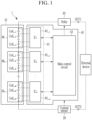
- FIG. 1 shows a battery system according to an embodiment
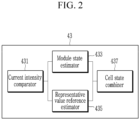
- FIG. 2 shows a function of a main control circuit described with reference to FIG. 1
- FIG. 3 shows a timing diagram of a method for estimating first or second states of charge based on a battery current measurement and a measured battery current according to an embodiment
- FIG. 4 shows a schematic view of a method for estimating a first state of charge according to an embodiment
- FIG. 5 shows a schematic view of a method for estimating a second state of charge according to an embodiment.
- the battery system 1 includes a battery module assembly 10, a current sensor 20, a relay 30, and a BMS 40.
- the battery module assembly 10 includes a plurality of battery modules (M1, M2, ..., Mm) connected in series/parallel and it may supply a power voltage to be used by an external device.
- the battery module assembly 10 is connected between two output ends OUT1 and OUT2 of the battery system 1
- the relay 30 is connected between a positive electrode of the battery system 1 and the output end OUT1
- the current sensor 20 is connected between a negative electrode of the battery system 1 and the output end OUT2.
- the battery module assembly 10 may include a plurality of battery modules (M1, M2, ..., Mm) coupled in series, and the battery modules (M x ) may respectively include a plurality of battery cells (Cell _x1 ,Cell _x2 , ..., Cell _xn ) coupled in series.
- Configurations and a connection relationship among them described with reference to FIG. 1 are only examples, and the present disclosure is not limited thereto.
- X is one of the natural numbers of 1 to m.
- the current sensor 20 is connected in series to a current path between the battery module assembly 10 and an external device.
- the current sensor 20 may measure a current flowing to the battery module assembly 10, that is, a charging current and a discharging current (hereinafter, a battery current), and may transmit a measurement result to the BMS 40.
- the current sensor 20 may measure the battery current for each predetermined period (Ta) and may transmit it to the BMS 40.
- the relay 30 controls an electrical connection between the battery system 1 and the external device.
- the relay 30 When the relay 30 is turned on, the battery system 1 is electrically connected to the external device to perform charging or discharging, and when the relay 30 is turned off, the battery system 1 is electrically disconnected from the external device.
- the external device may be a load or a charger.
- the BMS 40 may include a cell monitoring IC 41 and a main control circuit 43.
- the cell monitoring IC 41 is electrically connected to a positive electrode and a negative electrode of a plurality of respective battery cells (Cell_x1 , Cell_x2, ..., Cell_xn), and measures an open circuit voltage (OCV) (hereinafter, a cell voltage).
- OCV open circuit voltage
- the cell monitoring IC 41 includes a plurality of cell monitoring ICs (41_1, 41 _2, ..., 41 _m) corresponding to a plurality of battery modules (M1, M2, ..., Mm) and measures cell voltages of a plurality of battery cells (Cell_x1, Cell_x2, ..., Cell_xn), and without being limited to this, it may be configured in various forms for measuring the cell voltages of a plurality of battery cells (Cell_x1, Cell_x2, ..., Cell_xn).
- the cell monitoring IC 41 transmits the cell voltages of a plurality of battery cells (Cell_x1, Cell_x2,..., Cell_xn) to the main control circuit 43.
- the cell monitoring IC 41 measures cell voltages of a plurality of battery cells (Cell_x1, Cell_x2, ..., Cell_xn) for each predetermined period (Ta), and transmits a plurality of measured cell voltages to the main control circuit 43.
- the main control circuit 43 may include a current intensity comparator 431, a module state estimator 433, a representative value reference estimator 435, and a cell state combiner 437.
- the main control circuit 43 receives the battery current (lb) measured by the current sensor 20 and a plurality of cell voltages (hereinafter, SOC parameters) measured by the cell monitoring IC 41.
- the SOC parameters may be repeatedly measured and received for respective times (T1, T2, ..., Tn) at regular intervals of a predetermined period (Ta).
- the current intensity comparator 431 may compare the battery current (Ib) received from the current sensor 20 and a threshold current (It), and may select a method for estimating a first state of charge or a method for estimating a second state of charge according to the comparison result.
- FIG. 3 illustrates that the method for estimating a first state of charge is selected for the estimation times T1, T2, T3, and T4, and the method for estimating a second state of charge is selected for the estimation times Tn-2, Tn-1, and Tn, which is however not limited thereto.
- the current intensity comparator 431 may repeatedly compare the current for respective times (T1, T2, ..., Tn) at regular intervals of a predetermined period (Ta), and may select a method for estimating a first state of charge or a method for estimating a second state of charge according to the comparison result.
- the current intensity comparator 431 determines as that a change ( ⁇ SOC) of the state of charge (SOC) of a plurality of battery cells (Cell_x1, Cell_x2, ..., Cell_xn) is small, and may select the method for estimating a first state of charge.
- the current intensity comparator 431 may determine that the change ( ⁇ SOC) of the state of charge of a plurality of battery cells (Cell_x1, Cell_x2, ..., Cell_xn) is big, and may select the method for estimating a second state of charge.
- the module state estimator 433 may estimate and substitute the SOC of a plurality of battery cells (Cell_x1, Cell_x2, ..., Cell_xn) for the respective battery modules (M x ) according to the method for estimating a first state of charge.
- the SOC estimated for a previous estimation time will be defined to be a previous SOC
- the SOC estimated for a current estimation time will be defined to be a current SOC.
- the module state estimator 433 may select one battery module (M x ) from among a plurality of battery modules (M1, M2, ..., Mm), and may estimate the SOC of the cell voltages of a plurality of battery cells (Cell_x1, Cell_x2, ..., Cell_xn) configuring the selected battery module (M x ) based on a lookup table (not shown).
- the module state estimator 433 may reduce a SOC operation process by substituting the current SOC of a plurality of battery cells (Cell_x1, Cell_x2, ..., Cell_xn) configuring the battery module (M x ) that is not selected with the previous SOC and estimating the SOC.
- the module state estimator 433 may select the battery module (M x ) for the respective times T1, T2, T3, and T4 at the interval of a predetermined period (Ta), and may estimate the SOC of a plurality of battery cells (Cell_x1, Cell_x2, and Cell_x3) configuring the selected battery module (M x ) based on the cell voltage.
- the module state estimator 433 may estimate the SOC by substituting the current SOC of a plurality of battery cells (Cell_x1, Cell_x2, and Cell_x3) configuring the battery module (M x ) that is not selected for the times T1, T2, T3, and T4 with the previous SOC.
- the module state estimator 433 may estimate the SOC (78 %, 80 %, and 79 %) of the cell voltages of a plurality of battery cells (Cell _11 , Cell _12 , and Cell _13 ) configuring the first battery module M1 based on the lookup table.
- the module state estimator 433 may estimate the previous SOC (78 %, 80 %, and 78 %) of a plurality of battery cells (Cell _21 , Cell _22 , and Cell _23 ) configuring the second battery module M2 and the previous SOC (80 %, 82 %, and 80 %) of a plurality of battery cells (Cell _31 , Cell _32 , and Cell _33 ) configuring the third battery module M3 as the current SOC (78 %, 80 %, and 78 %) and the current SOC (80 %, 82 %, and 80 %).
- the representative value reference estimator 435 may estimate the respective SOC of a plurality of battery cells (Cell_x1, Cell_x2, ..., Cell_xn) according to the method for estimating a second state of charge. In detail, the representative value reference estimator 435 calculates a representative value based on the cell voltages of a plurality of battery cells (Cell_x1, Cell_x2, ..., Cell_xn) included in the respective battery modules (M x ), estimates the SOC corresponding to the calculated representative value, and calculates a SOC deviation between the estimated current SOC and the previous SOC.
- the representative value reference estimator 435 may estimate the current SOC of a plurality of battery cells (Cell_x1, Cell_x2, ..., Cell_xn) by adding the calculated SOC deviation to the previous SOC of a plurality of respective battery cells (Cell_x1, Cell_x2, ..., Cell_xn) configuring the respective battery modules (M x ).
- the representative value may be set with the cell voltage of a median value from among cell voltages of a plurality of battery cells (Cell_x1, Cell_x2, ..., Cell_xn) configuring the battery module (M x ), and a mean voltage (V m ) of the cell voltages of a plurality of battery cells (Cell_x1, Cell_x2, ..., Cell_xn), but it is not limited thereto.
- the representative value reference estimator 435 may calculate a representative value of a plurality of respective battery modules (M1, M2, ..., Mm) for the times Tn-2, Tn-1, and Tn at the interval of a predetermined period (Ta), may calculate a SOC deviation corresponding to the calculated representative value, and may estimate the current SOC of a plurality of battery cells (Cell_x1, Cell_x2, ..., Cell_xn) included in the respective battery modules (M x ) based on the calculated SOC deviation.
- the representative value reference estimator 435 calculates the SOC deviation at -1 % between the SOC 34 % corresponding to the representative value at the current Tn and the SOC 35 % corresponding to the representative value at the previous Tn-1, and may estimate the current SOC (33 %, 34 %, 34 %, 35 %, ..., 33 %, 34 %) by adding the calculated -1 % to the previous SOC 34 %, 35 %, 35 %, 36 %, ..., 34 %, 35 % of a plurality of battery cells (Cell_x1, Cell_x2, ..., Cell_xn).
- the cell state combiner 437 may estimate the entire SOC of the battery module assembly 10 by combining the estimated and substituted SOC of a plurality of battery cells (Cell_x1, Cell_x2, ..., Cell_xn) configuring the battery module (M x ). For example, referring to FIG. 3 and FIG. 4 , the cell state combiner 437 may estimate the entire SOC of the battery module assembly 10 by repeatedly combining the estimated SOC of a plurality of battery cells (Cell_x1, Cell_x2, ..., Cell_xn) for the respective times (T1, T2, ..., Tn) at the interval of a predetermined period (Ta).
- FIG. 6 shows a flowchart of a method for estimating a state of charge of a battery according to an embodiment.
- the main control circuit 43 receives a battery current (lb) from the current sensor 20, and a plurality of cell voltages of a plurality of battery cells (Cell_x1, Cell_x2, ..., Cell_xn) from the cell monitoring IC 41 (S10).
- the main control circuit 43 may repeatedly receive the battery current (lb) and a plurality of cell voltages for the times (T1, T2, ..., Tn) at the interval of a predetermined period (Ta).
- the main control circuit 43 compares the received battery current (lb) and the threshold current (It) and selects the method for estimating a first state of charge or the method for estimating a second state of charge according to the comparison result (S20).
- the main control circuit 43 determines that the change ( ⁇ SOC) of the states of charge (SOC) of a plurality of battery cells (Cell_x1, Cell_x2, ..., Cell_xn) is small, and it may select the method for estimating a first state of charge.
- the main control circuit 43 determines that the change ( ⁇ SOC) of the states of charge of a plurality of battery cells (Cell_x1, Cell_x2, ..., Cell_xn) is big, and it may select the method for estimating a second state of charge.
- the main control circuit 43 estimates the SOC of a plurality of battery cells (Cell_x1, Cell_x2, ..., Cell_xn) according to the selected method for estimating a state of charge.
- the main control circuit 43 may estimate and substitute the SOC for each battery module (M x ) according to the method for estimating a first state of charge (S30), or may estimate the SOC of a plurality of battery cells (Cell_x1, Cell_x2, ..., Cell_xn) configuring the battery module (M x ) based on the SOC deviation among the SOC corresponding to the respective representative values of the battery module distinguished by discretization according to the method for estimating a second state of charge (S40).
- the main control circuit 43 selects one battery module (M x ) from among a plurality of battery modules (M1, M2, ..., Mm), and may estimate the SOC of a plurality of battery cells (Cell_x1, Cell_x2, ..., Cell_xn) configuring the selected battery module (M x ) by comparing the cell voltage and a lookup table (S31).
- the main control circuit 43 may reduce a SOC operation process by substituting the current SOC of a plurality of battery cells (Cell_x1, Cell_x2, ..., Cell_xn) configuring the battery module (M x ) that is not selected with the previous SOC and estimating the SOC (S33).
- the main control circuit 43 may select the battery module (M x ) for the respective times T1, T2, T3, and T4 at the interval of a predetermined period (Ta), and may operate the SOC of a plurality of battery cells (Cell_x1, Cell_x2, and Cell_x3) configuring the selected battery module (M x ) based on the cell voltage.
- the main control circuit 43 may estimate the SOC by substituting the current SOC of a plurality of battery cells (Cell_x1, Cell_x2, and Cell_x3) configuring the battery module (M x ) that is not selected for the times T1, T2, T3, and T4 with the previous SOC.
- the main control circuit 43 may estimate the SOC (78 %, 80 %, and 79 %) of the cell voltages of a plurality of battery cells (Cell _11 , Cell _12 , and Cell _13 ) configuring the first battery module M1 based on the lookup table.
- the main control circuit 43 may estimate the previous SOC (78 %, 80 %, and 78 %) of a plurality of battery cells (Cell _21 , Cell _22 , and Cell _23 ) configuring the second battery module M2 and the previous SOC (80 %, 82 %, and 80 %) of a plurality of battery cells (Cell _31 , Cell _32 , and Cell _33 ) configuring the third battery module M3 as the current SOC (78 %, 80 %, and 78 %) and the current SOC (80 %, 82 %, and 80 %) at the time T1.
- the main control circuit 43 may calculate a representative value based on the cell voltages of a plurality of battery cells (Cell_x1, Cell_x2, and Cell_x3) included in the respective battery modules (M x ), may estimate the SOC corresponding to the calculated representative value, and may calculate a SOC deviation between the estimated current SOC and the previous SOC.
- the representative value may be set with the cell voltage of a median value from among cell voltages of a plurality of battery cells (Cell_x1, Cell_x2, ..., Cell_xn) configuring the battery module (M x ), and a mean voltage (V m ) of the cell voltages of a plurality of battery cells (Cell_x1, Cell_x2, ..., Cell_xn), but it is not limited thereto.
- the main control circuit 43 may estimate the current SOC by respectively adding the calculated SOC deviation to the previous SOC of a plurality of battery cells (Cell_x1, Cell_x2, ..., Cell_xn) (S43).
- the main control circuit 43 may estimate the current SOC (33 %, 34 %, 34 %, 35 %, ..., 33 %, 34 %) by calculating the SOC deviation of -1 % between the SOC 34 % corresponding to the representative value at the current Tn and the SOC 35 % corresponding to the representative value at the previous Tn-1, and respectively adding the calculated -1 % to the previous SOC 34 %, 35 %, 35 %, 36 %, ..., 34 %, 35 % of a plurality of battery cells (Cell_x1, Cell_x2, ..., Cell_xn).
- Cell_x1, Cell_x2, ..., Cell_xn a plurality of battery cells
- the main control circuit 43 may estimate the entire SOC of the battery module assembly 10 by combining the estimated and substituted SOC of a plurality of battery cells (Cell_x1, Cell_x2, ..., Cell_xn) configuring the battery module (M x ) (S50).
- the main control circuit 43 may estimate the entire SOC of the battery module assembly 10 by repeatedly combining the estimated and substituted SOC of a plurality of battery cells (Cell_x1, Cell_x2, ..., Cell_xn) for respective times (T1, T2, ..., Tn) at the interval of a predetermined period (Ta).
Landscapes
- Engineering & Computer Science (AREA)
- General Physics & Mathematics (AREA)
- Physics & Mathematics (AREA)
- Chemical Kinetics & Catalysis (AREA)
- Electrochemistry (AREA)
- General Chemical & Material Sciences (AREA)
- Chemical & Material Sciences (AREA)
- Manufacturing & Machinery (AREA)
- Power Engineering (AREA)
- Transportation (AREA)
- Life Sciences & Earth Sciences (AREA)
- Sustainable Development (AREA)
- Sustainable Energy (AREA)
- Mechanical Engineering (AREA)
- Microelectronics & Electronic Packaging (AREA)
- Secondary Cells (AREA)
- Charge And Discharge Circuits For Batteries Or The Like (AREA)
- Tests Of Electric Status Of Batteries (AREA)
Description
- The present invention relates to a method for estimating a state of charge of a battery and a battery management system applying the same.
- In recent years, electric vehicles such as a hybrid electric vehicle (HEV) or a pure water electric vehicle (PEV) have gained high attention. The electric vehicle includes a battery for driving an electric motor and driving the vehicle. Further, the electric vehicle includes a regenerative brake system, and braking power may be converted into useful electrical energy for charging the battery through the regenerative brake system. Therefore, the battery included in the electric vehicle may frequently cause transition of a state of charge and a state of discharge.
- On the other hand, when the battery is connected to a load and a discharging starts, a terminal voltage is gradually reduced, and when the terminal voltage reaches a termination voltage, discharging performance may be lost. When the terminal voltage is discharged to be less than the termination voltage, a lifespan of the battery may be reduced or a function may be lost.
- Therefore, an important parameter of the electric vehicle using a battery is a state of charge (SOC) of the battery. When the state of charge (SOC) of the battery is accurately known, problems such that the electric vehicle abruptly stops may be prevented in advance, and power may be stably supplied to the driving motor of the electric vehicle.
- A Coulomb counting method and an impedance measuring method are used as methods for calculating a SOC of a battery cell. The Coulomb counting method is a method for counting an amount of a discharged current (a current flowing to the load) and estimating a SOC of the battery according to the amount of a discharged current. However, the Coulomb counting method has a problem that a measuring error generated by the process for measuring a current is accumulated with respect to time and the accuracy of estimating the SOC is lowered. The impedance measuring method is a method for measuring an open circuit voltage (OCV) of the battery cell, mapping the measured OCV on a lookup table, and estimating the SOC of the battery cell.
- In another way, the entire SOC may be calculated by combining the SOC of a plurality of respective battery cells in the battery system including a plurality of battery cells. In this case, as a number of the battery cells increases, the time of calculating the entire SOC increases, and the use of capacity of the memory increases.
- Further background art is described in
KR 2015 0048439 A KR 2015 0019190 A US 2015/268309 A1 ,US 2017/045587 A1 , andUS 2013/144547 A1 . - The present invention has been made in an effort to provide a method for reducing a time of estimating a state of charge (SOC) of a battery and a memory space in a battery system including a plurality of battery modules respectively including a plurality of battery cells, and a battery management system applying the method.
- An embodiment of the present invention provides a method for estimating a state of charge (SOC) of a battery in a method for estimating a SOC of a battery module assembly according to
claim 1. - Another embodiment of the present invention provides a battery management system for estimating a state of charge (SOC) of a battery module assembly according to claim 3.
- The present disclosure may save the time of estimating a state of charge (SOC) of a battery and the memory space in the battery system including a plurality of battery modules respectively including a plurality of battery cells.
- The present disclosure may estimate the state of charge of the entire battery cells installed in the battery module when the number of battery modules installed in the battery system increases.
-
-
FIG. 1 shows a battery system according to an embodiment. -
FIG. 2 shows a function of a main control circuit described with reference toFIG. 1 . -
FIG. 3 shows a timing diagram of a method for estimating first or second states of charge based on a battery current measurement and a measured battery current according to an embodiment. -
FIG. 4 shows a schematic view of a method for estimating a first state of charge according to an embodiment. -
FIG. 5 shows a schematic view of a method for estimating a second state of charge according to an embodiment. -
FIG. 6 shows a flowchart of a method for estimating a state of charge of a battery according to an embodiment. - Hereinafter, embodiments disclosed in the present specification will be described in detail with reference to the accompanying drawings. In the present specification, the same or similar components will be denoted by the same or similar reference numerals, and an overlapped description thereof will be omitted. The terms "module" and "unit" for components used in the following description are used only in order to make the specification easier, and hence, these terms do not have meanings or roles that distinguish them from each other by themselves. In describing embodiments of the present specification, when it is determined that a detailed description of the well-known art associated with the present invention may obscure the gist of the present invention, it will be omitted. The accompanying drawings are provided only in order to allow embodiments disclosed in the present specification to be easily understood and are not to be interpreted as limiting the present specification, and it is to be understood that the present invention includes all modifications, equivalents, and substitutions without departing from the scope of the present invention, which is defined by the appended claims.
- Terms including ordinal numbers such as first, second, and the like, will be used only to describe various components, and are not interpreted as limiting these components. The terms are only used to differentiate one component from other components.
- It is to be understood that when one component is referred to as being "connected" or "coupled" to another component, it may be connected or coupled directly to another component or be connected or coupled to another component with the other component intervening therebetween. On the other hand, it is to be understood that when one component is referred to as being "connected or coupled directly" to another component, it may be connected to or coupled to another component without the other component intervening therebetween.
- It will be further understood that terms "comprises" or "have" used in the present specification specify the presence of stated features, numerals, steps, operations, components, parts, or a combination thereof, but do not preclude the presence or addition of one or more other features, numerals, steps, operations, components, parts, or a combination thereof.
-
FIG. 1 shows a battery system according to an embodiment,FIG. 2 shows a function of a main control circuit described with reference toFIG. 1 ,FIG. 3 shows a timing diagram of a method for estimating first or second states of charge based on a battery current measurement and a measured battery current according to an embodiment,FIG. 4 shows a schematic view of a method for estimating a first state of charge according to an embodiment, andFIG. 5 shows a schematic view of a method for estimating a second state of charge according to an embodiment. - As shown in
FIG. 1 , thebattery system 1 includes abattery module assembly 10, acurrent sensor 20, arelay 30, and aBMS 40. - The
battery module assembly 10 includes a plurality of battery modules (M1, M2, ..., Mm) connected in series/parallel and it may supply a power voltage to be used by an external device. InFIG. 1 , thebattery module assembly 10 is connected between two output ends OUT1 and OUT2 of thebattery system 1, therelay 30 is connected between a positive electrode of thebattery system 1 and the output end OUT1, and thecurrent sensor 20 is connected between a negative electrode of thebattery system 1 and the output end OUT2. - For example, the
battery module assembly 10 may include a plurality of battery modules (M1, M2, ..., Mm) coupled in series, and the battery modules (Mx) may respectively include a plurality of battery cells (Cell_x1,Cell_x2, ..., Cell_xn) coupled in series. Configurations and a connection relationship among them described with reference toFIG. 1 are only examples, and the present disclosure is not limited thereto. X is one of the natural numbers of 1 to m. - The
current sensor 20 is connected in series to a current path between thebattery module assembly 10 and an external device. Thecurrent sensor 20 may measure a current flowing to thebattery module assembly 10, that is, a charging current and a discharging current (hereinafter, a battery current), and may transmit a measurement result to theBMS 40. In detail, thecurrent sensor 20 may measure the battery current for each predetermined period (Ta) and may transmit it to theBMS 40. - The
relay 30 controls an electrical connection between thebattery system 1 and the external device. When therelay 30 is turned on, thebattery system 1 is electrically connected to the external device to perform charging or discharging, and when therelay 30 is turned off, thebattery system 1 is electrically disconnected from the external device. The external device may be a load or a charger. - The BMS 40 may include a cell monitoring IC 41 and a
main control circuit 43. - The
cell monitoring IC 41 is electrically connected to a positive electrode and a negative electrode of a plurality of respective battery cells (Cell_x1 , Cell_x2, ..., Cell_xn), and measures an open circuit voltage (OCV) (hereinafter, a cell voltage). InFIG. 1 , thecell monitoring IC 41 includes a plurality of cell monitoring ICs (41_1, 41 _2, ..., 41 _m) corresponding to a plurality of battery modules (M1, M2, ..., Mm) and measures cell voltages of a plurality of battery cells (Cell_x1, Cell_x2, ..., Cell_xn), and without being limited to this, it may be configured in various forms for measuring the cell voltages of a plurality of battery cells (Cell_x1, Cell_x2, ..., Cell_xn). - The
cell monitoring IC 41 transmits the cell voltages of a plurality of battery cells (Cell_x1, Cell_x2,..., Cell_xn) to themain control circuit 43. For example, thecell monitoring IC 41 measures cell voltages of a plurality of battery cells (Cell_x1, Cell_x2, ..., Cell_xn) for each predetermined period (Ta), and transmits a plurality of measured cell voltages to themain control circuit 43. - Referring to
FIG. 2 , themain control circuit 43 may include acurrent intensity comparator 431, amodule state estimator 433, a representativevalue reference estimator 435, and a cell state combiner 437. - Referring to
FIG. 1 andFIG. 3 (a) , themain control circuit 43 receives the battery current (lb) measured by thecurrent sensor 20 and a plurality of cell voltages (hereinafter, SOC parameters) measured by thecell monitoring IC 41. The SOC parameters may be repeatedly measured and received for respective times (T1, T2, ..., Tn) at regular intervals of a predetermined period (Ta). - The
current intensity comparator 431 may compare the battery current (Ib) received from thecurrent sensor 20 and a threshold current (It), and may select a method for estimating a first state of charge or a method for estimating a second state of charge according to the comparison result. -
FIG. 3 illustrates that the method for estimating a first state of charge is selected for the estimation times T1, T2, T3, and T4, and the method for estimating a second state of charge is selected for the estimation times Tn-2, Tn-1, and Tn, which is however not limited thereto. For example, thecurrent intensity comparator 431 may repeatedly compare the current for respective times (T1, T2, ..., Tn) at regular intervals of a predetermined period (Ta), and may select a method for estimating a first state of charge or a method for estimating a second state of charge according to the comparison result. - In detail, when the battery current (lb) is less than the threshold current (It), the
current intensity comparator 431 determines as that a change (△SOC) of the state of charge (SOC) of a plurality of battery cells (Cell_x1, Cell_x2, ..., Cell_xn) is small, and may select the method for estimating a first state of charge. When the battery current (lb) is greater than the threshold current (It) according to the comparison result, thecurrent intensity comparator 431 may determine that the change (△SOC) of the state of charge of a plurality of battery cells (Cell_x1, Cell_x2, ..., Cell_xn) is big, and may select the method for estimating a second state of charge. - The
module state estimator 433 may estimate and substitute the SOC of a plurality of battery cells (Cell_x1, Cell_x2, ..., Cell_xn) for the respective battery modules (Mx) according to the method for estimating a first state of charge. Hereinafter, the SOC estimated for a previous estimation time will be defined to be a previous SOC, and the SOC estimated for a current estimation time will be defined to be a current SOC. - In detail, the
module state estimator 433 may select one battery module (Mx) from among a plurality of battery modules (M1, M2, ..., Mm), and may estimate the SOC of the cell voltages of a plurality of battery cells (Cell_x1, Cell_x2, ..., Cell_xn) configuring the selected battery module (Mx) based on a lookup table (not shown). Themodule state estimator 433 may reduce a SOC operation process by substituting the current SOC of a plurality of battery cells (Cell_x1, Cell_x2, ..., Cell_xn) configuring the battery module (Mx) that is not selected with the previous SOC and estimating the SOC. - Referring to
FIG. 3 (b) andFIG. 4 , themodule state estimator 433 may select the battery module (Mx) for the respective times T1, T2, T3, and T4 at the interval of a predetermined period (Ta), and may estimate the SOC of a plurality of battery cells (Cell_x1, Cell_x2, and Cell_x3) configuring the selected battery module (Mx) based on the cell voltage. Themodule state estimator 433 may estimate the SOC by substituting the current SOC of a plurality of battery cells (Cell_x1, Cell_x2, and Cell_x3) configuring the battery module (Mx) that is not selected for the times T1, T2, T3, and T4 with the previous SOC. - For example, for the time T1, the
module state estimator 433 may estimate the SOC (78 %, 80 %, and 79 %) of the cell voltages of a plurality of battery cells (Cell_11, Cell_12, and Cell_13) configuring the first battery module M1 based on the lookup table. In this instance, themodule state estimator 433 may estimate the previous SOC (78 %, 80 %, and 78 %) of a plurality of battery cells (Cell_21, Cell_22, and Cell_23) configuring the second battery module M2 and the previous SOC (80 %, 82 %, and 80 %) of a plurality of battery cells (Cell_31, Cell_32, and Cell_33) configuring the third battery module M3 as the current SOC (78 %, 80 %, and 78 %) and the current SOC (80 %, 82 %, and 80 %). - The representative
value reference estimator 435 may estimate the respective SOC of a plurality of battery cells (Cell_x1, Cell_x2, ..., Cell_xn) according to the method for estimating a second state of charge. In detail, the representativevalue reference estimator 435 calculates a representative value based on the cell voltages of a plurality of battery cells (Cell_x1, Cell_x2, ..., Cell_xn) included in the respective battery modules (Mx), estimates the SOC corresponding to the calculated representative value, and calculates a SOC deviation between the estimated current SOC and the previous SOC. - The representative
value reference estimator 435 may estimate the current SOC of a plurality of battery cells (Cell_x1, Cell_x2, ..., Cell_xn) by adding the calculated SOC deviation to the previous SOC of a plurality of respective battery cells (Cell_x1, Cell_x2, ..., Cell_xn) configuring the respective battery modules (Mx). The representative value may be set with the cell voltage of a median value from among cell voltages of a plurality of battery cells (Cell_x1, Cell_x2, ..., Cell_xn) configuring the battery module (Mx), and a mean voltage (Vm) of the cell voltages of a plurality of battery cells (Cell_x1, Cell_x2, ..., Cell_xn), but it is not limited thereto. - Referring to
FIG. 3 (c) , the representativevalue reference estimator 435 may calculate a representative value of a plurality of respective battery modules (M1, M2, ..., Mm) for the times Tn-2, Tn-1, and Tn at the interval of a predetermined period (Ta), may calculate a SOC deviation corresponding to the calculated representative value, and may estimate the current SOC of a plurality of battery cells (Cell_x1, Cell_x2, ..., Cell_xn) included in the respective battery modules (Mx) based on the calculated SOC deviation. - Referring to
FIG. 5 , the representativevalue reference estimator 435 calculates the SOC deviation at -1 % between theSOC 34 % corresponding to the representative value at the current Tn and theSOC 35 % corresponding to the representative value at the previous Tn-1, and may estimate the current SOC (33 %, 34 %, 34 %, 35 %, ..., 33 %, 34 %) by adding the calculated -1 % to theprevious SOC 34 %, 35 %, 35 %, 36 %, ..., 34 %, 35 % of a plurality of battery cells (Cell_x1, Cell_x2, ..., Cell_xn). - The
cell state combiner 437 may estimate the entire SOC of thebattery module assembly 10 by combining the estimated and substituted SOC of a plurality of battery cells (Cell_x1, Cell_x2, ..., Cell_xn) configuring the battery module (Mx). For example, referring toFIG. 3 andFIG. 4 , thecell state combiner 437 may estimate the entire SOC of thebattery module assembly 10 by repeatedly combining the estimated SOC of a plurality of battery cells (Cell_x1, Cell_x2, ..., Cell_xn) for the respective times (T1, T2, ..., Tn) at the interval of a predetermined period (Ta). -
FIG. 6 shows a flowchart of a method for estimating a state of charge of a battery according to an embodiment. - First, the
main control circuit 43 receives a battery current (lb) from thecurrent sensor 20, and a plurality of cell voltages of a plurality of battery cells (Cell_x1, Cell_x2, ..., Cell_xn) from the cell monitoring IC 41 (S10). Referring toFIG. 3 , themain control circuit 43 may repeatedly receive the battery current (lb) and a plurality of cell voltages for the times (T1, T2, ..., Tn) at the interval of a predetermined period (Ta). - The
main control circuit 43 compares the received battery current (lb) and the threshold current (It) and selects the method for estimating a first state of charge or the method for estimating a second state of charge according to the comparison result (S20). - For example, when the battery current (lb) is less than the threshold current (It), the
main control circuit 43 determines that the change (△SOC) of the states of charge (SOC) of a plurality of battery cells (Cell_x1, Cell_x2, ..., Cell_xn) is small, and it may select the method for estimating a first state of charge. When the battery current (lb) is greater than the threshold current (It), themain control circuit 43 determines that the change (△SOC) of the states of charge of a plurality of battery cells (Cell_x1, Cell_x2, ..., Cell_xn) is big, and it may select the method for estimating a second state of charge. - The
main control circuit 43 estimates the SOC of a plurality of battery cells (Cell_x1, Cell_x2, ..., Cell_xn) according to the selected method for estimating a state of charge. In detail, themain control circuit 43 may estimate and substitute the SOC for each battery module (Mx) according to the method for estimating a first state of charge (S30), or may estimate the SOC of a plurality of battery cells (Cell_x1, Cell_x2, ..., Cell_xn) configuring the battery module (Mx) based on the SOC deviation among the SOC corresponding to the respective representative values of the battery module distinguished by discretization according to the method for estimating a second state of charge (S40). - In S30, the
main control circuit 43 selects one battery module (Mx) from among a plurality of battery modules (M1, M2, ..., Mm), and may estimate the SOC of a plurality of battery cells (Cell_x1, Cell_x2, ..., Cell_xn) configuring the selected battery module (Mx) by comparing the cell voltage and a lookup table (S31). - In S30, the
main control circuit 43 may reduce a SOC operation process by substituting the current SOC of a plurality of battery cells (Cell_x1, Cell_x2, ..., Cell_xn) configuring the battery module (Mx) that is not selected with the previous SOC and estimating the SOC (S33). - For example, referring to
FIG. 3 (b) andFIG. 4 , themain control circuit 43 may select the battery module (Mx) for the respective times T1, T2, T3, and T4 at the interval of a predetermined period (Ta), and may operate the SOC of a plurality of battery cells (Cell_x1, Cell_x2, and Cell_x3) configuring the selected battery module (Mx) based on the cell voltage. Themain control circuit 43 may estimate the SOC by substituting the current SOC of a plurality of battery cells (Cell_x1, Cell_x2, and Cell_x3) configuring the battery module (Mx) that is not selected for the times T1, T2, T3, and T4 with the previous SOC. - For example, for the time T1, the
main control circuit 43 may estimate the SOC (78 %, 80 %, and 79 %) of the cell voltages of a plurality of battery cells (Cell_11, Cell_12, and Cell_13) configuring the first battery module M1 based on the lookup table. In this instance, themain control circuit 43 may estimate the previous SOC (78 %, 80 %, and 78 %) of a plurality of battery cells (Cell_21, Cell_22, and Cell_23) configuring the second battery module M2 and the previous SOC (80 %, 82 %, and 80 %) of a plurality of battery cells (Cell_31, Cell_32, and Cell_33) configuring the third battery module M3 as the current SOC (78 %, 80 %, and 78 %) and the current SOC (80 %, 82 %, and 80 %) at the time T1. - In S40, the
main control circuit 43 may calculate a representative value based on the cell voltages of a plurality of battery cells (Cell_x1, Cell_x2, and Cell_x3) included in the respective battery modules (Mx), may estimate the SOC corresponding to the calculated representative value, and may calculate a SOC deviation between the estimated current SOC and the previous SOC. The representative value may be set with the cell voltage of a median value from among cell voltages of a plurality of battery cells (Cell_x1, Cell_x2, ..., Cell_xn) configuring the battery module (Mx), and a mean voltage (Vm) of the cell voltages of a plurality of battery cells (Cell_x1, Cell_x2, ..., Cell_xn), but it is not limited thereto. - In S40, the
main control circuit 43 may estimate the current SOC by respectively adding the calculated SOC deviation to the previous SOC of a plurality of battery cells (Cell_x1, Cell_x2, ..., Cell_xn) (S43). - For example, referring to
FIG. 5 , themain control circuit 43 may estimate the current SOC (33 %, 34 %, 34 %, 35 %, ..., 33 %, 34 %) by calculating the SOC deviation of -1 % between theSOC 34 % corresponding to the representative value at the current Tn and theSOC 35 % corresponding to the representative value at the previous Tn-1, and respectively adding the calculated -1 % to theprevious SOC 34 %, 35 %, 35 %, 36 %, ..., 34 %, 35 % of a plurality of battery cells (Cell_x1, Cell_x2, ..., Cell_xn). - The
main control circuit 43 may estimate the entire SOC of thebattery module assembly 10 by combining the estimated and substituted SOC of a plurality of battery cells (Cell_x1, Cell_x2, ..., Cell_xn) configuring the battery module (Mx) (S50). - For example, referring to
FIG. 3 andFIG. 4 , themain control circuit 43 may estimate the entire SOC of thebattery module assembly 10 by repeatedly combining the estimated and substituted SOC of a plurality of battery cells (Cell_x1, Cell_x2, ..., Cell_xn) for respective times (T1, T2, ..., Tn) at the interval of a predetermined period (Ta). - While this invention has been described in connection with what is presently considered to be practical embodiments, it is to be understood that the invention is not limited to the disclosed embodiments, but, on the contrary, is intended to cover various modifications and equivalent arrangements included within the scope of the appended claims.
Claims (4)
- A method for estimating a state of charge, SOC, of a battery comprising a battery module assembly (10) including battery modules (Mx) respectively including a plurality of battery cells (Cell_x1, Cell_x2, ..., Cell_xn), comprising:repeatedly receiving (S10) a battery current (lb) from a current sensor and a plurality of cell voltages of the plurality of battery cells at an interval of a predetermined period (Ta);comparing (S20) the battery current and a threshold current (It),selecting (S20) a method for estimating a first state of charge or a method for estimating a second state of charge according to a comparison result; wherein the method for estimating a first state of charge is selected when the battery current is equal to or less than the threshold current, and the method for estimating a second state of charge is selected when the battery current is greater than the threshold current;estimating (S30, S40) a SOC of the cells according to the selected method for estimating a state of charge; andestimating (S50) the SOC of the battery module assembly by combining the estimated SOC of the battery cells;wherein when the method for estimating a first state of charge is selected, estimating (S30) a SOC of the cells includes estimating the SOC of a plurality of battery cells configuring a selected battery module by comparing the received cell voltages of the plurality of battery cells configuring the selected battery module and a lookup table, and estimating a current SOC of a plurality of battery cells configuring a non-selected battery module by substituting the current SOC with a previous SOC;wherein when the method for estimating a second state of charge is selected, estimating (S40) a SOC of the cells includes for each battery module calculating a representative value based on the cell voltages of the plurality of battery cells included in the respective battery modules, estimating a SOC corresponding to the representative value, calculating a SOC deviation between the estimated SOC corresponding to the representative value and the previous SOC corresponding to a previously calculated representative value, estimating the SOC of the cells by respectively adding the SOC deviation to each of previously estimated SOC of the plurality of battery cells.
- The method of claim 1, wherein
the representative value is set with the cell voltage of a median value from among cell voltages of the plurality of battery cells configuring the battery module, or a mean voltage of the cell voltages of the plurality of battery cells. - A battery management system (40) for estimating a state of charge (SOC) of a battery module assembly (10) including a plurality of battery modules (Mx) respectively including a plurality of battery cells (Cell_x1, Cell_x2, ..., Cell_xn), comprising:a cell monitoring IC (41) configured to be connected to respective ends of the respective cells and configured to measure cell voltages of the cells; anda main control circuit (43) for estimating the SOC of the battery module assembly and configured to receive the cell voltages from the cell monitoring IC and carry out the method of claim 1 or 2.
- A battery system (1) including a battery module assembly (10), a current sensor (20), a relay (30) and the battery management system of claim 3,wherein the battery module assembly comprises a plurality of battery modules (M1, M2, ..., Mx) connected in series or parallel, and connected between two output ends (OUT1, OUT2) of the battery system;wherein the relay is connected between a positive electrode of the battery system and one of the output ends,wherein the current sensor is connected between a negative electrode of the battery system and the other one of the output ends and to the main control circuit of the battery management system.
Applications Claiming Priority (2)
| Application Number | Priority Date | Filing Date | Title |
|---|---|---|---|
| KR1020190137548A KR102824433B1 (en) | 2019-10-31 | 2019-10-31 | Method for estimating of battery's state of charge and Battery Management System |
| PCT/KR2020/013043 WO2021085869A1 (en) | 2019-10-31 | 2020-09-25 | Method for estimating battery state of charge and battery management system equipped with same |
Publications (3)
| Publication Number | Publication Date |
|---|---|
| EP3923006A1 EP3923006A1 (en) | 2021-12-15 |
| EP3923006A4 EP3923006A4 (en) | 2022-05-18 |
| EP3923006B1 true EP3923006B1 (en) | 2023-11-29 |
Family
ID=75715343
Family Applications (1)
| Application Number | Title | Priority Date | Filing Date |
|---|---|---|---|
| EP20883067.9A Active EP3923006B1 (en) | 2019-10-31 | 2020-09-25 | Method for estimating battery state of charge and battery management system applying the same |
Country Status (8)
| Country | Link |
|---|---|
| US (1) | US12085619B2 (en) |
| EP (1) | EP3923006B1 (en) |
| JP (1) | JP7244189B2 (en) |
| KR (1) | KR102824433B1 (en) |
| CN (1) | CN113544895B (en) |
| ES (1) | ES2973223T3 (en) |
| HU (1) | HUE065046T2 (en) |
| WO (1) | WO2021085869A1 (en) |
Families Citing this family (5)
| Publication number | Priority date | Publication date | Assignee | Title |
|---|---|---|---|---|
| US10962623B1 (en) | 2017-05-17 | 2021-03-30 | Heathkit Company, Inc. | Accurate and model-based measurement and management systems and methods |
| TWI715367B (en) * | 2019-12-23 | 2021-01-01 | 台達電子工業股份有限公司 | Battery controller and battery level measurement method thereof |
| KR20220039249A (en) * | 2020-09-22 | 2022-03-29 | 주식회사 엘지에너지솔루션 | Battery apparatus and method for estimating battery state |
| KR20240037583A (en) * | 2022-09-15 | 2024-03-22 | 주식회사 엘지에너지솔루션 | Battery cell degradation diagnosis method and battery system using the same |
| EP4407328A1 (en) * | 2023-01-24 | 2024-07-31 | Rimac Technology LLC | Estimating a battery state of charge under non-uniform temperature conditions |
Family Cites Families (27)
| Publication number | Priority date | Publication date | Assignee | Title |
|---|---|---|---|---|
| JP3126591B2 (en) | 1994-07-15 | 2001-01-22 | 株式会社東芝 | Method of estimating remaining capacity of storage battery |
| JP4228760B2 (en) * | 2002-07-12 | 2009-02-25 | トヨタ自動車株式会社 | Battery charge state estimation device |
| US8264203B2 (en) | 2006-03-31 | 2012-09-11 | Valence Technology, Inc. | Monitoring state of charge of a battery |
| KR100985667B1 (en) | 2007-08-22 | 2010-10-05 | 주식회사 엘지화학 | Battery open circuit voltage estimator, battery charge state estimator and its control method |
| WO2011118039A1 (en) | 2010-03-26 | 2011-09-29 | 三菱電機株式会社 | Charge state estimation apparatus |
| JP2011221012A (en) | 2010-03-26 | 2011-11-04 | Sanyo Electric Co Ltd | Battery module state detecting device, battery module state control device, battery system, electric vehicle, mobile body, power storage device and power supply device |
| JP5051264B2 (en) | 2010-04-08 | 2012-10-17 | 株式会社デンソー | Battery voltage monitoring device |
| JP5521795B2 (en) | 2010-06-04 | 2014-06-18 | 日産自動車株式会社 | Battery control device |
| DE102010062838A1 (en) | 2010-12-10 | 2012-06-14 | Dspace Digital Signal Processing And Control Engineering Gmbh | Real-time battery cell simulation |
| CN103635822B (en) | 2011-08-30 | 2016-02-10 | 三洋电机株式会社 | Battery system, electric vehicle, mobile body, power storage device, and power supply device |
| JP5798887B2 (en) | 2011-10-31 | 2015-10-21 | 株式会社日立製作所 | Power storage system |
| KR101648889B1 (en) | 2011-12-06 | 2016-08-18 | 삼성에스디아이 주식회사 | Apparatus for controlling battery pack, and energy storage system including the battery pack |
| JP5272069B2 (en) | 2011-12-22 | 2013-08-28 | 三菱重工業株式会社 | Battery system |
| KR101486470B1 (en) * | 2012-03-16 | 2015-01-26 | 주식회사 엘지화학 | Apparatus and method for estimating battery state |
| JP6300000B2 (en) * | 2013-02-20 | 2018-03-28 | 株式会社Gsユアサ | Charge state estimation device, charge state estimation method |
| KR20140133318A (en) * | 2013-05-10 | 2014-11-19 | 현대모비스 주식회사 | Apparatus and method for estimating SOC of battery |
| US9770997B2 (en) * | 2013-06-11 | 2017-09-26 | Ford Global Technologies, Llc | Detection of imbalance across multiple battery cells measured by the same voltage sensor |
| KR20150019190A (en) | 2013-08-13 | 2015-02-25 | 현대모비스 주식회사 | Method of Estimating Battery Stste-Of-Charge and Apparatus therefor the same |
| KR102080632B1 (en) | 2013-10-28 | 2020-04-14 | 현대모비스 주식회사 | Battery management system and its operating method |
| DE102014204956A1 (en) * | 2014-03-18 | 2015-09-24 | Robert Bosch Gmbh | Method for detecting anomalies in a battery cell and short-circuit sensor |
| KR102177721B1 (en) | 2014-03-20 | 2020-11-11 | 현대모비스 주식회사 | Apparatus and Method for estimating deterioration of battery pack |
| KR102205841B1 (en) | 2014-04-28 | 2021-01-21 | 삼성전자주식회사 | Method and apparatus for estimating state of battery |
| KR102314211B1 (en) | 2014-07-28 | 2021-10-19 | 현대모비스 주식회사 | Method for estimating soc of battery management system |
| JP6405942B2 (en) * | 2014-11-27 | 2018-10-17 | 三菱自動車工業株式会社 | Battery pack abnormality determination device |
| KR102441335B1 (en) * | 2015-08-13 | 2022-09-06 | 삼성전자주식회사 | Apparatus and method for SOC estimation of battery |
| KR102203245B1 (en) | 2017-11-01 | 2021-01-13 | 주식회사 엘지화학 | Apparatus and method for estimating SOC of battery |
| KR20190137548A (en) | 2018-06-01 | 2019-12-11 | 백연선 | It consolidation / composite housing with environmentally friendly desalination and-conditioning facilities |
-
2019
- 2019-10-31 KR KR1020190137548A patent/KR102824433B1/en active Active
-
2020
- 2020-09-05 US US17/435,822 patent/US12085619B2/en active Active
- 2020-09-25 EP EP20883067.9A patent/EP3923006B1/en active Active
- 2020-09-25 CN CN202080019887.2A patent/CN113544895B/en active Active
- 2020-09-25 WO PCT/KR2020/013043 patent/WO2021085869A1/en not_active Ceased
- 2020-09-25 HU HUE20883067A patent/HUE065046T2/en unknown
- 2020-09-25 JP JP2021545812A patent/JP7244189B2/en active Active
- 2020-09-25 ES ES20883067T patent/ES2973223T3/en active Active
Also Published As
| Publication number | Publication date |
|---|---|
| CN113544895B (en) | 2024-05-10 |
| US12085619B2 (en) | 2024-09-10 |
| EP3923006A1 (en) | 2021-12-15 |
| WO2021085869A1 (en) | 2021-05-06 |
| EP3923006A4 (en) | 2022-05-18 |
| KR102824433B1 (en) | 2025-06-23 |
| JP2022534831A (en) | 2022-08-04 |
| HUE065046T2 (en) | 2024-04-28 |
| US20220155380A1 (en) | 2022-05-19 |
| ES2973223T3 (en) | 2024-06-19 |
| JP7244189B2 (en) | 2023-03-22 |
| KR20210051809A (en) | 2021-05-10 |
| CN113544895A (en) | 2021-10-22 |
Similar Documents
| Publication | Publication Date | Title |
|---|---|---|
| EP3923006B1 (en) | Method for estimating battery state of charge and battery management system applying the same | |
| US11474154B1 (en) | Performing active interrogation of battery packs in situ to obtain precise SOC and SOH estimates | |
| JP5496612B2 (en) | Battery chargeable / dischargeable current calculation method, power supply device, and vehicle equipped with the same | |
| KR102066702B1 (en) | Battery management apparatus and soc calibrating method using the same | |
| EP1801604B1 (en) | Method for compensating state of charge of battery and battery management system using the same | |
| Mastali et al. | Battery state of the charge estimation using Kalman filtering | |
| JP5673654B2 (en) | Power storage system and full charge capacity calculation method | |
| CN101013822B (en) | Method for compensating state of charge of battery and battery management system using the same | |
| CN103460062B (en) | Degeneration measurement mechanism, secondary battery and degeneration measuring method | |
| EP2847026B1 (en) | Electrical storage system and equalizing method | |
| US10838013B2 (en) | Management apparatus and power storage system | |
| US20180074129A1 (en) | Battery control device and electric motor vehicle system | |
| KR101746139B1 (en) | Apparatus for Cell Balancing Using Auxiliary Battery and Method thereof | |
| KR101561887B1 (en) | Apparatus and method for managing battery based on differential SOC estimation and battery pack using it | |
| JP2023500449A (en) | Fast charging method | |
| WO2012140776A1 (en) | Charging control device | |
| KR20190106061A (en) | Apparatus and method for estimating state of health of battery rack | |
| CN102540085B (en) | The optimization method of electric component parameter and system in energy-storage system model | |
| JP2020079764A (en) | Secondary battery status determination method | |
| KR102754697B1 (en) | Battery Management System | |
| JP6434245B2 (en) | Charging rate estimation device and power supply system | |
| KR102902823B1 (en) | Cell voltage estimation method and battery system providing the same | |
| US20250140944A1 (en) | Battery system | |
| CN121773342A (en) | Battery system for supplementing cell voltage and cell temperature data and battery pack diagnosis method | |
| JP2015102444A (en) | Battery state detection device and battery state detection method |
Legal Events
| Date | Code | Title | Description |
|---|---|---|---|
| STAA | Information on the status of an ep patent application or granted ep patent |
Free format text: STATUS: THE INTERNATIONAL PUBLICATION HAS BEEN MADE |
|
| PUAI | Public reference made under article 153(3) epc to a published international application that has entered the european phase |
Free format text: ORIGINAL CODE: 0009012 |
|
| STAA | Information on the status of an ep patent application or granted ep patent |
Free format text: STATUS: REQUEST FOR EXAMINATION WAS MADE |
|
| 17P | Request for examination filed |
Effective date: 20210910 |
|
| AK | Designated contracting states |
Kind code of ref document: A1 Designated state(s): AL AT BE BG CH CY CZ DE DK EE ES FI FR GB GR HR HU IE IS IT LI LT LU LV MC MK MT NL NO PL PT RO RS SE SI SK SM TR |
|
| RAP3 | Party data changed (applicant data changed or rights of an application transferred) |
Owner name: LG ENERGY SOLUTION, LTD. |
|
| A4 | Supplementary search report drawn up and despatched |
Effective date: 20220414 |
|
| RIC1 | Information provided on ipc code assigned before grant |
Ipc: G01R 31/388 20190101ALI20220408BHEP Ipc: G01R 31/3835 20190101ALI20220408BHEP Ipc: G06N 3/08 20060101ALI20220408BHEP Ipc: G06N 20/00 20190101ALI20220408BHEP Ipc: G01R 19/165 20060101ALI20220408BHEP Ipc: G01R 31/382 20190101ALI20220408BHEP Ipc: G01R 31/396 20190101ALI20220408BHEP Ipc: G01R 31/367 20190101AFI20220408BHEP |
|
| DAV | Request for validation of the european patent (deleted) | ||
| DAX | Request for extension of the european patent (deleted) | ||
| GRAJ | Information related to disapproval of communication of intention to grant by the applicant or resumption of examination proceedings by the epo deleted |
Free format text: ORIGINAL CODE: EPIDOSDIGR1 |
|
| STAA | Information on the status of an ep patent application or granted ep patent |
Free format text: STATUS: GRANT OF PATENT IS INTENDED |
|
| GRAP | Despatch of communication of intention to grant a patent |
Free format text: ORIGINAL CODE: EPIDOSNIGR1 |
|
| INTG | Intention to grant announced |
Effective date: 20230717 |
|
| P01 | Opt-out of the competence of the unified patent court (upc) registered |
Effective date: 20230801 |
|
| GRAS | Grant fee paid |
Free format text: ORIGINAL CODE: EPIDOSNIGR3 |
|
| GRAA | (expected) grant |
Free format text: ORIGINAL CODE: 0009210 |
|
| STAA | Information on the status of an ep patent application or granted ep patent |
Free format text: STATUS: THE PATENT HAS BEEN GRANTED |
|
| AK | Designated contracting states |
Kind code of ref document: B1 Designated state(s): AL AT BE BG CH CY CZ DE DK EE ES FI FR GB GR HR HU IE IS IT LI LT LU LV MC MK MT NL NO PL PT RO RS SE SI SK SM TR |
|
| REG | Reference to a national code |
Ref country code: GB Ref legal event code: FG4D |
|
| REG | Reference to a national code |
Ref country code: CH Ref legal event code: EP |
|
| REG | Reference to a national code |
Ref country code: DE Ref legal event code: R096 Ref document number: 602020022117 Country of ref document: DE |
|
| REG | Reference to a national code |
Ref country code: IE Ref legal event code: FG4D |
|
| REG | Reference to a national code |
Ref country code: LT Ref legal event code: MG9D |
|
| REG | Reference to a national code |
Ref country code: NL Ref legal event code: MP Effective date: 20231129 |
|
| PG25 | Lapsed in a contracting state [announced via postgrant information from national office to epo] |
Ref country code: GR Free format text: LAPSE BECAUSE OF FAILURE TO SUBMIT A TRANSLATION OF THE DESCRIPTION OR TO PAY THE FEE WITHIN THE PRESCRIBED TIME-LIMIT Effective date: 20240301 |
|
| PG25 | Lapsed in a contracting state [announced via postgrant information from national office to epo] |
Ref country code: IS Free format text: LAPSE BECAUSE OF FAILURE TO SUBMIT A TRANSLATION OF THE DESCRIPTION OR TO PAY THE FEE WITHIN THE PRESCRIBED TIME-LIMIT Effective date: 20240329 |
|
| PG25 | Lapsed in a contracting state [announced via postgrant information from national office to epo] |
Ref country code: LT Free format text: LAPSE BECAUSE OF FAILURE TO SUBMIT A TRANSLATION OF THE DESCRIPTION OR TO PAY THE FEE WITHIN THE PRESCRIBED TIME-LIMIT Effective date: 20231129 |
|
| REG | Reference to a national code |
Ref country code: HU Ref legal event code: AG4A Ref document number: E065046 Country of ref document: HU |
|
| PG25 | Lapsed in a contracting state [announced via postgrant information from national office to epo] |
Ref country code: LT Free format text: LAPSE BECAUSE OF FAILURE TO SUBMIT A TRANSLATION OF THE DESCRIPTION OR TO PAY THE FEE WITHIN THE PRESCRIBED TIME-LIMIT Effective date: 20231129 Ref country code: IS Free format text: LAPSE BECAUSE OF FAILURE TO SUBMIT A TRANSLATION OF THE DESCRIPTION OR TO PAY THE FEE WITHIN THE PRESCRIBED TIME-LIMIT Effective date: 20240329 Ref country code: GR Free format text: LAPSE BECAUSE OF FAILURE TO SUBMIT A TRANSLATION OF THE DESCRIPTION OR TO PAY THE FEE WITHIN THE PRESCRIBED TIME-LIMIT Effective date: 20240301 Ref country code: BG Free format text: LAPSE BECAUSE OF FAILURE TO SUBMIT A TRANSLATION OF THE DESCRIPTION OR TO PAY THE FEE WITHIN THE PRESCRIBED TIME-LIMIT Effective date: 20240229 |
|
| REG | Reference to a national code |
Ref country code: AT Ref legal event code: MK05 Ref document number: 1636668 Country of ref document: AT Kind code of ref document: T Effective date: 20231129 |
|
| PG25 | Lapsed in a contracting state [announced via postgrant information from national office to epo] |
Ref country code: NL Free format text: LAPSE BECAUSE OF FAILURE TO SUBMIT A TRANSLATION OF THE DESCRIPTION OR TO PAY THE FEE WITHIN THE PRESCRIBED TIME-LIMIT Effective date: 20231129 |
|
| PG25 | Lapsed in a contracting state [announced via postgrant information from national office to epo] |
Ref country code: SE Free format text: LAPSE BECAUSE OF FAILURE TO SUBMIT A TRANSLATION OF THE DESCRIPTION OR TO PAY THE FEE WITHIN THE PRESCRIBED TIME-LIMIT Effective date: 20231129 Ref country code: RS Free format text: LAPSE BECAUSE OF FAILURE TO SUBMIT A TRANSLATION OF THE DESCRIPTION OR TO PAY THE FEE WITHIN THE PRESCRIBED TIME-LIMIT Effective date: 20231129 Ref country code: PL Free format text: LAPSE BECAUSE OF FAILURE TO SUBMIT A TRANSLATION OF THE DESCRIPTION OR TO PAY THE FEE WITHIN THE PRESCRIBED TIME-LIMIT Effective date: 20231129 Ref country code: NO Free format text: LAPSE BECAUSE OF FAILURE TO SUBMIT A TRANSLATION OF THE DESCRIPTION OR TO PAY THE FEE WITHIN THE PRESCRIBED TIME-LIMIT Effective date: 20240229 Ref country code: NL Free format text: LAPSE BECAUSE OF FAILURE TO SUBMIT A TRANSLATION OF THE DESCRIPTION OR TO PAY THE FEE WITHIN THE PRESCRIBED TIME-LIMIT Effective date: 20231129 Ref country code: LV Free format text: LAPSE BECAUSE OF FAILURE TO SUBMIT A TRANSLATION OF THE DESCRIPTION OR TO PAY THE FEE WITHIN THE PRESCRIBED TIME-LIMIT Effective date: 20231129 Ref country code: HR Free format text: LAPSE BECAUSE OF FAILURE TO SUBMIT A TRANSLATION OF THE DESCRIPTION OR TO PAY THE FEE WITHIN THE PRESCRIBED TIME-LIMIT Effective date: 20231129 |
|
| REG | Reference to a national code |
Ref country code: ES Ref legal event code: FG2A Ref document number: 2973223 Country of ref document: ES Kind code of ref document: T3 Effective date: 20240619 |
|
| PG25 | Lapsed in a contracting state [announced via postgrant information from national office to epo] |
Ref country code: DK Free format text: LAPSE BECAUSE OF FAILURE TO SUBMIT A TRANSLATION OF THE DESCRIPTION OR TO PAY THE FEE WITHIN THE PRESCRIBED TIME-LIMIT Effective date: 20231129 |
|
| PG25 | Lapsed in a contracting state [announced via postgrant information from national office to epo] |
Ref country code: CZ Free format text: LAPSE BECAUSE OF FAILURE TO SUBMIT A TRANSLATION OF THE DESCRIPTION OR TO PAY THE FEE WITHIN THE PRESCRIBED TIME-LIMIT Effective date: 20231129 Ref country code: AT Free format text: LAPSE BECAUSE OF FAILURE TO SUBMIT A TRANSLATION OF THE DESCRIPTION OR TO PAY THE FEE WITHIN THE PRESCRIBED TIME-LIMIT Effective date: 20231129 |
|
| PG25 | Lapsed in a contracting state [announced via postgrant information from national office to epo] |
Ref country code: SK Free format text: LAPSE BECAUSE OF FAILURE TO SUBMIT A TRANSLATION OF THE DESCRIPTION OR TO PAY THE FEE WITHIN THE PRESCRIBED TIME-LIMIT Effective date: 20231129 |
|
| PG25 | Lapsed in a contracting state [announced via postgrant information from national office to epo] |
Ref country code: SM Free format text: LAPSE BECAUSE OF FAILURE TO SUBMIT A TRANSLATION OF THE DESCRIPTION OR TO PAY THE FEE WITHIN THE PRESCRIBED TIME-LIMIT Effective date: 20231129 Ref country code: SK Free format text: LAPSE BECAUSE OF FAILURE TO SUBMIT A TRANSLATION OF THE DESCRIPTION OR TO PAY THE FEE WITHIN THE PRESCRIBED TIME-LIMIT Effective date: 20231129 Ref country code: RO Free format text: LAPSE BECAUSE OF FAILURE TO SUBMIT A TRANSLATION OF THE DESCRIPTION OR TO PAY THE FEE WITHIN THE PRESCRIBED TIME-LIMIT Effective date: 20231129 Ref country code: IT Free format text: LAPSE BECAUSE OF FAILURE TO SUBMIT A TRANSLATION OF THE DESCRIPTION OR TO PAY THE FEE WITHIN THE PRESCRIBED TIME-LIMIT Effective date: 20231129 Ref country code: EE Free format text: LAPSE BECAUSE OF FAILURE TO SUBMIT A TRANSLATION OF THE DESCRIPTION OR TO PAY THE FEE WITHIN THE PRESCRIBED TIME-LIMIT Effective date: 20231129 Ref country code: DK Free format text: LAPSE BECAUSE OF FAILURE TO SUBMIT A TRANSLATION OF THE DESCRIPTION OR TO PAY THE FEE WITHIN THE PRESCRIBED TIME-LIMIT Effective date: 20231129 Ref country code: CZ Free format text: LAPSE BECAUSE OF FAILURE TO SUBMIT A TRANSLATION OF THE DESCRIPTION OR TO PAY THE FEE WITHIN THE PRESCRIBED TIME-LIMIT Effective date: 20231129 Ref country code: AT Free format text: LAPSE BECAUSE OF FAILURE TO SUBMIT A TRANSLATION OF THE DESCRIPTION OR TO PAY THE FEE WITHIN THE PRESCRIBED TIME-LIMIT Effective date: 20231129 |
|
| PG25 | Lapsed in a contracting state [announced via postgrant information from national office to epo] |
Ref country code: PT Free format text: LAPSE BECAUSE OF FAILURE TO SUBMIT A TRANSLATION OF THE DESCRIPTION OR TO PAY THE FEE WITHIN THE PRESCRIBED TIME-LIMIT Effective date: 20240401 |
|
| PG25 | Lapsed in a contracting state [announced via postgrant information from national office to epo] |
Ref country code: PT Free format text: LAPSE BECAUSE OF FAILURE TO SUBMIT A TRANSLATION OF THE DESCRIPTION OR TO PAY THE FEE WITHIN THE PRESCRIBED TIME-LIMIT Effective date: 20240401 |
|
| REG | Reference to a national code |
Ref country code: DE Ref legal event code: R097 Ref document number: 602020022117 Country of ref document: DE |
|
| PLBE | No opposition filed within time limit |
Free format text: ORIGINAL CODE: 0009261 |
|
| STAA | Information on the status of an ep patent application or granted ep patent |
Free format text: STATUS: NO OPPOSITION FILED WITHIN TIME LIMIT |
|
| PG25 | Lapsed in a contracting state [announced via postgrant information from national office to epo] |
Ref country code: SI Free format text: LAPSE BECAUSE OF FAILURE TO SUBMIT A TRANSLATION OF THE DESCRIPTION OR TO PAY THE FEE WITHIN THE PRESCRIBED TIME-LIMIT Effective date: 20231129 |
|
| PG25 | Lapsed in a contracting state [announced via postgrant information from national office to epo] |
Ref country code: SI Free format text: LAPSE BECAUSE OF FAILURE TO SUBMIT A TRANSLATION OF THE DESCRIPTION OR TO PAY THE FEE WITHIN THE PRESCRIBED TIME-LIMIT Effective date: 20231129 |
|
| 26N | No opposition filed |
Effective date: 20240830 |
|
| PG25 | Lapsed in a contracting state [announced via postgrant information from national office to epo] |
Ref country code: MC Free format text: LAPSE BECAUSE OF FAILURE TO SUBMIT A TRANSLATION OF THE DESCRIPTION OR TO PAY THE FEE WITHIN THE PRESCRIBED TIME-LIMIT Effective date: 20231129 |
|
| REG | Reference to a national code |
Ref country code: CH Ref legal event code: PL |
|
| PG25 | Lapsed in a contracting state [announced via postgrant information from national office to epo] |
Ref country code: LU Free format text: LAPSE BECAUSE OF NON-PAYMENT OF DUE FEES Effective date: 20240925 |
|
| PGFP | Annual fee paid to national office [announced via postgrant information from national office to epo] |
Ref country code: BE Payment date: 20250417 Year of fee payment: 6 |
|
| PG25 | Lapsed in a contracting state [announced via postgrant information from national office to epo] |
Ref country code: CH Free format text: LAPSE BECAUSE OF NON-PAYMENT OF DUE FEES Effective date: 20240930 |
|
| PG25 | Lapsed in a contracting state [announced via postgrant information from national office to epo] |
Ref country code: IE Free format text: LAPSE BECAUSE OF NON-PAYMENT OF DUE FEES Effective date: 20240925 |
|
| PG25 | Lapsed in a contracting state [announced via postgrant information from national office to epo] |
Ref country code: FI Free format text: LAPSE BECAUSE OF FAILURE TO SUBMIT A TRANSLATION OF THE DESCRIPTION OR TO PAY THE FEE WITHIN THE PRESCRIBED TIME-LIMIT Effective date: 20231129 |
|
| PGFP | Annual fee paid to national office [announced via postgrant information from national office to epo] |
Ref country code: DE Payment date: 20250820 Year of fee payment: 6 |
|
| PGFP | Annual fee paid to national office [announced via postgrant information from national office to epo] |
Ref country code: HU Payment date: 20250929 Year of fee payment: 6 Ref country code: GB Payment date: 20250820 Year of fee payment: 6 |
|
| PGFP | Annual fee paid to national office [announced via postgrant information from national office to epo] |
Ref country code: FR Payment date: 20250821 Year of fee payment: 6 |
|
| PG25 | Lapsed in a contracting state [announced via postgrant information from national office to epo] |
Ref country code: CY Free format text: LAPSE BECAUSE OF FAILURE TO SUBMIT A TRANSLATION OF THE DESCRIPTION OR TO PAY THE FEE WITHIN THE PRESCRIBED TIME-LIMIT; INVALID AB INITIO Effective date: 20200925 |
|
| PGFP | Annual fee paid to national office [announced via postgrant information from national office to epo] |
Ref country code: ES Payment date: 20251007 Year of fee payment: 6 |