EP3922549B1 - Aircraft - Google Patents
Aircraft Download PDFInfo
- Publication number
- EP3922549B1 EP3922549B1 EP21173725.9A EP21173725A EP3922549B1 EP 3922549 B1 EP3922549 B1 EP 3922549B1 EP 21173725 A EP21173725 A EP 21173725A EP 3922549 B1 EP3922549 B1 EP 3922549B1
- Authority
- EP
- European Patent Office
- Prior art keywords
- wing
- propulsor
- aircraft
- lift
- aircraft according
- Prior art date
- Legal status (The legal status is an assumption and is not a legal conclusion. Google has not performed a legal analysis and makes no representation as to the accuracy of the status listed.)
- Active
Links
Images




Classifications
-
- B—PERFORMING OPERATIONS; TRANSPORTING
- B64—AIRCRAFT; AVIATION; COSMONAUTICS
- B64C—AEROPLANES; HELICOPTERS
- B64C3/00—Wings
-
- B—PERFORMING OPERATIONS; TRANSPORTING
- B64—AIRCRAFT; AVIATION; COSMONAUTICS
- B64C—AEROPLANES; HELICOPTERS
- B64C11/00—Propellers, e.g. of ducted type; Features common to propellers and rotors for rotorcraft
- B64C11/46—Arrangements of, or constructional features peculiar to, multiple propellers
-
- B—PERFORMING OPERATIONS; TRANSPORTING
- B64—AIRCRAFT; AVIATION; COSMONAUTICS
- B64C—AEROPLANES; HELICOPTERS
- B64C3/00—Wings
- B64C3/10—Shape of wings
- B64C3/14—Aerofoil profile
-
- B—PERFORMING OPERATIONS; TRANSPORTING
- B64—AIRCRAFT; AVIATION; COSMONAUTICS
- B64C—AEROPLANES; HELICOPTERS
- B64C3/00—Wings
- B64C3/32—Wings specially adapted for mounting power plant
-
- B—PERFORMING OPERATIONS; TRANSPORTING
- B64—AIRCRAFT; AVIATION; COSMONAUTICS
- B64C—AEROPLANES; HELICOPTERS
- B64C3/00—Wings
- B64C3/38—Adjustment of complete wings or parts thereof
-
- B—PERFORMING OPERATIONS; TRANSPORTING
- B64—AIRCRAFT; AVIATION; COSMONAUTICS
- B64D—EQUIPMENT FOR FITTING IN OR TO AIRCRAFT; FLIGHT SUITS; PARACHUTES; ARRANGEMENT OR MOUNTING OF POWER PLANTS OR PROPULSION TRANSMISSIONS IN AIRCRAFT
- B64D27/00—Arrangement or mounting of power plants in aircraft; Aircraft characterised by the type or position of power plants
- B64D27/02—Aircraft characterised by the type or position of power plants
- B64D27/30—Aircraft characterised by electric power plants
- B64D27/31—Aircraft characterised by electric power plants within, or attached to, wings
-
- B—PERFORMING OPERATIONS; TRANSPORTING
- B64—AIRCRAFT; AVIATION; COSMONAUTICS
- B64D—EQUIPMENT FOR FITTING IN OR TO AIRCRAFT; FLIGHT SUITS; PARACHUTES; ARRANGEMENT OR MOUNTING OF POWER PLANTS OR PROPULSION TRANSMISSIONS IN AIRCRAFT
- B64D27/00—Arrangement or mounting of power plants in aircraft; Aircraft characterised by the type or position of power plants
- B64D27/02—Aircraft characterised by the type or position of power plants
- B64D27/30—Aircraft characterised by electric power plants
- B64D27/33—Hybrid electric aircraft
-
- B—PERFORMING OPERATIONS; TRANSPORTING
- B64—AIRCRAFT; AVIATION; COSMONAUTICS
- B64D—EQUIPMENT FOR FITTING IN OR TO AIRCRAFT; FLIGHT SUITS; PARACHUTES; ARRANGEMENT OR MOUNTING OF POWER PLANTS OR PROPULSION TRANSMISSIONS IN AIRCRAFT
- B64D27/00—Arrangement or mounting of power plants in aircraft; Aircraft characterised by the type or position of power plants
- B64D27/02—Aircraft characterised by the type or position of power plants
- B64D27/30—Aircraft characterised by electric power plants
- B64D27/35—Arrangements for on-board electric energy production, distribution, recovery or storage
-
- B—PERFORMING OPERATIONS; TRANSPORTING
- B64—AIRCRAFT; AVIATION; COSMONAUTICS
- B64D—EQUIPMENT FOR FITTING IN OR TO AIRCRAFT; FLIGHT SUITS; PARACHUTES; ARRANGEMENT OR MOUNTING OF POWER PLANTS OR PROPULSION TRANSMISSIONS IN AIRCRAFT
- B64D27/00—Arrangement or mounting of power plants in aircraft; Aircraft characterised by the type or position of power plants
- B64D27/02—Aircraft characterised by the type or position of power plants
- B64D27/30—Aircraft characterised by electric power plants
- B64D27/35—Arrangements for on-board electric energy production, distribution, recovery or storage
- B64D27/355—Arrangements for on-board electric energy production, distribution, recovery or storage using fuel cells
-
- B—PERFORMING OPERATIONS; TRANSPORTING
- B64—AIRCRAFT; AVIATION; COSMONAUTICS
- B64D—EQUIPMENT FOR FITTING IN OR TO AIRCRAFT; FLIGHT SUITS; PARACHUTES; ARRANGEMENT OR MOUNTING OF POWER PLANTS OR PROPULSION TRANSMISSIONS IN AIRCRAFT
- B64D27/00—Arrangement or mounting of power plants in aircraft; Aircraft characterised by the type or position of power plants
- B64D27/02—Aircraft characterised by the type or position of power plants
- B64D27/30—Aircraft characterised by electric power plants
- B64D27/35—Arrangements for on-board electric energy production, distribution, recovery or storage
- B64D27/359—Arrangements for on-board electric energy production, distribution, recovery or storage using capacitors
-
- B—PERFORMING OPERATIONS; TRANSPORTING
- B60—VEHICLES IN GENERAL
- B60L—PROPULSION OF ELECTRICALLY-PROPELLED VEHICLES; SUPPLYING ELECTRIC POWER FOR AUXILIARY EQUIPMENT OF ELECTRICALLY-PROPELLED VEHICLES; ELECTRODYNAMIC BRAKE SYSTEMS FOR VEHICLES IN GENERAL; MAGNETIC SUSPENSION OR LEVITATION FOR VEHICLES; MONITORING OPERATING VARIABLES OF ELECTRICALLY-PROPELLED VEHICLES; ELECTRIC SAFETY DEVICES FOR ELECTRICALLY-PROPELLED VEHICLES
- B60L2200/00—Type of vehicles
- B60L2200/10—Air crafts
-
- B—PERFORMING OPERATIONS; TRANSPORTING
- B60—VEHICLES IN GENERAL
- B60L—PROPULSION OF ELECTRICALLY-PROPELLED VEHICLES; SUPPLYING ELECTRIC POWER FOR AUXILIARY EQUIPMENT OF ELECTRICALLY-PROPELLED VEHICLES; ELECTRODYNAMIC BRAKE SYSTEMS FOR VEHICLES IN GENERAL; MAGNETIC SUSPENSION OR LEVITATION FOR VEHICLES; MONITORING OPERATING VARIABLES OF ELECTRICALLY-PROPELLED VEHICLES; ELECTRIC SAFETY DEVICES FOR ELECTRICALLY-PROPELLED VEHICLES
- B60L50/00—Electric propulsion with power supplied within the vehicle
- B60L50/40—Electric propulsion with power supplied within the vehicle using propulsion power supplied by capacitors
-
- B—PERFORMING OPERATIONS; TRANSPORTING
- B60—VEHICLES IN GENERAL
- B60L—PROPULSION OF ELECTRICALLY-PROPELLED VEHICLES; SUPPLYING ELECTRIC POWER FOR AUXILIARY EQUIPMENT OF ELECTRICALLY-PROPELLED VEHICLES; ELECTRODYNAMIC BRAKE SYSTEMS FOR VEHICLES IN GENERAL; MAGNETIC SUSPENSION OR LEVITATION FOR VEHICLES; MONITORING OPERATING VARIABLES OF ELECTRICALLY-PROPELLED VEHICLES; ELECTRIC SAFETY DEVICES FOR ELECTRICALLY-PROPELLED VEHICLES
- B60L50/00—Electric propulsion with power supplied within the vehicle
- B60L50/50—Electric propulsion with power supplied within the vehicle using propulsion power supplied by batteries or fuel cells
- B60L50/70—Electric propulsion with power supplied within the vehicle using propulsion power supplied by batteries or fuel cells using power supplied by fuel cells
-
- B—PERFORMING OPERATIONS; TRANSPORTING
- B64—AIRCRAFT; AVIATION; COSMONAUTICS
- B64C—AEROPLANES; HELICOPTERS
- B64C3/00—Wings
- B64C3/38—Adjustment of complete wings or parts thereof
- B64C3/56—Folding or collapsing to reduce overall dimensions of aircraft
-
- B—PERFORMING OPERATIONS; TRANSPORTING
- B64—AIRCRAFT; AVIATION; COSMONAUTICS
- B64D—EQUIPMENT FOR FITTING IN OR TO AIRCRAFT; FLIGHT SUITS; PARACHUTES; ARRANGEMENT OR MOUNTING OF POWER PLANTS OR PROPULSION TRANSMISSIONS IN AIRCRAFT
- B64D27/00—Arrangement or mounting of power plants in aircraft; Aircraft characterised by the type or position of power plants
- B64D27/02—Aircraft characterised by the type or position of power plants
- B64D27/026—Aircraft characterised by the type or position of power plants comprising different types of power plants, e.g. combination of a piston engine and a gas-turbine
-
- Y—GENERAL TAGGING OF NEW TECHNOLOGICAL DEVELOPMENTS; GENERAL TAGGING OF CROSS-SECTIONAL TECHNOLOGIES SPANNING OVER SEVERAL SECTIONS OF THE IPC; TECHNICAL SUBJECTS COVERED BY FORMER USPC CROSS-REFERENCE ART COLLECTIONS [XRACs] AND DIGESTS
- Y02—TECHNOLOGIES OR APPLICATIONS FOR MITIGATION OR ADAPTATION AGAINST CLIMATE CHANGE
- Y02T—CLIMATE CHANGE MITIGATION TECHNOLOGIES RELATED TO TRANSPORTATION
- Y02T10/00—Road transport of goods or passengers
- Y02T10/60—Other road transportation technologies with climate change mitigation effect
- Y02T10/70—Energy storage systems for electromobility, e.g. batteries
-
- Y—GENERAL TAGGING OF NEW TECHNOLOGICAL DEVELOPMENTS; GENERAL TAGGING OF CROSS-SECTIONAL TECHNOLOGIES SPANNING OVER SEVERAL SECTIONS OF THE IPC; TECHNICAL SUBJECTS COVERED BY FORMER USPC CROSS-REFERENCE ART COLLECTIONS [XRACs] AND DIGESTS
- Y02—TECHNOLOGIES OR APPLICATIONS FOR MITIGATION OR ADAPTATION AGAINST CLIMATE CHANGE
- Y02T—CLIMATE CHANGE MITIGATION TECHNOLOGIES RELATED TO TRANSPORTATION
- Y02T50/00—Aeronautics or air transport
- Y02T50/40—Weight reduction
-
- Y—GENERAL TAGGING OF NEW TECHNOLOGICAL DEVELOPMENTS; GENERAL TAGGING OF CROSS-SECTIONAL TECHNOLOGIES SPANNING OVER SEVERAL SECTIONS OF THE IPC; TECHNICAL SUBJECTS COVERED BY FORMER USPC CROSS-REFERENCE ART COLLECTIONS [XRACs] AND DIGESTS
- Y02—TECHNOLOGIES OR APPLICATIONS FOR MITIGATION OR ADAPTATION AGAINST CLIMATE CHANGE
- Y02T—CLIMATE CHANGE MITIGATION TECHNOLOGIES RELATED TO TRANSPORTATION
- Y02T50/00—Aeronautics or air transport
- Y02T50/60—Efficient propulsion technologies, e.g. for aircraft
Definitions
- the present disclosure concerns an aircraft comprising a wing integrated propulsion system, and a propulsion system for an aircraft.
- One method of reducing drag is to provide aircraft having "tip propellers".
- An example experimental aircraft using such a propulsion system is the Chance-Vought XF5U.
- Such aircraft produce reduced induced drag (i.e. drag due to lift).
- Such propulsions systems also provide for increased propeller efficiency.
- such designs are compromised by several considerations. For example, by providing tip propulsors at the wing tips, a relatively large yaw force and / or roll force is generated when one of the tip propulsors fails. This requires either a large tail to counteract such forces, or requires a relatively short span wing, to reduce the forces.
- Such a short span wing implies a low aspect ratio, which increases induced drag, thereby removing much of the benefit of such systems. Furthermore, the large weight of such systems far from the aircraft centreline implies a large structural weight penalty.
- the present disclosure seeks to provide an aircraft and propulsion system that overcomes these problems.
- United States patent US 9382000B1 discloses an aircraft wing design that creates a bell shaped span load, which results in a negative induced drag (induced thrust) on the outer portion of the wing; such a design obviates the need for rudder control of an aircraft.
- patent application US 2006006290 discloses methods for upper and lower surface boundary layers to cancel their opposing vorticity upon shedding from the trailing edge, thereby eliminating wake vorticty, induced drag and associated noise.
- This requires wing-rotor-propeller or fan blades with a platform designed for uniform bound circulation and with boundary layer control near the tip.
- this requires special techniques to counter span-wise pressure gradients, such as tip circulation control blowing or an upwind small propeller or wind turbine on each tip. These techniques can eliminate wake vorticity with its induced drag, noise, flying on the backside of the power curve and the option for asymmetric loading by pneumatic means to eliminate need for cyclic pitch control or conventional ailerons.
- an aircraft comprising; a port wing and a starboard wing, each having a spanwise lift distribution extending from a root to a tip, the lift distribution defining an inboard region defining a positive lift contribution, an outboard region defining a negative lift contribution, and an intermediate region defining a neutral lift contribution, the intermediate region being spaced from the tip and from the root; a propulsion system comprising a propulsor mounted to the port wing and a propulsor mounted to the starboard wing; wherein each wing mounted propulsor is located aft of a trailing edge of the corresponding wing; wherein the wing mounted propulsor has a rotational axis positioned substantially at a span of the wing where a value of ⁇ Lift / ⁇ Span is at a maximum magnitude for the span of the wing, and wherein the propeller mounted on the port wing rotates in a clockwise direction when viewed from the aft of the aircraft, and the
- this positioning of the wing mounted propulsor in combination with the above lift distribution allows for reduced drag and increased propeller efficiency. Without wishing to be constrained by theory, this is thought to be a result of wing vortices generated at a span position corresponding to a maximum value of the first differential of the lift with respect to span resulting in a reduced advance ratio of the propulsor, leading to a higher propeller efficiency. Further features and advantages are provided by the disclosed arrangement, as set out below.
- the wing mounted propulsor may comprise one of an open rotor propulsor such as a propeller, and a ducted propulsor such as a fan.
- the wing mounted propulsor may be located at the intermediate region of the span of the wing. For some lift distributions, this position will correspond to the point of maximum magnitude of ⁇ Lift / ⁇ Span.
- the wing mounted propulsor is located aft of a trailing edge of the wing. Where the wing mounted propulsor is located aft of the trailing edge of the wing, the downwash generated upstream of the wing is reduced, thereby reducing drag.
- the wing may comprise an aspect ratio greater than 5.
- the wing may comprise an aspect ratio greater than 10, and may comprise an aspect ratio greater than 15 and may comprise an aspect ratio greater than 5 and less than 15.
- the wing mounted propulsors are relatively inboard compared to previous aircraft. This reduces the yaw generated by the propulsors in the event of a propulsor failure. This in turn allows for an increase in the span of the wing, since the wing span is no longer limited by the placement of the wing mounted open rotor propulsors, which would have been provided at the wing tips in previous designs. This higher span wing further reduces lift induced drag, in view of the lower span loading implied by a larger span, and so reduces fuel use and increases range.
- the propulsion system may comprise one or more further propulsors.
- the one or more further propulsors may be located inboard of the intermediate region of the wing.
- the propulsive requirements of the aircraft can be met by dedicated propulsors, while the wing mounted propulsors can be sized and optimised to the requirements of drag reduction, rather than thrust production.
- the weight of the propulsors provides wing bending moment relief, which counteracts the wing bending moment produced by the positive lift generated by the inboard region.
- the wing may comprise a folding mechanism configured to fold upward and stow the outboard region of the wing, wherein the folding mechanism.
- the folding mechanism may define a pivot point at or outboard of the position of the wing mounted propulsor and / or the intermediate region of the wing.
- a large aspect ratio wing can be provided, without requiring excessive clearance during ground operations.
- the provision of the pivot point outboard of the wing mounted propulsor reduces the weight that must be raised by the wing folding mechanism.
- the provision of the pivot point outboard of the neutral point ensures that the folding portion of the wing is urged toward the deployed position by aerodynamic forces in flight, thereby increasing safety.
- the propulsion system may comprise one or more internal combustion engines, and may comprise a gas turbine engine.
- the or each internal combustion engine may be configured to drive one or more propulsor.
- the propulsion system may comprise an electric motor configured to drive the wing mounted propulsor.
- the aircraft propulsion system may comprise a parallel hybrid propulsion system, comprising the internal combustion engine which is mechanically coupled to at least one wing mounted propulsor.
- the system may comprise an electric generator coupled to the internal combustion engine and configured to provide electrical power to the electric motor.
- the aircraft propulsion system may comprise a series hybrid propulsion system, in which the internal combustion engine is coupled to an electric generator configured to provide electrical power to a propulsor motor coupled to at least one wing mounted propulsor, and wherein the internal combustion engine is not mechanically coupled to a propulsor.
- the aircraft propulsion system may comprise an electric propulsion system, wherein the propulsion system comprises one or more electric storage devices, such as a fuel cell, capacitor or chemical cell configured to provide electrical power to the electric motor.
- the propulsion system comprises one or more electric storage devices, such as a fuel cell, capacitor or chemical cell configured to provide electrical power to the electric motor.
- the aircraft 1 comprises a fuselage 2, wings 3, tail 4 and a propulsion system comprising a pair of open rotor wing mounted propellers 5.
- Each propeller 5 is mechanically driven by a respective internal combustion engine in the form of a gas turbine engine 6.
- the wing 3 has a generally elliptical planform (though other planforms could be employed), and is shaped to provide a lift distribution as shown in figure 3 .
- the lift distribution is the lift coefficient produced by the wing under given conditions such as angle of attack of the aerofoil, the Reynolds number of the flow, and its Mach number, as a function of the span of the wing.
- L is the lift force
- S is the relevant surface area
- Q is the fluid dynamic pressure, in turn linked to the fluid density and flow speed.
- the wings 3 have a "bell-shaped" lift distribution, similar to that described in NASA Technical Report TP-2016-219072, published in 2016 .
- Such wings are thought to have benefits in terms of overall aircraft drag, taking into account the structural weight of the wing.
- the lift coefficient can be modified by adjusting various parameters. For instance, lift coefficient can be increased by increasing the camber of the wing section, and reduced by reducing the camber. Different aerofoil sections can be used. Similarly, increasing the chord will typically increase lift coefficient. Increasing local angle of attack can also increase lift coefficient, and so "twist" can be applied to the wing to control local angle of attack. Any one or a combination of these techniques can be applied to provide a desired local section lift coefficient.
- the wing 3 of the aircraft 1 of the present disclosure comprises several distinct regions.
- a root 10 of the aircraft wing 3 is defined at an inboard position of the wing 3, adjacent the fuselage 2.
- a tip 12 is defined at the extreme outboard end of the span of the wing 3.
- a positive lift region 14 is defined at an inboard region of the wing 3.
- the wing 3 is arranged to provide lift in an upward direction, as conventionally defined, at neutral or positive angles of attack. It will be understood that the lift provided varies as a function of span, with more lift being generated at the root 10 than at positions closer to the tip 12.
- the neutral region 18 provides little or no lift or downforce.
- the neutral lift region 18 may comprise a single point on the span of the wing 3, at the point at which the positive and negative lift regions 14, 16 meet.
- the positive lift region 12 occupies the majority of the span of the wing 3, and may extend between 60 and 80% of the span of the wing from the root 10. In one example, the positive lift region extends approximately 70% of the span of the wing 3 from the root 10. Similarly, the negative lift region occupies between 10 and 30% of the span of the wing from the tip 12. As can be seen, the lift generated by the positive lift portion 14 is greater than the downforce generated by the negative lift portion 16, such that the wing 3 produces net upward lift. Typically, in total, the positive lift portion 14 produces between 10 and 20 times as much lift as the negative lift portion 16 produces downforce.
- the section lift coefficient of the negative lift portion 16 varies across the span, with a maximum at a central region, and minima at the tip 12 and adjacent the neutral lift region 16.
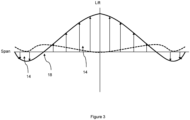
- the continuous line shows the lift distribution
- the dotted line shows the first differential with respect to span ⁇ Lift / ⁇ Span of the lift distribution.
- the wing mounted propellers 5 are positioned such that their rotational axis X is coincident with, or adjacent, the neutral lift region 16, and with the position of maximum magnitude (positive or negative) of ⁇ Lift / ⁇ Span, which in this particular case coincide.
- Each propeller 5 is positioned behind a trailing edge 20 of the wing 3.
- the propeller 5 positioned on the port wing rotates in a clockwise direction when viewed from the aft of the aircraft, and the propeller 5 positioned on the starboard wing rotates in an anti-clockwise direction when viewed from the aft of the aircraft.
- wings generate vortices.
- these vortices are generated at the tips of the wings, with a vortex emanating from the port wing and rotating in a counter-clockwise direction when viewed from the aft of the wing, and another vortex emanating from the starboard wing and rotating in a clockwise direction when viewed from the aft of the wing.
- vortices will instead be generated at the neutral lift portion, where the positive and negative lift portions meet.
- propellers generate thrust having a circumferential component, which imparts swirl on the airflow, rather than thrust. This effectively reduces propeller efficiency.
- the wing vortices turn this swirling flow in the direction of the aircraft longitudinal axis, thereby converting this swirl to thrust, and increasing propulsive efficiency. In other words, the advance ratio of the propellers is reduced, leading to higher propeller efficiency.
- propeller swirl can be controlled by controlling one or more of propeller diameter, blade chord, pitch and helix angle.
- the propeller 5 may be controlled such that the vortex is substantially eliminated at different flight conditions, by controlling blade pitch in flight. Additionally, this arrangement may allow for a wider design space, as designs that would cause a large degree of swirl would normally be rejected as inefficient - in this arrangement, these inefficiencies are eliminated.
- the propeller may have a twist that is designed to exploit the incoming vortex.
- the wing mounted propellers 5 of the present disclosure are provided relatively inboard along the span of the wing 5, rather than at the tips, as would be conventional. This gives the designer several opportunities.
- the wing mounted propellers 5 of the present disclosure may be provided at between 50% and 95% of the span of the wing from the root, or between 60% and 80% of the span of the wing, and preferably at about 70% of the span of the wing.
- the rotational axis X of the wing mounted propellers 5 are preferably located within 10% of the span of the neutral lift point, and preferably within 5% of the span of the neutral lift point.
- C Di is the drag due to induced drag
- e is the Oswald efficiency
- AR is the aspect ratio.
- an aspect ratio of between 5 and 15 can be achieved, without causing excessive yaw in the event of an engine failure, even where the aircraft is a twin propeller aircraft.
- the designer is able to choose a vertical tail having a low tail volume coefficient, in view of the relatively low yaw moment caused by one engine being inoperative. Indeed, in some cases, elimination of the vertical tail may be possible, in view of the elimination of adverse yaw in aircraft having this lift distribution.
- Another further advantage of the reduced vortex is the reduction in turbulent aircraft wake. This may allow for closer aircraft spacing, which may in turn allow for close formation flying for the purposes of aircraft fuel reduction, or shorter spacing for aircraft taking off and landing, which may reduce congestion at airports.
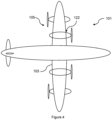
- Figure 4 shows a second aircraft 101.
- the second aircraft 101 is similar to the aircraft 1, and also comprises a wing 103 having the lift distribution shown in figure 2 , having positive lift 114, negative lift 116 and neutral 118 regions, and having wing mounted propellers 105 provided at the neutral lift region 118.
- wing 103 having the lift distribution shown in figure 2 , having positive lift 114, negative lift 116 and neutral 118 regions, and having wing mounted propellers 105 provided at the neutral lift region 118.
- the propulsion system of the aircraft 101 comprises further propulsors 122 provided inboard of the wing mounted propellers 105, and also inboard of the neutral lift region 118.
- the further propulsors 122 are also in the form of propellers in this embodiment, though they could take different forms, such as ducted propulsors.
- the further propulsors 122 are provided upstream of the leading edge of the wing 103, but could be positioned in different locations, or could be attached to the fuselage.
- additional structure and equipment may be installed in the wing inboard of the neutral lift region.
- fuel tanks 124 may be provided at this location.
- the aircraft comprises pivotable wings, an outboard portion 126 of which can be pivoted between a deployed position (as shown in figure 5 ) and a stowed position (as shown in figure 6 ).
- the effective span of the aircraft wings is reduced, improving ground handling. For instance, gate size requirements are reduced. Consequently, wing span can again be increased, without facing ground handling constraints.
- a pivot point 128 for the wing pivoting system is located outboard of the wing mounted propeller 105, and possibly also outboard of the neutral lift region 118. Consequently, the weight of the pivotable portion of the wing is relatively low, thereby reducing the weight and power requirements for the wing folding actuators. Furthermore, since the outboard portion 126 is coincident with the negative lift portion 116 of the wing 103, aerodynamic forces urge the portion 126 to the deployed position in flight, thereby increasing safety.
- the propulsion system of the aircraft 101 also differs from that of the aircraft 1 in other ways.
- FIG. 7 shows the propulsion system of the aircraft 101 in more detail.
- the propulsion system includes a pair of internal combustion engines in the form of gas turbine engines 106.
- Each gas turbine engine 106 comprises, in axial flow series, a propulsor in the form of a propeller 122, a compressor 130, combustion equipment 132 and a turbine 134.
- the gas turbine engine 106 works in the conventional manner so that air is accelerated by the propeller 126 to produce two air flows: a first core air flow into the compressor 130 and a second air flow which bypasses the compressor 130 to provide propulsive thrust.
- the core air flows through the compressor 130 where it is compressed, before delivering that air to the combustion equipment 132, where it is mixed with fuel and the mixture combusted.
- Fuel is supplied to the combustors 13 via fuel injectors (not shown).
- the resultant hot combustion products then expand through, and thereby drive the turbine 134 before being exhausted through a nozzle to provide additional propulsive thrust.
- the turbine 134 drives the compressor 130 and propeller 126, by a suitable interconnecting shaft.
- An electrical generator 136 is provided, which is coupled to the gas turbine engine shaft. Consequently, rotation of the shaft generates propulsive thrust via the propeller 126, and also generates electrical power.
- gas turbine engines to which the present disclosure may be applied may have alternative configurations.
- such engines may have an alternative number of interconnecting shafts (e.g. three) and/or an alternative number of compressors and/or turbines.
- the engine may comprise a gearbox provided in the drive train from a turbine to a compressor and/or fan.
- the propulsion system 5 further comprises one or more electrical machines driving at one or more propulsors.
- the system 5 comprises a pair of electric motors 138, which drive a respective wing mounted propulsor 105.
- the motor 138 is of a conventional type, such as an induction or permanent magnet electric machine.
- the electric motor 138 is optionally coupled to an energy storage device (142) in the form of one or more of a chemical battery, fuel cell, and capacitor, which provides the electric motor 138 with electrical power during operation.
- an energy storage device in the form of one or more of a chemical battery, fuel cell, and capacitor, which provides the electric motor 138 with electrical power during operation.
- FIG 8 An alternative propulsion system for the aircraft 101 is shown in figure 8 .
- a single gas turbine engine 206 is provided, which is similar the gas turbine engines 106.
- the gas turbine engine 206 comprises an electric generator 236, which is in turn coupled to electric motors 238, which drive a respective propulsor 205, 226.
- all of the propulsors are driven by electric motors, and so the system can be described as being a series hybrid.
- FIG 9 shows an alternative aircraft 301 not in accordance with the present invention.
- the aircraft again comprises wings 303 and a fuselage.
- the wings 303 in this instance have a rearward swept planform, in which the leading edge at the tip is located aft of the leading edge at the root. This both reduces drag at high transonic speeds, and allows for a further reduction of vertical tail volume, in view of increased longitudinal stability.
- the wing 303 is similar to the wing 3, having the lift distribution shown in figure 3 .
- wing mounted propulsors 305 are provided at the neutral lift point, with further propellers 326 provided inboard.
- the wing mounted propulsors 305 are in the form of ducted propulsors (fans), and are provided upstream of the leading edge of the wing, to reduce upwash generated forward of the wing. Again, this will be expected to reduce drag, and increase propulsive efficiency.
- the aircraft 301 is an electric aircraft, comprising an energy storage unit in the form of a fuel cell 342.
- the fuel cell provides electric power to motors 338.
- the fuel cell could be replaced or supplemented by other electric power sources, such as chemical batteries, capacitors.
- gas turbine engines having more or fewer shafts could be provided.
- Electric motors having different topologies could be provided, such as topologies in which the stator is provided radially inside of the rotor. Different fuels and coolant fluids could be utilised. Different components of the motors could be cooled using the cooling system.
Landscapes
- Engineering & Computer Science (AREA)
- Aviation & Aerospace Engineering (AREA)
- Mechanical Engineering (AREA)
- Structures Of Non-Positive Displacement Pumps (AREA)
- Engine Equipment That Uses Special Cycles (AREA)
Description
- The present disclosure concerns an aircraft comprising a wing integrated propulsion system, and a propulsion system for an aircraft.
- It is desirable to decrease aircraft drag, to reduce fuel burn and increase range. One method of reducing drag is to provide aircraft having "tip propellers". An example experimental aircraft using such a propulsion system is the Chance-Vought XF5U. Such aircraft produce reduced induced drag (i.e. drag due to lift). Such propulsions systems also provide for increased propeller efficiency. However, such designs are compromised by several considerations. For example, by providing tip propulsors at the wing tips, a relatively large yaw force and / or roll force is generated when one of the tip propulsors fails. This requires either a large tail to counteract such forces, or requires a relatively short span wing, to reduce the forces. Such a short span wing implies a low aspect ratio, which increases induced drag, thereby removing much of the benefit of such systems. Furthermore, the large weight of such systems far from the aircraft centreline implies a large structural weight penalty. The present disclosure seeks to provide an aircraft and propulsion system that overcomes these problems.
- United States patent
US 9382000B1 - United states patent application
US 2006006290 discloses methods for upper and lower surface boundary layers to cancel their opposing vorticity upon shedding from the trailing edge, thereby eliminating wake vorticty, induced drag and associated noise. This requires wing-rotor-propeller or fan blades with a platform designed for uniform bound circulation and with boundary layer control near the tip. In addition this requires special techniques to counter span-wise pressure gradients, such as tip circulation control blowing or an upwind small propeller or wind turbine on each tip. These techniques can eliminate wake vorticity with its induced drag, noise, flying on the backside of the power curve and the option for asymmetric loading by pneumatic means to eliminate need for cyclic pitch control or conventional ailerons. - According to the invention there is provided an aircraft comprising; a port wing and a starboard wing, each having a spanwise lift distribution extending from a root to a tip, the lift distribution defining an inboard region defining a positive lift contribution, an outboard region defining a negative lift contribution, and an intermediate region defining a neutral lift contribution, the intermediate region being spaced from the tip and from the root;
a propulsion system comprising a propulsor mounted to the port wing and a propulsor mounted to the starboard wing; wherein each wing mounted propulsor is located aft of a trailing edge of the corresponding wing; wherein the wing mounted propulsor has a rotational axis positioned substantially at a span of the wing where a value of δLift/δSpan is at a maximum magnitude for the span of the wing, and wherein the propeller mounted on the port wing rotates in a clockwise direction when viewed from the aft of the aircraft, and the propeller mounted on the starboard wing rotates in an anti-clockwise direction when viewed from the aft of the aircraft. - Advantageously, it has been found that this positioning of the wing mounted propulsor in combination with the above lift distribution allows for reduced drag and increased propeller efficiency. Without wishing to be constrained by theory, this is thought to be a result of wing vortices generated at a span position corresponding to a maximum value of the first differential of the lift with respect to span resulting in a reduced advance ratio of the propulsor, leading to a higher propeller efficiency. Further features and advantages are provided by the disclosed arrangement, as set out below.
- The wing mounted propulsor may comprise one of an open rotor propulsor such as a propeller, and a ducted propulsor such as a fan.
- The wing mounted propulsor may be located at the intermediate region of the span of the wing. For some lift distributions, this position will correspond to the point of maximum magnitude of δLift/δSpan.
- The wing mounted propulsor is located aft of a trailing edge of the wing. Where the wing mounted propulsor is located aft of the trailing edge of the wing, the downwash generated upstream of the wing is reduced, thereby reducing drag.
- The wing may comprise an aspect ratio greater than 5. The wing may comprise an aspect ratio greater than 10, and may comprise an aspect ratio greater than 15 and may comprise an aspect ratio greater than 5 and less than 15.
- The wing mounted propulsors are relatively inboard compared to previous aircraft. This reduces the yaw generated by the propulsors in the event of a propulsor failure. This in turn allows for an increase in the span of the wing, since the wing span is no longer limited by the placement of the wing mounted open rotor propulsors, which would have been provided at the wing tips in previous designs. This higher span wing further reduces lift induced drag, in view of the lower span loading implied by a larger span, and so reduces fuel use and increases range.
- The propulsion system may comprise one or more further propulsors. The one or more further propulsors may be located inboard of the intermediate region of the wing. By providing further propulsors, the propulsive requirements of the aircraft can be met by dedicated propulsors, while the wing mounted propulsors can be sized and optimised to the requirements of drag reduction, rather than thrust production. Furthermore, by placing the further propulsors inboard of the intermediate region of the wing, the weight of the propulsors provides wing bending moment relief, which counteracts the wing bending moment produced by the positive lift generated by the inboard region.
- The wing may comprise a folding mechanism configured to fold upward and stow the outboard region of the wing, wherein the folding mechanism. The folding mechanism may define a pivot point at or outboard of the position of the wing mounted propulsor and / or the intermediate region of the wing. Advantageously, a large aspect ratio wing can be provided, without requiring excessive clearance during ground operations. The provision of the pivot point outboard of the wing mounted propulsor reduces the weight that must be raised by the wing folding mechanism. The provision of the pivot point outboard of the neutral point ensures that the folding portion of the wing is urged toward the deployed position by aerodynamic forces in flight, thereby increasing safety.
- The propulsion system may comprise one or more internal combustion engines, and may comprise a gas turbine engine. The or each internal combustion engine may be configured to drive one or more propulsor.
- The propulsion system may comprise an electric motor configured to drive the wing mounted propulsor.
- The aircraft propulsion system may comprise a parallel hybrid propulsion system, comprising the internal combustion engine which is mechanically coupled to at least one wing mounted propulsor. Where the aircraft propulsion system comprises a parallel hybrid system, the system may comprise an electric generator coupled to the internal combustion engine and configured to provide electrical power to the electric motor.
- Alternatively, the aircraft propulsion system may comprise a series hybrid propulsion system, in which the internal combustion engine is coupled to an electric generator configured to provide electrical power to a propulsor motor coupled to at least one wing mounted propulsor, and wherein the internal combustion engine is not mechanically coupled to a propulsor.
- As a further alternative, the aircraft propulsion system may comprise an electric propulsion system, wherein the propulsion system comprises one or more electric storage devices, such as a fuel cell, capacitor or chemical cell configured to provide electrical power to the electric motor.
- Embodiments will now be described by way of example only, with reference to the Figures, in which:
-
Figure 1 is a plan view of a first aircraft; -
Figure 2 is a front view of part of the aircraft offigure 1 ; -
Figure 3 is a graph showing a lift distribution and the first differential of the lift distribution with respect to span for a wing of the aircraft offigures 1 and2 ; -
Figure 4 is a plan view of a second aircraft; -
Figure 5 is a front view of part of the aircraft offigure 4 having wing tips in a deployed position; -
Figure 6 is a front view of the part of the aircraft shown infigure 4 having wing tips in a stowed position; -
Figure 7 is a schematic diagram of the propulsion system of the aircraft offigures 4 to 6 ; -
Figure 8 is a schematic diagram of an alternative propulsion system for the aircraft offigures 4 to 7 ; and -
Figure 9 is a schematic diagram of a third aircraft not in accordance with the invention. - With reference to
Figure 1 , a plan view of anaircraft 1 is shown. Theaircraft 1 comprises afuselage 2,wings 3,tail 4 and a propulsion system comprising a pair of open rotor wing mountedpropellers 5. Eachpropeller 5 is mechanically driven by a respective internal combustion engine in the form of agas turbine engine 6. - The
wing 3 has a generally elliptical planform (though other planforms could be employed), and is shaped to provide a lift distribution as shown infigure 3 . As will be understood by the skilled person, the lift distribution is the lift coefficient produced by the wing under given conditions such as angle of attack of the aerofoil, the Reynolds number of the flow, and its Mach number, as a function of the span of the wing. As is well known, the lift coefficient CL is given as:
- Where L is the lift force, S is the relevant surface area, and Q is the fluid dynamic pressure, in turn linked to the fluid density and flow speed.
- In the present disclosure, the
wings 3 have a "bell-shaped" lift distribution, similar to that described in NASA Technical Report TP-2016-219072, published in 2016. Such wings are thought to have benefits in terms of overall aircraft drag, taking into account the structural weight of the wing. As will be understood by the skilled person, the lift coefficient can be modified by adjusting various parameters. For instance, lift coefficient can be increased by increasing the camber of the wing section, and reduced by reducing the camber. Different aerofoil sections can be used. Similarly, increasing the chord will typically increase lift coefficient. Increasing local angle of attack can also increase lift coefficient, and so "twist" can be applied to the wing to control local angle of attack. Any one or a combination of these techniques can be applied to provide a desired local section lift coefficient. - The
wing 3 of theaircraft 1 of the present disclosure comprises several distinct regions. Aroot 10 of theaircraft wing 3 is defined at an inboard position of thewing 3, adjacent thefuselage 2. Similarly, atip 12 is defined at the extreme outboard end of the span of thewing 3. - Referring to
figure 2 , apositive lift region 14 is defined at an inboard region of thewing 3. In the positive lift region, thewing 3 is arranged to provide lift in an upward direction, as conventionally defined, at neutral or positive angles of attack. It will be understood that the lift provided varies as a function of span, with more lift being generated at theroot 10 than at positions closer to thetip 12. Outboard of thepositive lift region 14, adjacent thetip 12, is anegative lift region 16. In this region, a downforce is generated at a positive or neutral angle of attack. Between these two regions is an intermediateneutral region 18. Theneutral region 18 provides little or no lift or downforce. In some cases, theneutral lift region 18 may comprise a single point on the span of thewing 3, at the point at which the positive andnegative lift regions - Typically, the
positive lift region 12 occupies the majority of the span of thewing 3, and may extend between 60 and 80% of the span of the wing from theroot 10. In one example, the positive lift region extends approximately 70% of the span of thewing 3 from theroot 10. Similarly, the negative lift region occupies between 10 and 30% of the span of the wing from thetip 12. As can be seen, the lift generated by thepositive lift portion 14 is greater than the downforce generated by thenegative lift portion 16, such that thewing 3 produces net upward lift. Typically, in total, thepositive lift portion 14 produces between 10 and 20 times as much lift as thenegative lift portion 16 produces downforce. - The section lift coefficient of the
negative lift portion 16 varies across the span, with a maximum at a central region, and minima at thetip 12 and adjacent theneutral lift region 16. - Referring now to
figure 3 , the continuous line shows the lift distribution, while the dotted line shows the first differential with respect to span δLift/δSpan of the lift distribution. As can be seen, the wing mountedpropellers 5 are positioned such that their rotational axis X is coincident with, or adjacent, theneutral lift region 16, and with the position of maximum magnitude (positive or negative) of δLift/δSpan, which in this particular case coincide. Eachpropeller 5 is positioned behind a trailingedge 20 of thewing 3. Thepropeller 5 positioned on the port wing rotates in a clockwise direction when viewed from the aft of the aircraft, and thepropeller 5 positioned on the starboard wing rotates in an anti-clockwise direction when viewed from the aft of the aircraft. - Without wishing to be limited by theory, this is believed to have the effect of increasing propeller efficiency, as outlined below.
- As will be understood, as they generate lift, wings generate vortices. In traditional wing designs, these vortices are generated at the tips of the wings, with a vortex emanating from the port wing and rotating in a counter-clockwise direction when viewed from the aft of the wing, and another vortex emanating from the starboard wing and rotating in a clockwise direction when viewed from the aft of the wing. However, in the case of wing having a negative lift region at the tip, vortices will instead be generated at the neutral lift portion, where the positive and negative lift portions meet. By placing a
propeller 5 in this region, with each propeller configured to rotate in a direction opposite to the direction of rotation of the local vortex, the propeller interacts with the vortex. This results in an increase in propeller efficiency. - Ordinarily, propellers generate thrust having a circumferential component, which imparts swirl on the airflow, rather than thrust. This effectively reduces propeller efficiency. The wing vortices turn this swirling flow in the direction of the aircraft longitudinal axis, thereby converting this swirl to thrust, and increasing propulsive efficiency. In other words, the advance ratio of the propellers is reduced, leading to higher propeller efficiency.
- This effect can be managed by controlling the swirl imparted on the airflow by the
propeller 5. As will be understood, propeller swirl can be controlled by controlling one or more of propeller diameter, blade chord, pitch and helix angle. Thepropeller 5 may be controlled such that the vortex is substantially eliminated at different flight conditions, by controlling blade pitch in flight. Additionally, this arrangement may allow for a wider design space, as designs that would cause a large degree of swirl would normally be rejected as inefficient - in this arrangement, these inefficiencies are eliminated. For example, the propeller may have a twist that is designed to exploit the incoming vortex. - In contrast to prior aircraft, the wing mounted
propellers 5 of the present disclosure are provided relatively inboard along the span of thewing 5, rather than at the tips, as would be conventional. This gives the designer several opportunities. For example, the wing mountedpropellers 5 of the present disclosure may be provided at between 50% and 95% of the span of the wing from the root, or between 60% and 80% of the span of the wing, and preferably at about 70% of the span of the wing. In other words, the rotational axis X of the wing mountedpropellers 5 are preferably located within 10% of the span of the neutral lift point, and preferably within 5% of the span of the neutral lift point. - Since the wing mounted
propellers 5 are not located at the tips, the span of the wing 3 (and so its aspect ratio) can be increased, without risking excessive yaw in the event of a propeller or engine failure. This increased aspect ratio will reduce induced drag, since induced drag is known to be related to aspect ratio, in accordance with the following formula:
- Where CDi is the drag due to induced drag, e is the Oswald efficiency, and AR is the aspect ratio. In the present case, it is thought that an aspect ratio of between 5 and 15 can be achieved, without causing excessive yaw in the event of an engine failure, even where the aircraft is a twin propeller aircraft.
- Similarly, the designer is able to choose a vertical tail having a low tail volume coefficient, in view of the relatively low yaw moment caused by one engine being inoperative. Indeed, in some cases, elimination of the vertical tail may be possible, in view of the elimination of adverse yaw in aircraft having this lift distribution.
- Further advantages are provided. In view of the downforce / upwash generated by the wing at the tip, and the weight of the
propeller 5 inboard, significant wing bending moment relief is provided. This allows the structural weight to be reduced, which can be traded for lower overall aircraft weight, or further increased aspect ratio. In either case, fuel use is reduced, and range increased. - Another further advantage of the reduced vortex is the reduction in turbulent aircraft wake. This may allow for closer aircraft spacing, which may in turn allow for close formation flying for the purposes of aircraft fuel reduction, or shorter spacing for aircraft taking off and landing, which may reduce congestion at airports.
-
Figure 4 shows asecond aircraft 101. Thesecond aircraft 101 is similar to theaircraft 1, and also comprises awing 103 having the lift distribution shown infigure 2 , havingpositive lift 114,negative lift 116 and neutral 118 regions, and having wing mountedpropellers 105 provided at theneutral lift region 118. However, there are also various differences. - The propulsion system of the
aircraft 101 comprisesfurther propulsors 122 provided inboard of the wing mountedpropellers 105, and also inboard of theneutral lift region 118. Thefurther propulsors 122 are also in the form of propellers in this embodiment, though they could take different forms, such as ducted propulsors. Similarly, thefurther propulsors 122 are provided upstream of the leading edge of thewing 103, but could be positioned in different locations, or could be attached to the fuselage. - By providing
further propulsors 122 inboard of the wing mountedpropulsors 105, several advantages are realised. Firstly, only a proportion of the thrust required by the aircraft must be generated by the wing mountedpropulsors 105. This reduces their required size and weight, and also reduces the consequence of the failure of such a device. Consequently, yaw in the event of an engine failure is again reduced, which gives rise to the advantages outlined above. Secondly, additional wing bending moment relief is provided, since the weight of the further propulsors counteracts the bending caused by the lift generated by the wing in thepositive lift region 14. Since thenegative lift region 116 does not contribute to lift, no bending moment relief is provided by providing engines in these locations. - In order to take further advantage of this bending moment relief, additional structure and equipment may be installed in the wing inboard of the neutral lift region. For instance,
fuel tanks 124 may be provided at this location. - Additional features are provided of the
aircraft 101. The aircraft comprises pivotable wings, anoutboard portion 126 of which can be pivoted between a deployed position (as shown infigure 5 ) and a stowed position (as shown infigure 6 ). In the stowed position, the effective span of the aircraft wings is reduced, improving ground handling. For instance, gate size requirements are reduced. Consequently, wing span can again be increased, without facing ground handling constraints. - A
pivot point 128 for the wing pivoting system is located outboard of the wing mountedpropeller 105, and possibly also outboard of theneutral lift region 118. Consequently, the weight of the pivotable portion of the wing is relatively low, thereby reducing the weight and power requirements for the wing folding actuators. Furthermore, since theoutboard portion 126 is coincident with thenegative lift portion 116 of thewing 103, aerodynamic forces urge theportion 126 to the deployed position in flight, thereby increasing safety. - The propulsion system of the
aircraft 101 also differs from that of theaircraft 1 in other ways. -
Figure 7 shows the propulsion system of theaircraft 101 in more detail. The propulsion system includes a pair of internal combustion engines in the form ofgas turbine engines 106. Eachgas turbine engine 106 comprises, in axial flow series, a propulsor in the form of apropeller 122, acompressor 130,combustion equipment 132 and aturbine 134. - The
gas turbine engine 106 works in the conventional manner so that air is accelerated by thepropeller 126 to produce two air flows: a first core air flow into thecompressor 130 and a second air flow which bypasses thecompressor 130 to provide propulsive thrust. The core air flows through thecompressor 130 where it is compressed, before delivering that air to thecombustion equipment 132, where it is mixed with fuel and the mixture combusted. Fuel is supplied to the combustors 13 via fuel injectors (not shown). The resultant hot combustion products then expand through, and thereby drive theturbine 134 before being exhausted through a nozzle to provide additional propulsive thrust. Theturbine 134 drives thecompressor 130 andpropeller 126, by a suitable interconnecting shaft. Anelectrical generator 136 is provided, which is coupled to the gas turbine engine shaft. Consequently, rotation of the shaft generates propulsive thrust via thepropeller 126, and also generates electrical power. - Other gas turbine engines to which the present disclosure may be applied may have alternative configurations. By way of example such engines may have an alternative number of interconnecting shafts (e.g. three) and/or an alternative number of compressors and/or turbines. Further, the engine may comprise a gearbox provided in the drive train from a turbine to a compressor and/or fan. The
propulsion system 5 further comprises one or more electrical machines driving at one or more propulsors. In particular, thesystem 5 comprises a pair ofelectric motors 138, which drive a respective wing mountedpropulsor 105. Themotor 138 is of a conventional type, such as an induction or permanent magnet electric machine. - The
electric motor 138 is optionally coupled to an energy storage device (142) in the form of one or more of a chemical battery, fuel cell, and capacitor, which provides theelectric motor 138 with electrical power during operation. - An alternative propulsion system for the
aircraft 101 is shown infigure 8 . In this case, a singlegas turbine engine 206 is provided, which is similar thegas turbine engines 106. Thegas turbine engine 206 comprises anelectric generator 236, which is in turn coupled toelectric motors 238, which drive arespective propulsor -
Figure 9 shows analternative aircraft 301 not in accordance with the present invention. The aircraft again compriseswings 303 and a fuselage. Thewings 303 in this instance have a rearward swept planform, in which the leading edge at the tip is located aft of the leading edge at the root. This both reduces drag at high transonic speeds, and allows for a further reduction of vertical tail volume, in view of increased longitudinal stability. Otherwise, thewing 303 is similar to thewing 3, having the lift distribution shown infigure 3 . - In this case, wing mounted
propulsors 305 are provided at the neutral lift point, withfurther propellers 326 provided inboard. The wing mountedpropulsors 305 are in the form of ducted propulsors (fans), and are provided upstream of the leading edge of the wing, to reduce upwash generated forward of the wing. Again, this will be expected to reduce drag, and increase propulsive efficiency. - The
aircraft 301 is an electric aircraft, comprising an energy storage unit in the form of afuel cell 342. The fuel cell provides electric power tomotors 338. The fuel cell could be replaced or supplemented by other electric power sources, such as chemical batteries, capacitors. - It will be understood that the invention is not limited to the embodiments above-described and various modifications and improvements can be made without departing from the concepts described herein.
- For example, gas turbine engines having more or fewer shafts could be provided. Electric motors having different topologies could be provided, such as topologies in which the stator is provided radially inside of the rotor. Different fuels and coolant fluids could be utilised. Different components of the motors could be cooled using the cooling system.
Claims (13)
- An aircraft (1) comprising;a port wing (3) and a starboard wing (3), each having a spanwise lift distribution extending from a root (10) to a tip (12), the lift distribution defining an inboard region (14) defining a positive lift contribution, an outboard region (16) defining a negative lift contribution, and an intermediate region (18, 118) defining a neutral lift contribution, the intermediate region (18, 118) being spaced from the tip (12) and from the root (10);a propulsion system comprising a port propulsor (5) mounted to the port wing and a starboard propulsor (5) mounted to the starboard wing (3);wherein each wing mounted propulsor (5) is located aft of a trailing edge (20) of the corresponding wing (3);whereineach wing mounted propulsor (5) has a rotational axis (x) positioned substantially at a span of the wing (3, 103, 203, 303) where a value of δLift/δSpan is at a maximum magnitude for the span of the wing (3, 103, 203, 303), and wherein the propeller (5) mounted on the port wing (3) rotates in a clockwise direction when viewed from the aft of the aircraft, and the propeller (5) mounted on the starboard wing (3) rotates in an anti-clockwise direction when viewed from the aft of the aircraft.
- An aircraft according to claim 1, wherein the wing mounted propulsor comprises one of an open rotor propulsor such as a propeller (5), and a ducted propulsor such as a fan (305).
- An aircraft according to claim 1 or claim 2, wherein the propulsor (5) is located at the intermediate region (18) of the span of the wing (3).
- An aircraft according to any of the preceding claims, wherein the wing mounted propulsor (305) is located forward of a leading edge (340) of the wing (303).
- An aircraft according to any of the preceding claims, wherein the wing (3) comprises an aspect ratio greater than 5 and less than 15.
- An aircraft according to any of the preceding claims, wherein the propulsion system comprises one or more further propulsors (122).
- An aircraft according to claim 8, wherein the one or more further propulsors (22) are located inboard of the intermediate region of the wing (103).
- An aircraft according to any of the preceding claims, wherein the wing (103) comprises a folding mechanism configured to fold upward and stow the outboard region of the wing, wherein the folding mechanism defines a pivot point (128) at or outboard of the position of the wing mounted propulsor (105) and / or the intermediate region of the wing (118).
- An aircraft according to any of the preceding claims, wherein the propulsion system comprises one or more internal combustion engines (6) which are configured to drive one or more propulsor (5, 122).
- An aircraft according to any of the preceding claims, wherein the propulsion system comprises an electric motor (128) configured to drive the wing mounted propulsor (105).
- An aircraft according to claim 10, when dependent on claim 9, wherein the aircraft propulsion system comprises a parallel hybrid propulsion system comprising the internal combustion engine (106) which is mechanically coupled to at least one wing mounted propulsor (105), and optionally an electric generator (136) coupled to the internal combustion engine (106) and configured to provide electrical power to the electric motor (128).
- An aircraft according to claim 11, wherein the internal combustion engine (206) is coupled to an electric generator (236) configured to provide electrical power to a propulsor motor (238) coupled to at least one wing mounted propulsor (205), and wherein the internal combustion engine (206) is not mechanically coupled to a propulsor (205, 226).
- An aircraft according to any of claims 12 to 14, wherein the propulsion system comprises one or more electric storage devices, such as a fuel cell, capacitor or chemical cell (142) configured to provide electrical power to the electric motor (128).
Applications Claiming Priority (1)
| Application Number | Priority Date | Filing Date | Title |
|---|---|---|---|
| GBGB2008876.1A GB202008876D0 (en) | 2020-06-11 | 2020-06-11 | Aircraft |
Publications (2)
| Publication Number | Publication Date |
|---|---|
| EP3922549A1 EP3922549A1 (en) | 2021-12-15 |
| EP3922549B1 true EP3922549B1 (en) | 2024-10-30 |
Family
ID=71835578
Family Applications (1)
| Application Number | Title | Priority Date | Filing Date |
|---|---|---|---|
| EP21173725.9A Active EP3922549B1 (en) | 2020-06-11 | 2021-05-13 | Aircraft |
Country Status (3)
| Country | Link |
|---|---|
| US (1) | US11713105B2 (en) |
| EP (1) | EP3922549B1 (en) |
| GB (1) | GB202008876D0 (en) |
Families Citing this family (3)
| Publication number | Priority date | Publication date | Assignee | Title |
|---|---|---|---|---|
| US12420924B2 (en) * | 2022-08-10 | 2025-09-23 | Regent Craft, Inc. | Hydrofoil takeoff and landing with multiple hydrofoils |
| WO2024192305A2 (en) * | 2023-03-15 | 2024-09-19 | REGENT Craft Inc. | Airspeed control in blown wing aircraft |
| US11891171B1 (en) * | 2023-06-12 | 2024-02-06 | Faruk Dizdarevic | Aircraft wing with tiplet |
Family Cites Families (10)
| Publication number | Priority date | Publication date | Assignee | Title |
|---|---|---|---|---|
| DE3127257A1 (en) | 1981-07-10 | 1983-01-27 | Vereinigte Flugtechnische Werke Gmbh, 2800 Bremen | Method for reducing the induced drag of a lift-generating wing and a device for carrying it out |
| US7134631B2 (en) * | 2004-06-10 | 2006-11-14 | Loth John L | Vorticity cancellation at trailing edge for induced drag elimination |
| US9776710B2 (en) | 2013-10-02 | 2017-10-03 | John Hincks Duke | Wingtip vortex drag reduction method using backwash convergence |
| US9382000B1 (en) * | 2014-06-05 | 2016-07-05 | The United States Of America As Represented By The Administrator Of The National Aeronautics And Space Administration | Aircraft design |
| US9751614B1 (en) * | 2015-02-20 | 2017-09-05 | The United States Of America As Represented By The Administrator Of Nasa | Aeroelastic wing shaping using distributed propulsion |
| US10457391B2 (en) * | 2016-03-15 | 2019-10-29 | Selex Galileo Inc. | Method and system for a small unmanned aerial system for delivering electronic warfare and cyber effects |
| US10518863B2 (en) * | 2016-04-22 | 2019-12-31 | Rolls-Royce Plc | Aircraft electrical network |
| GB2578587A (en) * | 2018-10-31 | 2020-05-20 | Airbus Operations Ltd | Aircraft wing tips |
| US11159024B2 (en) * | 2018-11-08 | 2021-10-26 | Rolls-Royce North American Technologies, Inc. | Electrical architecture for hybrid propulsion |
| GB2584665A (en) * | 2019-06-10 | 2020-12-16 | Airbus Operations Ltd | An aircraft with a moveable wing tip device |
-
2020
- 2020-06-11 GB GBGB2008876.1A patent/GB202008876D0/en not_active Ceased
-
2021
- 2021-05-13 EP EP21173725.9A patent/EP3922549B1/en active Active
- 2021-06-10 US US17/344,248 patent/US11713105B2/en active Active
Also Published As
| Publication number | Publication date |
|---|---|
| US11713105B2 (en) | 2023-08-01 |
| US20210387715A1 (en) | 2021-12-16 |
| EP3922549A1 (en) | 2021-12-15 |
| GB202008876D0 (en) | 2020-07-29 |
Similar Documents
| Publication | Publication Date | Title |
|---|---|---|
| US11673661B2 (en) | Tiltrotor propulsion system for an aircraft | |
| EP3216698B1 (en) | Propulsion system for an aircraft | |
| CN109641647B (en) | Tiltrotor propulsion system for aircraft | |
| EP3446962B1 (en) | Aircraft propulsion system and method | |
| CN104670503B (en) | Aircraft | |
| US10384773B2 (en) | Tiltrotor propulsion system for an aircraft | |
| EP3093235B1 (en) | Aircraft | |
| US10392106B2 (en) | Tiltrotor propulsion system for an aircraft | |
| US8651813B2 (en) | Fluid dynamic body having escapelet openings for reducing induced and interference drag, and energizing stagnant flow | |
| US20180065739A1 (en) | Tiltrotor propulsion system for an aircraft | |
| EP3922549B1 (en) | Aircraft | |
| EP3144216A1 (en) | Aft engine for an aircraft | |
| US20110044796A1 (en) | Fluidfoil tip vortex disruption | |
| GB2542184A (en) | Aircraft comprising a boundary layer ingesting propulsor | |
| US4533101A (en) | Wingtip vortex propeller | |
| US12545400B2 (en) | Parallel and series multi-stage electric fan | |
| EP3912904B1 (en) | Systems and methods for aircraft wing plug |
Legal Events
| Date | Code | Title | Description |
|---|---|---|---|
| PUAI | Public reference made under article 153(3) epc to a published international application that has entered the european phase |
Free format text: ORIGINAL CODE: 0009012 |
|
| STAA | Information on the status of an ep patent application or granted ep patent |
Free format text: STATUS: THE APPLICATION HAS BEEN PUBLISHED |
|
| AK | Designated contracting states |
Kind code of ref document: A1 Designated state(s): AL AT BE BG CH CY CZ DE DK EE ES FI FR GB GR HR HU IE IS IT LI LT LU LV MC MK MT NL NO PL PT RO RS SE SI SK SM TR |
|
| B565 | Issuance of search results under rule 164(2) epc |
Effective date: 20211102 |
|
| STAA | Information on the status of an ep patent application or granted ep patent |
Free format text: STATUS: REQUEST FOR EXAMINATION WAS MADE |
|
| 17P | Request for examination filed |
Effective date: 20220328 |
|
| RBV | Designated contracting states (corrected) |
Designated state(s): AL AT BE BG CH CY CZ DE DK EE ES FI FR GB GR HR HU IE IS IT LI LT LU LV MC MK MT NL NO PL PT RO RS SE SI SK SM TR |
|
| STAA | Information on the status of an ep patent application or granted ep patent |
Free format text: STATUS: EXAMINATION IS IN PROGRESS |
|
| 17Q | First examination report despatched |
Effective date: 20230327 |
|
| GRAP | Despatch of communication of intention to grant a patent |
Free format text: ORIGINAL CODE: EPIDOSNIGR1 |
|
| STAA | Information on the status of an ep patent application or granted ep patent |
Free format text: STATUS: GRANT OF PATENT IS INTENDED |
|
| RIC1 | Information provided on ipc code assigned before grant |
Ipc: B64C 3/56 20060101ALN20240814BHEP Ipc: B64D 27/02 20060101ALI20240814BHEP Ipc: B64C 3/32 20060101ALI20240814BHEP Ipc: B64C 11/46 20060101ALI20240814BHEP Ipc: B64C 3/00 20060101AFI20240814BHEP |
|
| GRAS | Grant fee paid |
Free format text: ORIGINAL CODE: EPIDOSNIGR3 |
|
| RIC1 | Information provided on ipc code assigned before grant |
Ipc: B64C 3/56 20060101ALN20240821BHEP Ipc: B64D 27/02 20060101ALI20240821BHEP Ipc: B64C 3/32 20060101ALI20240821BHEP Ipc: B64C 11/46 20060101ALI20240821BHEP Ipc: B64C 3/00 20060101AFI20240821BHEP |
|
| GRAA | (expected) grant |
Free format text: ORIGINAL CODE: 0009210 |
|
| STAA | Information on the status of an ep patent application or granted ep patent |
Free format text: STATUS: THE PATENT HAS BEEN GRANTED |
|
| INTG | Intention to grant announced |
Effective date: 20240905 |
|
| P01 | Opt-out of the competence of the unified patent court (upc) registered |
Free format text: CASE NUMBER: APP_51041/2024 Effective date: 20240909 |
|
| AK | Designated contracting states |
Kind code of ref document: B1 Designated state(s): AL AT BE BG CH CY CZ DE DK EE ES FI FR GB GR HR HU IE IS IT LI LT LU LV MC MK MT NL NO PL PT RO RS SE SI SK SM TR |
|
| REG | Reference to a national code |
Ref country code: GB Ref legal event code: FG4D |
|
| REG | Reference to a national code |
Ref country code: CH Ref legal event code: EP |
|
| REG | Reference to a national code |
Ref country code: IE Ref legal event code: FG4D |
|
| REG | Reference to a national code |
Ref country code: DE Ref legal event code: R096 Ref document number: 602021020868 Country of ref document: DE |
|
| REG | Reference to a national code |
Ref country code: LT Ref legal event code: MG9D |
|
| REG | Reference to a national code |
Ref country code: NL Ref legal event code: MP Effective date: 20241030 |
|
| PG25 | Lapsed in a contracting state [announced via postgrant information from national office to epo] |
Ref country code: IS Free format text: LAPSE BECAUSE OF FAILURE TO SUBMIT A TRANSLATION OF THE DESCRIPTION OR TO PAY THE FEE WITHIN THE PRESCRIBED TIME-LIMIT Effective date: 20250228 Ref country code: HR Free format text: LAPSE BECAUSE OF FAILURE TO SUBMIT A TRANSLATION OF THE DESCRIPTION OR TO PAY THE FEE WITHIN THE PRESCRIBED TIME-LIMIT Effective date: 20241030 Ref country code: PT Free format text: LAPSE BECAUSE OF FAILURE TO SUBMIT A TRANSLATION OF THE DESCRIPTION OR TO PAY THE FEE WITHIN THE PRESCRIBED TIME-LIMIT Effective date: 20250228 |
|
| PG25 | Lapsed in a contracting state [announced via postgrant information from national office to epo] |
Ref country code: FI Free format text: LAPSE BECAUSE OF FAILURE TO SUBMIT A TRANSLATION OF THE DESCRIPTION OR TO PAY THE FEE WITHIN THE PRESCRIBED TIME-LIMIT Effective date: 20241030 Ref country code: NL Free format text: LAPSE BECAUSE OF FAILURE TO SUBMIT A TRANSLATION OF THE DESCRIPTION OR TO PAY THE FEE WITHIN THE PRESCRIBED TIME-LIMIT Effective date: 20241030 |
|
| REG | Reference to a national code |
Ref country code: AT Ref legal event code: MK05 Ref document number: 1736664 Country of ref document: AT Kind code of ref document: T Effective date: 20241030 |
|
| PG25 | Lapsed in a contracting state [announced via postgrant information from national office to epo] |
Ref country code: BG Free format text: LAPSE BECAUSE OF FAILURE TO SUBMIT A TRANSLATION OF THE DESCRIPTION OR TO PAY THE FEE WITHIN THE PRESCRIBED TIME-LIMIT Effective date: 20241030 |
|
| PG25 | Lapsed in a contracting state [announced via postgrant information from national office to epo] |
Ref country code: ES Free format text: LAPSE BECAUSE OF FAILURE TO SUBMIT A TRANSLATION OF THE DESCRIPTION OR TO PAY THE FEE WITHIN THE PRESCRIBED TIME-LIMIT Effective date: 20241030 |
|
| PG25 | Lapsed in a contracting state [announced via postgrant information from national office to epo] |
Ref country code: NO Free format text: LAPSE BECAUSE OF FAILURE TO SUBMIT A TRANSLATION OF THE DESCRIPTION OR TO PAY THE FEE WITHIN THE PRESCRIBED TIME-LIMIT Effective date: 20250130 |
|
| PG25 | Lapsed in a contracting state [announced via postgrant information from national office to epo] |
Ref country code: GR Free format text: LAPSE BECAUSE OF FAILURE TO SUBMIT A TRANSLATION OF THE DESCRIPTION OR TO PAY THE FEE WITHIN THE PRESCRIBED TIME-LIMIT Effective date: 20250131 Ref country code: LV Free format text: LAPSE BECAUSE OF FAILURE TO SUBMIT A TRANSLATION OF THE DESCRIPTION OR TO PAY THE FEE WITHIN THE PRESCRIBED TIME-LIMIT Effective date: 20241030 Ref country code: AT Free format text: LAPSE BECAUSE OF FAILURE TO SUBMIT A TRANSLATION OF THE DESCRIPTION OR TO PAY THE FEE WITHIN THE PRESCRIBED TIME-LIMIT Effective date: 20241030 |
|
| PG25 | Lapsed in a contracting state [announced via postgrant information from national office to epo] |
Ref country code: PL Free format text: LAPSE BECAUSE OF FAILURE TO SUBMIT A TRANSLATION OF THE DESCRIPTION OR TO PAY THE FEE WITHIN THE PRESCRIBED TIME-LIMIT Effective date: 20241030 |
|
| PG25 | Lapsed in a contracting state [announced via postgrant information from national office to epo] |
Ref country code: RS Free format text: LAPSE BECAUSE OF FAILURE TO SUBMIT A TRANSLATION OF THE DESCRIPTION OR TO PAY THE FEE WITHIN THE PRESCRIBED TIME-LIMIT Effective date: 20250130 |
|
| PG25 | Lapsed in a contracting state [announced via postgrant information from national office to epo] |
Ref country code: SM Free format text: LAPSE BECAUSE OF FAILURE TO SUBMIT A TRANSLATION OF THE DESCRIPTION OR TO PAY THE FEE WITHIN THE PRESCRIBED TIME-LIMIT Effective date: 20241030 |
|
| PGFP | Annual fee paid to national office [announced via postgrant information from national office to epo] |
Ref country code: DE Payment date: 20250528 Year of fee payment: 5 |
|
| PG25 | Lapsed in a contracting state [announced via postgrant information from national office to epo] |
Ref country code: DK Free format text: LAPSE BECAUSE OF FAILURE TO SUBMIT A TRANSLATION OF THE DESCRIPTION OR TO PAY THE FEE WITHIN THE PRESCRIBED TIME-LIMIT Effective date: 20241030 |
|
| PG25 | Lapsed in a contracting state [announced via postgrant information from national office to epo] |
Ref country code: EE Free format text: LAPSE BECAUSE OF FAILURE TO SUBMIT A TRANSLATION OF THE DESCRIPTION OR TO PAY THE FEE WITHIN THE PRESCRIBED TIME-LIMIT Effective date: 20241030 |
|
| PGFP | Annual fee paid to national office [announced via postgrant information from national office to epo] |
Ref country code: FR Payment date: 20250526 Year of fee payment: 5 |
|
| PG25 | Lapsed in a contracting state [announced via postgrant information from national office to epo] |
Ref country code: RO Free format text: LAPSE BECAUSE OF FAILURE TO SUBMIT A TRANSLATION OF THE DESCRIPTION OR TO PAY THE FEE WITHIN THE PRESCRIBED TIME-LIMIT Effective date: 20241030 |
|
| PG25 | Lapsed in a contracting state [announced via postgrant information from national office to epo] |
Ref country code: SK Free format text: LAPSE BECAUSE OF FAILURE TO SUBMIT A TRANSLATION OF THE DESCRIPTION OR TO PAY THE FEE WITHIN THE PRESCRIBED TIME-LIMIT Effective date: 20241030 |
|
| PG25 | Lapsed in a contracting state [announced via postgrant information from national office to epo] |
Ref country code: CZ Free format text: LAPSE BECAUSE OF FAILURE TO SUBMIT A TRANSLATION OF THE DESCRIPTION OR TO PAY THE FEE WITHIN THE PRESCRIBED TIME-LIMIT Effective date: 20241030 |
|
| PG25 | Lapsed in a contracting state [announced via postgrant information from national office to epo] |
Ref country code: IT Free format text: LAPSE BECAUSE OF FAILURE TO SUBMIT A TRANSLATION OF THE DESCRIPTION OR TO PAY THE FEE WITHIN THE PRESCRIBED TIME-LIMIT Effective date: 20241030 |
|
| REG | Reference to a national code |
Ref country code: DE Ref legal event code: R097 Ref document number: 602021020868 Country of ref document: DE |
|
| PLBE | No opposition filed within time limit |
Free format text: ORIGINAL CODE: 0009261 |
|
| STAA | Information on the status of an ep patent application or granted ep patent |
Free format text: STATUS: NO OPPOSITION FILED WITHIN TIME LIMIT |
|
| PG25 | Lapsed in a contracting state [announced via postgrant information from national office to epo] |
Ref country code: SE Free format text: LAPSE BECAUSE OF FAILURE TO SUBMIT A TRANSLATION OF THE DESCRIPTION OR TO PAY THE FEE WITHIN THE PRESCRIBED TIME-LIMIT Effective date: 20241030 |
|
| 26N | No opposition filed |
Effective date: 20250731 |
|
| REG | Reference to a national code |
Ref country code: CH Ref legal event code: H13 Free format text: ST27 STATUS EVENT CODE: U-0-0-H10-H13 (AS PROVIDED BY THE NATIONAL OFFICE) Effective date: 20251223 |
|
| PG25 | Lapsed in a contracting state [announced via postgrant information from national office to epo] |
Ref country code: LU Free format text: LAPSE BECAUSE OF NON-PAYMENT OF DUE FEES Effective date: 20250513 |
|
| PG25 | Lapsed in a contracting state [announced via postgrant information from national office to epo] |
Ref country code: CH Free format text: LAPSE BECAUSE OF NON-PAYMENT OF DUE FEES Effective date: 20250531 |
|
| REG | Reference to a national code |
Ref country code: BE Ref legal event code: MM Effective date: 20250531 |
|
| PG25 | Lapsed in a contracting state [announced via postgrant information from national office to epo] |
Ref country code: MC Free format text: LAPSE BECAUSE OF FAILURE TO SUBMIT A TRANSLATION OF THE DESCRIPTION OR TO PAY THE FEE WITHIN THE PRESCRIBED TIME-LIMIT Effective date: 20241030 |
|
| PGFP | Annual fee paid to national office [announced via postgrant information from national office to epo] |
Ref country code: GB Payment date: 20260313 Year of fee payment: 6 |
|
| PG25 | Lapsed in a contracting state [announced via postgrant information from national office to epo] |
Ref country code: IE Free format text: LAPSE BECAUSE OF NON-PAYMENT OF DUE FEES Effective date: 20250513 |
|
| PG25 | Lapsed in a contracting state [announced via postgrant information from national office to epo] |
Ref country code: BE Free format text: LAPSE BECAUSE OF NON-PAYMENT OF DUE FEES Effective date: 20250531 |