EP3922247A1 - 15-pgdh inhibitor - Google Patents
15-pgdh inhibitor Download PDFInfo
- Publication number
- EP3922247A1 EP3922247A1 EP20738295.3A EP20738295A EP3922247A1 EP 3922247 A1 EP3922247 A1 EP 3922247A1 EP 20738295 A EP20738295 A EP 20738295A EP 3922247 A1 EP3922247 A1 EP 3922247A1
- Authority
- EP
- European Patent Office
- Prior art keywords
- group
- compound
- optionally
- alkyl
- substituents selected
- Prior art date
- Legal status (The legal status is an assumption and is not a legal conclusion. Google has not performed a legal analysis and makes no representation as to the accuracy of the status listed.)
- Withdrawn
Links
- 0 CC(C)(C)*C(C(CC1)=CC=C1N1C(NCC(C(N(CCC2)CC2(F)F)=O)=C2)=C2OCC1)=O Chemical compound CC(C)(C)*C(C(CC1)=CC=C1N1C(NCC(C(N(CCC2)CC2(F)F)=O)=C2)=C2OCC1)=O 0.000 description 48
- PCMGNSNSCKTERN-UHFFFAOYSA-N CC(C)(C(N)=O)c(cc1)ccc1N1c(ncc(C(N2CCCCC2)=O)c2)c2OCC1 Chemical compound CC(C)(C(N)=O)c(cc1)ccc1N1c(ncc(C(N2CCCCC2)=O)c2)c2OCC1 PCMGNSNSCKTERN-UHFFFAOYSA-N 0.000 description 2
- ZWGANJCBUXSNQQ-UHFFFAOYSA-N NC(c(cc1)ccc1N(CCOc1c2)c1ncc2C(N1CCCCC1)=O)=O Chemical compound NC(c(cc1)ccc1N(CCOc1c2)c1ncc2C(N1CCCCC1)=O)=O ZWGANJCBUXSNQQ-UHFFFAOYSA-N 0.000 description 2
- PNLYDYKYIQFPLX-SFQUDFHCSA-N C/C(/C(N1CCCCC1)=O)=C\C(OCC1)=C(N)N1C(C=CN1)=C/C1=N/CN(COC)C=O Chemical compound C/C(/C(N1CCCCC1)=O)=C\C(OCC1)=C(N)N1C(C=CN1)=C/C1=N/CN(COC)C=O PNLYDYKYIQFPLX-SFQUDFHCSA-N 0.000 description 1
- NCKMIQHCSBGERQ-JQIJEIRASA-N C/C(/C(N1CCCCC1)=O)=C\C(OCC1)=C(N)N1C(C=CN12)=CC1=[N]=C(CC[O](C)=O)C2=O Chemical compound C/C(/C(N1CCCCC1)=O)=C\C(OCC1)=C(N)N1C(C=CN12)=CC1=[N]=C(CC[O](C)=O)C2=O NCKMIQHCSBGERQ-JQIJEIRASA-N 0.000 description 1
- KZOLMMVLCFMDQQ-QHHAFSJGSA-N C/C=C/C1(CCN(COCc(cc2)cc(OCC3)c2N3C(C=CN23)=CC2=NNC3=O)CC1)F Chemical compound C/C=C/C1(CCN(COCc(cc2)cc(OCC3)c2N3C(C=CN23)=CC2=NNC3=O)CC1)F KZOLMMVLCFMDQQ-QHHAFSJGSA-N 0.000 description 1
- DDGJQTWYMPGTKK-GVFJYKHMSA-N C/C=C\C(\N1c(ncc(C(N2CCCCCC2)=O)c2)c2OCCC1)=C/C(NC(C(C)=C)=O)=[N-] Chemical compound C/C=C\C(\N1c(ncc(C(N2CCCCCC2)=O)c2)c2OCCC1)=C/C(NC(C(C)=C)=O)=[N-] DDGJQTWYMPGTKK-GVFJYKHMSA-N 0.000 description 1
- VCYNKBCWUAUTPV-XTQSDGFTSA-N C/N=N/c(cc1)ccc1N(CCOc1c2)c1ncc2C(N1CCCCC1)=O Chemical compound C/N=N/c(cc1)ccc1N(CCOc1c2)c1ncc2C(N1CCCCC1)=O VCYNKBCWUAUTPV-XTQSDGFTSA-N 0.000 description 1
- UTPIRDLGXDMUFJ-QWWSIDLKSA-N CC(/C=C\C(\N1c(ncc(C(N2CCCCC2)=O)c2)c2OCC1)=C/C)N=N Chemical compound CC(/C=C\C(\N1c(ncc(C(N2CCCCC2)=O)c2)c2OCC1)=C/C)N=N UTPIRDLGXDMUFJ-QWWSIDLKSA-N 0.000 description 1
- PWFCJZCXYOYFSZ-SFHVURJKSA-N CC(C(N(C=CC(N(CCOc1c2)c1ncc2C(N1C[C@H](CF)CCC1)=O)=C1)C1=C)=O)=C Chemical compound CC(C(N(C=CC(N(CCOc1c2)c1ncc2C(N1C[C@H](CF)CCC1)=O)=C1)C1=C)=O)=C PWFCJZCXYOYFSZ-SFHVURJKSA-N 0.000 description 1
- QFMKSQABGQIFHP-UHFFFAOYSA-N CC(C(N1C=CC(N(CCOc2c3)c2ncc3C(N2C(C3)C3CCC2)=O)=CC1[NH-])=O)=C Chemical compound CC(C(N1C=CC(N(CCOc2c3)c2ncc3C(N2C(C3)C3CCC2)=O)=CC1[NH-])=O)=C QFMKSQABGQIFHP-UHFFFAOYSA-N 0.000 description 1
- GQEBWYJBXMVAPZ-UHFFFAOYSA-N CC(C(N1C=CC(Nc(c(OCI)c2)ncc2C(N(CCC2)CC2(N)F)=O)=CC1[NH-])=O)=C Chemical compound CC(C(N1C=CC(Nc(c(OCI)c2)ncc2C(N(CCC2)CC2(N)F)=O)=CC1[NH-])=O)=C GQEBWYJBXMVAPZ-UHFFFAOYSA-N 0.000 description 1
- KJSICXHPUCQYII-UHFFFAOYSA-N CC(C)(C(OC)=O)c(cc1)ccc1N1c(ncc(C(N2CCCCC2)=O)c2)c2OCC1 Chemical compound CC(C)(C(OC)=O)c(cc1)ccc1N1c(ncc(C(N2CCCCC2)=O)c2)c2OCC1 KJSICXHPUCQYII-UHFFFAOYSA-N 0.000 description 1
- CVECRHFNIHIZCC-XDJHFCHBSA-N CC(C)(C)COC(c(cc1)ccc1N(CCC1C2C1)C(N)=C2/C=C(\C)/C[N+]1(CCOCC1)[O-])=O Chemical compound CC(C)(C)COC(c(cc1)ccc1N(CCC1C2C1)C(N)=C2/C=C(\C)/C[N+]1(CCOCC1)[O-])=O CVECRHFNIHIZCC-XDJHFCHBSA-N 0.000 description 1
- JPMWONRBSZXXRD-UHFFFAOYSA-N CC(C)(C)OC(C(CC1)CCC1N(CCOc1c2)c1ccc2C(N1CCCCC1)=O)=O Chemical compound CC(C)(C)OC(C(CC1)CCC1N(CCOc1c2)c1ccc2C(N1CCCCC1)=O)=O JPMWONRBSZXXRD-UHFFFAOYSA-N 0.000 description 1
- JPSUHSMFDXCQDM-UHFFFAOYSA-N CC(C)(C)OC(N1c(ccc(C(OC)=O)c2)c2OCCC1)=O Chemical compound CC(C)(C)OC(N1c(ccc(C(OC)=O)c2)c2OCCC1)=O JPSUHSMFDXCQDM-UHFFFAOYSA-N 0.000 description 1
- NADUQTSXEFIJGH-UHFFFAOYSA-N CC(C)(C)OC(c(cc1)ccc1N(CCOc1c2)c1ncc2C(N(CCC1)C1F)=O)=O Chemical compound CC(C)(C)OC(c(cc1)ccc1N(CCOc1c2)c1ncc2C(N(CCC1)C1F)=O)=O NADUQTSXEFIJGH-UHFFFAOYSA-N 0.000 description 1
- ZOHIRAWWONEVOO-UHFFFAOYSA-N CC(C)(C)OC(c(cc1)ccc1N(CCOc1c2)c1ncc2C(N1CC=CCC1)=O)=O Chemical compound CC(C)(C)OC(c(cc1)ccc1N(CCOc1c2)c1ncc2C(N1CC=CCC1)=O)=O ZOHIRAWWONEVOO-UHFFFAOYSA-N 0.000 description 1
- LMHQIKIOHVEFNZ-UHFFFAOYSA-N CC(C)(C)OC(c(cc1)ccc1N(CCc1c2)c1ncc2C(N(CCC1)CCC1=C)=O)=O Chemical compound CC(C)(C)OC(c(cc1)ccc1N(CCc1c2)c1ncc2C(N(CCC1)CCC1=C)=O)=O LMHQIKIOHVEFNZ-UHFFFAOYSA-N 0.000 description 1
- IKOWASWOEVRRSD-UHFFFAOYSA-N CC(C)(C)OC(c(cc1)ccc1N1c(cnc(Cl)c2)c2OCC1)=O Chemical compound CC(C)(C)OC(c(cc1)ccc1N1c(cnc(Cl)c2)c2OCC1)=O IKOWASWOEVRRSD-UHFFFAOYSA-N 0.000 description 1
- PXTIASOWILAJPD-UHFFFAOYSA-N CC(C)(C)[O](C)C(c(cc1)ccc1N(CCN(C)c1c2)c1ncc2C(N1CCCCC1)=O)=O Chemical compound CC(C)(C)[O](C)C(c(cc1)ccc1N(CCN(C)c1c2)c1ncc2C(N1CCCCC1)=O)=O PXTIASOWILAJPD-UHFFFAOYSA-N 0.000 description 1
- FVVVQTLOJSFVTH-PVCXERSVSA-N CC(C)C(N(C=CC(N(CCOc1c2)c1ncc2C(N1[C@H](C)CCCC1)=O)=C1)/C1=N\C)=O Chemical compound CC(C)C(N(C=CC(N(CCOc1c2)c1ncc2C(N1[C@H](C)CCCC1)=O)=C1)/C1=N\C)=O FVVVQTLOJSFVTH-PVCXERSVSA-N 0.000 description 1
- LTKRFXJAPNUOMG-UHFFFAOYSA-N CC(C1)C(N(CC2)C(C=CN34)=CC3=NN(Cc3c[n](C)cc3)C4=O)=C2C=C1C(N1CCCCC1)=O Chemical compound CC(C1)C(N(CC2)C(C=CN34)=CC3=NN(Cc3c[n](C)cc3)C4=O)=C2C=C1C(N1CCCCC1)=O LTKRFXJAPNUOMG-UHFFFAOYSA-N 0.000 description 1
- OBFABIXAKYPEAI-UHFFFAOYSA-N CC(CC(C(N1CCCCC1)=O)=C1)C2=C1OCCN2C1CCCCC1 Chemical compound CC(CC(C(N1CCCCC1)=O)=C1)C2=C1OCCN2C1CCCCC1 OBFABIXAKYPEAI-UHFFFAOYSA-N 0.000 description 1
- XPVBYEIFTBMCAO-GNVQSUKOSA-N CC(CC(C=C(C)C)=O)C(N(C=CC(N(CCOc1c2)c1ncc2C(N1CCCCC1)=O)=C1)/C1=N\C)=O Chemical compound CC(CC(C=C(C)C)=O)C(N(C=CC(N(CCOc1c2)c1ncc2C(N1CCCCC1)=O)=C1)/C1=N\C)=O XPVBYEIFTBMCAO-GNVQSUKOSA-N 0.000 description 1
- HYNOIQBKRZEDQK-UHFFFAOYSA-N CC(CC([N+]1(CCCCC1)[O-])=C(C1CC1)C1OCC2)C1N2C(CC1)=CCC1(C)C(O)=O Chemical compound CC(CC([N+]1(CCCCC1)[O-])=C(C1CC1)C1OCC2)C1N2C(CC1)=CCC1(C)C(O)=O HYNOIQBKRZEDQK-UHFFFAOYSA-N 0.000 description 1
- VXZVZGXGFRZTRQ-UHFFFAOYSA-N CC(CC1)(CCN1C(c(cc1)cc(OCC2)c1N2c1ccc(C(OC)=O)c(OC)c1)=O)F Chemical compound CC(CC1)(CCN1C(c(cc1)cc(OCC2)c1N2c1ccc(C(OC)=O)c(OC)c1)=O)F VXZVZGXGFRZTRQ-UHFFFAOYSA-N 0.000 description 1
- XYEVQPCPHWJQFH-UHFFFAOYSA-N CC(CC1)(CCN1C(c(cc1OCC2)ccc1N2c(cc1)cc(OC)c1C(O)=O)=O)F Chemical compound CC(CC1)(CCN1C(c(cc1OCC2)ccc1N2c(cc1)cc(OC)c1C(O)=O)=O)F XYEVQPCPHWJQFH-UHFFFAOYSA-N 0.000 description 1
- SZIPAJGQWNYICY-KGENOOAVSA-N CC(CC1)(CCN1C(c(cc1OCC2)cnc1N2/C(/C=C)=C/C(CC=C1C)=C(C)C1=O)=O)F Chemical compound CC(CC1)(CCN1C(c(cc1OCC2)cnc1N2/C(/C=C)=C/C(CC=C1C)=C(C)C1=O)=O)F SZIPAJGQWNYICY-KGENOOAVSA-N 0.000 description 1
- SJBYFMVHPUBKFH-YSMPRRRNSA-N CC(CCC1)(CN1C(c(cc1OCC2)cnc1N2C(C=CN1)=CC1/N=C(/C)\C=O)=O)F Chemical compound CC(CCC1)(CN1C(c(cc1OCC2)cnc1N2C(C=CN1)=CC1/N=C(/C)\C=O)=O)F SJBYFMVHPUBKFH-YSMPRRRNSA-N 0.000 description 1
- NTJPYWMSLSFXAL-UHFFFAOYSA-N CC(N(CC(COc1c2)=C)c1ncc2Br)=O Chemical compound CC(N(CC(COc1c2)=C)c1ncc2Br)=O NTJPYWMSLSFXAL-UHFFFAOYSA-N 0.000 description 1
- MGVZZXKKOZBLQA-UHFFFAOYSA-N CC(c1ccc(Cc2n[o]c3c2ccc(N2C4N(C)CC([N+]5(CCCCC5)[O-])=CC4OCC2)c3)cc1)OC Chemical compound CC(c1ccc(Cc2n[o]c3c2ccc(N2C4N(C)CC([N+]5(CCCCC5)[O-])=CC4OCC2)c3)cc1)OC MGVZZXKKOZBLQA-UHFFFAOYSA-N 0.000 description 1
- ADZTWNLJTGTAIF-UHFFFAOYSA-N CC1(C)Oc2cc(C(O)=O)cnc2NC1 Chemical compound CC1(C)Oc2cc(C(O)=O)cnc2NC1 ADZTWNLJTGTAIF-UHFFFAOYSA-N 0.000 description 1
- VRGHDIUILMVMGA-GOSISDBHSA-N CC1=CN=C(C=C(C=C2)N(CCOc3c4)c3ncc4C(N(CCC3)C[C@@H]3OC)=O)N2C1=O Chemical compound CC1=CN=C(C=C(C=C2)N(CCOc3c4)c3ncc4C(N(CCC3)C[C@@H]3OC)=O)N2C1=O VRGHDIUILMVMGA-GOSISDBHSA-N 0.000 description 1
- LESUWKHAZYOIOQ-UHFFFAOYSA-N CC1=[N]=C(C=C(C=C2)N(CCOc3c4)c3ncc4C(N(C)C3CCCC3)=O)N2C1=O Chemical compound CC1=[N]=C(C=C(C=C2)N(CCOc3c4)c3ncc4C(N(C)C3CCCC3)=O)N2C1=O LESUWKHAZYOIOQ-UHFFFAOYSA-N 0.000 description 1
- RIGPNLZSKGYBOS-QGZVFWFLSA-N CC1=[N]=C(C=C(C=C2)N3c(ncc(C(N(CCC4)C[C@@H]4OC)=O)c4)c4OCC3)N2C1=O Chemical compound CC1=[N]=C(C=C(C=C2)N3c(ncc(C(N(CCC4)C[C@@H]4OC)=O)c4)c4OCC3)N2C1=O RIGPNLZSKGYBOS-QGZVFWFLSA-N 0.000 description 1
- GEVWIKHPVLQLSN-UHFFFAOYSA-N CC1=[N]=C(C=C(C=C2)N3c(ncc(S(C4CCCCC4)=O)c4)c4OCC3)N2C1=O Chemical compound CC1=[N]=C(C=C(C=C2)N3c(ncc(S(C4CCCCC4)=O)c4)c4OCC3)N2C1=O GEVWIKHPVLQLSN-UHFFFAOYSA-N 0.000 description 1
- YGZJRMDAGGBOCE-UHFFFAOYSA-N CCC(C(c(c(CC)c1)ccc1N(CCCc1c2)c1ncc2C(N1Cc2ccccc2CC1)=O)=O)=C Chemical compound CCC(C(c(c(CC)c1)ccc1N(CCCc1c2)c1ncc2C(N1Cc2ccccc2CC1)=O)=O)=C YGZJRMDAGGBOCE-UHFFFAOYSA-N 0.000 description 1
- GOABNCGXBASZLS-WEVVVXLNSA-N CCC(C(c(c(OC)c1)ccc1N(CCOc1c2)c1ncc2C(N(CC1)CCC1(/C=C/C)F)=O)=O)=C Chemical compound CCC(C(c(c(OC)c1)ccc1N(CCOc1c2)c1ncc2C(N(CC1)CCC1(/C=C/C)F)=O)=O)=C GOABNCGXBASZLS-WEVVVXLNSA-N 0.000 description 1
- RGFNTPWKFHRLCY-LZWSPWQCSA-N CCC(CCN=C1N2C=CC(N(CCC3CCC(S4)=CCCC=C4Cl)c(nc4)c3cc4C(N(CC3)CCC3(/C=C/C)F)=O)=C1)C2=O Chemical compound CCC(CCN=C1N2C=CC(N(CCC3CCC(S4)=CCCC=C4Cl)c(nc4)c3cc4C(N(CC3)CCC3(/C=C/C)F)=O)=C1)C2=O RGFNTPWKFHRLCY-LZWSPWQCSA-N 0.000 description 1
- KAMOITNKQNXGOS-PKHIMPSTSA-N CCC(CCN=C1N2C=CC(N(CCOc3c4)c3ncc4C(N(CCC3)[C@@H]3C(O)=O)=O)=C1)C2=O Chemical compound CCC(CCN=C1N2C=CC(N(CCOc3c4)c3ncc4C(N(CCC3)[C@@H]3C(O)=O)=O)=C1)C2=O KAMOITNKQNXGOS-PKHIMPSTSA-N 0.000 description 1
- BIFMMUSJXKLRMT-UHFFFAOYSA-N CCC(Cc1cc(N(CCCc2c3)c2ncc3C(N(CC2)CCC2(C)F)=O)ccc11)C1=O Chemical compound CCC(Cc1cc(N(CCCc2c3)c2ncc3C(N(CC2)CCC2(C)F)=O)ccc11)C1=O BIFMMUSJXKLRMT-UHFFFAOYSA-N 0.000 description 1
- KDGOWDUVHMWTGG-UHFFFAOYSA-N CCC(Cc1cc(N(CCCc2c3)c2ncc3C(N2CCCCC2)=O)ccc11)C1=O Chemical compound CCC(Cc1cc(N(CCCc2c3)c2ncc3C(N2CCCCC2)=O)ccc11)C1=O KDGOWDUVHMWTGG-UHFFFAOYSA-N 0.000 description 1
- GIKRJBQNYMZBRJ-FNORWQNLSA-N CCC/C=C/c1cc(N(CCCc2c3)c2ncc3C(N2CCC(C)CC2)=O)ccc1C=O Chemical compound CCC/C=C/c1cc(N(CCCc2c3)c2ncc3C(N2CCC(C)CC2)=O)ccc1C=O GIKRJBQNYMZBRJ-FNORWQNLSA-N 0.000 description 1
- SBSFBAFSTKYHTQ-UHFFFAOYSA-N CCC1=[N+]=C(C=C(C=C2)N(CCc3c4)c3ncc4C(N3CCCCC3)=O)N2C1=O Chemical compound CCC1=[N+]=C(C=C(C=C2)N(CCc3c4)c3ncc4C(N3CCCCC3)=O)N2C1=O SBSFBAFSTKYHTQ-UHFFFAOYSA-N 0.000 description 1
- WCQCPAOREODZJU-UHFFFAOYSA-N CCCC(C(N(C=C1)[IH]C=C1N(CCOc1c2)c1ncc2C(N1CCCCCC1)=O)=O)N Chemical compound CCCC(C(N(C=C1)[IH]C=C1N(CCOc1c2)c1ncc2C(N1CCCCCC1)=O)=O)N WCQCPAOREODZJU-UHFFFAOYSA-N 0.000 description 1
- LZWYZIUSVXFEFM-UHFFFAOYSA-N CCCC(Cc1cc(N(CCCc2c3)c2ncc3C(N(CC2)CCC2=C)=O)ccc11)C1=O Chemical compound CCCC(Cc1cc(N(CCCc2c3)c2ncc3C(N(CC2)CCC2=C)=O)ccc11)C1=O LZWYZIUSVXFEFM-UHFFFAOYSA-N 0.000 description 1
- AWRMCSHDSMUVFI-UHFFFAOYSA-N CCCC(Cc1cc(N(CCCc2c3)c2ncc3C(N(CCC2)CC2(C)F)=O)ccc11)C1=O Chemical compound CCCC(Cc1cc(N(CCCc2c3)c2ncc3C(N(CCC2)CC2(C)F)=O)ccc11)C1=O AWRMCSHDSMUVFI-UHFFFAOYSA-N 0.000 description 1
- WZFQOJVNHYBIKA-UHFFFAOYSA-N CCCC(Cc1cc(N(CCCc2c3)c2ncc3C(N2CC=CCC2)=O)ccc11)C1=O Chemical compound CCCC(Cc1cc(N(CCCc2c3)c2ncc3C(N2CC=CCC2)=O)ccc11)C1=O WZFQOJVNHYBIKA-UHFFFAOYSA-N 0.000 description 1
- ZLIWQOUILCHANQ-OYKVQYDMSA-N CCCC(Cc1cc(N(CCCc2c3)c2ncc3C(N2[C@@H](C)CCCC2)=O)ccc11)C1=O Chemical compound CCCC(Cc1cc(N(CCCc2c3)c2ncc3C(N2[C@@H](C)CCCC2)=O)ccc11)C1=O ZLIWQOUILCHANQ-OYKVQYDMSA-N 0.000 description 1
- QFIYXTIRHBKICA-DAFNUICNSA-N CCCC/N=C1\N(C=O)C=CC(N(CCOc2c3)c2ncc3C(N2CC(C)(CC)C2)=O)=C1 Chemical compound CCCC/N=C1\N(C=O)C=CC(N(CCOc2c3)c2ncc3C(N2CC(C)(CC)C2)=O)=C1 QFIYXTIRHBKICA-DAFNUICNSA-N 0.000 description 1
- XGSMBEIENZDLDZ-UHFFFAOYSA-N CCCC1=Cc(cc(cc2)N(CCCc3c4)c3ncc4C(N3CCCCC3)=O)c2C1=O Chemical compound CCCC1=Cc(cc(cc2)N(CCCc3c4)c3ncc4C(N3CCCCC3)=O)c2C1=O XGSMBEIENZDLDZ-UHFFFAOYSA-N 0.000 description 1
- QBKVFRVXQFWJEL-OAQYLSRUSA-N CCCC1=Cc2cc(N(CCCc3c4)c3ncc4C(N(CCC3)C[C@@H]3F)=O)ccc2C1=O Chemical compound CCCC1=Cc2cc(N(CCCc3c4)c3ncc4C(N(CCC3)C[C@@H]3F)=O)ccc2C1=O QBKVFRVXQFWJEL-OAQYLSRUSA-N 0.000 description 1
- GPLVFWZAKGINNA-GOSISDBHSA-N CCCC1=Cc2cc(N(CCCc3c4)c3ncc4C(N3[C@H](C)CCCC3)=O)ccc2C1=O Chemical compound CCCC1=Cc2cc(N(CCCc3c4)c3ncc4C(N3[C@H](C)CCCC3)=O)ccc2C1=O GPLVFWZAKGINNA-GOSISDBHSA-N 0.000 description 1
- GFMDCJVZKOCVGN-UHFFFAOYSA-N CCCC1N=C(C=C(CC2)N(CC3)C(N(C)CC(C(N4CCCCC4)=O)=C4)=C4[O]3=C)N2C2OC12 Chemical compound CCCC1N=C(C=C(CC2)N(CC3)C(N(C)CC(C(N4CCCCC4)=O)=C4)=C4[O]3=C)N2C2OC12 GFMDCJVZKOCVGN-UHFFFAOYSA-N 0.000 description 1
- NEMXZYCSEXDMKQ-UHFFFAOYSA-N CCCCCNC(c(cc1OCCC)cnc1NC(C=CC1C(C(C)=C)=O)=CC1=[N-])=O Chemical compound CCCCCNC(c(cc1OCCC)cnc1NC(C=CC1C(C(C)=C)=O)=CC1=[N-])=O NEMXZYCSEXDMKQ-UHFFFAOYSA-N 0.000 description 1
- JCJKAYPXRVKPMG-UHFFFAOYSA-N CCCN(C)C(c([nH]1)cc(OCC2)c1N2C(C=CN12)=CC1=[N]=C(C)C2=O)=O Chemical compound CCCN(C)C(c([nH]1)cc(OCC2)c1N2C(C=CN12)=CC1=[N]=C(C)C2=O)=O JCJKAYPXRVKPMG-UHFFFAOYSA-N 0.000 description 1
- BKRSKQLVAMXIAF-HQQUCIOCSA-N CCCOc1cc(C(N2C[C@H](C)CCC2)=O)cnc1N/C(/C=C\C)=C/C(NC=O)=[N-] Chemical compound CCCOc1cc(C(N2C[C@H](C)CCC2)=O)cnc1N/C(/C=C\C)=C/C(NC=O)=[N-] BKRSKQLVAMXIAF-HQQUCIOCSA-N 0.000 description 1
- JDSCCMHZXHECCM-UHFFFAOYSA-N CCN(C)C(c(cc1OCC2)cnc1N2C(C=CN12)=CC1=[N]=C(C)C2=O)=O Chemical compound CCN(C)C(c(cc1OCC2)cnc1N2C(C=CN12)=CC1=[N]=C(C)C2=O)=O JDSCCMHZXHECCM-UHFFFAOYSA-N 0.000 description 1
- GEDUHKSFBLZKJA-PGMHBOJBSA-N CCN(C)C(c(cc1OCC2)cnc1N2C(C=CN1C=O)=C/C1=N/NC)=O Chemical compound CCN(C)C(c(cc1OCC2)cnc1N2C(C=CN1C=O)=C/C1=N/NC)=O GEDUHKSFBLZKJA-PGMHBOJBSA-N 0.000 description 1
- ULVLMCBZRPKCGJ-UHFFFAOYSA-N CCN(CC1=CC=CCC1C)C(N(C=CC(N(CC1)C(C(C)C2)=C1C=C2[N+]1(CCCCC1)[O-])=C1)C1=N)=O Chemical compound CCN(CC1=CC=CCC1C)C(N(C=CC(N(CC1)C(C(C)C2)=C1C=C2[N+]1(CCCCC1)[O-])=C1)C1=N)=O ULVLMCBZRPKCGJ-UHFFFAOYSA-N 0.000 description 1
- NTXCVBVPIWUBPE-UHFFFAOYSA-N CCN(Cc1cc(N(CCCc2c3)c2ncc3C(N2CCC2)=O)ccc11)C1=O Chemical compound CCN(Cc1cc(N(CCCc2c3)c2ncc3C(N2CCC2)=O)ccc11)C1=O NTXCVBVPIWUBPE-UHFFFAOYSA-N 0.000 description 1
- DDAOFBZNTDBWLL-UHFFFAOYSA-N CCN1N=C(C=C(C=C2)I)N2C1=O Chemical compound CCN1N=C(C=C(C=C2)I)N2C1=O DDAOFBZNTDBWLL-UHFFFAOYSA-N 0.000 description 1
- SUBGKXQUFDXQHZ-UHFFFAOYSA-N CCOC(c(cc1CCC2)cnc1N2C(OC(C)(C)C)=O)=O Chemical compound CCOC(c(cc1CCC2)cnc1N2C(OC(C)(C)C)=O)=O SUBGKXQUFDXQHZ-UHFFFAOYSA-N 0.000 description 1
- XVGFTAGZFCKXIV-UHFFFAOYSA-N CCOC(c1cnc2NCCc2c1)=O Chemical compound CCOC(c1cnc2NCCc2c1)=O XVGFTAGZFCKXIV-UHFFFAOYSA-N 0.000 description 1
- QCWYOMQQSITPHJ-XBXARRHUSA-N CCOCC(CCN=C1N2C=CC(N3C(N(C)CC(C(N(CC4)CCC4(/C=C/C)F)=O)=C4)=C4OCC3)=C1)C2=O Chemical compound CCOCC(CCN=C1N2C=CC(N3C(N(C)CC(C(N(CC4)CCC4(/C=C/C)F)=O)=C4)=C4OCC3)=C1)C2=O QCWYOMQQSITPHJ-XBXARRHUSA-N 0.000 description 1
- CLAVZECTBXGLAK-UHFFFAOYSA-N CCc1ccc(C[N+](CCN)(CN(C=C2)[IH]C=C2N2C(N(C)CC(C(N3CCCCC3)=O)=C3)=C3OCC2)[O-])cc1 Chemical compound CCc1ccc(C[N+](CCN)(CN(C=C2)[IH]C=C2N2C(N(C)CC(C(N3CCCCC3)=O)=C3)=C3OCC2)[O-])cc1 CLAVZECTBXGLAK-UHFFFAOYSA-N 0.000 description 1
- VMJBGIFBCPFJQN-UHFFFAOYSA-N CN(C)C(c(cc1)ccc1N(CCCc1c2)c1ncc2C(N1CCCCC1)=O)=O Chemical compound CN(C)C(c(cc1)ccc1N(CCCc1c2)c1ncc2C(N1CCCCC1)=O)=O VMJBGIFBCPFJQN-UHFFFAOYSA-N 0.000 description 1
- PRHSRMRRWZULLB-UHFFFAOYSA-N CN(C)C(c(cc1)ccc1N(CCOc1c2)c1ncc2C(N1CCCCC1)=O)=O Chemical compound CN(C)C(c(cc1)ccc1N(CCOc1c2)c1ncc2C(N1CCCCC1)=O)=O PRHSRMRRWZULLB-UHFFFAOYSA-N 0.000 description 1
- PYQACFCZAUJYTR-UHFFFAOYSA-N CN(C=NC1=C2C=C=CC(N(CCOc3c4)c3ncc4C(N3CCCCC3)=O)=C1)C2=O Chemical compound CN(C=NC1=C2C=C=CC(N(CCOc3c4)c3ncc4C(N3CCCCC3)=O)=C1)C2=O PYQACFCZAUJYTR-UHFFFAOYSA-N 0.000 description 1
- SDGMYTLCEGBVDL-UHFFFAOYSA-N CN(CC(C(N1CCCCC1)=O)=C1)C2=C1OCCN2C(C=C1)=CC2[N]11N2N(CC2COC2)C1=O Chemical compound CN(CC(C(N1CCCCC1)=O)=C1)C2=C1OCCN2C(C=C1)=CC2[N]11N2N(CC2COC2)C1=O SDGMYTLCEGBVDL-UHFFFAOYSA-N 0.000 description 1
- MXMZEXYISYSILS-UHFFFAOYSA-N CN(CC(C(N1CCCCC1)=O)=C1)C2=C1OCCN2C1=C[IH]N(C[N+](C2=CC=CCN2)(N)[O-])C=C1 Chemical compound CN(CC(C(N1CCCCC1)=O)=C1)C2=C1OCCN2C1=C[IH]N(C[N+](C2=CC=CCN2)(N)[O-])C=C1 MXMZEXYISYSILS-UHFFFAOYSA-N 0.000 description 1
- KJHMWZAKKNLJFZ-UHFFFAOYSA-N CN(CC(N1CCCCC1)=C1)C2=C1OCCN2c(cc1)cc(CC=C2Cc(cc3)ccc3OC)c1C2=O Chemical compound CN(CC(N1CCCCC1)=C1)C2=C1OCCN2c(cc1)cc(CC=C2Cc(cc3)ccc3OC)c1C2=O KJHMWZAKKNLJFZ-UHFFFAOYSA-N 0.000 description 1
- XDBKHNHUMYGNEP-OAHLLOKOSA-N CN(Cc1cc(N(CCOc2c3)c2ncc3C(N2C[C@@H](CF)CCC2)=O)ccc11)C1=O Chemical compound CN(Cc1cc(N(CCOc2c3)c2ncc3C(N2C[C@@H](CF)CCC2)=O)ccc11)C1=O XDBKHNHUMYGNEP-OAHLLOKOSA-N 0.000 description 1
- ODGHUXWUSXHMBD-CLCOLTQESA-N CN/N=C1\N(C=O)C=CC(N(CCOc2c3)c2ncc3C(N2C(C3)C3CCC2)=O)=C1 Chemical compound CN/N=C1\N(C=O)C=CC(N(CCOc2c3)c2ncc3C(N2C(C3)C3CCC2)=O)=C1 ODGHUXWUSXHMBD-CLCOLTQESA-N 0.000 description 1
- SLOPHUWUXFBXRJ-UHFFFAOYSA-N CN1N=C(C=C(C=C2)N(CCC(C3)C3c3c4)c3ncc4C(N3CCC4(CC4)CC3)=O)N2C1=O Chemical compound CN1N=C(C=C(C=C2)N(CCC(C3)C3c3c4)c3ncc4C(N3CCC4(CC4)CC3)=O)N2C1=O SLOPHUWUXFBXRJ-UHFFFAOYSA-N 0.000 description 1
- LOLRMQCPHDUWJE-UHFFFAOYSA-N CN1N=C(C=C(C=C2)N(CCCc3c4)c3ncc4SC3CCCCC3)N2C1=O Chemical compound CN1N=C(C=C(C=C2)N(CCCc3c4)c3ncc4SC3CCCCC3)N2C1=O LOLRMQCPHDUWJE-UHFFFAOYSA-N 0.000 description 1
- XDQLMXHMDXCDOA-UHFFFAOYSA-N CN1NNN=C1c(cc1)ccc1Br Chemical compound CN1NNN=C1c(cc1)ccc1Br XDQLMXHMDXCDOA-UHFFFAOYSA-N 0.000 description 1
- PEVLVADFQMEQLJ-UHFFFAOYSA-N CNC(C(C=C1)=C=NC=C1Nc(c(OCI)c1)ncc1C(N1CCCC1)=O)=O Chemical compound CNC(C(C=C1)=C=NC=C1Nc(c(OCI)c1)ncc1C(N1CCCC1)=O)=O PEVLVADFQMEQLJ-UHFFFAOYSA-N 0.000 description 1
- UGICTJFWUZJQEA-UHFFFAOYSA-N CNC(C(CC1)CCC1N(CCOc1c2)c1ccc2C(N1CCCCC1)=O)=O Chemical compound CNC(C(CC1)CCC1N(CCOc1c2)c1ccc2C(N1CCCCC1)=O)=O UGICTJFWUZJQEA-UHFFFAOYSA-N 0.000 description 1
- XQSIEMRZWDBWIS-UHFFFAOYSA-N CNC(N(C=CC(N(CCCOc1c2)c1ncc2C(N1CCC1)=O)=C1)C1=[N-])=O Chemical compound CNC(N(C=CC(N(CCCOc1c2)c1ncc2C(N1CCC1)=O)=C1)C1=[N-])=O XQSIEMRZWDBWIS-UHFFFAOYSA-N 0.000 description 1
- XNQPBKVKLAYKFM-UHFFFAOYSA-N CNC(c([nH]c1c2)cc1ccc2N(CCOc1c2)c1ncc2C(N1CCCCC1)=O)=O Chemical compound CNC(c([nH]c1c2)cc1ccc2N(CCOc1c2)c1ncc2C(N1CCCCC1)=O)=O XNQPBKVKLAYKFM-UHFFFAOYSA-N 0.000 description 1
- YDJLJLLZTWLOBC-UHFFFAOYSA-N CNC(c(cc1)ccc1N(CCCc1c2)c1ncc2C(N1CCCCC1)=O)=O Chemical compound CNC(c(cc1)ccc1N(CCCc1c2)c1ncc2C(N1CCCCC1)=O)=O YDJLJLLZTWLOBC-UHFFFAOYSA-N 0.000 description 1
- DOJRNILSHOZGII-UHFFFAOYSA-N COC(C(C=C1)=CCC=C1N(CCOc1c2)c1ccc2N1CCCCC1)=O Chemical compound COC(C(C=C1)=CCC=C1N(CCOc1c2)c1ccc2N1CCCCC1)=O DOJRNILSHOZGII-UHFFFAOYSA-N 0.000 description 1
- NOKPYPJLQLZKRH-UHFFFAOYSA-N COC(C1=CC2SC(N(CCOc3c4)c3ncc4C(N3CCCCC3)=O)=CC2S1)=O Chemical compound COC(C1=CC2SC(N(CCOc3c4)c3ncc4C(N3CCCCC3)=O)=CC2S1)=O NOKPYPJLQLZKRH-UHFFFAOYSA-N 0.000 description 1
- FGAJQDZACBLQEK-UHFFFAOYSA-N COC(c1cc(OCCCN2)c2nc1)=O Chemical compound COC(c1cc(OCCCN2)c2nc1)=O FGAJQDZACBLQEK-UHFFFAOYSA-N 0.000 description 1
- RTAMGACOCQUBFA-UHFFFAOYSA-N COC(c1ccc(N(CCOc2c3)c2ccc3[N+]2(CCCCC2)[O-])nc1)=O Chemical compound COC(c1ccc(N(CCOc2c3)c2ccc3[N+]2(CCCCC2)[O-])nc1)=O RTAMGACOCQUBFA-UHFFFAOYSA-N 0.000 description 1
- QOCGHVBHMMBWPD-UHFFFAOYSA-N COCCC1=CN=C(C=C(C=C2)N(CCOc3c4)c3ncc4C(N3CCCCC3)=O)N2C1=O Chemical compound COCCC1=CN=C(C=C(C=C2)N(CCOc3c4)c3ncc4C(N3CCCCC3)=O)N2C1=O QOCGHVBHMMBWPD-UHFFFAOYSA-N 0.000 description 1
- JSOWOAOJNJWGDH-UHFFFAOYSA-N COc(c(C(N1CCCCC1)=O)c1)cc2c1OCCN2c(cc1)ccc1C(O)=O Chemical compound COc(c(C(N1CCCCC1)=O)c1)cc2c1OCCN2c(cc1)ccc1C(O)=O JSOWOAOJNJWGDH-UHFFFAOYSA-N 0.000 description 1
- DSMHCSBCMFQGAZ-UHFFFAOYSA-N COc(c(C(O)=O)ccc1)c1O Chemical compound COc(c(C(O)=O)ccc1)c1O DSMHCSBCMFQGAZ-UHFFFAOYSA-N 0.000 description 1
- LRWZLGHGYAOMGU-UHFFFAOYSA-N COc(c(CCC1)c(cc2)N1c(cc1)ccc1C(O)=O)c2C(N1CCCCC1)=O Chemical compound COc(c(CCC1)c(cc2)N1c(cc1)ccc1C(O)=O)c2C(N1CCCCC1)=O LRWZLGHGYAOMGU-UHFFFAOYSA-N 0.000 description 1
- HUGYETAYIJHXCK-UHFFFAOYSA-N COc(cc(cc1)N2C(CC(C(N3CCCCC3)=O)=C3)=C3OCC2)c1C(N)=O Chemical compound COc(cc(cc1)N2C(CC(C(N3CCCCC3)=O)=C3)=C3OCC2)c1C(N)=O HUGYETAYIJHXCK-UHFFFAOYSA-N 0.000 description 1
- VNPONMCAJACLFX-UHFFFAOYSA-N COc1cc(OC)c(CC2=CCc(cc(nc3)Cl)c3C2=O)cc1 Chemical compound COc1cc(OC)c(CC2=CCc(cc(nc3)Cl)c3C2=O)cc1 VNPONMCAJACLFX-UHFFFAOYSA-N 0.000 description 1
- NIGKZFRBYHGARL-UHFFFAOYSA-N COc1ccc(CN(Cc2c3ccc(Br)c2)C3=O)cc1 Chemical compound COc1ccc(CN(Cc2c3ccc(Br)c2)C3=O)cc1 NIGKZFRBYHGARL-UHFFFAOYSA-N 0.000 description 1
- UADXHIPZDJGKCU-HNNXBMFYSA-N C[C@@H](C=C1C)c(cc(cc2)N3c([nH]c(C(N4CCCCC4)=O)c4)c4OCC3)c2C1=O Chemical compound C[C@@H](C=C1C)c(cc(cc2)N3c([nH]c(C(N4CCCCC4)=O)c4)c4OCC3)c2C1=O UADXHIPZDJGKCU-HNNXBMFYSA-N 0.000 description 1
- VFULVKDJZPBXTD-ZDUSSCGKSA-N C[C@@H](CC1)CN1C(c(cc1OCC2)cnc1N2C(C=CN12)=CC1=NN(C)C2=O)=O Chemical compound C[C@@H](CC1)CN1C(c(cc1OCC2)cnc1N2C(C=CN12)=CC1=NN(C)C2=O)=O VFULVKDJZPBXTD-ZDUSSCGKSA-N 0.000 description 1
- OVRVQMFDRDSIDY-LBPRGKRZSA-N C[C@@H]1COc(cc(cc2)C(N3CCCCC3)=O)c2NC1 Chemical compound C[C@@H]1COc(cc(cc2)C(N3CCCCC3)=O)c2NC1 OVRVQMFDRDSIDY-LBPRGKRZSA-N 0.000 description 1
- SGSKKOMNFFYTLP-MRXNPFEDSA-N C[C@H](C1)COc(cc(cc2)C(N3CCCCC3)=O)c2N1C(C=CN1C(NC)=O)=CC1=N Chemical compound C[C@H](C1)COc(cc(cc2)C(N3CCCCC3)=O)c2N1C(C=CN1C(NC)=O)=CC1=N SGSKKOMNFFYTLP-MRXNPFEDSA-N 0.000 description 1
- XLRHFCLXHUOKCI-OAHLLOKOSA-N C[C@H](CCCC1)N1C(c(cc1OCC2)cnc1N2c(cc1CN2C)ccc1C2=O)=O Chemical compound C[C@H](CCCC1)N1C(c(cc1OCC2)cnc1N2c(cc1CN2C)ccc1C2=O)=O XLRHFCLXHUOKCI-OAHLLOKOSA-N 0.000 description 1
- UWGUCHOZAIPXSF-CQSZACIVSA-N C[C@H](CN=C1N2C=CC(N3c(ncc(C(N4CCCC4)=O)c4)c4OCC3)=C1)C2=O Chemical compound C[C@H](CN=C1N2C=CC(N3c(ncc(C(N4CCCC4)=O)c4)c4OCC3)=C1)C2=O UWGUCHOZAIPXSF-CQSZACIVSA-N 0.000 description 1
- OVRVQMFDRDSIDY-GFCCVEGCSA-N C[C@H]1COc2cc(C(N3CCCCC3)=O)ccc2NC1 Chemical compound C[C@H]1COc2cc(C(N3CCCCC3)=O)ccc2NC1 OVRVQMFDRDSIDY-GFCCVEGCSA-N 0.000 description 1
- BNZGZHZVQFWIIV-SSDOTTSWSA-N C[C@H]1COc2cc(C(O)=O)ccc2NC1 Chemical compound C[C@H]1COc2cc(C(O)=O)ccc2NC1 BNZGZHZVQFWIIV-SSDOTTSWSA-N 0.000 description 1
- JLWFZQIKZFQLDP-UHFFFAOYSA-N C[NH+](NN(C=CC(N(CCOC1)c2c1cc(C(N1CCCCC1)=O)[nH]2)=C1)C1=N)[O-] Chemical compound C[NH+](NN(C=CC(N(CCOC1)c2c1cc(C(N1CCCCC1)=O)[nH]2)=C1)C1=N)[O-] JLWFZQIKZFQLDP-UHFFFAOYSA-N 0.000 description 1
- PAMYMEDAFTXAIS-UHFFFAOYSA-N Cc(cc(cc1)[NH+](NC)[O-])c1N1c(ncc(C(N2CCCCC2)=O)c2)c2OCC1 Chemical compound Cc(cc(cc1)[NH+](NC)[O-])c1N1c(ncc(C(N2CCCCC2)=O)c2)c2OCC1 PAMYMEDAFTXAIS-UHFFFAOYSA-N 0.000 description 1
- BRUCFKKWZZSBAN-UHFFFAOYSA-N Cc1cc(I)ccc1C(NC)=O Chemical compound Cc1cc(I)ccc1C(NC)=O BRUCFKKWZZSBAN-UHFFFAOYSA-N 0.000 description 1
- NLCQHPRJTHHDRT-UHFFFAOYSA-N Cc1cc(N(CCOc2c3)c2ncc3C(N2CCCCC2)=O)ccc1C(NC)=O Chemical compound Cc1cc(N(CCOc2c3)c2ncc3C(N2CCCCC2)=O)ccc1C(NC)=O NLCQHPRJTHHDRT-UHFFFAOYSA-N 0.000 description 1
- CXRDVMLRQDGQPC-UHFFFAOYSA-N Cc1ccccc1N(CCOc1c2)c1ncc2C(N1CCCCC1)=O Chemical compound Cc1ccccc1N(CCOc1c2)c1ncc2C(N1CCCCC1)=O CXRDVMLRQDGQPC-UHFFFAOYSA-N 0.000 description 1
- SAEGBAIURUCXRY-RXMQYKEDSA-N FC([C@H]1CNCCC1)F Chemical compound FC([C@H]1CNCCC1)F SAEGBAIURUCXRY-RXMQYKEDSA-N 0.000 description 1
- KAQLKDQWVSLNDM-UHFFFAOYSA-N N#Cc(cc1)ccc1N1c(ncc(C(N2CCCCC2)=O)c2)c2OCC1 Chemical compound N#Cc(cc1)ccc1N1c(ncc(C(N2CCCCC2)=O)c2)c2OCC1 KAQLKDQWVSLNDM-UHFFFAOYSA-N 0.000 description 1
- UNVOQXRBJWYEGI-UHFFFAOYSA-N N=C1N(C=O)C=CC(N(CCOc2c3)c2ncc3C(N2CCCCC2)=O)=C1 Chemical compound N=C1N(C=O)C=CC(N(CCOc2c3)c2ncc3C(N2CCCCC2)=O)=C1 UNVOQXRBJWYEGI-UHFFFAOYSA-N 0.000 description 1
- QLAASEVOUMEYRV-UHFFFAOYSA-N NC(c(cc1)ccc1N(CCCc1c2)c1ncc2C(N1CCCCC1)=O)=O Chemical compound NC(c(cc1)ccc1N(CCCc1c2)c1ncc2C(N1CCCCC1)=O)=O QLAASEVOUMEYRV-UHFFFAOYSA-N 0.000 description 1
- SKDILVQBZMVNTC-UHFFFAOYSA-N NCc1c(C=O)ccc(Nc(c(OCI)c2)ncc2C(N2CCCCC2)=O)c1 Chemical compound NCc1c(C=O)ccc(Nc(c(OCI)c2)ncc2C(N2CCCCC2)=O)c1 SKDILVQBZMVNTC-UHFFFAOYSA-N 0.000 description 1
- DDIXGWRTEOBXHB-UHFFFAOYSA-N O=C(C(CC1)CCC1(F)F)c1cnc2NCCOc2c1 Chemical compound O=C(C(CC1)CCC1(F)F)c1cnc2NCCOc2c1 DDIXGWRTEOBXHB-UHFFFAOYSA-N 0.000 description 1
- VMQYNIAEADVYSW-UHFFFAOYSA-N O=C(c(cc1)cc(OCC2)c1N2c1ccccc1)N1CCCCC1 Chemical compound O=C(c(cc1)cc(OCC2)c1N2c1ccccc1)N1CCCCC1 VMQYNIAEADVYSW-UHFFFAOYSA-N 0.000 description 1
- GZNOJADABIJWGE-UHFFFAOYSA-N O=C(c(cc1CCC2)cnc1N2C(CC1)=CC(CC2C3COC3)=C1C2=O)N1CCCCC1 Chemical compound O=C(c(cc1CCC2)cnc1N2C(CC1)=CC(CC2C3COC3)=C1C2=O)N1CCCCC1 GZNOJADABIJWGE-UHFFFAOYSA-N 0.000 description 1
- MDEQDLHJGWUKBO-UHFFFAOYSA-N O=C(c(cc1CCC2)cnc1N2c(cc1)ccc1F)N1CCCCC1 Chemical compound O=C(c(cc1CCC2)cnc1N2c(cc1)ccc1F)N1CCCCC1 MDEQDLHJGWUKBO-UHFFFAOYSA-N 0.000 description 1
- XOKRSPXCKHNRLY-UHFFFAOYSA-N O=C(c(cc1CCC2)cnc1N2c(cc1CC2CC3COC3)ccc1C2=O)N1CCCCC1 Chemical compound O=C(c(cc1CCC2)cnc1N2c(cc1CC2CC3COC3)ccc1C2=O)N1CCCCC1 XOKRSPXCKHNRLY-UHFFFAOYSA-N 0.000 description 1
- BQNLFBAQZHEMSP-UHFFFAOYSA-N O=C(c(cc1OCC2)cnc1N2C(C=CN12)=CC1=NNC2=O)N(CCC1)CC1C1CC1 Chemical compound O=C(c(cc1OCC2)cnc1N2C(C=CN12)=CC1=NNC2=O)N(CCC1)CC1C1CC1 BQNLFBAQZHEMSP-UHFFFAOYSA-N 0.000 description 1
- BJJNONOZIBOFCY-UHFFFAOYSA-N O=C(c1cc(OCCN2c(cc3CN4)ncc3C4=O)c2nc1)N1CCCCC1 Chemical compound O=C(c1cc(OCCN2c(cc3CN4)ncc3C4=O)c2nc1)N1CCCCC1 BJJNONOZIBOFCY-UHFFFAOYSA-N 0.000 description 1
- UFYRAVHSOXAXHO-UHFFFAOYSA-N O=C(c1cc(OCCN2c3ccccc3)c2nc1)N1CCCCC1 Chemical compound O=C(c1cc(OCCN2c3ccccc3)c2nc1)N1CCCCC1 UFYRAVHSOXAXHO-UHFFFAOYSA-N 0.000 description 1
- UNIYTEBGTPSQGQ-LLVKDONJSA-N O=C(c1cnc2NCCCc2c1)N1C[C@@H](CF)CCC1 Chemical compound O=C(c1cnc2NCCCc2c1)N1C[C@@H](CF)CCC1 UNIYTEBGTPSQGQ-LLVKDONJSA-N 0.000 description 1
- VJRIGSRFPHEYSP-UHFFFAOYSA-N O=C(c1cnc2NCCc2c1)N1CCCCC1 Chemical compound O=C(c1cnc2NCCc2c1)N1CCCCC1 VJRIGSRFPHEYSP-UHFFFAOYSA-N 0.000 description 1
- BKSZQJMRKDLBHN-UHFFFAOYSA-N O=C1N(C=CC(I)=C2)C2=NC=C1Cc1ccccc1 Chemical compound O=C1N(C=CC(I)=C2)C2=NC=C1Cc1ccccc1 BKSZQJMRKDLBHN-UHFFFAOYSA-N 0.000 description 1
- WCNSKIACHXDKCB-UHFFFAOYSA-N OC(c(c(F)c1)ccc1N(CCOc1c2)c1ncc2C(N1CCCCC1)=O)=O Chemical compound OC(c(c(F)c1)ccc1N(CCOc1c2)c1ncc2C(N1CCCCC1)=O)=O WCNSKIACHXDKCB-UHFFFAOYSA-N 0.000 description 1
- AWHZYVWAXARRDV-UHFFFAOYSA-N OC(c(cc1)ccc1N(CCCCOc1c2)c1ccc2C(N1CCCCC1)=O)=O Chemical compound OC(c(cc1)ccc1N(CCCCOc1c2)c1ccc2C(N1CCCCC1)=O)=O AWHZYVWAXARRDV-UHFFFAOYSA-N 0.000 description 1
- DTQMQRJLJFBWDO-UHFFFAOYSA-N OC(c(cc1)ccc1N(CCOc1c2)c1cc(Cl)c2C(N1CCCCC1)=O)=O Chemical compound OC(c(cc1)ccc1N(CCOc1c2)c1cc(Cl)c2C(N1CCCCC1)=O)=O DTQMQRJLJFBWDO-UHFFFAOYSA-N 0.000 description 1
- BKCITJSXEJUOKU-UHFFFAOYSA-N OC(c(cc1)ccc1N(CCOc1c2)c1ncc2C(N1CCCCC1)=O)=O Chemical compound OC(c(cc1)ccc1N(CCOc1c2)c1ncc2C(N1CCCCC1)=O)=O BKCITJSXEJUOKU-UHFFFAOYSA-N 0.000 description 1
- VDLQLYURSLWELX-UHFFFAOYSA-N OC(c(cc1)ccc1N(CCSc1c2)c1ccc2C(N1CCCCC1)=O)=O Chemical compound OC(c(cc1)ccc1N(CCSc1c2)c1ccc2C(N1CCCCC1)=O)=O VDLQLYURSLWELX-UHFFFAOYSA-N 0.000 description 1
- QSVBRQRNKDQJNR-UHFFFAOYSA-N OC1N(C=CC(N(CCOc2c3)c2ncc3C(N2CCCCC2)=O)=C2)C2=NN1 Chemical compound OC1N(C=CC(N(CCOc2c3)c2ncc3C(N2CCCCC2)=O)=C2)C2=NN1 QSVBRQRNKDQJNR-UHFFFAOYSA-N 0.000 description 1
- HSTVCABEVSUAQE-UHFFFAOYSA-N [N-]=C(C=C(C=C1)N(CCOc2c3)c2ncc3C(N2CCCCC2)=O)N1C(Cc1ccccc1)=O Chemical compound [N-]=C(C=C(C=C1)N(CCOc2c3)c2ncc3C(N2CCCCC2)=O)N1C(Cc1ccccc1)=O HSTVCABEVSUAQE-UHFFFAOYSA-N 0.000 description 1
- VHAUVHUTOOCOJX-UHFFFAOYSA-N [O-][N+]1(Cc(cc2OCC3)cnc2N3C(C=CN23)=CC2=NNC3=O)CCCCC1 Chemical compound [O-][N+]1(Cc(cc2OCC3)cnc2N3C(C=CN23)=CC2=NNC3=O)CCCCC1 VHAUVHUTOOCOJX-UHFFFAOYSA-N 0.000 description 1
Classifications
-
- C—CHEMISTRY; METALLURGY
- C07—ORGANIC CHEMISTRY
- C07D—HETEROCYCLIC COMPOUNDS
- C07D401/00—Heterocyclic compounds containing two or more hetero rings, having nitrogen atoms as the only ring hetero atoms, at least one ring being a six-membered ring with only one nitrogen atom
- C07D401/02—Heterocyclic compounds containing two or more hetero rings, having nitrogen atoms as the only ring hetero atoms, at least one ring being a six-membered ring with only one nitrogen atom containing two hetero rings
- C07D401/06—Heterocyclic compounds containing two or more hetero rings, having nitrogen atoms as the only ring hetero atoms, at least one ring being a six-membered ring with only one nitrogen atom containing two hetero rings linked by a carbon chain containing only aliphatic carbon atoms
-
- A—HUMAN NECESSITIES
- A61—MEDICAL OR VETERINARY SCIENCE; HYGIENE
- A61K—PREPARATIONS FOR MEDICAL, DENTAL OR TOILETRY PURPOSES
- A61K31/00—Medicinal preparations containing organic active ingredients
- A61K31/33—Heterocyclic compounds
- A61K31/395—Heterocyclic compounds having nitrogen as a ring hetero atom, e.g. guanethidine or rifamycins
- A61K31/435—Heterocyclic compounds having nitrogen as a ring hetero atom, e.g. guanethidine or rifamycins having six-membered rings with one nitrogen as the only ring hetero atom
- A61K31/4353—Heterocyclic compounds having nitrogen as a ring hetero atom, e.g. guanethidine or rifamycins having six-membered rings with one nitrogen as the only ring hetero atom ortho- or peri-condensed with heterocyclic ring systems
- A61K31/4375—Heterocyclic compounds having nitrogen as a ring hetero atom, e.g. guanethidine or rifamycins having six-membered rings with one nitrogen as the only ring hetero atom ortho- or peri-condensed with heterocyclic ring systems the heterocyclic ring system containing a six-membered ring having nitrogen as a ring heteroatom, e.g. quinolizines, naphthyridines, berberine, vincamine
-
- A—HUMAN NECESSITIES
- A61—MEDICAL OR VETERINARY SCIENCE; HYGIENE
- A61K—PREPARATIONS FOR MEDICAL, DENTAL OR TOILETRY PURPOSES
- A61K31/00—Medicinal preparations containing organic active ingredients
- A61K31/33—Heterocyclic compounds
- A61K31/395—Heterocyclic compounds having nitrogen as a ring hetero atom, e.g. guanethidine or rifamycins
- A61K31/435—Heterocyclic compounds having nitrogen as a ring hetero atom, e.g. guanethidine or rifamycins having six-membered rings with one nitrogen as the only ring hetero atom
- A61K31/44—Non condensed pyridines; Hydrogenated derivatives thereof
- A61K31/445—Non condensed piperidines, e.g. piperocaine
- A61K31/4523—Non condensed piperidines, e.g. piperocaine containing further heterocyclic ring systems
-
- A—HUMAN NECESSITIES
- A61—MEDICAL OR VETERINARY SCIENCE; HYGIENE
- A61K—PREPARATIONS FOR MEDICAL, DENTAL OR TOILETRY PURPOSES
- A61K31/00—Medicinal preparations containing organic active ingredients
- A61K31/33—Heterocyclic compounds
- A61K31/395—Heterocyclic compounds having nitrogen as a ring hetero atom, e.g. guanethidine or rifamycins
- A61K31/435—Heterocyclic compounds having nitrogen as a ring hetero atom, e.g. guanethidine or rifamycins having six-membered rings with one nitrogen as the only ring hetero atom
- A61K31/44—Non condensed pyridines; Hydrogenated derivatives thereof
- A61K31/445—Non condensed piperidines, e.g. piperocaine
- A61K31/4523—Non condensed piperidines, e.g. piperocaine containing further heterocyclic ring systems
- A61K31/454—Non condensed piperidines, e.g. piperocaine containing further heterocyclic ring systems containing a five-membered ring with nitrogen as a ring hetero atom, e.g. pimozide, domperidone
-
- A—HUMAN NECESSITIES
- A61—MEDICAL OR VETERINARY SCIENCE; HYGIENE
- A61K—PREPARATIONS FOR MEDICAL, DENTAL OR TOILETRY PURPOSES
- A61K31/00—Medicinal preparations containing organic active ingredients
- A61K31/33—Heterocyclic compounds
- A61K31/395—Heterocyclic compounds having nitrogen as a ring hetero atom, e.g. guanethidine or rifamycins
- A61K31/435—Heterocyclic compounds having nitrogen as a ring hetero atom, e.g. guanethidine or rifamycins having six-membered rings with one nitrogen as the only ring hetero atom
- A61K31/44—Non condensed pyridines; Hydrogenated derivatives thereof
- A61K31/445—Non condensed piperidines, e.g. piperocaine
- A61K31/4523—Non condensed piperidines, e.g. piperocaine containing further heterocyclic ring systems
- A61K31/4545—Non condensed piperidines, e.g. piperocaine containing further heterocyclic ring systems containing a six-membered ring with nitrogen as a ring hetero atom, e.g. pipamperone, anabasine
-
- A—HUMAN NECESSITIES
- A61—MEDICAL OR VETERINARY SCIENCE; HYGIENE
- A61K—PREPARATIONS FOR MEDICAL, DENTAL OR TOILETRY PURPOSES
- A61K31/00—Medicinal preparations containing organic active ingredients
- A61K31/33—Heterocyclic compounds
- A61K31/395—Heterocyclic compounds having nitrogen as a ring hetero atom, e.g. guanethidine or rifamycins
- A61K31/435—Heterocyclic compounds having nitrogen as a ring hetero atom, e.g. guanethidine or rifamycins having six-membered rings with one nitrogen as the only ring hetero atom
- A61K31/47—Quinolines; Isoquinolines
- A61K31/4709—Non-condensed quinolines and containing further heterocyclic rings
-
- A—HUMAN NECESSITIES
- A61—MEDICAL OR VETERINARY SCIENCE; HYGIENE
- A61K—PREPARATIONS FOR MEDICAL, DENTAL OR TOILETRY PURPOSES
- A61K31/00—Medicinal preparations containing organic active ingredients
- A61K31/33—Heterocyclic compounds
- A61K31/395—Heterocyclic compounds having nitrogen as a ring hetero atom, e.g. guanethidine or rifamycins
- A61K31/495—Heterocyclic compounds having nitrogen as a ring hetero atom, e.g. guanethidine or rifamycins having six-membered rings with two or more nitrogen atoms as the only ring heteroatoms, e.g. piperazine or tetrazines
- A61K31/496—Non-condensed piperazines containing further heterocyclic rings, e.g. rifampin, thiothixene or sparfloxacin
-
- A—HUMAN NECESSITIES
- A61—MEDICAL OR VETERINARY SCIENCE; HYGIENE
- A61K—PREPARATIONS FOR MEDICAL, DENTAL OR TOILETRY PURPOSES
- A61K31/00—Medicinal preparations containing organic active ingredients
- A61K31/33—Heterocyclic compounds
- A61K31/395—Heterocyclic compounds having nitrogen as a ring hetero atom, e.g. guanethidine or rifamycins
- A61K31/495—Heterocyclic compounds having nitrogen as a ring hetero atom, e.g. guanethidine or rifamycins having six-membered rings with two or more nitrogen atoms as the only ring heteroatoms, e.g. piperazine or tetrazines
- A61K31/4985—Pyrazines or piperazines ortho- or peri-condensed with heterocyclic ring systems
-
- A—HUMAN NECESSITIES
- A61—MEDICAL OR VETERINARY SCIENCE; HYGIENE
- A61K—PREPARATIONS FOR MEDICAL, DENTAL OR TOILETRY PURPOSES
- A61K31/00—Medicinal preparations containing organic active ingredients
- A61K31/33—Heterocyclic compounds
- A61K31/395—Heterocyclic compounds having nitrogen as a ring hetero atom, e.g. guanethidine or rifamycins
- A61K31/495—Heterocyclic compounds having nitrogen as a ring hetero atom, e.g. guanethidine or rifamycins having six-membered rings with two or more nitrogen atoms as the only ring heteroatoms, e.g. piperazine or tetrazines
- A61K31/50—Pyridazines; Hydrogenated pyridazines
- A61K31/502—Pyridazines; Hydrogenated pyridazines ortho- or peri-condensed with carbocyclic ring systems, e.g. cinnoline, phthalazine
-
- A—HUMAN NECESSITIES
- A61—MEDICAL OR VETERINARY SCIENCE; HYGIENE
- A61K—PREPARATIONS FOR MEDICAL, DENTAL OR TOILETRY PURPOSES
- A61K31/00—Medicinal preparations containing organic active ingredients
- A61K31/33—Heterocyclic compounds
- A61K31/395—Heterocyclic compounds having nitrogen as a ring hetero atom, e.g. guanethidine or rifamycins
- A61K31/495—Heterocyclic compounds having nitrogen as a ring hetero atom, e.g. guanethidine or rifamycins having six-membered rings with two or more nitrogen atoms as the only ring heteroatoms, e.g. piperazine or tetrazines
- A61K31/50—Pyridazines; Hydrogenated pyridazines
- A61K31/5025—Pyridazines; Hydrogenated pyridazines ortho- or peri-condensed with heterocyclic ring systems
-
- A—HUMAN NECESSITIES
- A61—MEDICAL OR VETERINARY SCIENCE; HYGIENE
- A61K—PREPARATIONS FOR MEDICAL, DENTAL OR TOILETRY PURPOSES
- A61K31/00—Medicinal preparations containing organic active ingredients
- A61K31/33—Heterocyclic compounds
- A61K31/395—Heterocyclic compounds having nitrogen as a ring hetero atom, e.g. guanethidine or rifamycins
- A61K31/495—Heterocyclic compounds having nitrogen as a ring hetero atom, e.g. guanethidine or rifamycins having six-membered rings with two or more nitrogen atoms as the only ring heteroatoms, e.g. piperazine or tetrazines
- A61K31/505—Pyrimidines; Hydrogenated pyrimidines, e.g. trimethoprim
- A61K31/517—Pyrimidines; Hydrogenated pyrimidines, e.g. trimethoprim ortho- or peri-condensed with carbocyclic ring systems, e.g. quinazoline, perimidine
-
- A—HUMAN NECESSITIES
- A61—MEDICAL OR VETERINARY SCIENCE; HYGIENE
- A61K—PREPARATIONS FOR MEDICAL, DENTAL OR TOILETRY PURPOSES
- A61K31/00—Medicinal preparations containing organic active ingredients
- A61K31/33—Heterocyclic compounds
- A61K31/395—Heterocyclic compounds having nitrogen as a ring hetero atom, e.g. guanethidine or rifamycins
- A61K31/495—Heterocyclic compounds having nitrogen as a ring hetero atom, e.g. guanethidine or rifamycins having six-membered rings with two or more nitrogen atoms as the only ring heteroatoms, e.g. piperazine or tetrazines
- A61K31/505—Pyrimidines; Hydrogenated pyrimidines, e.g. trimethoprim
- A61K31/519—Pyrimidines; Hydrogenated pyrimidines, e.g. trimethoprim ortho- or peri-condensed with heterocyclic rings
-
- A—HUMAN NECESSITIES
- A61—MEDICAL OR VETERINARY SCIENCE; HYGIENE
- A61K—PREPARATIONS FOR MEDICAL, DENTAL OR TOILETRY PURPOSES
- A61K31/00—Medicinal preparations containing organic active ingredients
- A61K31/33—Heterocyclic compounds
- A61K31/395—Heterocyclic compounds having nitrogen as a ring hetero atom, e.g. guanethidine or rifamycins
- A61K31/535—Heterocyclic compounds having nitrogen as a ring hetero atom, e.g. guanethidine or rifamycins having six-membered rings with at least one nitrogen and one oxygen as the ring hetero atoms, e.g. 1,2-oxazines
- A61K31/5375—1,4-Oxazines, e.g. morpholine
- A61K31/538—1,4-Oxazines, e.g. morpholine ortho- or peri-condensed with carbocyclic ring systems
-
- A—HUMAN NECESSITIES
- A61—MEDICAL OR VETERINARY SCIENCE; HYGIENE
- A61K—PREPARATIONS FOR MEDICAL, DENTAL OR TOILETRY PURPOSES
- A61K31/00—Medicinal preparations containing organic active ingredients
- A61K31/33—Heterocyclic compounds
- A61K31/395—Heterocyclic compounds having nitrogen as a ring hetero atom, e.g. guanethidine or rifamycins
- A61K31/535—Heterocyclic compounds having nitrogen as a ring hetero atom, e.g. guanethidine or rifamycins having six-membered rings with at least one nitrogen and one oxygen as the ring hetero atoms, e.g. 1,2-oxazines
- A61K31/5375—1,4-Oxazines, e.g. morpholine
- A61K31/5383—1,4-Oxazines, e.g. morpholine ortho- or peri-condensed with heterocyclic ring systems
-
- A—HUMAN NECESSITIES
- A61—MEDICAL OR VETERINARY SCIENCE; HYGIENE
- A61K—PREPARATIONS FOR MEDICAL, DENTAL OR TOILETRY PURPOSES
- A61K31/00—Medicinal preparations containing organic active ingredients
- A61K31/33—Heterocyclic compounds
- A61K31/395—Heterocyclic compounds having nitrogen as a ring hetero atom, e.g. guanethidine or rifamycins
- A61K31/54—Heterocyclic compounds having nitrogen as a ring hetero atom, e.g. guanethidine or rifamycins having six-membered rings with at least one nitrogen and one sulfur as the ring hetero atoms, e.g. sulthiame
- A61K31/541—Non-condensed thiazines containing further heterocyclic rings
-
- A—HUMAN NECESSITIES
- A61—MEDICAL OR VETERINARY SCIENCE; HYGIENE
- A61K—PREPARATIONS FOR MEDICAL, DENTAL OR TOILETRY PURPOSES
- A61K31/00—Medicinal preparations containing organic active ingredients
- A61K31/33—Heterocyclic compounds
- A61K31/395—Heterocyclic compounds having nitrogen as a ring hetero atom, e.g. guanethidine or rifamycins
- A61K31/54—Heterocyclic compounds having nitrogen as a ring hetero atom, e.g. guanethidine or rifamycins having six-membered rings with at least one nitrogen and one sulfur as the ring hetero atoms, e.g. sulthiame
- A61K31/5415—Heterocyclic compounds having nitrogen as a ring hetero atom, e.g. guanethidine or rifamycins having six-membered rings with at least one nitrogen and one sulfur as the ring hetero atoms, e.g. sulthiame ortho- or peri-condensed with carbocyclic ring systems, e.g. phenothiazine, chlorpromazine, piroxicam
-
- A—HUMAN NECESSITIES
- A61—MEDICAL OR VETERINARY SCIENCE; HYGIENE
- A61K—PREPARATIONS FOR MEDICAL, DENTAL OR TOILETRY PURPOSES
- A61K31/00—Medicinal preparations containing organic active ingredients
- A61K31/33—Heterocyclic compounds
- A61K31/395—Heterocyclic compounds having nitrogen as a ring hetero atom, e.g. guanethidine or rifamycins
- A61K31/54—Heterocyclic compounds having nitrogen as a ring hetero atom, e.g. guanethidine or rifamycins having six-membered rings with at least one nitrogen and one sulfur as the ring hetero atoms, e.g. sulthiame
- A61K31/542—Heterocyclic compounds having nitrogen as a ring hetero atom, e.g. guanethidine or rifamycins having six-membered rings with at least one nitrogen and one sulfur as the ring hetero atoms, e.g. sulthiame ortho- or peri-condensed with heterocyclic ring systems
-
- A—HUMAN NECESSITIES
- A61—MEDICAL OR VETERINARY SCIENCE; HYGIENE
- A61K—PREPARATIONS FOR MEDICAL, DENTAL OR TOILETRY PURPOSES
- A61K31/00—Medicinal preparations containing organic active ingredients
- A61K31/33—Heterocyclic compounds
- A61K31/395—Heterocyclic compounds having nitrogen as a ring hetero atom, e.g. guanethidine or rifamycins
- A61K31/55—Heterocyclic compounds having nitrogen as a ring hetero atom, e.g. guanethidine or rifamycins having seven-membered rings, e.g. azelastine, pentylenetetrazole
-
- A—HUMAN NECESSITIES
- A61—MEDICAL OR VETERINARY SCIENCE; HYGIENE
- A61K—PREPARATIONS FOR MEDICAL, DENTAL OR TOILETRY PURPOSES
- A61K31/00—Medicinal preparations containing organic active ingredients
- A61K31/33—Heterocyclic compounds
- A61K31/395—Heterocyclic compounds having nitrogen as a ring hetero atom, e.g. guanethidine or rifamycins
- A61K31/55—Heterocyclic compounds having nitrogen as a ring hetero atom, e.g. guanethidine or rifamycins having seven-membered rings, e.g. azelastine, pentylenetetrazole
- A61K31/553—Heterocyclic compounds having nitrogen as a ring hetero atom, e.g. guanethidine or rifamycins having seven-membered rings, e.g. azelastine, pentylenetetrazole having at least one nitrogen and one oxygen as ring hetero atoms, e.g. loxapine, staurosporine
-
- A—HUMAN NECESSITIES
- A61—MEDICAL OR VETERINARY SCIENCE; HYGIENE
- A61K—PREPARATIONS FOR MEDICAL, DENTAL OR TOILETRY PURPOSES
- A61K31/00—Medicinal preparations containing organic active ingredients
- A61K31/33—Heterocyclic compounds
- A61K31/395—Heterocyclic compounds having nitrogen as a ring hetero atom, e.g. guanethidine or rifamycins
- A61K31/55—Heterocyclic compounds having nitrogen as a ring hetero atom, e.g. guanethidine or rifamycins having seven-membered rings, e.g. azelastine, pentylenetetrazole
- A61K31/554—Heterocyclic compounds having nitrogen as a ring hetero atom, e.g. guanethidine or rifamycins having seven-membered rings, e.g. azelastine, pentylenetetrazole having at least one nitrogen and one sulfur as ring hetero atoms, e.g. clothiapine, diltiazem
-
- A—HUMAN NECESSITIES
- A61—MEDICAL OR VETERINARY SCIENCE; HYGIENE
- A61P—SPECIFIC THERAPEUTIC ACTIVITY OF CHEMICAL COMPOUNDS OR MEDICINAL PREPARATIONS
- A61P1/00—Drugs for disorders of the alimentary tract or the digestive system
- A61P1/02—Stomatological preparations, e.g. drugs for caries, aphtae, periodontitis
-
- A—HUMAN NECESSITIES
- A61—MEDICAL OR VETERINARY SCIENCE; HYGIENE
- A61P—SPECIFIC THERAPEUTIC ACTIVITY OF CHEMICAL COMPOUNDS OR MEDICINAL PREPARATIONS
- A61P1/00—Drugs for disorders of the alimentary tract or the digestive system
- A61P1/04—Drugs for disorders of the alimentary tract or the digestive system for ulcers, gastritis or reflux esophagitis, e.g. antacids, inhibitors of acid secretion, mucosal protectants
-
- A—HUMAN NECESSITIES
- A61—MEDICAL OR VETERINARY SCIENCE; HYGIENE
- A61P—SPECIFIC THERAPEUTIC ACTIVITY OF CHEMICAL COMPOUNDS OR MEDICINAL PREPARATIONS
- A61P1/00—Drugs for disorders of the alimentary tract or the digestive system
- A61P1/16—Drugs for disorders of the alimentary tract or the digestive system for liver or gallbladder disorders, e.g. hepatoprotective agents, cholagogues, litholytics
-
- A—HUMAN NECESSITIES
- A61—MEDICAL OR VETERINARY SCIENCE; HYGIENE
- A61P—SPECIFIC THERAPEUTIC ACTIVITY OF CHEMICAL COMPOUNDS OR MEDICINAL PREPARATIONS
- A61P11/00—Drugs for disorders of the respiratory system
-
- A—HUMAN NECESSITIES
- A61—MEDICAL OR VETERINARY SCIENCE; HYGIENE
- A61P—SPECIFIC THERAPEUTIC ACTIVITY OF CHEMICAL COMPOUNDS OR MEDICINAL PREPARATIONS
- A61P11/00—Drugs for disorders of the respiratory system
- A61P11/06—Antiasthmatics
-
- A—HUMAN NECESSITIES
- A61—MEDICAL OR VETERINARY SCIENCE; HYGIENE
- A61P—SPECIFIC THERAPEUTIC ACTIVITY OF CHEMICAL COMPOUNDS OR MEDICINAL PREPARATIONS
- A61P13/00—Drugs for disorders of the urinary system
- A61P13/10—Drugs for disorders of the urinary system of the bladder
-
- A—HUMAN NECESSITIES
- A61—MEDICAL OR VETERINARY SCIENCE; HYGIENE
- A61P—SPECIFIC THERAPEUTIC ACTIVITY OF CHEMICAL COMPOUNDS OR MEDICINAL PREPARATIONS
- A61P13/00—Drugs for disorders of the urinary system
- A61P13/12—Drugs for disorders of the urinary system of the kidneys
-
- A—HUMAN NECESSITIES
- A61—MEDICAL OR VETERINARY SCIENCE; HYGIENE
- A61P—SPECIFIC THERAPEUTIC ACTIVITY OF CHEMICAL COMPOUNDS OR MEDICINAL PREPARATIONS
- A61P15/00—Drugs for genital or sexual disorders; Contraceptives
-
- A—HUMAN NECESSITIES
- A61—MEDICAL OR VETERINARY SCIENCE; HYGIENE
- A61P—SPECIFIC THERAPEUTIC ACTIVITY OF CHEMICAL COMPOUNDS OR MEDICINAL PREPARATIONS
- A61P17/00—Drugs for dermatological disorders
-
- A—HUMAN NECESSITIES
- A61—MEDICAL OR VETERINARY SCIENCE; HYGIENE
- A61P—SPECIFIC THERAPEUTIC ACTIVITY OF CHEMICAL COMPOUNDS OR MEDICINAL PREPARATIONS
- A61P17/00—Drugs for dermatological disorders
- A61P17/02—Drugs for dermatological disorders for treating wounds, ulcers, burns, scars, keloids, or the like
-
- A—HUMAN NECESSITIES
- A61—MEDICAL OR VETERINARY SCIENCE; HYGIENE
- A61P—SPECIFIC THERAPEUTIC ACTIVITY OF CHEMICAL COMPOUNDS OR MEDICINAL PREPARATIONS
- A61P17/00—Drugs for dermatological disorders
- A61P17/14—Drugs for dermatological disorders for baldness or alopecia
-
- A—HUMAN NECESSITIES
- A61—MEDICAL OR VETERINARY SCIENCE; HYGIENE
- A61P—SPECIFIC THERAPEUTIC ACTIVITY OF CHEMICAL COMPOUNDS OR MEDICINAL PREPARATIONS
- A61P19/00—Drugs for skeletal disorders
- A61P19/02—Drugs for skeletal disorders for joint disorders, e.g. arthritis, arthrosis
-
- A—HUMAN NECESSITIES
- A61—MEDICAL OR VETERINARY SCIENCE; HYGIENE
- A61P—SPECIFIC THERAPEUTIC ACTIVITY OF CHEMICAL COMPOUNDS OR MEDICINAL PREPARATIONS
- A61P19/00—Drugs for skeletal disorders
- A61P19/08—Drugs for skeletal disorders for bone diseases, e.g. rachitism, Paget's disease
-
- A—HUMAN NECESSITIES
- A61—MEDICAL OR VETERINARY SCIENCE; HYGIENE
- A61P—SPECIFIC THERAPEUTIC ACTIVITY OF CHEMICAL COMPOUNDS OR MEDICINAL PREPARATIONS
- A61P21/00—Drugs for disorders of the muscular or neuromuscular system
-
- A—HUMAN NECESSITIES
- A61—MEDICAL OR VETERINARY SCIENCE; HYGIENE
- A61P—SPECIFIC THERAPEUTIC ACTIVITY OF CHEMICAL COMPOUNDS OR MEDICINAL PREPARATIONS
- A61P21/00—Drugs for disorders of the muscular or neuromuscular system
- A61P21/04—Drugs for disorders of the muscular or neuromuscular system for myasthenia gravis
-
- A—HUMAN NECESSITIES
- A61—MEDICAL OR VETERINARY SCIENCE; HYGIENE
- A61P—SPECIFIC THERAPEUTIC ACTIVITY OF CHEMICAL COMPOUNDS OR MEDICINAL PREPARATIONS
- A61P25/00—Drugs for disorders of the nervous system
-
- A—HUMAN NECESSITIES
- A61—MEDICAL OR VETERINARY SCIENCE; HYGIENE
- A61P—SPECIFIC THERAPEUTIC ACTIVITY OF CHEMICAL COMPOUNDS OR MEDICINAL PREPARATIONS
- A61P25/00—Drugs for disorders of the nervous system
- A61P25/28—Drugs for disorders of the nervous system for treating neurodegenerative disorders of the central nervous system, e.g. nootropic agents, cognition enhancers, drugs for treating Alzheimer's disease or other forms of dementia
-
- A—HUMAN NECESSITIES
- A61—MEDICAL OR VETERINARY SCIENCE; HYGIENE
- A61P—SPECIFIC THERAPEUTIC ACTIVITY OF CHEMICAL COMPOUNDS OR MEDICINAL PREPARATIONS
- A61P27/00—Drugs for disorders of the senses
- A61P27/02—Ophthalmic agents
-
- A—HUMAN NECESSITIES
- A61—MEDICAL OR VETERINARY SCIENCE; HYGIENE
- A61P—SPECIFIC THERAPEUTIC ACTIVITY OF CHEMICAL COMPOUNDS OR MEDICINAL PREPARATIONS
- A61P27/00—Drugs for disorders of the senses
- A61P27/02—Ophthalmic agents
- A61P27/06—Antiglaucoma agents or miotics
-
- A—HUMAN NECESSITIES
- A61—MEDICAL OR VETERINARY SCIENCE; HYGIENE
- A61P—SPECIFIC THERAPEUTIC ACTIVITY OF CHEMICAL COMPOUNDS OR MEDICINAL PREPARATIONS
- A61P27/00—Drugs for disorders of the senses
- A61P27/16—Otologicals
-
- A—HUMAN NECESSITIES
- A61—MEDICAL OR VETERINARY SCIENCE; HYGIENE
- A61P—SPECIFIC THERAPEUTIC ACTIVITY OF CHEMICAL COMPOUNDS OR MEDICINAL PREPARATIONS
- A61P29/00—Non-central analgesic, antipyretic or antiinflammatory agents, e.g. antirheumatic agents; Non-steroidal antiinflammatory drugs [NSAID]
-
- A—HUMAN NECESSITIES
- A61—MEDICAL OR VETERINARY SCIENCE; HYGIENE
- A61P—SPECIFIC THERAPEUTIC ACTIVITY OF CHEMICAL COMPOUNDS OR MEDICINAL PREPARATIONS
- A61P3/00—Drugs for disorders of the metabolism
- A61P3/08—Drugs for disorders of the metabolism for glucose homeostasis
- A61P3/10—Drugs for disorders of the metabolism for glucose homeostasis for hyperglycaemia, e.g. antidiabetics
-
- A—HUMAN NECESSITIES
- A61—MEDICAL OR VETERINARY SCIENCE; HYGIENE
- A61P—SPECIFIC THERAPEUTIC ACTIVITY OF CHEMICAL COMPOUNDS OR MEDICINAL PREPARATIONS
- A61P37/00—Drugs for immunological or allergic disorders
- A61P37/02—Immunomodulators
-
- A—HUMAN NECESSITIES
- A61—MEDICAL OR VETERINARY SCIENCE; HYGIENE
- A61P—SPECIFIC THERAPEUTIC ACTIVITY OF CHEMICAL COMPOUNDS OR MEDICINAL PREPARATIONS
- A61P37/00—Drugs for immunological or allergic disorders
- A61P37/02—Immunomodulators
- A61P37/06—Immunosuppressants, e.g. drugs for graft rejection
-
- A—HUMAN NECESSITIES
- A61—MEDICAL OR VETERINARY SCIENCE; HYGIENE
- A61P—SPECIFIC THERAPEUTIC ACTIVITY OF CHEMICAL COMPOUNDS OR MEDICINAL PREPARATIONS
- A61P43/00—Drugs for specific purposes, not provided for in groups A61P1/00-A61P41/00
-
- A—HUMAN NECESSITIES
- A61—MEDICAL OR VETERINARY SCIENCE; HYGIENE
- A61P—SPECIFIC THERAPEUTIC ACTIVITY OF CHEMICAL COMPOUNDS OR MEDICINAL PREPARATIONS
- A61P9/00—Drugs for disorders of the cardiovascular system
-
- A—HUMAN NECESSITIES
- A61—MEDICAL OR VETERINARY SCIENCE; HYGIENE
- A61P—SPECIFIC THERAPEUTIC ACTIVITY OF CHEMICAL COMPOUNDS OR MEDICINAL PREPARATIONS
- A61P9/00—Drugs for disorders of the cardiovascular system
- A61P9/04—Inotropic agents, i.e. stimulants of cardiac contraction; Drugs for heart failure
-
- A—HUMAN NECESSITIES
- A61—MEDICAL OR VETERINARY SCIENCE; HYGIENE
- A61P—SPECIFIC THERAPEUTIC ACTIVITY OF CHEMICAL COMPOUNDS OR MEDICINAL PREPARATIONS
- A61P9/00—Drugs for disorders of the cardiovascular system
- A61P9/10—Drugs for disorders of the cardiovascular system for treating ischaemic or atherosclerotic diseases, e.g. antianginal drugs, coronary vasodilators, drugs for myocardial infarction, retinopathy, cerebrovascula insufficiency, renal arteriosclerosis
-
- A—HUMAN NECESSITIES
- A61—MEDICAL OR VETERINARY SCIENCE; HYGIENE
- A61P—SPECIFIC THERAPEUTIC ACTIVITY OF CHEMICAL COMPOUNDS OR MEDICINAL PREPARATIONS
- A61P9/00—Drugs for disorders of the cardiovascular system
- A61P9/12—Antihypertensives
-
- C—CHEMISTRY; METALLURGY
- C07—ORGANIC CHEMISTRY
- C07D—HETEROCYCLIC COMPOUNDS
- C07D209/00—Heterocyclic compounds containing five-membered rings, condensed with other rings, with one nitrogen atom as the only ring hetero atom
- C07D209/02—Heterocyclic compounds containing five-membered rings, condensed with other rings, with one nitrogen atom as the only ring hetero atom condensed with one carbocyclic ring
- C07D209/04—Indoles; Hydrogenated indoles
- C07D209/08—Indoles; Hydrogenated indoles with only hydrogen atoms or radicals containing only hydrogen and carbon atoms, directly attached to carbon atoms of the hetero ring
-
- C—CHEMISTRY; METALLURGY
- C07—ORGANIC CHEMISTRY
- C07D—HETEROCYCLIC COMPOUNDS
- C07D215/00—Heterocyclic compounds containing quinoline or hydrogenated quinoline ring systems
- C07D215/02—Heterocyclic compounds containing quinoline or hydrogenated quinoline ring systems having no bond between the ring nitrogen atom and a non-ring member or having only hydrogen atoms or carbon atoms directly attached to the ring nitrogen atom
- C07D215/16—Heterocyclic compounds containing quinoline or hydrogenated quinoline ring systems having no bond between the ring nitrogen atom and a non-ring member or having only hydrogen atoms or carbon atoms directly attached to the ring nitrogen atom with hetero atoms or with carbon atoms having three bonds to hetero atoms with at the most one bond to halogen, e.g. ester or nitrile radicals, directly attached to ring carbon atoms
- C07D215/48—Carbon atoms having three bonds to hetero atoms with at the most one bond to halogen
-
- C—CHEMISTRY; METALLURGY
- C07—ORGANIC CHEMISTRY
- C07D—HETEROCYCLIC COMPOUNDS
- C07D265/00—Heterocyclic compounds containing six-membered rings having one nitrogen atom and one oxygen atom as the only ring hetero atoms
- C07D265/28—1,4-Oxazines; Hydrogenated 1,4-oxazines
- C07D265/34—1,4-Oxazines; Hydrogenated 1,4-oxazines condensed with carbocyclic rings
- C07D265/36—1,4-Oxazines; Hydrogenated 1,4-oxazines condensed with carbocyclic rings condensed with one six-membered ring
-
- C—CHEMISTRY; METALLURGY
- C07—ORGANIC CHEMISTRY
- C07D—HETEROCYCLIC COMPOUNDS
- C07D267/00—Heterocyclic compounds containing rings of more than six members having one nitrogen atom and one oxygen atom as the only ring hetero atoms
- C07D267/02—Seven-membered rings
-
- C—CHEMISTRY; METALLURGY
- C07—ORGANIC CHEMISTRY
- C07D—HETEROCYCLIC COMPOUNDS
- C07D267/00—Heterocyclic compounds containing rings of more than six members having one nitrogen atom and one oxygen atom as the only ring hetero atoms
- C07D267/02—Seven-membered rings
- C07D267/08—Seven-membered rings having the hetero atoms in positions 1 and 4
- C07D267/12—Seven-membered rings having the hetero atoms in positions 1 and 4 condensed with carbocyclic rings or ring systems
- C07D267/14—Seven-membered rings having the hetero atoms in positions 1 and 4 condensed with carbocyclic rings or ring systems condensed with one six-membered ring
-
- C—CHEMISTRY; METALLURGY
- C07—ORGANIC CHEMISTRY
- C07D—HETEROCYCLIC COMPOUNDS
- C07D267/00—Heterocyclic compounds containing rings of more than six members having one nitrogen atom and one oxygen atom as the only ring hetero atoms
- C07D267/22—Eight-membered rings
-
- C—CHEMISTRY; METALLURGY
- C07—ORGANIC CHEMISTRY
- C07D—HETEROCYCLIC COMPOUNDS
- C07D279/00—Heterocyclic compounds containing six-membered rings having one nitrogen atom and one sulfur atom as the only ring hetero atoms
- C07D279/10—1,4-Thiazines; Hydrogenated 1,4-thiazines
- C07D279/14—1,4-Thiazines; Hydrogenated 1,4-thiazines condensed with carbocyclic rings or ring systems
- C07D279/16—1,4-Thiazines; Hydrogenated 1,4-thiazines condensed with carbocyclic rings or ring systems condensed with one six-membered ring
-
- C—CHEMISTRY; METALLURGY
- C07—ORGANIC CHEMISTRY
- C07D—HETEROCYCLIC COMPOUNDS
- C07D281/00—Heterocyclic compounds containing rings of more than six members having one nitrogen atom and one sulfur atom as the only ring hetero atoms
- C07D281/02—Seven-membered rings
-
- C—CHEMISTRY; METALLURGY
- C07—ORGANIC CHEMISTRY
- C07D—HETEROCYCLIC COMPOUNDS
- C07D281/00—Heterocyclic compounds containing rings of more than six members having one nitrogen atom and one sulfur atom as the only ring hetero atoms
- C07D281/02—Seven-membered rings
- C07D281/04—Seven-membered rings having the hetero atoms in positions 1 and 4
- C07D281/08—Seven-membered rings having the hetero atoms in positions 1 and 4 condensed with carbocyclic rings or ring systems
- C07D281/10—Seven-membered rings having the hetero atoms in positions 1 and 4 condensed with carbocyclic rings or ring systems condensed with one six-membered ring
-
- C—CHEMISTRY; METALLURGY
- C07—ORGANIC CHEMISTRY
- C07D—HETEROCYCLIC COMPOUNDS
- C07D413/00—Heterocyclic compounds containing two or more hetero rings, at least one ring having nitrogen and oxygen atoms as the only ring hetero atoms
- C07D413/02—Heterocyclic compounds containing two or more hetero rings, at least one ring having nitrogen and oxygen atoms as the only ring hetero atoms containing two hetero rings
- C07D413/04—Heterocyclic compounds containing two or more hetero rings, at least one ring having nitrogen and oxygen atoms as the only ring hetero atoms containing two hetero rings directly linked by a ring-member-to-ring-member bond
-
- C—CHEMISTRY; METALLURGY
- C07—ORGANIC CHEMISTRY
- C07D—HETEROCYCLIC COMPOUNDS
- C07D413/00—Heterocyclic compounds containing two or more hetero rings, at least one ring having nitrogen and oxygen atoms as the only ring hetero atoms
- C07D413/02—Heterocyclic compounds containing two or more hetero rings, at least one ring having nitrogen and oxygen atoms as the only ring hetero atoms containing two hetero rings
- C07D413/06—Heterocyclic compounds containing two or more hetero rings, at least one ring having nitrogen and oxygen atoms as the only ring hetero atoms containing two hetero rings linked by a carbon chain containing only aliphatic carbon atoms
-
- C—CHEMISTRY; METALLURGY
- C07—ORGANIC CHEMISTRY
- C07D—HETEROCYCLIC COMPOUNDS
- C07D413/00—Heterocyclic compounds containing two or more hetero rings, at least one ring having nitrogen and oxygen atoms as the only ring hetero atoms
- C07D413/14—Heterocyclic compounds containing two or more hetero rings, at least one ring having nitrogen and oxygen atoms as the only ring hetero atoms containing three or more hetero rings
-
- C—CHEMISTRY; METALLURGY
- C07—ORGANIC CHEMISTRY
- C07D—HETEROCYCLIC COMPOUNDS
- C07D417/00—Heterocyclic compounds containing two or more hetero rings, at least one ring having nitrogen and sulfur atoms as the only ring hetero atoms, not provided for by group C07D415/00
- C07D417/02—Heterocyclic compounds containing two or more hetero rings, at least one ring having nitrogen and sulfur atoms as the only ring hetero atoms, not provided for by group C07D415/00 containing two hetero rings
- C07D417/06—Heterocyclic compounds containing two or more hetero rings, at least one ring having nitrogen and sulfur atoms as the only ring hetero atoms, not provided for by group C07D415/00 containing two hetero rings linked by a carbon chain containing only aliphatic carbon atoms
-
- C—CHEMISTRY; METALLURGY
- C07—ORGANIC CHEMISTRY
- C07D—HETEROCYCLIC COMPOUNDS
- C07D471/00—Heterocyclic compounds containing nitrogen atoms as the only ring hetero atoms in the condensed system, at least one ring being a six-membered ring with one nitrogen atom, not provided for by groups C07D451/00 - C07D463/00
- C07D471/02—Heterocyclic compounds containing nitrogen atoms as the only ring hetero atoms in the condensed system, at least one ring being a six-membered ring with one nitrogen atom, not provided for by groups C07D451/00 - C07D463/00 in which the condensed system contains two hetero rings
- C07D471/04—Ortho-condensed systems
-
- C—CHEMISTRY; METALLURGY
- C07—ORGANIC CHEMISTRY
- C07D—HETEROCYCLIC COMPOUNDS
- C07D498/00—Heterocyclic compounds containing in the condensed system at least one hetero ring having nitrogen and oxygen atoms as the only ring hetero atoms
- C07D498/02—Heterocyclic compounds containing in the condensed system at least one hetero ring having nitrogen and oxygen atoms as the only ring hetero atoms in which the condensed system contains two hetero rings
- C07D498/04—Ortho-condensed systems
-
- C—CHEMISTRY; METALLURGY
- C07—ORGANIC CHEMISTRY
- C07D—HETEROCYCLIC COMPOUNDS
- C07D519/00—Heterocyclic compounds containing more than one system of two or more relevant hetero rings condensed among themselves or condensed with a common carbocyclic ring system not provided for in groups C07D453/00 or C07D455/00
Definitions
- the present invention relates to a derivative having 15-PGDH inhibitory activity useful as a pharmaceutical, a pharmacologically acceptable salt thereof, a pharmaceutical composition containing the same, and medical use thereof.
- 15-Hydroxyprostaglandin dehydrogenase is an enzyme significant in inactivation (for example, conversion into 15-keto-PGE2 by catalyzing an oxidation reaction of the 15-position hydroxyl group of PGE2) of active prostaglandin (PGD2, PGE1, PGE2, PGF2 ⁇ , PGI2 or the like), hydroxyeicosatetraenoic acid (HETE) and inflammation resolving lipid mediator (RvD1, RvD2, RvE1, MaRl, LXA4 or the like) (which are hereinafter generically designated as substrates of 15-PGDH).
- a 15-oxo derivative of a substrate of 15-PGDH having been oxidized by 15-PGDH has usually lower biological activity as compared with the 15-hydroxyl molecule.
- the human enzyme is encoded by the HPGD gene, and consists of a homodimer having subunits of 29 kDa.
- the enzyme belongs to an evolutionarily conserved superfamily of short-chain dehydrogenase/reductase enzymes (SDRs).
- SDR36C1 two types of 15-PGDH (SDR36C1), namely, NAD+-dependent type I 15-PGDH and type II NADP-dependent 15-PGDH (CBR1, SDR21C1), have been identified.
- the affinity of CBR1 for the substrate is low, hence, it is suggested that activity in vivo is mostly attributed to type I 15-PGDH (see Non Patent Literature 1) .
- Each of these prostaglandins (PGD2, PGE1, PGE2, PGF2 ⁇ , PGI2 and the like), HETE and inflammation resolving lipid mediators (RvD1, RvD2, RvE1, MaRl, LXA4 and the like) exhibits its function via a specific receptor present on a target cell.
- Receptors corresponding to the substrates of 15-PGDH are widely distributed differently in a living body, and diversity of types of receptors, diversity of signal transmission and diversity of expression distribution appear as diversity of roles in a living body.
- PGE1 works on a blood vessel and a platelet to exhibit a blood flow increasing effect based on vasodilator action and a platelet aggregation inhibiting effect, and hence is known as a useful drug for treatment of chronic arterial occlusion (thromboangiitis obliterans (TAO) or arteriosclerosis obliterans (ASO)), skin ulcer and the like.
- TAO thromboangiitis obliterans
- ASO arteriosclerosis obliterans
- PGF2 ⁇ has uterine contraction effect and ocular hypotensive effect (see, for example, Non Patent Literature 2), and its derivative is used as a therapeutic agent for glaucoma.
- PGD2 is known to inhibit inflammation by enhancing the barrier function of lung blood vessels (see, for example, Non Patent Literature 3).
- PGE2 has vasodilator action, and also has a variety of functions including involvement in blood pressure, a pain, bone formation and cell growth, and stem cell differentiation, and antifibrotic and anti-inflammatory effects (see, for example, Non Patent Literatures 2, 4 and 5).
- PGI2 is known to have an inhibitory effect against platelet activation and relaxant effect for vascular smooth muscle, and its derivative is used as a therapeutic agent for chronic arterial occlusion and primary pulmonary hypertension.
- there is a therapeutic agent for stomach ulcer increasing PGE2 and PGI2 see, for example, Non Patent Literature 6) .
- the inflammation resolving lipid mediators (RvD1, RvD2, RvE1, MaRl, LXA4 and the like) inhibit migration/activation of neutrophils, and accelerate apoptosis of neutrophils. Besides, they are important for efficient removal of apoptotic neutrophil/tissue debris remaining in an inflammation site by increasing phagocytic activity of macrophages. These function, promote inflammation and maintain biological homeostasis (see, for example, Non Patent Literature 7).
- a 15-PGDH inhibitor can be used for prevention or treatment of a disease related to 15-PGDH and/or substrate of 15-PGDH, and/or when increase of a substrate level of 15-PGDH is preferable in a subject.
- a 15-PGDH inhibitor can be effective for treatment or prevention of fibrosis (such as lung fibrosis (idiopathic pulmonary fibrosis or the like), liver fibrosis, kidney fibrosis, myocardial fibrosis, scleroderma and bone marrow fibrosis), inflammatory diseases (such as chronic obstructive pulmonary disease (COPD), acute lung injury, sepsis, exacerbation of asthma and lung disease, inflammatory bowel disease (such as ulcerative colitis and Crohn's disease), peptic ulcer (such as NSAID induced ulcer), autoinflammatory diseases (such as Behcet's disease), vasculitis syndrome, acute liver injury, acute kidney injury, non-alcoholic fatty liver (NASH), atopic dermatitis
- COPD chronic obstructive pulmonary disease
- COPD chronic obstructive pulmonary disease
- COPD chronic obstructive pulmonary disease
- acute lung injury such as ulcerative colitis and Crohn's disease
- Patent Literature 1 discloses a compound represented by formula (I) having an amino group and an alkyl-substituted sulfur atom on a double bond:
- Patent Literature 2 a tetrazole derivative having a carbonyl methyl group with a substituent
- Patent Literature 3 a thiazolidine-2,4-dione derivative
- Patent Literature 4 discloses a quinazoline derivative, a pyrrole derivative, an oxazolidine derivative, a thiazolidine derivative and the like.
- a compound that can be a sufficiently satisfactory pharmaceutical having excellent 15-PGDH inhibitory effect as a preventive and therapeutic agent against the various medical conditions described above has not been found up to the present time.
- An object of the present invention is to provide a compound having 15-PGDH inhibitory effect.
- the present inventors have found that a compound represented by the following general formula (1) (hereinafter sometimes referred to as the compound (1)) has excellent 15-PGDH inhibitory effect, and the present invention was thus accomplished.
- the present invention provides the following:
- C n -C m as used herein means a carbon number of n to m, n and m are respectively independent natural numbers, and m is a larger number than n.
- C 1 -C 6 means a carbon number of 1 to 6.
- halogen atom as used herein means a fluorine atom, a chlorine atom, a bromine atom or an iodine atom. Preferably, it is a fluorine atom or a chlorine atom.
- 6-membered aromatic heterocyclic group as used herein means a 6-membered aromatic heterocyclic group containing, in the ring, 1 to 4 nitrogen atoms.
- examples of the 6-membered aromatic heterocyclic group include a pyridyl group, a pyridazinyl group, a pyrimidinyl group and a pyrazinyl group.
- condensed heterocyclic group having 8 to 10 ring atoms means a condensed aromatic ring group or non-aromatic ring group that has 8 to 10 atoms constituting the ring, contains 1 to 5 hetero atoms selected from a sulfur atom, an oxygen atom and a nitrogen atom in the atoms constituting the ring, optionally contains 1 to 5 double bonds in the ring, and optionally contains 1 to 3 oxo groups as a ring substituent (excluding a 6,7-dihydro-4H-thiazolo[5,4-c]pyridine ring).
- Examples of the condensed heterocyclic group having 8 to 10 ring atoms include a thienothiophenyl group, a thienofuranyl group, a thienoimidazolyl group, a benzofuranyl group, an isobenzofuranyl group, a benzoxazolyl group, a benzoisoxazolyl group, a benzothiazolyl group, a benzoisothiazolyl group, a benzoimidazolyl group, a benzothiophenyl group, an indolinyl group, an isoindolinyl group, an indazolyl group, a thiazolopyridyl group, an oxazolopyrazinyl group, a tetrahydrobenzothiophenyl group, a tetrahydrobenzofuranyl group, a dihydrobenzoxazolyl group, an imidazo[1,2-a]pyridinyl group,
- methylene group as used herein means a CH 2 group.
- C 1 -C 6 alkyl group as used herein means a linear or branched alkyl group having 1 to 6 carbon atoms. Examples include a methyl group, an ethyl group, a propyl group, an isopropyl group, a butyl group, an isobutyl group, a sec-butyl group, a tert-butyl group, a pentyl group, an isopentyl group, a neopentyl group, a 1-methylbutyl group, a 2-methylbutyl group, a 1,2-dimethylpropyl group, a hexyl group and an isohexyl group.
- C 1 -C 6 alkynyl group as used herein means a linear or branched alkynyl group having at least one triple bond and 1 to 6 carbon atoms. Examples include an ethynyl group, a 2-propynyl group, a butynyl group, a 5-pentynyl group and a hexenyl group.
- C 1 -C 6 alkoxy group is a linear or branched alkoxy group having 1 to 6 carbon atom, and means a C 1 -C 6 alkyl-O- group. Examples include a methoxy group, an ethoxy group, a propoxy group, an isopropoxy group, an isobutoxy group, a butoxy group, a sec-butoxy group, a tert-butoxy group, a pentyloxy group and a hexyloxy group.
- C 3 -C 8 cycloalkylsulfonylamino group is an amino group having one hydrogen atom thereof substituted with a C 3 -C 8 cycloalkylsulfonyl group, and means a C 3 -C 8 cycloalkyl -SO 2 NH- group.
- Examples include a cyclopropylsulfonylamino group, a cyclobutylsulfonylamino group, a cyclopentylsulfonylamino group, a cyclohexysulfonylamino group, a cycloheptylsulfonylamino group and a cyclooctylsulfonylamino group.
- 3- to 8-membered heterocycloalkyl group as used herein means a monocyclic, bicyclic or tricyclic heterocycloalkyl group having 3, 4, 5, 6, 7 or 8 ring members that contains 1 to 4 endocyclic hetero atoms independently selected from the group consisting of N, N-oxide, O, S, SO and SO 2 , optionally has 1 to 3 carbonyls, and optionally has one double bond in the ring.
- Examples of the 3- to 8-membered heterocycloalkyl group include an aziridinyl group, an azetidinyl group, an oxiranyl group, an oxetanyl group, a tetrahydro-2H-pyranyl group, a dihydropyranyl group, a pyranyl group, a tetrahydrofuranyl group, an imidazolyl group, a dihydropyrazolyl group, a dihydroimidazolyl group, a dihydrooxadiazolyl group, a thiazolidyl group, a pyrrolidinyl group, a piperidinyl group, an azepanyl group, an azocanyl group, a dihydropyrrolyl group, a tetrahydropyridinyl group, a piperazinyl group, a morpholinyl group, a thiomorpholinyl group, a 1-oxide
- Examples of the 3- to 8-membered heterocycloalkyl group with which a 6-membered aromatic hydrocarbon ring or 6-membered aromatic heterocycle is condensed include an indolinyl group, an isoindolinyl group, a 1,2,3,4-tetrahydroquinolyl group, a 1,2,3,4-tetrahydroisoquinolyl group, a 2,3,4,5-tetrahydro-1H-benzo[b]azepinyl group, a 2,3,4,5-tetrahydro-1H-benzo[c]azepinyl group, a 2,3,4,5-tetrahydro-1H-benzo[d]azepinyl group, a 2,3-dihydro-1H-pyrrolo[2,3-b]pyridinyl group, a 2,3-dihydro-1H-pyrrolo[2,3-c]pyridinyl group, a 2,3-dihydro-1H-pyrrolo[3,2-c]pyridin
- 3- to 8-membered heterocycloalkyl group containing an oxygen atom means a 3- to 8-membered heterocycloalkyl group containing one or more endocyclic oxygen atoms.
- the 3- to 8-membered heterocycloalkyl group containing an oxygen atom include an oxiranyl group, an oxetanyl group, a tetrahydro-2H-pyranyl group, a dihydropyranyl group, a pyranyl group, a tetrahydrofuranyl group, a dihydrooxadiazolyl group, a morpholinyl group, an oxazepinyl group, a 1,4-oxazocanyl group, a 1,5-oxazocanyl group, a 3,4-dihydro-2H-benzo[b][1,4]oxadinyl group, a 2,3,4,5-tetrahydrobenzo[b][1,4
- 3- to 8-membered heterocycloalkylcarbonyl group include an aziridinylcarbonyl group, an azetidinylcarbonyl group, an oxetanylcarbonyl group, an imidazolidylcarbonyl group, a thiazolidylcarbonyl group, a pyrrolidinylcarbonyl group, a piperidinylcarbonyl group, a piperazinylcarbonyl group, a morpholinylcarbonyl group, a thiomorpholinylcarbonyl group, a dihydropyrazolylcarbonyl group, a dihydropyrrolylcarbonyl group, a dihydroimidazolylcarbonyl group, a dihydrooxadiazolylcarbon
- 3- to 8-membered heterocycloalkylamino group means a 3- to 8-membered heterocycloalkyl -NH- group.
- the 3- to 8-membered heterocycloalkylamino group include an aziridinylamino group, an azetidinylamino group, an oxetanylamino group, an imidazolidylamino group, a thiazolidylamino group, a pyrrolidinylamino group, a piperidinylamino group, a piperazinylamino group, a morpholinylamino group, a thiomorpholinylamino group, a dihydropyrazolylamino group, a dihydropyrrolylamino group, a dihydroimidazolylamino group, a dihydrooxadiazolylamino group, a dihydropyranylamino group, a pyr
- the 3- to 8-membered heterocycloalkylaminocarbonyl group include an aziridinylaminocarbonyl group, an azetidinylaminocarbonyl group, an oxetanylaminocarbonyl group, an imidazolidylaminocarbonyl group, a thiazolidylaminocarbonyl group, a pyrrolidinylaminocarbonyl group, a piperidinylaminocarbonyl group, a piperazinylaminocarbonyl group, a morpholinylaminocarbonyl group, a thiomorpholinylaminocarbonyl group, a dihydropyrazolylaminocarbonyl group, a dihydropyrrolylaminocarbonyl group
- C 3 -C 8 cycloalkoxy group is a monocyclic saturated alicyclic hydrocarbon ring alkoxy group having 3 to 8 carbon atoms, and means a C 3 -C 8 cycloalkyl-O- group. Examples include a cyclopropyloxy group, a cyclobutyloxy group, a cyclopentyloxy group, a cyclohexyloxy group, a cycloheptyloxy group and a cyclooctyloxy group.
- hydroxy C 1 -C 6 alkyl group as used herein means a C 1 -C 6 alkyl group substituted with a hydroxyl group.
- examples of the hydroxy C 1 -C 6 alkyl group include a 2-hydroxyethyl group, a 1-hydroxyethyl group, a 3-hydroxypropyl group, a 2-hydroxypropyl group, a 1-hydroxypropyl group, a 4-hydroxybutyl group, a 3-hydroxybutyl group, a 2-hydroxybutyl group, a 1-hydroxybutyl group, a 5-hydroxypentyl group and a 6-hydroxyhexyl group.
- amino group optionally having one or two C 1 -C 6 alkyl groups means an amino group in which one or two hydrogen atoms thereof are optionally substituted with a linear alkyl group or branched alkyl group having 1 to 6 carbon atoms.
- NR 10 R 11 in -CONR 10 R 11 of G 2 is a group selected from the group consisting of the following B1) to B20), or -CHR 12 R 13 of G 2 is a group represented by the following C1):
- Examples of a salt derived from a pharmacologically acceptable non-toxic acid include acid addition salts with mineral acids such as hydrochloric acid, hydrobromic acid, sulfuric acid and nitric acid, and acid addition salts with organic acids such as formic acid, acetic acid, trifluoroacetic acid, maleic acid, fumaric acid, succinic acid, lactic acid, malic acid, tartaric acid, citric acid, methanesulfonic acid, p-toluenesulfonic acid, salicylic acid, stearic acid and palmitic acid.
- mineral acids such as hydrochloric acid, hydrobromic acid, sulfuric acid and nitric acid
- organic acids such as formic acid, acetic acid, trifluoroacetic acid, maleic acid, fumaric acid, succinic acid, lactic acid, malic acid, tartaric acid, citric acid, methanesulfonic acid, p-toluenesulfonic acid, salicylic
- the compound (1) of the present embodiment or a pharmacologically acceptable salt thereof embraces not only a racemic body but also an optically active substance, a stereoisomer and a rotamer.
- the compound (1) of the present embodiment is an optical isomer having one or more asymmetric carbon atoms
- the compound (1) of the present embodiment may have either the R configuration or the S configuration as the configuration of each asymmetric carbon atom.
- any optical isomers are embraced in the present invention, and a mixture of such optical isomers is also embraced therein.
- a racemic body composed of an equivalent amount of optical isomers is also embraced in the scope of the present invention.
- the compound (1) of the present embodiment is a solid or crystal of a racemic body, the racemic body, a racemic mixture and a solid solution of the racemic body are also embraced in the scope of the present invention.
- a pharmacologically acceptable salt thereof embraces a proton tautomer.
- a compound obtained by labeling the compound (1) of the present embodiment or a pharmacologically acceptable salt thereof with an isotope (such as 3 H, 14 C or 35 S) is also embraced in the compound of the present invention.
- 15-PGDH inhibitory effect refers to an effect to inhibit 15-hydroxyprostaglandin dehydrogenase (15-PGDH), that is, an enzyme significant in inactivation (for example, conversion into 15-keto-PGE2 by catalyzing an oxidation reaction of the 15-position hydroxyl group of PGE2) of active prostaglandin (PGD2, PGE1, PGE2, PGF2 ⁇ , PGI2 or the like), hydroxyeicosatetraenoic acid (HETE) and inflammation resolving lipid mediator (RvD1, RvD2, RvE1, MaRl, LXA4 or the like) (which are hereinafter generically designated as substrates of 15-PGDH).
- 15-PGDH 15-hydroxyprostaglandin dehydrogenase
- a 15-PGDH inhibitor is useful as a therapeutic agent or a preventive agent against one, two or more of fibrosis (such as lung fibrosis (idiopathic pulmonary fibrosis or the like), liver fibrosis, kidney fibrosis, myocardial fibrosis, scleroderma and bone marrow fibrosis), inflammatory diseases (such as chronic obstructive pulmonary disease (COPD), acute lung injury, sepsis, exacerbation of asthma and lung disease, inflammatory bowel disease (such as ulcerative colitis and Crohn's disease), peptic ulcer (such as NSAID induced ulcer), autoinflammatory diseases (such as Behcet's disease), vasculitis syndrome, acute liver injury, acute kidney injury, non-alcoholic fatty liver (NASH), atopic dermatitis, psoriasis, interstitial cystitis, prostatitis syndrome (such as chronic prostatitis/chronic pelvic pain syndrome)), cardiovascular diseases (such as pulmonary hypertension,
- the compound (1) of the present embodiment or a pharmacologically acceptable salt thereof can be produced by any of methods described in detail as Schemes 1 to 31 described below or any equivalent methods, methods described in other literatures or any equivalent methods.
- the compound (1) of the present embodiment can be produced by any of various synthesis methods. Next, representative production methods for the compound (1) of the present invention will be described.
- the production intermediate may be produced as a salt according to a conventional method as necessary. In some cases, microwaves irradiation are used for heating.
- Q 1 , Q 2 , Q 3 , Q 4 , G 1 and G 2 have the same meaning as defined above; and L 1 is a fluorine atom, a chlorine atom, a bromine atom, an iodine atom, a boronic acid derivative or the like.
- This step is a step of producing the compound (1) by reacting a compound (2) and a compound (3).
- the compound (1) can be produced by reacting the compound (2) and the compound (3) under normal Buchwald-Hartwig cross-coupling reaction conditions, for example, in a solvent in the presence of a palladium reagent and a base.
- the solvent to be used include tetrahydrofuran, 1,4-dioxane, benzene, toluene, xylene, methanol, ethanol, propanol, N,N-dimethylformamide, dimethylsulfoxide, water and a mixed solvent of any of these.
- Examples of the palladium reagent to be used include tris(dibenzylideneacetone)dipalladium (0), palladium (II) acetate and bis(tri-tert-butylphosphine)dipalladium (0).
- Examples of the base to be used include sodium tert-butoxide, potassium tert-butoxide, sodium methoxide, potassium methoxide, sodium ethoxide, potassium ethoxide, cesium carbonate, sodium carbonate, potassium carbonate and potassium phosphate.
- this step can be performed, if necessary, under addition of a ligand such as 4,5-bis(diphenylphosphino)-9,9-dimethylxanthene (Xantphos), 2-dicyclohexylphosphino-2',6'-diisopropoxybiphenyl (RuPhos), 2-dicyclohexylphosphino-2',6'-dimethoxybiphenyl (SPhos), 2-dicyclohexylphosphino-2',4',6'-triisopropylbiphenyl (XPhos) or tri-tert-butylphosphine.
- the reaction temperature is usually room temperature to a solvent reflux temperature.
- the reaction time varies depending on a starting material and a solvent to be used, the reaction temperature and the like, and is usually 30 minutes to 3 days.
- the compound (1) can be produced by reacting the compound (2) and the compound (3) under normal Chan-Lam-Evans coupling reaction conditions, for example, in a solvent in the presence of a copper reagent and in the presence or absence of a base.
- a solvent in the presence of a copper reagent and in the presence or absence of a base.
- the solvent to be used include dichloromethane, chloroform, 1,2-dichloroethane, acetonitrile, tetrahydrofuran, 1,4-dioxane, benzene, toluene and a mixed solvent of any of these.
- An example of the copper reagent to be used includes copper (II) acetate.
- the base to be used examples include triethylamine, pyridine and diisopropylethylamine. It is noted that this step can be performed, if necessary, under addition of a desiccant such as molecular sieves 4A.
- the reaction temperature is usually room temperature to a solvent reflux temperature.
- the reaction time varies depending on a starting material and a solvent to be used, the reaction temperature and the like, and is usually 30 minutes to 3 days.
- the compound (1) can be produced by reacting the compound (2) and the compound (3) under normal Goldberg amination reaction conditions, for example, in a solvent in the presence of a copper reagent and a base and in the presence or absence of a ligand.
- a solvent in the presence of a copper reagent and a base and in the presence or absence of a ligand.
- the solvent to be used include 1,4-dioxane, N,N-dimethylformamide, N,N-dimethylacetamide and a mixed solvent of any of these.
- the copper reagent to be used include copper (I) iodide, copper (I) bromide and copper.
- the reaction temperature is usually room temperature to a solvent reflux temperature.
- the reaction time varies depending on a starting material and a solvent to be used, the reaction temperature and the like, and is usually 30 minutes to 3 days.
- the compound (1) can be produced, for example, through a nucleophilic substitution reaction using L 1 as a leaving group.
- the leaving group include a fluorine atom and a chlorine atom.
- This reaction can be performed by reacting the compound (2) and the compound (3) in a solvent or without using a solvent in the presence or absence of an acid or a base.
- the solvent to be used include N,N-dimethylformamide, dimethylsulfoxide, water, tetrahydrofuran, 1,4-dioxane, ethanol and a mixed solvent of any of these.
- the acid to be used include hydrogen chloride, p-toluenesulfonic acid and methanesulfonic acid.
- Examples of the base to be used include triethylamine, diisopropylethylamine, pyridine, 2,6-dimethylpyridine, 2,4,6-trimethylpyridine, potassium carbonate and cesium carbonate.
- the reaction temperature the reaction can be performed usually at room temperature to a solvent reflux temperature.
- the reaction time varies depending on a starting material and a solvent to be used, the reaction temperature and the like, and is usually 30 minutes to 3 days.
- the compound (2a) when the compound (2) is represented as a compound (2a), the compound (2a) can be produced by a method shown in Scheme 2 or any equivalent method, or a method described in any literature or any equivalent method.
- Q 1 , Q 2 , Q 3 , Q 4 , R 5 , R 6 , R 8 , R 9 , R 10 and R 11 have the same meaning as defined above;
- Q 3a is -(CH 2 ) m -(CR 5 R 6 ) n -(CH 2 ) p1 -; each of m, n and p1 is 0, 1 or 2, and m + n + p1 is an integer of 2 to 4;
- L 2 is a chlorine atom, a bromine atom or an iodine atom;
- Y 1 is a C 1 -C 6 acyl group or a C 1 -C 6 alkoxycarbonyl group; and
- Y 2 is a C 1 -C 6 alkyl group or a phenyl group optionally having one or more halogen atoms.
- This step is a step of producing a compound (5) by reducing secondary amide of a compound (4) to secondary amine.
- the compound (5) can be produced, for example, by performing, in a solvent, a reduction reaction of the compound (4) using a borane-tetrahydrofuran complex, a borane-dimethylsulfide complex or the like.
- the solvent to be used include tetrahydrofuran and 1,4-dioxane.
- the reaction temperature the reaction can be performed usually at -20°C to a solvent reflux temperature, and is preferably performed at 0°C to room temperature.
- the reaction time varies depending on a starting material and a solvent to be used, the reaction temperature and the like, and is usually 30 minutes to 3 days.
- This step is a step of producing the compound (5) by introducing a halogen atom into a compound (6).
- the compound (5) can be produced, for example, by reacting the compound (6) in a solvent in the presence of a halogenating agent.
- the solvent to be used include acetonitrile, carbon tetrachloride, chloroform, dichloromethane, 1,4-dioxane, tetrahydrofuran and a mixed solvent of any of these.
- the halogenating agent to be used include, as for, for example, a brominating agent, N-bromosuccinimide and bromine.
- the reaction temperature the reaction can be performed usually at -20°C to a solvent reflux temperature.
- the reaction time varies depending on a starting material and a solvent to be used, the reaction temperature and the like, and is usually 30 minutes to 3 days.
- This step is a step of producing a compound (7) by introducing an alkoxycarbonyl group or an acyl group into an amino group of the compound (6).
- the compound (7) can be produced by, for example, reacting the compound (6) with an alkoxycarbonylating agent or an acylating agent in a solvent or without using a solvent in the presence or absence of a base.
- An example of the alkoxycarbonylating agent to be used includes di-tert-butyldicarbonate.
- the acylating agent to be used include acetic anhydride and acetyl chloride.
- Examples of the solvent to be used for the reaction include dichloromethane, tetrahydrofuran, 1,4-dioxane and a mixed solvent of any of these.
- a base when used in this reaction, triethylamine, diisopropylethylamine, pyridine, N,N-dimethyl-4-aminopyridine or the like can be used.
- the reaction temperature the reaction can be performed usually at 0°C to a solvent reflux temperature.
- the reaction time varies depending on a starting material and a solvent to be used, the reaction temperature and the like, and is usually 30 minutes to 3 days.
- This step is a step of producing a compound (8) by introducing an alkoxycarbonyl group or an acyl group into an amino group of the compound (5). This step can be performed in the same manner as in Step 2-3 described above.
- This step is a step of producing the compound (8) by introducing a halogen atom into the compound (7).
- This step can be performed in the same manner as in Step 2-2 described above.
- This step is a step of producing a compound (9) by converting L 2 of the compound (8) into an alkoxycarbonyl group or a phenoxycarbonyl group optionally having one or more halogen atoms.
- the compound (9) can be produced by reacting, in a solvent, the compound (8) in the presence of a palladium reagent and a base under carbon monoxide atmosphere.
- a solvent to be used include alcohols such as methanol, ethanol and propanol, and in addition, a mixture of any of these alcohols with N,N-dimethylformamide, N,N-dimethylacetamide, dimethylsulfoxide, water or the like can be used.
- An example of the palladium reagent to be used includes a [1,1-bis(diphenylphosphino)ferrocene]palladium (II) dichloride dichloromethane adduct.
- the base to be used examples include triethylamine and diisopropylethylamine.
- the reaction temperature is usually room temperature to a solvent reflux temperature.
- the reaction time varies depending on a starting material and a solvent to be used, the reaction temperature and the like, and is usually 30 minutes to 3 days.
- the compound (9) can be produced by reacting, in a solvent, a phenyl formate derivative and the compound (8) in the presence of a palladium reagent and a base.
- a phenyl formate derivative to be used include phenyl formate and 2,4,6-trichlorophenyl formate.
- the solvent to be used include toluene, benzene and 1,4-dioxane, and in addition, a mixture of any of these with N,N-dimethylformamide, N,N-dimethylacetamide, dimethylsulfoxide or the like can be used.
- the palladium reagent to be used includes palladium (II) acetate.
- Examples of the base to be used include triethylamine and diisopropylethylamine. It is noted that this step can be performed, if necessary, under addition of a ligand such as 4,5-bis(diphenylphosphino)-9,9-dimethylxanthene (Xantphos), 2-dicyclohexylphosphino-2',6'-diisopropoxybiphenyl (RuPhos), 2-dicyclohexylphosphino-2',6'-dimethoxybiphenyl (SPhos), 2-dicyclohexylphosphino-2',4',6'-triisopropylbiphenyl (XPhos) or tri-tert-butylphosphine.
- the reaction temperature is usually room temperature to a solvent reflux temperature. The reaction time varies depending on a starting material and a solvent to be
- This step is a step of producing a compound (10) by removing an alkoxycarbonyl group or an acyl group from the compound (9).
- the compound (10) can be produced by, for example, treating the compound (9) with an acid in a solvent or without using a solvent.
- the solvent to be used for the reaction include dichloromethane, 1,4-dioxane, tetrahydrofuran, methanol, ethanol, water and a mixed solvent of any of these.
- the acid to be used include trifluoroacetic acid and hydrogen chloride.
- the reaction temperature the reaction can be performed usually at -20°C to a solvent reflux temperature.
- the reaction time varies depending on a starting material and a solvent to be used, the reaction temperature and the like, and is usually 30 minutes to 3 days.
- the compound (10) can be produced by, for example, treating the compound (9) with a base in a solvent.
- a solvent for the reaction to be used include methanol, ethanol, water, tetrahydrofuran and a mixed solvent of any of these.
- the base to be used include sodium methoxide, potassium methoxide, sodium ethoxide, potassium ethoxide, sodium hydroxide and potassium hydroxide.
- the reaction temperature the reaction can be performed usually at 0°C to a solvent reflux temperature.
- the reaction time varies depending on a starting material and a solvent to be used, the reaction temperature and the like, and is usually 30 minutes to 3 days.
- this step may accompany a transesterification reaction in some cases depending on the solvent or the base to be used.
- the solvent or the base for example, when methanol is used as the solvent and sodium methoxide is used as the base, a compound in which all or part of the compound (10) to be produced has been converted into CO 2 Me can be obtained.
- This step is a step of producing the compound (10) by reducing secondary amide of a compound (11) to secondary amine.
- This step can be performed in the same manner as in Step 2-1 described above.
- This step is a step of producing a compound (12) by hydrolyzing an ester moiety of the compound (10).
- the compound (12) can be produced by, for example, reacting, in a solvent, the compound (10) in the presence of a base under usual ester hydrolysis conditions.
- a solvent examples include water, methanol, ethanol, propanol, isopropyl alcohol, butanol, tetrahydrofuran, 1,4-dioxane and a mixed solvent of any of these.
- the base to be used examples include alkali metal salts such as lithium hydroxide, sodium hydroxide and potassium hydroxide.
- the reaction temperature the reaction can be performed usually at 0°C to a solvent reflux temperature.
- the reaction time varies depending on a starting material and a solvent to be used, the reaction temperature and the like, and is usually 30 minutes to 3 days.
- the compound (12) can be produced through a reaction in the presence of an acid.
- a solvent to be used include water, tetrahydrofuran, 1,4-dioxane, methylene chloride, and a mixed solvent of any of these.
- the acid to be used include trifluoroacetic acid and hydrogen chloride.
- the reaction temperature the reaction can be performed usually at 0°C to a solvent reflux temperature.
- the reaction time varies depending on a starting material and a solvent to be used, the reaction temperature and the like, and is usually 30 minutes to 3 days.
- This step is a step of producing a compound (2a) through a condensation reaction of the compound (12) and a compound (13a) or a compound (13b).
- the compound (2a) can be produced by, for example, reacting the compound (12) and the compound (13a) or the compound (13b) in a solvent in the presence of a condensing agent and in the presence or absence of a base.
- a solvent in the presence of a condensing agent and in the presence or absence of a base.
- the solvent to be used include N,N-dimethylformamide, N,N-dimethylacetamide, N-methylpyrrolidone, dichloromethane, 1,4-dioxane, tetrahydrofuran and a mixed solvent of any of these.
- Examples of the condensing agent to be used include 1-[bis(dimethylamino)methylene]-1H-1,2,3-triazolo[4,5-b]pyridinium 3-oxide hexafluorophosphate (HATU), 1-ethyl-3-(3-dimethylaminopropyl)carbodiimide (EDCI) and dicyclohexylcarbodiimide (DCC).
- Examples of the base to be used include triethylamine and diisopropylethylamine.
- N,N-dimethyl-4-aminopyridine, pyridine, 1-hydroxybenzotriazole (HOBT) or the like can be added as a reaction accelerator if necessary.
- the reaction can be performed usually at 0°C to a solvent reflux temperature and is preferably performed at 0°C to 30°C.
- the reaction time varies depending on a starting material and a solvent to be used, the reaction temperature and the like, and is usually 30 minutes to 3 days.
- the compound (2a) can be produced by, for example, reacting the compound (12) with thionyl chloride or the like in the presence or absence of a solvent to obtain acid chloride, and reacting the resultant with the compound (13a) or the compound (13b) in a solvent in the presence or absence of a base.
- the solvent to be used for producing the acid chloride include methylene chloride, toluene and tetrahydrofuran.
- the reaction can be performed usually at 0°C to a solvent reflux temperature.
- the reaction time varies depending on a starting material and a solvent to be used, the reaction temperature and the like, and is usually 30 minutes to 3 days.
- the solvent to be used in the reaction between the acid chloride and the compound (13a) or the compound (13b) include methylene chloride, toluene, tetrahydrofuran and 1,4-dioxane.
- the base to be used include triethylamine, diisopropylethylamine, pyridine, 2,6-dimethylpyridine and 2,4,6-trimethylpyridine.
- the reaction temperature the reaction can be performed usually at 0°C to a solvent reflux temperature.
- the reaction time varies depending on a starting material and a solvent to be used, the reaction temperature and the like, and is usually 30 minutes to 3 days.
- This step is a step of producing the compound (2a) by reacting the compound (10) and the compound (13a) or the compound (13b).
- the compound (2a) can be produced by, for example, reacting the compound (10) and the compound (13a) or the compound (13b) in a solvent in the presence or absence of a base.
- a solvent to be used include toluene, xylene, 1,4-dioxane, tetrahydrofuran, N,N-dimethylformamide, N,N-dimethylacetamide, N-methylpyrrolidone, dichloromethane and a mixed solvent of any of these.
- Examples of the base to be used include triethylamine, diisopropylethylamine, pyridine, 2,6-dimethylpyridine and 2,4,6-trimethylpyridine.
- the reaction temperature the reaction can be performed usually at 0°C to a solvent reflux temperature.
- the reaction time varies depending on a starting material and a solvent to be used, the reaction temperature and the like, and is usually 30 minutes to 3 days.
- the compound in this step, can be produced by hydrolyzing an ester moiety of the compound (10) followed by a condensation reaction with the compound (13a) or the compound (13b).
- the compound (2a) can be produced by continuously performing Step 2-9 and Step 2-10 described above.
- This step is a step of producing a compound (14) by reacting the compound (9) and the compound (13a) or the compound (13b). This step can be performed in the same manner as in Step 2-11 described above.
- This step is a step of producing the compound (2a) by removing an alkoxycarbonyl group or an acyl group from the compound (14). This step can be performed in the same manner as in Step 2-7 described above.
- This step is a step of producing the compound (2a) by reacting the compound (9) and the compound (13a) or the compound (13b) followed by removal of an alkoxycarbonyl group or an acyl group.
- the compound (2a) can be produced by continuously performing Step 2-12 and Step 2-13 described above.
- the compound (2) when the compound (2) is represented as a compound (2b) or a compound (2c), the compound (2b) or the compound (2c) can be produced by a method shown in Scheme 3 or any equivalent method, or a method described in any literature or any equivalent method.
- This step is a step of producing the compound (2b) by reacting the compound (5) and a compound (15).
- the compound (2b) can be produced by, for example, lithiating the compound (5) in a solvent with an alkyllithium salt or the like, followed by a reaction with the compound (15).
- the solvent to be used include tetrahydrofuran, diethylether, 1,2-dimethoxyethane, 1,4-dioxane and a mixed solvent of any of these.
- the alkyllithium salt to be used include n-butyllithium and sec-butyllithium.
- the reaction can be performed usually at -78°C to 50°C, and is performed preferably at -78°C to 20°C.
- the reaction time varies depending on a starting material and a solvent to be used, the reaction temperature and the like, and is usually 30 minutes to 3 days.
- This step is a step of producing the compound (2c) having a hydroxy group by reducing a ketone moiety of the compound (2b).
- the compound (2c) can be produced by, for example, allowing a reducing agent such as a metal hydride to act on the compound (2b) in a solvent.
- a reducing agent such as a metal hydride
- An example of the metal hydride to be used includes sodium borohydride.
- an alcohol-based solvent such as methanol or ethanol can be singly used, or a mixed solvent of such a solvent with dichloromethane, chloroform, tetrahydrofuran, 1,4-dioxane or the like can be used.
- the reaction can be performed usually at -78°C to a solvent reflux temperature, and is performed preferably at -20°C to 20°C.
- the reaction time varies depending on a starting material and a solvent to be used, the reaction temperature and the like, and is usually 30 minutes to 3 days.
- the compound (2d) when the compound (2) is represented as a compound (2d), the compound (2d) can be produced by a method shown in Scheme 4 or any equivalent method, or a method described in any literature or any equivalent method.
- This step is a step of producing a compound (17) by reacting the compound (8) and a compound (16).
- the compound (17) can be produced by reacting, in a solvent, the compound (8) and the compound (16) in the presence of a palladium reagent and a base.
- a solvent examples include tetrahydrofuran, 1,4-dioxane, benzene, toluene, xylene, N,N-dimethylformamide, dimethylsulfoxide and a mixed solvent of any of these.
- Examples of the palladium reagent to be used include tris(dibenzylideneacetone)dipalladium (0), palladium (II) acetate and bis(tri-tert-butylphosphine)dipalladium (0).
- Examples of the base to be used include triethylamine and diisopropylethylamine.
- Examples of the ligand to be used include 4,5-bis(diphenylphosphino)-9,9-dimethylxanthene (Xantphos), 2-dicyclohexylphosphino-2',6'-diisopropoxybiphenyl (RuPhos), 2-dicyclohexylphosphino-2',6'-dimethoxybiphenyl (SPhos), 2-dicyclohexylphosphino-2',4',6'-triisopropylbiphenyl (XPhos) and tri-tert-butylphosphine.
- the reaction temperature is usually room temperature to a solvent reflux temperature.
- the reaction time varies depending on a starting material and a solvent to be used, the reaction temperature and the like, and is usually 30 minutes to 3 days.
- This step is a step of producing the compound (2d) by removing an alkoxycarbonyl group or an acyl group from the compound (17). This step can be performed in the same manner as in Step 2-7 described above.
- the compound (9a) when the compound (9) is represented as a compound (9a), the compound (9a) can be produced by a method shown in Scheme 5 or any equivalent method, or a method described in any literature or any equivalent method.
- Q 1 , Q 2 , Q 3 , L 2 , Y 1 and Y 2 have the same meaning as defined above; and L 3 and L 4 are the same or different, and a chlorine atom, a bromine atom, an iodine atom or a methanesulfonyloxy group.
- This step is a step of producing a compound (19) by introducing an alkoxycarbonyl group or an acyl group into an amino group of a compound (18). This step can be performed in the same manner as in Step 2-3 described above.
- This step is a step of producing the compound (9a) by converting L 2 of the compound (8a) into an alkoxycarbonyl group or an aryloxycarbonyl group. This step can be performed in the same manner as in Step 2-6 described above.
- This step is a step of producing a compound (24) by oxidizing an aldehyde group of a compound (23).
- the compound (24) can be produced by, for example, reacting sulfamic acid and sodium hypochlorite with the compound (23) in a solvent.
- the solvent to be used include tetrahydrofuran, 1,4-dioxane, dimethylsulfoxide, water and a mixed solvent of any of these.
- the reaction temperature the reaction can be performed usually at -20°C to a solvent reflux temperature.
- the reaction time varies depending on a starting material and a solvent to be used, the reaction temperature and the like, and is usually 30 minutes to 3 days.
- This step is a step of producing a compound (25) by nitrating the compound (24).
- the compound (25) can be produced by, for example, reacting a nitric acid aqueous solution having an appropriate concentration and the compound (24) with acetic acid used as a solvent.
- concentration of the nitric acid aqueous solution to be used is usually 50 to 80%.
- the reaction temperature the reaction can be performed usually at - 20°C to a solvent reflux temperature, and is performed preferably at 0°C to 30°C.
- the reaction time varies depending on a starting material and a solvent to be used, the reaction temperature and the like, and is usually 30 minutes to 3 days.
- This step is a step of producing a compound (26) through an esterification reaction of the compound (25).
- the compound (26) can be produced by reacting the compound (25) in an alcohol solvent in the presence of hydrogen chloride or thionyl chloride.
- the alcohol solvent to be used include methanol, ethanol and propanol.
- the reaction temperature the reaction can be performed usually at 0°C to a solvent reflux temperature.
- the reaction time varies depending on a starting material and a solvent to be used, the reaction temperature and the like, and is usually 30 minutes to 3 days.
- This step is a step of producing the compound (26) through a demethylation reaction of a compound (27).
- the compound (26) can be produced by, for example, allowing lithium iodide to act with pyridine used as a solvent.
- the reaction temperature the reaction can be performed usually at room temperature to a solvent reflux temperature.
- the reaction time varies depending on a starting material and a solvent to be used, the reaction temperature and the like, and is usually 30 minutes to 3 days.
- This step is a step of producing a compound (28) by reacting the compound (26) and the compound (20).
- the compound (28) can be produced by reacting the compound (26) and the compound (20) in a solvent in the presence of a base.
- the solvent to be used include acetonitrile, N,N-dimethylformamide, N,N-dimethylacetamide, N-methylpyrrolidone, 1,4-dioxane, tetrahydrofuran, dimethylsulfoxide and a mixed solvent of any of these.
- Examples of the base to be used include sodium carbonate, potassium carbonate, cesium carbonate, potassium phosphate and sodium hydride.
- the reaction temperature the reaction can be performed usually at 0°C to a solvent reflux temperature.
- the reaction time varies depending on a starting material and a solvent to be used, the reaction temperature and the like, and is usually 30 minutes to 3 days.
- This step is a step of producing the compound (28) by reacting the compound (26) and a compound (29).
- the compound (28) can be produced by, for example, reacting the compound (26) with the compound (29) in a solvent in the presence of a reagent used for Mitsunobu reaction.
- a reagent used for Mitsunobu reaction An example of the solvent to be used includes tetrahydrofuran.
- the reagent used for Mitsunobu reaction include diisopropyl azodicarboxylate, diethyl azodicarboxylate, bis(2-methoxyethyl) azodicarboxylate, triphenylphosphine and tributylphosphine.
- the reaction can be performed usually at - 78°C to a solvent reflux temperature, and is performed preferably at 0°C to 30°C.
- the reaction time varies depending on a starting material and a solvent to be used, the reaction temperature and the like, and is usually 30 minutes to 3 days.
- This step is a step of producing the compound (10a) by reducing a nitro group of the compound (28) into an amino group, followed by a ring closure reaction accompanying elimination of L 3 .
- the compound (10a) can be produced by, for example, reacting reduced iron and the compound (28) in a solvent in the presence of an acid.
- the solvent to be used include tetrahydrofuran and 1,4-dioxane.
- An example of the acid to be used includes acetic acid, and acetic acid can be used also as the solvent.
- the reaction temperature the reaction can be performed usually at room temperature to a solvent reflux temperature. It is noted that a temperature of 60°C to 150°C is usually necessary for completing the ring closure reaction accompanying the elimination of L 3 .
- the reaction time varies depending on a starting material and a solvent to be used, the reaction temperature and the like, and is usually 30 minutes to 3 days.
- This step is a step of producing a compound (30) by reducing a nitro group of the compound (28) into an amino group.
- the compound (30) can be produced by, for example, reacting reduced iron, zinc or the like with the compound (28) in a solvent in the presence or absence of an acid.
- the solvent to be used include tetrahydrofuran, 1,4-dioxane, N,N-dimethylformamide, N,N-dimethylacetamide, methanol, ethanol, propanol, butanol, water and a mixed solvent of any of these.
- the acid to be used include acetic acid, ammonium chloride, ammonium formate and hydrogen chloride, and acetic acid can be used also as the solvent.
- the reaction temperature the reaction can be performed usually at room temperature to a solvent reflux temperature.
- the reaction time varies depending on a starting material and a solvent to be used, the reaction temperature and the like, and is usually 30 minutes to 3 days.
- the compound (30) can be produced by, for example, reacting tin (II) chloride and the compound (28) in a solvent.
- the solvent to be used include ethanol, methanol, water, tetrahydrofuran and 1,4-dioxane. It is noted that this step can be performed under addition of an acid such as hydrogen chloride if necessary.
- the reaction temperature the reaction can be performed usually at room temperature to a solvent reflux temperature.
- the reaction time varies depending on a starting material and a solvent to be used, the reaction temperature and the like, and is usually 30 minutes to 3 days.
- the compound (30) can be produced by, for example, reacting the compound (28) by using palladium carbon or the like in a solvent in the presence of a hydrogen source.
- a hydrogen source examples include tetrahydrofuran, 1,4-dioxane, N,N-dimethylformamide, N,N-dimethylacetamide, methanol, ethanol, propanol, butanol, water and a mixed solvent of any of these.
- the hydrogen source to be used include hydrogen and ammonium formate.
- the reaction temperature the reaction can be performed usually at room temperature to a solvent reflux temperature.
- the reaction time varies depending on a starting material and a solvent to be used, the reaction temperature and the like, and is usually 30 minutes to 3 days.
- This step is a step of producing the compound (10a) from the compound (30) through a ring closure reaction accompanying elimination of L 3 .
- the compound (10a) can be produced from the compound (30) in a solvent in the presence of a base.
- the solvent to be used include acetonitrile, N,N-dimethylformamide, N,N-dimethylacetamide, N-methylpyrrolidone, 1,4-dioxane, tetrahydrofuran, dimethylsulfoxide and a mixed solvent of any of these.
- Examples of the base to be used include sodium carbonate, potassium carbonate, cesium carbonate, potassium phosphate, sodium hydroxide, potassium hydroxide, triethylamine, diisopropylethylamine, pyridine and 1,8-diazabicyclo[5,4,0]-7-undecene.
- the reaction temperature the reaction can be performed usually at room temperature to a solvent reflux temperature.
- the reaction time varies depending on a starting material and a solvent to be used, the reaction temperature and the like, and is usually 30 minutes to 3 days.
- This step is a step of producing the compound (11a) by reducing a nitro group of the compound (32) into an amino group, followed by a ring closure reaction.
- a procedure of reducing a nitro group into an amino group can be performed in the same manner as in Step 6-8 described above.
- the ring closure reaction may proceed rapidly under conditions for converting a nitro group into an amino group, but usually requires further heating.
- the heating temperature is usually 50°C to a solvent reflux temperature.
- the reaction time varies depending on a starting material and a solvent to be used, the reaction temperature and the like, and is usually 30 minutes to 3 days.
- This step is a step of producing the compound (11a) through an intramolecular condensation reaction of the compound (33).
- the compound (11a) can be produced, for example, from the compound (33) in a solvent in the presence of an acid.
- the solvent to be used include toluene, xylene, 1,4-dioxane, tetrahydrofuran and a mixed solvent of any of these.
- the acid to be used include p-toluenesulfonic acid and acetic acid.
- the reaction temperature the reaction can be performed usually at room temperature to a solvent reflux temperature.
- the reaction time varies depending on a starting material and a solvent to be used, the reaction temperature and the like, and is usually 30 minutes to 3 days.
- the compound (11a) can be produced from the compound (33) in a solvent in the presence of a base.
- a solvent to be used include acetonitrile, N,N-dimethylformamide, N,N-dimethylacetamide, N-methylpyrrolidone, 1,4-dioxane, tetrahydrofuran, dimethylsulfoxide and a mixed solvent of any of these.
- the base to be used include sodium carbonate, potassium carbonate, cesium carbonate, potassium phosphate, triethylamine, diisopropylethylamine, pyridine and 1,8-diazabicyclo[5,4,0]-7-undecene.
- the reaction temperature the reaction can be performed usually at room temperature to a solvent reflux temperature.
- the reaction time varies depending on a starting material and a solvent to be used, the reaction temperature and the like, and is usually 30 minutes to 3 days.
- This step is a step of producing a compound (36) by performing a nucleophilic substitution reaction of a fluorine atom of a compound (34) with a compound (35).
- the compound (36) can be produced from the compound (34) in a solvent in the presence of a base.
- the solvent to be used include acetonitrile, N,N-dimethylformamide, N,N-dimethylacetamide, N-methylpyrrolidone, 1,4-dioxane, tetrahydrofuran, dimethylsulfoxide and a mixed solvent of any of these.
- Examples of the base to be used include sodium carbonate, potassium carbonate, cesium carbonate, potassium phosphate, triethylamine, diisopropylethylamine, pyridine and 1,8-diazabicyclo[5,4,0]-7-undecene.
- the reaction temperature the reaction can be performed usually at 0°C to a solvent reflux temperature.
- the reaction time varies depending on a starting material and a solvent to be used, the reaction temperature and the like, and is usually 30 minutes to 3 days.
- This step is a step of producing the compound (11b) by reducing a nitro group of the compound (36) into an amino group, followed by a ring closure reaction. This step can be performed in the same manner as in Step 7-2 described above.
- This step is a step of producing a compound (37) by reducing a nitro group of the compound (36) into an amino group. This step can be performed in the same manner as in Step 6-8 described above.
- This step is a step of producing the compound (11b) through an intramolecular condensation reaction of the compound (37). This step can be performed in the same manner as in Step 7-4.
- the compound (2aa) when the compound (2) is represented as a compound (2aa), the compound (2aa) can be produced by a method shown in Scheme 9 or any equivalent method, or a method described in any literature or any equivalent method.
- This step is a step of producing a compound (38) from the compound (37).
- the compound (38) can be produced by, for example, performing a reduction reaction of the compound (37) in a solvent by using a borane-tetrahydrofuran complex, a borane-dimethylsulfide complex or the like.
- the solvent to be used include tetrahydrofuran and 1,4-dioxane.
- the reaction temperature the reaction can be performed usually at - 20°C to a solvent reflux temperature, and is performed preferably at 0°C to room temperature.
- the reaction time varies depending on a starting material and a solvent to be used, the reaction temperature and the like, and is usually 30 minutes to 3 days.
- This step is a step of producing a compound (39) by hydrolyzing an ester moiety of the compound (38). This step can be performed in the same manner as in Step 2-9 described above.
- This step is a step of producing a compound (40) through a condensation reaction of the compound (39) and the compound (13a) or the compound (13b). This step can be performed in the same manner as in Step 2-10 described above.
- This step is a step of producing a compound (41) by replacing a hydroxy group of the compound (40) with a bromine atom.
- the compound (41) can be produced by, for example, allowing phosphorus tribromide to act in a solvent or without using a solvent.
- the solvent to be used include chloroform and tetrahydrofuran.
- the reaction temperature the reaction can be performed usually at -78°C to a solvent reflux temperature, and is performed preferably at 0°C to 80°C.
- the reaction time varies depending on a starting material and a solvent to be used, the reaction temperature and the like, and is usually 30 minutes to 3 days.
- This step is a step of producing the compound (2aa) from the compound (41) through a ring closure reaction accompanying elimination of a bromine atom. This step can be performed in the same manner as in Step 6-9 described above.
- the compound (1a) when the compound (1) is represented as a compound (1a), the compound (1a) can be produced by a method shown in Scheme 10 or any equivalent method, or a method described in any literature or any equivalent method.
- This step is a step of producing a compound (42) by reacting the compound (10) and the compound (3). This step can be performed in the same manner as in Step 1-1 described above.
- This step is a step of producing the compound (1a) by reacting the compound (42) and the compound (13a) or the compound (13b). This step can be performed in the same manner as in Step 2-11 described above.
- This step is a step of producing the compound (1a) from the compound (9) by continuously performing the series of reactions of Step 2-12, Step 2-13 and Step 1-1 described above.
- the compound (42) when the compound (42) is represented as a compound (42a), the compound (42a) can be produced by a method shown in Scheme 11 or any equivalent method, or a method described in any literature or any equivalent method.
- This step is a step of producing a compound (46) through a reductive amination reaction of the compound (18) and a compound (45).
- the compound (46) can be produced by, for example, allowing a reducing agent to act in a solvent in the presence or absence of an acid.
- the solvent to be used include tetrahydrofuran, 1,2-dimethoxyethane and 1,4-dioxane.
- the reducing agent to be used include sodium triacetoxyborohydride, sodium cyanoborohydride and sodium borohydride.
- An example of the acid to be used includes acetic acid.
- the reaction temperature the reaction can be performed usually at 0°C to a solvent reflux temperature.
- the reaction time varies depending on a starting material and a solvent to be used, the reaction temperature and the like, and is usually 30 minutes to 3 days.
- the compound (42) when the compound (42) is represented as a compound (42c), the compound (42c) can be produced by a method shown in Scheme 12 or any equivalent method, or a method described in any literature or any equivalent method.
- a ligand such as (2-biphenyl)di-tert-butylphosphine (Johnphos), 2-dicyclohexylphosphino-2',6'-dimethoxybiphenyl (SPhos) or 2-dicyclohexylphosphino-2',4',6'-triisopropylbiphenyl (XPhos) can be added if necessary.
- the reaction temperature the reaction can be performed usually at room temperature to a solvent reflux temperature.
- the reaction time varies depending on a starting material and a solvent to be used, the reaction temperature and the like, and is usually 30 minutes to 3 days.
- L 1 , L 3 and L 6 have the same meaning as defined above;
- L 7 is a fluorine atom or a chlorine atom;
- M 1 is a C 1 -C 6 alkyl group, a C 3 -C 8 cycloalkyl group or a 3- to 8-membered heterocycloalkyl group containing an oxygen atom each optionally having one or more substituents selected from group E described below;
- M 2 is a C 1 -C 6 alkyl group, a C 3 -C 8 cycloalkyl group, a phenyl group, a 5-membered aromatic heterocyclic group, a 6-membered aromatic heterocyclic group or a heterocyclic group;
- group E consists of a halogen atom, a C 1 -C 6 alkyl group, a C 3 -C 8 cycloalkyl group, a C 1 -C 6 alkoxy group, a C 1 -C 6 alkoxycarbonyl group
- This step is a step of producing the compound (3a) through cyclization by introducing a carbonyl group into the compound (49).
- the compound (3a) can be produced by reacting the compound (49) and a compound corresponding to a carbonyl source in a solvent in the presence or absence of a base.
- the carbonyl source to be used include 1,1'-carbonyldiimidazole, triphosgene and a phosgene dimer.
- Examples of the solvent to be used include acetonitrile, N,N-dimethylformamide, N,N-dimethylacetamide, N-methylpyrrolidone, 1,4-dioxane, tetrahydrofuran, dimethylsulfoxide and a mixed solvent of any of these.
- Examples of the base to be used include triethylamine, diisopropylethylamine and pyridine.
- the reaction temperature the reaction can be performed usually at 0°C to a solvent reflux temperature.
- the reaction time varies depending on a starting material and a solvent to be used, the reaction temperature and the like, and is usually 30 minutes to 3 days.
- This step is a step of producing the compound (3b) by reacting the compound (3a) and a compound (50).
- the compound (3b) can be produced by reacting the compound (3a) and the compound (50) in a solvent in the presence of a base.
- the solvent to be used include acetonitrile, N,N-dimethylformamide, N,N-dimethylacetamide, N-methylpyrrolidone, 1,4-dioxane, tetrahydrofuran, dimethylsulfoxide and a mixed solvent of any of these.
- Examples of the base to be used include sodium hydride, sodium carbonate, potassium carbonate, cesium carbonate, potassium phosphate, triethylamine, diisopropylethylamine, pyridine and 1,8-diazabicyclo[5,4,0]-7-undecene.
- the reaction temperature the reaction can be performed usually at 0°C to a solvent reflux temperature.
- the reaction time varies depending on a starting material and a solvent to be used, the reaction temperature and the like, and is usually 30 minutes to 3 days.
- This step is a step of producing the compound (3c) by reacting the compound (3a) and a compound (51).
- the compound (3c) can be produced by reacting the compound (51) and the compound (3a) under usual Chan-Lam-Evans coupling reaction conditions, for example, in a solvent in the presence of a copper reagent and in the presence or absence of a base.
- the solvent to be used include dichloromethane, chloroform, 1,2-dichloroethane, acetonitrile, tetrahydrofuran, 1,4-dioxane, benzene, toluene and a mixed solvent of any of these.
- An example of the copper reagent to be used includes copper (II) acetate.
- the base to be used examples include triethylamine, pyridine and diisopropylethylamine. It is noted that this step can be performed under addition of a desiccant such as molecular sieves 4A if necessary.
- the reaction temperature is usually room temperature to a solvent reflux temperature.
- the reaction time varies depending on a starting material and a solvent to be used, the reaction temperature and the like, and is usually 30 minutes to 3 days.
- This step is a step of producing the compound (3d) through an alkylation reaction of the compound (3a).
- the compound (3d) can be produced by reacting the compound (3a) and 2,2-dimethyloxirane in a solvent in the presence of a base.
- the solvent to be used include N,N-dimethylformamide, N,N-dimethylacetamide, N-methylpyrrolidone, acetonitrile, 1,4-dioxane, tetrahydrofuran, dimethylsulfoxide and a mixed solvent of any of these.
- This step is a step of producing the compound (3b) from the compound (48) by continuously performing the series of reactions of Step 13-1, Step 13-2 and Step 13-3 described above.
- the compound (1ba) or the compound (1bb) can be produced by a method shown in Scheme 14 or any equivalent method, or a method described in any literature or any equivalent method.
- This step is a step of producing a compound (3f) from a compound (3e).
- the compound (3f) can be produced by reacting hydroxylamine and the compound (3e) in a solvent.
- the solvent to be used include 1,4-dioxane, tetrahydrofuran, N,N-dimethylformamide, N,N-dimethylacetamide, dimethylsulfoxide and a mixed solvent of any of these.
- the reaction temperature the reaction can be performed usually at 0°C to a solvent reflux temperature.
- the reaction time varies depending on a starting material and a solvent to be used, the reaction temperature and the like, and is usually 30 minutes to 3 days.
- This step is a step of producing a compound (3g) through an intramolecular condensation reaction of the compound (3f).
- the compound (3g) can be produced by, for example, reacting the compound (3f) in a solvent in the presence of 1,1'-carbodiimidazole or thionyl chloride.
- the solvent to be used include 1,4-dioxane, tetrahydrofuran, dichloromethane and a mixed solvent of any of these.
- triethylamine or the like can be added if necessary.
- the reaction temperature the reaction can be performed usually at room temperature to a solvent reflux temperature.
- the reaction time varies depending on a starting material and a solvent to be used, the reaction temperature and the like, and is usually 30 minutes to 3 days.
- This step is a step of producing either one of a compound (3h) and a compound (3i) or both of the compound (3h) and the compound (3i) by reacting the compound (3g) and the compound (50). This step can be performed in the same manner as in Step 13-3 described above.
- This step is a step of producing the compound (1ba) by reacting the compound (3h) and the compound (2). This step can be performed in the same manner as in Step 1-1 described above.
- This step is a step of producing the compound (1ba) from the compound (3a) by continuously performing the series of reactions of Step 14-1, Step 14-2, Step 14-3 and Step 14-4 described above.
- This step is a step of producing the compound (1bb) by reacting the compound (3i) and the compound (2). This step can be performed in the same manner as in Step 1-1 described above.
- This step is a step of producing the compound (1bb) from the compound (3a) by continuously performing the series of reactions of Step 14-1, Step 14-2, Step 14-3 and Step 14-6 described above.
- the compound (23) when the compound (23) is represented as a compound (23a) or a compound (23b), the compound (23a) or the compound (23b) can be produced by a method shown in Scheme 15 or any equivalent method, or a method described in any literature or any equivalent method.
- R 1a is a C 1 -C 6 alkyl group
- R 4b is a C 1 -C 6 alkyl group.
- This step is a step of producing the compound (23a) by reacting a compound (52) and a compound (53). This step can be performed in the same manner as in Step 13-3 described above.
- This step is a step of producing the compound (23b) by reacting a compound (54) and a compound (55). This step can be performed in the same manner as in Step 13-3 described above.
- the compound (8d) when the compound (8) is represented as a compound (8d), the compound (8d) can be produced by a method shown in Scheme 16 or any equivalent method, or a method described in any literature or any equivalent method.
- This step is a step of producing a compound (8c) from a compound (8b).
- the compound (8c) can be produced by reacting osmium tetroxide and the compound (8b) in a solvent in the presence or absence of a reoxidant.
- a solvent to be used include acetone, water, tert-butanol and a mixed solvent of any of these.
- the reoxidant to be used include N-methylmorpholine oxide, trimethylamine oxide, tert-butylhydroxy peroxide and potassium ferricyanide.
- the reaction temperature the reaction can be performed usually at 0°C to a solvent reflux temperature.
- the reaction time varies depending on a starting material and a solvent to be used, the reaction temperature and the like, and is usually 30 minutes to 3 days.
- This step is a step of producing a compound (8e) from the compound (8c).
- the compound (8e) can be produced by reacting sodium periodate or periodic acid with the compound (8c) in a solvent.
- the solvent to be used include water, 1,4-dioxane, tetrahydrofuran and a mixed solvent of any of these.
- the reaction temperature the reaction can be performed usually at 0°C to a solvent reflux temperature.
- the reaction time varies depending on a starting material and a solvent to be used, the reaction temperature and the like, and is usually 30 minutes to 3 days.
- This step is a step of producing the compound (8d) from the compound (8e).
- the compound (8d) can be produced by reacting a fluorinating agent and the compound (8e) in a solvent.
- the fluorinating agent to be used include N,N-dimethylaminosulfur trifluoride, Deoxo-Fluor and Pheno-Fluor.
- the solvent to be used include toluene and benzene.
- the reaction temperature the reaction can be performed usually at 0°C to a solvent reflux temperature.
- the reaction time varies depending on a starting material and a solvent to be used, the reaction temperature and the like, and is usually 30 minutes to 3 days.
- This step is a step of producing the compound (8d) from the compound (8c) by continuously performing the series of reactions of Step 16-2 and Step 16-3 described above.
- the compound (8f) when the compound (8) is represented as a compound (8f), the compound (8f) can be produced by a method shown in Scheme 17 or any equivalent method, or a method described in any literature or any equivalent method.
- This step is a step of producing the compound (8f) from a compound (56) and a compound (57).
- the compound (8f) can be produced by reacting the compound (56) and the compound (57) in a solvent in the presence of a base.
- a solvent to be used include N,N-dimethylformamide, acetonitrile, tetrahydrofuran and a mixed solvent of any of these.
- the base to be used include sodium hydride, potassium carbonate and cesium carbonate.
- the reaction temperature the reaction can be performed usually at 0°C to a solvent reflux temperature.
- the reaction time varies depending on a starting material and a solvent to be used, the reaction temperature and the like, and is usually 30 minutes to 3 days.
- the compound (3) when the compound (3) is represented as a compound (3k), the compound (3k) can be produced by a method shown in Scheme 18 or any equivalent method, or a method described in any literature or any equivalent method.
- L 1 and M 1 have the same meaning as defined above;
- a 1 is a carbon atom or a nitrogen atom;
- a 2 is a carbon atom or a nitrogen atom; and
- a 3 is a carbon atom or a nitrogen atom.
- This step is a step of producing the compound (3k) through a condensation reaction of a compound (3j) and a compound (58).
- the compound (3k) can be produced by, for example, reacting the compound (3j) and the compound (58) in a solvent in the presence of a condensing agent and in the presence or absence of a base.
- the solvent to be used include N,N-dimethylformamide, N,N-dimethylacetamide, N-methylpyrrolidone, dichloromethane, 1,4-dioxane, tetrahydrofuran and a mixed solvent of any of these.
- Examples of the condensing agent to be used include 1-[bis(dimethylamino)methylene]-1H-1,2,3-triazolo[4,5-b]pyridinium 3-oxide hexafluorophosphate (HATU), 1-ethyl-3-(3-dimethylaminopropyl)carbodiimide (EDCI) and dicyclohexylcarbodiimide (DCC).
- Examples of the base to be used include triethylamine and diisopropylethylamine.
- N,N-dimethyl-4-aminopyridine, pyridine, 1-hydroxybenzotriazole (HOBT) or the like can be added as a reaction accelerator if necessary.
- the reaction can be performed usually at 0°C to a solvent reflux temperature, and is performed preferably at 0°C to 30°C.
- the reaction time varies depending on a starting material and a solvent to be used, the reaction temperature and the like, and is usually 30 minutes to 3 days.
- the compound (3) when the compound (3) is represented as a compound (3m), the compound (3m) can be produced by a method shown in Scheme 19 or any equivalent method, or a method described in any literature or any equivalent method.
- L 1 , A 1 , A 2 , A 3 and M 1 have the same meaning as defined above; and Y 4 is a C 1 -C 6 alkyl group or an aryl group.
- This step is a step of producing a compound (59) through a bromination reaction of the compound (31).
- the compound (59) can be produced by, for example, reacting the compound (31) in a solvent in the presence of a brominating agent and in the presence or absence of a radical initiator.
- a solvent to be used include carbon tetrachloride, chloroform, dichloromethane and a mixed solvent of any of these.
- the brominating agent to be used include N-bromosuccinimide and bromine.
- the radical initiator to be used include azoisobutyronitrile and 1,1'-azobis(cyclohexanecarbonitrile).
- the reaction temperature the reaction can be performed usually at 0°C to a solvent reflux temperature.
- the reaction time varies depending on a starting material and a solvent to be used, the reaction temperature and the like, and is usually 30 minutes to 3 days.
- This step is a step of producing the compound (3m) from the compound (59) and a compound (60) through a ring closure reaction accompanying elimination of a bromine atom and Y 4 OH.
- the compound (3m) can be produced from the compound (59) and the compound (60) in a solvent in the presence of a base.
- the solvent to be used include tetrahydrofuran, 1,4-dioxane, toluene, acetonitrile, N,N-dimethylformamide, N,N-dimethylacetamide, N-methylpyrrolidone, dimethylsulfoxide and a mixed solvent of any of these.
- Examples of the base to be used include triethylamine, diisopropylethylamine, pyridine, 1,8-diazabicyclo[5,4,0]-7-undecene, sodium carbonate, potassium carbonate and cesium carbonate.
- the reaction temperature the reaction can be performed usually at 0°C to a solvent reflux temperature.
- the reaction time varies depending on a starting material and a solvent to be used, the reaction temperature and the like, and is usually 30 minutes to 3 days.
- This step is a step of producing the compound (3m) from the compound (31) by continuously performing the series of reactions of Step 19-1 and Step 19-2 described above.
- the compound (13) when the compound (13) is represented as a compound (13ba), the compound (13ba) can be produced by a method shown in Scheme 20 or any equivalent method, or a method described in any literature or any equivalent method.
- M 3 is a C 1 -C 6 alkyl group.
- This step is a step of producing a compound (62) through an alkylsulfonylation reaction of a compound (61).
- the compound (62) can be produced by reacting the compound (61) with an alkylsulfonylation agent in a solvent in the presence of a base.
- the solvent to be used include dichloromethane, chloroform, toluene, tetrahydrofuran and a mixed solvent of any of these.
- Examples of the base to be used include triethylamine, diisopropylethylamine and pyridine.
- Examples of the alkylsulfonylation agent to be used include methanesulfonyl chloride and ethanesulfonyl chloride.
- the reaction temperature the reaction can be performed usually at 0°C to a solvent reflux temperature.
- the reaction time varies depending on a starting material and a solvent to be used, the reaction temperature and the like, and is usually 30 minutes to 3 days.
- This step is a step of producing a compound (63) by substituting an alkylsulfonyl group of the compound (62) with a fluorine atom.
- the compound (63) can be produced by reacting with the compound (62) in a solvent in the presence of tetrabutylammonium fluoride.
- the solvent to be used include tetrahydrofuran, 1,4-dioxane and a mixed solvent of any of these.
- the reaction temperature the reaction can be performed usually at 0°C to a solvent reflux temperature.
- the reaction time varies depending on a starting material and a solvent to be used, the reaction temperature and the like, and is usually 30 minutes to 3 days.
- This step is a step of producing the compound (13ba) by removing a tert-butoxycarbonyl group of the compound (63).
- the compound (13ba) can be produced by, for example, treating the compound (63) with an acid in a solvent or without using a solvent.
- the solvent to be used for the reaction include dichloromethane, 1,4-dioxane, tetrahydrofuran, methanol, ethanol, water and a mixed solvent of any of these.
- the acid to be used include trifluoroacetic acid and hydrogen chloride.
- the reaction temperature the reaction can be performed usually at 0°C to a solvent reflux temperature.
- the reaction time varies depending on a starting material and a solvent to be used, the reaction temperature and the like, and is usually 30 minutes to 3 days.
- the compound (1) when the compound (1) is represented as a compound (1e) or a compound (If), the compound (1e) or the compound (1f) can be produced by a method shown in Scheme 21 or any equivalent method, or a method described in any literature or any equivalent method.
- Q 1 , Q 2 , Q 3 , Q 4 , G 1 and G 2 have the same meaning as defined above;
- L 8 is a chlorine atom or a bromine atom;
- Y 5 is a C 1 -C 6 alkyl group or an aryl group;
- M 4 is a hydrogen atom or a C 1 -C 6 alkyl group;
- M 5 is a hydrogen atom or a C 1 -C 6 alkyl group;
- M 6 is a C 1 -C 6 alkyl group.
- This step is a step of producing a compound (1d) by hydrolyzing an ester moiety of a compound (1c). This step can be performed in the same manner as in Step 2-9 described above.
- This step is a step of producing the compound (1e) through a condensation reaction of the compound (1d) and a compound (64). This step can be performed in the same manner as in Step 2-10 described above.
- This step is a step of producing the compound (1f) from the compound (1c).
- the compound (1f) can be produced by reacting the compound (1c) and a compound (65) in a solvent.
- the solvent to be used include diethyl ether, tetrahydrofuran, 1,2-dimethoxyethane, 1,4-dioxane and a mixed solvent of any of these.
- the reaction temperature the reaction can be performed usually at -80°C to a solvent reflux temperature.
- the reaction time varies depending on a starting material and a solvent to be used, the reaction temperature and the like, and is usually 30 minutes to 3 days.
- the compound (1da) when the compound (1) is represented as a compound (1da), the compound (1da) can be produced by a method shown in Scheme 22 or any equivalent method, or a method described in any literature or any equivalent method.
- This step is a step of producing a compound (67) by hydrolyzing an alkyl ester moiety of a compound (66).
- the compound (67) can be produced by, for example, reacting the compound (66) in a solvent in the presence of a base.
- a solvent to be used include water, methanol, ethanol, propanol, isopropyl alcohol, butanol, tetrahydrofuran, 1,4-dioxane and a mixed solvent of any of these.
- the base to be used include alkali metal salts such as lithium hydroxide, sodium hydroxide and potassium hydroxide.
- the reaction temperature the reaction can be performed usually at 0°C to a solvent reflux temperature.
- the reaction time varies depending on a starting material and a solvent to be used, the reaction temperature and the like, and is usually 30 minutes to 3 days.
- This step is a step of producing a compound (68) through a condensation reaction of the compound (67) and the compound (13a) or the compound (13b). This step can be performed in the same manner as in Step 2-10 described above.
- This step is a step of producing the compound (1da) by hydrolyzing a tert-butyl ester moiety of the compound (68).
- the compound (1da) can be produced by reacting the compound (68) in the presence or absence of a solvent and in the presence of an acid.
- the solvent to be used include water, tetrahydrofuran, 1,4-dioxane, methylene chloride and a mixed solvent of any of these.
- the acid to be used include trifluoroacetic acid and hydrogen chloride.
- the reaction temperature the reaction can be performed usually at 0°C to a solvent reflux temperature.
- the reaction time varies depending on a starting material and a solvent to be used, the reaction temperature and the like, and is usually 30 minutes to 3 days.
- This step is a step of producing the compound (1da) from the compound (66) by continuously performing the series of reactions of Step 22-1, Step 22-2 and Step 22-3 described above.
- the compound (1ga) or the compound (1gb) can be produced by a method shown in Scheme 23 or any equivalent method, or a method described in any literature or any equivalent method.
- This step is a step of producing the compound (1ga) or the compound (1gb) by oxidizing a sulfur atom of a compound (1g).
- the compound (1ga) or the compound (1gb) can be produced by reacting the compound (1g) with a peroxide in a solvent.
- the solvent to be used include dichloromethane, ethyl acetate, water and a mixed solvent of any of these.
- the peroxide to be used include 3-chloroperbenzoate and a hydrogen peroxide solution.
- the reaction temperature the reaction can be performed usually at 0°C to a solvent reflux temperature, and is performed preferably at 0°C to room temperature.
- the reaction time varies depending on a starting material and a solvent to be used, the reaction temperature and the like, and is usually 30 minutes to 3 days.
- the compound (1) when the compound (1) is represented as a compound (lha) or a compound (1hb), the compound (lha) or the compound (1hb) can be produced by a method shown in Scheme 24 or any equivalent method, or a method described in any literature or any equivalent method.
- This step is a step of producing the compound (lha) or the compound (1hb) by oxidizing a sulfur atom of a compound (1h). This step can be performed in the same manner as in Step 23-1 described above.
- the compound (1j) when the compound (1) is represented as a compound (1j), the compound (1j) can be produced by a method shown in Scheme 25 or any equivalent method, or a method described in any literature or any equivalent method.
- This step is a step of producing the compound (1j) having a hydroxy group by reducing a ketone moiety of a compound (1i). This step can be performed in the same manner as in Step 3-2 described above.
- the compound (1ka) when the compound (1) is represented as a compound (1ka), the compound (1ka) can be produced by a method shown in Scheme 26 or any equivalent method, or a method described in any literature or any equivalent method.
- This step is a step of producing the compound (1ka) by reacting a compound (1k) and a compound (69).
- the compound (1ka) can be produced by reacting the compound (1k) and the compound (69) in a solvent in the presence of a base.
- the solvent to be used include acetonitrile, N,N-dimethylformamide, N,N-dimethylacetamide, N-methylpyrrolidone, 1,4-dioxane, tetrahydrofuran, dimethylsulfoxide and a mixed solvent of any of these.
- Examples of the base to be used include sodium hydride, sodium carbonate, potassium carbonate, cesium carbonate and potassium phosphate.
- the reaction temperature the reaction can be performed usually at 0°C to a solvent reflux temperature.
- the reaction time varies depending on a starting material and a solvent to be used, the reaction temperature and the like, and is usually 30 minutes to 3 days.
- the compound (1m) when the compound (1) is represented as a compound (1m), the compound (1m) can be produced by a method shown in Scheme 27 or any equivalent method, or a method described in any literature or any equivalent method.
- R 8a is a C 1 -C 6 alkyl group or a C 3 -C 8 cycloalkyl group
- R 9a is a C 1 -C 6 alkyl group.
- This step is a step of producing the compound (1m) by reacting a compound (70) and a compound (71).
- the compound (1m) can be produced by reacting the compound (70) and the compound (71) in a solvent in the presence of a base.
- the solvent to be used include acetonitrile, N,N-dimethylformamide, N,N-dimethylacetamide, N-methylpyrrolidone, 1,4-dioxane, tetrahydrofuran, dimethylsulfoxide and a mixed solvent of any of these.
- Examples of the base to be used include sodium hydride, sodium carbonate, potassium carbonate, cesium carbonate and potassium phosphate.
- the reaction temperature the reaction can be performed usually at 0°C to a solvent reflux temperature.
- the reaction time varies depending on a starting material and a solvent to be used, the reaction temperature and the like, and is usually 30 minutes to 3 days.
- the compound (1) can be produced by a method shown in Scheme 28 or any equivalent method, or a method described in any literature or any equivalent method.
- Q 1 , Q 2 , Q 3 , Q 4 , G 1 and G 2 have the same meaning as defined above; and L 9 is a C 7 -C 10 aralkyl group.
- This step is a step of producing the compound (1) by removing L 9 from a compound (In).
- the compound (1) can be produced by, for example, reacting the compound (In) in the presence or absence of a solvent and in the presence of an acid.
- the solvent to be used include water, tetrahydrofuran, 1,4-dioxane, methylene chloride and a mixed solvent of any of these.
- the acid to be used include trifluoroacetic acid and hydrogen chloride.
- the reaction can be performed usually at 0°C to a solvent reflux temperature.
- the reaction time varies depending on a starting material and a solvent to be used, the reaction temperature and the like, and is usually 30 minutes to 3 days.
- the compound (1p) or the compound (1q) can be produced by a method shown in Scheme 29 or any equivalent method, or a method described in any literature or any equivalent method.
- This step is a step of producing the compound (1p) from the compound (3a) by continuously performing the series of reactions of Step 13-5 and Step 1-1 described above.
- This step is a step of producing the compound (1q) from the compound (3a) by continuously performing the series of reactions of Step 13-4 and Step 1-1 described above.
- the compound (1d) when the compound (1) is represented as a compound (1d), the compound (1d) can be produced by a method shown in Scheme 30 or any equivalent method, or a method described in any literature or any equivalent method.
- This step is a step of producing the compound (1d) by reacting the compound (2) and a compound (3n), followed by a hydrolysis reaction of an ester moiety.
- the reaction between the compound (2) and the compound (3n) can be performed in a solvent or without using a solvent in the presence or absence of an acid or a base.
- the solvent to be used include N,N-dimethylformamide, dimethylsulfoxide, water, tetrahydrofuran, 1,4-dioxane, ethanol and a mixed solvent of any of these.
- the acid to be used include hydrogen chloride, p-toluenesulfonic acid and methanesulfonic acid.
- Examples of the base to be used include triethylamine, diisopropylethylamine, pyridine, 2,6-dimethylpyridine, 2,4,6-trimethylpyridine, potassium carbonate and cesium carbonate.
- the reaction can be performed usually at room temperature to a solvent reflux temperature.
- the reaction time varies depending on a starting material and a solvent to be used, the reaction temperature and the like, and is usually 30 minutes to 3 days.
- the hydrolysis reaction of an ester moiety subsequently performed can be performed in the same manner as in Step 2-9 described above.
- the compound (1ra) when the compound (1) is represented as a compound (1ra), the compound (1ra) can be produced by a method shown in Scheme 31 or any equivalent method, or a method described in any literature or any equivalent method.
- This step is a step of producing the compound (1ra) by a methylation reaction of a compound (1r).
- the compound (1ra) can be produced by, for example, reacting the compound (1r) in a solvent in the presence of a base and a methylating agent.
- the solvent to be used include tetrahydrofuran, 1,4-dioxane, 1,2-dimethoxyethane and a mixed solvent of any of these.
- An example of the base to be used includes sodium bis(trimethylsilyl)amide.
- the methylating agent to be used include methyl iodide and dimethyl sulfate.
- the reaction temperature the reaction can be performed usually at -78°C to room temperature.
- the reaction time varies depending on a starting material and a solvent to be used, the reaction temperature and the like, and is usually 30 minutes to 3 days.
- the compound (3) when the compound (3) is represented as a compound (3pa), a compound (3qa), a compound (3ra), a compound (3sa), a compound (3ta) or a compound (3tb), the compound (3pa), the compound (3qa), the compound (3ra), the compound (3sa), the compound (3ta) or the compound (3tb) can be produced by a method shown in Scheme 32 or any equivalent method, or a method described in any literature or any equivalent method.
- a 1 , A 2 , A 3 , L 1 , L 3 and M 1 have the same meaning as defined above.
- This step is a step of producing the compound (3pa) by reacting a compound (3p) and the compound (50). This step can be performed in the same manner as in Step 13-3 described above.
- This step is a step of producing the compound (3qa) by reacting a compound (3q) and the compound (50). This step can be performed in the same manner as in Step 13-3 described above.
- This step is a step of producing the compound (3ra) by reacting a compound (3r) and the compound (50). This step can be performed in the same manner as in Step 13-3 described above.
- This step is a step of producing the compound (3sa) by reacting a compound (3s) and the compound (50). This step can be performed in the same manner as in Step 13-3 described above.
- This step is a step of producing either of the compound (3ta) and a compound (3tb) or both of the compound (3ta) and the compound (3tb) by reacting a compound (3t) and the compound (50).
- This step can be performed in the same manner as in Step 13-3 described above.
- the compound (1) when the compound (1) is represented as a compound (1sa), a compound (1sb), a compound (1sc) or a compound (1sd), the compound (1sa), the compound (1sb), the compound (1sc) or the compound (1sd) can be produced by a method shown in Scheme 33 or any equivalent method, or a method described in any literature or any equivalent method.
- G 1 , G 2 , L 3 , L 6 , L 8 , M 1 , M 2 , Q 1 , Q 2 , Q 3 and Q 4 have the same meaning as defined above; and M 8 is a C 1 -C 6 alkylcarbonyl group, a C 1 -C 6 alkylsulfonyl group, a C 3 -C 8 cycloalkylcarbonyl group or a C 3 -C 8 cycloalkylsulfonyl group.
- This step is a step of producing the compound (1sa) by reacting a compound (1s) and the compound (50). This step can be performed in the same manner as in Step 13-3 described above.
- This step is a step of producing the compound (1sb) by reacting the compound (1s) and the compound (51). This step can be performed in the same manner as in Step 13-4 described above.
- This step is a step of producing the compound (1sc) through a hydroxymethylation reaction of the compound (1s).
- the compound (1sc) can be produced by, for example, reacting the compound (1s) with formaldehyde in a solvent in the presence or absence of a base.
- the solvent to be used include tetrahydrofuran, 1,4-dioxane, 1,2-dimethoxyethane, acetone, methanol, ethanol, water and a mixed solvent of any of these.
- the base to be used include potassium hydroxide, sodium hydroxide, potassium carbonate and sodium carbonate.
- the reaction temperature the reaction can be performed usually at 0°C to room temperature.
- the reaction time varies depending on a starting material and a solvent to be used, the reaction temperature and the like, and is usually 30 minutes to 3 days.
- This step is a step of producing the compound (1sd) through an acylation or sulfonylation reaction of the compound (1s).
- the compound (1sd) can be produced by, for example, reacting the compound (1s) and a compound (72) or a compound (73) in a solvent in the presence of a base.
- a solvent examples include dichloromethane, chloroform, acetonitrile, N,N-dimethylformamide, N,N-dimethylacetamide, N-methylpyrrolidone, 1,4-dioxane, tetrahydrofuran, dimethylsulfoxide and a mixed solvent of any of these.
- Examples of the base to be used include sodium carbonate, potassium carbonate, cesium carbonate, potassium phosphate, triethylamine, diisopropylethylamine, pyridine and 1,8-diazabicyclo[5,4,0]-7-undecene.
- the reaction temperature the reaction can be performed usually at 0°C to a solvent reflux temperature.
- the reaction time varies depending on a starting material and a solvent to be used, the reaction temperature and the like, and is usually 30 minutes to 3 days.
- the compound (1) when the compound (1) is represented as a compound (1ta), a compound (1tb), a compound (1tc), a compound (lua) or a compound (1ub), the compound (1ta), the compound (1tb), the compound (1tc), the compound (lua) or the compound (1ub) can be produced by a method shown in Scheme 34 or any equivalent method, or a method described in any literature or any equivalent method.
- G 1 , G 2 , L 8 , M 3 , M 4 , M 5 , M 8 , Q 1 , Q 2 , Q 3 and Q 4 have the same meaning as defined above.
- This step is a step of producing the compound (1ta) by removing a tert-butoxycarbonyl group from a compound (It).
- the compound (1ta) can be produced by reacting the compound (It) in the presence or absence of a solvent and in the presence of an acid.
- the solvent to be used include water, tetrahydrofuran, 1,4-dioxane, methylene chloride and a mixed solvent of any of these.
- the acid to be used include trifluoroacetic acid and hydrogen chloride.
- the reaction temperature the reaction can be performed usually at 0°C to a solvent reflux temperature.
- the reaction time varies depending on a starting material and a solvent to be used, the reaction temperature and the like, and is usually 30 minutes to 3 days.
- This step is a step of producing the compound (1tb) through an acylation or sulfonylation reaction of the compound (1ta). This step can be performed in the same manner as in Step 33-4 described above.
- This step is a step of producing the compound (1tc) through a reductive methylation reaction of the compound (1ta).
- the compound (1tc) can be produced by reacting the compound (1ta) with formaldehyde in the presence or absence of a solvent and in the presence of acetic acid or acetic anhydride, and then allowing a reducing agent to act on the resultant.
- the solvent to be used include tetrahydrofuran, 1,4-dioxane, methylene chloride and a mixed solvent of any of these.
- the reducing agent to be used include sodium triacetoxyborohydride, sodium cyanoborohydride and sodium borohydride.
- the reaction temperature the reaction can be performed usually at 0°C to a solvent reflux temperature.
- the reaction time varies depending on a starting material and a solvent to be used, the reaction temperature and the like, and is usually 30 minutes to 3 days.
- This step is a step of producing the compound (lua) by hydrolyzing a tert-butyl ester moiety of a compound (1u). This step can be performed in the same manner as in Step 22-3 described above.
- This step is a step of producing the compound (1ub) through a condensation reaction of the compound (lua) and the compound (64). This step can be performed in the same manner as in Step 2-10 described above.
- the compound (10ba) when the compound (10) is represented as a compound (10ba), the compound (10ba) can be produced by a method shown in Scheme 35 or any equivalent method, or a method described in any literature or any equivalent method.
- L 2 , L 3 , M 1 , Q 1 , Q 2 , Q 3 , Q 3a and Y 2a have the same meaning as defined above.
- This step is a step of producing the compound (4ab) by reacting a compound (4aa) and the compound (50). This step can be performed in the same manner as in Step 13-3 described above.
- This step is a step of producing a compound (5aa) by reducing secondary amide of the compound (4ab) into secondary amine. This step can be performed in the same manner as in Step 2-1 described above.
- This step is a step of producing a compound (74) through an acetylation reaction of the compound (5aa).
- the compound (74) can be produced by, for example, reacting the compound (5aa) with acetic anhydride or acetyl chloride in a solvent in the presence of a base.
- the solvent to be used include dichloromethane, chloroform, acetonitrile, N,N-dimethylformamide, N,N-dimethylacetamide, N-methylpyrrolidone, 1,4-dioxane, tetrahydrofuran, dimethylsulfoxide and a mixed solvent of any of these.
- Examples of the base to be used include sodium carbonate, potassium carbonate, cesium carbonate, potassium phosphate, triethylamine, diisopropylethylamine, pyridine and 1,8-diazabicyclo[5,4,0]-7-undecene.
- the reaction temperature the reaction can be performed usually at 0°C to a solvent reflux temperature.
- the reaction time varies depending on a starting material and a solvent to be used, the reaction temperature and the like, and is usually 30 minutes to 3 days.
- This step is a step of producing the compound (74) from the compound (4aa).
- the compound (74) can be produced by continuously performing Step 35-1, Step 35-2 and Step 35-3 described above.
- This step is a step of producing the compound (10ba) by converting L 2 of the compound (74) into an alkoxycarbonyl group and removing an acetyl group substituted with a nitrogen atom.
- the compound (10ba) can be produced by reacting the compound (74) in a solvent in the presence of a palladium reagent and a base under carbon monoxide atmosphere.
- a solvent to be used include alcohols such as methanol, ethanol and propanol, and alternatively, a mixture of any of these alcohols with N,N-dimethylformamide, N,N-dimethylacetamide, dimethylsulfoxide, water or the like can be used.
- An example of the palladium reagent to be used includes a [1,1-bis(diphenylphosphino)ferrocene]palladium (II) dichloride dichloromethane adduct.
- the base to be used examples include triethylamine and diisopropylethylamine.
- the reaction temperature is usually room temperature to a solvent reflux temperature.
- the reaction time varies depending on a starting material and a solvent to be used, the reaction temperature and the like, and is usually 30 minutes to 3 days.
- the compound (1) when the compound (1) is represented as a compound (1va), a compound (1vb), a compound (1vc) or a compound (1vd), the compound (1va), the compound (1vb), the compound (1vc) or the compound (1vd) can be produced by a method shown in Scheme 36 or any equivalent method, or a method described in any literature or any equivalent method.
- L 1 , L 2 , L 3 , L 8 , M 1 , M 2 , M 8 , G 1 , G 2a , Q 1 , Q 2 , Q 3 , Q 3a , R 8 , R 9 , R 10 , R 11 and Y 2 have the same meaning as defined above.
- This step is a step of producing a compound (5ab) by reducing secondary amide of the compound (4aa) into secondary amine. This step can be performed in the same manner as in Step 2-1 described above.
- This step is a step of producing a compound (75) by introducing a tert-butoxycarbonyl group into the compound (5ab).
- the compound (75) can be produced by, for example, reacting the compound (5ab) with di-tert-butyl dicarbonate in a solvent in the presence of a base.
- the solvent to be used include dichloromethane, chloroform, acetonitrile, N,N-dimethylformamide, N,N-dimethylacetamide, N-methylpyrrolidone, 1,4-dioxane, tetrahydrofuran, dimethylsulfoxide and a mixed solvent of any of these.
- Examples of the base to be used include sodium carbonate, potassium carbonate, cesium carbonate, potassium phosphate, triethylamine, diisopropylethylamine, pyridine and 1,8-diazabicyclo[5,4,0]-7-undecene.
- the reaction temperature the reaction can be performed usually at 0°C to a solvent reflux temperature.
- the reaction time varies depending on a starting material and a solvent to be used, the reaction temperature and the like, and is usually 30 minutes to 3 days.
- This step is a step of producing the compound (75) by reducing secondary amide of the compound (4aa) into secondary amine to obtain the compound (5ab), followed by an introduction reaction of a tert-butoxycarbonyl group thereinto.
- the compound (75) can be produced by continuously performing Step 36-1 and Step 36-2 described above.
- This step is a step of producing a compound (10bb) through an elimination reaction, occurring as a side reaction, of a tert-butoxy group substituted with one nitrogen atom, that is, a reaction to convert L 2 of the compound (75) into an alkoxycarbonyl group.
- This step can be performed in the same manner as in Step 2-1 described above.
- This step is for causing a coupling reaction between the compound (10bb) and the compound (3), and is a step of producing a compound (44a) through a hydrolysis reaction of an ester group of the compound (10bb) under conditions of this reaction and an elimination reaction, occurring as a side reaction, of a tert-butoxy group.
- This step can be performed in the same manner as in Step 1-1 described above.
- This step is a step of producing the compound (1va) through a condensation reaction of the compound (44a) and the compound (13a) or the compound (13b). This step can be performed in the same manner as in Step 2-10 described above.
- This step is a step of producing the compound (1va) by continuously performing an alkoxycarbonylation reaction involving a tert-butoxycarbonyl group of the compound (75), a hydrolysis reaction of an ester group of the resultant compound (10bb) and a coupling reaction with the compound (3) accompanying an elimination reaction of a tert-butoxy group, and a condensation reaction of the resultant compound (44a) and the compound (13a) or the compound (13b).
- the compound (1va) can be produced by continuously performing Step 36-4, Step 36-5 and Step 36-6 described above.
- This step is a step of producing the compound (1vb) by reacting the compound (1va) and the compound (50). This step can be performed in the same manner as in Step 13-3 described above.
- This step is a step of producing the compound (1vc) by reacting the compound (1va) and a compound (76). This step can be performed in the same manner as in Step 1-1 described above.
- This step is a step of producing the compound (1vd) through an acylation or sulfonylation reaction of the compound (1va). This step can be performed in the same manner as in Step 33-4 described above.
- the compound (13) when the compound (13) is represented as a compound (13bb), the compound (13bb) can be produced by a method shown in Scheme 37 or any equivalent method, or a method described in any literature or any equivalent method.
- This step is a step of producing a compound (77) through oxidation of primary alcohol of the compound (61).
- the compound (77) can be produced from the compound (61) in a solvent under usual oxidation conditions from alcohol to aldehyde, for example, trough Dess-Martin oxidation, pyridinium chlorochromate (PCC) oxidation, pyridinium dichromate (PDC) oxidation, Swern oxidation, 2,2,6,6-tetramethylpiperidine-1-oxy radical (TEMPO) oxidation, tetrapropylammonium perruthenate (TPAP) oxidation, Parikh-Doering oxidation or the like.
- PCC pyridinium chlorochromate
- PDC pyridinium dichromate
- TEMPO 2,2,6,6-tetramethylpiperidine-1-oxy radical
- TPAP tetrapropylammonium perruthenate
- Examples of the solvent to be used include dichloromethane, chloroform and a mixed solvent of any of these.
- an oxidant to be used include a Dess-Martin periodinane (DMP), pyridinium chlorochromate (PCC), pyridinium dichromate (PDC), oxalyl chloride and dimethylsulfoxide, 2,2,6,6-tetramethylpiperidine-1-oxy radical (TEMPO), tetrapropylammonium perruthenate (TPAP), and a sulfur trioxide pyridine complex and dimethylsulfoxide.
- DMP Dess-Martin periodinane
- PCC pyridinium chlorochromate
- PDC pyridinium dichromate
- TEMPO 2,2,6,6-tetramethylpiperidine-1-oxy radical
- TPAP tetrapropylammonium perruthenate
- sulfur trioxide pyridine complex and dimethylsulfoxide Besides, a base such as trieth
- reaction temperature the reaction can be performed usually at -78°C to a solvent reflux temperature.
- the reaction time varies depending on a starting material and a solvent to be used, the reaction temperature and the like, and is usually 30 minutes to 3 days.
- This step is a step of producing a compound (78) by substituting an aldehyde group of the compound (77) with two fluorine atoms.
- the compound (78) can be produced by reacting with the compound (77) in a solvent in the presence of N,N-diethylaminosulfur trifluoride (DAST).
- DAST N,N-diethylaminosulfur trifluoride
- the solvent to be used include dichloromethane and a mixed solvent of any of these.
- the reaction temperature the reaction can be performed usually at 0°C to a solvent reflux temperature.
- the reaction time varies depending on a starting material and a solvent to be used, the reaction temperature and the like, and is usually 30 minutes to 3 days.
- This step is a step of producing the compound (13bb) by removing a tert-butoxycarbonyl group from the compound (78). This step can be performed in the same manner as in Step 20-3 described above.
- the compound (1wb) when the compound (1) is represented as a compound (1wb), the compound (1wb) can be produced by a method shown in Scheme 38 or any equivalent method, or a method described in any literature or any equivalent method.
- This step is a step of producing either or both of a compound (79) and a compound (80) by oxidizing primary alcohol of a compound (1wa). This step can be performed in the same manner as in Step 37-1 described above.
- This step is a step of producing the compound (1wb) through a dehydration reaction of the compound (79) or the compound (80).
- the compound (1wb) can be produced by reacting the compound (79) or the compound (80) in a solvent in the presence of an acid catalyst.
- the acid catalyst to be used include trifluoroacetic acid, hydrogen chloride and sulfuric acid.
- the solvent to be used include dichloromethane, 1,2-dichloroethane, chloroform, benzene, toluene and a mixed solvent of any of these.
- the reaction temperature the reaction can be performed usually at 0°C to a solvent reflux temperature.
- the reaction time varies depending on a starting material and a solvent to be used, the reaction temperature and the like, and is usually 30 minutes to 3 days.
- a pharmacologically acceptable salt of the compound (1) of the present embodiment can be produced by a usual method using the compound (1) of the present embodiment.
- a protecting group when necessary depending on the type of functional group, it can be used by appropriately combining introduction and elimination operations by an ordinary method.
- introduction and elimination of protecting group for example, methods described in " Greene's Protective Groups in Organic Synthesis” edited by Theodra W. Green & Peter G. M. Wuts, fourth edition, Wiley-Interscience, 2006 can be employed.
- An intermediate used for producing the compound (1) of the present embodiment or a pharmacologically acceptable salt thereof can be isolated/purified, if necessary, by isolation/purification methods known to those skilled in the art, such as solvent extraction, crystallization, recrystallization, chromatography and preparative high-performance liquid chromatography.
- 15-PGDH inhibitory effect means exhibition of inhibitory activity by acting on 15-PGDH.
- the compound (1) of the present embodiment or a pharmacologically acceptable salt thereof exhibits potent inhibitory activity in, for example, a 15-PGDH enzyme inhibition test or a 15-PGDH inhibitory activity evaluation test in mouse lung tissue. Accordingly, the compound (1) of the present embodiment or a pharmacologically acceptable salt thereof is useful as a therapeutic agent or a preventive agent against fibrosis (such as lung fibrosis (idiopathic pulmonary fibrosis or the like), liver fibrosis, kidney fibrosis, myocardial fibrosis, scleroderma and bone marrow fibrosis), inflammatory diseases (such as chronic obstructive pulmonary disease (COPD), acute lung injury, sepsis, exacerbation of asthma and lung disease, inflammatory bowel disease (such as ulcerative colitis and Crohn's disease), peptic ulcer (such as NSAID induced ulcer), autoinflammatory diseases (such as Behcet's disease), vasculitis syndrome, acute liver injury, acute kidney injury,
- fibrosis such as lung fibrosis (idiopathic pulmonary fibrosis or the like), liver fibrosis, kidney fibrosis, myocardial fibrosis, scleroderma and bone marrow fibrosis), inflammatory diseases (such as chronic obstructive pulmonary disease (COPD), acute lung injury, sepsis, exacerbation of asthma and lung disease, inflammatory bowel disease (such as ulcerative colitis and Crohn's disease), peptic ulcer (such as NSAID induced ulcer), autoinflammatory diseases (such as Behcet's disease), vasculitis syndrome, acute liver injury, acute kidney injury, non-alcoholic fatty liver (NASH), atopic dermatitis, psoriasis, interstitial cystitis, prostatitis syndrome (such as chronic prostatitis/chronic pelvic pain syndrome)), cardiovascular diseases (such as pulmonary hypertension, angina, myocardial infarction
- COPD chronic obstructive pulmonary disease
- a pharmaceutical containing the compound (1) of the present embodiment as an active ingredient can be used as a preventive agent or a therapeutic agent against, for example, various medical conditions in which 15-PGDH involves (for example, fibrosis (such as lung fibrosis (idiopathic pulmonary fibrosis or the like), liver fibrosis, kidney fibrosis, myocardial fibrosis, scleroderma and bone marrow fibrosis), inflammatory diseases (such as chronic obstructive pulmonary disease (COPD), acute lung injury, sepsis, exacerbation of asthma and lung disease, inflammatory bowel disease (such as ulcerative colitis and Crohn's disease), peptic ulcer (such as NSAID induced ulcer), autoinflammatory diseases (such as Behcet's disease), vasculitis syndrome, acute liver injury, acute kidney injury, non-alcoholic fatty liver (NASH), atopic dermatitis, psoriasis, interstitial cystitis, prostatitis syndrome (such as
- a pharmaceutical containing, as an active ingredient, the compound (1) of the present embodiment or a pharmacologically acceptable salt thereof can be in various dosage forms depending on usage.
- dosage forms include a powder, a granule, a fine granule, a dry syrup, a tablet, a capsule, an injection, a liquid, an ointment, a suppository, a patch and a sublingual tablet, which are orally or parenterally administered.
- Such a pharmaceutical can be constituted, by any known method according with the dosage form, as a pharmaceutical composition containing the compound (1) of the present invention or a pharmacologically acceptable salt thereof as an active ingredient, and a pharmacologically acceptable additive.
- a pharmaceutical composition containing the compound (1) of the present invention or a pharmacologically acceptable salt thereof as an active ingredient, and a pharmacologically acceptable additive.
- the additive to be contained in the pharmaceutical composition include an excipient, a disintegrating agent, a binder, a lubricant, a diluent, a buffer, a tonicity agent, a preservative, a wetting agent, an emulsifier, a dispersant, a stabilizer and a dissolution assisting agent.
- the pharmaceutical composition can be prepared by appropriately mixing the compound (1) of the present invention or a pharmacologically acceptable salt thereof, or diluting/dissolving, with/in an additive, the compound (1) or a pharmacologically acceptable salt thereof.
- an agent different from the 15-PGDH inhibitor it can be produced by formulating active ingredients of the respective agents simultaneously or separately in the same manner as described above.
- the pharmaceutical of the present embodiment can be administered systemically or locally, and orally or parenterally (nasally, pulmonarilly, intravenously, ractally, subcutaneously, intramuscularly or transdermally).
- a dose of the compound (1) of the present embodiment or the pharmacologically acceptable salt thereof corresponding to the active ingredient is appropriately determined in accordance with the age, sex and weight of a patient, the extent of disease and treatment, and the like.
- a dose of the compound (1) of the present embodiment or the pharmacologically acceptable salt thereof corresponding to the active ingredient is appropriately determined in accordance with the age, sex and weight of a patient, the extent of disease and treatment, and the like.
- it can be appropriately administered at the range of a dose of about 0.03 to 1000 mg/body once or several times a day for an adult (assumed to have a weight of 60 kg).
- a dose per day as an oral agent is preferably 0.06 to 540 mg/body, and more preferably 0.18 to 180 mg/body.
- parenteral administration it can be appropriately administered at the range of a dose of about 0.01 to 300 mg once or several times a day for an adult.
- a dose per day as a parenteral agent is preferably 0.01 to 100 mg/body, and more preferably 0.06 to 60 mg/body.
- a dose of the compound (1) of the present embodiment or a pharmacologically acceptable salt thereof can be reduced in accordance with a dose of an agent different from the 15-PGDH inhibitor.
- raw material compounds used in the production of the compound (1) include a novel compound
- a production example of the raw material compounds will be described as reference examples. It is noted that the present invention is not limited to compounds described in the following examples but may be modified without departing from the scope of the present invention.
- 1 H NMR means a hydrogen nuclear magnetic resonance spectrum
- CDCl 3 means chloroform-d
- DMSO-d 6 means dimethylsulfoxide-d 6 .
- LRMS(ESI), LRMS(EI), LRMS(CI), LRMS(FI) mean low resolution mass spectrometry spectrum data measured by an electrospray ionization method, electron ionization method, chemical ionization method, field ionization method, respectively.
- a solid line and broken line wedge used in a structural formula do not correspond to absolute configuration but correspond to relative configuration in an optical active substance.
- a thick solid line and broken line correspond to relative configuration in a racemic body or an optical active substance obtained by racemic resolution.
- the title compound was synthesized in the same manner as in Reference Example 1-1 by using corresponding hydroxybenzaldehyde derivative and reactant.
- the title compound was synthesized in the same manner as in Reference Example 2-1 by using corresponding benzaldehyde derivative and reactant.
- the title compound was synthesized in the same manner as in Reference Example 11-1 by using corresponding starting material and reactant.
- the title compound was synthesized in the same manner as in Reference Example 15-1 by using corresponding carboxylic acid derivative and reactant.
- Methyl 6-chloro-3,4-dihydro-2H-benzo[b][1,4]oxazine-7-carboxylate (56.0 mg) was dissolved in tetrahydrofuran (1.0 mL) and methanol (1.0 mL), and 1 mol/L lithium hydroxide aqueous solution (1.0 mL) was added thereto at room temperature, followed by stirring at room temperature for 12 hours and subsequently at 60 ° C for 2 hours. 6 mol/L hydrogen chloride aqueous solution was added to the resultant reaction solution to adjust pH to 4, and the resultant was concentrated under reduced pressure.
- the title compound was synthesized in the same manner as in Reference Example 21-1 by using corresponding starting material and reactant.
- reaction solution was added to a saturated sodium bicarbonate aqueous solution (200 mL), the resultant was extracted with ethyl acetate (50 mL x 2), and the resultant organic layers were combined and dried over sodium sulfate.
- the resultant organic layer was extracted with a 1 mol/L hydrogen chloride aqueous solution, and the extracted aqueous layers were combined.
- a 2 mol/L sodium hydroxide aqueous solution was added to adjust pH to 10 to 12, followed by extraction with dichloromethane.
- the thus extracted organic layers were combined, and dried over anhydrous sodium sulfate.
- the resultant was concentrated under reduced pressure to obtain the title compound (446 mg).
- Reference Example 47-2 A compound of the following Reference Example 47-2 was obtained in the same manner as in Reference Example 47-1 by using corresponding starting material and reactant. Its structure and spectrum data are shown in the following table. [Table 53] Reference Example No. Chemical Structural Formula Spectrum Data 47-2 1 H NMR (400 MHz, DMSO-d 6 ) ⁇ 1.20-1.35 (1H, m), 1.61-1. 84 (3H, m), 2.07-2.24 (1H, m), 2.61-2.81 (2H, m), 3.15-3.29 (2H, m), 4.24-4.50 (2H, m), 8.92-9.27 (2H, m). LRMS (ESI + ) 118 [M+H] + .
- tert-Butyl (S)-3-(hydroxymethyl)piperidine-1-caboxylate (3.23 g) was dissolved in dichloromethane (125 mL).
- dichloromethane 125 mL
- Dess-Martin periodinane (DMP) 7.00 g was added, followed by stirring at room temperature for 1.5 hours.
- DMP Dess-Martin periodinane
- a 10% sodium thiosulfate aqueous solution (125 mL) and a saturated sodium bicarbonate aqueous solution (125 mL) were added, and the resultant was stirred for 30 minutes, followed by extraction with dichloromethane.
- a reaction vessel was charged with dichloromethane (53.5 mL), and diethylaminosulfur trifluoride (DAST) (4.00 mL) was added dropwise thereto at -20°C. Subsequently, a solution of tert-butyl (S)-3-(hydroxymethyl)piperidine-1-carboxylate (2.67 g) in dichloromethane (9.00 mL) was added thereto, followed by stirring for 5 hours. The resultant reaction solution was added to an ice cooled saturated sodium bicarbonate aqueous solution, and extracted with dichloromethane.
- DAST diethylaminosulfur trifluoride
- N-bromosuccinimide N-bromosuccinimide
- benzoyl peroxide 129 mg
Landscapes
- Health & Medical Sciences (AREA)
- Chemical & Material Sciences (AREA)
- Organic Chemistry (AREA)
- Animal Behavior & Ethology (AREA)
- Pharmacology & Pharmacy (AREA)
- Life Sciences & Earth Sciences (AREA)
- Medicinal Chemistry (AREA)
- General Health & Medical Sciences (AREA)
- Public Health (AREA)
- Veterinary Medicine (AREA)
- Engineering & Computer Science (AREA)
- Bioinformatics & Cheminformatics (AREA)
- General Chemical & Material Sciences (AREA)
- Chemical Kinetics & Catalysis (AREA)
- Nuclear Medicine, Radiotherapy & Molecular Imaging (AREA)
- Epidemiology (AREA)
- Immunology (AREA)
- Physical Education & Sports Medicine (AREA)
- Neurology (AREA)
- Cardiology (AREA)
- Heart & Thoracic Surgery (AREA)
- Orthopedic Medicine & Surgery (AREA)
- Pulmonology (AREA)
- Dermatology (AREA)
- Neurosurgery (AREA)
- Ophthalmology & Optometry (AREA)
- Urology & Nephrology (AREA)
- Biomedical Technology (AREA)
- Rheumatology (AREA)
- Diabetes (AREA)
- Endocrinology (AREA)
- Hospice & Palliative Care (AREA)
- Emergency Medicine (AREA)
- Gastroenterology & Hepatology (AREA)
- Pain & Pain Management (AREA)
- Psychiatry (AREA)
- Vascular Medicine (AREA)
- Hematology (AREA)
- Obesity (AREA)
- Transplantation (AREA)
Abstract
Description
- The present invention relates to a derivative having 15-PGDH inhibitory activity useful as a pharmaceutical, a pharmacologically acceptable salt thereof, a pharmaceutical composition containing the same, and medical use thereof.
- 15-Hydroxyprostaglandin dehydrogenase (15-PGDH) is an enzyme significant in inactivation (for example, conversion into 15-keto-PGE2 by catalyzing an oxidation reaction of the 15-position hydroxyl group of PGE2) of active prostaglandin (PGD2, PGE1, PGE2, PGF2α, PGI2 or the like), hydroxyeicosatetraenoic acid (HETE) and inflammation resolving lipid mediator (RvD1, RvD2, RvE1, MaRl, LXA4 or the like) (which are hereinafter generically designated as substrates of 15-PGDH). A 15-oxo derivative of a substrate of 15-PGDH having been oxidized by 15-PGDH has usually lower biological activity as compared with the 15-hydroxyl molecule. The human enzyme is encoded by the HPGD gene, and consists of a homodimer having subunits of 29 kDa. The enzyme belongs to an evolutionarily conserved superfamily of short-chain dehydrogenase/reductase enzymes (SDRs). Until now, two types of 15-PGDH (SDR36C1), namely, NAD+-dependent type I 15-PGDH and type II NADP-dependent 15-PGDH (CBR1, SDR21C1), have been identified. The affinity of CBR1 for the substrate is low, hence, it is suggested that activity in vivo is mostly attributed to type I 15-PGDH (see Non Patent Literature 1) .
- Each of these prostaglandins (PGD2, PGE1, PGE2, PGF2α, PGI2 and the like), HETE and inflammation resolving lipid mediators (RvD1, RvD2, RvE1, MaRl, LXA4 and the like) exhibits its function via a specific receptor present on a target cell. Receptors corresponding to the substrates of 15-PGDH are widely distributed differently in a living body, and diversity of types of receptors, diversity of signal transmission and diversity of expression distribution appear as diversity of roles in a living body.
- For example, PGE1 works on a blood vessel and a platelet to exhibit a blood flow increasing effect based on vasodilator action and a platelet aggregation inhibiting effect, and hence is known as a useful drug for treatment of chronic arterial occlusion (thromboangiitis obliterans (TAO) or arteriosclerosis obliterans (ASO)), skin ulcer and the like. PGF2α has uterine contraction effect and ocular hypotensive effect (see, for example, Non Patent Literature 2), and its derivative is used as a therapeutic agent for glaucoma. PGD2 is known to inhibit inflammation by enhancing the barrier function of lung blood vessels (see, for example, Non Patent Literature 3). Besides, PGE2 has vasodilator action, and also has a variety of functions including involvement in blood pressure, a pain, bone formation and cell growth, and stem cell differentiation, and antifibrotic and anti-inflammatory effects (see, for example, Non Patent Literatures 2, 4 and 5). PGI2 is known to have an inhibitory effect against platelet activation and relaxant effect for vascular smooth muscle, and its derivative is used as a therapeutic agent for chronic arterial occlusion and primary pulmonary hypertension.
Besides, there is a therapeutic agent for stomach ulcer increasing PGE2 and PGI2 (see, for example, Non Patent Literature 6) . - The inflammation resolving lipid mediators (RvD1, RvD2, RvE1, MaRl, LXA4 and the like) inhibit migration/activation of neutrophils, and accelerate apoptosis of neutrophils. Besides, they are important for efficient removal of apoptotic neutrophil/tissue debris remaining in an inflammation site by increasing phagocytic activity of macrophages. These function, promote inflammation and maintain biological homeostasis (see, for example, Non Patent Literature 7).
- It has been reported that these inflammation resolving lipid mediators exhibit medicinal efficacy in various types of pathological models (such as a mouse lung inflammation model (see Non Patent Literature 8), a colitis model (see Non Patent Literature 9) and a liver injury model (see Non Patent Literature 10)).
- Since 15-PGDH is an enzyme significant in inactivation of the substrates of 15-PGDH involved in such a large number of effects in a living body, a 15-PGDH inhibitor can be used for prevention or treatment of a disease related to 15-PGDH and/or substrate of 15-PGDH, and/or when increase of a substrate level of 15-PGDH is preferable in a subject.
- As described above, some substrates of 15-PGDH have antifibrotic effect, anti-inflammatory effect, blood flow improving effect, growth accelerating effect, stem cell increasing effect, smooth muscle contraction/relaxation effect, immunosuppression effect and bone metabolic effect. Therefore, a 15-PGDH inhibitor can be effective for treatment or prevention of fibrosis (such as lung fibrosis (idiopathic pulmonary fibrosis or the like), liver fibrosis, kidney fibrosis, myocardial fibrosis, scleroderma and bone marrow fibrosis), inflammatory diseases (such as chronic obstructive pulmonary disease (COPD), acute lung injury, sepsis, exacerbation of asthma and lung disease, inflammatory bowel disease (such as ulcerative colitis and Crohn's disease), peptic ulcer (such as NSAID induced ulcer), autoinflammatory diseases (such as Behcet's disease), vasculitis syndrome, acute liver injury, acute kidney injury, non-alcoholic fatty liver (NASH), atopic dermatitis, psoriasis, interstitial cystitis, prostatitis syndrome (such as chronic prostatitis/chronic pelvic pain syndrome)), cardiovascular diseases (such as pulmonary hypertension, angina, myocardial infarction, heart failure, ischemic heart disease, chronic kidney disease, renal failure, cerebral apoplexy and peripheral circulatory disturbance), wounds (such as diabetic ulcer, burn, pressure ulcer, acute mucosal injury including Stevens-Johnson syndrome, mucosal injury (such as mucositis or stomatitis) related to an anticancer chemotherapy agent, mainly such as an alkylating agent, a DNA synthesis inhibitor, a DNA gyrase inhibitor or an antimetabolite, cellular or humoral immunotherapy or radioactive rays, or graft-versus-host disease), autoimmune diseases (such as multiple sclerosis or rheumatoid arthritis), graft-versus-host disease (GVHD), hair growth, osteoporosis, ear diseases (such as hearing loss, tinnitus, dizziness and dysequilibrium), eye diseases (such as glaucoma and dry eye), diabetes, underactive bladder, neutropenia, promotion of engraftment in stem cell or bone marrow transplantation or organ transplantation, neurogenesis and nerve cell death (such as psycho-neurologic disease, neuropathy, neurotoxic disease, neuropathic pain and neurodegenerative disease), muscle regeneration (such as muscular atrophy, muscular dystrophy and muscle damage), and cervical ripening.
- Currently, as a compound having 15-PGDH inhibitory effect, Patent Literature 1 discloses a compound represented by formula (I) having an amino group and an alkyl-substituted sulfur atom on a double bond:

- Besides, a tetrazole derivative having a carbonyl methyl group with a substituent (Patent Literature 2) and a thiazolidine-2,4-dione derivative (Patent Literature 3) are disclosed, and Patent Literature 4 discloses a quinazoline derivative, a pyrrole derivative, an oxazolidine derivative, a thiazolidine derivative and the like.
- These compounds have, however, basic chemical structural formulas different from that of a present compound. Needless to say, these compounds are not embraced in the appended claims of the present application.
-
- [Non Patent Literature 1] TTai HH et al., Prostaglandins Other Lipid Mediat., 2002, vol. 68-69, pp. 483-493
- [Non Patent Literature 2] Takeshi Shimizu, et al., The Otorhino-and laryngological clinic, 2007, vol. 100, No. 3, pp. 157-166
- [Non Patent Literature 3] Takahisa Murata et al., PNAS, 2013, vol. 110, No. 13, pp. 5205-5210
- [Non Patent Literature 4] Trista E. North et al., Nature, 2007, vol. 447, No. 7147, 1007-1011
- [Non Patent Literature 5] Paul D. Bozyk et al., Am J Respir Cell Mol Biol 2011, vol 45, 445-452
- [Non Patent Literature 6] M. Kinoshita et al., J. Pharmacol. Exp. Ther., 1995, vol. 275, No. 1, pp. 494-501
- [Non Patent Literature 7] Makoto Arita et al., The Journal of Japan Rhinologic Society, 2012, vol. 51, No. 1, pp. 60-62
- [Non Patent Literature 8] Zenglin Liao et al., Respiratory Research 2012, vol. 13, pp. 110-121
- [Non Patent Literature 9] Allisson Freire Bento et al., J Immunol. 2011, vol. 187, 1957-1969
- [Non Patent Literature 10] Xiahong Chen et al., Immunopharmacol. Immunotoxicol. 2016, vol. 38, No. 2, 61-67
-
- [Patent Literature 1]
International Publication No. WO2013/158649 - [Patent Literature 2]
International Publication No. WO2003/090699 - [Patent Literature 3]
Japanese Patent Laid-Open No. 2007-99775 - [Patent Literature 4]
Japanese Patent Laid-Open No. 2014-55193 - A compound that can be a sufficiently satisfactory pharmaceutical having excellent 15-PGDH inhibitory effect as a preventive and therapeutic agent against the various medical conditions described above has not been found up to the present time.
- An object of the present invention is to provide a compound having 15-PGDH inhibitory effect.
- As a result of making earnest studies, the present inventors have found that a compound represented by the following general formula (1) (hereinafter sometimes referred to as the compound (1)) has excellent 15-PGDH inhibitory effect, and the present invention was thus accomplished.
- Specifically, the present invention provides the following:
- [1] A compound represented by the following general formula (1), or a pharmacologically acceptable salt thereof:


- wherein Q1 is -C(R1)=C(R2)-, -C(R3)=N-, -N=C(R3)- or a sulfur atom;
- Q2 is C(R4) or a nitrogen atom;
- Q3 is -(CH2)m-(CR5R6)n-(CH2)p-;
- Q4 is a single bond, a methylene group, an oxygen atom, a sulfur atom, a SO group, a SO2 group, a methyleneoxy group, a difluoromethylene group or a NR7 group;
- G1 is a phenyl group, a 5-membered aromatic heterocyclic group, a 6-membered aromatic heterocyclic group, a condensed heterocyclic group having 8 to 10 ring atoms (excluding a 6,7-dihydro-4H-thiazolo[5,4-c]pyridine ring), a C3-C8 cycloalkyl group or a 3- to 8-membered heterocycloalkyl group, each optionally having one or more substituents selected from group A;
- G2 is -C(=O)-NR8R9, -C(=O)-NR10R11, -C(=O)-CHR12R13, -CH(OH)-CHR12R13, -S-CHR12R13, -S(=O)-CHR12R13 or -SO2CHR12R13;
- R1 and R2 are the same or different, and a hydrogen atom, a halogen atom, or a C1-C6 alkyl group, a C1-C6 alkoxy group or a C3-C8 cycloalkyl group, each optionally having one or more substituents selected from group C;
- R3 is a hydrogen atom, or a C1-C6 alkyl group, a C1-C6 alkoxy group or a C3-C8 cycloalkyl group, each optionally having one or more substituents selected from group C;
- R4 is a hydrogen atom, a halogen atom, or a C1-C6 alkyl group, a C1-C6 alkoxy group or a C3-C8 cycloalkyl group, each optionally having one or more substituents selected from group C;
- R5 and R6 are the same or different, and a hydrogen atom, a halogen atom, or a C1-C6 alkyl group, a C1-C6 alkoxy group or a C3-C8 cycloalkyl group, each optionally having one or more substituents selected from group C;
- R7 is a hydrogen atom, or a C1-C6 alkyl group, a C3-C8 cycloalkyl group, a C1-C6 alkylcarbonyl group, a phenyl group, a 5-membered aromatic heterocyclic group or a 6-membered aromatic heterocyclic group, each optionally having one or more substituents selected from group C;
- R8 and R9 are the same or different, and a hydrogen atom, or a C1-C6 alkyl group or a C3-C8 cycloalkyl group, each optionally having one or more substituents selected from group B;
- when one of R8 and R9 is a hydrogen atom, the other is a C1-C6 alkyl group having one or more substituents selected from a halogen atom, a hydroxy group, a carboxyl group, a C1-C6 alkylcarbonyl group, a C1-C6 alkoxy group and a C1-C6 alkoxycarbonyl group;
- R10 and R11 are, together with the nitrogen atom to which they are attached, a nitrogen-containing heterocycloalkyl group having 3 to 11 ring atoms optionally having one or more substituents selected from group B;
- R12 and R13 are the same or different, and a C1-C6 alkyl group, a C3-C8 cycloalkyl group or a 3- to 8-membered heterocycloalkyl group, each optionally having one or more substituents selected from group B; or
- R12 and R13 are, together with the carbon atom to which they are attached, a C3-C8 cycloalkyl group optionally having one or more substituents selected from group B;
- group A consists of a halogen atom, a hydroxy group, a carbonyl group, a nitrile group, a carboxyl group, a formyl group, an oxo group (=O); and C1-C6 alkyl group, a C1-C6 alkylcarbonyl group, a C1-C6 alkoxy group, a C1-C6 alkoxycarbonyl group, a C1-C6 alkylsulfonyl group, a C1-C6 alkylsulfonylamino group, a C3-C8 cycloalkyl group, a C3-C8 cycloalkylcarbonyl group, a C3-C8 cycloalkoxy group, a C3-C8 cycloalkylsulfonyl group, a C3-C8 cycloalkylsulfonylamino group, a 3- to 8-membered heterocycloalkyl group containing an oxygen atom, a 3- to 8-membered heterocycloalkylcarbonyl group, a 3- to 8-membered heterocycloalkylamino group and a 3- to 8-membered heterocycloalkylaminocarbonyl group, each optionally having one or more substituents selected from group A1; an amino group, an aminocarbonyl group and an aminosulfonyl group, each optionally having one or two C1-C6 alkyl groups optionally having, in an amino group, one or more substituents selected from group A1; and a phenyl group, a 5-membered aromatic heterocyclic group and a 6-membered aromatic heterocyclic group, each optionally having one or more substituents selected from group B;
- group A1 consists of a halogen atom, a hydroxy group, a carbonyl group, a nitrile group, a carboxyl group, a formyl group, an oxo group (=O); and a C1-C6 alkyl group, a C1-C6 alkylcarbonyl group, a C1-C6 alkoxy group, a C1-C6 alkoxycarbonyl group, a C1-C6 alkylsulfonyl group, a C1-C6 alkylsulfonylamino group, a C3-C8 cycloalkyl group, a 3- to 8-membered heterocycloalkyl group, a 3-to 8-membered heterocycloalkylcarbonyl group, a 3- to 8-memered heterocycloalkylamino group and a 3- to 8-memebered heterocycloalkylaminocarbonyl group, each optionally having one or more substituents selected from group A2; an aminocarbonyl group and an amino group, each optionally having one or two C1-C6 alkyl groups optionally having one or more substituents selected from group A2; and a phenyl group, a 5-membered aromatic heterocyclic group and a 6-membered aromatic heterocyclic group, each optionally having one or more substituents selected from group B;
- group A2 consists of a halogen atom, a hydroxy group, a nitrile group, a carboxyl group, a formyl group, an oxo group (=O), a C1-C6 alkyl group, a C1-C6 alkylcarbonyl group, a C1-C6 alkoxy group, a C1-C6 alkoxycarbonyl group, a C1-C6 alkylsulfonylamino group, a 5-membered aromatic heterocyclic group, a 6-membered aromatic heterocyclic group, and a 3- to 8-membered heterocycloalkyl group;
- group B consists of a halogen atom, a hydroxy group, a nitrile group, a carbonyl group, an oxo group (=O), a carboxyl group, a C1-C6 alkyl group, a C1-C6 alkynyl group, a halo C1-C6 alkyl group, a hydroxy C1-C6 alkyl group, a C1-C6 alkylcarbonyl group, a C1-C6 alkoxy group, a halo C1-C6 alkoxy group, a C1-C6 alkoxycarbonyl group, a C1-C6 alkoxy C1-C6 alkyl group, a C1-C6 alkoxycarbonyl C1-C6 alkyl group, a C3-C8 cycloalkyl group, a C3-C8 cycloalkylcarbonyl group, a C3-C8 cycloalkoxy group, an aminocarbonyl group optionally having one or two C1-C6 alkyl groups, a C1-C6 alkylsulfonyl group, an aminosulfonyl group optionally having one or two C1-C6 alkyl groups, a C1-C6 alkylsulfonylamino group and an amino group optionally having one or two C1-C6 alkyl groups;
- group C consists of a halogen atom, a hydroxy group, a nitrile group, a carboxyl group, a C1-C6 alkylcarbonyl group, a C1-C6 alkoxy group, a C1-C6 alkoxycarbonyl group, an aminocarbonyl group optionally having one or two C1-C6 alkyl groups, an amino group optionally having one or two C1-C6 alkyl groups, and a 3- to 8-membered heterocycloalkyl group; and
- each of m, n, and p is 0, 1 or 2, and m + n + p is an integer of 2 to 5.
- [2] The compound according to [1], or a pharmacologically acceptable salt thereof,
- wherein the compound represented by the general formula (1) is a compound represented by a formula selected from the group consisting of the following A1), A2) and A3):

- Q2 is C(R4) or a nitrogen atom;
- Q3 is -(CH2)m-(CR5R6)n-(CH2)p-;
- Q4 is a single bond, a methylene group, an oxygen atom, a sulfur atom, a SO group, a SO2 group, a methyleneoxy group, a difluoromethylene group or a NR7 group;
- X is -C(=O)-, -CH(OH)-, -S-, -SO- or -SO2-;
- G1 is a phenyl group, a 6-membered aromatic heterocyclic group or a condensed heterocyclic group having 8 to 10 ring atoms (excluding a 6,7-dihydro-4H-thiazolo[5,4-c]pyridine ring) each optionally having one or more substituents selected from group A;
- R1 and R2 are the same or different, and a hydrogen atom, a halogen atom, or a C1-C3 alkyl group, a C1-C3 alkoxy group or a C3-C8 cycloalkyl group, each optionally having one or more substituents selected from group C;
- R3 is a hydrogen atom, or a C1-C3 alkyl group or a C1-C3 alkoxy group, each optionally having one or more substituents selected from group C;
- R4 is a hydrogen atom, a halogen atom, or a C1-C3 alkyl group, a C1-C3 alkoxy group or a C3-C8 cycloalkyl group, each optionally having one or more substituents selected from group C;
- R5 and R6 are the same or different, and a hydrogen atom, a halogen atom, or a C1-C3 alkyl group or a C1-C3 alkoxy group, each optionally having one or more substituents selected from group C;
- R7 is a hydrogen atom, or a C1-C3 alkyl group optionally having one or more substituents selected from group C;
- R8 and R9 are the same or different, and a hydrogen atom, or a C1-C6 alkyl group optionally having one or more substituents selected from group B;
- when one of R8 and R9 is a hydrogen atom, the other is a C1-C6 alkyl group having one or more substituents selected from group B;
- R10 and R11 are, together with the nitrogen atom to which they are attached, a nitrogen-containing heterocycloalkyl group having 3 to 11 ring atoms optionally having one or more substituents selected from group B;
- the nitrogen-containing heterocycloalkyl group is monocyclic, condensed bicyclic, or bicyclic optionally including a bridged ring or a spiro ring;
- the nitrogen-containing heterocycloalkyl group further optionally has one to three heteroatoms selected from a nitrogen atom, an oxygen atom and a sulfur atom;
- R12 and R13 are, together with the carbon atom to which they are attached, a C3-C8 cycloalkyl group optionally having one or more substituents selected from group B;
- each of m, n and p is 0, 1 or 2, and m + n + p is an integer of 2 to 5.
- wherein the compound represented by the general formula (1) is a compound represented by a formula selected from the group consisting of the following A1), A2) and A3):
- [3] The compound according to [2], or a pharmacologically acceptable salt thereof,
- wherein the compound represented by the general formula (1) is a compound represented by a formula selected from the group consisting of the following A1a), A1b), A2a), A2b), A2c), A2d), A2e), A3a) and A3b):

- wherein R1 and R2 are the same or different, and a hydrogen atom, a halogen atom, a C1-C3 alkyl group, a C1-C3 alkoxy group or a C3-C8 cycloalkyl group;
- R3 is a hydrogen atom, a C1-C3 alkyl group or a C1-C3 alkoxy group;
- R4 is a hydrogen atom, a halogen atom, a C1-C3 alkyl group, a C1-C3 alkoxy group or a C3-C8 cycloalkyl group; and
- R7 is a hydrogen atom or a C1-C3 alkyl group.
- wherein the compound represented by the general formula (1) is a compound represented by a formula selected from the group consisting of the following A1a), A1b), A2a), A2b), A2c), A2d), A2e), A3a) and A3b):
- [4] The compound according to [3], or a pharmacologically acceptable salt thereof,
- wherein NR10R11 in -CONR10R11 of G2 in the general formula (1) is a group selected from the group consisting of the following B1) to B20) :

- wherein R14, R15 and R16 are the same or different, and a hydrogen atom or a substituent selected from group B1;
- R14 and R15 are substituted optionally in any ring in the formula;
- Y is a methylene group, an oxygen atom, a sulfur atom or a N-R17 group;
- R17 is a hydrogen atom or a C1-C3 alkyl group optionally having one or more substituents selected from group D;
- group B1 consists of a halogen atom, a hydroxy group, a carbonyl group, a carboxyl group, a C1-C6 alkyl group, a halo C1-C6 alkyl group, a C1-C6 alkylcarbonyl group, a C1-C6 alkoxy group, a halo C1-C6 alkoxy group, a C1-C6 alkoxycarbonyl group, a C1-C6 alkylsulfonylamino group, an aminocarbonyl group optionally having one or two C1-C6 alkyl groups, an amino group optionally having one or two C1-C6 alkyl groups, and a 3- to 8-membered heterocycloalkyl group;
- group D consists of a halogen atom, a hydroxy group, a carboxyl group, a C1-C6 alkylcarbonyl group, a C1-C6 alkoxy group, a C1-C6 alkoxycarbonyl group, an aminocarbonyl group optionally having one or two C1-C6 alkyl groups, a C1-C6 alkylsulfonyl group, an aminosulfonyl group optionally having one or two C1-C6 alkyl groups, a C1-C6 alkylsulfonylamino group, an amino group optionally having one or two C1-C6 alkyl groups, and a 3- to 8-membered heterocycloalkyl group; and
- each of q and r is 0, 1, 2 or 3, or
- -CHR12R13 of G2 is a group represented by the following C1):

- wherein R14 and R15 are the same or different, and a hydrogen atom or a substituent selected from group B1;
- R14 and R15 are substituted optionally in any ring in the formula; and
- r is 0, 1, 2 or 3.
- wherein NR10R11 in -CONR10R11 of G2 in the general formula (1) is a group selected from the group consisting of the following B1) to B20) :
- [5] The compound according to [4], or a pharmacologically acceptable salt thereof,
- wherein G1 in the general formula (1) is a group selected from the group consisting of the following G1a), G1b), G1c), G1d), G1e), G1f), G1g), G1h), G1i), G1j), G1k), G1l), G1m), G1n), G1o), G1p), G1q), G1r), G1s), G1t), G1u), G1v), G1w), G1x), G1y), G1z), G1A), G1B), G1C), G1D), G1E), G1F), G1G), G1H), G1I), G1J), G1K), G1L), G1M), G1N), G1O), G1P), G1Q), G1R), G1S) and G1T):


- wherein R18 is a hydrogen atom or a C1-C3 alkyl group;
- R19 is a hydrogen atom, a 3- to 8-membered heterocycloalkyl group containing an oxygen atom, or a C3-C8 cycloalkyl group, a hydroxyl C1-C6 alkyl group, a phenyl group, a phenyl C1-C3 alkyl group, a 6-membered aromatic heterocyclic group, a 6-membered aromatic heterocyclic C1-C3 alkyl group, a C1-C3 alkyl group, a halo C1-C3 alkyl group or a C1-C3 alkoxy C1-C3 alkyl group, each optionally having one or more substituents selected from group C;
- R20 is a hydrogen atom, a halogen atom, a hydroxy group, a nitrile group, a carboxyl group, a formyl group; or C1-C6 alkyl group, a C1-C6 alkylcarbonyl group, a C1-C6 alkoxy group, a C1-C6 alkoxycarbonyl group, a C1-C6 alkylsulfonylamino group, a C1-C6 alkylsulfonyl group, a C3-C8 cycloalkyl group, a 3- to 8-membered heterocycloalkylcarbonyl group, a 3- to 8-membered heterocycloalkylamino group or a 3- to 8-membered heterocycloalkylaminocarbonyl group, each optionally having one or more substituents selected from group A3; an aminocarbonyl group optionally having one or two C1-C6 alkyl groups optionally having one or more substituents selected from group B1; or a 5-membered aromatic heterocyclic group or a 6-membered aromatic heterocyclic group, each optionally having one or more substituents selected from group B1;
- R21 is a hydrogen atom, a halogen atom, a hydroxy group, a nitrile group, a carboxyl group, a formyl group; or a C1-C6 alkyl group, a C1-C6 alkylcarbonyl group, a C1-C6 alkoxy group, a C1-C6 alkoxycarbonyl group, a C1-C6 alkylsulfonylamino group, a C1-C6 alkylsulfonyl group, a C3-C8 cycloalkyl group, a 3- to 8-membered heterocycloalkylcarbonyl group, a 3- to 8-membered heterocycloalkylamino group or a 3- to 8-membered heterocycloalkylaminocarbonyl group, each optionally having one or more substituents selected from group B1; an amino group or an aminocarbonyl group, each optionally having one or two C1-C6 alkyl groups optionally having, in an amino group, one or more substituents selected from group A3; or a 5-membered aromatic heterocyclic group or a 6-membered aromatic heterocyclic group, each optionally having one or more substituents selected from group B1;
- R20 and R21 are substituted optionally in any ring in the formula;
- R22 and R23 are the same or different, and a hydrogen atom, a halogen atom or a C1-C3 alkyl group;
- R24 is a hydrogen atom or a substituent selected from group B1; and
- group A3 consists of a halogen atom, a hydroxy group, a nitrile group, a carboxyl group, a formyl group, a C1-C6 alkyl group, a C1-C6 alkylcarbonyl group, a C1-C6 alkoxy group, a C1-C6 alkoxycarbonyl group and a C1-C6 alkylsulfonylamino group.
- wherein G1 in the general formula (1) is a group selected from the group consisting of the following G1a), G1b), G1c), G1d), G1e), G1f), G1g), G1h), G1i), G1j), G1k), G1l), G1m), G1n), G1o), G1p), G1q), G1r), G1s), G1t), G1u), G1v), G1w), G1x), G1y), G1z), G1A), G1B), G1C), G1D), G1E), G1F), G1G), G1H), G1I), G1J), G1K), G1L), G1M), G1N), G1O), G1P), G1Q), G1R), G1S) and G1T):
- [6] The compound according to [5], or a pharmacologically acceptable salt thereof,
- wherein the compound represented by the general formula (1) is a compound represented by a formula selected from the group consisting of the following A1aa), A1ba), A2aa), A2ba), A2ca), A2da), A2ea), A3aa) and A3ba):

- wherein Q3 is -(CH2)m-(CR5R6)n-(CH2)p-;
- Q5 is a methylene group, an oxygen atom, a sulfur atom or NR7 group;
- Q6 is a single bond, a methylene group, an oxygen atom, a sulfur atom, a SO group, a SO2 group, a methyleneoxy group or NR7 group;
- R8 and R9 are the same or different, and a hydrogen atom or a C1-C6 alkyl group optionally having one or more substituents selected from group D1;
- when one of R8 and R9 is a hydrogen atom, the other is a C1-C6 alkyl group having one or more substituents selected from group D1;
- R5 and R6 are the same or different, and a hydrogen atom, a halogen atom, or a C1-C3 alkyl group or a C1-C3 alkoxy group, each optionally having one or more substituents selected from group D1;
- R14 and R15 are the same or different, and a hydrogen atom, a halogen atom, a hydroxy group, a carbonyl group, a carboxyl group, a C1-C6 alkyl group, a halo C1-C6 alkyl group, a C1-C6 alkylcarbonyl group, a C1-C6 alkoxy group, a halo C1-C6 alkoxy group, a C1-C6 alkoxycarbonyl group, a C1-C6 alkylsulfonylamino group, an aminocarbonyl group optionally having one or two C1-C6 alkyl groups, an amino group optionally having one or two C1-C6 alkyl groups, or a 3- to 8-membered heterocycloalkyl group;
- each of m, n and p is 0, 1 or 2, and m + n + p is an integer of 2 to 5;
- r is 0, 1, 2 or 3; and
- group D1 consists of a halogen atom, a hydroxy group, a carboxyl group, a C1-C6 alkylcarbonyl group, a C1-C6 alkoxy group and a C1-C6 alkoxycarbonyl group.
- wherein the compound represented by the general formula (1) is a compound represented by a formula selected from the group consisting of the following A1aa), A1ba), A2aa), A2ba), A2ca), A2da), A2ea), A3aa) and A3ba):
- [7] The compound according to [6], or a pharmacologically acceptable salt thereof,
- wherein G1 in the general formula (1) is a group selected from the group consisting of the following G1aa), G1ba), G1ca), G1fa), G1ga), G1ha), G1ia), G1la) , G1oa), G1pa), G1qa), G1va), G1wa), G1xa), G1ya) and G1Aa):

- wherein R19 is a hydrogen atom, a 3- to 8-membered heterocycloalkyl group containing an oxygen atom, or a C3-C8 cycloalkyl group, a hydroxyl C1-C6 alkyl group, a phenyl group, a phenyl C1-C3 alkyl group, a 6-membered aromatic heterocyclic group, a 6-membered aromatic heterocyclic C1-C3 alkyl group, a C1-C3 alkyl group, a halo C1-C3 alkyl group or a C1-C3 alkoxy C1-C3 alkyl group, each optionally having one or more substituents selected from group C;
- R20 is a hydrogen atom, a halogen atom, a hydroxy group, a nitrile group, a carboxyl group, a formyl group; or C1-C6 alkyl group, a C1-C6 alkylcarbonyl group, a C1-C6 alkoxy group, a C1-C6 alkoxycarbonyl group, a C1-C6 alkylsulfonylamino group, a C1-C6 alkylsulfonyl group, a C3-C8 cycloalkyl group, a 3- to 8-membered heterocycloalkylcarbonyl group, a 3- to 8-membered heterocycloalkylamino group or a 3- to 8-membered heterocycloalkylaminocarbonyl group, each optionally having one or more substituents selected from group A3; an aminocarbonyl group optionally having one or two C1-C6 alkyl groups optionally having one or more substituents selected from group B1; or a 5-membered aromatic heterocyclic group or a 6-membered aromatic heterocyclic group, each optionally having one or more substituents selected from group B1;
- R21 is a hydrogen atom, a halogen atom, a hydroxy group, a nitrile group, a carboxyl group, a formyl group; or a C1-C6 alkyl group, a C1-C6 alkylcarbonyl group, a C1-C6 alkoxy group, a C1-C6 alkoxycarbonyl group, a C1-C6 alkylsulfonylamino group, a C1-C6 alkylsulfonyl group, a C3-C8 cycloalkyl group, a 3- to 8-membered heterocycloalkylcarbonyl group, a 3- to 8-membered heterocycloalkylamino group or a 3- to 8-membered heterocycloalkylaminocarbonyl group, each optionally having one or more substituents selected from group B1; an amino group or an aminocarbonyl group, each optionally having one or two C1-C6 alkyl groups optionally having, in an amino group, one or more substituents selected from group A3; or a 5-membered aromatic heterocyclic group or a 6-membered aromatic heterocyclic group, each optionally having one or more substituents selected from group B1; and
- R22 is a hydrogen atom, a halogen atom or a C1-C3 alkyl group.
- wherein G1 in the general formula (1) is a group selected from the group consisting of the following G1aa), G1ba), G1ca), G1fa), G1ga), G1ha), G1ia), G1la) , G1oa), G1pa), G1qa), G1va), G1wa), G1xa), G1ya) and G1Aa):
- [8] The compound according to [7], or a pharmacologically acceptable salt thereof,
- wherein NR10R11 in -CONR10R11 of G2 in the general formula (1) is a group selected from the group consisting of the following B1a), B2a), B4a), B5a), B7a), B8a), B9a), B10a), B11a), B13a) and B16a):

- wherein R14 and R15 are the same or different, and a hydrogen atom, a halogen atom, a hydroxy group, a nitrile group, a carboxyl group, a C1-C6 alkyl group, a C1-C6 alkylcarbonyl group, a C1-C6 alkoxy group, a C1-C6 alkoxycarbonyl group or a halo C1-C6 alkyl group;
- R14 and R15 are substituted optionally in any ring in the formula; and each of q and r is 0, 1, 2 or 3, and
- -CHR12R13 of G2 is a group represented by the following C1a):

- wherein R14 and R15 are the same or different, and a hydrogen atom, a halogen atom, a hydroxy group, a nitrile group, a carboxyl group, a C1-C6 alkyl group, a C1-C6 alkylcarbonyl group, a C1-C6 alkoxy group, a C1-C6 alkoxycarbonyl group or a halo C1-C6 alkyl group;
- R14 and R15 are substituted optionally in any ring in the formula; and
- r is 0, 1, 2 or 3.
- wherein NR10R11 in -CONR10R11 of G2 in the general formula (1) is a group selected from the group consisting of the following B1a), B2a), B4a), B5a), B7a), B8a), B9a), B10a), B11a), B13a) and B16a):
- [9] The compound according to [8], or a pharmacologically acceptable salt thereof,
- wherein the compound represented by the general formula (1) is a compound represented by a formula selected from the group consisting of the following A2aa), A2ba) and A3ba):

- wherein Q6 is a single bond, a methylene group, an oxygen atom, a methyleneoxy group or NR7 group;
- Q3 is -(CH2)m-(CR5R6)n-(CH2)p-;
- R5 and R6 are the same or different, and a hydrogen atom, a halogen atom, a C1-C3 alkyl group, a C1-C3 alkoxy group or a halo C1-C3 alkyl group; and
- each of m, n and p is 0, 1 or 2, and m + n + p is an integer of 2 to 5.
- wherein the compound represented by the general formula (1) is a compound represented by a formula selected from the group consisting of the following A2aa), A2ba) and A3ba):
- [10] The compound according to [9], or a pharmacologically acceptable salt thereof,
- wherein the compound represented by the general formula (1) is a compound represented by a formula selected from the group consisting of the following A2aaa), A2baa), A2caa) and A2daa):

- wherein G1 is a group selected from the group consisting of the following G1aa), G1fa), G1ga), G1ia), G1pa), G1qa) and G1ya):

- Q3 is -(CH2)m-(CR5R6)n-(CH2)p-;
- Q6 is a single bond, a methylene group, an oxygen atom, or NR7 group;
- R1 and R2 are the same or different, and a hydrogen atom, a halogen atom or a C1-C3 alkyl group;
- R3 is a hydrogen atom or a C1-C3 alkyl group;
- R4 is a hydrogen atom, a halogen atom or a C1-C3 alkyl group;
- R14 and R15 are the same or different, and a hydrogen atom, a fluorine atom, a chlorine atom, a C1-C3 alkyl group or a halo C1-C3 alkyl group;
- R5 and R6 are the same or different, and a hydrogen atom, a halogen atom or a C1-C3 alkyl group;
- R19 is a hydrogen atom, a C1-C3 alkyl group, a C3-C8 cycloalkyl group, a hydroxyl C1-C6 alkyl group, a C1-C6 alkoxy C1-C3 alkyl group, a C1-C6 alkoxycarbonyl C1-C3 alkyl group or a 3- to 8-membered heterocycloalkyl C1-C3 alkyl group;
- R20 is a hydrogen atom, a halogen atom, a nitrile group, a carboxyl group, formyl group, a hydroxy C1-C6 alkyl group, a C1-C6 alkoxycarbonyl group or a aminocarbonyl group optionally having one or two C1-C6 alkyl groups;
- R21 is a hydrogen atom or a halogen atom;
- R22 is a hydrogen atom or a C1-C3 alkyl group; and
- each of m, n and p is 0, 1 or 2, and m + n + p is an integer of 2 to 5.
- wherein the compound represented by the general formula (1) is a compound represented by a formula selected from the group consisting of the following A2aaa), A2baa), A2caa) and A2daa):
- [11] The compound according to [1], or a pharmacologically acceptable salt thereof,
wherein the compound represented by the general formula (1) is a compound having a structure selected from the following structures:

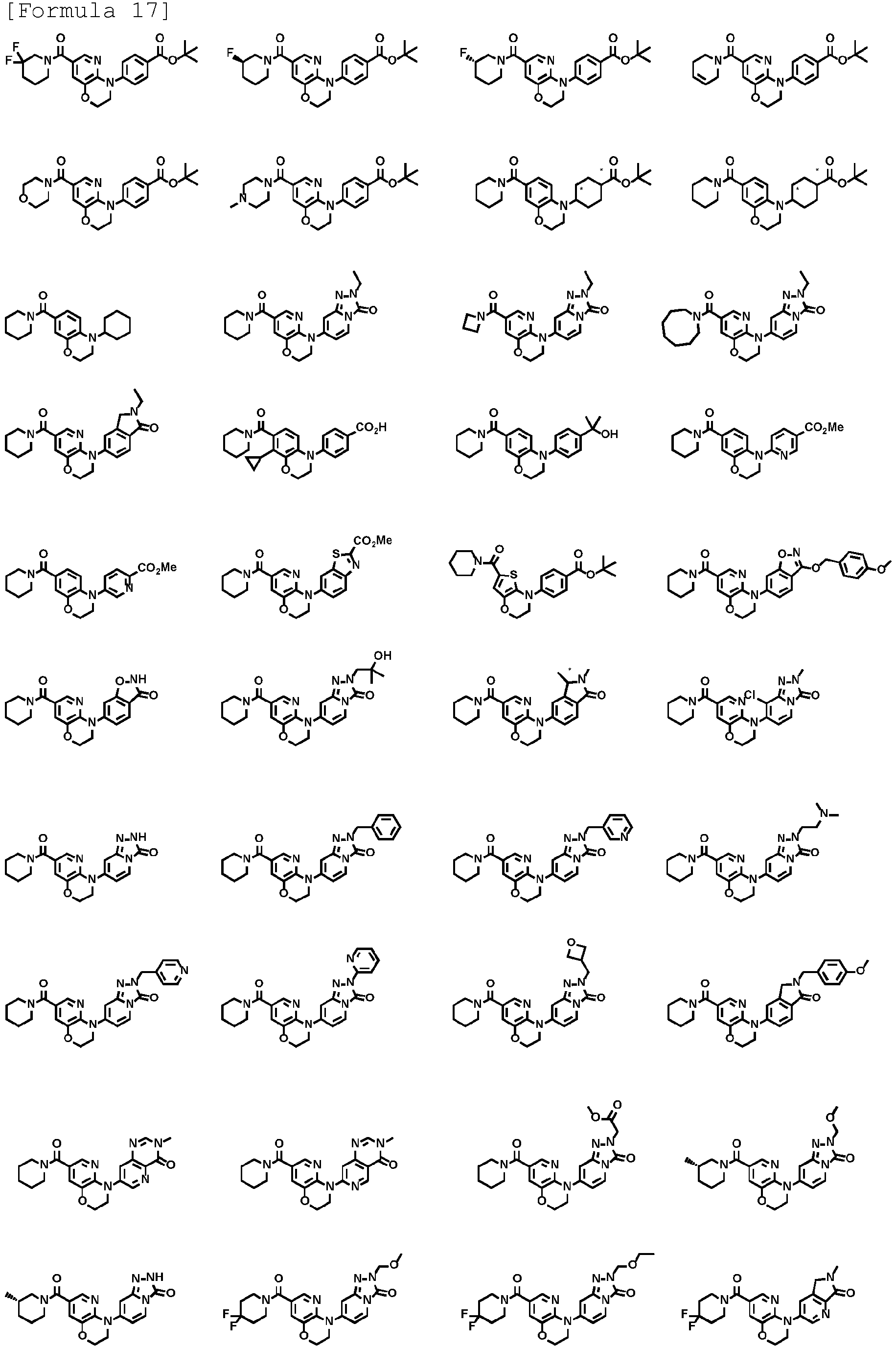


- [12] A pharmaceutical comprising, as an active ingredient, the compound according to any one of [1] to [11], or a pharmacologically acceptable salt thereof.
- [13] A 15-PGDH inhibitor comprising, as an active ingredient, the compound according to any one of [1] to [11], or a pharmacologically acceptable salt thereof.
- [14] A method for treating or preventing one, two or more of fibrosis (such as lung fibrosis (idiopathic pulmonary fibrosis or the like), liver fibrosis, kidney fibrosis, myocardial fibrosis, scleroderma and bone marrow fibrosis), inflammatory diseases (such as chronic obstructive pulmonary disease (COPD), acute lung injury, sepsis, exacerbation of asthma and lung disease, inflammatory bowel disease (such as ulcerative colitis and Crohn's disease), peptic ulcer (such as NSAID induced ulcer), autoinflammatory diseases (such as Behcet's disease), vasculitis syndrome, acute liver injury, acute kidney injury, non-alcoholic fatty liver (NASH), atopic dermatitis, psoriasis, interstitial cystitis, prostatitis syndrome (such as chronic prostatitis/chronic pelvic pain syndrome)), cardiovascular diseases (such as pulmonary hypertension, angina, myocardial infarction, heart failure, ischemic heart disease, chronic kidney disease, renal failure, cerebral apoplexy and peripheral circulatory disturbance), wounds (such as diabetic ulcer, burn, pressure ulcer, acute mucosal injury including Stevens-Johnson syndrome, mucosal injury (such as mucositis or stomatitis) related to an anticancer chemotherapy agent, mainly such as an alkylating agent, a DNA synthesis inhibitor, a DNA gyrase inhibitor or an antimetabolite, cellular or humoral immunotherapy or radioactive rays, or graft-versus-host disease), autoimmune diseases (such as multiple sclerosis or rheumatoid arthritis), graft-versus-host disease (GVHD), hair growth, osteoporosis, ear diseases (such as hearing loss, tinnitus, dizziness and dysequilibrium), eye diseases (such as glaucoma and dry eye), diabetes, underactive bladder, neutropenia, promotion of engraftment in stem cell or bone marrow transplantation or organ transplantation, neurodegenesis and nerve cell death (such as psycho-neurologic disease, neuropathy, neurotoxic disease, neuropathic pain and neurogenerative disease), muscle regeneration (such as muscular atrophy, muscular dystrophy and muscle damage), and cervical ripening, including administering the compound according to any one of [1] to [11] or a pharmacologically acceptable salt thereof.
- [15] Use of the compound according to any one of [1] to [11] or a pharmacologically acceptable salt thereof, for producing a pharmaceutical for treating or preventing one, two or more of fibrosis (such as lung fibrosis (idiopathic pulmonary fibrosis or the like), liver fibrosis, kidney fibrosis, myocardial fibrosis, scleroderma and bone marrow fibrosis), inflammatory diseases (such as chronic obstructive pulmonary disease (COPD), acute lung injury, sepsis, exacerbation of asthma and lung disease, inflammatory bowel disease (such as ulcerative colitis and Crohn's disease), peptic ulcer (such as NSAID induced ulcer), autoinflammatory diseases (such as Behcet's disease), vasculitis syndrome, acute liver injury, acute kidney injury, non-alcoholic fatty liver (NASH), atopic dermatitis, psoriasis, interstitial cystitis, prostatitis syndrome (such as chronic prostatitis/chronic pelvic pain syndrome)), cardiovascular diseases (such as pulmonary hypertension, angina, myocardial infarction, heart failure, ischemic heart disease, chronic kidney disease, renal failure, cerebral apoplexy and peripheral circulatory disturbance), wounds (such as diabetic ulcer, burn, pressure ulcer, acute mucosal injury including Stevens-Johnson syndrome, mucosal injury (such as mucositis or stomatitis) related to an anticancer chemotherapy agent, mainly such as an alkylating agent, a DNA synthesis inhibitor, a DNA gyrase inhibitor or an antimetabolite, cellular or humoral immunotherapy or radioactive rays, or graft-versus-host disease), autoimmune diseases (such as multiple sclerosis or rheumatoid arthritis), graft-versus-host disease (GVHD), hair growth, osteoporosis, ear diseases (such as hearing loss, tinnitus, dizziness and dysequilibrium), eye diseases (such as glaucoma and dry eye), diabetes, underactive bladder, neutropenia, promotion of engraftment in stem cell or bone marrow transplantation or organ transplantation, neurogenesis and nerve cell death (such as psycho-neurologic disease, neuropathy, neurotoxic disease, neuropathic pain and neurodegenerative disease), muscle regeneration (such as muscular atrophy, muscular dystrophy and muscle damage), and cervical ripening.
- [16] A pharmaceutical composition containing the compound according to any one of [1] to [11] or a pharmacologically acceptable salt, and a pharmacologically acceptable carrier, for use in treating or preventing one, two or more of fibrosis (such as lung fibrosis (idiopathic pulmonary fibrosis or the like), liver fibrosis, kidney fibrosis, myocardial fibrosis, scleroderma and bone marrow fibrosis), inflammatory diseases (such as chronic obstructive pulmonary disease (COPD), acute lung injury, sepsis, exacerbation of asthma and lung disease, inflammatory bowel disease (such as ulcerative colitis and Crohn's disease), peptic ulcer (such as NSAID induced ulcer), autoinflammatory diseases (such as Behcet's disease), vasculitis syndrome, acute liver injury, acute kidney injury, non-alcoholic fatty liver (NASH), atopic dermatitis, psoriasis, interstitial cystitis, prostatitis syndrome (such as chronic prostatitis/chronic pelvic pain syndrome)), cardiovascular diseases (such as pulmonary hypertension, angina, myocardial infarction, heart failure, ischemic heart disease, chronic kidney disease, renal failure, cerebral apoplexy and peripheral circulatory disturbance), wounds (such as diabetic ulcer, burn, pressure ulcer, acute mucosal injury including Stevens-Johnson syndrome, mucosal injury (such as mucositis or stomatitis) related to an anticancer chemotherapy agent, mainly such as an alkylating agent, a DNA synthesis inhibitor, a DNA gyrase inhibitor or an antimetabolite, cellular or humoral immunotherapy or radioactive rays, or graft-versus-host disease), autoimmune diseases (such as multiple sclerosis or rheumatoid arthritis), graft-versus-host disease (GVHD), hair growth, osteoporosis, ear diseases (such as hearing loss, tinnitus, dizziness and dysequilibrium), eye diseases (such as glaucoma and dry eye), diabetes, underactive bladder, neutropenia, promotion of engraftment in stem cell or bone marrow transplantation or organ transplantation, neurogenesis and nerve cell death (such as psycho-neurologic disease, neuropathy, neurotoxic disease, neuropathic pain and neurodegenerative disease), muscle regeneration (such as muscular atrophy, muscular dystrophy and muscle damage), and cervical ripening.
- Terms herein used will be described.
- The term "Cn-Cm" as used herein means a carbon number of n to m, n and m are respectively independent natural numbers, and m is a larger number than n. For example, "C1-C6" means a carbon number of 1 to 6.
- The term "halogen atom" as used herein means a fluorine atom, a chlorine atom, a bromine atom or an iodine atom. Preferably, it is a fluorine atom or a chlorine atom.
- The term "5-membered aromatic heterocyclic group" as used herein means a 5-membered aromatic heterocyclic group containing, in the ring, 1 to 4 atoms selected from a sulfur atom, an oxygen atom and a nitrogen atom. Examples of the 5-membered aromatic heterocyclic group include a furyl group, a thienyl group, a pyrrolyl group, an azepinyl group, a pyrazolyl group, an imidazolyl group, an oxazolyl group, an isoxazolyl group, a thiazolyl group, an isothiazolyl group, a 1,2,3-oxadiazolyl group, a triazolyl group, a tetrazolyl group and a thiadiazolyl group.
- The term "6-membered aromatic heterocyclic group" as used herein means a 6-membered aromatic heterocyclic group containing, in the ring, 1 to 4 nitrogen atoms. Examples of the 6-membered aromatic heterocyclic group include a pyridyl group, a pyridazinyl group, a pyrimidinyl group and a pyrazinyl group.
- The term "condensed heterocyclic group having 8 to 10 ring atoms" means a condensed aromatic ring group or non-aromatic ring group that has 8 to 10 atoms constituting the ring, contains 1 to 5 hetero atoms selected from a sulfur atom, an oxygen atom and a nitrogen atom in the atoms constituting the ring, optionally contains 1 to 5 double bonds in the ring, and optionally contains 1 to 3 oxo groups as a ring substituent (excluding a 6,7-dihydro-4H-thiazolo[5,4-c]pyridine ring). Examples of the condensed heterocyclic group having 8 to 10 ring atoms include a thienothiophenyl group, a thienofuranyl group, a thienoimidazolyl group, a benzofuranyl group, an isobenzofuranyl group, a benzoxazolyl group, a benzoisoxazolyl group, a benzothiazolyl group, a benzoisothiazolyl group, a benzoimidazolyl group, a benzothiophenyl group, an indolinyl group, an isoindolinyl group, an indazolyl group, a thiazolopyridyl group, an oxazolopyrazinyl group, a tetrahydrobenzothiophenyl group, a tetrahydrobenzofuranyl group, a dihydrobenzoxazolyl group, an imidazo[1,2-a]pyridinyl group, a 3-oxo-2,3-dihydro[1,2,4]triazolo[4,3-a]pyridinyl group, a 3-oxo-2,3-dihydrobenzo[d]isoxazolyl group, a [1,2,4]triazolo[4,3-a]pyridinyl group, a [1,2,4]triazolo[1,5-a]pyridinyl group, a triazolo[1,5-a]pyridinyl group, a 7-oxo-6,7-dihydro-5H-pyrrolo[3,4-b]pyridinyl group, a 3-oxo-2,3-dihydro-1H-pyrrolo[3,4-c]pyridinyl group, a 1-oxoisoindolinyl group, a 1,3-dioxoisoindolynyl group, a 1,1-dioxide-3-oxo-2,3-dihydrobenzo[d]isothiazolyl group, a 1,1-dioxide-3-oxo-2,3-dihydrobenzo[b]thiophenyl group, a 1,1-dioxidebenzo[d]isothiazolyl group, a benzo[d]isoxazolyl group, a 1-oxo-1,2-dihydroisoquinolinyl group, a 4-oxo-3,4-dihydroquinazolinyl group, a 4-oxo-3,4-dihydropyrido[3,2-d]pyrimidinyl group, a 4-oxo-3,4-dihydropyrido[4,3-d]pyrimidinyl group, a 8-oxo-7,8-dihydro-1,7-naphthyridinyl group, a 8-oxo-7,8-dihydro-2,7-naphthyridinyl group, a 5-oxo-5,6-dihydro-1,6-naphthyridinyl group, a 1-oxo-1,2-dihydrophthaladinyl group, a 1-oxo-1,2,3,4-tetrahydroisoquinolinyl group, a thieno[3,2-b]thiophenyl group, a pyrazolo[1,5-a]pyridinyl group, a quinolinyl group, a quinoxalinyl group, a naphthyridinyl group, a 8-oxopyrido[2,3-d]pyridazinyl group, a 2-oxoindolinyl group and an isoquinolinyl group.
- The term "methylene group" as used herein means a CH2 group.
- The term "carbonyl group" as used herein means a C=O group.
- The term "oxo group" as used herein means an =O group.
- The term "formyl group" as used herein means a -CHO group.
- The term "C1-C6 alkyl group" as used herein means a linear or branched alkyl group having 1 to 6 carbon atoms. Examples include a methyl group, an ethyl group, a propyl group, an isopropyl group, a butyl group, an isobutyl group, a sec-butyl group, a tert-butyl group, a pentyl group, an isopentyl group, a neopentyl group, a 1-methylbutyl group, a 2-methylbutyl group, a 1,2-dimethylpropyl group, a hexyl group and an isohexyl group.
- The term "C1-C6 alkynyl group" as used herein means a linear or branched alkynyl group having at least one triple bond and 1 to 6 carbon atoms. Examples include an ethynyl group, a 2-propynyl group, a butynyl group, a 5-pentynyl group and a hexenyl group.
- The term "C1-C6 alkylcarbonyl group" as used herein is an alkylcarbonyl group derived from linear or branched aliphatic carboxylic acid having 1 to 6 carbon atoms, and means a C1-C6 alkyl-C(=O)- group. Examples of the C1-C6 alkylcarbonyl group include a methylcarbonyl group, an ethylcarbonyl group, a propylcarbonyl group, an isopropylcarbonyl group, a butylcarbonyl group, an isobutylcarbonyl group, a sec-butylcarbonyl group, a t-butylcarbonyl group, a pentylcarbonyl group, an isopentylcarbonyl group, a neopentylcarbonyl group, a 1-methylbutylcarbonyl group, a 2-methylbutylcarbonyl group, a 1,2-dimethypropylcarbonyl group, a hexylcarbonyl group and an isohexylcarbonyl group.
- The term "C1-C6 alkoxy group" as used herein is a linear or branched alkoxy group having 1 to 6 carbon atom, and means a C1-C6 alkyl-O- group. Examples include a methoxy group, an ethoxy group, a propoxy group, an isopropoxy group, an isobutoxy group, a butoxy group, a sec-butoxy group, a tert-butoxy group, a pentyloxy group and a hexyloxy group.
- The term "C1-C6 alkoxycarbonyl group" as used herein is a linear or branched alkoxycarbonyl group having 1 to 6 carbon atoms, and means a C1-C6 alkyl-O-C(=O)- group. Examples include a methoxycarbonyl group, an ethoxycarbonyl group, a propoxycarbonyl group, an isopropoxycarbonyl group, an isobutoxycarbonyl group, a butoxycarbonyl group, a sec-butoxycarbonyl group, a tert-butoxycarbonyl group, a pentyloxycarbonyl group and a hexyloxycarbonyl group.
- The term "C1-C6 alkylsulfonyl group" as used herein is a linear or branched alkylsulfonyl group having 1 to 6 carbon atoms, and means a C1-C6 alkyl-SO2- group. Examples include a methylsulfonyl group, an ethylsulfonyl group, a propylsulfonyl group, an isopropylsulfonyl group, a butylsulfonyl group, an isobutylsulfonyl group, a sec-butylsulfonyl group and a tert-butylsulfonyl group.
- The term "C1-C6 alkylsulfonylamino group" as used herein is an amino group having one hydrogen atom thereof substituted with a C1-C6 alkylsulfonyl group, and means a C1-C6 alkyl-SO2NH- group. Examples include a methylsulfonylamino group, an ethylsulfonylamino group, a propylsulfonylamino group, an isopropylsulfonylamino group, a butylsulfonylamino group, an isobutylsulfonylamino group, a sec-butylsulfonylamino group and a tert-butylsulfonylamino group.
- The term "C3-C8 cycloalkyl group" as used herein means a monocyclic saturated alicyclic hydrocarbon group having 3 to 8 carbon atoms. Examples include a cyclopropyl group, a cyclobutyl group, a cyclopentyl group, a cyclohexyl group, a cycloheptyl group and a cyclooctyl group.
- The term "C3-C8 cycloalkylcarbonyl group" as used herein is a cycloalkylcarbonyl group derived from a monocyclic saturated alicyclic hydrocarbon carboxylic acid having 3 to 8 carbon atoms, and means a C3-C8 cycloalkyl -C(=O)- group. Examples of the C3-C8 cycloalkylcarbonyl group include a cyclopropylcarbonyl group, a cyclobutylcarbonyl group, a cyclopentylcarbonyl group, a cyclohexylcarbonyl group, a cycloheptylcarbonyl group and a cyclooctylcarbonyl group.
- The term "C3-C8 cycloalkylsulfonyl group" as used herein means a cycloalkyl -SO2- group having 3 to 8 carbon atoms. Examples include a cyclopropylsulfonyl group, a cyclobutylsulfonyl group, a cyclopentylsulfonyl group, a cyclohexylsulfonyl group, a cycloheptylsulfonyl group and a cyclooctylsulfonyl group.
- The term "C3-C8 cycloalkylsulfonylamino group" as used herein is an amino group having one hydrogen atom thereof substituted with a C3-C8 cycloalkylsulfonyl group, and means a C3-C8 cycloalkyl -SO2NH- group. Examples include a cyclopropylsulfonylamino group, a cyclobutylsulfonylamino group, a cyclopentylsulfonylamino group, a cyclohexysulfonylamino group, a cycloheptylsulfonylamino group and a cyclooctylsulfonylamino group.
- The term "nitrogen-containing heterocycloalkyl group having 3 to 11 ring atoms" as used herein means a saturated or non-aromatic unsaturated monocyclic, bicyclic or tricyclic heterocycloalkyl group having 3, 4, 5, 6, 7, 8, 9 or 10 ring members that contains one or more nitrogen atoms in its ring structure, and optionally contains an oxygen atom or a sulfur atom.
- The nitrogen-containing heterocycloalkyl group having 3 to 11 ring atoms may be condensed further with a 6-membered aromatic hydrocarbon ring or a 6-membered aromatic heterocycle. Besides, the nitrogen-containing heterocycloalkyl group having 3 to 11 ring atoms can be a bridged or spiro ring group. Examples of the nitrogen-containing heterocycloalkyl group having 3 to 11 ring atoms include an aziridinyl group, an azetidinyl group, a pyrrolidinyl group, a piperidinyl group, an azepanyl group, an azocanyl group, a dihydropyrrolyl group, a tetrahydropyridinyl group, a piperazinyl group, a morpholinyl group, a thiomorpholinyl group, a 1-oxidethiomorpholinyl group, a 1,1-dioxidethiomorpholinyl group, an oxazepinyl group, a thiazepanyl group, a 1-oxide-1,4-thiazepanyl group, a 1,1-dioxide-1,4-thiazepanyl group, a 1,4-dithiazepanyl group, a 1,4-oxazocanyl group, a 1,5-oxazocanyl group, an octahydroindolinyl group, an octahydroisoindolinyl group, an octahydrocyclopenta[c]pyrrolyl group, a 3-azabicyclo[3,2,0]heptanyl group, a 3-azabicyclo[3,1,0]hexanyl group, a 5-azabicyclo[2,1,1]hexanyl group, a 2-azabicyclo[2,1,1]hexanyl group, a 2-azabicyclo[4,1,0]heptanyl group, a 3-azabicyclo[4,1,0]heptanyl group, a 2-azabicyclo[4,2,0]octanyl group, a 3-azabicyclo[4,2,0]octanyl group, an octahydro-1H-cyclopenta[c]pyridinyl group, a 3-azabicyclo[3,1,1]heptanyl group, a 2-azabicyclo[2,2,1]heptanyl group, a 6-azabicyclo[3,1,1]heptanyl group, a 8-azabicyclo[3,2,1]octanyl group, a 3-azabicyclo[3,2,1]octanyl group, a 6-azabicyclo[3,2,1]octanyl group, a 4-azaspiro[2,4]heptanyl group, a 5-azaspiro[2,4]heptanyl group, a 1-oxo-5-azaspiro[2,4]heptanyl group, a 5-azaspiro[3,4]octanyl group, a 6-azaspiro[3,4]octanyl group, a 2-oxo-6-azaspiro[3,4]octanyl group, a 1-oxo-6-azaspiro[3,4]octanyl group, a 1-azaspiro[4,4]nonanyl group, a 2-azaspiro[4,4]nonanyl group, a 2-oxa-7-azaspiro[4,4]nonanyl group, a 1-oxa-7-azaspiro[4,4]nonanyl group, a 2-azaspiro[4,5]decanyl group, a 8-oxa-2-azaspiro[4,5]decanyl group, a 7-oxa-2-azaspiro[4,5]decanyl group, a 6-oxa-2-azaspiro[4,5]decanyl group, a 2-azaspiro[4,6]undecanyl group, a 4-azaspiro[2,5]octanyl group, a 5-azaspiro[2,5]octanyl group, a 6-azaspiro[2,5]octanyl group, a 1-oxa-5-azaspiro[2,5]octanyl group, a 4-oxa-7-azaspiro[2,5]octanyl group, a 1-oxa-6-azaspiro[2,5]octanyl group, a 5-azaspiro[3,5]nonanyl group, a 6-azaspiro[3,5]nonanyl group, a 7-azaspiro[3,5]nonanyl group, a 1-oxa-6-azaspiro[3,5]nonanyl group, a 2-oxa-6-azaspiro[3,5]nonanyl group, a 2-oxa-5-azaspiro[3,5]nonanyl group, a 2-oxa-7-azaspiro[3,5]nonanyl group, a 7-azaspiro[4,5]decanyl group, a 8-azaspiro[4,5]decanyl group, a 2-azaspiro[5,5]undecanyl group and a 3-azaspiro[5,5]undecanyl group. Examples of the nitrogen-containing heterocycloalkyl group having 3 to 11 ring atoms with which a 6-membered aromatic hydrocarbon ring or a 6-membered aromatic heterocycle is condensed include an indolinyl group, an isoindolinyl group, a 1,2,3,4-tetrahydroquinolyl group, a 1,2,3,4-tetrahydroisoquinolyl group, a 2,3,4,5-tetrahydro-1H-benzo[b]azepinyl group, a 2,3,4,5-tetrahydro-1H-benzo[c]azepinyl group, a 2,3,4,5-tetrahydro-1H-benzo[d]azepinyl group, a 2,3-dihydro-1H-pyrrolo[2,3-b]pyridinyl group, a 2,3-dihydro-1H-pyrrolo[2,3-c]pyridinyl group, a 2,3-dihydro-1H-pyrrolo[3,2-c]pyridinyl group, a 2,3-dihydro-1H-pyrrolo[3,2-b]pyridinyl group, a 6,7-dihydro-5H-pyrrolo[3,4-b]pyridinyl group, a 2,3-dihydro-1H-pyrrolo[3,4-c]pyridinyl group, a 1,2,3,4-tetrahydro-1,8-naphthyridinyl group, a 1,2,3,4-tetrahydro-1,7-naphthyridinyl group, a 1,2,3,4-tetrahydro-1,6-naphthyridinyl group, a 1,2,3,4-tetrahydro-1,5-naphthyridinyl group, a 5,6,7,8-tetrahydro-1,6-naphthyridinyl group, a 1,2,3,4-tetrahydro-2,6-naphthyridinyl group, a 1,2,3,4-tetrahydro-2,7-naphthyridinyl group, a 5,6,7,8-tetrahydro-1,7-naphthyridinyl group, a 3,4-dihydro-2H-benzo[b][1,4]oxadinyl group, a 2,3,4,5-tetrahydrobenzo[b][1,4]oxazepinyl group, a 2,3,4,5-tetrahydrobenzo[b][1,4]thiazepinyl group and a 2,3,4,5-tetrahydrobenzo[f][1,4]oxazepinyl group.
- The term "3- to 8-membered heterocycloalkyl group" as used herein means a monocyclic, bicyclic or tricyclic heterocycloalkyl group having 3, 4, 5, 6, 7 or 8 ring members that contains 1 to 4 endocyclic hetero atoms independently selected from the group consisting of N, N-oxide, O, S, SO and SO2, optionally has 1 to 3 carbonyls, and optionally has one double bond in the ring.
- The 3- to 8-membered heterocycloalkyl group may be condensed further with a 6-membered aromatic hydrocarbon ring or a 6-membered aromatic heterocycle. Besides, the 3- to 8-membered heterocycloalkyl group can be a bridged or spiro ring group. Examples of the 3- to 8-membered heterocycloalkyl group include an aziridinyl group, an azetidinyl group, an oxiranyl group, an oxetanyl group, a tetrahydro-2H-pyranyl group, a dihydropyranyl group, a pyranyl group, a tetrahydrofuranyl group, an imidazolyl group, a dihydropyrazolyl group, a dihydroimidazolyl group, a dihydrooxadiazolyl group, a thiazolidyl group, a pyrrolidinyl group, a piperidinyl group, an azepanyl group, an azocanyl group, a dihydropyrrolyl group, a tetrahydropyridinyl group, a piperazinyl group, a morpholinyl group, a thiomorpholinyl group, a 1-oxide thiomorphlinyl group, a 1,1-dioxide thiomorpholinyl group, an oxazepinyl group, a thiazepanyl group, a 1-oxide-1,4-thiazepanyl group, a 1,1-dioxide-1,4-thiazepanyl group, a 1,4-diazepanyl group, a 1,4-oxazocanyl group, a 1,5-oxazocanyl group, an octahydrocyclopenta[c]pyrrolyl group, a 3-azabicyclo[3,2,0]heptanyl group, a 3-azabicyclo[3,1,0]hexanyl group, a 5-azabicyclo[2,1,1]hexanyl group, a 2-azabicyclo[2,1,1]hexanyl group, a 2-azabicyclo[4,1,0]heptanyl group, a 3-azabicyclo[4,1,0]heptanyl group, a 2-azabicyclo[4,2,0]octanyl group, a 3-azabicyclo[4,2,0]octanyl group, a 3-azabicyclo[3,1,1]heptanyl group, a 2-azabicyclo[2,2,1]heptanyl group, a 6-azabicyclo[3,1,1]heptanyl group, a 8-azabicyclo[3,2,1]octanyl group, a 3-azabicyclo[3,2,1]octanyl group, a 6-azabicyclo[3,2,1]octanyl group, a 4-azaspiro[2,4]heptanyl group, a 5-azaspiro[2,4]heptanyl group, a 1-oxo-5-azaspiro[2,4]heptanyl group, a 5-azaspiro[3,4]octanyl group, a 6-azaspiro[3,4]octanyl group, a 2-oxo-6-azaspiro[3,4]octanyl group, a 1-oxo-6-azaspiro[3,4]octanyl group, a 4-azaspiro[2,5]octanyl group, a 5-azaspiro[2,5]octanyl group, a 6-azaspiro[2,5]octanyl group, a 1-oxa-5-azaspiro[2,5]octanyl group, a 4-oxa-7-azaspiro[2,5]octanyl group and a 1-oxa-6-azaspiro[2,5]octanyl group. Examples of the 3- to 8-membered heterocycloalkyl group with which a 6-membered aromatic hydrocarbon ring or 6-membered aromatic heterocycle is condensed include an indolinyl group, an isoindolinyl group, a 1,2,3,4-tetrahydroquinolyl group, a 1,2,3,4-tetrahydroisoquinolyl group, a 2,3,4,5-tetrahydro-1H-benzo[b]azepinyl group, a 2,3,4,5-tetrahydro-1H-benzo[c]azepinyl group, a 2,3,4,5-tetrahydro-1H-benzo[d]azepinyl group, a 2,3-dihydro-1H-pyrrolo[2,3-b]pyridinyl group, a 2,3-dihydro-1H-pyrrolo[2,3-c]pyridinyl group, a 2,3-dihydro-1H-pyrrolo[3,2-c]pyridinyl group, a 2,3-dihydro-1H-pyrrolo[3,2-b]pyridinyl group, a 6,7-dihydro-5H-pyrrolo[3,4-b]pyridinyl group, a 2,3-dihydro-1H-pyrrolo[3,4-c]pyridinyl group, a 1,2,3,4-tetrahydro-1,8-naphthyridinyl group, a 1,2,3,4-tetrahydro-1,7-naphthyridinyl group, a 1,2,3,4-tetrahydro-1,6-naphthyridinyl group, a 1,2,3,4-tetrahydro-1,5-naphthrydinyl group, a 5,6,7,8-tetrahydro-1,6-napthyridinyl group, a 1,2,3,4-tetrahydro-2,6-napthyridinyl group, a 1,2,3,4-tetrahydro-2,7-naphthyridinyl group, a 5,6,7,8-tetrahydro-1,7-naphthyridinyl group, a 3,4-dihydro-2H-benzo[b][1,4]oxadinyl group, a 2,3,4,5-tetrahydrobenzo[b][1,4]oxazepinyl group, a 2,3,4,5-tetrahydrobenzo[b][1,4]thiazepinyl group and a 2,3,4,5-tetrahydrobenzo[f][1,4]oxazepinyl group.
- The term "3- to 8-membered heterocycloalkyl group containing an oxygen atom" as used herein means a 3- to 8-membered heterocycloalkyl group containing one or more endocyclic oxygen atoms. Examples of the 3- to 8-membered heterocycloalkyl group containing an oxygen atom include an oxiranyl group, an oxetanyl group, a tetrahydro-2H-pyranyl group, a dihydropyranyl group, a pyranyl group, a tetrahydrofuranyl group, a dihydrooxadiazolyl group, a morpholinyl group, an oxazepinyl group, a 1,4-oxazocanyl group, a 1,5-oxazocanyl group, a 3,4-dihydro-2H-benzo[b][1,4]oxadinyl group, a 2,3,4,5-tetrahydrobenzo[b][1,4]oxazepinyl group and a 2,3,4,5-tetrahydrobenzo[f][1,4]oxazepinyl group.
- The term "3- to 8-membered heterocycloalkylcarbonyl group" as used herein means a 3- to 8-membered heterocycloalkyl -C(=O)-group. Examples of the 3- to 8-membered heterocycloalkylcarbonyl group include an aziridinylcarbonyl group, an azetidinylcarbonyl group, an oxetanylcarbonyl group, an imidazolidylcarbonyl group, a thiazolidylcarbonyl group, a pyrrolidinylcarbonyl group, a piperidinylcarbonyl group, a piperazinylcarbonyl group, a morpholinylcarbonyl group, a thiomorpholinylcarbonyl group, a dihydropyrazolylcarbonyl group, a dihydropyrrolylcarbonyl group, a dihydroimidazolylcarbonyl group, a dihydrooxadiazolylcarbonyl group, a dihydropyranylcarbonyl group, a pyranylcarbonyl group, a tetrahydropyrazinylcarbonyl group, an azepanylcarbonyl group, a diazepanylcarbonyl group, an oxazepanylcarbonyl group, a thiazepanylcarbonyl group and a tetrahydrodiazepinylcarbonyl group.
- The term "3- to 8-membered heterocycloalkylamino group" as used herein means a 3- to 8-membered heterocycloalkyl -NH- group. Examples of the 3- to 8-membered heterocycloalkylamino group include an aziridinylamino group, an azetidinylamino group, an oxetanylamino group, an imidazolidylamino group, a thiazolidylamino group, a pyrrolidinylamino group, a piperidinylamino group, a piperazinylamino group, a morpholinylamino group, a thiomorpholinylamino group, a dihydropyrazolylamino group, a dihydropyrrolylamino group, a dihydroimidazolylamino group, a dihydrooxadiazolylamino group, a dihydropyranylamino group, a pyranylamino group, a tetrahydropyrazinylamino group, an azepanylamino group, a diazepanylamino group, an oxazepanylamino group, a thiazepanylamino group and a tetrahydrodiazepinylamino group.
- The term "3- to 8-membered heterocycloalkylaminocarbonyl group" as used herein means a 3- to 8-membered heterocycloalkyl-NHC(=O)- group. Examples of the 3- to 8-membered heterocycloalkylaminocarbonyl group include an aziridinylaminocarbonyl group, an azetidinylaminocarbonyl group, an oxetanylaminocarbonyl group, an imidazolidylaminocarbonyl group, a thiazolidylaminocarbonyl group, a pyrrolidinylaminocarbonyl group, a piperidinylaminocarbonyl group, a piperazinylaminocarbonyl group, a morpholinylaminocarbonyl group, a thiomorpholinylaminocarbonyl group, a dihydropyrazolylaminocarbonyl group, a dihydropyrrolylaminocarbonyl group, a dihydroimidazolylaminocarbonyl group, a dihydrooxadiazolylaminocarbonyl group, a dihydropyranylaminocarbonyl group, a pyranylaminocarbonyl group, a tetrahydropyrazinylaminocarbonyl group, an azepanylaminocarbonyl group, a diazepanylaminocarbonyl group, an oxazepanylaminocarbonyl group, a thiazepanylaminocarbonyl group and a tetrahydrodiazepinylaminocarbonyl group.
- The term "C3-C8 cycloalkoxy group" as used herein is a monocyclic saturated alicyclic hydrocarbon ring alkoxy group having 3 to 8 carbon atoms, and means a C3-C8 cycloalkyl-O- group. Examples include a cyclopropyloxy group, a cyclobutyloxy group, a cyclopentyloxy group, a cyclohexyloxy group, a cycloheptyloxy group and a cyclooctyloxy group.
- The term "halo C1-C6 alkyl group" as used herein means a C1-C6 alkyl group substituted with 1 to 5 same or different halogen atoms. Examples of the halo C1-C6 alkyl group include a fluoromethyl group, a difluoromethyl group, a trifluoromethyl group, a 2-fluoroethyl group, a 2-chloroethyl group, a 2,2-difluoroethyl group, a 1,1-difluoroethyl group, a 1,2-difluoroethyl group, a 2,2,2-trifluoroethyl group, a 1,1,2,2,2-pentafluoroethyl group, a 2,2,2-trichloroethyl group, a 3-fluoropropyl group, a 2-fluoropropyl group, a 1-fluoropropyl group, a 3,3-difluoropropyl group, a 2,2-difluoropropyl group, a 1,1-difluoropropyl group, a 4-fluorobutyl group, a 5-fluoropentyl group and a 6-fluorohexyl group.
- The term "halo C1-C6 alkoxy group" as used herein means a C1-C6 alkoxy group substituted with 1 to 5 same or different halogen atoms. Examples of the halo C1-C6 alkoxy group include a fluoromethoxy group, a difluoromethoxy group, a trifluoromethoxy group, a 2-fluoroethoxy group, a 2-chloroethoxy group, a 2,2-difluoroethoxy group, a 1,1-difluoroethoxy group, a 1,2-difluoroethoxy group, a 2,2,2-trifluoroethoxy group, a 1,1,2,2,2-pentafluoroethoxy group, a 2,2,2-trichloroethoxy group, a 3-fluoropropoxy group, a 2-fluoropropoxy group, a 1-fluoropropoxy group, a 3,3-difluoropropoxy group, a 2,2-difluoropropoxy group, a 1,1-difluoropropoxy group, a 4-fluorobutoxy group, a 5-fluoropentoxy group and a 6-fluorohexyloxy group.
- The term "hydroxy C1-C6 alkyl group" as used herein means a C1-C6 alkyl group substituted with a hydroxyl group. Examples of the hydroxy C1-C6 alkyl group include a 2-hydroxyethyl group, a 1-hydroxyethyl group, a 3-hydroxypropyl group, a 2-hydroxypropyl group, a 1-hydroxypropyl group, a 4-hydroxybutyl group, a 3-hydroxybutyl group, a 2-hydroxybutyl group, a 1-hydroxybutyl group, a 5-hydroxypentyl group and a 6-hydroxyhexyl group.
- The term "C7-C10 aralkyl group" as used herein means a C1-C4 alkyl group substituted with a phenyl group. Examples of the C7-C10 aralkyl group include a benzyl group, a 2-phenylethyl group, a 1-phenylethyl group, a 3-phenylpropyl group, a 1-phenylpropyl group and a 4-phenylbutyl group.
- The term "amino group optionally having one or two C1-C6 alkyl groups" as used herein means an amino group in which one or two hydrogen atoms thereof are optionally substituted with a linear alkyl group or branched alkyl group having 1 to 6 carbon atoms. Examples include an amino group, a methylamino group, an ethylamino group, a propylamino group, an isopropylamino group, a butylamino group, an isobutylamino group, a sec-butylamino group, a tert-butylamino group, a pentylamino group, an isopentylamino group, a neopentylamino group, a 1-methylbutylamino group, a 2-methylbutylamino group, a 1,2-dimethylpropylamino group, a hexylamino group, an isohexylamino group, a dimethylamino group, a diethylamino group, a N-ethyl-N-methylamino group and a N-ethyl-N-propylamino group.
- The term "aminocarbonyl group optionally having one or two C1-C6 alkyl groups" as used herein means an aminocarbonyl group in which one or two hydrogen atoms of an amino group are optionally substituted with a linear alkyl group or branched alkyl group having 1 to 6 carbon atoms. Examples include an aminocarbonyl group, a methylaminocarbonyl group, an ethylaminocarbonyl group, a propylaminocarbonyl group, an isopropylaminocarbonyl group, a butylaminocarbonyl group, an isobutylaminocarbonyl group, a secbutylaminocarbonyl group, a tert-butylaminocarbonyl group, a pentylaminocarbonyl group, an isopentylaminocarbonyl group, a neopentylaminocarbonyl group, a 1-methylbutylaminocarbonyl group, a 2-methylbutylaminocarbonyl group, a 1,2-dimethylpropylaminocarbonyl group, a hexylaminocarbonyl group, an isohexylaminocarbonyl group, a dimethylaminocarbonyl group, a diethylaminocarbonyl group, a N-ethyl-N-methylaminocarbonyl group and a N-ethyl-N-propylaminocarbonyl group.
- The term "aminosulfonyl group optionally having one or two C1-C6 alkyl groups" as used herein means an aminosulfonyl group in which one or two hydrogen atoms of an amino group are optionally substituted with a linear alkyl group or branched alkyl group having 1 to 6 carbon atoms. Examples include an aminosulfonyl group, a methylaminosulfonyl group, an ethylaminosulfonyl group, a propylaminosulfonyl group, an isopropylaminosulfonyl group, a butylaminosulfonyl group, an isobutylaminosulfonyl group, a secbutylaminosulfonyl group, a tert-butylaminosulfonyl group, a pentylaminosulfonyl group, an isopentylaminosulfonyl group, a neopentylaminosulfonyl group, a 1-methylbutylaminosulfonyl group, a 2-methylbutylaminosulfonyl group, a 1,2-dimethylpropylaminosulfonyl group, a hexylaminosulfonyl group, an isohexylaminosulfonyl group, a dimethylaminosulfonyl group, a diethylaminosulfonyl group, a N-ethyl-N-methylaminosulfonyl group and a N-ethyl-N-propylaminosulfonyl group.
- Now, the present embodiment will be described in more detail.
- In the following description, definition of each functional group included in a general formula may be sometimes omitted by referring to definition already given. Referred definition corresponds to definition mentioned in the following description of the embodiment.
- The present embodiment relates to a compound represented by the following general formula (1) or a pharmacologically acceptable salt thereof.

- In the general formula (1), Q1 is -C(R1)=C(R2)-, -C(R3)=N- or a sulfur atom;
- Q2 is C(R4) or a nitrogen atom;
- Q3 is -(CH2)m-(CR5R6)n-(CH2)p-;
- Q4 is a single bond, a methylene group, an oxygen atom, a sulfur atom, a SO group, a SO2 group, a methyleneoxy group, a difluoromethylene group or a NR7 group;
- G1 is a phenyl group, a 5-membered aromatic heterocyclic group, a 6-membered aromatic heterocyclic group, a condensed heterocyclic group having 8 to 10 ring atoms (excluding a 6,7-dihydro-4H-thiazolo[5,4-c]pyridine ring), a C3-C8 cycloalkyl group or a 3- to 8-membered heterocycloalkyl group, each optionally having one or more substituents selected from group A;
- G2 is -C(=O)-NR8R9, -C(=O)-NR10R11, -C(=O)-CHR12R13, -CH(OH)-CHR12R13, -S-CHR12R13, -S(=O)-CHR12R13 or -SO2-CHR12R13;
- R1 and R2 are the same or different, and a hydrogen atom, a halogen atom, or a C1-C6 alkyl group, a C1-C6 alkoxy group or a C3-C8 cycloalkyl group, each optionally having one or more substituents selected from group C;
- R3 is a hydrogen atom, or a C1-C6 alkyl group, a C1-C6 alkoxy group or a C3-C8 cycloalkyl group, each optionally having one or more substituents selected from group C;
- R4 is a hydrogen atom, a halogen atom, or a C1-C6 alkyl group, a C1-C6 alkoxy group or a C3-C8 cycloalkyl group, each optionally having one or more substituents selected from group C;
- R5 and R6 are the same or different, and a hydrogen atom, a halogen atom, or a C1-C6 alkyl group, a C1-C6 alkoxy group or a C3-C8 cycloalkyl group, each optionally having one or more substituents selected from group C;
- R7 is a hydrogen atom, or a C1-C6 alkyl group, a C3-C8 cycloalkyl group, a C1-C6 alkylcarbonyl group, a phenyl group, a 5-membered aromatic heterocyclic group or a 6-membered aromatic heterocyclic group, each optionally having one or more substituents selected from group C;
- R8 and R9 are the same or different, and a hydrogen atom, or a C1-C6 alkyl group or a C3-C8 cycloalkyl group, each optionally having one or more substituents selected from group B;
- when one of R8 and R9 is a hydrogen atom, the other is a C1-C6 alkyl group having one or more substituents selected from a halogen atom, a hydroxy group, a carboxyl group, a C1-C6 alkylcarbonyl group, a C1-C6 alkoxy group and a C1-C6 alkoxycarbonyl group;
- R10 and R11 are, together with the nitrogen atom to which they are attached, a nitrogen-containing heterocycloalkyl group having 3 to 11 ring atoms optionally having one or more substituents selected from group B;
- R12 and R13 are the same or different, and a C1-C6 alkyl group, a C3-C8 cycloalkyl group or a 3- to 8-membered heterocycloalkyl group, each optionally having one or more substituents selected from group B; or
- R12 and R13 are, together with the carbon atom to which they are attached, a C3-C8 cycloalkyl group optionally having one or more substituents selected from group B;
- group A consists of a halogen atom, a hydroxy group, a carbonyl group, a nitrile group, a carboxyl group, a formyl group, an oxo group (=O); and C1-C6 alkyl group, a C1-C6 alkylcarbonyl group, a C1-C6 alkoxy group, a C1-C6 alkoxycarbonyl group, a C1-C6 alkylsulfonyl group, a C1-C6 alkylsulfonylamino group, a C3-C8 cycloalkyl group, a C3-C8 cycloalkylcarbonyl group, a C3-C8 cycloalkoxy group, a C3-C8 cycloalkylsulfonyl group, a C3-C8 cycloalkylsulfonylamino group, a 3- to 8-membered heterocycloalkyl group containing an oxygen atom, a 3- to 8-membered heterocycloalkylcarbonyl group, a 3- to 8-membered heterocycloalkylamino group and a 3- to 8-membered heterocycloalkylaminocarbonyl group, each optionally having one or more substituents selected from group A1; an amino group, an aminocarbonyl group and an aminosulfonyl group, each optionally having one or two C1-C6 alkyl groups optionally having, in an amino group, one or more substituents selected from group A1; and a phenyl group, a 5-membered aromatic heterocyclic group and a 6-membered aromatic heterocyclic group, each optionally having one or more substituents selected from group B;
- group A1 consists of a halogen atom, a hydroxy group, a carbonyl group, a nitrile group, a carboxyl group, a formyl group, an oxo group (=O); and a C1-C6 alkyl group, a C1-C6 alkylcarbonyl group, a C1-C6 alkoxy group, a C1-C6 alkoxycarbonyl group, a C1-C6 alkylsulfonyl group, a C1-C6 alkylsulfonylamino group, a C3-C8 cycloalkyl group, a 3- to 8-membered heterocycloalkyl group, a 3-to 8-membered heterocycloalkylcarbonyl group, a 3- to 8-memered heterocycloalkylamino group and a 3- to 8-memebered heterocycloalkylaminocarbonyl group, each optionally having one or more substituents selected from group A2; an aminocarbonyl group and an amino group, each optionally having one or two C1-C6 alkyl groups optionally having one or more substituents selected from group A2; and a phenyl group, a 5-membered aromatic heterocyclic group and a 6-membered aromatic heterocyclic group, each optionally having one or more substituents selected from group B;
- group A2 consists of a halogen atom, a hydroxy group, a nitrile group, a carboxyl group, a formyl group, an oxo group (=O), a C1-C6 alkyl group, a C1-C6 alkylcarbonyl group, a C1-C6 alkoxy group, a C1-C6 alkoxycarbonyl group, a C1-C6 alkylsulfonylamino group, a 5-membered aromatic heterocyclic group, a 6-membered aromatic heterocyclic group, and a 3- to 8-membered heterocycloalkyl group;
- group B consists of a halogen atom, a hydroxy group, a nitrile group, a carbonyl group, an oxo group (=O), a carboxyl group, a C1-C6 alkyl group, a C1-C6 alkynyl group, a halo C1-C6 alkyl group, a hydroxy C1-C6 alkyl group, a C1-C6 alkylcarbonyl group, a C1-C6 alkoxy group, a halo C1-C6 alkoxy group, a C1-C6 alkoxycarbonyl group, a C1-C6 alkoxy C1-C6 alkyl group, a C1-C6 alkoxycarbonyl C1-C6 alkyl group, a C3-C8 cycloalkyl group, a C3-C8 cycloalkylcarbonyl group, a C3-C8 cycloalkoxy group, an aminocarbonyl group optionally having one or two C1-C6 alkyl groups, a C1-C6 alkylsulfonyl group, an aminosulfonyl group optionally having one or two C1-C6 alkyl groups, a C1-C6 alkylsulfonylamino group and an amino group optionally having one or two C1-C6 alkyl groups;
- group C consists of a halogen atom, a hydroxy group, a nitrile group, a carboxyl group, a C1-C6 alkylcarbonyl group, a C1-C6 alkoxy group, a C1-C6 alkoxycarbonyl group, an aminocarbonyl group optionally having one or two C1-C6 alkyl groups, an amino group optionally having one or two C1-C6 alkyl groups, and a 3- to 8-membered heterocycloalkyl group; and
- each of m, n, p is 0, 1 or 2, and m + n + p is an integer of 2 to 5.
- With regard to the compound (1) of the present embodiment or a pharmacologically acceptable salt thereof, preferred compounds are as follows.
- The compound represented by the general formula (1) is preferably a compound represented by a formula selected from the group consisting of the following A1a), A1b), A2a), A2b), A2c), A2d), A2e), A3a) and A3b):

- In the general formula (1), preferably, NR10R11 in -CONR10R11 of G2 is a group selected from the group consisting of the following B1) to B20), or -CHR12R13 of G2 is a group represented by the following C1):

- The compound represented by the general formula (1) is more preferably a compound represented by a formula selected from the group consisting of the following A1aa), A1ba), A2aa), A2ba), A2ca), A2da), A2ea), A3aa) and A3ba):

- In the general formula (1), G1 is preferably a group selected from the following G1a), G1b), G1c), G1d), G1e), G1f), G1g), G1h), G1i), G1j), G1k), G1l), G1m), G1n), G1o), G1p), G1q), G1r), G1s), G1t), G1u), G1v), G1w), G1x), G1y), G1z), G1A), G1B), G1C), G1D), G1E), G1F), G1G), G1H), G1I), G1J), G1K), G1L), G1M), G1N), G1O), G1P), G1Q), G1R), G1S) and G1T):


- In the general formula (1), G1 is more preferably a group selected from the following G1aa), G1ba), G1ca), G1fa), G1ga), G1ha), G1ia), G1la), G1oa), G1pa), G1qa), G1va), G1wa), G1xa), G1ya) and G1Aa):

-
- R1 and R2 are preferably the same or different, and a hydrogen atom, a halogen atom, or a C1-C3 alkyl group, a C1-C3 alkoxy group or a C3-C8 cycloalkyl group, each optionally having one or more substituents selected from group C;
- R1 and R2 are more preferably the same or different, and a hydrogen atom, a halogen atom, a C1-C3 alkyl group, a C1-C3 alkoxy group or a C3-C8 cycloalkyl group;
- R3 is preferably a hydrogen atom, or a C1-C3 alkyl group or a C1-C3 alkoxy group optionally having one or more substituents selected from group C;
- R3 is more preferably a hydrogen atom, a C1-C3 alkyl group or a C1-C3 alkoxy group;
- R4 is preferably a hydrogen atom, a halogen atom, or a C1-C3 alkyl group, a C1-C3 alkoxy group or a C3-C8 cycloalkyl group, each optionally having one or more substituents selected from group C;
- R4 is more preferably a hydrogen atom, a halogen atom, a C1-C3 alkyl group, a C1-C3 alkoxy group or a C3-C8 cycloalkyl group;
- R5 and R6 are preferably the same or different, and a hydrogen atom, a halogen atom, or a C1-C6 alkyl group, a C1-C6 alkoxy group or a C3-C8 cycloalkyl group, each optionally having one or more substituents selected from group C;
- R5 and R6 are more preferably the same or different, and a hydrogen atom, a halogen atom, or a C1-C3 alkyl group or a C1-C3 alkoxy group, each optionally having one or more substituents selected from group C;
- R7 is preferably a hydrogen atom, or a C1-C6 alkyl group or a C3-C8 cycloalkyl group, each optionally having one or more substituents selected from group C;
- R7 is more preferably a hydrogen atom, or a C1-C3 alkyl group optionally having one or more substituents selected from group C; and
- R7 is most preferably a hydrogen atom, or a C1-C3 alkyl group.
- R8 and R9 are preferably the same or different, and a hydrogen atom, or a C1-C6 alkyl group optionally having one or more substituents selected from group B;
- when one of R8 and R9 is a hydrogen atom, the other is a C1-C6 alkyl group having one or more substituents selected from group B;
- R8 and R9 are more preferably the same or different, and a hydrogen atom, or a C1-C6 alkyl group optionally having one or more substituents selected from group D1;
- when one of R8 and R9 is a hydrogen atom, the other is a C1-C6 alkyl group having one or more substituents selected from group D1;
- R10 and R11 preferably represent, together with the nitrogen atom to which they are attached, a nitrogen-containing heterocycloalkyl group optionally having one or more substituents selected from group B and having 3 to 11 ring atoms;
- the nitrogen-containing heterocycloalkyl group is monocyclic, condensed bicyclic, or bicyclic optionally containing a bridged or spiro ring;
- the nitrogen-containing heterocycloalkyl group optionally further contains one to three hetero atoms selected from a nitrogen atom, an oxygen atom and a sulfur atom;
- R12 and R13 preferably represent, together with the carbon atom to which they are attached, a C3-C8 cycloalkyl group optionally having one or more substituents selected from group B;
- R14 and R15 are preferably the same or different, and a hydrogen atom, a halogen atom, a hydroxy group, a nitrile group, a carboxyl group, a C1-C6 alkyl group, a C1-C6 alkylcarbonyl group, a C1-C6 alkoxy group, a C1-C6 alkoxycarbonyl group or a halo C1-C6 alkyl group;
- R14 and R15 are optionally substituted in any ring in the formula;
- R16 is a hydrogen atom, or a C1-C3 alkyl group optionally having one or more substituents selected from group D;
- R17 and R18 are preferably the same or different, and a hydrogen atom, a halogen atom, or a C1-C3 alkyl group or a C1-C3 alkoxy group, each optionally having one or more substituents selected from group D1;
- R17 and R18 are preferably the same or different, and a hydrogen atom, a halogen atom, a C1-C3 alkyl group, a C1-C3 alkoxy group or a halo C1-C3 alkyl group;
- R19 is preferably a hydrogen atom, a 3- to 8-membered heterocycloalkyl group containing an oxygen atom, or a C3-C8 cycloalkyl group, a hydroxy C1-C3 alkyl group, a phenyl group, a phenyl C1-C3 alkyl group, a 6-membered aromatic heterocyclic group, a 6-membered aromatic heterocyclic C1-C3 alkyl group, a C1-C3 alkyl group or a C1-C3 alkoxy C1-C3 alkyl group, each optionally having one or more substituents selected from group C;
- R20 is preferably a hydrogen atom, a halogen atom, a hydroxy group, a nitrile group, a carboxyl group, a formyl group, or C1-C6 alkyl group, a C1-C6 alkylcarbonyl group, a C1-C6 alkoxy group, a C1-C6 alkoxycarbonyl group, a C1-C6 alkylsulfonylamino group, a C1-C6 alkylsulfonyl group, a C3-C8 cycloalkyl group, a 3- to 8-membered heterocycloalkylcarbonyl group, a 3- to 8-membered heterocycloalkylamino group, or a 3- to 8-membered heterocycloalkylaminocarbonyl group, each optionally having one or more substituents selected from group A3, or an aminocarbonyl group optionally having one or two C1-C6 alkyl groups optionally having one or more substituents selected from group B1, or a 5-membered aromatic heterocyclic group or a 6-membered aromatic heterocyclic group, each optionally having one or more substituents selected from group B1;
- R21 is preferably a hydrogen atom, a halogen atom, a hydroxy group, a nitrile group, a carboxyl group, a formyl group; or a C1-C6 alkyl group, a C1-C6 alkylcarbonyl group, a C1-C6 alkoxy group, a C1-C6 alkoxycarbonyl group, a C1-C6 alkylsulfonylamino group, a C1-C6 alkylsulfonyl group, a C3-C8 cycloalkyl group, a 3- to 8-membered heterocycloalkylcarbonyl group, a 3- to 8-membered heterocycloalkylamino group or a 3- to 8-membered heterocycloalkylaminocarbonyl group, each optionally having one or more substituents selected from group B1; an amino group or an aminocarbonyl group, each optionally having one or two C1-C6 alkyl groups optionally having, in an amino group, one or more substituents selected from group A3; or a 5-membered aromatic heterocyclic group or a 6-membered aromatic heterocyclic group, each optionally having one or more substituents selected from group B1;
- R20 and R21 are optionally substituted in any ring in the formula;
- R22 and R23 are preferably the same or different, and a hydrogen atom, a halogen atom or a C1-C3 alkyl group;
- R24 is a hydrogen atom, or one or more substituents selected from group B1;
- Y is preferably a methylene group, an oxygen atom, a sulfur atom or a N-R16 group;
- Q5 is preferably a methylene group, an oxygen atom or a sulfur atom;
- Q6 is preferably a single bond, a methylene group, an oxygen atom, a sulfur atom, a SO group, a SO2 group, a methyleneoxy group, a difluoromethylene group or NR7, and more preferably a single bond, a methylene group, an oxygen atom or a methyleneoxy group.
- each of m, n and p is 0, 1 or 2, and m + n + p is an integer of 2 to 5.
- q and r are preferably 0, 1, 2 or 3.
- Group A consists of a halogen atom, a hydroxy group, a carbonyl group, a nitrile group, a carboxyl group, a formyl group, an oxo group (=O); and a C1-C6 alkyl group, a C1-C6 alkylcarbonyl group, a C1-C6 alkoxy group, a C1-C6 alkoxycarbonyl group, a C1-C6 alkylsulfonyl group, a C1-C6 alkylsulfonylamino group, a C3-C8 cycloalkyl group, a C3-C8 cycloalkylcarbonyl group, a C3-C8 cycloalkoxy group, a C3-C8 cycloalkylsulfonyl group, a C3-C8 cycloalkylsulfonylamino group, a 3- to 8-membered heterocycloalkyl group containing an oxygen atom, a 3- to 8-membered heterocycloalkylcarbonyl group, a 3- to 8-membered heterocycloalkylamino group and a 3- to 8-membered heterocycloalkylaminocarbonyl group, each optionally having one or more substituents selected from group A1; an amino group, an aminocarbonyl group and an aminosulfonyl group, each optionally having one or two C1-C6 alkyl groups optionally having, in an amino group, one or more substituents selected from group A1; and a phenyl group, a 5-membered aromatic heterocyclic group and a 6-membered aromatic heterocyclic group, each optionally having one or more substituents selected from group B.
- Group A1 consists of a halogen atom, a hydroxy group, a carbonyl group, a nitrile group, a carboxyl group, a formyl group, an oxo group (=O); and a C1-C6 alkyl group, a C1-C6 alkylcarbonyl group, a C1-C6 alkoxy group, a C1-C6 alkoxycarbonyl group, a C1-C6 alkylsulfonyl group, a C1-C6 alkylsulfonylamino group, a C3-C8 cycloalkyl group, a 3- to 8-membered heterocycloalkyl group, a 3-to 8-membered heterocycloalkylcarbonyl group, a 3- to 8-memered heterocycloalkylamino group and a 3- to 8-memebered heterocycloalkylaminocarbonyl group, each optionally having one or more substituents selected from group A2; an aminocarbonyl group and an amino group, each optionally having one or two C1-C6 alkyl groups optionally having one or more substituents selected from group A2; and a phenyl group, a 5-membered aromatic heterocyclic group and a 6-membered aromatic heterocyclic group, each optionally having one or more substituents selected from group B.
- Group A2 consists of a halogen atom, a hydroxy group, a nitrile group, a carboxyl group, a formyl group, an oxo group (=O), a C1-C6 alkyl group, a C1-C6 alkylcarbonyl group, a C1-C6 alkoxy group, a C1-C6 alkoxycarbonyl group, a C1-C6 alkylsulfonylamino group, a 5-membered aromatic heterocyclic group, a 6-membered aromatic heterocyclic group, and a 3- to 8-membered heterocycloalkyl group.
- Group A3 consists of a halogen atom, a hydroxy group, a nitrile group, a carboxyl group, an oxo group (=O), a formyl group, a C1-C6 alkyl group, a C1-C6 alkynyl group, a C1-C6 alkylcarbonyl group, a C1-C6 alkoxy group, a C1-C6 alkoxycarbonyl group and a C1-C6 alkylsulfonylamino group.
- Group B consists of a halogen atom, a hydroxy group, a nitrile group, a carbonyl group, a carboxyl group, a C1-C6 alkyl group, a halo C1-C6 alkyl group, a hydroxy C1-C6 alkyl group, a C1-C6 alkylcarbonyl group, a C1-C6 alkoxy group, a halo C1-C6 alkoxy group, a C1-C6 alkoxycarbonyl group, a C1-C6 alkoxy C1-C6 alkyl group, a C1-C6 alkoxycarbonyl C1-C6 alkyl group, a C3-C8 cycloalkyl group, a C3-C8 cycloalkylcarbonyl group, a C3-C8 cycloalkoxy group, an aminocarbonyl group optionally having one or two C1-C6 alkyl groups, a C1-C6 alkylsulfonyl group, an aminosulfonyl group optionally having one or two C1-C6 alkyl groups, a C1-C6 alkylsulfonylamino group, and an amino group optionally having one or two C1-C6 alkyl groups.
- Group B1 consists of a halogen atom, a hydroxy group, a nitrile group, a carbonyl group, a carboxyl group, a C1-C6 alkyl group, a halo C1-C6 alkyl group, a C1-C6 alkylcarbonyl group, a C1-C6 alkoxy group, a halo C1-C6 alkoxy group, a C1-C6 alkoxycarbonyl group, a C1-C6 alkylsulfonylamino group, an aminocarbonyl group optionally having one or two C1-C6 alkyl groups, an amino group optionally having one or two C1-C6 alkyl groups, and a 3- to 8-membered heterocycloalkyl group.
- Group C consists of a halogen atom, a hydroxy group, a carboxyl group, a C1-C6 alkylcarbonyl group, a C1-C6 alkoxy group, a C1-C6 alkoxycarbonyl group, an aminocarbonyl group optionally having one or two C1-C6 alkyl groups, an amino group optionally having one or two C1-C6 alkyl groups and a 3- to 8-membered heterocycloalkyl group.
- Group D consists of a halogen atom, a hydroxy group, a carboxyl group, a C1-C6 alkylcarbonyl group, a C1-C6 alkoxy group, a C1-C6 alkoxycarbonyl group, an aminocarbonyl group optionally having one or two C1-C6 alkyl groups, a C1-C6 alkylsulfonyl group, an aminosulfonyl group optionally having one or two C1-C6 alkyl groups, a C1-C6 alkylsulfonylamino group, an amino group optionally having one or two C1-C6 alkyl groups and a 3- to 8-membered heterocycloalkyl group.
- Group D1 consists of a halogen atom, a hydroxy group, a carboxyl group, a C1-C6 alkylcarbonyl group, a C1-C6 alkoxy group and a C1-C6 alkoxycarbonyl group.
- Examples of a preferable compound of the present embodiment include the following compounds:


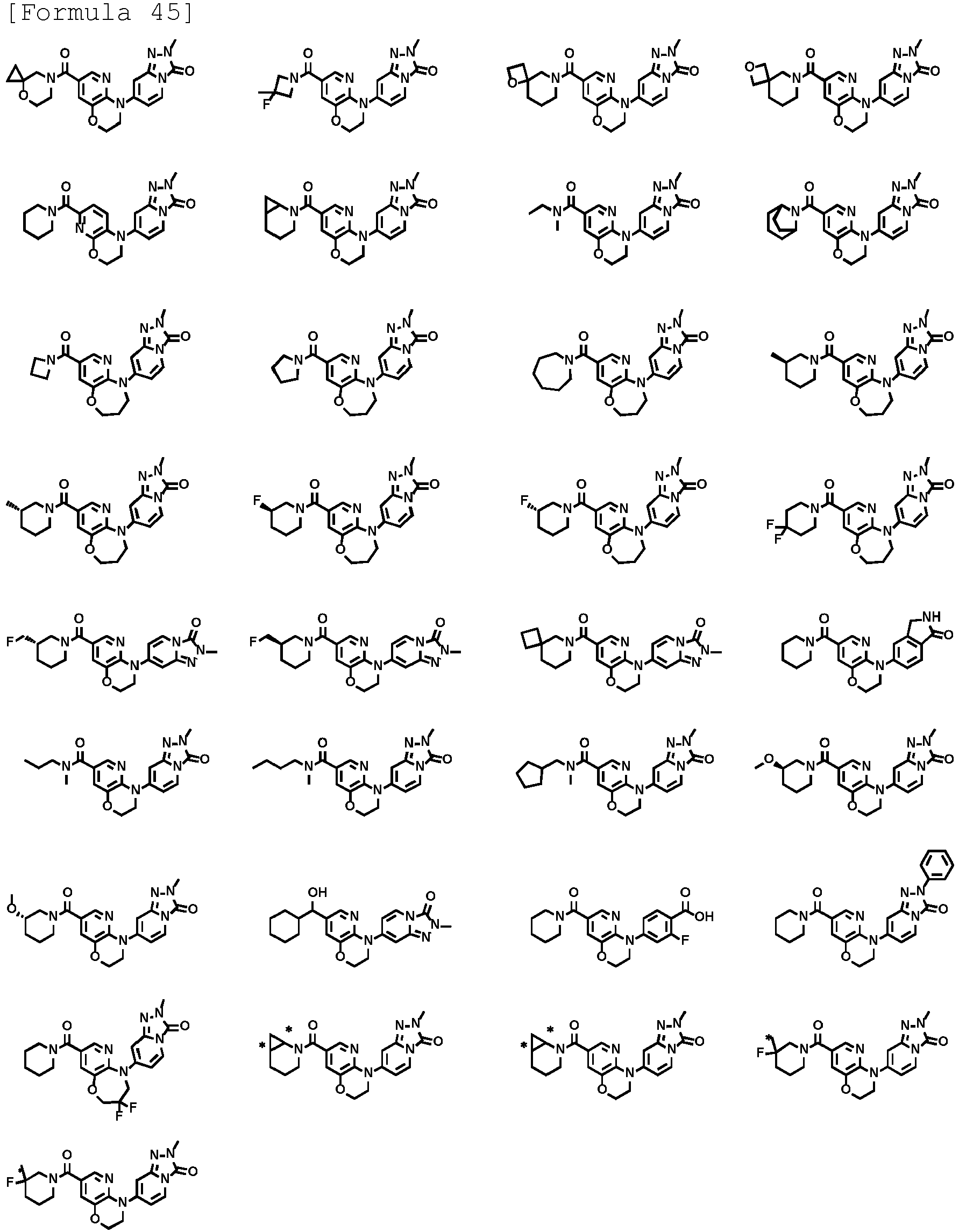


- The compound (1) of the present embodiment can be formed into a pharmacologically acceptable salt thereof by a normal method if necessary. A pharmacologically acceptable salt means a salt with a pharmacologically acceptable non-toxic base or acid (for example, an inorganic or organic base, or an inorganic or organic acid).
- Examples of a salt derived from a pharmacologically acceptable non-toxic base include salts with inorganic bases such as a sodium salt, a potassium salt, a calcium salt and a magnesium salt, and salts with organic bases such as piperidine, morpholine, pyrrolidine, arginine and lysine.
- Examples of a salt derived from a pharmacologically acceptable non-toxic acid include acid addition salts with mineral acids such as hydrochloric acid, hydrobromic acid, sulfuric acid and nitric acid, and acid addition salts with organic acids such as formic acid, acetic acid, trifluoroacetic acid, maleic acid, fumaric acid, succinic acid, lactic acid, malic acid, tartaric acid, citric acid, methanesulfonic acid, p-toluenesulfonic acid, salicylic acid, stearic acid and palmitic acid.
- Besides, the compound (1) of the present embodiment or a pharmacologically acceptable salt thereof may be present as a hydrate or a solvate in some cases. Not only the preferable compounds specifically described above but also arbitrary hydrates and solvates formed by a derivative represented by the general formula (1) or a salt thereof are all embraced in the scope of the present invention. Examples of a solvent capable of forming a solvate include methanol, ethanol, 2-propanol, acetone, ethyl acetate, dichloromethane and diisopropyl ether.
- The compound (1) of the present embodiment or a pharmacologically acceptable salt thereof embraces not only a racemic body but also an optically active substance, a stereoisomer and a rotamer.
- When the compound (1) of the present embodiment is an optical isomer having one or more asymmetric carbon atoms, the compound (1) of the present embodiment may have either the R configuration or the S configuration as the configuration of each asymmetric carbon atom. Besides, any optical isomers are embraced in the present invention, and a mixture of such optical isomers is also embraced therein. Furthermore, with respect to a mixture of optically active substances, a racemic body composed of an equivalent amount of optical isomers is also embraced in the scope of the present invention. When the compound (1) of the present embodiment is a solid or crystal of a racemic body, the racemic body, a racemic mixture and a solid solution of the racemic body are also embraced in the scope of the present invention.
- When the compound (1) of the present embodiment has geometric isomers, the present invention embraces all the geometric isomers.
- When the compound (1) of the present embodiment has tautomers, the present invention embraces all the tautomers.
- Besides, a pharmacologically acceptable salt thereof embraces a proton tautomer.
- A compound obtained by labeling the compound (1) of the present embodiment or a pharmacologically acceptable salt thereof with an isotope (such as 3H, 14C or 35S) is also embraced in the compound of the present invention.
- Besides, a deuterated compound obtained by substituting 1H with 2H(D) is also embraced in the compound of the present invention.
- Each compound name of the compound (1) of the present embodiment was created by using ChemDraw Professional, version 15.0.0.106 (PerkinElmer Informatics, Inc. (registered trademark)).
- The term "15-PGDH inhibitory effect" as used in the present embodiment refers to an effect to inhibit 15-hydroxyprostaglandin dehydrogenase (15-PGDH), that is, an enzyme significant in inactivation (for example, conversion into 15-keto-PGE2 by catalyzing an oxidation reaction of the 15-position hydroxyl group of PGE2) of active prostaglandin (PGD2, PGE1, PGE2, PGF2α, PGI2 or the like), hydroxyeicosatetraenoic acid (HETE) and inflammation resolving lipid mediator (RvD1, RvD2, RvE1, MaRl, LXA4 or the like) (which are hereinafter generically designated as substrates of 15-PGDH).
- The compound (1) of the present embodiment or a pharmacologically acceptable salt thereof inhibits, for example, decomposition of PGE2 by inhibiting 15-PGDH. As a result, the compound (1) of the present embodiment or a pharmacologically acceptable salt thereof is applicable to a disease in which inactivation of a substrate of 15-PGDH is involved. A 15-PGDH inhibitor is useful as a therapeutic agent or a preventive agent against one, two or more of fibrosis (such as lung fibrosis (idiopathic pulmonary fibrosis or the like), liver fibrosis, kidney fibrosis, myocardial fibrosis, scleroderma and bone marrow fibrosis), inflammatory diseases (such as chronic obstructive pulmonary disease (COPD), acute lung injury, sepsis, exacerbation of asthma and lung disease, inflammatory bowel disease (such as ulcerative colitis and Crohn's disease), peptic ulcer (such as NSAID induced ulcer), autoinflammatory diseases (such as Behcet's disease), vasculitis syndrome, acute liver injury, acute kidney injury, non-alcoholic fatty liver (NASH), atopic dermatitis, psoriasis, interstitial cystitis, prostatitis syndrome (such as chronic prostatitis/chronic pelvic pain syndrome)), cardiovascular diseases (such as pulmonary hypertension, angina, myocardial infarction, heart failure, ischemic heart disease, chronic kidney disease, renal failure, cerebral apoplexy and peripheral circulatory disturbance), wounds (such as diabetic ulcer, burn, pressure ulcer, acute mucosal injury including Stevens-Johnson syndrome, mucosal injury (such as mucositis or stomatitis) related to an anticancer chemotherapy agent, mainly such as an alkylating agent, a DNA synthesis inhibitor, a DNA gyrase inhibitor or an antimetabolite, cellular or humoral immunotherapy or radioactive rays, or graft-versus-host disease), autoimmune diseases (such as multiple sclerosis or rheumatoid arthritis), graft-versus-host disease (GVHD), hair growth, osteoporosis, ear diseases (such as hearing loss, tinnitus, dizziness and dysequilibrium), eye diseases (such as glaucoma and dry eye), diabetes, underactive bladder, neutropenia, promotion of engraftment in stem cell or bone marrow transplantation or organ transplantation, neurogenesis and nerve cell death (such as psycho-neurologic disease, neuropathy, neurotoxic disease, neuropathic pain and neurodegenerative disease), muscle regeneration (such as muscular atrophy, muscular dystrophy and muscle damage), and cervical ripening.
- The compound (1) of the present embodiment or a pharmacologically acceptable salt thereof can be produced by any of methods described in detail as Schemes 1 to 31 described below or any equivalent methods, methods described in other literatures or any equivalent methods.
- The compound (1) of the present embodiment can be produced by any of various synthesis methods. Next, representative production methods for the compound (1) of the present invention will be described. The production intermediate may be produced as a salt according to a conventional method as necessary. In some cases, microwaves irradiation are used for heating.
-

- This step is a step of producing the compound (1) by reacting a compound (2) and a compound (3).
- For example, when L1 of the compound (3) is a bromine atom or an iodine atom, the compound (1) can be produced by reacting the compound (2) and the compound (3) under normal Buchwald-Hartwig cross-coupling reaction conditions, for example, in a solvent in the presence of a palladium reagent and a base. Examples of the solvent to be used include tetrahydrofuran, 1,4-dioxane, benzene, toluene, xylene, methanol, ethanol, propanol, N,N-dimethylformamide, dimethylsulfoxide, water and a mixed solvent of any of these. Examples of the palladium reagent to be used include tris(dibenzylideneacetone)dipalladium (0), palladium (II) acetate and bis(tri-tert-butylphosphine)dipalladium (0). Examples of the base to be used include sodium tert-butoxide, potassium tert-butoxide, sodium methoxide, potassium methoxide, sodium ethoxide, potassium ethoxide, cesium carbonate, sodium carbonate, potassium carbonate and potassium phosphate. It is noted that this step can be performed, if necessary, under addition of a ligand such as 4,5-bis(diphenylphosphino)-9,9-dimethylxanthene (Xantphos), 2-dicyclohexylphosphino-2',6'-diisopropoxybiphenyl (RuPhos), 2-dicyclohexylphosphino-2',6'-dimethoxybiphenyl (SPhos), 2-dicyclohexylphosphino-2',4',6'-triisopropylbiphenyl (XPhos) or tri-tert-butylphosphine. The reaction temperature is usually room temperature to a solvent reflux temperature. The reaction time varies depending on a starting material and a solvent to be used, the reaction temperature and the like, and is usually 30 minutes to 3 days.
- Alternatively, for example, when L1 of the compound (3) is a boronic acid derivative, the compound (1) can be produced by reacting the compound (2) and the compound (3) under normal Chan-Lam-Evans coupling reaction conditions, for example, in a solvent in the presence of a copper reagent and in the presence or absence of a base. Examples of the solvent to be used include dichloromethane, chloroform, 1,2-dichloroethane, acetonitrile, tetrahydrofuran, 1,4-dioxane, benzene, toluene and a mixed solvent of any of these. An example of the copper reagent to be used includes copper (II) acetate. Examples of the base to be used include triethylamine, pyridine and diisopropylethylamine. It is noted that this step can be performed, if necessary, under addition of a desiccant such as molecular sieves 4A. The reaction temperature is usually room temperature to a solvent reflux temperature. The reaction time varies depending on a starting material and a solvent to be used, the reaction temperature and the like, and is usually 30 minutes to 3 days.
- Alternatively, for example, when L1 is an iodine atom or a bromine atom, the compound (1) can be produced by reacting the compound (2) and the compound (3) under normal Goldberg amination reaction conditions, for example, in a solvent in the presence of a copper reagent and a base and in the presence or absence of a ligand. Examples of the solvent to be used include 1,4-dioxane, N,N-dimethylformamide, N,N-dimethylacetamide and a mixed solvent of any of these. Examples of the copper reagent to be used include copper (I) iodide, copper (I) bromide and copper. Examples of the base to be used include potassium phosphate, sodium phosphate, cesium carbonate, potassium carbonate and sodium carbonate. Examples of the ligand to be used include N,N'-dimethylethylenediamine and tetramethylethylenediamine. The reaction temperature is usually room temperature to a solvent reflux temperature. The reaction time varies depending on a starting material and a solvent to be used, the reaction temperature and the like, and is usually 30 minutes to 3 days.
- Besides, the compound (1) can be produced, for example, through a nucleophilic substitution reaction using L1 as a leaving group. Examples of the leaving group include a fluorine atom and a chlorine atom. This reaction can be performed by reacting the compound (2) and the compound (3) in a solvent or without using a solvent in the presence or absence of an acid or a base. Examples of the solvent to be used include N,N-dimethylformamide, dimethylsulfoxide, water, tetrahydrofuran, 1,4-dioxane, ethanol and a mixed solvent of any of these. Examples of the acid to be used include hydrogen chloride, p-toluenesulfonic acid and methanesulfonic acid. Examples of the base to be used include triethylamine, diisopropylethylamine, pyridine, 2,6-dimethylpyridine, 2,4,6-trimethylpyridine, potassium carbonate and cesium carbonate. With respect to the reaction temperature, the reaction can be performed usually at room temperature to a solvent reflux temperature. The reaction time varies depending on a starting material and a solvent to be used, the reaction temperature and the like, and is usually 30 minutes to 3 days.
- Here, when the compound (2) is represented as a compound (2a), the compound (2a) can be produced by a method shown in Scheme 2 or any equivalent method, or a method described in any literature or any equivalent method.
-

- This step is a step of producing a compound (5) by reducing secondary amide of a compound (4) to secondary amine. The compound (5) can be produced, for example, by performing, in a solvent, a reduction reaction of the compound (4) using a borane-tetrahydrofuran complex, a borane-dimethylsulfide complex or the like. Examples of the solvent to be used include tetrahydrofuran and 1,4-dioxane. With respect to the reaction temperature, the reaction can be performed usually at -20°C to a solvent reflux temperature, and is preferably performed at 0°C to room temperature. The reaction time varies depending on a starting material and a solvent to be used, the reaction temperature and the like, and is usually 30 minutes to 3 days.
- This step is a step of producing the compound (5) by introducing a halogen atom into a compound (6). The compound (5) can be produced, for example, by reacting the compound (6) in a solvent in the presence of a halogenating agent. Examples of the solvent to be used include acetonitrile, carbon tetrachloride, chloroform, dichloromethane, 1,4-dioxane, tetrahydrofuran and a mixed solvent of any of these. Examples of the halogenating agent to be used include, as for, for example, a brominating agent, N-bromosuccinimide and bromine. With respect to the reaction temperature, the reaction can be performed usually at -20°C to a solvent reflux temperature. The reaction time varies depending on a starting material and a solvent to be used, the reaction temperature and the like, and is usually 30 minutes to 3 days.
- This step is a step of producing a compound (7) by introducing an alkoxycarbonyl group or an acyl group into an amino group of the compound (6). The compound (7) can be produced by, for example, reacting the compound (6) with an alkoxycarbonylating agent or an acylating agent in a solvent or without using a solvent in the presence or absence of a base. An example of the alkoxycarbonylating agent to be used includes di-tert-butyldicarbonate. Examples of the acylating agent to be used include acetic anhydride and acetyl chloride. Examples of the solvent to be used for the reaction include dichloromethane, tetrahydrofuran, 1,4-dioxane and a mixed solvent of any of these. Besides, when a base is used in this reaction, triethylamine, diisopropylethylamine, pyridine, N,N-dimethyl-4-aminopyridine or the like can be used. With respect to the reaction temperature, the reaction can be performed usually at 0°C to a solvent reflux temperature. The reaction time varies depending on a starting material and a solvent to be used, the reaction temperature and the like, and is usually 30 minutes to 3 days.
- This step is a step of producing a compound (8) by introducing an alkoxycarbonyl group or an acyl group into an amino group of the compound (5). This step can be performed in the same manner as in Step 2-3 described above.
- This step is a step of producing the compound (8) by introducing a halogen atom into the compound (7). This step can be performed in the same manner as in Step 2-2 described above.
- This step is a step of producing a compound (9) by converting L2 of the compound (8) into an alkoxycarbonyl group or a phenoxycarbonyl group optionally having one or more halogen atoms.
- When Y2 is a C1-C6 alkyl group, the compound (9) can be produced by reacting, in a solvent, the compound (8) in the presence of a palladium reagent and a base under carbon monoxide atmosphere. Examples of the solvent to be used include alcohols such as methanol, ethanol and propanol, and in addition, a mixture of any of these alcohols with N,N-dimethylformamide, N,N-dimethylacetamide, dimethylsulfoxide, water or the like can be used. An example of the palladium reagent to be used includes a [1,1-bis(diphenylphosphino)ferrocene]palladium (II) dichloride dichloromethane adduct. Examples of the base to be used include triethylamine and diisopropylethylamine. The reaction temperature is usually room temperature to a solvent reflux temperature. The reaction time varies depending on a starting material and a solvent to be used, the reaction temperature and the like, and is usually 30 minutes to 3 days.
- Alternatively, when Y2 is a phenyl group optionally having one or more halogen atoms, the compound (9) can be produced by reacting, in a solvent, a phenyl formate derivative and the compound (8) in the presence of a palladium reagent and a base. Examples of the phenyl formate derivative to be used include phenyl formate and 2,4,6-trichlorophenyl formate. Examples of the solvent to be used include toluene, benzene and 1,4-dioxane, and in addition, a mixture of any of these with N,N-dimethylformamide, N,N-dimethylacetamide, dimethylsulfoxide or the like can be used. An example of the palladium reagent to be used includes palladium (II) acetate. Examples of the base to be used include triethylamine and diisopropylethylamine. It is noted that this step can be performed, if necessary, under addition of a ligand such as 4,5-bis(diphenylphosphino)-9,9-dimethylxanthene (Xantphos), 2-dicyclohexylphosphino-2',6'-diisopropoxybiphenyl (RuPhos), 2-dicyclohexylphosphino-2',6'-dimethoxybiphenyl (SPhos), 2-dicyclohexylphosphino-2',4',6'-triisopropylbiphenyl (XPhos) or tri-tert-butylphosphine. The reaction temperature is usually room temperature to a solvent reflux temperature. The reaction time varies depending on a starting material and a solvent to be used, the reaction temperature and the like, and is usually 30 minutes to 3 days.
- This step is a step of producing a compound (10) by removing an alkoxycarbonyl group or an acyl group from the compound (9).
- The compound (10) can be produced by, for example, treating the compound (9) with an acid in a solvent or without using a solvent. Examples of the solvent to be used for the reaction include dichloromethane, 1,4-dioxane, tetrahydrofuran, methanol, ethanol, water and a mixed solvent of any of these. Examples of the acid to be used include trifluoroacetic acid and hydrogen chloride. With respect to the reaction temperature, the reaction can be performed usually at -20°C to a solvent reflux temperature. The reaction time varies depending on a starting material and a solvent to be used, the reaction temperature and the like, and is usually 30 minutes to 3 days.
- Alternatively, the compound (10) can be produced by, for example, treating the compound (9) with a base in a solvent. Examples of the solvent for the reaction to be used include methanol, ethanol, water, tetrahydrofuran and a mixed solvent of any of these. Examples of the base to be used include sodium methoxide, potassium methoxide, sodium ethoxide, potassium ethoxide, sodium hydroxide and potassium hydroxide. With respect to the reaction temperature, the reaction can be performed usually at 0°C to a solvent reflux temperature. The reaction time varies depending on a starting material and a solvent to be used, the reaction temperature and the like, and is usually 30 minutes to 3 days. It is noted that this step may accompany a transesterification reaction in some cases depending on the solvent or the base to be used. For example, when methanol is used as the solvent and sodium methoxide is used as the base, a compound in which all or part of the compound (10) to be produced has been converted into CO2Me can be obtained.
- This step is a step of producing the compound (10) by reducing secondary amide of a compound (11) to secondary amine. This step can be performed in the same manner as in Step 2-1 described above.
- This step is a step of producing a compound (12) by hydrolyzing an ester moiety of the compound (10).
- The compound (12) can be produced by, for example, reacting, in a solvent, the compound (10) in the presence of a base under usual ester hydrolysis conditions. Examples of the solvent to be used include water, methanol, ethanol, propanol, isopropyl alcohol, butanol, tetrahydrofuran, 1,4-dioxane and a mixed solvent of any of these. Examples of the base to be used include alkali metal salts such as lithium hydroxide, sodium hydroxide and potassium hydroxide. With respect to the reaction temperature, the reaction can be performed usually at 0°C to a solvent reflux temperature. The reaction time varies depending on a starting material and a solvent to be used, the reaction temperature and the like, and is usually 30 minutes to 3 days.
- Alternatively, for example, when Y2 of the compound (10) is a tert-butyl group or the like, the compound (12) can be produced through a reaction in the presence of an acid. Examples of a solvent to be used include water, tetrahydrofuran, 1,4-dioxane, methylene chloride, and a mixed solvent of any of these. Examples of the acid to be used include trifluoroacetic acid and hydrogen chloride. With respect to the reaction temperature, the reaction can be performed usually at 0°C to a solvent reflux temperature. The reaction time varies depending on a starting material and a solvent to be used, the reaction temperature and the like, and is usually 30 minutes to 3 days.
- This step is a step of producing a compound (2a) through a condensation reaction of the compound (12) and a compound (13a) or a compound (13b).
- The compound (2a) can be produced by, for example, reacting the compound (12) and the compound (13a) or the compound (13b) in a solvent in the presence of a condensing agent and in the presence or absence of a base. Examples of the solvent to be used include N,N-dimethylformamide, N,N-dimethylacetamide, N-methylpyrrolidone, dichloromethane, 1,4-dioxane, tetrahydrofuran and a mixed solvent of any of these. Examples of the condensing agent to be used include 1-[bis(dimethylamino)methylene]-1H-1,2,3-triazolo[4,5-b]pyridinium 3-oxide hexafluorophosphate (HATU), 1-ethyl-3-(3-dimethylaminopropyl)carbodiimide (EDCI) and dicyclohexylcarbodiimide (DCC). Examples of the base to be used include triethylamine and diisopropylethylamine. Besides, N,N-dimethyl-4-aminopyridine, pyridine, 1-hydroxybenzotriazole (HOBT) or the like can be added as a reaction accelerator if necessary. With respect to the reaction temperature, the reaction can be performed usually at 0°C to a solvent reflux temperature and is preferably performed at 0°C to 30°C. The reaction time varies depending on a starting material and a solvent to be used, the reaction temperature and the like, and is usually 30 minutes to 3 days. Alternatively, the compound (2a) can be produced by, for example, reacting the compound (12) with thionyl chloride or the like in the presence or absence of a solvent to obtain acid chloride, and reacting the resultant with the compound (13a) or the compound (13b) in a solvent in the presence or absence of a base. Examples of the solvent to be used for producing the acid chloride include methylene chloride, toluene and tetrahydrofuran. With respect to the reaction temperature, the reaction can be performed usually at 0°C to a solvent reflux temperature. The reaction time varies depending on a starting material and a solvent to be used, the reaction temperature and the like, and is usually 30 minutes to 3 days. Examples of the solvent to be used in the reaction between the acid chloride and the compound (13a) or the compound (13b) include methylene chloride, toluene, tetrahydrofuran and 1,4-dioxane. Examples of the base to be used include triethylamine, diisopropylethylamine, pyridine, 2,6-dimethylpyridine and 2,4,6-trimethylpyridine. With respect to the reaction temperature, the reaction can be performed usually at 0°C to a solvent reflux temperature. The reaction time varies depending on a starting material and a solvent to be used, the reaction temperature and the like, and is usually 30 minutes to 3 days.
- This step is a step of producing the compound (2a) by reacting the compound (10) and the compound (13a) or the compound (13b).
- The compound (2a) can be produced by, for example, reacting the compound (10) and the compound (13a) or the compound (13b) in a solvent in the presence or absence of a base. Examples of the solvent to be used include toluene, xylene, 1,4-dioxane, tetrahydrofuran, N,N-dimethylformamide, N,N-dimethylacetamide, N-methylpyrrolidone, dichloromethane and a mixed solvent of any of these. Examples of the base to be used include triethylamine, diisopropylethylamine, pyridine, 2,6-dimethylpyridine and 2,4,6-trimethylpyridine. With respect to the reaction temperature, the reaction can be performed usually at 0°C to a solvent reflux temperature. The reaction time varies depending on a starting material and a solvent to be used, the reaction temperature and the like, and is usually 30 minutes to 3 days.
- Alternatively, in this step, the compound can be produced by hydrolyzing an ester moiety of the compound (10) followed by a condensation reaction with the compound (13a) or the compound (13b). The compound (2a) can be produced by continuously performing Step 2-9 and Step 2-10 described above.
- This step is a step of producing a compound (14) by reacting the compound (9) and the compound (13a) or the compound (13b). This step can be performed in the same manner as in Step 2-11 described above.
- This step is a step of producing the compound (2a) by removing an alkoxycarbonyl group or an acyl group from the compound (14). This step can be performed in the same manner as in Step 2-7 described above.
- This step is a step of producing the compound (2a) by reacting the compound (9) and the compound (13a) or the compound (13b) followed by removal of an alkoxycarbonyl group or an acyl group. The compound (2a) can be produced by continuously performing Step 2-12 and Step 2-13 described above.
- Here, when the compound (2) is represented as a compound (2b) or a compound (2c), the compound (2b) or the compound (2c) can be produced by a method shown in Scheme 3 or any equivalent method, or a method described in any literature or any equivalent method.
-

- This step is a step of producing the compound (2b) by reacting the compound (5) and a compound (15). The compound (2b) can be produced by, for example, lithiating the compound (5) in a solvent with an alkyllithium salt or the like, followed by a reaction with the compound (15). Examples of the solvent to be used include tetrahydrofuran, diethylether, 1,2-dimethoxyethane, 1,4-dioxane and a mixed solvent of any of these. Examples of the alkyllithium salt to be used include n-butyllithium and sec-butyllithium. With respect to the reaction temperature, the reaction can be performed usually at -78°C to 50°C, and is performed preferably at -78°C to 20°C. The reaction time varies depending on a starting material and a solvent to be used, the reaction temperature and the like, and is usually 30 minutes to 3 days.
- This step is a step of producing the compound (2c) having a hydroxy group by reducing a ketone moiety of the compound (2b). The compound (2c) can be produced by, for example, allowing a reducing agent such as a metal hydride to act on the compound (2b) in a solvent. An example of the metal hydride to be used includes sodium borohydride. As the solvent, an alcohol-based solvent such as methanol or ethanol can be singly used, or a mixed solvent of such a solvent with dichloromethane, chloroform, tetrahydrofuran, 1,4-dioxane or the like can be used. With respect to the reaction temperature, the reaction can be performed usually at -78°C to a solvent reflux temperature, and is performed preferably at -20°C to 20°C. The reaction time varies depending on a starting material and a solvent to be used, the reaction temperature and the like, and is usually 30 minutes to 3 days.
- Here, when the compound (2) is represented as a compound (2d), the compound (2d) can be produced by a method shown in Scheme 4 or any equivalent method, or a method described in any literature or any equivalent method.
-

- This step is a step of producing a compound (17) by reacting the compound (8) and a compound (16).
- For example, when L2 of the compound (8) is a bromine atom or an iodine atom, the compound (17) can be produced by reacting, in a solvent, the compound (8) and the compound (16) in the presence of a palladium reagent and a base. Examples of the solvent to be used include tetrahydrofuran, 1,4-dioxane, benzene, toluene, xylene, N,N-dimethylformamide, dimethylsulfoxide and a mixed solvent of any of these. Examples of the palladium reagent to be used include tris(dibenzylideneacetone)dipalladium (0), palladium (II) acetate and bis(tri-tert-butylphosphine)dipalladium (0). Examples of the base to be used include triethylamine and diisopropylethylamine. Examples of the ligand to be used include 4,5-bis(diphenylphosphino)-9,9-dimethylxanthene (Xantphos), 2-dicyclohexylphosphino-2',6'-diisopropoxybiphenyl (RuPhos), 2-dicyclohexylphosphino-2',6'-dimethoxybiphenyl (SPhos), 2-dicyclohexylphosphino-2',4',6'-triisopropylbiphenyl (XPhos) and tri-tert-butylphosphine. The reaction temperature is usually room temperature to a solvent reflux temperature. The reaction time varies depending on a starting material and a solvent to be used, the reaction temperature and the like, and is usually 30 minutes to 3 days.
- This step is a step of producing the compound (2d) by removing an alkoxycarbonyl group or an acyl group from the compound (17). This step can be performed in the same manner as in Step 2-7 described above.
- Here, when the compound (9) is represented as a compound (9a), the compound (9a) can be produced by a method shown in Scheme 5 or any equivalent method, or a method described in any literature or any equivalent method.
-

- This step is a step of producing a compound (19) by introducing an alkoxycarbonyl group or an acyl group into an amino group of a compound (18). This step can be performed in the same manner as in Step 2-3 described above.
- This step is a step of producing a compound (9a) by reacting the compound (19) and a compound (20). The compound (9a) can be produced by reacting the compound (19) and the compound (20) in a solvent in the presence of a base. Examples of the solvent to be used include acetonitrile, N,N-dimethylformamide, N,N-dimethylacetamide, N-methylpyrrolidone, 1,4-dixane, tetrahydrofuran, dimethylsulfoxide and a mixed solvent of any of these. Examples of the base to be used include sodium carbonate, potassium carbonate, cesium carbonate and potassium phosphate. With respect to the reaction temperature, the reaction can be performed usually at room temperature to a solvent reflux temperature. The reaction time varies depending on a starting material and a solvent to be used, the reaction temperature and the like, and is usually 30 minutes to 3 days.
- This step is a step of producing a compound (22) by introducing an alkoxycarbonyl group or an acyl group into an amino group of a compound (21). This step can be performed in the same manner as in Step 2-3 described above.
- This step is a step of producing a compound (8a) by reacting the compound (22) and the compound (20). This step can be performed in the same manner as in Step 5-2 described above.
- This step is a step of producing the compound (9a) by converting L2 of the compound (8a) into an alkoxycarbonyl group or an aryloxycarbonyl group. This step can be performed in the same manner as in Step 2-6 described above.
- Here, when the compound (10) is represented as a compound (10a), the compound (10a) can be produced by a method shown in Scheme 6 or any equivalent method, or a method described in any literature or any equivalent method.
-

- This step is a step of producing a compound (24) by oxidizing an aldehyde group of a compound (23). The compound (24) can be produced by, for example, reacting sulfamic acid and sodium hypochlorite with the compound (23) in a solvent. Examples of the solvent to be used include tetrahydrofuran, 1,4-dioxane, dimethylsulfoxide, water and a mixed solvent of any of these. With respect to the reaction temperature, the reaction can be performed usually at -20°C to a solvent reflux temperature. The reaction time varies depending on a starting material and a solvent to be used, the reaction temperature and the like, and is usually 30 minutes to 3 days.
- This step is a step of producing a compound (25) by nitrating the compound (24). The compound (25) can be produced by, for example, reacting a nitric acid aqueous solution having an appropriate concentration and the compound (24) with acetic acid used as a solvent. The concentration of the nitric acid aqueous solution to be used is usually 50 to 80%. With respect to the reaction temperature, the reaction can be performed usually at - 20°C to a solvent reflux temperature, and is performed preferably at 0°C to 30°C. The reaction time varies depending on a starting material and a solvent to be used, the reaction temperature and the like, and is usually 30 minutes to 3 days.
- This step is a step of producing a compound (26) through an esterification reaction of the compound (25). The compound (26) can be produced by reacting the compound (25) in an alcohol solvent in the presence of hydrogen chloride or thionyl chloride. Examples of the alcohol solvent to be used include methanol, ethanol and propanol. With respect to the reaction temperature, the reaction can be performed usually at 0°C to a solvent reflux temperature. The reaction time varies depending on a starting material and a solvent to be used, the reaction temperature and the like, and is usually 30 minutes to 3 days.
- This step is a step of producing the compound (26) through a demethylation reaction of a compound (27). The compound (26) can be produced by, for example, allowing lithium iodide to act with pyridine used as a solvent. With respect to the reaction temperature, the reaction can be performed usually at room temperature to a solvent reflux temperature. The reaction time varies depending on a starting material and a solvent to be used, the reaction temperature and the like, and is usually 30 minutes to 3 days.
- This step is a step of producing a compound (28) by reacting the compound (26) and the compound (20). The compound (28) can be produced by reacting the compound (26) and the compound (20) in a solvent in the presence of a base. Examples of the solvent to be used include acetonitrile, N,N-dimethylformamide, N,N-dimethylacetamide, N-methylpyrrolidone, 1,4-dioxane, tetrahydrofuran, dimethylsulfoxide and a mixed solvent of any of these. Examples of the base to be used include sodium carbonate, potassium carbonate, cesium carbonate, potassium phosphate and sodium hydride. With respect to the reaction temperature, the reaction can be performed usually at 0°C to a solvent reflux temperature. The reaction time varies depending on a starting material and a solvent to be used, the reaction temperature and the like, and is usually 30 minutes to 3 days.
- This step is a step of producing the compound (28) by reacting the compound (26) and a compound (29). The compound (28) can be produced by, for example, reacting the compound (26) with the compound (29) in a solvent in the presence of a reagent used for Mitsunobu reaction. An example of the solvent to be used includes tetrahydrofuran. Examples of the reagent used for Mitsunobu reaction include diisopropyl azodicarboxylate, diethyl azodicarboxylate, bis(2-methoxyethyl) azodicarboxylate, triphenylphosphine and tributylphosphine. With respect to the reaction temperature, the reaction can be performed usually at - 78°C to a solvent reflux temperature, and is performed preferably at 0°C to 30°C. The reaction time varies depending on a starting material and a solvent to be used, the reaction temperature and the like, and is usually 30 minutes to 3 days.
- This step is a step of producing the compound (10a) by reducing a nitro group of the compound (28) into an amino group, followed by a ring closure reaction accompanying elimination of L3. The compound (10a) can be produced by, for example, reacting reduced iron and the compound (28) in a solvent in the presence of an acid. Examples of the solvent to be used include tetrahydrofuran and 1,4-dioxane. An example of the acid to be used includes acetic acid, and acetic acid can be used also as the solvent. With respect to the reaction temperature, the reaction can be performed usually at room temperature to a solvent reflux temperature. It is noted that a temperature of 60°C to 150°C is usually necessary for completing the ring closure reaction accompanying the elimination of L3. The reaction time varies depending on a starting material and a solvent to be used, the reaction temperature and the like, and is usually 30 minutes to 3 days.
- This step is a step of producing a compound (30) by reducing a nitro group of the compound (28) into an amino group.
- The compound (30) can be produced by, for example, reacting reduced iron, zinc or the like with the compound (28) in a solvent in the presence or absence of an acid. Examples of the solvent to be used include tetrahydrofuran, 1,4-dioxane, N,N-dimethylformamide, N,N-dimethylacetamide, methanol, ethanol, propanol, butanol, water and a mixed solvent of any of these. Examples of the acid to be used include acetic acid, ammonium chloride, ammonium formate and hydrogen chloride, and acetic acid can be used also as the solvent. With respect to the reaction temperature, the reaction can be performed usually at room temperature to a solvent reflux temperature. The reaction time varies depending on a starting material and a solvent to be used, the reaction temperature and the like, and is usually 30 minutes to 3 days.
- Alternatively, the compound (30) can be produced by, for example, reacting tin (II) chloride and the compound (28) in a solvent. Examples of the solvent to be used include ethanol, methanol, water, tetrahydrofuran and 1,4-dioxane. It is noted that this step can be performed under addition of an acid such as hydrogen chloride if necessary. With respect to the reaction temperature, the reaction can be performed usually at room temperature to a solvent reflux temperature. The reaction time varies depending on a starting material and a solvent to be used, the reaction temperature and the like, and is usually 30 minutes to 3 days.
- Alternatively, the compound (30) can be produced by, for example, reacting the compound (28) by using palladium carbon or the like in a solvent in the presence of a hydrogen source. Examples of the solvent to be used include tetrahydrofuran, 1,4-dioxane, N,N-dimethylformamide, N,N-dimethylacetamide, methanol, ethanol, propanol, butanol, water and a mixed solvent of any of these. Examples of the hydrogen source to be used include hydrogen and ammonium formate. With respect to the reaction temperature, the reaction can be performed usually at room temperature to a solvent reflux temperature. The reaction time varies depending on a starting material and a solvent to be used, the reaction temperature and the like, and is usually 30 minutes to 3 days.
- This step is a step of producing the compound (10a) from the compound (30) through a ring closure reaction accompanying elimination of L3. The compound (10a) can be produced from the compound (30) in a solvent in the presence of a base. Examples of the solvent to be used include acetonitrile, N,N-dimethylformamide, N,N-dimethylacetamide, N-methylpyrrolidone, 1,4-dioxane, tetrahydrofuran, dimethylsulfoxide and a mixed solvent of any of these. Examples of the base to be used include sodium carbonate, potassium carbonate, cesium carbonate, potassium phosphate, sodium hydroxide, potassium hydroxide, triethylamine, diisopropylethylamine, pyridine and 1,8-diazabicyclo[5,4,0]-7-undecene. With respect to the reaction temperature, the reaction can be performed usually at room temperature to a solvent reflux temperature. The reaction time varies depending on a starting material and a solvent to be used, the reaction temperature and the like, and is usually 30 minutes to 3 days.
- Here, when the compound (11) is represented as a compound (11a), the compound (11a) can be produced by a method shown in Scheme 7 or any equivalent method, or a method described in any literature or any equivalent method.
-

- This step is a step of producing a compound (32) by reacting the compound (26) and a compound (31). This step can be performed in the same manner as in Step 6-6 described above.
- This step is a step of producing the compound (11a) by reducing a nitro group of the compound (32) into an amino group, followed by a ring closure reaction. In this step, a procedure of reducing a nitro group into an amino group can be performed in the same manner as in Step 6-8 described above. Besides, the ring closure reaction may proceed rapidly under conditions for converting a nitro group into an amino group, but usually requires further heating. The heating temperature is usually 50°C to a solvent reflux temperature. The reaction time varies depending on a starting material and a solvent to be used, the reaction temperature and the like, and is usually 30 minutes to 3 days.
- This step is a step of producing a compound (33) by reducing a nitro group of the compound (32) into an amino group. This step can be performed in the same manner as in Step 6-8 described above.
- This step is a step of producing the compound (11a) through an intramolecular condensation reaction of the compound (33).
- The compound (11a) can be produced, for example, from the compound (33) in a solvent in the presence of an acid. Examples of the solvent to be used include toluene, xylene, 1,4-dioxane, tetrahydrofuran and a mixed solvent of any of these. Examples of the acid to be used include p-toluenesulfonic acid and acetic acid. With respect to the reaction temperature, the reaction can be performed usually at room temperature to a solvent reflux temperature. The reaction time varies depending on a starting material and a solvent to be used, the reaction temperature and the like, and is usually 30 minutes to 3 days.
- Alternatively, the compound (11a) can be produced from the compound (33) in a solvent in the presence of a base. Examples of the solvent to be used include acetonitrile, N,N-dimethylformamide, N,N-dimethylacetamide, N-methylpyrrolidone, 1,4-dioxane, tetrahydrofuran, dimethylsulfoxide and a mixed solvent of any of these. Examples of the base to be used include sodium carbonate, potassium carbonate, cesium carbonate, potassium phosphate, triethylamine, diisopropylethylamine, pyridine and 1,8-diazabicyclo[5,4,0]-7-undecene. With respect to the reaction temperature, the reaction can be performed usually at room temperature to a solvent reflux temperature. The reaction time varies depending on a starting material and a solvent to be used, the reaction temperature and the like, and is usually 30 minutes to 3 days.
- Here, when the compound (11) is represented as a compound (11b), the compound (11b) can be produced by a method shown in Scheme 8 or any equivalent method, or a method described in any literature or any equivalent method.
-

- This step is a step of producing a compound (36) by performing a nucleophilic substitution reaction of a fluorine atom of a compound (34) with a compound (35). The compound (36) can be produced from the compound (34) in a solvent in the presence of a base. Examples of the solvent to be used include acetonitrile, N,N-dimethylformamide, N,N-dimethylacetamide, N-methylpyrrolidone, 1,4-dioxane, tetrahydrofuran, dimethylsulfoxide and a mixed solvent of any of these. Examples of the base to be used include sodium carbonate, potassium carbonate, cesium carbonate, potassium phosphate, triethylamine, diisopropylethylamine, pyridine and 1,8-diazabicyclo[5,4,0]-7-undecene. With respect to the reaction temperature, the reaction can be performed usually at 0°C to a solvent reflux temperature. The reaction time varies depending on a starting material and a solvent to be used, the reaction temperature and the like, and is usually 30 minutes to 3 days.
- This step is a step of producing the compound (11b) by reducing a nitro group of the compound (36) into an amino group, followed by a ring closure reaction. This step can be performed in the same manner as in Step 7-2 described above.
- This step is a step of producing a compound (37) by reducing a nitro group of the compound (36) into an amino group. This step can be performed in the same manner as in Step 6-8 described above.
- This step is a step of producing the compound (11b) through an intramolecular condensation reaction of the compound (37). This step can be performed in the same manner as in Step 7-4.
- Here, when the compound (2) is represented as a compound (2aa), the compound (2aa) can be produced by a method shown in Scheme 9 or any equivalent method, or a method described in any literature or any equivalent method.
-

- This step is a step of producing a compound (38) from the compound (37). The compound (38) can be produced by, for example, performing a reduction reaction of the compound (37) in a solvent by using a borane-tetrahydrofuran complex, a borane-dimethylsulfide complex or the like. Examples of the solvent to be used include tetrahydrofuran and 1,4-dioxane. With respect to the reaction temperature, the reaction can be performed usually at - 20°C to a solvent reflux temperature, and is performed preferably at 0°C to room temperature. The reaction time varies depending on a starting material and a solvent to be used, the reaction temperature and the like, and is usually 30 minutes to 3 days.
- This step is a step of producing a compound (39) by hydrolyzing an ester moiety of the compound (38). This step can be performed in the same manner as in Step 2-9 described above.
- This step is a step of producing a compound (40) through a condensation reaction of the compound (39) and the compound (13a) or the compound (13b). This step can be performed in the same manner as in Step 2-10 described above.
- This step is a step of producing a compound (41) by replacing a hydroxy group of the compound (40) with a bromine atom. The compound (41) can be produced by, for example, allowing phosphorus tribromide to act in a solvent or without using a solvent. Examples of the solvent to be used include chloroform and tetrahydrofuran. With respect to the reaction temperature, the reaction can be performed usually at -78°C to a solvent reflux temperature, and is performed preferably at 0°C to 80°C. The reaction time varies depending on a starting material and a solvent to be used, the reaction temperature and the like, and is usually 30 minutes to 3 days.
- This step is a step of producing the compound (2aa) from the compound (41) through a ring closure reaction accompanying elimination of a bromine atom. This step can be performed in the same manner as in Step 6-9 described above.
- Here, when the compound (1) is represented as a compound (1a), the compound (1a) can be produced by a method shown in Scheme 10 or any equivalent method, or a method described in any literature or any equivalent method.
-

- This step is a step of producing a compound (42) by reacting the compound (10) and the compound (3). This step can be performed in the same manner as in Step 1-1 described above.
- This step is a step of producing a compound (43) by reacting the compound (5) and the compound (3). This step can be performed in the same manner as in Step 1-1 described above.
- This step is a step of producing the compound (42) by converting L2 of the compound (43) into an alkoxycarbonyl group or an aryloxycarbonyl group. This step can be performed in the same manner as in Step 2-6 described above.
- This step is a step of producing a compound (44) by hydrolyzing an ester moiety of the compound (42). This step can be performed in the same manner as in Step 2-9 described above.
- This step is a step of producing the compound (44) by reacting the compound (10) and the compound (3), followed by hydrolysis of an ester moiety of the resultant compound (42). In this step, the compound can be produced by continuously performing Step 10-1 and Step 10-4 described above.
- This step is a step of producing the compound (1a) through a condensation reaction of the compound (44) and the compound (13a) or the compound (13b). This step can be performed in the same manner as in Step 2-10 described above.
- This step is a step of producing the compound (1a) by reacting the compound (42) and the compound (13a) or the compound (13b). This step can be performed in the same manner as in Step 2-11 described above.
- This step is a step of producing the compound (1a) from the compound (9) by continuously performing the series of reactions of Step 2-12, Step 2-13 and Step 1-1 described above.
- Here, when the compound (42) is represented as a compound (42a), the compound (42a) can be produced by a method shown in Scheme 11 or any equivalent method, or a method described in any literature or any equivalent method.
-

- This step is a step of producing a compound (46) through a reductive amination reaction of the compound (18) and a compound (45). The compound (46) can be produced by, for example, allowing a reducing agent to act in a solvent in the presence or absence of an acid. Examples of the solvent to be used include tetrahydrofuran, 1,2-dimethoxyethane and 1,4-dioxane. Examples of the reducing agent to be used include sodium triacetoxyborohydride, sodium cyanoborohydride and sodium borohydride. An example of the acid to be used includes acetic acid. With respect to the reaction temperature, the reaction can be performed usually at 0°C to a solvent reflux temperature. The reaction time varies depending on a starting material and a solvent to be used, the reaction temperature and the like, and is usually 30 minutes to 3 days.
- This step is a step of producing the compound (42a) by reacting the compound (46) and the compound (20). This step can be performed in the same manner as in Step 5-2 described above.
- Here, when the compound (42) is represented as a compound (42c), the compound (42c) can be produced by a method shown in Scheme 12 or any equivalent method, or a method described in any literature or any equivalent method.
-

- This step is a step of producing the compound (42c) through a reaction of a compound (42b) and a compound (47). The compound (42c) can be produced by reacting the compound (42b) and the compound (47) under usual Suzuki coupling reaction conditions, for example, in a solvent in the presence of a palladium reagent and a base. Examples of the solvent to be used include tetrahydrofuran, 1,4-dioxane, benzene, toluene, ethanol, propanol, N,N-dimethylformamide, dimethylsulfoxide, water and a mixed solvent of any of these. Examples of the palladium reagent to be used include dichlorobis(triphenylphosphine)palladium and tetrakis(triphenylphosphine)palladium. Examples of the base to be used include sodium carbonate, potassium carbonate, sodium bicarbonate, potassium bicarbonate, cesium carbonate, sodium phosphate and potassium phosphate. Besides, a ligand such as (2-biphenyl)di-tert-butylphosphine (Johnphos), 2-dicyclohexylphosphino-2',6'-dimethoxybiphenyl (SPhos) or 2-dicyclohexylphosphino-2',4',6'-triisopropylbiphenyl (XPhos) can be added if necessary. With respect to the reaction temperature, the reaction can be performed usually at room temperature to a solvent reflux temperature. The reaction time varies depending on a starting material and a solvent to be used, the reaction temperature and the like, and is usually 30 minutes to 3 days.
- Here, when the compound (3) is represented as a compound (3a), a compound (3b), a compound (3c) or a compound (3d), the compound (3a), the compound (3b), the compound (3c) or the compound (3d) can be produced by a method shown in Scheme 13 or any equivalent method, or a method described in any literature or any equivalent method.
-

M2 is a C1-C6 alkyl group, a C3-C8 cycloalkyl group, a phenyl group, a 5-membered aromatic heterocyclic group, a 6-membered aromatic heterocyclic group or a heterocyclic group; and group E consists of a halogen atom, a C1-C6 alkyl group, a C3-C8 cycloalkyl group, a C1-C6 alkoxy group, a C1-C6 alkoxycarbonyl group, a 3- to 8-membered heterocycloalkyl group, an aminocarbonyl group optionally having two C1-C6 alkyl groups, an amino group optionally having two C1-C6 alkyl groups, a phenyl group optionally having one or more halogen atoms or C1-C6 alkoxy groups, a 5-membered aromatic heterocyclic group, and a 6-membered aromatic heterocyclic group. - This step is a step of producing a compound (49) by reacting a compound (48) with hydrazine. The compound (49) can be produced by reacting the compound (48) with hydrazine or a hydrate thereof in a solvent in the presence of a base. Examples of the solvent to be used include ethanol, propanol, isopropyl alcohol, butanol, methanol, acetonitrile, N,N-dimethylformamide, N,N-dimethylacetamide, N-methylpyrrolidone, 1,4-dioxane, tetrahydrofuran, dimethylsulfoxide and a mixed solvent of any of these. With respect to the reaction temperature, the reaction can be performed usually at 0°C to a solvent reflux temperature. The reaction time varies depending on a starting material and a solvent to be used, the reaction temperature and the like, and is usually 30 minutes to 3 days.
- This step is a step of producing the compound (3a) through cyclization by introducing a carbonyl group into the compound (49). The compound (3a) can be produced by reacting the compound (49) and a compound corresponding to a carbonyl source in a solvent in the presence or absence of a base. Examples of the carbonyl source to be used include 1,1'-carbonyldiimidazole, triphosgene and a phosgene dimer. Examples of the solvent to be used include acetonitrile, N,N-dimethylformamide, N,N-dimethylacetamide, N-methylpyrrolidone, 1,4-dioxane, tetrahydrofuran, dimethylsulfoxide and a mixed solvent of any of these. Examples of the base to be used include triethylamine, diisopropylethylamine and pyridine. With respect to the reaction temperature, the reaction can be performed usually at 0°C to a solvent reflux temperature. The reaction time varies depending on a starting material and a solvent to be used, the reaction temperature and the like, and is usually 30 minutes to 3 days.
When 1,1'-carbonyldiimidazole is used as the carbonyl source and the compound (3a) has an atom easily nucleophilically reacted, such as a fluorine atom, the compound (3a) in which an imidazolyl group is substituted may be obtained as a side reaction of this step in some cases. - This step is a step of producing the compound (3b) by reacting the compound (3a) and a compound (50). The compound (3b) can be produced by reacting the compound (3a) and the compound (50) in a solvent in the presence of a base. Examples of the solvent to be used include acetonitrile, N,N-dimethylformamide, N,N-dimethylacetamide, N-methylpyrrolidone, 1,4-dioxane, tetrahydrofuran, dimethylsulfoxide and a mixed solvent of any of these. Examples of the base to be used include sodium hydride, sodium carbonate, potassium carbonate, cesium carbonate, potassium phosphate, triethylamine, diisopropylethylamine, pyridine and 1,8-diazabicyclo[5,4,0]-7-undecene. With respect to the reaction temperature, the reaction can be performed usually at 0°C to a solvent reflux temperature. The reaction time varies depending on a starting material and a solvent to be used, the reaction temperature and the like, and is usually 30 minutes to 3 days.
- This step is a step of producing the compound (3c) by reacting the compound (3a) and a compound (51). The compound (3c) can be produced by reacting the compound (51) and the compound (3a) under usual Chan-Lam-Evans coupling reaction conditions, for example, in a solvent in the presence of a copper reagent and in the presence or absence of a base. Examples of the solvent to be used include dichloromethane, chloroform, 1,2-dichloroethane, acetonitrile, tetrahydrofuran, 1,4-dioxane, benzene, toluene and a mixed solvent of any of these. An example of the copper reagent to be used includes copper (II) acetate. Examples of the base to be used include triethylamine, pyridine and diisopropylethylamine. It is noted that this step can be performed under addition of a desiccant such as molecular sieves 4A if necessary. The reaction temperature is usually room temperature to a solvent reflux temperature. The reaction time varies depending on a starting material and a solvent to be used, the reaction temperature and the like, and is usually 30 minutes to 3 days.
- This step is a step of producing the compound (3d) through an alkylation reaction of the compound (3a). The compound (3d) can be produced by reacting the compound (3a) and 2,2-dimethyloxirane in a solvent in the presence of a base. Examples of the solvent to be used include N,N-dimethylformamide, N,N-dimethylacetamide, N-methylpyrrolidone, acetonitrile, 1,4-dioxane, tetrahydrofuran, dimethylsulfoxide and a mixed solvent of any of these. Examples of the base to be used include sodium carbonate, potassium carbonate, cesium carbonate, potassium phosphate, triethylamine, diisopropylethylamine, pyridine and 1,8-diazabicyclo[5,4,0]-7-undecene. With respect to the reaction temperature, the reaction can be performed usually at room temperature to a solvent reflux temperature. The reaction time varies depending on a starting material and a solvent to be used, the reaction temperature and the like, and is usually 30 minutes to 3 days.
- This step is a step of producing the compound (3b) from the compound (48) by continuously performing the series of reactions of Step 13-1, Step 13-2 and Step 13-3 described above.
- Here, when the compound (1) is represented as a compound (1ba) or a compound (1bb), the compound (1ba) or the compound (1bb) can be produced by a method shown in Scheme 14 or any equivalent method, or a method described in any literature or any equivalent method.
-

- This step is a step of producing a compound (3f) from a compound (3e). The compound (3f) can be produced by reacting hydroxylamine and the compound (3e) in a solvent. Examples of the solvent to be used include 1,4-dioxane, tetrahydrofuran, N,N-dimethylformamide, N,N-dimethylacetamide, dimethylsulfoxide and a mixed solvent of any of these. With respect to the reaction temperature, the reaction can be performed usually at 0°C to a solvent reflux temperature. The reaction time varies depending on a starting material and a solvent to be used, the reaction temperature and the like, and is usually 30 minutes to 3 days.
- This step is a step of producing a compound (3g) through an intramolecular condensation reaction of the compound (3f). The compound (3g) can be produced by, for example, reacting the compound (3f) in a solvent in the presence of 1,1'-carbodiimidazole or thionyl chloride. Examples of the solvent to be used include 1,4-dioxane, tetrahydrofuran, dichloromethane and a mixed solvent of any of these. Besides, triethylamine or the like can be added if necessary. With respect to the reaction temperature, the reaction can be performed usually at room temperature to a solvent reflux temperature. The reaction time varies depending on a starting material and a solvent to be used, the reaction temperature and the like, and is usually 30 minutes to 3 days.
- This step is a step of producing either one of a compound (3h) and a compound (3i) or both of the compound (3h) and the compound (3i) by reacting the compound (3g) and the compound (50). This step can be performed in the same manner as in Step 13-3 described above.
- This step is a step of producing the compound (1ba) by reacting the compound (3h) and the compound (2). This step can be performed in the same manner as in Step 1-1 described above.
- This step is a step of producing the compound (1ba) from the compound (3a) by continuously performing the series of reactions of Step 14-1, Step 14-2, Step 14-3 and Step 14-4 described above.
- This step is a step of producing the compound (1bb) by reacting the compound (3i) and the compound (2). This step can be performed in the same manner as in Step 1-1 described above.
- This step is a step of producing the compound (1bb) from the compound (3a) by continuously performing the series of reactions of Step 14-1, Step 14-2, Step 14-3 and Step 14-6 described above.
- Here, when the compound (23) is represented as a compound (23a) or a compound (23b), the compound (23a) or the compound (23b) can be produced by a method shown in Scheme 15 or any equivalent method, or a method described in any literature or any equivalent method.
-

- This step is a step of producing the compound (23a) by reacting a compound (52) and a compound (53). This step can be performed in the same manner as in Step 13-3 described above.
- This step is a step of producing the compound (23b) by reacting a compound (54) and a compound (55). This step can be performed in the same manner as in Step 13-3 described above.
- Here, when the compound (8) is represented as a compound (8d), the compound (8d) can be produced by a method shown in Scheme 16 or any equivalent method, or a method described in any literature or any equivalent method.
-

- This step is a step of producing a compound (8c) from a compound (8b). The compound (8c) can be produced by reacting osmium tetroxide and the compound (8b) in a solvent in the presence or absence of a reoxidant. Examples of the solvent to be used include acetone, water, tert-butanol and a mixed solvent of any of these. Examples of the reoxidant to be used include N-methylmorpholine oxide, trimethylamine oxide, tert-butylhydroxy peroxide and potassium ferricyanide. With respect to the reaction temperature, the reaction can be performed usually at 0°C to a solvent reflux temperature. The reaction time varies depending on a starting material and a solvent to be used, the reaction temperature and the like, and is usually 30 minutes to 3 days.
- This step is a step of producing a compound (8e) from the compound (8c). The compound (8e) can be produced by reacting sodium periodate or periodic acid with the compound (8c) in a solvent. Examples of the solvent to be used include water, 1,4-dioxane, tetrahydrofuran and a mixed solvent of any of these. With respect to the reaction temperature, the reaction can be performed usually at 0°C to a solvent reflux temperature. The reaction time varies depending on a starting material and a solvent to be used, the reaction temperature and the like, and is usually 30 minutes to 3 days.
- This step is a step of producing the compound (8d) from the compound (8e). The compound (8d) can be produced by reacting a fluorinating agent and the compound (8e) in a solvent. Examples of the fluorinating agent to be used include N,N-dimethylaminosulfur trifluoride, Deoxo-Fluor and Pheno-Fluor. Examples of the solvent to be used include toluene and benzene. With respect to the reaction temperature, the reaction can be performed usually at 0°C to a solvent reflux temperature. The reaction time varies depending on a starting material and a solvent to be used, the reaction temperature and the like, and is usually 30 minutes to 3 days.
- This step is a step of producing the compound (8d) from the compound (8c) by continuously performing the series of reactions of Step 16-2 and Step 16-3 described above.
- Here, when the compound (8) is represented as a compound (8f), the compound (8f) can be produced by a method shown in Scheme 17 or any equivalent method, or a method described in any literature or any equivalent method.
-

- This step is a step of producing the compound (8f) from a compound (56) and a compound (57). The compound (8f) can be produced by reacting the compound (56) and the compound (57) in a solvent in the presence of a base. Examples of the solvent to be used include N,N-dimethylformamide, acetonitrile, tetrahydrofuran and a mixed solvent of any of these. Examples of the base to be used include sodium hydride, potassium carbonate and cesium carbonate. With respect to the reaction temperature, the reaction can be performed usually at 0°C to a solvent reflux temperature. The reaction time varies depending on a starting material and a solvent to be used, the reaction temperature and the like, and is usually 30 minutes to 3 days.
- Here, when the compound (3) is represented as a compound (3k), the compound (3k) can be produced by a method shown in Scheme 18 or any equivalent method, or a method described in any literature or any equivalent method.
-

- This step is a step of producing the compound (3k) through a condensation reaction of a compound (3j) and a compound (58). The compound (3k) can be produced by, for example, reacting the compound (3j) and the compound (58) in a solvent in the presence of a condensing agent and in the presence or absence of a base. Examples of the solvent to be used include N,N-dimethylformamide, N,N-dimethylacetamide, N-methylpyrrolidone, dichloromethane, 1,4-dioxane, tetrahydrofuran and a mixed solvent of any of these. Examples of the condensing agent to be used include 1-[bis(dimethylamino)methylene]-1H-1,2,3-triazolo[4,5-b]pyridinium 3-oxide hexafluorophosphate (HATU), 1-ethyl-3-(3-dimethylaminopropyl)carbodiimide (EDCI) and dicyclohexylcarbodiimide (DCC). Examples of the base to be used include triethylamine and diisopropylethylamine. Besides, N,N-dimethyl-4-aminopyridine, pyridine, 1-hydroxybenzotriazole (HOBT) or the like can be added as a reaction accelerator if necessary. With respect to the reaction temperature, the reaction can be performed usually at 0°C to a solvent reflux temperature, and is performed preferably at 0°C to 30°C. The reaction time varies depending on a starting material and a solvent to be used, the reaction temperature and the like, and is usually 30 minutes to 3 days.
- Here, when the compound (3) is represented as a compound (3m), the compound (3m) can be produced by a method shown in Scheme 19 or any equivalent method, or a method described in any literature or any equivalent method.
-

- This step is a step of producing a compound (59) through a bromination reaction of the compound (31). The compound (59) can be produced by, for example, reacting the compound (31) in a solvent in the presence of a brominating agent and in the presence or absence of a radical initiator. Examples of the solvent to be used include carbon tetrachloride, chloroform, dichloromethane and a mixed solvent of any of these. Examples of the brominating agent to be used include N-bromosuccinimide and bromine. Examples of the radical initiator to be used include azoisobutyronitrile and 1,1'-azobis(cyclohexanecarbonitrile). With respect to the reaction temperature, the reaction can be performed usually at 0°C to a solvent reflux temperature. The reaction time varies depending on a starting material and a solvent to be used, the reaction temperature and the like, and is usually 30 minutes to 3 days.
- This step is a step of producing the compound (3m) from the compound (59) and a compound (60) through a ring closure reaction accompanying elimination of a bromine atom and Y4OH. The compound (3m) can be produced from the compound (59) and the compound (60) in a solvent in the presence of a base. Examples of the solvent to be used include tetrahydrofuran, 1,4-dioxane, toluene, acetonitrile, N,N-dimethylformamide, N,N-dimethylacetamide, N-methylpyrrolidone, dimethylsulfoxide and a mixed solvent of any of these. Examples of the base to be used include triethylamine, diisopropylethylamine, pyridine, 1,8-diazabicyclo[5,4,0]-7-undecene, sodium carbonate, potassium carbonate and cesium carbonate. With respect to the reaction temperature, the reaction can be performed usually at 0°C to a solvent reflux temperature. The reaction time varies depending on a starting material and a solvent to be used, the reaction temperature and the like, and is usually 30 minutes to 3 days.
- This step is a step of producing the compound (3m) from the compound (31) by continuously performing the series of reactions of Step 19-1 and Step 19-2 described above.
- Here, when the compound (13) is represented as a compound (13ba), the compound (13ba) can be produced by a method shown in Scheme 20 or any equivalent method, or a method described in any literature or any equivalent method.
-

- This step is a step of producing a compound (62) through an alkylsulfonylation reaction of a compound (61). The compound (62) can be produced by reacting the compound (61) with an alkylsulfonylation agent in a solvent in the presence of a base. Examples of the solvent to be used include dichloromethane, chloroform, toluene, tetrahydrofuran and a mixed solvent of any of these. Examples of the base to be used include triethylamine, diisopropylethylamine and pyridine. Examples of the alkylsulfonylation agent to be used include methanesulfonyl chloride and ethanesulfonyl chloride. With respect to the reaction temperature, the reaction can be performed usually at 0°C to a solvent reflux temperature. The reaction time varies depending on a starting material and a solvent to be used, the reaction temperature and the like, and is usually 30 minutes to 3 days.
- This step is a step of producing a compound (63) by substituting an alkylsulfonyl group of the compound (62) with a fluorine atom. The compound (63) can be produced by reacting with the compound (62) in a solvent in the presence of tetrabutylammonium fluoride. Examples of the solvent to be used include tetrahydrofuran, 1,4-dioxane and a mixed solvent of any of these. With respect to the reaction temperature, the reaction can be performed usually at 0°C to a solvent reflux temperature. The reaction time varies depending on a starting material and a solvent to be used, the reaction temperature and the like, and is usually 30 minutes to 3 days.
- This step is a step of producing the compound (13ba) by removing a tert-butoxycarbonyl group of the compound (63). The compound (13ba) can be produced by, for example, treating the compound (63) with an acid in a solvent or without using a solvent. Examples of the solvent to be used for the reaction include dichloromethane, 1,4-dioxane, tetrahydrofuran, methanol, ethanol, water and a mixed solvent of any of these. Examples of the acid to be used include trifluoroacetic acid and hydrogen chloride. With respect to the reaction temperature, the reaction can be performed usually at 0°C to a solvent reflux temperature. The reaction time varies depending on a starting material and a solvent to be used, the reaction temperature and the like, and is usually 30 minutes to 3 days.
- Here, when the compound (1) is represented as a compound (1e) or a compound (If), the compound (1e) or the compound (1f) can be produced by a method shown in Scheme 21 or any equivalent method, or a method described in any literature or any equivalent method.
-

- This step is a step of producing a compound (1d) by hydrolyzing an ester moiety of a compound (1c). This step can be performed in the same manner as in Step 2-9 described above.
- This step is a step of producing the compound (1e) through a condensation reaction of the compound (1d) and a compound (64). This step can be performed in the same manner as in Step 2-10 described above.
- This step is a step of producing the compound (1f) from the compound (1c). The compound (1f) can be produced by reacting the compound (1c) and a compound (65) in a solvent. Examples of the solvent to be used include diethyl ether, tetrahydrofuran, 1,2-dimethoxyethane, 1,4-dioxane and a mixed solvent of any of these. With respect to the reaction temperature, the reaction can be performed usually at -80°C to a solvent reflux temperature. The reaction time varies depending on a starting material and a solvent to be used, the reaction temperature and the like, and is usually 30 minutes to 3 days.
- Here, when the compound (1) is represented as a compound (1da), the compound (1da) can be produced by a method shown in Scheme 22 or any equivalent method, or a method described in any literature or any equivalent method.
-

- This step is a step of producing a compound (67) by hydrolyzing an alkyl ester moiety of a compound (66).
- The compound (67) can be produced by, for example, reacting the compound (66) in a solvent in the presence of a base. Examples of the solvent to be used include water, methanol, ethanol, propanol, isopropyl alcohol, butanol, tetrahydrofuran, 1,4-dioxane and a mixed solvent of any of these. Examples of the base to be used include alkali metal salts such as lithium hydroxide, sodium hydroxide and potassium hydroxide. With respect to the reaction temperature, the reaction can be performed usually at 0°C to a solvent reflux temperature. The reaction time varies depending on a starting material and a solvent to be used, the reaction temperature and the like, and is usually 30 minutes to 3 days.
- This step is a step of producing a compound (68) through a condensation reaction of the compound (67) and the compound (13a) or the compound (13b). This step can be performed in the same manner as in Step 2-10 described above.
- This step is a step of producing the compound (1da) by hydrolyzing a tert-butyl ester moiety of the compound (68). The compound (1da) can be produced by reacting the compound (68) in the presence or absence of a solvent and in the presence of an acid. Examples of the solvent to be used include water, tetrahydrofuran, 1,4-dioxane, methylene chloride and a mixed solvent of any of these. Examples of the acid to be used include trifluoroacetic acid and hydrogen chloride. With respect to the reaction temperature, the reaction can be performed usually at 0°C to a solvent reflux temperature. The reaction time varies depending on a starting material and a solvent to be used, the reaction temperature and the like, and is usually 30 minutes to 3 days.
- This step is a step of producing the compound (1da) from the compound (66) by continuously performing the series of reactions of Step 22-1, Step 22-2 and Step 22-3 described above.
- Here, when the compound (1) is represented as a compound (1ga) or a compound (1gb), the compound (1ga) or the compound (1gb) can be produced by a method shown in Scheme 23 or any equivalent method, or a method described in any literature or any equivalent method.
-

- This step is a step of producing the compound (1ga) or the compound (1gb) by oxidizing a sulfur atom of a compound (1g). The compound (1ga) or the compound (1gb) can be produced by reacting the compound (1g) with a peroxide in a solvent. Examples of the solvent to be used include dichloromethane, ethyl acetate, water and a mixed solvent of any of these. Examples of the peroxide to be used include 3-chloroperbenzoate and a hydrogen peroxide solution. With respect to the reaction temperature, the reaction can be performed usually at 0°C to a solvent reflux temperature, and is performed preferably at 0°C to room temperature. The reaction time varies depending on a starting material and a solvent to be used, the reaction temperature and the like, and is usually 30 minutes to 3 days.
- Here, when the compound (1) is represented as a compound (lha) or a compound (1hb), the compound (lha) or the compound (1hb) can be produced by a method shown in Scheme 24 or any equivalent method, or a method described in any literature or any equivalent method.
-

- This step is a step of producing the compound (lha) or the compound (1hb) by oxidizing a sulfur atom of a compound (1h). This step can be performed in the same manner as in Step 23-1 described above.
- Here, when the compound (1) is represented as a compound (1j), the compound (1j) can be produced by a method shown in Scheme 25 or any equivalent method, or a method described in any literature or any equivalent method.
-


- This step is a step of producing the compound (1j) having a hydroxy group by reducing a ketone moiety of a compound (1i). This step can be performed in the same manner as in Step 3-2 described above.
- Here, when the compound (1) is represented as a compound (1ka), the compound (1ka) can be produced by a method shown in Scheme 26 or any equivalent method, or a method described in any literature or any equivalent method.
-

- This step is a step of producing the compound (1ka) by reacting a compound (1k) and a compound (69). The compound (1ka) can be produced by reacting the compound (1k) and the compound (69) in a solvent in the presence of a base. Examples of the solvent to be used include acetonitrile, N,N-dimethylformamide, N,N-dimethylacetamide, N-methylpyrrolidone, 1,4-dioxane, tetrahydrofuran, dimethylsulfoxide and a mixed solvent of any of these. Examples of the base to be used include sodium hydride, sodium carbonate, potassium carbonate, cesium carbonate and potassium phosphate. With respect to the reaction temperature, the reaction can be performed usually at 0°C to a solvent reflux temperature. The reaction time varies depending on a starting material and a solvent to be used, the reaction temperature and the like, and is usually 30 minutes to 3 days.
- Here, when the compound (1) is represented as a compound (1m), the compound (1m) can be produced by a method shown in Scheme 27 or any equivalent method, or a method described in any literature or any equivalent method.
-
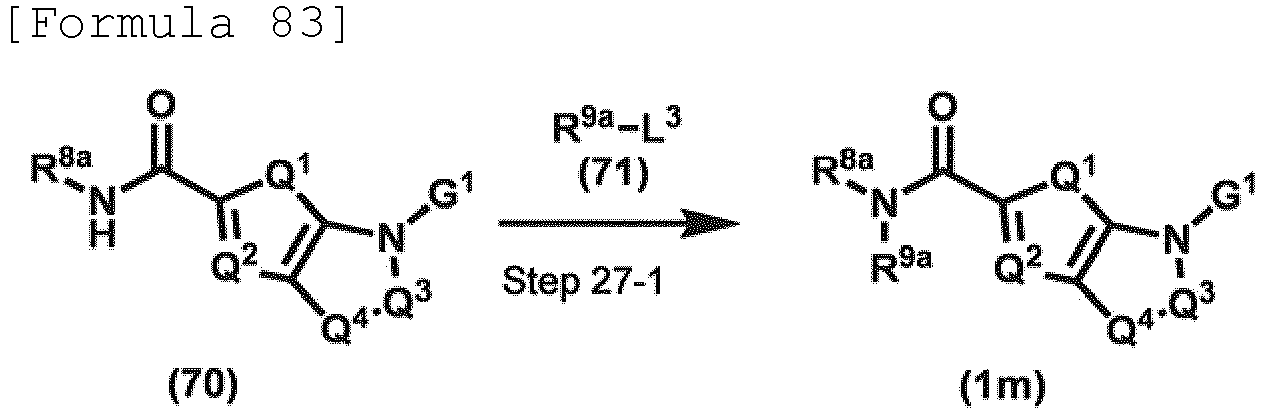
- This step is a step of producing the compound (1m) by reacting a compound (70) and a compound (71). The compound (1m) can be produced by reacting the compound (70) and the compound (71) in a solvent in the presence of a base. Examples of the solvent to be used include acetonitrile, N,N-dimethylformamide, N,N-dimethylacetamide, N-methylpyrrolidone, 1,4-dioxane, tetrahydrofuran, dimethylsulfoxide and a mixed solvent of any of these. Examples of the base to be used include sodium hydride, sodium carbonate, potassium carbonate, cesium carbonate and potassium phosphate. With respect to the reaction temperature, the reaction can be performed usually at 0°C to a solvent reflux temperature. The reaction time varies depending on a starting material and a solvent to be used, the reaction temperature and the like, and is usually 30 minutes to 3 days.
- Here, the compound (1) can be produced by a method shown in Scheme 28 or any equivalent method, or a method described in any literature or any equivalent method.
-

- This step is a step of producing the compound (1) by removing L9 from a compound (In). The compound (1) can be produced by, for example, reacting the compound (In) in the presence or absence of a solvent and in the presence of an acid. Examples of the solvent to be used include water, tetrahydrofuran, 1,4-dioxane, methylene chloride and a mixed solvent of any of these. Examples of the acid to be used include trifluoroacetic acid and hydrogen chloride.
- With respect to the reaction temperature, the reaction can be performed usually at 0°C to a solvent reflux temperature. The reaction time varies depending on a starting material and a solvent to be used, the reaction temperature and the like, and is usually 30 minutes to 3 days.
- Here, when the compound (1) is represented as a compound (1p) or a compound (1q), the compound (1p) or the compound (1q) can be produced by a method shown in Scheme 29 or any equivalent method, or a method described in any literature or any equivalent method.
-

- This step is a step of producing the compound (1p) from the compound (3a) by continuously performing the series of reactions of Step 13-5 and Step 1-1 described above.
- This step is a step of producing the compound (1q) from the compound (3a) by continuously performing the series of reactions of Step 13-4 and Step 1-1 described above.
- Here, when the compound (1) is represented as a compound (1d), the compound (1d) can be produced by a method shown in Scheme 30 or any equivalent method, or a method described in any literature or any equivalent method.
-

- This step is a step of producing the compound (1d) by reacting the compound (2) and a compound (3n), followed by a hydrolysis reaction of an ester moiety.
- The reaction between the compound (2) and the compound (3n) can be performed in a solvent or without using a solvent in the presence or absence of an acid or a base. Examples of the solvent to be used include N,N-dimethylformamide, dimethylsulfoxide, water, tetrahydrofuran, 1,4-dioxane, ethanol and a mixed solvent of any of these. Examples of the acid to be used include hydrogen chloride, p-toluenesulfonic acid and methanesulfonic acid. Examples of the base to be used include triethylamine, diisopropylethylamine, pyridine, 2,6-dimethylpyridine, 2,4,6-trimethylpyridine, potassium carbonate and cesium carbonate. With respect to the reaction temperature, the reaction can be performed usually at room temperature to a solvent reflux temperature. The reaction time varies depending on a starting material and a solvent to be used, the reaction temperature and the like, and is usually 30 minutes to 3 days. Besides, the hydrolysis reaction of an ester moiety subsequently performed can be performed in the same manner as in Step 2-9 described above.
- Here, when the compound (1) is represented as a compound (1ra), the compound (1ra) can be produced by a method shown in Scheme 31 or any equivalent method, or a method described in any literature or any equivalent method.
-

- This step is a step of producing the compound (1ra) by a methylation reaction of a compound (1r). The compound (1ra) can be produced by, for example, reacting the compound (1r) in a solvent in the presence of a base and a methylating agent. Examples of the solvent to be used include tetrahydrofuran, 1,4-dioxane, 1,2-dimethoxyethane and a mixed solvent of any of these. An example of the base to be used includes sodium bis(trimethylsilyl)amide. Examples of the methylating agent to be used include methyl iodide and dimethyl sulfate. With respect to the reaction temperature, the reaction can be performed usually at -78°C to room temperature. The reaction time varies depending on a starting material and a solvent to be used, the reaction temperature and the like, and is usually 30 minutes to 3 days.
- Here, when the compound (3) is represented as a compound (3pa), a compound (3qa), a compound (3ra), a compound (3sa), a compound (3ta) or a compound (3tb), the compound (3pa), the compound (3qa), the compound (3ra), the compound (3sa), the compound (3ta) or the compound (3tb) can be produced by a method shown in Scheme 32 or any equivalent method, or a method described in any literature or any equivalent method.
-


- This step is a step of producing the compound (3pa) by reacting a compound (3p) and the compound (50). This step can be performed in the same manner as in Step 13-3 described above.
- This step is a step of producing the compound (3qa) by reacting a compound (3q) and the compound (50). This step can be performed in the same manner as in Step 13-3 described above.
- This step is a step of producing the compound (3ra) by reacting a compound (3r) and the compound (50). This step can be performed in the same manner as in Step 13-3 described above.
- This step is a step of producing the compound (3sa) by reacting a compound (3s) and the compound (50). This step can be performed in the same manner as in Step 13-3 described above.
- This step is a step of producing either of the compound (3ta) and a compound (3tb) or both of the compound (3ta) and the compound (3tb) by reacting a compound (3t) and the compound (50). This step can be performed in the same manner as in Step 13-3 described above.
- Here, when the compound (1) is represented as a compound (1sa), a compound (1sb), a compound (1sc) or a compound (1sd), the compound (1sa), the compound (1sb), the compound (1sc) or the compound (1sd) can be produced by a method shown in Scheme 33 or any equivalent method, or a method described in any literature or any equivalent method.
-

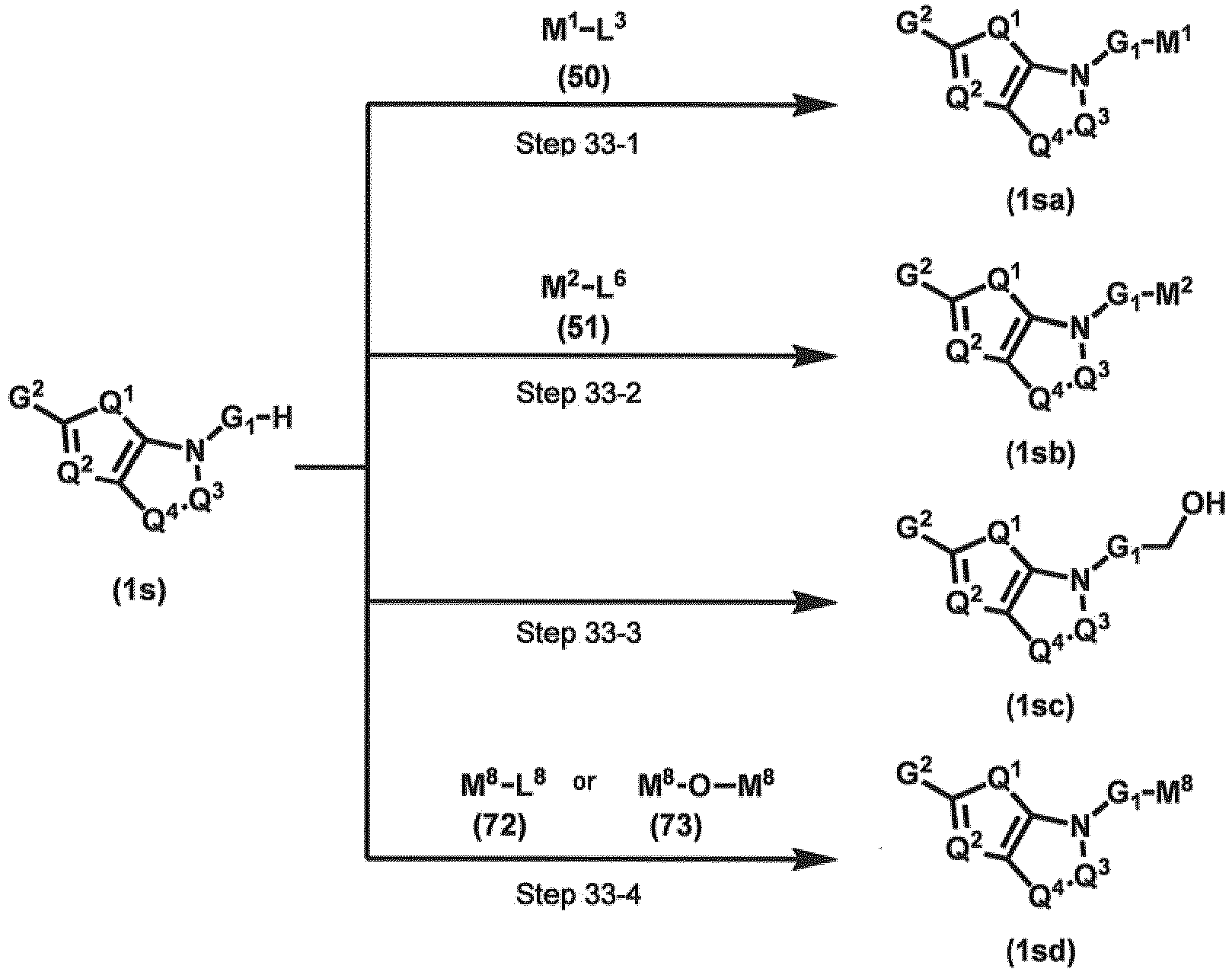
- This step is a step of producing the compound (1sa) by reacting a compound (1s) and the compound (50). This step can be performed in the same manner as in Step 13-3 described above.
- This step is a step of producing the compound (1sb) by reacting the compound (1s) and the compound (51). This step can be performed in the same manner as in Step 13-4 described above.
- This step is a step of producing the compound (1sc) through a hydroxymethylation reaction of the compound (1s). The compound (1sc) can be produced by, for example, reacting the compound (1s) with formaldehyde in a solvent in the presence or absence of a base. Examples of the solvent to be used include tetrahydrofuran, 1,4-dioxane, 1,2-dimethoxyethane, acetone, methanol, ethanol, water and a mixed solvent of any of these. Examples of the base to be used include potassium hydroxide, sodium hydroxide, potassium carbonate and sodium carbonate. With respect to the reaction temperature, the reaction can be performed usually at 0°C to room temperature. The reaction time varies depending on a starting material and a solvent to be used, the reaction temperature and the like, and is usually 30 minutes to 3 days.
- This step is a step of producing the compound (1sd) through an acylation or sulfonylation reaction of the compound (1s).
- The compound (1sd) can be produced by, for example, reacting the compound (1s) and a compound (72) or a compound (73) in a solvent in the presence of a base. Examples of the solvent to be used include dichloromethane, chloroform, acetonitrile, N,N-dimethylformamide, N,N-dimethylacetamide, N-methylpyrrolidone, 1,4-dioxane, tetrahydrofuran, dimethylsulfoxide and a mixed solvent of any of these. Examples of the base to be used include sodium carbonate, potassium carbonate, cesium carbonate, potassium phosphate, triethylamine, diisopropylethylamine, pyridine and 1,8-diazabicyclo[5,4,0]-7-undecene. With respect to the reaction temperature, the reaction can be performed usually at 0°C to a solvent reflux temperature. The reaction time varies depending on a starting material and a solvent to be used, the reaction temperature and the like, and is usually 30 minutes to 3 days.
- Here, when the compound (1) is represented as a compound (1ta), a compound (1tb), a compound (1tc), a compound (lua) or a compound (1ub), the compound (1ta), the compound (1tb), the compound (1tc), the compound (lua) or the compound (1ub) can be produced by a method shown in Scheme 34 or any equivalent method, or a method described in any literature or any equivalent method.
-

- This step is a step of producing the compound (1ta) by removing a tert-butoxycarbonyl group from a compound (It). The compound (1ta) can be produced by reacting the compound (It) in the presence or absence of a solvent and in the presence of an acid. Examples of the solvent to be used include water, tetrahydrofuran, 1,4-dioxane, methylene chloride and a mixed solvent of any of these. Examples of the acid to be used include trifluoroacetic acid and hydrogen chloride. With respect to the reaction temperature, the reaction can be performed usually at 0°C to a solvent reflux temperature. The reaction time varies depending on a starting material and a solvent to be used, the reaction temperature and the like, and is usually 30 minutes to 3 days.
- This step is a step of producing the compound (1tb) through an acylation or sulfonylation reaction of the compound (1ta). This step can be performed in the same manner as in Step 33-4 described above.
- This step is a step of producing the compound (1tc) through a reductive methylation reaction of the compound (1ta). The compound (1tc) can be produced by reacting the compound (1ta) with formaldehyde in the presence or absence of a solvent and in the presence of acetic acid or acetic anhydride, and then allowing a reducing agent to act on the resultant. Examples of the solvent to be used include tetrahydrofuran, 1,4-dioxane, methylene chloride and a mixed solvent of any of these. Examples of the reducing agent to be used include sodium triacetoxyborohydride, sodium cyanoborohydride and sodium borohydride. With respect to the reaction temperature, the reaction can be performed usually at 0°C to a solvent reflux temperature. The reaction time varies depending on a starting material and a solvent to be used, the reaction temperature and the like, and is usually 30 minutes to 3 days.
- This step is a step of producing the compound (lua) by hydrolyzing a tert-butyl ester moiety of a compound (1u). This step can be performed in the same manner as in Step 22-3 described above.
- This step is a step of producing the compound (1ub) through a condensation reaction of the compound (lua) and the compound (64). This step can be performed in the same manner as in Step 2-10 described above.
- Here, when the compound (10) is represented as a compound (10ba), the compound (10ba) can be produced by a method shown in Scheme 35 or any equivalent method, or a method described in any literature or any equivalent method.
-

- This step is a step of producing the compound (4ab) by reacting a compound (4aa) and the compound (50). This step can be performed in the same manner as in Step 13-3 described above.
- This step is a step of producing a compound (5aa) by reducing secondary amide of the compound (4ab) into secondary amine. This step can be performed in the same manner as in Step 2-1 described above.
- This step is a step of producing a compound (74) through an acetylation reaction of the compound (5aa). The compound (74) can be produced by, for example, reacting the compound (5aa) with acetic anhydride or acetyl chloride in a solvent in the presence of a base. Examples of the solvent to be used include dichloromethane, chloroform, acetonitrile, N,N-dimethylformamide, N,N-dimethylacetamide, N-methylpyrrolidone, 1,4-dioxane, tetrahydrofuran, dimethylsulfoxide and a mixed solvent of any of these. Examples of the base to be used include sodium carbonate, potassium carbonate, cesium carbonate, potassium phosphate, triethylamine, diisopropylethylamine, pyridine and 1,8-diazabicyclo[5,4,0]-7-undecene. With respect to the reaction temperature, the reaction can be performed usually at 0°C to a solvent reflux temperature. The reaction time varies depending on a starting material and a solvent to be used, the reaction temperature and the like, and is usually 30 minutes to 3 days.
- This step is a step of producing the compound (74) from the compound (4aa). The compound (74) can be produced by continuously performing Step 35-1, Step 35-2 and Step 35-3 described above.
- This step is a step of producing the compound (10ba) by converting L2 of the compound (74) into an alkoxycarbonyl group and removing an acetyl group substituted with a nitrogen atom.
- The compound (10ba) can be produced by reacting the compound (74) in a solvent in the presence of a palladium reagent and a base under carbon monoxide atmosphere. Examples of the solvent to be used include alcohols such as methanol, ethanol and propanol, and alternatively, a mixture of any of these alcohols with N,N-dimethylformamide, N,N-dimethylacetamide, dimethylsulfoxide, water or the like can be used. An example of the palladium reagent to be used includes a [1,1-bis(diphenylphosphino)ferrocene]palladium (II) dichloride dichloromethane adduct. Examples of the base to be used include triethylamine and diisopropylethylamine. The reaction temperature is usually room temperature to a solvent reflux temperature. The reaction time varies depending on a starting material and a solvent to be used, the reaction temperature and the like, and is usually 30 minutes to 3 days.
- Here, when the compound (1) is represented as a compound (1va), a compound (1vb), a compound (1vc) or a compound (1vd), the compound (1va), the compound (1vb), the compound (1vc) or the compound (1vd) can be produced by a method shown in Scheme 36 or any equivalent method, or a method described in any literature or any equivalent method.

- This step is a step of producing a compound (5ab) by reducing secondary amide of the compound (4aa) into secondary amine. This step can be performed in the same manner as in Step 2-1 described above.
- This step is a step of producing a compound (75) by introducing a tert-butoxycarbonyl group into the compound (5ab). The compound (75) can be produced by, for example, reacting the compound (5ab) with di-tert-butyl dicarbonate in a solvent in the presence of a base. Examples of the solvent to be used include dichloromethane, chloroform, acetonitrile, N,N-dimethylformamide, N,N-dimethylacetamide, N-methylpyrrolidone, 1,4-dioxane, tetrahydrofuran, dimethylsulfoxide and a mixed solvent of any of these. Examples of the base to be used include sodium carbonate, potassium carbonate, cesium carbonate, potassium phosphate, triethylamine, diisopropylethylamine, pyridine and 1,8-diazabicyclo[5,4,0]-7-undecene. With respect to the reaction temperature, the reaction can be performed usually at 0°C to a solvent reflux temperature. The reaction time varies depending on a starting material and a solvent to be used, the reaction temperature and the like, and is usually 30 minutes to 3 days.
- This step is a step of producing the compound (75) by reducing secondary amide of the compound (4aa) into secondary amine to obtain the compound (5ab), followed by an introduction reaction of a tert-butoxycarbonyl group thereinto. The compound (75) can be produced by continuously performing Step 36-1 and Step 36-2 described above.
- This step is a step of producing a compound (10bb) through an elimination reaction, occurring as a side reaction, of a tert-butoxy group substituted with one nitrogen atom, that is, a reaction to convert L2 of the compound (75) into an alkoxycarbonyl group. This step can be performed in the same manner as in Step 2-1 described above.
- This step is for causing a coupling reaction between the compound (10bb) and the compound (3), and is a step of producing a compound (44a) through a hydrolysis reaction of an ester group of the compound (10bb) under conditions of this reaction and an elimination reaction, occurring as a side reaction, of a tert-butoxy group. This step can be performed in the same manner as in Step 1-1 described above.
- This step is a step of producing the compound (1va) through a condensation reaction of the compound (44a) and the compound (13a) or the compound (13b). This step can be performed in the same manner as in Step 2-10 described above.
- This step is a step of producing the compound (1va) by continuously performing an alkoxycarbonylation reaction involving a tert-butoxycarbonyl group of the compound (75), a hydrolysis reaction of an ester group of the resultant compound (10bb) and a coupling reaction with the compound (3) accompanying an elimination reaction of a tert-butoxy group, and a condensation reaction of the resultant compound (44a) and the compound (13a) or the compound (13b). The compound (1va) can be produced by continuously performing Step 36-4, Step 36-5 and Step 36-6 described above.
- This step is a step of producing the compound (1vb) by reacting the compound (1va) and the compound (50). This step can be performed in the same manner as in Step 13-3 described above.
- This step is a step of producing the compound (1vc) by reacting the compound (1va) and a compound (76). This step can be performed in the same manner as in Step 1-1 described above.
- This step is a step of producing the compound (1vd) through an acylation or sulfonylation reaction of the compound (1va). This step can be performed in the same manner as in Step 33-4 described above.
- Here, when the compound (13) is represented as a compound (13bb), the compound (13bb) can be produced by a method shown in Scheme 37 or any equivalent method, or a method described in any literature or any equivalent method.
-

- This step is a step of producing a compound (77) through oxidation of primary alcohol of the compound (61). The compound (77) can be produced from the compound (61) in a solvent under usual oxidation conditions from alcohol to aldehyde, for example, trough Dess-Martin oxidation, pyridinium chlorochromate (PCC) oxidation, pyridinium dichromate (PDC) oxidation, Swern oxidation, 2,2,6,6-tetramethylpiperidine-1-oxy radical (TEMPO) oxidation, tetrapropylammonium perruthenate (TPAP) oxidation, Parikh-Doering oxidation or the like. Examples of the solvent to be used include dichloromethane, chloroform and a mixed solvent of any of these. Examples of an oxidant to be used include a Dess-Martin periodinane (DMP), pyridinium chlorochromate (PCC), pyridinium dichromate (PDC), oxalyl chloride and dimethylsulfoxide, 2,2,6,6-tetramethylpiperidine-1-oxy radical (TEMPO), tetrapropylammonium perruthenate (TPAP), and a sulfur trioxide pyridine complex and dimethylsulfoxide. Besides, a base such as triethylamine can be added if necessary. Furthermore, iodo benzene diacetate, sodium hypochlorite or the like can be added as a reoxidant. With respect to the reaction temperature, the reaction can be performed usually at -78°C to a solvent reflux temperature. The reaction time varies depending on a starting material and a solvent to be used, the reaction temperature and the like, and is usually 30 minutes to 3 days.
- This step is a step of producing a compound (78) by substituting an aldehyde group of the compound (77) with two fluorine atoms. The compound (78) can be produced by reacting with the compound (77) in a solvent in the presence of N,N-diethylaminosulfur trifluoride (DAST). Examples of the solvent to be used include dichloromethane and a mixed solvent of any of these. With respect to the reaction temperature, the reaction can be performed usually at 0°C to a solvent reflux temperature. The reaction time varies depending on a starting material and a solvent to be used, the reaction temperature and the like, and is usually 30 minutes to 3 days.
- This step is a step of producing the compound (13bb) by removing a tert-butoxycarbonyl group from the compound (78). This step can be performed in the same manner as in Step 20-3 described above.
- Here, when the compound (1) is represented as a compound (1wb), the compound (1wb) can be produced by a method shown in Scheme 38 or any equivalent method, or a method described in any literature or any equivalent method.


- This step is a step of producing either or both of a compound (79) and a compound (80) by oxidizing primary alcohol of a compound (1wa). This step can be performed in the same manner as in Step 37-1 described above.
- This step is a step of producing the compound (1wb) through a dehydration reaction of the compound (79) or the compound (80). The compound (1wb) can be produced by reacting the compound (79) or the compound (80) in a solvent in the presence of an acid catalyst. Examples of the acid catalyst to be used include trifluoroacetic acid, hydrogen chloride and sulfuric acid. Examples of the solvent to be used include dichloromethane, 1,2-dichloroethane, chloroform, benzene, toluene and a mixed solvent of any of these. With respect to the reaction temperature, the reaction can be performed usually at 0°C to a solvent reflux temperature. The reaction time varies depending on a starting material and a solvent to be used, the reaction temperature and the like, and is usually 30 minutes to 3 days.
- A pharmacologically acceptable salt of the compound (1) of the present embodiment can be produced by a usual method using the compound (1) of the present embodiment.
- The above-described schemes are merely examples to be employed for producing the compound (1) of the present embodiment or production intermediates thereof. These schemes can be modified into various schemes easily understood by those skilled in the art.
- Besides, when a protecting group is necessary depending on the type of functional group, it can be used by appropriately combining introduction and elimination operations by an ordinary method. With respect to the type, introduction and elimination of protecting group, for example, methods described in "Greene's Protective Groups in Organic Synthesis" edited by Theodra W. Green & Peter G. M. Wuts, fourth edition, Wiley-Interscience, 2006 can be employed.
- An intermediate used for producing the compound (1) of the present embodiment or a pharmacologically acceptable salt thereof can be isolated/purified, if necessary, by isolation/purification methods known to those skilled in the art, such as solvent extraction, crystallization, recrystallization, chromatography and preparative high-performance liquid chromatography.
- The term "15-PGDH inhibitory effect" as used in the present embodiment means exhibition of inhibitory activity by acting on 15-PGDH.
- The compound (1) of the present embodiment or a pharmacologically acceptable salt thereof exhibits potent inhibitory activity in, for example, a 15-PGDH enzyme inhibition test or a 15-PGDH inhibitory activity evaluation test in mouse lung tissue. Accordingly, the compound (1) of the present embodiment or a pharmacologically acceptable salt thereof is useful as a therapeutic agent or a preventive agent against fibrosis (such as lung fibrosis (idiopathic pulmonary fibrosis or the like), liver fibrosis, kidney fibrosis, myocardial fibrosis, scleroderma and bone marrow fibrosis), inflammatory diseases (such as chronic obstructive pulmonary disease (COPD), acute lung injury, sepsis, exacerbation of asthma and lung disease, inflammatory bowel disease (such as ulcerative colitis and Crohn's disease), peptic ulcer (such as NSAID induced ulcer), autoinflammatory diseases (such as Behcet's disease), vasculitis syndrome, acute liver injury, acute kidney injury, non-alcoholic fatty liver (NASH), atopic dermatitis, psoriasis, interstitial cystitis, prostatitis syndrome (such as chronic prostatitis/chronic pelvic pain syndrome)), cardiovascular diseases (such as pulmonary hypertension, angina, myocardial infarction, heart failure, ischemic heart disease, chronic kidney disease, renal failure, cerebral apoplexy and peripheral circulatory disturbance), wounds (such as diabetic ulcer, burn, pressure ulcer, acute mucosal injury including Stevens-Johnson syndrome, mucosal injury (such as mucositis or stomatitis) related to an anticancer chemotherapy agent, mainly such as an alkylating agent, a DNA synthesis inhibitor, a DNA gyrase inhibitor or an antimetabolite, cellular or humoral immunotherapy or radioactive rays, or graft-versus-host disease), autoimmune diseases (such as multiple sclerosis or rheumatoid arthritis), graft-versus-host disease (GVHD), hair growth, osteoporosis, ear diseases (such as hearing loss, tinnitus, dizziness and dysequilibrium), eye diseases (such as glaucoma and dry eye), diabetes, underactive bladder, neutropenia, promotion of engraftment in stem cell or bone marrow transplantation or organ transplantation, neurogenesis and nerve cell death (such as psycho-neurologic disease, neuropathy, neurotoxic disease, neuropathic pain and neurodegenerative disease), muscle regeneration (such as muscular atrophy, muscular dystrophy and muscle damage), and cervical ripening.
- Besides, it can be used for producing a pharmaceutical for treatment or prevention of fibrosis (such as lung fibrosis (idiopathic pulmonary fibrosis or the like), liver fibrosis, kidney fibrosis, myocardial fibrosis, scleroderma and bone marrow fibrosis), inflammatory diseases (such as chronic obstructive pulmonary disease (COPD), acute lung injury, sepsis, exacerbation of asthma and lung disease, inflammatory bowel disease (such as ulcerative colitis and Crohn's disease), peptic ulcer (such as NSAID induced ulcer), autoinflammatory diseases (such as Behcet's disease), vasculitis syndrome, acute liver injury, acute kidney injury, non-alcoholic fatty liver (NASH), atopic dermatitis, psoriasis, interstitial cystitis, prostatitis syndrome (such as chronic prostatitis/chronic pelvic pain syndrome)), cardiovascular diseases (such as pulmonary hypertension, angina, myocardial infarction, heart failure, ischemic heart disease, chronic kidney disease, renal failure, cerebral apoplexy and peripheral circulatory disturbance), wounds (such as diabetic ulcer, burn, pressure ulcer, acute mucosal injury including Stevens-Johnson syndrome, mucosal injury (such as mucositis or stomatitis) related to an anticancer chemotherapy agent, mainly such as an alkylating agent, a DNA synthesis inhibitor, a DNA gyrase inhibitor or an antimetabolite, cellular or humoral immunotherapy or radioactive rays, or graft-versus-host disease), autoimmune diseases (such as multiple sclerosis or rheumatoid arthritis), graft-versus-host disease (GVHD), hair growth, osteoporosis, ear diseases (such as hearing loss, tinnitus, dizziness and dysequilibrium), eye diseases (such as glaucoma and dry eye), diabetes, underactive bladder, neutropenia, promotion of engraftment in stem cell or bone marrow transplantation or organ transplantation, neurogenesis and nerve cell death (such as psycho-neurologic disease, neuropathy, neurotoxic disease, neuropathic pain and neurodegenerative disease), muscle regeneration (such as muscular atrophy, muscular dystrophy and muscle damage), and cervical ripening.
- Furthermore, a pharmaceutical containing the compound (1) of the present embodiment as an active ingredient can be used as a preventive agent or a therapeutic agent against, for example, various medical conditions in which 15-PGDH involves (for example, fibrosis (such as lung fibrosis (idiopathic pulmonary fibrosis or the like), liver fibrosis, kidney fibrosis, myocardial fibrosis, scleroderma and bone marrow fibrosis), inflammatory diseases (such as chronic obstructive pulmonary disease (COPD), acute lung injury, sepsis, exacerbation of asthma and lung disease, inflammatory bowel disease (such as ulcerative colitis and Crohn's disease), peptic ulcer (such as NSAID induced ulcer), autoinflammatory diseases (such as Behcet's disease), vasculitis syndrome, acute liver injury, acute kidney injury, non-alcoholic fatty liver (NASH), atopic dermatitis, psoriasis, interstitial cystitis, prostatitis syndrome (such as chronic prostatitis/chronic pelvic pain syndrome)), cardiovascular diseases (such as pulmonary hypertension, angina, myocardial infarction, heart failure, ischemic heart disease, chronic kidney disease, renal failure, cerebral apoplexy and peripheral circulatory disturbance), wounds (such as diabetic ulcer, burn, pressure ulcer, acute mucosal injury including Stevens-Johnson syndrome, mucosal injury (such as mucositis or stomatitis) related to an anticancer chemotherapy agent, mainly such as an alkylating agent, a DNA synthesis inhibitor, a DNA gyrase inhibitor or an antimetabolite, cellular or humoral immunotherapy or radioactive rays, or graft-versus-host disease), autoimmune diseases (such as multiple sclerosis or rheumatoid arthritis), graft-versus-host disease (GVHD), hair growth, osteoporosis, ear diseases (such as hearing loss, tinnitus, dizziness and dysequilibrium), eye diseases (such as glaucoma and dry eye), diabetes, underactive bladder, neutropenia, promotion of engraftment in stem cell or bone marrow transplantation or organ transplantation, neurogenesis and nerve cell death (such as psycho-neurologic disease, neuropathy, neurotoxic disease, neuropathic pain and neurodegenerative disease), muscle regeneration (such as muscular atrophy, muscular dystrophy and muscle damage), and cervical ripening).
- A pharmaceutical containing, as an active ingredient, the compound (1) of the present embodiment or a pharmacologically acceptable salt thereof can be in various dosage forms depending on usage. Examples of such dosage forms include a powder, a granule, a fine granule, a dry syrup, a tablet, a capsule, an injection, a liquid, an ointment, a suppository, a patch and a sublingual tablet, which are orally or parenterally administered.
- Such a pharmaceutical can be constituted, by any known method according with the dosage form, as a pharmaceutical composition containing the compound (1) of the present invention or a pharmacologically acceptable salt thereof as an active ingredient, and a pharmacologically acceptable additive. Examples of the additive to be contained in the pharmaceutical composition include an excipient, a disintegrating agent, a binder, a lubricant, a diluent, a buffer, a tonicity agent, a preservative, a wetting agent, an emulsifier, a dispersant, a stabilizer and a dissolution assisting agent. The pharmaceutical composition can be prepared by appropriately mixing the compound (1) of the present invention or a pharmacologically acceptable salt thereof, or diluting/dissolving, with/in an additive, the compound (1) or a pharmacologically acceptable salt thereof. Besides, when used in combination with an agent different from the 15-PGDH inhibitor, it can be produced by formulating active ingredients of the respective agents simultaneously or separately in the same manner as described above.
- The pharmaceutical of the present embodiment can be administered systemically or locally, and orally or parenterally (nasally, pulmonarilly, intravenously, ractally, subcutaneously, intramuscularly or transdermally).
- When a pharmaceutical composition containing the compound (1) of the present embodiment or a pharmacologically acceptable salt thereof as an active ingredient is used in actual treatment, a dose of the compound (1) of the present embodiment or the pharmacologically acceptable salt thereof corresponding to the active ingredient is appropriately determined in accordance with the age, sex and weight of a patient, the extent of disease and treatment, and the like. For example, for oral administration, it can be appropriately administered at the range of a dose of about 0.03 to 1000 mg/body once or several times a day for an adult (assumed to have a weight of 60 kg). A dose per day as an oral agent is preferably 0.06 to 540 mg/body, and more preferably 0.18 to 180 mg/body. For parenteral administration, it can be appropriately administered at the range of a dose of about 0.01 to 300 mg once or several times a day for an adult. A dose per day as a parenteral agent is preferably 0.01 to 100 mg/body, and more preferably 0.06 to 60 mg/body. Besides, a dose of the compound (1) of the present embodiment or a pharmacologically acceptable salt thereof can be reduced in accordance with a dose of an agent different from the 15-PGDH inhibitor.
- Now, the present invention will be described in more detail based on test examples, examples and reference examples. Also, since raw material compounds used in the production of the compound (1) include a novel compound, a production example of the raw material compounds will be described as reference examples. It is noted that the present invention is not limited to compounds described in the following examples but may be modified without departing from the scope of the present invention.
- In signs used in each reference example, each example and each table, 1H NMR means a hydrogen nuclear magnetic resonance spectrum, CDCl3 means chloroform-d, and DMSO-d6 means dimethylsulfoxide-d6. LRMS(ESI), LRMS(EI), LRMS(CI), LRMS(FI) mean low resolution mass spectrometry spectrum data measured by an electrospray ionization method, electron ionization method, chemical ionization method, field ionization method, respectively.
- A solid line and broken line wedge used in a structural formula do not correspond to absolute configuration but correspond to relative configuration in an optical active substance. A thick solid line and broken line correspond to relative configuration in a racemic body or an optical active substance obtained by racemic resolution.
-

- To a solution, in N,N-dimethylformamide (36.2 mL), of 2,5-dihydroxybenzaldehyde (2.50 g) and iodo methane (1.24 mL), potassium carbonate (8.26 g) was added under ice cooling, followed by stirring at room temperature for 5 hours. To the resultant reaction solution, water and 6 mol/L hydrogen chloride aqueous solution were successively added to adjust pH to 1, followed by extraction with ethyl acetate. The thus obtained extract was dried over anhydrous sodium sulfate, and concentrated under reduced pressure. The thus obtained residue was purified by silica gel column chromatography (hexane:ethyl acetate = 2:1) to obtain the title compound (1.57 g).
- 1H NMR (400 MHz, CDCl3) δ 3.89 (3H, s), 4.93 (1H, s), 6.91 (1H, d, J = 8.5 Hz), 7.09 (1H, dd, J = 8.5, 3.6 Hz), 7.29 (1H, d, J = 3.6 Hz), 10.42 (1H, s).
- LRMS (ESI+) 153 [M+H]+.
-
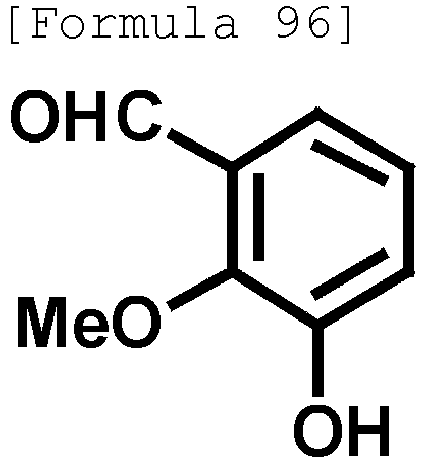
- The title compound was synthesized in the same manner as in Reference Example 1-1 by using corresponding hydroxybenzaldehyde derivative and reactant.
- 1H NMR (400 MHz, CDCl3) δ 3.98 (3H, s), 5.80 (1H, s), 7.16 (1H, t, J = 7.9 Hz), 7.23 (1H, dd, J = 7.9, 1.8 Hz), 7.38 (1H, dd, J = 7.9, 1.8 Hz), 10.27 (1H, s).
- LRMS (ESI-) 151 [M-H]-.
-


- Water (250 mL), tetrahydrofuran (125 mL) and dimethylsulfoxide (12.5 mL) were added to 5-hydroxy-2-methoxybenzaldehyde (1.96 g) for allowing it to be dissolved therein, and to the resultant, an aqueous solution (50 mL) of sulfamic acid (4.41 g) and an aqueous solution (50 mL) of sodium hypochlorite (3.80 g) were successively added at 0°C, followed by stirring for 1 hour. The resultant reaction solution was extracted with diethyl ether, and the resultant extract was dried over anhydrous sodium sulfate, and concentrated under reduced pressure. The thus obtained residue was purified by silica gel column chromatography (ethyl acetate) to obtain the title compound (2.06 g).
- 1H NMR (400 MHz, DMSO-d6) δ 3.72 (3H, s), 6.88 (1H, dd, J = 9.1, 3.0 Hz), 6.94 (1H, d, J = 9.1 Hz), 7.04 (1H, d, J = 3.0 Hz), 9.21 (1H, s), 12.50 (1H, brs).
- LRMS (ESI+) 169 [M+H]+.
-

- The title compound was synthesized in the same manner as in Reference Example 2-1 by using corresponding benzaldehyde derivative and reactant.
- 1H NMR (400 MHz, DMSO-d6) δ 3.74 (3H, s), 6.96 (1H, t, J = 7.9 Hz), 7.00 (1H, dd, J = 7.9, 2.4 Hz), 7.05 (1H, dd, J = 7.9, 2.4 Hz), 9.55 (1H, s), 12.71 (1H, brs).
- LRMS (ESI-) 167 [M-H]-.
-

- To a solution of 5-hydroxy-2-methoxy benzoic acid (2.05 g) in acetic acid (50 mL), a 70% nitric acid aqueous solution (0.80 mL) was added at room temperature over 5 minutes, followed by stirring at room temperature for 12 hours. The resultant reaction solution was concentrated under reduced pressure, the thus obtained residue was diluted with methanol (60 mL), and thionyl chloride (1.80 mL) was added thereto at 0°C over 5 minutes, followed by stirring at room temperature for 12 hours. The resultant reaction solution was concentrated under reduced pressure, and the thus obtained residue was purified by silica gel column chromatography (hexane:ethyl acetate = 3:1) to obtain the title compound (698 mg).
- 1H NMR (400 MHz, CDCl3) δ 3.91 (3H, s), 3.93 (3H, s), 7.51 (1H, s), 7.60 (1H, s), 10.14 (1H, s).
- LRMS (ESI-) 226 [M-H]-.
- Compounds of the following Reference Examples 3-2 to 3-4 were obtained in the same manner as in Reference Example 3-1 by using corresponding starting materials and reactants. Their structures and spectrum data are shown in the following table.
[Table 1] Reference Example No. Chemical Structural Formula Spectrum Data 3-2 
1H NMR (400 MHz, CDCl3) δ 3.96 (3H, s), 4.02 (3H, s), 7. 26 (1H, d, J = 9.1 Hz), 7.89 (1H, d, J = 9.1 Hz), 10.73 (1H , s). LRMS (ESI-) 226 [M-H]-. 3-3 
1H NMR (400 MHz, CDCl3) δ 3.98 (3H, s), 7.58 (1H, s), 8. 21 (1H, s), 10.34 (1H, s). LRMS (EI+) 231 [M]+. 3-4 
1H NMR (400 MHz, CDCl3) δ 3.99 (3H, s), 7.32 (1H, d, J = 8.6 Hz), 8.10 (1H, d, J = 8.6 Hz), 11.16 (1H, s). LRMS (EI+) 231 [M]+. -

- A suspension, in acetonitrile (31 mL), of methyl 5-hydroxy-2-methoxy-4-nitrobenzoic acid (692 mg), 1,2-dibromoethane (1.10 mL) and potassium carbonate (2.11 g) was heated to reflux for 8 hours. To the resultant reaction solution, water and 1 mol/L hydrogen chloride aqueous solution were successively added to adjust pH to 1, followed by extraction with ethyl acetate. The resultant extract was dried over anhydrous sodium sulfate, and concentrated under reduced pressure. The thus obtained residue was purified by silica gel column chromatography (hexane:ethyl acetate = 7:3) to obtain the title compound (748 mg).
- 1H NMR (400 MHz, CDCl3) δ 3.66 (2H, t, J = 6.7 Hz), 3.92 (3H, s), 3.94 (3H, s), 4.41 (2H, t, J = 6.7 Hz), 7.43 (1H, s), 7.54 (1H, s) .
- LRMS (ESI+) 334 [M+H]+.
- Compounds of the following Reference Examples 4-2 to 4-4 were obtained in the same manner as in Reference Example 4-1 by using corresponding starting materials and reactants. Their structures and spectrum data are shown in the following table.
[Table 2] Reference Example No. Chemical Structural Formula Spectrum Data 4-2 
1H NMR (400 MHz, CDCl3) δ 3.68 (2H, t, J = 6.1 Hz), 3.9 6 (3H, s), 3.99 (3H, s), 4.49 (2H, t, J = 6.1 Hz), 7.54 (1H, d, J = 8.6 Hz), 7.61 (1H, d, J = 8.6 Hz). LRMS (EI+) 333 [M]+. 4-3 
1H NMR (400 MHz, CDCl3) δ 3.68 (2H, t, J = 6.1 Hz), 3.9 9 (3H, s), 4.45 (2H, t, J = 6.1 Hz), 7.53 (1H, s), 7.91 (1H, s). LRMS (EI+) 337 [M]+. 4-4 
1H NMR (400 MHz, CDCl3) δ 3.72 (2H, t, J = 6.7 Hz), 3.9 9 (3H, s), 4.49 (2H, t, J = 6.7 Hz), 7.64 (1H, d, J = 8.6 Hz ), 7.74 (1H, d, J = 8.6 Hz). LRMS (EI+) 337 [M]+. -


- Methyl 5-(2-bromoethoxy)-2-methoxy-4-nitrobenzoic acid (734 mg) and reduced iron (615 mg) were suspended in tetrahydrofuran (3.7 mL) and acetic acid (1.5 mL), followed by stirring under heating at 70°C for 3 hours. The resultant reaction solution was filtered through celite, and the thus obtained solid was washed with hot ethyl acetate and ethanol. To the resultant filtrate, a saturated sodium bicarbonate aqueous solution was added to adjust pH to 10, followed by extraction with ethyl acetate. The resultant extract was dried over anhydrous sodium sulfate, and concentrated under reduced pressure. The thus obtained residue was dissolved in N,N-dimethylformamide (11 mL), and potassium carbonate (1.21 g) was added thereto, followed by stirring under heating at 100°C for 2 hours. The resultant reaction solution was filtered through celite, and the resultant filtrate was concentrated under reduced pressure. The thus obtained residue was purified by silica gel column chromatography (hexane:ethyl acetate = 1:1) to obtain the title compound (428 mg).
- 1H NMR (400 MHz, CDCl3) δ 3.45-3.49 (2H, m), 3.81 (3H, s), 3.82 (3H, s), 4.18 (2H, t, J = 4.3 Hz), 4.23 (1H, brs), 6.12 (1H, s), 7.36 (1H, s).
- LRMS (ESI+) 224 [M+H]+.
- Compounds of the following Reference Examples 5-2 to 5-4 were obtained in the same manner as in Reference Example 5-1 by using corresponding starting materials and reactants. Their structures and spectrum data are shown in the following table.
[Table 3] Reference Example No. Chemical Structural Formula Spectrum Data 5-2 
1H NMR (400 MHz, CDCl3) δ 3.48 (2H, t, J = 4.3 Hz), 3.8 5 (3H, s), 3.90 (3H, s), 4.28 (2H, t, J = 4.3 Hz), 6.32 (1H, d, J = 8.6 Hz), 7.33 (1H, d, J = 8.6 Hz). (NH proton signal is missing) LRMS (ESI+) 224 [M+H]+. 5-3 
1H NMR (400 MHz, CDCl3) δ 3.44-3.49 (2H, m), 3.85 (3H, s), 4.19-4.25 (3H, m), 6.58 (1H, s), 7.40 (1H, s). LRMS (EI+) 227 [M]+. 5-4 
1H NMR (400 MHz, CDCl3) δ 3.48-3.52 (2H, m), 3.86 (3H, s), 4.25 (1H, brs), 4.34 (2H, t, J = 4.9 Hz), 6.45 (1H, d, J = 8.5 Hz), 7.41 (1H, d, J = 8.5 Hz). LRMS (ESI+) 228 [M+H]+. -

- To a suspension, in dichloromethane (26 mL), of 2-amino-5-bromopyridin-3-ol (5.00 g) and di-tert-butyl dicarbonate (7.05 g), triethylamine (4.50 mL) was added at room temperature. The resultant reaction solution was stirred at room temperature for 8 hours, and then concentrated under reduced pressure. The thus obtained residue was purified by silica gel column chromatography (hexane:ethyl acetate = 4:1) to obtain the title compound (6.99 g).
- 1H NMR (400 MHz, CDCl3) δ 1.56 (9H, s), 4.63 (2H, brs), 7.58 (1H, d, J = 2.4 Hz), 7.98 (1H, d, J = 2.4 Hz).
- LRMS (ESI+) 289 [M+H]+.
-

- To a solution of methyl 4-((tert-butoxycarbonyl)amino)-3-hydroxybenzoate (1.00 g) in dimethylsulfoxide (19 mL), potassium carbonate (2.59 g) and 1,3-dibromopropane (1.53 mL) were added at room temperature, followed by stirring at 100°C for 3 hours. The resultant reaction solution was purified by silica gel column chromatography (hexane:ethyl acetate = 3:1) to obtain the title compound (398 mg).
- 1H NMR (400 MHz, CDCl3) δ 1.45 (9H, s), 2.03-2.12 (2H, m), 3.68-3.81 (2H, m), 3.89 (3H, s), 4.10-4.20 (2H, m), 7.30-7.40 (1H, m), 7.60-7.70 (2H, m).
- LRMS (ESI+) 308 [M+H]+.
- Compounds of the following Reference Examples 7-2 to 7-9 were obtained in the same manner as in Reference Example 7-1 by using corresponding starting materials and reactants. Their structures and spectrum data are shown in the following tables.
[Table 4] Reference Example No. Chemical Structural Formula Spectrum Data 7-2 
1H NMR (400 MHz, CDCl3) δ 1.38 (9H, s), 1.65-1.74 (2H, m), 1.75-1.84 (2H, m), 3.62 (2H, t, J = 5.5 Hz), 3.91 (3H, s ), 4.18 (2H, t, J = 5.5 Hz), 7.21 (1H, d, J = 9.2 Hz), 7.74 ( 1H, dd, J = 9.2, 1.8 Hz), 7.75 (1H, d, J = 1.8 Hz). LRMS (ESI+) 322 [M+H]+. 7-3 
1H NMR (400 MHz, CDCl3) δ 1.54 (9H, s), 3.91 (2H, t, J = 4.9 Hz), 4.24 (2H, t, J = 4.9 Hz), 7.33 (1H, d, J = 2.4 Hz) , 8.11 (1H, d, J = 2.4 Hz). LRMS (ESI+) 315 [M+H]+. 7-4 
1H NMR (400 MHz, CDCl3) δ 1.46 (9H, s), 2.03-2.13 (2H, m), 3.70-3.80 (2H, m), 4.18 (2H, t, J = 5.5 Hz), 7.49 (1H, d , J = 1.8 Hz), 8.22 (1H, d, J = 1.8 Hz). LRMS (ESI+) 329 [M+H]+. 7-5 
1H NMR (400 MHz, CDCl3) δ 1.39 (9H, s), 1.72-1.82 (4H, m), 3.65-3.72 (2H, m), 4.23-4.28 (2H, m), 7.56 (1H, d, J = 2 .4 Hz), 8.28 (1H, d, J = 2.4 Hz). LRMS (ESI+) 343 [M+H]+. [Table 5] Reference Example No. Chemical Structural Formula Spectrum Data 7-6 Isomer A 
1H NMR (400 MHz, CDCl3) δ: 1.48 (9H, s), 1.53-1.74 (6H, m), 2.22-2.30 (2H, m), 2.56-2.63 (1H, m), 3.32 (2H, t, J = 4 .5 Hz), 3.61-3.71 (1H, m), 3.84 (3H, s), 4.16 (2H, t, J = 4.5 Hz), 6.67 (1H, d, J = 9.1 Hz), 7.43 (1H, d, J = 2.4 Hz), 7.5 4 (1H, dd, J = 8.5, 2.4 Hz). LRMS (ESI+) 376 [M+H]+. 7-6 Isomer B 
1H NMR (400 MHz, CDCl3) δ: 1.42-1.66 (13H, m), 1.90 (2H , d, J = 11.5 Hz), 2.07-2.22 (3H, m), 3.33 (2H, t, J = 4.5 H z), 3.62-3.72 (1H, m), 3.84 (3H, s), 4.18 (2H, t, J = 4.5 Hz), 6.67 (1H, d, J = 8.5 Hz), 7.43 (1H, d, J = 1.8 Hz), 7.55 (1 H, dd, J = 8.8, 2.1 Hz). LRMS (ESI+) 376 [M+H]+. 7-7 
1H NMR (400 MHz, CDCl3) δ: 1.09-1.22 (1H, m), 1.33-1.50 (4H, m), 1.69-1.95 (5H, m), 3.35 (2H, t, J = 4.5 Hz), 3.60-3. 69 (1H, m), 3.84 (3H, s), 4.17 (2H, t, J = 4.5 Hz), 6.68 (1H , d, J = 9.1 Hz), 7.43 (1H, d, J = 2.4 Hz), 7.55 (1H, dd, J = 8.5, 1.8 Hz). LRMS (ESI+) 276 [M+H]+. 7-8 
1H NMR (400 MHz, CDCl3) δ 2.09 (3H, s), 4.53 (2H, s), 4. 66 (2H, s), 5.24 (2H, d, J = 16.5 Hz), 7.51 (1H, d, J = 2.4 Hz), 8.18 (1H, d, J = 2.4 Hz). LRMS (ESI+) 283 [M+H]+. 7-9 
1H NMR (400 MHz, DMSO-d6) δ 1.89-1.99 (5H, m), 3.77 (2 H, t, J = 5.4 Hz), 4.18 (2H, t, J = 5.4 Hz), 7.85 (1H, d, J = 2.4 Hz), 8.28 (1H, d, J = 1.8 Hz). LRMS (ESI+) 271 [M+H]+. -

- To tert-butyl 7-bromo-2,3-dihydro-4H-pyrido[3,2-b][1,4]oxazine-4-carboxylate (20.0 g), [1,1'-bis(diphenylphosphino)ferrocene]palladium (II) dichloride dichloromethane adduct (5.19 g), triethylamine (17.7 mL), ethanol (320 mL) and N,N-dimethylformamide (32 mL) were added at room temperature, followed by stirring the resultant mixture under carbon monoxide atmosphere at 70°C for 12 hours. The resultant reaction solution was filtered through celite, and the resultant filtrate was concentrated under reduced pressure. The thus obtained residue was purified by silica gel column chromatography (hexane:ethyl acetate = 3:1) to obtain the title compound (17.2 g).
- 1H NMR (400 MHz, CDCl3) δ 1.39 (3H, t, J = 7.3 Hz), 1.56 (9H, s), 3.95 (2H, t, J = 4.2 Hz), 4.28 (2H, t, J = 4.2 Hz), 4.37 (2H, q, J = 7.3 Hz), 7.74 (1H, d, J = 1.8 Hz), 8.68 (1H, d, J = 1.8 Hz).
- LRMS (ESI+) 309 [M+H]+.
- Compounds of the following Reference Examples 8-2 to 8-12 were obtained in the same manner as in Reference Example 8-1 by using corresponding starting materials and reactants. Their structures and spectrum data are shown in the following tables.
[Table 6] Reference Example No. Chemical Structural Formula Spectrum Data 8-2 
1H NMR (400 MHz, CDCl3) δ 1.47 (9H, s), 2.07-2.15 (2H, m), 3.81 (2H, t, J = 5.5 Hz), 3.94 (3H, s), 4.21 (2H, t, J = 5.5 Hz), 7.90 (1H, d, J = 1.8 Hz), 8.76 (1H, d, J = 1.8 Hz). LRMS (ESI+) 309 [M+H]+. 8-3 
1H NMR (400 MHz, CDCl3) δ 1.39 (9H, s), 1.71-1.85 (4H, m), 3.71 (2H, t, J = 5.5 Hz), 3.96 (3H, s), 4.25 (2H, t, J = 5.5 Hz), 7.99 (1H, d, J = 1.8 Hz), 8.83 (1H, d, J = 1.8 Hz). LRMS (ESI+) 323 [M+H]+. 8-4 
1H NMR (400 MHz, CDCl3) δ 1.59 (9H, s), 3.88 (3H, s), 3. 97 (2H, t, J = 4.2 Hz), 4.38 (2H, t, J = 4.5 Hz), 7.42-7.47 ( 2H, m), 7.65 (1H, d, J = 1.8 Hz), 8.00-8.05 (2H, m), 8.41 ( 1H, d, J = 1.8 Hz). LRMS (ESI+) 371 [M+H]+. 8-5 
1H NMR (400 MHz, CDCl3) δ 1.60 (9H, s), 3.82 (2H, t, J = 4.2 Hz), 3.96 (3H, s), 4.40 (2H, t, J = 4.2 Hz), 7.23-7.28 ( 2H, m), 7.68 (1H, s), 7.97-8.02 (2H, m), 8.39 (1H, s). LRMS (ESI+) 371 [M+H]+. 8-6 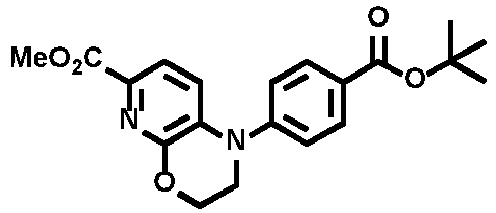
1H NMR (400 MHz, CDCl3) δ 1.61 (9H, s), 3.82 (2H, t, J = 4.6 Hz), 3.93 (3H, s), 4.53 (2H, t, J = 4.6 Hz), 7.25-7.30 ( 3H, m), 7.64 (1H, d, J = 7.9 Hz), 8.03-8.06 (2H, m). LRMS (ESI+) 371 [M+H]+. [Table 7] Reference Example No. Chemical Structural Formula Spectrum Data 8-7 
1H NMR (400 MHz, CDCl3) δ 3.65 (3H, s), 3.78-3.83 (2H, m), 3.95 (3H, s), 4.53-4.57 (2H, m), 6.51 (1H, dd, J = 7.6, 2.1 Hz), 6.64-6.66 (1H, m), 7.35 (1H, d, J = 7.9 Hz), 7.73 ( 1H, d, J = 8.6 Hz), 7.77 (1H, d, J = 8.6 Hz). LRMS (ESI+) 342 [M+H]+. 8-8 
1H NMR (400 MHz, CDCl3) δ 1.35-1.41 (9H, m), 1.55 (9H, s), 3.70 (2H, s), 4.37 (2H, q, J = 7.3 Hz), 7.72 (1H, d, J = 1.8 Hz), 8.68 (1H, d, J = 1.8 Hz). LRMS (ESI+) 337 [M+H]+. 8-9 
1H NMR (400 MHz, CDCl3) δ 1.39 (3H, t, J = 7.0 Hz), 1.5 5 (9H, s), 1.91-1.99 (2H, m), 2.80 (2H, t, J = 6.4 Hz), 3.80 (2H, t, J = 6.1 Hz), 4.37 (2H, q, J = 7.1 Hz), 7.97-7.98 (1H , m), 8.92 (1H, d, J = 2.4 Hz). LRMS (ESI+) 307 [M+H]+. 8-10 
1H NMR (400 MHz, CDCl3) δ 1.41 (3H, t, J = 7.3 Hz), 1.4 3 (9H, s), 1.65-1.76 (2H, m), 1.82-1.90 (2H, m), 2.79 (2H, t, J = 5.8 Hz), 3.37-3.77 (2H, m), 4.41 (2H, q, J = 7.3 Hz), 8. 15 (1H, d, J = 2.4 Hz), 8.95 (1H, d, J = 2.4 Hz). LRMS (ESI+) 321 [M+H]+. 8-11 
1H NMR (400 MHz, CDCl3) δ 1.41 (3H, t, J = 7.3 Hz), 1.4 6 (9H, s), 3.37-3.99 (4H, m), 4.42 (2H, q, J = 7.3 Hz), 4.64 (2H, br s), 8.23 (1H, d, J = 2.4 Hz), 9.04 (1H, d, J = 1.8 H z). LRMS (ESI+) 323 [M+H]+. 8-12 
1H NMR (400 MHz, CDCl3) δ 1.38 (3H, t, J = 7.3 Hz), 1.5 7 (9H, s), 3.09 (2H, t, J = 8.6 Hz), 4.07 (2H, t, J = 8.6 Hz) , 4.36 (2H, q, J = 7.3 Hz), 7.97 (1H, d, J = 1.8 Hz), 8.88 ( 1H, d, J = 1.8 Hz). LRMS (ESI+) 293 [M+H]+. -

- To a solution of 5-(tert-butyl) 8-methyl 3,4-dihydrobenzo[b][1,4]oxazepine-5,8(2H)-dicarboxylate (390 mg) in dichloromethane (1.3 mL), trifluoroacetic acid (0.60 mL) was added at room temperature. The resultant reaction solution was stirred at room temperature for 24 hours, and then concentrated under reduced pressure. The thus obtained residue was purified by silica gel column chromatography (hexane:ethyl acetate = 3:1) to obtain the title compound (266 mg).
- 1H NMR (400 MHz, CDCl3) δ 2.00-2.09 (2H, m), 3.37 (2H, t, J = 5.5 Hz), 3.85 (3H, s), 4.06 (1H, brs), 4.16 (2H, t, J = 5.5 Hz), 6.64 (1H, d, J = 8.6 Hz), 7.54 (1H, dd, J = 8.6, 1.8 Hz), 7.60 (1H, d, J = 1.8 Hz).
- LRMS (ESI+) 208 [M+H]+.
- Compounds of the following Reference Examples 9-2 to 9-10 were obtained in the same manner as in Reference Example 9-1 by using corresponding starting materials and reactants. Their structures and spectrum data are shown in the following tables.
[Table 8] Reference Example No. Chemical Structural Formula Spectrum Data 9-2 
1H NMR (400 MHz, CDCl3) δ 1.70-1.78 (2H, m), 1.82-1.90 ( 2H, m), 3.74 (2H, t, J = 5.5 Hz), 3.83 (3H, s), 4.15 (2H, t, J = 5.5 Hz), 4.29 (1H, brs), 6.47 (1H, d, J = 7.9 Hz), 7.56 (1H, dd, J = 7.9, 1.8 Hz), 7.59 (1H, d, J = 1.8 Hz). LRMS (ESI+) 222 [M+H]+. 9-3 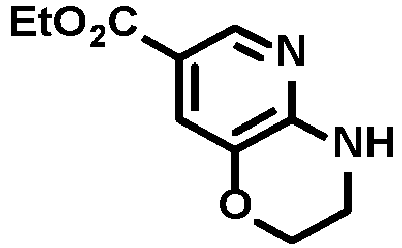
1H NMR (400 MHz, CDCl3) δ 1.36 (3H, t, J = 7.3 Hz), 3.5 9-3.65 (2H, m), 4.22 (2H, t, J = 4.3 Hz), 4.32 (2H, q, J = 7 .3 Hz), 5.34 (1H, brs), 7.53 (1H, d, J = 1.8 Hz), 8.37 (1H, d, J = 1.8 Hz). LRMS (FI+) 208 [M]+ 9-4 
1H NMR (400 MHz, CDCl3) δ 2.06-2.15 (2H, m), 3.48-3.55 ( 2H, m), 3.87 (3H, s), 4.22 (2H, t, J = 5.5 Hz), 5.16 (1H, br s), 7.67 (1H, d, J = 1.8 Hz), 8.43 (1H, d, J = 1.8 Hz). LRMS (ESI+) 209 [M+H]+. 9-5 
1H NMR (400 MHz, CDCl3) δ 1.71-1.80 (2H, m), 1.85-1.94 ( 2H, m), 3.75-3.85 (2H, m), 3.86 (3H, s), 4.16 (2H, t, J = 5. 5 Hz), 5.37-5.47 (1H, m), 7.69 (1H, d, J = 1.8 Hz), 8.45 (1 H, d, J = 1.8 Hz). LRMS (ESI+) 223 [M+H]+. [Table 9] Reference Example No. Chemical Structural Formula Spectrum Data 9-6 
1H NMR (400 MHz, CDCl3) δ 1.36 (3H, t, J = 7.3 Hz), 1.3 6 (6H, s), 3.32 (2H, d, J = 2.4 Hz), 4.32 (2H, q, J = 7.3 H z), 5.44 (1H, br s), 7.52 (1H, d, J = 1.8 Hz), 8.38 (1H, d, J = 1.8 Hz). LRMS (ESI+) 237 [M+H]+. 9-7 
1H NMR (400 MHz, CDCl3) δ 1.36 (3H, t, J = 6.7 Hz), 1.8 9-1.97 (2H, m), 2.76 (2H, t, J = 6.1 Hz), 3.45-3.50 (2H, m), 4.32 (2H, q, J = 6.7 Hz), 5.47 (1H, br s), 7.71-7.74 (1H, m), 8.54 (1H, d, J = 1.8 Hz). LRMS (ESI+) 207 [M+H]+. 9-8 
1H NMR (400 MHz, CDCl3) δ 1.37 (3H, t, J = 7.3 Hz), 1.7 7-1.91 (4H, m), 2.75-2.80 (2H, m), 3.26-3.33 (2H, m), 4.34 ( 2H, q, J = 7.3 Hz), 5.20 (1H, br s), 7.87 (1H, d, J = 1.2 H z), 8.57 (1H, d, J = 1.8 Hz). LRMS (ESI+) 221 [M+H]+. 9-9 
1H NMR (400 MHz, CDCl3) δ 1.38 (3H, t, J = 7.3 Hz), 3.3 3-3.38 (2H, m), 3.85-3.90 (2H, m), 4.35 (2H, q, J = 7.3 Hz), 4.60 (2H, s), 5.42 (1H, br s), 7.97 (1H, d, J = 1.2 Hz), 8.7 0 (1H, d, J = 2.4 Hz). LRMS (ESI+) 223 [M+H]+. 9-10 
1H NMR (400 MHz, CDCl3) δ 1.36 (3H, t, J = 7.3 Hz), 3.1 1 (2H, t, J = 8.6 Hz), 3.72 (2H, t, J = 8.6 Hz), 4.32 (2H, q, J = 7.3 Hz), 5.00 (1H, br s), 7.78 (1H, d, J = 1.8 Hz), 8.5 4 (1H, d, J = 1.8 Hz). LRMS (ESI+) 193 [M+H]+. -

- To a solution, in tetrahydrofuran (40 mL), of methyl 3-hydroxy-4-nitrobenzoate (2.00 g), methyl (S)-3-hydroxy-2-methylpropionate (1.70 mL) and triphenylphosphine (4.04 g), diisopropyl azodicarboxylate (3.10 mL) was added at room temperature. The resultant reaction mixture was stirred at room temperature for 6 hours, diluted with ethyl acetate, and washed successively with a saturated sodium bicarbonate aqueous solution and saturated saline. The resultant organic layer was dried by adding anhydrous sodium sulfate thereto, and filtered, and the resultant filtrate was concentrated under reduced pressure. The thus obtained residue was purified by silica gel column chromatography (hexane:ethyl acetate = 3:1) to obtain the title compound (2.57 g).
- 1H NMR (400 MHz, CDCl3) δ 1.34 (3H, d, J = 7.3 Hz), 2.97-3.09 (1H, m), 3.75 (3H, s), 3.97 (3H, s), 4.21 (1H, dd, J = 8.5, 6.7 Hz), 4.37 (1H, dd, J = 8.5, 6.7 Hz), 7.70 (1H, d, J = 8.5 Hz), 7.76 (1H, s), 7.83 (1H, d, J = 8.5 Hz).
- LRMS (ESI+) 298 [M+H]+.
- Compounds of the following Reference Examples 10-2 to 10-4 were obtained in the same manner as in Reference Example 10-1 by using corresponding starting materials and reactants. Their structures and spectrum data are shown in the following table.
[Table 10] Reference Example No. Chemical Structural Formula Spectrum Data 10-2 
1H NMR (400 MHz, CDCl3) δ 1.34 (3H, d, J = 7.3 Hz), 2.9 8-3.09 (1H, m), 3.75 (3H, s), 3.97 (3H, s), 4.21 (1H, dd, J = 8.6, 6.7 Hz), 4.37 (1H, dd, J = 8.6, 6.7 Hz), 7.70 (1H, dd, J = 8.5, 1.8 Hz), 7.76 (1H, d, J = 1.8 Hz), 7.83 (1H, d, J = 8.5 Hz). LRMS (ESI+) 298 [M+H]+. 10-3 
1H NMR (400 MHz, CDCl3) δ 1.41 (3H, t, J = 7.0 Hz), 3.8 9 (2H, t, J = 5.8 Hz), 4.41 (2H, q, J = 7.1 Hz), 4.49 (2H, t, J = 6.1 Hz), 7.47 (1H, s). 10-4 
1H NMR (400 MHz, CDCl3) δ 1.67 (6H, s), 3.83 (3H, s), 7. 61 (1H, d, J = 1.8 Hz), 8.20 (1H, d, J = 1.8 Hz). LRMS (CI+) 319 [M+H]+. -

- To a suspension of methyl 3-fluoro-4-nitrobenzoate (4.00 g) and potassium carbonate (3.34 g) in N,N-dimethylformamide (100 mL), ethyl 2-mercaptoacetate (2.20 g) was added at 0°C. The resultant reaction solution was heated to room temperature, followed by stirring for 3 hours. The resultant reaction solution was filtered through celite, and the resultant filtrate was concentrated under reduced pressure. The thus obtained residue was purified by silica gel column chromatography (hexane:ethyl acetate = 7:3) to obtain the title compound (5.61 g).
- 1H NMR (400 MHz, CDCl3) δ 1.29 (3H, t, J = 7.3 Hz), 3.82 (2H, s), 3.98 (3H, s), 4.24 (2H, q, J = 7.3 Hz), 7.91 (1H, dd, J = 8.5, 1.8 Hz), 8.20 (1H, d, J = 1.8 Hz), 8.26 (1H, d, J = 8.5 Hz).
- LRMS (ESI+) 300 [M+H]+.
-

- The title compound was synthesized in the same manner as in Reference Example 11-1 by using corresponding starting material and reactant.
- 1H NMR (400 MHz, CDCl3) δ 2.76 (2H, t, J = 7.3 Hz), 3.33 (2H, t, J = 7.3 Hz), 3.74 (3H, s), 3.99 (3H,s), 7.89 (1H, dd, J = 9.1, 1.8 Hz), 8.10 (1H, d, J = 1.8 Hz), 8.23 (1H, d, J = 9.1 Hz).
- LRMS (ESI+) 300 [M+H]+.
-

- To methyl (S)-3-(3-methoxy-2-methyl-3-oxopropoxy)-4-nitrobenzoate (3.60 g), reduced iron (3.38 g), 1,4-dioxane (20 mL) and acetic acid (8.0 mL) were added at room temperature to obtain a suspension, followed by stirring under heating at 120°C for 6 hours. The resultant reaction solution was cooled to room temperature, a saturated sodium bicarbonate aqueous solution was added thereto to adjust pH to 10, and then the resultant was filtered through celite, and the resultant solid was washed with hot ethyl acetate. The resultant extract was dried over anhydrous sodium sulfate, and concentrated under reduced pressure. The thus obtained residue was purified by silica gel column chromatography (hexane:ethyl acetate = 1:1) to obtain the title compound (417 mg).
- 1H NMR (400 MHz, CDCl3) δ 1.22 (3H, d, J = 6.7 Hz), 2.95-3.06 (1H, m), 3.91 (3H, s), 4.25 (1H, dd, J = 11.5, 9.7 Hz), 4.35 (1H, dd, J = 11.5, 4.9 Hz), 6.95 (1H, d, J = 8.5 Hz), 7.71 (1H, dd, J = 8.5, 1.8 Hz), 7.74 (1H, d, J = 1.8 Hz), 7.88 (1H, brs).
- LRMS (ESI+) 236 [M+H]+.
- Compounds of the following Reference Examples 12-2 to 12-5 were obtained in the same manner as in Reference Example 12-1 by using corresponding starting materials and reactants. Their structures and spectrum data are shown in the following table.
[Table 11] Reference Example No. Chemical Structural Formula Spectrum Data 12-2 
1H NMR (400 MHz, CDCl3) δ 1.22 (3H, d, J = 7.3 Hz), 2.9 5-3.05 (1H, m), 3.91 (3H, s), 4.25 (1H, dd, J = 11.5, 9.7 Hz ), 4.35 (1H, dd, J = 11.5, 4.9 Hz), 6.92 (1H, d, J = 8.5 Hz), 7.57 (1H, brs), 7.71 (1H, dd, J = 8.5, 1.8 Hz), 7.74 (1H, d, J = 1.8 Hz). LRMS (ESI+) 236 [M+H]+. 12-3 
1H NMR (400 MHz, CDCl3) δ 3.47 (2H, s), 3.91 (3H, s), 6. 88 (1H, d, J = 8.5 Hz), 7.85 (1H, dd, J = 8.5, 1.8 Hz), 8.03 (1H, d, J = 1.8 Hz), 8.45 (1H, brs). LRMS (ESI+) 224 [M+H]+. 12-4 
1H NMR (400 MHz, CDCl3) δ 2.57 (2H, t, J = 7.3 Hz), 2.9 9 (2H, t, J = 7.3 Hz), 3.68 (3H, s), 3.86 (3H,s), 4.86 (2H, s) , 6.69 (1H, d, J = 8.5 Hz), 7.80 (1H, dd, J = 8.5, 1.8 Hz), 8.08 (1H, d, J = 1.8 Hz). LRMS (ESI+) 270 [M+H]+. 12-5 
1H NMR (400 MHz, CDCl3) δ 1.56 (6H, s), 7.40 (1H, d, J = 3.1 Hz), 8.04 (1H, d, J = 1.8 Hz), 8.91 (1H, br s). LRMS (ESI+) 257 [M+H]+. -

- To a solution of methyl (S)-3-methyl-4-oxo-2,3,4,5-tetrahydrobenzo[b][1,4]oxazepine-8-carboxylate (2.09 g) in tetrahydrofuran (18 mL), borane-tetrahydrofuran complex (27 mL, 1 mol/L tetrahydrofuran solution) was added at 0°C. The resultant reaction mixture was stirred at room temperature for 2 hours, and the reaction was stopped by adding water thereto. The resultant was extracted with ethyl acetate, the resultant organic layer was dried over anhydrous sodium sulfate and filtered, and the resultant filtrate was concentrated under reduced pressure. The thus obtained residue was purified by silica gel column chromatography (hexane:ethyl acetate = 3:1) to obtain the title compound (1.53 g).
- 1H NMR (400 MHz, CDCl3) δ 0.99 (3H, d, J = 7.3 Hz), 2.20-2.32 (1H, m), 3.00 (1H, dd, J = 12.7, 6.7 Hz), 3.49 (1H, dd, J = 12.7, 4.9 Hz), 3.73 (1H, dd, J = 11.5, 7.9 Hz), 3.85 (3H, s), 3.99 (1H, brs), 4.27 (1H, dd, J = 11.5, 4.9 Hz), 6.60 (1H, d, J = 8.5 Hz), 7.52 (1H, dd, J = 8.5, 2.4 Hz), 7.55 (1H, d, J = 2.4 Hz).
- LRMS (EI+) 221 [M]+.
- Compounds of the following Reference Examples 13-2 to 13-7 were obtained in the same manner as in Reference Example 13-1 by using corresponding starting materials and reactants. Their structures and spectrum data are shown in the following table.
[Table 12] Reference Example No. Chemical Structural Formula Spectrum Data 13-2 
1H NMR (400 MHz, CDCl3) δ 0.99 (3H, d, J = 6.7 Hz), 2.2 0-2.32 (1H, m), 3.00 (1H, dd, J = 13.3, 6.7 Hz), 3.49 (1H, d d, J = 12.7, 4.2 Hz), 3.72 (1H, dd, J = 12.1, 7.3 Hz), 3.84 ( 3H, s), 3.99 (1H, brs), 4.27 (1H, dd, J = 12.1, 4.9 Hz), 6.60 (1H, d, J = 8.5 Hz), 7.52 (1H, dd, J = 8.5, 1.8 Hz), 7.55 (1 H, d, J = 1.8 Hz). LRMS (ESI+) 222 [M+H]+. 13-3 
1H NMR (400 MHz, CDCl3) δ 3.00-3.05 (2H, m), 3.69-3.74 ( 2H, m), 3.84 (3H, s), 4.44 (1H, brs), 6.42 (1H, d, J = 8.5 H z), 7.57 (1H, dd, J = 8.5, 2.4 Hz), 7.72 (1H, d, J = 2.4 Hz). LRMS (ESI+) 210 [M+H]+. 13-4 
1H NMR (400 MHz, CDCl3) δ 1.43 (1H, brs), 1.77-1.85 (2H, m), 2.87 (2H, t, J = 7.3 Hz), 3.75 (2H, t, J = 6.1 Hz), 3.8 6 (3H, s), 4.80 (2H, s), 6.69 (1H, d, J = 8.5 Hz), 7.79 (1H, dd, J = 8.5, 1.8 Hz), 8.08 (1H, d, J = 1.8 Hz). LRMS (ESI+) 242 [M+H]+. 13-5 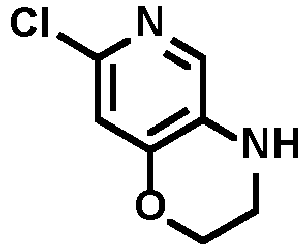
1H NMR (400 MHz, CDCl3) δ 3.40-3.46 (2H, m), 3.82 (1H, br s), 4.31 (2H, t, J = 3.9 Hz), 6.72 (1H, s), 7.66 (1H, s). LRMS (ESI+) 171 [M+H]+. 13-6 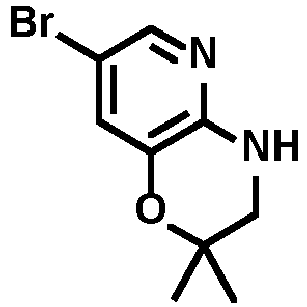
1H NMR (400 MHz, CDCl3) δ 1.35 (6H, s), 3.24 (2H, d, J = 2.4 Hz), 4.85 (1H, br s), 7.08 (1H, d, J = 1.8 Hz), 7.71 ( 1H, d, J = 1.8 Hz). LRMS (FI+) 242 [M]+. 13-7 
1H NMR (400 MHz, CDCl3) δ 3.53 (2H, dd, J = 9.2, 4.3 Hz ), 3.92 (2H, t, J = 4.3 Hz), 4.60 (2H, s), 6.70 (1H, br s), 7. 60 (1H, d, J = 1.8 Hz), 8.35 (1H, d, J = 1.8 Hz). LRMS (ESI+) 229 [M+H]+. -

- Methyl 6-methoxy-3,4-dihydro-2H-benzo[b][1,4]oxazine-7-carboxylate (200 mg) was dissolved in tetrahydrofuran (3.6 mL) and methanol (3.6 mL), and 1 mol/L lithium hydroxide aqueous solution (3.6 mL) was added thereto at room temperature, followed by stirring at 70°C for 3 hours. The resultant reaction solution was concentrated under reduced pressure, and 6 mol/L hydrogen chloride aqueous solution was added to the resultant residue to adjust pH to 4. The thus precipitated product was collected by filtration to obtain the title compound (151 mg).
- 1H NMR (400 MHz, DMSO-d6) δ 3.10-3.50 (2H, m), 3.69 (3H, s), 4.04 (2H, t, J = 4.3 Hz), 6.21 (1H, s), 6.65 (1H, brs), 7.06 (1H, s), 11.53 (1H, brs).
- LRMS (ESI+) 210 [M+H]+.
- Compounds of the following Reference Examples 14-2 to 14-35 were obtained in the same manner as in Reference Example 14-1 by using corresponding starting materials and reactants. Their structures and spectrum data are shown in the following tables.
[Table 13] Reference Example No. Chemical Structural Formula Spectrum Data 14-2 
1H NMR (400 MHz, DMSO-d6) δ 3.20-3.50 (2H, m), 3.71 (3 H, s), 4.11 (2H, t, J = 4.9 Hz), 6.32 (1H, d, J = 8.6 Hz), 6. 56 (1H, brs), 7.15 (1H, d, J = 8.6 Hz), 11.85 (1H, brs). LRMS (ESI+) 210 [M+H]+. 14-3 
1H NMR (400 MHz, DMSO-d6) δ 3.20-3.50 (2H, m), 4.18 (2 H, t, J = 4.9 Hz), 6.50 (1H, d, J = 8.6 Hz), 6.81 (1H, brs), 7.30 (1H, d, J = 8.6 Hz), 12.35 (1H, brs). LRMS (ESI+) 214 [M+H]+. 14-4 
1H NMR (400 MHz, DMSO-d6) δ 1.86-1.95 (2H, m), 3.18-3. 25 (2H, m), 4.06 (2H, t, J = 5.5 Hz), 6.10 (1H, brs), 6.74 ( 1H, d, J = 8.6 Hz), 7.29 (1H, d, J = 1.8 Hz), 7.36 (1H, dd, J = 8.6, 1.8 Hz), 12.26 (1H, brs). LRMS (ESI+) 194 [M+H]+. [Table 14] Reference Example No. Chemical Structural Formula Spectrum Data 14-5 
1H NMR (400 MHz, DMSO-d6) δ 1.56-1.66 (2H, m), 1.71-1. 81 (2H, m), 3.51-3.61 (2H, m), 4.04 (2H, t, J = 5.5 Hz), 6.5 0 (1H, t, J = 6.1 Hz), 6.56 (1H, d, J = 8.5 Hz), 7.30 (1H, d , J = 1.8 Hz), 7.37 (1H, dd, J = 8.5, 1.8 Hz), 12.02 (1H, br s). LRMS (ESI+) 208 [M+H]+. 14-6 
1H NMR (400 MHz, DMSO-d6) δ 3.42-3.47 (2H, m), 4.11 (2 H, t, J = 4.2 Hz), 7.24 (1H, d, J = 1.8 Hz), 7.62 (1H, brs), 8.16 (1H, d, J = 1.8 Hz), 12.43 (1H, brs). LRMS (ESI+) 181 [M+H]+. 14-7 
1H NMR (400 MHz, DMSO-d6) δ 1.93-2.03 (2H, m), 3.30-3. 50 (2H, m), 4.14 (2H, t, J = 6.1 Hz), 6.98 (1H, brs), 7.39 ( 1H, d, J = 1.8 Hz), 8.24 (1H, d, J = 1.8 Hz), 12.52 (1H, br s). LRMS (ESI+) 195 [M+H]+. 14-8 
1H NMR (400 MHz, DMSO-d6) δ 1.57-1.66 (2H, m), 1.73-1. 83 (2H, m), 3.55-3.67 (2H, m), 4.05-4.15 (2H, m), 7.20-7.30 (1H, m), 7.47 (1H, d, J = 1.8 Hz), 8.26 (1H, d, J = 1.8 Hz) , 12.33 (1H, brs). LRMS (ESI+) 209 [M+H]+. 14-9 
1H NMR (400 MHz, DMSO-d6) δ 0.91 (3H, d, J = 6.7 Hz), 2.08-2.20 (1H, m), 2.83-2.92 (1H, m), 3.30-3.40 (1H, m), 3.6 4 (1H, dd, J = 11.5, 7.3 Hz), 4.18 (1H, dd, J = 11.5, 4.9 H z), 6.08 (1H, brs), 6.70 (1H, d, J = 7.9 Hz), 7.25 (1H, d, J = 2.4 Hz), 7.34 (1H, dd, J = 7.9, 2.4 Hz), 12.23 (1H, brs). LRMS (EI+) 207 [M]+. 14-10 
1H NMR (400 MHz, DMSO-d6) δ 0.91 (3H, d, J = 6.7 Hz), 2.08-2.20 (1H, m), 2.83-2.92 (1H, m), 3.37-3.40 (1H, m), 3.6 5 (1H, dd, J = 12.2, 7.3 Hz), 4.18 (1H, dd, J = 12.2, 4.9 H z), 6.07 (1H, brs), 6.70 (1H, d, J = 8.6 Hz), 7.25 (1H, d, J = 1.8 Hz), 7.35 (1H, dd, J = 8.6, 1.8 Hz), 12.23 (1H, brs). LRMS (ESI+) 208 [M+H]+. [Table 15] Reference Example No. Chemical Structural Formula Spectrum Data 14-11 
1H NMR (400 MHz, DMSO-d6) δ 2.92-3.00 (2H, m), 3.52-3. 60 (2H, m), 6.50 (1H, d, J = 8.5 Hz), 6.88 (1H, brs), 7.39 ( 1H, dd, J = 8.5, 1.8 Hz), 7.43 (1H, d, J = 1.8 Hz), 12.12 (1 H, brs). LRMS (ESI+) 196 [M+H]+. 14-12 
1H NMR (400 MHz, DMSO-d6) δ 1.55-1.65 (2H, m), 2.75 (2 H, t, J = 7.3 Hz), 3.46 (2H, t, J = 6.7 Hz), 4.52 (1H, brs), 6.07 (2H, s), 6.70 (1H, d, J = 8.5 Hz), 7.59 (1H, dd, J = 8. 5, 2.4 Hz), 7.80 (1H, d, J = 2.4 Hz), 12.19 (1H, brs). LRMS (ESI+) 228 [M+H]+. 14-13 
1H NMR (400 MHz, CDCl3) δ: 1.60 (9H, s), 2.55 (3H, s), 3. 78 (2H, t, J = 4.3 Hz), 4.37 (2H, t, J = 4.6 Hz), 6.87 (1H, d, J = 8.6 Hz), 7.24-7.28 (2H, m), 7.48 (1H, d, J = 8.6 Hz), 7.97-8.01 (2H, m). (COOH peak missing) LRMS (ESI+) 370 [M+H]+. 14-14 
1H NMR (400 MHz, DMSO-d6) δ 1.54 (9H, s), 3.98 (2H, t, J = 4.2 Hz), 4.35 (2H, t, J = 4.2 Hz), 7.48 (1H, d, J = 1.8 Hz), 7.52-7.58 (2H, m), 7.86-7.91 (2H, m), 8.19 (1H, d, J = 1.8 Hz), 12.81 (1H, br s). LRMS (ESI+) 357 [M+H]+. 14-15 
1H NMR (400 MHz, DMSO-d6) δ 1.54 (9H, s), 3.84 (2H, t, J = 4.2 Hz), 4.39 (2H, t, J = 4.2 Hz), 7.41 (2H, d, J = 9.1 Hz), 7.47 (1H, s), 7.90 (2H, d, J = 8.5 Hz), 8.27 (1H, s). (C OOH peak missing) LRMS (ESI+) 357 [M+H]+. 14-16 
1H NMR (400 MHz, DMSO-d6) δ 1.41 (9H, s), 3.69 (2H, t, J = 4.6 Hz), 4.33 (2H, t, J = 4.6 Hz), 7.22 (1H, d, J = 8.6 Hz), 7.27-7.31 (2H, m), 7.39 (1H, d, J = 8.6 Hz), 7.78-7.82 (2H, m), 12.4 (1H, br s). LRMS (ESI+) 357 [M+H]+. [Table 16] Reference Example No. Chemical Structural Formula Spectrum Data 14-17 
1H NMR (400 MHz, CDCl3) δ: 1.43-1.74 (15H, m), 2.23-2.30 (2H, m), 2.58-2.63 (1H, m), 3.34 (2H, t, J = 4.5 Hz), 3.61-3.74 (1H, m), 4.17 (2H, t, J = 4.5 Hz), 6.69 (1H, d, J = 8.5 Hz), 7.47 (1H, d, J = 2.4 Hz), 7.59 (1H, dd, J = 8.8, 2.1 Hz). (COOH peak missing) LRMS (ESI+) 362 [M+H]+. 14-18 
1H NMR (400 MHz, CDCl3) δ: 1.39-1.70 (13H, m), 1.91 (2H, d, J = 11.5 Hz), 2.12 (2H, d, J = 15.1 Hz), 2.16-2.22 (1H, m), 3.35 (2H, t, J = 4.5 Hz), 3.63-3.76 (1H, m), 4.19 (2H, t, J = 4.5 Hz), 6.69 (1H, d, J = 9.1 Hz), 7.47 (1H, d, J = 1.8 Hz), 7.60 (1H, dd, J = 8.8, 2.1 Hz). (COOH peak missing) LRMS (ESI+) 362 [M+H]+. 14-19 
1H NMR (400 MHz, CDCl3) δ: 1.12-1.25 (1H, m), 1.36-1.95 (9H, m), 3.40 (2H, t, J = 4.5 Hz), 3.64-3.74 (1H, m), 4.21 (2H, t, J = 4.5 Hz), 6.72 (1H, d, J = 9.1 Hz), 7.50 (1H, d, J = 1.8 Hz), 7.63 (1H, dd, J = 8.5, 1.8 Hz). (COOH peak missing) LRMS (ESI+) 262 [M+H]+. 14-20 
1H NMR (400 MHz, DMSO-d6) δ: 1.28 (3H, t, J = 7.3 Hz), 3.88 (2H, q, J = 7.3 Hz), 3.96 (2H, t, J = 4.3 Hz), 4.37 (2H, t, J = 4.6 Hz), 6.93 (1H, dd, J = 7.6, 2.1 Hz), 6.99 (1H, d, J = 1.2 Hz), 7.52 (1H, d, J = 1.8 Hz), 7.77 (1H, d, J = 6.7 Hz), 8.26 (1H, d, J = 1.8 Hz), 12.94 (1H, s). LRMS (ESI+) 342 [M+H]+. 14-21 
1H NMR (400 MHz, DMSO-d6) δ: 1.16 (3H, t, J = 7.0 Hz), 3.53 (2H, q, J = 7.1 Hz), 3.98 (2H, t, J = 4.3 Hz), 4.36 (2H, t, J = 4.3 Hz), 4.46 (2H, s), 7.46 (1H, d, J = 2.4 Hz), 7.51 (1H, dd, J = 8.6, 1.8 Hz), 7.61-7.68 (2H, m), 8.17 (1H, d, J= 1.8 Hz), 12.79 (1H, s). LRMS (ESI+) 340 [M+H]+. 14-22 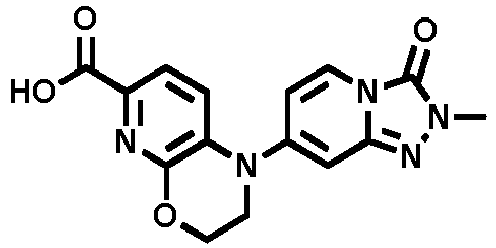
1H NMR (400 MHz, DMSO-d6) δ 3.49 (3H, s), 3.82 (2H, t, J = 4.3 Hz), 4.47 (2H, t, J = 4.3 Hz), 6.66 (1H, dd, J = 7.9, 1.8 Hz), 6.91 (1H, d, J = 1.2 Hz), 7.39 (1H, d, J = 8.6 Hz), 7.58 (1H, d, J = 7.9 Hz), 7.84 (1H, d, J = 7.9 Hz), 12.70 (1H, br s). LRMS (ESI+) 328 [M+H]+. [Table 17] Reference Example No. Chemical Structural Formula Spectrum Data 14-23 
1H NMR (400 MHz, DMSO-d6) δ 1.26 (6H, s), 3.22 (2H, d, J = 2.4 Hz), 7.22 (1H, d, J = 1.8 Hz), 7.63 (1H, s), 8.17 (1 H, d, J = 1.8 Hz), 12.42 (1H, s). LRMS (ESI+) 209 [M+H]+. 14-24 
1H NMR (400 MHz, DMSO-d6) δ 1.72-1.82 (2H, m), 2.68 (2 H, t, J = 6.1 Hz), 3.26-3.39 (2H, m), 7.30 (1H, br s), 7.56-7 .59 (1H, m), 8.32 (1H, d, J = 1.8 Hz), 12.22 (1H, s). LRMS (ESI+) 179 [M+H]+. 14-25 
1H NMR (400 MHz, DMSO-d6) δ 1.72-1.80 (4H, m), 2.70-2. 77 (2H, m), 3.21-3.27 (2H, m), 6.79 (1H, t, J = 4.3 Hz), 7.7 0 (1H, d, J = 1.8 Hz), 8.36 (1H, d, J = 2.4 Hz), 12.42 (1H, br s). LRMS (ESI+) 193 [M+H]+. 14-26 
1H NMR (400 MHz, DMSO-d6) δ 3.26 (2H, dd, J = 8.6, 4.3 Hz), 3.75 (2H, t, J = 4.3 Hz), 4.55 (2H, s), 7.11-7.16 (1H, m), 7.87 (1H, d, J = 1.8 Hz), 8.48 (1H, d, J = 2.4 Hz), 12.5 9 (1H, br s). LRMS (ESI+) 195 [M+H]+. 14-27 
1H NMR (400 MHz, DMSO-d6) δ 3.01 (2H, t, J = 8.6 Hz), 3.56 (2H, t, J = 8.6 Hz), 7.27 (1H, br s), 7.59 (1H, d, J = 1.8 Hz), 8.30 (1H, d, J = 1.8 Hz), 12.26 (1H, br s). LRMS (ESI+) 165 [M+H]+. [Table 18] Reference Example No. Chemical Structural Formula Spectrum Data 14-28 
1H NMR (400 MHz, DMSO-d6) δ 1.17 (3H, t, J = 7.3 Hz), 1.97-2.07 (2H, m), 2.89 (2H, t, J = 6.1 Hz), 3.54 (2H, q, J = 7.3 Hz), 3.82 (2H, t, J = 5.5 Hz), 4.46 (2H, s), 7.42 (1H, dd, J = 7.9, 1.2 Hz), 7.54 (1H, s), 7.65 (1H, d, J = 7.9 Hz), 7.79 (1H, d, J = 1.2 Hz), 8.31 (1H, d, J = 1.8 Hz), 12.53 ( 1H, br s). LRMS (ESI+) 338 [M+H]+. 14-29 
1H NMR (400 MHz, DMSO-d6) δ 1.98-2.08 (2H, m), 2.89 (2 H, t, J = 6.1 Hz), 3.90 (2H, t, J = 6.1 Hz), 7.55 (1H, dd, J = 8.6, 1.8 Hz), 7.57 (1H, t, J = 2.1 Hz), 7.84 (1H, d, J = 2. 4 Hz), 8.03-8.09 (2H, m), 8.37 (1H, d, J = 1.8 Hz), 12.16 (1 H, br s), 12.62 (1H, br s). LRMS (FD+) 322 [M]+. 14-30 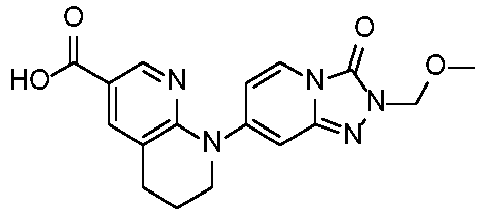
1H NMR (400 MHz, DMSO-d6) δ 1.95-2.06 (2H, m), 2.86 (2 H, t, J = 6.4 Hz), 3.31 (3H, s), 3.84 (2H, t, J = 5.8 Hz), 5. 18 (2H, s), 6.74 (1H, dd, J = 7.6, 2.1 Hz), 6.99 (1H, d, J = 1.8 Hz), 7.74 (1H, d, J = 7.9 Hz), 7.88 (1H, d, J = 1.8 H z), 8.46 (1H, d, J = 1.8 Hz), 12.81 (1H, br s). LRMS (ESI+) 356 [M+H]+. 14-31 
1H NMR (400 MHz, DMSO-d6) δ 1.94-2.07 (2H, m), 2.86 (2 H, t, J = 6.4 Hz), 3.51 (3H, s), 3.83 (2H, t, J = 5.8 Hz), 6. 72 (1H, dd, J = 7.6, 2.1 Hz), 6.99 (1H, d, J = 1.8 Hz), 7.7 2 (1H, d, J = 7.9 Hz), 7.83-7.90 (1H, m), 8.45 (1H, d, J = 2.4 Hz), 12.75 (1H, s). LRMS (ESI-) 324 [M-H]-. [Table 19] Reference Example No. Chemical Structural Formula Spectrum Data 14-32 
1H NMR (400 MHz, DMSO-d6) δ 3.06 (3H, s), 3.98 (2H, t, J = 4.2 Hz), 4.36 (2H, t, J = 4.5 Hz), 4.45 (2H, s), 7.46 (1H, d, J = 1.8 Hz), 7.52 (1H, dd, J = 8.5, 1.8 Hz), 7.61-7.68 (2H, m), 8.18 (1H, d, J = 1.8 Hz), 1 2.76 (1H, s). LRMS (ESI+) 326 [M+H]+. 14-33 
1H NMR (400 MHz, DMSO-d6) δ 1.26 (3H, t, J = 7.3 Hz), 3.93-4.05 (4H, m), 4.37 (2H, t, J = 4.3 Hz), 7.44 (1H, dd, J = 8.6, 1.8 Hz), 7.50 (1H, d, J = 1.8 Hz), 7.55 (1H, d, J = 1 .8 Hz), 7.73 (1H, d, J = 8.6 Hz), 8.23 (1H, d, J = 1.8 Hz), 12.86 (1H, s). LRMS (ESI+) 342 [M+H]+. 14-34 
1H NMR (400 MHz, DMSO-d6) δ 1.45 (3H, t, J = 7.0 Hz), 4.02 (2H, t, J = 4.3 Hz), 4.37 (2H, t, J = 4.6 Hz), 4.45 (2H, q, J = 6.9 Hz), 7.43-7.52 (2H, m), 7.64-7.71 (2H, m), 8.20 (1H, d, J = 1.8 Hz), 12.81 (1H, s). LRMS (ESI+) 342 [M+H]+. 14-35 
1H NMR (400 MHz, DMSO-d6) δ 3.47 (3H, s), 3.81 (2H, t, J = 4.0 Hz), 4.30 (2H, t, J = 4.0 Hz), 6.77 (1H, d, J = 1.2 Hz), 6.84 (1H, dd, J = 7.3, 2.4 Hz), 7.24 (1H, s), 7.86 (1H, d, J = 7.3 Hz), 12.89 (1H, s). LRMS (ESI+) 333 [M+H]+. -

- A mixture of 6-methoxy-3,4-dihydro-2H-benzo[b][1,4]oxazine-7-carboxylic acid (50.0 mg) and thionyl chloride (0.40 mL) was stirred under heating at 70°C for 30 minutes. The resultant reaction mixture was concentrated under reduced pressure, the thus obtained residue was dissolved in tetrahydrofuran (1 mL), and the resultant was added to a solution of piperidine (1.00 mL) in tetrahydrofuran (1 mL) under ice cooling. Thereafter, the resultant reaction solution was stirred at room temperature for 3 hours, and then concentrated under reduced pressure. The thus obtained residue was purified by silica gel column chromatography (ethyl acetate) to obtain the title compound (68.1 mg).
- 1H NMR (400 MHz, CDCl3) δ 1.37-1.70 (6H, m), 3.24 (2H, t, J = 4.2 Hz), 3.42 (2H, t, J = 4.2 Hz), 3.55-3.65 (1H, m), 3.71 (3H, s), 3.72-3.82 (1H, m), 3.82-3.90 (1H, m), 4.10-4.25 (2H, m), 6.13 (1H, s), 6.68 (1H, s).
- LRMS (ESI+) 277 [M+H]+.
-

- The title compound was synthesized in the same manner as in Reference Example 15-1 by using corresponding carboxylic acid derivative and reactant.
- 1H NMR (400 MHz, CDCl3) δ 1.38-1.50 (1H, m), 1.50-1.72 (5H, m), 3.15-3.35 (2H, m), 3.41-3.46 (2H, m), 3.65-3.75 (2H, m), 3.84 (3H, s), 3.85-3.90 (1H, m), 4.25-4.35 (2H, m), 6.35 (1H, d, J = 8.5 Hz), 6.64 (1H, d, J = 8.5 Hz).
- LRMS (ESI+) 277 [M+H]+.
-

- To a solution of 8-chloro-3,4-dihydro-2H-benzo[b][1,4]oxazine-7-carboxylic acid (60.0 mg) in N,N-dimethylformamide (1.4 mL), piperidine (56.0 µL), 1-[bis(dimethylamino)methylene]-1H-1,2,3-triazolo[4,5-b]pyridinium 3-oxide hexafluorophosphate (130 mg) and diisopropylethylamine (100 µL) were added at room temperature, followed by stirring at room temperature for 12 hours. The resultant reaction mixture was concentrated under reduced pressure, and the thus obtained residue was purified by silica gel column chromatography (hexane:ethyl acetate = 4:1) to obtain the title compound (78.8 mg).
- 1H NMR (400 MHz, CDCl3) δ 1.39-1.49 (1H, m), 1.53-1.73 (5H, m), 3.15-3.30 (2H, m), 3.42-3.48 (2H, m), 3.65-3.80 (2H, m), 3.92-4.00 (1H, m), 4.28-4.42 (2H, m), 6.50 (1H, d, J = 8.6 Hz), 6.66 (1H, d, J = 8.6 Hz).
- LRMS (ESI+) 281 [M+H]+.
- Compounds of the following Reference Examples 16-2 to 16-26 were obtained in the same manner as in Reference Example 16-1 by using corresponding starting materials and reactants. Their structures and spectrum data are shown in the following tables.
[Table 20] Reference Example No. Chemical Structural Formula Spectrum Data 16-2 
1H NMR (400 MHz, CDCl3) δ 1.50-1.63 (4H, m), 1.63-1.70 ( 2H, m), 1.98-2.05 (2H, m), 3.28 (2H, t, J = 5.5 Hz), 3.35-3. 70 (4H, m), 4.11 (2H, t, J = 5.5 Hz), 6.67 (1H, d, J = 7.9 Hz), 6.92 (1H, dd, J = 7.9, 1.8 Hz), 7.00 (1H, d, J = 1.8 H z). (NH proton signal is missing) LRMS (ESI+) 261 [M+H]+. 16-3 
1H NMR (400 MHz, DMSO-d6) δ 1.43-1.52 (4H, m), 1.56-1. 68 (4H, m), 1.72-1.80 (2H, m), 3.40-3.45 (4H, m), 3.52 (2H, q, J = 6.1 Hz), 4.00-4.07 (2H, m), 6.11 (1H, t, J = 6.1 Hz), 6.55 (1H, d, J = 8.5 Hz), 6.81 (1H, d, J = 1.8 Hz), 6.86 (1 H, dd, J = 8.5, 1.8 Hz). LRMS (ESI+) 275 [M+H]+. 16-4 
1H NMR (400 MHz, CDCl3) δ 1.52-1.72 (6H, m), 3.45-3.65 ( 6H, m), 4.23 (2H, t, J = 4.2 Hz), 5.07 (1H, brs), 7.07 (1H, d, J = 1.8 Hz), 7.78 (1H, d, J = 1.8 Hz). LRMS (ESI+) 248 [M+H]+. 16-5 
1H NMR (400 MHz, CDCl3) δ 1.55-1.73 (6H, m), 2.02-2.12 ( 2H, m), 3.40-3.46 (2H, m), 3.46-3.66 (4H, m), 4.20 (2H, t, J = 5.5 Hz), 4.91 (1H, brs), 7.23 (1H, d, J = 1.8 Hz), 7.87 (1 H, d, J = 1.8 Hz). LRMS (ESI+) 262 [M+H]+. 16-6 
1H NMR (400 MHz, CDCl3) δ 1.55-1.72 (6H, m), 1.72-1.80 ( 2H, m), 1.85-1.93 (2H, m), 3.45-3.65 (4H, m), 3.76 (2H, q, J = 6.1 Hz), 4.16 (2H, t, J = 5.5 Hz), 5.17 (1H, t, J = 7.3 H z), 7.26 (1H, d, J = 2.4 Hz), 7.90 (1H, d, J = 2.4 Hz). LRMS (ESI+) 276 [M+H]+. 16-7 
1H NMR (400 MHz, CDCl3) δ 0.98 (3H, d, J = 6.7 Hz), 1.5 0-1.70 (6H, m), 2.15-2.30 (1H, m), 2.90 (1H, dd, J = 12.7, 7 .3 Hz), 3.41 (1H, dd, J = 12.7, 4.2 Hz), 3.37-3.65 (4H, m), 3.69 (1H, dd, J = 12.1, 7.3 Hz), 3.79 (1H, brs), 4.24 (1H, d d, J = 12.1, 4.2 Hz), 6.63 (1H, d, J = 7.9 Hz), 6.91 (1H, dd , J = 7.9, 2.4 Hz), 6.97 (1H, d, J = 2.4 Hz). LRMS (EI+) 274 [M]+. [Table 21] Reference Example No. Chemical Structural Formula Spectrum Data 16-8 
1H NMR (400 MHz, CDCl3) δ 0.98 (3H, d, J = 6.7 Hz), 1.5 0-1.72 (6H, m), 2.15-2.30 (1H, m), 2.90 (1H, dd, J = 12.8, 7 .3 Hz), 3.41 (1H, dd, J = 12.8, 4.9 Hz), 3.40-3.65 (4H, m), 3.69 (1H, dd, J = 11.6, 7.3 Hz), 3.79 (1H, brs), 4.24 (1H, d d, J =11.6, 4.9 Hz), 6.63 (1H, d, J = 7.9 Hz), 6.91 (1H, dd, J = 7.9, 1.8 Hz), 6.97 (1H, d, J = 1.8 Hz). LRMS (ESI+) 275 [M+H]+. 16-9 
1H NMR (400 MHz, CDCl3) δ 1.90-2.08 (4H, m), 3.46 (2H, t, J = 4.2 Hz), 3.68-3.78 (4H, m), 4.03 (1H, brs), 4.24 (2H, t, J = 4.2 Hz), 6.56 (1H, d, J = 8.5 Hz), 6.85-6.90 (2H, m). LRMS (EI+) 282 [M]+. 16-10 
1H NMR (400 MHz, CDCl3) δ 2.16-2.25 (2H, m), 3.45 (2H, t, J = 4.3 Hz), 3.55-3.73 (2H, m), 3.95-4.15 (3H, m), 4.24 (2 H, t, J = 4.3 Hz), 5.65-5.78 (1H, m), 5.82-5.90 (1H,m), 6.55 (1H, d, J = 8.5 Hz), 6.86-6.92 (2H, m). LRMS (EI+) 244 [M]+. 16-11 
1H NMR (400 MHz, CDCl3) δ 1.50-1.70 (6H, m), 3.00-3.05 ( 2H, m), 3.45-3.60 (4H, m), 3.67 (2H, t, J = 4.9 Hz), 4.20 (1 H, brs), 6.42 (1H, d, J = 8.5 Hz), 6.97 (1H, dd, J = 8.5, 1.8 Hz), 7.08 (1H, d, J = 1.8 Hz). LRMS (ESI+) 263 [M+H]+. 16-12 
1H NMR (400 MHz, CDCl3) δ 1.47-1.74 (6H, m), 3.35-3.68 ( 6H, m), 3.94 (1H, s), 4.24 (2H, t, J = 4.3 Hz), 6.53-6.58 (1 H, m), 6.82-6.89 (2H, m). LRMS (ESI+) 247 [M+H]+. 16-13 
1H NMR (400 MHz, CDCl3) δ 1.50-1.75 (6H, m), 1.75-1.85 ( 2H,m), 2.88 (2H, t, J = 7.3 Hz), 2.98 (2H, d, J = 5.5 Hz), 3 .42-3.65 (4H, m), 3.73 (2H, t, J = 6.1 Hz), 4.40-4.70 (1H, m ), 6.69 (1H, d, J = 7.9 Hz), 7.19 (1H, dd, J = 7.9, 1.8 Hz), 7.46 (1H, d, J = 1.8 Hz). LRMS (ESI+) 295 [M+H]+. [Table 22] Reference Example No. Chemical Structural Formula Spectrum Data 16-14 
1H NMR (400 MHz, CDCl3) δ 1.85-2.11 (6H, m), 2.75 (2H, t, J = 6.4 Hz), 3.41-3.50 (2H, m), 3.75 (4H, t, J = 5.4 Hz), 5.17 (1H, br s), 7.29-7.33 (1H, m), 7.98 (1H, d, J = 2.4 Hz). LRMS (ESI+) 282 [M+H]+. 16-15 
1H NMR (400 MHz, CDCl3) δ 1.36 (6H, s), 1.41-1.76 (6H, m), 3.28 (2H, s), 3.46-3.64 (4H, m), 5.11 (1H, br s), 7.04 (1 H, d, J = 1.8 Hz), 7.78 (1H, d, J = 2.4 Hz). LRMS (ESI+) 276 [M+H]+. 16-16 
1H NMR (400 MHz, CDCl3) δ 1.54-1.77 (6H, m), 1.89-1.95 ( 2H, m), 2.74 (2H, t, J = 6.1 Hz), 3.45 (2H, t, J = 4.8 Hz), 3.50-3.64 (4H, m), 5.14 (1H, br s), 7.30 (1H, d, J = 1.2 Hz), 7.94 (1H, d, J = 1.8 Hz). LRMS (ESI+) 246 [M+H]+. 16-17 
1H NMR (400 MHz, CDCl3) δ 1.54-1.72 (6H, m), 1.72-1.80 ( 2H, m), 1.80-1.87 (2H, m), 2.71-2.76 (2H, m), 3.19-3.24 (2H, m), 3.40-3.71 (4H, m), 4.91-4.98 (1H, m), 7.44 (1H, d, J = 2.4 Hz), 8.01 (1H, d, J = 2.4 Hz). LRMS (ESI+) 260 [M+H]+. 16-18 
1H NMR (400 MHz, CDCl3) δ 1.53-1.73 (6H, m), 3.27-3.33 ( 2H, m), 3.36-3.76 (4H, m), 3.84-3.89 (2H, m), 4.56 (2H, s), 5.19 (1H, br s), 7.51 (1H, d, J = 1.8 Hz), 8.15 (1H, d, J = 2.4 Hz). LRMS (ESI+) 262 [M+H]+. 16-19 
1H NMR (400 MHz, CDCl3) δ 1.54-1.76 (6H, m), 3.10 (2H, t, J = 8.6 Hz), 3.50-3.62 (4H, m), 3.68 (2H, t, J = 8.6 Hz), 4.73 (1H, br s), 7.35-7.37 (1H, m), 7.88-7.91 (1H, m). LRMS (ESI+) 232 [M+H]+. 16-20 
1H NMR (400 MHz, CDCl3) δ 1.35-1.62 (2H, m), 1.72-1.82 ( 1H, m), 1.83-2.03 (4H, m), 2.74 (2H, t, J = 6.1 Hz), 2.80-3. 07 (2H, m), 3.41-3.49 (2H, m), 3.99-4.47 (4H, m), 5.12 (1H, s), 7.30 (1H, d, J = 1.8 Hz), 7.96 (1H, d, J = 1.8 Hz). LRMS (ESI+) 278 [M+H]+. [Table 23] Reference Example No. Chemical Structural Formula Spectrum Data 16-21 
1H NMR (400 MHz, CDCl3) δ 1.33-1.64 (2H, m), 1.70-1.81 ( 1H, m), 1.82-2.05 (4H, m), 2.74 (2H, t, J = 6.1 Hz), 2.79-3. 08 (2H, m), 3.45 (2H, t, J = 5.5 Hz), 3.85-4.54 (4H, m), 5.2 2 (1H, s), 7.30 (1H, d, J = 2.4 Hz), 7.95 (1H, d, J = 2.4 H z). LRMS (FD+) 277 [M]+. 16-22 
1H NMR (400 MHz, DMSO-d6) δ 0.86 (3H, t, J = 7.3 Hz), 1.44-1.56 (2H, m), 3.13-3.22 (2H, m), 3.49 (3H, s), 3.94 (2H, t, J = 4.6 Hz), 4.36 (2H, t, J = 4.3 Hz), 6.91 (1H, d, J = 1.2 Hz), 6.96 (1H, dd, J = 7.3, 1.8 Hz), 7.60 (1H, d, J = 2. 4 Hz), 7.76 (1H, d, J = 7.3 Hz), 8.24 (1H, d, J = 2.4 Hz), 8.37 (1H, t, J = 5.5 Hz). LRMS (ESI+) 369 [M+H]+. 16-23 
1H NMR (400 MHz, DMSO-d6) δ 0.88 (3H, t, J = 7.3 Hz), 1.25-1.34 (2H, m), 1.44-1.51 (2H, m), 3.22 (2H, q, J = 6.7 Hz), 3.49 (3H, s), 3.94 (2H, t, J = 4.3 Hz), 4.36 (2H, t, J = 4.3 Hz), 6.91 (1H, s), 6.96 (1H, dd, J = 7.6, 2.1 Hz), 7.60 ( 1H, d, J = 1.8 Hz), 7.76 (1H, d, J = 7.9 Hz), 8.23 (1H, d, J = 1.8 Hz), 8.35 (1H, t, J = 5.8 Hz). LRMS (ESI+) 383 [M+H]+. 16-24 
1H NMR (400 MHz, DMSO-d6) δ 3.01 (3H, d, J = 4.9 Hz), 3.65 (3H, s), 3.91 (2H, t, J = 4.6 Hz), 4.41 (2H, t, J = 4.6 Hz), 5.96-6.04 (1H, m), 6.66 (1H, d, J = 1.2 Hz), 6.95 (1H, dd, J = 7.6, 2.1 Hz), 7.58 (1H, d, J = 2.4 Hz), 7.69 (1H, d, J = 7.9 Hz), 8.17 (1H, d, J = 1.8 Hz). LRMS (ESI+) 341 [M+H]+. [Table 24] Reference Example No. Chemical Structural Formula Spectrum Data 16-25 
1H NMR (400 MHz, CDCl3) δ 1.52-1.62 (4H, m), 1.63-1.71 ( 2H, m), 1.88-1.98 (2H, m), 2.75 (2H, t, J = 6.1 Hz), 3.32 (2 H, t, J = 5.5 Hz), 3.46-3.64 (4H, m), 4.03 (1H, s), 6.40 (1H, d, J = 8.6 Hz), 7.02 (1H, dd, J = 8.6, 1.8 Hz), 7.07 (1H, d , J = 1.2 Hz). LRMS (ESI+) 245 [M+H]+. 16-26 
1H NMR (400 MHz, CDCl3) δ 1.52-1.71 (6H, m), 3.04 (2H, t, J = 8.5 Hz), 3.45-3.64 (6H, m), 3.92 (1H, br s), 6.56 (1H, d, J = 7.9 Hz), 7.08 (1H, dd, J = 7.9, 1.8 Hz), 7.20 (1H, d , J = 1.2 Hz). LRMS (ESI+) 231 [M+H]+. -

- Methyl 6-chloro-3,4-dihydro-2H-benzo[b][1,4]oxazine-7-carboxylate (56.0 mg) was dissolved in tetrahydrofuran (1.0 mL) and methanol (1.0 mL), and 1 mol/L lithium hydroxide aqueous solution (1.0 mL) was added thereto at room temperature, followed by stirring at room temperature for 12 hours and subsequently at 60°C for 2 hours. 6 mol/L hydrogen chloride aqueous solution was added to the resultant reaction solution to adjust pH to 4, and the resultant was concentrated under reduced pressure. The thus obtained residue was dissolved in N,N-dimethylformamide (1.2 mL), and piperidine (49.0 µL), 1-[bis(dimethylamino)methylene]-1H-1,2,3-triazolo[4,5-b]pyridinium 3-oxide hexafluorophosphate (113 mg) and diisopropylethylamine (85.0 µm) were added thereto at room temperature, followed by stirring at room temperature for 12 hours. The resultant reaction mixture was concentrated under reduced pressure and the thus obtained residue was purified by silica gel column chromatography (hexane:ethyl acetate = 1:4) to obtain the title compound (61.5 mg).
- 1H NMR (400 MHz, CDCl3) δ 1.40-1.70 (6H, m), 3.18-3.32 (2H, m), 3.39-3.45 (2H, m), 3.59-3.70 (1H, m), 3.70-3.81 (1H, m), 3.94 (1H, brs), 4.15-4.28 (2H, m), 6.56 (1H, s), 6.67 (1H, s).
- LRMS (ESI+) 281 [M+H]+.
- A compound of the following Reference Example 17-2 was obtained in the same manner as in Reference Example 17-1 by using corresponding starting material and reactant. Its structure and spectrum data are shown in the following table.
[Table 25] Reference Example No. Chemical Structural Formula Spectrum Data 17-2 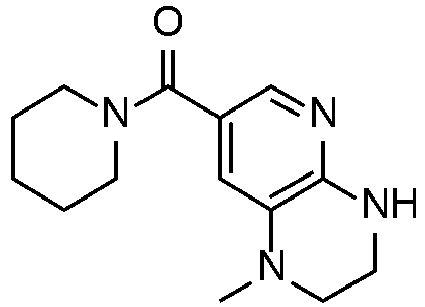
1H NMR (400 MHz, CDCl3) δ 1.51-1.74 (6H, m), 2.86 (3H, s), 3.20-3.27 (2H, m), 3.50-3.69 (6H, m), 6.73 (1H, d, J = 1. 8 Hz), 7.53 (1H, d, J = 1.8 Hz). (NH peak missing) LRMS (ESI+) 261 [M+H]+. -

- To a solution of (4-amino-3-((3-hydroxypropyl)thio)phenyl)(piperidin-1-yl)methanone (1.26 g) in chloroform (8.5 mL), phosphorus tribromide (1.22 mL) was added at 0°C, followed by stirring at room temperature for 1 hour and subsequently at 60°C for 2 hours. The resultant reaction solution was poured into ice water, and a saturated sodium bicarbonate aqueous solution was added thereto to adjust pH to 10, followed by extraction with ethyl acetate. The resultant organic layer was dried over anhydrous sodium sulfate and filtered, and the resultant filtrate was concentrated under reduced pressure. The thus obtained residue was purified by silica gel column chromatography (hexane:ethyl acetate = 1:1) to obtain the title compound (1.10 g).
- 1H NMR (400 MHz, CDCl3) δ 1.50-1.72 (6H, m), 2.02-2.10 (2H, m), 2.89 (2H, t, J = 6.7 Hz), 3.50 (2H, t, J = 6.7 Hz), 3.42-3.65 (4H, m), 4.54 (2H, brs), 6.70 (1H, d, J = 7.9 Hz), 7.22 (1H, dd, J = 7.9, 1.8 Hz), 7.45 (1H, d, J = 1.8 Hz).
- LRMS (ESI+) 357 [M+H]+.
-

- To a solution of (4-amino-3-((3-bromopropyl)thio)phenyl)(piperidin-1-yl)methanone (914 mg) in dimethylsulfoxide (5 mL), potassium hydroxide (215 mg) was added, followed by stirring at 100°C for 5 hours. The resultant reaction solution was concentrated under reduced pressure, and the thus obtained residue was purified by silica gel column chromatography (hexane:ethyl acetate = 1:1) to obtain the title compound (410 mg).
- 1H NMR (400 MHz, CDCl3) δ 1.50-1.70 (6H, m), 2.03-2.12 (2H, m), 2.93 (2H, t, J = 6.1 Hz), 3.38 (2H, t, J = 5.5 Hz), 3.35-3.70 (4H, m), 4.06 (1H, brs), 6.66 (1H, d, J = 7.9 Hz), 7.09 (1H, dd, J = 7.9, 1.8 Hz), 7.40 (1H, d, J = 1.8 Hz).
- LRMS (ESI+) 277 [M+H]+.
-

- A solution, in toluene (15 mL), of methyl 8-chloro-3,4-dihydro-2H-benzo[b][1,4]oxazine-7-carboxylate (341 mg), tert-butyl 4-iodobenzoate (684 mg), tris(dibenzylideneacetone) dipalladium (0) (68.6 mg), 4,5-bis(diphenylphosphino)-9,9-dimethylxanthene (Xantphos) (86.8 mg) and sodium tert-butoxide (288 mg) was stirred at 85°C for 2 hours, and the resultant reaction solution was then filtered, and the resultant filtrate was concentrated under reduced pressure. The thus obtained residue was purified by silica gel column chromatography (ethyl acetate:hexane = 5:95 to 20:80) to obtain the title compound (394 mg).
- 1H NMR (400 MHz, CDCl3) δ: 1.60 (9H, s), 3.80 (2H, t, J = 4.3 Hz), 3.89 (3H, s), 4.45 (2H, t, J = 4.3 Hz), 6.88 (1H, d, J = 9.2 Hz), 7.23-7.28 (2H, m), 7.34 (1H, d, J = 9.2 Hz), 7.98-8.03 (2H, m).
- LRMS (ESI+) 404 [M+H]+.
- Compounds of the following Reference Examples 20-2 to 20-10 were obtained in the same manner as in Reference Example 20-1 by using corresponding starting materials and reactants. Their structures and spectrum data are shown in the following tables.
[Table 26] Reference Example No. Chemical Structural Formula Spectrum Data 20-2 
1H NMR (400 MHz, CDCl3) δ 1.59 (9H, s), 3.91 (2H, t, J = 4.5 Hz), 4.35 (2H, t, J = 4.5 Hz), 7.24-7.27 (1H, m), 7.37-7 .42 (2H, m), 7.80 (1H, d, J = 1.8 Hz), 7.97-8.02 (2H, m). LRMS (ESI+) 391 [M+H]+. [Table 27] Reference Example No. Chemical Structural Formula Spectrum Data 20-3 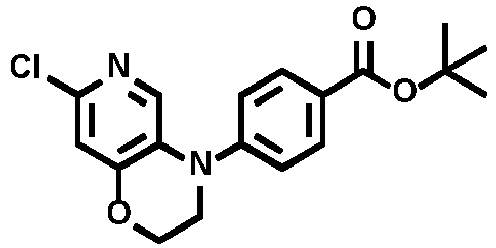
1H NMR (400 MHz, CDCl3) δ 1.59 (9H, s), 3.76 (2H, t, J = 4.2 Hz), 4.35 (2H, t, J = 4.2 Hz), 6.86 (1H, s), 7.17-7.22 ( 2H, m), 7.95-7.99 (2H, m), 8.09 (1H, s). LRMS (ESI+) 347 [M+H]+. 20-4 
1H NMR (400 MHz, CDCl3) δ 1.60 (9H, s), 3.75 (2H, t, J = 4.2 Hz), 4.48 (2H, t, J = 4.2 Hz), 6.93 (1H, d, J = 8.5 Hz) , 7.17-7.21 (2H, m), 7.23 (1H, d, J = 8.5 Hz), 7.97-8.01 (2H , m). LRMS (ESI+) 391 [M+H]+. 20-5 
1H NMR (400 MHz, CDCl3) δ 1.33 (3H, t, J = 7.0 Hz), 1.5 9 (9H, s), 3.80 (2H, t, J = 4.3 Hz), 4.29 (2H, q, J = 7.1 H z), 4.35 (2H, t, J = 4.3 Hz), 7.31-7.35 (3H, m), 7.96-8.00 (2 H, m). LRMS (ESI+) 390 [M+H]+. 20-6 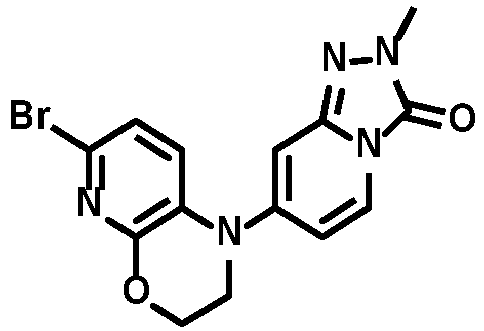
1H NMR (400 MHz, CDCl3) δ 3.63 (3H, s), 3.72-3.77 (2H, m), 4.48-4.52 (2H, m), 6.47 (1H, dd, J = 7.6, 2.1 Hz), 6.51 (1H, d, J = 1.8 Hz), 7.03 (1H, d, J = 7.9 Hz), 7.22 (1H, d, J = 8.6 Hz), 7.73 (1H, d, J = 8.6 Hz). LRMS (ESI+) 362 [M+H]+. [Table 28] Reference Example No. Chemical Structural Formula Spectrum Data 20-7 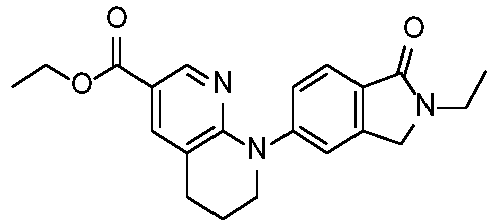
1H NMR (400 MHz, CDCl3) δ 1.26 (3H, t, J = 7.3 Hz), 1.3 5 (3H, t, J = 7.3 Hz), 2.08-2.16 (2H, m), 2.92 (2H, t, J = 6. 1 Hz), 3.68 (2H, q, J = 7.3 Hz), 3.86 (2H, t, J = 6.1 Hz), 4 .32 (2H, q, J = 7.3 Hz), 4.39 (2H, s), 7.37 (1H, dd, J = 7.9, 1.8 Hz), 7.44 (1H, d, J = 1.2 Hz), 7.83-7.89 (2H, m), 8.56 (1H, d, J = 2.4 Hz). LRMS (ESI+) 366 [M+H]+. 20-8 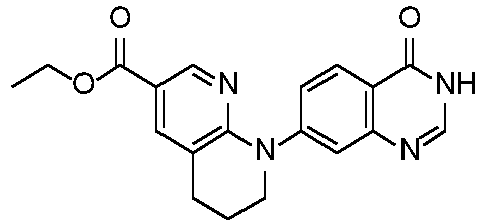
1H NMR (400 MHz, CDCl3) δ 1.36 (3H, t, J = 7.3 Hz), 2.1 0-2.19 (2H, m), 2.94 (2H, t, J = 6.1 Hz), 3.95 (2H, t, J = 6. 1 Hz), 4.34 (2H, q, J = 7.3 Hz), 7.60-7.65 (2H, m), 7.90-7.9 2 (1H, m), 8.00 (1H, br s), 8.24 (1H, d, J = 9.2 Hz), 8.61 ( 1H, d, J = 2.4 Hz), 9.70-9.87 (1H, m). LRMS (FD+) 350 [M]+. 20-9 
1H NMR (400 MHz, CDCl3) δ 1.38 (3H, t, J = 7.0 Hz), 2.0 9-2.21 (2H, m), 2.91 (2H, t, J = 6.4 Hz), 3.44 (3H, s), 3.85 (2H, t, J = 5.8 Hz), 4.36 (2H, q, J = 7.1 Hz), 5.31 (2H, s), 6.68-6.79 (2H, m), 7.64 (1H, d, J = 7.3 Hz), 7.94 (1H, t, J = 1.2 Hz), 8.66 (1H, d, J = 2.4 Hz). LRMS (ESI+) 384 [M+H]+. 20-10 
1H NMR (400 MHz, CDCl3) δ 3.22 (3H, s), 3.90 (3H, s), 3.98-4.03 (2 H, m), 4.37-4.44 (4H, m), 7.43 (1H, dd, J = 8.6, 1.8 Hz), 7.56-7.58 (1H, m), 7.68 (1H, d, J = 1.8 Hz), 7.89 (1H, d, J = 8.6 Hz), 8.42 (1H, d, J = 1.8 Hz). LRMS (ESI+) 340 [M+H]+. -

- A solution, in 1,4-dioxane (2.0 mL), of methyl 4-(4-tert-butoxycarbonyl)phenyl)-8-chloro-3,4-dihydro-2H-benzo[b][1,4]oxazine-7-carboxylate (80.0 mg), trimethylboroxine (49.7 mg), tetrakis(triphenylphosphine)palladium (0) (45.8 mg) and potassium carbonate (109 mg) was heated to reflux for 7.5 hours, and 1,4-dioxane (4 mL) was then added thereto. To the resultant reaction solution, trimethylboroxine (49.7 mg), tetrakis(triphenylphosphine)palladium (0) (45.8 mg) and potassium carbonate (109 mg) were added, the resultant was heated to reflux for 9.5 hours, and the resultant reaction solution was then concentrated under reduced pressure. The thus obtained residue was purified by silica gel column chromatography (ethyl acetate:hexane = 5:95 to 20:80) to obtain the title compound (53.1 mg).
- 1H NMR (400 MHz, CDCl3) δ: 1.59 (9H, s), 2.50 (3H, s), 3.77 (2H, t, J = 4.6 Hz), 3.85 (3H, s), 4.35 (2H, t, J = 4.3 Hz), 6.87 (1H, d, J = 8.6 Hz), 7.22-7.28 (2H, m), 7.36 (1H, d, J = 9.2 Hz), 7.95-7.99 (2H, m).
- LRMS (ESI+) 384 [M+H]+.
-

- The title compound was synthesized in the same manner as in Reference Example 21-1 by using corresponding starting material and reactant.
- 1H NMR (400 MHz, CDCl3) δ: 0.53 (2H, q, J = 5.5 Hz), 0.92-0.98 (2H, m), 1.59 (9H, s), 1.92-2.01 (1H, m), 3.77 (2H, t, J = 4.3 Hz), 3.88 (3H, s), 4.35 (2H, t, J = 4.3 Hz), 6.90 (1H, d, J = 8.6 Hz), 7.09 (1H, d, J = 8.6 Hz), 7.20-7.25 (2H, m), 7.94-7.98 (2H, m).
- LRMS (ESI+) 410 [M+H]+.
-

- To a solution of ethyl 4-methoxy-5-nitrothiophene-2-carboxylate (701 mg; known compound described in literature,
US 20130324501 ) in pyridine (30.3 mL), lithium iodide (4.05 g) was added. The resultant was stirred at 100°C for 2.5 hours, and the resultant reaction solution was added to 1 mol/L hydrogen chloride aqueous solution (100 mL). The resultant was extracted with dichloromethane (10 mL x 5), and the resultant organic layers were combined, washed with 4 mol/L hydrogen chloride aqueous solution (35 mL x 3) and saturated saline, and dried over sodium sulfate. After filtration, the resultant filtrate was concentrated under reduced pressure to obtain the title compound in the form of a reddish brown solid (505 mg). - 1H NMR (400 MHz, CDCl3) δ 1.40 (3H, t, J = 7.3 Hz), 4.41 (2H, q, J = 7.1 Hz), 7.39 (1H, s), 9.83 (1H, s).
- LRMS (ESI-) 216 [M-H]-.
-

- A solution, in acetic acid (44 mL), of ethyl 4-(2-chloroethoxy)-5-nitrothiophene-2-carboxylate (617 mg) and reduced iron (614 mg) was stirred at 60°C for 40 minutes, and the resultant reaction solution was filtered through celite. The resultant filtrate was concentrated under reduced pressure, and the thus obtained residue was purified by silica gel column chromatography (ethyl acetate:hexane = 10:90 to 50:50) to obtain the title compound (507 mg).
1H NMR (400 MHz, δ 1.33 (3H, t, J = 7.3 Hz), 3.75 (2H, t, J = 5.5 Hz), 4.08-4.22 (4H, m), 4.28 (2H, q, J = 7.3 Hz), 7.37 (1H, s). -

- To a solution of ethyl 5-amino-4-(2-chloroethoxy)thiophene-2-carboxylate (481 mg) in N,N-dimethylacetamide (38 mL), potassium carbonate (530 mg) was added. The resultant reaction solution was stirred at 100°C for 1 hour, and the resultant reaction solution was added to a 0.2 mol/L hydrogen chloride aqueous solution under ice cooling. The resultant was extracted with ethyl acetate, and the resultant organic layers were combined and dried over sodium sulfate. After filtering, the resultant filtrate was concentrated under reduced pressure, and the thus obtained residue was purified by silica gel column chromatography (ethyl acetate:hexane = 5:95 to 35:65) to obtain the title compound (266 mg).
- 1H NMR (400 MHz, CDCl3) δ 1.33 (3H, t, J = 7.0 Hz), 3.44 (2H, t, J = 4.3 Hz), 3.94 (1H, s), 4.17 (2H, t, J = 4.3 Hz), 4.28 (2H, q, J = 7.1 Hz), 7.24 (1H, s).
- LRMS (ESI+) 214 [M+H]+.
-

- To a solution, in tetrahydrofuran (50 mL), of methyl 4-amino-3-hydroxybenzoate (1.00 g) and tert-butyl 4-oxocyclohexane-1-carboxylate (991 mg), acetic acid (2.8 mL) was added. The resultant was stirred at 65°C for 1.5 hours, sodium triacetoxyborohydride (1.59 g) was added to the resultant reaction solution at room temperature, followed by stirring at 65°C for 4 hours. The reaction solution was added to a saturated sodium bicarbonate aqueous solution (200 mL), the resultant was extracted with ethyl acetate (50 mL x 2), and the resultant organic layers were combined and dried over sodium sulfate. The resultant was filtered, the obtained filtrate was concentrated under reduced pressure, and the thus obtained residue was purified by silica gel column chromatography (ethyl acetate:hexane = 10:90 to 40:60) to obtain the title compound (1.12 g).
- 1H NMR (400 MHz, CDCl3) δ: 1.14-2.49 (18H, m), 3.25-3.60 (1H, m), 3.85 (3H, d, J = 1.8 Hz), 4.37-4.74 (1H, m), 5.19-5.64 (1H, m), 6.55 (1H, t, J = 7.0 Hz), 7.35-7.49 (1H, m), 7.57 (1H, d, J = 8.5 Hz).
- LRMS (ESI+) 350 [M+H]+.
-

- The title compound was synthesized in the same manner as in Reference Example 25-1 by using corresponding starting material and reactant.
- 1H NMR (400 MHz, CDCl3) δ: 1.17-1.32 (3H, m), 1.33-1.46 (2H, m), 1.62-1.71 (1H, m), 1.72-1.85 (2H, m), 1.99-2.13 (2H, m), 3.26-3.41 (1H, m), 3.85 (3H, s), 4.53 (1H, s), 5.09-5.51 (1H, m), 6.56 (1H, d, J = 8.5 Hz), 7.38-7.50 (1H, m), 7.57 (1H, d, J = 7.9 Hz).
- LRMS (ESI+) 250 [M+H]+.
-


-
- Isomer A: 6-iodo-2-methylbenzo[d]isoxazol-3(2H)-one
- Isomer B: 6-iodo-3-methoxybenzo[d]isoxazole
- To a solution of methyl 2-hydroxy-4-iodobenzoate (7.75 g; commercially available product) in 1,4-dioxane (200 mL), hydroxylamine (50 mL) was added at room temperature. The resultant was stirred at room temperature for 3 days, water and ethyl acetate were added to the resultant reaction solution, and the organic layer and the aqueous layer were separated. The aqueous layer was prepared to be acidic by using concentrated hydrochloric acid. The resultant was extracted with ethyl acetate, washed with saturated saline, and dried over sodium sulfate. The resultant was filtered, the thus obtained filtrate was concentrated under reduced pressure to obtain a crude product containing N,2-dihydroxy-4-iodobenzamide (11.8 g).
- To a solution, in tetrahydrofuran (200 mL), of the crude product (11.8 g) containing N,2-dihydroxy-4-iodobenzamide, 1,1'-carbonyldiimidazole (13.6 g) was added. The resultant reaction solution was heated to reflux for 1.5 hours, water and ethyl acetate were added thereto, and the organic layer and the aqueous layer were separated. The aqueous layer was prepared to be acidic by using concentrated hydrochloric acid. The resultant was extracted with ethyl acetate, washed with water and saturated saline, and dried over magnesium sulfate. The resultant was filtered, and the thus obtained filtrate was concentrated under reduced pressure to obtain a crude product containing 6-iodobenzo[d]isoxazol-3(2H)-one (4.08 g).
- To a solution, in N,N-dimethylformamide (5.9 mL), of the crude product (461 mg) containing 6-iodobenzo[d]isoxazol-3(2H)-one, methyl iodide (219 µL) was added. To the resultant reaction solution, potassium carbonate (486 mg) was added at room temperature, followed by stirring at room temperature for 5 hours. The resultant was filtered, the thus obtained filtrate was concentrated under reduced pressure, and the thus obtained residue was purified by silica gel column chromatography (ethyl acetate:hexane = 5:95 to 100:0) to obtain 6-iodo-2-methylbenzo[d]isoxazol-3(2H)-one (104 mg) and 6-iodo-3-methoxybenzo[d]isoxazole (111 mg).
- 6-Iodo-2-methylbenzo[d]isoxazol-3(2H)-one
- 1H NMR (400 MHz, CDCl3) δ: 3.65 (3H, s), 7.55 (1H, d, J = 7.9 Hz), 7.61 (1H, dd, J = 7.9, 1.2 Hz), 7.65 (1H, d, J = 1.2 Hz).
- LRMS (ESI+) 276 [M+H]+.
- 6-Iodo-3-methoxybenzo[d]isoxazole
- 1H NMR (400 MHz, CDCl3) δ: 4.16 (3H, s), 7.36 (1H, d, J = 7.9 Hz), 7.59 (1H, dd, J = 7.9, 1.2 Hz), 7.86 (1H, s).
- LRMS (ESI+) 276 [M+H]+.
- Compounds of the following Reference Example 26-2 (an isomer A and an isomer B) were obtained in the same manner as in Reference Example 26-1 by using corresponding starting materials and reactants. Their structures and spectrum data are shown in the following table.
[Table 29] Reference Example No. Chemical Structural Formula Spectrum Data 26-2 Isomer A 
1H NMR (400 MHz, CDCl3) δ 1.38 (3H, t, J = 7.0 Hz), 4.0 8 (2H, q, J = 7.1 Hz), 7.55 (1H, d, J = 8.6 Hz), 7.61 (1H, dd, J = 7.9, 1.2 Hz), 7.66 (1H, d, J = 1.2 Hz). LRMS (ESI+) 290 [M+H]+. 26-2 Isomer B 
1H NMR (400 MHz, CDCl3) δ 1.51 (3H, t, J = 7.0 Hz), 4.4 9 (2H, q, J = 6.9 Hz), 7.37 (1H, d, J = 8.6 Hz), 7.58 (1H, dd, J = 7.9, 1.2 Hz), 7.85 (1H, s). LRMS (ESI+) 290 [M+H]+. -

- To a solution of 7-iodo-[1,2,4]triazolo[4,3-a]pyridin-3(2H)-one (203 mg; known compound described in literature,
WO2011057757A1 ) in N,N-dimethylformamide (2.6 mL), methyl iodide (96 µL) was added. To the resultant reaction solution, potassium carbonate (214 mg) was added at room temperature, followed by stirring at room temperature for 2 hours. A solid precipitated by adding water to the resultant reaction mixture was collected by filtration, dissolved in dichloromethane (5 mL) and dried over sodium sulfate. The resultant was filtered, the thus obtained filtrate was concentrated under reduced pressure, and the thus obtained residue was purified by silica gel column chromatography (ethyl acetate:hexane = 10:90 to 65:35) to obtain the title compound (122 mg). - 1H NMR (400 MHz, CDCl3) δ: 3.64 (3H, s), 6.71 (1H, dd, J = 7.3, 1.8 Hz), 7.50 (1H, d, J = 7.3 Hz), 7.56 (1H, d, J = 1.2 Hz).
- LRMS (ESI+) 276 [M+H]+.
- Compounds of the following Reference Examples 27-2 to 27-32 were obtained in the same manner as in Reference Example 27-1 by using corresponding starting materials and reactants. Their structures and spectrum data are shown in the following tables.
[Table 30] Reference Example No. Chemical Structural Formula Spectrum Data 27-2 
1H NMR (400 MHz, DMSO-d6) δ: 3.28 (3H, s), 5.17 (2H, s) , 6.81 (1H, dd, J = 7.3, 1.2 Hz), 7.65 (1H, dd, J = 7.3, 1.2 Hz), 7.82 (1H, s). LRMS (ESI+) 306 [M+H]+. 27-3 
1H NMR (400 MHz, CDCl3) δ: 1.41 (3H, t, J = 7.0 Hz), 4.0 3 (2H, q, J = 7.1 Hz), 6.70 (1H, dd, J = 7.3, 1.8 Hz), 7.50 (1H, d, J = 7.3 Hz), 7.57 (1H, t, J = 1.2 Hz). LRMS (CI+) 290 [M+H]+. 27-4 
1H NMR (400 MHz, CDCl3) δ: 1.44 (6H, d, J = 6.7 Hz), 4. 64-4.71 (1H, m), 6.69 (1H, dd, J = 7.3, 1.2 Hz), 7.50 (1H, d , J = 7.3 Hz), 7.59 (1H, s). LRMS (ESI+) 304 [M+H]+. 27-5 
1H NMR (400 MHz, CDCl3) δ: 3.36 (3H, s), 3.76 (2H, t, J = 5.5 Hz), 4.16 (2H, t, J = 5.5 Hz), 6.70 (1H, dd, J = 7.3, 1.2 Hz), 7.50 (1H, d, J = 7.3 Hz), 7.57 (1H, s). LRMS (ESI+) 320 [M+H]+. 27-6 
1H NMR (400 MHz, CDCl3) δ 3.70 (3H, s), 6.86 (1H, d, J = 7.3 Hz), 7.47 (1H, d, J = 7.3 Hz). LRMS (ESI+) 310 [M+H]+. 27-7 
1H NMR (400 MHz, CDCl3) δ 5.13 (2H, s), 6.70 (1H, dd, J = 7.3, 1.8 Hz), 7.27-7.41 (5H, m), 7.51 (1H, dd, J = 7.3, 1.2 Hz), 7.54 (1H, d, J = 1.2 Hz). LRMS (ESI+) 352 [M+H]+. [Table 31] Reference Example No. Chemical Structural Formula Spectrum Data 27-8 
1H NMR (400 MHz, CDCl3) δ 5.14 (2H, s), 6.72 (1H, dd, J = 7.3, 1.2 Hz), 7.24-7.32 (1H, m), 7.51 (1H, d, J = 7.3 Hz), 7.55 (1H, t, J = 1.2 Hz), 7.72 (1H, dt, J = 7.9, 1.8 Hz), 8.5 7 (1H, dd, J = 4.6, 1.5 Hz), 8.67 (1H, d, J = 2.4 Hz). LRMS (ESI+) 353 [M+H]+. 27-9 
1H NMR (400 MHz, CDCl3) δ 2.30 (6H, s), 2.74 (2H, t, J = 6.4 Hz), 4.07 (2H, t, J = 6.4 Hz), 6.69 (1H, dd, J = 7.3, 1. 8 Hz), 7.49 (1H, dd, J = 7.3, 1.2 Hz), 7.56 (1H, t, J = 1.2 Hz). LRMS (ESI+) 333 [M+H]+. 27-10 
1H NMR (400 MHz, CDCl3) δ 5.13 (2H, s), 6.75 (1H, dd, J = 7.3, 1.8 Hz), 7.22-7.30 (2H, m), 7.52 (1H, d, J = 7.3 Hz), 7.56-7.59 (1H, m), 8.57-8.61 (2H, m). LRMS (ESI+) 353 [M+H]+. 27-11 
1H NMR (400 MHz, CDCl3) δ 3.42-3.56 (1H, m), 4.27 (2H, d, J = 7.3 Hz), 4.61 (2H, t, J = 6.1 Hz), 4.82 (2H, dd, J = 7.9, 6.7 Hz), 6.72 (1H, dd, J = 7.3, 1.2 Hz), 7.49 (1H, d, J = 7.3 Hz), 7.56 (1H, t, J = 1.2 Hz). LRMS (ESI+) 332 [M+H]+. 27-12 
1H NMR (400 MHz, CDCl3) δ 3.79 (3H, s), 4.22 (2H, s), 4. 72 (2H, s), 6.83-6.90 (2H, m), 7.20-7.25 (2H, m), 7.53 (1H, d, J = 1.2 Hz), 7.58-7.62 (1H, m), 7.74 (1H, d, J = 7.9 Hz). LRMS (ESI+) 332 [M+H]+. 27-13 
1H NMR (400 MHz, CDCl3) δ 3.67 (3H, s), 8.12 (1H, s), 8. 24 (1H, d, J = 1.8 Hz), 8.90 (1H, d, J = 1.8 Hz). LRMS (ESI+) 240 [M+H]+. 27-14 
1H NMR (400 MHz, DMSO-d6) δ 3.48 (3H, s), 7.75 (1H, s), 8.60 (1H, s), 9.14 (1H, s). LRMS (ESI+) 196 [M+H]+. [Table 32] Reference Example No. Chemical Structural Formula Spectrum Data 27-15 
1H NMR (400 MHz, CDCl3) δ 3.79 (3H, s), 4.75 (2H, s), 6. 73 (1H, dd, J = 7.3, 1.2 Hz), 7.50 (1H, d, J = 7.3 Hz), 7.57 (1H, d, J = 1.2 Hz). LRMS (ESI+) 334 [M+H]+. 27-16 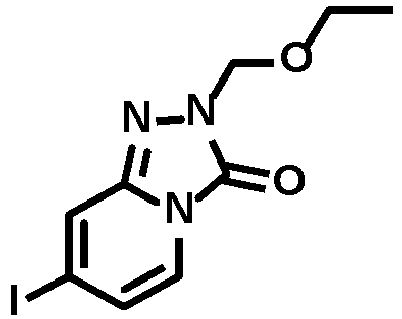
1H NMR (400 MHz, CDCl3) δ 1.22 (3H, t, J = 7.0 Hz), 3.6 5 (2H, q, J = 7.1 Hz), 5.34 (2H, s), 6.71 (1H, dd, J = 7.3, 1.8 Hz), 7.50 (1H, dd, J = 7.3, 1.2 Hz), 7.56-7.61 (1H, m). LRMS (ESI+) 320 [M+H]+. 27-17 
1H NMR (400 MHz, CDCl3) δ 1.16 (3H, t, J = 7.0 Hz), 3.5 3 (2H, q, J = 7.1 Hz), 3.80 (2H, t, J = 5.8 Hz), 4.15 (2H, t, J = 5.8 Hz), 6.69 (1H, dd, J = 7.3, 1.2 Hz), 7.50 (1H, d, J = 7.3 Hz), 7.57 (1H, d, J = 1.2 Hz). LRMS (ESI+) 334 [M+H]+. 27-18 
1H NMR (400 MHz, CDCl3) δ 3.34 (3H, s), 3.49-3.54 (2H, m), 3.61-3.67 (2H, m), 3.88 (2H, t, J = 6.1 Hz), 4.16 (2H, t, J = 5.8 Hz), 6.69 (1H, dd, J = 7.3, 1.2 Hz), 7.49 (1H, dd, J = 7.3, 1.2 Hz), 7.56 (1H, d, J = 1.2 Hz). LRMS (ESI+) 364 [M+H]+. [Table 33] Reference Example No. Chemical Structural Formula Spectrum Data 27-19 
1H NMR (400MHz, δ 3.27 (3H, s), 7.80 (1H, d, J = 8.2 Hz), 8.00 (1H, dd, J = 8.2, 1.8 Hz), 8.20 (1H, d, J = 1. 8 Hz). LRMS (ESI+): 276 [M+H]+. 27-20 
1H NMR (400MHz, CDCl3) δ 3.26 (3H, s), 7.92 (1H, d, J = 8.5 Hz), 7.96 (1H, dd, J = 8.5, 1.8 Hz), 8.07 (1H, d, J = 1. 8 Hz). LRMS (ESI+): 276 [M+H]+. 27-21 
1H NMR (400 MHz, δ 3.32 (3H, s), 4.46 (2H, s), 5. 01 (2H, s), 7.62 (1H, d, J = 7.9 Hz), 7.84 (1H, d, J = 9.7 Hz), 7.88 (1H, s). LRMS (ESI+) 304 [M+H]+. 27-23 
1H NMR (400 MHz, CDCl3) δ 3.92 (3H, s), 8.09 (1H, s), 8. 22 (1H, d, J = 1.8 Hz), 9.12 (1H, d, J = 2.4 Hz). LRMS (ESI+) 240 [M+H]+. 27-24 
1H NMR (400 MHz, CDCl3) δ 0.96 (3H, t, J = 7.3 Hz), 1.7 9-1.92 (2H, m), 3.93 (2H, t, J = 7.3 Hz), 6.70 (1H, dd, J = 7.3, 1.2 Hz), 7.48-7.53 (1H, m), 7.55-7.59 (1H, m). LRMS (EI+) 303 [M]+. 27-25 
1H NMR (400 MHz, CDCl3) δ 0.95 (3H, t, J = 7.3 Hz), 1.3 1-1.43 (2H, m), 1.75-1.87 (2H, m), 3.96 (2H, t, J = 7.3 Hz), 6.70 (1H, dd, J = 7.3, 1.2 Hz), 7.48-7.52 (1H, m), 7.55-7.5 8 (1H, m). LRMS (EI+) 317 [M]+. 27-26 
1H NMR (400 MHz, DMSO-d6) δ 3.70 (3H, s), 7.88 (1H, dd J = 8.6, 2.4 Hz), 8.09 (1H, d, J = 1.8 Hz), 8.23 (1H, d, J = 8.6 Hz), 8.37 (1H, s) LRMS (ESI+) 195 [M+H]+. [Table 34] Reference Example No. Chemical Structural Formula Spectrum Data 27-27 
1H NMR (400 MHz, CDCl3) δ 3.77 (3H, s), 5.32 (2H, s), 6.83-6.88 (2 H, m), 7.40-7.45 (2H, m), 7.65 (1H, d, J = 1.8 Hz), 7.69 (1H, dd, J = 8.3 , 2.1 Hz), 8.09 (1H, s), 8.36 (1H, d, J = 8.6 Hz). LRMS (ESI+) 301 [M+H]+. 27-28 
1H NMR (400 MHz, CDCl3) δ 3.57 (3H, s), 6.58 (1H, d, J = 1.2 Hz), 7.19-7.23 (2H, m), 7.59 (1H, d, J = 1.8 Hz), 7.75 (1H, s). LRMS (ESI+) 342 [M+H]+. 27-29 
1H NMR (400MHz, CDCl3) δ 7.09-7.20 (6H, m), 7.29-7.45 (9 H, m), 7.56-7.61 (2H, m), 7.99-8.04 (2H, m). MS (not detected) 27-30 
1H NMR (400MHz, CDCl3) δ 4.40 (3H, s), 7.61-7.65 (2H, m ), 7.99-8.03 (2H, m). LRMS (ESI+) 239 [M+H]+. 27-31 
1H NMR (400MHz, CDCl3) δ 4.18 (3H, s), 7.62-7.65 (2H, m ), 7.71-7.75 (2H, m). LRMS (ESI+) 239 [M+H]+. 27-32 
1H NMR (400 MHz, CDCl3) δ 3.65 (3H, s), 7.76 (1H, s), 7. 88 (1H, s). LRMS (ESI+) 310 [M+H]+. -

- A solution, in toluene (16 mL), of ethyl 3,4-dihydro-2H-pyrido[3,2-b][1,4]oxazine-7-carboxylate (339 mg), 2-ethyl-7-iodo-[1,2,4]triazolo[4,3-a]pyridin-3(2H)-one (474 mg), palladium (II) acetate (18.3 mg), 2-dicyclohexylphosphino-2',4',6'-triisopropylbiphenyl (58.1 mg) and cesium carbonate (1.59 g) was stirred for 3 hours under heating to reflux, the resultant reaction solution was filtered, and the thus obtained filtrate was concentrated under reduced pressure. The thus obtained residue was purified by silica gel column chromatography (ethyl acetate:hexane = 10:90 to 100:0) to obtain the title compound (498 mg).
- 1H NMR (400 MHz, DMSO-d6) δ: 1.25-1.31 (6H, m), 3.89 (2H, q, J = 7.1 Hz), 3.97 (2H, t, J = 4.2 Hz), 4.27 (2H, q, J = 7.5 Hz), 4.37 (2H, t, J = 4.2 Hz), 6.92 (1H, dd, J = 7.6, 2.1 Hz), 7.01 (1H, d, J = 1.2 Hz), 7.53 (1H, d, J = 1.8 Hz), 7.78 (1H, d, J = 7.3 Hz), 8.29 (1H, d, J = 1.8 Hz).
- LRMS (ESI+) 370 [M+H]+.
- Compounds of the following Reference Examples 28-2 to 28-6 were obtained in the same manner as in Reference Example 28-1 by using corresponding starting materials and reactants. Their structures and spectrum data are shown in the following tables.
[Table 35] Reference Example No. Chemical Structural Formula Spectrum Data 28-2 
1H NMR (400 MHz, CDCl3) δ: 1.27 (3H, t, J = 7.3 Hz), 1.3 6 (3H, t, J = 7.3 Hz), 3.68 (2H, q, J = 7.3 Hz), 3.98 (2H, t, J = 4.3 Hz), 4.31-4.42 (6H, m), 7.40 (1H, dd, J = 7.9, 1.8 Hz), 7.56 (1H, d, J = 1.2 Hz), 7.66 (1H, d, J = 1.8 Hz), 7.8 7 (1H, d, J = 7.9 Hz), 8.41 (1H, d, J = 1.8 Hz). LRMS (ESI+) 368 [M+H]+. [Table 36] Reference Example No. Chemical Structural Formula Spectrum Data 28-3 
1H NMR (400 MHz, CDCl3) δ 1.37 (3H, t, J = 7.0 Hz), 2.0 8-2.18 (2H, m), 2.90 (2H, t, J = 6.7 Hz), 3.64 (3H, s), 3.84 (2H, t, J = 5.8 Hz), 4.35 (2H, q, J = 7.1 Hz), 6.70-6.76 (2 H, m), 7.61-7.68 (1H, m), 7.90-7.95 (1H, m), 8.63-8.68 (1H, m). LRMS (ESI+) 354 [M+H]+. 28-4 
1H NMR (400 MHz, CDCl3) δ 1.33-1.42 (6H, m), 4.00 (2H, t, J = 4.6 Hz), 4.08 (2H, q, J = 7.1 Hz), 4.31-4.42 (4H, m), 7.29 (1H, dd, J = 8.6, 1.8 Hz), 7.33 (1H, d, J = 1.8 Hz), 7. 70 (1H, d, J = 1.8 Hz), 7.82 (1H, d, J = 8.6 Hz), 8.45 (1H, d, J = 1.8 Hz). LRMS (ESI+) 370 [M+H]+. 28-5 
1H NMR (400 MHz, CDCl3) δ 1.36 (3H, t, J = 7.3 Hz), 1.5 2 (3H, t, J = 7.0 Hz), 4.00 (2H, t, J = 4.6 Hz), 4.34 (2H, q, J = 7.1 Hz), 4.40 (2H, t, J = 4.6 Hz), 4.50 (2H, q, J = 7.1 Hz), 7.37 (1H, dd, J = 8.6, 1.8 Hz), 7.41 (1H, d, J = 1.2 Hz), 7.62 (1H, d, J = 8.6 Hz), 7.67 (1H, d, J = 2.4 Hz), 8.4 2 (1H, d, J = 1.8 Hz). LRMS (ESI+) 370 [M+H]+. 28-6 
1H NMR (400 MHz, DMSO-d6) δ 1.25 (3H, t, J = 7.0 Hz), 3.47 (3H, s), 3.83 (2H, t, J = 4.3 Hz), 4.22 (2H, q, J = 7.1 Hz), 4.33 (2H, t, J = 4.0 Hz), 6.81 (1H, d, J = 2.4 Hz), 6.8 5 (1H, dd, J = 7.6, 2.1 Hz), 7.37 (1H, s), 7.88 (1H, d, J = 6.7 Hz). LRMS (ESI+) 361 [M+H]+. -

- A mixture of 7-bromo-2,2-dimethyl-3,4-dihydro-2H-pyrido[3,2-b][1,4]oxazine (633 mg) and di-tert-butyl dicarbonate (2.84 g) was stirred at 80°C for 5 hours. The resultant reaction mixture was purified by silica gel column chromatography (ethyl acetate:hexane = 1:5) to obtain the title compound (925 mg).
- 1H NMR (400 MHz, δ 1.34 (6H, s), 1.54 (9H, s), 3.67 (2H, s), 7.29 (1H, d, J = 1.8 Hz), 8.10 (1H, d, J = 1.8 Hz).
- LRMS (ESI+) 343 [M+H]+.
- Compounds of the following Reference Examples 29-2 to 29-4 were obtained in the same manner as in Reference Example 29-1 by using corresponding starting materials and reactants. Their structures and spectrum data are shown in the following table.
[Table 37] Reference Example No. Chemical Structural Formula Spectrum Data 29-2 
1H NMR (400 MHz, δ 1.53 (9H, s), 1.88-1.96 (2H, m), 2.75 (2H, t, J = 6.7 Hz), 3.76 (2H, t, J = 6.1 Hz), 7.52 (1H, d, J = 2.4 Hz), 8.35 (1H, d, J = 2.4 Hz). LRMS (ESI+) 313 [M+H]+. 29-3 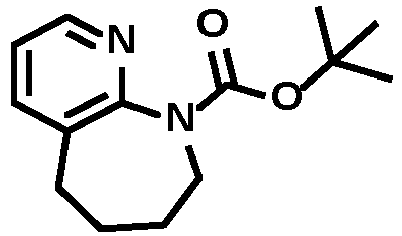
1H NMR (400 MHz, CDCl3) δ 1.43 (9H, s), 1.55-1.79 (4H, m), 1.80-1.91 (2H, m), 2.73 (2H, t, J = 5.4 Hz), 7.11 (1H, d d, J = 7.3, 4.8 Hz), 7.54 (1H, dd, J = 7.3, 1.8 Hz), 8.35 (1 H, d, J = 3.6 Hz). LRMS (ESI+) 249 [M+H]+. 29-4 
1H NMR (400 MHz, δ 1.46 (9H, s), 3.29-4.22 (4H, m), 4.54 (2H, s), 7.76 (1H, d, J = 2.4 Hz), 8.49 (1H, d, J = 1.8 Hz). LRMS (ESI+) 329 [M+H]+. -

- A solution, in toluene (49 mL), of ethyl 3,4-dihydro-2H-pyrido[3,2-b][1,4]oxazine-7-carboxylate (1.02 g), 7-iodo-2-methyl-[1,2,4]triazolo[4,3-a]pyridin-3(2H)-one (1.48 g), palladium (II) acetate (55.0 mg), 2-dicyclohexylphosphino-2',4',6'-triisopropylbiphenyl (175 mg) and cesium carbonate (4.79 g) was heated to reflux for 3 hours. The resultant reaction solution was filtered through celite, and to the thus obtained filtrate, activated carbon (55 mg) and QuadraPure™ MPA (26 mg) were added, followed by heating to reflux for 1 hour. The resultant mixture was filtered through celite, and the thus obtained filtrate was concentrated under reduced pressure to obtain a crude product of ethyl 4-(2-methyl-3-oxo-2,3-dihydro-[1,2,4]triazolo[4,3-a]pyridin-7-yl)-3,4-dihydro-2H-pyrido[3,2-b][1,4] oxazine-7-carboxylate (2.09 g) .
- To a mixed solution, in tetrahydrofuran (80 mL) and methanol (20 mL), of the obtained crude product (2.09 g) of ethyl 4-(2-methyl-3-oxo-2,3-dihydro-[1,2,4]triazolo[4,3-a]pyridin-7-yl)-3,4-dihydro-2H-pyrido[3,2-b][1,4]oxazine-7-carboxylate, a 1 mol/L lithium hydroxide aqueous solution (4.9 mL) was added at room temperature. The resultant reaction solution was stirred at 45°C for 4 hours, and then at room temperature for 13.7 hours. To the resultant reaction solution, a 1 mol/L lithium hydroxide aqueous solution (490 µL) was added at room temperature. The resultant reaction solution was stirred at 45°C for 2.5 hours, and a 1 mol/L hydrogen chloride aqueous solution (5.4 mL) was then added to the reaction solution at room temperature. The resultant reaction solution was concentrated under reduced pressure, and the resultant was washed with water and then with ethyl acetate to obtain the title compound (1.59 g).
- 1H NMR (400 MHz, DMSO-d6) δ 3.50 (3H, s), 3.96 (2H, t, J = 4.6 Hz), 4.37 (2H, t, J = 4.6 Hz), 6.94 (1H, dd, J = 7.6, 2.1 Hz), 6.97 (1H, s), 7.52 (1H, d, J = 1.8 Hz), 7.77 (1H, d, J = 7.3 Hz), 8.27 (1H, d, J = 1.8 Hz), 12.93 (1H, s).
- LRMS (ESI+) 328 [M+H]+.
- Compounds of the following Reference Examples 30-2 to 30-3 were obtained in the same manner as in Reference Example 30-1 by using corresponding starting materials and reactants. Their structures and spectrum data are shown in the following tables.
[Table 38] Reference Example No. Chemical Structural Formula Spectrum Data 30-2 
1H NMR (400 MHz, DMSO-d6) δ 2.02-2.10 (2H, m), 3.47 (3 H, s), 3.99 (2H, t, J = 6.1 Hz), 4.24 (2H, t, J = 5.8 Hz), 6. 46 (1H, dd, J = 7.9, 1.8 Hz), 6.75 (1H, d, J = 1.8 Hz), 7.66 (1H, d, J = 7.9 Hz), 7.73 (1H, d, J = 2.4 Hz), 8.48 (1H, d, J = 1.8 Hz), 13.26 (1H, s). LRMS (ESI-) 340 [M-H]-. [Table 39] Reference Example No. Chemical Structural Formula Spectrum Data 30-3 
1H NMR (400 MHz, DMSO-d6) δ 1.29 (3H, t, J = 7.0 Hz), 1.95-2.06 (2H, m), 2.86 (2H, t, J = 6.4 Hz), 3.78-3.94 (4H, m), 6.72 (1H, dd, J = 7.9, 1.8 Hz), 7.01 (1H, d, J = 1.8 Hz ), 7.72 (1H, d, J = 6.7 Hz), 7.84-7.89 (1H, m), 8.45 (1H, d, J = 1.8 Hz), 12.75 (1H, br s). LRMS (ESI-) 338 [M-H]-. -

- To a solution of 3-chloro-3-fluoro-4-iodopyridine (257 mg) in ethanol (2.6 mL), hydrazine monohydrate (514 µL) was added. The resultant was stirred under heating at room temperature for 0.5 hours and at 50°C for 1 hour, ice water was added to the resultant reaction solution, and the thus precipitated solid was collected by filtration to obtain the title compound (245 mg).
- 1H NMR (400 MHz, δ 3.98 (2H, br s), 6.34 (1H, br s), 7.14 (1H, d, J = 5.5 Hz), 7.72 (1H, d, J = 5.5 Hz).
- LRMS (ESI+) 270 [M+H]+.
- Compounds of the following Reference Examples 31-2 to 31-3 were obtained in the same manner as in Reference Example 31-1 by using corresponding starting materials and reactants. Their structures and spectrum data are shown in the following table.
[Table 40] Reference Example No. Chemical Structural Formula Spectrum Data 31-2 
1H NMR (400 MHz, CDCl3) δ 3.76 (2H, s), 5.86 (1H, s), 6.62 (1H, d, J = 1.8 Hz), 7.01 (1H, s). LRMS (ESI+) 254 [M+H]+ 31-3 
1H NMR (400 MHz, CDCl3) δ 3.77 (2H, br s), 5.81 (1H, br s), 7.36 (1H, s), 8.04 (1H, s). LRMS (ESI+) 270 [M+H]+. -

- To a solution of 3-chloro-2-hydrazinyl-4-iodopyridine (240 mg) in acetonitrile (4.8 mL), 1,1'-carbonyldiimidazole (173 mg) was added, followed by stirring at room temperature for 8.3 hours. Ice water was added to the resultant reaction solution, and the thus precipitated solid was collected by filtration to obtain the title compound (242 mg).
- 1H NMR (400 MHz, DMSO-d6) δ 6.91 (1H, d, J = 7.3 Hz), 7.60 (1H, d, J = 7.3 Hz), 12.70 (1H, s).
- LRMS (ESI-) 294 [M-H]-.
- A compound of the following Reference Example 32-2 was obtained in the same manner as in Reference Example 32-1 by using corresponding starting material and reactant. Its structure and spectrum data are shown in the following table.
[Table 41] Reference Example No. Chemical Structural Formula Spectrum Data 32-2 
1H NMR (400 MHz, DMSO-d6) δ 8.03 (1H, s), 8.13 (1H, d, J = 1.2 Hz), 12.63 (1H, s). LRMS (ESI-) 294 [M-H]-. -

- To a mixed solution, in dichloromethane (20 mL) and methanol (4 mL), of 7-iodo-[1,2,4]triazolo[4,3-a]pyridin-3(2H)-one (131 mg), triethylamine (209 µL) and pyridin-2-yl boronic acid (92.3 mg) were added. To the resultant reaction solution, copper (II) acetate (136 mg) was added at room temperature, followed by heating to reflux for 13.5 hours. The resultant reaction solution was concentrated under reduced pressure, and the thus obtained residue was purified by silica gel column chromatography (ethyl acetate:hexane = 5:95 to 100:0, subsequently methanol:ethyl acetate = 0:100 to 20:80) to obtain the title compound (8.4 mg).
- 1H NMR (400 MHz, CDCl3) δ 6.75-6.78 (1H, m), 7.19-7.32 (1H, m), 7.58 (1H, d, J = 7.3 Hz), 7.69-7.71 (1H, m), 7.84-7.90 (1H, m), 8.28-8.33 (1H, m), 8.60-8.64 (1H, m).
- LRMS (ESI+) 339 [M+H]+.
-
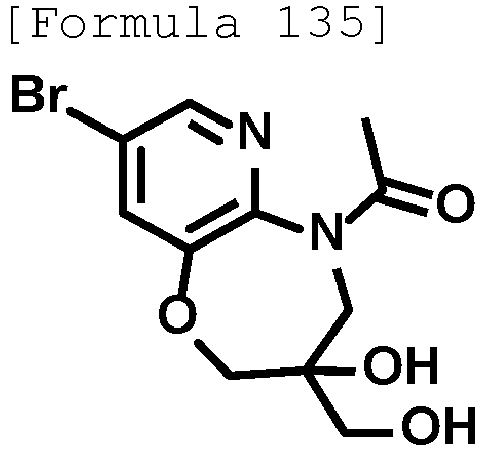
- To a mixture, with acetone (3.6 mL) and water (0.4 mL), of 1-(8-bromo-3-methylene-3,4-dihydropyrido[3,2-b][1,4]oxazepin-5(2H)-yl)ethan-1-one (111 mg), osmium tetroxide (2.5 wt% tert-butanol solution, 160 µL) and N-methylmorpholine oxide (68.9 mg) were added at room temperature. The resultant was stirred at 60°C for 3 hours, and an aqueous solution (30 mL) of sodium hydrogen sulfite (40 mg) was added to the resultant reaction solution. After extraction with dichloromethane, the resultant organic layers were combined, washed with saturated saline, and dried over anhydrous sodium sulfate. The resultant was filtered, the obtained filtrate was concentrated under reduced pressure, and the thus obtained residue was purified by silica gel column chromatography (ethyl acetate:hexane = 10:90 to 100:0, subsequently methanol/ethyl acetate = 0:100 to 20:80)) to obtain the title compound (115 mg).
- 1H NMR (400 MHz, CDCl3) δ 1.53-1.66 (1H, m), 2.22 (3H, s), 2.91-3.08 (1H, m), 3.48-3.83 (4H, m), 3.88 (1H, d, J = 12.2 Hz), 3.99-4.20 (1H, m), 7.59 (1H, d, J = 1.8 Hz), 8.23 (1H, d, J = 2.4 Hz).
- LRMS (ESI+) 317 [M+H]+.
-

- To a mixed solution, in acetone (13.5 mL) and water (4.5 mL), of 1-(8-bromo-3-hydroxy-3-(hydroxymethyl)-3,4-dihydropyrido[3,2-b][1,4]oxazepin-5(2H)-yl)ethan-1-one (114 mg), sodium periodate (385 mg) was added. The resultant was stirred at room temperature for 5 hours, and water was added to the resultant reaction solution. After extraction with a mixed solvent of dichloromethane and methanol, the resultant organic layers were combined, washed with saturated saline, and dried over anhydrous sodium sulfate. The resultant was filtered, the obtained filtrate was concentrated under reduced pressure, and the thus obtained residue was purified by silica gel column chromatography (ethyl acetate:hexane = 10:90 to 100:0) to obtain a crude product of 5-acetyl-8-bromo-4,5-dihydropyrido[3,2-b][1,4]oxazepin-3(2H)-one (118 mg). To a solution, in dichloromethane (12 mL), of the thus obtained crude product (71.1 mg) of 5-acetyl-8-bromo-4,5-dihydropyrido[3,2-b][1,4]oxazepin-3(2H)-one, N,N-diethylaminosulfur trifluoride (131 µL) was added at room temperature. The resultant was stirred at room temperature for 2.5 hours, and a saturated sodium bicarbonate aqueous solution was added to the resultant reaction solution. After extraction with dichloromethane, the resultant organic layers were combined, washed with saturated saline, and dried over anhydrous sodium sulfate. The resultant was filtered, the obtained filtrate was concentrated under reduced pressure, and the thus obtained residue was purified by silica gel column chromatography (ethyl acetate:hexane = 0:100 to 100:0) to obtain the title compound (39.3 mg).
- 1H NMR (400 MHz, CDCl3) δ 2.22 (3H, s), 4.18-4.41 (4H, m), 7.63 (1H, d, J = 1.8 Hz), 8.26 (1H, d, J = 1.8 Hz).
- LRMS (FI+) 306 [M]+.
-

- To a solution, in toluene (2.6 mL), of 1-(8-bromo-3,3-difluor0-3,4-dihydropyrido[3,2-b][1,4]oxazepin-5(2H)-yl)ethan-1-one (38.3 mg), palladium acetate (2.8 mg), 4,5-bis(diphenylphosphino)-9,9-dimethylxanthene (Xantphos) (14.5 mg) and diisopropylethylamine (63.8 µL), a solution of 2,4,6-trichlorophenyl formate (56.4 mg) in toluene (1.3 mL) was added at 85°C in a dropwise manner over 1 hour, and the resultant was stirred at 85°C for 1.5 hours. To the resultant reaction solution, diisopropylethylamine (63.8 µL) was added, and a solution of 2,4,6-trichlorophenyl formate (56.4 mg) in toluene (1.3 mL) was added thereto in a dropwise manner over 1 hour. The resultant was stirred at 85°C for 0.5 hours, the resultant reaction solution was concentrated under reduced pressure, and the thus obtained residue was purified by silica gel column chromatography (ethyl acetate:hexane = 5:95 to 50:50) to obtain the title compound (47.4 mg).
- 1H NMR (400 MHz, CDCl3) δ 2.39 (3H, s), 4.37 (2H, t, J = 10.7 Hz), 4.45 (2H, t, J = 11.6 Hz), 7.45 (2H, s), 8.18 (1H, d, J = 2.4 Hz), 8.96 (1H, d, J = 2.4 Hz).
- LRMS (ESI+) 451 [M+H]+.
- Compounds of the following Reference Examples 36-2 to 36-3 were obtained in the same manner as in Reference Example 36-1 by using corresponding starting materials and reactants. Their structures and spectrum data are shown in the following table.
[Table 42] Reference Example No. Chemical Structural Formula Spectrum Data 36-2 
1H NMR (400 MHz, DMSO-d6) δ 1.96-2.04 (2H, m), 2.16 (3 H, s), 3.90 (2H, t, J = 6.1 Hz), 4.29 (2H, t, J = 5.8 Hz), 7. 95 (2H, s), 8.09 (1H, d, J = 1.8 Hz), 8.87 (1H, d, J = 2.4 Hz). LRMS (ESI+) 415 [M+H]+. 36-3 
1H NMR (400 MHz, CDCl3) δ 2.71 (3H, s), 4.12 (2H, t, J = 4.9 Hz), 4.33 (2H, t, J = 4.9 Hz), 7.44 (2H, s), 7.94 (1H, d , J = 2.4 Hz), 8.79 (1H, d, J = 1.8 Hz). LRMS (ESI+) 401 [M+H]+. -

- To a solution of (S)-3-methylpiperidine hydrochloride (814 mg) in tetrahydrofuran (10 mL), triethylamine (2.79 mL), N,N-dimethyl-4-aminopyridine (30.5 mg) and 2,4,6-trichlorophenyl 4-acetyl-3,4-dihydro-2H-pyrido[3,2-b][1,4]oxazine-7-carboxylate (2.01 g) were added. After stirring at 45°C for 8.3 hours, triethylamine (1.4 mL) was added to the resultant reaction solution. After stirring at 45°C for 1.5 hours, methanol (6 mL) and an aqueous solution (6 mL) of potassium hydroxide (701 mg) was added to the reaction solution. After stirring at room temperature for 7.3 hours, an aqueous solution (6 mL) of potassium hydroxide (420 mg) was added to the reaction solution. After stirring at room temperature for 16 hours, 1 mol/L hydrogen chloride aqueous solution (12.5 mL) was added to the reaction solution. After extraction with ethyl acetate, the resultant organic layers were combined, washed with saturated saline and dried over anhydrous sodium sulfate. The resultant was filtered, and the obtained filtrate was concentrated under reduced pressure, and the thus obtained residue was purified by silica gel column chromatography (ethyl acetate:hexane = 20:80 to 100:0) to obtain the title compound (1.28 g).
- 1H NMR (400 MHz, CDCl3) δ 0.78-0.99 (3H, m), 1.10-1.22 (1H, m), 1.42-1.76 (3H, m), 1.82-1.90 (1H, m), 2.37-3.03 (2H, m), 3.56-3.61 (2H, m), 3.63-4.71 (4H, m), 5.07 (1H, s), 7.07 (1H, d, J = 1.2 Hz), 7.78 (1H, d, J = 1.8 Hz).
- LRMS (ESI+) 262 [M+H]+.
- Compounds of the following Reference Examples 37-2 to 37-3 were obtained in the same manner as in Reference Example 37-1 by using corresponding starting materials and reactants. Their structures and spectrum data are shown in the following table.
[Table 43] Reference Example No. Chemical Structural Formula Spectrum Data 37-2 
1H NMR (400 MHz, DMSO-d6) δ 1.92-2.08 (4H, m), 3.38-3. 45 (2H, m), 3.57 (4H, t, J = 5.5 Hz), 4.11 (2H, t, J = 4.6 Hz), 6.99 (1H, d, J = 1.8 Hz), 7.23 (1H, s), 7.70 (1H, d, J = 1.8 Hz). LRMS (ESI+) 284 [M+H]+. 37-3 
1H NMR (400 MHz, CDCl3) δ 1.55-1.73 (6H, m), 2.02-2.12 ( 2H, m), 3.40-3.46 (2H, m), 3.46-3.66 (4H, m), 4.20 (2H, t, J = 5.5 Hz), 4.91 (1H, brs), 7.23 (1H, d, J = 1.8 Hz), 7.87 (1 H, d, J = 1.8 Hz). LRMS (ESI+) 262 [M+H]+. -

- To a suspension of 2,4,6-trichlorophenyl 5-acetyl-2,3,4,5-tetrahydropyrido[3,2-b][1,4]oxazepine-8-carboxylate (1.10 g) in methanol (13.2 mL), a 5 mol/L sodium methoxide methanol solution (1.06 mL) was added in a dropwise manner, followed by stirring at 40°C for 17.5 hours. To the resultant reaction solution, a 3 mol/L hydrogen chloride aqueous solution was added under ice cooling, and the resultant was washed with dichloromethane. The resultant organic layer was extracted with a 1 mol/L hydrogen chloride aqueous solution, and the extracted aqueous layers were combined. To the resultant aqueous layers, a 2 mol/L sodium hydroxide aqueous solution was added to adjust pH to 10 to 12, followed by extraction with dichloromethane. The thus extracted organic layers were combined, and dried over anhydrous sodium sulfate. The resultant was concentrated under reduced pressure to obtain the title compound (446 mg).
- 1H NMR (400 MHz, CDCl3) δ 2.06-2.15 (2H, m), 3.48-3.55 (2H, m), 3.87 (3H, s), 4.22 (2H, t, J = 5.5 Hz), 5.16 (1H, brs), 7.67 (1H, d, J = 1.8 Hz), 8.43 (1H, d, J = 1.8 Hz).
- LRMS (ESI+) 209 [M+H]+.
-

- To a solution of 4-bromo-2-fluorobenzoic acid (500 mg) in N,N-dimethylformamide (22.9 mL), 2-methoxyethane-1-amine (236 µL), diisopropylethylamine (1.94 mL), and 1-[bis(dimethylamino)methylene]-1H-1,2,3-triazolo[4,5-b]pyridinium 3-oxide hexafluorophosphate (1.04 g) were added, followed by stirring at room temperature for 6 hours. The resultant reaction solution was concentrated under reduced pressure and purified by silica gel column chromatography (ethyl acetate:hexane = 20:80 to 100:0) to obtain the title compound (599 mg).
- 1H NMR (400 MHz, CDCl3) δ 3.40 (3H, s), 3.57 (2H, t, J = 5.1 Hz), 3.63-3.70 (2H, m), 6.99 (1H, br s), 7.32 (1H, dd, J = 10.9, 1.8 Hz), 7.41 (1H, dd, J = 8.5, 1.8 Hz), 7.98 (1H, t, J = 8.2 Hz).
- LRMS (ESI+) 276 [M+H]+.
- Compounds of the following Reference Examples 39-2 to 39-5 were obtained in the same manner as in Reference Example 39-1 by using corresponding starting materials and reactants. Their structures and spectrum data are shown in the following tables.
[Table 44] Reference Example No. Chemical Structural Formula Spectrum Data 39-2 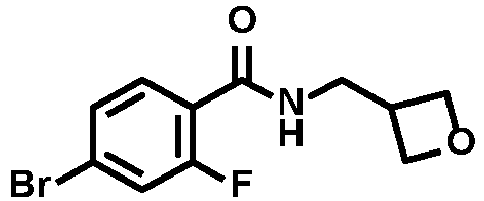
1H NMR (400 MHz, CDCl3) δ 3.23-3.39 (1H, m), 3.74-3.81 ( 2H, m), 4.48 (2H, t, J = 6.1 Hz), 4.84 (2H, dd, J = 7.6, 6.4 Hz), 6.85 (1H, br s), 7.33 (1H, dd, J = 10.9, 1.8 Hz), 7.43 ( 1H, dd, J = 8.5, 1.8 Hz), 7.98 (1H, t, J = 8.5 Hz). LRMS (ESI+) 288 [M+H]+. 39-3 
1H NMR (400 MHz, CDCl3) δ 4.61 (2H, t, J = 6.7 Hz), 5.0 2 (2H, t, J = 7.3 Hz), 5.19-5.30 (1H, m), 7.14 (1H, br s), 7. 37 (1H, dd, J = 11.5, 1.8 Hz), 7.44 (1H, dd, J = 8.5, 1.8 H z), 7.97 (1H, t, J = 8.5 Hz). LRMS (ESI+) 274 [M+H]+. 39-4 
1H NMR (400 MHz, CDCl3) δ 3.01 (3H, d, J = 4.8 Hz), 7.5 5-7.80 (2H, m), 8.41-8.46 (1H, m). LRMS (ESI+) 233 [M+H]+. [Table 45] Reference Example No. Chemical Structural Formula Spectrum Data 39-5 
1H NMR (CDCl3,, 400 MHz) δ 2.40 (3H, s), 2.99 (3H, d, J = 4.8 Hz), 5.62-5.85 (1H, m), 7.07 (1H, d, J = 8.5 Hz), 7.5 4 (1H, dd, J = 7.9, 1.2 Hz), 7.58-7.63 (1H, m). LRMS (ESI+) 276 [M+H]+. -


- To a solution of ethyl 6-chloro-2-methylnicotinate (500 mg) in carbon tetrachloride (5 mL), N-bromosuccinimide (490 mg) and azobisisobutyronitrile (4.2 mg) were added at room temperature, and the resultant reaction mixture was heated to reflux for 4 hours. The resultant reaction solution was cooled to room temperature and concentrated under reduced pressure. The thus obtained residue was purified by silica gel column chromatography (hexane:ethyl acetate = 9:1) to obtain the title compound (713 mg).
- 1H NMR (400 MHz, CDCl3) δ 1.44 (3H, t, J = 7.3 Hz), 4.44 (2H, q, J = 7.3 Hz), 4.97 (2H, s), 7.36 (1H, d, J = 8.6 Hz), 8.24 (1H, d, J = 7.9 Hz).
- LRMS (ESI+) 278 [M+H]+.
- A compound of the following Reference Example 40-2 was obtained in the same manner as in Reference Example 40-1 by using corresponding starting material and reactant. Its structure and spectrum data are shown in the following table.
[Table 46] Reference Example No. Chemical Structural Formula Spectrum Data 40-2 
1H NMR (400 MHz, CDCl3) δ 3.98 (3H, s), 4.86 (2H, s), 7. 50 (1H, s), 8.94 (1H, s). LRMS (ESI+) 264 [M+H]+. -

- To a solution of methyl 4-bromo-2-(bromomethyl) benzoate (500 mg) in tetrahydrofuran (8.1 mL), 2-ethoxyethane-1-amine (341 µL) and diisopropylethylamine (827 µL) were added, followed by stirring at room temperature for 21 hours. The resultant reaction solution was concentrated under reduced pressure, and the thus obtained residue was purified by silica gel column chromatography (ethyl acetate:hexane = 20:80 to 80:20) to obtain the title compound (431 mg).
- 1H NMR (400 MHz, CDCl3) δ 1.19 (3H, t, J = 7.0 Hz), 3.49 (2H, q, J = 6.9 Hz), 3.66 (2H, t, J = 4.8 Hz), 3.78 (2H, t, J = 4.8 Hz), 4.53 (2H, s), 7.57-7.63 (2H, m), 7.71 (1H, d, J = 8.5 Hz).
- LRMS (ESI+) 284 [M+H]+.
- Compounds of the following Reference Examples 41-2 to 41-15 were obtained in the same manner as in Reference Example 41-1 by using corresponding starting materials and reactants. Their structures and spectrum data are shown in the following tables.
[Table 47] Reference Example No. Chemical Structural Formula Spectrum Data 41-2 
1H NMR (400 MHz, CDCl3) δ 3.35 (3H, s), 3.63 (2H, t, J = 4.8 Hz), 3.79 (2H, t, J = 4.8 Hz), 4.51 (2H, s), 7.57-7.62 ( 2H, m), 7.71 (1H, d, J = 9.1 Hz). LRMS (ESI+) 270 [M+H]+. 41-3 
1H NMR (400 MHz, CDCl3) δ 3.32-3.42 (1H, m), 3.94 (2H, d, J = 7.3 Hz), 4.35 (2H, s), 4.56 (2H, t, J = 6.4 Hz), 4.84 (2H, dd, J = 7.9, 6.7 Hz), 7.59-7.64 (2H, m), 7.71 (1H, dd, J = 7.0, 2.1 Hz). LRMS (ESI+) 282 [M+H]+. 41-4 
1H NMR (400 MHz, CDCl3) δ 4.69 (2H, s), 4.86 (2H, t, J = 6.7 Hz), 5.00 (2H, t, J = 7.3 Hz), 5.59-5.69 (1H, m), 7.61-7 .65 (1H, m), 7.68-7.73 (2H, m). LRMS (ESI+) 268 [M+H]+. 41-5 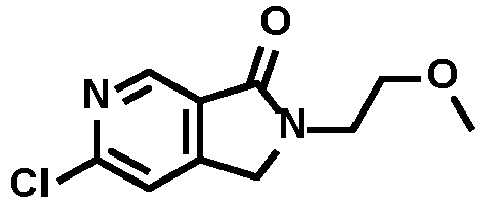
1H NMR (400 MHz, CDCl3) δ 3.35 (3H, s), 3.63 (2H, t, J = 4.8 Hz), 3.79 (2H, t, J = 5.1 Hz), 4.58 (2H, s), 7.45 (1H, s ), 8.86 (1H, s). LRMS (ESI+) 227 [M+H]+. 41-6 
1H NMR (400 MHz, CDCl3) δ 1.19 (3H, t, J = 7.0 Hz), 3.4 9 (2H, q, J = 6.9 Hz), 3.66 (2H, t, J = 4.8 Hz), 3.79 (2H, t, J = 5.1 Hz), 4.60 (2H, s), 7.46 (1H, s), 8.86 (1H, s). LRMS (ESI+) 241 [M+H]+. 41-7 
1H NMR (400 MHz, CDCl3) δ 4.75 (2H, s), 4.84 (2H, t, J = 6.7 Hz), 5.01 (2H, t, J = 7.6 Hz), 5.58-5.67 (1H, m), 7.55 ( 1H, d, J = 1.2 Hz), 8.87 (1H, s). LRMS (ESI+) 225 [M+H]+. 41-8 
1H NMR (400 MHz, CDCl3) δ 3.23 (3H, s), 4.43 (2H, s), 7. 43 (1H, d, J = 7.9 Hz), 8.05 (1H, d, J = 7.9 Hz). LRMS (ESI+) 183 [M+H]+. [Table 48] Reference Example No. Chemical Structural Formula Spectrum Data 41-9 
1H NMR (400 MHz, CDCl3) δ 3.20 (3H, s), 4.42 (2H, s), 7. 46 (1H, s), 8.85 (1H, s). LRMS (ESI+) 183 [M+H]+. [Table 49] Reference Example No. Chemical Structural Formula Spectrum Data 41-10 
1H NMR (400 MHz, CDCl3) δ 3.79 (3H, s), 3.84 (3H, s), 4. 26 (2H, s), 4.73 (2H, s), 6.44 (1H, dd, J = 8.6, 2.4 Hz), 6.4 7 (1H, d, J = 2.4 Hz), 7.20 (1H, d, J = 7.9 Hz), 7.53 (1H, d, J = 1.2 Hz), 7.58 (1H, dd, J = 7.9, 1.2 Hz), 7.71 (1H, d, J = 8.6 Hz). LRMS (FD+) 361 [M]+. 41-11 
1H NMR (400 MHz, CDCl3) δ 3.29-3.43 (1H, m), 3.95 (2H, d, J = 7.3 Hz), 4.41 (2H, s), 4.54 (2H, t, J = 6.4 Hz), 4.81 -4.88 (2H, m), 7.46 (1H, s), 8.86 (1H, s). LRMS (ESI+) 239 [M+H]+. 41-12 
1H NMR (400 MHz, CDCl3) δ 1.27 (3H, t, J = 7.3 Hz), 3.6 7 (2H, q, J = 7.3 Hz), 4.37 (2H, s), 7.58-7.63 (2H, m), 7.70 (1H, d, J = 7.9 Hz) .LRMS (ESI+) 240 [M+H]+. 41-13 
1H NMR (400 MHz, CDCl3) δ 0.96 (3H, t, J = 7.6 Hz), 1.63-1.76 (2H, m), 3.57 (2H, t, J = 7.3 Hz), 4.36 (2H, s), 7.58-7.62 (2H, m), 7.69-7.73 (1 H, m). LRMS (ESI+) 254 [M+H]+. 41-14 
1H NMR (400 MHz, CDCl3) δ 0.96 (3H, t, J = 7.6 Hz), 1.32-1.43 (2H, m), 1.60-1.69 (2H, m), 3.61 (2H, t, J = 7.3 Hz), 4.35 (2H, s), 7.56-7.63 (2 H, m), 7.67-7.73 (1H, m). LRMS (ESI+) 268 [M+H]+. 41-15 
1H NMR (400 MHz, CDCl3) δ 0.80-0.98 (4H, m), 2.87-2.95 (1H, m), 4 .30 (2H, s), 7.56-7.63 (2H, m), 7.66-7.73 (1H, m). LRMS (ESI+) 252 [M+H]+. -


- To a solution of tert-butyl 5,6,7,8-tetrahydro-9H-pyrido[2,3-b]azepine-9-carboxylate (749 mg) in acetonitrile (6 mL), N-bromosuccinimide (644 mg) was added at room temperature. The resultant reaction solution was stirred at 40°C for 3 hours, and subsequently at 80°C for 8 hours. The resultant reaction solution was concentrated under reduced pressure. The thus obtained residue was purified by silica gel column chromatography (hexane:ethyl acetate = 3:1) to obtain the title compound (534 mg).
- 1H NMR (400 MHz, CDCl3) δ 1.43 (9H, s), 1.62-1.76 (2H, m), 1.79-1.89 (2H, m), 2.65-2.74 (2H, m), 3.11-4.03 (2H, m), 7.69 (1H, d, J = 2.4 Hz), 8.39 (1H, d, J = 2.4 Hz).
- LRMS (ESI+) 327 [M+H]+.
-

- To a solution of ethyl 2-hydroxyacetate (5.50 mL) in N,N-dimethylformamide (200 mL), sodium hydride (60% oil suspension, 2.30 g) was added at 0°C. The resultant reaction solution was stirred at 0°C for 0.5 hours, and 5-bromo-3-(bromomethyl)pyridine-2-amine hydrochloride (10.0 g) was added thereto over 10 minutes, followed by stirring at 0°C for 0.5 hours, and subsequently at room temperature for 3 hours. Water was added to the resultant reaction solution. The thus precipitated solid was collected by filtration to obtain the title compound (2.06 g).
- 1H NMR (400 MHz, DMSO-d6) δ 4.51 (2H, s), 4.74 (2H, s), 7.90 (1H, d, J = 1.2 Hz), 8.34 (1H, d, J = 2.4 Hz), 10.56 (1H, s).
- LRMS (ESI+) 243 [M+H]+.
-

- To a solution of tert-butyl 7-bromo-2,3-dihydro-4H-pyrido[3,2-b][1,4]oxazine-4-carboxylate (765 mg) in 1,4-dioxane (24 mL), cyclohexanethiol (0.36 mL), tris(dibenzylideneacetone) dipalladium (0) (111 mg), 4,5-bis(diphenylphosphino)-9,9-dimethylxanthene (Xantphos) (140 mg) and diisopropylethylamine (0.85 mL) were added at room temperature, followed by stirring at 90°C for 5 hours. The resultant reaction solution was cooled to room temperature, and then concentrated under reduced pressure. The thus obtained residue was purified by silica gel column chromatography (hexane:ethyl acetate = 5:1) to obtain the title compound (984 mg).
- 1H NMR (400 MHz, CDCl3) δ 1.16-1.40 (6H, m), 1.55 (9H, s), 1.70-1.81 (2H, m), 1.91-2.00 (2H, m), 2.92-3.03 (1H, m), 3.92 (2H, t, J = 4.6 Hz), 4.24 (2H, t, J = 4.6 Hz), 7.24 (1H, d, J = 2.4 Hz), 8.11 (1H, d, J = 1.8 Hz).
- LRMS (ESI+) 351 [M+H]+.
- A compound of the following Reference Example 44-2 was obtained in the same manner as in Reference Example 44-1 by using corresponding starting material and reactant. Its structure and spectrum data are shown in the following table.
[Table 50] Reference Example No. Chemical Structural Formula Spectrum Data 44-2 
1H NMR (400 MHz, CDCl3) δ 1.15-1.40 (6H, m), 1.54 (9H, s), 1.71-1.80 (2H, m), 1.88-1.99 (4H, m), 2.74 (2H, t, J = 6. 7 Hz), 2.88-2.98 (1H, m), 3.77 (2H, t, J = 6.1 Hz), 7.44-7.47 (1H, m), 8.37 (1H, d, J = 2.4 Hz). LRMS (ESI+) 349 [M+H]+. -

- A mixture of tert-butyl 7-(cyclohexylthio)-2,3-dihydro-4H-pyrido[3,2-b][1,4]oxazine-4-carboxylate (300 mg) and a 4 mol/L solution (2.0 mL) of hydrogen chloride in 1,4-dioxane was stirred at room temperature for 3 hours. The resultant reaction solution was concentrated under reduced pressure, and the thus obtained residue was purified by silica gel column chromatography (hexane:ethyl acetate = 1:1) to obtain the title compound (219 mg).
- 1H NMR (400 MHz, CDCl3) δ 1.13-1.36 (6H, m), 1.70-1.81 (2H, m), 1.86-1.96 (2H, m), 2.74-2.84 (1H, m), 3.54-3.59 (2H, m), 4.22 (2H, t, J = 4.3 Hz), 4.92 (1H, br s), 7.10 (1H, d, J = 1.8 Hz), 7.77 (1H, d, J = 1.8 Hz).
- LRMS (ESI+) 251 [M+H]+.
- A compound of the following Reference Example 45-2 was obtained in the same manner as in Reference Example 45-1 by using corresponding starting material and reactant. Its structure and spectrum data are shown in the following table.
[Table 51] Reference Example No. Chemical Structural Formula Spectrum Data 45-2 
1H NMR (400 MHz, CDCl3) δ 1.10-1.34 (6H, m), 1.69-1.80 ( 2H, m), 1.86-1.98 (4H, m), 2.72 (3H, t, J = 6.4 Hz), 3.39-3. 46 (2H, m), 4.91 (1H, s), 7.25 (1H, d, J = 1.2 Hz), 7.95 (1 H, d, J = 1.8 Hz). LRMS (ESI+) 249 [M+H]+. -

- To a solution of 7-bromo-3,4-dihydro-2H-pyrido[3,2-b][1,4]oxazine (2.15 g) in tetrahydrofuran (20 mL), n-butyllithium (2.6 mol/L tetrahydrofuran solution, 10.0 mL) was added at -78°C in a dropwise manner over 30 minutes, followed by stirring for 1 hour. To the resultant solution, N-ethoxy-N-methylcyclohexanecarboxamide (4.50 g) was added at -78°C over 10 minutes. The resultant reaction solution was slowly heated to 0°C, followed by stirring at 0°C for 0.5 hours. To the reaction solution, water and a 6 mol/L hydrogen chloride aqueous solution were added to adjust pH to 4. The resultant was extracted with ethyl acetate and dried over anhydrous sodium sulfate. The resultant reaction solution was concentrated under reduced pressure, and the thus obtained residue was purified by silica gel column chromatography (hexane:ethyl acetate = 1:1) to obtain the title compound (1.41 g).
- 1H NMR (400 MHz, CDCl3) δ 1.19-1.31 (1H, m), 1.31-1.43 (2H, m), 1.44-1.56 (2H, m), 1.68-1.77 (1H, m), 1.79-1.89 (4H, m), 3.05-3.15 (1H, m), 3.59-3.66 (2H, m), 4.22 (2H, t, J = 4.6 Hz), 5.43 (1H, br s), 7.52 (1H, d, J = 1.8 Hz), 8.34 (1H, d, J = 1.8 Hz).
- LRMS (ESI+) 247 [M+H]+.
- A compound of the following Reference Example 46-2 was obtained in the same manner as in Reference Example 46-1 by using corresponding starting material and reactant. Its structure and spectrum data are shown in the following table.
[Table 52] Reference Example No. Chemical Structural Formula Spectrum Data 46-2 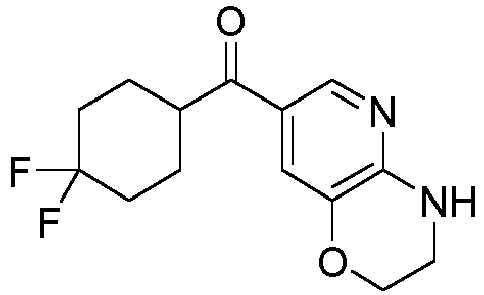
1H NMR (400 MHz, CDCl3) δ 1.75-2.00 (6H, m), 2.14-2.28 ( 2H, m), 3.13-3.25 (1H, m), 3.60-3.69 (2H, m), 4.23 (2H, t, J = 4.9 Hz), 5.49 (1H, s), 7.50 (1H, d, J = 1.2 Hz), 8.32 (1H, d, J = 1.8 Hz). LRMS (ESI+) 283 [M+H]+. -

- To a solution of tert-butyl (S)-3-(hydroxymethyl)piperidine-1-carboxylate (3.23 g) in dichloromethane (30 mL), triethylamine (4.20 mL) and ethanesulfonyl chloride (2.14 mL) were added under ice cooling. The resultant reaction solution was slowly heated to room temperature over 3 hours. The resultant reaction solution was diluted with chloroform, washed successively with a 10% citric acid aqueous solution, a saturated sodium bicarbonate aqueous solution and saturated saline, and then dried over anhydrous sodium sulfate. The resultant reaction solution was concentrated under reduced pressure, and the thus obtained residue was purified by silica gel column chromatography (hexane:ethyl acetate = 1:1) to obtain tert-butyl (S)-3-(((ethylsulfonyl)oxy)methyl)piperidine-1-carboxylate (5.95 g).
- 1H NMR (400 MHz, CDCl3) δ 1.23-1.36 (1H, m), 1.44 (3H, t, J = 7.3 Hz), 1.46 (9H, s), 1.48-1.54 (1H, m), 1.63-1.71 (1H, m), 1.78-1.87 (1H, m), 1.89-2.01 (1H, m), 2.64-2.84 (1H, m), 2.84-2.93 (1H, m), 3.15 (2H, q, J = 7.3 Hz), 3.79-3.89 (1H, m), 3.90-4.03 (1H, m), 4.03-4.15 (2H, m).
- LRMS (ESI+) 308 [M+H]+.
- A mixture of tert-butyl (S)-3-(((ethylsulfonyl)oxy)methyl)piperidine-1-carboxylate (1.50 g) and tetrabutylammonium fluoride (1 mol/L tetrahydrofuran solution, 26.0 mL) was stirred at 80°C for 12 hours. The resultant reaction solution was diluted with chloroform, washed successively with a 10% citric acid aqueous solution and saturated saline, and then dried over anhydrous sodium sulfate. The resultant reaction solution was concentrated under reduced pressure, and the thus obtained residue was purified by silica gel column chromatography (hexane:ethyl acetate = 3:1) to obtain tert-butyl (S)-3-(fluoromethyl)piperidine-1-carboxylate (914 mg).
- 1H NMR (400 MHz, CDCl3) δ 1.22-1.35 (1H, m), 1.41-1.54 (10H, m), 1.61-1.71 (1H, m), 1.74-1.82 (1H, m), 1.83-1.96 (1H, m), 2.60-2.88 (2H, m), 3.85-4.14 (2H, m), 4.20-4.29 (1H, m), 4.31-4.41 (1H, m).
- LRMS (ESI+) 218 [M+H]+.
- A mixture of tert-butyl (S)-3-(fluoromethyl)piperidine-1-carboxylate (903 mg) and 4 mol/L solution (11.0 mL) of hydrogen chloride in 1,4-dioxane was stirred at room temperature for 12 hours. The resultant reaction solution was concentrated under reduced pressure to obtain the title compound (655 mg).
- 1H NMR (400 MHz, DMSO-d6) δ 1.20-1.35 (1H, m), 1.61-1.84 (3H, m), 2.06-2.25 (1H, m), 2.61-2.81 (2H, m), 3.16-3.29 (2H, m), 4.25-4.50 (2H, m), 8.92-9.23 (2H, m).
- LRMS (ESI+) 118 [M+H]+.
- A compound of the following Reference Example 47-2 was obtained in the same manner as in Reference Example 47-1 by using corresponding starting material and reactant. Its structure and spectrum data are shown in the following table.
[Table 53] Reference Example No. Chemical Structural Formula Spectrum Data 47-2 
1H NMR (400 MHz, DMSO-d6) δ 1.20-1.35 (1H, m), 1.61-1. 84 (3H, m), 2.07-2.24 (1H, m), 2.61-2.81 (2H, m), 3.15-3.29 (2H, m), 4.24-4.50 (2H, m), 8.92-9.27 (2H, m). LRMS (ESI+) 118 [M+H]+. -

- tert-Butyl (S)-3-(hydroxymethyl)piperidine-1-caboxylate (3.23 g) was dissolved in dichloromethane (125 mL). To the resultant, Dess-Martin periodinane (DMP) (7.00 g) was added, followed by stirring at room temperature for 1.5 hours. To the resultant reaction solution, a 10% sodium thiosulfate aqueous solution (125 mL) and a saturated sodium bicarbonate aqueous solution (125 mL) were added, and the resultant was stirred for 30 minutes, followed by extraction with dichloromethane. The resultant organic layers were combined, washed with a saturated sodium bicarbonate aqueous solution and saturated saline, and dried over anhydrous sodium sulfate. The solvent was distilled off to obtain tert-butyl (S)-3-formylpiperidine-1-carboxylate (2.91 g).
- 1H NMR (400 MHz, CDCl3) δ 1.37-1.55 (10H, m), 1.63-1.76 (2H, m), 1.90-2.02 (1H, m), 2.36-2.50 (1H, m), 3.03-3.15 (1H, m), 3.32 (1H, dd, J = 13.6, 8.2 Hz), 3.56-3.72 (1H, m), 3.92 (1H, br s), 9.70 (1H, s).
- A reaction vessel was charged with dichloromethane (53.5 mL), and diethylaminosulfur trifluoride (DAST) (4.00 mL) was added dropwise thereto at -20°C. Subsequently, a solution of tert-butyl (S)-3-(hydroxymethyl)piperidine-1-carboxylate (2.67 g) in dichloromethane (9.00 mL) was added thereto, followed by stirring for 5 hours. The resultant reaction solution was added to an ice cooled saturated sodium bicarbonate aqueous solution, and extracted with dichloromethane. The resultant organic layers were combined, washed with a saturated sodium bicarbonate aqueous solution and saturated saline, and dried over anhydrous sodium sulfate. The resultant reaction solution was concentrated under reduced pressure, and the thus obtained residue was purified by silica gel column chromatography (ethyl acetate:hexane = 10:90 to 50:50) to obtain tert-butyl (S)-3-(difluoromethyl)piperidine-1-carboxylate (1.27 g).
- 1H NMR (400 MHz, CDCl3) δ 1.35-1.52 (11H, m), 1.68-1.77 (1H, m), 1.82-2.08 (2H, m), 2.56-3.10 (2H, m), 3.72-4.37 (2H, m), 5.64 (1H, td, J = 56.2, 4.6 Hz).
- LRMS (ESI+) 236 [M+H]+.
- To a solution of tert-butyl (S)-3-(difluoromethyl)piperidine-1-carboxylate (1.26 g) in 1,4-dioxane (26.8 mL), a 4 mol/L solution (26.8 mL) of hydrogen chloride in 1,4-dioxane was added, followed by stirring at room temperature for 4 hours. The resultant reaction solution was subjected to distillation under reduced pressure to obtain the title compound (919 mg).
- 1H NMR (400 MHz, CDCl3) δ 1.29-1.45 (1H, m), 1.53-1.71 (1H, m), 1.75-1.88 (2H, m), 2.17-2.39 (1H, m), 2.72-2.86 (2H, m), 3.15-3.45 (2H, m), 6.03 (1H, td, J = 55.7, 4.2 Hz), 8.74 (2H, s).
- LRMS (ESI+) 136 [M+H]+.
- A compound of the following Reference Example 48-2 was obtained in the same manner as in Reference Example 48-1 by using corresponding starting material and reactant. Its structure and spectrum data are shown in the following table.
[Table 54] Reference Example No. Chemical Structural Formula Spectrum Data 48-2 
1H NMR (DMSO, 400 MHz) δ 1.30-1.45 (1H, m), 1.60-1.75 (1H, m), 1.77-1.88 (2H, m), 2.22-2.44 (1H, m), 2.70-2.86 (2H , m), 3.18-3.31 (2H, m), 6.05 (1H, td, J = 56.0, 4.0 Hz), 9.1 2 (2H, br s). LRMS (ESI+) 136 [M+H]+. -

- To a solution of methyl 6-chloro-4-methylnicotinate (1.86 g) in carbon tetrachloride (74 mL), N-bromosuccinimide (NBS) (2.14 g) and benzoyl peroxide (129 mg) were added at room temperature, followed by stirring at 85°C for 6 hours. The resultant reaction solution was concentrated under reduced pressure, and the thus obtained residue was purified by silica gel column chromatography (ethyl acetate:hexane = 0:100 to 20:80) to obtain a mixture containing methyl 4-(bromomethyl)-6-chloronicotinate (582 mg).
- To a solution, in methanol (20 mL), of the mixture (580 mg) containing methyl 4-(bromomethyl)-6-chloronicotinate, diisopropylethylamine (701 µL) and (2,4-dimethoxyphenyl)methanamine (310 µL) were successively added at room temperature. After stirring at room temperature for 7.5 hours, the resultant reaction solution was concentrated under reduced pressure, and the thus obtained residue was purified by silica gel column chromatography (ethyl acetate:hexane = 10:90 to 80:20) to obtain the title compound (378 mg).
- 1H NMR (400 MHz, CDCl3) δ 3.80 (3H, s), 3.84 (3H, s), 4.31 (2H, s), 4.73 (2H, s), 6.43-6.49 (2H, m), 7.23 (1H, d, J = 7.9 Hz), 7.38 (1H, s), 8.85 (1H, s).
- LRMS (ESI+) 319 [M+H]+.
-

- To a solution of 7-bromo-3,4-dihydropyrido[2,3-b]pyrazin-2(1H)-one (228 mg) in N,N-dimethylformamide (5.0 mL), sodium hydride (22 mg) was added at room temperature. After stirring at room temperature for 3 hours, methyl iodide (31 µL) was added thereto. After stirring at room temperature for 2 hours, N,N-dimethylformamide (15.0 mL) was added thereto. After stirring at room temperature for 17.5 hours, sodium hydride (22 mg) was added thereto. After stirring at room temperature for 20 minutes, methyl iodide (31 µL) was added thereto. After stirring at room temperature for 7.5 hours, a saturated ammonium chloride aqueous solution was added to the resultant reaction solution, the resultant was extracted with ethyl acetate, and the resultant organic layers were combined, washed with saturate saline, and dried over anhydrous sodium sulfate. The resultant reaction solution was concentrated under reduced pressure to obtain a mixture containing 7-bromo-1-methyl-3,4-dihydropyrido[2,3-b]pyrazin-2(1H)-one (174 mg).
- To a solution, in tetrahydrofuran (7.2 mL), of the mixture (174 mg) containing 7-bromo-1-methyl-3,4-dihydropyrido[2,3-b]pyrazin-2(1H)-one, a borane-dimethylsulfide complex (720 µL) was added at room temperature. After stirring at room temperature for 22.5 hours, the resultant was stirred for 5 hours under heating to reflux. After adding methanol, the resultant reaction solution was concentrated under reduced pressure to obtain a mixture containing 7-bromo-1-methyl-1,2,3,4-tetrahydropyrido[2,3-b]pyrazine (173 mg).
- To the mixture (173 mg) containing 7-bromo-1-methyl-1,2,3,4-tetrahydropyrido[2,3-b]pyrazine, pyridine (1 mL) and acetic anhydride (1 mL) were added. After stirring at room temperature for 2.5 hours, the resultant reaction solution was concentrated under reduced pressure, and the thus obtained residue was purified by silica gel column chromatography (ethyl acetate:hexane = 10:90 to 100:0) to obtain the title compound (43.0 mg).
- 1H NMR (400 MHz, CDCl3) δ 2.43 (3H, s), 2.96 (3H, s), 3.36 (2H, t, J = 5.2 Hz), 3.98 (2H, t, J = 5.2 Hz), 6.97 (1H, d, J = 1.8 Hz), 7.71 (1H, d, J = 1.8 Hz).
- LRMS (ESI+) 270 [M+H]+.
-

- To a solution of 1-(7-bromo-1-methyl-2,3-dihydropyrido[2,3-b]pyrazin-4(1H)-yl)ethan-1-one (115 mg) in ethanol (4.3 mL), diisopropylethylamine (289 µL) and [1,1-bis(diphenylphosphino)ferrocene]palladium (II) dichloride dichloromethane adduct (34.7 mg) were added. The resultant mixture was stirred under carbon monoxide atmosphere at 85°C for 9 hours. The resultant reaction solution was concentrated under reduced pressure, and the thus obtained residue was purified by silica gel column chromatography (ethyl acetate:hexane = 5:95 to 100:0) to obtain the title compound (68.0 mg).
- 1H NMR (400 MHz, CDCl3) δ 1.37 (3H, t, J = 7.0 Hz), 2.89 (3H, s), 3.19-3.23 (2H, m), 3.62-3.67 (2H, m), 4.33 (2H, q, J = 7.1 Hz), 5.22 (1H, s), 7.15 (1H, d, J = 1.2 Hz), 8.18 (1H, d, J = 1.8 Hz).
- LRMS (ESI+) 222 [M+H]+.
-

- To a solution of 7-bromo-3,4-dihydropyrido[2,3-b]pyrazin-2(1H)-one (3.08 g) in tetrahydrofuran (135 mL), borane-dimethylsulfide complex (3.8 mL) was added at room temperature. After stirring under heating to reflux for 2 hours, ethanol (20 mL) and a 1 mol/L sodium hydroxide aqueous solution (80 mL) were added to the resultant reaction solution. After stirring at 85°C for 2 hours, the resultant was filtered through celite. The thus obtained filtrate was extracted with ethyl acetate, and the resultant organic layers were combined and dried over anhydrous sodium sulfate. The resultant reaction solution was concentrated under reduced pressure, and to a solution of the thus obtained residue in dichloromethane (100 mL), di-tert-butyl dicarbonate (5.89 g) and N,N-dimethyl-4-aminopyridine (82.5 mg) were added at room temperature. After stirring at room temperature for 14.5 hours, the resultant reaction solution was concentrated under reduced pressure, and the thus obtained residue was purified by silica gel column chromatography (ethyl acetate:hexane = 0:100 to 50:50) to obtain the title compound (2.69 g).
- 1H NMR (400 MHz, CDCl3) δ 1.53 (9H, s), 1.55 (9H, s), 3.76-3.87 (4H, m), 8.18 (1H, d, J = 1.8 Hz), 8.41-8.56 (1H, m).
- LRMS (ESI+) 414 [M+H]+.
-

- To a solution of 2-fluoro-4-iodo-6-methoxypyridine (228 mg) in ethanol (2.3 mL), hydrazine monohydrate (456 µL) was added at room temperature. After stirring at 50°C for 8 hours, a solid precipitated by adding ice water to the resultant reaction mixture was collected by filtration to obtain a mixture containing 2-hydrazinyl-4-iodo-6-methoxypyridine (111 mg).
- To a solution, in acetonitrile (2.5 mL), of the mixture (111 mg) containing 2-hydrazinyl-4-iodo-6-methoxypyridine, 1,1'-carbonyldiimidazole (81.2 mg) was added. After stirring at room temperature for 2.6 days, a solid precipitated by adding ice water to the resultant reaction mixture was collected by filtration to obtain a mixture containing 7-iodo-5-methoxy-[1,2,4]triazolo[4,3-b]pyridin-3(2H)-one (93.3 mg).
- To a solution, in N,N-dimethylformamide (1.2 mL), of the mixture (93.3 mg) containing 7-iodo-5-methoxy-[1,2,4]triazolo[4,3-a]pyridin-3(2H)-one, potassium carbonate (88.5 mg) and methyl iodide (40 µL) were added at room temperature. After stirring at room temperature for 1 hour, N,N-dimethylformamide (1.2 mL) was added to the resultant reaction solution. After stirring at room temperature for 17 hours, tetrahydrofuran (1.0 mL) was added to the resultant reaction solution, followed by stirring under heating to reflux for 40 minutes. A solid precipitated by adding ice water to the resultant reaction solution was collected by filtration to obtain the title compound (70.9 mg).
- 1H NMR (400 MHz, DMSO-d6) δ 3.37 (3H, s), 3.89 (3H, s), 5.99 (1H, s), 7.19 (1H, s).
- LRMS (ESI+) 306 [M+H]+.
-

- To a solution of 2-fluoro-6-hydrazinyl-4-iodopyridine (225 mg) in acetonitrile (4.5 mL), 1,1'-carbonyldiimidazole (174 mg) was added. After stirring at room temperature for 1.6 days, a solid precipitated by adding ice water to the resultant reaction solution was collected by filtration to obtain the title compound (141 mg).
- 1H NMR (400 MHz, DMSO-d6) δ 6.76 (1H, d, J = 1.2 Hz), 6.98 (1H, t, J = 1.2 Hz), 7.48 (1H, t, J = 1.5 Hz), 7.80 (1H, d, J = 1.8 Hz), 7.93 (1H, d, J = 1.2 Hz), 12.51 (1H, s).
- LRMS (ESI+) 328 [M+H]+.
-

- To a solution of (6-methoxy-3,4-dihydro-2H-benzo[b][1,4]oxazin-7-yl)(piperidin-1-yl)methanone (62.0 mg) in toluene (1.2 mL), methyl 4-iodobenzoate (89.0 mg), tris(dibenzylideneacetone)dipalladium (0) (11.0 mg), 4,5-bis(diphenylphosphino)-9,9-dimethylxanthene (Xantphos) (13.0 mg) and sodium tert-butoxide (43.1 mg) were added at room temperature, followed by stirring under heating at 90°C for 3 hours. The resultant reaction mixture was cooled to room temperature, an insoluble matter was filtered off, and the resultant filtrate was concentrated under reduced pressure. The thus obtained residue was purified by silica gel column chromatography (hexane:ethyl acetate = 1:1) to obtain the title compound (67.7 mg).
- 1H NMR (400 MHz, CDCl3) δ 1.40-1.70 (6H, m), 3.26 (2H, t, J = 5.5 Hz), 3.60-3.85 (4H, m), 3.61 (3H, s), 3.91 (3H, s), 4.20-4.30 (2H, m), 6.63 (1H, s), 6.82 (1H, s), 7.27 (2H, d, J = 9.1 Hz), 8.01 (2H, d, J = 9.1 Hz).
- LRMS (ESI+) 411 [M+H]+.
- Compounds of the following Examples 1-2 to 1-270 were obtained in the same manner as in Example 1-1 by using corresponding starting materials and reactants. Their structures and spectrum data are shown in the following tables.
[Table 55] Example No. Chemical Structural Formula Spectrum Data 1-2 
1H NMR (400 MHz, CDCl3) δ 1.40-1.70 (6H, m), 3.18-3.38 ( 2H, m), 3.65-3.77 (2H, m), 3.79 (2H, t, J = 4.8 Hz), 3.89 (3 H, s), 3.90 (3H, s), 4.29-4.43 (2H, m), 6.66 (1H, d, J = 8.5 Hz), 6.88 (1H, d, J = 8.5 Hz), 7.24 (2H, d, J = 8.5 Hz), 8.0 0 (2H, d, J = 8.5 Hz). LRMS (ESI+) 411 [M+H]+. 1-3 
1H NMR (400 MHz, CDCl3) δ 1.42-1.72 (6H, m), 3.20-3.33 ( 2H, m), 3.62-3.81 (4H, m), 3.92 (3H, s), 4.24-4.36 (2H, m), 6.82 (1H, s), 7.06 (1H, s), 7.27 (2H, d, J = 8.6 Hz), 8.04 (2 H, d, J = 8.6 Hz). LRMS (ESI+) 415 [M+H]+. 1-4 
1H NMR (400 MHz, CDCl3) δ 1.40-1.75 (6H, m), 3.17-3.35 ( 2H, m), 3.70-3.77 (2H, m), 3.77-3.82 (2H, m), 3.91 (3H, s), 4.34-4.49 (2H, m), 6.69 (1H, d, J = 8.6 Hz), 7.01 (1H, d, J = 8.6 Hz), 7.23 (2H, d, J = 8.6 Hz), 8.01 (2H, d, J = 8.6 H z). LRMS (ESI+) 415 [M+H]+. 1-5 
1H NMR (400 MHz, CDCl3) δ 1.55-1.75 (6H, m), 2.07-2.17 ( 2H, m), 3.35-3.77 (4H, m), 3.86 (3H, s), 3.96 (2H, t, J = 6. 1 Hz), 4.11 (2H, t, J = 5.5 Hz), 6.89 (2H, d, J = 9.2 Hz), 7 .01 (1H, dd, J = 7.9, 1.8 Hz), 7.09 (1H, d, J = 1.8 Hz), 7.1 8 (1H, d, J = 7.9 Hz), 7.89 (2H, d, J = 9.2 Hz). LRMS (ESI+) 395 [M+H]+. 1-6 
1H NMR (400 MHz, CDCl3) δ 1.50-1.75 (6H, m), 1.80-1.90 ( 4H, m), 3.35-3.76 (4H, m), 3.80-3.85 (2H, m), 3.86 (3H, s), 4.18 (2H, t, J = 5.5 Hz), 6.73 (2H, d, J = 9.1 Hz), 7.05 (1H , dd, J = 7.9, 1.8 Hz), 7.14 (1H, d, J = 1.8 Hz), 7.15 (1H, d, J = 7.9 Hz), 7.87 (2H, d, J = 9.1 Hz). LRMS (ESI+) 409 [M+H]+. [Table 56] Example No. Chemical Structural Formula Spectrum Data 1-7 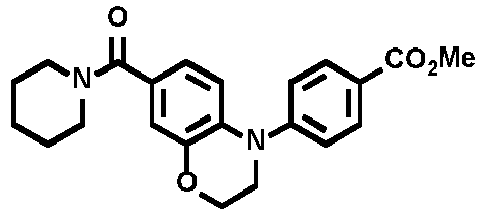
1H NMR (400 MHz, CDCl3) δ 1.52-1.72 (6H, m), 3.45-3.65 ( 4H, m), 3.78 (2H, t, J = 4.2 Hz), 3.90 (3H, s), 4.30 (2H, t, J = 4.2 Hz), 6.85 (1H, dd, J = 8.5, 2.4 Hz), 6.98 (1H, d, J = 2.4 Hz), 7.10 (1H, d, J = 8.5 Hz), 7.24 (2H, d, J = 9.1 H z), 8.00 (2H, d, J = 9.1 Hz). LRMS (ESI+) 381 [M+H]+. 1-8 
1H NMR (400 MHz, CDCl3) δ 1.50-1.75 (6H, m), 2.09-2.18 ( 2H, m), 3.35-3.78 (4H, m), 3.88 (3H, s), 4.09 (2H, t, J = 6. 1 Hz), 4.23 (2H, t, J = 6.1 Hz), 7.14 (2H, d, J = 9.2 Hz), 7 .37 (1H, d, J = 1.8 Hz), 7.96 (2H, d, J = 9.2 Hz), 8.06 (1H, d, J = 1.8 Hz). LRMS (ESI+) 396 [M+H]+. 1-9 
1H NMR (400 MHz, CDCl3) δ 1.51-1.74 (6H, m), 1.82-1.95 ( 4H, m), 3.35-3.80 (4H, m), 3.88 (3H, s), 4.10 (2H, t, J = 5. 5 Hz), 4.23 (2H, t, J = 5.5 Hz), 7.07 (2H, d, J = 9.1 Hz), 7 .44 (1H, d, J = 2.4 Hz), 7.97 (2H, d, J = 9.1 Hz), 8.04 (1H, d, J = 2.4 Hz). LRMS (ESI+) 410 [M+H]+. 1-10 
1H NMR (400 MHz, CDCl3) δ 1.02 (3H, d, J = 6.7 Hz), 1.5 0-1.75 (6H, m), 2.35-2.45 (1H, m), 3.33 (1H, dd, J = 14.5, 9 .7 Hz), 3.35-3.75 (4H, m), 3.76 (1H, dd, J = 12.1, 4.8 Hz), 3.86 (3H, s), 4.12-4.20 (2H, m), 6.90 (2H, d, J = 8.5 Hz), 7. 00 (1H, dd, J = 8.5, 1.8 Hz), 7.09 (1H, d, J = 1.8 Hz), 7.16 (1H, d, J = 8.5 Hz), 7.88 (2H, d, J = 8.5 Hz). LRMS (EI+) 408 [M]+. 1-11 
1H NMR (400 MHz, CDCl3) δ 1.02 (3H, d, J = 6.7 Hz), 1.5 0-1.75 (6H, m), 2.35-2.45 (1H, m), 3.33 (1H, dd, J = 15.1, 1 0.3 Hz), 3.35-3.80 (4H, m), 3.76 (1H, dd, J = 12.1, 4.9 Hz), 3.86 (3H, s), 4.12-4.20 (2H, m), 6.90 (2H, d, J = 9.1 Hz), 7. 00 (1H, dd, J = 8.5, 1.8 Hz), 7.09 (1H, d, J = 1.8 Hz), 7.16 (1H, d, J = 8.5 Hz), 7.87 (2H, d, J = 9.1 Hz). LRMS (ESI+) 409 [M+H]+. 1-12 
1H NMR (400 MHz, CDCl3) δ 1.50-1.72 (6H, m), 3.40-3.75 ( 4H, m), 3.78 (2H, t, J = 4.2 Hz), 3.86 (3H, s), 3.88 (3H, s), 4.31 (2H, t, J = 4.2 Hz), 6.78 (1H, dd, J = 8.5, 2.4 Hz), 6. 81 (1H, d, J = 2.4 Hz), 6.86 (1H, dd, J = 8.5, 2.4 Hz), 6.98 (1H, d, J = 2.4 Hz), 7.12 (1H, d, J = 8.5 Hz), 7.84 (1H, d, J = 8.5 Hz). LRMS (EI+) 410 [M]+. [Table 57] Example No. Chemical Structural Formula Spectrum Data 1-13 
1H NMR (400 MHz, CDCl3) δ 1.93-2.10 (4H, m), 3.70-3.78 ( 4H, m), 3.79 (2H, t, J = 4.2 Hz), 3.87 (3H, s), 3.88 (3H, s), 4.33 (2H, t, J = 4.2 Hz), 6.80 (1H, dd, J = 8.5, 2.4 Hz), 6. 81 (1H, d, J = 2.4 Hz), 6.88 (1H, dd, J = 8.5, 2.4 Hz), 7.00 (1H, d, J = 2.4 Hz), 7.12 (1H, d, J = 8.5 Hz), 7.85 (1H, d, J = 8.5 Hz). LRMS (EI+) 446 [M]+. 1-14 
1H NMR (400 MHz, CDCl3) δ 2.15-2.27 (2H, m), 3.50-3.70 ( 2H, m), 3.78 (2H, t, J = 4.3 Hz), 3.86 (3H, s), 3.88 (3H, s), 4.00-4.20 (2H, m), 4.32 (2H, t, J = 4.3 Hz), 5.50-5.80 (1H, m), 5.84-5.92 (1H, m), 6.78 (1H, dd, J = 8.6, 2.4 Hz), 6.82 (1H, d, J = 1.8 Hz), 6.90 (1H, dd, J = 7.9, 1.8 Hz), 7.01 (1 H, d, J = 1.8 Hz), 7.13 (1H, d, J = 8.6 Hz), 7.84 (1H, d, J = 7.9 Hz). LRMS (EI+) 408 [M]+. 1-15 
1H NMR (400 MHz, CDCl3) δ 1.52-1.65 (4H, m), 1.65-1.72 ( 2H, m), 3.10-3.15 (2H, m), 3.35-3.75 (4H, m), 3.90 (3H, s), 3.96-4.02 (2H, m), 6.99 (2H, d, J = 1.2 Hz), 7.14 (2H, d, J = 8.5 Hz), 7.23-7.28 (1H, m), 7.96 (2H, d, J = 8.5 Hz). LRMS (ESI+) 397 [M+H]+. 1-16 
1H NMR (400 MHz, CDCl3) δ 1.52-1.75 (6H, m), 2.16-2.24 ( 2H, m), 2.85 (2H, t, J = 5.5 Hz), 3.35-3.80 (4H, m), 3.85 (3 H, s), 3.88-3.96 (2H, m), 6.67 (2H, d, J = 9.1 Hz), 7.21-7.29 (2H, m), 7.59 (1H, d, J = 1.8 Hz), 7.86 (2H, d, J = 9.1 Hz ). LRMS (ESI+) 411 [M+H]+. 1-17 
1H NMR (400 MHz, DMSO-d6) δ 1.94-2.07 (4H, m), 3.50-3. 64 (4H, m), 3.81 (2H, t, J = 4.5 Hz), 4.27 (2H, t, J = 4.2 Hz), 6.88 (1H, dd, J = 8.5, 1.8 Hz), 6.98 (1H, d, J = 2.4 H z), 7.13 (1H, d, J = 8.5 Hz), 7.38-7.42 (2H, m), 7.75-7.79 (2 H, m). LRMS (ESI+) 384 [M+H]+. 1-18 
1H NMR (400 MHz, DMSO-d6) δ: 1.40-1.51 (4H, m), 1.55-1. 64 (2H, m), 3.37-3.48 (4H, m), 3.71 (2H, t, J = 4.5 Hz), 4.2 8 (2H, t, J = 4.5 Hz), 6.71-6.77 (2H, m), 6.80-6.82 (1H, m), 7.12-7.17 (1H, m), 7.26-7.31 (2H, m), 7.37-7.43 (2H, m). LRMS (ESI+) 323 [M+H]+. [Table 58] Example No. Chemical Structural Formula Spectrum Data 1-19 
1H NMR (400 MHz, DMSO-d6) δ: 1.41-1.66 (6H, m), 3.35-3. 53 (4H, m), 3.54 (3H, s), 3.99 (2H, t, J = 4.3 Hz), 4.36 (2H , t, J = 4.6 Hz), 7.19 (1H, d, J = 2.4 Hz), 7.45 (1H, dd, J = 8.6, 1.8 Hz), 7.50 (1H, d, J = 1.8 Hz), 7.70 (1H, d, J = 8 .6 Hz), 7.74 (1H, d, J = 1.8 Hz). LRMS (ESI+) 395 [M+H]+. 1-20 
1H NMR (400 MHz, DMSO-d6) δ: 1.40-1.66 (6H, m), 3.37-3. 53 (4H, m), 3.99 (2H, t, J = 4.3 Hz), 4.09 (3H, s), 4.36 (2H , t, J = 4.3 Hz), 7.17 (1H, d, J = 1.8 Hz), 7.50 (1H, dd, J = 8.6, 1.8 Hz), 7.62 (1H, d, J = 1.2 Hz), 7.65 (1H, d, J = 8 .6 Hz), 7.71 (1H, d, J = 1.8 Hz). LRMS (ESI+) 395 [M+H]+. 1-21 
1H NMR (400 MHz, DMSO-d6) δ: 1.41-1.66 (6H, m), 3.23-3. 64 (7H, m), 3.93 (2H, t, J = 4.3 Hz), 4.36 (2H, t, J = 4.3 Hz), 6.88 (1H, d, J = 1.8 Hz), 6.98 (1H, dd, J = 7.6, 2.1 H z), 7.21 (1H, d, J = 1.8 Hz), 7.75 (1H, d, J = 6.7 Hz), 7.77 (1H, d, J = 2.4 Hz). LRMS (ESI+) 395 [M+H]+. 1-22 
1H NMR (400 MHz, DMSO-d6) δ: 1.42-1.66 (6H, m), 3.29 ( 3H, s), 3.30-3.60 (4H, m), 3.94 (2H, t, J = 4.3 Hz), 4.37 (2 H, t, J = 4.3 Hz), 5.16 (2H, s), 6.89 (1H, d, J = 1.8 Hz), 7. 00 (1H, dd, J = 7.6, 2.1 Hz), 7.22 (1H, d, J = 1.8 Hz), 7.75 -7.80 (2H, m). LRMS (ESI+) 425 [M+H]+. 1-23 
1H NMR (400 MHz, DMSO-d6) δ: 1.40-1.66 (6H, m), 3.06 ( 3H, s), 3.35-3.55 (4H, m), 3.96 (2H, t, J = 4.3 Hz), 4.35 (2 H, t, J = 4.3 Hz), 4.44 (2H, s), 7.15 (1H, d, J = 1.8 Hz), 7. 51 (1H, dd, J = 8.3, 2.1 Hz), 7.59-7.66 (2H, m), 7.69 (1H, d , J = 1.8 Hz). LRMS (ESI+) 393 [M+H]+. 1-24 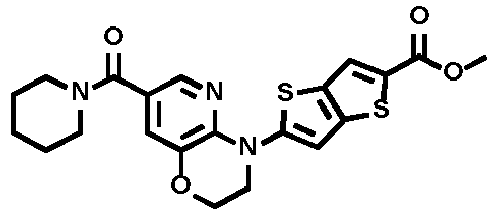
1H NMR (400 MHz, DMSO-d6) δ: 1.43-1.66 (6H, m), 3.34-3. 60 (4H, m), 3.81 (3H, s), 4.16 (2H, t, J = 4.9 Hz), 4.44 (2H , t, J = 4.6 Hz), 7.13 (1H, s), 7.28 (1H, d, J = 1.8 Hz), 7.9 7 (1H, d, J = 1.8 Hz), 8.07 (1H, s). LRMS (ESI+) 444 [M+H]+. [Table 59] Example No. Chemical Structural Formula Spectrum Data 1-25 
1H NMR (400 MHz, DMSO-d6) δ: 1.40-1.65 (6H, m), 3.36-3. 57 (7H, m), 3.77 (2H, t, J = 4.3 Hz), 4.29 (2H, t, J = 4.3 Hz), 6.64-6.70 (2H, m), 6.83 (1H, dd, J = 8.3, 2.1 Hz), 6.87 (1H, d, J = 1.8 Hz), 7.05 (1H, d, J = 8.6 Hz), 7.75-7.81 (1 H, m). LRMS (ESI+) 394 [M+H]+. 1-26 
1H NMR (400 MHz, DMSO-d6) δ: 1.40-1.64 (6H, m), 2.29 ( 3H, s), 3.37-3.53 (4H, m), 3.95 (2H, t, J = 4.2 Hz), 4.36 (2 H, t, J = 4.2 Hz), 7.07 (1H, dd, J = 7.3, 1.8 Hz), 7.14 (1H, d, J = 2.4 Hz), 7.27 (1H, d, J = 1.8 Hz), 7.56 (1H, s), 7.70 (1H, d, J = 1.8 Hz), 8.33 (1H, d, J = 7.3 Hz). LRMS (ESI+) 378 [M+H]+. 1-27 
1H NMR (400 MHz, DMSO-d6) δ: 1.33 (6H, d, J = 6.7 Hz), 1.40-1.66 (6H, m), 3.34-3.57 (4H, m), 3.92 (2H, t, J = 4.6 H z), 4.36 (2H, t, J = 4.6 Hz), 4.45-4.55 (1H, m), 6.92-7.00 (2 H, m), 7.20 (1H, d, J = 1.8 Hz), 7.72-7.81 (2H, m). LRMS (ESI+) 423 [M+H]+. 1-28 
1H NMR (400 MHz, DMSO-d6) δ: 1.42-1.64 (6H, m), 3.22 ( 3H, s), 3.25-3.59 (4H, m), 3.66 (2H, t, J = 5.5 Hz), 3.93 (2 H, t, J = 4.3 Hz), 4.00 (2H, t, J = 5.5 Hz), 4.36 (2H, t, J = 4.3 Hz), 6.91 (1H, d, J = 1.8 Hz), 6.98 (1H, dd, J = 7.9, 1 .8 Hz), 7.21 (1H, d, J = 1.8 Hz), 7.73-7.79 (2H, m). LRMS (ESI+) 439 [M+H]+. 1-29 
1H NMR (400 MHz, DMSO-d6) δ 1.40-1.64 (6H, m), 3.25-3. 61 (7H, m), 3.87 (2H, t, J = 4.6 Hz), 4.35 (2H, t, J = 4.3 Hz), 6.73 (1H, d, J = 7.3 Hz), 7.19 (1H, d, J = 1.8 Hz), 7.7 0 (1H, d, J = 2.4 Hz), 7.90 (1H, d, J = 7.3 Hz). LRMS (ESI+) 429 [M+H]+. 1-30 
1H NMR (400 MHz, DMSO-d6) δ 1.40-1.64 (6H, m), 3.27-3. 65 (4H, m), 3.92 (2H, t, J = 4.6 Hz), 4.36 (2H, t, J = 4.3 Hz), 6.88 (1H, d, J = 2.4 Hz), 6.93 (1H, dd, J = 7.9, 1.8 H z), 7.20 (1H, d, J = 1.8 Hz), 7.71 (1H, d, J = 6.7 Hz), 7.77 (1H, d, J = 1.8 Hz), 12.22 (1H, s). LRMS (ESI+) 381 [M+H]+. [Table 60] Example No. Chemical Structural Formula Spectrum Data 1-31 
1H NMR (400 MHz, DMSO-d6) δ 1.41-1.65 (6H, m), 3.25-3. 57 (4H, m), 3.92 (2H, t, J = 4.3 Hz), 4.35 (2H, t, J = 4.3 Hz), 5.06 (2H, s), 6.88 (1H, d, J = 1.2 Hz), 7.00 (1H, dd, J = 7.6, 2.1 Hz), 7.20 (1H, d, J = 1.8 Hz), 7.25-7.37 (5H, m), 7.76-7.81 (2H, m). LRMS (ESI+) 471 [M+H]+. 1-32 
1H NMR (400 MHz, DMSO-d6) δ 1.40-1.67 (6H, m), 3.21-3. 65 (4H, m), 3.91 (2H, t, J = 4.3 Hz), 4.35 (2H, t, J = 4.6 Hz), 5.12 (2H, s), 6.89 (1H, d, J = 1.8 Hz), 7.00 (1H, dd, J = 7.9, 1.8 Hz), 7.21 (1H, d, J = 1.8 Hz), 7.33-7.41 (1H, m), 7.67-7.72 (1H, m), 7.75-7.81 (2H, m), 8.50 (1H, dd, J = 4.9, 1.8 Hz), 8.55 (1H, d, J = 1.8 Hz). LRMS (ESI+) 472 [M+H]+. 1-33 
1H NMR (400 MHz, DMSO-d6) δ 1.39-1.67 (6H, m), 2.15 (6 H, s), 2.59 (2H, t, J = 6.1 Hz), 3.22-3.65 (4H, m), 3.87-3.97 (4H, m), 4.36 (2H, t, J = 4.3 Hz), 6.91 (1H, d, J = 1.8 Hz), 6.97 (1H, dd, J = 7.9, 1.8 Hz), 7.21 (1H, d, J = 1.8 Hz), 7 .72-7.79 (2H, m). LRMS (ESI+) 452 [M+H]+. 1-34 
1H NMR (400 MHz, DMSO-d6) δ 1.38-1.68 (6H, m), 3.21-3. 64 (4H, m), 3.93 (2H, t, J = 4.6 Hz), 4.36 (2H, t, J = 4.3 Hz), 5.12 (2H, s), 6.90 (1H, d, J = 1.8 Hz), 7.02 (1H, dd, J = 7.6, 2.1 Hz), 7.21 (1H, d, J = 1.8 Hz), 7.22-7.26 (2H, m), 7.78 (1H, d, J = 1.8 Hz), 7.81 (1H, d, J = 8.6 Hz), 8.49-8.5 5 (2H, m). LRMS (ESI+) 472 [M+H]+. 1-35 
1H NMR (400 MHz, DMSO-d6) δ 1.41-1.66 (6H, m), 3.25-3. 62 (4H, m), 3.98 (2H, t, J = 4.6 Hz), 4.39 (2H, t, J = 4.3 Hz), 6.94 (1H, d, J = 1.2 Hz), 7.06 (1H, dd, J = 7.6, 2.1 H z), 7.24 (1H, d, J = 2.4 Hz), 7.32-7.37 (1H, m),, 7.81 (1H, d , J = 2.4 Hz), 7.85 (1H, d, J = 7.9 Hz), 7.95-8.05 (2H, m), 8.51-8.55 (1H, m). LRMS (ESI+) 458 [M+H]+. 1-36 
1H NMR (400 MHz, DMSO-d6) δ 1.39-1.66 (6H, m), 3.24-3. 64 (5H, m), 3.92 (2H, t, J = 4.3 Hz), 4.15 (2H, d, J = 6.7 Hz), 4.36 (2H, t, J = 4.3 Hz), 4.44 (2H, dd, J = 6.1, 6.1 Hz ), 4.65 (2H, dd, J = 7.9, 6.1 Hz), 6.91 (1H, d, J = 1.8 Hz), 6.99 (1H, dd, J = 7.9, 1.8 Hz), 7.21 (1H, d, J = 1.8 Hz), 7. 74-7.79 (2H, m). LRMS (ESI+) 451 [M+H]+. [Table 61] Example No. Chemical Structural Formula Spectrum Data 1-37 
1H NMR (400 MHz, CDCl3) δ 1.46-1.77 (6H, m), 3.34-3.73 ( 4H, m), 3.79 (3H, s), 3.93 (2H, t, J = 4.3 Hz), 4.24 (2H, s), 4.36 (2H, t, J = 4.3 Hz), 4.73 (2H, s), 6.83-6.89 (2H, m), 7 .19-7.28 (3H, m), 7.39 (1H, dd, J = 7.9, 1.8 Hz), 7.48 (1H, d, J = 1.2 Hz), 7.80 (1H, d, J = 1.8 Hz), 7.89 (1H, d, J = 8.6 Hz). LRMS (ESI+) 499 [M+H]+. 1-38 
1H NMR (400 MHz, DMSO-d6) δ 1.43-1.64 (6H, m), 3.37-3. 56 (7H, m), 4.05-4.11 (2H, m), 4.39-4.44 (2H, m), 7.24 (1H, d, J = 1.8 Hz), 7.76 (1H, d, J = 1.8 Hz), 7.93 (1H, d, J = 2.4 Hz), 8.42 (1H, s), 9.07 (1H, d, J = 2.4 Hz). LRMS (ESI+) 407 [M+H]+. 1-39 
1H NMR (400 MHz, DMSO-d6) δ 1.42-1.67 (6H, m), 3.26-3. 68 (7H, m), 4.29-4.42 (4H, m), 7.31 (1H, d, J = 2.4 Hz), 7. 94 (1H, d, J = 1.8 Hz), 8.29 (1H, s), 8.44 (1H, s), 9.12 (1H, s). LRMS (ESI+) 407 [M+H]+. 1-40 
1H NMR (400 MHz, DMSO-d6) δ 1.41-1.66 (6H, m), 3.26-3. 63 (4H, m), 3.69 (3H, s), 3.94 (2H, t, J = 4.3 Hz), 4.37 (2H , t, J = 4.3 Hz), 4.77 (2H, s), 6.88 (1H, d, J = 1.2 Hz), 7.0 1 (1H, dd, J = 7.6, 2.1 Hz), 7.22 (1H, d, J = 1.8 Hz), 7.77-7.81 (2H, m). LRMS (ESI+) 453 [M+H]+. 1-41 
1H NMR (400 MHz, DMSO-d6) δ 0.74-1.04 (3H, m), 1.07-1. 33 (1H, m), 1.39-1.55 (1H, m), 1.56-1.77 (2H, m), 1.78-1.94 (1H, m), 2.64-3.17 (2H, m), 3.37 (3H, s), 3.56-3.87 (1H, m), 4.01 (2H, t, J = 4.3 Hz), 4.13-4.54 (3H, m), 5.24 (2H, s), 6. 96 (1H, d, J = 1.2 Hz), 7.08 (1H, dd, J = 7.6, 2.1 Hz), 7.29 (1H, d, J = 1.8 Hz), 7.82-7.90 (2H, m). LRMS (ESI+) 439 [M+H]+. 1-42 
1H NMR (400 MHz, DMSO-d6) δ 0.73-0.93 (3H, m), 1.07-1. 19 (1H, m), 1.34-1.46 (1H, m), 1.49-1.67 (2H, m), 1.71-1.81 (1H, m), 2.61-3.13 (2H, m), 3.40-3.83 (1H, m), 3.92 (2H, t, J = 4.3 Hz), 4.00-4.45 (3H, m), 6.88 (1H, d, J = 1.2 Hz), 6.9 4 (1H, dd, J = 7.9, 1.8 Hz), 7.19 (1H, d, J = 1.8 Hz), 7.71 (1H, d, J = 8.6 Hz), 7.77 (1H, d, J = 1.8 Hz), 12.22 (1H, s) LRMS (ESI+) 395 [M+H]+. [Table 62] Example No. Chemical Structural Formula Spectrum Data 1-43 
1H NMR (400 MHz, DMSO-d6) δ 1.93-2.12 (4H, m), 3.29 (3 H, s), 3.43-3.77 (4H, m), 3.94 (2H, t, J = 4.3 Hz), 4.37 (2H, t, J = 4.3 Hz), 5.16 (2H, s), 6.90 (1H, d, J = 1.2 Hz), 7.00 (1H, dd, J = 7.6, 2.1 Hz), 7.31 (1H, d, J = 1.8 Hz), 7.79 ( 1H, d, J = 8.6 Hz), 7.86 (1H, d, J = 1.8 Hz). LRMS (ESI+) 461 [M+H]+. 1-44 
1H NMR (400 MHz, DMSO-d6) δ 1.09 (3H, t, J = 7.0 Hz), 1.95-2.11 (4H, m), 3.45-3.70 (6H, m), 3.94 (2H, t, J = 4.3 H z), 4.37 (2H, t, J = 4.3 Hz), 5.20 (2H, s), 6.90 (1H, d, J = 1.8 Hz), 6.99 (1H, dd, J = 7.9, 1.8 Hz), 7.31 (1H, d, J = 1. 8 Hz), 7.78 (1H, d, J = 7.3 Hz), 7.86 (1H, d, J = 1.8 Hz). LRMS (ESI+) 475 [M+H]+. 1-45 
1H NMR (400 MHz, DMSO-d6) δ 1.95-2.09 (4H, m), 3.10 (3 H, s), 3.51-3.66 (4H, m), 3.99-4.05 (2H, m), 4.36-4.42 (2H, m), 4.47 (2H, s), 7.28 (1H, d, J = 1.8 Hz), 7.78 (1H, d, J = 2.4 Hz), 8.06 (1H, d, J = 2.4 Hz), 8.82 (1H, d, J = 2.4 Hz ). LRMS (ESI+) 430 [M+H]+. 1-46 
1H NMR (400 MHz, DMSO-d6) δ 1.95-2.12 (4H, m), 3.03 (3 H, s), 3.49-3.74 (4H, m), 4.27 (2H, t, J = 4.0 Hz), 4.36 (2H, t, J = 4.3 Hz), 4.50 (2H, s), 7.37 (1H, d, J = 1.8 Hz), 7.96 (1H, d, J = 2.4 Hz), 8.28 (1H, s), 8.63 (1H, s). LRMS (ESI+) 430 [M+H]+. 1-47 
1H NMR (400 MHz, DMSO-d6) δ 1.95-2.10 (4H, m), 3.22 (3 H, s), 3.47-3.71 (6H, m), 3.94 (2H, t, J = 4.3 Hz), 4.00 (2H, t, J = 5.5 Hz), 4.37 (2H, t, J = 4.3 Hz), 6.92 (1H, d, J = 1.8 Hz), 6.98 (1H, dd, J = 7.9, 1.8 Hz), 7.30 (1H, d, J = 1. 8 Hz), 7.76 (1H, d, J = 6.7 Hz), 7.86 (1H, d, J = 1.8 Hz). LRMS (ESI+) 475 [M+H]+. 1-48 
1H NMR (400 MHz, DMSO-d6) δ 1.04 (3H, t, J = 6.7 Hz), 1.95-2.11 (4H, m), 3.42 (2H, q, J = 7.1 Hz), 3.51-3.65 (4H, m), 3.70 (2H, t, J = 5.5 Hz), 3.94 (2H, t, J = 4.3 Hz), 3.99 (2H, t, J = 5.5 Hz), 4.37 (2H, t, J = 4.3 Hz), 6.92 (1H, d, J = 1.2 Hz), 6.98 (1H, dd, J = 7.6, 2.1 Hz), 7.30 (1H, d, J = 1.8 Hz), 7.77 (1H, d, J = 7.9 Hz), 7.85 (1H, d, J = 1.8 Hz ). LRMS (ESI+) 489 [M+H]+. [Table 63] Example No. Chemical Structural Formula Spectrum Data 1-49 
1H NMR (400 MHz, DMSO-d6) δ 1.94-2.09 (4H, m), 3.26 (3 H, s), 3.52-3.63 (6H, m), 3.67 (2H, t, J = 5.2 Hz), 3.96 (2H, t, J = 4.3 Hz), 4.36 (2H, t, J = 4.3 Hz), 4.50 (2H, s), 7.24 (1H, d, J = 1.8 Hz), 7.52 (1H, dd, J = 8.3, 2.1 Hz), 7.60-7.6 7 (2H, m), 7.76 (1H, d, J = 1.8 Hz). LRMS (ESI+) 473 [M+H]+. 1-50 
1H NMR (400 MHz, DMSO-d6) δ 1.09 (3H, t, J = 6.7 Hz), 1.95-2.08 (4H, m), 3.45 (2H, q, J = 6.9 Hz), 3.51-3.69 (8H, m), 3.96 (2H, t, J = 4.6 Hz), 4.36 (2H, t, J = 4.3 Hz), 4.51 (2H, s), 7.24 (1H, d, J = 1.8 Hz), 7.52 (1H, dd, J = 7.9, 1.8 Hz), 7.61-7.67 (2H, m), 7.76 (1H, d, J = 1.8 Hz). LRMS (ESI+) 487 [M+H]+. 1-51 
1H NMR (400 MHz, DMSO-d6) δ 1.09 (3H, t, J = 7.0 Hz), 1.96-2.12 (4H, m), 3.44 (2H, q, J = 6.9 Hz), 3.49-3.74 (8H, m), 4.24-4.29 (2H, m), 4.34-4.40 (2H, m), 4.57 (2H, s), 7.38 (1H, d, J = 1.8 Hz), 7.95 (1H, d, J = 1.8 Hz), 8.29 (1H, s), 8.66 (1H, d, J = 1.2 Hz). LRMS (ESI+) 488 [M+H]+. 1-52 
1H NMR (400 MHz, DMSO-d6) δ 1.41-1.69 (6H, m), 2.02-2. 14 (2H, m), 3.15-3.70 (7H, m), 3.96 (2H, t, J = 6.1 Hz), 4.2 2 (2H, t, J = 5.8 Hz), 5.13 (2H, s), 6.49 (1H, dd, J = 7.9, 2 .4 Hz), 6.63 (1H, d, J = 1.8 Hz), 7.42 (1H, d, J = 1.8 Hz), 7.68 (1H, d, J = 7.9 Hz), 8.04 (1H, d, J = 2.4 Hz). LRMS (ESI+) 439 [M+R]+. 1-53 
1H NMR (400 MHz, DMSO-d6) δ 1.43-1.67 (6H, m), 1.95-2. 06 (2H, m), 2.83 (2H, t, J = 6.4 Hz), 3.33 (3H, s), 3.36-3.59 (4H, m), 3.81 (2H, t, J = 5.8 Hz), 5.17 (2H, s), 6.80 (1H, dd, J = 7.9, 1.8 Hz), 6.89 (1H, d, J = 1.2 Hz), 7.51 (1H, d, J = 1.8 Hz), 7.71 (1H, d, J = 7.9 Hz), 8.00 (1H, d, J = 2.4 Hz). LRMS (ESI+) 423 [M+H]+. 1-54 
1H NMR (400 MHz, DMSO-d6) δ 1.29 (3H, t, J = 7.0 Hz), 1.43-1.68 (6H, m), 1.94-2.05 (2H, m), 2.83 (2H, t, J = 6.4 H z), 3.39-3.57 (4H, m), 3.80 (2H, t, J = 5.8 Hz), 3.88 (2H, q, J = 7.3 Hz), 6.77 (1H, dd, J = 7.9, 1.8 Hz), 6.91 (1H, d, J = 1.2 Hz), 7.49 (1H, d, J = 1.8 Hz), 7.69 (1H, d, J = 7.9 H z), 7.99 (1H, d, J = 2.4 Hz). LRMS (ESI+) 407 [M+H]+. [Table 64] Example No. Chemical Structural Formula Spectrum Data 1-55 
1H NMR (400 MHz, DMSO-d6) δ 1.44-1.67 (6H, m), 1.95-2. 05 (2H, m), 2.83 (2H, t, J = 6.4 Hz), 3.23 (3H, s), 3.38-3.57 (4H, m), 3.67 (2H, t, J = 5.4 Hz), 3.80 (2H, t, J = 5.8 Hz) , 4.00 (2H, t, J = 5.4 Hz), 6.78 (1H, dd, J = 7.9, 1.8 Hz), 6 .91 (1H, d, J = 1.2 Hz), 7.49 (1H, d, J = 2.4 Hz), 7.69 (1H, d, J = 7.9 Hz), 7.99 (1H, d, J = 2.4 Hz). LRMS (ESI+) 437 [M+H]+. 1-56 
1H NMR (400 MHz, DMSO-d6) δ 1.43-1.68 (6H, m), 1.93-2. 03 (2H, m), 2.86 (2H, t, J = 6.4 Hz), 3.03 (3H, s), 3.40-3.57 (4H, m), 4.03-4.11 (2H, m), 4.47 (2H, s), 7.56 (1H, d, J = 2.4 Hz), 7.97 (1H, s), 8.06 (1H, d, J = 1.8 Hz), 8.63 (1H, s) LRMS (ESI+) 392 [M+H]+. 1-57 
1H NMR (400 MHz, DMSO-d6) δ 1.11 (3H, t, J = 7.0 Hz), 1.40-1.67 (6H, m), 1.95-2.05 (2H, m), 2.83 (2H, t, J = 6.4 H z), 3.38-3.61 (6H, m), 3.81 (2H, t, J = 5.8 Hz), 5.21 (2H, s), 6.79 (1H, dd, J = 7.6, 2.1 Hz), 6.89 (1H, d, J = 1.8 Hz), 7 .50 (1H, d, J = 1.8 Hz), 7.70 (1H, d, J = 7.9 Hz), 8.00 (1H, d, J = 1.8 Hz). LRMS (ESI+) 437 [M+H]+. 1-58 
1H NMR (400 MHz, DMSO-d6) δ 1.43-1.67 (6H, m), 1.94-2. 05 (2H, m), 2.83 (2H, t, J = 6.4 Hz), 3.27-3.37 (1H, m), 3.3 8-3.57 (4H, m), 3.79 (2H, t, J = 6.1 Hz), 4.16 (2H, d, J = 7 .3 Hz), 4.45 (2H, t, J = 6.1 Hz), 4.66 (2H, dd, J = 7.6, 6.4 Hz), 6.78 (1H, dd, J = 7.9, 1.8 Hz), 6.91 (1H, d, J = 1.8 H z), 7.49 (1H, d, J = 1.8 Hz), 7.70 (1H, d, J = 7.3 Hz), 7.98 (1H, d, J = 2.4 Hz). LRMS (ESI+) 449 [M+H]+. 1-59 
1H NMR (400 MHz, DMSO-d6) δ 1.43-1.67 (6H, m), 1.93-2. 06 (2H, m), 2.78 (3H, d, J = 4.8 Hz), 2.84 (2H, t, J = 6.1 Hz), 3.37-3.55 (4H, m), 3.79 (2H, t, J = 5.4 Hz), 7.26 (1H, dd, J = 8.5, 2.4 Hz), 7.32 (1H, dd, J = 13.0, 2.1 Hz), 7.44 ( 1H, d, J = 2.4 Hz), 7.61 (1H, t, J = 8.5 Hz), 7.91 (1H, d, J = 1.8 Hz), 8.08-8.17 (1H, m) LRMS (ESI+) 397 [M+H]+. [Table 65] Example No. Chemical Structural Formula Spectrum Data 1-60 
1H NMR (400 MHz, DMSO-d6) δ 1.42-1.67 (6H, m), 1.94-2. 05 (2H, m), 2.85 (2H, t, J = 6.4 Hz), 3.21-3.53 (11H, m), 3. 80 (2H, t, J = 5.4 Hz), 7.26 (1H, dd, J = 8.5, 2.4 Hz), 7.32 (1H, dd, J = 13.3, 1.8 Hz), 7.44 (1H, d, J = 1.8 Hz), 7.61 ( 1H, t, J = 8.5 Hz), 7.90 (1H, d, J = 2.4 Hz), 8.13-8.21 (1H, m). LRMS (ESI+) 441 [M+H]+. 1-61 
1H NMR (400 MHz, DMSO-d6) δ 1.42-1.68 (6H, m), 1.95-2. 06 (2H, m), 2.85 (2H, t, J = 6.4 Hz), 3.10-3.22 (1H, m), 3.3 8-3.57 (6H, m), 3.79 (2H, t, J = 5.4 Hz), 4.35 (2H, t, J = 6. 1 Hz), 4.62 (2H, dd, J = 7.9, 6.1 Hz), 7.26 (1H, dd, J = 8.5 , 2.4 Hz), 7.32 (1H, dd, J = 12.7, 1.8 Hz), 7.43 (1H, d, J = 2.4 Hz), 7.57 (1H, t, J = 8.5 Hz), 7.89 (1H, d, J = 2.4 Hz), 8.34-8.43 (1H, m). LRMS (ESI+) 453 [M+H]+. 1-62 
1H NMR (400 MHz, DMSO-d6) δ 1.42-1.68 (6H, m), 1.95-2. 06 (2H, m), 2.85 (2H, t, J = 6.4 Hz), 3.37-3.56 (4H, m), 3.8 0 (2H, t, J = 5.4 Hz), 4.56 (2H, t, J = 6.7 Hz), 4.76 (2H, t, J = 7.0 Hz), 4.93-5.05 (1H, m), 7.27 (1H, dd, J = 8.5, 2.4 Hz), 7.34 (1H, dd, J = 13.0, 2.1 Hz), 7.44 (1H, d, J = 1.8 Hz), 7.58 (1H, t, J = 8.5 Hz), 7.90 (1H, d, J = 1.8 Hz), 8.9 4 (1H, d, J = 5.4 Hz). LRMS (ESI+) 439 [M+H]+. 1-63 
1H NMR (400 MHz, DMSO-d6) δ 1.10 (3H, t, J = 7.0 Hz), 1.39-1.67 (6H, m), 1.97-2.06 (2H, m), 2.87 (2H, t, J = 6.4 H z), 3.40-3.51 (6H, m), 3.59 (2H, t, J = 5.1 Hz), 3.67 (2H, t, J = 5.4 Hz), 3.81 (2H, t, J = 5.4 Hz), 4.51 (2H, s), 7.39-7.4 6 (2H, m), 7.52-7.56 (1H, m), 7.64 (1H, d, J = 8.5 Hz), 7.8 4 (1H, d, J = 2.4 Hz). LRMS (ESI+) 449 [M+H]+. 1-64 
1H NMR (400 MHz, DMSO-d6) δ 1.43-1.67 (6H, m), 1.97-2. 06 (2H, m), 2.87 (2H, t, J = 6.1 Hz), 3.27 (3H, s), 3.40-3.51 (4H, m), 3.56 (2H, t, J = 5.1 Hz), 3.67 (2H, t, J = 5.4 Hz) , 3.80 (2H, t, J = 5.8 Hz), 4.49 (2H, s), 7.40-7.45 (2H, m), 7.54 (1H, d, J = 1.2 Hz), 7.64 (1H, d, J = 8.5 Hz), 7.84 (1 H, d, J = 2.4 Hz). LRMS (ESI+) 435 [M+H]+. [Table 66] Example No. Chemical Structural Formula Spectrum Data 1-65 
1H NMR (400 MHz, DMSO-d6) δ 1.41-1.66 (6H, m), 1.95-2. 07 (2H, m), 2.86 (2H, t, J = 6.4 Hz), 3.26-3.36 (1H, m), 3.3 7-3.56 (4H, m), 3.76-3.87 (4H, m), 4.35-4.44 (4H, m), 4.67 ( 2H, dd, J = 7.9, 6.1 Hz), 7.39-7.45 (2H, m), 7.52 (1H, s), 7. 64 (1H, d, J = 8.5 Hz), 7.83 (1H, d, J = 2.4 Hz). LRMS (ESI+) 447 [M+H]+. 1-66 
1H NMR (400 MHz, DMSO-d6) δ 1.42-1.69 (6H, m), 1.97-2. 08 (2H, m), 2.87 (2H, t, J = 6.4 Hz), 3.38-3.57 (4H, m), 3.8 2 (2H, t, J = 5.4 Hz), 4.75-4.91 (6H, m), 5.37-5.47 (1H, m), 7.40-7.47 (2H, m), 7.59-7.62 (1H, m), 7.65 (1H, d, J = 7.9 Hz), 7.85 (1H, d, J = 2.4 Hz). LRMS (ESI+) 433 [M+H]+. 1-67 
1H NMR (400 MHz, DMSO-d6) δ 1.43-1.66 (6H, m), 2.00-2. 09 (2H, m), 2.89 (2H, t, J = 6.4 Hz), 3.10 (3H, s), 3.39-3.54 (4H, m), 3.86 (2H, t, J = 5.4 Hz), 4.46 (2H, s), 7.45 (1H, d, J = 2.4 Hz), 7.87 (1H, d, J = 2.4 Hz), 8.00 (1H, d, J = 2.4 Hz), 8.72 (1H, d, J = 2.4 Hz). LRMS (ESI+) 392 [M+H]+. 1-68 
1H NMR1H NMR (400 MHz, DMSO-d6) δ 1.40-1.67 (6H, m) , 1.94-2.07 (2H, m), 2.86 (2H, t, J = 6.1 Hz), 3.07 (3H, s), 3.37-3.55 (4H, m), 3.80 (2H, t, J = 5.4 Hz), 4.43 (2H, s), 7. 39-7.44 (2H, m), 7.52-7.54 (1H, m), 7.62 (1H, d, J = 7.9 Hz ), 7.84 (1H, d, J = 2.4 Hz). LRMS (ESI+) 391 [M+R]+. 1-69 
1H NMR (400 MHz, DMSO-d6) δ 1.42-1.68 (6H, m), 1.98-2. 07 (2H, m), 2.78 (3H, d, J = 4.8 Hz), 2.87 (2H, t, J = 6.4 Hz), 3.38-3.56 (4H, m), 3.87 (2H, t, J = 5.4 Hz), 7.50 (1H, d, J = 2.4 Hz), 7.85 (1H, dd, J = 13.3, 1.8 Hz), 7.95 (1H, d , J = 2.4 Hz), 8.50-8.58 (1H, m), 8.59-8.63 (1H, m) LRMS (ESI+) 398 [M+H]+. 1-70 
1H NMR (400 MHz, DMSO-d6) δ 1.05 (3H, t, J = 7.0 Hz), 1.41-1.67 (6H, m), 1.95-2.05 (2H, m), 2.83 (2H, t, J = 6.4 H z), 3.38-3.57 (6H, m), 3.71 (2H, t, J = 5.4 Hz), 3.80 (2H, t, J = 5.8 Hz), 3.99 (2H, t, J = 5.8 Hz), 6.78 (1H, dd, J = 7.6 , 2.1 Hz), 6.91 (1H, d, J = 1.2 Hz), 7.49 (1H, t, J = 1.2 Hz ), 7.70 (1H, d, J = 6.7 Hz), 7.99 (1H, d, J = 2.4 Hz). LRMS (ESI+) 451 [M+H]+. [Table 67] Example No. Chemical Structural Formula Spectrum Data 1-71 
1H NMR (400 MHz, DMSO-d6) δ 1.42-1.68 (6H, m), 1.94-2. 06 (2H, m), 2.83 (2H, t, J = 6.4 Hz), 3.20 (3H, s), 3.26-3.55 (8H, m), 3.72-3.85 (4H, m), 4.00 (2H, t, J = 5.8 Hz), 6.78 (1H, dd, J = 7.9, 1.8 Hz), 6.91 (1H, d, J = 1.8 Hz), 7.49 (1 H, d, J = 1.8 Hz), 7.70 (1H, d, J = 7.3 Hz), 7.99 (1H, d, J = 2.4 Hz). LRMS (ESI+) 481 [M+H]+. 1-72 
1H NMR (400 MHz, DMSO-d6) δ 1.45-1.68 (6H, m), 1.91-2. 03 (2H, m), 2.87 (2H, t, J = 6.4 Hz), 3.26 (3H, s), 3.39-3.59 (6H, m), 3.65 (2H, t, J = 5.1 Hz), 4.07 (2H, t, J = 5.8 Hz) , 4.53 (2H, s), 7.56 (1H, d, J = 2.4 Hz), 7.97 (1H, s), 8.06 (1H, d, J = 2.4 Hz), 8.65 (1H, d, J = 1.2 Hz). LRMS (ESI+) 436 [M+H]+. 1-73 
1H NMR (400 MHz, DMSO-d6) δ 1.10 (3H, t, J = 7.0 Hz), 1.44-1.68 (6H, m), 1.92-2.02 (2H, m), 2.87 (2H, t, J = 6.4 H z), 3.40-3.61 (8H, m), 3.64 (2H, t, J = 5.1 Hz), 4.07 (2H, t, J = 5.8 Hz), 4.54 (2H, s), 7.56 (1H, d, J = 2.4 Hz), 7.98 (1 H, s), 8.06 (1H, d, J = 2.4 Hz), 8.65 (1H, s). LRMS (ESI+) 450 [M+H]+. 1-74 
1H NMR (400 MHz, DMSO-d6) δ 1.45-1.69 (6H, m), 1.93-2. 03 (2H, m), 2.87 (2H, t, J = 6.4 Hz), 3.39-3.64 (4H, m), 4.0 8 (2H, t, J = 5.8 Hz), 4.73-4.90 (6H, m), 5.34-5.45 (1H, m), 7.58 (1H, d, J = 1.8 Hz), 8.02-8.08 (2H, m), 8.67 (1H, d, J = 1.2 Hz). LRMS (ESI+) 434 [M+H]+. 1-75 
1H NMR (400 MHz, DMSO-d6) δ 1.29 (3H, t, J = 7.3 Hz), 1.94-2.12 (6H, m), 2.84 (2H, t, J = 6.4 Hz), 3.53-3.67 (4H, m), 3.81 (2H, t, J = 5.8 Hz), 3.88 (2H, q, J = 7.1 Hz), 6.77 (1H, dd, J = 7.6, 2.1 Hz), 6.93 (1H, d, J = 1.2 Hz), 7.56 ( 1H, d, J = 2.4 Hz), 7.71 (1H, d, J = 8.5 Hz), 8.07 (1H, d, J = 2.4 Hz). LRMS (ESI+) 443 [M+H]+. 1-76 
1H NMR (400 MHz, DMSO-d6) δ 1.95-2.13 (6H, m), 2.84 (2 H, t, J = 6.4 Hz), 3.31 (3H, s), 3.52-3.69 (4H, m), 3.82 (2H, t, J = 5.8 Hz), 5.17 (2H, s), 6.79 (1H, dd, J = 7.9, 1.8 Hz) , 6.91 (1H, d, J = 2.4 Hz), 7.58 (1H, d, J = 2.4 Hz), 7.73 ( 1H, d, J = 8.5 Hz), 8.08 (1H, d, J = 2.4 Hz). LRMS (ESI+) 459 [M+H]+. [Table 68] Example No. Chemical Structural Formula Spectrum Data 1-77 
1H NMR (400 MHz, DMSO-d6) δ 1.11 (3H, t, J = 7.0 Hz), 1.95-2.12 (6H, m), 2.84 (2H, t, J = 6.4 Hz), 3.51-3.68 (6H, m), 3.82 (2H, t, J = 5.8 Hz), 5.21 (2H, s), 6.79 (1H, dd, J = 7.9, 1.8 Hz), 6.91 (1H, d, J = 1.2 Hz), 7.58 (1H, d, J = 2 .4 Hz), 7.72 (1H, d, J = 8.5 Hz), 8.08 (1H, d, J = 2.4 Hz). LRMS (ESI+) 473 [M+H]+. 1-78 
1H NMR (400 MHz, DMSO-d6) δ 1.96-2.11 (6H, m), 2.84 (2 H, t, J = 6.4 Hz), 3.23 (3H, s), 3.55-3.71 (6H, m), 3.81 (2H, t, J = 5.8 Hz), 4.01 (2H, t, J = 5.4 Hz), 6.77 (1H, dd, J = 7.9, 1.8 Hz), 6.93 (1H, d, J = 1.2 Hz), 7.56 (1H, d, J = 2.4 Hz), 7.71 (1H, d, J = 8.5 Hz), 8.07 (1H, d, J = 2.4 Hz). LRMS (ESI+) 473 [M+H]+. 1-79 
1H NMR (400 MHz, DMSO-d6) δ 1.05 (3H, t, J = 7.0 Hz), 1.94-2.12 (6H, m), 2.84 (2H, t, J = 6.4 Hz), 3.43 (2H, q, J = 7.1 Hz), 3.52-3.66 (4H, m), 3.71 (2H, t, J = 5.8 Hz), 3.81 (2H, t, J = 5.8 Hz), 3.99 (2H, t, J = 5.8 Hz), 6.77 (1H, dd, J = 7.9, 1.8 Hz), 6.94 (1H, d, J = 1.2 Hz), 7.56 (1H, d, J = 2.4 Hz), 7.71 (1H, d, J = 7.9 Hz), 8.07 (1H, d, J = 2.4 Hz ). LRMS (ESI+) 487 [M+H]+. 1-80 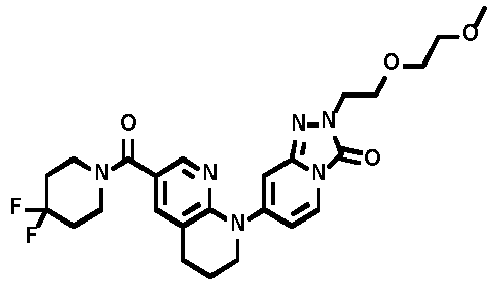
1H NMR (400 MHz, DMSO-d6) δ 1.95-2.12 (6H, m), 2.84 (2 H, t, J = 6.4 Hz), 3.20 (3H, s), 3.36-3.42 (2H, m), 3.49-3.55 (2H, m), 3.56-3.68 (4H, m), 3.72-3.85 (4H, m), 4.00 (2H, t, J = 5.4 Hz), 6.77 (1H, dd, J = 7.6, 2.1 Hz), 6.94 (1H, d, J = 1.8 Hz), 7.56 (1H, d, J = 2.4 Hz), 7.71 (1H, d, J = 7.9 Hz ), 8.07 (1H, d, J = 2.4 Hz). LRMS (ESI+) 517 [M+H]+. 1-81 
1H NMR (400 MHz, DMSO-d6) δ 1.94-2.09 (6H, m), 2.87 (2 H, t, J = 6.1 Hz), 3.07 (3H, s), 3.55-3.64 (4H, m), 3.81 (2H, t, J = 5.4 Hz), 4.44 (2H, s), 7.42 (1H, dd, J = 8.5, 1.8 Hz) , 7.48 (1H, d, J = 2.4 Hz), 7.53 (1H, d, J = 1.2 Hz), 7.63 ( 1H, d, J = 8.5 Hz), 7.93 (1H, d, J = 2.4 Hz). LRMS (ESI+) 427 [M+H]+. [Table 69] Example No. Chemical Structural Formula Spectrum Data 1-82 
1H NMR (400 MHz, DMSO-d6) δ 1.94-2.10 (6H, m), 2.87 (2 H, t, J = 6.4 Hz), 3.27 (3H, s), 3.53-3.63 (6H, m), 3.68 (2H, t, J = 5.4 Hz), 3.81 (2H, t, J = 5.8 Hz), 4.50 (2H, s), 7.43 (1H, dd, J = 8.5, 1.8 Hz), 7.48 (1H, d, J = 2.4 Hz), 7.54 (1 H, d, J = 1.2 Hz), 7.64 (1H, d, J = 8.5 Hz), 7.92 (1H, d, J = 2.4 Hz). LRMS (ESI+) 471 [M+H]+. 1-83 
1H NMR (400 MHz, DMSO-d6) δ 1.10 (3H, t, J = 7.0 Hz), 1.91-2.12 (6H, m), 2.87 (2H, t, J = 6.1 Hz), 3.46 (2H, q, J = 7.1 Hz), 3.56-3.63 (6H, m), 3.67 (2H, t, J = 5.1 Hz), 3.81 (2H, t, J = 5.4 Hz), 4.51 (2H, s), 7.43 (1H, dd, J = 8.5, 1.8 Hz), 7.48 (1H, d, J = 2.4 Hz), 7.55 (1H, d, J = 1.2 Hz), 7.6 5 (1H, d, J = 7.9 Hz), 7.92 (1H, d, J = 2.4 Hz). LRMS (ESI+) 485 [M+H]+. 1-84 
1H NMR (400 MHz, DMSO-d6) δ 1.93-2.12 (6H, m), 2.89 (2 H, t, J = 6.4 Hz), 3.11 (3H, s), 3.52-3.67 (4H, m), 3.86 (2H, t, J = 5.4 Hz), 4.47 (2H, s), 7.53 (1H, d, J = 2.4 Hz), 7.95 (1H, d, J = 2.4 Hz), 8.00 (1H, d, J = 2.4 Hz), 8.72 (1H, d, J = 2.4 Hz). LRMS (ESI+) 428 [M+H]+. 1-85 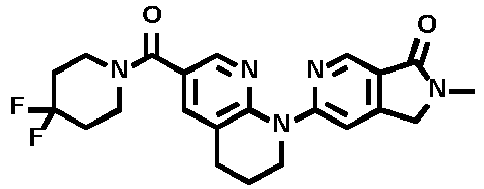
1H NMR (400 MHz, DMSO-d6) δ 1.91-2.13 (6H, m), 2.87 (2 H, t, J = 6.4 Hz), 3.04 (3H, s), 3.53-3.71 (4H, m), 4.07 (2H, t, J = 5.8 Hz), 4.47 (2H, s), 7.63 (1H, d, J = 2.4 Hz), 7.97 (1H, d, J = 1.2 Hz), 8.14 (1H, d, J = 2.4 Hz), 8.64 (1H, s) LRMS (ESI+) 428 [M+H]+. 1-86 
1H NMR (400 MHz, DMSO-d6) δ 1.92-2.14 (6H, m), 2.87 (2 H, t, J = 6.1 Hz), 3.26 (3H, s), 3.51-3.72 (8H, m), 4.08 (2H, t, J = 5.8 Hz), 4.53 (2H, s), 7.63 (1H, d, J = 2.4 Hz), 7.97 (1H, s), 8.13 (1H, d, J = 2.4 Hz), 8.66 (1H, s). LRMS (ESI+) 472 [M+H]+. 1-87 
1H NMR (400 MHz, DMSO-d6) δ 1.43-1.67 (6H, m), 1.97-2. 09 (2H, m), 2.87 (2H, t, J = 6.4 Hz), 3.40-3.54 (7H, m), 3.8 8 (2H, t, J = 5.8 Hz), 7.46 (1H, d, J = 2.4 Hz), 7.55 (1H, d , J = 2.4 Hz), 7.59 (1H, dd, J = 8.8, 2.1 Hz), 7.92 (1H, d, J = 2.4 Hz), 8.05 (1H, d, J = 8.5 Hz), 8.33 (1H, s). LRMS (ESI+) 404 [M+H]+. [Table 70] Example No. Chemical Structural Formula Spectrum Data 1-88 
1H NMR (400 MHz, DMSO-d6) δ 1.94-2.12 (6H, m), 2.88 (2 H, t, J = 6.4 Hz), 3.49 (3H, s), 3.54-3.68 (4H, m), 3.89 (2H, t, J = 5.4 Hz), 7.53 (1H, d, J = 2.4 Hz), 7.56 (1H, d, J = 1.8 Hz), 7.59 (1H, dd, J = 8.5, 1.8 Hz), 8.00 (1H, d, J = 1. 8 Hz), 8.06 (1H, d, J = 8.5 Hz), 8.34 (1H, s). LRMS (ESI+) 440 [M+H]+. 1-89 
1H NMR (400 MHz, CDCl3) δ 1.50-1.72 (15H, m), 3.36-3.76 (4H, m), 3.89 (3H, s), 3.93 (2H, t, J = 4.3 Hz), 4.36 (2H, t, J = 4.3 Hz), 6.92 (1H, dd, J = 8.6, 1.8 Hz), 7.08 (1H, d, J = 1.8 Hz), 7.21 (1H, d, J = 1.8 Hz), 7.82 (1H, d, J = 7.9 H z), 7.86 (1H, d, J = 1.8 Hz). LRMS (ESI+) 454 [M+H]+. 1-90 
1H NMR (400 MHz, CDCl3) δ 1.50-1.71 (6H, m), 3.45-3.66 ( 4H, m), 3.81 (3H, s), 3.91 (3H, s), 3.97 (2H, t, J = 4.3 Hz), 4.39 (2H, t, J = 4.3 Hz), 7.19 (1H, d, J = 1.8 Hz), 7.23 (1 H, dd, J = 8.6, 1.8 Hz), 7.37 (1H, d, J = 1.8 Hz), 7.78 (1H, s), 7.81 (1H, d, J = 1.8 Hz), 8.18 (1H, d, J = 8.6 Hz). LRMS (ESI+) 435 [M+H]+. 1-91 
1H NMR (400 MHz, CDCl3) δ 1.48-1.70 (6H, m), 3.43-3.68 ( 4H, m), 3.77 (3H, s), 3.95 (2H, t, J = 4.3 Hz), 4.38 (2H, t, J = 4.3 Hz), 6.47 (1H, d, J = 2.4 Hz), 7.03-7.08 (2H, m), 7. 18 (1H, d, J = 1.8 Hz), 7.29 (1H, s), 7.64 (1H, d, J = 7.9 Hz), 7.81 (1H, d, J = 1.8 Hz). LRMS (ESI+) 377 [M+R]+. 1-92 
1H NMR (400 MHz, CDCl3) δ 1.48-1.71 (6H, m), 3.40-3.71 ( 4H, m), 3.91 (3H, s), 3.98 (2H, t, J = 4.3 Hz), 4.05 (3H, s), 4.39 (2H, t, J = 4.6 Hz), 7.16 (1H, dd, J = 8.6, 1.8 Hz), 7. 20 (1H, d, J = 1.8 Hz), 7.27 (1H, s), 7.33 (1H, s), 7.68 (1H, d, J = 8.6 Hz), 7.82 (1H, d, J = 1.8 Hz). LRMS (ESI+) 435 [M+H]+. 1-93 
1H NMR (400 MHz, CDCl3) δ 1.41 (6H, s), 1.47-1.74 (6H, m), 3.35-3.78 (4H, m), 3.62 (2H, s), 3.64 (3H, s), 6.59 (1H, d, J = 1.8 Hz), 6.93 (1H, dd, J = 7.9, 1.8 Hz), 7.22 (1H, d, J = 1.8 Hz), 7.68 (1H, d, J = 6.7 Hz), 7.89 (1H, d, J = 1.8 Hz). LRMS (ESI+) 423 [M+H]+. [Table 71] Example No. Chemical Structural Formula Spectrum Data 1-94 
1H NMR (400 MHz, CDCl3) δ 1.51-1.76 (6H, m), 2.08-2.16 ( 2H, m), 2.88 (2H, t, J = 6.4 Hz), 3.41-3.73 (4H, m), 3.64 (3 H, s), 3.81 (2H, t, J = 6.1 Hz), 6.67 (1H, d, J = 1.2 Hz), 6. 76 (1H, dd, J = 7.9, 1.8 Hz), 7.50 (1H, t, J = 1.2 Hz), 7.63 (1H, d, J = 6.7 Hz), 8.09 (1H, d, J = 2.4 Hz). LRMS (ESI+) 393 |M+H1+. 1-95 
1H NMR (400 MHz, CDCl3) δ 1.02 (3H, d, J = 6.7 Hz), 1.5 0-1.75 (6H, m), 2.35-2.51 (1H, m), 3.24 (1H, dd, J = 14.7, 1 1.0 Hz), 3.34-3.49 (2H, m), 3.58 (3H, s), 3.64-3.78 (3H, m), 4.00 (1H, dd, J = 14.7, 4.9 Hz), 4.19 (1H, dd, J = 11.6, 3.7 Hz), 6.15 (1H, d, J = 1.8 Hz), 6.27 (1H, dd, J = 7.9, 2.4 H z), 7.05 (1H, dd, J = 7.9, 1.8 Hz), 7.11-7.14 (2H, m), 7.58 ( 1H, d, J = 7.9 Hz). LRMS (ESI+) 422 |M+H1+. 1-96 
1H NMR (400 MHz, CDCl3) δ 1.02 (3H, d, J = 7.3 Hz), 1.5 1-1.75 (6H, m), 2.36-2.50 (1H, m), 3.24 (1H, dd, J = 14.1, 1 0.4 Hz), 3.33-3.48 (2H, m), 3.58 (3H, s), 3.64-3.78 (3H, m), 4.00 (1H, dd, J = 14.7, 4.9 Hz), 4.19 (1H, dd, J = 11.6, 4.3 Hz), 6.15 (1H, d, J = 1.8 Hz), 6.27 (1H, dd, J = 7.3, 2.4 H z), 7.05 (1H, dd, J = 8.6, 1.8 Hz), 7.10-7.15 (2H, m), 7.58 ( 1H, d, J = 7.9 Hz). LRMS (ESI+) 422 [M+R]+. 1-97 
1H NMR (400 MHz, CDCl3) δ 1.50-1.75 (6H, m), 3.13-3.18 ( 2H, m), 3.32-3.56 (2H, m), 3.62 (3H, s), 3.63-3.77 (2H, m), 3.91-3.97 (2H, m), 6.37-6.42 (2H, m), 7.01 (1H, d, J = 7.9 Hz), 7.10 (1H, dd, J = 7.9, 1.8 Hz), 7.31 (1H, d, J = 1.8 H z), 7.61 (1H, d, J = 7.3 Hz). LRMS (ESI+) 410 [M+H]+. 1-98 
1H NMR (400 MHz, CDCl3) δ 1.55-1.75 (6H, m), 1.86-2.00 ( 4H, m), 3.35-3.50 (2H, m), 3.62 (3H, s), 3.65-3.78 (2H, m), 3.94 (2H, t, J = 4.9 Hz), 4.28 (2H, t, J = 4.9 Hz), 6.18 (1H, dd, J = 7.9, 2.4 Hz), 6.44 (1H, d, J = 1.8 Hz), 7.45 (1H, d , J = 1.8 Hz), 7.58 (1H, d, J = 7.3 Hz), 8.10 (1H, d, J = 1. 8 Hz). LRMS (ESI+) 423 [M+H]+. [Table 72] Example No. Chemical Structural Formula Spectrum Data 1-99 
1H NMR (400 MHz, CDCl3) δ 1.55-1.76 (6H, m), 2.15-2.24 ( 2H, m), 3.35-3.50 (2H, m), 3.61 (3H, s), 3.65-3.77 (2H, m), 3.96 (2H, t, J = 6.1 Hz), 4.26 (2H, t, J = 6.1 Hz), 6.42-6.46 (2H, m), 7.40 (1H, d, J = 1.8 Hz), 7.60 (1H, dd, J = 6.7, 2.4 Hz), 8.10 (1H, d, J = 2.4 Hz). LRMS (ESI+) 409 [M+H]+. 1-100 
1H NMR (400 MHz, CDCl3) δ 1.40-1.71 (6H, m), 3.17-3.35 ( 2H, m), 3.62 (3H, s), 3.68-3.80 (4H, m), 3.89 (3H, s), 4.36-4 .43 (2H, m), 6.51 (1H, d, J = 2.4 Hz), 6.57 (1H, dd, J = 7. 9, 2.4 Hz), 6.72 (1H, d, J = 8.6 Hz), 6.82 (1H, d, J = 8.6 Hz), 7.69 (1H, d, J = 8.6 Hz). LRMS (ESI+) 424 [M+H]+. 1-101 
1H NMR (400 MHz, CDCl3) δ 1.51-1.72 (6H, m), 3.27 (3H, s), 3.36-3.76 (4H, m), 4.03 (2H, t, J = 4.3 Hz), 4.39-4.43 (4 H, m), 7.25 (1H, d, J = 1.8 Hz), 7.83 (1H, d, J = 1.8 Hz), 8.02 (1H, d, J = 1.8 Hz), 8.73 (1H, d, J = 2.4 Hz). LRMS (ESI+) 394 [M+H]+. 1-102 
1H NMR (400 MHz, CDCl3) δ 1.53-1.74 (6H, m), 3.21 (3H, s), 3.37-3.78 (4H, m), 4.31-4.41 (6H, m), 7.29 (1H, d, J = 1. 8 Hz), 7.97 (1H, d, J = 1.8 Hz), 7.99 (1H, d, J = 9.2 Hz), 8.24 (1H, d, J = 9.2 Hz). LRMS (ESI+) 394 [M+H]+. 1-103 
1H NMR (400 MHz, CDCl3) δ 1.51-1.74 (6H, m), 3.18 (3H, s), 3.38-3.76 (4H, m), 4.34-4.43 (6H, m), 7.27 (1H, d, J = 2. 4 Hz), 7.96 (1H, d, J = 2.4 Hz), 8.29 (1H, d, J = 1.2 Hz), 8.79 (1H, s). LRMS (ESI+) 394 [M+H]+. 1-104 
1H NMR (400 MHz, CDCl3) δ 1.51-1.75 (6H, m), 3.32-3.77 ( 4H, m), 4.03 (2H, t, J = 4.5 Hz), 4.47 (2H, t, J = 4.5 Hz), 7.31 (1H, d, J = 1.8 Hz), 7.53 (1H, d, J = 1.8 Hz), 7.80 (1 H, dd, J = 7.9, 2.4 Hz), 7.89 (1H, d, J = 2.4 Hz), 8.67 (1H, d, J = 7.3 Hz). LRMS (ESI+) 366 [M+H]+. [Table 73] Example No. Chemical Structural Formula Spectrum Data 1-105 
1H NMR (400 MHz, CDCl3) δ 1.48-1.79 (6H, m), 3.31-3.78 ( 4H, m), 3.99 (2H, t, J = 4.5 Hz), 4.44 (2H, t, J = 4.5 Hz), 7.26 (1H, d, J = 1.8 Hz), 7.33 (1H, d, J = 1.8 Hz), 7.41 (1 H, dd, J = 7.3, 1.8 Hz), 7.87 (1H, d, J = 1.8 Hz), 8.01 (1H, d, J = 6.7 Hz), 8.72 (1H, s). LRMS (ESI+) 365 [M+H]+. 1-106 
1H NMR (400 MHz, CDCl3) δ 1.50-1.74 (6H, m), 3.34-3.76 ( 4H, m), 4.00 (2H, t, J = 4.5 Hz), 4.44 (2H, t, J = 4.5 Hz), 7.28 (1H, d, J = 1.8 Hz), 7.42 (1H, d, J = 2.4 Hz), 7.50 (1 H, dd, J = 7.9, 2.4 Hz), 7.88 (1H, d, J = 1.8 Hz), 8.27 (1H, s), 8.48 (1H, d, J = 7.3 Hz). LRMS (ESI+) 365 [M+H]+. 1-107 
1H NMR (400 MHz, CDCl3) δ 1.53-1.76 (6H, m), 1.77-1.91 ( 4H, m), 2.80 (2H, t, J = 6.1 Hz), 3.36-3.53 (2H, m), 3.59 (3 H, s), 3.64-3.79 (4H, m), 6.08 (1H, dd, J = 7.9, 1.8 Hz), 6.2 3 (1H, d, J = 1.8 Hz), 7.52 (1H, d, J = 7.9 Hz), 7.71 (1H, d, J = 2.4 Hz), 8.36 (1H, d, J = 2.4 Hz). LRMS (ESI+) 407 [M+H]+. 1-108 
1H NMR (400 MHz, CDCl3) δ 1.52-1.76 (6H, m), 3.34-3.52 ( 2H, m), 3.62 (3H, s), 3.65-3.78 (2H, m), 3.80-3.85 (2H, m), 3.93-3.98 (2H, m), 4.67 (2H, s), 6.17 (1H, dd, J = 7.9, 2.4 Hz), 6.45 (1H, d, J = 1.8 Hz), 7.57 (1H, d, J = 8.6 Hz), 7.7 4 (1H, d, J = 2.4 Hz), 8.36 (1H, d, J = 2.4 Hz). LRMS (ESI+) 409 [M+H]+. 1-109 
1H NMR (400 MHz, CDCl3) δ 1.54-1.75 (6H, m), 3.23 (2H, t, J = 8.6 Hz), 3.43-3.75 (4H, m), 3.64 (3H, s), 4.08 (2H, t, J = 8.6 Hz), 6.68 (1H, d, J = 1.2 Hz), 7.51-7.55 (1H, m), 7. 72 (1H, d, J = 7.9 Hz), 8.09-8.14 (2H, m). LRMS (ESI+) 379 [M+H]+. 1-110 
1H NMR (400 MHz, CDCl3) δ 1.15-1.39 (6H, m), 1.70-1.83 ( 2H, m), 1.87-2.01 (2H, m), 2.86-2.97 (1H, m), 3.64 (3H, s), 3.87 (2H, t, J = 4.6 Hz), 4.39 (2H, t, J = 4.6 Hz), 6.59 (1H, d, J = 1.2 Hz), 7.01 (1H, dd, J = 7.9, 1.8 Hz), 7.26 (1H, d , J = 1.8 Hz), 7.67 (1H, d, J = 7.9 Hz), 7.88 (1H, d, J = 2. 4 Hz). LRMS (ESI+) 398 [M+H]+. [Table 74] Example No. Chemical Structural Formula Spectrum Data 1-111 
1H NMR (400 MHz, CDCl3) δ 1.20-1.54 (5H, m), 1.69-1.77 ( 1H, m), 1.80-1.91 (4H, m), 3.07-3.16 (1H, m), 3.65 (3H, s), 3.93 (2H, t, J = 4.3 Hz), 4.42 (2H, t, J = 4.3 Hz), 6.69 (1H, d, J = 1.2 Hz), 6.97 (1H, dd, J = 7.3, 1.8 Hz), 7.68 (1H, d , J = 1.8 Hz), 7.70 (1H, d, J = 8.6 Hz), 8.43 (1H, d, J = 1. 8 Hz). LRMS (ESI+) 394 [M+H]+. 1-112 
1H NMR (400 MHz, CDCl3) δ 1.33-2.06 (6H, m), 2.09-2.17 ( 2H, m), 2.77-3.10 (4H, m), 3.64 (3H, s), 3.82 (2H, t, J = 5. 5 Hz), 4.15-4.51 (3H, m), 6.68 (1H, d, J = 1.2 Hz), 6.76 (1 H, dd, J = 7.3, 1.8 Hz), 7.47-7.51 (1H, m), 7.64 (1H, d, J = 6.7 Hz), 8.09 (1H, d, J = 1.8 Hz). LRMS (ESI+) 425 [M+H]+. 1-113 
1H NMR (400 MHz, CDCl3) δ 1.34-2.06 (6H, m), 1.41 (3H, t, J = 7.3 Hz), 2.09-2.17 (2H, m), 2.76-3.10 (4H, m), 3.82 (2 H, t, J = 5.5 Hz), 4.02 (2H, q, J = 7.3 Hz), 4.16-4.53 (3H, m), 6.71 (1H, d, J = 1.2 Hz), 6.74 (1H, dd, J = 7.3, 1.8 Hz) , 7.47-7.51 (1H, m), 7.64 (1H, d, J = 6.7 Hz), 8.08 (1H, d, J = 2.4 Hz). LRMS (ESI+) 439 [M+H]+. 1-114 
1H NMR (400 MHz, CDCl3) δ 1.33-2.06 (6H, m), 2.09-2.19 ( 2H, m), 2.72-3.14 (4H, m), 3.43 (3H, s), 3.82 (2H, t, J = 5. 5 Hz), 4.12-4.67 (3H, m), 5.30 (2H, s), 6.67 (1H, d, J = 1.2 Hz), 6.77 (1H, dd, J = 7.3, 1.8 Hz), 7.48-7.52 (1H, m), 7.63 (1H, d, J = 8.6 Hz), 8.10 (1H, d, J = 2.4 Hz). LRMS (ESI+) 455 [M+H]+. 1-115 
1H NMR (400 MHz, CDCl3) δ 1.22 (3H, t, J = 7.3 Hz), 1.3 4-2.05 (6H, m), 2.09-2.18 (2H, m), 2.71-3.13 (4H, m), 3.65 ( 2H, q, J = 7.3 Hz), 3.82 (2H, t, J = 5.5 Hz), 4.06-4.64 (3H, m), 5.34 (2H, s), 6.65-6.69 (1H, m), 6.76 (1H, dd, J = 7.3, 1.8 Hz), 7.48-7.52 (1H, m), 7.63 (1H, d, J = 8.6 Hz), 8.09 ( 1H, d, J = 2.4 Hz). LRMS (ESI+) 469 [M+H]+. [Table 75] Example No. Chemical Structural Formula Spectrum Data 1-116 
1H NMR (400 MHz, CDCl3) δ 1.34-2.06 (6H, m), 2.08-2.16 ( 2H, m), 2.69-3.14 (4H, m), 3.37 (3H, s), 3.77 (2H, t, J = 5. 5 Hz), 3.81 (2H, t, J = 5.5 Hz), 4.15 (2H, t, J = 5.5 Hz), 4. 20-4.60 (3H, m), 6.69-6.71 (1H, m), 6.73 (1H, dd, J = 7.9, 1 .8 Hz), 7.49 (1H, d, J = 1.8 Hz), 7.62-7.66 (1H, m), 8.08 (1 H, d, J = 2.4 Hz). LRMS (ESI+) 469 [M+H]+. 1-117 
1H NMR (400 MHz, CDCl3) δ 1.18 (3H, t, J = 7.3 Hz), 1.3 2-2.06 (6H, m), 2.08-2.18 (2H, m), 2.70-3.15 (4H, m), 3.53 ( 2H, q, J = 7.3 Hz), 3.78-3.84 (4H, m), 4.15 (2H, t, J = 5.5 Hz), 4.20-4.58 (3H, m), 6.70 (1H, d, J = 1.2 Hz), 6.73 (1H, dd, J = 7.3, 1.8 Hz), 7.49 (1H, d, J = 2.4 Hz), 7.64 (1H, d, J = 6.7 Hz), 8.08 (1H, d, J = 2.4 Hz). LRMS (ESI+) 483 [M+H]+. 1-118 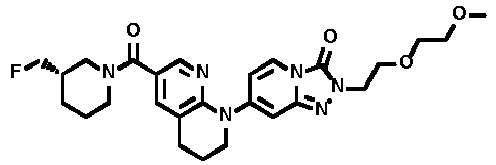
1H NMR (400 MHz, CDCl3) δ 1.34-2.05 (6H, m), 2.08-2.17 ( 2H, m), 2.75-3.14 (4H, m), 3.36 (3H, s), 3.50-3.55 (2H, m), 3.62-3.67 (2H, m), 3.81 (2H, t, J = 5.8 Hz), 3.88 (2H, t, J = 5.8 Hz), 4.16 (2H, t, J = 5.8 Hz), 4.21-4.49 (3H, m), 6.69 ( 1H, d, J = 1.2 Hz), 6.73 (1H, dd, J = 7.9, 1.8 Hz), 7.47-7.5 1 (1H, m), 7.63 (1H, dd, J = 7.9, 1.2 Hz), 8.08 (1H, d, J = 2.4 Hz). LRMS (ESI+) 513 [M+H]+. 1-119 
1H NMR (400 MHz, CDCl3) δ 1.34-2.05 (6H, m), 2.08-2.19 ( 2H, m), 2.69-3.12 (4H, m), 3.64 (3H, s), 3.82 (2H, t, J = 5. 5 Hz), 4.16-4.62 (3H, m), 6.68 (1H, d, J = 1.2 Hz), 6.76 (1 H, dd, J = 7.9, 1.2 Hz), 7.49 (1H, d, J = 1.8 Hz), 7.64 (1H, d, J = 8.6 Hz), 8.09 (1H, d, J = 2.4 Hz). LRMS (ESI+) 425 [M+H]+. 1-120 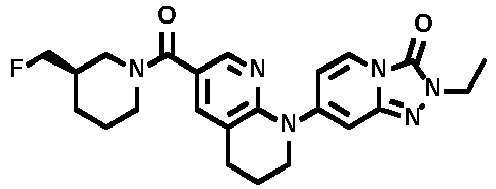
1H NMR (400 MHz, CDCl3) δ 1.34-2.06 (6H, m), 1.41 (3H, t, J = 7.3 Hz), 2.08-2.18 (2H, m), 2.72-3.14 (4H, m), 3.82 (2 H, t, J = 5.5 Hz), 4.02 (2H, q, J = 7.3 Hz), 4.17-4.63 (3H, m), 6.71 (1H, d, J = 1.2 Hz), 6.74 (1H, dd, J = 7.9, 1.8 Hz) , 7.49 (1H, d, J = 1.8 Hz), 7.64 (1H, dd, J = 7.3, 1.2 Hz), 8.08 (1H, d, J = 2.4 Hz). LRMS (ESI+) 439 [M+H]+. [Table 76] Example No. Chemical Structural Formula Spectrum Data 1-121 
1H NMR (400 MHz, CDCl3) δ 1.33-2.06 (6H, m), 2.09-2.20 ( 2H, m), 2.67-3.14 (4H, m), 3.43 (3H, s), 3.83 (2H, t, J = 5. 5 Hz), 4.17-4.67 (3H, m), 5.30 (2H, s), 6.67 (1H, d, J = 1.8 Hz), 6.77 (1H, dd, J = 7.3, 1.8 Hz), 7.50 (1H, d, J = 1.8 H z), 7.64 (1H, d, J = 7.3 Hz), 8.10 (1H, d, J = 2.4 Hz). LRMS (ESI+) 455 [M+H]+. 1-122 
1H NMR (400 MHz, CDCl3) δ 1.22 (3H, t, J = 7.3 Hz), 1.3 3-2.06 (6H, m), 2.08-2.19 (2H, m), 2.70-3.15 (4H, m), 3.65 ( 2H, q, J = 7.3 Hz), 3.82 (2H, t, J = 5.5 Hz), 4.17-4.62 (3H, m), 5.34 (2H, s), 6.67 (1H, d, J = 1.2 Hz), 6.76 (1H, dd, J = 7.9, 1.8 Hz), 7.50 (1H, d, J = 1.8 Hz), 7.63 (1H, d, J = 7 .3 Hz), 8.09 (1H, d, J = 1.8 Hz). LRMS (ESI+) 469 [M+H]+. 1-123 
1H NMR (400 MHz, CDCl3) δ 1.34-2.06 (6H, m), 2.08-2.18 ( 2H, m), 2.69-3.13 (4H, m), 3.37 (3H, s), 3.77 (2H, t, J = 5. 5 Hz), 3.81 (2H, t, J = 5.5 Hz), 4.16 (2H, t, J = 5.5 Hz), 4. 20-4.65 (3H, m), 6.71 (1H, d, J = 1.2 Hz), 6.73 (1H, dd, J = 7.3, 1.8 Hz), 7.49 (1H, d, J = 1.2 Hz), 7.64 (1H, d, J = 8 .6 Hz), 8.08 (1H, d, J = 1.8 Hz). LRMS (ESI+) 469 [M+H]+. 1-124 
1H NMR (400 MHz, CDCl3) δ 1.17 (3H, t, J = 7.3 Hz), 1.3 4-2.06 (11H, m), 2.08-2.17 (2H, m), 2.73-3.12 (4H, m), 3.53 (2H, q, J = 7.3 Hz), 3.77-3.85 (4H, m), 4.14 (2H, t, J = 5.5 Hz), 4.19-4.59 (3H, m), 6.70 (1H, d, J = 1.8 Hz), 6.73 (1H, dd, J = 7.9, 1.8 Hz), 7.49 (1H, d, J = 1.2 Hz), 7.64 (1H, dd , J = 7.3, 1.2 Hz), 8.08 (1H, d, J = 2.4 Hz). LRMS (ESI+) 483 [M+H]+. 1-125 
1H NMR (400 MHz, CDCl3) δ 1.33-2.06 (6H, m), 2.08-2.17 ( 2H, m), 2.70-3.14 (4H, m), 3.36 (3H, s), 3.50-3.55 (2H, m), 3.63-3.68 (2H, m), 3.81 (2H, t, J = 5.5 Hz), 3.88 (2H, t, J = 5.5 Hz), 4.16 (2H, t, J = 5.5 Hz), 4.20-4.64 (3H, m), 6.69 ( 1H, d, J = 1.2 Hz), 6.74 (1H, dd, J = 7.9, 1.8 Hz), 7.49 (1 H, d, J = 2.4 Hz), 7.63 (1H, d, J = 6.7 Hz), 8.08 (1H, d, J = 2.4 Hz). LRMS (ESI+) 513 [M+H]+. [Table 77] Example No. Chemical Structural Formula Spectrum Data 1-126 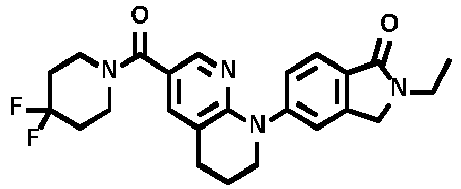
1H-NMR (400 MHz, DMSO-d6) δ 1.17 (3H, t, J = 7.3 Hz), 1.93-2.11 (6H, m), 2.87 (2H, t, J = 6.4 Hz), 3.47-3.68 (6H, m), 3.81 (2H, t, J = 5.4 Hz), 4.45 (2H, s), 7.42 (1H, dd, J = 8.5, 1.8 Hz), 7.48 (1H, d, J = 2.4 Hz), 7.54 (1H, d, J = 1 .2 Hz), 7.63 (1H, d, J = 7.9 Hz), 7.92 (1H, d, J = 1.8 Hz). LRMS (ESI+) 441 [M+H]+. 1-127 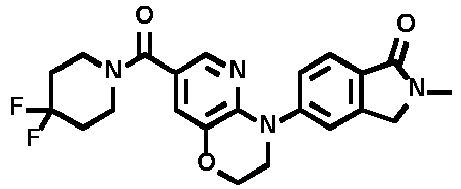
1H NMR (400 MHz, DMSO-d6) δ 1.94-2.10 (4H, m), 3.06 (3 H, s), 3.48-3.69 (4H, m), 3.96 (2H, t, J = 4.3 Hz), 4.36 (2H, t, J = 4.3 Hz), 4.44 (2H, s), 7.24 (1H, d, J = 1.8 Hz), 7.51 (1H, dd, J = 7.9, 1.8 Hz), 7.60-7.66 (2H, m), 7.76 (1H, d, J = 1.8 Hz). LRMS (ESI+) 429 [M+H]+. 1-128 
1H NMR (400 MHz, DMSO-d6) δ 1.95-2.09 (4H, m), 3.48-3. 68 (4H, m), 4.01 (2H, t, J = 4.3 Hz), 4.37 (2H, t, J = 4.3 Hz), 6.48 (1H, d, J = 6.7 Hz), 7.13 (1H, dd, J = 7.0, 5.8 H z), 7.26 (1H, d, J = 1.8 Hz), 7.58 (1H, d, J = 1.8 Hz), 7.62 (1H, dd, J = 8.9, 2.1 Hz), 7.80 (1H, d, J = 2.4 Hz), 8.11 (1 H, d, J = 8.6 Hz), 11.08-11.15 (1H, m). LRMS (ESI+) 427 [M+H]+. 1-129 
1H NMR (400 MHz, CDCl3) δ 1.94-2.08 (4H, m), 2.10-2.17 ( 2H, m), 2.89 (2H, t, J = 6.4 Hz), 3.64 (3H, s), 3.69-3.80 (4 H, m), 3.83 (2H, t, J = 5.8 Hz), 6.70 (1H, d, J = 1.2 Hz), 6 .74 (1H, dd, J = 7.6, 2.1 Hz), 7.51 (1H, d, J = 1.8 Hz), 7.6 5 (1H, d, J = 8.6 Hz), 8.10 (1H, d, J = 2.4 Hz). LRMS (ESI+) 429 [M+H]+. [Table 78] Example No. Chemical Structural Formula Spectrum Data 1-130 
1H NMR (400 MHz, CDCl3) δ 1.51-1.75 (6H, m), 2.01-2.11 (2H, m), 2.76 (2H, t, J = 6.1 Hz), 3.36-3.78 (9H, m), 6.42 ( 1H, d, J = 1.8 Hz), 6.54 (1H, dd, J = 7.9, 1.8 Hz), 6.98 (1 H, d, J = 7.9 Hz), 7.15 (1H, dd, J = 8.6, 1.8 Hz), 7.24 (1H , d, J = 1.8 Hz), 7.59 (1H, d, J = 7.9 Hz). LRMS (ESI+) 392 [M+H]+. 1-131 
1H NMR (400 MHz, CDCl3) δ 1.51-1.73 (6H, m), 1.99-2.09 (2H, m), 2.81 (2H, t, J = 6.1 Hz), 3.36-3.66 (4H, m), 3.69 ( 2H, t, J = 6.1 Hz), 3.90 (3H, s), 7.01 (1H, d, J = 8.6 Hz), 7.04 (1H, dd, J = 8.6, 1.8 Hz), 7.20 (1H, d, J = 1.2 Hz), 7. 24 (2H, d, J = 8.6 Hz), 7.97 (2H, d, J = 9.2 Hz). LRMS (ESI+) 379 [M+H]+ 1-132 
1H NMR (400 MHz, CDCl3) δ 1.75-2.01 (6H, m), 2.14-2.27 (2H, m), 3.15-3.25 (1H, m), 3.66 (3H, s), 3.94 (2H, t, J = 4 .3 Hz), 4.43 (2H, t, J = 4.3 Hz), 6.72 (1H, d, J = 1.2 Hz), 6.94 (1H, dd, J = 7.9, 1.8 Hz), 7.67 (1H, d, J = 2.4 Hz), 7. 71 (1H, dd, J = 7.9, 1.2 Hz), 8.41 (1H, d, J = 1.8 Hz). LRMS (ESI+) 430 [M+H]+. 1-133 
1H NMR (400 MHz, CDCl3) δ 1.72-2.00 (6H, m), 2.13-2.26 (2H, m), 3.12-3.24 (4H, m), 4.00 (2H, t, J = 4.9 Hz), 4.37-4 .44 (4H, m), 7.44 (1H, dd, J = 7.9, 1.8 Hz), 7.53 (1H, d, J = 1.2 Hz), 7.63 (1H, d, J = 1.8 Hz), 7.89 (1H, d, J = 8.6 Hz), 8.35 (1H, d, J = 2.4 Hz). LRMS (ESI+) 428 [M+H]+. 1-134 
1H NMR (400 MHz, CDCl3) δ 1.19-1.41 (3H, m), 1.43-1.56 (2H, m), 1.67-1.76 (1H, m), 1.78-1.93 (4H, m), 3.02-3.15 (1 H, m), 3.21 (3H, s), 3.99 (2H, t, J = 4.3 Hz), 4.33-4.47 (4H , m), 7.43 (1H, dd, J = 8.6, 1.8 Hz), 7.54 (1H, s), 7.65 (1H, d, J = 1.8 Hz), 7.88 (1H, d, J = 7.9 Hz), 8.38 (1H, d, J = 1.8 Hz). LRMS (ESI+) 392 [M+H]+. 1-135 
1H NMR (400 MHz, CDCl3) δ 1.15-1.39 (6H, m), 1.71-1.82 (2H, m), 1.88-1.99 (2H, m), 2.06-2.15 (2H, m), 2.80-2.91 (3 H, m), 3.63 (3H, s), 3.79 (2H, t, J = 6.1 Hz), 6.61 (1H, d, J = 1.2 Hz), 6.80 (1H, dd, J = 7.9, 1.8 Hz), 7.43-7.47 (1H, m), 7.61 (1H, d, J = 7.3 Hz), 8.10 (1H, d, J = 2.4 Hz). LRMS (ESI+) 396 [M+H]+. [Table 79] Example No. Chemical Structural Formula Spectrum Data 1-136 
1H NMR (400 MHz, CDCl3) δ 1.13-1.38 (6H, m), 1.69-1.80 (2H, m), 1.89-1.98 (2H, m), 2.81-2.90 (1H, m), 3.19 (3H, s), 3.94 (2H, t, J = 4.3 Hz), 4.33-4.39 (4H, m), 7.23 (1H, d, J = 1.8 Hz), 7.38 (1H, dd, J = 7.9, 1.8 Hz), 7.55 (1H, d, J = 1.2 Hz), 7.80-7.86 (2H, m). LRMS (ESI+) 396 [M+H]+. 1-137 
1H NMR (400 MHz, CDCl3) δ 1.49-1.70 (6H, m), 3.35-3.83 (9H, m), 4.25-4.44 (2H, m), 6.35 (1H, d, J = 7.9 Hz), 6.75 (1H, dd, J = 8.5, 1.8 Hz), 6.95 (1H, d, J = 1.8 Hz), 7.29-7. 37 (2H, m), 7.56 (1H, td, J = 7.3, 1.8 Hz), 7.88 (1H, dd, J = 7.9, 1.2 Hz). LRMS (ESI+) 381 [M+H]+. 1-138 
1H NMR (400 MHz, CDCl3) δ 1.51-1.71 (6H, m), 3.17 (2H, t, J = 8.5 Hz), 3.46-3.63 (4H, m), 3.69 (3H, s), 3.98 (2H, t, J = 8.5 Hz), 6.40 (1H, d, J = 8.5 Hz), 7.05 (1H, dd, J = 7. 9, 1.8 Hz), 7.21 (1H, td, J = 7.3, 1.2 Hz), 7.25 (1H, d, J = 1.2 Hz), 7.37 (1H, dd, J = 7.9, 1.2 Hz), 7.51 (1H, td, J = 7 .3, 1.8 Hz), 7.83 (1H, dd, J = 7.9, 1.8 Hz). LRMS (ESI+) 365 [M+H]+. 1-139 
1H NMR (400 MHz, CDCl3) δ 1.51-1.73 (6H, m), 3.17 (2H, t, J = 8.5 Hz), 3.44-3.70 (4H, m), 3.93 (3H, s), 4.04 (2H, t, J = 8.5 Hz), 7.09 (1H, d, J = 7.9 Hz), 7.17 (1H, dd, J = 7. 9, 1.2 Hz), 7.29 (1H, d, J = 1.2 Hz), 7.38-7.46 (2H, m), 7.6 5 (1H, td, J = 6.7, 1.8 Hz), 7.88 (1H, s). LRMS (ESI+) 365 [M+H]+. 1-140 
1H NMR (400 MHz, CDCl3) δ 1.52-1.73 (6H, m), 3.18 (2H, t, J = 8.5 Hz), 3.41-3.73 (4H, m), 3.90 (3H, s), 4.06 (2H, t, J = 8.5 Hz), 7.16-7.25 (4H, m), 7.30 (1H, s), 7.99-8.05 (2H, m). LRMS (ESI+) 365 [M+H]+. 1-141 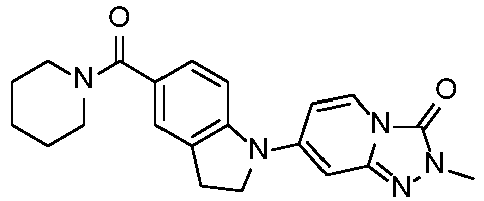
1H NMR (400 MHz, CDCl3) δ 1.51-1.74 (6H, m), 3.19 (2H, t, J = 8.3 Hz), 3.39-3.73 (7H, m), 4.02 (2H, t, J = 8.3 Hz), 6.41 (1H, d, J = 1.2 Hz), 6.75 (1H, dd, J = 7.9, 1.8 Hz), 7. 12 (1H, d, J = 7.9 Hz), 7.20 (1H, dd, J = 8.6, 1.8 Hz), 7.3 1 (1H, d, J = 1.2 Hz), 7.71 (1H, d, J = 7.9 Hz). LRMS (ESI+) 378 [M+H]+. [Table 80] Example No. Chemical Structural Formula Spectrum Data 1-142 
1H NMR (400 MHz, CDCl3) δ 1.56-1.58 (4H, m), 1.58 (9H, s), 1.64-1.73 (2H, m), 2.59 (3H, s), 3.37-3.75 (4H, m), 3.89-3.94 (2H, m), 4.32-4.37 (2H, m), 7.21 (2H, d, J = 1.8 Hz), 7.24-7.28 (1H, m), 7.84 (1H, d, J = 1.8 Hz), 7.90 (1H, d, J = 8.6 Hz). LRMS (ESI+) 438 [M+H]+. 1-143 
1H NMR (400 MHz, CDCl3) δ 1.50-1.58 (4H, m), 1.60 (9H, s), 1.65-1.73 (2H, m), 3.34-3.76 (4H, m), 3.91 (2H, t, J = 4. 6 Hz), 4.36 (2H, t, J = 4.6 Hz), 7.23 (1H, d, J = 1.8 Hz), 7.38 (1H, dd, J = 8.6, 2.4 Hz), 7.46 (1H, d, J = 2.4 Hz), 7. 82 (1H, d, J = 8.6 Hz), 7.85 (1H, d, J = 1.8 Hz). LRMS (ESI+) 458 [M+H]+. 1-144 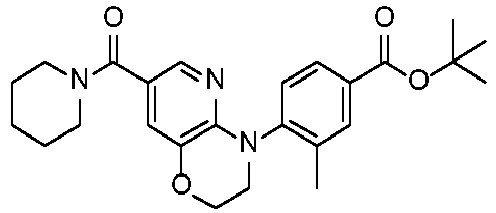
1H NMR (400 MHz, CDCl3) δ 1.50-1.58 (4H, m), 1.59 (9H, s), 1.62-1.71 (2H, m), 2.22 (3H, s), 3.39-3.99 (6H, m), 4.34-4.43 (2H, m), 7.18 (1H, d, J = 1.8 Hz), 7.24 (1H, d, J = 8. 6 Hz), 7.77 (1H, d, J = 1.8 Hz), 7.90 (1H, dd, J = 7.9, 1.8 Hz), 7.94 (1H, d, J = 1.8 Hz). LRMS (ESI+) 438 [M+H]+. 1-145 
1H NMR (400 MHz, CDCl3) δ 1.34-2.06 (6H, m), 2.08-2.19 (2H, m), 2.71-3.14 (4H, m), 3.83 (2H, t, J = 5.5 Hz), 4.14-4 .63 (3H, m), 6.70 (1H, d, J = 1.2 Hz), 6.77 (1H, dd, J = 7. 9, 1.8 Hz), 7.48-7.52 (1H, m), 7.64 (1H, d, J = 6.7 Hz), 8.1 0 (1H, d, J = 2.4 Hz), 9.22 (1H, br s). LRMS (ESI+) 411 [M+H]+. 1-146 
1H NMR (400 MHz, CDCl3) δ 1.35-2.06 (6H, m), 2.09-2.18 (2H, m), 2.75-3.14 (4H, m), 3.83 (2H, t, J = 5.5 Hz), 4.12-4 .68 (3H, m), 6.70 (1H, d, J = 1.2 Hz), 6.77 (1H, dd, J = 7. 9, 1.8 Hz), 7.48-7.52 (1H, m), 7.64 (1H, d, J = 6.7 Hz), 8.1 0 (1H, d, J = 2.4 Hz), 9.21 (1H, br s). LRMS (ESI+) 411 [M+H]+. 1-147 
1H NMR (400 MHz, CDCl3) δ 1.93-2.11 (4H, m), 3.63 (3H, s), 3.66-3.87 (6H, m), 4.35 (2H, t, J = 4.3 Hz), 6.53-6.59 (2 H, m), 6.91 (1H, dd, J = 8.6, 1.8 Hz), 7.02 (1H, d, J = 1.8 Hz), 7.06 (1H, d, J = 8.6 Hz), 7.71 (1H, dd, J = 7.3, 1.2 H z). LRMS (ESI+) 430 [M+H]+. [Table 81] Example No. Chemical Structural Formula Spectrum Data 1-148 
1H NMR (400 MHz, CDCl3) δ 1.90-2.14 (4H, m), 3.46-3.95 (6H, m), 4.35 (2H, t, J = 4.3 Hz), 6.55-6.61 (2H, m), 6.93 ( 1H, dd, J = 7.9, 1.8 Hz), 7.02 (1H, d, J = 1.8 Hz), 7.07 (1 H, d, J = 8.6 Hz), 7.72 (1H, dd, J = 7.3, 1.2 Hz), 9.36 (1H , br s). LRMS (ESI+) 416 [M+H]+. 1-149 
1H NMR (400 MHz, CDCl3) δ 1.91-2.11 (4H, m), 3.20 (3H, s), 3.64-3.85 (6H, m), 4.33 (2H, t, J = 4.3 Hz), 4.35 (2H, s) , 6.86 (1H, dd, J = 8.6, 1.8 Hz), 7.00 (2H, dd, J = 5.5, 3.1 Hz), 7.28-7.32 (2H, m), 7.82 (1H, d, J = 8.6 Hz). LRMS (ESI+) 428 [M+H]+. 1-150 
1H NMR (400 MHz, CDCl3) δ 1.91-2.08 (4H, m), 3.67-3.79 (6H, m), 3.79 (3H, s), 3.84 (3H, s), 4.26 (2H, s), 4.31 (2H, t, J = 4.2 Hz), 4.75 (2H, s), 6.44 (1H, dd, J = 8.5, 2.4 Hz), 6.47 (1H, d, J = 2.4 Hz), 6.83 (1H, dd, J = 8.5, 1.8 Hz), 6.95-7.00 (2H, m), 7.20-7.24 (2H, m), 7.28 (1H, dd, J = 7.9, 1.8 Hz), 7.83 (1H, d, J = 7.9 Hz). LRMS (ESI+) 564 [M+H]+. 1-151 
1H NMR (400 MHz, CDCl3) δ 1.94-2.12 (4H, m), 3.16 (3H, s), 3.63-3.88 (4H, m), 4.22 (2H, t, J = 4.9 Hz), 4.29-4.34 (4 H, m), 6.96 (1H, dd, J = 8.6, 1.8 Hz), 7.02 (1H, d, J = 1.8 Hz), 7.28 (1H, d, J = 1.2 Hz), 7.42 (1H, d, J = 7.9 Hz), 8. 76 (1H, d, J = 1.2 Hz). LRMS (ESI+) 429 [M+H]+. 1-152 
1H NMR (400 MHz, CDCl3) δ 1.94-2.11 (4H, m), 3.64-3.84 (4H, m), 3.87 (2H, t, J = 4.3 Hz), 4.35 (2H, t, J = 4.3 Hz), 6.89 (1H, dd, J = 8.6, 1.8 Hz), 7.04 (1H, d, J = 2.4 Hz), 7.24 (1H, d, J = 8.6 Hz), 7.41-7.47 (2H, m), 8.00 (1H, d, J = 3.7 Hz), 8.23 (1H, d, J = 8.6 Hz), 9.72 (1H, br s). LRMS (ESI+) 427 [M+H]+. 1-153 
1H NMR (400 MHz, CDCl3) δ 1.93-2.12 (4H, m), 3.59 (3H, s), 3.66-3.83 (4H, m), 3.86 (2H, t, J = 4.3 Hz), 4.35 (2H, t, J = 4.3 Hz), 6.88 (1H, dd, J = 8.6, 1.8 Hz), 7.03 (1H, d, J = 1.8 Hz), 7.21 (1H, d, J = 7.9 Hz), 7.38-7.43 (2H, m), 8.0 2 (1H, s), 8.22-8.28 (1H, m). LRMS (ESI+) 441 [M+H]+. [Table 82] Example No. Chemical Structural Formula Spectrum Data 1-154 
1H NMR (400 MHz, CDCl3) δ 1.92-2.12 (4H, m), 3.46 (3H, s), 3.61-3.88 (6H, m), 4.35 (2H, t, J = 4.3 Hz), 5.28 (2H, s) , 6.54 (1H, t, J = 1.2 Hz), 6.58 (1H, dd, J = 7.9, 1.8 Hz), 6.92 (1H, dd, J = 8.6, 1.8 Hz), 7.02 (1H, d, J = 1.8 Hz), 7. 07 (1H, d, J = 8.6 Hz), 7.71 (1H, dd, J = 7.9, 1.2 Hz). LRMS (ESI+) 460 [M+H]+. 1-155 
1H NMR (400 MHz, CDCl3) δ 1.49-1.73 (6H, m), 2.09-2.19 (2H, m), 2.92 (2H, t, J = 6.1 Hz), 3.41-3.75 (4H, m), 3.93 ( 2H, t, J = 6.1 Hz), 7.51 (1H, d, J = 1.8 Hz), 7.60-7.67 (2H, m), 8.02 (1H, d, J = 2.4 Hz), 8.05 (1H, d, J = 2.4 Hz), 8. 23 (1H, d, J = 8.6 Hz), 10.43 (1H, br s). LRMS (ESI+) 390 [M+H]+. 1-156 
1H NMR (400 MHz, CDCl3) δ 1.59 (4H, s), 1.67 (2H, s), 3. 45-3.65 (4H, m), 3.75 (2H, t, J = 4.2 Hz), 3.92 (3H, s), 4.3 2 (2H, t, J = 4.2 Hz), 6.84 (2H, dt, J = 15.3, 6.4 Hz), 6.97 (1H, d, J = 1.8 Hz), 7.44 (2H, t, J = 3.0 Hz), 7.78 (1H, t, J = 3.3 Hz), 7.90 (1H, s). LRMS (ESI+) 381 [M+H]+. 1-157 
1H NMR (400 MHz, DMSO-d6) δ 1.43-1.53 (4H, m), 1.55-1.64 ( 2H, m), 3.35-3.50 (4H, m), 3.81 (2H, t, J = 4.5 Hz), 4.26 (2 H, t, J = 4.5 Hz), 6.80 (1H, dd, J = 8.5, 1.8 Hz), 6.88 (1H, d, J = 1.8 Hz), 7.13 (1H, d, J = 8.5 Hz), 7.39 (2H, dd, J = 7.0, 2.1 Hz), 7.76 (2H, dd, J = 11.5, 2.4 Hz). LRMS (ESI+) 348 [M+H]+. 1-158 
1H NMR (400 MHz, CDCl3) δ 1.64-1.70 (6H, m), 3.43-3.60 (4H, m), 3.62 (2H, s), 3.70 (2H, t, J = 3.6 Hz), 3.72 (3H, s ), 4.30 (2H, t, J = 4.5 Hz), 6.80 (1H, dd, J = 8.5, 1.8 Hz), 6.86 (1H, d, J = 8.5 Hz), 6.95 (1H, d, J = 1.8 Hz), 7.19 (2 H, d, J = 8.5 Hz), 7.28 (2H, d, J = 8.5 Hz). LRMS (ESI+) 395 [M+H]+. 1-159 
1H NMR (400 MHz, CDCl3) δ 1.57-1.71 (6H, m), 2.65 (2H, t, J = 7.9 Hz), 2.95 (2H, t, J = 7.9 Hz), 3.45-3.65 (4H, m), 3.69 (3H, s), 3.71 (2H, s), 4.31 (2H, t, J = 4.3 Hz), 6.80 (2 H, s), 6.94 (1H, s), 7.16 (2H, d, J = 7.9 Hz), 7.21 (2H, d, J = 8.6 Hz). LRMS (ESI+) 409 [M+H]+. [Table 83] Example No. Chemical Structural Formula Spectrum Data 1-160 
1H NMR (400 MHz, CDCl3) δ 1.58-1.70 (6H, m), 2.95 (3H, s), 3.40-3.68 (4H, m), 3.72 (2H, t, J = 4.3 Hz), 4.29-4.34 (4 H, m), 4.55 (1H, t, J = 5.8 Hz), 6.81 (1H, dd, J = 8.6, 1.8 Hz), 6.86 (1H, d, J = 7.9 Hz), 6.96 (1H, d, J = 1.8 Hz), 7. 23 (2H, d, J = 8.6 Hz), 7.35 (2H, d, J = 8.6 Hz). LRMS (ESI+) 430 [M+H]+. 1-161 
1H NMR (400 MHz, CDCl3) δ 1.51-1.70 (6H, m), 2.89 (3H, s), 3.14-3.19 (2H, m), 3.29-3.34 (2H, m), 3.39-3.67 (4H, m), 3.70 (2H, t, J = 4.3 Hz), 4.30 (2H, t, J = 4.3 Hz), 6.79-6.84 (2H, m), 6.95 (1H, d, J = 1.2 Hz), 7.19-7.25 (4H, m). LRMS (ESI+) 429 [M+H]+. 1-162 
1H NMR (400 MHz, CDCl3) δ 1.59-1.72 (6H, m), 2.83 (3H, s), 3.40-3.65 (4H, m), 3.74 (2H, t, J = 4.3 Hz), 4.23 (2H, s) , 4.30 (2H, t, J = 4.3 Hz), 6.83 (1H, dd, J = 8.3, 2.1 Hz), 6.97 (2H, dd, J = 4.9, 3.1 Hz), 7.27-7.28 (2H, m), 7.39 (2H, d, J = 8.6 Hz). LRMS (ESI+) 415 [M+H]+. 1-163 
1H NMR (400 MHz, CDCl3) δ 1.62-1.73 (6H, m), 3.40-3.77 (7H, m), 4.02 (2H, dd, J = 5.5, 3.1 Hz), 4.40 (2H, dd, J = 5.8, 3.4 Hz), 7.26 (1H, s), 7.59 (1H, d, J = 2.4 Hz), 7.73 (1 H, dd, J = 8.6, 2.4 Hz), 7.87 (1H, d, J = 2.4 Hz), 8.03 (1H , s), 8.28 (1H, d, J = 8.6 Hz). LRMS (ESI+): 406 (M+H+). 1-164 
1H NMR (400 MHz, CDCl3) δ 1.54-1.73 (6H, m), 3.27 (3H, s), 3.36-3.80 (4H, m), 4.00 (2H, t, J = 4.3 Hz), 4.42 (2H, t, J = 4.3 Hz), 7.29 (1H, d, J = 1.8 Hz), 7.86 (1H, d, J = 1.8 Hz), 7.88 (1H, d, J = 8.6 Hz), 7.98 (1H, dd, J = 8.6, 1.8 Hz), 8.02 (1H, d, J = 1.8 Hz). LRMS (ESI+): 443 (M+H+). 1-165 
1H NMR (400 MHz, CDCl3) δ 1.56-1.74 (6H, m), 3.26 (3H, s), 3.38-3.82 (4H, m), 4.00-4.02 (2H, m), 4.41-4.43 (2H, m), 7.30 (1H, d, J = 1.8 Hz), 7.82 (1H, dd, J = 8.6, 1.8 Hz), 7. 89 (1H, d, J = 1.8 Hz), 8.00 (1H, d, J = 8.6 Hz), 8.07 (1H, d, J = 1.8 Hz). LRMS (ESI+): 443 (M+H+). [Table 84] Example No. Chemical Structural Formula Spectrum Data 1-166 
1H NMR (400 MHz, CDCl3) δ 1.59-1.76 (6H, m), 3.18 (3H, s), 3.35-3.79 (4H, m), 3.99 (2H, t, J = 4.3 Hz), 4.40 (2H, t, J = 4.6 Hz), 7.27 (1H, d, J = 1.8 Hz), 7.71 (1H, dd, J = 8. 3, 2.1 Hz), 7.83 (1H, d, J = 7.9 Hz), 7.86 (1H, d, J = 1.8 Hz), 7.92 (1H, d, J = 1.8 Hz). LRMS (ESI+): 407 (M+H+). 1-167 
1H NMR (400 MHz, CDCl3) δ 1.39-1.44 (2H, m), 1.58-1.74 (8H, m), 2.22-2.29 (1H, m), 3.40-3.74 (4H, m), 3.99 (2H, t, J = 4.5 Hz), 4.41 (2H, t, J = 4.5 Hz), 7.26 (1H, s), 7.57 (1 H, dd, J = 8.5, 1.8 Hz), 7.86 (1H, d, J = 6.1 Hz), 7.88 (1H , s), 8.05 (1H, d, J = 1.8 Hz). LRMS (ESI+): 453 (M+H+). 1-168 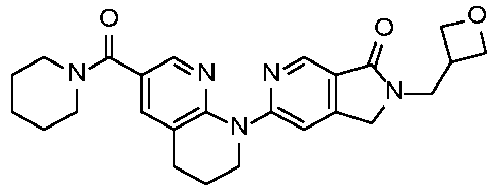
1H NMR (400 MHz, DMSO-d6) δ 1.44-1.68 (6H, m), 1.90-2.03 ( 2H, m), 2.86 (2H, t, J = 6.4 Hz), 3.22-3.37 (1H, m), 3.40-3. 59 (4H, m), 3.80 (2H, d, J = 7.3 Hz), 4.07 (2H, t, J = 5.8 Hz), 4.37 (2H, t, J = 6.1 Hz), 4.45 (2H, s), 4.66 (2H, dd, J = 7.9, 6.1 Hz), 7.56 (1H, d, J = 2.4 Hz), 7.96 (1H, s), 8.0 4 (1H, d, J = 2.4 Hz), 8.65 (1H, d, J = 1.2 Hz). LRMS (ESI+) 448 [M+H]+. 1-169 
1H NMR (400 MHz, DMSO-d6) δ 1.17 (3H, t, J = 7.3 Hz), 1.4 1-1.67 (6H, m), 1.95-2.07 (2H, m), 2.87 (2H, t, J = 6.4 Hz), 3.39-3.60 (6H, m), 3.80 (2H, t, J = 5.8 Hz), 4.45 (2H, s), 7.39-7.45 (2H, m), 7.53 (1H, s), 7.63 (1H, d, J = 7.9 Hz), 7 .84 (1H, d, J = 2.4 Hz). LRMS (ESI+) 405 [M+H]+. 1-170 
1H NMR (400 MHz, CDCl3) δ 1.45-1.77 (6H, m), 2.02-2.15 (2H, m), 2.89 (2H, t, J = 6.4 Hz), 3.43-3.67 (4H, m), 3.72-3 .89 (8H, m), 4.26 (2H, s), 4.74 (2H, s), 6.41-6.48 (2H, m), 7.18 (1H, d, J = 7.9 Hz), 7.32-7.38 (2H, m), 7.41-7.44 (1H, m), 7.86 (1H, d, J = 8.5 Hz), 7.96 (1H, d, J = 2.4 Hz).. LRMS (ESI+) 527 [M+H]+. 1-171 
1H NMR (400 MHz, CDCl3) δ 1.46-1.76 (6H, m), 2.08-2.19 (2H, m), 2.88 (2H, t, J = 6.4 Hz), 3.22-3.76 (4H, m), 3.82 ( 2H, t, J = 5.8 Hz), 6.69 (1H, d, J = 1.2 Hz), 6.78 (1H, dd, J = 7.9, 1.8 Hz), 7.49-7.52 (1H, m), 7.64 (1H, d, J = 8.5 Hz), 8.10 (1H, d, J = 1.8 Hz), 9.05 (1H, br s). LRMS (ESI+) 379 [M+H]+. [Table 85] Example No. Chemical Structural Formula Spectrum Data 1-172 
1H NMR (400 MHz, DMSO-d6) δ 1.42-1.68 (6H, m), 1.97-2.07 ( 2H, m), 2.87 (2H, t, J = 6.4 Hz), 3.21 (3H, s), 3.38-3.55 (4 H, m), 3.82 (2H, t, J = 5.8 Hz), 4.52 (2H, s), 4.91 (2H, s), 7.42 (1H, d, J = 1.8 Hz), 7.47 (1H, dd, J = 7.9, 1.8 Hz), 7 .58 (1H, d, J = 1.2 Hz), 7.70 (1H, d, J = 8.5 Hz), 7.86 (1 H, d, J = 2.4 Hz). LRMS (ESI+) 421 [M+H]+. 1-173 
1H NMR (400 MHz, DMSO-d6) δ 1.42-1.67 (6H, m), 1.97-2.08 ( 2H, m), 2.87 (2H, t, J = 6.4 Hz), 3.37-3.59 (4H, m), 3.85 (2 H, t, J = 5.4 Hz), 6.48 (1H, d, J = 7.3 Hz), 7.10-7.16 (1H, m), 7.44 (1H, d, J = 1.8 Hz), 7.49 (1H, dd, J = 8.8, 2.1 Hz ), 7.54 (1H, d, J = 2.4 Hz), 7.88 (1H, d, J = 2.4 Hz), 8.10 (1H, d, J = 8.5 Hz), 11.11 (1H, d, J = 4.8 Hz). LRMS (ESI+) 389 [M+H]+. 1-174 
1H NMR (400 MHz, DMSO-d6) δ 1.44-1.67 (6H, m), 1.97-2.08 ( 2H, m), 2.87 (2H, t, J = 6.4 Hz), 3.39-3.57 (7H, m), 3.85 ( 2H, t, J = 5.4 Hz), 6.54 (1H, d, J = 7.9 Hz), 7.40-7.46 (2H , m), 7.49-7.56 (2H, m), 7.86-7.90 (1H, m), 8.13 (1H, d, J = 8.5 Hz). LRMS (ESI+) 403 [M+H]+. 1-175 
1H NMR (400 MHz, DMSO-d6) δ 1.91-2.12 (6H, m), 2.78 (3H, d, J = 4.8 Hz), 2.85 (2H, t, J = 6.1 Hz), 3.51-3.68 (4H, m) , 3.80 (2H, t, J = 5.8 Hz), 7.26 (1H, dd, J = 8.5, 2.4 Hz), 7.33 (1H, dd, J = 13.0, 2.1 Hz), 7.51 (1H, d, J = 2.4 Hz), 7.61 (1H, t, J = 8.5 Hz), 7.98 (1H, d, J = 2.4 Hz), 8.08-8.1 8 (1H, m). LRMS (ESI+) 433 [M+H]+. 1-176 
1H NMR (400 MHz, DMSO-d6) δ 1.93-2.12 (6H, m), 2.85 (2H, t, J = 6.4 Hz), 3.28 (3H, s), 3.38-3.50 (4H, m), 3.52-3.69 (4 H, m), 3.80 (2H, t, J = 5.8 Hz), 7.27 (1H, dd, J = 8.5, 2.4 Hz), 7.33 (1H, dd, J = 13.3, 1.8 Hz), 7.51 (1H, d, J = 2.4 Hz), 7.61 (1H, t, J = 8.5 Hz), 7.98 (1H, d, J = 2.4 Hz), 8. 18 (1H, t, J = 4.2 Hz). LRMS (ESI+) 477 [M+H]+. 1-177 
1H NMR (400 MHz, DMSO-d6) δ 1.90-2.13 (6H, m), 2.87 (2H, t, J = 6.4 Hz), 3.27-3.35 (1H, m), 3.52-3.68 (4H, m), 3.76-3 .87 (4H, m), 4.35-4.45 (4H, m), 4.64-4.71 (2H, m), 7.43 (1H , dd, J = 7.9, 1.8 Hz), 7.48 (1H, d, J = 1.8 Hz), 7.53 (1H, d, J = 1.2 Hz), 7.65 (1H, d, J = 8.5 Hz), 7.91 (1H, d, J = 2.4 Hz). LRMS (ESI+) 483 [M+H]+. [Table 86] Example No. Chemical Structural Formula Spectrum Data 1-178 
1H NMR (400 MHz, DMSO-d6) δ 1.94-2.11 (6H, m), 2.88 (2H, t, J = 6.4 Hz), 3.52-3.66 (4H, m), 3.82 (2H, t, J = 5.4 Hz), 4.75-4.90 (6H, m), 5.36-5.49 (1H, m), 7.45 (1H, dd, J = 8. 2, 2.1 Hz), 7.49 (1H, d, J = 2.4 Hz), 7.61 (1H, s), 7.66 (1 H, d, J = 8.5 Hz), 7.93 (1H, d, J = 1.8 Hz). LRMS (ESI+) 469 [M+H]+. 1-179 
1H NMR (400 MHz, CDCl3) δ 1.83-2.18 (6H, m), 2.90 (2H, t, J = 6.4 Hz), 3.61-3.91 (12H, m), 4.27 (2H, s), 4.74 (2H, s), 6.39-6.49 (2H, m), 7.16-7.21 (1H, m), 7.32-7.37 (2H, m), 7.43-7.47 (1H, m), 7.86 (1H, d, J = 8.5 Hz), 7.95-7.99 (1H, m). .LRMS (ESI+) 563 [M+H]+. 1-180 
1H NMR (400 MHz, DMSO-d6) δ 1.93-2.12 (6H, m), 2.78 (3H, d, J = 4.8 Hz), 2.88 (2H, t, J = 6.4 Hz), 3.52-3.71 (4H, m) , 3.87 (2H, t, J = 5.4 Hz), 7.57 (1H, d, J = 2.4 Hz), 7.86 ( 1H, dd, J = 13.0, 2.1 Hz), 8.03 (1H, d, J = 1.8 Hz), 8.51-8 .58 (1H, m), 8.61 (1H, t, J = 1.5 Hz). .LRMS (ESI+) 434 [M+H]+. 1-181 
1H NMR (400 MHz, DMSO-d6) δ 1.94-2.12 (6H, m), 2.88 (2H, t, J = 6.4 Hz), 3.52-3.67 (4H, m), 3.86 (2H, t, J = 5.4 Hz), 6.48 (1H, d, J = 7.3 Hz), 7.11-7.17 (1H, m), 7.46-7.52 (2H , m), 7.55 (1H, d, J = 1.8 Hz), 7.96 (1H, d, J = 2.4 Hz), 8 .10 (1H, d, J = 9.1 Hz), 11.12 (1H, d, J = 4.8 Hz). .LRMS (ESI+) 425 [M+H]+. 1-182 
1H NMR (400 MHz, DMSO-d6) δ 1.95-2.11 (6H, m), 2.88 (2H, t, J = 6.4 Hz), 3.50 (3H, s), 3.54-3.69 (4H, m), 3.86 (2H, t, J = 5.4 Hz), 6.54 (1H, d, J = 7.3 Hz), 7.44 (1H, d, J = 7 .3 Hz), 7.48-7.56 (3H, m), 7.96 (1H, d, J = 1.8 Hz), 8.14 ( 1H, d, J = 9.1 Hz). .LRMS (ESI+) 439 [M+H]+. 1-183 
1H NMR (400 MHz, DMSO-d6) δ 1.92-2.16 (6H, m), 2.88 (2H, t, J = 6.4 Hz), 3.49-3.76 (4H, m), 4.09 (2H, t, J = 5.4 Hz), 4.74-4.90 (6H, m), 5.34-5.45 (1H, m), 7.63-7.67 (1H, m), 8. 03-8.06 (1H, m), 8.14 (1H, d, J = 2.4 Hz), 8.68 (1H, d, J = 1.2 Hz). LRMS (ESI+) 470 [M+H]+. [Table 87] Example No. Chemical Structural Formula Spectrum Data 1-184 
1H NMR (400 MHz, CDCl3) δ 1.92-2.09 (4H, m), 2.10-2.19 (2H, m), 2.90 (2H, t, J = 6.7 Hz), 3.67-3.88 (6H, m), 6.70-6 .78 (2H, m), 7.52 (1H, d, J = 1.8 Hz), 7.65 (1H, d, J = 7. 3 Hz), 8.11 (1H, d, J = 2.4 Hz), 8.98 (1H, br s). .LRMS (ESI+) 415 [M+H]+. 1-185 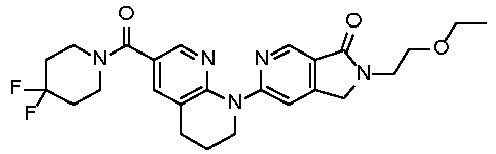
1H NMR (400 MHz, DMSO-d6) δ 1.10 (3H, t, J = 7.0 Hz), 1.9 0-2.13 (6H, m), 2.87 (2H, t, J = 6.4 Hz), 3.45 (2H, q, J = 6.9 Hz), 3.53-3.69 (8H, m), 4.08 (2H, t, J = 5.8 Hz), 4.54 ( 2H, s), 7.63 (1H, d, J = 1.8 Hz), 7.98 (1H, s), 8.13 (1H, d, J = 2.4 Hz), 8.66 (1H, s). .LRMS (ESI+) 486 [M+H]+. 1-186 
1H NMR (400 MHz, DMSO-d6) δ 1.93-2.14 (6H, m), 2.91 (2H, t, J = 6.4 Hz), 3.29-3.44 (1H, m), 3.66-3.87 (4H, m), 3.93 ( 2H, d, J = 7.3 Hz), 4.19 (2H, t, J = 5.8 Hz), 4.38 (2H, s), 4.55 (2H, t, J = 6.1 Hz), 4.80-4.87 (2H, m), 7.51-7.55 (1H, m), 7.91-7.95 (1H, m), 8.12 (1H, d, J = 2.4 Hz), 8.83-8.87 ( 1H, m). .LRMS (ESI+) 484 [M+H]+. 1-187 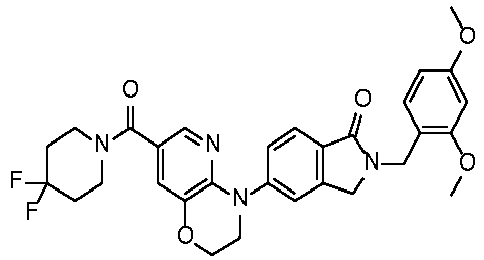
1H NMR (400 MHz, CDCl3) δ 1.92-2.09 (4H, m), 3.66-3.77 (4H, m), 3.80 (3H, s), 3.84 (3H, s), 3.95 (2H, t, J = 4.3 Hz ), 4.28 (2H, s), 4.37 (2H, t, J = 4.3 Hz), 4.75 (2H, s), 6.44 (1H, dd, J = 7.9, 1.8 Hz), 6.47 (1H, d, J = 1.8 Hz), 7.19 (1 H, d, J = 7.9 Hz), 7.22 (1H, d, J = 1.8 Hz), 7.37 (1H, dd, J = 7.9, 1.8 Hz), 7.47 (1H, d, J = 1.2 Hz), 7.81 (1H, d, J = 2.4 Hz), 7.88 (1H, d, J = 7.9 Hz). LRMS (ESI+) 565 [M+H]+. 1-188 
1H NMR (400 MHz, DMSO-d6) δ 1.42-1.69 (6H, m), 1.98-2.10 ( 2H, m), 2.89 (2H, t, J = 6.4 Hz), 3.36-3.57 (4H, m), 3.71 ( 3H, s), 3.90 (2H, t, J = 5.4 Hz), 7.47-7.51 (1H, m), 7.84 (1 H, d, J = 1.8 Hz), 7.88-7.94 (2H, m), 8.16 (1H, d, J = 8.5 Hz), 8.33 (1H, s). LRMS (ESI+) 404 [M+H]+. 1-189 
1H NMR (400 MHz, DMSO-d6) δ 1.93-2.15 (6H, m), 2.90 (2H, t, J = 6.1 Hz), 3.51-3.66 (4H, m), 3.71 (3H, s), 3.91 (2H, t, J = 5.1 Hz), 7.53-7.59 (1H, m), 7.82-7.86 (1H, m), 7.88-7.9 4 (1H, m), 7.98-8.03 (1H, m), 8.17 (1H, d, J = 8.5 Hz), 8.3 3 (1H, s). LRMS (ESI+) 440 [M+H]+. [Table 88] Example No. Chemical Structural Formula Spectrum Data 1-190 
1H NMR (400 MHz, DMSO-d6) δ 1.45-1.67 (6H, m), 2.01-2.11 ( 2H, m), 2.89 (2H, t, J = 6.4 Hz), 3.39-3.57 (7H, m), 3.93 ( 2H, t, J = 5.4 Hz), 7.49-7.53 (1H, m), 7.89 (1H, d, J = 2.4 Hz), 7.95 (1H, d, J = 2.4 Hz), 8.42 (1H, s), 8.95 (1H, d, J = 2.4 Hz). LRMS (ESI+) 405 [M+H]+. 1-191 
1H NMR (400 MHz, DMSO-d6) δ 1.97-2.12 (6H, m), 2.90 (2H, t, J = 6.4 Hz), 3.52 (3H, s), 3.56-3.68 (4H, m), 3.94 (2H, t, J = 5.4 Hz), 7.58 (1H, d, J = 1.8 Hz), 7.91 (1H, d, J = 2 .4 Hz), 8.03 (1H, d, J = 1.8 Hz), 8.43 (1H, s), 8.95 (1H, d, J = 2.4 Hz). LRMS (ESI+) 441 [M+H]+. 1-192 
1H NMR (400 MHz, DMSO-d6) δ 1.95-2.15 (6H, m), 2.92 (2H, t, J = 6.4 Hz), 3.56-3.67 (4H, m), 3.94 (2H, t, J = 5.4 Hz), 7.58-7.63 (1H, m), 8.03 (1H, d, J = 1.8 Hz), 8.19 (1H, d, J = 2.4 Hz), 8.32 (1H, s), 9.20 (1H, d, J = 2.4 Hz), 12.79 (1H, s). LRMS (ESI+) 427 [M+H]+ 1-193 
1H NMR (400 MHz, DMSO-d6) δ 1.95-2.13 (6H, m), 2.90 (2H, t, J = 6.4 Hz), 3.49-3.72 (4H, m), 3.93 (2H, t, J = 5.8 Hz), 7.56-7.60 (1H, m), 7.89 (1H, d, J = 2.4 Hz), 8.02 (1H, d, J = 2.4 Hz), 8.11 (1H, s), 8.91 (1H, d, J = 2.4 Hz), 12.37 (1H, br s). LRMS (ESI+) 427 [M+H]+. 1-194 
1H NMR (400 MHz, DMSO-d6) δ 1.44-1.68 (6H, m), 2.02-2.13 ( 2H, m), 2.91 (2H, t, J = 6.4 Hz), 3.39-3.58 (4H, m), 3.74 ( 3H, s), 3.94 (2H, t, J = 5.8 Hz), 7.51-7.56 (1H, m), 7.95 (1 H, d, J = 1.8 Hz), 8.19 (1H, d, J = 2.4 Hz), 8.36 (1H, s), 9.22 (1H, d, J = 2.4 Hz). LRMS (ESI+) 405 [M+H]+. 1-195 
1H NMR (400 MHz, DMSO-d6) δ 1.43-1.67 (6H, m), 2.03-2.12 ( 2H, m), 2.91 (2H, t, J = 7.0 Hz), 3.38-3.55 (4H, m), 3.94 ( 2H, t, J = 5.8 Hz), 7.51-7.55 (1H, m), 7.93-7.97 (1H, m), 8. 18 (1H, d, J = 2.4 Hz), 8.32 (1H, s), 9.20 (1H, d, J = 2.4 Hz), 12.78 (1H, s). LRMS (ESI+) 391 [M+H]+. 1-196 
1H NMR (400 MHz, DMSO-d6) δ 0.87 (3H, t, J = 7.6 Hz), 1.4 1-1.69 (8H, m), 1.96-2.07 (2H, m), 2.87 (2H, t, J = 6.4 Hz), 3.36-3.57 (6H, m), 3.80 (2H, t, J = 5.4 Hz), 4.44 (2H, s), 7.38-7.45 (2H, m), 7.51-7.55 (1H, m), 7.63 (1H, d, J = 7.9 Hz), 7.84 (1H, d, J = 2.4 Hz). LRMS (ESI+) 419 [M+H]+. [Table 89] Example No. Chemical Structural Formula Spectrum Data 1-197 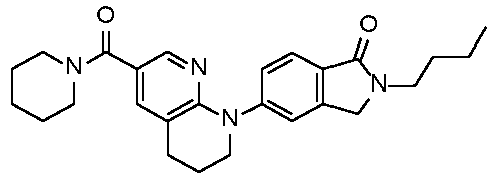
1H NMR (400 MHz, DMSO-d6) δ 0.91 (3H, t, J = 7.6 Hz), 1.2 3-1.36 (2H, m), 1.43-1.66 (8H, m), 1.96-2.08 (2H, m), 2.87 ( 2H, t, J = 6.4 Hz), 3.39-3.55 (6H, m), 3.80 (2H, t, J = 5.4 Hz), 4.44 (2H, s), 7.39-7.44 (2H, m), 7.53 (1H, d, J = 1.2 Hz), 7.63 (1H, d, J = 7.9 Hz), 7.84 (1H, d, J = 1.8 Hz). LRMS (ESI+) 433 [M+H]+. 1-198 
1H NMR (400 MHz, DMSO-d6) δ 0.76-0.86 (4H, m), 1.41-1.68 ( 6H, m), 1.96-2.06 (2H, m), 2.80-2.97 (3H, m), 3.36-3.57 (4H , m), 3.79 (2H, t, J = 5.4 Hz), 4.37 (2H, s), 7.38-7.44 (2H, m), 7.47-7.51 (1H, m), 7.61 (1H, d, J = 7.9 Hz), 7.83 (1H, d, J = 2.4 Hz). LRMS (ESI+) 417 [M+H]+. 1-199 
1H NMR (400 MHz, DMSO-d6) δ 1.42-1.67 (6H, m), 1.94-2.06 ( 2H, m), 2.85 (2H, t, J = 6.1 Hz), 3.38-3.53 (4H, m), 3.74 ( 2H, t, J = 5.4 Hz), 7.13-7.20 (1H, m), 7.28-7.41 (5H, m), 7. 80 (1H, d, J = 2.4 Hz). LRMS (ESI+) 322 [M+H]+. 1-200 
1H NMR (400 MHz, DMSO-d6) δ 1.41-1.65 (6H, m), 1.93-2.04 ( 2H, m), 2.83 (2H, t, J = 6.4 Hz), 3.38-3.50 (4H, m), 3.68 ( 2H, t, J = 5.4 Hz), 3.76 (3H, s), 6.90-6.96 (2H, m), 7.17-7. 23 (2H, m), 7.30-7.33 (1H, m), 7.77 (1H, d, J = 2.4 Hz). LRMS (ESI+) 352 [M+H]+. 1-201 
1H NMR (400 MHz, DMSO-d6) δ 1.43-1.69 (6H, m), 1.97-2.08 ( 2H, m), 2.87 (2H, t, J = 6.4 Hz), 3.39-3.56 (4H, m), 3.82 ( 2H, t, J = 5.4 Hz), 4.43 (3H, s), 7.39-7.44 (1H, m), 7.50-7. 56 (2H, m), 7.87 (1H, d, J = 2.4 Hz), 7.99-8.06 (2H, m). LRMS (ESI+) 404 [M+H]+. 1-202 
1H NMR (400 MHz, DMSO-d6) δ 0.86 (3H, t, J = 7.6 Hz), 1.4 1-1.67 (6H, m), 1.69-1.81 (2H, m), 1.95-2.06 (2H, m), 2.83 ( 2H, t, J = 6.4 Hz), 3.36-3.65 (4H, m), 3.75-3.86 (4H, m), 6. 77 (1H, dd, J = 7.6, 2.1 Hz), 6.91 (1H, d, J = 1.2 Hz), 7.4 9 (1H, d, J = 1.8 Hz), 7.70 (1H, d, J = 6.7 Hz), 7.99 (1H, d, J = 2.4 Hz). LRMS (ESI+) 421[M+H]+. 1-203 
1H NMR (400 MHz, DMSO-d6) δ 0.90 (3H, t, J = 7.6 Hz), 1.2 3-1.35 (2H, m), 1.40-1.78 (8H, m), 1.95-2.06 (2H, m), 2.83 ( 2H, t, J = 6.4 Hz), 3.36-3.62 (4H, m), 3.75-3.91 (4H, m), 6. 77 (1H, dd, J = 7.9, 1.8 Hz), 6.91 (1H, d, J = 1.2 Hz), 7.4 7-7.51 (1H, m), 7.69 (1H, d, J = 7.3 Hz), 7.99 (1H, d, J = 2.4 Hz). LRMS (ESI+) 435 [M+H]+. [Table 90] Example No. Chemical Structural Formula Spectrum Data 1-204 
1H NMR (400 MHz, DMSO-d6) δ 1.42-1.68 (6H, m), 1.94-2.06 ( 2H, m), 2.78 (3H, d, J = 4.2 Hz), 2.85 (2H, t, J = 6.4 Hz), 3.36-3.59 (4H, m), 3.79 (2H, t, J = 5.8 Hz), 7.37-7.45 (3H, m), 7.77-7.83 (2H, m), 7.85 (1H, d, J = 2.4 Hz), 8.31-8.40 (1H, m). LRMS (ESI+) 379 [M+H]+. 1-205 
1H NMR (400 MHz, CDCl3) δ 1.48-1.75 (6H, m), 2.06-2.14 (2H, m), 2.89 (2H, t, J = 6.4 Hz), 3.39-3.73 (4H, m), 3.84 ( 2H, t, J = 5.8 Hz), 3.90 (3H, s), 7.38-7.48 (3H, m), 7.99-8. 08 (3H, m). LRMS (ESI+) 380 [M+H]+. 1-206 
1H NMR (400 MHz, CDCl3) δ 1.51-1.71 (15H, m), 2.06-2.15 (2H, m), 2.89 (2H, t, J = 6.4 Hz), 3.42-3.70 (4H, m), 3.81 (2H, t, J = 5.4 Hz), 7.40-7.45 (2H, m), 7.48-7.52 (1H, m), 7 .79-7.83 (1H, m), 7.91 (1H, t, J = 1.8 Hz), 7.97 (1H, d, J = 2.4 Hz). LRMS (ESI+) 422 [M+H]+. 1-207 
1H NMR (400 MHz, DMSO-d6) δ 1.42-1.65 (6H, m), 1.93-2.05 ( 2H, m), 2.32 (3H, s), 2.74 (3H, d, J = 4.2 Hz), 2.84 (2H, t, J = 6.1 Hz), 3.37-3.55 (4H, m), 3.73 (2H, t, J = 5.4 Hz), 7.13-7.19 (2H, m), 7.31 (1H, d, J = 8.5 Hz), 7.36 (1H, d, J = 1.8 Hz), 7.82 (1H, d, J = 1.8 Hz), 8.11-8.20 (1H, m). LRMS (ESI+) 393 [M+H]+. 1-208 
1H NMR (400 MHz, DMSO-d6) δ 1.43-1.66 (6H, m), 1.96-2.07 ( 2H, m), 2.86 (2H, t, J = 6.4 Hz), 3.39-3.52 (4H, m), 3.81 ( 2H, t, J = 5.4 Hz), 7.07-7.14 (6H, m), 7.39-7.47 (10H, m), 7.49-7.54 (2H, m), 7.85 (1H, d, J = 1.8 Hz), 7.96-8.01 (2H, m). LRMS (ESI+) 632 [M+H]+. 1-209 
1H NMR (400 MHz, DMSO-d6) δ 1.42-1.67 (6H, m), 1.94-2.06 ( 2H, m), 2.85 (2H, t, J = 6.4 Hz), 3.38-3.57 (4H, m), 3.82 ( 2H, t, J = 5.4 Hz), 7.45-7.48 (1H, m), 7.54-7.58 (2H, m), 7. 74-7.79 (2H, m), 7.90-7.93 (1H, m). LRMS (ESI+) 347 [M+H]+. 1-210 
1H NMR (400 MHz, DMSO-d6) δ 1.43-1.66 (6H, m), 1.98-2.08 ( 2H, m), 2.82 (3H, d, J = 4.8 Hz), 2.88 (2H, t, J = 6.1 Hz), 3.38-3.54 (4H, m), 3.86 (2H, t, J = 5.4 Hz), 7.43-7.48 (1H, m), 7.86-7.93 (2H, m), 8.00 (1H, d, J = 8.5 Hz), 8.62-8.73 (2H, m). LRMS (ESI+) 380 [M+H]+. [Table 91] Example No. Chemical Structural Formula Spectrum Data 1-211 
1H NMR (400 MHz, DMSO-d6) δ 1.41-1.67 (6H, m), 1.94-2.06 ( 2H, m), 2.84 (2H, t, J = 6.4 Hz), 3.36-3.55 (4H, m), 3.74 ( 2H, t, J = 5.8 Hz), 7.31-7.45 (5H, m), 7.82 (1H, d, J = 1.8 Hz). LRMS (ESI+) 356 [M+H]+. 1-212 
1H NMR (400 MHz, DMSO-d6) δ 1.38-1.67 (6H, m), 1.91-2.11 ( 2H, m), 2.73-2.88 (2H, m), 3.38-3.50 (4H, m), 3.54-3.88 (2H , m), 7.30 (1H, d, J = 2.4 Hz), 7.32-7.38 (2H, m), 7.58-7.63 (1H, m), 7.69 (1H, d, J = 2.4 Hz), 7.79 (1H, d, J = 7.3 Hz), 12.58 (1H, br s). LRMS (ESI+) 366 [M+H]+. 1-213 
1H NMR (400 MHz, DMSO-d6) δ 0.75-0.89 (4H, m), 1.93-2.11 ( 6H, m), 2.82-2.98 (3H, m), 3.53-3.66 (4H, m), 3.80 (2H, t, J = 5.8 Hz), 4.37 (2H, s), 7.41 (1H, dd, J = 8.5, 1.8 Hz), 7. 45-7.51 (2H, m), 7.61 (1H, d, J = 7.9 Hz), 7.91 (1H, d, J = 1.8 Hz). LRMS (ESI+) 453 [M+H]+. 1-214 
1H NMR (400 MHz, DMSO-d6) δ 1.41-1.69 (6H, m), 1.93-2.07 ( 2H, m), 2.84 (2H, t, J = 6.1 Hz), 3.39-3.55 (4H, m), 3.72 ( 2H, t, J = 5.4 Hz), 7.15-7.24 (2H, m), 7.30-7.38 (3H, m), 7. 80 (1H, d, J = 2.4 Hz). LRMS (ESI+) 340 [M+H]+. 1-215 
1H NMR (400 MHz, DMSO-d6) δ 0.85 (3H, 1, J = 73 Hz), 1.41-1.64 ( 6H, m), 1.67-1.80 (2H, m), 3.28-3.58 (4H, m), 3.80 (2H, t, J = 6.7 Hz), 3.93 (2H, t, J = 4.6 Hz), 4.36 (2H, t, J = 4.6 Hz), 6.90 (1H, d, J = 1.2 Hz), 6.98 (1H, dd, J = 7.6, 2.1 Hz), 7.21 (1H, d, J = 1.8 Hz), 7.73-7.79 ( 2H, m). LRMS (ESI+) 423 [M+H]+. 1-216 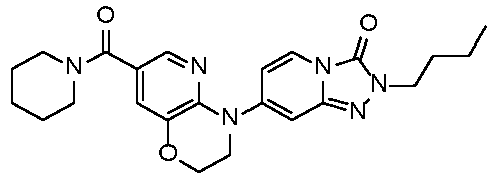
1H NMR (400 MHz, DMSO-d6) δ 0.87 (3H, t, J = 73 Hz), 1.19-1.32 ( 2H, m), 1.40-1.62 (6H, m), 1.63-1.74 (2H, m), 3.33-3.57 (4H, m), 3.83 (2 H, t, J = 7.0 Hz), 3.92 (2H, t, J = 4.5 Hz), 4.35 (2H, t, J = 4.2 Hz), 6.89 (1H, d, J = 1.8 Hz), 6.96 (1H, dd, J = 7.6, 2.1 Hz), 7.19 (1H, d, J = 1. 8 Hz), 7.71-7.78 (2H, m). LRMS (LSI+) 437 [M+H]+. [Table 92] Example No. Chemical Structural Formula Spectrum Data 1-217 
1H NMR (400 MHz, DMSO-d6) δ 1.41-1.66 (6H, m), 3.34-3.58 (7H, m ), 4.00 (2H, t, J = 3.7 Hz), 4.37 (2H, t, J = 4.3 Hz), 6.54 (1H, d, J = 7.3 Hz), 7.17 (1H, d, J = 1.8 Hz), 7.43 (1H, d, J = 7.3 Hz), 7.57 (1H, d, J = 1.8 Hz), 7.64 (1H, dd, J = 8.6, 2.4 Hz), 7.72 (1H, d, J = 1.8 Hz), 8.14 (1 H, d, J = 8.6 Hz). LRMS (ESI+) 405 [M+H]+. 1-218 
1H NMR (400 MHz, DMSO-d6) δ 1.43-1.65 (6H, m), 3.35-3.55 (4H, m ), 3.70 (3H, s), 3.98-4.12 (2H, m), 4.39 (2H, t, J = 4.5 Hz), 7.22 (1H, d, J = 1.8 Hz), 7.75 (1H, d, J = 2.4 Hz), 7.87 (1H, d, J = 1.8 Hz), 8.01 (1 H, dd, J = 8.5, 2.4 Hz), 8.18 (1H, d, J = 8.5 Hz), 8.34 (1H, s). LRMS (ESI+) 406 [M+H]+. 1-219 
1H NMR (400 MHz, DMSO-d6) δ 1.42-1.64 (6H, m), 3.35-3.56 (4H, m ), 4.00 (2H, t, J = 4.3 Hz), 4.37 (2H, t, J = 4.3 Hz), 6.48 (1H, d, J = 6.7 Hz), 7.12 (1H, dd, J = 7.0, 5.8 Hz), 7.17 (1H, d, J = 1.8 Hz), 7.57 (1H, d, J = 1.8 Hz), 7.62 (1H, dd, J = 8.6, 2.4 Hz), 7.72 (1H, d, J = 1.8 Hz), 8.10 (1H, d, J = 9.2 Hz), 11.08-11.13 (1H, m). LRMS (ESI+) 391 [M+H]+. 1-220 
1H NMR (400 MHz, CDCl3) δ 1.42-1.73 (6H, m), 3.33-3.87 (7H, m), 4 .00 (2H, t, J = 4.2 Hz), 4.40 (2H, t, J = 4.2 Hz), 5.34 (2H, s), 6.82-6.88 ( 2H, m), 7.26 (1H, d, J = 1.8 Hz), 7.37-7.43 (2H, m), 7.65 (1H, d, J = 1.8 Hz), 7.79-7.87 (2H, m), 8.10 (1H, s), 8.41 (1H, d, J = 9.1 Hz). LRMS (LSI+) 512 [M+H]+. 1-221 
1H NMR (400 MHz, CDCl3) δ 1.47-1.79 (6H, m), 3.31-3.75 (4H, m), 3. 80 (3H, s), 3.84 (3H, s), 4.28-4.32 (2H, m), 4.33-4.39 (4H, m), 4.71-4.75 ( 2H, m), 6.42-6.49 (2H, m), 7.20 (1H, d, J = 7.9 Hz), 7.24-7.28 (1H, m), 7.92 (1H, d, J = 1.8 Hz), 8.20 (1H, s), 8.80 (1H, s). LRMS (ESI+) 530 [M+H]+. 1-222 
1H NMR (400 MHz, DMSO-d6) δ 0.86 (3H, t, J = 7.6 Hz), 1.43-1.66 ( 8H, m), 3.35-3.52 (6H, m), 3.96 (2H, t, J = 4.3 Hz), 4.35 (2H, t, J = 4.6 Hz), 4.44 (2H, s), 7.15 (1H, d, J = 2.4 Hz), 7.51 (1H, dd, J = 8.6, 1.8 Hz ), 7.60-7.65 (2H, m), 7.68 (1H, d, J = 1.8 Hz). LRMS (ESF) 421 [M+H]+. 1-223 
1H NMR (400 MHz, DMSO-d6) δ 0.90 (3H, 1, J = 73 Hz), 1.22-1.34 ( 2H, m), 1.43-1.64 (8H, m), 3.35-3.55 (6H, m), 3.96 (2H, t, J = 4.6 Hz), 4 .35 (2H, t, J = 4.3 Hz), 4.44 (2H, s), 7.15 (1H, d, J = 1.8 Hz), 7.50 (1H, dd, J = 8.6, 1.8 Hz), 7.60-7.65 (2H, m), 7.68 (1H, d, J = 1.8 Hz). LRMS (ESI+) 435 [M+H]+. [Table 93] Example No. Chemical Structural Formula Spectrum Data 1-224 
1H NMR (400 MHz, DMSO-d6) δ 0.72-0.87 (4H, m), 1.42-1.64 (6H, m), 2.87-2.95 (1H, m), 3.34-3.54 (4H, m), 3.94 (2H, t, J = 4.2 Hz), 4.3 2-4.39 (4H, m), 7.14 (1H, d, J = 2.4 Hz), 7.50 (1H, dd, J = 8.5, 1.8 Hz ), 7.57 (1H, d, J = 1.2 Hz), 7.61 (1H, d, J = 8.5 Hz), 7.67 (1H, d, J = 2.4 Hz). LRMS (ESI+) 419 [M+H]+. 1-225 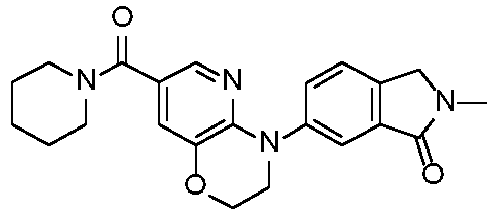
1H NMR (400 MHz, DMSO-d6) δ 1.42-1.63 (6H, m), 3.08 (3H, s), 3. 36-3.51 (4H, m), 3.95 (2H, t, J = 4.3 Hz), 4.35 (2H, t, J = 4.3 Hz), 4.4 4 (2H, s), 7.11 (1H, d, J = 2.4 Hz), 7.53-7.58 (1H, m), 7.60-7.66 (3H, m). LRMS (ESI+) 393 [M+H]+. 1-226 
1H NMR (400 MHz, DMSO-d6) δ 1.95-2.10 (4H, m), 3.48 (3H, s), 3. 50-3.69 (4H, m), 4.04 (2H, t, J = 4.6 Hz), 4.38 (2H, t, J = 4.3 Hz), 7.2 8 (1H, d, J = 1.8 Hz), 7.61 (1H, d, J = 1.8 Hz), 7.71 (1H, dd, J = 8.9, 2.1 Hz), 7.82 (1H, d, J = 2.4 Hz), 8.08 (1H, d, J = 8.6 Hz), 8.34 (1H, s). LRMS (ESI+) 442 [M+H]+. 1-227 
1H NMR (400 MHz, DMSO-d6) δ 0.74-0.87 (4H, m), 1.95-2.09 (4H, m), 2.90-2.93 (1H, m), 3.51-3.66 (4H, m), 3.95 (2H, t, J = 4.2 Hz), 4.3 3-4.40 (4H, m), 7.23 (1H, d, J = 1.8 Hz), 7.50 (1H, dd, J = 8.5, 1.8 Hz ), 7.56-7.59 (1H, m), 7.62 (1H, d, J = 8.5 Hz), 7.75 (1H, d, J = 2.4 Hz ). LRMS (ESI+) 455 [M+H]+. 1-228 
1H NMR (400 MHz, DMSO-d6) δ 1.40-1.65 (6H, m), 2.86 (3H, s), 3.33-3.39 (2H, m), 3.40-3.52 (4H, m), 3.83-3.90 (2 H, m), 6.71 (1H, d, J = 1.8 Hz), 7.08-7.15 (1H, m), 7.28-7 .38 (5H, m). LRMS (ESI+) 337 [M+H]+. 1-229 
1H NMR (400 MHz, CDCl3) δ 1.47-1.75 (15H, m), 2.95 (3H, s ), 3.38-3.45 (2H, m), 3.45-3.73 (4H, m), 3.92-3.99 (2H, m), 6.88 (1H, d, J = 1.8 Hz), 7.34-7.40 (2H, m), 7.57 (1H, d, J = 1.8 Hz), 7.96-8.01 (2H, m). LRMS (ESI+) 437 [M+H]+. 1-230 
1H NMR (400 MHz, DMSO-d6) δ 1.43-1.64 (6H, m), 3.25-3.58 (7H, m), 3.83-3.94 (5H, m), 4.30-4.37 (2H, m), 6.13 (1H, d, J = 1.8 Hz), 6.4 8 (1H, d, J = 1.8 Hz), 7.19 (1H, d, J = 1.8 Hz), 7.80 (1H, d, J = 1.8 Hz). LRMS (ESF) 425 [M+H]+. [Table 94] Example No. Chemical Structural Formula Spectrum Data 1-231 
1H NMR (400 MHz, DMSO-d6) δ 1.94-2.09 (4H, m), 3.50-3.65 ( 4H, m), 3.78-3.84 (5H, m), 4.28 (2H, t, J = 4.5 Hz), 6.87 (1 H, dd, J = 8.5, 1.8 Hz), 6.97 (1H, d, J = 1.8 Hz), 7.10 (1H, d, J = 8.5 Hz), 7.34-7.39 (2H, m), 7.90-7.95 (2H, m). LRMS (ESI+) 417 [M+H]+. 1-232 
1H NMR (400 MHz, DMSO-d6) δ 1.40-1.64 (6H, m), 3.35-3.53 ( 4H, m), 3.89 (2H, t, J = 4.5 Hz), 4.33 (2H, t, J = 4.5 Hz), 7.09 (1H, d, J = 1.8 Hz), 7.11-7.17 (1H, m), 7.33-7.43 (4H, m), 7.64 (1H, d, J = 1.8 Hz). LRMS (ESI+) 324 [M+H]+. 1-233 
1H NMR (400 MHz, DMSO-d6) δ 1.41-1.64 (6H, m), 3.34-3.58 ( 4H, m), 3.96 (2H, t, J = 4.3 Hz), 4.34 (2H, t, J = 4.6 Hz), 7.22 (1H, d, J = 2.4 Hz), 7.48-7.51 (2H, m), 7.79 (1H, d, J = 1.8 Hz), 8.41-8.44 (2H, m). LRMS (ESI+) 325 [M+H]+. 1-234 
1H NMR (400 MHz, DMSO-d6) δ 1.41-1.64 (6H, m), 3.36-3.51 ( 4H, m), 3.95 (2H, t, J = 4.3 Hz), 4.36 (2H, t, J = 4.6 Hz), 7.14 (1H, d, J = 1.8 Hz), 7.40 (1H, dd, J = 8.3, 4.6 Hz), 7. 67 (1H, d, J = 1.8 Hz), 7.81-7.85 (1H, m), 8.31 (1H, dd, J = 4.6, 1.5 Hz), 8.69 (1H, d, J = 2.4 Hz). LRMS (ESI+) 325 [M+H]+. 1-235 
1H NMR (400 MHz, CDCl3) δ 1.44-1.76 (6H, m), 3.33-3.79 (4H, m), 4.24-4.29 (2H, m), 4.33-4.38 (2H, m), 6.92-6.98 (1H, m) , 7.24 (1H, d, J = 1.8 Hz), 7.61-7.68 (1H, m), 7.92 (1H, d, J = 2.4 Hz), 8.08 (1H, d, J = 8.6 Hz), 8.35-8.38 (1H, m). LRMS (ESI+) 325 [M+H]+. 1-236 
1H NMR (400 MHz, CDCl3) δ 1.46-1.72 (6H, m), 3.45-3.66 (4H, m), 3.86-3.89 (2H, m), 4.33-4.37 (2H, m), 7.07-7.12 (2H, m) , 7.18 (1H, d, J = 2.4 Hz), 7.28-7.34 (2H, m), 7.80 (1H, d, J = 2.4 Hz). LRMS (ESI+) 342 [M+H]+. 1-237 
1H NMR (400MHz, CDCl3) δ 1.50-1.73 (6H, m), 3.37-3.72 (4 H, m), 3.90 (2H, t, J = 4.3 Hz), 4.35 (2H, t, J = 4.3 Hz), 6 .83-6.89 (1H, m), 7.13-7.18 (2H, m), 7.21 (1H, d, J = 1.8 H z), 7.30-7.38 (1H, m), 7.84 (1H, d, J = 1.8 Hz). LRMS (ESI+) 342 [M+H]+. [Table 95] Example No. Chemical Structural Formula Spectrum Data 1-238 
1H NMR (400MHz, CDCl3) δ 1.49-1.72 (6H, m), 3.40-3.70 ( 4H, m), 3.86 (2H, t, J = 4.6 Hz), 4.37 (2H, t, J = 4.6 Hz), 7.14-7.30 (4H, m), 7.34-7.41 (1H, m), 7.79 (1H, d, J = 1.8 Hz). LRMS (ESI+) 342 [M+H]+. 1-239 
1H NMR (400MHz, CDCl3) δ 1.50-1.66 (6H, m), 3.38-3.72 ( 4H, m), 3.87 (2H, t, J = 4.5 Hz), 4.35 (2H, t, J = 4.5 Hz), 7.04-7.10 (1H, m), 7.13-7.22 (2H, m), 7.23-7.30 (1H, m), 7.8 1 (1H, d, J = 1.8 Hz). LRMS (ESI+) 360 [M+H]+. 1-240 
1H NMR (400 MHz, DMSO-d6) δ 1.41-1.66 (6H, m), 3.20 (3H, s), 3.34-3.54 (4H, m), 3.98 (2H, t, J = 4.3 Hz), 4.36 (2H, t, J = 4.3 Hz), 7.19 (1H, d, J = 1.8 Hz), 7.65-7.70 (2H, m), 7. 72 (1H, d, J = 1.8 Hz), 7.85-7.89 (2H, m). LRMS (ESI+) 402 [M+H]+. 1-241 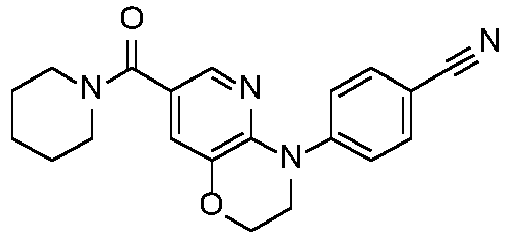
1H NMR (400 MHz, DMSO-d6) δ 1.40-1.65 (6H, m), 3.35-3.53 ( 4H, m), 3.96 (2H, t, J = 4.3 Hz), 4.35 (2H, t, J = 4.3 Hz), 7.20 (1H, d, J = 1.8 Hz), 7.61-7.66 (2H, m), 7.73 (1H, d, J = 1.8 Hz), 7.76-7.82 (2H, m). LRMS (ESI+) 349 [M+H]+. 1-242 
1H NMR (400 MHz, DMSO-d6) δ 1.43-1.63 (6H, m), 3.34-3.53 ( 4H, m), 3.96 (2H, t, J = 4.6 Hz), 4.35 (2H, t, J = 4.3 Hz), 7.17 (1H, d, J = 1.8 Hz), 7.61-7.67 (2H, m), 7.68-7.72 (3H, m). LRMS (ESI+) 392 [M+H]+. 1-243 
1H NMR (400 MHz, DMSO-d6) δ 1.41-1.63 (6H, m), 3.35-3.50 ( 4H, m), 3.89 (2H, t, J = 4.6 Hz), 4.33 (2H, t, J = 4.3 Hz), 7.11 (1H, d, J = 2.4 Hz), 7.35-7.42 (2H, m), 7.51-7.56 (2H, m), 7.65 (1H, d, J = 1.8 Hz). LRMS (ESI+) 402 [M+H]+. 1-244 
1H NMR (400 MHz, DMSO-d6) δ 1.18 (3H, t, J = 7.6 Hz), 1.42 -1.63 (6H, m), 2.59 (2H, q, J = 7.5 Hz), 3.38-3.48 (4H, m), 3.86 (2H, t, J = 4.6 Hz), 4.32 (2H, t, J = 4.6 Hz), 7.07 (1H , d, J = 1.8 Hz), 7.17-7.22 (2H, m), 7.26-7.31 (2H, m), 7.62 (1H, d, J = 1.8 Hz). LRMS (ESI+) 352 [M+H]+. [Table 96] Example No. Chemical Structural Formula Spectrum Data 1-245 
1H NMR (400MHz, CDCl3) δ 1.47-1.70 (6H, m), 3.40-3.70 ( 4H, m), 3.82 (3H, s), 3.86 (2H, t, J = 4.2 Hz), 4.34 (2H, t, J = 4.5 Hz), 6.92-6.97 (2H, m), 7.16 (1H, d, J = 1.8 Hz), 7. 23-7.29 (2H, m), 7.80 (1H, d, J = 1.8 Hz). LRMS (ESI+) 354 [M+H]+. 1-246 
1H NMR (400 MHz, DMSO-d6) δ 1.37 (6H, s), 1.41-1.64 (6H, m), 1.85 (2H, s), 3.37-3.51 (4H, m), 3.87 (2H, t, J = 4.3 Hz ), 4.32 (2H, t, J = 4.3 Hz), 7.07 (1H, d, J = 1.8 Hz), 7.26-7 .31 (2H, m), 7.48-7.53 (2H, m), 7.62 (1H, d, J = 2.4 Hz). LRMS (ESI+) 381 [M+H]+. 1-247 
1H NMR (400MHz, CDCl3) δ 1.49-1.71 (12H, m), 3.47-3.64 (4H, m), 3.66 (3H, s), 3.90 (2H, t, J = 4.3 Hz), 4.32 (2H, t, J = 4.3 Hz), 7.19 (1H, d, J = 1.8 Hz), 7.32-7.38 (4H, m), 7.83 (1H, d, J = 1.8 Hz). LRMS (ESI+) 424 [M+H]+. 1-248 
1H NMR (400 MHz, DMSO-d6) δ 1.27 (6H, s), 1.43-1.63 (6H, m), 3.10 (3H, s), 3.36-3.50 (4H, m), 3.90 (2H, t, J = 4.3 Hz ), 4.33 (2H, t, J = 4.3 Hz), 7.02 (1H, dd, J = 7.9, 1.8 Hz), 7.06-7.11 (2H, m), 7.33 (1H, d, J = 7.9 Hz), 7.65 (1H, d, J = 2.4 Hz). LRMS (ESI+) 421 [M+H]+. 1-249 
1H NMR (400 MHz, DMSO-d6) δ 1.27 (6H, s), 1.40-1.64 (6H, m), 3.14 (3H, s), 3.37-3.49 (4H, m), 3.86 (2H, t, J = 4.3 Hz ), 4.33 (2H, t, J = 4.3 Hz), 7.00 (1H, d, J = 8.6 Hz), 7.06 ( 1H, d, J = 1.8 Hz), 7.26 (1H, dd, J = 8.3, 2.1 Hz), 7.38 (1 H, d, J = 2.4 Hz), 7.60 (1H, d, J = 2.4 Hz). LRMS (ESI+) 421 [M+H]+. 1-250 
1H NMR (400MHz, CDCl3) δ 1.45-1.73 (6H, m), 3.39-3.69 ( 4H, m), 3.95 (2H, t, J = 4.3 Hz), 4.37 (2H, t, J = 4.3 Hz), 7.14-7.19 (6H, m), 7.21 (1H, d, J = 2.4 Hz), 7.29-7.41 (9H, m), 7.45-7.51 (2H, m), 7.83 (1H, d, J = 1.8 Hz), 8.14-8.21 ( 2H, m). LRMS (ESI+) 634 [M+H]+. [Table 97] Example No. Chemical Structural Formula Spectrum Data 1-251 
1H NMR (400 MHz, DMSO-d6) δ 1.43-1.64 (6H, m), 3.37-3.52 ( 4H, m), 3.97 (2H, t, J = 4.3 Hz), 4.36 (2H, t, J = 4.3 Hz), 4.42 (3H, s), 7.15 (1H, d, J = 1.8 Hz), 7.59-7.64 (2H, m), 7 .71 (1H, d, J = 2.4 Hz), 8.01-8.05 (2H, m). LRMS (ESI+) 406 [M+H]+. 1-252 
1H NMR (400 MHz, DMSO-d6) δ 1.44-1.64 (6H, m), 3.38-3.52 ( 4H, m), 4.00 (2H, t, J = 4.6 Hz), 4.19 (3H, s), 4.37 (2H, t, J = 4.3 Hz), 7.18 (1H, d, J = 1.8 Hz), 7.65-7.70 (2H, m), 7. 72 (1H, d, J = 1.8 Hz), 7.83-7.88 (2H, m). LRMS (ESI+) 406 [M+H]+. 1-253 
1H NMR (400MHz, CDCl3) δ 1.46-1.78 (6H, m), 3.40-3.70 ( 4H, m), 3.89 (2H, t, J = 4.6 Hz), 4.35 (2H, t, J = 4.3 Hz), 7.14 (1H, dt, J = 7.0, 1.8 Hz), 7.21 (1H, d, J = 1.8 Hz), 7. 25-7.35 (2H, m), 7.39 (1H, t, J = 1.8 Hz), 7.83 (1H, d, J = 1.8 Hz). LRMS (ESI+) 358 [M+H]+. 1-254 
1H NMR (400 MHz, DMSO-d6) δ 1.43-1.65 (6H, m), 3.31 (3H, s), 3.35-3.56 (4H, m), 3.99 (2H, t, J = 4.5 Hz), 4.36 (2H, t, J = 4.2 Hz), 7.23 (1H, d, J = 1.8 Hz), 7.63 (1H, dd, J = 8. 8, 2.1 Hz), 7.77 (1H, d, J = 1.8 Hz), 7.84 (1H, d, J = 2.4 Hz), 7.97 (1H, d, J = 9.1 Hz). LRMS (ESI+) 436 [M+H]+. 1-255 
1H NMR (400 MHz, DMSO-d6) δ 1.43-1.64 (6H, m), 3.21 (3H, s), 3.33-3.56 (4H, m), 3.92 (3H, s), 3.99 (2H, t, J = 4.2 Hz) , 4.36 (2H, t, J = 4.5 Hz), 7.15-7.21 (2H, m), 7.35 (1H, d, J = 1.8 Hz), 7.72 (1H, d, J = 9.1 Hz), 7.75 (1H, d, J = 1.8 Hz). LRMS (ESI+) 432 [M+H]+. 1-256 
1H NMR (400MHz, CDCl3) δ 1.40-1.72 (6H, m), 3.40-3.70 ( 4H, m), 4.04 (2H, t, J = 4.2 Hz), 4.42 (2H, t, J = 4.2 Hz), 7.21-7.28 (1H, m), 7.39 (1H, dd, J = 8.5, 4.2 Hz), 7.65 (1H, d, J = 2.4 Hz), 7.84 (1H, d, J = 1.8 Hz), 7.89 (1H, dd, J = 9.1, 2.4 Hz), 8.08-8.13 (2H, m), 8.86 (1H, d, J = 4.2 Hz). LRMS (ESI+) 375 [M+H]+. [Table 98] Example No. Chemical Structural Formula Spectrum Data 1-257 
1H NMR (400 MHz, CDCl3) δ 1.47-1.78 (6H, m), 3.35-3.75 (4 H, m), 4.08 (2H, t, J = 4.3 Hz), 4.43 (2H, t, J = 4.6 Hz), 7 .24 (1H, d, J = 1.8 Hz), 7.34 (1H, dd, J = 8.6, 4.3 Hz), 7.7 9 (1H, d, J = 8.6 Hz), 7.82-7.90 (3H, m), 8.12 (1H, dd, J = 8.3, 1.5 Hz), 8.86 (1H, dd, J = 4.3, 1.8 Hz). LRMS (ESI+) 375 [M+H]+. 1-258 
1H NMR (400MHz, CDCl3) δ 1.49-1.78 (6H, m), 3.30-3.80 ( 4H, m), 4.09 (2H, t, J = 4.5 Hz), 4.45 (2H, t, J = 4.5 Hz), 7.27 (1H, t, J = 2.1 Hz), 7.84 (2H, dd, J = 12.4, 2.1 Hz), 8 .07 (1H, d, J = 9.1 Hz), 8.13 (1H, dd, J = 9.1, 2.4 Hz), 8.7 8 (2H, dd, J = 9.1, 1.8 Hz). LRMS (ESI+) 376 [M+H]+. 1-259 
1H NMR (400 MHz, DMSO-d6) δ 1.37-1.66 (6H, m), 3.35-3.55 ( 4H, m), 4.06 (2H, t, J = 4.2 Hz), 4.40 (2H, t, J = 4.2 Hz), 7.19 (1H, d, J = 1.8 Hz), 7.70-7.75 (2H, m), 7.77 (1H, d, J = 2.4 Hz), 7.91 (1H, dd, J = 8.8, 2.1 Hz), 8.04 (1H, d, J = 9.1 Hz), 8.42 (1H, d, J = 5.4 Hz), 9.20 (1H, s). LRMS (ESI+) 375 [M+H]+. 1-260 
1H NMR (400 MHz, DMSO-d6) δ 1.39-1.65 (6H, m), 3.36-3.53 ( 4H, m), 4.05 (2H, t, J = 3.6 Hz), 4.41 (2H, t, J = 3.9 Hz), 7.17 (1H, d, J = 1.8 Hz), 7.68 (1H, d, J = 1.2 Hz), 7.77 (1 H, d, J = 6.1 Hz), 7.88-8.02 (3H, m), 8.43 (1H, d, J = 5.4 Hz), 9.23 (1H, s). LRMS (ESI+) 375 [M+R]+. 1-261 
1H NMR (400 MHz, DMSO-d6) δ 1.39-1.65 (6H, m), 3.34-3.61 ( 4H, m), 3.83 (3H, s), 3.96 (2H, t, J = 4.5 Hz), 4.35 (2H, t, J = 4.2 Hz), 7.18 (1H, d, J = 1.8 Hz), 7.55-7.60 (2H, m), 7. 72 (1H, d, J = 1.8 Hz), 7.91-7.96 (2H, m). LRMS (ESI+) 382 [M+H]+. 1-262 
1H NMR (400 MHz, DMSO-d6) δ 1.38-1.68 (6H, m), 3.34-3.59 ( 4H, m), 3.85 (3H, s), 3.91-3.98 (2H, m), 4.28-4.41 (2H, m), 7.13 (1H, d, J = 1.8 Hz), 7.52 (1H, t, J = 7.9 Hz), 7.66 (1 H, d, J = 1.8 Hz), 7.68-7.75 (2H, m), 7.95-7.99 (1H, m). LRMS (ESI+) 382 [M+H]+. [Table 99] Example No. Chemical Structural Formula Spectrum Data 1-263 
1H NMR (400 MHz, DMSO-d6) δ 1.38-1.66 (6H, m), 3.34-3. 46 (4H, m), 3.48 (3H, s), 3.77-4.05 (2H, m), 4.24-4.44 (2H, m), 7.07 (1H, d, J = 1.8 Hz), 7.32-7.38 (1H, m), 7.41-7.45 ( 1H, m), 7.49 (1H, d, J = 1.8 Hz), 7.62-7.68 (1H, m), 7.75 ( 1H, dd, J = 7.6, 1.5 Hz). LRMS (ESI+) 382 [M+H]+. 1-264 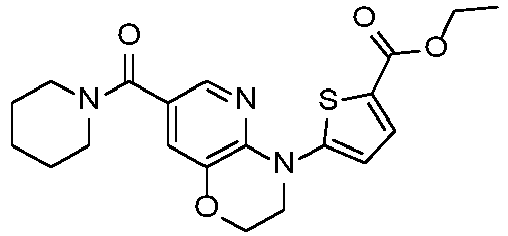
1H NMR (400 MHz, DMSO-d6) δ 1.28 (3H, t, J = 7.0 Hz), 1.40-1.68 (6H, m), 3.24-3.66 (6H, m), 4.15 (2H, t, J = 4.6 Hz), 4.24 (2H, q, J = 7.1 Hz), 4.42 (2H, t, J = 4.6 Hz), 6.7 7 (1H, d, J = 4.9 Hz), 7.28 (1H, d, J = 1.8 Hz), 7.65 (1H, d, J = 4.3 Hz), 8.03 (1H, d, J = 1.8 Hz). LRMS (ESI+) 402 [M+H]+. 1-265 
1H NMR (400 MHz, DMSO-d6) δ 1.34-1.67 (6H, m), 3.09-3.18 ( 2H, m), 3.47 (3H, s), 3.57 (2H, t, J = 5.2 Hz), 3.74-3.85 (2 H, m), 4.39 (2H, t, J = 4.6 Hz), 6.65 (1H, dd, J = 7.6, 2.1 Hz), 6.72 (1H, d, J = 1.8 Hz), 6.75 (1H, d, J = 8.6 Hz), 7. 01 (1H, d, J = 8.6 Hz), 7.80 (1H, d, J = 7.3 Hz). LRMS (ESI+) 428 [M+H]+. 1-266 
1H NMR (400 MHz, DMSO-d6) δ 1.97-2.12 (4H, m), 3.25 (3H, s), 3.46-3.74 (8H, m), 4.27 (2H, t, J = 4.3 Hz), 4.36 (2H, t, J = 4.3 Hz), 4.56 (2H, s), 7.38 (1H, d, J = 1.8 Hz), 7.95 (1 H, d, J = 1.8 Hz), 8.28 (1H, s), 8.65 (1H, s). LRMS (ESI+) 474 [M+H]+. 1-267 
1H NMR (400 MHz, DMSO-d6) δ 1.95-2.10 (4H, m), 3.48 (3H, s), 3.51-3.71 (4H, m), 4.01 (2H, t, J = 4.6 Hz), 4.37 (2H, t, J = 4.3 Hz), 6.54 (1H, d, J = 7.9 Hz), 7.26 (1H, d, J = 2.4 Hz), 7.43 (1H, d, J = 7.3 Hz), 7.58 (1H, d, J = 1.8 Hz), 7 .64 (1H, dd, J = 8.9, 2.1 Hz), 7.80 (1H, d, J = 2.4 Hz), 8.1 4 (1H, d, J = 8.6 Hz). LRMS (ESI+) 441 [M+H]+. 1-268 
1H NMR (400 MHz, DMSO-d6) δ 1.09 (3H, t, J = 7.0 Hz), 1.4 2-1.64 (6H, m), 3.26-3.60 (6H, m), 3.94 (2H, t, J = 4.6 Hz), 4.37 (2H, t, J = 4.3 Hz), 5.20 (2H, s), 6.88 (1H, d, J = 1. 8 Hz), 7.00 (1H, dd, J = 7.6, 2.1 Hz), 7.22 (1H, d, J = 1.8 Hz), 7.75-7.80 (2H, m). LRMS (ESI+) 439 [M+H]+. [Table 100] Example No. Chemical Structural Formula Spectrum Data 1-269 
1H NMR (400 MHz, DMSO-d6) δ 1.04 (3H, t, J = 6.7 Hz), 1.4 4-1.65 (6H, m), 3.34-3.57 (6H, m), 3.70 (2H, t, J = 5.5 Hz), 3.93 (2H, t, J = 4.6 Hz), 3.98 (2H, t, J = 5.5 Hz), 4.36 (2 H, t, J = 4.3 Hz), 6.91 (1H, d, J = 1.2 Hz), 6.98 (1H, dd, J = 7.9, 1.8 Hz), 7.21 (1H, d, J = 1.8 Hz), 7.74-7.79 (2H, m ). LRMS (ESI+) 453 [M+H]+. 1-270 
1H NMR (400 MHz, DMSO-d6) δ 1.42-1.64 (6H, m), 3.36-3.57 ( 7H, m), 3.75-3.98 (2H, m), 4.31-4.46 (2H, m), 7.16 (1H, d, J = 1.8 Hz), 7.44 (1H, s), 7.68 (1H, d, J = 2.4 Hz), 8.19 (1 H, s). LRMS (ESI+) 429 [M+H]+. -

- To a solution of methyl 4-(6-methoxy-7-(piperidine-1-carbonyl)-2,3-dihydro-4H-benzo[b][1,4]oxazin-4-yl)benzoate (61.9 mg) in methanol (1.5 mL), a 2 mol/L sodium hydroxide aqueous solution (0.45 mL) was added at room temperature, followed by stirring at 50°C for 3 hours. The resultant reaction solution was concentrated under reduced pressure, and a 1 mol/L hydrogen chloride aqueous solution was added to the thus obtained residue to adjust pH to 2. The thus precipitated product was collected by filtration to obtain the title compound (51.9 mg).
- 1H NMR (400 MHz, DMSO-d6) δ 1.33-1.54 (4H, m), 1.54-1.63 (2H, m), 3.12-3.18 (2H, m), 3.40-3.52 (2H, m), 3.57 (3H, s), 3.75-3.82 (2H, m), 4.18-4.23 (2H, m), 6.67 (2H, s), 7.36 (2H, d, J = 8.6 Hz), 7.91 (2H, d, J = 8.6 Hz), 12.60 (1H, brs).
- LRMS (ESI+) 397 [M+H]+.
- Compounds of the following Examples 2-2 to 2-38 were obtained in the same manner as in Example 2-1 by using corresponding starting materials and reactants. Their structures and spectrum data are shown in the following tables.
[Table 101] Example No. Chemical Structural Formula Spectrum Data 2-2 
1H NMR (400 MHz, DMSO-d6) δ 1.33-1.55 (4H, m), 1.55-1. 63 (2H, m), 3.13-3.21 (2H, m), 3.45-3.65 (2H, m), 3.74 (3H, s), 3.80 (2H, t, J = 4.3 Hz), 4.31 (2H, t, J = 4.3 Hz), 6.56 ( 1H, d, J = 8.6 Hz), 6.82 (1H, d, J = 8.6 Hz), 7.32 (2H, d, J = 8.6 Hz), 7.90 (2H, d, J = 8.6 Hz), 12.68 (1H, brs). LRMS (ESI+) 397 [M+R]+. 2-3 
1H NMR (400 MHz, DMSO-d6) δ 1.38-1.65 (6H, m), 3.17 (2 H, t, J = 5.5 Hz), 3.45-3.65 (2H, m), 3.78-3.82 (2H, m), 4.3 0 (2H, t, J = 4.3 Hz), 6.82 (1H, s), 6.99 (1H, s), 7.38 (2H, d, J = 8.6 Hz), 7.95 (2H, d, J = 8.6 Hz), 12.77 (1H, brs). LRMS (ESI+) 401 [M+H]+. 2-4 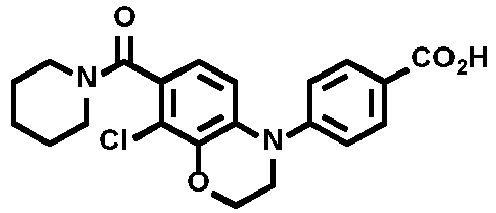
1H NMR (400 MHz, DMSO-d6) δ 1.35-1.65 (6H, m), 3.10-3. 20 (2H, m), 3.55-3.62 (2H, m), 3.80-3.85 (2H, m), 4.34-4.42 (2H, m), 6.69 (1H, d, J = 8.6 Hz), 7.02 (1H, d, J = 8.6 Hz) , 7.34 (2H, d, J = 8.6 Hz), 7.92 (2H, d, J = 8.6 Hz), 12.73 (1H, brs). LRMS (ESI+) 401 [M+H]+. 2-5 
1H NMR (400 MHz, DMSO-d6) δ 1.45-1.58 (4H, m), 1.58-1. 67 (2H, m), 1.97-2.06 (2H, m), 3.25-3.65 (4H, m), 3.93 (2H, t, J = 5.5 Hz), 4.05 (2H, t, J = 5.5 Hz), 6.90 (2H, d, J = 9. 2 Hz), 7.00-7.06 (2H, m), 7.22 (1H, d, J = 8.6 Hz), 7.76 (2 H, d, J = 9.2 Hz), 12.36 (1H, brs). LRMS (ESI+) 381 [M+H]+. 2-6 
1H NMR (400 MHz, DMSO-d6) δ 1.45-1.57 (4H, m), 1.57-1. 67 (2H, m), 1.67-1.80 (4H, m), 3.25-3.65 (4H, m), 3.73-3.80 (2H, m), 4.10 (2H, t, J = 5.5 Hz), 6.65 (2H, d, J = 8.5 Hz), 7.11 (1H, dd, J = 7.9, 1.8 Hz), 7.15 (1H, d, J = 1.8 Hz), 7 .20 (1H, d, J = 7.9 Hz), 7.73 (2H, d, J = 8.5 Hz), 12.24 (1 H, brs). LRMS (ESI+) 395 [M+H]+. [Table 102] Example No. Chemical Structural Formula Spectrum Data 2-7 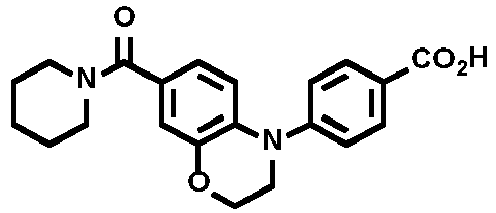
1H NMR (400 MHz, DMSO-d6) δ 1.42-1.65 (6H, m), 3.35-3. 55 (4H, m), 3.80 (2H, t, J = 4.8 Hz),, 4.28 (2H, t, J = 4.8 Hz), 6.79 (1H, dd, J = 8.5, 1.8 Hz), 6.86 (1H, d, J = 2.4 H z), 7.06 (1H, d, J = 8.5 Hz), 7.33 (2H, d, J = 8.5 Hz), 7.91 (2H, d, J = 8.5 Hz), 12.77 (1H, brs). LRMS (ESI+) 367 [M+H]+. 2-8 
1H NMR (400 MHz, DMSO-d6) δ 1.40-1.70 (6H, m), 1.95-2. 12 (2H, m), 3.15-3.70 (4H, m), 3.97-4.09 (2H, m), 4.12-4.22 (2H, m), 7.19 (2H, d, J = 8.6 Hz), 7.38 (1H, s), 7.81 (2H, d , J = 8.6 Hz), 7.99 (1H, s), 12.51 (1H, brs). LRMS (ESI+) 382 [M+H]+. 2-9 
1H NMR (400 MHz, DMSO-d6) δ 1.47-1.66 (6H, m), 1.71-1. 85 (4H, m), 3.35-3.60 (4H, m), 3.97-4.05 (2H, m), 4.15-4.24 (2H, m), 7.08 (2H, d, J = 8.5 Hz), 7.44 (1H, d, J = 2.4 Hz) , 7.82 (2H, d, J = 8.5 Hz), 7.95 (1H, d, J = 2.4 Hz), 12.53 (1H, brs). LRMS (ESI+) 396 [M+H]+. 2-10 
1H NMR (400 MHz, DMSO-d6) δ 0.93 (3H, d, J = 6.7 Hz), 1.42-1.68 (6H, m), 2.25-2.35 (1H, m), 3.20-3.65 (5H, m), 3.7 1 (1H, dd, J = 12.1, 6.1 Hz), 4.09 (1H, dd, J = 12.1, 4.2 H z), 4.25 (1H, dd, J = 15.1, 4.2 Hz), 6.92 (2H, d, J = 8.5 Hz ), 7.00-7.06 (2H, m), 7.20 (1H, d, J = 7.9 Hz), 7.76 (2H, d, J = 8.5 Hz), 12.36 (1H, brs). LRMS (ESI+) 395 [M+H]+. 2-11 
1H NMR (400 MHz, DMSO-d6) δ 0.93 (3H, d, J = 7.3 Hz), 1.42-1.67 (6H, m), 2.25-2.35 (1H, m), 3.20-3.65 (5H, m), 3.7 1 (1H, dd, J = 12.2, 5.5 Hz), 4.09 (1H, dd, J = 12.2, 4.3 H z), 4.24 (1H, dd, J = 15.3, 4.3 Hz), 6.92 (2H, d, J = 8.6 Hz ), 7.02 (1H, dd, J = 7.9, 1.8 Hz), 7.04 (1H, d, J = 1.8 Hz), 7.20 (1H, d, J = 7.9 Hz), 7.76 (2H, d, J = 8.6 Hz), 12.35 (1 H, brs). LRMS (ESI+) 395 [M+H]+. [Table 103] Example No. Chemical Structural Formula Spectrum Data 2-12 
1H NMR (400 MHz, DMSO-d6) δ 1.43-1.65 (6H, m), 3.40-3. 55 (4H, m), 3.81 (3H, s), 3.72-3.85 (2H, m), 4.29 (2H, t, J = 4.9 Hz), 6.80 (1H, dd, J = 8.6, 1.8 Hz), 6.85-6.90 (2H, m) , 6.92 (1H, d, J = 1.8 Hz), 7.10 (1H, d, J = 8.6 Hz), 7.69 ( 1H, d, J = 8.6 Hz), 12.30 (1H, brs). LRMS (ESI+) 397 [M+H]+. 2-13 
1H NMR (400 MHz, DMSO-d6) δ 1.94-2.10 (4H, m), 3.52-3. 65 (4H, m), 3.77-3.87 (2H,m), 3.81 (3H, s), 4.30 (2H, t, J = 4.9 Hz), 6.88 (2H, dd, J = 8.6, 1.8 Hz), 6.93 (1H, d, J = 1. 8 Hz), 6.97 (1H, d, J = 1.8 Hz), 7.10 (1H, d, J = 8.6 Hz), 7.70 (1H, d, J = 8.6 Hz), 12.31 (1H, brs). LRMS (ESI+) 433 [M+H]+. 2-14 
1H NMR (400 MHz, DMSO-d6) δ 2.10-2.18 (2H, m), 3.45-3. 60 (2H, m), 3.78-3.85 (2H, m), 3.81 (3H, s), 3.95-4.03 (2H, m), 4.29 (2H, t, J = 4.9 Hz), 5.60-5.80 (1H, m), 5.80-5.90 (1 H, m), 6.84 (1H, dd, J = 8.6, 1.8 Hz), 6.88 (1H, dd, J = 8.6 , 1.8 Hz), 6.91 (1H, d, J = 1.8 Hz), 6.93 (1H, d, J = 1.8 H z), 7.10 (1H, d, J = 8.6 Hz), 7.69 (1H, d, J = 8.6 Hz), 12.3 7 (1H, brs). LRMS (ESI+) 395 [M+H]+. 2-15 
1H NMR (400 MHz, DMSO-d6) δ 1.43-1.53 (4H, m), 1.56-1. 65 (2H, m), 3.13-3.20 (2H, m), 3.35-3.50 (4H, m), 3.95-4.00 (2H, m), 6.97 (2H, s), 7.17 (1H, s), 7.23 (2H, d, J = 9.1 Hz ), 7.87 (2H, d, J = 9.1 Hz), 12.66 (1H, brs). LRMS (ESI-) 381 [M-H]-. 2-16 
1H NMR (400 MHz, DMSO-d6) δ 1.43-1.56 (4H, m), 1.56-1. 66 (2H, m), 3.12-3.30 (2H, m), 3.40-3.55 (4H, m), 3.90-4.00 (1H, m), 4.08-4.20 (1H, m), 6.80 (1H, d, J = 8.5 Hz), 7.32 ( 1H, dd, J = 8.5, 1.8 Hz), 7.49 (2H, d, J = 8.5 Hz), 7.63 (1 H, d, J = 1.8 Hz), 8.03 (2H, d, J = 8.5 Hz), 13.01 (1H, brs) LRMS (ESI-) 397 [M-H]-. 2-17 
1H NMR (400 MHz, DMSO-d6) δ 1.44-1.55 (4H, m), 1.55-1. 65 (2H, m), 3.35-3.50 (4H, m), 3.73-3.82 (2H, m), 4.20-4.28 (2H, m), 6.63 (1H, d, J = 8.5 Hz), 7.34 (1H, dd, J = 8.5, 1. 8 Hz), 7.51 (2H, d, J = 8.5 Hz), 7.68 (1H, d, J = 1.8 Hz), 8.04 (2H, d, J = 8.5 Hz), 13.08 (1H, brs). LRMS (ESI-) 413 [M-H]-. [Table 104] Example No. Chemical Structural Formula Spectrum Data 2-18 
1H NMR (400 MHz, DMSO-d6) δ 1.42-1.66 (6H, m), 2.05-2. 12 (2H, m), 2.82-2.90 (2H, m), 3.20-3.45 (2H, m), 3.45-3.65 (2H, m), 3.83-3.95 (2H, m), 6.64 (2H, d, J = 8.5 Hz), 7.28-7 .35 (2H, m), 7.54 (1H, d, J = 1.2 Hz), 7.73 (2H, d, J = 8.5 Hz), 12.26 (1H, brs). LRMS (ESI+) 397 [M+H]+. 2-19 
1H NMR (400 MHz, DMSO-d6) δ 1.45-1.70 (6H, m), 1.90-2. 00 (1H, m), 2.30-2.45 (1H, m), 2.95-3.06 (1H, m), 3.09-3.20 (1H, m), 3.25-3.45 (3H, m), 3.50-3.75 (2H, m), 4.14-4.25 (1H ,m), 6.69 (2H, d, J = 9.1 Hz), 7.40 (1H, d, J = 8.5 Hz), 7.6 2 (1H, dd, J = 8.5, 1.8 Hz), 7.67 (1H, d, J = 1.8 Hz), 7.76 (2H, d, J = 9.1 Hz), 12.36 (1H, brs). LRMS (ESI+) 413 [M+H]+. 2-20 
1H NMR (400 MHz, DMSO-d6) δ 1.45-1.70 (6H, m), 2.00-2. 17 (2H, m), 3.25-4.00 (8H, m), 6.71 (2H, d, J = 8.5 Hz), 7. 55 (1H, d, J = 7.9 Hz), 7.71-7.83 (3H, m), 7.95 (1H, d, J = 1.8 Hz), 12.31 (1H, brs). LRMS (ESI+) 429 [M+H]+. 2-21 
1H NMR (400 MHz, DMSO-d6) δ 1.39-1.65 (6H, m), 3.18-3. 61 (4H, m), 4.09 (2H, t, J = 3.9 Hz), 4.27 (2H, t, J = 4.2 Hz), 6.86 (1H, dd, J = 8.5, 1.8 Hz), 6.90 (1H, d, J = 2.4 H z), 7.28 (1H, d., J = 9.1 Hz), 7.50 (1H, d, J = 7.9 Hz), 8.07 (1H, dd, J = 8.8, 2.1 Hz), 8.76 (1H, d, J = 2.4 Hz). (COO H peak missing) LRMS (ESI+) 368 [M+H]+. 2-22 
1H NMR (400 MHz, DMSO-d6) δ 1.42-1.53 (4H, m), 1.56-1. 64 (2H, m), 3.28-3.54 (4H, mbrs), 3.84 (2H, t, J = 4.3 Hz), 4.29 (2H, t, J = 4.6 Hz), 6.80 (1H, dd, J = 8.6, 1.8 Hz), 6.8 8 (1H, d, J = 1.8 Hz), 7.06-7.12 (1H, m), 7.75 (1H, dd, J = 8.6, 2.4 Hz), 7.98 (1H, d, J = 8.6 Hz), 8.60 (1H, d, J = 2.4 Hz). (COOH peak missing) LRMS (ESI+) 368 [M+H]+. [Table 105] Example No. Chemical Structural Formula Spectrum Data 2-23 
1H NMR (400 MHz, DMSO-d6) δ 1.44-1.64 (6H, m), 3.27-3. 55 (4H, m), 3.94 (2H, t, J = 4.3 Hz), 4.37 (2H, t, J = 4.6 Hz), 4.62 (2H, s), 6.89 (1H, d, J = 1.8 Hz), 7.00 (1H, dd, J = 7.6, 2.1 Hz), 7.21 (1H, d, J = 2.4 Hz), 7.76-7.80 (2H, m), 13.20 (1H, s). LRMS (ESI+) 439 [M+H]+. 2-24 
1H NMR (400 MHz, DMSO-d6) δ 1.43-1.65 (6H, m), 3.40-3. 50 (4H, m), 3.82 (3H, s), 3.92-4.02 (2H, m), 4.38 (2H, t, J = 4.3 Hz), 7.09 (1H, d, J = 1.8 Hz), 7.21-7.27 (1H, m), 7.53 (1H, d, J = 1.8 Hz), 7.61 (1H, d, J = 2.4 Hz), 7.97 (1H, d, J = 7.9 Hz), 8.04 (1H, d, J = 7.9 Hz), 12.02 (1H, br s). LRMS (ESI+) 421 [M+H]+. 2-25 
1H NMR (400 MHz, DMSO-d6) δ 1.42-1.65 (6H, m), 3.39-3. 55 (4H, m), 3.95-4.03 (5H, m), 4.38 (2H, t, J = 4.3 Hz), 7.1 1 (1H, d, J = 2.4 Hz), 7.18-7.23 (2H, m), 7.54 (1H, s), 7.61-7.66 (2H, m), 12.86 (1H, br s). LRMS (ESI+) 421 [M+H]+. [Table 106] Example No. Chemical Structural Formula Spectrum Data 2-26 
1H NMR (400 MHz, DMSO-d6) δ 1.42-1.55 (4H, m), 1.57-1.66 ( 2H, m), 1.91-2.01 (2H, m), 2.78 (2H, t, J = 6.1 Hz), 3.39-3. 53 (4H, m), 3.67 (2H, t, J = 6.1 Hz), 6.93 (1H, d, J = 8.6 Hz), 7.02 (1H, dd, J = 8.6, 1.8 Hz), 7.14 (1H, d, J = 1.8 H z), 7.31 (2H, d, J = 9.2 Hz), 7.89 (2H, d, J = 8.6 Hz), 12.6 7 (1H, br s). LRMS (ESI+) 365 [M+H]+. 2-27 
1H NMR (400 MHz, DMSO-d6) δ 1.39-1.65 (6H, m), 3.38-3.47 ( 4H, m), 3.62-3.72 (2H, m), 4.29 (2H, t, J = 4.6 Hz), 6.18 (1 H, d, J = 7.9 Hz), 6.67 (1H, dd, J = 7.9, 1.8 Hz), 6.78 (1H, d, J = 1.8 Hz), 7.36-7.46 (2H, m), 7.64 (1H, t, J = 7.3 Hz) , 7.82 (1H, d, J = 7.9 Hz), 12.94 (1H, br s). LRMS (ESI+) 367 [M+H]+. 2-28 
1H NMR (400 MHz, DMSO-d6) δ 1.42-1.67 (6H, m), 3.11 (2H, t , J = 8.6 Hz), 3.40-3.52 (4H, m), 3.95 (2H, t, J = 8.6 Hz), 6.32 (1H, d, J = 8.6 Hz), 7.00 (1H, dd, J = 8.6, 1.2 Hz), 7. 16 (1H, d, J = 1.2 Hz), 7.25 (1H, td, J = 7.3, 1.2 Hz), 7.44 (1H, dd, J = 7.9, 1.2 Hz), 7.56 (1H, td, J = 7.3, 1.8 Hz), 7. 75 (1H, dd, J = 7.9, 1.8 Hz), 12.87 (1H, br s). LRMS (ESI+) 351 [M+H]+. [Table 107] Example No. Chemical Structural Formula Spectrum Data 2-29 
1H NMR (400 MHz, DMSO-d6) δ 1.42-1.67 (6H, m), 3.14 (2H, t , J = 8.6 Hz), 3.41-3.54 (4H, m), 4.03 (2H, t, J = 8.6 Hz), 7.08 (1H, d, J = 8.6 Hz), 7.14 (1H, dd, J = 8.6, 1.8 Hz), 7. 23 (1H, s), 7.45-7.58 (3H, m), 7.79 (1H, s), 13.07 (1H, br s) LRMS (ESI+) 351 [M+H]+. 2-30 
1H NMR (400 MHz, DMSO-d6) δ 1.43-1.68 (6H, m), 3.15 (2H, t , J = 8.6 Hz), 3.40-3.55 (4H, m), 4.06 (2H, t, J = 8.6 Hz), 7.16 (1H, dd, J = 8.6, 1.8 Hz), 7.25 (1H, d, J = 1.2 Hz), 7. 28 (1H, d, J = 7.9 Hz), 7.32 (2H, d, J = 9.2 Hz), 7.92 (2H, d, J = 8.6 Hz), 12.56 (1H, br s). LRMS (ESI+) 351 [M+H]+. 2-31 
1H NMR (400 MHz, DMSO-d6) δ 1.42-1.52 (4H, m), 1.55-1.63 ( 2H, m), 3.38-3.48 (4H, m), 3.75 (2H, t, J = 4.3 Hz), 4.28 (2 H, t, J = 4.3 Hz), 6.75 (1H, dd, J = 8.6, 1.8 Hz), 6.80-6.84 (2H, m), 7.48-7.55 (2H, m), 7.65-7.69 (1H, m), 7.79 (1H, d, J = 1.8 Hz), 13.11 (1H, s). LRMS (ESI+) 367 [M+H]+. 2-32 
1H NMR (400 MHz, DMSO-d6) δ 1.42-1.51 (4H, m), 1.54-1.63 ( 2H, m), 3.37-3.48 (4H, m), 3.55 (2H, s), 3.69 (2H, t, J = 4. 3 Hz), 4.27 (2H, t, J = 4.3 Hz), 6.72 (2H, s), 6.80 (1H, s), 7.21-7.24 (2H, m), 7.28 (2H, d, J = 8.6 Hz), 12.26 (1H, s). LRMS (ESI+) 381 [M+H]+. 2-33 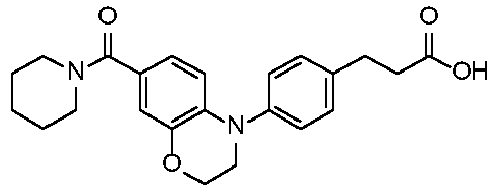
1H NMR (400 MHz, DMSO-d6) δ 1.42-1.51 (4H, m), 1.54-1.63 ( 2H, m), 2.54 (2H, t, J = 7.6 Hz), 2.81 (2H, t, J = 7.6 Hz), 3.38-3.48 (4H, m), 3.67 (2H, t, J = 4.2 Hz), 4.27 (2H, t, J = 4.2 Hz), 6.67 (1H, d, J = 8.5 Hz), 6.72 (1H, dd, J = 8.5, 1 .8 Hz), 6.79 (1H, d, J = 1.8 Hz), 7.19 (2H, d, J = 8.5 Hz), 7.26 (2H, d, J = 8.5 Hz), 12.13 (1H, s). LRMS (ESI+) 395 [M+H]+. 2-34 
1H NMR (400 MHz, DMSO-d6) δ 1.41-1.69 (6H, m), 1.94-2.07 ( 2H, m), 2.85 (2H, t, J = 6.4 Hz), 3.22-3.60 (4H, m), 3.81 (2 H, t, J = 5.4 Hz), 7.37-7.53 (3H, m), 7.85-7.97 (3H, m), 12. 58-12.92 (1H, m). LRMS (ESI+) 366 [M+H]+. [Table 108] Example No. Chemical Structural Formula Spectrum Data 2-35 
1H NMR (400 MHz, DMSO-d6) δ 1.94-2.07 (4H, m), 3.51-3.63 ( 4H, m), 3.79 (2H, t, J = 4.2 Hz), 4.28 (2H, t, J = 4.2 Hz), 6.86 (1H, dd, J = 8.5, 1.8 Hz), 6.96 (1H, d, J = 1.8 Hz), 7. 07 (1H, d, J = 8.5 Hz), 7.31-7.36 (2H, m), 7.89-7.93 (2H, m ), 12.59-12.92 (1H, m). LRMS (ESI+) 403 [M+H]+. 2-36 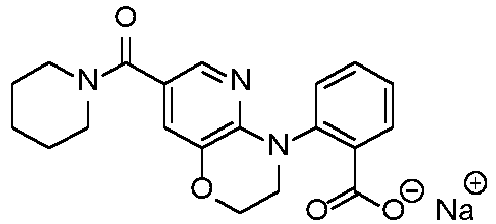
1H NMR (400 MHz, DMSO-d6) δ 1.40-1.64 (6H, m), 3.39-3. 48 (4H, m), 3.77-3.89 (2H, m), 4.27 (2H, t, J = 4.3 Hz), 6.9 2 (1H, d, J = 1.8 Hz), 7.09-7.22 (3H, m), 7.48 (1H, d, J = 2.4 Hz), 7.57 (1H, dd, J = 7.6, 2.1 Hz). LRMS (ESI+) 368 [M+H]+. 2-37 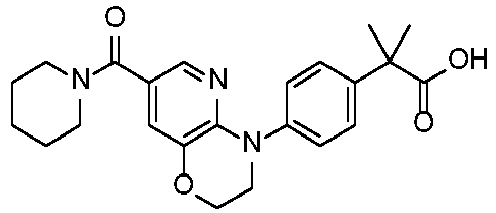
1H NMR (400 MHz, DMSO-d6) δ 1.26-1.70 (12H, m), 3.00-3.65 (4H, m), 3.85 (2H, t, J = 4.3 Hz), 4.31 (2H, t, J = 4.3 Hz), 7.05 (1H, d, J = 1.8 Hz), 7.17-7.22 (2H, m), 7.32-7.37 (2H, m), 7.62 (1H, d, J = 1.8 Hz). (COOH peak missing) LRMS (ESI+) 410 [M+H]+. 2-38 
1H NMR (400 MHz, DMSO-d6) δ 1.36-1.68 (6H, m), 3.09-3.67 ( 4H, m), 3.92-4.00 (2H, m), 4.32-4.40 (2H, m), 7.15 (1H, s), 7.67 (1H, s), 7.85 (1H, d, J = 8.6 Hz), 7.95 (1H, d, J = 8.6 Hz), 8.60 (1H, s). (COOH peak missing) LRMS (ESI+) 369 [M+H]+. -

- To a solution of (4,4-difluoropiperidin-1-yl)(3,4-dihydro-2H-benzo[b][1,4]oxazin-7-yl)methanone (56.5 mg) in toluene (2 mL), 5-(4-bromophenyl)-1H-tetrazole (67.6 mg), bis(tri-tert-butylphosphine)palladium (0) (10.5 mg) and sodium tert-butoxide (58.0 mg) were added at room temperature, followed by stirring under heating at 100°C for 3 hours. The resultant reaction mixture was cooled to room temperature, and a 6 mol/L hydrogen chloride aqueous solution was added to the resultant reaction solution to adjust pH to 4. The resultant mixture was concentrated under reduced pressure, and the thus obtained residue was purified by silica gel column chromatography (chloroform:methanol = 9:1) to obtain the title compound (22.0 mg).
- 1H NMR (400 MHz, CDCl3) δ 1.85-2.10 (4H, m), 3.40-3.90 (7H, m), 4.05-4.20 (2H, m), 6.65-7.05 (5H, m), 7.75-7.90 (2H, m).
- LRMS (ESI-) 425 [M-H]-.
-
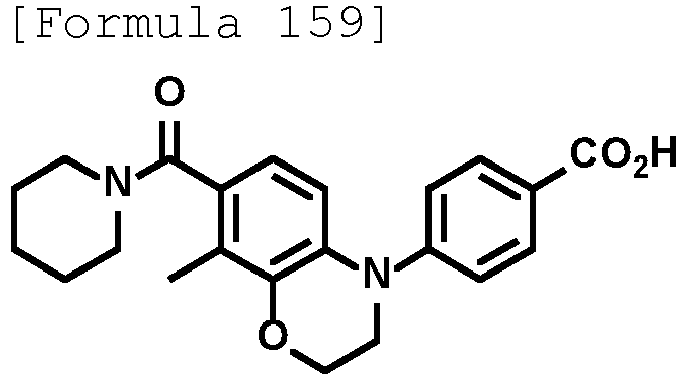
- To a solution of tert-butyl 4-(8-methyl-7-(piperidine-1-carbonyl)-2,3-dihydro-4H-benzo[b][1,4]oxazin-4-yl)benzoate (30.1 mg) in dichloromethane (1.0 mL), trifluoroacetic acid (0.5 mL) was added. After stirring at room temperature for 4 hours, the resultant reaction solution was concentrated under reduced pressure to obtain the title compound (23.9 mg).
- 1H NMR (400 MHz, DMSO-d6) δ: 1.30-1.45 (2H, m), 1.47-1.62 (4H, m), 2.03 (3H, s), 3.30-3.63 (4H, m), 3.74-3.81 (2H, m), 4.29 (2H, t, J = 4.3 Hz), 6.55 (1H, d, J = 8.6 Hz), 6.94 (1H, d, J = 7.9 Hz), 7.26-7.31 (2H, m), 7.85-7.91 (2H, m), 12.61 (1H, s).
- LRMS (ESI+) 381 [M+H]+.
- Compounds of the following Examples 4-2 to 4-21 were obtained in the same manner as in Example 4-1 by using corresponding starting materials and reactants. Their structures and spectrum data are shown in the following tables.
[Table 109] Example No. Chemical Structural Formula Spectrum Data 4-2 
1H NMR (400 MHz, DMSO-d6) δ 1.40-1.65 (6H, m), 3.27-3. 56 (4H, m), 3.96 (2H, t, J = 4.2 Hz), 4.35 (2H, t, J = 4.5 Hz), 7.17 (1H, d, J = 2.4 Hz), 7.52-7.57 (2H, m), 7.71 (1H, d, J = 1.8 Hz) , 7.89-7.93 (2H, m), 12.71 (1H, brs). LRMS (ESI+) 368 [M+H]+. 4-3 
1H NMR (400 MHz, DMSO-d6) δ 1.40-1.63 (6H, m), 3.40-3. 47 (2H, m), 3.51-3.57 (2H, m), 3.81 (2H, t, J = 4.2 Hz), 4.3 6 (2H, t, J = 4.2 Hz), 7.03 (1H, s), 7.32 (2H, d, J = 8.5 Hz ), 7.91 (2H, d, J = 8.5 Hz), 8.15 (1H, s). (COOH peak missi ng) LRMS (ESI-) 366 [M-H]-. 4-4 
1H NMR (400 MHz, DMSO-d6) δ 1.41-1.65 (6H, m), 3.42-3. 59 (4H, m), 3.81 (2H, t, J = 4.3 Hz), 4.43 (2H, t, J = 4.3 Hz), 7.04 (1H, d, J = 7.9 Hz), 7.37 (2H, d, J = 8.6 Hz), 7.4 4 (1H, d, J = 7.9 Hz), 7.94 (2H, d, J = 8.6 Hz), 12.79 (1H, brs). LRMS (ESI+) 368 [M+H]+. [Table 110] Example No. Chemical Structural Formula Spectrum Data 4-5 
1H NMR (400 MHz, DMSO-d6) δ: 1.96-2.08 (4H, m), 3.52-3. 65 (4H, m), 3.96 (2H, t, J = 4.3 Hz), 4.35 (2H, t, J = 4.6 Hz), 7.25 (1H, d, J = 1.8 Hz), 7.51-7.56 (2H, m), 7.79 (1H, d, J = 1.8 Hz), 7.89-7.94 (2H, m), 12.74 (1H, s). LRMS (ESI+) 404 [M+H]+. 4-6 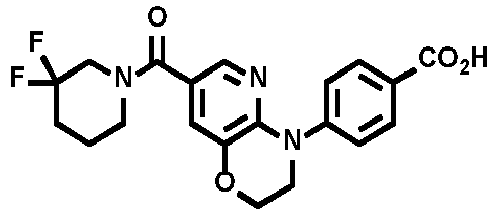
1H NMR (400 MHz, DMSO-d6) δ: 1.64-1.73 (2H, m), 2.01-2. 14 (2H, m), 3.45-3.60 (2H, m), 3.82 (2H, t, J = 11.3 Hz), 3. 97 (2H, t, J = 4.3 Hz), 4.36 (2H, t, J = 4.0 Hz), 7.17 (1H, d, J = 2.4 Hz), 7.55 (2H, d, J = 8.6 Hz), 7.73 (1H, d, J = 1.8 Hz), 7.92 (2H, d, J = 8.6 Hz), 12.76 (1H, s). LRMS (ESI+) 404 [M+H]+. 4-7 
1H NMR (400 MHz, DMSO-d6) δ: 1.43-1.94 (4H, m), 3.00-3. 58 (3H, m), 3.84 (1H, s), 3.96 (2H, t, J = 4.3 Hz), 4.35 (2H , t, J = 4.3 Hz), 4.75 (1H, d, J = 47.1 Hz), 7.16 (1H, d, J = 1.8 Hz), 7.53 (2H, d, J = 8.6 Hz), 7.72 (1H, d, J = 2.4 H z), 7.91 (2H, d, J = 8.6 Hz), 12.77 (1H, s). LRMS (ESI+) 386 [M+H]+. 4-8 
1H NMR (400 MHz, DMSO-d6) δ: 1.42-1.97 (4H, m), 3.00-3. 58 (3H, m), 3.72-4.03 (3H, m), 4.35 (2H, t, J = 4.6 Hz), 4.7 5 (1H, d, J = 47.7 Hz), 7.16 (1H, d, J = 1.8 Hz), 7.88-7.94 (2H, m), 7.72 (1H, d, J = 1.8 Hz), 7.90-7.92 (2H, m), 12.77 (1H, s). LRMS (ESI+) 386 [M+H]+. 4-9 
1H NMR (400 MHz, DMSO-d6) δ: 2.10-2.18 (2H, m), 3.42-3. 65 (2H, m), 3.93-4.04 (4H, m), 4.35 (2H, t, J = 4.2 Hz), 5.6 2-5.76 (1H, m), 5.80-5.88 (1H, m), 7.20 (1H, d, J = 1.8 Hz), 7.54 (2H, d, J = 8.5 Hz), 7.76 (1H, d, J = 1.8 Hz), 7.91 (2 H, d, J = 8.5 Hz), 12.76 (1H, s). LRMS (ESI+) 366 [M+H]+. 4-10 
1H NMR (400 MHz, DMSO-d6) δ: 3.40-3.56 (8H, m), 3.90 ( 2H, t, J = 4.6 Hz), 4.29 (2H, t, J = 4.3 Hz), 7.16 (1H, d, J = 2.4 Hz), 7.46-7.51 (2H, m), 7.70 (1H, d, J = 1.8 Hz), 7.83 -7.88 (2H, m). (COOH peak missing) LRMS (ESI+) 370 [M+H]+. [Table 111] Example No. Chemical Structural Formula Spectrum Data 4-11 
1H NMR (400 MHz, DMSO-d6) δ: 2.77 (3H, s), 2.91-3.64 (8 H, m), 3.97 (2H, t, J = 4.3 Hz), 4.36 (2H, t, J = 4.3 Hz), 7 .25 (1H, d, J = 2.4 Hz), 7.53-7.59 (2H, m), 7.81 (1H, d, J = 1.8 Hz), 7.90-7.96 (2H, m), 9.83 (1H, s), 12.75 (1H, s). LRMS (ESI+) 383 [M-CF3COO-]+. 4-12 
1H NMR (400 MHz, DMSO-d6) δ 1.45-1.65 (6H, m), 3.55-3. 62 (4H, m), 3.83 (2H, t, J = 4.0 Hz), 4.30 (2H, t, J = 4.3 Hz), 7.05 (1H, s), 7.38-7.43 (2H, m), 7.89-7.94 (2H, m). (CO OH peak missing) LRMS (ESI+) 373 [M+H]+. 4-13 
1H NMR (400 MHz, DMSO-d6) δ: 1.40-1.67 (12H, m), 2.06-2.16 (2H, m), 2.56-2.62 (1H, m), 3.19 (2H, t, J = 4.2 Hz), 3 .34-3.56 (4H, m), 3.62-3.72 (1H, m), 4.10 (2H, t, J = 4.5 Hz ), 6.67 (1H, d, J = 1.8 Hz), 6.75-6.84 (2H, m), 12.18 (1H, s) LRMS (ESI+) 373 [M+H]+. 4-14 
1H NMR (400 MHz, DMSO-d6) δ: 1.41-1.63 (10H, m), 1.64-1.77 (2H, m), 1.91-2.02 (2H, m), 2.13-2.23 (1H, m), 3.25 (2 H, t, J = 4.2 Hz), 3.30-3.53 (4H, m), 3.60-3.70 (1H, m), 4.1 1 (2H, t, J = 4.2 Hz), 6.67 (1H, s), 6.80 (2H, s), 12.07 (1H, s). LRMS (ESI+) 373 [M+H]+. 4-15 
1H NMR (400 MHz, DMSO-d6) δ 1.42-1.65 (6H, m), 3.42-3. 58 (4H, m), 3.81 (3H, s), 3.98 (2H, t, J = 4.3 Hz), 4.36 (2H , t, J = 4.3 Hz), 7.07 (1H, dd, J = 8.3, 2.1 Hz), 7.17 (1H, d , J = 1.8 Hz), 7.20 (1H, d, J = 1.8 Hz), 7.69 (1H, d, J = 8. 6 Hz), 7.74 (1H, d, J = 1.8 Hz), 12.35 (1H, br s). LRMS (ESI+) 398 [M+H]+. [Table 112] Example No. Chemical Structural Formula Spectrum Data 4-16 
1H NMR (400 MHz, DMSO-d6) δ 1.42-1.66 (6H, m), 2.54 (3H, s ), 3.41-3.62 (4H, m), 3.94 (2H, t, J = 4.3 Hz), 4.34 (2H, t, J = 4.6 Hz), 7.16 (1H, d, J = 1.8 Hz), 7.32-7.39 (2H, m), 7.7 2 (1H, d, J = 1.8 Hz), 7.85 (1H, d, J = 7.9 Hz), 12.60 (1H, br s). LRMS (ESI+) 382 [M+H]+. 4-17 
1H NMR (400 MHz, DMSO-d6) δ 1.43-1.67 (6H, m), 3.41-3.65 ( 4H, m), 3.97 (2H, t, J = 4.3 Hz), 4.35 (2H, t, J = 4.3 Hz), 7.20 (1H, d, J = 1.8 Hz), 7.50 (1H, dd, J = 8.6, 1.8 Hz), 7. 65 (1H, d, J = 2.4 Hz), 7.76 (1H, d, J = 1.8 Hz), 7.85 (1H, d, J = 8.6 Hz), 13.12 (1H, br s). LRMS (ESI+) 402 [M+H]+. 4-18 
1H NMR (400 MHz, DMSO-d6) δ 1.41-1.64 (6H, m), 2.17 (3H, s ), 3.37-3.53 (4H, m), 3.60-4.05 (2H, m), 4.30-4.48 (2H, m), 7 .10 (1H, d, J = 1.8 Hz), 7.39 (1H, d, J = 7.9 Hz), 7.60 (1H, d, J = 1.8 Hz), 7.82 (1H, dd, J = 8.3, 2.1 Hz), 7.87 (1H, d , J = 1.8 Hz), 12.89 (1H, br s). LRMS (ESI+) 382 [M+H]+. 4-19 
1H NMR (400 MHz, DMSO-d6) δ 1.44-1.54 (4H, m), 1.55-1.63 ( 2H, m), 3.37-3.50 (4H, m), 3.94 (2H, t, J = 4.3 Hz), 4.35 (2 H, t, J = 4.3 Hz), 7.12 (1H, d, J = 1.8 Hz), 7.48 (1H, t, J = 7.6 Hz), 7.67 (2H, dd, J = 6.4, 1.5 Hz), 7.70 (1H, dt, J = 7.7, 1.4 Hz), 7.94 (1H, t, J = 1.8 Hz), 13.01 (1H, s). LRMS (ESI+) 368 [M+H]+. 4-20 
1H NMR (400 MHz, DMSO-d6) δ 1.41-1.67 (6H, m), 1.96-2.08 ( 2H, m), 2.86 (2H, t, J = 6.1 Hz), 3.39-3.57 (4H, m), 3.78 (2 H, t, J = 5.4 Hz), 7.38 (1H, d, J = 2.4 Hz), 7.48 (1H, t, J = 7.9 Hz), 7.54-7.60 (1H, m), 7.70-7.75 (1H, m), 7.81-7.87 ( 2H, m), 13.04 (1H, br s). LRMS (ESI+) 366 [M+H]+. 4-21 
1H NMR (400 MHz, DMSO-d6) δ 1.42-1.65 (6H, m), 2.89 (3 H, s), 3.35-3.52 (6H, m), 3.89-3.94 (2H, m), 6.79 (1H, d, J = 1.8 Hz), 7.39 (1H, d, J = 1.8 Hz), 7.42-7.47 (2H, m), 7.85 -7.90 (2H, m), 12.67 (1H, s). LRMS (ESI+) 381 [M+H]+. -

- A mixture of 2-methoxy-4-(7-(1,2,3,6-tetrahydropyridine-1-carbonyl)-2,3-dihydro-4H-benzo[b][1,4]oxazin-4-yl)benzoic acid (50.0 mg) and thionyl chloride (0.5 mL) was stirred at room temperature for 12 hours. The resultant reaction solution was concentrated under reduced pressure, and to the thus obtained residue, tetrahydrofuran (1 mL) was added, and then a 7 mol/L methanol solution (2 mL) of ammonia was added at room temperature. The resultant mixture was stirred at room temperature for 5 hours, the resultant was concentrated under reduced pressure, and the thus obtained residue was purified by silica gel column chromatography (ethyl acetate/methanol = 10:1) to obtain the title compound (11.2 mg).
- 1H NMR (400 MHz, CDCl3) δ 2.17-2.27 (2H, m), 3.50-3.75 (2H, m), 3.79 (2H, t, J = 4.3 Hz), 3.92 (3H, s), 4.00-4.25 (2H, m), 4.32 (2H, t, J = 4.3 Hz), 5.60-5.80 (2H, m), 5.83-5.91 (1H, m), 6.83-6.94 (3H, m), 7.01 (1H, d, J = 1.8 Hz), 7.14 (1H, d, J = 8.5 Hz), 7.62 (1H, brs), 8.20 (1H, d, J = 8.5 Hz).
- LRMS (ESI+) 394 [M+H]+.
- Compounds of the following Examples 5-2 to 5-3 were obtained in the same manner as in Example 5-1 by using corresponding starting materials and reactants. Their structures and spectrum data are shown in the following tables.
[Table 113] Example No. Chemical Structural Formula Spectrum Data 5-2 
1H NMR (400 MHz, CDCl3) δ 1.94-2.10 (4H, m), 3.65-3.80 ( 4H,m), 3.79 (2H, t, J = 4.9 Hz), 3.93 (3H, s), 4.33 (2H, t, J = 4.9 Hz), 5.73 (1H, brs), 6.85 (1H, d, J = 1.2 Hz), 6.86-6.9 3 (2H, m), 7.00 (1H, d, J = 1.2 Hz), 7.13 (1H, d, J = 8.6 Hz), 7.62 (1H, brs), 8.21 (1H, d, J = 8.6 Hz). LRMS (ESI+) 432 [M+H]+. 5-3 
1H NMR (400 MHz, CDCl3) δ 2.16-2.28 (2H, m), 3.10 (3H, d, J = 4.3 Hz), 3.50-3.75 (2H, m), 3.78 (2H, t, J = 4.3 Hz), 3.91 (3H, s), 4.00-4.25 (2H, m), 4.32 (2H, t, J = 4.2 Hz), 5. 55-5.80 (1H, m), 5.84-5.91 (1H, m), 6.83 (1H, d, J = 1.8 Hz ), 6.85-6.92 (2H, m), 7.01 (1H, d, J = 1.8 Hz), 7.10 (1H, d, J = 8.6 Hz), 7.70-7.78 (1H, m), 8.21 (1H, d, J = 8.6 Hz). LRMS (ESI+) 408 [M+H]+. -

- To a suspension, in tetrahydrofuran (0.5 mL), of 4-(7-(4,4-difluoropiperidine-1-carbonyl)-2,3-dihydro-4H-benzo[b][1,4]oxazin-4-yl)-2-methoxybenzoic acid (30.0 mg) and a 2 mol/L tetrahydrofuran solution (1 mL) of methylamine, 1-[bis(dimethylamino)methylene]-1H-1,2,3-triazolo[4,5-b]pyridinium 3-oxide hexafluorophosphate (32.0 mg) and diisopropylethylamine (24.0 µL) were added at room temperature, followed by stirring at room temperature for 2 hours. The resultant reaction mixture was concentrated under reduced pressure, and the thus obtained residue was purified by silica gel column chromatography (ethyl acetate:methanol = 20:1) to obtain the title compound (12.8 mg).
- 1H NMR (400 MHz, CDCl3) δ 1.94-2.08 (4H, m), 3.01 (3H, d, J = 4.8 Hz), 3.68-3.80 (4H,m), 3.78 (2H, t, J = 4.2 Hz), 3.92 (3H, s), 4.33 (2H, t, J = 4.2 Hz), 6.83 (1H, d, J = 1.8 Hz), 6.87 (1H, dd, J = 8.5, 1.8 Hz), 6.90 (1H, dd, J = 8.5, 1.8 Hz), 6.99 (1H, d, J = 1.8 Hz), 7.09 (1H, d, J = 8.5 Hz), 7.68-7.75 (1H, m), 8.22 (1H, d, J = 8.5 Hz).
- LRMS (ESI+) 446 [M+H]+.
- Compounds of the following Examples 6-2 to 6-22 were obtained in the same manner as in Example 6-1 by using corresponding starting materials and reactants. Their structures and spectrum data are shown in the following tables.
[Table 114] Example No. Chemical Structural Formula Spectrum Data 6-2 
1H NMR (400 MHz, DMSO-d6) δ 1.39-1.66 (6H, m), 3.27-3. 62 (4H, m), 4.07 (2H, t, J = 4.2 Hz), 4.27 (2H, t, J = 4.5 Hz), 6.86 (1H, dd, J = 8.5, 1.8 Hz), 6.89 (1H, d, J = 1.8 H z), 7.28 (1H, d., J = 9.1 Hz), 7.34 (1H, s), 7.49 (1H, d, J = 8.5 Hz), 7.93 (1H, s), 8.08 (1H, dd, J = 9.1, 2.4 Hz), 8.77 ( 1H, d, J = 1.8 Hz). LRMS (ESI+) 367 [M+H]+. 6-3 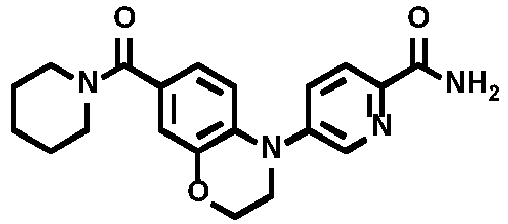
1H NMR (400 MHz, DMSO-d6) δ 1.40-1.66 (6H, m), 3.29-3. 58 (4H, m), 3.83 (2H, t, J = 4.5 Hz), 4.29 (2H, t, J = 4.5 Hz), 6.79 (1H, dd, J = 8.5, 1.8 Hz), 6.87 (1H, d, J = 2.4 H z), 7.05 (1H, d., J = 7.9 Hz), 7.48-7.54 (1H, m), 7.80 (1H, d d, J = 8.8, 2.7Hz), 7.94-8.02 (2H, m), 8.54 (1H, d, J = 2.4 Hz). LRMS (ESI+) 367 [M+H]+. 6-4 
1H NMR (400 MHz, DMSO-d6) δ 1.39-1.67 (6H, m), 3.34-3. 61 (4H, m), 3.94 (2H, t, J = 4.6 Hz), 4.34 (2H, t, J = 4.3 Hz), 7.18 (1H, d, J = 2.4 Hz), 7.33 (1H, dd, J = 8.6, 2.4 H z), 7.41 (1H, dd, J = 13.4, 1.8 Hz), 7.55 (2H, br s), 7.67 (1 H, t, J = 8.9 Hz), 7.74 (1H, d, J = 2.4 Hz). LRMS (ESI+) 385 [M+H]+. 6-5 
1H NMR (400 MHz, DMSO-d6) δ 1.39-1.66 (6H, m), 2.77 (3 H, d, J = 4.3 Hz), 3.34-3.58 (4H, m), 3.94 (2H, t, J = 4.3 Hz), 4.34 (2H, t, J = 4.3 Hz), 7.17 (1H, d, J = 1.8 Hz), 7.3 3 (1H, dd, J = 8.6, 1.8 Hz), 7.42 (1H, dd, J = 13.1, 2.1 Hz) , 7.63 (1H, t, J = 8.9 Hz), 7.73 (1H, d, J = 1.8 Hz), 8.05-8. 16 (1H, m). LRMS (ESI+) 399 [M+H]+. [Table 115] Example No. Chemical Structural Formula Spectrum Data 6-6 
1H NMR (400 MHz, DMSO-d6) δ 1.41-1.64 (6H, m), 3.26-3. 62 (4H, m), 3.93 (2H, t, J = 4.3 Hz), 4.37 (2H, t, J = 4.6 Hz), 4.42 (2H, s), 6.88 (1H, d, J = 1.2 Hz), 6.97 (1H, dd, J = 7.6, 2.1 Hz), 7.21 (1H, d, J = 2.4 Hz), 7.24-7.31 (1H, m), 7.47-7.53 (1H, m), 7.74-7.79 (2H, m). LRMS (ESI+) 438 [M+H]+. 6-7 
1H NMR (400 MHz, DMSO-d6) δ 1.38-1.66 (6H, m), 2.59 (3 H, d, J = 4.3 Hz), 3.22-3.65 (4H, m), 3.93 (2H, t, J = 4.6 Hz), 4.37 (2H, t, J = 4.3 Hz), 4.44 (2H, s), 6.88 (1H, d, J = 1.2 Hz), 6.98 (1H, dd, J = 7.9, 1.8 Hz), 7.21 (1H, d, J = 1 .8 Hz), 7.75-7.80 (2H, m), 7.92 (1H, q, J = 4.5 Hz). LRMS (ESI+) 452 [M+H]+. 6-8 
1H NMR (400 MHz, DMSO-d6) δ 1.43-1.64 (6H, m), 2.83 (3 H, s), 3.03 (3H, s), 3.27-3.58 (4H, m), 3.94 (2H, t, J = 4.3 Hz), 4.37 (2H, t, J = 4.3 Hz), 4.79 (2H, s), 6.86 (1H, d, J = 1.2 Hz), 6.97 (1H, dd, J = 7.6, 2.1 Hz), 7.21 (1H, d, J = 1 .8 Hz), 7.75-7.79 (2H, m). LRMS (ESI+) 466 [M+H]+. 6-9 
1H NMR (400 MHz, DMSO-d6) δ 1.20-1.30 (2H, m), 1.42-1. 56 (2H, m), 1.56-1.65 (2H, m), 2.73-2.89 (3H, m), 3.38-3.55 (4H, m), 3.88 (3H, s), 3.96 (2H, t, J = 4.2 Hz), 4.35 (2H, t, J = 4.2 Hz), 7.08 (1H, dd, J = 8.5, 1.8 Hz), 7.16 (1H, d, J = 1.8 Hz), 7.21 (1H, d, J = 2.4 Hz), 7.72 (1H, d, J = 1.8 H z), 7.79 (1H, d, J = 8.5 Hz), 8.06-8.12 (1H, m). LRMS (ESI+) 411 [M+H]+. 6-10 
1H NMR (400 MHz, DMSO-d6) δ 1.42-1.67 (6H, m), 2.77 (3 H, d, J = 4.9 Hz), 3.40-3.50 (4H, m), 3.79 (3H, s), 3.95 (2H , t, J = 4.3 Hz), 4.37 (2H, t, J = 4.0 Hz), 7.08 (1H, d, J = 1.8 Hz), 7.18 (1H, dd, J = 8.6, 1.2 Hz), 7.48 (1H, s), 7.61 ( 1H, d, J = 1.8 Hz), 7.80-7.86 (1H, m), 7.90 (1H, s), 8.10 (1 H, d, J = 8.6 Hz). LRMS (ESI+) 434 [M+H]+. 6-11 
1H NMR (400 MHz, DMSO-d6) δ 1.42-1.65 (6H, m), 2.79 (3 H, d, J = 4.3 Hz), 3.34-3.57 (4H, m), 3.92-4.04 (5H, m), 4.4 0 (2H, t, J = 4.3 Hz), 7.05 (1H, s), 7.14-7.21 (2H, m), 7.52-7.61 (2H, m), 7.65 (1H, d, J = 8.6 Hz), 8.43-8.51 (1H, m). LRMS (ESI+) 434 [M+H]+. [Table 116] Example No. Chemical Structural Formula Spectrum Data 6-12 
1H NMR (400 MHz, DMSO-d6) δ 1.43-1.66 (6H, m), 2.34 (3H, s ), 2.74 (3H, d, J = 4.9 Hz), 3.40-3.58 (4H, m), 3.85-3.95 (2 H, m), 4.29-4.39 (2H, m), 7.12 (1H, d, J = 1.8 Hz), 7.24-7.2 9 (2H, m), 7.33 (1H, d, J = 7.9 Hz), 7.66 (1H, d, J = 1.8 Hz), 8.11-8.19 (1H, m). LRMS (ESI+) 395 [M+H]+. 6-13 
1H NMR (400 MHz, DMSO-d6) δ 1.42-1.63 (6H, m), 2.16 (3H, s ), 2.79 (3H, d, J = 4.9 Hz), 3.39-3.52 (4H, m), 3.56-4.00 (2 H, m), 4.31-4.45 (2H, m), 7.09 (1H, d, J = 1.8 Hz), 7.35 (1 H, d, J = 7.9 Hz), 7.59 (1H, d, J = 1.8 Hz), 7.69 (1H, dd, J = 7.9, 1.8 Hz), 7.75 (1H, d, J = 1.2 Hz), 8.37-8.45 (1H, m) LRMS (ESI+) 395 [M+H]+. 6-14 
1H NMR (400 MHz, DMSO-d6) δ 1.41-1.68 (6H, m), 1.94-2.06 ( 2H, m), 2.85 (2H, t, J = 6.1 Hz), 3.38-3.56 (4H, m), 3.79 (2 H, t, J = 5.4 Hz), 7.23-7.31 (1H, m), 7.36-7.43 (3H, m), 7.8 0-7.95 (4H, m). LRMS (ESI+) 365 [M+H]+. 6-15 
1H NMR (400 MHz, DMSO-d6) δ 1.41-1.68 (6H, m), 1.95-2.06 ( 2H, m), 2.85 (2H, t, J = 6.1 Hz), 2.98 (6H, s), 3.36-3.56 (4 H, m), 3.78 (2H, t, J = 5.4 Hz), 7.35-7.44 (5H, m), 7.85 (1 H, d, J = 1.8 Hz). LRMS (ESI+) 393 [M+H]+. 6-16 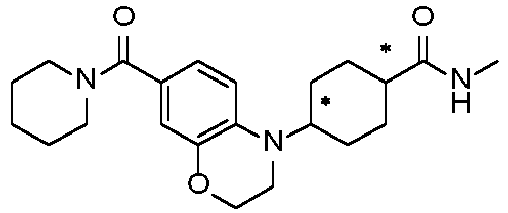
1H NMR (400 MHz, DMSO-d6) δ 1.36-1.63 (10H, m), 1.66-1.84 (4H, m), 2.00-2.10 (1H, m), 2.55 (3H, d, J = 4.9 Hz), 3.26 (2H, t, J = 4.3 Hz), 3.58-3.68 (4H, m), 3.61-3.66 (1H, m), 4.11 (2H, t, J = 4.3 Hz), 6.67 (1H , d, J = 1.2 Hz), 6.76-6.84 (2H, m), 7.63-7.72 (1H, m). LRMS (ESI+) 386 [M+H]+. 6-17 
1H NMR (400 MHz, DMSO-d6) δ 1.41-1.63 (6H, m), 3.36-3.52 ( 4H, m), 3.94 (2H, t, J = 4.3 Hz), 4.34 (2H, t, J = 4.3 Hz), 7.14 (1H, d, J = 2.4 Hz), 7.26 (1H, s), 7.45-7.51 (2H, m), 7. 69 (1H, d, J = 1.8 Hz), 7.82-7.93 (3H, m). LRMS (ESI+) 367 [M+H]+. 6-18 
1H NMR (400 MHz, DMSO-d6) δ 1.41-1.64 (6H, m), 2.77 (3H, d , J = 4.9 Hz), 3.36-3.52 (4H, m), 3.94 (2H, t, J = 4.3 Hz), 4.34 (2H, t, J = 4.3 Hz), 7.14 (1H, d, J = 1.8 Hz), 7.46-7.51 (2H, m), 7.69 (1H, d, J = 2.4 Hz), 7.79-7.84 (2H, m), 8.35 (1H, q, J = 4.9 Hz). LRMS (ESI+) 381 [M+H]+. [Table 117] Example No. Chemical Structural Formula Spectrum Data 6-19 
1H NMR (400 MHz, DMSO-d6) δ 1.41-1.65 (6H, m), 2.97 (6H, s ), 3.37-3.50 (4H, m), 3.93 (2H, t, J = 4.0 Hz), 4.34 (2H, t, J = 4.0 Hz), 7.13 (1H, d, J = 1.8 Hz), 7.41 (2H, d, J = 8.6 Hz), 7.47 (2H, d, J = 7.9 Hz), 7.67-7.70 (1H, m). LRMS (ESI+) 395 [M+H]+. 6-20 
1H NMR (400 MHz, DMSO-d6) δ 1.36-1.65 (12H, m), 3.38-3.49 (4H, m), 3.87 (2H, t, J = 4.5 Hz), 4.32 (2H, t, J = 4.2 Hz), 6.86-6.95 (2H, m), 7.08 (1H, d, J = 1.8 Hz), 7.29-7.36 (4H, m), 7.64 (1H, d, J = 1.8 Hz). LRMS (ESI+) 409 [M+H]+. 6-21 
1H NMR (400 MHz, DMSO-d6) δ 1.41-1.64 (6H, m), 3.34-3.53 ( 4H, m), 4.00 (2H, t, J = 4.3 Hz), 4.38 (2H, t, J = 4.3 Hz), 7.19 (1H, d, J = 1.8 Hz), 7.50-7.55 (1H, m), 7.72 (1H, d, J = 1.8 Hz), 7.95 (1H, dd, J = 8.6, 2.4 Hz), 7.98-8.05 (2H, m) , 8.80 (1H, d, J = 1.8 Hz). LRMS (ESI+) 368 [M+H]+. 6-22 
1H NMR (400 MHz, DMSO-d6) δ 1.40-1.64 (6H, m), 2.81 (3H, d , J = 4.9 Hz), 3.37-3.51 (4H, m), 4.00 (2H, t, J = 4.3 Hz), 4.38 (2H, t, J = 4.3 Hz), 7.19 (1H, d, J = 1.8 Hz), 7.72 (1H , d, J = 1.8 Hz), 7.95 (1H, dd, J = 8.6, 1.8 Hz), 8.01 (1H, d, J = 8.6 Hz), 8.63-8.69 (1H, m), 8.80 (1H, d, J = 2.4 Hz). LRMS (ESI+) 382 [M+H]+. -

- To a solution of methyl 4-(7-piperidine-1-carbonyl)-2,3-dihydro-4H-benzo[b][1,4]thiazin-4-yl)benzoate (90 mg) in dichloromethane (1.2 mL), 3-chloroperbenzoic acid (56.0 mg) was added at 0°C. The resultant reaction solution was heated to room temperature, stirred for 2 hours, and concentrated under reduced pressure. The thus obtained residue was purified by silica gel column chromatography (ethyl acetate) to obtain the title compound (88.1 mg).
- 1H NMR (400 MHz, CDCl3) δ 1.53-1.64 (4H, m), 1.64-1.73 (2H, m), 2.90-3.00 (1H, m), 3.19-3.27 (1H, m), 3.43-3.67 (4H, m), 3.87-3.94 (1H, m), 3.95 (3H, s), 4.38-4.48 (1H, m), 6.80 (1H, d, J = 8.6 Hz), 7.31 (1H, dd, J = 8.6, 2.4 Hz), 7.37 (2H, d, J = 8.6 Hz), 7.74 (1H, d, J = 2.4 Hz), 8.13 (2H, d, J = 8.6 Hz).
- LRMS (ESI+) 413 [M+H]+.
- Compounds of the following Examples 7-2 to 7-10 were obtained in the same manner as in Example 7-1 by using corresponding starting materials and reactants. Their structures and spectrum data are shown in the following tables.
[Table 118] Example No. Chemical Structural Formula Spectrum Data 7-2 
1H NMR (400 MHz, CDCl3) δ 1.54-1.65 (4H, m), 1.65-1.74 ( 2H, m), 3.46-3.53 (2H, m), 3.53-3.70 (4H, m), 3.95 (3H, s), 4.28-4.35 (2H, m), 6.65 (1H, d, J = 9.2 Hz), 7.30-7.38 (3H, m), 7.90 (1H, d, J = 2.4 Hz), 8.14 (2H, d, J = 8.6 Hz). LRMS (ESI+) 429 [M+H]+. 7-3 
1H NMR (400 MHz, CDCl3) δ 1.57-1.76 (6H, m), 2.00-2.12 ( 1H, m), 2.45-2.57 (1H, m), 2.94-3.03 (1H, m), 3.10-3.20 (1H, m), 3.33-3.50 (3H, m), 3.67-3.82 (2H, m), 3.87 (3H, s), 4.08 -4.17 (1H, m), 6.66 (2H, d, J = 9.1 Hz), 7.29 (1H, d, J = 7. 9 Hz), 7.61 (1H, dd, J = 7.9, 1.8 Hz), 7.89 (2H, d, J = 9.1 Hz), 7.91 (1H, d, J = 1.8 Hz). LRMS (ESI+) 427 [M+H]+. [Table 119] Example No. Chemical Structural Formula Spectrum Data 7-4 
1H NMR (400 MHz, CDCl3) δ 1.52-1.78 (6H, m), 2.25-2.36 ( 2H, m), 3.27-3.35 (2H, m), 3.37-3.48 (2H, m), 3.65-3.80 (2H, m), 3.86 (3H, s), 3.83-3.95 (2H, m), 6.72 (2H, d, J = 9.1 H z), 7.44 (1H, d, J = 8.5 Hz), 7.70 (1H, dd, J = 8.5, 1.8 Hz), 7.90 (2H, d, J = 9.1 Hz), 8.18 (1H, d, J = 1.8 Hz). LRMS (ESI+) 443 [M+H]+. 7-5 
1H NMR (400 MHz, CDCl3) δ 1.17-1.38 (4H, m), 1.39-1.52 ( 1H, m), 1.63-1.72 (1H, m), 1.75-1.94 (3H, m), 1.96-2.04 (1H, m), 2.57-2.67 (1H, m), 3.65 (3H, s), 3.93 (2H, dd, J = 6.1, 3.7 Hz), 4.42-4.47 (2H, m), 6.68 (1H, d, J = 1.8 Hz), 6.96 ( 1H, dd, J = 7.9, 1.8 Hz), 7.46 (1H, d, J = 1.8 Hz), 7.70 (1 H, dd, J = 7.9, 1.2 Hz), 7.90 (1H, d, J = 1.8 Hz). LRMS (ESI+) 414 [M+H]+. 7-6 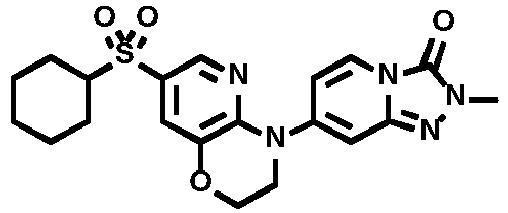
1H NMR (400 MHz, CDCl3) δ 1.07-1.30 (3H, m), 1.33-1.46 ( 2H, m), 1.64-1.72 (1H, m), 1.83-1.92 (2H, m), 2.06-2.15 (2H, m), 2.83-2.92 (1H, m), 3.66 (3H, s), 3.96 (2H, t, J = 4.6 H z), 4.45 (2H, t, J = 4.6 Hz), 6.72-6.75 (1H, m), 6.91 (1H, dd , J = 7.6, 2.1 Hz), 7.51 (1H, d, J = 1.8 Hz), 7.71 (1H, d, J = 8.6 Hz), 8.22 (1H, d, J = 1.8 Hz). LRMS (ESI+) 430 [M+H]+. [Table 120] Example No. Chemical Structural Formula Spectrum Data 7-7 
1H NMR (400 MHz, CDCl3) δ 1.16-1.37 (4H, m), 1.39-1.52 ( 1H, m), 1.63-1.95 (4H, m), 1.99-2.08 (1H, m), 2.10-2.21 (2H, m), 2.56-2.67 (1H, m), 2.94 (2H, t, J = 6.1 Hz), 3.64 (3H, s), 3.85 (2H, t, J = 6.1 Hz), 6.71-6.76 (2H, m), 7.65 (1H, dd , J = 7.3, 1.2 Hz), 7.67-7.70 (1H, m), 8.08 (1H, d, J = 2.4 Hz). LRMS (ESI+) 412 [M+H]+. 7-8 
1H NMR (400 MHz, CDCl3) δ 1.08-1.30 (3H, m), 1.33-1.46 ( 2H, m), 1.64-1.74 (1H, m), 1.83-1.93 (2H, m), 2.06-2.21 (4H, m), 2.86 (1H, tt, J = 12.2, 3.1 Hz), 2.94 (2H, t, J = 5.5 Hz ), 3.65 (3H, s), 3.87 (2H, t, J = 5.5 Hz), 6.68 (1H, dd, J = 7.3, 1.8 Hz), 6.79 (1H, d, J = 1.2 Hz), 7.66-7.72 (2H, m), 8. 39 (1H, d, J = 2.4 Hz). LRMS (ESI+) 428 [M+H]+. 7-9 
1H NMR (400 MHz, CDCl3) δ 1.14-1.35 (4H, m), 1.38-1.51 ( 1H, m), 1.63-1.76 (2H, m), 1.78-1.95 (2H, m), 2.00-2.10 (1H, m), 2.57-2.67 (1H, m), 3.21 (3H, s), 3.93-4.05 (2H, m), 4.35 -4.46 (4H, m), 7.39-7.44 (2H, m), 7.55 (1H, d, J = 1.2 Hz), 7.83 (1H, d, J = 1.8 Hz), 7.87 (1H, d, J = 8.6 Hz). LRMS (ESI+) 412 [M+H]+. 7-10 
1H NMR (400 MHz, CDCl3) δ 1.06-1.30 (3H, m), 1.32-1.45 ( 2H, m), 1.63-1.72 (1H, m), 1.82-1.91 (2H, m), 2.06-2.14 (2H, m), 2.85 (1H, tt, J = 12.2, 3.7 Hz), 3.21 (3H, s), 4.01 (2H, t, J = 4.3 Hz), 4.38-4.45 (4H, m), 7.41 (1H, dd, J = 8.6, 1.8 Hz), 7.45 (1H, d, J = 1.8 Hz), 7.55 (1H, d, J = 1.2 Hz), 7. 89 (1H, d, J = 8.6 Hz), 8.14 (1H, d, J = 1.8 Hz). LRMS (ESI+) 428 [M+H]+. -

- To a solution of 4-(4-(tert-butoxycarbonyl)phenyl)-8-methyl-3,4-dihydro-2H-benzo[b][1,4]oxazine-7-carboxylic acid (29.1 mg) in N,N-dimethylformamide (0.8 mL), piperidine (8.6 µL) and diisopropylethylamine (29.4 µL) were added. To the resultant reaction solution, 1-[bis(dimethylamino)methylene]-1H-1,2,3-triazolo[4,5-b]pyridinium 3-oxide hexafluorophosphate (32.9 mg) was added, followed by stirring at room temperature for 2.5 hours. The resultant reaction solution was purified by silica gel column chromatography (methanol:water = 5:95 to 65:35 to 90:10 to 100:0) to obtain the title compound (31.9 mg).
- 1H NMR (400 MHz, CDCl3) δ: 1.41-1.70 (15H, m), 2.17 (3H, s), 3.25 (2H, t, J = 5.5 Hz), 3.67-3.81 (4H, m), 4.24-4.37 (2H, m), 6.60 (1H, d, J = 7.9 Hz), 6.95 (1H, d, J = 8.6 Hz), 7.17-7.23 (2H, m), 7.91-7.96 (2H, m).
- LRMS (ESI+) 437 [M+H]+.
- Compounds of the following Examples 8-2 to 8-231 were obtained in the same manner as in Example 8-1 by using corresponding starting materials and reactants. Their structures and spectrum data are shown in the following tables.
[Table 121] Example No. Chemical Structural Formula Spectrum Data 8-2 
1H NMR (400 MHz, CDCl3) δ 1.44-1.72 (15H, m), 3.36-3.70 (4H, m), 3.94 (2H, t, J = 4.2 Hz), 4.37 (2H, t, J = 4.2 Hz), 7.22 (1H, d, J = 2.4 Hz), 7.41-7.46 (2H, m), 7.84 (1H, d, J = 1.8 Hz) , 7.99-8.03 (2H, m). LRMS (ESI+) 424 [M+H]+. 8-3 
1H NMR (400 MHz, CDCl3) δ 1.47-1.71 (15H, m), 3.51-3.58 (2H, m), 3.67-3.73 (2H, m), 3.79 (2H, t, J = 4.2 Hz), 4.37 ( 2H, t, J = 4.2 Hz), 7.17-7.19 (1H, m), 7.21-7.28 (2H, m), 7. 96-8.01 (2H, m), 8.29 (1H, s). LRMS (ESI+) 424 [M+H]+. 8-4 
1H NMR (400 MHz, DMSO-d6) δ 1.42-1.64 (15H, m), 3.42-3 .57 (4H, m), 3.80 (2H, t, J = 4.3 Hz), 4.44 (2H, t, J = 4.3 Hz), 7.04 (1H, d, J = 8.6 Hz), 7.35-7.39 (2H, m), 7.43 (1H, d, J = 7.9 Hz), 7.88-7.92 (2H, m). LRMS (ESI+) 424 [M+H]+. 8-5 
1H NMR (400 MHz, CDCl3) δ: 1.59 (9H, s), 1.94-2.08 (4H, m), 3.68-3.80 (4H, m), 3.96 (2H, t, J = 4.6 Hz), 4.38 (2H, t, J = 4.3 Hz), 7.21-7.25 (1H, m), 7.42-7.46 (2H, m), 7.85 (1 H, d, J = 1.8 Hz), 8.00-8.04 (2H, m). LRMS (ESI+) 460 [M+H]+. 8-6 
1H NMR (400 MHz, CDCl3) δ: 1.59 (9H, s), 1.78-1.87 (2H, m), 2.00-2.14 (2H, m), 3.56-3.85 (4H, m), 3.95 (2H, t, J = 4 .6 Hz), 4.38 (2H, t, J = 4.6 Hz), 7.21-7.31 (1H, m), 7.42-7.4 6 (2H, m), 7.86 (1H, d, J = 1.8 Hz), 8.00-8.04 (2H, m). LRMS (ESI+) 460 [M+H]+. 8-7 
1H NMR (400 MHz, CDCl3) δ: 1.39-2.11 (13H, m), 3.02-3.75 (3H, m), 3.84-4.01 (3H, m), 4.37 (2H, t, J = 4.0 Hz), 4.51-4.84 (1H, m), 7.25 (1H, s), 7.44 (2H, d, J = 8.6 Hz), 7.86 ( 1H, s), 8.01 (2H, d, J = 7.9 Hz). LRMS (ESI+) 442 [M+H]+. [Table 122] Example No. Chemical Structural Formula Spectrum Data 8-8 
1H NMR (400 MHz, CDCl3) δ: 1.41-2.07 (13H, m), 3.17-4.04 (6H, m), 4.37 (2H, t, J = 4.3 Hz), 4.52-4.82 (1H, m), 7.25 (1H, d, J = 1.8 Hz), 7.41-7.46 (2H, m), 7.86 (1H, d, J = 2.4 Hz), 7.99-8.04 (2H, m). LRMS (ESI+) 442 [M+H]+. 8-9 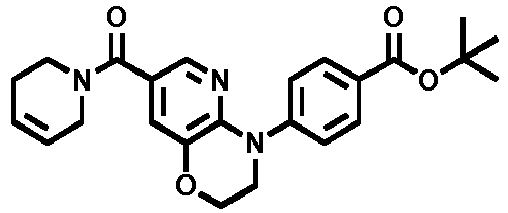
1H NMR (400 MHz, CDCl3) δ: 1.59 (9H, s), 2.16-2.29 (2H, m), 3.47-3.84 (2H, m), 3.95 (2H, t, J = 4.6 Hz), 4.01-4.19 (2 H, m), 4.37 (2H, t, J = 4.3 Hz), 5.58-5.90 (2H, m), 7.21-7.3 2 (1H, m), 7.42-7.46 (2H, m), 7.87 (1H, d, J = 2.4 Hz), 7.9 9-8.03 (2H, m). LRMS (ESI+) 422 [M+H]+. 8-10 
1H NMR (400 MHz, CDCl3) δ: 1.59 (9H, s), 3.47-3.81 (8H, m), 3.95 (2H, t, J = 4.6 Hz), 4.38 (2H, t, J = 4.3 Hz), 7.23 (1H, d, J = 2.4 Hz), 7.41-7.45 (2H, m), 7.84 (1H, d, J = 1.8 Hz), 7.99-8.04 (2H, m). LRMS (ESI+) 426 [M+H]+. 8-11 
1H NMR (400 MHz, CDCl3) δ: 1.59 (9H, s), 2.32 (3H, s), 2. 34-2.50 (4H, m), 3.50-3.78 (4H, m), 3.95 (2H, t, J = 4.6 Hz) , 4.37 (2H, t, J = 4.6 Hz), 7.23 (1H, d, J = 1.8 Hz), 7.41-7. 46 (2H, m), 7.85 (1H, d, J = 2.4 Hz), 7.99-8.03 (2H, m). LRMS (ESI+) 439 [M+H]+. 8-12 
1H NMR (400 MHz, CDCl3) δ: 1.41-1.78 (21H, m), 2.21-2.30 (2H, m), 2.56-2.61 (1H, m), 3.27 (2H, t, J = 4.5 Hz), 3.42-3.68 (5H, m), 4.17 (2H, t, J = 4.5 Hz), 6.67 (1H, d, J = 9.1 Hz), 6.86 (1H, d, J = 2.4 Hz), 6.93 (1H, dd, J = 8.5, 2.4 Hz). LRMS (ESI+) 429 [M+H]+. 8-13 
1H NMR (400 MHz, CDCl3) δ: 1.39-1.80 (19H, m), 1.85-1.93 (2H, m), 2.06-2.21 (3H, m), 3.28 (2H, t, J = 4.5 Hz), 3.42-3.68 (5H, m), 4.19 (2H, t, J = 4.5 Hz), 6.67 (1H, d, J = 8.5 Hz), 6.87 (1H, d, J = 1.8 Hz), 6.93 (1H, dd, J = 8.5, 1.8 Hz). LRMS (ESI+) 429 [M+H]+. [Table 123] Example No. Chemical Structural Formula Spectrum Data 8-14 
1H NMR (400 MHz, DMSO-d6) δ: 1.05-1.19 (1H, m), 1.31-1. 50 (8H, m), 1.55-1.81 (7H, m), 3.26 (2H, t, J = 4.5 Hz), 3.4 2 (4H, t, J = 4.8 Hz), 3.57-3.66 (1H, m), 4.11 (2H, t, J = 4. 5 Hz), 6.67 (1H, d, J = 1.8 Hz), 6.76 (1H, d, J = 8.5 Hz), 6.81 (1H, dd, J = 8.5, 1.8 Hz). LRMS (ESI+) 329 [M+H]+. 8-15 
1H NMR (400 MHz, DMSO-d6) δ: 1.28 (3H, t, J = 7.0 Hz), 1.41-1.64 (6H, m), 3.32-3.58 (4H, m), 3.83-3.95 (4H, m), 4.3 6 (2H, t, J = 4.3 Hz), 6.91 (1H, d, J = 1.2 Hz), 6.98 (1H, d d, J = 7.9, 1.8 Hz), 7.21 (1H, d, J = 1.8 Hz), 7.73-7.79 (2H, m). LRMS (ESI+) 409 [M+H]+. 8-16 
1H NMR (400 MHz, DMSO-d6) δ: 1.28 (3H, t, J = 7.0 Hz), 2.20-2.28 (2H, m), 3.88 (2H, q, J = 7.1 Hz), 3.94 (2H, t, J = 4.6 Hz), 3.98-4.06 (2H, m), 4.28-4.41 (4H, m), 6.93-6.97 ( 2H, m), 7.36 (1H, d, J = 1.8 Hz), 7.75-7.79 (1H, m), 8.00 ( 1H, d, J = 1.8 Hz). LRMS (ESI+) 381 [M+H]+. 8-17 
1H NMR (400 MHz, DMSO-d6) δ: 1.28 (3H, t, J = 7.0 Hz), 1.43-1.61 (8H, m), 1.64-1.75 (2H, m), 3.27-3.39 (2H, m), 3.5 0 (2H, t, J = 5.8 Hz), 3.87 (2H, q, J = 7.1 Hz), 3.93 (2H, t, J = 4.3 Hz), 4.36 (2H, t, J = 4.3 Hz), 6.90 (1H, d, J = 1.2 Hz), 6.98 (1H, dd, J = 7.6, 2.1 Hz), 7.19 (1H, d, J = 1.8 Hz), 7.73-7.78 (2H, m). LRMS (ESI+) 437 [M+H]+. 8-18 
1H NMR (400 MHz, DMSO-d6) δ: 1.16 (3H, t, J = 7.3 Hz), 1.40-1.65 (6H, m), 3.35-3.59 (6H, m), 3.96 (2H, t, J = 4.3 H z), 4.35 (2H, t, J = 4.3 Hz), 4.45 (2H, s), 7.15 (1H, d, J = 1.8 Hz), 7.51 (1H, dd, J = 7.9, 1.8 Hz), 7.63 (2H, d, J = 8. 6 Hz), 7.68 (1H, d, J = 1.8 Hz). LRMS (ESI+) 407 [M+H]+. 8-19 
1H NMR (400 MHz, DMSO-d6) δ 1.28 (3H, t, J = 7.0 Hz), 1.75-1.88 (4H, m), 3.38-3.51 (4H, m), 3.88 (2H, q, J = 7.1 Hz), 3.93 (2H, t, J = 4.6 Hz), 4.36 (2H, t, J = 4.3 Hz), 6.92 (1H, d, J = 1.2 Hz), 6.97 (1H, dd, J = 7.6, 2.1 Hz), 7.34 ( 1H, d, J = 1.8 Hz), 7.76 (1H, d, J = 7.3 Hz), 7.95 (1H, d, J = 1.8 Hz). LRMS (ESI+) 395 [M+H]+. [Table 124] Example No. Chemical Structural Formula Spectrum Data 8-20 
1H NMR (400 MHz, DMSO-d6) δ 1.74-1.89 (4H, m), 3.38-3. 54 (7H, m), 3.93 (2H, t, J = 4.3 Hz), 4.36 (2H, t, J = 4.3 Hz), 6.89 (1H, d, J = 1.8 Hz), 6.98 (1H, dd, J = 7.6, 2.1 H z), 7.34 (1H, d, J = 1.8 Hz), 7.75 (1H, d, J = 7.3 Hz), 7.95 (1H, d, J = 1.8 Hz). LRMS (ESI+) 381 [M+H]+. 8-21 
1H NMR (400 MHz, DMSO-d6) δ 1.17 (3H, d, J = 7.3 Hz), 1.27-1.73 (6H, m), 2.90-3.04 (1H, m), 3.49 (3H, s), 3.77-4.05 (3H, m), 4.25-4.47 (3H, m), 6.88 (1H, d, J = 1.8 Hz), 6.98 ( 1H, dd, J = 7.3, 1.8 Hz), 7.19 (1H, d, J = 1.8 Hz), 7.73-7.7 7 (2H, m). LRMS (ESI+) 409 [M+H]+. 8-22 
1H NMR (400 MHz, DMSO-d6) δ 0.73-1.32 (3H, m), 1.40-1. 95 (3H, m), 1.99-2.12 (1H, m), 3.34-3.63 (5H, m), 3.93 (2H, t, J = 4.6 Hz), 4.01-4.16 (1H, m), 4.29-4.42 (2H, m), 6.89 (1 H, d, J = 1.8 Hz), 6.98 (1H, dd, J = 7.9, 1.8 Hz), 7.31 (1H, d, J = 1.8 Hz), 7.75 (1H, d, J = 8.6 Hz), 7.85-7.97 (1H, m ). LRMS (ESI+) 395 [M+H]+. 8-23 
1H NMR (400 MHz, DMSO-d6) δ 1.43-1.95 (4H, m), 2.87-3. 27 (1H, m), 3.38-3.60 (4H, m), 3.69-4.24 (4H, m), 4.37 (2H, t, J = 4.6 Hz), 4.75 (1H, d, J = 47.7 Hz), 6.89 (1H, d, J = 2.4 Hz), 6.98 (1H, dd, J = 7.6, 2.1 Hz), 7.20 (1H, d, J = 1. 8 Hz), 7.75 (1H, d, J = 8.6 Hz), 7.78 (1H, d, J = 1.8 Hz). LRMS (ESI+) 413 [M+H]+. 8-24 
1H NMR (400 MHz, DMSO-d6) δ 1.63-1.74 (2H, m), 2.02-2. 16 (2H, m), 3.40-3.64 (5H, m), 3.71-3.90 (2H, m), 3.94 (2H, t, J = 4.3 Hz), 4.37 (2H, t, J = 4.3 Hz), 6.91 (1H, d, J = 1. 2 Hz), 6.99 (1H, dd, J = 7.9, 1.8 Hz), 7.21 (1H, d, J = 1.8 Hz), 7.75 (1H, d, J = 8.6 Hz), 7.79 (1H, d, J = 1.8 Hz). LRMS (ESI+) 431 [M+H]+. 8-25 
1H NMR (400 MHz, DMSO-d6) δ 2.35-2.52 (2H, m), 3.49 (3 H, s), 3.61-4.09 (6H, m), 4.37 (2H, t, J = 4.3 Hz), 6.92 (1H, d, J = 1.2 Hz), 6.97 (1H, dd, J = 7.3, 1.8 Hz), 7.37 (1H, d , J = 1.8 Hz), 7.76 (1H, d, J = 7.9 Hz), 7.98 (1H, d, J = 1. 8 Hz). LRMS (ESI+) 417 [M+H]+. [Table 125] Example No. Chemical Structural Formula Spectrum Data 8-26 
1H NMR (400 MHz, DMSO-d6) δ 1.95-2.10 (4H, m), 3.49 (3 H, s), 3.51-3.69 (4H, m), 3.93 (2H, t, J = 4.3 Hz), 4.37 (2H, t, J = 4.3 Hz), 6.90 (1H, d, J = 1.2 Hz), 6.98 (1H, dd, J = 7.6, 2.1 Hz), 7.30 (1H, d, J = 1.8 Hz), 7.76 (1H, d, J = 6. 7 Hz), 7.85 (1H, d, J = 1.8 Hz). LRMS (ESI+) 431 [M+H]+. 8-27 
1H NMR (400 MHz, DMSO-d6) δ 1.40-1.99 (4H, m), 2.93-3. 28 (1H, m), 3.39-3.58 (4H, m), 3.68-4.24 (4H, m), 4.37 (2H, t, J = 4.6 Hz), 4.75 (1H, d, J = 47.1 Hz), 6.89 (1H, d, J = 2.4 Hz), 6.98 (1H, dd, J = 7.6, 2.1 Hz), 7.20 (1H, d, J = 1. 8 Hz), 7.75 (1H, d, J = 7.9 Hz), 7.78 (1H, d, J = 1.8 Hz). LRMS (ESI+) 413 [M+H]+. 8-28 
1H NMR (400 MHz, DMSO-d6) δ 1.17 (3H, d, J = 7.3 Hz), 1.27-1.76 (6H, m), 2.83-3.11 (1H, m), 3.49 (3H, s), 3.68-4.06 (3H, m), 4.15-4.58 (3H, m), 6.88 (1H, d, J = 1.2 Hz), 6.98 ( 1H, dd, J = 7.6, 2.1 Hz), 7.19 (1H, d, J = 1.8 Hz), 7.73-7.7 7 (2H, m). LRMS (ESI+) 409 [M+H]+. 8-29 
1H NMR (400 MHz, DMSO-d6) δ 0.73-1.29 (3H, m), 1.42-1. 93 (3H, m), 1.99-2.11 (1H, m), 3.34-3.64 (5H, m), 3.93 (2H, t, J = 4.6 Hz), 4.02-4.15 (1H, m), 4.31-4.41 (2H, m), 6.89 (1 H, d, J = 1.8 Hz), 6.98 (1H, dd, J = 7.9, 1.8 Hz), 7.31 (1H, d, J = 1.8 Hz), 7.75 (1H, d, J = 7.9 Hz), 7.85-7.96 (1H, m ). LRMS (ESI+) 395 [M+H]+. 8-30 
1H NMR (400 MHz, DMSO-d6) δ 3.50 (3H, s), 3.95 (2H, t, J = 4.3 Hz), 4.27-5.02 (6H, m), 6.92-6.97 (2H, m), 7.43 (1H, d, J = 1.8 Hz), 7.78 (1H, dd, J = 6.7, 1.2 Hz), 8.08 (1H, d , J = 2.4 Hz). LRMS (ESI+) 403 [M+H]+. 8-31 
1H NMR (400 MHz, DMSO-d6) δ 0.66-0.99 (3H, m), 1.06-1. 20 (1H, m), 1.33-1.47 (1H, m), 1.48-1.69 (2H, m), 1.71-1.81 (1H, m), 2.56-3.07 (2H, m), 3.49 (3H, s), 3.51-3.76 (1H, m), 3.85-4.00 (2H, m), 4.04-4.40 (3H, m), 6.88 (1H, d, J = 1.8 Hz), 6.99 (1H, dd, J = 7.6, 2.1 Hz), 7.20 (1H, d, J = 1.8 H z), 7.75 (1H, d, J = 8.6 Hz), 7.77 (1H, d, J = 2.4 Hz). LRMS (ESI+) 409 [M+H]+. [Table 126] Example No. Chemical Structural Formula Spectrum Data 8-32 
1H NMR (400 MHz, DMSO-d6) δ 0.91-1.06 (3H, m), 1.37-1. 53 (1H, m), 1.88-2.04 (1H, m), 2.09-2.30 (1H, m), 2.91-3.15 (1H, m), 3.35-3.64 (6H, m), 3.93 (2H, t, J = 4.6 Hz), 4.36 ( 2H, t, J = 4.3 Hz), 6.89 (1H, d, J = 1.2 Hz), 6.95-7.01 (1H, m), 7.31-7.37 (1H, m), 7.75 (1H, d, J = 8.6 Hz), 7.92-7.98 ( 1H, m). LRMS (ESI+) 395 [M+H]+. 8-33 
1H NMR (400 MHz, DMSO-d6) δ 1.26-1.51 (2H, m), 1.55-1. 95 (2H, m), 2.63-3.74 (8H, m), 3.93 (2H, t, J = 4.6 Hz), 4.3 6 (2H, t, J = 4.3 Hz), 4.78-5.03 (1H, m), 6.88 (1H, d, J = 1 .2 Hz), 6.98 (1H, dd, J = 7.6, 2.1 Hz), 7.18-7.28 (1H, m), 7. 70-7.87 (2H, m). LRMS (ESI+) 411 [M+H]+. 8-34 
1H NMR (400 MHz, DMSO-d6) δ 0.75-0.93 (3H, m), 1.07-1. 20 (1H, m), 1.32-1.47 (1H, m), 1.48-1.83 (3H, m), 2.59-3.12 (2H, m), 3.42-3.77 (4H, m), 3.85-4.00 (2H, m), 4.04-4.45 (3H , m), 6.88 (1H, d, J = 1.8 Hz), 6.99 (1H, dd, J = 7.3, 1.8 H z), 7.20 (1H, d, J = 1.8 Hz), 7.73-7.79 (2H, m). LRMS (ESI+) 409 [M+H]+. 8-35 
1H NMR (400 MHz, DMSO-d6) δ 0.92-1.07 (3H, m), 1.38-1. 55 (1H, m), 1.86-2.04 (1H, m), 2.10-2.29 (1H, m), 2.93-3.15 (1H, m), 3.34-3.63 (6H, m), 3.93 (2H, t, J = 4.6 Hz), 4.36 ( 2H, t, J = 4.3 Hz), 6.90 (1H, d, J = 1.2 Hz), 6.95-7.00 (1H, m), 7.32-7.36 (1H, m), 7.75 (1H, d, J = 7.3 Hz), 7.92-7.97 ( 1H, m). LRMS (ESI+) 395 [M+H]+. 8-36 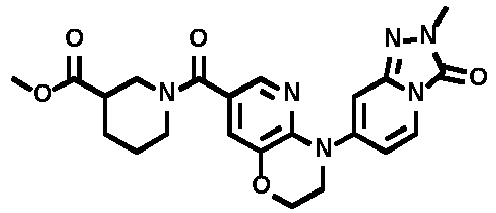
1H NMR (400 MHz, DMSO-d6) δ 1.36-2.03 (4H, m), 2.52-2. 68 (1H, m), 2.74-3.18 (2H, m), 3.49 (3H, s), 3.52-4.04 (7H, m), 4.12-4.44 (2H, m), 6.89 (1H, d, J = 1.2 Hz), 6.98 (1H, dd, J = 7.6, 2.1 Hz), 7.23 (1H, d, J = 1.8 Hz), 7.72-7.83 (2 H, m). LRMS (ESI+) 453 [M+H]+. 8-37 
1H NMR (400 MHz, DMSO-d6) δ 3.49 (3H, s), 3.51-3.60 (1 H, m), 3.65 (3H, s), 3.91-3.98 (2H, m), 4.02-4.27 (2H, m), 4. 30-4.46 (3H, m), 4.49-4.62 (1H, m), 6.91-6.98 (2H, m), 7.36 (1H, d, J = 1.8 Hz), 7.76 (1H, d, J = 6.7 Hz), 8.01 (1H, d, J = 1.8 Hz). LRMS (ESI+) 425 [M+H]+. [Table 127] Example No. Chemical Structural Formula Spectrum Data 8-38 
1H NMR (400 MHz, DMSO-d6) δ 1.30-1.51 (2H, m), 1.56-1. 94 (2H, m), 2.92-3.75 (8H, m), 3.93 (2H, t, J = 4.3 Hz), 4.3 6 (2H, t, J = 4.3 Hz), 4.77-5.02 (1H, m), 6.88 (1H, d, J = 1 .8 Hz), 6.98 (1H, dd, J = 7.9, 1.8 Hz), 7.17-7.29 (1H, m), 7. 71-7.84 (2H, m). LRMS (ESI+) 411 [M+H]+. 8-39 
1H NMR (400 MHz, DMSO-d6) δ 1.23-1.63 (6H, m), 2.01-2. 30 (2H, m), 2.68-2.89 (1H, m), 3.05-3.54 (5H, m), 3.87-3.98 (2H, m), 4.14-4.44 (3H, m), 6.87 (1H, d, J = 1.2 Hz), 6.98 ( 1H, dd, J = 7.3, 1.8 Hz), 7.18 (1H, d, J = 1.8 Hz), 7.72-7.7 7 (2H, m). LRMS (ESI+) 421 [M+H]+. 8-40 
1H NMR (400 MHz, DMSO-d6) δ 1.29-1.39 (2H, m), 2.03-2. 14 (2H, m), 2.30-2.39 (1H, m), 2.41-2.58 (1H, m), 3.49 (3H, s), 3.59-3.73 (4H, m), 3.92 (2H, t, J = 4.3 Hz), 4.36 (2H, t, J = 4.3 Hz), 6.88 (1H, d, J = 1.2 Hz), 6.98 (1H, dd, J = 7. 3, 1.8 Hz), 7.33 (1H, d, J = 1.8 Hz), 7.75 (1H, d, J = 8.6 Hz), 7.87 (1H, d, J = 1.8 Hz). LRMS (ESI+) 407 [M+H]+. 8-41 
1H NMR (400 MHz, DMSO-d6) δ 0.63-1.03 (7H, m), 1.49-1. 64 (2H, m), 1.72-1.81 (1H, m), 2.09-2.70 (2H, m), 3.44-3.78 (4H, m), 3.93 (2H, t, J = 4.3 Hz), 4.28-4.48 (3H, m), 6.89 ( 1H, d, J = 1.2 Hz), 6.99 (1H, dd, J = 7.6, 2.1 Hz), 7.20 (1 H, d, J = 2.4 Hz), 7.73-7.79 (2H, m). LRMS (ESI+) 423 [M+H]+. 8-42 
1H NMR (400 MHz, DMSO-d6) δ 0.04-0.55 (4H, m), 1.38-1. 49 (2H, m), 1.53-1.66 (2H, m), 3.09-3.68 (7H, m), 3.93 (2H, t, J = 4.3 Hz), 4.36 (2H, t, J = 4.3 Hz), 6.88 (1H, d, J = 1. 2 Hz), 6.98 (1H, dd, J = 7.6, 2.1 Hz), 7.14-7.22 (1H, m), 7. 71-7.81 (2H, m). LRMS (ESI+) 421 [M+H]+. 8-43 
1H NMR (400 MHz, DMSO-d6) δ 0.68-0.97 (3H, m), 1.00-1. 47 (5H, m), 1.53-1.71 (1H, m), 1.77-1.88 (1H, m), 2.41-3.09 (2H, m), 3.38-3.77 (4H, m), 3.87-4.00 (2H, m), 4.12-4.42 (3H , m), 6.88 (1H, d, J = 1.8 Hz), 6.98 (1H, dd, J = 7.3, 1.8 H z), 7.20 (1H, d, J = 1.8 Hz), 7.75 (1H, d, J = 7.9 Hz), 7.77 (1H, d, J = 1.8 Hz). LRMS (ESI+) 423 [M+H]+. [Table 128] Example No. Chemical Structural Formula Spectrum Data 8-44 
1H NMR (400 MHz, DMSO-d6) δ 0.90 (3H, d, J = 6.1 Hz), 0.96-1.12 (2H, m), 1.50-1.71 (3H, m), 2.62-3.10 (2H, m), 3.4 9 (3H, s), 3.59-4.02 (3H, m), 4.15-4.45 (3H, m), 6.88 (1H, d, J = 1.2 Hz), 6.98 (1H, dd, J = 7.6, 2.1 Hz), 7.21 (1H, d, J = 1.8 Hz), 7.75 (1H, d, J = 6.7 Hz), 7.77 (1H, d, J = 1.8 Hz). LRMS (ESI+) 409 [M+H]+. 8-45 
1H NMR (400 MHz, DMSO-d6) δ 0.29-0.36 (4H, m), 1.28-1. 39 (4H, m), 3.36-3.63 (7H, m), 3.93 (2H, t, J = 4.6 Hz), 4.3 6 (2H, t, J = 4.6 Hz), 6.88 (1H, d, J = 1.2 Hz), 6.98 (1H, d d, J = 7.6, 2.1 Hz), 7.23 (1H, d, J = 1.8 Hz), 7.75 (1H, d, J = 8.6 Hz), 7.80 (1H, d, J = 1.8 Hz). LRMS (ESI+) 421 [M+H]+. 8-46 
1H NMR (400 MHz, DMSO-d6) δ 0.03-0.33 (1H, m), 0.53-0. 69 (1H, m), 0.88-1.20 (2H, m), 1.58-1.71 (1H, m), 1.89-2.00 (1H, m), 3.00-3.14 (1H, m), 3.49 (3H, s), 3.51-3.89 (3H, m), 3.93 (2H, t, J = 4.3 Hz), 4.36 (2H, t, J = 4.3 Hz), 6.88 (1H, d, J = 1.2 Hz), 6.98 (1H, dd, J = 7.9, 1.8 Hz), 7.19 (1H, d , J = 1.8 Hz), 7.73-7.79 (2H, m). LRMS (ESI+) 407 [M+H]+. 8-47 
1H NMR (400 MHz, CDCl3) δ 1.14-1.75 (4H, m), 1.84-2.10 ( 2H, m), 2.73-3.17 (2H, m), 3.64 (3H, s), 3.84-3.94 (3H, m), 4.29-4.68 (3H, m), 6.64 (1H, d, J = 1.2 Hz), 6.99 (1H, dd, J = 7.6, 2.1 Hz), 7.29 (1H, d, J = 1.8 Hz), 7.68 (1H, d, J = 7.3 Hz), 7.92 (1H, d, J = 1.8 Hz). LRMS (ESI+) 445 [M+H]+. 8-48 
1H NMR (400 MHz, CDCl3) δ 0.79-1.17 (4H, m), 1.75-2.24 ( 3H, m), 2.94-3.13 (1H, m), 3.29-3.42 (1H, m), 3.65 (3H, s), 3.73-4.60 (6H, m), 6.66 (1H, d, J = 1.2 Hz), 6.96 (1H, dd, J = 7.6, 2.1 Hz), 7.24-7.28 (1H, m), 7.69 (1H, d, J = 7.9 Hz) , 7.89 (1H, d, J = 1.8 Hz). LRMS (ESI+) 427 [M+H]+. 8-49 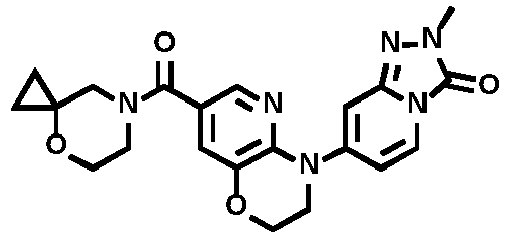
1H NMR (400 MHz, DMSO-d6) δ 0.39-0.76 (4H, m), 3.43-3. 70 (9H, m), 3.93 (2H, t, J = 4.6 Hz), 4.36 (2H, t, J = 4.3 Hz), 6.90 (1H, d, J = 1.2 Hz), 6.98 (1H, dd, J = 7.6, 2.1 H z), 7.20-7.27 (1H, m), 7.75 (1H, d, J = 6.7 Hz), 7.78-7.85 (1 H, m). LRMS (ESI+) 423 [M+H]+. [Table 129] Example No. Chemical Structural Formula Spectrum Data 8-50 
1H NMR (400 MHz, DMSO-d6) δ 1.57 (3H, d, J = 22.0 Hz), 3.50 (3H, s), 3.94 (2H, t, J = 4.3 Hz), 3.99-4.22 (2H, m), 4 .25-4.64 (4H, m), 6.93-6.97 (2H, m), 7.40 (1H, d, J = 1.8 H z), 7.77 (1H, dd, J = 7.0, 1.5 Hz), 8.04 (1H, d, J = 1.8 Hz). LRMS (ESI+) 399 [M+H]+. 8-51 
1H NMR (400 MHz, DMSO-d6) δ 1.37-1.64 (2H, m), 1.66-2. 02 (2H, m), 2.08-2.38 (2H, m), 2.73-3.37 (2H, m), 3.49 (3H, s), 3.55-4.02 (3H, m), 4.06-4.47 (5H, m), 6.90 (1H, d, J = 1. 2 Hz), 6.99 (1H, dd, J = 7.3, 1.8 Hz), 7.16-7.34 (1H, m), 7. 72-7.88 (2H, m). LRMS (ESI+) 437 [M+H]+. 8-52 
1H NMR (400 MHz, DMSO-d6) δ 1.38-1.48 (2H, m), 1.82 (2 H, t, J = 5.8 Hz), 3.25-3.47 (2H, m), 3.49 (3H, s), 3.58-3.84 (2H, m), 3.94 (2H, t, J = 4.3 Hz), 4.03-4.45 (6H, m), 6.89 ( 1H, d, J = 1.2 Hz), 7.00 (1H, dd, J = 7.6, 1.5 Hz), 7.23 (1 H, d, J = 1.2 Hz), 7.72-7.83 (2H, m). LRMS (ESI+) 437 [M+H]+. 8-53 
1H NMR (400 MHz, DMSO-d6) δ 1.42-1.65 (6H, m), 3.38-3. 59 (7H, m), 3.79 (2H, t, J = 4.3 Hz), 4.45 (2H, t, J = 4.6 Hz), 6.66 (1H, dd, J = 7.6, 2.1 Hz), 6.79 (1H, d, J = 1.2 H z), 7.08 (1H, d, J = 7.9 Hz), 7.43 (1H, d, J = 7.9 Hz), 7.81 (1H, d, J = 7.3 Hz). LRMS (ESI+) 395 [M+H]+. 8-54 
1H NMR (400 MHz, DMSO-d6) δ 0.30-0.41 (0.3H, m), 0.52-0.59 (0.7H, m), 0.61-0.71 (0.7H, m), 0.77-0.91 (0.3H, m), 1.1 7-1.39 (2.0H, m), 1.44-1.67 (1.0H, m), 1.69-1.90 (2.0H, m), 2 .44-2.57 (0.7H, m), 2.68-2.76 (0.7H, m), 2.87-3.02 (0.6H, m), 3.49 (3.0H, s), 3.89-4.05 (3.0H, m), 4.30-4.41 (2.0H, m), 6.88 (1.0H, s), 6.98 (1.0H, dd, J = 7.9, 1.8 Hz), 7.23 (0.3H, s), 7.41 (0.7H, d, J = 1.8 Hz), 7.75 (1.0H, d, J = 7.3 Hz), 7.79 (0.3H, s), 8.01 (0.7H, d, J = 1.8 Hz). LRMS (ESI+) 407 [M+H]+. 8-55 
1H NMR (400 MHz, DMSO-d6) δ 1.10 (3H, t, J = 7.0 Hz), 2.94 (3H, br s), 3.24-3.46 (2H, m), 3.50 (3H, s), 3.94 (2H, t, J = 4.2 Hz), 4.37 (2H, t, J = 4.5 Hz), 6.90 (1H, d, J = 1.2 Hz), 6.99 (1H, dd, J = 7.6, 2.1 Hz), 7.24 (1H, br s), 7.74-7 .85 (2H, m). LRMS (ESI+) 369[M+H]+. [Table 130] Example No. Chemical Structural Formula Spectrum Data 8-56 
1H NMR (400 MHz, DMSO-d6) δ 1.37-2.04 (10H, m), 3.50 ( 3H, s), 3.95 (2H, t, J = 4.2 Hz), 4.08 (1H, br s), 4.38 (2H, t, J = 4.2 Hz), 4.54 (1H, br s), 6.91 (1H, d, J = 1.2 Hz), 7. 00 (1H, dd, J = 7.6, 2.1 Hz), 7.27 (1H, d, J = 2.4 Hz), 7.76 (1H, d, J = 7.3 Hz), 7.87 (1H, d, J = 1.8 Hz). LRMS (ESI+) 421[M+H]+. 8-57 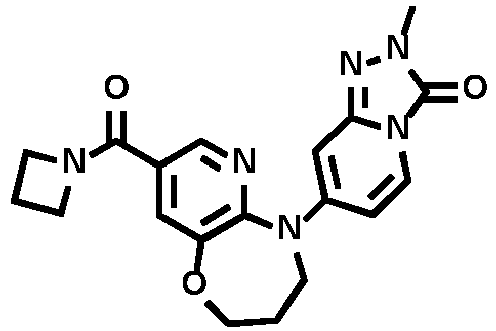
1H NMR (400 MHz, DMSO-d6) δ 2.01-2.10 (2H, m), 2.22-2. 31 (2H, m), 3.46 (3H, s), 3.97 (2H, t, J = 6.1 Hz), 4.05 (2H , t, J = 7.9 Hz), 4.22 (2H, t, J = 5.8 Hz), 4.37 (2H, t, J = 7.6 Hz), 6.45 (1H, dd, J = 7.9, 2.4 Hz), 6.69 (1H, d, J = 1. 2 Hz), 7.56 (1H, d, J = 1.8 Hz), 7.66 (1H, d, J = 7.9 Hz), 8.25 (1H, d, J = 1.8 Hz). LRMS (ESI+) 381 [M+H]+. 8-58 
1H NMR (400 MHz, DMSO-d6) δ 1.76-1.92 (4H, m), 2.02-2. 12 (2H, m), 3.42-3.53 (7H, m), 3.95 (2H, t, J = 6.1 Hz), 4.2 1 (2H, t, J = 5.8 Hz), 6.44 (1H, dd, J = 7.9, 1.8 Hz), 6.63 ( 1H, d, J = 1.8 Hz), 7.55 (1H, d, J = 2.4 Hz), 7.65 (1H, d, J = 7.9 Hz), 8.19 (1H, d, J = 1.8 Hz). LRMS (ESI+) 395 [M+H]+. 8-59 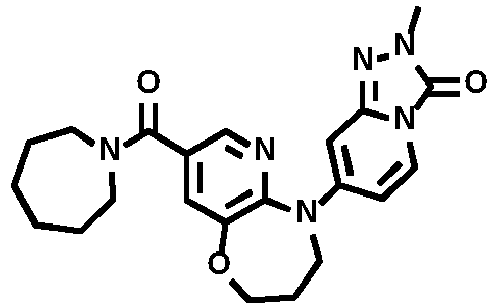
1H NMR (400 MHz, DMSO-d6) δ 1.46-1.65 (6H, m), 1.67-1. 75 (2H, m), 2.03-2.11 (2H, m), 3.39 (2H, t, J = 5.8 Hz), 3.4 5 (3H, s), 3.54 (2H, t, J = 5.8 Hz), 3.95 (2H, t, J = 5.8 Hz) , 4.21 (2H, t, J = 5.8 Hz), 6.46 (1H, dd, J = 7.9, 2.4 Hz), 6 .61 (1H, d, J = 1.8 Hz), 7.42 (1H, d, J = 1.8 Hz), 7.65 (1H, d, J = 7.9 Hz), 8.04 (1H, d, J = 1.8 Hz). LRMS (ESI+) 423 [M+H]+. 8-60 
1H NMR (400 MHz, DMSO-d6) δ 0.68-1.01 (3H, m), 1.10-1. 26 (1H, m), 1.38-1.50 (1H, m), 1.53-1.84 (3H, m), 2.02-2.11 (2H, m), 2.72-3.12 (2H, m), 3.42-3.69 (4H, m), 3.96 (2H, t, J = 6.1 Hz), 4.15-4.37 (3H, m), 6.47 (1H, dd, J = 7.6, 2.1 H z), 6.63 (1H, d, J = 1.8 Hz), 7.41 (1H, d, J = 1.8 Hz), 7.65 (1H, d, J = 7.9 Hz), 8.03 (1H, d, J = 1.8 Hz). LRMS (ESI+) 423 [M+H]+. [Table 131] Example No. Chemical Structural Formula Spectrum Data 8-60 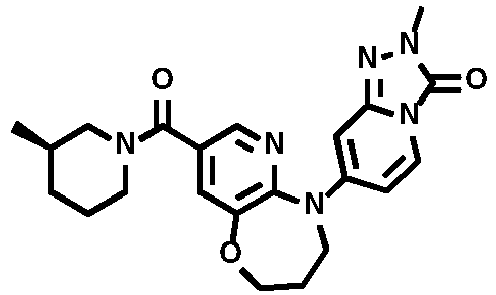
1H NMR (400 MHz, DMSO-d6) δ 0.68-1.01 (3H, m), 1.10-1. 26 (1H, m), 1.38-1.50 (1H, m), 1.53-1.84 (3H, m), 2.02-2.11 (2H, m), 2.72-3.12 (2H, m), 3.42-3.69 (4H, m), 3.96 (2H, t, J = 6.1 Hz), 4.15-4.37 (3H, m), 6.47 (1H, dd, J = 7.6, 2.1 H z), 6.63 (1H, d, J = 1.8 Hz), 7.41 (1H, d, J = 1.8 Hz), 7.65 (1H, d, J = 7.9 Hz), 8.03 (1H, d, J = 1.8 Hz). LRMS (ESI+) 423 [M+H]+. 8-61 
1H NMR (400 MHz, DMSO-d6) δ 0.66-1.02 (3H, m), 1.09-1. 26 (1H, m), 1.35-1.84 (4H, m), 2.01-2.13 (2H, m), 2.71-3.14 (2H, m), 3.40-3.66 (4H, m), 3.92-3.99 (2H, m), 4.15-4.36 (3H , m), 6.47 (1H, dd, J = 7.9, 2.4 Hz), 6.63 (1H, d, J = 1.8 H z), 7.41 (1H, d, J = 1.8 Hz), 7.65 (1H, d, J = 7.9 Hz), 8.03 (1H, d, J = 1.8 Hz). LRMS (ESI+) 423 [M+H]+. 8-62 
1H NMR (400 MHz, DMSO-d6) δ 1.45-1.96 (4H, m), 2.01-2. 12 (2H, m), 2.92-3.17 (1H, m), 3.42-3.84 (5H, m), 3.93-4.27 (5H, m), 4.79 (1H, d, J = 46.0 Hz), 6.49 (1H, dd, J = 7.9, 1.8 Hz), 6.64 (1H, d, J = 2.4 Hz), 7.39 (1H, d, J = 1.8 Hz), 7.66 (1H, d, J = 7.3 Hz), 8.03 (1H, d, J = 1.8 Hz). LRMS (ESI+) 427 [M+H]+. 8-63 
1H NMR (400 MHz, DMSO-d6) δ 1.46-1.97 (4H, m), 2.00-2. 13 (2H, m), 2.86-3.17 (1H, m), 3.42-3.84 (5H, m), 3.89-4.27 (5H, m), 4.79 (1H, d, J = 47.2 Hz), 6.48 (1H, dd, J = 7.9, 2.4 Hz), 6.64 (1H, d, J = 1.8 Hz), 7.39 (1H, d, J = 1.8 Hz), 7.65 (1H, d, J = 7.9 Hz), 8.03 (1H, d, J = 1.8 Hz). LRMS (ESI+) 427 [M+H]+. 8-64 
1H NMR (400 MHz, DMSO-d6) δ 1.99-2.14 (6H, m), 3.38-3. 84 (7H, m), 3.96 (2H, t, J = 6.1 Hz), 4.22 (2H, t, J = 5.8 Hz), 6.48 (1H, dd, J = 7.9, 2.4 Hz), 6.64 (1H, d, J = 1.8 H z), 7.51 (1H, d, J = 1.8 Hz), 7.66 (1H, d, J = 7.9 Hz), 8.10 (1H, d, J = 1.8 Hz). LRMS (ESI+) 445 [M+H]+. 8-65 
1H NMR (400 MHz, CDCl3) δ 1.35-2.06 (6H, m), 2.69-3.14 ( 2H, m), 3.64 (3H, s), 3.90 (2H, t, J = 4.6 Hz), 4.15-4.72 (5 H, m), 6.64 (1H, d, J = 1.2 Hz), 6.97 (1H, dd, J = 7.9, 1.8 Hz), 7.25 (1H, d, J = 1.8 Hz), 7.68 (1H, d, J = 7.9 Hz), 7.8 9 (1H, d, J = 1.8 Hz). LRMS (ESI+) 427 [M+H]+. [Table 132] Example No. Chemical Structural Formula Spectrum Data 8-66 
1H NMR (400 MHz, CDCl3) δ 1.34-2.08 (6H, m), 2.72-3.14 ( 2H, m), 3.64 (3H, s), 3.90 (2H, t, J = 4.6 Hz), 4.13-4.71 (5 H, m), 6.64 (1H, d, J = 1.2 Hz), 6.97 (1H, dd, J = 7.9, 1.8 Hz), 7.25 (1H, d, J = 1.8 Hz), 7.68 (1H, d, J = 6.7 Hz), 7.8 9 (1H, d, J = 1.8 Hz). LRMS (ESI+) 427 [M+H]+. 8-67 
1H NMR (400 MHz, CDCl3) δ 1.46-1.97 (10H, m), 3.25-3.73 (7H, m), 3.91 (2H, t, J = 4.3 Hz), 4.41 (2H, t, J = 4.3 Hz), 6.64 (1H, d, J = 1.2 Hz), 6.99 (1H, dd, J = 7.3, 1.8 Hz), 7. 25 (1H, d, J = 1.8 Hz), 7.69 (1H, d, J = 7.3 Hz), 7.88 (1H, d, J = 1.8 Hz). LRMS (ESI+) 435 [M+H]+. [Table 133] Example No. Chemical Structural Formula Spectrum Data 8-68 
1H NMR (400 MHz, CDCl3) δ 1.26 (3H, t, J = 7.3 Hz), 2.0 7-2.15 (2H, m), 2.29-2.38 (2H, m), 2.91 (2H, t, J = 6.1 Hz), 3.67 (2H, q, J = 7.3 Hz), 3.84 (2H, t, J = 5.5 Hz), 4.14-4.37 (4H, m), 4.38 (2H, s), 7.37 (1H, dd, J = 8.6, 1.8 Hz), 7.44 (1H, s), 7.72 (1H, d, J = 1.8 Hz), 7.86 (1H, d, J = 7.9 Hz), 8.15 (1H, d, J = 1.8 Hz). LRMS (ESI+) 377 [M+H]+. 8-69 
1H NMR (400 MHz, CDCl3) δ 1.26 (3H, t, J = 7.3 Hz), 1.8 2-2.00 (4H, m), 2.07-2.15 (2H, m), 2.90 (2H, t, J = 6.1 Hz), 3.49-3.65 (4H, m), 3.68 (2H, t, J = 7.3 Hz), 3.84 (2H, t, J = 5.5 Hz), 4.38 (2H, s), 7.37 (1H, dd, J = 8.6, 1.8 Hz), 7.45 (1H, s), 7.59 (1H, d, J = 2.4 Hz), 7.85 (1H, d, J = 7.9 Hz), 8.14 (1H, d, J = 2.4 Hz). LRMS (ESI+) 391 [M+H]+. 8-70 
1H NMR (400 MHz, CDCl3) δ 1.26 (3H, t, J = 7.3 Hz), 1.5 1-1.72 (6H, m), 1.76-1.87 (2H, m), 2.06-2.14 (2H, m), 2.90 ( 2H, t, J = 6.1 Hz), 3.44-3.71 (6H, m), 3.84 (2H, t, J = 5.5 Hz), 4.37 (2H, s), 7.36 (1H, dd, J = 8.6, 1.8 Hz), 7.41-7.43 (1H, m), 7.45 (1H, d, J = 1.2 Hz), 7.84 (1H, d, J = 7.9 Hz) , 7.99 (1H, d, J = 1.8 Hz). LRMS (ESI+) 419 [M+H]+. [Table 134] Example No. Chemical Structural Formula Spectrum Data 8-71 
1H NMR (400 MHz, CDCl3) δ 1.26 (3H, t, J = 7.3 Hz), 1.5 3-1.70 (8H, m), 1.79-1.89 (2H, m), 2.06-2.15 (2H, m), 2.90 ( 2H, t, J = 6.1 Hz), 3.40-3.63 (4H, m), 3.67 (2H, q, J = 7.3 Hz), 3.84 (2H, t, J = 5.5 Hz), 4.37 (2H, s), 7.36 (1H, dd, J = 7.9, 1.8 Hz), 7.40 (1H, d, J = 1.8 Hz), 7.45 (1H, s), 7.84 (1H, d, J = 7.9 Hz), 7.99 (1H, d, J = 1.8 Hz). LRMS (ESI+) 433 [M+H]+. 8-72 
1H NMR (400 MHz, CDCl3) δ 1.26 (3H, t, J = 7.3 Hz), 2.0 7-2.16 (2H, m), 2.91 (2H, t, J = 6.1 Hz), 3.60-3.74 (10H, m) , 3.84 (2H, t, J = 6.1 Hz), 4.38 (2H, s), 7.36 (1H, dd, J = 8 .6, 1.8 Hz), 7.44 (1H, d, J = 1.2 Hz), 7.46 (1H, d, J = 1.8 Hz), 7.86 (1H, d, J = 8.6 Hz), 7.99 (1H, d, J = 2.4 Hz). LRMS (ESI+) 407 [M+H]+. 8-73 
1H NMR (400 MHz, CDCl3) δ 1.26 (3H, t, J = 7.3 Hz), 2.0 7-2.17 (2H, m), 2.32 (3H, s), 2.37-2.54 (4H, m), 2.91 (2H, t, J = 6.1 Hz), 3.58-3.74 (6H, m), 3.84 (2H, t, J = 5.5 Hz), 4. 38 (2H, s), 7.36 (1H, dd, J = 7.9, 1.8 Hz), 7.43-7.48 (2H, m ), 7.85 (1H, d, J = 7.9 Hz), 7.99 (1H, d, J = 2.4 Hz). LRMS (ESI+) 420 [M+H]+. 8-74 
1H NMR (400 MHz, CDCl3) δ 1.26 (3H, t, J = 7.3 Hz), 2.0 8-2.16 (4H, m), 2.92 (2H, t, J = 6.1 Hz), 3.46-3.53 (2H, m), 3.57-3.72 (8H, m), 3.85 (2H, t, J = 6.1 Hz), 4.38 (2H, s), 7. 37 (1H, dd, J = 7.9, 1.8 Hz), 7.44 (1H, s), 7.46 (2H, d, J = 1.8 Hz), 7.86 (1H, d, J = 8.6 Hz), 7.99 (1H, d, J = 2.4 Hz). LRMS (ESI+) 448 [M+H]+. 8-75 
1H NMR (400 MHz, CDCl3) δ 1.26 (3H, t, J = 7.3 Hz), 2.0 7-2.15 (2H, m), 2.17-2.26 (2H, m), 2.91 (2H, t, J = 6.1 Hz), 3.55-3.76 (4H, m), 3.84 (2H, t, J = 6.1 Hz), 4.03-4.16 (2H, m), 4.38 (2H, s), 5.58-5.77 (1H, m), 5.83-5.90 (1H, m), 7.37 (1H, dd, J = 1.8, 1.5 Hz), 7.45 (1H, d, J = 1.2 Hz), 7.48 (1 H, d, J = 2.4 Hz), 7.85 (1H, d, J = 7.9 Hz), 8.01 (1H, d, J = 2.4 Hz). LRMS (ESI+) 403 [M+H]+. [Table 135] Example No. Chemical Structural Formula Spectrum Data 8-76 
1H NMR (400 MHz, CDCl3) δ 1.26 (3H, t, J = 7.3 Hz), 2.0 8-2.16 (2H, m), 2.88-2.95 (4H, m), 3.68 (2H, q, J = 7.3 Hz), 3.75-3.94 (4H, m), 4.39 (2H, s), 4.73-4.84 (2H, m), 7.02-7.2 2 (4H, m), 7.38 (1H, dd, J = 7.9, 1.8 Hz), 7.46 (1H, s), 7.5 1 (1H, d, J = 1.8 Hz), 7.86 (1H, d, J = 7.9 Hz), 8.07 (1H, d, J = 1.8 Hz). LRMS (ESI+) 453 [M+H]+. 8-77 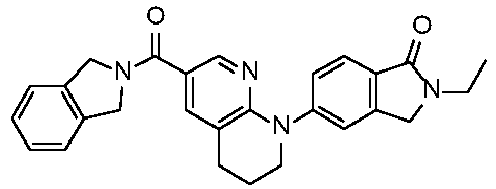
1H NMR (400 MHz, CDCl3) δ 1.27 (3H, t, J = 7.3 Hz), 2.0 9-2.18 (2H, m), 2.93 (2H, t, J = 6.1 Hz), 3.68 (2H, q, J = 7 .3 Hz), 3.86 (2H, t, J = 6.1 Hz), 4.39 (2H, s), 4.87-5.05 (4H , m), 7.12-7.20 (1H, m), 7.23-7.36 (3H, m), 7.40 (1H, dd, J = 7.9, 1.8 Hz), 7.48 (1H, d, J = 1.2 Hz), 7.60-7.64 (1H, m), 7.87 (1H, d, J = 7.9 Hz), 8.24 (1H, d, J = 1.8 Hz). LRMS (ESI+) 439 [M+H]+. 8-78 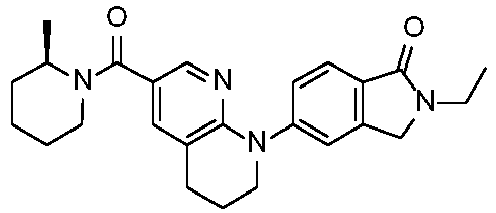
1H NMR (400 MHz, CDCl3) δ 1.24 (3H, d, J = 7.3 Hz), 1.2 6 (3H, t, J = 7.3 Hz), 1.38-1.56 (2H, m), 1.62-1.75 (4H, m), 2.06-2.15 (2H, m), 2.90 (2H, t, J = 6.4 Hz), 2.96-3.07 (1H, m), 3.67 (2H, q, J = 7.3 Hz), 3.84 (2H, t, J = 5.5 Hz), 3.99 -4.19 (1H, m), 4.37 (2H, s), 4.50-4.69 (1H, m), 7.36 (1H, dd, J = 8.6, 1.8 Hz), 7.42 (1H, d, J = 1.8 Hz), 7.45 (1H, d, J = 1.2 Hz), 7.84 (1H, d, J = 8.6 Hz), 7.97 (1H, d, J = 2.4 H z). LRMS (ESI+) 419 [M+H]+. 8-79 
1H NMR (400 MHz, CDCl3) δ 1.24 (3H, d, J = 7.3 Hz), 1.2 6 (3H, t, J = 7.3 Hz), 1.37-1.57 (2H, m), 1.63-1.74 (4H, m), 2.06-2.15 (2H, m), 2.90 (2H, t, J = 6.4 Hz), 2.96-3.08 (1H, m), 3.67 (2H, q, J = 7.3 Hz), 3.84 (2H, t, J = 5.5 Hz), 4.01 -4.18 (1H, m), 4.38 (2H, s), 4.51-4.67 (1H, m), 7.36 (1H, dd, J = 7.9, 1.8 Hz), 7.40-7.43 (1H, m), 7.45 (1H, d, J = 1.2 Hz), 7.85 (1H, d, J = 7.9 Hz), 7.97 (1H, d, J = 1.8 Hz). LRMS (ESI+) 419 [M+H]+. 8-80 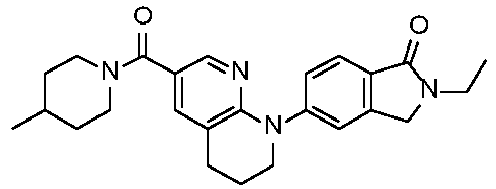
1H NMR (400 MHz, CDCl3) δ 0.96 (3H, d, J = 6.7 Hz), 1.0 7-1.22 (2H, m), 1.26 (3H, t, J = 7.3 Hz), 1.61-1.74 (3H, m), 2.06-2.15 (2H, m), 2.67-3.06 (4H, m), 3.67 (2H, q, J = 7.3 Hz), 3.84 (2H, t, J = 5.5 Hz), 3.94-4.87 (4H, m), 7.36 (1H, dd, J = 7.9, 1.8 Hz), 7.43-7.46 (2H, m), 7.85 (1H, d, J = 7. 9 Hz), 7.98 (1H, d, J = 1.8 Hz). LRMS (ESI+) 419 [M+H]+. [Table 136] Example No. Chemical Structural Formula Spectrum Data 8-81 
1H NMR (400 MHz, CDCl3) δ 1.26 (3H, t, J = 7.3 Hz), 1.2 9-1.41 (3H, m), 1.50-1.69 (2H, m), 1.82-1.97 (1H, m), 1.98-2. 07 (1H, m), 2.07-2.15 (2H, m), 2.82-3.15 (4H, m), 3.67 (2H, q, J = 7.3 Hz), 3.84 (2H, dd, J = 6.1, 4.9 Hz), 3.91-4.61 (4 H, m), 7.37 (1H, dd, J = 8.6, 1.8 Hz), 7.45 (1H, d, J = 1.2 Hz), 7.47 (1H, d, J = 1.8 Hz), 7.85 (1H, d, J = 7.9 Hz), 8.0 1 (1H, d, J = 2.4 Hz). LRMS (ESI+) 437 [M+H]+. 8-82 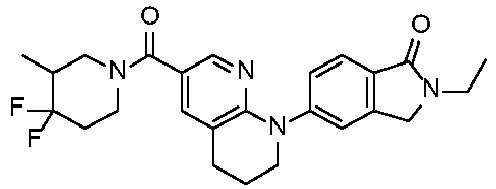
1H NMR (400 MHz, CDCl3) δ 1.02 (3H, d, J = 6.1 Hz), 1.2 6 (3H, t, J = 7.3 Hz), 1.75-2.20 (5H, m), 2.91 (2H, t, J = 6. 1 Hz), 2.96-3.10 (1H, m), 3.26-3.38 (1H, m), 3.67 (2H, q, J = 7.3 Hz), 3.85 (2H, t, J = 5.5 Hz), 3.94-4.31 (2H, m), 4.38 (2H, s), 7.37 (1H, dd, J = 7.9, 1.8 Hz), 7.43-7.48 (2H, m), 7 .86 (1H, d, J = 8.6 Hz), 7.99 (1H, d, J = 2.4 Hz). LRMS (ESI+) 455 [M+H]+. 8-83 
1H NMR (400 MHz, CDCl3) δ 1.26 (3H, t, J = 7.3 Hz), 1.7 8-2.05 (4H, m), 2.07-2.15 (2H, m), 2.91 (2H, t, J = 6.1 Hz), 3.22-3.37 (1H, m), 3.45-3.63 (1H, m), 3.67 (2H, q, J = 7.3 Hz), 3.79-3.99 (4H, m), 4.38 (2H, s), 4.56-4.79 (1H, m), 7.36 (1H, dd, J = 8.6, 1.8 Hz), 7.43-7.48 (2H, m), 7.85 (1H, d, J = 7.9 Hz), 8.01 (1H, d, J = 2.4 Hz). LRMS (ESI+) 423 [M+H]+. 8-84 
1H NMR (400 MHz, CDCl3) δ 1.26 (3H, t, J = 7.3 Hz), 1.7 6-2.05 (4H, m), 2.07-2.15 (2H, m), 2.91 (2H, t, J = 6.1 Hz), 3.23-3.37 (1H, m), 3.44-3.63 (1H, m), 3.67 (2H, q, J = 7.3 Hz), 3.80-4.00 (4H, m), 4.38 (2H, s), 4.56-4.77 (1H, m), 7.36 (1H, dd, J = 8.6, 1.8 Hz), 7.44-7.48 (2H, m), 7.85 (1H, d, J = 7.9 Hz), 8.01 (1H, d, J = 2.4 Hz). LRMS (ESI+) 423 [M+H]+. 8-85 
1H NMR (400 MHz, CDCl3) δ 1.26 (3H, t, J = 7.3 Hz), 1.7 8-1.88 (2H, m), 2.00-2.17 (4H, m), 2.91 (2H, t, J = 6.4 Hz), 3.57-3.72 (4H, m), 3.74-3.88 (4H, m), 4.38 (2H, s), 7.37 (1H, dd, J = 7.9, 1.8 Hz), 7.43-7.47 (2H, m), 7.86 (1H, d, J = 8 .6 Hz), 8.00 (1H, d, J = 2.4 Hz). LRMS (ESI+) 441 [M+H]+. [Table 137] Example No. Chemical Structural Formula Spectrum Data 8-86 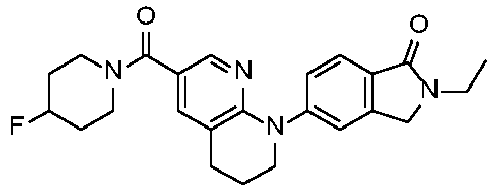
1H NMR (400 MHz, CDCl3) δ 1.26 (3H, t, J = 7.3 Hz), 1.7 7-1.96 (4H, m), 2.07-2.16 (2H, m), 2.91 (2H, t, J = 6.1 Hz), 3.57-3.81 (6H, m), 3.84 (2H, t, J = 6.1 Hz), 4.38 (2H, s), 4. 80-4.99 (1H, m), 7.37 (1H, dd, J = 7.9, 1.8 Hz), 7.43-7.47 ( 2H, m), 7.85 (1H, d, J = 8.5 Hz), 7.99 (1H, d, J = 1.8 Hz). LRMS (ESI+) 423 [M+H]+. 8-87 
1H NMR (400 MHz, CDCl3) δ 1.26 (3H, t, J = 7.3 Hz), 1.4 1-1.57 (2H, m), 1.76-1.85 (1H, m), 2.06-2.16 (3H, m), 2.21-2. 37 (1H, m), 2.83-3.01 (4H, m), 3.67 (2H, q, J = 7.3 Hz), 3. 84 (2H, t, J = 5.8 Hz), 4.00-4.72 (4H, m), 7.37 (1H, dd, J = 7.9, 1.8 Hz), 7.42-7.47 (2H, m), 7.86 (1H, d, J = 7.9 Hz), 7.98 (1H, d, J = 1.8 Hz). LRMS (ESI+) 473 [M+H]+. 8-88 
1H NMR (400 MHz, CDCl3) δ 1.26 (3H, t, J = 7.3 Hz), 1.4 1-1.57 (2H, m), 1.76-1.87 (1H, m), 2.06-2.17 (3H, m), 2.23-2. 38 (1H, m), 2.85-3.01 (4H, m), 3.67 (2H, q, J = 7.3 Hz), 3. 85 (2H, t, J = 5.5 Hz), 4.00-4.72 (4H, m), 7.37 (1H, dd, J = 8.6, 1.8 Hz), 7.42-7.47 (2H, m), 7.86 (1H, d, J = 8.6 Hz), 7.98 (1H, d, J = 2.4 Hz). LRMS (ESI+) 473 [M+H]+. 8-89 
1H NMR (400 MHz, CDCl3) δ 0.79-0.98 (3H, m), 1.08-1.21 ( 1H, m), 1.26 (3H, t, J = 7.3 Hz), 1.41-1.53 (2H, m), 1.63-1. 76 (2H, m), 1.80-1.91 (1H, m), 2.06-2.15 (2H, m), 2.35-2.70 (1H, m), 2.82-2.97 (3H, m), 3.67 (2H, q, J = 7.3 Hz), 3.84 ( 2H, t, J = 5.5 Hz), 3.95-4.65 (3H, m), 7.36 (1H, dd, J = 7.9 , 1.8 Hz), 7.41-7.46 (2H, m), 7.85 (1H, d, J = 8.6 Hz), 7.98 (1H, d, J = 2.4 Hz). LRMS (ESI+) 419 [M+H]+. 8-90 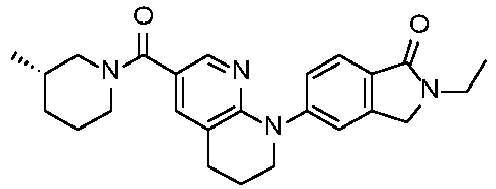
1H NMR (400 MHz, CDCl3) δ 0.75-1.00 (3H, m), 1.09-1.21 ( 1H, m), 1.26 (3H, t, J = 7.3 Hz), 1.41-1.54 (2H, m), 1.63-1. 75 (2H, m), 1.80-1.90 (1H, m), 2.06-2.15 (2H, m), 2.38-2.70 (1H, m), 2.81-2.95 (3H, m), 3.67 (2H, q, J = 7.3 Hz), 3.84 ( 2H, t, J = 5.5 Hz), 4.09-4.67 (3H, m), 7.36 (1H, dd, J = 7.9 , 1.8 Hz), 7.41-7.47 (2H, m), 7.85 (1H, d, J = 8.6 Hz), 7.98 (1H, d, J = 2.4 Hz). LRMS (ESI+) 419 [M+H]+. [Table 138] Example No. Chemical Structural Formula Spectrum Data 8-91 
1H NMR (400 MHz, CDCl3) δ 1.26 (3H, t, J = 7.3 Hz), 1.3 4-1.51 (2H, m), 1.69-2.02 (3H, m), 2.06-2.16 (2H, m), 2.78-3. 05 (4H, m), 3.67 (2H, q, J = 7.3 Hz), 3.84 (2H, t, J = 5.5 Hz), 3.96-4.45 (6H, m), 7.36 (1H, dd, J = 7.9, 1.8 Hz), 7.42-7.47 (2H, m), 7.85 (1H, d, J = 8.6 Hz), 7.99 (1H, d, J = 2. 4 Hz). LRMS (ESI+) 437 [M+H]+. 8-92 
1H NMR (400 MHz, CDCl3) δ 1.26 (3H, t, J = 7.3 Hz), 1.3 3-1.59 (2H, m), 1.69-2.04 (3H, m), 2.06-2.15 (2H, m), 2.73-3. 07 (4H, m), 3.67 (2H, q, J = 7.3 Hz), 3.84 (2H, t, J = 5.4 Hz), 3.93-4.50 (6H, m), 7.36 (1H, dd, J = 7.9, 1.8 Hz), 7.42-7.47 (2H, m), 7.85 (1H, d, J = 8.5 Hz), 7.99 (1H, d, J = 2. 4 Hz). LRMS (ESI+) 437 [M+H]+. 8-93 
1H NMR (400 MHz, CDCl3) δ 1.26 (3H, t, J = 7.3 Hz), 1.4 1-1.56 (2H, m), 1.72-1.84 (1H, m), 1.92-2.16 (4H, m), 2.83-3. 06 (4H, m), 3.67 (2H, q, J = 7.3 Hz), 3.84 (2H, t, J = 5.8 Hz), 3.94-4.54 (4H, m), 5.67 (1H, t, J = 56.6 Hz), 7.37 (1H, dd, J = 8.5, 1.8 Hz), 7.41-7.47 (2H, m), 7.85 (1H, d, J = 7. 9 Hz), 7.98 (1H, d, J = 2.4 Hz). LRMS (ESI+) 455 [M+H]+. 8-94 
1H NMR (400 MHz, CDCl3) δ 1.26 (3H, t, J = 7.3 Hz), 1.4 1-1.56 (2H, m), 1.70-1.85 (1H, m), 1.92-2.16 (4H, m), 2.82-3. 06 (4H, m), 3.67 (2H, q, J = 7.3 Hz), 3.84 (2H, t, J = 5.8 Hz), 3.95-4.56 (4H, m), 5.67 (1H, t, J = 52.7 Hz), 7.37 (1H, dd, J = 8.5, 1.8 Hz), 7.42-7.46 (2H, m), 7.85 (1H, d, J = 8. 5 Hz), 7.98 (1H, d, J = 2.4 Hz). LRMS (ESI+) 455 [M+H]+. 8-95 
1H NMR (400 MHz, CDCl3) δ 1.62-1.83 (4H, m), 2.41 (4H, t, J = 12.5 Hz), 3.36-3.75 (7H, m), 3.90 (2H, t, J = 4.3 Hz), 4.41 (2H, t, J = 4.3 Hz), 6.65 (1H, d, J = 1.2 Hz), 6.96 (1 H, dd, J = 7.9, 1.8 Hz), 7.25 (1H, d, J = 1.8 Hz), 7.69 (1H, d, J = 7.9 Hz), 7.88 (1H, d, J = 1.8 Hz). LRMS (ESI+) 471 [M+H]+. [Table 139] Example No. Chemical Structural Formula Spectrum Data 8-96 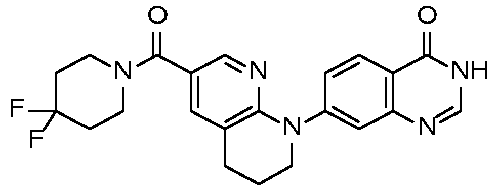
1H NMR (400 MHz, CDCl3) δ 1.93-2.09 (4H, m), 2.11-2.19 ( 2H, m), 2.93 (2H, t, J = 6.1 Hz), 3.70-3.82 (4H, m), 3.94 (2 H, t, J = 5.5 Hz), 7.52 (1H, d, J = 2.4 Hz), 7.60-7.65 (2H, m), 8.01 (1H, s), 8.05 (1H, d, J = 2.4 Hz), 8.25 (1H, dd, J = 7.9, 1.2 Hz), 9.85 (1H, br s). LRMS (ESI+) 426 [M+H]+. 8-97 
1H NMR (400 MHz, CDCl3) δ 1.62-1.80 (2H, m), 2.15-2.28 ( 2H, m), 2.92-3.00 (2H, m), 3.35-3.60 (3H, m), 3.64 (3H, s), 3.90 (2H, t, J = 4.6 Hz), 4.08-4.25 (1H, m), 4.41 (2H, t, J = 4.6 Hz), 6.64 (1H, d, J = 1.2 Hz), 6.99 (1H, dd, J = 7.6, 2 .1 Hz), 7.40 (1H, d, J = 1.8 Hz), 7.69 (1H, d, J = 8.6 Hz), 8.03 (1H, d, J = 2.4 Hz). LRMS (ESI+): 407 (M+H+). 8-98 
1H NMR (400 MHz, CDCl3) δ 1.30-1.45 (1H, m), 1.61-1.91 ( 4H, m), 2.61-2.75 (2H, m), 3.22-3.58 (3H, m), 3.64 (3H, s), 3.67-3.87 (2H, m), 3.90 (2H, t, J = 4.5 Hz), 4.40 (2H, t, J = 4.5 Hz), 6.64 (1H, d, J = 1.2 Hz), 6.98 (1H, dd, J = 7.6, 2 .1 Hz), 7.35 (1H, d, J = 1.8 Hz), 7.68 (1H, d, J = 7.6 Hz), 7.99 (1H, d, J = 1.8 Hz). LRMS (ESI+): 421 (M+H+). 8-99 
1H NMR (400 MHz, CDCl3) δ 0.17 (1H, dd, J = 9.1, 4.2 Hz ), 0.68-0.73 (1H, m), 1.47-1.58 (2H, m), 3.48 (1H, d, J = 10. 3 Hz), 3.58 (1H, d, J = 10.3 Hz), 3.64 (3H, s), 3.67-3.76 (1 H, m), 3.90 (2H, t, J = 4.5 Hz), 4.17 (1H, d, J = 12.1 Hz), 4.40 (2H, t, J = 4.5 Hz), 6.64 (1H, d, J = 1.8 Hz), 6.97 (1H , dd, J = 7.9, 1.8 Hz), 7.31 (1H, d, J = 1.8 Hz), 7.68 (1H, d, J = 7.9 Hz), 7.95 (1H, d, J = 2.4 Hz). LRMS (ESI+): 393 (M+H+). 8-100 
1H NMR (400 MHz, CDCl3) δ 1.05 (4H, s), 1.15 (2H,s), 1.7 0-1.77 (2H, m), 3.26 (1.3H, s), 3.39 (0.7H, s), 3.61 (1H, t, J = 7.3 Hz), 3.64 (3H, s), 3.72 (1H, t, J = 7.3 Hz), 3.90 (2 H, t, J = 4.6 Hz), 4.41 (2H, t, J = 4.6 Hz), 6.64 (1H, s), 6 .99 (1H, dd, J = 7.9, 1.8 Hz), 7.39 (1H, d, J = 1.8 Hz), 7. 68 (1H, d, J = 7.9 Hz), 8.03 (1H, dd, J = 12.8, 1.8 Hz). LRMS (ESI+): 409 (M+H+). [Table 140] Example No. Chemical Structural Formula Spectrum Data 8-101 
1H NMR (400 MHz, CDCl3) δ 1.61-1.69 (2H, m), 1.87-2.02 ( 2H, m), 2.26-2.38 (1H, m), 2.72-3.14 (2H, m), 3.65 (3H, s), 3.91 (2H, t, J = 4.6 Hz), 4.04-4.98 (4H, m), 6.65 (1H, d, J = 1.2 Hz), 6.97 (1H, dd, J = 7.6, 2.1 Hz), 7.25-7.27 (1H, m) , 7.69 (1H, d, J = 8.6 Hz), 7.89 (1H, d, J = 1.8 Hz). LRMS (ESI+): 463 (M+H+). 8-102 
1H NMR (400 MHz, CDCl3) δ 1.60-1.72 (6H, m), 1.78-1.88 ( 2H, m), 3.47 (2H, t, J = 5.5 Hz), 3.60-3.70 (5H, m), 3.89 (2 H, t, J = 4.6 Hz), 4.40 (2H, t, J = 4.6 Hz), 6.63 (1H, d, J = 1.2 Hz), 6.98 (1H, dd, J = 7.3, 1.8 Hz), 7.24 (1H, d, J = 1.8 Hz), 7.68 (1H, d, J = 6.7 Hz), 7.89 (1H, d, J = 1.8 Hz). LRMS (ESI+): 409 (M+H+). 8-103 
1H NMR (400 MHz, CDCl3) δ 3.65 (3H, s), 3.93 (2H, t, J = 4.5 Hz), 4.43 (2H, t, J = 4.5 Hz), 4.89 (2H, s), 5.02 (2H, s ), 6.67 (1H, d, J = 1.8 Hz), 7.01 (1H, dd, J = 7.6, 2.1 Hz), 7.18 (1H, d, J = 7.6 Hz), 7.28-7.36 (3H, m), 7.44 (1H, d, J = 1.8 Hz), 7.70 (1H, d, J = 7.6 Hz), 8.13 (1H, d, J = 1.8 H z). LRMS (ESI+): 429 (M+H+). 8-104 
1H NMR (400 MHz, CDCl3) δ 3.14 (2H, t, J = 8.2 Hz), 3.6 5 (3H, s), 3.93 (2H, t, J = 4.5 Hz), 4.15 (2H, t, J = 8.2 Hz) , 4.43 (2H, t, J = 4.5 Hz), 6.67 (1H, d, J = 1.8 Hz), 6.99 (1 H, dd, J = 7.9, 1.8 Hz), 7.05 (1H, d, J = 7.9 Hz), 7.14-7.23 (3H, m), 7.40 (1H, d, J = 1.8 Hz), 7.69 (1H, d, J = 7.9 Hz) , 8.08 (1H, d, J = 1.8 Hz). LRMS (ESI+): 429 (M+H+). 8-105 
1H NMR (400 MHz, CDCl3) δ 3.39 (3H, s), 3.55 (2H, t, J = 4.9 Hz), 3.62-3.66 (5H, m), 3.91 (2H, t, J = 4.6 Hz), 4.41 ( 2H, t, J = 4.6 Hz), 6.40 (1H, t, J = 5.2 Hz), 6.65 (1H, d, J = 1.6 Hz), 6.97 (1H, dd, J = 8.0, 2.4 Hz), 7.58 (1H, d, J = 1.6 Hz), 7.68 (1H, d, J = 8.0 Hz), 8.22 (1H, d, J = 2.4 Hz). LRMS (ESI+): 385 (M+H+). 8-106 
1H NMR (400 MHz, CDCl3) δ 3.12 (3H, s), 3.30-3.41 (3H, m), 3.45-3.75 (7H, m), 3.90 (2H, t, J = 4.6 Hz), 4.40 (2H, t, J = 4.6 Hz), 6.63 (1H, d, J = 1.2 Hz), 6.98 (1H, dd, J = 7 .6, 1.8 Hz), 7.30 (1H, d, J = 1.2 Hz), 7.68 (1H, d, J = 7.6 Hz), 7.94 (1H, d, J = 1.8 Hz). LRMS (ESI+): 399 (M+H+). [Table 141] Example No. Chemical Structural Formula Spectrum Data 8-107 
1H NMR (400 MHz, CDCl3) δ 1.85-1.91 (2H, m), 3.39 (3H, s), 3.55-3.60 (4H, m), 3.64 (3H, s), 3.91 (2H, t, J = 4.5 Hz), 4.41 (2H, t, J = 4.5 Hz), 6.66 (1H, d, J = 1.8 Hz), 6.92 (1 H, t, J = 4.8 Hz), 6.96 (1H, dd, J = 7.9, 1.8 Hz), 7.59 (1H, d, J = 2.4 Hz), 7.69 (1H, d, J = 7.9 Hz), 8.16 (1H, d, J = 1.8 Hz). LRMS (ESI+): 399 (M+H+). 8-108 
1H NMR (400 MHz, CDCl3) δ 1.81 (1H, d, J = 14.5 Hz), 2. 20 (1H, d, J = 14.5 Hz), 2.93-3.42 (3H, m), 3.64 (3H, s), 3. 89-4.08 (5H, m), 4.18-4.36 (1H, m), 4.40 (2H, t, J = 4.5 Hz) , 4.61-4.84 (1H, m), 6.64 (1H, d, J = 1.2 Hz), 6.98 (1H, dd, J = 8.3, 1.8 Hz), 7.41 (1H, d, J = 1.8 Hz), 7.68 (1H, d, J = 8.3 Hz), 8.01 (1H, d, J = 1.8 Hz). LRMS (ESI+): 427 (M+H+). 8-109 
1H NMR (400 MHz, CDCl3) δ 1.45-1.68 (2H, m), 1.78-1.89 ( 1H, m), 2.08-2.16 (1H, m), 2.23-2.40 (1H, m), 2.80-3.10 (2H, m), 3.65 (3H, s), 3.78-4.88 (6H, m), 6.66 (1H, d, J = 1.2 H z), 6.96 (1H, dd, J = 7.6, 2.1 Hz), 7.25 (1H, d, J = 1.8 Hz), 7.69 (1H, d, J = 6.7 Hz), 7.88 (1H, d, J = 1.8 Hz). LRMS (ESI+): 463 (M+H+). 8-110 
1H NMR (400 MHz, CDCl3) δ 0.78-1.06 (6H, m), 1.41-1.48 ( 2H, m), 1.61-1.70 (2H, m), 3.03-3.68 (7H, m), 3.90 (2H, t, J = 4.3 Hz), 4.41 (2H, t, J = 4.6 Hz), 6.64 (1H, d, J = 1.2 H z), 6.99 (1H, dd, J = 7.6, 2.1 Hz), 7.24 (1H, s), 7.68 (1H, d, J = 6.7 Hz), 7.88 (1H, s). LRMS (ESI+): 423 (M+H+). 8-111 
1H NMR (400 MHz, CDCl3) δ 1.62-1.97 (4H, m), 2.15 (1H, d, J = 2.4 Hz), 2.71-2.79 (1H, m), 3.30-3.60 (2H, m), 3.64 ( 3H, s), 3.70-4.01 (4H, m), 4.41 (2H, t, J = 4.3 Hz), 6.64 (1 H, d, J = 1.8 Hz), 6.97 (1H, dd, J = 7.9, 1.8 Hz), 7.25 (1H, d, J = 1.8 Hz), 7.68 (1H, d, J = 6.7 Hz), 7.88 (1H, d, J = 1.8 Hz). LRMS (ESI+): 419 (M+H+). [Table 142] Example No. Chemical Structural Formula Spectrum Data 8-112 
1H NMR (400 MHz, CDCl3) δ 2.40-2.66 (4H, m), 3.65 (3H, s), 3.85-4.00 (6H, m), 4.43 (2H, t, J = 4.6 Hz), 6.67 (1H, t, J = 1.5 Hz), 6.96 (1H, dd, J = 7.6, 2.1 Hz), 7.32 (1H, d, J = 1.8 Hz), 7.70 (1H, d, J = 8.6 Hz), 7.97 (1H, d, J = 2.4 H z). LRMS (ESI+): 409 (M+H+). 8-113 
1H NMR (400 MHz, CDCl3) δ 1.82-1.99 (2H, m), 2.01-2.20 ( 2H, m), 3.41-3.89 (7H, m), 3.90 (2H, t, J = 4.6 Hz), 4.31-4. 36 (1H, m), 4.41 (2H, t, J = 4.6 Hz), 6.65 (1H, d, J = 1.2 Hz), 6.96 (1H, dd, J = 7.3, 1.8 Hz), 7.26 (1H, t, J = 1.5 Hz ), 7.69 (1H, d, J = 8.6 Hz), 7.89 (1H, d, J = 1.8 Hz). LRMS (ESI+): 429 (M+H+). 8-114 
1H NMR (400 MHz, CDCl3) δ 1.76-2.01 (4H, m), 3.47-4.02 ( 9H, m), 4.41 (2H, t, J = 4.6 Hz), 4.84-5.00 (1H, m), 6.65 (1 H, d, J = 1.8 Hz), 6.96 (1H, dd, J = 7.6, 2.1 Hz), 7.26 (1H, s), 7.69 (1H, d, J = 8.6 Hz), 7.90 (1H, d, J = 1.8 Hz). LRMS (ESI+): 413 (M+H+). 8-115 
1H NMR (400 MHz, CDCl3) δ 1.51-1.68 (2H, m), 1.77-1.91 ( 1H, m), 2.08-2.17 (1H, m), 2.23-2.41 (1H, m), 2.81-3.13 (2H, m), 3.64 (3H, s), 3.90-4.99 (6H, m), 6.66 (1H, d, J = 1.2 H z), 6.96 (1H, dd, J = 7.9, 1.8 Hz), 7.25 (1H, d, J = 1.8 Hz), 7.69 (1H, d, J = 6.7 Hz), 7.88 (1H, d, J = 1.8 Hz). LRMS (ESI+): 463 (M+H+). 8-116 
1H NMR (400 MHz, CDCl3) δ 1.46-1.68 (2H, m), 1.76-1.90 ( 1H, m), 2.08-2.17 (1H, m), 2.23-2.40 (1H, m), 2.78-3.12 (2H, m), 3.65 (3H, s), 3.90-4.96 (6H, m), 6.66 (1H, d, J = 1.8 H z), 6.96 (1H, dd, J = 7.6, 2.1 Hz), 7.25 (1H, d, J = 2.4 Hz), 7.69 (1H, d, J = 8.6 Hz), 7.88 (1H, d, J = 2.4 Hz). LRMS (ESI+): 463 (M+H+). 8-117 
1H NMR (400 MHz, CDCl3) δ 0.96-1.12 (3H, m), 1.77-2.28 ( 5H, m), 2.90 (2H, t, J = 6.7 Hz), 2.96-3.14 (1H, m), 3.25-3. 68 (6H, m), 3.84 (2H, t, J = 5.8 Hz), 5.30 (2H, s), 6.70 (1 H, d, J = 1.8 Hz), 6.76 (1H, dd, J = 7.9, 1.8 Hz), 7.50-7.53 (1H, m), 7.65 (1H, d, J = 7.9 Hz), 8.10 (1H, d, J = 2.4 H z). LRMS (ESI+) 473 [M+H]+. [Table 143] Example No. Chemical Structural Formula Spectrum Data 8-118 
1H NMR (400 MHz, DMSO-d6) δ 1.38-1.54 (2H, m), 1.62-1.78 ( 1H, m), 1.80-1.93 (1H, m), 1.94-2.15 (3H, m), 2.74-3.20 (6H, m), 3.28-3.37 (3H, m), 3.82 (2H, t, J = 5.8 Hz), 5.17 (2H, s), 6.02 (1H, t, J = 56.0 Hz), 6.79 (1H, dd, J = 7.6, 2.1 Hz ), 6.90 (1H, d, J = 1.8 Hz), 7.53 (1H, d, J = 1.8 Hz), 7.72 (1H, d, J = 7.3 Hz), 8.03 (1H, d, J = 2.4 Hz). LRMS (ESI+) 473 [M+H]+. 8-119 
1H NMR (400 MHz, DMSO-d6) δ 1.37-1.55 (2H, m), 1.62-1.77 ( 1H, m), 1.80-1.92 (1H, m), 1.95-2.18 (3H, m), 2.72-3.19 (4H, m), 3.33 (3H, s), 3.53-4.58 (4H, m), 5.17 (2H, s), 6.02 (1H, t, J = 55.7 Hz), 6.79 (1H, dd, J = 7.6, 2.1 Hz), 6.90 (1H, d, J = 1.2 Hz), 7.53 (1H, d, J = 2.4 Hz), 7.72 (1H, d, J = 7.3 Hz), 8.04 (1H, d, J = 2.4 Hz). LRMS (ESI+) 473 [M+H]+. 8-120 
1H NMR (400 MHz, DMSO-d6) δ 0.92-1.10 (3H, m), 1.39-1.60 ( 1H, m), 1.91-2.05 (3H, m), 2.12-2.30 (1H, m), 2.83 (2H, t, J = 6.7 Hz), 2.94-3.17 (1H, m), 3.27-3.36 (3H, m), 3.39-3.67 ( 3H, m), 3.81 (2H, t, J = 5.8 Hz), 5.17 (2H, s), 6.79 (1H, d, J = 8.5 Hz), 6.90 (1H, s), 7.65 (1H, s), 7.72 (1H, d, J = 7. 9 Hz), 8.17 (1H, s). LRMS (ESI+) 423 [M+H]+. 8-121 
1H NMR (400 MHz, DMSO-d6) δ 0.91-1.11 (3H, m), 1.40-1.57 ( 1H, m), 1.88-2.08 (3H, m), 2.13-2.30 (1H, m), 2.84 (2H, t, J = 6.1 Hz), 2.94-3.19 (1H, m), 3.27-3.36 (3H, m), 3.38-3.67 ( 3H, m), 3.82 (2H, t, J = 5.4 Hz), 5.17 (2H, s), 6.79 (1H, d, J = 7.9 Hz), 6.90 (1H, s), 7.65 (1H, s), 7.72 (1H, d, J = 7. 3 Hz), 8.17 (1H, s). LRMS (ESI+) 423 [M+H]+. 8-122 
1H NMR (400 MHz, DMSO-d6) δ 1.93-2.06 (2H, m), 2.19-2.31 ( 2H, m), 2.84 (2H, t, J = 6.4 Hz), 3.50 (3H, s), 3.81 (2H, t, J = 5.8 Hz), 3.92-4.12 (2H, m), 4.22-4.44 (2H, m), 6.74 (1H , dd, J = 7.3, 1.8 Hz), 6.93 (1H, d, J = 1.2 Hz), 7.66-7.74 (2H, m), 8.21 (1H, d, J = 1.8 Hz). LRMS (ESI+) 365 [M+H]+. [Table 144] Example No. Chemical Structural Formula Spectrum Data 8-123 
1H NMR (400 MHz, DMSO-d6) δ 1.76-1.90 (4H, m), 1.94-2.06 ( 2H, m), 2.83 (2H, t, J = 6.4 Hz), 3.38-3.56 (7H, m), 3.80 (2 H, t, J = 5.8 Hz), 6.77 (1H, dd, J = 7.6, 2.1 Hz), 6.88-6.91 (1H, m), 7.62-7.66 (1H, m), 7.69 (1H, d, J = 7.9 Hz), 8.17 (1H, d, J = 2.4 Hz). LRMS (ESI+) 379 [M+H]+. 8-124 
1H NMR (400 MHz, DMSO-d6) δ 1.43-1.76 (8H, m), 1.96-2.06 ( 2H, m), 2.83 (2H, t, J = 6.4 Hz), 3.37-3.59 (7H, m), 3.80 (2 H, t, J = 5.8 Hz), 6.78 (1H, dd, J = 7.6, 2.1 Hz), 6.86-6.89 (1H, m), 7.48-7.53 (1H, m), 7.69 (1H, d, J = 7.3 Hz), 7.99 (1H, d, J = 1.8 Hz). LRMS (ESI+) 407 [M+H]+. 8-125 
1H NMR (400 MHz, DMSO-d6) δ 1.46-1.63 (8H, m), 1.65-1.78 ( 2H, m), 1.95-2.05 (2H, m), 2.83 (2H, t, J = 6.4 Hz), 3.34-3. 42 (2H, m), 3.45-3.58 (5H, m), 3.80 (2H, t, J = 5.8 Hz), 6.7 8 (1H, dd, J = 7.6, 2.1 Hz), 6.88 (1H, d, J = 1.2 Hz), 7.46 -7.50 (1H, m), 7.69 (1H, d, J = 8.5 Hz), 7.97 (1H, d, J = 2 .4 Hz). LRMS (ESI+) 421 [M+H]+. 8-126 
1H NMR (400 MHz, DMSO-d6) δ 1.95-2.05 (2H, m), 2.83 (2H, t , J = 6.4 Hz), 3.44-3.65 (11H, m), 3.80 (2H, t, J = 5.8 Hz), 6.77 (1H, dd, J = 7.9, 1.8 Hz), 6.88-6.91 (1H, m), 7.51-7.5 6 (1H, m), 7.69 (1H, d, J = 8.5 Hz), 8.04 (1H, d, J = 2.4 Hz). LRMS (ESI+) 395 [M+H]+. 8-127 
1H NMR (400 MHz, DMSO-d6) δ 1.95-2.05 (2H, m), 2.19 (3H, s), 2.24-2.38 (4H, m), 2.83 (2H, t, J = 6.4 Hz), 3.39-3.61 (7 H, m), 3.80 (2H, t, J = 5.8 Hz), 6.78 (1H, dd, J = 7.9, 1.8 Hz), 6.87-6.92 (1H, m), 7.49-7.53 (1H, m), 7.69 (1H, d, J = 8.5 Hz), 8.01 (1H, d, J = 2.4 Hz). LRMS (ESI+) 408 [M+H]+. 8-128 
1H NMR (400 MHz, DMSO-d6) δ 1.95-2.07 (5H, m), 2.84 (2H, t , J = 6.4 Hz), 3.44-3.61 (11H, m), 3.81 (2H, t, J = 5.8 Hz), 6.78 (1H, dd, J = 7.9, 1.8 Hz), 6.91 (1H, d, J = 1.2 Hz), 7.54 (1H, d, J = 1.8 Hz), 7.70 (1H, d, J = 7.3 Hz), 8.05 (1 H, d, J = 2.4 Hz). LRMS (ESI+) 436 [M+H]+. [Table 145] Example No. Chemical Structural Formula Spectrum Data 8-129 
1H NMR (400 MHz, DMSO-d6) δ 1.95-2.06 (2H, m), 2.11-2.22 ( 2H, m), 2.84 (2H, t, J = 6.4 Hz), 3.41-3.70 (5H, m), 3.81 (2 H, t, J = 5.8 Hz), 3.98-4.04 (2H, m), 5.59-5.78 (1H, m), 5.8 1-5.91 (1H, m), 6.78 (1H, dd, J = 7.6, 2.1 Hz), 6.90 (1H, d, J = 1.2 Hz), 7.53 (1H, d, J = 1.8 Hz), 7.69 (1H, d, J = 6 .7 Hz), 8.03 (1H, d, J = 2.4 Hz). LRMS (ESI+) 391 [M+H]+. 8-130 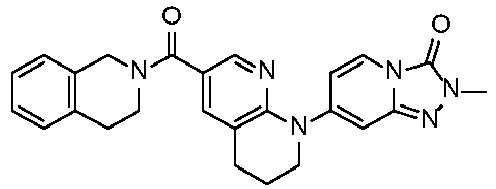
1H NMR (400 MHz, DMSO-d6) δ 1.95-2.08 (2H, m), 2.80-2.92 ( 4H, m), 3.50 (3H, s), 3.64-3.86 (4H, m), 4.71 (2H, s), 6.80 ( 1H, dd, J = 7.6, 2.1 Hz), 6.90-6.93 (1H, m), 7.12-7.26 (4H, m), 7.56-7.60 (1H, m), 7.70 (1H, d, J = 7.3 Hz), 8.09 (1H, d, J = 2.4 Hz). LRMS (ESI+) 441 [M+H]+. 8-131 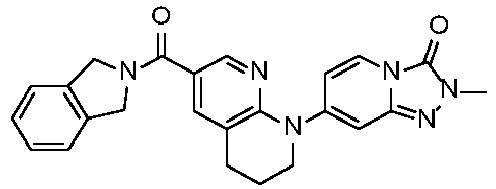
1H NMR (400 MHz, DMSO-d6) δ 1.96-2.09 (2H, m), 2.81-2.92 ( 2H, m), 3.51 (3H, s), 3.83 (2H, t, J = 5.8 Hz), 4.80-4.98 (4 H, m), 6.80 (1H, dd, J = 7.9, 1.8 Hz), 6.93 (1H, d, J = 1.8 Hz), 7.23-7.34 (3H, m), 7.36-7.45 (1H, m), 7.69-7.78 (2H, m), 8.29 (1H, d, J = 2.4 Hz). LRMS (ESI+) 427 [M+H]+. 8-132 
1H NMR (400 MHz, DMSO-d6) δ 1.19 (3H, d, J = 7.3 Hz), 1.3 0-1.77 (6H, m), 1.93-2.07 (2H, m), 2.83 (2H, t, J = 6.4 Hz), 2.91-3.10 (1H, m), 3.50 (3H, s), 3.65-4.07 (3H, m), 4.22-4.5 8 (1H, m), 6.78 (1H, dd, J = 7.6, 2.1 Hz), 6.88 (1H, d, J = 1.8 Hz), 7.44-7.50 (1H, m), 7.69 (1H, d, J = 7.9 Hz), 7.97 (1H, d, J = 2.4 Hz). LRMS (ESI+) 407 [M+H]+. 8-133 
1H NMR (400 MHz, DMSO-d6) δ 1.19 (3H, d, J = 6.7 Hz), 1.3 0-1.75 (6H, m), 1.93-2.06 (2H, m), 2.83 (2H, t, J = 6.4 Hz), 2.90-3.10 (1H, m), 3.50 (3H, s), 3.65-4.06 (3H, m), 4.23-4.5 4 (1H, m), 6.78 (1H, dd, J = 7.6, 2.1 Hz), 6.88 (1H, d, J = 1.2 Hz), 7.46-7.49 (1H, m), 7.69 (1H, d, J = 7.9 Hz), 7.97 (1H, d, J = 2.4 Hz). LRMS (ESI+) 407 [M+H]+. 8-134 
1H NMR (400 MHz, DMSO-d6) δ 0.85 (3H, d, J = 6.7 Hz), 1.0 7-1.70 (4H, m), 1.73-1.85 (1H, m), 1.94-2.08 (2H, m), 2.54-2. 70 (1H, m), 2.77-3.04 (3H, m), 3.49 (3H, s), 3.68-4.17 (4H, m), 6.77 (1H, dd, J = 7.6, 2.1 Hz), 6.85-6.88 (1H, m), 7.45-7.49 (1H, m), 7.66 (1H, d, J = 7.3 Hz), 7.98 (1H, d, J = 2. 4 Hz). LRMS (ESI+) 407 [M+H]+. [Table 146] Example No. Chemical Structural Formula Spectrum Data 8-135 
1H NMR (400 MHz, DMSO-d6) δ 0.85 (3H, d, J = 6.7 Hz), 1.0 9-1.23 (1H, m), 1.34-1.70 (3H, m), 1.73-1.84 (1H, m), 1.95-2. 08 (2H, m), 2.57-2.69 (1H, m), 2.83 (2H, t, J = 6.4 Hz), 2.8 8-3.01 (1H, m), 3.49 (3H, s), 3.72-4.12 (4H, m), 6.77 (1H, d d, J = 7.9, 1.8 Hz), 6.86 (1H, d, J = 1.8 Hz), 7.44-7.49 (1 H, m), 7.65 (1H, d, J = 7.9 Hz), 7.98 (1H, d, J = 1.8 Hz). LRMS (ESI+) 407 [M+H]+. 8-136 
1H NMR (400 MHz, DMSO-d6) δ 0.92 (3H, d, J = 6.1 Hz), 0.9 9-1.16 (2H, m), 1.48-1.75 (3H, m), 1.93-2.06 (2H, m), 2.72-3. 19 (4H, m), 3.50 (3H, s), 3.58-4.54 (4H, m), 6.78 (1H, dd, J = 7.9, 1.8 Hz), 6.89 (1H, d, J = 1.2 Hz), 7.48-7.51 (1H, m ), 7.69 (1H, d, J = 7.9 Hz), 7.99 (1H, d, J = 2.4 Hz). LRMS (ESI+) 407 [M+H]+. 8-137 
1H NMR (400 MHz, DMSO-d6) δ 1.44-1.58 (1H, m), 1.64-2.09 ( 5H, m), 2.83 (2H, t, J = 6.4 Hz), 2.95-3.26 (1H, m), 3.43-3. 61 (4H, m), 3.70-4.18 (4H, m), 4.66-4.87 (1H, m), 6.78 (1H, dd, J = 7.9, 1.8 Hz), 6.90 (1H, d, J = 1.2 Hz), 7.47-7.52 (1 H, m), 7.69 (1H, d, J = 7.3 Hz), 7.99 (1H, d, J = 2.4 Hz). LRMS (ESI+) 411 [M+H]+. 8-138 
1H NMR (400 MHz, DMSO-d6) δ 1.42-1.59 (1H, m), 1.62-1.94 ( 3H, m), 1.95-2.07 (2H, m), 2.83 (2H, t, J = 6.4 Hz), 2.94-3. 27 (1H, m), 3.42-3.60 (4H, m), 3.66-4.19 (4H, m), 4.64-4.88 (1H, m), 6.78 (1H, dd, J = 7.6, 2.1 Hz), 6.90 (1H, d, J = 1 .2 Hz), 7.48-7.51 (1H, m), 7.69 (1H, d, J = 7.9 Hz), 7.99 (1 H, d, J = 2.4 Hz). LRMS (ESI+) 411 [M+H]+. 8-139 
1H NMR (400 MHz, DMSO-d6) δ 1.64-1.75 (2H, m), 1.94-2.18 ( 4H, m), 2.84 (2H, t, J = 6.1 Hz), 3.43-3.64 (5H, m), 3.73-3. 92 (4H, m), 6.74-6.81 (1H, m), 6.88-6.94 (1H, m), 7.48-7.53 (1H, m), 7.69 (1H, d, J = 7.9 Hz), 7.98-8.03 (1H, m). LRMS (ESI+) 429 [M+H]+. 8-140 
1H NMR (400 MHz, DMSO-d6) δ 1.64-1.80 (2H, m), 1.81-2.08 ( 4H, m), 2.83 (2H, t, J = 6.4 Hz), 3.37-3.70 (7H, m), 3.80 (2 H, t, J = 5.8 Hz), 4.80-5.03 (1H, m), 6.78 (1H, dd, J = 7.3, 1.8 Hz), 6.87-6.93 (1H, m), 7.51-7.56 (1H, m), 7.69 (1H, d, J = 7.9 Hz), 8.03 (1H, d, J = 2.4 Hz). LRMS (ESI+) 411 [M+H]+. [Table 147] Example No. Chemical Structural Formula Spectrum Data 8-141 
1H NMR (400 MHz, DMSO-d6) δ 1.12-1.42 (3H, m), 1.47-1.80 ( 3H, m), 1.82-2.06 (3H, m), 2.72-3.27 (4H, m), 3.50 (3H, s), 3.57-4.53 (4H, m), 6.79 (1H, dd, J = 7.6, 2.1 Hz), 6.90 (1H, d, J = 1.2 Hz), 7.47-7.51 (1H, m), 7.69 (1H, d, J = 6.7 H z), 7.99 (1H, d, J = 2.4 Hz). LRMS (ESI+) 425 [M+H]+. 8-142 
1H NMR (400 MHz, DMSO-d6) δ 1.36-1.55 (2H, m), 1.61-1.91 ( 2H, m), 1.93-2.17 (3H, m), 2.73-3.17 (4H, m), 3.50 (3H, s), 3.61-4.47 (4H, m), 5.83-6.20 (1H, m), 6.77 (1H, dd, J = 7.9, 1.8 Hz), 6.90 (1H, d, J = 1.2 Hz), 7.52 (1H, d, J = 1.8 H z), 7.69 (1H, d, J = 7.9 Hz), 8.02 (1H, d, J = 2.4 Hz). LRMS (ESI+) 443 [M+H]+. 8-143 
1H NMR (400 MHz, DMSO-d6) δ 1.34-1.54 (2H, m), 1.62-1.91 ( 2H, m), 1.93-2.17 (3H, m), 2.73-3.17 (4H, m), 3.50 (3H, s), 3.59-4.55 (4H, m), 5.84-6.19 (1H, m), 6.77 (1H, dd, J = 7.6, 2.1 Hz), 6.88-6.92 (1H, m), 7.49-7.54 (1H, m), 7.69 (1H, d, J = 7.3 Hz), 8.02 (1H, d, J = 1.8 Hz). LRMS (ESI+) 443 8-144 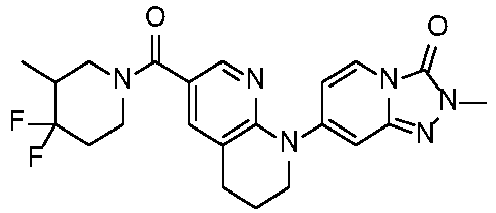
1H NMR (400 MHz, DMSO-d6) δ 0.85-1.05 (3H, m), 1.85-2.28 ( 5H, m), 2.78-3.14 (4H, m), 3.50 (3H, s), 3.67-4.20 (4H, m), 6.78 (1H, dd, J = 7.6, 2.1 Hz), 6.91 (1H, d, J = 1.2 Hz), 7. 54-7.58 (1H, m), 7.70 (1H, d, J = 7.9 Hz), 8.29 (1H, d, J = 1.8 Hz). LRMS (ESI+) 443 [M+H]+. 8-145 
1H NMR (400 MHz, DMSO-d6) δ 1.38-1.81 (3H, m), 1.92-2.08 ( 3H, m), 2.56-2.70 (1H, m), 2.74-3.20 (4H, m), 3.50 (3H, s), 3.62-4.70 (4H, m), 6.77 (1H, dd, J = 7.6, 2.1 Hz), 6.91 (1H, d, J = 1.2 Hz), 7.50-7.55 (1H, m), 7.70 (1H, d, J = 7.3 H z), 8.03 (1H, d, J = 2.4 Hz). LRMS (ESI+) 461 8-146 
1H NMR (400 MHz, DMSO-d6) δ 1.39-1.81 (3H, m), 1.89-2.10 ( 3H, m), 2.55-2.71 (1H, m), 2.73-3.21 (4H, m), 3.50 (3H, s), 3.60-4.51 (4H, m), 6.77 (1H, dd, J = 7.6, 2.1 Hz), 6.91 (1H, d, J = 1.2 Hz), 7.49-7.54 (1H, m), 7.70 (1H, d, J = 7.3 H z), 8.03 (1H, d, J = 2.4 Hz). LRMS (ESI+) 461 [Table 148] Example No. Chemical Structural Formula Spectrum Data 8-147 
1H NMR (400 MHz, DMSO-d6) δ 1.29 (3H, t, J = 7.3 Hz), 1.9 7-2.02 (2H, m), 2.19-2.31 (2H, m), 2.84 (2H, t, J = 6.4 Hz), 3.81 (2H, t, J = 5.8 Hz), 3.89 (2H, q, J = 7.3 Hz), 3.95-4. 13 (2H, m), 4.20-4.53 (2H, m), 6.74 (1H, dd, J = 7.9, 1.8 H z), 6.96 (1H, d, J = 1.2 Hz), 7.65-7.75 (2H, m), 8.20 (1H, d , J = 2.4 Hz). LRMS (ESI+) 379 8-148 
1H NMR (400 MHz, DMSO-d6) δ 1.28 (3H, t, J = 7.3 Hz), 1.7 5-1.89 (4H, m), 1.95-2.05 (2H, m), 2.82 (2H, t, J = 6.4 Hz), 3.39-3.54 (4H, m), 3.79 (2H, t, J = 5.8 Hz), 3.87 (2H, q, J = 7.1 Hz), 6.75 (1H, dd, J = 7.6, 2.1 Hz), 6.91 (1H, d, J = 2.4 Hz), 7.60-7.64 (1H, m), 7.69 (1H, d, J = 7.9 Hz), 8.1 5 (1H, d, J = 2.4 Hz). LRMS (ESI+) 393 8-149 
1H NMR (400 MHz, DMSO-d6) δ 1.29 (3H, t, J = 7.3 Hz), 1.4 2-1.78 (8H, m), 1.95-2.06 (2H, m), 2.83 (2H, t, J = 6.4 Hz), 3.36-3.60 (4H, m), 3.80 (2H, t, J = 5.8 Hz), 3.88 (2H, q, J = 7.1 Hz), 6.77 (1H, dd, J = 7.6, 2.1 Hz), 6.90 (1H, d, J = 1.8 Hz), 7.48-7.52 (1H, m), 7.69 (1H, d, J = 7.9 Hz), 7.9 9 (1H, d, J = 2.4 Hz). LRMS (ESI+) 421 8-150 
1H NMR (400 MHz, DMSO-d6) δ 1.29 (3H, t, J = 7.3 Hz), 1.4 5-1.79 (10H, m), 1.95-2.05 (2H, m), 2.83 (2H, t, J = 6.4 Hz ), 3.34-3.57 (4H, m), 3.80 (2H, t, J = 5.8 Hz), 3.88 (2H, q, J = 7.3 Hz), 6.78 (1H, dd, J = 7.6, 2.1 Hz), 6.90 (1H, d, J = 1.2 Hz), 7.45-7.50 (1H, m), 7.69 (1H, d, J = 7.3 Hz), 7.9 7 (1H, d, J = 2.4 Hz). LRMS (ESI+) 435 8-151 
1H NMR (400 MHz, DMSO-d6) δ 1.29 (3H, t, J = 7.3 Hz), 1.9 4-2.07 (2H, m), 2.83 (2H, t, J = 6.4 Hz), 3.42-3.68 (8H, m), 3.80 (2H, t, J = 5.8 Hz), 3.88 (2H, q, J = 7.3 Hz), 6.77 ( 1H, dd, J = 7.6, 2.1 Hz), 6.93 (1H, d, J = 1.2 Hz), 7.51-7.5 6 (1H, m), 7.70 (1H, d, J = 7.3 Hz), 8.03 (1H, d, J = 1.8 Hz). LRMS (ESI+) 409 [Table 149] Example No. Chemical Structural Formula Spectrum Data 8-152 
1H NMR (400 MHz, DMSO-d6) δ 1.29 (3H, t, J = 7.3 Hz), 1.9 5-2.06 (2H, m), 2.19 (3H, s), 2.24-2.40 (4H, m), 2.83 (2H, t, J = 6.4 Hz), 3.38-3.65 (4H, m), 3.80 (2H, t, J = 5.8 Hz), 3. 88 (2H, q, J = 7.3 Hz), 6.77 (1H, dd, J = 7.6, 2.1 Hz), 6.9 2 (1H, d, J = 1.8 Hz), 7.49-7.53 (1H, m), 7.69 (1H, d, J = 7.9 Hz), 8.00 (1H, d, J = 1.8 Hz). LRMS (ESI+) 422 [M+H]+. 8-153 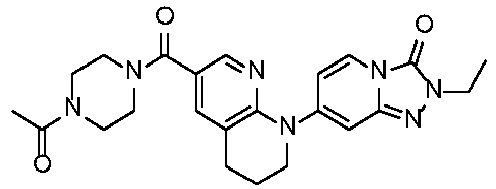
1H NMR (400 MHz, DMSO-d6) δ 1.29 (3H, t, J = 7.3 Hz), 1.9 6-2.07 (5H, m), 2.84 (2H, t, J = 6.4 Hz), 3.40-3.61 (8H, m), 3.81 (2H, t, J = 5.8 Hz), 3.89 (2H, q, J = 7.1 Hz), 6.77 ( 1H, dd, J = 7.6, 2.1 Hz), 6.94 (1H, d, J = 1.2 Hz), 7.52-7.5 6 (1H, m), 7.71 (1H, d, J = 7.3 Hz), 8.05 (1H, d, J = 2.4 Hz). LRMS (ESI+) 450 [M+H]+. 8-154 
1H NMR (400 MHz, DMSO-d6) δ 1.29 (3H, t, J = 7.3 Hz), 1.9 5-2.06 (2H, m), 2.10-2.24 (2H, m), 2.84 (2H, t, J = 6.4 Hz), 3.41-3.71 (2H, m), 3.80 (2H, t, J = 5.8 Hz), 3.88 (2H, q, J = 7.3 Hz), 3.97-4.08 (2H, m), 5.58-5.93 (2H, m), 6.77 (1H, dd, J = 7.6, 2.1 Hz), 6.93 (1H, d, J = 1.2 Hz), 7.51-7.56 (1 H, m), 7.70 (1H, d, J = 7.9 Hz), 8.01-8.06 (1H, m). LRMS (ESI+) 405 [M+H]+. 8-155 
1H NMR (400 MHz, DMSO-d6) δ 1.29 (3H, t, J = 7.3 Hz), 1.9 7-2.08 (2H, m), 2.79-2.93 (4H, m), 3.59-3.94 (6H, m), 4.67-4. 76 (2H, m), 6.80 (1H, dd, J = 7.9, 1.8 Hz), 6.94 (1H, d, J = 1.2 Hz), 7.09-7.29 (4H, m), 7.56-7.60 (1H, m), 7.71 (1H, d, J = 7.3 Hz), 8.09 (1H, d, J = 1.8 Hz). LRMS (ESI+) 455 [M+H]+. 8-156 
1H NMR (400 MHz, DMSO-d6) δ 1.30 (3H, t, J = 7.3 Hz), 1.9 6-2.09 (2H, m), 2.87 (2H, t, J = 6.4 Hz), 3.78-3.94 (4H, m), 4.80-4.97 (4H, m), 6.79 (1H, dd, J = 7.6, 2.1 Hz), 6.96 (1 H, d, J = 1.2 Hz), 7.24-7.45 (4H, m), 7.69-7.78 (2H, m), 8.2 9 (1H, d, J = 2.4 Hz). LRMS (ESI+) 441 [M+H]+. 8-157 
1H NMR (400 MHz, DMSO-d6) δ 1.19 (3H, d, J = 7.3 Hz), 1.2 9 (3H, t, J = 7.3 Hz), 1.33-1.75 (6H, m), 1.95-2.06 (2H, m), 2.83 (2H, t, J = 6.4 Hz), 2.91-3.09 (1H, m), 3.67-4.00 (5H, m), 4.27-4.58 (1H, m), 6.77 (1H, dd, J = 7.6, 2.1 Hz), 6.89-6.92 (1H, m), 7.45-7.49 (1H, m), 7.69 (1H, d, J = 6.7 Hz), 7.96 (1H, d, J = 2.4 Hz). LRMS (ESI+) 421 [M+H]+. [Table 150] Example No. Chemical Structural Formula Spectrum Data 8-158 
1H NMR (400 MHz, DMSO-d6) δ 1.19 (3H, d, J = 7.3 Hz), 1.2 9 (3H, t, J = 7.3 Hz), 1.33-1.75 (6H, m), 1.95-2.05 (2H, m), 2.83 (2H, t, J = 6.4 Hz), 2.93-3.08 (1H, m), 3.72-3.98 (5H, m), 4.29-4.54 (1H, m), 6.77 (1H, dd, J = 7.6, 2.1 Hz), 6.89-6.92 (1H, m), 7.46-7.49 (1H, m), 7.69 (1H, d, J = 6.7 Hz), 7.96 (1H, d, J = 1.8 Hz). LRMS (ESI+) 421 [M+H]+. 8-159 
1H NMR (400 MHz, DMSO-d6) δ 0.68-0.98 (3H, m), 1.08-1.22 ( 1H, m), 1.29 (3H, t, J = 7.3 Hz), 1.34-1.69 (3H, m), 1.73-1. 84 (1H, m), 1.94-2.06 (2H, m), 2.60-3.16 (4H, m), 3.46-4.61 (6H, m), 6.78 (1H, dd, J = 7.6, 2.1 Hz), 6.90-6.93 (1H, m), 7.46-7.51 (1H, m), 7.69 (1H, d, J = 6.7 Hz), 7.98 (1H, d, J = 2.4 Hz). LRMS (ESI+) 421 [M+H]+. 8-160 
1H NMR (400 MHz, DMSO-d6) δ 0.63-1.01 (3H, m), 1.06-1.22 ( 1H, m), 1.29 (3H, t, J = 7.3 Hz), 1.34-1.85 (4H, m), 1.92-2. 08 (2H, m), 2.55-3.16 (4H, m), 3.46-4.46 (6H, m), 6.77 (1H, dd, J = 7.3, 1.8 Hz), 6.91 (1H, d, J = 1.2 Hz), 7.49 (1H, d, J = 1.8 Hz), 7.69 (1H, d, J = 7.9 Hz), 7.98 (1H, d, J = 2 .4 Hz). LRMS (ESI+) 421 [M+H]+. 8-161 
1H NMR (400 MHz, DMSO-d6) δ 0.92 (3H, d, J = 6.7 Hz), 0.9 9-1.15 (2H, m), 1.29 (3H, t, J = 7.3 Hz), 1.53-1.71 (3H, m), 1.95-2.06 (2H, m), 2.60-3.22 (4H, m), 3.46-4.74 (6H, m), 6. 77 (1H, dd, J = 7.6, 2.1 Hz), 6.91 (1H, d, J = 1.2 Hz), 7.4 7-7.51 (1H, m), 7.69 (1H, d, J = 6.7 Hz), 7.99 (1H, d, J = 2.4 Hz). LRMS (ESI+) 421 [M+H]+. 8-162 
1H NMR (400 MHz, DMSO-d6) δ 1.29 (3H, t, J = 7.3 Hz), 1.4 1-1.59 (1H, m), 1.63-2.13 (5H, m), 2.83 (2H, t, J = 6.4 Hz), 2.95-3.27 (1H, m), 3.43-3.60 (1H, m), 3.64-4.31 (6H, m), 4. 65-4.88 (1H, m), 6.77 (1H, dd, J = 7.6, 2.1 Hz), 6.92 (1H, d, J = 1.8 Hz), 7.47-7.52 (1H, m), 7.70 (1H, d, J = 6.7 Hz) , 7.99 (1H, d, J = 2.4 Hz). LRMS (ESI+) 425 [M+H]+. [Table 151] Example No. Chemical Structural Formula Spectrum Data 8-163 
1H NMR (400 MHz, DMSO-d6) δ 1.29 (3H, t, J = 7.3 Hz), 1.4 5-1.94 (4H, m), 1.96-2.08 (2H, m), 2.83 (2H, t, J = 6.4 Hz), 3.02-3.27 (1H, m), 3.42-3.60 (1H, m), 3.66-4.13 (6H, m), 4. 66-4.88 (1H, m), 6.77 (1H, dd, J = 7.6, 2.1 Hz), 6.92 (1H, d, J = 1.8 Hz), 7.47-7.52 (1H, m), 7.70 (1H, d, J = 7.3 Hz) , 7.99 (1H, d, J = 2.4 Hz). LRMS (ESI+) 425 [M+H]+. 8-164 
1H NMR (400 MHz, DMSO-d6) δ 1.29 (3H, t, J = 7.3 Hz), 1.6 3-1.78 (2H, m), 1.94-2.20 (4H, m), 2.84 (2H, t, J = 6.4 Hz), 3.46-3.61 (2H, m), 3.72-3.95 (6H, m), 6.78 (1H, dd, J = 7. 3, 1.8 Hz), 6.93-6.96 (1H, m), 7.48-7.53 (1H, m), 7.70 (1H, d, J = 7.3 Hz), 8.00 (1H, d, J = 1.8 Hz). LRMS (ESI+) 443 [M+H]+. 8-165 
1H NMR (400 MHz, DMSO-d6) δ 1.29 (3H, t, J = 7.3 Hz), 1.6 3-2.06 (6H, m), 2.83 (2H, t, J = 6.4 Hz), 3.39-3.69 (4H, m), 3.80 (2H, t, J = 5.8 Hz), 3.88 (2H, q, J = 7.3 Hz), 4.80-5. 03 (1H, m), 6.77 (1H, dd, J = 7.6, 2.1 Hz), 6.92 (1H, d, J = 1.2 Hz), 7.50-7.55 (1H, m), 7.70 (1H, d, J = 8.5 Hz), 8.0 3 (1H, d, J = 2.4 Hz). LRMS (ESI+) 425 [M+H]+. 8-166 
1H NMR (400 MHz, DMSO-d6) δ 1.02-1.42 (6H, m), 1.49-1.78 ( 3H, m), 1.82-2.08 (3H, m), 2.64-3.28 (4H, m), 4.88-5.21 (6H, m), 6.78 (1H, dd, J = 7.6, 2.1 Hz), 6.90-6.95 (1H, m), 7.46 -7.52 (1H, m), 7.69 (1H, d, J = 6.7 Hz), 7.98 (1H, d, J = 2 .4 Hz). LRMS (ESI+) 439 [M+H]+. 8-167 
1H NMR (400 MHz, DMSO-d6) δ 1.29 (3H, t, J = 7.0 Hz), 1.3 7-1.54 (2H, m), 1.60-1.91 (2H, m), 1.95-2.21 (3H, m), 2.73-3. 22 (4H, m), 3.53-5.30 (6H, m), 5.83-6.21 (1H, m), 6.77 (1H, dd, J = 7.9, 1.8 Hz), 6.92 (1H, d, J = 1.8 Hz), 7.52 (1H, d, J = 2.4 Hz), 7.70 (1H, d, J = 8.5 Hz), 8.02 (1H, d, J = 2 .4 Hz). LRMS (ESI+) 457 [M+H]+. 8-168 
1H NMR (400 MHz, DMSO-d6) δ 1.29 (3H, t, J = 7.0 Hz), 1.3 8-1.54 (2H, m), 1.63-1.92 (2H, m), 1.94-2.22 (3H, m), 2.74-3. 21 (4H, m), 3.47-5.49 (6H, m), 5.82-6.22 (1H, m), 6.77 (1H, dd, J = 7.9, 1.8 Hz), 6.93 (1H, d, J = 1.2 Hz), 7.52 (1H, d, J = 2.4 Hz), 7.70 (1H, d, J = 7.9 Hz), 8.02 (1H, d, J = 2 .4 Hz). LRMS (ESI+) 457 [M+H]+. [Table 152] Example No. Chemical Structural Formula Spectrum Data 8-169 
1H NMR (400 MHz, DMSO-d6) δ 0.84-1.05 (3H, m), 1.29 (3H, t , J = 7.3 Hz), 1.85-2.27 (5H, m), 2.84 (2H, t, J = 6.4 Hz), 2.90-3.07 (1H, m), 3.16-3.31 (1H, m), 3.64-4.29 (6H, m), 6.7 7 (1H, dd, J = 7.9, 1.8 Hz), 6.94 (1H, d, J = 1.2 Hz), 7.53 -7.58 (1H, m), 7.70 (1H, d, J = 7.9 Hz), 8.06 (1H, d, J = 1 .8 Hz). LRMS (ESI+) 457 [M+H]+. 8-170 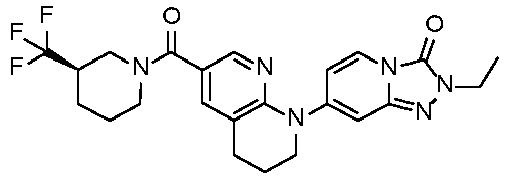
1H NMR (400 MHz, DMSO-d6) δ 1.29 (3H, t, J = 7.0 Hz), 1.4 0-1.79 (3H, m), 1.93-2.06 (3H, m), 2.56-2.70 (1H, m), 2.77-3. 20 (4H, m), 3.45-4.65 (6H, m), 6.76 (1H, dd, J = 7.6, 2.1 H z), 6.93 (1H, d, J = 1.2 Hz), 7.50-7.54 (1H, m), 7.70 (1H, d , J = 7.3 Hz), 8.03 (1H, d, J = 1.8 Hz). LRMS (ESI+) 475 [M+H]+. 8-171 
1H NMR (400 MHz, DMSO-d6) δ 1.29 (3H, t, J = 7.3 Hz), 1.3 9-1.81 (3H, m), 1.89-2.09 (3H, m), 2.57-2.71 (1H, m), 2.74-3. 20 (4H, m), 3.45-4.70 (6H, m), 6.76 (1H, dd, J = 7.3, 1.8 H z), 6.93 (1H, d, J = 1.2 Hz), 7.49-7.55 (1H, m), 7.70 (1H, d , J = 7.9 Hz), 8.03 (1H, d, J = 2.4 Hz). LRMS (ESI+) 475 [M+H]+. 8-172 
1H NMR (400 MHz, CDCl3) δ 1.53 (6H, s), 1.61-1.69 (6H, m), 3.33 (2H, t, J = 5.4 Hz), 3.64 (3H, s), 3.89 (2H, t, J = 4.5 Hz), 4.39 (2H, t, J = 4.5 Hz), 6.63 (1H, d, J = 1.8 Hz), 6.97 (1H, dd, J = 7.6, 2.1 Hz), 7.30 (1H, d, J = 2.4 Hz), 7. 68 (1H, d, J = 7.9 Hz), 7.94 (1H, d, J = 2.4 Hz). LRMS (ESI+) 423[M+H]+. 8-173 
1H NMR (400 MHz, CDCl3) δ 1.57 (6H, s), 1.80-1.89 (4H, m), 3.47-3.54 (2H, m), 3.64 (3H, s), 3.89 (2H, t, J = 4.6 Hz ), 4.39 (2H, t, J = 4.6 Hz), 6.62 (1H, d, J = 1.8 Hz), 6.98 ( 1H, dd, J = 7.9, 1.8 Hz), 7.29 (1H, s), 7.67 (1H, d, J = 7.9 Hz), 7.94 (1H, d, J = 1.8 Hz). LRMS (ESI+): 409 [M+H]+. 8-174 
1H NMR (400 MHz, CDCl3) δ 1.78-1.84 (2H, m), 2.78 (1H, s), 3.61-3.67 (5H, m), 3.72-3.79 (2H, m), 3.91 (2H, t, J = 4. 6 Hz), 4.41 (2H, t, J = 4.6 Hz), 6.61 (1H, t, J = 5.5 Hz), 6. 67 (1H, d, J = 1.8 Hz), 6.95 (1H, dd, J = 7.3, 1.8 Hz), 7.59 (1H, d, J = 1.8 Hz), 7.68 (1H, d, J = 7.3 Hz), 8.19 (1H, d, J = 1.8 Hz). LRMS (ESI+): 385 [M+H]+. [Table 153] Example No. Chemical Structural Formula Spectrum Data 8-175 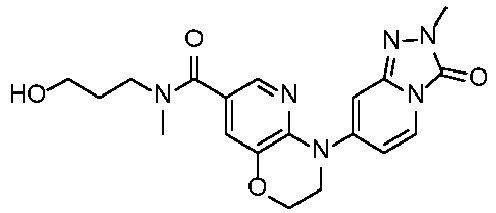
1H NMR (400 MHz, CDCl3) δ 1.80-1.86 (2H, m), 3.06 (3H, s), 3.57-3.62 (2H, m), 3.65 (3H, s), 3.67-3.74 (2H, m), 3.75-3 .83 (1H, m), 3.91 (2H, t, J = 4.6 Hz), 4.41 (2H, t, J = 4.6 Hz), 6.65 (1H, s), 6.97 (1H, dd, J = 7.9, 2.1 Hz), 7.29 (1H, s), 7.69 (1H, d, J = 7.9 Hz), 7.93 (1H, s). LRMS (ESI+): 399 [M+H]+. 8-176 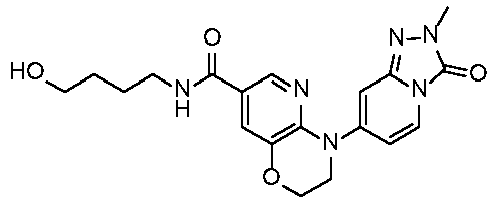
1H NMR (400 MHz, CDCl3) δ 1.64-1.76 (5H, m), 3.50 (2H, q, J = 6.3 Hz), 3.65 (3H, s), 3.74 (2H, q, J = 5.1 Hz), 3.91 (2H, t, J = 4.3 Hz), 4.41 (2H, t, J = 4.3 Hz), 6.53 (1H, s), 6.66 (1H, d, J = 3.1 Hz), 6.96 (1H, dd, J = 7.9, 1.8 Hz), 7. 60 (1H, d, J = 1.8 Hz), 7.68 (1H, dd, J = 7.9, 1.2 Hz), 8.20 (1H, d, J = 1.8 Hz). LRMS (ESI+): 399 [M+H]+. 8-177 
1H NMR (400 MHz, CDCl3) δ 1.30-1.86 (5H, m), 3.06 (3H, s), 3.35-3.72 (7H, m), 3.90 (2H, t, J = 4.6 Hz), 4.41 (2H, t, J = 4.6 Hz), 6.64 (1H, d, J = 1.8 Hz), 6.97 (1H, dd, J = 7. 9, 1.8 Hz), 7.26 (1H, m), 7.68 (1H, d, J = 7.9 Hz), 7.90 (1 H, s). LRMS (ESI+): 413 [M+H]+. 8-178 
1H NMR (400 MHz, CDCl3) δ 1.00 (3H, t, J = 7.3 Hz), 1.5 0-1.55 (1H, m), 1.58-1.61 (1H, m), 2.33 (1H, d, J = 4.3 Hz), 3.27-3.33 (1H, m), 3.65 (3H, s), 3.69-3.79 (2H, m), 3.91 (2 H, t, J = 4.3 Hz), 4.41 (2H, t, J = 4.3 Hz), 6.49 (1H, s), 6. 66 (1H, d, J = 1.2 Hz), 6.96 (1H, dd, J = 7.6, 2.1 Hz), 7.59 (1H, d, J = 2.4 Hz), 7.68 (1H, d, J = 6.7 Hz), 8.22 (1H, d, J = 1.8 Hz). LRMS (ESI+): 399 [M+H]+. 8-179 
1H NMR (400 MHz, CDCl3) δ 1.19-1.28 (6H, m), 3.29 (1H, d, J = 13.9 Hz), 3.40-3.52 (2H, m), 3.64 (3H, s), 3.68-3.86 ( 2H, m), 3.91 (2H, t, J = 4.2 Hz), 4.06-4.18 (1H, m), 4.41 (2 H, t, J = 4.2 Hz), 6.65 (1H, d, J = 1.8 Hz), 6.97 (1H, dd, J = 7.6, 2.1 Hz), 7.28 (1H, d, J = 1.8 Hz), 7.69 (1H, d, J = 7.9 Hz), 7.92 (1H, d, J = 2.4 Hz). LRMS (ESI+): 413 [M+H]+. [Table 154] Example No. Chemical Structural Formula Spectrum Data 8-180 
1H NMR (400 MHz, CDCl3) δ 1.26 (3H, d, J = 6.1 Hz), 1.6 0-1.67 (1H, m), 1.73-1.80 (1H, m), 2.67 (1H, d, J = 3.0 Hz), 3.31-3.39 (1H, m), 3.64 (3H, s), 3.84-3.99 (4H, m), 4.41 (2 H, t, J = 4.5 Hz), 6.66 (1H, d, J = 1.2 Hz), 6.78 (1H, s), 6. 95 (1H, dd, J = 7.6, 2.1 Hz), 7.59 (1H, d, J = 1.8 Hz), 7.68 (1H, d, J = 8.5 Hz), 8.19 (1H, d, J = 1.8 Hz). LRMS (ESI+): 399 [M+H]+ 8-181 
1H NMR (400 MHz, CDCl3) δ 1.24 (3H, d, J = 6.1 Hz), 1.5 0-1.88 (2H, m), 3.06 (3H, s), 3.08-3.19 (1H, m), 3.65 (3H, s) , 3.69-3.78 (1H, m), 3.91 (2H, t, J = 4.3 Hz), 4.08 (1H, s), 4.17-4.29 (1H, m), 4.41 (2H, t, J = 4.3 Hz), 6.65 (1H, d, J = 1.8 Hz), 6.97 (1H, dd, J = 7.6, 2.1 Hz), 7.28 (1H, s), 7.68 (1H, d, J = 7.9 Hz), 7.93 (1H, d, J = 1.8 Hz). LRMS (ESI+): 413 [M+H]+. 8-182 
1H NMR (400 MHz, CDCl3) δ 1.30 (6H, s), 3.19 (3H, s), 3. 59 (2H, s), 3.65 (3H, s), 3.91 (3H, t, J = 4.3 Hz), 4.42 (2H, t, J = 4.3 Hz), 6.65 (1H, d, J = 1.8 Hz), 6.97 (1H, dd, J = 8.6, 1.8 Hz), 7.31 (1H, s), 7.69 (1H, d, J = 8.6 Hz), 7.96 ( 1H, s). LRMS (ESI+): 413 [M+H]+. 8-183 
1H NMR (400 MHz, CDCl3) δ 1.85-2.03 (4H, m), 2.92-3.00 ( 1H, m), 3.55-3.86 (7H, m), 3.91 (2H, t, J = 4.9 Hz), 4.42 (2 H, dd, J = 4.9, 3.7 Hz), 6.66 (1H, d, J = 1.8 Hz), 6.95 (1H, dd, J = 7.6, 2.1 Hz), 7.25 (1H, d, J = 2.4 Hz), 7.69 (1H, d , J = 8.6 Hz), 7.88 (1H, d, J = 1.8 Hz). LRMS (ESI+): 420 [M+H]+. 8-184 
1H NMR (400 MHz, DMSO-d6) δ 2.17-2.28 (2H, m), 3.06 (3H, s), 3.92 -4.05 (4H, m), 4.25-4.39 (4H, m), 4.44 (2H, s), 7.31 (1H, d, J = 1.8 Hz), 7.51 (1H, dd J = 8.5, 1.8 Hz), 7.60-7.66 (2H, m), 7.92 (1H, d, J = 1.8 H z). LRMS (ESI+) 365 [M+H]+. 8-185 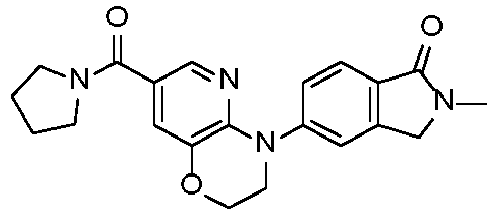
1H NMR (400 MHz, DMSO-d6) δ 1.73-1.91 (4H, m), 3.06 (3H, s), 3.37 -3.55 (4H, m), 3.96 (2H, t, J = 4.5 Hz), 4.35 (2H, t, J = 4.2 Hz), 4.44 (2 H, s), 7.29 (1H, d, J = 1.8 Hz), 7.51 (1H, dd J = 7.9, 1.8 Hz), 7.60-7.65 (2H, m), 7.87 (1H, d, J = 1.8 Hz). LRMS (ESI+) 379 [M+H]+. [Table 155] Example No. Chemical Structural Formula Spectrum Data 8-186 
1H NMR (400 MHz, DMSO-d6) δ 1.40-1.76 (8H, m), 3.05 (3H, s), 3.34 -3.56 (4H, m), 3.95 (2H, t, J = 4.6 Hz), 4.35 (2H, t, J = 4.3 Hz), 4.43 (2 H, s), 7.16 (1H, d, J = 2.4 Hz), 7.51 (1H, dd, J = 7.9, 1.8 Hz), 7.59-7.65 (2H, m), 7.68 (1H, d, J = 2.4 Hz). LRMS (ESI+) 407 [M+H]+. 8-187 
1H NMR (400 MHz, DMSO-d6) δ 1.42-1.79 (10H, m), 3.06 (3H, s), 3.2 7-3.55 (4H, m), 3.96 (2H, t, J = 4.3 Hz), 4.35 (2H, t, J = 4.3 Hz), 4.43 ( 2H, s), 7.13 (1H, d, J = 2.4 Hz), 7.51 (1H, dd, J = 8.3, 2.1 Hz), 7.59-7.6 5 (2H, m), 7.67 (1H, d, J = 1.8 Hz). LRMS (ESI+) 421 [M+H]+. 8-188 
1H NMR (400 MHz, DMSO-d6) δ 3.06 (3H, s), 3.40-3.65 (8H, m), 3.96 (2H, t, J = 4.2 Hz), 4.35 (2H, t, J = 4.2 Hz), 4.43 (2H, s), 7.20 (1H, d, J = 1.8 Hz), 7.51 (1H, dd J = 8.5, 1.8 Hz), 7.59-7.65 (2H, m), 7.73 (1H, d, J = 1.8 Hz). LRMS (ESI+) 395 [M+H]+. 8-189 
1H NMR (400 MHz, DMSO-d6) δ 2.17 (3H, s), 2.24-2.34 (4H, m), 3.06 (3H, s), 3.41-3.56 (4H, m), 3.96 (2H, t, J = 4.6 Hz), 4.35 (2H, t, J = 4.3 Hz), 4.44 (2H, s), 7.16 (1H, d, J = 1.8 Hz), 7.51 (1H, dd, J = 8.6, 1.8 Hz ), 7.60-7.65 (2H, m), 7.70 (1H, d, J = 1.8 Hz). LRMS (ESI+) 408 [M+H]+. 8-190 
1H NMR (400 MHz, DMSO-d6) δ 2.01 (3H, s), 3.06 (3H, s), 3.39-3.59 (8H, m), 3.97 (2H, t, J = 4.3 Hz), 4.36 (2H, t, J = 4.3 Hz), 4.44 (2H, s), 7.21 (1H, d, J = 1.8 Hz), 7.52 (1H, dd, J = 8.6, 1.8 Hz), 7.60-7.66 (2H, m), 7.75 (1H, d, J = 2.4 Hz). LRMS (ESI+) 436 [M+H]+. 8-191 
1H NMR (400 MHz, DMSO-d6) δ 2.07-2.20 (2H, m), 3.06 (3H, s), 3.41 -3.68 (2H, m), 3.90-4.07 (4H, m), 4.36 (2H, t, J = 4.3 Hz), 4.44 (2H, s), 5.59-5.77 (1H, m), 5.79-5.89 (1H, m), 7.19 (1H, d, J = 1.8 Hz), 7.52 (1H, dd, J = 8.6, 1.8 Hz), 7.60-7.66 (2H, m), 7.73 (1H, d, J = 1.8 Hz). LRMS (ESI+) 391 [M+H]+. [Table 156 ] Example No. Chemical Structural Formula Spectrum Data 8-192 
1H NMR (400 MHz, DMSO-d6) δ 2.85 (2H, t, J = 6.1 Hz), 3.06 (3H, s ), 3.60-3.79 (2H, m), 3.98 (2H, t, J = 4.3 Hz), 4.37 (2H, t, J = 4.3 Hz), 4. 44 (2H, s), 4.69 (2H, s), 7.11-7.22 (4H, m), 7.24 (1H, d, J = 2.4 Hz), 7.5 3 (1H, dd J = 7.9, 1.8 Hz), 7.62-7.66 (2H, m), 7.79 (1H, d, J = 1.8 Hz). LRMS (ESI+) 441 [M+H]+. 8-193 
1H NMR (400 MHz, DMSO-d6) δ 3.06 (3H, s), 3.99 (2H, t, J = 4.6 Hz ), 4.38 (2H, t, J = 4.3 Hz), 4.45 (2H, s), 4.84 (2H, s), 4.90 (2H, s), 7.25-7 .32 (3H, m), 7.35-7.40 (1H, m), 7.42 (1H, d, J = 2.4 Hz), 7.54 (1H, dd, J = 7.9, 2.4 Hz), 7.62-7.67 (2H, m), 7.99 (1H, d, J = 2.4 Hz). LRMS (ESI+) 427 [M+H]+. 8-194 
1H NMR (400 MHz, DMSO-d6) δ 0.90 (3H, d, J = 6.1 Hz), 0.98-1.14 (2H, m), 1.52-1.67 (3H, m), 2.70-3.15 (5H, m), 3.54-4.61 (2H, m), 3.96 (2 H, t, J = 4.5 Hz), 4.35 (2H, t, J = 4.2 Hz), 4.43 (2H, s), 7.15 (1H, d, J = 1.8 Hz), 7.51 (1H, dd J = 8.5, 1.8 Hz), 7.60-7.64 (2H, m), 7.68 (1H, d, J = 2.4 Hz). LRMS (ESI+) 407 [M+H]+. 8-195 
1H NMR (400 MHz, DMSO-d6) δ 1.17 (3H, d, J = 7.3 Hz), 127-1.41 (1H, m), 1.42-1.69 (5H, m), 2.90-3.03 (1H, m), 3.06 (3H, s), 3.82-4.01 (3 H, m), 4.29-4.46 (5H, m), 7.13 (1H, d, J = 2.4 Hz), 7.51 (1H, dd, J = 7.9 , 1.8 Hz), 7.59-7.64 (2H, m), 7.66 (1H, d, J = 1.8 Hz). LRMS (ESI+) 407 [M+H]+. 8-196 
1H NMR (400 MHz, DMSO-d6) δ 1.17 (3H, d, J = 7.3 Hz), 127-1.42 (1H, m), 1.43-1.75 (5H, m), 2.90-3.03 (1H, m), 3.06 (3H, s), 3.72-4.05 (3 H, m), 4.23-4.50 (5H, m), 7.13 (1H, d, J = 1.8 Hz), 7.51 (1H, dd, J = 8.3 , 2.1 Hz), 7.59-7.64 (2H, m), 7.66 (1H, d, J = 1.8 Hz). LRMS (ESI+) 407 [M+H]+. 8-197 
1H NMR (400 MHz, DMSO-d6) δ 0.70-0.93 (3H, m), 1.06-1.20 (1H, m ), 1.31-1.47 (1H, m), 1.48-1.68 (2H, m), 1.71-1.80 (1H, m), 2.36-3.01 (2H, m), 3.06 (3H, s), 3.48-3.90 (1H, m), 3.96 (2H, t, J = 4.3 Hz), 4.06-4.29 ( 1H, m), 4.35 (2H, t, J = 4.3 Hz), 4.44 (2H, s), 7.15 (1H, d, J = 1.8 Hz), 7.51 (1H, dd, J = 8.3, 2.1 Hz), 7.60-7.65 (2H, m), 7.68 (1H, d, J = 1.8 H z). LRMS (ESI+) 407 [M+H]+. 8-198 
1H NMR (400 MHz, DMSO-d6) δ 0.84 (3H, d, J = 6.7 Hz), 1.07-1.22 (1H, m), 1.33-1.49 (1H, m), 1.50-1.69 (2H, m), 1.71-1.85 (1H, m), 2.55-2. 70 (1H, m), 2.85-2.99 (1H, m), 3.07 (3H, s), 3.80-4.04 (4H, m), 4.36 (2H, t, J = 4.3 Hz), 4.43 (2H, s), 7.13 (1H, d, J = 1.8 Hz), 7.52 (1H, dd, J = 8.3, 2.1 Hz), 7.59-7.65 (2H, m), 7.69 (1H, d, J = 1.8 Hz). LRMS (ESI+) 407 [M+H]+. [Table 157] Example No. Chemical Structural Formula Spectrum Data 8-199 
1H NMR (400 MHz, DMSO-d6) δ 1.42-1.96 (4H, m), 2.93-3.25 (4H, m ), 3.41-3.57 (1H, m), 3.71-4.06 (4H, m), 4.36 (2H, t, J = 4.6 Hz), 4.44 (2 H, s), 4.64-4.87 (1H, m), 7.14 (1H, d, J = 1.8 Hz), 7.51 (1H, dd, J = 7.9, 1.8 Hz), 7.59-7.65 (2H, m), 7.69 (1H, d, J = 1.8 Hz). LRMS (ESI+) 411 [M+H]+. 8-200 
1H NMR (400 MHz, DMSO-d6) δ 1.38-1.96 (4H, m), 2.97-3.24 (4H, m ), 3.40-3.58 (1H, m), 3.74-4.05 (4H, m), 4.36 (2H, t, J = 4.3 Hz), 4.44 (2 H, s), 4.65-4.85 (1H, m), 7.14 (1H, d, J = 1.8 Hz), 7.51 (1H, dd, J = 7.9, 1.8 Hz), 7.60-7.65 (2H, m), 7.69 (1H, d, J = 1.8 Hz). LRMS (ESI+) 411 [M+H]+. 8-201 
1H NMR (400 MHz, DMSO-d6) δ 1.61-1.73 (2H, m), 2.00-2.16 (2H, m ), 3.06 (3H, s), 3.41-3.59 (2H, m), 3.73-3.89 (2H, m), 3.97 (2H, t, J = 4.3 Hz), 4.36 (2H, t, J = 4.3 Hz), 4.44 (2H, s), 7.15 (1H, d, J = 1.8 Hz), 7.52 (1H, dd, J = 8.3, 2.1 Hz), 7.61-7.65 (2H, m), 7.71 (1H, d, J = 2.4 Hz). LRMS (ESI+) 429 [M+H]+. 8-202 
1H NMR (400 MHz, DMSO-d6) δ 1.62-1.78 (2H, m), 1.79-1.96 (2H, m ), 3.06 (3H, s), 3.38-3.66 (4H, m), 3.96 (2H, t, J = 4.3 Hz), 4.36 (2H, t, J = 4.3 Hz), 4.44 (2H, s), 4.76-5.01 (1H, m), 7.19 (1H, d, J = 1.8 Hz), 7.51 (1H, dd, J = 7.9, 1.8 Hz), 7.59-7.66 (2H, m), 7.73 (1H, d, J = 1.8 Hz). LRMS (ESI+) 411 [M+H]+. 8-203 
1H NMR (400 MHz, DMSO-d6) δ 1.19-1.35 (1H, m), 1.36-1.51 (1H, m ), 1.54-1.79 (2H, m), 1.81-1.99 (1H, m), 2.69-3.12 (5H, m), 3.64-4.50 (10 H, m), 7.17 (1H, d, J = 1.8 Hz), 7.51 (1H, dd, J = 8.3, 2.1 Hz), 7.59-7.65 (2H, m), 7.71 (1H, d, J = 1.8 Hz). LRMS (ESI+) 425 [M+H]+. 8-204 
1H NMR (400 MHz, DMSO-d6) δ 120-1.36 (1H, m), 1.36-1.51 (1H, m ), 1.54-1.79 (2H, m), 1.81-2.00 (1H, m), 2.68-3.11 (5H, m), 3.51-4.50 (10 H, m), 7.17 (1H, d, J = 1.8 Hz), 7.51 (1H, dd, J = 8.6, 1.8 Hz), 7.59-7.65 (2H, m), 7.71 (1H, d, J = 1.8 Hz). LRMS (ESI+) 425 [M+H]+. 8-205 
1H NMR (400 MHz, DMSO-d6) δ 1.35-1.51 (2H, m), 1.60-1.75 (1H, m ), 1.77-1.92 (1H, m), 1.94-2.19 (1H, m), 2.76-3.12 (5H, m), 3.40-4.61 (8H, m), 5.90-6.11 (1H, m), 7.19 (1H, d, J = 2.4 Hz), 7.51 (1H, dd J = 7.9, 1.8 Hz), 7.59-7.67 (2H, m), 7.72 (1H, d, J = 2.4 Hz). LRMS (ESI+) 443 [M+H]+. [Table 158] Example No. Chemical Structural Formula Spectrum Data 8-206 
1H NMR (400 MHz, DMSO-d6) δ 1.35-1.52 (2H, m), 1.60-1.75 (1H, m ), 1.76-1.90 (1H, m), 1.95-2.14 (1H, m), 2.74-3.12 (5H, m), 3.57-4.49 (8H, m), 5.80-6.19 (1H, m), 7.19 (1H, d, J = 2.4 Hz), 7.51 (1H, dd J = 7.9, 1.8 Hz), 7.59-7.66 (2H, m), 7.72 (1H, d, J = 2.4 Hz). LRMS (ESI+) 443 [M+H]+. 8-207 
1H NMR (400 MHz, DMSO-d6) δ 1.41-1.62 (2H, m), 1.63-1.77 (1H, m ), 1.90-2.02 (1H, m), 2.55-2.71 (1H, m), 2.82-3.16 (5H, m), 3.68-4.04 (3H, m), 4.27-4.51 (5H, m), 7.19 (1H, d, J = 1.8 Hz), 7.52 (1H, dd J = 8.3, 2.1 Hz), 7.60-7.65 (2H, m), 7.73 (1H, d, J = 1.8 Hz). LRMS (ESI+) 461 [M+H]+. 8-208 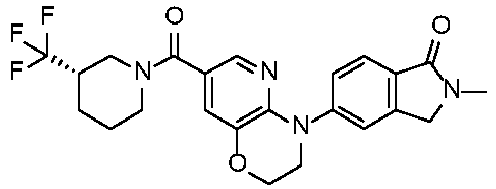
1H NMR (400 MHz, DMSO-d6) δ 1.40-1.63 (2H, m), 1.64-1.79 (1H, m ), 1.88-2.05 (1H, m), 2.41-2.75 (1H, m), 2.86-3.25 (5H, m), 3.90-4.11 (3H, m), 4.27-4.63 (5H, m), 7.19 (1H, s), 7.52 (1H, d, J = 8.6 Hz), 7.60-7.67 (2H, m), 7.73 (1H, s). LRMS (ESI+) 461 [M+H]+. 8-209 
1H NMR (400 MHz, DMSO-d6) δ 1.10-1.42 (3H, m), 1.47-1.78 (3H, m ), 1.80-1.93 (1H, m), 2.66-3.02 (1H, m), 3.06 (3H, s), 3.08-3.30 (1H, m), 3.58-4.51 (8H, m), 7.13 (1H, d, J = 1.8 Hz), 7.52 (1H, dd J = 7.9, 1.8 H z), 7.60-7.65 (2H, m), 7.69 (1H, d, J = 1.8 Hz). LRMS (ESI+) 425 [M+H]+. 8-210 
1H NMR (400 MHz, DMSO-d6) δ 0.92 (3H, d, J = 5.5 Hz), 1.86-2.25 (3H, m), 2.85-3.03 (1H, m), 3.06 (3H, s), 3.14-3.28 (1H, m), 3.60-4.12 (4 H, m), 4.36 (2H, t, J = 4.3 Hz), 4.44 (2H, s), 7.23 (1H, d, J = 1.8 Hz), 7. 52 (1H, dd, J = 8.3, 2.1 Hz), 7.59-7.67 (2H, m), 7.76 (1H, d, J = 1.8 Hz) LRMS (ESI+) 443 [M+H]+. 8-211 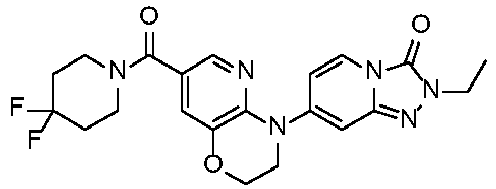
1H NMR (400 MHz, DMSO-d6) δ 1.28 (3H, t, J = 7.0 Hz), 1.95-2.10 (4H, m), 3.58 (4H, s), 3.88 (2H, q, J = 7.1 Hz), 3. 94 (2H, t, J = 4.3 Hz), 4.37 (2H, t, J = 4.6 Hz), 6.92 (1H, d, J = 1.2 Hz), 6.97 (1H, dd, J = 7.6, 2.1 Hz), 7.30 (1H, d, J = 1.8 Hz), 7.76 (1H, d, J = 8.6 Hz), 7.85 (1H, d, J = 1.8 Hz). LRMS (ESI+) 445 [M+H]+. [Table 159] Example No. Chemical Structural Formula Spectrum Data 8-212 
1H NMR (400 MHz, DMSO-d6) δ 1.16 (3H, t, J = 7.3 Hz), 1.95-2.09 (4H, m), 3.46-3.68 (6H, m), 3.96 (2H, t, J = 4.3 H z), 4.36 (2H, t, J = 4.3 Hz), 4.45 (2H, s), 7.24 (1H, d, J = 1.8 Hz), 7.51 (1H, dd, J = 8.3, 2.1 Hz), 7.60-7.66 (2H, m), 7.76 (1H, d, J = 1.8 Hz). LRMS (ESI+) 443 [M+H]+. 8-213 
1H NMR (400 MHz, DMSO-d6) δ 1.25 (3H, t, J = 7.0 Hz), 1.39-1.67 (6H, m), 3.44 (4H, s), 3.93-4.03 (4H, m), 4.36 (2H, t, J = 4.6 Hz), 7.20 (1H, d, J = 1.8 Hz), 7.44 (1H, dd, J = 8.6, 1.8 Hz), 7.52 (1H, d, J = 1.2 Hz), 7.70 (1H, d, J = 8. 6 Hz), 7.74 (1H, d, J = 1.8 Hz). LRMS (ESI+) 409 [M+H]+. 8-214 
1H NMR (400 MHz, DMSO-d6) δ 1.25 (3H, t, J = 7.0 Hz), 1.95-2.10 (4H, m), 3.50-3.66 (4H, m), 3.92-4.05 (4H, m), 4.3 7 (2H, t, J = 4.3 Hz), 7.28 (1H, d, J = 1.8 Hz), 7.45 (1H, d d, J = 8.6, 1.8 Hz), 7.52 (1H, d, J = 1.2 Hz), 7.71 (1H, d, J = 8.6 Hz), 7.82 (1H, d, J = 1.8 Hz). LRMS (ESI+) 445 [M+H]+. 8-215 
1H NMR (400 MHz, DMSO-d6) δ 1.40-1.64 (9H, m), 3.35-3. 52 (4H, m), 3.99 (2H, t, J = 4.3 Hz), 4.36 (2H, t, J = 4.3 Hz), 4.44 (2H, q, J = 6.9 Hz), 7.17 (1H, d, J = 1.8 Hz), 7.4 9 (1H, dd, J = 8.6, 1.8 Hz), 7.62 (1H, d, J = 1.2 Hz), 7.65 (1H, d, J = 8.6 Hz), 7.71 (1H, d, J = 1.8 Hz). LRMS (ESI+) 409 [M+H]+. 8-216 
1H NMR (400 MHz, DMSO-d6) δ 1.44 (3H, t, J = 7.0 Hz), 1.95-2.08 (4H, m), 3.52-3.64 (4H, m), 4.00 (2H, t, J = 4.3 H z), 4.37 (2H, t, J = 4.3 Hz), 4.44 (2H, q, J = 6.9 Hz), 7.26 (1H, d, J = 1.8 Hz), 7.49 (1H, dd, J = 8.6, 1.8 Hz), 7.63 (1 H, d, J = 1.2 Hz), 7.65 (1H, d, J = 9.2 Hz), 7.79 (1H, d, J = 2.4 Hz). LRMS (ESI+) 445 [M+H]+. 8-217 
1H NMR (400 MHz, DMSO-d6) δ 1.28 (3H, t, J = 7.3 Hz), 2.14 (2H, s), 3.39-3.74 (2H, m), 3.81-4.07 (6H, m), 4.36 (2H, t, J = 4.3 Hz), 5.54-5.88 (2H, m), 6.92 (1H, d, J = 1.8 Hz) , 6.98 (1H, dd, J = 7.6, 2.1 Hz), 7.24 (1H, d, J = 1.8 Hz), 7.76 (1H, d, J = 7.9 Hz), 7.82 (1H, d, J = 1.8 Hz). LRMS (ESI+) 407 [M+H]+. [Table 160] Example No. Chemical Structural Formula Spectrum Data 8-218 
1H NMR (400 MHz, DMSO-d6) δ 1.17-1.25 (2H, m), 1.28 (3 H, t, J = 7.0 Hz), 1.60-1.69 (2H, m), 1.99 (2H, t, J = 5.5 H z), 3.24 (2H, t, J = 5.2 Hz), 3.88 (2H, q, J = 7.1 Hz), 3.94 (2H, t, J = 4.3 Hz), 4.32 (2H, d, J = 7.3 Hz), 4.37 (2H, t, J = 4.6 Hz), 4.62 (2H, d, J = 6.7 Hz), 6.92-6.98 (2H, m), 7.3 0 (1H, d, J = 1.8 Hz), 7.76 (1H, d, J = 8.6 Hz), 7.91 (1H, d, J = 1.8 Hz). LRMS (ESI+) 451 [M+H]+. 8-219 
1H NMR (400 MHz, DMSO-d6) δ 1.28 (3H, t, J = 7.0 Hz), 2.01 (3H, s), 3.39-3.62 (8H, m), 3.88 (2H, q, J = 7.1 Hz), 3. 94 (2H, t, J = 4.6 Hz), 4.37 (2H, t, J = 4.6 Hz), 6.93 (1H, d, J = 1.2 Hz), 6.97 (1H, dd, J = 7.3, 1.8 Hz), 7.27 (1H, d, J = 2.4 Hz), 7.76 (1H, d, J = 6.7 Hz), 7.84 (1H, d, J = 1.8 Hz). LRMS (ESI+) 452 [M+H]+. 8-220 
1H NMR (400 MHz, DMSO-d6) δ 1.28 (3H, t, J = 7.0 Hz), 1.40 (9H, s), 3.36 (4H, s), 3.47 (4H, s), 3.88 (2H, q, J = 7.3 Hz), 3.93 (2H, t, J = 4.3 Hz), 4.37 (2H, t, J = 4.6 Hz), 6.9 3 (1H, d, J = 1.2 Hz), 6.97 (1H, dd, J = 7.9, 1.8 Hz), 7.25 (1H, d, J = 1.8 Hz), 7.76 (1H, d, J = 8.6 Hz), 7.82 (1H, d, J = 1.8 Hz). LRMS (ESI+) 510 [M+H]+. 8-221 
1H NMR (400 MHz, DMSO-d6) δ 1.28 (3H, t, J = 7.0 Hz), 2.85 (3H, s), 3.36 (2H, t, J = 5.5 Hz), 3.72 (2H, s), 3.88 (2 H, q, J = 7.1 Hz), 3.94 (2H, t, J = 4.6 Hz), 4.08 (2H, s), 4. 37 (2H, t, J = 4.3 Hz), 6.93 (1H, d, J = 1.8 Hz), 6.98 (1H, dd, J = 7.9, 1.8 Hz), 7.29 (1H, d, J = 1.8 Hz), 7.76 (1H, d, J = 7.9 Hz), 7.86 (1H, d, J = 2.4 Hz). LRMS (ESI+) 438 [M+H]+. 8-222 
1H NMR (400 MHz, DMSO-d6) δ 1.47-1.66 (6H, m), 3.46 (3H, s), 3.58 (4H, t, J = 5.2 Hz), 3.80 (2H, t, J = 4.3 Hz), 4.30 ( 2H, t, J = 4.3 Hz), 6.73 (1H, d, J = 1.2 Hz), 6.82 (1H, dd, J = 7.9, 2.4 Hz), 7.06 (1H, s), 7.85 (1H, d, J = 7.9 Hz). LRMS (ESI+) 400 [M+H]+. [Table 161] Example No. Chemical Structural Formula Spectrum Data 8-223 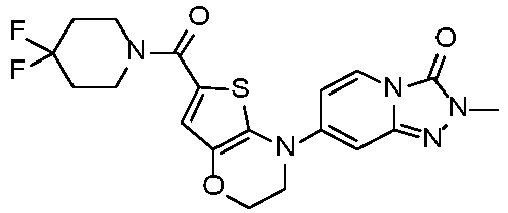
1H NMR (400 MHz, DMSO-d6) δ 1.97-2.12 (4H, m), 3.46 (3H, s), 3.72 (4H, t, J = 5.5 Hz), 3.81 (2H, t, J = 4.3 Hz), 4.31 ( 2H, t, J = 4.0 Hz), 6.75 (1H, d, J = 1.8 Hz), 6.82 (1H, dd, J = 7.9, 2.4 Hz), 7.19 (1H, s), 7.86 (1H, d, J = 7.3 Hz). LRMS (ESI+) 436 [M+H]+. 8-224 
1H NMR (400 MHz, DMSO-d6) δ 1.36-1.59 (6H, m), 1.70 (4H, s), 3.46 (3H, s), 3.59 (4H, s), 3.80 (2H, t, J = 4.0 Hz), 4.30 (2H, t, J = 4.3 Hz), 6.73 (1H, d, J = 1.8 Hz), 6.83 (1H, dd, J = 7.6, 2.1 Hz), 7.08 (1H, s), 7.86 (1H, d, J = 7.3 Hz). LRMS (ESI+) 428 [M+H]+. 8-225 
1H NMR (400 MHz, DMSO-d6) δ 3.38-3.68 (11H, m), 3.93 (2H, t, J = 4.6 Hz), 4.36 (2H, t, J = 4.6 Hz), 6.89 (1H, d, J = 1. 8 Hz), 6.98 (1H, dd, J = 7.9, 1.8 Hz), 7.25 (1H, d, J = 2.4 Hz), 7.75 (1H, d, J = 8.6 Hz), 7.82 (1H, d, J = 1.8 Hz). LRMS (ESI+) 397 [M+H]+. 8-226 
1H NMR (400 MHz, DMSO-d6) δ 2.17 (3H, s), 2.22-2.38 (4H, m), 3.35-3.65 (7H, m), 3.93 (2H, t, J = 4.6 Hz), 4.36 (2H, t, J = 4.6 Hz), 6.89 (1H, d, J = 1.2 Hz), 6.98 (1H, dd, J = 7 .6, 2.1 Hz), 7.22 (1H, d, J = 1.8 Hz), 7.75 (1H, d, J = 7.9 Hz), 7.79 (1H, d, J = 1.8 Hz). LRMS (ESI+) 410 [M+H]+. 8-227 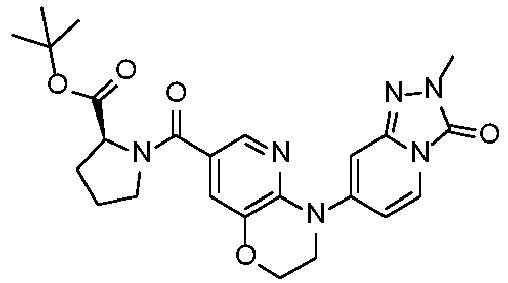
1H NMR (400 MHz, DMSO-d6) δ 1.23 (3H, s), 1.39 (6H, s), 1.7 2-1.95 (3H, m), 2.17-2.33 (1H, m), 3.44-3.66 (5H, m), 3.87-4. 00 (2H, m), 4.24-4.51 (3H, m), 6.86-7.01 (2H, m), 7.16-7.34 (1H, m), 7.76 (1H, d, J = 7.9 Hz), 7.80-7.99 (1H, m). LRMS (ESI+) 481 [M+H]+. 8-228 
1H NMR (400 MHz, DMSO-d6) δ 1.23 (3H, s), 1.39 (6H, s), 1.7 4-1.95 (3H, m), 2.15-2.30 (1H, m), 3.42-3.68 (5H, m), 3.85-4. 00 (2H, m), 4.25-4.52 (3H, m), 6.86-7.00 (2H, m), 7.17-7.35 (1H, m), 7.76 (1H, d, J = 7.9 Hz), 7.79-7.99 (1H, m). LRMS (ESI+) 481 [M+H]+. [Table 162] Example No. Chemical Structural Formula Spectrum Data 8-229 
1H NMR (400 MHz, DMSO-d6) δ 2.12-2.18 (2H, m), 3.49 (3 H, s), 3.56 (2H, t, J = 5.8 Hz), 3.94 (2H, t, J = 4.2 Hz), 3. 98-4.03 (2H, m), 4.37 (2H, t, J = 4.2 Hz), 5.66-5.73 (1H, m) , 5.81-5.88 (1H, m), 6.90 (1H, d, J = 1.8 Hz), 6.97 (1H, dd, J = 7.3, 2.4 Hz), 7.21 (1H, d, J = 1.8 Hz), 7.70 (1H, d, J = 7.3 Hz), 7.82 (1H, d, J = 2.4 Hz). LRMS (ESI+) 393 [M+H]+. 8-230 
1H NMR (400 MHz, DMSO-d6) δ 1.27-1.42 (2H, m), 1.66-1. 81 (2H, m), 3.14-3.25 (2H, m), 3.50 (3H, s), 3.56-4.02 (5H, m), 4.37 (2H, t, J = 1.8 Hz), 4.78 (1H, d, J = 4.2 Hz), 6.89 (1H, d, J = 1.2 Hz), 6.99 (1H, dd, J = 7.9, 1.8 Hz), 7.22 ( 1H, d, J = 1.8 Hz), 7.76 (1H, d, J = 7.9 Hz), 7.79 (1H, d, J = 1.8 Hz). LRMS (ESI+) 411 [M+H]+. 8-231 
1H NMR (400 MHz, DMSO-d6) δ 1.26-1.36 (2H, m), 1.39-1. 55 (4H, m), 3.19-3.26 (2H, m), 3.35-3.41 (2H, m), 3.51 (3H, s), 3.95 (2H, t, J = 4.2 Hz), 4.33-4.40 (3H, m), 6.92 (1H, d, J = 1.8 Hz), 6.97 (1H, dd, J = 7.9, 2.4 Hz), 7.61 (1H, d, J = 2.4 Hz), 7.77 (1H, d, J = 7.9 Hz), 8.24 (1H, d, J = 1.8 H z), 8.36 (1H, t, J = 5.8 Hz). LRMS (ESI+) 413 [M+H]+. -

- To a solution of methyl 4-(4-(tert-butoxycarbonyl)phenyl)-8-cyclopropyl-3,4-dihydro-2H-benzo[b][1,4]oxazine-7-carboxylate (31.4 mg) in tetrahydrofuran (1.0 mL), a 1 mol/L lithium hydroxide aqueous solution (0.23 mL) was added, followed by stirring at room temperature for 4 hours, at 65°C for 3.5 hours, and at 70°C for 9 hours. After adding a 1 mol/L lithium hydroxide aqueous solution (0.23 mL) thereto, the resultant reaction solution was heated to reflux for 10 hours. The resultant was stirred at room temperature for 5.5 days, a 1 mol/L hydrogen chloride aqueous solution (460 µL) was added to the reaction solution, the resultant was concentrated under reduced pressure, and the thus obtained residue was washed with water. The residue was dissolved in ethyl acetate, and dried over sodium sulfate. The resultant was filtered, and the thus obtained filtrate was concentrated under reduced pressure to obtain a crude product containing 4-(4-(tert-butoxycarbonyl)phenyl)-8-cyclopropyl-3,4-dihydro-2H-benzo[b][1,4]oxazine-7-carboxylic acid (17.1 mg).
- To a solution, in N,N-dimethylformamide (0.5 mL), of the crude product (17.1 mg) containing 4-(4-(tert-butoxycarbonyl)phenyl)-8-cyclopropyl-3,4-dihydro-2H-benzo[b][1,4]oxazine-7-carboxylic acid, piperidine (6.4 µL) and diisopropylethylamine (22.1 µL) were added. To the resultant reaction solution, 1-[bis(dimethylamino)methylene]-1H-1,2,3-triazolo[4,5-b]pyridinium 3-oxide hexafluorophosphate (24.6 mg) was added, followed by stirring at room temperature for 2.5 hours. The resultant reaction solution was concentrated under reduced pressure, and the thus obtained residue was purified by silica gel column chromatography (ethyl acetate:hexane = 5:95 to 30:70) to obtain a mixture containing tert-butyl 4-(8-cyclopropyl-7-(piperidine-1-carbonyl)-2,3-dihydro-4H-benzo[b][1,4]oxazin-4-yl)benzoate (12.5 mg).
- To a solution, in dichloromethane (0.5 mL), of the mixture (12.5 mg) containing tert-butyl 4-(8-cyclopropyl-7-(piperidine-1-carbonyl)-2,3-dihydro-4H-benzo[b][1,4]oxazin-4-yl)benzoate, trifluoroacetic acid (0.25 mL) was added. After stirring at room temperature for 2.5 hours, the resultant reaction solution was concentrated under reduced pressure, and the thus obtained residue was purified by silica gel column chromatography (acetonitrile:water = 5:95 to 60:40 to 80:20) to obtain the title compound (10.1 mg).
- 1H NMR (400 MHz, DMSO-d6) δ: 0.48-0.57 (1H, m), 0.73-0.76 (3H, m), 1.32-1.71 (7H, m), 3.17 (2H, t, J = 5.5 Hz), 3.45-3.55 (1H, m), 3.59-3.68 (1H, m), 3.73-3.79 (2H, m), 4.23-4.29 (2H, m), 6.50 (1H, d, J = 8.6 Hz), 6.91 (1H, d, J = 7.9 Hz), 7.26 (2H, d, J = 9.2 Hz), 7.87 (2H, d, J = 8.6 Hz). (COOH peak missing)
- LRMS (ESI+) 407 [M+H]+.
-

- To a solution of methyl 4-(7-(piperidine-1-carbonyl)-2,3-dihydro-4H-benzo[b][1,4]oxazin-4-yl)benzoate (46.2 mg) in tetrahydrofuran (1.2 mL), methylmagnesium bromide (100 µL; 3 mol/L diethyl ether solution) was added under ice cooling, followed by stirring for 50 minutes. After stirring at room temperature for 13.5 hours, methylmagnesium bromide (100 µL; 3 mol/L diethyl ether solution) was added thereto, followed by stirring at room temperature for 23.5 hours. To the resultant reaction solution, a saturated ammonium chloride aqueous solution (5 mL) and water (5 mL) were added, followed by extraction with ethyl acetate (10 mL x 2). The resultant organic layers were combined, dried over anhydrous sodium sulfate, and filtered, and the resultant filtrate was concentrated under reduced pressure. The thus obtained residue was purified by silica gel column chromatography (ethyl acetate:hexane = 10:90 to 80:20) to obtain the title compound (30.8 mg).
- 1H NMR (400 MHz, DMSO-d6) δ 1.40-1.51 (10H, m), 1.55-1.62 (2H, m), 3.38-3.46 (4H, m), 3.68 (2H, t, J = 4.2 Hz), 4.27 (2H, t, J = 4.2 Hz), 4.99 (1H, s), 6.69 (1H, d, J = 8.5 Hz), 6.73 (1H, dd, J = 8.5, 1.8 Hz), 6.80 (1H, d, J = 1.2 Hz), 7.18-7.23 (2H, m), 7.46-7.51 (2H, m).
- LRMS (ESI+) 381 [M+H]+.
- Compounds of the following Examples 10-2 to 10-3 were obtained in the same manner as in Example 10-1 by using corresponding starting materials and reactants. Their structures and spectrum data are shown in the following table.
[Table 163] Example No. Chemical Structural Formula Spectrum Data 10-2 
1H NMR (400 MHz, DMSO-d6) δ 1.31-1.62 (12H, m), 3.06-3.18 (2H, m), 3.48-3.61 (2H, m), 3.70 (2H, t, J = 4.3 Hz), 4.34-4.39 (2H, m), 5.00 ( 1H, s), 6.60 (1H, d, J = 8.6 Hz), 6.64 (1H, d, J = 8.6 Hz), 7.18-7.23 (2H, m), 7.46-7.51 (2H, m). LRMS (ESI+) 415 [M+H]+. 10-3 
1H NMR (400MHz, CDCl3) δ 1.45-1.76 (12H, m), 3.40-3.70 ( 4H, m), 3.91 (2H, t, J = 4.6 Hz), 4.34 (2H, t, J = 4.3 Hz), 7.19 (1H, d, J = 1.8 Hz), 7.32-7.37 (2H, m), 7.50-7.55 (2H, m), 7.83 (1H, d, J = 1.8 Hz). (OH peak missing) LRMS (ESI+) 382 [M+H]+. -

- A solution, in toluene (4.2 mL), of (3,4-dihydro-2H-benzo[b][1,4]oxazin-7-yl)(piperidin-1-yl)methanone (103 mg), methyl 6-bromonicotinate (108 mg; commercially available product), palladium (II) acetate (4.7 mg), 2-dicyclohexylphospino-2',4',6'-triisopropylbiphenyl (15.0 mg) and cesium carbonate (163 mg) was stirred at an external temperature of 105°C for 3 hours, and then stirred under heating to reflux for 8 hours. The resultant reaction solution was concentrated under reduced pressure, and the thus obtained residue was purified by silica gel column chromatography (ethyl acetate:hexane = 10:90 to 80:20 to 100:0) to obtain the title compound (35.7 mg).
- 1H NMR (400 MHz, CDCl3) δ 1.48-1.74 (6H, m), 3.32-3.78 (4H, m), 3.91 (3H, s), 4.22 (2H, t, J = 4.5 Hz), 4.32 (2H, t, J = 4.5 Hz), 6.93 (1H, dd, J = 8.5, 1.8 Hz), 7.01 (1H, d, J = 1.8 Hz), 7.29 (1H, s), 7.40 (1H, d, J = 8.5 Hz), 8.08 (1H, dd, J = 8.5, 2.4 Hz), 8.92 (1H, d, J = 2.4 Hz).
- LRMS (ESI+) 382 [M+H]+.
- Compounds of the following Examples 11-2 to 11-7 were obtained in the same manner as in Example 11-1 by using corresponding starting materials and reactants. Their structures and spectrum data are shown in the following tables.
[Table 164] Example No. Chemical Structural Formula Spectrum Data 11-2 
1H NMR (400 MHz, CDCl3) δ 1.45-1.72 (6H, m), 3.34-3.75 ( 4H, m), 3.82 (2H, t, J = 4.2 Hz), 4.00 (3H, s), 4.33 (2H, t, J = 4.2 Hz), 6.87 (1H, dd, J = 8.5, 1.8 Hz), 7.01 (1H, d, J = 2.4 Hz), 7.11 (1H, d, J = 8.5 Hz), 7.62 (1H, dd, J = 8.5, 2.4 Hz), 8.09 (1H, d, J = 8.5 Hz), 8.64 (1H, d, J = 3.0 Hz). LRMS (ESI+) 382 [M+H]+. 11-3 
1H NMR (400 MHz, DMSO-d6) δ: 1.36-1.69 (6H, m), 3.22-3. 92 (4H, m), 3.97 (3H, s), 4.01 (2H, t, J = 4.3 Hz), 4.38 (2H , t, J = 4.3 Hz), 7.17 (1H, d, J = 1.8 Hz), 7.70 (1H, d, J = 1.8 Hz), 7.79 (1H, dd, J = 8.9, 2.1 Hz), 8.16 (1H, d, J = 9. 2 Hz), 8.22 (1H, d, J = 2.4 Hz). LRMS (ESI+) 439 [M+H]+. [Table 165] Example No. Chemical Structural Formula Spectrum Data 11-4 
1H NMR (400 MHz, DMSO-d6) δ 1.39-1.64 (6H, m), 3.17-3.58 (7H, m ), 3.95 (2H, t, J = 4.3 Hz), 4.36 (2H, t, J = 4.6 Hz), 6.97-7.03 (3H, m), 7. 21 (1H, d, J = 1.8 Hz), 7.50 (1H, t, J = 1.5 Hz), 7.79 (1H, d, J = 1.8 Hz ), 7.97 (1H, s). LRMS (ESI+) 461 [M+H]+. 11-5 
1H NMR (400 MHz, DMSO-d6) δ 1.45-1.67 (6H, m), 3.38-3.56 ( 4H, m), 3.87 (3H, s), 4.37 (4H, s), 7.21 (1H, d, J = 1.8 Hz) , 7.53 (1H, d, J = 9.2 Hz), 7.63 (1H, dd, J = 9.8, 1.8 Hz), 7.97 (1H, d, J = 1.8 Hz), 8.74 (1H, s), 9.36 (1H, d, J = 1.8 Hz). LRMS (ESI+) 422 [M+H]+. 11-6 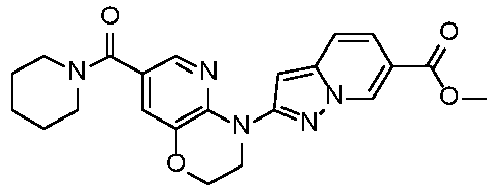
1H NMR (400 MHz, DMSO-d6) δ 1.42-1.67 (6H, m), 3.37-3.58 ( 4H, m), 3.86 (3H, s), 4.27 (2H, t, J = 4.3 Hz), 4.38 (2H, t, J = 4.6 Hz), 7.24 (1H, d, J = 2.4 Hz), 7.47 (1H, d, J = 1.2 Hz), 7.56 (1H, dd, J = 9.2, 1.8 Hz), 7.66 (1H, dd, J = 9.2, 1.2 Hz), 7.95 (1H, d, J = 1.8 Hz), 9.06 (1H, s). LRMS (ESI+) 422 [M+H]+. 11-7 
1H NMR (400MHz, CDCl3) δ 1.42-1.79 (6H, m), 3.26-3.79 (4 H, m), 3.94-4.04 (5H, m), 4.41 (2H, t, J = 4.3 Hz), 7.23-7.2 9 (1H, m), 7.84 (1H, t, J = 1.5 Hz), 7.94 (1H, dd, J = 8.6, 1.8 Hz), 8.15 (1H, dd, J = 8.6, 1.2 Hz), 8.85 (1H, d, J = 2. 4 Hz). LRMS (ESI+) 383 [M+H]+. -

- To a solution of ethyl 4-(4-(tert-butoxycarbonyl)phenyl)-3,4-dihydro-2H-thieno[3,2-b][1,4]oxazine-6-carboxylate (60.5 mg) in tetrahydrofuran (3.1 mL), a solution of lithium hydroxide (19.5 mg) in water (1 mL) was added, followed by stirring at room temperature for 2.5 hours, at 40°C for 0.5 hours, at 65°C for 3 hours and at 70°C for 9 hours. To the resultant reaction solution, 1 mol/L hydrogen chloride aqueous solution (465 µL) was added, and the resultant was concentrated under reduced pressure to obtain a crude product (57.7 mg) containing 4-(4-(tert-butoxycarbonyl)phenyl)-3,4-dihydro-2H-thieno[3,2-b][1,4]oxazine-6-carboxylic acid.
- To a solution, in N,N-dimethylformamide (0.8 mL), of the crude product (57.7 mg) containing 4-(4-(tert-butoxycarbonyl)phenyl)-3,4-dihydro-2H-thieno[3,2-b][1,4]oxazine-6-carboxylic acid, piperidine (16.8 µL) and diisopropylethylamine (57.8 µL) were added. To the resultant reaction solution, 1-[bis(dimethylamino)methylene]-1H-1,2,3-triazolo[4,5-b]pyridinium 3-oxide hexafluorophosphate (64.6 mg) was added, followed by stirring for 0.5 hours. The resultant reaction solution was purified by silica gel column chromatography (methanol:water = 5:95 to 60:40 to 100:0) to obtain the title compound (41.1 mg).
- 1H NMR (400 MHz, CDCl3) δ 1.46-1.72 (15H, m), 3.65-3.71 (4H, m), 3.78 (2H, t, J = 4.3 Hz), 4.32 (2H, t, J = 4.3 Hz), 6.88 (1H, s), 7.30-7.35 (2H, m), 7.93-7.97 (2H, m).
- LRMS (ESI+) 429 [M+H]+.
-

- To a solution of methyl 2-hydroxy-4-iodobenzoate (7.75 g; commercially available product) in 1,4-dioxane (200 mL), hydroxylamine (50 mL) was added at room temperature. After stirring at room temperature for 3 days, water and ethyl acetate were added to the resultant reaction solution to separate an organic layer and an aqueous layer. The aqueous layer was prepared to be acidic by using concentrated hydrochloric acid. The resultant was extracted with ethyl acetate, washed with saturated saline, and dried over sodium sulfate. The resultant was filtered, and the obtained filtrate was concentrated under reduced pressure to obtain a crude product containing N,2-dihydroxy-4-iodobenzamide (11.8 g).
- To a solution, in tetrahydrofuran (200 mL), of the crude product (11.8 g) containing N,-2-dihydroxy-4-iodobenzamide, 1,1'-carbonyldiimidazole (13.6 g) was added. The resultant reaction solution was heated to reflux for 1.5 hours, and water and ethyl acetate were added thereto to separate an organic layer and an aqueous layer. The aqueous layer was prepared to be acidic by using concentrated hydrochloric acid. The resultant was extracted with ethyl acetate, washed with water and saturated saline, and dried over magnesium sulfate. The resultant was filtered, and the obtained filtrate was concentrated under reduced pressure to obtain a crude product containing 6-iodobenzo[d]isoxazol-3(2H)-one (4.08 g).
- To a solution, in N,N-dimethylformamide (5.8 mL), of the crude product (300 mg) containing 6-iodobenzo[d]isoxazol-3(2H)-one, 4-methoxybenzylchloride (235 µL) was added. To the resultant reaction solution, potassium carbonate (477 mg) was added at room temperature, followed by stirring at room temperature for 17 hours. Water was added to the reaction solution, followed by extraction with ethyl acetate. The resultant organic layers were combined, and dried over sodium sulfate. The resultant was filtered, the obtained filtrate was concentrated under reduced pressure, and the thus obtained residue was purified by silica gel column chromatography (ethyl acetate:hexane = 0:100 to 30:70) to obtain a mixture containing 6-iodo-3-((4-methoxybenzyl)oxy)benzo[d]isoxazole (165 mg).
- A solution, in toluene (0.8 mL), of (3,4-dihydro-2H-pyrido[3,2-b][1,4]oxazin-7-yl)(piperidin-1-yl)methanone (30.0 mg), the mixture (69.4 mg) containing 6-iodo-3-((4-methoxybenzyl)oxy)benzo[d]isoxazole, tris(dibenzylideneacetone)dipalladium (0) (11.0 mg), 4,5-bis(diphenylphosphino)-9,9-dimethylxanthene (Xantphos) (14.0 mg) and sodium tert-butoxide (23.3 mg) was stirred at 85°C for 1 hour, and the resultant reaction solution was then filtered, and the obtained filtrate was concentrated under reduced pressure. The thus obtained residue was purified by silica gel column chromatography (ethyl acetate:hexane = 5:95 to 100:0 to ethyl acetate:methanol = 50:50) to obtain the title compound (62.4 mg).
- 1H NMR (400 MHz, CDCl3) δ: 1.50-1.75 (6H, m), 3.36-3.74 (4H, m), 3.84 (3H, s), 3.96 (2H, t, J = 4.3 Hz), 4.38 (2H, t, J = 4.3 Hz), 5.39 (2H, s), 6.92-6.98 (2H, m), 7.23 (1H, d, J = 1.8 Hz), 7.36 (1H, dd, J = 8.6, 1.8 Hz), 7.39-7.41 (1H, m), 7.43-7.49 (2H, m), 7.59 (1H, d, J = 8.6 Hz), 7.83 (1H, d, J = 1.8 Hz).
- LRMS (ESI+) 501 [M+H]+.
-

- To a solution of (4-(3-((4-methoxybenzyl)oxy)benzo[d]isoxazol-6-yl)-3,4-dihydro-2H-pyrido[3,2-b][1,4]oxazin-7-yl)(piperidin-1-yl)methanone (60.6 mg) in dichloromethane (2.4 mL), trifluoroacetic acid (1.2 mL) was added at room temperature. After stirring at room temperature for 5 hours, the resultant reaction solution was concentrated under reduced pressure. The thus obtained residue was purified by silica gel column chromatography (methanol:water = 10:90 to 30:70 to 100:0) to obtain the title compound (10.2 mg).
- 1H NMR (400 Hz, DMSO-D6) δ: 1.40-1.63 (6H, m), 3.15-3.60 (4H, m), 3.95 (2H, t, J = 4.2 Hz), 4.35 (2H, t, J = 3.9 Hz), 7.13 (1H, d, J = 1.8 Hz), 7.28 (1H, d, J = 9.1 Hz), 7.39 (1H, s), 7.64 (1H, d, J = 8.5 Hz), 7.68 (1H, d, J = 1.8 Hz). (NH peak missing)
- LRMS (ESI+) 381 [M+H]+.
- Compounds of the following Examples 14-2 to 14-10 were obtained in the same manner as in Example 14-1 by using corresponding starting materials and reactants. Their structures and spectrum data are shown in the following tables.
[Table 166] Example No. Chemical Structural Formula Spectrum Data 14-2 
1H NMR (400 MHz, DMSO-d6) δ 1.41-1.65 (6H, m), 3.35-3.55 (4H, m), 3.92-3.99 (2H, m), 4.31-4.38 (4H, m), 7.15 (1H, d, J = 1.8 Hz), 7.51 (1H, dd, J = 8.6, 1.8 Hz), 7.59 (1H, d, J = 1.2 Hz), 7.63 (1H, d, J = 8.6 Hz), 7.68 (1H, d, J = 2.4 Hz), 8.44 (1H, s). LRMS (ESI+) 379 [M+R]+. 14-3 
1H NMR (400 MHz, CDCl3) δ 1.93-2.10 (4H, m), 3.64-3.86 (6H, m), 4.34 (2H, t, J = 4.3 Hz), 4.44 (2H, s), 6.30 (1H, br s), 6.87 (1H, dd, J = 8.6, 2.4 Hz), 7.00 (1H, d, J = 2.4 Hz), 7.04 (1H, d, J = 8.6 H z), 7.29-7.37 (2H, m), 7.85 (1H, d, J = 8.6 Hz). LRMS (ESI+) 414 [M+H]+. 14-4 
1H NMR (400 MHz, DMSO-d6) δ 1.39-1.67 (6H, m), 1.95-2.07 (2H, m), 2.87 (2H, t, J = 6.1 Hz), 3.38-3.57 (4H, m), 3.80 (2H, t, J = 5.4 H z), 4.35 (2H, s), 7.38-7.45 (2H, m), 7.51 (1H, s), 7.63 (1H, d, J = 8. 5 Hz), 7.84 (1H, d, J = 1.8 Hz), 8.45 (1H, s). LRMS (ESI+) 377 [M+H]+. 14-5 
1H NMR (400 MHz, DMSO-d6) δ 1.94-2.11 (6H, m), 2.87 (2H, t, J = 6. 4 Hz), 3.51-3.67 (4H, m), 3.81 (2H, t, J = 5.4 Hz), 4.35 (2H, s), 7.4 2 (1H, dd, J = 7.9, 1.8 Hz), 7.48 (1H, d, J = 2.4 Hz), 7.51 (1H, s), 7.64 (1H, d, J = 7.9 Hz), 7.92 (1H, d, J = 1.8 Hz), 8.46 (1H, s). .LRMS (ESI+) 413 [M+H]+. [Table 167] Example No. Chemical Structural Formula Spectrum Data 14-6 
1H NMR (400 MHz, CDCl3) δ 1.99-2.07 (4H, m), 3.56-3.62 (4H, m), 3.97 (2H, t, J = 4.6 Hz), 4.36-4.38 (4H, m), 7.24 (1H, d, J = 1.9 Hz ), 7.53 (1H, dd, J = 8.4, 1.9 Hz), 7.61 (1H, d, J = 1.1 Hz), 7.65 (1 H, d, J = 8.0 Hz), 7.77 (1H, d, J = 1.9 Hz), 8.45 (1H, s). LRMS (ESI+) 415 [M+H]+. 14-7 
1H NMR (400 MHz, DMSO-d6) δ 1.42-1.69 (6H, m), 2.01-2.12 (2H, m), 2.91 (2H, t, J = 6.1 Hz), 3.34-3.55 (4H, m), 3.85 (2H, t, J = 5.8 H z), 7.59-7.71 (3H, m), 7.79-7.85 (1H, m), 8.09-8.19 (2H, m). (NH pea k missing) LRMS (ESI+) 390 [M+H]+. 14-8 
1H NMR (400 MHz, DMSO-d6) δ 1.39-1.70 (6H, m), 3.34-3.68 (4H, m), 4.04 (2 H, t, J = 4.2 Hz), 4.39 (2H, t, J = 4.5 Hz), 7.22 (1H, d, J = 2.4 Hz), 7.75 (1H, d, J = 1.8 Hz), 7.86 (1H, d, J = 2.4 Hz), 7.99 (1H, dd, J = 8.8, 2.1 Hz), 8.15 (1H, d, J = 9.1 Hz), 8.29 (1H, s), 12.52 (1H, s). LRMS (ESI+) 392 [M+H]+. 14-9 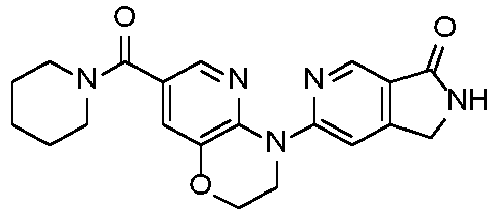
1H NMR (400 MHz, DMSO-d6) δ 1.41-1.65 (6H, m), 3.33-3.62 (4H, m), 4.23-4.3 0 (2H, m), 4.32-4.38 (2H, m), 4.41 (2H, s), 7.28 (1H, d, J = 1.8 Hz), 7.87 (1H, d, J = 2.4 Hz), 8.28 (1H, d, J = 1.2 Hz), 8.47-8.51 (1H, m), 8.64 (1H, d, J = 1.2 Hz). LRMS (ESI+) 380 [M+H]+. 14-10 
1H NMR (400 MHz, DMSO-d6) δ 1.43-1.66 (6H, m), 3.33-3.53 (4H, m), 3.98 (2H, t, J = 3.6 Hz), 4.37 (2H, t, J = 4.2 Hz), 7.17 (1H, d, J = 1.8 Hz), 7.63-7.69 (2H, m), 7.72 (1H, d, J = 1.8 Hz), 7.99-8.05 (2H, m). (NH peak missing) LRMS (ESI+) 392 [M+H]+. -

- To a solution of 7-iodo-[1,2,4]triazolo[4,3-a]pyridin-3(2H)-one (183 mg; known compound described in literature,
WO2011057757A1 ) in N,N-dimethylformamide (1.8 mL), potassium carbonate (193 mg) was added. To the resultant reaction solution, 2,2-dimethyloxirane (125 µL) was added at room temperature, followed by stirring at 120°C for 40 minutes. The resultant was stirred at 120°C for 30 minutes under microwave irradiation. To the resultant reaction solution, water was added, the resultant was extracted with ethyl acetate, and the resultant organic layers were combined and dried over sodium sulfate. The resultant was filtered, the obtained filtrate was concentrated under reduced pressure, and the thus obtained residue was purified by silica gel column chromatography (ethyl acetate:hexane = 10:90 to 100:0 to ethyl acetate:methanol = 90:10) to obtain a mixture containing 2-(2-hydroxy-2-methylpropyl)7-iodo-[1,2,4]triazolo[4,3-a]pyridin-3(2H)-one (34.7 mg). - A solution, in toluene (2 mL), of (3,4-dihydro-2H-pyrido[3,2-b][1,4]oxazin-7-yl)(piperidin-1-yl)methanone (24.7 mg), the mixture (34.7 mg) containing 2-(2-hydroxy-2-methylpropyl)-7-iodo-[1,2,4]triazolo[4,3-a]pyridin-3(2H)-one, tris(dibenzylideneacetone)dipalladium (0) (4.6 mg), 4,5-bis(diphenylphosphino)-9,9-dimethylxanthene (Xantphos) (5.8 mg), and sodium tert-butoxide (19.2 mg) was stirred at 85 °C for 1.5 hours, the resultant reaction solution was filtered, and the obtained filtrate was concentrated under reduced pressure. The thus obtained residue was purified by silica gel column chromatography (ethyl acetate:hexane = 30:70 to 100:0 to ethyl acetate:methanol = 85:15) to obtain the title compound (35.9 mg).
- 1H NMR (400 MHz, DMSO-d6) δ: 1.14 (6H, s), 1.40-1.65 (6H, m), 3.15-3.57 (4H, m), 3.76 (2H, s), 3.93 (2H, t, J = 4.6 Hz), 4.36 (2H, t, J = 4.6 Hz), 4.66 (1H, s), 6.92 (1H, d, J = 1.8 Hz), 6.97 (1H, dd, J = 7.9, 1.8 Hz), 7.21 (1H, d, J = 1.8 Hz), 7.73-7.79 (2H, m).
- LRMS (ESI+) 453 [M+H]+.
-

-
- Isomer A:
2,3-Dimethyl-5-(7-piperidine-1-carbonyl)-2,3-dihydro-4H-pyrido[3,2-b][1,4]oxazin-4-yl)isoindolin-1-one - Isomer B:
2,3-Dimethyl-5-(7-(piperidine-1-carbonyl)-2,3-dihydro-4H-pyrido[3,2-b][1,4]oxazin-4-yl)isoindolin-1-one - To a solution of 2-methyl-5-(7-(piperidine-1-carbonyl)-2,3-dihydro-4H-pyrido[3,2-b][1,4]oxazin-4-yl)isoindolin-1-one (75.0 mg) in tetrahydrofuran (3.5 mL), methyl iodide (13.1 µL) was added. To the resultant reaction solution, sodium bis(trimethylsilyl)amide (229 µL; 1.0 M tetrahydrofuran solution) was added at -78°C, followed by stirring at -78°C for 20 minutes, and then a saturated ammonium chloride aqueous solution was added to the resultant reaction solution. The resultant was extracted with dichloromethane (3 mL x 3), and the resultant organic layers were combined and dried over sodium sulfate. The resultant was filtered, the obtained filtrate was concentrated under reduced pressure, and the thus obtained residue was purified by silica gel column chromatography (ethyl acetate:hexane = 50:50 to 100:0 to ethyl acetate:methanol = 90:10) to obtain a mixture (35.6 mg) of the title compound. The obtained mixture was purified by high-performance liquid chromatography (IPA, flow rate: 3 mL/min) using an optically active column (CHIRALPAK IA: Daicel Corporation) to obtain the isomer A (10.8 mg) with a retention time of analysis condition (flow rate: 0.3 mL/min) of 28.1 minutes and the isomer B (11.2 mg) with a retention time of 42.9 minutes.
- Isomer A:
1H NMR (400 MHz, CDCl3) δ: 1.44-1.74 (9H, m), 3.12 (3H, s), 3.34-3.74 (4H, m), 3.89-4.05 (2H, m), 4.31-4.50 (3H, m), 7.23 (1H, d, J = 1.8 Hz), 7.40 (1H, dd, J = 8.6, 1.8 Hz), 7.49 (1H, d, J = 1.8 Hz), 7.81-7.86 (2H, m). - LRMS (ESI+) 407 [M+H]+.
- Isomer B:
1H NMR (400 MHz, CDCl3) δ: 1.40-1.75 (9H, m), 3.12 (3H, s), 3.34-3.74 (4H, m), 3.89-4.04 (2H, m), 4.32-4.50 (3H, m), 7.23 (1H, d, J = 1.8 Hz), 7.40 (1H, dd, J = 8.6, 1.8 Hz), 7.49 (1H, d, J = 1.8 Hz), 7.80-7.88 (2H, m). - LRMS (ESI+) 407 [M+H]+.
-

- To a solution of 4-(2-methyl-3-oxo-2,3-dihydro-[1,2,4]triazolo[4,3-a]pyridin-7-yl)-N-propyl-3,4-dihydro-2H-pyrido[3,2-b][1,4]oxazine-7-carboxamide (25.0 mg) in N,N-dimethylformamide (0.8 mL), sodium hydride (3.0 mg) and subsequently methyl iodide (8.5 µL) were added at room temperature. After stirring at room temperature for 3.5 hours, a saturated ammonium chloride aqueous solution was added to the resultant reaction solution. The resultant reaction solution was purified by silica gel column chromatography (methanol:water = 5:95 to 100:0, further with another column, ethyl acetate:hexane = 30:70 to 100:0, subsequently methanol:ethyl acetate = 0:100 to 10:90) to obtain the title compound (19.8 mg).
- 1H NMR (400 MHz, DMSO-d6) δ 0.64-0.96 (3H, m), 1.45-1.62 (2H, m), 2.93 (3H, s), 3.18-3.41 (2H, m), 3.49 (3H, s), 3.93 (2H, t, J = 4.2 Hz), 4.36 (2H, t, J = 4.5 Hz), 6.89 (1H, d, J = 1.8 Hz), 6.99 (1H, dd, J = 7.6, 2.1 Hz), 7.18-7.26 (1H, m), 7.73-7.86 (2H, m).
- LRMS (ESI+) 383 [M+H]+.
- Compounds of the following Examples 17-2 to 17-3 were obtained in the same manner as in Example 17-1 by using corresponding starting materials and reactants. Their structures and spectrum data are shown in the following table.
[Table 168] Example No. Chemical Structural Formula Spectrum Data 17-2 
1H NMR (400 MHz, DMSO-d6) δ 0.68-1.37 (5H, m), 1.42-1. 60 (2H, m), 2.93 (3H, s), 3.19-3.44 (2H, m), 3.49 (3H, s), 3. 93 (2H, t, J = 4.2 Hz), 4.36 (2H, t, J = 4.5 Hz), 6.89 (1H, d, J = 1.8 Hz), 6.98 (1H, dd, J = 7.9, 1.8 Hz), 7.18-7.27 (1 H, m), 7.72-7.85 (2H, m). LRMS (ESI+) 397 [M+H]+. 17-3 
1H NMR (400 MHz, DMSO-d6) δ 0.87-1.29 (2H, m), 1.31-1. 81 (6H, m), 2.08-2.30 (1H, m), 2.94 (3H, s), 3.15-3.43 (2H, m), 3.49 (3H, s), 3.93 (2H, t, J = 4.3 Hz), 4.36 (2H, t, J = 4.3 Hz), 6.88 (1H, d, J = 1.2 Hz), 6.98 (1H, dd, J = 7.6, 2. 1 Hz), 7.17-7.26 (1H, m), 7.71-7.85 (2H, m). LRMS (ESI+) 423 [M+H]+. -

- To a solution of (R)-7-(7-(3-hydroxypiperidine-1-carbonyl)-2,3-dihydro-4H-pyrido[3,2-b][1,4]oxazin-4-yl)-2-methyl-[1,2,4]triazolo[4,3-a]pyridin-3(2H)-one (36.3 mg) in N,N-dimethylformamide (1 mL), sodium hydride (3.9 mg) and subsequently methyl iodide (6.1 µL) were added at room temperature. After stirring at room temperature for 5.5 hours, the resultant reaction solution was purified by silica gel column chromatography (methanol:water = 5:95 to 100:0) to obtain the title compound (27.0 mg) .
- 1H NMR (400 MHz, DMSO-d6) δ 1.30-2.02 (4H, m), 3.00-3.79 (11H, m), 3.93 (2H, t, J = 4.3 Hz), 4.36 (2H, t, J = 4.6 Hz), 6.89 (1H, d, J = 1.2 Hz), 6.98 (1H, dd, J = 7.3, 1.8 Hz), 7.18-7.24 (1H, m), 7.72-7.85 (2H, m).
- LRMS (ESI+) 425 [M+H]+.
- A compound of the following Example 18-2 was obtained in the same manner as in Example 18-1 by using corresponding starting material and reactant. Its structure and spectrum data are shown in the following table.
[Table 169] Example No. Chemical Structural Formula Spectrum Data 18-2 
1H NMR (400 MHz, DMSO-d6) δ 1.26-1.96 (4H, m), 3.06-3. 45 (8H, m), 3.49 (3H, s), 3.93 (2H, t, J = 4.5 Hz), 4.36 (2H , t, J = 4.2 Hz), 6.89 (1H, d, J = 1.2 Hz), 6.98 (1H, dd, J = 7.9, 1.8 Hz), 7.20-7.23 (1H, m), 7.73-7.81 (2H, m). LRMS (ESI+) 425 [M+H]+. -


- A suspension of 7-(7-(cyclohexanecarbonyl)-2,3-dihydro-4H-pyrido[3,2-b] [1,4]oxazin-4-yl)-2-methyl-[1,2,4]triazolo[4,3-a]pyridin-3(2H)-one (35.0 mg) in methanol (1 mL), sodium borohydride (6.8 mg) was added at room temperature. After stirring at room temperature for 1 hour, water was added to the resultant reaction solution, followed by stirring at room temperature for 1 hour. A residue obtained by concentrating the reaction solution under reduced pressure was purified by silica gel column chromatography (ethyl acetate) to obtain the title compound (35.0 mg).
- 1H NMR (400 MHz, CDCl3) δ 0.85-1.29 (5H, m), 1.38-1.46 (1H, m), 1.62-1.73 (2H, m), 1.74-1.82 (1H, m), 1.83 (1H, d, J = 3.7 Hz), 1.94-2.02 (1H, m), 3.63 (3H, s), 3.86 (2H, dd, J = 4.9, 3.7 Hz), 4.33 (1H, dd, J = 7.3, 3.1 Hz), 4.39 (2H, dd, J = 4.9, 3.7 Hz), 6.56 (1H, d, J = 1.8 Hz), 7.04 (1H, dd, J = 7.9, 1.8 Hz), 7.16 (1H, d, J = 1.8 Hz), 7.65 (1H, d, J = 8.6 Hz), 7.73 (1H, d, J = 1.8 Hz).
- LRMS (ESI+) 396 [M+H]+.
- Compounds of the following Examples 19-2 to 19-4 were obtained in the same manner as in Example 19-1 by using corresponding starting materials and reactants. Their structures and spectrum data are shown in the following table.
[Table 170] Example No. Chemical Structural Formula Spectrum Data 19-2 
1H NMR (400 MHz, CDCl3) δ 1.17-1.53 (4H, m), 1.54-1.81 ( 2H, m), 1.98-2.22 (3H, m), 2.36 (1H, s), 3.61 (3H, s), 3.86 ( 2H, t, J = 4.9 Hz), 4.32-4.44 (3H, m), 6.52 (1H, d, J = 1.2 Hz), 7.01 (1H, dd, J = 7.9, 1.8 Hz), 7.15 (1H, d, J = 1.2 H z), 7.60 (1H, d, J = 7.9 Hz), 7.72 (1H, d, J = 1.2 Hz). LRMS (ESI+) 432 [M+H]+. 19-3 
1H NMR (400 MHz, CDCl3) δ 1.17-1.53 (4H, m), 1.61-1.74 ( 2H, m), 1.82 (1H, d, J = 3.0 Hz), 1.97-2.21 (3H, m), 3.19 ( 3H, s), 3.94 (2H, dd, J = 5.4, 3.6 Hz), 4.32-4.40 (5H, m), 7. 12 (1H, d, J = 1.8 Hz), 7.39 (1H, dd, J = 7.9, 1.8 Hz), 7.54 (1H, d, J = 1.2 Hz), 7.66 (1H, d, J = 1.8 Hz), 7.83 (1H, d, J = 8.5 Hz). LRMS (ESI+) 430 [M+H]+. 19-4 
1H NMR (400 MHz, CDCl3) δ 0.80-1.32 (6H, m), 1.36-1.47 ( 1H, m), 1.52-1.73 (2H, m), 1.73-1.83 (1H, m), 1.86-1.95 (1H, m), 1.96-2.06 (1H, m), 3.19 (3H, s), 3.93 (2H, dd, J = 5.5, 3.7 Hz), 4.24-4.43 (5H, m), 7.13 (1H, d, J = 1.8 Hz), 7.38 ( 1H, dd, J = 8.6, 1.8 Hz), 7.55 (1H, s), 7.66 (1H, d, J = 1.8 Hz), 7.82 (1H, d, J = 8.6 Hz). LRMS (ESI+) 394 [M+H]+. -

- A solution, in N,N-dimethylformamide (3 mL), of (3,4-dihydro-2H-pyrido[3,2-b][1,4]oxazin-7-yl)(piperidin-1-yl)methanone (100 mg), ethyl 2,4-difluorobenzoate (607 µL) and cesium carbonate (394 mg) was stirred under microwave irradiation at 80°C for 3 hours and then at 130°C for 2.5 hours, and the resultant reaction solution was then poured into water. After extraction with ethyl acetate, the resultant organic layers were combined and dried over anhydrous sodium sulfate. The resultant was filtered, the obtained filtrate was concentrated under reduced pressure, and the thus obtained residue was purified by silica gel column chromatography (ethyl acetate:hexane = 5:95 to 60:40) to obtain a crude product (135 mg) of ethyl 2-fluoro-4-(7-piperidine-1-carbonyl)-2,3-dihydro-4H-pyrido[3,2-b][1,4]oxazin-4-yl)benzoate. To a solution, in tetrahydrofuran (5.3 mL), of the crude product of ethyl 2-fluoro-4-(7-piperidine-1-carbonyl)-2,3-dihydro-4H-pyrido[3,2-b][1,4]oxazin-4-yl)benzoate (135 mg), a 1 mol/L lithium hydroxide aqueous solution (1.96 mL) was added at room temperature. After stirring at room temperature for 17.3 hours, the resultant reaction solution was concentrated under reduced pressure. The thus obtained residue was washed with ethyl acetate, and a 1 mol/L hydrogen chloride aqueous solution (1.96 mL) was added thereto. After extraction with ethyl acetate, the resultant organic layers were combined and dried over anhydrous sodium sulfate. The resultant was filtered, the obtained filtrate was concentrated under reduced pressure, and the thus obtained residue was purified by silica gel column chromatography (methanol:water = 5:95 to 100:0). The resultant was washed with ethyl acetate to obtain the title compound (27.9 mg).
- 1H NMR (400 MHz, DMSO-d6) δ 1.41-1.64 (6H, m), 3.23-3.58 (4H, m), 3.97 (2H, t, J = 4.3 Hz), 4.34 (2H, t, J = 4.3 Hz), 7.20 (1H, d, J = 2.4 Hz), 7.37 (1H, dd, J = 8.9, 2.1 Hz), 7.44 (1H, dd, J = 13.4, 1.8 Hz), 7.77 (1H, d, J = 1.8 Hz), 7.83 (1H, t, J = 8.9 Hz), 12.97 (1H, s).
- LRMS (ESI+) 386 [M+H]+.
-

- To a solution of 7-iodo-[1,2,4]triazolo[4,3-a]pyridin-3(2H)-one (131 mg) in dichloromethane (20 mL), triethylamine (209 µL) was added. To the resultant reaction solution, methanol (4 mL), phenylboronic acid (91.4 mg) and copper (II) acetate (136 mg) were added at room temperature. The resultant was stirred at room temperature for 1.5 hours, and then heated to reflux for 13.5 hours. The resultant reaction solution was concentrated under reduced pressure, and the thus obtained residue was purified by silica gel column chromatography (ethyl acetate:hexane = 5:95 to 100:0) to obtain a crude product of 7-iodo-2-phenyl-[1,2,4]triazolo[4,3-a]pyridin-3(2H)-one (3.5 mg). A solution, in 1,4-dioxane (1.0 mL), of the crude product (3.5 mg) of 7-iodo-2-phenyl-[1,2,4]triazolo[4,3-a]pyridin-3(2H)-one, (3,4-dihydro-2H-pyrido[3,2-b][1,4]oxazin-7-yl)(piperidin-1-yl)methanone (2.6 mg), tris(dibenzylideneacetone)dipalladium (0) (0.5 mg), 4,5-bis(diphenylphosphino)-9,9-dimethylxanthene (Xantphos) (0.6 mg) and sodium tert-butoxide (2.0 mg) was heated to reflux for 4.5 hours, and then concentrated under reduced pressure. The thus obtained residue was purified by silica gel column chromatography (ethyl acetate:hexane = 30:70 to 100:0), and the resultant was washed with diethyl ether to obtain the title compound (3.1 mg).
- 1H NMR (400 MHz, DMSO-d6) δ 1.39-1.69 (6H, m), 3.17-3.68 (4H, m), 3.97 (2H, t, J = 4.3 Hz), 4.39 (2H, t, J = 4.3 Hz), 6.99 (1H, d, J = 1.8 Hz), 7.08 (1H, dd, J = 7.9, 1.8 Hz), 7.24 (1H, d, J = 1.8 Hz), 7.25-7.31 (1H, m), 7.51 (2H, t, J = 8.3 Hz), 7.81 (1H, d, J = 1.8 Hz), 7.86 (1H, d, J = 7.9 Hz), 8.05 (2H, d, J = 7.9 Hz).
- LRMS (ESI+) 457 [M+H]+.
-

- To a solution of 2,4,6-trichlorophenyl 5-acetyl-3,3-difluoro-2,3,4,5-tetrahydropyrido[3,2-b][1,4]oxazepine-8-carboxylate (47.4 mg) in tetrahydrofuran (1 mL), triethylamine (24 µL), N,N-dimethyl-4-aminopyridine (0.7 mg) and piperidine (13.7 µL) were added. After stirring at 45°C for 6 hours, methanol (0.6 mL) and an aqueous solution (0.6 mL) of potassium hydroxide (16.1 mg) were added to the resultant reaction solution at room temperature. After stirring at room temperature for 21.2 hours, a 1 mol/L hydrogen chloride aqueous solution (287 µL) was added thereto. The resultant reaction solution was concentrated under reduced pressure, and extracted with ethyl acetate, and the resultant organic layers were combined, washed with saturated saline and dried over anhydrous sodium sulfate. The resultant was concentrated under reduced pressure to obtain a crude product of (3,3-difluoro-2,3,4,5-tetrahydropyrido[3,2-b][1,4]oxazepin-8-yl)(piperidin-1-yl)methanone (40.3 mg).
- A solution, in 1,4-dioxane (1.2 mL), of the crude product (40.3 mg) of (3,3-difluoro-2,3,4,5-tetrahydropyrido[3,2-b][1,4]oxazepin-8-yl)(piperidin-1-yl)methanone, 7-iodo-2-methyl-[1,2,4]triazolo[4,3-a]pyridin-3(2H)-one (38.0 mg), tris(dibenzylideneacetone)dipalladium (0) (5.3 mg), 4,5-bis(diphenylphosphino)-9,9-dimethylxanthene (Xantphos) (6.7 mg) and sodium tert-butoxide (22.1 mg) was stirred at 85°C for 2 hours. The resultant reaction solution was concentrated under reduced pressure, and the thus obtained residue was purified by silica gel column chromatography (ethyl acetate:hexane = 10:90 to 100:0, subsequently methanol:ethyl acetate = 0:100 to 10:90) to obtain the title compound (18.8 mg).
- 1H NMR (400 MHz, DMSO-d6) δ 1.42-1.65 (6H, m), 3.26-3.63 (7H, m), 4.51-4.64 (4H, m), 6.62 (1H, dd, J = 7.9, 1.8 Hz), 7.01 (1H, d, J = 1.2 Hz), 7.46 (1H, d, J = 2.4 Hz), 7.73 (1H, d, J = 6.7 Hz), 7.99 (1H, d, J = 1.8 Hz).
- LRMS (ESI+) 445 [M+H]+.
-

-
- Isomer A
7-(7-(2-Azabicyclo[4,1,0]heptane-2-carbonyl)-2,3-dihydro-4H-pyrido[3,2-b][1,4]oxazin-4-yl)-2-methyl-[1,2,4]triazolo[4,3-a]pyridin-3(2H)-one - Isomer B
7-(7-(2-Azabicyclo[4,1,0]heptane-2-carbonyl)-2,3-dihydro-4H-pyrido[3,2-b][1,4]oxazin-4-yl)-2-methyl-[1,2,4]triazolo[4,3-a]pyridin-3(2H)-one - A racemic mixture of 7-(7-(2-azabicyclo[4,1,0]heptane-2-carbonyl)-2,3-dihydro-4H-pyrido[3,2-b][1,4]oxazin-4-yl)-2-methyl-[1,2,4]triazolo[4,3-a]pyridin-3(2H)-one (77.9 mg) was purified by high-performance liquid chromatography (ethanol:dichloromethane = 5:95, flow rate: 7.5 mL/min) using an optically active column (CHIRALPAK IA: Daicel Corporation) to obtain the isomer A (21.0 mg) with a retention time of analysis condition (flow rate: 0.5 mL/min) of 11.8 minutes and the isomer B (17.0 mg) with a retention time of 13.9 minutes.
- Isomer A:
1H NMR (400 MHz, DMSO-d6) δ 0.37-0.58 (1H, m), 0.62-0.93 (1H, m), 1.20-1.40 (2H, m), 1.47-1.70 (1H, m), 1.73-1.87 (2H, m), 2.37-3.07 (2H, m), 3.49 (3H, s), 3.85-4.08 (3H, m), 4.33-4.39 (2H, m), 6.89 (1H, d, J = 1.2 Hz), 6.98 (1H, dd, J = 7.6, 2.1 Hz), 7.21-7.45 (1H, m), 7.72 (1H, d, J = 8.6 Hz), 7.86-8.09 (1H, m). - LRMS (ESI+) 407 [M+H]+.
- Isomer B:
1H NMR (400 MHz, DMSO-d6) δ 0.28-0.59 (1H, m), 0.60-0.95 (1H, m), 1.19-1.43 (2H, m), 1.50-1.69 (1H, m), 1.73-1.89 (2H, m), 2.40-3.05 (2H, m), 3.49 (3H, s), 3.84-4.07 (3H, m), 4.31-4.42 (2H, m), 6.89 (1H, d, J = 1.2 Hz), 6.98 (1H, dd, J = 7.6, 2.1 Hz), 7.15-7.47 (1H, m), 7.72 (1H, d, J = 8.6 Hz), 7.86-8.12 (1H, m). - LRMS (ESI+) 407 [M+H]+.
- An isomer A and an isomer B of the following Example 23-2 were obtained in the same manner as in Example 23-1 by using corresponding starting materials and reactants. Their structures and spectrum data are shown in the following table.
[Table 171] Example No. Chemical Structural Formula Spectrum Data 23-2 Isomer A 
1H NMR (400 MHz, DMSO-d6) δ 1.11-1.40 (3H, m), 1.42-1. 78 (3H, m), 1.80-1.95 (1H, m), 2.58-3.30 (2H, m), 3.49 (3H, s), 3.55-4.58 (6H, m), 6.89 (1H, d, J = 1.8 Hz), 6.99 (1H, d d, J = 7.6, 2.1 Hz), 7.18 (1H, d, J = 2.4 Hz), 7.73-7.79 (2H, m). LRMS (ESI+) 427 [M+H]+. 23-2 Isomer B 
1H NMR (400 MHz, DMSO-d6) δ 1.10-1.42 (3H, m), 1.43-1. 78 (3H, m), 1.80-1.94 (1H, m), 2.62-3.36 (2H, m), 3.49 (3H, s), 3.55-4.47 (6H, m), 6.89 (1H, d, J = 1.2 Hz), 6.99 (1H, d d, J = 7.6, 2.1 Hz), 7.18 (1H, d, J = 2.4 Hz), 7.73-7.79 (2H, m). LRMS (ESI+) 427 [M+H]+. -
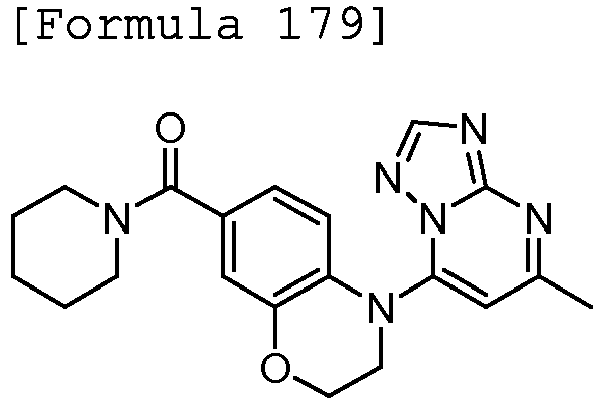
- A solution, in ethanol (2 mL), of (3,4-dihydro-2H-benzo[b][1,4]oxazin-7-yl)(piperidin-1-yl)methanone (50.0 mg) and 7-chloro-5-methyl-[1,2,4]triazolo[1,5-a]pyrimidine (50.0 mg) was stirred at room temperature for 24 hours. The resultant reaction mixture was concentrated under reduced pressure, and the thus obtained residue was purified by silica gel column chromatography (ethyl acetate:methanol = 9:1) to obtain the title compound (74.0 mg) .
- 1H NMR (400 MHz, CDCl3) δ 1.48-1.76 (6H, m), 2.59 (3H, s), 3.29-3.83 (4H, m), 4.29 (2H, t, J = 4.2Hz), 4.36 (2H, t, J = 4.2Hz), 6.64 (1H, s), 6.97 (1H, dd, J = 8.5, 1.8 Hz), 7.06 (1H, d, J = 1.8 Hz), 7.16 (1H, d, J = 8.5Hz), 8.41 (1H, s).
- LRMS (ESI+) 379 [M+H]+.
- Compounds of the following Examples 24-2 to 24-3 were obtained in the same manner as in Example 24-1 by using corresponding starting materials and reactants. Their structures and spectrum data are shown in the following table.
[Table 172] Example No. Chemical Structural Formula Spectrum Data 24-2 
1H NMR (400 MHz, CDCl3) δ 1.90-2.17 (4H, m), 2.60 (3H, s), 3.51-3.99 (4H, m), 4.28-4.39 (4H, m), 6.65 (1H, s), 6.98 ( 1H, dd, J = 8.5, 1.8 Hz), 7.08 (1H, d, J = 1.8 Hz), 7.17 (1 H, d, J = 8.5Hz), 8.42 (1H, s). LRMS (ESI+) 415 [M+H]+. 24-3 
1H NMR (400 MHz, CDCl3) δ 1.89-2.16 (4H, m), 2.61 (3H, s), 3.54-3.96 (4H, m), 4.23 (2H, t, J = 4.3 Hz), 4.32 (2H, t, J = 4.3 Hz), 6.96 (1H, dd, J = 8.6, 2.4 Hz), 6.99 (1H, d, J = 6.1 Hz), 7.02 (1H, d, J = 2.4 Hz), 7.45 (1H, d, J = 8.6 Hz), 8.27 (1H, d, J = 6.1 Hz). LRMS (ESI+) 375 [M+H]+. -

- To a solution of 5-(7-(4,4-difluoropiperidine-1-carbonyl)-2,3-dihydro-4H-pyrido[3,2-b]oxazin-4-yl)isoindolin-1-one (141 mg) in tetrahydrofuran (2.0 mL), formaldehyde (37% aqueous solution, 30 µL) and potassium hydroxide (48% aqueous solution, 10 µL) were added at room temperature, followed by stirring for 1 hour. The resultant reaction mixture was poured into ice water, followed by extraction with ethyl acetate. The thus extracted organic layers were combined, washed with saturated saline, and dried over anhydrous sodium sulfate. The resultant reaction mixture was concentrated under reduced pressure, and the thus obtained residue was purified by silica gel column chromatography (ethyl acetate:methanol = 10:1) to obtain the title compound (117 mg).
- 1H NMR (400 MHz, CDCl3) δ 1.98-2.04 (4H, m), 3.05 (1H, t, J = 6.9 Hz), 3.72-3.77 (4H, m), 3.97 (2H, t, J = 4.6 Hz), 4.39 (2H, t, J = 4.6 Hz), 4.59 (2H, s), 5.14 (2H, d, J = 6.5 Hz), 7.24 (1H, d, J = 1.9 Hz), 7.44 (1H, dd, J = 8.4, 1.9 Hz), 7.56 (1H, d, J = 1.1 Hz), 7.85 (1H, d, J = 1.9 Hz), 7.88 (1H, d, J = 8.4 Hz).
- LRMS (ESI+) 445 [M+H]+.
-

- To a suspension of 7-(6-(piperidine-1-carbonyl)-3,4-dihydro-1,8-naphthylidin-1(2H)-yl)-[1,2,4]triazolo[4,3-a]pyridin-3(2H)-one (41.0 mg) in toluene (540 µL), cyclopropylboronic acid (27.8 mg), copper acetate (39.2 mg), pyridine (72 µL) and triethylamine (72 µL) were added, and the resultant was stirred under microwave irradiation at 140°C for 1 hour. The resultant reaction mixture was concentrated under reduced pressure, and the thus obtained residue was purified by silica gel column chromatography (ethyl acetate:hexane = 40:60 to ethyl acetate:methanol = 80:20) to obtain the title compound (10.1 mg).
- 1H NMR (400 MHz, DMSO-d6) δ 0.91-1.06 (4H, m), 1.44-1.69 (6H, m), 1.94-2.05 (2H, m), 2.82 (2H, t, J = 6.4 Hz), 3.35-3.58 (5H, m), 3.78 (2H, t, J = 5.8 Hz), 6.76 (1H, dd, J = 7.3, 1.8 Hz), 6.85-6.88 (1H, m), 7.47-7.51 (1H, m), 7.67 (1H, d, J = 7.9 Hz), 7.98 (1H, d, J = 2.4 Hz).
- LRMS (ESI+) 419 [M+H]+.
- A compound of the following Example 26-2 was obtained in the same manner as in Example 26-1 by using corresponding starting material and reactant. Its structure and spectrum data are shown in the following table.
[Table 173] Example No. Chemical Structural Formula Spectrum Data 26-2 
1H NMR (400 MHz, DMSO-d6) δ 0.90-1.07 (4H, m), 1.41-1.65 (6H, m ), 3.24-3.58 (5H, m), 3.91 (2H, t, J = 4.3 Hz), 4.35 (2H, t, J = 4.3 Hz), 6. 86 (1H, d, J = 1.2 Hz), 6.96 (1H, dd, J = 7.3, 1.8 Hz), 7.20 (1H, d, J = 1.8 Hz), 7.73 (1H, d, J = 8.6 Hz), 7.77 (1H, d, J = 1.8 Hz). LRMS (ESI+) 421 [M+H]+. -

- To a solution of 7-(7-(piperidine-1-carbonyl)-2,3-dihydro-4H-pyrido[3,2-b][1,4]oxazin-4-yl)-[1,2,4]triazolo[4,3-a]pyridin-3(2H)-one (41.8 mg) in N,N-dimethylformamide (500 µL), 1-(bromomethyl)-4-fluorobenzene (22.9 mg) was added at room temperature, and sodium hydride (4.8 mg) was further added thereto, followed by stirring at room temperature for 22 hours. The resultant reaction mixture was purified by silica gel column chromatography (ethyl acetate:hexane = 10:90 to 100:0) to obtain the title compound (29.7 mg).
- 1H NMR (400 MHz, DMSO-d6) δ 1.43-1.64 (6H, m), 3.28-3.57 (4H, m), 3.91 (2H, t, J = 4.6 Hz), 4.35 (2H, t, J = 4.3 Hz), 5.05 (2H, s), 6.88 (1H, d, J = 1.8 Hz), 7.00 (1H, dd, J = 7.9, 1.8 Hz), 7.13-7.22 (3H, m), 7.31-7.36 (2H, m), 7.76-7.81 (2H, m).
- LRMS (ESI+) 489 [M+H]+.
- Compounds of the following Examples 27-2 to 27-8 were obtained in the same manner as in Example 27-1 by using corresponding starting materials and reactants. Their structures and spectrum data are shown in the following tables.
[Table 174] Example No. Chemical Structural Formula Spectrum Data 27-2 
1H NMR (400 MHz, DMSO-d6) δ 1.42-1.64 (6H, m), 3.27-3.62 (4H, m ), 3.93 (2H, t J = 4.6 Hz), 4.36 (2H, t, J = 4.3 Hz), 5.16 (2H, s), 6.90 (1 H, d, J = 1.8 Hz), 7.03 (1H, dd, J = 7.6, 2.1 Hz), 7.21 (1H, d, J = 1.8 H z), 7.28 (1H, dd, J = 5.2, 1.5 Hz), 7.42 (1H, s), 7.78 (1H, d, J = 2.4 Hz), 7.81 (1H, d, J = 8.6 Hz), 8.36 (1H, d, J = 4.3 Hz). LRMS (ESI+) 506 [M+H]+. 27-3 
1H NMR (400 MHz, DMSO-d6) δ 1.40-1.66 (6H, m), 3.22-3. 63 (4H, m), 3.94 (2H, t, J = 4.3 Hz), 4.37 (2H, t, J = 4.3 Hz), 4.78 (2H, q, J = 9.0 Hz), 6.92 (1H, d, J = 1.8 Hz), 7.0 5 (1H, dd, J = 7.6, 2.1 Hz), 7.22 (1H, d, J = 1.8 Hz), 7.77-7.82 (2H, m). LRMS (ESI+) 463 [M+H]+. 27-4 
1H NMR (400 MHz, DMSO-d6) δ 1.95-2.10 (4H, m), 3.49-3.67 (4H, m ), 3.92 (2H, t J = 4.3 Hz), 4.36 (2H, t, J = 4.3 Hz), 5.05 (2H, s), 6.90 (1 H, d, J = 1.2 Hz), 6.99 (1H, dd, J = 7.3, 1.8 Hz), 7.13-7.20 (2H, m), 7.29 (1H, d, J = 2.4 Hz), 7.31-7.37 (2H, m), 7.80 (1H, d, J = 7.3 Hz), 7.85 ( 1H, d, J = 1.8 Hz). LRMS (ESI+) 525 [M+H]+. 27-5 
1H NMR (400 MHz, DMSO-d6) δ 1.95-2.10 (4H, m), 3.47-3.68 (4H, m ), 3.91 (2H, t J = 4.3 Hz), 4.35 (2H, t, J = 4.6 Hz), 5.08 (2H, s), 6.90 (1 H, d, J = 1.8 Hz), 6.99 (1H, dd, J = 7.6, 2.1 Hz), 7.03-7.12 (1H, m), 7.22 -7.31 (2H, m), 7.35-7.44 (1H, m), 7.79 (1H, d, J = 7.3 Hz), 7.85 (1H, d, J = 1.8 Hz). LRMS (ESI+) 543 [M+H]+. [Table 175] Example No. Chemical Structural Formula Spectrum Data 27-6 
1H NMR (400 MHz, DMSO-d6) δ 1.93-2.12 (4H, m), 3.45-3.69 (4H, m ), 3.93 (2H, t J = 4.3 Hz), 4.36 (2H, t, J = 4.3 Hz), 5.07 (2H, s), 6.90 (1 H, d, J = 1.2 Hz), 7.00 (1H, dd, J = 7.6, 2.1 Hz), 7.11-7.17 (1H, m), 7.30 (1H, d, J = 1.8 Hz), 7.34-7.45 (2H, m), 7.80 (1H, d, J = 7.3 Hz), 7.85 ( 1H, d, J = 1.8 Hz). LRMS (ESI+) 543 [M+H]+. 27-7 
1H NMR (400 MHz, DMSO-d6) δ 1.96-2.10 (4H, m), 3.47-3. 70 (4H, m), 3.94 (2H, t, J = 4.3 Hz), 4.37 (2H, t, J = 4.3 Hz), 5.16 (2H, s), 6.92 (1H, d, J = 1.2 Hz), 7.02 (1H, dd, J = 7.6, 2.1 Hz), 7.28 (1H, dd, J = 4.9, 1.2 Hz), 7.30 (1H, d, J = 1.8 Hz), 7.42 (1H, s), 7.82 (1H, d, J = 8.6 Hz), 7.86 (1 H, d, J = 2.4 Hz), 8.37 (1H, d, J = 5.5 Hz). LRMS (ESI+) 542 [M+H]+. 27-8 
1H NMR (400 MHz, DMSO-d6) δ 1.95-2.10 (4H, m), 3.45-3. 70 (4H, m), 3.95 (2H, t, J = 4.6 Hz), 4.37 (2H, t, J = 4.3 Hz), 4.79 (2H, q, J = 9.0 Hz), 6.93 (1H, d, J = 1.8 Hz), 7.0 4 (1H, dd, J = 7.6, 2.1 Hz), 7.31 (1H, d, J = 1.8 Hz), 7.81 (1H, d, J = 8.6 Hz), 7.87 (1H, d, J = 1.8 Hz). LRMS (ESI+) 499 [M+H]+. -

- To a mixed solution, in ethanol (70 mL) and N,N-dimethylacetamide (70 mL), of di-tert-butyl 7-bromo-2,3-dihydropyrido[2,3-b]pyrazine-1,4-dicarboxylate (2.69 g), [1,1'-bis(diphenylphosphino)ferrocene]palladium (II) dichloride dichloromethane adduct (795 mg) and triethylamine (3.62 mL) were added at room temperature, and the resultant mixture was stirred under heating to reflux for 3 hours under carbon monoxide atmosphere, followed by concentrating the resultant reaction solution under reduced pressure. The thus obtained residue was purified by silica gel column chromatography (ethyl acetate:hexane = 0:100 to 100:0) to obtain a mixture containing 1-(tert-butyl) 7-ethyl 3,4-dihydropyrido[2,3-b]pyrazine-1,7(2H)-dicarboxylate (1.51 g).
- To a solution, in 1,4-dioxane (31 mL), of the mixture (1.51 g) containing 1-(tert-butyl) 7-ethyl 3,4-dihydropyrido[2,3-b]pyrazine-1,7(2H)-dicarboxylate and 7-iodo-2-methyl-[1,2,4]triazolo[4,3-a]pyridin-3(2H)-one (946 mg), tris(dibenzylideneacetone)dipalladium (0) (143 mg), 4,5-bis(diphenylphosphino)-9,9-dimethylxanthene (Xantphos) (181 mg) and sodium tert-butoxide (1.50 g) were added, followed by stirring under heating to reflux for 1.5 hours. The resultant reaction solution was concentrated under reduced pressure and washed with dichloromethane, and a solid was collected by filtration. The thus obtained solid was washed with methanol, the resultant filtrate was concentrated under reduced pressure and washed with ethyl acetate to obtain a mixture containing 2-(2-methyl-3-oxo-2,3-dihydro-[1,2,4]triazolo[4,3-a]pyridin-7-yl)1,2,3,4-tetrahydropyrido[2,3-b]pyrazine-7-carboxylic acid sodium salt (1.62 g).
- To a solution, in N,N-dimethylformamide (7.2 mL), of the mixture (469 mg) containing 2-(2-methyl-3-oxo-2,3-dihydro-[1,2,4]triazo[4,3-a]pyridin-7-yl)1,2,3,4-tetrahydropyrido[2,3-b]pyrazine-7-carboxylic acid sodium salt, piperidine (428 µL), diisopropylethylamine (1.22 mL) and 1-[bis(dimethylamino)methylene]-1H-1,2,3-triazolo[4,5-b]pyridinium 3-oxide hexafluorophosphate (658 mg) were added, the resultant was stirred at room temperature for 6 hours, and the resultant reaction solution was poured into water. After extraction with dichloromethane, the resultant organic layers were combined and dried over anhydrous sodium sulfate. The resultant was concentrated under reduced pressure, and the thus obtained residue was purified by silica gel column chromatography (ethyl acetate:hexane = 10:90 to 100:0, methanol:ethyl acetate = 0:100 to 20:80) to obtain the title compound (306 mg).
- 1H NMR (400 MHz, DMSO-d6) δ 1.41-1.71 (6H, m), 3.12-3.27 (6H, m), 3.47 (3H, s), 3.76 (2H, t, J = 4.9 Hz), 6.39 (1H, t, J = 7.3 Hz), 6.71 (1H, d, J = 1.2 Hz), 6.83-6.87 (2H, m), 7.40 (1H, d, J = 2.4 Hz), 7.66 (1H, d, J = 7.9 Hz).
- LRMS (ESI+) 394 [M+H]+.
- A compound of the following Example 28-2 was obtained in the same manner as in Example 28-1 by using corresponding starting material and reactant. Its structure and spectrum data are shown in the following table.
[Table 176] Example No. Chemical Structural Formula Spectrum Data 28-2 
1H NMR (400 MHz, DMSO-d6) δ 1.93-2.09 (4H, m), 3.38-3. 44 (2H, m), 3.48 (3H, s), 3.50-3.64 (4H, m), 3.77 (2H, t, J = 4.6 Hz), 6.38-6.43 (1H, m), 6.73 (1H, d, J = 1.2 Hz), 6.85 (1H, dd, J = 7.6, 2.1 Hz), 6.90 (1H, d, J = 2.4 Hz), 7.49 ( 1H, d, J = 1.8 Hz), 7.67 (1H, d, J = 7.3 Hz). LRMS (ESI+) 430 [M+H]+. -

- To a solution of 2-methyl-7-(7-(piperidine-1-carbonyl)-2,3-dihydropyrido[2,3-b]pyrazin-4(1H)-yl)-[1,2,4]triazolo[4,3-a]pyridin-3(2H)-one (48.4 mg) in N,N-dimethylformamide (1 mL), sodium hydride (5.9 mg) and subsequently methyl iodide (15.3 µL) were added at room temperature. After stirring at room temperature for 4 days, the resultant reaction solution was purified by silica gel column chromatography (methanol:water = 10:90 to 100:0) to obtain the title compound (10.4 mg).
- 1H NMR (400 MHz, DMSO-d6) δ 1.42-1.65 (6H, m), 2.90 (3H, s), 3.36-3.54 (9H, m), 3.84-3.90 (2H, m), 6.77-6.79 (1H, m), 6.80-6.84 (2H, m), 7.44 (1H, d, J = 1.8 Hz), 7.67 (1H, d, J = 6.7 Hz).
- LRMS (ESI+) 408 [M+H]+.
- Compounds of the following Examples 29-2 to 29-5 were obtained in the same manner as in Example 29-1 by using corresponding starting materials and reactants. Their structures and spectrum data are shown in the following table.
[Table 177] Example No. Chemical Structural Formula Spectrum Data 29-2 
1H NMR (400 MHz, DMSO-d6) δ 1.43-1.65 (6H, m), 3.25 (3 H, s), 3.36-3.58 (13H, m), 3.79 (2H, t, J = 4.9 Hz), 6.72 (1 H, d, J = 1.8 Hz), 6.81 (1H, dd, J = 7.6, 2.1 Hz), 6.91 (1H, d, J = 1.8 Hz), 7.40 (1H, d, J = 1.8 Hz), 7.65 (1H, d, J = 7.9 Hz). LRMS (ESI+) 452 [M+H]+. 29-3 
1H NMR (400 MHz, DMSO-d6) δ 1.41-1.67 (6H, m), 2.25 (3 H, s), 3.34-3.63 (7H, m), 3.85-4.02 (4H, m), 6.81 (1H, dd, J = 7.6, 2.1 Hz), 7.00 (1H, s), 7.74 (1H, d, J = 7.3 Hz), 7.94 (1H, d, J = 1.2 Hz), 7.98-8.48 (1H, m). LRMS (ESI+) 436 [M+H]+. 29-4 
1H NMR (400 MHz, DMSO-d6) δ 1.95-2.09 (4H, m), 2.91 (3 H, s), 3.38-3.45 (2H, m), 3.48 (3H, s), 3.51-3.67 (4H, m), 3. 85-3.91 (2H, m), 6.81 (2H, dq, J = 11.6, 3.1 Hz), 6.90 (1H, d, J = 1.8 Hz), 7.52 (1H, d, J = 1.8 Hz), 7.68 (1H, d, J = 6.7 Hz). LRMS (ESI+) 444 [M+H]+. 29-5 
1H NMR (400 MHz, DMSO-d6) δ 1.09 (3H, t, J = 7.0 Hz), 1.96-2.10 (4H, m), 3.35-3.47 (4H, m), 3.48 (3H, s), 3.50-3.68 (4H, m), 3.83 (2H, t, J = 4.9 Hz), 6.75 (1H, d, J = 1.2 Hz), 6.81 (1H, dd, J = 7.3, 1.8 Hz), 6.95 (1H, d, J = 1.8 Hz), 7 .47 (1H, d, J = 1.8 Hz), 7.66 (1H, d, J = 7.9 Hz). LRMS (ESI+) 458 [M+H]+. -
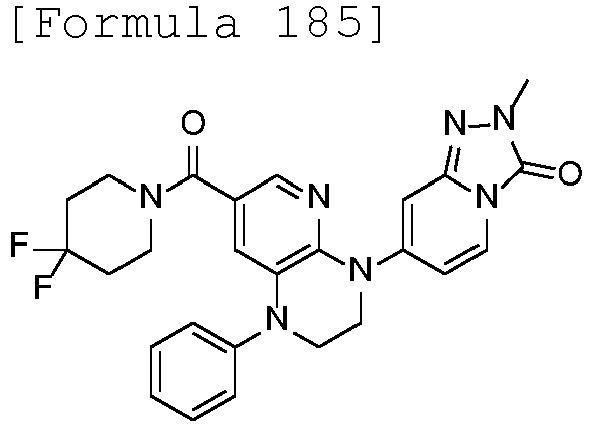
- A solution, in 1,4-dioxane (2 mL), of 7-(7-(4,4-difluoropiperidine-1-carbonyl)-2,3-dihydropyrido[2,3-b]pyrazin-4(1H)-yl)-2-methyl-[1,2,4]triazolo[4,3-a]pyridin-3(2H)-one (50.0 mg), bromobenzene (14.7 µL), tris(dibenzylideneacetone)dipalladium (0) (5.3 mg), 4,5-bis(diphenylphosphino)-9,9-dimethylxanthene (Xantphos) (6.7 mg) and cesium carbonate (113 mg) was stirred under heating to reflux for 7 hours, followed by concentration under reduced pressure. The thus obtained residue was purified by silica gel column chromatography (methanol:ethyl acetate = 0:100 to 20:80) and the resultant was washed with ethanol to obtain the title compound (47.7 mg).
- 1H NMR (400 MHz, DMSO-d6) δ 1.88-2.03 (4H, m), 3.43-3.63 (7H, m), 3.78-3.86 (2H, m), 3.94-4.02 (2H, m), 6.86-6.93 (3H, m), 7.23 (1H, t, J = 7.3 Hz), 7.35 (2H, dd, J = 8.6, 1.2 Hz), 7.43-7.50 (2H, m), 7.66 (1H, d, J = 1.8 Hz), 7.71-7.76 (1H, m).
- LRMS (ESI+) 506 [M+H]+.
- Compounds of the following Examples 30-2 to 30-5 were obtained in the same manner as in Example 30-1 by using corresponding starting materials and reactants. Their structures and spectrum data are shown in the following table.
[Table 178] Example No. Chemical Structural Formula Spectrum Data 30-2 
1H NMR (400 MHz, DMSO-d6) δ 1.93-2.07 (4H, m), 3.47-3.65 ( 7H, m), 3.88-3.99 (4H, m), 6.86 (1H, dd, J = 7.6, 2.1 Hz), 6 .96 (1H, d, J = 1.2 Hz), 7.38-7.47 (3H, m), 7.75 (1H, d, J = 8.6 Hz), 7.79-7.85 (3H, m). LRMS (ESI+) 531 [M+H]+. 30-3 
1H NMR (400 MHz, DMSO-d6) δ 1.91-2.06 (4H, m), 3.50 (3 H, s), 3.52-3.64 (4H, m), 3.83 (3H, s), 3.88-4.00 (4H, m), 6. 87 (1H, dd, J = 7.6, 2.1 Hz), 6.95 (1H, d, J = 1.8 Hz), 7.34 (1H, d, J = 1.8 Hz), 7.37-7.43 (2H, m), 7.74 (1H, d, J = 7. 9 Hz), 7.80 (1H, d, J = 1.8 Hz), 7.94-7.99 (2H, m). LRMS (ESI+) 564 [M+H]+. 30-4 
1H NMR (400 MHz, DMSO-d6) δ 1.98-2.13 (4H, m), 3.50 (3 H, s), 3.54-3.69 (4H, m), 3.95-4.05 (4H, m), 6.81 (1H, dd, J = 7.9, 1.8 Hz), 6.96 (1H, d, J = 1.2 Hz), 7.48 (1H, s), 7.75 (1H, dd, J = 7.6, 0.9 Hz), 7.96 (1H, d, J = 1.8 Hz), 8.60 (1 H, d, J = 1.8 Hz). LRMS (ESI+) 547 [M+H]+. 30-5 
1H NMR (400 MHz, DMSO-d6) δ 1.88-2.04 (4H, m), 3.45-3. 62 (7H, m), 3.82-3.90 (2H, m), 3.95-4.02 (2H, m), 6.88 (1H, dd, J = 7.6, 2.1 Hz), 6.91-6.94 (1H, m), 6.98 (1H, d, J = 1. 8 Hz), 7.48 (1H, dd, J = 8.6, 4.3 Hz), 7.71 (1H, d, J = 1.8 Hz), 7.74 (1H, d, J = 8.6 Hz), 7.78-7.82 (1H, m), 8.41 (1H, dd, J = 4.6, 1.5 Hz), 8.61 (1H, d, J = 2.4 Hz). LRMS (ESI+) 507 [M+H]+. -

- To a solution, in dichloromethane (1.0 mL), of (4-(4-(2-aminopropan-2-yl)phenyl)-3,4-dihydro-2H-pyrido[3,2-b][1,4]oxazin-7-yl)(piperidin-1-yl)methanone (38.0 mg) and triethylamine (41.8 µL), acetyl chloride (7.1 µL) was added at room temperature. The resultant reaction solution was purified by silica gel column chromatography (ethyl acetate:hexane = 30:70 to 100:0 to ethyl acetate:methanol = 80:20), and the resultant was washed with a mixture of diethyl ether and hexane to obtain the title compound (18.8 mg).
- 1H NMR (400 MHz, DMSO-d6) δ 1.42-1.64 (12H, m), 1.82 (3H, s), 3.37-3.51 (4H, m), 3.86 (2H, t, J = 4.3 Hz), 4.31 (2H, t, J = 4.3 Hz), 7.07 (1H, d, J = 1.8 Hz), 7.28 (4H, s), 7.64 (1H, d, J = 1.8 Hz), 8.04 (1H, s).
- LRMS (ESI+) 423 [M+H]+.
- A compound of the following Example 31-2 was obtained in the same manner as in Example 31-1 by using corresponding starting material and reactant. Its structure and spectrum data are shown in the following table.
[Table 179] Example No. Chemical Structural Formula Spectrum Data 31-2 
1H NMR (400 MHz, DMSO-d6) δ 1.40-1.68 (12H, m), 2.64 (3H, s), 3.35-3.54 (4H, m), 3.89 (2H, t, J = 4.3 Hz), 4.32 (2H, t, J = 4.3 Hz), 7.09 (1H, d, J = 1.8 Hz), 7.34-7.39 (2H, m), 7. 45-7.51 (3H, m), 7.65 (1H, d, J = 2.4 Hz). LRMS (ESI+) 459 [M+H]+. -

- To a solution of tert-butyl methyl(1-(4-(2-methyl-3-oxo-2,3-dihydro-[1,2,4]triazolo[4,3-a]pyridin-7-yl)-3,4-dihydro-2H-pyrido[3,2-b][1,4]oxazine-7-carbonyl)piperidin-3-yl)carbamate (165 mg) in dichloromethane (3.2 mL), trifluoroacetic acid (1.6 mL) was added at room temperature. After stirring at room temperature for 2.5 hours, the resultant reaction solution was concentrated under reduced pressure. The thus obtained residue was purified by silica gel column chromatography (ethyl acetate:hexane = 50:50 to 100:0 to ethyl acetate:methanol = 80:20) to obtain the title compound (133 mg).
- 1H NMR (400 MHz, DMSO-d6) δ 1.40-1.54 (1H, m), 1.60-1.82 (2H, m), 2.00-2.11 (1H, m), 2.52-2.62 (3H, m), 3.10-3.26 (2H, m), 3.27-3.47 (2H, m), 3.49 (3H, s), 3.94 (2H, t, J = 4.3 Hz), 3.98-4.08 (1H, m), 4.37 (2H, t, J = 4.6 Hz), 6.91 (1H, d, J = 1.2 Hz), 6.98 (1H, dd, J = 7.6, 2.1 Hz), 7.29 (1H, d, J = 1.8 Hz), 7.76 (1H, d, J = 8.6 Hz), 7.85 (1H, d, J = 1.8 Hz), 8.62-8.96 (2H, m).
- LRMS (ESI+) 424 [M+H]+.
-

- To a solution of 2-methyl-7-(7-(3-(methylamino)piperidine-1-carbonyl)-2,3-dihydro-4H-pyrido[3,2-b][1,4]oxazin-4-yl)-[1,2,4]triazolo[4,3-a]pyridin-3(2H)-one trifluoroacetate (56.1 mg) in tetrahydrofuran (1.3 mL), paraformaldehyde (18.2 mg) was added at room temperature. After stirring at room temperature for 5 minutes, acetic acid (375 µL) was added thereto, followed by stirring at 65°C for 3 hours. To the resultant reaction solution, sodium triacetoxyborohydride (140 mg) was added at room temperature. After stirring at 65°C for 4 hours, a saturated sodium bicarbonate aqueous solution was added to the resultant reaction solution, and the reaction solution was concentrated under reduced pressure. The thus obtained residue was purified by silica gel column chromatography (methanol:water = 5:95 to 100:0) to obtain the title compound (41.0 mg).
- 1H NMR (400 MHz, DMSO-d6) δ 1.31-1.48 (2H, m), 1.57-1.75 (1H, m), 1.83-1.93 (1H, m), 2.00-2.30 (6H, m), 2.62-3.70 (8H, m), 3.93 (2H, t, J = 4.3 Hz), 4.36 (2H, t, J = 4.3 Hz), 6.88 (1H, d, J = 1.2 Hz), 6.98 (1H, dd, J = 7.3, 1.8 Hz), 7.21 (1H, d, J = 1.8 Hz), 7.72-7.80 (2H, m).
- LRMS (ESI+) 438 [M+H]+.
-

- To a solution, in dichloromethane (1.0 mL), of 2-methyl-7-(7-(3-(metylamino)piperidine-1-carbonyl)-2,3-dihydro-4H-pyrido[3,2-b][1,4]oxazin-4-yl)-[1,2,4]triazolo[4,3-a]pyridin-3(2H)-one trifluoroacetate (42.1 mg) and triethylamine (41.5 µL), acetyl chloride (7.8 µL) was added at room temperature. After stirring at room temperature for 7 hours, the resultant reaction solution was concentrated under reduced pressure. The thus obtained residue was purified by silica gel column chromatography (methanol:water = 5:95 to 100:0) to obtain the title compound (31.8 mg).
- 1H NMR (400 MHz, DMSO-d6) δ 1.38-1.86 (4H, m), 1.88-2.10 (3H, m), 2.29-2.53 (1H, m), 2.60-3.12 (5H, m), 3.49 (3H, s), 3.61-3.79 (1H, m), 3.86-3.99 (2H, m), 4.13-4.47 (3H, m), 6.89 (1H, d, J = 1.2 Hz), 6.98 (1H, dd, J = 7.3, 1.8 Hz), 7.25 (1H, dd, J = 12.1, 1.8 Hz), 7.75 (1H, d, J = 7.9 Hz), 7.81 (1H, dd, J = 7.3, 2.4 Hz).
- LRMS (ESI+) 466 [M+H]+.
-

- To a solution of tert-butyl (4-(2-methyl-3-oxo-2,3-dihydro-[1,2,4]triazolo[4,3-a]pyridin-7-yl)-3,4-dihydro-2H-pyrido[3,2-b][1,4]oxazine-7-carbonyl)-L-proline (167 mg) in dichloromethane (3 mL), trifluoroacetic acid (1.5 mL) was added at room temperature. After stirring at room temperature for 24 hours, the resultant reaction solution was concentrated under reduced pressure. The thus obtained residue was purified by silica gel column chromatography (methanol:water = 5:95 to 100:0), and the resultant was washed with diethyl ether to obtain the title compound (104 mg).
- 1H NMR (400 MHz, DMSO-d6) δ 1.72-2.02 (3H, m), 2.16-2.30 (1H, m), 3.44-3.69 (5H, m), 3.86-4.14 (2H, m), 4.28-4.52 (3H, m), 6.85-7.01 (2H, m), 7.20 (0.2H, s), 7.33 (0.8H, d, J = 1.8 Hz), 7.76 (1H, d, J = 7.3 Hz), 7.81 (0.2H, s), 7.97 (0.8H, d, J = 1.8 Hz), 12.34-12.97 (1H, m).
- LRMS (ESI+) 425 [M+H]+.
- A compound of the following Example 35-2 was obtained in the same manner as in Example 35-1 by using corresponding starting material and reactant. Its structure and spectrum data are shown in the following table.
[Table 180] Example No. Chemical Structural Formula Spectrum Data 35-2 
1H NMR (400 MHz, DMSO-d6) δ 1.75-2.01 (3H, m), 2.16-2.30 ( 1H, m), 3.45-3.68 (5H, m), 3.88-3.99 (2H, m), 4.29-4.53 (3H, m), 6.86-7.01 (2H, m), 7.20 (0.2H, s), 7.33 (0.8H, d, J = 1. 8 Hz), 7.76 (1H, d, J = 6.7 Hz), 7.81 (0.2H, s), 7.97 (0.8H, d, J = 1.8 Hz), 12.29-13.00 (1H, m). LRMS (ESI+) 425 [M+H]+. -

- To a solution, in N,N-dimethylformamide (0.5 mL), of (4-(2-methyl-3-oxo-2,3-dihydro-[1,2,4]triazolo[4,3-a]pyridin-7-yl)-3,4-dihydro-2H-pyrido[3,2-b][1,4]oxazine-7-carbonyl)-L-proline (50.9 mg), ammonium chloride (12.8 mg) and diisopropylethylamine (102 µL), 1-[bis(dimethylamino)methylene]-1H-1,2,3-triazolo[4,5-b]pyridinium 3-oxide hexafluorophosphate (50.2 mg) was added, followed by stirring at room temperature for 4.5 hours. The resultant reaction mixture was purified by silica gel column chromatography (methanol:water = 5:95 to 100:0) to obtain the title compound (5.7 mg).
- 1H NMR (400 MHz, DMSO-d6) δ 1.69-1.95 (3H, m), 2.08-2.21 (1H, m), 3.44-3.70 (5H, m), 3.87-3.99 (2H, m), 4.23-4.41 (3H, m), 6.83-7.08 (3H, m), 7.13-7.21 (0.3H, m), 7.27-7.46 (1.7H, m), 7.72-7.82 (1.3H, m), 7.98-8.04 (0.7H, m).
- LRMS (ESI+) 424 [M+H]+.
- A compound of the following Example 36-2 was obtained in the same manner as in Example 36-1 by using corresponding starting material and reactant. Its structure and spectrum data are shown in the following table.
[Table 181] Example No. Chemical Structural Formula Spectrum Data 36-2 
1H NMR (400 MHz, DMSO-d6) δ 1.67-1.96 (3H, m), 2.09-2.21 ( 1H, m), 3.45-3.69 (5H, m), 3.88-3.98 (2H, m), 4.22-4.42 (3H, m), 6.87-7.06 (3H, m), 7.15-7.21 (0.3H, m), 7.31-7.47 (1.7H, m), 7.72-7.81 (1.3H, m), 7.97-8.04 (0.7H, m). LRMS (ESI+) 424 [M+H]+. -

- Dichloromethane (2.00 mL) and triethylamine (41.8 µL) were added to N-(5-hydroxypentyl)-4-(2-methyl-3-oxo-2,3-dihydro-[1,2,4]triazolo[4,3-a]pyridin-7-yl)-3,4-dihydro-2H-pyrido[3,2-b][1,4]oxazine-7-carboxamide (41.2 mg), and the resultant was cooled with ice. A solution of a sulfur trioxide pyridine complex (52.5 mg) in dimethylsulfoxide (1.20 mL) was added thereto under ice cooling, and the resultant was heated to room temperature and then stirred for 2 hours. The resultant reaction solution was concentrated under reduced pressure, and the thus obtained residue was purified by silica gel column chromatography (chloroform:methanol = 100:0 to 90:10), the thus obtained residue was solidified by adding isopropyl ether (5 mL) and acetone (3 mL) thereto. The thus obtained solid was collected by filtration to obtain 4-(2-methyl-3-oxo-2,3-dihydro-[1,2,4]triazolo[4,3-a]pyridin-7-yl)-N-(5-oxopentyl)-3,4-dihydro-2H-pyrido[3,2-b][1,4]oxazine-7-carboxamide (14.9 mg).
- 1H NMR (400 MHz, DMSO-d6): δ 1.42-1.60 (4H, m), 2.42-2.48 (2H, m), 3.17-3.28 (2H, m), 3.51 (3H, s), 3.95 (2H, t, J = 4.8 Hz), 4.37 (2H, t, J = 4.8 Hz), 6.92 (1H, d, J = 2.4 Hz), 6.97 (1H, dd, J = 7.9, 2.4 Hz), 7.60 (1H, d, J = 2.4 Hz), 7.77 (1H, d, J = 7.9 Hz), 8.24 (1H, d, J = 2.4 Hz), 8.38 (1H, t, J = 5.8 Hz), 9.67 (1H, t, J = 1.8 Hz).
- LRMS (ESI+) : 411 [M+H]+.
- To the thus obtained 4-(2-methyl-3-oxo-2,3-dihydro-[1,2,4]triazolo[4,3-a]pyridin-7-yl)-N-(5-oxopentyl)-3,4-dihydro-2H-pyrido[3,2-b][1,4]oxazine-7-carboxamide (20.5 mg), dichloromethane (1.00 mL) and trifluoroacetic acid (one drop) were added, followed by stirring under heating to reflux for 1 hour. The resultant reaction solution was purified by silica gel column chromatography (chloroform:methanol = 100:0 to 90:10), and the thus obtained residue was solidified by adding isopropyl ether (5 mL) and acetone (3 mL) thereto. The thus obtained solid was collected by filtration to obtain the title compound (7.8 mg).
- 1H NMR (400 MHz, DMSO-d6) δ 1.77-1.86 (2H, m), 2.03-2.10 (2H, m), 3.50 (3H, s), 3.64 (2H, t, J = 5.8 Hz), 3.95 (2H, t, J = 4.2 Hz), 4.37 (2H, t, J = 4.2 Hz), 4.96-5.07 (1H, m), 6.65-6.83 (1H, m), 6.92 (1H, d, J = 1.8 Hz), 6.97 (1H, dd, J = 7.9, 1.8 Hz), 7.26 (1H, d, J = 1.8 Hz), 7.73 (1H, d, J = 7.9 Hz), 7.86 (1H, d, J = 1.8 Hz).
- LRMS (ESI+) 393 [M+H]+.
- Next, results supporting the efficacy of the compound of the present invention are described with reference to test examples.
- A test compound and 4 nM recombinant human 15-PGDH (R&D Systems) were added, in 50 mM Tris-HCl (pH 8.0) containing 0.01% TWEEN 20 (Sigma) and 0.01% bovine gamma globulin (Sigma), to a 384-well Flat Bottom Black plate (Corning, 3820), and the resultant was allowed to stand still at room temperature for 12 minutes, and 30 µM PGE2 (Cayman Chemical) and 1 mM NAD+ (Sigma) were added thereto to start the reaction. 60 minutes after starting the reaction, measurement was performed using Synergy 2 (BioTeck) at an excitation wavelength of 340 nm and a fluorescence wavelength of 440 nm. Assuming that a fluorescence signal obtained with an assay buffer added instead of the test compound and NAD+ was 100% and that a signal obtained with NAD+ added was 0%, a concentration corresponding to 50% inhibition plotted on a concentration-reaction curve of the test compound was defined as an IC50 value. Incidentally, in the following tables, an IC50 value smaller than 10 nM was shown as +++, an IC50 value equal to or larger than 10 nM and smaller than 100 nM was shown as ++, and an IC50 value equal to or larger than 100 nM was shown as +.
[Table 182] Test Compound (Example No.) IC50 Value 1-7 +++ 1-17 +++ 1-18 +++ 1-19 +++ 1-20 +++ 1-21 +++ 1-22 +++ 1-23 +++ 1-24 +++ 1-25 +++ 1-26 ++ 1-27 +++ 1-28 +++ 1-29 +++ 1-30 +++ 1-31 +++ 1-32 +++ 1-33 +++ 1-34 +++ 1-35 +++ 1-36 +++ 1-37 +++ 1-38 +++ 1-39 ++ 1-40 +++ 1-41 +++ 1-42 +++ 1-43 +++ 1-44 +++ 1-45 +++ 1-46 ++ 1-47 +++ 1-48 +++ 1-49 +++ 1-50 +++ 1-51 ++ 1-52 +++ 1-53 +++ [Table 183] Test Compound (Example No.) IC50 Value 1-54 +++ 1-55 +++ 1-56 ++ 1-57 +++ 1-58 +++ 1-59 +++ 1-60 +++ 1-61 +++ 1-62 +++ 1-63 +++ 1-64 +++ 1-65 +++ 1-66 +++ 1-67 +++ 1-68 +++ 1-69 +++ 1-70 +++ 1-71 +++ 1-72 ++ 1-73 ++ 1-74 ++ 1-75 +++ 1-76 +++ 1-77 +++ 1-78 +++ 1-79 +++ 1-80 +++ 1-81 +++ 1-82 +++ 1-83 +++ 1-84 +++ 1-85 ++ 1-86 ++ 1-87 +++ 1-88 +++ 1-90 ++ 1-91 ++ 1-92 +++ 1-93 +++ [Table 184] Test Compound (Example No.) IC50 Value 1-94 +++ 1-95 +++ 1-96 +++ 1-97 +++ 1-98 ++ 1―99 +++ 1-100 +++ 1-101 +++ 1-102 ++ 1-103 +++ 1-104 +++ 1-105 +++ 1-106 +++ 1-107 +++ 1-108 ++ 1-109 +++ 1-110 +++ 1-111 +++ 1-112 +++ 1-113 +++ 1-114 +++ 1-115 +++ 1-116 +++ 1-117 +++ 1-118 +++ 1-119 +++ 1-120 +++ 1-121 +++ 1-122 +++ 1-123 +++ 1-124 +++ 1-125 +++ 1-126 +++ 1-127 +++ 1-128 +++ 1-129 +++ 2-1 ++ 2-2 +++ 2-3 +++ 2-4 +++ [Table 185] Test Compound (Example No.) IC50 Value 2-5 +++ 2-6 +++ 2-7 +++ 2-8 +++ 2-9 +++ 2-10 +++ 2-11 +++ 2-12 +++ 2-13 +++ 2-14 +++ 2-15 +++ 2-16 ++ 2-17 ++ 2-18 +++ 2-19 + 2-20 + 2-21 +++ 2-22 +++ 2-23 +++ 3-1 +++ 4-1 +++ 4-2 +++ 4-3 ++ 4-4 +++ 4-5 +++ 4-6 +++ 4-7 +++ 4-8 +++ 4-9 +++ 4-10 ++ 4-11 ++ 4-12 +++ 4-13 ++ 4-14 +++ 4-15 ++ 5-1 +++ 5-2 +++ 5-3 +++ 6-1 +++ [Table 186] Test Compound (Example No.) IC50 Value 6-2 +++ 6-3 +++ 6-4 +++ 6-5 +++ 6-6 +++ 6-7 +++ 6-8 +++ 6-11 ++ 7-5 +++ 8-7 ++ 8-14 ++ 8-15 +++ 8-16 +++ 8-17 +++ 8-18 +++ 8-19 +++ 8-20 +++ 8-21 +++ 8-22 ++ 8-23 +++ 8-24 +++ 8-25 +++ 8-26 +++ 8-27 +++ 8-28 +++ 8-29 +++ 8-30 +++ 8-31 +++ 8-32 +++ 8-33 +++ 8-34 +++ 8-35 +++ 8-36 +++ 8-37 +++ 8-38 +++ 8-39 +++ 8-40 +++ 8-41 +++ 8-42 +++ 8-43 +++ [Table 187] Test Compound (Example No.) IC50 Value 8-44 +++ 8-45 +++ 8-46 +++ 8-47 +++ 8-48 +++ 8-49 +++ 8-50 +++ 8-51 ++ 8-52 ++ 8-53 +++ 8-54 +++ 8-55 +++ 8-56 +++ 8-57 +++ 8-58 +++ 8-59 +++ 8-60 +++ 8-61 +++ 8-62 +++ 8-63 +++ 8-64 +++ 8-65 +++ 8-66 +++ 8-67 +++ 9-1 +++ 10-1 +++ 11-3 +++ 14-1 +++ 14-2 +++ 15-1 +++ 16-1 Isomer A +++ 16-1 Isomer B +++ 17-1 +++ 17-2 +++ 17-3 +++ 18-1 +++ 18-2 +++ 19-1 +++ 20-1 +++ 21-1 +++ [Table 188] Test Compound (Example No.) IC50 Value 22-1 ++ 23-1 Isomer A +++ 23-1 Isomer B +++ 23-2 Isomer A +++ 23-2 Isomer B +++ [Table 189] Test Compound (Example No.) IC50 Value 1-130 +++ 1-131 +++ 1-132 +++ 1-133 +++ 1-134 +++ 1-135 ++ 1-136 ++ 1-137 + 1-138 + 1-139 +++ 1-140 +++ 1-141 +++ 1-145 +++ 1-146 +++ 1-147 +++ 1-148 +++ 1-149 +++ 1-150 +++ 1-151 +++ 1-152 +++ 1-153 +++ 1-154 +++ 1-155 +++ 1-157 +++ 1-160 +++ 1-161 +++ 1-162 +++ 1-163 +++ 1-164 ++ 1-165 +++ 1-166 +++ 1-167 ++ 1-168 ++ 1-169 +++ [Table 190] Test Compound (Example No.) IC50 Value 1-171 +++ 1-172 +++ 1-173 +++ 1-174 +++ 1-175 +++ 1-176 +++ 1-177 +++ 1-178 +++ 1-180 +++ 1-181 +++ 1-182 +++ 1-183 ++ 1-184 +++ 1-185 ++ 1-186 ++ 1-188 +++ 1-189 +++ 1-190 +++ 1-191 +++ 1-192 +++ 1-193 +++ 1-194 +++ 1-195 +++ 1-196 +++ 1-197 +++ 1-198 +++ 1-199 ++ 1-200 ++ 1-201 +++ 1-202 +++ 1-203 +++ 1-204 +++ 1-205 +++ 1-207 ++ 1-209 +++ 1-210 +++ 1-211 ++ 1-212 ++ [Table 191] Test Compound (Example No.) IC50 Value 1-213 +++ 1-214 ++ 1-215 +++ 1-216 +++ 1-217 +++ 1-218 +++ 1-219 +++ 1-222 +++ 1-223 +++ 1-224 +++ 1-225 ++ 1-226 +++ 1-227 +++ 1-228 + 1-230 ++ 1-232 ++ 1-233 ++ 1-234 ++ 1-235 + 1-236 + 1-237 +++ 1-238 + 1-239 ++ 1-240 ++ 1-241 +++ 1-242 ++ 1-243 ++ 1-244 ++ 1-245 ++ 1-246 + 1-247 + 1-248 + 1-249 + 1-251 +++ 1-252 +++ 1-253 ++ 1-254 ++ 1-255 ++ [Table 192] Test Compound (Example No.) IC50 Value 1-257 +++ 1-258 +++ 1-259 +++ 1-260 +++ 1-261 +++ 1-262 +++ 1-263 + 1-264 +++ 1-265 +++ 1-266 ++ 1-267 +++ 1-268 +++ 1-269 +++ 1-270 + 2-26 +++ 2-27 + 2-28 + 2-29 +++ 2-30 +++ 2-31 +++ 2-32 +++ 2-33 +++ 2-34 +++ 2-35 +++ 2-36 + 2-37 + 2-38 +++ 4-16 +++ 4-17 +++ 4-18 ++ 4-19 ++ 4-20 ++ 4-21 +++ 6-10 + 6-12 + 6-13 + 6-14 +++ 6-15 ++ [Table 193] Test Compound (Example No.) IC50 Value 6-16 ++ 6-17 +++ 6-18 +++ 6-19 +++ 6-20 + 6-21 +++ 6-22 +++ 7-6 + 7-7 +++ 7-8 + 7-9 +++ 7-10 ++ 8-8 + 8-68 +++ 8-69 +++ 8-70 +++ 8-71 +++ 8-72 +++ 8-73 +++ 8-74 + 8-75 +++ 8-76 +++ 8-77 +++ 8-78 +++ 8-79 +++ 8-80 +++ 8-81 +++ 8-82 +++ 8-83 +++ 8-84 +++ 8-85 +++ 8-86 +++ 8-87 +++ 8-88 +++ 8-89 +++ 8-90 +++ 8-91 +++ 8-92 +++ [Table 194] Test Compound (Example No.) IC50 Value 8-93 +++ 8-94 +++ 8-95 ++ 8-96 +++ 8-97 +++ 8-98 +++ 8-99 +++ 8-100 +++ 8-101 +++ 8-102 +++ 8-103 +++ 8-104 ++ 8-105 +++ 8-106 +++ 8-107 +++ 8-108 ++ 8-109 +++ 8-110 +++ 8-111 +++ 8-112 ++ 8-113 +++ 8-114 +++ 8-115 +++ 8-116 +++ 8-117 +++ 8-118 +++ 8-119 +++ 8-120 +++ 8-121 +++ 8-122 +++ 8-123 +++ 8-124 +++ 8-125 +++ 8-126 ++ 8-127 ++ 8-128 + 8-129 +++ 8-130 +++ [Table 195] Test Compound (Example No.) IC50 Value 8-131 +++ 8-132 +++ 8-133 +++ 8-134 +++ 8-135 +++ 8-136 +++ 8-137 +++ 8-138 +++ 8-139 +++ 8-140 +++ 8-141 +++ 8-142 +++ 8-143 +++ 8-144 +++ 8-145 ++ 8-146 +++ 8-147 +++ 8-148 +++ 8-149 +++ 8-150 +++ 8-151 ++ 8-152 ++ 8-153 + 8-154 +++ 8-155 +++ 8-156 +++ 8-157 ++ 8-158 +++ 8-159 +++ 8-160 +++ 8-161 +++ 8-162 +++ 8-163 +++ 8-164 +++ 8-165 +++ 8-166 +++ 8-167 +++ 8-168 +++ [Table 196] Test Compound (Example No.) IC50 Value 8-169 +++ 8-170 ++ 8-171 +++ 8-172 + 8-173 ++ 8-174 ++ 8-175 ++ 8-176 ++ 8-177 + 8-178 + 8-179 ++ 8-180 ++ 8-181 ++ 8-182 ++ 8-183 ++ 8-184 +++ 8-185 +++ 8-186 +++ 8-187 +++ 8-188 +++ 8-189 +++ 8-190 + 8-191 +++ 8-192 +++ 8-193 +++ 8-194 +++ 8-195 +++ 8-196 +++ 8-197 +++ 8-198 +++ 8-199 +++ 8-200 +++ 8-201 +++ 8-202 +++ 8-203 +++ 8-204 +++ 8-205 +++ 8-206 +++ [Table 197] Test Compound (Example No.) IC50 Value 8-207 +++ 8-208 +++ 8-209 +++ 8-210 +++ 8-211 +++ 8-212 +++ 8-213 +++ 8-214 +++ 8-215 +++ 8-216 +++ 8-217 +++ 8-218 + 8-219 + 8-220 + 8-221 + 8-222 +++ 8-223 ++ 8-224 ++ 8-225 ++ 8-226 ++ 8-227 + 8-228 + 8-229 +++ 8-230 +++ 10-2 +++ 10-3 ++ 11-4 ++ 11-5 + 11-6 +++ 14-3 +++ 14-4 +++ 14-5 +++ 14-6 +++ 14-7 +++ 14-8 +++ 14-9 +++ 14-10 +++ 19-2 ++ [Table 198] Test Compound (Example No.) IC50 Value 19-3 +++ 19-4 +++ 24-1 + 24-2 + 24-3 ++ 25-1 +++ 26-1 +++ 26-2 +++ 27-1 +++ 27-2 +++ 27-3 +++ 27-4 +++ 27-5 +++ 27-6 +++ 27-7 +++ 27-8 +++ 28-2 +++ 29-1 +++ 29-2 +++ 29-3 +++ 29-4 +++ 29-5 +++ 30-1 ++ 30-2 ++ 30-3 ++ 30-4 +++ 30-5 + 31-1 + 31-2 + 32-1 + 33-1 + 34-1 + 35-1 + 35-2 + 36-1 + 36-2 + 37-1 +++ - As is understood from these tables, the compound (1) of the present invention or a pharmacologically acceptable salt thereof is found to exhibit strong 15-PGDH inhibitory effect.
- Nine-week old female C57BL/6J mice were purchased from Charles River Laboratories, and were used when they were 10 weeks old. The mice were maintained under environment controlled in temperature (standard range: 20 to 26°C) and relative humidity (standard range: 30 to 70%) in a 12-hour light/dark cycle (lighted from 7:00 AM to 7:00 PM). The mice were allowed to free access to feed (CE-2; CLEA Japan) and drinking water. All the animal experiments employed in this test were performed according to the guideline of Institutional Animal Care and Use Committee of KYORIN Pharmaceutical Co., Ltd., WATARASE Research Center.
- DSS [M.W. 36 to 50 kDa (591-18791, lot No. Q6182)] was purchased from MP Biomedicals. On a DSS administration day (day 1), a DSS powder was weighed to prepare a 3% DSS solution with autoclave sterile water. A water bottle of each cage was filled with 100 mL of the DSS solution, which was exchanged with a freshly prepared once every three days. The same amount of autoclaved sterile water not containing DSS was given to a DSS untreated group. In order to check after the recovery phase following acute colitis, the DSS solution was exchanged with usual drinking water on day 5, and was exchanged every 2 days (day 7, day 9 and day 11).
[Table 199] Table of Groups Group DSS Administration Dose of Compound (mg/kg/day) Number of Animals DSS Untreated Group Autoclaved Sterile Water Solvent (0.5% MC) 0 8-10 DSS Treated Control Group 3% DSS Solution Solvent (0.5% MC) 0 8-10 Compound Administration Group 3% DSS Solution Compound Suspension 20 8-10 - Compound was homogenously pulverized in a test tube containing five stainless steel beads (diameter: 3 mm) by ShakeMaster Auto ver. 2.0 (BMS-A20TP; Biomedical Science) at 1100 rpm for 5 minutes. Next, 0.5% methylcellulose (0.5% MC) was added to the pulverized compound for suspension using ShakeMaster at 1100 rpm for 5 minutes, and thus, a compound suspension in an appropriate concentration was prepared. After performing ultrasonication for 5 minutes, the resultant suspension was stored at 4°C until use. A dose was set to 10 mL/kg. In the evening on day 5, the administration was started, and the compound suspension or a solvent was orally administered twice a day to each mouse.
- A DAI score was calculated as a sum of scores of three parameters (consistency of stool (diarrhea), bleeding (blood in stool) and a weight loss rate) obtained from day 10 to day 12.
- The scores of the respective parameters were defined as follows:
- Consistency of Stool: 0 (normal), 1 (loose stool), 2 (diarrhea), 3 (watery diarrhea)
- Bleeding: 0 (no blood), 1 (bleeding on outer surface of stool), 2 (bleeding inside stool), 3 (rectal bleeding)
- Weight Loss Rate: 0 (< 5%), 1 (5 to 10%), 2 (10 to 15%), 3 (> 15%)
- (Each mouse was kept in an individual cage for 15 to 30 minutes to collect a stool sample.)
- An improvement rate of the DAI score of each compound administration group was calculated in accordance with the following expression:

- Incidentally, the improvement rate of 30% to 50% was shown as +, and that higher than 50% was shown as ++.
- Each compounds used in the test had an improvement rate of + or ++.
- As is understood from these tables, the compound (1) of the present invention or a pharmacologically acceptable salt thereof exhibits excellent therapeutic or preventive effect on the disease also when administered into a living body.
- A compound of the present invention is useful, owing to its potent 15-PGDH inhibitory effect, as an agent for treatment or prevention of fibrosis (such as lung fibrosis (idiopathic pulmonary fibrosis or the like), liver fibrosis, kidney fibrosis, myocardial fibrosis, scleroderma and bone marrow fibrosis), inflammatory diseases (such as chronic obstructive pulmonary disease (COPD), acute lung injury, sepsis, exacerbation of asthma and lung disease, inflammatory bowel disease (such as ulcerative colitis and Crohn's disease), peptic ulcer (such as NSAID induced ulcer), autoinflammatory diseases (such as Behcet's disease), vasculitis syndrome, acute liver injury, acute kidney injury, non-alcoholic fatty liver (NASH), atopic dermatitis, psoriasis, interstitial cystitis, prostatitis syndrome (such as chronic prostatitis/chronic pelvic pain syndrome)), cardiovascular diseases (such as pulmonary hypertension, angina, myocardial infarction, heart failure, ischemic heart disease, chronic kidney disease, renal failure, cerebral apoplexy and peripheral circulatory disturbance), wounds (such as diabetic ulcer, burn, pressure ulcer, acute mucosal injury including Stevens-Johnson syndrome, mucosal injury (such as mucositis or stomatitis) related to an anticancer chemotherapy agent, mainly such as an alkylating agent, a DNA synthesis inhibitor, a DNA gyrase inhibitor or an antimetabolite, cellular or humoral immunotherapy or radioactive rays, or graft-versus-host disease), autoimmune diseases (such as multiple sclerosis or rheumatoid arthritis), graft-versus-host disease (GVHD), hair growth, osteoporosis, ear diseases (such as hearing loss, tinnitus, dizziness and dysequilibrium), eye diseases (such as glaucoma and dry eye), diabetes, underactive bladder, neutropenia, promotion of engraftment in stem cell or bone marrow transplantation or organ transplantation, neurodegenesis and nerve cell death (such as psycho-neurologic disease, neuropathy, neurotoxic disease, neuropathic pain and neurogenerative disease), muscle regeneration (such as muscular atrophy, muscular dystrophy and muscle damage), and cervical ripening.
Claims (16)
- A compound represented by the following general formula (1), or a pharmacologically acceptable salt thereof:
 wherein Q1 is -C(R1)=C(R2)-, -C(R3)=N-, -N=C(R3)- or a sulfur atom;Q2 is C(R4) or a nitrogen atom;Q3 is -(CH2)m-(CR5R6)n-(CH2)p-;Q4 is a single bond, a methylene group, an oxygen atom, a sulfur atom, a SO group, a SO2 group, a methyleneoxy group, a difluoromethylene group or a NR7 group;G1 is a phenyl group, a 5-membered aromatic heterocyclic group, a 6-membered aromatic heterocyclic group, a condensed heterocyclic group having 8 to 10 ring atoms (excluding a 6,7-dihydro-4H-thiazolo[5,4-c]pyridine ring), a C3-C8 cycloalkyl group or a 3- to 8-membered heterocycloalkyl group, each optionally having one or more substituents selected from group A;G2 is -C(=O)-NR8R9, -C(=O)-NR10R11, -C (=O) -CHR12R13, -CH(OH)-CHR12R13, -S-CHR12R13, -S(=O)-CHR12R13 or -SO2CHR12R13;R1 and R2 are the same or different, and a hydrogen atom, a halogen atom, or a C1-C6 alkyl group, a C1-C6 alkoxy group or a C3-C8 cycloalkyl group, each optionally having one or more substituents selected from group C;R3 is a hydrogen atom, or a C1-C6 alkyl group, a C1-C6 alkoxy group or a C3-C8 cycloalkyl group, each optionally having one or more substituents selected from group C;R4 is a hydrogen atom, a halogen atom, or a C1-C6 alkyl group, a C1-C6 alkoxy group or a C3-C8 cycloalkyl group, each optionally having one or more substituents selected from group C;R5 and R6 are the same or different, and a hydrogen atom, a halogen atom, or a C1-C6 alkyl group, a C1-C6 alkoxy group or a C3-C8 cycloalkyl group, each optionally having one or more substituents selected from group C;R7 is a hydrogen atom, or a C1-C6 alkyl group, a C3-C8 cycloalkyl group, a C1-C6 alkylcarbonyl group, a phenyl group, a 5-membered aromatic heterocyclic group or a 6-membered aromatic heterocyclic group, each optionally having one or more substituents selected from group C;R8 and R9 are the same or different, and a hydrogen atom, or a C1-C6 alkyl group or a C3-C8 cycloalkyl group, each optionally having one or more substituents selected from group B;when one of R8 and R9 is a hydrogen atom, the other is a C1-C6 alkyl group having one or more substituents selected from a halogen atom, a hydroxy group, a carboxyl group, a C1-C6 alkylcarbonyl group, a C1-C6 alkoxy group and a C1-C6 alkoxycarbonyl group;R10 and R11 are, together with the nitrogen atom to which they are attached, a nitrogen-containing heterocycloalkyl group having 3 to 11 ring atoms optionally having one or more substituents selected from group B;R12 and R13 are the same or different, and a C1-C6 alkyl group, a C3-C8 cycloalkyl group or a 3- to 8-membered heterocycloalkyl group, each optionally having one or more substituents selected from group B; orR12 and R13 are, together with the carbon atom to which they are attached, a C3-C8 cycloalkyl group optionally having one or more substituents selected from group B;group A consists of a halogen atom, a hydroxy group, a carbonyl group, a nitrile group, a carboxyl group, a formyl group, an oxo group (=O); and C1-C6 alkyl group, a C1-C6 alkylcarbonyl group, a C1-C6 alkoxy group, a C1-C6 alkoxycarbonyl group, a C1-C6 alkylsulfonyl group, a C1-C6 alkylsulfonylamino group, a C3-C8 cycloalkyl group, a C3-C8 cycloalkylcarbonyl group, a C3-C8 cycloalkoxy group, a C3-C8 cycloalkylsulfonyl group, a C3-C8 cycloalkylsulfonylamino group, a 3- to 8-membered heterocycloalkyl group containing an oxygen atom, a 3- to 8-membered heterocycloalkylcarbonyl group, a 3- to 8-membered heterocycloalkylamino group and a 3- to 8-membered heterocycloalkylaminocarbonyl group, each optionally having one or more substituents selected from group A1; an amino group, an aminocarbonyl group and an aminosulfonyl group, each optionally having one or two C1-C6 alkyl groups optionally having, in an amino group, one or more substituents selected from group A1; and a phenyl group, a 5-membered aromatic heterocyclic group and a 6-membered aromatic heterocyclic group, each optionally having one or more substituents selected from group B;group A1 consists of a halogen atom, a hydroxy group, a carbonyl group, a nitrile group, a carboxyl group, a formyl group, an oxo group (=O); and a C1-C6 alkyl group, a C1-C6 alkylcarbonyl group, a C1-C6 alkoxy group, a C1-C6 alkoxycarbonyl group, a C1-C6 alkylsulfonyl group, a C1-C6 alkylsulfonylamino group, a C3-C8 cycloalkyl group, a 3- to 8-membered heterocycloalkyl group, a 3-to 8-membered heterocycloalkylcarbonyl group, a 3- to 8-memered heterocycloalkylamino group and a 3- to 8-memebered heterocycloalkylaminocarbonyl group, each optionally having one or more substituents selected from group A2; an aminocarbonyl group and an amino group, each optionally having one or two C1-C6 alkyl groups optionally having one or more substituents selected from group A2; and a phenyl group, a 5-membered aromatic heterocyclic group and a 6-membered aromatic heterocyclic group, each optionally having one or more substituents selected from group B;group A2 consists of a halogen atom, a hydroxy group, a nitrile group, a carboxyl group, a formyl group, an oxo group (=O), a C1-C6 alkyl group, a C1-C6 alkylcarbonyl group, a C1-C6 alkoxy group, a C1-C6 alkoxycarbonyl group, a C1-C6 alkylsulfonylamino group, a 5-membered aromatic heterocyclic group, a 6-membered aromatic heterocyclic group, and a 3- to 8-membered heterocycloalkyl group;group B consists of a halogen atom, a hydroxy group, a nitrile group, a carbonyl group, an oxo group (=O), a carboxyl group, a C1-C6 alkyl group, a C1-C6 alkynyl group, a halo C1-C6 alkyl group, a hydroxy C1-C6 alkyl group, a C1-C6 alkylcarbonyl group, a C1-C6 alkoxy group, a halo C1-C6 alkoxy group, a C1-C6 alkoxycarbonyl group, a C1-C6 alkoxy C1-C6 alkyl group, a C1-C6 alkoxycarbonyl C1-C6 alkyl group, a C3-C8 cycloalkyl group, a C3-C8 cycloalkylcarbonyl group, a C3-C8 cycloalkoxy group, an aminocarbonyl group optionally having one or two C1-C6 alkyl groups, a C1-C6 alkylsulfonyl group, an aminosulfonyl group optionally having one or two C1-C6 alkyl groups, a C1-C6 alkylsulfonylamino group and an amino group optionally having one or two C1-C6 alkyl groups;group C consists of a halogen atom, a hydroxy group, a nitrile group, a carboxyl group, a C1-C6 alkylcarbonyl group, a C1-C6 alkoxy group, a C1-C6 alkoxycarbonyl group, an aminocarbonyl group optionally having one or two C1-C6 alkyl groups, an amino group optionally having one or two C1-C6 alkyl groups, and a 3- to 8-membered heterocycloalkyl group; andeach of m, n, and p is 0, 1 or 2, and m + n + p is an integer of 2 to 5.
 - The compound according to claim 1, or a pharmacologically acceptable salt thereof,wherein the compound represented by the general formula (1) is a compound represented by a formula selected from the group consisting of the following A1), A2) and A3):
 wherein Q1 is -C(R1)=C(R2)-, -C(R3)=N-, -N=C(R3)- or a sulfur atom;Q2 is C(R4) or a nitrogen atom;Q3 is - (CH2)m- (CR5R6)n- (CH2)p-;Q4 is a single bond, a methylene group, an oxygen atom, a sulfur atom, a SO group, a SO2 group, a methyleneoxy group, a difluoromethylene group or a NR7 group;X is -C(=O)-, -CH(OH)-, -S-, -SO- or -SO2-;G1 is a phenyl group, a 6-membered aromatic heterocyclic group or a condensed heterocyclic group having 8 to 10 ring atoms (excluding a 6,7-dihydro-4H-thiazolo[5,4-c]pyridine ring), each optionally having one or more substituents selected from group A;R1 and R2 are the same or different, and a hydrogen atom, a halogen atom, or a C1-C3 alkyl group, a C1-C3 alkoxy group or a C3-C8 cycloalkyl group, each optionally having one or more substituents selected from group C;R3 is a hydrogen atom, or a C1-C3 alkyl group or a C1-C3 alkoxy group, each optionally having one or more substituents selected from group C;R4 is a hydrogen atom, a halogen atom, or a C1-C3 alkyl group, a C1-C3 alkoxy group or a C3-C8 cycloalkyl group, each optionally having one or more substituents selected from group C;R5 and R6 are the same or different, and a hydrogen atom, a halogen atom, or a C1-C3 alkyl group or a C1-C3 alkoxy group, each optionally having one or more substituents selected from group C;R7 is a hydrogen atom, or a C1-C3 alkyl group optionally having one or more substituents selected from group C;R8 and R9 are the same or different, and a hydrogen atom, or a C1-C6 alkyl group optionally having one or more substituents selected from group B;when one of R8 and R9 is a hydrogen atom, the other is a C1-C6 alkyl group having one or more substituents selected from group B;R10 and R11 are, together with the nitrogen atom to which they are attached, a nitrogen-containing heterocycloalkyl group having 3 to 11 ring atoms optionally having one or more substituents selected from group B;the nitrogen-containing heterocycloalkyl group is monocyclic, condensed bicyclic, or bicyclic optionally including a bridged ring or a spiro ring;the nitrogen-containing heterocycloalkyl group further optionally has one to three heteroatoms selected from a nitrogen atom, an oxygen atom and a sulfur atom;R12 and R13 are, together with the carbon atom to which they are attached, a C3-C8 cycloalkyl group optionally having one or more substituents selected from group B;each of m, n and p is 0, 1 or 2, and m + n + p is an integer of 2 to 5.
 - The compound according to claim 2, or a pharmacologically acceptable salt thereof,wherein the compound represented by the general formula (1) is a compound represented by a formula selected from the group consisting of the following A1a), A1b), A2a), A2b), A2c), A2d), A2e), A3a) and A3b):
 wherein R1 and R2 are the same or different, and a hydrogen atom, a halogen atom, a C1-C3 alkyl group, a C1-C3 alkoxy group or a C3-C8 cycloalkyl group;R3 is a hydrogen atom, a C1-C3 alkyl group or a C1-C3 alkoxy group;R4 is a hydrogen atom, a halogen atom, a C1-C3 alkyl group, a C1-C3 alkoxy group or a C3-C8 cycloalkyl group; andR7 is a hydrogen atom or a C1-C3 alkyl group.
 - The compound according to claim 3, or a pharmacologically acceptable salt thereof,wherein NR10R11 in -CONR10R11 of G2 in the general formula (1) is a group selected from the group consisting of the following B1) to B20):
 wherein R14, R15 and R16 are the same or different, and a hydrogen atom or a substituent selected from group B1;R14 and R15 are substituted optionally in any ring in the formula;Y is a methylene group, an oxygen atom, a sulfur atom or a N-R17 group;R17 is a hydrogen atom or a C1-C3 alkyl group optionally having one or more substituents selected from group D;group B1 consists of a halogen atom, a hydroxy group, a carbonyl group, a carboxyl group, a C1-C6 alkyl group, a halo C1-C6 alkyl group, a C1-C6 alkylcarbonyl group, a C1-C6 alkoxy group, a halo C1-C6 alkoxy group, a C1-C6 alkoxycarbonyl group, a C1-C6 alkylsulfonylamino group, an aminocarbonyl group optionally having one or two C1-C6 alkyl groups, an amino group optionally having one or two C1-C6 alkyl groups, and a 3- to 8-membered heterocycloalkyl group;group D consists of a halogen atom, a hydroxy group, a carboxyl group, a C1-C6 alkylcarbonyl group, a C1-C6 alkoxy group, a C1-C6 alkoxycarbonyl group, an aminocarbonyl group optionally having one or two C1-C6 alkyl groups, a C1-C6 alkylsulfonyl group, an aminosulfonyl group optionally having one or two C1-C6 alkyl groups, a C1-C6 alkylsulfonylamino group, an amino group optionally having one or two C1-C6 alkyl groups, and a 3- to 8-membered heterocycloalkyl group; oreach of q and r is 0, 1, 2 or 3, and -CHR12R13 of G2 is a group represented by the following C1):
 wherein R14 and R15 are the same or different, and a hydrogen atom or a substituent selected from group B1;R14 and R15 are substituted optionally in any ring in the formula; andr is 0, 1, 2 or 3.
 - The compound according to claim 4, or a pharmacologically acceptable salt thereof,wherein G1 in the general formula (1) is a group selected from the group consisting of the following G1a), G1b), G1c), G1d), G1e), G1f), G1g), G1h), G1i), G1j), G1k), G1l), G1m), G1n), G1o),G1p), G1q), G1r), G1s), G1t), G1u), G1v), G1w), G1x), G1y), G1z), G1A), G1B), G1C), G1D), G1E), G1F), G1G), G1H), G1I), G1J), G1K), G1L), G1M), G1N), G10), G1P), G1Q), G1R), G1S) and G1T):
 wherein R18 is a hydrogen atom or a C1-C3 alkyl group;R19 is a hydrogen atom, a 3- to 8-membered heterocycloalkyl group containing an oxygen atom, or a C3-C8 cycloalkyl group, a hydroxyl C1-C6 alkyl group, a phenyl group, a phenyl C1-C3 alkyl group, a 6-membered aromatic heterocyclic group, a 6-membered aromatic heterocyclic C1-C3 alkyl group, a C1-C3 alkyl group, a halo C1-C3 alkyl group or a C1-C3 alkoxy C1-C3 alkyl group, each optionally having one or more substituents selected from group C;R20 is a hydrogen atom, a halogen atom, a hydroxy group, a nitrile group, a carboxyl group, a formyl group; or C1-C6 alkyl group, a C1-C6 alkylcarbonyl group, a C1-C6 alkoxy group, a C1-C6 alkoxycarbonyl group, a C1-C6 alkylsulfonylamino group, a C1-C6 alkylsulfonyl group, a C3-C8 cycloalkyl group, a 3- to 8-membered heterocycloalkylcarbonyl group, a 3- to 8-membered heterocycloalkylamino group or a 3- to 8-membered heterocycloalkylaminocarbonyl group, each optionally having one or more substituents selected from group A3; an aminocarbonyl group optionally having one or two C1-C6 alkyl groups optionally having one or more substituents selected from group B1; or a 5-membered aromatic heterocyclic group or a 6-membered aromatic heterocyclic group, each optionally having one or more substituents selected from group B1;R21 is a hydrogen atom, a halogen atom, a hydroxy group, a nitrile group, a carboxyl group, a formyl group; or a C1-C6 alkyl group, a C1-C6 alkylcarbonyl group, a C1-C6 alkoxy group, a C1-C6 alkoxycarbonyl group, a C1-C6 alkylsulfonylamino group, a C1-C6 alkylsulfonyl group, a C3-C8 cycloalkyl group, a 3- to 8-membered heterocycloalkylcarbonyl group, a 3- to 8-membered heterocycloalkylamino group or a 3- to 8-membered heterocycloalkylaminocarbonyl group, each optionally having one or more substituents selected from group B1; an amino group or an aminocarbonyl group, each optionally having one or two C1-C6 alkyl groups optionally having, in an amino group, one or more substituents selected from group A3; or a 5-membered aromatic heterocyclic group or a 6-membered aromatic heterocyclic group, each optionally having one or more substituents selected from group B1;R20 and R21 are substituted optionally in any ring in the formula;R22 and R23 are the same or different, and a hydrogen atom, a halogen atom or a C1-C3 alkyl group;R24 is a hydrogen atom or a substituent selected from group B1; andgroup A3 consists of a halogen atom, a hydroxy group, a nitrile group, a carboxyl group, a formyl group, a C1-C6 alkyl group, a C1-C6 alkylcarbonyl group, a C1-C6 alkoxy group, a C1-C6 alkoxycarbonyl group and a C1-C6 alkylsulfonylamino group.
 - The compound according to claim 5, or a pharmacologically acceptable salt thereof,wherein the compound represented by the general formula (1) is a compound represented by a formula selected from the group consisting of the following A1aa), A1ba), A2aa), A2ba), A2ca), A2da), A2ea), A3aa) and A3ba):
 wherein Q3 is -(CH2)m-(CR5R6)n-(CH2)p-;Q5 is a methylene group, an oxygen atom, a sulfur atom or NR7 group;Q6 is a single bond, a methylene group, an oxygen atom, a sulfur atom, a SO group, a SO2 group, a methyleneoxy group or NR7 group;R8 and R9 are the same or different, and a hydrogen atom or a C1-C6 alkyl group optionally having one or more substituents selected from group D1;when one of R8 and R9 is a hydrogen atom, the other is a C1-C6 alkyl group having one or more substituents selected from group D1;R5 and R6 are the same or different, and a hydrogen atom, a halogen atom, or a C1-C3 alkyl group or a C1-C3 alkoxy group, each optionally having one or more substituents selected from group D1;R14 and R15 are the same or different, and a hydrogen atom, a halogen atom, a hydroxy group, a carbonyl group, a carboxyl group, a C1-C6 alkyl group, a halo C1-C6 alkyl group, a C1-C6 alkylcarbonyl group, a C1-C6 alkoxy group, a halo C1-C6 alkoxy group, a C1-C6 alkoxycarbonyl group, a C1-C6 alkylsulfonylamino group, an aminocarbonyl group optionally having one or two C1-C6 alkyl groups, an amino group optionally having one or two C1-C6 alkyl groups, or a 3- to 8-membered heterocycloalkyl group;each of m, n and p is 0, 1 or 2, and m + n + p is an integer of 2 to 5;r is 0, 1, 2 or 3; andgroup D1 consists of a halogen atom, a hydroxy group, a carboxyl group, a C1-C6 alkylcarbonyl group, a C1-C6 alkoxy group and a C1-C6 alkoxycarbonyl group.
 - The compound according to claim 6, or a pharmacologically acceptable salt thereof,wherein G1 in the general formula (1) is a group selected from the group consisting of the following G1aa), G1ba), G1ca) , G1fa), G1ga), G1ha) , G1ia), G1la), Gloa), G1pa), G1qa), G1va), G1wa), G1xa), G1ya) and G1Aa):
 wherein R19 is a hydrogen atom, a 3- to 8-membered heterocycloalkyl group containing an oxygen atom, or a C3-C8 cycloalkyl group, a hydroxyl C1-C6 alkyl group, a phenyl group, a phenyl C1-C3 alkyl group, a 6-membered aromatic heterocyclic group, a 6-membered aromatic heterocyclic C1-C3 alkyl group, a C1-C3 alkyl group, a halo C1-C3 alkyl group or a C1-C3 alkoxy C1-C3 alkyl group, each optionally having one or more substituents selected from group C;R20 is a hydrogen atom, a halogen atom, a hydroxy group, a nitrile group, a carboxyl group, a formyl group; or C1-C6 alkyl group, a C1-C6 alkylcarbonyl group, a C1-C6 alkoxy group, a C1-C6 alkoxycarbonyl group, a C1-C6 alkylsulfonylamino group, a C1-C6 alkylsulfonyl group, a C3-C8 cycloalkyl group, a 3- to 8-membered heterocycloalkylcarbonyl group, a 3- to 8-membered heterocycloalkylamino group or a 3- to 8-membered heterocycloalkylaminocarbonyl group, each optionally having one or more substituents selected from group A3; an aminocarbonyl group optionally having one or two C1-C6 alkyl groups optionally having one or more substituents selected from group B1; or a 5-membered aromatic heterocyclic group or a 6-membered aromatic heterocyclic group, each optionally having one or more substituents selected from group B1;R21 is a hydrogen atom, a halogen atom, a hydroxy group, a nitrile group, a carboxyl group, a formyl group; or a C1-C6 alkyl group, a C1-C6 alkylcarbonyl group, a C1-C6 alkoxy group, a C1-C6 alkoxycarbonyl group, a C1-C6 alkylsulfonylamino group, a C1-C6 alkylsulfonyl group, a C3-C8 cycloalkyl group, a 3- to 8-membered heterocycloalkylcarbonyl group, a 3- to 8-membered heterocycloalkylamino group or a 3- to 8-membered heterocycloalkylaminocarbonyl group, each optionally having one or more substituents selected from group B1; an amino group or an aminocarbonyl group, each optionally having one or two C1-C6 alkyl groups optionally having, in an amino group, one or more substituents selected from group A3; or a 5-membered aromatic heterocyclic group or a 6-membered aromatic heterocyclic group, each optionally having one or more substituents selected from group B1; andR22 is a hydrogen atom, a halogen atom or a C1-C3 alkyl group.
 - The compound according to claim 7, or a pharmacologically acceptable salt thereof,wherein NR10R11 in -CONR10R11 of G2 in the general formula (1) is a group selected from the group consisting of the following B1a), B2a), B4a), B5a), B7a), B8a), B9a), B10a), B11a), B13a) and B16a):
 wherein R14 and R15 are the same or different, and a hydrogen atom, a halogen atom, a hydroxy group, a nitrile group, a carboxyl group, a C1-C6 alkyl group, a C1-C6 alkylcarbonyl group, a C1-C6 alkoxy group, a C1-C6 alkoxycarbonyl group or a halo C1-C6 alkyl group;R14 and R15 are substituted optionally in any ring in the formula; andeach of q and r is 0, 1, 2 or 3, and -CHR12R13 of G2 is a group represented by the following C1a):
 wherein R14 and R15 are the same or different, and a hydrogen atom, a halogen atom, a hydroxy group, a nitrile group, a carboxyl group, a C1-C6 alkyl group, a C1-C6 alkylcarbonyl group, a C1-C6 alkoxy group, a C1-C6 alkoxycarbonyl group or a halo C1-C6 alkyl group;R14 and R15 are substituted optionally in any ring in the formula; andr is 0, 1, 2 or 3.
 - The compound according to claim 8, or a pharmacologically acceptable salt thereof,wherein the compound represented by the general formula (1) is a compound represented by a formula selected from the group consisting of the following A2aa), A2ba) and A3ba):
 wherein Q6 is a single bond, a methylene group, an oxygen atom,a methyleneoxy group or NR7 group;Q3 is -(CH2)m-(CR5R6)n-(CH2)p-;R5 and R6 are the same or different, and a hydrogen atom, a halogen atom, a C1-C3 alkyl group, a C1-C3 alkoxy group or a halo C1-C3 alkyl group; andeach of m, n and p is 0, 1 or 2, and m + n + p is an integer of 2 to 5.
 - The compound according to claim 9, or a pharmacologically acceptable salt thereof,wherein the compound represented by the general formula (1) is a compound represented by a formula selected from the group consisting of the following A2aaa), A2baa), A2caa) and A2daa):
 wherein G1 is a group selected from the group consisting of the following G1aa), G1fa), G1ga), G1ia), G1pa), G1qa) and G1ya):
 Q3 is -(CH2)m-(CR5R6)n-(CH2)p-;Q6 is a single bond, a methylene group, an oxygen atom, or NR7 group;R1 and R2 are the same or different, and a hydrogen atom, a halogen atom or a C1-C3 alkyl group;R3 is a hydrogen atom or a C1-C3 alkyl group;R4 is a hydrogen atom, a halogen atom or a C1-C3 alkyl group;R14 and R15 are the same or different, and a hydrogen atom, a fluorine atom, a chlorine atom, a C1-C3 alkyl group or a halo C1-C3 alkyl group;R5 and R6 are the same or different, and a hydrogen atom, a halogen atom or a C1-C3 alkyl group;R19 is a hydrogen atom, a C1-C3 alkyl group, a C1-C6 alkoxy C1-C3 alkyl group, a C1-C6 alkoxycarbonyl C1-C3 alkyl group or a 3- to 8-membered heterocycloalkyl C1-C3 alkyl group;R20 is a hydrogen atom, a halogen atom, a nitrile group, a carboxyl group, formyl group, a hydroxy C1-C6 alkyl group, a C1-C6 alkoxycarbonyl group or a aminocarbonyl group optionally having one or two C1-C6 alkyl groups;R21 is a hydrogen atom or a halogen atom; R22 is a hydrogen atom or a C1-C3 alkyl group; andeach of m, n and p is 0, 1 or 2, and m + n + p is an integer of 2 to 5.
 - The compound according to claim 1, or a pharmacologically acceptable salt thereof,
wherein the compound represented by the general formula (1) is a compound having a structure selected from the following structures:


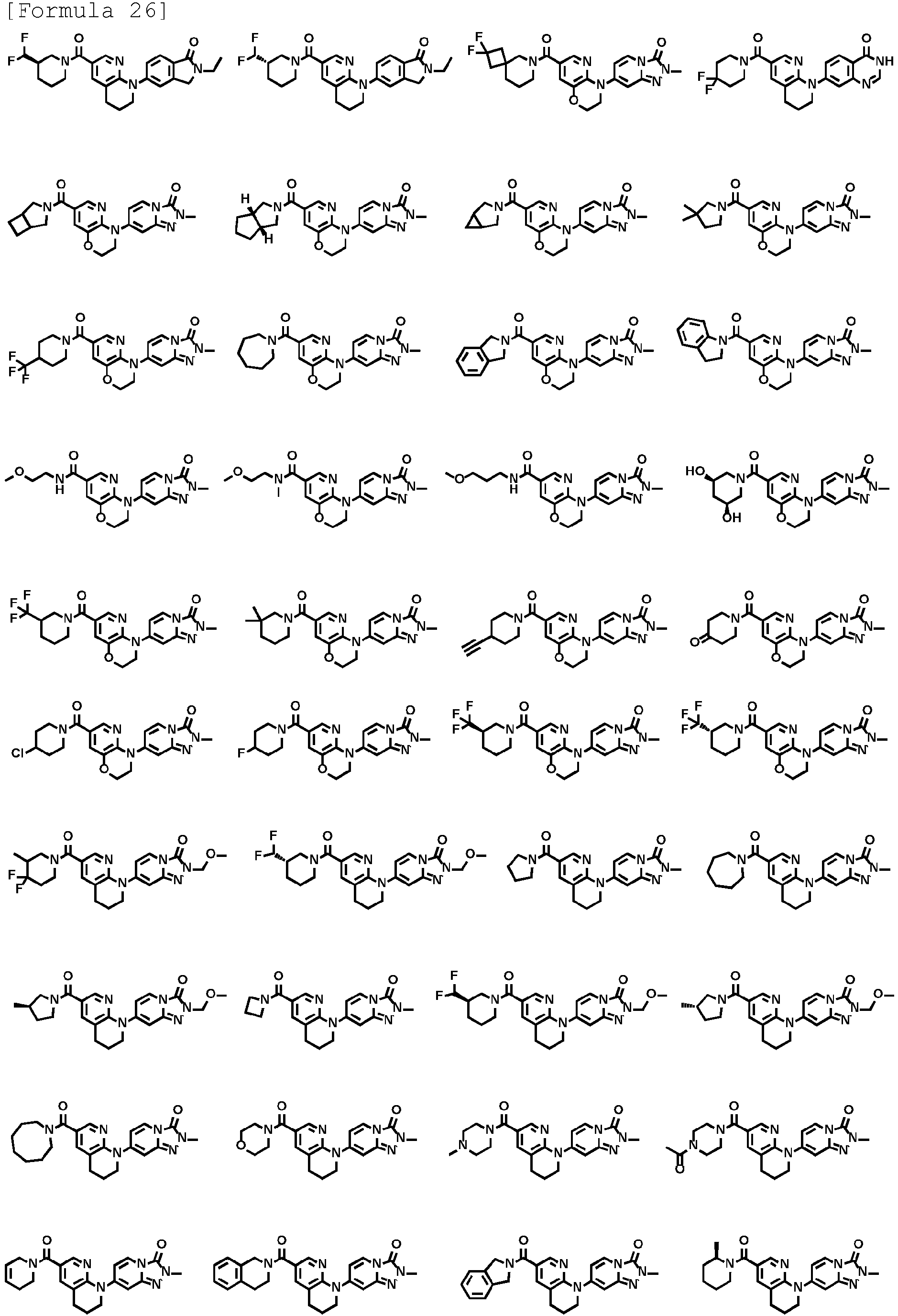


- A pharmaceutical comprising, as an active ingredient, the compound according to any one of claims 1 to 11, or a pharmacologically acceptable salt thereof.
- A 15-PGDH inhibitor comprising, as an active ingredient, the compound according to any one of claims 1 to 11, or a pharmacologically acceptable salt thereof.
- A method for treating or preventing one, two or more of fibrosis, inflammatory diseases, cardiovascular diseases, wounds, autoimmune diseases, graft-versus-host disease (GVHD), hair growth, osteoporosis, ear diseases, eye diseases, neutropenia, diabetes, underactive bladder, promotion of engraftment in stem cell or bone marrow transplantation or organ transplantation, neurogenesis and nerve cell death, muscle regeneration and cervical ripening, comprising administering the compound according to any one of claims 1 to 11 or a pharmacologically acceptable salt thereof.
- Use of the compound according to any one of claims 1 to 11 or a pharmacologically acceptable salt thereof, for producing a pharmaceutical for treating or preventing one, two or more of fibrosis, inflammatory diseases, cardiovascular diseases, wounds, autoimmune diseases, graft-versus-host disease (GVHD), hair growth, osteoporosis, ear diseases, eye diseases, neutropenia, diabetes, underactive bladder, promotion of engraftment in stem cell or bone marrow transplantation or organ transplantation, neurogenesis and nerve cell death, muscle regeneration and cervical ripening.
- A pharmaceutical composition comprising the compound according to any one of claims 1 to 11 or a pharmacologically acceptable salt thereof, and a pharmacologically acceptable carrier, for use in treating or preventing one, two or more of fibrosis, inflammatory diseases, cardiovascular diseases, wounds, autoimmune diseases, graft-versus-host disease (GVHD), hair growth, osteoporosis, ear diseases, eye diseases, neutropenia, diabetes, underactive bladder, promotion of engraftment in stem cell or bone marrow transplantation or organ transplantation, neurogenesis and nerve cell death, muscle regeneration and cervical ripening.
Applications Claiming Priority (2)
| Application Number | Priority Date | Filing Date | Title |
|---|---|---|---|
| JP2019000915 | 2019-01-08 | ||
| PCT/JP2020/000115 WO2020145250A1 (en) | 2019-01-08 | 2020-01-07 | 15-pgdh inhibitor |
Publications (2)
| Publication Number | Publication Date |
|---|---|
| EP3922247A1 true EP3922247A1 (en) | 2021-12-15 |
| EP3922247A4 EP3922247A4 (en) | 2022-10-12 |
Family
ID=71521703
Family Applications (1)
| Application Number | Title | Priority Date | Filing Date |
|---|---|---|---|
| EP20738295.3A Withdrawn EP3922247A4 (en) | 2019-01-08 | 2020-01-07 | 15-PGDH INHIBITOR |
Country Status (21)
| Country | Link |
|---|---|
| US (1) | US12577217B2 (en) |
| EP (1) | EP3922247A4 (en) |
| JP (1) | JP7575952B2 (en) |
| KR (1) | KR102905322B1 (en) |
| CN (1) | CN113226310B (en) |
| AR (1) | AR119672A1 (en) |
| AU (1) | AU2020207089B2 (en) |
| BR (1) | BR112021013105A2 (en) |
| CA (1) | CA3125900A1 (en) |
| CL (1) | CL2021001416A1 (en) |
| CO (1) | CO2021008681A2 (en) |
| EA (1) | EA202191286A1 (en) |
| IL (1) | IL283608B2 (en) |
| MA (1) | MA54901A (en) |
| MX (1) | MX2021007017A (en) |
| PH (1) | PH12021551324A1 (en) |
| SA (1) | SA521422143B1 (en) |
| SG (1) | SG11202106564XA (en) |
| TW (1) | TWI834795B (en) |
| WO (1) | WO2020145250A1 (en) |
| ZA (1) | ZA202104112B (en) |
Cited By (1)
| Publication number | Priority date | Publication date | Assignee | Title |
|---|---|---|---|---|
| WO2026096992A1 (en) * | 2024-11-04 | 2026-05-07 | Amgen Inc. | 5,6-fused bicyclic alcohol compounds as 15-prostaglandin dehydrogenase modulators |
Families Citing this family (18)
| Publication number | Priority date | Publication date | Assignee | Title |
|---|---|---|---|---|
| JP7604067B2 (en) * | 2020-11-26 | 2024-12-23 | エルジー・ケム・リミテッド | Heterocyclic compounds as diacylglycerol kinase inhibitors and their uses |
| JP2023552832A (en) * | 2020-12-09 | 2023-12-19 | ザ ボード オブ トラスティーズ オブ ザ レランド スタンフォード ジュニア ユニバーシティー | Methods for inhibiting prostaglandin-degrading enzyme 15-PGDH to improve joint structure and function |
| GB202106871D0 (en) * | 2021-05-13 | 2021-06-30 | Addex Pharmaceuticals Sa | Novel compounds |
| AU2022319753A1 (en) * | 2021-07-28 | 2024-02-22 | Epirium Bio Inc. | Pyrrolo[2,3-b]pyridine pgdh inhibitors and methods of making and using |
| CN116120285A (en) * | 2021-11-08 | 2023-05-16 | 武汉人福创新药物研发中心有限公司 | Heterocyclic compound, preparation method and application thereof |
| TWI926139B (en) * | 2021-11-18 | 2026-05-21 | 大陸商武漢人福創新藥物研發中心有限公司 | 15-PGDH inhibitors and their uses |
| CA3243368A1 (en) * | 2022-01-28 | 2025-01-16 | Scinnohub Pharmaceutical Co., Ltd. | Compound for regulating and controlling 15-pgdh activity and preparation method therefor |
| US20250250283A1 (en) * | 2022-04-13 | 2025-08-07 | Scinnohub Pharmaceutical Co., Ltd. | Compound capable of regulating and controlling activity of 15-pgdh, and preparation method therefor |
| CA3260935A1 (en) * | 2022-07-22 | 2025-03-31 | Scinnohub Pharmaceutical Co., Ltd | Compound for regulating and controlling activity of 15-pgdh and preparation method therefor |
| WO2024067463A1 (en) * | 2022-09-27 | 2024-04-04 | 苏州阿尔脉生物科技有限公司 | Benzo[7]annulene derivative, pharmaceutical composition comprising same, and medical uses thereof |
| WO2024099429A1 (en) * | 2022-11-11 | 2024-05-16 | 赛诺哈勃药业(成都)有限公司 | Compound for regulating and controlling activity of 15-pgdh and preparation method therefor |
| JP2026503081A (en) * | 2023-01-20 | 2026-01-27 | イノボ テラピュティクス インク | Novel heterocyclic compounds |
| CN118908977A (en) * | 2023-05-08 | 2024-11-08 | 武汉人福创新药物研发中心有限公司 | Crystal form of heterocyclic compound, salt thereof, crystal form of salt thereof and application of crystal form of salt |
| TW202446380A (en) * | 2023-05-19 | 2024-12-01 | 大陸商成都倍特藥業股份有限公司 | A compound for regulating 15-PGDH activity, a pharmaceutical composition containing the same and their uses |
| WO2024254599A1 (en) * | 2023-06-09 | 2024-12-12 | Nimbus Discovery, Inc. | Hpgd inhibitors and uses thereof |
| WO2024254601A1 (en) * | 2023-06-09 | 2024-12-12 | Nimbus Discovery, Inc. | Hpgd inhibitors and uses thereof |
| WO2026006830A1 (en) * | 2024-06-28 | 2026-01-02 | Case Western Reserve University | Compositions and methods of treating diseases and disorders characterized by blood-brain barrier deterioration or reactive oxygen species generation |
| CN121987634A (en) * | 2024-11-07 | 2026-05-08 | 湖北生物医药产业技术研究院有限公司 | Preparation containing heterocyclic compound or compound formed by heterocyclic compound and pharmaceutically acceptable salt, preparation method and application thereof |
Family Cites Families (63)
| Publication number | Priority date | Publication date | Assignee | Title |
|---|---|---|---|---|
| WO1997033866A1 (en) | 1996-03-11 | 1997-09-18 | Ube Industries, Ltd. | β-ANILINOETHANETHIOL COMPOUNDS, PROCESS FOR THE PREPARATION THEREOF, AND PROCESS FOR PREPARING 3,4-DIHYDRO-2H-1,4-BENZOTHIAZINE COMPOUNDS THEREFROM |
| US6245760B1 (en) | 1997-05-28 | 2001-06-12 | Aventis Pharmaceuticals Products, Inc | Quinoline and quinoxaline compounds which inhibit platelet-derived growth factor and/or p56lck tyrosine kinases |
| US6303627B1 (en) | 1998-06-19 | 2001-10-16 | Eli Lilly And Company | Inhibitors of serotonin reuptake |
| PE20010306A1 (en) | 1999-07-02 | 2001-03-29 | Agouron Pharma | INDAZOLE COMPOUNDS AND PHARMACEUTICAL COMPOSITIONS CONTAINING THEM USEFUL FOR THE INHIBITION OF PROTEIN KINASE |
| AU7360700A (en) * | 1999-09-09 | 2001-04-10 | Androsolutions, Inc. | Methods and compositions for preventing and treating urinary tract disorders |
| DE60124730T2 (en) | 2000-03-03 | 2007-10-04 | Eisai R&D Management Co., Ltd. | NEW METHODS USING CHOLINESTERASEINHIBITORS |
| SI1397364T1 (en) | 2001-05-24 | 2007-12-31 | Lilly Co Eli | Novel pyrrole derivatives as pharmaceutical agents |
| GB0115109D0 (en) | 2001-06-21 | 2001-08-15 | Aventis Pharma Ltd | Chemical compounds |
| US6787558B2 (en) | 2001-09-28 | 2004-09-07 | Hoffmann-La Roche Inc. | Quinoline derivatives |
| AU2002340282B2 (en) | 2001-10-23 | 2007-08-09 | Merck Serono Sa | Pyrazolidinone compounds as ligands of the prostaglandin EP2 and/or EP4 receptors |
| US7320967B2 (en) | 2002-04-23 | 2008-01-22 | L'oreal | Cosmetic composition, method of cosmetic treatment and preparation of a composition for promoting the growth and/or preventing or delaying the loss of hair |
| EP1358868A3 (en) | 2002-04-23 | 2003-11-19 | L'oreal | Cosmetic composition for increasing hair growth and/or for preventing or delaying hair loss |
| WO2004034963A2 (en) | 2002-05-17 | 2004-04-29 | Eisai Co., Ltd. | Methods and compositions using cholinesterase inhibitors |
| EP1594438B1 (en) | 2003-02-12 | 2013-07-17 | L'Oréal | Use of an inhibitor of 15-hydroxyprostaglandin dehydrogenase in order to stimulate pigmentation of the skin or hair |
| WO2004089416A2 (en) | 2003-04-11 | 2004-10-21 | Novo Nordisk A/S | Combination of an 11beta-hydroxysteroid dehydrogenase type 1 inhibitor and an antihypertensive agent |
| GB0320320D0 (en) | 2003-08-29 | 2003-10-01 | Glaxo Group Ltd | Novel compounds |
| FR2869224B1 (en) | 2004-04-22 | 2006-06-09 | Oreal | 2-OXY-ACETAMIDE COMPOUND, USES THEREOF AND COMPOSITIONS FOR STIMULATING OR INDUCING THE PUSH OF KERATIN FIBERS AND / OR BRAKING THEIR FALL |
| AR051780A1 (en) | 2004-11-29 | 2007-02-07 | Japan Tobacco Inc | FUSIONED RING COMPOUNDS CONTAINING NITROGEN AND USING THEMSELVES |
| EP1851203A2 (en) | 2005-02-08 | 2007-11-07 | Merck & Co., Inc. | Inhibitors of checkpoint kinases |
| US20090111805A1 (en) | 2005-02-24 | 2009-04-30 | Pfizer Inc. | Bicyclic heteroaromatic derivatives useful as anticancer agents |
| EP1896461A2 (en) | 2005-06-30 | 2008-03-12 | Amgen Inc. | Bis-aryl kinase inhibitors and their use in the treatment of inflammation, angiogenesis and cancer |
| FR2891457B1 (en) | 2005-10-05 | 2007-11-23 | Oreal | USE OF PHENYL-FURYL-METHYL-THIAZOLIDINE-2,4-DIONE OR PHENYL-THIENYL-METHYL-THIAZOLIDINE-2,4-DIONES COMPOUNDS FOR PROMOTING AND / OR INDUCING AND / OR STIMULATING THE PIGMENTATION OF KERATINIC MATERIALS AND / OR LIMITING THEIR DEPIGMENTATION AND/ |
| US20070077215A1 (en) | 2005-10-05 | 2007-04-05 | L'oreal | Administration of phenylfurymethylthiazolidine-2,4-dione or phenylthienymethylthiazolidine-2,4-dione compounds for promoting and/or inducing and/or stimulating the pigmentation of keratinous substances and/or limiting their depigmentation and/or their whitening |
| AU2007214594B2 (en) | 2006-02-13 | 2010-11-11 | F. Hoffmann-La Roche Ag | Heterobicyclic sulfonamide derivatives for the treatment of diabetes |
| US20080305169A1 (en) | 2006-05-26 | 2008-12-11 | Japan Tobacco Inc. | Pharmaceutical Compositions Comprising Nitrogen-Containing Fused Ring Coumpounds |
| US20080064871A1 (en) | 2006-05-26 | 2008-03-13 | Japan Tobacco Inc. | Production Method of Nitrogen-Containing Fused Ring Compounds |
| GB0611759D0 (en) | 2006-06-14 | 2006-07-26 | Victrex Mfg Ltd | Polymeric material |
| WO2008001076A1 (en) | 2006-06-26 | 2008-01-03 | Ucb Pharma S.A. | Fused thiazole derivatives as kinase inhibitors |
| EA019103B1 (en) | 2007-03-20 | 2014-01-30 | Кьюрис, Инк. | Fused amino pyridine as hsp90 inhibitors |
| WO2009017838A2 (en) | 2007-08-01 | 2009-02-05 | Exelixis, Inc. | Combinations of jak-2 inhibitors and other agents |
| US7960376B2 (en) | 2007-09-14 | 2011-06-14 | Cara Therapeutics, Inc. | Benzo-fused heterocycles |
| KR101536021B1 (en) | 2007-10-16 | 2015-07-10 | 다이이찌 산쿄 가부시키가이샤 | Pyrimidyl indoline compound |
| CN101939288A (en) | 2008-02-05 | 2011-01-05 | 阿斯特兰德英国有限公司 | Difluorobenzamide derivatives for the treatment of ocular hypertension |
| TWI386204B (en) | 2008-04-10 | 2013-02-21 | Mitsubishi Tanabe Pharma Corp | Homocysteine synthetase inhibitors |
| EP2341052A4 (en) | 2008-09-05 | 2011-10-12 | Shionogi & Co | Ring-fused morpholine derivative having pi3k-inhibiting activity |
| EP2210891A1 (en) | 2009-01-26 | 2010-07-28 | Domain Therapeutics | New adenosine receptor ligands and uses thereof |
| RU2558141C2 (en) * | 2009-04-22 | 2015-07-27 | Янссен Фармацевтика Нв | Heteroaromatic and aromatic piperazinyl azetidinyl amides as monoacylglycerol lipase inhibitors |
| EP2322176A1 (en) | 2009-11-11 | 2011-05-18 | Almirall, S.A. | New 7-phenyl-[1,2,4]triazolo[4,3-a]pyridin-3(2H)-one derivatives |
| BR112013010958A8 (en) * | 2010-10-22 | 2017-10-03 | Api Genesis Llc | METHODS FOR ENHANCED THE SOLUBILITY OF POORLY SOLUBLE COMPOUNDS AND METHODS FOR MANUFACTURING AND USE FORMULATIONS OF SUCH COMPOUNDS |
| WO2012094462A2 (en) * | 2011-01-05 | 2012-07-12 | Bioenergenix | Heterocyclic compounds for the inhibition of pask |
| USRE47009E1 (en) | 2011-02-01 | 2018-08-28 | The Children's Hospital Of Philadelphia | HDAC inhibitors and therapeutic methods using the same |
| JP2014518267A (en) | 2011-06-27 | 2014-07-28 | 杏林製薬株式会社 | Bridged bicyclic compounds for the treatment of bacterial infections |
| US9801863B2 (en) | 2012-04-16 | 2017-10-31 | Case Western Reserve University | Inhibitors of short-chain dehydrogenase activity for modulating hematopoietic stem cells and hematopoiesis |
| WO2016144958A1 (en) | 2015-03-08 | 2016-09-15 | Case Western Reserve University | Inhibitors of short-chain dehydrogenase activity for treating fibrosis |
| CA2870666A1 (en) | 2012-04-16 | 2013-10-24 | Case Western Reserve University | Compositions and methods of modulating 15-pgdh activity |
| EA029892B1 (en) | 2012-04-25 | 2018-05-31 | Такеда Фармасьютикал Компани Лимитед | Nitrogenated heterocyclic compound |
| KR20150022789A (en) | 2012-06-04 | 2015-03-04 | 키에시 파르마슈티시 엣스. 피. 에이. | Derivatives of 1-phenyl-2-pyridinyl alkyl alcohols as phosphodiesterase inhibitors |
| FR2992316A1 (en) | 2012-06-22 | 2013-12-27 | Sanofi Sa | PYRIMIDINONE DERIVATIVES, THEIR PREPARATION AND THEIR THERAPEUTIC APPLICATION |
| CA2927730A1 (en) * | 2013-10-15 | 2015-05-07 | Case Western Reserve University | Compositions and methods of modulating short-chain dehydrogenase activity |
| WO2015115673A1 (en) | 2014-01-31 | 2015-08-06 | Ono Pharmaceutical Co., Ltd. | Fused imidazole compounds |
| KR101551313B1 (en) | 2014-07-28 | 2015-09-09 | 충남대학교산학협력단 | Novel indene derivatives, preparation method thereof, and pharmaceutical composition for use in preventing or treating blindness related diseases containing the same as an active ingredient |
| CA2971413A1 (en) | 2014-12-16 | 2016-06-23 | Axovant Sciences Gmbh | Geminal substituted quinuclidine amide compounds as agonists of alpha-7 nicotinic acetylcholine receptors |
| HK1247813A1 (en) | 2015-02-24 | 2018-10-05 | Pitney Pharmaceuticals Pty Limited | Anti cancer agent comprising aminoacetonitrile compound as active ingredient |
| KR101663277B1 (en) | 2015-03-30 | 2016-10-06 | 주식회사 녹십자 | Pyrazole derivatives as TNIK, IKKε and TBK1 inhibitors and pharmaceutical compositions containing them |
| EP3283074A4 (en) | 2015-04-14 | 2018-12-05 | Case Western Reserve University | Compositions and methods of modulating short-chain dehydrogenase activity |
| EP3372601B1 (en) | 2015-10-22 | 2022-09-21 | Mitsubishi Tanabe Pharma Corporation | Novel bicyclic heterocyclic compound |
| SG11201803242TA (en) | 2015-10-29 | 2018-05-30 | Effector Therapeutics Inc | Isoindoline, azaisoindoline, dihydroindenone and dihydroazaindenone inhibitors of mnk1 and mnk2 |
| WO2017147328A1 (en) | 2016-02-23 | 2017-08-31 | Portola Pharmaceuticals, Inc. | Compounds for binding proprotein convertase subtilisin/kexin type 9 (pcsk9) |
| CA3031091A1 (en) | 2016-07-18 | 2018-01-25 | Case Western Reserve University | Inhibitors of short-chain dehydrogenase activity for promoting neurogenesis and inhibiting nerve cell death |
| EP3548035A4 (en) * | 2016-11-30 | 2020-07-22 | Case Western Reserve University | COMBINATIONS OF 15 PGDH INHIBITORS WITH CORTICOSTEROIDS AND / OR TNF INHIBITORS AND USES THEREOF |
| CN110573154A (en) | 2017-02-06 | 2019-12-13 | 卡斯西部储备大学 | Compositions and methods for modulating short-chain dehydrogenase activity |
| US12138263B2 (en) | 2018-03-21 | 2024-11-12 | Relay Therapeutics, Inc. | Pyrazolo[3,4-b]pyrazine SHP2 phosphatase inhibitors and methods of use thereof |
| JP7677983B2 (en) | 2020-01-23 | 2025-05-15 | マイオフォルテ セラピューティクス,インク. | PGDH inhibitors and methods of making and using same |
-
2020
- 2020-01-07 JP JP2020565151A patent/JP7575952B2/en active Active
- 2020-01-07 SG SG11202106564XA patent/SG11202106564XA/en unknown
- 2020-01-07 PH PH1/2021/551324A patent/PH12021551324A1/en unknown
- 2020-01-07 CA CA3125900A patent/CA3125900A1/en active Pending
- 2020-01-07 AR ARP200100039A patent/AR119672A1/en unknown
- 2020-01-07 MA MA054901A patent/MA54901A/en unknown
- 2020-01-07 TW TW109100385A patent/TWI834795B/en active
- 2020-01-07 BR BR112021013105-1A patent/BR112021013105A2/en not_active Application Discontinuation
- 2020-01-07 EA EA202191286A patent/EA202191286A1/en unknown
- 2020-01-07 CN CN202080008297.XA patent/CN113226310B/en not_active Withdrawn - After Issue
- 2020-01-07 IL IL283608A patent/IL283608B2/en unknown
- 2020-01-07 MX MX2021007017A patent/MX2021007017A/en unknown
- 2020-01-07 US US17/417,201 patent/US12577217B2/en active Active
- 2020-01-07 EP EP20738295.3A patent/EP3922247A4/en not_active Withdrawn
- 2020-01-07 KR KR1020217019022A patent/KR102905322B1/en not_active Ceased
- 2020-01-07 AU AU2020207089A patent/AU2020207089B2/en not_active Revoked
- 2020-01-07 WO PCT/JP2020/000115 patent/WO2020145250A1/en not_active Ceased
-
2021
- 2021-05-28 CL CL2021001416A patent/CL2021001416A1/en unknown
- 2021-05-31 SA SA521422143A patent/SA521422143B1/en unknown
- 2021-06-15 ZA ZA2021/04112A patent/ZA202104112B/en unknown
- 2021-06-30 CO CONC2021/0008681A patent/CO2021008681A2/en unknown
Cited By (1)
| Publication number | Priority date | Publication date | Assignee | Title |
|---|---|---|---|---|
| WO2026096992A1 (en) * | 2024-11-04 | 2026-05-07 | Amgen Inc. | 5,6-fused bicyclic alcohol compounds as 15-prostaglandin dehydrogenase modulators |
Also Published As
| Publication number | Publication date |
|---|---|
| KR102905322B1 (en) | 2025-12-30 |
| CA3125900A1 (en) | 2020-07-16 |
| BR112021013105A2 (en) | 2021-09-21 |
| EP3922247A4 (en) | 2022-10-12 |
| IL283608A (en) | 2021-07-29 |
| ZA202104112B (en) | 2024-10-30 |
| AU2020207089A1 (en) | 2021-06-24 |
| CN113226310A (en) | 2021-08-06 |
| US12577217B2 (en) | 2026-03-17 |
| CN113226310B (en) | 2024-03-19 |
| US20230082516A1 (en) | 2023-03-16 |
| JP7575952B2 (en) | 2024-10-30 |
| CL2021001416A1 (en) | 2021-12-24 |
| KR20210113598A (en) | 2021-09-16 |
| AU2020207089B2 (en) | 2025-08-14 |
| EA202191286A1 (en) | 2021-11-19 |
| MX2021007017A (en) | 2021-07-21 |
| SG11202106564XA (en) | 2021-07-29 |
| MA54901A (en) | 2021-12-15 |
| SA521422143B1 (en) | 2025-05-14 |
| TW202043206A (en) | 2020-12-01 |
| CO2021008681A2 (en) | 2021-07-19 |
| PH12021551324A1 (en) | 2022-04-25 |
| IL283608B2 (en) | 2025-06-01 |
| IL283608B1 (en) | 2025-02-01 |
| WO2020145250A1 (en) | 2020-07-16 |
| AR119672A1 (en) | 2022-01-05 |
| TWI834795B (en) | 2024-03-11 |
| JPWO2020145250A1 (en) | 2021-11-18 |
Similar Documents
| Publication | Publication Date | Title |
|---|---|---|
| US12577217B2 (en) | 15-PGDH inhibitor | |
| AU2020343671B2 (en) | RIP1 inhibitory compounds and methods for making and using the same | |
| JP7017521B2 (en) | Inhibitor of activin receptor-like kinase | |
| ES2972419T3 (en) | Kynurenine-3-monooxygenase inhibitors, pharmaceutical compositions and methods of use thereof | |
| EP3148539B1 (en) | Histone deacetylase inhibitors and compositions and methods of use thereof | |
| AU2016271762B2 (en) | Nitrogen-containing tricyclic derivatives having HIV replication inhibitory activity | |
| US10246429B2 (en) | Vinyl fluoride cyclopropyl fused thiazin-2-amine compounds as beta-secretase inhibitors and methods of use | |
| PT2663561E (en) | Novel heterocyclic derivatives and their use in the treatment of neurological disorders | |
| EP3860998B1 (en) | Compounds and compositions for treating conditions associated with apj receptor activity | |
| US9617259B2 (en) | Histone deacetylase inhibitors and compositions and methods of use thereof | |
| WO2014159224A1 (en) | Histone deacetylase inhibitors and compositions and methods of use thereof | |
| JP2021527665A (en) | Thiophene derivatives for treating disorders caused by IgE | |
| CN113754635B (en) | Condensed ring compound and preparation method and application thereof | |
| EA046481B1 (en) | INHIBITOR 15-PGDH | |
| BR112021014539A2 (en) | COMPOUND, SIRT6 ACTIVATOR, PHARMACEUTICAL COMPOSITION, METHOD TO TREAT AND/OR PREVENT A PERIPHERAL INFLAMMATORY DISEASE AND USE OF THE COMPOUND | |
| KR20140029478A (en) | New hexahydropyrroloimidazolone compounds | |
| HK40111351A (en) | Compounds and compositions for treating conditions associated with apj receptor activity | |
| JP2025502100A (en) | Heterocyclic inhibitors of glut9 for the treatment of disease - Patents.com | |
| BR122023025931A2 (en) | COMPOUNDS FOR THE TREATMENT OF CONDITIONS ASSOCIATED WITH APJ RECEPTOR ACTIVITY, PHARMACEUTICAL COMPOSITION COMPRISING SAID COMPOUNDS, AND THEIR USES | |
| HK40056632A (en) | 15-pgdh inhibitor | |
| KR20220116823A (en) | Novel compound and pharmaceutical composition for preventing or treating diseases related to autotaxin activity comprising the same | |
| WO2020138015A1 (en) | Pyrazolo[1,5-a]pyrimidine macrocyclic compound | |
| HK1233253A1 (en) | Kynurenine-3-monooxygenase inhibitors, pharmaceutical compositions, and methods of use thereof | |
| MXPA00009744A (en) | Sulfonamide derivatives |
Legal Events
| Date | Code | Title | Description |
|---|---|---|---|
| STAA | Information on the status of an ep patent application or granted ep patent |
Free format text: STATUS: THE INTERNATIONAL PUBLICATION HAS BEEN MADE |
|
| PUAI | Public reference made under article 153(3) epc to a published international application that has entered the european phase |
Free format text: ORIGINAL CODE: 0009012 |
|
| STAA | Information on the status of an ep patent application or granted ep patent |
Free format text: STATUS: REQUEST FOR EXAMINATION WAS MADE |
|
| 17P | Request for examination filed |
Effective date: 20210808 |
|
| AK | Designated contracting states |
Kind code of ref document: A1 Designated state(s): AL AT BE BG CH CY CZ DE DK EE ES FI FR GB GR HR HU IE IS IT LI LT LU LV MC MK MT NL NO PL PT RO RS SE SI SK SM TR |
|
| A4 | Supplementary search report drawn up and despatched |
Effective date: 20220914 |
|
| RIC1 | Information provided on ipc code assigned before grant |
Ipc: A61K 31/496 20060101ALI20220908BHEP Ipc: A61K 31/4709 20060101ALI20220908BHEP Ipc: A61K 31/4545 20060101ALI20220908BHEP Ipc: A61K 31/454 20060101ALI20220908BHEP Ipc: A61K 31/4523 20060101ALI20220908BHEP Ipc: A61K 31/4375 20060101AFI20220908BHEP |
|
| RAP3 | Party data changed (applicant data changed or rights of an application transferred) |
Owner name: KYORIN PHARMACEUTICAL CO., LTD. |
|
| STAA | Information on the status of an ep patent application or granted ep patent |
Free format text: STATUS: THE APPLICATION HAS BEEN WITHDRAWN |
|
| 18W | Application withdrawn |
Effective date: 20260413 |