EP3920503A1 - Resource request method, device and storage medium - Google Patents
Resource request method, device and storage medium Download PDFInfo
- Publication number
- EP3920503A1 EP3920503A1 EP20763140.9A EP20763140A EP3920503A1 EP 3920503 A1 EP3920503 A1 EP 3920503A1 EP 20763140 A EP20763140 A EP 20763140A EP 3920503 A1 EP3920503 A1 EP 3920503A1
- Authority
- EP
- European Patent Office
- Prior art keywords
- resource
- remote reference
- reference node
- resource request
- key
- Prior art date
- Legal status (The legal status is an assumption and is not a legal conclusion. Google has not performed a legal analysis and makes no representation as to the accuracy of the status listed.)
- Granted
Links
Images





Classifications
-
- H—ELECTRICITY
- H04—ELECTRIC COMMUNICATION TECHNIQUE
- H04L—TRANSMISSION OF DIGITAL INFORMATION, e.g. TELEGRAPHIC COMMUNICATION
- H04L63/00—Network architectures or network communication protocols for network security
- H04L63/10—Network architectures or network communication protocols for network security for controlling access to devices or network resources
-
- H—ELECTRICITY
- H04—ELECTRIC COMMUNICATION TECHNIQUE
- H04L—TRANSMISSION OF DIGITAL INFORMATION, e.g. TELEGRAPHIC COMMUNICATION
- H04L63/00—Network architectures or network communication protocols for network security
- H04L63/04—Network architectures or network communication protocols for network security for providing a confidential data exchange among entities communicating through data packet networks
- H04L63/0428—Network architectures or network communication protocols for network security for providing a confidential data exchange among entities communicating through data packet networks wherein the data content is protected, e.g. by encrypting or encapsulating the payload
- H04L63/0435—Network architectures or network communication protocols for network security for providing a confidential data exchange among entities communicating through data packet networks wherein the data content is protected, e.g. by encrypting or encapsulating the payload wherein the sending and receiving network entities apply symmetric encryption, i.e. same key used for encryption and decryption
-
- G—PHYSICS
- G06—COMPUTING OR CALCULATING; COUNTING
- G06F—ELECTRIC DIGITAL DATA PROCESSING
- G06F21/00—Security arrangements for protecting computers, components thereof, programs or data against unauthorised activity
- G06F21/30—Authentication, i.e. establishing the identity or authorisation of security principals
- G06F21/44—Program or device authentication
-
- G—PHYSICS
- G06—COMPUTING OR CALCULATING; COUNTING
- G06F—ELECTRIC DIGITAL DATA PROCESSING
- G06F21/00—Security arrangements for protecting computers, components thereof, programs or data against unauthorised activity
- G06F21/60—Protecting data
- G06F21/606—Protecting data by securing the transmission between two devices or processes
-
- H—ELECTRICITY
- H04—ELECTRIC COMMUNICATION TECHNIQUE
- H04L—TRANSMISSION OF DIGITAL INFORMATION, e.g. TELEGRAPHIC COMMUNICATION
- H04L63/00—Network architectures or network communication protocols for network security
- H04L63/04—Network architectures or network communication protocols for network security for providing a confidential data exchange among entities communicating through data packet networks
- H04L63/0428—Network architectures or network communication protocols for network security for providing a confidential data exchange among entities communicating through data packet networks wherein the data content is protected, e.g. by encrypting or encapsulating the payload
- H04L63/0442—Network architectures or network communication protocols for network security for providing a confidential data exchange among entities communicating through data packet networks wherein the data content is protected, e.g. by encrypting or encapsulating the payload wherein the sending and receiving network entities apply asymmetric encryption, i.e. different keys for encryption and decryption
-
- H—ELECTRICITY
- H04—ELECTRIC COMMUNICATION TECHNIQUE
- H04L—TRANSMISSION OF DIGITAL INFORMATION, e.g. TELEGRAPHIC COMMUNICATION
- H04L63/00—Network architectures or network communication protocols for network security
- H04L63/06—Network architectures or network communication protocols for network security for supporting key management in a packet data network
-
- H—ELECTRICITY
- H04—ELECTRIC COMMUNICATION TECHNIQUE
- H04L—TRANSMISSION OF DIGITAL INFORMATION, e.g. TELEGRAPHIC COMMUNICATION
- H04L63/00—Network architectures or network communication protocols for network security
- H04L63/12—Applying verification of the received information
- H04L63/126—Applying verification of the received information the source of the received data
-
- H—ELECTRICITY
- H04—ELECTRIC COMMUNICATION TECHNIQUE
- H04L—TRANSMISSION OF DIGITAL INFORMATION, e.g. TELEGRAPHIC COMMUNICATION
- H04L9/00—Cryptographic mechanisms or cryptographic arrangements for secret or secure communications; Network security protocols
- H04L9/08—Key distribution or management, e.g. generation, sharing or updating, of cryptographic keys or passwords
- H04L9/088—Usage controlling of secret information, e.g. techniques for restricting cryptographic keys to pre-authorized uses, different access levels, validity of crypto-period, different key- or password length, or different strong and weak cryptographic algorithms
-
- H—ELECTRICITY
- H04—ELECTRIC COMMUNICATION TECHNIQUE
- H04L—TRANSMISSION OF DIGITAL INFORMATION, e.g. TELEGRAPHIC COMMUNICATION
- H04L9/00—Cryptographic mechanisms or cryptographic arrangements for secret or secure communications; Network security protocols
- H04L9/14—Cryptographic mechanisms or cryptographic arrangements for secret or secure communications; Network security protocols using a plurality of keys or algorithms
-
- H—ELECTRICITY
- H04—ELECTRIC COMMUNICATION TECHNIQUE
- H04L—TRANSMISSION OF DIGITAL INFORMATION, e.g. TELEGRAPHIC COMMUNICATION
- H04L9/00—Cryptographic mechanisms or cryptographic arrangements for secret or secure communications; Network security protocols
- H04L9/30—Public key, i.e. encryption algorithm being computationally infeasible to invert or user's encryption keys not requiring secrecy
Definitions
- Embodiments of the present application relate to Internet of Things technology, in particular, to a resource request method, a device, and a storage medium.
- Open Connectivity Foundation (English: Open Connectivity Foundation, for short: OCF) is one of the largest industrial connectivity and interoperability standard organizations for Internet of Things devices.
- An OCF network includes an original client (English: Original Client, for short: OC), a remote reference host (English: Remote Reference Host, for short: RRH), and a collection host (English: Collection Host, for short: CH).
- An OC can be a control device, such as a smart phone, a computer or the like; a CH can be a connection device, such as a home gateway or the like; and an RRH can be an intelligent device that provides various services, for example, a smart desk lamp, a smart speaker, a smart air conditioner or the like.
- the OC When the OC needs to operate an RRH resource, the OC sends a collection (collection) resource request to the CH, and the CH verifies whether the OC has a right to access an RRH resource. If yes, the CH decomposes the collection resource request into requests for respective RRH resources, and sends a resource request to the RRH, which returns a resource response to the CH, the CH integrates the resource responses from respective RRHs and returns it to the OC as a whole.
- a collection (collection) resource request to the CH
- the CH verifies whether the OC has a right to access an RRH resource. If yes, the CH decomposes the collection resource request into requests for respective RRH resources, and sends a resource request to the RRH, which returns a resource response to the CH, the CH integrates the resource responses from respective RRHs and returns it to the OC as a whole.
- Embodiments of the present application provide a resource request method, a device, and a storage medium, improving security of data transmitted between a control device and a remote reference node.
- an embodiment of the present application may provide a resource request method applied to a control device, the method including:
- an embodiment of the present application may provide a resource request method applied to a remote reference node, the method including:
- an embodiment of the present application may provide a resource request method applied to a resource collection device, the method including:
- an embodiment of the present application may provide a control device, including:
- an embodiment of the present application may provide a remote reference node, including:
- an embodiment of the present application may provide a resource collection device, including:
- an embodiment of the present application may provide a control device, including:
- an embodiment of the present application may provide a remote reference node, including:
- an embodiment of the present application may provide a resource collection device, including:
- an embodiment of the present application may provide a computer readable storage medium, the computer readable storage medium storing a computer executable instruction, and when the computer executable instruction is executed by a processor, the resource request method according to the first aspect being implemented.
- an embodiment of the present application may provide a computer readable storage medium, the computer readable storage medium storing a computer executable instruction, and when the computer executable instruction is executed by a processor, the resource request method according to the second aspect being implemented.
- an embodiment of the present application may provide a computer readable storage medium, the computer readable storage medium storing a computer executable instruction, and when the computer executable instruction is executed by a processor, the resource request method according to the third aspect being implemented.
- an embodiment of the present application provides a program for executing the resource request method according to the first aspect when the program is executed by a processor.
- an embodiment of the present application further provides a program for executing the resource request method according to the second aspect when the program is executed by a processor.
- an embodiment of the present application further provides a program for executing the resource request method according to the third aspect when the program is executed by a processor.
- the processor may be a chip.
- an embodiment of the present application provides a computer program product including a program instruction, the program instruction being used to implement the resource request method according to the first aspect.
- an embodiment of the present application provides a computer program product including a program instruction, the program instruction being used to implement the resource request method according to the second aspect.
- an embodiment of the present application provides a computer program product including a program instruction, the program instruction being used to implement the resource request method according to the third aspect.
- an embodiment of the present application provides a chip including a processing module and a communication interface, the processing module being able to execute the resource request method according to the first aspect. Further, the chip further includes a memory module (e.g., memory), the memory module being able to store an instruction, the processing module being used to execute the instruction stored in the memory module, and an execution of the instruction stored in the memory module causes the processing module to execute the resource request method according to the first aspect.
- a memory module e.g., memory
- an embodiment of the present application provides a chip including a processing module and a communication interface, the processing module being able to execute the resource request method according to the second aspect. Further, the chip further includes a memory module (e.g., memory), the memory module being able to store an instruction, the processing module being used to execute the instruction stored in the memory module, and an execution of the instruction stored in the memory module causes the processing module to execute the resource request method according to the second aspect.
- a memory module e.g., memory
- an embodiment of the present application provides a chip including a processing module and a communication interface, the processing module being able to execute the resource request method according to the third aspect.
- the chip further includes a memory module (e.g., memory), the memory module being able to store an instruction, the processing module being used to execute the instructions stored in the memory module, and an execution of the instruction stored in the memory module causes the processing module to execute the resource request method according to the third aspect.
- a memory module e.g., memory
- the memory module being able to store an instruction
- the processing module being used to execute the instructions stored in the memory module
- an execution of the instruction stored in the memory module causes the processing module to execute the resource request method according to the third aspect.
- Embodiments of the present application provide a resource request method, a device, and a storage medium, where the method applied to a control device includes: generating a resource collection request message, the resource collection request message including a resource request for at least one remote reference node and corresponding first check data of the resource request, and sending the resource collection request message to a resource collection device.
- a remote service device is enabled to determine whether a source of the resource request is reliable according to the first check data, thus improving security of data transmitted between the control device and the remote reference node.
- a process, a method, a system, a product, or a device including a series of steps or units are not necessary to be limited to those steps or units clearly listed, but may include other steps or units not clearly listed or inherent to the process, the method, the product, or the device.
- FIG. 1 is a schematic diagram of a network architecture applicable to an embodiment of the present application.
- the network architecture at least includes a control device 11, a resource collection device 12, and a remote reference node 13. It can be understood that in actual network deployment, there may be one or more control devices 11, resource collection devices 12, and remote reference nodes 13, and FIG. 1 only takes one as an example.
- control device 11 and the resource collection device 12 may be connected or communicate in a wired or wireless manner.
- resource collection device 12 and the remote reference node 13 can also be connected or communicate in a wired or wireless manner.
- the control device 11 accesses and operates a resource provided by the remote reference node 13 through the resource collection device 12, and each remote reference node 13 may provide one or more resources, which may be a function of the remote reference node 13.
- the resource collection device 12 is used to perform unified management to a local resource and the resource provided by the remote reference node 13, and provides an interface for the control device 11 to access a resource.
- the network architecture may be an OCF network, and accordingly, the control device 11 is an OC, the resource collection device 12 is a CH, and the remote reference node 13 is an RRH. It can be understood that the network architecture is not limited to an OCF network, but can further be: a smart device which is used as a client and a server and controlled by an intermediate device (whose function is similar to a CH) under an Internet of Things environment.
- an OC may be a smart phone, a personal computer, a tablet computer, etc.
- a CH may be a home gateway or other gateway devices
- an RRH may be a smart home appliances device, such as a smart desk lamp, a smart refrigerator, a smart speaker, etc.
- FIG. 2 is a schematic diagram of an application layer of each device in an OCF network.
- the CH includes a first access control entry (English: Access Control Entry, for short: ACE), a second ACE, and a collection resource (collection resource) A.
- ACE Access Control Entry
- the collection resource A is a local resource of the CH
- the second ACE defines a collection resource B allowed to be accessed by the OC
- the collection resource B is a resource of the RRH.
- the first ACE includes information of the collection resource A and an ID or a rule of the OC allowed to access
- the second ACE includes information of the collection resource B and the ID or the rule of the OC allowed to access.
- the CH When receiving a collection resource request message sent by the OC, the CH determines whether the OC matches with the first ACE and the second ACE. If so, the CH decomposes and encapsulates the collection resource request message, obtains a resource request for the RRH, and sends the resource request for the RRH to the RRH.
- the RRH includes a third ACE, the third ACE defines the collection resource B that is allowed to be accessed by the CH, and optionally, the RRH further includes a fourth ACE, the fourth ACE defines the collection resource B that is allowed to be accessed by the OC.
- the RRH determines, according to the third ACE, whether to execute the request and returns a response to the CH.
- the CH collects all responses, and then packages them as a whole and sends them to the OC.
- the CH includes one or more collection resources, each collection resource includes one or more link resources, each link resource is an address or an index of a local resource of the CH or a resource of the RRH.
- a collection resource includes a link of a switching resource in a device A (light) and a link of a switching resource in a device B (fan), thus forming a centralized resource group.
- the OC may request a plurality of resources at the same time by accessing an oic.if.b interface of the collection resource.
- the CH may send a request to a respective resource in links, collect a response returned by the respective resource, and return it to the OC after unified concentration.
- the present application provides a resource request method.
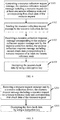
- FIG. 3 is a schematic flowchart of a resource request method provided in Embodiment 1 of the present application, and the embodiment describes the method from a perspective of a control device.
- the method provided in the present embodiment includes following steps: S101, generating a resource collection request message, the resource collection request message including a resource request for at least one remote reference node and corresponding first check data of the resource request.
- the resource collection request message carries the first check data corresponding to the resource request for the remote reference node, and the first check data is used for the remote reference node to verify whether a source of the resource request is reliable, i.e., the remote reference node verifies whether the resource request is sent by the control device instead of other devices according to the first check data.
- the resource request message further includes other information, for example, an identifier of the control device.
- the resource collection request message may be a collection resource request message.
- the first check data may be obtained by encrypting the resource request for the remote reference node with an encryption key by the control device.
- the first check data is obtained by encrypting first information in the resource request for the remote reference node with an encryption key by the control device, and the first information is used to identify resource requests for different remote reference nodes, and other information in the resource request except the first information may be called second information.
- the first information may be multiple pieces of information.
- the encryption key may be determined by the control device and the remote reference node through negotiation in advance, or configured by other management devices for the control device, or configured manually by a worker.
- the control device may use the encryption key to encrypt the resource request for the remote reference node as a whole, or may encrypt the first information in the resource request for the remote reference node.
- the first information is not limited as long as the first information can identify resource requests for different remote reference nodes, for example, the first information is an address of a resource.
- control device and the remote reference node may adopt a symmetric encryption algorithm or an asymmetric encryption algorithm.
- the key used in the symmetric encryption algorithm is a shared key between the control device and the remote reference node, and the shared key means that the control device and the remote reference node use the same key.
- the shared key is used to encrypt the resource request for the remote reference node to obtain the first check data, and accordingly, the remote reference node decrypts the first check data with the shared key.
- the shared key is a key shared by the control device and a plurality of remote reference nodes. In this way, a plurality of different remote reference nodes uses the same key.
- control device stores a plurality of different shared keys, each of the plurality of shared keys corresponds to a remote reference node, i.e., different remote reference nodes use different keys.
- control device and the remote reference node use different keys for encryption and decryption.
- a pair of public key and private key are respectively configured for the control device and the remote reference node, and data encrypted with the private key can only be decrypted with the corresponding public key.
- data encrypted with the public key can only be decrypted with the corresponding private key.
- a public key configured for the control device is called a first public key
- a private key configured for the control device is called a first private key.
- Data encrypted by the first private key can only be decrypted by the first public key
- data encrypted by the first public key can only be decrypted by the first private key.
- the first private key is stored in a security area of the control device and can only be invoked by the control device.
- a public key configured for the remote reference node is called a second public key
- a private key configured for the remote reference node is called a second private key.
- Data encrypted by the second private key can only be decrypted by the second public key
- data encrypted by the second public key can only be decrypted by the second private key.
- the second private key is stored in a security area of the remote reference node and can only be invoked by the remote reference node.
- control device further stores the second public key
- remote reference node further stores the first public key
- control device encrypts the resource request for the remote reference node or the first information in the resource request with the first private key to obtain the first check data. Accordingly, the remote reference node can decrypt the first check data only with the first public key.
- the first check data further includes an identifier of the resource request for the remote reference node, the identifier of the resource request is used by the remote reference node to determine whether the resource request is a replay request. If the first check data includes the identifier of the resource request for the remote reference node, when generating the first check data, the control device encrypts the resource request for the remote reference node (or the first information in the resource request) together with the identifier of the resource request with the encryption key to obtain the first check data.
- the resource collection device may cache the resource request for the remote reference node. If the resource collection device is illegally controlled, the resource collection device may repeatedly send a previously cached resource request for the remote reference node as a replay attack.
- the replay attack is further called a rebroadcast attack or a playback attack.
- the replay attack is mainly used in a process of identity authentication to destroy correctness of the authentication.
- the control device for each resource request, the control device generates an identifier of the resource request, the identifier of the resource request is used to uniquely identify a resource request.
- the identifier of the resource request is encrypted together with the resource request for the remote reference node (or the first information in the resource request), thus preventing the identifier of the resource request from being tampered with.
- the remote reference node obtains the identifier of the resource request through decryption and determines whether the identifier of the resource request is a new identifier. If the identifier of the resource request is a new identifier, it is determined that the resource request is not a replay message; if the identifier of the resource request is not a new identifier, it is determined that the resource request is a replay message. The identifier of the resource request is not a new identifier, which means that the identifier of the resource request has been sent, so it can be determined that the resource request is a replay message.
- the remote reference node processes according to a determining result.
- the identifier of the resource request is a serial number or a timestamp.
- the serial number may be generated according to a preset rule, for example, adding one to a previous serial number every time. Or the serial number may also be generated randomly.
- the timestamp may be a generated time of the resource request for the remote reference node or a generated time of the resource collection request message.
- the control device sends the resource collection request message to the resource collection device, the resource collection device decomposes the resource collection request message into a resource request message for each remote reference node, the resource request message for each remote reference node including a resource request for the remote reference node and first check data of the resource request, and sends a corresponding resource request message to each remote reference node, and the resource request further includes an identifier of the control device.
- the resource collection device decomposes and recombines the resource collection request message to obtain the resource request message for each remote reference node.
- control device generates a resource collection request message and sends the resource collection request message to a resource collection device, the resource collection request message including a resource request for at least one remote reference node and corresponding first check data of the resource request. Therefore, the remote reference node verifies whether a source of the resource request is reliable according to the first check data, thus improving security of data transmission.
- FIG. 4 is yet another schematic flowchart of a resource request method provided in Embodiment 2 of the present application.
- the remote reference node may encrypt the resource response, and correspondingly, the control device decrypts the resource response to verify whether a source of the resource response is reliable.
- the method of the present embodiment on the basis of Embodiment 1, further includes following steps: S103, receiving a resource collection response message corresponding to the resource collection request message sent by the resource collection device, the resource collection response message including second check data corresponding to a resource response of at least one remote reference node.
- the resource collection response message is obtained by combining, by the resource collection device, resource response messages sent by the at least one remote reference node.
- the resource collection response message may be a collection resource response message.
- the control device verifies whether a source of the resource response is reliable according to a decrypting result. For example, if the control device can successfully decrypt the second check data with the decryption key, it is determined that the source of the resource response is reliable; and if the control device cannot successfully decrypt the second check data with the decryption key, it is determined that the source of the resource response is unreliable.
- the decryption key is a shared key between the control device and the remote reference node.
- the shared key may be a key shared by the control device and a plurality of remote reference nodes, or the control device stores a plurality of different shared keys, and each of the shared keys corresponds to a remote reference node.
- the control device queries a corresponding shared key according to an identifier of the remote reference node, and performs decryption with the shared key corresponding to the remote reference node, the identifier of the remote reference node being carried in the resource collection request message.
- the resource collection request message further includes a plaintext resource response.
- the decryption key includes a first private key and a second public key.
- the control device performs decryption with following manners: performing a first decryption on the second check data with the first private key to obtain a resource response of the remote reference node and first encrypted data; determining the second public key according to the identifier of the remote reference node; and performing a second decryption on the first encrypted data with the second public key to obtain a resource response of the remote reference node. Since public keys of the plurality of remote reference nodes are stored on the control device, the second public key needs to be determined according to an identifier of the remote reference node.
- control device further compares the resource response of the remote reference node obtained through the first decryption with the resource response of the remote reference node obtained through the second decryption, and determines that the resource response of the remote reference node is correct when the resource response of the remote reference node obtained through the first decryption is the same as the resource response of the remote reference node obtained through the second decryption.
- the remote reference node encrypts the resource response with the first public key, so that other nodes in a network cannot obtain the resource response.
- the decryption key includes a second public key
- the resource response message further includes a resource response of at least one remote reference node.
- the control device determines the second public key according to an identifier of the remote reference node, and decrypts the second check data with the second public key to obtain a resource response of the remote reference node.
- the resource response of the remote reference node included in the resource collection response message is plaintext data, i.e., the remote reference node only signs the resource response, and the control device may further determines whether a source of a message is the remote reference node by virtue of a signature.
- a plaintext resource response carried in the resource collection response message may be tampered with by other nodes in the network.
- control device compares the resource response of the remote reference node included in the resource collection response message with the resource response of the remote reference node obtained through decryption, and determines that the resource response of the remote reference node is correct when the resource response included in the resource collection response message is the same as the resource response of the remote reference node obtained through decryption. If the resource response included in the resource collection response message is different from the resource response of the remote reference node obtained through decryption, it is determined that the resource response of the remote reference node is incorrect and is tampered with by other nodes.
- the second check data further includes an identifier of the resource response of the remote reference node, the identifier of the resource response being used to determine whether the resource response is a replay message.
- control device determines whether the resource response of the remote reference node is a replay message according to the identifier of the resource response of the remote reference node, when the resource response of the remote reference node is a replay message, the flow ends; and when the resource response of the remote reference node is not a replay message, it is verified whether the resource response of the remote reference node is correct according to data obtained through decryption.
- the identifier of the resource response is a serial number or a timestamp. It can be understood that the identifier of the resource response may or may not be associated with an identifier of a corresponding resource request.
- the identifier of the resource response can be the same as the identifier of the corresponding resource request.
- the identifier of the resource response may also be calculated according to a certain rule based on the identifier of the resource request. For example, when the identifier of the resource request is a serial number, the identifier of the resource response can be N plus the serial number carried in the resource request message, N being greater than or equal to 1.
- the identifier of the resource response may be obtained by adding a preset time to the timestamp carried in the resource request message.
- the control device receives a resource collection response message corresponding to a resource collection request message sent by the resource collection device, the resource collection response message including second check data corresponding to a resource response of at least one remote reference node, decrypts the second check data with a decryption key, and determines that a source of the resource response is reliable if a decryption is successful, thus improving security of data transmission.
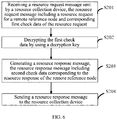
- FIG. 5 is another schematic flowchart of a resource request method provided in Embodiment 3 of the present application.
- the present embodiment describes the method from a perspective of a remote reference node.
- the method in the present embodiment includes following steps: S201, receiving a resource request message sent by a resource collection device, the resource request message including a resource request for the remote reference node and corresponding first check data of the resource request.
- the first check data is obtained by encrypting, by a control device with an encryption key, the resource request for the remote reference node, or the first check data is obtained by encrypting, by the control device, first information in the resource request for the remote reference node.
- the remote reference node verifies whether a source of the resource request is reliable according to a decrypting result. If the remote reference node successfully decrypts the first check data with the decryption key, it is determined that the source of the resource request is reliable; and if a decryption performed by the remote reference node with the decryption key fails, it is determined that the source of the resource request is unreliable.
- the decrypting result includes a resource request for the remote reference node or the first information in the resource request for the remote reference node.
- the remote reference node may compare a decrypted resource request with a plaintext resource request included in the resource request message to verify reliability of the resource request.
- the decryption key is a shared key between the control device and the remote reference node.
- the shared key is a key shared by the control device and a plurality of remote reference nodes, or the shared key is different from shared keys corresponding to other remote reference nodes, i.e., each remote reference node corresponds to a shared key, and a plurality of shared keys corresponding to the plurality of remote reference nodes are different.
- the first check data is encrypted by a first private key, and accordingly, the decryption key is a first public key.
- the first check data further includes an identifier of the resource request for the remote reference node, the identifier of the resource request being used to determine whether the resource request is a replay message.
- the remote reference node performs decryption to obtain the identifier of the resource request, determines whether the resource request is a replay message according to the identifier of the resource request, and verifies whether the resource request for the remote reference node is correct when the resource request is not a replay message.
- the flow ends, and optionally, a replay event may be reported to a management device.
- the remote reference node determines whether the resource request is a replay message by determining whether the identifier of the resource request is a new identifier.
- the remote reference node may determine whether the identifier of the resource request is a new identifier in following manners:
- the remote reference node determines whether the current serial number carried in the current resource request is the same as a serial number carried in a received resource request stored locally. If not, it is determined that the identifier of the current resource request is a new identifier; if so, it is determined that the identifier of the current resource request is not a new identifier.
- the remote reference node receives a resource request message sent by the resource collection device, the resource request message including a resource request for the remote reference node and corresponding first check data of the resource request, decrypts the first check data with a decryption key, and verifies whether a source of the resource request is reliable according to a decrypting result, thus improving security of data transmitted between the control device and the remote reference node.
- FIG. 6 is another schematic flowchart of a resource request method provided in Embodiment 4 of the present application.
- the remote reference node sends a resource response to the control device and encrypts the resource response.
- the method in the present embodiment includes following steps: S203, generating a resource response message, the resource response message including second check data corresponding to the resource response of the remote reference node.
- the remote reference node generates the resource response message after verifying that a source of the resource request is reliable. Unlike the prior art, the resource response message carries the second check data corresponding to the resource response of the remote reference node.
- the second check data is used for the control device to verify whether a source of the resource response of the remote reference node is reliable.
- the second check data is obtained by encrypting, by the remote reference node with an encryption key, the resource response of the remote reference node.
- the encryption key is a shared key between the remote reference node and the control device.
- the shared key is a key shared by the control device and a plurality of remote reference nodes, or the shared key is different from shared keys used by other remote reference nodes.
- the encryption key is a second private key, or the encryption key is a second private key and a first public key.
- the remote reference node When the encryption key is a second private key and a first public key stored on the remote reference node, the remote reference node encrypts the resource response of the remote reference node with the second private key to obtain first encrypted data, and then encrypts the resource response and the first encrypted data with the first public key to obtain second check data. In this way, the resource collection device cannot obtain the resource response of the remote reference node since twice encryption has been performed.
- the second check data further includes an identifier of the resource response of the remote reference node, the identifier of the resource response of the remote reference node being used to determine whether the resource response is a replay message.
- the identifier of the resource request for the remote reference node is a serial number or a timestamp.
- the remote reference node carries the second check data corresponding to the resource response of the remote reference node in the resource response message, so that the control device verifies whether a source of the resource response is reliable according to the second check data, thus improving security of data transmitted between the control device and the remote reference node.
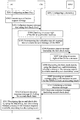
- FIG. 7 is another signaling schematic flowchart of a resource request method provided in Embodiment 5 of the present application.
- an OCF network is taken as an example
- an OC and an RRH being encrypted by adopting a symmetric encryption algorithm is taken as an example for explanation.
- the method in the present embodiment includes following steps: S301, configuring a shared key for the OC and the RRH.
- the shared key is a key shared by the OC and a plurality of RRHs, or shared keys of the plurality of RRHs are different.
- the OC generates a collection request message which includes a resource request for the RRH and corresponding first check data of the resource request.
- the OC first generates the resource request for the RRH and a serial number, and then encrypts the resource request for the RRH and the serial number with the shared key to obtain first check data, and carries the resource request for the RRH and the first check data in the collection request message, which may further include other information, for example, an identifier of the OC.
- the RRH may be a light 1 (light), and the resource request for the RRH is used to request a switching resource of the light 1.
- the collection request message may include resource requests for the plurality of RRH.
- the OC sends the collection request message to a CH.
- the CH checks an access right of the OC to a collection resource.
- the CH determines whether the OC has the access right to the collection resource according to an ACE of the OC saved this time. If the OC has the access right, S305 is executed; if the OC does not have the access right, a rejection message is returned to the OC.
- the CH decomposes the collection request message into a resource request message for the RRH.
- the collection request message includes the resource requests for the plurality of RRHs
- the collection request message is decomposed into the resource request messages for the plurality of RRHs; and the identifier of the OC, the resource request for this RRH and corresponding first check data of the resource request for this RRH are added to the resource request message for the RRH.
- the collection request message includes a plaintext resource request for the RRH, i.e., an unencrypted resource request for an RRH.
- the CH decomposes the collection request message according to the plaintext resource request for the RRH to obtain a resource request message for a respective RRH.
- the CH sends a resource request message to the RRH.
- the resource request message sent by the CH to the RRH includes the plaintext resource request for the RRH and the first check data.
- the RRH verifies an access right of the CH to a resource.
- the RRH After receiving the resource request message, the RRH verifies the access right of the CH to the resource according to an ACE. If the CH has the access right to the resource, S308 is executed; if the CH does not have the access right to the resource, a rejection message is returned to the CH.
- the RRH decrypts the first check data with the shared key to obtain the resource request and the serial number, and then determines that the source of the resource request is reliable.
- the RRH determines whether the decrypted serial number is a new serial number, and if so, it is determined that the resource request is not a replay message, and step S309 is executed.
- a decrypted resource request is the same as a plaintext resource request carried in the resource request message, if so, it is determined that the resource request is correct, and S309 is executed after it is determined that the resource request is correct. If the decrypted resource request is different from the plaintext resource request carried in the resource request message, it is determined that the resource request is unreliable and verification fails, and the RRH can return a request failure message to CH.
- the decrypted serial number is not a new serial number, it is determined that the resource request message is a replay message.
- the RRH can return the request failure message to the CH, and optionally, the RRH can also report a replay attack event to other devices.
- the operation corresponding to the resource request for the RRH is to turn off the light 1, then the light 1 is turned off. If the operation corresponding to the resource request for the RRH is to turn on the light 1, then the light1 is turned on. If the operation corresponding to the resource request for the RRH is to adjust color/brightness of the light 1, then the color/brightness of the light 1 is adjusted.
- the RRH generates a resource response message which includes second check data corresponding to the resource response of the RRH.
- the resource response of the RRH includes the executing result in S309, and the RRH encrypts the resource response of the RRH and the serial number with the shared key to obtain the second check data, and the serial number in the second check data may be the same as or different from the serial number carried in the first check data.
- the resource response message may further include a plaintext resource response.
- the RRH sends a resource response message to the CH.
- the CH sends a collection response message to the OC.
- the CH waits to receive resource response messages of all the RRHs, and then packages and sends them to the OC as a whole.
- the OC decrypts the second check data with the shared key, and determines whether a source of the resource response is reliable according to a decrypting result.
- the OC determines whether the resource response of the RRH is a replay message according to the serial number, if not. If the OC determines that the resource response of the RRH is a replay message according to the serial number, a corresponding operation is executed, for example, reporting a replay attack event to an upper layer device, or counting the number of replay messages, which is not limited in the present embodiment.
- FIG. 8 is another signaling schematic flowchart of a resource request method provided in Embodiment 6 of the present application.
- an OCF network is taken as an example, and an OC and an RRH being encrypted by adopting an asymmetric encryption algorithm is taken as an example for explanation.
- the method in the present embodiment includes following steps:
- the OC carries the plaintext resource request and the first check data in a collection request message, and the collection request message further includes an identifier of the OC.
- the OC sends the collection request message to a CH.
- the CH checks an access right of the OC to a collection resource.
- the CH determines whether the OC has the access right to the collection resource according to an ACE of the OC saved this time. If the OC has the access right, S405 is executed; if the OC does not have the access right, a rejection message is returned to the OC.
- the CH decomposes the collection request message into a resource request message for the RRH.
- the CH decomposes the collection request message into resource request messages for the plurality of RRHs according to a plurality of plaintext resource requests for the RRHs included in the collection request message, and adds the identifier of the OC, the plaintext resource request for the RRH and corresponding first check data of the plaintext resource request for the RRH to the resource request message for the RRH.
- the CH sends the resource request message to the RRH.
- the RRH verifies an access right of the CH to a resource.
- the RRH After receiving the resource request message, the RRH verifies the access right of the CH to the resource according to an ACE. If the CH has the access right to the resource, S308 is executed; if the CH does not have the access right to the resource, a rejection message is returned to the CH.
- the RRH decrypts the first check data with the first public key, and determines whether a source of the resource request is reliable according to a decrypting result.
- the RRH queries and obtains the first public key according to the ID of the OC, and decrypts the first check data with the first public key. If a resource request for the RRH and a serial number are obtained through decryption, it is determined that a source of the resource request is reliable. The RRH can also determine whether the decrypted serial number is a new serial number. If so, it is determined that the resource request for the RRH is not a replay message; if not, it is determined that the resource request message is a replay message.
- the resource request for the RRH when it is determined that the resource request for the RRH is not a replay message, it can also be determined whether a decrypted resource request for the RRH is the same as the plaintext resource request carried in the resource request message, if so, it is determined that the resource request for the RRH is correct, and S409 is continued. If the decrypted resource request for the RRH is different from the plaintext resource request carried in the resource request message, it is determined that the resource request for the RRH is incorrect, and the RRH can return a request failure message to the CH.
- the RRH may return a request failure message to the CH, and optionally, the RRH may further report a replay attack event to other devices.
- the RRH executes an operation corresponding to the resource request to obtain an executing result.
- the RRH encrypts the resource response of the RRH with the second private key to obtain first encrypted data, and encrypts the resource response of the RRH, the serial number and the first encrypted data with the first public key to obtain second check data.
- the RRH encrypts the resource response of the RRH, the serial number and the first encrypted data with the first public key, so that other devices in the network cannot obtain the resource response of the RRH.
- the serial number in the second check data may be the same as or different from the serial number carried in the first check data.
- the RRH sends a resource response message to the CH.
- the resource response message includes the resource response of the RRH and corresponding second check data of the resource response of the RRH.
- the CH sends a collection response message to the OC.
- the CH waits to receive resource response messages of all the RRHs, and then packages and sends them to the OC as a whole.
- the OC decrypts the second check data with the first private key to obtain the resource response of the RRH, the serial number, and the first encrypted data.
- the OC decrypts the first encrypted data with the second public key, and determines whether a source of the resource response of the RRH is reliable according to a decrypting result.
- the OC If the OC successfully decrypts the first encrypted data with the second public key, it is determined that the source of the resource response of the RRH is reliable.
- the OC determines whether the resource response of the RRH obtained through the second decryption is the same as the resource response of the RRH obtained through the first decryption, and if so, it is determined that the resource response of the RRH is correct; if the resource response obtained through the second decryption is different from that obtained through the first decryption, it is determined that the resource response of the RRH is incorrect.
- the OC encrypts the resource request for the RRH with the first private key to obtain the first check data. It can be understood that in other embodiments of the present application, the OC can use the first private key to encrypt first information in the resource request for the RRH to obtain the first check data.
- the serial number in the present embodiment can be replaced by a timestamp.
- FIG. 9 is another signaling schematic flowchart of a resource request method provided in Embodiment 7 of the present application. Difference between the present embodiment and Embodiment 6 is that in the present embodiment, the RRH only signs the resource response, without encryption. As shown in FIG. 9 , the method in the present embodiment includes following steps:
- the OC carries the plaintext resource request and the first check data in a collection request message, and the collection request message further includes an identifier of the OC.
- the OC sends the collection request message to a CH.
- the CH checks an access right of the OC to a collection resource.
- the CH decomposes the collection request message into a resource request message for the RRH.
- the CH sends the resource request message to the RRH.
- the RRH verifies an access right of the CH to a resource.
- the RRH decrypts the first check data with the first public key, and determines whether a source of the resource request is reliable according to a decrypting result.
- Steps S501 to S509 are the same as steps S401 to S409 in Embodiment 6, which are not described in detail herein.
- the RRH encrypts the resource response of the RRH and the serial number with the second private key to obtain second check data.
- the RRH signs the resource response of the RRH and the serial number only with the second private key.
- the RRH sends a resource response message to the CH.
- the resource response message includes a plaintext resource response of the RRH, the second check data, and an identifier of the RRH.
- the CH sends a collection response message to the OC.
- the CH packages resource response messages sent by a plurality of RRHs to obtain a collection response message.
- the OC decrypts the second check data with the second public key.
- the OC determines whether a source of the resource response of the RRH is reliable according to a decrypting result.
- the OC decrypts the resource response and the serial number correctly with the second public key, then it is determined that the source of the resource response is reliable.
- the OC determines whether the resource response of the RRH is a replay message according to the decrypted serial number, if not, determines whether the decrypted resource response of the RRH is the same as the resource response of the RRH included in the collection response message: if so, it is determined that the resource response of the RRH is correct; and if not, it is determined that the resource response of the RRH is incorrect.
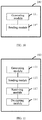
- FIG. 10 is a structural schematic diagram of a control device provided in Embodiment 8 of the present application. As shown in FIG. 10 , the control device 100 includes:
- the first check data is obtained by encrypting the resource request for the remote reference node with an encryption key by the control device.
- the first check data is obtained by encrypting first information in the resource request for the remote reference node with an encryption key by the control device, and the first information is used to identify resource requests for different remote reference nodes.
- the encryption key is a shared key between the control device and the remote reference node.
- the shared key is a key shared by the control device and a plurality of remote reference nodes.
- a plurality of different shared keys is stored in the control device, and each shared key in the plurality of shared keys corresponds to a remote reference node.
- the encryption key is a first private key.
- the first check data further includes an identifier of the corresponding resource request for the remote reference node, and the identifier of the corresponding resource request is used by the remote reference node to determine whether the resource request is a replay request.
- the identifier of the resource request for the remote reference node is a serial number or a timestamp.
- FIG. 11 is a structural schematic diagram of another control device provided in Embodiment 9 of the present application. As shown in FIG. 11 , the control device 100 further includes:
- the decryption key is a shared key between the control device and the remote reference node.
- the shared key is a key shared by the control device and a plurality of remote reference nodes.
- a plurality of different shared keys are stored in the control device, and each shared key in the plurality of shared keys corresponds to a remote reference node.
- the decryption key includes a first private key and a second public key. Accordingly, the decryption module 114 is specifically configured to:
- a verifying module is further included, and is configured to determine that the resource response of the remote reference node is correct when the resource response of the remote reference node obtained through the first decryption is the same as the resource response of the remote reference node obtained through the second decryption.
- the decryption key includes a second public key
- the resource collection response message further includes a resource response of at least one remote reference node.
- the decrypting module 114 is specifically configured to:
- a verifying module is further included, and is configured to determine that the resource response of the remote reference node is correct when the resource response of the remote reference node included in the resource collection response message is the same as the decrypted resource response of the remote reference node.
- the second check data further includes an identifier of the resource response of the remote reference node, and the identifier of the resource response is used to determine whether the resource response is a replay message.
- control device provided in any of the above implementations is used to implement the technical solution implemented by the control device in any of the above method embodiments, and its implementation principle and technical effect are similar, which are not described in detail herein.
- FIG. 12 is a structural schematic diagram of a remote reference node provided in Embodiment 10 of the present application. As shown in FIG. 12 , the remote reference node 200 includes:
- a decrypting result includes the resource request for the remote reference node or first information in the resource request for the remote reference node, and the first information is used to identify resource requests for different remote reference nodes.
- the decryption key is a shared key between the control device and the remote reference node.
- the shared key is a key shared by the control device and a plurality of remote reference nodes.
- the decryption key is a first public key.
- the first check data further includes an identifier of the resource request for the remote reference node, the identifier of the resource request being used to determine whether the resource request is a replay message.
- the identifier of the resource request for the remote reference node is a serial number or a timestamp.
- FIG. 13 is a structural schematic diagram of another remote reference node provided in Embodiment 11 of the present application. As shown in FIG. 13 , on the basis of the device shown in FIG. 12 , the remote reference node 200 further includes:
- the second check data is obtained by encrypting the resource response of the remote reference node by the remote reference node with an encryption key.
- the encryption key is a shared key between the remote reference node and the control device.
- the shared key is a key shared by the control device and a plurality of remote reference nodes.
- the shared key is different from shared keys corresponding to other remote reference nodes.
- the encryption key is a second private key.
- the encryption key is a second private key and a first public key
- the second private key is used to encrypt the resource response of the remote reference node to obtain first encrypted data
- the first public key is used to encrypt the resource response of the remote reference node and the first encrypted data to obtain the second check data.
- the second check data further includes an identifier of the resource response of the remote reference node, and the identifier of the resource response of the remote reference node is used to determine whether the resource response is a replay message.
- the identifier of the resource request for the remote reference node is a serial number or a timestamp.
- the remote reference node provided in any of the above implementations is used to implement the technical solution implemented by the remote reference node in any of the above method embodiments, and its implementation principle and technical effect are similar, which are not described in detail herein.
- FIG. 14 is a structural schematic diagram of yet another control device provided in Embodiment 12 of the present application. As shown in FIG. 14 , the control device 400 includes:
- FIG. 14 is a simple design of a control device.
- the embodiment in the present application does not limit the numbers of processors and memories in the control device, and FIG. 14 only takes the number being 1 as an example.
- FIG. 15 is a structural schematic diagram of yet another remote reference node provided in Embodiment 13 of the present application. As shown in FIG. 15 , the remote reference node 500 includes:
- FIG. 15 is a simple design of a remote reference node.
- the embodiment in the present application does not limit the number of processors and memories in the remote reference node, and FIG. 15 only takes the number being 1 as an example.
- the memory, the processor, and the interface may be connected through a bus, and optionally, the memory may be integrated inside the processor.
- An embodiment in the present application further provides a computer readable storage medium, in which a computer executable instruction is stored, and when executed by a processor, the computer executable instruction is used to implement the technical solution executed by the control device in any of the method embodiments described above.
- An embodiment in the present application further provides a computer readable storage medium, in which a computer executable instruction is stored, and when executed by a processor, the computer executable instruction is used to implement the technical solution executed by the remote reference node in any of the method embodiments described above.
- An embodiment in the present application further provides a computer readable storage medium, in which a computer executable instruction is stored, and when executed by a processor, the computer executable instruction is used to implement the technical solution executed by the resource collection device in any of the method embodiments described above.
- An embodiment in the present application further provides a program, which, when executed by a processor, is used to execute the technical solution executed by the control device in any of the method embodiments described above.
- An embodiment in the present application further provides a program, which, when executed by a processor, is used to execute the technical solution executed by the remote reference node in any of the method embodiments described above.
- An embodiment in the present application further provides a program, which, when executed by a processor, is used to execute the technical solution executed by the resource collection device in any of the method embodiments described above.
- the processor may be a chip.
- the embodiment of the present application further provides a computer program product, which includes a program instruction, and the program instruction is used to implement the technical solution executed by the control device in any of the method embodiments described above.
- the embodiment of the present application further provides a computer program product, which includes a program instruction, and the program instruction is used to implement the technical solution executed by the remote reference node in any of the method embodiments described above.
- the embodiment of the present application further provides a computer program product, which includes a program instruction, and the program instruction is used to implement the technical solution executed by the resource collection device in any of the method embodiments described above.
- the embodiment of the present application further provides a chip, which includes a processing module and a communication interface, the processing module being able to execute the technical solution executed by the control device in any of the method embodiments described above.
- the chip further includes a memory module (e.g., memory), the memory module being able to store an instruction, the processing module being used to execute the instruction stored in the memory module, and an execution of the instruction stored in the memory module causes the processing module to execute the technical solution executed by the control device in any of the method embodiments described above.
- a memory module e.g., memory
- the memory module being able to store an instruction
- the processing module being used to execute the instruction stored in the memory module
- an execution of the instruction stored in the memory module causes the processing module to execute the technical solution executed by the control device in any of the method embodiments described above.
- the embodiment of the present application further provides a chip, which includes a processing module and a communication interface, the processing module being able to execute the technical solution executed by the remote reference node in any of the method embodiments described above.
- the chip further includes a memory module (e.g., memory), the memory module being able to store an instruction, the processing module being used to execute the instruction stored in the memory module, and an execution of the instruction stored in the memory module causes the processing module to execute the technical solution executed by the remote reference node in any of the method embodiments described above.
- a memory module e.g., memory
- the memory module being able to store an instruction
- the processing module being used to execute the instruction stored in the memory module
- an execution of the instruction stored in the memory module causes the processing module to execute the technical solution executed by the remote reference node in any of the method embodiments described above.
- the embodiment of the present application further provides a chip, which includes a processing module and a communication interface, the processing module being able to execute the technical solution executed by the resource collection device in any of the method embodiments described above.
- the chip further includes a memory module (e.g., memory), the memory module being able to store an instruction, the processing module being used to execute the instruction stored in the memory module, and an execution of the instruction stored in the memory module causes the processing module to execute the technical solution executed by the resource collection device in any of the method embodiments described above.
- a memory module e.g., memory
- the memory module being able to store an instruction
- the processing module being used to execute the instruction stored in the memory module
- an execution of the instruction stored in the memory module causes the processing module to execute the technical solution executed by the resource collection device in any of the method embodiments described above.
- module division is only a logical function division.
- there may be another division mode for example, a plurality of modules may be combined or integrated into another system, or some features may be ignored or not executed.
- mutual coupling or direct coupling or communication connection shown or discussed may be indirect coupling or communication connection through some interfaces and modules, and may be in electrical, mechanical or other forms.
- a processor may be a central processing unit (English: Central Processing Unit, for short: CPU), other general-purpose processors, a digital signal processor (English: Digital Signal Processor, for short: DSP), an application specific integrated circuit (English: Application Specific Integrated Circuit, for short: ASIC), etc.
- the general-purpose processor may be a microprocessor or the processor may be any conventional processor. Steps of the method disclosed in the present application may be directly embodied as completion of being executed by a hardware processor, or by a combination of hardware and software modules in a processor.
- the aforementioned program may be stored in a readable memory.
- the aforementioned memory includes: a read-only memory (English: read-only memory, for short: ROM), RAM, a flash memory a hard disk, a solid state disk, a magnetic tape (English: magnetic tape), a floppy disk (English: floppy disk), an optical disc (English: optical disc), and any combination thereof.
Landscapes
- Engineering & Computer Science (AREA)
- Computer Security & Cryptography (AREA)
- Computer Networks & Wireless Communication (AREA)
- Signal Processing (AREA)
- Computer Hardware Design (AREA)
- General Engineering & Computer Science (AREA)
- Computing Systems (AREA)
- Theoretical Computer Science (AREA)
- Physics & Mathematics (AREA)
- General Physics & Mathematics (AREA)
- Software Systems (AREA)
- Health & Medical Sciences (AREA)
- Bioethics (AREA)
- General Health & Medical Sciences (AREA)
- Telephonic Communication Services (AREA)
- Mobile Radio Communication Systems (AREA)
Abstract
Description
- This application claims priority to
Chinese application No. 2019101525546 filed on February 28, 2019 - Embodiments of the present application relate to Internet of Things technology, in particular, to a resource request method, a device, and a storage medium.
- Open Connectivity Foundation (English: Open Connectivity Foundation, for short: OCF) is one of the largest industrial connectivity and interoperability standard organizations for Internet of Things devices. An OCF network includes an original client (English: Original Client, for short: OC), a remote reference host (English: Remote Reference Host, for short: RRH), and a collection host (English: Collection Host, for short: CH).
- Where the OC is used to operate an RRH resource and the OC can operate a plurality of RRH resources; various functions of the RRH are called RRH resources, and the OC and the RRH are connected and communicated through the CH; and the CH is used to perform unified management to a local resource and an RRH resource. An OC can be a control device, such as a smart phone, a computer or the like; a CH can be a connection device, such as a home gateway or the like; and an RRH can be an intelligent device that provides various services, for example, a smart desk lamp, a smart speaker, a smart air conditioner or the like. When the OC needs to operate an RRH resource, the OC sends a collection (collection) resource request to the CH, and the CH verifies whether the OC has a right to access an RRH resource. If yes, the CH decomposes the collection resource request into requests for respective RRH resources, and sends a resource request to the RRH, which returns a resource response to the CH, the CH integrates the resource responses from respective RRHs and returns it to the OC as a whole.
- However, an existing communication solution makes security of data transmitted between the OC and the RRH low.
- Embodiments of the present application provide a resource request method, a device, and a storage medium, improving security of data transmitted between a control device and a remote reference node.
- According to a first aspect, an embodiment of the present application may provide a resource request method applied to a control device, the method including:
- generating a resource collection request message, the resource collection request message including a resource request for at least one remote reference node and corresponding first check data of the resource request; and
- sending the resource collection request message to a resource collection device.
- According to a second aspect, an embodiment of the present application may provide a resource request method applied to a remote reference node, the method including:
- receiving a resource request message sent by a resource collection device, the resource request message including a resource request for the remote reference node and corresponding first check data of the resource request; and
- decrypting the first check data with a decryption key.
- According to a third aspect, an embodiment of the present application may provide a resource request method applied to a resource collection device, the method including:
- receiving a resource collection request message sent by a control device, the resource collection request message including a resource request for at least one remote reference node and corresponding first check data of the resource request;
- decomposing the resource collection request message into a resource request message for each remote reference node, the resource request message for each remote reference node including a resource request for the remote reference node and first check data of the resource request; and
- sending a corresponding resource request message to each remote reference node.
- According to a fourth aspect, an embodiment of the present application may provide a control device, including:
- a generating module, configured to generate a resource collection request message, the resource collection request message including a resource request for at least one remote reference node and corresponding first check data of the resource request; and
- a sending module, configured to send the resource collection request message to a resource collection device.
- According to a fifth aspect, an embodiment of the present application may provide a remote reference node, including:
- a receiving module, configured to receive a resource request message sent by a resource collection device, the resource request message including a resource request for the remote reference node and corresponding first check data of the resource request; and
- a decrypting module, configured to decrypt the first check data with a decryption key.
- According to a sixth aspect, an embodiment of the present application may provide a resource collection device, including:
- a receiving module, configured to receive a resource collection request message sent by a control device, the resource collection request message including a resource request for at least one remote reference node and corresponding first check data of the resource request;
- a decomposing module, configured to decompose the resource collection request message into a resource request message for each remote reference node, the resource request message for each remote reference node including a resource request for the remote reference node and first check data of the resource request; and
- a sending module, configured to send a corresponding resource request message to each remote reference node.
- According to a seventh aspect, an embodiment of the present application may provide a control device, including:
- a processor, a memory, and an interface for communicating with a network device;
- the memory stores a computer executable instruction; and
- the processor executes the computer executable instruction stored in the memory, causing the processor to execute the resource request method according to the first aspect.
- According to an eighth aspect, an embodiment of the present application may provide a remote reference node, including:
- a processor, a memory and an interface for communicating with a terminal device;
- the memory stores a computer executable instruction; and
- the processor executes the computer executable instruction stored in the memory, causing the processor to execute the resource request method according to the second aspect.
- According to a ninth aspect, an embodiment of the present application may provide a resource collection device, including:
- a processor, a memory and an interface for communicating with a terminal device;
- the memory stores a computer executable instruction; and
- the processor executes the computer executable instruction stored in the memory, causing the processor to execute the resource request method according to the third aspect.
- According to a tenth aspect, an embodiment of the present application may provide a computer readable storage medium, the computer readable storage medium storing a computer executable instruction, and when the computer executable instruction is executed by a processor, the resource request method according to the first aspect being implemented.
- According to a eleventh aspect, an embodiment of the present application may provide a computer readable storage medium, the computer readable storage medium storing a computer executable instruction, and when the computer executable instruction is executed by a processor, the resource request method according to the second aspect being implemented.
- According to a twelfth aspect, an embodiment of the present application may provide a computer readable storage medium, the computer readable storage medium storing a computer executable instruction, and when the computer executable instruction is executed by a processor, the resource request method according to the third aspect being implemented.
- According to a thirteenth aspect, an embodiment of the present application provides a program for executing the resource request method according to the first aspect when the program is executed by a processor.
- According to a fourteenth aspect, an embodiment of the present application further provides a program for executing the resource request method according to the second aspect when the program is executed by a processor.
- According to a fifteenth aspect, an embodiment of the present application further provides a program for executing the resource request method according to the third aspect when the program is executed by a processor.
- Optionally, the processor may be a chip.
- According to a sixteenth aspect, an embodiment of the present application provides a computer program product including a program instruction, the program instruction being used to implement the resource request method according to the first aspect.
- According to a seventeenth aspect, an embodiment of the present application provides a computer program product including a program instruction, the program instruction being used to implement the resource request method according to the second aspect.
- According to a eighteenth aspect, an embodiment of the present application provides a computer program product including a program instruction, the program instruction being used to implement the resource request method according to the third aspect.
- According to a nineteenth aspect, an embodiment of the present application provides a chip including a processing module and a communication interface, the processing module being able to execute the resource request method according to the first aspect. Further, the chip further includes a memory module (e.g., memory), the memory module being able to store an instruction, the processing module being used to execute the instruction stored in the memory module, and an execution of the instruction stored in the memory module causes the processing module to execute the resource request method according to the first aspect.
- According to a twentieth aspect, an embodiment of the present application provides a chip including a processing module and a communication interface, the processing module being able to execute the resource request method according to the second aspect. Further, the chip further includes a memory module (e.g., memory), the memory module being able to store an instruction, the processing module being used to execute the instruction stored in the memory module, and an execution of the instruction stored in the memory module causes the processing module to execute the resource request method according to the second aspect.
- According to a twenty-first aspect, an embodiment of the present application provides a chip including a processing module and a communication interface, the processing module being able to execute the resource request method according to the third aspect.
- Further, the chip further includes a memory module (e.g., memory), the memory module being able to store an instruction, the processing module being used to execute the instructions stored in the memory module, and an execution of the instruction stored in the memory module causes the processing module to execute the resource request method according to the third aspect.
- Embodiments of the present application provide a resource request method, a device, and a storage medium, where the method applied to a control device includes: generating a resource collection request message, the resource collection request message including a resource request for at least one remote reference node and corresponding first check data of the resource request, and sending the resource collection request message to a resource collection device. Through generation of the first check data and carrying the first check data in the resource collection request message by the control device, a remote service device is enabled to determine whether a source of the resource request is reliable according to the first check data, thus improving security of data transmitted between the control device and the remote reference node.
- In order to explain embodiments of the present application or a technical solution in the prior art more clearly, drawings required in the embodiments or a description of the prior art will be briefly introduced below. Obviously, drawings in a following description are some embodiments of the present application, and other drawings may be obtained by persons of ordinary skills in the art according to these drawings without paying creative labor.
-
FIG. 1 is a schematic diagram of a network architecture applicable to an embodiment of the present application. -
FIG. 2 is a schematic diagram of an application layer of each device in an OCF network. -
FIG. 3 is a schematic flowchart of a resource request method provided in Embodiment 1 of the present application. -
FIG. 4 is yet another schematic flowchart of a resource request method provided in Embodiment 2 of the present application. -
FIG. 5 is another schematic flowchart of a resource request method provided in Embodiment 3 of the present application. -
FIG. 6 is another schematic flowchart of a resource request method provided in Embodiment 4 of the present application. -
FIG. 7 is another signaling schematic flowchart of a resource request method provided in Embodiment 5 of the present application. -
FIG. 8 is another signaling schematic flowchart of a resource request method provided in Embodiment 6 of the present application. -
FIG. 9 is another signaling schematic flowchart of a resource request method provided in Embodiment 7 of the present application. -
FIG. 10 is a structural schematic diagram of a control device provided in Embodiment 8 of the present application. -
FIG. 11 is a structural schematic diagram of another control device provided in Embodiment 9 of the present application. -
FIG. 12 is a structural schematic diagram of a remote reference node provided in Embodiment 10 of the present application. -
FIG. 13 is a structural schematic diagram of another remote reference node provided inEmbodiment 11 of the present application. -
FIG. 14 is a structural schematic diagram of yet another control device provided inEmbodiment 12 of the present application. -
FIG. 15 is a structural schematic diagram of yet another remote reference node provided inEmbodiment 13 of the present application. - In order to make a purpose, a technical solution, and an advantage of embodiments of the present application clearer, the technical solution of the embodiments of the present application will be described clearly and completely in conjunction with drawings in the embodiments of the present application. Obviously, described embodiments are part of the embodiments of the present application, not all of the embodiments. Based on the embodiments in the present application, all other embodiments obtained by persons of ordinary skills in the art without creative labor belong to protection scope of the present application.
- Terms "first", "second", etc. in a specification, a claim, and drawings described above of the embodiments in the present application are used to distinguish similar objects, and are not necessary to be used to describe a specific order or sequence. It should be understood that data thus used may be interchanged under an appropriate circumstance, so that the embodiments of the present application described herein can be implemented in an order other than those illustrated or described herein. In addition, terms "including" and "having" and any variations thereof are intended to cover non-exclusive inclusion. For example, a process, a method, a system, a product, or a device including a series of steps or units are not necessary to be limited to those steps or units clearly listed, but may include other steps or units not clearly listed or inherent to the process, the method, the product, or the device.
-
FIG. 1 is a schematic diagram of a network architecture applicable to an embodiment of the present application. As shown inFIG. 1 , the network architecture at least includes acontrol device 11, aresource collection device 12, and aremote reference node 13. It can be understood that in actual network deployment, there may be one ormore control devices 11,resource collection devices 12, andremote reference nodes 13, andFIG. 1 only takes one as an example. - The
control device 11 and theresource collection device 12 may be connected or communicate in a wired or wireless manner. Similarly, theresource collection device 12 and theremote reference node 13 can also be connected or communicate in a wired or wireless manner. - The
control device 11 accesses and operates a resource provided by theremote reference node 13 through theresource collection device 12, and eachremote reference node 13 may provide one or more resources, which may be a function of theremote reference node 13. Theresource collection device 12 is used to perform unified management to a local resource and the resource provided by theremote reference node 13, and provides an interface for thecontrol device 11 to access a resource. - As shown in
FIG. 2 , the network architecture may be an OCF network, and accordingly, thecontrol device 11 is an OC, theresource collection device 12 is a CH, and theremote reference node 13 is an RRH. It can be understood that the network architecture is not limited to an OCF network, but can further be: a smart device which is used as a client and a server and controlled by an intermediate device (whose function is similar to a CH) under an Internet of Things environment. - Taking an OCF network as an example, an OC may be a smart phone, a personal computer, a tablet computer, etc., a CH may be a home gateway or other gateway devices, and an RRH may be a smart home appliances device, such as a smart desk lamp, a smart refrigerator, a smart speaker, etc.
-
FIG. 2 is a schematic diagram of an application layer of each device in an OCF network. As shown inFIG. 2 , the CH includes a first access control entry (English: Access Control Entry, for short: ACE), a second ACE, and a collection resource (collection resource) A. Where the first ACE defines the collection resource A allowed to be accessed by the OC, the collection resource A is a local resource of the CH; the second ACE defines a collection resource B allowed to be accessed by the OC, and the collection resource B is a resource of the RRH. - For example, the first ACE includes information of the collection resource A and an ID or a rule of the OC allowed to access, and the second ACE includes information of the collection resource B and the ID or the rule of the OC allowed to access.
- When receiving a collection resource request message sent by the OC, the CH determines whether the OC matches with the first ACE and the second ACE. If so, the CH decomposes and encapsulates the collection resource request message, obtains a resource request for the RRH, and sends the resource request for the RRH to the RRH.
- The RRH includes a third ACE, the third ACE defines the collection resource B that is allowed to be accessed by the CH, and optionally, the RRH further includes a fourth ACE, the fourth ACE defines the collection resource B that is allowed to be accessed by the OC. When receiving a resource access request message sent by the CH, the RRH determines, according to the third ACE, whether to execute the request and returns a response to the CH. The CH collects all responses, and then packages them as a whole and sends them to the OC.
- The CH includes one or more collection resources, each collection resource includes one or more link resources, each link resource is an address or an index of a local resource of the CH or a resource of the RRH.
- For example, a collection resource includes a link of a switching resource in a device A (light) and a link of a switching resource in a device B (fan), thus forming a centralized resource group. The OC may request a plurality of resources at the same time by accessing an oic.if.b interface of the collection resource. The CH may send a request to a respective resource in links, collect a response returned by the respective resource, and return it to the OC after unified concentration.
- In the prior art, there is a risk that the CH is illegally controlled, which leads to tampering of a resource request message received by the RRH or tampering of a collection resource response message received by the OC. In order to solve problems in the prior art, the present application provides a resource request method.
-
FIG. 3 is a schematic flowchart of a resource request method provided in Embodiment 1 of the present application, and the embodiment describes the method from a perspective of a control device. As shown inFIG. 3 , the method provided in the present embodiment includes following steps:
S101, generating a resource collection request message, the resource collection request message including a resource request for at least one remote reference node and corresponding first check data of the resource request. - Different from the prior art, in the present embodiment, the resource collection request message carries the first check data corresponding to the resource request for the remote reference node, and the first check data is used for the remote reference node to verify whether a source of the resource request is reliable, i.e., the remote reference node verifies whether the resource request is sent by the control device instead of other devices according to the first check data. The resource request message further includes other information, for example, an identifier of the control device.
- When the method in the present embodiment is applied in an OCF network, the resource collection request message may be a collection resource request message.
- The first check data may be obtained by encrypting the resource request for the remote reference node with an encryption key by the control device. Or, the first check data is obtained by encrypting first information in the resource request for the remote reference node with an encryption key by the control device, and the first information is used to identify resource requests for different remote reference nodes, and other information in the resource request except the first information may be called second information. Optionally, the first information may be multiple pieces of information.
- The encryption key may be determined by the control device and the remote reference node through negotiation in advance, or configured by other management devices for the control device, or configured manually by a worker.
- The control device may use the encryption key to encrypt the resource request for the remote reference node as a whole, or may encrypt the first information in the resource request for the remote reference node. In the present embodiment, the first information is not limited as long as the first information can identify resource requests for different remote reference nodes, for example, the first information is an address of a resource.
- In the present embodiment, the control device and the remote reference node may adopt a symmetric encryption algorithm or an asymmetric encryption algorithm.
- The key used in the symmetric encryption algorithm is a shared key between the control device and the remote reference node, and the shared key means that the control device and the remote reference node use the same key. The shared key is used to encrypt the resource request for the remote reference node to obtain the first check data, and accordingly, the remote reference node decrypts the first check data with the shared key.
- Optionally, the shared key is a key shared by the control device and a plurality of remote reference nodes. In this way, a plurality of different remote reference nodes uses the same key.
- Or, the control device stores a plurality of different shared keys, each of the plurality of shared keys corresponds to a remote reference node, i.e., different remote reference nodes use different keys.
- In the asymmetric encryption algorithm, the control device and the remote reference node use different keys for encryption and decryption. In the present embodiment, a pair of public key and private key are respectively configured for the control device and the remote reference node, and data encrypted with the private key can only be decrypted with the corresponding public key. Similarly, data encrypted with the public key can only be decrypted with the corresponding private key.
- In various embodiments of the present application, a public key configured for the control device is called a first public key, and a private key configured for the control device is called a first private key. Data encrypted by the first private key can only be decrypted by the first public key, and data encrypted by the first public key can only be decrypted by the first private key. The first private key is stored in a security area of the control device and can only be invoked by the control device.
- A public key configured for the remote reference node is called a second public key, and a private key configured for the remote reference node is called a second private key. Data encrypted by the second private key can only be decrypted by the second public key, and data encrypted by the second public key can only be decrypted by the second private key. The second private key is stored in a security area of the remote reference node and can only be invoked by the remote reference node.
- In the present embodiment, the control device further stores the second public key, and the remote reference node further stores the first public key.
- In the present embodiment, the control device encrypts the resource request for the remote reference node or the first information in the resource request with the first private key to obtain the first check data. Accordingly, the remote reference node can decrypt the first check data only with the first public key.
- Optionally, the first check data further includes an identifier of the resource request for the remote reference node, the identifier of the resource request is used by the remote reference node to determine whether the resource request is a replay request. If the first check data includes the identifier of the resource request for the remote reference node, when generating the first check data, the control device encrypts the resource request for the remote reference node (or the first information in the resource request) together with the identifier of the resource request with the encryption key to obtain the first check data.
- The resource collection device may cache the resource request for the remote reference node. If the resource collection device is illegally controlled, the resource collection device may repeatedly send a previously cached resource request for the remote reference node as a replay attack. The replay attack is further called a rebroadcast attack or a playback attack. The replay attack is mainly used in a process of identity authentication to destroy correctness of the authentication.
- In the present embodiment, for each resource request, the control device generates an identifier of the resource request, the identifier of the resource request is used to uniquely identify a resource request. The identifier of the resource request is encrypted together with the resource request for the remote reference node (or the first information in the resource request), thus preventing the identifier of the resource request from being tampered with.
- The remote reference node obtains the identifier of the resource request through decryption and determines whether the identifier of the resource request is a new identifier. If the identifier of the resource request is a new identifier, it is determined that the resource request is not a replay message; if the identifier of the resource request is not a new identifier, it is determined that the resource request is a replay message. The identifier of the resource request is not a new identifier, which means that the identifier of the resource request has been sent, so it can be determined that the resource request is a replay message. The remote reference node processes according to a determining result.
- Optionally, the identifier of the resource request is a serial number or a timestamp. The serial number may be generated according to a preset rule, for example, adding one to a previous serial number every time. Or the serial number may also be generated randomly. The timestamp may be a generated time of the resource request for the remote reference node or a generated time of the resource collection request message.
- S102, sending the resource collection request message to the resource collection device.
- The control device sends the resource collection request message to the resource collection device, the resource collection device decomposes the resource collection request message into a resource request message for each remote reference node, the resource request message for each remote reference node including a resource request for the remote reference node and first check data of the resource request, and sends a corresponding resource request message to each remote reference node, and the resource request further includes an identifier of the control device.
- The resource collection device decomposes and recombines the resource collection request message to obtain the resource request message for each remote reference node. Reference may be made to existing technologies for the decomposition and recombination methods, which will not be described in detail herein.
- In the present embodiment, the control device generates a resource collection request message and sends the resource collection request message to a resource collection device, the resource collection request message including a resource request for at least one remote reference node and corresponding first check data of the resource request. Therefore, the remote reference node verifies whether a source of the resource request is reliable according to the first check data, thus improving security of data transmission.
-
FIG. 4 is yet another schematic flowchart of a resource request method provided in Embodiment 2 of the present application. On the basis of Embodiment 1, the remote reference node may encrypt the resource response, and correspondingly, the control device decrypts the resource response to verify whether a source of the resource response is reliable. As shown inFIG. 4 , the method of the present embodiment, on the basis of Embodiment 1, further includes following steps:
S103, receiving a resource collection response message corresponding to the resource collection request message sent by the resource collection device, the resource collection response message including second check data corresponding to a resource response of at least one remote reference node. - The resource collection response message is obtained by combining, by the resource collection device, resource response messages sent by the at least one remote reference node. When the method in the present embodiment is applied in an OCF network, the resource collection response message may be a collection resource response message.
-
S 104, decrypting the second check data with a decryption key. - The control device verifies whether a source of the resource response is reliable according to a decrypting result. For example, if the control device can successfully decrypt the second check data with the decryption key, it is determined that the source of the resource response is reliable; and if the control device cannot successfully decrypt the second check data with the decryption key, it is determined that the source of the resource response is unreliable.
- When a symmetric encryption algorithm is adopted, the decryption key is a shared key between the control device and the remote reference node. The shared key may be a key shared by the control device and a plurality of remote reference nodes, or the control device stores a plurality of different shared keys, and each of the shared keys corresponds to a remote reference node. The control device queries a corresponding shared key according to an identifier of the remote reference node, and performs decryption with the shared key corresponding to the remote reference node, the identifier of the remote reference node being carried in the resource collection request message.
- Optionally, when a symmetric encryption algorithm is adopted, the resource collection request message further includes a plaintext resource response.
- When an asymmetric encryption algorithm is used, in an implementation, the decryption key includes a first private key and a second public key.
- Accordingly, the control device performs decryption with following manners: performing a first decryption on the second check data with the first private key to obtain a resource response of the remote reference node and first encrypted data; determining the second public key according to the identifier of the remote reference node; and performing a second decryption on the first encrypted data with the second public key to obtain a resource response of the remote reference node. Since public keys of the plurality of remote reference nodes are stored on the control device, the second public key needs to be determined according to an identifier of the remote reference node.
- Optionally, the control device further compares the resource response of the remote reference node obtained through the first decryption with the resource response of the remote reference node obtained through the second decryption, and determines that the resource response of the remote reference node is correct when the resource response of the remote reference node obtained through the first decryption is the same as the resource response of the remote reference node obtained through the second decryption.
- In this way, the remote reference node encrypts the resource response with the first public key, so that other nodes in a network cannot obtain the resource response.
- If the resource response of the remote reference node obtained through the first decryption is different from the resource response of the remote reference node obtained through the second decryption, it is determined that the resource response of the remote reference node is incorrect.
- When an asymmetric encryption algorithm is adopted, in another way, the decryption key includes a second public key, and the resource response message further includes a resource response of at least one remote reference node. The control device determines the second public key according to an identifier of the remote reference node, and decrypts the second check data with the second public key to obtain a resource response of the remote reference node.
- In this way, the resource response of the remote reference node included in the resource collection response message is plaintext data, i.e., the remote reference node only signs the resource response, and the control device may further determines whether a source of a message is the remote reference node by virtue of a signature. However, a plaintext resource response carried in the resource collection response message may be tampered with by other nodes in the network.
- Optionally, the control device compares the resource response of the remote reference node included in the resource collection response message with the resource response of the remote reference node obtained through decryption, and determines that the resource response of the remote reference node is correct when the resource response included in the resource collection response message is the same as the resource response of the remote reference node obtained through decryption. If the resource response included in the resource collection response message is different from the resource response of the remote reference node obtained through decryption, it is determined that the resource response of the remote reference node is incorrect and is tampered with by other nodes.
- Optionally, the second check data further includes an identifier of the resource response of the remote reference node, the identifier of the resource response being used to determine whether the resource response is a replay message.
- Accordingly, the control device determines whether the resource response of the remote reference node is a replay message according to the identifier of the resource response of the remote reference node, when the resource response of the remote reference node is a replay message, the flow ends; and when the resource response of the remote reference node is not a replay message, it is verified whether the resource response of the remote reference node is correct according to data obtained through decryption.
- Where a manner in which the control device determines whether the resource response is a replay message is the same as a manner in which the remote reference node determines whether the resource request is a replay message, which is not described in detail herein.
- Optionally, the identifier of the resource response is a serial number or a timestamp. It can be understood that the identifier of the resource response may or may not be associated with an identifier of a corresponding resource request.
- When the identifier of the resource response can be associated with the identifier of the corresponding resource request, the identifier of the resource response can be the same as the identifier of the corresponding resource request. The identifier of the resource response may also be calculated according to a certain rule based on the identifier of the resource request. For example, when the identifier of the resource request is a serial number, the identifier of the resource response can be N plus the serial number carried in the resource request message, N being greater than or equal to 1. When the identifier of the resource request is a timestamp, the identifier of the resource response may be obtained by adding a preset time to the timestamp carried in the resource request message.
- In the present embodiment, the control device receives a resource collection response message corresponding to a resource collection request message sent by the resource collection device, the resource collection response message including second check data corresponding to a resource response of at least one remote reference node, decrypts the second check data with a decryption key, and determines that a source of the resource response is reliable if a decryption is successful, thus improving security of data transmission.
-
FIG. 5 is another schematic flowchart of a resource request method provided in Embodiment 3 of the present application. The present embodiment describes the method from a perspective of a remote reference node. As shown inFIG. 5 , the method in the present embodiment includes following steps:
S201, receiving a resource request message sent by a resource collection device, the resource request message including a resource request for the remote reference node and corresponding first check data of the resource request. - The first check data is obtained by encrypting, by a control device with an encryption key, the resource request for the remote reference node, or the first check data is obtained by encrypting, by the control device, first information in the resource request for the remote reference node.
- S202, decrypting the first check data with a decryption key.
- The remote reference node verifies whether a source of the resource request is reliable according to a decrypting result. If the remote reference node successfully decrypts the first check data with the decryption key, it is determined that the source of the resource request is reliable; and if a decryption performed by the remote reference node with the decryption key fails, it is determined that the source of the resource request is unreliable.
- The decrypting result includes a resource request for the remote reference node or the first information in the resource request for the remote reference node.
- Optionally, if the decrypting result includes the resource request for the remote reference node, the remote reference node may compare a decrypted resource request with a plaintext resource request included in the resource request message to verify reliability of the resource request.
- When a symmetric encryption algorithm is adopted, the decryption key is a shared key between the control device and the remote reference node. Optionally, the shared key is a key shared by the control device and a plurality of remote reference nodes, or the shared key is different from shared keys corresponding to other remote reference nodes, i.e., each remote reference node corresponds to a shared key, and a plurality of shared keys corresponding to the plurality of remote reference nodes are different.
- When an asymmetric encryption algorithm is adopted, the first check data is encrypted by a first private key, and accordingly, the decryption key is a first public key.
- Optionally, the first check data further includes an identifier of the resource request for the remote reference node, the identifier of the resource request being used to determine whether the resource request is a replay message.
- The remote reference node performs decryption to obtain the identifier of the resource request, determines whether the resource request is a replay message according to the identifier of the resource request, and verifies whether the resource request for the remote reference node is correct when the resource request is not a replay message. When the resource request is a replay message, the flow ends, and optionally, a replay event may be reported to a management device.
- The remote reference node determines whether the resource request is a replay message by determining whether the identifier of the resource request is a new identifier. The remote reference node may determine whether the identifier of the resource request is a new identifier in following manners:
- (1) when the identifier of the resource request is a timestamp, the remote reference node determines whether the timestamp carried in a current resource request is greater than that carried in a previous resource request, and if the timestamp carried in the current resource request is greater than that carried in the previous resource request, it is determined that the identifier of the current resource request is a new identifier. If the timestamp carried in the current resource request is not greater than (less than or equal to) the timestamp carried in the previous resource request, it is determined that the identifier of the current resource request is not a new identifier;
every time receiving a new resource request, the remote reference node saves a timestamp carried in the resource request for a next determination; - (2) when the identifier of the resource request is a serial number, if a serial number generated by the control device increases according to a certain rule, the remote reference node determines whether a current serial number carried in the current resource request is a value obtained by increasing a serial number carried in the previous resource request, if so, it is determined that the identifier of the current resource request is a new identifier, otherwise, it is determined that the identifier of the current resource request is not a new identifier.
- Or, the remote reference node determines whether the current serial number carried in the current resource request is the same as a serial number carried in a received resource request stored locally. If not, it is determined that the identifier of the current resource request is a new identifier; if so, it is determined that the identifier of the current resource request is not a new identifier.
- In the present embodiment, the remote reference node receives a resource request message sent by the resource collection device, the resource request message including a resource request for the remote reference node and corresponding first check data of the resource request, decrypts the first check data with a decryption key, and verifies whether a source of the resource request is reliable according to a decrypting result, thus improving security of data transmitted between the control device and the remote reference node.
-
FIG. 6 is another schematic flowchart of a resource request method provided in Embodiment 4 of the present application. In the present embodiment, on the basis of the embodiment 3, the remote reference node sends a resource response to the control device and encrypts the resource response. As shown inFIG. 6 , the method in the present embodiment includes following steps:
S203, generating a resource response message, the resource response message including second check data corresponding to the resource response of the remote reference node. - The remote reference node generates the resource response message after verifying that a source of the resource request is reliable. Unlike the prior art, the resource response message carries the second check data corresponding to the resource response of the remote reference node.
- The second check data is used for the control device to verify whether a source of the resource response of the remote reference node is reliable. The second check data is obtained by encrypting, by the remote reference node with an encryption key, the resource response of the remote reference node.
- When a symmetric encryption algorithm is adopted for encryption, the encryption key is a shared key between the remote reference node and the control device. Optionally, the shared key is a key shared by the control device and a plurality of remote reference nodes, or the shared key is different from shared keys used by other remote reference nodes.
- When an asymmetric encryption algorithm is adopted for the encryption, the encryption key is a second private key, or the encryption key is a second private key and a first public key.
- When the encryption key is a second private key and a first public key stored on the remote reference node, the remote reference node encrypts the resource response of the remote reference node with the second private key to obtain first encrypted data, and then encrypts the resource response and the first encrypted data with the first public key to obtain second check data. In this way, the resource collection device cannot obtain the resource response of the remote reference node since twice encryption has been performed.
- Optionally, the second check data further includes an identifier of the resource response of the remote reference node, the identifier of the resource response of the remote reference node being used to determine whether the resource response is a replay message. Where the identifier of the resource request for the remote reference node is a serial number or a timestamp.
- S204, sending a resource response message to the resource collection device.
- In the present embodiment, the remote reference node carries the second check data corresponding to the resource response of the remote reference node in the resource response message, so that the control device verifies whether a source of the resource response is reliable according to the second check data, thus improving security of data transmitted between the control device and the remote reference node. Based on the above solution, taking an OCF network as an example, several manners of the resource request method in the OCF network are explained below.
-
FIG. 7 is another signaling schematic flowchart of a resource request method provided in Embodiment 5 of the present application. In the present embodiment, an OCF network is taken as an example, an OC and an RRH being encrypted by adopting a symmetric encryption algorithm is taken as an example for explanation. As shown inFIG. 7 , the method in the present embodiment includes following steps:
S301, configuring a shared key for the OC and the RRH. - Optionally, the shared key is a key shared by the OC and a plurality of RRHs, or shared keys of the plurality of RRHs are different.
- S302, the OC generates a collection request message which includes a resource request for the RRH and corresponding first check data of the resource request.
- The OC first generates the resource request for the RRH and a serial number, and then encrypts the resource request for the RRH and the serial number with the shared key to obtain first check data, and carries the resource request for the RRH and the first check data in the collection request message, which may further include other information, for example, an identifier of the OC.
- For example, the RRH may be a light 1 (light), and the resource request for the RRH is used to request a switching resource of the light 1. The collection request message may include resource requests for the plurality of RRH.
- S303, the OC sends the collection request message to a CH.
- S304, the CH checks an access right of the OC to a collection resource.
- The CH determines whether the OC has the access right to the collection resource according to an ACE of the OC saved this time. If the OC has the access right, S305 is executed; if the OC does not have the access right, a rejection message is returned to the OC.
- S305, the CH decomposes the collection request message into a resource request message for the RRH.
- If the collection request message includes the resource requests for the plurality of RRHs, the collection request message is decomposed into the resource request messages for the plurality of RRHs; and the identifier of the OC, the resource request for this RRH and corresponding first check data of the resource request for this RRH are added to the resource request message for the RRH.
- The collection request message includes a plaintext resource request for the RRH, i.e., an unencrypted resource request for an RRH. The CH decomposes the collection request message according to the plaintext resource request for the RRH to obtain a resource request message for a respective RRH.
- S306, the CH sends a resource request message to the RRH.
- The resource request message sent by the CH to the RRH includes the plaintext resource request for the RRH and the first check data.
- S307, the RRH verifies an access right of the CH to a resource.
- After receiving the resource request message, the RRH verifies the access right of the CH to the resource according to an ACE. If the CH has the access right to the resource, S308 is executed; if the CH does not have the access right to the resource, a rejection message is returned to the CH.
- S308, decrypting the first check data by an RRH shared key, and determining whether a source of the resource request is reliable according to a decrypting result.
- The RRH decrypts the first check data with the shared key to obtain the resource request and the serial number, and then determines that the source of the resource request is reliable. The RRH determines whether the decrypted serial number is a new serial number, and if so, it is determined that the resource request is not a replay message, and step S309 is executed.
- Optionally, it can also be determined whether a decrypted resource request is the same as a plaintext resource request carried in the resource request message, if so, it is determined that the resource request is correct, and S309 is executed after it is determined that the resource request is correct. If the decrypted resource request is different from the plaintext resource request carried in the resource request message, it is determined that the resource request is unreliable and verification fails, and the RRH can return a request failure message to CH.
- If the decrypted serial number is not a new serial number, it is determined that the resource request message is a replay message. The RRH can return the request failure message to the CH, and optionally, the RRH can also report a replay attack event to other devices.
- S309, executing an operation corresponding to the resource request for the RRH to obtain an executing result.
- For example, if the operation corresponding to the resource request for the RRH is to turn off the light 1, then the light 1 is turned off. If the operation corresponding to the resource request for the RRH is to turn on the light 1, then the light1 is turned on. If the operation corresponding to the resource request for the RRH is to adjust color/brightness of the light 1, then the color/brightness of the light 1 is adjusted.
- S310, the RRH generates a resource response message which includes second check data corresponding to the resource response of the RRH.
- The resource response of the RRH includes the executing result in S309, and the RRH encrypts the resource response of the RRH and the serial number with the shared key to obtain the second check data, and the serial number in the second check data may be the same as or different from the serial number carried in the first check data.
- Optionally, the resource response message may further include a plaintext resource response.
- S311, the RRH sends a resource response message to the CH.
- S312, the CH sends a collection response message to the OC.
- If the collection request message includes resource requests for a plurality of RRHs, the CH waits to receive resource response messages of all the RRHs, and then packages and sends them to the OC as a whole.
- S313, the OC decrypts the second check data with the shared key, and determines whether a source of the resource response is reliable according to a decrypting result.
- If the resource response of the RRH and the serial number are obtained through decryption, it is determined that the source of the resource response is reliable. The OC determines whether the resource response of the RRH is a replay message according to the serial number, if not. If the OC determines that the resource response of the RRH is a replay message according to the serial number, a corresponding operation is executed, for example, reporting a replay attack event to an upper layer device, or counting the number of replay messages, which is not limited in the present embodiment.
-
FIG. 8 is another signaling schematic flowchart of a resource request method provided in Embodiment 6 of the present application. In the present embodiment, an OCF network is taken as an example, and an OC and an RRH being encrypted by adopting an asymmetric encryption algorithm is taken as an example for explanation. As shown inFIG. 8 , the method in the present embodiment includes following steps: - S401, configuring a first private key, a first public key, and a second public key for the OC, and configuring a second private key, the second public key, and the first public key for the RRH.
- S402, the OC encrypts a resource request for the RRH and a serial number with the first private key to obtain first check data.
- The OC carries the plaintext resource request and the first check data in a collection request message, and the collection request message further includes an identifier of the OC.
- S403, the OC sends the collection request message to a CH.
- S404, the CH checks an access right of the OC to a collection resource.
- The CH determines whether the OC has the access right to the collection resource according to an ACE of the OC saved this time. If the OC has the access right, S405 is executed; if the OC does not have the access right, a rejection message is returned to the OC.
- S405, the CH decomposes the collection request message into a resource request message for the RRH.
- If the collection request message includes the resource request for the plurality of RRHs, the CH decomposes the collection request message into resource request messages for the plurality of RRHs according to a plurality of plaintext resource requests for the RRHs included in the collection request message, and adds the identifier of the OC, the plaintext resource request for the RRH and corresponding first check data of the plaintext resource request for the RRH to the resource request message for the RRH.
- S406, the CH sends the resource request message to the RRH.
- S407, the RRH verifies an access right of the CH to a resource.
- After receiving the resource request message, the RRH verifies the access right of the CH to the resource according to an ACE. If the CH has the access right to the resource, S308 is executed; if the CH does not have the access right to the resource, a rejection message is returned to the CH.
- S408, the RRH decrypts the first check data with the first public key, and determines whether a source of the resource request is reliable according to a decrypting result.
- The RRH queries and obtains the first public key according to the ID of the OC, and decrypts the first check data with the first public key. If a resource request for the RRH and a serial number are obtained through decryption, it is determined that a source of the resource request is reliable. The RRH can also determine whether the decrypted serial number is a new serial number. If so, it is determined that the resource request for the RRH is not a replay message; if not, it is determined that the resource request message is a replay message.
- Optionally, when it is determined that the resource request for the RRH is not a replay message, it can also be determined whether a decrypted resource request for the RRH is the same as the plaintext resource request carried in the resource request message, if so, it is determined that the resource request for the RRH is correct, and S409 is continued. If the decrypted resource request for the RRH is different from the plaintext resource request carried in the resource request message, it is determined that the resource request for the RRH is incorrect, and the RRH can return a request failure message to the CH.
- When the resource request for the RRH is determined to be a replay message, the RRH may return a request failure message to the CH, and optionally, the RRH may further report a replay attack event to other devices.
- S409, the RRH executes an operation corresponding to the resource request to obtain an executing result.
- S410, the RRH encrypts the resource response of the RRH with the second private key to obtain first encrypted data, and encrypts the resource response of the RRH, the serial number and the first encrypted data with the first public key to obtain second check data.
- The RRH encrypts the resource response of the RRH, the serial number and the first encrypted data with the first public key, so that other devices in the network cannot obtain the resource response of the RRH.
- The serial number in the second check data may be the same as or different from the serial number carried in the first check data.
- S411, the RRH sends a resource response message to the CH.
- The resource response message includes the resource response of the RRH and corresponding second check data of the resource response of the RRH.
- S412, the CH sends a collection response message to the OC.
- If the collection request message includes resource requests for a plurality of RRHs, the CH waits to receive resource response messages of all the RRHs, and then packages and sends them to the OC as a whole.
- S413, the OC decrypts the second check data with the first private key to obtain the resource response of the RRH, the serial number, and the first encrypted data.
- S414, if verifying that the serial number is correct, the OC decrypts the first encrypted data with the second public key, and determines whether a source of the resource response of the RRH is reliable according to a decrypting result.
- If the OC successfully decrypts the first encrypted data with the second public key, it is determined that the source of the resource response of the RRH is reliable. Optionally, the OC determines whether the resource response of the RRH obtained through the second decryption is the same as the resource response of the RRH obtained through the first decryption, and if so, it is determined that the resource response of the RRH is correct; if the resource response obtained through the second decryption is different from that obtained through the first decryption, it is determined that the resource response of the RRH is incorrect.
- It should be noted that in the present embodiment, the OC encrypts the resource request for the RRH with the first private key to obtain the first check data. It can be understood that in other embodiments of the present application, the OC can use the first private key to encrypt first information in the resource request for the RRH to obtain the first check data. In addition, the serial number in the present embodiment can be replaced by a timestamp.
-
FIG. 9 is another signaling schematic flowchart of a resource request method provided in Embodiment 7 of the present application. Difference between the present embodiment and Embodiment 6 is that in the present embodiment, the RRH only signs the resource response, without encryption. As shown inFIG. 9 , the method in the present embodiment includes following steps: - S501, configuring a first private key, a first public key, and a second public key for the OC, and configuring a second private key, the second public key, and the first public key for the RRH.
- S502, the OC encrypts a resource request for the RRH and a serial number with the first private key to obtain first check data.
- The OC carries the plaintext resource request and the first check data in a collection request message, and the collection request message further includes an identifier of the OC.
- S503, the OC sends the collection request message to a CH.
- S504, the CH checks an access right of the OC to a collection resource.
- S505, the CH decomposes the collection request message into a resource request message for the RRH.
- S506, the CH sends the resource request message to the RRH.
- S507, the RRH verifies an access right of the CH to a resource.
- S508, the RRH decrypts the first check data with the first public key, and determines whether a source of the resource request is reliable according to a decrypting result.
- S509, executing an operation corresponding to the resource request for the RRH to obtain an executing result.
- Steps S501 to S509 are the same as steps S401 to S409 in Embodiment 6, which are not described in detail herein.
- S510, the RRH encrypts the resource response of the RRH and the serial number with the second private key to obtain second check data.
- Different from Embodiment 4, in the present embodiment, the RRH signs the resource response of the RRH and the serial number only with the second private key.
- S511, the RRH sends a resource response message to the CH.
- The resource response message includes a plaintext resource response of the RRH, the second check data, and an identifier of the RRH.
- S512, the CH sends a collection response message to the OC.
- The CH packages resource response messages sent by a plurality of RRHs to obtain a collection response message.
- S513, the OC decrypts the second check data with the second public key.
- S514, the OC determines whether a source of the resource response of the RRH is reliable according to a decrypting result.
- If the OC decrypts the resource response and the serial number correctly with the second public key, then it is determined that the source of the resource response is reliable. The OC determines whether the resource response of the RRH is a replay message according to the decrypted serial number, if not, determines whether the decrypted resource response of the RRH is the same as the resource response of the RRH included in the collection response message: if so, it is determined that the resource response of the RRH is correct; and if not, it is determined that the resource response of the RRH is incorrect.
-
FIG. 10 is a structural schematic diagram of a control device provided in Embodiment 8 of the present application. As shown inFIG. 10 , thecontrol device 100 includes: - a
generating module 111, configured to generate a resource collection request message, the resource collection request message including a resource request for at least one remote reference node and corresponding first check data of the resource request; and - a sending
module 112, configured to send the resource collection request message to a resource collection device. - Optionally, the first check data is obtained by encrypting the resource request for the remote reference node with an encryption key by the control device. Or, the first check data is obtained by encrypting first information in the resource request for the remote reference node with an encryption key by the control device, and the first information is used to identify resource requests for different remote reference nodes.
- Optionally, the encryption key is a shared key between the control device and the remote reference node.
- Where the shared key is a key shared by the control device and a plurality of remote reference nodes.
- Or, a plurality of different shared keys is stored in the control device, and each shared key in the plurality of shared keys corresponds to a remote reference node.
- Optionally, the encryption key is a first private key.
- Optionally, the first check data further includes an identifier of the corresponding resource request for the remote reference node, and the identifier of the corresponding resource request is used by the remote reference node to determine whether the resource request is a replay request.
- Optionally, the identifier of the resource request for the remote reference node is a serial number or a timestamp.
-
FIG. 11 is a structural schematic diagram of another control device provided in Embodiment 9 of the present application. As shown inFIG. 11 , thecontrol device 100 further includes: - a
receiving module 113, configure to receive a resource collection response message corresponding to the resource collection request message sent by the resource collection device, the resource collection response message including second check data corresponding to a resource response of at least one remote reference node. - a
decrypting module 114, configured to decrypt the second check data with a decryption key. - Optionally, the decryption key is a shared key between the control device and the remote reference node.
- Where the shared key is a key shared by the control device and a plurality of remote reference nodes.
- Or, a plurality of different shared keys are stored in the control device, and each shared key in the plurality of shared keys corresponds to a remote reference node.
- Optionally, the decryption key includes a first private key and a second public key. Accordingly, the
decryption module 114 is specifically configured to: - perform a first decryption on the second check data with the first private key to obtain a resource response of the remote reference node and first encrypted data;
- determine the second public key according to an identifier of the remote reference node; and
- perform a second decryption on the first encrypted data with the second public key to obtain a resource response of the remote reference node
- Optionally, a verifying module is further included, and is configured to determine that the resource response of the remote reference node is correct when the resource response of the remote reference node obtained through the first decryption is the same as the resource response of the remote reference node obtained through the second decryption.
- Optionally, the decryption key includes a second public key, and the resource collection response message further includes a resource response of at least one remote reference node. Accordingly, the
decrypting module 114 is specifically configured to: - determine the second public key according to an identifier of the remote reference node; and
- decrypt the second check data with the second public key to obtain a resource response of the remote reference node.
- Optionally, a verifying module is further included, and is configured to determine that the resource response of the remote reference node is correct when the resource response of the remote reference node included in the resource collection response message is the same as the decrypted resource response of the remote reference node.
- Optionally, the second check data further includes an identifier of the resource response of the remote reference node, and the identifier of the resource response is used to determine whether the resource response is a replay message.
- The control device provided in any of the above implementations is used to implement the technical solution implemented by the control device in any of the above method embodiments, and its implementation principle and technical effect are similar, which are not described in detail herein.
-
FIG. 12 is a structural schematic diagram of a remote reference node provided in Embodiment 10 of the present application. As shown inFIG. 12 , theremote reference node 200 includes: - a
receiving module 211, configured to receive a resource request message sent by a resource collection device, the resource request message including a resource request for a remote reference node and corresponding first check data of the resource request; and - a
decrypting module 212, configured to decrypt the first check data with a decryption key. - A decrypting result includes the resource request for the remote reference node or first information in the resource request for the remote reference node, and the first information is used to identify resource requests for different remote reference nodes.
- Optionally, the decryption key is a shared key between the control device and the remote reference node.
- Where the shared key is a key shared by the control device and a plurality of remote reference nodes.
- Where the shared key is different from shared keys corresponding to other remote reference nodes.
- Optionally, the decryption key is a first public key.
- Optionally, the first check data further includes an identifier of the resource request for the remote reference node, the identifier of the resource request being used to determine whether the resource request is a replay message.
- Optionally, the identifier of the resource request for the remote reference node is a serial number or a timestamp.
-
FIG. 13 is a structural schematic diagram of another remote reference node provided inEmbodiment 11 of the present application. As shown inFIG. 13 , on the basis of the device shown inFIG. 12 , theremote reference node 200 further includes: - a
generating module 213, configured to generate a resource response message, the resource response message including second check data corresponding to the resource response of the remote reference node; and - a sending
module 214, configured to send the resource response message to the resource collection device. - Optionally, the second check data is obtained by encrypting the resource response of the remote reference node by the remote reference node with an encryption key.
- Optionally, the encryption key is a shared key between the remote reference node and the control device.
- Where the shared key is a key shared by the control device and a plurality of remote reference nodes.
- Or, the shared key is different from shared keys corresponding to other remote reference nodes.
- Optionally, the encryption key is a second private key.
- Optionally, the encryption key is a second private key and a first public key, the second private key is used to encrypt the resource response of the remote reference node to obtain first encrypted data, and the first public key is used to encrypt the resource response of the remote reference node and the first encrypted data to obtain the second check data.
- Optionally, the second check data further includes an identifier of the resource response of the remote reference node, and the identifier of the resource response of the remote reference node is used to determine whether the resource response is a replay message.
- Optionally, the identifier of the resource request for the remote reference node is a serial number or a timestamp.
- The remote reference node provided in any of the above implementations is used to implement the technical solution implemented by the remote reference node in any of the above method embodiments, and its implementation principle and technical effect are similar, which are not described in detail herein.
-
FIG. 14 is a structural schematic diagram of yet another control device provided inEmbodiment 12 of the present application. As shown inFIG. 14 , thecontrol device 400 includes: - a
processor 411, amemory 412, and aninterface 413 for communicating with a resource collection device; - the
memory 412 stores a computer executable instruction; and - the
processor 411 executes the computer executed instruction stored in the memory, causing theprocessor 411 to execute the technical solution executed by the control device in any of the method embodiments described above. -
FIG. 14 is a simple design of a control device. The embodiment in the present application does not limit the numbers of processors and memories in the control device, andFIG. 14 only takes the number being 1 as an example. -
FIG. 15 is a structural schematic diagram of yet another remote reference node provided inEmbodiment 13 of the present application. As shown inFIG. 15 , theremote reference node 500 includes: - a
processor 511, amemory 512, and aninterface 513 for communicating with a resource collection device; - the
memory 512 stores a computer executable instruction; and - the
processor 511 executes the computer executed instruction stored in thememory 512, causing theprocessor 511 to execute the technical solution executed by the remote reference node in any of the method embodiments described above. -
FIG. 15 is a simple design of a remote reference node. The embodiment in the present application does not limit the number of processors and memories in the remote reference node, andFIG. 15 only takes the number being 1 as an example. - In a specific implementation of the control device shown in
FIG. 15 or the remote reference node shown in FIG. 16, the memory, the processor, and the interface may be connected through a bus, and optionally, the memory may be integrated inside the processor. - An embodiment in the present application further provides a computer readable storage medium, in which a computer executable instruction is stored, and when executed by a processor, the computer executable instruction is used to implement the technical solution executed by the control device in any of the method embodiments described above.
- An embodiment in the present application further provides a computer readable storage medium, in which a computer executable instruction is stored, and when executed by a processor, the computer executable instruction is used to implement the technical solution executed by the remote reference node in any of the method embodiments described above.
- An embodiment in the present application further provides a computer readable storage medium, in which a computer executable instruction is stored, and when executed by a processor, the computer executable instruction is used to implement the technical solution executed by the resource collection device in any of the method embodiments described above.
- An embodiment in the present application further provides a program, which, when executed by a processor, is used to execute the technical solution executed by the control device in any of the method embodiments described above.
- An embodiment in the present application further provides a program, which, when executed by a processor, is used to execute the technical solution executed by the remote reference node in any of the method embodiments described above.
- An embodiment in the present application further provides a program, which, when executed by a processor, is used to execute the technical solution executed by the resource collection device in any of the method embodiments described above.
- Optionally, the processor may be a chip.
- The embodiment of the present application further provides a computer program product, which includes a program instruction, and the program instruction is used to implement the technical solution executed by the control device in any of the method embodiments described above.
- The embodiment of the present application further provides a computer program product, which includes a program instruction, and the program instruction is used to implement the technical solution executed by the remote reference node in any of the method embodiments described above.
- The embodiment of the present application further provides a computer program product, which includes a program instruction, and the program instruction is used to implement the technical solution executed by the resource collection device in any of the method embodiments described above.
- The embodiment of the present application further provides a chip, which includes a processing module and a communication interface, the processing module being able to execute the technical solution executed by the control device in any of the method embodiments described above.
- Further, the chip further includes a memory module (e.g., memory), the memory module being able to store an instruction, the processing module being used to execute the instruction stored in the memory module, and an execution of the instruction stored in the memory module causes the processing module to execute the technical solution executed by the control device in any of the method embodiments described above.
- The embodiment of the present application further provides a chip, which includes a processing module and a communication interface, the processing module being able to execute the technical solution executed by the remote reference node in any of the method embodiments described above.
- Further, the chip further includes a memory module (e.g., memory), the memory module being able to store an instruction, the processing module being used to execute the instruction stored in the memory module, and an execution of the instruction stored in the memory module causes the processing module to execute the technical solution executed by the remote reference node in any of the method embodiments described above.
- The embodiment of the present application further provides a chip, which includes a processing module and a communication interface, the processing module being able to execute the technical solution executed by the resource collection device in any of the method embodiments described above.
- Further, the chip further includes a memory module (e.g., memory), the memory module being able to store an instruction, the processing module being used to execute the instruction stored in the memory module, and an execution of the instruction stored in the memory module causes the processing module to execute the technical solution executed by the resource collection device in any of the method embodiments described above.
- In several embodiments provided in the present application, it should be understood that the disclosed device and method may be realized in other ways. For example, device embodiments described above are only schematic. For example, module division is only a logical function division. In an actual implementation, there may be another division mode, for example, a plurality of modules may be combined or integrated into another system, or some features may be ignored or not executed. On the other hand, mutual coupling or direct coupling or communication connection shown or discussed may be indirect coupling or communication connection through some interfaces and modules, and may be in electrical, mechanical or other forms.
- In a specific implementation of the above terminal device and network device, it should be understood that a processor may be a central processing unit (English: Central Processing Unit, for short: CPU), other general-purpose processors, a digital signal processor (English: Digital Signal Processor, for short: DSP), an application specific integrated circuit (English: Application Specific Integrated Circuit, for short: ASIC), etc. The general-purpose processor may be a microprocessor or the processor may be any conventional processor. Steps of the method disclosed in the present application may be directly embodied as completion of being executed by a hardware processor, or by a combination of hardware and software modules in a processor.
- All or part of steps for implementing the method embodiments described above may be completed by hardware related to a program instruction. The aforementioned program may be stored in a readable memory. When the program is executed, steps including the above method embodiments are executed; and the aforementioned memory (storage medium) includes: a read-only memory (English: read-only memory, for short: ROM), RAM, a flash memory a hard disk, a solid state disk, a magnetic tape (English: magnetic tape), a floppy disk (English: floppy disk), an optical disc (English: optical disc), and any combination thereof.
Claims (48)
- A resource request method applied to a control device, the method comprising:generating a resource collection request message, wherein the resource collection request message comprises a resource request for at least one remote reference node and corresponding first check data of the resource request; andsending the resource collection request message to a resource collection device.
- The method according to claim 1, wherein the first check data is obtained by encrypting the resource request for the remote reference node with an encryption key by the control device.
- The method according to claim 1, wherein the first check data is obtained by encrypting first information in the resource request for the remote reference node with an encryption key by the control device, and the first information is used to identify resource requests for different remote reference nodes.
- The method according to claim 2 or 3, wherein the encryption key is a shared key between the control device and the remote reference node.
- The method according to claim 4, wherein the shared key is a key shared by the control device and a plurality of remote reference nodes.
- The method according to claim 4, wherein a plurality of different shared keys are stored in the control device, and each shared key in the plurality of shared keys corresponds to a remote reference node.
- The method according to claim 2 or 3, wherein the encryption key is a first private key.
- The method according to any one of claims 1 to 6, wherein the first check data further comprises an identifier of the corresponding resource request for the remote reference node, and the identifier of the corresponding resource request is used by the remote reference node to determine whether the resource request is a replay request.
- The method according to any one of claims 1 to 8, wherein the method further comprises:receiving a resource collection response message corresponding to the resource collection request message sent by the resource collection device, the resource collection response message comprising second check data corresponding to a resource response of at least one remote reference node; anddecrypting the second check data with a decryption key.
- The method according to claim 9, wherein the decryption key is a shared key between the control device and the remote reference node.
- The method according to claim 10, wherein the shared key is a key shared by the control device and a plurality of remote reference nodes.
- The method according to claim 10, wherein a plurality of different shared keys are stored in the control device, and each shared key in the plurality of shared keys corresponds to a remote reference node.
- The method according to claim 9, wherein the decryption key comprises a first private key and a second public key; and
the decrypting the second check data with a decryption key comprises:performing a first decryption on the second check data with the first private key to obtain a resource response of the remote reference node and first encrypted data;determining the second public key according to an identifier of the remote reference node; andperforming a second decryption on the first encrypted data with the second public key to obtain a resource response of the remote reference node. - The method according to claim 13, wherein the method further comprises:
when the resource response of the remote reference node obtained through the first decryption is the same as the resource response of the remote reference node obtained through the second decryption, determining that the resource response of the remote reference node is correct. - The method according to claim 9, wherein the decryption key comprises a second public key, and the resource collection response message further comprises a resource response of at least one remote reference node; and
the decrypting the second check data with a decryption key comprises:determining the second public key according to an identifier of the remote reference node; anddecrypting the second check data with the second public key to obtain a resource response of the remote reference node. - The method according to claim 15, wherein the method further comprises:
when the resource response of the remote reference node comprised in the resource collection response message is the same as the decrypted resource response of the remote reference node, determining that the resource response of the remote reference node is correct. - The method according to any one of claims 9 to 16, wherein the second check data further comprises an identifier of the resource response of the remote reference node, and the identifier of the resource response is used to determine whether the resource response is a replay message.
- A resource request method applied to a remote reference node, the method comprising:receiving a resource request message sent by a resource collection device, wherein the resource request message comprises a resource request for the remote reference node and corresponding first check data of the resource request; anddecrypting the first check data with a decryption key.
- The method according to claim 18, wherein the decryption key is a shared key between a control device and the remote reference node.
- The method according to claim 19, wherein the shared key is a key shared by the control device and a plurality of remote reference nodes.
- The method according to claim 19, wherein the shared key is different from shared keys corresponding to other remote reference nodes.
- The method according to claim 18, wherein the decryption key is a first public key.
- The method according to any one of claims 18 to 22, wherein a decrypting result comprises the resource request for the remote reference node or first information in the resource request for the remote reference node, and the first information is used to identify resource requests for different remote reference nodes.
- The method according to any one of claims 18 to 23, wherein the first check data further comprises an identifier of the resource request for the remote reference node, and the identifier of the resource request is used to determine whether the resource request is a replay message.
- The method according to any one of claims 18 to 24, wherein the method further comprises:generating a resource response message, the resource response message comprising second check data corresponding to a resource response of the remote reference node; andsending the resource response message to the resource collection device.
- The method according to claim 25, wherein the second check data is obtained by encrypting the resource response of the remote reference node by the remote reference node with an encryption key.
- The method according to claim 26, wherein the encryption key is a shared key between the remote reference node and the control device.
- The method according to claim 27, wherein the shared key is a key shared by the control device and a plurality of remote reference nodes.
- The method according to claim 27, wherein the shared key is different from shared keys corresponding to other remote reference nodes.
- The method according to claim 26, wherein the encryption key is a second private key.
- The method according to claim 26, wherein the encryption key is a second private key and a first public key, the second private key is used to encrypt the resource response of the remote reference node to obtain first encrypted data, and the first public key is used to encrypt the resource response of the remote reference node and the first encrypted data to obtain the second check data.
- The method according to any one of claims 26 to 31, wherein the second check data further comprises an identifier of the resource response of the remote reference node, and the identifier of the resource response of the remote reference node is used to determine whether the resource response is a replay message.
- A control device, comprising:a generating module, configured to generate a resource collection request message, wherein the resource collection request message comprises a resource request for at least one remote reference node and corresponding first check data of the resource request; anda sending module, configured to send the resource collection request message to a resource collection device.
- The device according to claim 33, wherein the first check data is obtained by encrypting the resource request for the remote reference node with an encryption key by the control device.
- The device according to claim 33, wherein the first check data is obtained by encrypting first information in the resource request for the remote reference node by the control device with the encryption key, and the first information is used to identify resource requests for different remote reference nodes.
- The device according to any one of claims 33 to 35, wherein the first check data further comprises an identifier of the corresponding resource request for the remote reference node, and the identifier of the corresponding resource request is used by the remote reference node to determine whether the resource request is a replay request.
- The device according to any one of claims 33 to 36, further comprising:a receiving module, configure to receive a resource collection response message corresponding to the resource collection request message sent by the resource collection device, the resource collection response message comprising second check data corresponding to a resource response of at least one remote reference node; anda decrypting module, configured to decrypt the second check data with a decryption key.
- The device according to claim 37, wherein the second check data further comprises an identifier of the resource response of the remote reference node, and the identifier of the resource response is used to determine whether the resource response is a replay message.
- A remote reference node, comprising:a receiving module, configured to receive a resource request message sent by a resource collection device, wherein the resource request message comprises a resource request for the remote reference node and corresponding first check data of the resource request; anda decrypting module, configured to decrypt the first check data with a decryption key.
- The node according to claim 39, wherein a decrypting result comprises the resource request for the remote reference node or first information in the resource request for the remote reference node, and the first information is used to identify resource requests for different remote reference nodes.
- The node according to claim 39 or 40, wherein the first check data further comprises an identifier of the resource request for the remote reference node, and the identifier of the resource request is used to determine whether the resource request is a replay message.
- The node according to any one of claims 39 to 41, further comprising:a generating module, configured to generate a resource response message, the resource response message comprising second check data corresponding to a resource response of the remote reference node; anda sending module, configured to send the resource response message to the resource collection device.
- The node according to claim 42, wherein the second check data is obtained by encrypting the resource response of the remote reference node by the remote reference node with an encryption key.
- The node according to claim 42 or 43, wherein the second check data further comprises an identifier of the resource response of the remote reference node, and the identifier of the resource response of the remote reference node is used to determine whether the resource response is a replay message.
- A control device, comprising:a processor, a memory, and an interface for communicating with a network device;the memory stores a computer executable instruction; andthe processor executes the computer executable instruction stored in the memory, causing the processor to execute the resource request method according to any one of claims 1 to 17.
- A remote reference node, comprising:a processor, a memory and an interface for communicating with a terminal device;the memory stores a computer executable instruction; andthe processor executes the computer executable instruction stored in the memory, causing the processor to execute the resource request method according to any one of claims 18 to 32.
- A computer readable storage medium, wherein the computer readable storage medium stores a computer executable instruction, and when the computer executable instruction is executed by a processor, the resource request method according to any one of claims 1 to 17 is implemented.
- A computer readable storage medium, wherein the computer readable storage medium stores a computer executable instruction, and when the computer executable instruction is executed by a processor, the resource request method according to any one of claims 18 to 32 is implemented.
Applications Claiming Priority (2)
| Application Number | Priority Date | Filing Date | Title |
|---|---|---|---|
| CN201910152554.6A CN110035058B (en) | 2019-02-28 | 2019-02-28 | Resource request method, device and storage medium |
| PCT/CN2020/070914 WO2020173231A1 (en) | 2019-02-28 | 2020-01-08 | Resource request method, device and storage medium |
Publications (3)
| Publication Number | Publication Date |
|---|---|
| EP3920503A1 true EP3920503A1 (en) | 2021-12-08 |
| EP3920503A4 EP3920503A4 (en) | 2022-03-09 |
| EP3920503B1 EP3920503B1 (en) | 2023-05-24 |
Family
ID=67234990
Family Applications (1)
| Application Number | Title | Priority Date | Filing Date |
|---|---|---|---|
| EP20763140.9A Active EP3920503B1 (en) | 2019-02-28 | 2020-01-08 | Resource request method, device and storage medium |
Country Status (6)
| Country | Link |
|---|---|
| US (1) | US11394696B2 (en) |
| EP (1) | EP3920503B1 (en) |
| JP (1) | JP2022522454A (en) |
| KR (1) | KR20210128418A (en) |
| CN (2) | CN113709095A (en) |
| WO (1) | WO2020173231A1 (en) |
Families Citing this family (6)
| Publication number | Priority date | Publication date | Assignee | Title |
|---|---|---|---|---|
| CN113709095A (en) | 2019-02-28 | 2021-11-26 | Oppo广东移动通信有限公司 | Resource request method, device and storage medium |
| WO2021102735A1 (en) * | 2019-11-27 | 2021-06-03 | Oppo广东移动通信有限公司 | Access control method and device for ble mesh apparatus, and storage medium |
| CN114902169A (en) * | 2019-12-30 | 2022-08-12 | Oppo广东移动通信有限公司 | Equipment management method and device |
| CN114788393B (en) * | 2019-12-30 | 2024-08-20 | Oppo广东移动通信有限公司 | Inter-device communication method, device, and storage medium |
| CN114556891B (en) * | 2020-01-02 | 2024-01-30 | Oppo广东移动通信有限公司 | Method, device, equipment and storage medium for determining equipment state |
| WO2021146960A1 (en) * | 2020-01-21 | 2021-07-29 | Oppo广东移动通信有限公司 | Message endpoint discovery method and related apparatus |
Family Cites Families (17)
| Publication number | Priority date | Publication date | Assignee | Title |
|---|---|---|---|---|
| CN103166931A (en) | 2011-12-15 | 2013-06-19 | 华为技术有限公司 | Method, device and system of transmitting data safely |
| US9131009B2 (en) * | 2013-03-08 | 2015-09-08 | Comcast Cable Holdings, Llc | Resource request management |
| US9456237B2 (en) * | 2013-12-31 | 2016-09-27 | Google Inc. | Methods, systems, and media for presenting supplemental information corresponding to on-demand media content |
| US9894067B1 (en) * | 2015-12-03 | 2018-02-13 | Amazon Technologies, Inc. | Cross-region roles |
| US10277569B1 (en) * | 2015-12-03 | 2019-04-30 | Amazon Technologies, Inc. | Cross-region cache of regional sessions |
| US10182044B1 (en) * | 2015-12-03 | 2019-01-15 | Amazon Technologies, Inc. | Personalizing global session identifiers |
| US9900160B1 (en) * | 2015-12-03 | 2018-02-20 | Amazon Technologies, Inc. | Asymmetric session credentials |
| CN107659406B (en) * | 2016-07-25 | 2021-06-01 | 华为技术有限公司 | A resource operation method and device |
| US20180063879A1 (en) * | 2016-08-29 | 2018-03-01 | Electronics And Telecommunications Research Institute | Apparatus and method for interoperation between internet-of-things devices |
| WO2018208286A1 (en) * | 2017-05-09 | 2018-11-15 | Intel Corporation | Creating a computing system |
| US11405899B2 (en) * | 2017-06-16 | 2022-08-02 | Huawei Technologies Co., Ltd. | Resource request sending method, user equipment, and base station |
| US11025627B2 (en) * | 2017-07-10 | 2021-06-01 | Intel Corporation | Scalable and secure resource isolation and sharing for IoT networks |
| CN107493294B (en) * | 2017-09-04 | 2020-08-21 | 上海润欣科技股份有限公司 | Safe access and management control method of OCF (optical clock and frequency conversion) equipment based on asymmetric encryption algorithm |
| CN108206992B (en) * | 2017-12-05 | 2022-07-15 | 中兴通讯股份有限公司 | Method, device and system for transmitting multicast group information |
| CN110636627B (en) * | 2018-06-21 | 2021-01-08 | 维沃移动通信有限公司 | Resource request method and user equipment |
| CN110839284B (en) * | 2018-08-16 | 2024-03-12 | 大唐移动通信设备有限公司 | A method, equipment and device for determining and configuring scheduling request resources |
| CN113709095A (en) * | 2019-02-28 | 2021-11-26 | Oppo广东移动通信有限公司 | Resource request method, device and storage medium |
-
2019
- 2019-02-28 CN CN202110670315.7A patent/CN113709095A/en active Pending
- 2019-02-28 CN CN201910152554.6A patent/CN110035058B/en active Active
-
2020
- 2020-01-08 EP EP20763140.9A patent/EP3920503B1/en active Active
- 2020-01-08 JP JP2021550190A patent/JP2022522454A/en active Pending
- 2020-01-08 WO PCT/CN2020/070914 patent/WO2020173231A1/en not_active Ceased
- 2020-01-08 KR KR1020217028118A patent/KR20210128418A/en not_active Withdrawn
-
2021
- 2021-08-27 US US17/459,416 patent/US11394696B2/en active Active
Also Published As
| Publication number | Publication date |
|---|---|
| KR20210128418A (en) | 2021-10-26 |
| EP3920503B1 (en) | 2023-05-24 |
| EP3920503A4 (en) | 2022-03-09 |
| CN113709095A (en) | 2021-11-26 |
| US11394696B2 (en) | 2022-07-19 |
| WO2020173231A1 (en) | 2020-09-03 |
| US20210392119A1 (en) | 2021-12-16 |
| JP2022522454A (en) | 2022-04-19 |
| CN110035058B (en) | 2021-07-06 |
| CN110035058A (en) | 2019-07-19 |
Similar Documents
| Publication | Publication Date | Title |
|---|---|---|
| EP3920503B1 (en) | Resource request method, device and storage medium | |
| KR102581873B1 (en) | Method and apparatus for updating password of electronic device, device and storage medium | |
| US11616775B2 (en) | Network access authentication method, apparatus, and system | |
| EP3742696B1 (en) | Identity management method, equipment, communication network, and storage medium | |
| CN110324287B (en) | Access authentication method, device and server | |
| TWI725148B (en) | Methods, systems, and media for using dynamic public key infrastructure to send and receive encrypted messages | |
| US10819687B2 (en) | Apparatus and method of encrypted communication | |
| AU2017277572B2 (en) | Method, server, and communication device for updating identity-based cryptographic private keys of compromised communication devices | |
| CN106973056B (en) | Object-oriented security chip and encryption method thereof | |
| CN105553951A (en) | Data transmission method and data transmission device | |
| CN103685323A (en) | Method for realizing intelligent home security networking based on intelligent cloud television gateway | |
| US12149627B2 (en) | Systems and methods for out-of-band authenticity verification of mobile applications | |
| CN114223233B (en) | Data security for network slice management | |
| JP2019514314A (en) | Method, system and medium for using dynamic public key infrastructure to send and receive encrypted messages | |
| JP2024529816A (en) | Blockchain-based data detection method and device, equipment, and program thereof | |
| CN104104650A (en) | Data file visit method and terminal equipment | |
| CN116980155A (en) | Data processing methods, devices, products, equipment and media for blockchain networks | |
| CN112738008A (en) | Information synchronous changing method, device, computer and readable storage medium | |
| CN113794563A (en) | A kind of communication network security control method and system | |
| CN106372557B (en) | Certificate card information acquisition method, device and system | |
| CN116132134A (en) | Data transmission method and device, electronic equipment and storage medium | |
| CN110968442B (en) | Data processing method and device | |
| CN121644070A (en) | SM9 algorithm-based data processing and encrypting method and system | |
| CN120856323A (en) | A data encryption storage method and related equipment based on dynamic identity binding | |
| CN121997349A (en) | Blockchain processing methods, devices, electronic equipment and media |
Legal Events
| Date | Code | Title | Description |
|---|---|---|---|
| STAA | Information on the status of an ep patent application or granted ep patent |
Free format text: STATUS: THE INTERNATIONAL PUBLICATION HAS BEEN MADE |
|
| PUAI | Public reference made under article 153(3) epc to a published international application that has entered the european phase |
Free format text: ORIGINAL CODE: 0009012 |
|
| STAA | Information on the status of an ep patent application or granted ep patent |
Free format text: STATUS: REQUEST FOR EXAMINATION WAS MADE |
|
| 17P | Request for examination filed |
Effective date: 20210903 |
|
| AK | Designated contracting states |
Kind code of ref document: A1 Designated state(s): AL AT BE BG CH CY CZ DE DK EE ES FI FR GB GR HR HU IE IS IT LI LT LU LV MC MK MT NL NO PL PT RO RS SE SI SK SM TR |
|
| A4 | Supplementary search report drawn up and despatched |
Effective date: 20220207 |
|
| RIC1 | Information provided on ipc code assigned before grant |
Ipc: G06F 21/60 20130101AFI20220201BHEP |
|
| DAV | Request for validation of the european patent (deleted) | ||
| DAX | Request for extension of the european patent (deleted) | ||
| REG | Reference to a national code |
Ref country code: DE Ref legal event code: R079 Ref document number: 602020011167 Country of ref document: DE Free format text: PREVIOUS MAIN CLASS: H04L0029060000 Ipc: H04L0009400000 |
|
| RIC1 | Information provided on ipc code assigned before grant |
Ipc: H04L 9/08 20060101ALI20221110BHEP Ipc: G06F 21/60 20130101ALI20221110BHEP Ipc: H04L 9/14 20060101ALI20221110BHEP Ipc: G06F 21/44 20130101ALI20221110BHEP Ipc: H04L 9/40 20220101AFI20221110BHEP |
|
| GRAP | Despatch of communication of intention to grant a patent |
Free format text: ORIGINAL CODE: EPIDOSNIGR1 |
|
| STAA | Information on the status of an ep patent application or granted ep patent |
Free format text: STATUS: GRANT OF PATENT IS INTENDED |
|
| INTG | Intention to grant announced |
Effective date: 20221221 |
|
| GRAS | Grant fee paid |
Free format text: ORIGINAL CODE: EPIDOSNIGR3 |
|
| GRAA | (expected) grant |
Free format text: ORIGINAL CODE: 0009210 |
|
| STAA | Information on the status of an ep patent application or granted ep patent |
Free format text: STATUS: THE PATENT HAS BEEN GRANTED |
|
| AK | Designated contracting states |
Kind code of ref document: B1 Designated state(s): AL AT BE BG CH CY CZ DE DK EE ES FI FR GB GR HR HU IE IS IT LI LT LU LV MC MK MT NL NO PL PT RO RS SE SI SK SM TR |
|
| REG | Reference to a national code |
Ref country code: GB Ref legal event code: FG4D |
|
| REG | Reference to a national code |
Ref country code: CH Ref legal event code: EP |
|
| REG | Reference to a national code |
Ref country code: DE Ref legal event code: R096 Ref document number: 602020011167 Country of ref document: DE |
|
| REG | Reference to a national code |
Ref country code: AT Ref legal event code: REF Ref document number: 1570237 Country of ref document: AT Kind code of ref document: T Effective date: 20230615 |
|
| REG | Reference to a national code |
Ref country code: IE Ref legal event code: FG4D |
|
| P01 | Opt-out of the competence of the unified patent court (upc) registered |
Effective date: 20230525 |
|
| REG | Reference to a national code |
Ref country code: LT Ref legal event code: MG9D |
|
| REG | Reference to a national code |
Ref country code: NL Ref legal event code: MP Effective date: 20230524 |
|
| REG | Reference to a national code |
Ref country code: AT Ref legal event code: MK05 Ref document number: 1570237 Country of ref document: AT Kind code of ref document: T Effective date: 20230524 |
|
| PG25 | Lapsed in a contracting state [announced via postgrant information from national office to epo] |
Ref country code: SE Free format text: LAPSE BECAUSE OF FAILURE TO SUBMIT A TRANSLATION OF THE DESCRIPTION OR TO PAY THE FEE WITHIN THE PRESCRIBED TIME-LIMIT Effective date: 20230524 Ref country code: PT Free format text: LAPSE BECAUSE OF FAILURE TO SUBMIT A TRANSLATION OF THE DESCRIPTION OR TO PAY THE FEE WITHIN THE PRESCRIBED TIME-LIMIT Effective date: 20230925 Ref country code: NO Free format text: LAPSE BECAUSE OF FAILURE TO SUBMIT A TRANSLATION OF THE DESCRIPTION OR TO PAY THE FEE WITHIN THE PRESCRIBED TIME-LIMIT Effective date: 20230824 Ref country code: NL Free format text: LAPSE BECAUSE OF FAILURE TO SUBMIT A TRANSLATION OF THE DESCRIPTION OR TO PAY THE FEE WITHIN THE PRESCRIBED TIME-LIMIT Effective date: 20230524 Ref country code: ES Free format text: LAPSE BECAUSE OF FAILURE TO SUBMIT A TRANSLATION OF THE DESCRIPTION OR TO PAY THE FEE WITHIN THE PRESCRIBED TIME-LIMIT Effective date: 20230524 Ref country code: AT Free format text: LAPSE BECAUSE OF FAILURE TO SUBMIT A TRANSLATION OF THE DESCRIPTION OR TO PAY THE FEE WITHIN THE PRESCRIBED TIME-LIMIT Effective date: 20230524 |
|
| PG25 | Lapsed in a contracting state [announced via postgrant information from national office to epo] |
Ref country code: RS Free format text: LAPSE BECAUSE OF FAILURE TO SUBMIT A TRANSLATION OF THE DESCRIPTION OR TO PAY THE FEE WITHIN THE PRESCRIBED TIME-LIMIT Effective date: 20230524 Ref country code: PL Free format text: LAPSE BECAUSE OF FAILURE TO SUBMIT A TRANSLATION OF THE DESCRIPTION OR TO PAY THE FEE WITHIN THE PRESCRIBED TIME-LIMIT Effective date: 20230524 Ref country code: LV Free format text: LAPSE BECAUSE OF FAILURE TO SUBMIT A TRANSLATION OF THE DESCRIPTION OR TO PAY THE FEE WITHIN THE PRESCRIBED TIME-LIMIT Effective date: 20230524 Ref country code: LT Free format text: LAPSE BECAUSE OF FAILURE TO SUBMIT A TRANSLATION OF THE DESCRIPTION OR TO PAY THE FEE WITHIN THE PRESCRIBED TIME-LIMIT Effective date: 20230524 Ref country code: IS Free format text: LAPSE BECAUSE OF FAILURE TO SUBMIT A TRANSLATION OF THE DESCRIPTION OR TO PAY THE FEE WITHIN THE PRESCRIBED TIME-LIMIT Effective date: 20230924 Ref country code: HR Free format text: LAPSE BECAUSE OF FAILURE TO SUBMIT A TRANSLATION OF THE DESCRIPTION OR TO PAY THE FEE WITHIN THE PRESCRIBED TIME-LIMIT Effective date: 20230524 Ref country code: GR Free format text: LAPSE BECAUSE OF FAILURE TO SUBMIT A TRANSLATION OF THE DESCRIPTION OR TO PAY THE FEE WITHIN THE PRESCRIBED TIME-LIMIT Effective date: 20230825 |
|
| PG25 | Lapsed in a contracting state [announced via postgrant information from national office to epo] |
Ref country code: FI Free format text: LAPSE BECAUSE OF FAILURE TO SUBMIT A TRANSLATION OF THE DESCRIPTION OR TO PAY THE FEE WITHIN THE PRESCRIBED TIME-LIMIT Effective date: 20230524 |
|
| PG25 | Lapsed in a contracting state [announced via postgrant information from national office to epo] |
Ref country code: SK Free format text: LAPSE BECAUSE OF FAILURE TO SUBMIT A TRANSLATION OF THE DESCRIPTION OR TO PAY THE FEE WITHIN THE PRESCRIBED TIME-LIMIT Effective date: 20230524 |
|
| PG25 | Lapsed in a contracting state [announced via postgrant information from national office to epo] |
Ref country code: SM Free format text: LAPSE BECAUSE OF FAILURE TO SUBMIT A TRANSLATION OF THE DESCRIPTION OR TO PAY THE FEE WITHIN THE PRESCRIBED TIME-LIMIT Effective date: 20230524 Ref country code: SK Free format text: LAPSE BECAUSE OF FAILURE TO SUBMIT A TRANSLATION OF THE DESCRIPTION OR TO PAY THE FEE WITHIN THE PRESCRIBED TIME-LIMIT Effective date: 20230524 Ref country code: RO Free format text: LAPSE BECAUSE OF FAILURE TO SUBMIT A TRANSLATION OF THE DESCRIPTION OR TO PAY THE FEE WITHIN THE PRESCRIBED TIME-LIMIT Effective date: 20230524 Ref country code: EE Free format text: LAPSE BECAUSE OF FAILURE TO SUBMIT A TRANSLATION OF THE DESCRIPTION OR TO PAY THE FEE WITHIN THE PRESCRIBED TIME-LIMIT Effective date: 20230524 Ref country code: DK Free format text: LAPSE BECAUSE OF FAILURE TO SUBMIT A TRANSLATION OF THE DESCRIPTION OR TO PAY THE FEE WITHIN THE PRESCRIBED TIME-LIMIT Effective date: 20230524 Ref country code: CZ Free format text: LAPSE BECAUSE OF FAILURE TO SUBMIT A TRANSLATION OF THE DESCRIPTION OR TO PAY THE FEE WITHIN THE PRESCRIBED TIME-LIMIT Effective date: 20230524 |
|
| REG | Reference to a national code |
Ref country code: DE Ref legal event code: R097 Ref document number: 602020011167 Country of ref document: DE |
|
| PLBE | No opposition filed within time limit |
Free format text: ORIGINAL CODE: 0009261 |
|
| STAA | Information on the status of an ep patent application or granted ep patent |
Free format text: STATUS: NO OPPOSITION FILED WITHIN TIME LIMIT |
|
| 26N | No opposition filed |
Effective date: 20240227 |
|
| PG25 | Lapsed in a contracting state [announced via postgrant information from national office to epo] |
Ref country code: SI Free format text: LAPSE BECAUSE OF FAILURE TO SUBMIT A TRANSLATION OF THE DESCRIPTION OR TO PAY THE FEE WITHIN THE PRESCRIBED TIME-LIMIT Effective date: 20230524 |
|
| PG25 | Lapsed in a contracting state [announced via postgrant information from national office to epo] |
Ref country code: SI Free format text: LAPSE BECAUSE OF FAILURE TO SUBMIT A TRANSLATION OF THE DESCRIPTION OR TO PAY THE FEE WITHIN THE PRESCRIBED TIME-LIMIT Effective date: 20230524 Ref country code: IT Free format text: LAPSE BECAUSE OF FAILURE TO SUBMIT A TRANSLATION OF THE DESCRIPTION OR TO PAY THE FEE WITHIN THE PRESCRIBED TIME-LIMIT Effective date: 20230524 |
|
| PG25 | Lapsed in a contracting state [announced via postgrant information from national office to epo] |
Ref country code: MC Free format text: LAPSE BECAUSE OF FAILURE TO SUBMIT A TRANSLATION OF THE DESCRIPTION OR TO PAY THE FEE WITHIN THE PRESCRIBED TIME-LIMIT Effective date: 20230524 |
|
| PG25 | Lapsed in a contracting state [announced via postgrant information from national office to epo] |
Ref country code: MC Free format text: LAPSE BECAUSE OF FAILURE TO SUBMIT A TRANSLATION OF THE DESCRIPTION OR TO PAY THE FEE WITHIN THE PRESCRIBED TIME-LIMIT Effective date: 20230524 |
|
| REG | Reference to a national code |
Ref country code: CH Ref legal event code: PL |
|
| PG25 | Lapsed in a contracting state [announced via postgrant information from national office to epo] |
Ref country code: LU Free format text: LAPSE BECAUSE OF NON-PAYMENT OF DUE FEES Effective date: 20240108 |
|
| PG25 | Lapsed in a contracting state [announced via postgrant information from national office to epo] |
Ref country code: LU Free format text: LAPSE BECAUSE OF NON-PAYMENT OF DUE FEES Effective date: 20240108 |
|
| PG25 | Lapsed in a contracting state [announced via postgrant information from national office to epo] |
Ref country code: BE Free format text: LAPSE BECAUSE OF NON-PAYMENT OF DUE FEES Effective date: 20240131 |
|
| PG25 | Lapsed in a contracting state [announced via postgrant information from national office to epo] |
Ref country code: CH Free format text: LAPSE BECAUSE OF NON-PAYMENT OF DUE FEES Effective date: 20240131 |
|
| PG25 | Lapsed in a contracting state [announced via postgrant information from national office to epo] |
Ref country code: CH Free format text: LAPSE BECAUSE OF NON-PAYMENT OF DUE FEES Effective date: 20240131 Ref country code: BE Free format text: LAPSE BECAUSE OF NON-PAYMENT OF DUE FEES Effective date: 20240131 |
|
| REG | Reference to a national code |
Ref country code: BE Ref legal event code: MM Effective date: 20240131 |
|
| PG25 | Lapsed in a contracting state [announced via postgrant information from national office to epo] |
Ref country code: BG Free format text: LAPSE BECAUSE OF FAILURE TO SUBMIT A TRANSLATION OF THE DESCRIPTION OR TO PAY THE FEE WITHIN THE PRESCRIBED TIME-LIMIT Effective date: 20230524 |
|
| PG25 | Lapsed in a contracting state [announced via postgrant information from national office to epo] |
Ref country code: BG Free format text: LAPSE BECAUSE OF FAILURE TO SUBMIT A TRANSLATION OF THE DESCRIPTION OR TO PAY THE FEE WITHIN THE PRESCRIBED TIME-LIMIT Effective date: 20230524 |
|
| PG25 | Lapsed in a contracting state [announced via postgrant information from national office to epo] |
Ref country code: IE Free format text: LAPSE BECAUSE OF NON-PAYMENT OF DUE FEES Effective date: 20240108 |
|
| PG25 | Lapsed in a contracting state [announced via postgrant information from national office to epo] |
Ref country code: IE Free format text: LAPSE BECAUSE OF NON-PAYMENT OF DUE FEES Effective date: 20240108 |
|
| PG25 | Lapsed in a contracting state [announced via postgrant information from national office to epo] |
Ref country code: CY Free format text: LAPSE BECAUSE OF FAILURE TO SUBMIT A TRANSLATION OF THE DESCRIPTION OR TO PAY THE FEE WITHIN THE PRESCRIBED TIME-LIMIT; INVALID AB INITIO Effective date: 20200108 |
|
| PG25 | Lapsed in a contracting state [announced via postgrant information from national office to epo] |
Ref country code: HU Free format text: LAPSE BECAUSE OF FAILURE TO SUBMIT A TRANSLATION OF THE DESCRIPTION OR TO PAY THE FEE WITHIN THE PRESCRIBED TIME-LIMIT; INVALID AB INITIO Effective date: 20200108 |
|
| PG25 | Lapsed in a contracting state [announced via postgrant information from national office to epo] |
Ref country code: TR Free format text: LAPSE BECAUSE OF FAILURE TO SUBMIT A TRANSLATION OF THE DESCRIPTION OR TO PAY THE FEE WITHIN THE PRESCRIBED TIME-LIMIT Effective date: 20230524 |
|
| PGFP | Annual fee paid to national office [announced via postgrant information from national office to epo] |
Ref country code: GB Payment date: 20260123 Year of fee payment: 7 |
|
| PGFP | Annual fee paid to national office [announced via postgrant information from national office to epo] |
Ref country code: DE Payment date: 20260126 Year of fee payment: 7 |
|
| PGFP | Annual fee paid to national office [announced via postgrant information from national office to epo] |
Ref country code: FR Payment date: 20260129 Year of fee payment: 7 |