EP3919500B1 - Compound and organic light-emitting device comprising same - Google Patents
Compound and organic light-emitting device comprising same Download PDFInfo
- Publication number
- EP3919500B1 EP3919500B1 EP20894491.8A EP20894491A EP3919500B1 EP 3919500 B1 EP3919500 B1 EP 3919500B1 EP 20894491 A EP20894491 A EP 20894491A EP 3919500 B1 EP3919500 B1 EP 3919500B1
- Authority
- EP
- European Patent Office
- Prior art keywords
- group
- compound
- substituted
- unsubstituted
- carbon atoms
- Prior art date
- Legal status (The legal status is an assumption and is not a legal conclusion. Google has not performed a legal analysis and makes no representation as to the accuracy of the status listed.)
- Active
Links
Images





Classifications
-
- H—ELECTRICITY
- H10—SEMICONDUCTOR DEVICES; ELECTRIC SOLID-STATE DEVICES NOT OTHERWISE PROVIDED FOR
- H10K—ORGANIC ELECTRIC SOLID-STATE DEVICES
- H10K85/00—Organic materials used in the body or electrodes of devices covered by this subclass
- H10K85/60—Organic compounds having low molecular weight
- H10K85/658—Organoboranes
-
- C—CHEMISTRY; METALLURGY
- C07—ORGANIC CHEMISTRY
- C07F—ACYCLIC, CARBOCYCLIC OR HETEROCYCLIC COMPOUNDS CONTAINING ELEMENTS OTHER THAN CARBON, HYDROGEN, HALOGEN, OXYGEN, NITROGEN, SULFUR, SELENIUM OR TELLURIUM
- C07F5/00—Compounds containing elements of Groups 3 or 13 of the Periodic Table
- C07F5/02—Boron compounds
- C07F5/027—Organoboranes and organoborohydrides
-
- C—CHEMISTRY; METALLURGY
- C07—ORGANIC CHEMISTRY
- C07D—HETEROCYCLIC COMPOUNDS
- C07D211/00—Heterocyclic compounds containing hydrogenated pyridine rings, not condensed with other rings
- C07D211/04—Heterocyclic compounds containing hydrogenated pyridine rings, not condensed with other rings with only hydrogen or carbon atoms directly attached to the ring nitrogen atom
- C07D211/06—Heterocyclic compounds containing hydrogenated pyridine rings, not condensed with other rings with only hydrogen or carbon atoms directly attached to the ring nitrogen atom having no double bonds between ring members or between ring members and non-ring members
- C07D211/36—Heterocyclic compounds containing hydrogenated pyridine rings, not condensed with other rings with only hydrogen or carbon atoms directly attached to the ring nitrogen atom having no double bonds between ring members or between ring members and non-ring members with hetero atoms or with carbon atoms having three bonds to hetero atoms with at the most one bond to halogen, e.g. ester or nitrile radicals, directly attached to ring carbon atoms
- C07D211/54—Sulfur atoms
-
- C—CHEMISTRY; METALLURGY
- C07—ORGANIC CHEMISTRY
- C07D—HETEROCYCLIC COMPOUNDS
- C07D405/00—Heterocyclic compounds containing both one or more hetero rings having oxygen atoms as the only ring hetero atoms, and one or more rings having nitrogen as the only ring hetero atom
- C07D405/02—Heterocyclic compounds containing both one or more hetero rings having oxygen atoms as the only ring hetero atoms, and one or more rings having nitrogen as the only ring hetero atom containing two hetero rings
- C07D405/12—Heterocyclic compounds containing both one or more hetero rings having oxygen atoms as the only ring hetero atoms, and one or more rings having nitrogen as the only ring hetero atom containing two hetero rings linked by a chain containing hetero atoms as chain links
-
- C—CHEMISTRY; METALLURGY
- C07—ORGANIC CHEMISTRY
- C07D—HETEROCYCLIC COMPOUNDS
- C07D409/00—Heterocyclic compounds containing two or more hetero rings, at least one ring having sulfur atoms as the only ring hetero atoms
- C07D409/02—Heterocyclic compounds containing two or more hetero rings, at least one ring having sulfur atoms as the only ring hetero atoms containing two hetero rings
- C07D409/12—Heterocyclic compounds containing two or more hetero rings, at least one ring having sulfur atoms as the only ring hetero atoms containing two hetero rings linked by a chain containing hetero atoms as chain links
-
- C—CHEMISTRY; METALLURGY
- C07—ORGANIC CHEMISTRY
- C07D—HETEROCYCLIC COMPOUNDS
- C07D519/00—Heterocyclic compounds containing more than one system of two or more relevant hetero rings condensed among themselves or condensed with a common carbocyclic ring system not provided for in groups C07D453/00 or C07D455/00
-
- C—CHEMISTRY; METALLURGY
- C07—ORGANIC CHEMISTRY
- C07F—ACYCLIC, CARBOCYCLIC OR HETEROCYCLIC COMPOUNDS CONTAINING ELEMENTS OTHER THAN CARBON, HYDROGEN, HALOGEN, OXYGEN, NITROGEN, SULFUR, SELENIUM OR TELLURIUM
- C07F5/00—Compounds containing elements of Groups 3 or 13 of the Periodic Table
- C07F5/02—Boron compounds
-
- C—CHEMISTRY; METALLURGY
- C07—ORGANIC CHEMISTRY
- C07F—ACYCLIC, CARBOCYCLIC OR HETEROCYCLIC COMPOUNDS CONTAINING ELEMENTS OTHER THAN CARBON, HYDROGEN, HALOGEN, OXYGEN, NITROGEN, SULFUR, SELENIUM OR TELLURIUM
- C07F7/00—Compounds containing elements of Groups 4 or 14 of the Periodic Table
- C07F7/02—Silicon compounds
-
- C—CHEMISTRY; METALLURGY
- C07—ORGANIC CHEMISTRY
- C07F—ACYCLIC, CARBOCYCLIC OR HETEROCYCLIC COMPOUNDS CONTAINING ELEMENTS OTHER THAN CARBON, HYDROGEN, HALOGEN, OXYGEN, NITROGEN, SULFUR, SELENIUM OR TELLURIUM
- C07F7/00—Compounds containing elements of Groups 4 or 14 of the Periodic Table
- C07F7/02—Silicon compounds
- C07F7/08—Compounds having one or more C—Si linkages
- C07F7/0803—Compounds with Si-C or Si-Si linkages
- C07F7/081—Compounds with Si-C or Si-Si linkages comprising at least one atom selected from the elements N, O, halogen, S, Se or Te
- C07F7/0812—Compounds with Si-C or Si-Si linkages comprising at least one atom selected from the elements N, O, halogen, S, Se or Te comprising a heterocyclic ring
-
- C—CHEMISTRY; METALLURGY
- C09—DYES; PAINTS; POLISHES; NATURAL RESINS; ADHESIVES; COMPOSITIONS NOT OTHERWISE PROVIDED FOR; APPLICATIONS OF MATERIALS NOT OTHERWISE PROVIDED FOR
- C09K—MATERIALS FOR MISCELLANEOUS APPLICATIONS, NOT PROVIDED FOR ELSEWHERE
- C09K11/00—Luminescent materials, e.g. electroluminescent or chemiluminescent
- C09K11/06—Luminescent materials, e.g. electroluminescent or chemiluminescent containing organic luminescent materials
-
- H—ELECTRICITY
- H10—SEMICONDUCTOR DEVICES; ELECTRIC SOLID-STATE DEVICES NOT OTHERWISE PROVIDED FOR
- H10K—ORGANIC ELECTRIC SOLID-STATE DEVICES
- H10K85/00—Organic materials used in the body or electrodes of devices covered by this subclass
- H10K85/30—Coordination compounds
- H10K85/321—Metal complexes comprising a group IIIA element, e.g. Tris (8-hydroxyquinoline) gallium [Gaq3]
- H10K85/322—Metal complexes comprising a group IIIA element, e.g. Tris (8-hydroxyquinoline) gallium [Gaq3] comprising boron
-
- H—ELECTRICITY
- H10—SEMICONDUCTOR DEVICES; ELECTRIC SOLID-STATE DEVICES NOT OTHERWISE PROVIDED FOR
- H10K—ORGANIC ELECTRIC SOLID-STATE DEVICES
- H10K85/00—Organic materials used in the body or electrodes of devices covered by this subclass
- H10K85/40—Organosilicon compounds, e.g. TIPS pentacene
-
- H—ELECTRICITY
- H10—SEMICONDUCTOR DEVICES; ELECTRIC SOLID-STATE DEVICES NOT OTHERWISE PROVIDED FOR
- H10K—ORGANIC ELECTRIC SOLID-STATE DEVICES
- H10K85/00—Organic materials used in the body or electrodes of devices covered by this subclass
- H10K85/60—Organic compounds having low molecular weight
- H10K85/615—Polycyclic condensed aromatic hydrocarbons, e.g. anthracene
-
- H—ELECTRICITY
- H10—SEMICONDUCTOR DEVICES; ELECTRIC SOLID-STATE DEVICES NOT OTHERWISE PROVIDED FOR
- H10K—ORGANIC ELECTRIC SOLID-STATE DEVICES
- H10K85/00—Organic materials used in the body or electrodes of devices covered by this subclass
- H10K85/60—Organic compounds having low molecular weight
- H10K85/615—Polycyclic condensed aromatic hydrocarbons, e.g. anthracene
- H10K85/622—Polycyclic condensed aromatic hydrocarbons, e.g. anthracene containing four rings, e.g. pyrene
-
- H—ELECTRICITY
- H10—SEMICONDUCTOR DEVICES; ELECTRIC SOLID-STATE DEVICES NOT OTHERWISE PROVIDED FOR
- H10K—ORGANIC ELECTRIC SOLID-STATE DEVICES
- H10K85/00—Organic materials used in the body or electrodes of devices covered by this subclass
- H10K85/60—Organic compounds having low molecular weight
- H10K85/615—Polycyclic condensed aromatic hydrocarbons, e.g. anthracene
- H10K85/626—Polycyclic condensed aromatic hydrocarbons, e.g. anthracene containing more than one polycyclic condensed aromatic rings, e.g. bis-anthracene
-
- H—ELECTRICITY
- H10—SEMICONDUCTOR DEVICES; ELECTRIC SOLID-STATE DEVICES NOT OTHERWISE PROVIDED FOR
- H10K—ORGANIC ELECTRIC SOLID-STATE DEVICES
- H10K85/00—Organic materials used in the body or electrodes of devices covered by this subclass
- H10K85/60—Organic compounds having low molecular weight
- H10K85/631—Amine compounds having at least two aryl rest on at least one amine-nitrogen atom, e.g. triphenylamine
-
- H—ELECTRICITY
- H10—SEMICONDUCTOR DEVICES; ELECTRIC SOLID-STATE DEVICES NOT OTHERWISE PROVIDED FOR
- H10K—ORGANIC ELECTRIC SOLID-STATE DEVICES
- H10K85/00—Organic materials used in the body or electrodes of devices covered by this subclass
- H10K85/60—Organic compounds having low molecular weight
- H10K85/631—Amine compounds having at least two aryl rest on at least one amine-nitrogen atom, e.g. triphenylamine
- H10K85/636—Amine compounds having at least two aryl rest on at least one amine-nitrogen atom, e.g. triphenylamine comprising heteroaromatic hydrocarbons as substituents on the nitrogen atom
-
- H—ELECTRICITY
- H10—SEMICONDUCTOR DEVICES; ELECTRIC SOLID-STATE DEVICES NOT OTHERWISE PROVIDED FOR
- H10K—ORGANIC ELECTRIC SOLID-STATE DEVICES
- H10K85/00—Organic materials used in the body or electrodes of devices covered by this subclass
- H10K85/60—Organic compounds having low molecular weight
- H10K85/649—Aromatic compounds comprising a hetero atom
- H10K85/654—Aromatic compounds comprising a hetero atom comprising only nitrogen as heteroatom
-
- H—ELECTRICITY
- H10—SEMICONDUCTOR DEVICES; ELECTRIC SOLID-STATE DEVICES NOT OTHERWISE PROVIDED FOR
- H10K—ORGANIC ELECTRIC SOLID-STATE DEVICES
- H10K85/00—Organic materials used in the body or electrodes of devices covered by this subclass
- H10K85/60—Organic compounds having low molecular weight
- H10K85/649—Aromatic compounds comprising a hetero atom
- H10K85/657—Polycyclic condensed heteroaromatic hydrocarbons
-
- H—ELECTRICITY
- H10—SEMICONDUCTOR DEVICES; ELECTRIC SOLID-STATE DEVICES NOT OTHERWISE PROVIDED FOR
- H10K—ORGANIC ELECTRIC SOLID-STATE DEVICES
- H10K85/00—Organic materials used in the body or electrodes of devices covered by this subclass
- H10K85/60—Organic compounds having low molecular weight
- H10K85/649—Aromatic compounds comprising a hetero atom
- H10K85/657—Polycyclic condensed heteroaromatic hydrocarbons
- H10K85/6572—Polycyclic condensed heteroaromatic hydrocarbons comprising only nitrogen in the heteroaromatic polycondensed ring system, e.g. phenanthroline or carbazole
-
- H—ELECTRICITY
- H10—SEMICONDUCTOR DEVICES; ELECTRIC SOLID-STATE DEVICES NOT OTHERWISE PROVIDED FOR
- H10K—ORGANIC ELECTRIC SOLID-STATE DEVICES
- H10K85/00—Organic materials used in the body or electrodes of devices covered by this subclass
- H10K85/60—Organic compounds having low molecular weight
- H10K85/649—Aromatic compounds comprising a hetero atom
- H10K85/657—Polycyclic condensed heteroaromatic hydrocarbons
- H10K85/6574—Polycyclic condensed heteroaromatic hydrocarbons comprising only oxygen in the heteroaromatic polycondensed ring system, e.g. cumarine dyes
-
- H—ELECTRICITY
- H10—SEMICONDUCTOR DEVICES; ELECTRIC SOLID-STATE DEVICES NOT OTHERWISE PROVIDED FOR
- H10K—ORGANIC ELECTRIC SOLID-STATE DEVICES
- H10K85/00—Organic materials used in the body or electrodes of devices covered by this subclass
- H10K85/60—Organic compounds having low molecular weight
- H10K85/649—Aromatic compounds comprising a hetero atom
- H10K85/657—Polycyclic condensed heteroaromatic hydrocarbons
- H10K85/6576—Polycyclic condensed heteroaromatic hydrocarbons comprising only sulfur in the heteroaromatic polycondensed ring system, e.g. benzothiophene
-
- C—CHEMISTRY; METALLURGY
- C07—ORGANIC CHEMISTRY
- C07B—GENERAL METHODS OF ORGANIC CHEMISTRY; APPARATUS THEREFOR
- C07B2200/00—Indexing scheme relating to specific properties of organic compounds
- C07B2200/05—Isotopically modified compounds, e.g. labelled
-
- C—CHEMISTRY; METALLURGY
- C09—DYES; PAINTS; POLISHES; NATURAL RESINS; ADHESIVES; COMPOSITIONS NOT OTHERWISE PROVIDED FOR; APPLICATIONS OF MATERIALS NOT OTHERWISE PROVIDED FOR
- C09K—MATERIALS FOR MISCELLANEOUS APPLICATIONS, NOT PROVIDED FOR ELSEWHERE
- C09K2211/00—Chemical nature of organic luminescent or tenebrescent compounds
- C09K2211/10—Non-macromolecular compounds
- C09K2211/1018—Heterocyclic compounds
-
- C—CHEMISTRY; METALLURGY
- C09—DYES; PAINTS; POLISHES; NATURAL RESINS; ADHESIVES; COMPOSITIONS NOT OTHERWISE PROVIDED FOR; APPLICATIONS OF MATERIALS NOT OTHERWISE PROVIDED FOR
- C09K—MATERIALS FOR MISCELLANEOUS APPLICATIONS, NOT PROVIDED FOR ELSEWHERE
- C09K2211/00—Chemical nature of organic luminescent or tenebrescent compounds
- C09K2211/10—Non-macromolecular compounds
- C09K2211/1018—Heterocyclic compounds
- C09K2211/1025—Heterocyclic compounds characterised by ligands
- C09K2211/1096—Heterocyclic compounds characterised by ligands containing other heteroatoms
-
- C—CHEMISTRY; METALLURGY
- C09—DYES; PAINTS; POLISHES; NATURAL RESINS; ADHESIVES; COMPOSITIONS NOT OTHERWISE PROVIDED FOR; APPLICATIONS OF MATERIALS NOT OTHERWISE PROVIDED FOR
- C09K—MATERIALS FOR MISCELLANEOUS APPLICATIONS, NOT PROVIDED FOR ELSEWHERE
- C09K2211/00—Chemical nature of organic luminescent or tenebrescent compounds
- C09K2211/18—Metal complexes
- C09K2211/188—Metal complexes of other metals not provided for in one of the previous groups
-
- H—ELECTRICITY
- H10—SEMICONDUCTOR DEVICES; ELECTRIC SOLID-STATE DEVICES NOT OTHERWISE PROVIDED FOR
- H10K—ORGANIC ELECTRIC SOLID-STATE DEVICES
- H10K2101/00—Properties of the organic materials covered by group H10K85/00
- H10K2101/10—Triplet emission
-
- H—ELECTRICITY
- H10—SEMICONDUCTOR DEVICES; ELECTRIC SOLID-STATE DEVICES NOT OTHERWISE PROVIDED FOR
- H10K—ORGANIC ELECTRIC SOLID-STATE DEVICES
- H10K2101/00—Properties of the organic materials covered by group H10K85/00
- H10K2101/90—Multiple hosts in the emissive layer
-
- H—ELECTRICITY
- H10—SEMICONDUCTOR DEVICES; ELECTRIC SOLID-STATE DEVICES NOT OTHERWISE PROVIDED FOR
- H10K—ORGANIC ELECTRIC SOLID-STATE DEVICES
- H10K50/00—Organic light-emitting devices
- H10K50/10—OLEDs or polymer light-emitting diodes [PLED]
- H10K50/11—OLEDs or polymer light-emitting diodes [PLED] characterised by the electroluminescent [EL] layers
-
- H—ELECTRICITY
- H10—SEMICONDUCTOR DEVICES; ELECTRIC SOLID-STATE DEVICES NOT OTHERWISE PROVIDED FOR
- H10K—ORGANIC ELECTRIC SOLID-STATE DEVICES
- H10K50/00—Organic light-emitting devices
- H10K50/10—OLEDs or polymer light-emitting diodes [PLED]
- H10K50/11—OLEDs or polymer light-emitting diodes [PLED] characterised by the electroluminescent [EL] layers
- H10K50/12—OLEDs or polymer light-emitting diodes [PLED] characterised by the electroluminescent [EL] layers comprising dopants
-
- H—ELECTRICITY
- H10—SEMICONDUCTOR DEVICES; ELECTRIC SOLID-STATE DEVICES NOT OTHERWISE PROVIDED FOR
- H10K—ORGANIC ELECTRIC SOLID-STATE DEVICES
- H10K50/00—Organic light-emitting devices
- H10K50/10—OLEDs or polymer light-emitting diodes [PLED]
- H10K50/11—OLEDs or polymer light-emitting diodes [PLED] characterised by the electroluminescent [EL] layers
- H10K50/12—OLEDs or polymer light-emitting diodes [PLED] characterised by the electroluminescent [EL] layers comprising dopants
- H10K50/121—OLEDs or polymer light-emitting diodes [PLED] characterised by the electroluminescent [EL] layers comprising dopants for assisting energy transfer, e.g. sensitization
-
- H—ELECTRICITY
- H10—SEMICONDUCTOR DEVICES; ELECTRIC SOLID-STATE DEVICES NOT OTHERWISE PROVIDED FOR
- H10K—ORGANIC ELECTRIC SOLID-STATE DEVICES
- H10K50/00—Organic light-emitting devices
- H10K50/10—OLEDs or polymer light-emitting diodes [PLED]
- H10K50/11—OLEDs or polymer light-emitting diodes [PLED] characterised by the electroluminescent [EL] layers
- H10K50/125—OLEDs or polymer light-emitting diodes [PLED] characterised by the electroluminescent [EL] layers specially adapted for multicolour light emission, e.g. for emitting white light
-
- H—ELECTRICITY
- H10—SEMICONDUCTOR DEVICES; ELECTRIC SOLID-STATE DEVICES NOT OTHERWISE PROVIDED FOR
- H10K—ORGANIC ELECTRIC SOLID-STATE DEVICES
- H10K50/00—Organic light-emitting devices
- H10K50/10—OLEDs or polymer light-emitting diodes [PLED]
- H10K50/14—Carrier transporting layers
- H10K50/15—Hole transporting layers
- H10K50/156—Hole transporting layers comprising a multilayered structure
-
- H—ELECTRICITY
- H10—SEMICONDUCTOR DEVICES; ELECTRIC SOLID-STATE DEVICES NOT OTHERWISE PROVIDED FOR
- H10K—ORGANIC ELECTRIC SOLID-STATE DEVICES
- H10K50/00—Organic light-emitting devices
- H10K50/10—OLEDs or polymer light-emitting diodes [PLED]
- H10K50/17—Carrier injection layers
-
- H—ELECTRICITY
- H10—SEMICONDUCTOR DEVICES; ELECTRIC SOLID-STATE DEVICES NOT OTHERWISE PROVIDED FOR
- H10K—ORGANIC ELECTRIC SOLID-STATE DEVICES
- H10K50/00—Organic light-emitting devices
- H10K50/10—OLEDs or polymer light-emitting diodes [PLED]
- H10K50/18—Carrier blocking layers
-
- Y—GENERAL TAGGING OF NEW TECHNOLOGICAL DEVELOPMENTS; GENERAL TAGGING OF CROSS-SECTIONAL TECHNOLOGIES SPANNING OVER SEVERAL SECTIONS OF THE IPC; TECHNICAL SUBJECTS COVERED BY FORMER USPC CROSS-REFERENCE ART COLLECTIONS [XRACs] AND DIGESTS
- Y02—TECHNOLOGIES OR APPLICATIONS FOR MITIGATION OR ADAPTATION AGAINST CLIMATE CHANGE
- Y02E—REDUCTION OF GREENHOUSE GAS [GHG] EMISSIONS, RELATED TO ENERGY GENERATION, TRANSMISSION OR DISTRIBUTION
- Y02E10/00—Energy generation through renewable energy sources
- Y02E10/50—Photovoltaic [PV] energy
- Y02E10/549—Organic PV cells
Definitions
- the present specification relates to a compound, and an organic light emitting device including the same.
- An organic light emission phenomenon generally refers to a phenomenon converting electrical energy to light energy using an organic material.
- An organic light emitting device using an organic light emission phenomenon normally has a structure including an anode, a cathode, and an organic material layer therebetween.
- the organic material layer is often formed in a multilayer structure formed with different materials in order to increase efficiency and stability of the organic light emitting device, and for example, may be formed with a hole injection layer, a hole transfer layer, a light emitting layer, an electron transfer layer, an electron injection layer and the like.
- US 2019/0341571 relates to organic electroluminescent devices comprising a light-emitting layer B comprising a n-type and a p-type host material, a thermally activated delayed fluorescence material and an emitter material, exhibiting a narrow deep-blue emission.
- the present specification is directed to providing a compound, and an organic light emitting device including the same.
- One embodiment of the present specification provides a compound represented by the following Chemical Formula 1. in Chemical Formula 1,
- an organic light emitting device including a first electrode; a second electrode provided opposite to the first electrode; and one or more organic material layers provided between the first electrode and the second electrode, wherein one or more layers of the organic material layers include the compound.
- a compound according to one embodiment of the present specification can be used as a material of an organic material layer of an organic light emitting device, and by using the same, high color purity and/or enhancement in lifetime properties can be obtained in the organic light emitting device.
- An organic light emitting device using an existing boron-based compound has more favorable efficiency compared to an organic light emitting device using a pyrene-based compound, but has a disadvantage of short lifetime.
- the compound represented by Chemical Formula 1 includes S or O, which lowers first triplet excitation energy of Chemical Formula 1, and thereby increases a difference between first singlet excitation energy and the first triplet excitation energy. Accordingly, triplet quenching is suppressed, and an organic light emitting device including the same has an increased device efficiency in a host-dopant system.
- Chemical Formula 1 has a left-right asymmetric structure, and has a substituent in which at least one of Y1 and Y2 is not hydrogen, and therefore, has excellent thermal stability due to a lower sublimation temperature compared to an existing boron-based compound considering the molecular weight, and is also suited for deposition when manufacturing an organic light emitting device.
- Chemical Formula 1 includes at least one aliphatic hydrocarbon ring substituted with a substituted or unsubstituted alkyl group and thereby has 1) high oxidation stability, and a lifetime of an organic light emitting device including the same increases, and with the structural properties, 2) molecular planarity is minimized, and 3) molecular volume increases, and efficiency of the organic light emitting device including the same increases by minimizing concentration quenching.
- an organic light emitting device using the compound of Chemical Formula 1 having a substituent in which at least one of Y1 and Y2 is not hydrogen as a dopant of a light emitting layer has a minimized intermolecular interaction between a host and the dopant, and as a result, an organic light emitting device with high efficiency and long lifetime may be obtained.
- a term "combination thereof" included in a Markush-type expression means a mixture or a combination of one or more selected from the group consisting of constituents described in the Markush-type expression, and means including one or more selected from the group consisting of the constituents.
- substitution means a hydrogen atom bonding to a carbon atom of a compound being changed to another substituent, and the position of substitution is not limited as long as it is a position at which the hydrogen atom is substituted, that is, a position at which a substituent can substitute, and when two or more substituents substitute, the two or more substituents may be the same as or different from each other.
- substituted or unsubstituted means being substituted with one or more substituents selected from the group consisting of deuterium; a halogen group; a cyano group; an alkyl group; a cycloalkyl group; an alkoxy group; an aryloxy group; an alkylthioxy group; an arylthioxy group; an alkenyl group; a haloalkyl group; a haloalkoxy group; an arylalkyl group; a silyl group; a boron group; an amine group; an aryl group; a fused ring group of aromatic hydrocarbon ring and aliphatic hydrocarbon ring; and a heterocyclic group, or being substituted with a substituent linking two or more substituents among the substituents illustrated above, or having no substituents.
- linking two or more substituents refers to linking hydrogen of any one substituent to another substituent.
- linking two substituents may include a phenyl group and a naphthyl group being linked to become a substituent of or
- linking three substituents includes not only continuously linking (substituent 1)-(substituent 2)-(substituent 3), but also linking (substituent 2) and (substituent 3) to (substituent 1).
- a phenyl group, a naphthyl group and an isopropyl group may be linked to become a substituent of or The same rule described above applies to cases of linking four or more substituents.
- examples of the halogen group may include fluorine, chlorine, bromine or iodine.
- the alkyl group may be linear or branched, and although not particularly limited thereto, the number of carbon atoms is preferably from 1 to 30. Specific examples thereof may include methyl, ethyl, propyl, n-propyl, isopropyl, butyl, n-butyl, isobutyl, tert-butyl, secbutyl, 1-methyl-butyl, 1-ethyl-butyl, pentyl, n-pentyl, isopentyl, neopentyl, tert-pentyl, hexyl, n-hexyl, 1-methylpentyl, 2-methylpentyl, 4-methyl-2-pentyl, 3,3-dimethylbutyl, 2-ethylbutyl, heptyl, n-heptyl, 1-methylhexyl, cyclopentylmethyl, cyclohexylmethyl, octyl
- the cycloalkyl group is not particularly limited, but preferably has 3 to 30 carbon atoms. Specific examples thereof may include cyclopropyl, cyclobutyl, cyclopentyl, 3-methylcyclopentyl, 2,3-dimethylcyclopentyl, cyclohexyl, 3-methylcyclohexyl, 4-methylcyclohexyl, 2,3-dimethylcyclohexyl, 3,4,5-trimethylcyclohexyl, 4-tert-butylcyclohexyl, cycloheptyl, cyclooctyl, an adamantyl group, a bicyclo[2.2.1]octyl group, a norbornyl group and the like, but are not limited thereto.
- the alkoxy group may be linear, branched or cyclic.
- the number of carbon atoms of the alkoxy group is not particularly limited, but is preferably from 1 to 30. Specific examples thereof may include methoxy, ethoxy, n-propoxy, isopropoxy, n-butoxy, isobutoxy, tertbutoxy, sec-butoxy, n-pentyloxy, neopentyloxy, isopentyloxy, n-hexyloxy, 3,3-dimethylbutyloxy, 2-ethylbutyloxy, n-octyloxy, n-nonyloxy, n-decyloxy, benzyloxy, p-methylbenzyloxy and the like, but are not limited thereto.
- the alkenyl group may be linear or branched, and although not particularly limited thereto, the number of carbon atoms is preferably from 2 to 30. Specific examples thereof may include vinyl, 1-propenyl, isopropenyl, 1-butenyl, 2-butenyl, 3-butenyl, 1-pentenyl, 2-pentenyl, 3-pentenyl, 3-methyl-1-butenyl, 1,3-butadienyl, allyl, 1-phenylvinyl-1-yl, 2-phenylvinyl-1-yl, 2,2-diphenylvinyl-1-yl, 2-phenyl-2-(naphthyl-1-yl)vinyl-1-yl, 2,2-bis(diphenyl-1-yl)vinyl-1-yl, a stilbenyl group, a styrenyl group and the like, but are not limited thereto.
- haloalkyl group means, in the definition of the alkyl group, hydrogen of the alkyl group being substituted with at least one halogen group.
- haloalkoxy group means, in the definition of the alkoxy group, hydrogen of the alkoxy group being substituted with at least one halogen group.
- the aryl group is not particularly limited, but preferably has 6 to 30 carbon atoms, and the aryl group may be monocyclic or polycyclic.
- the aryl group is a monocyclic aryl group
- the number of carbon atoms is not particularly limited, but is preferably from 6 to 30.
- Specific examples of the monocyclic aryl group may include a phenyl group, a biphenyl group, a terphenyl group and the like, but are not limited thereto.
- the number of carbon atoms is not particularly limited, but is preferably from 10 to 30.
- Specific examples of the polycyclic aryl group may include a naphthyl group, an anthracene group, a phenanthrene group, a triphenylene group, a pyrene group, a phenalene group, a perylene group, a chrysene group, a fluorene group and the like, but are not limited thereto.
- the fluorene group may be substituted, and adjacent groups may bond to each other to form a ring.
- an "adjacent" group may mean a substituent substituting an atom directly linked to an atom substituted by the corresponding substituent, a substituent sterically most closely positioned to the corresponding substituent, or another substituent substituting an atom substituted by the corresponding substituent.
- two substituents substituting ortho positions in a benzene ring, and two substituents substituting the same carbon in an aliphatic ring may be interpreted as groups "adjacent" to each other.
- R2 and Y1 two or more R2s, R3 and Y2, two or more R3s, Z1 and R1, two or more R1s, and two or more R11s are "adjacent groups".
- the arylalkyl group means the alkyl group being substituted with an aryl group, and the examples of the aryl group and the alkyl group described above may be applied to the aryl group and the alkyl group of the arylalkyl group.
- the aryloxy group means, in the definition of the alkoxy group, the alkyl group of the alkoxy group being substituted with an aryl group.
- the aryloxy group may include a phenoxy group, a p-tolyloxy group, an m-tolyloxy group, a 3,5-dimethyl-phenoxy group, a 2,4,6-trimethylphenoxy group, a p-tert-butylphenoxy group, a 3-biphenyloxy group, a 4-biphenyloxy group, a 1-naphthyloxy group, a 2-naphthyloxy group, a 4-methyl-1-naphthyloxy group, a 5-methyl-2-naphthyloxy group, a 1-anthryloxy group, a 2-anthryloxy group, a 9-anthryloxy group, a 1-phenanthryloxy group, a 3-phenanthryloxy group, a 9-phenan
- the alkyl group of the alkylthioxy group is the same as the examples of the alkyl group described above.
- Specific examples of the alkylthioxy group may include a methylthioxy group, an ethylthioxy group, a tert-butylthioxy group, a hexylthioxy group, an octylthioxy group and the like, but are not limited thereto.
- the aryl group in the arylthioxy group is the same as the examples of the aryl group described above.
- Specific examples of the arylthioxy group may include a phenylthioxy group, a 2-methylphenylthioxy group, a 4-tert-butylphenylthioxy group and the like, but are not limited thereto.
- the heterocyclic group is a group including one or more atoms that are not carbon, that is, heteroatoms, and specifically, the heteroatom may include one or more atoms selected from the group consisting of O, N, Se, S and the like, and includes an aromatic heterocyclic group or an aliphatic heterocyclic group.
- the aromatic heterocyclic group may be represented by a heteroaryl group.
- the number of carbon atoms of the heterocyclic group is not particularly limited, but is preferably from 2 to 30, and the heterocyclic group may be monocyclic or polycyclic.
- heterocyclic group may include a thiophene group, a furan group, a pyrrole group, an imidazole group, a thiazole group, an oxazole group, an oxadiazole group, a pyridine group, a bipyridine group, a pyrimidine group, a triazine group, a triazole group, an acridine group, a pyridazine group, a pyrazine group, a quinoline group, a quinazoline group, a quinoxaline group, a phthalazine group, a pyridopyrimidine group, a pyridopyrazine group, a pyrazinopyrazine group, an isoquinoline group, an indole group, a carbazole group, a benzoxazole group, a benzimidazole group, a benzothiazole group, a benzocarbazol
- the silyl group may be an alkylsilyl group, an arylsilyl group, an alkylarylsilyl group, a heteroarylsilyl group or the like.
- the alkyl group in the alkylsilyl group the examples of the alkyl group described above may be applied, and as the aryl group in the arylsilyl group, the examples of the aryl group described above may be applied.
- the alkyl group and the aryl group in the alkylarylsilyl group the examples of the alkyl group and the aryl group may be applied, and as the heteroaryl group in the heteroarylsilyl group, the examples of the heterocyclic group may be applied.
- the boron group may be - BR 100 R 101 .
- R 100 and R 101 are the same as or different from each other, and may be each independently selected from the group consisting of hydrogen; deuterium; halogen; a nitrile group; a substituted or unsubstituted monocyclic or polycyclic cycloalkyl group having 3 to 30 carbon atoms; a substituted or unsubstituted linear or branched alkyl group having 1 to 30 carbon atoms; a substituted or unsubstituted monocyclic or polycyclic aryl group having 6 to 30 carbon atoms; and a substituted or unsubstituted monocyclic or polycyclic heterocyclic group having 2 to 30 carbon atoms.
- boron group may include a trimethylboron group, a triethylboron group, a t-butyldimethylboron group, a triphenylboron group, a phenylboron group and the like, but are not limited thereto.
- the amine group may be selected from the group consisting of -NH 2 , an alkylamine group, an N-alkylarylamine group, an arylamine group, an N-arylheteroarylamine group, an N-alkylheteroarylamine group and a heteroarylamine group, and although not particularly limited thereto, the number of carbon atoms is preferably from 1 to 30.
- the amine group may include a methylamine group, a dimethylamine group, an ethylamine group, a diethylamine group, a phenylamine group, a naphthylamine group, a biphenylamine group, an anthracenylamine group, a 9-methyl-anthracenylamine group, a diphenylamine group, a ditolylamine group, an N-phenyltolylamine group, a triphenylamine group, an N-phenylbiphenylamine group, an N-phenylnaphthylamine group, an N-biphenylnaphthylamine group, an N-naphthylfluorenylamine group, an N-phenylphenanthrenylamine group, an N-biphenylphenanthrenylamine group, an N-phenylfluorenylamine group, an N-phenylterphenylamine group
- the N-alkylarylamine group means an amine group in which N of the amine group is substituted with an alkyl group and an aryl group.
- the alkyl group and the aryl group in the N-alkylarylamine group are the same as the examples of the alkyl group and the aryl group described above.
- the N-arylheteroarylamine group means an amine group in which N of the amine group is substituted with an aryl group and a heteroaryl group.
- the aryl group and the heteroaryl group in the N-arylheteroarylamine group are the same as the examples of the aryl group and the heterocyclic group described above.
- the N-alkylheteroarylamine group means an amine group in which N of the amine group is substituted with an alkyl group and a heteroaryl group.
- the alkyl group and the heteroaryl group in the N-alkylheteroarylamine group are the same as the examples of the alkyl group and the heterocyclic group described above.
- examples of the alkylamine group include a substituted or unsubstituted monoalkylamine group, or a substituted or unsubstituted dialkylamine group.
- the alkyl group in the alkylamine group may be a linear or branched alkyl group.
- the alkylamine group including two or more alkyl groups may include linear alkyl groups, branched alkyl groups, or both linear alkyl groups and branched alkyl groups.
- the alkyl group in the alkylamine group may be selected from among the examples of the alkyl group described above.
- examples of the heteroarylamine group include a substituted or unsubstituted monoheteroarylamine group, or a substituted or unsubstituted diheteroarylamine group.
- the heteroarylamine group including two or more heteroaryl groups may include monocyclic heteroaryl groups, polycyclic heteroaryl groups, or both monocyclic heteroaryl groups and polycyclic heteroaryl groups.
- the heteroaryl group in the heteroarylamine group may be selected from among the examples of the heterocyclic group described above.
- the hydrocarbon ring group may be an aromatic hydrocarbon ring group, an aliphatic hydrocarbon ring group, or a fused ring group of aromatic hydrocarbon ring and aliphatic hydrocarbon ring, and may be selected from among the examples of the cycloalkyl group, the aryl group, and combination thereof.
- hydrocarbon ring group may include a phenyl group, a cyclohexyl group, an adamantyl group, a bicyclo[2.2.1]heptyl group, a bicyclo[2.2.1]octyl group, a tetrahydronaphthalene group, a tetrahydroanthracene group, a 1,2,3,4-tetrahydro-1,4-methanonaphthalene group, a 1,2,3,4-tetrahydro-1,4-ethanonaphthalene group and the like, but are not limited thereto.
- the meaning of "adjacent” in the “adjacent groups bond to each other to form a ring” is the same as described above, and the "ring” means a substituted or unsubstituted hydrocarbon ring; or a substituted or unsubstituted heteroring.
- the hydrocarbon ring may be an aromatic hydrocarbon ring, an aliphatic hydrocarbon ring, or a fused ring of aromatic hydrocarbon ring and aliphatic hydrocarbon ring, and may be selected from among the examples of the cycloalkyl group, the aryl group and combinations thereof except for those that are not monovalent.
- hydrocarbon ring examples include benzene, cyclohexane, adamantane, bicyclo[2.2.1]heptane, bicyclo[2.2.1]octane, tetrahydronaphthalene, tetrahydroanthracene, 1,2,3,4-tetrahydro-1,4-methanonaphthalene, 1,2,3,4-tetrahydro-1,4-ethanonaphthalene and the like, but are not limited thereto.
- the heteroring includes one or more atoms that are not carbon, that is, heteroatoms, and specifically, the heteroatom may include one or more atoms selected from the group consisting of O, N, Se, S and the like.
- the heteroring may be monocyclic or polycyclic, may be aromatic, aliphatic, or a fused ring of aromatic and aliphatic, and the aromatic heteroring may be selected from among the examples of the heteroaryl group of the heterocyclic group except for those that are not monovalent.
- the aliphatic heteroring means an aliphatic ring including one or more of heteroatoms.
- the aliphatic heteroring may include oxirane, tetrahydrofuran, 1,4-dioxane, pyrrolidine, piperidine, morpholine, oxepane, azokane, thiokane, tetrahydronaphthothiophene, tetrahydronaphthofuran, tetrahydrobenzothiophene, tetrahydrobenzofuran and the like, but are not limited thereto.
- Chemical Formula 1 is represented by the following Chemical Formula 2 or 3.
- X1 is O.
- X1 is S.
- Chemical Formula 1 is represented by the following Chemical Formula 1-1 or 1-2.
- Chemical Formula 1 is represented by any one of the following Chemical Formulae 4 to 7.
- Chemical Formula 1 is represented by any one of the following Chemical Formulae 1-3 to 1-5.
- Chemical Formula 1 includes one fused aliphatic hydrocarbon ring substituted with a substituted or unsubstituted alkyl group.
- Chemical Formula 1 includes two fused aliphatic hydrocarbon rings substituted with a substituted or unsubstituted alkyl group.
- Chemical Formula 1 includes three fused aliphatic hydrocarbon rings substituted with a substituted or unsubstituted alkyl group.
- Chemical Formula 1 includes four fused aliphatic hydrocarbon rings substituted with a substituted or unsubstituted alkyl group.
- Chemical Formula 1 includes at least one monocyclic or polycyclic fused aliphatic hydrocarbon ring having 3 to 30 carbon atoms substituted with a substituted or unsubstituted linear or branched alkyl group having 1 to 30 carbon atoms.
- Chemical Formula 1 includes at least one monocyclic or polycyclic fused aliphatic hydrocarbon ring having 3 to 20 carbon atoms substituted with a substituted or unsubstituted linear or branched alkyl group having 1 to 20 carbon atoms.
- Chemical Formula 1 includes at least one monocyclic or polycyclic fused aliphatic hydrocarbon ring having 3 to 10 carbon atoms substituted with a substituted or unsubstituted linear or branched alkyl group having 1 to 10 carbon atoms.
- Chemical Formula 1 includes at least one monocyclic or polycyclic fused aliphatic hydrocarbon ring having 3 to 30 carbon atoms substituted with a linear or branched alkyl group having 1 to 30 carbon atoms unsubstituted or substituted with deuterium.
- Chemical Formula 1 includes at least one monocyclic or polycyclic fused aliphatic hydrocarbon ring having 3 to 20 carbon atoms substituted with a linear or branched alkyl group having 1 to 20 carbon atoms unsubstituted or substituted with deuterium.
- Chemical Formula 1 includes at least one monocyclic or polycyclic fused aliphatic hydrocarbon ring having 3 to 10 carbon atoms substituted with a linear or branched alkyl group having 1 to 10 carbon atoms unsubstituted or substituted with deuterium.
- Chemical Formula 1 includes at least one monocyclic fused aliphatic hydrocarbon ring having 3 to 10 carbon atoms substituted with a linear or branched alkyl group having 1 to 30 carbon atoms unsubstituted or substituted with deuterium.
- Chemical Formula 1 includes at least one monocyclic or polycyclic fused aliphatic hydrocarbon ring having 3 to 30 carbon atoms unsubstituted or substituted with one or more selected from the group consisting of a linear or branched alkyl group having 1 to 30 carbon atoms unsubstituted or substituted with deuterium, and deuterium.
- Chemical Formula 1 includes at least one monocyclic or polycyclic fused aliphatic hydrocarbon ring having 3 to 20 carbon atoms unsubstituted or substituted with one or more selected from the group consisting of a linear or branched alkyl group having 1 to 20 carbon atoms unsubstituted or substituted with deuterium, and deuterium.
- Chemical Formula 1 includes at least one monocyclic or polycyclic fused aliphatic hydrocarbon ring having 3 to 10 carbon atoms unsubstituted or substituted with one or more selected from the group consisting of a linear or branched alkyl group having 1 to 10 carbon atoms unsubstituted or substituted with deuterium, and deuterium.
- Chemical Formula 1 includes one or more selected from the group consisting of a fused cyclohexane ring substituted with one or more selected from the group consisting of a methyl group substituted with deuterium, a methyl group and deuterium; a fused bicyclo[2.2.1]heptane ring substituted with a methyl group; and a fused bicyclo[2.2.1]octane ring substituted with a methyl group.
- Chemical Formula 1 includes one or more selected from the group consisting of a fused tetramethylcyclohexane ring; tetradeuteriumtetramethylcyclohexane; a fused tetratrideuteriummethylcyclohexane ring; a fused dimethylbicyclo[2.2.1]heptane ring; and a fused dimethylbicyclo[2.2.1]octane ring.
- Chemical Formula 1 includes at least one of a fused cyclohexane ring substituted with one or more selected from the group consisting of deuterium, a methyl group, and a methyl group substituted with deuterium; a fused bicyclo[2.2.1]heptane ring substituted with a methyl group; or a fused bicyclo[2.2.1]octane ring substituted with a methyl group.
- Chemical Formula 1 includes at least one of a fused tetramethylcyclohexane ring; tetradeuteriumtetramethylcyclohexane; a fused tetratrideuteriummethylcyclohexane ring; a fused bicyclo[2.2.1]heptane ring substituted with a methyl group; or a fused bicyclo[2.2.1]octane ring substituted with a methyl group.
- Chemical Formula 1 includes at least one fused cyclohexane ring substituted with a methyl group.
- Chemical Formula 1 includes at least one fused cyclohexane ring substituted with a methyl group substituted with deuterium.
- Chemical Formula 1 includes at least one fused cyclohexane ring substituted with a methyl group and deuterium.
- Chemical Formula 1 includes at least one fused bicyclo[2.2.1]heptane ring substituted with a methyl group.
- Chemical Formula 1 includes at least one fused bicyclo[2.2.1]octane ring substituted with a methyl group.
- Chemical Formula 1 includes at least one tetramethylcyclohexane.
- Chemical Formula 1 includes at least one tetramethylcyclohexane substituted with deuterium.
- Chemical Formula 1 includes at least one tetradeuteriumtetramethylcyclohexane.
- Chemical Formula 1 includes at least one fused tetratrideuteriummethylcyclohexane ring.
- Chemical Formula 1 includes at least one fused tetratrideuteriummethylcyclohexane ring substituted with deuterium.
- Chemical Formula 1 includes at least one fused dimethylbicyclo[2.2.1]heptane ring.
- Chemical Formula 1 includes at least one fused dimethylbicyclo[2.2.1]octane ring.
- Chemical Formula 1 includes at least one of the following structures.
- the meaning of "including at least one substituted or unsubstituted fused aliphatic hydrocarbon ring” is a substituted or unsubstituted aliphatic hydrocarbon ring being fused to at least one of fusible positions of Chemical Formula 1.
- the substituted or unsubstituted fused aliphatic hydrocarbon ring is included in at least one of 21, A1, R11, R1 to R3, Y1 and Y2 of Chemical Formula 1.
- adjacent R2s of Chemical Formula 1 bond to each other to form as the substituted or unsubstituted fused aliphatic hydrocarbon ring
- adjacent R2s may be represented as bonding to each other to form cyclohexane substituted with a methyl group, and may be represented by the following structure, however, the structure is not limited thereto.
- A1 of Chemical Formula 1 is benzene and includes as the substituted or unsubstituted fused aliphatic hydrocarbon ring
- A1 may be represented as tetrahydronaphthalene substituted with a methyl group, and may be represented by the following structure, however, Chemical Formula 1 is not limited to the following structure.
- A1 is a substituted or unsubstituted monocyclic or polycyclic aromatic hydrocarbon ring having 6 to 30 carbon atoms; a substituted or unsubstituted monocyclic or polycyclic aliphatic hydrocarbon ring having 3 to 30 carbon atoms; or a substituted or unsubstituted fused ring of monocyclic or polycyclic aromatic hydrocarbon ring having 6 to 30 carbon atoms and monocyclic or polycyclic aliphatic hydrocarbon ring having 3 to 30 carbon atoms,
- R11 is hydrogen; a substituted or unsubstituted linear or branched alkyl group having 1 to 30 carbon atoms; a substituted or unsubstituted amine group; or a substituted or unsubstituted monocyclic or polycyclic heterocyclic group having 2 to 30 carbon atoms, or adjacent groups bond to each other to form a substituted or unsubstituted monocyclic or polycyclic aliphatic hydrocarbon
- A1 is a substituted or unsubstituted monocyclic or polycyclic aromatic hydrocarbon ring having 6 to 30 carbon atoms; a substituted or unsubstituted monocyclic or polycyclic aliphatic hydrocarbon ring having 3 to 30 carbon atoms; or a substituted or unsubstituted fused ring of monocyclic or polycyclic aromatic hydrocarbon ring having 6 to 30 carbon atoms and monocyclic or polycyclic aliphatic hydrocarbon ring having 3 to 30 carbon atoms.
- A1 is a substituted or unsubstituted monocyclic or polycyclic aromatic hydrocarbon ring having 6 to 20 carbon atoms; a substituted or unsubstituted monocyclic or polycyclic aliphatic hydrocarbon ring having 3 to 20 carbon atoms; or a substituted or unsubstituted fused ring of monocyclic or polycyclic aromatic hydrocarbon ring having 6 to 20 carbon atoms and monocyclic or polycyclic aliphatic hydrocarbon ring having 3 to 20 carbon atoms.
- A1 is substituted or unsubstituted tetrahydronaphthalene; substituted or unsubstituted benzene; substituted or unsubstituted cyclohexane; substituted or unsubstituted methanonaphthalene; or substituted or unsubstituted ethanonaphthalene.
- the "substituted or unsubstituted” means being substituted with one or more selected from the group consisting of deuterium; a halogen group; a cyano group; a linear or branched alkyl group having 1 to 30 carbon atoms unsubstituted or substituted with one or more selected from the group consisting of deuterium, and a monocyclic or polycyclic aryl group having 6 to 30 carbon atoms; a monocyclic or polycyclic cycloalkyl group having 3 to 30 carbon atoms; a monocyclic or polycyclic aryl group having 6 to 30 carbon atoms unsubstituted or substituted with a linear or branched alkyl group having 1 to 30 carbon atoms; a monocyclic or polycyclic heteroaryl group having 2 to 30 carbon atoms; and combinations thereof, or being unsubstituted.
- the "substituted or unsubstituted” means being substituted with one or more selected from the group consisting of deuterium; F; a cyano group; a methyl group; a trideuteriummethyl group (CD 3 ); an isopropyl group; a tert-butyl group; an adamantyl group; a cumyl group; a cumyl group substituted with deuterium; a phenyl group; a phenyl group substituted with a methyl group; a phenyl group substituted with a tert-butyl group; and combinations thereof, or being unsubstituted.
- A1 is tetrahydronaphthalene; benzene; cyclohexane; methanonaphthalene; or ethanonaphthalene, and the substituent is substituted with one or more selected from the group consisting of deuterium; F; a cyano group; a methyl group; a trideuteriummethyl group (CD 3 ); an isopropyl group; a tert-butyl group; an adamantyl group; a cumyl group; a cumyl group substituted with deuterium; a phenyl group; a phenyl group substituted with a methyl group; a phenyl group substituted with a tert-butyl group; and combinations thereof, or is unsubstituted.
- R11 is hydrogen; a substituted or unsubstituted linear or branched alkyl group having 1 to 30 carbon atoms; a substituted or unsubstituted amine group; or a substituted or unsubstituted monocyclic or polycyclic heterocyclic group having 2 to 30 carbon atoms, or adjacent groups bond to each other to form a substituted or unsubstituted monocyclic or polycyclic aliphatic hydrocarbon ring having 3 to 30 carbon atoms; a substituted or unsubstituted monocyclic or polycyclic aromatic hydrocarbon ring having 6 to 30 carbon atoms; a substituted or unsubstituted fused ring of monocyclic or polycyclic aromatic hydrocarbon ring having 6 to 30 carbon atoms and monocyclic or polycyclic aliphatic hydrocarbon ring having 3 to 30 carbon atoms; or a substituted or unsubstituted monocyclic or polycyclic heteroring having 2 to 30 carbon atom
- R11 is hydrogen; a substituted or unsubstituted linear or branched alkyl group having 1 to 20 carbon atoms; a substituted or unsubstituted amine group; or a substituted or unsubstituted monocyclic or polycyclic heterocyclic group having 2 to 20 carbon atoms, or adjacent groups bond to each other to form a substituted or unsubstituted monocyclic or polycyclic aliphatic hydrocarbon ring having 3 to 20 carbon atoms; a substituted or unsubstituted monocyclic or polycyclic aromatic hydrocarbon ring having 6 to 20 carbon atoms; a substituted or unsubstituted fused ring of monocyclic or polycyclic aromatic hydrocarbon ring having 6 to 20 carbon atoms and monocyclic or polycyclic aliphatic hydrocarbon ring having 3 to 20 carbon atoms; or a substituted or unsubstituted monocyclic or polycyclic heteroring having 2 to 20 carbon atom
- R11 is hydrogen; a substituted or unsubstituted methyl group; a substituted or unsubstituted isopropyl group; a substituted or unsubstituted tert-butyl group; a substituted or unsubstituted phenyl group; a substituted or unsubstituted biphenyl group; a substituted or unsubstituted diphenylamine group; a substituted or unsubstituted ditetrahydronaphthylamine group; a substituted or unsubstituted carbazole group; or a substituted or unsubstituted hexahydrocarbazole group, or adjacent groups bond to each other to form substituted or unsubstituted cyclohexane; substituted or unsubstituted bicyclo[2.2.1]heptane; substituted or unsubstituted bicyclo[2.2.1]octane; substituted
- the "substituted or unsubstituted” means being substituted with one or more selected from the group consisting of deuterium; a linear or branched alkyl group having 1 to 30 carbon atoms unsubstituted or substituted with one or more selected from the group consisting of deuterium, and a monocyclic or polycyclic aryl group having 6 to 30 carbon atoms; a monocyclic or polycyclic aryl group having 6 to 30 carbon atoms; and combinations thereof, or being unsubstituted.
- the "substituted or unsubstituted” means being substituted with one or more selected from the group consisting of deuterium; a methyl group; a trideuteriummethyl group (CD 3 ); an isopropyl group; a tert-butyl group; a cumyl group; a cumyl group substituted with deuterium; a phenyl group; and combinations thereof, or being unsubstituted.
- R11 is hydrogen; a methyl group; an isopropyl group; a tert-butyl group; a phenyl group; a biphenyl group; a diphenylamine group; a ditetrahydronaphthylamine group; a carbazole group; or a hexahydrocarbazole group, or adjacent groups bond to each other to form cyclohexane; bicyclo[2.2.1]heptane; bicyclo[2.2.1]octane; indene; benzosilole; benzofuran; cyclopentanaphthalene; benzothiophene; or chromene, and the substituent is substituted with one or more selected from the group consisting of deuterium; a methyl group; a trideuteriummethyl group (CD 3 ); an isopropyl group; a tert-butyl group; a cumyl group; a cumyl group; a cumyl group;
- r11 is 1.
- r11 is 2.
- R11 when r11 is 1, R11 is hydrogen; a substituted or unsubstituted linear or branched alkyl group having 1 to 30 carbon atoms; a substituted or unsubstituted amine group; or a substituted or unsubstituted monocyclic or polycyclic heterocyclic group having 2 to 30 carbon atoms.
- R11 when r11 is 1, R11 is hydrogen; a substituted or unsubstituted linear or branched alkyl group having 1 to 20 carbon atoms; a substituted or unsubstituted amine group; or a substituted or unsubstituted monocyclic or polycyclic heterocyclic group having 2 to 20 carbon atoms.
- R11 when r11 is 1, R11 is hydrogen; a methyl group; an isopropyl group; a tert-butyl group; a phenyl group; a biphenyl group; a diphenylamine group; a ditetrahydronaphthylamine group; a carbazole group; or a hexahydrocarbazole group, and the substituent is substituted with one or more selected from the group consisting of deuterium; a methyl group; a trideuteriummethyl group (CD 3 ); an isopropyl group; a tert-butyl group; a cumyl group; a cumyl group substituted with deuterium; a phenyl group; and combinations thereof, or is unsubstituted.
- R11 when r11 is 2, adjacent R11s bond to each other to form cyclohexane; bicyclo[2.2.1]heptane; bicyclo[2.2.1]octane; indene; benzosilole; benzofuran; cyclopentanaphthalene; benzothiophene; or chromene, and the substituent is substituted with one or more selected from the group consisting of deuterium; a methyl group; a trideuteriummethyl group (CD 3 ); an isopropyl group; a tert-butyl group; a cumyl group; a cumyl group substituted with deuterium; a phenyl group; and combinations thereof, or is unsubstituted.
- r'11 is 1.
- R'11 is hydrogen; a substituted or unsubstituted linear or branched alkyl group having 1 to 20 carbon atoms; a substituted or unsubstituted amine group; or a substituted or unsubstituted monocyclic or polycyclic heterocyclic group having 2 to 20 carbon atoms.
- R'11 is hydrogen; a substituted or unsubstituted linear or branched alkyl group having 1 to 20 carbon atoms; a substituted or unsubstituted amine group; or a substituted or unsubstituted monocyclic or polycyclic heterocyclic group having 2 to 20 carbon atoms.
- R'11 is hydrogen; a methyl group; an isopropyl group; a tert-butyl group; a phenyl group; a biphenyl group; a diphenylamine group; a ditetrahydronaphthylamine group; a carbazole group; or a hexahydrocarbazole group, and the substituent is substituted with one or more selected from the group consisting of deuterium; a methyl group; a trideuteriummethyl group (CD 3 ); an isopropyl group; a tert-butyl group; a cumyl group; a cumyl group substituted with deuterium; a phenyl group; and combinations thereof, or is unsubstituted.
- A2 is a substituted or unsubstituted monocyclic or polycyclic aliphatic hydrocarbon ring having 3 to 30 carbon atoms.
- A2 is a substituted or unsubstituted monocyclic or polycyclic aliphatic hydrocarbon ring having 3 to 20 carbon atoms.
- A2 is cyclohexane; bicyclo[2.2.1]heptane; or bicyclo[2.2.1]octane, and the substituent is substituted with one or more selected from the group consisting of deuterium; a methyl group; a trideuteriummethyl group (CD 3 ); an isopropyl group; a tert-butyl group; a cumyl group; a cumyl group substituted with deuterium; a phenyl group; and combinations thereof, or is unsubstituted.
- r"11 is 1.
- R"11 is hydrogen
- At least one of Y1 and Y2 is deuterium; a cyano group; a halogen group; a substituted or unsubstituted linear or branched alkyl group having 1 to 30 carbon atoms; a substituted or unsubstituted linear or branched alkylsilyl group having 1 to 30 carbon atoms; a substituted or unsubstituted linear or branched alkenyl group having 2 to 30 carbon atoms; a substituted or unsubstituted monocyclic or polycyclic aryl group having 6 to 30 carbon atoms; a substituted or unsubstituted fused ring group of monocyclic or polycyclic aromatic hydrocarbon ring having 6 to 30 carbon atoms and monocyclic or polycyclic aliphatic hydrocarbon ring having 3 to 30 carbon atoms; or a substituted or unsubstituted monocyclic or polycyclic heterocyclic group having 2 to 30 carbon atoms,
- At least one of Y1 and Y2 is deuterium; a cyano group; a halogen group; a substituted or unsubstituted linear or branched alkyl group having 1 to 20 carbon atoms; a substituted or unsubstituted linear or branched alkylsilyl group having 1 to 20 carbon atoms; a substituted or unsubstituted linear or branched alkenyl group having 2 to 20 carbon atoms; a substituted or unsubstituted monocyclic or polycyclic aryl group having 6 to 20 carbon atoms; a substituted or unsubstituted fused ring group of monocyclic or polycyclic aromatic hydrocarbon ring having 6 to 20 carbon atoms and monocyclic or polycyclic aliphatic hydrocarbon ring having 3 to 20 carbon atoms; or a substituted or unsubstituted monocyclic or polycyclic heterocyclic group having 2 to 20 carbon atoms,
- At least one of Y1 and Y2 is deuterium; a cyano group; F; a substituted or unsubstituted methyl group; a substituted or unsubstituted tert-butyl group; a substituted or unsubstituted trimethylsilyl group; a substituted or unsubstituted vinyl group; a substituted or unsubstituted phenyl group; a substituted or unsubstituted biphenyl group; a substituted or unsubstituted naphthyl group; or a substituted or unsubstituted phenanthrene group, or bonds to adjacent groups to form substituted or unsubstituted indene; substituted or unsubstituted benzofuran; substituted or unsubstituted benzothiophene; substituted or unsubstituted cyclopentanaphthalene; substituted or unsubstituted naphthofur
- the "substituted or unsubstituted” means being substituted with one or more selected from the group consisting of deuterium; a halogen group; a cyano group; a linear or branched alkyl group having 1 to 30 carbon atoms unsubstituted or substituted with one or more selected from the group consisting of deuterium, a halogen group, and a monocyclic or polycyclic aryl group having 6 to 30 carbon atoms; a linear or branched alkylsilyl group having 1 to 30 carbon atoms; a monocyclic or polycyclic aryl group having 6 to 30 carbon atoms; and combinations thereof, or being unsubstituted.
- the "substituted or unsubstituted” means being substituted with one or more selected from the group consisting of deuterium; F; a cyano group; a methyl group; a trideuteriummethyl group (CD 3 ); an isopropyl group; a tert-butyl group; a cumyl group; a cumyl group substituted with deuterium; a trifluoromethyl group (CF 3 ); a trimethylsilyl group; a phenyl group; and combinations thereof, or being unsubstituted.
- At least one of Y1 and Y2 is deuterium; a cyano group; F; a methyl group; a tert-butyl group; a trimethylsilyl group; a vinyl group; a phenyl group; a biphenyl group; a naphthyl group; or a phenanthrene group, or bonds to adjacent groups to form indene; benzofuran; benzothiophene; cyclopentanaphthalene; naphthofuran; tetrahydronaphthalene; benzosilole; benzene; naphthalene; or cyclohexane, and the other one is hydrogen, and the substituent is substituted with one or more selected from the group consisting of deuterium; F; a cyano group; a methyl group; a trideuteriummethyl group (CD 3 ); an isopropyl group; a tert-butyl group;
- Y2 is hydrogen
- Y1 is deuterium; a cyano group; a halogen group; a substituted or unsubstituted linear or branched alkyl group having 1 to 30 carbon atoms; a substituted or unsubstituted linear or branched alkylsilyl group having 1 to 30 carbon atoms; a substituted or unsubstituted linear or branched alkenyl group having 2 to 30 carbon atoms; a substituted or unsubstituted monocyclic or polycyclic aryl group having 6 to 30 carbon atoms; a substituted or unsubstituted fused ring group of monocyclic or polycyclic aromatic hydrocarbon ring having 6 to 30 carbon atoms and monocyclic or polycyclic aliphatic hydrocarbon ring having 3 to 30 carbon atoms; or a substituted or unsubstituted monocyclic or polycyclic heterocyclic group having 2 to 30 carbon atoms, or bonds to R2 to form
- Y1 is deuterium; a cyano group; a halogen group; a substituted or unsubstituted linear or branched alkyl group having 1 to 20 carbon atoms; a substituted or unsubstituted linear or branched alkylsilyl group having 1 to 20 carbon atoms; a substituted or unsubstituted linear or branched alkenyl group having 2 to 20 carbon atoms; a substituted or unsubstituted monocyclic or polycyclic aryl group having 6 to 20 carbon atoms; a substituted or unsubstituted fused ring group of monocyclic or polycyclic aromatic hydrocarbon ring having 6 to 20 carbon atoms and monocyclic or polycyclic aliphatic hydrocarbon ring having 3 to 20 carbon atoms; or a substituted or unsubstituted monocyclic or polycyclic heterocyclic group having 2 to 20 carbon atoms, or bonds to R2 to form
- Y1 is deuterium; a cyano group; F; a methyl group; a tert-butyl group; a trimethylsilyl group; a vinyl group; a phenyl group; a biphenyl group; a naphthyl group; or a phenanthrene group, or bonds to R2 to form indene; benzofuran; benzothiophene; cyclopentanaphthalene; naphthofuran; tetrahydronaphthalene; benzosilole; benzene; naphthalene; or cyclohexane, and the substituent is substituted with one or more selected from the group consisting of deuterium; F; a cyano group; a methyl group; a trideuteriummethyl group (CD 3 ); an isopropyl group; a tert-butyl group; a cumyl group; a cumyl group substituted
- Y1 is hydrogen
- Y2 is deuterium; a cyano group; a halogen group; a substituted or unsubstituted linear or branched alkyl group having 1 to 30 carbon atoms; a substituted or unsubstituted linear or branched alkylsilyl group having 1 to 30 carbon atoms; a substituted or unsubstituted linear or branched alkenyl group having 2 to 30 carbon atoms; a substituted or unsubstituted monocyclic or polycyclic aryl group having 6 to 30 carbon atoms; a substituted or unsubstituted fused ring group of monocyclic or polycyclic aromatic hydrocarbon ring having 6 to 30 carbon atoms and monocyclic or polycyclic aliphatic hydrocarbon ring having 3 to 30 carbon atoms; or a substituted or unsubstituted monocyclic or polycyclic heterocyclic group having 2 to 30 carbon atoms, or bonds to R3 to form
- Y2 is deuterium; a cyano group; a halogen group; a substituted or unsubstituted linear or branched alkyl group having 1 to 20 carbon atoms; a substituted or unsubstituted linear or branched alkylsilyl group having 1 to 20 carbon atoms; a substituted or unsubstituted linear or branched alkenyl group having 2 to 20 carbon atoms; a substituted or unsubstituted monocyclic or polycyclic aryl group having 6 to 20 carbon atoms; a substituted or unsubstituted fused ring group of monocyclic or polycyclic aromatic hydrocarbon ring having 6 to 20 carbon atoms and monocyclic or polycyclic aliphatic hydrocarbon ring having 3 to 20 carbon atoms; or a substituted or unsubstituted monocyclic or polycyclic heterocyclic group having 2 to 20 carbon atoms, or bonds to R3 to form
- Y2 is deuterium; a cyano group; F; a methyl group; a tert-butyl group; a trimethylsilyl group; a vinyl group; a phenyl group; a biphenyl group; a naphthyl group; or a phenanthrene group, or bonds to R3 to form indene; benzofuran; benzothiophene; cyclopentanaphthalene; naphthofuran; tetrahydronaphthalene; benzosilole; benzene; naphthalene; or cyclohexane, and the substituent is substituted with one or more selected from the group consisting of deuterium; F; a cyano group; a methyl group; a trideuteriummethyl group (CD 3 ); an isopropyl group; a tert-butyl group; a cumyl group; a cumyl group substituted
- Y1 and Y2 are the same as or different from each other, and each independently deuterium; a cyano group; a halogen group; a substituted or unsubstituted linear or branched alkyl group having 1 to 30 carbon atoms; a substituted or unsubstituted linear or branched alkylsilyl group having 1 to 30 carbon atoms; a substituted or unsubstituted linear or branched alkenyl group having 2 to 30 carbon atoms; a substituted or unsubstituted monocyclic or polycyclic aryl group having 6 to 30 carbon atoms; a substituted or unsubstituted fused ring group of monocyclic or polycyclic aromatic hydrocarbon ring having 6 to 30 carbon atoms and monocyclic or polycyclic aliphatic hydrocarbon ring having 3 to 30 carbon atoms; or a substituted or unsubstituted monocyclic or polycyclic heterocyclic group having
- Y1 and Y2 are the same as or different from each other, and each independently deuterium; a cyano group; a halogen group; a substituted or unsubstituted linear or branched alkyl group having 1 to 20 carbon atoms; a substituted or unsubstituted linear or branched alkylsilyl group having 1 to 20 carbon atoms; a substituted or unsubstituted linear or branched alkenyl group having 2 to 20 carbon atoms; a substituted or unsubstituted monocyclic or polycyclic aryl group having 6 to 20 carbon atoms; a substituted or unsubstituted fused ring group of monocyclic or polycyclic aromatic hydrocarbon ring having 6 to 20 carbon atoms and monocyclic or polycyclic aliphatic hydrocarbon ring having 3 to 20 carbon atoms; or a substituted or unsubstituted monocyclic or polycyclic heterocyclic group having
- Y1 and Y2 are the same as or different from each other, and each independently deuterium; a cyano group; F; a methyl group; a tert-butyl group; a trimethylsilyl group; a vinyl group; a phenyl group; a biphenyl group; a naphthyl group; or a phenanthrene group, or any one or more of Y1 and R2, and Y2 and R3 bond to each other to form indene; benzofuran; benzothiophene; cyclopentanaphthalene; naphthofuran; tetrahydronaphthalene; benzosilole; benzene; naphthalene; or cyclohexane, and the substituent is substituted with one or more selected from the group consisting of deuterium; F; a cyano group; a methyl group; a trideuteriummethyl group (CD 3 );
- Z1 is hydrogen; deuterium; a halogen group; a cyano group; a substituted or unsubstituted linear or branched alkyl group having 1 to 30 carbon atoms; a substituted or unsubstituted monocyclic or polycyclic cycloalkyl group having 3 to 30 carbon atoms; a substituted or unsubstituted amine group; a substituted or unsubstituted linear or branched alkylsilyl group having 1 to 30 carbon atoms; a substituted or unsubstituted monocyclic or polycyclic aryl group having 6 to 30 carbon atoms; or a substituted or unsubstituted monocyclic or polycyclic heterocyclic group having 2 to 30 carbon atoms.
- Z1 is hydrogen; deuterium; a halogen group; a cyano group; a substituted or unsubstituted linear or branched alkyl group having 1 to 20 carbon atoms; a substituted or unsubstituted monocyclic or polycyclic cycloalkyl group having 3 to 20 carbon atoms; a substituted or unsubstituted amine group; a substituted or unsubstituted linear or branched alkylsilyl group having 1 to 20 carbon atoms; a substituted or unsubstituted monocyclic or polycyclic aryl group having 6 to 20 carbon atoms; or a substituted or unsubstituted monocyclic or polycyclic heterocyclic group having 2 to 20 carbon atoms.
- Z1 is hydrogen; deuterium; F; a cyano group; a substituted or unsubstituted methyl group; a substituted or unsubstituted ethyl group; a substituted or unsubstituted isopropyl group; a substituted or unsubstituted n-butyl group; a substituted or unsubstituted tert-butyl group; a substituted or unsubstituted cyclohexyl group; a substituted or unsubstituted adamantyl group; a substituted or unsubstituted trimethylsilyl group; a substituted or unsubstituted diphenylamine group; a substituted or unsubstituted phenylbiphenylamine group; a substituted or unsubstituted phenylnaphthylamine group; a substituted or unsubstituted dibiphen
- the "substituted or unsubstituted” means being substituted with one or more selected from the group consisting of deuterium; a halogen group; a cyano group; a linear or branched alkyl group having 1 to 30 carbon atoms unsubstituted or substituted with one or more selected from the group consisting of deuterium, a halogen group, and a monocyclic or polycyclic aryl group having 6 to 30 carbon atoms; a linear or branched alkylsilyl group having 1 to 30 carbon atoms; a substituted or unsubstituted monocyclic or polycyclic arylamine group having 6 to 30 carbon atoms; a monocyclic or polycyclic aryl group having 6 to 30 carbon atoms; and combinations thereof, or being unsubstituted.
- the "substituted or unsubstituted” means being substituted with one or more selected from the group consisting of deuterium; F; a cyano group; a methyl group; a trideuteriummethyl group (CD 3 ); an isopropyl group; a tert-butyl group; a trimethylsilyl group; a tert-butyldimethylsilyl group; a diphenylamine group; a phenyl group; and combinations thereof, or being unsubstituted.
- r1 is 1.
- R1 is hydrogen
- r2 is 1.
- r2 is 2.
- r3 is 1.
- r3 is 2.
- R2 and R3 are the same as or different from each other, and each independently hydrogen; deuterium; a halogen group; a cyano group; a substituted or unsubstituted linear or branched alkyl group having 1 to 30 carbon atoms; a substituted or unsubstituted linear or branched alkylsilyl group having 1 to 30 carbon atoms; a substituted or unsubstituted monocyclic or polycyclic arylsilyl group having 6 to 30 carbon atoms; a substituted or unsubstituted amine group; a substituted or unsubstituted fused ring group of monocyclic or polycyclic aromatic hydrocarbon ring having 6 to 30 carbon atoms and monocyclic or polycyclic aliphatic hydrocarbon ring having 3 to 30 carbon atoms; or a substituted or unsubstituted monocyclic or polycyclic aryl group having 6 to 30 carbon atoms, or adjacent groups bond
- R2 and R3 are the same as or different from each other, and each independently hydrogen; deuterium; a halogen group; a cyano group; a substituted or unsubstituted linear or branched alkyl group having 1 to 20 carbon atoms; a substituted or unsubstituted linear or branched alkylsilyl group having 1 to 20 carbon atoms; a substituted or unsubstituted monocyclic or polycyclic arylsilyl group having 6 to 20 carbon atoms; a substituted or unsubstituted amine group; a substituted or unsubstituted fused ring group of monocyclic or polycyclic aromatic hydrocarbon ring having 6 to 20 carbon atoms and monocyclic or polycyclic aliphatic hydrocarbon ring having 3 to 20 carbon atoms; or a substituted or unsubstituted monocyclic or polycyclic aryl group having 6 to 20 carbon atoms, or adjacent groups bond
- R2 and R3 are the same as or different from each other, and each independently hydrogen; deuterium; F; a cyano group; a substituted or unsubstituted methyl group; a substituted or unsubstituted isopropyl group; a substituted or unsubstituted tert-butyl group; a substituted or unsubstituted diphenylamine group; a substituted or unsubstituted trimethylsilyl group; a substituted or unsubstituted triphenylsilyl group; a substituted or unsubstituted tetrahydronaphthyl group; or a substituted or unsubstituted phenyl group, or adjacent groups bond to each other to form substituted or unsubstituted indene; substituted or unsubstituted benzofuran; substituted or unsubstituted benzothiophene; substituted or unsubstituted
- the "substituted or unsubstituted” means being substituted with one or more selected from the group consisting of deuterium; a halogen group; a cyano group; a linear or branched alkyl group having 1 to 30 carbon atoms; a linear or branched alkylsilyl group having 1 to 30 carbon atoms; a monocyclic or polycyclic arylsilyl group having 6 to 30 carbon atoms; a monocyclic or polycyclic arylamine group having 6 to 30 carbon atoms; a monocyclic or polycyclic aryl group having 6 to 30 carbon atoms; and combinations thereof, or being unsubstituted.
- the "substituted or unsubstituted” means being substituted with one or more selected from the group consisting of deuterium; F; a cyano group; a methyl group; a tert-butyl group; a trimethylsilyl group; a triphenylsilyl group; a phenyl group; and combinations thereof, or being unsubstituted.
- R2 and R3 are the same as or different from each other, and each independently hydrogen; deuterium; F; a cyano group; a methyl group; an isopropyl group; a tert-butyl group; a diphenylamine group; a trimethylsilyl group; a triphenylsilyl group; a tetrahydronaphthyl group; or a phenyl group, or adjacent groups bond to each other to form indene; benzofuran; benzothiophene; cyclopentanaphthalene; naphthofuran; tetrahydronaphthalene; benzosilole; benzene; naphthalene; or cyclohexane, and the substituent is substituted with one or more selected from the group consisting of deuterium; F; a cyano group; a methyl group; a tert-butyl group; a trimethyls
- Y1 may be the adjacent group when r2 is 1, and Y1 or R2 may be the adjacent group when r2 is 2 or greater.
- Y2 may be the adjacent group when r3 is 1, and Y2 or R3 may be the adjacent group when r3 is 2 or greater.
- the cumyl group means
- Chemical Formula 1 is any one selected from among the following compounds.
- Ph means a phenyl group
- D means deuterium
- One embodiment of the present specification provides an organic light emitting device including the compound described above.
- a description of a certain member being placed "on" another member includes not only a case of the one member being in contact with the another member but a case of still another member being present between the two members.
- the "layer” has a meaning compatible with a 'film' mainly used in the art, and means coating covering a target area.
- the size of the “layer” is not limited, and each "layer” may have the same or a different size. According to one embodiment, the size of the "layer” may be the same as the whole device, may correspond to the size of a specific functional area, or may be as small as a single subpixel.
- a meaning of a specific A material being included in a B layer includes both i) one or more types of A materials being included in one B layer, and ii) a B layer being formed in one or more layers, and an A material being included in one or more of the B layers that is a multilayer.
- a meaning of a specific A material being included in a C layer or a D layer includes both i) being included in one or more layers of one or more C layers, ii) being included in one or more layers of one or more B layers, or iii) being included in each of one or more C layers and one or more D layers.
- deuteration means hydrogen at a substitutable position of a compound being substituted with deuterium.
- X% substituted with deuterium means, in the corresponding structure, X% of hydrogens at substitutable positions being substituted with deuterium.
- the dibenzofuran being "substituted with deuterium by 25%”
- the dibenzofuran being "25% deuterated”
- the dibenzofuran having a "deuterium substitution rate of 25%” means two of eight hydrogens at substitutable positions of the dibenzofuran being substituted with deuterium.
- the degree of deuteration may be identified using known methods such as nuclear magnetic resonance spectroscopy ( 1 H NMR), TLC/MS (thin-layer chromatography/mass spectrometry) or MALDI-TOF MS (matrix assisted laser desorption/ionization time-of-flight mass spectrometry).
- 1 H NMR nuclear magnetic resonance spectroscopy
- TLC/MS thin-layer chromatography/mass spectrometry
- MALDI-TOF MS matrix assisted laser desorption/ionization time-of-flight mass spectrometry
- One embodiment of the present specification provides an organic light emitting device including a first electrode; a second electrode provided opposite to the first electrode; and one or more organic material layers provided between the first electrode and the second electrode, wherein one or more layers of the organic material layers include the compound represented by Chemical Formula 1.
- the organic material layer of the organic light emitting device of the present specification may be formed in a single layer structure, but may also be formed in a multilayer structure in which two or more organic material layers are laminated.
- the organic light emitting device of the present specification may have a structure including a hole injection layer, a hole transfer layer, a light emitting layer, an electron transfer layer, an electron injection layer, an electron blocking layer, a hole blocking layer and the like.
- the structure of the organic light emitting device is not limited thereto, and may include a smaller number of organic layers.
- the organic material layer includes a light emitting layer, and the light emitting layer includes the compound represented by Chemical Formula 1.
- the organic material layer includes a light emitting layer
- the light emitting layer includes the compound represented by Chemical Formula 1 as a dopant of the light emitting layer.
- the organic material layer includes a light emitting layer
- the light emitting layer includes the compound represented by Chemical Formula 1 as a blue fluorescent dopant of the light emitting layer.
- the organic light emitting device further includes one, two or more layers selected from the group consisting of a hole injection layer, a hole transfer layer, a light emitting layer, an electron transfer layer, an electron injection layer, a hole blocking layer and an electron blocking layer.
- the light emitting layer further includes a host compound.
- the light emitting layer further includes a host compound, and in the host compound, at least one hydrogen at a substitutable position is substituted with deuterium.
- the host compound when the host compound is substituted with deuterium, the host compound is substituted with deuterium by 30% or more. In another embodiment, the host compound is substituted with deuterium by 40% or more. In another embodiment, the host compound is substituted with deuterium by 60% or more. In another embodiment, the host compound is substituted with deuterium by 80% or more. In another embodiment, the host compound is substituted with deuterium by 100%.
- the light emitting layer further includes a compound represented by the following Chemical Formula H.
- L20 and L21 are the same as or different from each other, and each independently a direct bond; a phenylene group unsubstituted or substituted with deuterium; a biphenylylene group unsubstituted or substituted with deuterium; a naphthylene group unsubstituted or substituted with deuterium; a divalent dibenzofuran group; or a divalent dibenzothiophene group.
- Ar20 and Ar21 are the same as or different from each other, and each independently a substituted or unsubstituted monocyclic or polycyclic aryl group having 6 to 30 carbon atoms; or a substituted or unsubstituted monocyclic or polycyclic heterocyclic group having 2 to 30 carbon atoms.
- Ar20 and Ar21 are the same as or different from each other, and each independently a substituted or unsubstituted monocyclic or polycyclic aryl group having 6 to 20 carbon atoms; or a substituted or unsubstituted monocyclic or polycyclic heterocyclic group having 2 to 20 carbon atoms.
- Ar20 and Ar21 are the same as or different from each other, and each independently a substituted or unsubstituted monocyclic to tetracyclic aryl group having 6 to 20 carbon atoms; or a substituted or unsubstituted monocyclic to tetracyclic heterocyclic group having 2 to 20 carbon atoms.
- Ar20 and Ar21 are the same as or different from each other, and each independently a substituted or unsubstituted phenyl group; a substituted or unsubstituted biphenyl group; a substituted or unsubstituted terphenyl group; a substituted or unsubstituted naphthyl group; a substituted or unsubstituted anthracene group; a substituted or unsubstituted phenanthrene group; a substituted or unsubstituted phenalene group; a substituted or unsubstituted fluorene group; a substituted or unsubstituted benzofluorene group; a substituted or unsubstituted furan group; a substituted or unsubstituted thiophene group; a substituted or unsubstituted dibenzofuran group; a substituted or unsubstituted naphthobenzofuran
- Ar20 and Ar21 are the same as or different from each other, and each independently a phenyl group unsubstituted or substituted with deuterium, or a monocyclic or polycyclic aryl group having 6 to 20 carbon atoms; a biphenyl group unsubstituted or substituted with deuterium, or a monocyclic or polycyclic aryl group having 6 to 20 carbon atoms; a naphthyl group unsubstituted or substituted with a monocyclic or polycyclic aryl group having 6 to 20 carbon atoms; a dibenzofuran group unsubstituted or substituted with a monocyclic or polycyclic aryl group having 6 to 20 carbon atoms; a naphthobenzofuran group unsubstituted or substituted with a monocyclic or polycyclic aryl group having 6 to 20 carbon atoms; a dibenzothiophene group unsubstituted or substituted or substituted or substituted
- Ar20 and Ar21 are the same as or different from each other, and each independently a phenyl group unsubstituted or substituted with deuterium; a biphenyl group unsubstituted or substituted with deuterium; a terphenyl group; a naphthyl group unsubstituted or substituted with deuterium; a phenanthrene group; a dibenzofuran group; a naphthobenzofuran group; a dibenzothiophene group; or a naphthobenzothiophene group.
- Ar20 is a substituted or unsubstituted heterocyclic group
- Ar21 is a substituted or unsubstituted aryl group.
- R20 is hydrogen; deuterium; a halogen group; a substituted or unsubstituted linear or branched alkyl group having 1 to 30 carbon atoms; a substituted or unsubstituted monocyclic or polycyclic cycloalkyl group having 3 to 30 carbon atoms; a substituted or unsubstituted monocyclic or polycyclic aryl group having 6 to 30 carbon atoms; or a substituted or unsubstituted monocyclic or polycyclic heterocyclic group having 2 to 30 carbon atoms.
- R20 is hydrogen; deuterium; fluorine; a substituted or unsubstituted linear or branched alkyl group having 1 to 10 carbon atoms; a substituted or unsubstituted monocyclic or polycyclic cycloalkyl group having 3 to 10 carbon atoms; a substituted or unsubstituted monocyclic or polycyclic aryl group having 6 to 30 carbon atoms; or a substituted or unsubstituted monocyclic or polycyclic heterocyclic group having 2 to 30 carbon atoms.
- R20 is hydrogen; a substituted or unsubstituted monocyclic or polycyclic aryl group having 6 to 30 carbon atoms; or a substituted or unsubstituted monocyclic or polycyclic heterocyclic group having 2 to 30 carbon atoms.
- R20 is hydrogen; a substituted or unsubstituted monocyclic or polycyclic aryl group having 6 to 20 carbon atoms; or a substituted or unsubstituted monocyclic or polycyclic heterocyclic group having 2 to 20 carbon atoms.
- R20 is hydrogen; a substituted or unsubstituted monocyclic to tetracyclic aryl group having 6 to 20 carbon atoms; or a substituted or unsubstituted monocyclic to tetracyclic heterocyclic group having 2 to 20 carbon atoms.
- R20 is hydrogen; a substituted or unsubstituted phenyl group; a substituted or unsubstituted biphenyl group; a substituted or unsubstituted terphenyl group; a substituted or unsubstituted naphthyl group; a substituted or unsubstituted anthracene group; a substituted or unsubstituted phenanthrene group; a substituted or unsubstituted phenalene group; a substituted or unsubstituted fluorene group; a substituted or unsubstituted benzofluorene group; a substituted or unsubstituted furan group; a substituted or unsubstituted thiophene group; a substituted or unsubstituted dibenzofuran group; a substituted or unsubstituted naphthobenzofuran group; a substituted or unsubstituted
- R20 is hydrogen; deuterium; a phenyl group unsubstituted or substituted with deuterium, or a monocyclic or polycyclic aryl group having 6 to 20 carbon atoms; a biphenyl group unsubstituted or substituted with a monocyclic or polycyclic aryl group having 6 to 20 carbon atoms; a naphthyl group unsubstituted or substituted with deuterium, or a monocyclic or polycyclic aryl group having 6 to 20 carbon atoms; a dibenzofuran group unsubstituted or substituted with a monocyclic or polycyclic aryl group having 6 to 20 carbon atoms; a naphthobenzofuran group unsubstituted or substituted with a monocyclic or polycyclic aryl group having 6 to 20 carbon atoms; a dibenzothiophene group unsubstituted or substituted with a monocyclic or polycyclic aryl group having
- R20 is hydrogen; deuterium; a phenyl group unsubstituted or substituted with deuterium, a phenyl group or a naphthyl group; a biphenyl group; a naphthyl group unsubstituted or substituted with deuterium, a phenyl group or a naphthyl group; a dibenzofuran group; a naphthobenzofuran group; a dibenzothiophene group; or a naphthobenzothiophene group.
- R21 is hydrogen
- R21 is deuterium
- hydrogen at a substitutable position when the compound represented by Chemical Formula H is substituted with deuterium, hydrogen at a substitutable position may be substituted with deuterium by 30% or more. In another embodiment, hydrogen at a substitutable position is substituted with deuterium by 40% or more in the structure of Chemical Formula H. In another embodiment, hydrogen at a substitutable position is substituted with deuterium by 60% or more in the structure of Chemical Formula H.
- hydrogen at a substitutable position is substituted with deuterium by 80% or more in the structure of Chemical Formula H. In another embodiment, hydrogen at a substitutable position is substituted with deuterium by 100% in the structure of Chemical Formula H.
- the compound represented by Chemical Formula H is any one selected from among the following compounds.
- the compound represented by Chemical Formula H may be prepared using the following General Formula 1, however, the method is not limited thereto.
- the compound represented by Chemical Formula 1 is used as a dopant, and the compound represented by Chemical Formula H is used as a host in the light emitting layer.
- a content of the dopant when the light emitting layer includes a host and a dopant, may be selected in a range of 0.01 parts by weight to 10 parts by weight based on 100 parts by weight of the host, however, the content is not limited thereto.
- the light emitting layer may further include a host material, and the host includes fused aromatic ring derivatives, heteroring-containing compounds or the like.
- the host includes fused aromatic ring derivatives, heteroring-containing compounds or the like.
- anthracene derivatives, pyrene derivatives, naphthalene derivatives, pentacene derivatives, phenanthrene compounds, fluoranthene compounds or the like may be included as the fused aromatic ring derivative
- carbazole derivatives, dibenzofuran derivatives, ladder-type furan compounds, pyrimidine derivatives, triazine derivatives or the like may be included as the heteroring-containing compound, and mixtures of two or more types thereof may be included, however, the host material is not limited thereto.
- the organic material layer includes a light emitting layer, and the light emitting layer includes two or more types of mixed dopants and a host.
- one or more of the two or more types of mixed dopants include Chemical Formula 1, and the host includes the compound represented by Chemical Formula H.
- One or more of the two or more types of mixed dopants include Chemical Formula 1, and as the rest, dopant materials known in the art may be used, however, the dopant is not limited thereto.
- one or more of the two or more types of mixed dopants include Chemical Formula 1, and as the rest, one or more of boron-based compounds, pyrene-based compounds and delayed fluorescencebased compounds different from Chemical Formula 1 may be used, however, the dopant is not limited thereto.
- the organic material layer includes a light emitting layer, and the light emitting layer includes one or more types of hosts.
- the organic material layer includes a light emitting layer, and the light emitting layer includes two or more types of mixed hosts.
- one or more of the two or more types of mixed hosts are the compound represented by Chemical Formula H.
- the two or more types of mixed hosts are different from each other, and each independently the compound represented by Chemical Formula H.
- the organic material layer includes a light emitting layer, and the light emitting layer includes two types of mixed hosts.
- the organic material layer includes a light emitting layer
- the light emitting layer includes two types of mixed hosts
- the two types of mixed hosts are different from each other
- the two types of hosts are the compound represented by Chemical Formula H.
- the organic material layer includes a light emitting layer, the light emitting layer includes a first host represented by Chemical Formula H; and a second host represented by Chemical Formula H, and the first host and the second host are different from each other.
- the first host:the second host are included in a weight ratio of 95:5 to 5:95, and preferably in a weight ratio of 70:30 to 30:70.
- the organic material layer includes a light emitting layer, and the light emitting layer includes one or more types of hosts and a dopant.
- the organic material layer includes a light emitting layer
- the light emitting layer includes one or more types of hosts and a dopant
- the hosts include the compound represented by Chemical Formula H
- the dopant includes the compound represented by Chemical Formula 1.
- the organic material layer includes a light emitting layer, and the light emitting layer includes two or more types of mixed hosts and a dopant.
- one or more of the two or more types of mixed hosts include the compound represented by Chemical Formula H, and the dopant includes the compound represented by Chemical Formula 1.
- the two or more types of mixed hosts are different from each other.
- the organic material layer includes a light emitting layer, and the light emitting layer includes two types of mixed hosts and a dopant.
- the two types of mixed hosts are different from each other, and each independently include the compound represented by Chemical Formula H, and the dopant includes the compound represented by Chemical Formula 1.
- the organic material layer includes a light emitting layer
- the light emitting layer includes a first host represented by Chemical Formula H; a second host represented by Chemical Formula H; and a dopant represented by Chemical Formula 1, and the first host and the second host are different from each other.
- the organic material layer uses one or more types of hosts and one or more types of dopants
- the one or more types of hosts include the compound represented by Chemical Formula H
- the one or more types of dopants include the compound represented by Chemical Formula 1.
- the organic material layer uses two or more types of mixed hosts and two or more types of mixed dopants, the two or more types of mixed hosts may use the same materials as described above, and the two or more types of mixed dopants may use the same materials as described above.
- the organic light emitting device includes a first electrode; a second electrode; a light emitting layer provided between the first electrode and the second electrode; and two or more organic material layers provided between the light emitting layer and the first electrode, or between the light emitting layer and the second electrode, wherein at least one of the two or more organic material layers includes the compound represented by Chemical Formula 1.
- two or more may be selected from the group consisting of a light emitting layer, a hole transfer layer, a hole injection layer, a layer carrying hole transfer and hole injection at the same time, and an electron blocking layer.
- the organic material layer includes two or more electron transfer layers, and at least one of the two or more electron transfer layers includes the compound represented by Chemical Formula 1.
- the compound represented by Chemical Formula 1 may be included in one of the two or more electron transfer layers, or may be included in each of the two or more electron transfer layers.
- materials other than the compound represented by Chemical Formula 1 may be the same as or different from each other.
- the electron transfer layer may further include an n-type dopant.
- the n-type dopant those known in the art may be used, and for example, metals or metal complexes may be used.
- the electron transfer layer including the compound represented by Chemical Formula 1 may further include lithium quinolate (LiQ).
- the organic material layer includes two or more hole transfer layers, and at least one of the two or more hole transfer layers includes the compound represented by Chemical Formula 1.
- the compound represented by Chemical Formula 1 may be included in one of the two or more hole transfer layers, or may be included in each of the two or more hole transfer layers.
- materials other than the compound represented by Chemical Formula 1 may be the same as or different from each other.
- the organic material layer may further include, in addition to the organic material layer including the compound represented by Chemical Formula 1, a hole injection layer or a hole transfer layer including a compound including an arylamine group, a carbazolyl group or a benzocarbazolyl group.
- the first electrode is an anode or a cathode.
- the second electrode is a cathode or an anode.
- the organic light emitting device may be an organic light emitting device having a structure in which an anode, one or more organic material layers and a cathode are consecutively laminated on a substrate (normal type).
- the organic light emitting device may be an organic light emitting device having a structure in a reverse direction in which a cathode, one or more organic material layers and an anode are consecutively laminated on a substrate (inverted type).
- FIG. 1 and FIG. 2 illustrate the organic light emitting device, and the organic light emitting device is not limited thereto.
- FIG. 1 illustrates a structure of the organic light emitting device in which a substrate (1), a first electrode (2), a light emitting layer (3) and a second electrode (4) are consecutively laminated.
- the compound may be included in the light emitting layer (3).
- FIG. 2 illustrates a structure of the organic light emitting device in which a substrate (1), a first electrode (2), a hole injection layer (5), a hole transfer layer (6), an electron blocking layer (7), a light emitting layer (3), a first electron transfer layer (8), a second electron transfer layer (9), an electron injection layer (10) and a second electrode (4) are consecutively laminated.
- the compound may be included in the light emitting layer (3).
- the organic light emitting device of the present specification may be manufactured using materials and methods known in the art, except that one or more layers of the organic material layers include the compound, that is, the compound represented by Chemical Formula 1.
- the organic material layers may be formed with the same materials or different materials.
- the organic light emitting device of the present specification may be manufactured by consecutively laminating a first electrode, an organic material layer and a second electrode on a substrate.
- the organic light emitting device may be manufactured by forming an anode on a substrate by depositing a metal, a metal oxide having conductivity, or an alloy thereof using a physical vapor deposition (PVD) method such as sputtering or e-beam evaporation, and forming an organic material layer including a hole injection layer, a hole transfer layer, a light emitting layer and an electron transfer layer thereon, and then depositing a material usable as a cathode thereon.
- PVD physical vapor deposition
- the organic light emitting device may also be manufactured by consecutively depositing a cathode material, an organic material layer and an anode material on a substrate.
- the compound represented by Chemical Formula 1 may be formed into an organic material layer using a solution coating method as well as a vacuum deposition method when manufacturing the organic light emitting device.
- the solution coating method means spin coating, dip coating, doctor blading, inkjet printing, screen printing, a spray method, roll coating and the like, but is not limited thereto.
- the organic light emitting device may also be manufactured by consecutively laminating a cathode material, an organic material layer and an anode material on a substrate (International Patent Application Laid Open Publication No. 2003/012890).
- the manufacturing method is not limited thereto.
- the first electrode material materials having large work function are normally preferred so that hole injection to an organic material layer is smooth.
- materials having large work function include metals such as vanadium, chromium, copper, zinc and gold, or alloys thereof; metal oxides such as zinc oxide, indium oxide, indium tin oxide (ITO) and indium zinc oxide (IZO); combinations of metals and oxides such as ZnO:Al or SnO 2 :Sb; conductive polymers such as poly(3-methylthiophene), poly[3,4-(ethylene-1,2-dioxy)thiophene] (PEDOT), polypyrrole and polyaniline, but are not limited thereto.
- metals such as vanadium, chromium, copper, zinc and gold, or alloys thereof
- metal oxides such as zinc oxide, indium oxide, indium tin oxide (ITO) and indium zinc oxide (IZO); combinations of metals and oxides such as ZnO:Al or SnO 2 :Sb
- the second electrode material materials having small work function are normally preferred so that electron injection to an organic material layer is smooth.
- materials having small work function include metals such as magnesium, calcium, sodium, potassium, titanium, indium, yttrium, lithium, gadolinium, aluminum, silver, tin and lead, or alloys thereof; multilayer structure materials such as LiF/Al or LiO 2 /Al, and the like, but are not limited thereto.
- the light emitting layer may include a host material and a dopant material.
- the host material includes fused aromatic ring derivatives, heteroring-containing compounds or the like.
- the fused aromatic ring derivative includes anthracene derivatives, pyrene derivatives, naphthalene derivatives, pentacene derivatives, phenanthrene compounds, fluoranthene compounds and the like
- the heteroring-containing compound includes dibenzofuran derivatives, ladder-type furan compounds, pyrimidine derivatives and the like, however, the material is not limited thereto.
- the dopant material includes, when including an additional compound in addition to the compound represented by Chemical Formula 1, aromatic amine derivatives, styrylamine compounds, boron complexes, fluoranthene compounds, metal complexes and the like.
- aromatic amine derivative is a fused aromatic ring derivative having a substituted or unsubstituted arylamine group and includes arylamine group-including pyrene, anthracene, chrysene, peryflanthene and the like.
- the styrylamine compound is a compound in which substituted or unsubstituted arylamine is substituted with at least one arylvinyl group, and one, two or more substituents selected from the group consisting of an aryl group, a silyl group, an alkyl group, a cycloalkyl group and an arylamine group are substituted or unsubstituted.
- styrylamine, styryldiamine, styryltriamine, styryltetramine or the like is included, however, the styrylamine compound is not limited thereto.
- the metal complex includes iridium complexes, platinum complexes or the like, but is not limited thereto.
- a light emitting material of the light emitting layer is, as a material capable of emitting light in a visible region by receiving holes and electrons from a hole transfer layer and an electron transfer layer, respectively, and binding the holes and the electrons, preferably a material having favorable quantum efficiency for fluorescence or phosphorescence.
- Alq 3 8-hydroxy-quinoline aluminum complexes
- carbazole-based compounds dimerized styryl compounds
- BAlq 10-hydroxybenzoquinoline-metal compounds
- benzoxazole-, benzothiazole- and benzimidazole-based compounds poly(p-phenylenevinylene) (PPV)-based polymers
- spiro compounds polyfluorene; rubrene, and the like, but are not limited thereto.
- the hole injection layer is a layer injecting holes from an electrode.
- the hole injection material preferably has, by having an ability to transfer holes, a hole injection effect in a first electrode and an excellent hole injection effect for a light emitting layer or a light emitting material.
- the hole injection material is preferably a material having an excellent ability to prevent excitons generated in the light emitting layer from moving to an electron injection layer or an electron injection material.
- a material having an excellent thin film forming ability is preferred.
- the highest occupied molecular orbital (HOMO) of the hole injection material is preferably in between the work function of a first electrode material and the HOMO of surrounding organic material layers.
- the hole injection material include metal porphyrins, oligothiophene, arylamine-based organic materials; carbazole-based organic materials; nitrile-based organic materials; hexanitrile hexaazatriphenylene-based organic materials; quinacridone-based organic materials; perylene-based organic materials; polythiophene-based conductive polymers such as anthraquinone or polyaniline, mixtures of two or more of the examples, and the like, but are not limited thereto.
- the hole transfer layer is a layer receiving holes from a hole injection layer and transferring the holes to a light emitting layer.
- the hole transfer material materials having, as a material capable of receiving holes from a first electrode or a hole injection layer and moving the holes to a light emitting layer, high mobility for the holes are preferred. Specific examples thereof include arylamine-based organic materials, carbazole-based organic materials, conductive polymers, block copolymers having conjugated parts and non-conjugated parts together, and the like, but are not limited thereto.
- the electron transfer layer is a layer receiving electrons from an electron injection layer and transferring the electrons to a light emitting layer.
- the electron transfer material materials capable of favorably receiving electrons from a second electrode, moving the electrons to a light emitting layer, and having high mobility for the electrons are preferred. Specific examples thereof include Al complexes of 8-hydroxyquinoline; complexes including Alq 3 ; organic radical compounds; hydroxyflavon-metal complexes; triazine derivatives; LiQ and the like, but are not limited thereto.
- the electron transfer layer may be used together with any desired first electrode material as used in the art.
- the suitable first electrode material is a common material having low work function and having an aluminum layer or a silver layer following. Specifically, cesium, barium, calcium, ytterbium, samarium and the like are included, and in each case, an aluminum layer or a silver layer follows.
- the electron injection layer is a layer injecting electrons from an electrode.
- the electron injection material materials having an excellent electron transferring ability, having an electron injection effect from a second electrode, and having an excellent electron injection effect for a light emitting layer or light emitting material are preferred.
- materials preventing excitons generated in the light emitting layer from moving to a hole injection layer, and having an excellent thin film forming ability are preferred.
- fluorenone anthraquinodimethane, diphenoquinone, thiopyran dioxide, oxazole, oxadiazole, triazole, triazine, midazole, perylene tetracarboxylic acid, fluorenylidene methane, anthrone or the like, and derivatives thereof, metal complex compounds, nitrogen-containing 5-membered ring derivatives, mixtures of two or more of the examples, and the like, but are not limited thereto.
- the metal complex compound includes 8-hydroxyquinolinato lithium, bis(8-hydroxyquinolinato)zinc, bis(8-hydroxyquinolinato)copper, bis(8-hydroxyquinolinato)manganese, tris(8-hydroxyquinolinato)aluminum, tris(2-methyl-8-hydroxyquinolinato)aluminum, tris(8-hydroxyquinolinato)gallium, bis(10-hydroxybenzo[h]quinolinato)beryllium, bis(10-hydroxybenzo[h]quinolinato)zinc, bis(2-methyl-8-quinolinato)chlorogallium, bis(2-methyl-8-quinolinato)(o-cresolato)gallium, bis(2-methyl-8-quinolinato)(1-naphtholato)aluminum, bis(2-methyl-8-quinolinato)(2-naphtholato)gallium and the like, but is not limited thereto.
- the electron blocking layer is a layer capable of enhancing lifetime and efficiency of a device by preventing electrons injected from an electron injection layer from passing through a light emitting layer and entering a hole injection layer.
- Known material may be used without limit, and the electron blocking layer may be formed between the light emitting layer and the hole injection layer, or between the light emitting layer and a layer carrying out hole injection and hole transfer at the same time.
- the hole blocking layer is a layer blocking holes from passing a light emitting layer and reaching a cathode, and may be generally formed under the same condition as the electron injection layer. Specific examples thereof may include oxadiazole derivatives, triazole derivatives, phenanthroline derivatives, aluminum complexes, pyridine, pyrimidine or triazine derivatives and the like, but are not limited thereto.
- the organic light emitting device may be a top-emission type, a bottomemission type or a dual-emission type depending on the materials used.
- the compound represented by Chemical Formula 1 may be included in, in addition to the organic light emitting device, an organic solar cell or an organic transistor.
- the compound according to the present specification may also be used in an organic light emitting device including an organic phosphorescent device, an organic solar cell, an organic photo conductor, an organic transistor and the like under a similar principle used in the organic light emitting device.
- the organic solar cell may have a structure including a cathode, an anode, and a photoactive layer provided between the cathode and the anode, and the photoactive layer may include the compound.
- the organic light emitting device of the present specification may be manufactured using common organic light emitting device manufacturing methods and materials except that one or more layers of the organic material layers are formed using the compound described above.
- Compound 7-3 was obtained in the same manner as in Preparation of Compound 1-3 of Preparation Example 10 except that Compound 7-2 was used instead of Compound 1-2, and 4-(tert-butyl)-2-(5,5,8,8-tetramethyl-5,6,7,8-tetrahydronaphthalen-2-yl)aniline was used instead of 4-(tert-butyl) aniline.
- MS: [M+H] + 760
- Compound 15-1 was obtained in the same manner as in Preparation of Compound 1-1 of Preparation Example 8 except that 5-chloro-1,1,4,4-tetramethyl-1,2,3,4-tetrahydronaphthalene was used instead of 6-bromo-1,1,4,4-tetramethyl-1,2,3,4-tetrahydronaphthalene, and 5,5,8,8-tetramethyl-5,6,7,8-tetrahydronaphthalen-2-amine was used instead of 5-(tert-butyl)-[1,1'-biphenyl]-2-amine.
- MS: [M+H] + 390
- Compound 15-3 was obtained in the same manner as in Preparation of Compound 1-3 of Preparation Example 10 except that Compound 15-2 was used instead of Compound 1-2, and 4-(tert-butyl)-2-(3,5,5,8,8-pentamethyl-5,6,7,8-tetrahydronaphthalen-2-yl)aniline was used instead of 4-(tert-butyl) aniline.
- MS: [M+H] + 828
- Compound 17-1 was obtained in the same manner as in Preparation of Compound 1-1 of Preparation Example 8 except that 5-chloro-1,1,4,4-tetramethyl-1,2,3,9-tetrahydronaphthalene was used instead of 6-bromo-1,1,4,4-tetramethyl-1,2,3,4-tetrahydronaphthalene, and 5,5,8,8-tetramethyl-3-phenyl-5,6,7,8-tetrahydronaphthalen-2-amine was used instead of 5-(tert-butyl)-[1,1'-biphenyl]-2-amine.
- MS: [M+H] + 466
- Compound 24-1 was obtained in the same manner as in Preparation of Compound 1-3 of Preparation Example 10 except that Compound 2-2 was used instead of Compound 1-2, and 5-(tert-butyl)-[1,1'-biphenyl]-2',3,3',4,4',5',6,6'-d8-2-amine was used instead of 4-(tert-butyl)aniline.
- MS: [M+H] + 603
- Compound 28-1 was obtained in the same manner as in Preparation of Compound 1-1 of Preparation Example 8 except that 2-bromo-5-(tert-butyl)-1,3-dimethylbenzene was used instead of 6-bromo-1,1,4,4-tetramethyl-1,2,3,4-tetrahydronaphthalene, and 4-(tert-butyl)aniline was used instead of 5-(tert-butyl)-[1,1'-biphenyl]-2-amine.
- MS: [M+H] + 310
- Compound G was obtained in the same manner as in Preparation of Compound A of Preparation Examples 1 to 3 except that 6-bromo-1,4-dimethyl-1,2,3,4-tetrahydro-1,4-ethanonaphthalene was used instead of 6-bromo-1,1,4,4-tetramethyl-1,2,3,4-tetrahydronaphthalene.
- MS: [M+H] + 322
- Compound 29-1 was obtained in the same manner as in Preparation of Compound 1-3 of Preparation Example 10 except that Compound 2-2 was used instead of Compound 1-2, and 4'-(tert-butyl)-5-(trimethylsilyl)-[1,1'-biphenyl]-2-amine was used instead of 4-(tert-butyl)aniline.
- MS: [M+H] + 668
- Compound 31-1 was obtained in the same manner as in Preparation of Compound 1-1 of Preparation Example 8 except that 1-bromo-3-(text-butyl)benzene was used instead of 6-bromo-1,1,4,4-tetramethyl-1,2,3,4-tetrahydronaphthalene, and 3-(tert-butyl) aniline was used instead of 5-(tert-butyl)-[1,1'-biphenyl]-2-amine.
- MS: [M+H] + 282
- Compound 36-1 was obtained in the same manner as in Preparation of Compound 1-1 of Preparation Example 8 except that 4-bromodibenzo[b,d]furan was used instead of 6-bromo-1,1,4,4-tetramethyl-1,2,3,4-tetrahydronaphthalene, and 4-(tert-butyl)aniline was used instead of 5-(tert-butyl)-[1,1'-biphenyl]-2-amine.
- MS: [M+H] + 316
- Compound 37-1 was obtained in the same manner as in Preparation of Compound 1-1 of Preparation Example 8 except that 2-bromo-4',5-di-tert-butyl-1,1'-biphenyl-2',3',5',6'-d4 was used instead of 6-bromo-1,1,4,4-tetramethyl-1,2,3,4-tetrahydronaphthalene, and 4-(tert-butyl)aniline was used instead of 5-(tert-butyl)-[1,1'-biphenyl]-2-amine.
- MS: [M+H] + 418
- Compound 37-2 was obtained in the same manner as in Preparation of Compound 1-2 of Preparation Example 9 except that Compound 37-1 was used instead of Compound 1-1, and 1-bromo-3-chloro-5-(methyl-d3)benzene was used instead of 1-bromo-3-chloro-5-methylbenzene.
- MS: [M+H] + 546
- Compound 48-1 was obtained in the same manner as in Preparation of Compound 1-1 of Preparation Example 8 except that 2-bromo-5-(tert-butyl)-1,3-dimethylbenzene was used instead of 6-bromo-1,1,4,4-tetramethyl-1,2,3,4-tetrahydronaphthalene, and 4-(tert-butyl)aniline was used instead of 5-(tert-butyl)-[1,1'-biphenyl]-2-amine.
- MS: [M+H] + 310
- Compound 48-2 was obtained in the same manner as in Preparation of Compound 1-2 of Preparation Example 9 except that Compound 48-1 was used instead of Compound 1-1, and 1-bromo-3-(tert-butyl)-5-chlorobenzene was used instead of 1-bromo-3-chloro-5-methylbenzene.
- MS: [M+H] + 477
- Compound 52-1 was obtained in the same manner as in Preparation of Compound 1-1 of Preparation Example 8 except that 5,5,8,8-tetramethyl-3-phenyl-5,6,7,8-tetrahydronaphthalen-2-amine was used instead of 5-(tert-butyl)-[1,1'-biphenyl]-2-amine, and 1-bromo-3-methylbenzene was used instead of 6-bromo-1,1,4,4-tetramethyl-1,2,3,4-tetrahydronaphthalene.
- MS: [M+H] + 370
- a system in which Compounds BD-1 and BH-1 are included in a weight ratio of 5:95 was prepared. Specifically, using an OPLS3e force field, an environment of a doped device was computational chemically obtained through NVT and NPT calculations employing 300 molecules (BH-1 95%, A-1 5% ratio), a temperature of 300 K and a simulation time of 30 ns, and the obtained molecular model is shown in FIG.5 .
- a molecular system was calculated in the same manner as in Example 1 except that a dopant described in the following Table 1 was used instead of Compound BD-1.
- FIG. 3 is a diagram showing a molecular model obtained through a simulation of the system of X-1 and BH-1 of Comparative Example 1-1.
- FIG. 4 is a diagram showing a molecular model obtained through a simulation of the system of X-2 and BH-1 of Comparative Example 1-2.
- FIG. 5 is a diagram showing a molecular model obtained through a simulation of the system of BD-1 and BH-1 of Example 1-1.
- FIG. 6 is a diagram showing a molecular model obtained through a simulation of the system of BD-2 and BH-1 of Example 1-2.
- each of Compounds BD-1 and BD-2 including one or more substituted or unsubstituted fused aliphatic hydrocarbon rings and including Y1 and Y2, that is, substituents at an ortho position, which is the compound of Chemical Formula 1 of the present specification, and BH-1 as a host compared to in the system of each of Compounds X-1 and X-2, and BH-1.
- an organic light emitting device by introducing the compound including one or more substituted or unsubstituted fused aliphatic hydrocarbon rings and including Y1 and Y2, that is, substituents at an ortho position, which is the compound of Chemical Formula 1 of the present specification, as a dopant of a light emitting layer since a dexter energy transfer with triplet energy of the host occurs less.
- a glass substrate on which indium tin oxide (ITO) was coated as a thin film to a thickness of 1,400 ⁇ was placed in detergent-dissolved distilled water and ultrasonic cleaned.
- ITO indium tin oxide
- a product of Fischer Co. was used as the detergent, and as the distilled water, distilled water filtered twice with a filter manufactured by Millipore Co. was used.
- the substrate was ultrasonic cleaned with solvents of isopropyl alcohol, acetone and methanol, then dried, and then transferred to a plasma cleaner.
- the substrate was cleaned for 5 minutes using oxygen plasma, and then transferred to a vacuum deposition apparatus.
- the following HI-A and LG-101 were thermal vacuum deposited to thicknesses of 650 ⁇ and 50 ⁇ , respectively, to form a hole injection layer.
- a hole transfer layer was formed by vacuum depositing the following HT-A to a thickness of 600 ⁇ .
- the following HT-B was vacuum deposited to a thickness of 50 ⁇ on the hole transfer layer to form an electron blocking layer.
- a light emitting layer was formed to a thickness of 200 ⁇ by vacuum depositing the following Compound 1 as a blue light emitting dopant in 4 parts by weight based on 100 parts by weight of the light emitting layer, and the following BH-A as a host.
- the following Compound ET-A was vacuum deposited to 50 ⁇ as a first electron transfer layer, and subsequently, the following ET-B and LiQ were vacuum deposited in a weight ratio of 1:1 to a thickness of 360 ⁇ to form a second electron transfer layer.
- An electron injection layer was formed on the second electron transfer layer by vacuum depositing LiQ to a thickness of 5 ⁇ .
- a cathode was formed by depositing aluminum and silver in a weight ratio of 10:1 to a thickness of 220 ⁇ , and then depositing aluminum thereon to a thickness of 1000 ⁇ .
- the deposition rates of the organic materials were maintained at 0.4 ⁇ /sec to 0.9 ⁇ /sec, the deposition rate of the aluminum of the cathode was maintained at 2 ⁇ /sec, and the degree of vacuum during the deposition was maintained at 5 ⁇ 10 -8 torr to 1 ⁇ 10 -7 torr (10 -7 torr equals 1,3 ⁇ 10 -7 Pa) and as a result, an organic light emitting device was manufactured.
Landscapes
- Chemical & Material Sciences (AREA)
- Organic Chemistry (AREA)
- Engineering & Computer Science (AREA)
- Materials Engineering (AREA)
- Physics & Mathematics (AREA)
- Spectroscopy & Molecular Physics (AREA)
- Optics & Photonics (AREA)
- Inorganic Chemistry (AREA)
- Electroluminescent Light Sources (AREA)
Description
- The present specification relates to a compound, and an organic light emitting device including the same.
- An organic light emission phenomenon generally refers to a phenomenon converting electrical energy to light energy using an organic material. An organic light emitting device using an organic light emission phenomenon normally has a structure including an anode, a cathode, and an organic material layer therebetween. Herein, the organic material layer is often formed in a multilayer structure formed with different materials in order to increase efficiency and stability of the organic light emitting device, and for example, may be formed with a hole injection layer, a hole transfer layer, a light emitting layer, an electron transfer layer, an electron injection layer and the like. When a voltage is applied between the two electrodes in such an organic light emitting device structure, holes and electrons are injected to the organic material layer from the anode and the cathode, respectively, and when the injected holes and electrons meet, excitons are formed, and light emits when these excitons fall back to the ground state.
- Development of new materials for such an organic light emitting device has been continuously required. In a blue organic light emitting device among these, high color purity and long lifetime properties are essential, however, there are lack of technologies to obtain these both due to instability caused by high energy of a blue material. Recently, a thermally active delayed fluorescent material having a core structure including boron has been newly developed and received attention for high efficiency and color purity, however, the material has a disadvantage of short lifetime due to high triplet energy and low inverse interphase transition rate. Accordingly, development of a blue organic light emitting body capable of obtaining both high color purity and long lifetime properties has been required.
-
US 2019/0341571 relates to organic electroluminescent devices comprising a light-emitting layer B comprising a n-type and a p-type host material, a thermally activated delayed fluorescence material and an emitter material, exhibiting a narrow deep-blue emission. - The present specification is directed to providing a compound, and an organic light emitting device including the same.
- One embodiment of the present specification provides a compound represented by the following Chemical Formula 1.

- X1 is O or S,
- A1 is a substituted or unsubstituted aromatic hydrocarbon ring; a substituted or unsubstituted aliphatic hydrocarbon ring; or a substituted or unsubstituted fused ring of aromatic hydrocarbon ring and aliphatic hydrocarbon ring,
- at least one of Y1 and Y2 is deuterium; a cyano group; a halogen group; a substituted or unsubstituted alkyl group; a substituted or unsubstituted silyl group; a substituted or unsubstituted alkenyl group; a substituted or unsubstituted aryl group; a substituted or unsubstituted fused ring group of aromatic hydrocarbon ring and aliphatic hydrocarbon ring; or a substituted or unsubstituted heterocyclic group, or adjacent groups bond to each other to form a substituted or unsubstituted ring, and the other one is hydrogen,
- Z1 is hydrogen; deuterium; a halogen group; a cyano group; a substituted or unsubstituted alkyl group; a substituted or unsubstituted cycloalkyl group; a substituted or unsubstituted alkoxy group; a substituted or unsubstituted arylalkyl group; a substituted or unsubstituted aryloxy group; a substituted or unsubstituted silyl group; a substituted or unsubstituted amine group; a substituted or unsubstituted aryl group; a substituted or unsubstituted fused ring group of aromatic hydrocarbon ring and aliphatic hydrocarbon ring; or a substituted or unsubstituted heterocyclic group,
- R1 to R3 and R11 are the same as or different from each other, and each independently hydrogen; deuterium; a halogen group; a cyano group; a substituted or unsubstituted alkyl group; a substituted or unsubstituted cycloalkyl group; a substituted or unsubstituted alkoxy group; a substituted or unsubstituted arylalkyl group; a substituted or unsubstituted aryloxy group; a substituted or unsubstituted silyl group; a substituted or unsubstituted amine group; a substituted or unsubstituted aryl group; a substituted or unsubstituted fused ring group of aromatic hydrocarbon ring and aliphatic hydrocarbon ring; or a substituted or unsubstituted heterocyclic group, or adjacent groups bond to each other to form a substituted or unsubstituted hydrocarbon ring,
- r1 is 1 or 2,
- when r1 is 2, the two R1s are the same as or different from each other,
- r2, r3 and r11 are each an integer of 1 to 4,
- when r2 is 2 or greater, the two or more R2s are the same as or different from each other,
- when r3 is 2 or greater, the two or more R3s are the same as or different from each other,
- when r11 is 2 or greater, the two or more R11s are the same as or different from each other, and
-
Chemical Formula 1 includes at least one fused aliphatic hydrocarbon ring substituted with a substituted or unsubstituted alkyl group, and wherein "substituted" means being substituted with one or more substituents selected from the group consisting of deuterium; a halogen group; a cyano group; an alkyl group; a cycloalkyl group; an alkoxy group; an aryloxy group; an alkylthioxy group; an arylthioxy group; an alkenyl group; a haloalkyl group; a haloalkoxy group; an arylalkyl group; a silyl group; a boron group; an amine group; an aryl group; a fused ring group of aromatic hydrocarbon ring and aliphatic hydrocarbon ring; and a heterocyclic group. - Another embodiment of the present specification provides an organic light emitting device including a first electrode; a second electrode provided opposite to the first electrode; and one or more organic material layers provided between the first electrode and the second electrode, wherein one or more layers of the organic material layers include the compound.
- A compound according to one embodiment of the present specification can be used as a material of an organic material layer of an organic light emitting device, and by using the same, high color purity and/or enhancement in lifetime properties can be obtained in the organic light emitting device.
-
-
FIG. 1 and FIG. 2 each illustrate an organic light emitting device according to one embodiment of the present specification. -
FIG. 3 to FIG. 6 are diagrams showing molecular models obtained through simulations of Experimental Example 1 of the present specification. -
FIG. 7 andFIG.8 are diagrams showing photoluminescence analysis graphs according to Experimental Example 2 of the present specification. -
FIG. 9 is a diagram showing a thermos gravimetric analysis graph of Example 4-1 of the present specification. -
FIG. 10 is a diagram showing a thermos gravimetric analysis graph of Comparative Example 4-1 of the present specification. -
- 1: Substrate
- 2: First Electrode
- 3: Light Emitting Layer
- 4: Second Electrode
- 5: Hole Injection Layer
- 6: Hole Transfer Layer
- 7: Electron Blocking Layer
- 8: First Electron Transfer Layer
- 9: Second Electron Transfer Layer
- 10: Electron Injection Layer
- Hereinafter, the present specification will be described in more detail.
- An organic light emitting device using an existing boron-based compound has more favorable efficiency compared to an organic light emitting device using a pyrene-based compound, but has a disadvantage of short lifetime. However, the compound represented by Chemical Formula 1 includes S or O, which lowers first triplet excitation energy of Chemical Formula 1, and thereby increases a difference between first singlet excitation energy and the first triplet excitation energy. Accordingly, triplet quenching is suppressed, and an organic light emitting device including the same has an increased device efficiency in a host-dopant system.
- In addition, Chemical Formula 1 has a left-right asymmetric structure, and has a substituent in which at least one of Y1 and Y2 is not hydrogen, and therefore, has excellent thermal stability due to a lower sublimation temperature compared to an existing boron-based compound considering the molecular weight, and is also suited for deposition when manufacturing an organic light emitting device. Chemical Formula 1 includes at least one aliphatic hydrocarbon ring substituted with a substituted or unsubstituted alkyl group and thereby has 1) high oxidation stability, and a lifetime of an organic light emitting device including the same increases, and with the structural properties, 2) molecular planarity is minimized, and 3) molecular volume increases, and efficiency of the organic light emitting device including the same increases by minimizing concentration quenching.
- Particularly, an organic light emitting device using the compound of Chemical Formula 1 having a substituent in which at least one of Y1 and Y2 is not hydrogen as a dopant of a light emitting layer has a minimized intermolecular interaction between a host and the dopant, and as a result, an organic light emitting device with high efficiency and long lifetime may be obtained.
- Throughout the specification of the present application, a term "combination thereof" included in a Markush-type expression means a mixture or a combination of one or more selected from the group consisting of constituents described in the Markush-type expression, and means including one or more selected from the group consisting of the constituents.
- Examples of substituents in the present specification are described below, however, the substituents are not limited thereto.
- In the present specification,

- The term "substitution" means a hydrogen atom bonding to a carbon atom of a compound being changed to another substituent, and the position of substitution is not limited as long as it is a position at which the hydrogen atom is substituted, that is, a position at which a substituent can substitute, and when two or more substituents substitute, the two or more substituents may be the same as or different from each other.
- In the present specification, the term "substituted or unsubstituted" means being substituted with one or more substituents selected from the group consisting of deuterium; a halogen group; a cyano group; an alkyl group; a cycloalkyl group; an alkoxy group; an aryloxy group; an alkylthioxy group; an arylthioxy group; an alkenyl group; a haloalkyl group; a haloalkoxy group; an arylalkyl group; a silyl group; a boron group; an amine group; an aryl group; a fused ring group of aromatic hydrocarbon ring and aliphatic hydrocarbon ring; and a heterocyclic group, or being substituted with a substituent linking two or more substituents among the substituents illustrated above, or having no substituents.
- In the present specification, linking two or more substituents refers to linking hydrogen of any one substituent to another substituent. For example, linking two substituents may include a phenyl group and a naphthyl group being linked to become a substituent of


- In the present specification, examples of the halogen group may include fluorine, chlorine, bromine or iodine.
- In the present specification, the alkyl group may be linear or branched, and although not particularly limited thereto, the number of carbon atoms is preferably from 1 to 30. Specific examples thereof may include methyl, ethyl, propyl, n-propyl, isopropyl, butyl, n-butyl, isobutyl, tert-butyl, secbutyl, 1-methyl-butyl, 1-ethyl-butyl, pentyl, n-pentyl, isopentyl, neopentyl, tert-pentyl, hexyl, n-hexyl, 1-methylpentyl, 2-methylpentyl, 4-methyl-2-pentyl, 3,3-dimethylbutyl, 2-ethylbutyl, heptyl, n-heptyl, 1-methylhexyl, cyclopentylmethyl, cyclohexylmethyl, octyl, n-octyl, tertoctyl, 1-methylheptyl, 2-ethylhexyl, 2-propylpentyl, n-nonyl, 2,2-dimethylheptyl, 1-ethyl-propyl, 1,1-dimethyl-propyl, isohexyl, 2-methylpentyl, 4-methylhexyl, 5-methylhexyl and the like, but are not limited thereto.
- In the present specification, the cycloalkyl group is not particularly limited, but preferably has 3 to 30 carbon atoms. Specific examples thereof may include cyclopropyl, cyclobutyl, cyclopentyl, 3-methylcyclopentyl, 2,3-dimethylcyclopentyl, cyclohexyl, 3-methylcyclohexyl, 4-methylcyclohexyl, 2,3-dimethylcyclohexyl, 3,4,5-trimethylcyclohexyl, 4-tert-butylcyclohexyl, cycloheptyl, cyclooctyl, an adamantyl group, a bicyclo[2.2.1]octyl group, a norbornyl group and the like, but are not limited thereto.
- In the present specification, the alkoxy group may be linear, branched or cyclic. The number of carbon atoms of the alkoxy group is not particularly limited, but is preferably from 1 to 30. Specific examples thereof may include methoxy, ethoxy, n-propoxy, isopropoxy, n-butoxy, isobutoxy, tertbutoxy, sec-butoxy, n-pentyloxy, neopentyloxy, isopentyloxy, n-hexyloxy, 3,3-dimethylbutyloxy, 2-ethylbutyloxy, n-octyloxy, n-nonyloxy, n-decyloxy, benzyloxy, p-methylbenzyloxy and the like, but are not limited thereto.
- In the present specification, the alkenyl group may be linear or branched, and although not particularly limited thereto, the number of carbon atoms is preferably from 2 to 30. Specific examples thereof may include vinyl, 1-propenyl, isopropenyl, 1-butenyl, 2-butenyl, 3-butenyl, 1-pentenyl, 2-pentenyl, 3-pentenyl, 3-methyl-1-butenyl, 1,3-butadienyl, allyl, 1-phenylvinyl-1-yl, 2-phenylvinyl-1-yl, 2,2-diphenylvinyl-1-yl, 2-phenyl-2-(naphthyl-1-yl)vinyl-1-yl, 2,2-bis(diphenyl-1-yl)vinyl-1-yl, a stilbenyl group, a styrenyl group and the like, but are not limited thereto.
- In the present specification, the haloalkyl group means, in the definition of the alkyl group, hydrogen of the alkyl group being substituted with at least one halogen group.
- In the present specification, the haloalkoxy group means, in the definition of the alkoxy group, hydrogen of the alkoxy group being substituted with at least one halogen group.
- In the present specification, the aryl group is not particularly limited, but preferably has 6 to 30 carbon atoms, and the aryl group may be monocyclic or polycyclic.
- When the aryl group is a monocyclic aryl group, the number of carbon atoms is not particularly limited, but is preferably from 6 to 30. Specific examples of the monocyclic aryl group may include a phenyl group, a biphenyl group, a terphenyl group and the like, but are not limited thereto.
- When the aryl group is a polycyclic aryl group, the number of carbon atoms is not particularly limited, but is preferably from 10 to 30. Specific examples of the polycyclic aryl group may include a naphthyl group, an anthracene group, a phenanthrene group, a triphenylene group, a pyrene group, a phenalene group, a perylene group, a chrysene group, a fluorene group and the like, but are not limited thereto.
- In the present specification, the fluorene group may be substituted, and adjacent groups may bond to each other to form a ring.
- When the fluorene group is substituted,


- In the present specification, an "adjacent" group may mean a substituent substituting an atom directly linked to an atom substituted by the corresponding substituent, a substituent sterically most closely positioned to the corresponding substituent, or another substituent substituting an atom substituted by the corresponding substituent. For example, two substituents substituting ortho positions in a benzene ring, and two substituents substituting the same carbon in an aliphatic ring may be interpreted as groups "adjacent" to each other.
- For example, in
Chemical Formula 1, R2 and Y1, two or more R2s, R3 and Y2, two or more R3s, Z1 and R1, two or more R1s, and two or more R11s are "adjacent groups". - In the present specification, the arylalkyl group means the alkyl group being substituted with an aryl group, and the examples of the aryl group and the alkyl group described above may be applied to the aryl group and the alkyl group of the arylalkyl group.
- In the present specification, the aryloxy group means, in the definition of the alkoxy group, the alkyl group of the alkoxy group being substituted with an aryl group. Examples of the aryloxy group may include a phenoxy group, a p-tolyloxy group, an m-tolyloxy group, a 3,5-dimethyl-phenoxy group, a 2,4,6-trimethylphenoxy group, a p-tert-butylphenoxy group, a 3-biphenyloxy group, a 4-biphenyloxy group, a 1-naphthyloxy group, a 2-naphthyloxy group, a 4-methyl-1-naphthyloxy group, a 5-methyl-2-naphthyloxy group, a 1-anthryloxy group, a 2-anthryloxy group, a 9-anthryloxy group, a 1-phenanthryloxy group, a 3-phenanthryloxy group, a 9-phenanthryloxy group and the like, but are not limited thereto.
- In the present specification, the alkyl group of the alkylthioxy group is the same as the examples of the alkyl group described above. Specific examples of the alkylthioxy group may include a methylthioxy group, an ethylthioxy group, a tert-butylthioxy group, a hexylthioxy group, an octylthioxy group and the like, but are not limited thereto.
- In the present specification, the aryl group in the arylthioxy group is the same as the examples of the aryl group described above. Specific examples of the arylthioxy group may include a phenylthioxy group, a 2-methylphenylthioxy group, a 4-tert-butylphenylthioxy group and the like, but are not limited thereto.
- In the present specification, the heterocyclic group is a group including one or more atoms that are not carbon, that is, heteroatoms, and specifically, the heteroatom may include one or more atoms selected from the group consisting of O, N, Se, S and the like, and includes an aromatic heterocyclic group or an aliphatic heterocyclic group. The aromatic heterocyclic group may be represented by a heteroaryl group. The number of carbon atoms of the heterocyclic group is not particularly limited, but is preferably from 2 to 30, and the heterocyclic group may be monocyclic or polycyclic. Examples of the heterocyclic group may include a thiophene group, a furan group, a pyrrole group, an imidazole group, a thiazole group, an oxazole group, an oxadiazole group, a pyridine group, a bipyridine group, a pyrimidine group, a triazine group, a triazole group, an acridine group, a pyridazine group, a pyrazine group, a quinoline group, a quinazoline group, a quinoxaline group, a phthalazine group, a pyridopyrimidine group, a pyridopyrazine group, a pyrazinopyrazine group, an isoquinoline group, an indole group, a carbazole group, a benzoxazole group, a benzimidazole group, a benzothiazole group, a benzocarbazole group, a benzothiophene group, a dibenzothiophene group, a benzofuran group, a phenanthridine group, a phenanthroline group, an isoxazole group, a thiadiazole group, a dibenzofuran group, dibenzosilole group, a phenoxanthine group, a phenoxazine group, a phenothiazine group, a dihydroindenocarbazole group, a spirofluorenexanthene group, a spirofluorenethioxanthene group, a tetrahydronaphthothiophene group, a tetrahydronaphthofuran group, a tetrahydrobenzothiophene group, a tetrahydrobenzofuran group and the like, but are not limited thereto.
- In the present specification, the silyl group may be an alkylsilyl group, an arylsilyl group, an alkylarylsilyl group, a heteroarylsilyl group or the like. As the alkyl group in the alkylsilyl group, the examples of the alkyl group described above may be applied, and as the aryl group in the arylsilyl group, the examples of the aryl group described above may be applied. As the alkyl group and the aryl group in the alkylarylsilyl group, the examples of the alkyl group and the aryl group may be applied, and as the heteroaryl group in the heteroarylsilyl group, the examples of the heterocyclic group may be applied.
- In the present specification, the boron group may be - BR100R101. R100 and R101 are the same as or different from each other, and may be each independently selected from the group consisting of hydrogen; deuterium; halogen; a nitrile group; a substituted or unsubstituted monocyclic or polycyclic cycloalkyl group having 3 to 30 carbon atoms; a substituted or unsubstituted linear or branched alkyl group having 1 to 30 carbon atoms; a substituted or unsubstituted monocyclic or polycyclic aryl group having 6 to 30 carbon atoms; and a substituted or unsubstituted monocyclic or polycyclic heterocyclic group having 2 to 30 carbon atoms. Specific examples of the boron group may include a trimethylboron group, a triethylboron group, a t-butyldimethylboron group, a triphenylboron group, a phenylboron group and the like, but are not limited thereto.
- In the present specification, the amine group may be selected from the group consisting of -NH2, an alkylamine group, an N-alkylarylamine group, an arylamine group, an N-arylheteroarylamine group, an N-alkylheteroarylamine group and a heteroarylamine group, and although not particularly limited thereto, the number of carbon atoms is preferably from 1 to 30. Specific examples of the amine group may include a methylamine group, a dimethylamine group, an ethylamine group, a diethylamine group, a phenylamine group, a naphthylamine group, a biphenylamine group, an anthracenylamine group, a 9-methyl-anthracenylamine group, a diphenylamine group, a ditolylamine group, an N-phenyltolylamine group, a triphenylamine group, an N-phenylbiphenylamine group, an N-phenylnaphthylamine group, an N-biphenylnaphthylamine group, an N-naphthylfluorenylamine group, an N-phenylphenanthrenylamine group, an N-biphenylphenanthrenylamine group, an N-phenylfluorenylamine group, an N-phenylterphenylamine group, an N-phenanthrenylfluorenylamine group, an N-biphenylfluorenylamine group and the like, but are not limited thereto.
- In the present specification, the N-alkylarylamine group means an amine group in which N of the amine group is substituted with an alkyl group and an aryl group. The alkyl group and the aryl group in the N-alkylarylamine group are the same as the examples of the alkyl group and the aryl group described above.
- In the present specification, the N-arylheteroarylamine group means an amine group in which N of the amine group is substituted with an aryl group and a heteroaryl group. The aryl group and the heteroaryl group in the N-arylheteroarylamine group are the same as the examples of the aryl group and the heterocyclic group described above.
- In the present specification, the N-alkylheteroarylamine group means an amine group in which N of the amine group is substituted with an alkyl group and a heteroaryl group. The alkyl group and the heteroaryl group in the N-alkylheteroarylamine group are the same as the examples of the alkyl group and the heterocyclic group described above.
- In the present specification, examples of the alkylamine group include a substituted or unsubstituted monoalkylamine group, or a substituted or unsubstituted dialkylamine group. The alkyl group in the alkylamine group may be a linear or branched alkyl group. The alkylamine group including two or more alkyl groups may include linear alkyl groups, branched alkyl groups, or both linear alkyl groups and branched alkyl groups. For example, the alkyl group in the alkylamine group may be selected from among the examples of the alkyl group described above.
- In the present specification, examples of the heteroarylamine group include a substituted or unsubstituted monoheteroarylamine group, or a substituted or unsubstituted diheteroarylamine group. The heteroarylamine group including two or more heteroaryl groups may include monocyclic heteroaryl groups, polycyclic heteroaryl groups, or both monocyclic heteroaryl groups and polycyclic heteroaryl groups. For example, the heteroaryl group in the heteroarylamine group may be selected from among the examples of the heterocyclic group described above.
- In the present specification, the hydrocarbon ring group may be an aromatic hydrocarbon ring group, an aliphatic hydrocarbon ring group, or a fused ring group of aromatic hydrocarbon ring and aliphatic hydrocarbon ring, and may be selected from among the examples of the cycloalkyl group, the aryl group, and combination thereof. Examples of the hydrocarbon ring group may include a phenyl group, a cyclohexyl group, an adamantyl group, a bicyclo[2.2.1]heptyl group, a bicyclo[2.2.1]octyl group, a tetrahydronaphthalene group, a tetrahydroanthracene group, a 1,2,3,4-tetrahydro-1,4-methanonaphthalene group, a 1,2,3,4-tetrahydro-1,4-ethanonaphthalene group and the like, but are not limited thereto.
- In the present specification, the meaning of "adjacent" in the "adjacent groups bond to each other to form a ring" is the same as described above, and the "ring" means a substituted or unsubstituted hydrocarbon ring; or a substituted or unsubstituted heteroring.
- In the present specification, the hydrocarbon ring may be an aromatic hydrocarbon ring, an aliphatic hydrocarbon ring, or a fused ring of aromatic hydrocarbon ring and aliphatic hydrocarbon ring, and may be selected from among the examples of the cycloalkyl group, the aryl group and combinations thereof except for those that are not monovalent. Examples of the hydrocarbon ring may include benzene, cyclohexane, adamantane, bicyclo[2.2.1]heptane, bicyclo[2.2.1]octane, tetrahydronaphthalene, tetrahydroanthracene, 1,2,3,4-tetrahydro-1,4-methanonaphthalene, 1,2,3,4-tetrahydro-1,4-ethanonaphthalene and the like, but are not limited thereto.
- In the present specification, the heteroring includes one or more atoms that are not carbon, that is, heteroatoms, and specifically, the heteroatom may include one or more atoms selected from the group consisting of O, N, Se, S and the like. The heteroring may be monocyclic or polycyclic, may be aromatic, aliphatic, or a fused ring of aromatic and aliphatic, and the aromatic heteroring may be selected from among the examples of the heteroaryl group of the heterocyclic group except for those that are not monovalent.
- In the present specification, the aliphatic heteroring means an aliphatic ring including one or more of heteroatoms. Examples of the aliphatic heteroring may include oxirane, tetrahydrofuran, 1,4-dioxane, pyrrolidine, piperidine, morpholine, oxepane, azokane, thiokane, tetrahydronaphthothiophene, tetrahydronaphthofuran, tetrahydrobenzothiophene, tetrahydrobenzofuran and the like, but are not limited thereto.
- Unless defined otherwise in the present specification, all technological and scientific terms used in the present specification have the same meanings as terms commonly understood by those skilled in the art. Although methods and materials similar or equivalent to those described in the present specification may be used in carrying out or experimenting embodiments of the present disclosure, suitable methods and materials are described later.
- According to one embodiment of the present specification,
Chemical Formula 1 is represented by the followingChemical Formula 


- In
Chemical Formulae
X1, A1, Y1, Y2, 21, R1 to R3, R11, r1 to r3 and r11 have the same definitions as inChemical Formula 1. - According to one embodiment of the present specification, X1 is O.
- According to one embodiment of the present specification, X1 is S.
- According to one embodiment of the present specification,
Chemical Formula 1 is represented by the following Chemical Formula 1-1 or 1-2.

- In Chemical Formulae 1-1 and 1-2,
A1, Y1, Y2, Z1, R1 to R3, R11, r1 to r3 and r11 have the same definitions as inChemical Formula 1. - According to one embodiment of the present specification,
Chemical Formula 1 is represented by any one of the followingChemical Formulae 4 to 7.


- In
Chemical Formulae 4 to 7,
A1, Y1, Y2, Z1, R1 to R3, R11, r1 to r3 and r11 have the same definitions as inChemical Formula 1. - According to one embodiment of the present specification,
Chemical Formula 1 is represented by any one of the following Chemical Formulae 1-3 to 1-5.


- In Chemical Formulae 1-3 to 1-5,
- X1, A1, Y1, Y2, 21, R1 to R3, and r1 to r3 have the same definitions as in
Chemical Formula 1, - A2 is a substituted or unsubstituted aliphatic hydrocarbon ring,
- R'11 and R"11 are the same as or different from each other, and each independently hydrogen; deuterium; a halogen group; a cyano group; a substituted or unsubstituted alkyl group; a substituted or unsubstituted cycloalkyl group; a substituted or unsubstituted alkoxy group; a substituted or unsubstituted arylalkyl group; a substituted or unsubstituted aryloxy group; a substituted or unsubstituted silyl group; a substituted or unsubstituted amine group; a substituted or unsubstituted aryl group; a substituted or unsubstituted fused ring group of aromatic hydrocarbon ring and aliphatic hydrocarbon ring; or a substituted or unsubstituted heterocyclic group,
- r'11 is an integer of 1 to 4, and when r'11 is 2 or greater, the two or more R'11s are the same as or different from each other, and
- r"11 is 1 or 2, and when r"11 is 2, the two R"11s are the same as or different from each other.
- According to one embodiment of the present specification,
Chemical Formula 1 includes one fused aliphatic hydrocarbon ring substituted with a substituted or unsubstituted alkyl group. - According to one embodiment of the present specification,
Chemical Formula 1 includes two fused aliphatic hydrocarbon rings substituted with a substituted or unsubstituted alkyl group. - According to one embodiment of the present specification,
Chemical Formula 1 includes three fused aliphatic hydrocarbon rings substituted with a substituted or unsubstituted alkyl group. - According to one embodiment of the present specification,
Chemical Formula 1 includes four fused aliphatic hydrocarbon rings substituted with a substituted or unsubstituted alkyl group. - According to one embodiment of the present specification,
Chemical Formula 1 includes at least one monocyclic or polycyclic fused aliphatic hydrocarbon ring having 3 to 30 carbon atoms substituted with a substituted or unsubstituted linear or branched alkyl group having 1 to 30 carbon atoms. - According to one embodiment of the present specification,
Chemical Formula 1 includes at least one monocyclic or polycyclic fused aliphatic hydrocarbon ring having 3 to 20 carbon atoms substituted with a substituted or unsubstituted linear or branched alkyl group having 1 to 20 carbon atoms. - According to one embodiment of the present specification,
Chemical Formula 1 includes at least one monocyclic or polycyclic fused aliphatic hydrocarbon ring having 3 to 10 carbon atoms substituted with a substituted or unsubstituted linear or branched alkyl group having 1 to 10 carbon atoms. - According to one embodiment of the present specification,
Chemical Formula 1 includes at least one monocyclic or polycyclic fused aliphatic hydrocarbon ring having 3 to 30 carbon atoms substituted with a linear or branched alkyl group having 1 to 30 carbon atoms unsubstituted or substituted with deuterium. - According to one embodiment of the present specification,
Chemical Formula 1 includes at least one monocyclic or polycyclic fused aliphatic hydrocarbon ring having 3 to 20 carbon atoms substituted with a linear or branched alkyl group having 1 to 20 carbon atoms unsubstituted or substituted with deuterium. - According to one embodiment of the present specification,
Chemical Formula 1 includes at least one monocyclic or polycyclic fused aliphatic hydrocarbon ring having 3 to 10 carbon atoms substituted with a linear or branched alkyl group having 1 to 10 carbon atoms unsubstituted or substituted with deuterium. - According to one embodiment of the present specification,
Chemical Formula 1 includes at least one monocyclic fused aliphatic hydrocarbon ring having 3 to 10 carbon atoms substituted with a linear or branched alkyl group having 1 to 30 carbon atoms unsubstituted or substituted with deuterium. - According to one embodiment of the present specification,
Chemical Formula 1 includes at least one monocyclic or polycyclic fused aliphatic hydrocarbon ring having 3 to 30 carbon atoms unsubstituted or substituted with one or more selected from the group consisting of a linear or branched alkyl group having 1 to 30 carbon atoms unsubstituted or substituted with deuterium, and deuterium. - According to one embodiment of the present specification,
Chemical Formula 1 includes at least one monocyclic or polycyclic fused aliphatic hydrocarbon ring having 3 to 20 carbon atoms unsubstituted or substituted with one or more selected from the group consisting of a linear or branched alkyl group having 1 to 20 carbon atoms unsubstituted or substituted with deuterium, and deuterium. - According to one embodiment of the present specification,
Chemical Formula 1 includes at least one monocyclic or polycyclic fused aliphatic hydrocarbon ring having 3 to 10 carbon atoms unsubstituted or substituted with one or more selected from the group consisting of a linear or branched alkyl group having 1 to 10 carbon atoms unsubstituted or substituted with deuterium, and deuterium. - According to one embodiment of the present specification,
Chemical Formula 1 includes one or more selected from the group consisting of a fused cyclohexane ring substituted with one or more selected from the group consisting of a methyl group substituted with deuterium, a methyl group and deuterium; a fused bicyclo[2.2.1]heptane ring substituted with a methyl group; and a fused bicyclo[2.2.1]octane ring substituted with a methyl group. - According to one embodiment of the present specification,
Chemical Formula 1 includes one or more selected from the group consisting of a fused tetramethylcyclohexane ring; tetradeuteriumtetramethylcyclohexane; a fused tetratrideuteriummethylcyclohexane ring; a fused dimethylbicyclo[2.2.1]heptane ring; and a fused dimethylbicyclo[2.2.1]octane ring. - According to one embodiment of the present specification,
Chemical Formula 1 includes at least one of a fused cyclohexane ring substituted with one or more selected from the group consisting of deuterium, a methyl group, and a methyl group substituted with deuterium; a fused bicyclo[2.2.1]heptane ring substituted with a methyl group; or a fused bicyclo[2.2.1]octane ring substituted with a methyl group. - According to one embodiment of the present specification,
Chemical Formula 1 includes at least one of a fused tetramethylcyclohexane ring; tetradeuteriumtetramethylcyclohexane; a fused tetratrideuteriummethylcyclohexane ring; a fused bicyclo[2.2.1]heptane ring substituted with a methyl group; or a fused bicyclo[2.2.1]octane ring substituted with a methyl group. - According to one embodiment of the present specification,
Chemical Formula 1 includes at least one fused cyclohexane ring substituted with a methyl group. - According to one embodiment of the present specification,
Chemical Formula 1 includes at least one fused cyclohexane ring substituted with a methyl group substituted with deuterium. - According to one embodiment of the present specification,
Chemical Formula 1 includes at least one fused cyclohexane ring substituted with a methyl group and deuterium. - According to one embodiment of the present specification,
Chemical Formula 1 includes at least one fused bicyclo[2.2.1]heptane ring substituted with a methyl group. - According to one embodiment of the present specification,
Chemical Formula 1 includes at least one fused bicyclo[2.2.1]octane ring substituted with a methyl group. - According to one embodiment of the present specification,
Chemical Formula 1 includes at least one tetramethylcyclohexane. - According to one embodiment of the present specification,
Chemical Formula 1 includes at least one tetramethylcyclohexane substituted with deuterium. - According to one embodiment of the present specification,
Chemical Formula 1 includes at least one tetradeuteriumtetramethylcyclohexane. - According to one embodiment of the present specification,
Chemical Formula 1 includes at least one fused tetratrideuteriummethylcyclohexane ring. - According to one embodiment of the present specification,
Chemical Formula 1 includes at least one fused tetratrideuteriummethylcyclohexane ring substituted with deuterium. - According to one embodiment of the present specification,
Chemical Formula 1 includes at least one fused dimethylbicyclo[2.2.1]heptane ring. - According to one embodiment of the present specification,
Chemical Formula 1 includes at least one fused dimethylbicyclo[2.2.1]octane ring. - According to one embodiment of the present specification,
Chemical Formula 1 includes at least one of the following structures.

- In the structures,

Chemical Formula 1, and in the structure, hydrogen at a position substitutable with deuterium may be substituted with deuterium. - According to one embodiment of the present specification, the meaning of "including at least one substituted or unsubstituted fused aliphatic hydrocarbon ring" is a substituted or unsubstituted aliphatic hydrocarbon ring being fused to at least one of fusible positions of
Chemical Formula 1. - According to one embodiment of the present specification, the substituted or unsubstituted fused aliphatic hydrocarbon ring is included in at least one of 21, A1, R11, R1 to R3, Y1 and Y2 of
Chemical Formula 1. - In the present specification, including at least one substituted or unsubstituted fused aliphatic hydrocarbon ring in
Chemical Formula 1 will be described using examples as follows, however, the structure is not limited thereto. - For example, 1) case of including a substituted or unsubstituted fused aliphatic hydrocarbon ring in R2 of
Chemical Formula 1 - When adjacent R2s of
Chemical Formula 1 bond to each other to form

- 2) case of including a substituted or unsubstituted fused aliphatic hydrocarbon ring in A1 of
Chemical Formula 1 - When A1 of
Chemical Formula 1 is benzene and includes
Chemical Formula 1 is not limited to the following structure.
- According to one embodiment of the present specification, A1 is a substituted or unsubstituted monocyclic or polycyclic aromatic hydrocarbon ring having 6 to 30 carbon atoms; a substituted or unsubstituted monocyclic or polycyclic aliphatic hydrocarbon ring having 3 to 30 carbon atoms; or a substituted or unsubstituted fused ring of monocyclic or polycyclic aromatic hydrocarbon ring having 6 to 30 carbon atoms and monocyclic or polycyclic aliphatic hydrocarbon ring having 3 to 30 carbon atoms, R11 is hydrogen; a substituted or unsubstituted linear or branched alkyl group having 1 to 30 carbon atoms; a substituted or unsubstituted amine group; or a substituted or unsubstituted monocyclic or polycyclic heterocyclic group having 2 to 30 carbon atoms, or adjacent groups bond to each other to form a substituted or unsubstituted monocyclic or polycyclic aliphatic hydrocarbon ring having 3 to 30 carbon atoms; a substituted or unsubstituted monocyclic or polycyclic aromatic hydrocarbon ring having 6 to 30 carbon atoms; a substituted or unsubstituted fused ring of monocyclic or polycyclic aromatic hydrocarbon ring having 6 to 30 carbon atoms and monocyclic or polycyclic aliphatic hydrocarbon ring having 3 to 30 carbon atoms; or a substituted or unsubstituted monocyclic or polycyclic heteroring having 2 to 30 carbon atoms, at least one of Y1 and Y2 is deuterium; a cyano group; a halogen group; a substituted or unsubstituted linear or branched alkyl group having 1 to 30 carbon atoms; a substituted or unsubstituted linear or branched alkylsilyl group having 1 to 30 carbon atoms; a substituted or unsubstituted linear or branched alkenyl group having 2 to 30 carbon atoms; a substituted or unsubstituted monocyclic or polycyclic aryl group having 6 to 30 carbon atoms; a substituted or unsubstituted fused ring group of monocyclic or polycyclic aromatic hydrocarbon ring having 6 to 30 carbon atoms and monocyclic or polycyclic aliphatic hydrocarbon ring having 3 to 30 carbon atoms; or a substituted or unsubstituted monocyclic or polycyclic heterocyclic group having 2 to 30 carbon atoms, or bonds to adjacent groups to form a substituted or unsubstituted monocyclic or polycyclic aliphatic hydrocarbon ring having 3 to 30 carbon atoms; a substituted or unsubstituted monocyclic or polycyclic aromatic hydrocarbon ring having 6 to 30 carbon atoms; a substituted or unsubstituted fused ring of monocyclic or polycyclic aromatic hydrocarbon ring having 6 to 30 carbon atoms and monocyclic or polycyclic aliphatic hydrocarbon ring having 3 to 30 carbon atoms; or a substituted or unsubstituted monocyclic or polycyclic heteroring having 2 to 30 carbon atoms, and the other one is hydrogen, Z1 is hydrogen; deuterium; a halogen group; a cyano group; a substituted or unsubstituted linear or branched alkyl group having 1 to 30 carbon atoms; a substituted or unsubstituted monocyclic or polycyclic cycloalkyl group having 3 to 30 carbon atoms; a substituted or unsubstituted amine group; a substituted or unsubstituted linear or branched alkylsilyl group having 1 to 30 carbon atoms; a substituted or unsubstituted monocyclic or polycyclic aryl group having 6 to 30 carbon atoms; or a substituted or unsubstituted monocyclic or polycyclic heterocyclic group having 2 to 30 carbon atoms, and R2 and R3 are the same as or different from each other, and each independently hydrogen; deuterium; a halogen group; a cyano group; a substituted or unsubstituted linear or branched alkyl group having 1 to 30 carbon atoms; a substituted or unsubstituted linear or branched alkylsilyl group having 1 to 30 carbon atoms; a substituted or unsubstituted monocyclic or polycyclic arylsilyl group having 6 to 30 carbon atoms; a substituted or unsubstituted amine group; a substituted or unsubstituted fused ring group of monocyclic or polycyclic aromatic hydrocarbon ring having 6 to 30 carbon atoms and monocyclic or polycyclic aliphatic hydrocarbon ring having 3 to 30 carbon atoms; or a substituted or unsubstituted monocyclic or polycyclic aryl group having 6 to 30 carbon atoms, or adjacent groups bond to each other to form a substituted or unsubstituted monocyclic or polycyclic aliphatic hydrocarbon ring having 3 to 30 carbon atoms; a substituted or unsubstituted monocyclic or polycyclic aromatic hydrocarbon ring having 6 to 30 carbon atoms; a substituted or unsubstituted fused ring of monocyclic or polycyclic aromatic hydrocarbon ring having 6 to 30 carbon atoms and monocyclic or polycyclic aliphatic hydrocarbon ring having 3 to 30 carbon atoms; or a substituted or unsubstituted monocyclic or polycyclic heteroring having 2 to 30 carbon atoms.
- According to one embodiment of the present specification, A1 is a substituted or unsubstituted monocyclic or polycyclic aromatic hydrocarbon ring having 6 to 30 carbon atoms; a substituted or unsubstituted monocyclic or polycyclic aliphatic hydrocarbon ring having 3 to 30 carbon atoms; or a substituted or unsubstituted fused ring of monocyclic or polycyclic aromatic hydrocarbon ring having 6 to 30 carbon atoms and monocyclic or polycyclic aliphatic hydrocarbon ring having 3 to 30 carbon atoms.
- According to one embodiment of the present specification, A1 is a substituted or unsubstituted monocyclic or polycyclic aromatic hydrocarbon ring having 6 to 20 carbon atoms; a substituted or unsubstituted monocyclic or polycyclic aliphatic hydrocarbon ring having 3 to 20 carbon atoms; or a substituted or unsubstituted fused ring of monocyclic or polycyclic aromatic hydrocarbon ring having 6 to 20 carbon atoms and monocyclic or polycyclic aliphatic hydrocarbon ring having 3 to 20 carbon atoms.
- According to one embodiment of the present specification, A1 is substituted or unsubstituted tetrahydronaphthalene; substituted or unsubstituted benzene; substituted or unsubstituted cyclohexane; substituted or unsubstituted methanonaphthalene; or substituted or unsubstituted ethanonaphthalene.
- In A1, the "substituted or unsubstituted" means being substituted with one or more selected from the group consisting of deuterium; a halogen group; a cyano group; a linear or branched alkyl group having 1 to 30 carbon atoms unsubstituted or substituted with one or more selected from the group consisting of deuterium, and a monocyclic or polycyclic aryl group having 6 to 30 carbon atoms; a monocyclic or polycyclic cycloalkyl group having 3 to 30 carbon atoms; a monocyclic or polycyclic aryl group having 6 to 30 carbon atoms unsubstituted or substituted with a linear or branched alkyl group having 1 to 30 carbon atoms; a monocyclic or polycyclic heteroaryl group having 2 to 30 carbon atoms; and combinations thereof, or being unsubstituted.
- In A1, the "substituted or unsubstituted" means being substituted with one or more selected from the group consisting of deuterium; F; a cyano group; a methyl group; a trideuteriummethyl group (CD3); an isopropyl group; a tert-butyl group; an adamantyl group; a cumyl group; a cumyl group substituted with deuterium; a phenyl group; a phenyl group substituted with a methyl group; a phenyl group substituted with a tert-butyl group; and combinations thereof, or being unsubstituted.
- According to one embodiment of the present specification, A1 is tetrahydronaphthalene; benzene; cyclohexane; methanonaphthalene; or ethanonaphthalene, and the substituent is substituted with one or more selected from the group consisting of deuterium; F; a cyano group; a methyl group; a trideuteriummethyl group (CD3); an isopropyl group; a tert-butyl group; an adamantyl group; a cumyl group; a cumyl group substituted with deuterium; a phenyl group; a phenyl group substituted with a methyl group; a phenyl group substituted with a tert-butyl group; and combinations thereof, or is unsubstituted.
- According to one embodiment of the present specification, R11 is hydrogen; a substituted or unsubstituted linear or branched alkyl group having 1 to 30 carbon atoms; a substituted or unsubstituted amine group; or a substituted or unsubstituted monocyclic or polycyclic heterocyclic group having 2 to 30 carbon atoms, or adjacent groups bond to each other to form a substituted or unsubstituted monocyclic or polycyclic aliphatic hydrocarbon ring having 3 to 30 carbon atoms; a substituted or unsubstituted monocyclic or polycyclic aromatic hydrocarbon ring having 6 to 30 carbon atoms; a substituted or unsubstituted fused ring of monocyclic or polycyclic aromatic hydrocarbon ring having 6 to 30 carbon atoms and monocyclic or polycyclic aliphatic hydrocarbon ring having 3 to 30 carbon atoms; or a substituted or unsubstituted monocyclic or polycyclic heteroring having 2 to 30 carbon atoms.
- According to one embodiment of the present specification, R11 is hydrogen; a substituted or unsubstituted linear or branched alkyl group having 1 to 20 carbon atoms; a substituted or unsubstituted amine group; or a substituted or unsubstituted monocyclic or polycyclic heterocyclic group having 2 to 20 carbon atoms, or adjacent groups bond to each other to form a substituted or unsubstituted monocyclic or polycyclic aliphatic hydrocarbon ring having 3 to 20 carbon atoms; a substituted or unsubstituted monocyclic or polycyclic aromatic hydrocarbon ring having 6 to 20 carbon atoms; a substituted or unsubstituted fused ring of monocyclic or polycyclic aromatic hydrocarbon ring having 6 to 20 carbon atoms and monocyclic or polycyclic aliphatic hydrocarbon ring having 3 to 20 carbon atoms; or a substituted or unsubstituted monocyclic or polycyclic heteroring having 2 to 20 carbon atoms.
- According to one embodiment of the present specification, R11 is hydrogen; a substituted or unsubstituted methyl group; a substituted or unsubstituted isopropyl group; a substituted or unsubstituted tert-butyl group; a substituted or unsubstituted phenyl group; a substituted or unsubstituted biphenyl group; a substituted or unsubstituted diphenylamine group; a substituted or unsubstituted ditetrahydronaphthylamine group; a substituted or unsubstituted carbazole group; or a substituted or unsubstituted hexahydrocarbazole group, or adjacent groups bond to each other to form substituted or unsubstituted cyclohexane; substituted or unsubstituted bicyclo[2.2.1]heptane; substituted or unsubstituted bicyclo[2.2.1]octane; substituted or unsubstituted indene; substituted or unsubstituted benzosilole; substituted or unsubstituted benzofuran; substituted or unsubstituted cyclopentanaphthalene; substituted or unsubstituted benzothiophene; or substituted or unsubstituted chromene.
- In R11, the "substituted or unsubstituted" means being substituted with one or more selected from the group consisting of deuterium; a linear or branched alkyl group having 1 to 30 carbon atoms unsubstituted or substituted with one or more selected from the group consisting of deuterium, and a monocyclic or polycyclic aryl group having 6 to 30 carbon atoms; a monocyclic or polycyclic aryl group having 6 to 30 carbon atoms; and combinations thereof, or being unsubstituted.
- In R11, the "substituted or unsubstituted" means being substituted with one or more selected from the group consisting of deuterium; a methyl group; a trideuteriummethyl group (CD3); an isopropyl group; a tert-butyl group; a cumyl group; a cumyl group substituted with deuterium; a phenyl group; and combinations thereof, or being unsubstituted.
- According to one embodiment of the present specification, R11 is hydrogen; a methyl group; an isopropyl group; a tert-butyl group; a phenyl group; a biphenyl group; a diphenylamine group; a ditetrahydronaphthylamine group; a carbazole group; or a hexahydrocarbazole group, or adjacent groups bond to each other to form cyclohexane; bicyclo[2.2.1]heptane; bicyclo[2.2.1]octane; indene; benzosilole; benzofuran; cyclopentanaphthalene; benzothiophene; or chromene, and the substituent is substituted with one or more selected from the group consisting of deuterium; a methyl group; a trideuteriummethyl group (CD3); an isopropyl group; a tert-butyl group; a cumyl group; a cumyl group substituted with deuterium; a phenyl group; and combinations thereof, or is unsubstituted.
- According to one embodiment of the present specification, r11 is 1.
- According to one embodiment of the present specification, r11 is 2.
- According to one embodiment of the present specification, when r11 is 1, R11 is hydrogen; a substituted or unsubstituted linear or branched alkyl group having 1 to 30 carbon atoms; a substituted or unsubstituted amine group; or a substituted or unsubstituted monocyclic or polycyclic heterocyclic group having 2 to 30 carbon atoms.
- According to one embodiment of the present specification, when r11 is 1, R11 is hydrogen; a substituted or unsubstituted linear or branched alkyl group having 1 to 20 carbon atoms; a substituted or unsubstituted amine group; or a substituted or unsubstituted monocyclic or polycyclic heterocyclic group having 2 to 20 carbon atoms.
- According to one embodiment of the present specification, when r11 is 1, R11 is hydrogen; a methyl group; an isopropyl group; a tert-butyl group; a phenyl group; a biphenyl group; a diphenylamine group; a ditetrahydronaphthylamine group; a carbazole group; or a hexahydrocarbazole group, and the substituent is substituted with one or more selected from the group consisting of deuterium; a methyl group; a trideuteriummethyl group (CD3); an isopropyl group; a tert-butyl group; a cumyl group; a cumyl group substituted with deuterium; a phenyl group; and combinations thereof, or is unsubstituted.
- According to one embodiment of the present specification, when r11 is 2, adjacent R11s bond to each other to form cyclohexane; bicyclo[2.2.1]heptane; bicyclo[2.2.1]octane; indene; benzosilole; benzofuran; cyclopentanaphthalene; benzothiophene; or chromene, and the substituent is substituted with one or more selected from the group consisting of deuterium; a methyl group; a trideuteriummethyl group (CD3); an isopropyl group; a tert-butyl group; a cumyl group; a cumyl group substituted with deuterium; a phenyl group; and combinations thereof, or is unsubstituted.
- According to one embodiment of the present specification, r'11 is 1.
- According to one embodiment of the present specification, R'11 is hydrogen; a substituted or unsubstituted linear or branched alkyl group having 1 to 20 carbon atoms; a substituted or unsubstituted amine group; or a substituted or unsubstituted monocyclic or polycyclic heterocyclic group having 2 to 20 carbon atoms.
- According to one embodiment of the present specification, R'11 is hydrogen; a substituted or unsubstituted linear or branched alkyl group having 1 to 20 carbon atoms; a substituted or unsubstituted amine group; or a substituted or unsubstituted monocyclic or polycyclic heterocyclic group having 2 to 20 carbon atoms.
- According to one embodiment of the present specification, R'11 is hydrogen; a methyl group; an isopropyl group; a tert-butyl group; a phenyl group; a biphenyl group; a diphenylamine group; a ditetrahydronaphthylamine group; a carbazole group; or a hexahydrocarbazole group, and the substituent is substituted with one or more selected from the group consisting of deuterium; a methyl group; a trideuteriummethyl group (CD3); an isopropyl group; a tert-butyl group; a cumyl group; a cumyl group substituted with deuterium; a phenyl group; and combinations thereof, or is unsubstituted.
- According to one embodiment of the present specification, A2 is a substituted or unsubstituted monocyclic or polycyclic aliphatic hydrocarbon ring having 3 to 30 carbon atoms.
- According to one embodiment of the present specification, A2 is a substituted or unsubstituted monocyclic or polycyclic aliphatic hydrocarbon ring having 3 to 20 carbon atoms.
- According to one embodiment of the present specification, A2 is cyclohexane; bicyclo[2.2.1]heptane; or bicyclo[2.2.1]octane, and the substituent is substituted with one or more selected from the group consisting of deuterium; a methyl group; a trideuteriummethyl group (CD3); an isopropyl group; a tert-butyl group; a cumyl group; a cumyl group substituted with deuterium; a phenyl group; and combinations thereof, or is unsubstituted.
- According to one embodiment of the present specification, r"11 is 1.
- According to one embodiment of the present specification, R"11 is hydrogen.
- According to one embodiment of the present specification, at least one of Y1 and Y2 is deuterium; a cyano group; a halogen group; a substituted or unsubstituted linear or branched alkyl group having 1 to 30 carbon atoms; a substituted or unsubstituted linear or branched alkylsilyl group having 1 to 30 carbon atoms; a substituted or unsubstituted linear or branched alkenyl group having 2 to 30 carbon atoms; a substituted or unsubstituted monocyclic or polycyclic aryl group having 6 to 30 carbon atoms; a substituted or unsubstituted fused ring group of monocyclic or polycyclic aromatic hydrocarbon ring having 6 to 30 carbon atoms and monocyclic or polycyclic aliphatic hydrocarbon ring having 3 to 30 carbon atoms; or a substituted or unsubstituted monocyclic or polycyclic heterocyclic group having 2 to 30 carbon atoms, or bonds to adjacent groups to form a substituted or unsubstituted monocyclic or polycyclic aliphatic hydrocarbon ring having 3 to 30 carbon atoms; a substituted or unsubstituted monocyclic or polycyclic aromatic hydrocarbon ring having 6 to 30 carbon atoms; a substituted or unsubstituted fused ring of monocyclic or polycyclic aromatic hydrocarbon ring having 6 to 30 carbon atoms and monocyclic or polycyclic aliphatic hydrocarbon ring having 3 to 30 carbon atoms; or a substituted or unsubstituted monocyclic or polycyclic heteroring having 2 to 30 carbon atoms, and the other one is hydrogen.
- According to one embodiment of the present specification, at least one of Y1 and Y2 is deuterium; a cyano group; a halogen group; a substituted or unsubstituted linear or branched alkyl group having 1 to 20 carbon atoms; a substituted or unsubstituted linear or branched alkylsilyl group having 1 to 20 carbon atoms; a substituted or unsubstituted linear or branched alkenyl group having 2 to 20 carbon atoms; a substituted or unsubstituted monocyclic or polycyclic aryl group having 6 to 20 carbon atoms; a substituted or unsubstituted fused ring group of monocyclic or polycyclic aromatic hydrocarbon ring having 6 to 20 carbon atoms and monocyclic or polycyclic aliphatic hydrocarbon ring having 3 to 20 carbon atoms; or a substituted or unsubstituted monocyclic or polycyclic heterocyclic group having 2 to 20 carbon atoms, or bonds to adjacent groups to form a substituted or unsubstituted monocyclic or polycyclic aliphatic hydrocarbon ring having 3 to 20 carbon atoms; a substituted or unsubstituted monocyclic or polycyclic aromatic hydrocarbon ring having 6 to 20 carbon atoms; a substituted or unsubstituted fused ring of monocyclic or polycyclic aromatic hydrocarbon ring having 6 to 20 carbon atoms and monocyclic or polycyclic aliphatic hydrocarbon ring having 3 to 20 carbon atoms; or a substituted or unsubstituted monocyclic or polycyclic heteroring having 2 to 20 carbon atoms, and the other one is hydrogen.
- According to one embodiment of the present specification, at least one of Y1 and Y2 is deuterium; a cyano group; F; a substituted or unsubstituted methyl group; a substituted or unsubstituted tert-butyl group; a substituted or unsubstituted trimethylsilyl group; a substituted or unsubstituted vinyl group; a substituted or unsubstituted phenyl group; a substituted or unsubstituted biphenyl group; a substituted or unsubstituted naphthyl group; or a substituted or unsubstituted phenanthrene group, or bonds to adjacent groups to form substituted or unsubstituted indene; substituted or unsubstituted benzofuran; substituted or unsubstituted benzothiophene; substituted or unsubstituted cyclopentanaphthalene; substituted or unsubstituted naphthofuran; substituted or unsubstituted tetrahydronaphthalene; substituted or unsubstituted benzosilole; substituted or unsubstituted benzene; substituted or unsubstituted naphthalene; or substituted or unsubstituted cyclohexane, and the other one is hydrogen.
- In Y1 and Y2, the "substituted or unsubstituted" means being substituted with one or more selected from the group consisting of deuterium; a halogen group; a cyano group; a linear or branched alkyl group having 1 to 30 carbon atoms unsubstituted or substituted with one or more selected from the group consisting of deuterium, a halogen group, and a monocyclic or polycyclic aryl group having 6 to 30 carbon atoms; a linear or branched alkylsilyl group having 1 to 30 carbon atoms; a monocyclic or polycyclic aryl group having 6 to 30 carbon atoms; and combinations thereof, or being unsubstituted.
- In Y1 and Y2, the "substituted or unsubstituted" means being substituted with one or more selected from the group consisting of deuterium; F; a cyano group; a methyl group; a trideuteriummethyl group (CD3); an isopropyl group; a tert-butyl group; a cumyl group; a cumyl group substituted with deuterium; a trifluoromethyl group (CF3); a trimethylsilyl group; a phenyl group; and combinations thereof, or being unsubstituted.
- According to one embodiment of the present specification, at least one of Y1 and Y2 is deuterium; a cyano group; F; a methyl group; a tert-butyl group; a trimethylsilyl group; a vinyl group; a phenyl group; a biphenyl group; a naphthyl group; or a phenanthrene group, or bonds to adjacent groups to form indene; benzofuran; benzothiophene; cyclopentanaphthalene; naphthofuran; tetrahydronaphthalene; benzosilole; benzene; naphthalene; or cyclohexane, and the other one is hydrogen, and the substituent is substituted with one or more selected from the group consisting of deuterium; F; a cyano group; a methyl group; a trideuteriummethyl group (CD3); an isopropyl group; a tert-butyl group; a cumyl group; a cumyl group substituted with deuterium; a trifluoromethyl group (CF3); a trimethylsilyl group; a phenyl group; and combinations thereof, or is unsubstituted.
- According to one embodiment of the present specification, Y2 is hydrogen.
- According to one embodiment of the present specification, Y1 is deuterium; a cyano group; a halogen group; a substituted or unsubstituted linear or branched alkyl group having 1 to 30 carbon atoms; a substituted or unsubstituted linear or branched alkylsilyl group having 1 to 30 carbon atoms; a substituted or unsubstituted linear or branched alkenyl group having 2 to 30 carbon atoms; a substituted or unsubstituted monocyclic or polycyclic aryl group having 6 to 30 carbon atoms; a substituted or unsubstituted fused ring group of monocyclic or polycyclic aromatic hydrocarbon ring having 6 to 30 carbon atoms and monocyclic or polycyclic aliphatic hydrocarbon ring having 3 to 30 carbon atoms; or a substituted or unsubstituted monocyclic or polycyclic heterocyclic group having 2 to 30 carbon atoms, or bonds to R2 to form a substituted or unsubstituted monocyclic or polycyclic aliphatic hydrocarbon ring having 3 to 30 carbon atoms; a substituted or unsubstituted monocyclic or polycyclic aromatic hydrocarbon ring having 6 to 30 carbon atoms; a substituted or unsubstituted fused ring of monocyclic or polycyclic aromatic hydrocarbon ring having 6 to 30 carbon atoms and monocyclic or polycyclic aliphatic hydrocarbon ring having 3 to 30 carbon atoms; or a substituted or unsubstituted monocyclic or polycyclic heteroring having 2 to 30 carbon atoms.
- According to one embodiment of the present specification, Y1 is deuterium; a cyano group; a halogen group; a substituted or unsubstituted linear or branched alkyl group having 1 to 20 carbon atoms; a substituted or unsubstituted linear or branched alkylsilyl group having 1 to 20 carbon atoms; a substituted or unsubstituted linear or branched alkenyl group having 2 to 20 carbon atoms; a substituted or unsubstituted monocyclic or polycyclic aryl group having 6 to 20 carbon atoms; a substituted or unsubstituted fused ring group of monocyclic or polycyclic aromatic hydrocarbon ring having 6 to 20 carbon atoms and monocyclic or polycyclic aliphatic hydrocarbon ring having 3 to 20 carbon atoms; or a substituted or unsubstituted monocyclic or polycyclic heterocyclic group having 2 to 20 carbon atoms, or bonds to R2 to form a substituted or unsubstituted monocyclic or polycyclic aliphatic hydrocarbon ring having 3 to 20 carbon atoms; a substituted or unsubstituted monocyclic or polycyclic aromatic hydrocarbon ring having 6 to 20 carbon atoms; a substituted or unsubstituted fused ring of monocyclic or polycyclic aromatic hydrocarbon ring having 6 to 20 carbon atoms and monocyclic or polycyclic aliphatic hydrocarbon ring having 3 to 20 carbon atoms; or a substituted or unsubstituted monocyclic or polycyclic heteroring having 2 to 20 carbon atoms.
- According to one embodiment of the present specification, Y1 is deuterium; a cyano group; F; a methyl group; a tert-butyl group; a trimethylsilyl group; a vinyl group; a phenyl group; a biphenyl group; a naphthyl group; or a phenanthrene group, or bonds to R2 to form indene; benzofuran; benzothiophene; cyclopentanaphthalene; naphthofuran; tetrahydronaphthalene; benzosilole; benzene; naphthalene; or cyclohexane, and the substituent is substituted with one or more selected from the group consisting of deuterium; F; a cyano group; a methyl group; a trideuteriummethyl group (CD3); an isopropyl group; a tert-butyl group; a cumyl group; a cumyl group substituted with deuterium; a trifluoromethyl group (CF3); a trimethylsilyl group; a phenyl group; and combinations thereof, or is unsubstituted.
- According to one embodiment of the present specification, Y1 is hydrogen.
- According to one embodiment of the present specification, Y2 is deuterium; a cyano group; a halogen group; a substituted or unsubstituted linear or branched alkyl group having 1 to 30 carbon atoms; a substituted or unsubstituted linear or branched alkylsilyl group having 1 to 30 carbon atoms; a substituted or unsubstituted linear or branched alkenyl group having 2 to 30 carbon atoms; a substituted or unsubstituted monocyclic or polycyclic aryl group having 6 to 30 carbon atoms; a substituted or unsubstituted fused ring group of monocyclic or polycyclic aromatic hydrocarbon ring having 6 to 30 carbon atoms and monocyclic or polycyclic aliphatic hydrocarbon ring having 3 to 30 carbon atoms; or a substituted or unsubstituted monocyclic or polycyclic heterocyclic group having 2 to 30 carbon atoms, or bonds to R3 to form a substituted or unsubstituted monocyclic or polycyclic aliphatic hydrocarbon ring having 3 to 30 carbon atoms; a substituted or unsubstituted monocyclic or polycyclic aromatic hydrocarbon ring having 6 to 30 carbon atoms; a substituted or unsubstituted fused ring of monocyclic or polycyclic aromatic hydrocarbon ring having 6 to 30 carbon atoms and monocyclic or polycyclic aliphatic hydrocarbon ring having 3 to 30 carbon atoms; or a substituted or unsubstituted monocyclic or polycyclic heteroring having 2 to 30 carbon atoms.
- According to one embodiment of the present specification, Y2 is deuterium; a cyano group; a halogen group; a substituted or unsubstituted linear or branched alkyl group having 1 to 20 carbon atoms; a substituted or unsubstituted linear or branched alkylsilyl group having 1 to 20 carbon atoms; a substituted or unsubstituted linear or branched alkenyl group having 2 to 20 carbon atoms; a substituted or unsubstituted monocyclic or polycyclic aryl group having 6 to 20 carbon atoms; a substituted or unsubstituted fused ring group of monocyclic or polycyclic aromatic hydrocarbon ring having 6 to 20 carbon atoms and monocyclic or polycyclic aliphatic hydrocarbon ring having 3 to 20 carbon atoms; or a substituted or unsubstituted monocyclic or polycyclic heterocyclic group having 2 to 20 carbon atoms, or bonds to R3 to form a substituted or unsubstituted monocyclic or polycyclic aliphatic hydrocarbon ring having 3 to 20 carbon atoms; a substituted or unsubstituted monocyclic or polycyclic aromatic hydrocarbon ring having 6 to 20 carbon atoms; a substituted or unsubstituted fused ring of monocyclic or polycyclic aromatic hydrocarbon ring having 6 to 20 carbon atoms and monocyclic or polycyclic aliphatic hydrocarbon ring having 3 to 20 carbon atoms; or a substituted or unsubstituted monocyclic or polycyclic heteroring having 2 to 20 carbon atoms.
- According to one embodiment of the present specification, Y2 is deuterium; a cyano group; F; a methyl group; a tert-butyl group; a trimethylsilyl group; a vinyl group; a phenyl group; a biphenyl group; a naphthyl group; or a phenanthrene group, or bonds to R3 to form indene; benzofuran; benzothiophene; cyclopentanaphthalene; naphthofuran; tetrahydronaphthalene; benzosilole; benzene; naphthalene; or cyclohexane, and the substituent is substituted with one or more selected from the group consisting of deuterium; F; a cyano group; a methyl group; a trideuteriummethyl group (CD3); an isopropyl group; a tert-butyl group; a cumyl group; a cumyl group substituted with deuterium; a trifluoromethyl group (CF3); a trimethylsilyl group; a phenyl group; and combinations thereof, or is unsubstituted.
- According to one embodiment of the present specification, Y1 and Y2 are the same as or different from each other, and each independently deuterium; a cyano group; a halogen group; a substituted or unsubstituted linear or branched alkyl group having 1 to 30 carbon atoms; a substituted or unsubstituted linear or branched alkylsilyl group having 1 to 30 carbon atoms; a substituted or unsubstituted linear or branched alkenyl group having 2 to 30 carbon atoms; a substituted or unsubstituted monocyclic or polycyclic aryl group having 6 to 30 carbon atoms; a substituted or unsubstituted fused ring group of monocyclic or polycyclic aromatic hydrocarbon ring having 6 to 30 carbon atoms and monocyclic or polycyclic aliphatic hydrocarbon ring having 3 to 30 carbon atoms; or a substituted or unsubstituted monocyclic or polycyclic heterocyclic group having 2 to 30 carbon atoms, or any one or more of Y1 and R2, and Y2 and R3 bond to each other to form a substituted or unsubstituted monocyclic or polycyclic aliphatic hydrocarbon ring having 3 to 30 carbon atoms; a substituted or unsubstituted monocyclic or polycyclic aromatic hydrocarbon ring having 6 to 30 carbon atoms; a substituted or unsubstituted fused ring of monocyclic or polycyclic aromatic hydrocarbon ring having 6 to 30 carbon atoms and monocyclic or polycyclic aliphatic hydrocarbon ring having 3 to 30 carbon atoms; or a substituted or unsubstituted monocyclic or polycyclic heteroring having 2 to 30 carbon atoms.
- According to one embodiment of the present specification, Y1 and Y2 are the same as or different from each other, and each independently deuterium; a cyano group; a halogen group; a substituted or unsubstituted linear or branched alkyl group having 1 to 20 carbon atoms; a substituted or unsubstituted linear or branched alkylsilyl group having 1 to 20 carbon atoms; a substituted or unsubstituted linear or branched alkenyl group having 2 to 20 carbon atoms; a substituted or unsubstituted monocyclic or polycyclic aryl group having 6 to 20 carbon atoms; a substituted or unsubstituted fused ring group of monocyclic or polycyclic aromatic hydrocarbon ring having 6 to 20 carbon atoms and monocyclic or polycyclic aliphatic hydrocarbon ring having 3 to 20 carbon atoms; or a substituted or unsubstituted monocyclic or polycyclic heterocyclic group having 2 to 20 carbon atoms, or any one or more of Y1 and R2, and Y2 and R3 bond to each other to form a substituted or unsubstituted monocyclic or polycyclic aliphatic hydrocarbon ring having 3 to 20 carbon atoms; a substituted or unsubstituted monocyclic or polycyclic aromatic hydrocarbon ring having 6 to 20 carbon atoms; a substituted or unsubstituted fused ring of monocyclic or polycyclic aromatic hydrocarbon ring having 6 to 20 carbon atoms and monocyclic or polycyclic aliphatic hydrocarbon ring having 3 to 20 carbon atoms; or a substituted or unsubstituted monocyclic or polycyclic heteroring having 2 to 20 carbon atoms.
- According to one embodiment of the present specification, Y1 and Y2 are the same as or different from each other, and each independently deuterium; a cyano group; F; a methyl group; a tert-butyl group; a trimethylsilyl group; a vinyl group; a phenyl group; a biphenyl group; a naphthyl group; or a phenanthrene group, or any one or more of Y1 and R2, and Y2 and R3 bond to each other to form indene; benzofuran; benzothiophene; cyclopentanaphthalene; naphthofuran; tetrahydronaphthalene; benzosilole; benzene; naphthalene; or cyclohexane, and the substituent is substituted with one or more selected from the group consisting of deuterium; F; a cyano group; a methyl group; a trideuteriummethyl group (CD3); an isopropyl group; a tert-butyl group; a cumyl group; a cumyl group substituted with deuterium; a trifluoromethyl group (CF3); a trimethylsilyl group; a phenyl group; and combinations thereof, or is unsubstituted.
- According to one embodiment of the present specification, Z1 is hydrogen; deuterium; a halogen group; a cyano group; a substituted or unsubstituted linear or branched alkyl group having 1 to 30 carbon atoms; a substituted or unsubstituted monocyclic or polycyclic cycloalkyl group having 3 to 30 carbon atoms; a substituted or unsubstituted amine group; a substituted or unsubstituted linear or branched alkylsilyl group having 1 to 30 carbon atoms; a substituted or unsubstituted monocyclic or polycyclic aryl group having 6 to 30 carbon atoms; or a substituted or unsubstituted monocyclic or polycyclic heterocyclic group having 2 to 30 carbon atoms.
- According to one embodiment of the present specification, Z1 is hydrogen; deuterium; a halogen group; a cyano group; a substituted or unsubstituted linear or branched alkyl group having 1 to 20 carbon atoms; a substituted or unsubstituted monocyclic or polycyclic cycloalkyl group having 3 to 20 carbon atoms; a substituted or unsubstituted amine group; a substituted or unsubstituted linear or branched alkylsilyl group having 1 to 20 carbon atoms; a substituted or unsubstituted monocyclic or polycyclic aryl group having 6 to 20 carbon atoms; or a substituted or unsubstituted monocyclic or polycyclic heterocyclic group having 2 to 20 carbon atoms.
- According to one embodiment of the present specification, Z1 is hydrogen; deuterium; F; a cyano group; a substituted or unsubstituted methyl group; a substituted or unsubstituted ethyl group; a substituted or unsubstituted isopropyl group; a substituted or unsubstituted n-butyl group; a substituted or unsubstituted tert-butyl group; a substituted or unsubstituted cyclohexyl group; a substituted or unsubstituted adamantyl group; a substituted or unsubstituted trimethylsilyl group; a substituted or unsubstituted diphenylamine group; a substituted or unsubstituted phenylbiphenylamine group; a substituted or unsubstituted phenylnaphthylamine group; a substituted or unsubstituted dibiphenylamine group; a substituted or unsubstituted ditetrahydronaphthylamine group; a substituted or unsubstituted phenyltetrahydronaphthylamine group; a substituted or unsubstituted N-phenyldibenzofuranamine group; a substituted or unsubstituted N-phenyldibenzothiophenamine group; a substituted or unsubstituted phenyl group; a substituted or unsubstituted biphenyl group; a substituted or unsubstituted naphthyl group; a substituted or unsubstituted dihydroacridine group; a substituted or unsubstituted hexahydrocarbazole group; a substituted or unsubstituted dihydrobenzoazasiline group; or a substituted or unsubstituted decahydrocarbazole group.
- In 21, the "substituted or unsubstituted" means being substituted with one or more selected from the group consisting of deuterium; a halogen group; a cyano group; a linear or branched alkyl group having 1 to 30 carbon atoms unsubstituted or substituted with one or more selected from the group consisting of deuterium, a halogen group, and a monocyclic or polycyclic aryl group having 6 to 30 carbon atoms; a linear or branched alkylsilyl group having 1 to 30 carbon atoms; a substituted or unsubstituted monocyclic or polycyclic arylamine group having 6 to 30 carbon atoms; a monocyclic or polycyclic aryl group having 6 to 30 carbon atoms; and combinations thereof, or being unsubstituted.
- In Z1, the "substituted or unsubstituted" means being substituted with one or more selected from the group consisting of deuterium; F; a cyano group; a methyl group; a trideuteriummethyl group (CD3); an isopropyl group; a tert-butyl group; a trimethylsilyl group; a tert-butyldimethylsilyl group; a diphenylamine group; a phenyl group; and combinations thereof, or being unsubstituted.
- According to one embodiment of the present specification, Z1 is hydrogen; deuterium; F; a cyano group; a methyl group; an ethyl group; an isopropyl group; an n-butyl group; a tert-butyl group; a cyclohexyl group; an adamantyl group; a trimethylsilyl group; a diphenylamine group; a phenylbiphenylamine group; a phenylnaphthylamine group; a dibiphenylamine group; a ditetrahydronaphthylamine group; a phenyltetrahydronaphthylamine group; an N-phenyldibenzofuranamine group; an N-phenyldibenzothiophenamine group; a phenyl group; a biphenyl group; a naphthyl group; a dihydroacridine group; a hexahydrocarbazole group; a dihydrobenzoazasiline group; or a decahydrocarbazole group, and the substituent is substituted with one or more selected from the group consisting of deuterium; F; a cyano group; a methyl group; a trideuteriummethyl group (CD3); an isopropyl group; a tert-butyl group; a trimethylsilyl group; a tert-butyldimethylsilyl group; a diphenylamine group; a phenyl group; and combinations thereof, or is unsubstituted.
- According to one embodiment of the present specification, r1 is 1.
- According to one embodiment of the present specification, R1 is hydrogen.
- According to one embodiment of the present specification, r2 is 1.
- According to one embodiment of the present specification, r2 is 2.
- According to one embodiment of the present specification, r3 is 1.
- According to one embodiment of the present specification, r3 is 2.
- According to one embodiment of the present specification, R2 and R3 are the same as or different from each other, and each independently hydrogen; deuterium; a halogen group; a cyano group; a substituted or unsubstituted linear or branched alkyl group having 1 to 30 carbon atoms; a substituted or unsubstituted linear or branched alkylsilyl group having 1 to 30 carbon atoms; a substituted or unsubstituted monocyclic or polycyclic arylsilyl group having 6 to 30 carbon atoms; a substituted or unsubstituted amine group; a substituted or unsubstituted fused ring group of monocyclic or polycyclic aromatic hydrocarbon ring having 6 to 30 carbon atoms and monocyclic or polycyclic aliphatic hydrocarbon ring having 3 to 30 carbon atoms; or a substituted or unsubstituted monocyclic or polycyclic aryl group having 6 to 30 carbon atoms, or adjacent groups bond to each other to form a substituted or unsubstituted monocyclic or polycyclic aliphatic hydrocarbon ring having 3 to 30 carbon atoms; a substituted or unsubstituted monocyclic or polycyclic aromatic hydrocarbon ring having 6 to 30 carbon atoms; a substituted or unsubstituted fused ring of monocyclic or polycyclic aromatic hydrocarbon ring having 6 to 30 carbon atoms and monocyclic or polycyclic aliphatic hydrocarbon ring having 3 to 30 carbon atoms; or a substituted or unsubstituted monocyclic or polycyclic heteroring having 2 to 30 carbon atoms.
- According to one embodiment of the present specification, R2 and R3 are the same as or different from each other, and each independently hydrogen; deuterium; a halogen group; a cyano group; a substituted or unsubstituted linear or branched alkyl group having 1 to 20 carbon atoms; a substituted or unsubstituted linear or branched alkylsilyl group having 1 to 20 carbon atoms; a substituted or unsubstituted monocyclic or polycyclic arylsilyl group having 6 to 20 carbon atoms; a substituted or unsubstituted amine group; a substituted or unsubstituted fused ring group of monocyclic or polycyclic aromatic hydrocarbon ring having 6 to 20 carbon atoms and monocyclic or polycyclic aliphatic hydrocarbon ring having 3 to 20 carbon atoms; or a substituted or unsubstituted monocyclic or polycyclic aryl group having 6 to 20 carbon atoms, or adjacent groups bond to each other to form a substituted or unsubstituted monocyclic or polycyclic aliphatic hydrocarbon ring having 3 to 20 carbon atoms; a substituted or unsubstituted monocyclic or polycyclic aromatic hydrocarbon ring having 6 to 20 carbon atoms; a substituted or unsubstituted fused ring of monocyclic or polycyclic aromatic hydrocarbon ring having 6 to 20 carbon atoms and monocyclic or polycyclic aliphatic hydrocarbon ring having 3 to 20 carbon atoms; or a substituted or unsubstituted monocyclic or polycyclic heteroring having 2 to 20 carbon atoms.
- According to one embodiment of the present specification, R2 and R3 are the same as or different from each other, and each independently hydrogen; deuterium; F; a cyano group; a substituted or unsubstituted methyl group; a substituted or unsubstituted isopropyl group; a substituted or unsubstituted tert-butyl group; a substituted or unsubstituted diphenylamine group; a substituted or unsubstituted trimethylsilyl group; a substituted or unsubstituted triphenylsilyl group; a substituted or unsubstituted tetrahydronaphthyl group; or a substituted or unsubstituted phenyl group, or adjacent groups bond to each other to form substituted or unsubstituted indene; substituted or unsubstituted benzofuran; substituted or unsubstituted benzothiophene; substituted or unsubstituted cyclopentanaphthalene; substituted or unsubstituted naphthofuran; substituted or unsubstituted tetrahydronaphthalene; substituted or unsubstituted benzosilole; substituted or unsubstituted benzene; substituted or unsubstituted naphthalene; or substituted or unsubstituted cyclohexane.
- In R2 and R3, the "substituted or unsubstituted" means being substituted with one or more selected from the group consisting of deuterium; a halogen group; a cyano group; a linear or branched alkyl group having 1 to 30 carbon atoms; a linear or branched alkylsilyl group having 1 to 30 carbon atoms; a monocyclic or polycyclic arylsilyl group having 6 to 30 carbon atoms; a monocyclic or polycyclic arylamine group having 6 to 30 carbon atoms; a monocyclic or polycyclic aryl group having 6 to 30 carbon atoms; and combinations thereof, or being unsubstituted.
- In R2 and R3, the "substituted or unsubstituted" means being substituted with one or more selected from the group consisting of deuterium; F; a cyano group; a methyl group; a tert-butyl group; a trimethylsilyl group; a triphenylsilyl group; a phenyl group; and combinations thereof, or being unsubstituted.
- According to one embodiment of the present specification, R2 and R3 are the same as or different from each other, and each independently hydrogen; deuterium; F; a cyano group; a methyl group; an isopropyl group; a tert-butyl group; a diphenylamine group; a trimethylsilyl group; a triphenylsilyl group; a tetrahydronaphthyl group; or a phenyl group, or adjacent groups bond to each other to form indene; benzofuran; benzothiophene; cyclopentanaphthalene; naphthofuran; tetrahydronaphthalene; benzosilole; benzene; naphthalene; or cyclohexane, and the substituent is substituted with one or more selected from the group consisting of deuterium; F; a cyano group; a methyl group; a tert-butyl group; a trimethylsilyl group; a triphenylsilyl group; a phenyl group; and combinations thereof, or is unsubstituted.
- As for the "adjacent group" in R2, Y1 may be the adjacent group when r2 is 1, and Y1 or R2 may be the adjacent group when r2 is 2 or greater.
- As for the "adjacent group" in R3, Y2 may be the adjacent group when r3 is 1, and Y2 or R3 may be the adjacent group when r3 is 2 or greater.
- In the present specification, the cumyl group means

- According to one embodiment of the present specification,
Chemical Formula 1 is any one selected from among the following compounds.



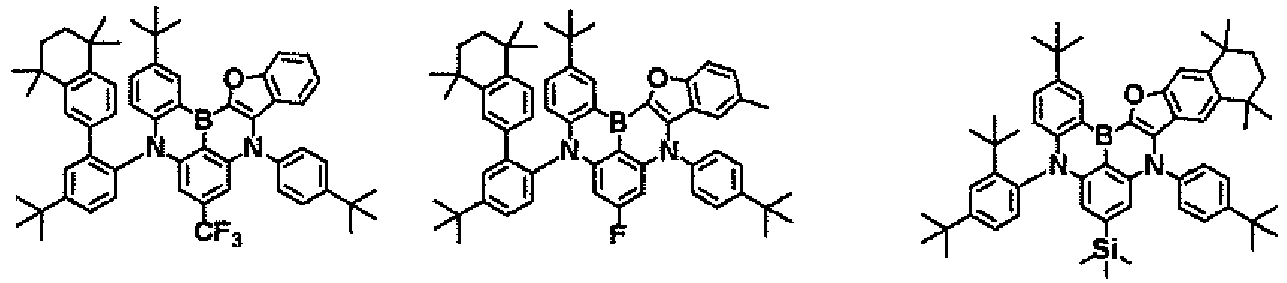


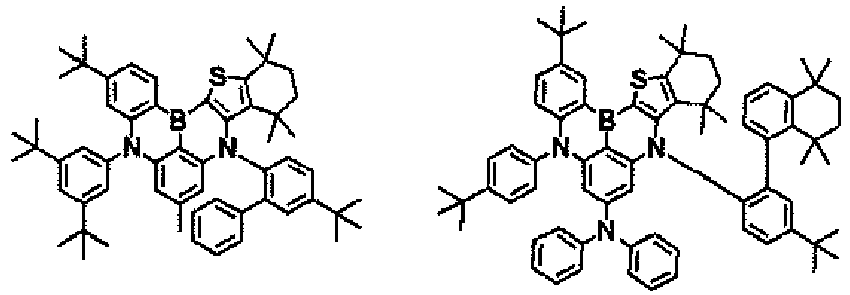








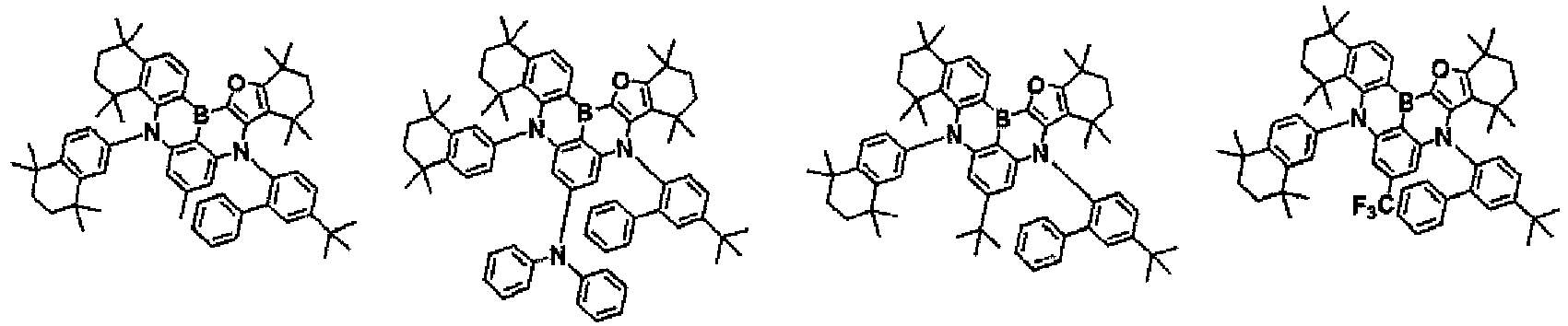


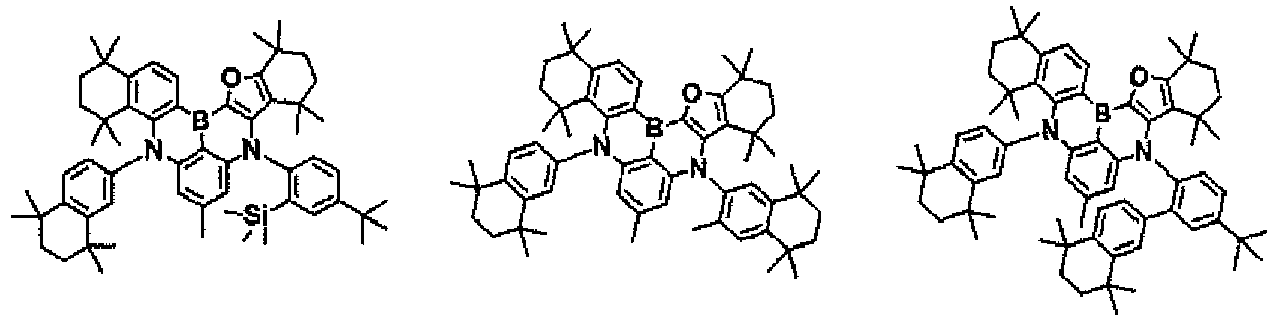





















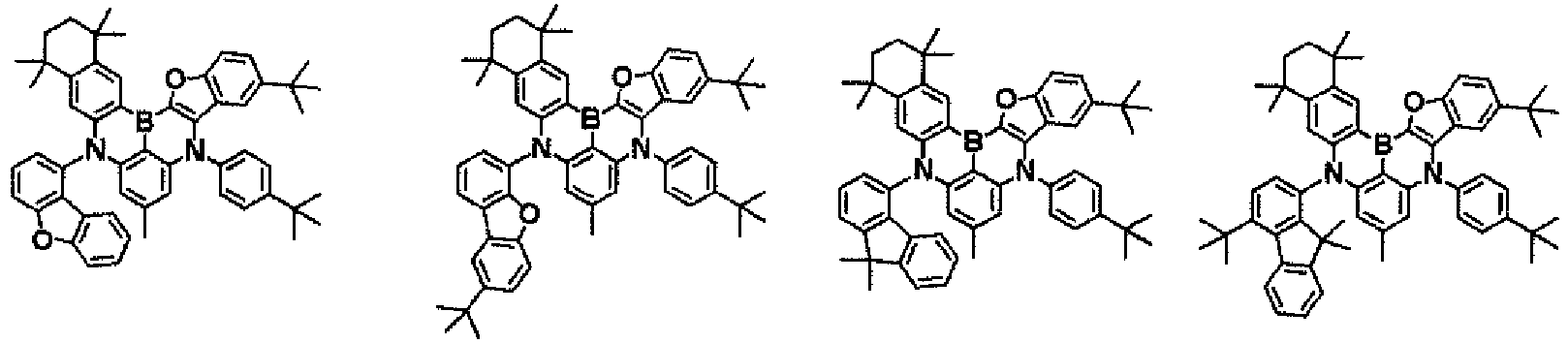





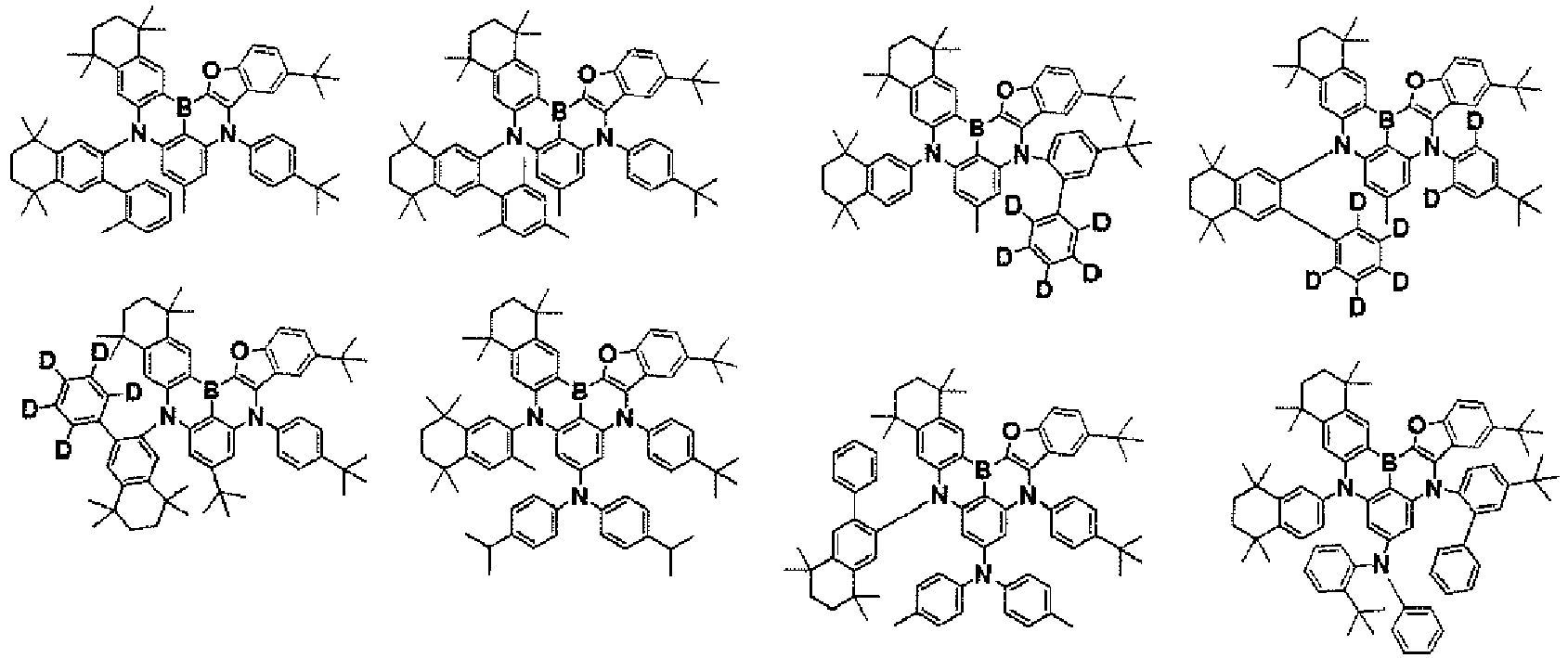


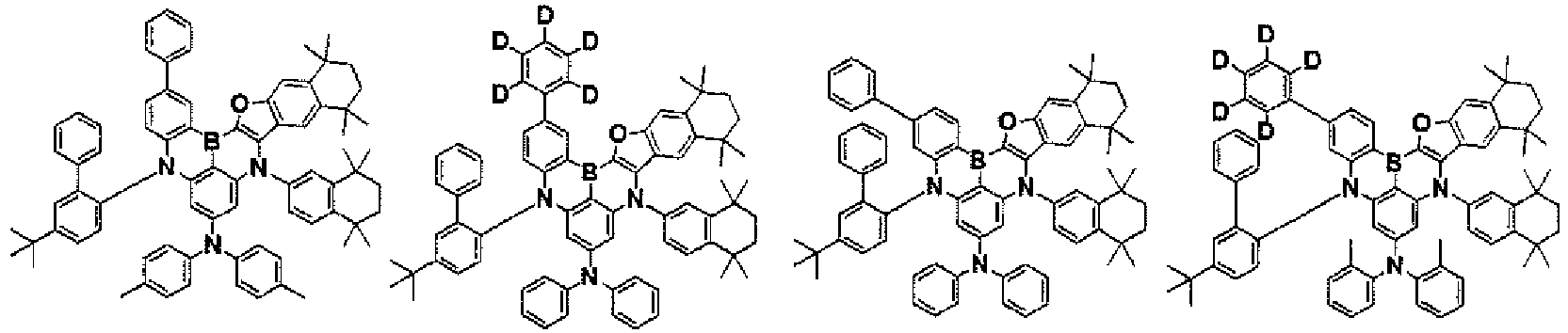


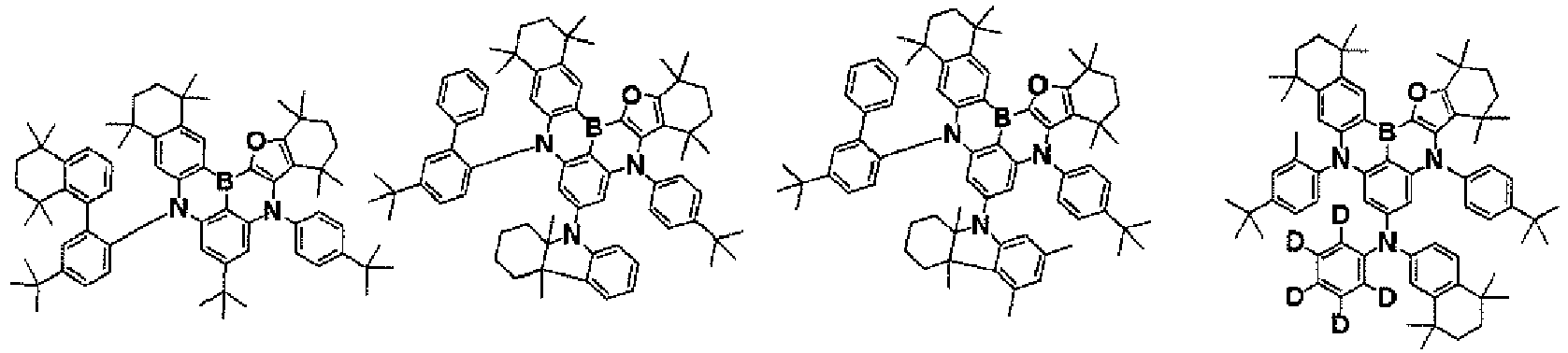


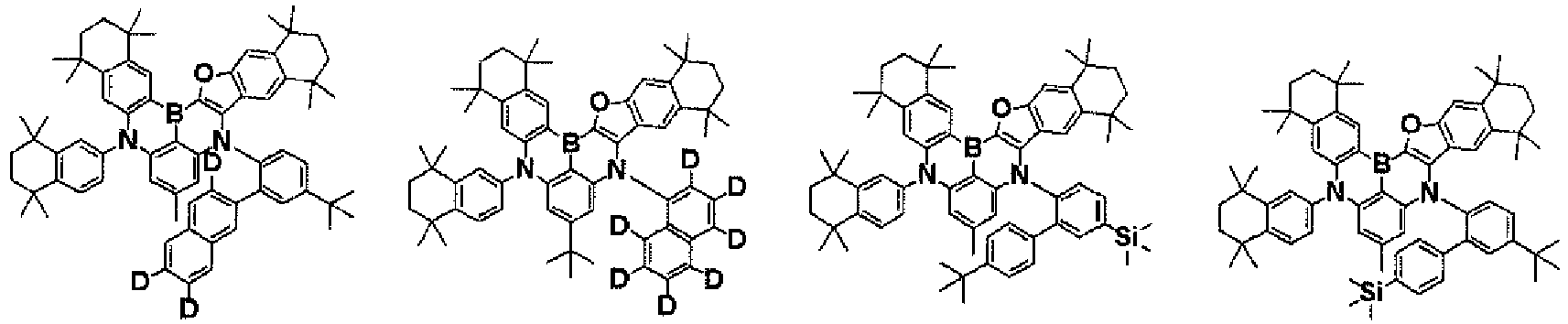





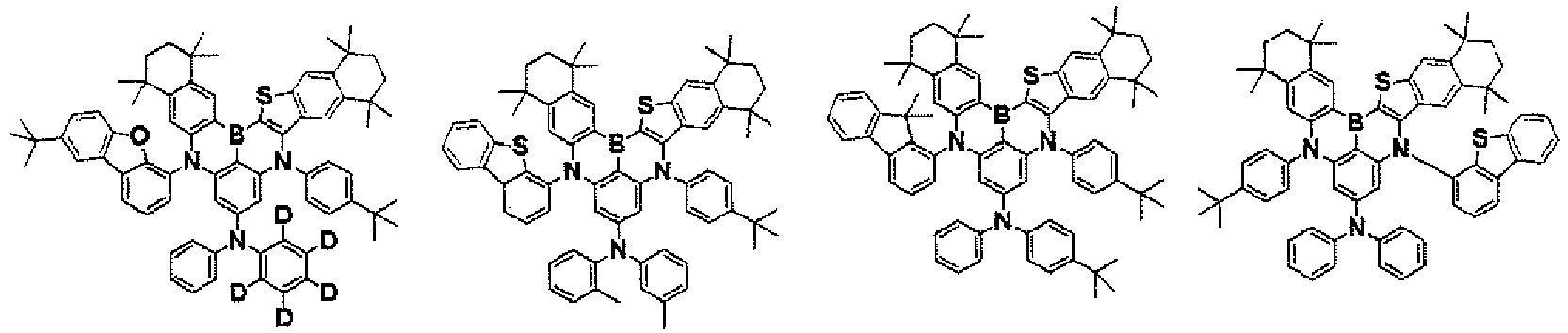










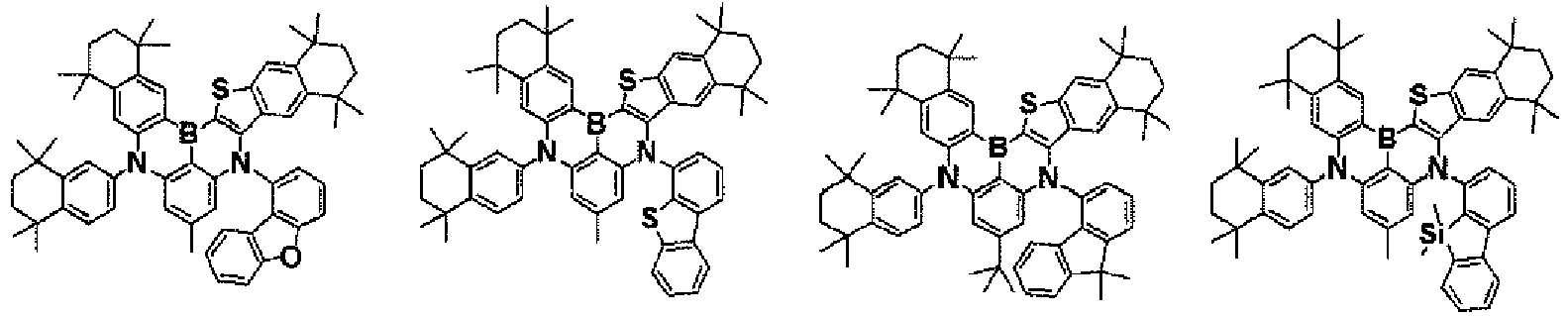
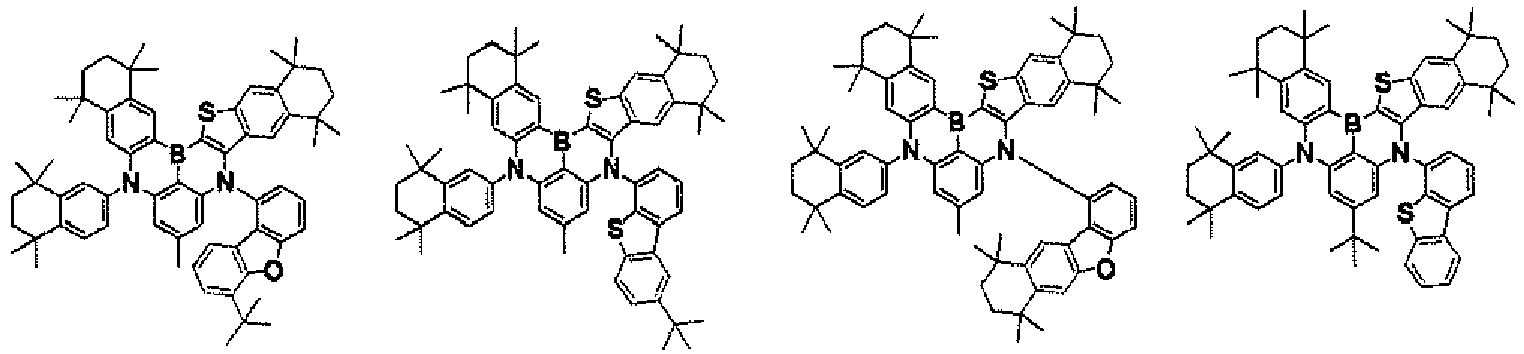










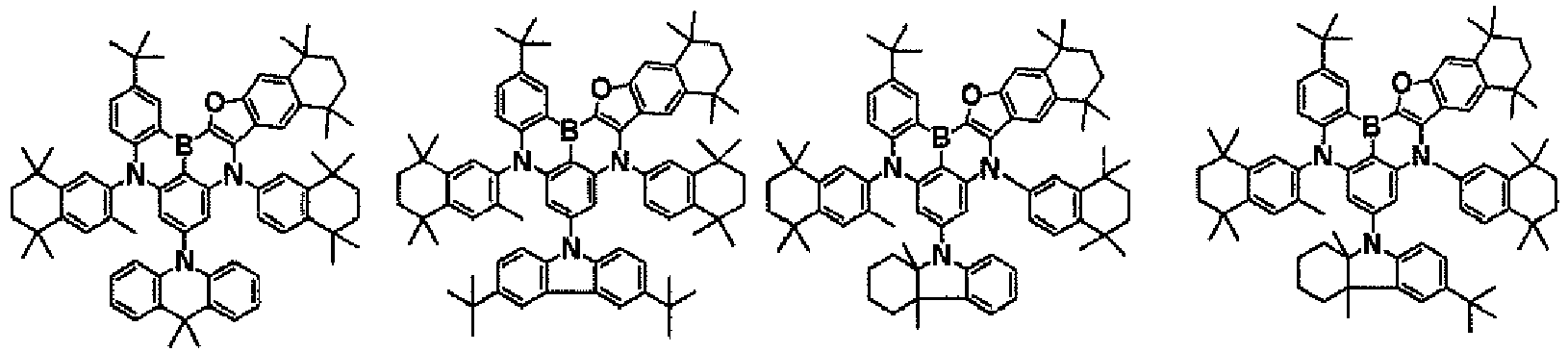


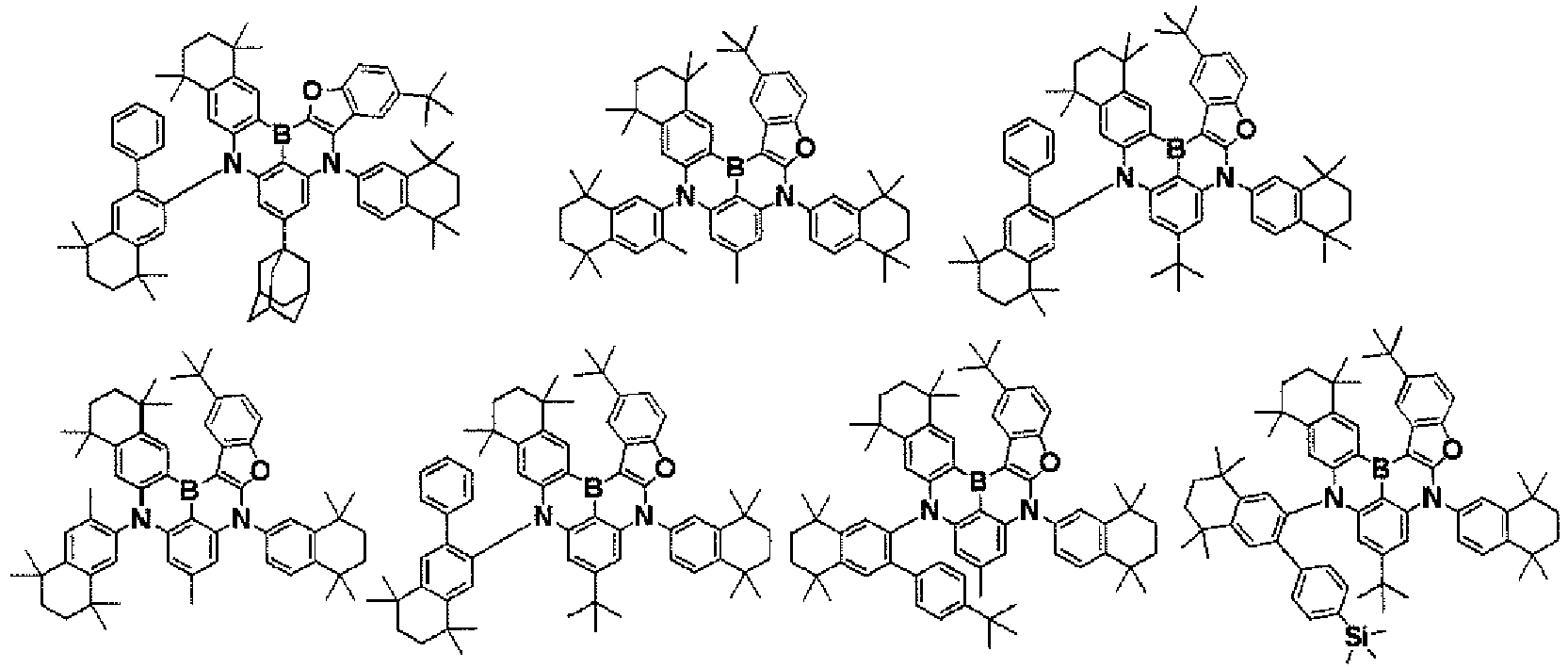











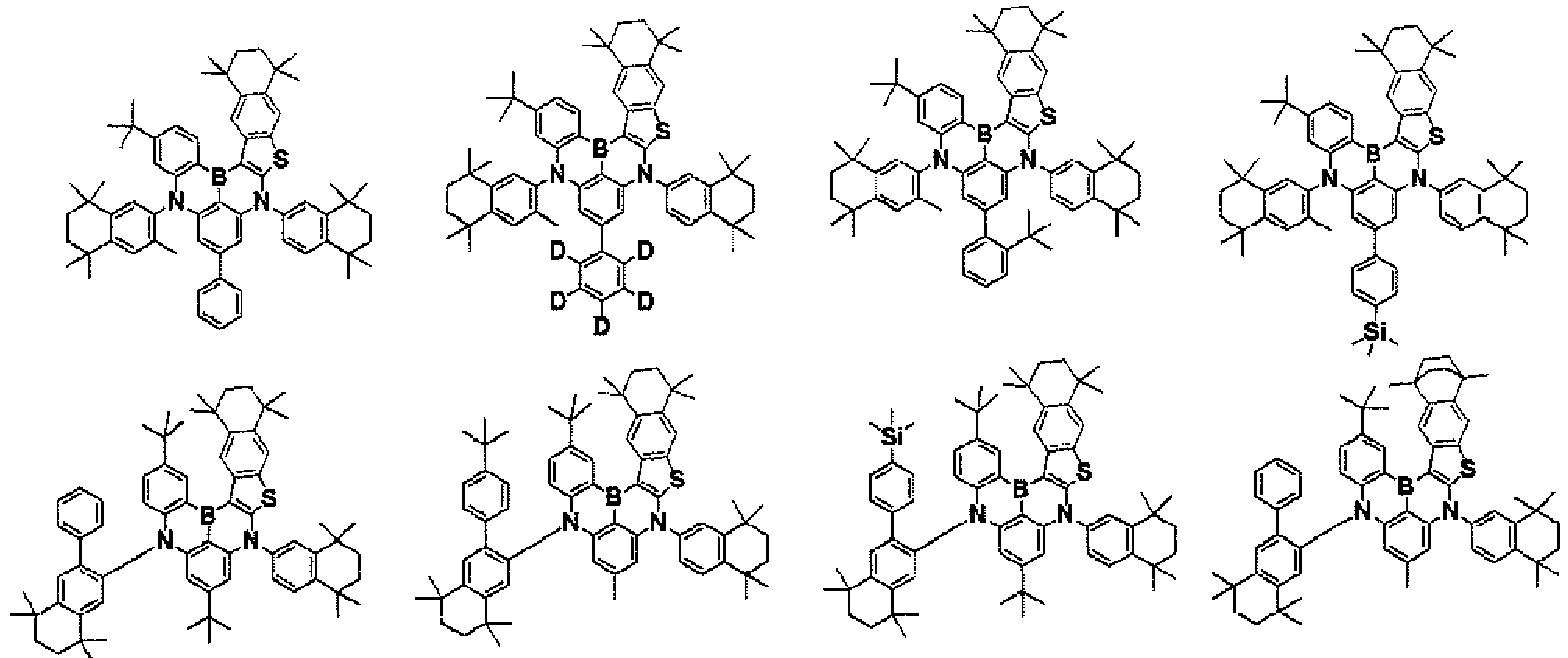


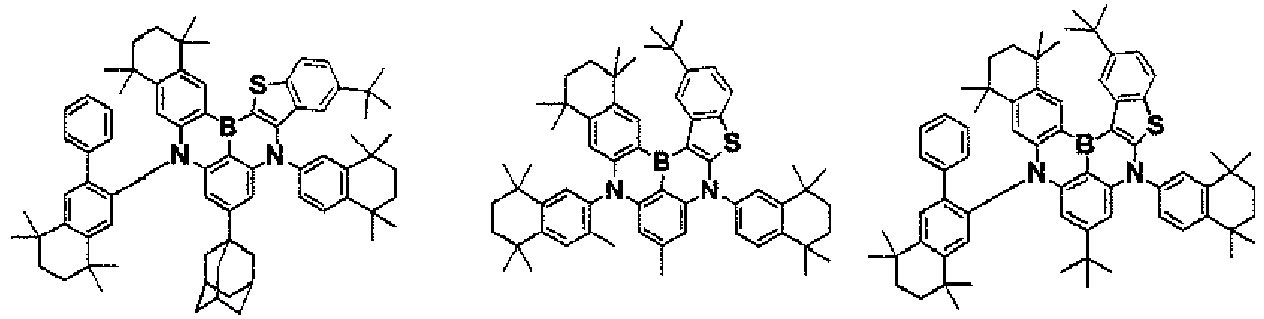


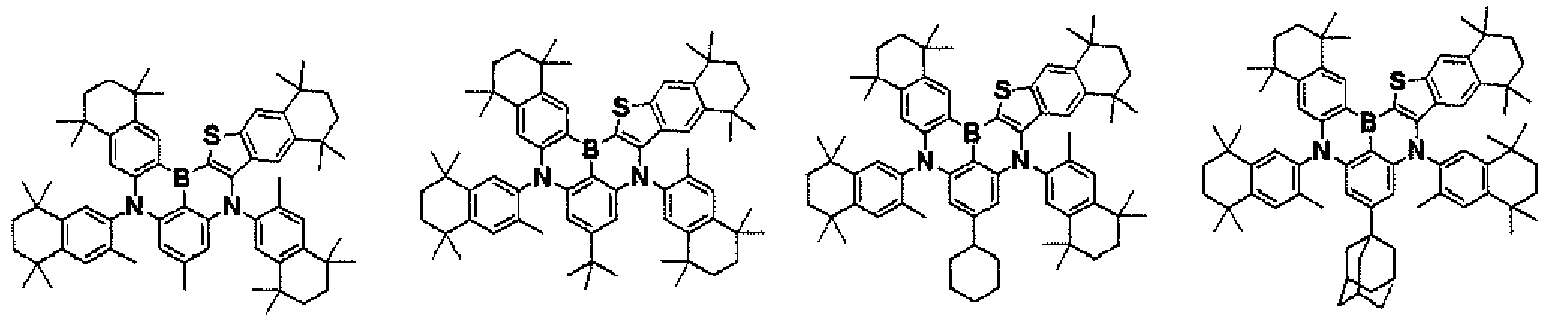


- In the compounds, Ph means a phenyl group, and D means deuterium.
- One embodiment of the present specification provides an organic light emitting device including the compound described above.
- In the present specification, a description of a certain member being placed "on" another member includes not only a case of the one member being in contact with the another member but a case of still another member being present between the two members.
- In the present specification, a description of a certain part "including" certain constituents means capable of further including other constituents, and does not exclude other constituents unless particularly stated on the contrary.
- In the present specification, the "layer" has a meaning compatible with a 'film' mainly used in the art, and means coating covering a target area. The size of the "layer" is not limited, and each "layer" may have the same or a different size. According to one embodiment, the size of the "layer" may be the same as the whole device, may correspond to the size of a specific functional area, or may be as small as a single subpixel.
- In the present specification, a meaning of a specific A material being included in a B layer includes both i) one or more types of A materials being included in one B layer, and ii) a B layer being formed in one or more layers, and an A material being included in one or more of the B layers that is a multilayer.
- In the present specification, a meaning of a specific A material being included in a C layer or a D layer includes both i) being included in one or more layers of one or more C layers, ii) being included in one or more layers of one or more B layers, or iii) being included in each of one or more C layers and one or more D layers.
- In the present specification, "deuteration", "substituted with deuterium" or "deuterated" means hydrogen at a substitutable position of a compound being substituted with deuterium.
- In the present specification, "X% substituted with deuterium", "X% deuterated", "degree of deuteration of X%", or "deuterium substitution rate of X%" means, in the corresponding structure, X% of hydrogens at substitutable positions being substituted with deuterium. For example, when the corresponding structure is dibenzofuran, the dibenzofuran being "substituted with deuterium by 25%", the dibenzofuran being "25% deuterated", the dibenzofuran having a "degree of deuteration of 25%", or the dibenzofuran having a "deuterium substitution rate of 25%" means two of eight hydrogens at substitutable positions of the dibenzofuran being substituted with deuterium.
- In the present specification, the degree of deuteration may be identified using known methods such as nuclear magnetic resonance spectroscopy (1H NMR), TLC/MS (thin-layer chromatography/mass spectrometry) or MALDI-TOF MS (matrix assisted laser desorption/ionization time-of-flight mass spectrometry).
- One embodiment of the present specification provides an organic light emitting device including a first electrode; a second electrode provided opposite to the first electrode; and one or more organic material layers provided between the first electrode and the second electrode, wherein one or more layers of the organic material layers include the compound represented by
Chemical Formula 1. - The organic material layer of the organic light emitting device of the present specification may be formed in a single layer structure, but may also be formed in a multilayer structure in which two or more organic material layers are laminated. For example, the organic light emitting device of the present specification may have a structure including a hole injection layer, a hole transfer layer, a light emitting layer, an electron transfer layer, an electron injection layer, an electron blocking layer, a hole blocking layer and the like. However, the structure of the organic light emitting device is not limited thereto, and may include a smaller number of organic layers.
- In one embodiment of the present specification, the organic material layer includes a light emitting layer, and the light emitting layer includes the compound represented by
Chemical Formula 1. - In one embodiment of the present specification, the organic material layer includes a light emitting layer, and the light emitting layer includes the compound represented by
Chemical Formula 1 as a dopant of the light emitting layer. - In one embodiment of the present specification, the organic material layer includes a light emitting layer, and the light emitting layer includes the compound represented by
Chemical Formula 1 as a blue fluorescent dopant of the light emitting layer. - In one embodiment of the present specification, the organic light emitting device further includes one, two or more layers selected from the group consisting of a hole injection layer, a hole transfer layer, a light emitting layer, an electron transfer layer, an electron injection layer, a hole blocking layer and an electron blocking layer.
- In one embodiment of the present specification, the light emitting layer further includes a host compound.
- In one embodiment of the present specification, the light emitting layer further includes a host compound, and in the host compound, at least one hydrogen at a substitutable position is substituted with deuterium.
- In one embodiment of the present specification, when the host compound is substituted with deuterium, the host compound is substituted with deuterium by 30% or more. In another embodiment, the host compound is substituted with deuterium by 40% or more. In another embodiment, the host compound is substituted with deuterium by 60% or more. In another embodiment, the host compound is substituted with deuterium by 80% or more. In another embodiment, the host compound is substituted with deuterium by 100%.
- In one embodiment of the present specification, the light emitting layer further includes a compound represented by the following Chemical Formula H.

- In Chemical Formula H,
- L20 and L21 are the same as or different from each other, and each independently a direct bond; a substituted or unsubstituted arylene group; or a substituted or unsubstituted heteroarylene group,
- Ar20 and Ar21 are the same as or different from each other, and each independently hydrogen; deuterium; a substituted or unsubstituted aryl group; or a substituted or unsubstituted heterocyclic group,
- R20 and R21 are the same as or different from each other, and each independently hydrogen; deuterium; a halogen group; a substituted or unsubstituted alkyl group; a substituted or unsubstituted cycloalkyl group; a substituted or unsubstituted aryl group; or a substituted or unsubstituted heterocyclic group, and
- r21 is an integer of 1 to 7, and when r21 is 2 or greater, the two or more R21s are the same as or different from each other.
- In one embodiment of the present specification, L20 and L21 are the same as or different from each other, and each independently a direct bond; a phenylene group unsubstituted or substituted with deuterium; a biphenylylene group unsubstituted or substituted with deuterium; a naphthylene group unsubstituted or substituted with deuterium; a divalent dibenzofuran group; or a divalent dibenzothiophene group.
- In one embodiment of the present specification, Ar20 and Ar21 are the same as or different from each other, and each independently a substituted or unsubstituted monocyclic or polycyclic aryl group having 6 to 30 carbon atoms; or a substituted or unsubstituted monocyclic or polycyclic heterocyclic group having 2 to 30 carbon atoms.
- In one embodiment of the present specification, Ar20 and Ar21 are the same as or different from each other, and each independently a substituted or unsubstituted monocyclic or polycyclic aryl group having 6 to 20 carbon atoms; or a substituted or unsubstituted monocyclic or polycyclic heterocyclic group having 2 to 20 carbon atoms.
- In one embodiment of the present specification, Ar20 and Ar21 are the same as or different from each other, and each independently a substituted or unsubstituted monocyclic to tetracyclic aryl group having 6 to 20 carbon atoms; or a substituted or unsubstituted monocyclic to tetracyclic heterocyclic group having 2 to 20 carbon atoms.
- In one embodiment of the present specification, Ar20 and Ar21 are the same as or different from each other, and each independently a substituted or unsubstituted phenyl group; a substituted or unsubstituted biphenyl group; a substituted or unsubstituted terphenyl group; a substituted or unsubstituted naphthyl group; a substituted or unsubstituted anthracene group; a substituted or unsubstituted phenanthrene group; a substituted or unsubstituted phenalene group; a substituted or unsubstituted fluorene group; a substituted or unsubstituted benzofluorene group; a substituted or unsubstituted furan group; a substituted or unsubstituted thiophene group; a substituted or unsubstituted dibenzofuran group; a substituted or unsubstituted naphthobenzofuran group; a substituted or unsubstituted dibenzothiophene group; or a substituted or unsubstituted naphthobenzothiophene group.
- In one embodiment of the present specification, Ar20 and Ar21 are the same as or different from each other, and each independently a phenyl group unsubstituted or substituted with deuterium, or a monocyclic or polycyclic aryl group having 6 to 20 carbon atoms; a biphenyl group unsubstituted or substituted with deuterium, or a monocyclic or polycyclic aryl group having 6 to 20 carbon atoms; a naphthyl group unsubstituted or substituted with a monocyclic or polycyclic aryl group having 6 to 20 carbon atoms; a dibenzofuran group unsubstituted or substituted with a monocyclic or polycyclic aryl group having 6 to 20 carbon atoms; a naphthobenzofuran group unsubstituted or substituted with a monocyclic or polycyclic aryl group having 6 to 20 carbon atoms; a dibenzothiophene group unsubstituted or substituted with a monocyclic or polycyclic aryl group having 6 to 20 carbon atoms; or a naphthobenzothiophene group unsubstituted or substituted with a monocyclic or polycyclic aryl group having 6 to 20 carbon atoms.
- In one embodiment of the present specification, Ar20 and Ar21 are the same as or different from each other, and each independently a phenyl group unsubstituted or substituted with deuterium; a biphenyl group unsubstituted or substituted with deuterium; a terphenyl group; a naphthyl group unsubstituted or substituted with deuterium; a phenanthrene group; a dibenzofuran group; a naphthobenzofuran group; a dibenzothiophene group; or a naphthobenzothiophene group.
- In one embodiment of the present specification, Ar20 is a substituted or unsubstituted heterocyclic group, and Ar21 is a substituted or unsubstituted aryl group.
- In one embodiment of the present specification, R20 is hydrogen; deuterium; a halogen group; a substituted or unsubstituted linear or branched alkyl group having 1 to 30 carbon atoms; a substituted or unsubstituted monocyclic or polycyclic cycloalkyl group having 3 to 30 carbon atoms; a substituted or unsubstituted monocyclic or polycyclic aryl group having 6 to 30 carbon atoms; or a substituted or unsubstituted monocyclic or polycyclic heterocyclic group having 2 to 30 carbon atoms.
- In one embodiment of the present specification, R20 is hydrogen; deuterium; fluorine; a substituted or unsubstituted linear or branched alkyl group having 1 to 10 carbon atoms; a substituted or unsubstituted monocyclic or polycyclic cycloalkyl group having 3 to 10 carbon atoms; a substituted or unsubstituted monocyclic or polycyclic aryl group having 6 to 30 carbon atoms; or a substituted or unsubstituted monocyclic or polycyclic heterocyclic group having 2 to 30 carbon atoms.
- In one embodiment of the present specification, R20 is hydrogen; a substituted or unsubstituted monocyclic or polycyclic aryl group having 6 to 30 carbon atoms; or a substituted or unsubstituted monocyclic or polycyclic heterocyclic group having 2 to 30 carbon atoms.
- In one embodiment of the present specification, R20 is hydrogen; a substituted or unsubstituted monocyclic or polycyclic aryl group having 6 to 20 carbon atoms; or a substituted or unsubstituted monocyclic or polycyclic heterocyclic group having 2 to 20 carbon atoms.
- In one embodiment of the present specification, R20 is hydrogen; a substituted or unsubstituted monocyclic to tetracyclic aryl group having 6 to 20 carbon atoms; or a substituted or unsubstituted monocyclic to tetracyclic heterocyclic group having 2 to 20 carbon atoms.
- In one embodiment of the present specification, R20 is hydrogen; a substituted or unsubstituted phenyl group; a substituted or unsubstituted biphenyl group; a substituted or unsubstituted terphenyl group; a substituted or unsubstituted naphthyl group; a substituted or unsubstituted anthracene group; a substituted or unsubstituted phenanthrene group; a substituted or unsubstituted phenalene group; a substituted or unsubstituted fluorene group; a substituted or unsubstituted benzofluorene group; a substituted or unsubstituted furan group; a substituted or unsubstituted thiophene group; a substituted or unsubstituted dibenzofuran group; a substituted or unsubstituted naphthobenzofuran group; a substituted or unsubstituted dibenzothiophene group; or a substituted or unsubstituted naphthobenzothiophene group.
- In one embodiment of the present specification, R20 is hydrogen; deuterium; a phenyl group unsubstituted or substituted with deuterium, or a monocyclic or polycyclic aryl group having 6 to 20 carbon atoms; a biphenyl group unsubstituted or substituted with a monocyclic or polycyclic aryl group having 6 to 20 carbon atoms; a naphthyl group unsubstituted or substituted with deuterium, or a monocyclic or polycyclic aryl group having 6 to 20 carbon atoms; a dibenzofuran group unsubstituted or substituted with a monocyclic or polycyclic aryl group having 6 to 20 carbon atoms; a naphthobenzofuran group unsubstituted or substituted with a monocyclic or polycyclic aryl group having 6 to 20 carbon atoms; a dibenzothiophene group unsubstituted or substituted with a monocyclic or polycyclic aryl group having 6 to 20 carbon atoms; or a naphthobenzothiophene group unsubstituted or substituted with a monocyclic or polycyclic aryl group having 6 to 20 carbon atoms.
- In one embodiment of the present specification, R20 is hydrogen; deuterium; a phenyl group unsubstituted or substituted with deuterium, a phenyl group or a naphthyl group; a biphenyl group; a naphthyl group unsubstituted or substituted with deuterium, a phenyl group or a naphthyl group; a dibenzofuran group; a naphthobenzofuran group; a dibenzothiophene group; or a naphthobenzothiophene group.
- According to one embodiment of the present specification, R21 is hydrogen.
- According to one embodiment of the present specification, R21 is deuterium.
- In one embodiment of the present specification, when the compound represented by Chemical Formula H is substituted with deuterium, hydrogen at a substitutable position may be substituted with deuterium by 30% or more. In another embodiment, hydrogen at a substitutable position is substituted with deuterium by 40% or more in the structure of Chemical Formula H. In another embodiment, hydrogen at a substitutable position is substituted with deuterium by 60% or more in the structure of Chemical Formula H.
- In another embodiment, hydrogen at a substitutable position is substituted with deuterium by 80% or more in the structure of Chemical Formula H. In another embodiment, hydrogen at a substitutable position is substituted with deuterium by 100% in the structure of Chemical Formula H.
- In one embodiment of the present specification, the compound represented by Chemical Formula H is any one selected from among the following compounds.





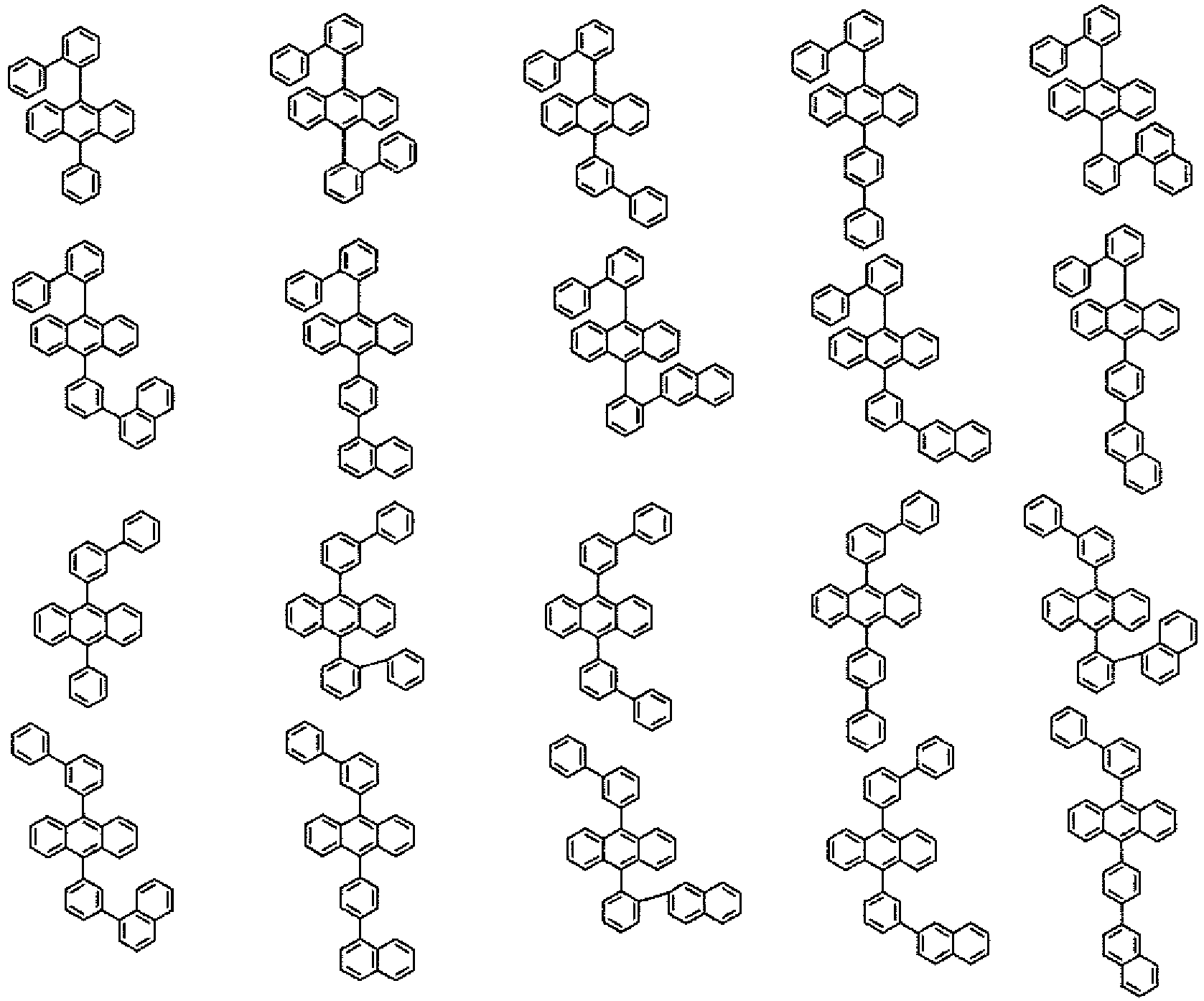


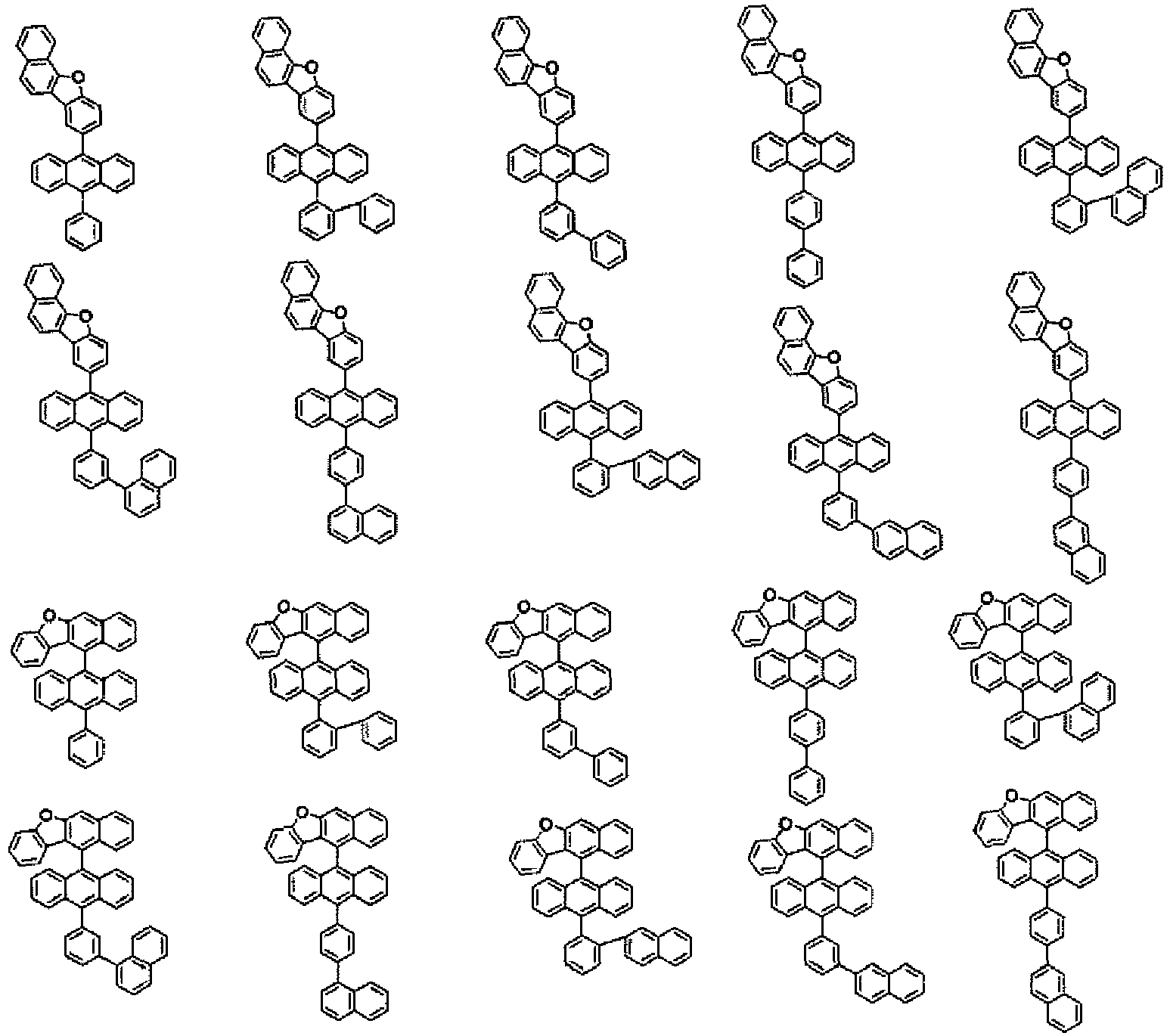


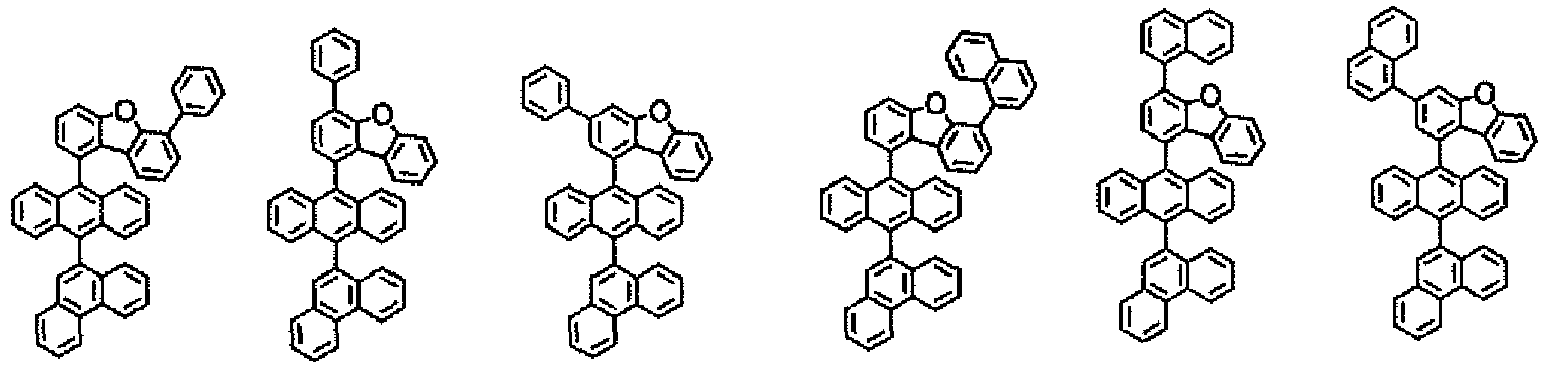


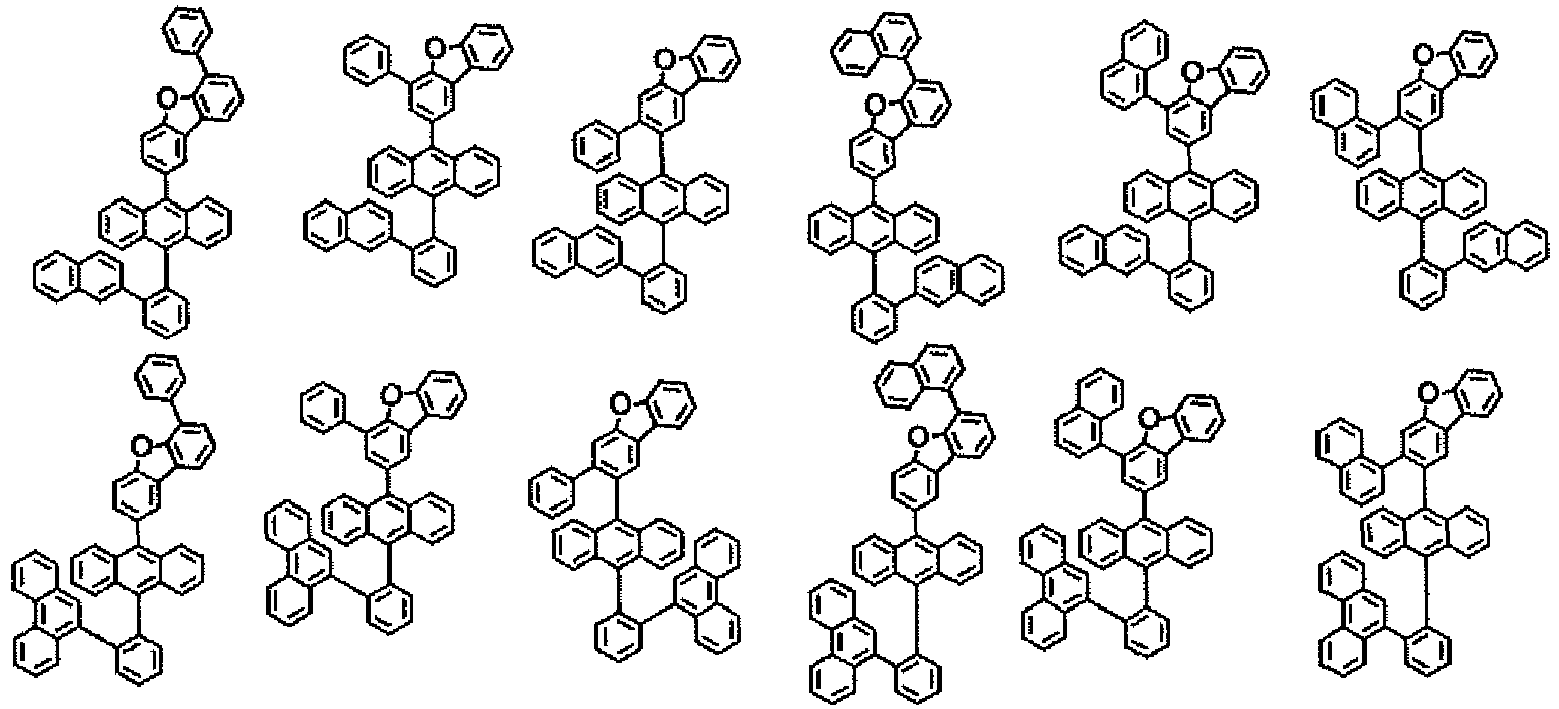


- According to one embodiment of the present specification, the compound represented by Chemical Formula H may be prepared using the following
General Formula 1, however, the method is not limited thereto.

- In
General Formula 1, - Ar1 has the same definition as -L20-Ar20 of Chemical Formula H,
- Ar2 has the same definition as -L21-Ar21 of Chemical Formula H, and the anthracene core of
General Formula 1 may be further substituted with R20 and R21. - In one embodiment of the present specification, the compound represented by
Chemical Formula 1 is used as a dopant, and the compound represented by Chemical Formula H is used as a host in the light emitting layer. - In one embodiment of the present specification, when the light emitting layer includes a host and a dopant, a content of the dopant may be selected in a range of 0.01 parts by weight to 10 parts by weight based on 100 parts by weight of the host, however, the content is not limited thereto.
- The light emitting layer may further include a host material, and the host includes fused aromatic ring derivatives, heteroring-containing compounds or the like. Specifically, anthracene derivatives, pyrene derivatives, naphthalene derivatives, pentacene derivatives, phenanthrene compounds, fluoranthene compounds or the like may be included as the fused aromatic ring derivative, and carbazole derivatives, dibenzofuran derivatives, ladder-type furan compounds, pyrimidine derivatives, triazine derivatives or the like may be included as the heteroring-containing compound, and mixtures of two or more types thereof may be included, however, the host material is not limited thereto.
- According to one embodiment of the present specification, the organic material layer includes a light emitting layer, and the light emitting layer includes two or more types of mixed dopants and a host.
- According to one embodiment of the present specification, one or more of the two or more types of mixed dopants include
Chemical Formula 1, and the host includes the compound represented by Chemical Formula H. One or more of the two or more types of mixed dopants includeChemical Formula 1, and as the rest, dopant materials known in the art may be used, however, the dopant is not limited thereto. - According to one embodiment of the present specification, one or more of the two or more types of mixed dopants include
Chemical Formula 1, and as the rest, one or more of boron-based compounds, pyrene-based compounds and delayed fluorescencebased compounds different fromChemical Formula 1 may be used, however, the dopant is not limited thereto. - According to one embodiment of the present specification, the organic material layer includes a light emitting layer, and the light emitting layer includes one or more types of hosts.
- According to one embodiment of the present specification, the organic material layer includes a light emitting layer, and the light emitting layer includes two or more types of mixed hosts.
- According to one embodiment of the present specification, one or more of the two or more types of mixed hosts are the compound represented by Chemical Formula H.
- According to one embodiment of the present specification, the two or more types of mixed hosts are different from each other, and each independently the compound represented by Chemical Formula H.
- According to one embodiment of the present specification, the organic material layer includes a light emitting layer, and the light emitting layer includes two types of mixed hosts.
- According to one embodiment of the present specification, the organic material layer includes a light emitting layer, the light emitting layer includes two types of mixed hosts, the two types of mixed hosts are different from each other, and the two types of hosts are the compound represented by Chemical Formula H.
- According to one embodiment of the present specification, the organic material layer includes a light emitting layer, the light emitting layer includes a first host represented by Chemical Formula H; and a second host represented by Chemical Formula H, and the first host and the second host are different from each other.
- According to one embodiment of the present specification, the first host:the second host are included in a weight ratio of 95:5 to 5:95, and preferably in a weight ratio of 70:30 to 30:70.
- According to one embodiment of the present specification, the organic material layer includes a light emitting layer, and the light emitting layer includes one or more types of hosts and a dopant.
- According to one embodiment of the present specification, the organic material layer includes a light emitting layer, the light emitting layer includes one or more types of hosts and a dopant, the hosts include the compound represented by Chemical Formula H, and the dopant includes the compound represented by
Chemical Formula 1. - According to one embodiment of the present specification, the organic material layer includes a light emitting layer, and the light emitting layer includes two or more types of mixed hosts and a dopant.
- According to one embodiment of the present specification, one or more of the two or more types of mixed hosts include the compound represented by Chemical Formula H, and the dopant includes the compound represented by
Chemical Formula 1. - In the present specification, the two or more types of mixed hosts are different from each other.
- According to one embodiment of the present specification, the organic material layer includes a light emitting layer, and the light emitting layer includes two types of mixed hosts and a dopant.
- According to one embodiment of the present specification, the two types of mixed hosts are different from each other, and each independently include the compound represented by Chemical Formula H, and the dopant includes the compound represented by
Chemical Formula 1. - According to one embodiment of the present specification, the organic material layer includes a light emitting layer, the light emitting layer includes a first host represented by Chemical Formula H; a second host represented by Chemical Formula H; and a dopant represented by
Chemical Formula 1, and the first host and the second host are different from each other. - According to one embodiment of the present specification, the organic material layer uses one or more types of hosts and one or more types of dopants, the one or more types of hosts include the compound represented by Chemical Formula H, and the one or more types of dopants include the compound represented by
Chemical Formula 1. - According to one embodiment of the present specification, the organic material layer uses two or more types of mixed hosts and two or more types of mixed dopants, the two or more types of mixed hosts may use the same materials as described above, and the two or more types of mixed dopants may use the same materials as described above.
- In one embodiment of the present specification, the organic light emitting device includes a first electrode; a second electrode; a light emitting layer provided between the first electrode and the second electrode; and two or more organic material layers provided between the light emitting layer and the first electrode, or between the light emitting layer and the second electrode, wherein at least one of the two or more organic material layers includes the compound represented by
Chemical Formula 1. - In one embodiment of the present specification, as the two or more organic material layers, two or more may be selected from the group consisting of a light emitting layer, a hole transfer layer, a hole injection layer, a layer carrying hole transfer and hole injection at the same time, and an electron blocking layer.
- In one embodiment of the present specification, the organic material layer includes two or more electron transfer layers, and at least one of the two or more electron transfer layers includes the compound represented by
Chemical Formula 1. Specifically, in one embodiment of the present specification, the compound represented byChemical Formula 1 may be included in one of the two or more electron transfer layers, or may be included in each of the two or more electron transfer layers. - In addition, when the compound is included in each of the two or more electron transfer layers in one embodiment of the present specification, materials other than the compound represented by
Chemical Formula 1 may be the same as or different from each other. - When the organic material layer including the compound represented by
Chemical Formula 1 is an electron transfer layer, the electron transfer layer may further include an n-type dopant. As the n-type dopant, those known in the art may be used, and for example, metals or metal complexes may be used. For example, the electron transfer layer including the compound represented byChemical Formula 1 may further include lithium quinolate (LiQ). - In one embodiment of the present specification, the organic material layer includes two or more hole transfer layers, and at least one of the two or more hole transfer layers includes the compound represented by
Chemical Formula 1. Specifically, in one embodiment of the present specification, the compound represented byChemical Formula 1 may be included in one of the two or more hole transfer layers, or may be included in each of the two or more hole transfer layers. - In addition, when the compound represented by
Chemical Formula 1 is included in each of the two or more hole transfer layers in one embodiment of the present specification, materials other than the compound represented byChemical Formula 1 may be the same as or different from each other. - In one embodiment of the present specification, the organic material layer may further include, in addition to the organic material layer including the compound represented by
Chemical Formula 1, a hole injection layer or a hole transfer layer including a compound including an arylamine group, a carbazolyl group or a benzocarbazolyl group. - In one embodiment of the present specification, the first electrode is an anode or a cathode.
- In one embodiment of the present specification, the second electrode is a cathode or an anode.
- In one embodiment of the present specification, the organic light emitting device may be an organic light emitting device having a structure in which an anode, one or more organic material layers and a cathode are consecutively laminated on a substrate (normal type).
- In one embodiment of the present specification, the organic light emitting device may be an organic light emitting device having a structure in a reverse direction in which a cathode, one or more organic material layers and an anode are consecutively laminated on a substrate (inverted type).
- For example, structures of the organic light emitting device according to one embodiment of the present specification are illustrated in
FIG. 1 and FIG. 2. FIG. 1 and FIG. 2 illustrate the organic light emitting device, and the organic light emitting device is not limited thereto. -
FIG. 1 illustrates a structure of the organic light emitting device in which a substrate (1), a first electrode (2), a light emitting layer (3) and a second electrode (4) are consecutively laminated. In such a structure, the compound may be included in the light emitting layer (3). -
FIG. 2 illustrates a structure of the organic light emitting device in which a substrate (1), a first electrode (2), a hole injection layer (5), a hole transfer layer (6), an electron blocking layer (7), a light emitting layer (3), a first electron transfer layer (8), a second electron transfer layer (9), an electron injection layer (10) and a second electrode (4) are consecutively laminated. In such a structure, the compound may be included in the light emitting layer (3). - The organic light emitting device of the present specification may be manufactured using materials and methods known in the art, except that one or more layers of the organic material layers include the compound, that is, the compound represented by
Chemical Formula 1. - When the organic light emitting device includes a plurality of organic material layers, the organic material layers may be formed with the same materials or different materials.
- For example, the organic light emitting device of the present specification may be manufactured by consecutively laminating a first electrode, an organic material layer and a second electrode on a substrate. Herein, the organic light emitting device may be manufactured by forming an anode on a substrate by depositing a metal, a metal oxide having conductivity, or an alloy thereof using a physical vapor deposition (PVD) method such as sputtering or e-beam evaporation, and forming an organic material layer including a hole injection layer, a hole transfer layer, a light emitting layer and an electron transfer layer thereon, and then depositing a material usable as a cathode thereon. In addition to such a method, the organic light emitting device may also be manufactured by consecutively depositing a cathode material, an organic material layer and an anode material on a substrate.
- In addition, the compound represented by
Chemical Formula 1 may be formed into an organic material layer using a solution coating method as well as a vacuum deposition method when manufacturing the organic light emitting device. Herein, the solution coating method means spin coating, dip coating, doctor blading, inkjet printing, screen printing, a spray method, roll coating and the like, but is not limited thereto. - In addition to such a method, the organic light emitting device may also be manufactured by consecutively laminating a cathode material, an organic material layer and an anode material on a substrate (International Patent Application Laid Open Publication No. 2003/012890). However, the manufacturing method is not limited thereto.
- As the first electrode material, materials having large work function are normally preferred so that hole injection to an organic material layer is smooth. Examples thereof include metals such as vanadium, chromium, copper, zinc and gold, or alloys thereof; metal oxides such as zinc oxide, indium oxide, indium tin oxide (ITO) and indium zinc oxide (IZO); combinations of metals and oxides such as ZnO:Al or SnO2:Sb; conductive polymers such as poly(3-methylthiophene), poly[3,4-(ethylene-1,2-dioxy)thiophene] (PEDOT), polypyrrole and polyaniline, but are not limited thereto.
- As the second electrode material, materials having small work function are normally preferred so that electron injection to an organic material layer is smooth. Examples thereof include metals such as magnesium, calcium, sodium, potassium, titanium, indium, yttrium, lithium, gadolinium, aluminum, silver, tin and lead, or alloys thereof; multilayer structure materials such as LiF/Al or LiO2/Al, and the like, but are not limited thereto.
- The light emitting layer may include a host material and a dopant material. The host material includes fused aromatic ring derivatives, heteroring-containing compounds or the like. Specifically, the fused aromatic ring derivative includes anthracene derivatives, pyrene derivatives, naphthalene derivatives, pentacene derivatives, phenanthrene compounds, fluoranthene compounds and the like, and the heteroring-containing compound includes dibenzofuran derivatives, ladder-type furan compounds, pyrimidine derivatives and the like, however, the material is not limited thereto.
- The dopant material includes, when including an additional compound in addition to the compound represented by
Chemical Formula 1, aromatic amine derivatives, styrylamine compounds, boron complexes, fluoranthene compounds, metal complexes and the like. Specifically, the aromatic amine derivative is a fused aromatic ring derivative having a substituted or unsubstituted arylamine group and includes arylamine group-including pyrene, anthracene, chrysene, peryflanthene and the like. In addition, the styrylamine compound is a compound in which substituted or unsubstituted arylamine is substituted with at least one arylvinyl group, and one, two or more substituents selected from the group consisting of an aryl group, a silyl group, an alkyl group, a cycloalkyl group and an arylamine group are substituted or unsubstituted. Specifically, styrylamine, styryldiamine, styryltriamine, styryltetramine or the like is included, however, the styrylamine compound is not limited thereto. In addition, the metal complex includes iridium complexes, platinum complexes or the like, but is not limited thereto. - In the present specification, when the compound represented by
Chemical Formula 1 is included in an organic material layer other than the light emitting layer, or an additional light emitting layer is provided, a light emitting material of the light emitting layer is, as a material capable of emitting light in a visible region by receiving holes and electrons from a hole transfer layer and an electron transfer layer, respectively, and binding the holes and the electrons, preferably a material having favorable quantum efficiency for fluorescence or phosphorescence. Specific examples thereof include 8-hydroxy-quinoline aluminum complexes (Alq3); carbazole-based compounds; dimerized styryl compounds; BAlq; 10-hydroxybenzoquinoline-metal compounds; benzoxazole-, benzothiazole- and benzimidazole-based compounds; poly(p-phenylenevinylene) (PPV)-based polymers; spiro compounds; polyfluorene; rubrene, and the like, but are not limited thereto. - The hole injection layer is a layer injecting holes from an electrode. The hole injection material preferably has, by having an ability to transfer holes, a hole injection effect in a first electrode and an excellent hole injection effect for a light emitting layer or a light emitting material. In addition, the hole injection material is preferably a material having an excellent ability to prevent excitons generated in the light emitting layer from moving to an electron injection layer or an electron injection material. In addition, a material having an excellent thin film forming ability is preferred. In addition, the highest occupied molecular orbital (HOMO) of the hole injection material is preferably in between the work function of a first electrode material and the HOMO of surrounding organic material layers. Specific examples of the hole injection material include metal porphyrins, oligothiophene, arylamine-based organic materials; carbazole-based organic materials; nitrile-based organic materials; hexanitrile hexaazatriphenylene-based organic materials; quinacridone-based organic materials; perylene-based organic materials; polythiophene-based conductive polymers such as anthraquinone or polyaniline, mixtures of two or more of the examples, and the like, but are not limited thereto.
- The hole transfer layer is a layer receiving holes from a hole injection layer and transferring the holes to a light emitting layer. As the hole transfer material, materials having, as a material capable of receiving holes from a first electrode or a hole injection layer and moving the holes to a light emitting layer, high mobility for the holes are preferred. Specific examples thereof include arylamine-based organic materials, carbazole-based organic materials, conductive polymers, block copolymers having conjugated parts and non-conjugated parts together, and the like, but are not limited thereto.
- The electron transfer layer is a layer receiving electrons from an electron injection layer and transferring the electrons to a light emitting layer. As the electron transfer material, materials capable of favorably receiving electrons from a second electrode, moving the electrons to a light emitting layer, and having high mobility for the electrons are preferred. Specific examples thereof include Al complexes of 8-hydroxyquinoline; complexes including Alq3; organic radical compounds; hydroxyflavon-metal complexes; triazine derivatives; LiQ and the like, but are not limited thereto. The electron transfer layer may be used together with any desired first electrode material as used in the art. Particularly, the suitable first electrode material is a common material having low work function and having an aluminum layer or a silver layer following. Specifically, cesium, barium, calcium, ytterbium, samarium and the like are included, and in each case, an aluminum layer or a silver layer follows.
- The electron injection layer is a layer injecting electrons from an electrode. As the electron injection material, materials having an excellent electron transferring ability, having an electron injection effect from a second electrode, and having an excellent electron injection effect for a light emitting layer or light emitting material are preferred. In addition, materials preventing excitons generated in the light emitting layer from moving to a hole injection layer, and having an excellent thin film forming ability are preferred. Specific examples thereof include fluorenone, anthraquinodimethane, diphenoquinone, thiopyran dioxide, oxazole, oxadiazole, triazole, triazine, midazole, perylene tetracarboxylic acid, fluorenylidene methane, anthrone or the like, and derivatives thereof, metal complex compounds, nitrogen-containing 5-membered ring derivatives, mixtures of two or more of the examples, and the like, but are not limited thereto.
- The metal complex compound includes 8-hydroxyquinolinato lithium, bis(8-hydroxyquinolinato)zinc, bis(8-hydroxyquinolinato)copper, bis(8-hydroxyquinolinato)manganese, tris(8-hydroxyquinolinato)aluminum, tris(2-methyl-8-hydroxyquinolinato)aluminum, tris(8-hydroxyquinolinato)gallium, bis(10-hydroxybenzo[h]quinolinato)beryllium, bis(10-hydroxybenzo[h]quinolinato)zinc, bis(2-methyl-8-quinolinato)chlorogallium, bis(2-methyl-8-quinolinato)(o-cresolato)gallium, bis(2-methyl-8-quinolinato)(1-naphtholato)aluminum, bis(2-methyl-8-quinolinato)(2-naphtholato)gallium and the like, but is not limited thereto.
- The electron blocking layer is a layer capable of enhancing lifetime and efficiency of a device by preventing electrons injected from an electron injection layer from passing through a light emitting layer and entering a hole injection layer. Known material may be used without limit, and the electron blocking layer may be formed between the light emitting layer and the hole injection layer, or between the light emitting layer and a layer carrying out hole injection and hole transfer at the same time.
- The hole blocking layer is a layer blocking holes from passing a light emitting layer and reaching a cathode, and may be generally formed under the same condition as the electron injection layer. Specific examples thereof may include oxadiazole derivatives, triazole derivatives, phenanthroline derivatives, aluminum complexes, pyridine, pyrimidine or triazine derivatives and the like, but are not limited thereto.
- The organic light emitting device according to the present specification may be a top-emission type, a bottomemission type or a dual-emission type depending on the materials used.
- In one embodiment of the present specification, the compound represented by
Chemical Formula 1 may be included in, in addition to the organic light emitting device, an organic solar cell or an organic transistor. - The compound according to the present specification may also be used in an organic light emitting device including an organic phosphorescent device, an organic solar cell, an organic photo conductor, an organic transistor and the like under a similar principle used in the organic light emitting device. For example, the organic solar cell may have a structure including a cathode, an anode, and a photoactive layer provided between the cathode and the anode, and the photoactive layer may include the compound.
- The organic light emitting device of the present specification may be manufactured using common organic light emitting device manufacturing methods and materials except that one or more layers of the organic material layers are formed using the compound described above.
- Hereinafter, the present specification will be described in detail with reference to examples, comparative examples and the like. However, the examples and the comparative examples according to the present specification may be modified to various other forms, and the scope of the present specification is not to be construed as being limited to the examples and the comparative examples described below. Examples and comparative examples of the present specification are provided in order to more fully describe the present specification to those having average knowledge in the art.
-

- After dissolving 6-bromo-1,1,4,4-tetramethyl-1,2,3,4-tetrahydronaphthalene (40.5 g, 151.566 mmol), methyl 3-mercaptopropionate (16.6 ml,150 mmol), Pd2dba3 (2.06 g, 2.24 mmol), Xantphos (4,5-bis(diphenylphosphino)-9,9-dimethylxanthene) (2.6 g, 4.49 mmol) and DIPEA (52 ml, 298.54 mmol) in dioxane (1000 ml), the mixture was stirred under reflux. When the reaction was finished, the result was cooled to room temperature, and stirred after adding NaOtBu (43 g, 450 mmol) thereto. When the reaction was finished, bromoacetaldehyde diethyl acetal (45.1 ml, 299 mmol) and dimethylformamide (DMF) (500 ml) were introduced thereto, and the result was stirred. When the reaction was finished, the result was cooled to room temperature, and the reaction material was transferred to a separatory funnel and then extracted. The result was dried with MgSO4, filtered, concentrated, and purified using column chromatography to obtain Compound A-1 (40.9 g, yield 83%).
MS: [M+H]+=337 -

- After dissolving Compound A-1 (50.5 g, 150.1 mmol) and polyphosphoric acid (105 ml) in monochlorobenzene (MCB) (750 ml), the mixture was stirred under reflux. When the reaction was finished, the result was cooled to room temperature, and the reaction material was transferred to a separatory funnel and then extracted. The result was dried with MgSO4, filtered, concentrated, and purified using column chromatography to obtain Compound A-2 (33.01 g, yield 90%).
MS: [M+H]+=245 -

- Compound A-2 (4.8 g, 19.6 mmol) and N-bromosuccinimide (NBS) (3.6 g, 20.2 mmol) were dissolved in dimethylformamide (DMF), and the temperature was maintained at -20°C. When the reaction was finished, the reaction material was transferred to a separatory funnel at room temperature and then extracted. The result was dried with MgSO4, filtered, concentrated, and purified using column chromatography to obtain Compound A (4 g, yield 63%).
MS: [M+H]+=324 -

- After dissolving 5,5,8,8-tetramethyl-5,6,7,8-tetrahydronaphthalen-2-ol (32 g, 156.6 mmol) and KOH (17.58 g, 313.2 mmol) in dimethylacetamide (DMAC) (313 ml), 2-bromo-1,1-diethoxyethane (30.56 g, 155.1 mmol) was slowly added dropwise thereto, and the result was stirred under reflux. When the reaction was finished, the result was cooled to room temperature, and the reaction material was transferred to a separatory funnel and then extracted. The result was dried with MgSO4, filtered, concentrated, and purified using column chromatography to obtain Compound B-1 (46.71 g, yield 94%).
MS: [M+H]+=320.47 -

- After dissolving Compound B-1 (46.71 g, 145.8 mmol) and H3PO4 (44 ml) in monochlorobenzene (MCB) (485 ml), the mixture was stirred under reflux. When the reaction was finished, the result was cooled to room temperature, and the reaction material was transferred to a separatory funnel and then extracted. The result was dried with MgSO4, filtered, concentrated, and purified using column chromatography to obtain Compound B-2 (28.29 g, yield 85%).
MS: [M+H]+=229 -

- Compound B-2 (28.29 g, 123.9 mmol) was dissolved in dichloromethane (DCM) (353 ml). Br2 (21.78 g, 136.3 mmol) was slowly added dropwise thereto while stirring at -10°C. When the reaction was finished, an aqueous Na2SO3 solution was introduced thereto at room temperature. The reaction material was transferred to a separatory funnel and then extracted. The result was dried with MgSO4, filtered, concentrated, and purified using column chromatography to obtain Compound B-3 (26.45 g, yield 55%) .
MS: [M+H]+=389 -

- After dissolving Compound B-3 (26.45 g, 68.1 mmol) in ethanol, a KOH saturated ethanol solution was slowly added dropwise thereto at 0°C. After that, the mixture was stirred under reflux. When the reaction was finished, the result was cooled to room temperature, and the reaction material was transferred to a separatory funnel and then extracted. The result was dried with MgSO4, filtered, concentrated, and purified using column chromatography to obtain Compound B (18.01 g, yield 86%).
MS: [M+H]+=308 -

- After dissolving 6-bromo-1,1,4,4-tetramethyl-1,2,3,4-tetrahydronaphthalene (25.0 g, 93.6 mmol), 5-(tert-butyl)-[1,1'-biphenyl]-2-amine (21.08 g, 93.6 mmol), Pd(Pt-Bu3)2 (0.96 g, 1.9 mmol) and NaOt-Bu (17.98 g, 187.1 mmol) in toluene (467 ml), the mixture was stirred under reflux. When the reaction was finished, the result was cooled to room temperature, and the reaction material was transferred to a separatory funnel and then extracted. The result was dried with MgSO4, filtered, concentrated, and purified using column chromatography to obtain Compound 1-1 (31.19 g, yield 81%).
MS: [M+H]+=412 -
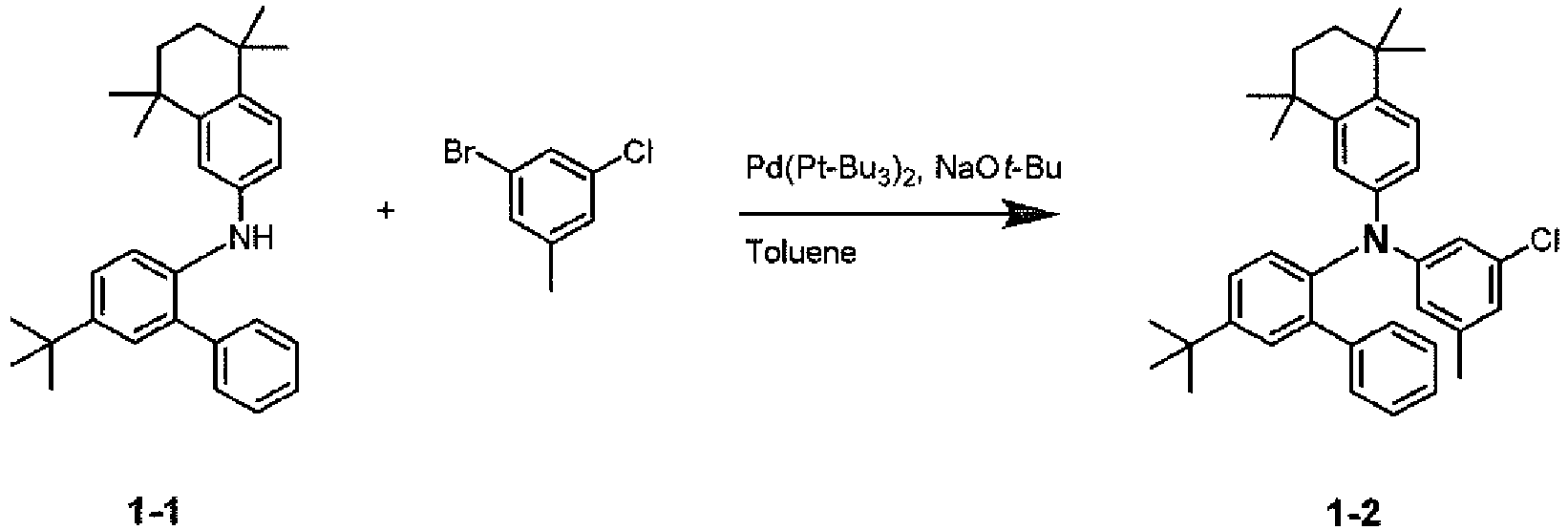
- After dissolving Compound 1-1 (31.19 g, 75.8 mmol), 1-bromo-3-chloro-5-methylbenzene (15.57 g, 75.8 mmol), Pd(Pt-Bu3)2 (0.77 g, 1.9 mmol) and NaOt-Bu (14.56 g, 151.5 mmol) in toluene (378 ml), the mixture was stirred under reflux. When the reaction was finished, the result was cooled to room temperature, and the reaction material was transferred to a separatory funnel and then extracted. The result was dried with MgSO4, filtered, concentrated, and purified using column chromatography to obtain Compound 1-2 (30.47 g, yield 75%).
MS: [M+H]+=537 -

- After dissolving Compound 1-2 (30.47 g, 56.8 mmol), 4-(tert-butyl)aniline (8.48 g, 56.8 mmol), Pd(Pt-Bu3)2 (0.58 g, 1.1 mmol) and NaOt-Bu (10.92 g, 113.7 mmol) in toluene (284 ml), the mixture was stirred under reflux. When the reaction was finished, the result was cooled to room temperature, and the reaction material was transferred to a separatory funnel and then extracted. The result was dried with MgSO4, filtered, concentrated, and purified using column chromatography to obtain Compound 1-3 (26.55 g, yield 72%).
MS: [M+H]+=649 -

- After dissolving Compound 1-3 (26.55 g, 40.9 mmol), Compound A (13.23 g, 40.9 mmol), Pd(Pt-Bu3)2 (0.42 g, 0.8 mmol) and NaOt-Bu (7.86 g, 81.8 mmol) in toluene (204 ml), the mixture was stirred under reflux. When the reaction was finished, the result was cooled to room temperature, and the reaction material was transferred to a separatory funnel and then extracted. The result was dried with MgSO4, filtered, concentrated, and purified using column chromatography to obtain Compound 1-4 (30.27 g, yield 83%).
MS: [M+H]+=892 -

- After dissolving Compound 1-4 (30.27 g, 34.0 mmol) in 1,2-dichlorobenzene (DCB) (340 ml), BI3 (19.94 g, 50.9 mmol) was introduced thereto, and the result was stirred at 130°C. When the reaction was finished, N,N-diisopropylethylamine (DIPEA) (17.56 g, 135.8 mmol) was added thereto at 0°C. After that, the reaction material was transferred to a separatory funnel and then extracted. The result was dried with MgSO4, filtered, concentrated, and purified using column chromatography to obtain Compound 1 (9.16 g, yield 30%).
MS: [M+H]+=900 -

- Compound 2-1 was obtained in the same manner as in Preparation of Compound 1-1 of Preparation Example 8 except that 1-bromo-4-(tert-butyl)benzene was used instead of 6-bromo-1,1,4,4-tetramethyl-1,2,3,4-tetrahydronaphthalene, and 4-(tert-butyl) aniline was used instead of 5-(tert-butyl)-[1,1'-biphenyl]-2-amine.
MS: [M+H]+=282 -

- Compound 2-2 was obtained in the same manner as in Preparation of Compound 1-2 of Preparation Example 9 except that Compound 2-1 was used instead of Compound 1-1.
MS: [M+H]+=407 -

- Compound 2-3 was obtained in the same manner as in Preparation of Compound 1-3 of Preparation Example 10 except that Compound 2-2 was used instead of Compound 1-2, and 5-(tert-butyl)-[1,1'-biphenyl]-2-amine was used instead of 4-(tert-butyl)aniline.
MS: [M+H]+=595 -

- Compound 2-4 was obtained in the same manner as in Preparation of Compound 1-4 of Preparation Example 11 except that Compound 2-3 was used instead of Compound 1-3.
MS: [M+H]+=838 -

-
Compound 2 was obtained in the same manner as in Preparation ofCompound 1 of Preparation Example 12 except that Compound 2-4 was used instead of Compound 1-4.
MS: [M+H]+=846 -

- Compound 3-1 was obtained in the same manner as in Preparation of Compound 1-4 of Preparation Example 11 except that 3-bromo-5-(tert-butyl)benzo[b]thiophene was used instead of Compound A.
MS: [M+H]+=838 -

-
Compound 3 was obtained in the same manner as in Preparation ofCompound 1 of Preparation Example 12 except that Compound 3-1 was used instead of Compound 1-4.
MS: [M+H]+=846 -

- Compound 4-1 was obtained in the same manner as in Preparation of Compound 1-1 of Preparation Example 8 except that 5,5,8,8-tetramethyl-5,6,7,8-tetrahydronaphthalen-2-amine was used instead of 5-(tert-butyl)-[1,1'-biphenyl]-2-amine.
MS: [M+H]+=390 -

- Compound 4-2 was obtained in the same manner as in Preparation of Compound 1-2 of Preparation Example 9 except that Compound 4-1 was used instead of Compound 1-1, and 1-bromo-3,5-dichlorobenzene was used instead of 1-bromo-3-chloro-5-methylbenzene.
MS: [M+H]+=535 -

- Compound 4-3 was obtained in the same manner as in Preparation of Compound 1-3 of Preparation Example 10 except that Compound 4-2 was used instead of Compound 1-2, and 5-(tert-butyl)-[1,1'-biphenyl]-2-amine was used instead of 4-(tert-butyl)aniline.
MS: [M+H]+=724 -

- Compound 4-4 was obtained in the same manner as in Preparation of Compound 1-4 of Preparation Example 11 except that Compound 4-3 was used instead of Compound 1-3, and 3-bromo-5-(tert-butyl)benzo[b]thiophene was used instead of Compound A.
MS: [M+H]+=912 -

- Compound 4-5 was obtained in the same manner as in Preparation of
Compound 1 of Preparation Example 12 except that Compound 4-4 was used instead of Compound 1-4.
MS: [M+H]+=920 -

-
Compound 4 was obtained in the same manner as in Preparation of Compound 1-4 of Preparation Example 11 except that Compound 4-5 was used instead of Compound 1-3, and diphenylamine was used instead of 3-bromo-5,5,8,8-tetramethyl-5,6,7,8-tetrahydronaphtho[2,3-b]thiophene.
MS: [M+H]+=1053 -

- Compound 5-1 was obtained in the same manner as in Preparation of Compound 1-1 of Preparation Example 8 except that 3,5,5,8,8-pentamethyl-5,6,7,8-tetrahydronaphthalen-2-amine was used instead of 5-(tert-butyl)-[1,1'-biphenyl]-2-amine.
MS: [M+H]+=404 -

- Compound 5-2 was obtained in the same manner as in Preparation of Compound 1-2 of Preparation Example 9 except that Compound 5-1 was used instead of Compound 1-1, and 1-bromo-3-(tert-butyl)-5-chlorobenzene was used instead of 1-bromo-3-chloro-5-methylbenzene.
MS: [M+H]+=571 -

- Compound 5-3 was obtained in the same manner as in Preparation of Compound 1-3 of Preparation Example 10 except that Compound 5-2 was used instead of Compound 1-2.
MS: [M+H]+=684 -

- Compound 5-4 was obtained in the same manner as in Preparation of Compound 1-4 of Preparation Example 11 except that Compound 5-3 was used instead of Compound 1-3, and 3-bromo-5-(tert-butyl)benzo[b]thiophene was used instead of Compound A.
MS: [M+H]+=872 -
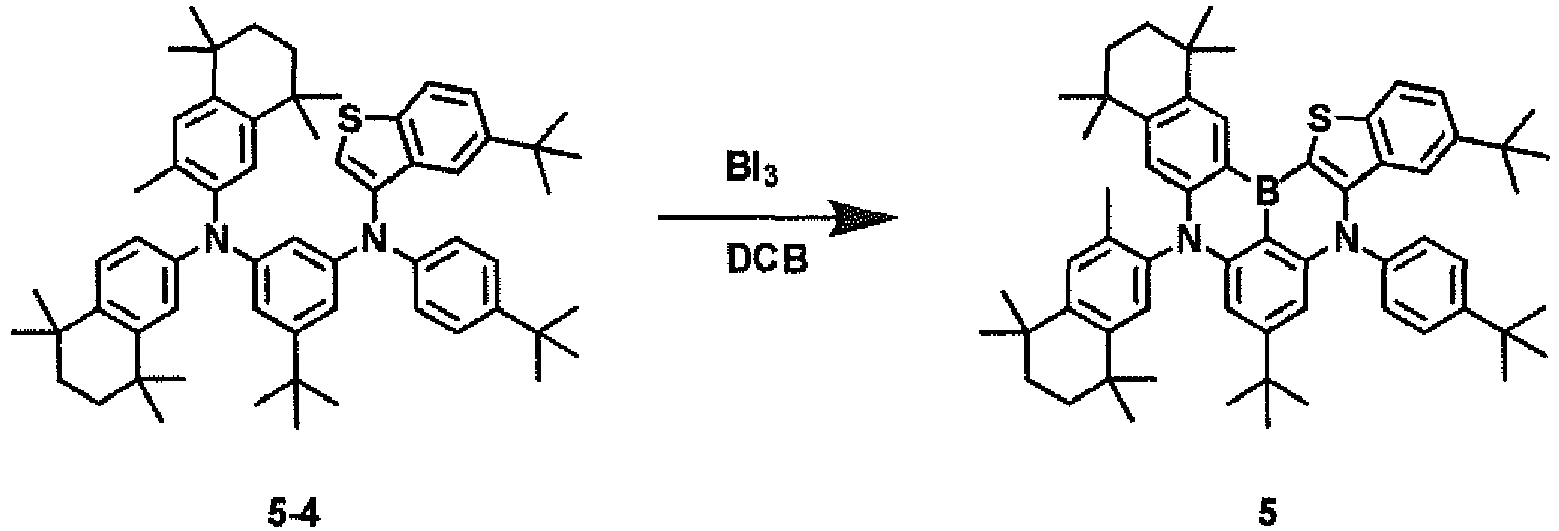
-
Compound 5 was obtained in the same manner as in Preparation ofCompound 1 of Preparation Example 12 except that Compound 5-4 was used instead of Compound 1-4.
MS: [M+H]+=880 -

- Compound 6-1 was obtained in the same manner as in Preparation of Compound 1-2 of Preparation Example 9 except that Compound 4-1 was used instead of Compound 1-1.
MS: [M+H]+=515 -

- Compound 6-2 was obtained in the same manner as in Preparation of Compound 1-3 of Preparation Example 10 except that Compound 6-1 was used instead of Compound 1-2, and 2,4-dimethylaniline was used instead of 4-(tert-butyl)aniline.
MS: [M+H]+=642 -

- Compound 6-3 was obtained in the same manner as in Preparation of Compound 1-4 of Preparation Example 11 except that Compound 6-2 was used instead of Compound 1-3, and Compound B was used instead of Compound A.
MS: [M+H]+=868 -

-
Compound 6 was obtained in the same manner as in Preparation ofCompound 1 of Preparation Example 12 except that Compound 6-3 was used instead of Compound 1-4.
MS: [M+H]+=876 -

- Compound 7-1 was obtained in the same manner as in Preparation of Compound 1-1 of Preparation Example 8 except that 4-(tert-butyl)aniline was used instead of 5-(tert-butyl)-[1,1' -biphenyl]-2-amine.
MS: [M+H]+=336 -

- Compound 7-2 was obtained in the same manner as in Preparation of Compound 1-2 of Preparation Example 9 except that Compound 7-1 was used instead of Compound 1-1.
MS: [M+H]+=461 -

- Compound 7-3 was obtained in the same manner as in Preparation of Compound 1-3 of Preparation Example 10 except that Compound 7-2 was used instead of Compound 1-2, and 4-(tert-butyl)-2-(5,5,8,8-tetramethyl-5,6,7,8-tetrahydronaphthalen-2-yl)aniline was used instead of 4-(tert-butyl) aniline.
MS: [M+H]+=760 -

- Compound 7-4 was obtained in the same manner as in Preparation of Compound 1-4 of Preparation Example 11 except that Compound 7-3 was used instead of Compound 1-3, and 3-bromo-5-(tert-butyl)benzofuran was used instead of Compound A.
MS: [M+H]+=932 -
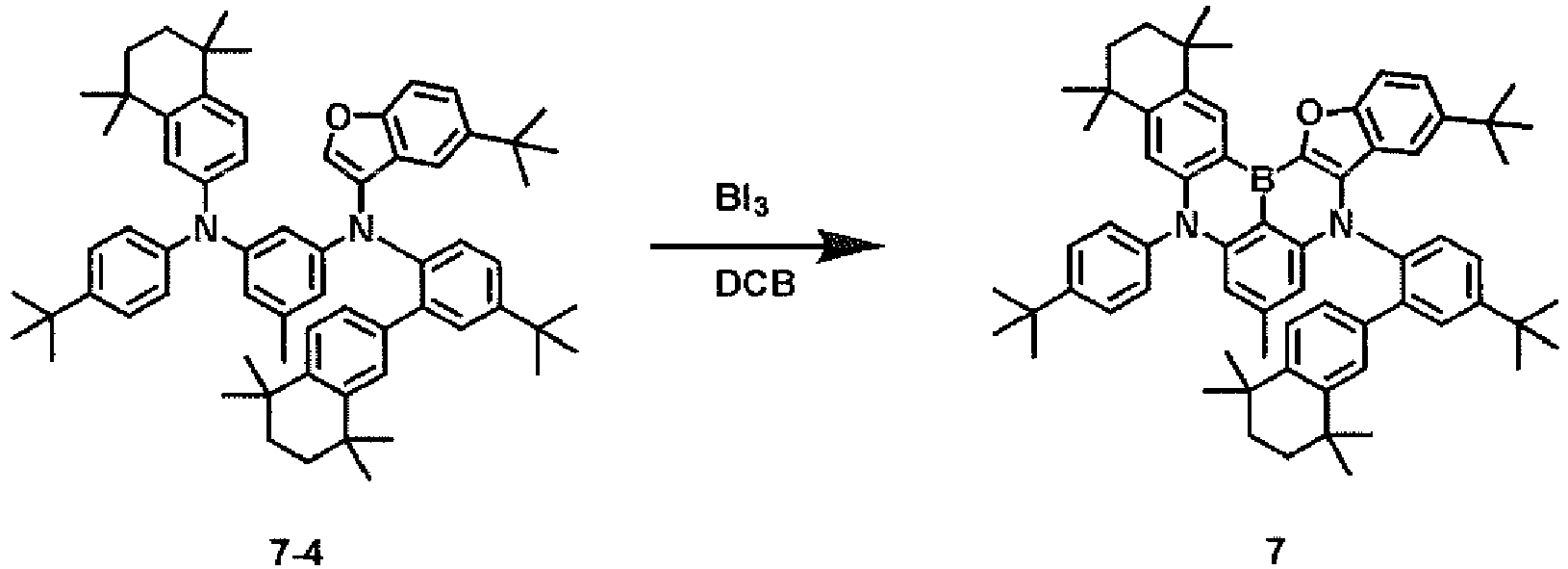
-
Compound 7 was obtained in the same manner as in Preparation ofCompound 1 of Preparation Example 12 except that Compound 7-4 was used instead of Compound 1-4.
MS: [M+H]+=940 -

- Compound 8-1 was obtained in the same manner as in Preparation of Compound 1-4 of Preparation Example 11 except that 3-bromobenzofuran was used instead of Compound A.
MS: [M+H]+=766 -

-
Compound 8 was obtained in the same manner as in Preparation ofCompound 1 of Preparation Example 12 except that Compound 8-1 was used instead of Compound 1-4.
MS: [M+H]+=773 -

- Compound 9-1 was obtained in the same manner as in Preparation of Compound 1-2 of Preparation Example 9 except that Compound 4-1 was used instead of Compound 1-1, and (3-bromo-5-chlorophenyl)trimethylsilane was used instead of 1-bromo-3-chloro-5-methylbenzene.
MS: [M+H]+=573 -

- Compound 9-2 was obtained in the same manner as in Preparation of Compound 1-3 of Preparation Example 10 except that Compound 9-1 was used instead of Compound 1-2, and 5-(tert-butyl)-[1,1'-biphenyl]-2-amine was used instead of 4-(tert-butyl)aniline.
MS: [M+H]+=762 -

- Compound 9-3 was obtained in the same manner as in Preparation of Compound 1-4 of Preparation Example 11 except that Compound 9-2 was used instead of Compound 1-3, and Compound B was used instead of Compound A.
MS: [M+H]+=988 -

- Compound 9 was obtained in the same manner as in Preparation of
Compound 1 of Preparation Example 12 except that Compound 9-3 was used instead of Compound 1-4.
MS: [M+H]+=996 -

- Compound 10-1 was obtained in the same manner as in Preparation of Compound 1-1 of Preparation Example 8 except that 1-bromo-4-(tert-butyl)benzene was used instead of 6-bromo-1,1,4,4-tetramethyl-1,2,3,4-tetrahydronaphthalene.
MS: [M+H]+=358 -

- Compound 10-2 was obtained in the same manner as in Preparation of Compound 1-2 of Preparation Example 9 except that Compound 10-1 was used instead of Compound 1-1, and 1-bromo-3-(tert-butyl)-5-chlorobenzene was used instead of 1-bromo-3-chloro-5-methylbenzene.
MS: [M+H]+=525 -

- Compound 10-3 was obtained in the same manner as in Preparation of Compound 1-3 of Preparation Example 10 except that Compound 10-2 was used instead of Compound 1-2.
MS: [M+H]+=637 -

- Compound 10-4 was obtained in the same manner as in Preparation of Compound 1-4 of Preparation Example 11 except that Compound 10-3 was used instead of Compound 1-3, and Compound B was used instead of Compound A.
MS: [M+H]+=864 -
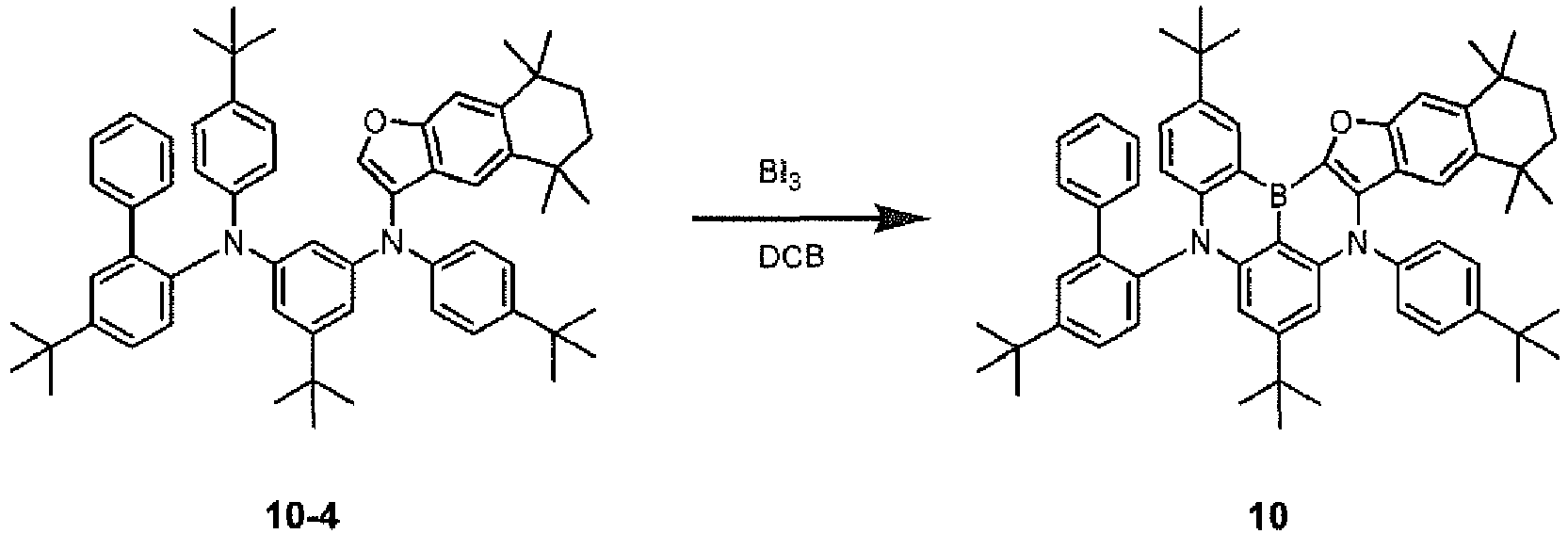
-
Compound 10 was obtained in the same manner as in Preparation ofCompound 1 of Preparation Example 12 except that Compound 10-4 was used instead of Compound 1-4.
MS: [M+H]+=872 -

- 2,5-Dichloro-2,5-dimethylhexane (50 g, 273 mmol) and thiophene (22.97 g, 273 mmol) were dissolved in dichloromethane (DCM) (390 ml). AlCl3 (36.41 g, 273 mmol) was slowly added thereto at 0°C, and the result was stirred at room temperature. When the reaction was finished, the result was cooled to room temperature, and the reaction material was transferred to a separatory funnel and then extracted. The result was dried with MgSO4, filtered, concentrated, and purified using column chromatography to obtain Compound C-1 (24.41 g, yield 46%).
MS: [M+H]+=194.34 -

- Compound C was obtained in the same manner as in Preparation of Compound A of Preparation Example 3 except that Compound C-1 was used instead of Compound A-2.
MS: [M+H]+=274 -

- Compound D-1 was obtained in the same manner as in Preparation of Compound C-1 of Preparation Example 51 except that furan was used instead of thiophene.
MS: [M+H]+=179 -

- Compound D-2 was obtained in the same manner as in Preparation of Compound B-3 of Preparation Example 6 except that Compound D-1 was used instead of Compound B-2.
MS: [M+H]+=339 -

- Compound D was obtained in the same manner as in Preparation of Compound B of Preparation Example 7 except that Compound D-2 was used instead of Compound B-3.
MS: [M+H]+=258 -

- Compound 11-1 was obtained in the same manner as in Preparation of Compound 1-4 of Preparation Example 11 except that Compound C was used instead of Compound A.
MS: [M+H]+=842 -

- Compound 11 was obtained in the same manner as in Preparation of
Compound 1 of Preparation Example 12 except that Compound 11-1 was used instead of Compound 1-4.
MS: [M+H]+=850 -

- Compound 12-1 was obtained in the same manner as in Preparation of Compound 1-3 of Preparation Example 10 except that Compound 6-1 was used instead of Compound 1-2, and 3,5,5,8,8-pentamethyl-5,6,7,8-tetrahydronaphthalen-2-amine was used instead of 4-(tert-butyl)aniline.
MS: [M+H]+=696 -

- Compound 12-2 was obtained in the same manner as in Preparation of Compound 1-4 of Preparation Example 11 except that Compound 12-1 was used instead of Compound 1-3, and Compound C was used instead of Compound A.
MS: [M+H]+=888 -

- Compound 12 was obtained in the same manner as in Preparation of
Compound 1 of Preparation Example 12 except that Compound 12-2 was used instead of Compound 1-4.
MS: [M+H]+=896 -

- Compound 13-1 was obtained in the same manner as in Preparation of Compound 1-4 of Preparation Example 11 except that Compound D was used instead of Compound A.
MS: [M+H]+=826 -

- Compound 13 was obtained in the same manner as in Preparation of
Compound 1 of Preparation Example 12 except that Compound 13-1 was used instead of Compound 1-4.
MS: [M+H]+=834 -

- Compound 14-1 was obtained in the same manner as in Preparation of Compound 1-2 of Preparation Example 9 except that Compound 2-1 was used instead of Compound 1-1, and 1-bromo-3-(tert-butyl)-5-chlorobenzene was used instead of 1-bromo-3-chloro-5-methylbenzene.
MS: [M+H]+=449 -

- Compound 14-2 was obtained in the same manner as in Preparation of Compound 1-3 of Preparation Example 10 except that Compound 14-1 was used instead of Compound 1-2, and 5-(tert-butyl)-[1,1'-biphenyl]-2-amine was used instead of 4-(tert-butyl)aniline.
MS: [M+H]+=637 -

- Compound 14-3 was obtained in the same manner as in Preparation of Compound 1-4 of Preparation Example 11 except that Compound 14-2 was used instead of Compound 1-3, and Compound D was used instead of Compound A.
MS: [M+H]+=814 -

- Compound 14 was obtained in the same manner as in Preparation of
Compound 1 of Preparation Example 12 except that Compound 14-3 was used instead of Compound 1-4.
MS: [M+H]+=822 -

- Compound 15-1 was obtained in the same manner as in Preparation of Compound 1-1 of Preparation Example 8 except that 5-chloro-1,1,4,4-tetramethyl-1,2,3,4-tetrahydronaphthalene was used instead of 6-bromo-1,1,4,4-tetramethyl-1,2,3,4-tetrahydronaphthalene, and 5,5,8,8-tetramethyl-5,6,7,8-tetrahydronaphthalen-2-amine was used instead of 5-(tert-butyl)-[1,1'-biphenyl]-2-amine.
MS: [M+H]+=390 -

- Compound 15-2 was obtained in the same manner as in Preparation of Compound 1-2 of Preparation Example 9 except that Compound 15-1 was used instead of Compound 1-1.
MS: [M+H]+=515 -

- Compound 15-3 was obtained in the same manner as in Preparation of Compound 1-3 of Preparation Example 10 except that Compound 15-2 was used instead of Compound 1-2, and 4-(tert-butyl)-2-(3,5,5,8,8-pentamethyl-5,6,7,8-tetrahydronaphthalen-2-yl)aniline was used instead of 4-(tert-butyl) aniline.
MS: [M+H]+=828 -

- Compound 15-4 was obtained in the same manner as in Preparation of Compound 1-4 of Preparation Example 11 except that Compound 15-3 was used instead of Compound 1-3.
MS: [M+H]+=1070 -

- Compound 15 was obtained in the same manner as in Preparation of
Compound 1 of Preparation Example 12 except that Compound 15-4 was used instead of Compound 1-4.
MS: [M+H]+=1078 -

- Compound 16-1 was obtained in the same manner as in Preparation of Compound 1-2 of Preparation Example 9 except that Compound 15-1 was used instead of Compound 1-1, and 1-bromo-3-chloro-5-fluorobenzene was used instead of 1-bromo-3-chloro-5-methylbenzene.
MS: [M+H]+=519 -

- Compound 16-2 was obtained in the same manner as in Preparation of Compound 1-3 of Preparation Example 10 except that Compound 16-2 was used instead of Compound 1-2, and 4-(tert-butyl)-2-methylaniline was used instead of 4-(tert-butyl) aniline.
MS: [M+H]+=645 -

- Compound 16-3 was obtained in the same manner as in Preparation of Compound 1-4 of Preparation Example 11 except that Compound 16-2 was used instead of Compound 1-3, and 3-bromo-5-methylbenzo[b]thiophene was used instead of Compound A.
MS: [M+H]+=792 -

- Compound 16 was obtained in the same manner as in Preparation of
Compound 1 of Preparation Example 12 except that Compound 16-3 was used instead of Compound 1-4.
MS: [M+H]+=799 -

- Compound 17-1 was obtained in the same manner as in Preparation of Compound 1-1 of Preparation Example 8 except that 5-chloro-1,1,4,4-tetramethyl-1,2,3,9-tetrahydronaphthalene was used instead of 6-bromo-1,1,4,4-tetramethyl-1,2,3,4-tetrahydronaphthalene, and 5,5,8,8-tetramethyl-3-phenyl-5,6,7,8-tetrahydronaphthalen-2-amine was used instead of 5-(tert-butyl)-[1,1'-biphenyl]-2-amine.
MS: [M+H]+=466 -

- Compound 17-2 was obtained in the same manner as in Preparation of Compound 1-2 of Preparation Example 9 except that Compound 17-1 was used instead of Compound 1-1, and 3-bromo-5-chlorobenzonitrile was used instead of 1-bromo-3-chloro-5-methylbenzene.
MS: [M+H]+=602 -

- Compound 17-3 was obtained in the same manner as in Preparation of Compound 1-3 of Preparation Example 10 except that Compound 17-2 was used instead of Compound 1-2, and 5-(tert-butyl)-N-(4-(tert-butyl)-2-methylphenyl)benzofuran-3-amine was used instead of 4-(tert-butyl)aniline.
MS: [M+H]+=901 -

- Compound 17 was obtained in the same manner as in Preparation of
Compound 1 of Preparation Example 12 except that Compound 17-3 was used instead of Compound 1-4.
MS: [M+H]+=909 -

- Compound A-2 (32.5 g, 133.0 mmol) was dissolved in tetrahydrofuran (THF) (660 ml). After that, n-BuLi in hexane 2.5 M (63.83 ml, 159.6 mmol) was slowly added dropwise thereto at -78°C. After 2 hours, Br2 (25.5 g, 159.6 mmol) was slowly added dropwise thereto, and the temperature was raised to room temperature. When the reaction was finished, the reaction material was transferred to a separatory funnel and then extracted. The result was dried with MgSO4, filtered, concentrated, and purified using column chromatography to obtain Compound E (24.5 g, yield 57%).
MS: [M+H]+=324 -
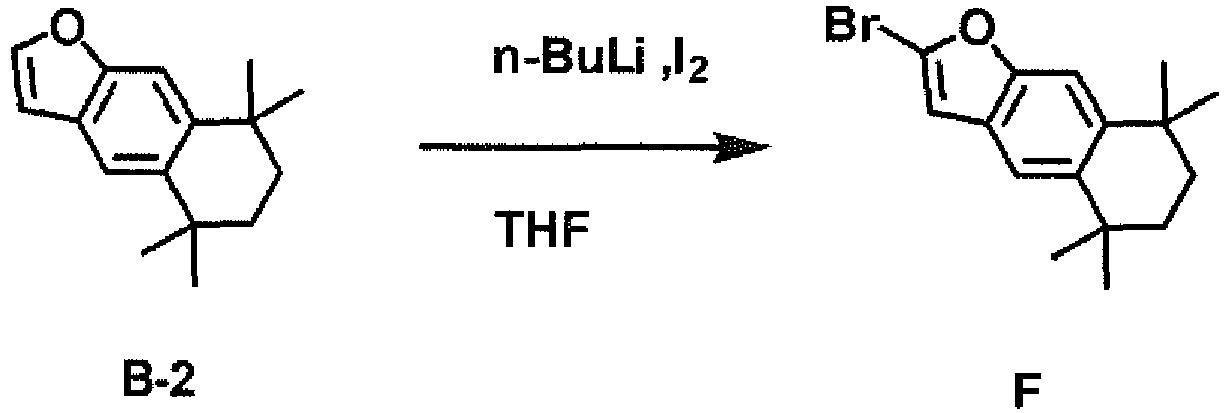
- Compound F was obtained in the same manner as in Preparation of Compound E of Preparation Example 80 except that Compound B-2 was used instead of Compound A-2, and I2 was used instead of Br2.
MS: [M+H]+=308 -
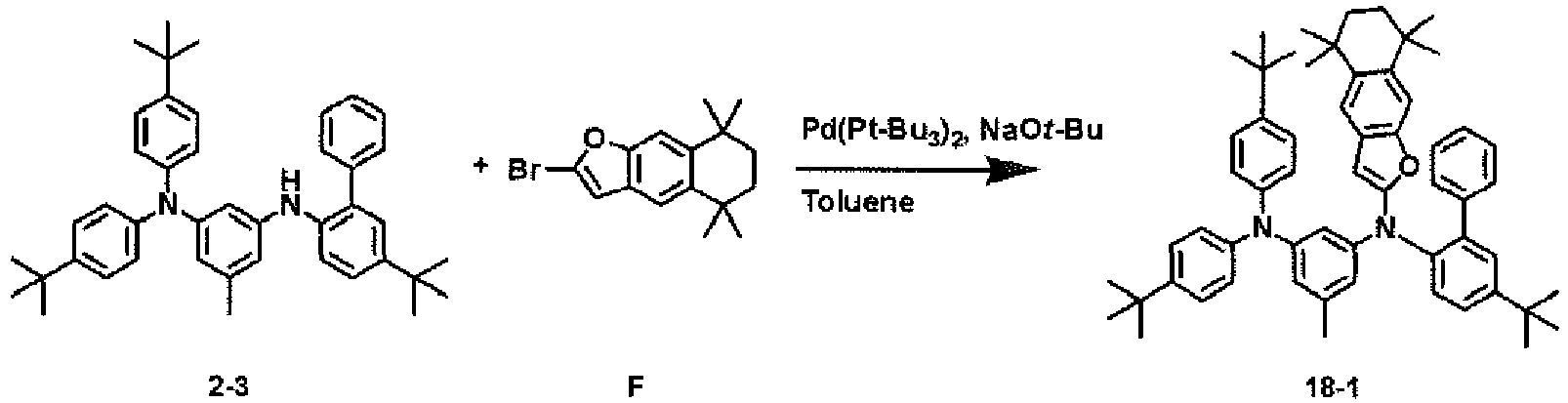
- Compound 18-1 was obtained in the same manner as in Preparation of Compound 1-4 of Preparation Example 11 except that Compound 2-3 was used instead of Compound 1-3, and Compound F was used instead of Compound A.
MS: [M+H]+=822 -

- Compound 18 was obtained in the same manner as in Preparation of
Compound 1 of Preparation Example 12 except that Compound 18-1 was used instead of Compound 1-4.
MS: [M+H]+=829 -

- Compound 19-1 was obtained in the same manner as in Preparation of Compound 1-4 of Preparation Example 11 except that Compound 5-3 was used instead of Compound 1-3, and 2-bromo-5-(tert-butyl)benzofuran was used instead of Compound A.
MS: [M+H]+=814 -

- Compound 19 was obtained in the same manner as in Preparation of
Compound 1 of Preparation Example 12 except that Compound 19-1 was used instead of Compound 1-4.
MS: [M+H]+=822 -

- Compound 20-1 was obtained in the same manner as in Preparation of Compound 1-3 of Preparation Example 10 except that Compound 6-2 was used instead of Compound 1-2 and 5-tert-butylbiphenyl-2-amine was used instead of 4-(tert-butyl)aniline.
MS: [M+H]+=901 -

- Compound 20-2 was obtained in the same manner as in Preparation of Compound 1-4 of Preparation Example 11 except that Compound 20-1 was used instead of Compound 1-3, and Compound E was used instead of Compound A.
MS: [M+H]+=946 -

- Compound 20 was obtained in the same manner as in Preparation of
Compound 1 of Preparation Example 12 except that Compound 20-2 was used instead of Compound 1-4.
MS: [M+H]+=954 -
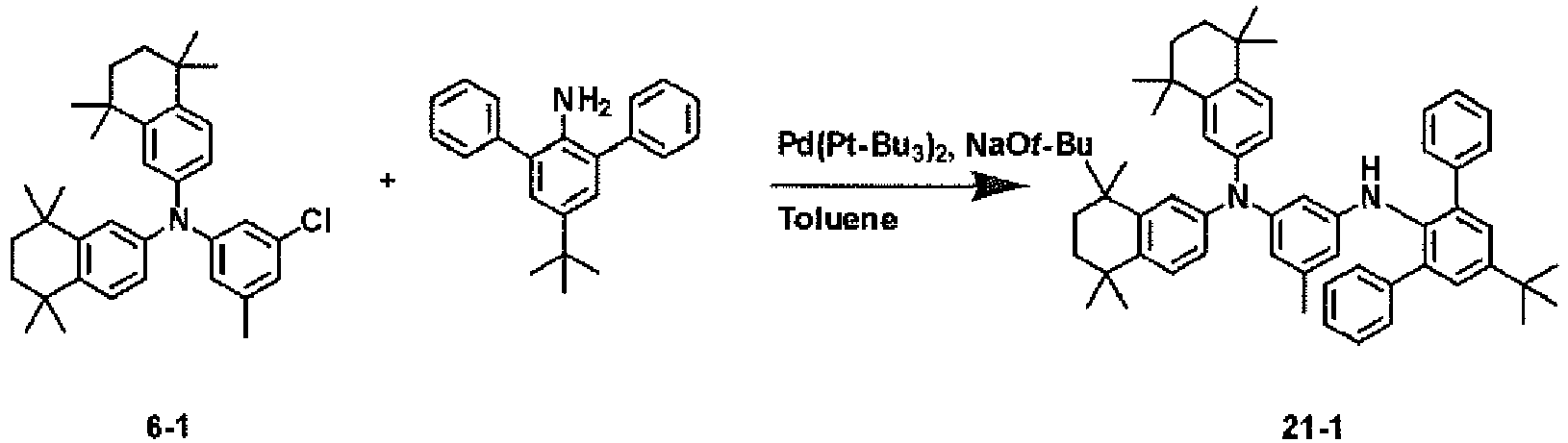
- Compound 21-1 was obtained in the same manner as in Preparation of Compound 1-3 of Preparation Example 10 except that Compound 6-1 was used instead of Compound 1-2, and 5'-(tert-butyl)-[1,1':3',1"-terphenyl]-2'-amine was used instead of 4-(tert-butyl)aniline.
MS: [M+H]+=780 -

- Compound 21-2 was obtained in the same manner as in Preparation of Compound 1-4 of Preparation Example 11 except that Compound 21-1 was used instead of Compound 1-3, and 2-bromobenzo[b]thiophene was used instead of Compound A.
MS: [M+H]+=912 -

- Compound 21 was obtained in the same manner as in Preparation of
Compound 1 of Preparation Example 12 except that Compound 21-2 was used instead of Compound 1-4.
MS: [M+H]+=920 -

- Compound 22-1 was obtained in the same manner as in Preparation of Compound 1-3 of Preparation Example 10 except that Compound 7-2 was used instead of Compound 1-2, and 4',5-di-tert-butyl-[1,1'-biphenyl]-2-amine was used instead of 4-(tert-butyl)aniline.
MS: [M+H]+=706 -

- Compound 22-2 was obtained in the same manner as in Preparation of Compound 1-4 of Preparation Example 11 except that Compound 22-1 was used instead of Compound 1-3, and 2-bromo-5-(tert-butyl)benzo[b]thiophene was used instead of Compound A.
MS: [M+H]+=894 -

- Compound 22 was obtained in the same manner as in Preparation of
Compound 1 of Preparation Example 12 except that Compound 22-2 was used instead of Compound 1-4.
MS: [M+H]+=902 -

- Compound 23-1 was obtained in the same manner as in Preparation of Compound 1-1 of Preparation Example 8 except that 4',5-di-tert-butyl-[1,1'-biphenyl]-2-amine was used instead of 5-(tert-butyl)-[1,1'-biphenyl]-2-amine.
MS: [M+H]+=468 -

- Compound 23-2 was obtained in the same manner as in Preparation of Compound 1-2 of Preparation Example 9 except that Compound 23-1 was used instead of Compound 1-1.
MS: [M+H]+=593 -

- Compound 23-3 was obtained in the same manner as in Preparation of Compound 1-3 of Preparation Example 10 except that Compound 23-2 was used instead of Compound 1-2.
MS: [M+H]+=706 -

- Compound 23-4 was obtained in the same manner as in Preparation of Compound 1-4 of Preparation Example 11 except that Compound 23-3 was used instead of Compound 1-3, and 3-bromobenzo[b]thiophene was used instead of Compound A.
MS: [M+H]+=838 -

- Compound 23 was obtained in the same manner as in Preparation of
Compound 1 of Preparation Example 12 except that Compound 23-4 was used instead of Compound 1-4.
MS: [M+H]+=846 -
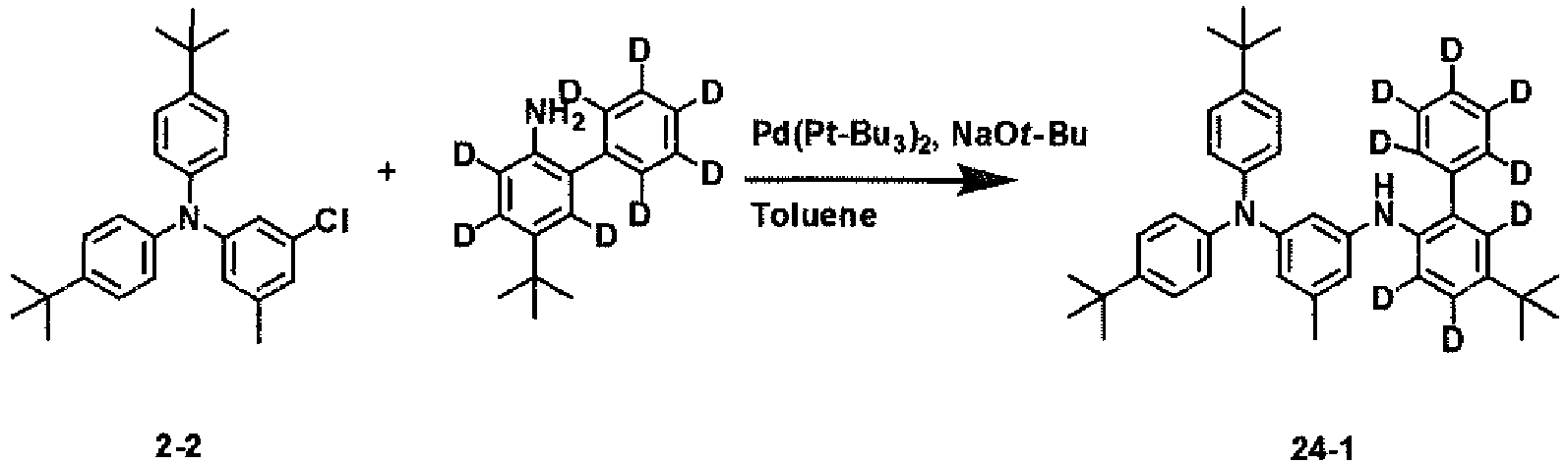
- Compound 24-1 was obtained in the same manner as in Preparation of Compound 1-3 of Preparation Example 10 except that Compound 2-2 was used instead of Compound 1-2, and 5-(tert-butyl)-[1,1'-biphenyl]-2',3,3',4,4',5',6,6'-d8-2-amine was used instead of 4-(tert-butyl)aniline.
MS: [M+H]+=603 -

- Compound 24-2 was obtained in the same manner as in Preparation of Compound 1-4 of Preparation Example 11 except that Compound 24-1 was used instead of Compound 1-3, and Compound E was used instead of Compound A.
MS: [M+H]+=846 -

- Compound 24 was obtained in the same manner as in Preparation of
Compound 1 of Preparation Example 12 except that Compound 24-2 was used instead of Compound 1-4.
MS: [M+H]+=854 -

- Compound 25-1 was obtained in the same manner as in Preparation of Compound 1-1 of Preparation Example 8 except that 5-(tert-butyl)-[1,1'-biphenyl]-2',3',4',5',6'-d5-2-amine was used instead of 5-(tert-butyl)-[1,1'-biphenyl]-2-amine.
MS: [M+H]+=417 -

- Compound 25-2 was obtained in the same manner as in Preparation of Compound 1-2 of Preparation Example 9 except that Compound 25-1 was used instead of Compound 1-1.
MS: [M+H]+=542 -
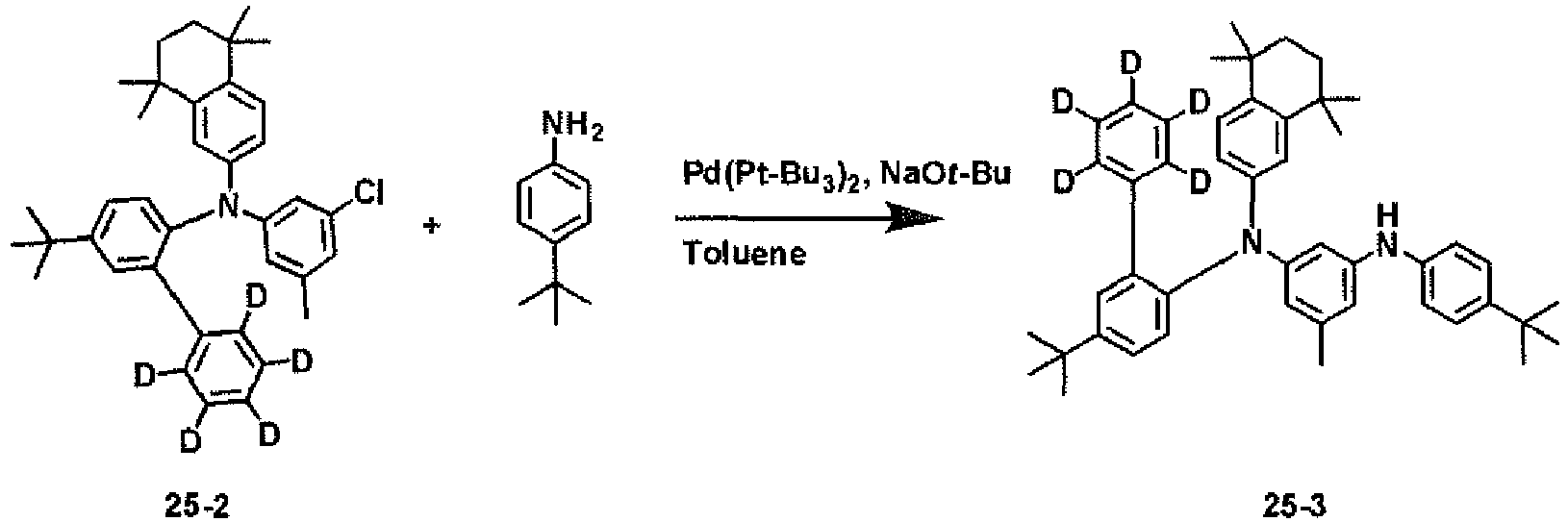
- Compound 25-3 was obtained in the same manner as in Preparation of Compound 1-3 of Preparation Example 10 except that Compound 25-2 was used instead of Compound 1-2.
MS: [M+H]+=655 -

- Compound 25-4 was obtained in the same manner as in Preparation of Compound 1-4 of Preparation Example 11 except that Compound 25-3 was used instead of Compound 1-3.
MS: [M+H]+=897 -

- Compound 25 was obtained in the same manner as in Preparation of
Compound 1 of Preparation Example 12 except that Compound 25-4 was used instead of Compound 1-4.
MS: [M+H]+=905 -

- Compound 26-1 was obtained in the same manner as in Preparation of Compound 1-2 of Preparation Example 9 except that Compound 17-1 was used instead of Compound 1-1.
MS: [M+H]+=591 -

- Compound 26-2 was obtained in the same manner as in Preparation of Compound 1-3 of Preparation Example 10 except that Compound 26-1 was used instead of Compound 1-2.
MS: [M+H]+=704 -

- Compound 26-3 was obtained in the same manner as in Preparation of Compound 1-4 of Preparation Example 11 except that Compound 26-2 was used instead of Compound 1-3, and 3-bromo-5-(methyl-d3)benzo[b]thiophene was used instead of Compound A.
MS: [M+H]+=853 -

- Compound 26 was obtained in the same manner as in Preparation of
Compound 1 of Preparation Example 12 except that Compound 26-3 was used instead of Compound 1-4.
MS: [M+H]+=861 -

- Compound 27-1 was obtained in the same manner as in Preparation of Compound 1-1 of Preparation Example 8 except that 5'-(tert-butyl)-[1,1':3',1"-terphenyl]-2'-amine was used instead of 5-(tert-butyl)-[1,1'-biphenyl]-2-amine.
MS: [M+H]+=488 -

- Compound 27-2 was obtained in the same manner as in Preparation of Compound 1-2 of Preparation Example 9 except that Compound 27-1 was used instead of Compound 1-1.
MS: [M+H]+=613 -

- Compound 27-3 was obtained in the same manner as in Preparation of Compound 1-3 of Preparation Example 10 except that Compound 27-2 was used instead of Compound 1-2, and [1,1'-biphenyl]-4-amine was used instead of 4-(tert-butyl)aniline.
MS: [M+H]+=746 -

- Compound 27-4 was obtained in the same manner as in Preparation of Compound 1-4 of Preparation Example 11 except that Compound 27-3 was used instead of Compound 1-3, and Compound B was used instead of Compound A.
MS: [M+H]+=972 -

- Compound 27 was obtained in the same manner as in Preparation of
Compound 1 of Preparation Example 12 except that Compound 27-4 was used instead of Compound 1-4.
MS: [M+H]+=980 -

- Compound 28-1 was obtained in the same manner as in Preparation of Compound 1-1 of Preparation Example 8 except that 2-bromo-5-(tert-butyl)-1,3-dimethylbenzene was used instead of 6-bromo-1,1,4,4-tetramethyl-1,2,3,4-tetrahydronaphthalene, and 4-(tert-butyl)aniline was used instead of 5-(tert-butyl)-[1,1'-biphenyl]-2-amine.
MS: [M+H]+=310 -

- Compound 28-2 was obtained in the same manner as in Preparation of Compound 1-2 of Preparation Example 9 except that Compound 28-1 was used instead of Compound 1-1, and 1-bromo-3-(tert-butyl)-5-chlorobenzene was used instead of 1-bromo-3-chloro-5-methylbenzene.
MS: [M+H]+=477 -
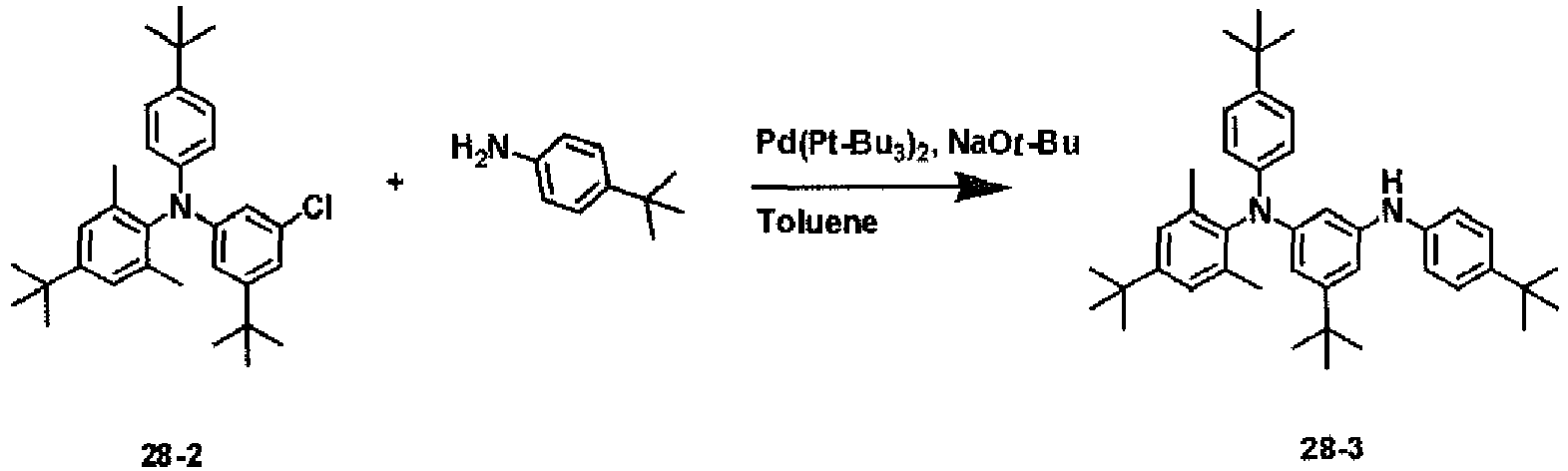
- Compound 28-3 was obtained in the same manner as in Preparation of Compound 1-3 of Preparation Example 10 except that Compound 28-2 was used instead of Compound 1-2.
MS: [M+H]+=589 -

- Compound 28-4 was obtained in the same manner as in Preparation of Compound 1-4 of Preparation Example 11 except that Compound 28-3 was used instead of Compound 1-3, and Compound B was used instead of Compound A.
MS: [M+H]+=816 -
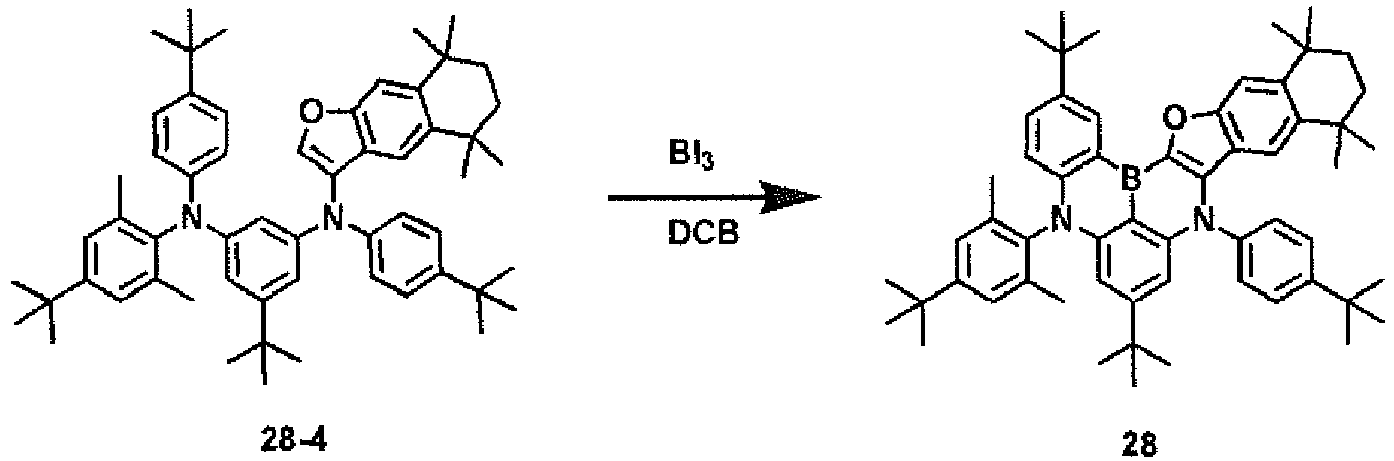
- Compound 28 was obtained in the same manner as in Preparation of
Compound 1 of Preparation Example 12 except that Compound 28-4 was used instead of Compound 1-4.
MS: [M+H]+=824 -

- Compound G was obtained in the same manner as in Preparation of Compound A of Preparation Examples 1 to 3 except that 6-bromo-1,4-dimethyl-1,2,3,4-tetrahydro-1,4-ethanonaphthalene was used instead of 6-bromo-1,1,4,4-tetramethyl-1,2,3,4-tetrahydronaphthalene.
MS: [M+H]+=322 -

- Compound H was obtained in the same manner as in Preparation of Compound B of Preparation Examples 4,5,6 and 7 except that 1,4-dimethyl-1,2,3,4-tetrahydro-1,4-ethanonaphthalen-6-ol was used instead of 5,5,8,8-tetramethyl-5,6,7,8-tetrahydronaphthalen-2-ol.
MS: [M+H]+=306 -

- Compound 29-1 was obtained in the same manner as in Preparation of Compound 1-3 of Preparation Example 10 except that Compound 2-2 was used instead of Compound 1-2, and 4'-(tert-butyl)-5-(trimethylsilyl)-[1,1'-biphenyl]-2-amine was used instead of 4-(tert-butyl)aniline.
MS: [M+H]+=668 -

- Compound 29-2 was obtained in the same manner as in Preparation of Compound 1-4 of Preparation Example 11 except that Compound 29-1 was used instead of Compound 1-3, and Compound G was used instead of Compound A.
MS: [M+H]+=908 -

- Compound 29 was obtained in the same manner as in Preparation of
Compound 1 of Preparation Example 12 except that Compound 29-2 was used instead of Compound 1-4.
MS: [M+H]+=916 -

- Compound 30-1 was obtained in the same manner as in Preparation of Compound 1-3 of Preparation Example 10 except that Compound 2-2 was used instead of Compound 1-2, and 2,4,6-trimethylaniline was used instead of 4-(tert-butyl)aniline.
MS: [M+H]+=505 -

- Compound 30-2 was obtained in the same manner as in Preparation of Compound 1-4 of Preparation Example 11 except that Compound 30-1 was used instead of Compound 1-3, and Compound H was used instead of Compound A.
MS: [M+H]+=730 -

- Compound 30 was obtained in the same manner as in Preparation of
Compound 1 of Preparation Example 12 except that Compound 30-2 was used instead of Compound 1-4.
MS: [M+H]+=737 -

- Compound 31-1 was obtained in the same manner as in Preparation of Compound 1-1 of Preparation Example 8 except that 1-bromo-3-(text-butyl)benzene was used instead of 6-bromo-1,1,4,4-tetramethyl-1,2,3,4-tetrahydronaphthalene, and 3-(tert-butyl) aniline was used instead of 5-(tert-butyl)-[1,1'-biphenyl]-2-amine.
MS: [M+H]+=282 -

- Compound 31-2 was obtained in the same manner as in Preparation of Compound 1-2 of Preparation Example 9 except that Compound 31-1 was used instead of Compound 1-1, and 1-bromo-3,5-dichlorobenzene was used instead of 1-bromo-3-chloro-5-methylbenzene.
MS: [M+H]+=427 -

- Compound 31-3 was obtained in the same manner as in Preparation of Compound 1-3 of Preparation Example 10 except that Compound 31-2 was used instead of Compound 1-2, and 4a,9a-dimethyl-2,3,4,4a,9,9a-hexahydro-1H-carbazole was used instead of 4-(tert-butyl)aniline.
MS: [M+H]+=592 -

- Compound 31-4 was obtained in the same manner as in Preparation of Compound 1-3 of Preparation Example 10 except that Compound 31-3 was used instead of Compound 1-2, and 5-(tert-butyl)-[1,1'-biphenyl]-2-amine was used instead of 4-(tert-butyl)aniline.
MS: [M+H]+=781 -

- Compound 31-5 was obtained in the same manner as in Preparation of Compound 1-4 of Preparation Example 11 except that Compound 31-4 was used instead of Compound 1-3.
MS: [M+H]+=1023 -

- Compound 31 was obtained in the same manner as in Preparation of
Compound 1 of Preparation Example 12 except that Compound 31-5 was used instead of Compound 1-4.
MS: [M+H]+=1031 -

- Compound 32-1 was obtained in the same manner as in Preparation of Compound 1-1 of Preparation Example 8 except that N1,N1-diphenylbenzene-1,3-diamine was used instead of 5-(tert-butyl)-[1,1'-biphenyl]-2-amine.
MS: [M+H]+=447 -
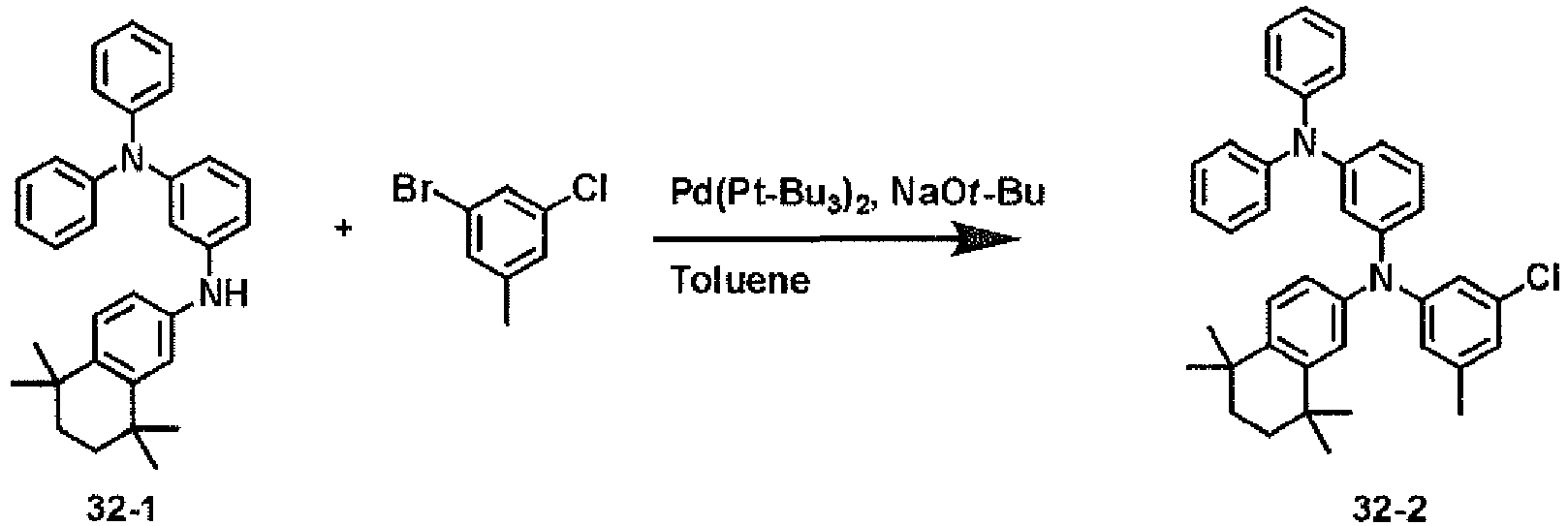
- Compound 32-2 was obtained in the same manner as in Preparation of Compound 1-2 of Preparation Example 9 except that Compound 32-1 was used instead of Compound 1-1.
MS: [M+H]+=572 -

- Compound 32-3 was obtained in the same manner as in Preparation of Compound 1-3 of Preparation Example 10 except that Compound 32-2 was used instead of Compound 1-2, and 5-(tert-butyl)-[1,1'-biphenyl]-2-amine was used instead of 4-(tert-butyl)aniline.
MS: [M+H]+=761 -

- Compound 32-4 was obtained in the same manner as in Preparation of Compound 1-4 of Preparation Example 11 except that Compound 32-3 was used instead of Compound 1-3, and Compound B was used instead of Compound A.
MS: [M+H]+=987 -

- Compound 32 was obtained in the same manner as in Preparation of
Compound 1 of Preparation Example 12 except that Compound 32-4 was used instead of Compound 1-4.
MS: [M+H]+=995 -

- Compound 33-1 was obtained in the same manner as in Preparation of Compound 1-2 of Preparation Example 9 except that 1-bromo-3-chloro-5-(methyl-d3)benzene was used instead of 1-bromo-3-chloro-5-methylbenzene.
MS: [M+H]+=540 -

- Compound 33-2 was obtained in the same manner as in Preparation of Compound 1-3 of Preparation Example 10 except that Compound 33-1 was used instead of Compound 1-2.
MS: [M+H]+=653 -

- Compound 33-3 was obtained in the same manner as in Preparation of Compound 1-4 of Preparation Example 11 except that Compound 33-2 was used instead of Compound 1-3, and 3-bromo-5-(tert-butyl)benzo[b]thiophene was used instead of Compound A.
MS: [M+H]+=841 -

- Compound 33 was obtained in the same manner as in Preparation of
Compound 1 of Preparation Example 12 except that Compound 33-3 was used instead of Compound 1-4.
MS: [M+H]+=848 -

- Compound 34-1 was obtained in the same manner as in Preparation of Compound 1-1 of Preparation Example 8 except that 2,6-dimethyl-N4,N4-diphenyl-N1-(5,5,8,8-tetramethyl-5,6,7,8-tetrahydronaphthalen-2-yl)benzene-1,4-diamine was used instead of 5-(tert-butyl)-[1,1'-biphenyl]-2-amine.
MS: [M+H]+=475 -

- Compound 39-2 was obtained in the same manner as in Preparation of Compound 1-2 of Preparation Example 9 except that Compound 34-1 was used instead of Compound 1-1.
MS: [M+H]+=600 -

- Compound 34-3 was obtained in the same manner as in Preparation of Compound 1-3 of Preparation Example 10 except that Compound 34-2 was used instead of Compound 1-2.
MS: [M+H]+=713 -

- Compound 34-4 was obtained in the same manner as in Preparation of Compound 1-4 of Preparation Example 11 except that Compound 34-3 was used instead of Compound 1-3, and 3-bromo-5-(tert-butyl)benzo[b]thiophene was used instead of Compound A.
MS: [M+H]+=901 -

- Compound 34 was obtained in the same manner as in Preparation of
Compound 1 of Preparation Example 12 except that Compound 34-4 was used instead of Compound 1-4.
MS: [M+H]+=909 -

- Compound 35-1 was obtained in the same manner as in Preparation of Compound 1-2 of Preparation Example 9 except that 1-bromo-3,5-dichlorobenzene was used instead of 1-bromo-3-chloro-5-methylbenzene.
MS: [M+H]+=557 -

- Compound 35-2 was obtained in the same manner as in Preparation of Compound 1-3 of Preparation Example 10 except that Compound 35-1 was used instead of Compound 1-2, and 10H-phenoxazine was used instead of 4-(tert-butyl)aniline.
MS: [M+H]+=704 -

- Compound 35-3 was obtained in the same manner as in Preparation of Compound 1-3 of Preparation Example 10 except that Compound 35-2 was used instead of Compound 1-2.
MS: [M+H]+=817 -
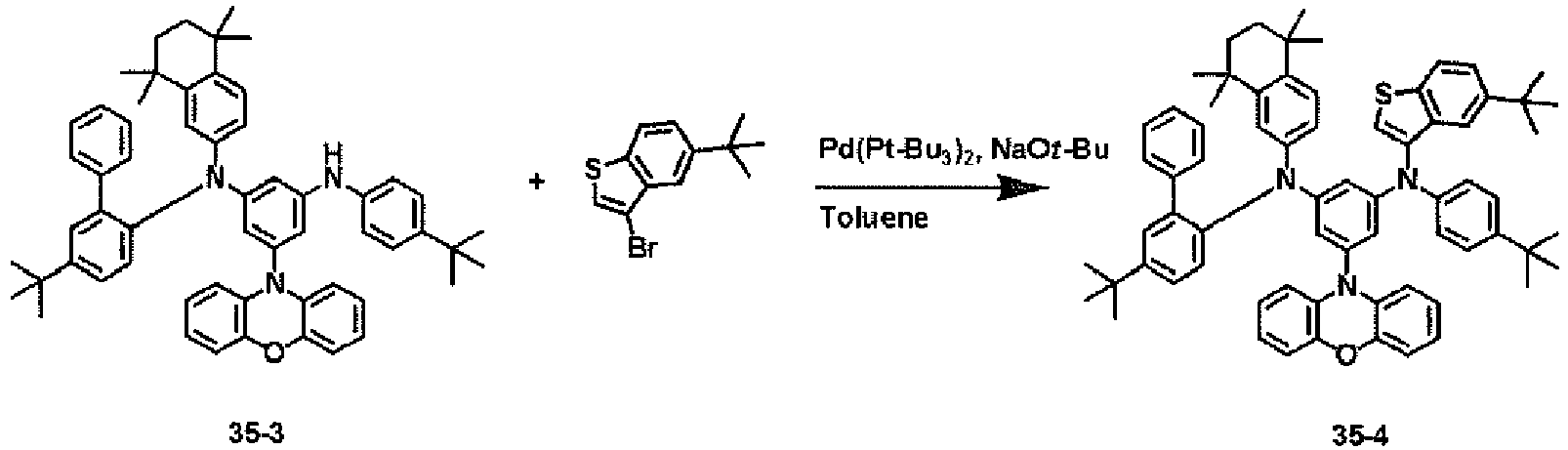
- Compound 35-4 was obtained in the same manner as in Preparation of Compound 1-4 of Preparation Example 11 except that Compound 35-3 was used instead of Compound 1-3, and 3-bromo-5-(tert-butyl)benzo[b]thiophene was used instead of Compound A.
MS: [M+H]+=1005 -

- Compound 35 was obtained in the same manner as in Preparation of
Compound 1 of Preparation Example 12 except that Compound 35-4 was used instead of Compound 1-4.
MS: [M+H]+=1013 -

- Compound 36-1 was obtained in the same manner as in Preparation of Compound 1-1 of Preparation Example 8 except that 4-bromodibenzo[b,d]furan was used instead of 6-bromo-1,1,4,4-tetramethyl-1,2,3,4-tetrahydronaphthalene, and 4-(tert-butyl)aniline was used instead of 5-(tert-butyl)-[1,1'-biphenyl]-2-amine.
MS: [M+H]+=316 -

- Compound 36-2 was obtained in the same manner as in Preparation of Compound 1-2 of Preparation Example 9 except that Compound 36-1 was used instead of Compound 1-1, and 1-bromo-3-(tert-butyl)-5-chlorobenzene was used instead of 1-bromo-3-chloro-5-methylbenzene.
MS: [M+H]+=483 -

- Compound 36-3 was obtained in the same manner as in Preparation of Compound 1-3 of Preparation Example 10 except that Compound 36-2 was used instead of Compound 1-2.
MS: [M+H]+=595 -

- Compound 36-4 was obtained in the same manner as in Preparation of Compound 1-4 of Preparation Example 11 except that Compound 36-3 was used instead of Compound 1-3.
MS: [M+H]+=838 -

- Compound 36 was obtained in the same manner as in Preparation of
Compound 1 of Preparation Example 12 except that Compound 36-4 was used instead of Compound 1-4.
MS: [M+H]+=846 -

- Compound 37-1 was obtained in the same manner as in Preparation of Compound 1-1 of Preparation Example 8 except that 2-bromo-4',5-di-tert-butyl-1,1'-biphenyl-2',3',5',6'-d4 was used instead of 6-bromo-1,1,4,4-tetramethyl-1,2,3,4-tetrahydronaphthalene, and 4-(tert-butyl)aniline was used instead of 5-(tert-butyl)-[1,1'-biphenyl]-2-amine.
MS: [M+H]+=418 -

- Compound 37-2 was obtained in the same manner as in Preparation of Compound 1-2 of Preparation Example 9 except that Compound 37-1 was used instead of Compound 1-1, and 1-bromo-3-chloro-5-(methyl-d3)benzene was used instead of 1-bromo-3-chloro-5-methylbenzene.
MS: [M+H]+=546 -

- Compound 37-3 was obtained in the same manner as in Preparation of Compound 1-3 of Preparation Example 10 except that Compound 37-2 was used instead of Compound 1-2.
MS: [M+H]+=659 -

- Compound 37-4 was obtained in the same manner as in Preparation of Compound 1-4 of Preparation Example 11 except that Compound 37-3 was used instead of Compound 1-3.
MS: [M+H]+=901 -

- Compound 37 was obtained in the same manner as in Preparation of
Compound 1 of Preparation Example 12 except that Compound 37-4 was used instead of Compound 1-4.
MS: [M+H]+=909 -

- Compound 38-1 was obtained in the same manner as in Preparation of Compound 1-2 of Preparation Example 9 except that Compound 2-1 was used instead of Compound 1-1, and 1-bromo-3,5-dichlorobenzene was used instead of 1-bromo-3-chloro-5-methylbenzene.
MS: [M+H]+=427 -

- Compound 38-2 was obtained in the same manner as in Preparation of Compound 1-3 of Preparation Example 10 except that Compound 38-1 was used instead of Compound 1-2, and diphenylamine was used instead of 4-(tert-butyl)aniline.
MS: [M+H]+=560 -

- Compound 38-3 was obtained in the same manner as in Preparation of Compound 1-3 of Preparation Example 10 except that Compound 38-2 was used instead of Compound 1-2, and 5-(tert-butyl)-[1,1'-biphenyl]-2-amine was used instead of 4-(tert-butyl)aniline.
MS: [M+H]+=749 -

- Compound 38-4 was obtained in the same manner as in Preparation of Compound 1-4 of Preparation Example 11 except that Compound 38-3 was used instead of Compound 1-3, and Compound F was used instead of Compound A.
MS: [M+H]+=975 -
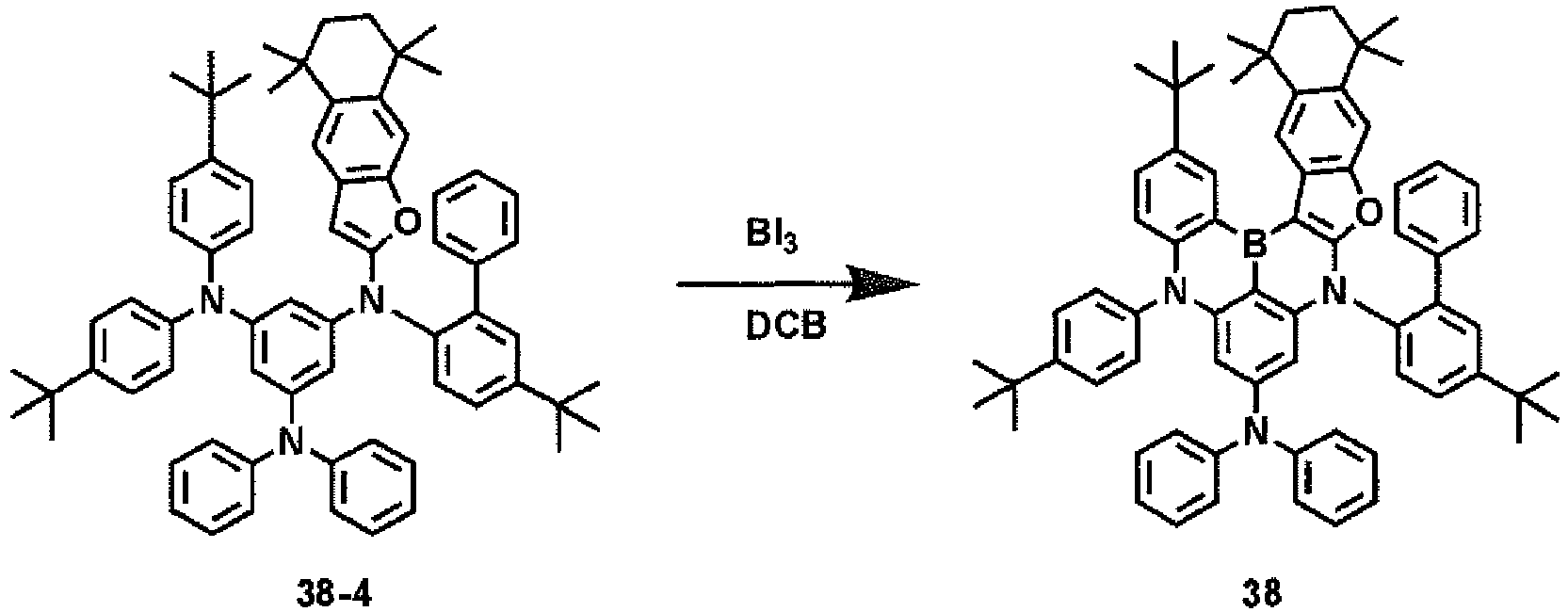
- Compound 38 was obtained in the same manner as in Preparation of
Compound 1 of Preparation Example 12 except that Compound 38-4 was used instead of Compound 1-4.
MS: [M+H]+=909 -

- Compound 39-1 was obtained in the same manner as in Preparation of Compound 1-3 of Preparation Example 10 except that Compound 5-1 was used instead of Compound 1-2, and 5-(tert-butyl)-[1,1'-biphenyl]-2-amine was used instead of 4-(tert-butyl)aniline.
MS: [M+H]+=704 -
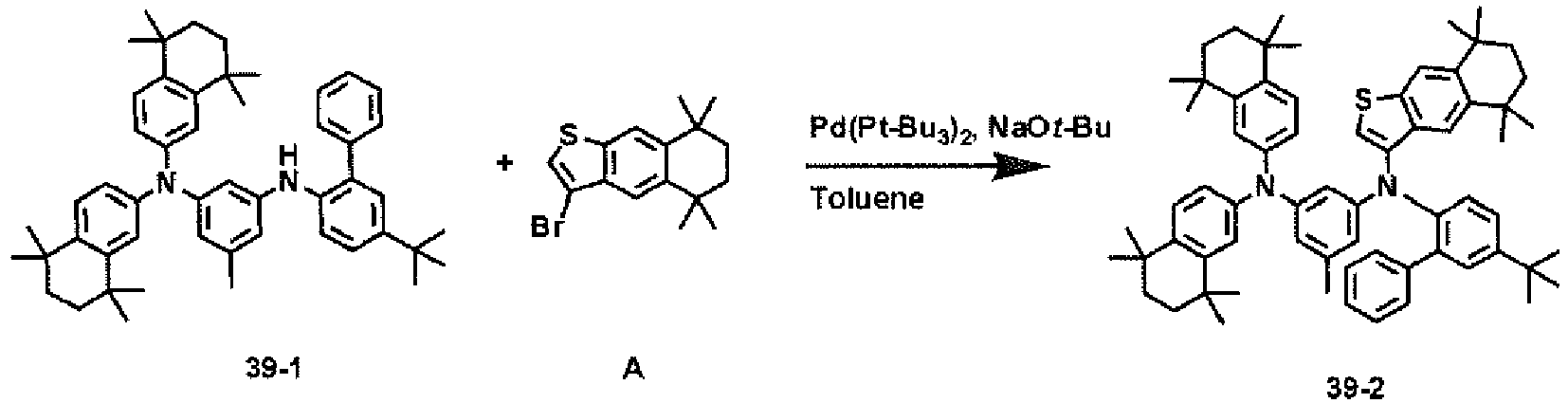
- Compound 39-2 was obtained in the same manner as in Preparation of Compound 1-4 of Preparation Example 11 except that Compound 39-1 was used instead of Compound 1-3.
MS: [M+H]+=946 -

- Compound 39 was obtained in the same manner as in Preparation of
Compound 1 of Preparation Example 12 except that Compound 39-2 was used instead of Compound 1-4.
MS: [M+H]+=954 -

- Compound 40-1 was obtained in the same manner as in Preparation of Compound 1-3 of Preparation Example 10 except that 5,5,8,8-tetramethyl-5,6,7,8-tetrahydronaphthalen-2-amine was used instead of 4-(tert-butyl)aniline.
MS: [M+H]+=704 -

- Compound 40-2 was obtained in the same manner as in Preparation of Compound 1-4 of Preparation Example 11 except that Compound 40-1 was used instead of Compound 1-3.
MS: [M+H]+=946 -

- Compound 40 was obtained in the same manner as in Preparation of
Compound 1 of Preparation Example 12 except that Compound 40-2 was used instead of Compound 1-4.
MS: [M+H]+=954 -

- Compound 41-1 was obtained in the same manner as in Preparation of Compound 1-1 of Preparation Example 8 except that 5,5,8,8-tetramethyl-3-phenyl-5,6,7,8-tetrahydronaphthalen-2-amine was used instead of 5-(tert-butyl)-[1,1'-biphenyl]-2-amine.
MS: [M+H]+=466 -
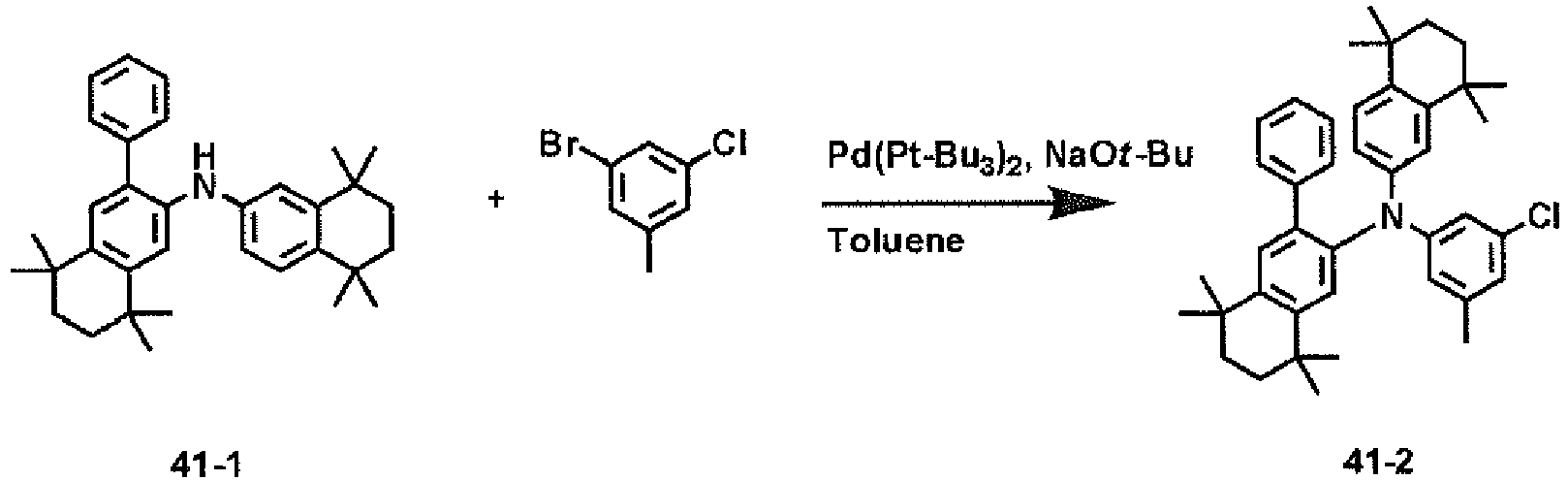
- Compound 41-2 was obtained in the same manner as in Preparation of Compound 1-2 of Preparation Example 9 except that Compound 41-1 was used instead of Compound 1-1.
MS: [M+H]+=591 -

- Compound 41-3 was obtained in the same manner as in Preparation of Compound 1-3 of Preparation Example 10 except that Compound 41-2 was used instead of Compound 1-2.
MS: [M+H]+=704 -

- Compound 41-4 was obtained in the same manner as in Preparation of Compound 1-4 of Preparation Example 11 except that Compound 41-3 was used instead of Compound 1-3.
MS: [M+H]+=946 -

- Compound 41 was obtained in the same manner as in Preparation of
Compound 1 of Preparation Example 12 except that Compound 41-4 was used instead of Compound 1-4.
MS: [M+H]+=954 -

- Compound 42-1 was obtained in the same manner as in Preparation of Compound 1-2 of Preparation Example 9 except that Compound 4-1 was used instead of Compound 1-1, and 1-bromo-3-(tert-butyl)-5-chlorobenzene was used instead of 1-bromo-3-chloro-5-methylbenzene.
MS: [M+H]+=557 -

- Compound 42-2 was obtained in the same manner as in Preparation of Compound 1-3 of Preparation Example 10 except that Compound 42-1 was used instead of Compound 1-2, and 9,9-dimethyl-9H-fluoren-4-amine was used instead of 4- (tert-butyl) aniline.
MS: [M+H]+=730 -

- Compound 42-3 was obtained in the same manner as in Preparation of Compound 1-4 of Preparation Example 11 except that Compound 42-2 was used instead of Compound 1-3.
MS: [M+H]+=972 -

- Compound 42 was obtained in the same manner as in Preparation of
Compound 1 of Preparation Example 12 except that Compound 42-3 was used instead of Compound 1-4.
MS: [M+H]+=980 -

- Compound 43-1 was obtained in the same manner as in Preparation of Compound 1-3 of Preparation Example 10 except that Compound 5-1 was used instead of Compound 1-2, and dibenzo[b,d]furan-1-amine was used instead of 4-(tert-butyl) aniline.
MS: [M+H]+=661 -

- Compound 43-2 was obtained in the same manner as in Preparation of Compound 1-4 of Preparation Example 11 except that Compound 43-1 was used instead of Compound 1-3, and 3-bromo-5-(tert-butyl)benzo[b]thiophene was used instead of Compound A.
MS: [M+H]+=850 -

- Compound 43 was obtained in the same manner as in Preparation of
Compound 1 of Preparation Example 12 except that Compound 43-2 was used instead of Compound 1-4.
MS: [M+H]+=858 -

- Compound 44-1 was obtained in the same manner as in Preparation of Compound 1-2 of Preparation Example 9 except that Compound 5-1 was used instead of Compound 1-1, and 1-bromo-3-chloro-5-cyclohexylbenzene was used instead of 1-bromo-3-chloro-5-methylbenzene.
MS: [M+H]+=597 -

- Compound 44-2 was obtained in the same manner as in Preparation of Compound 1-3 of Preparation Example 10 except that Compound 44-1 was used instead of Compound 1-2, and 5,5,8,8-tetramethyl-5,6,7,8-tetrahydronaphthalen-2-amine was used instead of 4-(tert-butyl)aniline.
MS: [M+H]+=764 -

- Compound 44-3 was obtained in the same manner as in Preparation of Compound 1-4 of Preparation Example 11 except that Compound 44-2 was used instead of Compound 1-3.
MS: [M+H]+=1006 -

- Compound 44 was obtained in the same manner as in Preparation of
Compound 1 of Preparation Example 12 except that Compound 44-3 was used instead of Compound 1-4.
MS: [M+H]+=1014 -

- Compound 45-1 was obtained in the same manner as in Preparation of Compound 1-2 of Preparation Example 8 except that 5,5,8,8-tetramethyl-1-phenyl-5,6,7,8-tetrahydronaphthalen-2-amine was used instead of 5-(tert-butyl)-[1,1'-biphenyl]-2-amine.
MS: [M+H]+=466 -

- Compound 45-2 was obtained in the same manner as in Preparation of Compound 1-2 of Preparation Example 9 except that Compound 45-1 was used instead of Compound 1-1, and 1-bromo-3-(tert-butyl)-5-chlorobenzene was used instead of 1-bromo-3-chloro-5-methylbenzene.
MS: [M+H]+=597 -

- Compound 45-3 was obtained in the same manner as in Preparation of Compound 1-3 of Preparation Example 10 except that Compound 45-2 was used instead of Compound 1-2, and 5,5,8,8-tetramethyl-5,6,7,8-tetrahydronaphthalen-2-amine was used instead of 4-(tert-butyl)aniline.
MS: [M+H]+=800 -

- Compound 45-4 was obtained in the same manner as in Preparation of Compound 1-4 of Preparation Example 11 except that Compound 45-3 was used instead of Compound 1-3, and Compound H was used instead of Compound A.
MS: [M+H]+=1024 -

- Compound 45 was obtained in the same manner as in Preparation of
Compound 1 of Preparation Example 12 except that Compound 45-4 was used instead of Compound 1-4.
MS: [M+H]+=1032 -

- Compound 46-1 was obtained in the same manner as in Preparation of Compound 1-1 of Preparation Example 8 except that 3-(4-(tert-butyl)phenyl)-5,5,8,8-tetramethyl-5,6,7,8-tetrahydronaphthalen-2-amine was used instead of 5-(tert-butyl)-[1,1'-biphenyl]-2-amine.
MS: [M+H]+=522 -

- Compound 46-2 was obtained in the same manner as in Preparation of Compound 1-2 of Preparation Example 9 except that Compound 46-1 was used instead of Compound 1-1.
MS: [M+H]+=647 -

- Compound 46-3 was obtained in the same manner as in Preparation of Compound 1-3 of Preparation Example 10 except that Compound 46-2 was used instead of Compound 1-2, and 5,5,8,8-tetramethyl-5,6,7,8-tetrahydronaphthalen-2-amine was used instead of 4-(tert-butyl)aniline.
MS: [M+H]+=814 -

- Compound 46-4 was obtained in the same manner as in Preparation of Compound 1-4 of Preparation Example 11 except that Compound 46-3 was used instead of Compound 1-3, and 2-bromo-5-(tert-butyl)benzo[b]thiophene was used instead of Compound A.
MS: [M+H]+=1002 -

- Compound 46 was obtained in the same manner as in Preparation of
Compound 1 of Preparation Example 12 except that Compound 46-4 was used instead of Compound 1-4.
MS: [M+H]+=1010 -

- Compound 47-1 was obtained in the same manner as in Preparation of Compound 1-1 of Preparation Example 8 except that 1,4-dimethyl-1,2,3,4-tetrahydro-1,4-ethanonaphthalen-6-amine was used instead of 5-(tert-butyl)-[1,1'-biphenyl]-2-amine. MS: [M+H]+=513
-

- Compound 47-2 was obtained in the same manner as in Preparation of Compound 1-2 of Preparation Example 9 except that Compound 47-1 was used instead of Compound 1-1.
MS: [M+H]+=513 -
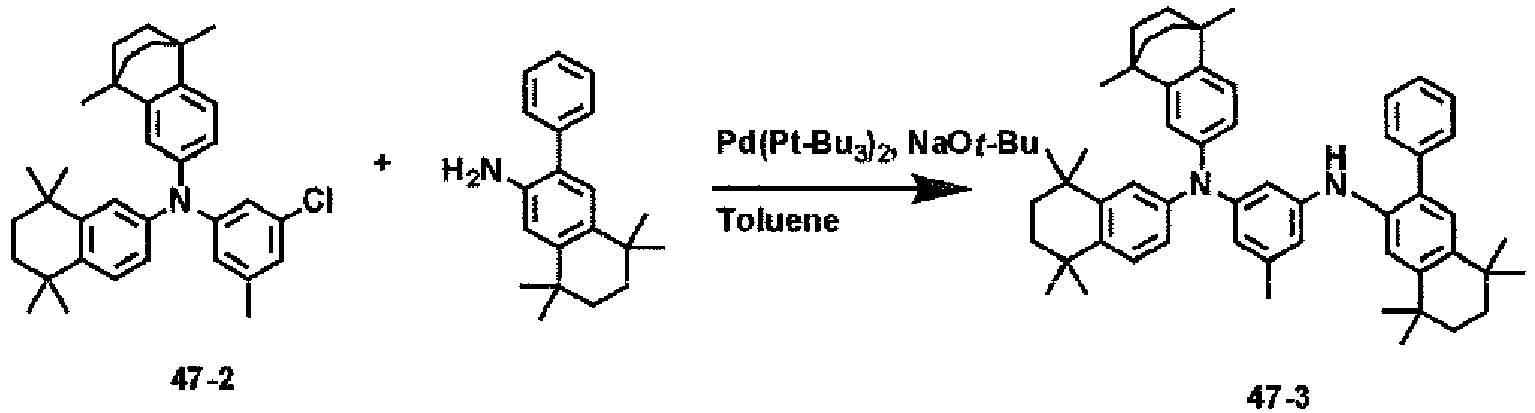
- Compound 47-3 was obtained in the same manner as in Preparation of Compound 1-3 of Preparation Example 10 except that Compound 47-2 was used instead of Compound 1-2, and 5,5,8,8-tetramethyl-3-phenyl-5,6,7,8-tetrahydronaphthalen-2-amine was used instead of 4-(tert-butyl)aniline.
MS: [M+H]+=756 -

- Compound 47-4 was obtained in the same manner as in Preparation of Compound 1-4 of Preparation Example 11 except that Compound 47-3 was used instead of Compound 1-3, and Compound H was used instead of Compound A.
MS: [M+H]+=932 -

- Compound 47 was obtained in the same manner as in Preparation of
Compound 1 of Preparation Example 12 except that Compound 47-4 was used instead of Compound 1-4.
MS: [M+H]+=940 -

- Compound 48-1 was obtained in the same manner as in Preparation of Compound 1-1 of Preparation Example 8 except that 2-bromo-5-(tert-butyl)-1,3-dimethylbenzene was used instead of 6-bromo-1,1,4,4-tetramethyl-1,2,3,4-tetrahydronaphthalene, and 4-(tert-butyl)aniline was used instead of 5-(tert-butyl)-[1,1'-biphenyl]-2-amine.
MS: [M+H]+=310 -

- Compound 48-2 was obtained in the same manner as in Preparation of Compound 1-2 of Preparation Example 9 except that Compound 48-1 was used instead of Compound 1-1, and 1-bromo-3-(tert-butyl)-5-chlorobenzene was used instead of 1-bromo-3-chloro-5-methylbenzene.
MS: [M+H]+=477 -

- Compound 48-3 was obtained in the same manner as in Preparation of Compound 1-3 of Preparation Example 10 except that Compound 48-2 was used instead of Compound 1-2, and 5,5,8,8-tetramethyl-5,6,7,8-tetrahydronaphthalen-2-amine was used instead of 4-(tert-butyl)aniline.
MS: [M+H]+=644 -

- Compound 48-4 was obtained in the same manner as in Preparation of Compound 1-4 of Preparation Example 11 except that Compound 48-3 was used instead of Compound 1-3. MS: [M+H]+=886
-

- Compound 48 was obtained in the same manner as in Preparation of
Compound 1 of Preparation Example 12 except that Compound 48-4 was used instead of Compound 1-4.
MS: [M+H]+=894 -

- Compound 49-1 was obtained in the same manner as in Preparation of Compound 1-3 of Preparation Example 10 except that Compound 38-2 was used instead of Compound 1-2, and dibenzo[b,d]furan-1-amine was used instead of 4-(tert-butyl) aniline.
MS: [M+H]+=706 -

- Compound 49-2 was obtained in the same manner as in Preparation of Compound 1-4 of Preparation Example 11 except that Compound 49-1 was used instead of Compound 1-3.
MS: [M+H]+=949 -

- Compound 49 was obtained in the same manner as in Preparation of
Compound 1 of Preparation Example 12 except that Compound 49-2 was used instead of Compound 1-4.
MS: [M+H]+=957 -

- Compound 50-1 was obtained in the same manner as in Preparation of Compound 1-3 of Preparation Example 10 except that Compound 41-2 was used instead of Compound 1-2, and 9,9-dimethyl-9H-fluoren-4-amine was used instead of 4-(tert-butyl) aniline.
MS: [M+H]+=764 -

- Compound 50-2 was obtained in the same manner as in Preparation of Compound 1-4 of Preparation Example 11 except that Compound 50-1 was used instead of Compound 1-3.
MS: [M+H]+=1006 -
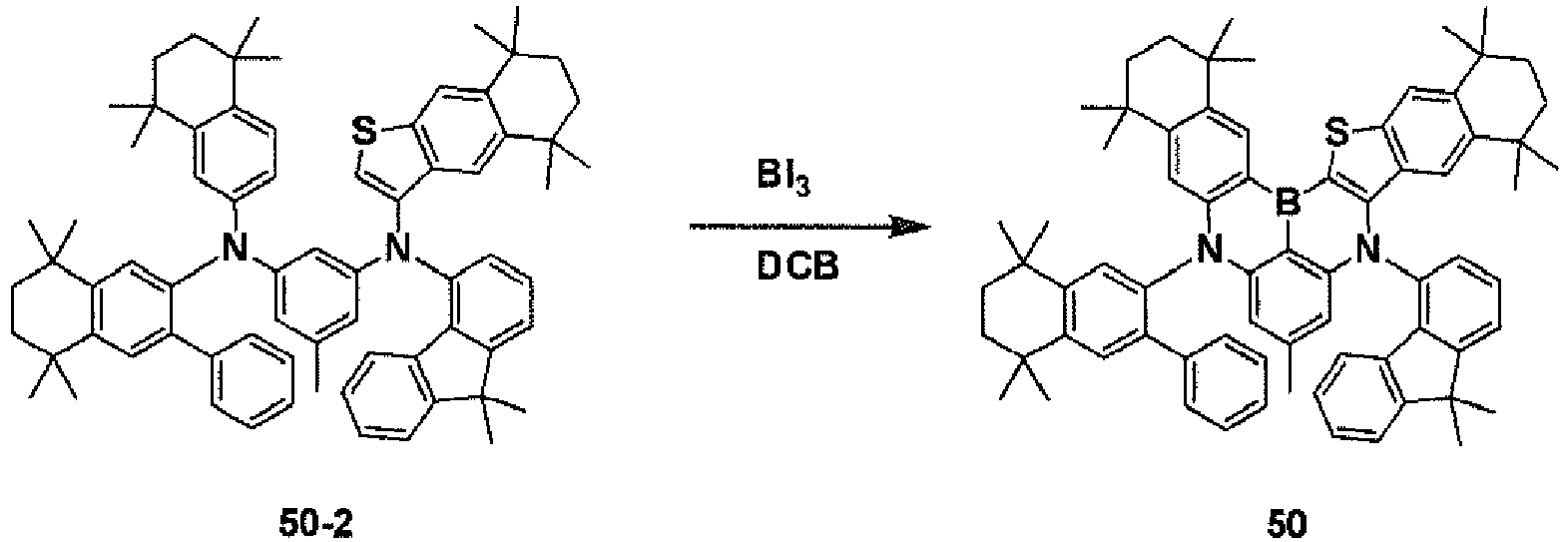
- Compound 50 was obtained in the same manner as in Preparation of
Compound 1 of Preparation Example 12 except that Compound 50-2 was used instead of Compound 1-4.
MS: [M+H]+=1014 -

- Compound 51-1 was obtained in the same manner as in Preparation of Compound 1-1 of Preparation Example 8 except that N-(3-bromophenyl)-5,5,8,8-tetramethyl-N-(5,5,8,8-tetramethyl-5,6,7,8-tetrahydronaphthalen-2-yl)-5,6,7,8-tetrahydronaphthalen-2-amine was used instead of 6-bromo-1,1,4,4-tetramethyl-1,2,3,4-tetrahydronaphthalene, and 4-(tert-butyl)aniline was used instead of 5-(tert-butyl)-[1,1'-biphenyl]-2-amine.
MS: [M+H]+=613 -

- Compound 51-2 was obtained in the same manner as in Preparation of Compound 1-2 of Preparation Example 9 except that Compound 51-1 was used instead of Compound 1-1.
MS: [M+H]+=738 -

- Compound 51-3 was obtained in the same manner as in Preparation of Compound 1-3 of Preparation Example 10 except that Compound 51-2 was used instead of Compound 1-2, and 5-(tert-butyl)-[1,1'-biphenyl]-2-amine was used instead of 4-(tert-butyl)aniline.
MS: [M+H]+=749 -

- Compound 51-4 was obtained in the same manner as in Preparation of Compound 1-4 of Preparation Example 11 except that Compound 51-3 was used instead of Compound 1-3.
MS: [M+H]+=1169 -

- Compound 51 was obtained in the same manner as in Preparation of
Compound 1 of Preparation Example 12 except that Compound 51-4 was used instead of Compound 1-4.
MS: [M+H]+=1177 -
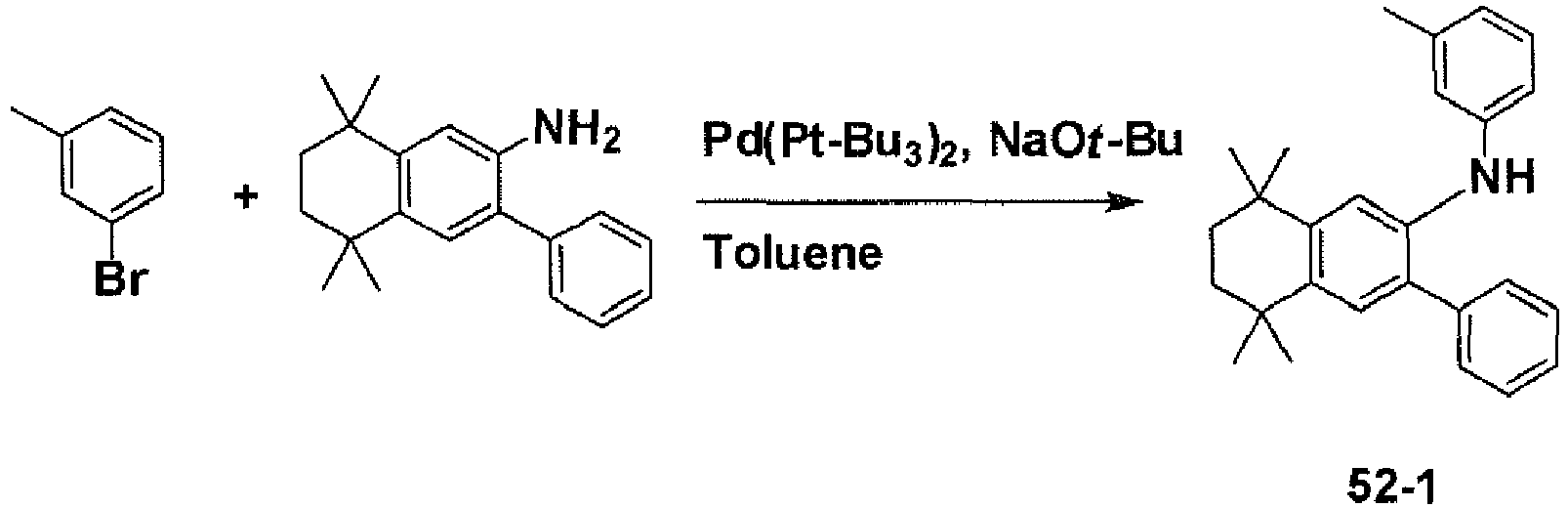
- Compound 52-1 was obtained in the same manner as in Preparation of Compound 1-1 of Preparation Example 8 except that 5,5,8,8-tetramethyl-3-phenyl-5,6,7,8-tetrahydronaphthalen-2-amine was used instead of 5-(tert-butyl)-[1,1'-biphenyl]-2-amine, and 1-bromo-3-methylbenzene was used instead of 6-bromo-1,1,4,4-tetramethyl-1,2,3,4-tetrahydronaphthalene.
MS: [M+H]+=370 -

- Compound 52-2 was obtained in the same manner as in Preparation of Compound 1-2 of Preparation Example 9 except that Compound 52-1 was used instead of Compound 1-1.
MS: [M+H]+=495 -

- Compound 52-3 was obtained in the same manner as in Preparation of Compound 1-3 of Preparation Example 10 except that Compound 52-2 was used instead of Compound 1-2, and 5,5,8,8-tetramethyl-5,6,7,8-tetrahydronaphthalen-2-amine was used instead of 4-(tert-butyl)aniline.
MS: [M+H]+=661 -

- Compound 52-4 was obtained in the same manner as in Preparation of Compound 1-4 of Preparation Example 11 except that Compound 52-3 was used instead of Compound 1-3.
MS: [M+H]+=904 -

- Compound 52 was obtained in the same manner as in Preparation of
Compound 1 of Preparation Example 12 except that Compound 52-4 was used instead of Compound 1-4.
MS: [M+H]+=912 -

- Compound 53-1 was obtained in the same manner as in Preparation of Compound 1-1 of Preparation Example 8 except that 3'-bromo-2,4-dimethyl-1,1'-biphenyl was used instead of 5-bromo-1,1,4,4-tetramethyl-1,2,3,4-tetrahydronaphthalene.
MS: [M+H]+=406 -

- Compound 53-2 was obtained in the same manner as in Preparation of Compound 1-2 of Preparation Example 9 except that Compound 53-1 was used instead of Compound 1-1.
MS: [M+H]+=573 -

- Compound 53-3 was obtained in the same manner as in Preparation of Compound 1-3 of Preparation Example 10 except that Compound 53-2 was used instead of Compound 1-2, and 5,5,8,8-tetramethyl-5,6,7,8-tetrahydronaphthalen-2-amine was used instead of 4-(tert-butyl)aniline.
MS: [M+H]+=740 -

- Compound 53-4 was obtained in the same manner as in Preparation of Compound 1-4 of Preparation Example 11 except that Compound 53-3 was used instead of Compound 1-3.
MS: [M+H]+=982 -

- Compound 53 was obtained in the same manner as in Preparation of
Compound 1 of Preparation Example 12 except that Compound 53-4 was used instead of Compound 1-4.
MS: [M+H]+=990 -

- Compound 54-1 was obtained in the same manner as in Preparation of Compound 1-1 of Preparation Example 8 except that 3-bromodibenzo[b,d]furan was used instead of 6-bromo-1,1,4,4-tetramethyl-1,2,3,4-tetrahydronaphthalene.
MS: [M+H]+=392 -

- Compound 54-2 was obtained in the same manner as in Preparation of Compound 1-2 of Preparation Example 9 except that Compound 54-1 was used instead of Compound 1-1.
MS: [M+H]+=517 -

- Compound 54-3 was obtained in the same manner as in Preparation of Compound 1-3 of Preparation Example 10 except that Compound 54-2 was used instead of Compound 1-2, and 5,5,8,8-tetramethyl-5,6,7,8-tetrahydronaphthalen-2-amine was used instead of 4-(tert-butyl)aniline.
MS: [M+H]+=683 -

- Compound 54-4 was obtained in the same manner as in Preparation of Compound 1-4 of Preparation Example 11 except that Compound 54-3 was used instead of Compound 1-3.
MS: [M+H]+=926 -
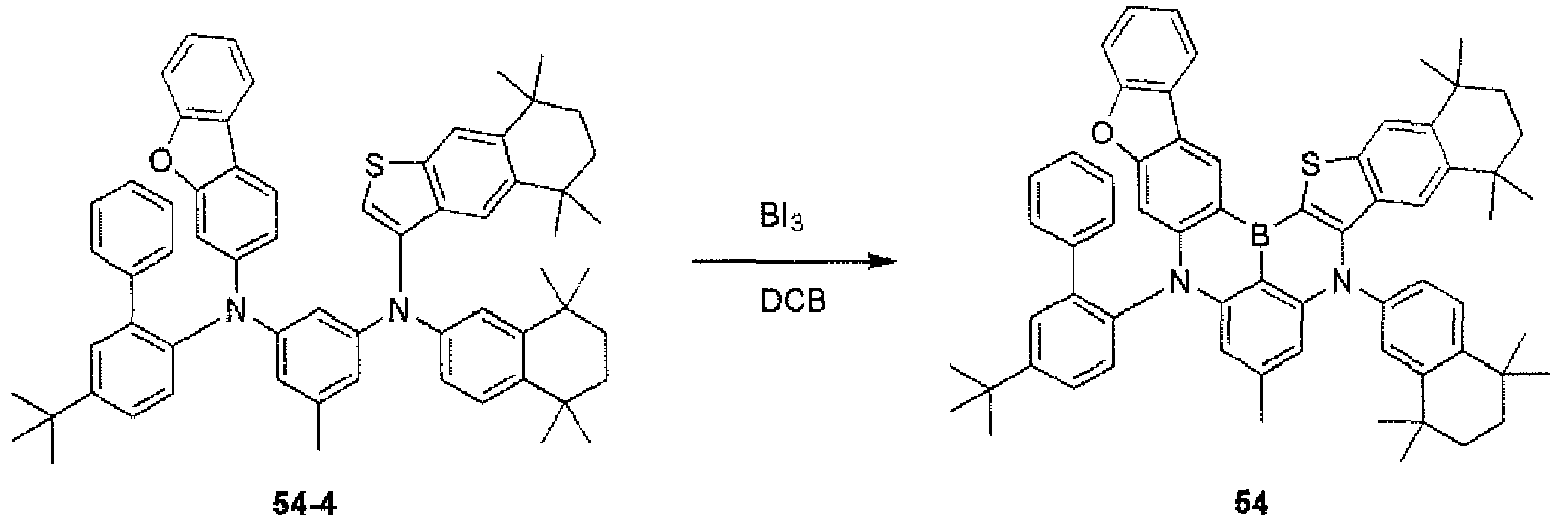
- Compound 54 was obtained in the same manner as in Preparation of
Compound 1 of Preparation Example 12 except that Compound 54-4 was used instead of Compound 1-4.
MS: [M+H]+=934 - A system in which Compounds BD-1 and BH-1 are included in a weight ratio of 5:95 was prepared. Specifically, using an OPLS3e force field, an environment of a doped device was computational chemically obtained through NVT and NPT calculations employing 300 molecules (BH-1 95%, A-1 5% ratio), a temperature of 300 K and a simulation time of 30 ns, and the obtained molecular model is shown in
FIG.5 . - Volume and density of the whole molecule, and an average distance between different molecules herein were obtained by calculation. The results are as shown in the following Table 1.
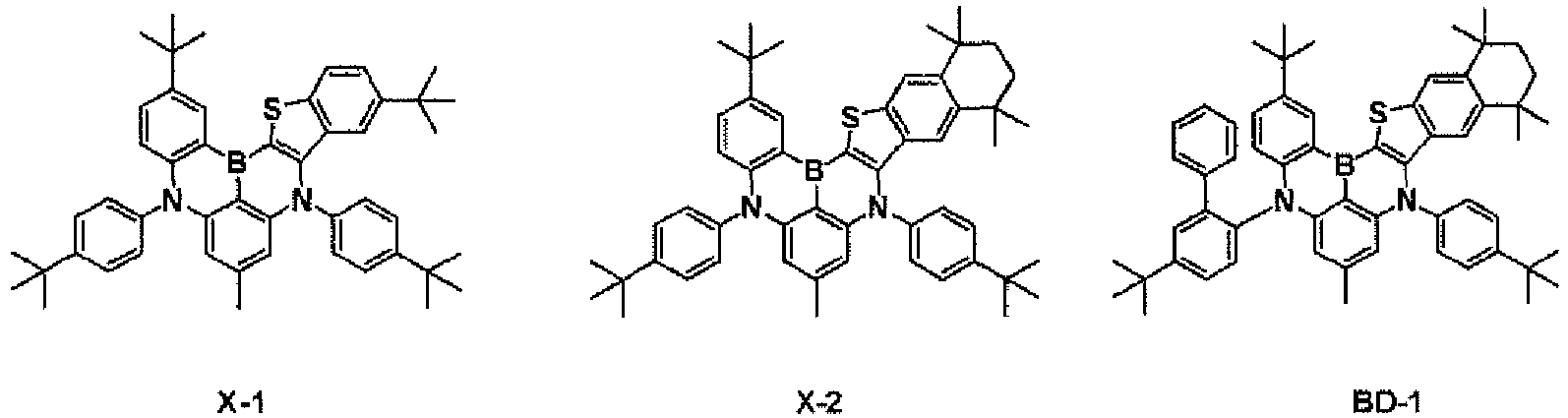

- A molecular system was calculated in the same manner as in Example 1 except that a dopant described in the following Table 1 was used instead of Compound BD-1.
- Molecular systems were calculated in the same manner as in Example 1 except that dopants described in the following Table 1 were used instead of Compound BD-1.
- Specifically, molecular models obtained by Examples 1-1 and 1-2 and Comparative Examples 1-1 and 1-2 are shown in
FIG. 3 to FIG. 6 . - Specifically,
FIG. 3 is a diagram showing a molecular model obtained through a simulation of the system of X-1 and BH-1 of Comparative Example 1-1. -
FIG. 4 is a diagram showing a molecular model obtained through a simulation of the system of X-2 and BH-1 of Comparative Example 1-2. -
FIG. 5 is a diagram showing a molecular model obtained through a simulation of the system of BD-1 and BH-1 of Example 1-1. -
FIG. 6 is a diagram showing a molecular model obtained through a simulation of the system of BD-2 and BH-1 of Example 1-2.[Table 1] Entry System Total Volume (cm3) Total Density (g/cm3) Intermolecul ar Distance (Å) Comparative Example 1-1 System of X-1 and BH-1 202.66x10⁻²⁷ 1.093 15.10 Comparative Example 1-2 System of X-2 and BH-1 203.84x10⁻²⁷ 1.094 15.19 Example 1-1 System of BD-1 and BH-1 206.36x10⁻²⁷ 1.089 15.38 Example 1-2 System of BD-2 and BH-1 208.49x10⁻²⁷ 1.091 15.56 - From Table 1 and
FIG. 3 to FIG. 6 , it was identified that the distance between the host and the dopant increased in the system employing, as a dopant, each of Compounds BD-1 and BD-2 including one or more substituted or unsubstituted fused aliphatic hydrocarbon rings and including Y1 and Y2, that is, substituents at an ortho position, which is the compound ofChemical Formula 1 of the present specification, and BH-1 as a host compared to in the system of each of Compounds X-1 and X-2, and BH-1. Accordingly, it may be expected that device efficiency increases when manufacturing an organic light emitting device by introducing the compound including one or more substituted or unsubstituted fused aliphatic hydrocarbon rings and including Y1 and Y2, that is, substituents at an ortho position, which is the compound ofChemical Formula 1 of the present specification, as a dopant of a light emitting layer since a dexter energy transfer with triplet energy of the host occurs less. - A maximum emission wavelength of each of compounds of the following Table 2 was measured and described in the following Table 2, and the maximum emission wavelength in a film state of each of the compounds of the following Table 2 was obtained as follows. On a glass substrate, a host Compound BH-1 and a dopant compound of the following Table 2 were vacuum deposited in a weight ratio of 97:3 to prepare a light emitting layer film having a thickness of 1000 Å. In the above-mentioned process, the deposition rate of the organic material was maintained at 0.1 nm/sec. For each of the prepared films, a fluorescence spectrum was measured at room temperature (300 K) using the measurement device. Herein, a wavelength value (nm) of the maximum emission peak was obtained, and the measurement graphs are shown in
FIG. 7 andFIG. 8 .
[Table 2] Dopant Compound Maximum Emission Wavelength (nm) Comparative Example 2-1 X-3 461 Comparative Example 2-2 X-4 463 Example 2-1 BD-3 458 Example 2-2 BD-4 459 - When comparing the maximum emission wavelength values in Table 2,
FIG. 7 andFIG. 8 , a shorter wavelength was observed in Compounds BD-3 and BD-4 including one or more substituted or unsubstituted fused aliphatic hydrocarbon rings and including Y1 and Y2, that is, substituents at an ortho position, which is the compound ofChemical Formula 1 of the present specification, compared to in Compounds X-3 and X-4. This is due to the fact that intermolecular interaction is minimized between the host and the dopant as shown in the experimental results of the simulation of Experimental Example 1. Therefore, an organic light emitting device with high efficiency is obtained using the compound represented byChemical Formula 1. - A glass substrate on which indium tin oxide (ITO) was coated as a thin film to a thickness of 1,400 Å was placed in detergent-dissolved distilled water and ultrasonic cleaned. Herein, a product of Fischer Co. was used as the detergent, and as the distilled water, distilled water filtered twice with a filter manufactured by Millipore Co. was used. After the ITO was cleaned for 30 minutes, ultrasonic cleaning was repeated twice using distilled water for 10 minutes. After the cleaning with distilled water was finished, the substrate was ultrasonic cleaned with solvents of isopropyl alcohol, acetone and methanol, then dried, and then transferred to a plasma cleaner. In addition, the substrate was cleaned for 5 minutes using oxygen plasma, and then transferred to a vacuum deposition apparatus.
- On the transparent ITO electrode prepared as above, the following HI-A and LG-101 were thermal vacuum deposited to thicknesses of 650 Å and 50 Å, respectively, to form a hole injection layer. On the hole injection layer, a hole transfer layer was formed by vacuum depositing the following HT-A to a thickness of 600 Å. The following HT-B was vacuum deposited to a thickness of 50 Å on the hole transfer layer to form an electron blocking layer. Subsequently, on the electron blocking layer, a light emitting layer was formed to a thickness of 200 Å by vacuum depositing the following
Compound 1 as a blue light emitting dopant in 4 parts by weight based on 100 parts by weight of the light emitting layer, and the following BH-A as a host. Then, on the light emitting layer, the following Compound ET-A was vacuum deposited to 50 Å as a first electron transfer layer, and subsequently, the following ET-B and LiQ were vacuum deposited in a weight ratio of 1:1 to a thickness of 360 Å to form a second electron transfer layer. An electron injection layer was formed on the second electron transfer layer by vacuum depositing LiQ to a thickness of 5 Å. On the electron injection layer, a cathode was formed by depositing aluminum and silver in a weight ratio of 10:1 to a thickness of 220 Å, and then depositing aluminum thereon to a thickness of 1000 Å. - In the above-described process, the deposition rates of the organic materials were maintained at 0.4 Å/sec to 0.9 Å/sec, the deposition rate of the aluminum of the cathode was maintained at 2 Å/sec, and the degree of vacuum during the deposition was maintained at 5×10⁻⁸ torr to 1×10⁻⁷ torr (10-7 torr equals 1,3 ×10⁻⁷ Pa) and as a result, an organic light emitting device was manufactured.
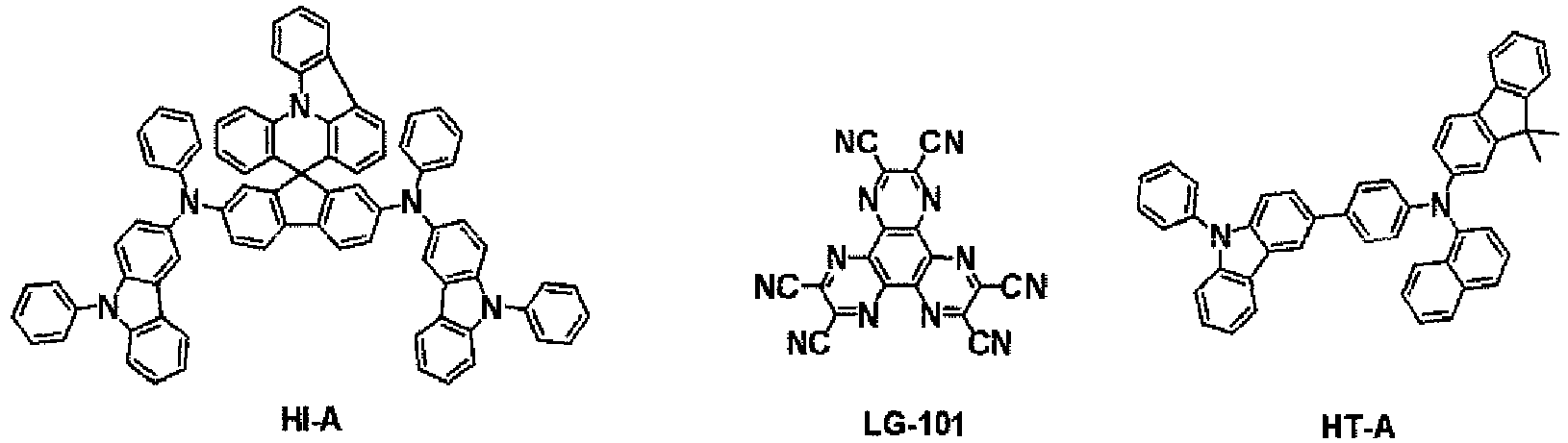


- Organic light emitting devices of Examples 3-2 to 3-40 and Comparative Examples 3-1 to 3-6 were each manufactured in the same manner as in Example 3-1 except that compounds described in the following Table 3 were each used as the dopant of the light emitting layer instead of
Compound 1, and compounds described in the following Table 3 were each used as the host material instead of BH-A.

- For each of the organic light emitting devices of Examples 3-1 to 3-40 and Comparative Examples 3-1 to 3-6, voltage, efficiency and color coordinate when applying current density of 10 mA/cm2 and a lifetime (T95) when applying current density of 20 mA/cm2 were measured, and the results are shown in the following Table 3. Herein, T95 means time taken for luminance to decrease to 95% when employing initial luminance at current density of 20 mA/cm2 as 100%, and the percentage is shown based on (100%) the results of Comparative Examples 3-2 and 3-5 including Compound BD-B.
[Table 3] Entry Light Emitting Layer 10 mA/cm2 20 mA/cm2 Hos t Dopant Volt age (V) Quantum Efficie ncy (QE) Color Coordin ate CIEy LT95 (%) Example 3-1 BH-A Compound 1 3.82 8.05 0.0891 117 Example 3-2 Compound 2 3.86 7.95 0.1067 130 Example 3-3 Compound 4 3.74 8.25 0.0913 124 Example 3-4 Compound 6 3.85 8.12 0.0901 123 Example 3-5 Compound 11 3.78 8.52 0.0891 120 Example 3-6 Compound 24 3.88 8.06 0.0888 131 Example 3-7 Compound 28 3.86 8.23 0.0809 123 Example 3-8 BH-A Compound 29 3.89 8.31 0.1022 126 Example 3-9 Compound 30 3.75 8.44 0.1042 118 Example 3-10 Compound 31 3.81 8.32 0.0962 113 Example 3-11 Compound 39 3.79 8.73 0.0941 130 Example 3-12 Compound 40 3.95 7.99 0.1020 125 Example 3-13 Compound 41 3.83 8.51 0.0918 120 Example 3-14 Compound 48 3.76 8.65 0.0804 115 Example 3-15 Compound 49 3.77 8.59 0.1025 123 Example 3-16 Compound 50 3.74 8.44 0.0791 111 Example 3-17 Compound 51 3.77 8.80 0.1086 120 Example 3-18 Compound 52 3.70 8.91 0.1011 125 Example 3-19 Compound 53 3.71 8.83 0.0994 132 Example 3-20 Compound 54 3.81 8.35 0.0961 121 Example 3-21 BH-B Compound 1 3.75 8.10 0.0893 125 Example 3-22 Compound 2 3.80 8.08 0.1064 122 Example 3-23 Compound 4 3.71 8.35 0.0910 135 Example 3-24 Compound 6 3.76 8.17 0.0904 123 Example 3-25 Compound 11 3.73 8.57 0.0894 122 Example 3-26 Compound 24 3.80 8.16 0.0893 125 Example 3-27 Compound 28 3.79 8.28 0.0813 126 Example 3-28 Compound 29 3.70 8.36 0.1017 115 Example 3-29 Compound 30 3.77 8.49 0.1038 123 Example 3-30 Compound 31 3.78 8.37 0.0965 111 Example 3-31 Compound 39 3.72 8.75 0.0943 123 Example 3-32 Compound 40 3.89 8.03 0.1021 124 Example 3-33 Compound 41 3.76 8.61 0.0921 125 Example 3-34 Compound 48 3.72 8.70 0.0806 124 Example 3-35 Compound 49 3.74 8.64 0.1027 128 Example 3-36 Compound 50 3.70 8.49 0.0801 115 Example 3-37 Compound 51 3.71 8.85 0.1089 124 Example 3-38 Compound 52 3.72 8.72 0.0993 124 Example 3-39 Compound 53 3.76 8.66 0.1106 121 Example 3-40 Compound 54 3.80 8.21 0.1001 132 Comparative Example 3-1 BH-A BD-A 3.83 7.62 0.0871 99 Comparative Example 3-2 BD-B 3.91 7.53 0.0942 100 Comparative Example 3-3 BD-C 3.95 7.72 0.1324 92 Comparative Example 3-4 BH-B BD-A 3.77 7.64 0.0873 98 Comparative Example 3-5 BD-B 3.85 7.56 0.0931 100 Comparative Example 3-6 BD-C 3.91 7.74 0.1312 93 - As seen from the device results of Table 3, the compound including one or more substituted or unsubstituted fused aliphatic hydrocarbon rings and including Y1 and Y2, that is, substituents at an ortho position, which is the compound of
Chemical Formula 1 of the present specification, was superior in both device efficiency and lifetime compared to the compound that does not include the compound ofChemical Formula 1 of the present specification. When compared with BD-A, BD-B or BD-C, a dopant introducing only a fused aliphatic hydrocarbon ring substituted with an alkyl group, it was seen that the compound including one or more substituted or unsubstituted fused aliphatic hydrocarbon rings and including Y1 and Y2, that is, substituents at an ortho position, which is the compound ofChemical Formula 1 of the present specification, had superior efficiency and lifetime. This is consistent with the experimental results of the simulation of Experimental Example 1. - Through Experimental Examples 1 to 3, it was identified that the compound of
Chemical Formula 1 of the present specification had superior performance of high efficiency and long lifetime. - A thermos gravimetric analyzer (TGA) is a device measuring, after applying a temperature to a sample, changes in the mass of the sample as a function of time or temperature. A mass loss of a material is caused by evaporation or a chemical reaction producing gaseous products. Using Q-500, 3 mg or more and less than 5 mg of compounds of the following Table 4 completed with sublimation purification were each put on a Pt pan, and heated from room temperature to 700°C at a rate of 10°C/min. Herein, a temperature at which the mass of each of the compounds was reduced by 5% with respect to the total weight (=Td-5% loss) and the amount (percent) of the residue remaining on the pan after heating to 700°C were measured. The thermos gravimetric analysis graph of Compound BD-3 of Example 4-1 is shown in
FIG. 9 , and the thermos gravimetric analysis graph of Compound X-1 of Comparative Example 4-1 is shown inFIG. 10 .[Table 4] Entry Comparative Example 4-1 Comparative Example 4-2 Example 4-1 Example 4-2 Compound X-1 X-4 BD-3 BD-4 Molecular Weight 714.86 823.05 845.05 1007.33 Td-5% loss (°C) 386 390 375 397 Residue (%) 22.7 0.6 4.2 2.2 

- In Table 4, and
FIG. 9 andFIG. 10 , the Td-5% loss value was measured to be very high of 386°C from the experimental result of the thermos gravimetric analysis on Compound X-1 of Comparative Example 4-1. On the other hand, it was identified through the experiment that Compound BD-3, the compound ofChemical Formula 1 of the present specification, of Example 4-1 had alower Td 5% loss value of 375°C even with a higher molecular weight. In addition, it was identified that BD-3 had 4.2% of the compound remaining on the pan after the analysis compared to X-1 having 22.7% of the compound remaining on the pan after the analysis,. It was identified that Compound BD-4, the compound ofChemical Formula 1 of the present specification, of Example 4-2 had asimilar Td 5% loss value with a higher molecular weight compared to Compound X-4 of Comparative Example 4-2. Through the experiment, it was identified that the compound ofChemical Formula 1 of the present specification was superior in terms of thermal stability by having a low a Td-5% loss value compared to compounds with similar molecular weights and thereby having a low sublimation temperature, and was an organic material suited for a deposition device as well.
Claims (15)
- A compound represented by the following Chemical Formula 1:
 X1 is O or S;A1 is a substituted or unsubstituted aromatic hydrocarbon ring; a substituted or unsubstituted aliphatic hydrocarbon ring; or a substituted or unsubstituted fused ring of aromatic hydrocarbon ring and aliphatic hydrocarbon ring;at least one of Y1 and Y2 is deuterium; a cyano group; a halogen group; a substituted or unsubstituted alkyl group; a substituted or unsubstituted silyl group; a substituted or unsubstituted alkenyl group; a substituted or unsubstituted aryl group; a substituted or unsubstituted fused ring group of aromatic hydrocarbon ring and aliphatic hydrocarbon ring; or a substituted or unsubstituted heterocyclic group, or bonds to adjacent groups to form a ring, and the other one is hydrogen;Z1 is hydrogen; deuterium; a halogen group; a cyano group; a substituted or unsubstituted alkyl group; a substituted or unsubstituted cycloalkyl group; a substituted or unsubstituted alkoxy group; a substituted or unsubstituted arylalkyl group; a substituted or unsubstituted aryloxy group; a substituted or unsubstituted silyl group; a substituted or unsubstituted amine group; a substituted or unsubstituted aryl group; a substituted or unsubstituted fused ring group of aromatic hydrocarbon ring and aliphatic hydrocarbon ring; or a substituted or unsubstituted heterocyclic group;R1 to R3 and R11 are the same as or different from each other, and each independently hydrogen; deuterium; a halogen group; a cyano group; a substituted or unsubstituted alkyl group; a substituted or unsubstituted cycloalkyl group; a substituted or unsubstituted alkoxy group; a substituted or unsubstituted arylalkyl group; a substituted or unsubstituted aryloxy group; a substituted or unsubstituted silyl group; a substituted or unsubstituted amine group; a substituted or unsubstituted aryl group; a substituted or unsubstituted fused ring group of aromatic hydrocarbon ring and aliphatic hydrocarbon ring; or a substituted or unsubstituted heterocyclic group, or adjacent groups bond to each other to form a substituted or unsubstituted hydrocarbon ring;r1 is 1 or 2;when r1 is 2, the two R1s are the same as or different from each other;r2, r3 and r11 are each an integer of 1 to 4;when r2 is 2 or greater, the two or more R2s are the same as or different from each other;when r3 is 2 or greater, the two or more R3s are the same as or different from each other;when r11 is 2 or greater, the two or more R11s are the same as or different from each other;Chemical Formula 1 includes at least one fused aliphatic hydrocarbon ring substituted with a substituted or unsubstituted alkyl group; andwherein "substituted" means being substituted with one or more substituents selected from the group consisting of deuterium; a halogen group; a cyano group; an alkyl group; a cycloalkyl group; an alkoxy group; an aryloxy group; an alkylthioxy group; an arylthioxy group; an alkenyl group; a haloalkyl group; a haloalkoxy group; an arylalkyl group; a silyl group; a boron group; an amine group; an aryl group; a fused ring group of aromatic hydrocarbon ring and aliphatic hydrocarbon ring; and a heterocyclic group.
 - The compound of Claim 1, wherein Chemical Formula 1 is represented by the following Chemical Formula 1-1 or 1-2:


A1, Y1, Y2, Z1, R1 to R3, R11, r1 to r3 and r11 have the same definitions as in Chemical Formula 1. - The compound of Claim 1, wherein Chemical Formula 1 is represented by any one of the following Chemical Formulae 1-3 to 1-5:


 X1, A1, Y1, Y2, Z1, R1 to R3, and r1 to r3 have the same definitions as in Chemical Formula 1;A2 is a substituted or unsubstituted aliphatic hydrocarbon ring;R'11 and R"11 are the same as or different from each other, and each independently hydrogen; a halogen group; a cyano group; a substituted or unsubstituted alkyl group; a substituted or unsubstituted cycloalkyl group; a substituted or unsubstituted alkoxy group; a substituted or unsubstituted arylalkyl group; a substituted or unsubstituted aryloxy group; a substituted or unsubstituted silyl group; a substituted or unsubstituted amine group; a substituted or unsubstituted aryl group; a substituted or unsubstituted fused ring group of aromatic hydrocarbon ring and aliphatic hydrocarbon ring; or a substituted or unsubstituted heterocyclic group;r'11 is an integer of 1 to 4, and when r'11 is 2 or greater, the two or more R'11s are the same as or different from each other; andr"11 is 1 or 2, and when r"11 is 2, the two R"11s are the same as or different from each other.
 - The compound of Claim 1, wherein Chemical Formula 1 includes at least one monocyclic fused aliphatic hydrocarbon ring having 3 to 10 carbon atoms substituted with a linear or branched alkyl group having 1 to 30 carbon atoms unsubstituted or substituted with deuterium.
- The compound of Claim 1, wherein A1 is a substituted or unsubstituted monocyclic or polycyclic aromatic hydrocarbon ring having 6 to 30 carbon atoms; a substituted or unsubstituted monocyclic or polycyclic aliphatic hydrocarbon ring having 3 to 30 carbon atoms; or a substituted or unsubstituted fused ring of monocyclic or polycyclic aromatic hydrocarbon ring having 6 to 30 carbon atoms and monocyclic or polycyclic aliphatic hydrocarbon ring having 3 to 30 carbon atoms;R11 is hydrogen; a substituted or unsubstituted linear or branched alkyl group having 1 to 30 carbon atoms; a substituted or unsubstituted amine group; or a substituted or unsubstituted monocyclic or polycyclic heterocyclic group having 2 to 30 carbon atoms, or adjacent groups bond to each other to form a substituted or unsubstituted monocyclic or polycyclic aliphatic hydrocarbon ring having 3 to 30 carbon atoms; a substituted or unsubstituted monocyclic or polycyclic aromatic hydrocarbon ring having 6 to 30 carbon atoms; a substituted or unsubstituted fused ring of monocyclic or polycyclic aromatic hydrocarbon ring having 6 to 30 carbon atoms and monocyclic or polycyclic aliphatic hydrocarbon ring having 3 to 30 carbon atoms; or a substituted or unsubstituted monocyclic or polycyclic heteroring having 2 to 30 carbon atoms;at least one of Y1 and Y2 is deuterium; a cyano group; a halogen group; a substituted or unsubstituted linear or branched alkyl group having 1 to 30 carbon atoms; a substituted or unsubstituted linear or branched alkylsilyl group having 1 to 30 carbon atoms; a substituted or unsubstituted linear or branched alkenyl group having 2 to 30 carbon atoms; a substituted or unsubstituted monocyclic or polycyclic aryl group having 6 to 30 carbon atoms; a substituted or unsubstituted fused ring group of monocyclic or polycyclic aromatic hydrocarbon ring having 6 to 30 carbon atoms and monocyclic or polycyclic aliphatic hydrocarbon ring having 3 to 30 carbon atoms; or a substituted or unsubstituted monocyclic or polycyclic heterocyclic group having 2 to 30 carbon atoms, or bonds to adjacent groups to form a substituted or unsubstituted monocyclic or polycyclic aliphatic hydrocarbon ring having 3 to 30 carbon atoms; a substituted or unsubstituted monocyclic or polycyclic aromatic hydrocarbon ring having 6 to 30 carbon atoms; a substituted or unsubstituted fused ring of monocyclic or polycyclic aromatic hydrocarbon ring having 6 to 30 carbon atoms and monocyclic or polycyclic aliphatic hydrocarbon ring having 3 to 30 carbon atoms; or a substituted or unsubstituted monocyclic or polycyclic heteroring having 2 to 30 carbon atoms, and the other one is hydrogen;Z1 is hydrogen; deuterium; a halogen group; a cyano group; a substituted or unsubstituted linear or branched alkyl group having 1 to 30 carbon atoms; a substituted or unsubstituted monocyclic or polycyclic cycloalkyl group having 3 to 30 carbon atoms; a substituted or unsubstituted amine group; a substituted or unsubstituted linear or branched alkylsilyl group having 1 to 30 carbon atoms; a substituted or unsubstituted monocyclic or polycyclic aryl group having 6 to 30 carbon atoms; or a substituted or unsubstituted monocyclic or polycyclic heterocyclic group having 2 to 30 carbon atoms; andR2 and R3 are the same as or different from each other, and each independently hydrogen; deuterium; a halogen group; a cyano group; a substituted or unsubstituted linear or branched alkyl group having 1 to 30 carbon atoms; a substituted or unsubstituted linear or branched alkylsilyl group having 1 to 30 carbon atoms; a substituted or unsubstituted monocyclic or polycyclic arylsilyl group having 6 to 30 carbon atoms; a substituted or unsubstituted amine group; a substituted or unsubstituted fused ring group of monocyclic or polycyclic aromatic hydrocarbon ring having 6 to 30 carbon atoms and monocyclic or polycyclic aliphatic hydrocarbon ring having 3 to 30 carbon atoms; or a substituted or unsubstituted monocyclic or polycyclic aryl group having 6 to 30 carbon atoms, or adjacent groups bond to each other to form a substituted or unsubstituted monocyclic or polycyclic aliphatic hydrocarbon ring having 3 to 30 carbon atoms; a substituted or unsubstituted monocyclic or polycyclic aromatic hydrocarbon ring having 6 to 30 carbon atoms; a substituted or unsubstituted fused ring of monocyclic or polycyclic aromatic hydrocarbon ring having 6 to 30 carbon atoms and monocyclic or polycyclic aliphatic hydrocarbon ring having 3 to 30 carbon atoms; or a substituted or unsubstituted monocyclic or polycyclic heteroring having 2 to 30 carbon atoms.
- The compound of Claim 1, wherein Chemical Formula 1 is any one selected from among the following compounds:

















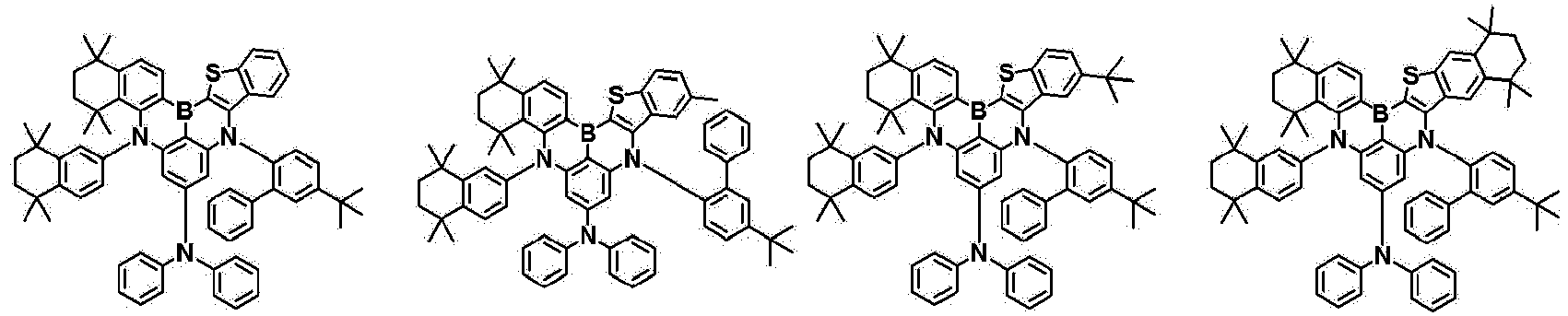











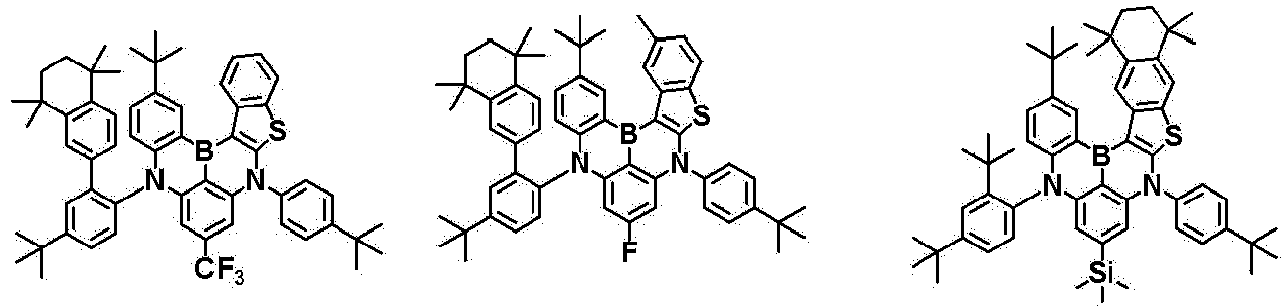








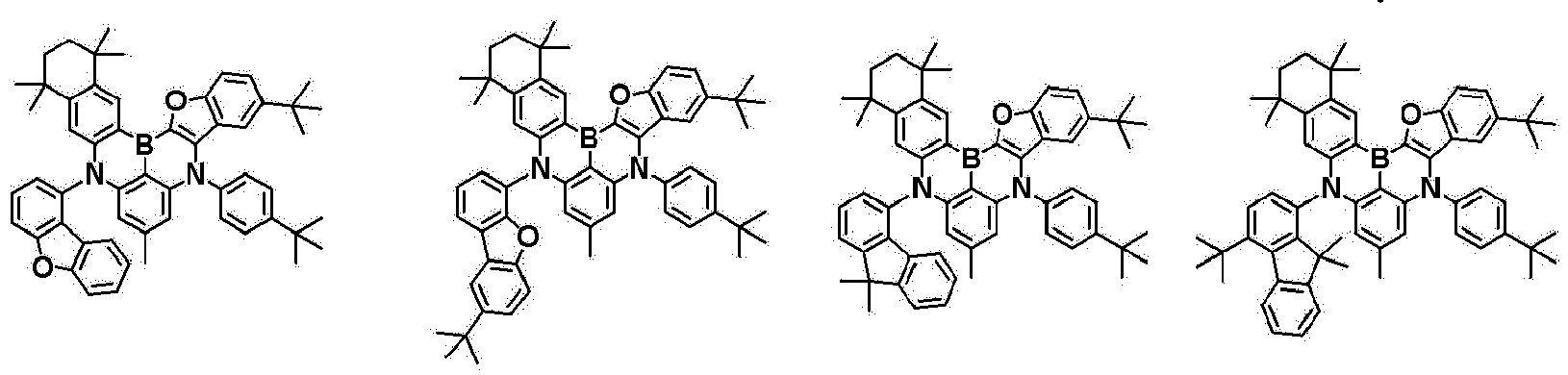


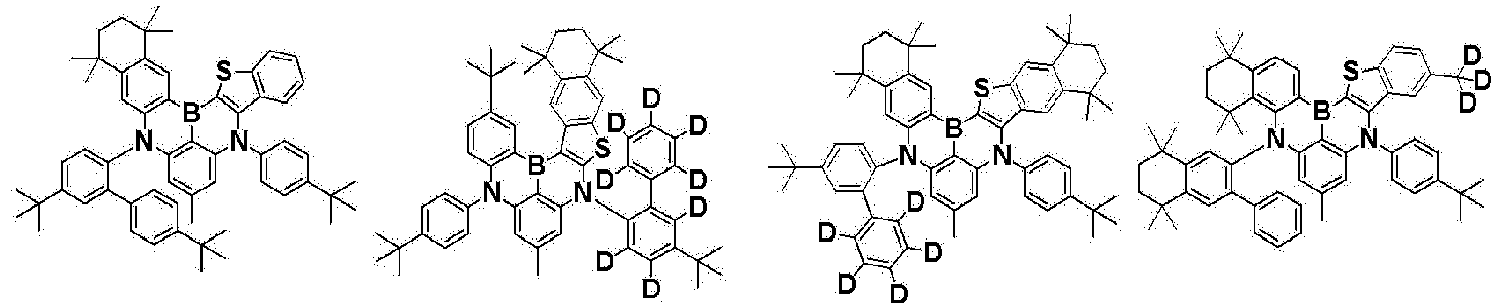




















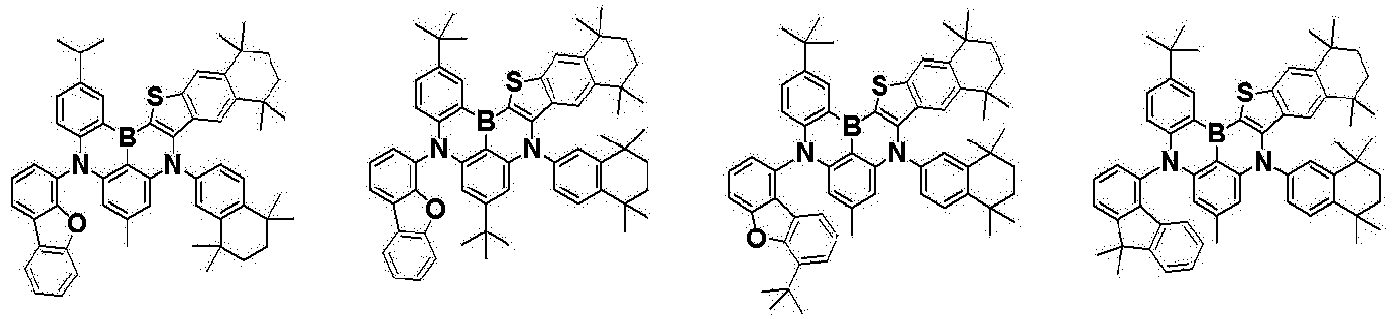
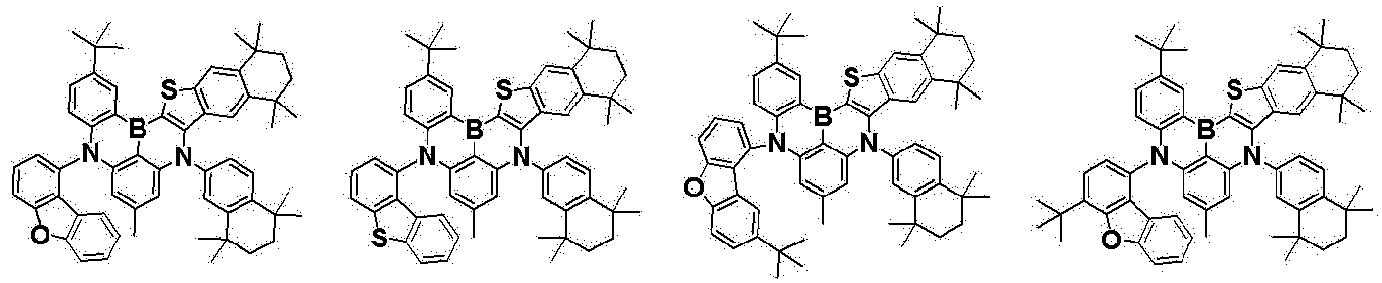





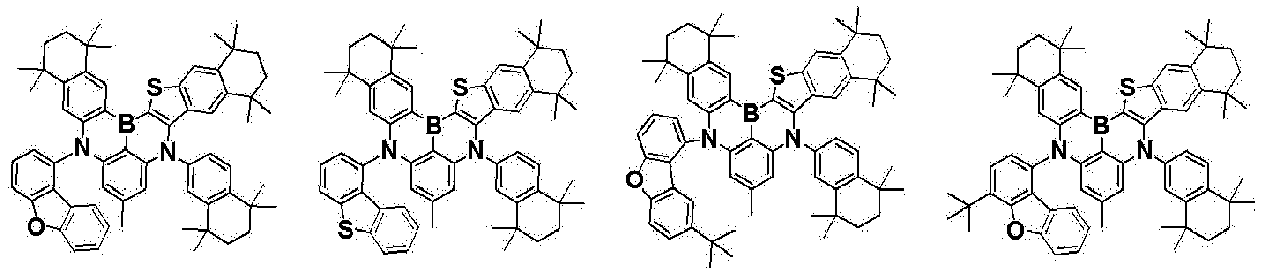


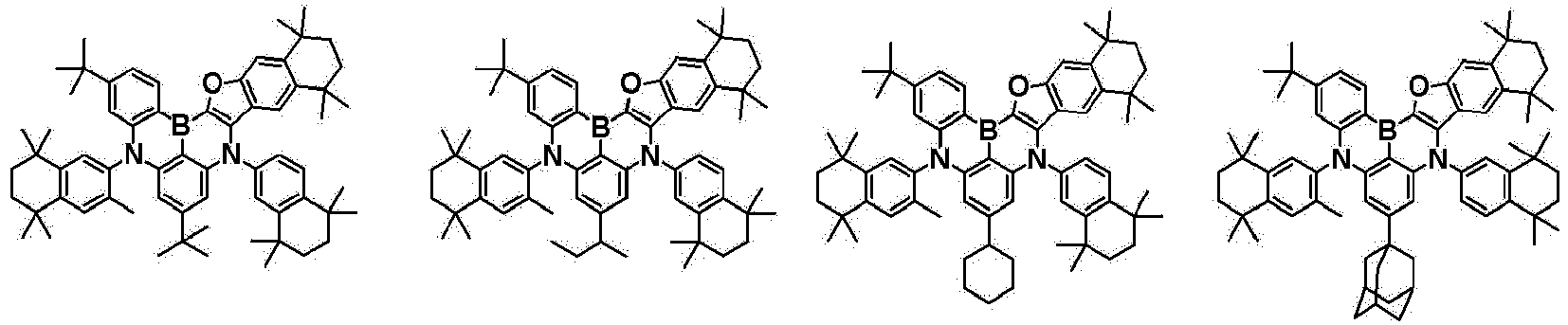








Ph means a phenyl group, and D means deuterium. - An organic light emitting device comprising:a first electrode;a second electrode; andone or more organic material layers provided between the first electrode and the second electrode,wherein one or more layers of the organic material layers include the compound of any one of Claims 1 to 6.
- The organic light emitting device of Claim 7, wherein the organic material layer includes a light emitting layer, and the light emitting layer includes the compound.
- The organic light emitting device of Claim 7, wherein the organic material layer includes a light emitting layer, the light emitting layer includes a dopant material, and the dopant material includes the compound.
- The organic light emitting device of Claim 7, wherein the organic material layer includes a light emitting layer, and the light emitting layer further includes a compound represented by the following Chemical Formula H:
 L20 and L21 are the same as or different from each other, and each independently a direct bond; a substituted or unsubstituted arylene group; or a substituted or unsubstituted heteroarylene group;Ar20 and Ar21 are the same as or different from each other, and each independently hydrogen; deuterium; a substituted or unsubstituted aryl group; or a substituted or unsubstituted heterocyclic group;R20 and R21 are the same as or different from each other, and each independently hydrogen; deuterium; a halogen group; a substituted or unsubstituted alkyl group; a substituted or unsubstituted cycloalkyl group; a substituted or unsubstituted aryl group; or a substituted or unsubstituted heterocyclic group; andr21 is an integer of 1 to 7, and when r21 is 2 or greater, the two or more R21s are the same as or different from each other.
 - The organic light emitting device of Claim 7, wherein the organic material layer includes a light emitting layer, the light emitting layer further includes a host compound, and in the host compound, at least one hydrogen at a substitutable position is substituted with deuterium.
- The organic light emitting device of Claim 7, wherein the organic material layer includes a light emitting layer, and the light emitting layer includes one or more types of dopants and a host.
- The organic light emitting device of Claim 7, wherein the organic material layer includes a light emitting layer, and the light emitting layer includes two or more types of mixed dopants and a host.
- The organic light emitting device of Claim 7, wherein the organic material layer includes a light emitting layer, and the light emitting layer includes one or more types of hosts and a dopant.
- The organic light emitting device of Claim 7, wherein the organic material layer includes a light emitting layer, and the light emitting layer includes two or more types of mixed hosts and a dopant.
Applications Claiming Priority (3)
| Application Number | Priority Date | Filing Date | Title |
|---|---|---|---|
| KR20190156840 | 2019-11-29 | ||
| KR1020200060591A KR20210067843A (en) | 2019-11-29 | 2020-05-20 | Compound and organic light emitting device comprising same |
| PCT/KR2020/017076 WO2021107681A1 (en) | 2019-11-29 | 2020-11-27 | Compound and organic light-emitting device comprising same |
Publications (3)
| Publication Number | Publication Date |
|---|---|
| EP3919500A1 EP3919500A1 (en) | 2021-12-08 |
| EP3919500A4 EP3919500A4 (en) | 2022-03-16 |
| EP3919500B1 true EP3919500B1 (en) | 2024-08-28 |
Family
ID=76129748
Family Applications (3)
| Application Number | Title | Priority Date | Filing Date |
|---|---|---|---|
| EP20891826.8A Active EP3909958B1 (en) | 2019-11-29 | 2020-11-27 | Compound and organic light-emitting device comprising same |
| EP20894376.1A Pending EP3907228A4 (en) | 2019-11-29 | 2020-11-27 | COMPOUND AND ORGANIC LIGHT EMITTING ELEMENT THEREOF |
| EP20894491.8A Active EP3919500B1 (en) | 2019-11-29 | 2020-11-27 | Compound and organic light-emitting device comprising same |
Family Applications Before (2)
| Application Number | Title | Priority Date | Filing Date |
|---|---|---|---|
| EP20891826.8A Active EP3909958B1 (en) | 2019-11-29 | 2020-11-27 | Compound and organic light-emitting device comprising same |
| EP20894376.1A Pending EP3907228A4 (en) | 2019-11-29 | 2020-11-27 | COMPOUND AND ORGANIC LIGHT EMITTING ELEMENT THEREOF |
Country Status (6)
| Country | Link |
|---|---|
| US (4) | US20220089617A1 (en) |
| EP (3) | EP3909958B1 (en) |
| JP (4) | JP7184242B2 (en) |
| KR (10) | KR20210067844A (en) |
| CN (4) | CN114402453A (en) |
| WO (1) | WO2021107694A1 (en) |
Families Citing this family (68)
| Publication number | Priority date | Publication date | Assignee | Title |
|---|---|---|---|---|
| KR102422413B1 (en) * | 2019-11-29 | 2022-07-19 | 주식회사 엘지화학 | Compound and organic light emitting device comprising same |
| KR20210067844A (en) * | 2019-11-29 | 2021-06-08 | 주식회사 엘지화학 | Compound and organic light emitting device comprising same |
| JP7562678B2 (en) * | 2020-01-22 | 2024-10-07 | エスエフシー カンパニー リミテッド | Polycyclic aromatic derivative compound and organic light-emitting device using the same |
| KR102921680B1 (en) * | 2020-03-03 | 2026-02-02 | 호도가야 가가쿠 고교 가부시키가이샤 | organic electroluminescent devices |
| US20230159566A1 (en) * | 2020-04-16 | 2023-05-25 | Sfc Co., Ltd. | Novel boron compound and organic light-emitting diode comprising same |
| KR20220008771A (en) * | 2020-07-13 | 2022-01-21 | 가꼬우 호징 관세이 가쿠잉 | Polycyclic aromatic compounds |
| KR20220021418A (en) * | 2020-08-12 | 2022-02-22 | 가꼬우 호징 관세이 가쿠잉 | Polycyclic aromatic compounds |
| KR102778558B1 (en) * | 2020-08-13 | 2025-03-07 | 주식회사 엘지화학 | Method for preparing deuterated aromatic compounds |
| CN114369108A (en) * | 2020-10-15 | 2022-04-19 | 学校法人关西学院 | Polycyclic aromatic compound, material for organic device, organic electroluminescent element, display device, and lighting device |
| WO2022086124A1 (en) * | 2020-10-19 | 2022-04-28 | 에스에프씨 주식회사 | Polycyclic compound and organic light-emitting device using same |
| CN114512617A (en) * | 2020-11-17 | 2022-05-17 | 京东方科技集团股份有限公司 | Light-emitting device, display device and manufacturing method of light-emitting device |
| JP2022082867A (en) * | 2020-11-24 | 2022-06-03 | 学校法人関西学院 | Polycyclic aromatic compound |
| KR20220086754A (en) | 2020-12-16 | 2022-06-24 | 삼성디스플레이 주식회사 | Organic electroluminescence device and amine compound for organic electroluminescence device |
| KR102888750B1 (en) | 2020-12-29 | 2025-11-21 | 엘지디스플레이 주식회사 | Luminescent compound and organic light emitting device having the compound |
| CN112961174A (en) * | 2021-02-05 | 2021-06-15 | 吉林奥来德光电材料股份有限公司 | Polycyclic aromatic compound and preparation method and application thereof |
| CN112939788A (en) * | 2021-03-01 | 2021-06-11 | 浙江虹舞科技有限公司 | Amantadine compound, application thereof and organic electroluminescent device containing amantadine compound |
| EP4056577A1 (en) * | 2021-03-12 | 2022-09-14 | SFC Co., Ltd. | Polycyclic compound and organic electroluminescent device using the same |
| KR102453929B1 (en) * | 2021-03-12 | 2022-10-12 | 에스에프씨 주식회사 | Polycyclic compound and organic light emitting device using the same |
| CN115073503A (en) * | 2021-03-12 | 2022-09-20 | Sfc株式会社 | Polycyclic compound and organic electroluminescent device using the same |
| CN113135935B (en) * | 2021-04-14 | 2023-03-24 | 吉林奥来德光电材料股份有限公司 | Polycyclic aromatic compound and preparation method and application thereof |
| CN115215888A (en) * | 2021-04-16 | 2022-10-21 | 北京鼎材科技有限公司 | Boron-containing compound and organic electroluminescent device containing same |
| KR20220148952A (en) * | 2021-04-26 | 2022-11-07 | 가꼬우 호징 관세이 가쿠잉 | Polycyclic aromatic compound |
| CN113201003A (en) * | 2021-05-08 | 2021-08-03 | 吉林奥来德光电材料股份有限公司 | Organic electroluminescent compound and application thereof |
| US12459962B2 (en) | 2021-07-12 | 2025-11-04 | Sfc Co., Ltd | Polycyclic compound and organic light emitting device using the same |
| KR20230025536A (en) * | 2021-08-05 | 2023-02-22 | 에스에프씨 주식회사 | organic light-emitting device comprising the same |
| CN113416206B (en) * | 2021-08-23 | 2022-03-15 | 浙江华显光电科技有限公司 | Spiro compound, preparation, organic electroluminescent diode and display device |
| KR20230030117A (en) * | 2021-08-24 | 2023-03-06 | 삼성디스플레이 주식회사 | Organic electroluminescent element and fused polycyclic compound for organic electroluminescent element |
| WO2023096399A1 (en) * | 2021-11-26 | 2023-06-01 | 에스에프씨 주식회사 | High efficiency and long lifetime organic light-emitting diode |
| KR20230089739A (en) * | 2021-12-14 | 2023-06-21 | 엘지디스플레이 주식회사 | Emitting compound and orgnic light emitting device including the same |
| WO2023113459A1 (en) * | 2021-12-14 | 2023-06-22 | 에스에프씨 주식회사 | Anthracene compound and organic light-emitting device comprising same |
| CN116396311B (en) * | 2021-12-24 | 2024-10-01 | 江苏三月科技股份有限公司 | Boron-containing organic compound and organic electroluminescent device prepared from same |
| CN116354998B (en) * | 2021-12-27 | 2025-05-16 | 广州华睿光电材料有限公司 | Organic compounds, mixtures, compositions and organic electronic devices |
| CN115322162B (en) * | 2021-12-30 | 2023-07-21 | 陕西莱特光电材料股份有限公司 | Organic compound, organic electroluminescent device and electronic apparatus |
| CN115521214B (en) * | 2022-02-25 | 2023-08-18 | 陕西莱特光电材料股份有限公司 | Organic compound, and electronic component and electronic device including the same |
| KR20230133787A (en) * | 2022-03-11 | 2023-09-19 | 에스에프씨 주식회사 | Organic compounds and organic light-emitting device comprising the same |
| CN116768783B (en) * | 2022-03-18 | 2026-04-17 | 江苏三月科技股份有限公司 | An aromatic amine compound and an organic electroluminescent device comprising the same. |
| KR20230141972A (en) * | 2022-03-24 | 2023-10-10 | (주)피엔에이치테크 | Organic compound and electroluminescent device comprising the same |
| CN114920766B (en) * | 2022-05-06 | 2024-05-03 | 吉林奥来德光电材料股份有限公司 | A polycyclic aromatic organic electroluminescent compound and preparation method thereof |
| CN117327106B (en) * | 2022-06-21 | 2025-09-23 | 江苏三月科技股份有限公司 | Boron-containing organic compound and organic electroluminescent device containing the same |
| CN117327005A (en) * | 2022-06-24 | 2024-01-02 | 江苏三月科技股份有限公司 | Organic compound and organic electroluminescent device prepared from same |
| CN116332826B (en) * | 2022-06-27 | 2025-07-29 | 陕西莱特光电材料股份有限公司 | Organic compound, and electronic component and electronic device including the same |
| CN116874509A (en) * | 2022-11-04 | 2023-10-13 | 石家庄诚志永华显示材料有限公司 | A boron-containing asymmetric structure polycyclic compound and an organic electroluminescent device containing the same |
| CN115772185B (en) * | 2022-11-04 | 2023-08-25 | 石家庄诚志永华显示材料有限公司 | Polycyclic compound and organic electroluminescent device comprising same |
| CN115724869B (en) * | 2022-11-15 | 2026-03-13 | 深圳市华星光电半导体显示技术有限公司 | Organic compounds, light-emitting elements and display panels |
| CN115746039A (en) * | 2022-11-30 | 2023-03-07 | 吉林奥来德光电材料股份有限公司 | Organic compound, preparation method thereof and electroluminescent device |
| WO2024120527A1 (en) * | 2022-12-08 | 2024-06-13 | 浙江光昊光电科技有限公司 | Boron-nitrogen-containing organic compound and use thereof in organic electronic device |
| JPWO2024128314A1 (en) * | 2022-12-16 | 2024-06-20 | ||
| WO2024166913A1 (en) * | 2023-02-07 | 2024-08-15 | 国立大学法人京都大学 | Polycyclic aromatic compound |
| CN116731060A (en) * | 2023-03-30 | 2023-09-12 | 石家庄诚志永华显示材料有限公司 | Aromatic organic compound containing silicon and organic electroluminescent device containing same |
| CN116947901A (en) * | 2023-04-24 | 2023-10-27 | 宇瑞(上海)化学有限公司 | Organic compound and organic electronic device using the same |
| WO2024230681A1 (en) * | 2023-05-08 | 2024-11-14 | 浙江华显光电科技有限公司 | Light-emitting compound and related electronic device |
| CN116217608B (en) * | 2023-05-08 | 2023-08-18 | 浙江华显光电科技有限公司 | Silicon-containing compounds and their use in organic light-emitting devices |
| CN117210219B (en) * | 2023-06-05 | 2026-01-23 | 宇瑞(上海)化学有限公司 | OLED luminous composition and electroluminescent device comprising same |
| KR20240175697A (en) | 2023-06-13 | 2024-12-20 | 고쿠리츠 다이가쿠 호진 교토 다이가쿠 | Polycyclic aromatic compounds |
| CN117447497A (en) * | 2023-06-13 | 2024-01-26 | 深圳市华星光电半导体显示技术有限公司 | Organic compounds, mixtures, compositions, organic light-emitting devices and display panels |
| KR20250005889A (en) | 2023-07-03 | 2025-01-10 | 고쿠리츠 다이가쿠 호진 교토 다이가쿠 | Polycyclic aromatic compounds |
| CN116891449B (en) * | 2023-07-28 | 2025-07-01 | 长春海谱润斯科技股份有限公司 | A triamine compound and an organic electroluminescent device thereof |
| CN116903561B (en) * | 2023-07-28 | 2025-11-07 | 长春海谱润斯科技股份有限公司 | Triamine derivative and organic electroluminescent device thereof |
| CN118388513A (en) * | 2023-11-09 | 2024-07-26 | 浙江华显光电科技有限公司 | Organic compound, OLED (organic light-emitting diode) with organic compound and organic light-emitting device |
| CN117886786B (en) * | 2024-03-12 | 2024-06-18 | 浙江华显光电科技有限公司 | Organic compound, OLED (organic light-emitting diode) with organic compound and organic light-emitting device |
| CN117946146B (en) * | 2024-03-27 | 2024-06-18 | 浙江华显光电科技有限公司 | Boron-nitrogen compound containing imidazole and derivative group, organic electroluminescent device and application |
| CN120247941A (en) * | 2024-04-07 | 2025-07-04 | 海宁奕诺炜特科技有限公司 | A condensed ring compound and an organic electroluminescent element containing the compound |
| CN118307581B (en) * | 2024-06-11 | 2024-09-17 | 浙江华显光电科技有限公司 | Organic compound, OLED (organic light-emitting diode) with organic compound and organic light-emitting device |
| KR20260016874A (en) | 2024-07-25 | 2026-02-04 | 에스케이머티리얼즈제이엔씨 주식회사 | Polycyclic aromatic compounds |
| WO2026038532A1 (en) * | 2024-08-14 | 2026-02-19 | 東ソー株式会社 | Capping layer material, organic electroluminescent element, and amine compound |
| CN119039337B (en) * | 2024-10-31 | 2025-02-25 | 阜阳欣奕华新材料科技股份有限公司 | A heterocyclic compound containing selenium and its application |
| CN119119097B (en) * | 2024-11-12 | 2025-08-05 | 浙江华显光电科技有限公司 | Boron nitrogen compound containing carbazole group, OLED and organic light-emitting device having the compound |
| CN119264169B (en) * | 2024-12-05 | 2025-04-08 | 安徽省华显新材料科技有限公司 | Boron-nitrogen compound, organic electroluminescent device and application |
Family Cites Families (57)
| Publication number | Priority date | Publication date | Assignee | Title |
|---|---|---|---|---|
| JPS5935199B2 (en) | 1976-03-23 | 1984-08-27 | 富士産業株式会社 | Mounting device for electronic components with leads on printed wiring boards |
| JPS5935199U (en) | 1982-08-30 | 1984-03-05 | 櫻木 光男 | wave propulsion device |
| DE10135513B4 (en) | 2001-07-20 | 2005-02-24 | Novaled Gmbh | Light-emitting component with organic layers |
| KR100648050B1 (en) | 2004-09-24 | 2006-11-23 | 주식회사 엘지화학 | Organic light emitting device |
| JP5509634B2 (en) | 2009-03-16 | 2014-06-04 | コニカミノルタ株式会社 | ORGANIC ELECTROLUMINESCENT ELEMENT, DISPLAY DEVICE, LIGHTING DEVICE, AND ORGANIC ELECTROLUMINESCENT ELEMENT MATERIAL |
| US10374166B2 (en) | 2014-02-18 | 2019-08-06 | Kwansei Gakuin Educational Foundation | Polycyclic aromatic compound |
| TWI636056B (en) * | 2014-02-18 | 2018-09-21 | 學校法人關西學院 | Polycyclic aromatic compound and method for production the same, material for organic device and application thereof |
| JP6447213B2 (en) | 2015-02-16 | 2019-01-09 | オンキヨー株式会社 | Signal receiving device and speaker device |
| TWI688137B (en) | 2015-03-24 | 2020-03-11 | 學校法人關西學院 | Organic electric field light-emitting element, display device and lighting device |
| KR20180108604A (en) * | 2016-02-10 | 2018-10-04 | 가꼬우 호징 관세이 가쿠잉 | Retarded fluorescent organic electroluminescent device |
| CN109155368B (en) * | 2016-04-26 | 2021-04-06 | 学校法人关西学院 | Organic electroluminescent element, display device and lighting device |
| KR102512628B1 (en) * | 2016-05-11 | 2023-03-24 | 덕산네오룩스 주식회사 | Compound for organic electric element, organic electric element comprising the same and electronic device thereof |
| CN108409769A (en) | 2016-07-29 | 2018-08-17 | 江苏三月光电科技有限公司 | A kind of boracic organic electroluminescent compounds that luminous efficiency is high and its application |
| KR102109075B1 (en) * | 2017-02-24 | 2020-05-11 | 주식회사 엘지화학 | Organic light emitting device |
| KR102495414B1 (en) * | 2017-03-08 | 2023-02-02 | 이데미쓰 고산 가부시키가이샤 | Chemical compounds, materials for organic electroluminescent devices, organic electroluminescent devices, and electronic devices |
| US20200091435A1 (en) * | 2017-03-24 | 2020-03-19 | Idemitsu Kosan Co., Ltd. | Organic electroluminescence element and electronic device |
| US20210005825A1 (en) | 2017-04-03 | 2021-01-07 | Idemitsu Kosan Co., Ltd. | Organic electroluminescent element and electronic device |
| US11502261B2 (en) | 2017-05-02 | 2022-11-15 | Lg Chem Ltd. | Compound and organic light emitting device using the same |
| KR101876763B1 (en) | 2017-05-22 | 2018-07-11 | 머티어리얼사이언스 주식회사 | Organic compound and organic electroluminescent device comprising the same |
| US10109803B1 (en) * | 2017-08-14 | 2018-10-23 | Idemitsu Kosan Co., Ltd. | Organic electroluminescence device and electronic device |
| JP6967433B2 (en) * | 2017-11-27 | 2021-11-17 | エスケーマテリアルズジェイエヌシー株式会社 | Organic electroluminescent device |
| JP7044547B2 (en) | 2017-12-28 | 2022-03-30 | 出光興産株式会社 | New compounds and organic electroluminescence devices |
| JP2019119680A (en) | 2017-12-28 | 2019-07-22 | 出光興産株式会社 | Novel compound and organic electroluminescence device |
| WO2019132040A1 (en) | 2017-12-28 | 2019-07-04 | 出光興産株式会社 | Novel compound and organic electroluminescence element |
| US20210066599A1 (en) | 2017-12-28 | 2021-03-04 | Idemitsu Kosan Co.,Ltd. | Novel compound and organic electroluminescence device |
| KR102030309B1 (en) * | 2018-02-23 | 2019-10-08 | 주식회사 엘지화학 | Heterocyclic compound and organic light emitting device comprising the same |
| US20190280209A1 (en) | 2018-03-08 | 2019-09-12 | Jnc Corporation | Organic electroluminescent element |
| US20220246864A1 (en) * | 2018-03-28 | 2022-08-04 | Lg Display Co., Ltd. | Novel organic compounds and organic electroluminescent device including the same |
| KR101990818B1 (en) * | 2018-05-04 | 2019-06-19 | 머티어리얼사이언스 주식회사 | Organic electroluminescent device |
| EP3565018B1 (en) | 2018-05-04 | 2024-05-08 | Samsung Display Co., Ltd. | Organic electroluminescent device emitting blue light |
| CN108658953A (en) * | 2018-05-16 | 2018-10-16 | 上海道亦化工科技有限公司 | A kind of compound based on dibenzofurans and carbazole and application thereof and luminescent device |
| WO2020054676A1 (en) * | 2018-09-10 | 2020-03-19 | 学校法人関西学院 | Organic electroluminescent element |
| KR102714927B1 (en) | 2018-09-21 | 2024-10-10 | 삼성디스플레이 주식회사 | Organic light emitting device and apparatus comprising the same |
| KR102094830B1 (en) * | 2018-11-30 | 2020-03-30 | 에스에프씨 주식회사 | Polycyclic aromatic compound and organoelectroluminescent device using the same |
| KR20190127529A (en) * | 2018-12-19 | 2019-11-13 | 머티어리얼사이언스 주식회사 | Organic electroluminescent device |
| KR102858390B1 (en) | 2019-01-11 | 2025-09-15 | 삼성디스플레이 주식회사 | Organic electroluminescence device and polycyclic compound for organic electroluminescence device |
| KR102144446B1 (en) | 2019-01-21 | 2020-08-13 | 에스에프씨주식회사 | Organic Compound for organic light emitting diode and an organic light emitting diode including the same with long life |
| US20230096132A1 (en) * | 2019-04-22 | 2023-03-30 | Kwansei Gakuin Educational Foundation | Cycloalkane-fused polycyclic aromatic compound |
| US20220173318A1 (en) * | 2019-05-15 | 2022-06-02 | Lg Chem, Ltd. | Organic light-emitting device |
| KR20250119652A (en) | 2019-06-14 | 2025-08-07 | 가꼬우 호징 관세이 가쿠잉 | Polycyclic Compounds |
| JP6960020B2 (en) | 2019-06-20 | 2021-11-05 | エスエフシー カンパニー リミテッド | Compounds for organic light emitting devices and organic light emitting devices containing them |
| KR102239995B1 (en) | 2019-06-20 | 2021-04-14 | 에스에프씨주식회사 | Organic Compound for organic light emitting diode and an organic light emitting diode including the same |
| KR102815622B1 (en) * | 2019-07-11 | 2025-06-02 | 에스에프씨 주식회사 | Polycyclic aromatic compound and organoelectroluminescent device using the same |
| KR102823875B1 (en) | 2019-07-17 | 2025-06-23 | 에스에프씨 주식회사 | Novel boron compounds and Organic light emitting diode including the same |
| KR102148296B1 (en) | 2019-07-29 | 2020-08-26 | 에스에프씨주식회사 | Organic light emitting diode including boron compounds |
| CN113454092B (en) | 2019-07-31 | 2024-06-14 | 株式会社Lg化学 | Compound and organic light-emitting device containing the same |
| JP7650018B2 (en) | 2019-08-30 | 2025-03-24 | 学校法人関西学院 | Polycyclic aromatic compounds |
| US11600787B2 (en) * | 2019-08-30 | 2023-03-07 | Universal Display Corporation | Organic electroluminescent materials and devices |
| CN121038513A (en) * | 2019-09-13 | 2025-11-28 | 出光兴产株式会社 | Organic electroluminescent elements and electronic devices |
| KR102430998B1 (en) * | 2019-10-11 | 2022-08-11 | 주식회사 엘지화학 | Compound and organic light emitting device comprising the same |
| WO2021107741A1 (en) | 2019-11-29 | 2021-06-03 | 주식회사 엘지화학 | Organic light-emitting element |
| KR20210067844A (en) | 2019-11-29 | 2021-06-08 | 주식회사 엘지화학 | Compound and organic light emitting device comprising same |
| KR102477844B1 (en) * | 2019-11-29 | 2022-12-15 | 주식회사 엘지화학 | Organic light emitting device |
| WO2021107699A1 (en) * | 2019-11-29 | 2021-06-03 | 주식회사 엘지화학 | Organic light-emitting device |
| KR102422413B1 (en) | 2019-11-29 | 2022-07-19 | 주식회사 엘지화학 | Compound and organic light emitting device comprising same |
| CN113841262A (en) * | 2020-01-20 | 2021-12-24 | 株式会社Lg化学 | Organic Light Emitting Devices |
| KR20210117974A (en) * | 2020-03-19 | 2021-09-29 | 에스에프씨 주식회사 | Organoelectroluminescent device using Polycyclic aromatic compounds |
-
2020
- 2020-05-20 KR KR1020200060597A patent/KR20210067844A/en active Pending
- 2020-05-20 KR KR1020200060591A patent/KR20210067843A/en active Pending
- 2020-05-20 KR KR1020200060630A patent/KR20210067845A/en active Pending
- 2020-05-27 KR KR1020200063750A patent/KR102653422B1/en active Active
- 2020-11-27 JP JP2021540474A patent/JP7184242B2/en active Active
- 2020-11-27 CN CN202080063806.9A patent/CN114402453A/en active Pending
- 2020-11-27 JP JP2021539575A patent/JP7143570B2/en active Active
- 2020-11-27 WO PCT/KR2020/017106 patent/WO2021107694A1/en not_active Ceased
- 2020-11-27 KR KR1020200162881A patent/KR102929251B1/en active Active
- 2020-11-27 CN CN202080011047.1A patent/CN113348172B/en active Active
- 2020-11-27 KR KR1020200162683A patent/KR102332680B1/en active Active
- 2020-11-27 KR KR1020200162704A patent/KR102479914B1/en active Active
- 2020-11-27 EP EP20891826.8A patent/EP3909958B1/en active Active
- 2020-11-27 US US17/428,032 patent/US20220089617A1/en active Pending
- 2020-11-27 US US17/428,851 patent/US11685751B2/en active Active
- 2020-11-27 EP EP20894376.1A patent/EP3907228A4/en active Pending
- 2020-11-27 US US17/639,574 patent/US20220348597A1/en active Pending
- 2020-11-27 KR KR1020200162677A patent/KR102331457B1/en active Active
- 2020-11-27 US US17/427,865 patent/US11780856B2/en active Active
- 2020-11-27 CN CN202080009134.3A patent/CN113366002B/en active Active
- 2020-11-27 JP JP2021542309A patent/JP7095212B2/en active Active
- 2020-11-27 EP EP20894491.8A patent/EP3919500B1/en active Active
- 2020-11-27 CN CN202080010665.4A patent/CN113348171A/en active Pending
- 2020-11-27 KR KR1020200162708A patent/KR102338207B1/en active Active
- 2020-11-27 KR KR1020200162603A patent/KR102491267B1/en active Active
-
2022
- 2022-09-22 JP JP2022150794A patent/JP2022191264A/en active Pending
Also Published As
Similar Documents
| Publication | Publication Date | Title |
|---|---|---|
| EP3919500A1 (en) | Compound and organic light-emitting device comprising same | |
| EP3439062B1 (en) | Organic light emitting element | |
| KR102712303B1 (en) | Composition, depositing source, organic electroluminescent device comprising same and method of manufacturung same | |
| EP3287446B1 (en) | Organic light-emitting device | |
| EP3428163B1 (en) | Polycyclic compound and organic light emitting element comprising same | |
| KR102798036B1 (en) | Organic light emitting device comprising organic compound | |
| EP3327024B1 (en) | Heterocyclic compound and organic light emitting diode comprising same | |
| EP3339293B1 (en) | Compound and organic electronic device comprising same | |
| KR102616374B1 (en) | Composition, organic electroluminescent device comprising same and method of manufacturing same | |
| EP3330262B1 (en) | Heterocyclic compound and organic light emitting diode containing same | |
| EP4431507A1 (en) | Compound and organic light-emitting device comprising same | |
| EP3263555B1 (en) | Hetero ring compound and organic luminescent element comprising same | |
| KR20240032784A (en) | Compound and organic light emitting device comprising same | |
| CN115275072A (en) | Organic light-emitting device | |
| KR20240146582A (en) | Compound and organic light emitting device comprising same | |
| EP4431506A1 (en) | Compound and organic light-emitting device comprising same | |
| EP4212535B1 (en) | Compound and organic light-emitting element comprising same | |
| KR20240146581A (en) | Compound and organic light emitting device comprising same | |
| KR102832006B1 (en) | Compound and organic light emitting device comprising same | |
| CN116261347A (en) | Organic electroluminescent device | |
| KR102943871B1 (en) | Compound and organic light emitting device comprising same | |
| KR102832007B1 (en) | Compound and organic light emitting device comprising same | |
| EP4431500A1 (en) | Compound and organic light-emitting device comprising same | |
| KR20230117044A (en) | Novel compound and organic light emitting device comprising the same | |
| KR20230117043A (en) | Novel compound and organic light emitting device comprising the same |
Legal Events
| Date | Code | Title | Description |
|---|---|---|---|
| STAA | Information on the status of an ep patent application or granted ep patent |
Free format text: STATUS: THE INTERNATIONAL PUBLICATION HAS BEEN MADE |
|
| PUAI | Public reference made under article 153(3) epc to a published international application that has entered the european phase |
Free format text: ORIGINAL CODE: 0009012 |
|
| STAA | Information on the status of an ep patent application or granted ep patent |
Free format text: STATUS: REQUEST FOR EXAMINATION WAS MADE |
|
| 17P | Request for examination filed |
Effective date: 20210901 |
|
| AK | Designated contracting states |
Kind code of ref document: A1 Designated state(s): AL AT BE BG CH CY CZ DE DK EE ES FI FR GB GR HR HU IE IS IT LI LT LU LV MC MK MT NL NO PL PT RO RS SE SI SK SM TR |
|
| A4 | Supplementary search report drawn up and despatched |
Effective date: 20220210 |
|
| RIC1 | Information provided on ipc code assigned before grant |
Ipc: C09K 11/06 20060101ALI20220204BHEP Ipc: H01L 51/50 20060101ALI20220204BHEP Ipc: H01L 51/00 20060101ALI20220204BHEP Ipc: C07F 7/08 20060101ALI20220204BHEP Ipc: C07F 5/02 20060101AFI20220204BHEP |
|
| DAV | Request for validation of the european patent (deleted) | ||
| DAX | Request for extension of the european patent (deleted) | ||
| RIC1 | Information provided on ipc code assigned before grant |
Ipc: H10K 99/00 20230101ALI20240314BHEP Ipc: H10K 101/00 20230101ALI20240314BHEP Ipc: H10K 85/30 20230101ALI20240314BHEP Ipc: H10K 85/60 20230101ALI20240314BHEP Ipc: C09K 11/06 20060101ALI20240314BHEP Ipc: C07F 7/08 20060101ALI20240314BHEP Ipc: C07F 5/02 20060101AFI20240314BHEP |
|
| GRAP | Despatch of communication of intention to grant a patent |
Free format text: ORIGINAL CODE: EPIDOSNIGR1 |
|
| STAA | Information on the status of an ep patent application or granted ep patent |
Free format text: STATUS: GRANT OF PATENT IS INTENDED |
|
| INTG | Intention to grant announced |
Effective date: 20240429 |
|
| GRAS | Grant fee paid |
Free format text: ORIGINAL CODE: EPIDOSNIGR3 |
|
| GRAA | (expected) grant |
Free format text: ORIGINAL CODE: 0009210 |
|
| STAA | Information on the status of an ep patent application or granted ep patent |
Free format text: STATUS: THE PATENT HAS BEEN GRANTED |
|
| AK | Designated contracting states |
Kind code of ref document: B1 Designated state(s): AL AT BE BG CH CY CZ DE DK EE ES FI FR GB GR HR HU IE IS IT LI LT LU LV MC MK MT NL NO PL PT RO RS SE SI SK SM TR |
|
| REG | Reference to a national code |
Ref country code: CH Ref legal event code: EP |
|
| REG | Reference to a national code |
Ref country code: IE Ref legal event code: FG4D |
|
| REG | Reference to a national code |
Ref country code: DE Ref legal event code: R096 Ref document number: 602020036866 Country of ref document: DE |
|
| REG | Reference to a national code |
Ref country code: LT Ref legal event code: MG9D |
|
| PG25 | Lapsed in a contracting state [announced via postgrant information from national office to epo] |
Ref country code: NO Free format text: LAPSE BECAUSE OF FAILURE TO SUBMIT A TRANSLATION OF THE DESCRIPTION OR TO PAY THE FEE WITHIN THE PRESCRIBED TIME-LIMIT Effective date: 20241128 |
|
| REG | Reference to a national code |
Ref country code: AT Ref legal event code: MK05 Ref document number: 1717866 Country of ref document: AT Kind code of ref document: T Effective date: 20240828 |
|
| PG25 | Lapsed in a contracting state [announced via postgrant information from national office to epo] |
Ref country code: NL Free format text: LAPSE BECAUSE OF FAILURE TO SUBMIT A TRANSLATION OF THE DESCRIPTION OR TO PAY THE FEE WITHIN THE PRESCRIBED TIME-LIMIT Effective date: 20240828 Ref country code: PT Free format text: LAPSE BECAUSE OF FAILURE TO SUBMIT A TRANSLATION OF THE DESCRIPTION OR TO PAY THE FEE WITHIN THE PRESCRIBED TIME-LIMIT Effective date: 20241230 Ref country code: GR Free format text: LAPSE BECAUSE OF FAILURE TO SUBMIT A TRANSLATION OF THE DESCRIPTION OR TO PAY THE FEE WITHIN THE PRESCRIBED TIME-LIMIT Effective date: 20241129 Ref country code: PL Free format text: LAPSE BECAUSE OF FAILURE TO SUBMIT A TRANSLATION OF THE DESCRIPTION OR TO PAY THE FEE WITHIN THE PRESCRIBED TIME-LIMIT Effective date: 20240828 Ref country code: FI Free format text: LAPSE BECAUSE OF FAILURE TO SUBMIT A TRANSLATION OF THE DESCRIPTION OR TO PAY THE FEE WITHIN THE PRESCRIBED TIME-LIMIT Effective date: 20240828 |
|
| PG25 | Lapsed in a contracting state [announced via postgrant information from national office to epo] |
Ref country code: BG Free format text: LAPSE BECAUSE OF FAILURE TO SUBMIT A TRANSLATION OF THE DESCRIPTION OR TO PAY THE FEE WITHIN THE PRESCRIBED TIME-LIMIT Effective date: 20240828 |
|
| PG25 | Lapsed in a contracting state [announced via postgrant information from national office to epo] |
Ref country code: LV Free format text: LAPSE BECAUSE OF FAILURE TO SUBMIT A TRANSLATION OF THE DESCRIPTION OR TO PAY THE FEE WITHIN THE PRESCRIBED TIME-LIMIT Effective date: 20240828 |
|
| REG | Reference to a national code |
Ref country code: NL Ref legal event code: MP Effective date: 20240828 |
|
| PG25 | Lapsed in a contracting state [announced via postgrant information from national office to epo] |
Ref country code: AT Free format text: LAPSE BECAUSE OF FAILURE TO SUBMIT A TRANSLATION OF THE DESCRIPTION OR TO PAY THE FEE WITHIN THE PRESCRIBED TIME-LIMIT Effective date: 20240828 Ref country code: IS Free format text: LAPSE BECAUSE OF FAILURE TO SUBMIT A TRANSLATION OF THE DESCRIPTION OR TO PAY THE FEE WITHIN THE PRESCRIBED TIME-LIMIT Effective date: 20241228 |
|
| PG25 | Lapsed in a contracting state [announced via postgrant information from national office to epo] |
Ref country code: HR Free format text: LAPSE BECAUSE OF FAILURE TO SUBMIT A TRANSLATION OF THE DESCRIPTION OR TO PAY THE FEE WITHIN THE PRESCRIBED TIME-LIMIT Effective date: 20240828 |
|
| PG25 | Lapsed in a contracting state [announced via postgrant information from national office to epo] |
Ref country code: ES Free format text: LAPSE BECAUSE OF FAILURE TO SUBMIT A TRANSLATION OF THE DESCRIPTION OR TO PAY THE FEE WITHIN THE PRESCRIBED TIME-LIMIT Effective date: 20240828 Ref country code: RS Free format text: LAPSE BECAUSE OF FAILURE TO SUBMIT A TRANSLATION OF THE DESCRIPTION OR TO PAY THE FEE WITHIN THE PRESCRIBED TIME-LIMIT Effective date: 20241128 |
|
| PG25 | Lapsed in a contracting state [announced via postgrant information from national office to epo] |
Ref country code: RS Free format text: LAPSE BECAUSE OF FAILURE TO SUBMIT A TRANSLATION OF THE DESCRIPTION OR TO PAY THE FEE WITHIN THE PRESCRIBED TIME-LIMIT Effective date: 20241128 Ref country code: PT Free format text: LAPSE BECAUSE OF FAILURE TO SUBMIT A TRANSLATION OF THE DESCRIPTION OR TO PAY THE FEE WITHIN THE PRESCRIBED TIME-LIMIT Effective date: 20241230 Ref country code: PL Free format text: LAPSE BECAUSE OF FAILURE TO SUBMIT A TRANSLATION OF THE DESCRIPTION OR TO PAY THE FEE WITHIN THE PRESCRIBED TIME-LIMIT Effective date: 20240828 Ref country code: NO Free format text: LAPSE BECAUSE OF FAILURE TO SUBMIT A TRANSLATION OF THE DESCRIPTION OR TO PAY THE FEE WITHIN THE PRESCRIBED TIME-LIMIT Effective date: 20241128 Ref country code: NL Free format text: LAPSE BECAUSE OF FAILURE TO SUBMIT A TRANSLATION OF THE DESCRIPTION OR TO PAY THE FEE WITHIN THE PRESCRIBED TIME-LIMIT Effective date: 20240828 Ref country code: LV Free format text: LAPSE BECAUSE OF FAILURE TO SUBMIT A TRANSLATION OF THE DESCRIPTION OR TO PAY THE FEE WITHIN THE PRESCRIBED TIME-LIMIT Effective date: 20240828 Ref country code: IS Free format text: LAPSE BECAUSE OF FAILURE TO SUBMIT A TRANSLATION OF THE DESCRIPTION OR TO PAY THE FEE WITHIN THE PRESCRIBED TIME-LIMIT Effective date: 20241228 Ref country code: HR Free format text: LAPSE BECAUSE OF FAILURE TO SUBMIT A TRANSLATION OF THE DESCRIPTION OR TO PAY THE FEE WITHIN THE PRESCRIBED TIME-LIMIT Effective date: 20240828 Ref country code: GR Free format text: LAPSE BECAUSE OF FAILURE TO SUBMIT A TRANSLATION OF THE DESCRIPTION OR TO PAY THE FEE WITHIN THE PRESCRIBED TIME-LIMIT Effective date: 20241129 Ref country code: FI Free format text: LAPSE BECAUSE OF FAILURE TO SUBMIT A TRANSLATION OF THE DESCRIPTION OR TO PAY THE FEE WITHIN THE PRESCRIBED TIME-LIMIT Effective date: 20240828 Ref country code: ES Free format text: LAPSE BECAUSE OF FAILURE TO SUBMIT A TRANSLATION OF THE DESCRIPTION OR TO PAY THE FEE WITHIN THE PRESCRIBED TIME-LIMIT Effective date: 20240828 Ref country code: BG Free format text: LAPSE BECAUSE OF FAILURE TO SUBMIT A TRANSLATION OF THE DESCRIPTION OR TO PAY THE FEE WITHIN THE PRESCRIBED TIME-LIMIT Effective date: 20240828 Ref country code: AT Free format text: LAPSE BECAUSE OF FAILURE TO SUBMIT A TRANSLATION OF THE DESCRIPTION OR TO PAY THE FEE WITHIN THE PRESCRIBED TIME-LIMIT Effective date: 20240828 |
|
| PG25 | Lapsed in a contracting state [announced via postgrant information from national office to epo] |
Ref country code: SM Free format text: LAPSE BECAUSE OF FAILURE TO SUBMIT A TRANSLATION OF THE DESCRIPTION OR TO PAY THE FEE WITHIN THE PRESCRIBED TIME-LIMIT Effective date: 20240828 Ref country code: DK Free format text: LAPSE BECAUSE OF FAILURE TO SUBMIT A TRANSLATION OF THE DESCRIPTION OR TO PAY THE FEE WITHIN THE PRESCRIBED TIME-LIMIT Effective date: 20240828 Ref country code: RO Free format text: LAPSE BECAUSE OF FAILURE TO SUBMIT A TRANSLATION OF THE DESCRIPTION OR TO PAY THE FEE WITHIN THE PRESCRIBED TIME-LIMIT Effective date: 20240828 |
|
| PG25 | Lapsed in a contracting state [announced via postgrant information from national office to epo] |
Ref country code: EE Free format text: LAPSE BECAUSE OF FAILURE TO SUBMIT A TRANSLATION OF THE DESCRIPTION OR TO PAY THE FEE WITHIN THE PRESCRIBED TIME-LIMIT Effective date: 20240828 |
|
| PG25 | Lapsed in a contracting state [announced via postgrant information from national office to epo] |
Ref country code: CZ Free format text: LAPSE BECAUSE OF FAILURE TO SUBMIT A TRANSLATION OF THE DESCRIPTION OR TO PAY THE FEE WITHIN THE PRESCRIBED TIME-LIMIT Effective date: 20240828 |
|
| PG25 | Lapsed in a contracting state [announced via postgrant information from national office to epo] |
Ref country code: IT Free format text: LAPSE BECAUSE OF FAILURE TO SUBMIT A TRANSLATION OF THE DESCRIPTION OR TO PAY THE FEE WITHIN THE PRESCRIBED TIME-LIMIT Effective date: 20240828 Ref country code: SK Free format text: LAPSE BECAUSE OF FAILURE TO SUBMIT A TRANSLATION OF THE DESCRIPTION OR TO PAY THE FEE WITHIN THE PRESCRIBED TIME-LIMIT Effective date: 20240828 |
|
| REG | Reference to a national code |
Ref country code: DE Ref legal event code: R097 Ref document number: 602020036866 Country of ref document: DE |
|
| REG | Reference to a national code |
Ref country code: CH Ref legal event code: PL |
|
| PLBE | No opposition filed within time limit |
Free format text: ORIGINAL CODE: 0009261 |
|
| STAA | Information on the status of an ep patent application or granted ep patent |
Free format text: STATUS: NO OPPOSITION FILED WITHIN TIME LIMIT |
|
| PG25 | Lapsed in a contracting state [announced via postgrant information from national office to epo] |
Ref country code: MC Free format text: LAPSE BECAUSE OF FAILURE TO SUBMIT A TRANSLATION OF THE DESCRIPTION OR TO PAY THE FEE WITHIN THE PRESCRIBED TIME-LIMIT Effective date: 20240828 |
|
| PG25 | Lapsed in a contracting state [announced via postgrant information from national office to epo] |
Ref country code: LU Free format text: LAPSE BECAUSE OF NON-PAYMENT OF DUE FEES Effective date: 20241127 |
|
| REG | Reference to a national code |
Ref country code: CH Ref legal event code: PL |
|
| PG25 | Lapsed in a contracting state [announced via postgrant information from national office to epo] |
Ref country code: CH Free format text: LAPSE BECAUSE OF NON-PAYMENT OF DUE FEES Effective date: 20241130 |
|
| 26N | No opposition filed |
Effective date: 20250530 |
|
| REG | Reference to a national code |
Ref country code: BE Ref legal event code: MM Effective date: 20241130 |
|
| PG25 | Lapsed in a contracting state [announced via postgrant information from national office to epo] |
Ref country code: SE Free format text: LAPSE BECAUSE OF FAILURE TO SUBMIT A TRANSLATION OF THE DESCRIPTION OR TO PAY THE FEE WITHIN THE PRESCRIBED TIME-LIMIT Effective date: 20240828 |
|
| PG25 | Lapsed in a contracting state [announced via postgrant information from national office to epo] |
Ref country code: BE Free format text: LAPSE BECAUSE OF NON-PAYMENT OF DUE FEES Effective date: 20241130 |
|
| PG25 | Lapsed in a contracting state [announced via postgrant information from national office to epo] |
Ref country code: IE Free format text: LAPSE BECAUSE OF NON-PAYMENT OF DUE FEES Effective date: 20241127 |
|
| PGFP | Annual fee paid to national office [announced via postgrant information from national office to epo] |
Ref country code: DE Payment date: 20251020 Year of fee payment: 6 |
|
| PGFP | Annual fee paid to national office [announced via postgrant information from national office to epo] |
Ref country code: GB Payment date: 20251023 Year of fee payment: 6 |
|
| PGFP | Annual fee paid to national office [announced via postgrant information from national office to epo] |
Ref country code: FR Payment date: 20251021 Year of fee payment: 6 |
|
| PG25 | Lapsed in a contracting state [announced via postgrant information from national office to epo] |
Ref country code: HU Free format text: LAPSE BECAUSE OF FAILURE TO SUBMIT A TRANSLATION OF THE DESCRIPTION OR TO PAY THE FEE WITHIN THE PRESCRIBED TIME-LIMIT; INVALID AB INITIO Effective date: 20201127 |
|
| PG25 | Lapsed in a contracting state [announced via postgrant information from national office to epo] |
Ref country code: CY Free format text: LAPSE BECAUSE OF FAILURE TO SUBMIT A TRANSLATION OF THE DESCRIPTION OR TO PAY THE FEE WITHIN THE PRESCRIBED TIME-LIMIT; INVALID AB INITIO Effective date: 20201127 |