EP3919319B1 - Battery charging control method and device, and battery management system and medium - Google Patents
Battery charging control method and device, and battery management system and medium Download PDFInfo
- Publication number
- EP3919319B1 EP3919319B1 EP20920763.8A EP20920763A EP3919319B1 EP 3919319 B1 EP3919319 B1 EP 3919319B1 EP 20920763 A EP20920763 A EP 20920763A EP 3919319 B1 EP3919319 B1 EP 3919319B1
- Authority
- EP
- European Patent Office
- Prior art keywords
- battery
- charging
- value
- capacity
- threshold value
- Prior art date
- Legal status (The legal status is an assumption and is not a legal conclusion. Google has not performed a legal analysis and makes no representation as to the accuracy of the status listed.)
- Active
Links
Images


Classifications
-
- H—ELECTRICITY
- H02—GENERATION; CONVERSION OR DISTRIBUTION OF ELECTRIC POWER
- H02J—ELECTRIC POWER NETWORKS; CIRCUIT ARRANGEMENTS OR SYSTEMS FOR SUPPLYING OR DISTRIBUTING ELECTRIC POWER; SYSTEMS FOR STORING ELECTRIC ENERGY
- H02J7/00—Circuit arrangements for charging or discharging batteries or for supplying loads from batteries
- H02J7/90—Regulation of charging or discharging current or voltage
- H02J7/96—Regulation of charging or discharging current or voltage in response to battery voltage
-
- H—ELECTRICITY
- H01—ELECTRIC ELEMENTS
- H01M—PROCESSES OR MEANS, e.g. BATTERIES, FOR THE DIRECT CONVERSION OF CHEMICAL ENERGY INTO ELECTRICAL ENERGY
- H01M10/00—Secondary cells; Manufacture thereof
- H01M10/42—Methods or arrangements for servicing or maintenance of secondary cells or secondary half-cells
- H01M10/425—Structural combination with electronic components, e.g. electronic circuits integrated to the outside of the casing
-
- B—PERFORMING OPERATIONS; TRANSPORTING
- B60—VEHICLES IN GENERAL
- B60L—PROPULSION OF ELECTRICALLY-PROPELLED VEHICLES; SUPPLYING ELECTRIC POWER FOR AUXILIARY EQUIPMENT OF ELECTRICALLY-PROPELLED VEHICLES; ELECTRODYNAMIC BRAKE SYSTEMS FOR VEHICLES IN GENERAL; MAGNETIC SUSPENSION OR LEVITATION FOR VEHICLES; MONITORING OPERATING VARIABLES OF ELECTRICALLY-PROPELLED VEHICLES; ELECTRIC SAFETY DEVICES FOR ELECTRICALLY-PROPELLED VEHICLES
- B60L3/00—Electric devices on electrically-propelled vehicles for safety purposes; Monitoring operating variables, e.g. speed, deceleration or energy consumption
- B60L3/12—Recording operating variables ; Monitoring of operating variables
-
- B—PERFORMING OPERATIONS; TRANSPORTING
- B60—VEHICLES IN GENERAL
- B60L—PROPULSION OF ELECTRICALLY-PROPELLED VEHICLES; SUPPLYING ELECTRIC POWER FOR AUXILIARY EQUIPMENT OF ELECTRICALLY-PROPELLED VEHICLES; ELECTRODYNAMIC BRAKE SYSTEMS FOR VEHICLES IN GENERAL; MAGNETIC SUSPENSION OR LEVITATION FOR VEHICLES; MONITORING OPERATING VARIABLES OF ELECTRICALLY-PROPELLED VEHICLES; ELECTRIC SAFETY DEVICES FOR ELECTRICALLY-PROPELLED VEHICLES
- B60L53/00—Methods of charging batteries, specially adapted for electric vehicles; Charging stations or on-board charging equipment therefor; Exchange of energy storage elements in electric vehicles
- B60L53/60—Monitoring or controlling charging stations
- B60L53/62—Monitoring or controlling charging stations in response to charging parameters, e.g. current, voltage or electrical charge
-
- B—PERFORMING OPERATIONS; TRANSPORTING
- B60—VEHICLES IN GENERAL
- B60L—PROPULSION OF ELECTRICALLY-PROPELLED VEHICLES; SUPPLYING ELECTRIC POWER FOR AUXILIARY EQUIPMENT OF ELECTRICALLY-PROPELLED VEHICLES; ELECTRODYNAMIC BRAKE SYSTEMS FOR VEHICLES IN GENERAL; MAGNETIC SUSPENSION OR LEVITATION FOR VEHICLES; MONITORING OPERATING VARIABLES OF ELECTRICALLY-PROPELLED VEHICLES; ELECTRIC SAFETY DEVICES FOR ELECTRICALLY-PROPELLED VEHICLES
- B60L53/00—Methods of charging batteries, specially adapted for electric vehicles; Charging stations or on-board charging equipment therefor; Exchange of energy storage elements in electric vehicles
- B60L53/60—Monitoring or controlling charging stations
- B60L53/66—Data transfer between charging stations and vehicles
-
- B—PERFORMING OPERATIONS; TRANSPORTING
- B60—VEHICLES IN GENERAL
- B60L—PROPULSION OF ELECTRICALLY-PROPELLED VEHICLES; SUPPLYING ELECTRIC POWER FOR AUXILIARY EQUIPMENT OF ELECTRICALLY-PROPELLED VEHICLES; ELECTRODYNAMIC BRAKE SYSTEMS FOR VEHICLES IN GENERAL; MAGNETIC SUSPENSION OR LEVITATION FOR VEHICLES; MONITORING OPERATING VARIABLES OF ELECTRICALLY-PROPELLED VEHICLES; ELECTRIC SAFETY DEVICES FOR ELECTRICALLY-PROPELLED VEHICLES
- B60L58/00—Methods or circuit arrangements for monitoring or controlling batteries or fuel cells, specially adapted for electric vehicles
- B60L58/10—Methods or circuit arrangements for monitoring or controlling batteries or fuel cells, specially adapted for electric vehicles for monitoring or controlling batteries
- B60L58/12—Methods or circuit arrangements for monitoring or controlling batteries or fuel cells, specially adapted for electric vehicles for monitoring or controlling batteries responding to state of charge [SoC]
-
- B—PERFORMING OPERATIONS; TRANSPORTING
- B60—VEHICLES IN GENERAL
- B60L—PROPULSION OF ELECTRICALLY-PROPELLED VEHICLES; SUPPLYING ELECTRIC POWER FOR AUXILIARY EQUIPMENT OF ELECTRICALLY-PROPELLED VEHICLES; ELECTRODYNAMIC BRAKE SYSTEMS FOR VEHICLES IN GENERAL; MAGNETIC SUSPENSION OR LEVITATION FOR VEHICLES; MONITORING OPERATING VARIABLES OF ELECTRICALLY-PROPELLED VEHICLES; ELECTRIC SAFETY DEVICES FOR ELECTRICALLY-PROPELLED VEHICLES
- B60L58/00—Methods or circuit arrangements for monitoring or controlling batteries or fuel cells, specially adapted for electric vehicles
- B60L58/10—Methods or circuit arrangements for monitoring or controlling batteries or fuel cells, specially adapted for electric vehicles for monitoring or controlling batteries
- B60L58/12—Methods or circuit arrangements for monitoring or controlling batteries or fuel cells, specially adapted for electric vehicles for monitoring or controlling batteries responding to state of charge [SoC]
- B60L58/15—Preventing overcharging
-
- B—PERFORMING OPERATIONS; TRANSPORTING
- B60—VEHICLES IN GENERAL
- B60L—PROPULSION OF ELECTRICALLY-PROPELLED VEHICLES; SUPPLYING ELECTRIC POWER FOR AUXILIARY EQUIPMENT OF ELECTRICALLY-PROPELLED VEHICLES; ELECTRODYNAMIC BRAKE SYSTEMS FOR VEHICLES IN GENERAL; MAGNETIC SUSPENSION OR LEVITATION FOR VEHICLES; MONITORING OPERATING VARIABLES OF ELECTRICALLY-PROPELLED VEHICLES; ELECTRIC SAFETY DEVICES FOR ELECTRICALLY-PROPELLED VEHICLES
- B60L58/00—Methods or circuit arrangements for monitoring or controlling batteries or fuel cells, specially adapted for electric vehicles
- B60L58/10—Methods or circuit arrangements for monitoring or controlling batteries or fuel cells, specially adapted for electric vehicles for monitoring or controlling batteries
- B60L58/16—Methods or circuit arrangements for monitoring or controlling batteries or fuel cells, specially adapted for electric vehicles for monitoring or controlling batteries responding to battery ageing, e.g. to the number of charging cycles or the state of health [SoH]
-
- H—ELECTRICITY
- H01—ELECTRIC ELEMENTS
- H01M—PROCESSES OR MEANS, e.g. BATTERIES, FOR THE DIRECT CONVERSION OF CHEMICAL ENERGY INTO ELECTRICAL ENERGY
- H01M10/00—Secondary cells; Manufacture thereof
- H01M10/42—Methods or arrangements for servicing or maintenance of secondary cells or secondary half-cells
- H01M10/44—Methods for charging or discharging
-
- H—ELECTRICITY
- H01—ELECTRIC ELEMENTS
- H01M—PROCESSES OR MEANS, e.g. BATTERIES, FOR THE DIRECT CONVERSION OF CHEMICAL ENERGY INTO ELECTRICAL ENERGY
- H01M10/00—Secondary cells; Manufacture thereof
- H01M10/42—Methods or arrangements for servicing or maintenance of secondary cells or secondary half-cells
- H01M10/44—Methods for charging or discharging
- H01M10/443—Methods for charging or discharging in response to temperature
-
- H—ELECTRICITY
- H01—ELECTRIC ELEMENTS
- H01M—PROCESSES OR MEANS, e.g. BATTERIES, FOR THE DIRECT CONVERSION OF CHEMICAL ENERGY INTO ELECTRICAL ENERGY
- H01M10/00—Secondary cells; Manufacture thereof
- H01M10/42—Methods or arrangements for servicing or maintenance of secondary cells or secondary half-cells
- H01M10/48—Accumulators combined with arrangements for measuring, testing or indicating the condition of cells, e.g. the level or density of the electrolyte
-
- H—ELECTRICITY
- H01—ELECTRIC ELEMENTS
- H01M—PROCESSES OR MEANS, e.g. BATTERIES, FOR THE DIRECT CONVERSION OF CHEMICAL ENERGY INTO ELECTRICAL ENERGY
- H01M10/00—Secondary cells; Manufacture thereof
- H01M10/42—Methods or arrangements for servicing or maintenance of secondary cells or secondary half-cells
- H01M10/48—Accumulators combined with arrangements for measuring, testing or indicating the condition of cells, e.g. the level or density of the electrolyte
- H01M10/486—Accumulators combined with arrangements for measuring, testing or indicating the condition of cells, e.g. the level or density of the electrolyte for measuring temperature
-
- H—ELECTRICITY
- H02—GENERATION; CONVERSION OR DISTRIBUTION OF ELECTRIC POWER
- H02J—ELECTRIC POWER NETWORKS; CIRCUIT ARRANGEMENTS OR SYSTEMS FOR SUPPLYING OR DISTRIBUTING ELECTRIC POWER; SYSTEMS FOR STORING ELECTRIC ENERGY
- H02J7/00—Circuit arrangements for charging or discharging batteries or for supplying loads from batteries
- H02J7/80—Circuit arrangements for charging or discharging batteries or for supplying loads from batteries including monitoring or indicating arrangements
- H02J7/82—Control of state of charge [SOC]
-
- H—ELECTRICITY
- H02—GENERATION; CONVERSION OR DISTRIBUTION OF ELECTRIC POWER
- H02J—ELECTRIC POWER NETWORKS; CIRCUIT ARRANGEMENTS OR SYSTEMS FOR SUPPLYING OR DISTRIBUTING ELECTRIC POWER; SYSTEMS FOR STORING ELECTRIC ENERGY
- H02J7/00—Circuit arrangements for charging or discharging batteries or for supplying loads from batteries
- H02J7/80—Circuit arrangements for charging or discharging batteries or for supplying loads from batteries including monitoring or indicating arrangements
- H02J7/84—Control of state of health [SOH]
-
- H—ELECTRICITY
- H02—GENERATION; CONVERSION OR DISTRIBUTION OF ELECTRIC POWER
- H02J—ELECTRIC POWER NETWORKS; CIRCUIT ARRANGEMENTS OR SYSTEMS FOR SUPPLYING OR DISTRIBUTING ELECTRIC POWER; SYSTEMS FOR STORING ELECTRIC ENERGY
- H02J7/00—Circuit arrangements for charging or discharging batteries or for supplying loads from batteries
- H02J7/90—Regulation of charging or discharging current or voltage
- H02J7/933—Regulation of charging or discharging current or voltage the cycle being controlled or terminated in response to electric parameters
-
- H—ELECTRICITY
- H02—GENERATION; CONVERSION OR DISTRIBUTION OF ELECTRIC POWER
- H02J—ELECTRIC POWER NETWORKS; CIRCUIT ARRANGEMENTS OR SYSTEMS FOR SUPPLYING OR DISTRIBUTING ELECTRIC POWER; SYSTEMS FOR STORING ELECTRIC ENERGY
- H02J7/00—Circuit arrangements for charging or discharging batteries or for supplying loads from batteries
- H02J7/90—Regulation of charging or discharging current or voltage
- H02J7/971—Regulation of charging or discharging current or voltage the charge cycle being controlled or terminated in response to non-electric parameters
-
- B—PERFORMING OPERATIONS; TRANSPORTING
- B60—VEHICLES IN GENERAL
- B60L—PROPULSION OF ELECTRICALLY-PROPELLED VEHICLES; SUPPLYING ELECTRIC POWER FOR AUXILIARY EQUIPMENT OF ELECTRICALLY-PROPELLED VEHICLES; ELECTRODYNAMIC BRAKE SYSTEMS FOR VEHICLES IN GENERAL; MAGNETIC SUSPENSION OR LEVITATION FOR VEHICLES; MONITORING OPERATING VARIABLES OF ELECTRICALLY-PROPELLED VEHICLES; ELECTRIC SAFETY DEVICES FOR ELECTRICALLY-PROPELLED VEHICLES
- B60L2240/00—Control parameters of input or output; Target parameters
- B60L2240/40—Drive Train control parameters
- B60L2240/54—Drive Train control parameters related to batteries
- B60L2240/545—Temperature
-
- B—PERFORMING OPERATIONS; TRANSPORTING
- B60—VEHICLES IN GENERAL
- B60Y—INDEXING SCHEME RELATING TO ASPECTS CROSS-CUTTING VEHICLE TECHNOLOGY
- B60Y2200/00—Type of vehicle
- B60Y2200/90—Vehicles comprising electric prime movers
- B60Y2200/91—Electric vehicles
-
- H—ELECTRICITY
- H01—ELECTRIC ELEMENTS
- H01M—PROCESSES OR MEANS, e.g. BATTERIES, FOR THE DIRECT CONVERSION OF CHEMICAL ENERGY INTO ELECTRICAL ENERGY
- H01M10/00—Secondary cells; Manufacture thereof
- H01M10/42—Methods or arrangements for servicing or maintenance of secondary cells or secondary half-cells
- H01M10/425—Structural combination with electronic components, e.g. electronic circuits integrated to the outside of the casing
- H01M2010/4271—Battery management systems including electronic circuits, e.g. control of current or voltage to keep battery in healthy state, cell balancing
-
- H—ELECTRICITY
- H01—ELECTRIC ELEMENTS
- H01M—PROCESSES OR MEANS, e.g. BATTERIES, FOR THE DIRECT CONVERSION OF CHEMICAL ENERGY INTO ELECTRICAL ENERGY
- H01M2220/00—Batteries for particular applications
- H01M2220/20—Batteries in motive systems, e.g. vehicle, ship, plane
-
- H—ELECTRICITY
- H02—GENERATION; CONVERSION OR DISTRIBUTION OF ELECTRIC POWER
- H02J—ELECTRIC POWER NETWORKS; CIRCUIT ARRANGEMENTS OR SYSTEMS FOR SUPPLYING OR DISTRIBUTING ELECTRIC POWER; SYSTEMS FOR STORING ELECTRIC ENERGY
- H02J2105/00—Networks for supplying or distributing electric power characterised by their spatial reach or by the load
- H02J2105/30—Networks for supplying or distributing electric power characterised by their spatial reach or by the load the load networks being external to vehicles, i.e. exchanging power with vehicles
- H02J2105/33—Networks for supplying or distributing electric power characterised by their spatial reach or by the load the load networks being external to vehicles, i.e. exchanging power with vehicles exchanging power with road vehicles
- H02J2105/37—Networks for supplying or distributing electric power characterised by their spatial reach or by the load the load networks being external to vehicles, i.e. exchanging power with vehicles exchanging power with road vehicles exchanging power with electric vehicles [EV] or with hybrid electric vehicles [HEV]
-
- H—ELECTRICITY
- H02—GENERATION; CONVERSION OR DISTRIBUTION OF ELECTRIC POWER
- H02J—ELECTRIC POWER NETWORKS; CIRCUIT ARRANGEMENTS OR SYSTEMS FOR SUPPLYING OR DISTRIBUTING ELECTRIC POWER; SYSTEMS FOR STORING ELECTRIC ENERGY
- H02J7/00—Circuit arrangements for charging or discharging batteries or for supplying loads from batteries
- H02J7/90—Regulation of charging or discharging current or voltage
- H02J7/971—Regulation of charging or discharging current or voltage the charge cycle being controlled or terminated in response to non-electric parameters
- H02J7/975—Regulation of charging or discharging current or voltage the charge cycle being controlled or terminated in response to non-electric parameters in response to temperature
- H02J7/977—Regulation of charging or discharging current or voltage the charge cycle being controlled or terminated in response to non-electric parameters in response to temperature of the battery
-
- Y—GENERAL TAGGING OF NEW TECHNOLOGICAL DEVELOPMENTS; GENERAL TAGGING OF CROSS-SECTIONAL TECHNOLOGIES SPANNING OVER SEVERAL SECTIONS OF THE IPC; TECHNICAL SUBJECTS COVERED BY FORMER USPC CROSS-REFERENCE ART COLLECTIONS [XRACs] AND DIGESTS
- Y02—TECHNOLOGIES OR APPLICATIONS FOR MITIGATION OR ADAPTATION AGAINST CLIMATE CHANGE
- Y02T—CLIMATE CHANGE MITIGATION TECHNOLOGIES RELATED TO TRANSPORTATION
- Y02T10/00—Road transport of goods or passengers
- Y02T10/60—Other road transportation technologies with climate change mitigation effect
- Y02T10/70—Energy storage systems for electromobility, e.g. batteries
-
- Y—GENERAL TAGGING OF NEW TECHNOLOGICAL DEVELOPMENTS; GENERAL TAGGING OF CROSS-SECTIONAL TECHNOLOGIES SPANNING OVER SEVERAL SECTIONS OF THE IPC; TECHNICAL SUBJECTS COVERED BY FORMER USPC CROSS-REFERENCE ART COLLECTIONS [XRACs] AND DIGESTS
- Y02—TECHNOLOGIES OR APPLICATIONS FOR MITIGATION OR ADAPTATION AGAINST CLIMATE CHANGE
- Y02T—CLIMATE CHANGE MITIGATION TECHNOLOGIES RELATED TO TRANSPORTATION
- Y02T10/00—Road transport of goods or passengers
- Y02T10/60—Other road transportation technologies with climate change mitigation effect
- Y02T10/7072—Electromobility specific charging systems or methods for batteries, ultracapacitors, supercapacitors or double-layer capacitors
Definitions
- This application relates to the field of new energy, and in particular to a battery charging control method and apparatus, a battery management system, and a medium.
- Lithium-ion batteries are widely used in fields of electric vehicles and the like due to their advantages of high energy density and cycle performance. However, the lithium-ion batteries have different aging rates under different charging or discharging conditions.
- Embodiments of the present application provide a battery charging control method and apparatus, a battery management system, and a medium, which improve use safety of a battery.
- an embodiment of the present application provides a battery charging control method, characterized by including:
- an embodiment of the present application provides a battery charging control apparatus, characterized by including:
- an embodiment of the present application provides a battery management system, including: a processor and a memory storing computer program instructions; wherein the processor, when executes the computer program instructions, implements the battery charging control method according to the embodiment of the present application.
- an embodiment of the present application provides a computer storage medium having computer program instructions stored thereon, wherein the computer program instructions, when executed by a processor, implement the battery charging control method according to the embodiment of the present application.
- the battery charging control method and apparatus, the battery management system, and the medium provided in the embodiments of the present application dynamically determine a threshold value of a charging parameter of a battery based on an actual capacity value of the battery and an accumulated mileage of an electric vehicle where the battery is located, which implement dynamic calculation of the threshold value of the charging parameter according to an aging state of the battery.
- the charging of the battery is stopped.
- an embodiment of the present application provides a battery charging control method, and the battery charging control method dynamically determine a threshold value of a charging parameter of a battery based on an actual capacity value of the battery and an accumulated mileage of an electric vehicle where the battery is located, which implement dynamic calculation of the threshold value of the charging parameter according to an aging state of the battery.
- the battery charging control method dynamically determine a threshold value of a charging parameter of a battery based on an actual capacity value of the battery and an accumulated mileage of an electric vehicle where the battery is located, which implement dynamic calculation of the threshold value of the charging parameter according to an aging state of the battery.
- Fig. 1 shows a schematic flowchart of a battery charging control method 100 provided according to an embodiment of the present application.
- a battery charging control method 100 includes the following step S110.
- a threshold value and an initial value of a charging parameter of a battery are obtained based on a received charging request.
- the threshold value of the charging parameter is determined based on an actual capacity value of the battery and an accumulated mileage of an electric vehicle where the battery is located.
- the actual capacity value of the battery is a parameter used to characterize an aging state of the battery. In some embodiments, the actual capacity value of the battery can be determined based on an accumulated charge/discharge capacity value of the battery.
- the accumulated charge/discharge capacity value of the battery may be any one of a sum of an accumulated charge capacity value of the battery per charge and an accumulated recharge capacity of the battery, an accumulated discharge capacity value of the battery per discharge, and a sum of the accumulated charge capacity value of the battery per charge and the accumulated discharge capacity value of the battery per discharge.
- the charge capacity of the battery refers to a capacity value charged to the battery that is measured under a specified condition
- the discharge capacity of the battery refers to a capacity value outputted by the battery that is measured under a specified condition.
- the accumulated charge/discharge capacity value of the battery may also be any one of an accumulated converted charge capacity value of a battery cell, an accumulated converted discharge capacity value of the battery cell, and a sum of the accumulated converted charge capacity value of the battery cell and the accumulated converted discharge capacity value of the battery cell.
- a conversion coefficient corresponding to a charging temperature of the battery is determined based on the charging temperature of the battery and a preset correspondence relationship between a temperature and the conversion coefficient
- a conversion coefficient corresponding to a discharging temperature of the battery is determined based on the discharging temperature of the battery and a preset correspondence relationship between a temperature and the conversion coefficient.
- a charging temperature of the battery is obtained during each charging of the battery. Then the charging temperature of the battery is matched with a temperature in the preset correspondence relationship between the temperature and the conversion coefficient, and a conversion coefficient corresponding to the temperature matching the charging temperature of the battery in the correspondence relationship is used as the conversion coefficient corresponding to the charging temperature of the battery.
- the discharging temperature of the battery is obtained during each discharging of the battery. Then the discharging temperature of the battery is matched with a temperature in the preset correspondence relationship between the temperature and the conversion coefficient, and a conversion coefficient corresponding to the temperature matching the discharging temperature of the battery in the correspondence relationship is used as the conversion coefficient corresponding to the discharging temperature of the battery.
- the accumulated charge/discharge capacity value of the battery can be calculated using the temperature-converted charge capacity and/or discharge capacity of the battery.
- a battery management system can determine the actual capacity value of the battery based on a preset correspondence relationship between a charge/discharge capacity and an actual capacity, and the obtained accumulated charge/discharge capacity value of the battery.
- the preset correspondence relationship between the charge/discharge capacity and the actual capacity is a correspondence relationship between a charge capacity and the actual capacity.
- the preset correspondence relationship between the charge/discharge capacity and the actual capacity is a correspondence relationship between a discharge capacity and the actual capacity.
- the preset correspondence relationship between the charge/discharge capacity and the actual capacity is a correspondence relationship between charge and discharge capacities and the actual capacity.
- Table 1 shows a schematic diagram of a preset correspondence relationship between a charge/discharge capacity and an actual capacity provided according to an embodiment of the present application. Table 1 Charge/discharge capacity/ Ah Actual capacity/ Ah A1 D1 A2 D2 A3 D3 A4 D4
- Ai is a different charge/discharge capacity value
- Di is a different actual capacity value
- i is an integer greater than or equal to 1 and less than or equal to 4. It should be noted that the number of charge/discharge capacities in Table 1 is only indicative, and the number of charge/discharge capacities in a first correspondence relationship can be adjusted according to actual requirements.
- the battery management system matches the accumulated charge/discharge capacity value of the battery with each charge/discharge capacity in the preset correspondence relationship between the charge/discharge capacity and the actual capacity, so as to obtain a charge/discharge capacity matching with the accumulated charge/discharge capacity value of the battery in the correspondence relationship, and use an actual capacity corresponding to the charge/discharge capacity as the actual capacity value of the battery.
- the actual capacity value of the battery can be quickly obtained using the preset correspondence relationship between the charge/discharge capacity and the actual capacity, which improves the calculation efficiency of the threshold value of the charging parameter.
- the charge/discharge capacity in the preset correspondence relationship between the charge/discharge capacity and the actual capacity is also a temperature-converted capacity.
- the actual capacity value of the battery may also be determined based on the accumulated mileage of the electric vehicle and a preset second correspondence relationship between a mileage and a capacity. For example, the battery management system first matches the accumulated mileage of the electric vehicle with each mileage in the preset second correspondence relationship, to obtain a mileage matching the accumulated mileage of the electric vehicle in the second correspondence relationship. Then the battery management system uses a capacity corresponding to the mileage matching the accumulated mileage of the electric vehicle in the second correspondence relationship as the actual capacity value of the battery.
- the specific method for obtaining the actual capacity of the battery is not limited here.
- the battery charging control method can be applied to a battery management system. Under a condition that the electric vehicle needs to be charged, the electric vehicle needs to be connected to a charging pile first. After the charging pile is connected to the electric vehicle, the charging pile sends a charging request to the battery management system, to request to charge the battery pack in the electric vehicle. After receiving the charging request, the battery management system obtains a threshold value and an initial value of a charging parameter of the battery.
- the initial value of the charging parameter of the battery refers to a value of the charging parameter of the battery obtained for a first time after the battery management system receives the charging request.
- the charging parameter may be at least one of a charging state of charge (SOC) and a charging voltage.
- SOC charging state of charge
- the charging voltage of the battery refers to a voltage difference between collected voltages at two ends of the battery.
- the charging SOC of the battery is calculated in real time by a SOC calculation module in the battery management system, and the specific calculation method is not limited here.
- the threshold value of the charging parameter is calculated in real time by the battery management system.
- the battery management system calculates the threshold value of the charging parameter every preset time interval. After receiving the charging request, the battery management system obtains the latest calculated threshold value of the charging parameter.
- the battery charging control method 100 further includes the following step S120.
- the battery management system under a condition that the initial value of the charging parameter is greater than or equal to the threshold value of the charging parameter, the battery management system sends a control command of no charging to the charging pile, to improve the use safety of the battery and prevent the problems of overcharge or thermal runaway, etc.
- the battery management system Under a condition that the initial value of the charging parameter is less than the threshold value of the charging parameter, it indicates that the battery can be charged, then the battery management system sends the control command of charging the battery to the charging pile. After receiving the control command of charging the battery, the charging pile starts to charge the battery.
- the battery charging control method 100 further includes the following steps S130 and S140.
- S 130 during the charging of the battery, a value of the charging parameter of the battery is obtained in real time.
- the battery management system obtains the value of the charging parameter in real time. Each time a value of the charging parameter of the battery is obtained, it is determined whether the obtained value of the charging parameter of the battery is greater than or equal to the threshold value of the charging parameter.
- the battery management system does not operate, and the charging pile can continue to charge the battery.
- the battery management system Under a condition that the obtained value of the charging parameter of the battery is greater than or equal to the threshold value of the charging parameter, the battery management system sends the control command of stopping charging the battery to the charging pile. After receiving the control command of stopping charging the battery sent by the battery management system, the charging pile stops charging the battery.
- the threshold value of the charging parameter of the battery is dynamically determined according to the aging state of the battery, that is, according to the actual capacity value of the battery and the accumulated mileage of the electric vehicle where the battery is located, instead of a fixed upper limit of the charging parameter, so the use safety of the battery can be improved by fully considering the current aging state of the battery.
- the threshold value of the charging parameter can be reduced to reduce the charge capacity of the battery, so as to extend the safety life of the battery and improve the use safety of the battery. That is, as the actual capacity of the battery and the mileage of the electric vehicle increase, the threshold value of the charging parameter is gradually reduced.
- the battery management system calculates the threshold value of the charging parameter in real time. The following describes a specific calculation method of the threshold value of the charging parameter of the battery in detail.
- the battery charging control method 100 may further include S101.
- a chargeable capacity upper-limit value of the battery is determined based on the actual capacity value of the battery and the accumulated mileage.
- S101 may include the following step A1.
- the chargeable capacity upper-limit value of the battery is determined based on the actual capacity value of the battery, the accumulated mileage and a preset third correspondence relationship, wherein the third correspondence relationship is a correspondence relationship between a first capacity and a second parameter, and the second parameter includes a second capacity and a mileage.
- the battery management system matches the actual capacity value of the battery with each second capacity in the preset third correspondence relationship, to obtain a second capacity matching the actual capacity value of the battery in the correspondence relationship.
- the battery management system matches the accumulated mileage of the electric vehicle with each mileage in the preset third correspondence relationship, to obtain a mileage matching the accumulated mileage of the electric vehicle in the correspondence relationship.
- the battery management system uses a first capacity corresponding to both of the second capacity matching the actual capacity value of the battery and the mileage matching the accumulated mileage of the electric vehicle in the third correspondence relationship as the chargeable capacity upper-limit value of the battery.
- the third correspondence relationship under a condition that the second capacity is constant, the higher the mileage is, the smaller the corresponding first capacity is. In the third correspondence relationship, under a condition that the mileage is constant, the lower the second capacity is, the smaller the corresponding first capacity is. That is, as the aging state of the battery becomes gradually serious, the chargeable capacity upper-limit value of the battery can be reduced, so as to avoid overcharging the battery and improve the use safety of the battery.
- S 101 may include the following step A2.
- an actual state of health (SOH) of the battery is determined based on the actual capacity value of the battery.
- the actual SOH of the battery can be obtained based on the actual capacity value of the battery and a nominal capacity of the battery.
- a ratio of the actual capacity value of the battery to the nominal capacity of the battery is the actual SOH of the battery.
- S 101 may further include the following step A3.
- the chargeable capacity upper-limit value of the battery is determined based on the actual SOH and the accumulated mileage.
- the chargeable capacity upper-limit value of the battery can be determined based on the actual SOH of the battery, the millage of the electric vehicle and a preset fourth correspondence relationship.
- the fourth correspondence relationship is a correspondence relationship between a capacity and a third parameter, and the third parameter includes a mileage and a SOH.
- Table 2 shows a schematic diagram of a preset fourth correspondence relationship provided according to an embodiment of the present application, that is, a correspondence relationship between a capacity, a mileage c and a SOH.
- the correspondence relationship between the capacity, the mileage c and the SOH can be obtained by an off-line calibration test.
- each value or value range in the first row of Table 2 represents a different mileage
- Bt in the first column of Table 2 represents a different SOH.
- t is an integer greater than or equal to 1 and less than or equal to 4.
- Ejk represents a capacity value
- j is an integer greater than or equal to
- k is an integer greater than or equal to 1. That is, for any SOH and any c, they together correspond to a capacity value.
- the number of SOHs and the number of mileages in Table 2 are only schematic, and the number of SOHs and the number of mileages in the fourth correspondence relationship can be adjusted according to actual requirements.
- the preset fourth correspondence relationship under a condition that the SOH is constant, the higher the mileage is, the smaller the corresponding capacity value is. In the preset fourth correspondence relationship, under a condition that the mileage is constant, the lower the SOH is, the smaller the corresponding capacity value is. That is, as the aging state of the battery becomes gradually serious, the chargeable capacity upper-limit value of the battery can be reduced, so as to avoid overcharging the battery and improve the use safety of the battery.
- the mileage c may also correspond to a mileage segment.
- the obtained actual SOH can be matched with each SOH in the fourth correspondence relationship in Table 2, to find a SOH matching the actual SOH of the battery in the correspondence relationship.
- a preset SOH difference threshold it can be considered that the actual SOH of the battery matches the SOH in the correspondence relationship .
- each mileage in the fourth correspondence relationship in Table 2 is a mileage segment
- the mileage segment into which the accumulated mileage of the electric vehicle falls is used as the matching mileage.
- S1 is 10000 kilometers and the accumulated mileage of the electric vehicle is 5000 kilometers
- the mileage matching the accumulated mileage of the electric vehicle in Table 2 is a mileage segment less than S1.
- each mileage in the fourth correspondence relationship in Table 2 is a specific mileage value
- the mileage in the correspondence relationship (for the mileage, an absolute value of a difference between the specific mileage value and the accumulated mileage of the electric vehicle is less than a preset mileage difference threshold) is used as the mileage matching the accumulated mileage of the electric vehicle.
- each mileage in the fourth correspondence relationship in Table 2 is a specific mileage value
- two successive mileage values nearest the accumulated mileage of the electric vehicle in the correspondence relationship are used as the mileages matching the accumulated mileage of the electric vehicle.
- S2 is 20000 kilometers
- S3 is 30000 kilometers
- the accumulated mileage of the electric vehicle is 25000 kilometers
- S2 and S3 are the mileages matching the accumulated mileage of the electric vehicle.
- the chargeable capacity upper-limit value of the battery is obtained based on a capacity value corresponding to both of the SOH matching the actual SOH of the battery and the mileage matching the accumulated mileage of the electric vehicle in the fourth correspondence relationship in Table 2.
- a capacity value corresponding to both of the mileage matching the accumulated mileage of the electric vehicle and the SOH matching the actual SOH of the battery can be used as the chargeable capacity upper-limit value of the battery.
- the chargeable capacity upper-limit value of the battery can be calculated based on the two mileage values and two capacity values respectively corresponding to both of a respective one of the two mileage values and the SOH matching the actual SOH of the battery.
- the mileage can be a value or a mileage segment.
- the chargeable capacity upper-limit value of the battery is calculated based on the two mileage values and two first capacity values respectively corresponding to both of a respective one of the two mileage values and the second capacity matching the actual capacity value of the battery.
- the specific calculation method may refer to formula (1). Details are not described herein again.
- the battery charging control method 100 may further include S103.
- the threshold value of the charging parameter of the battery is determined based on the actual capacity value and the chargeable capacity upper-limit value of the battery.
- the charging parameter is a charging SOC
- the threshold value of the charging parameter includes a charging SOC threshold value
- S103 may include S1301.
- a ratio of the chargeable capacity upper-limit value to the actual capacity value is used as the charging SOC threshold value of the battery.
- a control command of stopping charging the battery is sent, to stop charging the battery, so as to improve the safety of the battery.
- a range of the threshold value of the charging SOC is [30%, 100%].
- the charging parameter is a charging voltage
- the threshold value of the charging parameter includes a charging voltage threshold value
- step S103 not only includes S1301, but also may include S1303.
- the charging voltage threshold value of the battery is determined based on the charging SOC threshold value, an obtained current temperature of the battery and a first correspondence relationship, wherein the first correspondence relationship is a correspondence relationship between a voltage and a first parameter, and the first parameter includes a temperature and a SOC.
- the first correspondence relationship can be obtained by an off-line calibration test during normal charging of the battery.
- Table 3 shows a schematic diagram of a preset first correspondence relationship provided according to an embodiment of the present application.
- Cq in the first row of Table 3 is a different SOC, and q is an integer greater than or equal to 1 and less than or equal to 4.
- Tp in the first column of Table 3 represents a different temperature, and p is an integer greater than or equal to 1 and less than or equal to 5.
- Ah in Table 3 represents a different voltage value, and h is an integer greater than or equal to 1. For any SOC and any temperature, they together correspond to a voltage value. It should be noted that the number of SOCs and the number of temperatures in Table 3 are only schematic, and the number of SOCs and the number of temperatures in the first correspondence relationship can be adjusted according to actual requirements.
- the voltage gradually decreases as the SOC decreases, thereby reducing the charging cut-off voltage of the battery as the degree of aging becomes serious, such that the use safety of the battery is improved.
- the range of each voltage value in Table 3 is [3.6V, 4.3V].
- the charging SOC threshold value of the battery is obtained, the charging SOC threshold value is matched with each SOC in the correspondence relationship in Table 3, to find a SOC matching the charging SOC threshold value in the correspondence relationship in Table 3.
- the SOC for the SOC, an absolute value of a difference between the SOC and the charging SOC threshold value is less than or equal to the preset SOC threshold value
- the SOC can be the SOC matching the charging SOC threshold value.
- the current temperature of the battery is matched with each temperature in the correspondence relationship in Table 3, to find a temperature matching the current temperature of the battery in the correspondence relationship in Table 3.
- the temperature for the temperature, a difference between the temperature the current temperature of the battery is less than or equal to the preset temperature threshold value
- the preset temperature threshold value can be the temperature matching the current temperature of the battery.
- a voltage value corresponding to both of the temperature matching the current temperature of the battery and the SOC matching the charging SOC threshold value in Table 3 is used as the charging cut-off voltage of the battery.
- a control command of stopping charging the battery is sent to improve the use safety of the battery and prolong the service life of the battery.
- the charging parameter includes a charging voltage and a charging SOC
- the threshold value of the charging parameter includes a charging SOC threshold value and a charging voltage threshold value
- S103 may also include S1031 to S1303, the specific implementation can be referred to the above description, and details are not described herein again.
- a control command of stopping charging the battery is sent to improve the use safety of the battery and prolong the service life of the battery.
- the actual capacity of the battery is 70 Ah based on a preset correspondence relationship between a charge capacity and an actual capacity. Based on the actual capacity value of the battery and the nominal capacity of the battery, it can be obtained that the actual SOH of the battery is 70%.
- the chargeable capacity upper-limit value of the battery is 55 Ah based on a preset correspondence relationship between a capacity value and a mileage and SOH.
- the charging voltage threshold value of the battery is 3.9 V based on the charging SOC threshold value of the battery, the current temperature of the battery, and the preset first correspondence relationship.
- the charging SOC threshold value of the battery shows a gradual decrease trend
- the charging cut-off voltage of the battery also shows a gradual decrease trend
- Fig. 2 shows a schematic structural diagram of a battery charging control apparatus provided according to an embodiment of the present application.
- the battery charging control apparatus 200 includes:
- the battery charging control apparatus 200 may further include:
- the charging parameter may be a state of charge (SOC), and correspondingly, the threshold value of the charging parameter includes a charging SOC threshold value, then the charging parameter threshold value determination module is configured to use a ratio of the chargeable capacity upper-limit value to the actual capacity value as the charging SOC threshold value of the battery.
- SOC state of charge
- the charging parameter may be a charging voltage
- the threshold value of the charging parameter includes a charging voltage threshold value
- the charging parameter threshold value determination module can be configured to:
- the charging parameter includes a charging voltage and a charging SOC
- the threshold of the charging parameter may include a charging SOC threshold value and a charging voltage threshold value
- the charging parameter threshold value determination module can be configured to:
- the actual capacity value can be determined based on an accumulated charge/discharge capacity value of the battery, and the accumulated charge/discharge capacity value of the battery may be any one of:
- the actual capacity value is determined based on the accumulated mileage and a preset second correspondence relationship, wherein the second correspondence relationship is a correspondence relationship between a mileage and a capacity.
- the chargeable capacity upper-limit value determination module can be configured to: determine the chargeable capacity upper-limit value of the battery based on the actual capacity value of the battery, the accumulated mileage, and a preset third correspondence relationship, wherein the third correspondence relationship is a correspondence relationship between a first capacity and a second parameter, and the second parameter includes a second capacity and a mileage.
- the chargeable capacity upper-limit value determination module may include:
- the chargeable capacity upper-limit value determination unit can be configured to: determine the chargeable capacity upper-limit value of the battery based on the actual SOH, the accumulated mileage and a preset fourth correspondence relationship, wherein the fourth correspondence relationship is a correspondence relationship between a capacity and a third parameter, and the third parameter includes a mileage and a SOH.
- a threshold value of a charging parameter of a battery is dynamically determined based on an actual capacity value of the battery and an accumulated mileage of an electric vehicle where the battery is located, which implement dynamic calculation of the threshold value of the charging parameter according to an aging state of the battery.
- the charging of the battery is stopped.
- Fig. 3 is a schematic diagram showing a hardware structure 300 of a battery management system according to an embodiment of the invention.
- the battery management system 300 in this embodiment includes a processor 301, a memory 302, a communication interface 303, and a bus 310.
- the processor 301, the memory 302, and the communication interface 303 are connected by the bus 310 and complete communication with each other.
- the processor 301 may include a central processing unit (CPU) or an application specific integrated circuit (ASIC), or may be configured to implement one or more integrated circuits according to the embodiments of the present application.
- CPU central processing unit
- ASIC application specific integrated circuit
- the memory 302 may include a mass memory for data or instructions.
- the memory 302 may include a hard disk drive (HDD), a floppy disk drive, a flash memory, an optical disk, a magneto-optical disk, a magnetic tape, or a universal serial bus (USB) drive, or a combination of two or more thereof.
- the memory 302 may include removable or non-removable (or fixed) media.
- the memory 302 may be internal or external to the battery management system 300.
- the memory 302 is a non-volatile solid state memory.
- the memory 302 includes a read-only memory (ROM).
- the ROM may be a mask-programmed ROM, a programmable ROM (PROM), an erasable PROM (EPROM), an electrically erasable PROM (EEPROM), an electrically alterable ROM (EAROM), or a flash memory, or a combination of two or more thereof.
- PROM programmable ROM
- EPROM erasable PROM
- EEPROM electrically erasable PROM
- EAROM electrically alterable ROM
- flash memory or a combination of two or more thereof.
- the communication interface 303 is mainly configured to implement communication between various modules, apparatuses, units, and/or devices in the embodiments of the present application.
- the bus 310 includes hardware, software, or both, and couples the components of the battery management system 300 together.
- the bus may include an accelerated graphics port (AGP), or other graphics bus, enhanced industry standard architecture (EISA) bus, front side bus (FSB), hypertransport (HT) interconnect, industry standard architecture (ISA) bus, infinite bandwidth interconnect, low pin count (LPC) bus, memory bus, micro channel architecture (MCA) bus, peripheral component interconnect (PCI) bus, PCI-Express (PCI-X) bus, serial advanced technology attachment (SATA) bus, video electronics standards association local (VLB) bus, or other suitable bus, or a combination of two or more thereof.
- AGP accelerated graphics port
- EISA enhanced industry standard architecture
- FAB front side bus
- HT hypertransport
- ISA industry standard architecture
- ISA industry standard architecture
- LPC low pin count
- MCA micro channel architecture
- PCI peripheral component interconnect
- PCI-X PCI-Express
- SATA serial advanced technology attachment
- VLB video electronics standards association
- the battery management system 300 shown in Fig. 3 may be implemented as including a processor 301, a memory 302, a communication interface 303, and a bus 310.
- the processor 301, the memory 302, and the communication interface 303 are connected by the bus 310 and complete communication with each other.
- the memory 302 is configured to store program codes; the processor 301 runs a program corresponding to the executable program codes by reading the executable program codes stored in the memory 302, to execute the battery charging control method in any embodiment of the present application, so as to implement the battery charging control method and apparatus described in conjunction with Fig. 1 and Fig. 2 .
- An embodiment of the present application further provides a computer storage medium having computer program instructions stored thereon, wherein the computer program instructions, when executed by a processor, implement the battery charging control method according to any embodiment of the present application.
- the computer storage medium include non-transitory computer storage media, such as an electronic circuit, a semiconductor memory device, an ROM, a flash memory, an erasable ROM (EROM), a floppy disk, a CD-ROM, an optical disk, and a hard disk.
- the functional blocks shown in the above structural block diagram can be implemented as hardware, software, firmware, or a combination thereof.
- the functional blocks can be, for example, an electronic circuit, an application-specific integrated circuit (ASIC), appropriate firmware, plug-ins, function cards, etc.
- ASIC application-specific integrated circuit
- the elements of the present application are programs or code segments used to perform required tasks.
- the programs or code segments can be stored in a machine-readable medium, or transmitted over a transmission medium or communication link through data signals carried in carrier waves.
- the "machine-readable medium” may include any medium that can store or transmit information.
- Examples of the machine-readable medium include an electronic circuit, a semiconductor memory device, an ROM, a flash memory, an erasable ROM (EROM), a floppy disk, a CD-ROM, an optical disk, a hard disk, an optical fiber medium, a radio frequency (RF) link, etc.
- the code segments can be downloaded via a computer network such as the Internet and Intranet.
- These programs or code segments can be provided to a processor of a general-purpose computer, a special-purpose computer, or other programmable data processing device, to produce a machine that enables instructions executed by the processor of the computer or other programmable data processing device to implement the functions/operations specified in one or more blocks of the flowcharts and/or block diagrams.
- a processor may be, but not limited to, a general-purpose processor, a dedicated processor, a special application processor, or a field programmable logic circuit.
- the exemplary embodiments mentioned in the present invention describe some methods or systems based on a series of steps or devices.
- the present invention is not limited to the order of the above steps, that is, the steps may be performed in the order mentioned in the embodiment or in an order different from that in the embodiment, or several steps may be performed at the same time.
Landscapes
- Engineering & Computer Science (AREA)
- Power Engineering (AREA)
- Transportation (AREA)
- Mechanical Engineering (AREA)
- Life Sciences & Earth Sciences (AREA)
- Sustainable Development (AREA)
- Sustainable Energy (AREA)
- Electrochemistry (AREA)
- Chemical & Material Sciences (AREA)
- Chemical Kinetics & Catalysis (AREA)
- Manufacturing & Machinery (AREA)
- General Chemical & Material Sciences (AREA)
- Microelectronics & Electronic Packaging (AREA)
- Secondary Cells (AREA)
- Charge And Discharge Circuits For Batteries Or The Like (AREA)
- Electric Propulsion And Braking For Vehicles (AREA)
- Health & Medical Sciences (AREA)
- General Health & Medical Sciences (AREA)
- Medical Informatics (AREA)
- Physics & Mathematics (AREA)
- General Physics & Mathematics (AREA)
Description
- This application relates to the field of new energy, and in particular to a battery charging control method and apparatus, a battery management system, and a medium.
- Lithium-ion batteries are widely used in fields of electric vehicles and the like due to their advantages of high energy density and cycle performance. However, the lithium-ion batteries have different aging rates under different charging or discharging conditions.
- During charging, a potential at a negative electrode of a lithium-ion battery drops. Under a condition that the local potential of the negative electrode continues to be too low, it is likely that lithium ions cannot be diffused and intercalated into the negative electrode in time after obtaining electrons on a surface of the negative electrode, causing lithium dendrites at the negative electrode, which even pierce a separator to cause internal short circuits, thereby exacerbating aging of the battery and even causing safety problems. Document
US 2015/066406 discloses a method for monitoring the state of health of such a lithium-ion battery. - After the battery is used for a long time to reach a quality guarantee life or even a design life, battery parameters will change after severe aging, such as increase of impedance and loss of lithium ions, resulting in safety risks such as lithium precipitation and thermal runaway of the battery. Therefore, a charging method is urgently needed to improve use safety of the battery.
- Embodiments of the present application provide a battery charging control method and apparatus, a battery management system, and a medium, which improve use safety of a battery.
- In a first aspect, an embodiment of the present application provides a battery charging control method, characterized by including:
- obtaining, based on a received charging request, a threshold value and an initial value of a charging parameter of a battery, wherein the threshold value of the charging parameter is determined based on an actual capacity value of the battery and an accumulated mileage of an electric vehicle where the battery is located;
- sending, under a condition that the initial value of the charging parameter is less than the threshold value of the charging parameter, a control command of charging the battery, so as to charge the battery;
- obtaining a value of the charging parameter of the battery in real time during the charging of the battery; and
- sending, under a condition that the obtained value of the charging parameter of the battery is greater than or equal to the threshold value of the charging parameter, a control command of stopping charging the battery, so as to stop charging.
- In a second aspect, an embodiment of the present application provides a battery charging control apparatus, characterized by including:
- a first obtaining module configured to obtain, based on a received charging request, a threshold value and an initial value of a charging parameter of a battery, wherein the threshold value of the charging parameter is determined based on an actual capacity value of the battery and an accumulated mileage of an electric vehicle where the battery is located;
- a first control command sending module configured to send, under a condition that the initial value of the charging parameter is less than the threshold value of the charging parameter, a control command of charging the battery, so as to charge the battery;
- a second obtaining module configured to obtain a value of the charging parameter of the battery in real time during the charging of the battery; and
- a second control command sending module configured to send, under a condition that the obtained value of the charging parameter of the battery is greater than or equal to the threshold value of the charging parameter, a control command of stopping charging the battery, so as to stop charging.
- In a third aspect, an embodiment of the present application provides a battery management system, including: a processor and a memory storing computer program instructions;
wherein the processor, when executes the computer program instructions, implements the battery charging control method according to the embodiment of the present application. - In a fourth aspect, an embodiment of the present application provides a computer storage medium having computer program instructions stored thereon, wherein the computer program instructions, when executed by a processor, implement the battery charging control method according to the embodiment of the present application.
- The battery charging control method and apparatus, the battery management system, and the medium provided in the embodiments of the present application dynamically determine a threshold value of a charging parameter of a battery based on an actual capacity value of the battery and an accumulated mileage of an electric vehicle where the battery is located, which implement dynamic calculation of the threshold value of the charging parameter according to an aging state of the battery. During charging of the battery, under a condition that the obtained value of the charging parameter of the battery is greater than the latest calculated threshold value of the charging parameter, the charging of the battery is stopped. By determining the threshold value of the charging parameter of the battery in consideration with the aging state of the battery, overcharge or thermal runaway and the like occurring in the aging state of the battery can be prevented, and the use safety of the battery can be improved.
- The drawings required to describe embodiments of the present application are introduced briefly below to illustrate technical solutions of the embodiments of the present application more clearly. Obviously, the drawings described below are only some embodiments of the present application, and other drawings may be obtained by those ordinary skilled in the art from those drawings without any creative work.
-
Fig. 1 illustrates a schematic flowchart of an embodiment of a battery charging control method provided according to the present application; -
Fig. 2 illustrates a schematic structural diagram of an embodiment of a battery charging control apparatus provided according to the present application; -
Fig. 3 illustrates a schematic structural diagram of an embodiment of a battery management system provided according to the present application. - Features and exemplary embodiments of various aspects of the present application will be described in detail below. In order to make the objects, technical solutions and advantages of the present application clear, the present application will be further described in detail below in conjunction with the drawings and embodiments. It should be understood that the specific embodiments described herein are only configured for explaining the present application, and not configured for limiting the present application. For a person skilled in the art, the present application may be implemented without some of these specific details. The following descriptions of the embodiments are merely to provide a better understanding of the present application by illustrating the examples of the present application.
- It should be noted that, in the present application, relational terms, such as first and second, are used merely to distinguish one entity or operation from another entity or operation, without necessarily requiring or implying any actual such relationships or orders of these entities or operations. Moreover, the terms "comprise", "include", or any other variants thereof, are intended to represent a non-exclusive inclusion, such that a process, method, article or device including a series of elements includes not only those elements, but also other elements that are not explicitly listed or elements inherent to such a process, method, article or device. Without more constraints, the elements following an expression "comprise/include..." do not exclude the existence of additional identical elements in the process, method, article or device that includes the elements.
- At present, during charging of a battery, it is usually determined whether to stop charging the battery according to whether a charging parameter reaches a preset fixed upper limit. When an electric vehicle is in overdue service, under a condition that whether to stop charging the battery is still determined using the fixed upper limit of the charging parameter, safety risks such as overcharge or thermal runaway may occur.
- Based on this, an embodiment of the present application provides a battery charging control method, and the battery charging control method dynamically determine a threshold value of a charging parameter of a battery based on an actual capacity value of the battery and an accumulated mileage of an electric vehicle where the battery is located, which implement dynamic calculation of the threshold value of the charging parameter according to an aging state of the battery. During charging of the battery, under a condition that the obtained value of the charging parameter of the battery is greater than the latest calculated threshold value of the charging parameter, the charging of the battery is stopped. By determining the threshold value of the charging parameter of the battery in consideration with the aging state of the battery, overcharge or thermal runaway and the like occurring in the aging state of the battery can be prevented, and the use safety of the battery can be improved.
-
Fig. 1 shows a schematic flowchart of a batterycharging control method 100 provided according to an embodiment of the present application. As shown inFig. 1 , a batterycharging control method 100 includes the following step S110. - In S 110, a threshold value and an initial value of a charging parameter of a battery are obtained based on a received charging request. The threshold value of the charging parameter is determined based on an actual capacity value of the battery and an accumulated mileage of an electric vehicle where the battery is located.
- In some embodiments of the present application, the actual capacity value of the battery is a parameter used to characterize an aging state of the battery. In some embodiments, the actual capacity value of the battery can be determined based on an accumulated charge/discharge capacity value of the battery.
- As an example, the accumulated charge/discharge capacity value of the battery may be any one of a sum of an accumulated charge capacity value of the battery per charge and an accumulated recharge capacity of the battery, an accumulated discharge capacity value of the battery per discharge, and a sum of the accumulated charge capacity value of the battery per charge and the accumulated discharge capacity value of the battery per discharge. The charge capacity of the battery refers to a capacity value charged to the battery that is measured under a specified condition, and the discharge capacity of the battery refers to a capacity value outputted by the battery that is measured under a specified condition.
- In some embodiments of the present application, in order to improve the accuracy of accumulating the accumulated charge/discharge capacity value of the battery, the accumulated charge/discharge capacity value of the battery may also be any one of an accumulated converted charge capacity value of a battery cell, an accumulated converted discharge capacity value of the battery cell, and a sum of the accumulated converted charge capacity value of the battery cell and the accumulated converted discharge capacity value of the battery cell. A conversion coefficient corresponding to a charging temperature of the battery is determined based on the charging temperature of the battery and a preset correspondence relationship between a temperature and the conversion coefficient, and a conversion coefficient corresponding to a discharging temperature of the battery is determined based on the discharging temperature of the battery and a preset correspondence relationship between a temperature and the conversion coefficient.
- That is, a charging temperature of the battery is obtained during each charging of the battery. Then the charging temperature of the battery is matched with a temperature in the preset correspondence relationship between the temperature and the conversion coefficient, and a conversion coefficient corresponding to the temperature matching the charging temperature of the battery in the correspondence relationship is used as the conversion coefficient corresponding to the charging temperature of the battery.
- Similarly, the discharging temperature of the battery is obtained during each discharging of the battery. Then the discharging temperature of the battery is matched with a temperature in the preset correspondence relationship between the temperature and the conversion coefficient, and a conversion coefficient corresponding to the temperature matching the discharging temperature of the battery in the correspondence relationship is used as the conversion coefficient corresponding to the discharging temperature of the battery.
- Since the discharging temperature of the battery affects the discharge capacity of the battery, and the charging temperature of the battery affects the charge capacity of the battery, in order to improve the accuracy of accumulating the accumulated charge/discharge capacity value of the battery, the accumulated charge/discharge capacity value of the battery can be calculated using the temperature-converted charge capacity and/or discharge capacity of the battery.
- As a specific example, a battery management system can determine the actual capacity value of the battery based on a preset correspondence relationship between a charge/discharge capacity and an actual capacity, and the obtained accumulated charge/discharge capacity value of the battery.
- It should be noted that the statistical method of a charge/discharge capacity in a preset correspondence relationship between a charge/discharge capacity and an actual capacity is the same as that of the accumulated charge/discharge capacity value of the battery.
- As an example, under a condition that the accumulated charge/discharge capacity value of the battery is the sum of the accumulated charge capacity of the battery per charge and the accumulated recharge capacity, the preset correspondence relationship between the charge/discharge capacity and the actual capacity is a correspondence relationship between a charge capacity and the actual capacity.
- Under a condition that the accumulated charge/discharge capacity of the battery is the accumulated discharge capacity value of the battery per discharge, the preset correspondence relationship between the charge/discharge capacity and the actual capacity is a correspondence relationship between a discharge capacity and the actual capacity.
- Under a condition that the accumulated charge/discharge capacity value of the battery is the sum of the accumulated discharge capacity value of the battery per discharge and the accumulated charge capacity value of the battery per charge, the preset correspondence relationship between the charge/discharge capacity and the actual capacity is a correspondence relationship between charge and discharge capacities and the actual capacity. Table 1 shows a schematic diagram of a preset correspondence relationship between a charge/discharge capacity and an actual capacity provided according to an embodiment of the present application.
Table 1 Charge/discharge capacity/ Ah Actual capacity/ Ah A1 D1 A2 D2 A3 D3 A4 D4 - Where Ai is a different charge/discharge capacity value, Di is a different actual capacity value, and i is an integer greater than or equal to 1 and less than or equal to 4. It should be noted that the number of charge/discharge capacities in Table 1 is only indicative, and the number of charge/discharge capacities in a first correspondence relationship can be adjusted according to actual requirements.
- In the preset correspondence relationship between the charge/discharge capacity and the actual capacity, as the charge/discharge capacity increases, that is, as the number of charge and discharge of the battery increases, the actual capacity presents a decreasing trend. The correspondence relationship in Table 1 can be preset off line according to historically recorded charge/discharge capacity data and the actual capacity value.
- In the embodiment of the present application, after obtaining the accumulated charge/discharge capacity value of the battery, the battery management system matches the accumulated charge/discharge capacity value of the battery with each charge/discharge capacity in the preset correspondence relationship between the charge/discharge capacity and the actual capacity, so as to obtain a charge/discharge capacity matching with the accumulated charge/discharge capacity value of the battery in the correspondence relationship, and use an actual capacity corresponding to the charge/discharge capacity as the actual capacity value of the battery.
- The actual capacity value of the battery can be quickly obtained using the preset correspondence relationship between the charge/discharge capacity and the actual capacity, which improves the calculation efficiency of the threshold value of the charging parameter.
- It should be noted that, when the accumulated charge/discharge capacity value of the battery is calculated using the temperature-converted charge capacity and/or discharge capacity, the charge/discharge capacity in the preset correspondence relationship between the charge/discharge capacity and the actual capacity is also a temperature-converted capacity.
- In some embodiments of the present application, the actual capacity value of the battery may also be determined based on the accumulated mileage of the electric vehicle and a preset second correspondence relationship between a mileage and a capacity. For example, the battery management system first matches the accumulated mileage of the electric vehicle with each mileage in the preset second correspondence relationship, to obtain a mileage matching the accumulated mileage of the electric vehicle in the second correspondence relationship. Then the battery management system uses a capacity corresponding to the mileage matching the accumulated mileage of the electric vehicle in the second correspondence relationship as the actual capacity value of the battery. The specific method for obtaining the actual capacity of the battery is not limited here.
- In the embodiment of the present application, the battery charging control method can be applied to a battery management system. Under a condition that the electric vehicle needs to be charged, the electric vehicle needs to be connected to a charging pile first. After the charging pile is connected to the electric vehicle, the charging pile sends a charging request to the battery management system, to request to charge the battery pack in the electric vehicle. After receiving the charging request, the battery management system obtains a threshold value and an initial value of a charging parameter of the battery.
- In the embodiment of the present application, the initial value of the charging parameter of the battery refers to a value of the charging parameter of the battery obtained for a first time after the battery management system receives the charging request.
- In the embodiment of the present application, the charging parameter may be at least one of a charging state of charge (SOC) and a charging voltage. It should be noted that the charging voltage of the battery refers to a voltage difference between collected voltages at two ends of the battery. The charging SOC of the battery is calculated in real time by a SOC calculation module in the battery management system, and the specific calculation method is not limited here.
- In the embodiment of the present application, considering that the aging state of the battery constantly changes as the service time of the electric vehicle increases, the threshold value of the charging parameter is calculated in real time by the battery management system. As an example, the battery management system calculates the threshold value of the charging parameter every preset time interval. After receiving the charging request, the battery management system obtains the latest calculated threshold value of the charging parameter.
- The battery
charging control method 100 further includes the following step S120. - In S 120, under a condition that the initial value of the charging parameter is less than the threshold value of the charging parameter, a control command of charging the battery is sent, so as to charge the battery.
- In the embodiment of the present application, under a condition that the initial value of the charging parameter is greater than or equal to the threshold value of the charging parameter, the battery management system sends a control command of no charging to the charging pile, to improve the use safety of the battery and prevent the problems of overcharge or thermal runaway, etc.
- Under a condition that the initial value of the charging parameter is less than the threshold value of the charging parameter, it indicates that the battery can be charged, then the battery management system sends the control command of charging the battery to the charging pile. After receiving the control command of charging the battery, the charging pile starts to charge the battery.
- The battery
charging control method 100 further includes the following steps S130 and S140. In S 130, during the charging of the battery, a value of the charging parameter of the battery is obtained in real time. - In
S 140, under a condition that the obtained value of the charging parameter of the battery is greater than or equal to the threshold value of the charging parameter, a control command of stopping charging the battery is sent, so as to stop charging. - During the charging of the battery, the battery management system obtains the value of the charging parameter in real time. Each time a value of the charging parameter of the battery is obtained, it is determined whether the obtained value of the charging parameter of the battery is greater than or equal to the threshold value of the charging parameter.
- Under a condition that the obtained value of the charging parameter of the battery is less than the threshold value of the charging parameter, the battery management system does not operate, and the charging pile can continue to charge the battery.
- Under a condition that the obtained value of the charging parameter of the battery is greater than or equal to the threshold value of the charging parameter, the battery management system sends the control command of stopping charging the battery to the charging pile. After receiving the control command of stopping charging the battery sent by the battery management system, the charging pile stops charging the battery.
- In the embodiment of the present application, the threshold value of the charging parameter of the battery is dynamically determined according to the aging state of the battery, that is, according to the actual capacity value of the battery and the accumulated mileage of the electric vehicle where the battery is located, instead of a fixed upper limit of the charging parameter, so the use safety of the battery can be improved by fully considering the current aging state of the battery.
- It is worth mentioning that, in some embodiments, as the severity of the aging state of the battery increases, the threshold value of the charging parameter can be reduced to reduce the charge capacity of the battery, so as to extend the safety life of the battery and improve the use safety of the battery. That is, as the actual capacity of the battery and the mileage of the electric vehicle increase, the threshold value of the charging parameter is gradually reduced. In the embodiment of the present application, before S110, the battery management system calculates the threshold value of the charging parameter in real time. The following describes a specific calculation method of the threshold value of the charging parameter of the battery in detail.
- In the embodiment of the present application, before S110, the battery
charging control method 100 may further include S101. - In S101, a chargeable capacity upper-limit value of the battery is determined based on the actual capacity value of the battery and the accumulated mileage.
- In some embodiments of the present application, S101 may include the following step A1.
- In A1, the chargeable capacity upper-limit value of the battery is determined based on the actual capacity value of the battery, the accumulated mileage and a preset third correspondence relationship, wherein the third correspondence relationship is a correspondence relationship between a first capacity and a second parameter, and the second parameter includes a second capacity and a mileage.
- In the embodiment of the present application, the battery management system matches the actual capacity value of the battery with each second capacity in the preset third correspondence relationship, to obtain a second capacity matching the actual capacity value of the battery in the correspondence relationship.
- The battery management system matches the accumulated mileage of the electric vehicle with each mileage in the preset third correspondence relationship, to obtain a mileage matching the accumulated mileage of the electric vehicle in the correspondence relationship.
- Finally, the battery management system uses a first capacity corresponding to both of the second capacity matching the actual capacity value of the battery and the mileage matching the accumulated mileage of the electric vehicle in the third correspondence relationship as the chargeable capacity upper-limit value of the battery.
- In the preset third correspondence relationship, under a condition that the second capacity is constant, the higher the mileage is, the smaller the corresponding first capacity is. In the third correspondence relationship, under a condition that the mileage is constant, the lower the second capacity is, the smaller the corresponding first capacity is. That is, as the aging state of the battery becomes gradually serious, the chargeable capacity upper-limit value of the battery can be reduced, so as to avoid overcharging the battery and improve the use safety of the battery.
- In some embodiments of the present application, considering that the specification of the battery may be different, in order to improve the applicability of the battery charging control method provided according to the embodiment of the present application, S 101 may include the following step A2.
- In A2, an actual state of health (SOH) of the battery is determined based on the actual capacity value of the battery.
- In the embodiment of the present application, the actual SOH of the battery can be obtained based on the actual capacity value of the battery and a nominal capacity of the battery. A ratio of the actual capacity value of the battery to the nominal capacity of the battery is the actual SOH of the battery.
- After A2, S 101 may further include the following step A3.
- In A3, the chargeable capacity upper-limit value of the battery is determined based on the actual SOH and the accumulated mileage.
- In some embodiments of the present application, the chargeable capacity upper-limit value of the battery can be determined based on the actual SOH of the battery, the millage of the electric vehicle and a preset fourth correspondence relationship. The fourth correspondence relationship is a correspondence relationship between a capacity and a third parameter, and the third parameter includes a mileage and a SOH. Table 2 shows a schematic diagram of a preset fourth correspondence relationship provided according to an embodiment of the present application, that is, a correspondence relationship between a capacity, a mileage c and a SOH.

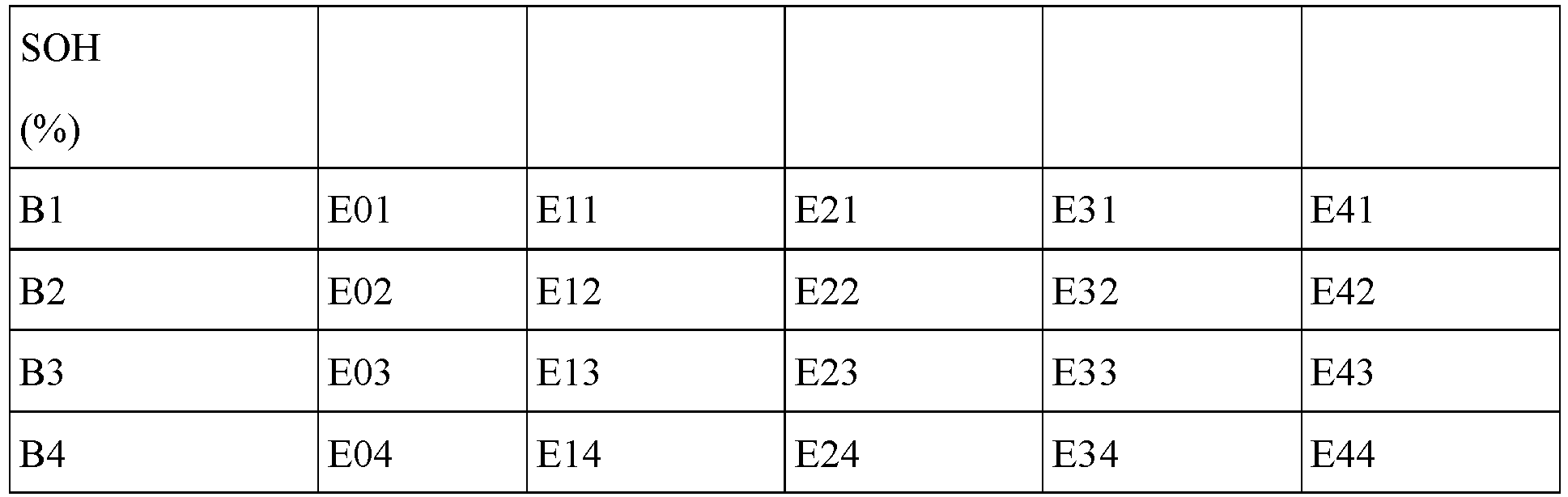
- The correspondence relationship between the capacity, the mileage c and the SOH can be obtained by an off-line calibration test. As shown in Table 2, each value or value range in the first row of Table 2 represents a different mileage, and Bt in the first column of Table 2 represents a different SOH. t is an integer greater than or equal to 1 and less than or equal to 4. Ejk represents a capacity value, j is an integer greater than or equal to 0, and k is an integer greater than or equal to 1. That is, for any SOH and any c, they together correspond to a capacity value. It should be noted that the number of SOHs and the number of mileages in Table 2 are only schematic, and the number of SOHs and the number of mileages in the fourth correspondence relationship can be adjusted according to actual requirements.
- In the preset fourth correspondence relationship, under a condition that the SOH is constant, the higher the mileage is, the smaller the corresponding capacity value is. In the preset fourth correspondence relationship, under a condition that the mileage is constant, the lower the SOH is, the smaller the corresponding capacity value is. That is, as the aging state of the battery becomes gradually serious, the chargeable capacity upper-limit value of the battery can be reduced, so as to avoid overcharging the battery and improve the use safety of the battery.
- In some other embodiments, in the preset fourth correspondence relationship, the mileage c may also correspond to a mileage segment.
- In the embodiment of the present application, the obtained actual SOH can be matched with each SOH in the fourth correspondence relationship in Table 2, to find a SOH matching the actual SOH of the battery in the correspondence relationship. As an example, under a condition that an absolute value of a difference between the actual SOH of the battery and a certain SOH in the correspondence relationship is less than or equal to a preset SOH difference threshold, it can be considered that the actual SOH of the battery matches the SOH in the correspondence relationship .
- Then, the obtained accumulated mileage of the electric vehicle is matched with each mileage in the fourth correspondence relationship in Table 2.
- In an example, under a condition that each mileage in the fourth correspondence relationship in Table 2 is a mileage segment, the mileage segment into which the accumulated mileage of the electric vehicle falls is used as the matching mileage. As shown in Table 2, under a condition that S1 is 10000 kilometers and the accumulated mileage of the electric vehicle is 5000 kilometers, the mileage matching the accumulated mileage of the electric vehicle in Table 2 is a mileage segment less than S1.
- In another example, under a condition that each mileage in the fourth correspondence relationship in Table 2 is a specific mileage value, the mileage in the correspondence relationship (for the mileage, an absolute value of a difference between the specific mileage value and the accumulated mileage of the electric vehicle is less than a preset mileage difference threshold) is used as the mileage matching the accumulated mileage of the electric vehicle.
- In yet another example, under a condition that each mileage in the fourth correspondence relationship in Table 2 is a specific mileage value, two successive mileage values nearest the accumulated mileage of the electric vehicle in the correspondence relationship are used as the mileages matching the accumulated mileage of the electric vehicle. For example, under a condition that S2 is 20000 kilometers, S3 is 30000 kilometers, and the accumulated mileage of the electric vehicle is 25000 kilometers, S2 and S3 are the mileages matching the accumulated mileage of the electric vehicle.
- Finally, the chargeable capacity upper-limit value of the battery is obtained based on a capacity value corresponding to both of the SOH matching the actual SOH of the battery and the mileage matching the accumulated mileage of the electric vehicle in the fourth correspondence relationship in Table 2.
- In some embodiments of the present application, under a condition that the mileage matching the accumulated mileage of the electric vehicle is a mileage value or a mileage segment, a capacity value corresponding to both of the mileage matching the accumulated mileage of the electric vehicle and the SOH matching the actual SOH of the battery can be used as the chargeable capacity upper-limit value of the battery.
- In some embodiments of the present application, under a condition that the mileages matching the accumulated mileage of the electric vehicle are two successive mileage values nearest the mileage value, the chargeable capacity upper-limit value of the battery can be calculated based on the two mileage values and two capacity values respectively corresponding to both of a respective one of the two mileage values and the SOH matching the actual SOH of the battery.
- As an example, under a condition that the accumulated mileage S0 of the electric vehicle is greater than S2 and less than S3, the mileages matching the accumulated mileage S0 of the electric vehicle are S2 and S3. The SOH matching the actual SOH of the battery is 90% in Table 2. In Table 2, the capacity value corresponding to both of S2 and 90% is E23, and the capacity value corresponding to both of S3 and 90% is E33. Then the chargeable capacity upper-limit value C0 of the battery can be calculated based on the following formula:

- It should be noted that, in the preset correspondence relationship between the first capacity and the second capacity and the mileage, the mileage can be a value or a mileage segment. Under a condition that the mileages matching the accumulated mileage of the electric vehicle are two successive mileage values nearest the mileage value, the chargeable capacity upper-limit value of the battery is calculated based on the two mileage values and two first capacity values respectively corresponding to both of a respective one of the two mileage values and the second capacity matching the actual capacity value of the battery. The specific calculation method may refer to formula (1). Details are not described herein again.
- After S101, the battery
charging control method 100 may further include S103. - In S103, the threshold value of the charging parameter of the battery is determined based on the actual capacity value and the chargeable capacity upper-limit value of the battery.
- In some embodiments of the present application, the charging parameter is a charging SOC, and correspondingly, the threshold value of the charging parameter includes a charging SOC threshold value.
- S103 may include S1301.
- In S1301, a ratio of the chargeable capacity upper-limit value to the actual capacity value is used as the charging SOC threshold value of the battery.
- Under a condition that the obtained charging SOC of the battery is greater than or equal to the charging SOC threshold value, a control command of stopping charging the battery is sent, to stop charging the battery, so as to improve the safety of the battery.
- In some embodiments of the present application, a range of the threshold value of the charging SOC is [30%, 100%].
- In some other embodiments of the present application, the charging parameter is a charging voltage, and correspondingly, the threshold value of the charging parameter includes a charging voltage threshold value.
- In this case, step S103 not only includes S1301, but also may include S1303.
- In S1303, the charging voltage threshold value of the battery is determined based on the charging SOC threshold value, an obtained current temperature of the battery and a first correspondence relationship, wherein the first correspondence relationship is a correspondence relationship between a voltage and a first parameter, and the first parameter includes a temperature and a SOC.
- The first correspondence relationship can be obtained by an off-line calibration test during normal charging of the battery.
- As an example, Table 3 shows a schematic diagram of a preset first correspondence relationship provided according to an embodiment of the present application.

- As shown in Table 3, Cq in the first row of Table 3 is a different SOC, and q is an integer greater than or equal to 1 and less than or equal to 4. Tp in the first column of Table 3 represents a different temperature, and p is an integer greater than or equal to 1 and less than or equal to 5. Ah in Table 3 represents a different voltage value, and h is an integer greater than or equal to 1. For any SOC and any temperature, they together correspond to a voltage value. It should be noted that the number of SOCs and the number of temperatures in Table 3 are only schematic, and the number of SOCs and the number of temperatures in the first correspondence relationship can be adjusted according to actual requirements.
- In the first correspondence relationship, under a condition that the temperature is constant, the voltage gradually decreases as the SOC decreases, thereby reducing the charging cut-off voltage of the battery as the degree of aging becomes serious, such that the use safety of the battery is improved.
- As an example, under a condition that the battery is a high-nickel ternary lithium-ion positive electrode material (NCM) battery, the range of each voltage value in Table 3 is [3.6V, 4.3V].
- After the charging SOC threshold value of the battery is obtained, the charging SOC threshold value is matched with each SOC in the correspondence relationship in Table 3, to find a SOC matching the charging SOC threshold value in the correspondence relationship in Table 3. As an example, in the preset first correspondence relationship, the SOC (for the SOC, an absolute value of a difference between the SOC and the charging SOC threshold value is less than or equal to the preset SOC threshold value) can be the SOC matching the charging SOC threshold value.
- After the current temperature of the battery is obtained, the current temperature of the battery is matched with each temperature in the correspondence relationship in Table 3, to find a temperature matching the current temperature of the battery in the correspondence relationship in Table 3. As an example, in the preset first correspondence relationship, the temperature (for the temperature, a difference between the temperature the current temperature of the battery is less than or equal to the preset temperature threshold value) can be the temperature matching the current temperature of the battery.
- Next, a voltage value corresponding to both of the temperature matching the current temperature of the battery and the SOC matching the charging SOC threshold value in Table 3 is used as the charging cut-off voltage of the battery.
- Under a condition that the obtained charging voltage of the battery is greater than or equal to the charging voltage threshold value, a control command of stopping charging the battery is sent to improve the use safety of the battery and prolong the service life of the battery.
- In still some other embodiments of the present application, the charging parameter includes a charging voltage and a charging SOC, and correspondingly, the threshold value of the charging parameter includes a charging SOC threshold value and a charging voltage threshold value.
- In this case, S103 may also include S1031 to S1303, the specific implementation can be referred to the above description, and details are not described herein again.
- Under this application scenario, under a condition that the obtained charging voltage of the battery is greater than or equal to the charging voltage threshold value and the obtained charging SOC is greater than or equal to the charging SOC threshold value, a control command of stopping charging the battery is sent to improve the use safety of the battery and prolong the service life of the battery.
- Taking a battery with a nominal capacity of 100 Ah and an operating vehicle warranty of 300000 kilometers in 3 years as an example, the specific implementation process of the battery charging control method provided according to the embodiments of the present application is described below.
- Under a condition that the accumulated charge capacity of the battery from the factory until now is 150000 Ah, it can be determined that the actual capacity of the battery is 70 Ah based on a preset correspondence relationship between a charge capacity and an actual capacity. Based on the actual capacity value of the battery and the nominal capacity of the battery, it can be obtained that the actual SOH of the battery is 70%.
- Under a condition that the accumulated mileage of the electric vehicle is 350000 kilometers, it can be determined that the chargeable capacity upper-limit value of the battery is 55 Ah based on a preset correspondence relationship between a capacity value and a mileage and SOH.
- Based on the actual SOH of the battery and the chargeable capacity upper-limit value of the battery, it can be calculated that the charging SOC threshold value of the battery is equal to 55Ah/70Ah = 78.6%.
- In some exemplary embodiments, it can be determined that the charging voltage threshold value of the battery is 3.9 V based on the charging SOC threshold value of the battery, the current temperature of the battery, and the preset first correspondence relationship.
- During charging of the battery, under a condition that the SOC calculated by a SOC module reaches the charging SOC threshold value 78.6%, and/or the voltage of the battery reaches 3.9 V, the charging of the battery is stopped.
- In the embodiment of the present application, from the time the battery leaves the factory to the final life of the battery, as the aging state of the battery becomes gradually serious, in order to improve the use safety of the battery, the charging SOC threshold value of the battery shows a gradual decrease trend, and the charging cut-off voltage of the battery also shows a gradual decrease trend.
-
Fig. 2 shows a schematic structural diagram of a battery charging control apparatus provided according to an embodiment of the present application. As shown inFig. 2 , the battery chargingcontrol apparatus 200 includes: - a first obtaining
module 210 configured to obtain, based on a received charging request, a threshold value and an initial value of a charging parameter of a battery, wherein the threshold value of the charging parameter is determined based on an actual capacity value of the battery and an accumulated mileage of an electric vehicle where the battery is located; - a first control
command sending module 220 configured to send, under a condition that the initial value of the charging parameter is less than the threshold value of the charging parameter, a control command of charging the battery, so as to charge the battery; - a second obtaining
module 230 configured to obtain a value of the charging parameter of the battery in real time during the charging of the battery; and - a second control
command sending module 240 configured to send, under a condition that the obtained value of the charging parameter of the battery is greater than or equal to the threshold value of the charging parameter, a control command of stopping charging the battery, so as to stop charging. - In the embodiment of the present application, the battery charging
control apparatus 200 may further include: - a chargeable capacity upper-limit value determination module configured to determine a chargeable capacity upper-limit value of the battery based on the actual capacity value of the battery and the accumulated mileage; and
- a charging parameter threshold value determination module configured to determine the threshold value of the charging parameter based on the actual capacity value and the chargeable capacity upper-limit value.
- In the embodiment of the present application, the charging parameter may be a state of charge (SOC), and correspondingly, the threshold value of the charging parameter includes a charging SOC threshold value, then the charging parameter threshold value determination module is configured to use a ratio of the chargeable capacity upper-limit value to the actual capacity value as the charging SOC threshold value of the battery.
- In the embodiment of the present application, the charging parameter may be a charging voltage, and correspondingly, the threshold value of the charging parameter includes a charging voltage threshold value, then the charging parameter threshold value determination module can be configured to:
- use a ratio of the chargeable capacity upper-limit value to the actual capacity value as a charging SOC threshold value of the battery; and
- determine the charging voltage threshold value of the battery based on the charging SOC threshold value, an obtained current temperature of the battery and a preset first correspondence relationship, wherein the first correspondence relationship is a correspondence relationship between a voltage and a first parameter, and the first parameter includes a temperature and a SOC.
- In the embodiment of the present application, the charging parameter includes a charging voltage and a charging SOC, and correspondingly, the threshold of the charging parameter may include a charging SOC threshold value and a charging voltage threshold value, then the charging parameter threshold value determination module can be configured to:
- use a ratio of the chargeable capacity upper-limit value to the actual capacity value as the charging SOC threshold value of the battery; and
- determine the charging voltage threshold value of the battery based on the charging SOC threshold value, an obtained current temperature of the battery and a preset first correspondence relationship, wherein the first correspondence relationship is a correspondence relationship between a voltage and a first parameter, and the first parameter includes a temperature and a SOC.
- In the embodiment of the present application, the actual capacity value can be determined based on an accumulated charge/discharge capacity value of the battery, and the accumulated charge/discharge capacity value of the battery may be any one of:
- an accumulated converted charge capacity value of the battery, an accumulated converted discharge capacity value of the battery, and a sum of the accumulated converted charge capacity value of the battery and the accumulated converted discharge capacity value of the battery;
- wherein the converted charge capacity value of the battery is a product of a charge capacity value of the battery and a conversion coefficient corresponding to a charging temperature of the battery, and the converted discharge capacity value of the battery is a product of a discharge capacity value of the battery and a conversion coefficient corresponding to a discharging temperature of the battery;
- wherein the conversion coefficient corresponding to the charging temperature of the battery is determined based on the charging temperature of the battery and a preset correspondence relationship between a temperature and the conversion coefficient, and the conversion coefficient corresponding to the discharging temperature of the battery is determined based on the discharging temperature of the battery and a preset correspondence relationship between a temperature and the conversion coefficient.
- In the embodiment of the present application, the actual capacity value is determined based on the accumulated mileage and a preset second correspondence relationship, wherein the second correspondence relationship is a correspondence relationship between a mileage and a capacity.
- In the embodiment of the present application, the chargeable capacity upper-limit value determination module can be configured to:
determine the chargeable capacity upper-limit value of the battery based on the actual capacity value of the battery, the accumulated mileage, and a preset third correspondence relationship, wherein the third correspondence relationship is a correspondence relationship between a first capacity and a second parameter, and the second parameter includes a second capacity and a mileage. - In the embodiment of the present application, the chargeable capacity upper-limit value determination module may include:
- an actual SOH determination unit configured to determine an actual state of health (SOH) of the battery based on the actual capacity value of the battery; and
- a chargeable capacity upper-limit value determination unit configured to determine the chargeable capacity upper-limit value of the battery based on the actual SOH and the accumulated mileage.
- In the embodiment of the present application, the chargeable capacity upper-limit value determination unit can be configured to:
determine the chargeable capacity upper-limit value of the battery based on the actual SOH, the accumulated mileage and a preset fourth correspondence relationship, wherein the fourth correspondence relationship is a correspondence relationship between a capacity and a third parameter, and the third parameter includes a mileage and a SOH. - In the embodiment of the present application, a threshold value of a charging parameter of a battery is dynamically determined based on an actual capacity value of the battery and an accumulated mileage of an electric vehicle where the battery is located, which implement dynamic calculation of the threshold value of the charging parameter according to an aging state of the battery. During charging of the battery, under a condition that the obtained value of the charging parameter of the battery is greater than the latest calculated threshold value of the charging parameter, the charging of the battery is stopped. By determining the threshold value of the charging parameter of the battery in consideration with the aging state of the battery, the use safety of the battery is improved.
- Other details of the battery charging control apparatus according to the embodiment of the present application are similar to those of the method according to the embodiment of the present application described above in conjunction with
Fig. 1 , and will not be repeated here. The battery charging control method and apparatus according to the embodiments of the present application described in conjunction withFigs. 1 to 2 can be implemented by a battery management system for a battery.Fig. 3 is a schematic diagram showing ahardware structure 300 of a battery management system according to an embodiment of the invention. As shown inFig. 3 , thebattery management system 300 in this embodiment includes aprocessor 301, amemory 302, a communication interface 303, and a bus 310. Theprocessor 301, thememory 302, and the communication interface 303 are connected by the bus 310 and complete communication with each other. - Specifically, the
processor 301 may include a central processing unit (CPU) or an application specific integrated circuit (ASIC), or may be configured to implement one or more integrated circuits according to the embodiments of the present application. - The
memory 302 may include a mass memory for data or instructions. By way of example and without limitation, thememory 302 may include a hard disk drive (HDD), a floppy disk drive, a flash memory, an optical disk, a magneto-optical disk, a magnetic tape, or a universal serial bus (USB) drive, or a combination of two or more thereof. Where appropriate, thememory 302 may include removable or non-removable (or fixed) media. Where appropriate, thememory 302 may be internal or external to thebattery management system 300. In a particular embodiment, thememory 302 is a non-volatile solid state memory. In a particular embodiment, thememory 302 includes a read-only memory (ROM). Where appropriate, the ROM may be a mask-programmed ROM, a programmable ROM (PROM), an erasable PROM (EPROM), an electrically erasable PROM (EEPROM), an electrically alterable ROM (EAROM), or a flash memory, or a combination of two or more thereof. - The communication interface 303 is mainly configured to implement communication between various modules, apparatuses, units, and/or devices in the embodiments of the present application.
- The bus 310 includes hardware, software, or both, and couples the components of the
battery management system 300 together. By way of example and without limitation, the bus may include an accelerated graphics port (AGP), or other graphics bus, enhanced industry standard architecture (EISA) bus, front side bus (FSB), hypertransport (HT) interconnect, industry standard architecture (ISA) bus, infinite bandwidth interconnect, low pin count (LPC) bus, memory bus, micro channel architecture (MCA) bus, peripheral component interconnect (PCI) bus, PCI-Express (PCI-X) bus, serial advanced technology attachment (SATA) bus, video electronics standards association local (VLB) bus, or other suitable bus, or a combination of two or more thereof. Where appropriate, the bus 310 may include one or more buses. Although the embodiment of the present application describes and shows a specific bus, the present application considers any suitable bus or interconnect. - That is, the
battery management system 300 shown inFig. 3 may be implemented as including aprocessor 301, amemory 302, a communication interface 303, and a bus 310. Theprocessor 301, thememory 302, and the communication interface 303 are connected by the bus 310 and complete communication with each other. Thememory 302 is configured to store program codes; theprocessor 301 runs a program corresponding to the executable program codes by reading the executable program codes stored in thememory 302, to execute the battery charging control method in any embodiment of the present application, so as to implement the battery charging control method and apparatus described in conjunction withFig. 1 and Fig. 2 . - An embodiment of the present application further provides a computer storage medium having computer program instructions stored thereon, wherein the computer program instructions, when executed by a processor, implement the battery charging control method according to any embodiment of the present application. Examples of the computer storage medium include non-transitory computer storage media, such as an electronic circuit, a semiconductor memory device, an ROM, a flash memory, an erasable ROM (EROM), a floppy disk, a CD-ROM, an optical disk, and a hard disk.
- It should be clear that the present application is not limited to the specific configuration and processing described above and shown in the figures. For the sake of brevity, detailed descriptions of known methods are omitted here. In the above embodiments, a plurality of specific steps are described and shown as examples. However, the method process of the present application is not limited to the specific steps described and shown. After understanding the present application, a person skilled in the art can make various changes, modifications and additions, or change the order between the steps.
- The functional blocks shown in the above structural block diagram can be implemented as hardware, software, firmware, or a combination thereof. When implemented in hardware, the functional blocks can be, for example, an electronic circuit, an application-specific integrated circuit (ASIC), appropriate firmware, plug-ins, function cards, etc. When implemented in software, the elements of the present application are programs or code segments used to perform required tasks. The programs or code segments can be stored in a machine-readable medium, or transmitted over a transmission medium or communication link through data signals carried in carrier waves. The "machine-readable medium" may include any medium that can store or transmit information. Examples of the machine-readable medium include an electronic circuit, a semiconductor memory device, an ROM, a flash memory, an erasable ROM (EROM), a floppy disk, a CD-ROM, an optical disk, a hard disk, an optical fiber medium, a radio frequency (RF) link, etc. The code segments can be downloaded via a computer network such as the Internet and Intranet. These programs or code segments can be provided to a processor of a general-purpose computer, a special-purpose computer, or other programmable data processing device, to produce a machine that enables instructions executed by the processor of the computer or other programmable data processing device to implement the functions/operations specified in one or more blocks of the flowcharts and/or block diagrams. Such a processor may be, but not limited to, a general-purpose processor, a dedicated processor, a special application processor, or a field programmable logic circuit.
- It should be noted that the exemplary embodiments mentioned in the present invention describe some methods or systems based on a series of steps or devices. However, the present invention is not limited to the order of the above steps, that is, the steps may be performed in the order mentioned in the embodiment or in an order different from that in the embodiment, or several steps may be performed at the same time.
Claims (13)
- A battery charging control method (100), characterized by comprising:obtaining (S1 10), based on a received charging request, a threshold value and an initial value of a charging parameter of a battery, wherein the threshold value of the charging parameter is determined based on an actual capacity value of the battery and an accumulated mileage of an electric vehicle where the battery is located, and the charging parameter comprises at least one of a charging state of charge (SOC) and a charging voltage;sending (S120), under a condition that the initial value of the charging parameter is less than the threshold value of the charging parameter, a control command of charging the battery, so as to charge the battery;obtaining (S130) a value of the charging parameter of the battery in real time during the charging of the battery;sending (S140), under a condition that the obtained value of the charging parameter of the battery is greater than or equal to the threshold value of the charging parameter, a control command of stopping charging the battery, so as to stop charging.
- The method (100) according to claim 1, wherein before obtaining (S110), based on a received charging request, a threshold value and an initial value of a charging parameter of a battery, the method (100) further comprises:determining a chargeable capacity upper-limit value of the battery based on the actual capacity value of the battery and the accumulated mileage;determining the threshold value of the charging parameter based on the actual capacity value and the chargeable capacity upper-limit value.
- The method (100) according to claim 2, wherein the charging parameter is a charging state of charge (SOC), and the threshold value of the charging parameter comprises a charging SOC threshold value;
wherein determining the threshold value of the charging parameter based on the actual capacity value and the chargeable capacity upper-limit value comprises:
using a ratio of the chargeable capacity upper-limit value to the actual capacity value as the charging SOC threshold value of the battery. - The method (100) according to claim 2, wherein the charging parameter is a charging voltage, and correspondingly, the threshold value of the charging parameter comprises a charging voltage threshold value;
wherein determining the threshold value of the charging parameter based on the actual capacity value and the chargeable capacity upper-limit value comprises:using a ratio of the chargeable capacity upper-limit value to the actual capacity value as a charging SOC threshold value of the battery;determining the charging voltage threshold value of the battery based on the charging SOC threshold value, an obtained current temperature of the battery, and a preset first correspondence relationship,wherein the first correspondence relationship is a correspondence relationship between a voltage and a first parameter, and the first parameter comprises a temperature and a SOC. - The method (100) according to claim 2, wherein the charging parameter comprises a charging voltage and a charging SOC, and the threshold value of the charging parameter comprises a charging SOC threshold value and a charging voltage threshold value;
wherein determining the threshold value of the charging parameter based on the actual capacity value and the chargeable capacity upper-limit value comprises:using a ratio of the chargeable capacity upper-limit value to the actual capacity value as the charging SOC threshold value of the battery;determining the charging voltage threshold value of the battery based on the charging SOC threshold value, an obtained current temperature of the battery, and a preset first correspondence relationship,wherein the first correspondence relationship is a correspondence relationship between a voltage and a first parameter, and the first parameter comprises a temperature and a SOC. - The method (100) according to claim 1, wherein the actual capacity value is determined based on an accumulated charge/discharge capacity value of the battery,
the accumulated charge/discharge capacity value of the battery is any one of:an accumulated converted charge capacity value of the battery, an accumulated converted discharge capacity value of the battery, and a sum of the accumulated converted charge capacity value of the battery and the accumulated converted discharge capacity value of the battery,the converted charge capacity value of the battery is a product of a charge capacity value of the battery and a conversion coefficient corresponding to a charging temperature of the battery, and the conversion coefficient corresponding to the charging temperature of the battery is determined based on the charging temperature of the battery and a preset correspondence relationship between a temperature and the conversion coefficient;the converted discharge capacity value of the battery is a product of a discharge capacity value of the battery and a conversion coefficient corresponding to a discharging temperature of the battery, and the conversion coefficient corresponding to the discharging temperature of the battery is determined based on the discharging temperature of the battery and the preset correspondence relationship between the temperature and the conversion coefficient. - The method (100) according to claim 1, wherein the actual capacity value is determined based on the accumulated mileage and a preset second correspondence relationship,
the second correspondence relationship is a correspondence relationship between a mileage and a capacity. - The method (100) according to claim 2, wherein determining a chargeable capacity upper-limit value of the battery based on the actual capacity value of the battery and the accumulated mileage comprises:determining the chargeable capacity upper-limit value of the battery based on the actual capacity value of the battery, the accumulated mileage, and a preset third correspondence relationship,wherein the third correspondence relationship is a correspondence relationship between a first capacity and a second parameter, and the second parameter comprises a second capacity and a mileage.
- The method (100) according to claim 2, wherein determining a chargeable capacity upper-limit value of the battery based on the actual capacity value of the battery and the accumulated mileage comprises:determining an actual state of health (SOH) of the battery based on the actual capacity value of the battery;determining the chargeable capacity upper-limit value of the battery based on the actual SOH and the accumulated mileage.
- The method (100) according to claim 9, wherein determining the chargeable capacity upper-limit value of the battery based on the actual SOH and the accumulated mileage comprises:determining the chargeable capacity upper-limit value of the battery based on the actual SOH, the accumulated mileage, and a preset fourth correspondence relationship,wherein the fourth correspondence relationship is a correspondence relationship between a capacity and a third parameter, and the third parameter comprises a mileage and a SOH.
- A battery charging control apparatus (200), characterized by comprising:a first obtaining module (210) configured to obtain, based on a received charging request, a threshold value and an initial value of a charging parameter of a battery, wherein the threshold value of the charging parameter is determined based on an actual capacity value of the battery and an accumulated mileage of an electric vehicle where the battery is located, and the charging parameter comprises at least one of a charging state of charge (SOC) and a charging voltage;a first control command sending module (220) configured to send, under a condition that the initial value of the charging parameter is less than the threshold value of the charging parameter, a control command of charging the battery, so as to charge the battery;a second obtaining module (230) configured to obtain a value of the charging parameter of the battery in real time during the charging of the battery;a second control command sending module (240) configured to send, under a condition that the obtained value of the charging parameter of the battery is greater than or equal to the threshold value of the charging parameter, a control command of stopping charging the battery, so as to stop charging.
- A battery management system, comprising: a processor and a memory storing computer program instructions,
wherein the processor, when executes the computer program instructions, implements the battery charging control method (100) according to any one of claims 1-10. - A computer storage medium having computer program instructions stored thereon, wherein the computer program instructions, when executed by a processor, implement the battery charging control method (100) according to any one of claims 1-10.
Applications Claiming Priority (2)
| Application Number | Priority Date | Filing Date | Title |
|---|---|---|---|
| CN202010328925.4A CN113547955B (en) | 2020-04-23 | 2020-04-23 | Battery charging control method, device, battery management system and medium |
| PCT/CN2020/132901 WO2021212837A1 (en) | 2020-04-23 | 2020-11-30 | Battery charging control method and device, and battery management system and medium |
Publications (3)
| Publication Number | Publication Date |
|---|---|
| EP3919319A1 EP3919319A1 (en) | 2021-12-08 |
| EP3919319A4 EP3919319A4 (en) | 2022-06-08 |
| EP3919319B1 true EP3919319B1 (en) | 2023-08-23 |
Family
ID=78101158
Family Applications (1)
| Application Number | Title | Priority Date | Filing Date |
|---|---|---|---|
| EP20920763.8A Active EP3919319B1 (en) | 2020-04-23 | 2020-11-30 | Battery charging control method and device, and battery management system and medium |
Country Status (7)
| Country | Link |
|---|---|
| US (1) | US11437838B2 (en) |
| EP (1) | EP3919319B1 (en) |
| JP (1) | JP7210809B2 (en) |
| KR (1) | KR102510346B1 (en) |
| CN (1) | CN113547955B (en) |
| ES (1) | ES2957114T3 (en) |
| WO (1) | WO2021212837A1 (en) |
Families Citing this family (20)
| Publication number | Priority date | Publication date | Assignee | Title |
|---|---|---|---|---|
| CN112311038B (en) * | 2019-07-31 | 2023-04-18 | 荣耀终端有限公司 | Charging and discharging protection circuit, terminal equipment and battery discharging control method |
| EP3859870A4 (en) * | 2019-10-21 | 2022-06-15 | Ningde Amperex Technology Ltd. | CHARGING PROCESS, ELECTRONIC DEVICE AND STORAGE MEDIA |
| JP7456900B2 (en) * | 2020-09-15 | 2024-03-27 | 本田技研工業株式会社 | Power management device and power management system |
| KR102913839B1 (en) * | 2021-09-08 | 2026-01-16 | 컨템포러리 엠퍼렉스 테크놀로지 (홍콩) 리미티드 | Power Battery Charging Method and Battery Management System |
| EP4231483A4 (en) * | 2021-09-08 | 2024-04-10 | Contemporary Amperex Technology Co., Limited | BATTERY CHARGING PROCEDURE AND BATTERY MANAGEMENT SYSTEM |
| SE545706C2 (en) * | 2022-03-29 | 2023-12-12 | Scania Cv Ab | Method for charging a maintenance battery by a propulsion battery |
| CN116923190A (en) * | 2022-04-01 | 2023-10-24 | 威马智慧出行科技(上海)股份有限公司 | Charging management method, device and equipment for electric automobile |
| DE102022203773A1 (en) * | 2022-04-14 | 2023-10-19 | Andreas Stihl Ag & Co. Kg | Method and system for determining at least one usage parameter for at least one battery pack for using a charging device for charging user-replaceable battery packs for driving at least one mobile device |
| CN114851866A (en) * | 2022-05-16 | 2022-08-05 | 合创汽车科技有限公司 | Storage battery power supplementing method and device, vehicle control unit and storage medium |
| CN115257449B (en) * | 2022-08-08 | 2024-09-10 | 中联重科股份有限公司 | A charging control method and system for a mixer truck |
| CN115534756B (en) * | 2022-08-30 | 2024-08-23 | 重庆长安新能源汽车科技有限公司 | Method, system, equipment and medium for identifying abnormal endurance mileage of electric automobile |
| CN115593271A (en) * | 2022-11-03 | 2023-01-13 | 合众新能源汽车有限公司(Cn) | Charging control method, computer device, and storage medium |
| CN116593909B (en) * | 2023-05-06 | 2026-04-17 | 福建星云电子股份有限公司 | A method, system, device and medium for calculating battery SOC |
| CN116315185B (en) * | 2023-05-12 | 2023-10-20 | 荣耀终端有限公司 | Electronic device and battery management method |
| TWI867725B (en) * | 2023-08-31 | 2024-12-21 | 華碩電腦股份有限公司 | Electronic device and battery management method thereof |
| CN119911161B (en) * | 2023-10-31 | 2025-11-07 | 北京车和家汽车科技有限公司 | Battery thermal management strategy determination methods, devices, equipment, media and vehicles |
| KR20250074738A (en) | 2023-11-20 | 2025-05-28 | 주식회사 엘지에너지솔루션 | Apparatus and method of controlling battery charging |
| CN117674365B (en) * | 2023-12-14 | 2024-08-06 | 深圳市助尔达电子科技有限公司 | Battery life cycle management system |
| CN119017957A (en) * | 2024-08-13 | 2024-11-26 | 北京新能源汽车股份有限公司 | Charging control method, device, vehicle, storage medium and program product |
| CN119749347B (en) * | 2025-03-05 | 2025-07-22 | 宁德时代新能源科技股份有限公司 | Battery SOC regulation method, device, equipment, medium and program product |
Family Cites Families (54)
| Publication number | Priority date | Publication date | Assignee | Title |
|---|---|---|---|---|
| US5515087A (en) * | 1993-12-02 | 1996-05-07 | Hewlett-Packard Company | Remaining battery capacity determination method and apparatus |
| JP3161215B2 (en) * | 1994-03-15 | 2001-04-25 | 日産自動車株式会社 | Rechargeable battery charge / discharge control device |
| JPH09191505A (en) * | 1995-12-28 | 1997-07-22 | Yazaki Corp | Driving distance calculation device for electric vehicles |
| US8536825B2 (en) * | 2009-12-31 | 2013-09-17 | Tesla Motors, Inc. | State of charge range |
| KR101065551B1 (en) * | 2010-01-08 | 2011-09-19 | 주식회사 엘지화학 | Battery capacity estimation device and method |
| CN101752892A (en) * | 2010-02-10 | 2010-06-23 | 江西伏沃特蓄电池有限公司 | Fast charging method of storage battery |
| JP5782803B2 (en) * | 2010-06-03 | 2015-09-24 | 日産自動車株式会社 | Battery charging device and battery charging method |
| US8332096B2 (en) * | 2010-06-17 | 2012-12-11 | GM Global Technology Operations LLC | Method and a system for providing a driving-range forecast for a vehicle |
| CN102299529B (en) * | 2010-06-25 | 2014-04-02 | 凹凸电子(武汉)有限公司 | Battery pack management system, electric vehicle and battery pack management method |
| KR101154308B1 (en) * | 2010-12-03 | 2012-06-13 | 기아자동차주식회사 | Estimation method of remaining distance of electric vehicle |
| JP2013222642A (en) | 2012-04-18 | 2013-10-28 | Sanyo Electric Co Ltd | Charge/discharge control device, charger, battery, moving body, and electronic apparatus |
| CN103730702B (en) * | 2012-10-12 | 2016-01-13 | 北汽福田汽车股份有限公司 | A kind of car lithium battery charging method of electric automobile |
| CN103107575B (en) * | 2013-01-18 | 2015-07-29 | 华为终端有限公司 | Charging method, mobile device, charging device and charging system |
| KR101800287B1 (en) * | 2013-01-21 | 2017-11-23 | 주식회사 케이티 | Method and system of management for checking out sharing-EV(electric vehicle) |
| US10393813B2 (en) * | 2013-08-27 | 2019-08-27 | The Regents Of The University Of Michigan | On-board state of health monitoring of batteries using incremental capacity analysis |
| WO2016031075A1 (en) | 2014-08-29 | 2016-03-03 | 日産自動車株式会社 | Secondary battery charging system and charging method |
| KR101684092B1 (en) * | 2015-04-08 | 2016-12-07 | 현대자동차주식회사 | Apparatus and Method for caculating degradation degree |
| US10005372B2 (en) * | 2016-02-23 | 2018-06-26 | Ford Global Technologies, Llc | Virtual assessment of battery state of health in electrified vehicles |
| KR101916511B1 (en) * | 2016-05-16 | 2018-11-07 | 현대자동차주식회사 | Vehicle system and battery charging method thereof |
| DE112016006782T5 (en) * | 2016-05-25 | 2019-01-24 | Ford Global Technologies, Llc | Methods and devices for charging electric vehicles |
| CN108336431B (en) * | 2017-01-19 | 2020-07-14 | 宁德时代新能源科技股份有限公司 | Charging control method, device and system for battery module |
| KR102405005B1 (en) * | 2017-04-14 | 2022-06-07 | 삼성전자주식회사 | Electronic apparatus for changing state of charging battery according to state of battery |
| US10343673B2 (en) * | 2017-06-27 | 2019-07-09 | Gm Global Technology Operations Llc. | Method and apparatus for controlling a hybrid powertrain system |
| CN107359376B (en) | 2017-06-30 | 2020-06-23 | 宁德时代新能源科技股份有限公司 | Battery charging method, device and device |
| CN107359378B (en) | 2017-06-30 | 2019-08-09 | 宁德时代新能源科技股份有限公司 | Battery charging method, device and equipment |
| CN108297877B (en) * | 2017-10-10 | 2019-08-13 | 腾讯科技(深圳)有限公司 | Control method for vehicle, system and device |
| CN109671997B (en) | 2017-10-13 | 2021-10-19 | 神讯电脑(昆山)有限公司 | Electronic device and charging method |
| CN108099860A (en) * | 2017-12-28 | 2018-06-01 | 浙江硕维新能源技术有限公司 | A kind of electric vehicle, which fills, replaces electric power station system and its control method |
| US11391597B2 (en) * | 2018-06-18 | 2022-07-19 | Chargeway Inc. | Displaying charging options for an electric vehicle |
| CN110896356B (en) * | 2018-09-12 | 2021-02-02 | 宁德时代新能源科技股份有限公司 | Battery management system and communication method in the system |
| CN110896233B (en) * | 2018-09-12 | 2021-07-30 | 宁德时代新能源科技股份有限公司 | battery management system |
| US10852340B2 (en) * | 2018-11-20 | 2020-12-01 | GM Global Technology Operations LLC | Vehicle electronics high-resistance fault detection and isolation |
| CN110970688B (en) * | 2018-11-30 | 2020-12-29 | 宁德时代新能源科技股份有限公司 | Battery heating system and method |
| CN111257752B (en) * | 2018-11-30 | 2021-02-26 | 宁德时代新能源科技股份有限公司 | Remaining charging time estimation method, device, system and storage medium |
| CN111251928B (en) * | 2018-11-30 | 2021-11-23 | 宁德时代新能源科技股份有限公司 | Charging method, charging device, charging equipment, charging medium, battery management system and charging pile |
| CN111376790A (en) * | 2018-12-28 | 2020-07-07 | 观致汽车有限公司 | Method, apparatus, device and medium for determining a mileage of a vehicle |
| CN112706657B (en) * | 2018-12-29 | 2022-12-23 | 宁德时代新能源科技股份有限公司 | Control method, battery management module, motor controller and medium |
| CN110046753B (en) * | 2019-03-29 | 2020-08-28 | 江苏大学 | An optimal construction quantity and site selection scheme planning method for electric vehicle charging stations |
| CN110970964B (en) * | 2019-04-24 | 2021-01-05 | 宁德时代新能源科技股份有限公司 | Battery pack balance control method, device, equipment and medium |
| CN110988690B (en) * | 2019-04-25 | 2021-03-09 | 宁德时代新能源科技股份有限公司 | Battery state of health correction method, device, management system and storage medium |
| CN110988702B (en) * | 2019-04-25 | 2021-04-02 | 宁德时代新能源科技股份有限公司 | Method, device, management system and storage medium for determining available battery capacity |
| CN110988689B (en) * | 2019-04-25 | 2021-05-25 | 宁德时代新能源科技股份有限公司 | Recovery method, device and system for recoverable attenuation capacity of battery |
| JP7308069B2 (en) * | 2019-04-25 | 2023-07-13 | 河村電器産業株式会社 | vehicle charger |
| CN110967644B (en) * | 2019-05-16 | 2021-01-29 | 宁德时代新能源科技股份有限公司 | Battery pack SOC correction method, battery management system, and vehicle |
| CN113075555B (en) * | 2019-05-24 | 2024-08-23 | 宁德时代新能源科技股份有限公司 | SOC correction method and device, battery management system and storage medium |
| CN110967647B (en) * | 2019-06-24 | 2020-11-17 | 宁德时代新能源科技股份有限公司 | Charge state correction method and device |
| CN110967636B (en) * | 2019-06-24 | 2020-12-11 | 宁德时代新能源科技股份有限公司 | Battery state of charge correction method, device, system and storage medium |
| CN110516300A (en) | 2019-07-19 | 2019-11-29 | 中国地质大学(武汉) | A Calculation Method of Eddy Current Loss of Linear Permanent Magnet Motor Based on Finite Element Analysis |
| CN110518300A (en) * | 2019-08-18 | 2019-11-29 | 浙江万马新能源有限公司 | It is a kind of to monitor power battery technology using big data |
| US11334081B2 (en) * | 2020-03-20 | 2022-05-17 | Ford Global Technologies, Llc | Vehicle anomalous-condition response during autonomous driving |
| WO2021195840A1 (en) * | 2020-03-30 | 2021-10-07 | 宁德时代新能源科技股份有限公司 | Method and apparatus for controlling temperature of battery pack, and battery management system and storage medium |
| KR20220062223A (en) * | 2020-11-06 | 2022-05-16 | 현대자동차주식회사 | System and method for managing battery of vehicle |
| CN112528786B (en) * | 2020-11-30 | 2023-10-31 | 北京百度网讯科技有限公司 | Vehicle tracking method, device and electronic equipment |
| CN113830012B (en) * | 2021-08-31 | 2023-08-15 | 北京车和家信息技术有限公司 | Method, device, equipment and storage medium for diagnosing causes of high fuel consumption of vehicles |
-
2020
- 2020-04-23 CN CN202010328925.4A patent/CN113547955B/en active Active
- 2020-11-30 WO PCT/CN2020/132901 patent/WO2021212837A1/en not_active Ceased
- 2020-11-30 KR KR1020227018614A patent/KR102510346B1/en active Active
- 2020-11-30 EP EP20920763.8A patent/EP3919319B1/en active Active
- 2020-11-30 ES ES20920763T patent/ES2957114T3/en active Active
- 2020-11-30 JP JP2022532592A patent/JP7210809B2/en active Active
-
2021
- 2021-12-30 US US17/565,462 patent/US11437838B2/en active Active
Also Published As
| Publication number | Publication date |
|---|---|
| KR20220086696A (en) | 2022-06-23 |
| CN113547955A (en) | 2021-10-26 |
| US11437838B2 (en) | 2022-09-06 |
| KR102510346B1 (en) | 2023-03-16 |
| US20220123578A1 (en) | 2022-04-21 |
| EP3919319A1 (en) | 2021-12-08 |
| ES2957114T3 (en) | 2024-01-11 |
| EP3919319A4 (en) | 2022-06-08 |
| JP7210809B2 (en) | 2023-01-23 |
| WO2021212837A1 (en) | 2021-10-28 |
| JP2022552426A (en) | 2022-12-15 |
| CN113547955B (en) | 2023-06-16 |
Similar Documents
| Publication | Publication Date | Title |
|---|---|---|
| EP3919319B1 (en) | Battery charging control method and device, and battery management system and medium | |
| EP4063883B1 (en) | Apparatus and method for diagnosing state of a battery | |
| EP3839537B1 (en) | Battery management apparatus | |
| EP3982507B1 (en) | Apparatus and method for balancing battery packs connected in parallel | |
| KR102714079B1 (en) | Apparatus and method for managing battery | |
| EP3641095B1 (en) | Battery charging management apparatus and method | |
| EP4553508A2 (en) | Apparatus and method for diagnosing battery cell | |
| CN113646652B (en) | Battery management device and battery pack including the same | |
| CN107359376B (en) | Battery charging method, device and device | |
| CN113991773A (en) | Charging method and related equipment | |
| EP4382935B1 (en) | Battery management apparatus and method | |
| EP3859870A1 (en) | Charging method, electronic device, and storage medium | |
| EP4131568B1 (en) | Battery management apparatus and method | |
| EP4600681A1 (en) | Method for diagnosing internal short circuit in battery and battery system for providing method | |
| EP4394998A1 (en) | Battery control apparatus and battery control method | |
| EP4329140A1 (en) | Apparatus and method for controlling battery | |
| EP4502632A1 (en) | Battery management device and method | |
| EP4191747A1 (en) | Apparatus and method for detecting lithium precipitation | |
| CN121069193A (en) | Method for estimating positive electrode capacity of battery and battery recycling system using the same | |
| CN120530329A (en) | Battery diagnostic device and battery diagnostic method |
Legal Events
| Date | Code | Title | Description |
|---|---|---|---|
| STAA | Information on the status of an ep patent application or granted ep patent |
Free format text: STATUS: UNKNOWN |
|
| STAA | Information on the status of an ep patent application or granted ep patent |
Free format text: STATUS: THE INTERNATIONAL PUBLICATION HAS BEEN MADE |
|
| PUAI | Public reference made under article 153(3) epc to a published international application that has entered the european phase |
Free format text: ORIGINAL CODE: 0009012 |
|
| STAA | Information on the status of an ep patent application or granted ep patent |
Free format text: STATUS: REQUEST FOR EXAMINATION WAS MADE |
|
| 17P | Request for examination filed |
Effective date: 20210901 |
|
| AK | Designated contracting states |
Kind code of ref document: A1 Designated state(s): AL AT BE BG CH CY CZ DE DK EE ES FI FR GB GR HR HU IE IS IT LI LT LU LV MC MK MT NL NO PL PT RO RS SE SI SK SM TR |
|
| REG | Reference to a national code |
Ref country code: DE Free format text: PREVIOUS MAIN CLASS: B60L0058120000 Ref country code: DE Ref legal event code: R079 Ref document number: 602020016453 Country of ref document: DE Free format text: PREVIOUS MAIN CLASS: B60L0058120000 Ipc: B60L0058160000 |
|
| A4 | Supplementary search report drawn up and despatched |
Effective date: 20220509 |
|
| RIC1 | Information provided on ipc code assigned before grant |
Ipc: B60L 3/12 20060101ALI20220502BHEP Ipc: B60L 58/12 20190101ALI20220502BHEP Ipc: B60L 58/16 20190101AFI20220502BHEP |
|
| STAA | Information on the status of an ep patent application or granted ep patent |
Free format text: STATUS: EXAMINATION IS IN PROGRESS |
|
| 17Q | First examination report despatched |
Effective date: 20221019 |
|
| GRAJ | Information related to disapproval of communication of intention to grant by the applicant or resumption of examination proceedings by the epo deleted |
Free format text: ORIGINAL CODE: EPIDOSDIGR1 |
|
| GRAP | Despatch of communication of intention to grant a patent |
Free format text: ORIGINAL CODE: EPIDOSNIGR1 |
|
| GRAP | Despatch of communication of intention to grant a patent |
Free format text: ORIGINAL CODE: EPIDOSNIGR1 |
|
| STAA | Information on the status of an ep patent application or granted ep patent |
Free format text: STATUS: GRANT OF PATENT IS INTENDED |
|
| DAV | Request for validation of the european patent (deleted) | ||
| DAX | Request for extension of the european patent (deleted) | ||
| INTG | Intention to grant announced |
Effective date: 20230613 |
|
| GRAS | Grant fee paid |
Free format text: ORIGINAL CODE: EPIDOSNIGR3 |
|
| GRAA | (expected) grant |
Free format text: ORIGINAL CODE: 0009210 |
|
| STAA | Information on the status of an ep patent application or granted ep patent |
Free format text: STATUS: THE PATENT HAS BEEN GRANTED |
|
| AK | Designated contracting states |
Kind code of ref document: B1 Designated state(s): AL AT BE BG CH CY CZ DE DK EE ES FI FR GB GR HR HU IE IS IT LI LT LU LV MC MK MT NL NO PL PT RO RS SE SI SK SM TR |
|
| REG | Reference to a national code |
Ref country code: GB Ref legal event code: FG4D |
|
| REG | Reference to a national code |
Ref country code: CH Ref legal event code: EP |
|
| REG | Reference to a national code |
Ref country code: IE Ref legal event code: FG4D |
|
| REG | Reference to a national code |
Ref country code: DE Ref legal event code: R096 Ref document number: 602020016453 Country of ref document: DE |
|
| REG | Reference to a national code |
Ref country code: NL Ref legal event code: FP |
|
| REG | Reference to a national code |
Ref country code: NO Ref legal event code: T2 Effective date: 20230823 |
|
| P01 | Opt-out of the competence of the unified patent court (upc) registered |
Effective date: 20230908 |
|
| REG | Reference to a national code |
Ref country code: LT Ref legal event code: MG9D |
|
| REG | Reference to a national code |
Ref country code: ES Ref legal event code: FG2A Ref document number: 2957114 Country of ref document: ES Kind code of ref document: T3 Effective date: 20240111 |
|
| REG | Reference to a national code |
Ref country code: AT Ref legal event code: MK05 Ref document number: 1602214 Country of ref document: AT Kind code of ref document: T Effective date: 20230823 |
|
| PG25 | Lapsed in a contracting state [announced via postgrant information from national office to epo] |
Ref country code: GR Free format text: LAPSE BECAUSE OF FAILURE TO SUBMIT A TRANSLATION OF THE DESCRIPTION OR TO PAY THE FEE WITHIN THE PRESCRIBED TIME-LIMIT Effective date: 20231124 |
|
| PG25 | Lapsed in a contracting state [announced via postgrant information from national office to epo] |
Ref country code: IS Free format text: LAPSE BECAUSE OF FAILURE TO SUBMIT A TRANSLATION OF THE DESCRIPTION OR TO PAY THE FEE WITHIN THE PRESCRIBED TIME-LIMIT Effective date: 20231223 |
|
| PG25 | Lapsed in a contracting state [announced via postgrant information from national office to epo] |
Ref country code: SE Free format text: LAPSE BECAUSE OF FAILURE TO SUBMIT A TRANSLATION OF THE DESCRIPTION OR TO PAY THE FEE WITHIN THE PRESCRIBED TIME-LIMIT Effective date: 20230823 Ref country code: RS Free format text: LAPSE BECAUSE OF FAILURE TO SUBMIT A TRANSLATION OF THE DESCRIPTION OR TO PAY THE FEE WITHIN THE PRESCRIBED TIME-LIMIT Effective date: 20230823 Ref country code: PT Free format text: LAPSE BECAUSE OF FAILURE TO SUBMIT A TRANSLATION OF THE DESCRIPTION OR TO PAY THE FEE WITHIN THE PRESCRIBED TIME-LIMIT Effective date: 20231226 Ref country code: LV Free format text: LAPSE BECAUSE OF FAILURE TO SUBMIT A TRANSLATION OF THE DESCRIPTION OR TO PAY THE FEE WITHIN THE PRESCRIBED TIME-LIMIT Effective date: 20230823 Ref country code: LT Free format text: LAPSE BECAUSE OF FAILURE TO SUBMIT A TRANSLATION OF THE DESCRIPTION OR TO PAY THE FEE WITHIN THE PRESCRIBED TIME-LIMIT Effective date: 20230823 Ref country code: IS Free format text: LAPSE BECAUSE OF FAILURE TO SUBMIT A TRANSLATION OF THE DESCRIPTION OR TO PAY THE FEE WITHIN THE PRESCRIBED TIME-LIMIT Effective date: 20231223 Ref country code: HR Free format text: LAPSE BECAUSE OF FAILURE TO SUBMIT A TRANSLATION OF THE DESCRIPTION OR TO PAY THE FEE WITHIN THE PRESCRIBED TIME-LIMIT Effective date: 20230823 Ref country code: GR Free format text: LAPSE BECAUSE OF FAILURE TO SUBMIT A TRANSLATION OF THE DESCRIPTION OR TO PAY THE FEE WITHIN THE PRESCRIBED TIME-LIMIT Effective date: 20231124 Ref country code: FI Free format text: LAPSE BECAUSE OF FAILURE TO SUBMIT A TRANSLATION OF THE DESCRIPTION OR TO PAY THE FEE WITHIN THE PRESCRIBED TIME-LIMIT Effective date: 20230823 Ref country code: AT Free format text: LAPSE BECAUSE OF FAILURE TO SUBMIT A TRANSLATION OF THE DESCRIPTION OR TO PAY THE FEE WITHIN THE PRESCRIBED TIME-LIMIT Effective date: 20230823 |
|
| PG25 | Lapsed in a contracting state [announced via postgrant information from national office to epo] |
Ref country code: PL Free format text: LAPSE BECAUSE OF FAILURE TO SUBMIT A TRANSLATION OF THE DESCRIPTION OR TO PAY THE FEE WITHIN THE PRESCRIBED TIME-LIMIT Effective date: 20230823 |
|
| PG25 | Lapsed in a contracting state [announced via postgrant information from national office to epo] |
Ref country code: SM Free format text: LAPSE BECAUSE OF FAILURE TO SUBMIT A TRANSLATION OF THE DESCRIPTION OR TO PAY THE FEE WITHIN THE PRESCRIBED TIME-LIMIT Effective date: 20230823 Ref country code: RO Free format text: LAPSE BECAUSE OF FAILURE TO SUBMIT A TRANSLATION OF THE DESCRIPTION OR TO PAY THE FEE WITHIN THE PRESCRIBED TIME-LIMIT Effective date: 20230823 Ref country code: EE Free format text: LAPSE BECAUSE OF FAILURE TO SUBMIT A TRANSLATION OF THE DESCRIPTION OR TO PAY THE FEE WITHIN THE PRESCRIBED TIME-LIMIT Effective date: 20230823 Ref country code: DK Free format text: LAPSE BECAUSE OF FAILURE TO SUBMIT A TRANSLATION OF THE DESCRIPTION OR TO PAY THE FEE WITHIN THE PRESCRIBED TIME-LIMIT Effective date: 20230823 Ref country code: CZ Free format text: LAPSE BECAUSE OF FAILURE TO SUBMIT A TRANSLATION OF THE DESCRIPTION OR TO PAY THE FEE WITHIN THE PRESCRIBED TIME-LIMIT Effective date: 20230823 Ref country code: SK Free format text: LAPSE BECAUSE OF FAILURE TO SUBMIT A TRANSLATION OF THE DESCRIPTION OR TO PAY THE FEE WITHIN THE PRESCRIBED TIME-LIMIT Effective date: 20230823 |
|
| REG | Reference to a national code |
Ref country code: DE Ref legal event code: R097 Ref document number: 602020016453 Country of ref document: DE |
|
| PLBE | No opposition filed within time limit |
Free format text: ORIGINAL CODE: 0009261 |
|
| STAA | Information on the status of an ep patent application or granted ep patent |
Free format text: STATUS: NO OPPOSITION FILED WITHIN TIME LIMIT |
|
| REG | Reference to a national code |
Ref country code: CH Ref legal event code: PL |
|
| PG25 | Lapsed in a contracting state [announced via postgrant information from national office to epo] |
Ref country code: MC Free format text: LAPSE BECAUSE OF FAILURE TO SUBMIT A TRANSLATION OF THE DESCRIPTION OR TO PAY THE FEE WITHIN THE PRESCRIBED TIME-LIMIT Effective date: 20230823 |
|
| PG25 | Lapsed in a contracting state [announced via postgrant information from national office to epo] |
Ref country code: LU Free format text: LAPSE BECAUSE OF NON-PAYMENT OF DUE FEES Effective date: 20231130 |
|
| PG25 | Lapsed in a contracting state [announced via postgrant information from national office to epo] |
Ref country code: CH Free format text: LAPSE BECAUSE OF NON-PAYMENT OF DUE FEES Effective date: 20231130 |
|
| 26N | No opposition filed |
Effective date: 20240524 |
|
| PG25 | Lapsed in a contracting state [announced via postgrant information from national office to epo] |
Ref country code: MC Free format text: LAPSE BECAUSE OF FAILURE TO SUBMIT A TRANSLATION OF THE DESCRIPTION OR TO PAY THE FEE WITHIN THE PRESCRIBED TIME-LIMIT Effective date: 20230823 Ref country code: LU Free format text: LAPSE BECAUSE OF NON-PAYMENT OF DUE FEES Effective date: 20231130 Ref country code: CH Free format text: LAPSE BECAUSE OF NON-PAYMENT OF DUE FEES Effective date: 20231130 Ref country code: SI Free format text: LAPSE BECAUSE OF FAILURE TO SUBMIT A TRANSLATION OF THE DESCRIPTION OR TO PAY THE FEE WITHIN THE PRESCRIBED TIME-LIMIT Effective date: 20230823 |
|
| REG | Reference to a national code |
Ref country code: BE Ref legal event code: MM Effective date: 20231130 |
|
| REG | Reference to a national code |
Ref country code: DE Ref legal event code: R081 Ref document number: 602020016453 Country of ref document: DE Owner name: CONTEMPORARY AMPEREX TECHNOLOGY (HONG KONG) LI, HK Free format text: FORMER OWNER: CONTEMPORARY AMPEREX TECHNOLOGY CO., LIMITED, NINGDE CITY, FUJIAN, CN |
|
| REG | Reference to a national code |
Ref country code: NL Ref legal event code: PD Owner name: CONTEMPORARY AMPEREX TECHNOLOGY (HONG KONG) LIMITED; CN Free format text: DETAILS ASSIGNMENT: CHANGE OF OWNER(S), ASSIGNMENT; FORMER OWNER NAME: CONTEMPORARY AMPEREX TECHNOLOGY CO., LIMITED Effective date: 20240819 |
|
| REG | Reference to a national code |
Ref country code: IE Ref legal event code: MM4A |
|
| REG | Reference to a national code |
Ref country code: GB Ref legal event code: 732E Free format text: REGISTERED BETWEEN 20240822 AND 20240828 |
|
| PG25 | Lapsed in a contracting state [announced via postgrant information from national office to epo] |
Ref country code: IE Free format text: LAPSE BECAUSE OF NON-PAYMENT OF DUE FEES Effective date: 20231130 |
|
| PG25 | Lapsed in a contracting state [announced via postgrant information from national office to epo] |
Ref country code: BE Free format text: LAPSE BECAUSE OF NON-PAYMENT OF DUE FEES Effective date: 20231130 |
|
| PG25 | Lapsed in a contracting state [announced via postgrant information from national office to epo] |
Ref country code: IE Free format text: LAPSE BECAUSE OF NON-PAYMENT OF DUE FEES Effective date: 20231130 Ref country code: BE Free format text: LAPSE BECAUSE OF NON-PAYMENT OF DUE FEES Effective date: 20231130 |
|
| PG25 | Lapsed in a contracting state [announced via postgrant information from national office to epo] |
Ref country code: BG Free format text: LAPSE BECAUSE OF FAILURE TO SUBMIT A TRANSLATION OF THE DESCRIPTION OR TO PAY THE FEE WITHIN THE PRESCRIBED TIME-LIMIT Effective date: 20230823 |
|
| PG25 | Lapsed in a contracting state [announced via postgrant information from national office to epo] |
Ref country code: BG Free format text: LAPSE BECAUSE OF FAILURE TO SUBMIT A TRANSLATION OF THE DESCRIPTION OR TO PAY THE FEE WITHIN THE PRESCRIBED TIME-LIMIT Effective date: 20230823 |
|
| REG | Reference to a national code |
Ref country code: ES Ref legal event code: PC2A Owner name: CONTEMPORARY AMPEREX TECHNOLOGY (HONG KONG) LIMITED Effective date: 20241127 |
|
| PG25 | Lapsed in a contracting state [announced via postgrant information from national office to epo] |
Ref country code: CY Free format text: LAPSE BECAUSE OF FAILURE TO SUBMIT A TRANSLATION OF THE DESCRIPTION OR TO PAY THE FEE WITHIN THE PRESCRIBED TIME-LIMIT; INVALID AB INITIO Effective date: 20201130 |
|
| PG25 | Lapsed in a contracting state [announced via postgrant information from national office to epo] |
Ref country code: HU Free format text: LAPSE BECAUSE OF FAILURE TO SUBMIT A TRANSLATION OF THE DESCRIPTION OR TO PAY THE FEE WITHIN THE PRESCRIBED TIME-LIMIT; INVALID AB INITIO Effective date: 20201130 |
|
| PGFP | Annual fee paid to national office [announced via postgrant information from national office to epo] |
Ref country code: FR Payment date: 20250930 Year of fee payment: 6 |
|
| PGFP | Annual fee paid to national office [announced via postgrant information from national office to epo] |
Ref country code: NL Payment date: 20251003 Year of fee payment: 6 |
|
| PG25 | Lapsed in a contracting state [announced via postgrant information from national office to epo] |
Ref country code: TR Free format text: LAPSE BECAUSE OF FAILURE TO SUBMIT A TRANSLATION OF THE DESCRIPTION OR TO PAY THE FEE WITHIN THE PRESCRIBED TIME-LIMIT Effective date: 20230823 |
|
| PGFP | Annual fee paid to national office [announced via postgrant information from national office to epo] |
Ref country code: DE Payment date: 20250930 Year of fee payment: 6 |
|
| PGFP | Annual fee paid to national office [announced via postgrant information from national office to epo] |
Ref country code: GB Payment date: 20251001 Year of fee payment: 6 |
|
| PGFP | Annual fee paid to national office [announced via postgrant information from national office to epo] |
Ref country code: NO Payment date: 20251113 Year of fee payment: 6 |
|
| PGFP | Annual fee paid to national office [announced via postgrant information from national office to epo] |
Ref country code: IT Payment date: 20251022 Year of fee payment: 6 |
|
| PGFP | Annual fee paid to national office [announced via postgrant information from national office to epo] |
Ref country code: ES Payment date: 20251210 Year of fee payment: 6 |