EP3919185A1 - Readily adhesive polyester film and method for producing same - Google Patents
Readily adhesive polyester film and method for producing same Download PDFInfo
- Publication number
- EP3919185A1 EP3919185A1 EP20749076.4A EP20749076A EP3919185A1 EP 3919185 A1 EP3919185 A1 EP 3919185A1 EP 20749076 A EP20749076 A EP 20749076A EP 3919185 A1 EP3919185 A1 EP 3919185A1
- Authority
- EP
- European Patent Office
- Prior art keywords
- film
- readily adhesive
- mass
- adhesive layer
- polyester film
- Prior art date
- Legal status (The legal status is an assumption and is not a legal conclusion. Google has not performed a legal analysis and makes no representation as to the accuracy of the status listed.)
- Pending
Links
- 229920006267 polyester film Polymers 0.000 title claims abstract description 45
- 239000000853 adhesive Substances 0.000 title claims abstract description 37
- 230000001070 adhesive effect Effects 0.000 title claims abstract description 37
- 238000004519 manufacturing process Methods 0.000 title claims abstract description 10
- 239000002245 particle Substances 0.000 claims abstract description 75
- 239000012790 adhesive layer Substances 0.000 claims abstract description 38
- 238000000576 coating method Methods 0.000 claims abstract description 33
- 229920001225 polyester resin Polymers 0.000 claims abstract description 32
- 239000004645 polyester resin Substances 0.000 claims abstract description 32
- IQPQWNKOIGAROB-UHFFFAOYSA-N isocyanate group Chemical group [N-]=C=O IQPQWNKOIGAROB-UHFFFAOYSA-N 0.000 claims abstract description 29
- 229920001296 polysiloxane Polymers 0.000 claims abstract description 28
- 238000000034 method Methods 0.000 claims abstract description 27
- 239000004094 surface-active agent Substances 0.000 claims abstract description 27
- 229920002803 thermoplastic polyurethane Polymers 0.000 claims abstract description 27
- 239000000203 mixture Substances 0.000 claims abstract description 14
- 239000011248 coating agent Substances 0.000 claims description 29
- 239000007788 liquid Substances 0.000 claims description 22
- 239000007787 solid Substances 0.000 claims description 18
- XLYOFNOQVPJJNP-UHFFFAOYSA-N water Substances O XLYOFNOQVPJJNP-UHFFFAOYSA-N 0.000 claims description 15
- LFQSCWFLJHTTHZ-UHFFFAOYSA-N Ethanol Chemical compound CCO LFQSCWFLJHTTHZ-UHFFFAOYSA-N 0.000 claims description 11
- 239000002904 solvent Substances 0.000 claims description 8
- 238000007611 bar coating method Methods 0.000 claims description 4
- 238000007756 gravure coating Methods 0.000 claims description 4
- 238000007865 diluting Methods 0.000 claims description 3
- 238000010438 heat treatment Methods 0.000 claims description 3
- 230000007547 defect Effects 0.000 abstract description 15
- 238000004804 winding Methods 0.000 abstract description 9
- 238000003860 storage Methods 0.000 abstract description 5
- 239000010408 film Substances 0.000 description 65
- 239000010410 layer Substances 0.000 description 54
- 229920005989 resin Polymers 0.000 description 19
- 239000011347 resin Substances 0.000 description 19
- VYPSYNLAJGMNEJ-UHFFFAOYSA-N Silicium dioxide Chemical compound O=[Si]=O VYPSYNLAJGMNEJ-UHFFFAOYSA-N 0.000 description 18
- LYCAIKOWRPUZTN-UHFFFAOYSA-N Ethylene glycol Chemical compound OCCO LYCAIKOWRPUZTN-UHFFFAOYSA-N 0.000 description 16
- 239000000976 ink Substances 0.000 description 16
- -1 polyethylene terephthalate Polymers 0.000 description 16
- 239000000047 product Substances 0.000 description 14
- 238000011156 evaluation Methods 0.000 description 10
- 230000003287 optical effect Effects 0.000 description 10
- 238000001035 drying Methods 0.000 description 7
- 229920000139 polyethylene terephthalate Polymers 0.000 description 7
- 239000005020 polyethylene terephthalate Substances 0.000 description 7
- 239000000126 substance Substances 0.000 description 7
- 230000000052 comparative effect Effects 0.000 description 6
- 239000000463 material Substances 0.000 description 6
- 239000002356 single layer Substances 0.000 description 6
- 229920000178 Acrylic resin Polymers 0.000 description 5
- 239000004925 Acrylic resin Substances 0.000 description 5
- WGCNASOHLSPBMP-UHFFFAOYSA-N hydroxyacetaldehyde Natural products OCC=O WGCNASOHLSPBMP-UHFFFAOYSA-N 0.000 description 5
- VTYYLEPIZMXCLO-UHFFFAOYSA-L Calcium carbonate Chemical compound [Ca+2].[O-]C([O-])=O VTYYLEPIZMXCLO-UHFFFAOYSA-L 0.000 description 4
- 229920000298 Cellophane Polymers 0.000 description 4
- OFOBLEOULBTSOW-UHFFFAOYSA-N Malonic acid Chemical compound OC(=O)CC(O)=O OFOBLEOULBTSOW-UHFFFAOYSA-N 0.000 description 4
- KKEYFWRCBNTPAC-UHFFFAOYSA-N Terephthalic acid Chemical compound OC(=O)C1=CC=C(C(O)=O)C=C1 KKEYFWRCBNTPAC-UHFFFAOYSA-N 0.000 description 4
- GWEVSGVZZGPLCZ-UHFFFAOYSA-N Titan oxide Chemical compound O=[Ti]=O GWEVSGVZZGPLCZ-UHFFFAOYSA-N 0.000 description 4
- TZCXTZWJZNENPQ-UHFFFAOYSA-L barium sulfate Chemical compound [Ba+2].[O-]S([O-])(=O)=O TZCXTZWJZNENPQ-UHFFFAOYSA-L 0.000 description 4
- 239000008119 colloidal silica Substances 0.000 description 4
- 238000009998 heat setting Methods 0.000 description 4
- QQVIHTHCMHWDBS-UHFFFAOYSA-N isophthalic acid Chemical compound OC(=O)C1=CC=CC(C(O)=O)=C1 QQVIHTHCMHWDBS-UHFFFAOYSA-N 0.000 description 4
- NLYAJNPCOHFWQQ-UHFFFAOYSA-N kaolin Chemical compound O.O.O=[Al]O[Si](=O)O[Si](=O)O[Al]=O NLYAJNPCOHFWQQ-UHFFFAOYSA-N 0.000 description 4
- 230000001590 oxidative effect Effects 0.000 description 4
- 239000008188 pellet Substances 0.000 description 4
- ZWEHNKRNPOVVGH-UHFFFAOYSA-N 2-Butanone Chemical compound CCC(C)=O ZWEHNKRNPOVVGH-UHFFFAOYSA-N 0.000 description 3
- KFZMGEQAYNKOFK-UHFFFAOYSA-N Isopropanol Chemical compound CC(C)O KFZMGEQAYNKOFK-UHFFFAOYSA-N 0.000 description 3
- DNIAPMSPPWPWGF-UHFFFAOYSA-N Propylene glycol Chemical compound CC(O)CO DNIAPMSPPWPWGF-UHFFFAOYSA-N 0.000 description 3
- 230000002776 aggregation Effects 0.000 description 3
- 230000015572 biosynthetic process Effects 0.000 description 3
- 239000002981 blocking agent Substances 0.000 description 3
- 238000006243 chemical reaction Methods 0.000 description 3
- MTHSVFCYNBDYFN-UHFFFAOYSA-N diethylene glycol Chemical compound OCCOCCO MTHSVFCYNBDYFN-UHFFFAOYSA-N 0.000 description 3
- 230000000694 effects Effects 0.000 description 3
- 125000000524 functional group Chemical group 0.000 description 3
- 238000002156 mixing Methods 0.000 description 3
- 239000000377 silicon dioxide Substances 0.000 description 3
- GZVHEAJQGPRDLQ-UHFFFAOYSA-N 6-phenyl-1,3,5-triazine-2,4-diamine Chemical compound NC1=NC(N)=NC(C=2C=CC=CC=2)=N1 GZVHEAJQGPRDLQ-UHFFFAOYSA-N 0.000 description 2
- 239000005995 Aluminium silicate Substances 0.000 description 2
- OKTJSMMVPCPJKN-UHFFFAOYSA-N Carbon Chemical compound [C] OKTJSMMVPCPJKN-UHFFFAOYSA-N 0.000 description 2
- JOYRKODLDBILNP-UHFFFAOYSA-N Ethyl urethane Chemical compound CCOC(N)=O JOYRKODLDBILNP-UHFFFAOYSA-N 0.000 description 2
- 239000002033 PVDF binder Substances 0.000 description 2
- 239000004793 Polystyrene Substances 0.000 description 2
- 239000000654 additive Substances 0.000 description 2
- 230000000996 additive effect Effects 0.000 description 2
- 239000002390 adhesive tape Substances 0.000 description 2
- WNLRTRBMVRJNCN-UHFFFAOYSA-N adipic acid Chemical compound OC(=O)CCCCC(O)=O WNLRTRBMVRJNCN-UHFFFAOYSA-N 0.000 description 2
- 238000005054 agglomeration Methods 0.000 description 2
- 125000001931 aliphatic group Chemical group 0.000 description 2
- PNEYBMLMFCGWSK-UHFFFAOYSA-N aluminium oxide Inorganic materials [O-2].[O-2].[O-2].[Al+3].[Al+3] PNEYBMLMFCGWSK-UHFFFAOYSA-N 0.000 description 2
- 235000012211 aluminium silicate Nutrition 0.000 description 2
- ADCOVFLJGNWWNZ-UHFFFAOYSA-N antimony trioxide Chemical compound O=[Sb]O[Sb]=O ADCOVFLJGNWWNZ-UHFFFAOYSA-N 0.000 description 2
- 229910000019 calcium carbonate Inorganic materials 0.000 description 2
- 125000004432 carbon atom Chemical group C* 0.000 description 2
- 239000006229 carbon black Substances 0.000 description 2
- 239000000470 constituent Substances 0.000 description 2
- 229920001577 copolymer Polymers 0.000 description 2
- 239000011258 core-shell material Substances 0.000 description 2
- WOZVHXUHUFLZGK-UHFFFAOYSA-N dimethyl terephthalate Chemical compound COC(=O)C1=CC=C(C(=O)OC)C=C1 WOZVHXUHUFLZGK-UHFFFAOYSA-N 0.000 description 2
- 150000002009 diols Chemical class 0.000 description 2
- 150000002148 esters Chemical class 0.000 description 2
- 239000010433 feldspar Substances 0.000 description 2
- 239000010439 graphite Substances 0.000 description 2
- 229910002804 graphite Inorganic materials 0.000 description 2
- 125000001183 hydrocarbyl group Chemical group 0.000 description 2
- 230000002209 hydrophobic effect Effects 0.000 description 2
- 239000010954 inorganic particle Substances 0.000 description 2
- 239000004973 liquid crystal related substance Substances 0.000 description 2
- 239000000314 lubricant Substances 0.000 description 2
- 125000002496 methyl group Chemical group [H]C([H])([H])* 0.000 description 2
- 239000011859 microparticle Substances 0.000 description 2
- CWQXQMHSOZUFJS-UHFFFAOYSA-N molybdenum disulfide Chemical compound S=[Mo]=S CWQXQMHSOZUFJS-UHFFFAOYSA-N 0.000 description 2
- 229910052982 molybdenum disulfide Inorganic materials 0.000 description 2
- SLCVBVWXLSEKPL-UHFFFAOYSA-N neopentyl glycol Chemical compound OCC(C)(C)CO SLCVBVWXLSEKPL-UHFFFAOYSA-N 0.000 description 2
- BDJRBEYXGGNYIS-UHFFFAOYSA-N nonanedioic acid Chemical compound OC(=O)CCCCCCCC(O)=O BDJRBEYXGGNYIS-UHFFFAOYSA-N 0.000 description 2
- 239000011146 organic particle Substances 0.000 description 2
- RVTZCBVAJQQJTK-UHFFFAOYSA-N oxygen(2-);zirconium(4+) Chemical compound [O-2].[O-2].[Zr+4] RVTZCBVAJQQJTK-UHFFFAOYSA-N 0.000 description 2
- 229920003229 poly(methyl methacrylate) Polymers 0.000 description 2
- 229920002239 polyacrylonitrile Polymers 0.000 description 2
- 229920000728 polyester Polymers 0.000 description 2
- 229920000642 polymer Polymers 0.000 description 2
- 238000006116 polymerization reaction Methods 0.000 description 2
- 239000004926 polymethyl methacrylate Substances 0.000 description 2
- 229920002223 polystyrene Polymers 0.000 description 2
- 229920003053 polystyrene-divinylbenzene Polymers 0.000 description 2
- 229920001343 polytetrafluoroethylene Polymers 0.000 description 2
- 239000004810 polytetrafluoroethylene Substances 0.000 description 2
- 229920002981 polyvinylidene fluoride Polymers 0.000 description 2
- 238000002360 preparation method Methods 0.000 description 2
- CXMXRPHRNRROMY-UHFFFAOYSA-N sebacic acid Chemical compound OC(=O)CCCCCCCCC(O)=O CXMXRPHRNRROMY-UHFFFAOYSA-N 0.000 description 2
- 229920002050 silicone resin Polymers 0.000 description 2
- 239000007858 starting material Substances 0.000 description 2
- 125000000542 sulfonic acid group Chemical group 0.000 description 2
- 239000002344 surface layer Substances 0.000 description 2
- 239000000454 talc Substances 0.000 description 2
- 229910052623 talc Inorganic materials 0.000 description 2
- 239000004408 titanium dioxide Substances 0.000 description 2
- 229910001928 zirconium oxide Inorganic materials 0.000 description 2
- QNODIIQQMGDSEF-UHFFFAOYSA-N (1-hydroxycyclohexyl)-phenylmethanone Chemical compound C=1C=CC=CC=1C(=O)C1(O)CCCCC1 QNODIIQQMGDSEF-UHFFFAOYSA-N 0.000 description 1
- ZDQNWDNMNKSMHI-UHFFFAOYSA-N 1-[2-(2-prop-2-enoyloxypropoxy)propoxy]propan-2-yl prop-2-enoate Chemical compound C=CC(=O)OC(C)COC(C)COCC(C)OC(=O)C=C ZDQNWDNMNKSMHI-UHFFFAOYSA-N 0.000 description 1
- OJMJOSRCBAXSAQ-UHFFFAOYSA-N 2,2-dibutylpropane-1,3-diol Chemical compound CCCCC(CO)(CO)CCCC OJMJOSRCBAXSAQ-UHFFFAOYSA-N 0.000 description 1
- AQJBTVUWDXWSGQ-UHFFFAOYSA-N 2,2-dihexylpropane-1,3-diol Chemical compound CCCCCCC(CO)(CO)CCCCCC AQJBTVUWDXWSGQ-UHFFFAOYSA-N 0.000 description 1
- JKNCOURZONDCGV-UHFFFAOYSA-N 2-(dimethylamino)ethyl 2-methylprop-2-enoate Chemical compound CN(C)CCOC(=O)C(C)=C JKNCOURZONDCGV-UHFFFAOYSA-N 0.000 description 1
- POAOYUHQDCAZBD-UHFFFAOYSA-N 2-butoxyethanol Chemical compound CCCCOCCO POAOYUHQDCAZBD-UHFFFAOYSA-N 0.000 description 1
- DSKYSDCYIODJPC-UHFFFAOYSA-N 2-butyl-2-ethylpropane-1,3-diol Chemical compound CCCCC(CC)(CO)CO DSKYSDCYIODJPC-UHFFFAOYSA-N 0.000 description 1
- QOOXGUCQYVVEFD-UHFFFAOYSA-N 2-butyl-2-methylpropane-1,3-diol Chemical compound CCCCC(C)(CO)CO QOOXGUCQYVVEFD-UHFFFAOYSA-N 0.000 description 1
- FNQJNAWBIIJHCV-UHFFFAOYSA-N 2-butyl-2-propylpropane-1,3-diol Chemical compound CCCCC(CO)(CO)CCC FNQJNAWBIIJHCV-UHFFFAOYSA-N 0.000 description 1
- KEUDFEHZLMMIHD-UHFFFAOYSA-N 2-ethyl-2-hexylpropane-1,3-diol Chemical compound CCCCCCC(CC)(CO)CO KEUDFEHZLMMIHD-UHFFFAOYSA-N 0.000 description 1
- VNAWKNVDKFZFSU-UHFFFAOYSA-N 2-ethyl-2-methylpropane-1,3-diol Chemical compound CCC(C)(CO)CO VNAWKNVDKFZFSU-UHFFFAOYSA-N 0.000 description 1
- WIVDTFSOBMXIMK-UHFFFAOYSA-N 2-hexyl-2-methylpropane-1,3-diol Chemical compound CCCCCCC(C)(CO)CO WIVDTFSOBMXIMK-UHFFFAOYSA-N 0.000 description 1
- NJHQOQAEEYIWOB-UHFFFAOYSA-N 2-methyl-2-propan-2-ylpropane-1,3-diol Chemical compound CC(C)C(C)(CO)CO NJHQOQAEEYIWOB-UHFFFAOYSA-N 0.000 description 1
- JVZZUPJFERSVRN-UHFFFAOYSA-N 2-methyl-2-propylpropane-1,3-diol Chemical compound CCCC(C)(CO)CO JVZZUPJFERSVRN-UHFFFAOYSA-N 0.000 description 1
- RAADBCJYJHQQBI-UHFFFAOYSA-N 2-sulfoterephthalic acid Chemical compound OC(=O)C1=CC=C(C(O)=O)C(S(O)(=O)=O)=C1 RAADBCJYJHQQBI-UHFFFAOYSA-N 0.000 description 1
- JSYUFUJLFRBMEN-UHFFFAOYSA-N 4-sulfobenzene-1,3-dicarboxylic acid Chemical compound OC(=O)C1=CC=C(S(O)(=O)=O)C(C(O)=O)=C1 JSYUFUJLFRBMEN-UHFFFAOYSA-N 0.000 description 1
- HBLRZDACQHNPJT-UHFFFAOYSA-N 4-sulfonaphthalene-2,7-dicarboxylic acid Chemical compound OS(=O)(=O)C1=CC(C(O)=O)=CC2=CC(C(=O)O)=CC=C21 HBLRZDACQHNPJT-UHFFFAOYSA-N 0.000 description 1
- LNJAFCPRJMLMGT-UHFFFAOYSA-N 5-(4-sulfophenoxy)benzene-1,3-dicarboxylic acid Chemical compound OC(=O)C1=CC(C(=O)O)=CC(OC=2C=CC(=CC=2)S(O)(=O)=O)=C1 LNJAFCPRJMLMGT-UHFFFAOYSA-N 0.000 description 1
- CARJPEPCULYFFP-UHFFFAOYSA-N 5-Sulfo-1,3-benzenedicarboxylic acid Chemical compound OC(=O)C1=CC(C(O)=O)=CC(S(O)(=O)=O)=C1 CARJPEPCULYFFP-UHFFFAOYSA-N 0.000 description 1
- 229920002799 BoPET Polymers 0.000 description 1
- 229920003171 Poly (ethylene oxide) Polymers 0.000 description 1
- 239000004721 Polyphenylene oxide Substances 0.000 description 1
- LSNNMFCWUKXFEE-UHFFFAOYSA-N Sulfurous acid Chemical class OS(O)=O LSNNMFCWUKXFEE-UHFFFAOYSA-N 0.000 description 1
- HVVWZTWDBSEWIH-UHFFFAOYSA-N [2-(hydroxymethyl)-3-prop-2-enoyloxy-2-(prop-2-enoyloxymethyl)propyl] prop-2-enoate Chemical compound C=CC(=O)OCC(CO)(COC(=O)C=C)COC(=O)C=C HVVWZTWDBSEWIH-UHFFFAOYSA-N 0.000 description 1
- YIMQCDZDWXUDCA-UHFFFAOYSA-N [4-(hydroxymethyl)cyclohexyl]methanol Chemical compound OCC1CCC(CO)CC1 YIMQCDZDWXUDCA-UHFFFAOYSA-N 0.000 description 1
- ZOIORXHNWRGPMV-UHFFFAOYSA-N acetic acid;zinc Chemical compound [Zn].CC(O)=O.CC(O)=O ZOIORXHNWRGPMV-UHFFFAOYSA-N 0.000 description 1
- 125000002777 acetyl group Chemical group [H]C([H])([H])C(*)=O 0.000 description 1
- 239000002313 adhesive film Substances 0.000 description 1
- 235000011037 adipic acid Nutrition 0.000 description 1
- 239000001361 adipic acid Substances 0.000 description 1
- 238000004220 aggregation Methods 0.000 description 1
- 150000001298 alcohols Chemical class 0.000 description 1
- 235000010290 biphenyl Nutrition 0.000 description 1
- 239000004305 biphenyl Substances 0.000 description 1
- GDTBXPJZTBHREO-UHFFFAOYSA-N bromine Chemical compound BrBr GDTBXPJZTBHREO-UHFFFAOYSA-N 0.000 description 1
- CDQSJQSWAWPGKG-UHFFFAOYSA-N butane-1,1-diol Chemical compound CCCC(O)O CDQSJQSWAWPGKG-UHFFFAOYSA-N 0.000 description 1
- QHIWVLPBUQWDMQ-UHFFFAOYSA-N butyl prop-2-enoate;methyl 2-methylprop-2-enoate;prop-2-enoic acid Chemical compound OC(=O)C=C.COC(=O)C(C)=C.CCCCOC(=O)C=C QHIWVLPBUQWDMQ-UHFFFAOYSA-N 0.000 description 1
- 238000004140 cleaning Methods 0.000 description 1
- 239000011247 coating layer Substances 0.000 description 1
- 238000004891 communication Methods 0.000 description 1
- 150000001875 compounds Chemical class 0.000 description 1
- 238000007334 copolymerization reaction Methods 0.000 description 1
- 230000007423 decrease Effects 0.000 description 1
- 235000014113 dietary fatty acids Nutrition 0.000 description 1
- 238000009792 diffusion process Methods 0.000 description 1
- VNGOYPQMJFJDLV-UHFFFAOYSA-N dimethyl benzene-1,3-dicarboxylate Chemical compound COC(=O)C1=CC=CC(C(=O)OC)=C1 VNGOYPQMJFJDLV-UHFFFAOYSA-N 0.000 description 1
- 239000006185 dispersion Substances 0.000 description 1
- 238000004090 dissolution Methods 0.000 description 1
- 238000005886 esterification reaction Methods 0.000 description 1
- 239000000194 fatty acid Substances 0.000 description 1
- 229930195729 fatty acid Natural products 0.000 description 1
- 238000001914 filtration Methods 0.000 description 1
- ACCCMOQWYVYDOT-UHFFFAOYSA-N hexane-1,1-diol Chemical compound CCCCCC(O)O ACCCMOQWYVYDOT-UHFFFAOYSA-N 0.000 description 1
- 125000004435 hydrogen atom Chemical group [H]* 0.000 description 1
- 239000003999 initiator Substances 0.000 description 1
- 238000002372 labelling Methods 0.000 description 1
- 150000003951 lactams Chemical class 0.000 description 1
- 239000011159 matrix material Substances 0.000 description 1
- 238000002844 melting Methods 0.000 description 1
- 230000008018 melting Effects 0.000 description 1
- QSHDDOUJBYECFT-UHFFFAOYSA-N mercury Chemical compound [Hg] QSHDDOUJBYECFT-UHFFFAOYSA-N 0.000 description 1
- 229910052753 mercury Inorganic materials 0.000 description 1
- 229910052751 metal Inorganic materials 0.000 description 1
- 239000002184 metal Substances 0.000 description 1
- 125000000325 methylidene group Chemical group [H]C([H])=* 0.000 description 1
- 239000012046 mixed solvent Substances 0.000 description 1
- 238000000465 moulding Methods 0.000 description 1
- RXOHFPCZGPKIRD-UHFFFAOYSA-N naphthalene-2,6-dicarboxylic acid Chemical compound C1=C(C(O)=O)C=CC2=CC(C(=O)O)=CC=C21 RXOHFPCZGPKIRD-UHFFFAOYSA-N 0.000 description 1
- 239000012788 optical film Substances 0.000 description 1
- 125000000962 organic group Chemical group 0.000 description 1
- 230000003647 oxidation Effects 0.000 description 1
- 238000007254 oxidation reaction Methods 0.000 description 1
- 150000002923 oximes Chemical class 0.000 description 1
- 230000000737 periodic effect Effects 0.000 description 1
- 150000002989 phenols Chemical class 0.000 description 1
- ZUOUZKKEUPVFJK-UHFFFAOYSA-N phenylbenzene Natural products C1=CC=CC=C1C1=CC=CC=C1 ZUOUZKKEUPVFJK-UHFFFAOYSA-N 0.000 description 1
- 229920003023 plastic Polymers 0.000 description 1
- 229920001707 polybutylene terephthalate Polymers 0.000 description 1
- 229920005668 polycarbonate resin Polymers 0.000 description 1
- 239000004431 polycarbonate resin Substances 0.000 description 1
- 238000006068 polycondensation reaction Methods 0.000 description 1
- 229920000570 polyether Polymers 0.000 description 1
- 229920002215 polytrimethylene terephthalate Polymers 0.000 description 1
- 229920005749 polyurethane resin Polymers 0.000 description 1
- XRVCFZPJAHWYTB-UHFFFAOYSA-N prenderol Chemical compound CCC(CC)(CO)CO XRVCFZPJAHWYTB-UHFFFAOYSA-N 0.000 description 1
- 229950006800 prenderol Drugs 0.000 description 1
- 238000007639 printing Methods 0.000 description 1
- 239000012798 spherical particle Substances 0.000 description 1
- 238000003756 stirring Methods 0.000 description 1
- 238000005728 strengthening Methods 0.000 description 1
- 125000000547 substituted alkyl group Chemical group 0.000 description 1
- 230000003746 surface roughness Effects 0.000 description 1
- 239000004246 zinc acetate Substances 0.000 description 1
Classifications
-
- C—CHEMISTRY; METALLURGY
- C09—DYES; PAINTS; POLISHES; NATURAL RESINS; ADHESIVES; COMPOSITIONS NOT OTHERWISE PROVIDED FOR; APPLICATIONS OF MATERIALS NOT OTHERWISE PROVIDED FOR
- C09J—ADHESIVES; NON-MECHANICAL ASPECTS OF ADHESIVE PROCESSES IN GENERAL; ADHESIVE PROCESSES NOT PROVIDED FOR ELSEWHERE; USE OF MATERIALS AS ADHESIVES
- C09J11/00—Features of adhesives not provided for in group C09J9/00, e.g. additives
-
- B—PERFORMING OPERATIONS; TRANSPORTING
- B05—SPRAYING OR ATOMISING IN GENERAL; APPLYING FLUENT MATERIALS TO SURFACES, IN GENERAL
- B05D—PROCESSES FOR APPLYING FLUENT MATERIALS TO SURFACES, IN GENERAL
- B05D1/00—Processes for applying liquids or other fluent materials
- B05D1/28—Processes for applying liquids or other fluent materials performed by transfer from the surfaces of elements carrying the liquid or other fluent material, e.g. brushes, pads, rollers
-
- B—PERFORMING OPERATIONS; TRANSPORTING
- B05—SPRAYING OR ATOMISING IN GENERAL; APPLYING FLUENT MATERIALS TO SURFACES, IN GENERAL
- B05D—PROCESSES FOR APPLYING FLUENT MATERIALS TO SURFACES, IN GENERAL
- B05D3/00—Pretreatment of surfaces to which liquids or other fluent materials are to be applied; After-treatment of applied coatings, e.g. intermediate treating of an applied coating preparatory to subsequent applications of liquids or other fluent materials
- B05D3/02—Pretreatment of surfaces to which liquids or other fluent materials are to be applied; After-treatment of applied coatings, e.g. intermediate treating of an applied coating preparatory to subsequent applications of liquids or other fluent materials by baking
-
- B—PERFORMING OPERATIONS; TRANSPORTING
- B05—SPRAYING OR ATOMISING IN GENERAL; APPLYING FLUENT MATERIALS TO SURFACES, IN GENERAL
- B05D—PROCESSES FOR APPLYING FLUENT MATERIALS TO SURFACES, IN GENERAL
- B05D5/00—Processes for applying liquids or other fluent materials to surfaces to obtain special surface effects, finishes or structures
-
- B—PERFORMING OPERATIONS; TRANSPORTING
- B05—SPRAYING OR ATOMISING IN GENERAL; APPLYING FLUENT MATERIALS TO SURFACES, IN GENERAL
- B05D—PROCESSES FOR APPLYING FLUENT MATERIALS TO SURFACES, IN GENERAL
- B05D5/00—Processes for applying liquids or other fluent materials to surfaces to obtain special surface effects, finishes or structures
- B05D5/10—Processes for applying liquids or other fluent materials to surfaces to obtain special surface effects, finishes or structures to obtain an adhesive surface
-
- B—PERFORMING OPERATIONS; TRANSPORTING
- B05—SPRAYING OR ATOMISING IN GENERAL; APPLYING FLUENT MATERIALS TO SURFACES, IN GENERAL
- B05D—PROCESSES FOR APPLYING FLUENT MATERIALS TO SURFACES, IN GENERAL
- B05D7/00—Processes, other than flocking, specially adapted for applying liquids or other fluent materials to particular surfaces or for applying particular liquids or other fluent materials
-
- B—PERFORMING OPERATIONS; TRANSPORTING
- B05—SPRAYING OR ATOMISING IN GENERAL; APPLYING FLUENT MATERIALS TO SURFACES, IN GENERAL
- B05D—PROCESSES FOR APPLYING FLUENT MATERIALS TO SURFACES, IN GENERAL
- B05D7/00—Processes, other than flocking, specially adapted for applying liquids or other fluent materials to particular surfaces or for applying particular liquids or other fluent materials
- B05D7/02—Processes, other than flocking, specially adapted for applying liquids or other fluent materials to particular surfaces or for applying particular liquids or other fluent materials to macromolecular substances, e.g. rubber
- B05D7/04—Processes, other than flocking, specially adapted for applying liquids or other fluent materials to particular surfaces or for applying particular liquids or other fluent materials to macromolecular substances, e.g. rubber to surfaces of films or sheets
-
- B—PERFORMING OPERATIONS; TRANSPORTING
- B05—SPRAYING OR ATOMISING IN GENERAL; APPLYING FLUENT MATERIALS TO SURFACES, IN GENERAL
- B05D—PROCESSES FOR APPLYING FLUENT MATERIALS TO SURFACES, IN GENERAL
- B05D7/00—Processes, other than flocking, specially adapted for applying liquids or other fluent materials to particular surfaces or for applying particular liquids or other fluent materials
- B05D7/24—Processes, other than flocking, specially adapted for applying liquids or other fluent materials to particular surfaces or for applying particular liquids or other fluent materials for applying particular liquids or other fluent materials
-
- B—PERFORMING OPERATIONS; TRANSPORTING
- B32—LAYERED PRODUCTS
- B32B—LAYERED PRODUCTS, i.e. PRODUCTS BUILT-UP OF STRATA OF FLAT OR NON-FLAT, e.g. CELLULAR OR HONEYCOMB, FORM
- B32B27/00—Layered products comprising a layer of synthetic resin
- B32B27/36—Layered products comprising a layer of synthetic resin comprising polyesters
-
- C—CHEMISTRY; METALLURGY
- C08—ORGANIC MACROMOLECULAR COMPOUNDS; THEIR PREPARATION OR CHEMICAL WORKING-UP; COMPOSITIONS BASED THEREON
- C08G—MACROMOLECULAR COMPOUNDS OBTAINED OTHERWISE THAN BY REACTIONS ONLY INVOLVING UNSATURATED CARBON-TO-CARBON BONDS
- C08G18/00—Polymeric products of isocyanates or isothiocyanates
- C08G18/06—Polymeric products of isocyanates or isothiocyanates with compounds having active hydrogen
- C08G18/28—Polymeric products of isocyanates or isothiocyanates with compounds having active hydrogen characterised by the compounds used containing active hydrogen
- C08G18/40—High-molecular-weight compounds
- C08G18/42—Polycondensates having carboxylic or carbonic ester groups in the main chain
- C08G18/4205—Polycondensates having carboxylic or carbonic ester groups in the main chain containing cyclic groups
- C08G18/4208—Polycondensates having carboxylic or carbonic ester groups in the main chain containing cyclic groups containing aromatic groups
- C08G18/4211—Polycondensates having carboxylic or carbonic ester groups in the main chain containing cyclic groups containing aromatic groups derived from aromatic dicarboxylic acids and dialcohols
-
- C—CHEMISTRY; METALLURGY
- C08—ORGANIC MACROMOLECULAR COMPOUNDS; THEIR PREPARATION OR CHEMICAL WORKING-UP; COMPOSITIONS BASED THEREON
- C08G—MACROMOLECULAR COMPOUNDS OBTAINED OTHERWISE THAN BY REACTIONS ONLY INVOLVING UNSATURATED CARBON-TO-CARBON BONDS
- C08G18/00—Polymeric products of isocyanates or isothiocyanates
- C08G18/06—Polymeric products of isocyanates or isothiocyanates with compounds having active hydrogen
- C08G18/28—Polymeric products of isocyanates or isothiocyanates with compounds having active hydrogen characterised by the compounds used containing active hydrogen
- C08G18/40—High-molecular-weight compounds
- C08G18/42—Polycondensates having carboxylic or carbonic ester groups in the main chain
- C08G18/4205—Polycondensates having carboxylic or carbonic ester groups in the main chain containing cyclic groups
- C08G18/4208—Polycondensates having carboxylic or carbonic ester groups in the main chain containing cyclic groups containing aromatic groups
- C08G18/4211—Polycondensates having carboxylic or carbonic ester groups in the main chain containing cyclic groups containing aromatic groups derived from aromatic dicarboxylic acids and dialcohols
- C08G18/4213—Polycondensates having carboxylic or carbonic ester groups in the main chain containing cyclic groups containing aromatic groups derived from aromatic dicarboxylic acids and dialcohols from terephthalic acid and dialcohols
-
- C—CHEMISTRY; METALLURGY
- C08—ORGANIC MACROMOLECULAR COMPOUNDS; THEIR PREPARATION OR CHEMICAL WORKING-UP; COMPOSITIONS BASED THEREON
- C08G—MACROMOLECULAR COMPOUNDS OBTAINED OTHERWISE THAN BY REACTIONS ONLY INVOLVING UNSATURATED CARBON-TO-CARBON BONDS
- C08G18/00—Polymeric products of isocyanates or isothiocyanates
- C08G18/06—Polymeric products of isocyanates or isothiocyanates with compounds having active hydrogen
- C08G18/28—Polymeric products of isocyanates or isothiocyanates with compounds having active hydrogen characterised by the compounds used containing active hydrogen
- C08G18/40—High-molecular-weight compounds
- C08G18/42—Polycondensates having carboxylic or carbonic ester groups in the main chain
- C08G18/4205—Polycondensates having carboxylic or carbonic ester groups in the main chain containing cyclic groups
- C08G18/4208—Polycondensates having carboxylic or carbonic ester groups in the main chain containing cyclic groups containing aromatic groups
- C08G18/4225—Polycondensates having carboxylic or carbonic ester groups in the main chain containing cyclic groups containing aromatic groups derived from residues obtained from the manufacture of dimethylterephthalate and from polyhydroxy compounds
-
- C—CHEMISTRY; METALLURGY
- C08—ORGANIC MACROMOLECULAR COMPOUNDS; THEIR PREPARATION OR CHEMICAL WORKING-UP; COMPOSITIONS BASED THEREON
- C08G—MACROMOLECULAR COMPOUNDS OBTAINED OTHERWISE THAN BY REACTIONS ONLY INVOLVING UNSATURATED CARBON-TO-CARBON BONDS
- C08G18/00—Polymeric products of isocyanates or isothiocyanates
- C08G18/06—Polymeric products of isocyanates or isothiocyanates with compounds having active hydrogen
- C08G18/70—Polymeric products of isocyanates or isothiocyanates with compounds having active hydrogen characterised by the isocyanates or isothiocyanates used
- C08G18/72—Polyisocyanates or polyisothiocyanates
- C08G18/77—Polyisocyanates or polyisothiocyanates having heteroatoms in addition to the isocyanate or isothiocyanate nitrogen and oxygen or sulfur
- C08G18/78—Nitrogen
- C08G18/7806—Nitrogen containing -N-C=0 groups
- C08G18/7843—Nitrogen containing -N-C=0 groups containing urethane groups
-
- C—CHEMISTRY; METALLURGY
- C08—ORGANIC MACROMOLECULAR COMPOUNDS; THEIR PREPARATION OR CHEMICAL WORKING-UP; COMPOSITIONS BASED THEREON
- C08G—MACROMOLECULAR COMPOUNDS OBTAINED OTHERWISE THAN BY REACTIONS ONLY INVOLVING UNSATURATED CARBON-TO-CARBON BONDS
- C08G18/00—Polymeric products of isocyanates or isothiocyanates
- C08G18/06—Polymeric products of isocyanates or isothiocyanates with compounds having active hydrogen
- C08G18/70—Polymeric products of isocyanates or isothiocyanates with compounds having active hydrogen characterised by the isocyanates or isothiocyanates used
- C08G18/72—Polyisocyanates or polyisothiocyanates
- C08G18/80—Masked polyisocyanates
-
- C—CHEMISTRY; METALLURGY
- C08—ORGANIC MACROMOLECULAR COMPOUNDS; THEIR PREPARATION OR CHEMICAL WORKING-UP; COMPOSITIONS BASED THEREON
- C08J—WORKING-UP; GENERAL PROCESSES OF COMPOUNDING; AFTER-TREATMENT NOT COVERED BY SUBCLASSES C08B, C08C, C08F, C08G or C08H
- C08J7/00—Chemical treatment or coating of shaped articles made of macromolecular substances
- C08J7/04—Coating
-
- C—CHEMISTRY; METALLURGY
- C08—ORGANIC MACROMOLECULAR COMPOUNDS; THEIR PREPARATION OR CHEMICAL WORKING-UP; COMPOSITIONS BASED THEREON
- C08K—Use of inorganic or non-macromolecular organic substances as compounding ingredients
- C08K7/00—Use of ingredients characterised by shape
- C08K7/16—Solid spheres
-
- C—CHEMISTRY; METALLURGY
- C09—DYES; PAINTS; POLISHES; NATURAL RESINS; ADHESIVES; COMPOSITIONS NOT OTHERWISE PROVIDED FOR; APPLICATIONS OF MATERIALS NOT OTHERWISE PROVIDED FOR
- C09J—ADHESIVES; NON-MECHANICAL ASPECTS OF ADHESIVE PROCESSES IN GENERAL; ADHESIVE PROCESSES NOT PROVIDED FOR ELSEWHERE; USE OF MATERIALS AS ADHESIVES
- C09J167/00—Adhesives based on polyesters obtained by reactions forming a carboxylic ester link in the main chain; Adhesives based on derivatives of such polymers
-
- C—CHEMISTRY; METALLURGY
- C09—DYES; PAINTS; POLISHES; NATURAL RESINS; ADHESIVES; COMPOSITIONS NOT OTHERWISE PROVIDED FOR; APPLICATIONS OF MATERIALS NOT OTHERWISE PROVIDED FOR
- C09J—ADHESIVES; NON-MECHANICAL ASPECTS OF ADHESIVE PROCESSES IN GENERAL; ADHESIVE PROCESSES NOT PROVIDED FOR ELSEWHERE; USE OF MATERIALS AS ADHESIVES
- C09J167/00—Adhesives based on polyesters obtained by reactions forming a carboxylic ester link in the main chain; Adhesives based on derivatives of such polymers
- C09J167/02—Polyesters derived from dicarboxylic acids and dihydroxy compounds
-
- C—CHEMISTRY; METALLURGY
- C09—DYES; PAINTS; POLISHES; NATURAL RESINS; ADHESIVES; COMPOSITIONS NOT OTHERWISE PROVIDED FOR; APPLICATIONS OF MATERIALS NOT OTHERWISE PROVIDED FOR
- C09J—ADHESIVES; NON-MECHANICAL ASPECTS OF ADHESIVE PROCESSES IN GENERAL; ADHESIVE PROCESSES NOT PROVIDED FOR ELSEWHERE; USE OF MATERIALS AS ADHESIVES
- C09J175/00—Adhesives based on polyureas or polyurethanes; Adhesives based on derivatives of such polymers
- C09J175/04—Polyurethanes
-
- C—CHEMISTRY; METALLURGY
- C09—DYES; PAINTS; POLISHES; NATURAL RESINS; ADHESIVES; COMPOSITIONS NOT OTHERWISE PROVIDED FOR; APPLICATIONS OF MATERIALS NOT OTHERWISE PROVIDED FOR
- C09J—ADHESIVES; NON-MECHANICAL ASPECTS OF ADHESIVE PROCESSES IN GENERAL; ADHESIVE PROCESSES NOT PROVIDED FOR ELSEWHERE; USE OF MATERIALS AS ADHESIVES
- C09J175/00—Adhesives based on polyureas or polyurethanes; Adhesives based on derivatives of such polymers
- C09J175/04—Polyurethanes
- C09J175/06—Polyurethanes from polyesters
-
- C—CHEMISTRY; METALLURGY
- C09—DYES; PAINTS; POLISHES; NATURAL RESINS; ADHESIVES; COMPOSITIONS NOT OTHERWISE PROVIDED FOR; APPLICATIONS OF MATERIALS NOT OTHERWISE PROVIDED FOR
- C09J—ADHESIVES; NON-MECHANICAL ASPECTS OF ADHESIVE PROCESSES IN GENERAL; ADHESIVE PROCESSES NOT PROVIDED FOR ELSEWHERE; USE OF MATERIALS AS ADHESIVES
- C09J7/00—Adhesives in the form of films or foils
-
- C—CHEMISTRY; METALLURGY
- C09—DYES; PAINTS; POLISHES; NATURAL RESINS; ADHESIVES; COMPOSITIONS NOT OTHERWISE PROVIDED FOR; APPLICATIONS OF MATERIALS NOT OTHERWISE PROVIDED FOR
- C09J—ADHESIVES; NON-MECHANICAL ASPECTS OF ADHESIVE PROCESSES IN GENERAL; ADHESIVE PROCESSES NOT PROVIDED FOR ELSEWHERE; USE OF MATERIALS AS ADHESIVES
- C09J7/00—Adhesives in the form of films or foils
- C09J7/20—Adhesives in the form of films or foils characterised by their carriers
- C09J7/22—Plastics; Metallised plastics
- C09J7/25—Plastics; Metallised plastics based on macromolecular compounds obtained otherwise than by reactions involving only carbon-to-carbon unsaturated bonds
- C09J7/255—Polyesters
-
- C—CHEMISTRY; METALLURGY
- C09—DYES; PAINTS; POLISHES; NATURAL RESINS; ADHESIVES; COMPOSITIONS NOT OTHERWISE PROVIDED FOR; APPLICATIONS OF MATERIALS NOT OTHERWISE PROVIDED FOR
- C09J—ADHESIVES; NON-MECHANICAL ASPECTS OF ADHESIVE PROCESSES IN GENERAL; ADHESIVE PROCESSES NOT PROVIDED FOR ELSEWHERE; USE OF MATERIALS AS ADHESIVES
- C09J7/00—Adhesives in the form of films or foils
- C09J7/30—Adhesives in the form of films or foils characterised by the adhesive composition
-
- B—PERFORMING OPERATIONS; TRANSPORTING
- B05—SPRAYING OR ATOMISING IN GENERAL; APPLYING FLUENT MATERIALS TO SURFACES, IN GENERAL
- B05D—PROCESSES FOR APPLYING FLUENT MATERIALS TO SURFACES, IN GENERAL
- B05D2252/00—Sheets
- B05D2252/02—Sheets of indefinite length
-
- B—PERFORMING OPERATIONS; TRANSPORTING
- B05—SPRAYING OR ATOMISING IN GENERAL; APPLYING FLUENT MATERIALS TO SURFACES, IN GENERAL
- B05D—PROCESSES FOR APPLYING FLUENT MATERIALS TO SURFACES, IN GENERAL
- B05D2401/00—Form of the coating product, e.g. solution, water dispersion, powders or the like
- B05D2401/20—Aqueous dispersion or solution
- B05D2401/21—Mixture of organic solvent and water
-
- B—PERFORMING OPERATIONS; TRANSPORTING
- B05—SPRAYING OR ATOMISING IN GENERAL; APPLYING FLUENT MATERIALS TO SURFACES, IN GENERAL
- B05D—PROCESSES FOR APPLYING FLUENT MATERIALS TO SURFACES, IN GENERAL
- B05D2503/00—Polyurethanes
-
- B—PERFORMING OPERATIONS; TRANSPORTING
- B05—SPRAYING OR ATOMISING IN GENERAL; APPLYING FLUENT MATERIALS TO SURFACES, IN GENERAL
- B05D—PROCESSES FOR APPLYING FLUENT MATERIALS TO SURFACES, IN GENERAL
- B05D2508/00—Polyesters
-
- B—PERFORMING OPERATIONS; TRANSPORTING
- B05—SPRAYING OR ATOMISING IN GENERAL; APPLYING FLUENT MATERIALS TO SURFACES, IN GENERAL
- B05D—PROCESSES FOR APPLYING FLUENT MATERIALS TO SURFACES, IN GENERAL
- B05D2518/00—Other type of polymers
- B05D2518/10—Silicon-containing polymers
-
- B—PERFORMING OPERATIONS; TRANSPORTING
- B05—SPRAYING OR ATOMISING IN GENERAL; APPLYING FLUENT MATERIALS TO SURFACES, IN GENERAL
- B05D—PROCESSES FOR APPLYING FLUENT MATERIALS TO SURFACES, IN GENERAL
- B05D2701/00—Coatings being able to withstand changes in the shape of the substrate or to withstand welding
- B05D2701/10—Coatings being able to withstand changes in the shape of the substrate or to withstand welding withstanding draw and redraw process, punching
-
- B—PERFORMING OPERATIONS; TRANSPORTING
- B05—SPRAYING OR ATOMISING IN GENERAL; APPLYING FLUENT MATERIALS TO SURFACES, IN GENERAL
- B05D—PROCESSES FOR APPLYING FLUENT MATERIALS TO SURFACES, IN GENERAL
- B05D3/00—Pretreatment of surfaces to which liquids or other fluent materials are to be applied; After-treatment of applied coatings, e.g. intermediate treating of an applied coating preparatory to subsequent applications of liquids or other fluent materials
- B05D3/12—Pretreatment of surfaces to which liquids or other fluent materials are to be applied; After-treatment of applied coatings, e.g. intermediate treating of an applied coating preparatory to subsequent applications of liquids or other fluent materials by mechanical means
-
- C—CHEMISTRY; METALLURGY
- C08—ORGANIC MACROMOLECULAR COMPOUNDS; THEIR PREPARATION OR CHEMICAL WORKING-UP; COMPOSITIONS BASED THEREON
- C08G—MACROMOLECULAR COMPOUNDS OBTAINED OTHERWISE THAN BY REACTIONS ONLY INVOLVING UNSATURATED CARBON-TO-CARBON BONDS
- C08G2170/00—Compositions for adhesives
-
- C—CHEMISTRY; METALLURGY
- C08—ORGANIC MACROMOLECULAR COMPOUNDS; THEIR PREPARATION OR CHEMICAL WORKING-UP; COMPOSITIONS BASED THEREON
- C08G—MACROMOLECULAR COMPOUNDS OBTAINED OTHERWISE THAN BY REACTIONS ONLY INVOLVING UNSATURATED CARBON-TO-CARBON BONDS
- C08G63/00—Macromolecular compounds obtained by reactions forming a carboxylic ester link in the main chain of the macromolecule
- C08G63/02—Polyesters derived from hydroxycarboxylic acids or from polycarboxylic acids and polyhydroxy compounds
- C08G63/12—Polyesters derived from hydroxycarboxylic acids or from polycarboxylic acids and polyhydroxy compounds derived from polycarboxylic acids and polyhydroxy compounds
- C08G63/16—Dicarboxylic acids and dihydroxy compounds
- C08G63/18—Dicarboxylic acids and dihydroxy compounds the acids or hydroxy compounds containing carbocyclic rings
- C08G63/181—Acids containing aromatic rings
- C08G63/183—Terephthalic acids
-
- C—CHEMISTRY; METALLURGY
- C08—ORGANIC MACROMOLECULAR COMPOUNDS; THEIR PREPARATION OR CHEMICAL WORKING-UP; COMPOSITIONS BASED THEREON
- C08G—MACROMOLECULAR COMPOUNDS OBTAINED OTHERWISE THAN BY REACTIONS ONLY INVOLVING UNSATURATED CARBON-TO-CARBON BONDS
- C08G63/00—Macromolecular compounds obtained by reactions forming a carboxylic ester link in the main chain of the macromolecule
- C08G63/68—Polyesters containing atoms other than carbon, hydrogen and oxygen
- C08G63/688—Polyesters containing atoms other than carbon, hydrogen and oxygen containing sulfur
- C08G63/6884—Polyesters containing atoms other than carbon, hydrogen and oxygen containing sulfur derived from polycarboxylic acids and polyhydroxy compounds
- C08G63/6886—Dicarboxylic acids and dihydroxy compounds
-
- C—CHEMISTRY; METALLURGY
- C08—ORGANIC MACROMOLECULAR COMPOUNDS; THEIR PREPARATION OR CHEMICAL WORKING-UP; COMPOSITIONS BASED THEREON
- C08K—Use of inorganic or non-macromolecular organic substances as compounding ingredients
- C08K2201/00—Specific properties of additives
- C08K2201/002—Physical properties
- C08K2201/003—Additives being defined by their diameter
-
- C—CHEMISTRY; METALLURGY
- C08—ORGANIC MACROMOLECULAR COMPOUNDS; THEIR PREPARATION OR CHEMICAL WORKING-UP; COMPOSITIONS BASED THEREON
- C08K—Use of inorganic or non-macromolecular organic substances as compounding ingredients
- C08K2201/00—Specific properties of additives
- C08K2201/011—Nanostructured additives
-
- C—CHEMISTRY; METALLURGY
- C08—ORGANIC MACROMOLECULAR COMPOUNDS; THEIR PREPARATION OR CHEMICAL WORKING-UP; COMPOSITIONS BASED THEREON
- C08K—Use of inorganic or non-macromolecular organic substances as compounding ingredients
- C08K3/00—Use of inorganic substances as compounding ingredients
- C08K3/34—Silicon-containing compounds
- C08K3/36—Silica
-
- C—CHEMISTRY; METALLURGY
- C09—DYES; PAINTS; POLISHES; NATURAL RESINS; ADHESIVES; COMPOSITIONS NOT OTHERWISE PROVIDED FOR; APPLICATIONS OF MATERIALS NOT OTHERWISE PROVIDED FOR
- C09J—ADHESIVES; NON-MECHANICAL ASPECTS OF ADHESIVE PROCESSES IN GENERAL; ADHESIVE PROCESSES NOT PROVIDED FOR ELSEWHERE; USE OF MATERIALS AS ADHESIVES
- C09J2203/00—Applications of adhesives in processes or use of adhesives in the form of films or foils
- C09J2203/318—Applications of adhesives in processes or use of adhesives in the form of films or foils for the production of liquid crystal displays
-
- C—CHEMISTRY; METALLURGY
- C09—DYES; PAINTS; POLISHES; NATURAL RESINS; ADHESIVES; COMPOSITIONS NOT OTHERWISE PROVIDED FOR; APPLICATIONS OF MATERIALS NOT OTHERWISE PROVIDED FOR
- C09J—ADHESIVES; NON-MECHANICAL ASPECTS OF ADHESIVE PROCESSES IN GENERAL; ADHESIVE PROCESSES NOT PROVIDED FOR ELSEWHERE; USE OF MATERIALS AS ADHESIVES
- C09J2203/00—Applications of adhesives in processes or use of adhesives in the form of films or foils
- C09J2203/326—Applications of adhesives in processes or use of adhesives in the form of films or foils for bonding electronic components such as wafers, chips or semiconductors
-
- C—CHEMISTRY; METALLURGY
- C09—DYES; PAINTS; POLISHES; NATURAL RESINS; ADHESIVES; COMPOSITIONS NOT OTHERWISE PROVIDED FOR; APPLICATIONS OF MATERIALS NOT OTHERWISE PROVIDED FOR
- C09J—ADHESIVES; NON-MECHANICAL ASPECTS OF ADHESIVE PROCESSES IN GENERAL; ADHESIVE PROCESSES NOT PROVIDED FOR ELSEWHERE; USE OF MATERIALS AS ADHESIVES
- C09J2301/00—Additional features of adhesives in the form of films or foils
- C09J2301/10—Additional features of adhesives in the form of films or foils characterized by the structural features of the adhesive tape or sheet
- C09J2301/12—Additional features of adhesives in the form of films or foils characterized by the structural features of the adhesive tape or sheet by the arrangement of layers
- C09J2301/122—Additional features of adhesives in the form of films or foils characterized by the structural features of the adhesive tape or sheet by the arrangement of layers the adhesive layer being present only on one side of the carrier, e.g. single-sided adhesive tape
-
- C—CHEMISTRY; METALLURGY
- C09—DYES; PAINTS; POLISHES; NATURAL RESINS; ADHESIVES; COMPOSITIONS NOT OTHERWISE PROVIDED FOR; APPLICATIONS OF MATERIALS NOT OTHERWISE PROVIDED FOR
- C09J—ADHESIVES; NON-MECHANICAL ASPECTS OF ADHESIVE PROCESSES IN GENERAL; ADHESIVE PROCESSES NOT PROVIDED FOR ELSEWHERE; USE OF MATERIALS AS ADHESIVES
- C09J2301/00—Additional features of adhesives in the form of films or foils
- C09J2301/10—Additional features of adhesives in the form of films or foils characterized by the structural features of the adhesive tape or sheet
- C09J2301/16—Additional features of adhesives in the form of films or foils characterized by the structural features of the adhesive tape or sheet by the structure of the carrier layer
-
- C—CHEMISTRY; METALLURGY
- C09—DYES; PAINTS; POLISHES; NATURAL RESINS; ADHESIVES; COMPOSITIONS NOT OTHERWISE PROVIDED FOR; APPLICATIONS OF MATERIALS NOT OTHERWISE PROVIDED FOR
- C09J—ADHESIVES; NON-MECHANICAL ASPECTS OF ADHESIVE PROCESSES IN GENERAL; ADHESIVE PROCESSES NOT PROVIDED FOR ELSEWHERE; USE OF MATERIALS AS ADHESIVES
- C09J2301/00—Additional features of adhesives in the form of films or foils
- C09J2301/20—Additional features of adhesives in the form of films or foils characterized by the structural features of the adhesive itself
-
- C—CHEMISTRY; METALLURGY
- C09—DYES; PAINTS; POLISHES; NATURAL RESINS; ADHESIVES; COMPOSITIONS NOT OTHERWISE PROVIDED FOR; APPLICATIONS OF MATERIALS NOT OTHERWISE PROVIDED FOR
- C09J—ADHESIVES; NON-MECHANICAL ASPECTS OF ADHESIVE PROCESSES IN GENERAL; ADHESIVE PROCESSES NOT PROVIDED FOR ELSEWHERE; USE OF MATERIALS AS ADHESIVES
- C09J2301/00—Additional features of adhesives in the form of films or foils
- C09J2301/40—Additional features of adhesives in the form of films or foils characterized by the presence of essential components
- C09J2301/408—Additional features of adhesives in the form of films or foils characterized by the presence of essential components additives as essential feature of the adhesive layer
-
- C—CHEMISTRY; METALLURGY
- C09—DYES; PAINTS; POLISHES; NATURAL RESINS; ADHESIVES; COMPOSITIONS NOT OTHERWISE PROVIDED FOR; APPLICATIONS OF MATERIALS NOT OTHERWISE PROVIDED FOR
- C09J—ADHESIVES; NON-MECHANICAL ASPECTS OF ADHESIVE PROCESSES IN GENERAL; ADHESIVE PROCESSES NOT PROVIDED FOR ELSEWHERE; USE OF MATERIALS AS ADHESIVES
- C09J2301/00—Additional features of adhesives in the form of films or foils
- C09J2301/40—Additional features of adhesives in the form of films or foils characterized by the presence of essential components
- C09J2301/41—Additional features of adhesives in the form of films or foils characterized by the presence of essential components additives as essential feature of the carrier layer
-
- C—CHEMISTRY; METALLURGY
- C09—DYES; PAINTS; POLISHES; NATURAL RESINS; ADHESIVES; COMPOSITIONS NOT OTHERWISE PROVIDED FOR; APPLICATIONS OF MATERIALS NOT OTHERWISE PROVIDED FOR
- C09J—ADHESIVES; NON-MECHANICAL ASPECTS OF ADHESIVE PROCESSES IN GENERAL; ADHESIVE PROCESSES NOT PROVIDED FOR ELSEWHERE; USE OF MATERIALS AS ADHESIVES
- C09J2301/00—Additional features of adhesives in the form of films or foils
- C09J2301/40—Additional features of adhesives in the form of films or foils characterized by the presence of essential components
- C09J2301/412—Additional features of adhesives in the form of films or foils characterized by the presence of essential components presence of microspheres
-
- C—CHEMISTRY; METALLURGY
- C09—DYES; PAINTS; POLISHES; NATURAL RESINS; ADHESIVES; COMPOSITIONS NOT OTHERWISE PROVIDED FOR; APPLICATIONS OF MATERIALS NOT OTHERWISE PROVIDED FOR
- C09J—ADHESIVES; NON-MECHANICAL ASPECTS OF ADHESIVE PROCESSES IN GENERAL; ADHESIVE PROCESSES NOT PROVIDED FOR ELSEWHERE; USE OF MATERIALS AS ADHESIVES
- C09J2301/00—Additional features of adhesives in the form of films or foils
- C09J2301/50—Additional features of adhesives in the form of films or foils characterized by process specific features
-
- C—CHEMISTRY; METALLURGY
- C09—DYES; PAINTS; POLISHES; NATURAL RESINS; ADHESIVES; COMPOSITIONS NOT OTHERWISE PROVIDED FOR; APPLICATIONS OF MATERIALS NOT OTHERWISE PROVIDED FOR
- C09J—ADHESIVES; NON-MECHANICAL ASPECTS OF ADHESIVE PROCESSES IN GENERAL; ADHESIVE PROCESSES NOT PROVIDED FOR ELSEWHERE; USE OF MATERIALS AS ADHESIVES
- C09J2467/00—Presence of polyester
-
- C—CHEMISTRY; METALLURGY
- C09—DYES; PAINTS; POLISHES; NATURAL RESINS; ADHESIVES; COMPOSITIONS NOT OTHERWISE PROVIDED FOR; APPLICATIONS OF MATERIALS NOT OTHERWISE PROVIDED FOR
- C09J—ADHESIVES; NON-MECHANICAL ASPECTS OF ADHESIVE PROCESSES IN GENERAL; ADHESIVE PROCESSES NOT PROVIDED FOR ELSEWHERE; USE OF MATERIALS AS ADHESIVES
- C09J2467/00—Presence of polyester
- C09J2467/006—Presence of polyester in the substrate
-
- C—CHEMISTRY; METALLURGY
- C09—DYES; PAINTS; POLISHES; NATURAL RESINS; ADHESIVES; COMPOSITIONS NOT OTHERWISE PROVIDED FOR; APPLICATIONS OF MATERIALS NOT OTHERWISE PROVIDED FOR
- C09J—ADHESIVES; NON-MECHANICAL ASPECTS OF ADHESIVE PROCESSES IN GENERAL; ADHESIVE PROCESSES NOT PROVIDED FOR ELSEWHERE; USE OF MATERIALS AS ADHESIVES
- C09J2475/00—Presence of polyurethane
Definitions
- the present invention relates to a readily adhesive polyester film, and a production method for producing the readily adhesive polyester film. More specifically, the present invention relates to a readily adhesive polyester film with fewer of the flaws that occur during the film-forming process, fewer appearance defects caused by tight winding during the storage of rolled products, and excellent adhesion with oxidative polymerization-type inks, UV curable-type inks, hard-coat resins, etc., and relates to a method for efficiently producing the readily adhesive polyester film.
- a backlight comprising, on the light-outgoing surface side of the light guide of the backlight, a lens sheet on which many prism row lens units are formed on one surface, or a lens sheet on which many lenticular row lens units are formed, has been proposed.
- Lens sheets improve the front luminance by directing the light emitted from the backlight toward the front of the display through refraction.
- Lens sheets are typically obtained by using transparent plastic resins with excellent formability, such as polycarbonate resins, acrylic resins, and polyester resins, as the base material (base film).
- transparent plastic resins with excellent formability such as polycarbonate resins, acrylic resins, and polyester resins
- polyester resins are widely adopted from the viewpoint of their excellent transparency, dimensional stability, and chemical resistance.
- Biaxially stretched polyester films are typically obtained by melting and extruding polyester resin to form a sheet.
- the sheet is transported by conveyor rolls, and biaxially stretched in the film-winding direction (MD direction) and width direction (TD direction).
- MD direction film-winding direction
- TD direction width direction
- Sequential biaxial stretching methods and simultaneous biaxial stretching methods are typically used as stretching methods, and sequential biaxial stretching methods are most widely used.
- a sequential biaxial stretching method a film is stretched in the MD direction by using the speed difference between the conveyor rolls, and then stretched in the TD direction with tenter clips.
- Patent Literature (PTL) 1 When a film passes through conveyer rolls during the film-forming process, foreign matter on the conveyor rolls can form small scratches on the film. Such foreign matter is present mainly because of oligomers and other substances generated during the film-forming process. In order to obtain high-quality films, measures have been proposed, such as periodic roll-cleaning and the use of lower oligomer starting materials, as disclosed in Patent Literature (PTL) 1.
- PTL Patent Literature
- SRa center surface average roughness
- SRa surface roughness index
- Protrusions may be provided on a film surface by a method of forming a film having a three-layer structure, and adding inert particles to the film surface layer.
- the addition of inert particles to a film increases haze, which is an index of film transparency, due to a difference in refractive index between the resin and the inactive particles; this results in loss of transparency.
- PTL 2 and PTL 3 propose using inert particles with different particle sizes to thus achieve both transparency and scratch resistance.
- PTL 4 proposes improving the transparency by extremely reducing the thickness of the surface layer of the three-layer structure, and reducing the number of particles that do not contribute to the protrusions.
- the particles will drop out of the resin layer during high-speed processing and film formation; this is a cause for concern, because it can be a new cause of optical defects.
- the method disclosed in PTL 5 in which the amount of amorphous bulk silica with a particle diameter of 2 ⁇ m or more added to the film is adjusted to 0.030 mass% or less, and particles of about 0.5 ⁇ m are added to a readily adhesive layer, does not cause scratches on the film-forming line.
- minute misalignment occurs in the film and thus causes particles to drop out of the readily adhesive layer, resulting in the occurrence of white unevenness as an appearance defect.
- the problem to be solved by the present invention is to provide a readily adhesive polyester film that has fewer flaws and in which no appearance defects occur due to tight winding etc. during the storage of rolled products; and to provide a method for efficiently producing the readily adhesive polyester film.
- the present invention provides the following subject matter.
- the present invention is capable of providing a readily adhesive polyester film that has fewer flaws and in which no appearance defects occur due to tight winding during the storage of rolled products, and providing a method for efficiently producing the readily adhesive polyester film.
- polyester resins that constitute a polyester film include polyethylene terephthalate, polybutylene terephthalate, polytrimethylene terephthalate, polyethylene-1,2-diphenoxyethane-4,4'-dicarboxylate, and polyethylene-2,6-naphthalate. It is also possible to use copolymerized polyesters obtained by copolymerizing polymer components of these resins as the main component and any other ester constituent units.
- the base film preferably contains particles with an average particle diameter of 0.1 ⁇ m or more and 2 ⁇ m or less in an amount of 1 mass% or less, based on the mass of the base film.
- the particles with an average particle diameter within this range are preferably contained in an amount of 1 mass% or less to prevent the occurrence of flaws on the rolls for stretching and/or drying in the film-forming process.
- the particles with an average particle diameter of 2 ⁇ m or less are preferably contained in an amount of 1 mass% or less to lower the haze and achieve excellent transparency.
- the average particle diameter is preferably 1.5 ⁇ m or less, and more preferably 1.0 ⁇ m or less.
- the content of particles is more preferably 0.2 mass% or less, particularly preferably 0.1 mass% or less, and most preferably 0.05 mass% or less.
- the lower limit of the particle content is preferably 0.001 mass% or more.
- the lower limit is more preferably, but is not limited to, 0.005 mass% or more.
- the type of particles contained in the base film is not particularly limited.
- Examples include organic particles, such as siloxane-copolymerized acrylic resins, crosslinked polystyrene, polystyrene-divinylbenzene, polymethylmethacrylate, methyl methacrylate copolymers, methyl methacrylate-copolymerized crosslinked products, polytetrafluoroethylene, polyvinylidene fluoride, polyacrylonitrile, benzoguanamine resins, silicone resins, and acrylic resins; and inorganic particles, such as silica, alumina, titanium dioxide, zirconium oxide, kaolin, talc, graphite, calcium carbonate, feldspar, molybdenum disulfide, carbon black, and barium sulfate. It is also possible to use core-shell particles with a multilayer structure consisting of materials with different properties in the inner and outer portions. Silica particles are particularly preferred for their various desirable properties as lubricants.
- the base film can be a uniaxially or biaxially stretched film.
- the base film is preferably a biaxially stretched film, in terms of mechanical properties etc.
- the stretching method may be performed by simultaneous biaxial stretching. However, the production process for a sequential biaxial stretched film is preferably used.
- the readily adhesive polyester film of the present invention preferably has a haze of 2% or less.
- the haze is preferably 2% or less to achieve excellent optical characteristics and appearance when used in optical fields, or when used after printing.
- the haze is more preferably 1.5% or less, and still more preferably 1.0% or less. The smaller the haze, the more preferable; however, the haze can be 0.1% or more, or 0.3% or more.
- a readily adhesive layer comprising a copolymerized polyester resin (A), a blocked isocyanate group-containing urethane resin (B), and a silicone surfactant (C) is formed on at least one side of the base film to improve adhesion with inks, hard-coat materials, etc.
- the expression "the readily adhesive layer is a cured product of a composition comprising a copolymerized polyester resin (A), a blocked isocyanate group-containing urethane resin (B), and a silicone surfactant (C)" is used. This is because it is extremely difficult to accurately express the composition of the readily adhesive layer after being cured.
- the glycol component (diol component) used in the polymerization of the copolymerized polyester resin (A) preferably has a branched structure.
- branched glycol components include 2,2-dimethyl-1,3-propanediol, 2-methyl-2-ethyl-1,3-propanediol, 2-methyl-2-propyl-1,3-propanediol, 2-methyl-2-isopropyl-1,3-propanediol, 2-methyl-2-butyl-1,3-propanediol, 2-methyl-2-n-hexyl-1,3-propanediol, 2,2-diethyl-1,3-propanediol, 2-ethyl-2-n-butyl-1,3-propanediol, 2-ethyl-2-n-hexyl-1,3-propanediol, 2,2-di-n-butyl-1,3-propanediol
- the branched glycol components mentioned above are contained in a proportion of preferably 10 mol% or more, and more preferably of 20 mol% or more, based on the total glycol components (total diol components).
- the glycol component contained in the copolymerized polyester resin (A) is most preferably ethylene glycol.
- a small amount of diethylene glycol, propylene glycol, butanediol, hexanediol, 1,4-cyclohexanedimethanol, or the like may also be used in combination.
- the dicarboxylic acid components contained as constituent components in the copolymerized polyester resin (A) are most preferably terephthalic acid and isophthalic acid.
- fatty acid dicarboxylic acids e.g., adipic acid, sebacic acid, and azelaic acid
- aromatic dicarboxylic acids e.g., diphenyl dicarboxylic acid and 2,6-naphthalenedicarboxylic acid
- a combined use of a sulfonic acid group-containing terephthalic acid or a sulfonic acid group-containing isophthalic acid in an amount within the range of 1 to 10 mol% based on the total dicarboxylic acid components is preferable to impart water dispersibility.
- 4-sulfoisophthalic acid, sulfoterephthalic acid, 5-sulfoisophthalic acid, 5-sodium sulfoisophthalic acid, 4-sulfonaphthalene-2,7-dicarboxylic acid, and 5-(4-sulfophenoxy)isophthalic acid can be preferably used.
- the blocked isocyanate group-containing urethane resin (B) is preferably a thermally reactive water-soluble urethane in which the terminal isocyanate groups are sealed (referred to below as "blocked") with hydrophilic groups.
- blocking agents for the isocyanate group include bisulfites, sulfonic group-containing phenols, alcohols, lactams, oximes, and active methylene compounds. Blocked isocyanate groups make a urethane prepolymer hydrophilic or water-soluble.
- thermal energy is applied to the blocked isocyanate group-containing urethane resin (B) during the drying or heat-setting process in the film-forming process, the blocking agents are removed from the isocyanate groups, whereby the mixed copolymerized polyester resin (A) is immobilized in a self-crosslinked network of the urethane resin (B) while the urethane resin (B) reacts with the end groups of the copolymerized polyester resin (A).
- the urethane resin (B) at the time of preparation of a coating liquid is hydrophilic, and does not have sufficient water resistance. However, after coating, drying, and heat-setting to complete the thermal reaction, the hydrophilic groups, i.e., the blocking agents, of the urethane resin (B) are removed, whereby a coating film with excellent water resistance is obtained.
- blocked isocyanate group-containing urethane resin (B) described above is ELASTRON (registered trademark), product name, manufactured by DKS Co. Ltd.
- the mass ratio of the copolymerized polyester resin (A) to the blocked isocyanate group-containing urethane resin (B) of (A):(B) is preferably 28:72 to 72:28.
- the mass ratio is preferably within this range in order to achieve, for example, easy adhesion with inks, easy adhesion with hard-coating materials, and haze in a well-balanced manner.
- a silicone surfactant (C) is incorporated in the composition for forming the readily adhesive layer.
- the content of the silicone surfactant (C) may be, for example, 0.01 to 0.3 parts by mass per 100 parts by mass of the total solids content of the copolymerized polyester resin (A) and the blocked isocyanate group-containing resin (B).
- the structure of the silicone is not particularly limited. The type and amount of silicone added can be appropriately selected within the range of the present invention in order to obtain a smooth and highly transparent film surface. Silicone surfactants manufactured by Shin-Etsu Chemical Co., Ltd., Dow Corning Toray Co., Ltd., and Momentive are suitable for use.
- a silicone surfactant improves the dispersibility of particles in the coating layer, and suppresses particle aggregation.
- low-molecular-weight surfactants have a high diffusion ability against changes in surface tension caused by hydrophobic particles or hydrophobic resins, and easily maintain the thickness of the coating around the particles. These properties of low-molecular-weight surfactants are believed to contribute to the reduction of dropping out of the particles.
- the silicone surfactant (C) is preferably a nonionic silicone surfactant that is not easily affected by pH changes.
- a polyoxyalkylene-modified silicone can be used.
- the silicone surfactant (C) is represented by the following average composition formula (I): R 1 xR 2 ySiO 4 ⁇ x ⁇ y / 2 wherein
- polyoxyethylene content in the polyoxyalkylene-modified silicone is preferably 30 to 80 mass%.
- silicone surfactant (C) examples include, but are not limited to, those represented by the following structural formulas (1) to (3).
- a composition comprising the copolymerized polyester resin (A), the blocked isocyanate group-containing urethane resin (B), and the silicone surfactant (C) in the amounts mentioned above can form a film that has no flaws.
- the readily adhesive layer contains particles with an average particle diameter of 20 nm or more and 200 nm or less, whereby a film with fewer flaws is easily formed.
- the average particle diameter of the particles is preferably 30 nm or more and 150 nm or less, and more preferably 40 nm or more and 100 nm or less.
- the use of particles with an average particle diameter that is three times or more the thickness of the readily adhesive layer is not preferable, because it causes a higher risk of the particles dropping out of the readily adhesive layer due to circumferential stress when the rolled products are tightly wound.
- the type of particles contained in the readily adhesive layer is not particularly limited.
- Examples include organic particles, such as siloxane-copolymerized acrylic resins, crosslinked polystyrene, polystyrene-divinylbenzene, polymethylmethacrylate, methyl methacrylate copolymers, methyl methacrylate-copolymerized crosslinked products, polytetrafluoroethylene, polyvinylidene fluoride, polyacrylonitrile, benzoguanamine resins, silicone resins, and acrylic resins; and inorganic particles, such as silica, alumina, titanium dioxide, zirconium oxide, kaolin, talc, graphite, calcium carbonate, feldspar, molybdenum disulfide, carbon black, and barium sulfate.
- organic particles such as siloxane-copolymerized acrylic resins, crosslinked polystyrene, polystyrene-divinylbenzene, polymethylmethacrylate, methyl methacrylate copolymers, methyl me
- core-shell particles with a multilayer structure consisting of materials with different properties in the inner and outer portions.
- Silica particles are particularly preferred for their various desirable properties as lubricants; and colloidal silica, which is in the form of spherical particles, is most desirable from the viewpoint of dispersibility.
- the average particle diameter of the particles in the base film and the readily adhesive layer is determined by observing 30 particles in the cross-section of the film with a scanning electron microscope, and obtaining the average value as the average particle diameter.
- the particle diameter of irregularly shaped particles can be calculated as having a circular equivalent diameter.
- the circular equivalent diameter is a value obtained by dividing the area of the observed particle by n, calculating the square root, and multiplying by 2.
- the particles contained in the readily adhesive layer preferably have a solids content of 0.3 parts by mass or more, more preferably 0.5 parts by mass or more, and still more preferably 1.0 parts by mass or more, per 100 parts by mass of the total solids content of the copolymerized polyester resin (A) and the blocked isocyanate group-containing urethane resin (B).
- the solids content is preferably 0.3 parts by mass or more, in order to improve slipperiness and easily reduce flaws.
- the content of the particles in the readily adhesive layer is preferably 18 parts by mass or less, more preferably 15 parts by mass or less, and still more preferably 8 parts by mass or less, per 100 parts by mass of the total solids content of the copolymerized polyester resin (A) and the blocked isocyanate group-containing urethane resin (B).
- the content of the particles is preferably 18 parts by mass or less, in order to lower the haze and improve transparency.
- the thickness of the readily adhesive layer may be, for example, 5 nm to 500 nm, preferably 10 nm to 300 nm, and more preferably 20 nm to 150 nm.
- the method for stacking the readily adhesive layer is not particularly limited; either in-line coating or off-line coating, in which a biaxially stretched polyester film is used for processing, may be used. Any coating method is applicable, as long as it is known.
- an in-line coating method by which a film is efficiently obtained by applying a coating liquid obtained by diluting a composition comprising the copolymerized polyester resin (A), the blocked isocyanate group-containing urethane resin (B), and the silicone surfactant (C) with a solvent to an unstretched film or an uniaxially stretched film during the production process of the base polyester film by a gravure coating method or a bar coating method; and stretching the film in at least one uniaxial direction that is not stretched, followed by heat-setting.
- the resulting readily adhesive polyester film has excellent adhesion with various inks, in particular, UV-curable inks and oxidative polymerization (or solvent-type) inks, and is also suitable for secondary processing such as for labeling.
- the solvent used for the coating liquid may be water or a mixed solvent of water and alcohol.
- the mass ratio of water to alcohol i.e., water/alcohol, is preferably selected from the range of 100/0 to 85/15.
- the mass ratio of water/alcohol is desirably within the range of 98/2 to 90/10 to control the surface tension of the coating liquid by the addition of alcohol, and to thus easily adjust the appearance of the readily adhesive layer.
- a gravure coating method or a bar coating method is suitably used as described above, and a highly transparent readily adhesive film with fewer flaws can be produced with a general-purpose biaxially stretched film-forming apparatus.
- an oxidative polymerization- (or solvent-) type ink was screen-printed using a 250-mesh screen, and air-dried for one day; or a UV curing-type ink was screen-printed using a 300-mesh screen, and cured by UV exposure of 500 mj/cm 2 with a UV exposure machine.
- each inked surface was cross-cut using a cutter knife to form a grid of 100 squares (2 mm ⁇ 2 mm), and Cellophane (registered trademark, Nichiban Co., Ltd.) tape (width: 25 mm) was adhered to the surface so that no air bubbles appeared under the tape.
- the tape surface was rubbed to sufficiently stick. Then, the tape was rapidly peeled off in the direction upward from the tape (the direction at an angle of 90 degrees) while the front and rear ends of the inked surface where the Cellophane (registered trademark) tape was not adhered were pressed down by hand. The inked surface after peeling off was observed to evaluate the adhesion based on the ink residual percentage.
- the ink residual percentage was evaluated according to the following four criteria.
- the hard-coat coating liquid A described below was applied to the readily adhesive layer of each readily adhesive polyester film with a wire-bar coater so that the coating thickness after drying was 2 ⁇ m, dried with hot air at a temperature of 80°C for 60 seconds, and allowed to pass through a position 20 cm under a high-pressure mercury lamp with an output of 120 W/cm 2 at a speed of 10 m/min, thus obtaining a hard-coat film.
- the hard-coat layer had a refractive index of 1.48.
- the coating liquid was obtained by mixing the following materials in the mass ratio shown below, and stirring the resulting mixture for 30 minutes or more for dissolution.
- the haze of each readily adhesive polyester film was measured using a turbidimeter (manufactured by Nippon Denshoku Industries Co. Ltd., NDH2000) in accordance with JIS K 7136:2000.
- the film having the readily adhesive layer was cut to A4 size, and irradiated with a brom light. Thereafter, scratches of 0.5 mm or more were counted.
- the evaluation was based on the following criteria.
- a film having the readily adhesive layer was cut into 10-cm-square pieces; and the top and bottom of a set of 10 sheets was sandwiched between 5-mm-thick SUS plates, and maintained for 24 hours in a pressure press at 50 kgf/cm 2 . Then, the film appearance was evaluated. The evaluation was based on the following criteria.
- the coating liquid used in the present invention was prepared according to the following method. Specifically, 95 parts by mass of dimethyl terephthalate, 95 parts by mass of dimethyl isophthalate, 35 parts by mass of ethylene glycol, 145 parts by mass of neopentyl glycol, 0.1 parts by mass of zinc acetate, and 0.1 parts by mass of antimony trioxide were placed in a reaction vessel to perform an ester exchange reaction at 180°C for 3 hours.
- the solvent used here was obtained by mixing water and isopropyl alcohol in a ratio of 95/5.
- the resulting cast film was heated to 95°C with a group of heated rolls and an infrared heater, and the coating liquid X was applied using a gravure coater to one side of a uniaxially stretched PET film running at a speed of 40 m/min.
- the amount of the coating liquid X applied was adjusted to a final solids content of 0.08 g/m 2 .
- the resulting product was stretched 4 times in the transverse direction at 120°C in a tenter, and then heat-treated in the same tenter at 220°C while being loosened (3%) in the transverse direction, thus obtaining a readily adhesive polyester film having an entire film thickness of 50 ⁇ m.
- the thickness of the readily adhesive layer was 80 nm.
- Readily adhesive polyester films were obtained in the same manner as in Example 1, except that the mass ratio, on a solids basis, of the copolymerized polyester resin (A) to the blocked isocyanate group-containing urethane resin (B) was changed to 30/70, 70/30, 25/75, or 75/25, as shown in Table 1.
- Readily adhesive polyester films were obtained in the same manner as in Example 1, except that the silicone surfactant (C1) in the coating liquid was changed to KF-6012 manufactured by Shin-Etsu Chemical Co., Ltd. (C2), L-77 manufactured by Momentive (C3), or 502 Additive manufactured by Dow Corning Toray Co., Ltd. (C4), or that no surfactant was used, as shown in Table 1.
- the silicone surfactant (C1) in the coating liquid was changed to KF-6012 manufactured by Shin-Etsu Chemical Co., Ltd. (C2), L-77 manufactured by Momentive (C3), or 502 Additive manufactured by Dow Corning Toray Co., Ltd. (C4), or that no surfactant was used, as shown in Table 1.
- Readily adhesive polyester films were obtained in the same manner as in Example 1, except that the silicone surfactant (C1) in the coating liquid was changed to a fluorosurfactant F-470 manufactured by DIC (C5), and the amount thereof was changed, or except that the amount of the same silicone surfactant (C1) was increased 5-fold, as shown in Table 1.
- Readily adhesive polyester films were obtained in the same manner as in Example 1, except that the colloidal silica (P1) in the coating liquid was changed to SNOWTEX ZL manufactured by Nissan Chemical Corporation (P2, average particle diameter: 100 nm) or MP2040 manufactured by Nissan Chemical Corporation (P3, average particle diameter: 200 nm), and their amounts were changed, as shown in Table 1. Both P2 and P3 are silica particles, as are P1.
- Readily adhesive polyester films were obtained in the same manner as in Example 1, except that the amount of colloidal silica (P1) in the coating liquid was changed to 20 parts by mass or 0.2 parts by mass, based on the mass of the total solids content of the copolymerized polyether resin (A) and the blocked isocyanate group-containing urethane resin (B), as shown in Table 1.
- P1 colloidal silica
- Readily adhesive polyester films were obtained in the same manner as in Example 1, except that the average particle diameter and the amount of the particles contained in polyethylene terephthalate in the base film were changed as shown in Table 1.
- Readily adhesive polyester films were obtained in the same manner as in Example 1, except that the base film was changed to a monolayer of only a layer obtained from the extruder II into which resin pellets obtained by adding 0.10% of silica particles with an average particle diameter of 0.5 ⁇ m to polyethylene terephthalate was placed, a monolayer of only a layer obtained from the extruder II into which resin pellets obtained by adding 0.02% of silica particles with an average particle diameter of 0.8 ⁇ m were added were placed, or a monolayer of only a layer obtained from the extruder I into which only polyethylene terephthalate resin was placed, as shown in Table 1.
- Tables 1 and 2 below show the film-forming conditions and evaluation results of the Examples and Comparative Examples.
- Table 1 Readily adhesive layer Base film Copolymerized polyester resin (A) Blocked isocyanate group-containing urethane resin (B) Silicone surfactant (C) Particles (P) in readily adhesive layer
- the present invention is capable of providing a readily adhesive polyester film that has fewer flaws and in which no appearance defects occur due to tight winding during the storage of rolled products, and providing a method for efficiently producing the readily adhesive polyester film.
Landscapes
- Chemical & Material Sciences (AREA)
- Organic Chemistry (AREA)
- Chemical Kinetics & Catalysis (AREA)
- Health & Medical Sciences (AREA)
- Medicinal Chemistry (AREA)
- Polymers & Plastics (AREA)
- Engineering & Computer Science (AREA)
- Life Sciences & Earth Sciences (AREA)
- Wood Science & Technology (AREA)
- Mechanical Engineering (AREA)
- Laminated Bodies (AREA)
- Coating Of Shaped Articles Made Of Macromolecular Substances (AREA)
- Paints Or Removers (AREA)
- Application Of Or Painting With Fluid Materials (AREA)
- Compositions Of Macromolecular Compounds (AREA)
Abstract
Description
- The present invention relates to a readily adhesive polyester film, and a production method for producing the readily adhesive polyester film. More specifically, the present invention relates to a readily adhesive polyester film with fewer of the flaws that occur during the film-forming process, fewer appearance defects caused by tight winding during the storage of rolled products, and excellent adhesion with oxidative polymerization-type inks, UV curable-type inks, hard-coat resins, etc., and relates to a method for efficiently producing the readily adhesive polyester film.
- In recent years, there has been a remarkable increase in the popularity of smaller and lighter laptop personal computers, tablet computers, and cell phone devices. For example, products that are provided with a color liquid crystal display have been put into practical use not only in laptop personal computers, but also in a wide variety of products such as liquid crystal televisions and portable communication devices (e.g., tablet computers), while achieving higher resolution.
- An increase in resolution increases the black matrix area, and thus decreases the pixel aperture ratio. Therefore, it becomes important to adjust the luminance of the backlight unit.
- As a method for improving the optical efficiency of the backlight unit, for example, a backlight comprising, on the light-outgoing surface side of the light guide of the backlight, a lens sheet on which many prism row lens units are formed on one surface, or a lens sheet on which many lenticular row lens units are formed, has been proposed.
- These lens sheets improve the front luminance by directing the light emitted from the backlight toward the front of the display through refraction. Lens sheets are typically obtained by using transparent plastic resins with excellent formability, such as polycarbonate resins, acrylic resins, and polyester resins, as the base material (base film). In particular, polyester resins are widely adopted from the viewpoint of their excellent transparency, dimensional stability, and chemical resistance. However, there has been a trend toward strengthening control over film defects as the need for luminance adjustment increases.
- Biaxially stretched polyester films are typically obtained by melting and extruding polyester resin to form a sheet. The sheet is transported by conveyor rolls, and biaxially stretched in the film-winding direction (MD direction) and width direction (TD direction). Sequential biaxial stretching methods and simultaneous biaxial stretching methods are typically used as stretching methods, and sequential biaxial stretching methods are most widely used. In a sequential biaxial stretching method, a film is stretched in the MD direction by using the speed difference between the conveyor rolls, and then stretched in the TD direction with tenter clips.
- When a film passes through conveyer rolls during the film-forming process, foreign matter on the conveyor rolls can form small scratches on the film. Such foreign matter is present mainly because of oligomers and other substances generated during the film-forming process. In order to obtain high-quality films, measures have been proposed, such as periodic roll-cleaning and the use of lower oligomer starting materials, as disclosed in Patent Literature (PTL) 1.
- Further, reducing small scratches by providing protrusions on a film surface has been studied. The effect on scratches typically corresponds to SRa (center surface average roughness), which is a surface roughness index; it is known that the higher the SRa, the higher the effect on scratches. Protrusions may be provided on a film surface by a method of forming a film having a three-layer structure, and adding inert particles to the film surface layer. However, the addition of inert particles to a film increases haze, which is an index of film transparency, due to a difference in refractive index between the resin and the inactive particles; this results in loss of transparency.
- To address these problems, PTL 2 and PTL 3 propose using inert particles with different particle sizes to thus achieve both transparency and scratch resistance. In addition, PTL 4 proposes improving the transparency by extremely reducing the thickness of the surface layer of the three-layer structure, and reducing the number of particles that do not contribute to the protrusions.
- The reduction of scratches and foreign matter, which are optical defects, has been addressed without problems by proposals such as those disclosed in PTL 1. However, displays with higher definition have been rapidly developed, and it is believed that small scratches and foreign matter that were not considered to be a problem in the past will probably become recognized as optical defects.
- In addition, due to an increase in productivity, the line speed in the processing process and the film-forming process has rapidly been increasing, which requires a reduction in optical defects even under such high-speed processing conditions. To address this matter, an analysis was conducted to reduce the optical defects, such as small scratches, by providing protrusions on a film surface as disclosed in PTL 2 to PTL 4. However, the use of porous microparticles with an average particle diameter of 1 µm or less as disclosed in PTL 2 and 3 results in agglomeration of the microparticles, and the particles could not be dispersed uniformly in the resin. The agglomeration of particles caused fish-eye defects. Accordingly, the optical defects could not be reduced to a level that can solve the above problems.
- Furthermore, if the resin layer is made overly thin relative to the particles as disclosed in PTL 4, the particles will drop out of the resin layer during high-speed processing and film formation; this is a cause for concern, because it can be a new cause of optical defects. The method disclosed in PTL 5, in which the amount of amorphous bulk silica with a particle diameter of 2 µm or more added to the film is adjusted to 0.030 mass% or less, and particles of about 0.5 µm are added to a readily adhesive layer, does not cause scratches on the film-forming line. However, when tight winding of rolls occurs due to changes with time of rolled products, minute misalignment occurs in the film and thus causes particles to drop out of the readily adhesive layer, resulting in the occurrence of white unevenness as an appearance defect.
- Given the above, it is revealed that there are still no measures to stably obtain high-quality optical films that have fewer optical defects and that can deal with higher definition and improved productivity.
-
- PTL 1:
JP2007-130984A - PTL 2:
JPH10-46012A - PTL 3:
JPH08-73623A - PTL 4:
JP2003-231229A - PTL 5:
JP2011-5648A - In view of the problems of the conventional art described above, the problem to be solved by the present invention is to provide a readily adhesive polyester film that has fewer flaws and in which no appearance defects occur due to tight winding etc. during the storage of rolled products; and to provide a method for efficiently producing the readily adhesive polyester film.
- More specifically, the present invention provides the following subject matter.
- 1. A readily adhesive polyester film comprising a polyester film as a base film and a readily adhesive layer on at least one side of the base film,
- wherein the base film contains particles with an average particle diameter of 0.1 µm or more and 2 µm or less in an amount of 1 mass% or less based on the mass of the base film, and
- the readily adhesive layer is a cured product of a composition comprising a copolymerized polyester resin (A), a blocked isocyanate group-containing urethane resin (B), and a silicone surfactant (C).
- 2. The readily adhesive polyester film according to Item 1, wherein the readily adhesive layer contains particles with an average particle diameter of 20 nm or more and 200 nm or less.
- 3. The readily adhesive polyester film according to Item 1 or 2, wherein the copolymerized polyester resin (A) and the blocked isocyanate group-containing urethane resin (B) are present in the composition constituting the readily adhesive layer in a mass ratio, on a solids basis, of (A)/(B) of 28/72 to 72/28.
- 4. A method for producing the readily adhesive polyester film of any one of Items 1 to 3, the method comprising
- preparing a coating liquid by diluting a composition comprising at least a copolymerized polyester resin (A), a blocked isocyanate group-containing urethane resin (B), and a silicone surfactant (C) with a solvent, the solvent containing water and alcohol in a mass ratio of water/alcohol of 100/0 to 85/15, and
- forming a readily adhesive layer by applying the coating liquid to at least one side of an unstretched film or a uniaxially stretched film during a production process of a base film by a gravure coating method or a bar coating method, stretching the film in at least one uniaxial direction that is not stretched, and performing heat treatment.
- The present invention is capable of providing a readily adhesive polyester film that has fewer flaws and in which no appearance defects occur due to tight winding during the storage of rolled products, and providing a method for efficiently producing the readily adhesive polyester film.
- Examples of polyester resins that constitute a polyester film, which is the base film in the present invention, include polyethylene terephthalate, polybutylene terephthalate, polytrimethylene terephthalate, polyethylene-1,2-diphenoxyethane-4,4'-dicarboxylate, and polyethylene-2,6-naphthalate. It is also possible to use copolymerized polyesters obtained by copolymerizing polymer components of these resins as the main component and any other ester constituent units.
- The base film preferably contains particles with an average particle diameter of 0.1 µm or more and 2 µm or less in an amount of 1 mass% or less, based on the mass of the base film. The particles with an average particle diameter within this range are preferably contained in an amount of 1 mass% or less to prevent the occurrence of flaws on the rolls for stretching and/or drying in the film-forming process. The particles with an average particle diameter of 2 µm or less are preferably contained in an amount of 1 mass% or less to lower the haze and achieve excellent transparency. The average particle diameter is preferably 1.5 µm or less, and more preferably 1.0 µm or less. The content of particles is more preferably 0.2 mass% or less, particularly preferably 0.1 mass% or less, and most preferably 0.05 mass% or less. The lower limit of the particle content is preferably 0.001 mass% or more. The lower limit is more preferably, but is not limited to, 0.005 mass% or more. The type of particles contained in the base film is not particularly limited. Examples include organic particles, such as siloxane-copolymerized acrylic resins, crosslinked polystyrene, polystyrene-divinylbenzene, polymethylmethacrylate, methyl methacrylate copolymers, methyl methacrylate-copolymerized crosslinked products, polytetrafluoroethylene, polyvinylidene fluoride, polyacrylonitrile, benzoguanamine resins, silicone resins, and acrylic resins; and inorganic particles, such as silica, alumina, titanium dioxide, zirconium oxide, kaolin, talc, graphite, calcium carbonate, feldspar, molybdenum disulfide, carbon black, and barium sulfate. It is also possible to use core-shell particles with a multilayer structure consisting of materials with different properties in the inner and outer portions. Silica particles are particularly preferred for their various desirable properties as lubricants.
- The base film can be a uniaxially or biaxially stretched film. The base film is preferably a biaxially stretched film, in terms of mechanical properties etc. The stretching method may be performed by simultaneous biaxial stretching. However, the production process for a sequential biaxial stretched film is preferably used.
- The readily adhesive polyester film of the present invention preferably has a haze of 2% or less. The haze is preferably 2% or less to achieve excellent optical characteristics and appearance when used in optical fields, or when used after printing. The haze is more preferably 1.5% or less, and still more preferably 1.0% or less. The smaller the haze, the more preferable; however, the haze can be 0.1% or more, or 0.3% or more.
- In the present invention, a readily adhesive layer comprising a copolymerized polyester resin (A), a blocked isocyanate group-containing urethane resin (B), and a silicone surfactant (C) is formed on at least one side of the base film to improve adhesion with inks, hard-coat materials, etc. In the present invention, the expression "the readily adhesive layer is a cured product of a composition comprising a copolymerized polyester resin (A), a blocked isocyanate group-containing urethane resin (B), and a silicone surfactant (C)" is used. This is because it is extremely difficult to accurately express the composition of the readily adhesive layer after being cured.
- The glycol component (diol component) used in the polymerization of the copolymerized polyester resin (A) preferably has a branched structure. Examples of branched glycol components include 2,2-dimethyl-1,3-propanediol, 2-methyl-2-ethyl-1,3-propanediol, 2-methyl-2-propyl-1,3-propanediol, 2-methyl-2-isopropyl-1,3-propanediol, 2-methyl-2-butyl-1,3-propanediol, 2-methyl-2-n-hexyl-1,3-propanediol, 2,2-diethyl-1,3-propanediol, 2-ethyl-2-n-butyl-1,3-propanediol, 2-ethyl-2-n-hexyl-1,3-propanediol, 2,2-di-n-butyl-1,3-propanediol, 2-n-butyl-2-propyl-1,3-propanediol, and 2,2-di-n-hexyl-1,3-propanediol. The branched glycol components mentioned above are contained in a proportion of preferably 10 mol% or more, and more preferably of 20 mol% or more, based on the total glycol components (total diol components). Other than the above compounds, the glycol component contained in the copolymerized polyester resin (A) is most preferably ethylene glycol. A small amount of diethylene glycol, propylene glycol, butanediol, hexanediol, 1,4-cyclohexanedimethanol, or the like may also be used in combination.
- The dicarboxylic acid components contained as constituent components in the copolymerized polyester resin (A) are most preferably terephthalic acid and isophthalic acid. A small amount of other dicarboxylic acid components, such as fatty acid dicarboxylic acids (e.g., adipic acid, sebacic acid, and azelaic acid) and aromatic dicarboxylic acids (e.g., diphenyl dicarboxylic acid and 2,6-naphthalenedicarboxylic acid), may be added for copolymerization.
- Other than the dicarboxylic acid components mentioned above, a combined use of a sulfonic acid group-containing terephthalic acid or a sulfonic acid group-containing isophthalic acid in an amount within the range of 1 to 10 mol% based on the total dicarboxylic acid components is preferable to impart water dispersibility. For example, 4-sulfoisophthalic acid, sulfoterephthalic acid, 5-sulfoisophthalic acid, 5-sodium sulfoisophthalic acid, 4-sulfonaphthalene-2,7-dicarboxylic acid, and 5-(4-sulfophenoxy)isophthalic acid can be preferably used.
- The blocked isocyanate group-containing urethane resin (B) is preferably a thermally reactive water-soluble urethane in which the terminal isocyanate groups are sealed (referred to below as "blocked") with hydrophilic groups.
- Examples of blocking agents for the isocyanate group include bisulfites, sulfonic group-containing phenols, alcohols, lactams, oximes, and active methylene compounds. Blocked isocyanate groups make a urethane prepolymer hydrophilic or water-soluble. When thermal energy is applied to the blocked isocyanate group-containing urethane resin (B) during the drying or heat-setting process in the film-forming process, the blocking agents are removed from the isocyanate groups, whereby the mixed copolymerized polyester resin (A) is immobilized in a self-crosslinked network of the urethane resin (B) while the urethane resin (B) reacts with the end groups of the copolymerized polyester resin (A). The urethane resin (B) at the time of preparation of a coating liquid is hydrophilic, and does not have sufficient water resistance. However, after coating, drying, and heat-setting to complete the thermal reaction, the hydrophilic groups, i.e., the blocking agents, of the urethane resin (B) are removed, whereby a coating film with excellent water resistance is obtained.
- An example of the blocked isocyanate group-containing urethane resin (B) described above is ELASTRON (registered trademark), product name, manufactured by DKS Co. Ltd.
- When preparing a coating liquid used in the present invention by mixing the copolymerized polyester resin (A) and the blocked isocyanate group-containing urethane resin (B), the mass ratio of the copolymerized polyester resin (A) to the blocked isocyanate group-containing urethane resin (B) of (A):(B) is preferably 28:72 to 72:28. The mass ratio is preferably within this range in order to achieve, for example, easy adhesion with inks, easy adhesion with hard-coating materials, and haze in a well-balanced manner.
- In the present invention, a silicone surfactant (C) is incorporated in the composition for forming the readily adhesive layer. The content of the silicone surfactant (C) may be, for example, 0.01 to 0.3 parts by mass per 100 parts by mass of the total solids content of the copolymerized polyester resin (A) and the blocked isocyanate group-containing resin (B). The structure of the silicone is not particularly limited. The type and amount of silicone added can be appropriately selected within the range of the present invention in order to obtain a smooth and highly transparent film surface. Silicone surfactants manufactured by Shin-Etsu Chemical Co., Ltd., Dow Corning Toray Co., Ltd., and Momentive are suitable for use. The use of a silicone surfactant improves the dispersibility of particles in the coating layer, and suppresses particle aggregation. In addition, low-molecular-weight surfactants have a high diffusion ability against changes in surface tension caused by hydrophobic particles or hydrophobic resins, and easily maintain the thickness of the coating around the particles. These properties of low-molecular-weight surfactants are believed to contribute to the reduction of dropping out of the particles.
- The silicone surfactant (C) is preferably a nonionic silicone surfactant that is not easily affected by pH changes. In particular, a polyoxyalkylene-modified silicone can be used. Specifically, the silicone surfactant (C) is represented by the following average composition formula (I):

- R1 is a substituted or unsubstituted monovalent hydrocarbon group that has 1 to 10, preferably 1 to 8 carbon atoms, and that does not contain an aliphatic unsaturated bond,
- R2 is an organic group represented by the general formula: -CfH2fO(CgH2gOh)R3 (wherein R3 is a hydrogen atom, a monovalent hydrocarbon group, such as an unsubstituted or substituted alkyl group that has 1 to 8, in particular, 1 to 4 carbon atoms, and that does not contain an aliphatic unsaturated group, or an acetyl group, f is an integer of 2 to 12, in particular 2 to 6, g is an integer of 2 to 4, and h is an integer of 1 to 200, preferably 1 to 100, and still more preferably 1 to 50), and
- x and y are positive values each satisfying 0 ≤ x < 3.0, 0 < y < 3.0, and 0 < x + y ≤ 3.0, wherein x is preferably 0.1 to 2, y is preferably 0.2 to 2, and x + y is preferably 0.3 to 3.
- Further, the polyoxyethylene content in the polyoxyalkylene-modified silicone is preferably 30 to 80 mass%.
- Examples of the silicone surfactant (C) include, but are not limited to, those represented by the following structural formulas (1) to (3).


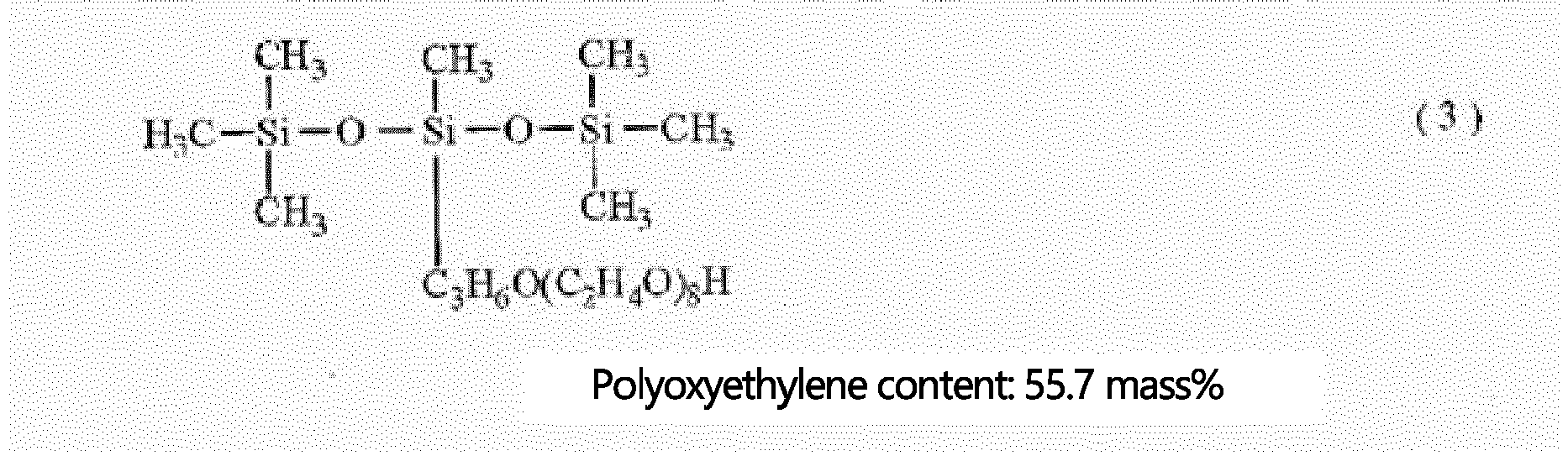
- A composition comprising the copolymerized polyester resin (A), the blocked isocyanate group-containing urethane resin (B), and the silicone surfactant (C) in the amounts mentioned above can form a film that has no flaws.
- In the present invention, the readily adhesive layer contains particles with an average particle diameter of 20 nm or more and 200 nm or less, whereby a film with fewer flaws is easily formed. The average particle diameter of the particles is preferably 30 nm or more and 150 nm or less, and more preferably 40 nm or more and 100 nm or less. Although it depends on the thickness of the readily adhesive layer to be formed, the use of particles with an average particle diameter that is three times or more the thickness of the readily adhesive layer is not preferable, because it causes a higher risk of the particles dropping out of the readily adhesive layer due to circumferential stress when the rolled products are tightly wound. The type of particles contained in the readily adhesive layer is not particularly limited. Examples include organic particles, such as siloxane-copolymerized acrylic resins, crosslinked polystyrene, polystyrene-divinylbenzene, polymethylmethacrylate, methyl methacrylate copolymers, methyl methacrylate-copolymerized crosslinked products, polytetrafluoroethylene, polyvinylidene fluoride, polyacrylonitrile, benzoguanamine resins, silicone resins, and acrylic resins; and inorganic particles, such as silica, alumina, titanium dioxide, zirconium oxide, kaolin, talc, graphite, calcium carbonate, feldspar, molybdenum disulfide, carbon black, and barium sulfate. It is also possible to use core-shell particles with a multilayer structure consisting of materials with different properties in the inner and outer portions. Silica particles are particularly preferred for their various desirable properties as lubricants; and colloidal silica, which is in the form of spherical particles, is most desirable from the viewpoint of dispersibility.
- In the present invention, the average particle diameter of the particles in the base film and the readily adhesive layer is determined by observing 30 particles in the cross-section of the film with a scanning electron microscope, and obtaining the average value as the average particle diameter.
- As long as the object of the present invention is achieved, the particle diameter of irregularly shaped particles can be calculated as having a circular equivalent diameter. The circular equivalent diameter is a value obtained by dividing the area of the observed particle by n, calculating the square root, and multiplying by 2.
- The particles contained in the readily adhesive layer preferably have a solids content of 0.3 parts by mass or more, more preferably 0.5 parts by mass or more, and still more preferably 1.0 parts by mass or more, per 100 parts by mass of the total solids content of the copolymerized polyester resin (A) and the blocked isocyanate group-containing urethane resin (B). The solids content is preferably 0.3 parts by mass or more, in order to improve slipperiness and easily reduce flaws. The content of the particles in the readily adhesive layer is preferably 18 parts by mass or less, more preferably 15 parts by mass or less, and still more preferably 8 parts by mass or less, per 100 parts by mass of the total solids content of the copolymerized polyester resin (A) and the blocked isocyanate group-containing urethane resin (B). The content of the particles is preferably 18 parts by mass or less, in order to lower the haze and improve transparency.
- The thickness of the readily adhesive layer may be, for example, 5 nm to 500 nm, preferably 10 nm to 300 nm, and more preferably 20 nm to 150 nm.
- In the polyester-based laminated film of the present invention, the method for stacking the readily adhesive layer is not particularly limited; either in-line coating or off-line coating, in which a biaxially stretched polyester film is used for processing, may be used. Any coating method is applicable, as long as it is known. It is preferable to use an in-line coating method, by which a film is efficiently obtained by applying a coating liquid obtained by diluting a composition comprising the copolymerized polyester resin (A), the blocked isocyanate group-containing urethane resin (B), and the silicone surfactant (C) with a solvent to an unstretched film or an uniaxially stretched film during the production process of the base polyester film by a gravure coating method or a bar coating method; and stretching the film in at least one uniaxial direction that is not stretched, followed by heat-setting. The resulting readily adhesive polyester film has excellent adhesion with various inks, in particular, UV-curable inks and oxidative polymerization (or solvent-type) inks, and is also suitable for secondary processing such as for labeling.
- The solvent used for the coating liquid may be water or a mixed solvent of water and alcohol. The mass ratio of water to alcohol, i.e., water/alcohol, is preferably selected from the range of 100/0 to 85/15. When the mass of alcohol is 15 parts by mass or less based on the total mass of water and alcohol, a film can be easily produced by using a general-purpose biaxially stretched film-forming apparatus. The mass ratio of water/alcohol is desirably within the range of 98/2 to 90/10 to control the surface tension of the coating liquid by the addition of alcohol, and to thus easily adjust the appearance of the readily adhesive layer.
- In the present invention, a gravure coating method or a bar coating method is suitably used as described above, and a highly transparent readily adhesive film with fewer flaws can be produced with a general-purpose biaxially stretched film-forming apparatus.
- In order to reduce the formation of scratches during the film formation, it is desirable to minimize the number of rolls used from the application to winding. Therefore, it is desirable to go on to the drying process from the coating process without using rolls, and perform the drying process to heat-setting in a drying furnace in succession.
- The present invention is described below with reference to specific Examples. However, the present invention is not limited to these Examples. First, the evaluation methods used in the present invention are described.
- On the readily adhesive layer of each readily adhesive polyester film obtained in the Examples and Comparative Examples described later, an oxidative polymerization- (or solvent-) type ink was screen-printed using a 250-mesh screen, and air-dried for one day; or a UV curing-type ink was screen-printed using a 300-mesh screen, and cured by UV exposure of 500 mj/cm2 with a UV exposure machine. Next, each inked surface was cross-cut using a cutter knife to form a grid of 100 squares (2 mm × 2 mm), and Cellophane (registered trademark, Nichiban Co., Ltd.) tape (width: 25 mm) was adhered to the surface so that no air bubbles appeared under the tape. Further, the tape surface was rubbed to sufficiently stick. Then, the tape was rapidly peeled off in the direction upward from the tape (the direction at an angle of 90 degrees) while the front and rear ends of the inked surface where the Cellophane (registered trademark) tape was not adhered were pressed down by hand. The inked surface after peeling off was observed to evaluate the adhesion based on the ink residual percentage.
-
- 1) Oxidative polymerization- (or solvent-) type inks
- (a) RAM, black, manufactured by Seiko advance Ltd.
- (b) SS-8 for PVC, white, manufactured by Toyo Ink Co., Ltd.
- 2) UV curing-type inks
- (c) FDSS, black, manufactured by Toyo Ink Co., Ltd.
- (d) UVA, black, manufactured by Seiko advance Ltd.
- After peeling off the cross-cut surface, the ink residual percentage was evaluated according to the following four criteria.
- A: the residual percentage was 100%; no peeling at all
- B: the residual percentage was 90% or more; no problem in practical use
- C: the residual percentage was 80% or more; possible to use by adjusting the conditions
- D: the residual percentage was less than 80%; unusable
- The hard-coat coating liquid A described below was applied to the readily adhesive layer of each readily adhesive polyester film with a wire-bar coater so that the coating thickness after drying was 2 µm, dried with hot air at a temperature of 80°C for 60 seconds, and allowed to pass through a position 20 cm under a high-pressure mercury lamp with an output of 120 W/cm2 at a speed of 10 m/min, thus obtaining a hard-coat film. The hard-coat layer had a refractive index of 1.48.
- The coating liquid was obtained by mixing the following materials in the mass ratio shown below, and stirring the resulting mixture for 30 minutes or more for dissolution.
- Then, a filter with a nominal filtration accuracy of 1 µm was used to remove undissolved matter to produce a hard-coat coating liquid A.
-
- Methyl ethyl ketone: 64.48 mass%
- Pentaerythritol triacrylate: 11.45 mass% (manufactured by Shin-Nakamura Chemical Co., Ltd., NK Ester A-TMM-3LM-N, number of functional groups: 3)
- Tripropylene glycol diacrylate: 5.73 mass% (manufactured by Shin-Nakamura Chemical Co., Ltd., NK Ester APG-200, number of functional groups: 2)
- Dimethylaminoethyl methacrylate: 5.72 mass% (manufactured by Kyoeisha Chemical Co., Ltd., Light Ester DM, number of functional groups: 1)
- Silica particles: 11.45 mass% (manufactured by Nissan Chemical Corporation, MEK-ST-L, solids content: 30 mass%, average particle diameter: 50 nm)
- Photopolymerization initiator: 1.14 mass% (manufactured by Ciba Specialty Chemicals, Irgacure 184)
- Silicone surfactant: 0.03 mass% (manufactured by Dow Corning Toray Co., Ltd., DC57)
- Specifically, cuts that reached the base film through the hard-coat layer were made to form a grid of 100 squares on the obtained hard-coat layer using a cutter guide with gap intervals of 2 mm. Next, Cellophane adhesive tape (Nichiban Co., Ltd., No. 405, width: 24 mm) was applied to the cut surface in the form of a grid, and rubbed with an eraser to ensure complete adhesion. Then, the Cellophane adhesive tape was vertically peeled off from the hard-coat layer surface of the hard coat film for molding, and the number of squares peeled off from the hard-coat layer surface of the base film was visually counted to determine the adhesion between the hard-coat layer and the base film according to the following formula. The squares that were partially peeled off were also counted as being peeled off, and the results were classified into four grades according to the following criteria.

- A: 100%
- B: 90% or more and less than 100%
- C: 80% or more and less than 90%
- D: less than 80%
- The haze of each readily adhesive polyester film was measured using a turbidimeter (manufactured by Nippon Denshoku Industries Co. Ltd., NDH2000) in accordance with JIS K 7136:2000.
- The film having the readily adhesive layer was cut to A4 size, and irradiated with a brom light. Thereafter, scratches of 0.5 mm or more were counted. The evaluation was based on the following criteria.
- A: 0
- B: 1 to 5
- D: 6 or more
- In order to reproduce the pressurized state of the winding core, a film having the readily adhesive layer was cut into 10-cm-square pieces; and the top and bottom of a set of 10 sheets was sandwiched between 5-mm-thick SUS plates, and maintained for 24 hours in a pressure press at 50 kgf/cm2. Then, the film appearance was evaluated. The evaluation was based on the following criteria.
- A: No change compared to before the treatment
- B: Blushing (white unevenness) was observed in an area of 5% or less
- C: Blushing (white unevenness) was observed in an area of 10% or less
- D: Blushing (white unevenness) was observed in an area exceeding 10%
- The coating liquid used in the present invention was prepared according to the following method. Specifically, 95 parts by mass of dimethyl terephthalate, 95 parts by mass of dimethyl isophthalate, 35 parts by mass of ethylene glycol, 145 parts by mass of neopentyl glycol, 0.1 parts by mass of zinc acetate, and 0.1 parts by mass of antimony trioxide were placed in a reaction vessel to perform an ester exchange reaction at 180°C for 3 hours. Next, 6.0 parts by mass of 5-sodium sulfoisophthalic acid was added thereto to perform an esterification reaction at 240°C for 1 hour, followed by a polycondensation reaction at 250°C for 2 hours under reduced pressure (10 to 0.2 mmHg) to thus obtain a copolymerized polyester resin (A) with a number average molecular weight of 19,500 and a softening point of 60°C.
- Sixty-four parts by mass of the resulting copolymerized polyester resin, 144 parts by mass of butyl cellosolve, and 114 parts by mass of water mass were stirred with heating for 6 hours or more to obtain a uniform light-white aqueous dispersion with a solid concentration of 30%.
- The copolymerized polyester resin (A) obtained as described above, a blocked isocyanate group-containing self-crosslinkable polyurethane resin (manufactured by DKS Co. Ltd., ELASTRON (registered trademark) H-3DF) (B), a silicone surfactant (manufactured by Dow Corning Toray Co., Ltd., 67 Additive) (C1), and colloidal silica (manufactured by Nissan Chemical Corporation, SNOWTEX OL, average particle diameter: 40 nm) (P1) in a mass ratio, on a solids basis, of (A)/(B)/(C1)/(P1) of 50/50/0.1/5 were dispersed in a solvent to form a coating liquid (X) with a solids content of 7 mass%. The solvent used here was obtained by mixing water and isopropyl alcohol in a ratio of 95/5.
- As a starting material polymer, polyethylene terephthalate resin pellets that contained no particles and that had an intrinsic viscosity of 0.62 dl/g were dried under reduced pressure (133.3 Pa) at 135°C for 6 hours. Then, the polyethylene terephthalate resin was placed in an extruder I, while resin pellets obtained by adding 0.10% silica particles with an average particle diameter of 1.5 µm to the same polyethylene terephthalate were placed in an extruder II, which were melt-extruded at 285°C so that the thickness ratio of II/I/II = 5/90/5. The film was quenched and solidified on a metal roll at a surface temperature of 25°C to obtain a cast film.
- The resulting cast film was heated to 95°C with a group of heated rolls and an infrared heater, and the coating liquid X was applied using a gravure coater to one side of a uniaxially stretched PET film running at a speed of 40 m/min. The amount of the coating liquid X applied was adjusted to a final solids content of 0.08 g/m2. Subsequently, the resulting product was stretched 4 times in the transverse direction at 120°C in a tenter, and then heat-treated in the same tenter at 220°C while being loosened (3%) in the transverse direction, thus obtaining a readily adhesive polyester film having an entire film thickness of 50 µm. The thickness of the readily adhesive layer was 80 nm.
- Readily adhesive polyester films were obtained in the same manner as in Example 1, except that the mass ratio, on a solids basis, of the copolymerized polyester resin (A) to the blocked isocyanate group-containing urethane resin (B) was changed to 30/70, 70/30, 25/75, or 75/25, as shown in Table 1.
- Readily adhesive polyester films were obtained in the same manner as in Example 1, except that the silicone surfactant (C1) in the coating liquid was changed to KF-6012 manufactured by Shin-Etsu Chemical Co., Ltd. (C2), L-77 manufactured by Momentive (C3), or 502 Additive manufactured by Dow Corning Toray Co., Ltd. (C4), or that no surfactant was used, as shown in Table 1.
- Readily adhesive polyester films were obtained in the same manner as in Example 1, except that the silicone surfactant (C1) in the coating liquid was changed to a fluorosurfactant F-470 manufactured by DIC (C5), and the amount thereof was changed, or except that the amount of the same silicone surfactant (C1) was increased 5-fold, as shown in Table 1.
- Readily adhesive polyester films were obtained in the same manner as in Example 1, except that the colloidal silica (P1) in the coating liquid was changed to SNOWTEX ZL manufactured by Nissan Chemical Corporation (P2, average particle diameter: 100 nm) or MP2040 manufactured by Nissan Chemical Corporation (P3, average particle diameter: 200 nm), and their amounts were changed, as shown in Table 1. Both P2 and P3 are silica particles, as are P1.
- Readily adhesive polyester films were obtained in the same manner as in Example 1, except that the amount of colloidal silica (P1) in the coating liquid was changed to 20 parts by mass or 0.2 parts by mass, based on the mass of the total solids content of the copolymerized polyether resin (A) and the blocked isocyanate group-containing urethane resin (B), as shown in Table 1.
- Readily adhesive polyester films were obtained in the same manner as in Example 1, except that the average particle diameter and the amount of the particles contained in polyethylene terephthalate in the base film were changed as shown in Table 1.
- Readily adhesive polyester films were obtained in the same manner as in Example 1, except that the base film was changed to a monolayer of only a layer obtained from the extruder II into which resin pellets obtained by adding 0.10% of silica particles with an average particle diameter of 0.5 µm to polyethylene terephthalate was placed, a monolayer of only a layer obtained from the extruder II into which resin pellets obtained by adding 0.02% of silica particles with an average particle diameter of 0.8 µm were added were placed, or a monolayer of only a layer obtained from the extruder I into which only polyethylene terephthalate resin was placed, as shown in Table 1.
- Tables 1 and 2 below show the film-forming conditions and evaluation results of the Examples and Comparative Examples.
Table 1 Readily adhesive layer Base film Copolymerized polyester resin (A) Blocked isocyanate group-containing urethane resin (B) Silicone surfactant (C) Particles (P) in readily adhesive layer Layer structure Particles in the base film Content (part by mass) Content (part by mass) Type Content (part by mass) Type Average particle diameter Content (part by mass) Average particle diameter State of particles Content in the base film Ex. 1 50 50 C1 0.1 P1 40 nm 5 3 layers (II/I/II) 1.5 µm contained only in layer II (0.10%) 0.01% Ex. 2 30 70 C1 0.1 P1 40 nm 5 3 layers (II/I/II) 1.5 µm contained only in layer II (0.10%) 0.01% Ex. 3 70 30 C1 0.1 P1 40 nm 5 3 layers (II/I/II) 1.5 µm contained only in layer II (0.10%) 0.01% Ex. 4 25 75 C1 0.1 P1 40 nm 5 3 layers (II/I/II) 1.5 µm contained only in layer II (0.10%) 0.01% Ex. 5 75 25 C1 0.1 P1 40 nm 5 3 layers (II/I/II) 1.5 µm contained only in layer II (0.10%) 0.01% Ex. 6 50 50 C2 0.1 P1 40 nm 5 3 layers (II/I/II) 1.5 µm contained only in layer II (0.10%) 0.01% Ex. 7 50 50 C3 0.1 P1 40 nm 5 3 layers (II/I/II) 1.5 µm contained only in layer II (0.10%) 0.01% Ex. 8 50 50 C4 0.1 P1 40 nm 5 3 layers (II/I/II) 1.5 µm contained only in layer II (0.10%) 0.01% Ex. 9 50 50 C4 0.5 P1 40 nm 5 3 layers (II/I/II) 1.5 µm contained only in layer II (0.10%) 0.01% Ex. 10 50 50 C1 0.1 P2 100nm 2 3 layers (II/I/II) 1.5 µm contained only in layer II (0.10%) 0.01% Ex. 11 50 50 C1 0.1 P3 200 nm 2 3 layers (II/I/II) 1.5 µm) contained only in layer II (0.10%) 0.01% Ex. 12 50 50 C1 0.1 P1 40 nm 20 3 layers (II/I/II) 1.5 µm contained only in layer II (0.10%) 0.01% Ex. 13 50 50 C1 0.1 P1 40 nm 02 3 layers (II/I/II) 1.5 µm contained only in layer II (0.10%) 0.01% Ex. 14 50 50 C1 0.1 P1 40 nm 5 3 layers (II/I/II) 1.0 µm contained only in layer II (0.10%) 0.01% Ex. 15 50 50 C1 0.1 P1 40 nm 5 3 layers (II/I/II) 0.5 µm contained only in layer II (0.10%) 0.01% Ex. 16 50 50 C1 0.1 P1 40 nm 5 3 layers (II/I/II) 0.5 µm contained only in layer II (0.05%) 0.005% Ex. 17 50 50 C1 0.1 P1 40 nm 5 3 layers (II/I/II) 1.0 µm contained only in layer II (0.50%) 0.05% Ex. 18 50 50 C1 0.1 P1 40 nm 10 Monolayer 0.5 µm contained entirely (0.10%) 0.10% Ex. 19 50 50 C3 0.1 P1 40 nm 12 Monolayer 0.8 µm contained entirely (0.02%) 0.02% Comp. Ex. 1 50 50 None 0 P1 40 nm 5 3 layers (II/I/II) 1.5 µm contained only in layer II (0.10%) 0.01% Comp. Ex. 2 50 50 C5 0.05 P1 40 nm 5 3 layers (II/I/II) 1.5 µm contained only in layer II (0.10%) 0.01% Comp. Ex. 3 50 50 C1 0.1 P1 40 nm 5 3 layers (II/I/II) 3.0 µm contained only in layer II (0.10%) 0.01% Comp. Ex. 4 50 50 C1 0.1 P1 40 nm 5 Monolayer None Not contained None - The content (part by mass) of the copolymerized polyester resin (A) and the content of the blocked isocyanate group-containing urethane resin (B) are each on a solids basis, per 100 parts by mass of the total solids content of (A) and (B).
- The content (part by mass) of the silicone surfactant (C) and the content of the particles (P) in the readily adhesive layer are each on a solids basis, per 100 parts by mass of the total solids content of the copolymerized polyester resin (A) and the blocked isocyanate group-containing urethane resin (B).
- The present invention is capable of providing a readily adhesive polyester film that has fewer flaws and in which no appearance defects occur due to tight winding during the storage of rolled products, and providing a method for efficiently producing the readily adhesive polyester film.
| Ink adhesion | Hard-coat adhesion | Haze (%) | Flaw | White unevenness | ||||
| Oxidation type | UV type | |||||||
| (a) | (b) | (c) | (d) | |||||
| Ex. 1 | A | A | A | A | A | 1.3 | A | A |
| Ex.2 | A | A | B | B | A | 1.6 | A | A |
| Ex. 3 | A | A | A | A | B | 1.2 | A | A |
| Ex. 4 | A | B | C | C | B | 2.2 | A | A |
| Ex. 5 | A | A | B | C | C | 1.2 | B | A |
| Ex. 6 | A | A | A | A | A | 1.5 | A | A |
| Ex. 7 | A | A | A | A | A | 1.1 | A | A |
| Ex. 8 | A | A | A | A | A | 1.6 | B | B |
| Ex. 9 | A | A | A | A | A | 1.2 | A | C |
| Ex. 10 | A | A | A | A | A | 1.8 | A | A |
| Ex. 11 | A | A | A | A | A | 2.0 | B | C |
| Ex. 12 | A | A | A | A | A | 2.2 | A | C |
| Ex. 13 | A | A | A | A | A | 0.7 | C | A |
| Ex. 14 | A | A | A | A | A | 1.1 | B | B |
| Ex. 15 | A | A | A | A | A | 0.9 | B | B |
| Ex. 16 | A | A | A | A | A | 0.7 | C | B |
| Ex. 17 | A | A | A | A | A | 3.0 | B | A |
| Ex. 18 | A | A | A | A | A | 0.8 | C | B |
| Ex. 19 | A | A | A | A | A | 0.7 | C | B |
| Comp. Ex. 1 | A | A | A | A | A | 1.5 | D | D |
| Comp. Ex. 2 | A | A | A | A | A | 1.0 | B | D |
| Comp. Ex. 3 | A | A | A | A | A | 3.5 | C | A |
| Comp. Ex. 4 | A | A | A | A | A | 0.5 | D | D |
Claims (4)
- A readily adhesive polyester film comprising a polyester film as a base film and a readily adhesive layer on at least one side of the base film,wherein the base film contains particles with an average particle diameter of 0.1 µm or more and 2 µm or less in an amount of 1 mass% or less based on the mass of the base film, andthe readily adhesive layer is a cured product of a composition comprising a copolymerized polyester resin (A), a blocked isocyanate group-containing urethane resin (B), and a silicone surfactant (C).
- The readily adhesive polyester film according to claim 1, wherein the readily adhesive layer contains particles with an average particle diameter of 20 nm or more and 200 nm or less.
- The readily adhesive polyester film according to claim 1 or 2, wherein the copolymerized polyester resin (A) and the blocked isocyanate group-containing urethane resin (B) are present in the composition constituting the readily adhesive layer in a mass ratio, on a solids basis, of (A)/(B) of 28/72 to 72/28.
- A method for producing the readily adhesive polyester film of any one of claims 1 to 3, the method comprisingpreparing a coating liquid by diluting a composition comprising at least a copolymerized polyester resin (A), a blocked isocyanate group-containing urethane resin (B), and a silicone surfactant (C) with a solvent, the solvent containing water and alcohol in a mass ratio of water/alcohol of 100/0 to 85/15, andforming a readily adhesive layer by applying the coating liquid to at least one side of an unstretched film or a uniaxially stretched film during a production process of a base film by a gravure coating method or a bar coating method, stretching the film in at least one uniaxial direction that is not stretched, and performing heat treatment.
Applications Claiming Priority (2)
| Application Number | Priority Date | Filing Date | Title |
|---|---|---|---|
| JP2019015237 | 2019-01-31 | ||
| PCT/JP2020/001184 WO2020158403A1 (en) | 2019-01-31 | 2020-01-16 | Readily adhesive polyester film and method for producing same |
Publications (2)
| Publication Number | Publication Date |
|---|---|
| EP3919185A1 true EP3919185A1 (en) | 2021-12-08 |
| EP3919185A4 EP3919185A4 (en) | 2022-10-12 |
Family
ID=71842188
Family Applications (1)
| Application Number | Title | Priority Date | Filing Date |
|---|---|---|---|
| EP20749076.4A Pending EP3919185A4 (en) | 2019-01-31 | 2020-01-16 | Readily adhesive polyester film and method for producing same |
Country Status (7)
| Country | Link |
|---|---|
| US (1) | US20220135847A1 (en) |
| EP (1) | EP3919185A4 (en) |
| JP (5) | JP7502721B2 (en) |
| KR (1) | KR102795567B1 (en) |
| CN (1) | CN113365743B (en) |
| TW (1) | TWI887226B (en) |
| WO (1) | WO2020158403A1 (en) |
Family Cites Families (27)
| Publication number | Priority date | Publication date | Assignee | Title |
|---|---|---|---|---|
| JP3235759B2 (en) | 1994-09-12 | 2001-12-04 | 東レ株式会社 | Polyester film for photo |
| JP3311591B2 (en) | 1996-08-07 | 2002-08-05 | 帝人株式会社 | Polyester film for photoresist |
| JP4792614B2 (en) * | 1999-11-16 | 2011-10-12 | 東洋紡績株式会社 | Easy adhesive film for optics |
| JP3948297B2 (en) | 2002-02-06 | 2007-07-25 | 東レ株式会社 | Laminated polyester film |
| TWI295303B (en) * | 2003-08-21 | 2008-04-01 | Toyo Boseki | Optical-use adhesive polyester film and optical-use laminatede film |
| KR20060067514A (en) * | 2004-12-15 | 2006-06-20 | 에스케이씨 주식회사 | Antistatic Polyester Film for Optical Film Protection |
| JP4996844B2 (en) | 2005-11-14 | 2012-08-08 | 三菱樹脂株式会社 | Optical laminated polyester film |
| JP4967479B2 (en) * | 2006-06-30 | 2012-07-04 | 東洋紡績株式会社 | Optically easy-adhesive polyester film roll and hard coat film |
| JP2008308533A (en) * | 2007-06-13 | 2008-12-25 | Toyo Ink Mfg Co Ltd | Antistatic pressure-sensitive adhesive composition and laminate thereof |
| JP5334431B2 (en) * | 2008-03-17 | 2013-11-06 | 三菱樹脂株式会社 | Easy-adhesive polyester film |
| JP2009269302A (en) * | 2008-05-08 | 2009-11-19 | Toyobo Co Ltd | Easily adhesive and biaxially oriented polyester film |
| JP2010036368A (en) * | 2008-07-31 | 2010-02-18 | Fujifilm Corp | Hydrophilic polyester film |
| JP2010221643A (en) * | 2009-03-25 | 2010-10-07 | Unitika Ltd | Method for producing biaxially stretched polyester film roll for vapor deposition and biaxially stretched polyester film roll for vapor deposition obtained by the production method |
| JP5471062B2 (en) | 2009-06-23 | 2014-04-16 | 東洋紡株式会社 | Lens sheet base film |
| JP5682407B2 (en) * | 2010-03-31 | 2015-03-11 | 三菱化学株式会社 | Biomass resource-derived polyurethane and method for producing the same |
| JP5834702B2 (en) * | 2011-02-09 | 2015-12-24 | 東洋紡株式会社 | Easy-adhesive polyester film for solar cell and front sheet using the same |
| WO2012121117A1 (en) * | 2011-03-09 | 2012-09-13 | 富士フイルム株式会社 | Process for producing polyester film, polyester film, and solar cell backsheet |
| WO2012121042A1 (en) * | 2011-03-09 | 2012-09-13 | 東洋紡績株式会社 | Easily adhering polyester film |
| TWI542907B (en) * | 2011-05-18 | 2016-07-21 | 東洋紡績股份有限公司 | Liquid crystal device, polarizing plate and polarizer protection film |
| JP5762159B2 (en) * | 2011-06-14 | 2015-08-12 | 旭化成ケミカルズ株式会社 | Easy adhesion treatment composition |
| JP6191099B2 (en) * | 2012-08-07 | 2017-09-06 | 東洋紡株式会社 | Polarizer |
| JP6326816B2 (en) * | 2013-12-29 | 2018-05-23 | 三菱ケミカル株式会社 | Biaxially stretched laminated polyester film |
| JP5818283B2 (en) * | 2014-01-07 | 2015-11-18 | 三菱樹脂株式会社 | Laminated polyester film |
| JP5773042B2 (en) * | 2014-08-06 | 2015-09-02 | 東洋紡株式会社 | Easy-adhesive polyester film |
| WO2017082130A1 (en) * | 2015-11-13 | 2017-05-18 | 東洋紡株式会社 | Multilayer polyester film |
| US11325362B2 (en) * | 2015-12-28 | 2022-05-10 | Toyobo Co., Ltd. | Layered polyester film |
| JP2018062105A (en) * | 2016-10-12 | 2018-04-19 | 三菱ケミカル株式会社 | Easy-adhesive laminated polyester film |
-
2020
- 2020-01-16 EP EP20749076.4A patent/EP3919185A4/en active Pending
- 2020-01-16 WO PCT/JP2020/001184 patent/WO2020158403A1/en not_active Ceased
- 2020-01-16 US US17/425,992 patent/US20220135847A1/en active Pending
- 2020-01-16 KR KR1020217023801A patent/KR102795567B1/en active Active
- 2020-01-16 JP JP2020505286A patent/JP7502721B2/en active Active
- 2020-01-16 CN CN202080011918.XA patent/CN113365743B/en active Active
- 2020-01-20 TW TW109101874A patent/TWI887226B/en active
-
2024
- 2024-06-04 JP JP2024090632A patent/JP2024110985A/en active Pending
- 2024-06-04 JP JP2024090631A patent/JP2024110984A/en active Pending
- 2024-06-04 JP JP2024090633A patent/JP2024110986A/en active Pending
-
2025
- 2025-10-17 JP JP2025175426A patent/JP2026002925A/en active Pending
Also Published As
| Publication number | Publication date |
|---|---|
| CN113365743B (en) | 2023-05-30 |
| JP2024110985A (en) | 2024-08-16 |
| EP3919185A4 (en) | 2022-10-12 |
| CN113365743A (en) | 2021-09-07 |
| KR102795567B1 (en) | 2025-04-14 |
| JP2024110984A (en) | 2024-08-16 |
| KR20210114004A (en) | 2021-09-17 |
| JP2024110986A (en) | 2024-08-16 |
| JP2026002925A (en) | 2026-01-08 |
| TW202043048A (en) | 2020-12-01 |
| JP7502721B2 (en) | 2024-06-19 |
| US20220135847A1 (en) | 2022-05-05 |
| WO2020158403A1 (en) | 2020-08-06 |
| JPWO2020158403A1 (en) | 2021-12-02 |
| TWI887226B (en) | 2025-06-21 |
Similar Documents
| Publication | Publication Date | Title |
|---|---|---|
| CN102066471B (en) | Hardcoat film for molding | |
| JP5467752B2 (en) | Biaxially stretched polyester film | |
| JP5471419B2 (en) | Hard coat film for molding with protective film | |
| US20130089730A1 (en) | Laminated polyester film | |
| JP4924381B2 (en) | Coated polyester film and hard coat film using the same | |
| JPWO2008035660A1 (en) | Resin laminate, production method thereof, and transfer film used for production of resin laminate | |
| KR102216490B1 (en) | Blue light-blocking resin composition | |
| JP2008183882A (en) | Optical laminated film and method for producing the same, antireflection film, and image display device | |
| JP5428830B2 (en) | Hard coat film for molding | |
| JP2011126165A (en) | Hard coat film for molding | |
| JP5471077B2 (en) | Polyester film for molding and hard coat film for molding | |
| TWI437034B (en) | Hard coating for molding | |
| JP4161251B2 (en) | White coated polyester film | |
| JP2004223714A (en) | White laminated polyester film | |
| CN113365743B (en) | Easily-adhered polyester film and preparation method thereof | |
| JP2011131406A (en) | Hard coat film for molding | |
| JP2009241575A (en) | Biaxially oriented laminated polyester film | |
| JP5605489B2 (en) | Hard coat film for molding with protective film | |
| JP5428831B2 (en) | Hard coat film for molding | |
| JP5434604B2 (en) | Easy-adhesive white polyester film | |
| JP5716810B2 (en) | Hard coat film for molding with protective film | |
| WO2023063117A1 (en) | Biaxially oriented polyester film |
Legal Events
| Date | Code | Title | Description |
|---|---|---|---|
| STAA | Information on the status of an ep patent application or granted ep patent |
Free format text: STATUS: THE INTERNATIONAL PUBLICATION HAS BEEN MADE |
|
| PUAI | Public reference made under article 153(3) epc to a published international application that has entered the european phase |
Free format text: ORIGINAL CODE: 0009012 |
|
| STAA | Information on the status of an ep patent application or granted ep patent |
Free format text: STATUS: REQUEST FOR EXAMINATION WAS MADE |
|
| 17P | Request for examination filed |
Effective date: 20210802 |
|
| AK | Designated contracting states |
Kind code of ref document: A1 Designated state(s): AL AT BE BG CH CY CZ DE DK EE ES FI FR GB GR HR HU IE IS IT LI LT LU LV MC MK MT NL NO PL PT RO RS SE SI SK SM TR |
|
| DAV | Request for validation of the european patent (deleted) | ||
| DAX | Request for extension of the european patent (deleted) | ||
| RAP3 | Party data changed (applicant data changed or rights of an application transferred) |
Owner name: TOYOBO CO., LTD. |
|
| A4 | Supplementary search report drawn up and despatched |
Effective date: 20220909 |
|
| RIC1 | Information provided on ipc code assigned before grant |
Ipc: C09J 175/04 20060101ALI20220905BHEP Ipc: C09J 167/00 20060101ALI20220905BHEP Ipc: C09J 11/00 20060101ALI20220905BHEP Ipc: C08J 7/04 20200101ALI20220905BHEP Ipc: B32B 27/36 20060101ALI20220905BHEP Ipc: B05D 7/24 20060101ALI20220905BHEP Ipc: B05D 7/04 20060101ALI20220905BHEP Ipc: B05D 7/00 20060101ALI20220905BHEP Ipc: B05D 5/00 20060101ALI20220905BHEP Ipc: B05D 3/12 20060101ALI20220905BHEP Ipc: B05D 3/02 20060101ALI20220905BHEP Ipc: B05D 1/28 20060101ALI20220905BHEP Ipc: C09J 7/25 20180101AFI20220905BHEP |