EP3917015A1 - Method for compressing digital signal data and signal compressor module - Google Patents
Method for compressing digital signal data and signal compressor module Download PDFInfo
- Publication number
- EP3917015A1 EP3917015A1 EP20177486.6A EP20177486A EP3917015A1 EP 3917015 A1 EP3917015 A1 EP 3917015A1 EP 20177486 A EP20177486 A EP 20177486A EP 3917015 A1 EP3917015 A1 EP 3917015A1
- Authority
- EP
- European Patent Office
- Prior art keywords
- digital signal
- signal
- module
- signal data
- data
- Prior art date
- Legal status (The legal status is an assumption and is not a legal conclusion. Google has not performed a legal analysis and makes no representation as to the accuracy of the status listed.)
- Granted
Links
Images

Classifications
-
- H—ELECTRICITY
- H03—ELECTRONIC CIRCUITRY
- H03M—CODING; DECODING; CODE CONVERSION IN GENERAL
- H03M7/00—Conversion of a code where information is represented by a given sequence or number of digits to a code where the same, similar or subset of information is represented by a different sequence or number of digits
- H03M7/30—Compression; Expansion; Suppression of unnecessary data, e.g. redundancy reduction
- H03M7/3059—Digital compression and data reduction techniques where the original information is represented by a subset or similar information, e.g. lossy compression
-
- H—ELECTRICITY
- H03—ELECTRONIC CIRCUITRY
- H03M—CODING; DECODING; CODE CONVERSION IN GENERAL
- H03M7/00—Conversion of a code where information is represented by a given sequence or number of digits to a code where the same, similar or subset of information is represented by a different sequence or number of digits
- H03M7/30—Compression; Expansion; Suppression of unnecessary data, e.g. redundancy reduction
- H03M7/60—General implementation details not specific to a particular type of compression
- H03M7/6058—Saving memory space in the encoder or decoder
-
- G—PHYSICS
- G06—COMPUTING OR CALCULATING; COUNTING
- G06N—COMPUTING ARRANGEMENTS BASED ON SPECIFIC COMPUTATIONAL MODELS
- G06N3/00—Computing arrangements based on biological models
- G06N3/02—Neural networks
- G06N3/04—Architecture, e.g. interconnection topology
- G06N3/0464—Convolutional networks [CNN, ConvNet]
-
- H—ELECTRICITY
- H03—ELECTRONIC CIRCUITRY
- H03M—CODING; DECODING; CODE CONVERSION IN GENERAL
- H03M7/00—Conversion of a code where information is represented by a given sequence or number of digits to a code where the same, similar or subset of information is represented by a different sequence or number of digits
- H03M7/30—Compression; Expansion; Suppression of unnecessary data, e.g. redundancy reduction
- H03M7/3068—Precoding preceding compression, e.g. Burrows-Wheeler transformation
-
- G—PHYSICS
- G06—COMPUTING OR CALCULATING; COUNTING
- G06F—ELECTRIC DIGITAL DATA PROCESSING
- G06F2218/00—Aspects of pattern recognition specially adapted for signal processing
- G06F2218/08—Feature extraction
-
- G—PHYSICS
- G06—COMPUTING OR CALCULATING; COUNTING
- G06N—COMPUTING ARRANGEMENTS BASED ON SPECIFIC COMPUTATIONAL MODELS
- G06N3/00—Computing arrangements based on biological models
- G06N3/02—Neural networks
- G06N3/04—Architecture, e.g. interconnection topology
-
- H—ELECTRICITY
- H03—ELECTRONIC CIRCUITRY
- H03M—CODING; DECODING; CODE CONVERSION IN GENERAL
- H03M7/00—Conversion of a code where information is represented by a given sequence or number of digits to a code where the same, similar or subset of information is represented by a different sequence or number of digits
- H03M7/30—Compression; Expansion; Suppression of unnecessary data, e.g. redundancy reduction
- H03M7/60—General implementation details not specific to a particular type of compression
- H03M7/6041—Compression optimized for errors
-
- H—ELECTRICITY
- H03—ELECTRONIC CIRCUITRY
- H03M—CODING; DECODING; CODE CONVERSION IN GENERAL
- H03M7/00—Conversion of a code where information is represented by a given sequence or number of digits to a code where the same, similar or subset of information is represented by a different sequence or number of digits
- H03M7/30—Compression; Expansion; Suppression of unnecessary data, e.g. redundancy reduction
- H03M7/70—Type of the data to be coded, other than image and sound
-
- H—ELECTRICITY
- H04—ELECTRIC COMMUNICATION TECHNIQUE
- H04L—TRANSMISSION OF DIGITAL INFORMATION, e.g. TELEGRAPHIC COMMUNICATION
- H04L27/00—Modulated-carrier systems
- H04L27/32—Carrier systems characterised by combinations of two or more of the types covered by groups H04L27/02, H04L27/10, H04L27/18 or H04L27/26
- H04L27/34—Amplitude- and phase-modulated carrier systems, e.g. quadrature-amplitude modulated carrier systems
- H04L27/3405—Modifications of the signal space to increase the efficiency of transmission, e.g. reduction of the bit error rate, bandwidth, or average power
Definitions
- the invention generally relates to a method for compressing digital signal data obtained from a signal.
- the invention further relates to a signal compressor module for compressing IQ data obtained from a signal and to a computer program.
- Baseband in-phase and quadrature data are the basis for radio frequency (RF) signal generation as well as radio frequency signal analysis.
- RF radio frequency
- IQ data are the basis for radio frequency (RF) signal generation as well as radio frequency signal analysis.
- RF radio frequency
- larger amounts of IQ data have to be stored. Accordingly, larger data storages as well as higher bandwidth capacities are required. Therefore, methods for compressing the IQ measurement data are of great interest wherein the respective methods also have to ensure a small deviation from the original signal when reconstructing the respective signal from the compressed IQ measurement data.
- the IQ data or in general digital signal data associated with an electromagnetic signal, are compressed based on the so-called ⁇ -law compression.
- this approach effectively reduces the data fidelity of the digital data as a trade-off with reducing the number of bits required to store the respective data.
- compression ratios of 2:1 or 3:1 with acceptable loss of fidelity are achieved wherein an increase of 1% of the error vector magnitude (EVM) occurs.
- EVM error vector magnitude
- the compression techniques used are based on retaining data in the most significant bits.
- the compression ratios achieved are not satisfying with respect to the increase in IQ data to be processed due to higher bandwidths and/or longer record lengths.
- the objective of the present invention is to provide a method for compressing digital signal data in a more effective way.
- the problem is solved by a method for compressing digital signal data obtained from a signal, with the following steps:
- the term "detect the wanted signal portion” is understood to mean that portions of the transformed digital signal data corresponding to the at least one wanted signal portion are identified.
- classify the wanted signal portion is generally understood to mean that (certain) information about the signal is determined that is associated with a certain class of electromagnetic signals. For example, a modulation type of the wanted signal portion and/or a symbol rate of the wanted signal portion are determined.
- the signal may comprise several wanted signal portions. Accordingly, several (i.e. two or more) wanted signal portions may be detected and/or classified with the method according to the invention.
- the method according to the invention is based on the idea to isolate wanted signal portions in the signal, i.e. signal portions carrying actual information, by means of the artificial intelligence module.
- the digital signal data corresponding to the remaining signal portions may be discarded.
- digital signal data corresponding to signal disturbances, particularly noise may be discarded.
- the digital signal data relating to unwanted signals that are not of interest, but may have significant signal power may also be discarded.
- the amount of memory needed can be reduced, as the digital signal data is compressed to the relevant subset of digital signal data.
- no information is lost during the compression of the digital signal data, as only the digital signal data corresponding to irrelevant portions of the signal or corresponding to unwanted signals are discarded, for instance noise, or for example a WIFI signal when the wanted signal is an LTE downlink.
- the transform domain may depend on the type of signal processed.
- the transform domain used for digital signal (measurement) data compression may be selected from a set of different transform domains depending on the type of signal.
- the respective transform domain may be at least one of a time domain, a frequency domain and a time-frequency domain (also called spectrogram or rather spectrogram waterfall) so that the respective digital signal data is transformed in a suitable transform domain depending on the type of signal processed as mentioned above.
- the respective signal or more precisely the digital signal data associated with the signal, may be transformed into the frequency domain, for instance by applying a Fourier transform, or into a time-frequency domain for compressing the respective digital signal measurement data appropriately.
- the at least one wanted signal portion may be identified automatically based on preset parameters.
- the preset parameters are associated with certain properties of the at least one wanted signal portion.
- the preset parameters are associated with a modulation type of the at least one wanted signal portions, with a frequency content of the at least one wanted signal portions, with amplitudes of the at least one wanted signal portions, with a signal-to-noise-ratio of the at least one wanted signal portions etc.
- the artificial intelligence module may detect and/or classify the at least one wanted signal portion based on the preset parameters.
- a user may set the preset parameters in order to narrow down the wanted signal to specific types of signals. Accordingly, other types of signals that are not associated with the preset parameters may be discarded.
- the at last one characteristic parameter is associated with a modulation type of the signal.
- the artificial intelligence module automatically detects and/or classifies the modulation of the at least one wanted portion of the signal. No previous knowledge about the modulation type of the signal is necessary, as the artificial intelligence module automatically recognizes the modulation type of at least the wanted portions of the signal.
- the subset of the digital signal data is stored together with meta-information on the signal.
- the meta-information corresponds to additional information on the at least one wanted portion of the signal that may be necessary in order to reconstruct the at least one wanted portion of the signal even with the remaining digital signal data being discarded.
- the meta-information may be stored in more efficient way, such that the overall needed memory is reduced.
- the meta-information comprises a noise level associated with at least one discarded subset of the digital signal data and/or a time stamp.
- a time order of the wanted signal portions may be reconstructed based on the time-stamps provided.
- the background noise contained in the signal may be reconstructed based on the stored noise level.
- the at least one characteristic parameter may comprise at least one correlation parameter, in particular a correlation multi-dimensional algebraic object comprising several correlation parameters. It was found that the at least one correlation parameter comprises information that enables separating signals even if they have the same frequency. In other words, colliding signals, also called interfering signals, can be separated and/or identified with the method according to the invention.
- the at least one correlation parameter may be determined by means of a "classical" statistical sub-module of the artificial intelligence module. More precisely, the statistical sub-module may determine the at least one correlation parameter via suitable statistical techniques. The at least one correlation parameter may then be used as an input of a machine-learning based sub-module of the artificial intelligence module.
- signal portions having different frequencies can be detected that, however, belong together. This is for example the case if a signal is split up into several different frequencies, i.e. in the case of so-called multi-tone signals.
- correlation multi-dimensional algebraic object of n-th order is understood to be an algebraic object having n indices, wherein the entries each are a correlation parameter comprising correlation information on the signal.
- the correlation parameter may be a frequency-to-frequency correlation coefficient, in particular a Pearson correlation coefficient. It has turned out that frequency-to-frequency correlation coefficients are particularly insensitive to signal noise and are particularly suitable for separating colliding signals. Hence, a more robust or rather resistant method is ensured.
- a spectrogram of the digital signal data is determined based on the transformed digital signal data.
- the spectrogram corresponds to a spectrum of the digital signal data over time, i.e. the spectrogram comprises the transformed digital signal data at several particular times or rather time slices.
- the at least one characteristic parameter is determined based on the spectrogram, particularly based on characteristic patterns in the spectrogram.
- an image representation of the, particularly an image representation of the spectrogram e.g. a heat map or a waterfall diagram
- the artificial intelligence module is processed via the artificial intelligence module in order to detect and/or classify the at least one wanted signal portion.
- the at least one characteristic parameter is determined via an image analysis technique that is applied to an image associated with the transformed digital signal data, particularly to the spectrogram of the digital signal data.
- the image may be generated based on the transformed digital signal data, and the image may be used as an input for the artificial intelligence module.
- the artificial intelligence module comprises a machine learning module, wherein the machine learning module is trained to determine the at least one characteristic parameter, and/or wherein the machine learning module is trained to detect and/or classify the at least one wanted signal portion.
- the at least one correlation parameter described above can be analyzed via machine learning techniques and the wanted signal can be detected and/or classified easily compared to the approaches known from the state of the art.
- machine learning techniques are particularly suitable for automated image analysis techniques, and thus for the analysis of the spectrogram via image analysis techniques described above.
- any suitable machine learning technique known from the state of the art may be used in order to train the machine learning module.
- the machine learning module comprises an artificial neural network, particularly a convolutional neural network (CNN).
- the artificial neural network is a deep convolutional neural network (DCNN).
- CNNs or DCNNs are particularly suitable for image processing and/or image recognition techniques.
- the wanted signal portion and/or the signal is reconstructed based on the stored digital signal data, particularly based on the stored meta-information.
- the wanted signal portions and/or the complete signal can be reconstructed based on the stored digital signal data.
- the meta-information comprises information on the noise level of the original signal
- even the noise-content of the original signal may be reproduced based on the stored digital signal data and the stored meta-information.
- the digital signal data is established as IQ data.
- the digital signal data comprises both in-phase data (I data) and quadrature data (Q data).
- I data in-phase data
- Q data quadrature data
- the method described above can be used to compress IQ data associated with an electromagnetic signal.
- a signal compressor module for compressing digital signal data obtained from a signal.
- the signal compressor module comprises a receiver module, a transformation module, an artificial intelligence module, and a memory.
- the receiver module is configured to receive digital signal data associated with a signal and/or to generate digital signal data based on a signal.
- the transformation module is configured to transform the digital signal data into a transform domain, thereby generating transformed digital signal data.
- the artificial intelligence module is configured to determine at least one characteristic parameter based on the transformed digital signal data.
- the artificial intelligence module is further configured to detect and/or classify at least one wanted signal portion based on the at least one characteristic parameter.
- the memory is configured to store only a subset of the digital signal data that is associated with the at least one wanted signal portion.
- the signal compressor module is configured to perform the method for compressing digital signal data obtained from a signal described above.
- the artificial intelligence module comprises a machine learning module, wherein the machine learning module is trained to determine the at least one characteristic parameter, and/or wherein the machine learning module is trained to detect and/or classify the at least one wanted signal portion.
- the at least one correlation parameter described above can be analyzed via machine learning techniques and the wanted signal can be detected and/or classified relatively easily compared to the approaches known from the state of the art.
- machine learning techniques are particularly suitable for automated image analysis techniques, and thus for the analysis of the spectrogram via image analysis techniques described above.
- any suitable machine learning technique known from the state of the art may be used in order to train the machine learning module.
- the machine learning module comprises an artificial neural network, particularly a convolutional neural network (CNN).
- the artificial neural network is a deep convolutional neural network (DCNN).
- CNNs or DCNNs are particularly suitable for image processing and/or image recognition techniques.
- a computer program comprising program code means being adapted to cause a signal compressor module, particularly the signal compressor module described above, to perform the method described above when the computer program is executed on a central processing unit, particularly on a central processing unit of the signal compressor module described above.
- program code means is understood to comprise machine-readable instructions in compiled and/or uncompiled form being provided in any suitable programming language and/or machine language.
- the phrase "at least one of A, B, and C", for example, means (A), (B), (C), (A and B), (A and C), (B and C), or (A, B, and C), including all further possible permutations when greater than three elements are listed.
- the term “at least one of A and B” generally means “A and/or B", namely "A” alone, “B” alone or "A and B”.
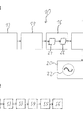
- Figure 1 schematically shows a signal compressor module 10 comprising a receiver module 12, a transformation module 14, an artificial intelligence module 16, and a memory 18.
- the signal compressor module 10 may further comprise a signal generator module 20 having a signal generator unit 22.
- the signal generator unit 22 is established as a numerically controlled oscillator (NCO) or as any other suitable type of signal generator.
- NCO numerically controlled oscillator
- module is understood to denote hardware and/or software, particularly a suitable combination of hardware and software that is adapted to have a certain functionality.
- the signal compressor module 10 is configured to receive and/or generate digital signal data associated with an electromagnetic signal, and to compress the digital signal data associated with the received signal.
- the digital signal data is established as IQ data.
- the exemplary embodiment of the digital signal data being IQ data will be described in the following.
- digital signal data may also be established as any other type of digital data that is associated with the electromagnetic signal.
- the artificial intelligence module 16 comprises an analysis module 24 and a machine learning module 26.
- the machine learning module 26 comprises an artificial neural network.
- the artificial neural network may comprise a convolutional neural network (CNN) and/or a deep convolutional neural network (DCNN).
- CNN convolutional neural network
- DCNN deep convolutional neural network
- the signal compressor module 10 is configured to perform a method for compressing IQ data obtained from a signal. The method is described in the following with reference to Figure 2 .
- IQ data that is associated with an electromagnetic signal is received by means of the receiver module 12 (step S1).
- the electromagnetic signal is received by means of the receiver module 12.
- the receiver module 12 then generates the IQ data associated with the signal based on the signal.
- IQ data may be received and/or generated by means of the receiver module 12.
- the IQ data associated with the signal is forwarded to the transformation module 14.
- the IQ data is transformed into a transform domain by means of the transformation module 14, thereby generating transformed IQ-data (step S2).
- the transform domain may depend on the type of signal processed.
- the transform domain used for IQ data compression may be selected from a set of different transform domains depending on the type of signal.
- the respective transform domain may be a time domain, a frequency domain, and/or a time-frequency domain (also called spectrogram or rather spectrogram waterfall) so that the respective IQ data is transformed in a suitable transform domain depending on the type of signal processed as mentioned above.
- the respective signal may be transformed into the frequency domain, for instance by applying a Fourier transform, or into a time-frequency domain for compressing the respective IQ measurement data appropriately.
- the transformed IQ data corresponds to a spectrum of the IQ data at several different times.
- the transformed IQ data comprises information on an evolution of the spectrum of the IQ data over time.
- step S2 is shown in Figure 3 for an exemplary electromagnetic signal, where the spectrogram is visualized as a heat map, which is also called "waterfall diagram".
- each frequency bin represents a certain frequency range. More precisely, each frequency bin is associated with a certain frequency range having a certain bandwidth in the complex baseband. For example, each frequency bin may have a bandwidth of 30 to 50 Hz, particularly of 35 to 45 Hz.
- the amplitude is plotted on a logarithmic scale.
- the scale is 20 ⁇ log 10 ( Amplitude ) [ dB ].
- the spectrogram shows a logarithmic power trend of the electromagnetic signal over time, for example over N temporal realizations, and over a predetermined frequency range.
- the transformed IQ data is forwarded to the artificial intelligence module 16, or more precisely to the analysis module 24.
- the artificial intelligence module determines at least one characteristic parameter based on the transformed IQ data (step S3) and detects and/or classifies at least one wanted signal portion based on the at least one characteristic parameter (step S4).
- classify the wanted signal portion is generally understood to mean that (certain) information about the signal is determined that is associated with a certain class of electromagnetic signals. For example, a modulation type of the wanted signal portion and/or a symbol rate of the wanted signal portion are determined.
- detect the wanted signal portion is understood to mean that portions of the transformed IQ data corresponding to the at least one wanted signal portion are identified.
- the analysis module 24 generates an image representation of the transformed IQ data.
- the analysis module 24 generates a heat map (also called waterfall diagram) of the spectrogram as shown in Figure 3 .
- the image representation is then used as an input for the machine learning module 26.
- the machine learning module 26 automatically detects the at least one wanted signal portion based on the image representation of the spectrogram via an image analysis technique that is applied to the image representation.
- the machine learning module 26 is trained to automatically detect and/or classify the at least one wanted signal portion based on the image representation of the transformed IQ data.
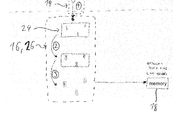
- Figure 4 shows a comparison of the method described above with a usual IQ recording method known from the state of the art, namely an IQ recording method without IQ data compression.
- the method for compressing IQ data described above reduces the data size of the IQ data with some additional steps.
- the IQ data is transformed into the transform domain by the transformation module 14.
- the transformed IQ data is processed via the artificial intelligence module 16, or more precisely via the analysis module 24 and via the machine learning module 26.
- the machine learning module 26 identifies relevant portions of the transformed IQ data that correspond to at the at least one wanted signal portion.
- the machine learning module 26 may also mark the relevant portions of the transformed IQ data.
- the machine learning module 26 may then extract a subset of the transformed IQ data that is associated with the at least one wanted signal portion.
- the subset of the transformed IQ data may then be forwarded to the memory 18.
- the subset of the transformed IQ data may be transformed back into the original domain, particularly into the time domain.
- the analysis module 24 determines at least one correlation parameter or rather a correlation multi-dimensional algebraic objects that comprises several correlation parameters based on the determined spectrogram.
- correlation multi-dimensional algebraic object Some specific examples for the correlation multi-dimensional algebraic object will be given in the following. However, it is to be understood that every other suitable type of correlation parameter could be used as well.
- a ( f i ) is the amplitude of the electromagnetic signal at frequency f i .
- a correlation multi-dimensional algebraic object of order two is determined, namely the frequency-to-frequency correlation matrix ⁇ ij .
- N is the number of temporal realizations.
- ⁇ A ( f i ) is the expectation value of the amplitude of the electromagnetic signal at frequency f i and ⁇ A ( f i ) is the variance of the amplitude of the electromagnetic signal at frequency f i .
- a frequency-to-frequency correlation coefficient more precisely the Pearson correlation coefficient ⁇ is determined for several, particularly for all frequency pairs f i , f j .
- Figure 5 shows a plot or rather a heat map of the determined frequency-to-frequency correlation matrix.
- the frequencies f i and f j are plotted on the horizontal and on the vertical axis, respectively.
- the respective value ⁇ ij of the correlation coefficient is depicted by the color of the respective point in the diagram.
- the determined correlation multi-dimensional algebraic object is then used as an input for the machine learning module 26.
- the determined correlation parameters i.e. the entries of the determined frequency-to-frequency correlation matrix ⁇ ij are then used as an input for the machine learning module 26.
- the machine learning module 26 particularly the artificial neural network, detects and/or classifies the wanted signal in the electromagnetic signal at least partially based on the determined correlation multi-dimensional algebraic object.
- the artificial neural network detects and/or classifies the at least one wanted signal portion based on the determined correlation parameters, i.e. based on the determined frequency-to-frequency correlation matrix ⁇ ij .
- an image may be generated based on the determined correlation parameters, particularly a heat map of the correlation coefficients.
- a heat map is depicted in Figure 5 , as already discussed above.
- the machine learning module 26 or rather the artificial neural network then applies image processing and/or image recognition techniques to the generated image in order to detect and/or classify the at least one wanted signal portion comprised in the electromagnetic signal.
- the number of different correlation patterns that the artificial neural network has to be trained for is reduced.
- smaller artificial neural networks can be used, which results in an enhanced processing speed for the detection and/or classification according to this variant of the method.
- this method is particularly suitable for detecting the at least one wanted signal portion or for classifying the wanted signal if a rough classification is sufficient.
- the correlation parameters and thus also the respective generated image comprise information on signal collisions, i.e. about a superposition of two or more signals in the same frequency band.
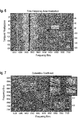
- An example of a spectrogram of an electromagnetic signal comprising a signal collision is shown in Figure 6 .
- Such signal collisions usually are not visible in the spectrogram. However, it turned out that such signal collisions can be identified based on the corresponding correlation parameters of the spectrogram as shown in Figure 7 .
- an image may be generated based on the determined spectrogram, particularly a heat map of the spectrogram like exemplarily shown in Figures 3 and 6 .
- the machine learning module 26 or rather the artificial neural network then applies image processing and/or image recognition techniques to the generated image in order to detect and/or classify the at least one wanted signal portion comprised in the electromagnetic signal. Additionally, the determined correlation multi-dimensional algebraic object is used as additional metadata for the machine learning module 26, particularly for the artificial neural network.
- the image processing and/or recognition techniques are applied directly to the spectrogram instead of to the image generated based on the correlation parameters.
- the determined correlation parameters serve as additional information.
- the correlation parameters inter alia comprise information on signal collisions, which might not be resolvable in the spectrogram alone.
- the information on signal collisions comprised in the electromagnetic signal is recovered.
- correlation parameters described above can be used as metadata.
- correlation multi-dimensional algebraic objects of third order are particularly suitable for use as metadata.
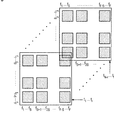
- FIG. 8 An example for such a correlation multi-dimensional algebraic objects of third order is illustrated in Figure 8 .
- the correlation multi-dimensional algebraic objects of third order may be a tensor of third order.
- the sum or rather the time average is only performed over r time realizations for each entry of the correlation multi-dimensional algebraic object of third order, wherein r is a natural number.
- the N time realizations are divided into several time slices that each contain r time realizations.
- the predetermined frequency range is divided into several frequency portions that each contain s frequency bins of a total number of F frequency bins, wherein s and F are natural numbers.
- each entry of the correlation multi-dimensional algebraic object of third order is associated with s frequency bins. For example, for each entry a sum or an average over the respective s frequency bins is taken.
- the resulting correlation multi-dimensional algebraic object of third order ⁇ ij , k has three indices, namely indices i and j each indicating the respective frequency portion, and an index k indicating the respective time slice.
- the entry " ⁇ 12,3 " of the correlation multi-dimensional algebraic object of third order is associated with the frequency portions ( f 1 ... f s ) and ( f s+1 ... f 2 s ) as well as with the time slice ( t 2r +1 ... t 3 r ).
- the determined correlation multi-dimensional algebraic object of third order may then be used as an input for the machine learning module 26, particularly as metadata for the machine learning module 26.
- the determined correlation multi-dimensional algebraic object of third order may be unfolded with respect to one of the indices i, j and k. In the unfolding, one dimension of the correlation multi-dimensional algebraic object of third order is kept constant while the other two dimensions are stacked.
- the indices i and j each run from 1 to F / s, while the index k runs from 1 to N / r.
- the result is a the multi-dimensional algebraic object of second order, i.e. a matrix, with F / s entries for the first index and with F / s ⁇ N / r entries for the second index.
- the result is a the multi-dimensional algebraic object of second order, i.e. a matrix, with F / s ⁇ N / r entries for the first index and with F / s entries for the second index.
- the result is a the multi-dimensional algebraic object of second order, i.e. a matrix, with F 2 / s 2 entries for the first index and with N / r entries for the second index.
- the unfolded multi-dimensional algebraic object may then be used as an input for the machine learning module 26, particularly as metadata for the machine learning module 26.
- higher order singular values of the correlation multi-dimensional algebraic object are determined based on at least one, particularly based on all of the unfolded correlation multi-dimensional algebraic objects described above.
- a singular value decomposition may be determined for each of the unfolded correlation multi-dimensional algebraic objects and the correlation multi-dimensional algebraic objects of third order may be multiplied with the respective singular vector of every unfolded correlation multi-dimensional algebraic object.
- the higher order singular values may be used as metadata for the machine learning module 26, particularly for the artificial neural network.
- the machine learning module 26 may detect and/or classify the at least one wanted signal portion based on any one of the techniques described above. The explanations given in the following hold for all of these variants.
- the at least one wanted signal portion may be identified automatically based on preset parameters.
- the preset parameters are associated with certain properties of the at least one wanted signal portion.
- the preset parameters are associated with a modulation type of the at least one wanted signal portions, with a frequency content of the at least one wanted signal portions, with amplitudes of the at least one wanted signal portions, with a signal-to-noise-ratio of the at least one wanted signal portions etc.
- the artificial intelligence module 16 may detect and/or classify the at least one wanted signal portion based on the preset parameters.
- a user may set the preset parameters in order to narrow down the wanted signal to specific types of signals.
- the machine learning module 26 may determine additional meta-information on the at least one wanted signal portion.
- the meta-information corresponds to additional information on the at least one wanted portion of the signal that may be necessary in order to reconstruct the at least one wanted portion.
- the meta-information may comprise a noise level associated with the transformed IQ data and/or at least one time stamp.
- the IQ data that is associated with the at least one wanted signal portion is stored in the memory 18 together with the meta-information mentioned above.
- the IQ data corresponding to the remaining signal portions may be discarded, such that the overall memory needed for storing the IQ data is reduced.
- IQ data corresponding to signal disturbances, particularly noise may be discarded.
- redundant IQ data comprising no additional information may be discarded.
- the at least one wanted signal portion and/or the signal may then be reconstructed based on the stored IQ data by means of the signal generator module or rather by means of the signal generator unit 22 (step S6).
- the signal generator unit 22 may generate an output signal having the properties of the at least one original wanted signal portion.
- the at least one wanted signal portion and/or the complete signal can be reconstructed based on the stored IQ data.
- the meta-information comprises information on the noise level of the original signal
- even the noise-content of the original signal may be reproduced based on the IQ data and the meta-information stored in the memory 18.
Landscapes
- Engineering & Computer Science (AREA)
- Theoretical Computer Science (AREA)
- Physics & Mathematics (AREA)
- Data Mining & Analysis (AREA)
- General Health & Medical Sciences (AREA)
- Biomedical Technology (AREA)
- Biophysics (AREA)
- Computational Linguistics (AREA)
- Life Sciences & Earth Sciences (AREA)
- Evolutionary Computation (AREA)
- Artificial Intelligence (AREA)
- Molecular Biology (AREA)
- Computing Systems (AREA)
- General Engineering & Computer Science (AREA)
- General Physics & Mathematics (AREA)
- Mathematical Physics (AREA)
- Software Systems (AREA)
- Health & Medical Sciences (AREA)
- Image Analysis (AREA)
Abstract
Description
- The invention generally relates to a method for compressing digital signal data obtained from a signal. The invention further relates to a signal compressor module for compressing IQ data obtained from a signal and to a computer program.
- Baseband in-phase and quadrature data (IQ data) are the basis for radio frequency (RF) signal generation as well as radio frequency signal analysis. Given the trend in radio frequency applications towards higher bandwidths in general and in certain applications such as surveillance and/or data analysis towards longer record lengths, larger amounts of IQ data have to be stored. Accordingly, larger data storages as well as higher bandwidth capacities are required. Therefore, methods for compressing the IQ measurement data are of great interest wherein the respective methods also have to ensure a small deviation from the original signal when reconstructing the respective signal from the compressed IQ measurement data.
- Typically, the IQ data, or in general digital signal data associated with an electromagnetic signal, are compressed based on the so-called µ-law compression. However, this approach effectively reduces the data fidelity of the digital data as a trade-off with reducing the number of bits required to store the respective data. Typically, compression ratios of 2:1 or 3:1 with acceptable loss of fidelity are achieved wherein an increase of 1% of the error vector magnitude (EVM) occurs.
- In fact, the compression techniques used are based on retaining data in the most significant bits. However, the compression ratios achieved are not satisfying with respect to the increase in IQ data to be processed due to higher bandwidths and/or longer record lengths.
- Thus, the objective of the present invention is to provide a method for compressing digital signal data in a more effective way.
- According to the invention, the problem is solved by a method for compressing digital signal data obtained from a signal, with the following steps:
- receiving digital signal data associated with a signal and/or generating digital signal data based on a signal;
- transforming the digital signal data into a transform domain, thereby generating transformed digital signal data;
- determining at least one characteristic parameter based on the transformed digital signal data by means of an artificial intelligence module;
- detecting and/or classifying at least one wanted signal portion based on the at least one characteristic parameter by means of the artificial intelligence module; and
- storing only a subset of the digital signal data that is associated with the at least one wanted signal portion.
- Therein and in the following, the term "detect the wanted signal portion" is understood to mean that portions of the transformed digital signal data corresponding to the at least one wanted signal portion are identified.
- Moreover, the term "classify the wanted signal portion" is generally understood to mean that (certain) information about the signal is determined that is associated with a certain class of electromagnetic signals. For example, a modulation type of the wanted signal portion and/or a symbol rate of the wanted signal portion are determined.
- Of course, the signal may comprise several wanted signal portions. Accordingly, several (i.e. two or more) wanted signal portions may be detected and/or classified with the method according to the invention.
- The method according to the invention is based on the idea to isolate wanted signal portions in the signal, i.e. signal portions carrying actual information, by means of the artificial intelligence module.
- Only the subset associated with the wanted signal portions is stored, while the digital signal data corresponding to the remaining signal portions may be discarded. For example, digital signal data corresponding to signal disturbances, particularly noise, may be discarded. In another aspect, the digital signal data relating to unwanted signals that are not of interest, but may have significant signal power, may also be discarded.
- This way, the amount of memory needed can be reduced, as the digital signal data is compressed to the relevant subset of digital signal data. However, no information is lost during the compression of the digital signal data, as only the digital signal data corresponding to irrelevant portions of the signal or corresponding to unwanted signals are discarded, for instance noise, or for example a WIFI signal when the wanted signal is an LTE downlink.
- The transform domain may depend on the type of signal processed. Thus, the transform domain used for digital signal (measurement) data compression may be selected from a set of different transform domains depending on the type of signal.
- The respective transform domain may be at least one of a time domain, a frequency domain and a time-frequency domain (also called spectrogram or rather spectrogram waterfall) so that the respective digital signal data is transformed in a suitable transform domain depending on the type of signal processed as mentioned above. Thus, the respective signal, or more precisely the digital signal data associated with the signal, may be transformed into the frequency domain, for instance by applying a Fourier transform, or into a time-frequency domain for compressing the respective digital signal measurement data appropriately.
- The at least one wanted signal portion may be identified automatically based on preset parameters. Generally, the preset parameters are associated with certain properties of the at least one wanted signal portion. For example, the preset parameters are associated with a modulation type of the at least one wanted signal portions, with a frequency content of the at least one wanted signal portions, with amplitudes of the at least one wanted signal portions, with a signal-to-noise-ratio of the at least one wanted signal portions etc.
- Thus, the artificial intelligence module may detect and/or classify the at least one wanted signal portion based on the preset parameters.
- Particularly, a user may set the preset parameters in order to narrow down the wanted signal to specific types of signals. Accordingly, other types of signals that are not associated with the preset parameters may be discarded.
- According to an aspect of the invention, the at last one characteristic parameter is associated with a modulation type of the signal. Thus, the artificial intelligence module automatically detects and/or classifies the modulation of the at least one wanted portion of the signal. No previous knowledge about the modulation type of the signal is necessary, as the artificial intelligence module automatically recognizes the modulation type of at least the wanted portions of the signal.
- According to another aspect of the invention, the subset of the digital signal data is stored together with meta-information on the signal. Generally speaking, the meta-information corresponds to additional information on the at least one wanted portion of the signal that may be necessary in order to reconstruct the at least one wanted portion of the signal even with the remaining digital signal data being discarded. However, the meta-information may be stored in more efficient way, such that the overall needed memory is reduced.
- In a further embodiment of the invention, the meta-information comprises a noise level associated with at least one discarded subset of the digital signal data and/or a time stamp. Thus, a time order of the wanted signal portions may be reconstructed based on the time-stamps provided. Moreover, the background noise contained in the signal may be reconstructed based on the stored noise level.
- The at least one characteristic parameter may comprise at least one correlation parameter, in particular a correlation multi-dimensional algebraic object comprising several correlation parameters. It was found that the at least one correlation parameter comprises information that enables separating signals even if they have the same frequency. In other words, colliding signals, also called interfering signals, can be separated and/or identified with the method according to the invention.
- It is noted that the at least one correlation parameter may be determined by means of a "classical" statistical sub-module of the artificial intelligence module. More precisely, the statistical sub-module may determine the at least one correlation parameter via suitable statistical techniques. The at least one correlation parameter may then be used as an input of a machine-learning based sub-module of the artificial intelligence module.
- Based on the at least one correlation parameter, signal portions having different frequencies can be detected that, however, belong together. This is for example the case if a signal is split up into several different frequencies, i.e. in the case of so-called multi-tone signals.
- It has turned out that several different classes of wanted signal portions are associated with similar correlation parameters. Accordingly, the number of different correlation parameters that the artificial intelligence module has to be trained for is reduced. Thus, artificial intelligence learning structures can be used, which generally results in an enhanced processing speed for the detection and/or classification.
- Moreover, even signal classes that the artificial intelligence module has not been trained for can be detected, if the corresponding signal class is associated with similar correlation parameters as another signal class that the artificial intelligence module has been trained for.
- Therein and in the following, the term "correlation multi-dimensional algebraic object of n-th order" is understood to be an algebraic object having n indices, wherein the entries each are a correlation parameter comprising correlation information on the signal.
- The correlation parameter may be a frequency-to-frequency correlation coefficient, in particular a Pearson correlation coefficient. It has turned out that frequency-to-frequency correlation coefficients are particularly insensitive to signal noise and are particularly suitable for separating colliding signals. Hence, a more robust or rather resistant method is ensured.
- According to another aspect of the invention, a spectrogram of the digital signal data is determined based on the transformed digital signal data. The spectrogram corresponds to a spectrum of the digital signal data over time, i.e. the spectrogram comprises the transformed digital signal data at several particular times or rather time slices.
- In a further embodiment of the invention, the at least one characteristic parameter is determined based on the spectrogram, particularly based on characteristic patterns in the spectrogram. In other words, an image representation of the, particularly an image representation of the spectrogram (e.g. a heat map or a waterfall diagram), is processed via the artificial intelligence module in order to detect and/or classify the at least one wanted signal portion.
- According to an aspect of the invention, the at least one characteristic parameter is determined via an image analysis technique that is applied to an image associated with the transformed digital signal data, particularly to the spectrogram of the digital signal data. Therein, the image may be generated based on the transformed digital signal data, and the image may be used as an input for the artificial intelligence module.
- According to another aspect of the invention, the artificial intelligence module comprises a machine learning module, wherein the machine learning module is trained to determine the at least one characteristic parameter, and/or wherein the machine learning module is trained to detect and/or classify the at least one wanted signal portion.
- Particularly, it has turned out that the at least one correlation parameter described above can be analyzed via machine learning techniques and the wanted signal can be detected and/or classified easily compared to the approaches known from the state of the art.
- Moreover, machine learning techniques are particularly suitable for automated image analysis techniques, and thus for the analysis of the spectrogram via image analysis techniques described above.
- Therein, any suitable machine learning technique known from the state of the art may be used in order to train the machine learning module.
- Preferably, the machine learning module comprises an artificial neural network, particularly a convolutional neural network (CNN). Particularly, the artificial neural network is a deep convolutional neural network (DCNN). Such CNNs or DCNNs are particularly suitable for image processing and/or image recognition techniques.
- According to a further aspect of the invention, the wanted signal portion and/or the signal is reconstructed based on the stored digital signal data, particularly based on the stored meta-information. As all relevant information on the signal (contained in the subset of the digital signal data) are stored, the wanted signal portions and/or the complete signal can be reconstructed based on the stored digital signal data.
- Particularly, if the meta-information comprises information on the noise level of the original signal, even the noise-content of the original signal may be reproduced based on the stored digital signal data and the stored meta-information.
- Preferably, the digital signal data is established as IQ data. In other words, the digital signal data comprises both in-phase data (I data) and quadrature data (Q data). Thus, the method described above can be used to compress IQ data associated with an electromagnetic signal.
- According to the invention, the problem further is solved by a signal compressor module for compressing digital signal data obtained from a signal. The signal compressor module comprises a receiver module, a transformation module, an artificial intelligence module, and a memory. The receiver module is configured to receive digital signal data associated with a signal and/or to generate digital signal data based on a signal. The transformation module is configured to transform the digital signal data into a transform domain, thereby generating transformed digital signal data. The artificial intelligence module is configured to determine at least one characteristic parameter based on the transformed digital signal data. The artificial intelligence module is further configured to detect and/or classify at least one wanted signal portion based on the at least one characteristic parameter. The memory is configured to store only a subset of the digital signal data that is associated with the at least one wanted signal portion.
- Particularly, the signal compressor module is configured to perform the method for compressing digital signal data obtained from a signal described above.
- Regarding the advantages and further properties of the signal compressor module, reference is made to the explanations given above with respect to the method for compressing digital signal data obtained from a signal, which also hold for the signal compressor module and vice versa.
- According to an aspect of the invention, the artificial intelligence module comprises a machine learning module, wherein the machine learning module is trained to determine the at least one characteristic parameter, and/or wherein the machine learning module is trained to detect and/or classify the at least one wanted signal portion.
- Particularly, it has turned out that the at least one correlation parameter described above can be analyzed via machine learning techniques and the wanted signal can be detected and/or classified relatively easily compared to the approaches known from the state of the art.
- Moreover, machine learning techniques are particularly suitable for automated image analysis techniques, and thus for the analysis of the spectrogram via image analysis techniques described above.
- Therein, any suitable machine learning technique known from the state of the art may be used in order to train the machine learning module.
- According to another aspect of the invention, the machine learning module comprises an artificial neural network, particularly a convolutional neural network (CNN). Particularly, the artificial neural network is a deep convolutional neural network (DCNN). Such CNNs or DCNNs are particularly suitable for image processing and/or image recognition techniques.
- According to the invention the problem further is solved by a computer program comprising program code means being adapted to cause a signal compressor module, particularly the signal compressor module described above, to perform the method described above when the computer program is executed on a central processing unit, particularly on a central processing unit of the signal compressor module described above.
- Therein and in the following, the term "program code means" is understood to comprise machine-readable instructions in compiled and/or uncompiled form being provided in any suitable programming language and/or machine language.
- Regarding the advantages and further properties of the computer program, reference is made to the explanations given above with respect to the method for compressing digital signal data obtained from a signal, which also hold for the computer program and vice versa.
- The foregoing aspects and many of the attendant advantages of the claimed subject matter will become more readily appreciated as the same become better understood by reference to the following detailed description, when taken in conjunction with the accompanying drawings, wherein:
-
Figure 1 schematically shows a block diagram of a signal compressor module according to the invention; -
Figure 2 shows a flow chart of method a for compressing digital signal data obtained from a signal according to the invention; -
Figure 3 shows a heat map representation of a spectrogram of a signal; -
Figure 4 shows an illustration of individual steps of the method according to the invention; -
Figure 5 shows a plot of a frequency-to-frequency correlation parameter of the spectrogram ofFigure 3 . -
Figure 6 shows a second spectrogram of a second electromagnetic signal; -
Figure 7 shows a plot of a frequency-to-frequency correlation parameter of the spectrogram ofFigure 6 ; and -
Figure 8 shows an illustration of a correlation multi-dimensional algebraic object. - The detailed description set forth below in connection with the appended drawings, where like numerals reference like elements, is intended as a description of various embodiments of the disclosed subject matter and is not intended to represent the only embodiments. Each embodiment described in this disclosure is provided merely as an example or illustration and should not be construed as preferred or advantageous over other embodiments. The illustrative examples provided herein are not intended to be exhaustive or to limit the claimed subject matter to the precise forms disclosed.
- For the purposes of the present disclosure, the phrase "at least one of A, B, and C", for example, means (A), (B), (C), (A and B), (A and C), (B and C), or (A, B, and C), including all further possible permutations when greater than three elements are listed. In other words, the term "at least one of A and B" generally means "A and/or B", namely "A" alone, "B" alone or "A and B".
-
Figure 1 schematically shows asignal compressor module 10 comprising areceiver module 12, atransformation module 14, anartificial intelligence module 16, and amemory 18. - The
signal compressor module 10 may further comprise asignal generator module 20 having asignal generator unit 22. - Particularly, the
signal generator unit 22 is established as a numerically controlled oscillator (NCO) or as any other suitable type of signal generator. - Therein and in the following, the term "module" is understood to denote hardware and/or software, particularly a suitable combination of hardware and software that is adapted to have a certain functionality.
- Generally speaking, the
signal compressor module 10 is configured to receive and/or generate digital signal data associated with an electromagnetic signal, and to compress the digital signal data associated with the received signal. - Preferably, the digital signal data is established as IQ data. Without restriction of generality, the exemplary embodiment of the digital signal data being IQ data will be described in the following.
- However, it is to be understood that the digital signal data may also be established as any other type of digital data that is associated with the electromagnetic signal.
- The functionality of the individual modules will be described in more detail below.
- The
artificial intelligence module 16 comprises ananalysis module 24 and amachine learning module 26. - Particularly, the
machine learning module 26 comprises an artificial neural network. For example, the artificial neural network may comprise a convolutional neural network (CNN) and/or a deep convolutional neural network (DCNN). - The
signal compressor module 10 is configured to perform a method for compressing IQ data obtained from a signal. The method is described in the following with reference toFigure 2 . - IQ data that is associated with an electromagnetic signal is received by means of the receiver module 12 (step S1).
- Alternatively or additionally, the electromagnetic signal is received by means of the
receiver module 12. Thereceiver module 12 then generates the IQ data associated with the signal based on the signal. Hence, IQ data may be received and/or generated by means of thereceiver module 12. - The IQ data associated with the signal is forwarded to the
transformation module 14. - The IQ data is transformed into a transform domain by means of the
transformation module 14, thereby generating transformed IQ-data (step S2). - The transform domain may depend on the type of signal processed. Thus, the transform domain used for IQ data compression may be selected from a set of different transform domains depending on the type of signal.
- The respective transform domain may be a time domain, a frequency domain, and/or a time-frequency domain (also called spectrogram or rather spectrogram waterfall) so that the respective IQ data is transformed in a suitable transform domain depending on the type of signal processed as mentioned above.
- Thus, the respective signal, or more precisely the IQ data associated with the signal, may be transformed into the frequency domain, for instance by applying a Fourier transform, or into a time-frequency domain for compressing the respective IQ measurement data appropriately.
- Without restriction of generality, the example of the transform domain being a time-frequency domain is described in the following. Accordingly, the transformed IQ data corresponds to a spectrum of the IQ data at several different times.
- Thus, the transformed IQ data comprises information on an evolution of the spectrum of the IQ data over time.
- The result of step S2 is shown in
Figure 3 for an exemplary electromagnetic signal, where the spectrogram is visualized as a heat map, which is also called "waterfall diagram". - In the example of
Figure 3 , the spectrogram is shown for frequency bins ranging from 1500 to 2200. Each frequency bin represents a certain frequency range. More precisely, each frequency bin is associated with a certain frequency range having a certain bandwidth in the complex baseband. For example, each frequency bin may have a bandwidth of 30 to 50 Hz, particularly of 35 to 45 Hz. - In
Figure 3 , the time is plotted on the vertical axis, the frequency is plotted on the horizontal axis and the respective amplitude of the electromagnetic signal is visualized by the color of the respective points in the frequency-time diagram. - Particularly, the amplitude is plotted on a logarithmic scale. In the example shown in
Figure 3 , the scale is 20 · log10(Amplitude) [dB]. - In other words, the spectrogram shows a logarithmic power trend of the electromagnetic signal over time, for example over N temporal realizations, and over a predetermined frequency range.
- The transformed IQ data is forwarded to the
artificial intelligence module 16, or more precisely to theanalysis module 24. - In general, the artificial intelligence module determines at least one characteristic parameter based on the transformed IQ data (step S3) and detects and/or classifies at least one wanted signal portion based on the at least one characteristic parameter (step S4).
- Therein, the term "classify the wanted signal portion" is generally understood to mean that (certain) information about the signal is determined that is associated with a certain class of electromagnetic signals. For example, a modulation type of the wanted signal portion and/or a symbol rate of the wanted signal portion are determined.
- Moreover, the term "detect the wanted signal portion" is understood to mean that portions of the transformed IQ data corresponding to the at least one wanted signal portion are identified
There are several different possible ways of performing steps S3 and S4, wherein two exemplary variants will be described in more detail below. - According to a first variant, the
analysis module 24 generates an image representation of the transformed IQ data. - For example, the
analysis module 24 generates a heat map (also called waterfall diagram) of the spectrogram as shown inFigure 3 . - The image representation is then used as an input for the
machine learning module 26. - The
machine learning module 26 automatically detects the at least one wanted signal portion based on the image representation of the spectrogram via an image analysis technique that is applied to the image representation. - In other words, the
machine learning module 26 is trained to automatically detect and/or classify the at least one wanted signal portion based on the image representation of the transformed IQ data. -
Figure 4 shows a comparison of the method described above with a usual IQ recording method known from the state of the art, namely an IQ recording method without IQ data compression. - As is shown in
Figure 4 , the complete IQ data is forwarded to a memory 18' in the state of the art, resulting in a high memory demand. - In contrast, the method for compressing IQ data described above reduces the data size of the IQ data with some additional steps.
- As indicated by the arrow with the numeral "1", the IQ data is transformed into the transform domain by the
transformation module 14. - Afterwards, the transformed IQ data is processed via the
artificial intelligence module 16, or more precisely via theanalysis module 24 and via themachine learning module 26. - As is indicated by the arrow with numeral "2", the
machine learning module 26 identifies relevant portions of the transformed IQ data that correspond to at the at least one wanted signal portion. - The
machine learning module 26 may also mark the relevant portions of the transformed IQ data. - As is indicated by the arrow with numeral "3", the
machine learning module 26 may then extract a subset of the transformed IQ data that is associated with the at least one wanted signal portion. - The subset of the transformed IQ data may then be forwarded to the
memory 18. - Alternatively or additionally, the subset of the transformed IQ data may be transformed back into the original domain, particularly into the time domain.
- According to a second variant, the
analysis module 24 determines at least one correlation parameter or rather a correlation multi-dimensional algebraic objects that comprises several correlation parameters based on the determined spectrogram. - Some specific examples for the correlation multi-dimensional algebraic object will be given in the following. However, it is to be understood that every other suitable type of correlation parameter could be used as well.
- One example for the correlation multi-dimensional algebraic object is a frequency-to-frequency correlation matrix ρij = ρ(A(fi ),A(fj )) that is calculated for several, particularly all frequency pairs fi ,fj in the predetermined frequency range. Therein, A(fi ) is the amplitude of the electromagnetic signal at frequency fi .
- Thus, a correlation multi-dimensional algebraic object of order two is determined, namely the frequency-to-frequency correlation matrix ρij .
- The frequency-to-frequency correlation matrix is calculated according to the following formula:

- Like above, N is the number of temporal realizations. Further, µ A(fi ) is the expectation value of the amplitude of the electromagnetic signal at frequency fi and σ A(fi ) is the variance of the amplitude of the electromagnetic signal at frequency fi .
- In other words, a frequency-to-frequency correlation coefficient, more precisely the Pearson correlation coefficient ρ is determined for several, particularly for all frequency pairs fi, fj.
- The result is shown in
Figure 5 , which shows a plot or rather a heat map of the determined frequency-to-frequency correlation matrix. Therein, the frequencies fi and fj are plotted on the horizontal and on the vertical axis, respectively. The respective value ρij of the correlation coefficient is depicted by the color of the respective point in the diagram. - Generally speaking, the determined correlation multi-dimensional algebraic object is then used as an input for the
machine learning module 26. - Particularly, the determined correlation parameters, i.e. the entries of the determined frequency-to-frequency correlation matrix ρij are then used as an input for the
machine learning module 26. - Finally, the
machine learning module 26, particularly the artificial neural network, detects and/or classifies the wanted signal in the electromagnetic signal at least partially based on the determined correlation multi-dimensional algebraic object. - In the example described above, the artificial neural network detects and/or classifies the at least one wanted signal portion based on the determined correlation parameters, i.e. based on the determined frequency-to-frequency correlation matrix ρij .
- Alternatively or additionally, an image may be generated based on the determined correlation parameters, particularly a heat map of the correlation coefficients. An example for such a heat map is depicted in
Figure 5 , as already discussed above. - The
machine learning module 26 or rather the artificial neural network then applies image processing and/or image recognition techniques to the generated image in order to detect and/or classify the at least one wanted signal portion comprised in the electromagnetic signal. - It has turned out that several different classes of wanted signal portions exhibit similar correlation patterns, i.e. the image generated based on the determined correlation coefficients are similar to each other.
- Accordingly, the number of different correlation patterns that the artificial neural network has to be trained for is reduced. Thus, smaller artificial neural networks can be used, which results in an enhanced processing speed for the detection and/or classification according to this variant of the method.
- Thus, this method is particularly suitable for detecting the at least one wanted signal portion or for classifying the wanted signal if a rough classification is sufficient.
- Moreover, the correlation parameters and thus also the respective generated image comprise information on signal collisions, i.e. about a superposition of two or more signals in the same frequency band. An example of a spectrogram of an electromagnetic signal comprising a signal collision is shown in
Figure 6 . - Such signal collisions usually are not visible in the spectrogram. However, it turned out that such signal collisions can be identified based on the corresponding correlation parameters of the spectrogram as shown in
Figure 7 . - An example for a typical structure corresponding to colliding signals is depicted in the magnified area in
Figure 7 . - Additionally or alternatively, an image may be generated based on the determined spectrogram, particularly a heat map of the spectrogram like exemplarily shown in
Figures 3 and6 . - The
machine learning module 26 or rather the artificial neural network then applies image processing and/or image recognition techniques to the generated image in order to detect and/or classify the at least one wanted signal portion comprised in the electromagnetic signal. Additionally, the determined correlation multi-dimensional algebraic object is used as additional metadata for themachine learning module 26, particularly for the artificial neural network. - Thus, in this variant, the image processing and/or recognition techniques are applied directly to the spectrogram instead of to the image generated based on the correlation parameters. The determined correlation parameters serve as additional information.
- As already explained above, the correlation parameters inter alia comprise information on signal collisions, which might not be resolvable in the spectrogram alone.
- However, by combining the image analysis of the spectrogram with the additional information comprised in the correlation parameters, the information on signal collisions comprised in the electromagnetic signal is recovered.
- In principal, the correlation parameters described above can be used as metadata.
- It turned out that correlation multi-dimensional algebraic objects of third order are particularly suitable for use as metadata.
- An example for such a correlation multi-dimensional algebraic objects of third order is illustrated in
Figure 8 . Particularly, the correlation multi-dimensional algebraic objects of third order may be a tensor of third order. - Instead of averaging over all N time realizations as in the definition of ρij given above, the sum or rather the time average is only performed over r time realizations for each entry of the correlation multi-dimensional algebraic object of third order, wherein r is a natural number. In other words, the N time realizations are divided into several time slices that each contain r time realizations.
- Moreover, the predetermined frequency range is divided into several frequency portions that each contain s frequency bins of a total number of F frequency bins, wherein s and F are natural numbers. In other words, each entry of the correlation multi-dimensional algebraic object of third order is associated with s frequency bins. For example, for each entry a sum or an average over the respective s frequency bins is taken.
- The resulting correlation multi-dimensional algebraic object of third order ρ ij,k has three indices, namely indices i and j each indicating the respective frequency portion, and an index k indicating the respective time slice.
- For example, the entry "ρ 12,3" of the correlation multi-dimensional algebraic object of third order is associated with the frequency portions (f 1 ... f s) and (f s+1 ... f 2s ) as well as with the time slice (t 2r+1 ... t 3r ).
- The determined correlation multi-dimensional algebraic object of third order may then be used as an input for the
machine learning module 26, particularly as metadata for themachine learning module 26. - Alternatively, the determined correlation multi-dimensional algebraic object of third order may be unfolded with respect to one of the indices i, j and k. In the unfolding, one dimension of the correlation multi-dimensional algebraic object of third order is kept constant while the other two dimensions are stacked.
- More specifically, the indices i and j each run from 1 to F/s, while the index k runs from 1 to N/r.
- Accordingly, if the multi-dimensional algebraic object of third order is unfolded with respect to index i, the result is a the multi-dimensional algebraic object of second order, i.e. a matrix, with F/s entries for the first index and with F/s · N/r entries for the second index.
- Similarly, if the multi-dimensional algebraic object of third order is unfolded with respect to index j, the result is a the multi-dimensional algebraic object of second order, i.e. a matrix, with F/s · N/r entries for the first index and with F/s entries for the second index.
- Finally, if the multi-dimensional algebraic object of third order is unfolded with respect to index k, the result is a the multi-dimensional algebraic object of second order, i.e. a matrix, with F 2/s 2 entries for the first index and with N/r entries for the second index.
- The unfolded multi-dimensional algebraic object may then be used as an input for the
machine learning module 26, particularly as metadata for themachine learning module 26. - Alternatively, higher order singular values of the correlation multi-dimensional algebraic object are determined based on at least one, particularly based on all of the unfolded correlation multi-dimensional algebraic objects described above.
- For this purpose, a singular value decomposition may be determined for each of the unfolded correlation multi-dimensional algebraic objects and the correlation multi-dimensional algebraic objects of third order may be multiplied with the respective singular vector of every unfolded correlation multi-dimensional algebraic object.
- Then, the higher order singular values may be used as metadata for the
machine learning module 26, particularly for the artificial neural network. - The
machine learning module 26 may detect and/or classify the at least one wanted signal portion based on any one of the techniques described above. The explanations given in the following hold for all of these variants. - Therein, the at least one wanted signal portion may be identified automatically based on preset parameters. Generally, the preset parameters are associated with certain properties of the at least one wanted signal portion. For example, the preset parameters are associated with a modulation type of the at least one wanted signal portions, with a frequency content of the at least one wanted signal portions, with amplitudes of the at least one wanted signal portions, with a signal-to-noise-ratio of the at least one wanted signal portions etc.
- Thus, the
artificial intelligence module 16 may detect and/or classify the at least one wanted signal portion based on the preset parameters. - Particularly, a user may set the preset parameters in order to narrow down the wanted signal to specific types of signals.
- Moreover, the
machine learning module 26 may determine additional meta-information on the at least one wanted signal portion. - Generally speaking, the meta-information corresponds to additional information on the at least one wanted portion of the signal that may be necessary in order to reconstruct the at least one wanted portion.
- The meta-information may comprise a noise level associated with the transformed IQ data and/or at least one time stamp.
- Only a subset of the IQ data that is associated with the at least one wanted signal portion is stored in the memory 18 (step S5).
- More precisely, the IQ data that is associated with the at least one wanted signal portion is stored in the
memory 18 together with the meta-information mentioned above. - The IQ data corresponding to the remaining signal portions may be discarded, such that the overall memory needed for storing the IQ data is reduced. For example, IQ data corresponding to signal disturbances, particularly noise, may be discarded.
- Moreover, redundant IQ data comprising no additional information may be discarded.
- This way, the amount of memory needed is reduced, as the IQ data is compressed to the relevant subset of IQ data. However, no information is lost during the compression of the IQ data, as only the IQ data corresponding to irrelevant portions of the signal is discarded.
- The at least one wanted signal portion and/or the signal may then be reconstructed based on the stored IQ data by means of the signal generator module or rather by means of the signal generator unit 22 (step S6).
- In other words, the
signal generator unit 22 may generate an output signal having the properties of the at least one original wanted signal portion. - As all relevant information on the signal (contained in the stored subset of the IQ data) are stored in the
memory 18, the at least one wanted signal portion and/or the complete signal can be reconstructed based on the stored IQ data. - Particularly, if the meta-information comprises information on the noise level of the original signal, even the noise-content of the original signal may be reproduced based on the IQ data and the meta-information stored in the
memory 18.
Claims (15)
- A method for compressing digital signal data obtained from a signal, with the following steps:- receiving digital signal data associated with a signal and/or generating digital signal data based on a signal;- transforming the digital signal data into a transform domain, thereby generating transformed digital signal data;- determining at least one characteristic parameter based on the transformed digital signal data by means of an artificial intelligence module (16);- detecting and/or classifying at least one wanted signal portion based on the at least one characteristic parameter by means of the artificial intelligence module (16); and- storing only a subset of the digital signal data that is associated with the at least one wanted signal portion.
- The method of claim 1, characterized in that the at last one characteristic parameter is associated with a modulation type of the signal.
- The method according to any one of the preceding claims, characterized in that the subset of the digital signal data is stored together with meta-information on the signal.
- The method according to claim 3, wherein the meta-information comprises a noise level associated with at least one discarded subset of the digital signal data and/or a time stamp.
- The method according to any one of the preceding claims, characterized in that the at least one characteristic parameter comprises at least one correlation parameter, in particular a correlation multi-dimensional algebraic object comprising several correlation parameters.
- The method according to any one of the preceding claims, characterized in that a spectrogram of the digital signal data is determined based on the transformed digital signal data.
- The method of claim 6, characterized in that the at least one characteristic parameter is determined based on the spectrogram, particularly based on characteristic patterns in the spectrogram.
- The method according to any one of the preceding claims, characterized in that the at least one characteristic parameter is determined via an image analysis technique that is applied to an image associated with the transformed digital signal data, particularly to the spectrogram of the digital signal data.
- The method according to any one of the preceding claims, characterized in that the artificial intelligence module (16) comprises a machine learning module (26), wherein the machine learning module (26) is trained to determine the at least one characteristic parameter, and/or wherein the machine learning module (26) is trained to detect and/or classify the at least one wanted signal portion.
- The method according to claim 9, characterized in that the machine learning module (26) comprises an artificial neural network, particularly a convolutional neural network.
- The method according to any one of the preceding claims, characterized in that the wanted signal portion and/or the signal is reconstructed based on the stored digital signal data, particularly based on the stored meta-information.
- The method according to any one of the preceding claims, characterized in that the digital signal data is established as IQ data.
- A signal compressor module for compressing digital signal data obtained from a signal, comprising a receiver module (12), a transformation module (14), an artificial intelligence module and a memory (18),
wherein the receiver module (12) is configured to receive digital signal data associated with a signal and/or to generate digital signal data based on a signal,
wherein the transformation module (14) is configured to transform the digital signal data into a transform domain, thereby generating transformed digital signal data,
wherein the artificial intelligence module (16) is configured to determine at least one characteristic parameter based on the transformed digital signal data,
wherein the artificial intelligence module (16) is further configured to detect and/or classify at least one wanted signal portion based on the at least one characteristic parameter, and
wherein the memory (18) is configured to store only a subset of the digital signal data that is associated with the at least one wanted signal portion. - The signal compressor module of claim 13, characterized in that the artificial intelligence module (16) comprises a machine learning module (26), wherein the machine learning module (26) is trained to determine the at least one characteristic parameter, and/or wherein the machine learning module (26) is trained to detect and/or classify the at least one wanted signal portion, in particular wherein the machine learning module (26) comprises an artificial neural network, particularly a convolutional neural network.
- A computer program, comprising program code means being adapted to cause a signal compressor module (10), particularly the signal compressor module (10) of any of the claims 13 to 14, to perform the method according to any one of the claims 1 to 12 when the computer program is executed on a central processing unit, particularly on a central processing unit of the signal compressor module (10) of any one of the claims 13 to 14.
Priority Applications (2)
| Application Number | Priority Date | Filing Date | Title |
|---|---|---|---|
| EP20177486.6A EP3917015B8 (en) | 2020-05-29 | 2020-05-29 | Method for compressing digital signal data and signal compressor module |
| US17/243,119 US11936405B2 (en) | 2020-05-29 | 2021-04-28 | Method for compressing digital signal data and signal compressor module |
Applications Claiming Priority (1)
| Application Number | Priority Date | Filing Date | Title |
|---|---|---|---|
| EP20177486.6A EP3917015B8 (en) | 2020-05-29 | 2020-05-29 | Method for compressing digital signal data and signal compressor module |
Publications (3)
| Publication Number | Publication Date |
|---|---|
| EP3917015A1 true EP3917015A1 (en) | 2021-12-01 |
| EP3917015B1 EP3917015B1 (en) | 2024-01-17 |
| EP3917015B8 EP3917015B8 (en) | 2024-04-24 |
Family
ID=70975692
Family Applications (1)
| Application Number | Title | Priority Date | Filing Date |
|---|---|---|---|
| EP20177486.6A Active EP3917015B8 (en) | 2020-05-29 | 2020-05-29 | Method for compressing digital signal data and signal compressor module |
Country Status (2)
| Country | Link |
|---|---|
| US (1) | US11936405B2 (en) |
| EP (1) | EP3917015B8 (en) |
Families Citing this family (2)
| Publication number | Priority date | Publication date | Assignee | Title |
|---|---|---|---|---|
| US12580669B1 (en) | 2023-09-11 | 2026-03-17 | Keysight Technologies, Inc. | Long duration broadband RF spectrum signal visualization |
| US12540963B1 (en) | 2024-03-28 | 2026-02-03 | Keysight Technologies, Inc. | Systems, methods, and computer readable media for a heuristic approach to facilitating analysis of radio frequency recordings |
Citations (4)
| Publication number | Priority date | Publication date | Assignee | Title |
|---|---|---|---|---|
| US10060961B1 (en) * | 2015-12-03 | 2018-08-28 | The United States Of America As Represented By The Secretary Of The Navy | Spectrogram compression for data transmission |
| WO2019083130A1 (en) * | 2017-10-25 | 2019-05-02 | 삼성전자주식회사 | Electronic device and control method thereof |
| US10382245B1 (en) * | 2018-06-27 | 2019-08-13 | Rohde & Schwarz Gmbh & Co. Kg | Method for compressing IQ measurement data |
| US20190311259A1 (en) * | 2018-04-09 | 2019-10-10 | Nokia Technologies Oy | Content-Specific Neural Network Distribution |
Family Cites Families (3)
| Publication number | Priority date | Publication date | Assignee | Title |
|---|---|---|---|---|
| EP2465221B1 (en) | 2009-08-14 | 2015-01-28 | Innovationszentrum für Telekommunikationstechnik GmbH IZT | Apparatus and method for providing a reduced representation based on a time-domain RF signal |
| US20110060895A1 (en) * | 2009-09-09 | 2011-03-10 | Neal Solomon | System and methods for generating and organizing modular program code components |
| GB2584684A (en) * | 2019-06-11 | 2020-12-16 | 3Brain Ag | Probe arrays |
-
2020
- 2020-05-29 EP EP20177486.6A patent/EP3917015B8/en active Active
-
2021
- 2021-04-28 US US17/243,119 patent/US11936405B2/en active Active
Patent Citations (4)
| Publication number | Priority date | Publication date | Assignee | Title |
|---|---|---|---|---|
| US10060961B1 (en) * | 2015-12-03 | 2018-08-28 | The United States Of America As Represented By The Secretary Of The Navy | Spectrogram compression for data transmission |
| WO2019083130A1 (en) * | 2017-10-25 | 2019-05-02 | 삼성전자주식회사 | Electronic device and control method thereof |
| US20190311259A1 (en) * | 2018-04-09 | 2019-10-10 | Nokia Technologies Oy | Content-Specific Neural Network Distribution |
| US10382245B1 (en) * | 2018-06-27 | 2019-08-13 | Rohde & Schwarz Gmbh & Co. Kg | Method for compressing IQ measurement data |
Non-Patent Citations (1)
| Title |
|---|
| IRIS A M HUIJBEN ET AL: "Learning Sub-Sampling and Signal Recovery with Applications in Ultrasound Imaging", ARXIV.ORG, CORNELL UNIVERSITY LIBRARY, 201 OLIN LIBRARY CORNELL UNIVERSITY ITHACA, NY 14853, 15 August 2019 (2019-08-15), XP081609058 * |
Also Published As
| Publication number | Publication date |
|---|---|
| EP3917015B8 (en) | 2024-04-24 |
| US11936405B2 (en) | 2024-03-19 |
| EP3917015B1 (en) | 2024-01-17 |
| US20210376852A1 (en) | 2021-12-02 |
Similar Documents
| Publication | Publication Date | Title |
|---|---|---|
| Vejmelka et al. | Inferring the directionality of coupling with conditional mutual information | |
| US8731293B2 (en) | Representing signals for classification | |
| US7725413B2 (en) | Generating two-class classification model for predicting chemical toxicity | |
| Sinha et al. | Efficient automated detection of power quality disturbances using nonsubsampled contourlet transform & PCA-SVM | |
| CN115267462B (en) | Partial discharge type identification method based on self-adaptive label generation | |
| Yar et al. | A complete framework of radar pulse detection and modulation classification for cognitive EW | |
| CN118197344B (en) | A smart Internet of Things multimedia teaching management method and system | |
| EP3917015B1 (en) | Method for compressing digital signal data and signal compressor module | |
| CN117473414A (en) | A bearing fault location identification method based on low-noise time-frequency images | |
| Satija et al. | Cyclostationary features based modulation classification in presence of non Gaussian noise using sparse signal decomposition | |
| Hosseini et al. | Image sharpness metric based on maxpol convolution kernels | |
| Lara-Cueva et al. | On the use of multi-class support vector machines for classification of seismic signals at Cotopaxi volcano | |
| Sinha et al. | Classifying power quality issues in railway electrification systems using a nonsubsampled contourlet transform approach | |
| Ren et al. | Automatic modulation recognition for overlapping radar signals based on multi-domain SE-ResNeXt | |
| Ray et al. | Intelligent deep learning-based dual-task approach for robust power quality event classification | |
| Zou et al. | Rf-gpt: Teaching ai to see the wireless world | |
| He et al. | Computationally efficient UAV fault diagnosis with adaptive vibration denoising: A signal processing approach for rotorcraft systems | |
| CN114913513A (en) | Method and device for calculating similarity of official seal images, electronic equipment and medium | |
| US8175829B2 (en) | Analyzer for signal anomalies | |
| CN120805000A (en) | Method and device for detecting structural abnormality of switch cabinet | |
| Abdoos et al. | A hybrid method based on time frequency analysis and artificial intelligence for classification of power quality events | |
| Li et al. | Animal sound recognition based on double feature of spectrogram | |
| Liu et al. | Sparse representation-based classification for rolling bearing fault diagnosis | |
| Avaiya et al. | Audio deepfake detection using deep scattering network | |
| CN114327978A (en) | System fault mode identification method and system based on moment variable |
Legal Events
| Date | Code | Title | Description |
|---|---|---|---|
| PUAI | Public reference made under article 153(3) epc to a published international application that has entered the european phase |
Free format text: ORIGINAL CODE: 0009012 |
|
| STAA | Information on the status of an ep patent application or granted ep patent |
Free format text: STATUS: THE APPLICATION HAS BEEN PUBLISHED |
|
| AK | Designated contracting states |
Kind code of ref document: A1 Designated state(s): AL AT BE BG CH CY CZ DE DK EE ES FI FR GB GR HR HU IE IS IT LI LT LU LV MC MK MT NL NO PL PT RO RS SE SI SK SM TR |
|
| B565 | Issuance of search results under rule 164(2) epc |
Effective date: 20201105 |
|
| STAA | Information on the status of an ep patent application or granted ep patent |
Free format text: STATUS: REQUEST FOR EXAMINATION WAS MADE |
|
| 17P | Request for examination filed |
Effective date: 20220517 |
|
| RBV | Designated contracting states (corrected) |
Designated state(s): AL AT BE BG CH CY CZ DE DK EE ES FI FR GB GR HR HU IE IS IT LI LT LU LV MC MK MT NL NO PL PT RO RS SE SI SK SM TR |
|
| P01 | Opt-out of the competence of the unified patent court (upc) registered |
Effective date: 20230525 |
|
| GRAP | Despatch of communication of intention to grant a patent |
Free format text: ORIGINAL CODE: EPIDOSNIGR1 |
|
| STAA | Information on the status of an ep patent application or granted ep patent |
Free format text: STATUS: GRANT OF PATENT IS INTENDED |
|
| RIC1 | Information provided on ipc code assigned before grant |
Ipc: G06N 3/02 20060101ALI20230831BHEP Ipc: H03M 7/30 20060101AFI20230831BHEP |
|
| INTG | Intention to grant announced |
Effective date: 20230920 |
|
| GRAS | Grant fee paid |
Free format text: ORIGINAL CODE: EPIDOSNIGR3 |
|
| GRAA | (expected) grant |
Free format text: ORIGINAL CODE: 0009210 |
|
| STAA | Information on the status of an ep patent application or granted ep patent |
Free format text: STATUS: THE PATENT HAS BEEN GRANTED |
|
| RBV | Designated contracting states (corrected) |
Designated state(s): AL AT BE BG CY CZ DE DK EE ES FI FR GB GR HR HU IS IT LT LU LV MC MK MT NL NO PL PT RO RS SE SI SK SM TR |
|
| AK | Designated contracting states |
Kind code of ref document: B1 Designated state(s): AL AT BE BG CY CZ DE DK EE ES FI FR GB GR HR HU IS IT LT LU LV MC MK MT NL NO PL PT RO RS SE SI SK SM TR |
|
| REG | Reference to a national code |
Ref country code: GB Ref legal event code: FG4D |
|
| REG | Reference to a national code |
Ref country code: DE Ref legal event code: R096 Ref document number: 602020024386 Country of ref document: DE |
|
| GRAT | Correction requested after decision to grant or after decision to maintain patent in amended form |
Free format text: ORIGINAL CODE: EPIDOSNCDEC |
|
| RAP4 | Party data changed (patent owner data changed or rights of a patent transferred) |
Owner name: ROHDE & SCHWARZ GMBH & CO. KG |
|
| REG | Reference to a national code |
Ref country code: LT Ref legal event code: MG9D |
|
| REG | Reference to a national code |
Ref country code: NL Ref legal event code: MP Effective date: 20240117 |
|
| REG | Reference to a national code |
Ref country code: AT Ref legal event code: MK05 Ref document number: 1651197 Country of ref document: AT Kind code of ref document: T Effective date: 20240117 |
|
| PG25 | Lapsed in a contracting state [announced via postgrant information from national office to epo] |
Ref country code: NL Free format text: LAPSE BECAUSE OF FAILURE TO SUBMIT A TRANSLATION OF THE DESCRIPTION OR TO PAY THE FEE WITHIN THE PRESCRIBED TIME-LIMIT Effective date: 20240117 |
|
| PG25 | Lapsed in a contracting state [announced via postgrant information from national office to epo] |
Ref country code: NL Free format text: LAPSE BECAUSE OF FAILURE TO SUBMIT A TRANSLATION OF THE DESCRIPTION OR TO PAY THE FEE WITHIN THE PRESCRIBED TIME-LIMIT Effective date: 20240117 |
|
| PG25 | Lapsed in a contracting state [announced via postgrant information from national office to epo] |
Ref country code: IS Free format text: LAPSE BECAUSE OF FAILURE TO SUBMIT A TRANSLATION OF THE DESCRIPTION OR TO PAY THE FEE WITHIN THE PRESCRIBED TIME-LIMIT Effective date: 20240517 |
|
| PG25 | Lapsed in a contracting state [announced via postgrant information from national office to epo] |
Ref country code: LT Free format text: LAPSE BECAUSE OF FAILURE TO SUBMIT A TRANSLATION OF THE DESCRIPTION OR TO PAY THE FEE WITHIN THE PRESCRIBED TIME-LIMIT Effective date: 20240117 |
|
| PG25 | Lapsed in a contracting state [announced via postgrant information from national office to epo] |
Ref country code: GR Free format text: LAPSE BECAUSE OF FAILURE TO SUBMIT A TRANSLATION OF THE DESCRIPTION OR TO PAY THE FEE WITHIN THE PRESCRIBED TIME-LIMIT Effective date: 20240418 |
|
| PG25 | Lapsed in a contracting state [announced via postgrant information from national office to epo] |
Ref country code: HR Free format text: LAPSE BECAUSE OF FAILURE TO SUBMIT A TRANSLATION OF THE DESCRIPTION OR TO PAY THE FEE WITHIN THE PRESCRIBED TIME-LIMIT Effective date: 20240117 Ref country code: RS Free format text: LAPSE BECAUSE OF FAILURE TO SUBMIT A TRANSLATION OF THE DESCRIPTION OR TO PAY THE FEE WITHIN THE PRESCRIBED TIME-LIMIT Effective date: 20240417 |
|
| PG25 | Lapsed in a contracting state [announced via postgrant information from national office to epo] |
Ref country code: ES Free format text: LAPSE BECAUSE OF FAILURE TO SUBMIT A TRANSLATION OF THE DESCRIPTION OR TO PAY THE FEE WITHIN THE PRESCRIBED TIME-LIMIT Effective date: 20240117 |
|
| PG25 | Lapsed in a contracting state [announced via postgrant information from national office to epo] |
Ref country code: AT Free format text: LAPSE BECAUSE OF FAILURE TO SUBMIT A TRANSLATION OF THE DESCRIPTION OR TO PAY THE FEE WITHIN THE PRESCRIBED TIME-LIMIT Effective date: 20240117 |
|
| PG25 | Lapsed in a contracting state [announced via postgrant information from national office to epo] |
Ref country code: RS Free format text: LAPSE BECAUSE OF FAILURE TO SUBMIT A TRANSLATION OF THE DESCRIPTION OR TO PAY THE FEE WITHIN THE PRESCRIBED TIME-LIMIT Effective date: 20240417 Ref country code: NO Free format text: LAPSE BECAUSE OF FAILURE TO SUBMIT A TRANSLATION OF THE DESCRIPTION OR TO PAY THE FEE WITHIN THE PRESCRIBED TIME-LIMIT Effective date: 20240417 Ref country code: LT Free format text: LAPSE BECAUSE OF FAILURE TO SUBMIT A TRANSLATION OF THE DESCRIPTION OR TO PAY THE FEE WITHIN THE PRESCRIBED TIME-LIMIT Effective date: 20240117 Ref country code: IS Free format text: LAPSE BECAUSE OF FAILURE TO SUBMIT A TRANSLATION OF THE DESCRIPTION OR TO PAY THE FEE WITHIN THE PRESCRIBED TIME-LIMIT Effective date: 20240517 Ref country code: HR Free format text: LAPSE BECAUSE OF FAILURE TO SUBMIT A TRANSLATION OF THE DESCRIPTION OR TO PAY THE FEE WITHIN THE PRESCRIBED TIME-LIMIT Effective date: 20240117 Ref country code: GR Free format text: LAPSE BECAUSE OF FAILURE TO SUBMIT A TRANSLATION OF THE DESCRIPTION OR TO PAY THE FEE WITHIN THE PRESCRIBED TIME-LIMIT Effective date: 20240418 Ref country code: FI Free format text: LAPSE BECAUSE OF FAILURE TO SUBMIT A TRANSLATION OF THE DESCRIPTION OR TO PAY THE FEE WITHIN THE PRESCRIBED TIME-LIMIT Effective date: 20240117 Ref country code: ES Free format text: LAPSE BECAUSE OF FAILURE TO SUBMIT A TRANSLATION OF THE DESCRIPTION OR TO PAY THE FEE WITHIN THE PRESCRIBED TIME-LIMIT Effective date: 20240117 Ref country code: BG Free format text: LAPSE BECAUSE OF FAILURE TO SUBMIT A TRANSLATION OF THE DESCRIPTION OR TO PAY THE FEE WITHIN THE PRESCRIBED TIME-LIMIT Effective date: 20240117 Ref country code: AT Free format text: LAPSE BECAUSE OF FAILURE TO SUBMIT A TRANSLATION OF THE DESCRIPTION OR TO PAY THE FEE WITHIN THE PRESCRIBED TIME-LIMIT Effective date: 20240117 |
|
| PG25 | Lapsed in a contracting state [announced via postgrant information from national office to epo] |
Ref country code: PT Free format text: LAPSE BECAUSE OF FAILURE TO SUBMIT A TRANSLATION OF THE DESCRIPTION OR TO PAY THE FEE WITHIN THE PRESCRIBED TIME-LIMIT Effective date: 20240517 Ref country code: PL Free format text: LAPSE BECAUSE OF FAILURE TO SUBMIT A TRANSLATION OF THE DESCRIPTION OR TO PAY THE FEE WITHIN THE PRESCRIBED TIME-LIMIT Effective date: 20240117 |
|
| PG25 | Lapsed in a contracting state [announced via postgrant information from national office to epo] |
Ref country code: SE Free format text: LAPSE BECAUSE OF FAILURE TO SUBMIT A TRANSLATION OF THE DESCRIPTION OR TO PAY THE FEE WITHIN THE PRESCRIBED TIME-LIMIT Effective date: 20240117 Ref country code: PT Free format text: LAPSE BECAUSE OF FAILURE TO SUBMIT A TRANSLATION OF THE DESCRIPTION OR TO PAY THE FEE WITHIN THE PRESCRIBED TIME-LIMIT Effective date: 20240517 Ref country code: PL Free format text: LAPSE BECAUSE OF FAILURE TO SUBMIT A TRANSLATION OF THE DESCRIPTION OR TO PAY THE FEE WITHIN THE PRESCRIBED TIME-LIMIT Effective date: 20240117 Ref country code: LV Free format text: LAPSE BECAUSE OF FAILURE TO SUBMIT A TRANSLATION OF THE DESCRIPTION OR TO PAY THE FEE WITHIN THE PRESCRIBED TIME-LIMIT Effective date: 20240117 |
|
| PG25 | Lapsed in a contracting state [announced via postgrant information from national office to epo] |
Ref country code: DK Free format text: LAPSE BECAUSE OF FAILURE TO SUBMIT A TRANSLATION OF THE DESCRIPTION OR TO PAY THE FEE WITHIN THE PRESCRIBED TIME-LIMIT Effective date: 20240117 |
|
| PG25 | Lapsed in a contracting state [announced via postgrant information from national office to epo] |
Ref country code: SM Free format text: LAPSE BECAUSE OF FAILURE TO SUBMIT A TRANSLATION OF THE DESCRIPTION OR TO PAY THE FEE WITHIN THE PRESCRIBED TIME-LIMIT Effective date: 20240117 |
|
| REG | Reference to a national code |
Ref country code: DE Ref legal event code: R097 Ref document number: 602020024386 Country of ref document: DE |
|
| PG25 | Lapsed in a contracting state [announced via postgrant information from national office to epo] |
Ref country code: EE Free format text: LAPSE BECAUSE OF FAILURE TO SUBMIT A TRANSLATION OF THE DESCRIPTION OR TO PAY THE FEE WITHIN THE PRESCRIBED TIME-LIMIT Effective date: 20240117 Ref country code: CZ Free format text: LAPSE BECAUSE OF FAILURE TO SUBMIT A TRANSLATION OF THE DESCRIPTION OR TO PAY THE FEE WITHIN THE PRESCRIBED TIME-LIMIT Effective date: 20240117 |
|
| PG25 | Lapsed in a contracting state [announced via postgrant information from national office to epo] |
Ref country code: SK Free format text: LAPSE BECAUSE OF FAILURE TO SUBMIT A TRANSLATION OF THE DESCRIPTION OR TO PAY THE FEE WITHIN THE PRESCRIBED TIME-LIMIT Effective date: 20240117 |
|
| PG25 | Lapsed in a contracting state [announced via postgrant information from national office to epo] |
Ref country code: SM Free format text: LAPSE BECAUSE OF FAILURE TO SUBMIT A TRANSLATION OF THE DESCRIPTION OR TO PAY THE FEE WITHIN THE PRESCRIBED TIME-LIMIT Effective date: 20240117 Ref country code: SK Free format text: LAPSE BECAUSE OF FAILURE TO SUBMIT A TRANSLATION OF THE DESCRIPTION OR TO PAY THE FEE WITHIN THE PRESCRIBED TIME-LIMIT Effective date: 20240117 Ref country code: RO Free format text: LAPSE BECAUSE OF FAILURE TO SUBMIT A TRANSLATION OF THE DESCRIPTION OR TO PAY THE FEE WITHIN THE PRESCRIBED TIME-LIMIT Effective date: 20240117 Ref country code: EE Free format text: LAPSE BECAUSE OF FAILURE TO SUBMIT A TRANSLATION OF THE DESCRIPTION OR TO PAY THE FEE WITHIN THE PRESCRIBED TIME-LIMIT Effective date: 20240117 Ref country code: DK Free format text: LAPSE BECAUSE OF FAILURE TO SUBMIT A TRANSLATION OF THE DESCRIPTION OR TO PAY THE FEE WITHIN THE PRESCRIBED TIME-LIMIT Effective date: 20240117 Ref country code: CZ Free format text: LAPSE BECAUSE OF FAILURE TO SUBMIT A TRANSLATION OF THE DESCRIPTION OR TO PAY THE FEE WITHIN THE PRESCRIBED TIME-LIMIT Effective date: 20240117 |
|
| PLBE | No opposition filed within time limit |
Free format text: ORIGINAL CODE: 0009261 |
|
| STAA | Information on the status of an ep patent application or granted ep patent |
Free format text: STATUS: NO OPPOSITION FILED WITHIN TIME LIMIT |
|
| PG25 | Lapsed in a contracting state [announced via postgrant information from national office to epo] |
Ref country code: IT Free format text: LAPSE BECAUSE OF FAILURE TO SUBMIT A TRANSLATION OF THE DESCRIPTION OR TO PAY THE FEE WITHIN THE PRESCRIBED TIME-LIMIT Effective date: 20240117 |
|
| 26N | No opposition filed |
Effective date: 20241018 |
|
| PG25 | Lapsed in a contracting state [announced via postgrant information from national office to epo] |
Ref country code: IT Free format text: LAPSE BECAUSE OF FAILURE TO SUBMIT A TRANSLATION OF THE DESCRIPTION OR TO PAY THE FEE WITHIN THE PRESCRIBED TIME-LIMIT Effective date: 20240117 |
|
| PG25 | Lapsed in a contracting state [announced via postgrant information from national office to epo] |
Ref country code: MC Free format text: LAPSE BECAUSE OF FAILURE TO SUBMIT A TRANSLATION OF THE DESCRIPTION OR TO PAY THE FEE WITHIN THE PRESCRIBED TIME-LIMIT Effective date: 20240117 |
|
| PG25 | Lapsed in a contracting state [announced via postgrant information from national office to epo] |
Ref country code: LU Free format text: LAPSE BECAUSE OF NON-PAYMENT OF DUE FEES Effective date: 20240529 |
|
| PG25 | Lapsed in a contracting state [announced via postgrant information from national office to epo] |
Ref country code: MC Free format text: LAPSE BECAUSE OF FAILURE TO SUBMIT A TRANSLATION OF THE DESCRIPTION OR TO PAY THE FEE WITHIN THE PRESCRIBED TIME-LIMIT Effective date: 20240117 Ref country code: LU Free format text: LAPSE BECAUSE OF NON-PAYMENT OF DUE FEES Effective date: 20240529 |
|
| REG | Reference to a national code |
Ref country code: BE Ref legal event code: MM Effective date: 20240531 |
|
| PG25 | Lapsed in a contracting state [announced via postgrant information from national office to epo] |
Ref country code: SI Free format text: LAPSE BECAUSE OF FAILURE TO SUBMIT A TRANSLATION OF THE DESCRIPTION OR TO PAY THE FEE WITHIN THE PRESCRIBED TIME-LIMIT Effective date: 20240117 Ref country code: BE Free format text: LAPSE BECAUSE OF NON-PAYMENT OF DUE FEES Effective date: 20240531 |
|
| PG25 | Lapsed in a contracting state [announced via postgrant information from national office to epo] |
Ref country code: CY Free format text: LAPSE BECAUSE OF FAILURE TO SUBMIT A TRANSLATION OF THE DESCRIPTION OR TO PAY THE FEE WITHIN THE PRESCRIBED TIME-LIMIT; INVALID AB INITIO Effective date: 20200529 |
|
| PG25 | Lapsed in a contracting state [announced via postgrant information from national office to epo] |
Ref country code: HU Free format text: LAPSE BECAUSE OF FAILURE TO SUBMIT A TRANSLATION OF THE DESCRIPTION OR TO PAY THE FEE WITHIN THE PRESCRIBED TIME-LIMIT; INVALID AB INITIO Effective date: 20200529 |
|
| PGFP | Annual fee paid to national office [announced via postgrant information from national office to epo] |
Ref country code: GB Payment date: 20260324 Year of fee payment: 7 |
|
| PG25 | Lapsed in a contracting state [announced via postgrant information from national office to epo] |
Ref country code: TR Free format text: LAPSE BECAUSE OF FAILURE TO SUBMIT A TRANSLATION OF THE DESCRIPTION OR TO PAY THE FEE WITHIN THE PRESCRIBED TIME-LIMIT Effective date: 20240117 |
|
| PGFP | Annual fee paid to national office [announced via postgrant information from national office to epo] |
Ref country code: DE Payment date: 20260520 Year of fee payment: 7 |
|
| PGFP | Annual fee paid to national office [announced via postgrant information from national office to epo] |
Ref country code: FR Payment date: 20260522 Year of fee payment: 7 |