EP3916646A1 - Adaptive machine learning system for an edge device - Google Patents
Adaptive machine learning system for an edge device Download PDFInfo
- Publication number
- EP3916646A1 EP3916646A1 EP20177522.8A EP20177522A EP3916646A1 EP 3916646 A1 EP3916646 A1 EP 3916646A1 EP 20177522 A EP20177522 A EP 20177522A EP 3916646 A1 EP3916646 A1 EP 3916646A1
- Authority
- EP
- European Patent Office
- Prior art keywords
- input data
- edge device
- input
- designed
- machine learning
- Prior art date
- Legal status (The legal status is an assumption and is not a legal conclusion. Google has not performed a legal analysis and makes no representation as to the accuracy of the status listed.)
- Withdrawn
Links
Images

Classifications
-
- G—PHYSICS
- G06—COMPUTING OR CALCULATING; COUNTING
- G06N—COMPUTING ARRANGEMENTS BASED ON SPECIFIC COMPUTATIONAL MODELS
- G06N5/00—Computing arrangements using knowledge-based models
- G06N5/04—Inference or reasoning models
-
- G—PHYSICS
- G06—COMPUTING OR CALCULATING; COUNTING
- G06N—COMPUTING ARRANGEMENTS BASED ON SPECIFIC COMPUTATIONAL MODELS
- G06N20/00—Machine learning
Definitions
- the present invention relates to an adaptive machine learning system, a controlling system comprising the adaptive machine learning system, an edge device comprising the adaptive machine learning system and an adaptive machine learning based method.
- Separating machine learning and deployment of the learned model on an edge device is a known technique to create a machine learning application in resource limited edge devices.
- the training is decoupled, whereby large datasets can be used for the training.
- the trained model is then deployed on an edge device and executed on input data collected by a sensor of the edge device (e.g. a camera).
- Every physical device operates with its own tolerances due to small variations of components and production processes.
- two edge devices in the same environment will provide slightly different input data.
- deviations also can change due to external conditions and/or aging processes.
- an edge device can provide input data comprising differences compared to training data the model has been trained with. Consequently, a performance of the trained machine learning model may be lower than expected or desired.
- An objective of the present invention is to provide an adaptive machine learning system, a controlling system comprising the adaptive machine learning system, an edge device comprising the adaptive machine learning system and an adaptive machine learning based method.
- This objective is solved by an adaptive machine learning system, a controlling system comprising the adaptive machine learning system, an edge device comprising the adaptive machine learning system and an adaptive machine learning based method with the features of the independent claims, respectively.
- Advantageous embodiments are specified in the dependent claims.
- An adaptive machine learning system for an edge device comprises at least one sensor, at least one input compensation module and an evaluation module.
- the sensor is designed to capture input data.
- the input compensation module is designed to modify the input data such that edge device specific artifacts of the input data are compensated.
- the evaluation module is trained to process the modified input data and to generate output data as a result.
- the general idea is to have at least two modules, the input compensation module that is designed to compensate variations of edge devices and a main machine learning module which is the evaluation module.
- the input compensation module may also be a machine learning module which can be trained for the compensation of edge device specific artifacts.
- the input compensation module is designed to modify the input data such that artifacts of the input data occurring due to aging of the edge device are compensated.
- it is not necessary to retrain the evaluation module for every aging phase of the edge device.
- the input compensation module is designed to modify the input data such that artifacts of the input data occurring due variations of environmental parameters are compensated.
- it is not necessary to retrain the evaluation module if external conditions change.
- the input compensation module is designed to modify the input data such that artifacts of the input data occurring due to limited resources of the edge device are compensated.
- the resource compensation module is designed to compensate edge device specific artifacts occurring due to such device restrictions.
- the input compensation module is designed to modify the input data such that sensor specific artifacts of the input data are compensated.
- this allows for e.g. the compensation of systematic errors occurring during capturing input data.
- a controlling system comprises the adaptive machine learning system according to one of the embodiments described above, at least one output compensation module and at least one actuator.
- the output compensation module is designed to modify the output data such that actuator specific requirements are fulfilled.
- the actuator is designed to be controllable according to the modified output data.
- the output compensation model is designed modify control signals for the actuator.
- deviations caused by production tolerances during the production of actuators can be compensated which allows for a reliable operation of an actuator.
- An edge device comprises the adaptive machine learning system according to one of the embodiments described above.
- the trained evaluation module may also be executed on a server.
- the transfer of input data to the server creates a certain data-stream. Combining several sensors could result in a required bandwidth which can be difficult to guarantee for an intended use-case.
- no transfer of input data is required if the adaptive machine learning system is part of the edge device.
- An adaptive machine learning based method comprises the following steps: Input data is captured with a sensor of an edge device. The input data are modified such that edge device specific artifacts of the input data are compensated. The modified input data are processed and output data are generated as a result, wherein processing the modified input data and generating the output data is performed by a trained evaluation module.
- the method comprises the following further steps:
- the output data are modified according to actuator specific requirements.
- An actuator is controlled according to the modified output data.
- Fig. 1 schematically shows an adaptive machine learning system 1 for an edge device.
- the adaptive machine learning system 1 comprises at least one sensor 2, at least one input compensation module 3 and an evaluation module 4.
- the sensor 2 is designed to capture input data.
- the sensor 2 can be a camera designed to capture images and/or videos.
- the sensor 2 may be any sensor, e.g. a temperature-sensor, an acceleration sensor or the like.
- the sensor 2 is part of the edge device which is not shown in Fig. 1 .
- the edge device can be any portable device designed to process captured input.
- the input compensation module 3 is designed to modify the input data captured by the sensor 2 such that edge device specific artifacts of the input data are compensated.
- the input compensation module 3 can be based on artificial intelligence/ machine learning.
- the input compensation module 3 can be a neuronal network, which is trained to perform the compensation of edge device specific artifacts of the input data.
- Such artifacts may e.g. occur due to production tolerances in the production of edge devices and their sensors and small variations of other components of the edge devices. E.g., different cameras may capture slightly different pictures.
- the input compensation module 3 can compensate artifacts of pictures which are specific for one type of camera. If the sensor is e.g. a temperature-sensor, the input compensation module 3 can be designed to compensate for a temperature-offset of the temperature-sensor.
- the evaluation module 4 is trained to process the modified input data and to generate output data as a result.
- the evaluation module 4 is based on artificial intelligence/ machine learning and can e.g. be a neuronal network.
- the evaluation module 4 can e.g. be designed for performing a recognition task.
- the output data can indicate a positive recognition performance of the evaluation module 4.
- the system 1 may also comprise a set of input compensation modules 3 covering different variations of artifacts, e.g. variations of different edge devices. Such variations or distortions can be generated and used for a training of the set of input compensation modules 3. In the following different types if input compensation modules 3 are presented.
- a first input compensation module 3 can be designed as an age compensation module designed to modify the input data such that artifacts of the input data occurring due to aging of the edge device are compensated.
- the evaluation module 4 does not need to be trained for different aging phases of the edge device.
- a second input compensation module 3 can be designed as an external condition compensation module designed to modify the input data such that artifacts of the input data occurring due variations of environmental parameters are compensated, whereby a retraining of the evaluation module 4 can be omitted, if external conditions change in an environment of the edge device.
- a third input compensation modules 3 can be designed as a resource compensation module designed to modify the input data such that artifacts of the input data occurring due to limited resources of the edge device are compensated.
- limited resources of the edge device like processing power, memory and bandwidth of a connection of the edge device can be considered.
- a fourth input compensation module 3 can be designed to modify the input data such that sensor specific artifacts, e.g. systematic errors of sensors, of the input data are compensated.
- a plurality of input compensation modules 3 can be tested sequentially. Thus, the input compensation module 3 allowing for a best performance of evaluation module 4 can be found und deployed. This is analogous to an ophthalmologist applying test lenses until vision is sufficiently restored. However, the first, second, third and fourth input compensation modules 3 may be deployed separately or as a part of just one input compensation module 3.
- the system 1 as a whole can also be part of the edge device.
- the trained evaluation module 4 may be executed on an external server, the transfer of the input data to the server creates a certain data-stream. Combining several sensors could result in a required bandwidth which can be difficult to guarantee for an intended use-case.
- no transfer of input data is required if the adaptive machine learning system 1 is part of the edge device.
- Fig. 2 schematically shows a controlling system 5 comprising the adaptive machine learning system 1 of Fig. 1 .
- the controlling system 5 can e.g. be a production facility or an automation system.
- the controlling system 5 comprises at least one output compensation module 6 and at least one actuator 7.
- the actuator 7 can be any element responsible for moving or controlling objects and/or parameters (e.g. a motor, a heating controller or the like).
- the output compensation module 6 can be based on artificial intelligence/ machine learning. E.g. the output compensation module 6 can be a neuronal network.
- the output compensation module 6 is designed to modify the output data generated by the evaluation module 4 such that actuator specific requirements are fulfilled.
- the actuator 7 is designed to be controllable according to the modified output data.
- the output compensation model 6 is designed modify control signals for the actuator 7.
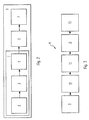
- Fig. 3 schematically shows an adaptive machine learning based method 8.
- a first method step 9 input data are captured with a sensor 2 of an edge device.
- the input data are modified such that edge device specific artifacts of the input data are compensated.
- the modified input data are processed and output data are generated as a result, wherein processing the modified input data and generating the output data is performed by a trained evaluation module 4.
- the output data are modified according to actuator specific requirements.
- an actuator 7 is controlled according to the modified output data.
- the third and the fourth step 12, 13 may also be omitted.
Landscapes
- Engineering & Computer Science (AREA)
- Theoretical Computer Science (AREA)
- Software Systems (AREA)
- Data Mining & Analysis (AREA)
- Evolutionary Computation (AREA)
- Physics & Mathematics (AREA)
- Computing Systems (AREA)
- General Engineering & Computer Science (AREA)
- General Physics & Mathematics (AREA)
- Mathematical Physics (AREA)
- Artificial Intelligence (AREA)
- Medical Informatics (AREA)
- Computer Vision & Pattern Recognition (AREA)
- Computational Linguistics (AREA)
- Manipulator (AREA)
Abstract
Description
- The present invention relates to an adaptive machine learning system, a controlling system comprising the adaptive machine learning system, an edge device comprising the adaptive machine learning system and an adaptive machine learning based method.
- For machine learning, device restrictions are a limiting factor. Often, it is not even possible to train a machine learning based system on an edge device. However, the execution of a machine learning model can be possible on edge devices.
- Separating machine learning and deployment of the learned model on an edge device is a known technique to create a machine learning application in resource limited edge devices. Thus, the training is decoupled, whereby large datasets can be used for the training. The trained model is then deployed on an edge device and executed on input data collected by a sensor of the edge device (e.g. a camera).
- Every physical device operates with its own tolerances due to small variations of components and production processes. During operation, two edge devices in the same environment will provide slightly different input data. During operation and with time, deviations also can change due to external conditions and/or aging processes.
- Therefore, a generic machine learning model is never exactly tuned to an individual edge device. Thus, an edge device can provide input data comprising differences compared to training data the model has been trained with. Consequently, a performance of the trained machine learning model may be lower than expected or desired.
- An objective of the present invention is to provide an adaptive machine learning system, a controlling system comprising the adaptive machine learning system, an edge device comprising the adaptive machine learning system and an adaptive machine learning based method. This objective is solved by an adaptive machine learning system, a controlling system comprising the adaptive machine learning system, an edge device comprising the adaptive machine learning system and an adaptive machine learning based method with the features of the independent claims, respectively. Advantageous embodiments are specified in the dependent claims.
- An adaptive machine learning system for an edge device comprises at least one sensor, at least one input compensation module and an evaluation module. The sensor is designed to capture input data. The input compensation module is designed to modify the input data such that edge device specific artifacts of the input data are compensated. The evaluation module is trained to process the modified input data and to generate output data as a result.
- The general idea is to have at least two modules, the input compensation module that is designed to compensate variations of edge devices and a main machine learning module which is the evaluation module. Advantageously, it is not necessary to retrain the evaluation module for each edge device. The input compensation module may also be a machine learning module which can be trained for the compensation of edge device specific artifacts.
- In an embodiment the input compensation module is designed to modify the input data such that artifacts of the input data occurring due to aging of the edge device are compensated. Advantageously, it is not necessary to retrain the evaluation module for every aging phase of the edge device.
- In an embodiment the input compensation module is designed to modify the input data such that artifacts of the input data occurring due variations of environmental parameters are compensated. Advantageously, it is not necessary to retrain the evaluation module if external conditions change.
- In an embodiment the input compensation module is designed to modify the input data such that artifacts of the input data occurring due to limited resources of the edge device are compensated.
- In order to operate an edge device with an intelligent service based on artificial intelligence, edge device restrictions concerning processing power, memory and bandwidth have to be considered. Advantageously, the resource compensation module is designed to compensate edge device specific artifacts occurring due to such device restrictions.
- In an embodiment the input compensation module is designed to modify the input data such that sensor specific artifacts of the input data are compensated. Advantageously, this allows for e.g. the compensation of systematic errors occurring during capturing input data.
- A controlling system comprises the adaptive machine learning system according to one of the embodiments described above, at least one output compensation module and at least one actuator. The output compensation module is designed to modify the output data such that actuator specific requirements are fulfilled. The actuator is designed to be controllable according to the modified output data.
- Advantageously, the output compensation model is designed modify control signals for the actuator. Thus, deviations caused by production tolerances during the production of actuators can be compensated which allows for a reliable operation of an actuator.
- An edge device comprises the adaptive machine learning system according to one of the embodiments described above. Generally, the trained evaluation module may also be executed on a server. However, the transfer of input data to the server creates a certain data-stream. Combining several sensors could result in a required bandwidth which can be difficult to guarantee for an intended use-case. Advantageously, no transfer of input data is required if the adaptive machine learning system is part of the edge device.
- An adaptive machine learning based method comprises the following steps: Input data is captured with a sensor of an edge device. The input data are modified such that edge device specific artifacts of the input data are compensated. The modified input data are processed and output data are generated as a result, wherein processing the modified input data and generating the output data is performed by a trained evaluation module.
- In an embodiment the method comprises the following further steps: The output data are modified according to actuator specific requirements. An actuator is controlled according to the modified output data.
- In the following, the invention is described in connection with schematic figures, wherein
-
Fig. 1 shows an adaptive machine learning system for an edge device; -
Fig. 2 shows a controlling system comprising the adaptive machine learning system; and -
Fig. 3 shows a machine learning based method. -
Fig. 1 schematically shows an adaptivemachine learning system 1 for an edge device. The adaptivemachine learning system 1 comprises at least one sensor 2, at least one input compensation module 3 and an evaluation module 4. - The sensor 2 is designed to capture input data. E.g. the sensor 2 can be a camera designed to capture images and/or videos. Alternatively, the sensor 2 may be any sensor, e.g. a temperature-sensor, an acceleration sensor or the like. The sensor 2 is part of the edge device which is not shown in
Fig. 1 . The edge device can be any portable device designed to process captured input. - The input compensation module 3 is designed to modify the input data captured by the sensor 2 such that edge device specific artifacts of the input data are compensated. The input compensation module 3 can be based on artificial intelligence/ machine learning. E.g. the input compensation module 3 can be a neuronal network, which is trained to perform the compensation of edge device specific artifacts of the input data.
- Such artifacts may e.g. occur due to production tolerances in the production of edge devices and their sensors and small variations of other components of the edge devices. E.g., different cameras may capture slightly different pictures. In this case, the input compensation module 3 can compensate artifacts of pictures which are specific for one type of camera. If the sensor is e.g. a temperature-sensor, the input compensation module 3 can be designed to compensate for a temperature-offset of the temperature-sensor.
- The evaluation module 4 is trained to process the modified input data and to generate output data as a result. The evaluation module 4 is based on artificial intelligence/ machine learning and can e.g. be a neuronal network. The evaluation module 4 can e.g. be designed for performing a recognition task. In this case, the output data can indicate a positive recognition performance of the evaluation module 4.
- Advantageously, it is not necessary to retrain the evaluation module 4 for each distortion and/or each type of an edge device.
- Instead of only one input compensation module 3, the
system 1 may also comprise a set of input compensation modules 3 covering different variations of artifacts, e.g. variations of different edge devices. Such variations or distortions can be generated and used for a training of the set of input compensation modules 3. In the following different types if input compensation modules 3 are presented. - A first input compensation module 3 can be designed as an age compensation module designed to modify the input data such that artifacts of the input data occurring due to aging of the edge device are compensated. Thus, the evaluation module 4 does not need to be trained for different aging phases of the edge device.
- A second input compensation module 3 can be designed as an external condition compensation module designed to modify the input data such that artifacts of the input data occurring due variations of environmental parameters are compensated, whereby a retraining of the evaluation module 4 can be omitted, if external conditions change in an environment of the edge device.
- A third input compensation modules 3 can be designed as a resource compensation module designed to modify the input data such that artifacts of the input data occurring due to limited resources of the edge device are compensated. Thus, limited resources of the edge device like processing power, memory and bandwidth of a connection of the edge device can be considered.
- A fourth input compensation module 3 can be designed to modify the input data such that sensor specific artifacts, e.g. systematic errors of sensors, of the input data are compensated.
- A plurality of input compensation modules 3 can be tested sequentially. Thus, the input compensation module 3 allowing for a best performance of evaluation module 4 can be found und deployed. This is analogous to an ophthalmologist applying test lenses until vision is sufficiently restored. However, the first, second, third and fourth input compensation modules 3 may be deployed separately or as a part of just one input compensation module 3.
- The
system 1 as a whole can also be part of the edge device. Although, the trained evaluation module 4 may be executed on an external server, the transfer of the input data to the server creates a certain data-stream. Combining several sensors could result in a required bandwidth which can be difficult to guarantee for an intended use-case. Advantageously, no transfer of input data is required if the adaptivemachine learning system 1 is part of the edge device. -
Fig. 2 schematically shows a controlling system 5 comprising the adaptivemachine learning system 1 ofFig. 1 . The controlling system 5 can e.g. be a production facility or an automation system. - The controlling system 5 comprises at least one output compensation module 6 and at least one actuator 7. The actuator 7 can be any element responsible for moving or controlling objects and/or parameters (e.g. a motor, a heating controller or the like). The output compensation module 6 can be based on artificial intelligence/ machine learning. E.g. the output compensation module 6 can be a neuronal network.
- The output compensation module 6 is designed to modify the output data generated by the evaluation module 4 such that actuator specific requirements are fulfilled. The actuator 7 is designed to be controllable according to the modified output data. Advantageously, the output compensation model 6 is designed modify control signals for the actuator 7. Thus, deviations caused by production tolerances during the production of actuators 7 can be compensated which allows for a reliable operation of an actuator 7.
-
Fig. 3 schematically shows an adaptive machine learning based method 8. - In a first method step 9 input data are captured with a sensor 2 of an edge device. In a
second method step 10 the input data are modified such that edge device specific artifacts of the input data are compensated. In athird method step 11 the modified input data are processed and output data are generated as a result, wherein processing the modified input data and generating the output data is performed by a trained evaluation module 4. In an optionalfourth method step 12 the output data are modified according to actuator specific requirements. In an optionalfifth method step 13 an actuator 7 is controlled according to the modified output data. The third and thefourth step -
- 1
- adaptive machine learning system
- 2
- sensor
- 3
- input compensation module
- 4
- evaluation module
- 5
- controlling system
- 6
- output compensation module
- 7
- actuator
- 8
- adaptive machine learning system
- 9
- first method step
- 10
- second method step
- 11
- third method step
- 12
- fourth method step
- 13
- fifth method step
Claims (9)
- Adaptive machine learning system (1) for an edge device, comprising at least one sensor (2), at least one input compensation module (3) and an evaluation module (4),
wherein the sensor (2) is designed to capture input data,
wherein the input compensation module (3) is designed to modify the input data such that edge device specific artifacts of the input data are compensated,
wherein the evaluation module (4) is trained to process the modified input data and to generate output data as a result. - The system (1) as claimed in claim 1,
wherein the input compensation module (3) is designed to modify the input data such that artifacts of the input data occurring due to aging of the edge device are compensated. - The system (1) as claimed in one of the preceding claims,
wherein the input compensation module (3) is designed to modify the input data such that artifacts of the input data occurring due variations of environmental parameters are compensated. - The system (1) as claimed in one of the preceding claims,
wherein the input compensation module (3) is designed to modify the input data such that artifacts of the input data occurring due to limited resources of the edge device are compensated. - The system (1) as claimed in one of the preceding claims,
wherein the input compensation module (3) is designed to modify the input data such that sensor specific artifacts of the input data are compensated. - Controlling system (5) comprising the adaptive machine learning system (1) as claimed in one of the preceding claims, at least one output compensation module (6) and at least one actuator (7),
wherein the output compensation module (6) is designed to modify the output data such that actuator specific requirements are fulfilled,
wherein the actuator (7) is designed to be controllable according to the modified output data. - An edge device comprising the adaptive machine learning system (1) as claimed in one of the claims 1 to 5.
- An adaptive machine learning based method (8) comprising the following steps:- capturing input data with a sensor (2) of an edge device,- modifying the input data such that edge device specific artifacts of the input data are compensated,- processing the modified input data and generating output data as a result, wherein processing the modified input data and generating the output data is performed by a trained evaluation module (4).
- The method (8) as claimed in claim 8 comprising the following further steps:- modifying the output data according to actuator specific requirements,- controlling an actuator (7) according to the modified output data.
Priority Applications (2)
| Application Number | Priority Date | Filing Date | Title |
|---|---|---|---|
| EP20177522.8A EP3916646A1 (en) | 2020-05-29 | 2020-05-29 | Adaptive machine learning system for an edge device |
| US17/328,982 US20210374571A1 (en) | 2020-05-29 | 2021-05-24 | Adaptive machine learning system for an edge device |
Applications Claiming Priority (1)
| Application Number | Priority Date | Filing Date | Title |
|---|---|---|---|
| EP20177522.8A EP3916646A1 (en) | 2020-05-29 | 2020-05-29 | Adaptive machine learning system for an edge device |
Publications (1)
| Publication Number | Publication Date |
|---|---|
| EP3916646A1 true EP3916646A1 (en) | 2021-12-01 |
Family
ID=70968804
Family Applications (1)
| Application Number | Title | Priority Date | Filing Date |
|---|---|---|---|
| EP20177522.8A Withdrawn EP3916646A1 (en) | 2020-05-29 | 2020-05-29 | Adaptive machine learning system for an edge device |
Country Status (2)
| Country | Link |
|---|---|
| US (1) | US20210374571A1 (en) |
| EP (1) | EP3916646A1 (en) |
Citations (2)
| Publication number | Priority date | Publication date | Assignee | Title |
|---|---|---|---|---|
| US5554273A (en) * | 1995-07-26 | 1996-09-10 | Praxair Technology, Inc. | Neural network compensation for sensors |
| US20170372232A1 (en) * | 2016-06-27 | 2017-12-28 | Purepredictive, Inc. | Data quality detection and compensation for machine learning |
Family Cites Families (4)
| Publication number | Priority date | Publication date | Assignee | Title |
|---|---|---|---|---|
| US20180316555A1 (en) * | 2017-04-29 | 2018-11-01 | Cisco Technology, Inc. | Cognitive profiling and sharing of sensor data across iot networks |
| US10759519B2 (en) * | 2017-10-31 | 2020-09-01 | The Boeing Company | Adaptive feedback control of force fighting in hybrid actuation systems |
| US11833882B2 (en) * | 2019-01-29 | 2023-12-05 | Aclima Inc. | Sensor and data platforms for vehicle environmental quality management |
| US11391825B2 (en) * | 2019-07-02 | 2022-07-19 | Waymo Llc | Sensor calibration parameter sensitivity analysis |
-
2020
- 2020-05-29 EP EP20177522.8A patent/EP3916646A1/en not_active Withdrawn
-
2021
- 2021-05-24 US US17/328,982 patent/US20210374571A1/en not_active Abandoned
Patent Citations (2)
| Publication number | Priority date | Publication date | Assignee | Title |
|---|---|---|---|---|
| US5554273A (en) * | 1995-07-26 | 1996-09-10 | Praxair Technology, Inc. | Neural network compensation for sensors |
| US20170372232A1 (en) * | 2016-06-27 | 2017-12-28 | Purepredictive, Inc. | Data quality detection and compensation for machine learning |
Non-Patent Citations (2)
| Title |
|---|
| MATSUI KANAE ET AL: "Error correction method considering fog and edge computing environment", 2019 IEEE INTERNATIONAL CONFERENCE ON INDUSTRIAL CYBER PHYSICAL SYSTEMS (ICPS), IEEE, 6 May 2019 (2019-05-06), pages 517 - 521, XP033585549, DOI: 10.1109/ICPHYS.2019.8780317 * |
| ZEBA IDREES ET AL: "Edge Computing Based IoT Architecture for Low Cost Air Pollution Monitoring Systems: A Comprehensive System Analysis, Design Considerations & Development", SENSORS, vol. 18, no. 9, 10 September 2018 (2018-09-10), pages 3021, XP055748872, DOI: 10.3390/s18093021 * |
Also Published As
| Publication number | Publication date |
|---|---|
| US20210374571A1 (en) | 2021-12-02 |
Similar Documents
| Publication | Publication Date | Title |
|---|---|---|
| US11173613B2 (en) | Position control device and position control method | |
| CN108462871B (en) | The abnormal cause estimating system of visual sensor | |
| US12400110B2 (en) | Knowledge transfer between different deep learning architectures | |
| US20200030970A1 (en) | Position control device and position control method | |
| CN113748389B (en) | Method and apparatus for monitoring industrial process steps | |
| KR20190111644A (en) | Apparatus and method of classifying defect type of repetition pattern image | |
| US20170038750A1 (en) | Method, controller, and computer program product for controlling a target system | |
| JP2020107104A (en) | Image judging device, image judging method, and image judging program | |
| US20210374571A1 (en) | Adaptive machine learning system for an edge device | |
| US12394084B2 (en) | Method and apparatus for learning human pose estimation in low-light conditions | |
| JP6944201B2 (en) | Electronic circuits, hardware components, edge processing systems, edge computing systems, identification methods, identification programs | |
| US12394017B2 (en) | Image analysis model establishment method and image analysis apparatus | |
| WO2020040929A1 (en) | Human action recognition in drone videos | |
| EP4479900A1 (en) | Generating training data to train a machine learning model applied for controlling a production process | |
| EP4099678A1 (en) | Solid-state imaging device, electronic device, and imaging system | |
| EP4478252A1 (en) | A system for learning new visual inspection tasks using a few-shot meta-learning method | |
| US12585566B2 (en) | Maintenance prediction for modules of a microscope | |
| Metzner et al. | Automated optical inspection of soldering connections in power electronics production using convolutional neural networks | |
| US11361424B2 (en) | Neural network-type image processing device, appearance inspection apparatus and appearance inspection method | |
| CN112734752A (en) | Method and system for image screening in flying shooting process | |
| US20240168470A1 (en) | Method and apparatus for commissioning artificial intelligence-based inspection systems | |
| US20250005740A1 (en) | Computer-implemented method and tool for optical quality control of intermediate or end products of production installations, and production installation controller | |
| Stroppa et al. | Self-optimizing robot vision for online quality control | |
| CN114120189A (en) | Online action detection method and system for progressive privilege information distillation | |
| CN119458337B (en) | A robot assembly optimization method and system based on federated learning |
Legal Events
| Date | Code | Title | Description |
|---|---|---|---|
| PUAI | Public reference made under article 153(3) epc to a published international application that has entered the european phase |
Free format text: ORIGINAL CODE: 0009012 |
|
| STAA | Information on the status of an ep patent application or granted ep patent |
Free format text: STATUS: THE APPLICATION HAS BEEN PUBLISHED |
|
| AK | Designated contracting states |
Kind code of ref document: A1 Designated state(s): AL AT BE BG CH CY CZ DE DK EE ES FI FR GB GR HR HU IE IS IT LI LT LU LV MC MK MT NL NO PL PT RO RS SE SI SK SM TR |
|
| B565 | Issuance of search results under rule 164(2) epc |
Effective date: 20201120 |
|
| STAA | Information on the status of an ep patent application or granted ep patent |
Free format text: STATUS: REQUEST FOR EXAMINATION WAS MADE |
|
| RAP1 | Party data changed (applicant data changed or rights of an application transferred) |
Owner name: BULL SAS |
|
| 17P | Request for examination filed |
Effective date: 20220330 |
|
| RBV | Designated contracting states (corrected) |
Designated state(s): AL AT BE BG CH CY CZ DE DK EE ES FI FR GB GR HR HU IE IS IT LI LT LU LV MC MK MT NL NO PL PT RO RS SE SI SK SM TR |
|
| P01 | Opt-out of the competence of the unified patent court (upc) registered |
Effective date: 20230330 |
|
| STAA | Information on the status of an ep patent application or granted ep patent |
Free format text: STATUS: EXAMINATION IS IN PROGRESS |
|
| 17Q | First examination report despatched |
Effective date: 20240104 |
|
| STAA | Information on the status of an ep patent application or granted ep patent |
Free format text: STATUS: THE APPLICATION IS DEEMED TO BE WITHDRAWN |
|
| 18D | Application deemed to be withdrawn |
Effective date: 20240705 |