EP3916408B1 - Storage battery monitoring system and method - Google Patents
Storage battery monitoring system and method Download PDFInfo
- Publication number
- EP3916408B1 EP3916408B1 EP20762090.7A EP20762090A EP3916408B1 EP 3916408 B1 EP3916408 B1 EP 3916408B1 EP 20762090 A EP20762090 A EP 20762090A EP 3916408 B1 EP3916408 B1 EP 3916408B1
- Authority
- EP
- European Patent Office
- Prior art keywords
- cmc
- daisy chain
- transmission path
- control module
- cmcs
- Prior art date
- Legal status (The legal status is an assumption and is not a legal conclusion. Google has not performed a legal analysis and makes no representation as to the accuracy of the status listed.)
- Active
Links
Images



Classifications
-
- H—ELECTRICITY
- H02—GENERATION; CONVERSION OR DISTRIBUTION OF ELECTRIC POWER
- H02J—ELECTRIC POWER NETWORKS; CIRCUIT ARRANGEMENTS OR SYSTEMS FOR SUPPLYING OR DISTRIBUTING ELECTRIC POWER; SYSTEMS FOR STORING ELECTRIC ENERGY
- H02J7/00—Circuit arrangements for charging or discharging batteries or for supplying loads from batteries
- H02J7/80—Circuit arrangements for charging or discharging batteries or for supplying loads from batteries including monitoring or indicating arrangements
-
- G—PHYSICS
- G01—MEASURING; TESTING
- G01R—MEASURING ELECTRIC VARIABLES; MEASURING MAGNETIC VARIABLES
- G01R31/00—Arrangements for testing electric properties; Arrangements for locating electric faults; Arrangements for electrical testing characterised by what is being tested not provided for elsewhere
- G01R31/36—Arrangements for testing, measuring or monitoring the electrical condition of accumulators or electric batteries, e.g. capacity or state of charge [SoC]
- G01R31/371—Arrangements for testing, measuring or monitoring the electrical condition of accumulators or electric batteries, e.g. capacity or state of charge [SoC] with remote indication, e.g. on external chargers
-
- G—PHYSICS
- G08—SIGNALLING
- G08C—TRANSMISSION SYSTEMS FOR MEASURED VALUES, CONTROL OR SIMILAR SIGNALS
- G08C25/00—Arrangements for preventing or correcting errors; Monitoring arrangements
-
- H—ELECTRICITY
- H01—ELECTRIC ELEMENTS
- H01M—PROCESSES OR MEANS, e.g. BATTERIES, FOR THE DIRECT CONVERSION OF CHEMICAL ENERGY INTO ELECTRICAL ENERGY
- H01M10/00—Secondary cells; Manufacture thereof
- H01M10/42—Methods or arrangements for servicing or maintenance of secondary cells or secondary half-cells
- H01M10/4207—Methods or arrangements for servicing or maintenance of secondary cells or secondary half-cells for several batteries or cells simultaneously or sequentially
-
- H—ELECTRICITY
- H01—ELECTRIC ELEMENTS
- H01M—PROCESSES OR MEANS, e.g. BATTERIES, FOR THE DIRECT CONVERSION OF CHEMICAL ENERGY INTO ELECTRICAL ENERGY
- H01M10/00—Secondary cells; Manufacture thereof
- H01M10/42—Methods or arrangements for servicing or maintenance of secondary cells or secondary half-cells
- H01M10/425—Structural combination with electronic components, e.g. electronic circuits integrated to the outside of the casing
-
- H—ELECTRICITY
- H01—ELECTRIC ELEMENTS
- H01M—PROCESSES OR MEANS, e.g. BATTERIES, FOR THE DIRECT CONVERSION OF CHEMICAL ENERGY INTO ELECTRICAL ENERGY
- H01M10/00—Secondary cells; Manufacture thereof
- H01M10/42—Methods or arrangements for servicing or maintenance of secondary cells or secondary half-cells
- H01M10/48—Accumulators combined with arrangements for measuring, testing or indicating the condition of cells, e.g. the level or density of the electrolyte
- H01M10/482—Accumulators combined with arrangements for measuring, testing or indicating the condition of cells, e.g. the level or density of the electrolyte for several batteries or cells simultaneously or sequentially
-
- H—ELECTRICITY
- H02—GENERATION; CONVERSION OR DISTRIBUTION OF ELECTRIC POWER
- H02J—ELECTRIC POWER NETWORKS; CIRCUIT ARRANGEMENTS OR SYSTEMS FOR SUPPLYING OR DISTRIBUTING ELECTRIC POWER; SYSTEMS FOR STORING ELECTRIC ENERGY
- H02J7/00—Circuit arrangements for charging or discharging batteries or for supplying loads from batteries
- H02J7/50—Circuit arrangements for charging or discharging batteries or for supplying loads from batteries acting upon multiple batteries simultaneously or sequentially
-
- H—ELECTRICITY
- H04—ELECTRIC COMMUNICATION TECHNIQUE
- H04Q—SELECTING
- H04Q9/00—Arrangements in telecontrol or telemetry systems for selectively calling a substation from a main station, in which substation desired apparatus is selected for applying a control signal thereto or for obtaining measured values therefrom
-
- G—PHYSICS
- G01—MEASURING; TESTING
- G01R—MEASURING ELECTRIC VARIABLES; MEASURING MAGNETIC VARIABLES
- G01R31/00—Arrangements for testing electric properties; Arrangements for locating electric faults; Arrangements for electrical testing characterised by what is being tested not provided for elsewhere
- G01R31/08—Locating faults in cables, transmission lines, or networks
- G01R31/088—Aspects of digital computing
-
- G—PHYSICS
- G01—MEASURING; TESTING
- G01R—MEASURING ELECTRIC VARIABLES; MEASURING MAGNETIC VARIABLES
- G01R31/00—Arrangements for testing electric properties; Arrangements for locating electric faults; Arrangements for electrical testing characterised by what is being tested not provided for elsewhere
- G01R31/36—Arrangements for testing, measuring or monitoring the electrical condition of accumulators or electric batteries, e.g. capacity or state of charge [SoC]
- G01R31/396—Acquisition or processing of data for testing or for monitoring individual cells or groups of cells within a battery
-
- G—PHYSICS
- G01—MEASURING; TESTING
- G01R—MEASURING ELECTRIC VARIABLES; MEASURING MAGNETIC VARIABLES
- G01R35/00—Testing or calibrating of apparatus covered by the other groups of this subclass
-
- H—ELECTRICITY
- H01—ELECTRIC ELEMENTS
- H01M—PROCESSES OR MEANS, e.g. BATTERIES, FOR THE DIRECT CONVERSION OF CHEMICAL ENERGY INTO ELECTRICAL ENERGY
- H01M10/00—Secondary cells; Manufacture thereof
- H01M10/42—Methods or arrangements for servicing or maintenance of secondary cells or secondary half-cells
- H01M10/425—Structural combination with electronic components, e.g. electronic circuits integrated to the outside of the casing
- H01M2010/4271—Battery management systems including electronic circuits, e.g. control of current or voltage to keep battery in healthy state, cell balancing
-
- H—ELECTRICITY
- H01—ELECTRIC ELEMENTS
- H01M—PROCESSES OR MEANS, e.g. BATTERIES, FOR THE DIRECT CONVERSION OF CHEMICAL ENERGY INTO ELECTRICAL ENERGY
- H01M10/00—Secondary cells; Manufacture thereof
- H01M10/42—Methods or arrangements for servicing or maintenance of secondary cells or secondary half-cells
- H01M10/425—Structural combination with electronic components, e.g. electronic circuits integrated to the outside of the casing
- H01M2010/4278—Systems for data transfer from batteries, e.g. transfer of battery parameters to a controller, data transferred between battery controller and main controller
-
- H—ELECTRICITY
- H04—ELECTRIC COMMUNICATION TECHNIQUE
- H04Q—SELECTING
- H04Q2209/00—Arrangements in telecontrol or telemetry systems
- H04Q2209/30—Arrangements in telecontrol or telemetry systems using a wired architecture
-
- H—ELECTRICITY
- H04—ELECTRIC COMMUNICATION TECHNIQUE
- H04Q—SELECTING
- H04Q2209/00—Arrangements in telecontrol or telemetry systems
- H04Q2209/80—Arrangements in the sub-station, i.e. sensing device
- H04Q2209/82—Arrangements in the sub-station, i.e. sensing device where the sensing device takes the initiative of sending data
- H04Q2209/823—Arrangements in the sub-station, i.e. sensing device where the sensing device takes the initiative of sending data where the data is sent when the measured values exceed a threshold, e.g. sending an alarm
-
- Y—GENERAL TAGGING OF NEW TECHNOLOGICAL DEVELOPMENTS; GENERAL TAGGING OF CROSS-SECTIONAL TECHNOLOGIES SPANNING OVER SEVERAL SECTIONS OF THE IPC; TECHNICAL SUBJECTS COVERED BY FORMER USPC CROSS-REFERENCE ART COLLECTIONS [XRACs] AND DIGESTS
- Y02—TECHNOLOGIES OR APPLICATIONS FOR MITIGATION OR ADAPTATION AGAINST CLIMATE CHANGE
- Y02E—REDUCTION OF GREENHOUSE GAS [GHG] EMISSIONS, RELATED TO ENERGY GENERATION, TRANSMISSION OR DISTRIBUTION
- Y02E60/00—Enabling technologies; Technologies with a potential or indirect contribution to GHG emissions mitigation
- Y02E60/10—Energy storage using batteries
Definitions
- the embodiments of the present disclosure relate to the field of battery monitoring technology, in particular to a storage battery monitoring system as specified in any of claims 1 to 7 and method as specified in any of claims 8 to 9.
- the storage battery management system mostly use a communication mode based on a CAN bus or single chain daisy chain.
- the daisy chain communication mode may make up for the unpredictability, channel error and blockage and other defects in a CAN bus system to a certain extent, and may improve EMC performance.
- Embodiments of the present disclosure are intended to provide a storage battery monitoring system as specified in any of claims 1 to 7 and method as specified in any of claims 8 to 9, which can avoid the problem of communication failure due to the occurrence of a fault in a current transmission path and improve safety.
- some embodiments of the present invention provide a storage battery monitoring system, including: n cell monitoring cells (CMCs), a control module, and several daisy chain buses; where n is an integer greater than 2; the n CMCs are configured to monitor a plurality of cell modules electrically connected in a storage battery, and each CMC is configured to monitor at least one of the plurality of cell modules; the n CMCs are connected to the control module through each daisy chain bus, wherein each CMC of the n CMCs is directly connected to the daisy chain buses; the control module is configured to receive monitoring data of the plurality of cell modules uploaded by the n CMCs through a transmission path formed by at least one daisy chain bus; and the control module is further configured to identify a fault location according to the monitoring data when a fault occurring to the transmission path is detected, and adjust the transmission path according to the fault location so as to receive the monitoring data; wherein, there are two daisy chain buses (L1, L2); wherein in a
- Some embodiments of the present disclosure also provide a storage battery monitoring method, applied to a control module in a storage battery monitoring system.
- the storage battery monitoring system also includes n cell monitoring cells (CMCs) and several daisy chain buses.
- the n CMCs are configured to monitor a plurality of cell modules electrically connected in a storage battery, and each CMC is configured to monitor its corresponding cell modules.
- the n CMCs are connected to the control module through each daisy chain bus, wherein each CMC of the n CMCs is directly connected to the daisy chain buses.
- n is an integer greater than 2.
- the storage battery monitoring method includes: receiving monitoring data of the plurality of cell modules uploaded by the n CMCs through a transmission path formed by at least one daisy chain bus; identifying a fault location according to the monitoring data when a fault occurring to the transmission path is detected; and adjusting the transmission path according to the fault location so as to receive the monitoring data; wherein, there are two daisy chain buses (L1, L2); wherein in a transmission path formed by one of the two daisy chain buses, a CMC with a highest potential among the n CMCS is directly connected to the control module; in a transmission path formed by another of the two daisy chain buses, a CMC with a lowest potential among the n CMCs is directly connected to the control module; wherein, the CMC with the highest potential is a CMC for monitoring a cell module with the highest potential, and the CMC with the lowest potential is a CMC for monitoring a cell module with the lowest potential;
- the storage battery monitoring system includes several daisy chain buses, and n CMCs are connected to the control module through each daisy chain bus.
- the control module identifies the fault location according to the monitoring data when the fault occurring to the transmission path is detected, and adjusts the transmission path according to the fault location so as to receive the monitoring data. That is, when the fault occurs to the current transmission path and the monitoring data may not be received, an adjusted transmission path may be used to continue to receive the monitoring data, thus avoiding the problem of communication failure due to the occurrence of the fault in the current transmission path and improving safety.
- control module includes an adaptive controller and a microcontroller.
- the microcontroller receives the monitoring data uploaded by the n CMCs through the adaptive controller; and the adaptive controller is configured to identify the fault location according to the monitoring data when the fault occurring to the transmission path is detected, and adjust the transmission path according to the fault location.
- the adaptive controller is used to adaptively adjust the transmission path, which may reduce a burden on a microprocessor.
- the monitoring data includes state data of the plurality of cell modules collected by the n CMCs and a respective extremum value of each of at least one state parameter in the state data determined by the n CMCs.
- the adaptive controller is further configured to output an alarm signal when it is identified that the respective extremum value reaches a preset alarm threshold.
- the respective extremum value of each of the at least one state parameter is determined by the CMC and then uploaded, so that the control module can obtain the respective extremum value without needing to process the state data after receiving the state data, which may not only reduce the processing burden of the microprocessor, but also improve the timeliness of discovering a storage battery abnormality.
- the respective extremum value of each of the at least one state parameter is judged by the adaptive controller, which may further reduce the running burden of the microcontroller.
- the monitoring data includes state data of the plurality of cell modules collected by the n CMCs and a respective extremum value of each of at least one state parameter in the state data determined by the n CMCs.
- the control module is configured to receive the state data through the transmission path formed by one of the two daisy chain buses, and receive the respective extremum value through the transmission path formed by another of the two daisy chain buses.
- the transmission efficiency may be improved by separately transmitting the state data and the respective extremum value of each of the at least one state parameter of the n cell modules, so that the control module may timely judge whether there is a potential danger through the state parameter.
- the fault location is any position in the transmission path formed by one of the two daisy chain buses; and an adjusted transmission path is a transmission path formed by another of the two daisy chain buses.
- fault locations which are respectively located on the transmission paths formed by the two daisy chain buses and both between a k-th CMC and a k+1-th CMC; where k is an integer and 1 ⁇ k ⁇ n-1.
- There are two adjusted transmission paths namely, a transmission path formed by a line between the control module and a first CMC, the first CMC and the k-th CMC in one of the two daisy chain buses, and a transmission path formed by a line between the k+1-th CMC and a n-th CMC, and the n-th CMC and the control module in another of the two daisy chain buses.
- This embodiment not treating the fault case defined in the independent claims provides another case of the fault location and its corresponding adjusted transmission path.
- the claimed subject-matter of the independent claims comprises the case where there are two fault locations, which are respectively located on the transmission paths formed by the two daisy chain buses, where one of the two fault locations is between a k-th CMC and a k+1-th CMC of one of the two daisy chain buses, and another of the two fault locations is between a k+1+a CMC and a k+2+a CMC of another of the two daisy chain buses; where both k and a are integers greater than or equal to 1, a is an integer greater than or equal to 0, and k+2+a ⁇ n; an adjusted transmission path is: a circular transmission path formed by a line between the control module and a first CMC, the first CMC and the k-th CMC, the k+1-th CMC and the k+2+a-th CMC in one of the two daisy chain buses, and between the k-th CMC and the k+1-th CMC, the k+2+a-th CMC
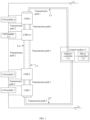
- a first embodiment of the present disclosure relates to a storage battery monitoring system, as shown in FIG. 1 , which includes: n cell monitoring cells (CMC), a control module 11 and several daisy chain buses.
- n is an integer greater than 2.
- the n CMCs are configured to monitor a plurality of cell modules electrically connected in a storage battery in a one-to-one correspondence, and each CMC is configured to monitor at least one of the plurality of cell modules; and the n CMCs are connected to the control module 11 through each daisy chain bus.
- the control module 11 is configured to receive monitoring data of the plurality of cell modules uploaded by the n CMCs through a transmission path formed by at least one daisy chain bus; and the control module 11 is further configured to identify a fault location according to the monitoring data when a fault occurring to the transmission path is detected, and adjust the transmission path according to the fault location so as to receive the monitoring data.
- the storage battery monitoring system includes several daisy chain buses, and the n CMCs are connected to the control module through each daisy chain bus.
- the control module identifies the fault location according to the monitoring data when the fault occurring to the transmission path is detected, and adjusts the transmission path according to the fault location so as to receive the monitoring data. That is, when the fault occurs to the current transmission path and the monitoring data may not be received, an adjusted transmission path may be used to continue to receive the monitoring data, thus avoiding the problem of communication failure due to the occurrence of the fault in the current transmission path and improving safety.
- the storage battery monitoring system in this embodiment is used to monitor a storage battery in an electric vehicle to ensure driving safety. However, it is not limited to this, and the storage battery monitoring system in this embodiment may also be applied to the monitoring of a storage battery in other electrical equipment.
- the storage battery includes n cell modules, which are a cell module 1, a cell module 2, ..., a cell module n.
- the n cell modules are sequentially connected in series, and each cell module includes a plurality of cells connected each other.
- the voltages of the cell module 1, the cell module 2, ... , the cell module n increase sequentially, that is, the cell module 1 is a cell module with a lowest potential in the storage battery, and the cell module n is a cell module with a highest potential in the storage battery.
- the voltages of the cell module 1, the cell module 2, ..., the cell module n may decrease sequentially.
- the n CMCs are a CMC1, a CMC2, ..., a CMCn, and the n CMCs correspond to the n cell modules one by one. That is, a CMCk is connected to both ends of a cell module k to monitor it.
- k is an integer and 1 ⁇ k ⁇ n. Since the CMC1 corresponds to the cell module 1 and the CMCn corresponds to the cell module n, then the CMC1 is a CMC with the lowest potential among the n CMCs, and the CMCn is a CMC with the highest potential among the n CMCs.
- the number of the CMCs in this embodiment is the same as the number of the cell modules, that is, the n CMCs correspond to the n cell modules one by one. However, it is not limited to this, and the number of the CMCs and the cell modules is not limited. If a CMC has relatively more sampling channels, it may also monitor a plurality of cell modules. For example, if a CMC has 12 sampling channels and each cell module includes 4 cells, then the CMC may monitor 3 cell modules. Alternatively, the same cell module may also be monitored by a plurality of CMCs.
- daisy chain buses L1 and L2 there are two daisy chain buses, namely, a daisy chain bus L1 and a daisy chain bus L2.
- the n CMCs are connected to the control module 11 through each daisy chain bus, and a transmission path may be formed based on each daisy chain bus.
- the daisy chain bus may transmit a signal in a differential manner.
- the daisy chain buses L1 and L2 in the figure respectively have two transmission lines, which may be understood as a pair of differential transmission lines.
- the CMC1, the CMC2, ..., and the CMCn are respectively connected to the daisy chain bus L1 and connected to the control module 11 through the daisy chain bus L1, and the CMCn is directly connected to the control module 11. That is, a transmission path 1 formed based on the daisy chain bus L1 includes the n CMCs, a line between adjacent CMCs, and a line between the CMCn and control module 11; and a transmission direction of the monitoring data is from CMC1, CMC2, ..., CMCn, to the control module 11, that is, transmitting from the low potential to the high potential.
- the CMC1, the CMC2, ..., and the CMCn are respectively connected to the daisy chain bus L2 and connected to the control module 11 through the daisy chain bus L2, and the CMC1 is directly connected to the control module 11. That is, a transmission path 2 formed based on the daisy chain bus L2 includes the n CMCs, a line between adjacent CMCs, and a line between the CMC1 and control module 11; and the transmission direction of the monitoring data is from CMCn, CMCn-1, ..., CMC1, to the control module 11, that is, transmitting from the high potential to the low potential.
- the monitoring data of the n cell modules includes state data of the plurality of cell modules and a respective extremum value of each of at least one state parameter in the state data.
- the state data of the plurality of cell modules are respectively collected by the n CMCS, and the state data includes a plurality of state parameters such as voltage, current and temperature of each cell in each cell module.
- Each CMC may also determine the respective extremum value through a step-by-step comparison and upload the respective extremum value to the control module 11.
- a state parameter closely related to the safety performance of the storage battery may be selected and its extremum value may be determined, such as a maximum value of the voltage and a maximum value of the temperature.
- the respective extremum value of each of the at least one state parameter is determined by the CMC and then uploaded, so that the control module 11 can obtain the respective extremum value without needing to process the state data after receiving the state data, which may not only reduce the processing burden of a microprocessor, but also improve the timeliness of discovering a storage battery abnormality.
- the transmission path 1 formed based on the daisy chain bus L1 and the transmission path 2 formed based on the daisy chain bus L2 may both transmit data in two directions, that is, one direction is used to upload the monitoring data of the n cell modules, and another direction is used to issue a control command of the control module to each CMC.
- the transmission directions of the monitoring data of the n cell modules uploaded by the two daisy chain buses may be opposite. However, it is not limited to this. In other examples, the transmission directions of the monitoring data of the n cell modules uploaded by the two daisy chain buses may be the same.
- this embodiment and the following embodiments are illustrated by taking the two daisy chain buses L1, L2 and transmission directions of the two transmission paths respectively formed based on the daisy chain buses L1, L2 being opposite as an example, but are not limited thereto.
- the control module 11 receives the state data of the n cell modules through the transmission path formed based on one of the two daisy chain buses, and receives a maximum voltage value and a maximum temperature value through the transmission path formed based on another of the two daisy chain buses.
- the control module 11 receives the state data of the n cell modules through the transmission path 1 formed based on the daisy chain bus L1, and receives the extremum values of the state parameters through the transmission path 2 formed based on the daisy chain bus L2.
- each CMC determines the extremum values of the state parameters through the step-by-step comparison.
- the CMCn transmits a collected voltage value and temperature value of the cell module n to the CMCn-1.
- the CMCn-1 compares a collected voltage value and temperature value of the cell module n-1 with the received voltage value and temperature value of cell module n respectively, to obtain a relatively large voltage value and a relatively large temperature value, and transmits the relatively large voltage value and the relatively large temperature value to a CMCn-2.
- the CMCn-2 compares a collected voltage value and temperature value of a cell module n-2 with the relatively large voltage value and the relatively large temperature value received from the CMCn-1 respectively, to obtain a re-determined relatively large voltage value and relatively large temperature value, and transmits the re-determined relatively large voltage value and relatively large temperature value to a CMCn-3; and so on, until the CMC1 obtains the maximum voltage value and the maximum temperature value, and uploads the maximum voltage value and the maximum temperature value to the control module 11.
- the state data of the n cell modules and the extremum values of the state parameters are uploaded through the transmission path 1 and the transmission path 2 respectively, which may improve the transmission efficiency of the monitoring data.
- the state data and the extremum values of the state parameters may also be uploaded to the control module 11 through the same transmission path.
- the state data and the extremum values of the state parameters are both uploaded through the transmission path 1 or are both uploaded through the transmission path 2.
- control module 11 may also issue a control command to the n CMCs so as to control each CMC to control its corresponding cell module.
- the control command may be issued to each CMC through the same transmission path.
- the control command may be issued to each CMC through the transmission path 1 or the transmission path 2.
- the control module 11 in this embodiment includes an adaptive controller 111 and a microcontroller 112.
- the adaptive controller 111 has two connection ports, one of which is connected with the daisy chain bus L1, and another is connected with the daisy chain bus L2.
- the adaptive controller 111 is configured to identify a fault location according to the monitoring data when a fault occurring to the transmission path 1 or the transmission path 2 is detected, and adjust the transmission path according to the fault location.
- the microcontroller 112 is connected to the adaptive controller 111 and communicates with the n CMCs through the adaptive controller 111, that is, the microcontroller 112 receives the monitoring data uploaded by the n CMCs or issues the control command to the n CMCs through the adaptive controller 111.
- the communication between the adaptive controller 111 and each CMC, and between the adaptive controller 111 and the microcontroller 112 may use a standard communication protocol such as SPI, CAN, UART, etc., or a non-standard communication protocol (i.e., a protocol defined by a developer's own coding).
- a standard communication protocol such as SPI, CAN, UART, etc.
- a non-standard communication protocol i.e., a protocol defined by a developer's own coding
- control module 11 may only include the microcontroller 112.
- the microcontroller 112 includes two connection ports, one of which is connected with the daisy chain bus L1 and another is connected with the daisy chain bus L2, and performs all functions of the control module 11.
- the state data of the n cell modules are transmitted through the transmission path 1 formed based on the daisy chain bus L1, and the maximum voltage value and the maximum temperature value of the cells are transmitted through the transmission path 2 formed based on the daisy chain bus L2.
- the adaptive controller 111 may upload the monitoring data received from the n CMCs to the microcontroller 112, so that the microcontroller 112 analyzes and processes the monitoring data.
- the adaptive controller 111 may detect whether a fault occurs to the transmission path. For example, the adaptive controller 111 may preset a waiting time for each data reception. After receiving data once, if the next data is received after the waiting time, whether a fault occurs to the transmission path is determined. In addition, the adaptive controller 111 may identify a fault location according to the monitoring data when the fault occurring to the transmission path is detected, and adjust the transmission path according to the fault location to receive the monitoring data.
- the adaptive controller 111 may identify the fault location according to whether the monitoring data may be received normally by controlling a CMC communication port to loop back one by one and issuing a test instruction.
- the transmission path 2 in FIG. 1 is taken as an example:
- the adaptive controller 111 sets a communication port of the CMC1 to a loop-back mode and issues a sampling control instruction. If the adaptive controller 111 may normally receive the state data of the cell module 1 collected by the CMC1 within a specified time, it indicates that the daisy chain transmission path between the adaptive controller 111 and the CMC1 has no fault; otherwise, it indicates that there is a fault.
- the adaptive controller 111 When there is no fault in the daisy chain of the CMC1 area, the adaptive controller 111 changes the loop-back mode of the communication port of the CMC1 to a normal mode, and sets the communication port of the CMC2 to the loop-back mode. At the same time, the adaptive controller 111 issues the sampling control instruction. If the state data of the cell module 1 and the cell module 2 collected by the CMC1 and the CMC2 may be normally received within the specified time after the sampling control instruction is issued, it indicates that the daisy chain between the adaptive controller 111 and the CMC2 has no fault; otherwise, it indicates that there is a fault. By analogy, the fault location of the CMC daisy chain is judged one by one in the same way as the above-mentioned daisy chain fault location judgment.
- the fault location is any position in the transmission path formed by one of the two daisy chain buses.
- an adjusted transmission path is a transmission path formed by another of the two daisy chain buses.
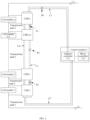
- positions P0, P1, P2 and P3 are schematically shown on the daisy chain bus L1, where the position P2 refers to any position between the CMC2 and the CMCn-1, that is, it is schematically shown in FIG. 2 that a fault occurs to the transmission path 1.
- the fault at any position in the transmission path here may be a fault in a line between adjacent CMCs or a line between the CMCn and the control module 11, or a fault in any CMC device itself.
- the adaptive controller 111 issues the control command to the n CMCs to control the n CMCs to transmit the monitoring data (including the state data of the n cell modules and the extremum values of the state parameters) through the daisy chain bus L2, that is, the adjusted transmission path is the transmission path 2 formed based on the daisy chain bus L2. That is, when the fault occurs to the transmission path 1, the state data of the n cell modules originally transmitted through the transmission path 1 formed based on the daisy chain bus L1 is changed to be transmitted through the transmission path 2 formed based on the daisy chain bus L2. It should be noted that FIG. 2 only illustrates the case where the fault occurs to the transmission path 1. If the fault occurs to the transmission path 2, the adjusted transmission path is the transmission path 1 formed based on the daisy chain bus L1.
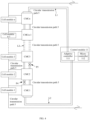
- FIG. 3 shows positions P3 and P4, where the position P3 is located on the transmission path 1 formed by the daisy chain bus L1, the position P4 is located on the transmission path 2 formed by the daisy chain bus L2, and both the position P3 and the position P4 are located between the CMC1 and the CMC2.
- the fault occurs to the position P3 and the position P4 simultaneously, it indicates that both the transmission path 1 and the transmission path 2 have problems.
- the adaptive controller 111 receives the monitoring data uploaded by the CMC1 through the transmission path 3, and receives monitoring data uploaded by the CMC2 to the CMCn through the transmission path 4, and transmits the received monitoring data from the CMC1, the CMC2 to the CMCn to the microcontroller 112.
- the monitoring data from the CMC1, the CMC2 to the CMCn are uploaded in two paths, so the extremum values of the state parameters may not be obtained by each CMC through the step-by-step comparison, that is, the microcontroller 112 may obtain the extremum values of the state parameters only by identifying and comparing the received monitoring data from the CMC1, the CMC2 to the CMCn.
- the microcontroller 112 issues the control command to the CMC1 through the transmission path 3, and issues the control command to the CMC2 to the CMCn through the transmission path 4.
- FIG. 3 only illustrates the case where the fault location is between the CMC1 and the CMC2; however, it is not limited to this. When the fault occurs to the transmission path 1 and the transmission path 2 between any two adjacent CMCs simultaneously, the adjusted transmission path may be obtained by the above-described methods.
- the adjusted transmission path is: a circular transmission path formed between the control module 11 and the first CMC, the first CMC and the k-th CMC, the k+1-th CMC and the k+2+a-th CMC in one of the two daisy chain buses, and between the k+2+a-th CMC and the n-th CMC, and the control module in another of the two daisy chain buses.
- FIG. 4 shows a position P4 and a position P5.
- the position P4 is on the daisy chain bus L2 and between the CMC1 and the CMC2, and the position P5 is on the daisy chain bus L1 between the CMC2 and the CMC3. That is, in the example of FIG. 4 , the value of k is 1 and the value of a is 0.
- the transmission path needs to be re-adjusted so that the monitoring data may be transmitted to the microcontroller 112.
- An adjustment basis is that due to the fault at the position P4, when transmitting between the CMC1 and the CMC2, it is necessary to transfer the monitoring data from a line between the CMC1 and the CMC2 in the daisy chain bus L2 to a line between the CMC1 and the CMC2 in the daisy chain bus L1 for transmission; and due to the fault at the position P5, when transmitting between the CMC2 and the CMC3, it is necessary to transfer the monitoring data from a line between the CMC2 and the CMC3 in the daisy chain bus L1 to a line between the CMC2 and the CMC3 in the daisy chain bus L2 for transmission.
- three different transmission paths may be obtained after adjustment, which are specifically as follows.
- a first transmission path is a circular transmission path 5 formed by lines between the control module 11 and the CMC1, the CMC2 and the CMC3 in the daisy chain bus L2, and lines between the CMC1 and the CMC2, the CMC3 and the CMCn, and the CMCn and the control module 11 in the daisy chain bus L1.
- a second transmission path is a single daisy chain transmission path formed by lines between the control module 11 and the CMC1, the CMC2 and the CMCn in the daisy chain bus L2, and the line between the CMC1 and the CMC2 in the daisy chain bus L1.
- a third transmission path is a single daisy chain transmission path formed by lines between the control module 11 and the CMCn, the CMCn-1 and the CMC3, and the CMC2 and the CMC1 in the daisy chain bus L1, and the line between the CMC3 and the CMC2 in the daisy chain bus L2.
- the following transmission path may be formed.
- a fourth transmission path is a circular transmission path formed by lines between the control module 11 and the CMC1, the CMC1 and the CMC2 in the daisy chain bus L2, and lines between the CMC2 and the CMCn, and the CMCn and the control module 11 in the daisy chain bus L1.
- the claimed subject-matter of the independent claims comprises the alternatives of the first transmission path, the third transmission path or the fourth transmission path but not the second transmission path.
- the adaptive controller 111 may obtain any adjusted transmission path by reconfiguring each CMC; receive the monitoring data uploaded by the n CMCs through the adjusted transmission path, and transmit the monitoring data to the microcontroller 112; where the extremum values of the state parameters may be obtained by a successive comparison of each CMC.
- the microcontroller 112 may also issue the control command to each CMC through the adjusted transmission path.
- the adaptive controller 111 triggers a communication path switching function of a daisy chain control unit within the corresponding CMC, so that the transmission path may be automatically switched after the communication path switching function of the CMC is triggered. Then, the adaptive controller 111 may re-detect whether the adjusted transmission path is normal according to the above-described identification of the fault location.
- the adaptive controller 111 directly sends a control command to control the corresponding CMC to switch the transmission path.
- transmission paths formed by any two of the daisy chain buses may be selected to respectively transmit the monitoring data of the n cell modules and the respective extremum value of each of the at least one state parameter, and the rest of the daisy chain buses are used as a standby daisy chain bus.
- the transmission path may be adjusted according to the above method of this embodiment; or, not forming part of the claimed subject-matter of the independent claims, a transmission path formed by the standby daisy chain bus may be used to transmit the monitoring data.
- a second embodiment of the present disclosure relates to a storage battery monitoring system.
- the second embodiment is substantially the same as the first embodiment, with the main difference that in the second embodiment of present disclosure, the adaptive controller 111 is further configured to output an alarm signal when it is identified that a respective extremum value of each of at least one state parameter reaches a preset alarm threshold.
- the adaptive controller 111 is internally preset with the alarm threshold corresponding to the state parameter.
- the alarm threshold includes a voltage alarm threshold and a temperature alarm threshold.
- the adaptive controller 111 receives a maximum voltage value and a maximum temperature value of a cell, it outputs an alarm signal if it is identified that the maximum voltage value reaches the voltage alarm threshold and/or the maximum temperature value reaches the temperature alarm threshold. That is, as long as one parameter of the maximum voltage value and the maximum temperature value reaches its corresponding alarm threshold, it indicates that the storage battery is in a dangerous state, and the alarm signal is output.
- the adaptive controller is configured to perform judgement on the respective extremum value, which may further reduce the operating burden of the microcontroller.
- the adaptive controller 111 is also connected to a switch 21 in a battery circuit where the storage battery is located; and the alarm signal is a signal for controlling the switch 21 to be turned off. That is, the adaptive controller 111 outputs the alarm signal to the switch 21 to turn off the switch 21, thereby turning off the battery circuit.
- the switch 21 shown in FIG. 5 is connected to the cell module n, that is, set on a high-voltage side of the storage battery, but it is not limited to this. In other examples, the switch may also be set on a low-voltage side of the storage battery, or there may be two switches respectively set on the high-voltage side and the low-voltage side of the storage battery.
- the adaptive controller 111 is connected to the two switches at the same time, and may output the alarm signal to the two switches at the same time.
- modules involved in this embodiment are logic modules.
- a logic unit may be a physical unit, or a part of a physical unit, or a combination of multiple physical units.
- a unit that is not closely related to solving the technical problems proposed in present disclosure is not introduced in this embodiment, but this does not indicate that there are no other units in this embodiment.
- a third embodiment of the present disclosure relates to a storage battery monitoring method, which is applied to a control module in a storage battery monitoring system.
- the storage battery monitoring system includes: n cell monitoring cells (CMC), a control module 11 and several daisy chain buses, where n is an integer greater than 2.
- the n CMCs are configured to monitor the n cell modules electrically connected in a storage battery in one-to-one correspondence, and each CMC is configured to monitor at least one cell module; and the n CMCs are connected to the control module 11 through each daisy chain bus.
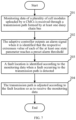
- FIG. 6 shows a flowchart of the storage battery monitoring method of this embodiment, including:
- the storage battery monitoring system includes several daisy chain buses, and n CMCs are connected to the control module through each daisy chain bus.
- the control module identifies the fault location according to the monitoring data when the fault occurring to the transmission path is detected, and adjusts the transmission path according to the fault location so as to receive the monitoring data. That is, when the fault occurs to the current transmission path and the monitoring data may not be received, an adjusted transmission path may be used to continue to receive the monitoring data, thus avoiding the problem of communication failure due to the occurrence of the fault in the current transmission path and improving safety.
- this embodiment is a method embodiment corresponding to the first embodiment, and this embodiment may be implemented in cooperation with the first embodiment.
- the relevant technical details mentioned in the first embodiment are still valid in this embodiment, and in order to reduce repetition, they will not be repeated here.
- the relevant technical details mentioned in this embodiment may also be applied in the first embodiment.
- a fourth embodiment of the present disclosure relates to a storage battery monitoring method.
- the fourth embodiment is substantially the same as the third embodiment, with the main difference that in the fourth embodiment of present disclosure, the adaptive controller may pre-alarm according to a respective extremum value of each of at least one state parameter.
- FIG. 7 is a schematic diagram of the storage battery monitoring method according to the fourth embodiment of the present disclosure, including:
- step 201, the step 203, the step 204 are substantially the same as the step 101-the step 103, which will not be repeated here.
- step 202 the execution sequence of step 202 and step 203 is not limited.
- the adaptive controller 111 is internally preset with the alarm threshold.
- the alarm threshold includes a voltage alarm threshold and a temperature alarm threshold.
- step 202 when the adaptive controller 111 receives a maximum voltage value and a maximum temperature value of a cell, it outputs an alarm signal if it is identified that the maximum voltage value reaches the voltage alarm threshold and/or the maximum temperature value reaches the temperature alarm threshold. That is, as long as one parameter of the maximum voltage value and the maximum temperature value reaches its corresponding alarm threshold, it indicates that the storage battery is in a dangerous state, and the alarm signal is output.
- the adaptive controller performs judgement on the respective extremum value, which may further reduce the operating burden of the microcontroller.
- the adaptive controller 111 is also connected to a switch 21 in a battery circuit where the storage battery is located; and the alarm signal is a signal for controlling the switch 21 to be turned off. That is, the adaptive controller 111 outputs the alarm signal to the switch 21 to turn off the switch 21, thereby turning off the battery circuit.
- this embodiment may be implemented in cooperation with the second embodiment.
- the relevant technical details mentioned in the second embodiment are still valid in this embodiment, and the technical effects that may be achieved in the second embodiment may also be achieved in this embodiment. In order to reduce repetition, details are not repeated here. Correspondingly, the relevant technical details mentioned in this embodiment may also be applied in the second embodiment.
- the aforementioned storage medium includes: a U disk, a mobile hard disk, a Read-Only Memory (ROM), a Random Access Memory (RAM), a magnetic disk or an optical disk and other media that may store a program code.
Landscapes
- Engineering & Computer Science (AREA)
- General Chemical & Material Sciences (AREA)
- Manufacturing & Machinery (AREA)
- Chemical & Material Sciences (AREA)
- Chemical Kinetics & Catalysis (AREA)
- Electrochemistry (AREA)
- Physics & Mathematics (AREA)
- General Physics & Mathematics (AREA)
- Power Engineering (AREA)
- Microelectronics & Electronic Packaging (AREA)
- Computer Networks & Wireless Communication (AREA)
- Charge And Discharge Circuits For Batteries Or The Like (AREA)
- Tests Of Electric Status Of Batteries (AREA)
- Secondary Cells (AREA)
Description
- The embodiments of the present disclosure relate to the field of battery monitoring technology, in particular to a storage battery monitoring system as specified in any of
claims 1 to 7 and method as specified in any of claims 8 to 9. - As the driving power of an electric vehicle, the working state of a storage battery directly affects the safety performance of the electric vehicle, so it is particularly important to use a storage battery management system to monitor the storage battery. At present, the storage battery management system mostly use a communication mode based on a CAN bus or single chain daisy chain. The daisy chain communication mode may make up for the unpredictability, channel error and blockage and other defects in a CAN bus system to a certain extent, and may improve EMC performance.
- The inventor finds that there are at least the following problems in the existing technology: what is used in the daisy chain is a cascaded serial transmission communication. When a failure occurs to a certain place in a data chain (a transmission line itself or a certain device), it may lead to a communication failure and an abnormality.
-
US2011/145629A1 ,JP2013104842A US2018/372804A1 ,US8089248B2 andDE102012222720A1 disclose battery monitoring systems and methods of battery monitoring in related art. - Embodiments of the present disclosure are intended to provide a storage battery monitoring system as specified in any of
claims 1 to 7 and method as specified in any of claims 8 to 9, which can avoid the problem of communication failure due to the occurrence of a fault in a current transmission path and improve safety. - To solve the above technical problems, some embodiments of the present invention provide a storage battery monitoring system, including: n cell monitoring cells (CMCs), a control module, and several daisy chain buses; where n is an integer greater than 2; the n CMCs are configured to monitor a plurality of cell modules electrically connected in a storage battery, and each CMC is configured to monitor at least one of the plurality of cell modules; the n CMCs are connected to the control module through each daisy chain bus, wherein each CMC of the n CMCs is directly connected to the daisy chain buses; the control module is configured to receive monitoring data of the plurality of cell modules uploaded by the n CMCs through a transmission path formed by at least one daisy chain bus; and the control module is further configured to identify a fault location according to the monitoring data when a fault occurring to the transmission path is detected, and adjust the transmission path according to the fault location so as to receive the monitoring data; wherein, there are two daisy chain buses (L1, L2); wherein in a transmission path formed by one of the two daisy chain buses, a CMC with a highest potential among the n CMCS is directly connected to the control module; in a transmission path formed by another of the two daisy chain buses, a CMC with a lowest potential among the n CMCs is directly connected to the control module; wherein, the CMC with the highest potential is a CMC for monitoring a cell module with the highest potential, and the CMC with the lowest potential is a CMC for monitoring a cell module with the lowest potential;
- wherein the storage battery monitoring system is configured that when there are two fault locations, which are respectively located on the transmission paths formed by the two daisy chain buses, wherein one of the fault locations is between a k-th CMC and a k+1-th CMC of one of the two daisy chain buses, and another fault location is between a k+1+a CMC and a k+2+a CMC of another of the two daisy chain buses; wherein k is an integer greater than or equal to 1, a is an integer greater than or equal to 0, and k+2+a≤n;
- an adjusted transmission path is:
- a circular transmission path formed by a line between the control module and a first CMC, the first CMC and the k-th CMC, the k+1-th CMC and the k+2+a-th CMC in one of the two daisy chain buses, and between the k-th CMC and the k+1-th CMC, the k+2+a-th CMC and a n-th CMC, and the n-th CMC and the control module in another of the two daisy chain buses; or,
- a circular transmission path formed by a line between the control module and the first CMC and the first CMC and the k+1+a-th CMC in another of the two daisy chain buses, and between the k+1+a-th CMC and the n-th CMC and the n-th CMC the control module in the one of the two daisy chain buses; or,
- a transmission path formed by a line between the k+2+a-th CMC and the k+1+a-th CMC in the one of the two daisy chain buses, and between the control module and the n-th CMC, the n-th CMC and the k+2+a-th CMC, and the k+1+a-th CMC and the first CMC in another of the two daisy chain buses.
- Some embodiments of the present disclosure also provide a storage battery monitoring method, applied to a control module in a storage battery monitoring system. The storage battery monitoring system also includes n cell monitoring cells (CMCs) and several daisy chain buses. The n CMCs are configured to monitor a plurality of cell modules electrically connected in a storage battery, and each CMC is configured to monitor its corresponding cell modules. The n CMCs are connected to the control module through each daisy chain bus, wherein each CMC of the n CMCs is directly connected to the daisy chain buses. n is an integer greater than 2. The storage battery monitoring method includes: receiving monitoring data of the plurality of cell modules uploaded by the n CMCs through a transmission path formed by at least one daisy chain bus; identifying a fault location according to the monitoring data when a fault occurring to the transmission path is detected; and adjusting the transmission path according to the fault location so as to receive the monitoring data; wherein, there are two daisy chain buses (L1, L2); wherein in a transmission path formed by one of the two daisy chain buses, a CMC with a highest potential among the n CMCS is directly connected to the control module; in a transmission path formed by another of the two daisy chain buses, a CMC with a lowest potential among the n CMCs is directly connected to the control module; wherein, the CMC with the highest potential is a CMC for monitoring a cell module with the highest potential, and the CMC with the lowest potential is a CMC for monitoring a cell module with the lowest potential;
- when there are two fault locations, which are respectively located on the transmission paths formed by the two daisy chain buses, wherein one of the fault locations is between a k-th CMC and a k+1-th CMC of one of the two daisy chain buses, and another fault location is between a k+1+a CMC and a k+2+a CMC of another of the two daisy chain buses; wherein both k and a are integers greater than or equal to 1, a is an integer greater than or equal to 0, and k+2+a≤n;
- an adjusted transmission path is:
- a circular transmission path formed by a line between the control module and a first CMC, the first CMC and the k-th CMC, the k+1-th CMC and the k+2+a-th CMC in one of the two daisy chain buses, and between the k-th CMC and the k+1-th CMC, the k+2+a-th CMC and a n-th CMC, and the n-th CMC and the control module in another of the two daisy chain buses; or,
- a circular transmission path formed by a line between the control module and the first CMC and the first CMC and the k+1+a-th CMC in another of the two daisy chain buses, and between the k+1+a-th CMC and the n-th CMC and the n-th CMC the control module in the one of the two daisy chain buses; or,
- a transmission path formed by a line between the k+2+a-th CMC and the k+1+a-th CMC in the one of the two daisy chain buses, and between the control module and the n-th CMC, the n-th CMC and the k+2+a-th CMC, and the k+1+a-th CMC and the first CMC in another of the two daisy chain buses.
- Compared with the existing technology, the storage battery monitoring system includes several daisy chain buses, and n CMCs are connected to the control module through each daisy chain bus. The control module identifies the fault location according to the monitoring data when the fault occurring to the transmission path is detected, and adjusts the transmission path according to the fault location so as to receive the monitoring data. That is, when the fault occurs to the current transmission path and the monitoring data may not be received, an adjusted transmission path may be used to continue to receive the monitoring data, thus avoiding the problem of communication failure due to the occurrence of the fault in the current transmission path and improving safety.
- In addition, the control module includes an adaptive controller and a microcontroller. The microcontroller receives the monitoring data uploaded by the n CMCs through the adaptive controller; and the adaptive controller is configured to identify the fault location according to the monitoring data when the fault occurring to the transmission path is detected, and adjust the transmission path according to the fault location. In this embodiment, the adaptive controller is used to adaptively adjust the transmission path, which may reduce a burden on a microprocessor.
- In addition, the monitoring data includes state data of the plurality of cell modules collected by the n CMCs and a respective extremum value of each of at least one state parameter in the state data determined by the n CMCs. The adaptive controller is further configured to output an alarm signal when it is identified that the respective extremum value reaches a preset alarm threshold. In this embodiment, the respective extremum value of each of the at least one state parameter is determined by the CMC and then uploaded, so that the control module can obtain the respective extremum value without needing to process the state data after receiving the state data, which may not only reduce the processing burden of the microprocessor, but also improve the timeliness of discovering a storage battery abnormality. The respective extremum value of each of the at least one state parameter is judged by the adaptive controller, which may further reduce the running burden of the microcontroller.
- In addition, there are two daisy chain buses. The monitoring data includes state data of the plurality of cell modules collected by the n CMCs and a respective extremum value of each of at least one state parameter in the state data determined by the n CMCs. The control module is configured to receive the state data through the transmission path formed by one of the two daisy chain buses, and receive the respective extremum value through the transmission path formed by another of the two daisy chain buses. In this embodiment, the transmission efficiency may be improved by separately transmitting the state data and the respective extremum value of each of the at least one state parameter of the n cell modules, so that the control module may timely judge whether there is a potential danger through the state parameter.
- In addition, the fault location is any position in the transmission path formed by one of the two daisy chain buses; and an adjusted transmission path is a transmission path formed by another of the two daisy chain buses. This embodiment not treating the fault case defined in the independent claims provides a case of the fault location and its corresponding adjusted transmission path.
- In addition, there are two fault locations, which are respectively located on the transmission paths formed by the two daisy chain buses and both between a k-th CMC and a k+1-th CMC; where k is an integer and 1≤k≤n-1. There are two adjusted transmission paths, namely, a transmission path formed by a line between the control module and a first CMC, the first CMC and the k-th CMC in one of the two daisy chain buses, and a transmission path formed by a line between the k+1-th CMC and a n-th CMC, and the n-th CMC and the control module in another of the two daisy chain buses. This embodiment not treating the fault case defined in the independent claims provides another case of the fault location and its corresponding adjusted transmission path.
- The claimed subject-matter of the independent claims comprises the case where there are two fault locations, which are respectively located on the transmission paths formed by the two daisy chain buses, where one of the two fault locations is between a k-th CMC and a k+1-th CMC of one of the two daisy chain buses, and another of the two fault locations is between a k+1+a CMC and a k+2+a CMC of another of the two daisy chain buses; where both k and a are integers greater than or equal to 1, a is an integer greater than or equal to 0, and k+2+a≤n; an adjusted transmission path is: a circular transmission path formed by a line between the control module and a first CMC, the first CMC and the k-th CMC, the k+1-th CMC and the k+2+a-th CMC in one of the two daisy chain buses, and between the k-th CMC and the k+1-th CMC, the k+2+a-th CMC and a n-th CMC, and the n-th CMC and the control module in another of the two daisy chain buses; or, a circular transmission path formed by a line between the control module and the first CMC, the first CMC and the k+1+a-th CMC in another of the two daisy chain buses, and between the k+1+a-th CMC and the n-th CMC and the n-th CMC the control module in the one of the two daisy chain buses; or, a transmission path formed by a line between the k+2+a-th CMC and the k+1+a-th CMC in the one of the two daisy chain buses, and between the control module and the n-th CMC, the n-th CMC and the k+2+a-th CMC, and the k+1+a-th CMC and the first CMC in another of the two daisy chain buses. This embodiment is according to the claimed subject-matter and provides yet another case of the fault location and its corresponding adjusted transmission path.
- One or more embodiments are described as examples with reference to the corresponding figures in the accompanying drawings, and the examples do not constitute a limitation to the embodiments. Elements with the same reference numerals in the accompanying drawings represent similar elements. The figures in the accompanying drawings do not constitute a proportion limitation unless otherwise stated.
-
FIG. 1 is a schematic diagram of a storage battery monitoring system according to a first embodiment of the present disclosure. -
FIG. 2 is a schematic diagram of an example of a fault location according to the first embodiment of the present disclosure not treating the fault case defined in the independent claims. -
FIG. 3 is a schematic diagram of another example of a fault location according to the first embodiment of the present disclosure not treating the fault case defined in the independent claims. -
FIG. 4 is a schematic diagram of yet another example of a fault location according to the first embodiment of the present disclosure treating the fault case defined in the independent claims. -
FIG. 5 is a schematic diagram of a storage battery monitoring system according to a second embodiment of the present disclosure. -
FIG. 6 is a flowchart of a storage battery monitoring method according to a third embodiment of the present disclosure. -
FIG. 7 is a flowchart of a storage battery monitoring method according to a fourth embodiment of the present disclosure. - The embodiments of the present disclosure will be described in detail below with reference to the accompanying drawings in order to make the objectives, technical solutions and advantages of the present disclosure clearer. However, it will be apparent to those skilled in the art that, in the various embodiments of the present disclosure, numerous technical details are set forth in order to provide the reader with a better understanding of the present disclosure. However, the technical solutions claimed in the present disclosure may be implemented without these technical details and various changes and modifications based on the following embodiments. The following embodiments are divided for convenience of description, and should not constitute any limitation to the specific implementation of the present disclosure. The various embodiments may be combined with each other and referred to each other on the premise of no contradiction.
- A first embodiment of the present disclosure relates to a storage battery monitoring system, as shown in
FIG. 1 , which includes: n cell monitoring cells (CMC), acontrol module 11 and several daisy chain buses. Here, n is an integer greater than 2. The n CMCs are configured to monitor a plurality of cell modules electrically connected in a storage battery in a one-to-one correspondence, and each CMC is configured to monitor at least one of the plurality of cell modules; and the n CMCs are connected to thecontrol module 11 through each daisy chain bus. - The
control module 11 is configured to receive monitoring data of the plurality of cell modules uploaded by the n CMCs through a transmission path formed by at least one daisy chain bus; and thecontrol module 11 is further configured to identify a fault location according to the monitoring data when a fault occurring to the transmission path is detected, and adjust the transmission path according to the fault location so as to receive the monitoring data. - In the embodiment of the present disclosure, the storage battery monitoring system includes several daisy chain buses, and the n CMCs are connected to the control module through each daisy chain bus. The control module identifies the fault location according to the monitoring data when the fault occurring to the transmission path is detected, and adjusts the transmission path according to the fault location so as to receive the monitoring data. That is, when the fault occurs to the current transmission path and the monitoring data may not be received, an adjusted transmission path may be used to continue to receive the monitoring data, thus avoiding the problem of communication failure due to the occurrence of the fault in the current transmission path and improving safety.
- The implementation details of the storage battery monitoring system in this embodiment are described in detail below. The following contents are only implementation details provided for ease of understanding and are not necessary for implementing the present solution.
- The storage battery monitoring system in this embodiment is used to monitor a storage battery in an electric vehicle to ensure driving safety. However, it is not limited to this, and the storage battery monitoring system in this embodiment may also be applied to the monitoring of a storage battery in other electrical equipment.
- In this embodiment, as shown in
FIG. 1 , the storage battery includes n cell modules, which are acell module 1, acell module 2, ..., a cell module n. The n cell modules are sequentially connected in series, and each cell module includes a plurality of cells connected each other. In this embodiment, the voltages of thecell module 1, thecell module 2, ... , the cell module n increase sequentially, that is, thecell module 1 is a cell module with a lowest potential in the storage battery, and the cell module n is a cell module with a highest potential in the storage battery. However, it is not limited to this. In other examples, the voltages of thecell module 1, thecell module 2, ..., the cell module n may decrease sequentially. The n CMCs are a CMC1, a CMC2, ..., a CMCn, and the n CMCs correspond to the n cell modules one by one. That is, a CMCk is connected to both ends of a cell module k to monitor it. Here, k is an integer and 1≤k≤n. Since the CMC1 corresponds to thecell module 1 and the CMCn corresponds to the cell module n, then the CMC1 is a CMC with the lowest potential among the n CMCs, and the CMCn is a CMC with the highest potential among the n CMCs. - It should be noted that the number of the CMCs in this embodiment is the same as the number of the cell modules, that is, the n CMCs correspond to the n cell modules one by one. However, it is not limited to this, and the number of the CMCs and the cell modules is not limited. If a CMC has relatively more sampling channels, it may also monitor a plurality of cell modules. For example, if a CMC has 12 sampling channels and each cell module includes 4 cells, then the CMC may monitor 3 cell modules. Alternatively, the same cell module may also be monitored by a plurality of CMCs.
- As shown in
FIG. 1 , there are two daisy chain buses, namely, a daisy chain bus L1 and a daisy chain bus L2. The n CMCs are connected to thecontrol module 11 through each daisy chain bus, and a transmission path may be formed based on each daisy chain bus. In this embodiment, the daisy chain bus may transmit a signal in a differential manner. The daisy chain buses L1 and L2 in the figure respectively have two transmission lines, which may be understood as a pair of differential transmission lines. - The CMC1, the CMC2, ..., and the CMCn are respectively connected to the daisy chain bus L1 and connected to the
control module 11 through the daisy chain bus L1, and the CMCn is directly connected to thecontrol module 11. That is, atransmission path 1 formed based on the daisy chain bus L1 includes the n CMCs, a line between adjacent CMCs, and a line between the CMCn andcontrol module 11; and a transmission direction of the monitoring data is from CMC1, CMC2, ..., CMCn, to thecontrol module 11, that is, transmitting from the low potential to the high potential. - The CMC1, the CMC2, ..., and the CMCn are respectively connected to the daisy chain bus L2 and connected to the
control module 11 through the daisy chain bus L2, and the CMC1 is directly connected to thecontrol module 11. That is, atransmission path 2 formed based on the daisy chain bus L2 includes the n CMCs, a line between adjacent CMCs, and a line between the CMC1 andcontrol module 11; and the transmission direction of the monitoring data is from CMCn, CMCn-1, ..., CMC1, to thecontrol module 11, that is, transmitting from the high potential to the low potential. - In this embodiment, the monitoring data of the n cell modules includes state data of the plurality of cell modules and a respective extremum value of each of at least one state parameter in the state data. Herein, the state data of the plurality of cell modules are respectively collected by the n CMCS, and the state data includes a plurality of state parameters such as voltage, current and temperature of each cell in each cell module. Each CMC may also determine the respective extremum value through a step-by-step comparison and upload the respective extremum value to the
control module 11. Generally, a state parameter closely related to the safety performance of the storage battery may be selected and its extremum value may be determined, such as a maximum value of the voltage and a maximum value of the temperature. In this embodiment, the respective extremum value of each of the at least one state parameter is determined by the CMC and then uploaded, so that thecontrol module 11 can obtain the respective extremum value without needing to process the state data after receiving the state data, which may not only reduce the processing burden of a microprocessor, but also improve the timeliness of discovering a storage battery abnormality. - In this embodiment, the
transmission path 1 formed based on the daisy chain bus L1 and thetransmission path 2 formed based on the daisy chain bus L2 may both transmit data in two directions, that is, one direction is used to upload the monitoring data of the n cell modules, and another direction is used to issue a control command of the control module to each CMC. In this embodiment, the transmission directions of the monitoring data of the n cell modules uploaded by the two daisy chain buses may be opposite. However, it is not limited to this. In other examples, the transmission directions of the monitoring data of the n cell modules uploaded by the two daisy chain buses may be the same. Herein, this embodiment and the following embodiments are illustrated by taking the two daisy chain buses L1, L2 and transmission directions of the two transmission paths respectively formed based on the daisy chain buses L1, L2 being opposite as an example, but are not limited thereto. - In this embodiment, the
control module 11 receives the state data of the n cell modules through the transmission path formed based on one of the two daisy chain buses, and receives a maximum voltage value and a maximum temperature value through the transmission path formed based on another of the two daisy chain buses. For example, thecontrol module 11 receives the state data of the n cell modules through thetransmission path 1 formed based on the daisy chain bus L1, and receives the extremum values of the state parameters through thetransmission path 2 formed based on the daisy chain bus L2. Herein, each CMC determines the extremum values of the state parameters through the step-by-step comparison. Specifically, the CMCn transmits a collected voltage value and temperature value of the cell module n to the CMCn-1. The CMCn-1 compares a collected voltage value and temperature value of the cell module n-1 with the received voltage value and temperature value of cell module n respectively, to obtain a relatively large voltage value and a relatively large temperature value, and transmits the relatively large voltage value and the relatively large temperature value to a CMCn-2. The CMCn-2 compares a collected voltage value and temperature value of a cell module n-2 with the relatively large voltage value and the relatively large temperature value received from the CMCn-1 respectively, to obtain a re-determined relatively large voltage value and relatively large temperature value, and transmits the re-determined relatively large voltage value and relatively large temperature value to a CMCn-3; and so on, until the CMC1 obtains the maximum voltage value and the maximum temperature value, and uploads the maximum voltage value and the maximum temperature value to thecontrol module 11. - In this embodiment, the state data of the n cell modules and the extremum values of the state parameters are uploaded through the
transmission path 1 and thetransmission path 2 respectively, which may improve the transmission efficiency of the monitoring data. However, it is not limited to this. In other examples, the state data and the extremum values of the state parameters may also be uploaded to thecontrol module 11 through the same transmission path. For example, the state data and the extremum values of the state parameters are both uploaded through thetransmission path 1 or are both uploaded through thetransmission path 2. - It should be noted that the
control module 11 may also issue a control command to the n CMCs so as to control each CMC to control its corresponding cell module. The control command may be issued to each CMC through the same transmission path. For example, the control command may be issued to each CMC through thetransmission path 1 or thetransmission path 2. - As shown in
FIG. 1 , thecontrol module 11 in this embodiment includes anadaptive controller 111 and amicrocontroller 112. Theadaptive controller 111 has two connection ports, one of which is connected with the daisy chain bus L1, and another is connected with the daisy chain bus L2. Theadaptive controller 111 is configured to identify a fault location according to the monitoring data when a fault occurring to thetransmission path 1 or thetransmission path 2 is detected, and adjust the transmission path according to the fault location. Themicrocontroller 112 is connected to theadaptive controller 111 and communicates with the n CMCs through theadaptive controller 111, that is, themicrocontroller 112 receives the monitoring data uploaded by the n CMCs or issues the control command to the n CMCs through theadaptive controller 111. Herein, the communication between theadaptive controller 111 and each CMC, and between theadaptive controller 111 and themicrocontroller 112 may use a standard communication protocol such as SPI, CAN, UART, etc., or a non-standard communication protocol (i.e., a protocol defined by a developer's own coding). - However, it is not limited to this. In other examples, the
control module 11 may only include themicrocontroller 112. At this time, themicrocontroller 112 includes two connection ports, one of which is connected with the daisy chain bus L1 and another is connected with the daisy chain bus L2, and performs all functions of thecontrol module 11. - In this embodiment, in a normal state, the state data of the n cell modules are transmitted through the
transmission path 1 formed based on the daisy chain bus L1, and the maximum voltage value and the maximum temperature value of the cells are transmitted through thetransmission path 2 formed based on the daisy chain bus L2. Theadaptive controller 111 may upload the monitoring data received from the n CMCs to themicrocontroller 112, so that themicrocontroller 112 analyzes and processes the monitoring data. - The
adaptive controller 111 may detect whether a fault occurs to the transmission path. For example, theadaptive controller 111 may preset a waiting time for each data reception. After receiving data once, if the next data is received after the waiting time, whether a fault occurs to the transmission path is determined. In addition, theadaptive controller 111 may identify a fault location according to the monitoring data when the fault occurring to the transmission path is detected, and adjust the transmission path according to the fault location to receive the monitoring data. - Herein, the
adaptive controller 111 may identify the fault location according to whether the monitoring data may be received normally by controlling a CMC communication port to loop back one by one and issuing a test instruction. Thetransmission path 2 inFIG. 1 is taken as an example: - The
adaptive controller 111 sets a communication port of the CMC1 to a loop-back mode and issues a sampling control instruction. If theadaptive controller 111 may normally receive the state data of thecell module 1 collected by the CMC1 within a specified time, it indicates that the daisy chain transmission path between theadaptive controller 111 and the CMC1 has no fault; otherwise, it indicates that there is a fault. - When there is no fault in the daisy chain of the CMC1 area, the
adaptive controller 111 changes the loop-back mode of the communication port of the CMC1 to a normal mode, and sets the communication port of the CMC2 to the loop-back mode. At the same time, theadaptive controller 111 issues the sampling control instruction. If the state data of thecell module 1 and thecell module 2 collected by the CMC1 and the CMC2 may be normally received within the specified time after the sampling control instruction is issued, it indicates that the daisy chain between theadaptive controller 111 and the CMC2 has no fault; otherwise, it indicates that there is a fault. By analogy, the fault location of the CMC daisy chain is judged one by one in the same way as the above-mentioned daisy chain fault location judgment. - In this embodiment, there are three cases for the fault location, which are specifically as follows.
- In the first case, the fault location is any position in the transmission path formed by one of the two daisy chain buses. At this time, an adjusted transmission path is a transmission path formed by another of the two daisy chain buses.
- As shown in
FIG. 2 , positions P0, P1, P2 and P3 are schematically shown on the daisy chain bus L1, where the position P2 refers to any position between the CMC2 and the CMCn-1, that is, it is schematically shown inFIG. 2 that a fault occurs to thetransmission path 1. It should be noted that the fault at any position in the transmission path here may be a fault in a line between adjacent CMCs or a line between the CMCn and thecontrol module 11, or a fault in any CMC device itself. - In the first case, not being the fault case defined in the subject-matter of the independent claims, the
adaptive controller 111 issues the control command to the n CMCs to control the n CMCs to transmit the monitoring data (including the state data of the n cell modules and the extremum values of the state parameters) through the daisy chain bus L2, that is, the adjusted transmission path is thetransmission path 2 formed based on the daisy chain bus L2. That is, when the fault occurs to thetransmission path 1, the state data of the n cell modules originally transmitted through thetransmission path 1 formed based on the daisy chain bus L1 is changed to be transmitted through thetransmission path 2 formed based on the daisy chain bus L2. It should be noted thatFIG. 2 only illustrates the case where the fault occurs to thetransmission path 1. If the fault occurs to thetransmission path 2, the adjusted transmission path is thetransmission path 1 formed based on the daisy chain bus L1. - In the second case, not being the fault case defined in the subject-matter of the independent claims, there are two fault locations, which are respectively located on the transmission paths formed by the two daisy chain buses and both between a k-th CMC and a k+1-th CMC, where k is an integer and 1≤k≤n-1. At this time, there are two adjusted transmission paths, namely, a transmission path formed by a line between the
control module 11 and a first CMC, the first CMC and the k-th CMC in one of the two daisy chain buses, and a transmission path formed by a line between the k+1-th CMC and a n-th CMC, and the n-th CMC and the control module in another of the two daisy chain buses. -
FIG. 3 shows positions P3 and P4, where the position P3 is located on thetransmission path 1 formed by the daisy chain bus L1, the position P4 is located on thetransmission path 2 formed by the daisy chain bus L2, and both the position P3 and the position P4 are located between the CMC1 and the CMC2. When the fault occurs to the position P3 and the position P4 simultaneously, it indicates that both thetransmission path 1 and thetransmission path 2 have problems. At this time, there are two adjusted transmission paths, namely, atransmission path 3 formed by a line between the CMC1 and thecontrol module 11 in the daisy chain bus L2 and atransmission path 4 formed by a line between the CMC2 and the CMCn and a line between the CMCn and thecontrol module 11 in daisy chain bus L1. That is, theadaptive controller 111 receives the monitoring data uploaded by the CMC1 through thetransmission path 3, and receives monitoring data uploaded by the CMC2 to the CMCn through thetransmission path 4, and transmits the received monitoring data from the CMC1, the CMC2 to the CMCn to themicrocontroller 112. The monitoring data from the CMC1, the CMC2 to the CMCn are uploaded in two paths, so the extremum values of the state parameters may not be obtained by each CMC through the step-by-step comparison, that is, themicrocontroller 112 may obtain the extremum values of the state parameters only by identifying and comparing the received monitoring data from the CMC1, the CMC2 to the CMCn. Herein, themicrocontroller 112 issues the control command to the CMC1 through thetransmission path 3, and issues the control command to the CMC2 to the CMCn through thetransmission path 4. It should be noted thatFIG. 3 only illustrates the case where the fault location is between the CMC1 and the CMC2; however, it is not limited to this. When the fault occurs to thetransmission path 1 and thetransmission path 2 between any two adjacent CMCs simultaneously, the adjusted transmission path may be obtained by the above-described methods. - In the third case, in this generality not being the fault case defined in the subject-matter of the independent claims, there are two fault locations, which are respectively located on the transmission paths formed by the two daisy chain buses, where one of the fault locations is between the k-th CMC and the k+1-th CMC, and another fault location is between a k+1+a CMC and a k+2+a CMC; where a is an integer greater than or equal to 0, and k+2+a≤n. The adjusted transmission path is: a circular transmission path formed between the
control module 11 and the first CMC, the first CMC and the k-th CMC, the k+1-th CMC and the k+2+a-th CMC in one of the two daisy chain buses, and between the k+2+a-th CMC and the n-th CMC, and the control module in another of the two daisy chain buses. -
FIG. 4 shows a position P4 and a position P5. The position P4 is on the daisy chain bus L2 and between the CMC1 and the CMC2, and the position P5 is on the daisy chain bus L1 between the CMC2 and the CMC3. That is, in the example ofFIG. 4 , the value of k is 1 and the value of a is 0. When the fault occurs to the position P4 and the position P5 simultaneously, it indicates that both the daisy chain buses L1 and L2 have problems. At this time, the transmission path needs to be re-adjusted so that the monitoring data may be transmitted to themicrocontroller 112. An adjustment basis is that due to the fault at the position P4, when transmitting between the CMC1 and the CMC2, it is necessary to transfer the monitoring data from a line between the CMC1 and the CMC2 in the daisy chain bus L2 to a line between the CMC1 and the CMC2 in the daisy chain bus L1 for transmission; and due to the fault at the position P5, when transmitting between the CMC2 and the CMC3, it is necessary to transfer the monitoring data from a line between the CMC2 and the CMC3 in the daisy chain bus L1 to a line between the CMC2 and the CMC3 in the daisy chain bus L2 for transmission. According to the above adjustment basis, three different transmission paths may be obtained after adjustment, which are specifically as follows. - A first transmission path is a
circular transmission path 5 formed by lines between thecontrol module 11 and the CMC1, the CMC2 and the CMC3 in the daisy chain bus L2, and lines between the CMC1 and the CMC2, the CMC3 and the CMCn, and the CMCn and thecontrol module 11 in the daisy chain bus L1. - A second transmission path is a single daisy chain transmission path formed by lines between the
control module 11 and the CMC1, the CMC2 and the CMCn in the daisy chain bus L2, and the line between the CMC1 and the CMC2 in the daisy chain bus L1. - A third transmission path is a single daisy chain transmission path formed by lines between the
control module 11 and the CMCn, the CMCn-1 and the CMC3, and the CMC2 and the CMC1 in the daisy chain bus L1, and the line between the CMC3 and the CMC2 in the daisy chain bus L2. - In addition, if the position P4 is on the daisy chain bus L1 and between the CMC1 and the CMC2, and the position P5 is on the daisy chain bus L2 and between the CMC2 and the CMC3, then the following transmission path may be formed.
- A fourth transmission path is a circular transmission path formed by lines between the
control module 11 and the CMC1, the CMC1 and the CMC2 in the daisy chain bus L2, and lines between the CMC2 and the CMCn, and the CMCn and thecontrol module 11 in the daisy chain bus L1. The claimed subject-matter of the independent claims comprises the alternatives of the first transmission path, the third transmission path or the fourth transmission path but not the second transmission path. - The
adaptive controller 111 may obtain any adjusted transmission path by reconfiguring each CMC; receive the monitoring data uploaded by the n CMCs through the adjusted transmission path, and transmit the monitoring data to themicrocontroller 112; where the extremum values of the state parameters may be obtained by a successive comparison of each CMC. Themicrocontroller 112 may also issue the control command to each CMC through the adjusted transmission path. - Herein, there may be two ways to adjust the transmission path, namely a hardware trigger mode and a software control mode. In the hardware trigger mode, after detecting the fault location for the first time, the
adaptive controller 111 triggers a communication path switching function of a daisy chain control unit within the corresponding CMC, so that the transmission path may be automatically switched after the communication path switching function of the CMC is triggered. Then, theadaptive controller 111 may re-detect whether the adjusted transmission path is normal according to the above-described identification of the fault location. In the software control mode, after detecting the fault location, theadaptive controller 111 directly sends a control command to control the corresponding CMC to switch the transmission path. - It should be noted that, in other examples, if the number of the daisy chain buses is greater than two, then transmission paths formed by any two of the daisy chain buses may be selected to respectively transmit the monitoring data of the n cell modules and the respective extremum value of each of the at least one state parameter, and the rest of the daisy chain buses are used as a standby daisy chain bus. When the fault of the above three cases occurs, the transmission path may be adjusted according to the above method of this embodiment; or, not forming part of the claimed subject-matter of the independent claims, a transmission path formed by the standby daisy chain bus may be used to transmit the monitoring data.
- A second embodiment of the present disclosure relates to a storage battery monitoring system. The second embodiment is substantially the same as the first embodiment, with the main difference that in the second embodiment of present disclosure, the
adaptive controller 111 is further configured to output an alarm signal when it is identified that a respective extremum value of each of at least one state parameter reaches a preset alarm threshold. - The
adaptive controller 111 is internally preset with the alarm threshold corresponding to the state parameter. In this embodiment, the alarm threshold includes a voltage alarm threshold and a temperature alarm threshold. When theadaptive controller 111 receives a maximum voltage value and a maximum temperature value of a cell, it outputs an alarm signal if it is identified that the maximum voltage value reaches the voltage alarm threshold and/or the maximum temperature value reaches the temperature alarm threshold. That is, as long as one parameter of the maximum voltage value and the maximum temperature value reaches its corresponding alarm threshold, it indicates that the storage battery is in a dangerous state, and the alarm signal is output. In this embodiment, the adaptive controller is configured to perform judgement on the respective extremum value, which may further reduce the operating burden of the microcontroller. - In an example, as shown in
FIG. 5 , theadaptive controller 111 is also connected to aswitch 21 in a battery circuit where the storage battery is located; and the alarm signal is a signal for controlling theswitch 21 to be turned off. That is, theadaptive controller 111 outputs the alarm signal to theswitch 21 to turn off theswitch 21, thereby turning off the battery circuit. - In this embodiment, the
switch 21 shown inFIG. 5 is connected to the cell module n, that is, set on a high-voltage side of the storage battery, but it is not limited to this. In other examples, the switch may also be set on a low-voltage side of the storage battery, or there may be two switches respectively set on the high-voltage side and the low-voltage side of the storage battery. Theadaptive controller 111 is connected to the two switches at the same time, and may output the alarm signal to the two switches at the same time. - It is worth mentioning that all modules involved in this embodiment are logic modules. In practical applications, a logic unit may be a physical unit, or a part of a physical unit, or a combination of multiple physical units. In addition, in order to highlight the innovative part of the present disclosure, a unit that is not closely related to solving the technical problems proposed in present disclosure is not introduced in this embodiment, but this does not indicate that there are no other units in this embodiment.
- A third embodiment of the present disclosure relates to a storage battery monitoring method, which is applied to a control module in a storage battery monitoring system. Referring to
FIG. 1 , the storage battery monitoring system includes: n cell monitoring cells (CMC), acontrol module 11 and several daisy chain buses, where n is an integer greater than 2. The n CMCs are configured to monitor the n cell modules electrically connected in a storage battery in one-to-one correspondence, and each CMC is configured to monitor at least one cell module; and the n CMCs are connected to thecontrol module 11 through each daisy chain bus. -
FIG. 6 shows a flowchart of the storage battery monitoring method of this embodiment, including: - In
step 101, monitoring data of a plurality of cell modules uploaded by the n CMCs is received through a transmission path formed by at least one daisy chain bus. - In
step 102, a fault location is identified according to the monitoring data when a fault occurring to the transmission path is detected. - In
step 103, the transmission path is adjusted according to the fault location so as to receive the monitoring data. - In the embodiment of the present disclosure, the storage battery monitoring system includes several daisy chain buses, and n CMCs are connected to the control module through each daisy chain bus. The control module identifies the fault location according to the monitoring data when the fault occurring to the transmission path is detected, and adjusts the transmission path according to the fault location so as to receive the monitoring data. That is, when the fault occurs to the current transmission path and the monitoring data may not be received, an adjusted transmission path may be used to continue to receive the monitoring data, thus avoiding the problem of communication failure due to the occurrence of the fault in the current transmission path and improving safety.
- It is not difficult to find that this embodiment is a method embodiment corresponding to the first embodiment, and this embodiment may be implemented in cooperation with the first embodiment. The relevant technical details mentioned in the first embodiment are still valid in this embodiment, and in order to reduce repetition, they will not be repeated here. Correspondingly, the relevant technical details mentioned in this embodiment may also be applied in the first embodiment.
- A fourth embodiment of the present disclosure relates to a storage battery monitoring method. The fourth embodiment is substantially the same as the third embodiment, with the main difference that in the fourth embodiment of present disclosure, the adaptive controller may pre-alarm according to a respective extremum value of each of at least one state parameter.
- Referring to
FIG. 1 andFIG. 7 together, whereFIG. 7 is a schematic diagram of the storage battery monitoring method according to the fourth embodiment of the present disclosure, including: - In
step 201, monitoring data of a plurality of cell modules uploaded by n CMCs is received through a transmission path formed by at least one daisy chain bus. - In
step 202, the adaptive controller outputs an alarm signal when it is identified that the respective extremum value reaches a preset alarm threshold. - In
step 203, a fault location is identified according to the monitoring data when a fault occurring to the transmission path is detected. - In
step 204, the transmission path is adjusted according to the fault location so as to receive the monitoring data. - Herein, the
step 201, thestep 203, thestep 204 are substantially the same as the step 101-thestep 103, which will not be repeated here. The difference lies in that this embodiment also includesstep 202. It should be noted that the execution sequence ofstep 202 and step 203 is not limited. - Specifically, the
adaptive controller 111 is internally preset with the alarm threshold. In this embodiment, the alarm threshold includes a voltage alarm threshold and a temperature alarm threshold. Instep 202, when theadaptive controller 111 receives a maximum voltage value and a maximum temperature value of a cell, it outputs an alarm signal if it is identified that the maximum voltage value reaches the voltage alarm threshold and/or the maximum temperature value reaches the temperature alarm threshold. That is, as long as one parameter of the maximum voltage value and the maximum temperature value reaches its corresponding alarm threshold, it indicates that the storage battery is in a dangerous state, and the alarm signal is output. In this embodiment, the adaptive controller performs judgement on the respective extremum value, which may further reduce the operating burden of the microcontroller. - In a preferred example, referring to
FIG. 5 , theadaptive controller 111 is also connected to aswitch 21 in a battery circuit where the storage battery is located; and the alarm signal is a signal for controlling theswitch 21 to be turned off. That is, theadaptive controller 111 outputs the alarm signal to theswitch 21 to turn off theswitch 21, thereby turning off the battery circuit. - Since the second embodiment corresponds to this embodiment, this embodiment may be implemented in cooperation with the second embodiment. The relevant technical details mentioned in the second embodiment are still valid in this embodiment, and the technical effects that may be achieved in the second embodiment may also be achieved in this embodiment. In order to reduce repetition, details are not repeated here. Correspondingly, the relevant technical details mentioned in this embodiment may also be applied in the second embodiment.
- The steps set in the above-described methods only aim to make the description clearer. In implementation, the steps may be combined into one or one step may be divided into multiple steps, which all fall into the protection scope of the present disclosure as long as the same logical relationship is included. Such a trivial amendment or design added to an algorithm or procedure as not changing the algorithm or a core design of the procedure falls into the protection scope of the disclosure.
- That is, those skilled in the art may understand that all or some of the steps of the method in the above-described embodiments may be completed by a program instructing related hardware, and the program may be stored in a storage medium and includes several instructions to make a device (which may be a single-chip microcomputer, a chip, etc.) or a processor implement all or some of the steps of the method described in each embodiment of present disclosure. The aforementioned storage medium includes: a U disk, a mobile hard disk, a Read-Only Memory (ROM), a Random Access Memory (RAM), a magnetic disk or an optical disk and other media that may store a program code.
Claims (9)
- A storage battery monitoring system, comprising: n cell monitoring cells, CMCs, a control module (11), and several daisy chain buses; wherein n is an integer greater than 2; the n CMCs are configured to monitor a plurality of cell modules electrically connected in a storage battery, and each CMC is configured to monitor at least one of the plurality of cell modules; the n CMCs are connected to the control module through each daisy chain bus;the control module (11) is configured to receive monitoring data of the plurality of cell modules uploaded by the n CMCs through a transmission path formed by at least one daisy chain bus; and the control module is further configured to identify a fault location according to the monitoring data when a fault occurring to the transmission path is detected, and adjust the transmission path according to the fault location so as to receive the monitoring data;wherein there are two daisy chain buses (L1, L2);wherein in a transmission path formed by one of the two daisy chain buses, a CMC with a highest potential among the n CMCS is connected to the control module; in a transmission path formed by another of the two daisy chain buses, a CMC with a lowest potential among the n CMCs is directly connected to the control module;wherein, the CMC with the highest potential is a CMC for monitoring a cell module with the highest potential, and the CMC with the lowest potential is a CMC for monitoring a cell module with the lowest potential;characterised in thatin the transmission path formed by the one of the two daisy chain buses, the CMC with the highest potential among the n CMCS is directly connected to the control module;the storage battery monitoring system is configured that when there are two fault locations, which are respectively located on the transmission paths formed by the two daisy chain buses, wherein one of the fault locations is between a k-th CMC and a k+1-th CMC of one of the two daisy chain buses, and another fault location is between a k+1+a CMC and a k+2+a CMC of another of the two daisy chain buses; wherein k is an integer greater than or equal to 1, a is an integer greater than or equal to 0, and k+2+a≤n;the adjusted transmission path is:a circular transmission path formed by a line between the control module and a first CMC, the first CMC and the k-th CMC, the k+1-th CMC and the k+2+a-th CMC in one of the two daisy chain buses, and between the k-th CMC and the k+1-th CMC, the k+2+a-th CMC and a n-th CMC, and the n-th CMC and the control module in another of the two daisy chain buses; or,a circular transmission path formed by a line between the control module and the first CMC, and the first CMC and the k+1+a-th CMC in another of the two daisy chain buses, and between the k+1+a-th CMC and the n-th CMC, and the n-th CMC and the control module in the one of the two daisy chain buses; or,a transmission path formed by a line between the k+2+a-th CMC and the k+1+a-th CMC in the one of the two daisy chain buses, and between the control module and the n-th CMC, the n-th CMC and the k+2+a-th CMC, and the k+1+a-th CMC and the first CMC in another of the two daisy chain buses.
- The storage battery monitoring system according to claim 1, wherein the control module (11) comprises an adaptive controller (111) and a microcontroller (112);the microcontroller (112) is configured to receive the monitoring data uploaded by the n CMCs through the adaptive controller (111); andthe adaptive controller (111) is configured to identify the fault location according to the monitoring data when the fault occurring to the transmission path is detected, and adjust the transmission path according to the fault location.
- The storage battery monitoring system according to claim 2, wherein the monitoring data comprises state data of the plurality of cell modules collected by the n CMCs and a respective extremum value of each of at least one state parameter in the state data determined by the n CMCs; and
the adaptive controller (111) is further configured to output an alarm signal when it is identified that the respective extremum value reaches a preset alarm threshold. - The storage battery monitoring system according to claim 3, wherein the adaptive controller (111) is further connected to a switch (21) in a battery circuit where the storage battery is located; and the alarm signal is a signal for controlling the switch to be turned off, so as to turn off the battery circuit.
- The storage battery monitoring system according to claim 1, wherein the monitoring data comprises state data of the plurality of cell modules collected by the n CMCs and a respective extremum value of each of at least one state parameter in the state data determined by the n CMCs; and
the control module is configured to receive the state data of the plurality of cell modules through the transmission path formed by one of the two daisy chain buses, and receive the respective extremum value through the transmission path formed by another of the two daisy chain buses. - The storage battery monitoring system according to claim 5, wherein the fault location is any position in the transmission path formed by one of the two daisy chain buses; and an adjusted transmission path is a transmission path formed by another of the two daisy chain buses.
- The storage battery monitoring system according to claim 5, wherein there are two fault locations, which are respectively located on the transmission paths formed by the two daisy chain buses and both between a k-th CMC and a k+1-th CMC; wherein k is an integer and 1≤k≤n-1;
there are two adjusted transmission paths, namely, a transmission path formed by a line between the control module and a first CMC, the first CMC and the k-th CMC in one of the two daisy chain buses, and a transmission path formed by a line between the k+1-th CMC and a n-th CMC, and the n-th CMC and the control module in another of the two daisy chain buses. - A storage battery monitoring method, applied to a control module in a storage battery monitoring system, wherein the storage battery monitoring system further comprises n cell monitoring cells, CMCs, and several daisy chain buses, the n CMCs are configured to monitor a plurality of cell modules electrically connected in a storage battery in one-to-one correspondence, and each CMC is configured to monitor at least one of the plurality of cell modules; the n CMCs are connected to the control module through each daisy chain bus; and n is an integer greater than 2;wherein there are two daisy chain buses;wherein in a transmission path formed by one of the two daisy chain buses, a CMC with a highest potential among the n CMCS is connected to the control module; in a transmission path formed by another of the two daisy chain buses, a CMC with a lowest potential among the n CMCs is directly connected to the control module;wherein, the CMC with the highest potential is a CMC for monitoring a cell module with the highest potential, and the CMC with the lowest potential is a CMC for monitoring a cell module with the lowest potential;wherein the storage battery monitoring method comprises:receiving monitoring data of the plurality of cell modules uploaded by the n CMCs through a transmission path formed by at least one daisy chain bus;identifying a fault location according to the monitoring data when a fault occurring to the transmission path is detected; andadjusting the transmission path according to the fault location so as to receive the monitoring data;characterised in thatin the transmission path formed by the one of the two daisy chain buses, the CMC with the highest potential among the n CMCS is directly connected to the control module;when there are two fault locations, which are respectively located on the transmission paths formed by the two daisy chain buses, wherein one of the fault locations is between a k-th CMC and a k+1-th CMC of one of the two daisy chain buses, and another fault location is between a k+1+a CMC and a k+2+a CMC of another of the two daisy chain buses; wherein both k and a are integers greater than or equal to 1, a is an integer greater than or equal to 0, and k+2+a≤n;the adjusted transmission path is:a circular transmission path formed by a line between the control module and a first CMC, the first CMC and the k-th CMC, the k+1-th CMC and the k+2+a-th CMC in one of the two daisy chain buses, and between the k-th CMC and the k+1-th CMC, the k+2+a-th CMC and a n-th CMC, and the n-th CMC and the control module in another of the two daisy chain buses; or,a circular transmission path formed by a line between the control module and the first CMC, and the first CMC and the k+1+a-th CMC in another of the two daisy chain buses, and between the k+1+a-th CMC and the n-th CMC, and the n-th CMC and the control module in the one of the two daisy chain buses; or,a transmission path formed by a line between the k+2+a-th CMC and the k+1+a-th CMC in the one of the two daisy chain buses, and between the control module and the n-th CMC, the n-th CMC and the k+2+a-th CMC, and the k+1+a-th CMC and the first CMC in another of the two daisy chain buses.
- The storage battery monitoring method according to claim 8, wherein the monitoring data comprises state data of the plurality of cell modules collected by the n CMCs and a respective extremum value of each of at least one state parameter in the state data determined by the n CMCs;
in receiving the monitoring data of the plurality of cell modules uploaded by the n CMCs through the transmission path formed by the at least one daisy chain bus, the state data of the plurality of cell modules is received through the transmission path formed by one of the two daisy chain buses, and the respective extremum value is received through the transmission path formed by another of the two daisy chain buses.
Applications Claiming Priority (2)
| Application Number | Priority Date | Filing Date | Title |
|---|---|---|---|
| CN201910142835.3A CN110967641B (en) | 2019-02-26 | 2019-02-26 | Storage battery monitoring system and method |
| PCT/CN2020/076545 WO2020173421A1 (en) | 2019-02-26 | 2020-02-25 | Storage battery monitoring system and method |
Publications (4)
| Publication Number | Publication Date |
|---|---|
| EP3916408A1 EP3916408A1 (en) | 2021-12-01 |
| EP3916408A4 EP3916408A4 (en) | 2022-03-23 |
| EP3916408C0 EP3916408C0 (en) | 2025-05-21 |
| EP3916408B1 true EP3916408B1 (en) | 2025-05-21 |
Family
ID=70028502
Family Applications (1)
| Application Number | Title | Priority Date | Filing Date |
|---|---|---|---|
| EP20762090.7A Active EP3916408B1 (en) | 2019-02-26 | 2020-02-25 | Storage battery monitoring system and method |
Country Status (4)
| Country | Link |
|---|---|
| US (1) | US12216175B2 (en) |
| EP (1) | EP3916408B1 (en) |
| CN (1) | CN110967641B (en) |
| WO (1) | WO2020173421A1 (en) |
Families Citing this family (10)
| Publication number | Priority date | Publication date | Assignee | Title |
|---|---|---|---|---|
| CN110967641B (en) | 2019-02-26 | 2021-02-19 | 宁德时代新能源科技股份有限公司 | Storage battery monitoring system and method |
| CN111562027A (en) * | 2020-06-22 | 2020-08-21 | 上海羿煜电子科技有限公司 | Two-wire system temperature measuring system and method for daisy chain |
| CN111775769B (en) * | 2020-06-28 | 2022-04-08 | 联合汽车电子有限公司 | Battery management system and method |
| CN112165423A (en) * | 2020-09-28 | 2021-01-01 | 北京东土科技股份有限公司 | Serial communication method, electronic equipment and storage medium |
| CN112787856B (en) * | 2020-12-30 | 2023-06-30 | 上海金脉电子科技有限公司 | Fault judging method, device, computer equipment and readable storage medium |
| CN112630694A (en) * | 2021-01-26 | 2021-04-09 | 武汉邢仪新未来电力科技股份有限公司 | Transmission line trouble early warning device |
| CN114844743A (en) * | 2022-04-24 | 2022-08-02 | 广州小鹏汽车科技有限公司 | Loop daisy chain state diagnosis method |
| CN118275911B (en) * | 2023-05-26 | 2025-12-16 | 比亚迪股份有限公司 | Battery total voltage detection method, battery total voltage detection system and energy storage system |
| CN119316267B (en) * | 2024-08-27 | 2025-11-14 | 中国第一汽车股份有限公司 | A method for diagnosing daisy-chain communication faults, a main control device, equipment, and storage medium. |
| DE102024128097A1 (en) * | 2024-09-27 | 2026-04-02 | Einhell Germany Ag | Accumulator and method for operating an accumulator |
Family Cites Families (23)
| Publication number | Priority date | Publication date | Assignee | Title |
|---|---|---|---|---|
| DE4225746A1 (en) * | 1992-08-04 | 1994-02-10 | Hagen Batterie Ag | Circuit device |
| JP2001310281A (en) | 2000-04-27 | 2001-11-06 | Sony Corp | Configuration acquisition method and state detection method |
| US8089248B2 (en) * | 2009-04-09 | 2012-01-03 | Ford Global Technologies, Llc | Battery monitoring and control system and method of use including redundant secondary communication interface |
| JP5328574B2 (en) | 2009-09-04 | 2013-10-30 | 矢崎総業株式会社 | Voltage measurement device for multiple assembled batteries |
| US8015452B2 (en) * | 2010-08-31 | 2011-09-06 | O2Micro International, Ltd. | Flexible bus architecture for monitoring and control of battery pack |
| DE102010062872A1 (en) | 2010-12-13 | 2012-06-14 | Sb Limotive Company Ltd. | Monitoring IC chip for battery management unit |
| JP2013104842A (en) | 2011-11-16 | 2013-05-30 | Denso Corp | Battery monitoring device |
| US10365332B2 (en) | 2012-11-02 | 2019-07-30 | Analog Devices Global Unlimited Company | System and method to reduce data handling on lithium ion battery monitors |
| DE102012222720A1 (en) * | 2012-12-11 | 2014-06-12 | Robert Bosch Gmbh | Battery management system and battery system |
| JP6048299B2 (en) * | 2013-04-24 | 2016-12-21 | トヨタ自動車株式会社 | Battery monitoring device and battery unit |
| JP2014217146A (en) * | 2013-04-24 | 2014-11-17 | トヨタ自動車株式会社 | Battery monitoring device and battery unit |
| JP6048300B2 (en) * | 2013-04-24 | 2016-12-21 | トヨタ自動車株式会社 | Battery monitoring device and battery unit |
| JP5900431B2 (en) * | 2013-07-18 | 2016-04-06 | トヨタ自動車株式会社 | Battery monitoring device and battery unit |
| US20150102943A1 (en) * | 2013-10-10 | 2015-04-16 | Datang Nxp Semiconductors Co., Ltd. | Daisy-chain communication bus and protocol |
| JP2015100179A (en) * | 2013-11-18 | 2015-05-28 | トヨタ自動車株式会社 | Battery monitoring device |
| CN104553852B (en) * | 2015-01-06 | 2017-02-01 | 重庆长安汽车股份有限公司 | Hybrid communication system of electric vehicle battery management system |
| JP6899699B2 (en) * | 2017-05-12 | 2021-07-07 | 株式会社デンソーテン | Anomaly detection device and abnormality detection method |
| JP6989221B2 (en) | 2017-06-23 | 2022-01-05 | ラピスセミコンダクタ株式会社 | Battery monitoring system, signal transmission method and semiconductor device |
| KR102605885B1 (en) * | 2017-06-30 | 2023-11-23 | 테슬라, 인크. | Multi-channel and bi-directional battery management system |
| KR101977748B1 (en) * | 2017-07-20 | 2019-05-13 | 현대오트론 주식회사 | Sensing chip, battery management system having the same, and operating method thereof |
| CN207311148U (en) * | 2017-08-18 | 2018-05-04 | 欣旺达电动汽车电池有限公司 | A kind of cell managing device |
| CN107770025A (en) | 2017-11-24 | 2018-03-06 | 延锋伟世通电子科技(上海)有限公司 | A kind of network device of annular differential communication |
| CN110967641B (en) | 2019-02-26 | 2021-02-19 | 宁德时代新能源科技股份有限公司 | Storage battery monitoring system and method |
-
2019
- 2019-02-26 CN CN201910142835.3A patent/CN110967641B/en active Active
-
2020
- 2020-02-25 EP EP20762090.7A patent/EP3916408B1/en active Active
- 2020-02-25 US US17/433,998 patent/US12216175B2/en active Active
- 2020-02-25 WO PCT/CN2020/076545 patent/WO2020173421A1/en not_active Ceased
Also Published As
| Publication number | Publication date |
|---|---|
| US12216175B2 (en) | 2025-02-04 |
| WO2020173421A1 (en) | 2020-09-03 |
| CN110967641A (en) | 2020-04-07 |
| CN110967641B (en) | 2021-02-19 |
| EP3916408C0 (en) | 2025-05-21 |
| US20220137152A1 (en) | 2022-05-05 |
| EP3916408A4 (en) | 2022-03-23 |
| EP3916408A1 (en) | 2021-12-01 |
Similar Documents
| Publication | Publication Date | Title |
|---|---|---|
| EP3916408B1 (en) | Storage battery monitoring system and method | |
| US10564225B2 (en) | Battery monitoring system, signal transmission method, and semiconductor device for monitoring batteries | |
| CN102623761A (en) | A battery pack management system and its management method | |
| CN111107572A (en) | Redundancy backup method and device | |
| EP2090950B1 (en) | Critical device with increased availability | |
| WO2014196280A1 (en) | Cell monitoring device | |
| JP2018006940A (en) | Information processing system, battery module, control method, and program | |
| JP2021520175A (en) | Topology unit parallel protection methods, devices, and systems | |
| CN112436486B (en) | Electric drive control system and method | |
| CN115498739B (en) | Energy storage system and control method thereof | |
| US12476482B2 (en) | Excitation fuse device and UPS battery circuit | |
| JP7111803B2 (en) | Charging method, terminal and computer storage medium | |
| CN119231557A (en) | Capacitor switching method, intelligent capacitor device and electronic equipment | |
| CN110912388A (en) | Control method of double-valve-base control system | |
| CN215990853U (en) | Bus network fault detection device | |
| CN112313868A (en) | Independent operation control system | |
| CN117728359A (en) | Method for preventing override trip of power distribution system | |
| JP2024097698A (en) | Control device and control method | |
| RU2139629C1 (en) | Method and system for identifying communication channel in control system of meshed communication network | |
| US20250329811A1 (en) | Self-healing battery pack | |
| CN120749259B (en) | Battery management system fault processing method, AFE chip and battery management system | |
| CN103701098B (en) | Control protection system for current converter and protection method thereof | |
| CN203480509U (en) | Serial communication architecture applied to series-connection power supply device and based on control modules | |
| CN115792386B (en) | Insulation detection method and system | |
| KR102959014B1 (en) | Battery pack cut-off apparatus |
Legal Events
| Date | Code | Title | Description |
|---|---|---|---|
| STAA | Information on the status of an ep patent application or granted ep patent |
Free format text: STATUS: THE INTERNATIONAL PUBLICATION HAS BEEN MADE |
|
| PUAI | Public reference made under article 153(3) epc to a published international application that has entered the european phase |
Free format text: ORIGINAL CODE: 0009012 |
|
| STAA | Information on the status of an ep patent application or granted ep patent |
Free format text: STATUS: REQUEST FOR EXAMINATION WAS MADE |
|
| 17P | Request for examination filed |
Effective date: 20210825 |
|
| AK | Designated contracting states |
Kind code of ref document: A1 Designated state(s): AL AT BE BG CH CY CZ DE DK EE ES FI FR GB GR HR HU IE IS IT LI LT LU LV MC MK MT NL NO PL PT RO RS SE SI SK SM TR |
|
| A4 | Supplementary search report drawn up and despatched |
Effective date: 20220218 |
|
| RIC1 | Information provided on ipc code assigned before grant |
Ipc: H01M 10/42 20060101ALN20220215BHEP Ipc: G01R 31/08 20200101ALN20220215BHEP Ipc: H04Q 9/00 20060101ALN20220215BHEP Ipc: G08C 19/30 20060101ALI20220215BHEP Ipc: G01R 31/396 20190101ALI20220215BHEP Ipc: H02J 7/00 20060101ALI20220215BHEP Ipc: G01R 31/3842 20190101AFI20220215BHEP |
|
| DAV | Request for validation of the european patent (deleted) | ||
| DAX | Request for extension of the european patent (deleted) | ||
| STAA | Information on the status of an ep patent application or granted ep patent |
Free format text: STATUS: EXAMINATION IS IN PROGRESS |
|
| 17Q | First examination report despatched |
Effective date: 20220722 |
|
| RAP1 | Party data changed (applicant data changed or rights of an application transferred) |
Owner name: CONTEMPORARY AMPEREX TECHNOLOGY(HONG KONG) LIMITED |
|
| REG | Reference to a national code |
Ref country code: DE Ipc: G01R0031371000 Ref legal event code: R079 Ref document number: 602020051646 Country of ref document: DE Free format text: PREVIOUS MAIN CLASS: G01R0031384200 |
|
| GRAP | Despatch of communication of intention to grant a patent |
Free format text: ORIGINAL CODE: EPIDOSNIGR1 |
|
| STAA | Information on the status of an ep patent application or granted ep patent |
Free format text: STATUS: GRANT OF PATENT IS INTENDED |
|
| RIC1 | Information provided on ipc code assigned before grant |
Ipc: G01R 35/00 20060101ALN20241219BHEP Ipc: G01R 31/08 20200101ALN20241219BHEP Ipc: G01R 31/396 20190101ALN20241219BHEP Ipc: H04Q 9/00 20060101ALN20241219BHEP Ipc: G08C 25/00 20060101ALI20241219BHEP Ipc: H01M 10/48 20060101ALI20241219BHEP Ipc: H01M 10/42 20060101ALI20241219BHEP Ipc: H02J 7/00 20060101ALI20241219BHEP Ipc: G01R 31/3842 20190101ALI20241219BHEP Ipc: G01R 31/371 20190101AFI20241219BHEP |
|
| INTG | Intention to grant announced |
Effective date: 20250116 |
|
| GRAS | Grant fee paid |
Free format text: ORIGINAL CODE: EPIDOSNIGR3 |
|
| GRAA | (expected) grant |
Free format text: ORIGINAL CODE: 0009210 |
|
| STAA | Information on the status of an ep patent application or granted ep patent |
Free format text: STATUS: THE PATENT HAS BEEN GRANTED |
|
| AK | Designated contracting states |
Kind code of ref document: B1 Designated state(s): AL AT BE BG CH CY CZ DE DK EE ES FI FR GB GR HR HU IE IS IT LI LT LU LV MC MK MT NL NO PL PT RO RS SE SI SK SM TR |
|
| REG | Reference to a national code |
Ref country code: GB Ref legal event code: FG4D |
|
| REG | Reference to a national code |
Ref country code: CH Ref legal event code: EP |
|
| REG | Reference to a national code |
Ref country code: DE Ref legal event code: R096 Ref document number: 602020051646 Country of ref document: DE |
|
| REG | Reference to a national code |
Ref country code: IE Ref legal event code: FG4D |
|
| U01 | Request for unitary effect filed |
Effective date: 20250612 |
|
| U07 | Unitary effect registered |
Designated state(s): AT BE BG DE DK EE FI FR IT LT LU LV MT NL PT RO SE SI Effective date: 20250624 |
|
| PG25 | Lapsed in a contracting state [announced via postgrant information from national office to epo] |
Ref country code: ES Free format text: LAPSE BECAUSE OF FAILURE TO SUBMIT A TRANSLATION OF THE DESCRIPTION OR TO PAY THE FEE WITHIN THE PRESCRIBED TIME-LIMIT Effective date: 20250521 |
|
| PG25 | Lapsed in a contracting state [announced via postgrant information from national office to epo] |
Ref country code: GR Free format text: LAPSE BECAUSE OF FAILURE TO SUBMIT A TRANSLATION OF THE DESCRIPTION OR TO PAY THE FEE WITHIN THE PRESCRIBED TIME-LIMIT Effective date: 20250822 Ref country code: NO Free format text: LAPSE BECAUSE OF FAILURE TO SUBMIT A TRANSLATION OF THE DESCRIPTION OR TO PAY THE FEE WITHIN THE PRESCRIBED TIME-LIMIT Effective date: 20250821 |
|
| PG25 | Lapsed in a contracting state [announced via postgrant information from national office to epo] |
Ref country code: PL Free format text: LAPSE BECAUSE OF FAILURE TO SUBMIT A TRANSLATION OF THE DESCRIPTION OR TO PAY THE FEE WITHIN THE PRESCRIBED TIME-LIMIT Effective date: 20250521 |
|
| PG25 | Lapsed in a contracting state [announced via postgrant information from national office to epo] |
Ref country code: HR Free format text: LAPSE BECAUSE OF FAILURE TO SUBMIT A TRANSLATION OF THE DESCRIPTION OR TO PAY THE FEE WITHIN THE PRESCRIBED TIME-LIMIT Effective date: 20250521 |
|
| PG25 | Lapsed in a contracting state [announced via postgrant information from national office to epo] |
Ref country code: RS Free format text: LAPSE BECAUSE OF FAILURE TO SUBMIT A TRANSLATION OF THE DESCRIPTION OR TO PAY THE FEE WITHIN THE PRESCRIBED TIME-LIMIT Effective date: 20250821 |
|
| PG25 | Lapsed in a contracting state [announced via postgrant information from national office to epo] |
Ref country code: IS Free format text: LAPSE BECAUSE OF FAILURE TO SUBMIT A TRANSLATION OF THE DESCRIPTION OR TO PAY THE FEE WITHIN THE PRESCRIBED TIME-LIMIT Effective date: 20250921 |
|
| PG25 | Lapsed in a contracting state [announced via postgrant information from national office to epo] |
Ref country code: SM Free format text: LAPSE BECAUSE OF FAILURE TO SUBMIT A TRANSLATION OF THE DESCRIPTION OR TO PAY THE FEE WITHIN THE PRESCRIBED TIME-LIMIT Effective date: 20250521 |
|
| PG25 | Lapsed in a contracting state [announced via postgrant information from national office to epo] |
Ref country code: CZ Free format text: LAPSE BECAUSE OF FAILURE TO SUBMIT A TRANSLATION OF THE DESCRIPTION OR TO PAY THE FEE WITHIN THE PRESCRIBED TIME-LIMIT Effective date: 20250521 |
|
| PG25 | Lapsed in a contracting state [announced via postgrant information from national office to epo] |
Ref country code: SK Free format text: LAPSE BECAUSE OF FAILURE TO SUBMIT A TRANSLATION OF THE DESCRIPTION OR TO PAY THE FEE WITHIN THE PRESCRIBED TIME-LIMIT Effective date: 20250521 |
|
| PLBE | No opposition filed within time limit |
Free format text: ORIGINAL CODE: 0009261 |
|
| STAA | Information on the status of an ep patent application or granted ep patent |
Free format text: STATUS: NO OPPOSITION FILED WITHIN TIME LIMIT |
|
| U20 | Renewal fee for the european patent with unitary effect paid |
Year of fee payment: 7 Effective date: 20260224 |
|
| REG | Reference to a national code |
Ref country code: CH Ref legal event code: L10 Free format text: ST27 STATUS EVENT CODE: U-0-0-L10-L00 (AS PROVIDED BY THE NATIONAL OFFICE) Effective date: 20260402 |
|
| 26N | No opposition filed |
Effective date: 20260224 |