EP3916135A1 - Method for modifying a metallic surface, such as a leading edge portion of an airfoil - Google Patents
Method for modifying a metallic surface, such as a leading edge portion of an airfoil Download PDFInfo
- Publication number
- EP3916135A1 EP3916135A1 EP20315263.2A EP20315263A EP3916135A1 EP 3916135 A1 EP3916135 A1 EP 3916135A1 EP 20315263 A EP20315263 A EP 20315263A EP 3916135 A1 EP3916135 A1 EP 3916135A1
- Authority
- EP
- European Patent Office
- Prior art keywords
- leading edge
- edge portion
- airfoil
- moles per
- per litre
- Prior art date
- Legal status (The legal status is an assumption and is not a legal conclusion. Google has not performed a legal analysis and makes no representation as to the accuracy of the status listed.)
- Pending
Links
- 238000000034 method Methods 0.000 title claims abstract description 40
- 239000000758 substrate Substances 0.000 claims abstract description 44
- MUBZPKHOEPUJKR-UHFFFAOYSA-N Oxalic acid Chemical compound OC(=O)C(O)=O MUBZPKHOEPUJKR-UHFFFAOYSA-N 0.000 claims abstract description 24
- 239000003795 chemical substances by application Substances 0.000 claims abstract description 23
- NBIIXXVUZAFLBC-UHFFFAOYSA-N Phosphoric acid Chemical compound OP(O)(O)=O NBIIXXVUZAFLBC-UHFFFAOYSA-N 0.000 claims abstract description 18
- 229910044991 metal oxide Inorganic materials 0.000 claims abstract description 15
- 229910000838 Al alloy Inorganic materials 0.000 claims abstract description 11
- 229910000147 aluminium phosphate Inorganic materials 0.000 claims abstract description 9
- 229910052782 aluminium Inorganic materials 0.000 claims abstract description 8
- 239000004411 aluminium Substances 0.000 claims abstract description 8
- XAGFODPZIPBFFR-UHFFFAOYSA-N aluminium Chemical compound [Al] XAGFODPZIPBFFR-UHFFFAOYSA-N 0.000 claims abstract description 8
- 235000006408 oxalic acid Nutrition 0.000 claims abstract description 8
- 238000007743 anodising Methods 0.000 claims description 17
- 230000003075 superhydrophobic effect Effects 0.000 claims description 13
- 239000011148 porous material Substances 0.000 claims description 9
- 239000008367 deionised water Substances 0.000 claims description 7
- KFZMGEQAYNKOFK-UHFFFAOYSA-N Isopropanol Chemical compound CC(C)O KFZMGEQAYNKOFK-UHFFFAOYSA-N 0.000 claims description 6
- 238000004519 manufacturing process Methods 0.000 claims description 6
- 238000004140 cleaning Methods 0.000 claims description 5
- 230000000116 mitigating effect Effects 0.000 claims description 2
- XLYOFNOQVPJJNP-UHFFFAOYSA-N water Substances O XLYOFNOQVPJJNP-UHFFFAOYSA-N 0.000 abstract description 54
- 238000002048 anodisation reaction Methods 0.000 abstract description 11
- 230000002940 repellent Effects 0.000 abstract description 7
- 239000005871 repellent Substances 0.000 abstract description 7
- 239000000126 substance Substances 0.000 abstract description 4
- 239000012459 cleaning agent Substances 0.000 abstract description 3
- 230000001846 repelling effect Effects 0.000 abstract description 3
- 239000010410 layer Substances 0.000 description 14
- PNEYBMLMFCGWSK-UHFFFAOYSA-N Alumina Chemical compound [O-2].[O-2].[O-2].[Al+3].[Al+3] PNEYBMLMFCGWSK-UHFFFAOYSA-N 0.000 description 12
- 239000002071 nanotube Substances 0.000 description 9
- 229910001250 2024 aluminium alloy Inorganic materials 0.000 description 8
- 238000002360 preparation method Methods 0.000 description 5
- 238000012360 testing method Methods 0.000 description 5
- 239000002086 nanomaterial Substances 0.000 description 4
- 239000003792 electrolyte Substances 0.000 description 3
- 239000010935 stainless steel Substances 0.000 description 3
- 229910001220 stainless steel Inorganic materials 0.000 description 3
- 238000009736 wetting Methods 0.000 description 3
- 238000005516 engineering process Methods 0.000 description 2
- 238000007306 functionalization reaction Methods 0.000 description 2
- 230000002209 hydrophobic effect Effects 0.000 description 2
- TWNQGVIAIRXVLR-UHFFFAOYSA-N oxo(oxoalumanyloxy)alumane Chemical compound O=[Al]O[Al]=O TWNQGVIAIRXVLR-UHFFFAOYSA-N 0.000 description 2
- 206010002368 Anger Diseases 0.000 description 1
- OKTJSMMVPCPJKN-UHFFFAOYSA-N Carbon Chemical compound [C] OKTJSMMVPCPJKN-UHFFFAOYSA-N 0.000 description 1
- 229910000831 Steel Inorganic materials 0.000 description 1
- 229910045601 alloy Inorganic materials 0.000 description 1
- 239000000956 alloy Substances 0.000 description 1
- 230000008901 benefit Effects 0.000 description 1
- 230000015572 biosynthetic process Effects 0.000 description 1
- 239000002041 carbon nanotube Substances 0.000 description 1
- 229910021393 carbon nanotube Inorganic materials 0.000 description 1
- 230000008859 change Effects 0.000 description 1
- 238000002485 combustion reaction Methods 0.000 description 1
- 238000011109 contamination Methods 0.000 description 1
- 238000005260 corrosion Methods 0.000 description 1
- 230000007797 corrosion Effects 0.000 description 1
- 230000007423 decrease Effects 0.000 description 1
- 229910021641 deionized water Inorganic materials 0.000 description 1
- 230000001419 dependent effect Effects 0.000 description 1
- 238000013461 design Methods 0.000 description 1
- 238000010586 diagram Methods 0.000 description 1
- 239000000284 extract Substances 0.000 description 1
- 230000003116 impacting effect Effects 0.000 description 1
- 239000007788 liquid Substances 0.000 description 1
- 238000005259 measurement Methods 0.000 description 1
- 229910052751 metal Inorganic materials 0.000 description 1
- 239000002184 metal Substances 0.000 description 1
- 238000012986 modification Methods 0.000 description 1
- 230000004048 modification Effects 0.000 description 1
- SOQBVABWOPYFQZ-UHFFFAOYSA-N oxygen(2-);titanium(4+) Chemical compound [O-2].[O-2].[Ti+4] SOQBVABWOPYFQZ-UHFFFAOYSA-N 0.000 description 1
- 230000008569 process Effects 0.000 description 1
- 230000009467 reduction Effects 0.000 description 1
- 238000011160 research Methods 0.000 description 1
- 230000000284 resting effect Effects 0.000 description 1
- 230000000630 rising effect Effects 0.000 description 1
- 238000001878 scanning electron micrograph Methods 0.000 description 1
- 238000005507 spraying Methods 0.000 description 1
- 239000010959 steel Substances 0.000 description 1
- 239000002344 surface layer Substances 0.000 description 1
Images






Classifications
-
- C—CHEMISTRY; METALLURGY
- C25—ELECTROLYTIC OR ELECTROPHORETIC PROCESSES; APPARATUS THEREFOR
- C25D—PROCESSES FOR THE ELECTROLYTIC OR ELECTROPHORETIC PRODUCTION OF COATINGS; ELECTROFORMING; APPARATUS THEREFOR
- C25D11/00—Electrolytic coating by surface reaction, i.e. forming conversion layers
- C25D11/02—Anodisation
- C25D11/04—Anodisation of aluminium or alloys based thereon
- C25D11/06—Anodisation of aluminium or alloys based thereon characterised by the electrolytes used
- C25D11/10—Anodisation of aluminium or alloys based thereon characterised by the electrolytes used containing organic acids
-
- B—PERFORMING OPERATIONS; TRANSPORTING
- B64—AIRCRAFT; AVIATION; COSMONAUTICS
- B64C—AEROPLANES; HELICOPTERS
- B64C3/00—Wings
- B64C3/28—Leading or trailing edges attached to primary structures, e.g. forming fixed slots
-
- B—PERFORMING OPERATIONS; TRANSPORTING
- B64—AIRCRAFT; AVIATION; COSMONAUTICS
- B64D—EQUIPMENT FOR FITTING IN OR TO AIRCRAFT; FLIGHT SUITS; PARACHUTES; ARRANGEMENT OR MOUNTING OF POWER PLANTS OR PROPULSION TRANSMISSIONS IN AIRCRAFT
- B64D15/00—De-icing or preventing icing on exterior surfaces of aircraft
-
- B—PERFORMING OPERATIONS; TRANSPORTING
- B64—AIRCRAFT; AVIATION; COSMONAUTICS
- B64F—GROUND OR AIRCRAFT-CARRIER-DECK INSTALLATIONS SPECIALLY ADAPTED FOR USE IN CONNECTION WITH AIRCRAFT; DESIGNING, MANUFACTURING, ASSEMBLING, CLEANING, MAINTAINING OR REPAIRING AIRCRAFT, NOT OTHERWISE PROVIDED FOR; HANDLING, TRANSPORTING, TESTING OR INSPECTING AIRCRAFT COMPONENTS, NOT OTHERWISE PROVIDED FOR
- B64F5/00—Designing, manufacturing, assembling, cleaning, maintaining or repairing aircraft, not otherwise provided for; Handling, transporting, testing or inspecting aircraft components, not otherwise provided for
-
- C—CHEMISTRY; METALLURGY
- C25—ELECTROLYTIC OR ELECTROPHORETIC PROCESSES; APPARATUS THEREFOR
- C25D—PROCESSES FOR THE ELECTROLYTIC OR ELECTROPHORETIC PRODUCTION OF COATINGS; ELECTROFORMING; APPARATUS THEREFOR
- C25D11/00—Electrolytic coating by surface reaction, i.e. forming conversion layers
- C25D11/02—Anodisation
- C25D11/04—Anodisation of aluminium or alloys based thereon
- C25D11/18—After-treatment, e.g. pore-sealing
-
- C—CHEMISTRY; METALLURGY
- C25—ELECTROLYTIC OR ELECTROPHORETIC PROCESSES; APPARATUS THEREFOR
- C25D—PROCESSES FOR THE ELECTROLYTIC OR ELECTROPHORETIC PRODUCTION OF COATINGS; ELECTROFORMING; APPARATUS THEREFOR
- C25D11/00—Electrolytic coating by surface reaction, i.e. forming conversion layers
- C25D11/02—Anodisation
- C25D11/04—Anodisation of aluminium or alloys based thereon
- C25D11/18—After-treatment, e.g. pore-sealing
- C25D11/24—Chemical after-treatment
Definitions
- the invention relates to a method for modifying a metallic surface into a superhydrophobic surface. Furthermore, the invention relates to a method for modifying a leading edge portion of an airfoil and such a modified airfoil.
- US 2017 / 0 002 475 A1 discloses a method for manufacturing a nanostructured metallic surface having water and ice repellent characteristics.
- US 2015 / 0 299 889 A1 discloses a self-cleaning and superhydrophobic surface based on TiO 2 nanotubes.
- the invention provides a method for manufacturing a superhydrophobic surface on a metallic substrate, the method comprising:
- the anodizing agent includes oxalic acid with a molarity from 0.2 moles per litre to 0.4 moles per litre.
- the anodizing agent includes oxalic acid with a molarity of 0.3 moles per litre.
- the anode is formed by the metallic substrate and the cathode is formed by a steel member, preferably a stainless steel member.
- the pore-widening agent includes phosphoric acid with a molarity from 0.8 moles per litre to 0.9 moles per litre.
- the pore-widening agent includes phosphoric acid with a molarity of 0.86 moles per litre.
- step 1.2 is performed for a duration of 10 minutes.
- step 1.3 is performed for a duration of 10 minutes.
- step 1.2 is performed at a temperature from 20 °C to 25 °C.
- step 1.3 is performed at a temperature of 40 °C.
- step 1.2 is performed using a controlled voltage source having a voltage set to 40 V.
- the anode to cathode ratio is set from 2.0:10 to 2.4:10.
- the anode to cathode ratio is set to 2.2:10.
- step 1.1 includes cleaning the metallic substrate before step 1.2, preferably with isopropanol.
- the method further comprises rinsing the porous metallic oxide surface using de-ionized water between step 1.1 and step 1.2.
- the method further comprises rinsing the porous metallic oxide surface using de-ionized water between step 1.2 and step 1.3.
- rinsing is performed for 20 seconds to 1 minute, preferably for 20 seconds.
- the invention provides a method for manufacturing a superhydrophobic surface on a leading edge portion of an airfoil so as to mitigate or prevent ice accretion on the leading edge portion, the method comprising the steps of:
- the invention provides an airfoil, such as wing, winglet, or slat, configured for mitigating or preventing ice accretion, the airfoil comprising an airfoil body and a leading edge portion, wherein the leading edge portion has a leading edge body part and a clad member bonded to the leading edge body part, wherein the clad member is obtainable by the preferred method.
- an airfoil such as wing, winglet, or slat, configured for mitigating or preventing ice accretion
- the airfoil comprising an airfoil body and a leading edge portion, wherein the leading edge portion has a leading edge body part and a clad member bonded to the leading edge body part, wherein the clad member is obtainable by the preferred method.
- the invention provides an aircraft comprising a preferred airfoil.
- Icing represents a major nuisance to all kinds of aviation products, be it commercial aircraft, helicopters or unmanned aerial vehicles (UAVs).
- UAVs unmanned aerial vehicles
- Some components implement ice protection systems (IPS). It is an idea of the invention to expand ice protection to other components which currently lack such measures and are being developed further for all weather capabilities.
- Icephobic surfaces are capable of reducing the adhesion strengths of ice to a surface. They represent a promising technology to support novel generation of thermal or mechanical IPS:
- the power requirement reduction of the IPS induced by an icephobic surface may improve or enable the use of electrothermal elements (heaters, e.g. carbon nanotubes mats) and electromechanical elements (e.g. pie-zos).
- Aerodynamic parts, in particular airfoils, such as leading edge slats are made of aluminium alloy (AA) 2024 clad.
- the clad is a high-purity aluminium surface layer metallurgically bonded, for example rolled, onto the AA 2024 alloy for corrosion protection.
- One idea of the invention is to modify the clad layer.
- the ideas described herein may be applied to aluminium alloy clad substrates and to pure aluminium substrates.
- the invention is based on the idea to make an icephobic porous aluminium oxide (Al 2 O 3 ) layer on AA2024 clad substrate. This can enable the implementation of more efficient IPS. Moreover, the proposed methods may allow for a surface modification (i.e. chemically and morphologically) with no additional weight or aesthetic variation.
- the method is also fast ( ⁇ 30 minutes), easy to perform, cheap, safe for the operator, environmentally friendly and REACH compliant.
- the porous aluminium oxide layer is a dense pack of regularly shaped nanotubes.
- Hydrophobization is done by spraying a hydrophobizing agent to give the right surface chemistry to the surface in order to repel supercooled water droplets. The idea is based on the assumption that superhydrophobicity also leads to icephobicity.
- hydrophobic i.e. water repellent
- superhydrophobic surfaces can reduce the adhesion of the ice which may accrete as a consequence of the impact of supercooled water droplets on the external surfaces of aircraft during flight operation.
- the use cases in mind for this invention are icing of slats and winglets.
- the ideas described herein may be applied to any airfoil having an aluminium alloy or aluminium surface.
- a nanostructured porous aluminium oxide layer is generated on the surfaces.
- superhydrophobicity can be achieved. Thanks to roughness produced on the surface, the water droplet impinging on it will rest in a spherical shape in the so-called Cassie-Baxter state without wetting the surface.
- anodization is performed with an anodization device.
- the voltage is applied and stable while the current flow will change in time. Indeed, the oxide layer modifies the surface properties and is insulating the substrate.
- the anode to cathode ratio is preferably 2.2:10.
- Nanotubes are built on the substrate during anodization. Then they are widened with a pore-widening step to reach the targeted dimension (diameter ⁇ 100 nm and thin walls).
- hydrophobizing agent such as Mecasurf ® obtainable by Surfactis Technologies, Angers, France. Similar products may be used.
- the wetting properties were tested using 10 ⁇ l droplets of deionized water with the instrument "Drop Shape Analyzer DSA25" by Krüss GmbH.
- the contact angle measurement shows that the surface presented herein has a lower wettability than the reference bare AA2024 clad, and even repels water droplets impacting on its surface.
- the water contact angle for the reference was (78 ⁇ 2)° while the substrate modified according to the invention exhibits a water contact angle of (146 ⁇ 2)°.
- the iCORE is a lab-sized icing wind tunnel in a Gottingen configuration (i.e. circular closed-loop wind tunnel) located at Airbus Central R&T.
- the iCORE can simulate atmospheric in-flight icing conditions with a median volume diameter (MVD) of the supercooled water droplets of approximately 20 ⁇ m. This volume corresponds to the typical drop size in clouds and in accordance to the icing design envelopes collected in appendix C specifications from the Federal Aviation Administration (FAA).
- MMD median volume diameter
- the liquid water content (LWC) is defined as the amount of water per volume unit of air. Basically, it represents how much water is in the icing cloud.
- a strain gage measures the strain of the test sample which can be related to the interfacial shear stresses between ice and surface.
- the parameters for the ice adhesion test were: Ice type Temperature [°C] Air speed [m/s] LWC [g/m 3 ] MVD [ ⁇ m] Rime -20 50 0.3 20 Mixed rime -20 50 0.8 20 Mixed glaze -5 50 0.3 20 Glaze -5 80 1.0 20
- the surface according to the invention significantly reduces the ice adhesion with respect to the bare reference AA2024 clad.
- Fig. 1 depicts an embodiment of an aircraft 10.
- the aircraft 10 comprises a pair of wings 12 attached to a fuselage 14.
- the wing 12 is an example for an airfoil 16. Additional examples for the airfoil 16 are high-lift devices 18, slats 20 and flaps 22.
- the wing 12 may comprise a winglet 24 at its tip.
- the winglet 24 as part of the wing 12 is also an example for an airfoil 16.
- the airfoil 16 comprises an airfoil body 26.
- a wing box is an example for the airfoil body 26.
- the airfoil 16 comprises a leading edge portion 28.
- the leading edge portion 28 is preferably attached to the airfoil body 26 and faces in flight direction.
- the leading edge portion 28 may include a leading edge body part 30.
- the leading edge body part 30 supports a clad member 32 that is bonded to the leading edge body part 30.
- the clad member 32 is preferably made from aluminium or aluminium alloy, such as aluminium alloy 2024 (AA2024).
- the clad member 32 includes a metallic substrate portion 34 and a porous metallic oxide layer portion 36.
- the metallic oxide layer portion 36 is made of aluminium oxide (Al 2 O 3 ) and includes a plurality of nanotubes 38.
- the nanotubes 38 are preferably arranged perpendicular relative to the metallic substrate portion 34.
- Each nanotube 38 defines a nanopore 40.
- the nanopore 40 preferably has a size of smaller than 100 nm.
- each nanotube 38 comprises a nano-sidewall 42.
- the thickness of the nano-sidewall 42 is substantially smaller than the size of the nanopore 40, for example roughly 1 nm to 5 nm.
- the nanotube 38 further defines a nanocavity 44.
- the nanocavity 44 is limited by the metallic substrate portion 34, whereas on the other end the nanocavity 44 is open and the nanopore 40 forms the entrance to the nanocavity 44.
- the nano-sidewall 42 defines the nanocavity 44 in the remaining directions.
- the water droplet 46 forms a contact angle above 140 degrees.
- the water droplet 46 also closes off the nanocavities 44 so that at the interface the water droplet 46 bulges into the air filled nanocavity 44 without wetting the nano-sidewall 42.
- the (macro-)surface of the clad member 32 has superhydrophobic properties so that the water and ice repellent characteristics of the clad member 32 are improved.
- Fig. 5 depicts an anodizing device 48 that is used during preparation of the clad member 32.
- the anodizing device 48 includes a controlled voltage source 50, an anode member 52 and a cathode member 54.
- the anode member 52 and the cathode member 54 are electrically connected to the controlled voltage source 50.
- anode member 52 and the cathode member 54 are submerged in an electrolyte bath 56.
- the anode member 52 is formed by the clad member 32 and the cathode member 54 is formed by a stainless steel member 58.
- the electrolyte bath 56 can also be designated as an anodizing agent.
- a preparation step S10 is performed.
- the preparation step S10 includes providing the clad member 32 as a metallic substrate. Furthermore, preparation step S10 includes cleaning the metallic substrate 32 with a cleaning agent, such as isopropanol.
- an anodization step S12 is performed.
- the metallic substrate 32 is brought into contact with the anodizing agent.
- the anodizing agent is preferably oxalic acid with a molarity of 0.3 moles per litre.
- the anodization is executed using the controlled voltage source 50 with a voltage of 40 V.
- the temperature of the anodizing agent is kept between 20 °C and 25 °C.
- the whole anodization step S12 is preferably performed for a duration of 10 min.
- the current flow decreases over time due to formation of Al 2 O 3 on the surface of the metallic substrate 32.
- initial nanopores are formed so that the metallic substrate now has a porous metallic oxide layer. However, those initially formed nanopores do not yet have the desired target dimension.
- a first rinsing step S14 is performed. During the first rinsing step S14, the metallic substrate 32 is rinsed with deionised water for 20 s.
- a pore-widening step S16 is performed.
- the metallic substrate 32 is brought into contact with a pore-widening agent that includes phosphoric acid.
- the phosphoric acid has a molarity 0.86 moles per litre.
- the pore-widening step S16 is executed at a temperature of 40 °C and preferably performed for a duration of 10 min.
- the initial nanopores have been widened to the desired nanopores 40 having the target dimension, such as close to but smaller than 100 nm.
- a second rinsing step S18 is performed.
- the second rinsing step S18 is performed using deionised water and rinsing the metallic substrate 32 for 20 s.
- a hydrophobization step S20 is performed.
- a hydrophobizing agent is applied to the nano structured metallic oxide layer so that in addition to mechanical changes, a chemical functionalization is performed.
- the clad member 32 now has a superhydrophobic/icephobic surface which improves ice repellent characteristics.
- the nanostructures, in particular the nanotubes 38 after performing the steps S10 to S20 are clearly visible.
- Fig. 10 depicts an imagine sequence of a falling water droplet onto an unstructured substrate
- Fig. 11 an imagine sequence depicting a falling water droplet onto the nanostructured substrate is depicted. Comparing Fig. 10 and Fig. 11 , the water repelling effect is clearly visible, in particular when looking at the contact angles. As shown in Fig. 11 , the water droplet even rebounds once from the surface before resting on it in the Cassie-Baxter state.
- leading edge portion (28) of an airfoil (16) In order to improve water and ice repellent characteristics of a leading edge portion (28) of an airfoil (16), a method for modifying a metallic substrate (32) is proposed.
- the leading edge portion (28) is made of an aluminium alloy or aluminium. Initially, the leading edge portion (28) is cleaned with a cleaning agent.
- the leading edge portion (28) is anodized in a bath of oxalic acid. Furthermore, initial nanopores formed in anodization are widened using phosphoric acid to a desired target dimension.
- the metallic oxide layer (36) is coated with chemical hydrophobization agent to further increase the superhydrophobicity. As a result, the leading edge portion (28) is morphologically and chemically functionalized for repelling water and ice.
Landscapes
- Engineering & Computer Science (AREA)
- Chemical & Material Sciences (AREA)
- Electrochemistry (AREA)
- Aviation & Aerospace Engineering (AREA)
- Chemical Kinetics & Catalysis (AREA)
- Materials Engineering (AREA)
- Metallurgy (AREA)
- Organic Chemistry (AREA)
- Transportation (AREA)
- Manufacturing & Machinery (AREA)
- General Chemical & Material Sciences (AREA)
- Mechanical Engineering (AREA)
- Turbine Rotor Nozzle Sealing (AREA)
Abstract
Description
- The invention relates to a method for modifying a metallic surface into a superhydrophobic surface. Furthermore, the invention relates to a method for modifying a leading edge portion of an airfoil and such a modified airfoil.
-
US 2017 / 0 002 475 A1 discloses a method for manufacturing a nanostructured metallic surface having water and ice repellent characteristics. -
US 2015 / 0 299 889 A1 discloses a self-cleaning and superhydrophobic surface based on TiO2 nanotubes. - It is the object of the invention to improve water and ice repellent characteristics of metal surfaces, such as airfoils.
- The object is achieved through the features according to the independent claims. Preferred embodiments are subject-matter of the dependent claims.
- The invention provides a method for manufacturing a superhydrophobic surface on a metallic substrate, the method comprising:
- 1.1 providing a metallic substrate that includes or consists of aluminium or an aluminium alloy;
- 1.2 anodizing the metallic substrate using an anodizing agent that includes oxalic acid so as to form a porous metallic oxide layer having a plurality of pores;
- 1.3 widening the pores using a pore-widening agent that includes phosphoric acid so as to form widened pores having a predetermined target dimension; and
- 1.4 applying a hydrophobizing agent to the porous metallic oxide layer with the widened pores.
- Preferably, in step 1.2 the anodizing agent includes oxalic acid with a molarity from 0.2 moles per litre to 0.4 moles per litre. Preferably, in step 1.2 the anodizing agent includes oxalic acid with a molarity of 0.3 moles per litre.
- Preferably, in step 1.2 the anode is formed by the metallic substrate and the cathode is formed by a steel member, preferably a stainless steel member.
- Preferably, in step 1.3 the pore-widening agent includes phosphoric acid with a molarity from 0.8 moles per litre to 0.9 moles per litre. Preferably, in step 1.3 the pore-widening agent includes phosphoric acid with a molarity of 0.86 moles per litre.
- Preferably, step 1.2 is performed for a duration of 10 minutes.
- Preferably, step 1.3 is performed for a duration of 10 minutes.
- Preferably, step 1.2 is performed at a temperature from 20 °C to 25 °C.
- Preferably, step 1.3 is performed at a temperature of 40 °C.
- Preferably, step 1.2 is performed using a controlled voltage source having a voltage set to 40 V.
- Preferably, in step 1.2 the anode to cathode ratio is set from 2.0:10 to 2.4:10. Preferably, in step 1.2 the anode to cathode ratio is set to 2.2:10.
- Preferably, step 1.1 includes cleaning the metallic substrate before step 1.2, preferably with isopropanol.
- Preferably, the method further comprises rinsing the porous metallic oxide surface using de-ionized water between step 1.1 and step 1.2.
- Preferably, the method further comprises rinsing the porous metallic oxide surface using de-ionized water between step 1.2 and step 1.3.
- Preferably, rinsing is performed for 20 seconds to 1 minute, preferably for 20 seconds.
- The invention provides a method for manufacturing a superhydrophobic surface on a leading edge portion of an airfoil so as to mitigate or prevent ice accretion on the leading edge portion, the method comprising the steps of:
- providing a leading edge portion comprising a leading edge body part and a clad member bonded to the leading edge body part; and
- performing the preferred method with the clad member as the metallic substrate.
- The invention provides an airfoil, such as wing, winglet, or slat, configured for mitigating or preventing ice accretion, the airfoil comprising an airfoil body and a leading edge portion, wherein the leading edge portion has a leading edge body part and a clad member bonded to the leading edge body part, wherein the clad member is obtainable by the preferred method.
- The invention provides an aircraft comprising a preferred airfoil.
- Icing represents a major nuisance to all kinds of aviation products, be it commercial aircraft, helicopters or unmanned aerial vehicles (UAVs). Some components implement ice protection systems (IPS). It is an idea of the invention to expand ice protection to other components which currently lack such measures and are being developed further for all weather capabilities.
- Most of commercial aircraft today usually adopt a bleed air IPS, which extracts hot air from the combustion chamber of the engine to warm up external surfaces of the wing, for example. This system is heavy, has lots of components and is overall less efficient. Above all, in the eye of industry 4.0, more electric commercial aircraft could make bleed air obsolete.
- Icephobic surfaces are capable of reducing the adhesion strengths of ice to a surface. They represent a promising technology to support novel generation of thermal or mechanical IPS: The power requirement reduction of the IPS induced by an icephobic surface may improve or enable the use of electrothermal elements (heaters, e.g. carbon nanotubes mats) and electromechanical elements (e.g. pie-zos).
- Aerodynamic parts, in particular airfoils, such as leading edge slats are made of aluminium alloy (AA) 2024 clad. The clad is a high-purity aluminium surface layer metallurgically bonded, for example rolled, onto the AA 2024 alloy for corrosion protection. One idea of the invention is to modify the clad layer. Thus, the ideas described herein may be applied to aluminium alloy clad substrates and to pure aluminium substrates.
- While structured surfaces and superhydrophobic surfaces and anodization processes are generally known per se, the methods and ideas described herein are used to tune the surface properties of aluminium alloys in order to tackle icing.
- The invention is based on the idea to make an icephobic porous aluminium oxide (Al2O3) layer on AA2024 clad substrate. This can enable the implementation of more efficient IPS. Moreover, the proposed methods may allow for a surface modification (i.e. chemically and morphologically) with no additional weight or aesthetic variation.
- The method is also fast (<30 minutes), easy to perform, cheap, safe for the operator, environmentally friendly and REACH compliant. The porous aluminium oxide layer is a dense pack of regularly shaped nanotubes. Hydrophobization is done by spraying a hydrophobizing agent to give the right surface chemistry to the surface in order to repel supercooled water droplets. The idea is based on the assumption that superhydrophobicity also leads to icephobicity.
- The use of hydrophobic (i.e. water repellent) and superhydrophobic surfaces can reduce the adhesion of the ice which may accrete as a consequence of the impact of supercooled water droplets on the external surfaces of aircraft during flight operation. The use cases in mind for this invention are icing of slats and winglets. However, as will be recognized the ideas described herein may be applied to any airfoil having an aluminium alloy or aluminium surface.
- One way to produce superhydrophobic/icephobic surfaces is via anodizing. A nanostructured porous aluminium oxide layer is generated on the surfaces. Depending on the size of the pores, superhydrophobicity can be achieved. Thanks to roughness produced on the surface, the water droplet impinging on it will rest in a spherical shape in the so-called Cassie-Baxter state without wetting the surface.
- Herein a method for building such a hydrophobic and icephobic aluminium oxide layer on AA2024 clad substrate with a smooth macrostructure and a highly-organized nano structure is disclosed, in order to repel supercool water droplets and to tackle icing without increasing the skin drag (surfaces with a smooth microstructure are required).
- After initial cleaning of the substrate, anodization is performed with an anodization device. The voltage is applied and stable while the current flow will change in time. Indeed, the oxide layer modifies the surface properties and is insulating the substrate. The anode to cathode ratio is preferably 2.2:10.
- Nanotubes are built on the substrate during anodization. Then they are widened with a pore-widening step to reach the targeted dimension (diameter<100 nm and thin walls).
- Finally, chemical functionalization is performed with a commercially available hydrophobizing agent, such as Mecasurf ® obtainable by Surfactis Technologies, Angers, France. Similar products may be used.
- In addition to manufacturing the desired nanostructure, the wetting properties were tested using 10 µl droplets of deionized water with the instrument "Drop Shape Analyzer DSA25" by Krüss GmbH. The contact angle measurement shows that the surface presented herein has a lower wettability than the reference bare AA2024 clad, and even repels water droplets impacting on its surface. The water contact angle for the reference was (78 ± 2)° while the substrate modified according to the invention exhibits a water contact angle of (146 ± 2)°.
- Furthermore, the icephobic properties of the method according to the invention were tested in the iCORE (icing and COntamination REsearch) facility. The iCORE is a lab-sized icing wind tunnel in a Gottingen configuration (i.e. circular closed-loop wind tunnel) located at Airbus Central R&T. The iCORE can simulate atmospheric in-flight icing conditions with a median volume diameter (MVD) of the supercooled water droplets of approximately 20 µm. This volume corresponds to the typical drop size in clouds and in accordance to the icing design envelopes collected in appendix C specifications from the Federal Aviation Administration (FAA).
- Four test conditions were used during the ice adhesion test: rime, mixed/rime, mixed/glaze and glaze. The liquid water content (LWC) is defined as the amount of water per volume unit of air. Basically, it represents how much water is in the icing cloud. During the test, a strain gage measures the strain of the test sample which can be related to the interfacial shear stresses between ice and surface.
- The parameters for the ice adhesion test were:
Ice type Temperature [°C] Air speed [m/s] LWC [g/m3] MVD [µm] Rime -20 50 0.3 20 Mixed rime -20 50 0.8 20 Mixed glaze -5 50 0.3 20 Glaze -5 80 1.0 20 - The comparison between the reference bare AA2024 clad surface and the novel anodized AA2024 clad surface is depicted in
Fig. 12 . - It is possible to observe that for the rime, mixed/rime and mixed/glaze icing conditions, the surface according to the invention significantly reduces the ice adhesion with respect to the bare reference AA2024 clad.
- In the glaze ice condition, no benefit was observed. It is hypothesized that in this particular condition, the impinging supercooled water droplets may not freeze on impact but run wet after the impact. In this case, the water may be still partially able to penetrate the nanostructures and then freeze inside them which may result in an increased mechanical interlocking. It should be noted that this is a working hypothesis to which the applicant shall not be bound.
- Embodiments of the invention are subsequently described in more detail with reference to the accompanying schematic drawings. Therein:
- Fig. 1
- depicts an embodiment of an aircraft;
- Fig. 2
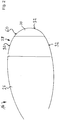
- depicts an embodiment of an airfoil;
- Fig. 3
- depicts a cross-section of the airfoil of
Fig. 2 ; - Fig. 4
- depicts a schematic view of the airfoil of
Fig. 2 in the nanoscopic domain; - Fig. 5
- depicts an embodiment of an anodizing device;
- Fig. 6
- depicts an embodiment of a method according to the invention;
- Fig. 7
- depicts a top view SEM picture of a nanostructured substrate at 1000x magnification;
- Fig. 8
- depicts a top view SEM picture of the nanostructured substrate of
Fig. 7 at 10,000x magnification (insert 50,000x magnification); - Fig. 9
- depicts an SEM micrograph depicting a cross section of the nanostructured substrate of
Fig. 7 at 50,000x magnification; - Fig. 10
- depicts an image sequence depicting a falling water droplet onto an unstructured substrate;
- Fig. 11
- depicts an image sequence depicting a falling water droplet onto the nanostructured substrate of
Fig. 7 ; and - Fig. 12
- depicts a diagram of experimental results under different icing conditions.
-
Fig. 1 depicts an embodiment of anaircraft 10. In a manner know per se, theaircraft 10 comprises a pair ofwings 12 attached to afuselage 14. - The
wing 12 is an example for anairfoil 16. Additional examples for theairfoil 16 are high-lift devices 18,slats 20 and flaps 22. - Furthermore, the
wing 12 may comprise awinglet 24 at its tip. Thewinglet 24 as part of thewing 12 is also an example for anairfoil 16. -
Fig. 2 andFig. 3 depict theairfoil 16 in more detail. Theairfoil 16 comprises anairfoil body 26. In the case of thewing 12, a wing box is an example for theairfoil body 26. Furthermore, theairfoil 16 comprises aleading edge portion 28. Theleading edge portion 28 is preferably attached to theairfoil body 26 and faces in flight direction. - The
leading edge portion 28 may include a leadingedge body part 30. The leadingedge body part 30 supports aclad member 32 that is bonded to the leadingedge body part 30. Theclad member 32 is preferably made from aluminium or aluminium alloy, such as aluminium alloy 2024 (AA2024). - The
clad member 32 includes ametallic substrate portion 34 and a porous metallicoxide layer portion 36. The metallicoxide layer portion 36 is made of aluminium oxide (Al2O3) and includes a plurality ofnanotubes 38. Thenanotubes 38 are preferably arranged perpendicular relative to themetallic substrate portion 34. - Each
nanotube 38 defines ananopore 40. Thenanopore 40 preferably has a size of smaller than 100 nm. Furthermore, eachnanotube 38 comprises a nano-sidewall 42. The thickness of the nano-sidewall 42 is substantially smaller than the size of thenanopore 40, for example roughly 1 nm to 5 nm. - The
nanotube 38 further defines ananocavity 44. On one end, thenanocavity 44 is limited by themetallic substrate portion 34, whereas on the other end thenanocavity 44 is open and thenanopore 40 forms the entrance to thenanocavity 44. The nano-sidewall 42 defines thenanocavity 44 in the remaining directions. - As depicted in
Fig. 4 , when awater droplet 46 is in contact with the cladmember 32, thewater droplet 46 forms a contact angle above 140 degrees. Thewater droplet 46 also closes off thenanocavities 44 so that at the interface thewater droplet 46 bulges into the air fillednanocavity 44 without wetting the nano-sidewall 42. As a result, the (macro-)surface of the cladmember 32 has superhydrophobic properties so that the water and ice repellent characteristics of the cladmember 32 are improved. -
Fig. 5 depicts ananodizing device 48 that is used during preparation of the cladmember 32. Theanodizing device 48 includes a controlledvoltage source 50, ananode member 52 and acathode member 54. Theanode member 52 and thecathode member 54 are electrically connected to the controlledvoltage source 50. - Furthermore, the
anode member 52 and thecathode member 54 are submerged in anelectrolyte bath 56. - Subsequently, the
anode member 52 is formed by the cladmember 32 and thecathode member 54 is formed by astainless steel member 58. Theelectrolyte bath 56 can also be designated as an anodizing agent. - Referring to
Fig. 6 , a method for obtaining a superhydrophobic surface is described in more detail. - Initially, a preparation step S10 is performed. The preparation step S10 includes providing the clad
member 32 as a metallic substrate. Furthermore, preparation step S10 includes cleaning themetallic substrate 32 with a cleaning agent, such as isopropanol. - Subsequently, an anodization step S12 is performed. In the anodization step S12, the
metallic substrate 32 is brought into contact with the anodizing agent. The anodizing agent is preferably oxalic acid with a molarity of 0.3 moles per litre. The anodization is executed using the controlledvoltage source 50 with a voltage of 40 V. The temperature of the anodizing agent is kept between 20 °C and 25 °C. The whole anodization step S12 is preferably performed for a duration of 10 min. The current flow decreases over time due to formation of Al2O3 on the surface of themetallic substrate 32. In addition, initial nanopores are formed so that the metallic substrate now has a porous metallic oxide layer. However, those initially formed nanopores do not yet have the desired target dimension. - Subsequently, a first rinsing step S14 is performed. During the first rinsing step S14, the
metallic substrate 32 is rinsed with deionised water for 20 s. - Subsequently, a pore-widening step S16 is performed. In the pore-widening step S16, the
metallic substrate 32 is brought into contact with a pore-widening agent that includes phosphoric acid. Preferably, the phosphoric acid has a molarity 0.86 moles per litre. The pore-widening step S16 is executed at a temperature of 40 °C and preferably performed for a duration of 10 min. After the pore-widening step S16, the initial nanopores have been widened to the desirednanopores 40 having the target dimension, such as close to but smaller than 100 nm. - Now, a second rinsing step S18 is performed. The second rinsing step S18 is performed using deionised water and rinsing the
metallic substrate 32 for 20 s. - After the second rinsing step S18, a hydrophobization step S20 is performed. In the hydrophobization step S20, a hydrophobizing agent is applied to the nano structured metallic oxide layer so that in addition to mechanical changes, a chemical functionalization is performed.
- As a result, the clad
member 32 now has a superhydrophobic/icephobic surface which improves ice repellent characteristics. As depicted inFig. 7 to Fig. 9 , the nanostructures, in particular thenanotubes 38 after performing the steps S10 to S20 are clearly visible. -
Fig. 10 depicts an imagine sequence of a falling water droplet onto an unstructured substrate, whereas inFig. 11 , an imagine sequence depicting a falling water droplet onto the nanostructured substrate is depicted. ComparingFig. 10 andFig. 11 , the water repelling effect is clearly visible, in particular when looking at the contact angles. As shown inFig. 11 , the water droplet even rebounds once from the surface before resting on it in the Cassie-Baxter state. - Finally, as depicted in
Fig. 12 , experimental results in an ice wind tunnel show the differences between unstructured substrates and substrates that have been subjected to the method according to steps S10 to S20. As can be seen, for ice conditions considering rime, mixed/rime and mixed/glaze, the interfacial shear stress needed for removing the ice is significantly lowered and generally half when compared to the unstructured substrate. Only relating to pure glaze, no difference can be observed. - In order to improve water and ice repellent characteristics of a leading edge portion (28) of an airfoil (16), a method for modifying a metallic substrate (32) is proposed. The leading edge portion (28) is made of an aluminium alloy or aluminium. Initially, the leading edge portion (28) is cleaned with a cleaning agent. The leading edge portion (28) is anodized in a bath of oxalic acid. Furthermore, initial nanopores formed in anodization are widened using phosphoric acid to a desired target dimension. The metallic oxide layer (36) is coated with chemical hydrophobization agent to further increase the superhydrophobicity. As a result, the leading edge portion (28) is morphologically and chemically functionalized for repelling water and ice.
-
- 10
- aircraft
- 12
- wing
- 14
- fuselage
- 16
- airfoil
- 18
- high-lift device
- 20
- slats
- 22
- flaps
- 24
- winglet
- 26
- airfoil body
- 28
- leading edge portion
- 30
- leading edge body part
- 32
- clad member (metallic substrate)
- 34
- metallic substrate portion
- 36
- metallic oxide layer portion
- 38
- nanotubes
- 40
- nanopore
- 42
- nano side wall
- 44
- nanocavity
- 46
- water droplet
- 48
- anodizing device
- 50
- controlled voltage source
- 52
- anode member
- 54
- cathode member
- 56
- electrolyte bath (anodizing agent)
- 58
- stainless steel member
- 60
- superhydrophobic surface
- S10
- preparation step
- S12
- anodization step
- S14
- first rinsing step
- S16
- pre widening step
- S18
- second rising step
- S20
- hydrophobization step
Claims (15)
- A method for manufacturing a superhydrophobic surface (60) on a metallic substrate (32), the method comprising:1.1 providing a metallic substrate (32) that includes or consists of aluminium or an aluminium alloy;1.2 anodizing the metallic substrate (32) using an anodizing agent that includes oxalic acid so as to form a porous metallic oxide layer having a plurality of pores;1.3 widening the pores using a pore-widening agent that includes phosphoric acid so as to form widened pores having a predetermined target dimension; and1.4 applying a hydrophobizing agent to the porous metallic oxide layer with the widened pores.
- The method according to any of the preceding claims, wherein in step 1.2 the anodizing agent includes oxalic acid with a molarity from 0.2 moles per litre to 0.4 moles per litre, preferably with a molarity of 0.3 moles per litre.
- The method according to any of the preceding claims, wherein in step 1.3 the pore-widening agent includes phosphoric acid with a molarity from 0.8 moles per litre to 0.9 moles per litre, preferably with a molarity of 0.86 moles per litre.
- The method according to any of the preceding claims, wherein step 1.2 and/or step 1.3 are performed for a duration of 10 minutes.
- The method according to any of the preceding claims, wherein step 1.3 is performed at a higher temperature as step 1.2.
- The method according to any of the preceding claims, wherein step 1.2 is performed at a temperature from 20 °C to 25 °C.
- The method according to any of the preceding claims, wherein step 1.3 is performed at a temperature of 40 °C.
- The method according to any of the preceding claims, wherein step 1.2 is performed using a controlled voltage source (50), preferably set to 40 V.
- The method according to any of the preceding claims, wherein in step 1.2 the anode to cathode ratio is set from 2.0:10 to 2.4:10, preferably set to 2.2:10.
- The method according to any of the preceding claims, wherein step 1.1 includes:- cleaning the metallic substrate (32) before step 1.2, preferably with isopropanol.
- The method according to any of the preceding claims, further comprising any of the steps of:- rinsing the porous metallic oxide surface (32) using de-ionized water between step 1.1 and step 1.2, and/or- rinsing the porous metallic oxide surface (32) using de-ionized water between step 1.2 and step 1.3.
- Method according to claim 11, wherein rinsing is performed for 20 seconds to 1 minute, preferably for 20 seconds.
- A method for manufacturing a superhydrophobic surface on a leading edge portion (28) of an airfoil (16) so as to mitigate or prevent ice accretion on the leading edge portion (28), the method comprising the steps of:13.1 providing a leading edge portion (28) comprising a leading edge body part (30) and a clad member (32) bonded to the leading edge body part (30); and13.2 performing the method according to any of the preceding claims with the clad member (32) as the metallic substrate (32).
- An airfoil (16), such as a wing (12), a winglet, a high-lift device (18), or a slat (20), the airfoil (16) being configured for mitigating or preventing ice accretion, the airfoil (16) comprising an airfoil body (26) and a leading edge portion (28), wherein the leading edge portion (28) has a leading edge body part (30) and a clad member (32) bonded to the leading edge body part (30), wherein the clad member (32) is obtainable by the method according to claim 13.
- An aircraft (10) comprising an airfoil (16) according to claim 14.
Priority Applications (1)
| Application Number | Priority Date | Filing Date | Title |
|---|---|---|---|
| EP20315263.2A EP3916135A1 (en) | 2020-05-26 | 2020-05-26 | Method for modifying a metallic surface, such as a leading edge portion of an airfoil |
Applications Claiming Priority (1)
| Application Number | Priority Date | Filing Date | Title |
|---|---|---|---|
| EP20315263.2A EP3916135A1 (en) | 2020-05-26 | 2020-05-26 | Method for modifying a metallic surface, such as a leading edge portion of an airfoil |
Publications (1)
| Publication Number | Publication Date |
|---|---|
| EP3916135A1 true EP3916135A1 (en) | 2021-12-01 |
Family
ID=71944067
Family Applications (1)
| Application Number | Title | Priority Date | Filing Date |
|---|---|---|---|
| EP20315263.2A Pending EP3916135A1 (en) | 2020-05-26 | 2020-05-26 | Method for modifying a metallic surface, such as a leading edge portion of an airfoil |
Country Status (1)
| Country | Link |
|---|---|
| EP (1) | EP3916135A1 (en) |
Citations (5)
| Publication number | Priority date | Publication date | Assignee | Title |
|---|---|---|---|---|
| EP1750018A2 (en) * | 2005-08-03 | 2007-02-07 | General Electric Company | Surfaces and articles resistant to impacting liquids |
| US20090184201A1 (en) * | 2008-01-19 | 2009-07-23 | The Boeing Company | Joining fuselage skins using friction stir welding |
| US20150299889A1 (en) | 2011-12-22 | 2015-10-22 | Eads Deutschland Gmbh | Self-Cleaning and Superhydrophobic Surfaces Based on TIO2 Nanotubes |
| US20170002475A1 (en) | 2014-03-14 | 2017-01-05 | Airbus Defence and Space GmbH | Method for manufacturing as well as use of a polished nanostructured metallic surface having water- and ice- repellent characteristics |
| KR102086933B1 (en) * | 2018-12-31 | 2020-03-09 | 동의대학교 산학협력단 | Method of anode oxide film of aluminum alloy having a superhydrophobic surface |
-
2020
- 2020-05-26 EP EP20315263.2A patent/EP3916135A1/en active Pending
Patent Citations (5)
| Publication number | Priority date | Publication date | Assignee | Title |
|---|---|---|---|---|
| EP1750018A2 (en) * | 2005-08-03 | 2007-02-07 | General Electric Company | Surfaces and articles resistant to impacting liquids |
| US20090184201A1 (en) * | 2008-01-19 | 2009-07-23 | The Boeing Company | Joining fuselage skins using friction stir welding |
| US20150299889A1 (en) | 2011-12-22 | 2015-10-22 | Eads Deutschland Gmbh | Self-Cleaning and Superhydrophobic Surfaces Based on TIO2 Nanotubes |
| US20170002475A1 (en) | 2014-03-14 | 2017-01-05 | Airbus Defence and Space GmbH | Method for manufacturing as well as use of a polished nanostructured metallic surface having water- and ice- repellent characteristics |
| KR102086933B1 (en) * | 2018-12-31 | 2020-03-09 | 동의대학교 산학협력단 | Method of anode oxide film of aluminum alloy having a superhydrophobic surface |
Similar Documents
| Publication | Publication Date | Title |
|---|---|---|
| Zeng et al. | Superhydrophobic coating induced anti-icing and deicing characteristics of an airfoil | |
| US20150299889A1 (en) | Self-Cleaning and Superhydrophobic Surfaces Based on TIO2 Nanotubes | |
| EP2915747B1 (en) | Systems and methods for passive deicing | |
| Shen et al. | Icephobic/anti-icing potential of superhydrophobic Ti6Al4V surfaces with hierarchical textures | |
| Ma et al. | Bio‐inspired icephobic coatings for aircraft icing mitigation: A critical review | |
| Saleema et al. | Prevention of ice accretion on aluminum surfaces by enhancing their hydrophobic properties | |
| De Pauw et al. | Effect of superhydrophobic coating on the anti-icing and deicing of an airfoil | |
| Antonini et al. | Understanding the effect of superhydrophobic coatings on energy reduction in anti-icing systems | |
| JP2017510717A (en) | Process for the production and use of polished nanostructured metal surfaces with water and ice repellent properties | |
| Belaud et al. | Development of nanostructured icephobic aluminium oxide surfaces for aeronautic applications | |
| JP2021095911A (en) | Ice protection system, rotary blade assembly, and wind turbine | |
| IL158327A (en) | Cylindrical wing tip with helical slot | |
| Ou et al. | Sessile droplet freezing and ice adhesion on aluminum with different surface wettability and surface temperature | |
| DE102009024320B4 (en) | Coatings with ice-repellent and freezing point-lowering properties, process for their preparation and use | |
| Strobl et al. | Development of a hybrid ice protection system based on nanostructured hydrophobic surfaces | |
| Ghalmi et al. | Experimental investigation to evaluate the effect of PTFE nanostructured roughness on ice adhesion strength | |
| CN105836103A (en) | Aircraft wing with condensate drop self-dispersing functional nanolayer | |
| EP4074603B1 (en) | De-icing system, airfoil and aircraft having such a system, and de-icing method | |
| JP6151751B2 (en) | Method for preventing icing of wing structure | |
| Hu et al. | An experimental study on ice accretion and anti-/de-icing of a pitot tube | |
| EP3287271B1 (en) | Film for forming an air flow surface on a body, outer casing part for a vehicle and method for forming an air flow surface on a body | |
| Bakhtian et al. | The low Reynolds number aerodynamics of leading edge flaps | |
| EP3676178B1 (en) | Non-icing surfaces | |
| JP2000109996A (en) | Aluminum anodic oxide film excellent in corrosion resistance and formation of anodic oxide film | |
| Muhammed et al. | Experimental study of superhydrophobic coating effects on dynamic ice accretion ice accretion process along S-1223 airfoil |
Legal Events
| Date | Code | Title | Description |
|---|---|---|---|
| PUAI | Public reference made under article 153(3) epc to a published international application that has entered the european phase |
Free format text: ORIGINAL CODE: 0009012 |
|
| STAA | Information on the status of an ep patent application or granted ep patent |
Free format text: STATUS: THE APPLICATION HAS BEEN PUBLISHED |
|
| AK | Designated contracting states |
Kind code of ref document: A1 Designated state(s): AL AT BE BG CH CY CZ DE DK EE ES FI FR GB GR HR HU IE IS IT LI LT LU LV MC MK MT NL NO PL PT RO RS SE SI SK SM TR |
|
| B565 | Issuance of search results under rule 164(2) epc |
Effective date: 20201126 |
|
| STAA | Information on the status of an ep patent application or granted ep patent |
Free format text: STATUS: REQUEST FOR EXAMINATION WAS MADE |
|
| 17P | Request for examination filed |
Effective date: 20220525 |
|
| RBV | Designated contracting states (corrected) |
Designated state(s): AL AT BE BG CH CY CZ DE DK EE ES FI FR GB GR HR HU IE IS IT LI LT LU LV MC MK MT NL NO PL PT RO RS SE SI SK SM TR |