EP3915589A1 - Tcdta-derived fe(iii) complexes for use in magnet resonance imaging with liver and kidney excretion - Google Patents
Tcdta-derived fe(iii) complexes for use in magnet resonance imaging with liver and kidney excretion Download PDFInfo
- Publication number
- EP3915589A1 EP3915589A1 EP20177188.8A EP20177188A EP3915589A1 EP 3915589 A1 EP3915589 A1 EP 3915589A1 EP 20177188 A EP20177188 A EP 20177188A EP 3915589 A1 EP3915589 A1 EP 3915589A1
- Authority
- EP
- European Patent Office
- Prior art keywords
- iii
- alkyl
- contrast agent
- branched
- linear
- Prior art date
- Legal status (The legal status is an assumption and is not a legal conclusion. Google has not performed a legal analysis and makes no representation as to the accuracy of the status listed.)
- Withdrawn
Links
- 238000003384 imaging method Methods 0.000 title claims abstract description 33
- 210000004185 liver Anatomy 0.000 title claims description 20
- VTLYFUHAOXGGBS-UHFFFAOYSA-N Fe3+ Chemical class [Fe+3] VTLYFUHAOXGGBS-UHFFFAOYSA-N 0.000 title description 16
- 230000029142 excretion Effects 0.000 title description 8
- 210000003734 kidney Anatomy 0.000 title description 7
- 239000002872 contrast media Substances 0.000 claims abstract description 32
- 239000000126 substance Substances 0.000 claims abstract description 25
- 125000006732 (C1-C15) alkyl group Chemical group 0.000 claims abstract description 17
- 239000003446 ligand Substances 0.000 claims abstract description 12
- 125000000113 cyclohexyl group Chemical group [H]C1([H])C([H])([H])C([H])([H])C([H])(*)C([H])([H])C1([H])[H] 0.000 claims abstract description 11
- HBAQYPYDRFILMT-UHFFFAOYSA-N 8-[3-(1-cyclopropylpyrazol-4-yl)-1H-pyrazolo[4,3-d]pyrimidin-5-yl]-3-methyl-3,8-diazabicyclo[3.2.1]octan-2-one Chemical class C1(CC1)N1N=CC(=C1)C1=NNC2=C1N=C(N=C2)N1C2C(N(CC1CC2)C)=O HBAQYPYDRFILMT-UHFFFAOYSA-N 0.000 claims abstract description 10
- 239000012453 solvate Substances 0.000 claims abstract description 10
- 125000003277 amino group Chemical group 0.000 claims abstract description 9
- 210000000013 bile duct Anatomy 0.000 claims description 12
- 238000001727 in vivo Methods 0.000 claims description 9
- 241000124008 Mammalia Species 0.000 claims description 8
- 210000000813 small intestine Anatomy 0.000 claims description 8
- 210000000232 gallbladder Anatomy 0.000 claims description 7
- 210000003932 urinary bladder Anatomy 0.000 claims description 7
- 238000000034 method Methods 0.000 claims description 6
- 125000004169 (C1-C6) alkyl group Chemical group 0.000 claims description 5
- 206010029113 Neovascularisation Diseases 0.000 claims description 5
- 208000038016 acute inflammation Diseases 0.000 claims description 5
- 230000006022 acute inflammation Effects 0.000 claims description 5
- 208000037976 chronic inflammation Diseases 0.000 claims description 5
- 230000006020 chronic inflammation Effects 0.000 claims description 5
- 238000003745 diagnosis Methods 0.000 claims description 5
- 210000003445 biliary tract Anatomy 0.000 claims description 4
- 210000000496 pancreas Anatomy 0.000 claims description 4
- 210000004881 tumor cell Anatomy 0.000 claims description 4
- 230000002792 vascular Effects 0.000 claims description 4
- 150000001875 compounds Chemical class 0.000 claims 2
- DYLIWHYUXAJDOJ-OWOJBTEDSA-N (e)-4-(6-aminopurin-9-yl)but-2-en-1-ol Chemical compound NC1=NC=NC2=C1N=CN2C\C=C\CO DYLIWHYUXAJDOJ-OWOJBTEDSA-N 0.000 abstract description 5
- 239000013067 intermediate product Substances 0.000 abstract description 3
- 238000002360 preparation method Methods 0.000 abstract description 2
- -1 gadolinium ions Chemical class 0.000 description 57
- XEEYBQQBJWHFJM-UHFFFAOYSA-N iron Substances [Fe] XEEYBQQBJWHFJM-UHFFFAOYSA-N 0.000 description 28
- RTZKZFJDLAIYFH-UHFFFAOYSA-N Diethyl ether Chemical compound CCOCC RTZKZFJDLAIYFH-UHFFFAOYSA-N 0.000 description 12
- 238000001990 intravenous administration Methods 0.000 description 8
- 229910052688 Gadolinium Inorganic materials 0.000 description 7
- 230000037396 body weight Effects 0.000 description 7
- 125000001495 ethyl group Chemical group [H]C([H])([H])C([H])([H])* 0.000 description 7
- 210000000056 organ Anatomy 0.000 description 7
- WFDIJRYMOXRFFG-UHFFFAOYSA-N Acetic anhydride Chemical compound CC(=O)OC(C)=O WFDIJRYMOXRFFG-UHFFFAOYSA-N 0.000 description 6
- XLYOFNOQVPJJNP-UHFFFAOYSA-N water Substances O XLYOFNOQVPJJNP-UHFFFAOYSA-N 0.000 description 6
- 150000000921 Gadolinium Chemical class 0.000 description 5
- 210000002966 serum Anatomy 0.000 description 5
- 238000009825 accumulation Methods 0.000 description 4
- 210000004204 blood vessel Anatomy 0.000 description 4
- 229960004132 diethyl ether Drugs 0.000 description 4
- 238000013535 dynamic contrast enhanced MRI Methods 0.000 description 4
- 239000007787 solid Substances 0.000 description 4
- 239000000243 solution Substances 0.000 description 4
- 238000003786 synthesis reaction Methods 0.000 description 4
- 239000012300 argon atmosphere Substances 0.000 description 3
- 230000015572 biosynthetic process Effects 0.000 description 3
- 230000000694 effects Effects 0.000 description 3
- UIWYJDYFSGRHKR-UHFFFAOYSA-N gadolinium atom Chemical compound [Gd] UIWYJDYFSGRHKR-UHFFFAOYSA-N 0.000 description 3
- 230000001965 increasing effect Effects 0.000 description 3
- 210000000936 intestine Anatomy 0.000 description 3
- 210000005229 liver cell Anatomy 0.000 description 3
- 229910021645 metal ion Inorganic materials 0.000 description 3
- 239000011541 reaction mixture Substances 0.000 description 3
- 230000002485 urinary effect Effects 0.000 description 3
- LKVFCSWBKOVHAH-UHFFFAOYSA-N 4-Ethoxyphenol Chemical compound CCOC1=CC=C(O)C=C1 LKVFCSWBKOVHAH-UHFFFAOYSA-N 0.000 description 2
- QPCDCPDFJACHGM-UHFFFAOYSA-N N,N-bis{2-[bis(carboxymethyl)amino]ethyl}glycine Chemical compound OC(=O)CN(CC(O)=O)CCN(CC(=O)O)CCN(CC(O)=O)CC(O)=O QPCDCPDFJACHGM-UHFFFAOYSA-N 0.000 description 2
- 206010028980 Neoplasm Diseases 0.000 description 2
- JUJWROOIHBZHMG-UHFFFAOYSA-N Pyridine Chemical compound C1=CC=NC=C1 JUJWROOIHBZHMG-UHFFFAOYSA-N 0.000 description 2
- WDLRUFUQRNWCPK-UHFFFAOYSA-N Tetraxetan Chemical compound OC(=O)CN1CCN(CC(O)=O)CCN(CC(O)=O)CCN(CC(O)=O)CC1 WDLRUFUQRNWCPK-UHFFFAOYSA-N 0.000 description 2
- 125000000217 alkyl group Chemical group 0.000 description 2
- 238000002583 angiography Methods 0.000 description 2
- 239000013522 chelant Substances 0.000 description 2
- OCDAWJYGVOLXGZ-VPVMAENOSA-K gadobenate dimeglumine Chemical compound [Gd+3].CNC[C@H](O)[C@@H](O)[C@H](O)[C@H](O)CO.CNC[C@H](O)[C@@H](O)[C@H](O)[C@H](O)CO.OC(=O)CN(CC([O-])=O)CCN(CC([O-])=O)CCN(CC(O)=O)C(C([O-])=O)COCC1=CC=CC=C1 OCDAWJYGVOLXGZ-VPVMAENOSA-K 0.000 description 2
- 150000002500 ions Chemical class 0.000 description 2
- 229910052742 iron Inorganic materials 0.000 description 2
- 239000000203 mixture Substances 0.000 description 2
- 210000004789 organ system Anatomy 0.000 description 2
- 230000005298 paramagnetic effect Effects 0.000 description 2
- 239000000047 product Substances 0.000 description 2
- 231100000331 toxic Toxicity 0.000 description 2
- 230000002588 toxic effect Effects 0.000 description 2
- 210000005166 vasculature Anatomy 0.000 description 2
- FCKYPQBAHLOOJQ-NXEZZACHSA-N 2-[[(1r,2r)-2-[bis(carboxymethyl)amino]cyclohexyl]-(carboxymethyl)amino]acetic acid Chemical compound OC(=O)CN(CC(O)=O)[C@@H]1CCCC[C@H]1N(CC(O)=O)CC(O)=O FCKYPQBAHLOOJQ-NXEZZACHSA-N 0.000 description 1
- PCZHWPSNPWAQNF-LMOVPXPDSA-K 2-[[(2s)-2-[bis(carboxylatomethyl)amino]-3-(4-ethoxyphenyl)propyl]-[2-[bis(carboxylatomethyl)amino]ethyl]amino]acetate;gadolinium(3+);hydron Chemical compound [Gd+3].CCOC1=CC=C(C[C@@H](CN(CCN(CC(O)=O)CC([O-])=O)CC([O-])=O)N(CC(O)=O)CC([O-])=O)C=C1 PCZHWPSNPWAQNF-LMOVPXPDSA-K 0.000 description 1
- 125000006176 2-ethylbutyl group Chemical group [H]C([H])([H])C([H])([H])C([H])(C([H])([H])*)C([H])([H])C([H])([H])[H] 0.000 description 1
- 125000004398 2-methyl-2-butyl group Chemical group CC(C)(CC)* 0.000 description 1
- 125000004918 2-methyl-2-pentyl group Chemical group CC(C)(CCC)* 0.000 description 1
- 125000004922 2-methyl-3-pentyl group Chemical group CC(C)C(CC)* 0.000 description 1
- 125000004493 2-methylbut-1-yl group Chemical group CC(C*)CC 0.000 description 1
- 125000005916 2-methylpentyl group Chemical group 0.000 description 1
- 125000004917 3-methyl-2-butyl group Chemical group CC(C(C)*)C 0.000 description 1
- 125000004919 3-methyl-2-pentyl group Chemical group CC(C(C)*)CC 0.000 description 1
- IMPPGHMHELILKG-UHFFFAOYSA-N 4-ethoxyaniline Chemical compound CCOC1=CC=C(N)C=C1 IMPPGHMHELILKG-UHFFFAOYSA-N 0.000 description 1
- JBTKMWMRLMDGJD-QZTJIDSGSA-N CCOc(cc1)ccc1NC(CN(CC(O)=O)[C@H](CCCC1)[C@@H]1N(CC(O)=O)CC(O)=O)=O Chemical compound CCOc(cc1)ccc1NC(CN(CC(O)=O)[C@H](CCCC1)[C@@H]1N(CC(O)=O)CC(O)=O)=O JBTKMWMRLMDGJD-QZTJIDSGSA-N 0.000 description 1
- KNQPSXBSKHRJJL-ADUPEVMXSA-L CCOc(cc1)ccc1OC(CN(CC([O-])=O)[C@@H](CCCC1)[C@H]1N(CC([O-])O)CC([O-])=O)=O Chemical compound CCOc(cc1)ccc1OC(CN(CC([O-])=O)[C@@H](CCCC1)[C@H]1N(CC([O-])O)CC([O-])=O)=O KNQPSXBSKHRJJL-ADUPEVMXSA-L 0.000 description 1
- ZJOIZIKMYZEHTE-QZTJIDSGSA-K CCOc(cc1)ccc1OC(CN(CC([O-])=O)[C@H](CCCC1)[C@@H]1N(CC([O-])=O)CC([O-])=O)=O Chemical compound CCOc(cc1)ccc1OC(CN(CC([O-])=O)[C@H](CCCC1)[C@@H]1N(CC([O-])=O)CC([O-])=O)=O ZJOIZIKMYZEHTE-QZTJIDSGSA-K 0.000 description 1
- BHPQYMZQTOCNFJ-UHFFFAOYSA-N Calcium cation Chemical compound [Ca+2] BHPQYMZQTOCNFJ-UHFFFAOYSA-N 0.000 description 1
- 229940127291 Calcium channel antagonist Drugs 0.000 description 1
- 238000012307 MRI technique Methods 0.000 description 1
- 208000003510 Nephrogenic Fibrosing Dermopathy Diseases 0.000 description 1
- 206010067467 Nephrogenic systemic fibrosis Diseases 0.000 description 1
- 241000700159 Rattus Species 0.000 description 1
- 206010062237 Renal impairment Diseases 0.000 description 1
- 210000004369 blood Anatomy 0.000 description 1
- 239000008280 blood Substances 0.000 description 1
- 210000000988 bone and bone Anatomy 0.000 description 1
- 210000004556 brain Anatomy 0.000 description 1
- 210000005013 brain tissue Anatomy 0.000 description 1
- 210000000481 breast Anatomy 0.000 description 1
- 239000000480 calcium channel blocker Substances 0.000 description 1
- 229910001424 calcium ion Inorganic materials 0.000 description 1
- 230000015271 coagulation Effects 0.000 description 1
- 238000005345 coagulation Methods 0.000 description 1
- 238000001816 cooling Methods 0.000 description 1
- 239000013078 crystal Substances 0.000 description 1
- SLYTULCOCGSBBJ-UHFFFAOYSA-I disodium;2-[[2-[bis(carboxylatomethyl)amino]-3-(4-ethoxyphenyl)propyl]-[2-[bis(carboxylatomethyl)amino]ethyl]amino]acetate;gadolinium(3+) Chemical compound [Na+].[Na+].[Gd+3].CCOC1=CC=C(CC(CN(CCN(CC([O-])=O)CC([O-])=O)CC([O-])=O)N(CC([O-])=O)CC([O-])=O)C=C1 SLYTULCOCGSBBJ-UHFFFAOYSA-I 0.000 description 1
- 230000002708 enhancing effect Effects 0.000 description 1
- 229960004455 gadobenic acid Drugs 0.000 description 1
- 229960001547 gadoxetic acid Drugs 0.000 description 1
- 230000001939 inductive effect Effects 0.000 description 1
- 238000010253 intravenous injection Methods 0.000 description 1
- 125000000959 isobutyl group Chemical group [H]C([H])([H])C([H])(C([H])([H])[H])C([H])([H])* 0.000 description 1
- 125000001972 isopentyl group Chemical group [H]C([H])([H])C([H])(C([H])([H])[H])C([H])([H])C([H])([H])* 0.000 description 1
- 125000001449 isopropyl group Chemical group [H]C([H])([H])C([H])(*)C([H])([H])[H] 0.000 description 1
- 231100001252 long-term toxicity Toxicity 0.000 description 1
- 125000002496 methyl group Chemical group [H]C([H])([H])* 0.000 description 1
- 201000006417 multiple sclerosis Diseases 0.000 description 1
- 230000002107 myocardial effect Effects 0.000 description 1
- 125000004108 n-butyl group Chemical group [H]C([H])([H])C([H])([H])C([H])([H])C([H])([H])* 0.000 description 1
- 125000003136 n-heptyl group Chemical group [H]C([H])([H])C([H])([H])C([H])([H])C([H])([H])C([H])([H])C([H])([H])C([H])([H])* 0.000 description 1
- 125000001280 n-hexyl group Chemical group C(CCCCC)* 0.000 description 1
- 125000000740 n-pentyl group Chemical group [H]C([H])([H])C([H])([H])C([H])([H])C([H])([H])C([H])([H])* 0.000 description 1
- 125000004123 n-propyl group Chemical group [H]C([H])([H])C([H])([H])C([H])([H])* 0.000 description 1
- 229940031182 nanoparticles iron oxide Drugs 0.000 description 1
- 125000001971 neopentyl group Chemical group [H]C([*])([H])C(C([H])([H])[H])(C([H])([H])[H])C([H])([H])[H] 0.000 description 1
- 230000008520 organization Effects 0.000 description 1
- 231100000915 pathological change Toxicity 0.000 description 1
- 230000036285 pathological change Effects 0.000 description 1
- 125000003538 pentan-3-yl group Chemical group [H]C([H])([H])C([H])([H])C([H])(*)C([H])([H])C([H])([H])[H] 0.000 description 1
- 229960003330 pentetic acid Drugs 0.000 description 1
- 239000000546 pharmaceutical excipient Substances 0.000 description 1
- 238000000918 plasma mass spectrometry Methods 0.000 description 1
- 231100000857 poor renal function Toxicity 0.000 description 1
- 238000001556 precipitation Methods 0.000 description 1
- UMJSCPRVCHMLSP-UHFFFAOYSA-N pyridine Natural products COC1=CC=CN=C1 UMJSCPRVCHMLSP-UHFFFAOYSA-N 0.000 description 1
- 150000003839 salts Chemical class 0.000 description 1
- 238000012216 screening Methods 0.000 description 1
- 125000002914 sec-butyl group Chemical group [H]C([H])([H])C([H])([H])C([H])(*)C([H])([H])[H] 0.000 description 1
- 238000007390 skin biopsy Methods 0.000 description 1
- 239000002904 solvent Substances 0.000 description 1
- 230000008685 targeting Effects 0.000 description 1
- 125000000999 tert-butyl group Chemical group [H]C([H])([H])C(*)(C([H])([H])[H])C([H])([H])[H] 0.000 description 1
- 238000012360 testing method Methods 0.000 description 1
- 231100000419 toxicity Toxicity 0.000 description 1
- 230000001988 toxicity Effects 0.000 description 1
- 231100000621 toxification Toxicity 0.000 description 1
Images

Classifications
-
- A—HUMAN NECESSITIES
- A61—MEDICAL OR VETERINARY SCIENCE; HYGIENE
- A61K—PREPARATIONS FOR MEDICAL, DENTAL OR TOILETRY PURPOSES
- A61K49/00—Preparations for testing in vivo
- A61K49/06—Nuclear magnetic resonance [NMR] contrast preparations; Magnetic resonance imaging [MRI] contrast preparations
- A61K49/08—Nuclear magnetic resonance [NMR] contrast preparations; Magnetic resonance imaging [MRI] contrast preparations characterised by the carrier
- A61K49/10—Organic compounds
- A61K49/101—Organic compounds the carrier being a complex-forming compound able to form MRI-active complexes with paramagnetic metals
- A61K49/103—Organic compounds the carrier being a complex-forming compound able to form MRI-active complexes with paramagnetic metals the complex-forming compound being acyclic, e.g. DTPA
-
- C—CHEMISTRY; METALLURGY
- C07—ORGANIC CHEMISTRY
- C07C—ACYCLIC OR CARBOCYCLIC COMPOUNDS
- C07C229/00—Compounds containing amino and carboxyl groups bound to the same carbon skeleton
- C07C229/02—Compounds containing amino and carboxyl groups bound to the same carbon skeleton having amino and carboxyl groups bound to acyclic carbon atoms of the same carbon skeleton
- C07C229/04—Compounds containing amino and carboxyl groups bound to the same carbon skeleton having amino and carboxyl groups bound to acyclic carbon atoms of the same carbon skeleton the carbon skeleton being acyclic and saturated
- C07C229/06—Compounds containing amino and carboxyl groups bound to the same carbon skeleton having amino and carboxyl groups bound to acyclic carbon atoms of the same carbon skeleton the carbon skeleton being acyclic and saturated having only one amino and one carboxyl group bound to the carbon skeleton
- C07C229/10—Compounds containing amino and carboxyl groups bound to the same carbon skeleton having amino and carboxyl groups bound to acyclic carbon atoms of the same carbon skeleton the carbon skeleton being acyclic and saturated having only one amino and one carboxyl group bound to the carbon skeleton the nitrogen atom of the amino group being further bound to acyclic carbon atoms or to carbon atoms of rings other than six-membered aromatic rings
- C07C229/16—Compounds containing amino and carboxyl groups bound to the same carbon skeleton having amino and carboxyl groups bound to acyclic carbon atoms of the same carbon skeleton the carbon skeleton being acyclic and saturated having only one amino and one carboxyl group bound to the carbon skeleton the nitrogen atom of the amino group being further bound to acyclic carbon atoms or to carbon atoms of rings other than six-membered aromatic rings to carbon atoms of hydrocarbon radicals substituted by amino or carboxyl groups, e.g. ethylenediamine-tetra-acetic acid, iminodiacetic acids
-
- C—CHEMISTRY; METALLURGY
- C07—ORGANIC CHEMISTRY
- C07C—ACYCLIC OR CARBOCYCLIC COMPOUNDS
- C07C237/00—Carboxylic acid amides, the carbon skeleton of the acid part being further substituted by amino groups
- C07C237/02—Carboxylic acid amides, the carbon skeleton of the acid part being further substituted by amino groups having the carbon atoms of the carboxamide groups bound to acyclic carbon atoms of the carbon skeleton
- C07C237/04—Carboxylic acid amides, the carbon skeleton of the acid part being further substituted by amino groups having the carbon atoms of the carboxamide groups bound to acyclic carbon atoms of the carbon skeleton the carbon skeleton being acyclic and saturated
-
- C—CHEMISTRY; METALLURGY
- C07—ORGANIC CHEMISTRY
- C07B—GENERAL METHODS OF ORGANIC CHEMISTRY; APPARATUS THEREFOR
- C07B2200/00—Indexing scheme relating to specific properties of organic compounds
- C07B2200/09—Geometrical isomers
-
- C—CHEMISTRY; METALLURGY
- C07—ORGANIC CHEMISTRY
- C07C—ACYCLIC OR CARBOCYCLIC COMPOUNDS
- C07C2601/00—Systems containing only non-condensed rings
- C07C2601/12—Systems containing only non-condensed rings with a six-membered ring
- C07C2601/14—The ring being saturated
Definitions
- Novel low molecular weight paramagnetic contrast agents based on novel ferric complexes for use in magnet resonance imaging (MRI) for combined imaging of the liver, the bile duct, the intestine as well as the vasculature, kidneys, the urinary system, and other organs.
- MRI magnet resonance imaging
- GBCA gadolinium-based contrast agents
- gadolinium ions are toxic, because of their chemical similarity to calcium ions.
- the similarity of the ion radii may result in an accumulation of gadolinium ions in the liver or the skeletal system, where the ions can remain for many years.
- gadolinium ions can act as a calcium-antagonist and thus inhibit the myocardial contractility or (blood) coagulation system.
- GBCAs have been approved for pharmaceutical use under the proviso that the toxic gadolinium ions are irreversibly complexed by means of chelating ligands such as DTPA (diethylenetriaminepentaacetic acid) or DOTA (1,4,7,10-tetraazacyclododecane-1,4,7,10-tetraacetic acid), which enable a rapid and complete excretion of the gadolinium complexes via mainly the kidneys.
- DTPA diethylenetriaminepentaacetic acid
- DOTA 1,4,7,10-tetraazacyclododecane-1,4,7,10-tetraacetic acid
- contrast agents could be observed in brain tissue of otherwise healthy patients.
- ICP-MS inductive coupled plasma mass spectrometry
- low molecular weight ferric complexes such as Fe(III)-DTPA and Fe(III)-tCDTA, can be used as contrast agents in MRI.
- the relatively lower relaxivity of the ferric complexes compared to the gadolinium derivatives can be compensated by increased doses. It is considered that the risk of long-term toxicities of ferric complexes is lower comparted to GBCAs due to the high amount of natural iron content in human body (approx. 4 g in case of an adult) and the corresponding systems for uptake, storage and transport. Furthermore, the tolerance of iron oxide nanoparticles, which will almost completely remain in the body after intravenous administration, is generally high.
- ferric complexes may also be used in modern MRI techniques such as dynamic contrast enhanced MRI (DCE-MRI) and MR angiography.
- DCE-MRI dynamic contrast enhanced MRI
- MR angiography MR angiography
- the present disclosure provides novel Fe(III)-complexes according to Chemical Formula (I): as well as enantiomers (and diastereomers) and solvates thereof.
- Z is selected from O, NH and NR, wherein R is a branched or linear C1-C15 alkyl.
- R 1 is C1-C15 alkyl.
- the orientation of the amine groups of the cyclohexyl ring in Chemical Formula (I) defines a trans-isomer.
- the Fe(III)-complex may be used in in vivo diagnostic, in particular may be used in magnet resonance imaging (MRI).
- MRI magnet resonance imaging
- a further aspect of the disclosure refers to a contrast agent for magnet resonance imaging (MRI), which includes the Fe(III)-complex according to the present disclosure.
- the contrast agent may be used in a method of diagnosis in vivo of acute inflammation, chronic inflammation, tumour cells and neovascularization.
- the contrast agent may further be used in imaging of a vascular system of mammals.
- the contrast agent may be used for imaging a biliary system of mammals.
- the contrast agent may be used for imaging at least one of liver, bile duct, gall bladder, pancreas, urinary bladder, and small intestine of mammals.
- the present disclosure provides novel ligands according to Chemical Formula (II), as well as (diastereomers and) enantiomers thereof, which constitute intermediate products for preparation of prespecified Fe(III)-complexes.
- Z is selected from O, NH, and NR, wherein R is a branched or linear C1-C15 alkyl.
- R 1 is a branched or linear C1-C15 alkyl.
- the orientation of the amine groups of the cyclohexyl ring in Chemical Formula (II) defines a trans-isomer.
- the present invention provides remarkably stable chelate complexes due to the increased rigidity of the ligand structure and thus higher degree of pre-organization around the metal ion:
- Z is selected from O, NH and NR, wherein R is a branched or linear C1-C15 alkyl.
- R 1 is a branched or linear C1-C15 alkyl.
- R 1 may be a branched or linear C1-C6 alkyl.
- R 1 may be ethyl.
- R 1 may be ethyl, wherein Z may be selected from O or NH.
- R 1 may be ethyl, wherein Z may be selected from O, NH and NR with R being a branched or linear C1-C15 alkyl.
- C1-C6 alkyl comprises methyl, ethyl, n-propyl, 2-propyl, n-butyl, 2-butyl, 2-methylpropyl, 2-methyl-2-propyl, n-pentyl, 2-pentyl, 3-pentyl, 2-methylbutyl, 3-methylbutyl, 2-methyl2-butyl, 3-methyl-2-butyl, 2,2-dimethylpropyl, n-hexyl, 2-hexyl, 3-hexyl, 2-methylpentyl, 2-ethylbutyl, 3-methyl-2-pentyl, 2-methyl-2-pentyl, 2-methyl-3-pentyl and 4-methyl-3-heptyl.
- alkyl with n ⁇ 7 comprise n-heptyl, n-octyl, n-nonyl, n-decyl, 2-heptyl, 2-octyl, 2-nonyl, 2-decyl, 2-undecyl, 3-heptyl, 3-octyl, 3-nonyl, 3-decyl, 3-undecyl, 3-dodecyl, 2-methylhexl, 2-methylheptyl, 2-methyloctyl, 2-methylnonyl, 2-methyldecanyl, 2-ethylpentyl, 2-ethylhexyl, 2-ethylheptyl, 2-ethyloctyl, 2-ethylnonyl, 2-ethyldecanyl, 2-methyl-2-hexyl, 2-methyl-2-heptyl, 2-methyl-2-octyl, 2-methyl-2-nonyl, 2-methyl-2-decanyl
- the orientation of the amine groups of the cyclohexyl ring in Chemical Formula (I) defines a trans -isomer, so the amine groups are oriented in opposing sides of the ring plain.
- the trans -isomerism means, that the nitrogen-bonded carbons (i.e. the carbon-stereocenters) of the cyclohexyl moiety shown in Chemical Formula (I) have S,S-configuration or R,R-configuration.
- the present invention comprises solvates of the Fe(III)-complexes, which means on the one hand that one or more solvate molecule coordinates to the metal ion centre and on the other hand that the solvate molecules are included in the crystals.
- the solvate is a (mono) hydrate.
- the present invention also comprises enantiomers of the ferric complex, which can be derived from variation of the configuration of the nitrogen-bonded carbons (i.e. the carbon-stereocenters) of the cyclohexyl moiety shown in in Chemical Formula (I).
- enantiomers of the ferric complex can be derived from variation of the configuration of the nitrogen-bonded carbons (i.e. the carbon-stereocenters) of the cyclohexyl moiety shown in in Chemical Formula (I).
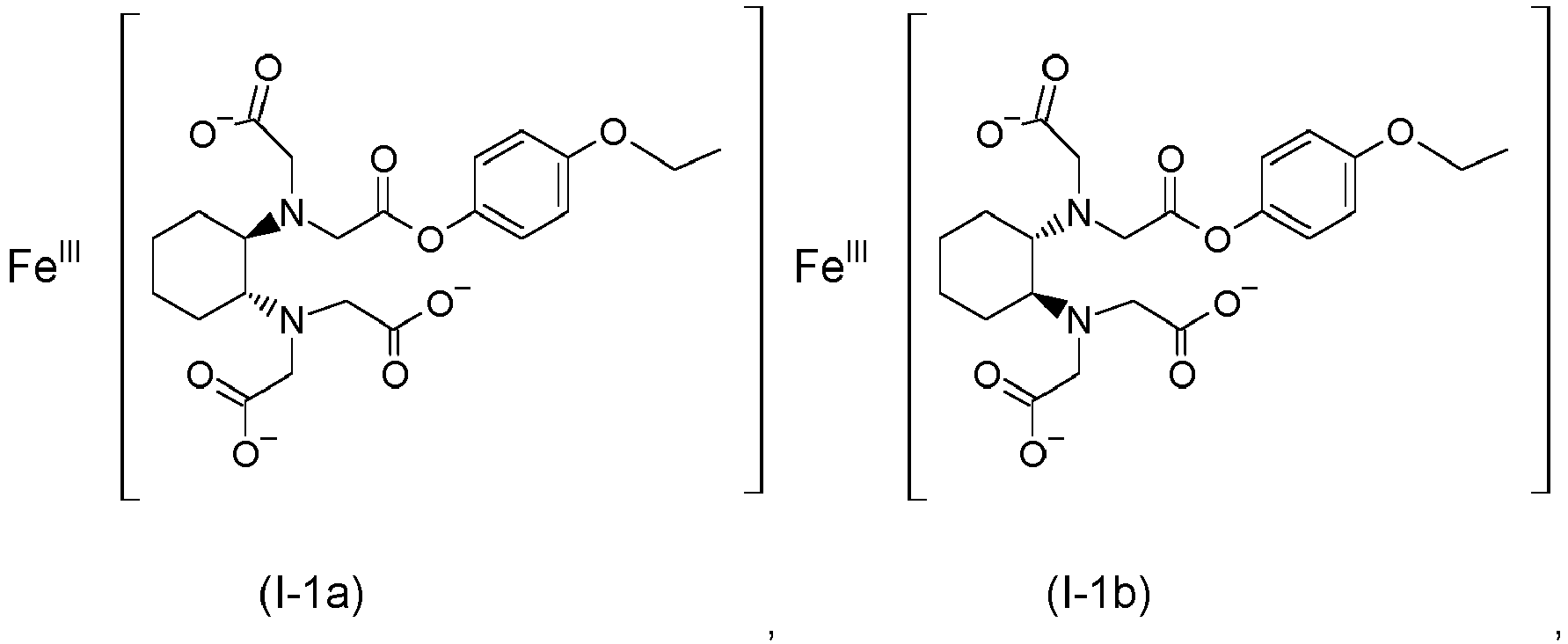
- the Fe(III)-complexes (I-1a) and (I-1b), or (I-2a) and (I-2b) each constitutes a pair of enantiomers:
- the Fe(III)-complexes may be diastereomers of the ferric complex according to Chemical Formula (I). These diasteromeric ferric complexes may comprise cis-isomers of the ligand, i.e. with a ( R,S ) or ( S,R ) configuration of the nitrogen-bonded carbons.
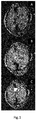
- Figure 1 shows the contrast effect of Fe(III)[4-ethoxyaniline-tCDTA] in T1-weighted MRI pictures of a mouse before the intravenous administration (see Fig 1, A ); 10 min after (see Fig 1, B ) and 22 min (see Fig 1, C ) after the intravenous administration (doses : 0.2 mmol/kg body weight) of the contrast agent.
- Figure 1 reveals an increasing intensity of the contrast signal in the liver of the mouse induced by the Fe(III)[4-ethoxyaniline-tCDTA] complex. The contrast signal remains high even after 22 minutes. After 22 min (see Fig 1, C ), the contrast of the gallbladder is also clearly visible as round shaped signal intense region, indicating the excretion of Fe(III)[4-ethoxyaniline-tCDTA] via the liver cells.
- Figure 2 shows the maximum intensity projection (MIP) of a mouse before the administration of the contrast agent (see Fig.2, A ) and 22 min after intravenous Fe(III)[4-ethoxyaniline-tCDTA] administration with a doses of 0.2 mmol/kg body weight (see Fig.2, B).
- Figure 2 reveals a strong T1-signal of the gall bladder, the urinary bladder and the small intestine after 22 min, which proves the excretion of Fe(III)[4-ethoxyaniline-tCDTA] via the liver (respectively via the liver cells) and the bile duct.
- the Fe(III)-complex according to the present invention is suitable for use in in vivo diagnostic, for example in magnet resonance imaging.
- the ferric complex may be used as a contrast agent or as a component of a contrast agent for magnet resonance imaging (MRI) for imaging of the vascular system, in particular of the biliary system which may include the liver, the bile duct, the gall bladder and the pancreas.
- MRI magnet resonance imaging
- urinary bladder and small intestine of mammals may be investigated by MRI.
- the Fe(III)-complex may be used for investigating in vivo pathological changes in these organs.
- the complexes are as well suitable for MRI of other organs that are reached by the blood vessels and of the urinary system due to the partial kidney excretion.
- the Fe(III)-complex may be more general used as a contrast agent for imaging of the vascular system of mammals, like humans.
- the Fe(III)-complex according to the present invention may be suitable for use in a method of diagnosis in vivo of acute inflammation, chronic inflammation, tumour cells and neovascularization, in particular each in the liver, the bile duct and the small intestine, the kidneys and the urinary bladder.
- the Fe(III)-complex according to the present invention may also be suitable for use in a method of diagnosis in vivo of acute inflammation, chronic inflammation, tumour cells and neovascularization in liver and in other organs that are reached by the blood vessels.
- the aforementioned method of diagnosis may be one of magnet resonance imaging (MRI), dynamic contrast enhanced MRI (DCE-MRI) and magnet resonance angiography.
- the Fe(III)-complex according to the present invention may be used as a contrast agent for magnet resonance imaging of the liver, the bile duct, the urinary bladder and the small intestine.
- the Fe(III)-complex according to the present invention may also be used as a contrast agent for magnet resonance imaging of other organ systems that are reached by the blood vessels.
- magnet resonance imaging of the biliary system may comprise magnet resonance imaging of the liver, the bile duct, the gall bladder and the pancreas.
- the Fe(III)-complex according to the present invention may be used for magnet resonance imaging of the liver.
- the Fe(III)-complex according to the present invention may be used for magnet resonance imaging of the bile duct.
- the Fe(III) complex according to the present invention may be used for magnet resonance imaging of the urinary bladder.
- Another use of the Fe(III) complex according to the present invention may be in magnet resonance imaging of the small intestine.
- the Fe(III)-complex according to the present invention may be used for magnet resonance imaging of other organ systems that are reached by the blood vessels.
- the administration dose of the Fe(III)-complex according to the present invention for use as described above may be 0.02 to 1 mmol/kg bodyweight, preferably 0.1-0.3 mmol/kg bodyweight, most preferably 0.2 mmol/kg bodyweight in order to optimize the duration and intensity of the magnet resonance imaging effect.
- contrast agent for magnet resonance imaging comprising a Fe(III)-complex as described above.
- the contrast agent may further comprise a medium and the Fe(III)-complex as described above.
- the medium may be selected from water or solutions containing pharmaceutically acceptable salts and/or excipients.
- the contrast agent may be preferably administered by means of intravenous injection.
- a further aspect of the present disclosure relates to a ligand according to Chemical Formula (II), which can be used as intermediate product for the synthesis of the ferric complexes according to the first aspect of this disclosure.
- Z is selected from O, NH and NR, wherein R is a branched or linear C1-C15 alkyl.
- R 1 is a branched or linear C1-C15 alkyl.
- R 1 may be a branched or linear C1-C6 alkyl.
- R 1 may be ethyl.
- R 1 may be ethyl, wherein Z may be selected from O or NH.
- R 1 may be ethyl, wherein Z may be selected from O, NH and NR with R being a branched or linear C1-C15 alkyl.
- the orientation of the amine groups of the cyclohexyl ring in Chemical Formula (II) defines a trans-isomer, so the amine groups are oriented to opposite sides of the ring plain.
- the trans -isomerism means, that the nitrogen-bonded carbons (i.e. the carbon-stereocenters) of the cyclohexyl moiety shown in Chemical Formula (II) have S,S-configuration or R,R -configuration.
- the present invention also comprises enantiomers of the ligand according to Chemical Formula (II), which can be derived from variation of the configuration of the nitrogen-bonded carbons (i.e. the carbon-stereocenters) of the cyclohexyl moiety shown in in Chemical Formula (II).
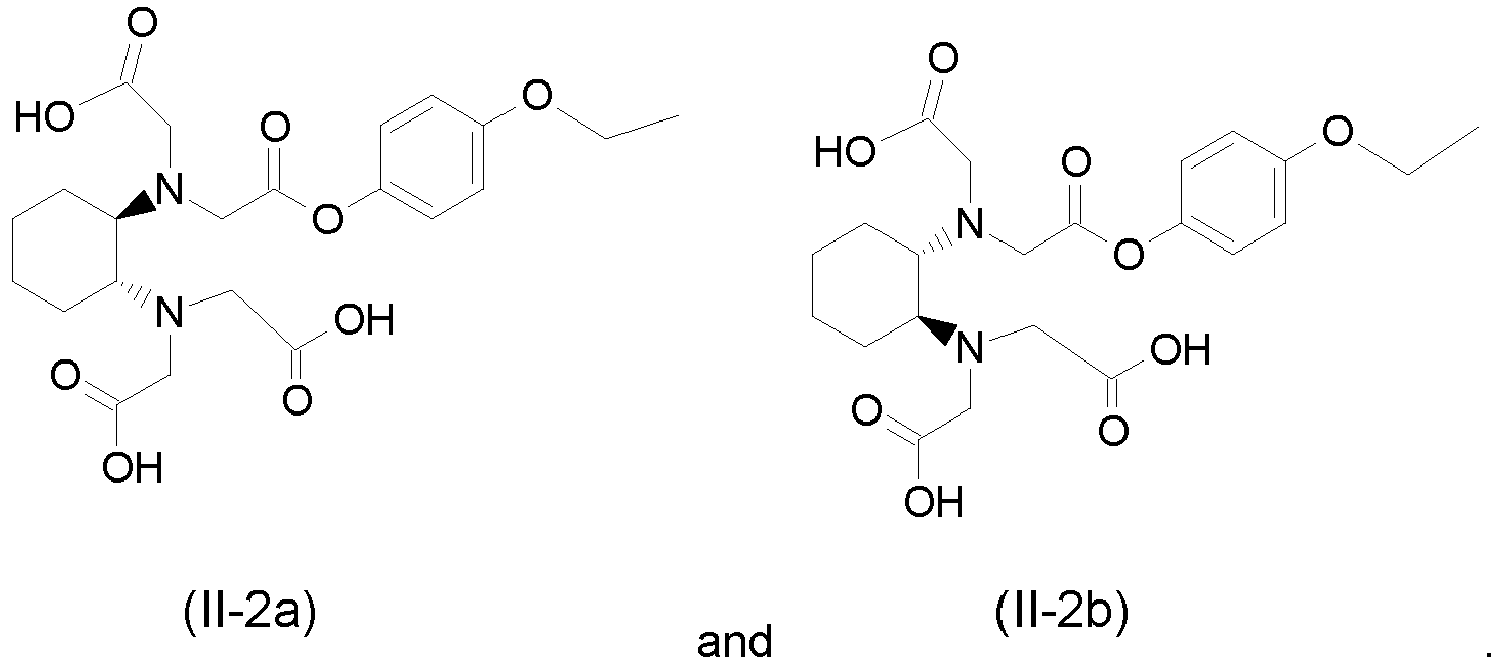
- the ligands (II-1a) and (II-1b), or (II-2a) and (II-2b) each constitutes a pair of enantiomers:
- Fe(III)[4-ethoxyaniline-tCDTA] or Fe(III)[4-ethoxyphenol-tCDTA] can be synthesised according to the procedure of US5362475A starting from FeCI3 as the Fe(III)source. In alternative it can be derived from Fe(III)-hydroxide according to PCT/EP2019/064750 .
Landscapes
- Chemical & Material Sciences (AREA)
- Organic Chemistry (AREA)
- Health & Medical Sciences (AREA)
- Nuclear Medicine, Radiotherapy & Molecular Imaging (AREA)
- Life Sciences & Earth Sciences (AREA)
- Epidemiology (AREA)
- Radiology & Medical Imaging (AREA)
- Animal Behavior & Ethology (AREA)
- General Health & Medical Sciences (AREA)
- Public Health (AREA)
- Veterinary Medicine (AREA)
- Medicinal Chemistry (AREA)
- Medicines Containing Antibodies Or Antigens For Use As Internal Diagnostic Agents (AREA)
- Magnetic Resonance Imaging Apparatus (AREA)
Abstract
The present disclosure provides novel Fe(III)-complexes according to Chemical Formula (I):as well as enantiomers (and diastereomers) and solvates thereof. In Chemical Formula (I), Z is selected from O, NH and NR, wherein R is a branched or linear C1-C15 alkyl. R<sup>1</sup> is C1-C15 alkyl. Further, the orientation of the amine groups of the cyclohexyl ring in Chemical Formula (I) defines a trans-isomer. A further aspect of the disclosure refers to a contrast agent for magnet resonance imaging, which includes the Fe(III)-complex according to the present disclosure. In addition, the present disclosure provides novel ligands according to Chemical Formula (II), as well as (diastereomers and) enantiomers thereof, which constitute intermediate products for preparation of prespecified Fe(III)-complexes.
Description
- Novel low molecular weight paramagnetic contrast agents based on novel ferric complexes for use in magnet resonance imaging (MRI) for combined imaging of the liver, the bile duct, the intestine as well as the vasculature, kidneys, the urinary system, and other organs.
- Low molecular weight paramagnetic contrast agents, in particular gadolinium-based contrast agents (GBCA), have been established as standard tool for improving the informative value of magnet resonance imaging (MRI) in the field of medical diagnostics. In 2015, over 10 million diagnostics were carried out by MRI in Germany. In this context, the intravenous administration of GBCA for T1-weighted imaging accounts for about one third and provides improved diagnostics for acute or chronic inflammations, tumours, neovascularization and more.
- Still, non-complexed gadolinium ions are toxic, because of their chemical similarity to calcium ions. In particular, the similarity of the ion radii may result in an accumulation of gadolinium ions in the liver or the skeletal system, where the ions can remain for many years. Furthermore, gadolinium ions can act as a calcium-antagonist and thus inhibit the myocardial contractility or (blood) coagulation system.
- Despite the mentioned toxicity, GBCAs have been approved for pharmaceutical use under the proviso that the toxic gadolinium ions are irreversibly complexed by means of chelating ligands such as DTPA (diethylenetriaminepentaacetic acid) or DOTA (1,4,7,10-tetraazacyclododecane-1,4,7,10-tetraacetic acid), which enable a rapid and complete excretion of the gadolinium complexes via mainly the kidneys.
- However, recent studies suggest that under certain circumstances the excretion may not be complete. In fact, a number of cases of the so-called nephrogenic systemic fibrosis in patients with impaired renal function are considered a direct consequence of an incomplete excretion of some GBCAs. Further, in vivo testing provided experimental evidence that in skin biopsy of rats the gadolinium complexes could be detected even one year after its administration. In this context, the magnitude of gadolinium accumulation highly depends on the chelating ability of the ligands, respectively the stability of the gadolinium complexes.
- Especially in cases of repeated administrations of low molecular weight contrast agents, e.g. in breast tumour screening or in follow-up controls of multiple sclerosis, accumulation of contrast agents could be observed in brain tissue of otherwise healthy patients. By means of ICP-MS (inductive coupled plasma mass spectrometry) it was also possible to detect gadolinium accumulation from stabilized macrocyclic GBCA in bone and brain samples from deceased patients.
- In earlier studies it could be shown that low molecular weight ferric complexes, such as Fe(III)-DTPA and Fe(III)-tCDTA, can be used as contrast agents in MRI.

- The relatively lower relaxivity of the ferric complexes compared to the gadolinium derivatives can be compensated by increased doses. It is considered that the risk of long-term toxicities of ferric complexes is lower comparted to GBCAs due to the high amount of natural iron content in human body (approx. 4 g in case of an adult) and the corresponding systems for uptake, storage and transport. Furthermore, the tolerance of iron oxide nanoparticles, which will almost completely remain in the body after intravenous administration, is generally high.
- In a recent study the applicant could show that ferric complexes may also be used in modern MRI techniques such as dynamic contrast enhanced MRI (DCE-MRI) and MR angiography.
- It is noteworthy that the prior art of Fe(III)-based contrast agents are mainly excreted via the kidney. That is, these complexes are not particularly suitable to examine organs such as the liver or organs of the bile duct, including the gall bladder, or the intestine. To date, the only approved signal enhancing T1 contrast agents dedicated for MRI liver diagnostics are represented by GBCAs such as Gadoxetic acid (Primovist, EOvist) and Gadobenic acid (Multihance) in Europe. However, both gadolinium complexes are less stable then macrocyclic GBCAs, which bears a higher risk of toxification.
- This means there is a continuing demand for improved contrast agents in order to provide reliable and safer alternatives for (combined) MRI of the liver, the bile duct, the intestine as well as the vasculature, kidneys, the urinary system and other organs.
- The present disclosure provides novel Fe(III)-complexes according to Chemical Formula (I):

- The Fe(III)-complex may be used in in vivo diagnostic, in particular may be used in magnet resonance imaging (MRI).
- A further aspect of the disclosure refers to a contrast agent for magnet resonance imaging (MRI), which includes the Fe(III)-complex according to the present disclosure. The contrast agent may be used in a method of diagnosis in vivo of acute inflammation, chronic inflammation, tumour cells and neovascularization. The contrast agent may further be used in imaging of a vascular system of mammals. In addition, the contrast agent may be used for imaging a biliary system of mammals. Furthermore, the contrast agent may be used for imaging at least one of liver, bile duct, gall bladder, pancreas, urinary bladder, and small intestine of mammals.
- In addition, the present disclosure provides novel ligands according to Chemical Formula (II), as well as (diastereomers and) enantiomers thereof, which constitute intermediate products for preparation of prespecified Fe(III)-complexes.

- In Chemical Formula (II), Z is selected from O, NH, and NR, wherein R is a branched or linear C1-C15 alkyl. R1 is a branched or linear C1-C15 alkyl. Further, the orientation of the amine groups of the cyclohexyl ring in Chemical Formula (II) defines a trans-isomer.
- Further preferred embodiments of the present disclosure may be derived from the detailed description.
-
-
Figure 1 shows the contrast effect of Fe(III)[4-ethoxyaniline-tCDTA] in T1-weighted MRI pictures of the liver of a mouse before the intravenous administration (A); 10 min after (B) and 22 min (C) after the intravenous administration (0.2 mmol/kg body weight). -
Figure 2 shows the maximum intensity projection (MIP) of a mouse before (A) and 22 min after Fe(III)[4-ethoxyaniline-tCDTA] administration (B); intravenous administration: (0.2 mmol/kg body weight). - With the novel Fe(III)-complexes (ferric complexes) according to Chemical Formula (I), the present invention provides remarkably stable chelate complexes due to the increased rigidity of the ligand structure and thus higher degree of pre-organization around the metal ion:

- In Chemical Formula (I), Z is selected from O, NH and NR, wherein R is a branched or linear C1-C15 alkyl. R1 is a branched or linear C1-C15 alkyl. Preferably R1 may be a branched or linear C1-C6 alkyl. In a preferred embodiment R1 may be ethyl. In another preferred embodiment R1 may be ethyl, wherein Z may be selected from O or NH. In yet another embodiment R1 may be ethyl, wherein Z may be selected from O, NH and NR with R being a branched or linear C1-C15 alkyl.
- In the context of the present disclosure "C1-C15 alkyl" corresponds to a linear or branched alkyl moiety, according to CnH2n+1 with n = 1 to 15. For example, C1-C6 alkyl comprises methyl, ethyl, n-propyl, 2-propyl, n-butyl, 2-butyl, 2-methylpropyl, 2-methyl-2-propyl, n-pentyl, 2-pentyl, 3-pentyl, 2-methylbutyl, 3-methylbutyl, 2-methyl2-butyl, 3-methyl-2-butyl, 2,2-dimethylpropyl, n-hexyl, 2-hexyl, 3-hexyl, 2-methylpentyl, 2-ethylbutyl, 3-methyl-2-pentyl, 2-methyl-2-pentyl, 2-methyl-3-pentyl and 4-methyl-3-heptyl. Furthermore, examples of alkyl with n ≥ 7 comprise n-heptyl, n-octyl, n-nonyl, n-decyl, 2-heptyl, 2-octyl, 2-nonyl, 2-decyl, 2-undecyl, 3-heptyl, 3-octyl, 3-nonyl, 3-decyl, 3-undecyl, 3-dodecyl, 2-methylhexl, 2-methylheptyl, 2-methyloctyl, 2-methylnonyl, 2-methyldecanyl, 2-ethylpentyl, 2-ethylhexyl, 2-ethylheptyl, 2-ethyloctyl, 2-ethylnonyl, 2-ethyldecanyl, 2-methyl-2-hexyl, 2-methyl-2-heptyl, 2-methyl-2-octyl, 2-methyl-2-nonyl, 2-methyl-2-decyl, 2-methyl-2-undecyl, 3-methyl-2-hexyl, 3-methyl-2-heptyl, 3-methyl-2-octyl, 3-methyl-2-nonyl, 3-methyl-2-decyl, 3-methyl-2-undecyl, 3-ethyl-2-pentyl, 3-ethyl-2-hexyl, 3-ethyl-2-heptyl, 3-ethyl-2-octyl, 3-ethyl-2-nonyl, 3-ethyl-2-decyl, 3-ethyl-2-undecyl, 4-methyl-3-hexyl, 4-10 methyl-3-octyl, 4-methyl-3-nonyl, 4-methyl-3-decyl, 4-methy-3-undecyl and 4-methyl-3-dodecyl.
- Further, the orientation of the amine groups of the cyclohexyl ring in Chemical Formula (I) defines a trans-isomer, so the amine groups are oriented in opposing sides of the ring plain. In other words, the trans-isomerism means, that the nitrogen-bonded carbons (i.e. the carbon-stereocenters) of the cyclohexyl moiety shown in Chemical Formula (I) have S,S-configuration or R,R-configuration.
- The present invention comprises solvates of the Fe(III)-complexes, which means on the one hand that one or more solvate molecule coordinates to the metal ion centre and on the other hand that the solvate molecules are included in the crystals. Preferably, the solvate is a (mono) hydrate.
- The present invention also comprises enantiomers of the ferric complex, which can be derived from variation of the configuration of the nitrogen-bonded carbons (i.e. the carbon-stereocenters) of the cyclohexyl moiety shown in in Chemical Formula (I). For example, the Fe(III)-complexes (I-1a) and (I-1b), or (I-2a) and (I-2b) each constitutes a pair of enantiomers:


- In another embodiment, the Fe(III)-complexes may be diastereomers of the ferric complex according to Chemical Formula (I). These diasteromeric ferric complexes may comprise cis-isomers of the ligand, i.e. with a (R,S) or (S,R) configuration of the nitrogen-bonded carbons.
-
Figure 1 shows the contrast effect of Fe(III)[4-ethoxyaniline-tCDTA] in T1-weighted MRI pictures of a mouse before the intravenous administration (seeFig 1, A ); 10 min after (seeFig 1, B ) and 22 min (seeFig 1, C ) after the intravenous administration (doses : 0.2 mmol/kg body weight) of the contrast agent.Figure 1 reveals an increasing intensity of the contrast signal in the liver of the mouse induced by the Fe(III)[4-ethoxyaniline-tCDTA] complex. The contrast signal remains high even after 22 minutes. After 22 min (seeFig 1, C ), the contrast of the gallbladder is also clearly visible as round shaped signal intense region, indicating the excretion of Fe(III)[4-ethoxyaniline-tCDTA] via the liver cells. -
Figure 2 shows the maximum intensity projection (MIP) of a mouse before the administration of the contrast agent (seeFig.2, A ) and 22 min after intravenous Fe(III)[4-ethoxyaniline-tCDTA] administration with a doses of 0.2 mmol/kg body weight (seeFig.2, B). Figure 2 reveals a strong T1-signal of the gall bladder, the urinary bladder and the small intestine after 22 min, which proves the excretion of Fe(III)[4-ethoxyaniline-tCDTA] via the liver (respectively via the liver cells) and the bile duct. - Consequently, the Fe(III)-complex according to the present invention is suitable for use in in vivo diagnostic, for example in magnet resonance imaging. In this context, the ferric complex may be used as a contrast agent or as a component of a contrast agent for magnet resonance imaging (MRI) for imaging of the vascular system, in particular of the biliary system which may include the liver, the bile duct, the gall bladder and the pancreas. Further, urinary bladder and small intestine of mammals may be investigated by MRI. For example, in case of the liver, the bile duct and the small intestine the Fe(III)-complex may be used for investigating in vivo pathological changes in these organs. Besides the specific targeting of e.g. liver cells and the resulting partial excretion by the liver, the complexes are as well suitable for MRI of other organs that are reached by the blood vessels and of the urinary system due to the partial kidney excretion. Thus, the Fe(III)-complex may be more general used as a contrast agent for imaging of the vascular system of mammals, like humans.
- In particular, the Fe(III)-complex according to the present invention may be suitable for use in a method of diagnosis in vivo of acute inflammation, chronic inflammation, tumour cells and neovascularization, in particular each in the liver, the bile duct and the small intestine, the kidneys and the urinary bladder. The Fe(III)-complex according to the present invention may also be suitable for use in a method of diagnosis in vivo of acute inflammation, chronic inflammation, tumour cells and neovascularization in liver and in other organs that are reached by the blood vessels. The aforementioned method of diagnosis may be one of magnet resonance imaging (MRI), dynamic contrast enhanced MRI (DCE-MRI) and magnet resonance angiography.
- The Fe(III)-complex according to the present invention may be used as a contrast agent for magnet resonance imaging of the liver, the bile duct, the urinary bladder and the small intestine. The Fe(III)-complex according to the present invention may also be used as a contrast agent for magnet resonance imaging of other organ systems that are reached by the blood vessels. In the context of the present disclosure magnet resonance imaging of the biliary system may comprise magnet resonance imaging of the liver, the bile duct, the gall bladder and the pancreas.
- Preferably, the Fe(III)-complex according to the present invention may be used for magnet resonance imaging of the liver. Preferably, the Fe(III)-complex according to the present invention may be used for magnet resonance imaging of the bile duct. Furthermore, the Fe(III) complex according to the present invention may be used for magnet resonance imaging of the urinary bladder. Another use of the Fe(III) complex according to the present invention may be in magnet resonance imaging of the small intestine. The Fe(III)-complex according to the present invention may be used for magnet resonance imaging of other organ systems that are reached by the blood vessels.
- The administration dose of the Fe(III)-complex according to the present invention for use as described above may be 0.02 to 1 mmol/kg bodyweight, preferably 0.1-0.3 mmol/kg bodyweight, most preferably 0.2 mmol/kg bodyweight in order to optimize the duration and intensity of the magnet resonance imaging effect.
- Another aspect of the present disclosure is a contrast agent for magnet resonance imaging, comprising a Fe(III)-complex as described above. The contrast agent may further comprise a medium and the Fe(III)-complex as described above. The medium may be selected from water or solutions containing pharmaceutically acceptable salts and/or excipients. The contrast agent may be preferably administered by means of intravenous injection.
- A further aspect of the present disclosure relates to a ligand according to Chemical Formula (II), which can be used as intermediate product for the synthesis of the ferric complexes according to the first aspect of this disclosure.

- In Chemical Formula (II), Z is selected from O, NH and NR, wherein R is a branched or linear C1-C15 alkyl. R1 is a branched or linear C1-C15 alkyl. Preferably R1 may be a branched or linear C1-C6 alkyl. In a preferred embodiment R1 may be ethyl. In another preferred embodiment R1 may be ethyl, wherein Z may be selected from O or NH. In yet another embodiment R1 may be ethyl, wherein Z may be selected from O, NH and NR with R being a branched or linear C1-C15 alkyl.
- Further, the orientation of the amine groups of the cyclohexyl ring in Chemical Formula (II) defines a trans-isomer, so the amine groups are oriented to opposite sides of the ring plain. In other words, the trans-isomerism means, that the nitrogen-bonded carbons (i.e. the carbon-stereocenters) of the cyclohexyl moiety shown in Chemical Formula (II) have S,S-configuration or R,R-configuration.
- The present invention also comprises enantiomers of the ligand according to Chemical Formula (II), which can be derived from variation of the configuration of the nitrogen-bonded carbons (i.e. the carbon-stereocenters) of the cyclohexyl moiety shown in in Chemical Formula (II). For example, the ligands (II-1a) and (II-1b), or (II-2a) and (II-2b) each constitutes a pair of enantiomers:


-

- Under an argon atmosphere, 4.0 g (10.9mmol) of trans-1,2-diaminocyclohexane-N,N,N',N'-tetraacetic acid was added to a solution of 7.89 ml (83.5 mmol) acetic anhydride and 1.69 ml (20.89 mmol) pyridine and stirred for 24 h at room temperature. The reaction mixture was filtered. Then the solids were washed with acetic anhydride and subsequently dried in vacuum to yield 3.16 g (79 %) of tCDTAMA as a white solid.

- Under an argon atmosphere, 3.16 g (9.12 mmol) tCDTAMA was added portion-wise over 6 h to a solution of 23.49 mL 4-Ethoxyaniline (182 mmol). After complete addition the reaction mixture was stirred overnight at room temperature. Precipitation of the product was induced by addition of diethylether. The precipitant was filtered, washed with diethylether and dried in vacuo to yield 2.65 g (84%) of 4-ethoxyaniline-tCDTA as a racemic mixture of II-1a and II-1b as a white solid.
-

- Under an argon atmosphere, 1.58 g (4.56 mmol) tCDTAMA was added portion-wise over 6 h to a prewarmed solution of 9.14 g 4-Ethoxyphenol (66.1 mmol) at 90°C.
- After complete addition the reaction mixture was stirred for 24h. After cooling to RT the product was precipitated by addition of diethylether. The precipitant was filtered, washed and recrystallized in diethylether to yield 4-ethoxyaniline-tCDTA as a racemic mixture of II-2a and II-2b as a beige solid.
- Fe(III)[4-ethoxyaniline-tCDTA] or Fe(III)[4-ethoxyphenol-tCDTA] can be synthesised according to the procedure of
US5362475A starting from FeCI3 as the Fe(III)source. In alternative it can be derived from Fe(III)-hydroxide according toPCT/EP2019/064750 -
Table 1: Relaxivities (r1 and r2) of the iron chelate of 4-Ethoxyanilin-tCDTA [L • mmol-1• s-1] per metal ion determined at 0.94, 1.5, 3.0, and 7.0 T Field strength (temperature) Relaxivity in Solvent 4-Ethoxyaniline-tCDTA [L • mmol-1 • s-1] r1 in water 1.43 ± 0.05 0.94 T r1 in serum 1.95 ± 0.07 37°C r2 in water 1.56 ± 0.01 r2 in serum 2.09 ± 0.17 1.5 T r1 in water 1.83 ± 0.10 23°C r1 in serum 2.10 ± 0.12 3T r1 in water 1.85 ± 0.26 / 1.86 ± 0.17 37°C / 23°C r1 in serum 2.10 ± 0.23 / 2.17 ± 0.10 7T r1 in water 1.77 ± 0.07 / 2.70 ± 0.28 37°C / 23°C r1 in serum 2.13 ± 0.26 / 3.66 ± 0.14
Claims (15)
- A Fe(III)-complex according to Chemical Formula (I), enantiomers and solvates thereof:
 Z selected from O, NH and NR, wherein R is a branched or linear C1-C15 alkyl;R1 is a branched or linear C1-C15 alkyl; andwherein the amine groups of the cyclohexyl ring define a trans-isomerism.
 - The Fe(III)-complex according to claim 1, wherein R1 is a branched or linear C1-C6 alkyl.
- The Fe(III)-complex according to claim 1, selected from the group of compounds and solvates thereof:

- The Fe(III)-complex according to one of the preceding claims, wherein the solvate is a hydrate.
- A Fe(III)-complex according to one of the preceding claims for use in in vivo diagnostic use.
- A contrast agent for magnet resonance imaging including a Fe(III)-complex according to any one of claims 1 to 4.
- A contrast agent according to claim 6 for use in magnet resonance imaging (MRI).
- The contrast agent according to claim 7 for use in a method of diagnosis in vivo of acute inflammation, chronic inflammation, tumour cells and neovascularization.
- The contrast agent according to claim 7 for use in imaging of a vascular system of mammals.
- The contrast agent according to claim 7 for use in imaging of a biliary system of mammals.
- The contrast agent according to claim 7 for use in imaging of at least one of liver, bile duct, gall bladder, pancreas, urinary bladder, and small intestine of mammals.
- The contrast agent according to claim 11 for use in imaging of liver.
- A ligand according to Chemical Formula (II), enantiomers and solvates thereof:
 Z selected from O, NH and NR, wherein R is a branched or linear C1-C15 alkyl;R1 is a branched or linear C1-C15 alkyl; andwherein the amine groups of the cyclohexyl ring define a trans-isomerism.
 - The ligand according to claim 13, wherein R1 is a branched or linear C1-C6 alkyl.
- The ligand according to claim 13, selected from the group of compounds:

Priority Applications (3)
| Application Number | Priority Date | Filing Date | Title |
|---|---|---|---|
| EP20177188.8A EP3915589A1 (en) | 2020-05-28 | 2020-05-28 | Tcdta-derived fe(iii) complexes for use in magnet resonance imaging with liver and kidney excretion |
| PCT/EP2021/063808 WO2021239687A1 (en) | 2020-05-28 | 2021-05-25 | Tcdta-derived fe(iii) complexes for use in magnet resonance imaging with liver and kidney excretion |
| EP21728216.9A EP4157360B1 (en) | 2020-05-28 | 2021-05-25 | Tcdta-derived fe(iii) complexes for use in magnet resonance imaging with liver and kidney excretion |
Applications Claiming Priority (1)
| Application Number | Priority Date | Filing Date | Title |
|---|---|---|---|
| EP20177188.8A EP3915589A1 (en) | 2020-05-28 | 2020-05-28 | Tcdta-derived fe(iii) complexes for use in magnet resonance imaging with liver and kidney excretion |
Publications (1)
| Publication Number | Publication Date |
|---|---|
| EP3915589A1 true EP3915589A1 (en) | 2021-12-01 |
Family
ID=70921799
Family Applications (2)
| Application Number | Title | Priority Date | Filing Date |
|---|---|---|---|
| EP20177188.8A Withdrawn EP3915589A1 (en) | 2020-05-28 | 2020-05-28 | Tcdta-derived fe(iii) complexes for use in magnet resonance imaging with liver and kidney excretion |
| EP21728216.9A Active EP4157360B1 (en) | 2020-05-28 | 2021-05-25 | Tcdta-derived fe(iii) complexes for use in magnet resonance imaging with liver and kidney excretion |
Family Applications After (1)
| Application Number | Title | Priority Date | Filing Date |
|---|---|---|---|
| EP21728216.9A Active EP4157360B1 (en) | 2020-05-28 | 2021-05-25 | Tcdta-derived fe(iii) complexes for use in magnet resonance imaging with liver and kidney excretion |
Country Status (2)
| Country | Link |
|---|---|
| EP (2) | EP3915589A1 (en) |
| WO (1) | WO2021239687A1 (en) |
Families Citing this family (1)
| Publication number | Priority date | Publication date | Assignee | Title |
|---|---|---|---|---|
| WO2024086331A1 (en) * | 2022-10-21 | 2024-04-25 | The General Hospital Corporation | Iron based mri probes |
Citations (2)
| Publication number | Priority date | Publication date | Assignee | Title |
|---|---|---|---|---|
| US4909257A (en) * | 1986-05-01 | 1990-03-20 | The Regents Of The University Of California | Method for attaining in vivo tissue-specific contrast by nuclear magnetic resonance imaging |
| US5362475A (en) | 1981-07-24 | 1994-11-08 | Schering Aktiengesellschaft | Gadolinium chelates for magnetic resonance imaging |
-
2020
- 2020-05-28 EP EP20177188.8A patent/EP3915589A1/en not_active Withdrawn
-
2021
- 2021-05-25 WO PCT/EP2021/063808 patent/WO2021239687A1/en not_active Ceased
- 2021-05-25 EP EP21728216.9A patent/EP4157360B1/en active Active
Patent Citations (2)
| Publication number | Priority date | Publication date | Assignee | Title |
|---|---|---|---|---|
| US5362475A (en) | 1981-07-24 | 1994-11-08 | Schering Aktiengesellschaft | Gadolinium chelates for magnetic resonance imaging |
| US4909257A (en) * | 1986-05-01 | 1990-03-20 | The Regents Of The University Of California | Method for attaining in vivo tissue-specific contrast by nuclear magnetic resonance imaging |
Non-Patent Citations (1)
| Title |
|---|
| PHILIPP BOEHM-STURM ET AL: "Low-Molecular-Weight Iron Chelates May Be an Alternative to Gadolinium-based Contrast Agents for T1-weighted Contrast-enhanced MR Imaging", RADIOLOGY, vol. 286, no. 2, 1 February 2018 (2018-02-01), US, pages 537 - 546, XP055662454, ISSN: 0033-8419, DOI: 10.1148/radiol.2017170116 * |
Also Published As
| Publication number | Publication date |
|---|---|
| EP4157360B1 (en) | 2024-02-28 |
| EP4157360C0 (en) | 2024-02-28 |
| WO2021239687A1 (en) | 2021-12-02 |
| EP4157360A1 (en) | 2023-04-05 |
Similar Documents
| Publication | Publication Date | Title |
|---|---|---|
| EP3753929B1 (en) | Dimeric contrast agents | |
| KR101469900B1 (en) | DO3A-diaminobiphenyl compounds and Gadolinium complex comprising the same compounds as a ligand | |
| EP2457914A1 (en) | Compounds comprising short aminoalcohol chains and metal complexes for medical imaging | |
| EP3442949B1 (en) | Contrast agents | |
| EP3334464B1 (en) | Manganese-based chelate conjugates for molecular mr imaging | |
| EP3551614B1 (en) | Dimeric contrast agents | |
| RU2755181C2 (en) | New gadolinium chelate compounds with high relaxivity for use in magnetic resonance imaging | |
| Tear et al. | An albumin-binding Gd-HPDO3A contrast agent for improved intravascular retention | |
| AU2025226747A1 (en) | Formulation of contrast media and process of preparation thereof | |
| EP4157360B1 (en) | Tcdta-derived fe(iii) complexes for use in magnet resonance imaging with liver and kidney excretion | |
| CN101642579B (en) | Preparation method of chitosan modified paramagnetic metal ion magnetic resonance imaging contrast agent | |
| JP6378837B2 (en) | Metal complexes with bisphosphonates or pyrophosphates useful as imaging agents | |
| Goswami et al. | Synthesis, relaxation properties and in vivo assessment of a carborane-GdDOTA-monoamide conjugate as an MRI blood pool contrast agent | |
| Hasallari et al. | A novel albumin-binding macrocyclic Gd-HPDO3A complex bearing a deoxycholic acid residue: the role of the hydration state, water exchange and local dynamics in the observed relaxivity | |
| KR20090123171A (en) | Gadolinium complex containing DTP-bis-amide ligand and its synthesis method | |
| KR101836461B1 (en) | Gd-complex of DO3A-ferrocene Conjugates as MRI Contrast Agent | |
| EP4582432A1 (en) | Novel compound and mri contrast agent comprising same | |
| EP0598837A1 (en) | Amino acid, ester and/or catechol contrast agents for mri | |
| Ozaki et al. | Synthesis, in vitro and in vivo studies of Gd-DTPA-XDA-D1-Glc (OH) complex as a new potential MRI contrast agent | |
| CN102274529B (en) | Magnetic resonance imaging contrast agent and preparation method thereof | |
| KR20230014663A (en) | Gadolinium-based compound, mri contrast agent comprising the same | |
| CN121930183A (en) | Highly inert Gd-DOTA-based contrast agent with hydrophobic side chain, preparation method and application thereof | |
| JP2022552705A (en) | Iron(III) complexes with novel contrast agent properties for magnetic resonance imaging | |
| HK40056424A (en) | Formulation of contrast media and process of preparation thereof |
Legal Events
| Date | Code | Title | Description |
|---|---|---|---|
| PUAI | Public reference made under article 153(3) epc to a published international application that has entered the european phase |
Free format text: ORIGINAL CODE: 0009012 |
|
| STAA | Information on the status of an ep patent application or granted ep patent |
Free format text: STATUS: THE APPLICATION HAS BEEN PUBLISHED |
|
| AK | Designated contracting states |
Kind code of ref document: A1 Designated state(s): AL AT BE BG CH CY CZ DE DK EE ES FI FR GB GR HR HU IE IS IT LI LT LU LV MC MK MT NL NO PL PT RO RS SE SI SK SM TR |
|
| B565 | Issuance of search results under rule 164(2) epc |
Effective date: 20201023 |
|
| STAA | Information on the status of an ep patent application or granted ep patent |
Free format text: STATUS: THE APPLICATION IS DEEMED TO BE WITHDRAWN |
|
| 18D | Application deemed to be withdrawn |
Effective date: 20220602 |