EP3914477B1 - System and method for variable intensity patterns - Google Patents
System and method for variable intensity patterns Download PDFInfo
- Publication number
- EP3914477B1 EP3914477B1 EP19712361.5A EP19712361A EP3914477B1 EP 3914477 B1 EP3914477 B1 EP 3914477B1 EP 19712361 A EP19712361 A EP 19712361A EP 3914477 B1 EP3914477 B1 EP 3914477B1
- Authority
- EP
- European Patent Office
- Prior art keywords
- driving control
- control signals
- pwm driving
- intensity
- light
- Prior art date
- Legal status (The legal status is an assumption and is not a legal conclusion. Google has not performed a legal analysis and makes no representation as to the accuracy of the status listed.)
- Active
Links
Images



Classifications
-
- H—ELECTRICITY
- H05—ELECTRIC TECHNIQUES NOT OTHERWISE PROVIDED FOR
- H05B—ELECTRIC HEATING; ELECTRIC LIGHT SOURCES NOT OTHERWISE PROVIDED FOR; CIRCUIT ARRANGEMENTS FOR ELECTRIC LIGHT SOURCES, IN GENERAL
- H05B45/00—Circuit arrangements for operating light-emitting diodes [LED]
- H05B45/40—Details of LED load circuits
-
- B—PERFORMING OPERATIONS; TRANSPORTING
- B60—VEHICLES IN GENERAL
- B60Q—ARRANGEMENT OF SIGNALLING OR LIGHTING DEVICES, THE MOUNTING OR SUPPORTING THEREOF OR CIRCUITS THEREFOR, FOR VEHICLES IN GENERAL
- B60Q1/00—Arrangement of optical signalling or lighting devices, the mounting or supporting thereof or circuits therefor
- B60Q1/26—Arrangement of optical signalling or lighting devices, the mounting or supporting thereof or circuits therefor the devices being primarily intended to indicate the vehicle, or parts thereof, or to give signals, to other traffic
- B60Q1/50—Arrangement of optical signalling or lighting devices, the mounting or supporting thereof or circuits therefor the devices being primarily intended to indicate the vehicle, or parts thereof, or to give signals, to other traffic for indicating other intentions or conditions, e.g. request for waiting or overtaking
- B60Q1/52—Arrangement of optical signalling or lighting devices, the mounting or supporting thereof or circuits therefor the devices being primarily intended to indicate the vehicle, or parts thereof, or to give signals, to other traffic for indicating other intentions or conditions, e.g. request for waiting or overtaking for indicating emergencies
-
- H—ELECTRICITY
- H05—ELECTRIC TECHNIQUES NOT OTHERWISE PROVIDED FOR
- H05B—ELECTRIC HEATING; ELECTRIC LIGHT SOURCES NOT OTHERWISE PROVIDED FOR; CIRCUIT ARRANGEMENTS FOR ELECTRIC LIGHT SOURCES, IN GENERAL
- H05B45/00—Circuit arrangements for operating light-emitting diodes [LED]
- H05B45/10—Controlling the intensity of the light
-
- H—ELECTRICITY
- H05—ELECTRIC TECHNIQUES NOT OTHERWISE PROVIDED FOR
- H05B—ELECTRIC HEATING; ELECTRIC LIGHT SOURCES NOT OTHERWISE PROVIDED FOR; CIRCUIT ARRANGEMENTS FOR ELECTRIC LIGHT SOURCES, IN GENERAL
- H05B45/00—Circuit arrangements for operating light-emitting diodes [LED]
- H05B45/30—Driver circuits
- H05B45/32—Pulse-control circuits
- H05B45/325—Pulse-width modulation [PWM]
-
- H—ELECTRICITY
- H05—ELECTRIC TECHNIQUES NOT OTHERWISE PROVIDED FOR
- H05B—ELECTRIC HEATING; ELECTRIC LIGHT SOURCES NOT OTHERWISE PROVIDED FOR; CIRCUIT ARRANGEMENTS FOR ELECTRIC LIGHT SOURCES, IN GENERAL
- H05B47/00—Circuit arrangements for operating light sources in general, i.e. where the type of light source is not relevant
- H05B47/10—Controlling the light source
- H05B47/105—Controlling the light source in response to determined parameters
- H05B47/11—Controlling the light source in response to determined parameters by determining the brightness or colour temperature of ambient light
-
- B—PERFORMING OPERATIONS; TRANSPORTING
- B60—VEHICLES IN GENERAL
- B60Q—ARRANGEMENT OF SIGNALLING OR LIGHTING DEVICES, THE MOUNTING OR SUPPORTING THEREOF OR CIRCUITS THEREFOR, FOR VEHICLES IN GENERAL
- B60Q1/00—Arrangement of optical signalling or lighting devices, the mounting or supporting thereof or circuits therefor
- B60Q1/26—Arrangement of optical signalling or lighting devices, the mounting or supporting thereof or circuits therefor the devices being primarily intended to indicate the vehicle, or parts thereof, or to give signals, to other traffic
- B60Q1/2611—Indicating devices mounted on the roof of the vehicle
-
- B—PERFORMING OPERATIONS; TRANSPORTING
- B60—VEHICLES IN GENERAL
- B60Q—ARRANGEMENT OF SIGNALLING OR LIGHTING DEVICES, THE MOUNTING OR SUPPORTING THEREOF OR CIRCUITS THEREFOR, FOR VEHICLES IN GENERAL
- B60Q1/00—Arrangement of optical signalling or lighting devices, the mounting or supporting thereof or circuits therefor
- B60Q1/26—Arrangement of optical signalling or lighting devices, the mounting or supporting thereof or circuits therefor the devices being primarily intended to indicate the vehicle, or parts thereof, or to give signals, to other traffic
- B60Q1/46—Arrangement of optical signalling or lighting devices, the mounting or supporting thereof or circuits therefor the devices being primarily intended to indicate the vehicle, or parts thereof, or to give signals, to other traffic for giving flashing caution signals during drive, other than signalling change of direction, e.g. flashing the headlights or hazard lights
-
- Y—GENERAL TAGGING OF NEW TECHNOLOGICAL DEVELOPMENTS; GENERAL TAGGING OF CROSS-SECTIONAL TECHNOLOGIES SPANNING OVER SEVERAL SECTIONS OF THE IPC; TECHNICAL SUBJECTS COVERED BY FORMER USPC CROSS-REFERENCE ART COLLECTIONS [XRACs] AND DIGESTS
- Y02—TECHNOLOGIES OR APPLICATIONS FOR MITIGATION OR ADAPTATION AGAINST CLIMATE CHANGE
- Y02B—CLIMATE CHANGE MITIGATION TECHNOLOGIES RELATED TO BUILDINGS, e.g. HOUSING, HOUSE APPLIANCES OR RELATED END-USER APPLICATIONS
- Y02B20/00—Energy efficient lighting technologies, e.g. halogen lamps or gas discharge lamps
- Y02B20/40—Control techniques providing energy savings, e.g. smart controller or presence detection
Definitions
- the system further includes another light source
- the controller is further configured to generate another driving control signal
- the another light source is configured to receive the another driving control signal and emit another light based on the another driving control signal. Intensity of the another light emitted from the another light source ramps up and ramps down repeatedly with a second period based on the driving control signal.
- the controller further includes at least one of a direct-memory access controller, a serial-to-parallel converter, a floating point unit and a real-time operating system.
- the duty cycle of a PWM driving signal is adjusted to have one or more intermediate values between its minimum value and maximum value, so that the intensity of light emitted by an LED element ramps up and down.
- the PWM driving signal may only have two duty cycle states corresponding to the light's turned on and turned-off states, respectively.
- the microcontroller 100 should have capability of computing the percentage intensities and output the corresponding output intensity data every sampling interval ⁇ T si for the respective LED elements LED_1 to LED_N, independently.
- a LED control system 10a including a microcontroller 100a with a DMA controller 130a, a S/P converter 300 and a PWM driver 200, according to an exemplary embodiment of the present disclosure.
- the microcontroller 100a includes a CPU 110a and memory 120a coupled to the CPU 110a.
- the S/P converter 300 can be implemented using one or more shift registers supporting a high serial bit rate (e.g., on the order of 10 Mbps).
- the microcontroller 100a has the DMA controller 130a to support the DMA feature, which allows the S/P converter 300 to directly access to the memory 120a without interrupting the CPU 110a to read the intensity data DATA 1 to DATA N from the memory 120a.
- the DMA feature allows serial transfer of the intensity data DATA 1 to DATA N to the PWM driver 200 through the S/P converter 300.
- the serial data 3 can be outputted with a minimal interruption to the CPU 110a or without any interruption.
- An RTOS is known as a computing environment that computes tasks within a specific time constrains (e.g., real-time computing).
- the use of an RTOS permits computation of percentage intensities for each LED element (e.g., lighting element states) to occur asynchronously from the lighting element control such as generating of intensity data and generating of a PWM driving signal for each LED element based on the intensity data.
- control of the LED elements may impose much load on a CPU due to the high frequency PWM cycle.
- the RTOS reclaims precious CPU cycles while the LED element control is idle, such as during DMA transfers. This can minimize the impact that the computational algorithms have on the timing of LED element states changes. Otherwise, a significantly more expensive microcontroller would be required for this functionality.
- the PWM driver 200 generates a respective PWM driving signal (e.g., PWM_1 to PWM_N) for each LED element based on the received intensity data (S630) and outputs the generated PWM driving signal to each LED element (S640).
- the duty cycle of the PWM driving signal varies according to the percentage light intensity identified by the intensity data received from the microcontroller (e.g., 100, 100a or 100b). The higher the percentage light intensity, the higher the duty cycle, or vice versa.
- Each LED element of the LED array 30 emits light whose intensity is controlled based on the duty cycle of the PWM driving signal (S650).
- FIG. 8 is a block diagram of a computing system 4000 according to an exemplary embodiment of the present disclosure.
- the computing system 4000 may include a variety of computing system readable media. Such media may be any available media that is accessible by the computer system (e.g., 4000), and it may include both volatile and non-volatile media, removable and non-removable media.
- the computer system may communicate with one or more devices using the network adapter (e.g., 4050).
- the network adapter may support wired communications based on Internet, local area network (LAN), wide area network (WAN), or the like, or wireless communications based on code division multiple access (CDMA), global system for mobile communication (GSM), wideband CDMA, CDMA-2000, time division multiple access (TDMA), long term evolution (LTE), wireless LAN, Bluetooth, Zig Bee, or the like.
- CDMA code division multiple access
- GSM global system for mobile communication
- TDMA time division multiple access
- LTE long term evolution
- wireless LAN Bluetooth
- Zig Bee Zig Bee
- Computer readable program instructions described herein can be downloaded to the computing system 4000 from the computer readable storage medium or to an external computer or external storage device via a network.
- the network may include copper transmission cables, optical transmission fibers, wireless transmission, routers, firewalls, switches, gateway computers and/or edge servers.
- a network adapter card (e.g., 4050) or network interface in each computing/processing device receives computer readable program instructions from the network and forwards the computer readable program instructions for storage in a computer readable storage medium within the computing system.
- the remote computer may be connected to the computing system (e.g., 4000) through any type of network, including a LAN or a WAN, or the connection may be made to an external computer (for example, through the Internet using an Internet Service Provider).
- electronic circuitry including, for example, programmable logic circuitry, field-programmable gate arrays (FPGA), or programmable logic arrays (PLA) may execute the computer readable program instructions by utilizing state information of the computer readable program instructions to personalize the electronic circuitry, in order to perform aspects of the present disclosure.
- These computer readable program instructions may be provided to a processor of a general-purpose computer, special purpose computer, or other programmable data processing apparatus to produce a machine, such that the instructions, which execute via the processor of the computer or other programmable data processing apparatus, create means for implementing the functions/acts specified in the flowchart and/or block diagram block or blocks.
- These computer readable program instructions may also be stored in a computer readable storage medium that can direct a computer, a programmable data processing apparatus, and/or other devices to function in a particular manner, such that the computer readable storage medium having instructions stored therein comprises an article of manufacture including instructions which implement aspects of the function/act specified in the flowchart and/or block diagram block or blocks.
Landscapes
- Engineering & Computer Science (AREA)
- Mechanical Engineering (AREA)
- Circuit Arrangement For Electric Light Sources In General (AREA)
Description
- This application relates to a lighting system used in an emergency warning industry, and more particularly to, a lighting system and a method driving the system for generating variable intensity patterns of emergency light.
- When emergency situations such as occurrences of disasters, car accidents, crimes, etc. take place, warning lighting around emergency scenes or emergency vehicles are often used. An exemplary lighting system for emergency vehicles is described in
DE 10 2016 001 487 A1 , another emergency lighting system is disclosed inUS 2005/0001562 A1 . Light sources such as light-emit diodes (LEDs) are used to provide unprecedented levels of brightness and efficiency. While first responders have never been more visible, this technology can often be counterintuitive. - Studies have shown that people tend to stare at bright flashing lights, meaning that drivers are more likely to take their eyes off the road in the presence of active emergency light sources, and thus, the impaired drivers may tend to drive where they are looking. This can be supported by the fact that many drivers have experienced while driving at night a scenario where LED emergency lights are so bright that they become only to see the LED light and asynchronicity of the high frequency flash patterns amongst emergency vehicles, thus resulting in a disorienting effect.
- Thus, there is a need for a new emergency lighting method and system to ease the disorienting effect for securing the first responders' safety.
- The objective of the present disclosure is to provide emergency warning lighting that can be visible or recognized at night without distracting drivers. Aspects of the present disclosure are a system, method and storage medium for providing the emergency warning lighting without making drivers to be distracted by dynamically varying intensity flash patterns of light. The objective is solved by the subject matter of the independent claims.
- In one aspect, there is provided a system for providing an emergency lighting system. The system, as defined by
claim 1, includes a controller and a light source. The controller is configured to generate a driving control signal. The light source is configured to receive the driving control signal and emit light based on the driving control signal. Intensity of the light emitted from the light source repeatedly ramps up and ramps down repeatedly with a first period based on the driving control signal. - Accordingly, the driving control signal is generated based on a plurality of intensity values of the light source computed by the controller, each of the plurality of intensity values corresponding to a respective plurality of time points.
- In one embodiment, at least one parameter of the driving control signal is gradually adjusted to have at least one intermediate value between a maximum value corresponding to a top peak of the intensity of the light and a minimum value corresponding to a bottom peak of the intensity of the light.
- In one embodiment, the controller is further configured to adjust a duty cycle of the pulse width modulation signal based on each of the computed plurality of intensity values to generate the driving control signal.
- In one embodiment, the at least one parameter of the driving control signal is a duty cycle of the pulse width modulation signal.
- In one embodiment, the controller is further configured to: adjust the duty cycle of the pulse width modulation signal to a first duty cycle at a first of the time points, based on a first of the computed plurality of intensity values; control the light source to emit the light with the first intensity value; adjust the duty cycle of the pulse width modulation signal to a second duty cycle at a second of the time points, based on a second of the computed plurality of intensity values; and control the light source to emit the light with the second intensity value. The second time point is adjacent to the first time point.
- In one embodiment, the duty cycle of the pulse width modulation signal adjusted at the first time point is maintained until the second time point.
- In one embodiment, the duty cycle of the driving control signal gradually varies between the first time point and the second time point from the first duty cycle to the second duty cycle.
- In one embodiment, the system further includes another light source, and the controller is further configured to generate another driving control signal, and the another light source is configured to receive the another driving control signal and emit another light based on the another driving control signal. Intensity of the another light emitted from the another light source ramps up and ramps down repeatedly with a second period based on the driving control signal.
- In one embodiment, the second period is different from the first period.
- In one embodiment, at least one of the maximum value and the minimum value of the driving control signal is different from a corresponding one of the another driving control signal.
- In one embodiment, the another light source and the light source are implemented with a light array bar.
- Accordingly, the controller further includes a pulse width modulation driver configured to generate the driving control signal based on the plurality of intensity values.
- In one embodiment, the controller further includes at least one of a direct-memory access controller, a serial-to-parallel converter, a floating point unit and a real-time operating system.
- In another aspect of the present disclosure, there is provided a method for driving a lighting system. The method, as defined by
claim 12, includes: generating, by a controller, a driving control signal; receiving, by a light source, the driving control signal; and emitting, by the light source, light based on the driving control signal. Intensity of the light emitted from the light source repeatedly ramps up and ramps down with a first period based on the driving control signal. - The present disclosure will become more readily apparent from the specific description accompanied by the drawings.
-
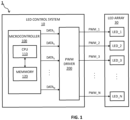
FIG. 1 is a block diagram of an example emergency lighting system according to an exemplary embodiment of the present disclosure; -
FIG. 2 is an example diagram illustrating an intensity variation curve of light emitted by an LED element according to an exemplary embodiment of the present disclosure; -
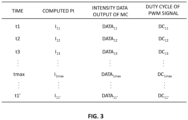
FIG. 3 is an example diagram illustrating relationships among percentage light intensities computed with respect to an LED element, output intensity data of a microcontroller, and duty cycles of a PWM driving signal, according to an exemplary embodiment of the present disclosure; -
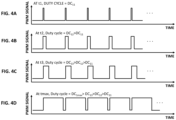
FIGS. 4A to 4D illustrate example diagrams of a PWM driving signal whose duty cycle varies to adjust light intensity of an LED element according to an embodiment of the present disclosure; -
FIG. 5A is a block diagram of an example LED control system including a microcontroller with a DMA feature, a serial-to-parallel converter, and a pulse width modulation driver, according to an exemplary embodiment of the present disclosure; -
FIG. 5B is an example diagram illustrating serial data transmitted to a PWM driver according to an exemplary embodiment of the present disclosure; -
FIG. 6 is a block diagram of an example microcontroller to which a floating point unit and a real-time operating system are implemented, according to an exemplary embodiment of the present disclosure; -
FIG. 7 is a flow chart illustrating a method for controlling an LED array according to an exemplary embodiment of the present disclosure; and -
FIG. 8 is a block diagram of a computing system according to an exemplary embodiment of the present disclosure. - The present disclosure may be understood more readily by reference to the following detailed description of the disclosure taken in connection with the accompanying drawing figures, which form a part of this disclosure. It is to be understood that this disclosure is not limited to the specific devices, methods, conditions or parameters described and/or shown herein, and that the terminology used herein is for the purpose of describing particular embodiments by way of example only and is not intended to be limiting of the claimed disclosure.
- Also, as used in the specification and including the appended claims, the singular forms "a," "an," and "the" include the plural, and reference to a particular numerical value includes at least that particular value, unless the context clearly dictates otherwise. Ranges may be expressed herein as from "about" or "approximately" one particular value and/or to "about" or "approximately" another particular value. When such a range is expressed, another embodiment includes from the one particular value and/or to the other particular value.
- The phrases "at least one", "one or more", and "and/or" are open-ended expressions that are both conjunctive and disjunctive in operation. For example, each of the expressions "at least one of A, B and C", "at least one of A, B, or C", "one or more of A, B, and C", "one or more of A, B, or C" and "A, B, and/or C" means A alone, B alone, C alone, A and B together, A and C together, B and C together, or A, B and C together.
- The emergency lighting system according to an exemplary embodiment of the present disclosure provides an emergency warning light that can be visible or recognized at night without making distractions. To this end, the emergency lighting system according to an exemplary embodiment of the present disclosure is configured to drive each light source therein to emit light with dynamically variable flash intensity patterns of light. For example, each light source can be driven to emit light with a flash intensity pattern where light intensity "ramps-up" and "ramps-down" to flash rather than simply turning on and off a light source; in addition, peak intensities of the light source can continuously be variable (e.g., not completely turned on or not completely turned off). The proposed emergency lighting system can produce emergency flash patterns that make it easier for the human eye to adjust, thus reducing drivers' distraction. These proposed emergency flash patterns can also minimize the disorienting, known as a "strobe effect" and thus can improve drivers' attention and visibility for securing the safety of first responders. Additionally, directional and sequential patterns that indicate desired actions or directions can improve resolution of the emergency lighting, thus reducing the confusion of oncoming traffics.
- In one embodiment, the emergency lighting system according to an exemplary embodiment of the present disclosure relies on a computing system including processor(s), software architectures or algorithms to provide the feature of a "computational lighting". For each light element of a lighting array of the emergency lighting system, the computing system computes percentage intensities as a mathematical function of time (or phase). This function can be discrete or time-continuous over time, and is computed, e.g., hundreds of times per second. If the function is discrete, data (e.g., intensity data) associated with the function can be stored as a lookup table in memory of the computing system or an external storage device.
- It will be appreciated that the percentage intensity is a relative intensity corresponding a fraction of the maximum intensity that each light element emits at a certain time point. Thus, the terms "percentage intensity" and "relative intensity" are interchangeable throughout the present disclosure. It will also be appreciated that the higher the percentage intensity (or the relative intensity), the brighter each light element is. In one embodiment, the intensity of light emitted by each light element is adjusted by adjusting a duty cycle of a pulse width modulation (PWM) driving signal to be injected thereto. For example, if the computed percentage intensity is increased, the duty cycle of the PWM driving signal is adapted to be increased, or vice versa.
- In one embodiment, the emergency lighting system according to an exemplary embodiment of the present disclosure includes a serial-to-parallel converter that performs a rapid serial-to-parallel conversion of intensity data corresponding to, e.g., PWM states to support a light array with multiple and/or variable number of lighting elements. This allows a light element to be toggled thousands of times per second.
-
FIG. 1 is a block diagram of an exampleemergency lighting system 1 according to an exemplary embodiment of the present disclosure. Theemergency lighting system 1 can be installed to be attached on an emergency vehicle or in the vicinity thereof.FIG. 2 is an example diagram illustrating anintensity variation curve 2 of light emitted by a lighting element (e.g., LED_1) of anLED array 30 according to an exemplary embodiment of the present disclosure.FIG. 3 is an example diagram illustrating relationships among percentage light intensities computed with respect to the lighting element (e.g., LED_1), output intensity data of themicrocontroller 100, and duty cycles of a PWM driving signal, according to an exemplary embodiment of the present disclosure. - Although it is illustrated in
FIG. 1 that the light elements constituting the lighting array are light-emitting diodes (LEDs), however embodiments of the present disclosure are not limited thereto. The lighting elements can be implemented with any type of light sources. - Referring now to
FIG. 1 , theemergency lighting system 1 includes anLED array 30 configured to provide a flash intensity light pattern and anLED control system 10 configured to control the operation of theLED array 30. As shown inFIG. 1 , theLED control system 10 includes at least one central processing unit (CPU) 110 (e.g., processor) andmemory 120 coupled to theCPU 110, and aPWM driver 200. TheCPU 110 and thememory 120 may constitute amicrocontroller 100. TheLED array 30 may be implemented as a light bar including a plurality of LED elements LED_1 to LED_N. The intensity of light emitted by the respective LED elements LED_1 to LED_N can independently be controlled (or driven) by thecontroller 100. In one embodiment, some or all the LED elements of theLED array 30 have the same flash light pattern one as another. In another embodiment, some or all the LED elements of theLED array 30 have different flash light patterns one from another. It will be apricated that when a flash light pattern of one LED element is different from another LED element, intensity patterns emitted from the two LED elements are different from each other. - For each of the LED elements LED_1 to LED_N, the
CPU 110 computes percentage light intensities as a mathematical function of time (or phase) and stores the computed percentage light intensities into thememory 120. The stored percentage intensities computed as the mathematical function can be discrete such as a lookup table or time-continuous. Referring toFIG. 2 , the percentage light intensities of each LED element LED_1 to LED_N ramps up to a top peak of theintensity variation curve 2 and ramps down to a bottom peak thereof, thus generating a flash light pattern with a slowing-varying envelope, which is distinguished from conventional technologies where LEDs are simply turned on or off, which causes drivers' distractions. - For example, further particularly for the LED element LED_1, as illustrated in
FIG. 2 , the output light intensity of the LED element LED_1 starts increasing at a time t1 with a first bottom peak intensity I11 to ramp up to a first top peak intensity I1max at a time tmax and ramps down to a second bottom peak intensity I11' at t1'. Further, the intensity ramps up to a second top peak I1max' at a time tmax' and ramps down again. This ramp up and down intensity variation is repeated with a predetermined flash pattern period ΔTflash. Thus, the time t1' is equal to t1 + ΔTflash (e.g., t1' = t1+ΔTflash), and the time tmax' is equal to tmax + ΔTflash (e.g., tmax' = tmax+ΔTflash). - The intensities (e.g., I11, I12, I1max, I11', I1max') on the
intensity variation curve 2 illustrated inFIG. 2 correspond to percentage intensities, respectively, computed by themicrocontroller 100. In one embodiment, the percentage intensities are stored in discrete data over time. Theintensity variation curve 2 may be a discrete curve while it is illustrated as a continuous curve inFIG. 2 . In this case, the number of intensity levels (or corresponding time points) during the flash pattern period ΔTflash is determined by the number of duty cycles of the PWM driving signals PWM_1 to PWM_N. For example, the more the duty cycles of the PWM driving signals, the greater the number of intensity levels, and then, the better resolution in light intensity variation, but requiring the faster computation on the percentage intensities by themicrocontroller 100. - By way of example only, the bottom peak intensity (e.g., I11 or I11') is an intensity corresponding to the state that the LED element (e.g., LED_1) is completely turned off, and/or the top peak intensity (e.g., Imax or Imax') is a 0
- Further, although it is illustrated
FIG. 2 that the first and second top peak intensities Imax and Imax' (and the first and second top bottom intensities I11 and I11') have the same levels as each other, embodiments of the present disclosure are not limited thereto. For example, the top peak intensities (and the bottom peak intensities) can dynamically vary over time. - Referring back to
FIG. 1 , the resulting computed percentage intensities with respect to each LED element LED_1 to LED_N are stored in thememory 120. The percentage intensities can be provided as digital intensity data DATA1 to DATAN to thePWM driver 200 through one or more I/O interfaces of themicrocontroller 100. The intensity data DATA1 to DATAN correspond to the plurality of LED elements LED_1 to LED_N of theLED array 30, respectively. Next, thePWM driver 200 receives the intensity data DATA1 to DATAN and generates corresponding PWM driving signals PWM_1 to PWM_N to a respective of the LED elements LED_1 to LED_N, based on a corresponding one of the intensity data DATA1 to DATAN. Then, the generated PWM driving signals PWM_1 to PWM_N are provided to a corresponding one of the LED elements LED_1 to LED_N. The PWM driving signals PWM_1 to PWM_N may be current signals each having a duty cycle. Thus, when an LED element is driven by the PWM driving signal, the light intensity of the LED element depends on the duty cycle of the PWM driving signal. - For example, referring back to
FIG. 2 , the PWM driving signal PWM_1 is applied to the LED element LED_1 for adjusting the light intensity thereof. At a time t1 (and/or t1'), the duty cycle of the PWM driving signal PWM_1 is a predetermined minimum value (or zero %); e.g., when the duty cycle of the PWM driving signal PWM_1 is zero %, the LED element LED_1 is completely turned off. In addition, at a time tmax (and/or tmax'), the duty cycle of the PWM driving signal PWM_1 is a predetermined maximum value (or 100 %); e.g., when the duty cycle of the PWM driving signal PWM_1 is 100 %, the LED element LED_1 is completely turned on. - Referring further to
FIG. 3 , as for the LED element LED_1, only observing a first flash cycle between t1 to t1' as an example, themicrocontroller 100 computes percentage intensities I11 to I11' that correspond to a plurality of time points t1 to t1', respectively and output intensity data DATA11 to DATA11' (corresponding to the percentage intensities I11 to I11', respectively) to thePWM driver 200. ThePWM driver 200 generates a PWM driving signal PWM_1 based on the intensity data DATA11 to DATA11'. The duty cycle of the PWM driving signal PWM_1 varies from DC11 to DC11' in order which correspond to the intensity data DATA11 to DATA11', respectively. - Similar descriptions can be applied for light intensity control of the other LED elements LED_2 to LED_N. For example, for an LED element LED_k (k is an integer, 2≤k≤N), the
microcontroller 100 computes percentage intensities Ik1 to Ik1' that correspond to a plurality of time points t1 to t1', respectively and output intensity data DATAk1 to DATAk1' (corresponding to the percentage intensities Ik1 to Ik1', respectively) to thePWM driver 200. ThePWM driver 200 generates a PWM driving signal PWM_k based on the intensity data DATAk1 to DATAk1'. The duty cycle of the PWM driving signal PWM_k varies from DCk1 to DCk1' in order which correspond to the intensity data DATAk1 to DATAk1', respectively. -
FIGS. 4A to 4D illustrate example diagrams of a PWM driving signal PWM_1 whose duty cycle varies to adjust light intensity of the LED element LED_1 according to an embodiment of the present disclosure. - Referring to
FIGS. 3 and4A , in response to the output intensity data DATA11 associated with a time t1, the duty cycle of the PWM driving signal PWM_1 is set to be DC11, and thus, the LED element LED_1 emits light based on the PWM driving signal PWM_1. Intensity of the light emitted by the LED element LED_1 corresponds to the percentage intensity I11. - In addition, referring to
FIGS. 3 and5B , in response to the output intensity data DATA12 associated with a time t2, the duty cycle of the PWM driving signal PWM_1 is set to be DC12 which is greater than DC11, and thus, the LED element LED_1 emits light based on the PWM driving signal PWM_1. Intensity of the light emitted by the LED element LED_1 corresponds to the percentage intensity I12. - Similarly, referring to
FIGS. 3 and4C , in response to the output intensity data DATA13 associated with a time t3, the duty cycle of the PWM driving signal PWM_1 is set to be DC13 which is greater than DC11 and DC12, and thus, the LED element LED_1 emits light based on the PWM driving signal PWM_1. Intensity of the light emitted by the LED element LED_1 corresponds to the percentage intensity I13. - Further, referring to
FIGS. 3 and4D , in response to the output intensity data DATA1max associated with a time tmax, the duty cycle of the PWM driving signal PWM_1 is set to be DC1max which is greater than DC11, DC12 and DC13, and thus, the LED element LED_1 emits light based on the PWM driving signal PWM_1. Intensity of the light emitted by the LED element LED_1 corresponds to the percentage intensity I1max. - It should be noted that the duty cycle of a PWM driving signal according to an embodiment of the present disclosure is adjusted to have one or more intermediate values between its minimum value and maximum value, so that the intensity of light emitted by an LED element ramps up and down. On the contrary, in the conventional emergency lighting systems simply turning on and off a light source, the PWM driving signal may only have two duty cycle states corresponding to the light's turned on and turned-off states, respectively.
- Referring back to
FIG. 2 , the flash light pattern of an LED element should be visible or recognizable by drivers at night. To this end, the flash pattern period ΔTflash of an LED element is selected to ensure that a 1/ΔTflash is lower than a frequency (e.g., 50 Hz) that the human's eye can perceive; e.g., ΔTflash is longer than 20 ms. In addition, the light intensity of an LED element varies every predetermined time interval (e.g., ΔTsi= t2 -t1) according to variation of the duty cycle of the PWM driving signal PWM_1. For example, at a time t1, the duty cycle of the PWM driving signal PWM_1 is DC11 which remains unchanged during an interval of t1 to t2, and at a time t2, the duty cycle is changed from DC11 to DC12 and remains unchanged during an interval of t2 to t3, and thus, theintensity variation curve 2 of the LED may vary in a step-wise manner (not shown). Although not shown in figures, similar descriptions can be applied for light intensity control of the other LED elements LED_2 to LED_N. - To this end, it is conceivable that the intensity data (e.g., DATA11 to DATA11') are (e.g., sequentially) provided to the
PWM driver 200 every predetermined sampling interval ΔTsi, so that the duty cycle of the PWM driving signal PWM_1 varies every predetermined sampling interval ΔTsi to have the LED element emit with corresponding light intensities (e.g., I11 to I11') at the respective time points (e.g., t1 to t1'). Thus, it is required that themicrocontroller 100 is capable of working at a computation speed to cover the above-mentioned features. In other words, themicrocontroller 100 should have capability of computing the percentage intensities and output the corresponding output intensity data every sampling interval ΔTsi for the respective LED elements LED_1 to LED_N, independently. The more the LED elements in a light array to be controlled, the higher the speed requirement for a microcontroller will be. - By way of example only, in case a turn-on period of a PWM driving signal (e.g., PWM_1) is 50µs, then the sampling interval ΔTsi will be 50µs ×M; M is an integer and denotes the number of PWM cycles required to each percentage intensity sample. For example, if M is 10, the sampling interval ΔTsi will be 500µs. Further, given that the number of the LED elements is N, the load imposed on a microcontroller will be increased as the number of the LED elements is increased.
- Thus, as shown in
FIG. 1 , if theCPU 110 of theLED control system 10 has a computation speed fast enough to cover the above-mentioned features, the intensity data DATA1 to DATAN can be output via the multiple I/O interfaces to thePWM driver 200. - In some embodiments, in order to ease the load imposed on the microcontroller, a LED control system can further be modified to include additional features such as direct-memory access (DMA), a serial-to-parallel (S/P) converter, a floating-point unit (FPU) and/or a real-time operating system (RTOS), as exemplarily illustrated in
FIGS. 5A and6 . - In one embodiment, referring to
FIG. 5A , illustrated is aLED control system 10a including amicrocontroller 100a with aDMA controller 130a, a S/P converter 300 and aPWM driver 200, according to an exemplary embodiment of the present disclosure. Themicrocontroller 100a includes aCPU 110a andmemory 120a coupled to theCPU 110a. - Compared to the
LED control system 10 ofFIG. 1 , theLED control system 10a further includes: aDMA controller 130a in themicrocontroller 100a for supporting the DMA feature; and the S/P converter 300. Thus, duplicate description thereof will be omitted for the sake of simplicity. - Referring still to
FIG. 5A , the S/P converter 300 can be implemented using one or more shift registers supporting a high serial bit rate (e.g., on the order of 10 Mbps). Themicrocontroller 100a has theDMA controller 130a to support the DMA feature, which allows the S/P converter 300 to directly access to thememory 120a without interrupting theCPU 110a to read the intensity data DATA1 to DATAN from thememory 120a. For example, the DMA feature allows serial transfer of the intensity data DATA1 to DATAN to thePWM driver 200 through the S/P converter 300. In one embodiment, due to the DMA feature, theserial data 3 can be outputted with a minimal interruption to theCPU 110a or without any interruption. -
FIG. 5B is an example diagram illustrating theserial data 3 transmitted to thePWM driver 200. Themicrocontroller 100a outputs the first round of intensity data DATA11 to DATAN1 corresponding to the LED elements LED_1 to LED_N, e.g., at a time t1, and then outputs the second round of intensity data DATA12 to DATAN2, e.g., at a time t2. An optional guard interval can be placed between the first round of intensity data and the second round of intensity data. Owing to the DMA feature and the S/P converter 300 illustrated inFIG. 5A , the number of CPU cycles (e.g., clocks) required for theCPU 110a to output the LED elements LED_1 to LED_N can be reduced, and thus, the CPU's availability for computing the percentage intensities can be maximized. - In another embodiment for further easing the load on a CPU and maximizing its availability to computation for the percentage intensities, e.g., in real-time, a microcontroller is designed to include the floating-point unit (FPU) and/or the real-time operating system (RTOS).
-
FIG. 6 is a block diagram of anexample microcontroller 100b to which anFPU 115 and a real-time operating system (RTOS) 125 are implemented, according to an exemplary embodiment of the present disclosure. - Referring now to
FIG. 6 , theFPU 115 is integrated into aCPU 110b, or implemented as a separate part from theCPU 110b, and is configured to perform floating point (e.g., non-integer numbers) calculations. This allows faster calculation on the floating points, compared to calculation only using a CPU (e.g., 110a) without theFPU 115. The floating-point calculation is necessary for timely computing the percentage intensities associated with the respective LED elements LED_1 to LED_N, so that the real-time operation can be achieved. - An RTOS is known as a computing environment that computes tasks within a specific time constrains (e.g., real-time computing). The use of an RTOS permits computation of percentage intensities for each LED element (e.g., lighting element states) to occur asynchronously from the lighting element control such as generating of intensity data and generating of a PWM driving signal for each LED element based on the intensity data. Despite the use of DMA feature, control of the LED elements may impose much load on a CPU due to the high frequency PWM cycle. The RTOS reclaims precious CPU cycles while the LED element control is idle, such as during DMA transfers. This can minimize the impact that the computational algorithms have on the timing of LED element states changes. Otherwise, a significantly more expensive microcontroller would be required for this functionality.
-
FIG. 7 is a flow chart illustrating a method for controlling anLED array 30 according to an exemplary embodiment of the present disclosure. - Referring now to
FIGS. 1-7 , a microcontroller (e.g., 100 ofFIG. 1 , 100a ofFIG. 5A and 100b ofFIG. 6 ) computes percentage light intensities for each LED element (e.g., LED_1 to LED_N) of an LED array 30 (S610) and outputs intensity data (e.g., DATA1 to DATAN) associated with the percentage intensities to a PWM driver 200 (S620). In one embodiment, the percentage light intensities of each LED element ramp up to a top peak and ramp down to a low peak repeatedly, thus forming a flash light pattern of the LED element. - Next, the
PWM driver 200 generates a respective PWM driving signal (e.g., PWM_1 to PWM_N) for each LED element based on the received intensity data (S630) and outputs the generated PWM driving signal to each LED element (S640). The duty cycle of the PWM driving signal varies according to the percentage light intensity identified by the intensity data received from the microcontroller (e.g., 100, 100a or 100b). The higher the percentage light intensity, the higher the duty cycle, or vice versa. Each LED element of theLED array 30 emits light whose intensity is controlled based on the duty cycle of the PWM driving signal (S650). -
FIG. 8 is a block diagram of acomputing system 4000 according to an exemplary embodiment of the present disclosure. - Referring to
FIG. 8 , thecomputing system 4000 may be used as a platform for performing: the functions or operations described hereinabove with respect to at least one of thecontrol system 10 ofFIG. 1 and/or control systems each including one of themicrocontroller FIG. 7 . - Referring to
FIG. 8 , thecomputing system 4000 may include aprocessor 4010, I/O devices 4020, amemory system 4030, adisplay device 4040, and/or anetwork adaptor 4050. - The
processor 4010 may drive the I/O devices 4020, thememory system 4030, thedisplay device 4040, and/or thenetwork adaptor 4050 through abus 4060. - The
computing system 4000 may include a program module for performing: the functions or operations described hereinabove with respect to at least one of thecontrol system 10 ofFIG. 1 and/or control systems each including one of themicrocontroller FIG. 7 . For example, the program module may include routines, programs, objects, components, logic, data structures, or the like, for performing particular tasks or implement particular abstract data types. The processor (e.g., 4010) of thecomputing system 4000 may execute instructions written in the program module to perform: the functions or operations described hereinabove with respect to at least one of thecontrol system 10 ofFIG. 1 and/or control systems each including one of themicrocontroller FIG. 7 . The program module may be programmed into the integrated circuits of the processor (e.g., 4010). In an exemplary embodiment, the program module may be stored in the memory system (e.g., 4030) or in a remote computer system storage media. - The
computing system 4000 may include a variety of computing system readable media. Such media may be any available media that is accessible by the computer system (e.g., 4000), and it may include both volatile and non-volatile media, removable and non-removable media. - The memory system (e.g., 4030) can include computer system readable media in the form of volatile memory, such as RAM and/or cache memory or others. The computer system (e.g., 4000) may further include other removable/non-removable, volatile/non-volatile computer system storage media.
- The computer system (e.g., 4000) may communicate with one or more devices using the network adapter (e.g., 4050). The network adapter may support wired communications based on Internet, local area network (LAN), wide area network (WAN), or the like, or wireless communications based on code division multiple access (CDMA), global system for mobile communication (GSM), wideband CDMA, CDMA-2000, time division multiple access (TDMA), long term evolution (LTE), wireless LAN, Bluetooth, Zig Bee, or the like.
- Exemplary embodiments of the present disclosure may include a system, a method, and/or a non-transitory computer readable storage medium. The non-transitory computer readable storage medium (e.g., the memory system 4030) has computer readable program instructions thereon for causing a processor to carry out aspects of the present disclosure.
- The computer readable storage medium can be a tangible device that can retain and store instructions for use by an instruction execution device. The computer readable storage medium may be, for example, but not limited to, an electronic storage device, a magnetic storage device, an optical storage device, an electromagnetic storage device, a semiconductor storage device, or any suitable combination of the foregoing. A non-exhaustive list of more specific examples of the computer readable storage medium includes the following: a portable computer diskette, a hard disk, a random access memory (RAM), a read-only memory (ROM), an erasable programmable read-only memory (EEPROM or Flash memory), a static random access memory (SRAM), a portable compact disc read-only memory (CD-ROM), a digital versatile disk (DVD), a memory stick, a floppy disk, or the like, a mechanically encoded device such as punch-cards or raised structures in a groove having instructions recorded thereon, and any suitable combination of the foregoing. A computer readable storage medium, as used herein, is not to be construed as being transitory signals per se, such as radio waves or other freely propagating electromagnetic waves, electromagnetic waves propagating through a waveguide or other transmission media (e.g., light pulses passing through a fiber-optic cable), or electrical signals transmitted through a wire.
- Computer readable program instructions described herein can be downloaded to the
computing system 4000 from the computer readable storage medium or to an external computer or external storage device via a network. The network may include copper transmission cables, optical transmission fibers, wireless transmission, routers, firewalls, switches, gateway computers and/or edge servers. A network adapter card (e.g., 4050) or network interface in each computing/processing device receives computer readable program instructions from the network and forwards the computer readable program instructions for storage in a computer readable storage medium within the computing system. - Computer readable program instructions for carrying out operations of the present disclosure may be assembler instructions, instruction-set-architecture (ISA) instructions, machine instructions, machine dependent instructions, microcode, firmware instructions, state-setting data, or either source code or object code written in any combination of one or more programming languages, including an object oriented programming language such as Smalltalk, C++ or the like, and conventional procedural programming languages, such as the "C" programming language or similar programming languages. The computer readable program instructions may execute entirely on the user's computer, partly on the user's computer, as a stand-alone software package, partly on the user's computer and partly on a remote computer or entirely on the remote computer or server. In the latter scenario, the remote computer may be connected to the computing system (e.g., 4000) through any type of network, including a LAN or a WAN, or the connection may be made to an external computer (for example, through the Internet using an Internet Service Provider). In an exemplary embodiment, electronic circuitry including, for example, programmable logic circuitry, field-programmable gate arrays (FPGA), or programmable logic arrays (PLA) may execute the computer readable program instructions by utilizing state information of the computer readable program instructions to personalize the electronic circuitry, in order to perform aspects of the present disclosure.
- Aspects of the present disclosure are described herein with reference to flowchart illustrations and/or block diagrams of methods, system (or device), and computer program products (or computer readable medium). It will be understood that each block of the flowchart illustrations and/or block diagrams, and combinations of blocks in the flowchart illustrations and/or block diagrams, can be implemented by computer readable program instructions.
- These computer readable program instructions may be provided to a processor of a general-purpose computer, special purpose computer, or other programmable data processing apparatus to produce a machine, such that the instructions, which execute via the processor of the computer or other programmable data processing apparatus, create means for implementing the functions/acts specified in the flowchart and/or block diagram block or blocks. These computer readable program instructions may also be stored in a computer readable storage medium that can direct a computer, a programmable data processing apparatus, and/or other devices to function in a particular manner, such that the computer readable storage medium having instructions stored therein comprises an article of manufacture including instructions which implement aspects of the function/act specified in the flowchart and/or block diagram block or blocks.
- The computer readable program instructions may also be loaded onto a computer, other programmable data processing apparatus, or other device to cause a series of operational steps to be performed on the computer, other programmable apparatus or other device to produce a computer implemented process, such that the instructions which execute on the computer, other programmable apparatus, or other device implement the functions/acts specified in the flowchart and/or block diagram block or blocks.
- The flowchart and block diagrams in the Figures illustrate the architecture, functionality, and operation of possible implementations of systems, methods, and computer program products according to various embodiments of the present disclosure. In this regard, each block in the flowchart or block diagrams may represent a module, segment, or portion of instructions, which comprises one or more executable instructions for implementing the specified logical function(s). In some alternative implementations, the functions noted in the block may occur out of the order noted in the figures. For example, two blocks shown in succession may, in fact, be executed substantially concurrently, or the blocks may sometimes be executed in the reverse order, depending upon the functionality involved. It will also be noted that each block of the block diagrams and/or flowchart illustration, and combinations of blocks in the block diagrams and/or flowchart illustration, can be implemented by special purpose hardware-based systems that perform the specified functions or acts or carry out combinations of special purpose hardware and computer instructions.
- The description of the present disclosure has been presented for purposes of illustration and description but is not intended to be exhaustive or limited to the present disclosure in the form disclosed. Many modifications and variations will be apparent to those of ordinary skill in the art without departing from the scope of the present disclosure. The embodiment was chosen and described in order to best explain the principles of the present disclosure and the practical application, and to enable others of ordinary skill in the art to understand the present disclosure for various embodiments with various modifications as are suited to the particular use contemplated.
- While the present invention has been particularly shown and described with respect to preferred embodiments thereof, it will be understood by those skilled in the art that the foregoing and other changes in forms and details may be made without departing from the scope of the present invention. It is therefore intended that the present invention not be limited to the exact forms and details described and illustrated but fall within the scope of the appended claims.
Claims (15)
- A lighting system (1) for generating a dynamically variable flash intensity pattern, comprising:a controller (10, 10a) configured to generate a plurality of PWM driving control signals; anda light source (30) comprised of a plurality of independent lighting elements in an array and configured to receive the plurality of PWM driving control signals and emit light from each of the plurality of independent lighting elements based on a corresponding one of the plurality of PWM driving control signals such that each of the independent lighting elements in the array is independently controlled, producing the dynamically variable flash intensity pattern,wherein intensity of the light emitted from each of the plurality of independent lighting elements ramps up and ramps down repeatedly with a first period based on a respective one of the plurality of PWM driving control signals;wherein for each of the plurality of PWM driving control signals a plurality of intensity values of the corresponding one of the plurality of independent lighting elements of the light source (30) is generated, computed by the controller (10, 10a), wherein for each of the plurality of the PWM driving control signals each of the plurality of intensity values corresponds to a respective plurality of time points; andwherein the controller (10, 10a) further comprises a pulse width modulation driver (200) configured to generate the plurality of PWM driving control signals based on the corresponding plurality of intensity values.
- The lighting system of claim 1, wherein at least one parameter of the plurality of PWM driving control signals is gradually adjusted to have at least one intermediate value between a maximum value corresponding to a top peak of the intensity of the light and a minimum value corresponding to a bottom peak of the intensity of the light.
- The lighting system of claim 1, wherein the controller (10, 10a) is further configured to adjust a plurality of duty cycles of the plurality of PWM driving control signals based on each of the computed plurality of intensity values to generate the plurality of PWM driving control signals.
- The lighting system of claim 3, wherein the controller (10, 10a) is further configured to:adjust the plurality of duty cycles of the plurality of PWM driving control signals to a first duty cycle at a first of the time points, based on a first of the computed plurality of intensity values;control the light source (30) to emit the light with the first intensity value;adjust the plurality of duty cycles of the plurality of PWM driving control signals to a second duty cycle at a second of the time points, based on a second of the computed plurality of intensity values; andcontrol the light source (30) to emit the light with the second intensity value, the second time point being adjacent to the first time point.
- The lighting system of claim 4, wherein the plurality of duty cycles of the plurality of PWM driving control signals adjusted at the first time point is maintained until the second time point.
- The lighting system of claim 5, wherein the plurality of duty cycles of the plurality of PWM driving control signals gradually varies between the first time point and the second time point from the first duty cycle to the second duty cycle.
- The lighting system of claim 2, further comprising another light source,wherein the controller (10, 10a) is further configured to generate another plurality of PWM driving control signals, and the another light source is configured to receive the another plurality of PWM driving control signals and emit another light based on the another plurality of PWM driving control signals, andwherein intensity of the another light emitted from the another light source ramps up and ramps down repeatedly with a second period based on the plurality of PWM driving control signals.
- The lighting system of claim 7, wherein the second period is different from the first period.
- The lighting system of claim 7, wherein at least one of the maximum value and the minimum value of the plurality of PWM driving control signals is different from a corresponding one of the another plurality of PWM driving control signals.
- The lighting system of claim 7, wherein the another light source and the light source are implemented with a light array bar (30).
- The lighting system of claim 1, further comprising at least one of a direct-memory access controller, a serial-to-parallel converter, a floating point unit and a real-time operating system.
- A method for driving a lighting system (1) for generating a dynamically variable flash intensity pattern, comprising:generating, by a controller (10, 10a), a plurality of PWM driving control signals;receiving, by a light source (30) comprised of a plurality of independent lighting elements in an array, the plurality of PWM driving control signals wherein the plurality of PWM driving control signals comprises a corresponding PWM driving control signal for each light emitting diode element in the light source (30) such that each of the light emitting diode elements is independently controlled, producing the dynamically variable flash intensity pattern; andemitting, by each of the plurality of individual lighting elements, light based on a corresponding one of the plurality of PWM driving control signals;wherein intensity of the light emitted from each of the plurality of independent lighting elements ramps up and ramps down repeatedly with a first period based on a respective one of the plurality of PWM driving control signals, wherein for each of the plurality of PWM driving control signals a plurality of intensity values of the corresponding one of the plurality of independent lighting elements of the light source (30) is generated, computed by the controller (10, 10a), wherein for each of the plurality of the PWM driving control signals each of the plurality of intensity values corresponds to a respective plurality of time points; andgenerating, by a pulse width modulation driver (200) of the controller (10, 10a), the plurality of PWM driving control signals based on the corresponding plurality of intensity values.
- The method of claim 12, wherein at least one parameter of the plurality of PWM driving control signals is gradually adjusted to have at least one intermediate value between a maximum value corresponding to a top peak of the intensity of the light and a minimum value corresponding to a bottom peak of the intensity of the light and/or wherein the method further comprises generating, by a serial-to parallel converter the plurality of intensity values from a plurality of shift registers.
- The method of claim 12, wherein the method further comprises adjusting, by the controller (10, 10a), a plurality of duty cycles of the plurality of PWM driving control signals based each of the computed plurality of intensity values.
- The method of claim 14, further comprising:generating, by the controller (10, 10a), another plurality of PWM driving control signalsreceiving, by another light source, the another plurality of PWM driving control signals; andemitting, by the another light source, another light based on the another plurality of PWM driving control signals,wherein intensity of the another light emitted from the another light source ramps up and ramps down repeatedly with a second period based on the plurality of PWM driving control signals, in particular wherein the second period is different from the first period and/or wherein at least one of the maximum value and the minimum value of the plurality of PWM driving control signals is different from a corresponding one of the another plurality of PWM driving control signals.
Applications Claiming Priority (2)
| Application Number | Priority Date | Filing Date | Title |
|---|---|---|---|
| US16/254,730 US11064589B2 (en) | 2019-01-23 | 2019-01-23 | System and method for variable intensity patterns |
| PCT/US2019/020687 WO2020153978A1 (en) | 2019-01-23 | 2019-03-05 | System and method for variable intensity patterns |
Publications (2)
| Publication Number | Publication Date |
|---|---|
| EP3914477A1 EP3914477A1 (en) | 2021-12-01 |
| EP3914477B1 true EP3914477B1 (en) | 2025-04-16 |
Family
ID=65818630
Family Applications (1)
| Application Number | Title | Priority Date | Filing Date |
|---|---|---|---|
| EP19712361.5A Active EP3914477B1 (en) | 2019-01-23 | 2019-03-05 | System and method for variable intensity patterns |
Country Status (5)
| Country | Link |
|---|---|
| US (2) | US11064589B2 (en) |
| EP (1) | EP3914477B1 (en) |
| ES (1) | ES3031717T3 (en) |
| PL (1) | PL3914477T3 (en) |
| WO (1) | WO2020153978A1 (en) |
Families Citing this family (11)
| Publication number | Priority date | Publication date | Assignee | Title |
|---|---|---|---|---|
| US20160144778A1 (en) | 2014-11-24 | 2016-05-26 | David M. Tucker | Enhanced communication system for vehicle hazard lights |
| WO2018185900A1 (en) * | 2017-04-06 | 2018-10-11 | 三菱電機株式会社 | Lighting control device, lighting control method, and lighting control program |
| WO2020123673A1 (en) | 2018-12-11 | 2020-06-18 | Ess-Help, Inc. | Enhanced operation of vehicle hazard and lighting communication systems |
| US11064589B2 (en) * | 2019-01-23 | 2021-07-13 | Whelen Engineering Company, Inc. | System and method for variable intensity patterns |
| US11518298B2 (en) | 2019-03-15 | 2022-12-06 | ESS-Help, lnc. | High visibility lighting for autonomous vehicles |
| US11590887B2 (en) | 2019-03-15 | 2023-02-28 | Ess-Help, Inc. | Control of high visibility vehicle light communication systems |
| AU2020241841A1 (en) | 2019-03-15 | 2021-10-14 | Emergency Safety Solutions, Inc. | Control of high visibility vehicle light communication systems |
| JP7065261B2 (en) | 2019-03-28 | 2022-05-11 | イーエスエス-ヘルプ,インコーポレーテッド | Remote Vehicle Hazard and Notification Beacon |
| AU2020329976A1 (en) | 2019-08-12 | 2022-03-10 | Emergency Safety Solutions, Inc. | System for communication of hazardous vehicle and road conditions |
| CN112040601B (en) * | 2020-09-03 | 2023-04-07 | 广州彩熠灯光股份有限公司 | Lamp dot matrix control device and method and LED stage lamp |
| JP7550003B2 (en) * | 2020-09-16 | 2024-09-12 | 株式会社小糸製作所 | Vehicle lighting fixture and lamp control module |
Citations (1)
| Publication number | Priority date | Publication date | Assignee | Title |
|---|---|---|---|---|
| US20120120123A1 (en) * | 2010-11-11 | 2012-05-17 | Atrc Corporation | Backlight apparatus, image display system and lighting apparatus |
Family Cites Families (38)
| Publication number | Priority date | Publication date | Assignee | Title |
|---|---|---|---|---|
| DE2830064A1 (en) * | 1978-07-08 | 1980-01-17 | Tekade Felten & Guilleaume | LIGHT SIGNALING DEVICE |
| US5159642A (en) * | 1990-07-13 | 1992-10-27 | Toa Medical Electronics Co., Ltd. | Particle image analyzing apparatus |
| US5953132A (en) * | 1995-07-18 | 1999-09-14 | Canon Kabushiki Kaisha | Image communication apparatus with enhanced utilization of CPU |
| US6897842B2 (en) * | 2001-09-19 | 2005-05-24 | Intel Corporation | Nonlinearly mapping video date to pixel intensity while compensating for non-uniformities and degradations in a display |
| US7215891B1 (en) * | 2003-06-06 | 2007-05-08 | Jds Uniphase Corporation | Integrated driving, receiving, controlling, and monitoring for optical transceivers |
| US20050001562A1 (en) * | 2003-07-02 | 2005-01-06 | 911Ep, Inc. | LED compensation circuit |
| US7199704B2 (en) * | 2004-10-15 | 2007-04-03 | Xtreme Engineered Solutions, Inc. | Vehicular flasher unit having selectable flasher schemes illuminated with pulse width modulated signals |
| US20110062888A1 (en) * | 2004-12-01 | 2011-03-17 | Bondy Montgomery C | Energy saving extra-low voltage dimmer and security lighting system wherein fixture control is local to the illuminated area |
| JP4591325B2 (en) * | 2005-01-28 | 2010-12-01 | カシオ計算機株式会社 | Imaging apparatus and program |
| US7621653B2 (en) * | 2005-11-22 | 2009-11-24 | Xenopus Electronix, Llc | Multi-function illumination device |
| US20080018261A1 (en) * | 2006-05-01 | 2008-01-24 | Kastner Mark A | LED power supply with options for dimming |
| US7994732B2 (en) * | 2006-11-03 | 2011-08-09 | Zulch Laboratories, Inc. | Intensity changing with reduced flicker for digitally-controlled lighting |
| US8767215B2 (en) * | 2007-06-18 | 2014-07-01 | Leddartech Inc. | Method for detecting objects with light |
| WO2008157772A1 (en) * | 2007-06-20 | 2008-12-24 | Eveready Battery Company, Inc. | Lighting device having light intensity control |
| US20090322800A1 (en) * | 2008-06-25 | 2009-12-31 | Dolby Laboratories Licensing Corporation | Method and apparatus in various embodiments for hdr implementation in display devices |
| US8138882B2 (en) * | 2009-02-05 | 2012-03-20 | International Business Machines Corporation | Securing premises using surfaced-based computing technology |
| WO2011008724A2 (en) * | 2009-07-13 | 2011-01-20 | Dolby Laboratories Licensing Corporation | Systems and methods for controlling drive signals in spatial light modulator displays |
| US8836532B2 (en) * | 2009-07-16 | 2014-09-16 | Gentex Corporation | Notification appliance and method thereof |
| US8729809B2 (en) * | 2009-09-08 | 2014-05-20 | Denovo Lighting, Llc | Voltage regulating devices in LED lamps with multiple power sources |
| US8264158B2 (en) * | 2009-11-30 | 2012-09-11 | Tai-Hsiang Huang | Protection circuit for alternating current light emitting diode |
| US20120101343A1 (en) * | 2010-10-21 | 2012-04-26 | Duffy Thomas P | Medical imaging device |
| GB2491550A (en) * | 2011-01-17 | 2012-12-12 | Radiant Res Ltd | A hybrid power control system using dynamic power regulation to increase the dimming dynamic range and power control of solid-state illumination systems |
| WO2012132221A1 (en) * | 2011-03-28 | 2012-10-04 | ルネサスエレクトロニクス株式会社 | Pwm signal generating circuit and processor system |
| US20130088595A1 (en) * | 2011-08-16 | 2013-04-11 | Richard S. Nauert | Control of electronic features and safety equipment for a one design race car |
| US8947223B2 (en) * | 2012-01-27 | 2015-02-03 | Rom Acquisition Corporation | Warning and scene lighting system |
| US20140301101A1 (en) * | 2013-04-07 | 2014-10-09 | Mr. Derek Terrell Russ | Multifunctional Multiple Color Center High Mounted Stop Lamp |
| US9142214B2 (en) * | 2013-07-26 | 2015-09-22 | SkyBell Technologies, Inc. | Light socket cameras |
| US20150204561A1 (en) * | 2014-01-20 | 2015-07-23 | Innosys, Inc. | Control System With Mobile Sensors |
| US9192031B2 (en) * | 2014-03-08 | 2015-11-17 | Feniex Industries Inc. | Resonating power transfer for auxiliary vehicle lights |
| WO2016089926A1 (en) * | 2014-12-01 | 2016-06-09 | Ihedinmah Chukwudi | Vehicle digital message display |
| US9951917B2 (en) * | 2015-09-30 | 2018-04-24 | Bell Helicopter Textron Inc. | Hybrid emergency exit lighting system |
| GB201522184D0 (en) * | 2015-12-16 | 2016-01-27 | Shields Energy Services Ltd | Measurement and control of lighting |
| DE102016001487A1 (en) | 2016-02-11 | 2017-08-17 | Hänsch Engineering GmbH | Optical warning device and method for controlling an optical warning device |
| US10021757B2 (en) * | 2016-03-11 | 2018-07-10 | Gooee Limited | System and method for predicting emergency lighting fixture life expectancy |
| WO2017223448A1 (en) * | 2016-06-24 | 2017-12-28 | Horizon Global Americas Inc. | Light fixture assembly for creeper assembly |
| US10028350B2 (en) * | 2016-09-25 | 2018-07-17 | Illum Horticulture Llc | Method and apparatus for horticultural lighting with enhanced dimming and optimized efficiency |
| US10332407B2 (en) * | 2017-07-07 | 2019-06-25 | Walmart Apollo, Llc | Systems and methods for providing emergency alerts at emergency landing areas of unmanned aerial vehicles |
| US11064589B2 (en) * | 2019-01-23 | 2021-07-13 | Whelen Engineering Company, Inc. | System and method for variable intensity patterns |
-
2019
- 2019-01-23 US US16/254,730 patent/US11064589B2/en active Active
- 2019-03-05 EP EP19712361.5A patent/EP3914477B1/en active Active
- 2019-03-05 ES ES19712361T patent/ES3031717T3/en active Active
- 2019-03-05 WO PCT/US2019/020687 patent/WO2020153978A1/en not_active Ceased
- 2019-03-05 PL PL19712361.5T patent/PL3914477T3/en unknown
-
2021
- 2021-06-09 US US17/342,821 patent/US11672064B2/en active Active
Patent Citations (1)
| Publication number | Priority date | Publication date | Assignee | Title |
|---|---|---|---|---|
| US20120120123A1 (en) * | 2010-11-11 | 2012-05-17 | Atrc Corporation | Backlight apparatus, image display system and lighting apparatus |
Also Published As
| Publication number | Publication date |
|---|---|
| US20200236745A1 (en) | 2020-07-23 |
| US11064589B2 (en) | 2021-07-13 |
| EP3914477A1 (en) | 2021-12-01 |
| TW202041101A (en) | 2020-11-01 |
| PL3914477T3 (en) | 2025-08-18 |
| US20210307143A1 (en) | 2021-09-30 |
| US11672064B2 (en) | 2023-06-06 |
| WO2020153978A1 (en) | 2020-07-30 |
| ES3031717T3 (en) | 2025-07-10 |
Similar Documents
| Publication | Publication Date | Title |
|---|---|---|
| EP3914477B1 (en) | System and method for variable intensity patterns | |
| US8704676B2 (en) | Dynamic road markers to provide visual feedback as to vehicle speed | |
| US9769898B1 (en) | Adjusted pulse width modulation (PWM) curve calculations for improved accuracy | |
| CN110505978B (en) | Lighting control device, lighting control method, and computer-readable storage medium | |
| EP3512308A1 (en) | Lighting circuit, vehicle lamp, and driving method for light source | |
| JP2008091311A (en) | LED drive device | |
| KR20220104230A (en) | Dynamically adjustable micro-LED pixel array | |
| CN109743812B (en) | Vehicle lighting control method, device, electronic device and automobile | |
| RU2017124976A (en) | SYSTEMS AND METHODS OF INTERNAL LIGHTING OF VEHICLE | |
| JP6456197B2 (en) | Image display system and image display method | |
| JP2013002059A (en) | Vehicle guide device and vehicle guiding method | |
| CN106134056A (en) | Power control and power control method | |
| US12101861B2 (en) | Lamp and operating method of the lamp | |
| TWI916317B (en) | System and method for individually controlled light element flashing with dynamically variable emergency flash patterns and computer-readable storage medium | |
| US10555391B2 (en) | Light-emitting diode assembly, and method for dimming a light-emitting diode of a light-emitting diode assembly | |
| JP4651528B2 (en) | Lighting control device and lighting device | |
| KR100912856B1 (en) | PDM-type LED drive apparatus and method employing sub-scan selection unit | |
| JP2011211271A (en) | Signal generator | |
| JP2015152664A (en) | display | |
| CN116189607A (en) | Display control method of rotary display device and rotary display device | |
| KR20220118595A (en) | Direction indicating method in vehicle and controller for executing thereof | |
| US10487400B2 (en) | Method of decreasing visible flickering effects in a light emitting diode array operated by pulse width modulated signals | |
| JP7369584B2 (en) | Lighting control device and lighting control method for vehicle lights, vehicle light system | |
| CN115426742B (en) | A LED control method and circuit based on multi-channel PWM signals | |
| US20260116295A1 (en) | Lighting control system for mitigating exterior light failures |
Legal Events
| Date | Code | Title | Description |
|---|---|---|---|
| STAA | Information on the status of an ep patent application or granted ep patent |
Free format text: STATUS: UNKNOWN |
|
| STAA | Information on the status of an ep patent application or granted ep patent |
Free format text: STATUS: THE INTERNATIONAL PUBLICATION HAS BEEN MADE |
|
| PUAI | Public reference made under article 153(3) epc to a published international application that has entered the european phase |
Free format text: ORIGINAL CODE: 0009012 |
|
| STAA | Information on the status of an ep patent application or granted ep patent |
Free format text: STATUS: REQUEST FOR EXAMINATION WAS MADE |
|
| 17P | Request for examination filed |
Effective date: 20210811 |
|
| AK | Designated contracting states |
Kind code of ref document: A1 Designated state(s): AL AT BE BG CH CY CZ DE DK EE ES FI FR GB GR HR HU IE IS IT LI LT LU LV MC MK MT NL NO PL PT RO RS SE SI SK SM TR |
|
| DAV | Request for validation of the european patent (deleted) | ||
| DAX | Request for extension of the european patent (deleted) | ||
| STAA | Information on the status of an ep patent application or granted ep patent |
Free format text: STATUS: EXAMINATION IS IN PROGRESS |
|
| 17Q | First examination report despatched |
Effective date: 20221103 |
|
| P01 | Opt-out of the competence of the unified patent court (upc) registered |
Effective date: 20230524 |
|
| REG | Reference to a national code |
Ref country code: DE Ref legal event code: R079 Free format text: PREVIOUS MAIN CLASS: B60Q0001260000 Ipc: H05B0045100000 Ref country code: DE Ref legal event code: R079 Ref document number: 602019068667 Country of ref document: DE Free format text: PREVIOUS MAIN CLASS: B60Q0001260000 Ipc: H05B0045100000 |
|
| GRAP | Despatch of communication of intention to grant a patent |
Free format text: ORIGINAL CODE: EPIDOSNIGR1 |
|
| STAA | Information on the status of an ep patent application or granted ep patent |
Free format text: STATUS: GRANT OF PATENT IS INTENDED |
|
| RIC1 | Information provided on ipc code assigned before grant |
Ipc: H05B 45/10 20200101AFI20241011BHEP |
|
| INTG | Intention to grant announced |
Effective date: 20241106 |
|
| GRAS | Grant fee paid |
Free format text: ORIGINAL CODE: EPIDOSNIGR3 |
|
| GRAA | (expected) grant |
Free format text: ORIGINAL CODE: 0009210 |
|
| STAA | Information on the status of an ep patent application or granted ep patent |
Free format text: STATUS: THE PATENT HAS BEEN GRANTED |
|
| AK | Designated contracting states |
Kind code of ref document: B1 Designated state(s): AL AT BE BG CH CY CZ DE DK EE ES FI FR GB GR HR HU IE IS IT LI LT LU LV MC MK MT NL NO PL PT RO RS SE SI SK SM TR |
|
| REG | Reference to a national code |
Ref country code: GB Ref legal event code: FG4D |
|
| REG | Reference to a national code |
Ref country code: CH Ref legal event code: EP |
|
| REG | Reference to a national code |
Ref country code: IE Ref legal event code: FG4D |
|
| REG | Reference to a national code |
Ref country code: DE Ref legal event code: R096 Ref document number: 602019068667 Country of ref document: DE |
|
| REG | Reference to a national code |
Ref country code: NL Ref legal event code: FP |
|
| REG | Reference to a national code |
Ref country code: ES Ref legal event code: FG2A Ref document number: 3031717 Country of ref document: ES Kind code of ref document: T3 Effective date: 20250710 |
|
| REG | Reference to a national code |
Ref country code: AT Ref legal event code: MK05 Ref document number: 1786772 Country of ref document: AT Kind code of ref document: T Effective date: 20250416 |
|
| PG25 | Lapsed in a contracting state [announced via postgrant information from national office to epo] |
Ref country code: PT Free format text: LAPSE BECAUSE OF FAILURE TO SUBMIT A TRANSLATION OF THE DESCRIPTION OR TO PAY THE FEE WITHIN THE PRESCRIBED TIME-LIMIT Effective date: 20250818 Ref country code: FI Free format text: LAPSE BECAUSE OF FAILURE TO SUBMIT A TRANSLATION OF THE DESCRIPTION OR TO PAY THE FEE WITHIN THE PRESCRIBED TIME-LIMIT Effective date: 20250416 |
|
| REG | Reference to a national code |
Ref country code: LT Ref legal event code: MG9D |
|
| PG25 | Lapsed in a contracting state [announced via postgrant information from national office to epo] |
Ref country code: NO Free format text: LAPSE BECAUSE OF FAILURE TO SUBMIT A TRANSLATION OF THE DESCRIPTION OR TO PAY THE FEE WITHIN THE PRESCRIBED TIME-LIMIT Effective date: 20250716 Ref country code: GR Free format text: LAPSE BECAUSE OF FAILURE TO SUBMIT A TRANSLATION OF THE DESCRIPTION OR TO PAY THE FEE WITHIN THE PRESCRIBED TIME-LIMIT Effective date: 20250717 |
|
| PG25 | Lapsed in a contracting state [announced via postgrant information from national office to epo] |
Ref country code: BG Free format text: LAPSE BECAUSE OF FAILURE TO SUBMIT A TRANSLATION OF THE DESCRIPTION OR TO PAY THE FEE WITHIN THE PRESCRIBED TIME-LIMIT Effective date: 20250416 |
|
| PG25 | Lapsed in a contracting state [announced via postgrant information from national office to epo] |
Ref country code: HR Free format text: LAPSE BECAUSE OF FAILURE TO SUBMIT A TRANSLATION OF THE DESCRIPTION OR TO PAY THE FEE WITHIN THE PRESCRIBED TIME-LIMIT Effective date: 20250416 |
|
| PG25 | Lapsed in a contracting state [announced via postgrant information from national office to epo] |
Ref country code: AT Free format text: LAPSE BECAUSE OF FAILURE TO SUBMIT A TRANSLATION OF THE DESCRIPTION OR TO PAY THE FEE WITHIN THE PRESCRIBED TIME-LIMIT Effective date: 20250416 |
|
| PG25 | Lapsed in a contracting state [announced via postgrant information from national office to epo] |
Ref country code: RS Free format text: LAPSE BECAUSE OF FAILURE TO SUBMIT A TRANSLATION OF THE DESCRIPTION OR TO PAY THE FEE WITHIN THE PRESCRIBED TIME-LIMIT Effective date: 20250716 |
|
| PG25 | Lapsed in a contracting state [announced via postgrant information from national office to epo] |
Ref country code: IS Free format text: LAPSE BECAUSE OF FAILURE TO SUBMIT A TRANSLATION OF THE DESCRIPTION OR TO PAY THE FEE WITHIN THE PRESCRIBED TIME-LIMIT Effective date: 20250816 |
|
| PG25 | Lapsed in a contracting state [announced via postgrant information from national office to epo] |
Ref country code: LV Free format text: LAPSE BECAUSE OF FAILURE TO SUBMIT A TRANSLATION OF THE DESCRIPTION OR TO PAY THE FEE WITHIN THE PRESCRIBED TIME-LIMIT Effective date: 20250416 |
|
| PG25 | Lapsed in a contracting state [announced via postgrant information from national office to epo] |
Ref country code: SM Free format text: LAPSE BECAUSE OF FAILURE TO SUBMIT A TRANSLATION OF THE DESCRIPTION OR TO PAY THE FEE WITHIN THE PRESCRIBED TIME-LIMIT Effective date: 20250416 Ref country code: DK Free format text: LAPSE BECAUSE OF FAILURE TO SUBMIT A TRANSLATION OF THE DESCRIPTION OR TO PAY THE FEE WITHIN THE PRESCRIBED TIME-LIMIT Effective date: 20250416 |
|
| REG | Reference to a national code |
Ref country code: DE Ref legal event code: R097 Ref document number: 602019068667 Country of ref document: DE |
|
| PG25 | Lapsed in a contracting state [announced via postgrant information from national office to epo] |
Ref country code: CZ Free format text: LAPSE BECAUSE OF FAILURE TO SUBMIT A TRANSLATION OF THE DESCRIPTION OR TO PAY THE FEE WITHIN THE PRESCRIBED TIME-LIMIT Effective date: 20250416 |
|
| PGFP | Annual fee paid to national office [announced via postgrant information from national office to epo] |
Ref country code: PL Payment date: 20251230 Year of fee payment: 8 |
|
| PG25 | Lapsed in a contracting state [announced via postgrant information from national office to epo] |
Ref country code: EE Free format text: LAPSE BECAUSE OF FAILURE TO SUBMIT A TRANSLATION OF THE DESCRIPTION OR TO PAY THE FEE WITHIN THE PRESCRIBED TIME-LIMIT Effective date: 20250416 |
|
| PG25 | Lapsed in a contracting state [announced via postgrant information from national office to epo] |
Ref country code: SK Free format text: LAPSE BECAUSE OF FAILURE TO SUBMIT A TRANSLATION OF THE DESCRIPTION OR TO PAY THE FEE WITHIN THE PRESCRIBED TIME-LIMIT Effective date: 20250416 Ref country code: RO Free format text: LAPSE BECAUSE OF FAILURE TO SUBMIT A TRANSLATION OF THE DESCRIPTION OR TO PAY THE FEE WITHIN THE PRESCRIBED TIME-LIMIT Effective date: 20250416 |
|
| PLBE | No opposition filed within time limit |
Free format text: ORIGINAL CODE: 0009261 |
|
| STAA | Information on the status of an ep patent application or granted ep patent |
Free format text: STATUS: NO OPPOSITION FILED WITHIN TIME LIMIT |
|
| REG | Reference to a national code |
Ref country code: CH Ref legal event code: L10 Free format text: ST27 STATUS EVENT CODE: U-0-0-L10-L00 (AS PROVIDED BY THE NATIONAL OFFICE) Effective date: 20260225 |
|
| PGFP | Annual fee paid to national office [announced via postgrant information from national office to epo] |
Ref country code: NL Payment date: 20260211 Year of fee payment: 8 |
|
| 26N | No opposition filed |
Effective date: 20260119 |
|
| REG | Reference to a national code |
Ref country code: CH Ref legal event code: U11 Free format text: ST27 STATUS EVENT CODE: U-0-0-U10-U11 (AS PROVIDED BY THE NATIONAL OFFICE) Effective date: 20260401 |
|
| PGFP | Annual fee paid to national office [announced via postgrant information from national office to epo] |
Ref country code: GB Payment date: 20260211 Year of fee payment: 8 |
|
| PGFP | Annual fee paid to national office [announced via postgrant information from national office to epo] |
Ref country code: DE Payment date: 20260213 Year of fee payment: 8 |
|
| PGFP | Annual fee paid to national office [announced via postgrant information from national office to epo] |
Ref country code: IT Payment date: 20260311 Year of fee payment: 8 |
|
| PGFP | Annual fee paid to national office [announced via postgrant information from national office to epo] |
Ref country code: FR Payment date: 20260209 Year of fee payment: 8 |