EP3913944A1 - Method and device for communication processing, and storage medium - Google Patents
Method and device for communication processing, and storage medium Download PDFInfo
- Publication number
- EP3913944A1 EP3913944A1 EP21151849.3A EP21151849A EP3913944A1 EP 3913944 A1 EP3913944 A1 EP 3913944A1 EP 21151849 A EP21151849 A EP 21151849A EP 3913944 A1 EP3913944 A1 EP 3913944A1
- Authority
- EP
- European Patent Office
- Prior art keywords
- cell
- cell information
- communication function
- cells
- registered
- Prior art date
- Legal status (The legal status is an assumption and is not a legal conclusion. Google has not performed a legal analysis and makes no representation as to the accuracy of the status listed.)
- Ceased
Links
- 238000004891 communication Methods 0.000 title claims abstract description 206
- 238000012545 processing Methods 0.000 title claims abstract description 51
- 238000000034 method Methods 0.000 title claims abstract description 47
- 230000009977 dual effect Effects 0.000 claims abstract description 70
- 230000004044 response Effects 0.000 claims abstract description 56
- 238000005259 measurement Methods 0.000 claims abstract description 18
- 238000012544 monitoring process Methods 0.000 claims description 24
- 230000001360 synchronised effect Effects 0.000 claims description 9
- 230000007774 longterm Effects 0.000 claims description 3
- 230000006870 function Effects 0.000 description 128
- 238000010586 diagram Methods 0.000 description 8
- 238000005516 engineering process Methods 0.000 description 8
- 230000003287 optical effect Effects 0.000 description 4
- 230000005236 sound signal Effects 0.000 description 4
- 238000012790 confirmation Methods 0.000 description 3
- 238000007726 management method Methods 0.000 description 3
- 230000008569 process Effects 0.000 description 3
- 230000009471 action Effects 0.000 description 2
- 230000008859 change Effects 0.000 description 2
- 238000004590 computer program Methods 0.000 description 2
- 238000011161 development Methods 0.000 description 2
- 230000003993 interaction Effects 0.000 description 2
- 230000001133 acceleration Effects 0.000 description 1
- 230000006978 adaptation Effects 0.000 description 1
- 238000003491 array Methods 0.000 description 1
- 230000009286 beneficial effect Effects 0.000 description 1
- 238000010276 construction Methods 0.000 description 1
- 238000013500 data storage Methods 0.000 description 1
- 238000013461 design Methods 0.000 description 1
- 230000000694 effects Effects 0.000 description 1
- 238000003384 imaging method Methods 0.000 description 1
- 239000004973 liquid crystal related substance Substances 0.000 description 1
- 238000004377 microelectronic Methods 0.000 description 1
- 238000012986 modification Methods 0.000 description 1
- 230000004048 modification Effects 0.000 description 1
- 230000002093 peripheral effect Effects 0.000 description 1
- 230000003068 static effect Effects 0.000 description 1
Images


Classifications
-
- H—ELECTRICITY
- H04—ELECTRIC COMMUNICATION TECHNIQUE
- H04W—WIRELESS COMMUNICATION NETWORKS
- H04W36/00—Hand-off or reselection arrangements
- H04W36/0005—Control or signalling for completing the hand-off
- H04W36/0011—Control or signalling for completing the hand-off for data sessions of end-to-end connection
-
- H—ELECTRICITY
- H04—ELECTRIC COMMUNICATION TECHNIQUE
- H04W—WIRELESS COMMUNICATION NETWORKS
- H04W8/00—Network data management
- H04W8/18—Processing of user or subscriber data, e.g. subscribed services, user preferences or user profiles; Transfer of user or subscriber data
- H04W8/183—Processing at user equipment or user record carrier
-
- H—ELECTRICITY
- H04—ELECTRIC COMMUNICATION TECHNIQUE
- H04W—WIRELESS COMMUNICATION NETWORKS
- H04W24/00—Supervisory, monitoring or testing arrangements
- H04W24/10—Scheduling measurement reports ; Arrangements for measurement reports
-
- H—ELECTRICITY
- H04—ELECTRIC COMMUNICATION TECHNIQUE
- H04W—WIRELESS COMMUNICATION NETWORKS
- H04W36/00—Hand-off or reselection arrangements
- H04W36/0005—Control or signalling for completing the hand-off
- H04W36/0083—Determination of parameters used for hand-off, e.g. generation or modification of neighbour cell lists
-
- H—ELECTRICITY
- H04—ELECTRIC COMMUNICATION TECHNIQUE
- H04W—WIRELESS COMMUNICATION NETWORKS
- H04W52/00—Power management, e.g. Transmission Power Control [TPC] or power classes
- H04W52/02—Power saving arrangements
- H04W52/0209—Power saving arrangements in terminal devices
- H04W52/0212—Power saving arrangements in terminal devices managed by the network, e.g. network or access point is leader and terminal is follower
-
- H—ELECTRICITY
- H04—ELECTRIC COMMUNICATION TECHNIQUE
- H04W—WIRELESS COMMUNICATION NETWORKS
- H04W56/00—Synchronisation arrangements
- H04W56/001—Synchronization between nodes
-
- H—ELECTRICITY
- H04—ELECTRIC COMMUNICATION TECHNIQUE
- H04W—WIRELESS COMMUNICATION NETWORKS
- H04W60/00—Affiliation to network, e.g. registration; Terminating affiliation with the network, e.g. de-registration
- H04W60/005—Multiple registrations, e.g. multihoming
-
- H—ELECTRICITY
- H04—ELECTRIC COMMUNICATION TECHNIQUE
- H04W—WIRELESS COMMUNICATION NETWORKS
- H04W76/00—Connection management
- H04W76/10—Connection setup
- H04W76/15—Setup of multiple wireless link connections
-
- H—ELECTRICITY
- H04—ELECTRIC COMMUNICATION TECHNIQUE
- H04W—WIRELESS COMMUNICATION NETWORKS
- H04W8/00—Network data management
- H04W8/22—Processing or transfer of terminal data, e.g. status or physical capabilities
- H04W8/24—Transfer of terminal data
- H04W8/245—Transfer of terminal data from a network towards a terminal
-
- H—ELECTRICITY
- H04—ELECTRIC COMMUNICATION TECHNIQUE
- H04W—WIRELESS COMMUNICATION NETWORKS
- H04W88/00—Devices specially adapted for wireless communication networks, e.g. terminals, base stations or access point devices
- H04W88/02—Terminal devices
- H04W88/06—Terminal devices adapted for operation in multiple networks or having at least two operational modes, e.g. multi-mode terminals
-
- Y—GENERAL TAGGING OF NEW TECHNOLOGICAL DEVELOPMENTS; GENERAL TAGGING OF CROSS-SECTIONAL TECHNOLOGIES SPANNING OVER SEVERAL SECTIONS OF THE IPC; TECHNICAL SUBJECTS COVERED BY FORMER USPC CROSS-REFERENCE ART COLLECTIONS [XRACs] AND DIGESTS
- Y02—TECHNOLOGIES OR APPLICATIONS FOR MITIGATION OR ADAPTATION AGAINST CLIMATE CHANGE
- Y02D—CLIMATE CHANGE MITIGATION TECHNOLOGIES IN INFORMATION AND COMMUNICATION TECHNOLOGIES [ICT], I.E. INFORMATION AND COMMUNICATION TECHNOLOGIES AIMING AT THE REDUCTION OF THEIR OWN ENERGY USE
- Y02D30/00—Reducing energy consumption in communication networks
- Y02D30/70—Reducing energy consumption in communication networks in wireless communication networks
Definitions
- 5G NR communication is sometimes abbreviated as 5G communication or NR communication.
- a terminal device supports communication based on a single subscriber identity module (SIM) card, and also supports communication based on multiple SIM cards.
- SIM subscriber identity module
- 5G communication based on a single SIM card has been in the drive to maturity stage, and will soon begin to lead the 5G communication based on multiple SIM cards.
- 5G communication based on multiple SIM cards can be understood as multiple SIM cards having their 5G communication functions enabled.
- it is usually configured with a data primary card and a data secondary card, and only the data primary card can be actually connected to the 5G network, whereas typically the data secondary card can be merely connected to a cell having 5G anchor points, and will not be actually connected to the 5G network.
- the present disclosure provides a method and device for communication processing, and a storage medium.
- a method for communication processing which is applied to a terminal device having installed therein multiple SIM cards including a data primary card and a data secondary card each supporting a NR communication function, the method including: conducting statistics on cell information of cells supporting the NR communication function; and determining, according to the cell information, whether a cell to which the data secondary card is registered is a cell supporting the NR communication function, and in response to the cell to which the data secondary card is registered being the cell supporting the NR communication function, enabling the NR communication function of the data secondary card and controlling the data secondary card to perform cell measurement.
- the technical solution provided by the embodiments of the present disclosure may include the beneficial effects as follows.
- the cell to which the data secondary card is registered is a cell supporting the 5G communication function
- the 5G communication function of the data secondary card is enabled, and the data secondary card is controlled to perform cell measurement. It is thus possible to ensure that the dual 5G communication function is not affected and power consumption is reduced.
- the method may further include: monitoring cells to which the multiple SIM cards are registered.
- conducting statistics on the cell information of the cells supporting the NR communication function includes: in response to the cells to which the multiple SIM cards are registered including a standalone (SA) NR cell, conducting statistics on and recording cell information of the SA NR cell; in response to the cells to which the multiple SIM cards are registered including a non-standalone (NSA) NR cell, conducting statistics on and recording cell information of the NSA NR cell; or in response to the cells to which the multiple SIM cards are registered including an NSA long term evolution (LTE) cell and the NSA LTE cell including an NR anchor point, conducting statistics on and recording cell information of the NSA LTE cell.
- SA standalone
- NSA non-standalone
- conducting statistics on the cell information of the cells supporting the NR communication function includes: obtaining, from a server side, the cell information of the cells supporting the NR communication function periodically.
- the cell information of the cells supporting the NR communication function which is obtained from the server side, includes at least one of: cell information, uploaded by the terminal device, of cells to which the multiple SIM cards are registered; cell information synchronized by operations personnel; or cell information obtained from an operator.
- the method may further include: synchronizing, to a server, the cell information of the cells to which the multiple SIM cards are registered.
- the method may further include: determining to enable a dual NR function, herein the dual NR function indicates that the data primary card has the NR communication function enabled and the data secondary card has the NR communication function enabled.
- the NR cell information statistics unit conducts statistics on the cell information of the cells supporting the NR communication function by: obtaining, from a server side, the cell information of the cells supporting the NR communication function periodically.
- the cell information of the cells supporting the NR communication function which is obtained from the server side, includes at least one of: cell information, uploaded by the terminal device, of cells to which the multiple SIM cards are registered; cell information synchronized by operations personnel; or cell information obtained from an operator.
- the device may further include a switch setting unit, herein the switch setting unit is configured to enable or disable a dual NR function, and enabling of the dual NR function indicates that the data primary card has the NR communication function enabled and the data secondary card has the NR communication function enabled; herein the NR control unit is further configured to determine to enable the dual NR function.
- the NR control unit determines to enable the dual NR function; or in response to receiving, by the switch setting unit, a selection instruction for enabling an NR communication mode in a network mode selection list interface for the data secondary card, the NR control unit determines to enable the dual NR function.
- a non-transitory computer-readable storage medium having stored therein instructions that, when executed by a processor of a mobile terminal device, cause the mobile terminal device to perform the method according to the first aspect or any one of the embodiments of the first aspect.
- the storage medium can be any entity or device capable of storing the program.
- the support can include storage means such as a ROM, for example a CD ROM or a microelectronic circuit ROM, or magnetic storage means, for example a diskette (floppy disk) or a hard disk.
- the storage medium can be an integrated circuit in which the program is incorporated, the circuit being adapted to execute the method in question or to be used in its execution.
- the steps of the method for communication processing are determined by computer program instructions.
- the disclosure is also directed to a computer program for executing the steps of the method for communication processing as described above when this program is executed by a computer.
- This program can use any programming language and take the form of source code, object code or a code intermediate between source code and object code, such as a partially compiled form, or any other desirable form.
- the method for communication processing provided by the embodiments of the present disclosure is applied to a terminal device installed with multiple SIM cards, and the multiple SIM cards installed on the terminal device include a data primary card and a data secondary card each supporting an NR communication function.
- the data primary card and the data secondary card each supports the NR communication function, which can also be called a dual NR function of the terminal device or a dual 5G communication function of the terminal device.
- NR and 5G are often used interchangeably, and those skilled in the art should understand their meaning.
- the data primary card is connected to the 5G network for 5G communication, and the data secondary card is not actually connected to the 5G network, but performs real-time cell measurement.
- the real-time cell measurement performed by the data secondary card will cause problems regarding power consumption.
- the embodiments of the present disclosure provide a method for communication processing.
- the method for communication processing in response to that the cell to which the data secondary card is registered is a cell supporting the 5G communication function (hereinafter referred to as a 5G cell), the 5G communication function of the data secondary card is enabled, and the data secondary card is controlled to perform cell measurement. It is thus possible to ensure that the dual 5G communication function is not affected and power consumption is reduced.
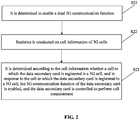
- FIG. 1 is a flowchart of a method for communication processing according to an exemplary embodiment. As shown in FIG. 1 , a method for communication processing is applied to a terminal device and includes the following operations.
- S12 it is determined according to the cell information whether a cell to which the data secondary card is registered is a 5G cell, and in response to the cell to which the data secondary card is registered is a 5G cell, the 5G communication function of the data secondary card is enabled, and the data secondary card is controlled to perform cell measurement.
- the 5G communication function of the data secondary card in response to that the cell to which the data secondary card is registered is a cell supporting the 5G communication function (hereinafter referred to as a 5G cell), the 5G communication function of the data secondary card is enabled, and the data secondary card is controlled to perform cell measurement. It is thus possible to ensure that the dual 5G communication function is not affected and power consumption is reduced.
- the terminal device in the embodiments of the present disclosure monitors the cells to which multiple SIM cards installed on the terminal device are registered.
- the terminal device can invoke the operating system interface of the terminal device to monitor, in real-time, cell information of the cells to which all SIM cards inserted in the terminal device are registered, and record the cell information of the monitored cells in real-time.
- the cells to which the multiple SIM cards are registered include an SA 5G cell (the terminal device is connected to the SA 5G cell), statistics is conducted on the cell information of the SA 5G cell and the resulting cell information is recorded.
- the cells to which the multiple SIM cards are registered include an NSA 5G cell (the terminal device is connected to the NSA 5G cell)
- statistics is conducted on the cell information of the NSA 5G cell and the resulting cell information is recorded.
- the cells to which the multiple SIM cards are registered include an NSA LTE cell and the NSA LTE cell includes an NR anchor point, statistics is conducted on the cell information of the NSA LTE cell and the resulting cell information is recorded.
- Table 1 SIM card Cell information data primary card (data card) e.g., cell information of a 5G cell data secondary card e.g., cell information of an (non-data card) NSA 4G cell
- the terminal device can record and keep the cell information locally. Further, the terminal device can synchronize the recorded cell information to a server. For example, in a case that the terminal device is connected to the Internet, the recorded cell information is synchronized and uploaded to the server on a regular basis (such as on a daily basis).
- the cell information of the cells supporting the 5G communication function can also be obtained from the server side.
- the terminal device may periodically obtain the cell information of the cells supporting the 5G communication function from the server side.
- the terminal device in addition to recording cell information of the cells that the current terminal device has accessed, the terminal device also needs to periodically download the cell information saved in the server from the server.
- the cell information of the cells supporting the 5G communication function, which is obtained from the server side comprises at least one of: cell information, uploaded by the terminal device, of cells to which the multiple SIM cards are registered; cell information synchronized by operations personnel; or cell information obtained from an operator or cell information saved in the server through other channels.
- the terminal device conducts statistics and records the cell information of the 5G cell, and obtains the cell information of the cell to which the data secondary card is registered.
- the cell information of the cell to which the data secondary card is registered is compared with the recorded cell information of the 5G cell to determine whether the cell to which the data secondary card is registered is a cell supporting the 5G communication function, for example, whether the cell is a 5G or 4G cell for SA or NSA.
- the cell to which the data secondary card is registered is not a cell supporting the 5G communication function
- the 5G communication function of the data secondary card is not enabled, and the data secondary card does not perform cell measurement, so that power consumption is reduced.
- the cell to which the data secondary card is registered is not a cell supporting the 5G communication function, no processing is performed temporarily, and in response to that the data secondary card is subsequently switched to a new cell, it is re-determined whether the cell to which the data secondary card is registered is a cell supporting the 5G communication function.
- the terminal device in response to that the terminal device monitors that the cell to which the SIM card is registered is switched, it can start conducting statistics on the cell information.
- a switch setting unit for enabling or disabling the dual 5G communication function can be set, and the dual 5G communication function can be enabled or disabled through the switch setting unit.
- the enabling of the dual 5G communication function indicates that the data primary card has the 5G communication function enabled, and the secondary data card has the 5G communication function enabled.
- the disabling of the dual 5G communication function indicates that at least one of the data primary card and the data secondary card has not its 5G communication function enabled.
- FIG. 2 is a flowchart of a method for communication processing according to an exemplary embodiment. As shown in FIG. 2 , a method for communication processing is applied to a terminal device and includes the following operations.
- a dual 5G communication function switch is provided. In response to that the dual 5G communication function switch is turned on, it indicates that the dual 5G communication function is enabled. In response to that the dual 5G communication function switch is turned off, it indicates that the dual 5G communication function is disabled. In the embodiments of the present disclosure, in response to that a trigger operation for turning on the dual NR function switch is received, it is determined to enable the dual NR function.
- the embodiments of the present disclosure provide a network mode selection list interface for the data secondary card (non-data card). Selection of the 5G network mode by a user in the network mode selection list interface for the data secondary card indicates that the dual 5G communication function is enabled. Cancellation of the selection of the 5G network mode of the data secondary card by the user (that is, selection of the non-5G network mode) indicates that the dual 5G communication function is disabled. In the embodiments of the present disclosure, in response to that a selection instruction for enabling the 5G communication mode in the network mode selection list interface for the data secondary card is received, it is determined to enable the dual 5G communication function.
- the method for communication processing shown in FIG. 2 further includes operation S22 and operation S23.
- operation S22 and operation S23 are the same as operation S11 and operation S12, and will not be repeated herein.
- 5G measurement by the data secondary card is not initiated in real-time for a terminal device that performs the dual 5G communication function. Only in response to that the cell to which the data secondary card is registered meets the conditions for 5G cells on which statistics have been conducted, the cell measurement is initiated and the data secondary card is connected to the 5G network. This not only ensures that the dual 5G communication function is not affected, but also reduces power consumption.
- the embodiments of the present disclosure also provide a device for communication processing.
- the device for communication processing provided by the embodiments of the present disclosure includes hardware structures and/or software modules corresponding to each function.
- the embodiments of the present disclosure can be implemented in the form of hardware or a combination of hardware and computer software. Whether a certain function is executed by hardware or by computer software driving hardware depends on the specific application and design constraint conditions of the technical solution. Those skilled in the art can use different methods for each specific application to implement the described functions, but such implementation should not be considered as going beyond the scope of the technical solutions of the embodiments of the present disclosure.
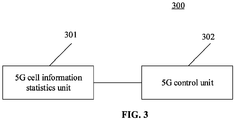
- FIG. 3 is a block diagram of a device for communication processing according to an exemplary embodiment.
- the device 300 for communication processing is applied to a terminal device having installed therein multiple SIM cards comprising a data primary card and a data secondary card each supporting the 5G communication function.
- the device 300 for communication processing includes a 5G cell information statistics unit 301 and a 5G control unit 302.
- the 5G cell information statistics unit 301 is configured to conduct statistics on cell information of cells supporting the 5G communication function.
- the 5G control unit 302 is configured to determine, based on the cell information, whether a cell to which the data secondary card is registered is a cell supporting the 5G communication function, and in response to that the cell to which the data secondary card is registered is a cell supporting the 5G communication function, enable the 5G communication function of the data secondary card, and control the data secondary card to perform cell measurement.
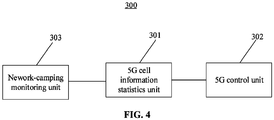
- the device 300 for communication processing further includes a network-camping monitoring unit 303.
- FIG. 4 is a block diagram of a device for communication processing according to an exemplary embodiment. Referring to FIG. 4 , the network-camping monitoring unit 303 is configured to monitor cells to which the multiple SIM cards are registered.
- the 5G cell information statistics unit 301 conducts statistics on and records cell information of the SA 5G cell.
- the 5G cell information statistics unit 301 conducts statistics on and records cell information of the NSA 5G cell.
- the 5G cell information statistics unit 301 conducts statistics on and records the NSA LTE cell.
- the 5G cell information statistics unit 301 periodically obtains the cell information of the cells supporting the 5G communication function from the server side.
- the cell information of the cells supporting the 5G communication function which is obtained from the server side, includes at least one of: cell information, uploaded by the terminal device, of cells to which the multiple SIM cards are registered; cell information synchronized by operations personnel; or cell information obtained from an operator.
- the 5G cell information statistics unit 301 is further configured to synchronize the cell information of the cells to which the multiple SIM cards are registered to the server.
- the device 300 for communication processing further includes a switch setting unit 304.
- FIG. 5 is a block diagram of a device for communication processing according to an exemplary embodiment.
- the switch setting unit 304 is configured to enable or disable the dual 5G communication function.
- the enabling of the dual 5G communication function indicates that the data primary card has the 5G communication function enabled, and the data secondary card has the 5G communication function enabled.
- the 5G control unit 302 is further configured to determine to enable the dual 5G communication function.
- the 5G control unit 302 determines that the dual 5G communication function is enabled. Or, in response to that the switch setting unit 304 receives a selection instruction for enabling a 5G communication mode in a network mode selection list interface for the data secondary card, the 5G control unit 302 determines to enable the dual 5G communication function.
- the switch setting unit 304 provides control setting options for the dual 5G communication function, and the user can enable or disable the dual 5G communication function at any time.
- the switch setting unit 304 may provide different interface displays to control the enabling or disabling of the dual 5G communication function.
- the switch setting unit 304 can control the enabling or disabling of the dual 5G communication function in the following two ways.
- the dual 5G communication function switch is provided. In response to that the user turns on the dual 5G communication function switch, the dual 5G communication function is enabled. In response to that the user turns off the dual 5G communication function switch, the dual 5G communication function is disabled.
- the network mode selection list interface for the data secondary card (non-data card) is provided.
- the network mode selection list interface for the data secondary card indicates that the dual 5G communication function is enabled.
- Cancellation of the selection of the 5G network mode of the data secondary card by the user indicates that the dual 5G communication function is disabled.
- the data secondary card after the user enables the dual 5G communication function through the switch setting unit 304, the data secondary card does not actually initiate 5G registration with the 5G network at this time, and only after the subsequent confirmation that the cell to which the data secondary card is registered supports 5G communication, the 5G registration will be initiated.
- the network-camping monitoring unit 303 invokes the operating system interface to monitor, in real time, the network information of the cells to which all SIM cards inserted in the terminal device are registered, and record the network information in real-time. In response to that the network-camping monitoring unit 303 monitors the cell being registered is switched, it sends the current cell information to the 5G cell information statistics unit 301.
- the 5G cell information statistics unit 301 needs to conduct statistics on cell information of 5G cells. For example, in response to that the current terminal device is connected to an SA 5G cell, cell information of the SA 5G cell is recorded. In response to that the current terminal device is connected to an NSA 5G cell, cell information of the NSA 5G cell is recorded. In response to that the current terminal device is connected to an NSA 4G cell, cell information of the NSA 4G cell is recorded.
- the NSA 4G cell has a 5G anchor point to provide the terminal device with an EN-DC connection.
- the 5G cell information statistics unit 301 will synchronize and upload the cell information to the server on a regular basis (such as on a daily basis) and in the case of the terminal device is connected to the Internet. In addition to recording the above-mentioned cell information that the current terminal device has accessed, the 5G cell information statistics unit 301 also needs to periodically download cell information uploaded by other terminal devices from the server.
- the cell information stored in the server synchronized by the 5G cell information statistics unit 301 may have multiple sources.
- it can be:
- the 5G control unit 302 may invoke the system to enable or disable the 5G communication function of a certain SIM card.
- the SIM card initiates 5G measurement to the network and waits for the network to allocate 5G resources.
- the SIM card stops 5G measurement to the network.
- the switch setting unit 304 will notify the 5G control unit 302 at this time that the dual 5G communication function has been enabled.
- the 5G control unit 302 will determine whether to control the data secondary card to connect to the 5G network by determining whether the cell to which the data secondary card is registered is a cell supporting the 5G radio communication function.
- the 5G control unit 302 directly invokes the system interface to disable the 5G communication function of the data secondary card.
- the 5G control unit 302 needs to obtain in real time the cell information of the cell to which the current secondary card is registered monitored by the network-camping monitoring unit 303, and send the cell information to the 5G cell information statistics unit 301 by sending a confirmation instruction to determine whether the current cell is a cell supporting the 5G radio communication function (5G or 4G cell for SA or NSA).
- 5G or 4G cell for SA or NSA 5G radio communication function
- the 5G cell information statistics unit 301 After the 5G cell information statistics unit 301 receives the confirmation instruction sent by the 5G control unit 302, it compares the transmitted cell information with the information saved in the local database. If the cell information is contained in the database, the result of "the 5G communication function is supported” is returned to the 5G control unit 302; otherwise, the result of "a cell that does not support the 5G communication function" is returned to the 5G control unit 302.
- the 5G control unit 302 receives the returned result, and if it is "the 5G communication function is supported", it invokes the system interface to enable the 5G communication function of the data secondary card. If it is "a cell that does not support the 5G communication function", then no processing is done, and in response to the data secondary card is subsequently switched to a new cell, the process of determining whether to enable 5G communication function is repeated.
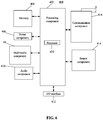
- FIG. 6 is a block diagram of a device 400 for communication processing according to an exemplary embodiment.
- the device 400 may be a mobile phone, a computer, a digital broadcast terminal, a messaging device, a game console, a tablet, a medical device, exercise equipment, a personal digital assistant, and the like.
- the device 400 may include one or more of the following components: a processing component 402, a memory 404, a power component 406, a multimedia component 408, an audio component 410, an input/output (I/O) interface 412, a sensor component 414, and a communication component 416.
- the processing component 402 typically controls the overall operations of the device 400, such as operations associated with display, telephone calls, data communications, camera operations, and recording operations.
- the processing component 402 may include one or more processors 420 to execute instructions to perform all or part of the operations of the abovementioned method.
- the processing component 402 may include one or more modules which facilitate the interaction between the processing component 402 and other components.
- the processing component 402 may include a multimedia module to facilitate the interaction between the multimedia component 408 and the processing component 402.
- the power component 406 provides power to various components of the device 400.
- the power component 406 may include a power management system, one or more power sources, and any other components associated with the generation, management, and distribution of power in the device 400.
- the multimedia component 408 includes a screen providing an output interface between the device 400 and the user.
- the screen may include a liquid crystal display (LCD) and a touch panel (TP). If the screen includes a touch panel, the screen may be implemented as a touch screen to receive input signals from the user.
- the touch panel includes one or more touch sensors to sense touches, swipes, and gestures on the touch panel. The touch sensors may not only sense a boundary of a touch or swipe action, but also sense a period of time and a pressure associated with the touch or swipe action.
- the multimedia component 408 includes a front camera and/or a rear camera. The front camera and the rear camera may receive an external multimedia datum while the device 400 is in an operation mode, such as a photographing mode or a video mode. Each of the front camera and the rear camera may be a fixed optical lens system or have focus and optical zoom capability.
- the audio component 410 is configured to output and/or input audio signals.
- the audio component 410 includes a microphone (MIC) configured to receive an external audio signal when the device 400 is in an operation mode, such as a call mode, a recording mode, and a voice recognition mode.
- the received audio signal may be further stored in the memory 404 or transmitted via the communication component 416.
- the audio component 410 further includes a speaker for outputting audio signals.
- the I/O interface 412 provides an interface between the processing component 402 and peripheral interface modules, such as a keyboard, a click wheel, buttons, and the like.
- the buttons may include, but are not limited to, a home button, a volume button, a starting button, and a locking button.
- the sensor component 414 includes one or more sensors to provide status assessments of various aspects of the device 400.
- the sensor component 414 may detect an open/closed status of the device 400, relative positioning of components, e.g., the display and the keypad, of the device 400, a change in position of the device 400 or a component of the device 400, a presence or absence of user contact with the device 400, an orientation or an acceleration/deceleration of the device 400, and a change in temperature of the device 400.
- the sensor component 414 may include a proximity sensor configured to detect the presence of nearby objects without any physical contact.
- the sensor component 414 may also include a light sensor, such as a CMOS or CCD image sensor, for use in imaging applications.
- the sensor component 414 may also include an accelerometer sensor, a gyroscope sensor, a magnetic sensor, a pressure sensor, or a temperature sensor.
- the communication component 416 is configured to facilitate communication, wired or wirelessly, between the device 400 and other devices.
- the device 400 can access a wireless network based on a communication standard, such as WiFi, 2G, or 3G, or a combination thereof.
- the communication component 416 receives a broadcast signal or broadcast associated information from an external broadcast management system via a broadcast channel.
- the communication component 416 further includes a near field communication (NFC) module to facilitate short-range communications.
- the NFC module may be implemented based on a radio frequency identification (RFID) technology, an infrared data association (IrDA) technology, an ultra-wideband (UWB) technology, a bluetooth (BT) technology, and other technologies.
- RFID radio frequency identification
- IrDA infrared data association
- UWB ultra-wideband
- BT bluetooth
- the device 400 may be implemented with one or more application specific integrated circuits (ASICs), digital signal processors (DSPs), digital signal processing devices (DSPDs), programmable logic devices (PLDs), field programmable gate arrays (FPGAs), controllers, micro-controllers, microprocessors, or other electronic components, for performing the above described methods.
- ASICs application specific integrated circuits
- DSPs digital signal processors
- DSPDs digital signal processing devices
- PLDs programmable logic devices
- FPGAs field programmable gate arrays
- controllers micro-controllers, microprocessors, or other electronic components, for performing the above described methods.
- non-transitory computer-readable storage medium including instructions, such as included in the memory 404, executable by the processor 420 in the device 400, for performing the above-described methods.
- the non-transitory computer-readable storage medium may be a ROM, a CD-ROM, a magnetic tape, a floppy disc, an optical data storage device, and the like.
Landscapes
- Engineering & Computer Science (AREA)
- Computer Networks & Wireless Communication (AREA)
- Signal Processing (AREA)
- Databases & Information Systems (AREA)
- Telephone Function (AREA)
- Mobile Radio Communication Systems (AREA)
Abstract
Description
- The present disclosure generally relates to the field of communication technology, and more particularly, to a method and device for communication processing, and a storage medium.
- Along with the development of communication technology, the development of the fifth generation (5G) new radio (NR) communication technology has been in the drive to maturity stage. 5G NR communication is sometimes abbreviated as 5G communication or NR communication.
- In the related art, a terminal device supports communication based on a single subscriber identity module (SIM) card, and also supports communication based on multiple SIM cards. 5G communication based on a single SIM card has been in the drive to maturity stage, and will soon begin to lead the 5G communication based on multiple SIM cards. 5G communication based on multiple SIM cards can be understood as multiple SIM cards having their 5G communication functions enabled. In 5G communication based on multiple SIM cards, it is usually configured with a data primary card and a data secondary card, and only the data primary card can be actually connected to the 5G network, whereas typically the data secondary card can be merely connected to a cell having 5G anchor points, and will not be actually connected to the 5G network.
- In the process of 5G communication based on multiple SIM cards, through the enabling of the 5G communication functions of multiple SIM cards, the data primary card that is actually connected to the 5G network can be switched among the multiple SIM cards, which may cause problems regarding power consumption.
- Accordingly, the present disclosure provides a method and device for communication processing, and a storage medium.
- According to a first aspect of embodiments of the disclosure, there is provided a method for communication processing, which is applied to a terminal device having installed therein multiple SIM cards including a data primary card and a data secondary card each supporting a NR communication function, the method including: conducting statistics on cell information of cells supporting the NR communication function; and determining, according to the cell information, whether a cell to which the data secondary card is registered is a cell supporting the NR communication function, and in response to the cell to which the data secondary card is registered being the cell supporting the NR communication function, enabling the NR communication function of the data secondary card and controlling the data secondary card to perform cell measurement.
- The technical solution provided by the embodiments of the present disclosure may include the beneficial effects as follows. In response to that the cell to which the data secondary card is registered is a cell supporting the 5G communication function, the 5G communication function of the data secondary card is enabled, and the data secondary card is controlled to perform cell measurement. It is thus possible to ensure that the dual 5G communication function is not affected and power consumption is reduced.
- According to an exemplary embodiment, the method may further include: monitoring cells to which the multiple SIM cards are registered.
- Herein conducting statistics on the cell information of the cells supporting the NR communication function includes: in response to the cells to which the multiple SIM cards are registered including a standalone (SA) NR cell, conducting statistics on and recording cell information of the SA NR cell; in response to the cells to which the multiple SIM cards are registered including a non-standalone (NSA) NR cell, conducting statistics on and recording cell information of the NSA NR cell; or in response to the cells to which the multiple SIM cards are registered including an NSA long term evolution (LTE) cell and the NSA LTE cell including an NR anchor point, conducting statistics on and recording cell information of the NSA LTE cell.
- According to an exemplary embodiment, conducting statistics on the cell information of the cells supporting the NR communication function includes:
obtaining, from a server side, the cell information of the cells supporting the NR communication function periodically. - According to an exemplary embodiment, the cell information of the cells supporting the NR communication function, which is obtained from the server side, includes at least one of:
cell information, uploaded by the terminal device, of cells to which the multiple SIM cards are registered; cell information synchronized by operations personnel; or cell information obtained from an operator. - According to an exemplary embodiment, the method may further include: synchronizing, to a server, the cell information of the cells to which the multiple SIM cards are registered.
- According to an exemplary embodiment, the method may further include:
determining to enable a dual NR function, herein the dual NR function indicates that the data primary card has the NR communication function enabled and the data secondary card has the NR communication function enabled. - According to an exemplary embodiment, determining to enable the dual NR function includes:
in response to receiving a trigger operation for turning on a dual NR function switch, determining to enable the dual NR function; or in response to receiving a selection instruction for enabling an NR communication mode in a network mode selection list interface for the data secondary card, determining to enable the dual NR function. - According to a second aspect of embodiments of the disclosure, there is provided a device for communication processing, which is applied to a terminal device having installed therein multiple SIM cards including a data primary card and a data secondary card each supporting an NR communication function, the device including:
an NR cell information statistics unit, configured to conduct statistics on cell information of cells supporting the NR communication function; and an NR control unit, configured to determine, according to the cell information, whether a cell to which the data secondary card is registered is a cell supporting the NR communication function, and in response to the cell to which the data secondary card is registered being the cell supporting the NR communication function, enable the NR communication function of the data secondary card and control the data secondary card to perform cell measurement. - The advantages and technical effects of the device according to the invention correspond to those of the method presented above.
- According to an exemplary embodiment, the device may further include: a network-camping monitoring unit, configured to monitor cells to which the multiple SIM cards are registered, herein in response to monitoring, by the network-camping monitoring unit, the cells to which the multiple SIM cards are registered including a SA NR cell, the NR cell information statistics unit conducts statistics on and records cell information of the SA NR cell; in response to monitoring, by the network-camping monitoring unit, the cells to which the multiple SIM cards are registered including an NSA NR cell, the NR cell information statistics unit conducts statistics on and records cell information of the NSA NR cell; or in response to monitoring, by the network-camping monitoring unit, the cells to which the multiple SIM cards are registered including an NSA LTE cell and the NSA LTE cell including an NR anchor point, the NR cell information statistics unit conducts statistics on and records cell information of the NSA LTE cell.
- According to an exemplary embodiment, the NR cell information statistics unit conducts statistics on the cell information of the cells supporting the NR communication function by: obtaining, from a server side, the cell information of the cells supporting the NR communication function periodically.
- According to an exemplary embodiment, the cell information of the cells supporting the NR communication function, which is obtained from the server side, includes at least one of: cell information, uploaded by the terminal device, of cells to which the multiple SIM cards are registered; cell information synchronized by operations personnel; or cell information obtained from an operator.
- According to an exemplary embodiment, the NR cell information statistics unit is further configured to: synchronize, to a server, the cell information of the cells to which the multiple SIM cards are registered.
- According to an exemplary embodiment, the device may further include a switch setting unit, herein the switch setting unit is configured to enable or disable a dual NR function, and enabling of the dual NR function indicates that the data primary card has the NR communication function enabled and the data secondary card has the NR communication function enabled; herein the NR control unit is further configured to determine to enable the dual NR function.
- According to an exemplary embodiment, in response to receiving, by the switch setting unit, a trigger operation for turning on a dual NR function switch, the NR control unit determines to enable the dual NR function; or in response to receiving, by the switch setting unit, a selection instruction for enabling an NR communication mode in a network mode selection list interface for the data secondary card, the NR control unit determines to enable the dual NR function.
- According to a third aspect of embodiments of the disclosure, there is provided a non-transitory computer-readable storage medium having stored therein instructions that, when executed by a processor of a mobile terminal device, cause the mobile terminal device to perform the method according to the first aspect or any one of the embodiments of the first aspect.
- The storage medium can be any entity or device capable of storing the program. For example, the support can include storage means such as a ROM, for example a CD ROM or a microelectronic circuit ROM, or magnetic storage means, for example a diskette (floppy disk) or a hard disk.
- Alternatively, the storage medium can be an integrated circuit in which the program is incorporated, the circuit being adapted to execute the method in question or to be used in its execution.
- In one particular embodiment, the steps of the method for communication processing are determined by computer program instructions.
- Consequently, according to a fourth aspect, the disclosure is also directed to a computer program for executing the steps of the method for communication processing as described above when this program is executed by a computer.
- This program can use any programming language and take the form of source code, object code or a code intermediate between source code and object code, such as a partially compiled form, or any other desirable form.
- It should be understood that the general description above and detailed description later are merely exemplary and explanatory, and are not intended to restrict the disclosure.
- The accompanying drawings herein are incorporated into the specification and constitute part of the present specification, illustrate embodiments consistent with the disclosure and explain the principles of the disclosure together with the specification.
-
FIG. 1 is a flowchart of a method for communication processing according to an exemplary embodiment. -
FIG. 2 is a flowchart of a method for communication processing according to an exemplary embodiment. -
FIG. 3 is a block diagram of a device for communication processing according to an exemplary embodiment. -
FIG. 4 is a block diagram of a device for communication processing according to an exemplary embodiment. -
FIG. 5 is a block diagram of a device for communication processing according to an exemplary embodiment. -
FIG. 6 is a block diagram of a device for communication processing according to an exemplary embodiment. - Detailed description will be made here to exemplary embodiments, examples of which are illustrated in the accompanying drawings. The following description refers to the accompanying drawings in which the same numbers in different drawings represent the same or similar elements unless otherwise represented. The implementations set forth in the following description of exemplary embodiments do not represent all implementations consistent with the invention. Instead, they are merely examples of apparatuses and methods consistent with aspects related to the invention as recited in the appended claims.
- The method for communication processing provided by the embodiments of the present disclosure is applied to a terminal device installed with multiple SIM cards, and the multiple SIM cards installed on the terminal device include a data primary card and a data secondary card each supporting an NR communication function. The data primary card and the data secondary card each supports the NR communication function, which can also be called a dual NR function of the terminal device or a dual 5G communication function of the terminal device. In the following embodiments of the present disclosure, NR and 5G are often used interchangeably, and those skilled in the art should understand their meaning.
- In the related art, when the terminal device enables the dual 5G communication function, the data primary card is connected to the 5G network for 5G communication, and the data secondary card is not actually connected to the 5G network, but performs real-time cell measurement. The real-time cell measurement performed by the data secondary card will cause problems regarding power consumption.
- In view of this, the embodiments of the present disclosure provide a method for communication processing. In the method for communication processing, in response to that the cell to which the data secondary card is registered is a cell supporting the 5G communication function (hereinafter referred to as a 5G cell), the 5G communication function of the data secondary card is enabled, and the data secondary card is controlled to perform cell measurement. It is thus possible to ensure that the dual 5G communication function is not affected and power consumption is reduced.
-
FIG. 1 is a flowchart of a method for communication processing according to an exemplary embodiment. As shown inFIG. 1 , a method for communication processing is applied to a terminal device and includes the following operations. - In S11, statistics is conducted on cell information of 5G cells.
- In S12, it is determined according to the cell information whether a cell to which the data secondary card is registered is a 5G cell, and in response to the cell to which the data secondary card is registered is a 5G cell, the 5G communication function of the data secondary card is enabled, and the data secondary card is controlled to perform cell measurement.
- In the embodiments of the present disclosure, in response to that the cell to which the data secondary card is registered is a cell supporting the 5G communication function (hereinafter referred to as a 5G cell), the 5G communication function of the data secondary card is enabled, and the data secondary card is controlled to perform cell measurement. It is thus possible to ensure that the dual 5G communication function is not affected and power consumption is reduced.
- In the embodiments of the present disclosure, the abovementioned method for communication processing will be described in detail below in conjunction with practical applications.
- In an embodiment, the terminal device in the embodiments of the present disclosure monitors the cells to which multiple SIM cards installed on the terminal device are registered. For example, the terminal device can invoke the operating system interface of the terminal device to monitor, in real-time, cell information of the cells to which all SIM cards inserted in the terminal device are registered, and record the cell information of the monitored cells in real-time.
- In an embodiment, in response to that the cells to which the multiple SIM cards are registered include an
SA 5G cell (the terminal device is connected to theSA 5G cell), statistics is conducted on the cell information of theSA 5G cell and the resulting cell information is recorded. In another embodiment, in response to that the cells to which the multiple SIM cards are registered include anNSA 5G cell (the terminal device is connected to theNSA 5G cell), statistics is conducted on the cell information of theNSA 5G cell and the resulting cell information is recorded. In yet another embodiment, in response to that the cells to which the multiple SIM cards are registered include an NSA LTE cell and the NSA LTE cell includes an NR anchor point, statistics is conducted on the cell information of the NSA LTE cell and the resulting cell information is recorded. The LTE cell is sometimes referred to as a 4G cell. That is, in response to that the terminal device is connected to an NSA 4G cell, statistics is conducted on cell information of the 4G cell and the resulting cell information is recorded. The 4G cell has a 5G anchor point, which can provide the terminal device with a EUTRA-NR Dual Connection (EN-DC) function. - In an example, recorded cell information is shown in Table 1.
Table 1 SIM card Cell information data primary card (data card) e.g., cell information of a 5G cell data secondary card e.g., cell information of an (non-data card) NSA 4G cell - Herein, the cell information in Table 1 includes cell information of a 5G cell to which the data primary card as a data card is registered, and cell information of an NSA 4G cell to which the data secondary card as a non-data card is registered.
- In an example of the present disclosure, after obtaining the cell information, the terminal device can record and keep the cell information locally. Further, the terminal device can synchronize the recorded cell information to a server. For example, in a case that the terminal device is connected to the Internet, the recorded cell information is synchronized and uploaded to the server on a regular basis (such as on a daily basis).
- Furthermore, in the embodiments of the present disclosure, the cell information of the cells supporting the 5G communication function can also be obtained from the server side. For example, the terminal device may periodically obtain the cell information of the cells supporting the 5G communication function from the server side. In an example, in addition to recording cell information of the cells that the current terminal device has accessed, the terminal device also needs to periodically download the cell information saved in the server from the server. The cell information of the cells supporting the 5G communication function, which is obtained from the server side, comprises at least one of: cell information, uploaded by the terminal device, of cells to which the multiple SIM cards are registered; cell information synchronized by operations personnel; or cell information obtained from an operator or cell information saved in the server through other channels.
- In the embodiments of the present disclosure, the terminal device conducts statistics and records the cell information of the 5G cell, and obtains the cell information of the cell to which the data secondary card is registered. The cell information of the cell to which the data secondary card is registered is compared with the recorded cell information of the 5G cell to determine whether the cell to which the data secondary card is registered is a cell supporting the 5G communication function, for example, whether the cell is a 5G or 4G cell for SA or NSA.
- Herein, if the cell to which the data secondary card is registered is a cell supporting the 5G communication function, it is determined to enable the 5G communication function of the data secondary card, and the data secondary card is controlled to perform cell measurement. In the embodiments of the present disclosure, in response to that the terminal device enables the 5G communication function of the data secondary card, the 5G communication function of the data secondary card can be enabled by invoking the system interface.
- In the embodiments of the present disclosure, if the cell to which the data secondary card is registered is not a cell supporting the 5G communication function, the 5G communication function of the data secondary card is not enabled, and the data secondary card does not perform cell measurement, so that power consumption is reduced. Further, if the cell to which the data secondary card is registered is not a cell supporting the 5G communication function, no processing is performed temporarily, and in response to that the data secondary card is subsequently switched to a new cell, it is re-determined whether the cell to which the data secondary card is registered is a cell supporting the 5G communication function.
- It is to be understood that in the embodiments of the present disclosure, in response to that the terminal device monitors that the cell to which the SIM card is registered is switched, it can start conducting statistics on the cell information.
- Furthermore, in an example of the present disclosure, a switch setting unit for enabling or disabling the dual 5G communication function can be set, and the dual 5G communication function can be enabled or disabled through the switch setting unit. The enabling of the dual 5G communication function indicates that the data primary card has the 5G communication function enabled, and the secondary data card has the 5G communication function enabled. The disabling of the dual 5G communication function indicates that at least one of the data primary card and the data secondary card has not its 5G communication function enabled.
-
FIG. 2 is a flowchart of a method for communication processing according to an exemplary embodiment. As shown inFIG. 2 , a method for communication processing is applied to a terminal device and includes the following operations. - In S21, it is determined to enable the dual 5G communication function.
- In an embodiment, a dual 5G communication function switch is provided. In response to that the dual 5G communication function switch is turned on, it indicates that the dual 5G communication function is enabled. In response to that the dual 5G communication function switch is turned off, it indicates that the dual 5G communication function is disabled. In the embodiments of the present disclosure, in response to that a trigger operation for turning on the dual NR function switch is received, it is determined to enable the dual NR function.
- In another embodiment, the embodiments of the present disclosure provide a network mode selection list interface for the data secondary card (non-data card). Selection of the 5G network mode by a user in the network mode selection list interface for the data secondary card indicates that the dual 5G communication function is enabled. Cancellation of the selection of the 5G network mode of the data secondary card by the user (that is, selection of the non-5G network mode) indicates that the dual 5G communication function is disabled. In the embodiments of the present disclosure, in response to that a selection instruction for enabling the 5G communication mode in the network mode selection list interface for the data secondary card is received, it is determined to enable the dual 5G communication function.
- In the embodiments of the present disclosure, the method for communication processing shown in
FIG. 2 further includes operation S22 and operation S23. Herein, operation S22 and operation S23 are the same as operation S11 and operation S12, and will not be repeated herein. - According to the method for communication processing provided by the embodiments of the present disclosure, 5G measurement by the data secondary card is not initiated in real-time for a terminal device that performs the dual 5G communication function. Only in response to that the cell to which the data secondary card is registered meets the conditions for 5G cells on which statistics have been conducted, the cell measurement is initiated and the data secondary card is connected to the 5G network. This not only ensures that the dual 5G communication function is not affected, but also reduces power consumption.
- Based on the same concept, the embodiments of the present disclosure also provide a device for communication processing.
- It can be understood that, in order to implement the above-mentioned functions, the device for communication processing provided by the embodiments of the present disclosure includes hardware structures and/or software modules corresponding to each function. In combination with the units and algorithm operations of the examples disclosed in the embodiments of the present disclosure, the embodiments of the present disclosure can be implemented in the form of hardware or a combination of hardware and computer software. Whether a certain function is executed by hardware or by computer software driving hardware depends on the specific application and design constraint conditions of the technical solution. Those skilled in the art can use different methods for each specific application to implement the described functions, but such implementation should not be considered as going beyond the scope of the technical solutions of the embodiments of the present disclosure.
-
FIG. 3 is a block diagram of a device for communication processing according to an exemplary embodiment. Referring toFIG. 3 , thedevice 300 for communication processing is applied to a terminal device having installed therein multiple SIM cards comprising a data primary card and a data secondary card each supporting the 5G communication function. Thedevice 300 for communication processing includes a 5G cellinformation statistics unit 301 and a5G control unit 302. - The 5G cell
information statistics unit 301 is configured to conduct statistics on cell information of cells supporting the 5G communication function. The5G control unit 302 is configured to determine, based on the cell information, whether a cell to which the data secondary card is registered is a cell supporting the 5G communication function, and in response to that the cell to which the data secondary card is registered is a cell supporting the 5G communication function, enable the 5G communication function of the data secondary card, and control the data secondary card to perform cell measurement. - In an embodiment, the
device 300 for communication processing further includes a network-camping monitoring unit 303.FIG. 4 is a block diagram of a device for communication processing according to an exemplary embodiment. Referring toFIG. 4 , the network-camping monitoring unit 303 is configured to monitor cells to which the multiple SIM cards are registered. - In an embodiment, in response to that the network-
camping monitoring unit 303 monitors that the cells to which the multiple SIM cards are registered include anSA 5G cell, the 5G cellinformation statistics unit 301 conducts statistics on and records cell information of theSA 5G cell. - In an embodiment, in response to that the network-
camping monitoring unit 303 monitors that the cells to which the multiple SIM cards are registered include anNSA 5G cell, the 5G cellinformation statistics unit 301 conducts statistics on and records cell information of theNSA 5G cell. - In an embodiment, in response to that the network-
camping monitoring unit 303 monitors that the cells to which the multiple SIM cards are registered include an NSA LTE cell and the NSA LTE cell includes a 5G anchor point, the 5G cellinformation statistics unit 301 conducts statistics on and records the NSA LTE cell. - In an embodiment, the 5G cell
information statistics unit 301 periodically obtains the cell information of the cells supporting the 5G communication function from the server side. - In an embodiment, the cell information of the cells supporting the 5G communication function, which is obtained from the server side, includes at least one of: cell information, uploaded by the terminal device, of cells to which the multiple SIM cards are registered; cell information synchronized by operations personnel; or cell information obtained from an operator.
- In another embodiment, the 5G cell
information statistics unit 301 is further configured to synchronize the cell information of the cells to which the multiple SIM cards are registered to the server. - In an embodiment, the
device 300 for communication processing further includes aswitch setting unit 304.FIG. 5 is a block diagram of a device for communication processing according to an exemplary embodiment. Referring toFIG. 5 , theswitch setting unit 304 is configured to enable or disable the dual 5G communication function. The enabling of the dual 5G communication function indicates that the data primary card has the 5G communication function enabled, and the data secondary card has the 5G communication function enabled. The5G control unit 302 is further configured to determine to enable the dual 5G communication function. - Herein, in response to that the
switch setting unit 304 receives a trigger operation for turning on the dual 5G communication function switch, the5G control unit 302 determines that the dual 5G communication function is enabled. Or, in response to that theswitch setting unit 304 receives a selection instruction for enabling a 5G communication mode in a network mode selection list interface for the data secondary card, the5G control unit 302 determines to enable the dual 5G communication function. - In the present disclosure, the communication processing process performed by the device for communication processing will be described below in conjunction with the following embodiments.
- In the embodiments of the present disclosure, the
switch setting unit 304 provides control setting options for the dual 5G communication function, and the user can enable or disable the dual 5G communication function at any time. Theswitch setting unit 304 may provide different interface displays to control the enabling or disabling of the dual 5G communication function. - The
switch setting unit 304 can control the enabling or disabling of the dual 5G communication function in the following two ways. - In way (1), the dual 5G communication function switch is provided. In response to that the user turns on the dual 5G communication function switch, the dual 5G communication function is enabled. In response to that the user turns off the dual 5G communication function switch, the dual 5G communication function is disabled.
- In way (2), the network mode selection list interface for the data secondary card (non-data card) is provided. Such as the 5G network mode selection interface. Selection of the 5G network mode in by a user the network mode selection list interface for the data secondary card indicates that the dual 5G communication function is enabled. Cancellation of the selection of the 5G network mode of the data secondary card by the user (that is, selection of any other network mode) indicates that the dual 5G communication function is disabled.
- In the embodiments of the present disclosure, after the user enables the dual 5G communication function through the
switch setting unit 304, the data secondary card does not actually initiate 5G registration with the 5G network at this time, and only after the subsequent confirmation that the cell to which the data secondary card is registered supports 5G communication, the 5G registration will be initiated. - In the embodiments of the present disclosure, the network-
camping monitoring unit 303 invokes the operating system interface to monitor, in real time, the network information of the cells to which all SIM cards inserted in the terminal device are registered, and record the network information in real-time. In response to that the network-camping monitoring unit 303 monitors the cell being registered is switched, it sends the current cell information to the 5G cellinformation statistics unit 301. - In the embodiments of the present disclosure, the 5G cell
information statistics unit 301 needs to conduct statistics on cell information of 5G cells. For example, in response to that the current terminal device is connected to anSA 5G cell, cell information of theSA 5G cell is recorded. In response to that the current terminal device is connected to anNSA 5G cell, cell information of theNSA 5G cell is recorded. In response to that the current terminal device is connected to an NSA 4G cell, cell information of the NSA 4G cell is recorded. The NSA 4G cell has a 5G anchor point to provide the terminal device with an EN-DC connection. - In an embodiment, after locally recording the above cell information, the 5G cell
information statistics unit 301 will synchronize and upload the cell information to the server on a regular basis (such as on a daily basis) and in the case of the terminal device is connected to the Internet. In addition to recording the above-mentioned cell information that the current terminal device has accessed, the 5G cellinformation statistics unit 301 also needs to periodically download cell information uploaded by other terminal devices from the server. - Herein, the cell information stored in the server synchronized by the 5G cell
information statistics unit 301 may have multiple sources. For example, it can be: - (1) cell information being registered, which is uploaded by 5G terminal device;
- (2) cell information manually synchronized by operations personnel;
- (3) cell information obtained from an operator;
- (4) or other channels.
- Further, in the embodiments of the present disclosure, the
5G control unit 302 may invoke the system to enable or disable the 5G communication function of a certain SIM card. In response to that the 5G communication function of the SIM card is enabled, the SIM card initiates 5G measurement to the network and waits for the network to allocate 5G resources. In response to that the 5G communication function of the SIM card is disabled, the SIM card stops 5G measurement to the network. - In the embodiments of the present disclosure, after the user enables the dual 5G communication through the
switch setting unit 304, theswitch setting unit 304 will notify the5G control unit 302 at this time that the dual 5G communication function has been enabled. The5G control unit 302 will determine whether to control the data secondary card to connect to the 5G network by determining whether the cell to which the data secondary card is registered is a cell supporting the 5G radio communication function. - If the user disables the dual 5G communication function through the
switch setting unit 304, the5G control unit 302 directly invokes the system interface to disable the 5G communication function of the data secondary card. - Herein, the
5G control unit 302 needs to obtain in real time the cell information of the cell to which the current secondary card is registered monitored by the network-camping monitoring unit 303, and send the cell information to the 5G cellinformation statistics unit 301 by sending a confirmation instruction to determine whether the current cell is a cell supporting the 5G radio communication function (5G or 4G cell for SA or NSA). - After the 5G cell
information statistics unit 301 receives the confirmation instruction sent by the5G control unit 302, it compares the transmitted cell information with the information saved in the local database. If the cell information is contained in the database, the result of "the 5G communication function is supported" is returned to the5G control unit 302; otherwise, the result of "a cell that does not support the 5G communication function" is returned to the5G control unit 302. The5G control unit 302 receives the returned result, and if it is "the 5G communication function is supported", it invokes the system interface to enable the 5G communication function of the data secondary card. If it is "a cell that does not support the 5G communication function", then no processing is done, and in response to the data secondary card is subsequently switched to a new cell, the process of determining whether to enable 5G communication function is repeated. - With respect to the device in the above embodiments, the specific manners for performing operations for individual modules therein have been described in detail in the embodiments of the method, which will not be elaborated herein.
-
FIG. 6 is a block diagram of adevice 400 for communication processing according to an exemplary embodiment. For example, thedevice 400 may be a mobile phone, a computer, a digital broadcast terminal, a messaging device, a game console, a tablet, a medical device, exercise equipment, a personal digital assistant, and the like. - Referring to
FIG. 6 , thedevice 400 may include one or more of the following components: aprocessing component 402, amemory 404, apower component 406, a multimedia component 408, anaudio component 410, an input/output (I/O)interface 412, asensor component 414, and acommunication component 416. - The
processing component 402 typically controls the overall operations of thedevice 400, such as operations associated with display, telephone calls, data communications, camera operations, and recording operations. Theprocessing component 402 may include one ormore processors 420 to execute instructions to perform all or part of the operations of the abovementioned method. Moreover, theprocessing component 402 may include one or more modules which facilitate the interaction between theprocessing component 402 and other components. For example, theprocessing component 402 may include a multimedia module to facilitate the interaction between the multimedia component 408 and theprocessing component 402. - The
memory 404 is configured to store various types of data to support the operation of thedevice 400. Examples of such data include instructions for any application or method operating on thedevice 400, contact data, phone book data, messages, pictures, videos, etc. Thememory 404 may be implemented using any type of volatile or non-volatile storage device or a combination thereof, such as a static random access memory (SRAM), an electrically erasable programmable read-only memory (EEPROM), an erasable and programmable read-only memory (EPROM), a programmable read-only memory (PROM), a read-only memory (ROM), a magnetic memory, a flash memory, a magnetic or optical disk. - The
power component 406 provides power to various components of thedevice 400. Thepower component 406 may include a power management system, one or more power sources, and any other components associated with the generation, management, and distribution of power in thedevice 400. - The multimedia component 408 includes a screen providing an output interface between the
device 400 and the user. In some embodiments, the screen may include a liquid crystal display (LCD) and a touch panel (TP). If the screen includes a touch panel, the screen may be implemented as a touch screen to receive input signals from the user. The touch panel includes one or more touch sensors to sense touches, swipes, and gestures on the touch panel. The touch sensors may not only sense a boundary of a touch or swipe action, but also sense a period of time and a pressure associated with the touch or swipe action. In some embodiments, the multimedia component 408 includes a front camera and/or a rear camera. The front camera and the rear camera may receive an external multimedia datum while thedevice 400 is in an operation mode, such as a photographing mode or a video mode. Each of the front camera and the rear camera may be a fixed optical lens system or have focus and optical zoom capability. - The
audio component 410 is configured to output and/or input audio signals. For example, theaudio component 410 includes a microphone (MIC) configured to receive an external audio signal when thedevice 400 is in an operation mode, such as a call mode, a recording mode, and a voice recognition mode. The received audio signal may be further stored in thememory 404 or transmitted via thecommunication component 416. In some embodiments, theaudio component 410 further includes a speaker for outputting audio signals. - The I/
O interface 412 provides an interface between theprocessing component 402 and peripheral interface modules, such as a keyboard, a click wheel, buttons, and the like. The buttons may include, but are not limited to, a home button, a volume button, a starting button, and a locking button. - The
sensor component 414 includes one or more sensors to provide status assessments of various aspects of thedevice 400. For example, thesensor component 414 may detect an open/closed status of thedevice 400, relative positioning of components, e.g., the display and the keypad, of thedevice 400, a change in position of thedevice 400 or a component of thedevice 400, a presence or absence of user contact with thedevice 400, an orientation or an acceleration/deceleration of thedevice 400, and a change in temperature of thedevice 400. Thesensor component 414 may include a proximity sensor configured to detect the presence of nearby objects without any physical contact. Thesensor component 414 may also include a light sensor, such as a CMOS or CCD image sensor, for use in imaging applications. In some embodiments, thesensor component 414 may also include an accelerometer sensor, a gyroscope sensor, a magnetic sensor, a pressure sensor, or a temperature sensor. - The
communication component 416 is configured to facilitate communication, wired or wirelessly, between thedevice 400 and other devices. Thedevice 400 can access a wireless network based on a communication standard, such as WiFi, 2G, or 3G, or a combination thereof. In one exemplary embodiment, thecommunication component 416 receives a broadcast signal or broadcast associated information from an external broadcast management system via a broadcast channel. In one exemplary embodiment, thecommunication component 416 further includes a near field communication (NFC) module to facilitate short-range communications. For example, the NFC module may be implemented based on a radio frequency identification (RFID) technology, an infrared data association (IrDA) technology, an ultra-wideband (UWB) technology, a bluetooth (BT) technology, and other technologies. - In exemplary embodiments, the
device 400 may be implemented with one or more application specific integrated circuits (ASICs), digital signal processors (DSPs), digital signal processing devices (DSPDs), programmable logic devices (PLDs), field programmable gate arrays (FPGAs), controllers, micro-controllers, microprocessors, or other electronic components, for performing the above described methods. - In exemplary embodiments, there is also provided a non-transitory computer-readable storage medium including instructions, such as included in the
memory 404, executable by theprocessor 420 in thedevice 400, for performing the above-described methods. For example, the non-transitory computer-readable storage medium may be a ROM, a CD-ROM, a magnetic tape, a floppy disc, an optical data storage device, and the like. - It should be understood that "multiple" as referred to herein means two or more, and other quantifiers are similar. "And/or," describing the association relationship of the associated objects, indicates that there may be three relationships, For example, A and/or B may indicate that there are three cases where A exists separately, A and B exist at the same time, and B exists separately. The character "/" generally indicates that the contextual objects are in an "or" relationship. The singular "a", "said" and "the" are also intended to include plural forms, unless the context clearly indicates other meanings.
- It should be further understood that although the operations in the embodiments of the present disclosure are described in a specific order in the drawings, they should not be understood as requiring these operations to be performed in the particular order shown or in sequential order, or requiring all the operations shown to be performed to achieve desirable results. In certain circumstances, multitasking and parallel processing may be advantageous.
- Other embodiments of the invention will be apparent to those skilled in the art from consideration of the specification and practice of the invention disclosed here. This application is intended to cover any variations, uses, or adaptations of the invention following the general principles thereof and including such departures from the present disclosure as come within known or customary practice in the art. It is intended that the specification and examples be considered as exemplary only, with a true scope of the invention being indicated by the following claims.
- It will be appreciated that the present invention is not limited to the exact construction that has been described above and illustrated in the accompanying drawings, and that various modifications and changes can be made without departing from the scope thereof. It is intended that the scope of the invention only be limited by the appended claims.
Claims (15)
- A method for communication processing, executed by a terminal device having installed therein multiple Subscriber Identity Module, SIM, cards comprising a data primary card and a data secondary card each supporting a New Radio, NR, communication function, characterized in that, the method comprises:conducting statistics on cell information of cells supporting the NR communication function (S11); anddetermining, according to the cell information, whether a cell to which the data secondary card is registered is a cell supporting the NR communication function, and in response to the cell to which the data secondary card is registered being the cell supporting the NR communication function, enabling the NR communication function of the data secondary card and controlling the data secondary card to perform cell measurement (S12).
- The method of claim 1, further comprising:monitoring cells to which the multiple SIM cards are registered,wherein conducting statistics on the cell information of the cells supporting the NR communication function comprises:in response to the cells to which the multiple SIM cards are registered comprising a Standalone, SA, NR cell, conducting statistics on and recording cell information of the SA NR cell;in response to the cells to which the multiple SIM cards are registered comprising a Non-Standalone, NSA, NR cell, conducting statistics on and recording cell information of the NSA NR cell; orin response to the cells to which the multiple SIM cards are registered comprising an NSA Long Term Evolution, LTE, cell and the NSA LTE cell comprising an NR anchor point, conducting statistics on and recording cell information of the NSA LTE cell.
- The method of claim 1 or 2, wherein conducting statistics on the cell information of the cells supporting the NR communication function comprises:
obtaining, from a server side, the cell information of the cells supporting the NR communication function periodically. - The method of claim 3, wherein the cell information of the cells supporting the NR communication function, which is obtained from the server side, comprises at least one of:cell information, uploaded by the terminal device, of cells to which the multiple SIM cards are registered;cell information synchronized by operations personnel; orcell information obtained from an operator.
- The method of claim 2 or 4, further comprising:
synchronizing, to a server, the cell information of the cells to which the multiple SIM cards are registered. - The method of claim 1, further comprising:
determining to enable a dual NR function, wherein the dual NR function indicates that the data primary card has the NR communication function enabled and the data secondary card has the NR communication function enabled. - The method of claim 6, wherein determining to enable the dual NR function comprises:in response to receiving a trigger operation for turning on a dual NR function switch, determining to enable the dual NR function; orin response to receiving a selection instruction for enabling an NR communication mode in a network mode selection list interface for the data secondary card, determining to enable the dual NR function.
- A device for communication processing, applied to a terminal device having installed therein multiple Subscriber Identity Module, SIM, cards comprising a data primary card and a data secondary card each supporting a New Radio, NR, communication function, characterized in that, the device comprises:an NR cell information statistics unit (301), configured to conduct statistics on cell information of cells supporting the NR communication function; andan NR control unit (302), configured to: determine, according to the cell information, whether a cell to which the data secondary card is registered is a cell supporting the NR communication function, and in response to the cell to which the data secondary card is registered being the cell supporting the NR communication function, enable the NR communication function of the data secondary card and control the data secondary card to perform cell measurement.
- The device of claim 8, further comprising:a network-camping monitoring unit (303), configured to monitor cells to which the multiple SIM cards are registered,wherein in response to monitoring, by the network-camping monitoring unit (303), the cells to which the multiple SIM cards are registered comprising a Standalone, SA, NR cell, the NR cell information statistics unit (301) conducts statistics on and records cell information of the SA NR cell;in response to monitoring, by the network-camping monitoring unit (303), the cells to which the multiple SIM cards are registered comprising a Non-Standalone, NSA, NR cell, the NR cell information statistics unit (301) conducts statistics on and records cell information of the NSA NR cell; orin response to monitoring, by the network-camping monitoring unit (303), the cells to which the multiple SIM cards are registered comprising an NSA Long Term Evolution, LTE, cell and the NSA LTE cell comprising an NR anchor point, the NR cell information statistics unit (301) conducts statistics on and records cell information of the NSA LTE cell.
- The device of claim 8 or 9, wherein the NR cell information statistics unit (301) conducts statistics on the cell information of the cells supporting the NR communication function by:
obtaining, from a server side, the cell information of the cells supporting the NR communication function periodically. - The device of claim 10, wherein the cell information of the cells supporting the NR communication function, which is obtained from the server side, comprises at least one of:cell information, uploaded by the terminal device, of cells to which the multiple SIM cards are registered;cell information synchronized by operations personnel; orcell information obtained from an operator.
- The device of claim 8 or 11, wherein the NR cell information statistics unit (301) is further configured to:
synchronize, to a server, the cell information of the cells to which the multiple SIM cards are registered. - The device of claim 8, further comprising a switch setting unit (304), wherein the switch setting unit (304) is configured to enable or disable a dual NR function, and enabling of the dual NR function indicates that the data primary card has the NR communication function enabled and the data secondary card has the NR communication function enabled;
wherein the NR control unit (302) is further configured to determine to enable the dual NR function. - The device of claim 13, wherein in response to receiving, by the switch setting unit (304), a trigger operation for turning on a dual NR function switch, the NR control unit (302) determines to enable the dual NR function; or
in response to receiving, by the switch setting unit (304), a selection instruction for enabling an NR communication mode in a network mode selection list interface for the data secondary card, the NR control unit (302) determines to enable the dual NR function. - A non-transitory computer-readable storage medium having stored therein instructions that, when executed by a processor of a mobile terminal device, cause the mobile terminal device to perform the method according to any one of claims 1 to 7.
Applications Claiming Priority (1)
| Application Number | Priority Date | Filing Date | Title |
|---|---|---|---|
| CN202010433806.5A CN111343685B (en) | 2020-05-21 | 2020-05-21 | Communication processing method, communication processing apparatus, and storage medium |
Publications (1)
| Publication Number | Publication Date |
|---|---|
| EP3913944A1 true EP3913944A1 (en) | 2021-11-24 |
Family
ID=71187585
Family Applications (1)
| Application Number | Title | Priority Date | Filing Date |
|---|---|---|---|
| EP21151849.3A Ceased EP3913944A1 (en) | 2020-05-21 | 2021-01-15 | Method and device for communication processing, and storage medium |
Country Status (3)
| Country | Link |
|---|---|
| US (1) | US11546749B2 (en) |
| EP (1) | EP3913944A1 (en) |
| CN (1) | CN111343685B (en) |
Families Citing this family (4)
| Publication number | Priority date | Publication date | Assignee | Title |
|---|---|---|---|---|
| CN112333734B (en) * | 2020-11-04 | 2022-11-18 | 维沃移动通信有限公司 | Serving cell switching method and device |
| CN112929869B (en) * | 2021-02-07 | 2023-09-26 | 北京小米移动软件有限公司 | Networking control method and device of terminal equipment, terminal equipment and medium |
| US11516759B1 (en) * | 2021-06-28 | 2022-11-29 | Viavi Solutions Inc. | Radio (NR) and long term evolution (LTE) signal concurrent testing |
| CN113613239B (en) * | 2021-08-09 | 2023-03-24 | 中国电信股份有限公司 | Network mode switching method, network mode switching device, medium, and electronic device |
Citations (3)
| Publication number | Priority date | Publication date | Assignee | Title |
|---|---|---|---|---|
| US20180124868A1 (en) * | 2016-10-27 | 2018-05-03 | Samsung Electronics Co., Ltd. | Methods for improving performance and reducing power consumption in a dsds device |
| US20200015303A1 (en) * | 2018-07-03 | 2020-01-09 | Mediatek Inc. | Apparatuses and methods for supporting dual talk of multiple subscriber identities |
| US20210022209A1 (en) * | 2019-07-15 | 2021-01-21 | Qualcomm Incorporated | Configuring non-standalone mode for a multi-subscriber identity module user equipment |
Family Cites Families (5)
| Publication number | Priority date | Publication date | Assignee | Title |
|---|---|---|---|---|
| CN106028368B (en) * | 2015-03-24 | 2019-08-23 | 西安酷派软件科技有限公司 | Based on mostly to the station information response method and system of single-pass terminal |
| CN110149732B (en) * | 2018-02-11 | 2021-12-31 | 华为技术有限公司 | Communication method and wireless communication device |
| US11445359B2 (en) * | 2018-08-27 | 2022-09-13 | Samsung Electronics Co., Ltd. | Apparatus and method for providing voice call and data service simultaneously on plurality of SIM |
| EP3903516B1 (en) * | 2019-01-04 | 2025-06-04 | Samsung Electronics Co., Ltd. | Method and system for managing communication in user equipment with plurality of subscriber identity modules |
| CN113906825A (en) * | 2019-07-11 | 2022-01-07 | Oppo广东移动通信有限公司 | Resource sharing method and device, terminal and network equipment |
-
2020
- 2020-05-21 CN CN202010433806.5A patent/CN111343685B/en active Active
- 2020-11-16 US US17/099,104 patent/US11546749B2/en active Active
-
2021
- 2021-01-15 EP EP21151849.3A patent/EP3913944A1/en not_active Ceased
Patent Citations (3)
| Publication number | Priority date | Publication date | Assignee | Title |
|---|---|---|---|---|
| US20180124868A1 (en) * | 2016-10-27 | 2018-05-03 | Samsung Electronics Co., Ltd. | Methods for improving performance and reducing power consumption in a dsds device |
| US20200015303A1 (en) * | 2018-07-03 | 2020-01-09 | Mediatek Inc. | Apparatuses and methods for supporting dual talk of multiple subscriber identities |
| US20210022209A1 (en) * | 2019-07-15 | 2021-01-21 | Qualcomm Incorporated | Configuring non-standalone mode for a multi-subscriber identity module user equipment |
Non-Patent Citations (2)
| Title |
|---|
| ERIK WESTERBERG: "4G/5G RAN ARCHITECTURE: HOW A SPLIT CAN MAKE THE DIFFERENCE", ERICSSN TECHNOLOGY REVIEW, 22 July 2016 (2016-07-22), pages 1 - 16, XP055478880, Retrieved from the Internet <URL:https://www.ericsson.com/assets/local/publications/ericsson-technology-review/docs/2016/etr-ran-architecture.pdf> [retrieved on 20180528] * |
| EVENTHELIX: "5G Standalone Access Registration", 17 November 2018 (2018-11-17), XP055819546, Retrieved from the Internet <URL:https://medium.com/5g-nr/5g-standalone-access-registration-fe80aa28d723> [retrieved on 20210630] * |
Also Published As
| Publication number | Publication date |
|---|---|
| US11546749B2 (en) | 2023-01-03 |
| US20210368328A1 (en) | 2021-11-25 |
| CN111343685A (en) | 2020-06-26 |
| CN111343685B (en) | 2020-09-18 |
Similar Documents
| Publication | Publication Date | Title |
|---|---|---|
| US11877242B2 (en) | Bandwidth part switching method and apparatus | |
| EP3136793B1 (en) | Method and apparatus for awakening electronic device | |
| EP3913944A1 (en) | Method and device for communication processing, and storage medium | |
| EP3136230B1 (en) | Method and client terminal for remote assistance | |
| EP3099063A1 (en) | Video communication method and apparatus | |
| EP3322227B1 (en) | Methods and apparatuses for controlling wireless connection, computer program and recording medium | |
| EP3016443B1 (en) | Communication method and terminal | |
| EP3128774A1 (en) | Methods, devices and system for accessing network | |
| CN106131802B (en) | Data broadcasting method, data broadcasting apparatus and electronic equipment | |
| US20170126801A1 (en) | Method, apparatus, and storage medium for performing media synchronization | |
| US20180120794A1 (en) | Method, apparatus and storage medium for controlling target device | |
| EP3166359A1 (en) | Network connecting method and apparatus, computer program and recording medium | |
| US20160255521A1 (en) | Method and apparatus for testing a smart device | |
| US11596018B2 (en) | Region configuration method and device | |
| US10439660B2 (en) | Method and device for adjusting frequencies of intercom apparatuses | |
| EP3076745B1 (en) | Methods and apparatuses for controlling wireless access point | |
| EP3024211B1 (en) | Method and device for announcing voice call | |
| US20170300211A1 (en) | Method and apparatus for displaying status information of application | |
| EP3119040A1 (en) | Method and device for controlling smart device | |
| US11011124B2 (en) | Method and device for adjusting current of backlight, and storage medium | |
| CN103905653A (en) | Mobile equipment data service control method and device | |
| US20170220401A1 (en) | Method, device, and computer-readable storage medium for calling a process | |
| CN107708106B (en) | User identification card management method and user identification card management device | |
| CN121900716A (en) | Image display method, device, medium, program product, and chip system | |
| CN113835612A (en) | Data processing method, apparatus and medium |
Legal Events
| Date | Code | Title | Description |
|---|---|---|---|
| PUAI | Public reference made under article 153(3) epc to a published international application that has entered the european phase |
Free format text: ORIGINAL CODE: 0009012 |
|
| STAA | Information on the status of an ep patent application or granted ep patent |
Free format text: STATUS: THE APPLICATION HAS BEEN PUBLISHED |
|
| AK | Designated contracting states |
Kind code of ref document: A1 Designated state(s): AL AT BE BG CH CY CZ DE DK EE ES FI FR GB GR HR HU IE IS IT LI LT LU LV MC MK MT NL NO PL PT RO RS SE SI SK SM TR |
|
| B565 | Issuance of search results under rule 164(2) epc |
Effective date: 20210712 |
|
| STAA | Information on the status of an ep patent application or granted ep patent |
Free format text: STATUS: REQUEST FOR EXAMINATION WAS MADE |
|
| 17P | Request for examination filed |
Effective date: 20220517 |
|
| RBV | Designated contracting states (corrected) |
Designated state(s): AL AT BE BG CH CY CZ DE DK EE ES FI FR GB GR HR HU IE IS IT LI LT LU LV MC MK MT NL NO PL PT RO RS SE SI SK SM TR |
|
| STAA | Information on the status of an ep patent application or granted ep patent |
Free format text: STATUS: THE APPLICATION HAS BEEN REFUSED |
|
| 18R | Application refused |
Effective date: 20240625 |