EP3913761B1 - Method for producing negative sequence current - Google Patents
Method for producing negative sequence current Download PDFInfo
- Publication number
- EP3913761B1 EP3913761B1 EP21174030.3A EP21174030A EP3913761B1 EP 3913761 B1 EP3913761 B1 EP 3913761B1 EP 21174030 A EP21174030 A EP 21174030A EP 3913761 B1 EP3913761 B1 EP 3913761B1
- Authority
- EP
- European Patent Office
- Prior art keywords
- phase
- negative sequence
- magnitude
- current
- power system
- Prior art date
- Legal status (The legal status is an assumption and is not a legal conclusion. Google has not performed a legal analysis and makes no representation as to the accuracy of the status listed.)
- Active
Links
Images




Classifications
-
- H—ELECTRICITY
- H02—GENERATION; CONVERSION OR DISTRIBUTION OF ELECTRIC POWER
- H02H—EMERGENCY PROTECTIVE CIRCUIT ARRANGEMENTS
- H02H7/00—Emergency protective circuit arrangements specially adapted for specific types of electric machines or apparatus or for sectionalised protection of cable or line systems, and effecting automatic switching in the event of an undesired change from normal working conditions
- H02H7/10—Emergency protective circuit arrangements specially adapted for specific types of electric machines or apparatus or for sectionalised protection of cable or line systems, and effecting automatic switching in the event of an undesired change from normal working conditions for converters; for rectifiers
- H02H7/12—Emergency protective circuit arrangements specially adapted for specific types of electric machines or apparatus or for sectionalised protection of cable or line systems, and effecting automatic switching in the event of an undesired change from normal working conditions for converters; for rectifiers for static converters or rectifiers
- H02H7/122—Emergency protective circuit arrangements specially adapted for specific types of electric machines or apparatus or for sectionalised protection of cable or line systems, and effecting automatic switching in the event of an undesired change from normal working conditions for converters; for rectifiers for static converters or rectifiers for inverters, i.e. DC/AC converters
-
- H—ELECTRICITY
- H02—GENERATION; CONVERSION OR DISTRIBUTION OF ELECTRIC POWER
- H02J—ELECTRIC POWER NETWORKS; CIRCUIT ARRANGEMENTS OR SYSTEMS FOR SUPPLYING OR DISTRIBUTING ELECTRIC POWER; SYSTEMS FOR STORING ELECTRIC ENERGY
- H02J3/00—Circuit arrangements for AC mains or AC distribution networks
- H02J3/001—Arrangements for handling faults or abnormalities, e.g. emergencies or contingencies
- H02J3/0012—Arrangements for handling faults or abnormalities, e.g. emergencies or contingencies characterised by the contingency detection means in AC networks, e.g. using phasor measurement units [PMU], synchrophasors or contingency analysis
-
- H—ELECTRICITY
- H02—GENERATION; CONVERSION OR DISTRIBUTION OF ELECTRIC POWER
- H02H—EMERGENCY PROTECTIVE CIRCUIT ARRANGEMENTS
- H02H1/00—Details of emergency protective circuit arrangements
- H02H1/0007—Details of emergency protective circuit arrangements concerning the detecting means
-
- H—ELECTRICITY
- H02—GENERATION; CONVERSION OR DISTRIBUTION OF ELECTRIC POWER
- H02J—ELECTRIC POWER NETWORKS; CIRCUIT ARRANGEMENTS OR SYSTEMS FOR SUPPLYING OR DISTRIBUTING ELECTRIC POWER; SYSTEMS FOR STORING ELECTRIC ENERGY
- H02J3/00—Circuit arrangements for AC mains or AC distribution networks
- H02J3/001—Arrangements for handling faults or abnormalities, e.g. emergencies or contingencies
-
- G—PHYSICS
- G01—MEASURING; TESTING
- G01R—MEASURING ELECTRIC VARIABLES; MEASURING MAGNETIC VARIABLES
- G01R31/00—Arrangements for testing electric properties; Arrangements for locating electric faults; Arrangements for electrical testing characterised by what is being tested not provided for elsewhere
- G01R31/08—Locating faults in cables, transmission lines, or networks
- G01R31/081—Locating faults in cables, transmission lines, or networks according to type of conductors
- G01R31/086—Locating faults in cables, transmission lines, or networks according to type of conductors in power transmission or distribution networks, i.e. with interconnected conductors
-
- Y—GENERAL TAGGING OF NEW TECHNOLOGICAL DEVELOPMENTS; GENERAL TAGGING OF CROSS-SECTIONAL TECHNOLOGIES SPANNING OVER SEVERAL SECTIONS OF THE IPC; TECHNICAL SUBJECTS COVERED BY FORMER USPC CROSS-REFERENCE ART COLLECTIONS [XRACs] AND DIGESTS
- Y04—INFORMATION OR COMMUNICATION TECHNOLOGIES HAVING AN IMPACT ON OTHER TECHNOLOGY AREAS
- Y04S—SYSTEMS INTEGRATING TECHNOLOGIES RELATED TO POWER NETWORK OPERATION, COMMUNICATION OR INFORMATION TECHNOLOGIES FOR IMPROVING THE ELECTRICAL POWER GENERATION, TRANSMISSION, DISTRIBUTION, MANAGEMENT OR USAGE, i.e. SMART GRIDS
- Y04S10/00—Systems supporting electrical power generation, transmission or distribution
- Y04S10/50—Systems or methods supporting the power network operation or management, involving a certain degree of interaction with the load-side end user applications
- Y04S10/52—Outage or fault management, e.g. fault detection or location
Definitions
- the invention relates generally to electrical power systems. More particularly, the present invention relates to an apparatus and method for producing only negative sequence current for use in detecting fault conditions in the presence of inverter-based resources.
- faults In the field of electrical power systems, faults must be analyzed before an appropriate response can be implemented. Analyzing faults in three-phase power systems is relatively straightforward when the fault is "symmetrical" or “balanced". A balanced fault is one that affects all three phases equally, such as when all three phases are shorted to ground. The analysis of balanced faults is straightforward. However, the majority of faults in power systems are "asymmetrical” or “unbalanced” faults, where all three phases are not affected equally. Unfortunately, analyzing faults in three-phase unbalanced networks was quite tedious prior to the advent of computer methods, especially if the networks were large.
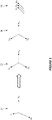
- a typical three-phase unbalanced system 10 that is represented as three unbalanced phasors (V a , V b , V c ). These phasors are "unbalanced” because they have a different magnitude (i.e., length) and/or are arranged with an angle other than 120 degrees between them.
- this single unbalanced system 10 can be transformed into three balanced sets of phasors that are typically referred to as the positive sequence 20, the negative sequence 30 and the zero sequence 40.
- sequences for voltage are illustrated.
- Corresponding sequences also exist for current.
- the positive sequence 20 is a balanced three-phase set that has the same phase sequence (V a1 , V b1 , V c1 ) as the original sequence of system 10.
- the negative sequence 30 is a balanced three-phase set with the opposite phase sequence (V a2 , V c2 , V b2 ) to the original sequence of system 10.
- the positive sequence 20 and negative sequence 30 sets are balanced because the phasors in each sequence, namely (V a1 , V b1 , V c1 ) and (V a2 , V b2 , V c2 ), are equal in magnitude and there is an angle of 120 degrees between each of the component phasors.
- the positive sequence 20 represents a balanced load. Therefore, when a system is operating normally (i.e., without faults and with equal phase currents that are displaced by exactly 120 degrees), only a positive sequence 20 current results. However, when an unbalanced fault is present in a system, at least one of a negative sequence 30 and/or a zero sequence 40 is produced in addition to the positive sequence 20. These effects can be detected with sequence filters. For that reason, protective relay designers have designed protective relay elements that take advantage of symmetrical components to detect negative sequences 30, which are indicative of an unbalanced system fault and are used to determine direction to the fault. These detection methods require faults to produce currents that have at least a minimum negative sequence amplitude. Additionally, these methods are designed based around the predictable phase angle that is typically found between the negative sequence current and the negative sequence voltage during a fault condition when the source of fault current is synchronous generators.
- a conventional electrical power generation and distribution system 50 that includes a power generation portion 52 having an IBR 54, such as a solar panel array or another green (i.e., renewable) power generation source.
- the system 50 includes a power transmission portion 56 that is connected to the power generation portion 52 via a step-up transformer 58.
- the power transmission portion 56 includes a conventional protective relay 60 that is used in isolating and protecting the system 50 against faults 62. Detecting and addressing unbalanced faults in IBR systems, such as the system 50, using conventional protective relays, such as relay 60, is difficult because the magnitude of the negative sequence current produced by IBRs may be insufficient and the phase angle incorrect.
- the amount of negative sequence current produced by IBRs is also lower than synchronous generators due to the physical differences between inverters and generators.
- the software-controlled electronics found in inverters lack the rotational inertia of a rotor that is found in synchronous generators. For this reason, the magnitude of the negative sequence current produced by these sources is often much less than the negative sequence current produced in conventional power systems by synchronous generators.
- HADDADI ABOUTALEB ET AL "Impact of Inverter-Based Resources on Negative Sequence Quantities-Based Protection Elements", IEEE TRANSACTIONS ON POWER DELIVERY, IEEE SERVICE CENTER, NEW YORK, NY, US, vol. 36, no.
- NDREKO MARIO ET AL "The effect of the offshore VSC-HVDC connected wind power plants on the unbalanced faulted behaviour of AC transmission systems", 2016 IEEE INTERNATIONAL ENERGY CONFERENCE (ENERGYCON), IEEE, 4 April 2016 ; EP 2 993 753 A1 ; WO 2020/057860 A1 and ERLICH ISTVAN ET AL: “Wind turbine negative sequence current control and its effect on power system protection", 2013 IEEE POWER & ENERGY SOCIETY GENERAL MEETING, 1 January 2013 .
- What is needed, therefore, is a device that may be connected to an existing utility bus associated with IBRs that is designed specifically to produce the required negative sequence current at an appropriate magnitude and at the proper phase relationship to the negative sequence voltage to enable existing protective relay elements to function properly even when the negative sequence current provided by the IBRs has an insufficient magnitude or phase angle to enable the protective relay elements to function properly.
- attachments, coupling and the like such as “attached”, “connected” and “interconnected”, refer to a relationship wherein structures are secured or attached to one another either directly or indirectly through intervening structures, as well as both moveable and rigid attachments or relationships, unless otherwise specified herein or clearly indicated as having a different relationship by context.
- operatively connected is such an attachment, coupling or connection that allows the pertinent structures to operate as intended by virtue of that relationship.
- a method for providing negative sequence current to a bus of an IBR-based power system to facilitate operation of a protective relay of the power system in protecting the power system includes the steps of, using a negative sequence converter (NSC) device connected to the power system via terminals, monitoring phase voltages of the power system at the terminals.
- NSC negative sequence converter
- a reference magnitude and reference phase angle of a negative sequence voltage incident on the NSC device is determined based on phase voltages of the power system.
- a first model current is provided.
- the first model current has a first magnitude and a first phase angle based on the reference magnitude and reference phase angle.
- a second model current having a second magnitude and second phase angle is provided using the NSC device.
- the second model current to the power system bus using the NSC device.
- the second model current provided to the power system bus consists only of negative sequence current.
- the phase angle of the first model current is equal to the reference phase angle of the negative sequence voltage incident on the NSC device rotated by 90 degrees.
- the first magnitude is equal to the reference magnitude of the negative sequence voltage.
- the second model current comprises three phases, each with a second magnitude and a second phase angle, wherein the second magnitude for each phase is equal to one another and wherein 120 degrees separates the second phase angles of each of the phases.
- the first model current includes three phases, each with a first phase angle. Each one of the three phases of the first model current corresponds with one of the three phases of the second model current, and 120 degrees separates the first phase angles of each of the three phases of the first model current and 180 degrees separates the first phase angles of each phase of the first current model from the second phase angle of each corresponding phase of the second current model.
- the power system includes an inverter having a current capability and the second magnitude to each phase of the second model current is equal to the current capability of the inverter.
- the method further includes the step of detecting a fault in the power system using the NSC device when a system voltage is below a pre-selected threshold percentage of a nominal voltage for the power system. Additionally, once a fault is detected, the NSC device switches from a non-fault mode of operation to a fault mode of operation. In certain cases, the NSC device switches from the non-fault mode of operation to the fault mode of operation when the system voltage falls below 80% of the nominal voltage for the power system. In certain cases, the NSC device switches from the non-fault mode of operation to the fault mode of operation when the system voltage falls below 70% of the nominal voltage for the power system.
- the NSC device carries out a secondary, non-fault related function when in non-fault mode.
- the NSC device functions as a static VAR compensator in the non-fault mode.
- the NSC device improves nominal power quality in the non-fault mode.
- the present disclosure provides a method for providing negative sequence current to a bus of an IBR-based power system to facilitate operation of protective relays in protecting the power system.
- the method includes the steps of monitoring phase voltages at terminals connected to the power system and then determining a reference phasor of a negative sequence voltage incident on the terminals having a reference magnitude and reference phase angle.
- the method also includes the step of applying a rotation phasor to the reference phasor based on an angular offset between the negative sequence voltage and a corresponding negative sequence current to obtain a first outbound negative sequence current having a first magnitude and a first phase angle.
- the method then provides for scaling the first outbound negative sequence current to obtain a second outbound negative sequence current having a second magnitude that is different from (i.e., either greater than or less than) the first magnitude and that is oriented at the first phase angle.
- the first outbound negative sequence current is scaled such that the second magnitude equals a current capacity of an inverter of the power system.
- the second outbound negative sequence is provided to the bus of the power system.
- the second outbound negative sequence includes a first phase, second phase, and third phase that each have a magnitude equal to the second magnitude and wherein 120 degrees separates each adjacent phase.
- the method may further include the step of providing a first phase of the outbound negative sequence having a magnitude equal to the second magnitude and a phase angle obtained by applying a first rotation phasor to the reference phasor, where the first rotation phasor is based on the angular offset between the negative sequence voltage and corresponding negative sequence current; providing a second phase of the outbound negative sequence having a magnitude equal to the second magnitude and a phase angle obtained by applying a second rotation phasor to the reference phasor, where the second rotation phasor is based on the angular offset between the negative sequence voltage and corresponding negative sequence current; and providing a third phase of the outbound negative sequence having a magnitude equal to the second magnitude and a phase angle obtained by applying a third rotation phasor to the reference phasor, where the third rotation phasor is based on the angular offset between the negative sequence voltage and corresponding negative sequence current.
- 120 degrees preferably separates the phase angles of the first phase, second phase, and third phase of the outbound
- System 100 includes a power generation portion 102 having an IBR 104, such as a solar panel array or another green (i.e., renewable) power generation source.
- the system 100 includes a power transmission portion 106 that is connected to the power generation portion 102 via a step-up transformer 108.
- the power transmission portion 106 includes a conventional protective relay 110 that is used in isolating and protecting the system 100 against faults 112.
- this improved system 100 includes a negative sequence converter (NSC) device 114 according to embodiment of the present invention.
- NSC negative sequence converter
- FIG 4 another electrical power generation and distribution system 200 according to an embodiment of the present invention is shown.
- this system 200 includes a power generation portion 102 and a power transmission portion 106 that is connected to the power generation portion via a step-up transformer 108.
- the power transmission portion 106 includes a conventional protective relay 110 that is used in isolating and protecting the system 200 against faults 112.
- an NSC device 114 allows for the relay 110 to protect the system 200 against balanced and unbalanced faults.
- this system 200 has multiple IBRs 104 that are connected together by a low-voltage collector bus 116.
- relay 110 is connected to a high-voltage collector bus 118 on the opposite side of transformer 108.
- a single NSC device 114 could be installed with multiple IBRs 104 (e.g., at a ratio of 10-20 IBRs to one NSC device).
- an NSC device 114 having terminals 115 for connecting the NSC device to a collector bus, such as bus 116 (shown in Figure 4 ).
- the primary purpose of the NSC device is to produce and inject negative sequence current only into a utility bus in response to an unbalanced fault condition in the grid.
- the NSC device does not produce (or actively suppresses) positive sequence current or zero sequence current.
- the full current capability of the NSC device 100 would be used to produce negative sequence current.
- the negative sequence current provided by NSC device 100 has sufficient magnitude and the correct phase angle that will be detectable by conventional protective relays.
- this apparatus 100 is provided as a separate add-on component that may be added to existing power generation and distribution systems that will enable the existing protective relays associated with that system to correctly detect and respond to unbalanced faults.
- the NSC device 100 may also be configured to serve a secondary purpose when no faults are detected. For example, the NSC device 100 may be configured to improve nominal power quality when no faults are detected and to automatically switch into a fault mode when an unbalanced fault occurs.
- the NSC first determines if a fault is present in the system by considering the terminal voltages of the power generation portion or power transmission portion of the system. Voltages are normally near 100% (nominal) when the system is functioning properly. However, when a fault is present, one or more of the phase voltages will be less than 100%.
- the NSC may be provided with pre-set voltage threshold that serves as a trigger to indicate the presence of a possible fault.
- the threshold might be set at 80% of the nominal (i.e., maximum or 100%) voltage. In other cases, the threshold is set at 70% of the nominal voltage. In preferred embodiments, the NSC permits a user-selectable threshold value to be selected in order to customize the system and to provide the desired level of sensitivity.
- the NSC may optionally be configured to perform a secondary function at Step 202, such as functioning as a static VAR compensator (SVC) device to regulate transmission voltage or improve power quality, or other similar functions.
- SVC static VAR compensator
- the terminal voltage falling below the specified threshold value is indicative of a fault condition.
- the NSC is preferably configured to automatically switch into a fault mode and begin to take steps to identify the type of fault and to produce appropriate negative sequence current.
- the NSC determines if the fault is a balanced (i.e., symmetrical) fault, the most rare type of fault, or a much more common unbalanced fault at Step 204 .
- a balanced fault is one that affects all three phases equally, such as when all three phases are shorted to ground.
- the majority of faults in power systems are "asymmetrical" or "unbalanced" faults, where all three phases are not affected equally. These include line-to-ground, phase-phase, or phase-phase-ground fault types.
- the phase voltage is determined.
- a first step in that analysis (Step 206) is to compute the negative sequence voltage (V 2 ).
- V ABC V A V B V C
- V ABC V A V B V C
- a phasor a i.e., 1 ⁇ 120°
- a phasor a 2 i.e., 1 ⁇ 240°
- phase angle of Phase B may be expressed as the phase angle of Phase A plus 240 degrees
- phase angle of Phase C may be expressed as the phase angle of Phase A plus 120 degrees.
- other phases could also serve as the reference phase.
- V 012 V 0 V 1 V 2
- A 1 1 1 1 1 a 2 a 1 a a 2
- v 012 A ⁇ 1 V ABC
- a ⁇ 1 1 3 1 1 1 1 1 a a 2 1 a 2 a
- the A matrix is used only for calculating the symmetrical components of the A phase of
- the NSC of the present invention is configured to determine the unbalanced three-phase voltage components by considering the terminal voltages of the power generation portion or power transmission portion of the system and then, based on that information, to calculate the negative sequence voltage using the procedure outlined above.
- the NSC derives the corresponding negative sequence current for Phase A (i.e., I A,2 ) by applying a fictitious negative sequence reactance X L equal to 1 Z 90° ⁇ to produce the proper 90 degree relationship between the negative sequence voltage and the negative sequence current (Step 208A).
- the correct phase angle for the A-phase of the negative sequence current is determined, the correct phase angle for the B- and C- phases can also be determined using the a and a 2 phasors mentioned above ( Step 208B ). Again, since this is a balanced phasor, each of the phases are separated by exactly 120 degrees with respect to the other phases.
- the phase angles of the B- and C- phases of the negative sequence current is determined by multiplying the A-phase by the a and a 2 phasors.
- the three phase angles calculated above represent the "inbound" currents traveling into the NSC. To account for electrical polarity, those currents must be converted to "outbound” currents traveling out of the NSC that are then injected into the bus. This is accomplished by adding or subtracting 180 degrees to the phase angles determined above ( Step 208C ).
- the current is scaled either up or down to equal the current capability of the inverter ( Step 210 ). From there, the NSC instructs power electronics to inject the scaled negative sequence current into the bus at the correct "outbound" phase angles for each of the three phases ( Step 212 ). Preferably, only negative sequence current is injected into the bus.
- an NSC of the present invention is used in connection with a 161 kV bus in an ABC phase rotation system, where a phase-to-ground fault occurs that impacts the A-phase only, to carry out the steps described below.
- the foregoing invention provides a method and apparatus for enabling power systems, especially in the case of systems with high penetration of IBR, to detect and correctly respond to unbalanced faults.
- the present invention does not require the replacement of conventional components with those that are better suited for IBR installations.
Landscapes
- Engineering & Computer Science (AREA)
- Power Engineering (AREA)
- Emergency Protection Circuit Devices (AREA)
Description
- This application claims the benefit of
U.S. Provisional Application No. 63/026,828 filed May 19, 2020 - The invention relates generally to electrical power systems. More particularly, the present invention relates to an apparatus and method for producing only negative sequence current for use in detecting fault conditions in the presence of inverter-based resources.
- In the field of electrical power systems, faults must be analyzed before an appropriate response can be implemented. Analyzing faults in three-phase power systems is relatively straightforward when the fault is "symmetrical" or "balanced". A balanced fault is one that affects all three phases equally, such as when all three phases are shorted to ground. The analysis of balanced faults is straightforward. However, the majority of faults in power systems are "asymmetrical" or "unbalanced" faults, where all three phases are not affected equally. Unfortunately, analyzing faults in three-phase unbalanced networks was quite tedious prior to the advent of computer methods, especially if the networks were large.
- The analysis was simplified through the use of symmetrical components, which may be used to translate a single three-phase unbalanced system, comprised of a set of three unbalanced phasors (e.g. Va, Vb, Vc), into three separate balanced components. For example, with reference to
Figure 1 , there is shown a typical three-phaseunbalanced system 10 that is represented as three unbalanced phasors (Va, Vb, Vc). These phasors are "unbalanced" because they have a different magnitude (i.e., length) and/or are arranged with an angle other than 120 degrees between them. Using symmetrical components, this singleunbalanced system 10 can be transformed into three balanced sets of phasors that are typically referred to as thepositive sequence 20, thenegative sequence 30 and the zerosequence 40. In this illustrated embodiment, sequences for voltage are illustrated. Corresponding sequences also exist for current. - The
positive sequence 20 is a balanced three-phase set that has the same phase sequence (Va1, Vb1, Vc1) as the original sequence ofsystem 10. Thenegative sequence 30 is a balanced three-phase set with the opposite phase sequence (Va2, Vc2, Vb2) to the original sequence ofsystem 10. Thepositive sequence 20 andnegative sequence 30 sets are balanced because the phasors in each sequence, namely (Va1, Vb1, Vc1) and (Va2, Vb2, Vc2), are equal in magnitude and there is an angle of 120 degrees between each of the component phasors. Lastly, in the zero sequence, all three phasors (Va0, Vb0, Vc0) are equal both in magnitude and phase. Advantageously, these individualbalanced systems entire system 10. Before the common use of computers this symmetrical component method of analyzing unbalanced power systems was prevalent. - The
positive sequence 20 represents a balanced load. Therefore, when a system is operating normally (i.e., without faults and with equal phase currents that are displaced by exactly 120 degrees), only apositive sequence 20 current results. However, when an unbalanced fault is present in a system, at least one of anegative sequence 30 and/or a zerosequence 40 is produced in addition to thepositive sequence 20. These effects can be detected with sequence filters. For that reason, protective relay designers have designed protective relay elements that take advantage of symmetrical components to detectnegative sequences 30, which are indicative of an unbalanced system fault and are used to determine direction to the fault. These detection methods require faults to produce currents that have at least a minimum negative sequence amplitude. Additionally, these methods are designed based around the predictable phase angle that is typically found between the negative sequence current and the negative sequence voltage during a fault condition when the source of fault current is synchronous generators. - In conventional power generation systems (e.g., gas, coal, hydro, etc.), where synchronous generators interface between the power generation plant and the electric power transmission and distribution grid (the "grid"), the magnitude of the negative sequence voltage and the negative sequence current is ample in quantity and their phase relationship is predictable. An unbalanced fault condition in a forward direction results in the negative sequence current leading the negative sequence voltage at the measurement location by approximately 90 degrees. An unbalanced fault condition in a reverse direction results in the negative sequence current lagging the negative sequence voltage at the measurement location by approximately 90 degrees.
- As concerns about climate change, fuel prices and energy security increase, there has been an increase in the amount of renewable energy sources (e.g., wind, solar, etc.) that are connected to the grid. Unlike the conventional power generation systems discussed above, which interface with the grid via synchronous generators, these types of renewable energy converters or sources interface with the grid via power electronic inverters. For this reason, these renewable energy sources are often commonly referred to as "inverter-based resources" or IBRs. While the fault response of generator-based systems is based on well-known physics, the fault response of IBR-based systems is controlled by algorithms (i.e., software) that control the operation of the power electronics. As discussed further below, since software is used to control the fault response of IBR-based systems instead of the predictable response seen with synchronous machines, that response can be much more unpredictable.
- Referring now to
Figure 2 , there is provided a conventional electrical power generation anddistribution system 50 that includes apower generation portion 52 having an IBR 54, such as a solar panel array or another green (i.e., renewable) power generation source. Thesystem 50 includes apower transmission portion 56 that is connected to thepower generation portion 52 via a step-up transformer 58. Thepower transmission portion 56 includes a conventionalprotective relay 60 that is used in isolating and protecting thesystem 50 againstfaults 62. Detecting and addressing unbalanced faults in IBR systems, such as thesystem 50, using conventional protective relays, such asrelay 60, is difficult because the magnitude of the negative sequence current produced by IBRs may be insufficient and the phase angle incorrect. - First, all negative sequence protective relays must be provided at least a minimum amount of negative sequence current before they will attempt to make a decision in detecting and addressing a fault. In many cases, this minimum amount is approximately ½ amp secondary. The term "secondary" means the current fed to the relay from a current transformer (CT). A typical CT ratio in the utility system would be 1200/5 (240:1). As such, a ½ amp secondary equates to 120A primary. However, there is a limit to the amount of current that an IBR can produce and IBRs are designed to primarily produce positive sequence current. For that reason, the amount of negative sequence current that IBRs can produce during an unbalanced fault condition is limited and is typically insufficient in amplitude and/or angle to trigger the protective relay and to enable the protective relay to function properly and predictably.
- Next, the amount of negative sequence current produced by IBRs is also lower than synchronous generators due to the physical differences between inverters and generators. The software-controlled electronics found in inverters lack the rotational inertia of a rotor that is found in synchronous generators. For this reason, the magnitude of the negative sequence current produced by these sources is often much less than the negative sequence current produced in conventional power systems by synchronous generators.
- Finally, existing IBR installations predominately produce negative sequence current in the wrong phase relationship. In the case of IBRs, the phase relationship between the negative sequence current and the negative sequence voltage is often not 90 degrees as it is with synchronous generation. There is typically some other, non-90 degree offset between the negative sequence current and negative sequence voltage. For this reason, existing protective relays cannot reliably determine the fault direction (i.e., forward or reverse) and cannot provide an appropriate response when used in connection with IBRs. In some cases, protective relays might fail to function altogether when used in connection with IBRs.
- One proposed solution for this issue is to replace conventional components with those that are better suited for IBR installations. For example, it may be possible to utilize a protective relay having a lower minimum negative sequence current requirement. However, these conventional protective relays are ubiquitous and replacing all of them would be time consuming and expensive. It would be much more economical to correct the issue at the source (i.e. at the IBR) than to correct the issue at the grid. Additionally, simply lowering the minimum negative sequence current requirement would not address the incorrect phase angle issue. Other examples of prior art can be seen in HADDADI ABOUTALEB ET AL: "Impact of Inverter-Based Resources on Negative Sequence Quantities-Based Protection Elements", IEEE TRANSACTIONS ON POWER DELIVERY, IEEE SERVICE CENTER, NEW YORK, NY, US, vol. 36, no. 1, 3 March 2020; NDREKO MARIO ET AL: "The effect of the offshore VSC-HVDC connected wind power plants on the unbalanced faulted behaviour of AC transmission systems", 2016 IEEE INTERNATIONAL ENERGY CONFERENCE (ENERGYCON), IEEE, 4 April 2016;
EP 2 993 753 A1 ;WO 2020/057860 A1 and ERLICH ISTVAN ET AL: "Wind turbine negative sequence current control and its effect on power system protection", 2013 IEEE POWER & ENERGY SOCIETY GENERAL MEETING, 1 January 2013. - What is needed, therefore, is a device that may be connected to an existing utility bus associated with IBRs that is designed specifically to produce the required negative sequence current at an appropriate magnitude and at the proper phase relationship to the negative sequence voltage to enable existing protective relay elements to function properly even when the negative sequence current provided by the IBRs has an insufficient magnitude or phase angle to enable the protective relay elements to function properly.
- The use of the terms "a", "an", "the" and similar terms in the context of describing embodiments of the invention are to be construed to cover both the singular and the plural, unless otherwise indicated herein or clearly contradicted by context. The terms "comprising", "having", "including" and "containing" are to be construed as open-ended terms (i.e., meaning "including, but not limited to,") unless otherwise noted. The terms "substantially", "generally" and other words of degree are relative modifiers intended to indicate permissible variation from the characteristic so modified. The use of such terms in describing a physical or functional characteristic of the invention is not intended to limit such characteristic to the absolute value which the term modifies, but rather to provide an approximation of the value of such physical or functional characteristic.
- Terms concerning attachments, coupling and the like, such as "attached", "connected" and "interconnected", refer to a relationship wherein structures are secured or attached to one another either directly or indirectly through intervening structures, as well as both moveable and rigid attachments or relationships, unless otherwise specified herein or clearly indicated as having a different relationship by context. The term "operatively connected" is such an attachment, coupling or connection that allows the pertinent structures to operate as intended by virtue of that relationship.
- The use of any and all examples or exemplary language (e.g., "such as" and "preferably") herein is intended merely to better illuminate the invention and the preferred embodiments thereof, and not to place a limitation on the scope of the invention. Nothing in the specification should be construed as indicating any element as essential to the practice of the invention unless so stated with specificity.
- The above and other problems are addressed by a method for providing negative sequence current to a bus of an IBR-based power system to facilitate operation of a protective relay of the power system in protecting the power system. The method includes the steps of, using a negative sequence converter (NSC) device connected to the power system via terminals, monitoring phase voltages of the power system at the terminals. Using the NSC device, a reference magnitude and reference phase angle of a negative sequence voltage incident on the NSC device is determined based on phase voltages of the power system. Using the NSC device, a first model current is provided. The first model current has a first magnitude and a first phase angle based on the reference magnitude and reference phase angle. A second model current having a second magnitude and second phase angle is provided using the NSC device. The second model current to the power system bus using the NSC device. In preferred embodiments, the second model current provided to the power system bus consists only of negative sequence current.
- In certain embodiments, the phase angle of the first model current is equal to the reference phase angle of the negative sequence voltage incident on the NSC device rotated by 90 degrees. In certain embodiments, the first magnitude is equal to the reference magnitude of the negative sequence voltage.
- In certain embodiments, the second model current comprises three phases, each with a second magnitude and a second phase angle, wherein the second magnitude for each phase is equal to one another and wherein 120 degrees separates the second phase angles of each of the phases. More preferably, the first model current includes three phases, each with a first phase angle. Each one of the three phases of the first model current corresponds with one of the three phases of the second model current, and 120 degrees separates the first phase angles of each of the three phases of the first model current and 180 degrees separates the first phase angles of each phase of the first current model from the second phase angle of each corresponding phase of the second current model. In certain embodiments, the power system includes an inverter having a current capability and the second magnitude to each phase of the second model current is equal to the current capability of the inverter.
- In certain embodiments, the method further includes the step of detecting a fault in the power system using the NSC device when a system voltage is below a pre-selected threshold percentage of a nominal voltage for the power system. Additionally, once a fault is detected, the NSC device switches from a non-fault mode of operation to a fault mode of operation. In certain cases, the NSC device switches from the non-fault mode of operation to the fault mode of operation when the system voltage falls below 80% of the nominal voltage for the power system. In certain cases, the NSC device switches from the non-fault mode of operation to the fault mode of operation when the system voltage falls below 70% of the nominal voltage for the power system. Preferably, the NSC device carries out a secondary, non-fault related function when in non-fault mode. In certain embodiments, the NSC device functions as a static VAR compensator in the non-fault mode. In certain embodiments, the NSC device improves nominal power quality in the non-fault mode.
- More generally, the present disclosure provides a method for providing negative sequence current to a bus of an IBR-based power system to facilitate operation of protective relays in protecting the power system. The method includes the steps of monitoring phase voltages at terminals connected to the power system and then determining a reference phasor of a negative sequence voltage incident on the terminals having a reference magnitude and reference phase angle. The method also includes the step of applying a rotation phasor to the reference phasor based on an angular offset between the negative sequence voltage and a corresponding negative sequence current to obtain a first outbound negative sequence current having a first magnitude and a first phase angle. The method then provides for scaling the first outbound negative sequence current to obtain a second outbound negative sequence current having a second magnitude that is different from (i.e., either greater than or less than) the first magnitude and that is oriented at the first phase angle. Preferably, the first outbound negative sequence current is scaled such that the second magnitude equals a current capacity of an inverter of the power system. Lastly, the second outbound negative sequence is provided to the bus of the power system. Preferably, the second outbound negative sequence includes a first phase, second phase, and third phase that each have a magnitude equal to the second magnitude and wherein 120 degrees separates each adjacent phase.
- The method may further include the step of providing a first phase of the outbound negative sequence having a magnitude equal to the second magnitude and a phase angle obtained by applying a first rotation phasor to the reference phasor, where the first rotation phasor is based on the angular offset between the negative sequence voltage and corresponding negative sequence current; providing a second phase of the outbound negative sequence having a magnitude equal to the second magnitude and a phase angle obtained by applying a second rotation phasor to the reference phasor, where the second rotation phasor is based on the angular offset between the negative sequence voltage and corresponding negative sequence current; and providing a third phase of the outbound negative sequence having a magnitude equal to the second magnitude and a phase angle obtained by applying a third rotation phasor to the reference phasor, where the third rotation phasor is based on the angular offset between the negative sequence voltage and corresponding negative sequence current. In that case, 120 degrees preferably separates the phase angles of the first phase, second phase, and third phase of the outbound negative sequence.
- Further advantages of the invention are apparent by reference to the detailed description when considered in conjunction with the figures, which are not to scale so as to more clearly show the details, wherein like reference numerals represent like elements throughout the several views, and wherein:
-
Figure 1 depicts three-phase unbalanced system and its corresponding positive, negative, and zero sequence symmetrical components; -
Figure 2 depicts a conventional electrical power generation and distribution system having a single IBR; -
Figure 3 depicts an electrical power generation and distribution system having a single IBR and a negative sequence converter device according to an embodiment of the present invention; -
Figure 4 depicts another electrical power distribution system having an NSC device connected to a low-voltage utility collector bus along with several IBRs; -
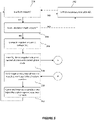
Figures 5 and6 provide a flowchart that depicts a sequence of steps used by an IBR-based power generation and distribution system provided with an NSC device to detect and address a fault according to an embodiment of the present invention; and -
Figure 7 depicts an NSC device having terminals for connecting to a power system according to an embodiment of the present invention. - Referring now to
Figure 3 , there is provided an improved electrical power generation anddistribution system 100 according to an embodiment of the present invention.System 100 includes apower generation portion 102 having anIBR 104, such as a solar panel array or another green (i.e., renewable) power generation source. Thesystem 100 includes apower transmission portion 106 that is connected to thepower generation portion 102 via a step-uptransformer 108. Thepower transmission portion 106 includes a conventionalprotective relay 110 that is used in isolating and protecting thesystem 100 againstfaults 112. Lastly, unlike the conventional system 50 (shown inFigure 1 ), thisimproved system 100 includes a negative sequence converter (NSC)device 114 according to embodiment of the present invention. - In
Figure 4 , another electrical power generation anddistribution system 200 according to an embodiment of the present invention is shown. Like the previously shownsystem 100, thissystem 200 includes apower generation portion 102 and apower transmission portion 106 that is connected to the power generation portion via a step-uptransformer 108. Thepower transmission portion 106 includes a conventionalprotective relay 110 that is used in isolating and protecting thesystem 200 againstfaults 112. Again, anNSC device 114 allows for therelay 110 to protect thesystem 200 against balanced and unbalanced faults. However, unlike the previously shownsystem 100, thissystem 200 hasmultiple IBRs 104 that are connected together by a low-voltage collector bus 116. Similarly,relay 110 is connected to a high-voltage collector bus 118 on the opposite side oftransformer 108. In thissystem 200, asingle NSC device 114 could be installed with multiple IBRs 104 (e.g., at a ratio of 10-20 IBRs to one NSC device). With reference toFigure 7 , anNSC device 114 having terminals 115 for connecting the NSC device to a collector bus, such as bus 116 (shown inFigure 4 ). - In each of the above-mentioned cases, the primary purpose of the NSC device is to produce and inject negative sequence current only into a utility bus in response to an unbalanced fault condition in the grid. Preferably, the NSC device does not produce (or actively suppresses) positive sequence current or zero sequence current. As such, the full current capability of the
NSC device 100 would be used to produce negative sequence current. The negative sequence current provided byNSC device 100 has sufficient magnitude and the correct phase angle that will be detectable by conventional protective relays. Advantageously, in certain embodiments, thisapparatus 100 is provided as a separate add-on component that may be added to existing power generation and distribution systems that will enable the existing protective relays associated with that system to correctly detect and respond to unbalanced faults. Thisapparatus 100 will, therefore, allow for conventional protective relays to protect grids that utilize IBRs, where the negative sequence current provided by those IBRs without the NSC would have been inadequate to allow the protective relay to function properly. TheNSC device 100 may also be configured to serve a secondary purpose when no faults are detected. For example, theNSC device 100 may be configured to improve nominal power quality when no faults are detected and to automatically switch into a fault mode when an unbalanced fault occurs. - With reference now to
Figures 5 and6 , there is provided a flow chart illustrating a sequence of steps used by an IBR-based power generation and distribution system provided with an NSC device to detect and address a fault according to an embodiment of the present invention. AtStep 200, the NSC first determines if a fault is present in the system by considering the terminal voltages of the power generation portion or power transmission portion of the system. Voltages are normally near 100% (nominal) when the system is functioning properly. However, when a fault is present, one or more of the phase voltages will be less than 100%. The NSC may be provided with pre-set voltage threshold that serves as a trigger to indicate the presence of a possible fault. For example, in certain embodiments, the threshold might be set at 80% of the nominal (i.e., maximum or 100%) voltage. In other cases, the threshold is set at 70% of the nominal voltage. In preferred embodiments, the NSC permits a user-selectable threshold value to be selected in order to customize the system and to provide the desired level of sensitivity. - When the terminal voltage is above the specified threshold value, the NSC may optionally be configured to perform a secondary function at
Step 202, such as functioning as a static VAR compensator (SVC) device to regulate transmission voltage or improve power quality, or other similar functions. Persons of skill in the art will appreciate that the precise secondary functions provided by the NSC will depend on the nature of the power electronic scheme in which the NSC is utilized On the other hand, the terminal voltage falling below the specified threshold value is indicative of a fault condition. Once the terminal voltage falls below the specified threshold value, the NSC is preferably configured to automatically switch into a fault mode and begin to take steps to identify the type of fault and to produce appropriate negative sequence current. - Once a fault is detected, the NSC determines if the fault is a balanced (i.e., symmetrical) fault, the most rare type of fault, or a much more common unbalanced fault at
Step 204. As discussed above, a balanced fault is one that affects all three phases equally, such as when all three phases are shorted to ground. However, the majority of faults in power systems are "asymmetrical" or "unbalanced" faults, where all three phases are not affected equally. These include line-to-ground, phase-phase, or phase-phase-ground fault types. In the case of an unbalanced fault, the phase voltage is determined. As mentioned above, analyzing balanced three-phase faults is relatively straightforward. On the other hand, analyzing unbalanced three-phase was difficult, but that analysis was simplified through the use of symmetrical components. As shown below, a first step in that analysis (Step 206) is to compute the negative sequence voltage (V2). - A vector for a three-phase system can be written as follows:


- With respect to the positive sequence and negative sequence, since they are each balanced, the magnitude of each of their three phasors is equal and the only difference is the angular displacement between those phasors. On the other hand, the zero sequence components have equal magnitude and are each in phase with one another. Using these facts, a phasor a (i.e., 1 ∠120°) can be defined which rotates the sequence component counterclockwise by 120 degrees when multiplied by that phasor, and a phasor a2 (i.e., 1 ∠240°) can be defined which rotates the sequence component counterclockwise by 240 degrees when multiplied by that phasor. These a and a2 phasors, thus, allow two of the sequence components to be defined in terms of the third sequence component. Therefore, for the positive sequence (V1) and negative sequence (V2):


- In the example given above, the angle of phases B and C are described with the angle of phase A as the reference point. In other words, the phase angle of Phase B may be expressed as the phase angle of Phase A plus 240 degrees, and the phase angle of Phase C may be expressed as the phase angle of Phase A plus 120 degrees. However, other phases could also serve as the reference phase.
- Next, the vector for the three-phase system may be rewritten as follows:


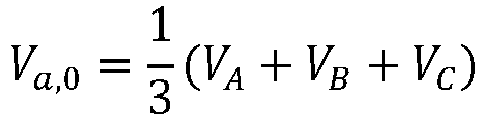


- In preferred embodiments, the NSC of the present invention is configured to determine the unbalanced three-phase voltage components by considering the terminal voltages of the power generation portion or power transmission portion of the system and then, based on that information, to calculate the negative sequence voltage using the procedure outlined above.
- Next, once the negative sequence voltage (V2) has been determined, the NSC derives the corresponding negative sequence current for Phase A (i.e., IA,2) by applying a fictitious negative sequence reactance XL equal to 1 Z 90° Ω to produce the proper 90 degree relationship between the negative sequence voltage and the negative sequence current (
Step 208A). Once the correct phase angle for the A-phase of the negative sequence current is determined, the correct phase angle for the B- and C- phases can also be determined using the a and a2 phasors mentioned above (Step 208B). Again, since this is a balanced phasor, each of the phases are separated by exactly 120 degrees with respect to the other phases. Therefore, the phase angles of the B- and C- phases of the negative sequence current is determined by multiplying the A-phase by the a and a2 phasors. The three phase angles calculated above represent the "inbound" currents traveling into the NSC. To account for electrical polarity, those currents must be converted to "outbound" currents traveling out of the NSC that are then injected into the bus. This is accomplished by adding or subtracting 180 degrees to the phase angles determined above (Step 208C). Once the correct "outbound" phase angle for each of the three phases of the negative sequence current is determined, the current is scaled either up or down to equal the current capability of the inverter (Step 210). From there, the NSC instructs power electronics to inject the scaled negative sequence current into the bus at the correct "outbound" phase angles for each of the three phases (Step 212). Preferably, only negative sequence current is injected into the bus. - In this example, an NSC of the present invention is used in connection with a 161 kV bus in an ABC phase rotation system, where a phase-to-ground fault occurs that impacts the A-phase only, to carry out the steps described below.
- Start with phase voltages during A-ground fault:

- Calculate resulting voltage for Phase A (VA,2):

- Calculate resulting "inbound" current for Phase A (Ia,2) using XL:

- Current scaled to inverter capacity (e.g., 300A) for a full set of "inbound" phase currents to be produced by NSC with reference into (i.e., incident on) the NSC using a and a2 phasors:

- Calculate full set of "outbound" phase currents to be produced by NSC by rotating the inbound phase currents by 180 degrees:

- Injecting the above negative sequence currents into the bus will, preferably, provide a sufficient magnitude and proper phase angle to allow the conventional negative sequence protective relays to determine fault direction and operate properly. Thus, the foregoing invention provides a method and apparatus for enabling power systems, especially in the case of systems with high penetration of IBR, to detect and correctly respond to unbalanced faults. Advantageously, unlike earlier-proposed solutions, the present invention does not require the replacement of conventional components with those that are better suited for IBR installations.
Claims (15)
- A method for providing negative sequence current to a bus of an IBR-based power system to facilitate operation of a protective relay of the power system in protecting the power system, the method comprising the steps of:using a negative sequence converter, NSC, device connected to the power system via terminals, monitoring phase voltages of the power system at the terminals;using the NSC device, determining a reference magnitude and reference phase angle of a negative sequence voltage incident on the NSC device based on phase voltages of the power system;using the NSC device, providing a first model current having a first magnitude and a first phase angle based on the reference magnitude and reference phase angle;using the NSC device, providing a second model current having a second and different magnitude from the first magnitude and also having a second phase angle; andusing the NSC device, providing the second model current to the power system bus.
- The method of claim 1 wherein the phase angle of the first model current is equal to the reference phase angle of the negative sequence voltage incident on the NSC device rotated by 90 degrees.
- The method of claim 1 wherein the first magnitude is equal to the reference magnitude of the negative sequence voltage.
- The method of claim 1 wherein the second model current comprises three phases, each one of the three phases of the first model current corresponding with one of the three phases of the second model current, wherein the second magnitude for each phase is equal to one another and wherein 120 degrees separates the second phase angles of each of the phases.
- The method of claim 4 wherein the first model current comprises three phases, each with a first phase angle, that each correspond with one of the three phases of the second model current, wherein 120 degrees separates the first phase angles of each of the three phases of the first model current and 180 degrees separates the first phase angles of each phase of the first model current from the second phase angle of each corresponding phase of the second model current.
- The method of claim 4 wherein the power system includes an inverter having a current capability and wherein the second magnitude to each phase of the second model current is equal to the current capability of the inverter.
- The method of claim 1 further comprising the steps of, with the NSC device, detecting a fault in the power system when a system voltage is below a pre-selected threshold percentage of a nominal voltage for the power system; and, once a fault is detected, switching the NSC device from a non-fault mode of operation to a fault mode of operation.
- The method of claim 7 wherein the NSC device switches from the non-fault mode of operation to the fault mode of operation when the system voltage falls below 70% of the nominal voltage for the power system.
- The method of claim 1 wherein the second model current provided to the power system bus consists of negative sequence current.
- The method of claim 1 wherein the second magnitude is greater than the first magnitude.
- The method of claim 1 wherein the second magnitude is less than the first magnitude.
- A method for providing negative sequence current to a bus of an IBR-based power system to facilitate operation of protective relays in protecting the power system, the method comprising the steps of:monitoring phase voltages at terminals connected to the power system;determining a reference phasor of a negative sequence voltage incident on the terminals having a reference magnitude and reference phase angle; characterized in the steps ofapplying a rotation phasor to the reference phasor based on an angular offset between the negative sequence voltage and a corresponding negative sequence current to obtain a first outbound negative sequence current having a first magnitude and a first phase angle;scaling the first outbound negative sequence current to obtain a second outbound negative sequence current having a second magnitude that is different from the first magnitude and that is oriented at the first phase angle;providing the second outbound negative sequence to the bus of the power system.
- The method of claim 12 wherein the second outbound negative sequence includes a first phase, second phase, and third phase that each have a magnitude equal to the second magnitude and wherein 120 degrees separates each adjacent phase.
- The method of claim 12 further comprising the steps of:providing a first phase of the outbound negative sequence having a magnitude equal to the second magnitude and a phase angle obtained by applying a first rotation phasor to the reference phasor, where the first rotation phasor is based on the angular offset between the negative sequence voltage and corresponding negative sequence current;providing a second phase of the outbound negative sequence having a magnitude equal to the second magnitude and a phase angle obtained by applying a second rotation phasor to the reference phasor, where the second rotation phasor is based on the angular offset between the negative sequence voltage and corresponding negative sequence current; andproviding a third phase of the outbound negative sequence having a magnitude equal to the second magnitude and a phase angle obtained by applying a third rotation phasor to the reference phasor, where the third rotation phasor is based on the angular offset between the negative sequence voltage and corresponding negative sequence current,wherein 120 degrees separates the phase angles of the first phase, second phase, and third phase of the outbound negative sequence.
- The method of claim 12 wherein the first outbound negative sequence current is scaled such that the second magnitude equals a current capacity of an inverter of the power system.
Applications Claiming Priority (1)
| Application Number | Priority Date | Filing Date | Title |
|---|---|---|---|
| US202063026828P | 2020-05-19 | 2020-05-19 |
Publications (2)
| Publication Number | Publication Date |
|---|---|
| EP3913761A1 EP3913761A1 (en) | 2021-11-24 |
| EP3913761B1 true EP3913761B1 (en) | 2022-08-03 |
Family
ID=75977587
Family Applications (1)
| Application Number | Title | Priority Date | Filing Date |
|---|---|---|---|
| EP21174030.3A Active EP3913761B1 (en) | 2020-05-19 | 2021-05-17 | Method for producing negative sequence current |
Country Status (2)
| Country | Link |
|---|---|
| US (1) | US11159010B1 (en) |
| EP (1) | EP3913761B1 (en) |
Family Cites Families (7)
| Publication number | Priority date | Publication date | Assignee | Title |
|---|---|---|---|---|
| US4398232A (en) * | 1981-11-13 | 1983-08-09 | Westinghouse Electric Corp. | Protective relaying methods and apparatus |
| US6525543B1 (en) * | 2000-10-20 | 2003-02-25 | Schweitzer Engineering Laboratories | Fault type selection system for identifying faults in an electric power system |
| US7319576B2 (en) * | 2005-08-18 | 2008-01-15 | Schweitzer Engineering Labortories, Inc. | Apparatus and method for providing differential protection for a phase angle regulating transformer in a power system |
| US8004222B2 (en) * | 2008-09-23 | 2011-08-23 | Hamilton Sundstrand Corporation | Negative sequence carrier signal controller |
| US10288688B2 (en) * | 2014-07-24 | 2019-05-14 | Schweitzer Engineering Laboratories, Inc. | Systems and methods for monitoring and protecting an electric power generator |
| PT2993753T (en) * | 2014-09-03 | 2020-01-20 | Siemens Ag | WIND TURBINE GENERATOR WITH FAILURE BEHAVIOR LIKE A SYNCHRONOUS GENERATOR |
| CN112689932B (en) * | 2018-09-20 | 2024-07-09 | 西门子歌美飒可再生能源公司 | Method for controlling a renewable power generation device during a network ground fault |
-
2021
- 2021-05-06 US US17/313,510 patent/US11159010B1/en not_active Expired - Fee Related
- 2021-05-17 EP EP21174030.3A patent/EP3913761B1/en active Active
Also Published As
| Publication number | Publication date |
|---|---|
| EP3913761A1 (en) | 2021-11-24 |
| US11159010B1 (en) | 2021-10-26 |
Similar Documents
| Publication | Publication Date | Title |
|---|---|---|
| Anderson et al. | Power system protection | |
| EP2128951B1 (en) | Electronic active earthing system for use in high-voltage distribution networks | |
| Li et al. | An adaptive protection scheme for multiple single-phase grounding faults in radial distribution networks with inverter-interfaced distributed generators | |
| Schlake et al. | Performance of third harmonic ground fault protection schemes for generator stator windings | |
| Das et al. | Effects of distributed generators on impedance-based fault location algorithms | |
| Xue et al. | Series compensation, power swings, and inverter-based sources and their impact on line current differential protection | |
| EP3913761B1 (en) | Method for producing negative sequence current | |
| Mohanty et al. | Current restrained undervoltage protection scheme of converter dominated microgrids | |
| US20230155371A1 (en) | Controlling an inverter to emulate synchronous generator under fault conditions | |
| EP3853958B1 (en) | Detecting device and method for detecting a fault in a transformer of a wind turbine | |
| CA3127874C (en) | Apparatus and method for producing negative sequence current | |
| Nagarjuna et al. | Novel second zone acceleration technique for distance relay utilizing sequence voltages | |
| Xiao et al. | Study on a new fault phase selector in interconnection line with wind turbine based on doubly-fed induction generator’s wind farm | |
| CN107785882A (en) | A kind of more level active compensation devices of three-phase four-arm and control method | |
| Jafarian et al. | A Comparison of the Impact of Current Priority Modes of Inverter-Based Resources on the Performance of Grid Protective Relays | |
| Sosa-Aguiluz et al. | CFE generator protection guidelines for setting 40 and 64G elements based on simulations and field experience | |
| Qureshi et al. | Systematic development of Low Voltage Ride-Through (LVRT) envelope for grids | |
| Wang et al. | Cooperative strategy of ESS control and protection for enhancement of phase selection recovery capacity and distance protection acceleration for IBR plant transmission lines | |
| Zhang et al. | Improved distance relay protection considering high proportion of new energy sources | |
| Cimadevilla et al. | Abnormal fault patterns in the presence of inverter based generation and their effect on line protection | |
| Zhang | Event Analysis: Innovative Tools and Strategies for Protection Engineers | |
| Luo et al. | Faulted phase selection method for system with VSG in compliance with new grid codes | |
| Yamuna et al. | Impact of TCSC on Distance Protection in Long Transmission Lines | |
| Patterson | Advancing Power Equipment and Line Protection with Practical Solutions | |
| Minghao et al. | Transformer Backup Protection for Substations in Renewable Energy Grid-Connected Areas |
Legal Events
| Date | Code | Title | Description |
|---|---|---|---|
| PUAI | Public reference made under article 153(3) epc to a published international application that has entered the european phase |
Free format text: ORIGINAL CODE: 0009012 |
|
| STAA | Information on the status of an ep patent application or granted ep patent |
Free format text: STATUS: THE APPLICATION HAS BEEN PUBLISHED |
|
| STAA | Information on the status of an ep patent application or granted ep patent |
Free format text: STATUS: REQUEST FOR EXAMINATION WAS MADE |
|
| AK | Designated contracting states |
Kind code of ref document: A1 Designated state(s): AL AT BE BG CH CY CZ DE DK EE ES FI FR GB GR HR HU IE IS IT LI LT LU LV MC MK MT NL NO PL PT RO RS SE SI SK SM TR |
|
| B565 | Issuance of search results under rule 164(2) epc |
Effective date: 20211027 |
|
| 17P | Request for examination filed |
Effective date: 20211102 |
|
| RBV | Designated contracting states (corrected) |
Designated state(s): AL AT BE BG CH CY CZ DE DK EE ES FI FR GB GR HR HU IE IS IT LI LT LU LV MC MK MT NL NO PL PT RO RS SE SI SK SM TR |
|
| RIC1 | Information provided on ipc code assigned before grant |
Ipc: H02J 3/00 20060101ALI20220317BHEP Ipc: G01R 31/08 20200101ALI20220317BHEP Ipc: H02J 3/26 20060101AFI20220317BHEP |
|
| GRAP | Despatch of communication of intention to grant a patent |
Free format text: ORIGINAL CODE: EPIDOSNIGR1 |
|
| STAA | Information on the status of an ep patent application or granted ep patent |
Free format text: STATUS: GRANT OF PATENT IS INTENDED |
|
| INTG | Intention to grant announced |
Effective date: 20220509 |
|
| GRAS | Grant fee paid |
Free format text: ORIGINAL CODE: EPIDOSNIGR3 |
|
| GRAA | (expected) grant |
Free format text: ORIGINAL CODE: 0009210 |
|
| STAA | Information on the status of an ep patent application or granted ep patent |
Free format text: STATUS: THE PATENT HAS BEEN GRANTED |
|
| AK | Designated contracting states |
Kind code of ref document: B1 Designated state(s): AL AT BE BG CH CY CZ DE DK EE ES FI FR GB GR HR HU IE IS IT LI LT LU LV MC MK MT NL NO PL PT RO RS SE SI SK SM TR |
|
| REG | Reference to a national code |
Ref country code: AT Ref legal event code: REF Ref document number: 1509529 Country of ref document: AT Kind code of ref document: T Effective date: 20220815 Ref country code: CH Ref legal event code: EP |
|
| REG | Reference to a national code |
Ref country code: DE Ref legal event code: R096 Ref document number: 602021000261 Country of ref document: DE |
|
| REG | Reference to a national code |
Ref country code: IE Ref legal event code: FG4D |
|
| REG | Reference to a national code |
Ref country code: LT Ref legal event code: MG9D |
|
| REG | Reference to a national code |
Ref country code: NL Ref legal event code: MP Effective date: 20220803 |
|
| PG25 | Lapsed in a contracting state [announced via postgrant information from national office to epo] |
Ref country code: SE Free format text: LAPSE BECAUSE OF FAILURE TO SUBMIT A TRANSLATION OF THE DESCRIPTION OR TO PAY THE FEE WITHIN THE PRESCRIBED TIME-LIMIT Effective date: 20220803 Ref country code: RS Free format text: LAPSE BECAUSE OF FAILURE TO SUBMIT A TRANSLATION OF THE DESCRIPTION OR TO PAY THE FEE WITHIN THE PRESCRIBED TIME-LIMIT Effective date: 20220803 Ref country code: PT Free format text: LAPSE BECAUSE OF FAILURE TO SUBMIT A TRANSLATION OF THE DESCRIPTION OR TO PAY THE FEE WITHIN THE PRESCRIBED TIME-LIMIT Effective date: 20221205 Ref country code: NO Free format text: LAPSE BECAUSE OF FAILURE TO SUBMIT A TRANSLATION OF THE DESCRIPTION OR TO PAY THE FEE WITHIN THE PRESCRIBED TIME-LIMIT Effective date: 20221103 Ref country code: NL Free format text: LAPSE BECAUSE OF FAILURE TO SUBMIT A TRANSLATION OF THE DESCRIPTION OR TO PAY THE FEE WITHIN THE PRESCRIBED TIME-LIMIT Effective date: 20220803 Ref country code: LV Free format text: LAPSE BECAUSE OF FAILURE TO SUBMIT A TRANSLATION OF THE DESCRIPTION OR TO PAY THE FEE WITHIN THE PRESCRIBED TIME-LIMIT Effective date: 20220803 Ref country code: LT Free format text: LAPSE BECAUSE OF FAILURE TO SUBMIT A TRANSLATION OF THE DESCRIPTION OR TO PAY THE FEE WITHIN THE PRESCRIBED TIME-LIMIT Effective date: 20220803 Ref country code: FI Free format text: LAPSE BECAUSE OF FAILURE TO SUBMIT A TRANSLATION OF THE DESCRIPTION OR TO PAY THE FEE WITHIN THE PRESCRIBED TIME-LIMIT Effective date: 20220803 Ref country code: ES Free format text: LAPSE BECAUSE OF FAILURE TO SUBMIT A TRANSLATION OF THE DESCRIPTION OR TO PAY THE FEE WITHIN THE PRESCRIBED TIME-LIMIT Effective date: 20220803 |
|
| REG | Reference to a national code |
Ref country code: AT Ref legal event code: MK05 Ref document number: 1509529 Country of ref document: AT Kind code of ref document: T Effective date: 20220803 |
|
| PG25 | Lapsed in a contracting state [announced via postgrant information from national office to epo] |
Ref country code: PL Free format text: LAPSE BECAUSE OF FAILURE TO SUBMIT A TRANSLATION OF THE DESCRIPTION OR TO PAY THE FEE WITHIN THE PRESCRIBED TIME-LIMIT Effective date: 20220803 Ref country code: IS Free format text: LAPSE BECAUSE OF FAILURE TO SUBMIT A TRANSLATION OF THE DESCRIPTION OR TO PAY THE FEE WITHIN THE PRESCRIBED TIME-LIMIT Effective date: 20221203 Ref country code: HR Free format text: LAPSE BECAUSE OF FAILURE TO SUBMIT A TRANSLATION OF THE DESCRIPTION OR TO PAY THE FEE WITHIN THE PRESCRIBED TIME-LIMIT Effective date: 20220803 Ref country code: GR Free format text: LAPSE BECAUSE OF FAILURE TO SUBMIT A TRANSLATION OF THE DESCRIPTION OR TO PAY THE FEE WITHIN THE PRESCRIBED TIME-LIMIT Effective date: 20221104 |
|
| PG25 | Lapsed in a contracting state [announced via postgrant information from national office to epo] |
Ref country code: SM Free format text: LAPSE BECAUSE OF FAILURE TO SUBMIT A TRANSLATION OF THE DESCRIPTION OR TO PAY THE FEE WITHIN THE PRESCRIBED TIME-LIMIT Effective date: 20220803 Ref country code: RO Free format text: LAPSE BECAUSE OF FAILURE TO SUBMIT A TRANSLATION OF THE DESCRIPTION OR TO PAY THE FEE WITHIN THE PRESCRIBED TIME-LIMIT Effective date: 20220803 Ref country code: DK Free format text: LAPSE BECAUSE OF FAILURE TO SUBMIT A TRANSLATION OF THE DESCRIPTION OR TO PAY THE FEE WITHIN THE PRESCRIBED TIME-LIMIT Effective date: 20220803 Ref country code: CZ Free format text: LAPSE BECAUSE OF FAILURE TO SUBMIT A TRANSLATION OF THE DESCRIPTION OR TO PAY THE FEE WITHIN THE PRESCRIBED TIME-LIMIT Effective date: 20220803 Ref country code: AT Free format text: LAPSE BECAUSE OF FAILURE TO SUBMIT A TRANSLATION OF THE DESCRIPTION OR TO PAY THE FEE WITHIN THE PRESCRIBED TIME-LIMIT Effective date: 20220803 |
|
| REG | Reference to a national code |
Ref country code: DE Ref legal event code: R097 Ref document number: 602021000261 Country of ref document: DE |
|
| PG25 | Lapsed in a contracting state [announced via postgrant information from national office to epo] |
Ref country code: SK Free format text: LAPSE BECAUSE OF FAILURE TO SUBMIT A TRANSLATION OF THE DESCRIPTION OR TO PAY THE FEE WITHIN THE PRESCRIBED TIME-LIMIT Effective date: 20220803 Ref country code: EE Free format text: LAPSE BECAUSE OF FAILURE TO SUBMIT A TRANSLATION OF THE DESCRIPTION OR TO PAY THE FEE WITHIN THE PRESCRIBED TIME-LIMIT Effective date: 20220803 |
|
| PLBE | No opposition filed within time limit |
Free format text: ORIGINAL CODE: 0009261 |
|
| STAA | Information on the status of an ep patent application or granted ep patent |
Free format text: STATUS: NO OPPOSITION FILED WITHIN TIME LIMIT |
|
| PG25 | Lapsed in a contracting state [announced via postgrant information from national office to epo] |
Ref country code: AL Free format text: LAPSE BECAUSE OF FAILURE TO SUBMIT A TRANSLATION OF THE DESCRIPTION OR TO PAY THE FEE WITHIN THE PRESCRIBED TIME-LIMIT Effective date: 20220803 |
|
| 26N | No opposition filed |
Effective date: 20230504 |
|
| PGFP | Annual fee paid to national office [announced via postgrant information from national office to epo] |
Ref country code: FR Payment date: 20230606 Year of fee payment: 3 Ref country code: DE Payment date: 20230607 Year of fee payment: 3 |
|
| PG25 | Lapsed in a contracting state [announced via postgrant information from national office to epo] |
Ref country code: MC Free format text: LAPSE BECAUSE OF FAILURE TO SUBMIT A TRANSLATION OF THE DESCRIPTION OR TO PAY THE FEE WITHIN THE PRESCRIBED TIME-LIMIT Effective date: 20220803 |
|
| REG | Reference to a national code |
Ref country code: BE Ref legal event code: MM Effective date: 20230531 |
|
| PG25 | Lapsed in a contracting state [announced via postgrant information from national office to epo] |
Ref country code: MC Free format text: LAPSE BECAUSE OF FAILURE TO SUBMIT A TRANSLATION OF THE DESCRIPTION OR TO PAY THE FEE WITHIN THE PRESCRIBED TIME-LIMIT Effective date: 20220803 Ref country code: LU Free format text: LAPSE BECAUSE OF NON-PAYMENT OF DUE FEES Effective date: 20230517 |
|
| REG | Reference to a national code |
Ref country code: IE Ref legal event code: MM4A |
|
| PG25 | Lapsed in a contracting state [announced via postgrant information from national office to epo] |
Ref country code: IE Free format text: LAPSE BECAUSE OF NON-PAYMENT OF DUE FEES Effective date: 20230517 |
|
| PG25 | Lapsed in a contracting state [announced via postgrant information from national office to epo] |
Ref country code: IE Free format text: LAPSE BECAUSE OF NON-PAYMENT OF DUE FEES Effective date: 20230517 |
|
| PG25 | Lapsed in a contracting state [announced via postgrant information from national office to epo] |
Ref country code: IT Free format text: LAPSE BECAUSE OF FAILURE TO SUBMIT A TRANSLATION OF THE DESCRIPTION OR TO PAY THE FEE WITHIN THE PRESCRIBED TIME-LIMIT Effective date: 20220803 Ref country code: BE Free format text: LAPSE BECAUSE OF NON-PAYMENT OF DUE FEES Effective date: 20230531 |
|
| PG25 | Lapsed in a contracting state [announced via postgrant information from national office to epo] |
Ref country code: BG Free format text: LAPSE BECAUSE OF FAILURE TO SUBMIT A TRANSLATION OF THE DESCRIPTION OR TO PAY THE FEE WITHIN THE PRESCRIBED TIME-LIMIT Effective date: 20220803 |
|
| PG25 | Lapsed in a contracting state [announced via postgrant information from national office to epo] |
Ref country code: BG Free format text: LAPSE BECAUSE OF FAILURE TO SUBMIT A TRANSLATION OF THE DESCRIPTION OR TO PAY THE FEE WITHIN THE PRESCRIBED TIME-LIMIT Effective date: 20220803 |
|
| REG | Reference to a national code |
Ref country code: DE Ref legal event code: R119 Ref document number: 602021000261 Country of ref document: DE |
|
| REG | Reference to a national code |
Ref country code: CH Ref legal event code: PL |
|
| PG25 | Lapsed in a contracting state [announced via postgrant information from national office to epo] |
Ref country code: CH Free format text: LAPSE BECAUSE OF NON-PAYMENT OF DUE FEES Effective date: 20240531 |
|
| PG25 | Lapsed in a contracting state [announced via postgrant information from national office to epo] |
Ref country code: DE Free format text: LAPSE BECAUSE OF NON-PAYMENT OF DUE FEES Effective date: 20241203 |
|
| PG25 | Lapsed in a contracting state [announced via postgrant information from national office to epo] |
Ref country code: FR Free format text: LAPSE BECAUSE OF NON-PAYMENT OF DUE FEES Effective date: 20240531 |
|
| PG25 | Lapsed in a contracting state [announced via postgrant information from national office to epo] |
Ref country code: CY Free format text: LAPSE BECAUSE OF FAILURE TO SUBMIT A TRANSLATION OF THE DESCRIPTION OR TO PAY THE FEE WITHIN THE PRESCRIBED TIME-LIMIT; INVALID AB INITIO Effective date: 20210517 |
|
| PG25 | Lapsed in a contracting state [announced via postgrant information from national office to epo] |
Ref country code: HU Free format text: LAPSE BECAUSE OF FAILURE TO SUBMIT A TRANSLATION OF THE DESCRIPTION OR TO PAY THE FEE WITHIN THE PRESCRIBED TIME-LIMIT; INVALID AB INITIO Effective date: 20210517 |
|
| PG25 | Lapsed in a contracting state [announced via postgrant information from national office to epo] |
Ref country code: TR Free format text: LAPSE BECAUSE OF FAILURE TO SUBMIT A TRANSLATION OF THE DESCRIPTION OR TO PAY THE FEE WITHIN THE PRESCRIBED TIME-LIMIT Effective date: 20220803 |
|
| GBPC | Gb: european patent ceased through non-payment of renewal fee |
Effective date: 20250517 |
|
| PG25 | Lapsed in a contracting state [announced via postgrant information from national office to epo] |
Ref country code: SI Free format text: LAPSE BECAUSE OF FAILURE TO SUBMIT A TRANSLATION OF THE DESCRIPTION OR TO PAY THE FEE WITHIN THE PRESCRIBED TIME-LIMIT Effective date: 20220803 |
|
| PG25 | Lapsed in a contracting state [announced via postgrant information from national office to epo] |
Ref country code: GB Free format text: LAPSE BECAUSE OF NON-PAYMENT OF DUE FEES Effective date: 20250517 |