EP3913507A1 - Optimization device, optimization program, and optimization method - Google Patents
Optimization device, optimization program, and optimization method Download PDFInfo
- Publication number
- EP3913507A1 EP3913507A1 EP21154731.0A EP21154731A EP3913507A1 EP 3913507 A1 EP3913507 A1 EP 3913507A1 EP 21154731 A EP21154731 A EP 21154731A EP 3913507 A1 EP3913507 A1 EP 3913507A1
- Authority
- EP
- European Patent Office
- Prior art keywords
- replicas
- reference bit
- states
- optimization
- replica
- Prior art date
- Legal status (The legal status is an assumption and is not a legal conclusion. Google has not performed a legal analysis and makes no representation as to the accuracy of the status listed.)
- Withdrawn
Links
Images

Classifications
-
- G—PHYSICS
- G06—COMPUTING OR CALCULATING; COUNTING
- G06N—COMPUTING ARRANGEMENTS BASED ON SPECIFIC COMPUTATIONAL MODELS
- G06N5/00—Computing arrangements using knowledge-based models
- G06N5/02—Knowledge representation; Symbolic representation
-
- G—PHYSICS
- G06—COMPUTING OR CALCULATING; COUNTING
- G06F—ELECTRIC DIGITAL DATA PROCESSING
- G06F7/00—Methods or arrangements for processing data by operating upon the order or content of the data handled
- G06F7/38—Methods or arrangements for performing computations using exclusively denominational number representation, e.g. using binary, ternary, decimal representation
- G06F7/383—Methods or arrangements for performing computations using exclusively denominational number representation, e.g. using binary, ternary, decimal representation using magnetic or similar elements
-
- G—PHYSICS
- G06—COMPUTING OR CALCULATING; COUNTING
- G06F—ELECTRIC DIGITAL DATA PROCESSING
- G06F17/00—Digital computing or data processing equipment or methods, specially adapted for specific functions
- G06F17/10—Complex mathematical operations
- G06F17/11—Complex mathematical operations for solving equations, e.g. nonlinear equations, general mathematical optimization problems
-
- G—PHYSICS
- G06—COMPUTING OR CALCULATING; COUNTING
- G06J—HYBRID COMPUTING ARRANGEMENTS
- G06J1/00—Hybrid computing arrangements
- G06J1/005—Hybrid computing arrangements for correlation; for convolution; for Z or Fourier Transform
-
- G—PHYSICS
- G06—COMPUTING OR CALCULATING; COUNTING
- G06N—COMPUTING ARRANGEMENTS BASED ON SPECIFIC COMPUTATIONAL MODELS
- G06N20/00—Machine learning
- G06N20/20—Ensemble learning
-
- G—PHYSICS
- G06—COMPUTING OR CALCULATING; COUNTING
- G06N—COMPUTING ARRANGEMENTS BASED ON SPECIFIC COMPUTATIONAL MODELS
- G06N5/00—Computing arrangements using knowledge-based models
- G06N5/01—Dynamic search techniques; Heuristics; Dynamic trees; Branch-and-bound
-
- G—PHYSICS
- G06—COMPUTING OR CALCULATING; COUNTING
- G06N—COMPUTING ARRANGEMENTS BASED ON SPECIFIC COMPUTATIONAL MODELS
- G06N7/00—Computing arrangements based on specific mathematical models
- G06N7/01—Probabilistic graphical models, e.g. probabilistic networks
Definitions
- the embodiments discussed herein are related to an optimization device, an optimization program, and an optimization method.
- Information processing is performed in all fields in today's society. Such information processing is performed by arithmetic devices such as computers, which perform operations and reorganization on a variety of kinds of data and obtain meaningful results to perform prediction, determination, control, and the like. Optimization processing is one approach of this information processing and has become an important field.
- One approach of the optimization processing is to solve a discrete optimization problem.
- the number of combinations increases explosively, and the calculation time sometimes does not fall within a realistic range in the technique of exhaustively performing calculations to work out all combinations.
- SA simulated annealing
- replica exchange method in which a copy (replica) of a certain state is used to search for a solution independently for each replica is known.
- every one replica calculates the interaction term at regular intervals such that the interaction term becomes larger if the one replica is more similar to each of the other replicas, and the interaction term becomes smaller if the one replica is less similar to each of the other replicas. Accordingly, there is a disadvantage that the speed of searching for the optimum solution becomes slower because each replica thoroughly refers to all the other replicas in order to calculate the interaction term.
- it is intended to provide an optimization device, an optimization program, and an optimization method that enable an optimum solution to be obtained at higher speed.
- an optimization method implemented by a computer configured to search for a solution using a replica exchange method.
- the optimization method includes: generating a reference bit to be referred to by each of a plurality of replicas, based on first states of respective replicas of the plurality of replicas at a time that is predetermined; causing each of the plurality of replicas to refer to the generated reference bit; and specifying second states at a time later than the time.
- the optimum solution may be obtained at higher speed.
- FIG. 1 is a block diagram illustrating an exemplary functional configuration of an information processing device according to an embodiment.
- the information processing device 1 includes a control unit 10, a plurality of replicas (20a, 20b, and 20c in the illustrated example), and a reference bit generation unit 30, and is an example of an optimization device that uses a copy (replica) of a certain state (a spin bit string depending on different temperature parameters) to search for a solution independently for each replica.
- a personal computer (PC) or the like can be applied as the information processing device 1.
- PC personal computer
- the number of replicas is three, but the number of replicas is not limited to three.
- the present embodiment will take as an example a case where simulated annealing (SA) using an Ising-type energy function is employed as an application target of the replica method, but the application target of the replica method may be the stochastic gradient descent (SGD) or belief propagation (BP).
- SA simulated annealing
- BP belief propagation
- the replicas 20a, 20b, and 20c include Markov Chain Monte Carlo methods (MCMC) units 21a, 21b, and 21c that perform MCMC.
- MCMC Markov Chain Monte Carlo methods
- the MCMC units 21a, 21b, and 21c perform MCMC based on, for example, a metropolis standard, using a spin bit string (s a ) indicating the current state of each replica, a reference bit (s R ), and a Hamiltonian H(s).
- a spin bit string indicating the current state of each replica
- a reference bit indicating the current state of each replica
- a Hamiltonian H(s) a Hamiltonian H(s).
- the MCMC units 21a, 21b, and 21c work out spin bit strings (s 1 , s 2 , s 3 ) indicating the states at a later time, by evolving the states of the respective replicas over time.
- spin bit string indicating the state is simply referred to as the "state”.
- the reference bit generation unit 30 is a processing unit that generates (calculates) a reference bit (s R ) to be referred to by each replica, based on the states (s 1 , s 2 , s 3 ) of the respective replicas (20a, 20b, 20c) at a predetermined time.
- the reference bit generation unit 30 is an example of a generation unit.
- the reference bit generation unit 30 takes a majority vote for each bit in the bit strings of the states (s 1 , s 2 , s 3 ) of the respective replicas (20a, 20b, 20c) (assigns 0 for bits, a larger part of which have 0, and assigns 1 for bits, a larger part of which have 1), to generate the reference bit (s R ).
- the reference bit generation unit 30 may employ, as the reference bit (s R ), the state of a replica (minimum_spin) that has the minimum energy among all replicas, instead of the majority vote for each bit.
- the reference bit generation unit 30 employs, as the reference bit (s R ), the state of a replica that has the minimum energy (minimum_spin) among the states (s 1 , s 2 , s 3 ) of the respective replicas (20a, 20b, 20c).
- the 2-way-1-hot constraint is a constraint in which only one element has 1 in both of the row and column of the two-dimensional array (most of the elements have 0).
- s takes the numerical values 0 and 1 instead of +1 and -1.
- the reference bit generation unit 30 may perform addition on all replicas for each bit, instead of the majority vote for each bit, which means to employ a value obtained by taking a histogram as the reference bit (s R ).
- the control unit 10 corresponds to an electronic circuit such as a central processing unit (CPU), for example, and controls the operation of the information processing device 1.
- the control unit 10 includes an internal memory for storing programs defining various processing procedures and control data, and executes diverse types of processing using the programs and the control data when searching for a solution using the replica method.
- control unit 10 causes each of the replicas (20a, 20b, 20c) to refer to the reference bit (s R ) generated by the reference bit generation unit 30 and perform MCMC.
- the control unit 10 obtains the state at the next time for each of the replicas (20a, 20b, 20c) by evolving the state of each replica over time.
- the information processing device 1 searches for a state (optimum solution) in which the energy takes the minimum value, by evolving the state of each replica over time.
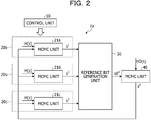
- FIG. 2 is a block diagram illustrating a modification of the functional configuration of the information processing device according to the embodiment. As illustrated in FIG. 2 , an information processing device 1a according to the modification differs from the information processing device 1 in that the information processing device 1a includes an MCMC unit 40.
- the MCMC unit 40 performs MCMC on a reference bit (s0 R ) generated by the reference bit generation unit 30 in a predetermined number of steps with a Hamiltonian H0(s) that does not consider the interaction (without interaction).
- the control unit 10 employs, as the final reference bit (s R ), a state obtained by the MCMC unit 40 trying MCMC, and causes each of the replicas (20a, 20b, 20c) to refer to the final reference bit. Note that the number of steps in which the MCMC unit 40 tries MCMC may be freely set by a user or the like.
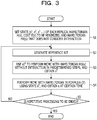
- FIG. 3 is a flowchart illustrating an exemplary operation of the information processing device according to the embodiment.
- the control unit 10 sets the state (s 1 , s 2 , s 3 ...) of each replica, the Hamiltonian H(s), a cost E(s) to be minimized, and the Hamiltonian H0(s) that does not consider the interaction.
- the cost E(s) is a formula desired to be minimized by optimization (for which the optimum solution is to be worked out). These settings are made on the basis of initial setting values or the like, for example, input by the user.
- control unit 10 searches for the optimum solution by repeating the processing in S2 to S5 to evolve the state of each replica over time.
- the processing in S2 to S5 represents an operation example of the information processing device 1a including the MCMC unit 40, and in the case of the information processing device 1, it suffices to skip the processing in S3 performed by the MCMC unit 40 and read s0 R as s R .
- the MCMC units 21a, 21b, and 21c of the relevant replicas perform MCMC with the Hamiltonian H(s) in following formula (2) containing an interaction ( ⁇ ), using the state (s R ), and obtain states (s) at a certain time (S4).
- H s E s + I ⁇ ⁇ s R s
- ⁇ may be fixed, or may be gradually strengthened or weakened with time.
- I denotes an increasing or decreasing function of the distance between the reference and the replica.
- I is given as following formula (3) when it is effective for each replica to search the periphery of the reference (it becomes easier to obtain the optimum solution). Note that, when it becomes easier to obtain the optimum solution by avoiding the search of the vicinity of the reference, I is given as a formula in which the minus before ⁇ in formula (3) is changed to the plus.
- the control unit 10 determines whether or not to end the repetitive processing (S5). For example, the control unit 10 determines that the processing is to be ended when the processing has been repeated by a predetermined number of steps, or when the minimum value of E(s) has been obtained. When the repetitive processing is continued (S5: No), the control unit 10 returns the processing to S2. Furthermore, when the repetitive processing is to be ended (S5: Yes), the control unit 10 ends the processing assuming that the optimum solution has been obtained.
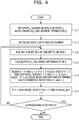
- FIG. 4 is a flowchart illustrating exemplary processing of MCMC. As illustrated in FIG. 4 , once the above-mentioned processing relating to S4 is started, the MCMC units 21a, 21b, and 21c are set with the bit state (s), the number of bits (N), the Hamiltonian H(s), and a reverse temperature ( ⁇ ) (S10).
- the MCMC units 21a, 21b, and 21c initialize the states (s) with a random number (S11).
- the MCMC units 21a, 21b, and 21c set H(s) as the initial value for the energy and the minimum energy.
- E H(s) is assigned for energy (E)
- Emin E is assigned for the minimum value of E (Emin).
- minimum_spin s is assigned for the Emin spin (minimum_spin).
- the MCMC units 21a, 21b, and 21c flip any one bit of s by one bit to obtain s' (S12).
- the bit to be flipped is set with a random number or the like.
- the MCMC units 21a, 21b, and 21c calculate H(s'), and work out an energy (E') of s' (S13).
- the MCMC units 21a, 21b, and 21c determine whether or not an end condition is satisfied (S16). For example, the MCMC units 21a, 21b, and 21c assume that the end condition is satisfied when the loop is made for a predetermined number of steps or when Emin takes the minimum value. Furthermore, when all the bits are flipped in one step, the end condition may be prescribed by whether or not the loop is made for the number of times obtained by the number of steps ⁇ the number of bits.
- the information processing device 1 that searches for a solution using the replica exchange method includes the plurality of replicas 20a, 20b, and 20c that each search for a solution, the reference bit generation unit 30, and the control unit 10.
- the reference bit generation unit 30 generates the reference bit (s R ) to be referred to by each of the plurality of replicas 20a, 20b, and 20c, based on first states of respective replicas of the plurality of replicas 20a, 20b, and 20c at a predetermined time.
- the control unit 10 causes each of the plurality of replicas 20a, 20b, and 20c to refer to the generated reference bit (s R ), and obtains states at a time later than the predetermined time.
- each replica since the information processing device 1 has a configuration in which each replica refers to the reference bit (s R ), each replica does not refer to all the other replicas thoroughly in order to calculate the interaction term as in the conventional replica method, and the optimum solution may be obtained at higher speed.
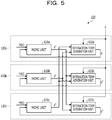
- FIG. 5 is a block diagram illustrating an exemplary functional configuration of an information processing device that carries out the conventional replica method.
- replicas 120a, 120b, and 120c include MCMC units 121a, 121b, and 121c, and interaction term generation units 122a, 122b, and 122c that refer to all the other replicas thoroughly to calculate (generate) the interaction terms, respectively.
- the interaction term generation units 122a, 122b, and 122c calculate the interaction terms (k 1 , k 2 , k 3 ) at regular intervals (for example, every one Monte Carlo step) such that the interaction term becomes larger if replicas other than their own replicas are more similar to each other, and the interaction term becomes smaller if replicas other than their own replicas are less similar to each other. Moreover, the interaction term generation units 122a, 122b, and 122c multiply the bits of their own replicas (s 1 , s 2 , s 3 ) by k such that, if the bits of the whole and their own replicas resemble each other, the values become even larger, and subtract the obtained values from the energy function.
- ⁇ denotes the reverse temperature
- j denotes the number assigned to the bit
- N denotes the number of bits.
- ⁇ denotes the strength of the interaction.
- ⁇ denotes the strength of the interaction.
- the number of references is given as n 2 + (n - 1) ⁇ n.
- the number of references (corresponding to the number of arrows denoted by s 1 , s 2 , s 3 and s R in FIGs. 1 and 2 ) is reduced to 2n.
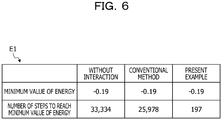
- FIG. 6 is an explanatory diagram explaining a comparative example in a ferromagnetic model.
- a comparative example E1 in FIG. 6 the case without interaction, the case of the conventional replica method, and the case of the present example are compared in regard to the search for the optimum solution (the minimum value of energy) in a ferromagnetic model (FT).
- FT ferromagnetic model
- the number of steps to reach the optimum solution is significantly decreased as compared with the case where a search for the optimum solution is performed by the conventional replica method.
- the load of reference may be lowered by creating the reference bit, and the optimum solution may be obtained at a higher speed.
- the reference bit generation unit 30 generates the reference bit (s R ) based on a majority vote for each bit that indicates the state of each of the replicas 20a, 20b, and 20c. As a result, the information processing device 1 can search for a solution by a majority vote by the states of the respective replicas 20a, 20b, and 20c.
- the reference bit generation unit 30 generates the reference bit (s R ) based on the state of a replica having the minimum energy among the states of the respective replicas 20a, 20b, and 20c.
- the information processing device 1 may search for a state (minimum solution) in which the energy is minimized at a higher speed in the search for a solution using the replica exchange method.
- the reference bit generation unit 30 generates the reference bit (s R ) based on a histogram obtained by adding bits that indicate the states of the respective replicas 20a, 20b, and 20c, for each bit. For example, when the 2-way-1-hot constraint is imposed to the state (s), only one element has 1 in both of the row and column of the two-dimensional array, and most of the elements have 0. Therefore, when the reference bit is generated based on the majority vote, all the reference bits will have 0. On the other hand, by generating the reference bit based on the histogram, the reference bit may be restrained from dropping to 0.
- the control unit 10 causes each of the replicas 20a, 20b, 20c to refer to the reference bit (s R ) after the MCMC unit 40 has tried the Monte Carlo method in a predetermined number of steps with a Hamiltonian without interaction. Even when a search for a solution is made in this manner, the load of reference can be lowered because all the other replicas are not thoroughly referred to in units of bits.
- each of the illustrated devices are not necessarily and physically configured as illustrated in the drawings.
- the specific aspects of separation and integration of each of the apparatuses and devices are not limited to the illustrated aspects, and all or some of the apparatuses or devices can be functionally or physically separated and integrated in any unit, in accordance with various loads, use status, and the like.
- various processing functions executed with the information processing device 1 may be entirely or optionally partially executed on a central processing unit (CPU) (or a microcomputer such as a microprocessor unit (MPU) or a micro controller unit (MCU)). Furthermore, it is needless to say that whole or any part of various processing functions may be executed by a program to be analyzed and executed on a CPU (or microcomputer such as MPU or MCU), or on hardware by wired logic. In addition, various processing functions executed with the information processing device 1 may be executed by a plurality of computers in cooperation through cloud computing.
- CPU central processing unit
- MPU microprocessor unit
- MCU micro controller unit
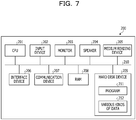
- FIG. 7 is a block diagram illustrating an example of a computer configuration.
- a computer 200 includes a CPU 201 that executes various kinds of arithmetic processing, an input device 202 that receives data input, a monitor 203, and a speaker 204.
- the computer 200 includes a medium reading device 205 that reads a program and the like from a storage medium, an interface device 206 that is used for connecting to various devices, and a communication device 207 that makes communicative connection with an external device in a wired or wireless manner.
- the computer 200 includes a random access memory (RAM) 208 that temporarily stores various kinds of information, and a hard disk device 209.
- each part (201 to 209) in the computer 200 is connected to a bus 210.
- the hard disk device 209 stores a program 211 used to execute various kinds of processing of the control unit 10, the replicas 20a, 20b, and 20c, the reference bit generation unit 30, the MCMC unit 40, and the like described above in the embodiment. Furthermore, the hard disk device 209 stores various kinds of data 212 to which the program 211 refers.
- the input device 202 receives, for example, an input of operation information from an operator.
- the monitor 203 displays, for example, various screens operated by the operator.
- the interface device 206 is connected to, for example, a printing device or the like.
- the communication device 207 is connected to a communication network such as a local area network (LAN), and exchanges various kinds of information with the external device via a communication network.
- LAN local area network
- the CPU 201 reads out the program 211 stored in the hard disk device 209, and expands the read-out program 211 into the RAM 208 to execute, thereby performing various kinds of processing relating to the control unit 10, the replicas 20a, 20b, and 20c, the reference bit generation unit 30, the MCMC unit 40, and the like.
- the program 211 may not be prestored in the hard disk device 209.
- the computer 200 may read out the program 211 stored in a storage medium that is readable by the computer 200 and may execute the program 211.
- the storage medium that is readable by the computer 200 corresponds to, for example, a portable recording medium such as a compact disk read only memory (CD-ROM), a digital versatile disk (DVD), or a universal serial bus (USB) memory, a semiconductor memory such as a flash memory, a hard disk drive, or the like.
- a portable recording medium such as a compact disk read only memory (CD-ROM), a digital versatile disk (DVD), or a universal serial bus (USB) memory
- a semiconductor memory such as a flash memory, a hard disk drive, or the like.
- the program 211 may be prestored in a device connected to a public line, the Internet, a LAN, or the like, and the computer 200 may read out the program 211 from the device to execute the program 211.
Landscapes
- Engineering & Computer Science (AREA)
- Physics & Mathematics (AREA)
- Theoretical Computer Science (AREA)
- General Physics & Mathematics (AREA)
- Mathematical Physics (AREA)
- Software Systems (AREA)
- General Engineering & Computer Science (AREA)
- Data Mining & Analysis (AREA)
- Evolutionary Computation (AREA)
- Computing Systems (AREA)
- Artificial Intelligence (AREA)
- Mathematical Analysis (AREA)
- Mathematical Optimization (AREA)
- Pure & Applied Mathematics (AREA)
- Computational Mathematics (AREA)
- Computational Linguistics (AREA)
- Algebra (AREA)
- Probability & Statistics with Applications (AREA)
- Operations Research (AREA)
- Databases & Information Systems (AREA)
- Computer Hardware Design (AREA)
- Automation & Control Theory (AREA)
- Fuzzy Systems (AREA)
- Computer Vision & Pattern Recognition (AREA)
- Medical Informatics (AREA)
- Management, Administration, Business Operations System, And Electronic Commerce (AREA)
- Complex Calculations (AREA)
- Information Retrieval, Db Structures And Fs Structures Therefor (AREA)
Abstract
Description
- The embodiments discussed herein are related to an optimization device, an optimization program, and an optimization method.
- Information processing is performed in all fields in today's society. Such information processing is performed by arithmetic devices such as computers, which perform operations and reorganization on a variety of kinds of data and obtain meaningful results to perform prediction, determination, control, and the like. Optimization processing is one approach of this information processing and has become an important field.
- One approach of the optimization processing is to solve a discrete optimization problem. In a large-scale multivariable discrete optimization problem, the number of combinations increases explosively, and the calculation time sometimes does not fall within a realistic range in the technique of exhaustively performing calculations to work out all combinations.
- As a method for solving such a large-scale multivariable discrete optimization problem, for example, there is simulated annealing (SA) using an Ising-type energy function. In this SA, calculation is performed by replacing a problem to be calculated with an Ising model, which is a model representing behavior of spins of magnetic material.
- In the discrete optimization problem, it is important to search for an optimum solution because there is a large number of states called local solutions that are not optimum solutions but take minimum values in local neighborhoods. As for the search for the optimum solution, a replica exchange method (hereinafter referred to as a replica method) in which a copy (replica) of a certain state is used to search for a solution independently for each replica is known.
- However, in the replica method in the above-mentioned prior art, every one replica calculates the interaction term at regular intervals such that the interaction term becomes larger if the one replica is more similar to each of the other replicas, and the interaction term becomes smaller if the one replica is less similar to each of the other replicas. Accordingly, there is a disadvantage that the speed of searching for the optimum solution becomes slower because each replica thoroughly refers to all the other replicas in order to calculate the interaction term.
- In one aspect, it is intended to provide an optimization device, an optimization program, and an optimization method that enable an optimum solution to be obtained at higher speed.
- According to an aspect of the embodiments, provided is an optimization method implemented by a computer configured to search for a solution using a replica exchange method. In an example, the optimization method includes: generating a reference bit to be referred to by each of a plurality of replicas, based on first states of respective replicas of the plurality of replicas at a time that is predetermined; causing each of the plurality of replicas to refer to the generated reference bit; and specifying second states at a time later than the time.
- The optimum solution may be obtained at higher speed.
-
-
FIG. 1 is a block diagram illustrating an exemplary functional configuration of an information processing device according to an embodiment; -
FIG. 2 is a block diagram illustrating a modification of the functional configuration of the information processing device according to the embodiment; -
FIG. 3 is a flowchart illustrating an exemplary operation of the information processing device according to the embodiment; -
FIG. 4 is a flowchart illustrating exemplary processing of Markov Chain Monte Carlo methods (MCMC); -
FIG. 5 is a block diagram illustrating an exemplary functional configuration of an information processing device that carries out a conventional replica method; -
FIG. 6 is an explanatory diagram explaining a comparative example in a ferromagnetic model; and -
FIG. 7 is a block diagram illustrating an example of a computer configuration. - Hereinafter, an optimization device, an optimization program, and an optimization method according to embodiments will be described with reference to the drawings. Configurations with the same functions in the embodiments are denoted by the same reference signs, and redundant description will be omitted. Note that the optimization device, the optimization program, and the optimization method to be described in the embodiments below are merely examples and do not limit the embodiments. Additionally, each of the embodiments below may be appropriately combined unless otherwise contradicted.
-
FIG. 1 is a block diagram illustrating an exemplary functional configuration of an information processing device according to an embodiment. As illustrated inFIG. 1 , theinformation processing device 1 includes acontrol unit 10, a plurality of replicas (20a, 20b, and 20c in the illustrated example), and a referencebit generation unit 30, and is an example of an optimization device that uses a copy (replica) of a certain state (a spin bit string depending on different temperature parameters) to search for a solution independently for each replica. For example, a personal computer (PC) or the like can be applied as theinformation processing device 1. - Note that, in the illustrated example, the number of replicas is three, but the number of replicas is not limited to three. Furthermore, the present embodiment will take as an example a case where simulated annealing (SA) using an Ising-type energy function is employed as an application target of the replica method, but the application target of the replica method may be the stochastic gradient descent (SGD) or belief propagation (BP).
- The
replicas units - The MCMC
units MCMC units - The reference
bit generation unit 30 is a processing unit that generates (calculates) a reference bit (sR) to be referred to by each replica, based on the states (s1, s2, s3) of the respective replicas (20a, 20b, 20c) at a predetermined time. For example, the referencebit generation unit 30 is an example of a generation unit. - For example, the reference
bit generation unit 30 takes a majority vote for each bit in the bit strings of the states (s1, s2, s3) of the respective replicas (20a, 20b, 20c) (assigns 0 for bits, a larger part of which have 0, and assigns 1 for bits, a larger part of which have 1), to generate the reference bit (sR). - Furthermore, the reference
bit generation unit 30 may employ, as the reference bit (sR), the state of a replica (minimum_spin) that has the minimum energy among all replicas, instead of the majority vote for each bit. For example, the referencebit generation unit 30 employs, as the reference bit (sR), the state of a replica that has the minimum energy (minimum_spin) among the states (s1, s2, s3) of the respective replicas (20a, 20b, 20c). - Note that, in the state (s), a 2-way-1-hot constraint is imposed in some cases. The 2-way-1-hot constraint is a constraint in which only one element has 1 in both of the row and column of the two-dimensional array (most of the elements have 0).
- For example, s takes the
numerical values 0 and 1 instead of +1 and -1. When this is expressed as X because it is confusing, a relationship of Xi = (1 + si)/2 holds. - When the 2-way-1-hot constraint is imposed, if the reference bit is generated based on the majority vote, all the reference bits will have 0.
- In such a case where the 2-way-1-hot constraint is imposed, the reference
bit generation unit 30 may perform addition on all replicas for each bit, instead of the majority vote for each bit, which means to employ a value obtained by taking a histogram as the reference bit (sR). - The
control unit 10 corresponds to an electronic circuit such as a central processing unit (CPU), for example, and controls the operation of theinformation processing device 1. For example, thecontrol unit 10 includes an internal memory for storing programs defining various processing procedures and control data, and executes diverse types of processing using the programs and the control data when searching for a solution using the replica method. - For example, the
control unit 10 causes each of the replicas (20a, 20b, 20c) to refer to the reference bit (sR) generated by the referencebit generation unit 30 and perform MCMC. As a result, thecontrol unit 10 obtains the state at the next time for each of the replicas (20a, 20b, 20c) by evolving the state of each replica over time. In this manner, theinformation processing device 1 searches for a state (optimum solution) in which the energy takes the minimum value, by evolving the state of each replica over time. -
FIG. 2 is a block diagram illustrating a modification of the functional configuration of the information processing device according to the embodiment. As illustrated inFIG. 2 , aninformation processing device 1a according to the modification differs from theinformation processing device 1 in that theinformation processing device 1a includes anMCMC unit 40. - The
MCMC unit 40 performs MCMC on a reference bit (s0R) generated by the referencebit generation unit 30 in a predetermined number of steps with a Hamiltonian H0(s) that does not consider the interaction (without interaction). Thecontrol unit 10 employs, as the final reference bit (sR), a state obtained by the MCMCunit 40 trying MCMC, and causes each of the replicas (20a, 20b, 20c) to refer to the final reference bit. Note that the number of steps in which the MCMCunit 40 tries MCMC may be freely set by a user or the like. -
FIG. 3 is a flowchart illustrating an exemplary operation of the information processing device according to the embodiment. As illustrated inFIG. 3 , when the processing is started, thecontrol unit 10 sets the state (s1, s2, s3...) of each replica, the Hamiltonian H(s), a cost E(s) to be minimized, and the Hamiltonian H0(s) that does not consider the interaction. The cost E(s) is a formula desired to be minimized by optimization (for which the optimum solution is to be worked out). These settings are made on the basis of initial setting values or the like, for example, input by the user. - Subsequently, the
control unit 10 searches for the optimum solution by repeating the processing in S2 to S5 to evolve the state of each replica over time. Note that the processing in S2 to S5 represents an operation example of theinformation processing device 1a including theMCMC unit 40, and in the case of theinformation processing device 1, it suffices to skip the processing in S3 performed by theMCMC unit 40 and read s0R as sR. - After S1, the reference
bit generation unit 30 generates the reference bit (s0R) by taking a majority vote for each bit, for example, as indicated by following formula (1) (S2). Note that j in formula (1) denotes a bit number.
- Subsequently, the
MCMC unit 40 uses the generated reference bit (s0R) to perform MCMC with the Hamiltonian H0(s) without interaction in predetermined steps. Note that H0(s) = E(s) holds. As a result, thecontrol unit 10 obtains the final reference bit (sR) after MCMC has been tried (S3). - Subsequently, the
MCMC units 
- In formula (2), γ may be fixed, or may be gradually strengthened or weakened with time. Furthermore, I denotes an increasing or decreasing function of the distance between the reference and the replica. For example, I is given as following formula (3) when it is effective for each replica to search the periphery of the reference (it becomes easier to obtain the optimum solution). Note that, when it becomes easier to obtain the optimum solution by avoiding the search of the vicinity of the reference, I is given as a formula in which the minus before γ in formula (3) is changed to the plus.

- Subsequently, the
control unit 10 determines whether or not to end the repetitive processing (S5). For example, thecontrol unit 10 determines that the processing is to be ended when the processing has been repeated by a predetermined number of steps, or when the minimum value of E(s) has been obtained. When the repetitive processing is continued (S5: No), thecontrol unit 10 returns the processing to S2. Furthermore, when the repetitive processing is to be ended (S5: Yes), thecontrol unit 10 ends the processing assuming that the optimum solution has been obtained. -
FIG. 4 is a flowchart illustrating exemplary processing of MCMC. As illustrated inFIG. 4 , once the above-mentioned processing relating to S4 is started, theMCMC units - Subsequently, the
MCMC units MCMC units - Subsequently, the
MCMC units - Subsequently, the
MCMC units - Thereafter, the
MCMC units MCMC units - For example, the
MCMC units - Subsequently, the
MCMC units MCMC units - Subsequently, the
MCMC units MCMC units - When the end condition is satisfied (S16: Yes), the
MCMC units MCMC units - As described above, the
information processing device 1 that searches for a solution using the replica exchange method includes the plurality ofreplicas bit generation unit 30, and thecontrol unit 10. The referencebit generation unit 30 generates the reference bit (sR) to be referred to by each of the plurality ofreplicas replicas control unit 10 causes each of the plurality ofreplicas - Therefore, since the
information processing device 1 has a configuration in which each replica refers to the reference bit (sR), each replica does not refer to all the other replicas thoroughly in order to calculate the interaction term as in the conventional replica method, and the optimum solution may be obtained at higher speed. -
FIG. 5 is a block diagram illustrating an exemplary functional configuration of an information processing device that carries out the conventional replica method. As illustrated inFIG. 5 , in aninformation processing device 100 that carries out the conventional replica method,replicas MCMC units term generation units - The interaction
term generation units term generation units - In the operation in the interaction
term generation units information processing device 100, if the states (s1, s2, s3) of the respective replicas are similar, the energy becomes smaller and more easily accepted. For this reason, in theinformation processing device 100, the states of replicas are made more resemble each other with evolution over time. In this case, the Hamiltonian H(s) for the bit state s ∈ {-1, +1} is given as following formula (4).
- Here, β denotes the reverse temperature, j denotes the number assigned to the bit, and N denotes the number of bits. Furthermore, kj is as indicated by following formula (5).

- Here, γ denotes the strength of the interaction. In the
information processing device 100, a result in which the minimum solution has been obtained or the solution has been obtained at higher speed among relevant replicas (for example, 20a, 20b, 20c) is adopted. - In such an
information processing device 100, when the number of replicas is assumed as n, since all the other replicas are thoroughly referred to in order to calculate the interaction term, the number of references is given as n2 + (n - 1) × n. On the other hand, in the present embodiment, the number of references (corresponding to the number of arrows denoted by s1, s2, s3 and sR inFIGs. 1 and2 ) is reduced to 2n. -
FIG. 6 is an explanatory diagram explaining a comparative example in a ferromagnetic model. In a comparative example E1 inFIG. 6 , the case without interaction, the case of the conventional replica method, and the case of the present example are compared in regard to the search for the optimum solution (the minimum value of energy) in a ferromagnetic model (FT). - Note that the Hamiltonian H(s) in the ferromagnetic model (FT) is as indicated by following formula (6). It is assumed that J0coef has 0.001. Furthermore, the number of replicas when searching for the optimum solution is assumed as five.

- As illustrated in
FIG. 6 , in the present example, the number of steps to reach the optimum solution is significantly decreased as compared with the case where a search for the optimum solution is performed by the conventional replica method. For example, in the present example, the load of reference may be lowered by creating the reference bit, and the optimum solution may be obtained at a higher speed. - Furthermore, the reference
bit generation unit 30 generates the reference bit (sR) based on a majority vote for each bit that indicates the state of each of thereplicas information processing device 1 can search for a solution by a majority vote by the states of therespective replicas - In addition, the reference
bit generation unit 30 generates the reference bit (sR) based on the state of a replica having the minimum energy among the states of therespective replicas information processing device 1 may search for a state (minimum solution) in which the energy is minimized at a higher speed in the search for a solution using the replica exchange method. - Additionally, the reference
bit generation unit 30 generates the reference bit (sR) based on a histogram obtained by adding bits that indicate the states of therespective replicas - In addition, in regard to the generated reference bit (s0R), the
control unit 10 causes each of thereplicas MCMC unit 40 has tried the Monte Carlo method in a predetermined number of steps with a Hamiltonian without interaction. Even when a search for a solution is made in this manner, the load of reference can be lowered because all the other replicas are not thoroughly referred to in units of bits. - Note that the components of each of the illustrated devices are not necessarily and physically configured as illustrated in the drawings. In other words, the specific aspects of separation and integration of each of the apparatuses and devices are not limited to the illustrated aspects, and all or some of the apparatuses or devices can be functionally or physically separated and integrated in any unit, in accordance with various loads, use status, and the like.
- In addition, various processing functions executed with the
information processing device 1 may be entirely or optionally partially executed on a central processing unit (CPU) (or a microcomputer such as a microprocessor unit (MPU) or a micro controller unit (MCU)). Furthermore, it is needless to say that whole or any part of various processing functions may be executed by a program to be analyzed and executed on a CPU (or microcomputer such as MPU or MCU), or on hardware by wired logic. In addition, various processing functions executed with theinformation processing device 1 may be executed by a plurality of computers in cooperation through cloud computing. - Meanwhile, the various kinds of processing described in the above embodiment can be achieved by execution of a prepared program on a computer. Thus, there will be described below an example of a computer (hardware) that executes a program having functions similar to the above embodiment.
FIG. 7 is a block diagram illustrating an example of a computer configuration. - As illustrated in
FIG. 7 , acomputer 200 includes aCPU 201 that executes various kinds of arithmetic processing, aninput device 202 that receives data input, amonitor 203, and aspeaker 204. In addition, thecomputer 200 includes amedium reading device 205 that reads a program and the like from a storage medium, aninterface device 206 that is used for connecting to various devices, and acommunication device 207 that makes communicative connection with an external device in a wired or wireless manner. Furthermore, thecomputer 200 includes a random access memory (RAM) 208 that temporarily stores various kinds of information, and ahard disk device 209. Moreover, each part (201 to 209) in thecomputer 200 is connected to abus 210. - The
hard disk device 209 stores aprogram 211 used to execute various kinds of processing of thecontrol unit 10, thereplicas bit generation unit 30, theMCMC unit 40, and the like described above in the embodiment. Furthermore, thehard disk device 209 stores various kinds ofdata 212 to which theprogram 211 refers. Theinput device 202 receives, for example, an input of operation information from an operator. Themonitor 203 displays, for example, various screens operated by the operator. Theinterface device 206 is connected to, for example, a printing device or the like. Thecommunication device 207 is connected to a communication network such as a local area network (LAN), and exchanges various kinds of information with the external device via a communication network. - The
CPU 201 reads out theprogram 211 stored in thehard disk device 209, and expands the read-outprogram 211 into theRAM 208 to execute, thereby performing various kinds of processing relating to thecontrol unit 10, thereplicas bit generation unit 30, theMCMC unit 40, and the like. Note that theprogram 211 may not be prestored in thehard disk device 209. For example, thecomputer 200 may read out theprogram 211 stored in a storage medium that is readable by thecomputer 200 and may execute theprogram 211. The storage medium that is readable by thecomputer 200 corresponds to, for example, a portable recording medium such as a compact disk read only memory (CD-ROM), a digital versatile disk (DVD), or a universal serial bus (USB) memory, a semiconductor memory such as a flash memory, a hard disk drive, or the like. Alternatively, theprogram 211 may be prestored in a device connected to a public line, the Internet, a LAN, or the like, and thecomputer 200 may read out theprogram 211 from the device to execute theprogram 211. -
- 1, 1a, 100information processing device
- 10control unit
- 20a to 20c, 120a to 120creplica
- 21a to 20c, 121a to 121cMCMC unit
- 30reference bit generation unit
- 40MCMC unit
- 122a to 122cinteraction term generation unit
- E1comparative example
- 200computer
- 201CPU
- 202input device
- 203monitor
- 204speaker
- 205medium reading device
- 206interface desvice
- 207communication device
- 208RAM
- 209hard disk device
- 210bus
- 211program
- 212various kinds of data
- "Unreasonable effectiveness of learning neural networks: From accessible states and robust ensembles to basic algorithmic schemes", Baldassi, Carlo. Et. Al., ArXiv: 1605.06444v3/PNAS E7655-E7662, Published online November 15, 2016
Claims (15)
- An optimization device of searching for a solution using a replica exchange method,
the optimization device comprising:a plurality of replicas that each search for a solution;a generation unit that generates a reference bit to be referred to by each of the plurality of replicas, based on first states of respective replicas of the plurality of replicas at a time that is predetermined; anda control unit that causes each of the plurality of replicas to refer to the generated reference bit, and specifies second states at a time later than the time. - The optimization device according to claim 1, wherein
the generation unit generates the reference bit based on a majority vote for each of bits that indicate the first states of respective replicas of the plurality of replicas. - The optimization device according to claim 1, wherein
the generation unit generates the reference bit based on a state of a replica that has a minimum energy, among the first states of respective replicas of the plurality of replicas. - The optimization device according to claim 1, wherein
the generation unit generates the reference bit based on a histogram obtained by adding bits that indicate the first states of respective replicas of the plurality of replicas, for each bit. - The optimization device according to any one of claims 1 to 4, wherein
in regard to the generated reference bit, the control unit causes each of the plurality of replicas to refer to the reference bit after a Monte Carlo method has been tried in a predetermined number of steps with a Hamiltonian without interaction. - An optimization program comprising instructions which, when the program is executed by a computer configured to search for a solution using a replica exchange method, cause the computer to carry out processing, the processing comprising:generating a reference bit to be referred to by each of a plurality of replicas, based on first states of respective replicas of the plurality of replicas at a time that is predetermined;causing each of the plurality of replicas to refer to the generated reference bit; andspecifying second states at a time later than the time.
- The optimization program according to claim 6, wherein
the generating the reference bit generates the reference bit based on a majority vote for each of bits that indicate the first states of respective replicas of the plurality of replicas. - The optimization program according to claim 6, wherein
the generating the reference bit generates the reference bit based on a state of a replica that has a minimum energy, among the first states of respective replicas of the plurality of replicas. - The optimization program according to claim 6, wherein
the generating the reference bit generates the reference bit based on a histogram obtained by adding bits that indicate the first states of respective replicas of the plurality of replicas, for each bit. - The optimization program according to any one of claims 11 to 14, wherein
in regard to the generated reference bit, the specifying the second states causes each of the plurality of replicas to refer to the reference bit after a Monte Carlo method has been tried in a predetermined number of steps with a Hamiltonian without interaction. - An optimization method implemented by a computer configured to search for a solution using a replica exchange method, the optimization method comprising:generating a reference bit to be referred to by each of a plurality of replicas, based on first states of respective replicas of the plurality of replicas at a time that is predetermined;causing each of the plurality of replicas to refer to the generated reference bit; andspecifying second states at a time later than the time.
- The optimization method according to claim 11, wherein
the generating the reference bit generates the reference bit based on a majority vote for each of bits that indicate the first states of respective replicas of the plurality of replicas. - The optimization method according to claim 11, wherein
the generating the reference bit generates the reference bit based on a state of a replica that has a minimum energy, among the first states of respective replicas of the plurality of replicas. - The optimization method according to claim 11, wherein
the generating the reference bit generates the reference bit based on a histogram obtained by adding bits that indicate the first states of respective replicas of the plurality of replicas, for each bit. - The optimization method according to any one of claims 11 to 14, wherein
in regard to the generated reference bit, the specifying the second states causes each of the plurality of replicas to refer to the reference bit after a Monte Carlo method has been tried in a predetermined number of steps with a Hamiltonian without interaction.
Applications Claiming Priority (1)
| Application Number | Priority Date | Filing Date | Title |
|---|---|---|---|
| JP2020088345A JP7528531B2 (en) | 2020-05-20 | 2020-05-20 | Optimization device, optimization program, and optimization method |
Publications (1)
| Publication Number | Publication Date |
|---|---|
| EP3913507A1 true EP3913507A1 (en) | 2021-11-24 |
Family
ID=74505072
Family Applications (1)
| Application Number | Title | Priority Date | Filing Date |
|---|---|---|---|
| EP21154731.0A Withdrawn EP3913507A1 (en) | 2020-05-20 | 2021-02-02 | Optimization device, optimization program, and optimization method |
Country Status (4)
| Country | Link |
|---|---|
| US (1) | US20210365799A1 (en) |
| EP (1) | EP3913507A1 (en) |
| JP (1) | JP7528531B2 (en) |
| CN (1) | CN113703716A (en) |
Citations (4)
| Publication number | Priority date | Publication date | Assignee | Title |
|---|---|---|---|---|
| US20180349325A1 (en) * | 2017-06-06 | 2018-12-06 | Hitachi, Ltd. | Information processing apparatus |
| US20190130295A1 (en) * | 2017-10-30 | 2019-05-02 | Hitachi, Ltd. | Information Processing Apparatus and Information Processing Method |
| US20190286077A1 (en) * | 2018-03-16 | 2019-09-19 | Fujitsu Limited | Optimization apparatus and control method for optimization apparatus |
| US20200090026A1 (en) * | 2018-09-14 | 2020-03-19 | Fujitsu Limited | Optimization apparatus and control method thereof |
Family Cites Families (2)
| Publication number | Priority date | Publication date | Assignee | Title |
|---|---|---|---|---|
| JP5282493B2 (en) * | 2008-09-04 | 2013-09-04 | 富士通株式会社 | Optimal solution relation display device, method, and program |
| US9588940B2 (en) * | 2013-12-05 | 2017-03-07 | D-Wave Systems Inc. | Sampling from a set of spins with clamping |
-
2020
- 2020-05-20 JP JP2020088345A patent/JP7528531B2/en active Active
-
2021
- 2021-01-29 US US17/161,733 patent/US20210365799A1/en not_active Abandoned
- 2021-02-02 EP EP21154731.0A patent/EP3913507A1/en not_active Withdrawn
- 2021-02-10 CN CN202110183736.7A patent/CN113703716A/en active Pending
Patent Citations (4)
| Publication number | Priority date | Publication date | Assignee | Title |
|---|---|---|---|---|
| US20180349325A1 (en) * | 2017-06-06 | 2018-12-06 | Hitachi, Ltd. | Information processing apparatus |
| US20190130295A1 (en) * | 2017-10-30 | 2019-05-02 | Hitachi, Ltd. | Information Processing Apparatus and Information Processing Method |
| US20190286077A1 (en) * | 2018-03-16 | 2019-09-19 | Fujitsu Limited | Optimization apparatus and control method for optimization apparatus |
| US20200090026A1 (en) * | 2018-09-14 | 2020-03-19 | Fujitsu Limited | Optimization apparatus and control method thereof |
Non-Patent Citations (1)
| Title |
|---|
| BALDASSI, CARLO.: "Unreasonable effectiveness of learning neural networks: From accessible states and robust ensembles to basic algorithmic schemes", ARXIV: 1605.06444V3/PNAS, 15 November 2016 (2016-11-15), pages E7655 - E7662 |
Also Published As
| Publication number | Publication date |
|---|---|
| US20210365799A1 (en) | 2021-11-25 |
| JP7528531B2 (en) | 2024-08-06 |
| CN113703716A (en) | 2021-11-26 |
| JP2021182338A (en) | 2021-11-25 |
Similar Documents
| Publication | Publication Date | Title |
|---|---|---|
| Delahaye et al. | Numerical evaluation of algorithmic complexity for short strings: A glance into the innermost structure of randomness | |
| Piccolo et al. | Evaluating a large language model’s ability to solve programming exercises from an introductory bioinformatics course | |
| US11182157B2 (en) | Information processing device, arithmetic device, and information processing method | |
| JP7115207B2 (en) | Learning program, learning method and learning device | |
| JP2019125319A (en) | Learning program, learning method and learning device | |
| US20250068973A1 (en) | Information processing device, information processing system, program, and ising model creation support method | |
| Moore et al. | Exploiting expert knowledge in genetic programming for genome-wide genetic analysis | |
| CN115495695A (en) | Data processing apparatus, computer-readable recording medium, and method of processing data | |
| Zou et al. | Teaching–learning-based optimization with differential and repulsion learning for global optimization and nonlinear modeling | |
| CN111506742B (en) | Method and system for constructing multivariate relation knowledge base | |
| EP3913507A1 (en) | Optimization device, optimization program, and optimization method | |
| Castelli et al. | A hybrid genetic algorithm for the repetition free longest common subsequence problem | |
| JP7652040B2 (en) | OPTIMIZATION PROGRAM, OPTIMIZATION METHOD, AND OPTIMIZATION APPARATUS | |
| JP6497267B2 (en) | Test case generation method, test case generation program, and test case generation apparatus | |
| US7469393B2 (en) | Method and device for supporting verification, and computer product | |
| CN114997060B (en) | A method for testing time-varying reliability of phononic crystals, computing equipment and storage medium | |
| US20160217170A1 (en) | Method for Computing Optimal Consensus Rankings | |
| US20240104268A1 (en) | Calculation method, calculation device, and computer readable storage medium | |
| Malela-Majika et al. | Design and implementation of distribution-free Phase-II charting schemes based on unconditional run-length percentiles | |
| US20230325304A1 (en) | Secret decision tree test apparatus, secret decision tree test system, secret decision tree test method, and program | |
| JP2023042857A (en) | Information processing device, information processing method, program, and model generation method | |
| Durant et al. | Mathematical model for the emulsion polymerization reaction kinetics of two phase latex particles | |
| JP2002126497A (en) | Chemical reaction simulation apparatus and chemical reaction simulation method | |
| EP4116886A1 (en) | Data processing apparatus, program of processing data, and method of processing data | |
| WO2022013954A1 (en) | Machine learning program, machine learning method, and information processing device |
Legal Events
| Date | Code | Title | Description |
|---|---|---|---|
| PUAI | Public reference made under article 153(3) epc to a published international application that has entered the european phase |
Free format text: ORIGINAL CODE: 0009012 |
|
| STAA | Information on the status of an ep patent application or granted ep patent |
Free format text: STATUS: THE APPLICATION HAS BEEN PUBLISHED |
|
| AK | Designated contracting states |
Kind code of ref document: A1 Designated state(s): AL AT BE BG CH CY CZ DE DK EE ES FI FR GB GR HR HU IE IS IT LI LT LU LV MC MK MT NL NO PL PT RO RS SE SI SK SM TR |
|
| B565 | Issuance of search results under rule 164(2) epc |
Effective date: 20210713 |
|
| STAA | Information on the status of an ep patent application or granted ep patent |
Free format text: STATUS: REQUEST FOR EXAMINATION WAS MADE |
|
| 17P | Request for examination filed |
Effective date: 20211222 |
|
| RBV | Designated contracting states (corrected) |
Designated state(s): AL AT BE BG CH CY CZ DE DK EE ES FI FR GB GR HR HU IE IS IT LI LT LU LV MC MK MT NL NO PL PT RO RS SE SI SK SM TR |
|
| STAA | Information on the status of an ep patent application or granted ep patent |
Free format text: STATUS: THE APPLICATION HAS BEEN WITHDRAWN |
|
| 18W | Application withdrawn |
Effective date: 20240327 |