EP3911658B1 - Method for preparation of fluoro alkylated compounds by homogeneous ni catalysis - Google Patents
Method for preparation of fluoro alkylated compounds by homogeneous ni catalysis Download PDFInfo
- Publication number
- EP3911658B1 EP3911658B1 EP20707045.9A EP20707045A EP3911658B1 EP 3911658 B1 EP3911658 B1 EP 3911658B1 EP 20707045 A EP20707045 A EP 20707045A EP 3911658 B1 EP3911658 B1 EP 3911658B1
- Authority
- EP
- European Patent Office
- Prior art keywords
- alkyl
- group
- compsubst
- substituted
- unsubstituted
- Prior art date
- Legal status (The legal status is an assumption and is not a legal conclusion. Google has not performed a legal analysis and makes no representation as to the accuracy of the status listed.)
- Active
Links
Classifications
-
- C—CHEMISTRY; METALLURGY
- C07—ORGANIC CHEMISTRY
- C07C—ACYCLIC OR CARBOCYCLIC COMPOUNDS
- C07C17/00—Preparation of halogenated hydrocarbons
- C07C17/26—Preparation of halogenated hydrocarbons by reactions involving an increase in the number of carbon atoms in the skeleton
- C07C17/32—Preparation of halogenated hydrocarbons by reactions involving an increase in the number of carbon atoms in the skeleton by introduction of halogenated alkyl groups into ring compounds
-
- C—CHEMISTRY; METALLURGY
- C07—ORGANIC CHEMISTRY
- C07D—HETEROCYCLIC COMPOUNDS
- C07D213/00—Heterocyclic compounds containing six-membered rings, not condensed with other rings, with one nitrogen atom as the only ring hetero atom and three or more double bonds between ring members or between ring members and non-ring members
- C07D213/02—Heterocyclic compounds containing six-membered rings, not condensed with other rings, with one nitrogen atom as the only ring hetero atom and three or more double bonds between ring members or between ring members and non-ring members having three double bonds between ring members or between ring members and non-ring members
- C07D213/04—Heterocyclic compounds containing six-membered rings, not condensed with other rings, with one nitrogen atom as the only ring hetero atom and three or more double bonds between ring members or between ring members and non-ring members having three double bonds between ring members or between ring members and non-ring members having no bond between the ring nitrogen atom and a non-ring member or having only hydrogen or carbon atoms directly attached to the ring nitrogen atom
- C07D213/24—Heterocyclic compounds containing six-membered rings, not condensed with other rings, with one nitrogen atom as the only ring hetero atom and three or more double bonds between ring members or between ring members and non-ring members having three double bonds between ring members or between ring members and non-ring members having no bond between the ring nitrogen atom and a non-ring member or having only hydrogen or carbon atoms directly attached to the ring nitrogen atom with substituted hydrocarbon radicals attached to ring carbon atoms
- C07D213/26—Radicals substituted by halogen atoms or nitro radicals
-
- B—PERFORMING OPERATIONS; TRANSPORTING
- B01—PHYSICAL OR CHEMICAL PROCESSES OR APPARATUS IN GENERAL
- B01J—CHEMICAL OR PHYSICAL PROCESSES, e.g. CATALYSIS OR COLLOID CHEMISTRY; THEIR RELEVANT APPARATUS
- B01J31/00—Catalysts comprising hydrides, coordination complexes or organic compounds
- B01J31/16—Catalysts comprising hydrides, coordination complexes or organic compounds containing coordination complexes
- B01J31/22—Organic complexes
- B01J31/2282—Unsaturated compounds used as ligands
- B01J31/2295—Cyclic compounds, e.g. cyclopentadienyls
-
- B—PERFORMING OPERATIONS; TRANSPORTING
- B01—PHYSICAL OR CHEMICAL PROCESSES OR APPARATUS IN GENERAL
- B01J—CHEMICAL OR PHYSICAL PROCESSES, e.g. CATALYSIS OR COLLOID CHEMISTRY; THEIR RELEVANT APPARATUS
- B01J31/00—Catalysts comprising hydrides, coordination complexes or organic compounds
- B01J31/16—Catalysts comprising hydrides, coordination complexes or organic compounds containing coordination complexes
- B01J31/24—Phosphines, i.e. phosphorus bonded to only carbon atoms, or to both carbon and hydrogen atoms, including e.g. sp2-hybridised phosphorus compounds such as phosphabenzene, phosphole or anionic phospholide ligands
- B01J31/2404—Cyclic ligands, including e.g. non-condensed polycyclic ligands, the phosphine-P atom being a ring member or a substituent on the ring
- B01J31/2409—Cyclic ligands, including e.g. non-condensed polycyclic ligands, the phosphine-P atom being a ring member or a substituent on the ring with more than one complexing phosphine-P atom
-
- C—CHEMISTRY; METALLURGY
- C07—ORGANIC CHEMISTRY
- C07B—GENERAL METHODS OF ORGANIC CHEMISTRY; APPARATUS THEREFOR
- C07B39/00—Halogenation
-
- C—CHEMISTRY; METALLURGY
- C07—ORGANIC CHEMISTRY
- C07C—ACYCLIC OR CARBOCYCLIC COMPOUNDS
- C07C17/00—Preparation of halogenated hydrocarbons
- C07C17/26—Preparation of halogenated hydrocarbons by reactions involving an increase in the number of carbon atoms in the skeleton
- C07C17/263—Preparation of halogenated hydrocarbons by reactions involving an increase in the number of carbon atoms in the skeleton by condensation reactions
- C07C17/269—Preparation of halogenated hydrocarbons by reactions involving an increase in the number of carbon atoms in the skeleton by condensation reactions of only halogenated hydrocarbons
-
- C—CHEMISTRY; METALLURGY
- C07—ORGANIC CHEMISTRY
- C07C—ACYCLIC OR CARBOCYCLIC COMPOUNDS
- C07C209/00—Preparation of compounds containing amino groups bound to a carbon skeleton
- C07C209/68—Preparation of compounds containing amino groups bound to a carbon skeleton from amines, by reactions not involving amino groups, e.g. reduction of unsaturated amines, aromatisation, or substitution of the carbon skeleton
-
- C—CHEMISTRY; METALLURGY
- C07—ORGANIC CHEMISTRY
- C07C—ACYCLIC OR CARBOCYCLIC COMPOUNDS
- C07C209/00—Preparation of compounds containing amino groups bound to a carbon skeleton
- C07C209/68—Preparation of compounds containing amino groups bound to a carbon skeleton from amines, by reactions not involving amino groups, e.g. reduction of unsaturated amines, aromatisation, or substitution of the carbon skeleton
- C07C209/74—Preparation of compounds containing amino groups bound to a carbon skeleton from amines, by reactions not involving amino groups, e.g. reduction of unsaturated amines, aromatisation, or substitution of the carbon skeleton by halogenation, hydrohalogenation, dehalogenation, or dehydrohalogenation
-
- C—CHEMISTRY; METALLURGY
- C07—ORGANIC CHEMISTRY
- C07C—ACYCLIC OR CARBOCYCLIC COMPOUNDS
- C07C21/00—Acyclic unsaturated compounds containing halogen atoms
- C07C21/02—Acyclic unsaturated compounds containing halogen atoms containing carbon-to-carbon double bonds
- C07C21/18—Acyclic unsaturated compounds containing halogen atoms containing carbon-to-carbon double bonds containing fluorine
-
- C—CHEMISTRY; METALLURGY
- C07—ORGANIC CHEMISTRY
- C07C—ACYCLIC OR CARBOCYCLIC COMPOUNDS
- C07C211/00—Compounds containing amino groups bound to a carbon skeleton
- C07C211/43—Compounds containing amino groups bound to a carbon skeleton having amino groups bound to carbon atoms of six-membered aromatic rings of the carbon skeleton
- C07C211/44—Compounds containing amino groups bound to a carbon skeleton having amino groups bound to carbon atoms of six-membered aromatic rings of the carbon skeleton having amino groups bound to only one six-membered aromatic ring
- C07C211/52—Compounds containing amino groups bound to a carbon skeleton having amino groups bound to carbon atoms of six-membered aromatic rings of the carbon skeleton having amino groups bound to only one six-membered aromatic ring the carbon skeleton being further substituted by halogen atoms or by nitro or nitroso groups
-
- C—CHEMISTRY; METALLURGY
- C07—ORGANIC CHEMISTRY
- C07C—ACYCLIC OR CARBOCYCLIC COMPOUNDS
- C07C213/00—Preparation of compounds containing amino and hydroxy, amino and etherified hydroxy or amino and esterified hydroxy groups bound to the same carbon skeleton
- C07C213/08—Preparation of compounds containing amino and hydroxy, amino and etherified hydroxy or amino and esterified hydroxy groups bound to the same carbon skeleton by reactions not involving the formation of amino groups, hydroxy groups or etherified or esterified hydroxy groups
-
- C—CHEMISTRY; METALLURGY
- C07—ORGANIC CHEMISTRY
- C07C—ACYCLIC OR CARBOCYCLIC COMPOUNDS
- C07C217/00—Compounds containing amino and etherified hydroxy groups bound to the same carbon skeleton
- C07C217/78—Compounds containing amino and etherified hydroxy groups bound to the same carbon skeleton having amino groups and etherified hydroxy groups bound to carbon atoms of six-membered aromatic rings of the same carbon skeleton
- C07C217/80—Compounds containing amino and etherified hydroxy groups bound to the same carbon skeleton having amino groups and etherified hydroxy groups bound to carbon atoms of six-membered aromatic rings of the same carbon skeleton having amino groups and etherified hydroxy groups bound to carbon atoms of non-condensed six-membered aromatic rings
- C07C217/82—Compounds containing amino and etherified hydroxy groups bound to the same carbon skeleton having amino groups and etherified hydroxy groups bound to carbon atoms of six-membered aromatic rings of the same carbon skeleton having amino groups and etherified hydroxy groups bound to carbon atoms of non-condensed six-membered aromatic rings of the same non-condensed six-membered aromatic ring
- C07C217/84—Compounds containing amino and etherified hydroxy groups bound to the same carbon skeleton having amino groups and etherified hydroxy groups bound to carbon atoms of six-membered aromatic rings of the same carbon skeleton having amino groups and etherified hydroxy groups bound to carbon atoms of non-condensed six-membered aromatic rings of the same non-condensed six-membered aromatic ring the oxygen atom of at least one of the etherified hydroxy groups being further bound to an acyclic carbon atom
-
- C—CHEMISTRY; METALLURGY
- C07—ORGANIC CHEMISTRY
- C07C—ACYCLIC OR CARBOCYCLIC COMPOUNDS
- C07C22/00—Cyclic compounds containing halogen atoms bound to an acyclic carbon atom
- C07C22/02—Cyclic compounds containing halogen atoms bound to an acyclic carbon atom having unsaturation in the rings
- C07C22/04—Cyclic compounds containing halogen atoms bound to an acyclic carbon atom having unsaturation in the rings containing six-membered aromatic rings
- C07C22/08—Cyclic compounds containing halogen atoms bound to an acyclic carbon atom having unsaturation in the rings containing six-membered aromatic rings containing fluorine
-
- C—CHEMISTRY; METALLURGY
- C07—ORGANIC CHEMISTRY
- C07C—ACYCLIC OR CARBOCYCLIC COMPOUNDS
- C07C25/00—Compounds containing at least one halogen atom bound to a six-membered aromatic ring
- C07C25/02—Monocyclic aromatic halogenated hydrocarbons
- C07C25/13—Monocyclic aromatic halogenated hydrocarbons containing fluorine
-
- C—CHEMISTRY; METALLURGY
- C07—ORGANIC CHEMISTRY
- C07C—ACYCLIC OR CARBOCYCLIC COMPOUNDS
- C07C41/00—Preparation of ethers; Preparation of compounds having groups, groups or groups
- C07C41/01—Preparation of ethers
- C07C41/18—Preparation of ethers by reactions not forming ether-oxygen bonds
- C07C41/30—Preparation of ethers by reactions not forming ether-oxygen bonds by increasing the number of carbon atoms, e.g. by oligomerisation
-
- C—CHEMISTRY; METALLURGY
- C07—ORGANIC CHEMISTRY
- C07C—ACYCLIC OR CARBOCYCLIC COMPOUNDS
- C07C43/00—Ethers; Compounds having groups, groups or groups
- C07C43/02—Ethers
- C07C43/20—Ethers having an ether-oxygen atom bound to a carbon atom of a six-membered aromatic ring
- C07C43/225—Ethers having an ether-oxygen atom bound to a carbon atom of a six-membered aromatic ring containing halogen
-
- C—CHEMISTRY; METALLURGY
- C07—ORGANIC CHEMISTRY
- C07C—ACYCLIC OR CARBOCYCLIC COMPOUNDS
- C07C45/00—Preparation of compounds having >C = O groups bound only to carbon or hydrogen atoms; Preparation of chelates of such compounds
- C07C45/61—Preparation of compounds having >C = O groups bound only to carbon or hydrogen atoms; Preparation of chelates of such compounds by reactions not involving the formation of >C = O groups
- C07C45/67—Preparation of compounds having >C = O groups bound only to carbon or hydrogen atoms; Preparation of chelates of such compounds by reactions not involving the formation of >C = O groups by isomerisation; by change of size of the carbon skeleton
- C07C45/68—Preparation of compounds having >C = O groups bound only to carbon or hydrogen atoms; Preparation of chelates of such compounds by reactions not involving the formation of >C = O groups by isomerisation; by change of size of the carbon skeleton by increase in the number of carbon atoms
-
- C—CHEMISTRY; METALLURGY
- C07—ORGANIC CHEMISTRY
- C07C—ACYCLIC OR CARBOCYCLIC COMPOUNDS
- C07C47/00—Compounds having —CHO groups
- C07C47/52—Compounds having —CHO groups bound to carbon atoms of six—membered aromatic rings
- C07C47/55—Compounds having —CHO groups bound to carbon atoms of six—membered aromatic rings containing halogen
-
- C—CHEMISTRY; METALLURGY
- C07—ORGANIC CHEMISTRY
- C07D—HETEROCYCLIC COMPOUNDS
- C07D207/00—Heterocyclic compounds containing five-membered rings not condensed with other rings, with one nitrogen atom as the only ring hetero atom
- C07D207/02—Heterocyclic compounds containing five-membered rings not condensed with other rings, with one nitrogen atom as the only ring hetero atom with only hydrogen or carbon atoms directly attached to the ring nitrogen atom
- C07D207/30—Heterocyclic compounds containing five-membered rings not condensed with other rings, with one nitrogen atom as the only ring hetero atom with only hydrogen or carbon atoms directly attached to the ring nitrogen atom having two double bonds between ring members or between ring members and non-ring members
- C07D207/32—Heterocyclic compounds containing five-membered rings not condensed with other rings, with one nitrogen atom as the only ring hetero atom with only hydrogen or carbon atoms directly attached to the ring nitrogen atom having two double bonds between ring members or between ring members and non-ring members with only hydrogen atoms, hydrocarbon or substituted hydrocarbon radicals, directly attached to ring carbon atoms
- C07D207/33—Heterocyclic compounds containing five-membered rings not condensed with other rings, with one nitrogen atom as the only ring hetero atom with only hydrogen or carbon atoms directly attached to the ring nitrogen atom having two double bonds between ring members or between ring members and non-ring members with only hydrogen atoms, hydrocarbon or substituted hydrocarbon radicals, directly attached to ring carbon atoms with substituted hydrocarbon radicals, directly attached to ring carbon atoms
-
- C—CHEMISTRY; METALLURGY
- C07—ORGANIC CHEMISTRY
- C07D—HETEROCYCLIC COMPOUNDS
- C07D213/00—Heterocyclic compounds containing six-membered rings, not condensed with other rings, with one nitrogen atom as the only ring hetero atom and three or more double bonds between ring members or between ring members and non-ring members
- C07D213/02—Heterocyclic compounds containing six-membered rings, not condensed with other rings, with one nitrogen atom as the only ring hetero atom and three or more double bonds between ring members or between ring members and non-ring members having three double bonds between ring members or between ring members and non-ring members
- C07D213/04—Heterocyclic compounds containing six-membered rings, not condensed with other rings, with one nitrogen atom as the only ring hetero atom and three or more double bonds between ring members or between ring members and non-ring members having three double bonds between ring members or between ring members and non-ring members having no bond between the ring nitrogen atom and a non-ring member or having only hydrogen or carbon atoms directly attached to the ring nitrogen atom
- C07D213/60—Heterocyclic compounds containing six-membered rings, not condensed with other rings, with one nitrogen atom as the only ring hetero atom and three or more double bonds between ring members or between ring members and non-ring members having three double bonds between ring members or between ring members and non-ring members having no bond between the ring nitrogen atom and a non-ring member or having only hydrogen or carbon atoms directly attached to the ring nitrogen atom with hetero atoms or with carbon atoms having three bonds to hetero atoms with at the most one bond to halogen, e.g. ester or nitrile radicals, directly attached to ring carbon atoms
-
- C—CHEMISTRY; METALLURGY
- C07—ORGANIC CHEMISTRY
- C07D—HETEROCYCLIC COMPOUNDS
- C07D213/00—Heterocyclic compounds containing six-membered rings, not condensed with other rings, with one nitrogen atom as the only ring hetero atom and three or more double bonds between ring members or between ring members and non-ring members
- C07D213/02—Heterocyclic compounds containing six-membered rings, not condensed with other rings, with one nitrogen atom as the only ring hetero atom and three or more double bonds between ring members or between ring members and non-ring members having three double bonds between ring members or between ring members and non-ring members
- C07D213/04—Heterocyclic compounds containing six-membered rings, not condensed with other rings, with one nitrogen atom as the only ring hetero atom and three or more double bonds between ring members or between ring members and non-ring members having three double bonds between ring members or between ring members and non-ring members having no bond between the ring nitrogen atom and a non-ring member or having only hydrogen or carbon atoms directly attached to the ring nitrogen atom
- C07D213/60—Heterocyclic compounds containing six-membered rings, not condensed with other rings, with one nitrogen atom as the only ring hetero atom and three or more double bonds between ring members or between ring members and non-ring members having three double bonds between ring members or between ring members and non-ring members having no bond between the ring nitrogen atom and a non-ring member or having only hydrogen or carbon atoms directly attached to the ring nitrogen atom with hetero atoms or with carbon atoms having three bonds to hetero atoms with at the most one bond to halogen, e.g. ester or nitrile radicals, directly attached to ring carbon atoms
- C07D213/62—Oxygen or sulfur atoms
- C07D213/69—Two or more oxygen atoms
-
- C—CHEMISTRY; METALLURGY
- C07—ORGANIC CHEMISTRY
- C07D—HETEROCYCLIC COMPOUNDS
- C07D233/00—Heterocyclic compounds containing 1,3-diazole or hydrogenated 1,3-diazole rings, not condensed with other rings
- C07D233/54—Heterocyclic compounds containing 1,3-diazole or hydrogenated 1,3-diazole rings, not condensed with other rings having two double bonds between ring members or between ring members and non-ring members
- C07D233/64—Heterocyclic compounds containing 1,3-diazole or hydrogenated 1,3-diazole rings, not condensed with other rings having two double bonds between ring members or between ring members and non-ring members with substituted hydrocarbon radicals attached to ring carbon atoms, e.g. histidine
-
- C—CHEMISTRY; METALLURGY
- C07—ORGANIC CHEMISTRY
- C07D—HETEROCYCLIC COMPOUNDS
- C07D333/00—Heterocyclic compounds containing five-membered rings having one sulfur atom as the only ring hetero atom
- C07D333/02—Heterocyclic compounds containing five-membered rings having one sulfur atom as the only ring hetero atom not condensed with other rings
- C07D333/04—Heterocyclic compounds containing five-membered rings having one sulfur atom as the only ring hetero atom not condensed with other rings not substituted on the ring sulphur atom
- C07D333/06—Heterocyclic compounds containing five-membered rings having one sulfur atom as the only ring hetero atom not condensed with other rings not substituted on the ring sulphur atom with only hydrogen atoms, hydrocarbon or substituted hydrocarbon radicals, directly attached to the ring carbon atoms
- C07D333/12—Radicals substituted by halogen atoms or nitro or nitroso radicals
-
- B—PERFORMING OPERATIONS; TRANSPORTING
- B01—PHYSICAL OR CHEMICAL PROCESSES OR APPARATUS IN GENERAL
- B01J—CHEMICAL OR PHYSICAL PROCESSES, e.g. CATALYSIS OR COLLOID CHEMISTRY; THEIR RELEVANT APPARATUS
- B01J2531/00—Additional information regarding catalytic systems classified in B01J31/00
- B01J2531/80—Complexes comprising metals of Group VIII as the central metal
- B01J2531/84—Metals of the iron group
- B01J2531/847—Nickel
Definitions
- Fluoroalkyl groups have strong effects such as high stability and lipophilicity, in addition, longer fluoroalkyl groups have high water and oil resistance and low friction.
- Subject of the invention is a method for the preparation of a fluoro alkylated compound FACOMPSUBST by a reaction of a compound COMPSUBST with a fluoro alkyl halide FAHALIDE by homogeneous catalysis using a Ni catalyst NICAT in the presence of a base BAS; wherein
- NISALT is Ni(NO 3 ) 2 .
- NISALT is NiCl 2 .
- LIG is compound of formula (DPEPhos) or Ph 3 P.
- BAS is selected from the group consisting of Cs 2 CO 3 , K 3 PO 4 , NaH and NaOtBu; more preferably,
- n and n are identical or different and independently from each other 0, 1, 2, 3 or 4; more preferably, m and n are identical or different and independently from each other 0 or 4.
- COMPSUBST is selected from the group consisting of compound COMPSUBST-I, ethene, cyclohexene, ethine, and polystyrene;
- COMPSUBST is selected from the group consisting of ethene, cyclohexene, ethine, and polystyrene;
- Y is methyl or ethyl; more preferably Y is ethyl.
- An embodiment of substituted cyclohexene is 4-(cyclohex-1-en-1-yl)morpholine.
- An embodiment of the substituted ethine is 1-octyne.
- COMPSUBST is compound of formula (PYRAZ) wherein
- R3 is C 1-15 alkylen, wherein in the alkylen chain at least one of the hydrogens is substituted by F; more preferably, R3 is C 1-10 alkylen, wherein in the alkylen chain at least one of the hydrogens is substituted by F.
- FAHALIDE is selected from the group consisting of F 21 C 10 -I, F 21 C 10 -Br, F 17 C 8 -I, F 17 C 8 -Br, F 13 C 6 -I, F 13 C 6 -Br, F 9 C 4 -I, F 9 C 4 -Br, F 7 C 3 -I, F 7 C 3 -Br, F 3 C-I, F 3 C-Br, Br-(CF 2 ) 4 -Br, F 2 HC-I, and F 2 HC-Br; more in particular, FAHALIDE is selected from the group consisting of F 21 C 10 -I, F 17 C 8 -I, F 9 C 4 -I, F 7 C 3 -I, F 3 C-Br, and Br-(CF 2 ) 4 -Br.
- R3 is perfluoroalkylen.
- mol % are based on the molar amount of FAHALIDE.
- the mol % are based on the molar amount of FAHALIDE.
- FAHALIDE in gaseous form at ambient temperature
- FAHALIDE is used in the reaction in an amount which corresponds to a pressure of from 1 to 20 bar, more preferably from 1 to 15 bar, even more preferably from 1 to 10 bar, especially from 2 to 10 bar, more especially from 3 to 8 bar, even more especially from 4 to 8 bar, at ambient temperature.
- the mol equivalents are based on the molar amount of FAHALIDE.
- the reaction temperature of the reaction is preferably from 20 to 200°C, more preferably from 30 to 175°C, even more preferably from 40 to 175°C, especially from 40 to 150°C.
- the reaction time of the reaction is preferably from 1 to 96 h, more preferably from 2 to 84 h, even more preferably from 3 to 80 h, especially from 4 to 76 h.
- the reaction is done under inert atmosphere.
- the inert atmosphere is achieved by the use if an inert gas preferably selected from the group consisting of argon, another noble gas, lower boiling alkane, nitrogen, more preferably nitrogen.
- the lower boiling alkane is preferably a C 1-3 alkane, i.e. methane, ethane or propane.
- the reaction can be done in the presence of a an additive ADD; ADD is selected from the group consisting of Zn, polymethylhydrosiloxane, and phenylboronic acid.
- the mol % are based on the molar amount of FAHALIDE.
- the reaction can be done in the presence of a an drying agent DRYAG;
- the amount of DRYAG used in the reaction is from 0.1 to 2 fold, more preferably from 0.1 to 1.5 fold, even more preferably from 0.1 to 1 fold, especially from 0.1 to 0.75 fold, more especially from 0.1 to 0.5 fold, based on the weight of FAHALIDE.
- the reaction can be done in the presence of DRYAG when NICAT is Ni-cat1.
- the reaction is done neat or in C 6 F 6 as SOL.
- the amount of SOL is preferably from 0.1 to 100 fold, more preferably from 1 to 50 fold, even more preferably from 1 to 25 fold, especially from 1 to 12.5 fold, more especially from 1 to 10 fold, even more especially from 3 to 10 fold, of the weight of FAHALIDE.
- FACOMPSUBST can be isolated by standard methods such as evaporation of volatile components, extraction, washing, drying, concentration, crystallization, chromatography and any combination thereof, which are known per se to the person skilled in the art.
- the obtained product solution was analyzed by quantitative GC analysis (internal standard hexadecane), 19 F-NMR analysis using the internal standards 1,2-difluorobenzene or 1,4-difluorobenzene, or GC-MS.
- Ni-cat2 was done according to Standley, E. A. et al., A Broadly Applicable Strategy for Entry into Homogeneous Nickel(0) Catalysts from Air-Stable Nickel(II) Complexes, Organometallics 2014, 33, 2012 : NiCl 2 ⁇ 6H 2 O (8.5 mmol, 2.02 g) and EtOH (25 mL) were placed in an argon flushed round bottom flask equipped with a septum and a reflux condenser (Schlenk-flask). Then dppf (8.5 mmol, 4.712 g) was added and the resulting reaction mixture refluxed for 30 min (temperature ca.
- the phosphine was BINAP.
- the base was Cs 2 CO 3 .
- alkylhalogenid was perfluorohexyl bromide instead of perfluorohexyl iodide.
Landscapes
- Chemical & Material Sciences (AREA)
- Organic Chemistry (AREA)
- Chemical Kinetics & Catalysis (AREA)
- Inorganic Chemistry (AREA)
- Engineering & Computer Science (AREA)
- Materials Engineering (AREA)
- Organic Low-Molecular-Weight Compounds And Preparation Thereof (AREA)
- Low-Molecular Organic Synthesis Reactions Using Catalysts (AREA)
- Pyridine Compounds (AREA)
- Pyrrole Compounds (AREA)
Description
- The invention discloses a method for the preparation of fluoro alkylated compounds by homogeneous Ni catalyzed fluoro alkylation with fluoro alkyl halides in the presence of a base.
- Organofluorine chemistry plays an important role in medicinal, agricultural, and material sciences and fields. Fluoroalkyl groups have strong effects such as high stability and lipophilicity, in addition, longer fluoroalkyl groups have high water and oil resistance and low friction.
- Loy, R.N., et al., Organic Letters 2011, 13, 2548-2551, discloses Pd-catalyzed coupling of CF3-I with benzene in 26% GC yield.
- According to Table 1 entry 10 the coupling of C6F13I provided 81% yield.
- But a repetition of this experiment with the bromide instead of the iodide provided less than 1 % yield, see Comparative Example herein.
- There was a need for a homogenous catalyzed method for the preparation of fluoro alkylated compounds by direct C-H fluoro methylation, which provides high yields but does not need the assistance of a directing group or of electron rich aromatic compounds. The method should be applicable to a wide variety of substrates and should be compatible with a wide variety of functional groups. Furthermore the method should not be restricted to iodides as alkylating agents only, but should also work with bromides.
- Unexpectedly a reaction with homogenous Ni catalysis was found that meets these requirements. No dialkylated products are observed. Only small exchange of the halide against H in the fluoro alkylated halide is observed.
- In this text, the following meanings are used, if not otherwise stated:
- alkyl
- linear or branched alkyl, preferably linear;
- DME
- 1,2-dimethoxyethane
- dppb
- 1,4-Bis(diphenylphosphino)butane, compound o formula (dppb)

- dppf
- 1,1'-Bis(diphenylphosphino)ferrocen, compound of formula (4)

- eq, equiv
- equivalent
- halogen
- F, Cl, Br or I; preferably F, Cl or Br; more preferably F or Cl
- "linear" and "n-"
- are used synonymously with respect to the respective isomers of alkanes
- MTBE
- methyl tert-butyl ether
- Ni-cat2
- (dppf)Ni(o-tol)Cl
- PfP-H
- 1,1,1,2,3,3,3-heptafluoropropane
- PhB-acid
- Phenylboronic acid, compound of formula (5)

- Ph3P
- triphenylphosphine
- PMHS
- polymethylhydrosiloxane
- RT
- room temperature, it is used synonymously with the expression ambient temperature "wt%", "% by weight" and "weight-%" are used synonymously and mean percent by weight
- Subject of the invention is a method for the preparation of a fluoro alkylated compound FACOMPSUBST by a reaction of a compound COMPSUBST with a fluoro alkyl halide FAHALIDE by homogeneous catalysis using a Ni catalyst NICAT in the presence of a base BAS;
wherein - NICAT is Ni-cat1 or Ni-cat2;
- Ni-cat1 is a combination of a nickel salt NISALT with a ligand LIG
- NISALT is NiCl2 or Ni(NO3)2;
- LIG is selected from the group consisting of compound of formula (DPEPhos), compound of formula (dppb) and Ph3P;


- Ni-cat2 is compound of formula (Ni-cat2);

- Ni-cat1 is a combination of a nickel salt NISALT with a ligand LIG
- BAS is selected from the group consisting of Cs2CO3, CsHCO3, K3PO4, NaH and NaOtBu;
- FAHALIDE is a compound of formula (FAHALIDE);
X2-R3-X1 (FAHALIDE)
- R3
- is C1-20 alkylen, wherein in the alkylen chain at least one of the hydrogens is substituted by F;
- X1
- is Br or I;
- X2
- is Br or H;
- COMPSUBST is selected from the group consisting of a compound COMPSUBST-I, ethene, cyclohexene, ethine, and polystyrene;
- the ethene and the cyclohexene being unsubstituted or substituted by 1, 2 or 3 substitutents selected from the group consisting of C1-10 alkyl, C3-8 cycloalkyl, C1-4 alkoxy, N(R10)R11, CN, NO, NO2, F, Cl, Br, I, CF3, (CH2)m-C(O)Y1, S(O)2R50, CH=C(H)R28,

- the ethine being unsubstituted or substituted by 1 substitutent selected from the group consisting of C1-10 alkyl, C3-8 cycloalkyl, C1-4 alkoxy, N(R10)R11, CN, NO, NO2, F, Cl, Br, I, CF3, (CH2)m-C(O)Y1, S(O)2R50, CH=C(H)R28,

- COMPSUBST-I is a compound of formula (COMPSUBST-I);
RINGA (COMPSUBST-I)
- RINGA is an aromatic 5 or 6 membered carbocyclic or heterocyclic ring,
- when RINGA is a heterocyclic ring, then RINGA has 1, 2 or 3 identical or different endocyclic heteroatoms independently from each other selected from the group consisting of N, O and S,
- when RINGA is a 5 membered ring, then RINGA is unsubstituted or substituted by 1, 2, 3 or 4 identical or different subsitutents,
- when RINGA is a 6 membered ring then RINGA is unsubstituted or substituted by 1, 2, 3, 4 or 5 identical or different subsitutents,
- any of said subsitutents of RINGA is independently from any other of said substitutents of RINGA selected from the group consisting of C1-10 alkyl, C3-8 cycloalkyl, C1-4 alkoxy, OH, N(R10)R11, CN, NH-OH, NO, NO2, F, Cl, Br, I, CF3, (CH2)m-C(O)Y1, S(O)2R50, CH=C(H)R28,

- RINGA can be condensed with a ring RINGB, RINGB is a 5 or 6 membered carbocyclic or heterocyclic ring,
- when RINGB is a heterocyclic ring, is contains 1, 2 or 3 identical or different endocyclic heteroatoms independently from each other selected from the group consisting of N, O and S;
- when RINGB is a 5 membered ring, then RINGB is unsubstituted or substituted by 1, 2 or 3 identical or different subsitutents,
- when RINGB is a 6 membered ring then RINGB is unsubstituted or substituted by 1, 2, 3 or 4 identical or different subsitutents,
- any of said subsitutents of RINGB is independently from any other of said substitutents of RINGB selected from the group consisting of C1-10 alkyl, C3-8 cycloalkyl, C1-4 alkoxy, OH, N(R17)R18, CN, NH-OH, NO, NO2, F, Cl, Br, I, CF3, (CH2)n-C(O)Y2, S(O)2R51, CH=C(H)R38,

- any of said C1-10 alkyl substitutent of RINGA or RINGB is unsubstituted or substituted with 1, 2, 3, 4 or 5 identical or different substituents selected from the group consisting of halogen, OH, O-C(O)-C1-5 alkyl, O-C1-10 alkyl, S-C1-10 alkyl, S(O)-C1-10 alkyl, S(O2)-C1-10 alkyl, O-C1-6 aikyien-O-C1-6 alkyl, C3-8 cycloalkyl and 1,2,4-triazolyl;
- any of said benzyl, phenyl and naphthyl substitutent of RINGA or RINGB is independently from each other unsubstituted or substituted with 1, 2, 3, 4 or 5 identical or different substituents selected from the group consisting of halogen, C1-4 alkoxy, NO2 and CN;
- m and n are identical or different and independently from each other 0, 1, 2, 3, 4, 5, 6, 7, 8, 9 or 10;
- Y1 and Y2 are identical or different and independently from each other selected from the group consisting of H, OH, C(R14)(R15)R16, C1-6 alkyl, O-C1-6 alkyl, phenyl, benzyl, O-phenyl, O-C1-6 alkylen-O-C1-6 alkyl and N(R19)R20;
R14, R15 and R16 are identical or different and independently from each other selected from the group consisting of H, F, Cl and Br; - R10, R11, R17, R18, R19 and R20 are identical or different and are independently from each other H or C1-6 alkyl, or R10 and R11, R17 and R18 or R19 and R20 represent together a tetramethylene or a pentamethylene chain;
- R50 and R51 are identical or different and independently from each other selected from the group consisting of OH, C1-6 alkyl and C1-6 alkoxy;
- R24, R34, R28 and R38 are identical or different and independently from each other selected from the group consisting of H, C1-10 alkyl, C(R25)(R26)-O-R27;
R25, R26 and R27 are identical or different and independently from each other selected from the group consisting of H and C1-10 alkyl.
- Preferably, when LIG is Ph3P then NISALT is Ni(NO3)2.
- Preferably, when LIG is compound of formula (dppb) then NISALT is NiCl2.
- Preferably, LIG is compound of formula (DPEPhos) or Ph3P.
- Preferably, Ni(NO3)2 is used in form of its hydrate Ni(NO3)2 6H2O.
- NiCl2 can be used as such or as NiCl2(DME); NiCl2(DME) is a mixture of NiCl2 and 1,2-dimethoxyethane in the molar ratio of 1:1;
preferably NiCl2 is used as NiCl2(DME). - Preferably, BAS is selected from the group consisting of Cs2CO3, K3PO4, NaH and NaOtBu; more preferably,
- BAS is Cs2CO3 or K3PO4, when COMPSUBST is COMPSUBST-I or polystyrene;
- BAS is NaH or NaOtBu, when COMPSUBST is the ethene, the cyclohexene or the ethine.
- Preferably, m and n are identical or different and independently from each other 0, 1, 2, 3 or 4; more preferably, m and n are identical or different and independently from each other 0 or 4.
- Preferably, Y1 and Y2 are identical or different and independently from each other selected from the group consisting of H, OH, C1-2 alkyl, and O-C1-2 alkyl.
- Preferably, COMPSUBST is selected from the group consisting of compound COMPSUBST-I, ethene, cyclohexene, ethine, and polystyrene;
- the ethene and the cyclohexene being unsubstituted or substituted by 1 or 2 substitutents selected from the group consisting of C1-10 alkyl, C3-6 cycloalkyl, C1-4 alkoxy, N(R10)R11, CN, F, Cl, Br, I, CF3, (CH2)m-C(O)Y1, S(O)2R50, benzyl, phenyl, naphthyl and morpholine;
- the ethine being unsubstituted or substituted by 1 substitutent selected from the group consisting of C1-10 alkyl, C3-6 cycloalkyl, C1-4 alkoxy, N(R10)R11, CN, F, Cl, Br, I, CF3, (CH2)m-C(O)Y1, S(O)2R50, benzyl, phenyl and naphthyl;
- with COMPSUBST-I being selected from the group consisting of


- with COMPSUBST-I being unsubstituted or substituted
- by 1, 2, 3 or 4 in case of COMPSUBST-I being a monocyclic compound with 5 endocyclic atoms,
- by 1, 2, 3, 4 or 5 in case of COMPSUBST-I being a monocyclic compound with 6 endocyclic atoms,
- by 1, 2, 3, 4, 5 or 6 in case of COMPSUBST-I being a bicyclic compound wherein a 5-membered and a 6-membered ring are ortho-fused,
- by 1, 2, 3, 4, 5, 6 or 7 in case of COMPSUBST-I being a bicyclic compound wherein two 6-membered rings are ortho-fused,
- identical or different substituents independently from each other selected from the group consisting of C1-10 alkyl, C3-8 cycloalkyl, C1-4 alkoxy, OH, C(H)=O, N(R10)R11, CN, NH-OH, NO, NO2, F, Cl, Br, I, CF3, (CH2)m-C(O)Y1, S(O)2R50, CH=C(H)R28, C≡C-R24 , benzyl, phenyl and naphthyl;
- said C1-10 alkyl substitutent of COMPSUBST-I is unsubstituted or substituted with 1, 2, 3, 4 or 5 identical or different substituents selected from the group consisting of halogen, OH, O-C(O)-C1-5 alkyl, O-C1-10 alkyl, S-C1-10 alkyl, S(O)-C1-10 alkyl, S(O2)-C1-10 alkyl, O-C1-6 alkylen-O-C1-6 alkyl, C3-8 cycloalkyl and 1,2,4-triazolyl;
- said benzyl, phenyl and naphthyl substitutents of COMPSUBST-I are independently from each other unsubstituted or substituted with 1, 2, 3, 4 or 5 identical or different substituents selected from the group consisting of halogen, C1-4 alkoxy, NO2 and CN;
- with R10, R11, m, Y1, R28, R50, R24 and halogen as defined herein, also with all their embodiments.
- More preferably, COMPSUBST-I is unsubstituted or substituted
- by 1, 2 or 3 in case of COMPSUBST-I being a monocyclic compound with 5 endocyclic atoms,
- by 1, 2, 3, 4 or 5 in case of COMPSUBST-I being a monocyclic compound with 6 endocyclic atoms,
- by 1, 2, 3 or 4 in case of COMPSUBST-I being a bicyclic compound wherein a 5-membered and a 6-membered ring are ortho-fused,
- by 1, 2, 3, 4 or 5 in case of COMPSUBST-I being a bicyclic compound wherein two 6-membered rings are ortho-fused,
- identical or different substituents independently from each other selected from the group consisting of C1-4 alkyl, C1-4 alkoxy, OH, C(H)=O, N(R10)R11, CN, F, Cl, Br, CF3, (CH2)m-C(O)Y1, and S(O)2R50;
- said C1-4 alkyl substitutent of COMPSUBST-I is unsubstituted or substituted with 1, 2 or 3 identical or different substituents selected from the group consisting of halogen;
- with R10, R11, m, Y1, R50 and halogen as defined herein, also with all their embodiments.
- Especially, COMPSUBST is selected from the group consisting of


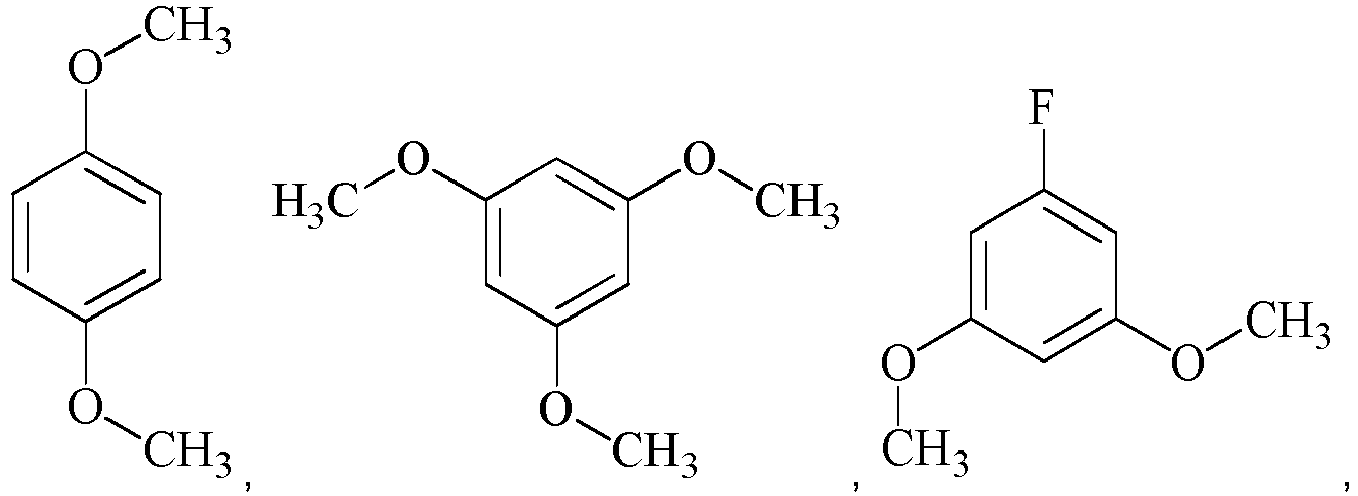


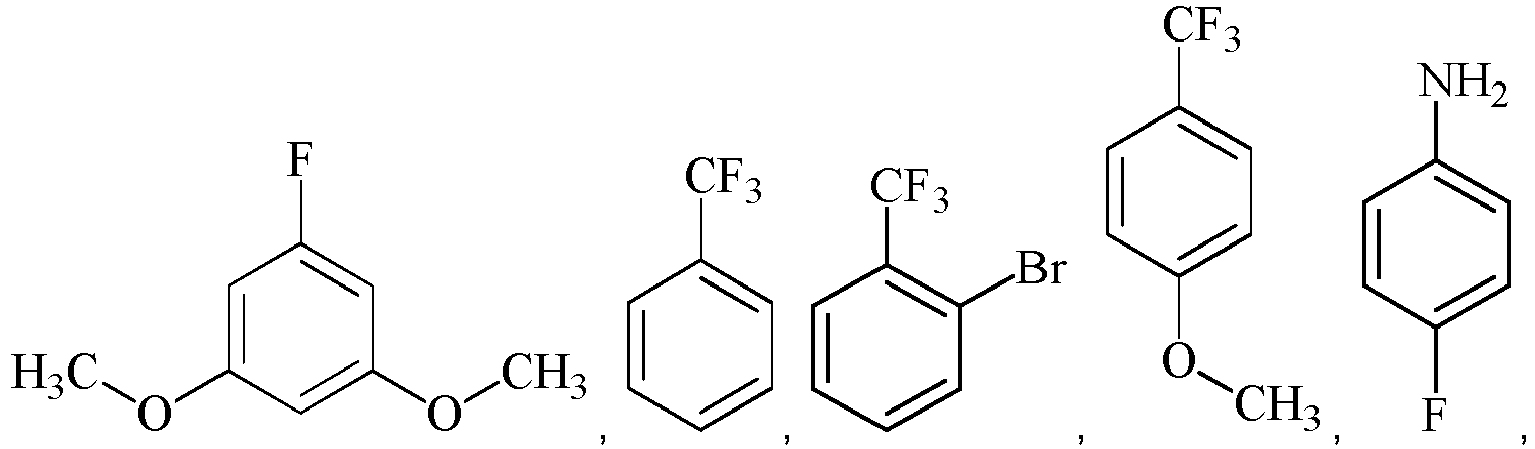


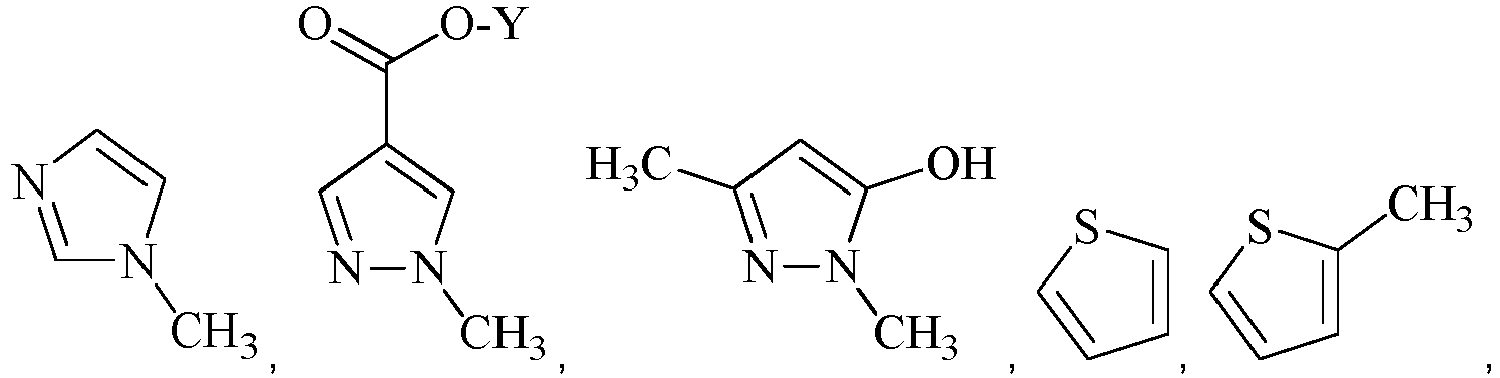

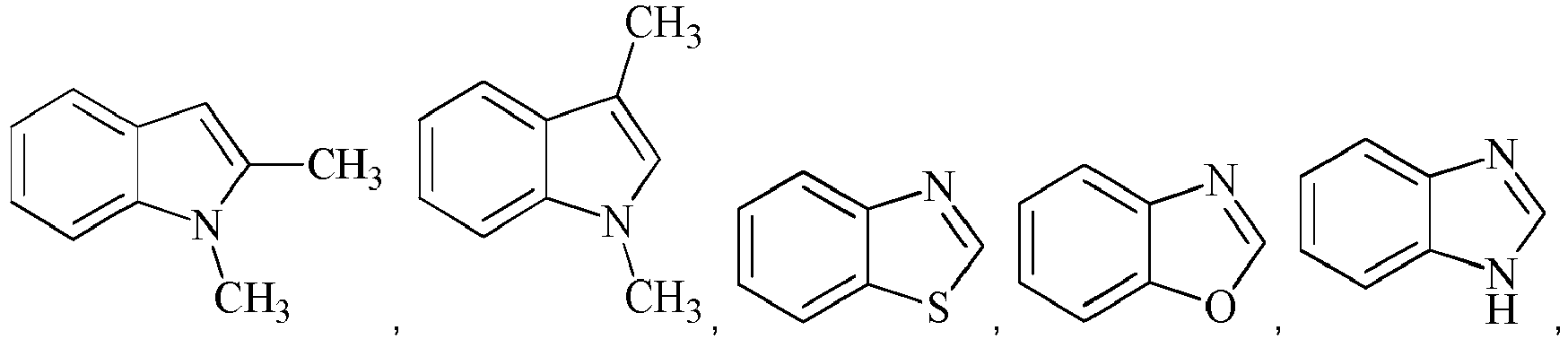

- Y is C1-6 alkyl;
- the ethene and the cyclohexene being unsubstituted or substituted by 1 or 2 substitutents selected from the group consisting of C1-10 alkyl, C1-4 alkoxy, N(R10)R11, CN, F, Cl, Br, I, CF3, (CH2)m-C(O)Y1, benzyl, phenyl and morpholine;
- the ethine being unsubstituted or substituted by 1 substitutent selected from the group consisting of C1-10 alkyl, C1-4 alkoxy, N(R10)R11, CN, F, Cl, Br, I, CF3, (CH2)m-C(O)Y1, benzyl and phenyl;
- with R10, R11, m and Y1 as defined herein, also with all their embodiments.
- Preferably, Y is methyl or ethyl;
more preferably Y is ethyl. - Embodiments of the substituted ethene are propene, ethene-1,1-diyldibenzene and
3,3-dimethylbut-1-ene:
preferably 3,3 dimethylbut 1 ene. - An embodiment of substituted cyclohexene is 4-(cyclohex-1-en-1-yl)morpholine.
- An embodiment of the substituted ethine is 1-octyne.
- An embodiment of COMPSUBST is compound of formula (PYRAZ)

- Y is methyl or ethyl;
- preferably Y is ethyl.
- Preferably, R3 is C1-15 alkylen, wherein in the alkylen chain at least one of the hydrogens is substituted by F;
more preferably, R3 is C1-10 alkylen, wherein in the alkylen chain at least one of the hydrogens is substituted by F. - Especially, FAHALIDE is selected from the group consisting of perfluoro C1-20 alkyl-X1, Br-(CF2)n3-Br, and F2HC-X1;
- more especially, FAHALIDE is selected from the group consisting of perfluoro C1-15 alkyl-X1, Br-(CF2)n3-Br or F2HC-X1;
- even more especially, FAHALIDE is selected from the group consisting of perfluoro C1-10 alkyl-X1, Br-(CF2)n3-Br or F2HC-X1;
- with n3 being an integer of 2 to 10;
- preferably, n3 is 2, 3, 4, 5, 6;
- more preferably, n3 is 2, 4 or 6;
- even more preferably, n3 is 4.
- In particular, FAHALIDE is selected from the group consisting of F21C10-I, F21C10-Br, F17C8-I, F17C8-Br, F13C6-I, F13C6-Br, F9C4-I, F9C4-Br, F7C3-I, F7C3-Br, F3C-I, F3C-Br, Br-(CF2)4-Br, F2HC-I, and F2HC-Br;
more in particular, FAHALIDE is selected from the group consisting of F21C10-I, F17C8-I, F9C4-I, F7C3-I, F3C-Br, and Br-(CF2)4-Br. - In one embodiment,
- X1
- is I;
- X2
- is H.
- In one embodiment,
R3 is perfluoroalkylen. - Preferably, from 0.1 to 20 mol%, more preferably from 0.5 to 15 mol %, even more preferably from 0.5 to 10 mol %, especially from 0.5 to 7.5 mol %, more especially from 0.5 to 6 mol %, even more especially from 0.75 to 5.5 mol %, of NICAT are used in the reaction, the mol % are based on the molar amount of FAHALIDE.
- Preferably, from 0.1 to 20 mol%, more preferably from 0.5 to 15 mol %, even more preferably from 1 to 12.5 mol %, especially from 2 to 12.5 mol %, of LIG are used in the reaction, the mol % are based on the molar amount of FAHALIDE.
- In case of FAHALIDE being in gaseous form at ambient temperature, then preferably FAHALIDE is used in the reaction in an amount which corresponds to a pressure of from 1 to 20 bar, more preferably from 1 to 15 bar, even more preferably from 1 to 10 bar, especially from 2 to 10 bar, more especially from 3 to 8 bar, even more especially from 4 to 8 bar, at ambient temperature.
- Preferably, from 1 to 20 mol equivalents, more preferably 1 to 15 mol equivalents, even more preferably from 2 to 15 mol equivalents, especially from 2 to 12.5 mol equivalents, more especially from 2 to 11 mol equivalents, even more especially from 2.5 to 11 mol equivalents, of COMPSUBST are used in the reaction, the mol equivalents are based on the molar amount of FAHALIDE.
- Preferably, from 0.1 to 10 mol equivalents, more preferably from 0.5 to 5 mol equivalents, even more preferably from 0.75 to 5 mol equivalents, especially from 0.85 to 5 mol equivalents, more especially from 0.95 to 5 mol equivalents, even more especially from 0.95 to 4 mol equivalents, in particular from 0.95 to 3 mol equivalents, of BAS are used in the reaction, the mol equivalents are based on the molar amount of FAHALIDE.
- The reaction temperature of the reaction is preferably from 20 to 200°C, more preferably from 30 to 175°C, even more preferably from 40 to 175°C, especially from 40 to 150°C.
- The reaction time of the reaction is preferably from 1 to 96 h, more preferably from 2 to 84 h, even more preferably from 3 to 80 h, especially from 4 to 76 h.
- Preferably, the reaction is done under inert atmosphere. Preferably, the inert atmosphere is achieved by the use if an inert gas preferably selected from the group consisting of argon, another noble gas, lower boiling alkane, nitrogen, more preferably nitrogen.
- The lower boiling alkane is preferably a C1-3 alkane, i.e. methane, ethane or propane.
- The reaction can be done in a closed system, it can be done at a pressure caused by the reaction mixture at the chosen temperature in a closed system, and/or caused by the pressure applied by COMPSUBST, in case that COMPSUBST is in gaseous form. It is also possible to apply pressure with said inert gas. It is also possible to carry out the reaction at ambient pressure.
- The reaction can be done in the presence of a an additive ADD;
ADD is selected from the group consisting of Zn, polymethylhydrosiloxane, and phenylboronic acid. - Preferably, from 1 to 40 mol%, more preferably from 1 to 30 mol %, even more preferably from 1.5 to 30 mol %, especially from 1.5 to 25 mol %, more especially from 2 to 25 mol %, of ADD are used in the reaction, the mol % are based on the molar amount of FAHALIDE.
- The reaction can be done in the presence of a an drying agent DRYAG;
- DRYAG is selected from the group consisting of molecular sieve and Na2SO4;
- preferably, the molecular sieve has a pore size of 4 angstrom.
- The molecular sieve is preferably a Na12[(AlO2)12(SiO2)12] ×H2O.
- Preferably, the amount of DRYAG used in the reaction is from 0.1 to 2 fold, more preferably from 0.1 to 1.5 fold, even more preferably from 0.1 to 1 fold, especially from 0.1 to 0.75 fold, more especially from 0.1 to 0.5 fold, based on the weight of FAHALIDE.
- Preferably, the reaction can be done in the presence of DRYAG when NICAT is Ni-cat1.
- The reaction can be done neat or in a solvent SOL, SOL is preferably selected from the group consisting of alkanes, chlorinated alkanes, ketones, ethers, esters, aliphatic nitrils, aliphatic amides, sulfoxides, C6F6, and mixtures thereof;
- preferably SOL is selected from the group consisting of C5-8 alkane, chlorinated C5-8 alkane, acetone, methylethylketone, diethylketone, MTBE, tetrahydrofuran, methyltetrahydrofuran, ethylacetate, butylacetate, valeronitril, acetonitrile, dimethylformamide, dimethylacetamide, N-methylpyrrolidone, dimethylsulfoxide, C6F6, and mixtures thereof;
- more preferably SOL is selected from the group consisting of acetone, methylethylketone, diethylketone, valeronitril, acetonitrile, dimethylsulfoxide, C6F6, and mixtures thereof;
- even more preferably SOL is selected from the group consisting of acetone, methylethylketone, diethylketone, dimethylsulfoxide, C6F6, and mixtures thereof;
- especially SOL is C6F6.
- It is also possible to use COMPSUBST and/or FAHALIDE simultaneously as solvent, meaning that the reaction is done neat.
- Preferably, the reaction is done neat or in C6F6 as SOL.
- The amount of SOL is preferably from 0.1 to 100 fold, more preferably from 1 to 50 fold, even more preferably from 1 to 25 fold, especially from 1 to 12.5 fold, more especially from 1 to 10 fold, even more especially from 3 to 10 fold, of the weight of FAHALIDE.
- After the reaction, FACOMPSUBST can be isolated by standard methods such as evaporation of volatile components, extraction, washing, drying, concentration, crystallization, chromatography and any combination thereof, which are known per se to the person skilled in the art.
-
- 4A-MS
- 4 Angstrom Molecular sieve, 70955-01-0, Na12[(AlO2)12(SiO2)12] ×H2O
- Conv
- Conversion in mol % with regard to COMPSUBST
- Sel
- Selectivity in mol % with regard to COMPSUBST
- Ex
- Example
- Ni(NO3)2
- was used as Ni(NO3)2 6H2O
- Proc
- Procedure
- T
- reaction temperature
- t
- reaction time
- A mixture of COMPSUBST, FAHALIDE, NICAT, LIG, BAS, ADD, DRYAG, solvent (all equivalents and amounts are specified in the experimental table) were placed in a thick-walled pressure tube (Ace pressure tube, Sigma-Adrich Art. Nr. Z564575). The gas atmosphere in the pressure tube was flushed with nitrogen, the tube was closed with a screw cap and heated (reaction temperature and reaction time are specified in Table 3). The resulting mixture was cooled to room temperature and diluted with dichloromethane (4 ml). The solids were removed by centrifugation (3000 rpm, 15 min). The obtained product solution was analyzed by quantitative GC analysis (internal standard hexadecane), 19F-NMR analysis using the internal standards 1,2-difluorobenzene or 1,4-difluorobenzene, or GC-MS.
- Isolation of the products was conducted by pipette column chromatography using FluoroFlash® reverse phase silica gel (Sigma Aldrich No.: 00866) and a gradient solvent elution (1. MeOH : H2O (4:1. 10 mL) 2. MeOH (100%, 10 mL) 3. acetone (100%, 10 mL) for long chains perfluoroalkyl chains (alkyl chain containing 10 or more carbon atoms) or by normal phase silical gel chromatography using silicagel (Sigma Aldrich No.: 236802) and a gradient solvent elution (1. Pentane Ether (100%) 2. Pentane : Diethylether (50%:50%, 10ml) for perfluoroalkyl chains containing less than 10 carbon atoms.
- Preformation of Ni-cat2 was done according to Standley, E. A. et al., A Broadly Applicable Strategy for Entry into Homogeneous Nickel(0) Catalysts from Air-Stable Nickel(II) Complexes, Organometallics 2014, 33, 2012:
NiCl2·6H2O (8.5 mmol, 2.02 g) and EtOH (25 mL) were placed in an argon flushed round bottom flask equipped with a septum and a reflux condenser (Schlenk-flask). Then dppf (8.5 mmol, 4.712 g) was added and the resulting reaction mixture refluxed for 30 min (temperature ca. 80°C), before cooled to 0°C for 10 min. The so formed solid was collected by filtration and washed twice with EtOH (2 times with 10 mL) and with diethylether (2 times with 10 mL). After drying of the solid under vacuum (ca. 20 mbar, room temperature) 4.98 g intermediate Ni-int1, (dppf)NiCl2, corresponding to 85 % yield was obtained as a deep green powder. - This Ni-int1 (6.81 mmol, 4.658 g) and 180 mL CH2Cl2 were placed in an argon flushed round bottom flask. The resulting solution was cooled to 0 °C, then o-tolylmagnesium chloride (6.81 mmol, 0.945 M in THF, 7.21 mL) was added dropwise with vigorous stirring. Near the end of the addition, the color of the solution changed from green to orange. This solution was stirred for an additional 15 min at 0°C after addition, then the solvent was evaporated under vaccum at room temperature. Then 25 ml MeOH were added and the reaction mixture was stirred for 5 min at room temperature. After cooling this mixture to 0°C, the solid was collected by filtration, the residue was washed with MeOH (2 times with 5 ml) and dried under vacuum (ca. 5 mbar) at room temperature to yield 4.63 g Ni-cat2, (dppf)Ni(o-tol)CI, corresponding to 92 % yield as a fine, bright yellow powder.
- 1H NMR (400 MHz, CD2Cl2): delta = 8.23 - 8.12 (m, 4H), 8.02 - 7.93 (m, 2H), 7.51 - 7.38 (m, 7H), 7.27 (td, J = 8.3, 2.0 Hz, 2H), 7.21 - 7.15 (m, 1H), 6.99 (t, J = 7.4 Hz, 1H), 6.76 (td, J = 8.2, 2.6 Hz, 2H), 6.66 - 6.54 (t, 2H), 6.43 (t, J = 7.4 Hz, 1H), 6.30 (t, J = 6.8 Hz, 1H), 6.10 (d, J = 7.1 Hz, 1H), 5.15 (s, 1H), 4.54 (m, 1H), 4.25 (s, 1H), 4.19 (s, 1H), 4.02 (d, J = 10.1 Hz, 2H), 3.52 (m, 1H), 3.33 (m, 1H), 2.44 (s, 3H).
- 31P NMR (162 MHz, CD2Cl2): delta = 29.51 (d, J = 25.9 Hz, 1P), 12.12 (d, J = 25.9 Hz, 1P).
- A mixture of FAHALIDE (1 eq, 0.2 mmol), Ni-cat2 (5 mol%, 0.01 mmol, 7.40 mg, prepared according to the procedure "Preformation of Ni-cat2"), COMPSUBST (10 eq, 2 mmol,) and BAS were placed in a thick-walled Ace pressure tube (Sigma-Aldrich Art. Nr. Z564575). The gas atmosphere in the pressure tube was flushed with nitrogen, the tube was closed with a screw cap and heated for the reaction time and at the reaction temperature specified in the tables. The resulting reaction mixture was cooled to room temperature and diluted with dichloromethane (4 ml). The solids were removed by centrifugation (3000 rpm, 15min). The obtained product solution was analyzed by quantitative 19F-NMR analysis using 1,4-difluorobenzene or 1,2-difluorobenzene as internal standard, quantitative GC analysis using hexadecane as internal standard, or GC-MS.
- Isolation of the products was conducted by pipette column chromatography using FluoroFlash® reverse phase silica gel (Sigma Aldrich No.: 00866) and a gradient solvent elution (1. MeOH : H2O (4:1. 10 mL) 2. MeOH (100%, 10 mL) 3. acetone (100%, 10 mL) for long chains perfluoroalkyl chains (alkyl chain containing 10 or more carbon atoms) or by normal phase silical gel chromatography using silicagel (Sigma Aldrich No.: 236802) and a gradient solvent elution (1. Pentane Ether (100%) 2. Pentane : Diethylether (50%:50%, 10ml) for perfluoroalkyl chains containing less than 10 carbon atoms.
- Details of the examples are given in Tables 1, 2 and 3.
Table 1 Ex Proc COMPSUBST FAHALIDE Product 1 1 


2 2 


3 1 


4 1 


5 1 


6 1 


7 1 


8 1 


9 1 

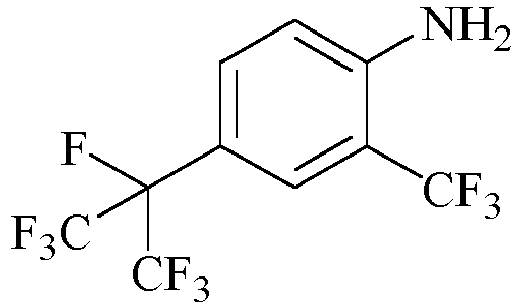
10 2 
C10F21I 
11 2 
C10F21I 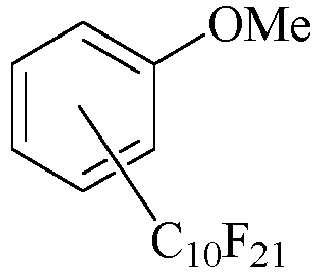
12 2 
C10F21I 
13 2 
C10F21I 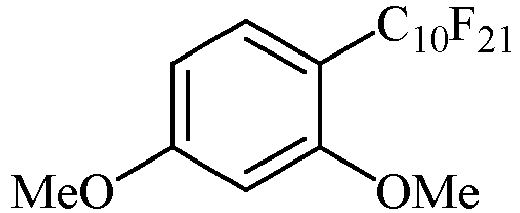
14 2 
C10F21I 
15 2 
C10F21I 
16 2 
C10F21I 
17 2 
C10F21I 
18 2 
C10F21I 
19 2 
C10F21I 
20 2 
C10F21I 
21 2 
C10F21I 
22 2 
C10F21I 
23 2 
C10F21I 
24 2 
C10F21I 
25 2 
C10F21I 
26 2 
C10F21I 
27 2 
C10F21I 
28 2 
C10F21I 
29 2 
C10F21I 
30 2 
C8F17I 
31 2 
C4F9I 
32 22 


33 2 
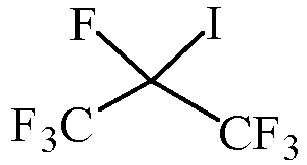

34 2 


35 2 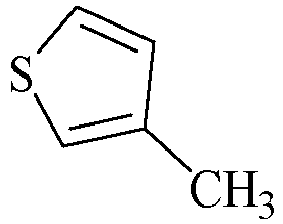


36 2 


37 2 


38 2 
CF3Br 
39 2 
C10F21I 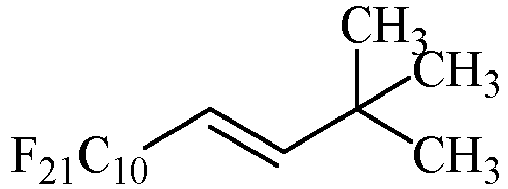
40 2 
C4F9I 
41 2 
C8F17I 
42 2 


43 2 


Table 2 Ex Proc COMPSUBST Amount FAHALIDE Amount NICAT LIG ADD BAS 1 1 0.5 ml 0.5 mmol NiCl2(DME) DPEPhos - Cs2CO3 4 mmol 150 mg 5 mol% 10 mol% 1 eq 1 eq 2 2 0.5 ml 0.5 mmol Ni-cat2 - - Cs2CO3 4 mmol 150 mg 5 mol% 1 eq 1 eq 3 1 0.25 ml 0.5 mmol NiCl2(DME) DPEPhos - Cs2CO3 2 mmol 150 mg 5 mol% 10 mol% 1eq 1 eq 4 1 0.25 ml 0.5 mmol NiCl2(DME) DPEPhos - K3PO4 2 mmol 150 mg 5 mol% 10 mol% 1eq 1 eq 5 1 0.3 ml 0.5 mmol Ni(NO3)2 DPEPhos Zn K3PO4 2.4 mmol 150 mg 5 mol% 6 mol% 15 mol% 1eq 1 eq 6 1 0.6 ml 0.5 mmol Ni(NO3)2 DPEPhos Zn K3PO4 4.8 mmol 150 mg 2.5 mol% 3 mol% 2.5 mol% 1eq 1 eq 7 1 0.3 ml 0.5 mmol Ni(NO3)2 DPEPhos Zn K3PO4 2.4 mmol 150 mg 3 mol% 3 mol% 2.5 mol% 1eq 1 eq 8 1 0.4 ml 1 mmol Ni(NO3)2 DPEPhos Zn K3PO4 3 mmol 300 mg 3 mol% 3 mol% 5 mol% 1eq 1 eq 9 1 0.2 ml 0.5 mmol Ni(NO3)2 Ph3P PHMS K3PO4 1.6 mmol 150 mg 3 mol% 6 mol% 20 mol% 1eq 1 eq 10 2 0.5 ml 0.2 mmol Ni-cat2 - - Cs2CO3 130 mg 5 mol% 1.5 eq 1 eq 11 2 0.5 ml 0.2 mmol Ni-cat2 - - Cs2CO3 130 mg 5 mol% 1.5 eq 1 eq 12 2 0.5 ml 0.2 mmol Ni-cat2 - - Cs2CO3 130 mg 5 mol% 1.5 eq 1 eq 13 2 0.5 ml 0.2 mmol Ni-cat2 - - Cs2CO3 130 mg 5 mol% 1.5 eq 1 eq 14 2 0.5 ml 0.2 mmol Ni-cat2 - - Cs2CO3 130 mg 5 mol% 1.5 eq 1 eq 15 2 0.5 ml 0.2 mmol Ni-cat2 - - Cs2CO3 130 mg 5 mol% 1.5 eq 1 eq 16 2 0.5 ml 0.2 mmol Ni-cat2 - - Cs2CO3 130 mg 5 mol% 1.5 eq 1 eq 17 2 0.5 ml 0.2 mmol Ni-cat2 - - Cs2CO3 130 mg 5 mol% 1.5 eq 1 eq 18 2 0.5 ml 0.2 mmol Ni-cat2 - - Cs2CO3 130 mg 5 mol% 1.5 eq 1 eq 19 2 0.5 ml 0.2 mmol Ni-cat2 - - Cs2CO3 130 mg 5 mol% 1.5 eq 1 eq 20 2 0.5 ml 0.2 mmol Ni-cat2 - - Cs2CO3 130 mg 5 mol% 1.5 eq 1 eq 21 2 0.5 ml 0.2 mmol Ni-cat2 - - Cs2CO3 130 mg 5 mol% 1.5 eq 1 eq 22 2 0.5 ml 0.2 mmol Ni-cat2 - - Cs2CO3 130 mg 5 mol% 1.5 eq 1 eq 23 2 0.5 ml 0.2 mmol Ni-cat2 - - Cs2CO3 130 mg 5 mol% 1.5 eq 1 eq 24 2 0.5 ml 0.2 mmol Ni-cat2 - - Cs2CO3 130 mg 5 mol% 1.5 eq 1 eq 25 2 0.5 ml 0.2 mmol Ni-cat2 - - Cs2CO3 130 mg 5 mol% 1.5 eq 1 eq 26 2 0.5 ml 0.2 mmol Ni-cat2 - - Cs2CO3 130 mg 5 mol% 1.5 eq 1 eq 27 2 0.5 ml 0.2 mmol Ni-cat2 - - Cs2CO3 130 mg 5 mol% 1.5 eq 1 eq 28 2 0.5 ml 0.2 mmol Ni-cat2 - - Cs2CO3 130 mg 5 mol% 1.5 eq 1 eq 29 2 0.5 ml 0.2 mmol Ni-cat2 - - Cs2CO3 130 mg 5 mol% 1.5 eq 1 eq 30 2 0.5 ml 0.2 mmol Ni-cat2 - - Cs2CO3 110 mg 5 mol% 1.5 eq 1 eq 31 2 0.5 ml 0.5 mmol Ni-cat2 - - Cs2CO3 170 mg 5 mol% 1.5 eq 1 eq 32 22 0.5 ml 0.5 mmol Ni-cat2 - - Cs2CO3 150 mg 5 mol% 1.5 eq 1 eq 33 2 170 mg 0.5 mmol Ni-cat2 - - Cs2CO3 1 mmol 150 mg 5 mol% 1.5 eq 2 eq 1 eq 34 2 0.5 ml 0.5 mmol Ni-cat2 - - Cs2CO3 150 mg 5 mol% 1.5 eq 1 eq 35 2 0.5 ml 0.5 mmol Ni-cat2 - - Cs2CO3 150 mg 5 mol% 1.5 eq 1 eq 36 2 111 mg 0.5 mmol Ni-cat2 - - Cs2CO3 1 mmol 150 mg 5 mol% 1.5 eq 2 eq 1 eq 37 2 160 mg 0.5 mmol Ni-cat2 - - Cs2CO3 1 mmol 150 mg 5 mol% 1.5 eq 2 eq 1 eq 38 2 0.5 mmol 5 bar Ni-cat2 - PhB-acid Cs2CO3 40 mg 5 mol% 10 mol% 1.5 eq 1 eq 39 2 0.5 ml 0.2 mmol Ni-cat2 - - NaH 325 mg 130 mg 5 mol% 2 eq 4 eq 1 eq 40 2 0.5 ml 0.5 mmol Ni-cat2 - - NaOtBu 325 mg 175 mg 1 mol% 2 eq 4 eq 1 eq 41 2 0.5 ml 0.5 mmol Ni-cat2 - - NaOtBu 325 mg 275 mg 1 mol% 2 eq 4 eq 1 eq 42 2 0.5 ml 0.5 mmol Ni-cat2 - - NaOtBu 325 mg 180 mg 1 mol% 2 eq 4 eq 1 eq 43 2 0.5 ml 0.5 mmol Ni-cat2 - - NaOtBu 325 mg 150 mg 1 mol% 2 eq 4 eq 1 eq Table 3 Ex Proc DRYAG Solvent T t Conv Sel Yield Remarks 1 1 4A-MS neat 50°C 20h 100% 65% 63% o-isomer: +21% 50mg GCMS 19F-NMR 2 2 4A-MS neat 50°C 20h 97% 65% 63% o-isomer: +21% 50mg GCMS 19F-NMR 3 1 4A-MS neat 50°C 24h 89% 60% 53% o-isomer: +21% 25mg 5% PfP-H GCMS 19F-NMR 4 1 4A-MS neat 50°C 24h 65% 55% 36% o-isomer: +15% 25mg 4% PfP-H GCMS 19F-NMR 5 1 4A-MS neat 100°C 6h 98% 73% 72% o-isomer: +17% 30mg 1% PfP-H GCMS 19F-NMR 6 1 4A-MS neat 100°C 72h 95% 81% 77% o-isomer: +8% 50mg GCMS 19F-NMR 7 1 4A-MS neat 100°C 16h 84% 85% 71% o-isomer: +5% 25mg 1% PfP-H GCMS 19F-NMR 8 1 4A-MS neat 100°C 16h 99% 68% 67% o-isomer: +20% 40mg 1% PfP-H GCMS 19F-NMR 9 1 Na2SO4 neat 90°C 24h 98% 72% 71% o-isomer: +4% 25mg 3% PfP-H GCMS 19F-NMR 10 2 - neat 100°C 16h 97% 77% 75% 19F-NMR 11 2 - neat 130°C 16h 91% 2-isomer:35% 3-isomer:15% 4-isomer:40% 19F-NMR 12 2 - neat 120°C 16h 55% 2-isomer:25% 3-isomer:9% 4-isomer:21% 19F-NMR 13 2 neat 100°C 16h 86% 19F-NMR 14 2 neat 100°C 16h 73% 19F-NMR 15 2 neat 100°C 24h 73% 2-isomer:48% 4-isomer:25% 19F-NMR 16 2 neat 130°C 16h 54% 19F-NMR 17 2 neat 130°c 17h 66% 3-isomer:18% 4-isomer:48% 19F-NMR 18 2 neat 120°C 16h 78% 19F-NMR 19 2 neat 100°C 16h 70% 2-isomer:19% 4-isomer:51% 19F-NMR 20 2 neat 100°C 16h 95% 3-isomer:19% 6-isomer:51% 19F-NMR 21 2 neat 100°C 30h 96% 3-isomer:10% 4-isomer:86% 19F-NMR 22 2 neat 120°C 24h 74% 19F-NMR 23 2 neat 130°C 16h 73% 19F-NMR 24 2 neat 130°C 26h 59% 2-isomer:26% 3-isomer:5% 4-isomer:28% 19F-NMR 25 2 - neat 130°C 16h 96% 19F-NMR 26 2 - neat 80°C 16h 86% 19F-NMR 27 2 - neat 120°C 16h 55% 19F-NMR 28 2 - neat 130°C 17h 61% 2-isomer:23% 4-isomer:17% 5-isomer:21% 19F-NMR 29 2 - neat 130°C 26h 51% 1-isomer:40% 2-isomer:11% 19F-NMR 30 2 - neat 120°C 16h 76% 19F-NMR 31 2 - neat 120°C 22h 50% 19F-NMR 32 22 - neat 100°C 16h 54% 19F-NMR 33 2 - C6F6 0.5ml 100°C 16h 52% 19F-NMR 34 2 - neat 100°C 16h 60% 19F-NMR 35 2 - neat 100°C 16h 80% 2-isomer:41% 5-isomer:39% 19F-NMR 36 2 - C6F6 100°C 16h 80% 19F-NMR 0.5ml 37 2 - C6F6 100°C 16h 85% 19F-NMR 0.5ml 38 2 - C6F6 100°C 16h 72% 19F-NMR 1 ml 39 2 - neat 80°C 16h 100% 64% 64% 19F-NMR 40 2 - neat 50°C 16h 73% 19F-NMR 41 2 - neat 50°C 16h 89% 19F-NMR 42 2 - neat 50°C 16h 69% 19F-NMR 43 2 - neat 50°C 16h 61% 19F-NMR -

- The entry 10 in Table 1 of Loy, R.N., et al., Organic Letters 2011, 13, 2548-2551, was repeated according to the detailed procedure given in the Supporting Information for said article, which is described under "Optimization procedure" on page S3 in connection with entry 9 in Table S4 on page S5.
- The phosphine was BINAP.
- [Pd] was Pd2dba3.
- The base was Cs2CO3.
- The alkylhalogenid was perfluorohexyl bromide instead of perfluorohexyl iodide.
- To a screw cap 1 dram vial was added base (0.4 mmol, 2 equiv), [Pd] (0.02 mmol, 10 mol %) and phosphine (0.04-0.08 mmol, 20-40 mol %). Benzene (1 mL) and perfluorohexyl bromide (43 microL, 0.2 mmol, 1 equiv) were added, and the resulting mixture was sealed with a Teflon-lined cap and heated in an aluminum reaction block with vigorous stirring for 15 h at 80°C. The reaction mixture was cooled to 23°C and chlorobenzene (20 microL) was added as a GC internal standard. An aliquot (ca. 100 microL) was removed from the crude reaction mixture and passed through a plug of Celite, eluting with EtOAc (2 mL). This sample was then analyzed by GC, and the yield was determined by comparison to a calibration against the chlorobenzene internal standard.
- A yield of less than 1% was measured.
Claims (12)
- A method for the preparation of a fluoro alkylated compound FACOMPSUBST by a reaction of a compound COMPSUBST with a fluoro alkyl halide FAHALIDE by homogeneous catalysis using a Ni catalyst NICAT in the presence of a base BAS;
whereinNICAT is Ni-cat1 or Ni-cat2;Ni-cat1 is a combination of a nickel salt NISALT with a ligand LIGNISALT is NiCl2 or Ni(NO3)2;LIG is selected from the group consisting of compound of formula (DPEPhos), compound of formula (dppb) and Ph3P;
 Ni-cat2 is compound of formula (Ni-cat2);
 BAS is selected from the group consisting of Cs2CO3, CsHCO3, K3PO4, NaH and NaOtBu;FAHALIDE is a compound of formula (FAHALIDE);
X2-R3-X1 (FAHALIDE)
R3 is C1-20 alkylen, wherein in the alkylen chain at least one of the hydrogens is substituted by F;X1 is Br or I;X2 is Br or H;COMPSUBST is selected from the group consisting of a compound COMPSUBST-I, ethene, cyclohexene, ethine, and polystyrene;the ethene and the cyclohexene being unsubstituted or substituted by 1, 2 or 3 substitutents selected from the group consisting of C1-10 alkyl, C3-8 cycloalkyl, C1-4 alkoxy, N(R10)R11, CN, NO, NO2, F, Cl, Br, I, CF3, (CH2)m-C(O)Y1, S(O)2R50, CH=C(H)R28,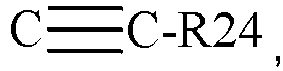 the ethine being unsubstituted or substituted by 1 substitutent selected from the group consisting of C1-10 alkyl, C3-8 cycloalkyl, C1-4 alkoxy, N(R10)R11, CN, NO, NO2, F, Cl, Br, I, CF3, (CH2)m-C(O)Y1, S(O)2R50, CH=C(H)R28,
 COMPSUBST-I is a compound of formula (COMPSUBST-I);
RINGA (COMPSUBST-I)
RINGA is an aromatic 5 or 6 membered carbocyclic or heterocyclic ring,when RINGA is a heterocyclic ring, then RINGA has 1, 2 or 3 identical or different endocyclic heteroatoms independently from each other selected from the group consisting of N, O and S,when RINGA is a 5 membered ring, then RINGA is unsubstituted or substituted by 1, 2, 3 or 4 identical or different subsitutents,when RINGA is a 6 membered ring then RINGA is unsubstituted or substituted by 1, 2, 3, 4 or 5 identical or different subsitutents,any of said subsitutents of RINGA is independently from any other of said substitutents of RINGA selected from the group consisting of C1-10 alkyl, C3-8 cycloalkyl, C1-4 alkoxy, OH, N(R10)R11, CN, NH-OH, NO, NO2, F, Cl, Br, I, CF3, (CH2)m-C(O)Y1, S(O)2R50, CH=C(H)R28, RINGA can be condensed with a ring RINGB, RINGB is a 5 or 6 membered carbocyclic or heterocyclic ring,when RINGB is a heterocyclic ring, is contains 1, 2 or 3 identical or different endocyclic heteroatoms independently from each other selected from the group consisting of N, O and S;when RINGB is a 5 membered ring, then RINGB is unsubstituted or substituted by 1, 2 or 3 identical or different subsitutents,when RINGB is a 6 membered ring then RINGB is unsubstituted or substituted by 1, 2, 3 or 4 identical or different subsitutents,any of said subsitutents of RINGB is independently from any other of said substitutents of RINGB selected from the group consisting of C1-10 alkyl, C3-8 cycloalkyl, C1-4 alkoxy, OH, N(R17)R18, CN, NH-OH, NO, NO2, F, Cl, Br, I, CF3, (CH2)n-C(O)Y2, S(O)2R51, CH=C(H)R38,
 any of said C1-10 alkyl substitutent of RINGA or RINGB is unsubstituted or substituted with 1, 2, 3, 4 or 5 identical or different substituents selected from the group consisting of halogen, OH, O-C(O)-C1-5 alkyl, O-C1-10 alkyl, S-C1-10 alkyl, S(O)-C1-10 alkyl, S(O2)-C1-10 alkyl, O-C1-6 alkylen-O-C1-6 alkyl, C3-8 cycloalkyl and 1,2,4-triazolyl;any of said benzyl, phenyl and naphthyl substitutent of RINGA or RINGB is independently from each other unsubstituted or substituted with 1, 2, 3, 4 or 5 identical or different substituents selected from the group consisting of halogen, C1-4 alkoxy, NO2 and CN;m and n are identical or different and independently from each other 0, 1, 2, 3, 4, 5, 6, 7, 8, 9 or 10;Y1 and Y2 are identical or different and independently from each other selected from the group consisting of H, OH, C(R14)(R15)R16, C1-6 alkyl, O-C1-6 alkyl, phenyl, benzyl, O-phenyl, O-C1-6 alkylen-O-C1-6 alkyl and N(R19)R20;
R14, R15 and R16 are identical or different and independently from each other selected from the group consisting of H, F, Cl and Br;R10, R11, R17, R18, R19 and R20 are identical or different and are independently from each other H or C1-6 alkyl, or R10 and R11, R17 and R18 or R19 and R20 represent together a tetramethylene or a pentamethylene chain;R50 and R51 are identical or different and independently from each other selected from the group consisting of OH, C1-6 alkyl and C1-6 alkoxy;R24, R34, R28 and R38 are identical or different and independently from each other selected from the group consisting of H, C1-10 alkyl, C(R25)(R26)-O-R27;
R25, R26 and R27 are identical or different and independently from each other selected from the group consisting of H and C1-10 alkyl. - Method according to claim 1, wherein
LIG is compound of formula (DPEPhos) or Ph3P. - Method according to claim 1 or 2, wherein
BAS is selected from the group consisting of Cs2CO3, K3PO4, NaH and NaOtBu. - Method according to one or more of claims 1 to 3, whereinCOMPSUBST is selected from the group consisting of compound COMPSUBST-I, ethene, cyclohexene, ethine, and polystyrene;the ethene and the cyclohexene being unsubstituted or substituted by 1 or 2 substitutents selected from the group consisting of C1-10 alkyl, C3-6 cycloalkyl, C1-4 alkoxy, N(R10)R11, CN, F, Cl, Br, I, CF3, (CH2)m-C(O)Y1, S(O)2R50, benzyl, phenyl, naphthyl and morpholine;the ethine being unsubstituted or substituted by 1 substitutent selected from the group consisting of C1-10 alkyl, C3-6 cycloalkyl, C1-4 alkoxy, N(R10)R11, CN, F, Cl, Br, I, CF3, (CH2)m-C(O)Y1, S(O)2R50, benzyl, phenyl and naphthyl;with COMPSUBST-I being selected from the group consisting of



 with COMPSUBST-I being unsubstituted or substitutedby 1, 2, 3 or 4 in case of COMPSUBST-I being a monocyclic compound with 5 endocyclic atoms,by 1, 2, 3, 4 or 5 in case of COMPSUBST-I being a monocyclic compound with 6 endocyclic atoms,by 1, 2, 3, 4, 5 or 6 in case of COMPSUBST-I being a bicyclic compound wherein a 5-membered and a 6-membered ring are ortho-fused,by 1, 2, 3, 4, 5, 6 or 7 in case of COMPSUBST-I being a bicyclic compound wherein two 6-membered rings are ortho-fused,identical or different substituents independently from each other selected from the group consisting of C1-10 alkyl, C3-8 cycloalkyl, C1-4 alkoxy, OH, C(H)=O, N(R10)R11, CN, NH-OH, NO, NO2, F, Cl, Br, I, CF3, (CH2)m-C(O)Y1, S(O)2R50, CH=C(H)R28, C≡C-R24 , benzyl, phenyl and naphthyl;said C1-10 alkyl substitutent of COMPSUBST-I is unsubstituted or substituted with 1, 2, 3, 4 or 5 identical or different substituents selected from the group consisting of halogen, OH, O-C(O)-C1-5 alkyl, O-C1-10 alkyl, S-C1-10 alkyl, S(O)-C1-10 alkyl, S(O2)-C1-10 alkyl, O-C1-6 alkylen-O-C1-6 alkyl, C3-8 cycloalkyl and 1,2,4-triazolyl;said benzyl, phenyl and naphthyl substitutents of COMPSUBST-I are independently from each other unsubstituted or substituted with 1, 2, 3, 4 or 5 identical or different substituents selected from the group consisting of halogen, C1-4 alkoxy, NO2 and CN;with R10, R11, m, Y1, R28, R50, R24 and halogen as defined in claim 1.
 - Method according to one or more of claims 1 to 4, whereinCOMPSUBST-I is unsubstituted or substitutedby 1, 2 or 3 in case of COMPSUBST-I being a monocyclic compound with 5 endocyclic atoms,by 1, 2, 3, 4 or 5 in case of COMPSUBST-I being a monocyclic compound with 6 endocyclic atoms,by 1, 2, 3 or 4 in case of COMPSUBST-I being a bicyclic compound wherein a 5-membered and a 6-membered ring are ortho-fused,by 1, 2, 3, 4 or 5 in case of COMPSUBST-I being a bicyclic compound wherein two 6-membered rings are ortho-fused,identical or different substituents independently from each other selected from the group consisting of C1-4 alkyl, C1-4 alkoxy, OH, C(H)=O, N(R10)R11, CN, F, Cl, Br, CF3, (CH2)m-C(O)Y1, and S(O)2R50;said C1-4 alkyl substitutent of COMPSUBST-I is unsubstituted or substituted with 1, 2 or 3 identical or different substituents selected from the group consisting of halogen;with R10, R11, m, Y1, R50 and halogen as defined in claim 1.
- Method according to one or more of claims 1 to 5, wherein COMPSUBST is selected from the group consisting of


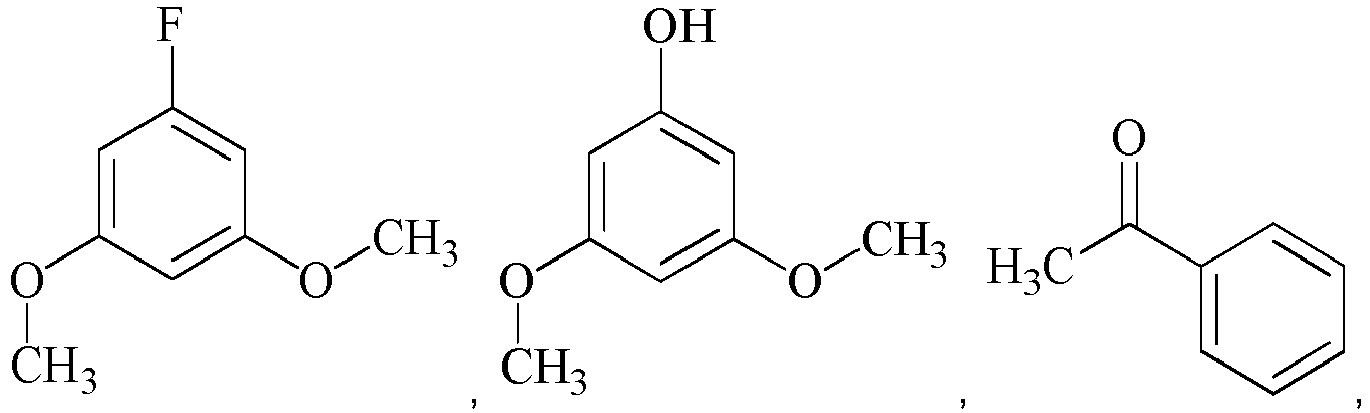


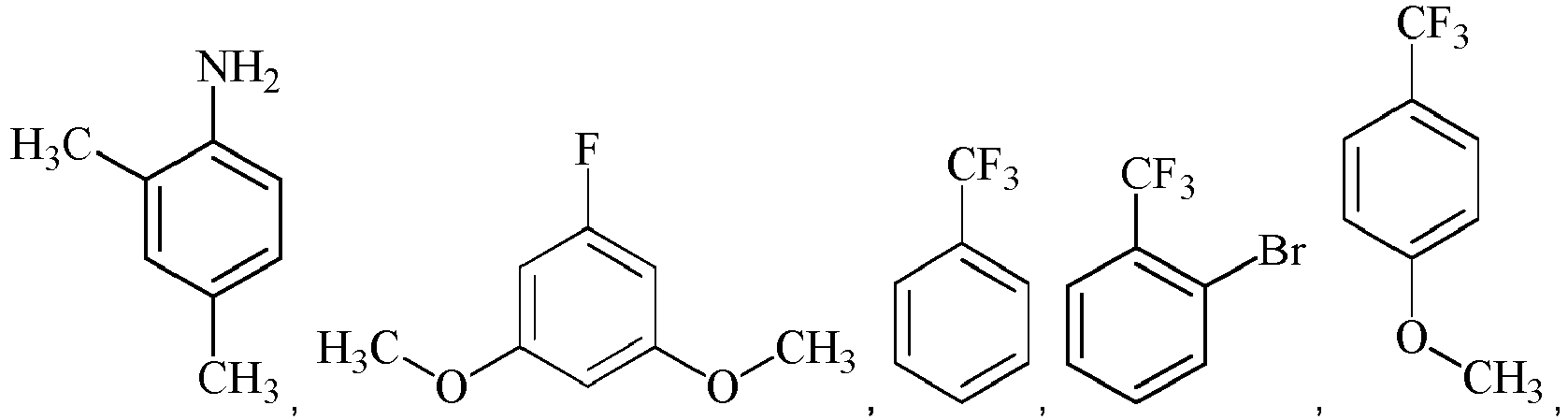

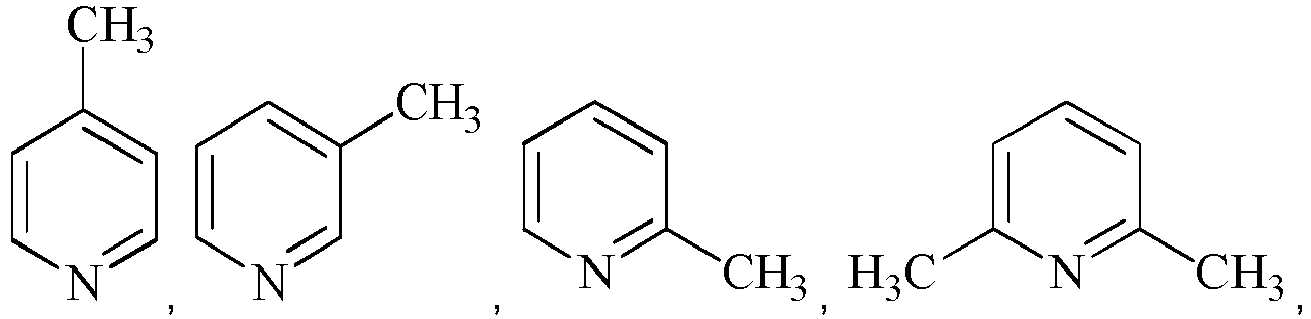


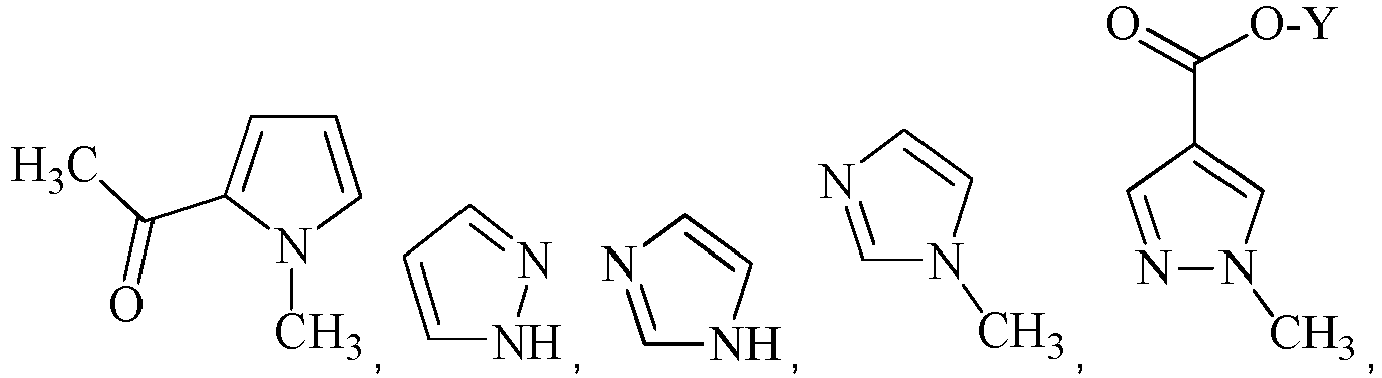


 Y is C1-6 alkyl;the ethene and the cyclohexene being unsubstituted or substituted by 1 or 2 substitutents selected from the group consisting of C1-10 alkyl, C1-4 alkoxy, N(R10)R11, CN, F, Cl, Br, I, CF3, (CH2)m-C(O)Y1, benzyl, phenyl and morpholine;the ethine being unsubstituted or substituted by 1 substitutent selected from the group consisting of C1-10 alkyl, C1-4 alkoxy, N(R10)R11, CN, F, Cl, Br, I, CF3, (CH2)m-C(O)Y1, benzyl and phenyl;with R10, R11, m and Y1 as defined in claim 1.
 - Method according to one or more of claims 1 to 6, whereinFAHALIDE is selected from the group consisting of perfluoro C1-20 alkyl-X1, Br-(CF2)n3-Br, and F2HC-X1;with n3 being an integer of 2 to 10.
- Method according to one or more of claims 1 to 7, wherein
n3 is 2, 3, 4, 5, 6. - Method according to one or more of claims 1 to 8, wherein
FAHALIDE is selected from the group consisting of F21C10-I, F21C10-Br, F17C8-I, F17C8-Br, F13C6-I, F13C6-Br, F9C4-I, F9C4-Br, F7C3-I, F7C3-Br, F3C-I, F3C-Br, Br-(CF2)4-Br, F2HC-I, and F2HC-Br. - Method according to one or more of claims 1 to 9, whereinthe reaction is done in the presence of a an additive ADD;ADD is selected from the group consisting of Zn, polymethylhydrosiloxane, and phenylboronic acid.
- Method according to one or more of claims 1 to 10, whereinthe reaction is done in the presence of a an drying agent DRYAG;DRYAG is selected from the group consisting of molecular sieve and Na2SO4.
- Method according to one or more of claims 1 to 11, wherein
the reaction is done neat or in a solvent SOL, SOL is preferably selected from the group consisting of alkanes, chlorinated alkanes, ketones, ethers, esters, aliphatic nitrils, aliphatic amides, sulfoxides, C6F6, and mixtures thereof.
Applications Claiming Priority (3)
| Application Number | Priority Date | Filing Date | Title |
|---|---|---|---|
| US201962807899P | 2019-02-20 | 2019-02-20 | |
| EP19158332 | 2019-02-20 | ||
| PCT/EP2020/054542 WO2020169768A1 (en) | 2019-02-20 | 2020-02-20 | Method for preparation of fluoro alkylated compounds by homogeneous ni catalysis |
Publications (2)
| Publication Number | Publication Date |
|---|---|
| EP3911658A1 EP3911658A1 (en) | 2021-11-24 |
| EP3911658B1 true EP3911658B1 (en) | 2023-01-11 |
Family
ID=69699864
Family Applications (1)
| Application Number | Title | Priority Date | Filing Date |
|---|---|---|---|
| EP20707045.9A Active EP3911658B1 (en) | 2019-02-20 | 2020-02-20 | Method for preparation of fluoro alkylated compounds by homogeneous ni catalysis |
Country Status (6)
| Country | Link |
|---|---|
| US (1) | US11530175B2 (en) |
| EP (1) | EP3911658B1 (en) |
| JP (1) | JP7075544B2 (en) |
| CN (1) | CN113454096A (en) |
| IL (1) | IL285731B (en) |
| WO (1) | WO2020169768A1 (en) |
Families Citing this family (2)
| Publication number | Priority date | Publication date | Assignee | Title |
|---|---|---|---|---|
| CN115073300B (en) | 2021-03-10 | 2024-04-05 | 江西天宇化工有限公司 | 4- (perfluoropropane-2-yl) -2-trifluoromethyl aniline and preparation method and application thereof |
| CN116514679A (en) * | 2023-04-03 | 2023-08-01 | 南京工业大学 | Palladium-catalyzed sp with low-cost and high-efficiency quaternary ammonium nitrate as oxidant 2 And sp (sp) 3 Carbon hydrogen bond alkenylation method |
Family Cites Families (3)
| Publication number | Priority date | Publication date | Assignee | Title |
|---|---|---|---|---|
| US3419595A (en) * | 1965-03-05 | 1968-12-31 | Minnesota Mining & Mfg | Fluorocarbon fluoroalkanesulfonates |
| EP2606048A4 (en) * | 2010-08-20 | 2014-01-15 | Univ Illinois | METHODS AND REAGENTS OF FLUOROALKYLATION |
| US10968187B2 (en) * | 2017-07-28 | 2021-04-06 | Lonza Solutions Ag | Method for preparation of alkylated or fluoro, chloro and fluorochloro alkylated compounds by heterogeneous cobalt catalysis |
-
2020
- 2020-02-20 EP EP20707045.9A patent/EP3911658B1/en active Active
- 2020-02-20 US US17/424,193 patent/US11530175B2/en active Active
- 2020-02-20 WO PCT/EP2020/054542 patent/WO2020169768A1/en not_active Ceased
- 2020-02-20 JP JP2021547422A patent/JP7075544B2/en not_active Expired - Fee Related
- 2020-02-20 CN CN202080014906.2A patent/CN113454096A/en active Pending
-
2021
- 2021-08-19 IL IL285731A patent/IL285731B/en unknown
Also Published As
| Publication number | Publication date |
|---|---|
| CN113454096A (en) | 2021-09-28 |
| JP2022516813A (en) | 2022-03-02 |
| EP3911658A1 (en) | 2021-11-24 |
| US11530175B2 (en) | 2022-12-20 |
| IL285731B (en) | 2022-06-01 |
| US20220041530A1 (en) | 2022-02-10 |
| IL285731A (en) | 2021-10-31 |
| JP7075544B2 (en) | 2022-05-25 |
| WO2020169768A1 (en) | 2020-08-27 |
Similar Documents
| Publication | Publication Date | Title |
|---|---|---|
| US11530175B2 (en) | Method for preparation of fluoro alkylated compounds by homogeneous Ni catalysis | |
| Coleman et al. | The Reaction of Potassium Amide in Liquid Ammonia with Diarylbromoethenes | |
| KR101810378B1 (en) | Method for preparation of fluoro alkylated compounds by homogeneous catalysis | |
| KR101763552B1 (en) | Method for preparation of alkylated or fluoro, chloro and fluorochloro alkylated compounds by heterogeneous catalysis | |
| US10654779B2 (en) | Substituted bis(trifluorovinyl)benzene compound | |
| US11332456B2 (en) | Method for preparation of fluoro alkylated 1,4-dioxene by homogeneous Ni catalysis | |
| EP3645484B1 (en) | Method for preparation of alkylated or fluoro, chloro and fluorochloro alkylated compounds by heterogeneous cobalt catalysis | |
| HK40058174A (en) | Method for preparation of fluoro alkylated compounds by homogeneous ni catalysis | |
| US5741938A (en) | Production of alkyl aralkyl keones from allylic-aralkenyl secondary alcohols | |
| US2297728A (en) | Ethers of substituted phenyl | |
| EP3983381A1 (en) | Method for fluoroalkylation of enamines | |
| HK40054959A (en) | Method for preparation of fluoro alkylated 1,4-dioxene by homogeneous ni catalysis | |
| HK1230161A1 (en) | Method for preparation of alkylated or fluoro, chloro and fluorochloro alkylated compounds by heterogeneous catalysis | |
| HK1230161B (en) | Method for preparation of alkylated or fluoro, chloro and fluorochloro alkylated compounds by heterogeneous catalysis |
Legal Events
| Date | Code | Title | Description |
|---|---|---|---|
| STAA | Information on the status of an ep patent application or granted ep patent |
Free format text: STATUS: UNKNOWN |
|
| STAA | Information on the status of an ep patent application or granted ep patent |
Free format text: STATUS: THE INTERNATIONAL PUBLICATION HAS BEEN MADE |
|
| PUAI | Public reference made under article 153(3) epc to a published international application that has entered the european phase |
Free format text: ORIGINAL CODE: 0009012 |
|
| STAA | Information on the status of an ep patent application or granted ep patent |
Free format text: STATUS: REQUEST FOR EXAMINATION WAS MADE |
|
| 17P | Request for examination filed |
Effective date: 20210820 |
|
| AK | Designated contracting states |
Kind code of ref document: A1 Designated state(s): AL AT BE BG CH CY CZ DE DK EE ES FI FR GB GR HR HU IE IS IT LI LT LU LV MC MK MT NL NO PL PT RO RS SE SI SK SM TR |
|
| RAP3 | Party data changed (applicant data changed or rights of an application transferred) |
Owner name: ARXADA AG |
|
| DAV | Request for validation of the european patent (deleted) | ||
| DAX | Request for extension of the european patent (deleted) | ||
| GRAP | Despatch of communication of intention to grant a patent |
Free format text: ORIGINAL CODE: EPIDOSNIGR1 |
|
| STAA | Information on the status of an ep patent application or granted ep patent |
Free format text: STATUS: GRANT OF PATENT IS INTENDED |
|
| INTG | Intention to grant announced |
Effective date: 20220927 |
|
| GRAS | Grant fee paid |
Free format text: ORIGINAL CODE: EPIDOSNIGR3 |
|
| GRAA | (expected) grant |
Free format text: ORIGINAL CODE: 0009210 |
|
| STAA | Information on the status of an ep patent application or granted ep patent |
Free format text: STATUS: THE PATENT HAS BEEN GRANTED |
|
| AK | Designated contracting states |
Kind code of ref document: B1 Designated state(s): AL AT BE BG CH CY CZ DE DK EE ES FI FR GB GR HR HU IE IS IT LI LT LU LV MC MK MT NL NO PL PT RO RS SE SI SK SM TR |
|
| REG | Reference to a national code |
Ref country code: GB Ref legal event code: FG4D |
|
| REG | Reference to a national code |
Ref country code: CH Ref legal event code: EP |
|
| REG | Reference to a national code |
Ref country code: DE Ref legal event code: R096 Ref document number: 602020007532 Country of ref document: DE |
|
| REG | Reference to a national code |
Ref country code: IE Ref legal event code: FG4D |
|
| REG | Reference to a national code |
Ref country code: NL Ref legal event code: FP |
|
| REG | Reference to a national code |
Ref country code: AT Ref legal event code: REF Ref document number: 1543382 Country of ref document: AT Kind code of ref document: T Effective date: 20230215 |
|
| REG | Reference to a national code |
Ref country code: SE Ref legal event code: TRGR |
|
| REG | Reference to a national code |
Ref country code: LT Ref legal event code: MG9D |
|
| REG | Reference to a national code |
Ref country code: AT Ref legal event code: MK05 Ref document number: 1543382 Country of ref document: AT Kind code of ref document: T Effective date: 20230111 |
|
| PG25 | Lapsed in a contracting state [announced via postgrant information from national office to epo] |
Ref country code: RS Free format text: LAPSE BECAUSE OF FAILURE TO SUBMIT A TRANSLATION OF THE DESCRIPTION OR TO PAY THE FEE WITHIN THE PRESCRIBED TIME-LIMIT Effective date: 20230111 Ref country code: PT Free format text: LAPSE BECAUSE OF FAILURE TO SUBMIT A TRANSLATION OF THE DESCRIPTION OR TO PAY THE FEE WITHIN THE PRESCRIBED TIME-LIMIT Effective date: 20230511 Ref country code: NO Free format text: LAPSE BECAUSE OF FAILURE TO SUBMIT A TRANSLATION OF THE DESCRIPTION OR TO PAY THE FEE WITHIN THE PRESCRIBED TIME-LIMIT Effective date: 20230411 Ref country code: LV Free format text: LAPSE BECAUSE OF FAILURE TO SUBMIT A TRANSLATION OF THE DESCRIPTION OR TO PAY THE FEE WITHIN THE PRESCRIBED TIME-LIMIT Effective date: 20230111 Ref country code: LT Free format text: LAPSE BECAUSE OF FAILURE TO SUBMIT A TRANSLATION OF THE DESCRIPTION OR TO PAY THE FEE WITHIN THE PRESCRIBED TIME-LIMIT Effective date: 20230111 Ref country code: HR Free format text: LAPSE BECAUSE OF FAILURE TO SUBMIT A TRANSLATION OF THE DESCRIPTION OR TO PAY THE FEE WITHIN THE PRESCRIBED TIME-LIMIT Effective date: 20230111 Ref country code: ES Free format text: LAPSE BECAUSE OF FAILURE TO SUBMIT A TRANSLATION OF THE DESCRIPTION OR TO PAY THE FEE WITHIN THE PRESCRIBED TIME-LIMIT Effective date: 20230111 Ref country code: AT Free format text: LAPSE BECAUSE OF FAILURE TO SUBMIT A TRANSLATION OF THE DESCRIPTION OR TO PAY THE FEE WITHIN THE PRESCRIBED TIME-LIMIT Effective date: 20230111 |
|
| PG25 | Lapsed in a contracting state [announced via postgrant information from national office to epo] |
Ref country code: PL Free format text: LAPSE BECAUSE OF FAILURE TO SUBMIT A TRANSLATION OF THE DESCRIPTION OR TO PAY THE FEE WITHIN THE PRESCRIBED TIME-LIMIT Effective date: 20230111 Ref country code: IS Free format text: LAPSE BECAUSE OF FAILURE TO SUBMIT A TRANSLATION OF THE DESCRIPTION OR TO PAY THE FEE WITHIN THE PRESCRIBED TIME-LIMIT Effective date: 20230511 Ref country code: GR Free format text: LAPSE BECAUSE OF FAILURE TO SUBMIT A TRANSLATION OF THE DESCRIPTION OR TO PAY THE FEE WITHIN THE PRESCRIBED TIME-LIMIT Effective date: 20230412 Ref country code: FI Free format text: LAPSE BECAUSE OF FAILURE TO SUBMIT A TRANSLATION OF THE DESCRIPTION OR TO PAY THE FEE WITHIN THE PRESCRIBED TIME-LIMIT Effective date: 20230111 |
|
| REG | Reference to a national code |
Ref country code: DE Ref legal event code: R097 Ref document number: 602020007532 Country of ref document: DE |
|
| REG | Reference to a national code |
Ref country code: BE Ref legal event code: MM Effective date: 20230228 |
|
| PG25 | Lapsed in a contracting state [announced via postgrant information from national office to epo] |
Ref country code: SM Free format text: LAPSE BECAUSE OF FAILURE TO SUBMIT A TRANSLATION OF THE DESCRIPTION OR TO PAY THE FEE WITHIN THE PRESCRIBED TIME-LIMIT Effective date: 20230111 Ref country code: RO Free format text: LAPSE BECAUSE OF FAILURE TO SUBMIT A TRANSLATION OF THE DESCRIPTION OR TO PAY THE FEE WITHIN THE PRESCRIBED TIME-LIMIT Effective date: 20230111 Ref country code: MC Free format text: LAPSE BECAUSE OF FAILURE TO SUBMIT A TRANSLATION OF THE DESCRIPTION OR TO PAY THE FEE WITHIN THE PRESCRIBED TIME-LIMIT Effective date: 20230111 Ref country code: LU Free format text: LAPSE BECAUSE OF NON-PAYMENT OF DUE FEES Effective date: 20230220 Ref country code: EE Free format text: LAPSE BECAUSE OF FAILURE TO SUBMIT A TRANSLATION OF THE DESCRIPTION OR TO PAY THE FEE WITHIN THE PRESCRIBED TIME-LIMIT Effective date: 20230111 Ref country code: DK Free format text: LAPSE BECAUSE OF FAILURE TO SUBMIT A TRANSLATION OF THE DESCRIPTION OR TO PAY THE FEE WITHIN THE PRESCRIBED TIME-LIMIT Effective date: 20230111 Ref country code: CZ Free format text: LAPSE BECAUSE OF FAILURE TO SUBMIT A TRANSLATION OF THE DESCRIPTION OR TO PAY THE FEE WITHIN THE PRESCRIBED TIME-LIMIT Effective date: 20230111 |
|
| PLBE | No opposition filed within time limit |
Free format text: ORIGINAL CODE: 0009261 |
|
| STAA | Information on the status of an ep patent application or granted ep patent |
Free format text: STATUS: NO OPPOSITION FILED WITHIN TIME LIMIT |
|
| PG25 | Lapsed in a contracting state [announced via postgrant information from national office to epo] |
Ref country code: SK Free format text: LAPSE BECAUSE OF FAILURE TO SUBMIT A TRANSLATION OF THE DESCRIPTION OR TO PAY THE FEE WITHIN THE PRESCRIBED TIME-LIMIT Effective date: 20230111 |
|
| 26N | No opposition filed |
Effective date: 20231012 |
|
| REG | Reference to a national code |
Ref country code: IE Ref legal event code: MM4A |
|
| PG25 | Lapsed in a contracting state [announced via postgrant information from national office to epo] |
Ref country code: SI Free format text: LAPSE BECAUSE OF FAILURE TO SUBMIT A TRANSLATION OF THE DESCRIPTION OR TO PAY THE FEE WITHIN THE PRESCRIBED TIME-LIMIT Effective date: 20230111 Ref country code: IE Free format text: LAPSE BECAUSE OF NON-PAYMENT OF DUE FEES Effective date: 20230220 |
|
| PG25 | Lapsed in a contracting state [announced via postgrant information from national office to epo] |
Ref country code: BE Free format text: LAPSE BECAUSE OF NON-PAYMENT OF DUE FEES Effective date: 20230228 |
|
| PG25 | Lapsed in a contracting state [announced via postgrant information from national office to epo] |
Ref country code: BG Free format text: LAPSE BECAUSE OF FAILURE TO SUBMIT A TRANSLATION OF THE DESCRIPTION OR TO PAY THE FEE WITHIN THE PRESCRIBED TIME-LIMIT Effective date: 20230111 |
|
| PG25 | Lapsed in a contracting state [announced via postgrant information from national office to epo] |
Ref country code: BG Free format text: LAPSE BECAUSE OF FAILURE TO SUBMIT A TRANSLATION OF THE DESCRIPTION OR TO PAY THE FEE WITHIN THE PRESCRIBED TIME-LIMIT Effective date: 20230111 |
|
| PGFP | Annual fee paid to national office [announced via postgrant information from national office to epo] |
Ref country code: NL Payment date: 20250107 Year of fee payment: 6 |
|
| PGFP | Annual fee paid to national office [announced via postgrant information from national office to epo] |
Ref country code: DE Payment date: 20250107 Year of fee payment: 6 |
|
| PGFP | Annual fee paid to national office [announced via postgrant information from national office to epo] |
Ref country code: SE Payment date: 20250109 Year of fee payment: 6 |
|
| PGFP | Annual fee paid to national office [announced via postgrant information from national office to epo] |
Ref country code: CH Payment date: 20250301 Year of fee payment: 6 |
|
| PGFP | Annual fee paid to national office [announced via postgrant information from national office to epo] |
Ref country code: FR Payment date: 20250108 Year of fee payment: 6 |
|
| PGFP | Annual fee paid to national office [announced via postgrant information from national office to epo] |
Ref country code: GB Payment date: 20250109 Year of fee payment: 6 Ref country code: IT Payment date: 20250114 Year of fee payment: 6 |
|
| PG25 | Lapsed in a contracting state [announced via postgrant information from national office to epo] |
Ref country code: CY Free format text: LAPSE BECAUSE OF FAILURE TO SUBMIT A TRANSLATION OF THE DESCRIPTION OR TO PAY THE FEE WITHIN THE PRESCRIBED TIME-LIMIT; INVALID AB INITIO Effective date: 20200220 |
|
| PG25 | Lapsed in a contracting state [announced via postgrant information from national office to epo] |
Ref country code: HU Free format text: LAPSE BECAUSE OF FAILURE TO SUBMIT A TRANSLATION OF THE DESCRIPTION OR TO PAY THE FEE WITHIN THE PRESCRIBED TIME-LIMIT; INVALID AB INITIO Effective date: 20200220 |
|
| PG25 | Lapsed in a contracting state [announced via postgrant information from national office to epo] |
Ref country code: TR Free format text: LAPSE BECAUSE OF FAILURE TO SUBMIT A TRANSLATION OF THE DESCRIPTION OR TO PAY THE FEE WITHIN THE PRESCRIBED TIME-LIMIT Effective date: 20230111 |