EP3910548A1 - Method for checking variable diffractive optical element - Google Patents
Method for checking variable diffractive optical element Download PDFInfo
- Publication number
- EP3910548A1 EP3910548A1 EP20472005.6A EP20472005A EP3910548A1 EP 3910548 A1 EP3910548 A1 EP 3910548A1 EP 20472005 A EP20472005 A EP 20472005A EP 3910548 A1 EP3910548 A1 EP 3910548A1
- Authority
- EP
- European Patent Office
- Prior art keywords
- image
- smartphone
- original
- diffractive optical
- screen
- Prior art date
- Legal status (The legal status is an assumption and is not a legal conclusion. Google has not performed a legal analysis and makes no representation as to the accuracy of the status listed.)
- Granted
Links
Images


Classifications
-
- G—PHYSICS
- G07—CHECKING-DEVICES
- G07D—HANDLING OF COINS OR VALUABLE PAPERS, e.g. TESTING, SORTING BY DENOMINATIONS, COUNTING, DISPENSING, CHANGING OR DEPOSITING
- G07D7/00—Testing specially adapted to determine the identity or genuineness of valuable papers or for segregating those which are unacceptable, e.g. banknotes that are alien to a currency
- G07D7/003—Testing specially adapted to determine the identity or genuineness of valuable papers or for segregating those which are unacceptable, e.g. banknotes that are alien to a currency using security elements
- G07D7/0032—Testing specially adapted to determine the identity or genuineness of valuable papers or for segregating those which are unacceptable, e.g. banknotes that are alien to a currency using security elements using holograms
-
- B—PERFORMING OPERATIONS; TRANSPORTING
- B42—BOOKBINDING; ALBUMS; FILES; SPECIAL PRINTED MATTER
- B42D—BOOKS; BOOK COVERS; LOOSE LEAVES; PRINTED MATTER CHARACTERISED BY IDENTIFICATION OR SECURITY FEATURES; PRINTED MATTER OF SPECIAL FORMAT OR STYLE NOT OTHERWISE PROVIDED FOR; DEVICES FOR USE THEREWITH AND NOT OTHERWISE PROVIDED FOR; MOVABLE-STRIP WRITING OR READING APPARATUS
- B42D25/00—Information-bearing cards or sheet-like structures characterised by identification or security features; Manufacture thereof
- B42D25/30—Identification or security features, e.g. for preventing forgery
- B42D25/328—Diffraction gratings; Holograms
-
- G—PHYSICS
- G06—COMPUTING OR CALCULATING; COUNTING
- G06V—IMAGE OR VIDEO RECOGNITION OR UNDERSTANDING
- G06V10/00—Arrangements for image or video recognition or understanding
- G06V10/10—Image acquisition
-
- G—PHYSICS
- G06—COMPUTING OR CALCULATING; COUNTING
- G06V—IMAGE OR VIDEO RECOGNITION OR UNDERSTANDING
- G06V10/00—Arrangements for image or video recognition or understanding
- G06V10/10—Image acquisition
- G06V10/17—Image acquisition using hand-held instruments
-
- G—PHYSICS
- G06—COMPUTING OR CALCULATING; COUNTING
- G06V—IMAGE OR VIDEO RECOGNITION OR UNDERSTANDING
- G06V10/00—Arrangements for image or video recognition or understanding
- G06V10/20—Image preprocessing
- G06V10/24—Aligning, centring, orientation detection or correction of the image
- G06V10/245—Aligning, centring, orientation detection or correction of the image by locating a pattern; Special marks for positioning
-
- G—PHYSICS
- G06—COMPUTING OR CALCULATING; COUNTING
- G06V—IMAGE OR VIDEO RECOGNITION OR UNDERSTANDING
- G06V10/00—Arrangements for image or video recognition or understanding
- G06V10/40—Extraction of image or video features
- G06V10/50—Extraction of image or video features by performing operations within image blocks; by using histograms, e.g. histogram of oriented gradients [HoG]; by summing image-intensity values; Projection analysis
- G06V10/507—Summing image-intensity values; Histogram projection analysis
-
- G—PHYSICS
- G06—COMPUTING OR CALCULATING; COUNTING
- G06V—IMAGE OR VIDEO RECOGNITION OR UNDERSTANDING
- G06V10/00—Arrangements for image or video recognition or understanding
- G06V10/88—Image or video recognition using optical means, e.g. reference filters, holographic masks, frequency domain filters or spatial domain filters
-
- G—PHYSICS
- G07—CHECKING-DEVICES
- G07D—HANDLING OF COINS OR VALUABLE PAPERS, e.g. TESTING, SORTING BY DENOMINATIONS, COUNTING, DISPENSING, CHANGING OR DEPOSITING
- G07D7/00—Testing specially adapted to determine the identity or genuineness of valuable papers or for segregating those which are unacceptable, e.g. banknotes that are alien to a currency
- G07D7/003—Testing specially adapted to determine the identity or genuineness of valuable papers or for segregating those which are unacceptable, e.g. banknotes that are alien to a currency using security elements
-
- G—PHYSICS
- G07—CHECKING-DEVICES
- G07D—HANDLING OF COINS OR VALUABLE PAPERS, e.g. TESTING, SORTING BY DENOMINATIONS, COUNTING, DISPENSING, CHANGING OR DEPOSITING
- G07D7/00—Testing specially adapted to determine the identity or genuineness of valuable papers or for segregating those which are unacceptable, e.g. banknotes that are alien to a currency
- G07D7/20—Testing patterns thereon
- G07D7/2008—Testing patterns thereon using pre-processing, e.g. de-blurring, averaging, normalisation or rotation
-
- G—PHYSICS
- G07—CHECKING-DEVICES
- G07D—HANDLING OF COINS OR VALUABLE PAPERS, e.g. TESTING, SORTING BY DENOMINATIONS, COUNTING, DISPENSING, CHANGING OR DEPOSITING
- G07D7/00—Testing specially adapted to determine the identity or genuineness of valuable papers or for segregating those which are unacceptable, e.g. banknotes that are alien to a currency
- G07D7/20—Testing patterns thereon
- G07D7/202—Testing patterns thereon using pattern matching
- G07D7/206—Matching template patterns
Definitions
- the present invention relates to the method of verification of diffractive optical variable identification device (DOVID), used for the protection of documents and goods from forgery.
- DOVID diffractive optical variable identification device
- the verification is processed using a smartphone with special software.
- spectral color a color with a dominant wavelength of the visible light range.
- Non-spectral color means a color obtained from the mixing of two or more spectral colors, resulting in an unsaturated color, such as brown, purple, purple, etc.
- white light illumination - the illumination of the variable optical device with natural directional non-polarized light.
- observation conditions is also used - a set of azimuth and height angles of illumination and observation of an element.
- substantially different observation conditions means two observation conditions that differ in azimuth and/or height angles of at least 20 degrees, and preferably more than 30 degrees.
- DOVID a set of single images (angles) that are visible individually under certain observation conditions and differ in one or more of their geometric characteristics: orientation, position, or size.
- hidden information Another term is “hidden information” - information that is not visually observable to the naked eye and requires a special procedure for visualization or reading.
- the method cannot be used for real-time verification because it requires the calculation of digital fingerprints from the original and from all captured images, which complicates the verification procedure.
- the disadvantage is the inspection pictures have to be taken under the same observation conditions under which the pictures of original DOVID photographs were taken. This makes it difficult to use the method because the verification device is positioned by hand.
- the object of the present invention is to enhance the security properties of DOVID by improving the check-up procedure with automatic, machine identification, and verification in addition to visual subjective control.
- the invention provides a method for objective verification of DOVID containing a set of machine-readable features that can be used not only by specialists in the field of diffraction optics but also by the majority of the users.
- Another object of the invention is to provide an algorithm for recognizing the machine-readable features of DOVID that can be implemented in a software application operating on a mobile electronic device with a camera (smartphone).
- the solution should work in real-time, and the DOVID check should take no more than 1 second after the last shot.
- the problem is solved by using a method of checking the diffractive optical variable element comprising machine-readable features, the main steps of which are to picture the DOVID at two substantially different observation conditions, to identify a dynamic effect and to measure its parameters, to measure the color characteristics of the pictures and comparing them with preset values, to decode, and display hidden information.
- the binary image with a random texture is a Fourier hologram and stores a hidden image with a random phase mask.
- the straightened image is processed with a reverse Fourier transform and its amplitude part containing a decoded image is displayed on the smartphone's screen.
- the binary image with a random texture contains an encrypted with a digital key image.
- the straightened image is decrypted with the key and the original image is displayed on the smartphone's screen.
- the DOVID verification algorithm has four main stages:
- DOVID (1) contains a set of machine-readable features ( Figure 1 ):
- FIG. 1 the observation scheme of a diffraction grating is shown.
- the light diffracts at an altitude angle ⁇ read between normal to the plane of the grating and a diffracted beam and an azimuth angle ⁇ read between the perpendicular to the grating's grooves and the beam's projection to the grating.
- the azimuth angle is positive if is read clockwise and negative against.
- the present invention describes a method for recognizing and verifying the authenticity of machine-readable features of DOVID (1). Verification is performed using a smartphone that continuously captures DOVID (1) in real-time. From these pictures, the machine-readable features are identified and their parameters are measured. If the parameters are within preset ranges, it is concluded that DOVID (1) is original. Otherwise, the DOVID is falsified.
- DOVID (1) is recognized while at least two pictures are taken at substantially different observation conditions.
- pictures 5.1 and 5.2
- design elements that show dynamic effects: moving, changing orientation, shape, or size. If the dynamic effects are not detected, then the pictured device is not DOVID and the algorithm stops the verification with an indication of a failed attempt on the screen.
- DOVID (1) The recognition of a dynamic effect in DOVID (1) is based on the correlation comparison algorithm. It is explained below with an example of finding the angle of rotation of the object ( Figure 2 ). In the general case, it can be applied to other geometric transformations: scaling, moving, and combinations of them.
- Correlation analysis is performed looking for the maximum of the correlation function between the unfolded image of the cross (2) while moving the unfolded image of the probe cross (22) along the ⁇ -axis.
- the maximum is obtained when the images coincide at the shifting value M along the ⁇ axis ( Figure 2c ), which corresponds to the angle of rotation of the cross (2).
- the algorithm is performed for each cross (2.1, 2.2) from the picture of DOVID (1).
- the values for scaling and position changing could be found for the image with a dynamic effect.
- This measuring procedure is performed for each taken picture (5.1, 5.2) and the differences in the geometrical parameters between the pictures are calculated. If the differences for the pictures taken under substantially different observation conditions are greater than predefined threshold values: at least 0.1 mm for positioning, preferably more than 1 mm, at least 0.1 mm for size, preferably more than 1mm and at least 1 degree, preferably more than 10 degrees for orientation, then it is concluded that dynamic effect is original, otherwise, it might be a polygraphic image or DOVID without dynamic effect.
- the picture (5) of a DOVID (1) has various geometrical deformations: translation, rotation, scaling, and perspective. For successful recognition of machine-readable features in DOVID, these deformations must be corrected ( Figures 3, 4 ).
- the taken picture (5) is filtered with a high-pass filter (HPF) and processed by Fourier transform (FFT), ( Figure 3 ).
- the amplitude part of the transformation contains the four maxima corresponding to the highest spatial frequencies of the picture (5).
- the deviations of the measured angles and the sizes of the diagonals from those for the straightened picture are used for the first transformation matrix HI to correct rotation and scaling.
- the additional square marks (4) placed on the binary random-texture image (3) shall be used. They consist of the alternating color concentric square contours with ratios 1:1:1:2:1:1:1. This ratio is optimal for accuracy and area usage of the DOVID.
- the three-contour structure provides a sufficiently high signal/noise ration.
- R is the cross-correlation function between the image intensity function T and the probe mark pattern I.
- Figure 5 shows non-spectral colored areas (3.1, 3.2) pictured at the substantially different observation conditions.
- the area (3.1) shows the color (8.1) and the area (3.2) shows the color (9.1) in the first picture (5.1) and the colors (8.2 and 9.2) in the second picture (5.2) respectively.
- the colors (8.1) and (8.2) are substantially the same and are used as a reference to compare other colors of the pictures (5.1, 5.2) taken at the substantially different observation conditions.
- the colors (9.1) and (9.2) are chosen so to have at least 10 degrees, preferably more than 20 degrees difference in chromaticity between each other and with the colors (8.1) and (8.2).
- the chromaticity histograms (7.1, 7.2) are plotted for each taken picture (5.1, 5.2), ( Figure 5 ).
- the histograms contain maxima H1.1, H1.2, and H2.1, H2.2, which are used for the comparative analysis. If these values are within a predefined range, it is concluded that the non-spectral color features (3.1, 3.2) of the DOVID (1) are original.
- the hidden information (10, 11) can be decoded from the straightened image (6) and binary random-texture image (3) ( Figure 6 ).
- the binary random-texture image (3) is a Fourier hologram ( Figure 6a ), and digital reconstruction with inverse Fourier transform F-1 is used to decode the image (10) and display it on the smartphone's screen.
- the Fourier hologram is difficult to falsify due to the random phase mask used in the synthesis step.
- the binary random-texture image (3) is the image encrypted with a digital key ( Figure 6b ), and decryption with key K-1 is applied.
- the decrypted image (11) is displayed on the smartphone's screen.
- the hidden information (10, 11) may contain not visual but digital information of the threshold values for dynamic effect (2.1, 2.2) and the chromaticity histograms (7.1, 7.2). In this case, the algorithm does not require predefined thresholds for original parameters but calculates with the values read from the hidden information (10, 11).
- the detection movement is chosen to be in a horizontal direction. This is the reason why the program interface and the visualization are executed for the landscape orientation of the smartphone. Only this embodiment is considered below, however, in the general case, the use of the vertical movement of the smartphone and the vertical dynamics in DOVID (1) are also possible, as well as a combination of these variants.
- the easiest way to take pictures of the DOVID at different observation conditions is to move the smartphone above it, parallel to its plane.
- the smartphone When the first picture of the DOVID (1) is being taken its image should be located inside the frame showed at one edge of the screen. And for the last picture, the frame is moved to another edge, ( Figure 7 ).
- the smartphone should be positioned above DOVID at a distance that allows the camera to focus and the size of DOVID (1) is about 1/10 of the screen size, to be able to move the image of the DOVID (1) from one edge of the screen to another while taking the pictures.
- the smartphone uses the built-in flash in torch mode, automatically determines the exposure, focuses, and constantly takes pictures as often as possible.
- the interface "guides" the operator by reference frame in which the DOVID's image should be positioned.
- FIG. 1 An example of a machine-readable DOVID (1) is shown in Figure 1 .
- the DOVID has two regions 3.1 and 3.2 which contain binary diffraction diffusers reproducing non-spectral colors that have at least 10 degrees difference in chromaticity.
- the binary random-texture image (3) comprises a computer-generated binary Fourier hologram of 64x64 pixels, in which a hidden image "OK" with a random phase mask is recorded. The pixel is 75 ⁇ m size.
- additional marks (4) consisting of alternating color concentric square contours with widths 50-50-50-100-50-50-50 ⁇ m are placed.
- Four dynamic crosses (2.1, 2.2) with different ranges of angles of rotation are located at four vertices of a square with a side of 10 mm, centered on the hologram (3).
- the operator launches an application that implements an algorithm on a smartphone with a camera with a resolution of at least 12MP and a minimum focal length typically about 10 cm and places the smartphone horizontally above the DOVID (1), parallel to its plane at a distance of about 11 cm.
- the flash switches to torch mode.
- a frame appears on the screen on the left edge of the screen, where the DOVID image must be positioned.
- the camera automatically focuses and determines the optimal exposure.
- the first view 5.1 is captured and stored in a 24-bit RGB format for further processing.
- the straightened image (6) is correlatively compared with the original one, and if the correlation level is greater than the threshold value of 0.8, it is concluded that the binary image (3) with a random texture is original.
- the straightened image (6) is processed by Fourier transform. The amplitude part is taken and displayed on the screen. The user can see the decoded image (10).
- the straightened image (6) is converted to HSV format.
- the brightness (V-component) is binarized and used as a mask for the chromaticity (Hue component). Thus, only areas with a brightness of more than 50% are utilized for the chromaticity analysis.
- the reference frame is shifted to the right edge of the screen and after the user would put the image of the DOVID inside the frame by moving the smartphone the second picture (5.2) is taken.
- the processing of the second picture (5.2) is similar to the first one.
Landscapes
- Engineering & Computer Science (AREA)
- Physics & Mathematics (AREA)
- General Physics & Mathematics (AREA)
- Multimedia (AREA)
- Theoretical Computer Science (AREA)
- Computer Security & Cryptography (AREA)
- Computer Vision & Pattern Recognition (AREA)
- Image Analysis (AREA)
- Collating Specific Patterns (AREA)
Abstract
Description
- The present invention relates to the method of verification of diffractive optical variable identification device (DOVID), used for the protection of documents and goods from forgery. DOVID is a relief type and is embossed on polymer metalized foil. The verification is processed using a smartphone with special software.
- The wide variety of optical effects used in modern DOVID is confusing to ordinary people who can only perform a visual inspection. Therefore, for example, when introducing optical security for banknotes, an educational program is conducted to teach users to identify DOVID. Identification is sometimes not easy even for those skilled in the art. The subjectivity of such visual inspection often results in the wrong negative conclusions for original DOVID or false positive for faked one.
- The use of such a diffractive optical variable device requires definitions of some basic terms, such as "spectral color" - a color with a dominant wavelength of the visible light range. "Non-spectral color" means a color obtained from the mixing of two or more spectral colors, resulting in an unsaturated color, such as brown, purple, purple, etc. Another term is "white light illumination" - the illumination of the variable optical device with natural directional non-polarized light. The term "observation conditions" is also used - a set of azimuth and height angles of illumination and observation of an element. The term "substantially different observation conditions" means two observation conditions that differ in azimuth and/or height angles of at least 20 degrees, and preferably more than 30 degrees. "Dynamic effect" means that a DOVID contains a set of single images (angles) that are visible individually under certain observation conditions and differ in one or more of their geometric characteristics: orientation, position, or size. Another term is "hidden information" - information that is not visually observable to the naked eye and requires a special procedure for visualization or reading.
- There is a known method [
US2014055824A1 ] for automatic machine authentication of documents containing DOVID, which involves picturing of a given document at two different angles of illumination, calculating two digital fingerprints of images and comparing them with ones obtained from the original DOVID. If the difference between the fingerprints does not exceed a predetermined threshold, then the DOVID is considered original. - The method cannot be used for real-time verification because it requires the calculation of digital fingerprints from the original and from all captured images, which complicates the verification procedure. The disadvantage is the inspection pictures have to be taken under the same observation conditions under which the pictures of original DOVID photographs were taken. This makes it difficult to use the method because the verification device is positioned by hand.
- The object of the present invention is to enhance the security properties of DOVID by improving the check-up procedure with automatic, machine identification, and verification in addition to visual subjective control. The invention provides a method for objective verification of DOVID containing a set of machine-readable features that can be used not only by specialists in the field of diffraction optics but also by the majority of the users.
- Another object of the invention is to provide an algorithm for recognizing the machine-readable features of DOVID that can be implemented in a software application operating on a mobile electronic device with a camera (smartphone). The solution should work in real-time, and the DOVID check should take no more than 1 second after the last shot.
- The problem is solved by using a method of checking the diffractive optical variable element comprising machine-readable features, the main steps of which are to picture the DOVID at two substantially different observation conditions, to identify a dynamic effect and to measure its parameters, to measure the color characteristics of the pictures and comparing them with preset values, to decode, and display hidden information.
- According to the invention, the following operations are performed to verify the DOVID:
- (a) The diffractive optical variable identification device is implemented comprising a binary random-texture image containing hidden information;
- b) On the binary image at four vertices of the square centered with it, additional marks shall be placed, consisting of alternating color concentric square contours with ratios 1:1:1:2:1:1:1;
- c) At least two regions are formed on the device, comprising binary diffraction diffusers reproducing different non-spectral colors;
- d) Four rotating dynamic crosses with different ranges of angles of rotation are placed outside the random-texture image at vertices of the square centered with respect to it;
- e) The diffractive optical variable identification device thus formed is subjected to verification procedure by launching an algorithm application on a smartphone with a camera having a minimum focal length of typically about 10 cm, with the smartphone positioned horizontally above the device parallel to its plane;
- f) The app switches the flash of the smartphone into torch mode and uses its light to take pictures;
- g) The user manually positions the smartphone so that the DOVID image positions into a frame that appears on the left side of the smartphone screen;
- h) The camera makes autofocus and autoexposure and captures the first picture, which is stored in a 24-bit RGB format for further processing.
- (i) The geometric deformations are corrected using the additional marks to obtain the straightened image;
- j) The straightened image is correlatively compared with the original one, and if correlation level is greater than the threshold value of 0.8 (the correlation function is normalized to 1 for full coincidence case), it is concluded that the binary image with a random texture is original;
- k) The straightened image is converted to HSV format and the histogram of the chromaticity is plotted from which the maxima are found and are compared with predefined values and if the differences do not exceed a preselected threshold value, it is concluded that the first picture is valid and a second one at substantially different observation conditions can be taken;
- l) The frame on the screen of the smartphone is moved to the right side of the screen and the second picture is taken, the processing of which is the same as for the first picture;
- m) The dynamic effect is identified from the two pictures and parameters of the dynamic effect are calculated, and when the values are within preset values ranges, it follows that the dynamic effect is original;
- n) The hidden information is decrypted and displayed at the screen;
- o) If all checks are passed successfully: the binary image with random texture and dynamic effect are original and the hidden information is decrypted, it's made the decision that the diffractive optical variable identification device is original and the corresponding message is displayed on the smartphone's screen.
- According to one variant of the method, the binary image with a random texture is a Fourier hologram and stores a hidden image with a random phase mask. The straightened image is processed with a reverse Fourier transform and its amplitude part containing a decoded image is displayed on the smartphone's screen.
- According to another variant of the method, the binary image with a random texture contains an encrypted with a digital key image. The straightened image is decrypted with the key and the original image is displayed on the smartphone's screen.
- The DOVID verification algorithm has four main stages:
- Establishing the fact that the DOVID with the original dynamic effect is being verified and not, for example, a polygraphic image or a DOVID with another dynamic image;
- Correction of geometric deformations in the captured images;
- Recognition and analysis of non-spectral colors with pre-defined properties that confirm authenticity;
- The decryption of hidden information.
- Successfully passing through all four stages leads to a conclusion about the DOVID's authenticity. The advantages of the method according to the invention are:
- Quick real-time verification;
- Identification of specific features, which ensures high reliability of the verification;
- A multi-step feature check, which involves comparing the geometric design of the DOVID with that of the original, recognizing dynamic effect and checking its parameters, measuring the color characteristics of the pictures taken under substantially different observation conditions and comparing them with predefined values, decoding, and rendering of hidden information.
- The invention is explained with the accompanying drawings, where
-
Figure 1 - DOVID with machine-readable features; -
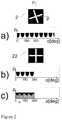
Figure 2 - Finding the rotation angle of the object of dynamic effect; -
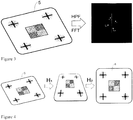
Figure 3 - Correction the rotation and scaling distortion of the taken picture by the high-pass filtering (HPF) and Fourier transformation (FFT); -
Figure 4 - Correction the perspective distortions of the taken picture; -
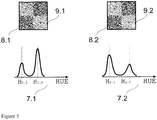
Figure 5 - Color histograms of two pictures taken at substantially different observation conditions; -
Figure 6 - Decoding of a hidden Fourier hologram image; -
Figure 7 - Decoding of a hidden image from a key encrypted image. - The method was developed for checking DOVID (1), which contains a set of machine-readable features (
Figure 1 ): - Dynamic effect image (2.1, 2.2);
- Images with non-spectral colors (3.1, 3.2);
- Binary random-texture image (3) with hidden information (10, 11);
- Additional marks (4) for the correction of geometric deformations.
- In
FIG. 1 the observation scheme of a diffraction grating is shown. The light diffracts at an altitude angle θ read between normal to the plane of the grating and a diffracted beam and an azimuth angle Φ read between the perpendicular to the grating's grooves and the beam's projection to the grating. The azimuth angle is positive if is read clockwise and negative against. - The present invention describes a method for recognizing and verifying the authenticity of machine-readable features of DOVID (1). Verification is performed using a smartphone that continuously captures DOVID (1) in real-time. From these pictures, the machine-readable features are identified and their parameters are measured. If the parameters are within preset ranges, it is concluded that DOVID (1) is original. Otherwise, the DOVID is falsified.
- At the first stage, DOVID (1) is recognized while at least two pictures are taken at substantially different observation conditions. When comparing pictures (5.1 and 5.2), we look for design elements that show dynamic effects: moving, changing orientation, shape, or size. If the dynamic effects are not detected, then the pictured device is not DOVID and the algorithm stops the verification with an indication of a failed attempt on the screen.
- The recognition of a dynamic effect in DOVID (1) is based on the correlation comparison algorithm. It is explained below with an example of finding the angle of rotation of the object (
Figure 2 ). In the general case, it can be applied to other geometric transformations: scaling, moving, and combinations of them. - We consider a dynamic image comprising the crosses (2.1, 2.2), which change their orientation (rotate) when the smartphone is translating above the DOVID (1), and successive pictures are taken. Finding the angle of rotation for each cross (2) is performed using a modified Fourier transform for polar coordinates. The image of the cross (2) is binarized and converted from a polar coordinate system to a Cartesian coordinate system by placing x = α and y = p (
Figure 2a ). An "unfolded" image of the cross is obtained. To perform a complete analysis of the angle of rotation, it is necessary to duplicate the unfolded image twice along the α-axis. The same procedure is done with the probe image of the cross (22), which is oriented straight and corresponds to a zero angle of rotation (Figure 2b ). It's not necessary to duplicate the "unfolded" image for probe cross (22). - Correlation analysis is performed looking for the maximum of the correlation function between the unfolded image of the cross (2) while moving the unfolded image of the probe cross (22) along the α-axis. The maximum is obtained when the images coincide at the shifting value M along the α axis (
Figure 2c ), which corresponds to the angle of rotation of the cross (2). The algorithm is performed for each cross (2.1, 2.2) from the picture of DOVID (1). - On the same principle, the values for scaling and position changing could be found for the image with a dynamic effect. This measuring procedure is performed for each taken picture (5.1, 5.2) and the differences in the geometrical parameters between the pictures are calculated. If the differences for the pictures taken under substantially different observation conditions are greater than predefined threshold values: at least 0.1 mm for positioning, preferably more than 1 mm, at least 0.1 mm for size, preferably more than 1mm and at least 1 degree, preferably more than 10 degrees for orientation, then it is concluded that dynamic effect is original, otherwise, it might be a polygraphic image or DOVID without dynamic effect.
- In a general case, the picture (5) of a DOVID (1) has various geometrical deformations: translation, rotation, scaling, and perspective. For successful recognition of machine-readable features in DOVID, these deformations must be corrected (
Figures 3, 4 ). - The taken picture (5) is filtered with a high-pass filter (HPF) and processed by Fourier transform (FFT), (
Figure 3 ). The amplitude part of the transformation contains the four maxima corresponding to the highest spatial frequencies of the picture (5). For the straightened picture, the maxima should form a square with equal diagonals L1 and L2, located horizontally and vertically (α1 = α2 = 0). The deviations of the measured angles and the sizes of the diagonals from those for the straightened picture are used for the first transformation matrix HI to correct rotation and scaling. - To correct the perspective, the additional square marks (4) placed on the binary random-texture image (3) shall be used. They consist of the alternating color concentric square contours with ratios 1:1:1:2:1:1:1. This ratio is optimal for accuracy and area usage of the DOVID. The three-contour structure provides a sufficiently high signal/noise ration. The exact positions of the marks (4) are defined by finding the maximum of the correlation function:

- Where R is the cross-correlation function between the image intensity function T and the probe mark pattern I.
- Based on the found coordinates of the marks (4), a reverse transformation matrix H2 is made to correct the perspective deformation (
Figure 4 ). The general transformation H for correction of all deformation is defined as:
- Applied to the input picture (5), a straightened image (6) suitable for the next analysis is obtained.
- To confirm the authenticity of the DOVID (1), an analysis of areas (3.1 3.2) with non-spectral colors is performed. The pictures (5.1 and 5.2) are taken and saved to the smartphone's ROM in 24-bit RGB format. Then they are converted from RGB to HSV format for processing. The brightness (V- component) is binarized and used as a mask for the chromaticity (Hue component). Thus, only areas with a brightness of more than 50% are utilized for the chromaticity analysis.
-
Figure 5 shows non-spectral colored areas (3.1, 3.2) pictured at the substantially different observation conditions. The area (3.1) shows the color (8.1) and the area (3.2) shows the color (9.1) in the first picture (5.1) and the colors (8.2 and 9.2) in the second picture (5.2) respectively. - The colors (8.1) and (8.2) are substantially the same and are used as a reference to compare other colors of the pictures (5.1, 5.2) taken at the substantially different observation conditions. The colors (9.1) and (9.2) are chosen so to have at least 10 degrees, preferably more than 20 degrees difference in chromaticity between each other and with the colors (8.1) and (8.2). The chromaticity histograms (7.1, 7.2) are plotted for each taken picture (5.1, 5.2), (
Figure 5 ). The histograms contain maxima H1.1, H1.2, and H2.1, H2.2, which are used for the comparative analysis. If these values are within a predefined range, it is concluded that the non-spectral color features (3.1, 3.2) of the DOVID (1) are original. - After the correction of the geometric deformations, the hidden information (10, 11) can be decoded from the straightened image (6) and binary random-texture image (3) (
Figure 6 ). - Usually, a Fourier hologram or an encrypted image is used for hidden information in DOVID. Other algorithms can also be used for this purpose without significant advantages.
- In one embodiment of the method, the binary random-texture image (3) is a Fourier hologram (
Figure 6a ), and digital reconstruction with inverse Fourier transform F-1 is used to decode the image (10) and display it on the smartphone's screen. The Fourier hologram is difficult to falsify due to the random phase mask used in the synthesis step. - In the next embodiment of the method, the binary random-texture image (3) is the image encrypted with a digital key (
Figure 6b ), and decryption with key K-1 is applied. The decrypted image (11) is displayed on the smartphone's screen. - The hidden information (10, 11) may contain not visual but digital information of the threshold values for dynamic effect (2.1, 2.2) and the chromaticity histograms (7.1, 7.2). In this case, the algorithm does not require predefined thresholds for original parameters but calculates with the values read from the hidden information (10, 11).
- Due to the natural sensitivity of human vision to the horizontal movement (horizontal parallax), the detection movement is chosen to be in a horizontal direction. This is the reason why the program interface and the visualization are executed for the landscape orientation of the smartphone. Only this embodiment is considered below, however, in the general case, the use of the vertical movement of the smartphone and the vertical dynamics in DOVID (1) are also possible, as well as a combination of these variants.
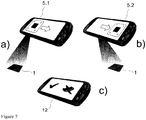
- The easiest way to take pictures of the DOVID at different observation conditions is to move the smartphone above it, parallel to its plane. When the first picture of the DOVID (1) is being taken its image should be located inside the frame showed at one edge of the screen. And for the last picture, the frame is moved to another edge, (
Figure 7 ). The smartphone should be positioned above DOVID at a distance that allows the camera to focus and the size of DOVID (1) is about 1/10 of the screen size, to be able to move the image of the DOVID (1) from one edge of the screen to another while taking the pictures. - During the execution of the algorithm, the smartphone uses the built-in flash in torch mode, automatically determines the exposure, focuses, and constantly takes pictures as often as possible.
- To obtain another picture at substantially different observation conditions, the interface "guides" the operator by reference frame in which the DOVID's image should be positioned.
- After capturing the first picture (5.1), (
Figure 7a ) and recognize it as valid, the reference frame is moved to another edge of the screen, and the operator required to put the DOVID inside it. The second picture (5.2) is taken and processed, (Figure 7b ). Only in cases of successful passing through all checks: finding a dynamic effect (2.1, 2.2) with valid parameters, recognizing the form of the binary random-texture image (3), decoding of the hidden information (10, 11), verifying the chromaticity histograms (7.1, 7.2), it is concluded that DOVID (1) is the original one and confirms the originality of the document or product possessing it (Figure 7c ). - An example of a machine-readable DOVID (1) is shown in
Figure 1 . The DOVID has two regions 3.1 and 3.2 which contain binary diffraction diffusers reproducing non-spectral colors that have at least 10 degrees difference in chromaticity. The binary random-texture image (3) comprises a computer-generated binary Fourier hologram of 64x64 pixels, in which a hidden image "OK" with a random phase mask is recorded. The pixel is 75 µm size. On the hologram (3) at four vertices of the square withside 3 mm centered with it, additional marks (4), consisting of alternating color concentric square contours with widths 50-50-50-100-50-50-50µm are placed. Four dynamic crosses (2.1, 2.2) with different ranges of angles of rotation are located at four vertices of a square with a side of 10 mm, centered on the hologram (3). - For verification, the operator launches an application that implements an algorithm on a smartphone with a camera with a resolution of at least 12MP and a minimum focal length typically about 10 cm and places the smartphone horizontally above the DOVID (1), parallel to its plane at a distance of about 11 cm. The flash switches to torch mode. A frame appears on the screen on the left edge of the screen, where the DOVID image must be positioned. The camera automatically focuses and determines the optimal exposure. The first view 5.1 is captured and stored in a 24-bit RGB format for further processing.
- Local filtering and binarization of the image are performed. Using the Fourier transform, the HI transformation is determined and the image is roughly straightened. By the correlation method, the additional marks (4) are found and the H2 transformation is determined and the straightened image (6) is obtained.
- The straightened image (6) is correlatively compared with the original one, and if the correlation level is greater than the threshold value of 0.8, it is concluded that the binary image (3) with a random texture is original. The straightened image (6) is processed by Fourier transform. The amplitude part is taken and displayed on the screen. The user can see the decoded image (10).
- There are four crosses (2.1, 2.2) at the vertices of the square centered to the hologram (3) which are supposed to have a dynamic effect. Their angles of rotation A1.1, A1.2, A1.3, A1.4 are measured by correlation procedure.
- The straightened image (6) is converted to HSV format. The brightness (V-component) is binarized and used as a mask for the chromaticity (Hue component). Thus, only areas with a brightness of more than 50% are utilized for the chromaticity analysis. A histogram (7.1) of chromaticity is plotted. There are the maxima Hue 1.1, Hue 1.2, which correspond to the two non-spectral colors used for the first picture (5.1). If Hue 1.1 is within the range from 30 to 40 degrees and Hue1.2 is within the range from 105 to 115 degrees, then the difference dH1 = Hue1.2 - Hue1.1 is calculated and it is concluded that the first picture (5.1) is valid and the second one at substantially different observation conditions can be taken.
- The reference frame is shifted to the right edge of the screen and after the user would put the image of the DOVID inside the frame by moving the smartphone the second picture (5.2) is taken. The processing of the second picture (5.2) is similar to the first one. As the result, the angles of orientation A2.1, A2.2, A2.3, A2.4 of the crosses (2.1, 2.2) with dynamic effect are measured, and the maxima of the histogram (7.2) of the chromaticity Hue2.1, Hue2.2 are obtained. If Hue2.1 is within the range from 30 to 40 degrees and Hue2.2 is within the range from 125 to 135 degrees, then the difference dH2 = Hue2.2 - Hue2.1 is calculated. If the modulus of difference | dH2-dH1 | is within the range of 15 to 25 degrees, it is concluded that the non-spectral color features at the areas (3.1, 3.2) are original.
- The differences of orientation angles of the crosses with dynamic effect (2.1, 2.2) measured from picture (5.1) and picture (5.2) are calculated:

- The expected values of the angles difference are dA1 = dA3 = -21o± 10o, dA2 = dA4 = 34o± 100. If the measured angles differences are within the ranges of the expected values, it is concluded that the dynamic effect is original.
- Upon successful passing through all checks: finding a dynamic effect (2.1, 2.2) with valid parameters, recognizing the form of the binary random-texture image (3), decoding of the hidden information (10, 11), and verifying the chromaticity histograms (7.1, 7.2), it is concluded that DOVID (1) is the original and the smartphone screen shows the green sign "V". Otherwise, a red "X" is displayed (
Figure 7c ).
Claims (3)
- A method for checking a diffractive optical variable identification device (1), comprising machine readable features, comprising capturing the device (1) at two substantially different viewing angles, characterized in that the following are performed for checking the diffractive optical variable identification device operations:(a) The diffractive optical variable identification device (1) is implemented comprising binary random-texture image (3) containing hidden information (10, 11);b) On the binary random-texture image (3) at four vertices of the square centered with it, additional marks (4) shall be placed, consisting of alternating color concentric square contours with ratios 1:1:1:2:1:1:1;c) At least two regions (3.1, 3.2) are formed on the device (1), comprising binary diffraction diffusers reproducing different non-spectral colors;d) Four rotating dynamic crosses (A2.1, A2.2, A2.3, A2.4) with different ranges of angles of rotation are placed outside the random-texture image (3) at vertices of the square centered with respect to it;e) The diffractive optical variable identification device (1) thus formed is subjected to verification procedure by launching an algorithm application on a smartphone with a camera having a minimum focal length of typically about 10 cm, with the smartphone positioned horizontally above the device (1) parallel to its plane;f) The app switches the flash of the smartphone into torch mode and uses its light to take pictures;g) The user manually positions the smartphone so that the DOVID image positions into a frame that appears on the left side of the smartphone screen;h) The camera makes autofocus and autoexposure and captures the first picture (5.1), which is stored in a 24-bit RGB format for further processing.(i) The geometric deformations are corrected using the additional marks to obtain the straightened image (6);j) The straightened image (6) is correlatively compared with the original one, and if correlation level is greater than the threshold value of 0.8 (the correlation function is normalized to 1 for full coincidence case), it is concluded that the binary image (3) with a random texture is original;k) The straightened image (6) is converted to HSV format and the histogram (7.1) of the chromaticity is plotted from which the maxima H1.1, H1.2 are found and are compared with predefined values and if the differences do not exceed a preselected threshold value, it is concluded that the first picture (5.1) is valid and a second one at substantially different observation conditions can be taken;l) The frame on the screen of the smartphone is moved to the right side of the screen and the second picture (5.2) is taken, the processing of which is the same as for the first picture;m) The dynamic effect is identified from the two pictures and parameters of the dynamic effect (A2.1, A2.2, A2.3, A2.4) are calculated, and when the values are within preset values ranges, it follows that the dynamic effect is original;n) The hidden information (10, 11) is decrypted and displayed at the screen;o) If all checks are passed successfully: the binary image with random texture (3) and dynamic effect (A2.1, A2.2, A2.3, A2.4) are original and the hidden information (10, 11) is decrypted, it's made the decision that the diffractive optical variable identification device (1) is original and the corresponding message is displayed on the smartphone's screen.
- A method according to claim 1, characterized in that the binary image with a random texture (3) is a Fourier hologram and it contains a hidden image with a random phase mask and the straightened image (6) is processed by a backward Fourier transform, the amplitude portion of which contains a decoded image (10), which is displayed on the smartphone's screen.
- Method according to claim 1, characterized in that the binary random texture image (3) is encrypted with a digital key image and the straightened image (6) is decrypted and the original image (11) is displayed on the smartphone's screen.
Priority Applications (1)
| Application Number | Priority Date | Filing Date | Title |
|---|---|---|---|
| EP20472005.6A EP3910548B1 (en) | 2020-05-14 | 2020-05-14 | Method for checking variable diffractive optical element |
Applications Claiming Priority (1)
| Application Number | Priority Date | Filing Date | Title |
|---|---|---|---|
| EP20472005.6A EP3910548B1 (en) | 2020-05-14 | 2020-05-14 | Method for checking variable diffractive optical element |
Publications (2)
| Publication Number | Publication Date |
|---|---|
| EP3910548A1 true EP3910548A1 (en) | 2021-11-17 |
| EP3910548B1 EP3910548B1 (en) | 2026-03-18 |
Family
ID=71783988
Family Applications (1)
| Application Number | Title | Priority Date | Filing Date |
|---|---|---|---|
| EP20472005.6A Active EP3910548B1 (en) | 2020-05-14 | 2020-05-14 | Method for checking variable diffractive optical element |
Country Status (1)
| Country | Link |
|---|---|
| EP (1) | EP3910548B1 (en) |
Cited By (2)
| Publication number | Priority date | Publication date | Assignee | Title |
|---|---|---|---|---|
| CN116883249A (en) * | 2023-09-07 | 2023-10-13 | 南京诺源医疗器械有限公司 | Super-resolution endoscope imaging device and method |
| PL445971A1 (en) * | 2023-08-31 | 2025-03-03 | Garsų pasaulis, UAB | Method of securing a valuable document in the area of a non-transparent substrate, secured valuable document, method of verifying the authenticity of a valuable document |
Citations (4)
| Publication number | Priority date | Publication date | Assignee | Title |
|---|---|---|---|---|
| US20100314861A1 (en) * | 2009-06-15 | 2010-12-16 | Ecole Polytechnique Federale De Lausanne (Epfl) | Authentication with built-in encryption by using moire parallax effects between fixed correlated s-random layers |
| US20140055824A1 (en) | 2011-03-25 | 2014-02-27 | Hologram Industries | Method and system for authenticating a secure document |
| US20160378061A1 (en) * | 2013-07-25 | 2016-12-29 | U-Nica Technology Ag | Method and device for verifying diffractive elements |
| CN108647659A (en) * | 2018-05-16 | 2018-10-12 | 臧戈平 | A method of hidden image in decryption printed matter is analyzed based on digital video image |
-
2020
- 2020-05-14 EP EP20472005.6A patent/EP3910548B1/en active Active
Patent Citations (4)
| Publication number | Priority date | Publication date | Assignee | Title |
|---|---|---|---|---|
| US20100314861A1 (en) * | 2009-06-15 | 2010-12-16 | Ecole Polytechnique Federale De Lausanne (Epfl) | Authentication with built-in encryption by using moire parallax effects between fixed correlated s-random layers |
| US20140055824A1 (en) | 2011-03-25 | 2014-02-27 | Hologram Industries | Method and system for authenticating a secure document |
| US20160378061A1 (en) * | 2013-07-25 | 2016-12-29 | U-Nica Technology Ag | Method and device for verifying diffractive elements |
| CN108647659A (en) * | 2018-05-16 | 2018-10-12 | 臧戈平 | A method of hidden image in decryption printed matter is analyzed based on digital video image |
Cited By (3)
| Publication number | Priority date | Publication date | Assignee | Title |
|---|---|---|---|---|
| PL445971A1 (en) * | 2023-08-31 | 2025-03-03 | Garsų pasaulis, UAB | Method of securing a valuable document in the area of a non-transparent substrate, secured valuable document, method of verifying the authenticity of a valuable document |
| CN116883249A (en) * | 2023-09-07 | 2023-10-13 | 南京诺源医疗器械有限公司 | Super-resolution endoscope imaging device and method |
| CN116883249B (en) * | 2023-09-07 | 2023-11-14 | 南京诺源医疗器械有限公司 | Super-resolution endoscope imaging device and method |
Also Published As
| Publication number | Publication date |
|---|---|
| EP3910548B1 (en) | 2026-03-18 |
Similar Documents
| Publication | Publication Date | Title |
|---|---|---|
| US7672475B2 (en) | Method and apparatus for verifying a hologram and a credit card | |
| KR101883425B1 (en) | Method for differentiation forgery by portable terminal device | |
| JP5038415B2 (en) | CONFIDENTIAL TEXT AUTHENTICATION DEVICE, CONFIDENTIAL TEXT AUTHENTICATION SYSTEM AND METHOD | |
| US8610976B1 (en) | Image enhancement methods | |
| CN115280384B (en) | Methods for authenticating security documents | |
| US8743426B2 (en) | Image enhancement methods | |
| TW201531958A (en) | Method for authenticating a security element, and optically variable security element | |
| CN108602374B (en) | Authentication of an object provided with a security element | |
| US11842593B2 (en) | Systems and methods for detection of counterfeit documents | |
| US20250272939A1 (en) | Improved authentification method | |
| WO2017090652A1 (en) | Identification device, identification method, identification program, and computer-readable medium containing identification program | |
| EP3910548B1 (en) | Method for checking variable diffractive optical element | |
| US20140002722A1 (en) | Image enhancement methods | |
| Valentín et al. | Optical benchmarking of security document readers for automated border control | |
| Piatriková et al. | Digital verification of optically variable ink feature on identity cards | |
| JP7069627B2 (en) | Information recording medium reading method and authenticity judgment method | |
| US12620196B2 (en) | Method for detecting an object in a search image, method for generating a pattern vector, and use of a method for determining a position and/or orientation of a security element of a banknote | |
| JP7024250B2 (en) | Anti-counterfeiting medium sticker and authenticity determination method | |
| US20240185562A1 (en) | Method for detecting an object in a search image, method for generating a pattern vector, and use of a method for determining a position and/or orientation of a security element of a banknote | |
| WO2024144409A1 (en) | Methods implemented by a computer for checking the existence of a variable diffractive optical element positioned on a surface of an object, and related computer programs and reading means | |
| JP2025074849A (en) | Authenticity determination device and program | |
| WO2025119439A1 (en) | Device to perform inline integrity verification of a security feature on an identification document | |
| Soukup et al. | On optimal illumination for DOVID description using photometric stereo | |
| IES84168Y1 (en) | A method and apparatus for verifying a hologram and a credit card |
Legal Events
| Date | Code | Title | Description |
|---|---|---|---|
| PUAI | Public reference made under article 153(3) epc to a published international application that has entered the european phase |
Free format text: ORIGINAL CODE: 0009012 |
|
| STAA | Information on the status of an ep patent application or granted ep patent |
Free format text: STATUS: THE APPLICATION HAS BEEN PUBLISHED |
|
| AK | Designated contracting states |
Kind code of ref document: A1 Designated state(s): AL AT BE BG CH CY CZ DE DK EE ES FI FR GB GR HR HU IE IS IT LI LT LU LV MC MK MT NL NO PL PT RO RS SE SI SK SM TR |
|
| B565 | Issuance of search results under rule 164(2) epc |
Effective date: 20201026 |
|
| STAA | Information on the status of an ep patent application or granted ep patent |
Free format text: STATUS: REQUEST FOR EXAMINATION WAS MADE |
|
| 17P | Request for examination filed |
Effective date: 20220427 |
|
| RBV | Designated contracting states (corrected) |
Designated state(s): AL AT BE BG CH CY CZ DE DK EE ES FI FR GB GR HR HU IE IS IT LI LT LU LV MC MK MT NL NO PL PT RO RS SE SI SK SM TR |
|
| RAV | Requested validation state of the european patent: fee paid |
Extension state: MD Effective date: 20220816 |
|
| DAV | Request for validation of the european patent (deleted) | ||
| STAA | Information on the status of an ep patent application or granted ep patent |
Free format text: STATUS: EXAMINATION IS IN PROGRESS |
|
| 17Q | First examination report despatched |
Effective date: 20240102 |
|
| REG | Reference to a national code |
Ref country code: DE Ref legal event code: R079 Free format text: PREVIOUS MAIN CLASS: G06K0009220000 Ipc: G06V0010240000 Ref country code: DE Ref legal event code: R079 Ref document number: 602020068743 Country of ref document: DE Free format text: PREVIOUS MAIN CLASS: G06K0009220000 Ipc: G06V0010240000 |
|
| GRAP | Despatch of communication of intention to grant a patent |
Free format text: ORIGINAL CODE: EPIDOSNIGR1 |
|
| STAA | Information on the status of an ep patent application or granted ep patent |
Free format text: STATUS: GRANT OF PATENT IS INTENDED |
|
| RIC1 | Information provided on ipc code assigned before grant |
Ipc: G06V 10/24 20220101AFI20250911BHEP Ipc: G06V 10/50 20220101ALI20250911BHEP Ipc: G06V 10/10 20220101ALI20250911BHEP Ipc: G06V 10/88 20220101ALI20250911BHEP Ipc: G07D 7/00 20160101ALI20250911BHEP Ipc: B42D 25/328 20140101ALI20250911BHEP Ipc: G07D 7/20 20160101ALI20250911BHEP |
|
| INTG | Intention to grant announced |
Effective date: 20251007 |
|
| GRAS | Grant fee paid |
Free format text: ORIGINAL CODE: EPIDOSNIGR3 |
|
| GRAA | (expected) grant |
Free format text: ORIGINAL CODE: 0009210 |
|
| STAA | Information on the status of an ep patent application or granted ep patent |
Free format text: STATUS: THE PATENT HAS BEEN GRANTED |
|
| AK | Designated contracting states |
Kind code of ref document: B1 Designated state(s): AL AT BE BG CH CY CZ DE DK EE ES FI FR GB GR HR HU IE IS IT LI LT LU LV MC MK MT NL NO PL PT RO RS SE SI SK SM TR |
|
| REG | Reference to a national code |
Ref country code: CH Ref legal event code: F10 Free format text: ST27 STATUS EVENT CODE: U-0-0-F10-F00 (AS PROVIDED BY THE NATIONAL OFFICE) Effective date: 20260318 Ref country code: GB Ref legal event code: FG4D |
|
| REG | Reference to a national code |
Ref country code: DE Ref legal event code: R096 Ref document number: 602020068743 Country of ref document: DE |
|
| REG | Reference to a national code |
Ref country code: IE Ref legal event code: FG4D |