EP3910172B1 - Boosted internal combustion engine provided with valve actuation system - Google Patents
Boosted internal combustion engine provided with valve actuation system Download PDFInfo
- Publication number
- EP3910172B1 EP3910172B1 EP21173468.6A EP21173468A EP3910172B1 EP 3910172 B1 EP3910172 B1 EP 3910172B1 EP 21173468 A EP21173468 A EP 21173468A EP 3910172 B1 EP3910172 B1 EP 3910172B1
- Authority
- EP
- European Patent Office
- Prior art keywords
- valve
- chamber
- engine
- engine according
- combustion
- Prior art date
- Legal status (The legal status is an assumption and is not a legal conclusion. Google has not performed a legal analysis and makes no representation as to the accuracy of the status listed.)
- Active
Links
Images

Classifications
-
- F—MECHANICAL ENGINEERING; LIGHTING; HEATING; WEAPONS; BLASTING
- F01—MACHINES OR ENGINES IN GENERAL; ENGINE PLANTS IN GENERAL; STEAM ENGINES
- F01L—CYCLICALLY OPERATING VALVES FOR MACHINES OR ENGINES
- F01L9/00—Valve-gear or valve arrangements actuated non-mechanically
- F01L9/10—Valve-gear or valve arrangements actuated non-mechanically by fluid means, e.g. hydraulic
- F01L9/16—Pneumatic means
-
- F—MECHANICAL ENGINEERING; LIGHTING; HEATING; WEAPONS; BLASTING
- F02—COMBUSTION ENGINES; HOT-GAS OR COMBUSTION-PRODUCT ENGINE PLANTS
- F02B—INTERNAL-COMBUSTION PISTON ENGINES; COMBUSTION ENGINES IN GENERAL
- F02B33/00—Engines characterised by provision of pumps for charging or scavenging
- F02B33/02—Engines with reciprocating-piston pumps; Engines with crankcase pumps
- F02B33/06—Engines with reciprocating-piston pumps; Engines with crankcase pumps with reciprocating-piston pumps other than simple crankcase pumps
-
- F—MECHANICAL ENGINEERING; LIGHTING; HEATING; WEAPONS; BLASTING
- F01—MACHINES OR ENGINES IN GENERAL; ENGINE PLANTS IN GENERAL; STEAM ENGINES
- F01L—CYCLICALLY OPERATING VALVES FOR MACHINES OR ENGINES
- F01L2820/00—Details on specific features characterising valve gear arrangements
- F01L2820/01—Absolute values
-
- F—MECHANICAL ENGINEERING; LIGHTING; HEATING; WEAPONS; BLASTING
- F01—MACHINES OR ENGINES IN GENERAL; ENGINE PLANTS IN GENERAL; STEAM ENGINES
- F01L—CYCLICALLY OPERATING VALVES FOR MACHINES OR ENGINES
- F01L2820/00—Details on specific features characterising valve gear arrangements
- F01L2820/03—Auxiliary actuators
- F01L2820/031—Electromagnets
-
- Y—GENERAL TAGGING OF NEW TECHNOLOGICAL DEVELOPMENTS; GENERAL TAGGING OF CROSS-SECTIONAL TECHNOLOGIES SPANNING OVER SEVERAL SECTIONS OF THE IPC; TECHNICAL SUBJECTS COVERED BY FORMER USPC CROSS-REFERENCE ART COLLECTIONS [XRACs] AND DIGESTS
- Y02—TECHNOLOGIES OR APPLICATIONS FOR MITIGATION OR ADAPTATION AGAINST CLIMATE CHANGE
- Y02T—CLIMATE CHANGE MITIGATION TECHNOLOGIES RELATED TO TRANSPORTATION
- Y02T10/00—Road transport of goods or passengers
- Y02T10/10—Internal combustion engine [ICE] based vehicles
- Y02T10/12—Improving ICE efficiencies
Definitions
- the present invention relates to a valve actuation system implemented in a boosted internal combustion engine.
- valve device such as an inlet valve or outlet valve for a cylinder of an internal combustion engine having an air conveying module, which comprises a pneumatically controllable air valve for supplying fresh air to a combustion chamber of the engine.
- WO 2009/023080 A1 describes a split-cycle engine having a balanced valve assembly used as one of a crossover compression valve and a crossover expansion valve in a crossover passage, and a balance piston which balances the fluid pressures acting against the valve.
- the main object of the present invention to provide a valve actuation system suitable for those implementations where the pressure at the intake manifold is relatively high, irrespective to the nature of the boost source.
- the main principle of the invention is implement a pneumatically actuated valve exploiting exclusively the intake pressure.
- the valve stem is physically connected to a mobile piston suitable to move in a relating cylinder defining at least one closed chamber interposed between the valve and the mobile piston.
- the valve has a first face exposed into intake manifold and a second face, opposite to the first face exposed into a corresponding combustion chamber.
- the first chamber is directly connected to the intake manifold through a throttled pressurization channel and is connected to a relative low-pressure sink, such as environment or crank case or a low pressure tank though a valve, suitable to permit a venting flow, higher than the pressurizing flow through the throttled channel.
- a relative low-pressure sink such as environment or crank case or a low pressure tank though a valve, suitable to permit a venting flow, higher than the pressurizing flow through the throttled channel.
- the throttled pressurization channel could be directly connected with the supercharging device.
- a spring is arranged in the first chamber to force the valve into close position.
- the valve condition is function of
- the pressure in the first chamber is mainly function of the (solenoid) valve condition, due to the ratio between pressurizing and venting flows. Indeed, being the first camera connected with the intake manifold and arranged in such a way to cooperate with the spring towards the closing of the intake valve, the opening of the solenoid valve leads to the immediate depressurization of the first chamber. Thus, the spring force is not enough to maintain the valve closed under the pressure in the intake manifold.
- valve is actuated fixedly by a control disk, thus the valve could be fully mechanic or could be an electro-actuated valve such as a fast solenoid valve fixedly controlled according to the angle position of the crankshaft.
- the solenoid valve is actuated according to the specific variable maps, stored in an electronic unit, such that to realize a variable valve actuation.
- the present valve actuation system is capable to exploit the boost pressure as power source without an addition power source such as the usual timing belt/chain.
- the combustion chamber above mentioned belongs to an only-in-one 4-stroke engine or to a split cycle engine.
- only-in-one 4-stroke engine it is meant an engine with at least one cylinder capable to develop 4 strokes, generally within 720° of crankshaft rotation.
- the Split cycle engine instead, has cylinders dedicated to a subset of the strokes.
- the combustion cylinder executes only combustion/expansion and exhaust, while the boost (or compression) cylinder executes intake and compression.
- boost (or compression) cylinder executes intake and compression. This means that a spit cycle engine does not requires two complete revolutions (720°) to execute the four strokes of the entire thermodynamic cycle, which can be executed in just one complete crankshaft rotation due to the splitting of the thermodynamic cycle over the two subsets of cylinders.
- the boost source in case of only-in-one 4-stroke engine should be capable to pressurize the intake manifold adequately even at the engine start.
- This capability can be easily realized in the pneumatically-actuated brake vehicles, such as trucks, public transportation and agricultural vehicles due to their pneumatic circuits that can be connected to the engine to feed the latter at start.
- a car with an only-one-4-stroke engine can be easily provided with a compressed air reservoir arranged to actuate the valve actuation system.
- the VA system might work even without additional boost at cold start, since the poppet valve, in such conditions acts as a non-return valve.
- the high boost will open the intake valve during the exhaust stroke, if it is not balanced by the mobile piston herein described.
- the present invention seems to solve a problem, which increases with higher boost pressure, by implementing a balancing mobile piston in conjunction with a venting valve and a low pressure sink, to control valve opening and closing.
- the split cycle engine uses a compression and a combustion cylinder. In front of the combustion cylinder, the pressure could reach peaks of 70 bar, with a minimum pressure of about 20bar.
- second element does not imply the presence of a "first element”, first, second, etc.. are used only for improving the clarity of the description and they should not be interpreted in a limiting way.
- Figure 1 discloses a combustion piston CP operatively associated with a combustion cylinder CC by defining an internal combustion engine IC.
- the combustion engine IC is provided with a cylinder head H arranged to close the cylinder and at least to cooperate to define a combustion chamber CCB.
- An intake poppet valve V is disclosed.
- the intake valve is arranged in order to communicate or seal the intake with the combustion chamber CCB.
- valve In a close position, the valve is biased on its corresponding seat defined in the head H, while in the open position, the valve protrudes in the combustion chamber CCB in a known fashion.
- the valve has a first face exposed into intake manifold and a second face, opposite to the first face exposed into a corresponding combustion chamber.
- the valve V has a stem VS suitable to slide in a corresponding seat as known to the skilled person.
- a boost source BOO supplies the intake manifold with compressed air.
- valve stem VS is physically connected with a movable piston AP of a pneumatic actuator PD.
- the pneumatic actuator defines at least a first chamber FC interposed between the piston AP and the valve V. This means that the pressurization of the first chamber leads towards valve close position.
- a metallic spring SP is arranged in the first chamber in order to cooperate with the pressurization of the first chamber to achieve the valve closing, especially when the engine is stopped and the intake manifold is not pressurized, such that to avoid the valve falls in the combustion chamber CCB. Therefore, the spring can be sized to exert a force strictly needed to maintain the valve closed when the engine is off.
- the movable piston AP has a first face exposed in the first chamber.
- the first chamber communicates with the intake through a pressurization channel PC arranged to throttle the pressurization flow from the intake to the first chamber.
- the first chamber communicates with a low pressure sink SK such as exhaust, environment or crank case LP or any vacuum reservoir, through a venting channel VC, where a fast solenoid valve SV is arranged in order to control the venting operation.
- a low pressure sink SK such as exhaust, environment or crank case LP or any vacuum reservoir
- the sink can be at a stable low pressure, such as exhaust, ambient pressure or crank case pressure or can be at lower pressure than the environmental pressure, at least during solenoid valve opening.
- a stable low pressure such as exhaust, ambient pressure or crank case pressure or can be at lower pressure than the environmental pressure, at least during solenoid valve opening.
- SV control valve
- a vacuum pump is arranged for certain aims.
- Such vacuum can define the low pressure sink. It is clear that even in case the intake manifold is under the ambient pressure, its boost pressure is relatively high in respect of the low pressure sink.
- the throttle can be avoided so as to determine the cylinder charging through the valve actuation VA.
- the operating surface of the movable piston AP is at least slightly larger than the first face of the valve. This means that, when the first chamber is pressurized, the valve tends to close.
- the operating surface of the movable piston AP is large enough with respect to the first face surface of the valve, such that the valve remains closed even under the combustion piston sucking effect and boost pressure.
- the metal spring can be useful to help the movable piston AP to maintain closed the valve V and also during dynamic conditions.
- the valve Without pressurizing the first chamber, during compression phase, the valve remains open at least till pressure in the combustion chamber is lower or equal to the boost pressure.
- the metal spring can help to compensate the pressurization dynamic. Indeed, the pressurization channel is throttled in order to render as fast as possible venting of the first chamber. However, during valve closing, the pressurization is slower than venting operation, thus metal spring can render slightly faster the closing operation.
- the solenoid valve is controlled fixedly according to the angle of the crankshaft.
- the solenoid valve is controlled in order to vary the valve actuation according to several known parameters, such as engine speed, torque, and so on or in order to actuate an engine brake operation.
- the pneumatic actuator can comprise a second chamber arranged oppositely to the first chamber, such that the piston AP exposes a second face opposite to the first face.
- the second chamber SC disclosed on figure 2 is operatively connected with the exhaust preferably immediately upstream or downstream of turbine of a turbo-charger or turbo-compound or with the crank case.
- the venting channel VC is connected with the exhaust or crankcase.
- Such pressure is operatively transmitted to the second chamber through a secondary channel (not disclosed), so that such pressure cooperates with the intake pressure developed on the first face of the valve and the sucking effect of the combustion piston CP.
- both the second chamber and the venting channel are operatively connected with the crankcase, which defines the above mentioned sink SK.
- a dumping element DE is arranged to define the end position of the valve in fully open position.
- the lift could be alternative controlled, if the venting channel is block by the movable piston at a defined lift by achieving a self-controlling effect.
- valve displacement is indicated by the label “Valve lift” in the drawings.
- a self-adjusting valve catch AJ Such device expands, for example, under engine oil pressure, by avoiding a strong impact of the valve with its respective seat, but without interfering with the completely closing of the valve itself.
- the threated pressurizing channel is realized through the stem guide in such a way to interconnect the intake IK and the first chamber FC by achieving the effects above disclosed.
- Example embodiments are provided so that this disclosure will be thorough, and will fully convey the teaching to those who are skilled in the art. Numerous specific details are set forth such as examples of specific components, devices, and methods, to provide a thorough understanding of embodiments of the present disclosure. It will be apparent to those skilled in the art that specific details need not be employed, that example embodiments may be embodied in many different forms. In some example embodiments, well known processes, well-known device structures, and well known technologies are not described in detail.
Landscapes
- Engineering & Computer Science (AREA)
- Mechanical Engineering (AREA)
- General Engineering & Computer Science (AREA)
- Chemical & Material Sciences (AREA)
- Combustion & Propulsion (AREA)
- Valve Device For Special Equipments (AREA)
- Fluid-Driven Valves (AREA)
Description
- The present invention relates to a valve actuation system implemented in a boosted internal combustion engine.
- When the pressure generated by the boost of an internal combustion engine is relatively high, namely constantly over the ambient pressure, as usual the camshaft leads to drawbacks. In order to maintain the intake valve(s) closed, strong spring(s) should be implemented to avoid unwanted valve(s) opening. This implies high friction at the camshaft. The high frictions lead to high parasitic torque.
-
DE 10 2013 209041 A1 describes a valve device, such as an inlet valve or outlet valve for a cylinder of an internal combustion engine having an air conveying module, which comprises a pneumatically controllable air valve for supplying fresh air to a combustion chamber of the engine. -
WO 2009/023080 A1 describes a split-cycle engine having a balanced valve assembly used as one of a crossover compression valve and a crossover expansion valve in a crossover passage, and a balance piston which balances the fluid pressures acting against the valve. - The main object of the present invention to provide a valve actuation system suitable for those implementations where the pressure at the intake manifold is relatively high, irrespective to the nature of the boost source.
- The main principle of the invention is implement a pneumatically actuated valve exploiting exclusively the intake pressure.
- According to the present invention, the valve stem is physically connected to a mobile piston suitable to move in a relating cylinder defining at least one closed chamber interposed between the valve and the mobile piston. The valve has a first face exposed into intake manifold and a second face, opposite to the first face exposed into a corresponding combustion chamber.
- The first chamber is directly connected to the intake manifold through a throttled pressurization channel and is connected to a relative low-pressure sink, such as environment or crank case or a low pressure tank though a valve, suitable to permit a venting flow, higher than the pressurizing flow through the throttled channel.
- The throttled pressurization channel could be directly connected with the supercharging device.
- A spring is arranged in the first chamber to force the valve into close position.
- The valve condition is function of
- The pressure in the engine combustion chamber,
- The pressure in the intake manifold,
- The spring force,
- The pressure in the first chamber
- The pressure in the first chamber is mainly function of the (solenoid) valve condition, due to the ratio between pressurizing and venting flows. Indeed, being the first camera connected with the intake manifold and arranged in such a way to cooperate with the spring towards the closing of the intake valve, the opening of the solenoid valve leads to the immediate depressurization of the first chamber. Thus, the spring force is not enough to maintain the valve closed under the pressure in the intake manifold.
- It should be noted that the pneumatic actuator is never connected with the combustion chamber at all.
- According to a first embodiment of the invention, valve is actuated fixedly by a control disk, thus the valve could be fully mechanic or could be an electro-actuated valve such as a fast solenoid valve fixedly controlled according to the angle position of the crankshaft.
- According to another embodiment of the invention, the solenoid valve is actuated according to the specific variable maps, stored in an electronic unit, such that to realize a variable valve actuation.
- Advantageously, the present valve actuation system is capable to exploit the boost pressure as power source without an addition power source such as the usual timing belt/chain. The combustion chamber above mentioned belongs to an only-in-one 4-stroke engine or to a split cycle engine.
- With "only-in-one 4-stroke engine" it is meant an engine with at least one cylinder capable to develop 4 strokes, generally within 720° of crankshaft rotation.
- The Split cycle engine, instead, has cylinders dedicated to a subset of the strokes. Usually the combustion cylinder executes only combustion/expansion and exhaust, while the boost (or compression) cylinder executes intake and compression. This means that a spit cycle engine does not requires two complete revolutions (720°) to execute the four strokes of the entire thermodynamic cycle, which can be executed in just one complete crankshaft rotation due to the splitting of the thermodynamic cycle over the two subsets of cylinders.
- It is clear that, the boost source, in case of only-in-one 4-stroke engine should be capable to pressurize the intake manifold adequately even at the engine start. This capability can be easily realized in the pneumatically-actuated brake vehicles, such as trucks, public transportation and agricultural vehicles due to their pneumatic circuits that can be connected to the engine to feed the latter at start. Nevertheless, even a car with an only-one-4-stroke engine can be easily provided with a compressed air reservoir arranged to actuate the valve actuation system. The VA system might work even without additional boost at cold start, since the poppet valve, in such conditions acts as a non-return valve.
- Low boost values, known from traditional Petrol and Diesel engines, will limit the engine valve dynamics, since forces are small. In contrast, a split cycle engine needs anyway boost to start. Such boost is "automatically" produced by the compression piston as known. The present invention finds its better implementation in those cases where the boost reaches high pressures, beyond 10 bars and especially in the split cycle engines. Indeed, if the valve spring forcing the valve closing is not sufficiently strong, the intake valve might behave like a check valve when the boost pressure is low, according to the pressure difference between intake pressure and combustion cylinder pressure. On the other side, increasing spring stiffness leads to friction increase.
- In contrast, in case of split cycle engine implementation, the high boost will open the intake valve during the exhaust stroke, if it is not balanced by the mobile piston herein described.
- Therefore, the present invention seems to solve a problem, which increases with higher boost pressure, by implementing a balancing mobile piston in conjunction with a venting valve and a low pressure sink, to control valve opening and closing.
- It should be understood that the present solution does not implement any rocker arms or the like, being fully actuated pneumatically.
- The split cycle engine uses a compression and a combustion cylinder. In front of the combustion cylinder, the pressure could reach peaks of 70 bar, with a minimum pressure of about 20bar.
- These and further objects are achieved by means of the attached claims, which describe preferred embodiments of the invention, forming an integral part of the present description.
- The invention will become fully clear from the following detailed description, given by way of a mere exemplifying and non limiting example, to be read with reference to the attached drawing figures, wherein:
-
Fig. 1 shows schematically a first example of high pressure boosted internal combustion engine provided with variable valve actuation according to the present invention; -
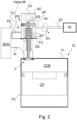
Fig. 2 shows a second example based on the example offigure 1 . - The same reference numerals and letters in the figures designate the same components or functionally equivalent parts.
- According to the present invention, the term "second element" does not imply the presence of a "first element", first, second, etc.. are used only for improving the clarity of the description and they should not be interpreted in a limiting way.
-
Figure 1 discloses a combustion piston CP operatively associated with a combustion cylinder CC by defining an internal combustion engine IC. The combustion engine IC is provided with a cylinder head H arranged to close the cylinder and at least to cooperate to define a combustion chamber CCB. - An intake poppet valve V is disclosed. The intake valve is arranged in order to communicate or seal the intake with the combustion chamber CCB.
- In a close position, the valve is biased on its corresponding seat defined in the head H, while in the open position, the valve protrudes in the combustion chamber CCB in a known fashion.
- The valve has a first face exposed into intake manifold and a second face, opposite to the first face exposed into a corresponding combustion chamber.
- The valve V has a stem VS suitable to slide in a corresponding seat as known to the skilled person.
- A boost source BOO supplies the intake manifold with compressed air.
- Preferably, the valve stem VS is physically connected with a movable piston AP of a pneumatic actuator PD.
- The pneumatic actuator defines at least a first chamber FC interposed between the piston AP and the valve V. This means that the pressurization of the first chamber leads towards valve close position.
- Preferably, a metallic spring SP is arranged in the first chamber in order to cooperate with the pressurization of the first chamber to achieve the valve closing, especially when the engine is stopped and the intake manifold is not pressurized, such that to avoid the valve falls in the combustion chamber CCB. Therefore, the spring can be sized to exert a force strictly needed to maintain the valve closed when the engine is off.
- The movable piston AP has a first face exposed in the first chamber.
- The first chamber communicates with the intake through a pressurization channel PC arranged to throttle the pressurization flow from the intake to the first chamber.
- The first chamber communicates with a low pressure sink SK such as exhaust, environment or crank case LP or any vacuum reservoir, through a venting channel VC, where a fast solenoid valve SV is arranged in order to control the venting operation.
- The sink can be at a stable low pressure, such as exhaust, ambient pressure or crank case pressure or can be at lower pressure than the environmental pressure, at least during solenoid valve opening. For a preferred implementation in the split cycle engine field, it makes sense to vent the flow of the control valve (SV) to the turbine inlet, when the engine is turbo-charged, in order to get some benefit of the pressurized gas.
- For example, in certain vehicle a vacuum pump is arranged for certain aims. Such vacuum can define the low pressure sink. It is clear that even in case the intake manifold is under the ambient pressure, its boost pressure is relatively high in respect of the low pressure sink.
- In addition, in the Otto engines, the throttle can be avoided so as to determine the cylinder charging through the valve actuation VA.
- This means that when solenoid valve SV opens, the first chamber is almost immediately vented. This means also that pressurization flow, through PC, is lower that the venting flow.
- The quickness of pressurization and venting of the first chamber depends on
- the ratio between pressurization flow and venting flow (flow area ratio) and
- the ratio between boost pressure and sink pressure.
- In addition, the operating surface of the movable piston AP is at least slightly larger than the first face of the valve. This means that, when the first chamber is pressurized, the valve tends to close.
- According to a preferred embodiment of the invention, the operating surface of the movable piston AP is large enough with respect to the first face surface of the valve, such that the valve remains closed even under the combustion piston sucking effect and boost pressure.
- In this context, the metal spring can be useful to help the movable piston AP to maintain closed the valve V and also during dynamic conditions.
- When the first chamber is vented through the valve SV, the sucking effect of the combustion piston and the boost pressure open quickly the valve, by permitting the filling of the combustion chamber with a fresh charge.
- Without pressurizing the first chamber, during compression phase, the valve remains open at least till pressure in the combustion chamber is lower or equal to the boost pressure. The metal spring can help to compensate the pressurization dynamic. Indeed, the pressurization channel is throttled in order to render as fast as possible venting of the first chamber. However, during valve closing, the pressurization is slower than venting operation, thus metal spring can render slightly faster the closing operation.
- In addition, the compression stroke before combustion, helps to close automatically the valve, thus the pressure increase in the combustion chamber cooperates with the spring preload and the first chamber pressurization in closing the valve. It is clear, that an exhaust valve, connected to the combustion chamber CCB is not disclosed in the drawings, but it is implicitly present.
- According to a first embodiment of the invention, the solenoid valve is controlled fixedly according to the angle of the crankshaft. Alternatively, the solenoid valve is controlled in order to vary the valve actuation according to several known parameters, such as engine speed, torque, and so on or in order to actuate an engine brake operation. According to another preferred embodiment of the invention that can be combine with any of the previous embodiments, the pneumatic actuator can comprise a second chamber arranged oppositely to the first chamber, such that the piston AP exposes a second face opposite to the first face. According to this embodiment, the second chamber SC disclosed on
figure 2 , is operatively connected with the exhaust preferably immediately upstream or downstream of turbine of a turbo-charger or turbo-compound or with the crank case. Preferably, also the venting channel VC is connected with the exhaust or crankcase. - Such pressure is operatively transmitted to the second chamber through a secondary channel (not disclosed), so that such pressure cooperates with the intake pressure developed on the first face of the valve and the sucking effect of the combustion piston CP.
- Therefore, the valve condition is function of
- The pressure in the engine combustion chamber,
- The pressure in the intake manifold,
- The spring force,
- The pressure in the first chamber
- The Pressure in second chamber (above the mobile piston).
- Preferably, both the second chamber and the venting channel are operatively connected with the crankcase, which defines the above mentioned sink SK.
- Preferably, within the first chamber a dumping element DE is arranged to define the end position of the valve in fully open position. The lift could be alternative controlled, if the venting channel is block by the movable piston at a defined lift by achieving a self-controlling effect.
- The valve displacement is indicated by the label "Valve lift" in the drawings.
- Preferably, the free end of the valve stem or the face of the movable piston AP, arranged at the opposite side with respect to the first chamber, contacts a self-adjusting valve catch AJ. Such device expands, for example, under engine oil pressure, by avoiding a strong impact of the valve with its respective seat, but without interfering with the completely closing of the valve itself.
- According to a further preferred embodiment of the invention, the threated pressurizing channel is realized through the stem guide in such a way to interconnect the intake IK and the first chamber FC by achieving the effects above disclosed.
- Example embodiments are provided so that this disclosure will be thorough, and will fully convey the teaching to those who are skilled in the art. Numerous specific details are set forth such as examples of specific components, devices, and methods, to provide a thorough understanding of embodiments of the present disclosure. It will be apparent to those skilled in the art that specific details need not be employed, that example embodiments may be embodied in many different forms. In some example embodiments, well known processes, well-known device structures, and well known technologies are not described in detail.
Claims (11)
- Boosted internal combustion engine (IC) provided with valve actuation system (VA), the combustion engine comprising at least a combustion piston (CP) reciprocating a corresponding combustion cylinder (CC) closed by a head (H) to define a combustion chamber (CCB), wherein in the head a poppet valve (V) is arranged in such a way to open protruding in the combustion chamber and to close against a corresponding head seat, the valve communicating the combustion chamber with an intake, the actuation system (VA) including a pneumatic actuator (PD) comprising- a piston (AP) operatively connected with the stem (VS) of the poppet valve (V),- at least a first chamber (FC) where the piston (AP) is movable in such a way the first chamber is between the poppet valve and the piston (AP),- a spring (SP) arranged to expand the first chamber,Wherein the first chamber is fluidly connected with- the intake manifold through a pressurization throttled channel (PC) and- a pressure sink (SK), which is at a pressure constantly under the intake one at least during first chamber venting, through a controllable valve (SV).
- Engine according to claim 1, wherein the controllable valve (SV) consists of a fully mechanical valve or an electro-actuated valve, such as a fast solenoid valve.
- Engine according to claim 2, further comprising a control unit arranged to control the fast solenoid valve in order to realize a variable valve actuation.
- Engine according to any one of previous claims 1-3, wherein said poppet valve (V) has a first face exposed into the intake manifold and wherein the surface of said first face is lower than a first face of the piston (AP) exposed in the first chamber.
- Engine according to any one of previous claims 1-4, wherein the pneumatic actuator includes a second chamber (SC) arranged oppositely to the first chamber, wherein the second chamber is fluidly connected with said pressure sink (SK) .
- Engine according to any one of the previous claims 1-5, wherein said pressure sink (SK) is one among:- external environment,- exhaust of the engine,- crankcase,- vacuum pump.
- Engine according to claim 5, further comprising a turbine operatively arranged on the exhaust of the engine and wherein said sink consists in a point immediately upstream or downstream of the turbine.
- Engine according to any one of the previous claims 1 - 7, further comprising a damper element (DE) arranged to dampen poppet valve opening, preferably arranged within said first chamber.
- Engine according to any one of the previous claims 1 - 8, further comprising a self-adjusting valve catch (AJ) arranged to dump poppet valve closing.
- Engine according to any one of the previous claims, wherein said combustion cylinder is arranged to develop 4-strokes of an Otto or Diesel internal combustion engine.
- Engine according to any one of the previous claims, further comprising a compression cylinder arranged to pressurize said intake manifold defining a split-cycle combustion engine.
Applications Claiming Priority (1)
| Application Number | Priority Date | Filing Date | Title |
|---|---|---|---|
| IT102020000011080A IT202000011080A1 (en) | 2020-05-14 | 2020-05-14 | SUPERCHARGED INTERNAL COMBUSTION ENGINE EQUIPPED WITH A VALVE ACTIVATION SYSTEM (VA) |
Publications (2)
| Publication Number | Publication Date |
|---|---|
| EP3910172A1 EP3910172A1 (en) | 2021-11-17 |
| EP3910172B1 true EP3910172B1 (en) | 2024-03-13 |
Family
ID=71662284
Family Applications (1)
| Application Number | Title | Priority Date | Filing Date |
|---|---|---|---|
| EP21173468.6A Active EP3910172B1 (en) | 2020-05-14 | 2021-05-12 | Boosted internal combustion engine provided with valve actuation system |
Country Status (2)
| Country | Link |
|---|---|
| EP (1) | EP3910172B1 (en) |
| IT (1) | IT202000011080A1 (en) |
Families Citing this family (1)
| Publication number | Priority date | Publication date | Assignee | Title |
|---|---|---|---|---|
| CN116428013A (en) * | 2023-04-19 | 2023-07-14 | 内蒙古科技大学 | Piston type expansion unit and two-stage expansion system |
Family Cites Families (4)
| Publication number | Priority date | Publication date | Assignee | Title |
|---|---|---|---|---|
| EP2176530B1 (en) * | 2007-08-13 | 2013-02-20 | The Scuderi Group, LLC | Pressure balanced engine valves |
| WO2010129872A1 (en) * | 2009-05-07 | 2010-11-11 | Scuderi Group, Llc | Air supply for components of a split-cycle engine |
| DE102013209041A1 (en) * | 2013-05-15 | 2014-11-20 | Robert Bosch Gmbh | Valve device for an internal combustion engine |
| FR3021347B1 (en) * | 2014-05-22 | 2016-05-20 | Motor Dev Int S A | COMPRESSED AIR MOTOR WITH ACTIVE CHAMBER INCLUSIVE AND ACTIVE DISTRIBUTION AT ADMISSION |
-
2020
- 2020-05-14 IT IT102020000011080A patent/IT202000011080A1/en unknown
-
2021
- 2021-05-12 EP EP21173468.6A patent/EP3910172B1/en active Active
Also Published As
| Publication number | Publication date |
|---|---|
| IT202000011080A1 (en) | 2021-11-14 |
| EP3910172A1 (en) | 2021-11-17 |
Similar Documents
| Publication | Publication Date | Title |
|---|---|---|
| US3786792A (en) | Variable valve timing system | |
| US4473047A (en) | Compression release engine brake | |
| US6082328A (en) | Method and apparatus to accomplish exhaust air recirculation during engine braking and/or exhaust gas recirculation during positive power operation of an internal combustion engine | |
| CN101180459B (en) | Engine braking method and device | |
| US6925976B2 (en) | Modal variable valve actuation system for internal combustion engine and method for operating the same | |
| CA1213184A (en) | Engine retarding system | |
| EP1472440B1 (en) | Efficient internal combustion engine valve actuator | |
| US20030140876A1 (en) | Engine valve actuation system and method using reduced pressure common rail and dedicated engine valve | |
| US6293248B1 (en) | Two-cycle compression braking on a four stroke engine using hydraulic lash adjustment | |
| US4429532A (en) | Apparatus and method for temporarily converting a turbocharged engine to a compressor | |
| JPH04503987A (en) | Method and device for applying engine braking to a four-stroke internal combustion engine | |
| US5522358A (en) | Fluid controlling system for an engine | |
| EP1537321A1 (en) | System and method for internal exhaust gas recirculation | |
| JPH04272431A (en) | Turbo composite engine | |
| US6920868B2 (en) | System and method for modifying engine valve lift | |
| US6050239A (en) | Control arrangement for an internal combustion engine | |
| US6216667B1 (en) | Method and device for a supercharged engine brake | |
| EP3910172B1 (en) | Boosted internal combustion engine provided with valve actuation system | |
| US20030221644A1 (en) | Engine valve actuation system | |
| US6418720B1 (en) | Method and a device for engine braking a four stroke internal combustion engine | |
| KR20060134985A (en) | Multi lift valve operation system and method | |
| Battistoni et al. | Development of an electro-hydraulic camless VVA system | |
| US20040083994A1 (en) | System for actuating an engine valve | |
| JPH06159024A (en) | Air spring type valve system of engine for vehicle | |
| US9708943B2 (en) | Device for delivering compressed air for pneumatically operated equipment in motor vehicles |
Legal Events
| Date | Code | Title | Description |
|---|---|---|---|
| PUAI | Public reference made under article 153(3) epc to a published international application that has entered the european phase |
Free format text: ORIGINAL CODE: 0009012 |
|
| STAA | Information on the status of an ep patent application or granted ep patent |
Free format text: STATUS: THE APPLICATION HAS BEEN PUBLISHED |
|
| AK | Designated contracting states |
Kind code of ref document: A1 Designated state(s): AL AT BE BG CH CY CZ DE DK EE ES FI FR GB GR HR HU IE IS IT LI LT LU LV MC MK MT NL NO PL PT RO RS SE SI SK SM TR |
|
| B565 | Issuance of search results under rule 164(2) epc |
Effective date: 20210908 |
|
| STAA | Information on the status of an ep patent application or granted ep patent |
Free format text: STATUS: REQUEST FOR EXAMINATION WAS MADE |
|
| 17P | Request for examination filed |
Effective date: 20220427 |
|
| RBV | Designated contracting states (corrected) |
Designated state(s): AL AT BE BG CH CY CZ DE DK EE ES FI FR GB GR HR HU IE IS IT LI LT LU LV MC MK MT NL NO PL PT RO RS SE SI SK SM TR |
|
| GRAP | Despatch of communication of intention to grant a patent |
Free format text: ORIGINAL CODE: EPIDOSNIGR1 |
|
| STAA | Information on the status of an ep patent application or granted ep patent |
Free format text: STATUS: GRANT OF PATENT IS INTENDED |
|
| INTG | Intention to grant announced |
Effective date: 20240109 |
|
| GRAS | Grant fee paid |
Free format text: ORIGINAL CODE: EPIDOSNIGR3 |
|
| GRAA | (expected) grant |
Free format text: ORIGINAL CODE: 0009210 |
|
| STAA | Information on the status of an ep patent application or granted ep patent |
Free format text: STATUS: THE PATENT HAS BEEN GRANTED |
|
| AK | Designated contracting states |
Kind code of ref document: B1 Designated state(s): AL AT BE BG CH CY CZ DE DK EE ES FI FR GB GR HR HU IE IS IT LI LT LU LV MC MK MT NL NO PL PT RO RS SE SI SK SM TR |
|
| REG | Reference to a national code |
Ref country code: GB Ref legal event code: FG4D |
|
| REG | Reference to a national code |
Ref country code: CH Ref legal event code: EP |
|
| REG | Reference to a national code |
Ref country code: DE Ref legal event code: R096 Ref document number: 602021010273 Country of ref document: DE |
|
| REG | Reference to a national code |
Ref country code: IE Ref legal event code: FG4D |
|
| P01 | Opt-out of the competence of the unified patent court (upc) registered |
Effective date: 20240403 |
|
| PG25 | Lapsed in a contracting state [announced via postgrant information from national office to epo] |
Ref country code: LT Free format text: LAPSE BECAUSE OF FAILURE TO SUBMIT A TRANSLATION OF THE DESCRIPTION OR TO PAY THE FEE WITHIN THE PRESCRIBED TIME-LIMIT Effective date: 20240313 |
|
| REG | Reference to a national code |
Ref country code: LT Ref legal event code: MG9D |
|
| PG25 | Lapsed in a contracting state [announced via postgrant information from national office to epo] |
Ref country code: GR Free format text: LAPSE BECAUSE OF FAILURE TO SUBMIT A TRANSLATION OF THE DESCRIPTION OR TO PAY THE FEE WITHIN THE PRESCRIBED TIME-LIMIT Effective date: 20240614 |
|
| REG | Reference to a national code |
Ref country code: NL Ref legal event code: MP Effective date: 20240313 |
|
| PG25 | Lapsed in a contracting state [announced via postgrant information from national office to epo] |
Ref country code: HR Free format text: LAPSE BECAUSE OF FAILURE TO SUBMIT A TRANSLATION OF THE DESCRIPTION OR TO PAY THE FEE WITHIN THE PRESCRIBED TIME-LIMIT Effective date: 20240313 Ref country code: RS Free format text: LAPSE BECAUSE OF FAILURE TO SUBMIT A TRANSLATION OF THE DESCRIPTION OR TO PAY THE FEE WITHIN THE PRESCRIBED TIME-LIMIT Effective date: 20240613 |
|
| PG25 | Lapsed in a contracting state [announced via postgrant information from national office to epo] |
Ref country code: ES Free format text: LAPSE BECAUSE OF FAILURE TO SUBMIT A TRANSLATION OF THE DESCRIPTION OR TO PAY THE FEE WITHIN THE PRESCRIBED TIME-LIMIT Effective date: 20240313 |
|
| PG25 | Lapsed in a contracting state [announced via postgrant information from national office to epo] |
Ref country code: RS Free format text: LAPSE BECAUSE OF FAILURE TO SUBMIT A TRANSLATION OF THE DESCRIPTION OR TO PAY THE FEE WITHIN THE PRESCRIBED TIME-LIMIT Effective date: 20240613 Ref country code: NO Free format text: LAPSE BECAUSE OF FAILURE TO SUBMIT A TRANSLATION OF THE DESCRIPTION OR TO PAY THE FEE WITHIN THE PRESCRIBED TIME-LIMIT Effective date: 20240613 Ref country code: LT Free format text: LAPSE BECAUSE OF FAILURE TO SUBMIT A TRANSLATION OF THE DESCRIPTION OR TO PAY THE FEE WITHIN THE PRESCRIBED TIME-LIMIT Effective date: 20240313 Ref country code: HR Free format text: LAPSE BECAUSE OF FAILURE TO SUBMIT A TRANSLATION OF THE DESCRIPTION OR TO PAY THE FEE WITHIN THE PRESCRIBED TIME-LIMIT Effective date: 20240313 Ref country code: GR Free format text: LAPSE BECAUSE OF FAILURE TO SUBMIT A TRANSLATION OF THE DESCRIPTION OR TO PAY THE FEE WITHIN THE PRESCRIBED TIME-LIMIT Effective date: 20240614 Ref country code: FI Free format text: LAPSE BECAUSE OF FAILURE TO SUBMIT A TRANSLATION OF THE DESCRIPTION OR TO PAY THE FEE WITHIN THE PRESCRIBED TIME-LIMIT Effective date: 20240313 Ref country code: ES Free format text: LAPSE BECAUSE OF FAILURE TO SUBMIT A TRANSLATION OF THE DESCRIPTION OR TO PAY THE FEE WITHIN THE PRESCRIBED TIME-LIMIT Effective date: 20240313 Ref country code: BG Free format text: LAPSE BECAUSE OF FAILURE TO SUBMIT A TRANSLATION OF THE DESCRIPTION OR TO PAY THE FEE WITHIN THE PRESCRIBED TIME-LIMIT Effective date: 20240313 |
|
| REG | Reference to a national code |
Ref country code: AT Ref legal event code: MK05 Ref document number: 1665961 Country of ref document: AT Kind code of ref document: T Effective date: 20240313 |
|
| PG25 | Lapsed in a contracting state [announced via postgrant information from national office to epo] |
Ref country code: SE Free format text: LAPSE BECAUSE OF FAILURE TO SUBMIT A TRANSLATION OF THE DESCRIPTION OR TO PAY THE FEE WITHIN THE PRESCRIBED TIME-LIMIT Effective date: 20240313 Ref country code: LV Free format text: LAPSE BECAUSE OF FAILURE TO SUBMIT A TRANSLATION OF THE DESCRIPTION OR TO PAY THE FEE WITHIN THE PRESCRIBED TIME-LIMIT Effective date: 20240313 |
|
| PG25 | Lapsed in a contracting state [announced via postgrant information from national office to epo] |
Ref country code: NL Free format text: LAPSE BECAUSE OF FAILURE TO SUBMIT A TRANSLATION OF THE DESCRIPTION OR TO PAY THE FEE WITHIN THE PRESCRIBED TIME-LIMIT Effective date: 20240313 |
|
| PG25 | Lapsed in a contracting state [announced via postgrant information from national office to epo] |
Ref country code: NL Free format text: LAPSE BECAUSE OF FAILURE TO SUBMIT A TRANSLATION OF THE DESCRIPTION OR TO PAY THE FEE WITHIN THE PRESCRIBED TIME-LIMIT Effective date: 20240313 |
|
| PG25 | Lapsed in a contracting state [announced via postgrant information from national office to epo] |
Ref country code: IS Free format text: LAPSE BECAUSE OF FAILURE TO SUBMIT A TRANSLATION OF THE DESCRIPTION OR TO PAY THE FEE WITHIN THE PRESCRIBED TIME-LIMIT Effective date: 20240713 |
|
| PG25 | Lapsed in a contracting state [announced via postgrant information from national office to epo] |
Ref country code: SM Free format text: LAPSE BECAUSE OF FAILURE TO SUBMIT A TRANSLATION OF THE DESCRIPTION OR TO PAY THE FEE WITHIN THE PRESCRIBED TIME-LIMIT Effective date: 20240313 Ref country code: PT Free format text: LAPSE BECAUSE OF FAILURE TO SUBMIT A TRANSLATION OF THE DESCRIPTION OR TO PAY THE FEE WITHIN THE PRESCRIBED TIME-LIMIT Effective date: 20240715 |
|
| PG25 | Lapsed in a contracting state [announced via postgrant information from national office to epo] |
Ref country code: EE Free format text: LAPSE BECAUSE OF FAILURE TO SUBMIT A TRANSLATION OF THE DESCRIPTION OR TO PAY THE FEE WITHIN THE PRESCRIBED TIME-LIMIT Effective date: 20240313 Ref country code: CZ Free format text: LAPSE BECAUSE OF FAILURE TO SUBMIT A TRANSLATION OF THE DESCRIPTION OR TO PAY THE FEE WITHIN THE PRESCRIBED TIME-LIMIT Effective date: 20240313 |
|
| PG25 | Lapsed in a contracting state [announced via postgrant information from national office to epo] |
Ref country code: AT Free format text: LAPSE BECAUSE OF FAILURE TO SUBMIT A TRANSLATION OF THE DESCRIPTION OR TO PAY THE FEE WITHIN THE PRESCRIBED TIME-LIMIT Effective date: 20240313 |
|
| PG25 | Lapsed in a contracting state [announced via postgrant information from national office to epo] |
Ref country code: PL Free format text: LAPSE BECAUSE OF FAILURE TO SUBMIT A TRANSLATION OF THE DESCRIPTION OR TO PAY THE FEE WITHIN THE PRESCRIBED TIME-LIMIT Effective date: 20240313 |
|
| PG25 | Lapsed in a contracting state [announced via postgrant information from national office to epo] |
Ref country code: SK Free format text: LAPSE BECAUSE OF FAILURE TO SUBMIT A TRANSLATION OF THE DESCRIPTION OR TO PAY THE FEE WITHIN THE PRESCRIBED TIME-LIMIT Effective date: 20240313 |
|
| PG25 | Lapsed in a contracting state [announced via postgrant information from national office to epo] |
Ref country code: SM Free format text: LAPSE BECAUSE OF FAILURE TO SUBMIT A TRANSLATION OF THE DESCRIPTION OR TO PAY THE FEE WITHIN THE PRESCRIBED TIME-LIMIT Effective date: 20240313 Ref country code: SK Free format text: LAPSE BECAUSE OF FAILURE TO SUBMIT A TRANSLATION OF THE DESCRIPTION OR TO PAY THE FEE WITHIN THE PRESCRIBED TIME-LIMIT Effective date: 20240313 Ref country code: RO Free format text: LAPSE BECAUSE OF FAILURE TO SUBMIT A TRANSLATION OF THE DESCRIPTION OR TO PAY THE FEE WITHIN THE PRESCRIBED TIME-LIMIT Effective date: 20240313 Ref country code: PT Free format text: LAPSE BECAUSE OF FAILURE TO SUBMIT A TRANSLATION OF THE DESCRIPTION OR TO PAY THE FEE WITHIN THE PRESCRIBED TIME-LIMIT Effective date: 20240715 Ref country code: PL Free format text: LAPSE BECAUSE OF FAILURE TO SUBMIT A TRANSLATION OF THE DESCRIPTION OR TO PAY THE FEE WITHIN THE PRESCRIBED TIME-LIMIT Effective date: 20240313 Ref country code: IS Free format text: LAPSE BECAUSE OF FAILURE TO SUBMIT A TRANSLATION OF THE DESCRIPTION OR TO PAY THE FEE WITHIN THE PRESCRIBED TIME-LIMIT Effective date: 20240713 Ref country code: EE Free format text: LAPSE BECAUSE OF FAILURE TO SUBMIT A TRANSLATION OF THE DESCRIPTION OR TO PAY THE FEE WITHIN THE PRESCRIBED TIME-LIMIT Effective date: 20240313 Ref country code: CZ Free format text: LAPSE BECAUSE OF FAILURE TO SUBMIT A TRANSLATION OF THE DESCRIPTION OR TO PAY THE FEE WITHIN THE PRESCRIBED TIME-LIMIT Effective date: 20240313 Ref country code: AT Free format text: LAPSE BECAUSE OF FAILURE TO SUBMIT A TRANSLATION OF THE DESCRIPTION OR TO PAY THE FEE WITHIN THE PRESCRIBED TIME-LIMIT Effective date: 20240313 |
|
| REG | Reference to a national code |
Ref country code: DE Ref legal event code: R097 Ref document number: 602021010273 Country of ref document: DE |
|
| REG | Reference to a national code |
Ref country code: CH Ref legal event code: PL |
|
| PG25 | Lapsed in a contracting state [announced via postgrant information from national office to epo] |
Ref country code: MC Free format text: LAPSE BECAUSE OF FAILURE TO SUBMIT A TRANSLATION OF THE DESCRIPTION OR TO PAY THE FEE WITHIN THE PRESCRIBED TIME-LIMIT Effective date: 20240313 |
|
| PG25 | Lapsed in a contracting state [announced via postgrant information from national office to epo] |
Ref country code: DK Free format text: LAPSE BECAUSE OF FAILURE TO SUBMIT A TRANSLATION OF THE DESCRIPTION OR TO PAY THE FEE WITHIN THE PRESCRIBED TIME-LIMIT Effective date: 20240313 |
|
| PG25 | Lapsed in a contracting state [announced via postgrant information from national office to epo] |
Ref country code: LU Free format text: LAPSE BECAUSE OF NON-PAYMENT OF DUE FEES Effective date: 20240512 |
|
| PLBE | No opposition filed within time limit |
Free format text: ORIGINAL CODE: 0009261 |
|
| STAA | Information on the status of an ep patent application or granted ep patent |
Free format text: STATUS: NO OPPOSITION FILED WITHIN TIME LIMIT |
|
| PG25 | Lapsed in a contracting state [announced via postgrant information from national office to epo] |
Ref country code: MC Free format text: LAPSE BECAUSE OF FAILURE TO SUBMIT A TRANSLATION OF THE DESCRIPTION OR TO PAY THE FEE WITHIN THE PRESCRIBED TIME-LIMIT Effective date: 20240313 Ref country code: DK Free format text: LAPSE BECAUSE OF FAILURE TO SUBMIT A TRANSLATION OF THE DESCRIPTION OR TO PAY THE FEE WITHIN THE PRESCRIBED TIME-LIMIT Effective date: 20240313 Ref country code: LU Free format text: LAPSE BECAUSE OF NON-PAYMENT OF DUE FEES Effective date: 20240512 Ref country code: CH Free format text: LAPSE BECAUSE OF NON-PAYMENT OF DUE FEES Effective date: 20240531 |
|
| 26N | No opposition filed |
Effective date: 20241216 |
|
| REG | Reference to a national code |
Ref country code: BE Ref legal event code: MM Effective date: 20240531 |
|
| PG25 | Lapsed in a contracting state [announced via postgrant information from national office to epo] |
Ref country code: IE Free format text: LAPSE BECAUSE OF NON-PAYMENT OF DUE FEES Effective date: 20240512 |
|
| PG25 | Lapsed in a contracting state [announced via postgrant information from national office to epo] |
Ref country code: BE Free format text: LAPSE BECAUSE OF NON-PAYMENT OF DUE FEES Effective date: 20240531 Ref country code: SI Free format text: LAPSE BECAUSE OF FAILURE TO SUBMIT A TRANSLATION OF THE DESCRIPTION OR TO PAY THE FEE WITHIN THE PRESCRIBED TIME-LIMIT Effective date: 20240313 |
|
| PGFP | Annual fee paid to national office [announced via postgrant information from national office to epo] |
Ref country code: DE Payment date: 20250602 Year of fee payment: 5 |
|
| PGFP | Annual fee paid to national office [announced via postgrant information from national office to epo] |
Ref country code: IT Payment date: 20250529 Year of fee payment: 5 |
|
| PGFP | Annual fee paid to national office [announced via postgrant information from national office to epo] |
Ref country code: FR Payment date: 20250520 Year of fee payment: 5 |
|
| PG25 | Lapsed in a contracting state [announced via postgrant information from national office to epo] |
Ref country code: CY Free format text: LAPSE BECAUSE OF FAILURE TO SUBMIT A TRANSLATION OF THE DESCRIPTION OR TO PAY THE FEE WITHIN THE PRESCRIBED TIME-LIMIT; INVALID AB INITIO Effective date: 20210512 |
|
| PG25 | Lapsed in a contracting state [announced via postgrant information from national office to epo] |
Ref country code: HU Free format text: LAPSE BECAUSE OF FAILURE TO SUBMIT A TRANSLATION OF THE DESCRIPTION OR TO PAY THE FEE WITHIN THE PRESCRIBED TIME-LIMIT; INVALID AB INITIO Effective date: 20210512 |
|
| GBPC | Gb: european patent ceased through non-payment of renewal fee |
Effective date: 20250512 |
|
| PG25 | Lapsed in a contracting state [announced via postgrant information from national office to epo] |
Ref country code: GB Free format text: LAPSE BECAUSE OF NON-PAYMENT OF DUE FEES Effective date: 20250512 |