EP3909947A2 - Method of producing high-purity 2-pyrone-4,6-dicarboxylic acid and method of producing intermediate for same - Google Patents
Method of producing high-purity 2-pyrone-4,6-dicarboxylic acid and method of producing intermediate for same Download PDFInfo
- Publication number
- EP3909947A2 EP3909947A2 EP20756552.4A EP20756552A EP3909947A2 EP 3909947 A2 EP3909947 A2 EP 3909947A2 EP 20756552 A EP20756552 A EP 20756552A EP 3909947 A2 EP3909947 A2 EP 3909947A2
- Authority
- EP
- European Patent Office
- Prior art keywords
- pdc
- acid
- producing
- catalyst
- sio
- Prior art date
- Legal status (The legal status is an assumption and is not a legal conclusion. Google has not performed a legal analysis and makes no representation as to the accuracy of the status listed.)
- Pending
Links
Images










Classifications
-
- C—CHEMISTRY; METALLURGY
- C12—BIOCHEMISTRY; BEER; SPIRITS; WINE; VINEGAR; MICROBIOLOGY; ENZYMOLOGY; MUTATION OR GENETIC ENGINEERING
- C12N—MICROORGANISMS OR ENZYMES; COMPOSITIONS THEREOF; PROPAGATING, PRESERVING, OR MAINTAINING MICROORGANISMS; MUTATION OR GENETIC ENGINEERING; CULTURE MEDIA
- C12N15/00—Mutation or genetic engineering; DNA or RNA concerning genetic engineering, vectors, e.g. plasmids, or their isolation, preparation or purification; Use of hosts therefor
- C12N15/09—Recombinant DNA-technology
- C12N15/11—DNA or RNA fragments; Modified forms thereof; Non-coding nucleic acids having a biological activity
- C12N15/52—Genes encoding for enzymes or proenzymes
-
- B—PERFORMING OPERATIONS; TRANSPORTING
- B01—PHYSICAL OR CHEMICAL PROCESSES OR APPARATUS IN GENERAL
- B01J—CHEMICAL OR PHYSICAL PROCESSES, e.g. CATALYSIS OR COLLOID CHEMISTRY; THEIR RELEVANT APPARATUS
- B01J21/00—Catalysts comprising the elements, oxides, or hydroxides of magnesium, boron, aluminium, carbon, silicon, titanium, zirconium, or hafnium
- B01J21/06—Silicon, titanium, zirconium or hafnium; Oxides or hydroxides thereof
- B01J21/08—Silica
-
- B—PERFORMING OPERATIONS; TRANSPORTING
- B01—PHYSICAL OR CHEMICAL PROCESSES OR APPARATUS IN GENERAL
- B01J—CHEMICAL OR PHYSICAL PROCESSES, e.g. CATALYSIS OR COLLOID CHEMISTRY; THEIR RELEVANT APPARATUS
- B01J35/00—Catalysts, in general, characterised by their form or physical properties
- B01J35/60—Catalysts, in general, characterised by their form or physical properties characterised by their surface properties or porosity
- B01J35/61—Surface area
- B01J35/615—100-500 m2/g
-
- B—PERFORMING OPERATIONS; TRANSPORTING
- B01—PHYSICAL OR CHEMICAL PROCESSES OR APPARATUS IN GENERAL
- B01J—CHEMICAL OR PHYSICAL PROCESSES, e.g. CATALYSIS OR COLLOID CHEMISTRY; THEIR RELEVANT APPARATUS
- B01J35/00—Catalysts, in general, characterised by their form or physical properties
- B01J35/60—Catalysts, in general, characterised by their form or physical properties characterised by their surface properties or porosity
- B01J35/64—Pore diameter
- B01J35/643—Pore diameter less than 2 nm
-
- B—PERFORMING OPERATIONS; TRANSPORTING
- B01—PHYSICAL OR CHEMICAL PROCESSES OR APPARATUS IN GENERAL
- B01J—CHEMICAL OR PHYSICAL PROCESSES, e.g. CATALYSIS OR COLLOID CHEMISTRY; THEIR RELEVANT APPARATUS
- B01J37/00—Processes, in general, for preparing catalysts; Processes, in general, for activation of catalysts
- B01J37/0009—Use of binding agents; Moulding; Pressing; Powdering; Granulating; Addition of materials ameliorating the mechanical properties of the product catalyst
- B01J37/0027—Powdering
- B01J37/0036—Grinding
-
- B—PERFORMING OPERATIONS; TRANSPORTING
- B01—PHYSICAL OR CHEMICAL PROCESSES OR APPARATUS IN GENERAL
- B01J—CHEMICAL OR PHYSICAL PROCESSES, e.g. CATALYSIS OR COLLOID CHEMISTRY; THEIR RELEVANT APPARATUS
- B01J37/00—Processes, in general, for preparing catalysts; Processes, in general, for activation of catalysts
- B01J37/06—Washing
-
- B—PERFORMING OPERATIONS; TRANSPORTING
- B01—PHYSICAL OR CHEMICAL PROCESSES OR APPARATUS IN GENERAL
- B01J—CHEMICAL OR PHYSICAL PROCESSES, e.g. CATALYSIS OR COLLOID CHEMISTRY; THEIR RELEVANT APPARATUS
- B01J37/00—Processes, in general, for preparing catalysts; Processes, in general, for activation of catalysts
- B01J37/20—Sulfiding
-
- C—CHEMISTRY; METALLURGY
- C07—ORGANIC CHEMISTRY
- C07D—HETEROCYCLIC COMPOUNDS
- C07D309/00—Heterocyclic compounds containing six-membered rings having one oxygen atom as the only ring hetero atom, not condensed with other rings
- C07D309/34—Heterocyclic compounds containing six-membered rings having one oxygen atom as the only ring hetero atom, not condensed with other rings having three or more double bonds between ring members or between ring members and non-ring members
- C07D309/36—Heterocyclic compounds containing six-membered rings having one oxygen atom as the only ring hetero atom, not condensed with other rings having three or more double bonds between ring members or between ring members and non-ring members with oxygen atoms directly attached to ring carbon atoms
- C07D309/38—Heterocyclic compounds containing six-membered rings having one oxygen atom as the only ring hetero atom, not condensed with other rings having three or more double bonds between ring members or between ring members and non-ring members with oxygen atoms directly attached to ring carbon atoms one oxygen atom in position 2 or 4, e.g. pyrones
-
- C—CHEMISTRY; METALLURGY
- C12—BIOCHEMISTRY; BEER; SPIRITS; WINE; VINEGAR; MICROBIOLOGY; ENZYMOLOGY; MUTATION OR GENETIC ENGINEERING
- C12N—MICROORGANISMS OR ENZYMES; COMPOSITIONS THEREOF; PROPAGATING, PRESERVING, OR MAINTAINING MICROORGANISMS; MUTATION OR GENETIC ENGINEERING; CULTURE MEDIA
- C12N15/00—Mutation or genetic engineering; DNA or RNA concerning genetic engineering, vectors, e.g. plasmids, or their isolation, preparation or purification; Use of hosts therefor
- C12N15/09—Recombinant DNA-technology
- C12N15/63—Introduction of foreign genetic material using vectors; Vectors; Use of hosts therefor; Regulation of expression
- C12N15/70—Vectors or expression systems specially adapted for E. coli
-
- C—CHEMISTRY; METALLURGY
- C12—BIOCHEMISTRY; BEER; SPIRITS; WINE; VINEGAR; MICROBIOLOGY; ENZYMOLOGY; MUTATION OR GENETIC ENGINEERING
- C12N—MICROORGANISMS OR ENZYMES; COMPOSITIONS THEREOF; PROPAGATING, PRESERVING, OR MAINTAINING MICROORGANISMS; MUTATION OR GENETIC ENGINEERING; CULTURE MEDIA
- C12N9/00—Enzymes; Proenzymes; Compositions thereof; Processes for preparing, activating, inhibiting, separating or purifying enzymes
- C12N9/0004—Oxidoreductases (1.)
- C12N9/0006—Oxidoreductases (1.) acting on CH-OH groups as donors (1.1)
-
- C—CHEMISTRY; METALLURGY
- C12—BIOCHEMISTRY; BEER; SPIRITS; WINE; VINEGAR; MICROBIOLOGY; ENZYMOLOGY; MUTATION OR GENETIC ENGINEERING
- C12N—MICROORGANISMS OR ENZYMES; COMPOSITIONS THEREOF; PROPAGATING, PRESERVING, OR MAINTAINING MICROORGANISMS; MUTATION OR GENETIC ENGINEERING; CULTURE MEDIA
- C12N9/00—Enzymes; Proenzymes; Compositions thereof; Processes for preparing, activating, inhibiting, separating or purifying enzymes
- C12N9/0004—Oxidoreductases (1.)
- C12N9/001—Oxidoreductases (1.) acting on the CH-CH group of donors (1.3)
-
- C—CHEMISTRY; METALLURGY
- C12—BIOCHEMISTRY; BEER; SPIRITS; WINE; VINEGAR; MICROBIOLOGY; ENZYMOLOGY; MUTATION OR GENETIC ENGINEERING
- C12N—MICROORGANISMS OR ENZYMES; COMPOSITIONS THEREOF; PROPAGATING, PRESERVING, OR MAINTAINING MICROORGANISMS; MUTATION OR GENETIC ENGINEERING; CULTURE MEDIA
- C12N9/00—Enzymes; Proenzymes; Compositions thereof; Processes for preparing, activating, inhibiting, separating or purifying enzymes
- C12N9/0004—Oxidoreductases (1.)
- C12N9/0069—Oxidoreductases (1.) acting on single donors with incorporation of molecular oxygen, i.e. oxygenases (1.13)
-
- C—CHEMISTRY; METALLURGY
- C12—BIOCHEMISTRY; BEER; SPIRITS; WINE; VINEGAR; MICROBIOLOGY; ENZYMOLOGY; MUTATION OR GENETIC ENGINEERING
- C12N—MICROORGANISMS OR ENZYMES; COMPOSITIONS THEREOF; PROPAGATING, PRESERVING, OR MAINTAINING MICROORGANISMS; MUTATION OR GENETIC ENGINEERING; CULTURE MEDIA
- C12N9/00—Enzymes; Proenzymes; Compositions thereof; Processes for preparing, activating, inhibiting, separating or purifying enzymes
- C12N9/0004—Oxidoreductases (1.)
- C12N9/0071—Oxidoreductases (1.) acting on paired donors with incorporation of molecular oxygen (1.14)
-
- C—CHEMISTRY; METALLURGY
- C12—BIOCHEMISTRY; BEER; SPIRITS; WINE; VINEGAR; MICROBIOLOGY; ENZYMOLOGY; MUTATION OR GENETIC ENGINEERING
- C12P—FERMENTATION OR ENZYME-USING PROCESSES TO SYNTHESISE A DESIRED CHEMICAL COMPOUND OR COMPOSITION OR TO SEPARATE OPTICAL ISOMERS FROM A RACEMIC MIXTURE
- C12P17/00—Preparation of heterocyclic carbon compounds with only O, N, S, Se or Te as ring hetero atoms
- C12P17/02—Oxygen as only ring hetero atoms
- C12P17/06—Oxygen as only ring hetero atoms containing a six-membered hetero ring, e.g. fluorescein
-
- C—CHEMISTRY; METALLURGY
- C12—BIOCHEMISTRY; BEER; SPIRITS; WINE; VINEGAR; MICROBIOLOGY; ENZYMOLOGY; MUTATION OR GENETIC ENGINEERING
- C12P—FERMENTATION OR ENZYME-USING PROCESSES TO SYNTHESISE A DESIRED CHEMICAL COMPOUND OR COMPOSITION OR TO SEPARATE OPTICAL ISOMERS FROM A RACEMIC MIXTURE
- C12P7/00—Preparation of oxygen-containing organic compounds
- C12P7/40—Preparation of oxygen-containing organic compounds containing a carboxyl group including Peroxycarboxylic acids
- C12P7/44—Polycarboxylic acids
- C12P7/50—Polycarboxylic acids having keto groups, e.g. 2-ketoglutaric acid
-
- C—CHEMISTRY; METALLURGY
- C12—BIOCHEMISTRY; BEER; SPIRITS; WINE; VINEGAR; MICROBIOLOGY; ENZYMOLOGY; MUTATION OR GENETIC ENGINEERING
- C12Y—ENZYMES
- C12Y101/00—Oxidoreductases acting on the CH-OH group of donors (1.1)
- C12Y101/01—Oxidoreductases acting on the CH-OH group of donors (1.1) with NAD+ or NADP+ as acceptor (1.1.1)
- C12Y101/01312—2-Hydroxy-4-carboxymuconate semialdehyde hemiacetal dehydrogenase (1.1.1.312)
-
- C—CHEMISTRY; METALLURGY
- C12—BIOCHEMISTRY; BEER; SPIRITS; WINE; VINEGAR; MICROBIOLOGY; ENZYMOLOGY; MUTATION OR GENETIC ENGINEERING
- C12Y—ENZYMES
- C12Y103/00—Oxidoreductases acting on the CH-CH group of donors (1.3)
- C12Y103/01—Oxidoreductases acting on the CH-CH group of donors (1.3) with NAD+ or NADP+ as acceptor (1.3.1)
- C12Y103/01053—(3S,4R)-3,4-dihydroxycyclohexa-1,5-diene-1,4-dicarboxylate dehydrogenase (1.3.1.53)
-
- C—CHEMISTRY; METALLURGY
- C12—BIOCHEMISTRY; BEER; SPIRITS; WINE; VINEGAR; MICROBIOLOGY; ENZYMOLOGY; MUTATION OR GENETIC ENGINEERING
- C12Y—ENZYMES
- C12Y113/00—Oxidoreductases acting on single donors with incorporation of molecular oxygen (oxygenases) (1.13)
- C12Y113/11—Oxidoreductases acting on single donors with incorporation of molecular oxygen (oxygenases) (1.13) with incorporation of two atoms of oxygen (1.13.11)
- C12Y113/11008—Protocatechuate 4,5-dioxygenase (1.13.11.8)
-
- C—CHEMISTRY; METALLURGY
- C12—BIOCHEMISTRY; BEER; SPIRITS; WINE; VINEGAR; MICROBIOLOGY; ENZYMOLOGY; MUTATION OR GENETIC ENGINEERING
- C12Y—ENZYMES
- C12Y114/00—Oxidoreductases acting on paired donors, with incorporation or reduction of molecular oxygen (1.14)
- C12Y114/12—Oxidoreductases acting on paired donors, with incorporation or reduction of molecular oxygen (1.14) with NADH or NADPH as one donor, and incorporation of two atoms of oxygen into one donor (1.14.12)
- C12Y114/12015—Terephthalate 1,2-dioxygenase (1.14.12.15)
Definitions
- the present invention relates to a method of producing high-purity 2-pyrone-4,6-dicarboxylic acid, and a method of producing an intermediate for the same.
- terephthalic acid may be produced from polyethylene terephthalate (PET) using a biomass catalyst and 2-pyrone-4,6-dicarboxylic acid (PDC), and 2-pyrone-4,6-dicarboxylic acid (PDC) may be produced by reacting the TPA with a recombinant strain. Further, high-purity PDC may be provided by removing impurities of the PDC.
- the present invention relates to a method of hydrolyzing polyethylene terephthalate to terephthalic acid using a SiO 2 catalyst derived from a biomass and microwaves.
- the present invention relates to a recombinant strain for producing 2-pyrone-4,6-dicarboxylic acid (PDC) introduced with nucleotide sequences that encode enzymes TphB, TphAabc, LigAB, and LigC, and to a method of producing PDC including reacting the recombinant strain for producing PDC with a substrate.
- PDC 2-pyrone-4,6-dicarboxylic acid
- the present invention relates to a method of purifying 2-pyrone-4,6-dicarboxylic acid to a high purity.
- Rice a main grain of the Asian area, including Korea, has been produced at about 5 million tons per year as about 4.68 million tons (approximately 0.92 million ha of cultivation area) in 2009 in Korea.
- Rice hulls are agricultural waste that occur in a threshing process of rice, and generally, occupies about 20% of rice at a weight ratio, and only in Korea, about 0.9 to 1 million tons per year of rice hulls have been generated as a by-product of a milling process.
- the rice hulls are largely divided into organic and inorganic material ingredients, wherein the organic material is about 80% and the inorganic material is about 20%.
- the organic material consists of vegetable polymers such as cellulose, hemicellulose and lignin, and the inorganic material mostly consists of silica.
- the silica ingredient contained in the rice hulls has a form protected by a polymer that has a large physical and chemical resistance, such as lignin.
- PET polyethylene terephthalate
- the PET has been used as household goods, toys, electrical insulators, household appliance cases, packaging materials, and especially, due to a light weight and no taste and smell, the PET occupies most of plastic beverage bottles.
- the PET is very slowly disintegrated because of large resistance to atmospheric and biological materials, so that a waste PET resin causes environmental problems.
- the glycolysis method is a method which is commercially widely used in a PET depolymerization method by glycol such as ethylene glycol.
- the method has advantages in that the manufacturing cost is low and the waste PET as a raw material may be slightly contaminated, but has a disadvantage in that the molecular weight of a depolymerization material is high and it is difficult to be purified.
- the hydrolysis method is a method which is frequently used for preparing terephthalic acid as a PET disintegration method by water, alkali, etc., and has a disadvantage, but has a disadvantage in that the manufacturing cost is large.
- the methanolysis is most widely used as a depolymerization method by methanol, and has an advantage in that there is no relation with the contamination state of the waste PET, but has a disadvantage in that since it is necessary to operate at high temperatures and pressure, manufacturing costs are large.
- terephthalic acid may be used as a raw material of polyester fiber
- hydrolysis method of separating terephthalic acid and ethylene glycol from the waste PET resin have been conducted.
- PET polyethylene terephthalate
- advantages such as light weight, persistence, chemical stability, and easy forming, and has been widely used in synthetic fibers, packaging, or the like.
- the annual production of PET is about 330,000 tons, and in polyesters, a largest amount of PET has been produced, but the PET is difficult to become naturally disintegrated to cause environmental pollution, such as pollution of fine plastic, and plastic precipitation of marine ecosystem.
- biodegradable plastic such as polyethylene furandicarboxylic acid
- these biodegradable plastics have many difficulties in replacing current PET in terms of physical properties or costs. For this reason, studies have been actively conducted to reduce waste plastics out of the nature by reinforcing the recycling of the PET.
- the PET and polyethylene are one of plastics which are physically recycled and may form recycled plastics.
- recycling processes of PET have been performed for several decades, but the recycling rate is only 21%. This is because the recycled PET has less quality than newly produced PET and the cost of the recycling process is expensive.
- the newly produced PET is 1.1 to 1.3 dollars per kilogram, but the cost of recycling PET is 1.3 to 1.5 dollars per kilogram.
- 2-pyrone-4,6-dicarboxylic acid has a structure in which two carboxylic acid group are attached to a polar like-aromatic ring and acts as a difunctional monomer capable of polyaddition and polycondensation, and thus, high value-added utilization such as monomers useful for the production of various functional polyesters has been proposed.
- the 2-pyrone-4,6-dicarboxylic acid (PDC) is mass-produced enzymatically from lignin and is generally purified to activated carbon, but for high value-added utilization, many studies have been conducted by requiring a technology capable of purified the PDC to a high purity.
- An object of the present invention is to provide high-purity PDC by producing terephthalic acid (TPA) from polyethylene terephthalate (PET) using a biomass catalyst, producing 2-pyrone-4,6-dicarboxylic acid (PDC) by reacting the TPA with a recombinant strain, and removing impurities of the PDC.
- TPA terephthalic acid
- PET polyethylene terephthalate
- PDC 2-pyrone-4,6-dicarboxylic acid
- Another object of the present invention is to provide a method of easily producing solid terephthalic acid by producing a SiO 2 catalyst using rice hulls and reacting with polyethylene terephthalate in a microwave reactor using the produced SiO 2 catalyst.
- Yet another object of the present invention is to provide a method of producing high-purity terephthalic acid by lowering the impurity content of terephthalic acid when hydrolyzing polyethylene terephthalate under neutral conditions.
- Still another object of the present invention is to provide a recombinant strain for producing 2-pyrone-4,6-dicarboxylic acid (PDC) introduced with nucleotide sequences that encode TphB, TphAabc, LigAB, and LigC enzymes.
- PDC 2-pyrone-4,6-dicarboxylic acid
- Still yet another object of the present invention is to provide a method of producing PDC including reacting a recombinant strain for producing the PDC with a substrate.
- Still yet another object of the present invention is to provide high-purity 2-pyrone-4,6-dicarboxylic acid by removing impurities which are confirmed by NMR and/or TLC analysis, but hardly removed and purified, from crude 2-pyrone-4,6-dicarboxylic acid or its sodium salt which is industrially produced or commercially available.
- the present invention relates to a method of producing high-purity 2-pyrone-4,6-dicarboxylic acid (PDC), and a method of producing an intermediate for the same, the methods including the steps of: 1) producing TPA from PET; 2) producing PDC by reacting the TPA with a recombinant strain; and 3) purifying the produced PDC to a high purity.
- PDC 2-pyrone-4,6-dicarboxylic acid
- the SiO 2 catalyst in the 1) producing of the TPA from PET, may be extracted from a biomass.
- the biomass is preferably rice hulls.
- the SiO 2 catalyst has preferably a surface modified by a thiol functional group (-SH).
- the specific surface area of the SiO 2 catalyst is preferably 151.92 to 281.02 m 2 /g, and the size of the pore is preferably 0.57 to 0.66 nm.
- a method of producing a biomass-derived SiO 2 catalyst may include a) grinding and then acid-treating rice hulls; and b) heat-treating the acid-treated rice hulls in step a).
- the acid-treating in step a) is preferably performed for 10 minutes to 3 hours at 40°C to 150°C using an acidic solution containing one selected from the group consisting of sulfuric acid, hydrochloric acid, nitric acid, phosphoric acid, and mixtures thereof.
- the method may further include filtering and washing the acid-treated rice hulls.
- the heat-treating in step b) may be performed for 2 to 3 hours while lowering by at a rate of 3.5°C per minute at a temperature of 600°C to 700°C.
- the method may further include modifying the surface of the SiO 2 catalyst, and the modifying of the surface of the SiO 2 catalyst may include preparing a mixture by adding the SiO 2 catalyst and mercaptopropyl trimethoxysilane in a toluene solvent; washing the mixture; and drying the washed mixture.
- a disintegration method from PET to TPA using a biomass-derived SiO 2 catalyst is characterized by mixing polyethylene terephthalate, a biomass-derived SiO 2 catalyst, and water and irradiating microwaves to hydrolyze the polyethylene terephthalate to terephthalic acid.
- the method of hydrolyzing the polyethylene terephthalate to terephthalic acid may include a) preparing a mixture with precipitated terephthalic acid by reacting polyethylene terephthalate, a biomass-derived SiO 2 catalyst, and water in a microwave reactor; b) dissolving the terephthalic acid by mixing sodium hydroxide in the mixture; c) removing residues and the catalyst by filtering the mixture with the dissolved terephthalic acid; d) forming and obtaining a precipitate by adding an acidic solution to the mixture from which the residues and the catalyst are removed; and e) drying the obtained precipitate.
- the acidic solution is preferably one selected from the group consisting of sulfuric acid, hydrochloric acid, nitric acid, phosphoric acid, and mixtures thereof.
- An embodiment of 2) the producing of the PDC by reacting the TPA with the recombinant strain of the present invention provides a recombinant strain for producing 2-pyrone-4,6-dicarboxylic acid (PDC) introduced with nucleotide sequences which encode an enzyme selected from the group consisting of 1,2-dihydroxy-3,5-cyclohexadiene-1,4-dicarboxylate dehydrogenase (TphB) enzyme; terephthalate 1,2-dioxyganase (TphAabc) enzyme; protocatechuate 4,5-dioxyganase (LigAB) enzyme; 4-carboxy-2-hydroxymuconate-6-semialdehyde dehydrogenase (LigC) enzyme, and combinations thereof.
- PDC 2-pyrone-4,6-dicarboxylic acid
- a nucleotide sequence tphB encoding the TphB enzyme is not particularly limited, but as an example, may consist of a nucleotide sequence of SEQ ID NO: 1; and a nucleotide sequence tphAabc encoding the TphAabc enzyme is not particularly limited, but as an example, may consist of a nucleotide sequence of SEQ ID NO: 2.
- a nucleotide sequence ligAB encoding the LigAB enzyme is not particularly limited, but as an example, may consist of a nucleotide sequence of SEQ ID NO: 3; and a nucleotide sequence LigC encoding the LigC enzyme is not particularly limited, but as an example, may consist of a nucleotide sequence of SEQ ID NO: 4.
- the recombinant strain for producing the PDC of the present invention may be a recombinant strain introduced with tphB of nucleotide SEQ ID NO: 1, tphAabc of nucleotide SEQ ID NO: 2, ligAB of nucleotide SEQ ID NO: 3, and ligC of nucleotide SEQ ID NO: 4; a mixed strain including a first recombinant strain introduced with tphB of nucleotide SEQ ID NO: 1 and tphAabc of nucleotide SEQ ID NO: 2 and a second recombinant strain introduced with ligAB of nucleotide SEQ ID NO: 3 and ligC of nucleotide SEQ ID NO: 4; and a recombinant strain introduced with ligAB of nucleotide SEQ ID NO: 3 and ligC of nucleotide SEQ ID NO: 4, etc.
- the introduction of the nucleotide sequence may be performed through an expression vector, and the strain introduced with the nucleotide sequence is transformed so that the nucleotide sequence is expressed.
- the expression vector refers to a gene construct including an essential regulating element operably linked to express a gene insert (the polynucleotide), as a vector capable of expressing a target protein or target RNA in a suitable host cell.
- the expression vector may be replicated regardless of host chromosome DNA once in the host cell, and inserted foreign DNA may be expressed. Since plasmid is the most commonly used form of the current vector, the plasmid and the vector are sometimes used interchangeably in the specification of the present invention.
- the vector includes a plasmid vector, a cosmid vector, a bacteriophage vector, a viral vector, etc., but is not limited thereto.
- the suitable expression vector includes a signal sequence or a leader sequence for membrane targeting or secretion in addition to expression regulatory elements such as a promoter, an operator, an initiation codon, a termination codon, a polyadenylation signal, and an enhancer and may be variously manufactured according to a purpose.
- the promoter of the vector may be constitutive or inductive.
- the expression vector includes a selective marker for selecting a host cell containing a vector and a replicable expression vector includes a replication origin.
- the transformation means that the DNA is introduced into a host to allow DNA to be replicated as an extrachromosomal factor or by chromosomal integration completion.
- the host cell that may be used in transformation according to the present invention may include all prokaryotic or eukaryotic cells, and hosts with high introduction efficiency of DNA and high expression efficiency of the introduced DNA may be used.
- the host cells may use known prokaryotic or eukaryotic cells such as Escherichia, Pseudomonas, Bacillus, Streptomaces, fungi, and yeast, insect cells such as Spodoptera frugiperda (SF9), animal cells such as CHO, COS 1, COS 7, BSC 1, BSC 40, and BMT 10, etc., and are not limited thereto.
- the transformation includes any method of introducing polynucleotides, and may be performed by selecting a suitable standard technique according to a host cell as known in the art.
- the method includes electroporation, protoplast fusion, calcium phosphate (CaPO 4 ) precipitation, calcium chloride (CaCl 2 ) precipitation, stirring using silicon carbide fibers, agrobacteria-mediated transformation, polyethylene glycol (PEG), dextran sulfate, lipofectamine, and particle bombardment, but is not limited thereto.
- Another aspect of the present invention provides a method of producing PDC including reacting a recombinant strain for producing the PDC with a substrate.
- the method of producing the PDC includes (1) obtaining a recombinant strain introduced with a nucleotide sequence of SEQ ID NO: 1 encoding a TphB enzymes, a nucleotide sequence of SEQ ID NO: 2 encoding a TphAabc enzyme, a nucleotide sequence of SEQ ID NO: 3 encoding a LigAB enzyme, and a nucleotide sequence of SEQ ID NO: 4 encoding a LigC enzyme; and (2) producing 2-pyrone-4,6-dicarboxylic acid (PDC) by reacting the obtained recombinant strain with terephthalic acid (TPA).
- PDC 2-pyrone-4,6-dicarboxylic acid
- a catalytic reaction of converting terephthalic acid (TPA) into protocatechuic acid (PCA) may be performed through sequential reaction of the TphAabc enzyme and the TphB enzyme.
- the LigAB enzyme may perform a catalytic reaction of converting protocatechuic acid (PCA) into 4-carboxy-2-hydroxymuconate-6-semialdehyde (CHMS) and the LigC enzyme may perform a catalytic reaction of converting CHMS into PDC.
- the method of producing the PDC provided by the present invention includes (1) obtaining a first recombinant strain introduced with a nucleotide sequence of SEQ ID NO: 1 encoding a TphB enzymes and a nucleotide sequence of SEQ ID NO: 2 encoding a TphAabc enzyme and a second recombinant strain introduced with a nucleotide sequence of SEQ ID NO: 3 encoding a LigAB enzyme and a nucleotide sequence of SEQ ID NO: 4 encoding a LigC enzyme, respectively; (2) obtaining a mixed strain by mixing the obtained first recombinant strain and second recombinant strain at a ratio of 15:25 (cell number); and (3) producing 2-pyrone-4,6-dicarboxylic acid (PDC) by reacting the obtained mixed strain with terephthalic acid (TPA).
- PDC 2-pyrone-4,6-dicarboxylic acid
- the method of producing the PDC provided by the present invention includes (1) obtaining a recombinant strain introduced with a nucleotide sequence of SEQ ID NO: 3 encoding a LigAB enzyme and a nucleotide sequence of SEQ ID NO: 4 encoding a LigC enzyme; and (2) producing 2-pyrone-4,6-dicarboxylic acid (PDC) by reacting the obtained recombinant strain with protocatechuic acid (PCA).
- PDC 2-pyrone-4,6-dicarboxylic acid
- the present invention provides a method of purifying high-purity 2-pyrone-4,6-dicarboxylic acid including the following steps in the case of the step 3) of purifying the produced PDC to a high purity:
- the 2-pyrone-4,6-dicarboxylic acid sodium salt may include one or more other metal cations selected from the group consisting of monovalent metal cations such as lithium, potassium, rubidium, silver, and cesium; bivalent metal cations such as magnesium, calcium, iron (II), copper (II), zinc, barium, cobalt, nickel (II), manganese, and chromium (II); trivalent metal cations such as iron (III), aluminum, and gallium; and tetravalent metal cations such as arsenic(IV), lead (IV), titanium (IV), and germanium (IV).
- monovalent metal cations such as lithium, potassium, rubidium, silver, and cesium
- bivalent metal cations such as magnesium, calcium, iron (II), copper (II), zinc, barium, cobalt, nickel (II), manganese, and chromium (II)
- trivalent metal cations such as iron (III), aluminum, and gallium
- the acidifying in step (a) may be performed using at least one acid selected from the group consisting of hydrochloric acid, sulfuric acid, nitric acid and phosphoric acid, preferably, hydrochloric acid.
- the organic solvents used in steps (b) and (d) are the same as or different from each other, may be at least one or two selected from the group consisting of ethyl acetate, methyl ethyl ketone, THF and mixtures thereof, preferably ethyl acetate.
- the column chromatography of step (f) may be silica gel column chromatography.
- terephthalic acid from polyethylene terephthalate (PET) using a biomass catalyst, producing 2-pyrone-4,6-dicarboxylic acid (PDC) by reacting the TPA with a recombinant strain, and removing impurities of the PDC.
- PDC 2-pyrone-4,6-dicarboxylic acid
- TPA high-purity terephthalic acid
- a conversion amount in a predetermined amount of substrate is 100%, only the PDC can be selectively produced without by-products, the separation and purification for the by-products are not required to be economic, and this may be widely used for economic production of PDC.
- the present invention relates to a method of producing high-purity 2-pyrone-4,6-dicarboxylic acid (PDC), and a method of producing an intermediate for the same, the methods including the steps of: 1) producing TPA from PET; 2) producing PDC by reacting the TPA with a recombinant strain; and 3) purifying the produced PDC to a high purity.
- PDC 2-pyrone-4,6-dicarboxylic acid
- a method of producing a biomass-derived SiO 2 catalyst may include a) grinding and then acid-treating rice hulls; and b) heat-treating the acid-treated rice hulls in step a).
- the method of hydrolyzing the polyethylene terephthalate to terephthalic acid may include a) preparing a mixture with precipitated terephthalic acid by reacting polyethylene terephthalate, a biomass-derived SiO 2 catalyst, and water in a microwave reactor; b) dissolving the terephthalic acid by mixing sodium hydroxide in the mixture; c) removing residues and the catalyst by filtering the mixture with the dissolved terephthalic acid; d) forming and obtaining a precipitate by adding an acidic solution to the mixture from which the residues and the catalyst are removed; and e) drying the obtained precipitate.
- a method of producing PDC including reacting a recombinant strain for producing PDC with a substrate.
- the method of producing the PDC provided in the present invention includes (1) obtaining a recombinant strain introduced with a nucleotide sequence of SEQ ID NO: 1 encoding a TphB enzymes, a nucleotide sequence of SEQ ID NO: 2 encoding a TphAabc enzyme, a nucleotide sequence of SEQ ID NO: 3 encoding a LigAB enzyme, and a nucleotide sequence of SEQ ID NO: 4 encoding a LigC enzyme; and (2) producing 2-pyrone-4,6-dicarboxylic acid (PDC) by reacting the obtained recombinant strain with terephthalic acid (TPA).
- PDC 2-pyrone-4,6-dicarboxylic acid
- the present invention provides a method of purifying high-purity 2-pyrone-4,6-dicarboxylic acid including (a) preparing an aqueous solution containing 2-pyrone-4,6-dicarboxylic acid by acidifying crude 2-pyrone-4,6-dicarboxylic acid sodium salt; (b) extracting and layer-separating the aqueous solution resulted in step (a) with an organic solvent; (c) separating and removing a white precipitate formed by adding acetone to the layer-separated water layer in step (b); (d) extracting and layer-separating the solution from which the white precipitate is removed in step (c) with an organic solvent; (e) binding and concentrating the layer-separated organic layer in step (b) and the layer-separated organic layer in step (d); and (f) column-chromatographing the concentrate resulted in step (e) with a mixed solvent of ethyl acetate and hexane.
- the present invention relates to a method of producing high-purity 2-pyrone-4,6-dicarboxylic acid (PDC), and a method of producing an intermediate for the same, the methods including the steps of: 1) producing TPA from PET; 2) producing PDC by reacting the TPA with a recombinant strain; and 3) purifying the produced PDC to a high purity.
- PDC 2-pyrone-4,6-dicarboxylic acid
- a biomass described in the present invention described in the description of the present invention may be rice hulls.
- SiO 2 nanoparticles prepared from the biomass may be a SiO 2 catalyst.
- SiO 2 catalyst with the surface modified by a thiol functional group is expressed as a Thiol-SiO 2 catalyst.
- An object of the present invention is to provide a method capable of easily disintegrating solid terephthalic acid by preparing a SiO 2 catalyst using rice hulls and reacting with polyethylene terephthalate in a microwave reactor using the produced SiO 2 catalyst.
- Another object of the present invention is to provide a method of producing high-purity terephthalic acid by lowering the impurity content of terephthalic acid when hydrolyzing polyethylene terephthalate under neutral conditions.
- the present invention provides a SiO 2 catalyst extracted from the biomass and a preparation method, and provides a method of hydrolyzing polyethylene terephthalate using the SiO 2 catalyst.
- the biomass according to an embodiment of the present invention may be rice hulls.
- the SiO 2 catalyst according to an embodiment of the present invention may be extracted from the biomass, and the surface of the SiO 2 catalyst may be modified by a thiol functional group (-SH).
- -SH thiol functional group
- the specific surface area of the SiO 2 catalyst may be 151.92 to 281.02 m 2 /g, and the size of the pore may be 0.57 to 0.66 nm.
- FIG. 1 illustrates a method of producing a biomass-derived SiO 2 catalyst.
- a method of producing a biomass-derived SiO 2 catalyst may include a) grinding and then acid-treating rice hulls (S10); and b) heat-treating the acid-treated rice hulls in step a) (S20).
- Step a) (S10) is a step of grinding and then acid-treating rice hulls.
- the reason for grinding the rice hulls to a certain size is to increase the efficiency of the acid-treating process after grinding, and increase the purity of the finally produced SiO 2 .
- the method of grinding the rice hulls is not limited, and specifically, milling may be performed.
- the milling may be performed using a generally used milling machine, such as a knee-type milling machine, a bed-type milling machine, a universal milling machine, and an upright milling machine.
- a generally used milling machine such as a knee-type milling machine, a bed-type milling machine, a universal milling machine, and an upright milling machine.
- the particle size of the milled rice hulls may be 50 to 500 ⁇ m.
- the acid-treating of step a) (S10) is to remove impurities contained in the rice hulls, and may be performed with 7 to 15% of an acidic solution, specifically, a 10% acidic solution.
- the acidic solution may be one selected from the group consisting of sulfuric acid, hydrochloric acid, nitric acid, phosphoric acid, and mixtures thereof, and specifically hydrochloric acid.
- the acid-treating of step a) (S10) may be performed for 10 minutes to 3 hours at 40°C to 150°C using an acidic solution including one selected from the group consisting of sulfuric acid, hydrochloric acid, nitric acid, phosphoric acid, and mixtures thereof. Specifically, the acid-treating of step a) (S10) may be performed for 20 minutes to 2 hours at 50°C to 100°C using hydrochloric acid, and more specifically, may be performed for 30 minutes at 60°C using hydrochloric acid.
- the acid-treating of the grinded rice hulls may be performed at least one time, specifically 1 to 10 times, and may be performed differently depending on a type and a concentration of the acidic solution.
- the acid-treating of step a) (S10) may be performed at a solid-liquid ratio (g:ml) of 1:5 to 15 of the grinded rice hulls and the acidic solution, specifically at a solid-liquid ratio of 1:10.
- the method may further include filtering and washing the acid-treated rice hulls.
- the filtering is not limited so long as the method is any method capable of obtaining SiO 2 nanoparticles.
- the washing may be performed 1 to 4 times with distilled water, toluene, acetone, etc.
- step b) (S20) is a step of heat-treating the acid-treated rice hulls in step (a) (S10).
- step b) (S20) may be performed for 2 to 3 hours while lowering the temperature of the acid-treated rice hulls by at a rate of 3.5°C per minute at a temperature of 600°C to 700°C.
- the method may further include modifying the surface of the SiO 2 catalyst, and the modifying of the surface of the SiO 2 catalyst may include preparing a mixture by adding the SiO 2 catalyst and mercaptopropyl trimethoxysilane in a toluene solvent; washing the mixture; and drying the washed mixture.
- the washing of the mixture may be performed 1 to 4 times with distilled water, toluene, acetone, etc.
- the drying of the washed mixture may be vacuum-dried for 12 to 26 hours at 50°C to 70°C.
- FIG. 2 illustrates a method of hydrolyzing polyethylene terephthalate to terephthalic acid.
- a disintegration method from PET to TPA using a biomass-derived SiO 2 catalyst is characterized by mixing polyethylene terephthalate, a biomass-derived SiO 2 catalyst, and water and irradiating microwaves to hydrolyze the polyethylene terephthalate to terephthalic acid.
- the method of hydrolyzing polyethylene terephthalate to terephthalic acid using the biomass-derived SiO 2 catalyst may include a) preparing a mixture with precipitated terephthalic acid by reacting polyethylene terephthalate, a biomass-derived SiO 2 catalyst, and water in a microwave reactor (S100); b) dissolving the terephthalic acid by mixing sodium hydroxide in the mixture (S200); c) removing residues and the catalyst by filtering the mixture with the dissolved terephthalic acid (S300); d) forming and obtaining a precipitate by adding an acidic solution to the mixture from which the residues and the catalyst are removed (S400); and e) drying the obtained precipitate (S500).
- Reaction Formula 1 illustrates a process of hydrolyzing polyethylene terephthalate to terephthalic acid.
- Step a) (S100) is a step of hydrolyzing polyethylene terephthalate to terephthalic acid using the biomass-derived SiO 2 catalyst.
- the hydrolyzing may be performed in a microwave reactor.
- the microwave reactor (Anton Paar, Monowave 400, UK) may be equipped with temperature and pressure sensors.
- the SiO 2 catalyst may be a biomass-derived SiO 2 catalyst and the biomass may be rice hulls.
- biomass-derived SiO 2 catalyst may have a surface modified by a thiol functional group.
- the mixture may be terephthalic acid, ethylene glycol, polyethylene terephthalate, and a catalyst.
- Step b) (S200) is a step of dissolving the terephthalic acid by mixing sodium hydroxide in the mixture.
- Step b) (S200), the terephthalic acid is dissolved to remove impurities in the next step.
- the impurities are unreacted polyethylene terephthalate and the catalyst.
- Step c) (S300) is a step of removing residues and the catalyst by filtering the mixture with the dissolved terephthalic acid.
- the residue is disintegrated polyethylene terephthalate.
- Step c) (S300) is not limited so long as the method is any method capable of removing the disintegrated polyethylene terephthalate and the catalyst.
- Step d) (S400) is a step of forming and obtaining a precipitate by adding an acidic solution to the mixture from which the residues and the catalyst are removed.
- the acidic solution may be one selected from the group consisting of sulfuric acid, hydrochloric acid, nitric acid, phosphoric acid, and mixtures thereof, and preferably hydrochloric acid.
- Step e) (S500) is a step of drying the obtained precipitate.
- the method of drying the obtained precipitate is not limited.
- rice hulls were ground using a grinder and prepared so that the particle size of the rice hulls was 150 ⁇ m.
- washed rice hulls were heat-treated (annealing) for 3 hours while falling by 3.5°C per minute at a temperature of 65°C to produce a biomass-derived SiO 2 catalyst.
- 0.1 g of polyethylene terephthalate and 12 ml of deionized water were added in a microwave reactor (Anton Paar, Monowave 400, UK) to prepare a mixture in which terephthalic acid was precipitated.
- TPA precipitated terephthalic acid
- NaTPA di-2-methyl terephthalic acid
- the TPA was precipitated and filtered by adding an excess amount of hydrochloric acid to separate the TPA.
- 0.1 g of the SiO 2 catalyst produced in Example 1 0.1 g of polyethylene terephthalate and 12 ml of deionized water were added in a microwave reactor (Anton Paar, Monowave 400, UK) to prepare a mixture in which terephthalic acid was precipitated.
- the TPA was precipitated and filtered by adding an excess amount of hydrochloric acid to separate the TPA.
- 0.1 g of the surface-modified SiO 2 catalyst produced in Example 2 0.1 g of polyethylene terephthalate and 12 ml of deionized water were added in a microwave reactor (Anton Paar, Monowave 400, UK) to prepare a mixture in which terephthalic acid was precipitated.
- terephthalic acid was precipitated and the precipitated terephthalic acid (TPA) was dissolved and filtered in a form of di-2-methyl terephthalic acid (NaTPA) to remove unreacted polyethylene terephthalate and the surface-modified SiO 2 catalyst.
- TPA precipitated terephthalic acid
- NaTPA di-2-methyl terephthalic acid
- the TPA was precipitated and filtered by adding an excess amount of hydrochloric acid to separate the TPA.
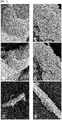
- FIG. 3 illustrates SEM images of Examples 1 and 2, where (a) to (f) are SEM images of Examples 1 and 2.
- the SiO 2 catalyst produced according to Example 1 consists of SiO 2 particles with small sizes of about 50 nm and has a bar shape with a fine interconnection structure.
- this nanostructure is a unique form of the SiO 2 catalyst.
- Test Example 2 X-ray diffraction analysis of SiO 2 catalyst
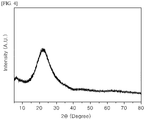
- FIG. 4 illustrates an analysis of an X-ray diffraction pattern of the SiO 2 catalyst produced according to Example 1.
- a wide protrusion was shown in a portion wherein a 2 ⁇ value was 20°, which coincides with an X-ray diffraction pattern of amorphous silica.
- Test Example 3 Analysis by X-ray photoelectron spectroscopy (XPS) of SiO 2 catalyst
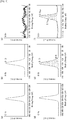
- FIG. 5 illustrates results of measuring XPS of the SiO 2 catalysts produced according to Examples 1 and 2, where (a) to (f) are results of measuring XPS of the SiO 2 catalysts produced according to Examples 1 and 2.
- the SiO 2 catalyst produced according to Example 1 had a single peak at 532.8 eV in an O Is spectrum, which corresponded to oxygen (O) in a Si-O-Si binding environment. Further, in a Si 2p spectrum, the SiO 2 catalyst produced according to Example 1 had a single peak at 103.5 eV, which corresponded to silicon (Si) in an Si-O binding environment. In addition, in a S 2p spectrum, the SiO 2 catalyst produced according to Example 1 did not have a peak corresponding to sulfur.
- the SiO 2 catalyst produced according to Example 2 had a single peak at 532.9 eV in an O Is spectrum. This is a result of confirming that even after the surface of the catalyst was modified with a thiol functional group, the Si-O-Si binding is not changed.
- the SiO 2 catalyst produced according to Example 2 is deconvoluted to one peak representing a Si-O bond (103.8 ev) and the other peak representing a Si-S bond (102.4 eV), which means that the surface of the catalyst was modified with a thiol functional group.
- the SiO 2 catalyst produced according to Example 2 had peaks corresponding to S 2p1/2 and 2p3/2 at 164.6 eV and 163.5 eV, respectively, which can be confirmed that the surface of the catalyst was modified with a thiol functional group.
- FIG. 6 illustrate XPS quantitative analysis of the SiO 2 catalysts produced according to Examples 1 and 2, where (a) and (b) are XPS quantitative analysis of the SiO 2 catalysts produced according to Examples 1 and 2.
- Example 2 The reason why the atomic ratios of the SiO 2 catalyst produced according to Example 2 are different from those of Example 1 is that the surface of the SiO 2 catalyst produced according to Example 2 was modified by a thiol functional group.
- Test Example 4 N 2 adsorption/desorption analysis and NH 3 -TPD analysis of SiO 2 catalyst
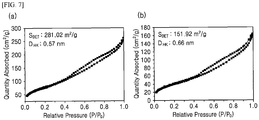
- FIG. 7 illustrates N 2 adsorption/desorption isotherms of the SiO 2 catalysts produced according to Examples 1 and 2, where (a) and (b) are N 2 adsorption/desorption isotherms of the SiO 2 catalysts produced according to Examples 1 and 2, and FIG. 8 illustrates a NH 3 -TPD measuring result of the SiO 2 catalysts produced according to Examples 1 and 2.
- the specific surface area of the SiO 2 catalyst was calculated by a Brunauer-Emmett-Teller (BET) theory (SBET).
- the specific surface areas of the SiO 2 catalysts produced according to Examples 1 and 2 were calculated to 281.02 m 2 /g and 151.92 m 2 /g..
- the pore size of the SiO 2 catalyst was calculated by a Hgoorvath-Kawazoe (HK) method.
- the pore sizes of the SiO 2 catalysts produced according to Examples 1 and 2 were calculated to 0.57 nm and 0.66 nm, respectively.
- the SiO 2 catalyst produced according to Example 1 had a NH 3 adsorption peak in a low-temperature region (LT) of 161.6°C, and the calculated acidic region concentration was 0.00838 mmol/g.
- the SiO 2 catalyst produced according to Example 2 had a NH 3 adsorption peak in a low-temperature region (LT) of 161.6°C, and the calculated acidic region concentration was 0.00838 mmol/g.
- Test Example 5 Calculation of yield of terephthalic acid (TPA) according to hydrolysis of polyethylene terephthalate (PET)
- the yield of terephthalic acid was calculated by hydrolyzing polyethylene terephthalate using the SiO 2 catalysts produced according to Examples 1 and 2.
- FIG. 9 is graphs showing the yield of TPA according to a time and a temperature, where (a) and (b) are graphs showing the yield of TPA according to a time and a temperature.
- the (a) in FIG. 9 compares the hydrolysis yield of terephthalic acid according to a reaction time at a temperature of 230°C.
- Test Example 6 NMR analysis of terephthalic acid (TPA) according to hydrolysis of polyethylene terephthalate (PET)
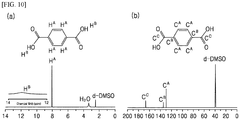
- FIG. 10 illustrates NMR analysis of terephthalic acid (TPA), where (a) and (b) illustrate are analysis of terephthalic acid (TPA).
- terephthalic acid prepared using the SiO 2 catalyst produced according to Example 2 showed two peaks for a hydroxy proton and an aromatic single proton, and chemical shift values were 13.31 ppm and 8.03 ppm, respectively.
- terephthalic acid produced using the SiO 2 catalyst produced according to Example 2 showed three peaks in a 13 C NMR spectrum, which were aromatic carbon, quaternary aromatic carbon and carbonyl carbon, respectively, and the chemical shift values were shown as 129.7 ppm, 134.8 ppm and 166.4 ppm, respectively.
- Test Example 7 Dynamic analysis of hydrolysis of polyethylene terephthalate (PET)
- v represents a reaction rate
- k represents a reaction rate constant
- [A] represents a concentration of polyethylene terephthalate.
- [A] t represents a polyethylene terephthalate concentration of a specific reaction time
- [A] 0 represents an initial polyethylene terephthalate concentration
- t represents a specific reaction time.
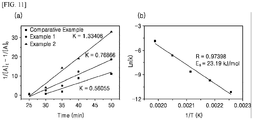
- FIG. 11 is graphs showing a reaction rate constant value for a concentration and a time, where (a) and (b) are graphs showing a reaction rate constant value for a concentration and a time.
- reaction rate constant (k) values were 0.56055, 0.76866 and 1.33406, respectively.
- the hydrolysis using the SiO 2 catalyst produced according to Example 1 exhibited hydrolysis characteristics 1.37 times more improved than the non-catalystic hydrolysis, and the hydrolysis using the SiO 2 catalyst produced according to Example 2 exhibited hydrolysis characteristics 2.37 times more improved than the non-catalystic hydrolysis.
- k represents a rate constant
- A represents a pre-exponential factor
- Ea represents activation energy
- R represents a gas constant
- T represents an absolute temperature
- Equation 4 above may be changed to the following Equation 5.
- Equation 4 above may be changed to the following Equation 5.
- ln k ln A ⁇ Ea / R 1 / T
- the activation energy of the hydrolysis of polyethylene terephthalate by the SiO 2 catalyst produced according to Example 2 was calculated to 23.19 kJ/mol, and this value is reduced to half or more of the activation energy (56.8 kJ/mol) of the hydrolysis of polyethylene terephthalate.
- Test Example 8 Hydrolysis mechanism analysis of polyethylene terephthalate of SiO 2 catalyst produced according to Example 2
- Reaction Formula 2 illustrates a process of hydrolyzing polyethylene terephthalate to terephthalic acid.
- the thiol functional group of the surface of the SiO 2 catalyst according to Example 2 was easily deprotonated in an aqueous condition to be formed into thiolate and hydronium (OH 3 +) ions.
- the generated hydronium ions provide protons in a nucleophilic center of polyethylene terephthalate.
- oxygen atoms of an ester group are positively charged, but the positive charges are more delocalized in the central carbon atoms.
- the present invention solves the problems to produce high-purity terephthalic acid.
- a recombinant E. coli strain expression vector introduced with a nucleotide sequence (SEQ ID NO: 1) encoding a 1,2-dihydroxy-3,5-cyclohexadiene-1,4-dicarboxylate dehydrogenase (TphB) enzyme, a nucleotide sequence (SEQ ID NO: 2) encoding a terephthalate 1,2-dioxyganase (TphAabc) enzyme, a nucleotide sequence (SEQ ID NO: 3) encoding protocatechuate 4,5-dioxyganase (LigAB) enzyme, and a nucleotide sequence (SEQ ID NO: 4) encoding 4-carboxy-2-hydroxymuconate-6-semialdehyde dehydrogenase (LigC)
- each nucleotide sequence encoding the TphB enzyme and the TphAabc enzyme was derived from Comamonas sp. E6 strain, and each nucleotide sequence encoding the LigAB enzyme and the LigC enzyme was derived from Sphingomonas paucimobilis strain.
- [Table 1] Primer sequence Target gene 1 5 '-ggatcc atgacaatagtgcaccgtagattg-3' tphB 2 5'-actagttt agaccggttgggctccg-3' 3 Genetic synthesis request tphAabc 4 5 Genetic synthesis request ligAB 6 7 Genetic synthesis request ligC 8
- PKE112 plasmid was cleaved with restriction enzymes Kpn I and Sbf I and a ligAB gene cleaved with the restriction enzymes Kpn I and Sbf I was inserted to construct pKE112ligAB plasmid in Experimental Group 1.
- the constructed pKE112ligAB plasmid was cleaved with a restriction enzyme Hind III and a ligC gene cleaved with the restriction enzymes Sbf I and Hind III was inserted to construct pKE112ligABC in Experimental Group 2.
- pKE112 plasmid was cleaved with restriction enzymes Ecor I and Kpn I and a tphB gene cleaved with the restriction enzymes Ecor I and Kpn I was inserted.
- a ligABC gene was inserted to construct pKE112tphBligABC plasmid.
- pKM212 plasmid was cleaved with restriction enzymes Kpn I and Hind III and a tphAabc gene cleaved with the restriction enzymes Kpn I and Hind III was inserted to construct pKM212tphAabc.
- a tphB gene was inserted to pKE112 plasmid to construct pKE112tphB.
- the pKM212tphAabc was constructed in the same manner as second plasmid of Experimental Group 3.
- Experimental Group 4-2 plasmid was the same plasmid as Experimental Group 2.
- the expression vector was transformed into the E. coli strain to obtain the strains of Experimental Groups 1 to 4 of Table 2 below.
- the two plasmids were transformed into the E. coli strain to obtain the strain.
- the two plasmids of Experimental Group 4-1 were transformed into the E. coli strain to obtain the strain, and the plasmid of Experimental Group 4-2 was transformed into the E. coli strain to obtain the strain, and then whole-cell conversion was performed to a ratio of 15:25.
- strain E6 tphAabc genes Km R Experimental Group 4 1 pKE112tphB pKE112; P tac promoter, Comamonas sp. strain E6 tphB genes, Amp R pKM212tphAabc pKM212; P tac promoter, Comamonas sp. strain E6 tphAabc genes, Km R 2 pKE112ligABC pKE112; P tac promoter, Sphingomonas paucimobilis strain ligABC gene, Amp R
- the recombinant E. coli strain of Experimental Example 1 was inoculated in 14 ml of a round bottom tube including 2 ml of an LB medium (5 g/L yeast extract, 10 g/L of sodium chloride (NaCl), and 10 g/L of pancreatic enzyme hydrolysate (bacto-tryptone) of casein) and incubated for 8 hours under conditions of 37°C and 200 rpm.
- LB medium 5 g/L yeast extract, 10 g/L of sodium chloride (NaCl), and 10 g/L of pancreatic enzyme hydrolysate (bacto-tryptone) of casein
- the culture solution incubated for 8 hours was added to a conical tube including 10 ml of an LB medium (5 g/L yeast extract, 10 g/L of sodium chloride (NaCl), and 10 g/L of pancreatic enzyme hydrolysate (bacto-tryptone) of casein), and then incubated overnight under conditions of 37°C and 200 rpm.
- an LB medium 5 g/L yeast extract, 10 g/L of sodium chloride (NaCl), and 10 g/L of pancreatic enzyme hydrolysate (bacto-tryptone) of casein
- the culture solution incubated overnight was transferred to 2 L of a baffled Erlenmeyer flask including 500 ml of an LB medium (5 g/L yeast extract, 10 g/L of sodium chloride (NaCl), and 10 g/L of pancreatic enzyme hydrolysate (bacto-tryptone) of casein) again and then incubated under conditions of 37°C and 200 rpm until the cell growth was 0.4 at an absorbance (OD600). At this time, the incubating up to 0.4 at the absorbance (OD600) is for IPTG induction of the cells.
- an LB medium 5 g/L yeast extract, 10 g/L of sodium chloride (NaCl), and 10 g/L of pancreatic enzyme hydrolysate (bacto-tryptone) of casein
- IPTG induction is molecularly similar to allolactose to initiate transcription when a gene is under the control of lac operon.
- IPTG an analog of allolactose, is not hydrolyzed by ⁇ -galactosidase unlike allolactos, and is maintained at the same concentration throughout an experimental environment. For this reason, the IPTG induction is used to induce protein expression.
- the culture solution was incubated until the cell growth became 0.4 at the absorbance (OD600) and then ice was added to stop the cell growth and added until the final concentration of IPTG became 0.1 mM and then incubated for about 24 hours under conditions of 16°C and 180 rpm until the cell growth stopped.
- the culture solution incubated for 24 hours was centrifuged for 20 minutes under conditions of 4°C and 8000 rpm for cell collection for whole-cell conversion.
- the collected cells were washed with Tris-HCl at a concentration of 50 mM at pH 8.0 so that the cell concentration in a 20 ml volume was adjusted to 30 in the absorbance (OD600).
- the cells were centrifuged under the conditions of 4°C and 4400 rpm again and reacted under conditions of 30°C and 250 rpm in a 20 ml volume in a 250 ml baffled Erlenmeyer flask with 50 mM Tris-HCl of pH 8.0 containing 1 g/L of protocatechuic acid.
- PDC 2-pyrone-4,6-dicarboxylic acid
- a pyrone ring of the PDC is a pseudo-aromatic ring, has a useful function such as receptor properties in donor-receptor type chromopores and biodegradable properties derived by PDC hydrolase, and two carboxylic acid functional groups attached to the pyrone ring are chemically modified when a large molecular system is made to act as a linker.
- the PDC has been studied to provide a linear or networked polymer by polycondensation with other difunctional or trifunctional monomers as difunctional monomers.
- the PDC can not be synthesized using petrochemical technology, and currently, can be extracted only from plant ingredients and, for example, can be produced in a large scale by a microbial fermentation process.
- the PDC as a compound is very soluble in polar solvents such as water, acetone, methanol, THF and acetonitrile, but is hardly dissolved in non-polar solvents such as benzene, hexane and heptane.
- polar solvents such as water, acetone, methanol, THF and acetonitrile
- non-polar solvents such as benzene, hexane and heptane.
- Most PDC metal salts such as PDC sodium salt have very low solubility in water or polar solvents, and then a PDC purification method has been developed using the same.
- a method of producing or obtaining such crude PDC or crude PDC sodium salt is not particularly limited.
- the crude PDC or crude PDC sodium salt may be commercially available or prepared by the microbial fermentation process described in the prior art.
- An object of the present invention is to provide an economic PDC purification method capable of removing these impurities simply and in low cost in the crude PDC or crude PDC sodium salt which is commercially available or prepared by the microbial fermentation process described in the prior art.
- the present invention provides a method of purifying 2-pyrone-4,6-dicarboxylic acid (PDC) including the following steps:
- Step (a) is a step of preparing an aqueous solution containing PDC by acidifying crude PDC sodium salt using at least one acid selected from the group consisting of, for example, hydrochloric acid, nitric acid, sulfuric acid, and phosphoric acid, as a step of preparing the crude PDC-containing aqueous solution.
- the acidifying may be performed by adding the PDC sodium salt to water and intensively stirring to make a water dispersion or water mixture, and adding strong hydrochloric acid thereto or directly adding strong hydrochloric acid to the PDC sodium salt.
- the acidifying may be performed by adding the PDC sodium salt to water and intensively stirring to make a water dispersion or water mixture, and adding strong hydrochloric acid thereto or directly adding strong hydrochloric acid to the PDC sodium salt.
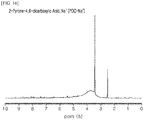
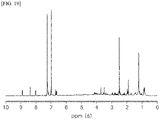
- FIGS. 16 and 17 show NMR graphs of crude PDC sodium salt and crude PDC, respectively, wherein peaks of two hydrogen atoms (around ⁇ 7.0 to 7.4) of the pyrone ring are not shown in FIG. 16 , but clearly shown in FIG. 17 .
- peaks that suggest the presence of impurities are not clear, but peaks shown in ⁇ 8 to 9 and ⁇ 3 to 4 may be estimated as impurities.
- the crude PDC sodium salt may be replaced with other metal cation salts or include some of the salts.
- Example of other metal cations may include other monovalent, bivalent, trivalenent, or tetravalent metal cations, specifically, monovalent metal cations such as lithium, potassium, rubidium, silver, and cesium; bivalent metal cations such as magnesium, calcium, iron (II), copper (II), zinc, barium, cobalt, nickel (II), manganese, and chromium (II); trivalent metal cations such as iron (III), aluminum, and gallium; and tetravalent metal cations such as arsenic(IV), lead (IV), titanium (IV), and germanium (IV).
- the acidification of the crude PDC sodium salt may be performed using an inorganic acid such as hydrochloric acid, sulfuric acid, nitric acid, and phosphoric acid, and organic acids such as acetic acid, preferably hydrochloric acid, and more preferably strong hydrochloric acid.
- the solution containing the PDC acidified as such may have pH 6 or less, preferably pH 5 or less, and more preferably pH 3 to 5.
- Step (b) is a step of extracting the crude PDC-containing aqueous solution resulted in step (a) with an organic solvent to be layer-separated into a water layer and an organic layer, and the extraction may be performed by adding an organic solvent to the crude PDC-containing aqueous solution and stirring, baffling, or shaking the mixture.
- the organic solvent used in extraction is not particularly limited, but ethyl acetate, methyl ethyl ketone, THF, and the like may be mentioned, and preferably, ethyl acetate, THF, or a mixture thereof may be mentioned.
- the amount of the organic solvent is not particularly limited, but generally, may be selected from 50 to 150 vol%, preferably 70 to 130 vol%, more preferably 90 to 110 vol% of the water layer.
- step (c) is a step of separating and removing the white precipitate formed by adding acetone to the water layer layer-separated in step (b), and the water layer or the solution from the white precipitate is separated is obtained.
- the separated white precipitate did not contain the PDC and was confirmed as impurities.
- the separation of the white precipitate is not particularly limited, and may use conventional solid solution separation methods, and for example, may be performed by filtration, centrifugation, gradient-separation, and the like.
- water-miscible organic solvents such as methanol, ethanol, propanol, acetonitrile, dimethylformamide (DMF), dimethylsulfoxide (DMSO) and N-methylpyrrolidone (NMP) may be used instead of acetone or some thereof may be replaced.
- DMF dimethylformamide
- DMSO dimethylsulfoxide
- NMP N-methylpyrrolidone
- the used amount of acetone or other water-miscible solvents is not particularly limited, but may be selected from 30 to 200 vol%, preferably 50 to 150 vol%, more preferably 60 to 120 vol%, specifically, 90 to 110 vol% of the water layer.
- the used amount of acetone or other water-miscible solvents is in the range or more, the formation of the white precipitate may not be performed well, and when the used amount thereof is in the range or more, a process of removing some or all of water-miscible solvents used for a subsequent extraction process may be further required.
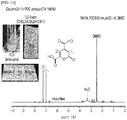
- FIG. 18 is a diagram illustrating an NMR graph and a TLC analysis image (upper right end) of a white precipitate separated into filtration.
- Step (d) is a step of extracting the solution from which the white precipitate is separated in step (c) with an organic solvent to be layer-separated into a water layer and an organic layer, and the extraction may be performed by adding the organic solvent to the solution and stirring, baffling, or shaking the mixture.
- the organic solvent used in extraction is not particularly limited, but ethyl acetate, methyl ethyl ketone, THF, and the like may be exemplified, and preferably, ethyl acetate, THF, or a mixture thereof may be mentioned.
- the amount of the organic solvent is not particularly limited, but generally, may be selected from 50 to 150 vol%, preferably 70 to 130 vol%, more preferably 90 to 110 vol% of the water layer, and the solution may be extracted one or more times, preferably 2 to 3 times.
- Step (e) of the present invention is a step of obtaining a concentrate containing 2-pyrone-4,6-dicarboxylic acid by concentrating the organic layer resulted in step (b) and the organic layers resulted in step (d).
- the organic layer is dried in advance with magnesium sulfate, sodium sulfate, and the like, and then concentrated under reduced pressure or under normal pressure.
- silica gel column chromatography is used.
- Each NMR image suggests that impurities are trace, but not ignored in addition to PDC.
- the column chromatography may be performed by isocratic elution or gradient elution.
- the gradient elution it may be mentioned an elution method using finally using a single solvent of 100% ethyl acetate by starting from a mixed solvent of ethyl acetate and hexane selected from a ratio of 4:1 to 1:4 and then gradually increasing a ratio of ethyl acetate.
- gradient elution finally using a single solvent of 100% hexane by gradually decreasing a ratio of ethyl acetate is not excluded.
- PDC 2-pyrone-4,6-dicarboxylic acid
- a microbial culture solution (1.5 L) containing PDC was centrifuged (4000 rpm, 1 hour, 4°C) to remove cells. 15 g of NaCl was added to a supernatant and left for 12 hours at 4°C to precipitate PDC sodium salt, and the precipitated PDC sodium salt was collected by filtration to prepare crude PDC sodium salt.
- the crude PDC sodium salt (22 g) was dispersed in water, acidified by adding strong hydrochloric acid, adjusted to pH 3 to 4, and concentrated under reduced pressure to prepare crude PDC.
- FIG. 16 shows an NMR graph of crude PDC sodium salt
- a water layer and an organic layer were separated and 30 ml of acetone was added to the water layer to precipitate a white solid, the formed white solid was removed by filtration, the remaining acetone was removed under reduced pressure, and then a filtrate was extracted twice with 100 ml of ethyl acetate again (second extraction).
- the organic layers (ethyl acetate layers) obtained in the first extraction and the second extraction were bound and dried with anhydrous sulfuric acid magnesium, and the anhydrous sulfuric acid magnesium was removed by filtration to concentrate the resulted filtrate under reduced pressure.
- Example 9 was performed in the same manner as Example 8.
- Comparative Example 1 was performed in the same manner as Example 8.
- Comparative Example 2 was performed in the same manner as Example 8.
- Comparative Example 3 was performed in the same manner as Example 8.
Landscapes
- Chemical & Material Sciences (AREA)
- Organic Chemistry (AREA)
- Engineering & Computer Science (AREA)
- Life Sciences & Earth Sciences (AREA)
- Health & Medical Sciences (AREA)
- Genetics & Genomics (AREA)
- Wood Science & Technology (AREA)
- Zoology (AREA)
- Bioinformatics & Cheminformatics (AREA)
- General Engineering & Computer Science (AREA)
- General Health & Medical Sciences (AREA)
- Biochemistry (AREA)
- Biotechnology (AREA)
- Biomedical Technology (AREA)
- Chemical Kinetics & Catalysis (AREA)
- Microbiology (AREA)
- Molecular Biology (AREA)
- Materials Engineering (AREA)
- Medicinal Chemistry (AREA)
- Biophysics (AREA)
- Physics & Mathematics (AREA)
- Plant Pathology (AREA)
- General Chemical & Material Sciences (AREA)
- Organic Low-Molecular-Weight Compounds And Preparation Thereof (AREA)
- Preparation Of Compounds By Using Micro-Organisms (AREA)
Abstract
Description
- The present invention relates to a method of producing high-purity 2-pyrone-4,6-dicarboxylic acid, and a method of producing an intermediate for the same.
- According to the present invention, terephthalic acid (TPA) may be produced from polyethylene terephthalate (PET) using a biomass catalyst and 2-pyrone-4,6-dicarboxylic acid (PDC), and 2-pyrone-4,6-dicarboxylic acid (PDC) may be produced by reacting the TPA with a recombinant strain. Further, high-purity PDC may be provided by removing impurities of the PDC.
- Further, the present invention relates to a method of hydrolyzing polyethylene terephthalate to terephthalic acid using a SiO2 catalyst derived from a biomass and microwaves.
- More specifically, the present invention relates to a recombinant strain for producing 2-pyrone-4,6-dicarboxylic acid (PDC) introduced with nucleotide sequences that encode enzymes TphB, TphAabc, LigAB, and LigC, and to a method of producing PDC including reacting the recombinant strain for producing PDC with a substrate.
- Further, the present invention relates to a method of purifying 2-pyrone-4,6-dicarboxylic acid to a high purity.
- Rice, a main grain of the Asian area, including Korea, has been produced at about 5 million tons per year as about 4.68 million tons (approximately 0.92 million ha of cultivation area) in 2009 in Korea. Rice hulls are agricultural waste that occur in a threshing process of rice, and generally, occupies about 20% of rice at a weight ratio, and only in Korea, about 0.9 to 1 million tons per year of rice hulls have been generated as a by-product of a milling process.
- However, despite various utilization studies of rice hulls since the mid-1900s, in Korea, only the self-utilization of rice hulls has been performed, such as most of rugs livestock facilities of cow, pig, etc., an interior thermal insulation, etc.
- The rice hulls are largely divided into organic and inorganic material ingredients, wherein the organic material is about 80% and the inorganic material is about 20%. The organic material consists of vegetable polymers such as cellulose, hemicellulose and lignin, and the inorganic material mostly consists of silica. The silica ingredient contained in the rice hulls has a form protected by a polymer that has a large physical and chemical resistance, such as lignin.
- Accordingly, in order to enhance the utilization of the rice hulls, various research and developments have been continuously conducted, such as a study for using rice hulls as a raw material, development of technology of preparing a wood material or a synthetic wood by utilizing the rice hulls as a material, and studies of separating/extracting and using silica present in the rice hulls.
- Meanwhile, polyethylene terephthalate (PET) that can be obtained by condensation-polymerizing terephthalic acid and ethylene glycol has good rigidity, electrical properties, weather resistance, and heat resistance, a quite small decrease in tensile strength despite long-term exposure under a high temperature, and good resistance to oil due to crystalline plastic.
- As a result, the PET has been used as household goods, toys, electrical insulators, household appliance cases, packaging materials, and especially, due to a light weight and no taste and smell, the PET occupies most of plastic beverage bottles.
- However, despite these advantages, the PET is very slowly disintegrated because of large resistance to atmospheric and biological materials, so that a waste PET resin causes environmental problems.
- As a method of recycling such a waste PET resin, there are disclosed chemical recycling methods such as glycolysis, hydrolysis, methanolysis, etc.
- The glycolysis method is a method which is commercially widely used in a PET depolymerization method by glycol such as ethylene glycol. The method has advantages in that the manufacturing cost is low and the waste PET as a raw material may be slightly contaminated, but has a disadvantage in that the molecular weight of a depolymerization material is high and it is difficult to be purified.
- The hydrolysis method is a method which is frequently used for preparing terephthalic acid as a PET disintegration method by water, alkali, etc., and has a disadvantage, but has a disadvantage in that the manufacturing cost is large.
- The methanolysis is most widely used as a depolymerization method by methanol, and has an advantage in that there is no relation with the contamination state of the waste PET, but has a disadvantage in that since it is necessary to operate at high temperatures and pressure, manufacturing costs are large.
- Among the methods, since terephthalic acid may be used as a raw material of polyester fiber, a lot of studies on the hydrolysis method of separating terephthalic acid and ethylene glycol from the waste PET resin have been conducted.
- The polyethylene terephthalate (PET) has advantages such as light weight, persistence, chemical stability, and easy forming, and has been widely used in synthetic fibers, packaging, or the like. In 2015, the annual production of PET is about 330,000 tons, and in polyesters, a largest amount of PET has been produced, but the PET is difficult to become naturally disintegrated to cause environmental pollution, such as pollution of fine plastic, and plastic precipitation of marine ecosystem.
- In order to replace the PET with eco-friendly plastic, biodegradable plastic such as polyethylene furandicarboxylic acid has been developed. However, these biodegradable plastics have many difficulties in replacing current PET in terms of physical properties or costs. For this reason, studies have been actively conducted to reduce waste plastics out of the nature by reinforcing the recycling of the PET.
- Among many plastics, the PET and polyethylene are one of plastics which are physically recycled and may form recycled plastics. In the United States, recycling processes of PET have been performed for several decades, but the recycling rate is only 21%. This is because the recycled PET has less quality than newly produced PET and the cost of the recycling process is expensive. For example, the newly produced PET is 1.1 to 1.3 dollars per kilogram, but the cost of recycling PET is 1.3 to 1.5 dollars per kilogram.
- Meanwhile, chemical or thermochemical plastic recycling of changing plastic into gas of fuel is not widely used due to energy cost and low price of products as compared with plastics. In summary, the recycling methods which have been currently used are not preferable solutions to reduce the waste PET. For this reason, recycling methods are required to upcycle the recycling method of the PET, that is, make a high value-added material using recycled articles.
- 2-pyrone-4,6-dicarboxylic acid (PDC) has a structure in which two carboxylic acid group are attached to a polar like-aromatic ring and acts as a difunctional monomer capable of polyaddition and polycondensation, and thus, high value-added utilization such as monomers useful for the production of various functional polyesters has been proposed. The 2-pyrone-4,6-dicarboxylic acid (PDC) is mass-produced enzymatically from lignin and is generally purified to activated carbon, but for high value-added utilization, many studies have been conducted by requiring a technology capable of purified the PDC to a high purity.
- However, in other 2-pyrone-4,6-dicarboxylic acids commercially acceptable as well as 2-pyrone-4,6-dicarboxylic acids purified by existing methods, as NMR and TLC analysis results, it was estimated that a trace of impurities are contained. However, these impurities are hardly removed by conventional methods (e.g., recrystallization, cation precipitation method, solubility method, etc.) of purifying 2-pyrone-4,6-dicarboxylic acid, so that the high value-added utilization of 2-pyrone-4,6-dicarboxylic acid has been limited in terms of industrial use. In addition, the removal and purification thereof require a lot of costs and efforts, so that there is a need for a method of removing the impurities simply, efficiently, and economically.
- An object of the present invention is to provide high-purity PDC by producing terephthalic acid (TPA) from polyethylene terephthalate (PET) using a biomass catalyst, producing 2-pyrone-4,6-dicarboxylic acid (PDC) by reacting the TPA with a recombinant strain, and removing impurities of the PDC.
- Another object of the present invention is to provide a method of easily producing solid terephthalic acid by producing a SiO2 catalyst using rice hulls and reacting with polyethylene terephthalate in a microwave reactor using the produced SiO2 catalyst.
- Yet another object of the present invention is to provide a method of producing high-purity terephthalic acid by lowering the impurity content of terephthalic acid when hydrolyzing polyethylene terephthalate under neutral conditions.
- Still another object of the present invention is to provide a recombinant strain for producing 2-pyrone-4,6-dicarboxylic acid (PDC) introduced with nucleotide sequences that encode TphB, TphAabc, LigAB, and LigC enzymes.
- Still yet another object of the present invention is to provide a method of producing PDC including reacting a recombinant strain for producing the PDC with a substrate.
- Still yet another object of the present invention is to provide high-purity 2-pyrone-4,6-dicarboxylic acid by removing impurities which are confirmed by NMR and/or TLC analysis, but hardly removed and purified, from crude 2-pyrone-4,6-dicarboxylic acid or its sodium salt which is industrially produced or commercially available.
- The objects to be solved by the present disclosure are not limited to the aforementioned object(s), and other object(s), which are not mentioned above, will be apparent to those skilled in the art from the following description.
- The present invention relates to a method of producing high-purity 2-pyrone-4,6-dicarboxylic acid (PDC), and a method of producing an intermediate for the same, the methods including the steps of: 1) producing TPA from PET; 2) producing PDC by reacting the TPA with a recombinant strain; and 3) purifying the produced PDC to a high purity.
- According to the present invention, in the 1) producing of the TPA from PET, the SiO2 catalyst may be extracted from a biomass.
- The biomass is preferably rice hulls.
- The SiO2 catalyst has preferably a surface modified by a thiol functional group (-SH).
- The specific surface area of the SiO2 catalyst is preferably 151.92 to 281.02 m2/g, and the size of the pore is preferably 0.57 to 0.66 nm.
- According to another preferred embodiment of the present invention, a method of producing a biomass-derived SiO2 catalyst may include a) grinding and then acid-treating rice hulls; and b) heat-treating the acid-treated rice hulls in step a).
- In another embodiment, the acid-treating in step a) is preferably performed for 10 minutes to 3 hours at 40°C to 150°C using an acidic solution containing one selected from the group consisting of sulfuric acid, hydrochloric acid, nitric acid, phosphoric acid, and mixtures thereof.
- After the acid-treating in step a), the method may further include filtering and washing the acid-treated rice hulls.
- The heat-treating in step b) may be performed for 2 to 3 hours while lowering by at a rate of 3.5°C per minute at a temperature of 600°C to 700°C.
- After step b), the method may further include modifying the surface of the SiO2 catalyst, and the modifying of the surface of the SiO2 catalyst may include preparing a mixture by adding the SiO2 catalyst and mercaptopropyl trimethoxysilane in a toluene solvent; washing the mixture; and drying the washed mixture.
- According to yet another preferred embodiment of the present invention, a disintegration method from PET to TPA using a biomass-derived SiO2 catalyst is characterized by mixing polyethylene terephthalate, a biomass-derived SiO2 catalyst, and water and irradiating microwaves to hydrolyze the polyethylene terephthalate to terephthalic acid.
- In yet another embodiment, the method of hydrolyzing the polyethylene terephthalate to terephthalic acid may include a) preparing a mixture with precipitated terephthalic acid by reacting polyethylene terephthalate, a biomass-derived SiO2 catalyst, and water in a microwave reactor; b) dissolving the terephthalic acid by mixing sodium hydroxide in the mixture; c) removing residues and the catalyst by filtering the mixture with the dissolved terephthalic acid; d) forming and obtaining a precipitate by adding an acidic solution to the mixture from which the residues and the catalyst are removed; and e) drying the obtained precipitate.
- The acidic solution is preferably one selected from the group consisting of sulfuric acid, hydrochloric acid, nitric acid, phosphoric acid, and mixtures thereof.
- An embodiment of 2) the producing of the PDC by reacting the TPA with the recombinant strain of the present invention provides a recombinant strain for producing 2-pyrone-4,6-dicarboxylic acid (PDC) introduced with nucleotide sequences which encode an enzyme selected from the group consisting of 1,2-dihydroxy-3,5-cyclohexadiene-1,4-dicarboxylate dehydrogenase (TphB) enzyme;
terephthalate 1,2-dioxyganase (TphAabc) enzyme;protocatechuate 4,5-dioxyganase (LigAB) enzyme; 4-carboxy-2-hydroxymuconate-6-semialdehyde dehydrogenase (LigC) enzyme, and combinations thereof. - A nucleotide sequence tphB encoding the TphB enzyme is not particularly limited, but as an example, may consist of a nucleotide sequence of SEQ ID NO: 1; and a nucleotide sequence tphAabc encoding the TphAabc enzyme is not particularly limited, but as an example, may consist of a nucleotide sequence of SEQ ID NO: 2. A nucleotide sequence ligAB encoding the LigAB enzyme is not particularly limited, but as an example, may consist of a nucleotide sequence of SEQ ID NO: 3; and a nucleotide sequence LigC encoding the LigC enzyme is not particularly limited, but as an example, may consist of a nucleotide sequence of SEQ ID NO: 4.
- As a detailed example of the embodiment, the recombinant strain for producing the PDC of the present invention may be a recombinant strain introduced with tphB of nucleotide SEQ ID NO: 1, tphAabc of nucleotide SEQ ID NO: 2, ligAB of nucleotide SEQ ID NO: 3, and ligC of nucleotide SEQ ID NO: 4; a mixed strain including a first recombinant strain introduced with tphB of nucleotide SEQ ID NO: 1 and tphAabc of nucleotide SEQ ID NO: 2 and a second recombinant strain introduced with ligAB of nucleotide SEQ ID NO: 3 and ligC of nucleotide SEQ ID NO: 4; and a recombinant strain introduced with ligAB of nucleotide SEQ ID NO: 3 and ligC of nucleotide SEQ ID NO: 4, etc.
- The introduction of the nucleotide sequence may be performed through an expression vector, and the strain introduced with the nucleotide sequence is transformed so that the nucleotide sequence is expressed.
- The expression vector refers to a gene construct including an essential regulating element operably linked to express a gene insert (the polynucleotide), as a vector capable of expressing a target protein or target RNA in a suitable host cell. The expression vector may be replicated regardless of host chromosome DNA once in the host cell, and inserted foreign DNA may be expressed. Since plasmid is the most commonly used form of the current vector, the plasmid and the vector are sometimes used interchangeably in the specification of the present invention.
- The vector includes a plasmid vector, a cosmid vector, a bacteriophage vector, a viral vector, etc., but is not limited thereto. The suitable expression vector includes a signal sequence or a leader sequence for membrane targeting or secretion in addition to expression regulatory elements such as a promoter, an operator, an initiation codon, a termination codon, a polyadenylation signal, and an enhancer and may be variously manufactured according to a purpose. The promoter of the vector may be constitutive or inductive. Further, the expression vector includes a selective marker for selecting a host cell containing a vector and a replicable expression vector includes a replication origin.
- The transformation means that the DNA is introduced into a host to allow DNA to be replicated as an extrachromosomal factor or by chromosomal integration completion. The host cell that may be used in transformation according to the present invention may include all prokaryotic or eukaryotic cells, and hosts with high introduction efficiency of DNA and high expression efficiency of the introduced DNA may be used. For example, the host cells may use known prokaryotic or eukaryotic cells such as Escherichia, Pseudomonas, Bacillus, Streptomaces, fungi, and yeast, insect cells such as Spodoptera frugiperda (SF9), animal cells such as CHO,
COS 1,COS 7,BSC 1,BSC 40, andBMT 10, etc., and are not limited thereto. - The transformation includes any method of introducing polynucleotides, and may be performed by selecting a suitable standard technique according to a host cell as known in the art. The method includes electroporation, protoplast fusion, calcium phosphate (CaPO4) precipitation, calcium chloride (CaCl2) precipitation, stirring using silicon carbide fibers, agrobacteria-mediated transformation, polyethylene glycol (PEG), dextran sulfate, lipofectamine, and particle bombardment, but is not limited thereto.
- Another aspect of the present invention provides a method of producing PDC including reacting a recombinant strain for producing the PDC with a substrate.
- The method of producing the PDC provided in the present invention is not particularly limited thereto. As a detailed example, the method of producing the PDC includes (1) obtaining a recombinant strain introduced with a nucleotide sequence of SEQ ID NO: 1 encoding a TphB enzymes, a nucleotide sequence of SEQ ID NO: 2 encoding a TphAabc enzyme, a nucleotide sequence of SEQ ID NO: 3 encoding a LigAB enzyme, and a nucleotide sequence of SEQ ID NO: 4 encoding a LigC enzyme; and (2) producing 2-pyrone-4,6-dicarboxylic acid (PDC) by reacting the obtained recombinant strain with terephthalic acid (TPA).
- At this time, a catalytic reaction of converting terephthalic acid (TPA) into protocatechuic acid (PCA) may be performed through sequential reaction of the TphAabc enzyme and the TphB enzyme. The LigAB enzyme may perform a catalytic reaction of converting protocatechuic acid (PCA) into 4-carboxy-2-hydroxymuconate-6-semialdehyde (CHMS) and the LigC enzyme may perform a catalytic reaction of converting CHMS into PDC.
- As another example, the method of producing the PDC provided by the present invention includes (1) obtaining a first recombinant strain introduced with a nucleotide sequence of SEQ ID NO: 1 encoding a TphB enzymes and a nucleotide sequence of SEQ ID NO: 2 encoding a TphAabc enzyme and a second recombinant strain introduced with a nucleotide sequence of SEQ ID NO: 3 encoding a LigAB enzyme and a nucleotide sequence of SEQ ID NO: 4 encoding a LigC enzyme, respectively; (2) obtaining a mixed strain by mixing the obtained first recombinant strain and second recombinant strain at a ratio of 15:25 (cell number); and (3) producing 2-pyrone-4,6-dicarboxylic acid (PDC) by reacting the obtained mixed strain with terephthalic acid (TPA).
- As yet another example, the method of producing the PDC provided by the present invention includes (1) obtaining a recombinant strain introduced with a nucleotide sequence of SEQ ID NO: 3 encoding a LigAB enzyme and a nucleotide sequence of SEQ ID NO: 4 encoding a LigC enzyme; and (2) producing 2-pyrone-4,6-dicarboxylic acid (PDC) by reacting the obtained recombinant strain with protocatechuic acid (PCA).
- Further, in order to achieve the object, the present invention provides a method of purifying high-purity 2-pyrone-4,6-dicarboxylic acid including the following steps in the case of the step 3) of purifying the produced PDC to a high purity:
- (a) preparing an aqueous solution containing 2-pyrone-4,6-dicarboxylic acid by acidifying crude 2-pyrone-4,6-dicarboxylic acid sodium salt;
- (b) extracting and layer-separating the aqueous solution resulted in step (a) with an organic solvent;
- (c) separating and removing a white precipitate formed by adding acetone to the layer-separated water layer in step (b);
- (d) extracting and layer-separating the solution from which the white precipitate is removed in step (c) with an organic solvent;
- (e) binding and concentrating the layer-separated organic layer in step (b) and the layer-separated organic layer in step (d); and
- (f) column-chromatographing the concentrate resulted in step (e) with a mixed solvent of ethyl acetate and hexane.
- According to an embodiment of the present invention, the 2-pyrone-4,6-dicarboxylic acid sodium salt may include one or more other metal cations selected from the group consisting of monovalent metal cations such as lithium, potassium, rubidium, silver, and cesium; bivalent metal cations such as magnesium, calcium, iron (II), copper (II), zinc, barium, cobalt, nickel (II), manganese, and chromium (II); trivalent metal cations such as iron (III), aluminum, and gallium; and tetravalent metal cations such as arsenic(IV), lead (IV), titanium (IV), and germanium (IV).
- According to an embodiment of the present invention, the acidifying in step (a) may be performed using at least one acid selected from the group consisting of hydrochloric acid, sulfuric acid, nitric acid and phosphoric acid, preferably, hydrochloric acid.
- According to an embodiment of the present invention, the organic solvents used in steps (b) and (d) are the same as or different from each other, may be at least one or two selected from the group consisting of ethyl acetate, methyl ethyl ketone, THF and mixtures thereof, preferably ethyl acetate.
- According to an embodiment of the present invention, the column chromatography of step (f) may be eluted with a mixed solvent of ethyl acetate:hexane = 4:1 to 1:4, and preferably gradient-eluted while being changed from the mixed solvent of ethyl acetate:hexane = 4:1 to 1:4 to ethyl acetate (single solvent).
- According to an embodiment of the present invention, the column chromatography of step (f) may be silica gel column chromatography.
- According to the present invention, it is possible to provide high-purity PDC by producing terephthalic acid (TPA) from polyethylene terephthalate (PET) using a biomass catalyst, producing 2-pyrone-4,6-dicarboxylic acid (PDC) by reacting the TPA with a recombinant strain, and removing impurities of the PDC.
- Further, by using a biomass-derived SiO2 catalyst, a method of producing the same, and a disintegration method of from PET to TPA using the same according to the present invention, high-purity terephthalic acid (TPA) can be produced at a faster rate than a conventional PET hydrolysis rate under neutral conditions, wherein the produced TPA can be usefully utilized as a raw material for polyester fibers and the like.
- Further, in the case of producing 2-pyrone-4,6-dicarboxylic acid (PDC) using the recombinant strain provided in the present invention, a conversion amount in a predetermined amount of substrate is 100%, only the PDC can be selectively produced without by-products, the separation and purification for the by-products are not required to be economic, and this may be widely used for economic production of PDC.
- Further, according to the present invention, it is possible to simply remove impurities, which are confirmed by NMR and/or TLC analysis, but hardly removed and purified, at low costs, from crude 2-pyrone-4,6-dicarboxylic acid or its sodium salt which is industrially manufactured or commercially available.
-
-
FIG. 1 illustrates a method of producing a biomass-derived SiO2 catalyst. -
FIG. 2 illustrates a method of hydrolyzing polyethylene terephthalate to terephthalic acid. -
FIG. 3 illustrates SEM images of Examples 1 and 2, where (a) to (f) are SEM images of Examples 1 and 2. -
FIG. 4 illustrates an analysis of an X-ray diffraction pattern of an SiO2 catalyst produced according to Example 1. -
FIG. 5 illustrates results of measuring XPS of the SiO2 catalysts produced according to Examples 1 and 2, where (a) to (f) are results of measuring XPS of the SiO2 catalysts produced according to Examples 1 and 2. -
FIG. 6 illustrates XPS quantitative analysis of the SiO2 catalysts produced according to Examples 1 and 2, where (a) and (b) are XPS quantitative analysis of the SiO2 catalysts produced according to Examples 1 and 2. -
FIG. 7 illustrates N2 adsorption/desorption isotherms of the SiO2 catalysts produced according to Examples 1 and 2, where (a) and (b) are N2 adsorption/desorption isotherms of the SiO2 catalysts produced according to Examples 1 and 2. -
FIG. 8 illustrates a NH3-TPD measuring result of the SiO2 catalysts produced according to Examples 1 and 2. -
FIG. 9 is graphs showing the yield of TPA according to a time and a temperature, where (a) and (b) are graphs showing the yield of TPA according to a time and a temperature. -
FIG. 10 illustrates NMR analysis of terephthalic acid (TPA), where (a) and (b) are NMR analysis of terephthalic acid (TPA). -
FIG. 11 is graphs showing a reaction rate constant value for a concentration and a time, where (a) and (b) are graphs showing a reaction rate constant value for a concentration and a time. -
FIG. 12 illustrates a result of converting whole cells using protocatechuic acid as a substrate by using a recombinant E. coli strain ofExperimental Group 1 provided in the present invention and confirming CHMS converted therefrom. -
FIG. 13 illustrates a result of converting whole cells using protocatechuic acid as a substrate by using a recombinant E. coli strain ofExperimental Group 2 provided in the present invention and confirming 2-pyrone-4,6-dicarboxylic acid (PDC) converted therefrom. -
FIG. 14 illustrates a result of converting whole cells using terephthalic acid as a substrate by using a recombinant E. coli strain ofExperimental Group 3 provided in the present invention and confirming 2-pyrone-4,6-dicarboxylic acid (PDC) converted therefrom. -
FIG. 15 illustrates a result of converting whole cells using terephthalic acid as a substrate by using a recombinant E. coli strain of Experimental Group 4-1 and a recombinant E. coli strain of Experimental Group 4-2 provided in the present invention and confirming 2-pyrone-4,6-dicarboxylic acid (PDC) converted therefrom. -
FIG. 16 illustrates an NMR graph of crude 2-pyrone-4,6-dicarboxylic acid sodium salt used in step (a) of the present invention. -
FIG. 17 illustrates an NMR graph and a TLC analysis image of crude 2-pyrone-4,6-dicarboxylic acid sodium salt used in step (b) of the present invention. -
FIG. 18 illustrates an NMR graph and a TLC analysis image of a white precipitate resulted in step (c) of the present invention. -
FIGS. 19 ,20 , and21 show NMR graphs of PDCs obtained in Comparative Examples 1, 2, and 3 of the present invention, respectively. -
FIG. 22 illustrates an NMR graph and a TLC analysis image of PDC obtained by column chromatography in step (f) of the present invention. - The present invention relates to a method of producing high-purity 2-pyrone-4,6-dicarboxylic acid (PDC), and a method of producing an intermediate for the same, the methods including the steps of: 1) producing TPA from PET; 2) producing PDC by reacting the TPA with a recombinant strain; and 3) purifying the produced PDC to a high purity.
- A method of producing a biomass-derived SiO2 catalyst may include a) grinding and then acid-treating rice hulls; and b) heat-treating the acid-treated rice hulls in step a).
- The method of hydrolyzing the polyethylene terephthalate to terephthalic acid may include a) preparing a mixture with precipitated terephthalic acid by reacting polyethylene terephthalate, a biomass-derived SiO2 catalyst, and water in a microwave reactor; b) dissolving the terephthalic acid by mixing sodium hydroxide in the mixture; c) removing residues and the catalyst by filtering the mixture with the dissolved terephthalic acid; d) forming and obtaining a precipitate by adding an acidic solution to the mixture from which the residues and the catalyst are removed; and e) drying the obtained precipitate.
- Further, there is provided a method of producing PDC including reacting a recombinant strain for producing PDC with a substrate.
- The method of producing the PDC provided in the present invention includes (1) obtaining a recombinant strain introduced with a nucleotide sequence of SEQ ID NO: 1 encoding a TphB enzymes, a nucleotide sequence of SEQ ID NO: 2 encoding a TphAabc enzyme, a nucleotide sequence of SEQ ID NO: 3 encoding a LigAB enzyme, and a nucleotide sequence of SEQ ID NO: 4 encoding a LigC enzyme; and (2) producing 2-pyrone-4,6-dicarboxylic acid (PDC) by reacting the obtained recombinant strain with terephthalic acid (TPA).
- Further, the present invention provides a method of purifying high-purity 2-pyrone-4,6-dicarboxylic acid including (a) preparing an aqueous solution containing 2-pyrone-4,6-dicarboxylic acid by acidifying crude 2-pyrone-4,6-dicarboxylic acid sodium salt; (b) extracting and layer-separating the aqueous solution resulted in step (a) with an organic solvent; (c) separating and removing a white precipitate formed by adding acetone to the layer-separated water layer in step (b); (d) extracting and layer-separating the solution from which the white precipitate is removed in step (c) with an organic solvent; (e) binding and concentrating the layer-separated organic layer in step (b) and the layer-separated organic layer in step (d); and (f) column-chromatographing the concentrate resulted in step (e) with a mixed solvent of ethyl acetate and hexane.
- Hereinafter, preferred embodiments of the present invention will be described in detail with reference to the accompanying drawings.
- Advantages and features of the present disclosure, and methods for accomplishing the same will be more clearly understood from exemplary embodiments to be described below in detail with reference to the accompanying drawings.
- However, the present disclosure is not limited to the following exemplary embodiments but may be implemented in various different forms. The exemplary embodiments are provided only to make description of the present disclosure complete and to fully provide the scope of the present disclosure to a person having ordinary skill in the art to which the present disclosure pertains with the category of the invention, and the present disclosure will be defined by the appended claims.
- In the following description of the present invention, a detailed description of known arts related thereto will be omitted when it is determined to make the subject matter of the present invention rather unclear.
- Hereinafter, a preferable embodiment of the present invention will be described in detail with reference to the accompanying drawings.
- The present invention relates to a method of producing high-purity 2-pyrone-4,6-dicarboxylic acid (PDC), and a method of producing an intermediate for the same, the methods including the steps of: 1) producing TPA from PET; 2) producing PDC by reacting the TPA with a recombinant strain; and 3) purifying the produced PDC to a high purity.
- A biomass described in the present invention described in the description of the present invention may be rice hulls.
- SiO2 nanoparticles prepared from the biomass may be a SiO2 catalyst.
- Further, the SiO2 catalyst with the surface modified by a thiol functional group is expressed as a Thiol-SiO2 catalyst.
- An object of the present invention is to provide a method capable of easily disintegrating solid terephthalic acid by preparing a SiO2 catalyst using rice hulls and reacting with polyethylene terephthalate in a microwave reactor using the produced SiO2 catalyst.
- Another object of the present invention is to provide a method of producing high-purity terephthalic acid by lowering the impurity content of terephthalic acid when hydrolyzing polyethylene terephthalate under neutral conditions.
- The present invention provides a SiO2 catalyst extracted from the biomass and a preparation method, and provides a method of hydrolyzing polyethylene terephthalate using the SiO2 catalyst.
- The biomass according to an embodiment of the present invention may be rice hulls.
- The SiO2 catalyst according to an embodiment of the present invention may be extracted from the biomass, and the surface of the SiO2 catalyst may be modified by a thiol functional group (-SH).
- The specific surface area of the SiO2 catalyst may be 151.92 to 281.02 m2/g, and the size of the pore may be 0.57 to 0.66 nm.
- Hereinafter, a method of producing a biomass-derived SiO2 catalyst according to an embodiment of the present invention will be described with reference to
FIG. 1 . -
FIG. 1 illustrates a method of producing a biomass-derived SiO2 catalyst. - According to an embodiment of the present invention, a method of producing a biomass-derived SiO2 catalyst may include a) grinding and then acid-treating rice hulls (S10); and b) heat-treating the acid-treated rice hulls in step a) (S20).
- Step a) (S10) is a step of grinding and then acid-treating rice hulls.
- The reason for grinding the rice hulls to a certain size is to increase the efficiency of the acid-treating process after grinding, and increase the purity of the finally produced SiO2.
- The method of grinding the rice hulls is not limited, and specifically, milling may be performed.
- The milling may be performed using a generally used milling machine, such as a knee-type milling machine, a bed-type milling machine, a universal milling machine, and an upright milling machine.
- The particle size of the milled rice hulls may be 50 to 500 µm.
- The acid-treating of step a) (S10) is to remove impurities contained in the rice hulls, and may be performed with 7 to 15% of an acidic solution, specifically, a 10% acidic solution.
- The acidic solution may be one selected from the group consisting of sulfuric acid, hydrochloric acid, nitric acid, phosphoric acid, and mixtures thereof, and specifically hydrochloric acid.
- The acid-treating of step a) (S10) may be performed for 10 minutes to 3 hours at 40°C to 150°C using an acidic solution including one selected from the group consisting of sulfuric acid, hydrochloric acid, nitric acid, phosphoric acid, and mixtures thereof. Specifically, the acid-treating of step a) (S10) may be performed for 20 minutes to 2 hours at 50°C to 100°C using hydrochloric acid, and more specifically, may be performed for 30 minutes at 60°C using hydrochloric acid.
- The acid-treating of the grinded rice hulls may be performed at least one time, specifically 1 to 10 times, and may be performed differently depending on a type and a concentration of the acidic solution.
- The acid-treating of step a) (S10) may be performed at a solid-liquid ratio (g:ml) of 1:5 to 15 of the grinded rice hulls and the acidic solution, specifically at a solid-liquid ratio of 1:10.
- After the acid-treating in step a) (S10), the method may further include filtering and washing the acid-treated rice hulls.
- The filtering is not limited so long as the method is any method capable of obtaining SiO2 nanoparticles.
- The washing may be performed 1 to 4 times with distilled water, toluene, acetone, etc.
- The step b) (S20) is a step of heat-treating the acid-treated rice hulls in step (a) (S10).
- The heat-treating of step b) (S20) may be performed for 2 to 3 hours while lowering the temperature of the acid-treated rice hulls by at a rate of 3.5°C per minute at a temperature of 600°C to 700°C.
- When the heat-treating is performed under the above conditions, a SiO2 catalyst with a high specific surface area (151.92 ~ 281.02 m2/g) and a large pore (0.57 to 0.66 nm) may be obtained.
- After step b) (S10), the method may further include modifying the surface of the SiO2 catalyst, and the modifying of the surface of the SiO2 catalyst may include preparing a mixture by adding the SiO2 catalyst and mercaptopropyl trimethoxysilane in a toluene solvent; washing the mixture; and drying the washed mixture.
- The washing of the mixture may be performed 1 to 4 times with distilled water, toluene, acetone, etc.
- The drying of the washed mixture may be vacuum-dried for 12 to 26 hours at 50°C to 70°C.
-
FIG. 2 illustrates a method of hydrolyzing polyethylene terephthalate to terephthalic acid. - According to another embodiment of the present invention, a disintegration method from PET to TPA using a biomass-derived SiO2 catalyst is characterized by mixing polyethylene terephthalate, a biomass-derived SiO2 catalyst, and water and irradiating microwaves to hydrolyze the polyethylene terephthalate to terephthalic acid.
- Specifically, the method of hydrolyzing polyethylene terephthalate to terephthalic acid using the biomass-derived SiO2 catalyst may include a) preparing a mixture with precipitated terephthalic acid by reacting polyethylene terephthalate, a biomass-derived SiO2 catalyst, and water in a microwave reactor (S100); b) dissolving the terephthalic acid by mixing sodium hydroxide in the mixture (S200); c) removing residues and the catalyst by filtering the mixture with the dissolved terephthalic acid (S300); d) forming and obtaining a precipitate by adding an acidic solution to the mixture from which the residues and the catalyst are removed (S400); and e) drying the obtained precipitate (S500).
- The following
Reaction Formula 1 illustrates a process of hydrolyzing polyethylene terephthalate to terephthalic acid.
- Step a) (S100) is a step of hydrolyzing polyethylene terephthalate to terephthalic acid using the biomass-derived SiO2 catalyst.
- The hydrolyzing may be performed in a microwave reactor.
- The microwave reactor (Anton Paar,
Monowave 400, UK) may be equipped with temperature and pressure sensors. - Since the description of the microwave reactor is beyond the scope of the present invention, the description thereof will be omitted.
- The SiO2 catalyst may be a biomass-derived SiO2 catalyst and the biomass may be rice hulls.
- Further, the biomass-derived SiO2 catalyst may have a surface modified by a thiol functional group.
- Since the SiO2 catalyst has been described above, the description thereof will be omitted.
- In order to hydrolyze the polyethylene terephthalate, since it is obvious that water is required, the description thereof will be omitted.
- Referring to
Reaction Formula 1, when the polyethylene terephthalate is hydrolyzed, a mixture in which terephthalic acid is precipitated is prepared. - The mixture may be terephthalic acid, ethylene glycol, polyethylene terephthalate, and a catalyst.
- Step b) (S200) is a step of dissolving the terephthalic acid by mixing sodium hydroxide in the mixture.
- In Step b) (S200), the terephthalic acid is dissolved to remove impurities in the next step.
- Here, the impurities are unreacted polyethylene terephthalate and the catalyst.
- Step c) (S300) is a step of removing residues and the catalyst by filtering the mixture with the dissolved terephthalic acid.
- The residue is disintegrated polyethylene terephthalate.
- Step c) (S300) is not limited so long as the method is any method capable of removing the disintegrated polyethylene terephthalate and the catalyst.
- Step d) (S400) is a step of forming and obtaining a precipitate by adding an acidic solution to the mixture from which the residues and the catalyst are removed.
- The acidic solution may be one selected from the group consisting of sulfuric acid, hydrochloric acid, nitric acid, phosphoric acid, and mixtures thereof, and preferably hydrochloric acid.
- Step e) (S500) is a step of drying the obtained precipitate.
- The method of drying the obtained precipitate is not limited.
- Hereinafter, the present invention will be described in more detail by Examples and Experimental Examples. However, the following Examples and Experimental Examples are just illustrative of the present invention and the scope of the present invention is not limited thereto.
- First, rice hulls were ground using a grinder and prepared so that the particle size of the rice hulls was 150 µm.
- 10 g of the ground rice hulls were immersed in 100 ml of a hydrochloric acid (10% HCl) aqueous solution for 15 hours.
- Next, the hydrochloric acid aqueous solution was removed using a filter, and then the rice hulls were washed twice with distilled water.
- Finally, the washed rice hulls were heat-treated (annealing) for 3 hours while falling by 3.5°C per minute at a temperature of 65°C to produce a biomass-derived SiO2 catalyst.
- First, 0.5 g of the biomass-derived SiO2 catalyst produced in Example 1 and 0.5 ml of mercaptopropyl trimethoxysilane were mixed in 200 ml of toluene and then refluxed for 24 hours and washed with toluene and acetone.
- Finally, the mixture was dried for 24 hours in a vacuum oven of 60°C to produce a surface-modified SiO2 (Thiol-SiO2) catalyst.
- First, 0.1 g of polyethylene terephthalate and 12 ml of deionized water were added in a microwave reactor (Anton Paar,
Monowave 400, UK) to prepare a mixture in which terephthalic acid was precipitated. - After the reaction, 1 M of sodium hydroxide was added to the mixture in which terephthalic acid was precipitated and the precipitated terephthalic acid (TPA) was dissolved and filtered in a form of di-2-methyl terephthalic acid (NaTPA) to remove unreacted polyethylene terephthalate.
- Next, the TPA was precipitated and filtered by adding an excess amount of hydrochloric acid to separate the TPA.
- Finally, the dried TPA was obtained in an oven of 60°C.
- First, 0.1 g of the SiO2 catalyst produced in Example 1, 0.1 g of polyethylene terephthalate and 12 ml of deionized water were added in a microwave reactor (Anton Paar,
Monowave 400, UK) to prepare a mixture in which terephthalic acid was precipitated. - After the reaction, 1 M of sodium hydroxide was added to the mixture in which terephthalic acid was precipitated and the precipitated terephthalic acid (TPA) was dissolved and filtered in a form of di-2-methyl terephthalic acid (NaTPA) to remove unreacted polyethylene terephthalate and the SiO2 catalyst.
- Next, the TPA was precipitated and filtered by adding an excess amount of hydrochloric acid to separate the TPA.
- Finally, the dried TPA was obtained in an oven of 60°C.
- First, 0.1 g of the surface-modified SiO2 catalyst produced in Example 2, 0.1 g of polyethylene terephthalate and 12 ml of deionized water were added in a microwave reactor (Anton Paar,
Monowave 400, UK) to prepare a mixture in which terephthalic acid was precipitated. - After the reaction, 1 M of sodium hydroxide was added to the mixture in which terephthalic acid was precipitated and the precipitated terephthalic acid (TPA) was dissolved and filtered in a form of di-2-methyl terephthalic acid (NaTPA) to remove unreacted polyethylene terephthalate and the surface-modified SiO2 catalyst.
- Next, the TPA was precipitated and filtered by adding an excess amount of hydrochloric acid to separate the TPA.
- Finally, the dried TPA was obtained in an oven of 60°C.
-
FIG. 3 illustrates SEM images of Examples 1 and 2, where (a) to (f) are SEM images of Examples 1 and 2. - Referring to the (a) to (c) in
FIG. 3 , it can be confirmed that the SiO2 catalyst produced according to Example 1 consists of SiO2 particles with small sizes of about 50 nm and has a bar shape with a fine interconnection structure. - Referring to the (d) to (f) in
FIG. 3 , it can be confirmed that the surface-modified SiO2 catalyst produced according to Example 2 is surface-modified and then continuously maintains a fine shape. - As a result, it can be confirmed that this nanostructure is a unique form of the SiO2 catalyst.
-
FIG. 4 illustrates an analysis of an X-ray diffraction pattern of the SiO2 catalyst produced according to Example 1. - Referring to
FIG. 4 , a wide protrusion was shown in a portion wherein a 2θ value was 20°, which coincides with an X-ray diffraction pattern of amorphous silica. -
FIG. 5 illustrates results of measuring XPS of the SiO2 catalysts produced according to Examples 1 and 2, where (a) to (f) are results of measuring XPS of the SiO2 catalysts produced according to Examples 1 and 2. - Referring to the (a) to (c) in
FIG. 5 , the SiO2 catalyst produced according to Example 1 had a single peak at 532.8 eV in an O Is spectrum, which corresponded to oxygen (O) in a Si-O-Si binding environment. Further, in aSi 2p spectrum, the SiO2 catalyst produced according to Example 1 had a single peak at 103.5 eV, which corresponded to silicon (Si) in an Si-O binding environment. In addition, in aS 2p spectrum, the SiO2 catalyst produced according to Example 1 did not have a peak corresponding to sulfur. - Referring to the (d) to (f) in
FIG. 5 , the SiO2 catalyst produced according to Example 2 had a single peak at 532.9 eV in an O Is spectrum. This is a result of confirming that even after the surface of the catalyst was modified with a thiol functional group, the Si-O-Si binding is not changed. - However, it can be confirmed that in the
Si 2p spectrum, the SiO2 catalyst produced according to Example 2 is deconvoluted to one peak representing a Si-O bond (103.8 ev) and the other peak representing a Si-S bond (102.4 eV), which means that the surface of the catalyst was modified with a thiol functional group. - Further, it was confirmed that in the
S 2p spectrum, the SiO2 catalyst produced according to Example 2 had peaks corresponding to S 2p1/2 and 2p3/2 at 164.6 eV and 163.5 eV, respectively, which can be confirmed that the surface of the catalyst was modified with a thiol functional group. -
FIG. 6 illustrate XPS quantitative analysis of the SiO2 catalysts produced according to Examples 1 and 2, where (a) and (b) are XPS quantitative analysis of the SiO2 catalysts produced according to Examples 1 and 2. - Referring to the (a) and (b) in
FIG. 6 , it was confirmed that in the SiO2 catalyst produced according to Example 1, a silicon atomic ratio was 31.24% and an oxygen atomic ratio was 64.01%, which coincided with a conventional SiO2 configuration. It was confirmed that in the SiO2 catalyst produced according to Example 2, a silicon atomic ratio was 26.26%, an oxygen atomic ratio was 50.65%, and a sulfur atomic ratio was 2.78%. - The reason why the atomic ratios of the SiO2 catalyst produced according to Example 2 are different from those of Example 1 is that the surface of the SiO2 catalyst produced according to Example 2 was modified by a thiol functional group.
- As the XPS analysis result, it can be seen that in the SiO2 catalyst produced according to Example 2, the surface modification was performed well, and even if the surface of the SiO2 catalyst produced according to Example 1 was modified, the initial structure was not affected.
-
FIG. 7 illustrates N2 adsorption/desorption isotherms of the SiO2 catalysts produced according to Examples 1 and 2, where (a) and (b) are N2 adsorption/desorption isotherms of the SiO2 catalysts produced according to Examples 1 and 2, andFIG. 8 illustrates a NH3-TPD measuring result of the SiO2 catalysts produced according to Examples 1 and 2. - Referring to the (a) and (b) in
FIG. 7 , all the SiO2 catalysts produced according to Examples 1 and 2 had iv-type isotherms of forming Hysteresis loops in a relative pressure (P/PO) range of 0.4 to 1.0 due to mesoporous solids through multilayer adsorption and then capillary condensation. - The specific surface area of the SiO2 catalyst was calculated by a Brunauer-Emmett-Teller (BET) theory (SBET).
- The specific surface areas of the SiO2 catalysts produced according to Examples 1 and 2 were calculated to 281.02 m2/g and 151.92 m2/g..
- In addition, the pore size of the SiO2 catalyst was calculated by a Hgoorvath-Kawazoe (HK) method.
- The pore sizes of the SiO2 catalysts produced according to Examples 1 and 2 were calculated to 0.57 nm and 0.66 nm, respectively.
- Through the two results, it can be seen that the surface area and the pore size of the SiO2 catalyst are almost not changed during the thiol modifying process.
- Referring to
FIG. 8 , the SiO2 catalyst produced according to Example 1 had a NH3 adsorption peak in a low-temperature region (LT) of 161.6°C, and the calculated acidic region concentration was 0.00838 mmol/g. - Further, the SiO2 catalyst produced according to Example 2 had a NH3 adsorption peak in a low-temperature region (LT) of 161.6°C, and the calculated acidic region concentration was 0.00838 mmol/g.
- However, in the SiO2 catalyst produced according to Example 2, the thiol functional group of the surface acted as the acidic region and thus another NH3 adsorption peak was confirmed in a high-temperature region (HT) of 369.4°C, and the calculated acidic region concentration was 0.39319 mmol/g.
- The yield of terephthalic acid was calculated by hydrolyzing polyethylene terephthalate using the SiO2 catalysts produced according to Examples 1 and 2.
-
FIG. 9 is graphs showing the yield of TPA according to a time and a temperature, where (a) and (b) are graphs showing the yield of TPA according to a time and a temperature. - The yield of TPA was calculated by the following
Equation 1.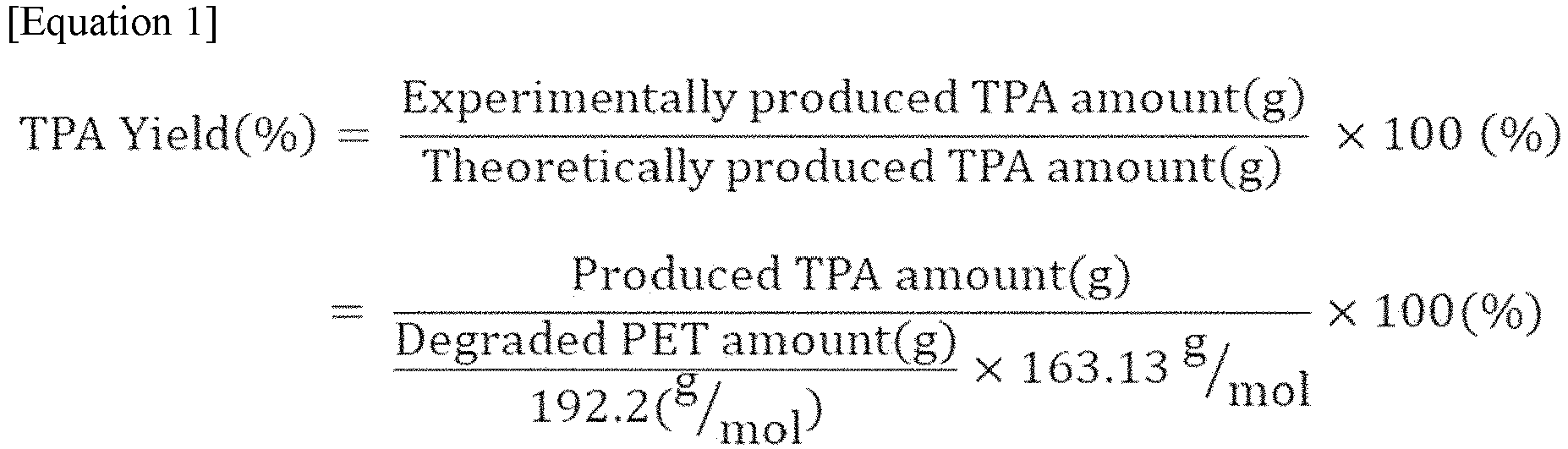
- The (a) in
FIG. 9 compares the hydrolysis yield of terephthalic acid according to a reaction time at a temperature of 230°C. - Referring to the (a) in
FIG. 9 , the hydrolysis of polyethylene terephthalate without using the catalyst was not reacted for an initial 5 minutes and then reacted for 50 minutes, and as a result, the yield reached 91.74%. - However, the hydrolysis of polyethylene terephthalate using the SiO2 catalyst produced according to Example 1 was performed for a reaction time of initial 5 minutes and then reacted for 40 minutes, and as a result, the yield reached 92.4%. Further, the hydrolysis reaction of polyethylene terephthalate using the SiO2 catalyst produced according to Example 2 was performed for 30 minutes, and as a result, the yield reached 93.43%.
- As a result, it was confirmed that as compared with the hydrolysis reaction of polyethylene terephthalate without using the catalyst, the hydrolysis time when using the SiO2 catalyst produced according to Example 1 was shortened by 10 minutes and the hydrolysis time when using the SiO2 catalyst produced according to Example 2 was further shortened by 10 minutes.
- This is because the acidity of the SiO2 catalyst according to Example 2 is higher than that of the SiO2 catalyst according to Example 1, and the slowly increasing of the hydrolysis rate when the reaction starts is due to irregular chain separation of polyethylene terephthalate.
- After the irregular chain separation of the polyethylene terephthalate, the hydrolysis rate was rapidly increased and the hydrolysis yield of terephthalic acid reached 97.06%.
- Referring to the (b) in
FIG. 9 , it was confirmed that the hydrolysis of polyethylene terephthalate at 170°C or less did not start, and the yield of terephthalic acid was increased as the temperature was increased when the temperature increased. In addition, the yield reached 93.43% at a reaction temperature of 230°C. - As a result, it was confirmed that the hydrolysis of polyethylene terephthalate without using the catalyst was not performed at a temperature of 170°C or less, but in the case of using the SiO2 catalysts produced according to Examples 1 and 2, even under the condition of 170°C or less, the hydrolysis of polyethylene terephthalate may be performed.
-
FIG. 10 illustrates NMR analysis of terephthalic acid (TPA), where (a) and (b) illustrate are analysis of terephthalic acid (TPA). - Referring to the (a) in
FIG. 10 , terephthalic acid prepared using the SiO2 catalyst produced according to Example 2 showed two peaks for a hydroxy proton and an aromatic single proton, and chemical shift values were 13.31 ppm and 8.03 ppm, respectively. - Referring to the (b) in
FIG. 10 , terephthalic acid produced using the SiO2 catalyst produced according to Example 2 showed three peaks in a 13C NMR spectrum, which were aromatic carbon, quaternary aromatic carbon and carbonyl carbon, respectively, and the chemical shift values were shown as 129.7 ppm, 134.8 ppm and 166.4 ppm, respectively. - The above result was confirmed to coincide with conventional terephthalic acid data.
- Terephthalic acid hydrolysis of polyethylene terephthalate followed
Equation 2 below.
- Here, v represents a reaction rate, k represents a reaction rate constant, and [A] represents a concentration of polyethylene terephthalate.
- The reaction rate constant (k) value of polyethylene terephthalate hydrolysis reaction was determined according to the following
Equation 3 depending on the integration rate rule.
- Here, [A]t represents a polyethylene terephthalate concentration of a specific reaction time, [A]0 represents an initial polyethylene terephthalate concentration, and t represents a specific reaction time.
-
FIG. 11 is graphs showing a reaction rate constant value for a concentration and a time, where (a) and (b) are graphs showing a reaction rate constant value for a concentration and a time. - Referring to the (a) in
FIG. 11 , when there is no catalyst (non-catalyst) and in the case of using catalysts according to Examples 1 and 2, the reaction rate constant (k) values were 0.56055, 0.76866 and 1.33406, respectively. - The hydrolysis using the SiO2 catalyst produced according to Example 1 exhibited hydrolysis characteristics 1.37 times more improved than the non-catalystic hydrolysis, and the hydrolysis using the SiO2 catalyst produced according to Example 2 exhibited hydrolysis characteristics 2.37 times more improved than the non-catalystic hydrolysis.
- The reason why the hydrolysis characteristics using the SiO2 catalyst produced according to Example 2 were improved was that the activation energy was lowered, and this was calculated according to the following Equation 4 (Arrhenius Equation) based on a reaction temperature control experiment.

- Here, k represents a rate constant, A represents a pre-exponential factor, Ea represents activation energy, R represents a gas constant, and T represents an absolute temperature.
-
Equation 4 above may be changed to the followingEquation 5.
- Referring to the (b) in
FIG. 11 , the activation energy of the hydrolysis of polyethylene terephthalate by the SiO2 catalyst produced according to Example 2 was calculated to 23.19 kJ/mol, and this value is reduced to half or more of the activation energy (56.8 kJ/mol) of the hydrolysis of polyethylene terephthalate. - The following
Reaction Formula 2 illustrates a process of hydrolyzing polyethylene terephthalate to terephthalic acid.
- First, the thiol functional group of the surface of the SiO2 catalyst according to Example 2 was easily deprotonated in an aqueous condition to be formed into thiolate and hydronium (OH3+) ions.
- Next, the generated hydronium ions provide protons in a nucleophilic center of polyethylene terephthalate.
- In polyethylene terephthalate, oxygen atoms of an ester group are positively charged, but the positive charges are more delocalized in the central carbon atoms.
- Next, water molecules attack positive-charged center carbon atoms, oxygen atoms of the ethyl group are provided with hydrogen atoms from other positive charged oxygen atoms, and the binding of carbons and oxygens are broken to generate terephthalic acid and ethylene glycol in a polyethylene terephthalate hydrolysis reaction.
- If there is no SiO2 catalyst produced according to Example 2, incomplete disintegration of ester bonds is induced from polyethylene terephthalate due to high activation energy to decrease the purity of terephthalic acid. The present invention solves the problems to produce high-purity terephthalic acid.
- Therefore, by using a biomass-derived SiO2 catalyst, a preparation method of the same, and a disintegration method from PET to TPA using the same according to the present invention, high-purity TPA can be produced at a faster time than the time of a conventional PET hydrolysis process under neutral conditions, wherein the TPA thus produced can be usefully utilized as a raw material for polyester fibers and the like.
- In the present invention, in order to produce PDC from a recombinant strain, by using Escherichia coli (XL1-Blue) strain, there was constructed a recombinant E. coli strain expression vector introduced with a nucleotide sequence (SEQ ID NO: 1) encoding a 1,2-dihydroxy-3,5-cyclohexadiene-1,4-dicarboxylate dehydrogenase (TphB) enzyme, a nucleotide sequence (SEQ ID NO: 2) encoding a
terephthalate 1,2-dioxyganase (TphAabc) enzyme, a nucleotide sequence (SEQ ID NO: 3)encoding protocatechuate 4,5-dioxyganase (LigAB) enzyme, and a nucleotide sequence (SEQ ID NO: 4) encoding 4-carboxy-2-hydroxymuconate-6-semialdehyde dehydrogenase (LigC) enzyme. - At this time, each nucleotide sequence encoding the TphB enzyme and the TphAabc enzyme was derived from Comamonas sp. E6 strain, and each nucleotide sequence encoding the LigAB enzyme and the LigC enzyme was derived from Sphingomonas paucimobilis strain.
[Table 1] Primer sequence Target gene 1 5 '-ggatcc atgacaatagtgcaccgtagattg-3' tphB 2 5'-actagttt agaccggttgggctccg-3' 3 Genetic synthesis request tphAabc 4 5 Genetic synthesis request ligAB 6 7 Genetic synthesis request ligC 8 - As a specific method of constructing an expression vector, PKE112 plasmid was cleaved with restriction enzymes KpnI and SbfI and a ligAB gene cleaved with the restriction enzymes KpnI and SbfI was inserted to construct pKE112ligAB plasmid in
Experimental Group 1. The constructed pKE112ligAB plasmid was cleaved with a restriction enzyme HindIII and a ligC gene cleaved with the restriction enzymes SbfI and HindIII was inserted to construct pKE112ligABC inExperimental Group 2. InExperimental Group 3, pKE112 plasmid was cleaved with restriction enzymes EcorI and KpnI and a tphB gene cleaved with the restriction enzymes EcorI and KpnI was inserted. - Thereafter, in the same manner as
Experimental Groups Experimental Group 3, pKM212 plasmid was cleaved with restriction enzymes KpnI and HindIII and a tphAabc gene cleaved with the restriction enzymes KpnI and HindIII was inserted to construct pKM212tphAabc. In the case of Experimental Group 4-1, likeExperimental Group 3, a tphB gene was inserted to pKE112 plasmid to construct pKE112tphB. The pKM212tphAabc was constructed in the same manner as second plasmid ofExperimental Group 3. In the case of Experimental Group 4-2, plasmid was the same plasmid asExperimental Group 2. - Thereafter, the expression vector was transformed into the E. coli strain to obtain the strains of
Experimental Groups 1 to 4 of Table 2 below. In the case ofExperimental Group 3, the two plasmids were transformed into the E. coli strain to obtain the strain. In the case ofExperimental Group 4, the two plasmids of Experimental Group 4-1 were transformed into the E. coli strain to obtain the strain, and the plasmid of Experimental Group 4-2 was transformed into the E. coli strain to obtain the strain, and then whole-cell conversion was performed to a ratio of 15:25.[Table 2] Condition Plasmid Experimental Group 1 pKE112ligAB pKE112; Ptac promoter, Sphingomonas paucimobilis strain ligAB gene, AmpR Experimental Group 2 pKE112ligABC pKE112; Ptac promoter, Sphingomonas paucimobilis strain ligABC gene, AmpR Experimental Group 3 pKE112tphBligABC pKE112; Ptac promoter,Comamonas sp. strain E6 tphB gene, Sphingomonas paucimobilis strain ligABC gene, AmpR pKM212tphAabc pKM212; Ptac promoter,Comamonas sp. strain E6 tphAabc genes, KmR Experimental Group 4 1 pKE112tphB pKE112; Ptac promoter,Comamonas sp. strain E6 tphB genes, AmpR pKM212tphAabc pKM212; Ptac promoter,Comamonas sp. strain E6 tphAabc genes, Km R2 pKE112ligABC pKE112; Ptac promoter, Sphingomonas paucimobilis strain ligABC gene, AmpR - The recombinant E. coli strain of Experimental Example 1 was inoculated in 14 ml of a round bottom tube including 2 ml of an LB medium (5 g/L yeast extract, 10 g/L of sodium chloride (NaCl), and 10 g/L of pancreatic enzyme hydrolysate (bacto-tryptone) of casein) and incubated for 8 hours under conditions of 37°C and 200 rpm.
- Next, the culture solution incubated for 8 hours was added to a conical tube including 10 ml of an LB medium (5 g/L yeast extract, 10 g/L of sodium chloride (NaCl), and 10 g/L of pancreatic enzyme hydrolysate (bacto-tryptone) of casein), and then incubated overnight under conditions of 37°C and 200 rpm.
- The culture solution incubated overnight was transferred to 2 L of a baffled Erlenmeyer flask including 500 ml of an LB medium (5 g/L yeast extract, 10 g/L of sodium chloride (NaCl), and 10 g/L of pancreatic enzyme hydrolysate (bacto-tryptone) of casein) again and then incubated under conditions of 37°C and 200 rpm until the cell growth was 0.4 at an absorbance (OD600). At this time, the incubating up to 0.4 at the absorbance (OD600) is for IPTG induction of the cells.
- The IPTG induction is molecularly similar to allolactose to initiate transcription when a gene is under the control of lac operon. IPTG, an analog of allolactose, is not hydrolyzed by β-galactosidase unlike allolactos, and is maintained at the same concentration throughout an experimental environment. For this reason, the IPTG induction is used to induce protein expression.
- For the IPTG induction, the culture solution was incubated until the cell growth became 0.4 at the absorbance (OD600) and then ice was added to stop the cell growth and added until the final concentration of IPTG became 0.1 mM and then incubated for about 24 hours under conditions of 16°C and 180 rpm until the cell growth stopped.
- Next, the culture solution incubated for 24 hours was centrifuged for 20 minutes under conditions of 4°C and 8000 rpm for cell collection for whole-cell conversion. After centrifuging, the collected cells were washed with Tris-HCl at a concentration of 50 mM at pH 8.0 so that the cell concentration in a 20 ml volume was adjusted to 30 in the absorbance (OD600). The cells were centrifuged under the conditions of 4°C and 4400 rpm again and reacted under conditions of 30°C and 250 rpm in a 20 ml volume in a 250 ml baffled Erlenmeyer flask with 50 mM Tris-HCl of pH 8.0 containing 1 g/L of protocatechuic acid.
- In order to measure CHMS converted from protocatechuic acid used as a substrate and recombinant E. coli by using a reaction solution of
Experimental Group 1 reacted in the 250 ml baffled Erlenmeyer flask, HPLC analysis was performed under conditions of Table 3 and the results were illustrated inFIG. 12 . - As illustrated in
FIG. 12 , when the whole-cell conversion was performed using protocatechuic acid as the substrate by using the recombinant E. coli strain, 1.20(±0.01) g/L of protocatechuic acid was fully consumed for 3 hours and the CHMS of a HPLC area value of 156.03(±9.63) was converted. - The whole-cell conversion reaction of the recombinant E. coli strain of
Experimental Group 2 was performed in the same manner as in Example 4, and in order to measure the CHMS converted from the protocatechuic acid used as the substrate and the recombinant E. coli and 2-pyrone-4,6-dicarboxylic acid (PDC), the HPLC analysis was performed under the conditions of the following Table 3 and the results were illustrated inFIG. 13 . - As illustrated in
FIG. 13 , when the whole-cell conversion was performed using protocatechuic acid as the substrate by using the recombinant E. coli strain, 1.17(±0.01) g/L of protocatechuic acid was fully consumed for 6 hours and 2-pyrone-4,6-dicarboxylic acid (PDC) of the HPLC area value of 1313.80(±22.79) was converted. - The whole-cell conversion reaction of the recombinant E. coli strain of
Experimental Group 3 was performed in the same manner as in Example 4, but a buffer (50 mM tris-HCl of PH 7.0 and 20 g/L glycerol) was used instead of a 50 mM Tris-HCl buffer of pH 8.0 and as the substrate, 0.5 g/L of terephthalic acid was used instead of 1 g/L of protocatechuic acid. In order to measure 2-pyrone-4,6-dicarboxylic acid (PDC) converted from terephthalic acid used as the substrate, protocatechuic acid and CHMS as intermediates, and the recombinant E. coli strain, the HPLC analysis was performed under the conditions of the following Table 3 and the results were illustrated inFIG. 14 . - As illustrated in
FIG. 14 , when the whole-cell conversion was performed using terephthalic acid as the substrate by using the recombinant E. coli strain, 0.50(±0.01) g/L of terephthalic acid was fully consumed for 5 hours and 2-pyrone-4,6-dicarboxylic acid (PDC) of the HPLC area value of 1129.9(±17.4) was converted. The CHMS of the HPLC area value of 11.8(±2.3) was not converted to 2-pyrone-4,6-dicarboxylic acid (PDC) and then left in the whole-cell conversion solution. - The whole-cell conversion reactions of the recombinant E. coli strain of Experimental Group 4-1 and the recombinant E. coli strain of Experimental Group 4-2 were performed in the same manner as in Example 4, but a ratio of the recombinant E. coli strain of Experimental Group 4-1 and the recombinant E. coli strain of Experimental Group 4-2 was 15:25. In order to measure 2-pyrone-4,6-dicarboxylic acid (PDC) converted from terephthalic acid used as the substrate, protocatechuic acid and CHMS as intermediates, and the recombinant E. coli strain, the HPLC analysis was performed under the conditions of the following Table 3 and the results were illustrated in
FIG. 15 .[Table 3] HPLC performance conditions ODC and CHMS measurement condition TPA and PCA measurement conditions Column Aminex HPX-87H column Optimapak C18 column Flow rate 0.8 ml/min 1.0 ml/ min Solvent 5 mM of H2SO4 A; 0.1 % trifluoroacetate in 100 % acetonitrile B; 0.1 % trifluoroacetate in waterA: 10 %B : 90 % Temperature 50° C 30°C - As illustrated in
FIG. 15 , when the whole-cell conversion was performed using terephthalic acid as the substrate by using the recombinant E. coli strain of Experimental Group 4-1 and the recombinant E. coli strain of Experimental Group 4-2 at a ratio of 15:25, 0.52(±0.00) g/L of terephthalic acid was fully consumed for 6 hours and 2-pyrone-4,6-dicarboxylic acid (PDC) of the HPLC area value of 1585.73(±16.63) was converted. Unlike the result ofFIG. 14 , it can be seen that CHMS, which was an intermediate, has not been left in the whole-cell conversion solution, and thus, the CHMS, which was an intermediate, was fully converted. - 2-pyrone-4,6-dicarboxylic acid (hereinafter, abbreviated as PDC) was chemically stable and had a variety of functional groups, and thus was much expected as a multifunctional material. A pyrone ring of the PDC is a pseudo-aromatic ring, has a useful function such as receptor properties in donor-receptor type chromopores and biodegradable properties derived by PDC hydrolase, and two carboxylic acid functional groups attached to the pyrone ring are chemically modified when a large molecular system is made to act as a linker. Typically, the PDC has been studied to provide a linear or networked polymer by polycondensation with other difunctional or trifunctional monomers as difunctional monomers.
- The PDC can not be synthesized using petrochemical technology, and currently, can be extracted only from plant ingredients and, for example, can be produced in a large scale by a microbial fermentation process.
- When the PDC was produced by the microbial fermentation process, there has been proposed a method in which NaCl was added to a fermentation mixture containing the PDC to precipitate PDC sodium salt, and the PDC sodium salt was collected by centrifuge and acidified again, and then extracted with an organic solvent to purify pure PDC.
- The PDC as a compound is very soluble in polar solvents such as water, acetone, methanol, THF and acetonitrile, but is hardly dissolved in non-polar solvents such as benzene, hexane and heptane. Most PDC metal salts such as PDC sodium salt have very low solubility in water or polar solvents, and then a PDC purification method has been developed using the same.
- In the present invention, a method of producing or obtaining such crude PDC or crude PDC sodium salt is not particularly limited. Generally, the crude PDC or crude PDC sodium salt may be commercially available or prepared by the microbial fermentation process described in the prior art.
- However, in the crude PDC or crude PDC sodium salt which is commercially available or prepared by the microbial fermentation process described in the prior art, it is analyzed that impurities are traced in a spectroscopic test of NMR, but in thin film chromatography (TLC) analysis, separate spots clearly distinguished from spots of PDC are observed. These spots are determined as impurities, and the amount thereof is also not small.
- An object of the present invention is to provide an economic PDC purification method capable of removing these impurities simply and in low cost in the crude PDC or crude PDC sodium salt which is commercially available or prepared by the microbial fermentation process described in the prior art.
- The present invention provides a method of purifying 2-pyrone-4,6-dicarboxylic acid (PDC) including the following steps:
- (a) preparing a crude PDC-containing aqueous solution by acidifying crude PDC sodium salt;
- (b) extracting the crude PDC-containing aqueous solution resulted in step (a) with an organic solvent to be layer-separated into a water layer and an organic layer;
- (c) separating and removing a white precipitate formed by adding acetone to the water layer resulted in step (b);
- (d) extracting the solution from which the white precipitate is removed in step (c) with an organic solvent to be layer-separated into a water layer and an organic layer;
- (e) concentrating the organic layer resulted in step (b) and the organic layer resulted in step (d); and
- (f) column-chromatographing the concentrate resulted in step (e) with a mixed solvent of ethyl acetate and hexane.
- In the present invention, Step (a) is a step of preparing an aqueous solution containing PDC by acidifying crude PDC sodium salt using at least one acid selected from the group consisting of, for example, hydrochloric acid, nitric acid, sulfuric acid, and phosphoric acid, as a step of preparing the crude PDC-containing aqueous solution.
- In an embodiment of the present invention, the acidifying may be performed by adding the PDC sodium salt to water and intensively stirring to make a water dispersion or water mixture, and adding strong hydrochloric acid thereto or directly adding strong hydrochloric acid to the PDC sodium salt.
- In an embodiment of the present invention, the acidifying may be performed by adding the PDC sodium salt to water and intensively stirring to make a water dispersion or water mixture, and adding strong hydrochloric acid thereto or directly adding strong hydrochloric acid to the PDC sodium salt.
- In the accompanying drawings,
FIGS. 16 and17 show NMR graphs of crude PDC sodium salt and crude PDC, respectively, wherein peaks of two hydrogen atoms (around δ 7.0 to 7.4) of the pyrone ring are not shown inFIG. 16 , but clearly shown inFIG. 17 . InFIG. 17 , peaks that suggest the presence of impurities are not clear, but peaks shown inδ 8 to 9 andδ 3 to 4 may be estimated as impurities. - On NMR graphs of
FIGS. 16 and17 , the presence of impurities is not clear, but in a TLC image displayed on an upper end ofFIG. 17 , spots are clearly shown at other locations as well as PDC spots (marked as P) in a dotted line, and it is estimated that a large amount of impurities may be present from these spots. - In an embodiment of the present invention, the crude PDC sodium salt may be replaced with other metal cation salts or include some of the salts. Example of other metal cations may include other monovalent, bivalent, trivalenent, or tetravalent metal cations, specifically, monovalent metal cations such as lithium, potassium, rubidium, silver, and cesium; bivalent metal cations such as magnesium, calcium, iron (II), copper (II), zinc, barium, cobalt, nickel (II), manganese, and chromium (II); trivalent metal cations such as iron (III), aluminum, and gallium; and tetravalent metal cations such as arsenic(IV), lead (IV), titanium (IV), and germanium (IV).
- The acidification of the crude PDC sodium salt may be performed using an inorganic acid such as hydrochloric acid, sulfuric acid, nitric acid, and phosphoric acid, and organic acids such as acetic acid, preferably hydrochloric acid, and more preferably strong hydrochloric acid. The solution containing the PDC acidified as such may have
pH 6 or less, preferablypH 5 or less, and more preferablypH 3 to 5. - In the present invention, Step (b) is a step of extracting the crude PDC-containing aqueous solution resulted in step (a) with an organic solvent to be layer-separated into a water layer and an organic layer, and the extraction may be performed by adding an organic solvent to the crude PDC-containing aqueous solution and stirring, baffling, or shaking the mixture.
- The organic solvent used in extraction is not particularly limited, but ethyl acetate, methyl ethyl ketone, THF, and the like may be mentioned, and preferably, ethyl acetate, THF, or a mixture thereof may be mentioned.
- The amount of the organic solvent is not particularly limited, but generally, may be selected from 50 to 150 vol%, preferably 70 to 130 vol%, more preferably 90 to 110 vol% of the water layer.
- Through NMR and TLC analysis, it was confirmed that trace impurities are contained in the PDC contained in the layer-separated organic layer (see
FIG. 17 ). - In the present invention, step (c) is a step of separating and removing the white precipitate formed by adding acetone to the water layer layer-separated in step (b), and the water layer or the solution from the white precipitate is separated is obtained. As the NMR and TLC analysis results, the separated white precipitate did not contain the PDC and was confirmed as impurities.
- The separation of the white precipitate is not particularly limited, and may use conventional solid solution separation methods, and for example, may be performed by filtration, centrifugation, gradient-separation, and the like.
- In this regard, since PDC has high solubility in both water and acetone, but the white precipitate as impurities has high solubility in water, but has low solubility in acetone, when acetone is added to the water layer, the PDC is not precipitated and the impurities that are insoluble to acetone are precipitated.
- According to one method of the present invention, other water-miscible organic solvents, such as methanol, ethanol, propanol, acetonitrile, dimethylformamide (DMF), dimethylsulfoxide (DMSO) and N-methylpyrrolidone (NMP) may be used instead of acetone or some thereof may be replaced.
- The used amount of acetone or other water-miscible solvents is not particularly limited, but may be selected from 30 to 200 vol%, preferably 50 to 150 vol%, more preferably 60 to 120 vol%, specifically, 90 to 110 vol% of the water layer. When the used amount of acetone or other water-miscible solvents is in the range or more, the formation of the white precipitate may not be performed well, and when the used amount thereof is in the range or more, a process of removing some or all of water-miscible solvents used for a subsequent extraction process may be further required.
-
FIG. 18 is a diagram illustrating an NMR graph and a TLC analysis image (upper right end) of a white precipitate separated into filtration. When an NMR graph of the white precipitate shown inFIG. 18 is compared with the NMR graph (FIG. 16 ) of the PDC sodium salt and the NMR graph (FIG. 17 ) of the PDC, it is confirmed that the white precipitate is different from the PDC. Further, when the TLC analysis image of the white precipitate is compared with the TLC analysis image of the PDC (the upper left end ofFIG. 17 ), it is confirmed that since the spot of the white precipitate is different from the position of the PDC spot and shown at the same position as one of spots of the PDC impurity, the white precipitate is the impurity other than the PDC. - In the present invention, Step (d) is a step of extracting the solution from which the white precipitate is separated in step (c) with an organic solvent to be layer-separated into a water layer and an organic layer, and the extraction may be performed by adding the organic solvent to the solution and stirring, baffling, or shaking the mixture.
- The organic solvent used in extraction is not particularly limited, but ethyl acetate, methyl ethyl ketone, THF, and the like may be exemplified, and preferably, ethyl acetate, THF, or a mixture thereof may be mentioned.
- The amount of the organic solvent is not particularly limited, but generally, may be selected from 50 to 150 vol%, preferably 70 to 130 vol%, more preferably 90 to 110 vol% of the water layer, and the solution may be extracted one or more times, preferably 2 to 3 times.
- Step (e) of the present invention is a step of obtaining a concentrate containing 2-pyrone-4,6-dicarboxylic acid by concentrating the organic layer resulted in step (b) and the organic layers resulted in step (d).
- According to a preferred embodiment of the present invention, the organic layer is dried in advance with magnesium sulfate, sodium sulfate, and the like, and then concentrated under reduced pressure or under normal pressure.
- It is confirmed that in the PDC contained in the concentrate, as the NMR and TLC analysis results, a trace amount of impurities are still present.
- Step (f) of the present invention is a step of column-chromatographing the concentrate resulted in step (e) with a mixed solvent of ethyl acetate and hexane, preferably, a mixed solvent of ethyl acetate:hexane = 4:1 to 1:4, and a step of obtaining 2-pyrone-4,6-dicarboxylic acid to high purity.
- According to one embodiment of the present invention, silica gel column chromatography is used.
-
FIGS. 19 ,20 , and21 illustrate NMR graphs and/or TLC analysis images of PDC obtained by separating the solid using a mixed solvent of ethyl acetate:methanol = 1:1, a mixed solvent of ethyl acetate:methanol = 2:1, and a single solvent of 100% ethyl acetate with column chromatography, respectively. Each NMR image suggests that impurities are trace, but not ignored in addition to PDC. -
FIG. 22 shows an NMR graph of a 2-pyrone-4,6-dicarboxylic acid product obtained by separating the solid using a mixed solvent of ethyl acetate:methanol = 1:1 with column chromatography, wherein there is almost no peak corresponding to the impurities. - According to a preferred embodiment of the present invention, the column chromatography may be performed by isocratic elution or gradient elution. As an example of the gradient elution, it may be mentioned an elution method using finally using a single solvent of 100% ethyl acetate by starting from a mixed solvent of ethyl acetate and hexane selected from a ratio of 4:1 to 1:4 and then gradually increasing a ratio of ethyl acetate. In the present invention, gradient elution finally using a single solvent of 100% hexane by gradually decreasing a ratio of ethyl acetate is not excluded.
- According to an advantage of the present invention, it is possible to provide high-purity 2-pyrone-4,6-dicarboxylic acid (PDC) by removing most impurities which are hardly confirmed and/or removed by a conventional purification method such as recrystallization, solvent precipitation, salting-out, and the like.
- According to another advantage of the present invention, it is possible to provide high-purity 2-pyrone-4,6-dicarboxylic acid (PDC) capable of producing high-functional polymer in an industrial scale by an economic and simple method.
- According to yet another advantage of the present invention, it is possible to provide a method of confirming and removing impurities which are contained in 2-pyrone-4,6-dicarboxylic acid (PDC) and hardly identified by a spectroscopic method such as NMR and/or a chromatographic method such as TLC.
- A microbial culture solution (1.5 L) containing PDC was centrifuged (4000 rpm, 1 hour, 4°C) to remove cells. 15 g of NaCl was added to a supernatant and left for 12 hours at 4°C to precipitate PDC sodium salt, and the precipitated PDC sodium salt was collected by filtration to prepare crude PDC sodium salt.
- The crude PDC sodium salt (22 g) was dispersed in water, acidified by adding strong hydrochloric acid, adjusted to
pH 3 to 4, and concentrated under reduced pressure to prepare crude PDC. -
FIG. 16 shows an NMR graph of crude PDC sodium salt andFIG. 17 shows an NMR graph and a TLC analysis image (deployment solvent chloroform: ethyl acetate:formamide = 10:8:1) of PDC obtained by acidifying crude PDC sodium salt with strong hydrochloric acid. - It is observed that two hydrogen atoms of the pyrone ring of PDC are not shown in the NMR graph in a sodium salt state (COONa state) (
FIG. 16 ), but shown around δ 7.0 to 7.3 in an acidified state (COOH state) (FIG. 17 ). However, in the TLC analysis image ofFIG. 17 , it is shown that separate other spots as well as PDC spots (spots marked by P in a red dotted rectangle) are clearly shown and a large amount of impurities are included in addition to the PDC. - 22 g of the crude PDC sodium salt obtained in Preparation Example 1 was dissolved in 100 ml of distilled water, slowly added with 1 M hydrochloric acid, adjusted to
pH 3 to 4, and then extracted once with 100 ml of ethyl acetate (first extraction). - A water layer and an organic layer were separated and 30 ml of acetone was added to the water layer to precipitate a white solid, the formed white solid was removed by filtration, the remaining acetone was removed under reduced pressure, and then a filtrate was extracted twice with 100 ml of ethyl acetate again (second extraction).
- The organic layers (ethyl acetate layers) obtained in the first extraction and the second extraction were bound and dried with anhydrous sulfuric acid magnesium, and the anhydrous sulfuric acid magnesium was removed by filtration to concentrate the resulted filtrate under reduced pressure.
- The resulted concentrate was eluded with a mixed solvent of ethyl acetate:hexane = 1:1 in silica gel column chromatography and concentrated under reduced pressure to obtain high-purity PDC, and the yield for the reactant was 80% or more. In the fractions eluted in column chromatography, the PDC-containing was confirmed by TLC (ethyl acetate:hexane = 1:1).
- Except that the concentrate obtained by concentrating the organic layer was gradient-eluted while changing slowly a ratio to an ethyl acetate signal solvent from a mixed solvent of ethyl acetate:hexane = 1:1 in silica gel column chromatography, Example 9 was performed in the same manner as Example 8.
- In the resulted 2-pyrone-4,6-dicarboxylic acid, it was confirmed that most of impurities were removed through the NMR graph (
FIG. 22 ). - Except that the concentrate obtained by concentrating the organic layer was eluted with a mixed solvent of ethyl acetate:hexane = 1:1 in silica gel column chromatography, Comparative Example 1 was performed in the same manner as Example 8.
- In the resulted 2-pyrone-4,6-dicarboxylic acid, it was confirmed that a trace amount of impurities was still present through the NMR graph (
FIG. 19 ). - Except that the concentrate obtained by concentrating the organic layer was eluted with a mixed solvent of ethyl acetate:hexane = 2:1 in silica gel column chromatography, Comparative Example 2 was performed in the same manner as Example 8.
- In the resulted 2-pyrone-4,6-dicarboxylic acid, it was confirmed that a trace amount of impurities was still present through the NMR graph (
FIG. 20 ). - Except that the concentrate obtained by concentrating the organic layer was eluted with ethyl acetate (single solvent) in silica gel column chromatography, Comparative Example 3 was performed in the same manner as Example 8.
- In the resulted 2-pyrone-4,6-dicarboxylic acid, it was confirmed that a trace amount of impurities was still present through the NMR graph (
FIG. 21 ). - As described above, specific embodiments for the method of producing high-purity 2-pyrone-4,6-dicarboxylic acid according to an embodiment of the present invention and the method of producing the intermediate for same have been described, but it will be apparent that various modification can be made without departing from the scope of the present invention.
- Therefore, the scope of the present invention should not be limited to the embodiments and should be defined by the appended claims and equivalents to the appended claims.
- In other words, the embodiments described above are illustrative in all aspects and should be understood as not being restrictive, and the scope of the present invention is represented by appended claims to be described below rather than the detailed description, and it is to be interpreted that the meaning and scope of the appended claims and all changed or modified forms derived from the equivalents thereof are included within the scope of the present invention.


Claims (33)
- A method of producing high-purity 2-pyrone-4,6-dicarboxylic acid and an intermediate for the same comprising the steps of:1) producing terephthalic acid (TPA) from polyethylene terephthalate (PET);2) producing 2-pyrone-4,6-dicarboxylic acid (PDC) by reacting the TPA with a recombinant strain; and3) purifying the produced PDC to a high purity.
- A SiO2 catalyst, which is extracted from a biomass.
- The SiO2 catalyst of claim 2, wherein the biomass is rice hulls.
- The SiO2 catalyst of claim 2, wherein a surface is modified by a thiol functional group (-SH).
- The SiO2 catalyst of claim 2, wherein the specific surface area of the SiO2 catalyst is 151.92 to 281.02 m2/g, and the size of the pore is 0.57 to 0.66 nm.
- A method of producing a biomass-derived SiO2 catalyst comprising the steps of:) grinding and then acid-treating rice hulls; and
 ) heat-treating the acid-treated rice hulls in step
 ).
).
- The method of producing the biomass-derived SiO2 catalyst of claim 6, wherein the acid-treating in step) is performed for 10 minutes to 3 hours at 40°C to 150°C using an acidic solution containing one selected from the group consisting of sulfuric acid, hydrochloric acid, nitric acid, phosphoric acid, and mixtures thereof.
- The method of producing the biomass-derived SiO2 catalyst of claim 6, further comprising:
after the acid-treating in step), filtering and washing the acid-treated rice hulls. - The method of producing the biomass-derived SiO2 catalyst of claim 6, wherein the heat-treating in step () is performed for 2 to 3 hours while lowering by at a rate of 3.5°C per minute at a temperature of 600°C to 700°C.
- The method of producing the biomass-derived SiO2 catalyst of claim 6, further comprising:modifying the surface of the SiO2 catalyst after step (),wherein the modifying of the surface of the SiO2 catalyst comprises the steps of:preparing a mixture by adding the SiO2 catalyst and mercaptopropyl trimethoxysilane in a toluene solvent;washing the mixture; anddrying the washed mixture.
- A disintegration method from PET to TPA using a biomass-derived SiO2 catalyst comprising:
mixing polyethylene terephthalate, a biomass-derived SiO2 catalyst, and water and irradiating microwaves to hydrolyze the polyethylene terephthalate to terephthalic acid. - The disintegration method from PET to TPA using the biomass-derived SiO2 catalyst of claim 11, wherein the method of hydrolyzing the polyethylene terephthalate to terephthalic acid comprises the steps of:(a) preparing a mixture with precipitated terephthalic acid by reacting polyethylene terephthalate, a biomass-derived SiO2 catalyst, and water in a microwave reactor;(b) dissolving the terephthalic acid by mixing sodium hydroxide in the mixture;(c) removing residues and the catalyst by filtering the mixture with the dissolved terephthalic acid;(d) forming and obtaining a precipitate by adding an acidic solution to the mixture from which the residues and the catalyst are removed; and(e) drying the obtained precipitate.
- The disintegration method from PET to TPA using the biomass-derived SiO2 catalyst of claim 12, wherein the acidic solution is one selected from the group consisting of sulfuric acid, hydrochloric acid, nitric acid, phosphoric acid, and mixtures thereof.
- A recombinant strain for producing 2-pyrone-4,6-dicarboxylic acid (PDC) introduced with a nucleotide sequence which encodes an enzyme selected from the group consisting of 1,2-dihydroxy-3,5-cyclohexadiene-1,4-dicarboxylate dehydrogenase (TphB) enzyme; terephthalate 1,2-dioxyganase (TphAabc) enzyme; protocatechuate 4,5-dioxyganase (LigAB) enzyme; 4-carboxy-2-hydroxymuconate-6-semialdehyde dehydrogenase (LigC) enzyme, and combinations thereof.
- The recombinant strain for producing the PDC of claim 14, wherein the nucleotide sequence encoding the TphB enzyme is represented by SEQ ID NO: 1.
- The recombinant strain for producing the PDC of claim 14, wherein the nucleotide sequence encoding the TphAabc enzyme is represented by SEQ ID NO: 2.
- The recombinant strain for producing the PDC of claim 14, wherein the nucleotide sequence encoding the LigAB enzyme is represented by SEQ ID NO: 3.
- The recombinant strain for producing the PDC of claim 14, wherein the nucleotide sequence encoding the LigC enzyme is represented by SEQ ID NO: 4.
- A method of producing PDC comprising the steps of:(a) obtaining a recombinant strain introduced with a nucleotide sequence of SEQ ID NO: 1 encoding a TphB enzymes, a nucleotide sequence of SEQ ID NO: 2 encoding a TphAabc enzyme, a nucleotide sequence of SEQ ID NO: 3 encoding a LigAB enzyme, and a nucleotide sequence of SEQ ID NO: 4 encoding a LigC enzyme; and(b) producing 2-pyrone-4,6-dicarboxylic acid (PDC) by reacting the obtained recombinant strain with terephthalic acid (TPA).
- The method of producing the PDC of claim 19, wherein the TphAabc enzyme and the TphB enzyme perform a catalytic reaction of converting terephthalic acid (TPA) into protocatechuic acid (PCA).
- The method of producing the PDC of claim 19, wherein the LigAB enzyme performs a catalytic reaction of converting protocatechuic acid (PCA) into CHMS.
- The method of producing the PDC of claim 19, wherein the LigC enzyme performs a catalytic reaction of converting CHMS into PDC.
- A method of producing PDC comprising the steps of:(a) obtaining a first recombinant strain introduced with a nucleotide sequence of SEQ ID NO: 1 encoding a TphB enzymes and a nucleotide sequence of SEQ ID NO: 2 encoding a TphAabc enzyme and a second recombinant strain introduced with a nucleotide sequence of SEQ ID NO: 3 encoding a LigAB enzyme and a nucleotide sequence of SEQ ID NO: 4 encoding a LigC enzyme, respectively;(b) obtaining a mixed strain by mixing the obtained first recombinant strain and second recombinant strain at a ratio of 15:25 (cell number); and(c) producing 2-pyrone-4,6-dicarboxylic acid (PDC) by reacting the obtained mixed strain with terephthalic acid (TPA).
- A method of producing PDC comprising the steps of:(a) obtaining a recombinant strain introduced with a nucleotide sequence of SEQ ID NO: 3 encoding a LigAB enzyme and a nucleotide sequence of SEQ ID NO: 4 encoding a LigC enzyme; and(b) producing 2-pyrone-4,6-dicarboxylic acid (PDC) by reacting the obtained recombinant strain with protocatechuic acid (PCA).
- A method of purifying 2-pyrone-4,6-dicarboxylic acid comprising the steps of:(a) preparing a crude PDC-containing aqueous solution by acidifying crude 2-pyrone-4,6-dicarboxylic acid sodium salt (PDC sodium salt);(b) extracting the crude PDC-containing aqueous solution resulted in step (a) with an organic solvent to layer-separate a water layer and an organic layer;(c) separating and removing a white precipitate formed by adding acetone to the water layer resulted in step (b);(d) extracting the solution from which the white precipitate is removed in step (c) with an organic solvent to be layer-separated into a water layer and an organic layer;(e) concentrating the organic layer resulted in step (b) and the organic layer resulted in step (d); and(f) column-chromatographing the concentrate resulted in step (e) with a mixed solvent of ethyl acetate and hexane.
- The method of purifying 2-pyrone-4,6-dicarboxylic acid of claim 25, wherein the PDC sodium salt includes one or more other metal cations selected from the group consisting of monovalent metal cations such as lithium, potassium, rubidium, silver, and cesium; bivalent metal cations such as magnesium, calcium, iron (II), copper (II), zinc, barium, cobalt, nickel (II), manganese, and chromium (II); trivalent metal cations such as iron (III), aluminum, and gallium; and tetravalent metal cations such as arsenic(IV), lead (IV), titanium (IV), and germanium (IV).
- The method of purifying 2-pyrone-4,6-dicarboxylic acid of claim 26, wherein the acidifying in step (a) is performed using at least one acid selected from the group consisting of hydrochloric acid, sulfuric acid, nitric acid and phosphoric acid.
- The method of purifying 2-pyrone-4,6-dicarboxylic acid of claim 26, wherein the acidifying in step (a) is performed using hydrochloric acid.
- The method of purifying 2-pyrone-4,6-dicarboxylic acid of claim 26, wherein the organic solvents used in steps (b) and (d) are the same as or different from each other, and are at least one or two selected from the group consisting of ethyl acetate, methyl ethyl ketone, THF and mixtures thereof.
- The method of purifying 2-pyrone-4,6-dicarboxylic acid of claim 26, wherein the organic solvents used in steps (b) and (d) are ethyl acetate.
- The method of purifying 2-pyrone-4,6-dicarboxylic acid of claim 26, wherein the column chromatography of step (f) is eluted with a mixed solvent of ethyl acetate:hexane = 4:1 to 1:4.
- The method of purifying 2-pyrone-4,6-dicarboxylic acid of claim 26, wherein the column chromatography of step (f) is gradient-eluted while being changed from the mixed solvent of ethyl acetate:hexane = 4:1 to 1:4 to ethyl acetate (single solvent).
- The method of purifying 2-pyrone-4,6-dicarboxylic acid of claim 26, wherein the column chromatography of step (f) is silica gel column chromatography.
Applications Claiming Priority (4)
| Application Number | Priority Date | Filing Date | Title |
|---|---|---|---|
| KR1020190016016A KR102278269B1 (en) | 2019-02-12 | 2019-02-12 | BIOMASS-DERIVED SiO₂ CATALYST FOR TPA HYDROLYSIS OF PET, MANUFACTURING THEREOF, AND TPA HYDROLYSIS OF PET USING THE CATALIST |
| KR1020190074404A KR102745337B1 (en) | 2019-06-21 | 2019-06-21 | Recombinant strain for producing 2-pyrone-4,6-dicarboxylic acid(PDC) and a method of producing 2-pyrone-4,6-dicarboxylic acid(PDC) using the same |
| KR1020190109179A KR102267703B1 (en) | 2019-09-03 | 2019-09-03 | Purification of 2-pyrone-4,6-dicarboxylic acid |
| PCT/IB2020/051457 WO2020165882A2 (en) | 2019-02-12 | 2020-02-21 | Method of producing high-purity 2-pyrone-4,6-dicarboxylic acid and method of producing intermediate for same |
Publications (2)
| Publication Number | Publication Date |
|---|---|
| EP3909947A2 true EP3909947A2 (en) | 2021-11-17 |
| EP3909947A4 EP3909947A4 (en) | 2023-03-15 |
Family
ID=72045048
Family Applications (1)
| Application Number | Title | Priority Date | Filing Date |
|---|---|---|---|
| EP20756552.4A Pending EP3909947A4 (en) | 2019-02-12 | 2020-02-21 | METHOD FOR PRODUCING HIGH PURITY 2-PYRONE-4,6-DICARBOXYLIC ACID AND METHOD FOR PRODUCING AN INTERMEDIATE THEREOF |
Country Status (2)
| Country | Link |
|---|---|
| EP (1) | EP3909947A4 (en) |
| WO (1) | WO2020165882A2 (en) |
Cited By (1)
| Publication number | Priority date | Publication date | Assignee | Title |
|---|---|---|---|---|
| WO2025150658A1 (en) * | 2024-01-11 | 2025-07-17 | 경북대학교 산학협력단 | Novel pet degrading enzyme and use thereof |
Families Citing this family (1)
| Publication number | Priority date | Publication date | Assignee | Title |
|---|---|---|---|---|
| KR102745337B1 (en) * | 2019-06-21 | 2024-12-23 | 한국화학연구원 | Recombinant strain for producing 2-pyrone-4,6-dicarboxylic acid(PDC) and a method of producing 2-pyrone-4,6-dicarboxylic acid(PDC) using the same |
Family Cites Families (7)
| Publication number | Priority date | Publication date | Assignee | Title |
|---|---|---|---|---|
| JP4658244B2 (en) * | 2004-03-30 | 2011-03-23 | 義博 片山 | Gene for producing 2-pyrone-4,6-dicarboxylic acid by fermentation, plasmid containing said gene, transformant containing said plasmid, and method for producing 2-pyrone-4,6-dicarboxylic acid |
| JP4882063B2 (en) * | 2005-10-12 | 2012-02-22 | 国立大学法人東京農工大学 | A novel gene involved in the metabolism of terephthalic acid |
| JP2007211188A (en) * | 2006-02-10 | 2007-08-23 | Univ Of Tokushima | Method for decomposing polyester and method for recovering aromatic dicarboxylic acid |
| KR101157373B1 (en) * | 2011-05-12 | 2012-06-21 | 충남대학교산학협력단 | Method for producing high purity porous silica and silicon from rice husk |
| IN2014MN00978A (en) * | 2012-01-27 | 2015-04-24 | Genaris Inc | |
| ITUB20150924A1 (en) * | 2015-05-29 | 2016-11-29 | N A M Nano Analysis & Mat S R L | SOL-GEL PROCESS FOR THE PRODUCTION OF SILICA AIRGELS |
| ES2880326T3 (en) * | 2015-06-19 | 2021-11-24 | China Petroleum & Chem Corp | Methods for making aromatic hydrocarbon, paraxylene, and terephthalic acid |
-
2020
- 2020-02-21 WO PCT/IB2020/051457 patent/WO2020165882A2/en not_active Ceased
- 2020-02-21 EP EP20756552.4A patent/EP3909947A4/en active Pending
Cited By (1)
| Publication number | Priority date | Publication date | Assignee | Title |
|---|---|---|---|---|
| WO2025150658A1 (en) * | 2024-01-11 | 2025-07-17 | 경북대학교 산학협력단 | Novel pet degrading enzyme and use thereof |
Also Published As
| Publication number | Publication date |
|---|---|
| EP3909947A4 (en) | 2023-03-15 |
| WO2020165882A3 (en) | 2021-05-06 |
| WO2020165882A2 (en) | 2020-08-20 |
| WO2020165882A4 (en) | 2021-06-24 |
Similar Documents
| Publication | Publication Date | Title |
|---|---|---|
| EP3485007B1 (en) | Novel esterases and uses thereof | |
| EP3485006B1 (en) | Novel esterases and uses thereof | |
| JP4582228B2 (en) | polyester | |
| EP3997220B1 (en) | Esterases and uses thereof | |
| CN101868441B (en) | Terephthalic acid composition and process for the production thereof | |
| EP1765757B1 (en) | Process for the preparation of lactic acid or lactate from a medium comprising magnesium lactate | |
| CN114008211B (en) | Method for producing high value-added compounds from polyethylene terephthalate | |
| WO2010035837A1 (en) | Succinic acid and process for producing same | |
| CA3195334A1 (en) | Novel esterases and uses thereof | |
| EP0707562A1 (en) | Production of dicarboxylic acids | |
| CN103703137B (en) | Process for the manufacture of useful chemicals from potassium terephthalate | |
| KR20250023516A (en) | Method for purifying monoethylene glycol | |
| CA3180216A1 (en) | Process for manufacturing high-purity magnesium oxide | |
| KR102745337B1 (en) | Recombinant strain for producing 2-pyrone-4,6-dicarboxylic acid(PDC) and a method of producing 2-pyrone-4,6-dicarboxylic acid(PDC) using the same | |
| CN110819616A (en) | Maleic acid isomerase mutant and application thereof | |
| KR102267703B1 (en) | Purification of 2-pyrone-4,6-dicarboxylic acid | |
| KR100792104B1 (en) | Purification method of crude naphthalene dicarboxylic acid using microorganism and 2,6-naphthalenedicarboxylic acid in crystalline state obtained by the method | |
| KR100719687B1 (en) | Method for preparing aldehyde dehydrogenase derived from Bacillus subtilis and method for purification of 2,6-naphthalene dicarboxylic acid using same | |
| KR100777529B1 (en) | Purification method of crude naphthalene dicarboxylic acid using microorganism and 2,6-naphthalenedicarboxylic acid in crystalline state obtained by the method | |
| JP4387579B2 (en) | Method for producing aliphatic polyester and method for recycling starch | |
| EP4375379A1 (en) | Bioproduction of glycolic acid from glyoxal | |
| CN121518434A (en) | An esterase derived from Burkholderia cepacia and its encoding gene and applications | |
| KR20200098782A (en) | BIOMASS-DERIVED SiO₂ CATALYST, MANUFACTURING THEREOF, AND TPA HYDROLYSIS OF PET USING THE CATALIST | |
| WO2025047523A1 (en) | Esterase, polyester decomposition product, polyester treatment method, and polyester production method | |
| KR100850164B1 (en) | 26- Purification method of crude naphthalene dicarboxylic acid using enzyme from Bacillus subtilis and 26-naphthalene dicarboxylic acid in crystalline form obtained by using the same |
Legal Events
| Date | Code | Title | Description |
|---|---|---|---|
| STAA | Information on the status of an ep patent application or granted ep patent |
Free format text: STATUS: THE INTERNATIONAL PUBLICATION HAS BEEN MADE |
|
| PUAI | Public reference made under article 153(3) epc to a published international application that has entered the european phase |
Free format text: ORIGINAL CODE: 0009012 |
|
| STAA | Information on the status of an ep patent application or granted ep patent |
Free format text: STATUS: REQUEST FOR EXAMINATION WAS MADE |
|
| 17P | Request for examination filed |
Effective date: 20210806 |
|
| AK | Designated contracting states |
Kind code of ref document: A2 Designated state(s): AL AT BE BG CH CY CZ DE DK EE ES FI FR GB GR HR HU IE IS IT LI LT LU LV MC MK MT NL NO PL PT RO RS SE SI SK SM TR |
|
| DAV | Request for validation of the european patent (deleted) | ||
| DAX | Request for extension of the european patent (deleted) | ||
| REG | Reference to a national code |
Ref country code: DE Ref legal event code: R079 Free format text: PREVIOUS MAIN CLASS: C07D0309380000 Ipc: C12P0017060000 |
|
| A4 | Supplementary search report drawn up and despatched |
Effective date: 20230215 |
|
| RIC1 | Information provided on ipc code assigned before grant |
Ipc: C12N 15/52 20060101ALI20230209BHEP Ipc: C12N 9/04 20060101ALI20230209BHEP Ipc: B01J 37/20 20060101ALI20230209BHEP Ipc: B01J 37/06 20060101ALI20230209BHEP Ipc: B01J 37/00 20060101ALI20230209BHEP Ipc: B01J 35/10 20060101ALI20230209BHEP Ipc: B01J 21/08 20060101ALI20230209BHEP Ipc: C12N 9/02 20060101ALI20230209BHEP Ipc: C12N 15/70 20060101ALI20230209BHEP Ipc: C07D 309/38 20060101ALI20230209BHEP Ipc: C12P 7/50 20060101ALI20230209BHEP Ipc: C12P 17/06 20060101AFI20230209BHEP |
|
| STAA | Information on the status of an ep patent application or granted ep patent |
Free format text: STATUS: EXAMINATION IS IN PROGRESS |
|
| 17Q | First examination report despatched |
Effective date: 20251211 |