EP3909834B1 - Automobile hood - Google Patents
Automobile hood Download PDFInfo
- Publication number
- EP3909834B1 EP3909834B1 EP19909151.3A EP19909151A EP3909834B1 EP 3909834 B1 EP3909834 B1 EP 3909834B1 EP 19909151 A EP19909151 A EP 19909151A EP 3909834 B1 EP3909834 B1 EP 3909834B1
- Authority
- EP
- European Patent Office
- Prior art keywords
- panel
- end part
- annular end
- floor
- reinforcing member
- Prior art date
- Legal status (The legal status is an assumption and is not a legal conclusion. Google has not performed a legal analysis and makes no representation as to the accuracy of the status listed.)
- Active
Links
Images










Classifications
-
- B—PERFORMING OPERATIONS; TRANSPORTING
- B62—LAND VEHICLES FOR TRAVELLING OTHERWISE THAN ON RAILS
- B62D—MOTOR VEHICLES; TRAILERS
- B62D25/00—Superstructure or monocoque structure sub-units; Parts or details thereof not otherwise provided for
- B62D25/08—Front or rear portions
- B62D25/10—Bonnets or lids, e.g. for trucks, tractors, busses, work vehicles
- B62D25/105—Bonnets or lids, e.g. for trucks, tractors, busses, work vehicles for motor cars
-
- B—PERFORMING OPERATIONS; TRANSPORTING
- B60—VEHICLES IN GENERAL
- B60R—VEHICLES, VEHICLE FITTINGS, OR VEHICLE PARTS, NOT OTHERWISE PROVIDED FOR
- B60R21/00—Arrangements or fittings on vehicles for protecting or preventing injuries to occupants or pedestrians in case of accidents or other traffic risks
- B60R21/34—Protecting non-occupants of a vehicle, e.g. pedestrians
-
- B—PERFORMING OPERATIONS; TRANSPORTING
- B62—LAND VEHICLES FOR TRAVELLING OTHERWISE THAN ON RAILS
- B62D—MOTOR VEHICLES; TRAILERS
- B62D25/00—Superstructure or monocoque structure sub-units; Parts or details thereof not otherwise provided for
- B62D25/08—Front or rear portions
- B62D25/10—Bonnets or lids, e.g. for trucks, tractors, busses, work vehicles
- B62D25/12—Parts or details thereof
-
- B—PERFORMING OPERATIONS; TRANSPORTING
- B60—VEHICLES IN GENERAL
- B60R—VEHICLES, VEHICLE FITTINGS, OR VEHICLE PARTS, NOT OTHERWISE PROVIDED FOR
- B60R21/00—Arrangements or fittings on vehicles for protecting or preventing injuries to occupants or pedestrians in case of accidents or other traffic risks
- B60R21/34—Protecting non-occupants of a vehicle, e.g. pedestrians
- B60R2021/343—Protecting non-occupants of a vehicle, e.g. pedestrians using deformable body panel, bodywork or components
Definitions
- the present disclosure relates to an automobile hood.
- Automobile hoods are known (for example, see Patent Documents 1 to 3).
- Patent Document 1 discloses a hood panel structure for a vehicle.
- the principal purpose of the hood panel structure is to reduce the degree of injury to a pedestrian if the pedestrian collides with the hood panel.
- Patent Document 2 discloses a hood for an automobile as exterior equipment for an automobile.
- the principal purpose of the hood for an automobile is to absorb the energy of contact when a pedestrian comes into contact with the hood for an automobile, by only deforming by a small amount in the inward direction of the automobile.
- Patent Document 3 discloses a motor vehicle hood with pedestrian protection.
- the hood is provided for an engine compartment of a motor vehicle including an outer skin and reinforcing ribs connected with the outer skin and imparting rigidity thereto.
- the ribs have a channel portion mainly formed in an equilateral hexagonal pattern.
- Patent Document 1 and Patent Document 2 do not disclose any matters regarding problems or structures from the viewpoint of securing both sufficient panel rigidity and sufficient dent resistance while achieving a weight reduction.
- One objective of the present disclosure is, with respect to an automobile hood, to secure sufficient panel rigidity and dent resistance of a panel while achieving a weight reduction.
- the gist of the present disclosure is an automobile hood which is described hereunder.
- An automobile hood including:
- the term "panel rigidity" refers to, in a case where a force from outside acts on a press-formed product, for example, a panel on the outer side of an automobile hood, which has a comparatively moderately curving surface and in which the surface area is extremely large relative to the sheet thickness, the rigidity of the panel in question.
- the panel rigidity corresponds to a feeling of elastic resistance or a sensation of deflection deformation when the panel is pressed with a hand. This characteristic is usually represented by the deflection when a load is applied, and the smaller the deflection is when a constant load is applied, the higher the panel rigidity is.
- the term "dent resistance” refers to the difficulty for an indentation (dent) to be left after removing the load in a case where a localized load is applied to a panel for some reason.
- dents occur when an outer panel of a door or the like is strongly pressed with a finger or the palm of a hand, or when the automobile body is hit by a flying stone while travelling and the like.
- a dent is formed as a result of a place on the panel at which a load has been applied plastically deforming. Therefore, when the strain on the panel at a time that a load is applied thereto reaches a certain magnitude, the strain remains even after the load is removed, resulting in a dent.
- the minimum value of a load that causes a certain residual strain in the panel is referred to as the "dent load", and the larger the dent load is, the better the dent resistance is.
- panel rigidity refers to the degree of inflexibility of a panel.
- panel rigidity refers to the degree of inflexibility of a panel.
- dent resistance refers to the degree to which it is difficult to form a dent flaw. For example, when a pebble hits a panel, if the dent resistance is low, a dent flaw will be easily formed in the panel.
- the aforementioned occurrence of deflection in which the panel rigidity in an outer panel of an automobile hood is reflected depends mainly on the modulus of elasticity and sheet thickness of the panel. Further, with respect to steel sheets, there is no difference in the value of the Young's modulus between a low-strength material and a high-strength material. Therefore, even if a low-strength material is simply replaced with a high-strength material, the panel rigidity does not improve. On the other hand, when a low-strength material is replaced with a high-strength material, the dent resistance that is one kind of resistance to plastic deformation improves.
- the sheet thickness of panels is not being made thinner than 0.65 mm. This is because the thinner the sheet thickness of a panel is made, the greater the deflection of the panel will be when the panel is touched with a hand in order to perform waxing or the like. In other words, it is because a high-quality feeling will no longer be felt from the automobile.
- attachment of a reinforcing member to a panel on a side which is on the inner surface side of a vehicle has been performed up to now.
- the inventors of the present application came to pay attention to the aforementioned problems, and conducted additional diligent research.
- the inventors of the present application then conceived of adopting a honeycomb structure as a reinforcing member of an automobile hood, in consideration of the balance between strength and weight.
- simply adopting a honeycomb structure is insufficient for securing both high panel rigidity and high dent resistance. This is because the shorter the length of one side is in a hexagonal annular unit constituting the honeycomb structure, the shorter the support span of the panel can be made, which is preferable for improving the panel rigidity.
- the inventors of the present application obtained the aforementioned findings for the first time. Subsequently, based on these findings, the inventors of the present application conceived of a structure which satisfies all of the requirements with respect to weight reduction, securing panel rigidity, and securing dent resistance. That is, the inventors of the present application arrived at the present disclosure, for which one example is described hereunder.
- Figure 1 is a schematic exploded perspective view of an automobile hood 1 according to one embodiment of the present disclosure.
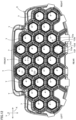
- Figure 2 is a plan view of a reinforcing member 3 of the automobile hood 1.
- Figure 3 is a schematic cross-sectional view along a line III-III in Figure 2 .
- Figure 4 is a cross-sectional view along a line IV-IV in Figure 2 , in which illustration of a portion that appears to the rear of the cross-section is omitted. Note that, in Figure 3 and Figure 4 , a panel 2 that does not appear in Figure 2 is indicated by a chain double-dashed line that is a virtual line.
- Figure 5 is a view in which one part of Figure 3 is enlarged.
- Figure 6 is a plan view in which the circumference of one unit 7 of the automobile hood 1 is enlarged.
- units 7 that are other than a single unit 7 at the center are illustrated using thinner lines than the central unit 7 so as to be easily distinguished from the central unit 7.
- Figure 7A is a view illustrating, in a simplified form, the single unit 7 illustrated in Figure 6 .
- Figure 7B is a view illustrating one portion extracted from Figure 7A .
- the embodiment will be described with reference to Figure 1 to Figure 7B as appropriate.
- the automobile hood 1 is a front hood provided at the front part of an automobile, and is also called a "bonnet".
- An automobile in which the automobile hood 1 is provided is, for example, a passenger vehicle.
- a sedan-type passenger vehicle, a coupe-type passenger vehicle, a hatchback-type passenger vehicle, a minivan-type passenger vehicle, an SUV (Sport Utility Vehicle) type passenger vehicle, and the like can be mentioned as examples of the passenger vehicle.
- the terms “front”, “rear”, “left”, “right”, and “upper” and “lower” are used taking a time when the automobile hood 1 is mounted to an automobile and the automobile hood 1 is closed as the basis.
- the term “front” refers to the direction in which the automobile advances.
- the term “rear” refers to the direction in which the automobile reverses.
- the term “right” refers to the turning direction of the automobile when the automobile which is advancing turns to the right.
- the term “left” refers to the turning direction of the automobile when the automobile which is advancing turns to the left.
- vehicle width direction of the automobile to which the automobile hood 1 is mounted is referred to as "vehicle width direction X”.
- vehicle length direction of the automobile to which the automobile hood 1 is mounted is referred to as “vehicle length direction Y”.
- vehicle height direction Z the vehicle height direction of the automobile to which the automobile hood 1 is mounted.
- the automobile hood 1 has a panel 2, a reinforcing member 3, and a joint 4 that joins together the panel 2 and the reinforcing member 3.
- the panel 2 is a portion that constitutes a part of the outer surface of the automobile.
- the panel 2 is formed of, for example, a metal material such as a mild steel sheet or a high-tensile strength steel sheet.
- a metal material such as a mild steel sheet or a high-tensile strength steel sheet.
- a steel sheet having a tensile strength of 340 MPa or more can be mentioned, and a steel sheet having a tensile strength within a range of 440 MPa to 590 MPa can be mentioned as a preferable example.
- the panel 2 is formed, for example, by subjecting a single steel sheet to press working or the like.
- a sheet thickness t1 of the panel 2 is set to 0.60 mm or less, preferably is set to 0.50 mm or less, and more preferably is set to 0.40 mm or less.
- the lower limit of the sheet thickness t1 of the panel 2 is preferably 0.35 mm.
- the sheet thickness t1 of the panel 2 is, for example, within the range of 0.35 mm to 0.60 mm. The thinner the sheet thickness of the panel 2 is made in this way, the lighter the automobile hood 1 can be made.
- the panel 2 may be an aluminum alloy sheet.
- the sheet thickness of the panel 2 is set so as to obtain equivalent values from the viewpoint of panel rigidity and dent resistance with respect to the sheet thickness of the panel 2 that is made of a steel sheet. More specifically, the panel rigidity depends on the Young's modulus of the material and the sheet thickness. Further, the dent resistance depends on the yield stress of the material and the sheet thickness. Hence, if the sheet thickness of the panel 2 made of an aluminum alloy sheet is approximately 1.5 to 1.6 times larger than the sheet thickness of the panel 2 made of a steel sheet, it can be said that the panel 2 that is made of an aluminum alloy and the panel 2 that is made of a steel sheet are equivalent from the viewpoint of panel rigidity and dent resistance.
- the panel 2 is an aluminum alloy sheet
- an aluminum alloy sheet having a tensile strength of 250 MPa or more preferably, an aluminum alloy sheet having a tensile strength of 300 MPa to 350 MPa
- the sheet thickness t1 of the panel 2 in this case is set to 1.00 mm or less, preferably is set to 0.80 mm or less, and more preferably is set to 0.64 mm or less.
- the lower limit of the sheet thickness t1 of the panel 2 is preferably 0.50 mm.
- the sheet thickness t1 of the panel 2 is, for example, within the range of 0.50 mm to 1.00 mm.
- the panel 2 has a shape in which the central portion is upwardly convex in the height direction Z.
- the reinforcing member 3 reinforces the panel 2 by being joined to an undersurface 2a of the panel 2.
- the reinforcing member 3 increases both the panel rigidity and the dent resistance of the panel 2. That is, in the present embodiment, the panel rigidity and the dent resistance of the panel 2 are secured not by increasing the sheet thickness of the panel 2, but rather are secured by the reinforcing member 3.
- the reinforcing member 3 is formed, for example, of a metal material such as a steel sheet.
- the reinforcing member 3 is formed, for example, by subjecting a single steel sheet to press working.
- the reinforcing member 3 may be an integrally formed product, or may be formed by joining a plurality of members together.
- the reinforcing member 3 is an integrally formed product.
- a sheet thickness t2 of the reinforcing member 3 is preferably within the range of 0.3 mm to 0.8 mm.
- the upper limit of the sheet thickness t2 of the reinforcing member 3 is preferably 0.6 mm.
- the sheet thickness t2 of the reinforcing member 3 may be less than the sheet thickness t1 of the panel 2, may be the same as the sheet thickness t1 of the panel 2, or may be greater than the sheet thickness t1 of the panel 2.
- the reinforcing member 3 may be an aluminum alloy sheet.
- the sheet thickness of the reinforcing member 3 is set to an equivalent value from the viewpoint of panel rigidity and dent resistance with respect to the sheet thickness of the reinforcing member 3 that is made of a steel sheet. Therefore, similarly to the case of the panel 2, if the sheet thickness of the reinforcing member 3 made of an aluminum alloy is approximately 1.5 to 1.6 times larger than the sheet thickness of the reinforcing member 3 made of a steel sheet, it can be said that the reinforcing member 3 made of an aluminum alloy and the reinforcing member 3 made of a steel sheet are equivalent from the viewpoint of panel rigidity and dent resistance.
- the sheet thickness t1 of the reinforcing member 3 is within the range of 0.4 to 1.3 mm.
- the upper limit of the sheet thickness t2 of the reinforcing member 3 is preferably 1.0 mm.
- the reinforcing member 3 has an outer circumferential portion 5, and a honeycomb structural body 6 disposed so as to be surrounded by the outer circumferential portion 5.
- the outer circumferential portion 5 is a portion that is disposed along an outer circumferential part of the panel 2.
- an outer circumferential edge portion 5a of the panel 5 is received by the automobile body (not illustrated) together with the outer circumferential portion of the panel 2.
- a load that acts on an upper face 2b of the panel 2 is received by the automobile body through the reinforcing member 3.
- An inner circumferential edge portion 5b of the outer circumferential portion 5 is a portion that is arranged so as to surround the honeycomb structural body 6 and is joined to the honeycomb structural body 6.
- the honeycomb structural body 6 has a three-dimensional structure which is provided in order to receive a load acting on the upper face 2b of the panel 2.
- the honeycomb structural body 6 is formed by combining members that have a V-shaped cross section (hat-shaped cross section).
- the honeycomb structural body 6 has a plurality of units 7, and a plurality of sub units 8 that are adjacent to the inner circumferential edge portion 5b of the outer circumferential portion 5 and continuous with the outer circumferential portion 5.
- the unit 7 which is adjacent to the outer circumferential portion 5 of the reinforcing member 3 is connected to the outer circumferential portion 5 directly or through the sub unit 8.
- the sub unit 8 has a configuration equivalent to a configuration in which one portion of the unit 7 has been cut off in the circumferential direction of the hexagonal unit 7.
- the sub unit 8 has a side portion that is similar to a side portion 10 of the unit 7 that is described later.
- the side portion is continuous with the inner circumferential edge portion 5b of the outer circumferential portion 5.
- Each unit 7 is formed in a hexagonal annular shape in plan view in the vehicle height direction Z.
- plan view means a plan view in the vehicle height direction Z.
- each unit 7 is formed in the shape of a substantially regular hexagon.
- regular hexagon means a hexagon in which the lengths of the respective sides are equal and the interior angles are also a constant angle of 120 degrees.
- substantially regular hexagon refers to a hexagon that can be treated as a regular hexagon from the viewpoint of the panel rigidity and the viewpoint of the dent resistance of the panel 2.
- the respective units 7 are formed so that the shape of each unit 7 is substantially the same. Note that, the term “substantially the same” in this case indicates that the configuration is the same except in the respect that the shape of each unit 7 is caused to match a shape which matches the curved shape of the panel 2.
- Each unit 7 may also be formed in the shape of a hexagon that is other than a regular hexagon.
- a hexagon other than a regular hexagon that can be mentioned include a hexagon in which the lengths of the respective sides are not uniform, and a hexagon in which the interior angles are not uniform at 120 degrees.
- Examples of a hexagon in which the lengths of the respective sides are not uniform that can be mentioned include a hexagon in which the length of a front end side and the length of a rear end side are set to a predetermined first length, and which has four sides whose lengths are each set to a predetermined second length that is different from the first length.
- the honeycomb structural body 6 has a structure formed from a plurality of the units 7 having a hexagonal annular shape disposed in a close-packed arrangement.
- the term "close-packed" means that, in a case where the honeycomb structural body 6 has other units 7 to which the respective side portions 10 of a given unit 7 are adjacent, the given unit 7 is disposed without a gap existing between given unit 7 and one side portion 10 of each of the relevant other units 7.
- each unit 7 is partitioned off from the other units 7 within a top plate 13.
- a front end 13b of the top plate 13 forms a boundary of the top plate 13 that includes the front end 13b.
- the boundary is formed in a hexagonal shape in plan view.
- the plurality of the units 7 are formed symmetrically in the vehicle width direction X as a whole. Specifically, in the present embodiment, three of the units 7 are arranged side by side in the front-to-rear direction at the center in the vehicle width direction X. Further, in plan view, the plurality of units 7 are arranged symmetrically in the vehicle width direction X with reference to a virtual line A1 extending in the front-to-rear direction through the center of the aforementioned three units 7 in the vehicle width direction X.
- the arrangement of the units 7 is not limited to this structure, and because the panel rigidity, the dent resistance and the mass do not depend on the direction of the units 7, there is no constraint on the direction of the units 7.
- the aforementioned three units 7 arranged at the central position in the vehicle width direction X are provided, in the following order, four units 7 which are arranged side by side in the vehicle length direction Y, a further three units 7 which are arranged side by side in the vehicle length direction Y, a further two units 7 which are arranged side by side in the vehicle length direction Y, and a further two units 7 which are arranged side by side in the vehicle length direction Y.
- Each of the units 7 has six of the side portions 10 (10a to 10f).
- a front side portion 10a and a rear side portion 10d extend along the vehicle width direction X, respectively. Further, in each of the units 7, the remaining four side portions 10 extend in a direction that inclines with respect to the vehicle length direction Y in plan view.
- Each of the side portions 10 (10a to 10f) has a floor 11, a inclined wall 12, and the top plate 13.
- the floor 11 is adjacent to the panel 2, and in the side portion 10, the floor 11 is a portion that is arranged closest to the panel 2.
- the floor 11 is a strip-shaped portion.
- the floor 11 is a flange portion of the side portion 10, and the floors 11 of the six side portions 10 form a hexagonal flange.
- the inner end parts of six of the floors 11 constitute an annular end part 20 which is centered on the center of the annular unit 7 as a whole.
- the annular end part 20 of the unit 7 which is on the center side of the unit 7 is an end part that is arranged on the center side of the unit 7.
- the annular end part 20 is centered on the center of the unit 7.
- an outer end part 11c of the floor 11 is the intersection point between a virtual line V1 including an upper face 11b (rectilinear portion) of the floor 11 and a virtual line V2 including an intermediate portion (rectilinear portion) of an upper side face 12a of the inclined wall 12.
- the intersection point between the virtual lines V1 and V2 is the outer end part 11c and is also a first ridge line 31.
- the outer end part 11c is a virtual end part. That is, in the present embodiment, the first ridge line 31 is a virtual line.
- the outer end part 11c is the connecting point between the floor 11 and the inclined wall 12. In this case, the first ridge line 31 is an actual line.
- the first ridge line 31 is a hexagonal annular ridge line in plan view.
- the first ridge line 31 is between the floor 11 and the inclined wall 12.
- the first ridge line 31 is one part of the floor 11, and is also one part of the inclined wall 12.
- the first ridge line 31 is adjacent to the panel 2.
- Each of the two end parts in the longitudinal direction of the floor 11 is formed in a curved shape in plan view, and smoothly connects with the floor 11 of an adjacent side portion 10.
- the floor 11 of at least some of the side portions 10 is adhered to the joint 4 at the upper face 11b as the floor surface, and is adhered to the panel 2 through the joint 4.
- the upper face 11b is a face which faces the undersurface 2a of the panel 2.
- a length L1 of one side of the first ridge line 31 is set to a length that is 40 mm or more and 75 mm or less. If the length L1 of one side of the first ridge line 31 is less than the aforementioned lower limit, the span over which one unit 7 supports the panel 2 will be short and the panel rigidity can be increased. However, the tolerance of deflection of the panel 2 will be small, and the dent resistance will decrease. In addition, the number of hexagonal annular units 7 disposed in a close-packed arrangement will be too large, and as a result the reinforcing member 3 will be heavy.
- the length L1 of one side of the first ridge line 31 is more than the aforementioned upper limit, the span over which one unit 7 supports the panel 2 will be too long, and it will be difficult to secure sufficient panel rigidity.
- the length L1 of one side of the first ridge line 31 within the aforementioned range, sufficient panel rigidity and sufficient dent resistance can be secured while lightening the reinforcing member 3.
- sufficient panel rigidity and dent resistance can be secured in the panel 2 while achieving a reduction in the weight of the panel 2.
- a width W1 (width at a cross section orthogonal to the longitudinal direction of the side portion 10) of the upper face 11b of the floor 11 is the distance between an inner end part 20 and the outer end part 11c of the floor 11.
- the width W1 is 2 mm or more over the whole area of the annular end part 20 in the circumferential direction of the annular end part 20.
- the width W1 of the upper face 11b of the floor 11 is 2 mm or more over the entire circumference area of the annular end part 20.
- the width W1 were less than 2 mm at a central portion in the longitudinal direction of the side portion 10, it would be easy for a deflection to occur in the panel 2 at a time when a comparatively low load as a load P1 acts on the panel 2 at a position C1 on the center position of the unit 7. Therefore, the panel rigidity of the panel 2 would decrease.
- the width W1 of the upper face 11b of the floor 11 is set to, at lowest, 2 mm or more, and the center of the annular end part 20 is caused to coincide with the center of the first ridge line 31.
- the distance between the corner and the annular end part 20 is a corner width W11 among the overall width W1.
- the distance between the center of one side of the first ridge line 31 and the annular end part 20 is a center width W12 among the overall width W1.
- the corner width W11 > the center width W12.
- all of the annular end part 20 is between a first circle CR1 and a second circle CR2.
- the first circle CR1 is a circle inscribed within the first ridge line 31.
- the second circle CR2 is concentric with the first circle CR1.
- a center point P1 of the first circle CR1, a center point P2 of the second circle CR2, a center point P3 (centroid) of the first ridge line 31 having a hexagonal annular shape, and a center point P20 of the annular end part 20 coincide one another.
- the annular end part 20 is formed in a perfect circle or a substantially perfect circle that is centered on the center point P3 of the first ridge line 31 in plan view.
- the phrase "substantially perfect circle” means a case where, after performing a hole forming process on a blank or an intermediate formed product to serve as the reinforcing member 3 in order to form the annular end part 20, the blank or the intermediate formed product is further subjected to press working or the like to form the unit 7, and consequently a strictly perfect circle is not formed.
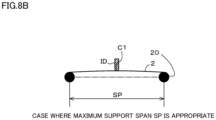
- a maximum support span SP of the panel 2 by the annular end part 20, that is, the diameter of the annular end part 20, can be set to a value that is neither too large nor too small.
- the panel rigidity of the panel 2 can be sufficiently secured and the dent resistance of the panel 2 can also be sufficiently secured. That is, it is possible to reduce the weight of the automobile hood 1, secure sufficient panel rigidity of the panel 2, and secure sufficient dent resistance of the panel 2 in a compatible manner. Therefore, even when an indenter ID is pushed into the upper face 2b of the panel 2, it is difficult for a dent to occur.
- the annular end part 20 is between the first circle CR1 and the second circle CR2, and the width W1 is 2 mm or more over the entire upper face 11 of the floor 11,. According to this configuration, sufficient panel rigidity and dent resistance of the panel 2 can be secured while achieving a reduction in the weight of the automobile hood 1.
- annular end part 20 By making the annular end part 20 circular, a load from the panel 2 can be received with a stable posture by the annular end part 20, while also reducing the weight of the reinforcing member 3.
- the dent resistance is significantly affected by constraint of the surrounding part (annular end part 20') with regard to the load that acts on the panel 2 when the indenter ID is pressed into the upper face 2b of the panel 2. Therefore, in a case where the distance between the point of action of a load applied by the indenter ID and the surrounding constraint position (the annular end part 20') is long as illustrated in Figure 8A , when the load applied by the indenter ID is, for example, low (a time of a low load), the deflection of the panel 2 becomes large. Consequently, it is difficult to maintain the designed curved shape of the panel 2, and therefore the dent resistance is liable to decrease and a dent DT is liable to occur.
- the dent resistance is significantly affected by constraint of the surrounding part (the annular end part 20") with regard to the load from the indenter ID that acts on the panel 2. Therefore, if the distance between the point of action of the load from the indenter ID and the annular end part 20" (constraint position) is too short as illustrated in Figure 8C , when the load from the indenter ID is, for example, low (a time of a low load), almost no deflection of the panel 2 occurs. As a result, localized stress arises at the point of action of the load from the indenter ID, and consequently a stress state that is more than the yield load of the panel 2 is liable to occur and a dent DT is liable to occur.
- the annular end part 20 is an annular shape in plan view. Further, according to the present embodiment, a radius r20 of the annular end part 20 is 90% of the first radius r1. Note that, the radius of the annular end part 20 may be 80% of the first radius r1, may be 70% of the first radius r1, or may be 60% of the first radius r1.
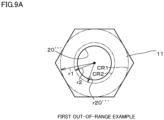
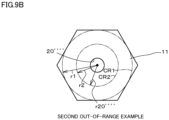
- Figure 9A and Figure 9B illustrate two out-of-range examples of the present disclosure.
- a radius r20′′′ of an annular end part 20′′′ is 50% of the first radius r1 ( Figure 9A )
- an example in which a radius r20"" of an annular end part 20 ⁇ is 20% of the first radius r1 ( Figure 9B ) can also be mentioned as an out-of-range example.
- the annular end parts 20′′′ and 20 ⁇ are located on the inner side of the second circle CR2.
- the configuration of the annular end part 20 is not limited to the configuration described above.
- a polygon can be mentioned as an example in which the annular end part 20 has a shape other than a circular shape in plan view. Note that, even in a case where the annular end part 20 is a polygon, the lower limit of the width W1 is 2 mm, and the entire area of the annular end part 20 is disposed between the first circle CR1 and the second circle CR2.
- a hexagon and a dodecagon can be mentioned as preferable examples of the aforementioned polygon in the present disclosure.
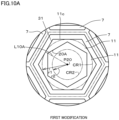
- FIG. 10A An example in which a hexagonal annular end part 20A is provided instead of the circular annular end part 20 is illustrated as a first modification in Figure 10A and Figure 10B .
- the annular end part 20A is a regular hexagon or a substantially regular hexagon.
- substantially regular hexagon means a case where, after performing a hole forming process on a blank or an intermediate formed product to serve as the reinforcing member 3 in order to form the annular end part 20A, the blank or the intermediate formed product is further subjected to press working or the like to form the unit 7, and as a result the annular end part 20A does not become a strictly regular hexagon.
- each apex of the annular end part 20A is disposed on a line segment L10A that links a center point P20 of the annular end part 20A and the midpoint of the corresponding side of the hexagonal first ridge line 31.
- each apex of the annular end part 20A may be disposed on a line segment that links the center point P20 of the annular end part 20A and the corresponding apex of the hexagonal first ridge line 31.
- annular end part 20A By making the annular end part 20A circular in this way, a load from the panel 2 can be received with a stable posture by the annular end part 20A, while also reducing the weight of the reinforcing member 3.
- FIG. 11A and Figure 11B An example in which a dodecagonal annular end part 20B is provided instead of the circular annular end part 20 is illustrated as a second modification in Figure 11A and Figure 11B .
- the annular end part 20B is a regular dodecagon or a substantially regular dodecagon.
- substantially regular dodecagon means a case where, after performing a hole forming process on a blank or an intermediate formed product to serve as the reinforcing member 3 in order to form the annular end part 20B, the blank or the intermediate formed product is further subjected to press working or the like to form the unit 7, and as a result the annular end part 20B does not become a strictly regular dodecagon.
- apexes AP1 and AP2 are set as the apexes of the annular end part 20B.
- Each apex AP1 is disposed on a line segment L10B that links a center point P20 of the annular end part 20B and a corresponding single apex of the hexagonal first ridge line 31.
- each apex AP2 is disposed on a line segment L20B that links the center point P20 of the annular end part 20B and the midpoint of the corresponding side of the hexagonal first ridge line 31.
- the apexes AP1 and the apexes AP2 are alternately arranged.
- a distance DS1B from the center point P20 of the annular end part 20B to the respective apexes AP1 and a distance DS2B from the center point P20 of the annular end part 20B to the respective apexes AP2 are the same. Note that, as long as the annular end part 20B is disposed between the first circle CR1 and the second circle CR2, the distance DS1B and the distance DS2B may be different from each other.
- the inclined wall 12 extends downward from the floor 11.
- the inclined wall 12 is disposed between the floor 11 and the top plate 13, and connects the floor 11 and the top plate 13.
- the inclined wall 12 is provided over the entire area in the longitudinal direction of the side portion 10 in which the inclined wall 12 in question is provided.
- An angle ⁇ 1 that the inclined wall 12 forms with respect to the floor 11, for example, an angle ⁇ 1 which is formed by the upper side face 12a of the inclined wall 12 and the upper face 11b of the floor 11, is preferably set within a range of 40 degrees to 90 degrees.
- the inclined wall 12 can be sufficiently caused to function as a pillar, and therefore a load transmitted from the panel 2 to the floor 11 can be received by the inclined wall 12 with a small amount of deformation.
- the unit 7 has a shape which gradually increases in width progressively in the downward direction (shape in which a distance between inclined walls 12 and 12 that face each other widens progressively toward the lower side in the vehicle height direction Z), and therefore the unit 7 is easy to be formed.
- the length of the inclined wall 12 in the vehicle height direction Z is a component in the vehicle height direction Z of the distance between the first ridge line 31 and a second ridge line 32, and is approximately 16 mm in the present embodiment.
- the second ridge line 32 is an intersecting point between a virtual line V3 which is a tangential line to the apex of a lower side face 13c of the top plate 13, and the virtual line V2.
- the intersecting point between the virtual lines V2 and V3 is the second ridge line 32 and is also an inner end part 13d of the top plate 13.
- the second ridge line 32 is a virtual ridge line.
- the second ridge line 32 is an actual line.
- the second ridge line 32 can be said to be one part of the inclined wall 12, and can also be said to be one part of the top plate 13.
- the second ridge line 32 is a hexagonal annular ridge line, similarly to the first ridge line 31.
- the second ridge line 32 is located at the outer circumference of the lower end of the inclined wall 12, and is separated from the panel 2.
- the first ridge line 31 is one example of "a hexagonal annular ridge line between the inclined wall and the floor", and is a ridge line at the end part on the floor 11 side of the inclined wall 12.
- the first ridge line 31 and the second ridge line 32 are similar to each other in plan view. In plan view, the overall length of the second ridge line 32 is longer than the overall length of the first ridge line 31.
- the distance from the panel 2 to the second ridge line 32 is longer than the distance from the panel 2 to the first ridge line 31.
- the smaller the inclination angle ⁇ 1 of the inclined wall 12 is, the larger the ratio of the length of one side of the second ridge line 32 to the length L1 of one side of the first ridge line 31 becomes. Therefore, the length of one side of the second ridge line 32 is preferably set to 40 mm or more and 95 mm or less.
- the thickness (length in the vehicle height direction Z) of the unit 7 can be set by setting the length and the angle ⁇ 1 of the inclined wall 12.
- the floor 11 is continuous with the upper end of the inclined wall 12.
- the top plate 13 is continuous with the lower end of the inclined wall 12.
- the floor 11 and the inclined wall 12 are continuous with each other in a smoothly curving shape, and are connected in a form in which it is difficult for stress concentration to occur.
- the top plate 13 and the inclined wall 12 are continuous with each other in a smoothly curving shape, and are connected in a form in which it is difficult for stress concentration to occur.
- the floor 11 and the inclined wall 12 may be connected in a pointed shape
- the inclined wall 12 and the top plate 13 may be connected in a pointed shape.
- the top plate 13 is a portion that is farthest from the panel 2.
- the top plate 13 is formed in a curved shape which is convex in the downward direction, or is formed in a shape that extends approximately horizontally.
- the top plate 13 is provided over the entire area in the longitudinal direction of the side portion 10 in which the inclined wall 12 in question is provided.
- the floor 11, the inclined wall 12, and the top plate 13 are arranged in that order from the inner side to the outer side of the unit 7.
- the front end 13b of the top plate 13 in one unit 7 is integral with the front end 13b of the top plate 13 in an adjacent unit 7.
- Figure 12 is a view for describing one example of the arrangement of the joints 4 in the automobile hood 1.
- the joint 4 will be more specifically described while referring mainly to Figure 5 and Figure 12 .
- the joint 4 is indicated by hatching that represents a cut cross-section.
- the joint 4 is an adhesive.
- a mastic sealer (mastic adhesive) can be exemplified as the adhesive.
- a resin-based adhesive can be exemplified as the mastic sealer.
- the adhesive may have a property of being cured at normal temperature (for example, 20 degrees Celsius), or may have a property of being cured by undergoing a heating process or a drying process.
- the joint 4 is provided so as to sufficiently secure both panel rigidity and dent resistance while achieving a reduction in the weight of the automobile hood 1.
- the joint 4 is provided in at least two of the side portions 10 that are parallel to each other among the six side portions 10.
- the joint 4 is provided in all of the six side portions 10.
- the joint 4 is provided on the upper face 11b of the floor 11 of each side portion 10, and the joints 4 provided on the side portions 10 that are adjacent are integrated with each other.
- the joint 4 is a hexagonal shape.
- a thickness t3 of the joint 4 is, for example, about several mms, and is an extremely large value relative to both the sheet thickness t1 of the panel 2 and the sheet thickness t2 of the reinforcing member 3.
- the joint 4 is preferably used in the smallest possible amount.
- the joint 4 is also a load transmission portion that is provided for transmitting the load from the panel 2 to the unit 7. Therefore, a more preferable usage form of the joint 4 in each unit 7 can be defined from the viewpoint of achieving each of a weight reduction, an improvement in the panel rigidity, and an improvement in the dent resistance.
- Figure 13 is a conceptual plan view illustrating the principal part of a third modification of the present disclosure, and shows locations where the joints 4 are provided.
- the following configuration that is illustrated in Figure 13 can be mentioned as an example of the third modification of the present embodiment. That is, the joint 4 is provided in some of the side portions 10 among the six side portions 10 (10a to 10f) of each of the annular units 7.
- the joint 4 is provided in at least two side portions 10 that face each other in parallel and which are two side portions 10 that are separated from each other.
- the joint 4 extends in a linear stripe along the longitudinal direction of the side portion 10.
- a length W2 of the joint 4 in plan view is set within the range of 20% to 100% of an overall length W3 of the floor 11 in the longitudinal direction of the floor 11, and preferably is set within the range of 50% to 100%.
- the length W2 the overall length W3.
- the joint 4 is provided in some of the side portions 10 among the six side portions 10, and the joint 4 is not provided in the remaining side portions 10.
- the whole area of each of the remaining side portions 10 directly faces the panel 2 vertically.
- the joint 4 is provided on two pairs of the side portions 10 that face each other in parallel in plan view.
- the remaining two side portions 10 two side portions 10 which are not adjacent to each other) that are separated from each other are not provided with the joint 4 and are directly adjacent to the panel 2 (through only air).
- the joint 4 is provided on the front side portion 10a and the rear side portion 10d which extend in parallel with each other, and the right rear side portion 10c and the left front side portion 10f which extend in parallel with each other. That is, in the unit 7, the joint 4 is provided on each of four side portions 10 that exclude the right front side portion 10b and the left rear side portion 10e.
- a region 14 in which joints are not set is provided in the direction from the left rear toward the right front (toward the diagonally right front side).
- the honeycomb structural body 6 is provided with a plurality of sets 15 of the joints 4 having a zigzag stripe shape extending from the left rear to the right front. According to this kind of configuration of the honeycomb structural body 6, the three requirements of weight reduction, securing panel rigidity, and securing dent resistance can be satisfied at a high level.
- the arrangement of the plurality of joints 4 as a whole in the third modification illustrated in Figure 13 may be symmetrically replaced in the vehicle width direction X.
- the joints 4 may be arranged in the form shown in a fourth modification illustrated in Figure 14 .
- the joint 4 is provided on the right front side portion 10b and the left rear side portion 10e as two sides extending in parallel with each other, and on two side portions 10 which are in contact with the two ends of either one of these two side portions 10b and 10e. That is, the joint 4 is provided on four of the side portions 10 in the unit 7.
- a first unit 21 as a set of the units 7 in which the joint 4 is not provided on the rear side portion 10d and the left front side portion 10f, and a second unit 22 as a set of the units 7 in which the joint 4 is not provided on the front side portion 10a and the right rear side portion 10c are provided.
- the units 7 extend in a row in the direction from the left rear toward the right front.
- the second unit 22 the units 7 extend in a row in the direction from the left rear toward the right front.
- the first units 21 and the second units 22 are alternately arranged.
- the arrangement of the plurality of joints 4 as a whole in the fourth modification illustrated in Figure 14 may be symmetrically replaced in the vehicle width direction X.
- each unit 7 a form in which, in each unit 7, the joint 4 is provided in four of the side portions 10, and the joint 4 is not provided in two of the side portions 10 is described as an example.
- the joints 4 need not be arranged in this manner.
- the joint 4 may be provided on two side portions 10 among the six side portions 10. That is, the joint 4 is provided on a set of two of the side portions 10, 10 that face each other in parallel in plan view. Further, the joint 4 is not provided on the remaining four side portions 10, and therefore the remaining four side portions 10 are directly adjacent to the panel 2.
- the joint 4 is provided only on the right rear side portion 10c and the left front side portion 10f which extend in parallel with each other. Therefore, in each unit 7, the joint 4 is not provided on four of the side portions 10.
- the joint 4 is provided on two of the side portions 10 (10c, 10f) which are some of the six side portions 10 and which are parallel with each other, the three requirements of weight reduction, securing panel rigidity, and securing dent resistance can be satisfied at a high level.
- the joint 4 is not limited to a case in which the joint 4 is formed in a continuous linear shape, and the joint 4 may be intermittently arranged in dot shapes.
- both the panel rigidity and the dent resistance of the panel 2 can be increased.
- both the panel rigidity and dent resistance of the panel 2 can be increased more in comparison to a case where the joint 4 is provided in a dot shape at corner portions of the hexagon or a case where the joint 4 is provided in a dot shape at the center of the side portion 10.
- the sheet thickness t1 of the panel 2 made of a steel sheet is 0.6 mm or less.
- the panel rigidity and dent resistance obtained from the rigidity of the panel 2 itself decrease extremely in comparison to a case where the sheet thickness t1 of the panel 2 is 0.65 mm or more.
- the panel rigidity of the panel 2 depends on the Young's modulus and the sheet thickness of the panel 2, and in particular, changes with the square of the sheet thickness.
- the panel rigidity that the panel 2 can secure by itself is reduced extremely. This reduction in rigidity is particularly noticeable from the aspect of a sense of touch perceived when the panel 2 is pressed by a human hand, which is a factor that reduces the salability of the automobile.
- a critical significance exists with respect to the sheet thickness t1 being between 0.6 mm and 0.65 mm.
- a thin panel 2 having a sheet thickness t1 of 0.6 mm or less is used as in the present embodiment also, by combining the reinforcing member 3 and the panel 2 for reinforcement and stiffening, as the automobile hood 1, panel rigidity and dent resistance that are approximately equal to a case where the sheet thickness t1 of the panel 2 is 0.65 mm can be secured. Moreover, since the sheet thickness t1 of the panel 2 is reduced, a reduction in the weight of the automobile hood 1 can be achieved through the weight reduction of the panel 2.
- the panel 2 and the reinforcing member 3 are made of steel, there is an advantage from the view point of material cost in comparison to the panel and the reinforcing member that are made of an aluminum alloy. Furthermore, in the case of an automobile hood made of an aluminum alloy, the idea of securing panel rigidity with a reinforcing member located below a panel has originally not existed heretofore. Further, because the Young's modulus of an aluminum alloy is low compared to the Young's modulus of steel, the rigidity of an aluminum alloy is lower than the rigidity of steel.
- a panel and a reinforcing member made of a steel sheet and a panel and a reinforcing member made of an aluminum alloy sheet can be set to thicknesses such that equivalent performance is obtained. Therefore, in the present embodiment, the panel 2 and the reinforcing member 3 may be steel sheets or may be aluminum alloy sheets.
- Geometric models of the automobile hoods 1 shown in the embodiment and modifications were created on a computer using CAD (Computer Aided Design) software. That is, the automobile hoods 1 having the panel 2, the reinforcing member 3 and the joints 4 were created on a computer. The panel rigidity and dent resistance were then evaluated by performing CAE (Computer Aided Engineering) analysis, that is, computer simulation, with respect to the geometric models of the automobile hood 1. Note that, the characteristics of each part were as follows.
- the modulus of elasticity of the steel sheet was a Young's modulus of 206 GPa, with a Poisson's ratio of 0.3.
- Disclosure Examples 1 to 7 and Comparative Examples 1 to 4 were prepared. With regard to these Disclosure Examples 1 to 7 and Comparative Examples 1 to 4, the length L1 of one side of the hexagonal first ridge line 31, the corner width W11 of the upper face 11b of the floor 11, and the center width W12 of the upper face 11b were as shown in Table 1.
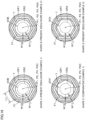
- shapes A and B had the dodecagonal annular end part 20B.
- Shape C (Comparative Example 1) had a hexagonal annular end part 20A'.
- the respective apexes of the annular end part 20A' were disposed on the corresponding midpoints of the six sides of the first ridge line 31. According to this configuration, the center width W12 was zero mm.
- the annular end part 20A of shape D (Present Disclosure Example 3) was arranged similarly to the first ridge line 31 in plan view.
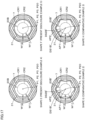
- shapes E and F had the dodecagonal annular end part 20B.
- Shapes G and H had a dodecagonal annular end part 20B'.
- the annular end part 20B' there were apexes AP1' which were adjacent to the apexes of the first ridge line 31, and apexes AP2' which were adjacent to the midpoints of the first ridge line 31.
- a distance DS2B' from the center point P3 of the hexagonal first ridge line 31 to each apex AP2' was less than a distance DS1B' from the center point P3 to each apex AP1'.
- one part of the annular end part 20B' was located on the outer side of the first circle CR1.
- the corner width W11 was less than the center width W12 (W11 ⁇ W12).
- shapes I, J and K had the circular annular end part 20.
- the annular end part 20′′′ was located on the inner side of the second circle CR2.
- the corresponding annular end part 20, 20A or 20B was located between the first circle CR1 and the second circle CR2, and the width W1 of the upper face 11b of the floor 11 was 2 mm or more.
- the load P was set to 49 N when evaluating the panel rigidity. If the maximum value of the deflection of the panel 2 when 49 N was applied was less than 1.8 mm, the relevant example was evaluated as "excellent", if the maximum value was less than 2.0 mm, the example was evaluated as “good”, and if the maximum value was 2.0 mm or more, the example was evaluated as "poor".
- the load P was set to 245 N when evaluating the dent resistance. If the maximum value of the plastic deformation amount of the panel 2 when 245 N was applied was less than 0.23 mm, the relevant example was evaluated as "excellent", if the maximum value was less than 0.35 mm, the example was evaluated as “good”, and if the maximum value was 0.35 mm or more, the example was evaluated as "poor”.
- the dent resistance was evaluated as "poor”.
- the panel rigidity of the panel 2 was also evaluated as “poor”.
- the annular end part 20′′′ was disposed inside the second circle CR2, and the support span of the panel 2 was short. Therefore, although the panel rigidity of the panel 2 was evaluated as "excellent”, localized stress arose at the point of action of the load P, and as a result the dent resistance was evaluated as "poor”.
- the present disclosure can be widely applied as an automobile hood.
Landscapes
- Engineering & Computer Science (AREA)
- Mechanical Engineering (AREA)
- Chemical & Material Sciences (AREA)
- Combustion & Propulsion (AREA)
- Transportation (AREA)
- Superstructure Of Vehicle (AREA)
Description
- The present disclosure relates to an automobile hood.
- Automobile hoods are known (for example, see
Patent Documents 1 to 3). -
Patent Document 1 discloses a hood panel structure for a vehicle. The principal purpose of the hood panel structure is to reduce the degree of injury to a pedestrian if the pedestrian collides with the hood panel. -
Patent Document 2 discloses a hood for an automobile as exterior equipment for an automobile. The principal purpose of the hood for an automobile is to absorb the energy of contact when a pedestrian comes into contact with the hood for an automobile, by only deforming by a small amount in the inward direction of the automobile. -
Patent Document 3 discloses a motor vehicle hood with pedestrian protection. The hood is provided for an engine compartment of a motor vehicle including an outer skin and reinforcing ribs connected with the outer skin and imparting rigidity thereto. The ribs have a channel portion mainly formed in an equilateral hexagonal pattern. -
- Patent Document 1:
JP2005-193863A - Patent Document 2:
JP2017-1553A - Patent Document 3:
US2004/182616A1 - There is a demand for the weight of automobile hoods to be reduced further and also for the panel rigidity and the dent resistance of automobile hoods to be improved. However, for example, if a panel of an automobile hood made of a steel sheet is made thinner than 0.6 mm in order to reduce the weight, both the panel rigidity and the dent resistance will decrease to an extent that cannot be ignored.
-
Patent Document 1 andPatent Document 2 do not disclose any matters regarding problems or structures from the viewpoint of securing both sufficient panel rigidity and sufficient dent resistance while achieving a weight reduction. - One objective of the present disclosure is, with respect to an automobile hood, to secure sufficient panel rigidity and dent resistance of a panel while achieving a weight reduction.
- The gist of the present disclosure is an automobile hood which is described hereunder.
- An automobile hood, including:
- a panel,
- a reinforcing member, and
- a joint that joins together the panel and the reinforcing member,
- wherein:
- the reinforcing member includes a structure formed from a plurality of units having a hexagonal annular shape disposed in a close-packed arrangement;
- the unit has a floor, an inclined wall, and a top plate;
- the floor is adjacent to the panel;
- the top plate and the panel are separated from each other;
- the inclined wall is between the floor and the top plate;
- a hexagonal annular ridge line of the unit is between the floor and the inclined wall;
- the floor has an annular end part which is centered on a center of the annular unit;
- all of the end part is between a first circle which is inscribed within the ridge line, and a second circle which is concentric with the first circle and which has a radius that is 60% of a radius of the first circle;
- the floor includes a floor surface as a face which faces the panel; and
- a width of the floor surface is 2 mm or more over an entire area of the annular end part in a circumferential direction of the annular end part.
- (2) The automobile hood according to the above (1), wherein a distance between a corner of the hexagonal ridge line and the annular end part is greater than a distance between a center of one side of the ridge line and the annular end part.
- (3) The automobile hood according to the above (1) or (2), wherein the end part is circular.
- (4) The automobile hood according to the above (1) or (2), wherein the end part is hexagonal.
- (5) The automobile hood according to the above (1) or (2), wherein the end part is dodecagonal.
- (6) The automobile hood according to any one of the above (1) to (5), wherein:
- the panel is a steel sheet, and
- a sheet thickness of the panel is within a range of 0.35 mm to 0.60 mm.
- (7) The automobile hood according to any one of the above (1) to (5), wherein:
- the panel is an aluminum alloy sheet, and
- a sheet thickness of the panel is within a range of 0.50 mm to 1.00 mm.
- According to the present disclosure, in an automobile hood, sufficient panel rigidity and dent resistance of a panel can be secured while achieving a weight reduction.
-
- [
Figure 1] Figure 1 is a schematic exploded perspective view of an automobile hood according to one embodiment of the present disclosure. - [
Figure 2] Figure 2 is a plan view of a reinforcing member of the automobile hood. - [
Figure 3] Figure 3 is a schematic cross-sectional view along a line III-III inFigure 2 . - [
Figure 4] Figure 4 is a cross-sectional view along a line IV-IV inFigure 2 , in which illustration of a portion that appears to the rear of the cross-section is omitted. - [
Figure 5] Figure 5 is a view in which one part ofFigure 3 is enlarged. - [
Figure 6] Figure 6 is a plan view in which the circumference of one unit of the automobile hood is enlarged. - [
Figure 7A] Figure 7A is a view illustrating, in a simplified form, the circumference of one unit that is illustrated inFigure 6 . - [
Figure 7B] Figure 7B is a view illustrating one portion extracted fromFigure 7A . - [
Figure 8A] Figure 8A is a conceptual side view for describing a case where a maximum support span of a panel supported by an annular end part is too long. - [
Figure 8B] Figure 8B is a conceptual side view for describing a case where a maximum support span of a panel supported by an annular end part is appropriate. - [
Figure 8C] Figure 8C is a conceptual side view for describing a case where a maximum support span of a panel supported by an annular end part is too short. - [
Figure 9A] Figure 9A is a schematic plan view illustrating the principal part of a first out-of-range example. - [
Figure 9B] Figure 9B is a schematic plan view illustrating the principal part of a second out-of-range example. - [
Figure 10A] Figure 10A is a view illustrating, in a simplified form, the circumference of one unit according to a first modification. - [
Figure 10B] Figure 10B is a view illustrating one portion extracted fromFigure 10A . - [
Figure 11A] Figure 11A is a view illustrating, in a simplified form, the circumference of one unit according to a second modification. - [
Figure 11B] Figure 11B is a view illustrating one portion extracted fromFigure 11A . - [
Figure 12] Figure 12 is a view for describing one example of the arrangement of joints in an automobile hood. - [
Figure 13] Figure 13 is a conceptual plan view illustrating the principal part of a third modification of the present disclosure, and shows locations at which joints are provided. - [
Figure 14] Figure 14 is a conceptual plan view illustrating the principal part of a fourth modification of the present disclosure, and shows locations at which joints are provided. - [
Figure 15] Figure 15 is a conceptual plan view illustrating the principal part of a fifth modification of the present disclosure, and shows locations at which joints are provided. - [
Figure 16] Figure 16 is a schematic plan view illustrating shapes A to D with respect to an annular end part. - [
Figure 17] Figure 17 is a schematic plan view illustrating shapes E to H with respect to an annular end part. - [
Figure 18] Figure 18 is a schematic plan view illustrating shapes I, J and K with respect to an annular end part. - Hereunder, first, the circumstances leading to the conception of the present disclosure will be described, and then an embodiment will be described in detail.
- In the present description, the term "panel rigidity" refers to, in a case where a force from outside acts on a press-formed product, for example, a panel on the outer side of an automobile hood, which has a comparatively moderately curving surface and in which the surface area is extremely large relative to the sheet thickness, the rigidity of the panel in question. The panel rigidity corresponds to a feeling of elastic resistance or a sensation of deflection deformation when the panel is pressed with a hand. This characteristic is usually represented by the deflection when a load is applied, and the smaller the deflection is when a constant load is applied, the higher the panel rigidity is.
- In the present description, the term "dent resistance" refers to the difficulty for an indentation (dent) to be left after removing the load in a case where a localized load is applied to a panel for some reason. In the case of the body of an actual automobile, such dents occur when an outer panel of a door or the like is strongly pressed with a finger or the palm of a hand, or when the automobile body is hit by a flying stone while travelling and the like. A dent is formed as a result of a place on the panel at which a load has been applied plastically deforming. Therefore, when the strain on the panel at a time that a load is applied thereto reaches a certain magnitude, the strain remains even after the load is removed, resulting in a dent. The minimum value of a load that causes a certain residual strain in the panel is referred to as the "dent load", and the larger the dent load is, the better the dent resistance is.
- In an automobile hood, the thinner the sheet thickness of a panel is made, the more both the panel rigidity and the dent resistance decrease. Further, with regard to automobile hoods, it cannot be said that conventionally improvements have been made mainly from the viewpoint of sufficiently securing both panel rigidity and dent resistance while achieving a weight reduction.
- Weight reduction, panel rigidity and dent resistance will now be described more specifically. First, the definition of panel rigidity is as described above. That is, the term "panel rigidity" refers to the degree of inflexibility of a panel. For example, when a panel of an automobile hood is pressed with a hand, it is difficult for the panel to deflect if the panel rigidity is high. The definition of dent resistance is also as described above. That is, the term "dent resistance" refers to the degree to which it is difficult to form a dent flaw. For example, when a pebble hits a panel, if the dent resistance is low, a dent flaw will be easily formed in the panel.
- In recent years, in order to reduce the weight of automobiles, the strength of members constituting the automobiles is being increased. In general, if the strength (tensile strength) of a member is increased, the walls of the member can be made thinner. It is considered that, as a result, the weight of the member can be reduced. However, it is not the case that such kind of weight reduction achieved by increasing the strength simply holds true for an exterior material such as a panel of an automobile. This is because the panel rigidity and the dent resistance which are required for an exterior material of an automobile are not determined only by the strength of the exterior material.
- The aforementioned occurrence of deflection in which the panel rigidity in an outer panel of an automobile hood is reflected depends mainly on the modulus of elasticity and sheet thickness of the panel. Further, with respect to steel sheets, there is no difference in the value of the Young's modulus between a low-strength material and a high-strength material. Therefore, even if a low-strength material is simply replaced with a high-strength material, the panel rigidity does not improve. On the other hand, when a low-strength material is replaced with a high-strength material, the dent resistance that is one kind of resistance to plastic deformation improves. However, the influence which the steel material strength has on the dent resistance is much less than the influence which the sheet thickness of the panel has on the dent resistance. Hence, even if a low-strength material is simply replaced with a high-strength material, a significant improvement in the dent resistance cannot be expected.
- Further, with respect to the relation between the panel rigidity and dent resistance of the panel and the sheet thickness of the panel, as described above, when the panel is made thinner, both the panel rigidity and the dent resistance decrease. Consequently, there is a limit to the amount of weight reduction that can be achieved while securing the panel rigidity and the dent resistance. The thickness of a panel that is considered to be such a limit is around 0.65 mm in the case of a panel made of a steel sheet. However, it is desired to make such automobile panels thinner than 0.65 mm in order to reduce the weight.
- However, at the present time, the sheet thickness of panels is not being made thinner than 0.65 mm. This is because the thinner the sheet thickness of a panel is made, the greater the deflection of the panel will be when the panel is touched with a hand in order to perform waxing or the like. In other words, it is because a high-quality feeling will no longer be felt from the automobile. On the other hand, in order to suppress such kind of deflection and reduce the degree of injury to a pedestrian at the time of a collision, attachment of a reinforcing member to a panel on a side which is on the inner surface side of a vehicle has been performed up to now.
- In order to improve the panel rigidity of a panel using a reinforcing member, it is preferable to increase the rigidity of the reinforcing member. However, if the sheet thickness of a reinforcing member is increased in order to increase the rigidity of the reinforcing member, the reinforcing member will become heavy, which is not preferable for reducing the weight of the automobile hood. Further, it is not necessarily the case that the dent resistance will be improved even if the rigidity of the reinforcing member is increased. Because of the existence of such problems, even when a reinforcing member is simply used, it is difficult to secure both panel rigidity and dent resistance while also reducing the weight of the automobile hood.
- As the result of diligent research, the inventors of the present application came to pay attention to the aforementioned problems, and conducted additional diligent research. The inventors of the present application then conceived of adopting a honeycomb structure as a reinforcing member of an automobile hood, in consideration of the balance between strength and weight. However, simply adopting a honeycomb structure is insufficient for securing both high panel rigidity and high dent resistance. This is because the shorter the length of one side is in a hexagonal annular unit constituting the honeycomb structure, the shorter the support span of the panel can be made, which is preferable for improving the panel rigidity. On the other hand, the shorter that the aforementioned length of one side is, the smaller the tolerance of the elastic deflection of the panel will be, and hence the more the dent resistance will decrease. In addition, the shorter the length of one side is, the higher the mass density of the reinforcing member will be, and the heavier the reinforcing member will become. By continuing to conduct diligent research even after conceiving of forming a reinforcing member with a honeycomb structure, the inventors of the present application obtained the aforementioned findings for the first time. Subsequently, based on these findings, the inventors of the present application conceived of a structure which satisfies all of the requirements with respect to weight reduction, securing panel rigidity, and securing dent resistance. That is, the inventors of the present application arrived at the present disclosure, for which one example is described hereunder.
- Hereunder, an embodiment of the present disclosure is described while referring to the accompanying drawings.
-
Figure 1 is a schematic exploded perspective view of anautomobile hood 1 according to one embodiment of the present disclosure.Figure 2 is a plan view of a reinforcingmember 3 of theautomobile hood 1.Figure 3 is a schematic cross-sectional view along a line III-III inFigure 2 .Figure 4 is a cross-sectional view along a line IV-IV inFigure 2 , in which illustration of a portion that appears to the rear of the cross-section is omitted. Note that, inFigure 3 andFigure 4 , apanel 2 that does not appear inFigure 2 is indicated by a chain double-dashed line that is a virtual line. -
Figure 5 is a view in which one part ofFigure 3 is enlarged.Figure 6 is a plan view in which the circumference of oneunit 7 of theautomobile hood 1 is enlarged. InFigure 6 ,units 7 that are other than asingle unit 7 at the center are illustrated using thinner lines than thecentral unit 7 so as to be easily distinguished from thecentral unit 7.Figure 7A is a view illustrating, in a simplified form, thesingle unit 7 illustrated inFigure 6 .Figure 7B is a view illustrating one portion extracted fromFigure 7A . Hereinafter, unless otherwise specified, the embodiment will be described with reference toFigure 1 to Figure 7B as appropriate. - The
automobile hood 1 is a front hood provided at the front part of an automobile, and is also called a "bonnet". An automobile in which theautomobile hood 1 is provided is, for example, a passenger vehicle. A sedan-type passenger vehicle, a coupe-type passenger vehicle, a hatchback-type passenger vehicle, a minivan-type passenger vehicle, an SUV (Sport Utility Vehicle) type passenger vehicle, and the like can be mentioned as examples of the passenger vehicle. - Note that, in the present description, the terms "front", "rear", "left", "right", and "upper" and "lower" are used taking a time when the
automobile hood 1 is mounted to an automobile and theautomobile hood 1 is closed as the basis. The term "front" refers to the direction in which the automobile advances. The term "rear" refers to the direction in which the automobile reverses. The term "right" refers to the turning direction of the automobile when the automobile which is advancing turns to the right. The term "left" refers to the turning direction of the automobile when the automobile which is advancing turns to the left. Further, in the present embodiment, the vehicle width direction of the automobile to which theautomobile hood 1 is mounted is referred to as "vehicle width direction X". Further, the vehicle length direction of the automobile to which theautomobile hood 1 is mounted is referred to as "vehicle length direction Y". Furthermore, the vehicle height direction of the automobile to which theautomobile hood 1 is mounted is referred to as "vehicle height direction Z". - The
automobile hood 1 has apanel 2, a reinforcingmember 3, and a joint 4 that joins together thepanel 2 and the reinforcingmember 3. - In the
automobile hood 1, thepanel 2 is a portion that constitutes a part of the outer surface of the automobile. Thepanel 2 is formed of, for example, a metal material such as a mild steel sheet or a high-tensile strength steel sheet. As an example of the high-tensile strength steel sheet, a steel sheet having a tensile strength of 340 MPa or more can be mentioned, and a steel sheet having a tensile strength within a range of 440 MPa to 590 MPa can be mentioned as a preferable example. Thepanel 2 is formed, for example, by subjecting a single steel sheet to press working or the like. A sheet thickness t1 of the panel 2 (thickness of the steel sheet) is set to 0.60 mm or less, preferably is set to 0.50 mm or less, and more preferably is set to 0.40 mm or less. The lower limit of the sheet thickness t1 of thepanel 2 is preferably 0.35 mm. The sheet thickness t1 of thepanel 2 is, for example, within the range of 0.35 mm to 0.60 mm. The thinner the sheet thickness of thepanel 2 is made in this way, the lighter theautomobile hood 1 can be made. - The
panel 2 may be an aluminum alloy sheet. In this case, the sheet thickness of thepanel 2 is set so as to obtain equivalent values from the viewpoint of panel rigidity and dent resistance with respect to the sheet thickness of thepanel 2 that is made of a steel sheet. More specifically, the panel rigidity depends on the Young's modulus of the material and the sheet thickness. Further, the dent resistance depends on the yield stress of the material and the sheet thickness. Hence, if the sheet thickness of thepanel 2 made of an aluminum alloy sheet is approximately 1.5 to 1.6 times larger than the sheet thickness of thepanel 2 made of a steel sheet, it can be said that thepanel 2 that is made of an aluminum alloy and thepanel 2 that is made of a steel sheet are equivalent from the viewpoint of panel rigidity and dent resistance. - In a case where the
panel 2 is an aluminum alloy sheet, an aluminum alloy sheet having a tensile strength of 250 MPa or more, preferably, an aluminum alloy sheet having a tensile strength of 300 MPa to 350 MPa, can be mentioned as an example thereof. The sheet thickness t1 of thepanel 2 in this case (thickness of the aluminum alloy sheet) is set to 1.00 mm or less, preferably is set to 0.80 mm or less, and more preferably is set to 0.64 mm or less. The lower limit of the sheet thickness t1 of thepanel 2 is preferably 0.50 mm. The sheet thickness t1 of thepanel 2 is, for example, within the range of 0.50 mm to 1.00 mm. - There are no particular restrictions with regard to the shape of the
panel 2. Note that, in the present embodiment, thepanel 2 has a shape in which the central portion is upwardly convex in the height direction Z. - The reinforcing
member 3 reinforces thepanel 2 by being joined to anundersurface 2a of thepanel 2. By this means, the reinforcingmember 3 increases both the panel rigidity and the dent resistance of thepanel 2. That is, in the present embodiment, the panel rigidity and the dent resistance of thepanel 2 are secured not by increasing the sheet thickness of thepanel 2, but rather are secured by the reinforcingmember 3. The reinforcingmember 3 is formed, for example, of a metal material such as a steel sheet. The reinforcingmember 3 is formed, for example, by subjecting a single steel sheet to press working. The reinforcingmember 3 may be an integrally formed product, or may be formed by joining a plurality of members together. In the present embodiment, the reinforcingmember 3 is an integrally formed product. A sheet thickness t2 of the reinforcing member 3 (thickness of the steel sheet) is preferably within the range of 0.3 mm to 0.8 mm. The upper limit of the sheet thickness t2 of the reinforcingmember 3 is preferably 0.6 mm. The sheet thickness t2 of the reinforcingmember 3 may be less than the sheet thickness t1 of thepanel 2, may be the same as the sheet thickness t1 of thepanel 2, or may be greater than the sheet thickness t1 of thepanel 2. - The reinforcing
member 3 may be an aluminum alloy sheet. In this case, the sheet thickness of the reinforcingmember 3 is set to an equivalent value from the viewpoint of panel rigidity and dent resistance with respect to the sheet thickness of the reinforcingmember 3 that is made of a steel sheet. Therefore, similarly to the case of thepanel 2, if the sheet thickness of the reinforcingmember 3 made of an aluminum alloy is approximately 1.5 to 1.6 times larger than the sheet thickness of the reinforcingmember 3 made of a steel sheet, it can be said that the reinforcingmember 3 made of an aluminum alloy and the reinforcingmember 3 made of a steel sheet are equivalent from the viewpoint of panel rigidity and dent resistance. In a case where the reinforcingmember 3 is made of an aluminum alloy, the sheet thickness t1 of the reinforcing member 3 (thickness of the aluminum alloy sheet) is within the range of 0.4 to 1.3 mm. The upper limit of the sheet thickness t2 of the reinforcingmember 3 is preferably 1.0 mm. - The reinforcing
member 3 has an outercircumferential portion 5, and a honeycombstructural body 6 disposed so as to be surrounded by the outercircumferential portion 5. - The outer
circumferential portion 5 is a portion that is disposed along an outer circumferential part of thepanel 2. When thepanel 2 closes the engine room, an outercircumferential edge portion 5a of thepanel 5 is received by the automobile body (not illustrated) together with the outer circumferential portion of thepanel 2. By this means, a load that acts on anupper face 2b of thepanel 2 is received by the automobile body through the reinforcingmember 3. An innercircumferential edge portion 5b of the outercircumferential portion 5 is a portion that is arranged so as to surround the honeycombstructural body 6 and is joined to the honeycombstructural body 6. - The honeycomb
structural body 6 has a three-dimensional structure which is provided in order to receive a load acting on theupper face 2b of thepanel 2. The honeycombstructural body 6 is formed by combining members that have a V-shaped cross section (hat-shaped cross section). - The honeycomb
structural body 6 has a plurality ofunits 7, and a plurality ofsub units 8 that are adjacent to the innercircumferential edge portion 5b of the outercircumferential portion 5 and continuous with the outercircumferential portion 5. - The
unit 7 which is adjacent to the outercircumferential portion 5 of the reinforcingmember 3 is connected to the outercircumferential portion 5 directly or through thesub unit 8. - The
sub unit 8 has a configuration equivalent to a configuration in which one portion of theunit 7 has been cut off in the circumferential direction of thehexagonal unit 7. Thesub unit 8 has a side portion that is similar to aside portion 10 of theunit 7 that is described later. The side portion is continuous with the innercircumferential edge portion 5b of the outercircumferential portion 5. - Each
unit 7 is formed in a hexagonal annular shape in plan view in the vehicle height direction Z. Hereinafter, when simply the term "plan view" is used, it means a plan view in the vehicle height direction Z. In the present embodiment, eachunit 7 is formed in the shape of a substantially regular hexagon. The term "regular hexagon" means a hexagon in which the lengths of the respective sides are equal and the interior angles are also a constant angle of 120 degrees. Further, in the present description, the term "substantially regular hexagon" refers to a hexagon that can be treated as a regular hexagon from the viewpoint of the panel rigidity and the viewpoint of the dent resistance of thepanel 2. Therespective units 7 are formed so that the shape of eachunit 7 is substantially the same. Note that, the term "substantially the same" in this case indicates that the configuration is the same except in the respect that the shape of eachunit 7 is caused to match a shape which matches the curved shape of thepanel 2. - Each
unit 7 may also be formed in the shape of a hexagon that is other than a regular hexagon. Examples of a hexagon other than a regular hexagon that can be mentioned include a hexagon in which the lengths of the respective sides are not uniform, and a hexagon in which the interior angles are not uniform at 120 degrees. Examples of a hexagon in which the lengths of the respective sides are not uniform that can be mentioned include a hexagon in which the length of a front end side and the length of a rear end side are set to a predetermined first length, and which has four sides whose lengths are each set to a predetermined second length that is different from the first length. - The honeycomb
structural body 6 has a structure formed from a plurality of theunits 7 having a hexagonal annular shape disposed in a close-packed arrangement. In this case, the term "close-packed" means that, in a case where the honeycombstructural body 6 hasother units 7 to which therespective side portions 10 of a givenunit 7 are adjacent, the givenunit 7 is disposed without a gap existing between givenunit 7 and oneside portion 10 of each of the relevantother units 7. Specifically, eachunit 7 is partitioned off from theother units 7 within atop plate 13. As illustrated inFigure 6 , afront end 13b of thetop plate 13 forms a boundary of thetop plate 13 that includes thefront end 13b. The boundary is formed in a hexagonal shape in plan view. By having such a structure formed from theunits 7 disposed in a close-packed hexagonal arrangement, the honeycombstructural body 6 can withstand loads in substantially the same manner from all directions including the vehicle height direction Z over the whole area in plan view. - In the present embodiment, the plurality of the
units 7 are formed symmetrically in the vehicle width direction X as a whole. Specifically, in the present embodiment, three of theunits 7 are arranged side by side in the front-to-rear direction at the center in the vehicle width direction X. Further, in plan view, the plurality ofunits 7 are arranged symmetrically in the vehicle width direction X with reference to a virtual line A1 extending in the front-to-rear direction through the center of the aforementioned threeunits 7 in the vehicle width direction X. The arrangement of theunits 7 is not limited to this structure, and because the panel rigidity, the dent resistance and the mass do not depend on the direction of theunits 7, there is no constraint on the direction of theunits 7. - In the present embodiment, in the direction toward the right side from the aforementioned three
units 7 arranged at the central position in the vehicle width direction X are provided, in the following order, fourunits 7 which are arranged side by side in the vehicle length direction Y, a further threeunits 7 which are arranged side by side in the vehicle length direction Y, a further twounits 7 which are arranged side by side in the vehicle length direction Y, and a further twounits 7 which are arranged side by side in the vehicle length direction Y. Furthermore, similarly to the foregoing arrangement, in the direction toward the left side from the aforementioned threeunits 7 arranged at the central position in the vehicle width direction X are provided, in the following order, fourunits 7 which are arranged side by side in the vehicle length direction Y, further threeunits 7 which are arranged side by side in the vehicle length direction Y, further twounits 7 which are arranged side by side in the vehicle length direction Y, and further twounits 7 which are arranged side by side in the vehicle length direction Y. - Each of the
units 7 has six of the side portions 10 (10a to 10f). In the present embodiment, in each of theunits 7, afront side portion 10a and arear side portion 10d extend along the vehicle width direction X, respectively. Further, in each of theunits 7, the remaining fourside portions 10 extend in a direction that inclines with respect to the vehicle length direction Y in plan view. - Each of the side portions 10 (10a to 10f) has a
floor 11, ainclined wall 12, and thetop plate 13. - The
floor 11 is adjacent to thepanel 2, and in theside portion 10, thefloor 11 is a portion that is arranged closest to thepanel 2. Thefloor 11 is a strip-shaped portion. Thefloor 11 is a flange portion of theside portion 10, and thefloors 11 of the sixside portions 10 form a hexagonal flange. The inner end parts of six of thefloors 11 constitute anannular end part 20 which is centered on the center of theannular unit 7 as a whole. Theannular end part 20 of theunit 7 which is on the center side of theunit 7 is an end part that is arranged on the center side of theunit 7. Theannular end part 20 is centered on the center of theunit 7. - In a cross section (cross section illustrated in
Figure 5 ) orthogonal to the longitudinal direction of theside portion 10, anouter end part 11c of thefloor 11 is the intersection point between a virtual line V1 including anupper face 11b (rectilinear portion) of thefloor 11 and a virtual line V2 including an intermediate portion (rectilinear portion) of anupper side face 12a of theinclined wall 12. The intersection point between the virtual lines V1 and V2 is theouter end part 11c and is also afirst ridge line 31. In a case where thefloor 11 and theinclined wall 12 are connected in a curved shape as in the present embodiment, theouter end part 11c is a virtual end part. That is, in the present embodiment, thefirst ridge line 31 is a virtual line. On the other hand, in a case where thefloor 11 and theinclined wall 12 are connected in a linearly pointed shape, theouter end part 11c is the connecting point between thefloor 11 and theinclined wall 12. In this case, thefirst ridge line 31 is an actual line. - In the present embodiment, the
first ridge line 31 is a hexagonal annular ridge line in plan view. Thefirst ridge line 31 is between thefloor 11 and theinclined wall 12. Thefirst ridge line 31 is one part of thefloor 11, and is also one part of theinclined wall 12. Thefirst ridge line 31 is adjacent to thepanel 2. - Each of the two end parts in the longitudinal direction of the
floor 11 is formed in a curved shape in plan view, and smoothly connects with thefloor 11 of anadjacent side portion 10. In eachunit 7, thefloor 11 of at least some of theside portions 10 is adhered to the joint 4 at theupper face 11b as the floor surface, and is adhered to thepanel 2 through thejoint 4. In thefloor 11, theupper face 11b is a face which faces theundersurface 2a of thepanel 2. - In the present embodiment, a length L1 of one side of the
first ridge line 31 is set to a length that is 40 mm or more and 75 mm or less. If the length L1 of one side of thefirst ridge line 31 is less than the aforementioned lower limit, the span over which oneunit 7 supports thepanel 2 will be short and the panel rigidity can be increased. However, the tolerance of deflection of thepanel 2 will be small, and the dent resistance will decrease. In addition, the number of hexagonalannular units 7 disposed in a close-packed arrangement will be too large, and as a result the reinforcingmember 3 will be heavy. On the other hand, if the length L1 of one side of thefirst ridge line 31 is more than the aforementioned upper limit, the span over which oneunit 7 supports thepanel 2 will be too long, and it will be difficult to secure sufficient panel rigidity. By setting the length L1 of one side of thefirst ridge line 31 within the aforementioned range, sufficient panel rigidity and sufficient dent resistance can be secured while lightening the reinforcingmember 3. Hence, in theautomobile hood 1, sufficient panel rigidity and dent resistance can be secured in thepanel 2 while achieving a reduction in the weight of thepanel 2. - A width W1 (width at a cross section orthogonal to the longitudinal direction of the side portion 10) of the
upper face 11b of thefloor 11 is the distance between aninner end part 20 and theouter end part 11c of thefloor 11. The width W1 is 2 mm or more over the whole area of theannular end part 20 in the circumferential direction of theannular end part 20. In order to both reduce the weight of theautomobile hood 1 and improve the dent resistance of thepanel 2 in a compatible manner, it is necessary that, as described above, the width W1 of theupper face 11b of thefloor 11 is 2 mm or more over the entire circumference area of theannular end part 20. If, for example, the width W1 were less than 2 mm at a central portion in the longitudinal direction of theside portion 10, it would be easy for a deflection to occur in thepanel 2 at a time when a comparatively low load as a load P1 acts on thepanel 2 at a position C1 on the center position of theunit 7. Therefore, the panel rigidity of thepanel 2 would decrease. - Thus, the width W1 of the
upper face 11b of thefloor 11 is set to, at lowest, 2 mm or more, and the center of theannular end part 20 is caused to coincide with the center of thefirst ridge line 31. As illustrated inFigures 7A and7B , at each corner (apex) of the hexagonalfirst ridge line 31, the distance between the corner and theannular end part 20 is a corner width W11 among the overall width W1. Further, on each of the six sides of thefirst ridge line 31, the distance between the center of one side of thefirst ridge line 31 and theannular end part 20 is a center width W12 among the overall width W1. In the present embodiment, the corner width W11 > the center width W12. By adopting a configuration in which the corner width W11 > the central width W12, it is possible to improve the panel rigidity and improve the dent resistance of thepanel 2 while achieving a reduction in the weight of the reinforcingmember 3 in a compatible manner. - In the present disclosure, in plan view, all of the
annular end part 20 is between a first circle CR1 and a second circle CR2. The first circle CR1 is a circle inscribed within thefirst ridge line 31. The second circle CR2 is concentric with the first circle CR1. Further, a second radius r2 as the radius of the second circle CR2 is set to 60% (r2 = 0.6 r1) of a first radius r1 as the radius of the first circle CR1. - In plan view, a center point P1 of the first circle CR1, a center point P2 of the second circle CR2, a center point P3 (centroid) of the
first ridge line 31 having a hexagonal annular shape, and a center point P20 of theannular end part 20 coincide one another. In the present embodiment, theannular end part 20 is formed in a perfect circle or a substantially perfect circle that is centered on the center point P3 of thefirst ridge line 31 in plan view. In this case, the phrase "substantially perfect circle" means a case where, after performing a hole forming process on a blank or an intermediate formed product to serve as the reinforcingmember 3 in order to form theannular end part 20, the blank or the intermediate formed product is further subjected to press working or the like to form theunit 7, and consequently a strictly perfect circle is not formed. - By disposing the
annular end part 20 between the first circle CR1 and the second circle CR2 in plan view, of theentire unit 7, the inner side portion of theannular end part 20 is hollow, and the reinforcingmember 3 can be reduced in weight. In addition, as illustrated in the conceptual side view ofFigure 8B , a maximum support span SP of thepanel 2 by theannular end part 20, that is, the diameter of theannular end part 20, can be set to a value that is neither too large nor too small. Thus, the panel rigidity of thepanel 2 can be sufficiently secured and the dent resistance of thepanel 2 can also be sufficiently secured. That is, it is possible to reduce the weight of theautomobile hood 1, secure sufficient panel rigidity of thepanel 2, and secure sufficient dent resistance of thepanel 2 in a compatible manner. Therefore, even when an indenter ID is pushed into theupper face 2b of thepanel 2, it is difficult for a dent to occur. - As described above, the
annular end part 20 is between the first circle CR1 and the second circle CR2, and the width W1 is 2 mm or more over the entireupper face 11 of thefloor 11,. According to this configuration, sufficient panel rigidity and dent resistance of thepanel 2 can be secured while achieving a reduction in the weight of theautomobile hood 1. - Further, by making the
annular end part 20 circular, a load from thepanel 2 can be received with a stable posture by theannular end part 20, while also reducing the weight of the reinforcingmember 3. - Note that, with regard to the
annular end part 20, if even one portion of theannular end part 20 is larger than the first circle CR1, as illustrated in the conceptual side view ofFigure 8A , the maximum support span SP of thepanel 2 supported by an annular end part 20' (diameter of the annular end part 20') will be too large. As a result, the area of theupper face 11b of thefloor 11 which can be adhered to thepanel 2 will be narrow. Consequently, the efficiency of the work of applying the joint 4 to thefloor 11 will be less efficient. In addition, the panel rigidity of thepanel 2 will decrease. Furthermore, the dent resistance will also decrease. More specifically, the dent resistance is significantly affected by constraint of the surrounding part (annular end part 20') with regard to the load that acts on thepanel 2 when the indenter ID is pressed into theupper face 2b of thepanel 2. Therefore, in a case where the distance between the point of action of a load applied by the indenter ID and the surrounding constraint position (the annular end part 20') is long as illustrated inFigure 8A , when the load applied by the indenter ID is, for example, low (a time of a low load), the deflection of thepanel 2 becomes large. Consequently, it is difficult to maintain the designed curved shape of thepanel 2, and therefore the dent resistance is liable to decrease and a dent DT is liable to occur. - On the other hand, if even one portion of an
annular end part 20" is located further on the inner side than the second circle CR2, as illustrated in the conceptual side view ofFigure 8C , a hollow region of the inner side portion of theannular end part 20" of theunit 7 is small. Hence, the reinforcingmember 3 becomes heavy, and the weight efficiency (the ratio of the reinforcing effect of the reinforcingmember 3 to the weight of the reinforcing member 3) deteriorates. Furthermore, the advantageous effect of improving the dent resistance of thepanel 2 by means of the reinforcingmember 3 also decreases. More specifically, as described above, the dent resistance is significantly affected by constraint of the surrounding part (theannular end part 20") with regard to the load from the indenter ID that acts on thepanel 2. Therefore, if the distance between the point of action of the load from the indenter ID and theannular end part 20" (constraint position) is too short as illustrated inFigure 8C , when the load from the indenter ID is, for example, low (a time of a low load), almost no deflection of thepanel 2 occurs. As a result, localized stress arises at the point of action of the load from the indenter ID, and consequently a stress state that is more than the yield load of thepanel 2 is liable to occur and a dent DT is liable to occur. - As is clearly illustrated in
Figure 7A andFigure 7B , in the present embodiment theannular end part 20 is an annular shape in plan view. Further, according to the present embodiment, a radius r20 of theannular end part 20 is 90% of the first radius r1. Note that, the radius of theannular end part 20 may be 80% of the first radius r1, may be 70% of the first radius r1, or may be 60% of the first radius r1. - On the other hand,
Figure 9A andFigure 9B illustrate two out-of-range examples of the present disclosure. As a first out-of-range example, an example in which a radius r20‴ of anannular end part 20‴ is 50% of the first radius r1 (Figure 9A ) can be mentioned, and an example in which a radius r20"" of an annular end part 20ʺʺ is 20% of the first radius r1 (Figure 9B ) can also be mentioned as an out-of-range example. Thus, in the out-of-range examples illustrated inFigure 9A andFigure 9B , theannular end parts 20‴ and 20ʺʺ are located on the inner side of the second circle CR2. - In the above description a form in which the
annular end part 20 is a circular shape is described. However, the configuration of theannular end part 20 is not limited to the configuration described above. A polygon can be mentioned as an example in which theannular end part 20 has a shape other than a circular shape in plan view. Note that, even in a case where theannular end part 20 is a polygon, the lower limit of the width W1 is 2 mm, and the entire area of theannular end part 20 is disposed between the first circle CR1 and the second circle CR2. - A hexagon and a dodecagon can be mentioned as preferable examples of the aforementioned polygon in the present disclosure.
- An example in which a hexagonal
annular end part 20A is provided instead of the circularannular end part 20 is illustrated as a first modification inFigure 10A andFigure 10B . Theannular end part 20A is a regular hexagon or a substantially regular hexagon. In this case, the phrase "substantially regular hexagon" means a case where, after performing a hole forming process on a blank or an intermediate formed product to serve as the reinforcingmember 3 in order to form theannular end part 20A, the blank or the intermediate formed product is further subjected to press working or the like to form theunit 7, and as a result theannular end part 20A does not become a strictly regular hexagon. In this first modification, each apex of theannular end part 20A is disposed on a line segment L10A that links a center point P20 of theannular end part 20A and the midpoint of the corresponding side of the hexagonalfirst ridge line 31. Note that, each apex of theannular end part 20A may be disposed on a line segment that links the center point P20 of theannular end part 20A and the corresponding apex of the hexagonalfirst ridge line 31. - By making the
annular end part 20A circular in this way, a load from thepanel 2 can be received with a stable posture by theannular end part 20A, while also reducing the weight of the reinforcingmember 3. - An example in which a dodecagonal
annular end part 20B is provided instead of the circularannular end part 20 is illustrated as a second modification inFigure 11A andFigure 11B . Theannular end part 20B is a regular dodecagon or a substantially regular dodecagon. In this case, the phrase "substantially regular dodecagon" means a case where, after performing a hole forming process on a blank or an intermediate formed product to serve as the reinforcingmember 3 in order to form theannular end part 20B, the blank or the intermediate formed product is further subjected to press working or the like to form theunit 7, and as a result theannular end part 20B does not become a strictly regular dodecagon. In this second modification, two kinds of apexes AP1 and AP2 are set as the apexes of theannular end part 20B. Each apex AP1 is disposed on a line segment L10B that links a center point P20 of theannular end part 20B and a corresponding single apex of the hexagonalfirst ridge line 31. Further, each apex AP2 is disposed on a line segment L20B that links the center point P20 of theannular end part 20B and the midpoint of the corresponding side of the hexagonalfirst ridge line 31. Further, the apexes AP1 and the apexes AP2 are alternately arranged. In the second modification, a distance DS1B from the center point P20 of theannular end part 20B to the respective apexes AP1 and a distance DS2B from the center point P20 of theannular end part 20B to the respective apexes AP2 are the same. Note that, as long as theannular end part 20B is disposed between the first circle CR1 and the second circle CR2, the distance DS1B and the distance DS2B may be different from each other. - By making the
annular end part 20B dodecagon in this way, a load from thepanel 2 can be received with a stable posture by theannular end part 20B, while also reducing the weight of the reinforcingmember 3. The foregoing is a description of the schematic configuration of thefloor 11. - As illustrated in
Figure 5 , theinclined wall 12 extends downward from thefloor 11. - The
inclined wall 12 is disposed between thefloor 11 and thetop plate 13, and connects thefloor 11 and thetop plate 13. Theinclined wall 12 is provided over the entire area in the longitudinal direction of theside portion 10 in which theinclined wall 12 in question is provided. An angle θ1 that theinclined wall 12 forms with respect to thefloor 11, for example, an angle θ1 which is formed by theupper side face 12a of theinclined wall 12 and theupper face 11b of thefloor 11, is preferably set within a range of 40 degrees to 90 degrees. When the aforementioned angle θ1 is equal to or greater than the aforementioned lower limit, theinclined wall 12 can be sufficiently caused to function as a pillar, and therefore a load transmitted from thepanel 2 to thefloor 11 can be received by theinclined wall 12 with a small amount of deformation. Further, when the angle θ1 is less than or equal to the aforementioned upper limit, theunit 7 has a shape which gradually increases in width progressively in the downward direction (shape in which a distance betweeninclined walls unit 7 is easy to be formed. - The length of the
inclined wall 12 in the vehicle height direction Z is a component in the vehicle height direction Z of the distance between thefirst ridge line 31 and asecond ridge line 32, and is approximately 16 mm in the present embodiment. In a cross section orthogonal to the longitudinal direction of theside portion 10, thesecond ridge line 32 is an intersecting point between a virtual line V3 which is a tangential line to the apex of alower side face 13c of thetop plate 13, and the virtual line V2. The intersecting point between the virtual lines V2 and V3 is thesecond ridge line 32 and is also aninner end part 13d of thetop plate 13. In a case where theinclined wall 12 and thetop plate 13 are connected in a curved shape as in the present embodiment, thesecond ridge line 32 is a virtual ridge line. On the other hand, in a case where theinclined wall 12 and thetop plate 13 are connected in a linearly pointed shape, thesecond ridge line 32 is an actual line. Thesecond ridge line 32 can be said to be one part of theinclined wall 12, and can also be said to be one part of thetop plate 13. - In the present embodiment, the
second ridge line 32 is a hexagonal annular ridge line, similarly to thefirst ridge line 31. Thesecond ridge line 32 is located at the outer circumference of the lower end of theinclined wall 12, and is separated from thepanel 2. Thefirst ridge line 31 is one example of "a hexagonal annular ridge line between the inclined wall and the floor", and is a ridge line at the end part on thefloor 11 side of theinclined wall 12. In the present embodiment, thefirst ridge line 31 and thesecond ridge line 32 are similar to each other in plan view. In plan view, the overall length of thesecond ridge line 32 is longer than the overall length of thefirst ridge line 31. In the vehicle height direction Z, the distance from thepanel 2 to thesecond ridge line 32 is longer than the distance from thepanel 2 to thefirst ridge line 31. Note that, the smaller the inclination angle θ1 of theinclined wall 12 is, the larger the ratio of the length of one side of thesecond ridge line 32 to the length L1 of one side of thefirst ridge line 31 becomes. Therefore, the length of one side of thesecond ridge line 32 is preferably set to 40 mm or more and 95 mm or less. - In the present embodiment, the thickness (length in the vehicle height direction Z) of the
unit 7 can be set by setting the length and the angle θ1 of theinclined wall 12. Thefloor 11 is continuous with the upper end of theinclined wall 12. Thetop plate 13 is continuous with the lower end of theinclined wall 12. In a cross section orthogonal to the longitudinal direction of theside portion 10, thefloor 11 and theinclined wall 12 are continuous with each other in a smoothly curving shape, and are connected in a form in which it is difficult for stress concentration to occur. Similarly, thetop plate 13 and theinclined wall 12 are continuous with each other in a smoothly curving shape, and are connected in a form in which it is difficult for stress concentration to occur. Note that, thefloor 11 and theinclined wall 12 may be connected in a pointed shape, and theinclined wall 12 and thetop plate 13 may be connected in a pointed shape. - In the
unit 7, thetop plate 13 is a portion that is farthest from thepanel 2. Thetop plate 13 is formed in a curved shape which is convex in the downward direction, or is formed in a shape that extends approximately horizontally. Thetop plate 13 is provided over the entire area in the longitudinal direction of theside portion 10 in which theinclined wall 12 in question is provided. In a cross section orthogonal to the longitudinal direction of theside portion 10, thefloor 11, theinclined wall 12, and thetop plate 13 are arranged in that order from the inner side to the outer side of theunit 7. Thefront end 13b of thetop plate 13 in oneunit 7 is integral with thefront end 13b of thetop plate 13 in anadjacent unit 7. -
Figure 12 is a view for describing one example of the arrangement of thejoints 4 in theautomobile hood 1. Next, the joint 4 will be more specifically described while referring mainly toFigure 5 andFigure 12 . InFigure 5 , the joint 4 is indicated by hatching that represents a cut cross-section. In the present embodiment, the joint 4 is an adhesive. A mastic sealer (mastic adhesive) can be exemplified as the adhesive. A resin-based adhesive can be exemplified as the mastic sealer. The adhesive may have a property of being cured at normal temperature (for example, 20 degrees Celsius), or may have a property of being cured by undergoing a heating process or a drying process. - The joint 4 is provided so as to sufficiently secure both panel rigidity and dent resistance while achieving a reduction in the weight of the
automobile hood 1. Specifically, the joint 4 is provided in at least two of theside portions 10 that are parallel to each other among the sixside portions 10. In the present embodiment, in each of theunits 7, the joint 4 is provided in all of the sixside portions 10. In the present embodiment, on theupper face 11b of thefloor 11 of eachside portion 10, the joint 4 is provided over the entire area in the longitudinal direction of theside portion 10, and thejoints 4 provided on theside portions 10 that are adjacent are integrated with each other. By this means, in the present embodiment, in each of theunits 7, the joint 4 is a hexagonal shape. - A thickness t3 of the joint 4 is, for example, about several mms, and is an extremely large value relative to both the sheet thickness t1 of the
panel 2 and the sheet thickness t2 of the reinforcingmember 3. Hence, the proportion that the joint 4 accounts for with regard to the material cost and the weight of theautomobile hood 1 cannot be ignored. Therefore, from the viewpoint of the material cost and also reducing the weight of theautomobile hood 1, the joint 4 is preferably used in the smallest possible amount. On the other hand, the joint 4 is also a load transmission portion that is provided for transmitting the load from thepanel 2 to theunit 7. Therefore, a more preferable usage form of the joint 4 in eachunit 7 can be defined from the viewpoint of achieving each of a weight reduction, an improvement in the panel rigidity, and an improvement in the dent resistance. -
Figure 13 is a conceptual plan view illustrating the principal part of a third modification of the present disclosure, and shows locations where thejoints 4 are provided. The following configuration that is illustrated inFigure 13 can be mentioned as an example of the third modification of the present embodiment. That is, the joint 4 is provided in some of theside portions 10 among the six side portions 10 (10a to 10f) of each of theannular units 7. In this modification of the present disclosure, among the sixside portions 10, the joint 4 is provided in at least twoside portions 10 that face each other in parallel and which are twoside portions 10 that are separated from each other. In eachside portion 10 in which thejoint 4 is provided, the joint 4 extends in a linear stripe along the longitudinal direction of theside portion 10. - A length W2 of the joint 4 in plan view is set within the range of 20% to 100% of an overall length W3 of the
floor 11 in the longitudinal direction of thefloor 11, and preferably is set within the range of 50% to 100%. InFigure 13 , an example is illustrated in which the length W2 = the overall length W3. By making the length W2 of the joint 4 equal to or greater than the aforementioned lower limit, the bonding strength between thefloor 11 on which thejoint 4 is provided and thepanel 2 can be sufficiently secured. In addition, in a case where a process is adopted that adheres thepanel 2 and thefloor 11 to each other by heating thejoint 4, thermal distortion occurs in thepanel 2 and the reinforcingmember 3 due to the heating in the process for heating thejoint 4. However, by providing thejoints 4 only on some of the sixside portions 10 of theunit 7, the aforementioned thermal distortion can be reduced. - As described above, in the third modification, in each
unit 7, the joint 4 is provided in some of theside portions 10 among the sixside portions 10, and the joint 4 is not provided in the remainingside portions 10. The whole area of each of the remainingside portions 10 directly faces thepanel 2 vertically. - As illustrated in
Figure 13 , four of theside portions 10 among the sixside portions 10 are joined to thejoints 4, and are joined to thepanel 2 by therelevant joints 4. That is, the joint 4 is provided on two pairs of theside portions 10 that face each other in parallel in plan view. The remaining two side portions 10 (twoside portions 10 which are not adjacent to each other) that are separated from each other are not provided with the joint 4 and are directly adjacent to the panel 2 (through only air). - More specifically, among the six
side portions 10, the joint 4 is provided on thefront side portion 10a and therear side portion 10d which extend in parallel with each other, and the rightrear side portion 10c and the leftfront side portion 10f which extend in parallel with each other. That is, in theunit 7, the joint 4 is provided on each of fourside portions 10 that exclude the rightfront side portion 10b and the leftrear side portion 10e. By this means, in the honeycombstructural body 6, as illustrated by an arrow B1, aregion 14 in which joints are not set is provided in the direction from the left rear toward the right front (toward the diagonally right front side). - By means of this configuration, the honeycomb
structural body 6 is provided with a plurality ofsets 15 of thejoints 4 having a zigzag stripe shape extending from the left rear to the right front. According to this kind of configuration of the honeycombstructural body 6, the three requirements of weight reduction, securing panel rigidity, and securing dent resistance can be satisfied at a high level. - Note that, as long as the relative positional relationship between the
joints 4 illustrated inFigure 13 is satisfied, a similar effect is obtained even if the arrangement of the joint 4 is changed. For example, the arrangement of the plurality ofjoints 4 as a whole in the third modification illustrated inFigure 13 may be symmetrically replaced in the vehicle width direction X. - Further, instead of the third modification illustrated in
Figure 13 , thejoints 4 may be arranged in the form shown in a fourth modification illustrated inFigure 14 . InFigure 14 , among the sixside portions 10 of theunit 7, for example, the joint 4 is provided on the rightfront side portion 10b and the leftrear side portion 10e as two sides extending in parallel with each other, and on twoside portions 10 which are in contact with the two ends of either one of these twoside portions side portions 10 in theunit 7. In this second modification, afirst unit 21 as a set of theunits 7 in which thejoint 4 is not provided on therear side portion 10d and the leftfront side portion 10f, and asecond unit 22 as a set of theunits 7 in which thejoint 4 is not provided on thefront side portion 10a and the rightrear side portion 10c are provided. In thefirst unit 21, theunits 7 extend in a row in the direction from the left rear toward the right front. Similarly, in thesecond unit 22 theunits 7 extend in a row in the direction from the left rear toward the right front. Further, thefirst units 21 and thesecond units 22 are alternately arranged. - Note that, as long as the relative positional relationship between the
joints 4 illustrated inFigure 14 is satisfied, a similar effect is obtained even if the arrangement of the joint 4 is changed. For example, the arrangement of the plurality ofjoints 4 as a whole in the fourth modification illustrated inFigure 14 may be symmetrically replaced in the vehicle width direction X. - In the third modification and the fourth modification described above, a form in which, in each
unit 7, the joint 4 is provided in four of theside portions 10, and the joint 4 is not provided in two of theside portions 10 is described as an example. However, thejoints 4 need not be arranged in this manner. For example, as illustrated in a fifth modification inFigure 15 , in eachunit 7, the joint 4 may be provided on twoside portions 10 among the sixside portions 10. That is, the joint 4 is provided on a set of two of theside portions side portions 10, and therefore the remaining fourside portions 10 are directly adjacent to thepanel 2. - In the fifth modification illustrated in
Figure 15 , among the sixside portions 10 of theunit 7, for example, the joint 4 is provided only on the rightrear side portion 10c and the leftfront side portion 10f which extend in parallel with each other. Therefore, in eachunit 7, the joint 4 is not provided on four of theside portions 10. Thus, when a configuration is adopted in which, in eachunit 7, the joint 4 is provided on two of the side portions 10 (10c, 10f) which are some of the sixside portions 10 and which are parallel with each other, the three requirements of weight reduction, securing panel rigidity, and securing dent resistance can be satisfied at a high level. - Note that, instead of the fifth modification illustrated in
Figure 15 , a modification (not illustrated in the drawings) in which, among the sixside portions 10, the joint 4 is provided on only thefront side portion 10a and therear side portion 10d which are parallel with each other, and a modification (not illustrated in the drawings) in which, among the sixside portions 10, the joint 4 is provided on only the rightfront side portion 10b and the leftrear side portion 10e which are parallel with each other can be given as examples of the arrangement of thejoints 4. - By adopting any one of the configurations according to the embodiment and the respective modifications that are described above with respect to the
joints 4, improvement in the performance of the panel 2 (at least improvement of the panel rigidity and improvement of the dent resistance) and a reduction in the weight of thepanel 2 can be realized. - Note that, in the embodiment and respective modifications that are described above, in each
side portion 10 on which thejoint 4 is provided, the joint 4 is not limited to a case in which thejoint 4 is formed in a continuous linear shape, and the joint 4 may be intermittently arranged in dot shapes. - According to the
automobile hood 1 of the present embodiment, with respect to eachside portion 10 on which thejoint 4 is provided among the sixside portions 10 of theunit 7, theside portion 10 is in contact with the joint 4 over a range of 20% or more of theside portion 10 with regard to the direction in which theside portion 10 extends. According to this configuration, both the panel rigidity and the dent resistance of thepanel 2 can be increased. In particular, if the joint 4 is a linear shape that extends continuously on theside portion 10, both the panel rigidity and dent resistance of thepanel 2 can be increased more in comparison to a case where the joint 4 is provided in a dot shape at corner portions of the hexagon or a case where the joint 4 is provided in a dot shape at the center of theside portion 10. - Further, according to the
automobile hood 1 of the present embodiment, the sheet thickness t1 of thepanel 2 made of a steel sheet is 0.6 mm or less. In a case where the sheet thickness t1 of thepanel 2 is 0.6 mm or less in this way, the panel rigidity and dent resistance obtained from the rigidity of thepanel 2 itself decrease extremely in comparison to a case where the sheet thickness t1 of thepanel 2 is 0.65 mm or more. More specifically, the panel rigidity of thepanel 2 depends on the Young's modulus and the sheet thickness of thepanel 2, and in particular, changes with the square of the sheet thickness. If the design sheet thickness of thepanel 2 formed of a steel sheet is changed from 0.65 mm to 0.6 mm, the panel rigidity that thepanel 2 can secure by itself is reduced extremely. This reduction in rigidity is particularly noticeable from the aspect of a sense of touch perceived when thepanel 2 is pressed by a human hand, which is a factor that reduces the salability of the automobile. Thus, in relation to the panel rigidity of thepanel 2 that is made of steel, a critical significance exists with respect to the sheet thickness t1 being between 0.6 mm and 0.65 mm. Further, in a case where athin panel 2 having a sheet thickness t1 of 0.6 mm or less is used as in the present embodiment also, by combining the reinforcingmember 3 and thepanel 2 for reinforcement and stiffening, as theautomobile hood 1, panel rigidity and dent resistance that are approximately equal to a case where the sheet thickness t1 of thepanel 2 is 0.65 mm can be secured. Moreover, since the sheet thickness t1 of thepanel 2 is reduced, a reduction in the weight of theautomobile hood 1 can be achieved through the weight reduction of thepanel 2. - In addition, if the
panel 2 and the reinforcingmember 3 are made of steel, there is an advantage from the view point of material cost in comparison to the panel and the reinforcing member that are made of an aluminum alloy. Furthermore, in the case of an automobile hood made of an aluminum alloy, the idea of securing panel rigidity with a reinforcing member located below a panel has originally not existed heretofore. Further, because the Young's modulus of an aluminum alloy is low compared to the Young's modulus of steel, the rigidity of an aluminum alloy is lower than the rigidity of steel. Therefore, in an automobile hood that is made of an aluminum alloy, in order to secure rigidity that is equivalent to the rigidity of theautomobile hood 1 made of steel, it is necessary to make the sheet thickness of the members larger. Hence, in order to satisfy the requirements regarding both panel rigidity and dent resistance in a panel that is made of an aluminum alloy, the sheet thickness increases. Therefore, the viewpoint of improving both the panel rigidity and the dent resistance while reducing the sheet thickness of thepanel 2 and the reinforcingmember 3 as in the present embodiment does not exist with respect to an automobile hood that is made of an aluminum alloy. However, as described above, from the viewpoint of panel rigidity and dent resistance, a panel and a reinforcing member made of a steel sheet and a panel and a reinforcing member made of an aluminum alloy sheet can be set to thicknesses such that equivalent performance is obtained. Therefore, in the present embodiment, thepanel 2 and the reinforcingmember 3 may be steel sheets or may be aluminum alloy sheets. - An embodiment and modifications of the present disclosure have been described above. However, the present disclosure is not limited to the above embodiment and modifications. In the present disclosure, various changes are possible within the scope of the accompanying claims.
- Geometric models of the
automobile hoods 1 shown in the embodiment and modifications were created on a computer using CAD (Computer Aided Design) software. That is, theautomobile hoods 1 having thepanel 2, the reinforcingmember 3 and thejoints 4 were created on a computer. The panel rigidity and dent resistance were then evaluated by performing CAE (Computer Aided Engineering) analysis, that is, computer simulation, with respect to the geometric models of theautomobile hood 1. Note that, the characteristics of each part were as follows. - Panel 2: Made of a high-strength steel sheet of 590 MPa-class. Yield stress = 375 MPa, tensile strength = 622 MPa, sheet thickness t1 = 0.4mm.
- Reinforcing member 3: Made of a mild steel sheet. Yield stress = 163 MPa, tensile strength = 325 MPa, sheet thickness t2 = 0.3 mm.
- Note that, the modulus of elasticity of the steel sheet was a Young's modulus of 206 GPa, with a Poisson's ratio of 0.3.
- For the present examples, Disclosure Examples 1 to 7 and Comparative Examples 1 to 4 were prepared. With regard to these Disclosure Examples 1 to 7 and Comparative Examples 1 to 4, the length L1 of one side of the hexagonal
first ridge line 31, the corner width W11 of theupper face 11b of thefloor 11, and the center width W12 of theupper face 11b were as shown in Table 1. - As illustrated in
Figure 16 , shapes A and B (Present Disclosure Examples 1 and 2) had the dodecagonalannular end part 20B. Shape C (Comparative Example 1) had a hexagonalannular end part 20A'. The respective apexes of theannular end part 20A' were disposed on the corresponding midpoints of the six sides of thefirst ridge line 31. According to this configuration, the center width W12 was zero mm. Theannular end part 20A of shape D (Present Disclosure Example 3) was arranged similarly to thefirst ridge line 31 in plan view. - As illustrated in
Figure 17 , shapes E and F (Present Disclosure Examples 4 and 5) had the dodecagonalannular end part 20B. Shapes G and H (Comparative Examples 2 and 3) had a dodecagonalannular end part 20B'. In theannular end part 20B', there were apexes AP1' which were adjacent to the apexes of thefirst ridge line 31, and apexes AP2' which were adjacent to the midpoints of thefirst ridge line 31. Further, a distance DS2B' from the center point P3 of the hexagonalfirst ridge line 31 to each apex AP2' was less than a distance DS1B' from the center point P3 to each apex AP1'. Furthermore, in the shapes G and H, one part of theannular end part 20B' was located on the outer side of the first circle CR1. In addition, in the shapes G and H, the corner width W11 was less than the center width W12 (W11 < W12). - As illustrated in
Figure 18 , shapes I, J and K (Present Disclosure Examples 6 and 7 and Comparative Example 4) had the circularannular end part 20. In the shape K (Comparative Example 4), theannular end part 20‴ was located on the inner side of the second circle CR2. In each of Present Disclosure Examples 1 to 7, the correspondingannular end part upper face 11b of thefloor 11 was 2 mm or more. - In the CAE analysis, a point C1 (see
Figure 3 ) on the center position of theunit 7, which is the weakest part of thepanel 2, was set as a load point, and a predetermined load P was applied to this load point. The results were used as the evaluations of the panel rigidity and the dent resistance. - The load P was set to 49 N when evaluating the panel rigidity. If the maximum value of the deflection of the
panel 2 when 49 N was applied was less than 1.8 mm, the relevant example was evaluated as "excellent", if the maximum value was less than 2.0 mm, the example was evaluated as "good", and if the maximum value was 2.0 mm or more, the example was evaluated as "poor". - The load P was set to 245 N when evaluating the dent resistance. If the maximum value of the plastic deformation amount of the
panel 2 when 245 N was applied was less than 0.23 mm, the relevant example was evaluated as "excellent", if the maximum value was less than 0.35 mm, the example was evaluated as "good", and if the maximum value was 0.35 mm or more, the example was evaluated as "poor". - The evaluation results for panel rigidity and dent resistance, respectively, are shown in Table 1.
[Table 1] Shape of Annular End Part 20 etc.Length of One Side of First Ridge Line 31 (mm) Corner Width W11 (mm) Center Width W12 (mm) Panel Rigidity Dent Resistance Weight of Reinforcing Member 3Remarks A(Substantially Dodecagonal Shape) 51 15 7.5 excellent good 3.2kg Present Disclosure Example 1 B(Substantially Dodecagonal Shape) 51 15 5 excellent good 3.1kg Present Disclosure Example 2 C(Substantially Hexagonal Shape) 51 14.25 0 good poor 3.1kg Comparative Example 1 D(Substantially Hexagonal Shape) 51 11.55 10 good good 3.1kg Present Disclosure Example 3 E(Substantially Dodecagonal Shape) 51 10 5 good excellent 3.0kg Present Disclosure Example 4 F(Substantially Dodecagonal Shape) 51 10 2.5 good good 3.0Kg Present Disclosure Example 5 G(Substantially Dodecagonal Shape) 51 5 10 good poor 3.1Kg Comparative Example 2 H(Substantially Dodecagonal Shape) 51 5 7.5 poor poor 3.0Kg Comparative Example 3 I (Substantially Circular Shape) 51 10 2 good good 2.9Kg Present Disclosure Example 6 J(Substantially Circular Shape) 51 14 6 excellent good 3.1Kg Present Disclosure Example 7 K(Substantially Circular Shape) 51 26 18 excellent poor 3.6Kg Comparative Example 4 - As shown in Table 1, for Comparative Example 1, because the center width W12 was zero, a support span of the
panel 2 that could secure the panel rigidity was realized, however, because the deflection of thepanel 2 was too large, the dent resistance was evaluated as "poor". Further, in Comparative Examples 2 and 3, one part of theannular end part 20A' was disposed outside the first circle CR1. Therefore, the distance between the point of action of the load P and theannular end part 20B' (constraint position) became too long. As a result, localized stress arose at the point of action of the load P, and consequently a stress state that was more than the yield load of thepanel 2 was liable to occur and a dent was liable to occur. That is, the dent resistance was evaluated as "poor". With regard to Comparative Example 3, the panel rigidity of thepanel 2 was also evaluated as "poor". With regard to Comparative Example 4 theannular end part 20‴ was disposed inside the second circle CR2, and the support span of thepanel 2 was short. Therefore, although the panel rigidity of thepanel 2 was evaluated as "excellent", localized stress arose at the point of action of the load P, and as a result the dent resistance was evaluated as "poor". - On the other hand, with regard to Present Disclosure Examples 1 to 7, because the
annular end parts panel 2 was appropriate, and the tension of thepanel 2 could be sufficiently maintained and moderate deflection of thepanel 2 was allowed. As a result, a favorable result ("good" or better) was obtained with respect to both the panel rigidity and the dent resistance. In particular, in Present Disclosure Examples 1 and 2, a very favorable result ("excellent") was obtained for panel rigidity, while also obtaining a favorable result ("good") for dent resistance. Further, in Present Disclosure Example 4, a very favorable result ("excellent") was obtained for dent resistance, while also obtaining a favorable result ("good") for panel rigidity. Furthermore, in Present Disclosure Example 7, a very favorable result ("excellent") was obtained for panel rigidity, while also obtaining a favorable result ("good") for dent resistance. - Note that, as described above, with respect to the
panel 2 made of a steel sheet and the reinforcingmember 3 made of a steel sheet, and thepanel 2 made of an aluminum alloy sheet and the reinforcingmember 3 made of an aluminum alloy sheet, by setting the respective sheet thicknesses of these components to thicknesses such that the respective performances thereof from the viewpoint of panel rigidity and dent resistance are equivalent, similar panel rigidity and dent resistance can be secured. Therefore, it is clear that similar advantageous effects can also be obtained when the present invention is applied to an aluminum alloy sheet. - The present disclosure can be widely applied as an automobile hood.
-
- 1 Automobile Hood
- 2 Panel
- 3 Reinforcing Member
- 4 Joint
- 7 Unit
- 11 Floor
- 11b Upper Face (Floor Surface)
- 12 Inclined wall
- 13 Top Plate
- 20, 20A, 20B Annular End Part
- 31 First Ridge Line (Hexagonal Annular Ridge Line)
- CR1 First Circle
- CR2 Second Circle
- t1 Sheet Thickness of Panel
- W1 Width of Upper Face (Width of Floor Surface)
- W11 Corner Width (Distance Between Corner of Hexagonal Ridge Line and Annular End Part)
- W12 Center Width (Distance Between Center of One End of Ridge Line and Annular End Part)
Claims (7)
- An automobile hood (1), comprising:a panel (2),a reinforcing member (3), anda joint (4) that joins together the panel (1) and the reinforcing member (3),wherein:the reinforcing member (3) includes a structure formed from a plurality of units (7) having a hexagonal annular shape disposed in a close-packed arrangement;the unit (7) has a floor (11), an inclined wall (12), and a top plate (13);the floor (11) is adjacent to the panel (2);the top plate (13) and the panel (2) are separated from each other;the inclined wall (12) is between the floor (11) and the top plate (13);a hexagonal annular ridge line (31) of the unit (7) is between the floor (11) and the inclined wall (12);the floor (11) has an annular end part (20) which is centered on a center of the annular unit (7); andthe floor (11) includes a floor surface (11b) as a face which faces the panel (2), characterised in that:all of the end part (20) is between a first circle (CR1) which is inscribed within the ridge line (31), and a second circle (CR2) which is concentric with the first circle (CR1) and which has a radius (r2) that is 60% of a radius (r1) of the first circle (CR1); anda width (W1) of the floor surface (11b) is 2 mm or more over an entire area of the annular end part (20) in a circumferential direction of the annular end part (20).
- The automobile hood (1) according to claim 1, wherein:
a distance (W12) between a corner of the hexagonal ridge line (31) and the annular end part (20) is greater than a distance (W11) between a center of one side of the ridge line (31) and the annular end part (20). - The automobile hood (1) according to claim 1 or claim 2, wherein:
The end part (20) is circular. - The automobile hood (1) according to claim 1 or claim 2, wherein:
The end part (20) is hexagonal. - The automobile hood (1) according to claim 1 or claim 2, wherein:
the end part (20) is dodecagonal. - The automobile hood (1) according to any one of claim 1 to claim 5, wherein:the panel (2) is a steel sheet, anda sheet thickness (t1) of the panel (2) is within a range of 0.35 mm to 0.60 mm.
- The automobile hood (1) according to any one of claim 1 to claim 5, wherein:the panel (2) is an aluminum alloy sheet, anda sheet thickness (t1) of the panel is within a range of 0.50 mm to 1.00 mm.
Applications Claiming Priority (2)
| Application Number | Priority Date | Filing Date | Title |
|---|---|---|---|
| JP2019002995 | 2019-01-10 | ||
| PCT/JP2019/051438 WO2020145201A1 (en) | 2019-01-10 | 2019-12-27 | Automobile hood |
Publications (3)
| Publication Number | Publication Date |
|---|---|
| EP3909834A1 EP3909834A1 (en) | 2021-11-17 |
| EP3909834A4 EP3909834A4 (en) | 2022-10-12 |
| EP3909834B1 true EP3909834B1 (en) | 2025-06-18 |
Family
ID=71521491
Family Applications (1)
| Application Number | Title | Priority Date | Filing Date |
|---|---|---|---|
| EP19909151.3A Active EP3909834B1 (en) | 2019-01-10 | 2019-12-27 | Automobile hood |
Country Status (5)
| Country | Link |
|---|---|
| US (1) | US11884332B2 (en) |
| EP (1) | EP3909834B1 (en) |
| JP (1) | JP6705579B1 (en) |
| CN (1) | CN113272210B (en) |
| WO (1) | WO2020145201A1 (en) |
Families Citing this family (6)
| Publication number | Priority date | Publication date | Assignee | Title |
|---|---|---|---|---|
| EP3909833A4 (en) * | 2019-01-10 | 2022-11-23 | Nippon Steel Corporation | MOTOR VEHICLE INTERIOR PANEL AND MOTOR VEHICLE PANEL |
| CN113316537B (en) * | 2019-01-10 | 2023-08-01 | 日本制铁株式会社 | car hood |
| US11884332B2 (en) * | 2019-01-10 | 2024-01-30 | Nippon Steel Corporation | Automobile hood |
| WO2021200860A1 (en) * | 2020-03-30 | 2021-10-07 | 日本製鉄株式会社 | Automobile hood |
| KR20240130482A (en) * | 2023-02-22 | 2024-08-29 | 현대자동차주식회사 | Pedestrian detection system |
| TR2023010060A2 (en) * | 2023-08-18 | 2025-02-21 | Oyak Renault Otomobil Fabrikalari Anonim Sirketi | A METHOD OF REDUCTION OF WEIGHT IN THE BONNET SECTIONS OF VEHICLES AND AN ENGINE BONNET WITH REDUCED WEIGHT |
Family Cites Families (39)
| Publication number | Priority date | Publication date | Assignee | Title |
|---|---|---|---|---|
| KR0135009Y1 (en) | 1994-09-12 | 1999-01-15 | 전성원 | Reinforced parts of hood panel |
| JP3982061B2 (en) | 1998-06-12 | 2007-09-26 | 日産自動車株式会社 | Actuator mounting structure for automobile hood lift-up device |
| JP4343417B2 (en) * | 2000-10-27 | 2009-10-14 | 本田技研工業株式会社 | Vehicle panel structure |
| US7467680B2 (en) * | 2003-03-18 | 2008-12-23 | Ford Global Technologies, Llc | Motor vehicle hood with pedestrian protection |
| JP4479241B2 (en) | 2004-01-09 | 2010-06-09 | マツダ株式会社 | Vehicle hood panel structure |
| JP2006224876A (en) | 2005-02-18 | 2006-08-31 | Nissan Motor Co Ltd | Automotive food panel structure |
| JP4763417B2 (en) | 2005-10-21 | 2011-08-31 | 城山工業株式会社 | Reinforced structure |
| CN1966310A (en) * | 2006-11-21 | 2007-05-23 | 奇瑞汽车有限公司 | Automobile front chamber lid |
| JP2011110954A (en) * | 2009-11-24 | 2011-06-09 | Sumitomo Light Metal Ind Ltd | Vehicle panel |
| WO2011097791A1 (en) * | 2010-02-09 | 2011-08-18 | Basf (China) Company Limited | Engine hood |
| JP5709610B2 (en) * | 2011-03-31 | 2015-04-30 | 株式会社神戸製鋼所 | Hood panel for vehicle |
| US9283923B2 (en) * | 2011-04-26 | 2016-03-15 | Mahindra And Mahindra Limited | Ladder honeycomb hood structure for a motor vehicle for pedestrian protection |
| EP2711271B1 (en) * | 2011-05-18 | 2015-01-14 | Toyota Jidosha Kabushiki Kaisha | Vehicle hood structure |
| CN106043455B (en) * | 2012-10-01 | 2018-09-11 | 株式会社神户制钢所 | Engine cover for vehicle plate |
| US8991902B2 (en) * | 2013-07-25 | 2015-03-31 | GM Global Technology Operations LLC | Vehicle hood assembly |
| EP2937267B1 (en) * | 2014-04-24 | 2017-06-14 | Volvo Car Corporation | Inner panel for a vehicle bonnet |
| JP6070670B2 (en) * | 2014-10-06 | 2017-02-01 | トヨタ自動車株式会社 | Vehicle hood structure |
| US20160251033A1 (en) * | 2015-02-27 | 2016-09-01 | Ford Global Technologies, Llc | Collapsible hood inner structure to absorb and dissipate energy |
| JP2017001553A (en) | 2015-06-11 | 2017-01-05 | 豊田合成株式会社 | Automobile exterior article |
| DE102016001229A1 (en) * | 2016-02-04 | 2017-08-10 | GM Global Technology Operations LLC (n. d. Ges. d. Staates Delaware) | Sheet metal work |
| US10246044B2 (en) * | 2016-02-12 | 2019-04-02 | Ford Global Technologies, Llc | Vehicle hood assembly with deployable pedestrian protection |
| US10144457B2 (en) * | 2016-03-31 | 2018-12-04 | Kobe Steel, Ltd. | Vehicle hood |
| CN109863077B (en) * | 2016-10-24 | 2022-01-07 | 本田技研工业株式会社 | Automobile floor and method for manufacturing automobile floor |
| WO2018123560A1 (en) * | 2016-12-27 | 2018-07-05 | 新日鐵住金株式会社 | Exterior panel and method for manufacturing exterior panel |
| US10286958B2 (en) * | 2017-07-14 | 2019-05-14 | Toyota Motor Engineering & Manufacturing North America, Inc. | Vehicles including mesh stamped panels |
| CN208007090U (en) * | 2017-11-06 | 2018-10-26 | 北京车和家信息技术有限公司 | Hood assembly and vehicle |
| CN113316537B (en) * | 2019-01-10 | 2023-08-01 | 日本制铁株式会社 | car hood |
| US11884332B2 (en) * | 2019-01-10 | 2024-01-30 | Nippon Steel Corporation | Automobile hood |
| DE102019200765A1 (en) * | 2019-01-23 | 2020-07-23 | Volkswagen Aktiengesellschaft | Front hood for a vehicle |
| JP7222816B2 (en) * | 2019-06-11 | 2023-02-15 | 株式会社神戸製鋼所 | vehicle hood |
| US11097785B2 (en) * | 2019-07-19 | 2021-08-24 | Volvo Car Corporation | Automobile hood for decoupled pedestrian safety and durability |
| EP4011517B1 (en) * | 2019-08-06 | 2025-07-09 | Nippon Steel Corporation | Method for manufacturing press-molded article |
| US11125253B2 (en) * | 2019-09-09 | 2021-09-21 | GM Global Technology Operations LLC | Pneumatic articulating structure system with internal tile architecture |
| US11299084B2 (en) * | 2019-10-16 | 2022-04-12 | GM Global Technology Operations LLC | Selectively rigidizable membrane |
| WO2021200860A1 (en) * | 2020-03-30 | 2021-10-07 | 日本製鉄株式会社 | Automobile hood |
| JP7360628B2 (en) * | 2020-03-31 | 2023-10-13 | マツダ株式会社 | Vehicle front body structure |
| JP7767826B2 (en) * | 2021-10-19 | 2025-11-12 | マツダ株式会社 | Vehicle hood structure |
| US11685336B1 (en) * | 2021-12-20 | 2023-06-27 | Ford Global Technologies, Llc | Vehilce-hood assembly including energy absorbers |
| EP4201746B1 (en) * | 2021-12-21 | 2024-02-07 | Volvo Car Corporation | Storage assembly for a vehicle, vehicle, and method for closing a lid of a storage assembly |
-
2019
- 2019-12-27 US US17/422,091 patent/US11884332B2/en active Active
- 2019-12-27 EP EP19909151.3A patent/EP3909834B1/en active Active
- 2019-12-27 CN CN201980088533.0A patent/CN113272210B/en active Active
- 2019-12-27 WO PCT/JP2019/051438 patent/WO2020145201A1/en not_active Ceased
- 2019-12-27 JP JP2020513361A patent/JP6705579B1/en active Active
Also Published As
| Publication number | Publication date |
|---|---|
| CN113272210A (en) | 2021-08-17 |
| US11884332B2 (en) | 2024-01-30 |
| US20220097774A1 (en) | 2022-03-31 |
| WO2020145201A1 (en) | 2020-07-16 |
| EP3909834A1 (en) | 2021-11-17 |
| CN113272210B (en) | 2023-05-05 |
| EP3909834A4 (en) | 2022-10-12 |
| JP6705579B1 (en) | 2020-06-03 |
| JPWO2020145201A1 (en) | 2021-02-18 |
Similar Documents
| Publication | Publication Date | Title |
|---|---|---|
| EP3909834B1 (en) | Automobile hood | |
| EP3909832B1 (en) | Automobile hood | |
| EP3909833A1 (en) | Motor vehicle inner panel and motor vehicle panel | |
| CN101932493B (en) | Energy absorbing vehicle hood assembly with asymmetric sandwich inner structure | |
| CN102762437B (en) | The B post of vehicle | |
| EP4190646A1 (en) | Structural member for automobile body | |
| EP4253114B1 (en) | Automotive battery case and method for manufacturing same | |
| JP7127704B2 (en) | auto hood | |
| EP3838721B1 (en) | Panel member | |
| US20240166268A1 (en) | Automotive exterior component | |
| JP2025014025A (en) | Automotive body structural components | |
| EP4190645B1 (en) | Structural member of vehicle body | |
| CN210116568U (en) | Bottom plate of motor vehicle | |
| JP7368710B2 (en) | Steel parts for vehicles | |
| CN117279824A (en) | Automotive exterior parts |
Legal Events
| Date | Code | Title | Description |
|---|---|---|---|
| STAA | Information on the status of an ep patent application or granted ep patent |
Free format text: STATUS: THE INTERNATIONAL PUBLICATION HAS BEEN MADE |
|
| PUAI | Public reference made under article 153(3) epc to a published international application that has entered the european phase |
Free format text: ORIGINAL CODE: 0009012 |
|
| STAA | Information on the status of an ep patent application or granted ep patent |
Free format text: STATUS: REQUEST FOR EXAMINATION WAS MADE |
|
| 17P | Request for examination filed |
Effective date: 20210810 |
|
| AK | Designated contracting states |
Kind code of ref document: A1 Designated state(s): AL AT BE BG CH CY CZ DE DK EE ES FI FR GB GR HR HU IE IS IT LI LT LU LV MC MK MT NL NO PL PT RO RS SE SI SK SM TR |
|
| DAV | Request for validation of the european patent (deleted) | ||
| DAX | Request for extension of the european patent (deleted) | ||
| A4 | Supplementary search report drawn up and despatched |
Effective date: 20220909 |
|
| RIC1 | Information provided on ipc code assigned before grant |
Ipc: B62D 25/12 20060101ALI20220905BHEP Ipc: B62D 25/10 20060101AFI20220905BHEP |
|
| GRAP | Despatch of communication of intention to grant a patent |
Free format text: ORIGINAL CODE: EPIDOSNIGR1 |
|
| STAA | Information on the status of an ep patent application or granted ep patent |
Free format text: STATUS: GRANT OF PATENT IS INTENDED |
|
| GRAJ | Information related to disapproval of communication of intention to grant by the applicant or resumption of examination proceedings by the epo deleted |
Free format text: ORIGINAL CODE: EPIDOSDIGR1 |
|
| STAA | Information on the status of an ep patent application or granted ep patent |
Free format text: STATUS: REQUEST FOR EXAMINATION WAS MADE |
|
| GRAP | Despatch of communication of intention to grant a patent |
Free format text: ORIGINAL CODE: EPIDOSNIGR1 |
|
| STAA | Information on the status of an ep patent application or granted ep patent |
Free format text: STATUS: GRANT OF PATENT IS INTENDED |
|
| RIC1 | Information provided on ipc code assigned before grant |
Ipc: B62D 25/12 20060101ALI20250212BHEP Ipc: B62D 25/10 20060101AFI20250212BHEP |
|
| INTG | Intention to grant announced |
Effective date: 20250317 |
|
| GRAS | Grant fee paid |
Free format text: ORIGINAL CODE: EPIDOSNIGR3 |
|
| GRAA | (expected) grant |
Free format text: ORIGINAL CODE: 0009210 |
|
| STAA | Information on the status of an ep patent application or granted ep patent |
Free format text: STATUS: THE PATENT HAS BEEN GRANTED |
|
| AK | Designated contracting states |
Kind code of ref document: B1 Designated state(s): AL AT BE BG CH CY CZ DE DK EE ES FI FR GB GR HR HU IE IS IT LI LT LU LV MC MK MT NL NO PL PT RO RS SE SI SK SM TR |
|
| REG | Reference to a national code |
Ref country code: GB Ref legal event code: FG4D |
|
| REG | Reference to a national code |
Ref country code: CH Ref legal event code: EP |
|
| REG | Reference to a national code |
Ref country code: DE Ref legal event code: R096 Ref document number: 602019071401 Country of ref document: DE |
|
| REG | Reference to a national code |
Ref country code: CH Ref legal event code: EP |
|
| REG | Reference to a national code |
Ref country code: IE Ref legal event code: FG4D |
|
| PG25 | Lapsed in a contracting state [announced via postgrant information from national office to epo] |
Ref country code: FI Free format text: LAPSE BECAUSE OF FAILURE TO SUBMIT A TRANSLATION OF THE DESCRIPTION OR TO PAY THE FEE WITHIN THE PRESCRIBED TIME-LIMIT Effective date: 20250618 |
|
| REG | Reference to a national code |
Ref country code: LT Ref legal event code: MG9D |
|
| PG25 | Lapsed in a contracting state [announced via postgrant information from national office to epo] |
Ref country code: NO Free format text: LAPSE BECAUSE OF FAILURE TO SUBMIT A TRANSLATION OF THE DESCRIPTION OR TO PAY THE FEE WITHIN THE PRESCRIBED TIME-LIMIT Effective date: 20250918 Ref country code: GR Free format text: LAPSE BECAUSE OF FAILURE TO SUBMIT A TRANSLATION OF THE DESCRIPTION OR TO PAY THE FEE WITHIN THE PRESCRIBED TIME-LIMIT Effective date: 20250919 |
|
| PG25 | Lapsed in a contracting state [announced via postgrant information from national office to epo] |
Ref country code: BG Free format text: LAPSE BECAUSE OF FAILURE TO SUBMIT A TRANSLATION OF THE DESCRIPTION OR TO PAY THE FEE WITHIN THE PRESCRIBED TIME-LIMIT Effective date: 20250618 |
|
| PG25 | Lapsed in a contracting state [announced via postgrant information from national office to epo] |
Ref country code: HR Free format text: LAPSE BECAUSE OF FAILURE TO SUBMIT A TRANSLATION OF THE DESCRIPTION OR TO PAY THE FEE WITHIN THE PRESCRIBED TIME-LIMIT Effective date: 20250618 |
|
| PG25 | Lapsed in a contracting state [announced via postgrant information from national office to epo] |
Ref country code: RS Free format text: LAPSE BECAUSE OF FAILURE TO SUBMIT A TRANSLATION OF THE DESCRIPTION OR TO PAY THE FEE WITHIN THE PRESCRIBED TIME-LIMIT Effective date: 20250918 |
|
| REG | Reference to a national code |
Ref country code: NL Ref legal event code: MP Effective date: 20250618 |
|
| PG25 | Lapsed in a contracting state [announced via postgrant information from national office to epo] |
Ref country code: LV Free format text: LAPSE BECAUSE OF FAILURE TO SUBMIT A TRANSLATION OF THE DESCRIPTION OR TO PAY THE FEE WITHIN THE PRESCRIBED TIME-LIMIT Effective date: 20250618 |
|
| PG25 | Lapsed in a contracting state [announced via postgrant information from national office to epo] |
Ref country code: NL Free format text: LAPSE BECAUSE OF FAILURE TO SUBMIT A TRANSLATION OF THE DESCRIPTION OR TO PAY THE FEE WITHIN THE PRESCRIBED TIME-LIMIT Effective date: 20250618 |
|
| PG25 | Lapsed in a contracting state [announced via postgrant information from national office to epo] |
Ref country code: PT Free format text: LAPSE BECAUSE OF FAILURE TO SUBMIT A TRANSLATION OF THE DESCRIPTION OR TO PAY THE FEE WITHIN THE PRESCRIBED TIME-LIMIT Effective date: 20251020 |
|
| REG | Reference to a national code |
Ref country code: AT Ref legal event code: MK05 Ref document number: 1803965 Country of ref document: AT Kind code of ref document: T Effective date: 20250618 |
|
| PG25 | Lapsed in a contracting state [announced via postgrant information from national office to epo] |
Ref country code: IS Free format text: LAPSE BECAUSE OF FAILURE TO SUBMIT A TRANSLATION OF THE DESCRIPTION OR TO PAY THE FEE WITHIN THE PRESCRIBED TIME-LIMIT Effective date: 20251018 |
|
| PGFP | Annual fee paid to national office [announced via postgrant information from national office to epo] |
Ref country code: DE Payment date: 20251104 Year of fee payment: 7 |
|
| PG25 | Lapsed in a contracting state [announced via postgrant information from national office to epo] |
Ref country code: AT Free format text: LAPSE BECAUSE OF FAILURE TO SUBMIT A TRANSLATION OF THE DESCRIPTION OR TO PAY THE FEE WITHIN THE PRESCRIBED TIME-LIMIT Effective date: 20250618 Ref country code: SM Free format text: LAPSE BECAUSE OF FAILURE TO SUBMIT A TRANSLATION OF THE DESCRIPTION OR TO PAY THE FEE WITHIN THE PRESCRIBED TIME-LIMIT Effective date: 20250618 |
|
| PGFP | Annual fee paid to national office [announced via postgrant information from national office to epo] |
Ref country code: FR Payment date: 20251110 Year of fee payment: 7 |
|
| PG25 | Lapsed in a contracting state [announced via postgrant information from national office to epo] |
Ref country code: CZ Free format text: LAPSE BECAUSE OF FAILURE TO SUBMIT A TRANSLATION OF THE DESCRIPTION OR TO PAY THE FEE WITHIN THE PRESCRIBED TIME-LIMIT Effective date: 20250618 |
|
| PG25 | Lapsed in a contracting state [announced via postgrant information from national office to epo] |
Ref country code: PL Free format text: LAPSE BECAUSE OF FAILURE TO SUBMIT A TRANSLATION OF THE DESCRIPTION OR TO PAY THE FEE WITHIN THE PRESCRIBED TIME-LIMIT Effective date: 20250618 |
|
| PG25 | Lapsed in a contracting state [announced via postgrant information from national office to epo] |
Ref country code: EE Free format text: LAPSE BECAUSE OF FAILURE TO SUBMIT A TRANSLATION OF THE DESCRIPTION OR TO PAY THE FEE WITHIN THE PRESCRIBED TIME-LIMIT Effective date: 20250618 |
|
| PG25 | Lapsed in a contracting state [announced via postgrant information from national office to epo] |
Ref country code: SK Free format text: LAPSE BECAUSE OF FAILURE TO SUBMIT A TRANSLATION OF THE DESCRIPTION OR TO PAY THE FEE WITHIN THE PRESCRIBED TIME-LIMIT Effective date: 20250618 Ref country code: RO Free format text: LAPSE BECAUSE OF FAILURE TO SUBMIT A TRANSLATION OF THE DESCRIPTION OR TO PAY THE FEE WITHIN THE PRESCRIBED TIME-LIMIT Effective date: 20250618 |
|
| PG25 | Lapsed in a contracting state [announced via postgrant information from national office to epo] |
Ref country code: ES Free format text: LAPSE BECAUSE OF FAILURE TO SUBMIT A TRANSLATION OF THE DESCRIPTION OR TO PAY THE FEE WITHIN THE PRESCRIBED TIME-LIMIT Effective date: 20250618 |
|
| PG25 | Lapsed in a contracting state [announced via postgrant information from national office to epo] |
Ref country code: DK Free format text: LAPSE BECAUSE OF FAILURE TO SUBMIT A TRANSLATION OF THE DESCRIPTION OR TO PAY THE FEE WITHIN THE PRESCRIBED TIME-LIMIT Effective date: 20250618 |
|
| PG25 | Lapsed in a contracting state [announced via postgrant information from national office to epo] |
Ref country code: IT Free format text: LAPSE BECAUSE OF FAILURE TO SUBMIT A TRANSLATION OF THE DESCRIPTION OR TO PAY THE FEE WITHIN THE PRESCRIBED TIME-LIMIT Effective date: 20250618 |
|
| PLBE | No opposition filed within time limit |
Free format text: ORIGINAL CODE: 0009261 |
|
| STAA | Information on the status of an ep patent application or granted ep patent |
Free format text: STATUS: NO OPPOSITION FILED WITHIN TIME LIMIT |
|
| REG | Reference to a national code |
Ref country code: CH Ref legal event code: L10 Free format text: ST27 STATUS EVENT CODE: U-0-0-L10-L00 (AS PROVIDED BY THE NATIONAL OFFICE) Effective date: 20260430 |