EP3908059A1 - Information transmission method, terminal and network device - Google Patents
Information transmission method, terminal and network device Download PDFInfo
- Publication number
- EP3908059A1 EP3908059A1 EP20735996.9A EP20735996A EP3908059A1 EP 3908059 A1 EP3908059 A1 EP 3908059A1 EP 20735996 A EP20735996 A EP 20735996A EP 3908059 A1 EP3908059 A1 EP 3908059A1
- Authority
- EP
- European Patent Office
- Prior art keywords
- aperiodic csi
- resource
- dci
- harq
- ack
- Prior art date
- Legal status (The legal status is an assumption and is not a legal conclusion. Google has not performed a legal analysis and makes no representation as to the accuracy of the status listed.)
- Granted
Links
Images


Classifications
-
- H—ELECTRICITY
- H04—ELECTRIC COMMUNICATION TECHNIQUE
- H04L—TRANSMISSION OF DIGITAL INFORMATION, e.g. TELEGRAPHIC COMMUNICATION
- H04L5/00—Arrangements affording multiple use of the transmission path
- H04L5/003—Arrangements for allocating sub-channels of the transmission path
- H04L5/0053—Allocation of signalling, i.e. of overhead other than pilot signals
- H04L5/0057—Physical resource allocation for CQI
-
- H—ELECTRICITY
- H04—ELECTRIC COMMUNICATION TECHNIQUE
- H04L—TRANSMISSION OF DIGITAL INFORMATION, e.g. TELEGRAPHIC COMMUNICATION
- H04L1/00—Arrangements for detecting or preventing errors in the information received
- H04L1/12—Arrangements for detecting or preventing errors in the information received by using return channel
- H04L1/16—Arrangements for detecting or preventing errors in the information received by using return channel in which the return channel carries supervisory signals, e.g. repetition request signals
- H04L1/1607—Details of the supervisory signal
- H04L1/1671—Details of the supervisory signal the supervisory signal being transmitted together with control information
-
- H—ELECTRICITY
- H04—ELECTRIC COMMUNICATION TECHNIQUE
- H04W—WIRELESS COMMUNICATION NETWORKS
- H04W72/00—Local resource management
- H04W72/20—Control channels or signalling for resource management
- H04W72/23—Control channels or signalling for resource management in the downlink direction of a wireless link, i.e. towards a terminal
-
- H—ELECTRICITY
- H04—ELECTRIC COMMUNICATION TECHNIQUE
- H04L—TRANSMISSION OF DIGITAL INFORMATION, e.g. TELEGRAPHIC COMMUNICATION
- H04L1/00—Arrangements for detecting or preventing errors in the information received
- H04L1/12—Arrangements for detecting or preventing errors in the information received by using return channel
- H04L1/16—Arrangements for detecting or preventing errors in the information received by using return channel in which the return channel carries supervisory signals, e.g. repetition request signals
- H04L1/1607—Details of the supervisory signal
-
- H—ELECTRICITY
- H04—ELECTRIC COMMUNICATION TECHNIQUE
- H04L—TRANSMISSION OF DIGITAL INFORMATION, e.g. TELEGRAPHIC COMMUNICATION
- H04L1/00—Arrangements for detecting or preventing errors in the information received
- H04L1/12—Arrangements for detecting or preventing errors in the information received by using return channel
- H04L1/16—Arrangements for detecting or preventing errors in the information received by using return channel in which the return channel carries supervisory signals, e.g. repetition request signals
- H04L1/18—Automatic repetition systems, e.g. Van Duuren systems
- H04L1/1812—Hybrid protocols; Hybrid automatic repeat request [HARQ]
-
- H—ELECTRICITY
- H04—ELECTRIC COMMUNICATION TECHNIQUE
- H04L—TRANSMISSION OF DIGITAL INFORMATION, e.g. TELEGRAPHIC COMMUNICATION
- H04L1/00—Arrangements for detecting or preventing errors in the information received
- H04L1/12—Arrangements for detecting or preventing errors in the information received by using return channel
- H04L1/16—Arrangements for detecting or preventing errors in the information received by using return channel in which the return channel carries supervisory signals, e.g. repetition request signals
- H04L1/18—Automatic repetition systems, e.g. Van Duuren systems
- H04L1/1829—Arrangements specially adapted for the receiver end
- H04L1/1854—Scheduling and prioritising arrangements
-
- H—ELECTRICITY
- H04—ELECTRIC COMMUNICATION TECHNIQUE
- H04L—TRANSMISSION OF DIGITAL INFORMATION, e.g. TELEGRAPHIC COMMUNICATION
- H04L1/00—Arrangements for detecting or preventing errors in the information received
- H04L1/12—Arrangements for detecting or preventing errors in the information received by using return channel
- H04L1/16—Arrangements for detecting or preventing errors in the information received by using return channel in which the return channel carries supervisory signals, e.g. repetition request signals
- H04L1/18—Automatic repetition systems, e.g. Van Duuren systems
- H04L1/1867—Arrangements specially adapted for the transmitter end
- H04L1/1896—ARQ related signaling
-
- H—ELECTRICITY
- H04—ELECTRIC COMMUNICATION TECHNIQUE
- H04L—TRANSMISSION OF DIGITAL INFORMATION, e.g. TELEGRAPHIC COMMUNICATION
- H04L5/00—Arrangements affording multiple use of the transmission path
- H04L5/003—Arrangements for allocating sub-channels of the transmission path
- H04L5/0044—Allocation of payload; Allocation of data channels, e.g. PDSCH or PUSCH
-
- H—ELECTRICITY
- H04—ELECTRIC COMMUNICATION TECHNIQUE
- H04L—TRANSMISSION OF DIGITAL INFORMATION, e.g. TELEGRAPHIC COMMUNICATION
- H04L5/00—Arrangements affording multiple use of the transmission path
- H04L5/003—Arrangements for allocating sub-channels of the transmission path
- H04L5/0053—Allocation of signalling, i.e. of overhead other than pilot signals
-
- H—ELECTRICITY
- H04—ELECTRIC COMMUNICATION TECHNIQUE
- H04L—TRANSMISSION OF DIGITAL INFORMATION, e.g. TELEGRAPHIC COMMUNICATION
- H04L5/00—Arrangements affording multiple use of the transmission path
- H04L5/003—Arrangements for allocating sub-channels of the transmission path
- H04L5/0053—Allocation of signalling, i.e. of overhead other than pilot signals
- H04L5/0055—Physical resource allocation for ACK/NACK
-
- H—ELECTRICITY
- H04—ELECTRIC COMMUNICATION TECHNIQUE
- H04L—TRANSMISSION OF DIGITAL INFORMATION, e.g. TELEGRAPHIC COMMUNICATION
- H04L5/00—Arrangements affording multiple use of the transmission path
- H04L5/0091—Signalling for the administration of the divided path, e.g. signalling of configuration information
- H04L5/0094—Indication of how sub-channels of the path are allocated
-
- H—ELECTRICITY
- H04—ELECTRIC COMMUNICATION TECHNIQUE
- H04W—WIRELESS COMMUNICATION NETWORKS
- H04W72/00—Local resource management
- H04W72/20—Control channels or signalling for resource management
- H04W72/21—Control channels or signalling for resource management in the uplink direction of a wireless link, i.e. towards the network
-
- H—ELECTRICITY
- H04—ELECTRIC COMMUNICATION TECHNIQUE
- H04B—TRANSMISSION
- H04B7/00—Radio transmission systems, i.e. using radiation field
- H04B7/02—Diversity systems; Multi-antenna system, i.e. transmission or reception using multiple antennas
- H04B7/04—Diversity systems; Multi-antenna system, i.e. transmission or reception using multiple antennas using two or more spaced independent antennas
- H04B7/06—Diversity systems; Multi-antenna system, i.e. transmission or reception using multiple antennas using two or more spaced independent antennas at the transmitting station
- H04B7/0613—Diversity systems; Multi-antenna system, i.e. transmission or reception using multiple antennas using two or more spaced independent antennas at the transmitting station using simultaneous transmission
- H04B7/0615—Diversity systems; Multi-antenna system, i.e. transmission or reception using multiple antennas using two or more spaced independent antennas at the transmitting station using simultaneous transmission of weighted versions of same signal
- H04B7/0619—Diversity systems; Multi-antenna system, i.e. transmission or reception using multiple antennas using two or more spaced independent antennas at the transmitting station using simultaneous transmission of weighted versions of same signal using feedback from receiving side
- H04B7/0621—Feedback content
- H04B7/0626—Channel coefficients, e.g. channel state information [CSI]
Definitions
- the present disclosure relates to the technical field of communication applications, and in particular, to an information transmission method, a terminal and a network device.
- aperiodic channel state information is transmitted through a physical uplink shared channel (PUSCH).
- PUSCH physical uplink shared channel
- a base station notifies user equipment (UE) of whether to perform aperiodic CSI report through a CSI request field in downlink control information (DCI) format 1_0 scheduling the PUSCH.
- DCI downlink control information
- the CSI request field of the DCI format 1_0 may have 0, 1, 2, 3, 4, 5 or 6 bits.
- the CSI request field is all 0, no CSI report is triggered. Otherwise, aperiodic CSI is reported according to higher layer configuration information.
- the base station can trigger the aperiodic CSI report to be transmitted together with uplink data, or trigger only the aperiodic CSI report.
- DCI format 1_0 contains time domain resource allocation information and frequency domain resource allocation information.
- Aperiodic CSI and data are transmitted on a resource indicated by DCI format 1_0.
- a reference resource for the aperiodic CSI is a slot of the DCI transmission; otherwise, the reference resource for the aperiodic CSI is a valid downlink slot which satisfies a CSI processing latency and is closest to the CSI report slot.
- An object of the present disclosure is to provide an information transmission method, a terminal and a network device to solve the problem that there is no relevant solution as to how to transmit CSI in the case that the use of downlink DCI to trigger the transmission of aperiodic CSI on the PUCCH is supported.
- the present disclosure provides an information transmission method applied to a terminal, including:
- the downlink DCI is at least one of:
- the HARQ-ACK corresponding to the downlink DCI is an HARQ-ACK corresponding to the DCI indicating the SPS PDSCH release; when the downlink DCI is the DCI scheduling PDSCH transmission, the HARQ-ACK corresponding to the downlink DCI is an HARQ-ACK of the PDSCH scheduled by the downlink DCI.
- the determining the first transmission resource for the aperiodic CSI includes:
- the first feedback timing is an interval between a first time domain resource of downlink DCI triggering the aperiodic CSI and a second time domain resource for transmitting the aperiodic CSI.
- the first time domain resource is a slot in which downlink DCI triggering the aperiodic CSI is transmitted
- the second time domain resource is a slot in which the PUCCH for transmitting the aperiodic CSI is transmitted; or, the first time domain resource is a last symbol of the downlink DCI triggering the aperiodic CSI, and the second time domain resource is a first symbol of the PUCCH transmitting the aperiodic CSI.
- the first feedback timing is pre-configured by higher layer signaling, or is indicated by an aperiodic CSI feedback timing indication field in the downlink DCI, or is indicated by an HARQ-ACK feedback timing indication field in the downlink DCI.
- the first PUCCH resource is configured by higher layer signaling, or is indicated by an aperiodic CSI PUCCH resource indication field in the downlink DCI, or is indicated by an HARQ-ACK resource indication field in the downlink DCI.
- the transmitting the aperiodic CSI on the first transmission resource and transmitting the HARQ-ACK on the second transmission resource includes:
- some embodiments of the present disclosure further provide an information transmission method applied to a network device, including:
- the downlink DCI is at least one of:
- the HARQ-ACK corresponding to the downlink DCI is an HARQ-ACK corresponding to the DCI indicating the SPS PDSCH release; when the downlink DCI is the DCI scheduling the PDSCH transmission, the HARQ-ACK corresponding to the downlink DCI is an HARQ-ACK of the PDSCH scheduled by the downlink DCI.
- the determining the first transmission resource for the aperiodic CSI includes:
- the first feedback timing is an interval between a first time domain resource of downlink DCI triggering the aperiodic CSI and a second time domain resource for transmitting the aperiodic CSI.
- the first time domain resource is a slot in which the downlink DCI triggering the aperiodic CSI is transmitted
- the second time domain resource is a slot in which the PUCCH for transmitting the aperiodic CSI is transmitted; or, the first time domain resource is a last symbol of the downlink DCI triggering the aperiodic CSI, and the second time domain resource is a first symbol of the PUCCH transmitting the aperiodic CSI.
- the first feedback timing is pre-configured by higher layer signaling, or is indicated by an aperiodic CSI feedback timing indication field in the downlink DCI, or is indicated by an HARQ-ACK feedback timing indication field in the downlink DCI.
- the first PUCCH resource is configured by higher layer signaling, or is indicated by an aperiodic CSI PUCCH resource indication field in the downlink DCI, or is indicated by an HARQ-ACK resource indication field in the downlink DCI.
- the receiving the aperiodic CSI on the first transmission resource and receiving the HARQ-ACK on the second transmission resource includes:
- some embodiments of the present disclosure further provide a terminal, including: a transceiver, a memory, a processor, and a program stored in the memory and executable by the processor, wherein the processor is configured to execute the program to implement following steps:
- the downlink DCI is at least one of:
- the HARQ-ACK corresponding to the downlink DCI is an HARQ-ACK corresponding to the DCI indicating the SPS PDSCH release; when the downlink DCI is the DCI scheduling the PDSCH transmission, the HARQ-ACK corresponding to the downlink DCI is an HARQ-ACK of the PDSCH scheduled by the downlink DCI.
- the processor is further configured to execute the program to implement following step:
- the first feedback timing is an interval between a first time domain resource of downlink DCI triggering the aperiodic CSI and a second time domain resource for transmitting the aperiodic CSI.
- the first time domain resource is a slot in which downlink DCI triggering the aperiodic CSI is transmitted
- the second time domain resource is a slot in which the PUCCH for transmitting the aperiodic CSI is transmitted; or, the first time domain resource is a last symbol of the downlink DCI triggering the aperiodic CSI, and the second time domain resource is a first symbol of the PUCCH transmitting the aperiodic CSI.
- the first feedback timing is pre-configured by higher layer signaling, or is indicated by an aperiodic CSI feedback timing indication field in the downlink DCI, or is indicated by an HARQ-ACK feedback timing indication field in the downlink DCI.
- the first PUCCH resource is configured by higher layer signaling, or indicated by an aperiodic CSI PUCCH resource indication field in the downlink DCI, or is indicated by an HARQ-ACK resource indication field in the downlink DCI.
- the processor is further configured to execute the program to implement following steps:
- some embodiments of the present disclosure further provide a computer readable storage medium storing therein a computer program, wherein the computer program is configured to be executed by a processor to implement the steps of the foregoing information transmission method applied to a terminal side.
- some embodiments of the present disclosure further provide a network device, including: a transceiver, a memory, a processor, and a program stored in the memory and executable by the processor, wherein the processor is configured to execute the program to implement following steps:
- the downlink DCI is at least one of:
- the HARQ-ACK corresponding to the downlink DCI is an HARQ-ACK corresponding to the DCI indicating the SPS PDSCH release; when the downlink DCI is the DCI scheduling the PDSCH transmission, the HARQ-ACK corresponding to the downlink DCI is an HARQ-ACK of the PDSCH scheduled by the downlink DCI.
- the processor is further configured to execute the program to implement following step:
- the first feedback timing is an interval between a first time domain resource of downlink DCI triggering the aperiodic CSI and a second time domain resource for transmitting the aperiodic CSI.
- the first time domain resource is a slot in which downlink DCI triggering the aperiodic CSI is transmitted
- the second time domain resource is a slot in which the PUCCH for transmitting the aperiodic CSI is transmitted; or, the first time domain resource is a last symbol of the downlink DCI triggering the aperiodic CSI, and the second time domain resource is a first symbol of the PUCCH transmitting the aperiodic CSI.
- the first feedback timing is pre-configured by higher layer signaling, or is indicated by an aperiodic CSI feedback timing indication field in the downlink DCI, or is indicated by an HARQ-ACK feedback timing indication field in the downlink DCI.
- the first PUCCH resource is configured by higher-layer signaling, or is indicated by an aperiodic CSI PUCCH resource indication field in the downlink DCI; or, the first PUCCH resource is indicated by an HARQ-ACK resource indication field in the downlink DCI.
- the processor is further configured to execute the program to implement following steps:
- some embodiments of the present disclosure further provide a computer readable storage medium, where a computer program is stored in the computer readable storage medium, when the computer program is executed by a processor, steps of the information transmission method applied to a network device as described above are implemented.
- some embodiments of the present disclosure further provide a terminal, including:
- the downlink DCI is at least one of:
- some embodiments of the present disclosure further provide a network device, including:
- the downlink DCI is at least one of:
- downlink downlink control information is received, wherein the downlink DCI includes aperiodic channel state information (CSI) trigger information field; when the aperiodic CSI trigger information field in the downlink DCI indicates that aperiodic CSI is to be reported, a first transmission resource for the aperiodic CSI and a second transmission resource for a hybrid automatic repeat request acknowledgement (HARQ-ACK) corresponding to the downlink DCI are determined; the aperiodic CSI is transmitted on the first transmission resource, and the HARQ-ACK is transmitted on the second transmission resource.
- CSI channel state information
- Some embodiments of the present disclosure perform transmission of aperiodic CSI and transmission of HARQ-ACK independently, which can effectively avoid the impact on the transmission content of PUCCH carrying HARQ-ACK when the terminal fails to detect the DCI triggering the aperiodic report, and effectively improves system performance and transmission efficiency.
- FIG. 1 is a structural diagram of a network system to which some embodiments of the present disclosure are applicable.
- the network system includes a terminal 11 and a network side device 12, wherein, the terminal 11 may be user equipment (UE) or other terminal device, for example, may be a terminal side device such as a mobile phone, a tablet personal computer, a laptop computer, a personal digital assistant (PDA), a mobile internet device (MID) or a wearable device.
- UE user equipment
- PDA personal digital assistant
- MID mobile internet device
- the network side device 12 may be a base station, such as a macro station, Long Term Evolution (LTE) eNB, 5G New Radio (NR) NB, etc.
- LTE Long Term Evolution
- NR 5G New Radio
- the network side device may also be a small station, such as a low power node (LPN), pico, femto, etc., or, the network side device can be an access point (AP); the base station can also be a network node formed collectively by a central unit (CU) and a plurality of transmission reception points (TRPs) managed and controlled by the CU. It should be noted that the specific type of the network side device is not limited in embodiments of the present disclosure.
- some embodiments of the present disclosure provide an information transmission method, applied to a terminal, including a step 201, a step 202 and a step 203.
- Step 201 receiving downlink downlink control information (DCI), wherein the downlink DCI includes aperiodic channel state information (CSI) trigger information field.
- DCI downlink downlink control information
- CSI channel state information
- the aperiodic CSI trigger information field in the downlink DCI is used to indicate whether the terminal is to report aperiodic CSI (A-CSI).
- the downlink DCI is at least one of the following:
- the HARQ-ACK corresponding to the downlink DCI is an HARQ-ACK corresponding to the DCI indicating the SPS PDSCH release; when the downlink DCI is the DCI scheduling the PDSCH transmission, the HARQ-ACK corresponding to the downlink DCI is an HARQ-ACK of the PDSCH scheduled by the downlink DCI.
- Step 202 when the aperiodic CSI trigger information field in the downlink DCI indicates that aperiodic CSI is to be reported, determining a first transmission resource for the aperiodic CSI and a second transmission resource for a hybrid automatic repeat request acknowledgement (HARQ-ACK) corresponding to the downlink DCI.
- HARQ-ACK hybrid automatic repeat request acknowledgement
- the first transmission resource and the second transmission resource are two independently configured transmission resources.
- the terminal determines the transmission resource for the aperiodic CSI and the transmission resource for the HARQ-ACK corresponding to the downlink DCI separately, so as to realize independent transmission of the aperiodic CSI and the HARQ-ACK corresponding to the downlink DCI.
- the independent configuration here is at least manifested as the independent configuration of one of feedback timing and specific resource.
- the other of feedback timing and specific resource can be independently configured as well, but of course its configuration can be shared, that is, have same configuration.
- Step 203 transmitting the aperiodic CSI on the first transmission resource, and transmitting the HARQ-ACK on the second transmission resource.
- downlink downlink control information is received, wherein the downlink DCI includes aperiodic channel state information (CSI) trigger information field; when the aperiodic CSI trigger information field in the downlink DCI indicates that aperiodic CSI is to be reported, a first transmission resource for the aperiodic CSI and a second transmission resource for a hybrid automatic repeat request acknowledgement HARQ-ACK corresponding to the downlink DCI are determined; the aperiodic CSI is transmitted on the first transmission resource, and the HARQ-ACK is transmitted on the second transmission resource.
- CSI channel state information
- Some embodiments of the present disclosure perform independent transmission of aperiodic CSI and HARQ-ACK, which can effectively avoid the impact on the transmission content of PUCCH carrying HARQ-ACK when the terminal fails to detect the DCI triggering the aperiodic report, and effectively improves system performance and transmission efficiency.
- the determining a first transmission resource for the aperiodic CSI in the above step 202 includes:
- the first feedback timing being different from the second feedback timing may refer to that the first feedback timing and the second feedback timing are in different slots, or in non-overlapping symbols of a same slot, such as, in a first half of a slot and a second half of the slot.
- the first PUCCH resource being different from the second PUCCH resource may refer to that the first PUCCH resource and the second PUCCH resource do not overlap in the time domain, and the non-overlap may be manifested as not being in the same slot, or manifested as being in non-overlapping symbols of a same slot.
- the first feedback timing is an interval between a first time domain resource of downlink DCI triggering the aperiodic CSI and a second time domain resource for transmitting the aperiodic CSI.
- the first time domain resource is a slot in which downlink DCI triggering the aperiodic CSI is transmitted
- the second time domain resource is a slot in which the PUCCH for transmitting the aperiodic CSI is transmitted; at this time, the above interval is the slot interval between the slot in which the downlink DCI triggering the aperiodic CSI is transmitted and the slot in which the PUCCH transmitting the aperiodic CSI is transmitted.
- the downlink DCI is in a slot n
- the aperiodic CSI trigger information field indicates that aperiodic CSI needs to be reported
- the aperiodic CSI is reported in a slot n+k, where k is the first feedback timing.
- the first time domain resource is a last symbol of the downlink DCI triggering the aperiodic CSI
- the second time domain resource is a first symbol of the PUCCH transmitting the aperiodic CSI.
- the interval is a symbol interval between the last symbol of the downlink DCI triggering the aperiodic CSI and the first symbol of the PUCCH transmitting the aperiodic CSI.
- the first feedback timing is pre-configured by higher layer signaling, or is indicated by an aperiodic CSI feedback timing indication field in the downlink DCI; when the first feedback timing is indicated by an aperiodic CSI feedback timing indication field in the downlink DCI, the aperiodic CSI feedback timing indicator field in the downlink DCI can directly indicate a first feedback timing value.
- the aperiodic CSI feedback timing indicator field can also indicate a value in the first feedback timing set pre-configured by higher layer signaling, for example, indicate a feedback timing value by indicating the number of each value in the pre-configured first feedback timing set.
- the first feedback timing is indicated by an HARQ-ACK feedback timing indication field in the downlink DCI.
- This case is equivalent to that the first feedback timing and the second feedback timing are the same.
- the aperiodic CSI and the HARQ-ACK corresponding to the downlink DCI are transmitted in the same slot.
- the first feedback timing and the second feedback timing are independently configured (the first feedback timing is independent of the second feedback timing)
- the first feedback timing is pre-configured by higher-layer signaling, or is indicated by the aperiodic CSI feedback timing indication field in the downlink DCI.
- the first feedback timing is indicated by the HARQ-ACK feedback timing indication field in the downlink DCI.
- the first PUCCH resource is different from the second PUCCH resource.
- the first PUCCH resource is configured by higher layer signaling, or is indicated by an aperiodic CSI PUCCH resource indication field in the downlink DCI, or is indicated by the HARQ-ACK resource indication field in the downlink DCI.
- the first PUCCH resource is configured by higher layer signaling, or is indicated by an aperiodic CSI PUCCH resource indication field in the downlink DCI.
- the aperiodic CSI PUCCH resource indication field in the downlink DCI can directly indicate all relevant parameters of the PUCCH resource, or can indicate one PUCCH resource in a PUCCH resource set pre-configured by higher layer signaling.
- the indication of one PUCCH resource can be realized by indicating a number of a PUCCH resource in the PUCCH resource set.
- the first PUCCH resource is indicated by the HARQ-ACK resource indication field in the downlink DCI.
- the first feedback timing and the second feedback timing need to be different.
- the transmitting the aperiodic CSI on the first transmission resource and transmitting the HARQ-ACK on the second transmission resource includes:
- downlink downlink control information is received, wherein the downlink DCI includes an aperiodic channel state information (CSI) trigger information field; when the aperiodic CSI trigger information field in the downlink DCI indicates that aperiodic CSI is to be reported, a first transmission resource for the aperiodic CSI and a second transmission resource for a hybrid automatic repeat request acknowledgement (HARQ-ACK) corresponding to the downlink DCI are determined; the aperiodic CSI is transmitted on the first transmission resource, and the HARQ-ACK is transmitted on the second transmission resource.
- CSI channel state information
- Some embodiments of the present disclosure perform independent transmission of aperiodic CSI and HARQ-ACK, which can effectively avoid the impact on the transmission content of PUCCH carrying HARQ-ACK when the terminal fails to detect the DCI triggering the aperiodic report, and effectively improves system performance and transmission efficiency.
- some embodiments of the present disclosure further provide an information transmission method applied to a network device, including a step 301, a step 302 and a step 303.
- Step 301 sending downlink downlink control information (DCI), wherein the downlink DCI includes an aperiodic channel state information (CSI) trigger information field.
- DCI downlink downlink control information
- CSI channel state information
- the aperiodic CSI trigger information field in the downlink DCI is used to indicate whether the terminal is to report aperiodic CSI (A-CSI).
- the downlink DCI is at least one of the following:
- the HARQ-ACK corresponding to the downlink DCI is an HARQ-ACK corresponding to the DCI indicating the SPS PDSCH release; when the downlink DCI is the DCI scheduling PDSCH transmission, the HARQ-ACK corresponding to the downlink DCI is an HARQ-ACK of the PDSCH scheduled by the downlink DCI.
- Step 302 when the aperiodic CSI trigger information field in the downlink DCI indicates that aperiodic CSI is to be reported, determining a first transmission resource for the aperiodic CSI and a second transmission resource for a hybrid automatic repeat request acknowledgement (HARQ-ACK) corresponding to the downlink DCI.
- HARQ-ACK hybrid automatic repeat request acknowledgement
- the first transmission resource and the second transmission resource are two independently configured transmission resources.
- the network device determines the transmission resource for the aperiodic CSI and the transmission resource for the HARQ-ACK corresponding to the downlink DCI separately, so as to realize independent transmission of the aperiodic CSI and the HARQ-ACK corresponding to the downlink DCI.
- the independent configuration here is at least manifested as the independent configuration of one of feedback timing and specific resource.
- the other of feedback timing and specific resource can be independently configured as well, but of course its configuration can be shared, that is, have same configuration.
- Step 303 receiving the aperiodic CSI on the first transmission resource, and receiving the HARQ-ACK on the second transmission resource.
- downlink downlink control information is transmitted, wherein the downlink DCI includes an aperiodic channel state information (CSI) trigger information field; when the aperiodic CSI trigger information field in the downlink DCI indicates that aperiodic CSI is to be reported, a first transmission resource for the aperiodic CSI and a second transmission resource for a hybrid automatic repeat request acknowledgement (HARQ-ACK) corresponding to the downlink DCI are determined; the aperiodic CSI is received on the first transmission resource, and the HARQ-ACK is received on the second transmission resource.
- CSI channel state information
- Some embodiments of the present disclosure perform independent transmission of aperiodic CSI and HARQ-ACK, which can effectively avoid the impact on the transmission content of PUCCH carrying HARQ-ACK when the terminal fails to detect the DCI triggering the aperiodic report, and effectively improves system performance and transmission efficiency.
- the determining a first transmission resource for the aperiodic CSI in the above Step 302 includes:
- the first feedback timing being different from the second feedback timing may refer to that the first feedback timing and the second feedback timing are in different slots, or in non-overlapping symbols of a same slot, such as, in a first half of a slot and a second half of the slot.
- the first PUCCH resource being different from the second PUCCH resource may refer to that the first PUCCH resource and the second PUCCH resource do not overlap in the time domain, and the non-overlap may be manifested as not being in the same slot, or manifested as being in non-overlapping symbols of a same slot.
- the first feedback timing is an interval between a first time domain resource of downlink DCI triggering the aperiodic CSI and a second time domain resource for transmitting the aperiodic CSI.
- the first time domain resource is a slot in which downlink DCI triggering the aperiodic CSI is transmitted
- the second time domain resource is a slot in which the PUCCH for transmitting the aperiodic CSI is transmitted; at this time, the above interval is the slot interval between the slot in which the downlink DCI triggering the aperiodic CSI is transmitted and the slot in which the PUCCH transmitting the aperiodic CSI is transmitted.
- the downlink DCI is in a slot n
- the aperiodic CSI trigger information field in the downlink DCI indicates that aperiodic CSI needs to be reported
- the aperiodic CSI is reported in a slot n+k, wherein k is the first feedback timing.
- the first time domain resource is a last symbol of the downlink DCI triggering the aperiodic CSI
- the second time domain resource is a first symbol of the PUCCH transmitting the aperiodic CSI.
- the interval is a symbol interval between the last symbol of the downlink DCI triggering the aperiodic CSI and the first symbol of the PUCCH transmitting the aperiodic CSI.
- the first feedback timing is pre-configured by higher layer signaling, or is indicated by an aperiodic CSI feedback timing indication field in the downlink DCI; when the first feedback timing is indicated by the aperiodic CSI feedback timing indication field in the downlink DCI, the aperiodic CSI feedback timing indicator field in the downlink DCI can directly indicate a first feedback timing value.
- the aperiodic CSI feedback timing indicator field can also indicate a value in the first feedback timing set pre-configured by higher layer signaling, for example, indicate a feedback timing value by indicating the number of each value in the pre-configured first feedback timing set.
- the first feedback timing is indicated by an HARQ-ACK feedback timing indication field in the downlink DCI.
- This case is equivalent to that the first feedback timing and the second feedback timing are the same.
- the aperiodic CSI and the HARQ-ACK corresponding to the downlink DCI are transmitted in the same slot.
- the first feedback timing and the second feedback timing are independently configured (the first feedback timing is independent of the second feedback timing)
- the first feedback timing is pre-configured by higher-layer signaling, or is indicated by the aperiodic CSI feedback timing indication field in the downlink DCI.
- the first feedback timing is indicated by the HARQ-ACK feedback timing indication field in the downlink DCI.
- the first PUCCH resource is different from the second PUCCH resource.
- the first PUCCH resource is configured by higher layer signaling, or is indicated by an aperiodic CSI PUCCH resource indication field in the downlink DCI, or is indicated by the HARQ-ACK resource indication field in the downlink DCI.
- the first PUCCH resource is configured by higher layer signaling, or is indicated by an aperiodic CSI PUCCH resource indication field in the downlink DCI.
- the aperiodic CSI PUCCH resource indication field in the downlink DCI can directly indicate all relevant parameters of the PUCCH resource, or can indicate one PUCCH resource in a PUCCH resource set pre-configured by higher layer signaling.
- the indication of one PUCCH resource can be realized by indicating the number of a PUCCH resource in the PUCCH resource set.
- the first PUCCH resource is indicated by the HARQ-ACK resource indication field in the downlink DCI.
- the first feedback timing and the second feedback timing need to be different.
- the receiving the aperiodic CSI on the first transmission resource and receiving the HARQ-ACK on the second transmission resource includes:
- downlink downlink control information is transmitted, wherein the downlink DCI includes an aperiodic channel state information (CSI) trigger information field; when the aperiodic CSI trigger information field in the downlink DCI indicates that aperiodic CSI is to be reported, a first transmission resource for the aperiodic CSI and a second transmission resource for a hybrid automatic repeat request acknowledgement (HARQ-ACK) corresponding to the downlink DCI are determined; the aperiodic CSI is received on the first transmission resource, and the HARQ-ACK is received on the second transmission resource.
- CSI channel state information
- Some embodiments of the present disclosure perform independent transmission of aperiodic CSI and HARQ-ACK, which can effectively avoid the impact on the transmission content of PUCCH carrying HARQ-ACK when the terminal fails to detect the DCI triggering the aperiodic report, and effectively improves system performance and transmission efficiency.
- the base station sends DCI in slot n (the DCI transmission is carried on the PDCCH), the DCI schedules the PDSCH transmission in slot n, and the HARQ-ACK timing indication field in the DCI indicates that the HARQ-ACK feedback timing is 4, that is, the HARQ-ACK feedback information of the PDSCH in slot n needs to be transmitted in slot n+4, and the HARQ-ACK PUCCH resource indication field in the DCI indicates the specific PUCCH resource in slot n+4 (e.g., PUCCH resource 1 in FIG. 4 ), such as time domain start symbol, transmission symbol length, frequency domain resource location and other information.
- the DCI includes an aperiodic CSI trigger field, and when the base station indicates through the aperiodic CSI trigger field that the terminal needs to perform aperiodic CSI feedback, the following manners can be specifically implemented.
- Manner 1 it is pre-agreed that the feedback timing of aperiodic CSI is determined according to the HARQ-ACK feedback timing, that is, the feedback timing of aperiodic CSI (A-CSI) is the same as the feedback timing of HARQ-ACK.
- the feedback timing of aperiodic CSI can be determined in the way of determining the HARQ-ACK feedback timing, that is, it is always assumed that aperiodic CSI and HARQ-ACK are transmitted in the same slot, and no additional signaling is needed to indicate the feedback timing of aperiodic CSI; moreover, the base station pre-configures through higher layer signaling a PUCCH resource carrying aperiodic CSI in a slot (e.g., PUCCH resource 2 in FIG.
- the base station when indicating the PUCCH resource for HARQ-ACK, the base station ensures that the PUCCH resource for HARQ-ACK does not overlap in the time domain with the PUCCH resource carrying aperiodic CSI in slot n+4 that is pre-configured by higher layer signaling.
- Manner 2 it is pre-agreed that the feedback timing of aperiodic CSI is determined according to the HARQ-ACK feedback timing, that is, the feedback timing of aperiodic CSI is the same as the feedback timing of HARQ-ACK.
- the feedback timing of aperiodic CSI can be determined in the way of determining the HARQ-ACK feedback timing, that is, it is always assumed that aperiodic CSI and HARQ-ACK are transmitted in the same slot, and no additional signaling is needed to indicate the feedback timing of aperiodic CSI; and the DCI contains a PUCCH resource indication field corresponding to aperiodic CSI, which is used to indicate the PUCCH resource carrying aperiodic CSI in a slot (e.g., PUCCH resource 2 in FIG.
- the PUCCH resource 2 may be a PUCCH resource selected, according to the corresponding indication field in the DCI, from a plurality of PUCCH resources for carrying aperiodic CSI that are pre-configured by higher layer signaling, and when indicating the PUCCH resources of HARQ-ACK and aperiodic CSI, the base station ensures that the two do not overlap in the time domain.
- Manner 3 the base station pre-configures the feedback timing of aperiodic CSI through higher layer signaling, for example, configures the feedback timing to 4 (that is, the same as the HARQ-ACK feedback timing), that is, indicates that the terminal is to perform aperiodic CSI feedback in slot n+4, and the base station pre-configures a PUCCH resource carrying aperiodic CSI in a slot through higher layer signaling (e.g., PUCCH resource 2 in FIG.
- the base station when indicating the PUCCH resource for HARQ-ACK, the base station ensures that the PUCCH resource for HARQ-ACK does not overlap in the time domain with the PUCCH resource carrying aperiodic CSI in slot n+4 that is pre-configured by higher layer signaling.
- Manner 4 the base station pre-configures the feedback timing of aperiodic CSI through higher layer signaling, for example, configures the feedback timing to 4, that is, indicates that the terminal is to perform aperiodic CSI feedback in slot n+4, and the DCI contains a PUCCH resource indication field corresponding to aperiodic CSI, which is used to indicate the PUCCH resource carrying aperiodic CSI in a slot (e.g., PUCCH resource 2 in FIG.
- the PUCCH resource 2 may be a PUCCH resource selected, according to the corresponding indication field in the DCI, from a plurality of PUCCH resources for carrying aperiodic CSI that are pre-configured by higher layer signaling, and when indicating the PUCCH resources of HARQ-ACK and aperiodic CSI, the base station ensures that the two do not overlap in the time domain.
- the DCI includes the feedback time domain indication field corresponding to aperiodic CSI
- the base station indicates that the feedback timing of the aperiodic CSI is 4 through the feedback time domain indication field corresponding to the aperiodic CSI in the DCI, that is, indicates that the terminal is to perform aperiodic CSI feedback in slot n+4, and the base station pre-configures a PUCCH resource carrying aperiodic CSI in a slot through higher layer signaling (e.g., PUCCH resource 2 in FIG.
- the base station when indicating the PUCCH resource for HARQ-ACK, the base station ensures that the PUCCH resource for HARQ-ACK does not overlap in the time domain with the PUCCH resource carrying aperiodic CSI in slot n+4 that is pre-configured by higher layer signaling.
- the DCI includes the feedback time domain indication field corresponding to aperiodic CSI, for example, the base station indicates that the feedback timing of the aperiodic CSI is 4 through the feedback time domain indication field corresponding to the aperiodic CSI in the DCI, that is, indicates that the terminal is to perform aperiodic CSI feedback in slot n+4, and the DCI further contains a PUCCH resource indication field corresponding to aperiodic CSI, which is used to indicate the PUCCH resource carrying aperiodic CSI in a slot (e.g., PUCCH resource 2 in FIG.
- the PUCCH resource 2 may be a PUCCH resource selected, according to the corresponding indication field in the DCI, from a plurality of PUCCH resources for carrying aperiodic CSI that are pre-configured by higher layer signaling, and when indicating the PUCCH resources of HARQ-ACK and aperiodic CSI, the base station ensures that the two do not overlap in the time domain.
- the terminal can determine to transmit the HARQ-ACK on PUCCH resource 1 in slot n+4, and determine to transmit the aperiodic CSI on PUCCH resource 2 in slot n+4; in the same way, the base station can determine to receive HARQ-ACK on PUCCH resource 1 in slot n+4, and determine to receive aperiodic CSI on PUCCH resource 2 in slot n+4.
- PUCCH resource 1 and PUCCH resource 2 are in the same slot, because PUCCH resource 1 and PUCCH resource 2 do not overlap in the time domain and are independent PUCCH transmission, independent transmission of HARQ-ACK and aperiodic CSI is realized.
- HARQ-ACK of another PDSCH scheduled by DCI needs to be multiplexed with the HARQ-ACK of this PDSCH in the same PUCCH transmission, as shown in FIG. 4 , there is also a PDSCH scheduled by DCI in slot n+1 that needs HARQ-ACK feedback in slot n+4, if aperiodic CSI and HARQ-ACK are transmitted on the same PUCCH (for example, both are transmitted on PUCCH resource 1), when the DCI triggering aperiodic CSI is received, the aperiodic CSI and the HARQ-ACKs of the two PDSCHs are transmitted on the PUCCH; when the DCI triggering the aperiodic CSI is not received, only the HARQ-ACKs of the two PDSCHs are transmitted on the PUCCH.
- the aperiodic CSI and HARQ-ACK are transmitted independently, so as to avoid affecting the transmission content on the PUCCH resource carrying HARQ-ACK because of the loss of the DCI triggering the aperiodic CSI in the slot n.
- the base station sends DCI in slot n (the DCI transmission is carried on the PDCCH), the DCI schedules the PDSCH transmission in slot n, and the HARQ-ACK timing indication field in the DCI indicates that the HARQ-ACK feedback timing is 4, that is, the HARQ-ACK feedback information of the PDSCH in slot n needs to be transmitted in slot n+4, and the HARQ-ACK PUCCH resource indication field in the DCI indicates the specific PUCCH resource in slot n+4 (e.g., PUCCH resource 1 in FIG. 5 ), such as time domain start symbol, transmission symbol length, frequency domain resource location and other information.
- the DCI includes an aperiodic CSI trigger field, and the base station indicates through the aperiodic CSI trigger field to the terminal that aperiodic CSI feedback needs to be performed, the following manners can be specifically implemented.
- the base station pre-configures the aperiodic CSI feedback timing through higher layer signaling, for example, the aperiodic CSI feedback timing is configured to 5 (that is, it is different from the HARQ-ACK feedback timing, specifically, the base station can dynamically adjust the HARQ-ACK feedback timing so that the HARQ-ACK is in a different slot from the aperiodic CSI), that is, the base station indicates that the terminal is to perform aperiodic CSI feedback in slot n+5, which is different from the slot of HARQ-ACK feedback; and it is pre-agreed that the PUCCH resource for the aperiodic CSI is determined in the way of determining the PUCCH resource for HARQ-ACK, that is, the start symbol, transmission length, and frequency domain resource, etc.
- the PUCCH resource for aperiodic CSI in the slot in which the aperiodic CSI is transmitted are the same as those of the PUCCH resource for HARQ-ACK (e.g., PUCCH resource 2 in Fig. 5 , that is, at this time, PUCCH resource 1 and PUCCH resource 2 have the same start position, length, frequency domain resources and the like in the respective slots). Due to the different slots, the PUCCH resource carrying aperiodic CSI and the PUCCH resource carrying HARQ-ACK naturally do not overlap in the time domain.
- the base station pre-configures the aperiodic CSI feedback timing through higher layer signaling, for example, configures the aperiodic CSI feedback timing to 5 (that is, it is different from the HARQ-ACK feedback timing, specifically, the base station can dynamically adjust the HARQ-ACK feedback timing so that the HARQ-ACK is in a different slot from the aperiodic CSI), that is, the base station indicates that the terminal is to perform aperiodic CSI feedback in slot n+5, which is different from the slot of HARQ-ACK feedback; and the base station pre-configures through higher layer signaling a PUCCH resource carrying aperiodic CSI in a slot (e.g., PUCCH resource 2 in FIG. 5 ), due to the different slots, the PUCCH resource carrying aperiodic CSI and the PUCCH resource carrying HARQ-ACK naturally do not overlap in the time domain.
- a PUCCH resource carrying aperiodic CSI in a slot e.g., P
- the base station pre-configures the aperiodic CSI feedback timing through higher layer signaling, for example, configures the aperiodic CSI feedback timing to 5 (that is, it is different from the HARQ-ACK feedback timing, specifically, the base station can dynamically adjust the HARQ-ACK feedback timing so that the HARQ-ACK is in a different slot from the aperiodic CSI), that is, the base station indicates that the terminal is to perform aperiodic CSI feedback in slot n+5, which is different from the slot of HARQ-ACK feedback; and the DCI contains a PUCCH resource indication field corresponding to aperiodic CSI, which is used to indicate the PUCCH resource carrying aperiodic CSI in a slot (e.g., PUCCH resource 2 in FIG.
- the PUCCH resource 2 may be a PUCCH resource selected, according to the corresponding indication field in the DCI, from a plurality of PUCCH resources for carrying aperiodic CSI that are pre-configured by higher layer signaling; due to the different slots, the PUCCH resource carrying aperiodic CSI and the PUCCH resource carrying HARQ-ACK naturally do not overlap in the time domain.
- the DCI includes the feedback time domain indication field corresponding to aperiodic CSI
- the base station indicates that the feedback timing of the aperiodic CSI is 5 through the feedback time domain indication field corresponding to the aperiodic CSI in the DCI, that is, the base station indicates that the terminal is to perform aperiodic CSI feedback in slot n+5, which is different from the slot of HARQ-ACK feedback; and it is pre-agreed that the PUCCH resource for the aperiodic CSI is determined in the way of determining the PUCCH resource for HARQ-ACK, that is, the start symbol, transmission length, and frequency domain resource, etc.
- the PUCCH resource for aperiodic CSI in the slot in which the aperiodic CSI is transmitted are the same as those of the PUCCH resource for HARQ-ACK (e.g., PUCCH resource 2 in Fig. 5 , that is, at this time, PUCCH resource 1 and PUCCH resource 2 have the same start position, length, frequency domain resources and the like in the respective slots). Due to the different slots, the PUCCH resource carrying aperiodic CSI and the PUCCH resource carrying HARQ-ACK naturally do not overlap in the time domain.
- the DCI includes the feedback time domain indication field corresponding to aperiodic CSI
- the base station indicates that the feedback timing of the aperiodic CSI is 5 through the feedback time domain indication field corresponding to the aperiodic CSI in the DCI, that is, the base station indicates that the terminal is to perform aperiodic CSI feedback in slot n+5, which is different from the slot of HARQ-ACK feedback
- the base station pre-configures a PUCCH resource (e.g., PUCCH resource 2 in FIG. 5 ) carrying aperiodic CSI in a slot through higher layer signaling; due to the different slots, the PUCCH resource carrying aperiodic CSI and the PUCCH resource carrying HARQ-ACK naturally do not overlap in the time domain.
- a PUCCH resource e.g., PUCCH resource 2 in FIG. 5
- the DCI includes the feedback time domain indication field corresponding to aperiodic CSI, for example, the base station indicates that the feedback timing of the aperiodic CSI is 5 through the feedback time domain indication field corresponding to the aperiodic CSI in the DCI, that is, the base station indicates that the terminal is to perform aperiodic CSI feedback in slot n+5, which is different from the slot of HARQ-ACK feedback; and the DCI contains a PUCCH resource indication field corresponding to aperiodic CSI, which is used to indicate the PUCCH resource carrying aperiodic CSI in a slot (e.g., PUCCH resource 2 in FIG.
- the PUCCH resource 2 may be a PUCCH resource selected, according to the corresponding indication field in the DCI, from a plurality of PUCCH resources for carrying aperiodic CSI that are pre-configured by higher layer signaling; due to the different slots, the PUCCH resource carrying aperiodic CSI and the PUCCH resource carrying HARQ-ACK naturally do not overlap in the time domain.
- the terminal can determine to transmit the HARQ-ACK on PUCCH resource 1 in slot n+4, and determine to transmit the aperiodic CSI on PUCCH resource 2 in slot n+5; in the same way, the base station can determine to receive HARQ-ACK on PUCCH resource 1 in slot n+4, and determine to receive aperiodic CSI on PUCCH resource 2 in slot n+5. Since PUCCH resource 1 and PUCCH resource 2 are in different slots, it is obvious that they never overlap in the time domain, and are independent PUCCH transmission, that is, independent transmission of HARQ-ACK and aperiodic CSI are realized.
- HARQ-ACK of another PDSCH scheduled by DCI needs to be multiplexed with the HARQ-ACK of this PDSCH in the same PUCCH transmission, as shown in FIG. 5 , there is also a PDSCH scheduled by DCI in slot n+1 that needs HARQ-ACK feedback in slot n+4, if aperiodic CSI and HARQ-ACK are transmitted on the same PUCCH (for example, both are transmitted on PUCCH resource 1 in the slot n+4), when the DCI triggering aperiodic CSI is received, the aperiodic CSI and the HARQ-ACKs of the two PDSCHs are transmitted on the PUCCH; when the DCI triggering the aperiodic CSI is not received, only the HARQ-ACKs of the two PDSCHs are transmitted on the PUCCH.
- the aperiodic CSI and HARQ-ACK are transmitted independently, so as to avoid affecting the transmission content on the PUCCH resource carrying HARQ-ACK because of the loss of the DCI triggering the aperiodic CSI in the slot n.
- feedback timing is defined by taking slot as an example of the unit of feedback timing.
- the same is applicable when the feedback timing is defined in units of other durations, for example, mini-slot, half slot, etc.
- an embodiment of the present disclosure further provides a terminal including: a transceiver, a memory, a processor, and a computer program stored in the memory and executable by the processor; wherein the processor is configured to execute the computer program to implement following steps:
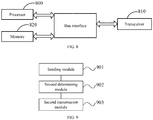
- a bus architecture may include any quantity of interconnected buses and bridges, and connects various circuits including one or more processors represented by the processor 600 and a memory represented by the memory 620.
- the bus architecture may also connect various other circuits such as peripherals, voltage regulators and power management circuits, which is well known in the art. Therefore, a detailed description thereof is omitted herein.
- the bus interface provides interfaces.
- the transceiver 610 may be multiple elements, that is, includes a transmitter and a receiver, to provide units for communicating with various other apparatuses on the transmission medium.
- the user interface 630 can also be an interface capable of externally/internally connecting the required devices, which including but not limited to: a keypad, a display, a speaker, a microphone, a joystick, and the like.
- the processor 600 is responsible for managing the bus architecture and general processing, and the memory 620 can store data used by the processor 600 when performing operations.
- the downlink DCI is at least one of the following:
- HARQ-ACK corresponding to the downlink DCI is HARQ-ACK corresponding to the DCI indicating the SPS PDSCH release; when the downlink DCI is the DCI scheduling PDSCH transmission, HARQ-ACK corresponding to the downlink DCI is HARQ-ACK of the PDSCH scheduled by the downlink DCI.
- the processor 600 is further configured to read the program in the memory 620 to perform the following step: determining a first feedback timing of the aperiodic CSI and a first physical uplink control channel PUCCH resource for transmitting the aperiodic CSI.
- the processor 600 is further configured to read the program in the memory 620 to perform the following step:
- the first feedback timing is an interval between a first time domain resource of downlink DCI triggering the aperiodic CSI and a second time domain resource for transmitting the aperiodic CSI.
- the first time domain resource is a slot in which downlink DCI triggering the aperiodic CSI is transmitted
- the second time domain resource is a slot in which the PUCCH for transmitting the aperiodic CSI is transmitted; or, the first time domain resource is a last symbol of the downlink DCI triggering the aperiodic CSI, and the second time domain resource is a first symbol of the PUCCH transmitting the aperiodic CSI.
- the first feedback timing is pre-configured by higher layer signaling, or is indicated by an aperiodic CSI feedback timing indication field in the downlink DCI, or is indicated by an HARQ-ACK feedback timing indication field in the downlink DCI.
- the first PUCCH resource is configured by higher layer signaling, or is indicated by an aperiodic CSI PUCCH resource indication field in the downlink DCI, or is indicated by the HARQ-ACK resource indication field in the downlink DCI.
- the processor 600 is further configured to read the program in the memory 620 to perform the following steps:
- the terminal receives downlink downlink control information (DCI), wherein the downlink DCI includes aperiodic channel state information (CSI) trigger information field; when the aperiodic CSI trigger information field in the downlink DCI indicates that aperiodic CSI is to be reported, the terminal determines a first transmission resource for the aperiodic CSI and a second transmission resource for a hybrid automatic repeat request acknowledgement (HARQ-ACK) corresponding to the downlink DCI; the terminal transmits the aperiodic CSI on the first transmission resource, and transmits the HARQ-ACK on the second transmission resource.
- DCI downlink downlink control information
- CSI channel state information
- HARQ-ACK hybrid automatic repeat request acknowledgement
- Some embodiments of the present disclosure perform independent transmission of aperiodic CSI and HARQ-ACK, which can effectively avoid the impact on the transmission content of PUCCH carrying HARQ-ACK when the terminal fails to detect the DCI triggering the aperiodic report, and effectively improves system performance and transmission efficiency.
- Some embodiments of the present disclosure further provide a computer readable storage medium, where a computer program is stored in the computer readable storage medium, when the computer program is executed by a processor, the following steps are implemented:
- some embodiments of the present disclosure further provide a terminal, including:
- the downlink DCI is at least one of the following:
- HARQ-ACK corresponding to the downlink DCI is an HARQ-ACK corresponding to the DCI indicating the SPS PDSCH release
- HARQ-ACK corresponding to the downlink DCI is an HARQ-ACK of the PDSCH scheduled by the downlink DCI
- the first determining module includes:
- the first feedback timing is an interval between a first time domain resource of downlink DCI triggering the aperiodic CSI and a second time domain resource for transmitting the aperiodic CSI.
- the first time domain resource is a slot in which downlink DCI triggering the aperiodic CSI is transmitted
- the second time domain resource is a slot in which the PUCCH for transmitting the aperiodic CSI is transmitted; or, the first time domain resource is a last symbol of the downlink DCI triggering the aperiodic CSI, and the second time domain resource is a first symbol of the PUCCH transmitting the aperiodic CSI.
- the first feedback timing is pre-configured by higher layer signaling, or is indicated by an aperiodic CSI feedback timing indication field in the downlink DCI, or is indicated by an HARQ-ACK feedback timing indication field in the downlink DCI.
- the first PUCCH resource is configured by higher layer signaling, or indicated by an aperiodic CSI PUCCH resource indication field in the downlink DCI, or is indicated by the HARQ-ACK resource indication field in the downlink DCI.
- the first transmission module is configured to transmit the aperiodic CSI on the first PUCCH resource, and transmit the HARQ-ACK on the second PUCCH resource;
- the terminal receives downlink downlink control information (DCI), wherein the downlink DCI includes aperiodic channel state information (CSI) trigger information field; when the aperiodic CSI trigger information field in the downlink DCI indicates that aperiodic CSI is to be reported, the terminal determines a first transmission resource for the aperiodic CSI and a second transmission resource for a hybrid automatic repeat request acknowledgement (HARQ-ACK) corresponding to the downlink DCI; the terminal transmits the aperiodic CSI on the first transmission resource, and transmits the HARQ-ACK on the second transmission resource.
- DCI downlink downlink control information
- CSI channel state information
- HARQ-ACK hybrid automatic repeat request acknowledgement
- Some embodiments of the present disclosure perform independent transmission of aperiodic CSI and HARQ-ACK, which can effectively avoid the impact on the transmission content of PUCCH carrying HARQ-ACK when the terminal fails to detect the DCI triggering the aperiodic report, and effectively improves system performance and transmission efficiency.
- an embodiment of the present disclosure further provides a network device, the network device may specifically be a base station, and includes: a memory 820, a processor 800, a transceiver 810, a bust interface and a computer program stored in the memory 820 and executable by the processor 800; the processor 800 is configured to read the program in the memory 820 and performs the following process:
- a bus architecture may include any quantity of interconnected buses and bridges, and connects various circuits including one or more processors represented by the processor 800 and a memory represented by the memory 820.
- the bus architecture may also connect various other circuits such as peripherals, voltage regulators and power management circuits, which is well known in the art. Therefore, a detailed description thereof is omitted herein.
- the bus interface provides interfaces.
- the transceiver 810 may be multiple elements, that is, includes a transmitter and a receiver, to provide units for communicating with various other apparatuses on the transmission medium.
- the processor 800 is responsible for managing the bus architecture and general processing, and the memory 820 can store data used by the processor 800 when performing operations.
- the downlink DCI is at least one of the following:
- HARQ-ACK corresponding to the downlink DCI is an HARQ-ACK corresponding to the DCI indicating the SPS PDSCH release; when the downlink DCI is the DCI scheduling PDSCH transmission, HARQ-ACK corresponding to the downlink DCI is an HARQ-ACK of the PDSCH scheduled by the downlink DCI.
- the processor is further configured to execute the program to implement following step:
- the first feedback timing is an interval between a first time domain resource of downlink DCI triggering the aperiodic CSI and a second time domain resource for transmitting the aperiodic CSI.
- the first time domain resource is a slot in which downlink DCI triggering the aperiodic CSI is transmitted
- the second time domain resource is a slot in which the PUCCH for transmitting the aperiodic CSI is transmitted; or, the first time domain resource is a last symbol of the downlink DCI triggering the aperiodic CSI, and the second time domain resource is a first symbol of the PUCCH transmitting the aperiodic CSI.
- the first feedback timing is pre-configured by higher layer signaling, or is indicated by an aperiodic CSI feedback timing indication field in the downlink DCI, or is indicated by an HARQ-ACK feedback timing indication field in the downlink DCI.
- the first PUCCH resource is configured by higher layer signaling, or is indicated by an aperiodic CSI PUCCH resource indication field in the downlink DCI, or is indicated by the HARQ-ACK resource indication field in the downlink DCI.
- processor 800 executes the program, the following steps are further implemented:
- Some embodiments of the present disclosure further provide a computer readable storage medium, where a computer program is stored in the computer readable storage medium, when the computer program is executed by a processor, the following steps are implemented:
- some embodiments of the present disclosure further provide a network device, including:
- the downlink DCI is at least one of the following:
- HARQ-ACK corresponding to the downlink DCI is an HARQ-ACK corresponding to the DCI indicating the SPS PDSCH release
- HARQ-ACK corresponding to the downlink DCI refers to an HARQ-ACK of the PDSCH scheduled by the downlink DCI.
- the second determining module includes:
- the first feedback timing is an interval between a first time domain resource of downlink DCI triggering the aperiodic CSI and a second time domain resource for transmitting the aperiodic CSI.
- the first time domain resource is a slot in which downlink DCI triggering the aperiodic CSI is transmitted
- the second time domain resource is a slot in which the PUCCH for transmitting the aperiodic CSI is transmitted; or, the first time domain resource is a last symbol of the downlink DCI triggering the aperiodic CSI, and the second time domain resource is a first symbol of the PUCCH transmitting the aperiodic CSI.
- the first feedback timing is pre-configured by higher layer signaling, or is indicated by an aperiodic CSI feedback timing indication field in the downlink DCI, or is indicated by an HARQ-ACK feedback timing indication field in the downlink DCI.
- the first PUCCH resource is configured by higher layer signaling, or is indicated by an aperiodic CSI PUCCH resource indication field in the downlink DCI, or is indicated by the HARQ-ACK resource indication field in the downlink DCI.
- the second transmission module is configured to transmit the aperiodic CSI on the first PUCCH resource, and transmit the HARQ-ACK on the second PUCCH resource;
- the network device transmits downlink downlink control information (DCI), wherein the downlink DCI includes aperiodic channel state information (CSI) trigger information field; when the aperiodic CSI trigger information field in the downlink DCI indicates that aperiodic CSI is to be reported, the network device determines a first transmission resource for the aperiodic CSI and a second transmission resource for a hybrid automatic repeat request acknowledgement (HARQ-ACK) corresponding to the downlink DCI; the network device receives the aperiodic CSI on the first transmission resource and receives the HARQ-ACK on the second transmission resource.
- DCI downlink downlink control information
- CSI channel state information
- HARQ-ACK hybrid automatic repeat request acknowledgement
- Some embodiments of the present disclosure perform independent transmission of aperiodic CSI and HARQ-ACK, which can effectively avoid the impact on the transmission content of PUCCH carrying HARQ-ACK when the terminal fails to detect the DCI triggering the aperiodic report, and effectively improves system performance and transmission efficiency.
- sequence numbers of the foregoing processes do not imply execution sequences of the processes in the embodiments of the present disclosure.
- the execution sequences of the processes should be determined according to functions and internal logic of the processes, and the sequence numbers should not be construed as any limitation on the implementation processes of the embodiments of this disclosure.
Landscapes
- Engineering & Computer Science (AREA)
- Signal Processing (AREA)
- Computer Networks & Wireless Communication (AREA)
- Mobile Radio Communication Systems (AREA)
Abstract
Description
- The present application claims a priority to
Chinese patent application No. 201910009124.9 filed on January 4, 2019 - The present disclosure relates to the technical field of communication applications, and in particular, to an information transmission method, a terminal and a network device.
- In the New Radio (NR) Rel-15, aperiodic channel state information (CSI) is transmitted through a physical uplink shared channel (PUSCH). A base station notifies user equipment (UE) of whether to perform aperiodic CSI report through a CSI request field in downlink control information (DCI) format 1_0 scheduling the PUSCH.
- The CSI request field of the DCI format 1_0 may have 0, 1, 2, 3, 4, 5 or 6 bits. When the CSI request field is all 0, no CSI report is triggered. Otherwise, aperiodic CSI is reported according to higher layer configuration information. The base station can trigger the aperiodic CSI report to be transmitted together with uplink data, or trigger only the aperiodic CSI report.
- DCI format 1_0 contains time domain resource allocation information and frequency domain resource allocation information. Aperiodic CSI and data (if present) are transmitted on a resource indicated by DCI format 1_0. When the DCI triggering the aperiodic CSI and the report of the aperiodic CSI are in the same slot, a reference resource for the aperiodic CSI is a slot of the DCI transmission; otherwise, the reference resource for the aperiodic CSI is a valid downlink slot which satisfies a CSI processing latency and is closest to the CSI report slot.
- In the NR Rel-16, it is possible to support the use of downlink DCI to trigger a UE to transmit aperiodic CSI in a short physical uplink control channel (PUCCH) format, but there is no specific transmission scheme therefor thus far.
- An object of the present disclosure is to provide an information transmission method, a terminal and a network device to solve the problem that there is no relevant solution as to how to transmit CSI in the case that the use of downlink DCI to trigger the transmission of aperiodic CSI on the PUCCH is supported.
- In order to achieve the above object, the present disclosure provides an information transmission method applied to a terminal, including:
- receiving downlink downlink control information (DCI), wherein the downlink DCI includes an aperiodic channel state information (CSI) trigger information field;
- when the aperiodic CSI trigger information field in the downlink DCI indicates that aperiodic CSI is to be reported, determining a first transmission resource for the aperiodic CSI and a second transmission resource for a hybrid automatic repeat request acknowledgement (HARQ-ACK) corresponding to the downlink DCI;
- transmitting the aperiodic CSI on the first transmission resource and transmitting the HARQ-ACK on the second transmission resource.
- The downlink DCI is at least one of:
- DCI indicating semi-persistent scheduling (SPS) physical downlink shared channel (PDSCH) release;
- DCI scheduling PDSCH transmission.
- When the downlink DCI is the DCI indicating the SPS PDSCH release, the HARQ-ACK corresponding to the downlink DCI is an HARQ-ACK corresponding to the DCI indicating the SPS PDSCH release;
when the downlink DCI is the DCI scheduling PDSCH transmission, the HARQ-ACK corresponding to the downlink DCI is an HARQ-ACK of the PDSCH scheduled by the downlink DCI. - The determining the first transmission resource for the aperiodic CSI includes:
- determining a first feedback timing of the aperiodic CSI and a first physical uplink control channel PUCCH resource for transmitting the aperiodic CSI;
- the determining the second transmission resource for HARQ-ACK corresponding to the downlink DCI includes:
- determining a second feedback timing of the HARQ-ACK and a second PUCCH resource for transmitting the HARQ-ACK;
- wherein, the first feedback timing is different from the second feedback timing, and/or the first PUCCH resource is different from the second PUCCH resource.
- The first feedback timing is an interval between a first time domain resource of downlink DCI triggering the aperiodic CSI and a second time domain resource for transmitting the aperiodic CSI.
- The first time domain resource is a slot in which downlink DCI triggering the aperiodic CSI is transmitted, and the second time domain resource is a slot in which the PUCCH for transmitting the aperiodic CSI is transmitted;
or, the first time domain resource is a last symbol of the downlink DCI triggering the aperiodic CSI, and the second time domain resource is a first symbol of the PUCCH transmitting the aperiodic CSI. - The first feedback timing is pre-configured by higher layer signaling, or is indicated by an aperiodic CSI feedback timing indication field in the downlink DCI,
or is indicated by an HARQ-ACK feedback timing indication field in the downlink DCI. - The first PUCCH resource is configured by higher layer signaling, or is indicated by an aperiodic CSI PUCCH resource indication field in the downlink DCI,
or is indicated by an HARQ-ACK resource indication field in the downlink DCI. - The transmitting the aperiodic CSI on the first transmission resource and transmitting the HARQ-ACK on the second transmission resource includes:
- transmitting the aperiodic CSI on a first PUCCH resource, and transmitting the HARQ-ACK on a second PUCCH resource;
- wherein, the first PUCCH resource and the second PUCCH resource are in a same slot, and do not overlap in the time domain;
or, - the first PUCCH resource and the second PUCCH resource are in different slots.
- In order to achieve the above object, some embodiments of the present disclosure further provide an information transmission method applied to a network device, including:
- sending downlink downlink control information (DCI), wherein the downlink DCI includes an aperiodic channel state information (CSI) trigger information field;
- when the aperiodic CSI trigger information field in the downlink DCI indicates that aperiodic CSI is to be reported, determining a first transmission resource for the aperiodic CSI and a second transmission resource for a hybrid automatic repeat request acknowledgement (HARQ-ACK) corresponding to the downlink DCI;
- receiving the aperiodic CSI on the first transmission resource and receiving the HARQ-ACK on the second transmission resource.
- The downlink DCI is at least one of:
- DCI indicating semi-persistent scheduling (SPS) physical downlink shared channel (PDSCH) release;
- DCI scheduling PDSCH transmission.
- When the downlink DCI is the DCI indicating the SPS PDSCH release, the HARQ-ACK corresponding to the downlink DCI is an HARQ-ACK corresponding to the DCI indicating the SPS PDSCH release;
when the downlink DCI is the DCI scheduling the PDSCH transmission, the HARQ-ACK corresponding to the downlink DCI is an HARQ-ACK of the PDSCH scheduled by the downlink DCI. - The determining the first transmission resource for the aperiodic CSI includes:
- determining a first feedback timing of the aperiodic CSI and a first physical uplink control channel PUCCH resource for transmitting the aperiodic CSI;
- the determining the second transmission resource for HARQ-ACK corresponding to the downlink DCI includes:
- determining a second feedback timing of the HARQ-ACK and a second PUCCH resource for transmitting the HARQ-ACK;
- wherein, the first feedback timing is different from the second feedback timing, and/or the first PUCCH resource is different from the second PUCCH resource.
- The first feedback timing is an interval between a first time domain resource of downlink DCI triggering the aperiodic CSI and a second time domain resource for transmitting the aperiodic CSI.
- The first time domain resource is a slot in which the downlink DCI triggering the aperiodic CSI is transmitted, and the second time domain resource is a slot in which the PUCCH for transmitting the aperiodic CSI is transmitted;
or, the first time domain resource is a last symbol of the downlink DCI triggering the aperiodic CSI, and the second time domain resource is a first symbol of the PUCCH transmitting the aperiodic CSI. - The first feedback timing is pre-configured by higher layer signaling, or is indicated by an aperiodic CSI feedback timing indication field in the downlink DCI,
or is indicated by an HARQ-ACK feedback timing indication field in the downlink DCI. - The first PUCCH resource is configured by higher layer signaling, or is indicated by an aperiodic CSI PUCCH resource indication field in the downlink DCI,
or is indicated by an HARQ-ACK resource indication field in the downlink DCI. - The receiving the aperiodic CSI on the first transmission resource and receiving the HARQ-ACK on the second transmission resource includes:
- receiving the aperiodic CSI on a first PUCCH resource, and receiving the HARQ-ACK on a second PUCCH resource;
- wherein, the first PUCCH resource and the second PUCCH resource are in a same slot, and do not overlap in the time domain;
- or, the first PUCCH resource and the second PUCCH resource are in different slots.
- In order to achieve the above object, some embodiments of the present disclosure further provide a terminal, including: a transceiver, a memory, a processor, and a program stored in the memory and executable by the processor, wherein the processor is configured to execute the program to implement following steps:
- receiving downlink downlink control information (DCI) by using the transceiver, wherein the downlink DCI includes an aperiodic channel state information (CSI) trigger information field;
- when the aperiodic CSI trigger information field in the downlink DCI indicates that aperiodic CSI is to be reported, determining a first transmission resource for the aperiodic CSI and a second transmission resource for a hybrid automatic repeat request acknowledgement (HARQ-ACK) corresponding to the downlink DCI;
- transmitting the aperiodic CSI on the first transmission resource and transmitting the HARQ-ACK on the second transmission resource.
- The downlink DCI is at least one of:
- DCI indicating semi-persistent scheduling (SPS) physical downlink shared channel (PDSCH) release;
- DCI scheduling PDSCH transmission.
- When the downlink DCI is the DCI indicating the SPS PDSCH release, the HARQ-ACK corresponding to the downlink DCI is an HARQ-ACK corresponding to the DCI indicating the SPS PDSCH release;
when the downlink DCI is the DCI scheduling the PDSCH transmission, the HARQ-ACK corresponding to the downlink DCI is an HARQ-ACK of the PDSCH scheduled by the downlink DCI. - The processor is further configured to execute the program to implement following step:
- determining a first feedback timing of the aperiodic CSI and a first physical uplink control channel (PUCCH) resource for transmitting the aperiodic CSI;
- the processor is further configured to execute the program to implement following step:
- determining a second feedback timing of the HARQ-ACK and a second PUCCH resource for transmitting the HARQ-ACK;
- wherein, the first feedback timing is different from the second feedback timing, and/or the first PUCCH resource is different from the second PUCCH resource.
- The first feedback timing is an interval between a first time domain resource of downlink DCI triggering the aperiodic CSI and a second time domain resource for transmitting the aperiodic CSI.
- The first time domain resource is a slot in which downlink DCI triggering the aperiodic CSI is transmitted, and the second time domain resource is a slot in which the PUCCH for transmitting the aperiodic CSI is transmitted;
or, the first time domain resource is a last symbol of the downlink DCI triggering the aperiodic CSI, and the second time domain resource is a first symbol of the PUCCH transmitting the aperiodic CSI. - The first feedback timing is pre-configured by higher layer signaling, or is indicated by an aperiodic CSI feedback timing indication field in the downlink DCI,
or is indicated by an HARQ-ACK feedback timing indication field in the downlink DCI. - The first PUCCH resource is configured by higher layer signaling, or indicated by an aperiodic CSI PUCCH resource indication field in the downlink DCI,
or is indicated by an HARQ-ACK resource indication field in the downlink DCI. - The processor is further configured to execute the program to implement following steps:
- transmitting the aperiodic CSI on a first PUCCH resource, and transmitting the HARQ-ACK on a second PUCCH resource;
- wherein, the first PUCCH resource and the second PUCCH resource are in a same slot, and do not overlap in the time domain;
- or, the first PUCCH resource and the second PUCCH resource are in different slots.
- In order to achieve the above object, some embodiments of the present disclosure further provide a computer readable storage medium storing therein a computer program, wherein the computer program is configured to be executed by a processor to implement the steps of the foregoing information transmission method applied to a terminal side.
- In order to achieve the above object, some embodiments of the present disclosure further provide a network device, including: a transceiver, a memory, a processor, and a program stored in the memory and executable by the processor, wherein the processor is configured to execute the program to implement following steps:
- sending downlink downlink control information (DCI) by using the transceiver, wherein the downlink DCI includes an aperiodic channel state information (CSI) trigger information field;
- when the aperiodic CSI trigger information field in the downlink DCI indicates that aperiodic CSI is to be reported, determining a first transmission resource for the aperiodic CSI and a second transmission resource for a hybrid automatic repeat request acknowledgement (HARQ-ACK) corresponding to the downlink DCI;
- receiving the aperiodic CSI on the first transmission resource and receiving the HARQ-ACK on the second transmission resource.
- The downlink DCI is at least one of:
- DCI indicating semi-persistent scheduling (SPS) physical downlink shared channel (PDSCH) release;
- DCI scheduling PDSCH transmission.
- When the downlink DCI is the DCI indicating the SPS PDSCH release, the HARQ-ACK corresponding to the downlink DCI is an HARQ-ACK corresponding to the DCI indicating the SPS PDSCH release;
when the downlink DCI is the DCI scheduling the PDSCH transmission, the HARQ-ACK corresponding to the downlink DCI is an HARQ-ACK of the PDSCH scheduled by the downlink DCI. - The processor is further configured to execute the program to implement following step:
- determining a first feedback timing of the aperiodic CSI and a first physical uplink control channel PUCCH resource for transmitting the aperiodic CSI;
- the processor is further configured to execute the program to implement following step:
- determining a second feedback timing of the HARQ-ACK and a second PUCCH resource for transmitting the HARQ-ACK;
- wherein, the first feedback timing is different from the second feedback timing, and/or the first PUCCH resource is different from the second PUCCH resource.
- The first feedback timing is an interval between a first time domain resource of downlink DCI triggering the aperiodic CSI and a second time domain resource for transmitting the aperiodic CSI.
- The first time domain resource is a slot in which downlink DCI triggering the aperiodic CSI is transmitted, and the second time domain resource is a slot in which the PUCCH for transmitting the aperiodic CSI is transmitted;
or, the first time domain resource is a last symbol of the downlink DCI triggering the aperiodic CSI, and the second time domain resource is a first symbol of the PUCCH transmitting the aperiodic CSI. - The first feedback timing is pre-configured by higher layer signaling, or is indicated by an aperiodic CSI feedback timing indication field in the downlink DCI,
or is indicated by an HARQ-ACK feedback timing indication field in the downlink DCI. - The first PUCCH resource is configured by higher-layer signaling, or is indicated by an aperiodic CSI PUCCH resource indication field in the downlink DCI;
or, the first PUCCH resource is indicated by an HARQ-ACK resource indication field in the downlink DCI. - The processor is further configured to execute the program to implement following steps:
- receiving the aperiodic CSI on a first PUCCH resource, and receiving the HARQ-ACK on a second PUCCH resource;
- wherein, the first PUCCH resource and the second PUCCH resource are in a same slot, and do not overlap in the time domain;
- or, the first PUCCH resource and the second PUCCH resource are in different slots.
- In order to achieve the above object, some embodiments of the present disclosure further provide a computer readable storage medium, where a computer program is stored in the computer readable storage medium, when the computer program is executed by a processor, steps of the information transmission method applied to a network device as described above are implemented.
- In order to achieve the above object, some embodiments of the present disclosure further provide a terminal, including:
- a receiving module, configured to receive downlink downlink control information (DCI), wherein the downlink DCI includes an aperiodic channel state information (CSI) trigger information field;
- a first determining module, configured to, when the aperiodic CSI trigger information field in the downlink DCI indicates that aperiodic CSI is to be reported, determine a first transmission resource for the aperiodic CSI and a second transmission resource for a hybrid automatic repeat request acknowledgement (HARQ-ACK) corresponding to the downlink DCI;
- a first transmission module, configured to transmit the aperiodic CSI on the first transmission resource and transmit the HARQ-ACK on the second transmission resource.
- The downlink DCI is at least one of:
- DCI indicating semi-persistent scheduling (SPS) physical downlink shared channel (PDSCH) release;
- DCI scheduling PDSCH transmission.
- In order to achieve the above object, some embodiments of the present disclosure further provide a network device, including:
- a sending module, configured to send downlink downlink control information (DCI), wherein the downlink DCI includes aperiodic channel state information (CSI) trigger information field;
- a second determining module, configured to, when the aperiodic CSI trigger information field in the downlink DCI indicates that aperiodic CSI is to be reported, determine a first transmission resource for the aperiodic CSI and a second transmission resource for a hybrid automatic repeat request acknowledgement (HARQ-ACK) corresponding to the downlink DCI;
- a second transmission module, configured to receive the aperiodic CSI on the first transmission resource and receive the HARQ-ACK on the second transmission resource.
- The downlink DCI is at least one of:
- DCI indicating semi-persistent scheduling (SPS) physical downlink shared channel (PDSCH) release;
- DCI scheduling PDSCH transmission.
- Some embodiments of the present disclosure have the following beneficial effects.
- In the above technical solutions in some embodiments of the present disclosure, downlink downlink control information (DCI) is received, wherein the downlink DCI includes aperiodic channel state information (CSI) trigger information field; when the aperiodic CSI trigger information field in the downlink DCI indicates that aperiodic CSI is to be reported, a first transmission resource for the aperiodic CSI and a second transmission resource for a hybrid automatic repeat request acknowledgement (HARQ-ACK) corresponding to the downlink DCI are determined; the aperiodic CSI is transmitted on the first transmission resource, and the HARQ-ACK is transmitted on the second transmission resource. Some embodiments of the present disclosure perform transmission of aperiodic CSI and transmission of HARQ-ACK independently, which can effectively avoid the impact on the transmission content of PUCCH carrying HARQ-ACK when the terminal fails to detect the DCI triggering the aperiodic report, and effectively improves system performance and transmission efficiency.
-
-
FIG. 1 is a structural diagram of a network system applicable to some embodiments of the present disclosure; -
FIG. 2 is a first schematic flowchart of an information transmission method according to some embodiments of the present disclosure; -
FIG. 3 is a second schematic flowchart of an information transmission method according to some embodiments of the present disclosure; -
FIG. 4 is a first schematic diagram of the transmission of aperiodic CSI and HARQ-ACK according to some embodiments of the present disclosure; -
FIG. 5 is a second schematic diagram of the transmission of aperiodic CSI and HARQ-ACK according to some embodiments of the present disclosure; -
FIG. 6 is a block diagram of a terminal according to some embodiments of the present disclosure; -
FIG. 7 is a schematic diagram of modules of a terminal according to some embodiments of the present disclosure; -
FIG. 8 is a block diagram of a network device according to some embodiments of the present disclosure; -
FIG. 9 is a schematic diagram of modules of a network device according to some embodiments of the present disclosure. - The Exemplary embodiments of the present disclosure will be described in more detail below with reference to the accompanying drawings. Although exemplary embodiments of the present disclosure are shown in the drawings, it should be understood that the present disclosure may be implemented in various forms, without being limited by the embodiments described herein. Rather, these embodiments are provided so that the present disclosure will be thorough and complete, and will fully convey the scope of the present disclosure to those skilled in the art.
- The terms "first", "second" and the like in the specification and claims of the present application are used to distinguish similar objects, and are not necessarily used to describe a particular order or chronological order. It is to be understood that terms used in this way may be interchangeable under appropriate circumstances, so that embodiments of the present application described herein may be implemented in a sequence other than those illustrated or described herein. In addition, such terms as "comprise", "have" and any variants thereof are intended to cover non-exclusive inclusions, for example, a process, a method, a system, a product, or a device that includes a series of steps or units is not necessarily limited to those steps or units clearly listed, but may include other steps or units not explicitly listed or inherent to such processes, methods, products or devices. Use of "and/or" in the description and claims represents at least one of connected objects.
- The following description provides examples, and is not intended to limit the scope, applicability, or configuration set forth in the claims. Changes may be made in the function and arrangement of elements discussed without departing from the spirit and scope of the disclosure. Various examples may omit, substitute, or add various procedures or components as appropriate. For instance, the methods described may be performed in an order different from that described, and various steps may be added, omitted, or combined. Also, features described with respect to certain examples may be combined in other examples.
- Referring to
FIG. 1, FIG. 1 is a structural diagram of a network system to which some embodiments of the present disclosure are applicable. As shown inFIG. 1 , the network system includes a terminal 11 and anetwork side device 12, wherein, the terminal 11 may be user equipment (UE) or other terminal device, for example, may be a terminal side device such as a mobile phone, a tablet personal computer, a laptop computer, a personal digital assistant (PDA), a mobile internet device (MID) or a wearable device. It should be noted that a specific type of the terminal 11 is not limited in embodiments of the present disclosure. Thenetwork side device 12 may be a base station, such as a macro station, Long Term Evolution (LTE) eNB, 5G New Radio (NR) NB, etc. The network side device may also be a small station, such as a low power node (LPN), pico, femto, etc., or, the network side device can be an access point (AP); the base station can also be a network node formed collectively by a central unit (CU) and a plurality of transmission reception points (TRPs) managed and controlled by the CU. It should be noted that the specific type of the network side device is not limited in embodiments of the present disclosure. - As shown in
FIG. 2 , some embodiments of the present disclosure provide an information transmission method, applied to a terminal, including astep 201, astep 202 and astep 203. - Step 201: receiving downlink downlink control information (DCI), wherein the downlink DCI includes aperiodic channel state information (CSI) trigger information field.
- Here, the aperiodic CSI trigger information field in the downlink DCI is used to indicate whether the terminal is to report aperiodic CSI (A-CSI).
- In some embodiments of the present disclosure, the downlink DCI is at least one of the following:
- DCI indicating semi-persistent scheduling (SPS) physical downlink shared channel (PDSCH) release;
- DCI scheduling PDSCH transmission.
- Further, when the downlink DCI is the DCI indicating the SPS PDSCH release, the HARQ-ACK corresponding to the downlink DCI is an HARQ-ACK corresponding to the DCI indicating the SPS PDSCH release;
when the downlink DCI is the DCI scheduling the PDSCH transmission, the HARQ-ACK corresponding to the downlink DCI is an HARQ-ACK of the PDSCH scheduled by the downlink DCI. - Step 202: when the aperiodic CSI trigger information field in the downlink DCI indicates that aperiodic CSI is to be reported, determining a first transmission resource for the aperiodic CSI and a second transmission resource for a hybrid automatic repeat request acknowledgement (HARQ-ACK) corresponding to the downlink DCI.
- Here, the first transmission resource and the second transmission resource are two independently configured transmission resources. The terminal determines the transmission resource for the aperiodic CSI and the transmission resource for the HARQ-ACK corresponding to the downlink DCI separately, so as to realize independent transmission of the aperiodic CSI and the HARQ-ACK corresponding to the downlink DCI. The independent configuration here is at least manifested as the independent configuration of one of feedback timing and specific resource. The other of feedback timing and specific resource can be independently configured as well, but of course its configuration can be shared, that is, have same configuration.
- Step 203: transmitting the aperiodic CSI on the first transmission resource, and transmitting the HARQ-ACK on the second transmission resource.
- In the information transmission method according to some embodiments of the present disclosure, downlink downlink control information (DCI) is received, wherein the downlink DCI includes aperiodic channel state information (CSI) trigger information field; when the aperiodic CSI trigger information field in the downlink DCI indicates that aperiodic CSI is to be reported, a first transmission resource for the aperiodic CSI and a second transmission resource for a hybrid automatic repeat request acknowledgement HARQ-ACK corresponding to the downlink DCI are determined; the aperiodic CSI is transmitted on the first transmission resource, and the HARQ-ACK is transmitted on the second transmission resource. Some embodiments of the present disclosure perform independent transmission of aperiodic CSI and HARQ-ACK, which can effectively avoid the impact on the transmission content of PUCCH carrying HARQ-ACK when the terminal fails to detect the DCI triggering the aperiodic report, and effectively improves system performance and transmission efficiency.
- Further, the determining a first transmission resource for the aperiodic CSI in the
above step 202 includes: - determining a first feedback timing of the aperiodic CSI and a first physical uplink control channel (PUCCH) resource for transmitting the aperiodic CSI;
- the determining a second transmission resource for HARQ-ACK corresponding to the downlink DCI in the
above step 202 includes:- determining a second feedback timing of the HARQ-ACK and a second PUCCH resource for transmitting the HARQ-ACK;
- wherein, the first feedback timing is different from the second feedback timing, and/or the first PUCCH resource is different from the second PUCCH resource.
- The first feedback timing being different from the second feedback timing may refer to that the first feedback timing and the second feedback timing are in different slots, or in non-overlapping symbols of a same slot, such as, in a first half of a slot and a second half of the slot. The first PUCCH resource being different from the second PUCCH resource may refer to that the first PUCCH resource and the second PUCCH resource do not overlap in the time domain, and the non-overlap may be manifested as not being in the same slot, or manifested as being in non-overlapping symbols of a same slot.
- Specifically, the first feedback timing is an interval between a first time domain resource of downlink DCI triggering the aperiodic CSI and a second time domain resource for transmitting the aperiodic CSI.
- The first time domain resource is a slot in which downlink DCI triggering the aperiodic CSI is transmitted, and the second time domain resource is a slot in which the PUCCH for transmitting the aperiodic CSI is transmitted; at this time, the above interval is the slot interval between the slot in which the downlink DCI triggering the aperiodic CSI is transmitted and the slot in which the PUCCH transmitting the aperiodic CSI is transmitted. For example, it can be defined that the downlink DCI is in a slot n, if the aperiodic CSI trigger information field indicates that aperiodic CSI needs to be reported, the aperiodic CSI is reported in a slot n+k, where k is the first feedback timing.
- Or, the first time domain resource is a last symbol of the downlink DCI triggering the aperiodic CSI, and the second time domain resource is a first symbol of the PUCCH transmitting the aperiodic CSI. At this time, the interval is a symbol interval between the last symbol of the downlink DCI triggering the aperiodic CSI and the first symbol of the PUCCH transmitting the aperiodic CSI.
- In some embodiments of the present disclosure, the first feedback timing is pre-configured by higher layer signaling, or is indicated by an aperiodic CSI feedback timing indication field in the downlink DCI; when the first feedback timing is indicated by an aperiodic CSI feedback timing indication field in the downlink DCI, the aperiodic CSI feedback timing indicator field in the downlink DCI can directly indicate a first feedback timing value. Of course, the aperiodic CSI feedback timing indicator field can also indicate a value in the first feedback timing set pre-configured by higher layer signaling, for example, indicate a feedback timing value by indicating the number of each value in the pre-configured first feedback timing set.
- Or, the first feedback timing is indicated by an HARQ-ACK feedback timing indication field in the downlink DCI. This case is equivalent to that the first feedback timing and the second feedback timing are the same. For example, the aperiodic CSI and the HARQ-ACK corresponding to the downlink DCI are transmitted in the same slot.
- Specifically, when the first feedback timing and the second feedback timing are independently configured (the first feedback timing is independent of the second feedback timing), the first feedback timing is pre-configured by higher-layer signaling, or is indicated by the aperiodic CSI feedback timing indication field in the downlink DCI.
- When the first feedback timing and the second feedback timing are the same, the first feedback timing is indicated by the HARQ-ACK feedback timing indication field in the downlink DCI. At this time, the first PUCCH resource is different from the second PUCCH resource.
- In some embodiments of the present disclosure, the first PUCCH resource is configured by higher layer signaling, or is indicated by an aperiodic CSI PUCCH resource indication field in the downlink DCI,
or is indicated by the HARQ-ACK resource indication field in the downlink DCI. - Specifically, when the first PUCCH resource and the second PUCCH resource are independently configured (the first PUCCH resource is independent of the second PUCCH resource), the first PUCCH resource is configured by higher layer signaling, or is indicated by an aperiodic CSI PUCCH resource indication field in the downlink DCI. When the first PUCCH resource is indicated by the aperiodic CSI PUCCH resource indication field in the downlink DCI, the aperiodic CSI PUCCH resource indication field in the downlink DCI can directly indicate all relevant parameters of the PUCCH resource, or can indicate one PUCCH resource in a PUCCH resource set pre-configured by higher layer signaling. Specifically, the indication of one PUCCH resource can be realized by indicating a number of a PUCCH resource in the PUCCH resource set.
- When the first PUCCH resource and the second PUCCH resource are the same, the first PUCCH resource is indicated by the HARQ-ACK resource indication field in the downlink DCI. At this time, the first feedback timing and the second feedback timing need to be different.
- Further, the transmitting the aperiodic CSI on the first transmission resource and transmitting the HARQ-ACK on the second transmission resource includes:
- transmitting the aperiodic CSI on a first PUCCH resource, and transmitting the HARQ-ACK on a second PUCCH resource;
- wherein, the first PUCCH resource and the second PUCCH resource are in a same slot, and do not overlap in time domain; or,
- the first PUCCH resource and the second PUCCH resource are in different slots.
- In the information transmission method according to some embodiments of the present disclosure, downlink downlink control information (DCI) is received, wherein the downlink DCI includes an aperiodic channel state information (CSI) trigger information field; when the aperiodic CSI trigger information field in the downlink DCI indicates that aperiodic CSI is to be reported, a first transmission resource for the aperiodic CSI and a second transmission resource for a hybrid automatic repeat request acknowledgement (HARQ-ACK) corresponding to the downlink DCI are determined; the aperiodic CSI is transmitted on the first transmission resource, and the HARQ-ACK is transmitted on the second transmission resource. Some embodiments of the present disclosure perform independent transmission of aperiodic CSI and HARQ-ACK, which can effectively avoid the impact on the transmission content of PUCCH carrying HARQ-ACK when the terminal fails to detect the DCI triggering the aperiodic report, and effectively improves system performance and transmission efficiency.
- As shown in
FIG. 3 , some embodiments of the present disclosure further provide an information transmission method applied to a network device, including astep 301, astep 302 and astep 303. - Step 301: sending downlink downlink control information (DCI), wherein the downlink DCI includes an aperiodic channel state information (CSI) trigger information field.
- Here, the aperiodic CSI trigger information field in the downlink DCI is used to indicate whether the terminal is to report aperiodic CSI (A-CSI).
- In some embodiments of the present disclosure, the downlink DCI is at least one of the following:
- DCI indicating semi-persistent scheduling (SPS) physical downlink shared channel (PDSCH) release;
- DCI scheduling PDSCH transmission.
- Further, when the downlink DCI is the DCI indicating the SPS PDSCH release, the HARQ-ACK corresponding to the downlink DCI is an HARQ-ACK corresponding to the DCI indicating the SPS PDSCH release;
when the downlink DCI is the DCI scheduling PDSCH transmission, the HARQ-ACK corresponding to the downlink DCI is an HARQ-ACK of the PDSCH scheduled by the downlink DCI. - Step 302: when the aperiodic CSI trigger information field in the downlink DCI indicates that aperiodic CSI is to be reported, determining a first transmission resource for the aperiodic CSI and a second transmission resource for a hybrid automatic repeat request acknowledgement (HARQ-ACK) corresponding to the downlink DCI.
- Here, the first transmission resource and the second transmission resource are two independently configured transmission resources. The network device determines the transmission resource for the aperiodic CSI and the transmission resource for the HARQ-ACK corresponding to the downlink DCI separately, so as to realize independent transmission of the aperiodic CSI and the HARQ-ACK corresponding to the downlink DCI. The independent configuration here is at least manifested as the independent configuration of one of feedback timing and specific resource. The other of feedback timing and specific resource can be independently configured as well, but of course its configuration can be shared, that is, have same configuration.
- Step 303: receiving the aperiodic CSI on the first transmission resource, and receiving the HARQ-ACK on the second transmission resource.
- In the information transmission method of some embodiments of the present disclosure, downlink downlink control information (DCI) is transmitted, wherein the downlink DCI includes an aperiodic channel state information (CSI) trigger information field; when the aperiodic CSI trigger information field in the downlink DCI indicates that aperiodic CSI is to be reported, a first transmission resource for the aperiodic CSI and a second transmission resource for a hybrid automatic repeat request acknowledgement (HARQ-ACK) corresponding to the downlink DCI are determined; the aperiodic CSI is received on the first transmission resource, and the HARQ-ACK is received on the second transmission resource. Some embodiments of the present disclosure perform independent transmission of aperiodic CSI and HARQ-ACK, which can effectively avoid the impact on the transmission content of PUCCH carrying HARQ-ACK when the terminal fails to detect the DCI triggering the aperiodic report, and effectively improves system performance and transmission efficiency.
- Further, the determining a first transmission resource for the aperiodic CSI in the
above Step 302 includes: - determining a first feedback timing of the aperiodic CSI and a first physical uplink control channel PUCCH resource for transmitting the aperiodic CSI;
- the determining a second transmission resource for HARQ-ACK corresponding to the downlink DCI in the
above Step 302 includes:- determining a second feedback timing of the HARQ-ACK and a second physical uplink control channel PUCCH resource for transmitting the HARQ-ACK;
- wherein, the first feedback timing is different from the second feedback timing, and/or the first PUCCH resource is different from the second PUCCH resource.
- The first feedback timing being different from the second feedback timing may refer to that the first feedback timing and the second feedback timing are in different slots, or in non-overlapping symbols of a same slot, such as, in a first half of a slot and a second half of the slot. The first PUCCH resource being different from the second PUCCH resource may refer to that the first PUCCH resource and the second PUCCH resource do not overlap in the time domain, and the non-overlap may be manifested as not being in the same slot, or manifested as being in non-overlapping symbols of a same slot.
- Specifically, the first feedback timing is an interval between a first time domain resource of downlink DCI triggering the aperiodic CSI and a second time domain resource for transmitting the aperiodic CSI.
- The first time domain resource is a slot in which downlink DCI triggering the aperiodic CSI is transmitted, and the second time domain resource is a slot in which the PUCCH for transmitting the aperiodic CSI is transmitted; at this time, the above interval is the slot interval between the slot in which the downlink DCI triggering the aperiodic CSI is transmitted and the slot in which the PUCCH transmitting the aperiodic CSI is transmitted. For example, it may be defined that the downlink DCI is in a slot n, if the aperiodic CSI trigger information field in the downlink DCI indicates that aperiodic CSI needs to be reported, the aperiodic CSI is reported in a slot n+k, wherein k is the first feedback timing.
- Or, the first time domain resource is a last symbol of the downlink DCI triggering the aperiodic CSI, and the second time domain resource is a first symbol of the PUCCH transmitting the aperiodic CSI. At this time, the interval is a symbol interval between the last symbol of the downlink DCI triggering the aperiodic CSI and the first symbol of the PUCCH transmitting the aperiodic CSI.
- In some embodiments of the present disclosure, the first feedback timing is pre-configured by higher layer signaling, or is indicated by an aperiodic CSI feedback timing indication field in the downlink DCI; when the first feedback timing is indicated by the aperiodic CSI feedback timing indication field in the downlink DCI, the aperiodic CSI feedback timing indicator field in the downlink DCI can directly indicate a first feedback timing value. Of course, the aperiodic CSI feedback timing indicator field can also indicate a value in the first feedback timing set pre-configured by higher layer signaling, for example, indicate a feedback timing value by indicating the number of each value in the pre-configured first feedback timing set.
- Or, the first feedback timing is indicated by an HARQ-ACK feedback timing indication field in the downlink DCI. This case is equivalent to that the first feedback timing and the second feedback timing are the same. For example, the aperiodic CSI and the HARQ-ACK corresponding to the downlink DCI are transmitted in the same slot.
- Specifically, when the first feedback timing and the second feedback timing are independently configured (the first feedback timing is independent of the second feedback timing), the first feedback timing is pre-configured by higher-layer signaling, or is indicated by the aperiodic CSI feedback timing indication field in the downlink DCI.
- When the first feedback timing and the second feedback timing are the same, the first feedback timing is indicated by the HARQ-ACK feedback timing indication field in the downlink DCI. At this time, the first PUCCH resource is different from the second PUCCH resource.
- In some embodiments of the present disclosure, the first PUCCH resource is configured by higher layer signaling, or is indicated by an aperiodic CSI PUCCH resource indication field in the downlink DCI,
or is indicated by the HARQ-ACK resource indication field in the downlink DCI. - Specifically, when the first PUCCH resource and the second PUCCH resource are independently configured (the first PUCCH resource is independent of the second PUCCH resource), the first PUCCH resource is configured by higher layer signaling, or is indicated by an aperiodic CSI PUCCH resource indication field in the downlink DCI. When the first PUCCH resource is indicated by the aperiodic CSI PUCCH resource indication field in the downlink DCI, the aperiodic CSI PUCCH resource indication field in the downlink DCI can directly indicate all relevant parameters of the PUCCH resource, or can indicate one PUCCH resource in a PUCCH resource set pre-configured by higher layer signaling. Specifically, the indication of one PUCCH resource can be realized by indicating the number of a PUCCH resource in the PUCCH resource set. When the first PUCCH resource and the second PUCCH resource are the same, the first PUCCH resource is indicated by the HARQ-ACK resource indication field in the downlink DCI. At this time, the first feedback timing and the second feedback timing need to be different.
- Further, the receiving the aperiodic CSI on the first transmission resource and receiving the HARQ-ACK on the second transmission resource, includes:
- receiving the aperiodic CSI on a first PUCCH resource, and receiving the HARQ-ACK on a second PUCCH resource;
- wherein, the first PUCCH resource and the second PUCCH resource are in a same slot, and do not overlap in the time domain; or,
- the first PUCCH resource and the second PUCCH resource are in different slots.
- In the information transmission method according to some embodiments of the present disclosure, downlink downlink control information (DCI) is transmitted, wherein the downlink DCI includes an aperiodic channel state information (CSI) trigger information field; when the aperiodic CSI trigger information field in the downlink DCI indicates that aperiodic CSI is to be reported, a first transmission resource for the aperiodic CSI and a second transmission resource for a hybrid automatic repeat request acknowledgement (HARQ-ACK) corresponding to the downlink DCI are determined; the aperiodic CSI is received on the first transmission resource, and the HARQ-ACK is received on the second transmission resource. Some embodiments of the present disclosure perform independent transmission of aperiodic CSI and HARQ-ACK, which can effectively avoid the impact on the transmission content of PUCCH carrying HARQ-ACK when the terminal fails to detect the DCI triggering the aperiodic report, and effectively improves system performance and transmission efficiency.
- The information transmission methods of some embodiments of the present disclosure will be described below in conjunction with specific embodiments.
- As shown in
Figure 4 , assuming that the base station uses same-slot scheduling, the base station sends DCI in slot n (the DCI transmission is carried on the PDCCH), the DCI schedules the PDSCH transmission in slot n, and the HARQ-ACK timing indication field in the DCI indicates that the HARQ-ACK feedback timing is 4, that is, the HARQ-ACK feedback information of the PDSCH in slot n needs to be transmitted in slot n+4, and the HARQ-ACK PUCCH resource indication field in the DCI indicates the specific PUCCH resource in slot n+4 (e.g.,PUCCH resource 1 inFIG. 4 ), such as time domain start symbol, transmission symbol length, frequency domain resource location and other information. At the same time, the DCI includes an aperiodic CSI trigger field, and when the base station indicates through the aperiodic CSI trigger field that the terminal needs to perform aperiodic CSI feedback, the following manners can be specifically implemented. - Manner 1: it is pre-agreed that the feedback timing of aperiodic CSI is determined according to the HARQ-ACK feedback timing, that is, the feedback timing of aperiodic CSI (A-CSI) is the same as the feedback timing of HARQ-ACK. At this time, the feedback timing of aperiodic CSI can be determined in the way of determining the HARQ-ACK feedback timing, that is, it is always assumed that aperiodic CSI and HARQ-ACK are transmitted in the same slot, and no additional signaling is needed to indicate the feedback timing of aperiodic CSI; moreover, the base station pre-configures through higher layer signaling a PUCCH resource carrying aperiodic CSI in a slot (e.g.,
PUCCH resource 2 inFIG. 4 ), and when indicating the PUCCH resource for HARQ-ACK, the base station ensures that the PUCCH resource for HARQ-ACK does not overlap in the time domain with the PUCCH resource carrying aperiodic CSI in slot n+4 that is pre-configured by higher layer signaling. - Manner 2: it is pre-agreed that the feedback timing of aperiodic CSI is determined according to the HARQ-ACK feedback timing, that is, the feedback timing of aperiodic CSI is the same as the feedback timing of HARQ-ACK. At this time, the feedback timing of aperiodic CSI can be determined in the way of determining the HARQ-ACK feedback timing, that is, it is always assumed that aperiodic CSI and HARQ-ACK are transmitted in the same slot, and no additional signaling is needed to indicate the feedback timing of aperiodic CSI; and the DCI contains a PUCCH resource indication field corresponding to aperiodic CSI, which is used to indicate the PUCCH resource carrying aperiodic CSI in a slot (e.g.,
PUCCH resource 2 inFIG. 4 ), thePUCCH resource 2 may be a PUCCH resource selected, according to the corresponding indication field in the DCI, from a plurality of PUCCH resources for carrying aperiodic CSI that are pre-configured by higher layer signaling, and when indicating the PUCCH resources of HARQ-ACK and aperiodic CSI, the base station ensures that the two do not overlap in the time domain. - Manner 3: the base station pre-configures the feedback timing of aperiodic CSI through higher layer signaling, for example, configures the feedback timing to 4 (that is, the same as the HARQ-ACK feedback timing), that is, indicates that the terminal is to perform aperiodic CSI feedback in slot n+4, and the base station pre-configures a PUCCH resource carrying aperiodic CSI in a slot through higher layer signaling (e.g.,
PUCCH resource 2 inFIG. 4 ), and when indicating the PUCCH resource for HARQ-ACK, the base station ensures that the PUCCH resource for HARQ-ACK does not overlap in the time domain with the PUCCH resource carrying aperiodic CSI in slot n+4 that is pre-configured by higher layer signaling. - Manner 4: the base station pre-configures the feedback timing of aperiodic CSI through higher layer signaling, for example, configures the feedback timing to 4, that is, indicates that the terminal is to perform aperiodic CSI feedback in slot n+4, and the DCI contains a PUCCH resource indication field corresponding to aperiodic CSI, which is used to indicate the PUCCH resource carrying aperiodic CSI in a slot (e.g.,
PUCCH resource 2 inFIG. 4 ), thePUCCH resource 2 may be a PUCCH resource selected, according to the corresponding indication field in the DCI, from a plurality of PUCCH resources for carrying aperiodic CSI that are pre-configured by higher layer signaling, and when indicating the PUCCH resources of HARQ-ACK and aperiodic CSI, the base station ensures that the two do not overlap in the time domain. - Manner 5: the DCI includes the feedback time domain indication field corresponding to aperiodic CSI, for example, the base station indicates that the feedback timing of the aperiodic CSI is 4 through the feedback time domain indication field corresponding to the aperiodic CSI in the DCI, that is, indicates that the terminal is to perform aperiodic CSI feedback in slot n+4, and the base station pre-configures a PUCCH resource carrying aperiodic CSI in a slot through higher layer signaling (e.g.,
PUCCH resource 2 inFIG. 4 ), and when indicating the PUCCH resource for HARQ-ACK, the base station ensures that the PUCCH resource for HARQ-ACK does not overlap in the time domain with the PUCCH resource carrying aperiodic CSI in slot n+4 that is pre-configured by higher layer signaling. - Manner 6: the DCI includes the feedback time domain indication field corresponding to aperiodic CSI, for example, the base station indicates that the feedback timing of the aperiodic CSI is 4 through the feedback time domain indication field corresponding to the aperiodic CSI in the DCI, that is, indicates that the terminal is to perform aperiodic CSI feedback in slot n+4, and the DCI further contains a PUCCH resource indication field corresponding to aperiodic CSI, which is used to indicate the PUCCH resource carrying aperiodic CSI in a slot (e.g.,
PUCCH resource 2 inFIG. 4 ), thePUCCH resource 2 may be a PUCCH resource selected, according to the corresponding indication field in the DCI, from a plurality of PUCCH resources for carrying aperiodic CSI that are pre-configured by higher layer signaling, and when indicating the PUCCH resources of HARQ-ACK and aperiodic CSI, the base station ensures that the two do not overlap in the time domain. - According to the above corresponding manners, the terminal can determine to transmit the HARQ-ACK on
PUCCH resource 1 in slot n+4, and determine to transmit the aperiodic CSI onPUCCH resource 2 in slot n+4; in the same way, the base station can determine to receive HARQ-ACK onPUCCH resource 1 in slot n+4, and determine to receive aperiodic CSI onPUCCH resource 2 inslot n+ 4. AlthoughPUCCH resource 1 andPUCCH resource 2 are in the same slot, becausePUCCH resource 1 andPUCCH resource 2 do not overlap in the time domain and are independent PUCCH transmission, independent transmission of HARQ-ACK and aperiodic CSI is realized. - At this time, if HARQ-ACK of another PDSCH scheduled by DCI needs to be multiplexed with the HARQ-ACK of this PDSCH in the same PUCCH transmission, as shown in
FIG. 4 , there is also a PDSCH scheduled by DCI in slot n+1 that needs HARQ-ACK feedback in slot n+4, if aperiodic CSI and HARQ-ACK are transmitted on the same PUCCH (for example, both are transmitted on PUCCH resource 1), when the DCI triggering aperiodic CSI is received, the aperiodic CSI and the HARQ-ACKs of the two PDSCHs are transmitted on the PUCCH; when the DCI triggering the aperiodic CSI is not received, only the HARQ-ACKs of the two PDSCHs are transmitted on the PUCCH. Therefore, whether the DCI triggering the aperiodic CSI is received will affect the transmission content of the PUCCH carrying HARQ-ACK, resulting in a deterioration of the HARQ-ACK detection performance of the base station. In some embodiments of the present disclosure, the aperiodic CSI and HARQ-ACK are transmitted independently, so as to avoid affecting the transmission content on the PUCCH resource carrying HARQ-ACK because of the loss of the DCI triggering the aperiodic CSI in the slot n. - Assuming that the base station uses same-slot scheduling, the base station sends DCI in slot n (the DCI transmission is carried on the PDCCH), the DCI schedules the PDSCH transmission in slot n, and the HARQ-ACK timing indication field in the DCI indicates that the HARQ-ACK feedback timing is 4, that is, the HARQ-ACK feedback information of the PDSCH in slot n needs to be transmitted in slot n+4, and the HARQ-ACK PUCCH resource indication field in the DCI indicates the specific PUCCH resource in slot n+4 (e.g.,
PUCCH resource 1 inFIG. 5 ), such as time domain start symbol, transmission symbol length, frequency domain resource location and other information. At the same time, the DCI includes an aperiodic CSI trigger field, and the base station indicates through the aperiodic CSI trigger field to the terminal that aperiodic CSI feedback needs to be performed, the following manners can be specifically implemented. - Manner 1: the base station pre-configures the aperiodic CSI feedback timing through higher layer signaling, for example, the aperiodic CSI feedback timing is configured to 5 (that is, it is different from the HARQ-ACK feedback timing, specifically, the base station can dynamically adjust the HARQ-ACK feedback timing so that the HARQ-ACK is in a different slot from the aperiodic CSI), that is, the base station indicates that the terminal is to perform aperiodic CSI feedback in slot n+5, which is different from the slot of HARQ-ACK feedback; and it is pre-agreed that the PUCCH resource for the aperiodic CSI is determined in the way of determining the PUCCH resource for HARQ-ACK, that is, the start symbol, transmission length, and frequency domain resource, etc. of the PUCCH resource for aperiodic CSI in the slot in which the aperiodic CSI is transmitted are the same as those of the PUCCH resource for HARQ-ACK (e.g.,
PUCCH resource 2 inFig. 5 , that is, at this time,PUCCH resource 1 andPUCCH resource 2 have the same start position, length, frequency domain resources and the like in the respective slots). Due to the different slots, the PUCCH resource carrying aperiodic CSI and the PUCCH resource carrying HARQ-ACK naturally do not overlap in the time domain. - Manner 2: the base station pre-configures the aperiodic CSI feedback timing through higher layer signaling, for example, configures the aperiodic CSI feedback timing to 5 (that is, it is different from the HARQ-ACK feedback timing, specifically, the base station can dynamically adjust the HARQ-ACK feedback timing so that the HARQ-ACK is in a different slot from the aperiodic CSI), that is, the base station indicates that the terminal is to perform aperiodic CSI feedback in slot n+5, which is different from the slot of HARQ-ACK feedback; and the base station pre-configures through higher layer signaling a PUCCH resource carrying aperiodic CSI in a slot (e.g.,
PUCCH resource 2 inFIG. 5 ), due to the different slots, the PUCCH resource carrying aperiodic CSI and the PUCCH resource carrying HARQ-ACK naturally do not overlap in the time domain. - Manner 3: the base station pre-configures the aperiodic CSI feedback timing through higher layer signaling, for example, configures the aperiodic CSI feedback timing to 5 (that is, it is different from the HARQ-ACK feedback timing, specifically, the base station can dynamically adjust the HARQ-ACK feedback timing so that the HARQ-ACK is in a different slot from the aperiodic CSI), that is, the base station indicates that the terminal is to perform aperiodic CSI feedback in slot n+5, which is different from the slot of HARQ-ACK feedback; and the DCI contains a PUCCH resource indication field corresponding to aperiodic CSI, which is used to indicate the PUCCH resource carrying aperiodic CSI in a slot (e.g.,
PUCCH resource 2 inFIG. 5 ), thePUCCH resource 2 may be a PUCCH resource selected, according to the corresponding indication field in the DCI, from a plurality of PUCCH resources for carrying aperiodic CSI that are pre-configured by higher layer signaling; due to the different slots, the PUCCH resource carrying aperiodic CSI and the PUCCH resource carrying HARQ-ACK naturally do not overlap in the time domain. - Manner 4: the DCI includes the feedback time domain indication field corresponding to aperiodic CSI, for example, the base station indicates that the feedback timing of the aperiodic CSI is 5 through the feedback time domain indication field corresponding to the aperiodic CSI in the DCI, that is, the base station indicates that the terminal is to perform aperiodic CSI feedback in slot n+5, which is different from the slot of HARQ-ACK feedback; and it is pre-agreed that the PUCCH resource for the aperiodic CSI is determined in the way of determining the PUCCH resource for HARQ-ACK, that is, the start symbol, transmission length, and frequency domain resource, etc. of the PUCCH resource for aperiodic CSI in the slot in which the aperiodic CSI is transmitted are the same as those of the PUCCH resource for HARQ-ACK (e.g.,
PUCCH resource 2 inFig. 5 , that is, at this time,PUCCH resource 1 andPUCCH resource 2 have the same start position, length, frequency domain resources and the like in the respective slots). Due to the different slots, the PUCCH resource carrying aperiodic CSI and the PUCCH resource carrying HARQ-ACK naturally do not overlap in the time domain. - Manner 5: the DCI includes the feedback time domain indication field corresponding to aperiodic CSI, for example, the base station indicates that the feedback timing of the aperiodic CSI is 5 through the feedback time domain indication field corresponding to the aperiodic CSI in the DCI, that is, the base station indicates that the terminal is to perform aperiodic CSI feedback in slot n+5, which is different from the slot of HARQ-ACK feedback; and the base station pre-configures a PUCCH resource (e.g.,
PUCCH resource 2 inFIG. 5 ) carrying aperiodic CSI in a slot through higher layer signaling; due to the different slots, the PUCCH resource carrying aperiodic CSI and the PUCCH resource carrying HARQ-ACK naturally do not overlap in the time domain. - Manner 6: the DCI includes the feedback time domain indication field corresponding to aperiodic CSI, for example, the base station indicates that the feedback timing of the aperiodic CSI is 5 through the feedback time domain indication field corresponding to the aperiodic CSI in the DCI, that is, the base station indicates that the terminal is to perform aperiodic CSI feedback in slot n+5, which is different from the slot of HARQ-ACK feedback; and the DCI contains a PUCCH resource indication field corresponding to aperiodic CSI, which is used to indicate the PUCCH resource carrying aperiodic CSI in a slot (e.g.,
PUCCH resource 2 inFIG. 5 ), thePUCCH resource 2 may be a PUCCH resource selected, according to the corresponding indication field in the DCI, from a plurality of PUCCH resources for carrying aperiodic CSI that are pre-configured by higher layer signaling; due to the different slots, the PUCCH resource carrying aperiodic CSI and the PUCCH resource carrying HARQ-ACK naturally do not overlap in the time domain. - According to the above corresponding manners, the terminal can determine to transmit the HARQ-ACK on
PUCCH resource 1 in slot n+4, and determine to transmit the aperiodic CSI onPUCCH resource 2 in slot n+5; in the same way, the base station can determine to receive HARQ-ACK onPUCCH resource 1 in slot n+4, and determine to receive aperiodic CSI onPUCCH resource 2 inslot n+ 5. SincePUCCH resource 1 andPUCCH resource 2 are in different slots, it is obvious that they never overlap in the time domain, and are independent PUCCH transmission, that is, independent transmission of HARQ-ACK and aperiodic CSI are realized. At this time, if HARQ-ACK of another PDSCH scheduled by DCI needs to be multiplexed with the HARQ-ACK of this PDSCH in the same PUCCH transmission, as shown inFIG. 5 , there is also a PDSCH scheduled by DCI in slot n+1 that needs HARQ-ACK feedback in slot n+4, if aperiodic CSI and HARQ-ACK are transmitted on the same PUCCH (for example, both are transmitted onPUCCH resource 1 in the slot n+4), when the DCI triggering aperiodic CSI is received, the aperiodic CSI and the HARQ-ACKs of the two PDSCHs are transmitted on the PUCCH; when the DCI triggering the aperiodic CSI is not received, only the HARQ-ACKs of the two PDSCHs are transmitted on the PUCCH. Therefore, whether the DCI triggering the aperiodic CSI is received will affect the transmission content of the PUCCH carrying HARQ-ACK, resulting in a deterioration of the HARQ-ACK detection performance of the base station. In some embodiments of the present disclosure, the aperiodic CSI and HARQ-ACK are transmitted independently, so as to avoid affecting the transmission content on the PUCCH resource carrying HARQ-ACK because of the loss of the DCI triggering the aperiodic CSI in the slot n. - In the above embodiments, feedback timing is defined by taking slot as an example of the unit of feedback timing. The same is applicable when the feedback timing is defined in units of other durations, for example, mini-slot, half slot, etc.
- As shown in
FIG. 6 , an embodiment of the present disclosure further provides a terminal including: a transceiver, a memory, a processor, and a computer program stored in the memory and executable by the processor; wherein the processor is configured to execute the computer program to implement following steps: - receiving downlink downlink control information (DCI), wherein the downlink DCI includes aperiodic channel state information (CSI) trigger information field;
- when the aperiodic CSI trigger information field in the downlink DCI indicates that aperiodic CSI is to be reported, determining a first transmission resource for the aperiodic CSI and a second transmission resource for a hybrid automatic repeat request acknowledgement HARQ-ACK corresponding to the downlink DCI;
- transmitting the aperiodic CSI on the first transmission resource and transmitting the HARQ-ACK on the second transmission resource.
- In
FIG. 6 , a bus architecture may include any quantity of interconnected buses and bridges, and connects various circuits including one or more processors represented by the processor 600 and a memory represented by thememory 620. The bus architecture may also connect various other circuits such as peripherals, voltage regulators and power management circuits, which is well known in the art. Therefore, a detailed description thereof is omitted herein. The bus interface provides interfaces. Thetransceiver 610 may be multiple elements, that is, includes a transmitter and a receiver, to provide units for communicating with various other apparatuses on the transmission medium. For different user equipment, the user interface 630 can also be an interface capable of externally/internally connecting the required devices, which including but not limited to: a keypad, a display, a speaker, a microphone, a joystick, and the like. - The processor 600 is responsible for managing the bus architecture and general processing, and the
memory 620 can store data used by the processor 600 when performing operations. - Optionally, the downlink DCI is at least one of the following:
- DCI indicating semi-persistent scheduling (SPS) physical downlink shared channel (PDSCH) release;
- DCI scheduling PDSCH transmission.
- Optionally, when the downlink DCI is the DCI indicating the SPS PDSCH release, HARQ-ACK corresponding to the downlink DCI is HARQ-ACK corresponding to the DCI indicating the SPS PDSCH release;
when the downlink DCI is the DCI scheduling PDSCH transmission, HARQ-ACK corresponding to the downlink DCI is HARQ-ACK of the PDSCH scheduled by the downlink DCI. - Optionally, the processor 600 is further configured to read the program in the
memory 620 to perform the following step:
determining a first feedback timing of the aperiodic CSI and a first physical uplink control channel PUCCH resource for transmitting the aperiodic CSI. - Optionally, the processor 600 is further configured to read the program in the
memory 620 to perform the following step: - determining a second feedback timing of the HARQ-ACK and a second physical uplink control channel (PUCCH) resource for transmitting the HARQ-ACK;
- wherein, the first feedback timing is different from the second feedback timing, and/or the first PUCCH resource is different from the second PUCCH resource.
- Optionally, the first feedback timing is an interval between a first time domain resource of downlink DCI triggering the aperiodic CSI and a second time domain resource for transmitting the aperiodic CSI.
- Optionally, the first time domain resource is a slot in which downlink DCI triggering the aperiodic CSI is transmitted, and the second time domain resource is a slot in which the PUCCH for transmitting the aperiodic CSI is transmitted;
or, the first time domain resource is a last symbol of the downlink DCI triggering the aperiodic CSI, and the second time domain resource is a first symbol of the PUCCH transmitting the aperiodic CSI. - Optionally, the first feedback timing is pre-configured by higher layer signaling, or is indicated by an aperiodic CSI feedback timing indication field in the downlink DCI,
or is indicated by an HARQ-ACK feedback timing indication field in the downlink DCI. - Optionally, the first PUCCH resource is configured by higher layer signaling, or is indicated by an aperiodic CSI PUCCH resource indication field in the downlink DCI,
or is indicated by the HARQ-ACK resource indication field in the downlink DCI. - Optionally, the processor 600 is further configured to read the program in the
memory 620 to perform the following steps: - transmitting the aperiodic CSI on a first PUCCH resource, and transmitting the HARQ-ACK on a second PUCCH resource;
- wherein, the first PUCCH resource and the second PUCCH resource are in a same slot, and do not overlap in the time domain;
- or, the first PUCCH resource and the second PUCCH resource are in different slots.
- The terminal according to some embodiments of the present disclosure receives downlink downlink control information (DCI), wherein the downlink DCI includes aperiodic channel state information (CSI) trigger information field; when the aperiodic CSI trigger information field in the downlink DCI indicates that aperiodic CSI is to be reported, the terminal determines a first transmission resource for the aperiodic CSI and a second transmission resource for a hybrid automatic repeat request acknowledgement (HARQ-ACK) corresponding to the downlink DCI; the terminal transmits the aperiodic CSI on the first transmission resource, and transmits the HARQ-ACK on the second transmission resource. Some embodiments of the present disclosure perform independent transmission of aperiodic CSI and HARQ-ACK, which can effectively avoid the impact on the transmission content of PUCCH carrying HARQ-ACK when the terminal fails to detect the DCI triggering the aperiodic report, and effectively improves system performance and transmission efficiency.
- Some embodiments of the present disclosure further provide a computer readable storage medium, where a computer program is stored in the computer readable storage medium, when the computer program is executed by a processor, the following steps are implemented:
- receiving downlink downlink control information (DCI), wherein the downlink DCI includes aperiodic channel state information (CSI) trigger information field;
- when the aperiodic CSI trigger information field in the downlink DCI indicates that aperiodic CSI is to be reported, determining a first transmission resource for the aperiodic CSI and a second transmission resource for a hybrid automatic repeat request acknowledgement HARQ-ACK corresponding to the downlink DCI;
- transmitting the aperiodic CSI on the first transmission resource and transmitting the HARQ-ACK on the second transmission resource.
- When the program is executed by the processor, all implementations in the above-mentioned embodiments of information transmission method applied to the terminal side may be achieved, and the same technical effects may be achieved. To avoid repetition, details thereof are not described here.
- As shown in
FIG. 7 , some embodiments of the present disclosure further provide a terminal, including: - a
receiving module 701, configured to receive downlink downlink control information (DCI), wherein the downlink DCI includes aperiodic channel state information (CSI) trigger information field; - a first determining
module 702, configured to, when the aperiodic CSI trigger information field in the downlink DCI indicates that aperiodic CSI is to be reported, determine a first transmission resource for the aperiodic CSI and a second transmission resource for a hybrid automatic repeat request acknowledgement HARQ-ACK corresponding to the downlink DCI; - a
first transmission module 703, configured to transmit the aperiodic CSI on the first transmission resource and transmit the HARQ-ACK on the second transmission resource. - In the terminal according to some embodiments of the present disclosure, the downlink DCI is at least one of the following:
- DCI indicating semi-persistent scheduling (SPS) physical downlink shared channel (PDSCH) release;
- DCI scheduling PDSCH transmission.
- In the terminal according to some embodiments of the present disclosure, when the downlink DCI is the DCI indicating the SPS PDSCH release, HARQ-ACK corresponding to the downlink DCI is an HARQ-ACK corresponding to the DCI indicating the SPS PDSCH release;
when the downlink DCI is the DCI scheduling PDSCH transmission, HARQ-ACK corresponding to the downlink DCI is an HARQ-ACK of the PDSCH scheduled by the downlink DCI. - In the terminal according to some embodiments of the present disclosure, the first determining module includes:
- a first determining sub-module configured to determine a first feedback timing of the aperiodic CSI and a first physical uplink control channel PUCCH resource for transmitting the aperiodic CSI;
- the first determining module further includes:
- a second determining sub-module configured to determine a second feedback timing of the HARQ-ACK and a second physical uplink control channel PUCCH resource for transmitting the HARQ-ACK;
- wherein, the first feedback timing is different from the second feedback timing, and/or the first PUCCH resource is different from the second PUCCH resource.
- In the terminal according to some embodiments of the present disclosure, the first feedback timing is an interval between a first time domain resource of downlink DCI triggering the aperiodic CSI and a second time domain resource for transmitting the aperiodic CSI.
- In the terminal according to some embodiments of the present disclosure, the first time domain resource is a slot in which downlink DCI triggering the aperiodic CSI is transmitted, and the second time domain resource is a slot in which the PUCCH for transmitting the aperiodic CSI is transmitted;
or, the first time domain resource is a last symbol of the downlink DCI triggering the aperiodic CSI, and the second time domain resource is a first symbol of the PUCCH transmitting the aperiodic CSI. - In the terminal according to some embodiments of the present disclosure, the first feedback timing is pre-configured by higher layer signaling, or is indicated by an aperiodic CSI feedback timing indication field in the downlink DCI,
or is indicated by an HARQ-ACK feedback timing indication field in the downlink DCI. - In the terminal according to some embodiments of the present disclosure, the first PUCCH resource is configured by higher layer signaling, or indicated by an aperiodic CSI PUCCH resource indication field in the downlink DCI,
or is indicated by the HARQ-ACK resource indication field in the downlink DCI. - In the terminal according to some embodiments of the present disclosure, the first transmission module is configured to transmit the aperiodic CSI on the first PUCCH resource, and transmit the HARQ-ACK on the second PUCCH resource;
- wherein, the first PUCCH resource and the second PUCCH resource are in a same slot, and do not overlap in the time domain; or,
- the first PUCCH resource and the second PUCCH resource are in different slots.
- The terminal according to some embodiments of the present disclosure receives downlink downlink control information (DCI), wherein the downlink DCI includes aperiodic channel state information (CSI) trigger information field; when the aperiodic CSI trigger information field in the downlink DCI indicates that aperiodic CSI is to be reported, the terminal determines a first transmission resource for the aperiodic CSI and a second transmission resource for a hybrid automatic repeat request acknowledgement (HARQ-ACK) corresponding to the downlink DCI; the terminal transmits the aperiodic CSI on the first transmission resource, and transmits the HARQ-ACK on the second transmission resource. Some embodiments of the present disclosure perform independent transmission of aperiodic CSI and HARQ-ACK, which can effectively avoid the impact on the transmission content of PUCCH carrying HARQ-ACK when the terminal fails to detect the DCI triggering the aperiodic report, and effectively improves system performance and transmission efficiency.
- As shown in
FIG. 8 , an embodiment of the present disclosure further provides a network device, the network device may specifically be a base station, and includes: a memory 820, aprocessor 800, atransceiver 810, a bust interface and a computer program stored in the memory 820 and executable by theprocessor 800; theprocessor 800 is configured to read the program in the memory 820 and performs the following process: - sending downlink downlink control information (DCI) by using the transceiver, wherein the downlink DCI includes aperiodic channel state information (CSI) trigger information field;
- when the aperiodic CSI trigger information field in the downlink DCI indicates that aperiodic CSI is to be reported, determining a first transmission resource for the aperiodic CSI and a second transmission resource for a hybrid automatic repeat request acknowledgement HARQ-ACK corresponding to the downlink DCI;
- receiving the aperiodic CSI on the first transmission resource and receiving the HARQ-ACK on the second transmission resource.
- In
FIG. 8 , a bus architecture may include any quantity of interconnected buses and bridges, and connects various circuits including one or more processors represented by theprocessor 800 and a memory represented by the memory 820. The bus architecture may also connect various other circuits such as peripherals, voltage regulators and power management circuits, which is well known in the art. Therefore, a detailed description thereof is omitted herein. The bus interface provides interfaces. Thetransceiver 810 may be multiple elements, that is, includes a transmitter and a receiver, to provide units for communicating with various other apparatuses on the transmission medium. Theprocessor 800 is responsible for managing the bus architecture and general processing, and the memory 820 can store data used by theprocessor 800 when performing operations. - Optionally, the downlink DCI is at least one of the following:
- DCI indicating semi-persistent scheduling (SPS) physical downlink shared channel (PDSCH) release;
- DCI scheduling PDSCH transmission.
- Optionally, when the downlink DCI is the DCI indicating the SPS PDSCH release, HARQ-ACK corresponding to the downlink DCI is an HARQ-ACK corresponding to the DCI indicating the SPS PDSCH release;
when the downlink DCI is the DCI scheduling PDSCH transmission, HARQ-ACK corresponding to the downlink DCI is an HARQ-ACK of the PDSCH scheduled by the downlink DCI. - Optionally, the processor is further configured to execute the program to implement following step:
- determining a first feedback timing of the aperiodic CSI and a first physical uplink control channel (PUCCH) resource for transmitting the aperiodic CSI;
- the processor is further configured to execute the program to implement following step:
- determining a second feedback timing of the HARQ-ACK and a second physical uplink control channel (PUCCH) resource for transmitting the HARQ-ACK;
- wherein, the first feedback timing is different from the second feedback timing, and/or the first PUCCH resource is different from the second PUCCH resource.
- Optionally, the first feedback timing is an interval between a first time domain resource of downlink DCI triggering the aperiodic CSI and a second time domain resource for transmitting the aperiodic CSI.
- Optionally, the first time domain resource is a slot in which downlink DCI triggering the aperiodic CSI is transmitted, and the second time domain resource is a slot in which the PUCCH for transmitting the aperiodic CSI is transmitted;
or, the first time domain resource is a last symbol of the downlink DCI triggering the aperiodic CSI, and the second time domain resource is a first symbol of the PUCCH transmitting the aperiodic CSI. - Optionally, the first feedback timing is pre-configured by higher layer signaling, or is indicated by an aperiodic CSI feedback timing indication field in the downlink DCI,
or is indicated by an HARQ-ACK feedback timing indication field in the downlink DCI. - Optionally, the first PUCCH resource is configured by higher layer signaling, or is indicated by an aperiodic CSI PUCCH resource indication field in the downlink DCI,
or is indicated by the HARQ-ACK resource indication field in the downlink DCI. - Optionally, when the
processor 800 executes the program, the following steps are further implemented: - receiving the aperiodic CSI on a first PUCCH resource, and receiving the HARQ-ACK on a second PUCCH resource;
- wherein, the first PUCCH resource and the second PUCCH resource are in a same slot, and do not overlap in the time domain; or,
- the first PUCCH resource and the second PUCCH resource are in different slots.
- Some embodiments of the present disclosure further provide a computer readable storage medium, where a computer program is stored in the computer readable storage medium, when the computer program is executed by a processor, the following steps are implemented:
- sending downlink downlink control information (DCI), wherein the downlink DCI includes aperiodic channel state information (CSI) trigger information field;
- when the aperiodic CSI trigger information field in the downlink DCI indicates that aperiodic CSI is to be reported, determining a first transmission resource for the aperiodic CSI and a second transmission resource for a hybrid automatic repeat request acknowledgement (HARQ-ACK) corresponding to the downlink DCI;
- receiving the aperiodic CSI on the first transmission resource, and receiving the HARQ-ACK on the second transmission resource.
- When the program is executed by the processor, all implementations in the above-mentioned embodiments of information transmission method applied to the network device side may be achieved, and the same technical effects may be achieved. To avoid repetition, details thereof are not described here.
- As shown in
FIG. 9 , some embodiments of the present disclosure further provide a network device, including: - a sending
module 901, configured to send downlink downlink control information (DCI), wherein the downlink DCI includes aperiodic channel state information (CSI) trigger information field; - a second determining
module 902, configured to, when the aperiodic CSI trigger information field in the downlink DCI indicates that aperiodic CSI is to be reported, determine a first transmission resource for the aperiodic CSI and a second transmission resource for a hybrid automatic repeat request acknowledgement (HARQ-ACK) corresponding to the downlink DCI; - a
second transmission module 903, configured to receive the aperiodic CSI on the first transmission resource and receive the HARQ-ACK on the second transmission resource. - In the network device according to some embodiments of the present disclosure, the downlink DCI is at least one of the following:
- DCI indicating semi-persistent scheduling (SPS) physical downlink shared channel (PDSCH) release;
- DCI scheduling PDSCH transmission.
- In the network device according to some embodiments of the present disclosure, when the downlink DCI is the DCI indicating the SPS PDSCH release, HARQ-ACK corresponding to the downlink DCI is an HARQ-ACK corresponding to the DCI indicating the SPS PDSCH release;
when the downlink DCI is the DCI scheduling PDSCH transmission, HARQ-ACK corresponding to the downlink DCI refers to an HARQ-ACK of the PDSCH scheduled by the downlink DCI. - In the network device according to some embodiments of the present disclosure, the second determining module includes:
- a third determining sub-module configured to determine a first feedback timing of the aperiodic CSI and a first physical uplink control channel (PUCCH) resource for transmitting the aperiodic CSI;
- the second determining module further includes:
- a fourth determining sub-module configured to determine a second feedback timing of the HARQ-ACK and a second PUCCH resource for transmitting the HARQ-ACK;
- wherein, the first feedback timing is different from the second feedback timing, and/or the first PUCCH resource is different from the second PUCCH resource.
- In the network device according to some embodiments of the present disclosure, the first feedback timing is an interval between a first time domain resource of downlink DCI triggering the aperiodic CSI and a second time domain resource for transmitting the aperiodic CSI.
- In the network device according to some embodiments of the present disclosure, the first time domain resource is a slot in which downlink DCI triggering the aperiodic CSI is transmitted, and the second time domain resource is a slot in which the PUCCH for transmitting the aperiodic CSI is transmitted;
or, the first time domain resource is a last symbol of the downlink DCI triggering the aperiodic CSI, and the second time domain resource is a first symbol of the PUCCH transmitting the aperiodic CSI. - In the network device according to some embodiments of the present disclosure, the first feedback timing is pre-configured by higher layer signaling, or is indicated by an aperiodic CSI feedback timing indication field in the downlink DCI,
or is indicated by an HARQ-ACK feedback timing indication field in the downlink DCI. - In the network device according to some embodiments of the present disclosure, the first PUCCH resource is configured by higher layer signaling, or is indicated by an aperiodic CSI PUCCH resource indication field in the downlink DCI,
or is indicated by the HARQ-ACK resource indication field in the downlink DCI. - In the network device according to some embodiments of the present disclosure, the second transmission module is configured to transmit the aperiodic CSI on the first PUCCH resource, and transmit the HARQ-ACK on the second PUCCH resource;
- wherein, the first PUCCH resource and the second PUCCH resource are in a same slot, and do not overlap in the time domain;
- or, the first PUCCH resource and the second PUCCH resource are in different slots.
- The network device according to some embodiments of the present disclosure transmits downlink downlink control information (DCI), wherein the downlink DCI includes aperiodic channel state information (CSI) trigger information field; when the aperiodic CSI trigger information field in the downlink DCI indicates that aperiodic CSI is to be reported, the network device determines a first transmission resource for the aperiodic CSI and a second transmission resource for a hybrid automatic repeat request acknowledgement (HARQ-ACK) corresponding to the downlink DCI; the network device receives the aperiodic CSI on the first transmission resource and receives the HARQ-ACK on the second transmission resource. Some embodiments of the present disclosure perform independent transmission of aperiodic CSI and HARQ-ACK, which can effectively avoid the impact on the transmission content of PUCCH carrying HARQ-ACK when the terminal fails to detect the DCI triggering the aperiodic report, and effectively improves system performance and transmission efficiency.
- It should be understood that sequence numbers of the foregoing processes do not imply execution sequences of the processes in the embodiments of the present disclosure. The execution sequences of the processes should be determined according to functions and internal logic of the processes, and the sequence numbers should not be construed as any limitation on the implementation processes of the embodiments of this disclosure.
- The foregoing descriptions are some implementations of the present disclosure. It should be noted that persons of ordinary skill in the art may make several improvements or modifications without departing from the principle of the present disclosure, and the improvements and modifications shall fall within the scope of the present disclosure.
Claims (42)
- An information transmission method, applied to a terminal, comprising:receiving downlink downlink control information (DCI), wherein the downlink DCI comprises an aperiodic channel state information (CSI) trigger information field;when the aperiodic CSI trigger information field in the downlink DCI indicates that aperiodic CSI is to be reported, determining a first transmission resource for the aperiodic CSI and a second transmission resource for a hybrid automatic repeat request acknowledgement (HARQ-ACK) corresponding to the downlink DCI;transmitting the aperiodic CSI on the first transmission resource and transmitting the HARQ-ACK on the second transmission resource.
- The information transmission method according to claim 1, wherein the downlink DCI is at least one of:DCI indicating a semi-persistent scheduling (SPS) physical downlink shared channel (PDSCH) release;DCI scheduling PDSCH transmission.
- The information transmission method according to claim 2, wherein,when the downlink DCI is the DCI indicating the SPS PDSCH release, the HARQ-ACK corresponding to the downlink DCI is an HARQ-ACK corresponding to the DCI indicating the SPS PDSCH release;when the downlink DCI is the DCI scheduling the PDSCH transmission, the HARQ-ACK corresponding to the downlink DCI is an HARQ-ACK of the PDSCH scheduled by the downlink DCI.
- The information transmission method according to claim 1, wherein,
the determining the first transmission resource for the aperiodic CSI comprises:determining a first feedback timing of the aperiodic CSI and a first physical uplink control channel (PUCCH) resource for transmitting the aperiodic CSI;the determining the second transmission resource for the HARQ-ACK corresponding to the downlink DCI comprises:determining a second feedback timing of the HARQ-ACK and a second PUCCH resource for transmitting the HARQ-ACK;wherein the first feedback timing is different from the second feedback timing, and/or the first PUCCH resource is different from the second PUCCH resource. - The information transmission method according to claim 4, wherein the first feedback timing is an interval between a first time domain resource of downlink DCI triggering the aperiodic CSI and a second time domain resource for transmitting the aperiodic CSI.
- The information transmission method according to claim 5, wherein,the first time domain resource is a slot in which the downlink DCI triggering the aperiodic CSI is transmitted, and the second time domain resource is a slot in which the PUCCH for transmitting the aperiodic CSI is transmitted;
or,the first time domain resource is a last symbol of the downlink DCI triggering the aperiodic CSI, and the second time domain resource is a first symbol of the PUCCH for transmitting the aperiodic CSI. - The information transmission method according to claim 4, wherein,
the first feedback timing is pre-configured by higher layer signaling, or is indicated by an aperiodic CSI feedback timing indication field in the downlink DCI, or is indicated by an HARQ-ACK feedback timing indication field in the downlink DCI. - The information transmission method according to claim 4, wherein,
the first PUCCH resource is configured by higher layer signaling, or is indicated by an aperiodic CSI PUCCH resource indication field in the downlink DCI, or is indicated by an HARQ-ACK resource indication field in the downlink DCI. - The information transmission method according to claim 1, wherein the transmitting the aperiodic CSI on the first transmission resource and transmitting the HARQ-ACK on the second transmission resource comprises:transmitting the aperiodic CSI on a first PUCCH resource and transmitting the HARQ-ACK on a second PUCCH resource;wherein,the first PUCCH resource and the second PUCCH resource are in a same slot, and do not overlap in time domain;
or,the first PUCCH resource and the second PUCCH resource are in different slots. - An information transmission method, applied to a network device, comprising:sending downlink downlink control information (DCI), wherein the downlink DCI comprises an aperiodic channel state information (CSI) trigger information field;when the aperiodic CSI trigger information field in the downlink DCI indicates that aperiodic CSI is to be reported, determining a first transmission resource for the aperiodic CSI and a second transmission resource for a hybrid automatic repeat request acknowledgement (HARQ-ACK) corresponding to the downlink DCI;receiving the aperiodic CSI on the first transmission resource and receiving the HARQ-ACK on the second transmission resource.
- The information transmission method according to claim 10, wherein the downlink DCI is at least one of:DCI indicating semi-persistent scheduling (SPS) physical downlink shared channel (PDSCH) release;DCI scheduling PDSCH transmission.
- The information transmission method according to claim 11, wherein,when the downlink DCI is the DCI indicating the SPS PDSCH release, the HARQ-ACK corresponding to the downlink DCI is an HARQ-ACK corresponding to the DCI indicating the SPS PDSCH release;when the downlink DCI is the DCI scheduling the PDSCH transmission, the HARQ-ACK corresponding to the downlink DCI is an HARQ-ACK of the PDSCH scheduled by the downlink DCI.
- The information transmission method according to claim 10, wherein,
the determining the first transmission resource for the aperiodic CSI comprises:determining a first feedback timing of the aperiodic CSI and a first physical uplink control channel (PUCCH) resource for transmitting the aperiodic CSI;the determining the second transmission resource for the HARQ-ACK corresponding to the downlink DCI comprises:determining a second feedback timing of the HARQ-ACK and a second PUCCH resource for transmitting the HARQ-ACK;wherein the first feedback timing is different from the second feedback timing, and/or the first PUCCH resource is different from the second PUCCH resource. - The information transmission method according to claim 13, wherein the first feedback timing is an interval between a first time domain resource of downlink DCI triggering the aperiodic CSI and a second time domain resource for transmitting the aperiodic CSI.
- The information transmission method according to claim 14, wherein,the first time domain resource is a slot in which the downlink DCI triggering the aperiodic CSI is transmitted, and the second time domain resource is a slot in which the PUCCH for transmitting the aperiodic CSI is transmitted;
or,the first time domain resource is a last symbol of the downlink DCI triggering the aperiodic CSI, and the second time domain resource is a first symbol of the PUCCH transmitting the aperiodic CSI. - The information transmission method according to claim 15, wherein,
the first feedback timing is pre-configured by higher layer signaling, or is indicated by an aperiodic CSI feedback timing indication field in the downlink DCI, or is indicated by an HARQ-ACK feedback timing indication field in the downlink DCI. - The information transmission method according to claim 13, wherein,the first PUCCH resource is configured by higher layer signaling, or is indicated by an aperiodic CSI PUCCH resource indication field in the downlink DCI,or is indicated by an HARQ-ACK resource indication field in the downlink DCI.
- The information transmission method according to claim 13, wherein the receiving the aperiodic CSI on the first transmission resource and receiving the HARQ-ACK on the second transmission resource comprises:receiving the aperiodic CSI on a first PUCCH resource, and receiving the HARQ-ACK on a second PUCCH resource;wherein,the first PUCCH resource and the second PUCCH resource are in a same slot, and do not overlap in time domain;or,the first PUCCH resource and the second PUCCH resource are in different slots.
- A terminal, comprising: a transceiver, a memory, a processor, and a program stored in the memory and executable by the processor, wherein the processor is configured to execute the program to implement following steps:receiving downlink downlink control information (DCI) by using the transceiver, wherein the downlink DCI comprises an aperiodic channel state information (CSI) trigger information field;when the aperiodic CSI trigger information field in the downlink DCI indicates that aperiodic CSI is to be reported, determining a first transmission resource for the aperiodic CSI and a second transmission resource for a hybrid automatic repeat request acknowledgement (HARQ-ACK) corresponding to the downlink DCI;transmitting the aperiodic CSI on the first transmission resource and transmitting the HARQ-ACK on the second transmission resource.
- The terminal according to claim 19, wherein the downlink DCI is at least one of:DCI indicating semi-persistent scheduling (SPS) physical downlink shared channel (PDSCH) release;DCI scheduling PDSCH transmission.
- The terminal according to claim 20, wherein,when the downlink DCI is the DCI indicating the SPS PDSCH release, the HARQ-ACK corresponding to the downlink DCI is an HARQ-ACK corresponding to the DCI indicating the SPS PDSCH release;when the downlink DCI is the DCI scheduling the PDSCH transmission, the HARQ-ACK corresponding to the downlink DCI is an HARQ-ACK of the PDSCH scheduled by the downlink DCI.
- The terminal according to claim 19, wherein,
the processor is further configured to execute the program to implement following step:determining a first feedback timing of the aperiodic CSI and a first physical uplink control channel (PUCCH) resource for transmitting the aperiodic CSI;the processor is further configured to execute the program to implement following step:determining a second feedback timing of the HARQ-ACK and a second PUCCH resource for transmitting the HARQ-ACK;wherein the first feedback timing is different from the second feedback timing, and/or the first PUCCH resource is different from the second PUCCH resource. - The terminal according to claim 22, wherein the first feedback timing is an interval between a first time domain resource of downlink DCI triggering the aperiodic CSI and a second time domain resource for transmitting the aperiodic CSI.
- The terminal according to claim 23, wherein,the first time domain resource is a slot in which the downlink DCI triggering the aperiodic CSI is transmitted, and the second time domain resource is a slot in which the PUCCH for transmitting the aperiodic CSI is transmitted;or,the first time domain resource is a last symbol of the downlink DCI triggering the aperiodic CSI, and the second time domain resource is a first symbol of the PUCCH transmitting the aperiodic CSI.
- The terminal according to claim 22, wherein,
the first feedback timing is pre-configured by higher layer signaling, or is indicated by an aperiodic CSI feedback timing indication field in the downlink DCI, or is indicated by an HARQ-ACK feedback timing indication field in the downlink DCI. - The terminal according to claim 22, wherein,the first PUCCH resource is configured by higher layer signaling, or is indicated by an aperiodic CSI PUCCH resource indication field in the downlink DCI,or is indicated by an HARQ-ACK resource indication field in the downlink DCI.
- The terminal according to claim 19, wherein the processor is further configured to execute the program to implement following steps:transmitting the aperiodic CSI on a first PUCCH resource, and transmitting the HARQ-ACK on a second PUCCH resource;wherein,the first PUCCH resource and the second PUCCH resource are in a same slot, and do not overlap in the time domain;or,the first PUCCH resource and the second PUCCH resource are in different slots.
- A computer readable storage medium storing therein a computer program, wherein the computer program is configured to be executed by a processor to implement the steps of the information transmission method according to any one of claims 1 to 9.
- A network device, comprising: a transceiver, a memory, a processor, and a program stored in the memory and executable by the processor, wherein the processor is configured to execute the program to implement following steps:sending downlink downlink control information (DCI) by using the transceiver, wherein the downlink DCI comprises an aperiodic channel state information (CSI) trigger information field;when the aperiodic CSI trigger information field in the downlink DCI indicates that aperiodic CSI is to be reported, determining a first transmission resource for the aperiodic CSI and a second transmission resource for a hybrid automatic repeat request acknowledgement (HARQ-ACK) corresponding to the downlink DCI;receiving the aperiodic CSI on the first transmission resource and receiving the HARQ-ACK on the second transmission resource.
- The network device according to claim 29, wherein the downlink DCI is at least one of:DCI indicating semi-persistent scheduling (SPS) physical downlink shared channel (PDSCH) release;DCI scheduling PDSCH transmission.
- The network device according to claim 30, wherein,when the downlink DCI is the DCI indicating the SPS PDSCH release, the HARQ-ACK corresponding to the downlink DCI is an HARQ-ACK corresponding to the DCI indicating the SPS PDSCH release;when the downlink DCI is the DCI scheduling the PDSCH transmission, the HARQ-ACK corresponding to the downlink DCI is an HARQ-ACK of the PDSCH scheduled by the downlink DCI.
- The network device according to claim 29, wherein,
the processor is further configured to execute the program to implement following step:determining a first feedback timing of the aperiodic CSI and a first physical uplink control channel (PUCCH) resource for transmitting the aperiodic CSI;the processor is further configured to execute the program to implement following step:determining a second feedback timing of the HARQ-ACK and a second PUCCH resource for transmitting the HARQ-ACK;wherein,the first feedback time domain is different from the second feedback time domain, and/or the first PUCCH resource is different from the second PUCCH resource. - The network device according to claim 32, wherein the first feedback timing is an interval between a first time domain resource of downlink DCI triggering the aperiodic CSI and a second time domain resource for transmitting the aperiodic CSI.
- The network device according to claim 33, wherein,the first time domain resource is a slot in which the downlink DCI triggering the aperiodic CSI is transmitted, and the second time domain resource is a slot in which the PUCCH for transmitting the aperiodic CSI is transmitted;or,the first time domain resource is a last symbol of the downlink DCI triggering the aperiodic CSI, and the second time domain resource is a first symbol of the PUCCH transmitting the aperiodic CSI.
- The network device according to claim 34, wherein,the first feedback timing is pre-configured by higher layer signaling, or is indicated by an aperiodic CSI feedback timing indication field in the downlink DCI,or is indicated by an HARQ-ACK feedback timing indication field in the downlink DCI.
- The network device according to claim 32, wherein,the first PUCCH resource is configured by higher layer signaling, or is indicated by an aperiodic CSI PUCCH resource indication field in the downlink DCI,or is indicated by an HARQ-ACK resource indication field in the downlink DCI.
- The network device according to claim 32, wherein, the processor is further configured to execute the program to implement following steps:receiving the aperiodic CSI on a first PUCCH resource, and receiving the HARQ-ACK on a second PUCCH resource;wherein,the first PUCCH resource and the second PUCCH resource are in a same slot, and do not overlap in time domain;or,the first PUCCH resource and the second PUCCH resource are in different slots.
- A computer readable storage medium storing therein a computer program, wherein the computer program is configured to be executed by a processor to implement the steps of the information transmission method according to any one of claims 10 to 18.
- A terminal, comprising:a receiving module, configured to receive downlink downlink control information (DCI), wherein the downlink DCI comprises an aperiodic channel state information (CSI) trigger information field;a first determining module, configured to, when the aperiodic CSI trigger information field in the downlink DCI indicates that aperiodic CSI is to be reported, determine a first transmission resource for the aperiodic CSI and a second transmission resource for a hybrid automatic repeat request acknowledgement (HARQ-ACK) corresponding to the downlink DCI;a first transmission module, configured to transmit the aperiodic CSI on the first transmission resource and transmit the HARQ-ACK on the second transmission resource.
- The terminal according to claim 39, wherein the downlink DCI is at least one of:DCI indicating semi-persistent scheduling (SPS) physical downlink shared channel (PDSCH) release;DCI scheduling PDSCH transmission.
- A network device, comprising:a sending module, configured to send downlink downlink control information (DCI), wherein the downlink DCI comprises an aperiodic channel state information (CSI) trigger information field;a second determining module, configured to, when the aperiodic CSI trigger information field in the downlink DCI indicates that aperiodic CSI is to be reported, determine a first transmission resource for the aperiodic CSI and a second transmission resource for a hybrid automatic repeat request acknowledgement (HARQ-ACK) corresponding to the downlink DCI;a second transmission module, configured to receive the aperiodic CSI on the first transmission resource and receive the HARQ-ACK on the second transmission resource.
- The network device according to claim 41, wherein the downlink DCI is at least one of:DCI indicating semi-persistent scheduling (SPS) physical downlink shared channel (PDSCH) release;DCI scheduling PDSCH transmission.
Applications Claiming Priority (2)
| Application Number | Priority Date | Filing Date | Title |
|---|---|---|---|
| CN201910009124.9A CN111417191A (en) | 2019-01-04 | 2019-01-04 | Information transmission method, terminal and network equipment |
| PCT/CN2020/070229 WO2020140965A1 (en) | 2019-01-04 | 2020-01-03 | Information transmission method, terminal and network device |
Publications (3)
| Publication Number | Publication Date |
|---|---|
| EP3908059A1 true EP3908059A1 (en) | 2021-11-10 |
| EP3908059A4 EP3908059A4 (en) | 2022-03-09 |
| EP3908059B1 EP3908059B1 (en) | 2026-04-01 |
Family
ID=71407280
Family Applications (1)
| Application Number | Title | Priority Date | Filing Date |
|---|---|---|---|
| EP20735996.9A Active EP3908059B1 (en) | 2019-01-04 | 2020-01-03 | Information transmission method, terminal and network device |
Country Status (4)
| Country | Link |
|---|---|
| US (1) | US20220094479A1 (en) |
| EP (1) | EP3908059B1 (en) |
| CN (1) | CN111417191A (en) |
| WO (1) | WO2020140965A1 (en) |
Cited By (1)
| Publication number | Priority date | Publication date | Assignee | Title |
|---|---|---|---|---|
| US20240014981A1 (en) * | 2020-11-12 | 2024-01-11 | Datang Mobile Communications Equipment Co., Ltd. | Data transmission method, data transmission apparatus and data transmission device |
Families Citing this family (9)
| Publication number | Priority date | Publication date | Assignee | Title |
|---|---|---|---|---|
| CN111431682B (en) * | 2019-01-10 | 2022-02-08 | 华为技术有限公司 | Communication method, communication device, and storage medium |
| EP4456658A3 (en) * | 2019-05-02 | 2024-12-18 | Samsung Electronics Co., Ltd. | Method and device for measuring and reporting channel state in sidelink communication |
| EP4082137A4 (en) * | 2020-02-14 | 2023-01-04 | ZTE Corporation | Channel state information feedback information transmission and configuration |
| US11889502B2 (en) * | 2020-02-24 | 2024-01-30 | Qualcomm Incorporated | Two-stage feedback procedures |
| WO2021168598A1 (en) * | 2020-02-24 | 2021-09-02 | Qualcomm Incorporated | Timeline and resource assignment for downlink triggered csi reports |
| WO2022077304A1 (en) * | 2020-10-15 | 2022-04-21 | Zte Corporation | Dynamically triggering carrier for uplink control channel |
| CN114501527B (en) * | 2020-10-23 | 2025-01-24 | 中国移动通信有限公司研究院 | Aperiodic CSI reporting method, device, equipment and readable storage medium |
| CN116803033A (en) * | 2021-01-29 | 2023-09-22 | 高通股份有限公司 | Transmission of delayed SPS HARQ feedback concurrent with current PUCCH |
| US20240188083A1 (en) * | 2021-04-05 | 2024-06-06 | Telefonaktiebolaget Lm Ericsson (Publ) | Harq methods for pucch carrier switching |
Family Cites Families (11)
| Publication number | Priority date | Publication date | Assignee | Title |
|---|---|---|---|---|
| US9215050B2 (en) * | 2011-09-23 | 2015-12-15 | Lg Electronics Inc. | Method and apparatus for transmitting uplink control information in wireless communication system |
| CN103684705A (en) * | 2012-09-10 | 2014-03-26 | 中兴通讯股份有限公司 | Method, device and system for transmitting HARQ (hybrid automatic repeat request) response message and CSI (channel state information) |
| CN103973391A (en) * | 2013-01-24 | 2014-08-06 | 北京三星通信技术研究有限公司 | Method and equipment for reporting channel state information (CSI) |
| US10148392B2 (en) * | 2015-01-27 | 2018-12-04 | Qualcomm Incorporated | Group acknowledgement/negative acknowledgement and triggering GACK/channel state information |
| CN106301720B (en) * | 2015-05-14 | 2020-08-21 | 北京三星通信技术研究有限公司 | Method and device for transmitting uplink control information |
| US10548096B2 (en) * | 2017-04-21 | 2020-01-28 | Samsung Electronics Co., Ltd. | Information type multiplexing and power control |
| WO2018227538A1 (en) * | 2017-06-16 | 2018-12-20 | Qualcomm Incorporated | Reporting aperiodic csi via pucch |
| WO2019069296A1 (en) * | 2017-10-02 | 2019-04-11 | Telefonaktiebolaget Lm Ericsson (Publ) | Ordering of csi in uci |
| CN111345092B (en) * | 2017-11-15 | 2023-10-27 | Lg电子株式会社 | Method for terminal to send aperiodic channel state information in wireless communication system and terminal using the method |
| CN109802783A (en) * | 2017-11-17 | 2019-05-24 | 电信科学技术研究院 | Transmission method, terminal device and the network equipment of aperiodic channel status information |
| US11432369B2 (en) * | 2018-06-19 | 2022-08-30 | Apple Inc. | Reference signal and control information processing in 5G-NR wireless systems |
-
2019
- 2019-01-04 CN CN201910009124.9A patent/CN111417191A/en active Pending
-
2020
- 2020-01-03 US US17/420,646 patent/US20220094479A1/en not_active Abandoned
- 2020-01-03 WO PCT/CN2020/070229 patent/WO2020140965A1/en not_active Ceased
- 2020-01-03 EP EP20735996.9A patent/EP3908059B1/en active Active
Cited By (2)
| Publication number | Priority date | Publication date | Assignee | Title |
|---|---|---|---|---|
| US20240014981A1 (en) * | 2020-11-12 | 2024-01-11 | Datang Mobile Communications Equipment Co., Ltd. | Data transmission method, data transmission apparatus and data transmission device |
| US12615124B2 (en) * | 2020-11-12 | 2026-04-28 | Datang Mobile Communications Equipment Co., Ltd. | Data transmission method, data transmission apparatus and data transmission device |
Also Published As
| Publication number | Publication date |
|---|---|
| CN111417191A (en) | 2020-07-14 |
| EP3908059A4 (en) | 2022-03-09 |
| EP3908059B1 (en) | 2026-04-01 |
| US20220094479A1 (en) | 2022-03-24 |
| WO2020140965A1 (en) | 2020-07-09 |
Similar Documents
| Publication | Publication Date | Title |
|---|---|---|
| EP3908059B1 (en) | Information transmission method, terminal and network device | |
| US20220295328A1 (en) | Methods and apparatuses for channel state information transmission | |
| US10856292B2 (en) | Communication method and base station | |
| US10945165B2 (en) | UE reported SRS switching capability | |
| WO2022206932A1 (en) | Wireless communication method, user equipment, and base station | |
| US11665734B2 (en) | Method for processing uplink control information, terminal and base station | |
| US20190081765A1 (en) | Transmission resource indication method, base station, user equipment and transmission resource indication system | |
| US20130343356A1 (en) | Method and apparatus for configuration of special subframe pattern configuration | |
| US20240007166A1 (en) | Csi feedback method and apparatus, device, and readable storage medium | |
| US12501422B2 (en) | UCI transmission method, device, terminal and base station | |
| CN115334678B (en) | Shared channel scheduling method, device, terminal and network side equipment | |
| US11284390B2 (en) | Data communication method, terminal device, and network device | |
| US20230254873A1 (en) | Feedback Information Transmission Method, Terminal and Network Device | |
| US20200037349A1 (en) | Method and apparatus for transmitting uplink control information (uci) | |
| CN109392136B (en) | Time domain resource determining and configuring method, terminal and network side equipment | |
| US20240023108A1 (en) | Method and apparatus for determining pucch resource, and terminal | |
| US10779298B2 (en) | Uplink data sending method, uplink data scheduling method, and apparatus | |
| CN114503721A (en) | Hybrid automatic repeat request feedback method and device | |
| CN109392130B (en) | Method for determining time domain position of physical channel, user terminal and network side equipment | |
| KR102347904B1 (en) | Message decoding method, transmitting end device and receiving end device | |
| WO2018229326A1 (en) | Data channel scheduling reliability for urllc services | |
| US20240179702A1 (en) | Feedback method, related device, and readable storage medium | |
| CN115173907B (en) | Codebook determination, receiving method, device, terminal and network side equipment | |
| EP4307814A1 (en) | Information feedback method and apparatus, information sending method and apparatus, and terminal and network side device | |
| US20210045104A1 (en) | Scheduling a data channel corresponding to a control channel |
Legal Events
| Date | Code | Title | Description |
|---|---|---|---|
| STAA | Information on the status of an ep patent application or granted ep patent |
Free format text: STATUS: THE INTERNATIONAL PUBLICATION HAS BEEN MADE |
|
| PUAI | Public reference made under article 153(3) epc to a published international application that has entered the european phase |
Free format text: ORIGINAL CODE: 0009012 |
|
| STAA | Information on the status of an ep patent application or granted ep patent |
Free format text: STATUS: REQUEST FOR EXAMINATION WAS MADE |
|
| 17P | Request for examination filed |
Effective date: 20210707 |
|
| AK | Designated contracting states |
Kind code of ref document: A1 Designated state(s): AL AT BE BG CH CY CZ DE DK EE ES FI FR GB GR HR HU IE IS IT LI LT LU LV MC MK MT NL NO PL PT RO RS SE SI SK SM TR |
|
| A4 | Supplementary search report drawn up and despatched |
Effective date: 20220207 |
|
| RIC1 | Information provided on ipc code assigned before grant |
Ipc: H04L 1/18 20060101ALI20220201BHEP Ipc: H04L 1/16 20060101ALI20220201BHEP Ipc: H04W 72/04 20090101AFI20220201BHEP |
|
| DAV | Request for validation of the european patent (deleted) | ||
| DAX | Request for extension of the european patent (deleted) | ||
| STAA | Information on the status of an ep patent application or granted ep patent |
Free format text: STATUS: EXAMINATION IS IN PROGRESS |
|
| 17Q | First examination report despatched |
Effective date: 20230317 |
|
| GRAP | Despatch of communication of intention to grant a patent |
Free format text: ORIGINAL CODE: EPIDOSNIGR1 |
|
| STAA | Information on the status of an ep patent application or granted ep patent |
Free format text: STATUS: GRANT OF PATENT IS INTENDED |
|
| INTG | Intention to grant announced |
Effective date: 20251031 |
|
| GRAS | Grant fee paid |
Free format text: ORIGINAL CODE: EPIDOSNIGR3 |
|
| GRAA | (expected) grant |
Free format text: ORIGINAL CODE: 0009210 |
|
| STAA | Information on the status of an ep patent application or granted ep patent |
Free format text: STATUS: THE PATENT HAS BEEN GRANTED |
|
| AK | Designated contracting states |
Kind code of ref document: B1 Designated state(s): AL AT BE BG CH CY CZ DE DK EE ES FI FR GB GR HR HU IE IS IT LI LT LU LV MC MK MT NL NO PL PT RO RS SE SI SK SM TR |
|
| REG | Reference to a national code |
Ref country code: CH Ref legal event code: F10 Free format text: ST27 STATUS EVENT CODE: U-0-0-F10-F00 (AS PROVIDED BY THE NATIONAL OFFICE) Effective date: 20260401 Ref country code: GB Ref legal event code: FG4D |
|
| REG | Reference to a national code |
Ref country code: DE Ref legal event code: R096 Ref document number: 602020069598 Country of ref document: DE |
|
| REG | Reference to a national code |
Ref country code: IE Ref legal event code: FG4D |