EP3907808A1 - Bipolar lithium secondary battery - Google Patents
Bipolar lithium secondary battery Download PDFInfo
- Publication number
- EP3907808A1 EP3907808A1 EP20822422.0A EP20822422A EP3907808A1 EP 3907808 A1 EP3907808 A1 EP 3907808A1 EP 20822422 A EP20822422 A EP 20822422A EP 3907808 A1 EP3907808 A1 EP 3907808A1
- Authority
- EP
- European Patent Office
- Prior art keywords
- secondary battery
- positive electrode
- polymer film
- current collector
- lithium secondary
- Prior art date
- Legal status (The legal status is an assumption and is not a legal conclusion. Google has not performed a legal analysis and makes no representation as to the accuracy of the status listed.)
- Granted
Links
Images


Classifications
-
- H—ELECTRICITY
- H01—ELECTRIC ELEMENTS
- H01M—PROCESSES OR MEANS, e.g. BATTERIES, FOR THE DIRECT CONVERSION OF CHEMICAL ENERGY INTO ELECTRICAL ENERGY
- H01M10/00—Secondary cells; Manufacture thereof
- H01M10/05—Accumulators with non-aqueous electrolyte
- H01M10/058—Construction or manufacture
- H01M10/0585—Construction or manufacture of accumulators having only flat construction elements, i.e. flat positive electrodes, flat negative electrodes and flat separators
-
- H—ELECTRICITY
- H01—ELECTRIC ELEMENTS
- H01M—PROCESSES OR MEANS, e.g. BATTERIES, FOR THE DIRECT CONVERSION OF CHEMICAL ENERGY INTO ELECTRICAL ENERGY
- H01M10/00—Secondary cells; Manufacture thereof
- H01M10/42—Methods or arrangements for servicing or maintenance of secondary cells or secondary half-cells
- H01M10/4235—Safety or regulating additives or arrangements in electrodes, separators or electrolyte
-
- H—ELECTRICITY
- H01—ELECTRIC ELEMENTS
- H01M—PROCESSES OR MEANS, e.g. BATTERIES, FOR THE DIRECT CONVERSION OF CHEMICAL ENERGY INTO ELECTRICAL ENERGY
- H01M4/00—Electrodes
- H01M4/02—Electrodes composed of, or comprising, active material
- H01M4/13—Electrodes for accumulators with non-aqueous electrolyte, e.g. for lithium-accumulators; Processes of manufacture thereof
-
- H—ELECTRICITY
- H01—ELECTRIC ELEMENTS
- H01M—PROCESSES OR MEANS, e.g. BATTERIES, FOR THE DIRECT CONVERSION OF CHEMICAL ENERGY INTO ELECTRICAL ENERGY
- H01M10/00—Secondary cells; Manufacture thereof
- H01M10/04—Construction or manufacture in general
- H01M10/0436—Small-sized flat cells or batteries for portable equipment
- H01M10/044—Small-sized flat cells or batteries for portable equipment with bipolar electrodes
-
- H—ELECTRICITY
- H01—ELECTRIC ELEMENTS
- H01M—PROCESSES OR MEANS, e.g. BATTERIES, FOR THE DIRECT CONVERSION OF CHEMICAL ENERGY INTO ELECTRICAL ENERGY
- H01M10/00—Secondary cells; Manufacture thereof
- H01M10/05—Accumulators with non-aqueous electrolyte
- H01M10/052—Li-accumulators
-
- H—ELECTRICITY
- H01—ELECTRIC ELEMENTS
- H01M—PROCESSES OR MEANS, e.g. BATTERIES, FOR THE DIRECT CONVERSION OF CHEMICAL ENERGY INTO ELECTRICAL ENERGY
- H01M10/00—Secondary cells; Manufacture thereof
- H01M10/05—Accumulators with non-aqueous electrolyte
- H01M10/052—Li-accumulators
- H01M10/0525—Rocking-chair batteries, i.e. batteries with lithium insertion or intercalation in both electrodes; Lithium-ion batteries
-
- H—ELECTRICITY
- H01—ELECTRIC ELEMENTS
- H01M—PROCESSES OR MEANS, e.g. BATTERIES, FOR THE DIRECT CONVERSION OF CHEMICAL ENERGY INTO ELECTRICAL ENERGY
- H01M4/00—Electrodes
- H01M4/02—Electrodes composed of, or comprising, active material
- H01M4/13—Electrodes for accumulators with non-aqueous electrolyte, e.g. for lithium-accumulators; Processes of manufacture thereof
- H01M4/133—Electrodes based on carbonaceous material, e.g. graphite-intercalation compounds or CFx
-
- H—ELECTRICITY
- H01—ELECTRIC ELEMENTS
- H01M—PROCESSES OR MEANS, e.g. BATTERIES, FOR THE DIRECT CONVERSION OF CHEMICAL ENERGY INTO ELECTRICAL ENERGY
- H01M4/00—Electrodes
- H01M4/02—Electrodes composed of, or comprising, active material
- H01M4/13—Electrodes for accumulators with non-aqueous electrolyte, e.g. for lithium-accumulators; Processes of manufacture thereof
- H01M4/134—Electrodes based on metals, Si or alloys
-
- H—ELECTRICITY
- H01—ELECTRIC ELEMENTS
- H01M—PROCESSES OR MEANS, e.g. BATTERIES, FOR THE DIRECT CONVERSION OF CHEMICAL ENERGY INTO ELECTRICAL ENERGY
- H01M4/00—Electrodes
- H01M4/02—Electrodes composed of, or comprising, active material
- H01M4/36—Selection of substances as active materials, active masses, active liquids
- H01M4/38—Selection of substances as active materials, active masses, active liquids of elements or alloys
- H01M4/381—Alkaline or alkaline earth metals elements
- H01M4/382—Lithium
-
- H—ELECTRICITY
- H01—ELECTRIC ELEMENTS
- H01M—PROCESSES OR MEANS, e.g. BATTERIES, FOR THE DIRECT CONVERSION OF CHEMICAL ENERGY INTO ELECTRICAL ENERGY
- H01M4/00—Electrodes
- H01M4/02—Electrodes composed of, or comprising, active material
- H01M4/64—Carriers or collectors
-
- H—ELECTRICITY
- H01—ELECTRIC ELEMENTS
- H01M—PROCESSES OR MEANS, e.g. BATTERIES, FOR THE DIRECT CONVERSION OF CHEMICAL ENERGY INTO ELECTRICAL ENERGY
- H01M4/00—Electrodes
- H01M4/02—Electrodes composed of, or comprising, active material
- H01M4/64—Carriers or collectors
- H01M4/66—Selection of materials
- H01M4/665—Composites
-
- H—ELECTRICITY
- H01—ELECTRIC ELEMENTS
- H01M—PROCESSES OR MEANS, e.g. BATTERIES, FOR THE DIRECT CONVERSION OF CHEMICAL ENERGY INTO ELECTRICAL ENERGY
- H01M4/00—Electrodes
- H01M4/02—Electrodes composed of, or comprising, active material
- H01M4/64—Carriers or collectors
- H01M4/66—Selection of materials
- H01M4/665—Composites
- H01M4/667—Composites in the form of layers, e.g. coatings
-
- H—ELECTRICITY
- H01—ELECTRIC ELEMENTS
- H01M—PROCESSES OR MEANS, e.g. BATTERIES, FOR THE DIRECT CONVERSION OF CHEMICAL ENERGY INTO ELECTRICAL ENERGY
- H01M50/00—Constructional details or processes of manufacture of the non-active parts of electrochemical cells other than fuel cells, e.g. hybrid cells
- H01M50/40—Separators; Membranes; Diaphragms; Spacing elements inside cells
- H01M50/409—Separators, membranes or diaphragms characterised by the material
- H01M50/411—Organic material
-
- H—ELECTRICITY
- H01—ELECTRIC ELEMENTS
- H01M—PROCESSES OR MEANS, e.g. BATTERIES, FOR THE DIRECT CONVERSION OF CHEMICAL ENERGY INTO ELECTRICAL ENERGY
- H01M50/00—Constructional details or processes of manufacture of the non-active parts of electrochemical cells other than fuel cells, e.g. hybrid cells
- H01M50/40—Separators; Membranes; Diaphragms; Spacing elements inside cells
- H01M50/409—Separators, membranes or diaphragms characterised by the material
- H01M50/411—Organic material
- H01M50/414—Synthetic resins, e.g. thermoplastics or thermosetting resins
- H01M50/417—Polyolefins
-
- H—ELECTRICITY
- H01—ELECTRIC ELEMENTS
- H01M—PROCESSES OR MEANS, e.g. BATTERIES, FOR THE DIRECT CONVERSION OF CHEMICAL ENERGY INTO ELECTRICAL ENERGY
- H01M50/00—Constructional details or processes of manufacture of the non-active parts of electrochemical cells other than fuel cells, e.g. hybrid cells
- H01M50/40—Separators; Membranes; Diaphragms; Spacing elements inside cells
- H01M50/409—Separators, membranes or diaphragms characterised by the material
- H01M50/411—Organic material
- H01M50/429—Natural polymers
- H01M50/4295—Natural cotton, cellulose or wood
-
- H—ELECTRICITY
- H01—ELECTRIC ELEMENTS
- H01M—PROCESSES OR MEANS, e.g. BATTERIES, FOR THE DIRECT CONVERSION OF CHEMICAL ENERGY INTO ELECTRICAL ENERGY
- H01M50/00—Constructional details or processes of manufacture of the non-active parts of electrochemical cells other than fuel cells, e.g. hybrid cells
- H01M50/40—Separators; Membranes; Diaphragms; Spacing elements inside cells
- H01M50/409—Separators, membranes or diaphragms characterised by the material
- H01M50/449—Separators, membranes or diaphragms characterised by the material having a layered structure
-
- H—ELECTRICITY
- H01—ELECTRIC ELEMENTS
- H01M—PROCESSES OR MEANS, e.g. BATTERIES, FOR THE DIRECT CONVERSION OF CHEMICAL ENERGY INTO ELECTRICAL ENERGY
- H01M50/00—Constructional details or processes of manufacture of the non-active parts of electrochemical cells other than fuel cells, e.g. hybrid cells
- H01M50/40—Separators; Membranes; Diaphragms; Spacing elements inside cells
- H01M50/471—Spacing elements inside cells other than separators, membranes or diaphragms; Manufacturing processes thereof
- H01M50/474—Spacing elements inside cells other than separators, membranes or diaphragms; Manufacturing processes thereof characterised by their position inside the cells
-
- H—ELECTRICITY
- H01—ELECTRIC ELEMENTS
- H01M—PROCESSES OR MEANS, e.g. BATTERIES, FOR THE DIRECT CONVERSION OF CHEMICAL ENERGY INTO ELECTRICAL ENERGY
- H01M50/00—Constructional details or processes of manufacture of the non-active parts of electrochemical cells other than fuel cells, e.g. hybrid cells
- H01M50/40—Separators; Membranes; Diaphragms; Spacing elements inside cells
- H01M50/471—Spacing elements inside cells other than separators, membranes or diaphragms; Manufacturing processes thereof
- H01M50/477—Spacing elements inside cells other than separators, membranes or diaphragms; Manufacturing processes thereof characterised by their shape
-
- H—ELECTRICITY
- H01—ELECTRIC ELEMENTS
- H01M—PROCESSES OR MEANS, e.g. BATTERIES, FOR THE DIRECT CONVERSION OF CHEMICAL ENERGY INTO ELECTRICAL ENERGY
- H01M50/00—Constructional details or processes of manufacture of the non-active parts of electrochemical cells other than fuel cells, e.g. hybrid cells
- H01M50/40—Separators; Membranes; Diaphragms; Spacing elements inside cells
- H01M50/471—Spacing elements inside cells other than separators, membranes or diaphragms; Manufacturing processes thereof
- H01M50/48—Spacing elements inside cells other than separators, membranes or diaphragms; Manufacturing processes thereof characterised by the material
-
- H—ELECTRICITY
- H01—ELECTRIC ELEMENTS
- H01M—PROCESSES OR MEANS, e.g. BATTERIES, FOR THE DIRECT CONVERSION OF CHEMICAL ENERGY INTO ELECTRICAL ENERGY
- H01M50/00—Constructional details or processes of manufacture of the non-active parts of electrochemical cells other than fuel cells, e.g. hybrid cells
- H01M50/40—Separators; Membranes; Diaphragms; Spacing elements inside cells
- H01M50/471—Spacing elements inside cells other than separators, membranes or diaphragms; Manufacturing processes thereof
- H01M50/48—Spacing elements inside cells other than separators, membranes or diaphragms; Manufacturing processes thereof characterised by the material
- H01M50/486—Organic material
-
- H—ELECTRICITY
- H01—ELECTRIC ELEMENTS
- H01M—PROCESSES OR MEANS, e.g. BATTERIES, FOR THE DIRECT CONVERSION OF CHEMICAL ENERGY INTO ELECTRICAL ENERGY
- H01M50/00—Constructional details or processes of manufacture of the non-active parts of electrochemical cells other than fuel cells, e.g. hybrid cells
- H01M50/40—Separators; Membranes; Diaphragms; Spacing elements inside cells
- H01M50/489—Separators, membranes, diaphragms or spacing elements inside the cells, characterised by their physical properties, e.g. swelling degree, hydrophilicity or shut down properties
- H01M50/491—Porosity
-
- H—ELECTRICITY
- H01—ELECTRIC ELEMENTS
- H01M—PROCESSES OR MEANS, e.g. BATTERIES, FOR THE DIRECT CONVERSION OF CHEMICAL ENERGY INTO ELECTRICAL ENERGY
- H01M2220/00—Batteries for particular applications
- H01M2220/20—Batteries in motive systems, e.g. vehicle, ship, plane
-
- H—ELECTRICITY
- H01—ELECTRIC ELEMENTS
- H01M—PROCESSES OR MEANS, e.g. BATTERIES, FOR THE DIRECT CONVERSION OF CHEMICAL ENERGY INTO ELECTRICAL ENERGY
- H01M2220/00—Batteries for particular applications
- H01M2220/30—Batteries in portable systems, e.g. mobile phone, laptop
-
- Y—GENERAL TAGGING OF NEW TECHNOLOGICAL DEVELOPMENTS; GENERAL TAGGING OF CROSS-SECTIONAL TECHNOLOGIES SPANNING OVER SEVERAL SECTIONS OF THE IPC; TECHNICAL SUBJECTS COVERED BY FORMER USPC CROSS-REFERENCE ART COLLECTIONS [XRACs] AND DIGESTS
- Y02—TECHNOLOGIES OR APPLICATIONS FOR MITIGATION OR ADAPTATION AGAINST CLIMATE CHANGE
- Y02E—REDUCTION OF GREENHOUSE GAS [GHG] EMISSIONS, RELATED TO ENERGY GENERATION, TRANSMISSION OR DISTRIBUTION
- Y02E60/00—Enabling technologies; Technologies with a potential or indirect contribution to GHG emissions mitigation
- Y02E60/10—Energy storage using batteries
-
- Y—GENERAL TAGGING OF NEW TECHNOLOGICAL DEVELOPMENTS; GENERAL TAGGING OF CROSS-SECTIONAL TECHNOLOGIES SPANNING OVER SEVERAL SECTIONS OF THE IPC; TECHNICAL SUBJECTS COVERED BY FORMER USPC CROSS-REFERENCE ART COLLECTIONS [XRACs] AND DIGESTS
- Y02—TECHNOLOGIES OR APPLICATIONS FOR MITIGATION OR ADAPTATION AGAINST CLIMATE CHANGE
- Y02P—CLIMATE CHANGE MITIGATION TECHNOLOGIES IN THE PRODUCTION OR PROCESSING OF GOODS
- Y02P70/00—Climate change mitigation technologies in the production process for final industrial or consumer products
- Y02P70/50—Manufacturing or production processes characterised by the final manufactured product
Definitions
- One aspect of the present disclosure relates to a bipolar lithium secondary battery comprising a bipolar unit in which electrode layers having different polarities are formed on both sides of a current collector.
- a secondary battery is a battery capable of charging and discharging, unlike a primary battery that cannot be charged.
- Low-capacity secondary batteries are used in portable electronic devices such as cell phones, notebooks, or camcorders, and high-capacity secondary batteries are widely used as power sources for driving motors in hybrid vehicles and the like.
- the high-capacity secondary battery having high energy density and high power is configured by connecting a plurality of secondary batteries in series so that they can be used to drive instruments that require electric power, such as motors in electric vehicles and the like.
- the secondary battery may comprise a general monopolar electrode coated with active materials having the same polarity on both sides of the current collector or a bipolar electrode coated with active materials having different polarities on both sides of the current collector.
- a secondary battery to which a general monopolar electrode is applied comprises a structure in which a connection portion for connecting electrodes is formed, but this structure causes a problem that the output is lowered by the electrical resistance of the connection.
- the bipolar electrode is an electrode that can be used by stacking electrodes without such a connection portion, thereby minimizing the connection resistance.
- bipolar secondary battery comprising bipolar electrodes
- a gasket is used for sealing to prevent leakage of electrolyte solution, but there is a problem that it is difficult to manufacture a gasket having a thickness of 1 mm or less, and if the thickness of the gasket is too large, there are problems that the empty space between the bipolar electrodes becomes large, and thus the output compared to the volume is lowered.
- Patent Document 1 Japanese Laid-open Patent Publication No. 2005-190713
- the inventors of one aspect of the present disclosure have confirmed that in a battery comprising a bipolar unit in which positive and negative electrodes are stacked on both sides of one current collector, when a polymer film is attached to the edge of the current collector, electrolyte solutions adjacent to the positive electrode and the negative electrode may be prevented from moving and mixing, due to the polymer film, thereby preventing the self-discharging and bypass current generation.
- bipolar lithium secondary battery comprising,
- a lithium secondary battery comprising a bipolar unit in which positive and negative electrodes are formed respectively on both sides of one current collector, since electrolyte solutions adjacent to the positive electrode and the negative electrode respectively are separated by a polymer film attached to the edge of the current collector, it is possible to prevent movement and mixing between the separated electrolyte solutions, thereby preventing the self-discharging and bypass current generation.
- the unit cells comprising the positive electrode and the negative electrode may be connected in series in the battery through the current collector comprised in the bipolar unit, thereby reducing the weight and volume of the auxiliary material, thereby securing a higher energy density.
- bipolar unit may be a unit comprising an electrode layer containing active materials having different polarities on both sides of one current collector, and for example, the bipolar unit may be a unit comprising a positive electrode and a negative electrode formed on both sides of the current collector and the current collector.
- positive electrode and negative electrode used in this specification may mean a positive electrode active material layer and a negative electrode active material layer, respectively.
- the positive electrode comprises a positive electrode current collector and a positive electrode active material layer
- the negative electrode comprises a negative electrode current collector and a negative electrode active material layer
- the "positive electrode” and “negative electrode” comprised in the bipolar unit according to the present invention may mean a positive electrode active material layer and a negative electrode active material layer formed separately from the current collector.
- unit cell means a structure comprising a positive electrode, a negative electrode, and a separator interposed therebetween.
- bipolar lithium secondary battery means a lithium secondary battery comprising at least one "bipolar unit” defined as above.
- One aspect of the present disclosure relates to a bipolar lithium secondary battery comprising a bipolar unit in which electrode layers comprising active materials having different polarities are formed on both sides of one current collector.
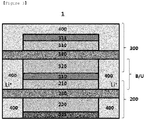
- FIG. 1 is a schematic diagram showing a cross-section of a bipolar lithium secondary battery according to an embodiment of the present invention.
- the cross-section may be a longitudinal section.
- the bipolar lithium secondary battery 1 comprises a current collector 110 and a polymer film 120 formed on the edges of the current collector 110, and electrode layers of different polarities, that is, a positive electrode 320 and a negative electrode 210 may be stacked on both sides of the current collector 110, respectively.
- a structure configured by forming the positive electrode 320 and the negative electrode 210, which are electrode layers of different polarities, on both sides of one current collector 110 may be referred to as a bipolar unit (B/U).
- the current collector 110 may also be referred to as a current pathway.
- the second separator 230, the positive electrode 220, and the positive electrode current collector 221 may be sequentially stacked on the negative electrode 210 formed on one surface of the current collector 110, and this is called the second unit cell 200.
- first separator 330, the negative electrode 310, and the negative electrode current collector 311 may be sequentially stacked on the positive electrode 320 formed on the other surface of the current collector 110, and this is called the first unit cell 300.
- the bipolar lithium secondary battery 1 may have a form in which the second unit cell 200 and the first unit cell 300 are connected in series inside the battery, and specifically are connected in series through the current collector 110.
- the bipolar lithium secondary battery 1 may comprise an electrolyte solution 400 injected therein.
- the separators 330 and 230 may have a size (area) of the transverse section that is equal to the sum of the sizes of the transverse sections of the current collector 110 and the polymer film 120.
- the size (area) of the transverse sections of the separators 330 and 230 may be larger than the size of the transverse sections of the positive electrodes 220 and 320 and the negative electrodes 210 and 310.
- the electrolyte solution 400 comprised between the separators 330 and 230 may be separated by the polymer film 120.
- the polymer film 120 attached in the form surrounding the edges of the current collector 110 may separate the electrolyte solution contained between the separators 230 and 330, thereby dividing into the first electrolyte solution 420 and the second electrolyte solution 410.
- the first electrolyte solution 420 may be comprised in a form surrounded by the polymer film 120, the positive electrode 320, and the first separator 330
- the second electrolyte solution 410 may be comprised in a form surrounded by the polymer film 120, the negative electrode 210, and the second separator 230.
- the first electrolyte solution 420 means an electrolyte solution in contact with the positive electrode 320 and may also be referred to as an electrolyte solution on the positive electrode side
- the second electrolyte solution 410 means an electrolyte solution in contact with the negative electrode 210 and may also be referred to as an electrolyte solution on the negative electrode side.
- the first electrolyte solution 420 and the second electrolyte solution 410 are separated by the polymer film 120 to prevent their mutual movement, thereby preventing self-discharging and bypass current that may occur when these electrolyte solutions are mixed.
- the polymer film may serve to prevent movement and mixing of the electrolyte solution adjacent to the positive electrode and the negative electrode formed on both sides of the current collector in the bipolar lithium secondary battery.
- the negative electrode is a lithium negative electrode containing lithium metal
- lithium ions (Li + ) dissolved in the electrolyte solution from the negative electrode may be prevented from moving from the negative electrode to the positive electrode through the electrolyte solution.
- the positive electrode is a positive electrode containing sulfur
- polysulfide dissolved from the positive electrode into the electrolyte solution may be prevented from moving from the positive electrode to the negative electrode through the electrolyte solution.
- the polymer film physically separates the electrolyte solution on the positive electrode side and the electrolyte solution on the negative electrode side to prevent the movement of lithium ions through the electrolyte solution. Therefore, the polymer film is not particularly limited as long as it may not be permeated by the electrolyte solution while not dissolving in the electrolyte solution.
- the polymer film may be a single-layer film comprising a non-porous membrane, or a laminated film formed by laminating a non-porous membrane and a porous membrane.
- the non-porous membrane may have a porosity of 30% or less, 20% or less, or 10% or less. If the porosity of the non-porous membrane is more than 30%, lithium ions move smoothly, thereby generating bypass current.
- lithium polysulfide (LiPS) is leached from the positive electrode and then flows into the negative electrode, causing a direct reaction between the positive electrode and the negative electrode comprised in the bipolar unit.
- the porosity of the non-porous membrane may be preferably greater than 0%.
- the porosity of the non-porous membrane may be defined as a Gurley number that is a measure of air permeability.
- the Gurley Number of the non-porous membrane may be 1,000 [s/100cc] or more, 2,000 [s/100cc] or more, 3,000 [s/100cc] or more, 4,000 [s/100cc] or more, 5,000 [s/100cc] or more, 6,000 [s/100cc] or more, 7,000 [s/100cc] or more, 8,000 [s/100cc] or more, 9,000 [s/100cc] or more, or 10,000 [s/100cc] or more.
- the upper limit of the Gurley number may be 15,000 [s/100cc] or less, but is not limited thereto.
- the Gurley number means that the larger the number, the more difficult the material is to permeate. If the Gurley number is less than 1,000 [s/100cc], it is possible to mutually move between electrolyte solutions separated by the non-porous membrane, thereby generating bypass current and self-discharging.
- the porous membrane is not particularly limited as long as it is a porous membrane commonly used as a separator for lithium secondary batteries.
- the porous membrane may have a porosity of more than 30%, 70% or less, specifically more than 30%, 35% or more, 40% or more, or 45% or more, and 55% or less, 60% or less, 65 % or less, or 70% or less.
- non-porous membrane and porous membrane may be classified by the prescribed porosity and/or Gurley number.
- Materials for the non-porous membrane and porous membrane may be the same or different, and may comprise one or more selected from the group consisting of polyolefin, cellulose, and fluorine resin.
- the polyolefin may comprise one or more selected from the group consisting of polyethylene, polypropylene, polybutylene, polypentene, polyhexene, and polyoctene.
- the polymer film may be applied to all types of bipolar lithium secondary batteries. Specifically, since the polymer film serves to physically prevent the movement of lithium ions dissolved into the electrolyte solution, the polymer film may also more effectively prevent the occurrence of self-discharging and bypass current, in the secondary battery of the conversion type in which the reaction proceeds when lithium ions are dissolved into the electrolyte solution, as compared to a battery in which lithium ions are inserted into a positive electrode active material (lithiation or delithiation, Li+ insertion or intercalation).
- a lithium-sulfur secondary battery is exemplified as the conversion type secondary battery.
- the positive electrode may comprise a positive electrode active material layer comprising a positive electrode active material, a binder, and an electrically conductive material.
- the positive electrode active material may comprise sulfur, and specifically, the sulfur may be selected from the group consisting of elemental sulfur (S8), sulfur-based compounds, and sulfur-carbon composites.
- a battery containing sulfur in the positive electrode may be a lithium-sulfur secondary battery, and thus, the bipolar lithium secondary battery according to one aspect of the present disclosure may be a bipolar lithium-sulfur secondary battery.
- the positive electrode active material may be comprised in an amount of 60 to 95% by weight based on the total weight of the positive electrode active material layer, and specifically, the content of the positive electrode active material is 60% by weight or more, 65% by weight or more, or 70% by weight or more, and 85% by weight or less, 90% by weight or less, or 95% by weight or less. If the content of the positive electrode active material is less than the above range, the performance of the battery may be deteriorated. If the content of the positive electrode active material exceeds the above range, the content of an electrically conductive material or binder other than the positive electrode active material may be relatively reduced, thereby deteriorating characteristics such as an electrically conductive property or durability.
- the binder may be styrene-butadiene rubber (SBR)/carboxymethyl cellulose (CMC), poly(vinyl acetate), polyvinyl alcohol, polyethylene oxide, polyvinylpyrrolidone, alkylated polyethylene oxide, crosslinked polyethylene oxide, polyvinyl ether, poly (methyl methacrylate), polyvinylidene fluoride, copolymer of polyhexafluoropropylene and polyvinylidene fluoride, poly(ethyl acrylate), polytetrafluoroethylene, polyvinyl chloride, polyacrylonitrile, polyvinylpyridine, polystyrene, polyacrylic acid, or derivatives, blends, or copolymers thereof or the like.
- SBR styrene-butadiene rubber
- CMC carboxymethyl cellulose
- poly(vinyl acetate) polyvinyl alcohol
- polyethylene oxide polyvinylpyrrolidone
- the content of the binder may be 1% by weight to 20% by weight, specifically 1% by weight or more, 3% by weight or more, or 5% by weight or more, and 15% by weight or less, 18% by weight or less, or 20% by weight or less, based on the total weight of the positive electrode active material layer. If the content of the binder is less than the above range, the binding force between positive electrode active materials or between positive electrode active materials and current collector may be greatly declined, and there may occur a problem that capacity characteristics may be deteriorated, and the interaction between the poly sulfide and a specific functional group of a polymer chain used as a binder is weakened, and thus poly sulfide may be leached. If the content of the binder exceeds the above range, the capacity of the battery may be decreased.
- the electrically conductive material is not particularly limited, but may be, for example, graphite such as natural graphite or artificial graphite; carbon blacks such as carbon black (Super-p), acetylene black, Ketjen black, channel black, furnace black, lamp black, thermal black, and Denka black; electrically conductive fibers such as carbon fiber or metal fiber; metal powders such as carbon fluoride, aluminum, and nickel powder; electrically conductive whiskers such as zinc oxide and potassium titanate; electrically conductive metal oxides such as titanium oxide; or electrically conductive materials such as polyphenylene derivatives.
- the electrically conductive material may typically be present in an amount of 0.05 wt.% to 10 wt.% based on the total weight of the positive electrode active material layer.
- the content of the electrically conductive material may be 0.05 wt.% or more, 1 wt.% or more, 3 wt.% or more, or 5 wt.% or more, and 8 wt.% or less, 9 wt.% or less, or 10 wt.% or less.
- the positive electrode current collector is not particularly limited as long as it has a high electrical conductivity without causing chemical changes in the relevant battery, and for example, stainless steel, aluminum, nickel, titanium, sintered carbon, or aluminum or stainless steel surface-treated with carbon, nickel, titanium, silver or the like may be used.
- the positive electrode current collector may be formed in various forms such as film, sheet, foil, net, porous body, foam, or nonwoven fabric having fine irregularities formed on its surface in order to enhance the bonding force with the positive electrode active material.
- the negative electrode may comprise lithium metal or lithium alloy.
- the negative electrode may comprise a negative electrode active material, a binder, and an electrically conductive material.
- the negative electrode active material may comprise a material capable of reversibly intercalating or de-intercalating lithium ion (Li + ), a material capable of reacting with lithium ion to reversibly form lithium containing compounds, lithium metal, or lithium alloy.
- the material capable of reversibly intercalating or de-intercalating lithium ion (Li + ) may be, for example, crystalline carbon, amorphous carbon, or a mixture thereof.
- the material capable of reacting with lithium ion (Li + ) to reversibly form lithium containing compounds may be, for example, tin oxide, titanium nitrate, or silicon.
- the lithium alloy may be, for example, an alloy of lithium (Li) and a metal selected from the group consisting of sodium (Na), potassium (K), rubidium (Rb), cesium (Cs), francium (Fr), beryllium (Be), magnesium (Mg), calcium (Ca), strontium (Sr), barium (Ba), radium (Ra), aluminum (Al), and tin (Sn).
- a metal selected from the group consisting of sodium (Na), potassium (K), rubidium (Rb), cesium (Cs), francium (Fr), beryllium (Be), magnesium (Mg), calcium (Ca), strontium (Sr), barium (Ba), radium (Ra), aluminum (Al), and tin (Sn).
- the binder and the electrically conductive material may be composed by the material used in the positive electrode described above.
- the negative electrode current collector may be copper, stainless steel, aluminum, nickel, titanium, or sintered carbon, or aluminum or stainless steel surface-treated with carbon, nickel, titanium, silver, or the like.
- the separator is a physical separator having a function of physically separating electrodes. Any separator may be used without any particular limitations as long as it is used as a conventional separator. Particularly, a separator with excellent humidification ability for the electrolyte solution while exhibiting low resistance to ion migration of electrolyte solution is preferable.
- the separator enables the lithium ion to be transported between the positive electrode and the negative electrode while separating or insulating the positive electrode and the negative electrode from each other.
- the separator may be made of a porous, nonconductive or insulating material having a porosity of 30 to 50%.
- a porous polymer film for example, a porous polymer film made of a polyolefin-based polymer such as ethylene homopolymer, propylene homopolymer, ethylene/butene copolymer, ethylene/hexene copolymer, ethylene/methacrylate copolymer, etc. may be used, and a nonwoven fabric made of glass fiber having high melting point or the like may be used.
- the porous polymer film is preferably used.
- the impregnation amount and ion conduction characteristics of the electrolyte solution are decreased and the effect of reducing the overvoltage and improving the capacity characteristics becomes insignificant.
- the nonwoven fabric material is used for both the buffer layer and the separator, a mechanical stiffness may not be ensured and thus a problem of short circuit of the battery occurs.
- the mechanical strength may also be ensured together with the improvement effect of the battery performance due to the adoption of the buffer layer.
- the ethylene homopolymer (polyethylene) polymer film is used as a separator, and the polyimide nonwoven fabric is used as a buffer layer.
- the polyethylene polymer film preferably has a thickness of 10 to 25 ⁇ m and a porosity of 40 to 50%.
- the electrolyte solution may be a non-aqueous electrolyte solution, and the electrolyte salt contained in the non-aqueous electrolyte solution is a lithium salt.
- the lithium salt may be used without limitation as long as it is commonly used in electrolyte solutions for lithium secondary batteries.
- the lithium salt may be at least one selected from the group consisting of LiFSI, LiPF 6 , LiCl, LiBr, LiI, LiClO 4 , LiBF 4 , LiB 10 Cl 10 , LiPF 6 , LiCF 3 SO 3 , LiCF 3 CO 2 , LiAsF 6 , LiSbF 6 , LiPF 6 , LiAlCl 4 , CH 3 SO 3 Li, CF 3 SO 3 Li, (CF 3 SO 2 ) 2 NLi, lithium chloroborane, and lithium 4-phenyl borate.
- LiFSI LiPF 6 , LiCl, LiBr, LiI, LiClO 4 , LiBF 4 , LiB 10 Cl 10 , LiPF 6 , LiCF 3 SO 3 , LiCF 3 CO 2 , LiAsF 6 , LiSbF 6 , LiPF 6 , LiAlCl 4 , CH 3 SO 3 Li, CF 3 SO 3 Li, (CF 3 SO 2 ) 2 NLi, lithium chlor
- the organic solvent contained in the non-aqueous electrolyte solution the organic solvents commonly used in the electrolyte solution for the lithium secondary battery may be used without limitation, and for example, ethers, esters, amides, linear carbonates, cyclic carbonates, etc. may be used alone or in combination of two or more thereof. Among them, carbonate compounds which are representatively cyclic carbonates, linear carbonates, or a slurry thereof may be comprised.
- cyclic carbonate compound may be at least one selected from the group consisting of ethylene carbonate (EC), propylene carbonate (PC), 1,2-butylene carbonate, 2,3-butylene carbonate, 1,2-pentylene carbonate, 2,3-pentylene carbonate, vinylene carbonate, vinylethylene carbonate, and halides thereof, or a slurry of two or more thereof.
- halides comprise, but are not limited to, fluoroethylene carbonate (FEC) and the like.
- linear carbonate compound may be, but is not limited to, at least one selected from the group consisting of dimethyl carbonate (DMC), diethyl carbonate (DEC), dipropyl carbonate, ethylmethyl carbonate (EMC), methylpropyl carbonate, and ethylpropyl carbonate, or a slurry of two or more thereof.
- DMC dimethyl carbonate
- DEC diethyl carbonate
- EMC ethylmethyl carbonate
- methylpropyl carbonate methylpropyl carbonate
- ethylpropyl carbonate or a slurry of two or more thereof.
- ethylene carbonate and propylene carbonate which are cyclic carbonates in the carbonate-based organic solvent, are highly viscous organic solvents having a high dielectric constant, so that the lithium salt in the electrolyte may be more easily dissociated.
- cyclic carbonates are mixed with linear carbonates having a low viscosity and a low dielectric constant, such as dimethyl carbonate and diethyl carbonate, in an appropriate ratio, an electrolyte solution having a higher electrical conductivity may be produced.
- the ether among the organic solvents may be, but is not limited to, at least one selected from the group consisting of dimethyl ether, diethyl ether, dipropyl ether, methylethyl ether, methylpropyl ether, and ethylpropyl ether, or a slurry of two or more thereof.
- ester among the organic solvents may be, but is not limited to, at least one selected from the group consisting of methyl acetate, ethyl acetate, propyl acetate, methyl propionate, ethyl propionate, propyl propionate, ⁇ -butyrolactone, ⁇ -valerolactone, ⁇ -caprolactone, ⁇ -valerolactone, and ⁇ -caprolactone, or a slurry of two or more thereof.
- the injection of the non-aqueous electrolyte solution may be performed at an appropriate stage of the manufacturing process of the electrochemical device depending on the manufacturing process and required properties of the final product. That is, it may be applied before assembling the electrochemical device or in the final stage of assembling the electrochemical device.
- the lithium secondary battery it is possible to perform laminating or stacking and folding processes of the separator and the electrode, in addition to the winding process which is a general process.
- the shape of the battery case is not particularly limited, and may be of various shapes such as a cylindrical shape, a laminate shape, a square shape, a pouch shape, or a coin shape.
- the structure and manufacturing method of these batteries are widely known in the art, and thus detailed description thereof will be omitted.
- the lithium secondary battery may be classified into various batteries, such as a lithium-sulfur battery, a lithium-air battery, a lithium-oxide battery, and a lithium all-solid battery, depending on the positive electrode/negative electrode material used.
- batteries such as a lithium-sulfur battery, a lithium-air battery, a lithium-oxide battery, and a lithium all-solid battery, depending on the positive electrode/negative electrode material used.
- one aspect of the present disclosure provides a battery module comprising the lithium secondary battery as a unit cell.
- the battery module may be used as a power source of medium or large-sized devices requiring high temperature stability, long cycle characteristics, and high capacity characteristics.
- Examples of the medium or large-sized devices may comprise, but are not limited to, a power tool that is powered and moved by an electric motor; electric cars comprising an electric vehicle (EV), a hybrid electric vehicle (HEV), a plug-in hybrid electric vehicle (PHEV), and the like; an electric motorcycle comprising an electric bike (E-bike) and an electric scooter (E-scooter); an electric golf cart; and a power storage system.
- electric cars comprising an electric vehicle (EV), a hybrid electric vehicle (HEV), a plug-in hybrid electric vehicle (PHEV), and the like
- an electric motorcycle comprising an electric bike (E-bike) and an electric scooter (E-scooter)
- E-scooter electric golf cart
- a power storage system a power storage system
- PE film polyethylene, 20 ⁇ m thick
- a porosity of 20% which is a non-porous membrane as a polymer film
- a positive electrode slurry having a concentration of 20% (concentration based on solid content) was prepared by mixing the sulfur-carbon composite, the electrically conductive material, and the binder in a weight ratio of 90:5:5 and dissolving them in water.
- the positive electrode slurry was coated on the top surface of the current collector using a bar coating method, and then dried at 50 °C for 2 hours to form a positive electrode.
- the dried positive electrode was rolled using a roll press so that porosity was 65%.
- the sulfur-carbon composite was prepared by mixing sulfur and carbon at a weight ratio of 70:30 and heat-treating at 155 °C, wherein CNTs having a specific surface area of 300 m 2 /g and a particle diameter of 30 ⁇ m were used as the carbon.
- a vapor grown carbon fiber (VGCF) was used as the conductive material
- PVDF polyvinylidene fluoride
- lithium foil was attached to the lower surface of the current collector. At this time, the lithium foil was pressed and attached with a roll press.
- first and second separators were stacked on the positive electrode and the negative electrode.
- polyethylene separators having a thickness of 20 ⁇ m and a porosity of 45% were used.
- the lithium negative electrode and the Cu foil, which is a negative electrode current collector are sequentially stacked on the first separator formed on the positive electrode, and the positive electrode and the aluminum foil, which is a positive electrode current collector, were sequentially stacked on the second separator formed on the negative electrode.
- positive and negative electrodes positive and negative electrodes of the same type as described above were formed in the same manner.
- the electrolyte solution was injected into the case to manufacture a lithium-sulfur secondary battery.
- the electrolyte solution was prepared by dissolving lithium bis(trifluoromethyl sulfonyl)imide (LiTFSI) at a concentration of 3.0M in an organic solvent, and the organic solvent is a solvent obtained by mixing propionitrile (first solvent) and 1H,1H,2'H,3H-decafluorodipropyl ether (second solvent) in a 3:7 weight ratio (w/w).
- LiTFSI lithium bis(trifluoromethyl sulfonyl)imide
- Example 1 two unit cells comprising the positive electrode, the negative electrode, and the separator are serially connected internally through a current collector to which the polymer film is attached.
- the electrolyte solution 400 was injected into the case to manufacture a unit cell 200.
- the configuration and formation of the positive electrode current collector, positive electrode, separator, negative electrode, and negative electrode current collector are the same as in Example 1.
- a polymer film was not attached to the positive electrode current collector 221 and the negative electrode current collector 211.
- a lithium-sulfur secondary battery was manufactured by connecting two unit cells in series to the outside ( FIG. 2 ).
- a bipolar lithium-sulfur secondary battery was prepared in the same manner as in Example 1, except that a polymer film is not attached to the edge of the current collector.
- Comparative Example 2 two unit cells comprising the positive electrode, the negative electrode, and the separator are connected in series through the current collector ( FIG. 3 ).
- Example 1 is a bipolar lithium-sulfur secondary battery that comprises a current collector with a polymer film attached to its edge (a form formed by connecting two unit cells in series inside the battery by a current collector with a polymer film attached to the edge)
- Comparative Example 1 is a lithium-sulfur secondary battery in which two unit cells are connected in series from the outside of the battery
- Comparative Example 2 is a bipolar lithium-sulfur secondary battery that comprises a current collector without the polymer film attached as in Example 1.
- Example 1 The lithium-sulfur secondary batteries prepared in Example 1 and Comparative Examples 1 and 2, respectively were discharged at 0.1 C to measure discharging capacity.
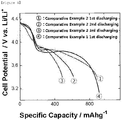
- FIG. 4 is a graph of the measurement results of the discharging capacity for the lithium-sulfur secondary batteries prepared in Comparative Example 1 and Comparative Example 2, respectively
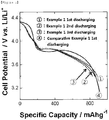
- FIG. 5 is a graph of the measurement results of the discharging capacity for the lithium-sulfur secondary batteries prepared in Comparative Example 1 and Example 1, respectively.
- Example 1 where two unit cells are connected in series by a current collector with a polymer film attached inside the battery, the reduction in discharge capacity is small, as compared to Comparative Example 1 in which the two unit cells are connected in series from the outside of the battery.
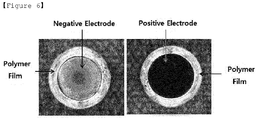
- FIG. 6 is a photograph showing transverse sections of negative and positive electrodes formed on both sides of the current collector in the bipolar lithium-sulfur secondary battery of Example 1.
- the negative electrode and the polymer film attached to the edge of the current collector stacked on the negative electrode can be confirmed.
- the positive electrode and the polymer film can be identified. From this, it can be seen that the positive electrode and the negative electrode are separated due to the polymer film attached to the edge of the current collector, and also it can be seen that due to this structure, it is possible to block the movement of Li + ions and polysulfides in the electrolyte solution during the actual operation of the battery.
Landscapes
- Chemical & Material Sciences (AREA)
- General Chemical & Material Sciences (AREA)
- Chemical Kinetics & Catalysis (AREA)
- Electrochemistry (AREA)
- Engineering & Computer Science (AREA)
- Materials Engineering (AREA)
- Manufacturing & Machinery (AREA)
- Composite Materials (AREA)
- Life Sciences & Earth Sciences (AREA)
- Wood Science & Technology (AREA)
- Secondary Cells (AREA)
- Battery Electrode And Active Subsutance (AREA)
- Cell Electrode Carriers And Collectors (AREA)
Abstract
Description
- This application claims the benefits of priorities based on
Korean Patent Application No. 10-2019-0070374 filed on June 14, 2019 Korean Patent Application No. 10-2020-0070651 filed on June 11, 2020 - One aspect of the present disclosure relates to a bipolar lithium secondary battery comprising a bipolar unit in which electrode layers having different polarities are formed on both sides of a current collector.
- A secondary battery is a battery capable of charging and discharging, unlike a primary battery that cannot be charged. Low-capacity secondary batteries are used in portable electronic devices such as cell phones, notebooks, or camcorders, and high-capacity secondary batteries are widely used as power sources for driving motors in hybrid vehicles and the like.
- Recently, a high-capacity secondary battery having a high energy density and a high power using a non-aqueous electrolyte solution has been developed. The high-capacity secondary battery having high energy density and high power is configured by connecting a plurality of secondary batteries in series so that they can be used to drive instruments that require electric power, such as motors in electric vehicles and the like.
- The secondary battery may comprise a general monopolar electrode coated with active materials having the same polarity on both sides of the current collector or a bipolar electrode coated with active materials having different polarities on both sides of the current collector.
- A secondary battery to which a general monopolar electrode is applied comprises a structure in which a connection portion for connecting electrodes is formed, but this structure causes a problem that the output is lowered by the electrical resistance of the connection. The bipolar electrode is an electrode that can be used by stacking electrodes without such a connection portion, thereby minimizing the connection resistance.
- Meanwhile, in the case of a bipolar secondary battery comprising bipolar electrodes, it is very important to seal the electrolyte solutions to prevent leakage between the stacked bipolar electrodes, and at the same time, it is also necessary to reduce the thickness of the bipolar secondary battery.
- In general, a gasket is used for sealing to prevent leakage of electrolyte solution, but there is a problem that it is difficult to manufacture a gasket having a thickness of 1 mm or less, and if the thickness of the gasket is too large, there are problems that the empty space between the bipolar electrodes becomes large, and thus the output compared to the volume is lowered.
- In addition, in the bipolar electrode, when electrolyte solutions adjacent to electrodes having different polarities are moved and mixed, self-discharging and bypass current may occur, and thus there is a need to develop a technology capable of preventing such problems.
- (Patent Document 1)
Japanese Laid-open Patent Publication No. 2005-190713 - Accordingly, the inventors of one aspect of the present disclosure have confirmed that in a battery comprising a bipolar unit in which positive and negative electrodes are stacked on both sides of one current collector, when a polymer film is attached to the edge of the current collector, electrolyte solutions adjacent to the positive electrode and the negative electrode may be prevented from moving and mixing, due to the polymer film, thereby preventing the self-discharging and bypass current generation.
- Therefore, it is an object of one aspect of the present disclosure to provide a bipolar lithium secondary battery that prevents self-discharging and bypass current generation.
- In order to achieve the above object, one aspect of the present disclosure provides a bipolar lithium secondary battery comprising,
- a current collector;
- a polymer film attached in the form surrounding the edge of the current collector;
- an electrode layer comprising positive and negative electrodes formed on both sides of the current collector;
- first and second separators respectively formed on the positive electrode and the negative electrode; and
- electrolyte solutions contained between the first and second separators,
- wherein the electrolyte solutions contained between the first and second separators are separated by the polymer film.
- According to one aspect of the present disclosure, in a lithium secondary battery comprising a bipolar unit in which positive and negative electrodes are formed respectively on both sides of one current collector, since electrolyte solutions adjacent to the positive electrode and the negative electrode respectively are separated by a polymer film attached to the edge of the current collector, it is possible to prevent movement and mixing between the separated electrolyte solutions, thereby preventing the self-discharging and bypass current generation.
- In addition, in the case of the lithium secondary battery according to the present invention, the unit cells comprising the positive electrode and the negative electrode may be connected in series in the battery through the current collector comprised in the bipolar unit, thereby reducing the weight and volume of the auxiliary material, thereby securing a higher energy density.
-
-
FIG. 1 is a schematic view showing a cross-section of a bipolar lithium secondary battery according to an embodiment of the present invention. -
FIG. 2 is a schematic view showing a cross-section of a lithium-sulfur secondary battery according to Comparative Example 1. -
FIG. 3 is a schematic view showing a cross-section of a bipolar lithium-sulfur secondary battery according to Comparative Example 2. -
FIG. 4 is a graph of the measurement results of the discharging capacity for the lithium-sulfur secondary batteries prepared in Comparative Example 1 and Comparative Example 2, respectively. -
FIG. 5 is a graph of the measurement results of the discharging capacity for the lithium-sulfur secondary batteries prepared in Comparative Example 1 and Example 1, respectively. -
FIG. 6 is a photograph showing transverse sections of negative and positive electrodes formed on both sides of the current collector in the bipolar lithium-sulfur secondary battery of Example 1. - Hereinafter, the present invention will be described in more detail to help understanding of the present invention.
- As used herein, the term "bipolar unit" may be a unit comprising an electrode layer containing active materials having different polarities on both sides of one current collector, and for example, the bipolar unit may be a unit comprising a positive electrode and a negative electrode formed on both sides of the current collector and the current collector.
- The terms "positive electrode" and "negative electrode" used in this specification may mean a positive electrode active material layer and a negative electrode active material layer, respectively. Generally, the positive electrode comprises a positive electrode current collector and a positive electrode active material layer, and the negative electrode comprises a negative electrode current collector and a negative electrode active material layer, but the "positive electrode" and "negative electrode" comprised in the bipolar unit according to the present invention may mean a positive electrode active material layer and a negative electrode active material layer formed separately from the current collector.
- As used herein, the term "unit cell" means a structure comprising a positive electrode, a negative electrode, and a separator interposed therebetween.
- As used herein, the term "bipolar lithium secondary battery" means a lithium secondary battery comprising at least one "bipolar unit" defined as above.
- One aspect of the present disclosure relates to a bipolar lithium secondary battery comprising a bipolar unit in which electrode layers comprising active materials having different polarities are formed on both sides of one current collector.
- Hereinafter, one aspect of the present disclosure will be described in more detail with reference to the drawings.
-
FIG. 1 is a schematic diagram showing a cross-section of a bipolar lithium secondary battery according to an embodiment of the present invention. The cross-section may be a longitudinal section. - Referring to
FIG. 1 , the bipolar lithiumsecondary battery 1 comprises acurrent collector 110 and apolymer film 120 formed on the edges of thecurrent collector 110, and electrode layers of different polarities, that is, apositive electrode 320 and anegative electrode 210 may be stacked on both sides of thecurrent collector 110, respectively. As described above, a structure configured by forming thepositive electrode 320 and thenegative electrode 210, which are electrode layers of different polarities, on both sides of onecurrent collector 110 may be referred to as a bipolar unit (B/U). At this time, thecurrent collector 110 may also be referred to as a current pathway. - In addition, the
second separator 230, thepositive electrode 220, and the positive electrodecurrent collector 221 may be sequentially stacked on thenegative electrode 210 formed on one surface of thecurrent collector 110, and this is called thesecond unit cell 200. - In addition, the
first separator 330, thenegative electrode 310, and the negative electrodecurrent collector 311 may be sequentially stacked on thepositive electrode 320 formed on the other surface of thecurrent collector 110, and this is called thefirst unit cell 300. - The bipolar lithium
secondary battery 1 may have a form in which thesecond unit cell 200 and thefirst unit cell 300 are connected in series inside the battery, and specifically are connected in series through thecurrent collector 110. - Also, the bipolar lithium
secondary battery 1 may comprise anelectrolyte solution 400 injected therein. - Further, the
separators current collector 110 and thepolymer film 120. In addition, the size (area) of the transverse sections of theseparators positive electrodes negative electrodes secondary battery 1 is defined as described above, theelectrolyte solution 400 comprised between theseparators polymer film 120. - Accordingly, the
polymer film 120 attached in the form surrounding the edges of thecurrent collector 110 may separate the electrolyte solution contained between theseparators first electrolyte solution 420 and thesecond electrolyte solution 410. Specifically, thefirst electrolyte solution 420 may be comprised in a form surrounded by thepolymer film 120, thepositive electrode 320, and thefirst separator 330, and thesecond electrolyte solution 410 may be comprised in a form surrounded by thepolymer film 120, thenegative electrode 210, and thesecond separator 230. At this time, thefirst electrolyte solution 420 means an electrolyte solution in contact with thepositive electrode 320 and may also be referred to as an electrolyte solution on the positive electrode side, and thesecond electrolyte solution 410 means an electrolyte solution in contact with thenegative electrode 210 and may also be referred to as an electrolyte solution on the negative electrode side. - The
first electrolyte solution 420 and thesecond electrolyte solution 410 are separated by thepolymer film 120 to prevent their mutual movement, thereby preventing self-discharging and bypass current that may occur when these electrolyte solutions are mixed. - In one aspect of the present disclosure, the polymer film may serve to prevent movement and mixing of the electrolyte solution adjacent to the positive electrode and the negative electrode formed on both sides of the current collector in the bipolar lithium secondary battery. Specifically, when the negative electrode is a lithium negative electrode containing lithium metal, lithium ions (Li+) dissolved in the electrolyte solution from the negative electrode may be prevented from moving from the negative electrode to the positive electrode through the electrolyte solution. In addition, when the positive electrode is a positive electrode containing sulfur, polysulfide dissolved from the positive electrode into the electrolyte solution may be prevented from moving from the positive electrode to the negative electrode through the electrolyte solution.
- As described above, the polymer film physically separates the electrolyte solution on the positive electrode side and the electrolyte solution on the negative electrode side to prevent the movement of lithium ions through the electrolyte solution. Therefore, the polymer film is not particularly limited as long as it may not be permeated by the electrolyte solution while not dissolving in the electrolyte solution.
- For example, the polymer film may be a single-layer film comprising a non-porous membrane, or a laminated film formed by laminating a non-porous membrane and a porous membrane.
- The non-porous membrane may have a porosity of 30% or less, 20% or less, or 10% or less. If the porosity of the non-porous membrane is more than 30%, lithium ions move smoothly, thereby generating bypass current. In addition, in the case of a lithium-sulfur secondary battery containing sulfur in the positive electrode, lithium polysulfide (LiPS) is leached from the positive electrode and then flows into the negative electrode, causing a direct reaction between the positive electrode and the negative electrode comprised in the bipolar unit. In addition, the porosity of the non-porous membrane may be preferably greater than 0%.
- In the case where the porosity of the non-porous membrane is expressed in a different way, it may be defined as a Gurley number that is a measure of air permeability. For example, the Gurley Number of the non-porous membrane may be 1,000 [s/100cc] or more, 2,000 [s/100cc] or more, 3,000 [s/100cc] or more, 4,000 [s/100cc] or more, 5,000 [s/100cc] or more, 6,000 [s/100cc] or more, 7,000 [s/100cc] or more, 8,000 [s/100cc] or more, 9,000 [s/100cc] or more, or 10,000 [s/100cc] or more. The upper limit of the Gurley number may be 15,000 [s/100cc] or less, but is not limited thereto. The Gurley number means that the larger the number, the more difficult the material is to permeate. If the Gurley number is less than 1,000 [s/100cc], it is possible to mutually move between electrolyte solutions separated by the non-porous membrane, thereby generating bypass current and self-discharging.
- In addition, the porous membrane is not particularly limited as long as it is a porous membrane commonly used as a separator for lithium secondary batteries.
- For example, the porous membrane may have a porosity of more than 30%, 70% or less, specifically more than 30%, 35% or more, 40% or more, or 45% or more, and 55% or less, 60% or less, 65 % or less, or 70% or less.
- In addition, the non-porous membrane and porous membrane may be classified by the prescribed porosity and/or Gurley number. Materials for the non-porous membrane and porous membrane may be the same or different, and may comprise one or more selected from the group consisting of polyolefin, cellulose, and fluorine resin. The polyolefin may comprise one or more selected from the group consisting of polyethylene, polypropylene, polybutylene, polypentene, polyhexene, and polyoctene.
- In addition, the polymer film may be applied to all types of bipolar lithium secondary batteries. Specifically, since the polymer film serves to physically prevent the movement of lithium ions dissolved into the electrolyte solution, the polymer film may also more effectively prevent the occurrence of self-discharging and bypass current, in the secondary battery of the conversion type in which the reaction proceeds when lithium ions are dissolved into the electrolyte solution, as compared to a battery in which lithium ions are inserted into a positive electrode active material (lithiation or delithiation, Li+ insertion or intercalation). A lithium-sulfur secondary battery is exemplified as the conversion type secondary battery.
- In one aspect of the present disclosure, the positive electrode may comprise a positive electrode active material layer comprising a positive electrode active material, a binder, and an electrically conductive material.
- The positive electrode active material may comprise sulfur, and specifically, the sulfur may be selected from the group consisting of elemental sulfur (S8), sulfur-based compounds, and sulfur-carbon composites. The sulfur-based compound may specifically be Li2Sn(n≥1), an organic sulfur compound, or a carbon-sulfur polymer ((C2Sx)n: x=2.5 to 50, n≥2).
- In general, a battery containing sulfur in the positive electrode may be a lithium-sulfur secondary battery, and thus, the bipolar lithium secondary battery according to one aspect of the present disclosure may be a bipolar lithium-sulfur secondary battery.
- The positive electrode active material may be comprised in an amount of 60 to 95% by weight based on the total weight of the positive electrode active material layer, and specifically, the content of the positive electrode active material is 60% by weight or more, 65% by weight or more, or 70% by weight or more, and 85% by weight or less, 90% by weight or less, or 95% by weight or less. If the content of the positive electrode active material is less than the above range, the performance of the battery may be deteriorated. If the content of the positive electrode active material exceeds the above range, the content of an electrically conductive material or binder other than the positive electrode active material may be relatively reduced, thereby deteriorating characteristics such as an electrically conductive property or durability.
- In addition, the binder may be styrene-butadiene rubber (SBR)/carboxymethyl cellulose (CMC), poly(vinyl acetate), polyvinyl alcohol, polyethylene oxide, polyvinylpyrrolidone, alkylated polyethylene oxide, crosslinked polyethylene oxide, polyvinyl ether, poly (methyl methacrylate), polyvinylidene fluoride, copolymer of polyhexafluoropropylene and polyvinylidene fluoride, poly(ethyl acrylate), polytetrafluoroethylene, polyvinyl chloride, polyacrylonitrile, polyvinylpyridine, polystyrene, polyacrylic acid, or derivatives, blends, or copolymers thereof or the like.
- In addition, the content of the binder may be 1% by weight to 20% by weight, specifically 1% by weight or more, 3% by weight or more, or 5% by weight or more, and 15% by weight or less, 18% by weight or less, or 20% by weight or less, based on the total weight of the positive electrode active material layer. If the content of the binder is less than the above range, the binding force between positive electrode active materials or between positive electrode active materials and current collector may be greatly declined, and there may occur a problem that capacity characteristics may be deteriorated, and the interaction between the poly sulfide and a specific functional group of a polymer chain used as a binder is weakened, and thus poly sulfide may be leached. If the content of the binder exceeds the above range, the capacity of the battery may be decreased.
- The electrically conductive material is not particularly limited, but may be, for example, graphite such as natural graphite or artificial graphite; carbon blacks such as carbon black (Super-p), acetylene black, Ketjen black, channel black, furnace black, lamp black, thermal black, and Denka black; electrically conductive fibers such as carbon fiber or metal fiber; metal powders such as carbon fluoride, aluminum, and nickel powder; electrically conductive whiskers such as zinc oxide and potassium titanate; electrically conductive metal oxides such as titanium oxide; or electrically conductive materials such as polyphenylene derivatives. The electrically conductive material may typically be present in an amount of 0.05 wt.% to 10 wt.% based on the total weight of the positive electrode active material layer. Specifically, the content of the electrically conductive material may be 0.05 wt.% or more, 1 wt.% or more, 3 wt.% or more, or 5 wt.% or more, and 8 wt.% or less, 9 wt.% or less, or 10 wt.% or less.
- In addition, the positive electrode current collector is not particularly limited as long as it has a high electrical conductivity without causing chemical changes in the relevant battery, and for example, stainless steel, aluminum, nickel, titanium, sintered carbon, or aluminum or stainless steel surface-treated with carbon, nickel, titanium, silver or the like may be used. In this case, the positive electrode current collector may be formed in various forms such as film, sheet, foil, net, porous body, foam, or nonwoven fabric having fine irregularities formed on its surface in order to enhance the bonding force with the positive electrode active material.
- In one aspect of the present disclosure, the negative electrode may comprise lithium metal or lithium alloy.
- Alternatively, the negative electrode may comprise a negative electrode active material, a binder, and an electrically conductive material. The negative electrode active material may comprise a material capable of reversibly intercalating or de-intercalating lithium ion (Li+), a material capable of reacting with lithium ion to reversibly form lithium containing compounds, lithium metal, or lithium alloy. The material capable of reversibly intercalating or de-intercalating lithium ion (Li+) may be, for example, crystalline carbon, amorphous carbon, or a mixture thereof. The material capable of reacting with lithium ion (Li+) to reversibly form lithium containing compounds may be, for example, tin oxide, titanium nitrate, or silicon. The lithium alloy may be, for example, an alloy of lithium (Li) and a metal selected from the group consisting of sodium (Na), potassium (K), rubidium (Rb), cesium (Cs), francium (Fr), beryllium (Be), magnesium (Mg), calcium (Ca), strontium (Sr), barium (Ba), radium (Ra), aluminum (Al), and tin (Sn).
- In addition, the binder and the electrically conductive material may be composed by the material used in the positive electrode described above.
- In addition, the negative electrode current collector may be copper, stainless steel, aluminum, nickel, titanium, or sintered carbon, or aluminum or stainless steel surface-treated with carbon, nickel, titanium, silver, or the like.
- In one aspect of the present disclosure, the separator is a physical separator having a function of physically separating electrodes. Any separator may be used without any particular limitations as long as it is used as a conventional separator. Particularly, a separator with excellent humidification ability for the electrolyte solution while exhibiting low resistance to ion migration of electrolyte solution is preferable.
- In addition, the separator enables the lithium ion to be transported between the positive electrode and the negative electrode while separating or insulating the positive electrode and the negative electrode from each other. The separator may be made of a porous, nonconductive or insulating material having a porosity of 30 to 50%.
- Specifically, a porous polymer film, for example, a porous polymer film made of a polyolefin-based polymer such as ethylene homopolymer, propylene homopolymer, ethylene/butene copolymer, ethylene/hexene copolymer, ethylene/methacrylate copolymer, etc. may be used, and a nonwoven fabric made of glass fiber having high melting point or the like may be used. Among them, the porous polymer film is preferably used.
- If the polymer film is used for both the buffer layer and the separator, the impregnation amount and ion conduction characteristics of the electrolyte solution are decreased and the effect of reducing the overvoltage and improving the capacity characteristics becomes insignificant. On the contrary, if the nonwoven fabric material is used for both the buffer layer and the separator, a mechanical stiffness may not be ensured and thus a problem of short circuit of the battery occurs. However, if a film-type separator and a polymer nonwoven fabric buffer layer are used together, the mechanical strength may also be ensured together with the improvement effect of the battery performance due to the adoption of the buffer layer.
- According to one preferred embodiment of the present invention, the ethylene homopolymer (polyethylene) polymer film is used as a separator, and the polyimide nonwoven fabric is used as a buffer layer. In that case, the polyethylene polymer film preferably has a thickness of 10 to 25 µm and a porosity of 40 to 50%.
- In one aspect of the present disclosure, the electrolyte solution may be a non-aqueous electrolyte solution, and the electrolyte salt contained in the non-aqueous electrolyte solution is a lithium salt. The lithium salt may be used without limitation as long as it is commonly used in electrolyte solutions for lithium secondary batteries. For example, the lithium salt may be at least one selected from the group consisting of LiFSI, LiPF6, LiCl, LiBr, LiI, LiClO4, LiBF4, LiB10Cl10, LiPF6, LiCF3SO3, LiCF3CO2, LiAsF6, LiSbF6, LiPF6, LiAlCl4, CH3SO3Li, CF3SO3Li, (CF3SO2)2NLi, lithium chloroborane, and lithium 4-phenyl borate.
- As the organic solvent contained in the non-aqueous electrolyte solution, the organic solvents commonly used in the electrolyte solution for the lithium secondary battery may be used without limitation, and for example, ethers, esters, amides, linear carbonates, cyclic carbonates, etc. may be used alone or in combination of two or more thereof. Among them, carbonate compounds which are representatively cyclic carbonates, linear carbonates, or a slurry thereof may be comprised.
- Specific examples of the cyclic carbonate compound may be at least one selected from the group consisting of ethylene carbonate (EC), propylene carbonate (PC), 1,2-butylene carbonate, 2,3-butylene carbonate, 1,2-pentylene carbonate, 2,3-pentylene carbonate, vinylene carbonate, vinylethylene carbonate, and halides thereof, or a slurry of two or more thereof. Examples of such halides comprise, but are not limited to, fluoroethylene carbonate (FEC) and the like.
- In addition, specific examples of the linear carbonate compound may be, but is not limited to, at least one selected from the group consisting of dimethyl carbonate (DMC), diethyl carbonate (DEC), dipropyl carbonate, ethylmethyl carbonate (EMC), methylpropyl carbonate, and ethylpropyl carbonate, or a slurry of two or more thereof. In particular, ethylene carbonate and propylene carbonate, which are cyclic carbonates in the carbonate-based organic solvent, are highly viscous organic solvents having a high dielectric constant, so that the lithium salt in the electrolyte may be more easily dissociated. If such cyclic carbonates are mixed with linear carbonates having a low viscosity and a low dielectric constant, such as dimethyl carbonate and diethyl carbonate, in an appropriate ratio, an electrolyte solution having a higher electrical conductivity may be produced.
- In addition, the ether among the organic solvents may be, but is not limited to, at least one selected from the group consisting of dimethyl ether, diethyl ether, dipropyl ether, methylethyl ether, methylpropyl ether, and ethylpropyl ether, or a slurry of two or more thereof.
- In addition, the ester among the organic solvents may be, but is not limited to, at least one selected from the group consisting of methyl acetate, ethyl acetate, propyl acetate, methyl propionate, ethyl propionate, propyl propionate, γ-butyrolactone, γ-valerolactone, γ-caprolactone, σ -valerolactone, and ε-caprolactone, or a slurry of two or more thereof.
- The injection of the non-aqueous electrolyte solution may be performed at an appropriate stage of the manufacturing process of the electrochemical device depending on the manufacturing process and required properties of the final product. That is, it may be applied before assembling the electrochemical device or in the final stage of assembling the electrochemical device.
- In the case of the lithium secondary battery according to one aspect of the present disclosure, it is possible to perform laminating or stacking and folding processes of the separator and the electrode, in addition to the winding process which is a general process.
- In addition, the shape of the battery case is not particularly limited, and may be of various shapes such as a cylindrical shape, a laminate shape, a square shape, a pouch shape, or a coin shape. The structure and manufacturing method of these batteries are widely known in the art, and thus detailed description thereof will be omitted.
- In addition, the lithium secondary battery may be classified into various batteries, such as a lithium-sulfur battery, a lithium-air battery, a lithium-oxide battery, and a lithium all-solid battery, depending on the positive electrode/negative electrode material used.
- In addition, one aspect of the present disclosure provides a battery module comprising the lithium secondary battery as a unit cell.
- The battery module may be used as a power source of medium or large-sized devices requiring high temperature stability, long cycle characteristics, and high capacity characteristics.
- Examples of the medium or large-sized devices may comprise, but are not limited to, a power tool that is powered and moved by an electric motor; electric cars comprising an electric vehicle (EV), a hybrid electric vehicle (HEV), a plug-in hybrid electric vehicle (PHEV), and the like; an electric motorcycle comprising an electric bike (E-bike) and an electric scooter (E-scooter); an electric golf cart; and a power storage system.
- Hereinafter, preferred examples of the present invention will be described in order to facilitate understanding of the present invention. It will be apparent to those skilled in the art, however, that the following examples are illustrative of the present invention and that various changes and modifications can be made within the scope and spirit of the present invention, and also it is natural that such variations and modifications are within the scope of the appended claims.
- A PE film (polyethylene, 20 µm thick) having a porosity of 20%, which is a non-porous membrane as a polymer film, was attached to the edge of a Cu foil (LS Cable & System, 20 µm thick) as a current collector.
- Thereafter, positive and negative electrodes were formed on the upper and lower surfaces of the current collector in the following manner.
- In order to form the positive electrode, a positive electrode slurry having a concentration of 20% (concentration based on solid content) was prepared by mixing the sulfur-carbon composite, the electrically conductive material, and the binder in a weight ratio of 90:5:5 and dissolving them in water. The positive electrode slurry was coated on the top surface of the current collector using a bar coating method, and then dried at 50 °C for 2 hours to form a positive electrode. The dried positive electrode was rolled using a roll press so that porosity was 65%. At this time, the sulfur-carbon composite was prepared by mixing sulfur and carbon at a weight ratio of 70:30 and heat-treating at 155 °C, wherein CNTs having a specific surface area of 300 m2/g and a particle diameter of 30 µm were used as the carbon. In addition, a vapor grown carbon fiber (VGCF) was used as the conductive material, and polyvinylidene fluoride (PVDF) was used as the binder.
- As the negative electrode, lithium foil was attached to the lower surface of the current collector. At this time, the lithium foil was pressed and attached with a roll press.
- In addition, first and second separators were stacked on the positive electrode and the negative electrode. As both of the first and second separators, polyethylene separators having a thickness of 20 µm and a porosity of 45% were used.
- Thereafter, the lithium negative electrode and the Cu foil, which is a negative electrode current collector, are sequentially stacked on the first separator formed on the positive electrode, and the positive electrode and the aluminum foil, which is a positive electrode current collector, were sequentially stacked on the second separator formed on the negative electrode. At this time, as the positive and negative electrodes, positive and negative electrodes of the same type as described above were formed in the same manner.
- Thereafter, an electrolyte solution was injected into the case to manufacture a lithium-sulfur secondary battery. At this time, the electrolyte solution was prepared by dissolving lithium bis(trifluoromethyl sulfonyl)imide (LiTFSI) at a concentration of 3.0M in an organic solvent, and the organic solvent is a solvent obtained by mixing propionitrile (first solvent) and 1H,1H,2'H,3H-decafluorodipropyl ether (second solvent) in a 3:7 weight ratio (w/w).
- In Example 1, two unit cells comprising the positive electrode, the negative electrode, and the separator are serially connected internally through a current collector to which the polymer film is attached.
- As shown in
FIG. 2 , after sequentially stacking thepositive electrode 220, theseparator 230, thenegative electrode 210, and the copper foil as the negative electrodecurrent collector 211 on the aluminum foil as the positive electrodecurrent collector 221, theelectrolyte solution 400 was injected into the case to manufacture aunit cell 200. At this time, the configuration and formation of the positive electrode current collector, positive electrode, separator, negative electrode, and negative electrode current collector are the same as in Example 1. At this time, a polymer film was not attached to the positive electrodecurrent collector 221 and the negative electrodecurrent collector 211. - A lithium-sulfur secondary battery was manufactured by connecting two unit cells in series to the outside (
FIG. 2 ). - A bipolar lithium-sulfur secondary battery was prepared in the same manner as in Example 1, except that a polymer film is not attached to the edge of the current collector. In Comparative Example 2, two unit cells comprising the positive electrode, the negative electrode, and the separator are connected in series through the current collector (
FIG. 3 ). - Experiments were performed on the performance of lithium-sulfur secondary batteries prepared in Example 1 and Comparative Examples 1 and 2, respectively. Example 1 is a bipolar lithium-sulfur secondary battery that comprises a current collector with a polymer film attached to its edge (a form formed by connecting two unit cells in series inside the battery by a current collector with a polymer film attached to the edge), Comparative Example 1 is a lithium-sulfur secondary battery in which two unit cells are connected in series from the outside of the battery, and Comparative Example 2 is a bipolar lithium-sulfur secondary battery that comprises a current collector without the polymer film attached as in Example 1.
- The lithium-sulfur secondary batteries prepared in Example 1 and Comparative Examples 1 and 2, respectively were discharged at 0.1 C to measure discharging capacity.
-
FIG. 4 is a graph of the measurement results of the discharging capacity for the lithium-sulfur secondary batteries prepared in Comparative Example 1 and Comparative Example 2, respectively, andFIG. 5 is a graph of the measurement results of the discharging capacity for the lithium-sulfur secondary batteries prepared in Comparative Example 1 and Example 1, respectively. - Referring to
FIG. 4 , it was confirmed that in the case where a bipolar lithium-sulfur secondary battery is configured without attaching a polymer film to the edge of the current collector as in Comparative Example 2, as charging/discharging is repeated, self-discharging occurs due to the generation of bypass current, thereby reducing discharging capacity, as compared to Comparative Example 1 in which two unit cells are connected in series from the outside. - Referring to
FIG. 5 , it can be seen that in the case of Example 1 where two unit cells are connected in series by a current collector with a polymer film attached inside the battery, the reduction in discharge capacity is small, as compared to Comparative Example 1 in which the two unit cells are connected in series from the outside of the battery. -
FIG. 6 is a photograph showing transverse sections of negative and positive electrodes formed on both sides of the current collector in the bipolar lithium-sulfur secondary battery of Example 1. - As shown in
FIG. 6 , upon reviewing the photograph of the transverse section of the negative electrode of the bipolar lithium-sulfur secondary battery in Example 1, the negative electrode and the polymer film attached to the edge of the current collector stacked on the negative electrode can be confirmed. Upon reviewing the photograph of the positive electrode, the positive electrode and the polymer film can be identified. From this, it can be seen that the positive electrode and the negative electrode are separated due to the polymer film attached to the edge of the current collector, and also it can be seen that due to this structure, it is possible to block the movement of Li+ ions and polysulfides in the electrolyte solution during the actual operation of the battery. - In the above, although the present invention has been described by way of limited embodiments and drawings, the present invention is not limited thereto, and it is apparent to those skilled in the art that various modifications and variations can be made within the equivalent scope of the technical spirit of the present invention and the claims to be described below.
-
- 1: Bipolar lithium secondary battery
- B/U: Bipolar unit
- 110: Current collector
- 120: Polymer film
- 200: Second unit cell
- 300: First unit cell
- 210, 310: Negative electrode
- 211,311: Negative electrode current collector
- 220, 320: Positive electrode
- 221: Positive electrode current collector
- 230: Second separator, 330: First separator
- 400: Electrolyte solution
- 410: Second electrolyte solution, 420: First electrolyte solution
Claims (9)
- A bipolar lithium secondary battery comprising,a current collector;a polymer film attached in the form surrounding the edge of the current collector;an electrode layer comprising positive and negative electrodes formed on both sides of the current collector;first and second separators respectively formed on the positive electrode and the negative electrode; andelectrolyte solutions contained between the first and second separators,wherein the electrolyte solutions contained between the first and second separators are separated by the polymer film.
- The bipolar lithium secondary battery according to claim 1, wherein the polymer film comprises a non-porous membrane.
- The bipolar lithium secondary battery according to claim 1, wherein the polymer film is a laminated polymer film comprising a non-porous membrane and a porous membrane.
- The bipolar lithium secondary battery according to claim 2 or 3, wherein the non-porous membrane comprises at least one selected from the group consisting of polyolefin, cellulose and fluorine resin.
- The bipolar lithium secondary battery according to claim 2 or 3, wherein the non-porous membrane has a porosity of 30% or less.
- The bipolar lithium secondary battery according to claim 1, wherein the positive electrode in the electrode layer comprises at least one element selected from the group consisting of elemental sulfur (S8), a sulfur-based compound, and a sulfur-carbon composite.
- The bipolar lithium secondary battery according to claim 1, wherein the negative electrode in the electrode layer comprises lithium metal or lithium alloy.
- The bipolar lithium secondary battery according to claim 1, wherein the electrolyte solutions are separated by the polymer film to prevent their mutual movement.
- The bipolar lithium secondary battery according to claim 1, wherein the electrolyte solutions are separated by a polymer film, and the electrolyte solutions are separated into an electrolyte solution adjacent to the positive electrode and an electrolyte solution adjacent to the negative electrode, and wherein the mutual movement of polysulfide contained in the electrolyte solution adjacent to the positive electrode and lithium ions contained in the electrolyte solution adjacent to the negative electrode is prevented by the polymer film.
Applications Claiming Priority (3)
| Application Number | Priority Date | Filing Date | Title |
|---|---|---|---|
| KR20190070374 | 2019-06-14 | ||
| KR1020200070651A KR102663587B1 (en) | 2019-06-14 | 2020-06-11 | Bipolar lithium secondary battery |
| PCT/KR2020/007629 WO2020251295A1 (en) | 2019-06-14 | 2020-06-12 | Bipolar lithium secondary battery |
Publications (3)
| Publication Number | Publication Date |
|---|---|
| EP3907808A1 true EP3907808A1 (en) | 2021-11-10 |
| EP3907808A4 EP3907808A4 (en) | 2022-03-02 |
| EP3907808B1 EP3907808B1 (en) | 2023-08-02 |
Family
ID=73782191
Family Applications (1)
| Application Number | Title | Priority Date | Filing Date |
|---|---|---|---|
| EP20822422.0A Active EP3907808B1 (en) | 2019-06-14 | 2020-06-12 | Bipolar lithium secondary battery |
Country Status (8)
| Country | Link |
|---|---|
| US (1) | US12107230B2 (en) |
| EP (1) | EP3907808B1 (en) |
| JP (1) | JP7263528B2 (en) |
| CN (1) | CN113994500B (en) |
| ES (1) | ES2954772T3 (en) |
| HU (1) | HUE062572T2 (en) |
| PL (1) | PL3907808T3 (en) |
| WO (1) | WO2020251295A1 (en) |
Families Citing this family (2)
| Publication number | Priority date | Publication date | Assignee | Title |
|---|---|---|---|---|
| JP7609135B2 (en) | 2022-07-15 | 2025-01-07 | トヨタ自動車株式会社 | battery |
| CN120048851A (en) * | 2023-11-15 | 2025-05-27 | 广州汽车集团股份有限公司 | Negative electrode plate and preparation method thereof, bipolar electrode plate and preparation method thereof, battery and power utilization device |
Family Cites Families (26)
| Publication number | Priority date | Publication date | Assignee | Title |
|---|---|---|---|---|
| KR100354228B1 (en) * | 2000-09-01 | 2002-09-27 | 삼성에스디아이 주식회사 | A Lithium Sulfur Secondary batteries using multi-layer separator |
| EP1565100A4 (en) * | 2002-04-22 | 2008-11-19 | Marcio Marc Abreu | Apparatus and method for measuring biologic parameters |
| JP4144312B2 (en) * | 2002-10-08 | 2008-09-03 | 日産自動車株式会社 | Bipolar battery |
| WO2004051767A1 (en) | 2002-11-29 | 2004-06-17 | Nilar International Ab | A bipolar battery and a method for manufacturing a bipolar battery |
| JP4370902B2 (en) | 2003-12-24 | 2009-11-25 | 日産自動車株式会社 | Bipolar battery and manufacturing method thereof. |
| JP4635589B2 (en) | 2004-12-08 | 2011-02-23 | 日産自動車株式会社 | Bipolar battery, assembled battery, composite battery and vehicle equipped with these |
| JP4972862B2 (en) | 2005-01-25 | 2012-07-11 | 日産自動車株式会社 | Method for manufacturing battery electrode |
| JP4586820B2 (en) | 2007-05-07 | 2010-11-24 | ソニー株式会社 | Winding type non-aqueous electrolyte secondary battery |
| US20110014520A1 (en) | 2008-07-25 | 2011-01-20 | Tomohiro Ueda | Bipolar battery |
| KR101147208B1 (en) | 2009-10-16 | 2012-05-29 | 삼성에스디아이 주식회사 | Rechargeable battery, bipolar electrode, and fabricating method rechargeable battery |
| KR101419572B1 (en) | 2009-11-18 | 2014-07-16 | 주식회사 엘지화학 | Bipolar electrode/separator assembly, bipolar battery comprising the same and method of manufacturing the same |
| CN103548196B (en) | 2011-05-27 | 2016-03-02 | 丰田自动车株式会社 | bipolar all-solid-state battery |
| KR101826990B1 (en) | 2011-06-07 | 2018-02-07 | 현대자동차주식회사 | Lithium sulfur battery |
| WO2012172785A1 (en) | 2011-06-13 | 2012-12-20 | 日東電工株式会社 | Nonaqueous electrolytic electricity storage device and production method therefor |
| JP2013110081A (en) | 2011-11-24 | 2013-06-06 | Toyota Industries Corp | Laminated battery, manufacturing method of he same, and vehicle |
| CN103219521B (en) | 2012-01-20 | 2015-07-08 | 北京好风光储能技术有限公司 | Bipolarity current collector and preparation method |
| JP2013196781A (en) | 2012-03-15 | 2013-09-30 | Nissan Motor Co Ltd | Positive electrode for electric device and electric device using the same |
| KR101735510B1 (en) | 2012-11-30 | 2017-05-15 | 주식회사 엘지화학 | Porous separator and preparation method thereof |
| KR101699175B1 (en) | 2014-09-26 | 2017-01-23 | 주식회사 엘지화학 | Lithium-sulfur battery and battery module comprising the same |
| CN106033823B (en) | 2015-03-11 | 2018-11-13 | 北京好风光储能技术有限公司 | A kind of high voltage power battery and preparation method thereof that reservoir quantity is controllable |
| US11296361B2 (en) | 2015-07-07 | 2022-04-05 | Apple Inc. | Bipolar battery design |
| WO2017136545A1 (en) | 2016-02-02 | 2017-08-10 | Research Foundation Of The City University Of New York | Rechargeable alkaline manganese dioxide-zinc bipolar batteries |
| KR101891876B1 (en) | 2016-03-11 | 2018-08-24 | 한국과학기술원 | Separator of lithium-sulfur battery containing conductive polymer swollen by plasticizer, lithium-sulfur battery comprising the same, and manufacturing method for the same |
| KR101905956B1 (en) | 2016-05-30 | 2018-10-08 | 현대자동차주식회사 | A all solid-state battery having a stack structure |
| KR20190070374A (en) | 2017-12-12 | 2019-06-21 | 이종식 | Sunlight generation device using Fresnel lens |
| KR102376802B1 (en) | 2018-12-10 | 2022-03-21 | 주식회사 엘지화학 | Method for preparing thermoplastic copolymer, thermoplastic copolymer produced by the method and thermoplastic resin composition comprising the copolymer |
-
2020
- 2020-06-12 HU HUE20822422A patent/HUE062572T2/en unknown
- 2020-06-12 EP EP20822422.0A patent/EP3907808B1/en active Active
- 2020-06-12 CN CN202080040510.5A patent/CN113994500B/en active Active
- 2020-06-12 JP JP2021546351A patent/JP7263528B2/en active Active
- 2020-06-12 PL PL20822422.0T patent/PL3907808T3/en unknown
- 2020-06-12 WO PCT/KR2020/007629 patent/WO2020251295A1/en not_active Ceased
- 2020-06-12 ES ES20822422T patent/ES2954772T3/en active Active
- 2020-06-12 US US17/426,524 patent/US12107230B2/en active Active
Also Published As
| Publication number | Publication date |
|---|---|
| HUE062572T2 (en) | 2023-11-28 |
| CN113994500B (en) | 2024-05-17 |
| CN113994500A (en) | 2022-01-28 |
| JP7263528B2 (en) | 2023-04-24 |
| PL3907808T3 (en) | 2023-11-13 |
| US20220102761A1 (en) | 2022-03-31 |
| EP3907808B1 (en) | 2023-08-02 |
| JP2022520181A (en) | 2022-03-29 |
| ES2954772T3 (en) | 2023-11-24 |
| WO2020251295A1 (en) | 2020-12-17 |
| EP3907808A4 (en) | 2022-03-02 |
| US12107230B2 (en) | 2024-10-01 |
Similar Documents
| Publication | Publication Date | Title |
|---|---|---|
| CN114447437B (en) | Electrolyte and separator for lithium metal battery | |
| CN112582621B (en) | Non-aqueous electrolyte secondary battery | |
| CN111384399B (en) | Protective coating for lithium metal electrodes | |
| KR101905246B1 (en) | Manufacturing method of lithium secondary battery | |
| CN112448047B (en) | Methods of Prelithiating Electrodes | |
| US20080131781A1 (en) | Lithium Secondary Batteries With Enhanced Safety And Performance | |
| CN114430069B (en) | Propylene carbonate-based electrolyte with extended long cycle life | |
| CN116565305A (en) | polymer blend gel electrolyte | |
| EP3907808B1 (en) | Bipolar lithium secondary battery | |
| KR102663587B1 (en) | Bipolar lithium secondary battery | |
| EP3664194B1 (en) | Method for improving lifespan of lithium secondary battery | |
| KR20180028930A (en) | Electrode Comprising Current Collector Having a 3Dimension Network Structure | |
| KR102940357B1 (en) | Electrode protection layer for lithium secondary battery and method for preparing the same | |
| US20230216031A1 (en) | Cathode Active Material, and Lithium Ion Battery Comprising Said Cathode Active Material | |
| KR20220107994A (en) | A lithium ion secondary battery | |
| KR102953704B1 (en) | Lithium secondary battery | |
| KR102849636B1 (en) | CATHODE INCLUDING LiFexMn1-xPO4 BASED CATHODE ACTIVE MATERIAL AND LITHIUM SECONDARY BATTERY INCLUDING THE SAME | |
| KR102940091B1 (en) | Electrode for lithium secondary battery and manufacturing method thereof | |
| US11967702B2 (en) | Sulfur-carbon composite, and cathode and lithium secondary battery each comprising same | |
| US20230253548A1 (en) | Cathode Active Material and Lithium Ion Battery Comprising Said Cathode Active Material |
Legal Events
| Date | Code | Title | Description |
|---|---|---|---|
| STAA | Information on the status of an ep patent application or granted ep patent |
Free format text: STATUS: THE INTERNATIONAL PUBLICATION HAS BEEN MADE |
|
| PUAI | Public reference made under article 153(3) epc to a published international application that has entered the european phase |
Free format text: ORIGINAL CODE: 0009012 |
|
| STAA | Information on the status of an ep patent application or granted ep patent |
Free format text: STATUS: REQUEST FOR EXAMINATION WAS MADE |
|
| 17P | Request for examination filed |
Effective date: 20210803 |
|
| AK | Designated contracting states |
Kind code of ref document: A1 Designated state(s): AL AT BE BG CH CY CZ DE DK EE ES FI FR GB GR HR HU IE IS IT LI LT LU LV MC MK MT NL NO PL PT RO RS SE SI SK SM TR |
|
| A4 | Supplementary search report drawn up and despatched |
Effective date: 20220202 |
|
| RIC1 | Information provided on ipc code assigned before grant |
Ipc: H01M 10/42 20060101ALI20220127BHEP Ipc: H01M 10/04 20060101ALI20220127BHEP Ipc: H01M 4/66 20060101ALI20220127BHEP Ipc: H01M 10/052 20100101AFI20220127BHEP |
|
| RAP3 | Party data changed (applicant data changed or rights of an application transferred) |
Owner name: LG ENERGY SOLUTION, LTD. |
|
| DAV | Request for validation of the european patent (deleted) | ||
| DAX | Request for extension of the european patent (deleted) | ||
| REG | Reference to a national code |
Ref country code: DE Ref legal event code: R079 Ref document number: 602020015153 Country of ref document: DE Free format text: PREVIOUS MAIN CLASS: H01M0010058500 Ipc: H01M0004380000 Ref country code: DE Ref legal event code: R079 Free format text: PREVIOUS MAIN CLASS: H01M0010058500 Ipc: H01M0004380000 |
|
| GRAP | Despatch of communication of intention to grant a patent |
Free format text: ORIGINAL CODE: EPIDOSNIGR1 |
|
| STAA | Information on the status of an ep patent application or granted ep patent |
Free format text: STATUS: GRANT OF PATENT IS INTENDED |
|
| RIC1 | Information provided on ipc code assigned before grant |
Ipc: H01M 4/66 19740701ALI20230112BHEP Ipc: H01M 10/42 19740701ALI20230112BHEP Ipc: H01M 10/04 19740701ALI20230112BHEP Ipc: H01M 50/491 20210101ALI20230112BHEP Ipc: H01M 50/48 20210101ALI20230112BHEP Ipc: H01M 50/477 20210101ALI20230112BHEP Ipc: H01M 50/474 20210101ALI20230112BHEP Ipc: H01M 4/38 19740701AFI20230112BHEP |
|
| INTG | Intention to grant announced |
Effective date: 20230213 |
|
| GRAS | Grant fee paid |
Free format text: ORIGINAL CODE: EPIDOSNIGR3 |
|
| P01 | Opt-out of the competence of the unified patent court (upc) registered |
Effective date: 20230522 |
|
| GRAA | (expected) grant |
Free format text: ORIGINAL CODE: 0009210 |
|
| STAA | Information on the status of an ep patent application or granted ep patent |
Free format text: STATUS: THE PATENT HAS BEEN GRANTED |
|
| AK | Designated contracting states |
Kind code of ref document: B1 Designated state(s): AL AT BE BG CH CY CZ DE DK EE ES FI FR GB GR HR HU IE IS IT LI LT LU LV MC MK MT NL NO PL PT RO RS SE SI SK SM TR |
|
| REG | Reference to a national code |
Ref country code: GB Ref legal event code: FG4D |
|
| REG | Reference to a national code |
Ref country code: CH Ref legal event code: EP |
|
| REG | Reference to a national code |
Ref country code: DE Ref legal event code: R096 Ref document number: 602020015153 Country of ref document: DE |
|
| REG | Reference to a national code |
Ref country code: IE Ref legal event code: FG4D |
|
| REG | Reference to a national code |
Ref country code: SE Ref legal event code: TRGR |
|
| REG | Reference to a national code |
Ref country code: ES Ref legal event code: FG2A Ref document number: 2954772 Country of ref document: ES Kind code of ref document: T3 Effective date: 20231124 |
|
| REG | Reference to a national code |
Ref country code: LT Ref legal event code: MG9D |
|
| REG | Reference to a national code |
Ref country code: HU Ref legal event code: AG4A Ref document number: E062572 Country of ref document: HU |
|
| REG | Reference to a national code |
Ref country code: NL Ref legal event code: MP Effective date: 20230802 |
|
| REG | Reference to a national code |
Ref country code: AT Ref legal event code: MK05 Ref document number: 1595819 Country of ref document: AT Kind code of ref document: T Effective date: 20230802 |
|
| PG25 | Lapsed in a contracting state [announced via postgrant information from national office to epo] |
Ref country code: GR Free format text: LAPSE BECAUSE OF FAILURE TO SUBMIT A TRANSLATION OF THE DESCRIPTION OR TO PAY THE FEE WITHIN THE PRESCRIBED TIME-LIMIT Effective date: 20231103 |
|
| PG25 | Lapsed in a contracting state [announced via postgrant information from national office to epo] |
Ref country code: IS Free format text: LAPSE BECAUSE OF FAILURE TO SUBMIT A TRANSLATION OF THE DESCRIPTION OR TO PAY THE FEE WITHIN THE PRESCRIBED TIME-LIMIT Effective date: 20231202 |
|
| PG25 | Lapsed in a contracting state [announced via postgrant information from national office to epo] |
Ref country code: RS Free format text: LAPSE BECAUSE OF FAILURE TO SUBMIT A TRANSLATION OF THE DESCRIPTION OR TO PAY THE FEE WITHIN THE PRESCRIBED TIME-LIMIT Effective date: 20230802 Ref country code: PT Free format text: LAPSE BECAUSE OF FAILURE TO SUBMIT A TRANSLATION OF THE DESCRIPTION OR TO PAY THE FEE WITHIN THE PRESCRIBED TIME-LIMIT Effective date: 20231204 Ref country code: NO Free format text: LAPSE BECAUSE OF FAILURE TO SUBMIT A TRANSLATION OF THE DESCRIPTION OR TO PAY THE FEE WITHIN THE PRESCRIBED TIME-LIMIT Effective date: 20231102 Ref country code: NL Free format text: LAPSE BECAUSE OF FAILURE TO SUBMIT A TRANSLATION OF THE DESCRIPTION OR TO PAY THE FEE WITHIN THE PRESCRIBED TIME-LIMIT Effective date: 20230802 Ref country code: LV Free format text: LAPSE BECAUSE OF FAILURE TO SUBMIT A TRANSLATION OF THE DESCRIPTION OR TO PAY THE FEE WITHIN THE PRESCRIBED TIME-LIMIT Effective date: 20230802 Ref country code: LT Free format text: LAPSE BECAUSE OF FAILURE TO SUBMIT A TRANSLATION OF THE DESCRIPTION OR TO PAY THE FEE WITHIN THE PRESCRIBED TIME-LIMIT Effective date: 20230802 Ref country code: IS Free format text: LAPSE BECAUSE OF FAILURE TO SUBMIT A TRANSLATION OF THE DESCRIPTION OR TO PAY THE FEE WITHIN THE PRESCRIBED TIME-LIMIT Effective date: 20231202 Ref country code: HR Free format text: LAPSE BECAUSE OF FAILURE TO SUBMIT A TRANSLATION OF THE DESCRIPTION OR TO PAY THE FEE WITHIN THE PRESCRIBED TIME-LIMIT Effective date: 20230802 Ref country code: GR Free format text: LAPSE BECAUSE OF FAILURE TO SUBMIT A TRANSLATION OF THE DESCRIPTION OR TO PAY THE FEE WITHIN THE PRESCRIBED TIME-LIMIT Effective date: 20231103 Ref country code: FI Free format text: LAPSE BECAUSE OF FAILURE TO SUBMIT A TRANSLATION OF THE DESCRIPTION OR TO PAY THE FEE WITHIN THE PRESCRIBED TIME-LIMIT Effective date: 20230802 Ref country code: AT Free format text: LAPSE BECAUSE OF FAILURE TO SUBMIT A TRANSLATION OF THE DESCRIPTION OR TO PAY THE FEE WITHIN THE PRESCRIBED TIME-LIMIT Effective date: 20230802 |
|
| PG25 | Lapsed in a contracting state [announced via postgrant information from national office to epo] |
Ref country code: SM Free format text: LAPSE BECAUSE OF FAILURE TO SUBMIT A TRANSLATION OF THE DESCRIPTION OR TO PAY THE FEE WITHIN THE PRESCRIBED TIME-LIMIT Effective date: 20230802 Ref country code: RO Free format text: LAPSE BECAUSE OF FAILURE TO SUBMIT A TRANSLATION OF THE DESCRIPTION OR TO PAY THE FEE WITHIN THE PRESCRIBED TIME-LIMIT Effective date: 20230802 Ref country code: EE Free format text: LAPSE BECAUSE OF FAILURE TO SUBMIT A TRANSLATION OF THE DESCRIPTION OR TO PAY THE FEE WITHIN THE PRESCRIBED TIME-LIMIT Effective date: 20230802 Ref country code: DK Free format text: LAPSE BECAUSE OF FAILURE TO SUBMIT A TRANSLATION OF THE DESCRIPTION OR TO PAY THE FEE WITHIN THE PRESCRIBED TIME-LIMIT Effective date: 20230802 Ref country code: CZ Free format text: LAPSE BECAUSE OF FAILURE TO SUBMIT A TRANSLATION OF THE DESCRIPTION OR TO PAY THE FEE WITHIN THE PRESCRIBED TIME-LIMIT Effective date: 20230802 Ref country code: SK Free format text: LAPSE BECAUSE OF FAILURE TO SUBMIT A TRANSLATION OF THE DESCRIPTION OR TO PAY THE FEE WITHIN THE PRESCRIBED TIME-LIMIT Effective date: 20230802 |
|
| REG | Reference to a national code |
Ref country code: DE Ref legal event code: R097 Ref document number: 602020015153 Country of ref document: DE |
|
| PG25 | Lapsed in a contracting state [announced via postgrant information from national office to epo] |
Ref country code: IT Free format text: LAPSE BECAUSE OF FAILURE TO SUBMIT A TRANSLATION OF THE DESCRIPTION OR TO PAY THE FEE WITHIN THE PRESCRIBED TIME-LIMIT Effective date: 20230802 |
|
| PLBE | No opposition filed within time limit |
Free format text: ORIGINAL CODE: 0009261 |
|
| STAA | Information on the status of an ep patent application or granted ep patent |
Free format text: STATUS: NO OPPOSITION FILED WITHIN TIME LIMIT |
|
| 26N | No opposition filed |
Effective date: 20240503 |
|
| PG25 | Lapsed in a contracting state [announced via postgrant information from national office to epo] |
Ref country code: SI Free format text: LAPSE BECAUSE OF FAILURE TO SUBMIT A TRANSLATION OF THE DESCRIPTION OR TO PAY THE FEE WITHIN THE PRESCRIBED TIME-LIMIT Effective date: 20230802 |
|
| PG25 | Lapsed in a contracting state [announced via postgrant information from national office to epo] |
Ref country code: BG Free format text: LAPSE BECAUSE OF FAILURE TO SUBMIT A TRANSLATION OF THE DESCRIPTION OR TO PAY THE FEE WITHIN THE PRESCRIBED TIME-LIMIT Effective date: 20230802 |
|
| PG25 | Lapsed in a contracting state [announced via postgrant information from national office to epo] |
Ref country code: BG Free format text: LAPSE BECAUSE OF FAILURE TO SUBMIT A TRANSLATION OF THE DESCRIPTION OR TO PAY THE FEE WITHIN THE PRESCRIBED TIME-LIMIT Effective date: 20230802 |
|
| PG25 | Lapsed in a contracting state [announced via postgrant information from national office to epo] |
Ref country code: MC Free format text: LAPSE BECAUSE OF FAILURE TO SUBMIT A TRANSLATION OF THE DESCRIPTION OR TO PAY THE FEE WITHIN THE PRESCRIBED TIME-LIMIT Effective date: 20230802 |
|
| REG | Reference to a national code |
Ref country code: CH Ref legal event code: PL |
|
| PG25 | Lapsed in a contracting state [announced via postgrant information from national office to epo] |
Ref country code: LU Free format text: LAPSE BECAUSE OF NON-PAYMENT OF DUE FEES Effective date: 20240612 |
|
| PG25 | Lapsed in a contracting state [announced via postgrant information from national office to epo] |
Ref country code: IE Free format text: LAPSE BECAUSE OF NON-PAYMENT OF DUE FEES Effective date: 20240612 |
|
| PG25 | Lapsed in a contracting state [announced via postgrant information from national office to epo] |
Ref country code: BE Free format text: LAPSE BECAUSE OF NON-PAYMENT OF DUE FEES Effective date: 20240630 Ref country code: CH Free format text: LAPSE BECAUSE OF NON-PAYMENT OF DUE FEES Effective date: 20240630 |
|
| REG | Reference to a national code |
Ref country code: BE Ref legal event code: MM Effective date: 20240630 |
|
| PGFP | Annual fee paid to national office [announced via postgrant information from national office to epo] |
Ref country code: PL Payment date: 20250521 Year of fee payment: 6 Ref country code: DE Payment date: 20250520 Year of fee payment: 6 |
|
| PGFP | Annual fee paid to national office [announced via postgrant information from national office to epo] |
Ref country code: GB Payment date: 20250520 Year of fee payment: 6 |
|
| PGFP | Annual fee paid to national office [announced via postgrant information from national office to epo] |
Ref country code: HU Payment date: 20250623 Year of fee payment: 6 Ref country code: FR Payment date: 20250521 Year of fee payment: 6 |
|
| PGFP | Annual fee paid to national office [announced via postgrant information from national office to epo] |
Ref country code: SE Payment date: 20250523 Year of fee payment: 6 |
|
| PGFP | Annual fee paid to national office [announced via postgrant information from national office to epo] |
Ref country code: ES Payment date: 20250714 Year of fee payment: 6 |
|
| PG25 | Lapsed in a contracting state [announced via postgrant information from national office to epo] |
Ref country code: CY Free format text: LAPSE BECAUSE OF FAILURE TO SUBMIT A TRANSLATION OF THE DESCRIPTION OR TO PAY THE FEE WITHIN THE PRESCRIBED TIME-LIMIT; INVALID AB INITIO Effective date: 20200612 |