EP3907670A1 - Information processing device, information processing method, and program - Google Patents
Information processing device, information processing method, and program Download PDFInfo
- Publication number
- EP3907670A1 EP3907670A1 EP19907653.0A EP19907653A EP3907670A1 EP 3907670 A1 EP3907670 A1 EP 3907670A1 EP 19907653 A EP19907653 A EP 19907653A EP 3907670 A1 EP3907670 A1 EP 3907670A1
- Authority
- EP
- European Patent Office
- Prior art keywords
- classification
- threshold
- transform
- classes
- information processing
- Prior art date
- Legal status (The legal status is an assumption and is not a legal conclusion. Google has not performed a legal analysis and makes no representation as to the accuracy of the status listed.)
- Granted
Links
Images





Classifications
-
- G—PHYSICS
- G06—COMPUTING OR CALCULATING; COUNTING
- G06N—COMPUTING ARRANGEMENTS BASED ON SPECIFIC COMPUTATIONAL MODELS
- G06N3/00—Computing arrangements based on biological models
- G06N3/02—Neural networks
- G06N3/08—Learning methods
-
- G—PHYSICS
- G06—COMPUTING OR CALCULATING; COUNTING
- G06F—ELECTRIC DIGITAL DATA PROCESSING
- G06F18/00—Pattern recognition
- G06F18/20—Analysing
- G06F18/21—Design or setup of recognition systems or techniques; Extraction of features in feature space; Blind source separation
-
- G—PHYSICS
- G06—COMPUTING OR CALCULATING; COUNTING
- G06F—ELECTRIC DIGITAL DATA PROCESSING
- G06F18/00—Pattern recognition
- G06F18/20—Analysing
- G06F18/24—Classification techniques
- G06F18/241—Classification techniques relating to the classification model, e.g. parametric or non-parametric approaches
- G06F18/2415—Classification techniques relating to the classification model, e.g. parametric or non-parametric approaches based on parametric or probabilistic models, e.g. based on likelihood ratio or false acceptance rate versus a false rejection rate
-
- G—PHYSICS
- G06—COMPUTING OR CALCULATING; COUNTING
- G06F—ELECTRIC DIGITAL DATA PROCESSING
- G06F18/00—Pattern recognition
- G06F18/20—Analysing
- G06F18/24—Classification techniques
- G06F18/243—Classification techniques relating to the number of classes
- G06F18/2431—Multiple classes
-
- G—PHYSICS
- G06—COMPUTING OR CALCULATING; COUNTING
- G06N—COMPUTING ARRANGEMENTS BASED ON SPECIFIC COMPUTATIONAL MODELS
- G06N20/00—Machine learning
-
- G—PHYSICS
- G06—COMPUTING OR CALCULATING; COUNTING
- G06N—COMPUTING ARRANGEMENTS BASED ON SPECIFIC COMPUTATIONAL MODELS
- G06N3/00—Computing arrangements based on biological models
- G06N3/02—Neural networks
- G06N3/04—Architecture, e.g. interconnection topology
- G06N3/0499—Feedforward networks
-
- G—PHYSICS
- G06—COMPUTING OR CALCULATING; COUNTING
- G06N—COMPUTING ARRANGEMENTS BASED ON SPECIFIC COMPUTATIONAL MODELS
- G06N3/00—Computing arrangements based on biological models
- G06N3/02—Neural networks
- G06N3/08—Learning methods
- G06N3/09—Supervised learning
-
- G—PHYSICS
- G06—COMPUTING OR CALCULATING; COUNTING
- G06N—COMPUTING ARRANGEMENTS BASED ON SPECIFIC COMPUTATIONAL MODELS
- G06N5/00—Computing arrangements using knowledge-based models
- G06N5/04—Inference or reasoning models
-
- G—PHYSICS
- G06—COMPUTING OR CALCULATING; COUNTING
- G06N—COMPUTING ARRANGEMENTS BASED ON SPECIFIC COMPUTATIONAL MODELS
- G06N7/00—Computing arrangements based on specific mathematical models
- G06N7/01—Probabilistic graphical models, e.g. probabilistic networks
-
- G—PHYSICS
- G06—COMPUTING OR CALCULATING; COUNTING
- G06V—IMAGE OR VIDEO RECOGNITION OR UNDERSTANDING
- G06V10/00—Arrangements for image or video recognition or understanding
- G06V10/70—Arrangements for image or video recognition or understanding using pattern recognition or machine learning
- G06V10/764—Arrangements for image or video recognition or understanding using pattern recognition or machine learning using classification, e.g. of video objects
-
- G—PHYSICS
- G06—COMPUTING OR CALCULATING; COUNTING
- G06N—COMPUTING ARRANGEMENTS BASED ON SPECIFIC COMPUTATIONAL MODELS
- G06N3/00—Computing arrangements based on biological models
- G06N3/02—Neural networks
- G06N3/04—Architecture, e.g. interconnection topology
- G06N3/048—Activation functions
Definitions
- the present disclosure relates to an information processing device, an information processing method, and a program.
- DNNs Deep Neural Networks
- a DNN takes an image as an input, and outputs a probability value of an object in the image being classified into a class (also called a “likelihood” of an object class).
- a Softmax function is used in an output layer of the DNN (for example, see PTL 1).
- a Softmax function involves exponential computations, which may place a strain on computational resources when the classification model is implemented on embedded devices having limited computational resources.
- the present disclosure provides an information processing device, an information processing method, and a program capable of reducing an amount of computations for classifying an object into a class.
- an information processing device including a processor.
- the processor is configured to obtain a first classification threshold for classifying data into at least one of a plurality of classes, and output a classification result of classifying the data into at least one of the plurality of classes based on an output of a trained classification model and the first classification threshold.
- the first classification threshold is obtained by a second transform performed on a second classification threshold, the second transform being an inverse transform of a first transform.
- the first transform corresponds to transforming the output of the trained classification model into a classification probability value of each of a plurality of unit classes constituting the plurality of classes.
- the second classification threshold is set based on the classification probability values of the plurality of unit classes.
- an information processing method is an information processing method executed by a computer.
- the information processing method includes: executing a first transform from an output of a trained classification model into a classification probability value of each of a plurality of unit classes; setting a second classification threshold based on the classification probability values of the plurality of unit classes; executing a second transform, the second transform being a transform from the second classification threshold into a first classification threshold for classifying data into at least one of a plurality of classes, and the second transform being an inverse transform of the first transform; and outputting the first classification threshold.
- a program is a program for causing a computer to execute an information processing method.
- the information processing method includes: obtaining a first classification threshold for classifying data into at least one of a plurality of classes; and outputting a classification result of classifying the data into at least one of the plurality of classes based on an output of a trained classification model and the first classification threshold.
- the first classification threshold is obtained by a second transform performed on a second classification threshold, the second transform being an inverse transform of a first transform.
- the first transform corresponds to transforming the output of the trained classification model into a classification probability value of each of a plurality of unit classes.
- the second classification threshold is set based on the classification probability values of the plurality of unit classes.
- one aspect of the present disclosure can be realized as a computer-readable non-transitory recording medium in which the program is stored.
- the amount of computations for classifying an object into a class can be reduced.
- DNNs Deep Neural Networks
- the past technique described in PTL 1 determines whether or not to perform scalar quantization in each layer of a DNN, and in the next layer after the layer in which scalar quantization is performed, multiplies the scalar-quantized vector with a weight vector. This makes it possible to reduce the amount of computations more than when multiplying a non-scalar-quantized vector and the weight vector, which in turn makes it possible to increase the number of hidden layer units.
- a likelihood vector is calculated using a scalar-quantized output vector, and thus the values are coarser than when calculating the likelihood vector using a non-scalar-quantized output vector. The recognition accuracy may drop as a result.
- a Softmax function is applied in the output layer to calculate a likelihood vector ("classification probability value" hereinafter) for a plurality of classes.
- the Softmax function involves the computation of exponential functions, and thus the amount of computations of exponential functions becomes an issue when implemented in embedded systems.
- a Softmax function adjusts a sum to be 1 with respect to the input, and thus original values cannot be restored even through inverse transforms. In other words, because the Softmax function performs an irreversible computation on the input, a non-normalized value cannot be obtained by performing an inverse transform on the output value obtained in response to the input to the Softmax function.
- the inventors of the present disclosure found that, in the process of determining a threshold for each of a plurality of classes, performing a reversible transform at the output layer of the DNN makes it possible to perform an inverse transform on the calculated threshold and obtain a non-normalized threshold.
- the inventors therefore arrived at an information processing device that, for example, can use a non-normalized threshold in a process of classifying objects in an input image into classes, which makes it possible to reduce the amount of computations for classifying objects into classes.
- An information processing device is an information processing device including a processor.
- the processor is configured to obtain a first classification threshold for classifying data into at least one of a plurality of classes, and output a classification result of classifying the data into at least one of the plurality of classes based on an output of a trained classification model and the first classification threshold.
- the first classification threshold is obtained by a second transform performed on a second classification threshold, the second transform being an inverse transform of a first transform.
- the first transform corresponds to transforming the output of the trained classification model into a classification probability value of each of a plurality of unit classes constituting the plurality of classes.
- the second classification threshold is set based on the classification probability values of the plurality of unit classes.
- an inverse-transformable function is used in the first transform the transforms from the output of the classification model into the classification probability values of the plurality of unit classes. Accordingly, when the first classification threshold, which is obtained by executing the second transform that is an inverse transform of the first transform on the second classification threshold, is used in processing for classifying an object into a class, it is no longer necessary to convert the output of the classification model, which takes, for example, an image as an input, into the classification probability values of the plurality of unit classes.
- An information processing device can therefore reduce the amount of computations performed for classifying an object into a class.
- the output of the trained classification model may be a plurality of scalars corresponding to the plurality of classes.
- an information processing method is an information processing method executed by a computer.
- the information processing method includes: executing a first transform from an output of a trained classification model into a classification probability value of each of a plurality of unit classes; setting a second classification threshold based on the classification probability values of the plurality of unit classes; executing a second transform, the second transform being a transform from the second classification threshold into a first classification threshold for classifying data into at least one of a plurality of classes, and the second transform being an inverse transform of the first transform; and outputting the first classification threshold.
- an inverse-transformable function is used in the first transform the transforms from the output of the classification model into the classification probability values of the plurality of unit classes.
- the first classification threshold which is a non-normalized threshold
- the second transform which is an inverse transform of the first transform, on the second classification threshold.
- the first transform may be a computation by an inverse-transformable probability function
- the second transform may be a computation by an inverse function of the inverse-transformable probability function
- pre-transform values i.e., the output of the trained classification model
- the first transform may be a database corresponding to a computation by an inverse-transformable probability function
- the second transform may be a database corresponding to a computation by an inverse function of the inverse-transformable probability function.
- an information processing method may further include: obtaining a data set; obtaining the classification probability value of each of the plurality of unit classes for each of data included in the data set by inputting the data set into the trained classification model; and determining the second classification threshold based on a classification result obtained by using the second classification threshold on each obtained classification probability value of each of the plurality of unit classes.
- a classification probability value threshold for the classification probability values of the plurality of unit classes i.e., the second classification threshold
- a second classification threshold which satisfies a target accuracy is selected. Therefore, with the information processing method according to one aspect of the present disclosure, a threshold at which a desired classification accuracy is obtained can be determined.
- a program is a program for causing a computer to execute an information processing method.
- the information processing method includes: obtaining a first classification threshold for classifying data into at least one of a plurality of classes; and outputting a classification result of classifying the data into at least one of the plurality of classes based on an output of a trained classification model and the first classification threshold.
- the first classification threshold is obtained by a second transform performed on a second classification threshold, the second transform being an inverse transform of a first transform.
- the first transform corresponds to transforming the output of the trained classification model into a classification probability value of each of a plurality of unit classes.
- the second classification threshold is set based on the classification probability values of the plurality of unit classes.
- an inverse-transformable function is used in the first transform the transforms from the output of the classification model into the classification probability values of the plurality of unit classes. Accordingly, when the first classification threshold, which is obtained by executing the second transform that is an inverse transform of the first transform on the second classification threshold, is used in processing for classifying an object into a class, it is no longer necessary to convert the output of the classification model, which takes, for example, an image as an input, into the classification probability values of the plurality of unit classes.
- a program according to one aspect of the present disclosure can therefore reduce the amount of computations performed for classifying an object into a class.
- drawings are schematic diagrams, and are not necessarily exact illustrations. As such, the scales and so on, for example, are not necessarily consistent from drawing to drawing. Furthermore, configurations that are substantially the same are given the same reference signs in the drawings, and redundant descriptions will be omitted or simplified.
- FIG. 1 is a block diagram illustrating an example of the configuration of information processing system 300a according to Embodiment 1.
- Information processing system 300a is a system that classifies data obtained by a sensor into at least one of a plurality of classes and outputs a classification result.
- Information processing system 300a includes threshold calculation device 200a, which calculates a first classification threshold for classifying the data into at least one of the plurality of classes, and information processing device 100a, which based on an output of a trained classification model and the first classification threshold, outputs a classification result in which the data has been classified into at least one of the plurality of classes.
- the sensor is, for example, a sound sensor such as a microphone, an image sensor, a range sensor, a gyrosensor, a pressure sensor, or the like.
- Data obtained using a plurality of sensors may be obtained using a three-dimensional reconstruction technique such as SfM (Structure from Motion), for example.
- the data obtained by the sensor is, for example, audio, an image, a moving image, three-dimensional point cloud data, or vector data.
- a plurality of classes that classify the data may be set in accordance with the type of the data, the application of the data, or the like. For example, if the data is audio, classes such as the voice of a specific person, the operation sound of a specific machine, or the cry of a specific animal may be set. If the data is an image, in a surveillance camera system, for example, a class such as a specific person may be set, and in an in-vehicle camera system, for example, a class such as pedestrian, automobile, motorcycle, bicycle, background, and the like may be set.
- the data is three-dimensional point cloud data, for example, a class such as unevenness or cracks in a structure or terrain, or a specific structure, may be set from the three-dimensional shape of a structure or terrain.
- vector data for example, a class such as motion vectors at a plurality of parts of a structure, such as bridge girders or soundproof walls, may be set.
- Threshold calculation device 200a is a device for calculating a first classification threshold for classifying data into at least one of a plurality of classes.
- threshold calculation device 200a includes storage 201, first calculator 202, classification probability calculator 203, classification threshold determiner 204, threshold converter 205, and first outputter 206.
- Storage 201 stores a data set for evaluation of a second classification threshold.
- the data set for evaluation includes a set of input data to be input to first calculator 202 and correct answer data corresponding to the input data.
- the correct answer data are a classification probability value for each of a plurality of classes of the input data.
- classification probability values for each of the plurality of classes will also be referred to as classification probability values for a plurality of unit classes.
- "Unit class" refers to each class constituting the plurality of classes.
- the classification probability value of a plurality of unit classes is a normalized probability value obtained by classification probability calculator 203 performing a first transform on an output of first calculator 202.
- the second classification threshold is set based on the classification probability values of the plurality of unit classes.
- First calculator 202 is a feature amount extractor that extracts a feature amount of the data, e.g., a machine learning model.
- first calculator 202 is a trained classification model.
- the classification model is a multilayer neural network (DNN).
- First calculator 202 obtains the data set for evaluation.
- first calculator 202 reads out the data set for evaluation from storage 201.
- the input data of the data set for evaluation is input to first calculator 202.
- First calculator 202 outputs a plurality of scalars corresponding to the plurality of classes of the input data. Each scalar is a feature amount that corresponds to a respective class of the input data.
- the output of first calculator 202 is a non-normalized value.
- first calculator 202 is not limited to a DNN.
- first calculator 202 may be a feature amount extractor, aside from a DNN, that uses a method such as edge extraction, primary component analysis, block matching, or a sampling moire method.
- first calculator 202 may obtain the data set for evaluation from another device through communication.
- the data set for evaluation may be obtained from a server or storage over the Internet.
- Classification probability calculator 203 performs the first transform, which is a transform of the output of first calculator 202 to classification probability values of the plurality of unit classes. More specifically, in the first transform, classification probability calculator 203 calculates the classification probability values of the plurality of unit classes from the output of first calculator 202 using a reversible transform. For example, classification probability calculator 203 derives classification probability values corresponding to the plurality of classes of input data by normalizing a plurality of scalars (feature amounts) corresponding to the plurality of classes of input data using a probability function that can be inverse-transformed. By performing normalization using a reversible transform in this manner, a non-normalized threshold can be derived by inverse-transforming a suitable threshold after determining the suitable threshold (the second classification threshold; described later) based on the data set for evaluation.
- the first transform is a transform of the output of first calculator 202 to classification probability values of the plurality of unit classes. More specifically, in the first transform, classification probability calculator 203 calculates the classification probability values
- Classification probability calculator 203 is constituted by, for example, probability calculators of a plurality of unit classes. Each of the plurality of scalars corresponding to the plurality of classes is input to the probability calculator of the corresponding unit class among the plurality of classes. Each of the probability calculators of the plurality of unit classes is an inverse-transformable function. These functions may be different from each other, or may be the same.
- the inverse-transformable function may be a differentiable function, e.g., a sigmoid function, a tangent hyperbolic function (Tanh), or the like.
- the first transform may be a computation performed using an inverse-transformable probability function, or may be a transform performed using a database corresponding to a computation performed using an inverse-transformable probability function.
- the database may be a table in which inputs and outputs (post-transform values) are mapped to each other, such as a lookup table, for example.
- Classification threshold determiner 204 determines the second classification threshold based on the classification probability values of the plurality of unit classes, which have been calculated by classification probability calculator 203. To be more specific, classification threshold determiner 204 obtains the classification probability values of the plurality of unit classes, and determines the second classification threshold based on a classification result obtained using the second classification threshold for each of the obtained classification probability values of the plurality of unit classes. For example, classification threshold determiner 204 reads out the data set for evaluation from storage 201, and determines the second classification threshold based on the correct answer data in the data set for evaluation and the classification probability values of the plurality of unit classes which have been calculated by classification probability calculator 203. In other words, classification threshold determiner 204 determines an optimal second classification threshold based on the data set for evaluation. For example, classification threshold determiner 204 determines the second classification threshold in accordance with a false positive (FP)/false negative (FN) ratio with respect to the data set for evaluation, for each classification probability value of the plurality of unit classes.
- FP false positive
- the second classification threshold may be set to a predetermined value, or may be determined in accordance with a target accuracy set by a user.
- classification threshold determiner 204 may determine the second classification threshold so that a result obtained by applying the second classification threshold to the classification probability values of the plurality of unit classes satisfies a target threshold.
- the target accuracy may be set on a class-by-class basis, or may be set to be common across all classes. This method will be described in detail later in the section pertaining to threshold calculation device operations.
- the second classification threshold may be a different value for each of the plurality of unit classes, or may be the same value for all the plurality of unit classes.
- Threshold converter 205 performs a second transform, which is a transform from the second classification threshold into the first classification threshold for classifying the data into at least one of a plurality of classes, and is an inverse transform of the first transform.
- threshold converter 205 converts the second classification threshold into a non-normalized threshold (i.e., the first classification threshold) by performing an inverse transform.
- Threshold converter 205 may be an inverse function of a function constituting classification probability calculator 203 (e.g., an inverse-transformable probability function), or may be a database corresponding to computations made using an inverse function of an inverse-transformable probability function.
- the database may be a table in which inputs and outputs (post-inverse transform values) are mapped to each other, such as a lookup table, for example.
- the first classification threshold is used in information processing device 100a for classifying the data into at least one of the plurality of classes.
- Information processing device 100a can execute the processing of classifying the data into classes by using a non-normalized threshold (the first classification threshold). Accordingly, with information processing device 100a, the classification process can be executed based on feature amounts extracted from the data, which eliminates the need for normalization processing and makes it possible to reduce the amount of computations.
- the first classification threshold may be set to a different value for each of the plurality of classes, or may be set to a value which is common for all of the plurality of classes.
- First outputter 206 outputs the first classification threshold. More specifically, first outputter 206 outputs the first classification threshold to first obtainer 103 of information processing device 100a through communication.
- the communication may be wireless communication such as Wi-Fi (registered trademark) or Bluetooth (registered trademark), or wired communication such as Ethernet (registered trademark), for example.
- threshold calculation device 200a may include a trainer (not shown) for training a machine learning model.
- the trainer may include storage (not shown) that holds a data set for training.
- the data set for training includes a set of input data and correct answer data, stored in advance.
- the trainer may update the data set for training by obtaining new data for training from a database located on the server connected over a communication network such as the Internet.
- the trainer may include a holder (not shown) that holds the same classification model as first calculator 202, and the holder may further hold the same N single-class classification probability calculators as classification probability calculator 203.
- the trainer trains the same classification model as first calculator 202 by using the data set for training.
- the trainer may train a network having N single-class classification probability calculators provided by classification probability calculator 203. Once the training of the classification model and the network ends, the trainer may output the trained classification model to first calculator 202, and update first calculator 202 to the trained classification model. Likewise, the trainer may output the trained network having the N single-class classification probability calculators to classification probability calculator 203, and update classification probability calculator 203 to the trained network.
- Information processing device 100a is a device that, for example, classifies data obtained by a sensor into at least one of a plurality of classes and outputs a classification result.
- the following will describe an example in which the data is an image. Note that the data, and the sensor that obtains the data, have already been described in the overview of information processing system 300a, and will therefore not be described here.
- information processing device 100a includes first obtainer 103, second obtainer 101, second calculator 102, threshold processor 104, and second outputter 105.
- First obtainer 103 obtains the first classification threshold output from first outputter 206 of threshold calculation device 200a, and outputs the obtained first classification threshold to threshold processor 104, through communication.
- the communication has already been described above, and will therefore not be mentioned here.
- the first classification threshold may be stored in advance in storage included in information processing device 100a.
- Second obtainer 101 obtains the data from the sensor through communication.
- the sensor is an image sensor, and the data is an image.
- Second obtainer 101 outputs the obtained data to second calculator 102.
- the communication may be wireless communication or wired communication.
- the sensor is not limited to a single sensor, and the data may be obtained by synchronizing two or more sensors, for example.
- second obtainer 101 may obtain the data through removable memory.
- the removable memory is, for example, USB (Universal Serial Bus) memory.
- Second calculator 102 is a feature amount extractor that extracts a feature amount of the data, e.g., a machine learning model.
- second calculator 102 is a trained classification model.
- the classification model is a multilayer neural network (DNN).
- DNN multilayer neural network
- the data obtained by first obtainer 103 is input to second calculator 102.
- Second calculator 102 outputs a plurality of scalars corresponding to the plurality of classes of the data. Each scalar is a feature amount that corresponds to a respective class of the data.
- the output of second calculator 102 is a non-normalized value.
- second calculator 102 is not limited to a DNN.
- second calculator 102 may be a feature amount extractor, aside from a DNN, that uses a method such as feature point extraction (e.g., edge extraction), primary component analysis, block matching, or a sampling moire method.
- Threshold processor 104 obtains the first classification threshold output from first obtainer 103, and classifies the data into at least one of a plurality of classes based on the output of second calculator 102 and the first classification threshold. To be more specific, threshold processor 104 classifies the data into at least one of the plurality of classes by determining whether or not a probability value for each of the plurality of classes, output from second calculator 102, is at least the first classification threshold.
- the first classification threshold may be set to a different value for each of the plurality of classes, or may be set to a value which is common for all of the plurality of classes. The specific operations performed by threshold processor 104 will be described later.
- Second outputter 105 outputs a data classification result.
- Second outputter 105 may output the data classification result to a presenter (not shown), or to another device aside from information processing device 100a.
- second outputter 105 may cause the presenter to present information based on the classification result, on the basis of a user operation input to an inputter (not shown).
- the inputter is, for example, a keyboard, a mouse, a touch panel, a button, a microphone, or the like.
- the presenter is, for example, a display, a speaker, or the like.
- information processing device 100a may or may not include the inputter and the presenter.
- the inputter and the presenter may be provided in another device aside from information processing device 100a, for example.
- the other device aside from information processing device 100a may be, for example, an information terminal such as a smartphone, a tablet, a computer, or the like. Additionally, although information processing device 100a has been described as a computer as an example, information processing device 100a may be provided in a server connected over a communication network such as the Internet.
- information processing device 100a may include a trainer (not shown) for training a machine learning model.
- trainer for training a machine learning model.
- training of the network of classification probability calculator 203 is not included, and first calculator 202 is replaced with second calculator 102.
- information processing system 300a may include a trainer (not shown) that is shared by threshold calculation device 200a and information processing device 100a, and that trainer may train the classification model of first calculator 202, the network of classification probability calculator 203, and the classification model of second calculator 102.
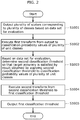
- FIG. 2 is a flowchart illustrating an example of operations of threshold calculation device 200a according to Embodiment 1.
- First calculator 202 reads out the input data of the data set for evaluation from storage 201, and outputs a plurality of scalars corresponding to the plurality of classes of the input data (step S1001).
- the plurality of scalars corresponding to the plurality of classes of the input data are feature amounts corresponding to each of the plurality of classes of the input data.
- the input data is an image, and an automobile and a motorcycle appear in the image.
- the plurality of classes are, for example, "pedestrian”, “automobile”, “motorcycle”, “bicycle", and “background”.
- classification probability calculator 203 performs the first transform, which is a transform of the output of first calculator 202 to classification probability values of the plurality of unit classes (step S1002).
- classification probability calculator 203 includes classification probability calculators of a plurality of unit classes.
- the classification probability calculator of each unit class is an inverse-transformable probability function.
- the classification probability calculators of the unit classes may be mutually-different functions, or may be the same function. Additionally, the classification probability calculators of the unit classes may be a database in which those calculators are associated with computations performed by inverse-transformable probability functions.
- "normalization” refers not to adding a plurality of scalar values to adjust the values to 1, but rather to converting the scalar values to values in a range from 0 to 1 in accordance with the magnitudes of those scalar values. The transform coefficient used at this time may be adjusted in accordance with the classification accuracy of each class.
- classification threshold determiner 204 sets the second classification threshold based on the classification probability values of the plurality of unit classes, which have been derived in step S1002 (step S1003).
- classification threshold determiner 204 obtains the classification probability values of the plurality of unit classes, and determines the second classification threshold based on a classification result obtained using the second classification threshold for each of the obtained classification probability values of the plurality of unit classes. For example, classification threshold determiner 204 reads out the data set for evaluation from storage 201, and determines the second classification threshold based on the correct answer data in the data set for evaluation and the classification probability values of the plurality of unit classes.
- classification threshold determiner 204 may determine the second classification threshold in accordance with a false positive (FP)/false negative (FN) ratio with respect to the data set for evaluation, for each classification probability value of the plurality of unit classes. Additionally, for example, the second classification threshold may be determined so that a result obtained by applying the second classification threshold to the outputs of the plurality of unit classes (i.e., the classification probability values) satisfies a target accuracy.
- a target accuracy may be provided; classification accuracies for when the threshold of the classification probability values of the plurality of unit classes (the second classification threshold) is shifted may be calculated; a threshold at which the calculated classification accuracy is closest to the target accuracy may be selected; and that threshold may be determined as the second classification threshold.
- the first threshold at which the calculated classification accuracy exceeds the target accuracy may be determined as the second classification threshold, instead of the threshold at which the calculated classification accuracy is closest to the target accuracy.
- the target accuracy may, for example, be set on a class-by-class basis, or may be set to be common across all classes.
- the second classification threshold may be a different value for each of the plurality of unit classes, or may be the same value for all the plurality of unit classes.
- threshold converter 205 performs a second transform, which is a transform from the second classification threshold set by classification threshold determiner 204 into the first classification threshold for classifying the data into at least one of a plurality of classes, and is an inverse transform of the first transform (step S1004).
- a non-normalized threshold here, the first classification threshold
- the first classification threshold is a threshold for classifying the data into at least one of a plurality of classes.
- the first classification threshold may be set to a different value for each of the classes, or may be set to a value which is common for all of the plurality of classes.
- threshold converter 205 inputs the second classification threshold derived in step S1003 and calculates the first classification threshold by inverse-transforming the second classification threshold.
- threshold converter 205 is a database corresponding to computations performed by an inverse function of the function constituting classification probability calculator 203 (e.g., a table in which inputs and outputs are mapped to each other, such as a lookup table), when the second classification threshold is input to threshold converter 205, the first classification threshold associated with the input is output.
- first outputter 206 outputs the first classification threshold derived in step S1004 to information processing device 100a (step S1005). At this time, first outputter 206 may be communicably connected to information processing device 100a.
- the communication method has already been described above, and will therefore not be mentioned here.
- FIG. 3 is a flowchart illustrating an example of operations performed by information processing device 100a according to Embodiment 1.
- Second obtainer 101 obtains data from, for example, a sensor such as an image sensor (not shown) (step S2001).
- a sensor such as an image sensor (not shown)
- An example in which the data is in image will be described here.
- the image may be a moving image, or may be a still image (also called simply an "image").
- Second obtainer 101 may be communicably connected to the sensor, or may obtain a plurality of images from the sensor through removable memory, e.g., USB (Universal Serial Bus) memory.
- removable memory e.g., USB (Universal Serial Bus) memory.
- USB Universal Serial Bus
- Second calculator 102 outputs a plurality of scalars corresponding to the plurality of classes of the data obtained in step S2001 (step S2002).
- the data may be, for example, a moving image captured by an in-vehicle camera, or may be an image.
- second calculator 102 outputs a plurality of scalars (feature amounts) from the obtained data.
- First obtainer 103 obtains the first classification threshold output from threshold calculation device 200a (step S2003). At this time, first obtainer 103 obtains the first classification threshold from threshold calculation device 200a through communication.
- Threshold processor 104 classifies the data obtained by second obtainer 101 into at least one of the plurality of classes based on the output of second calculator 102 and the first classification threshold obtained by first obtainer 103 (step S2004). To be more specific, in step S2004, threshold processor 104 classifies the data into at least one of the plurality of classes by determining whether or not each of the plurality of scalars corresponding to the plurality of classes in the data is greater than or equal to the first classification threshold.
- threshold processor 104 may classify the image into the three classes, i.e., pedestrian, automobile, and bicycle, or into a single class. In the latter case, of probability values corresponding to the three classes of the image, threshold processor 104 may select the class having the highest scalar value and classify that image into a single class.
- threshold processor 104 may select a class having a scalar value which has the greatest difference from the first classification threshold, and may classify the image into a single class. In this case, threshold processor 104 may classify that image into the automobile class.
- the method for classifying the data may be set as appropriate in accordance with the type of the data and the purpose of the classification.
- Second outputter 105 outputs the classification result obtained in step S2004 (step S2005).
- Second outputter 105 may output the classification result to a presenter (not shown), or to another device aside from information processing device 100a.
- second outputter 105 may cause the presenter to present information based on the classification result, on the basis of a user operation input to an inputter (not shown).
- the inputter, the presenter, the other device, and the like have been described above, and will therefore not be mentioned here.
- the classification result may be presented in a variety of formats based on settings input to the inputter.
- the information based on the classification result may be a type and number of detections of an object class detected by information processing device 100a, a recognition accuracy for each of object classes, a change in recognition accuracy for each of object classes depending on the weather or time of day, trends of images having low recognition accuracy, advice for avoiding danger, or the like.
- Information processing device 100a may, for example, transmit an analysis result to a database located in a server connected over the Internet, and obtain information based on the analysis result.
- Embodiment 1 An information processing device according to a variation on Embodiment 1 will be described next. The following descriptions will focus on the differences from Embodiment 1, and descriptions of common points will be omitted or simplified.
- FIG. 4 is a block diagram illustrating an example of the configuration of information processing device 100b according to the variation on Embodiment 1.
- Information processing device 100b includes threshold calculator 20a, storage 201a, and information processor 10.
- Embodiment 1 described an example in which information processing device 100a obtains the first classification threshold from threshold calculation device 200a and classifies data into at least one of a plurality of classes using the obtained first classification threshold.
- the main difference between information processing device 100b and information processing device 100a according to Embodiment 1 is that information processing device 100b includes threshold calculator 20a. Note that in FIGS. 1 and 4 , constituent elements which are substantially identical are given the same reference signs.
- threshold calculation device 200a outputs the first classification threshold derived by threshold converter 205 to first outputter 206, and the first classification threshold is output to information processing device 100a via first outputter 206.
- threshold calculator 20a stores the first classification threshold derived by threshold converter 205 in storage 201a. Then, information processor 10 reads out the first classification threshold stored in storage 201a.
- obtainer 101a illustrated in FIG. 4 corresponds to second obtainer 101 illustrated in FIG. 1
- outputter 105a illustrated in FIG. 4 corresponds to second outputter 105 illustrated in FIG. 1
- obtainer 101a obtains data from a sensor such as an image sensor.
- outputter 105a outputs a classification result of classifying the data obtained by obtainer 101a into at least one of a plurality of classes.
- FIG. 5 is a flowchart illustrating an example of operations of threshold calculator 20a according to a variation on Embodiment 1. Steps S3001 to S3004 in FIG. 5 correspond to steps S1001 to S1004 in FIG. 2 , respectively, and the descriptions thereof will therefore be simplified here. Note that the operations of threshold calculator 20a according to the variation differ from the operations of threshold calculation device 200a according to Embodiment 1 in that the first classification threshold is stored in storage 201a.
- First calculator 202 reads out the input data of the data set for evaluation from storage 201, and outputs a plurality of scalars corresponding to the plurality of classes of the input data (step S3001).
- classification probability calculator 203 performs the first transform, which is a transform of the output of first calculator 202 to classification probability values of the plurality of unit classes (step S3002).
- classification threshold determiner 204 sets the second classification threshold based on the classification probability values of the plurality of unit classes, which have been derived in step S3002 (step S3003).
- threshold converter 205 performs a second transform on the second classification threshold, which is a transform from the second classification threshold set by classification threshold determiner 204 into the first classification threshold for classifying the data into at least one of a plurality of classes, and is an inverse transform of the first transform (step S3004).
- threshold converter 205 stores the first classification threshold in storage 201a (step S3005).
- FIG. 6 is a flowchart illustrating an example of operations of information processor 10 according to the variation on Embodiment 1. Steps S4001 and S4002 in FIG. 6 correspond to steps S2001 and S2002 in FIG. 3 , respectively, and the descriptions thereof will therefore be simplified here.
- Obtainer 101a obtains data from, for example, a sensor such as an image sensor (step S4001).
- second calculator 102 outputs a plurality of scalars (probability values) corresponding to the plurality of classes of the data obtained in step S4001 (step S4002).
- a per-class loop process is then started for each of the plurality of classes of the data.
- Threshold processor 104 reads out the first classification threshold stored in storage 201a (step S4003). Although an example in which threshold processor 104 reads out the first classification threshold for each of the plurality of classes for each classification process of each class will be described here, threshold processor 104 may read out the first classification values for all of the plurality of classes at once. Note that the first classification threshold may be a different value for each of the plurality of unit classes, or may be the same value.
- Threshold processor 104 classifies the data obtained by second obtainer 101 into at least one of the plurality of classes based on the output of second calculator 102 and the first classification threshold read out from storage 201a.
- threshold processor 104 reads out the first classification threshold of one of the plurality of classes (e.g., a pedestrian class) from storage 201a (step S4003), and then determines whether or not the scalar value of that class is at least the first classification threshold read out from storage 201a (step S4004). If the scalar value of that class is at least the first classification threshold (Yes in step S4004), threshold processor 104 saves the scalar value of that class in association with a number indicating the class in storage 201a (step S4005).
- the first classification threshold of one of the plurality of classes e.g., a pedestrian class
- threshold processor 104 saves the scalar value of that class in association with a number indicating the class in storage 201a (step S4005).
- threshold processor 104 reads out the first classification threshold of another class (e.g., an automobile class) in the plurality of classes from storage 201a (step S4003). Threshold processor 104 then determines whether or not the scalar value of that class is at least the first classification threshold read out from storage 201a (step S4004). If the scalar value of that class is at least the first classification threshold (Yes in step S4004), threshold processor 104 stores the scalar value of that class in association with a number indicating the class in storage 201a (step S4005).
- another class e.g., an automobile class
- threshold processor 104 reads out another class (e.g., a motorcycle class) in the plurality of classes from storage 201a (step S4003), and executes the determination processing of step S4004. By repeating the same processing in this manner, the classification processing can be executed on a class-by-class basis for a plurality of scalars corresponding to a plurality of classes of data. Once the per-class loop processing ends, threshold processor 104 determines whether or not the number of classes stored in storage 201a is at least 1 (step S4006).
- another class e.g., a motorcycle class
- threshold processor 104 outputs, to outputter 105a, the class number having the highest scalar value (step S4007). In this manner, based on the class number, outputter 105a outputs (not shown) a classification result (e.g., that the data indicates an automobile) in which the data has been classified into at least one of a plurality of classes.
- a classification result e.g., that the data indicates an automobile
- threshold processor 104 outputs, to outputter 105a, a number indicating "other" (step S4008). "Other" indicates that there is no corresponding class.
- the classification result output from outputter 105a may, for example, indicate that the data belongs to another class, or that the data belongs to a background class.
- Embodiment 2 An information processing system according to Embodiment 2 will be described next. The following descriptions will focus on the differences from Embodiment 1, and descriptions of common points will be omitted or simplified.
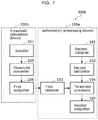
- FIG. 7 is a block diagram illustrating an example of the configuration of information processing system 300b according to Embodiment 2.
- Information processing system 300b includes threshold calculation device 200b and information processing device 100a.
- the main difference between threshold calculation device 200b according to Embodiment 2 and threshold calculation device 200a according to Embodiment 1 is that the first classification threshold is derived from the second classification threshold, which has been set by a user.
- threshold calculation device 200b The configuration of threshold calculation device 200b will be described next.
- threshold calculation device 200b includes inputter 207, threshold converter 205, and first outputter 206.
- inputter 207 may be provided in another device aside from threshold calculation device 200b.
- the other device is, for example, a tablet terminal, a smartphone, a computer, or the like.
- Inputter 207 inputs an operation signal from a user into threshold converter 205.
- Inputter 207 is, for example, a touch panel, a keyboard, a mouse, a button, a speaker, or the like.
- the operation signal is, for example, a signal indicating the second classification threshold for each of the plurality of classes.
- the user inputs the second classification threshold into threshold converter 205 through inputter 207.
- the second classification threshold may be a value set in advance.
- Threshold converter 205 derives the first classification threshold by performing a second transform, which is an inverse transform of the first transform, on the obtained second classification threshold.
- First outputter 206 outputs the first classification threshold to information processing device 100a.
- information processing device 100a is the same as information processing device 100a according to Embodiment 1, and will therefore not be described here.
- FIG. 8 is a flowchart illustrating an example of operations of threshold calculation device 200b according to Embodiment 2.
- the user inputs the second classification threshold for each of the plurality of classes to threshold converter 205 through inputter 207.
- threshold converter 205 obtains the second classification threshold for each of the plurality of classes, input through inputter 207 (step S5001).
- threshold converter 205 performs a second transform on the second classification threshold, which is a transform from the obtained second classification threshold into the first classification threshold for classifying the data into at least one of a plurality of classes, and is an inverse transform of the first transform (step S5002).
- First outputter 206 outputs the first classification threshold to information processing device 100a (step S5003).
- Embodiment 2 An information processing device according to a variation on Embodiment 2 will be described next. The following descriptions will focus on the differences from Embodiment 2, and descriptions of common points will be omitted or simplified.
- FIG. 9 is a block diagram illustrating an example of the configuration of information processing device 100c according to the variation on Embodiment 2.
- Information processing device 100b includes threshold calculator 20b, storage 201b, and information processor 10.
- Embodiment 2 described an example in which information processing device 100a obtains the first classification threshold from threshold calculation device 200b and classifies data into at least one of a plurality of classes using the obtained first classification threshold.
- the main difference between information processing device 100c according to the present variation and information processing device 100a according to Embodiment 2 is that information processing device 100c includes threshold calculator 20b. Additionally, the main difference between threshold calculator 20b according to the present variation and threshold calculation device 200b according to Embodiment 2 is that threshold calculator 20b includes classification threshold determiner 204. Note that in FIGS. 7 and 9 , constituent elements which are substantially identical are given the same reference signs.
- threshold calculation device 200b derives the first classification threshold by using threshold converter 205 to perform an inverse transform on the second classification threshold input by the user to threshold converter 205 through inputter 207. Then, threshold calculation device 200b outputs the derived first classification threshold from first outputter 206 to information processing device 100.
- threshold calculator 20b stores the first classification threshold derived by threshold converter 205 in storage 201b. Then, information processor 10 reads out the first classification threshold stored in storage 201b, and classifies the data into at least one of a plurality of classes.
- obtainer 101a illustrated in FIG. 9 corresponds to second obtainer 101 illustrated in FIG. 7
- outputter 105a illustrated in FIG. 9 corresponds to second outputter 105 illustrated in FIG. 7
- obtainer 101a obtains data from a sensor such as an image sensor.
- outputter 105a outputs a classification result of classifying the data obtained by obtainer 101a into at least one of a plurality of classes.
- classification threshold determiner 204 illustrated in FIG. 9 corresponds to classification threshold determiner 204 illustrated in FIG. 1 .
- Classification threshold determiner 204 determines the appropriate second classification threshold by, for example, referring to a data set for evaluation stored in storage 201 or storage 201b.
- threshold calculation device 200b derives the first classification threshold from the second classification threshold input by the user
- threshold calculator 20b determines the second classification threshold based on the second classification threshold input by the user and the evaluation data stored in storage 201b. Details of the determination process will be described in the section regarding operations.
- information processor 10 is the same as information processor 10 according to the variation on Embodiment 1, and will therefore not be described here.
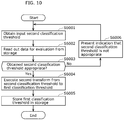
- FIG. 10 is a flowchart illustrating an example of operations of threshold calculator 20b according to a variation on Embodiment 2.
- classification threshold determiner 204 obtains the input second classification threshold (step S6001).
- classification threshold determiner 204 reads out the evaluation data from storage 201b (step S6002). Based on the data set for evaluation, classification threshold determiner 204 determines whether or not the second classification threshold obtained in step S6001 is appropriate, and more specifically, whether or not a result obtained by applying the second classification threshold to the classification probability values of a plurality of unit classes in the data set for evaluation satisfies a target accuracy (step S6003). If it is determined that the second classification threshold is appropriate (Yes in step S6003), classification threshold determiner 204 outputs the second classification threshold to threshold converter 205.
- Threshold converter 205 performs a second transform on the second classification threshold, which is a transform from the obtained second classification threshold into the first classification threshold for classifying the data into at least one of a plurality of classes, and is an inverse transform of the first transform (step S6004). Threshold converter 205 stores the derived first classification threshold in storage 201b (step S6005).
- classification threshold determiner 204 causes a presenter (not shown) to present an indication that the second classification threshold is not appropriate (step S6006). At this time, classification threshold determiner 204 may cause the presenter to present the second classification threshold at which a result, obtained by applying the second classification threshold to the classification probability values of the plurality of unit classes in the data set for evaluation, satisfies the target accuracy.
- information processor 10 is the same as information processor 10 according to the variation on Embodiment 1, and will therefore not be described here.
- the processing described in the foregoing embodiments may be implemented through centralized processing using a single device (system), or may be implemented through distributed processing using a plurality of devices.
- a single processor or a plurality of processors may execute the above-described programs.
- the processing may be centralized processing or distributed processing.
- the present disclosure is useful as an information processing device, an information processing method, and a program capable of reducing an amount of computations for classifying an object into a class.
Landscapes
- Engineering & Computer Science (AREA)
- Theoretical Computer Science (AREA)
- Physics & Mathematics (AREA)
- General Physics & Mathematics (AREA)
- Data Mining & Analysis (AREA)
- Artificial Intelligence (AREA)
- Evolutionary Computation (AREA)
- Software Systems (AREA)
- General Engineering & Computer Science (AREA)
- Computing Systems (AREA)
- Mathematical Physics (AREA)
- Life Sciences & Earth Sciences (AREA)
- General Health & Medical Sciences (AREA)
- Health & Medical Sciences (AREA)
- Computer Vision & Pattern Recognition (AREA)
- Computational Linguistics (AREA)
- Biophysics (AREA)
- Molecular Biology (AREA)
- Biomedical Technology (AREA)
- Medical Informatics (AREA)
- Bioinformatics & Cheminformatics (AREA)
- Bioinformatics & Computational Biology (AREA)
- Evolutionary Biology (AREA)
- Databases & Information Systems (AREA)
- Multimedia (AREA)
- Probability & Statistics with Applications (AREA)
- Algebra (AREA)
- Computational Mathematics (AREA)
- Mathematical Analysis (AREA)
- Mathematical Optimization (AREA)
- Pure & Applied Mathematics (AREA)
- Image Analysis (AREA)
- Information Retrieval, Db Structures And Fs Structures Therefor (AREA)
Abstract
Description
- The present disclosure relates to an information processing device, an information processing method, and a program.
- In fields such as image recognition, multilayer neural networks (Deep Neural Networks, or "DNNs") are used as a recognition model (also called a "classification model" hereinafter) to recognize objects in images. A DNN, for example, takes an image as an input, and outputs a probability value of an object in the image being classified into a class (also called a "likelihood" of an object class). In this case, a Softmax function is used in an output layer of the DNN (for example, see PTL 1).
- [PTL 1]
International Publication No.2017/149722 - However, a Softmax function involves exponential computations, which may place a strain on computational resources when the classification model is implemented on embedded devices having limited computational resources.
- Accordingly, the present disclosure provides an information processing device, an information processing method, and a program capable of reducing an amount of computations for classifying an object into a class.
- To solve the above-described problem, an information processing device according to one aspect of the present disclosure is an information processing device including a processor. The processor is configured to obtain a first classification threshold for classifying data into at least one of a plurality of classes, and output a classification result of classifying the data into at least one of the plurality of classes based on an output of a trained classification model and the first classification threshold. The first classification threshold is obtained by a second transform performed on a second classification threshold, the second transform being an inverse transform of a first transform. The first transform corresponds to transforming the output of the trained classification model into a classification probability value of each of a plurality of unit classes constituting the plurality of classes. The second classification threshold is set based on the classification probability values of the plurality of unit classes.
- Additionally, an information processing method according to one aspect of the present disclosure is an information processing method executed by a computer. The information processing method includes: executing a first transform from an output of a trained classification model into a classification probability value of each of a plurality of unit classes; setting a second classification threshold based on the classification probability values of the plurality of unit classes; executing a second transform, the second transform being a transform from the second classification threshold into a first classification threshold for classifying data into at least one of a plurality of classes, and the second transform being an inverse transform of the first transform; and outputting the first classification threshold.
- Additionally, a program according to one aspect of the present disclosure is a program for causing a computer to execute an information processing method. The information processing method includes: obtaining a first classification threshold for classifying data into at least one of a plurality of classes; and outputting a classification result of classifying the data into at least one of the plurality of classes based on an output of a trained classification model and the first classification threshold. The first classification threshold is obtained by a second transform performed on a second classification threshold, the second transform being an inverse transform of a first transform. The first transform corresponds to transforming the output of the trained classification model into a classification probability value of each of a plurality of unit classes. The second classification threshold is set based on the classification probability values of the plurality of unit classes. Alternatively, one aspect of the present disclosure can be realized as a computer-readable non-transitory recording medium in which the program is stored.
- According to the present disclosure, the amount of computations for classifying an object into a class can be reduced.
-
- [
FIG. 1 ]
FIG. 1 is a block diagram illustrating an example of the configuration of an information processing system according toEmbodiment 1. - [
FIG. 2 ]
FIG. 2 is a flowchart illustrating an example of operations of a threshold calculation device according toEmbodiment 1. - [
FIG. 3 ]
FIG. 3 is a flowchart illustrating an example of operations performed by an information processing device according toEmbodiment 1. - [
FIG. 4 ]
FIG. 4 is a block diagram illustrating an example of the configuration of an information processing device according to a variation onEmbodiment 1. - [
FIG. 5 ]
FIG. 5 is a flowchart illustrating an example of operations of a threshold calculator according to a variation onEmbodiment 1. - [
FIG. 6 ]
FIG. 6 is a flowchart illustrating an example of operations of an information processor according to a variation onEmbodiment 1. - [
FIG. 7 ]
FIG. 7 is a block diagram illustrating an example of the configuration of an information processing system according to Embodiment 2. - [
FIG. 8 ]
FIG. 8 is a flowchart illustrating an example of operations of a threshold calculation device according to Embodiment 2. - [
FIG. 9 ]
FIG. 9 is a block diagram illustrating an example of the configuration of an information processing device according to a variation on Embodiment 2. - [
FIG. 10 ]
FIG. 10 is a flowchart illustrating an example of operations of a threshold calculator according to a variation on Embodiment 2. - Thus far, multilayer neural networks (Deep Neural Networks, "DNNs") implemented in computing devices with limited computational resources, such as embedded devices, have had an issue in that the number of hidden layer units cannot be increased, which causes a drop in pattern recognition performance. In response to this issue, the past technique described in
PTL 1 determines whether or not to perform scalar quantization in each layer of a DNN, and in the next layer after the layer in which scalar quantization is performed, multiplies the scalar-quantized vector with a weight vector. This makes it possible to reduce the amount of computations more than when multiplying a non-scalar-quantized vector and the weight vector, which in turn makes it possible to increase the number of hidden layer units. However, a likelihood vector is calculated using a scalar-quantized output vector, and thus the values are coarser than when calculating the likelihood vector using a non-scalar-quantized output vector. The recognition accuracy may drop as a result. - In the past technique described in
PTL 1, when scalar quantization has not been performed in the layer one previous to the output layer of the DNN, a Softmax function is applied in the output layer to calculate a likelihood vector ("classification probability value" hereinafter) for a plurality of classes. The Softmax function involves the computation of exponential functions, and thus the amount of computations of exponential functions becomes an issue when implemented in embedded systems. Furthermore, a Softmax function adjusts a sum to be 1 with respect to the input, and thus original values cannot be restored even through inverse transforms. In other words, because the Softmax function performs an irreversible computation on the input, a non-normalized value cannot be obtained by performing an inverse transform on the output value obtained in response to the input to the Softmax function. Therefore, in the past technique described inPTL 1, it is necessary, for example, to calculate a classification probability value for each of a plurality of classes of objects in an input image in order to identify an object in the input image. Such a process of calculating the classification probability value of an object in an input image increases the amount of computations in computing devices with limited computational resources, such as embedded devices, and may therefore reduce the recognition accuracy of DNNs implemented in such computing devices. It is therefore difficult to say that the past technique described inPTL 1 is able to reduce the amount of computations for classifying objects into classes. - After diligently examining the above-described issue, the inventors of the present disclosure found that, in the process of determining a threshold for each of a plurality of classes, performing a reversible transform at the output layer of the DNN makes it possible to perform an inverse transform on the calculated threshold and obtain a non-normalized threshold. The inventors therefore arrived at an information processing device that, for example, can use a non-normalized threshold in a process of classifying objects in an input image into classes, which makes it possible to reduce the amount of computations for classifying objects into classes.
- An overview of one aspect of the present disclosure is as follows.
- An information processing device according to one aspect of the present disclosure is an information processing device including a processor. The processor is configured to obtain a first classification threshold for classifying data into at least one of a plurality of classes, and output a classification result of classifying the data into at least one of the plurality of classes based on an output of a trained classification model and the first classification threshold. The first classification threshold is obtained by a second transform performed on a second classification threshold, the second transform being an inverse transform of a first transform. The first transform corresponds to transforming the output of the trained classification model into a classification probability value of each of a plurality of unit classes constituting the plurality of classes. The second classification threshold is set based on the classification probability values of the plurality of unit classes.
- According to the above-described configuration, an inverse-transformable function is used in the first transform the transforms from the output of the classification model into the classification probability values of the plurality of unit classes. Accordingly, when the first classification threshold, which is obtained by executing the second transform that is an inverse transform of the first transform on the second classification threshold, is used in processing for classifying an object into a class, it is no longer necessary to convert the output of the classification model, which takes, for example, an image as an input, into the classification probability values of the plurality of unit classes. An information processing device according to one aspect of the present disclosure can therefore reduce the amount of computations performed for classifying an object into a class.
- Specifically, in an information processing device according to one aspect of the present disclosure, the output of the trained classification model may be a plurality of scalars corresponding to the plurality of classes.
- Additionally, an information processing method according to one aspect of the present disclosure is an information processing method executed by a computer. The information processing method includes: executing a first transform from an output of a trained classification model into a classification probability value of each of a plurality of unit classes; setting a second classification threshold based on the classification probability values of the plurality of unit classes; executing a second transform, the second transform being a transform from the second classification threshold into a first classification threshold for classifying data into at least one of a plurality of classes, and the second transform being an inverse transform of the first transform; and outputting the first classification threshold.
- According to the above-described method, an inverse-transformable function is used in the first transform the transforms from the output of the classification model into the classification probability values of the plurality of unit classes. As such, the first classification threshold, which is a non-normalized threshold, is obtained by executing the second transform, which is an inverse transform of the first transform, on the second classification threshold. For example, if the first classification threshold is used in processing for classifying an object into a class, it is no longer necessary to convert the output of the classification model into the classification probability values of the plurality of unit classes. Accordingly, according to the information processing method according to one aspect of the present disclosure, the first classification threshold, which is a non-normalized threshold, is obtained, which makes it possible to reduce the amount of computations performed for classifying an object into a class.
- For example, in an information processing method according to one aspect of the present disclosure, the first transform may be a computation by an inverse-transformable probability function, and the second transform may be a computation by an inverse function of the inverse-transformable probability function.
- Accordingly, by inverse-transforming the classification probability values of the plurality of unit classes, pre-transform values, i.e., the output of the trained classification model, can be derived.
- For example, in an information processing method according to one aspect of the present disclosure, the first transform may be a database corresponding to a computation by an inverse-transformable probability function, and the second transform may be a database corresponding to a computation by an inverse function of the inverse-transformable probability function.
- This makes it possible to further reduce the amount of calculations than when using function computations.
- For example, an information processing method according to one aspect of the present disclosure may further include: obtaining a data set; obtaining the classification probability value of each of the plurality of unit classes for each of data included in the data set by inputting the data set into the trained classification model; and determining the second classification threshold based on a classification result obtained by using the second classification threshold on each obtained classification probability value of each of the plurality of unit classes.
- Through this, a classification probability value threshold for the classification probability values of the plurality of unit classes, i.e., the second classification threshold, is shifted with reference to correct answer data contained in the data set for evaluation, and a second classification threshold which satisfies a target accuracy is selected. Therefore, with the information processing method according to one aspect of the present disclosure, a threshold at which a desired classification accuracy is obtained can be determined.
- Additionally, a program according to one aspect of the present disclosure is a program for causing a computer to execute an information processing method. The information processing method includes: obtaining a first classification threshold for classifying data into at least one of a plurality of classes; and outputting a classification result of classifying the data into at least one of the plurality of classes based on an output of a trained classification model and the first classification threshold. The first classification threshold is obtained by a second transform performed on a second classification threshold, the second transform being an inverse transform of a first transform. The first transform corresponds to transforming the output of the trained classification model into a classification probability value of each of a plurality of unit classes. The second classification threshold is set based on the classification probability values of the plurality of unit classes.
- According to the above-described program, an inverse-transformable function is used in the first transform the transforms from the output of the classification model into the classification probability values of the plurality of unit classes. Accordingly, when the first classification threshold, which is obtained by executing the second transform that is an inverse transform of the first transform on the second classification threshold, is used in processing for classifying an object into a class, it is no longer necessary to convert the output of the classification model, which takes, for example, an image as an input, into the classification probability values of the plurality of unit classes. A program according to one aspect of the present disclosure can therefore reduce the amount of computations performed for classifying an object into a class.
- Embodiments of the present disclosure will be described hereinafter with reference to the drawings.
- Note that the following embodiments describe comprehensive or specific examples of the present disclosure. The numerical values, shapes, constituent elements, arrangements and connection states of constituent elements, steps, orders of steps, and the like in the following embodiments are merely examples, and are not intended to limit the present disclosure. Additionally, of the constituent elements in the following embodiments, constituent elements not denoted in the independent claims will be described as optional constituent elements.
- Additionally, the drawings are schematic diagrams, and are not necessarily exact illustrations. As such, the scales and so on, for example, are not necessarily consistent from drawing to drawing. Furthermore, configurations that are substantially the same are given the same reference signs in the drawings, and redundant descriptions will be omitted or simplified.
- Additionally, in the present specification, terms indicating relationships between elements, such as "horizontal" or "vertical", and numerical value ranges do not express the items in question in the strictest sense, but rather include substantially equivalent ranges, e.g., differences of several percent, as well.
- First, an overview of an information processing system including an information processing device according to
Embodiment 1 will be described with reference to the drawings.FIG. 1 is a block diagram illustrating an example of the configuration ofinformation processing system 300a according toEmbodiment 1. -
Information processing system 300a is a system that classifies data obtained by a sensor into at least one of a plurality of classes and outputs a classification result.Information processing system 300a includesthreshold calculation device 200a, which calculates a first classification threshold for classifying the data into at least one of the plurality of classes, andinformation processing device 100a, which based on an output of a trained classification model and the first classification threshold, outputs a classification result in which the data has been classified into at least one of the plurality of classes. - The sensor is, for example, a sound sensor such as a microphone, an image sensor, a range sensor, a gyrosensor, a pressure sensor, or the like. Data obtained using a plurality of sensors may be obtained using a three-dimensional reconstruction technique such as SfM (Structure from Motion), for example. The data obtained by the sensor is, for example, audio, an image, a moving image, three-dimensional point cloud data, or vector data.
- In
information processing system 300a, a plurality of classes that classify the data may be set in accordance with the type of the data, the application of the data, or the like. For example, if the data is audio, classes such as the voice of a specific person, the operation sound of a specific machine, or the cry of a specific animal may be set. If the data is an image, in a surveillance camera system, for example, a class such as a specific person may be set, and in an in-vehicle camera system, for example, a class such as pedestrian, automobile, motorcycle, bicycle, background, and the like may be set. If the data is three-dimensional point cloud data, for example, a class such as unevenness or cracks in a structure or terrain, or a specific structure, may be set from the three-dimensional shape of a structure or terrain. Finally, if the data is vector data, for example, a class such as motion vectors at a plurality of parts of a structure, such as bridge girders or soundproof walls, may be set. - Each element of
information processing system 300a will be described below. -
Threshold calculation device 200a is a device for calculating a first classification threshold for classifying data into at least one of a plurality of classes. - As illustrated in
FIG. 1 ,threshold calculation device 200a includesstorage 201,first calculator 202,classification probability calculator 203,classification threshold determiner 204,threshold converter 205, andfirst outputter 206. -
Storage 201 stores a data set for evaluation of a second classification threshold. The data set for evaluation includes a set of input data to be input tofirst calculator 202 and correct answer data corresponding to the input data. The correct answer data are a classification probability value for each of a plurality of classes of the input data. Hereinafter, the classification probability values for each of the plurality of classes will also be referred to as classification probability values for a plurality of unit classes. "Unit class" refers to each class constituting the plurality of classes. The classification probability value of a plurality of unit classes is a normalized probability value obtained byclassification probability calculator 203 performing a first transform on an output offirst calculator 202. The second classification threshold is set based on the classification probability values of the plurality of unit classes. -
First calculator 202 is a feature amount extractor that extracts a feature amount of the data, e.g., a machine learning model. For example,first calculator 202 is a trained classification model. The classification model is a multilayer neural network (DNN).First calculator 202 obtains the data set for evaluation. For example,first calculator 202 reads out the data set for evaluation fromstorage 201. The input data of the data set for evaluation is input tofirst calculator 202.First calculator 202 outputs a plurality of scalars corresponding to the plurality of classes of the input data. Each scalar is a feature amount that corresponds to a respective class of the input data. The output offirst calculator 202 is a non-normalized value. - Note that
first calculator 202 is not limited to a DNN. For example,first calculator 202 may be a feature amount extractor, aside from a DNN, that uses a method such as edge extraction, primary component analysis, block matching, or a sampling moire method. - Note that
first calculator 202 may obtain the data set for evaluation from another device through communication. For example, the data set for evaluation may be obtained from a server or storage over the Internet. -
Classification probability calculator 203 performs the first transform, which is a transform of the output offirst calculator 202 to classification probability values of the plurality of unit classes. More specifically, in the first transform,classification probability calculator 203 calculates the classification probability values of the plurality of unit classes from the output offirst calculator 202 using a reversible transform. For example,classification probability calculator 203 derives classification probability values corresponding to the plurality of classes of input data by normalizing a plurality of scalars (feature amounts) corresponding to the plurality of classes of input data using a probability function that can be inverse-transformed. By performing normalization using a reversible transform in this manner, a non-normalized threshold can be derived by inverse-transforming a suitable threshold after determining the suitable threshold (the second classification threshold; described later) based on the data set for evaluation. -
Classification probability calculator 203 is constituted by, for example, probability calculators of a plurality of unit classes. Each of the plurality of scalars corresponding to the plurality of classes is input to the probability calculator of the corresponding unit class among the plurality of classes. Each of the probability calculators of the plurality of unit classes is an inverse-transformable function. These functions may be different from each other, or may be the same. The inverse-transformable function may be a differentiable function, e.g., a sigmoid function, a tangent hyperbolic function (Tanh), or the like. Note that the first transform may be a computation performed using an inverse-transformable probability function, or may be a transform performed using a database corresponding to a computation performed using an inverse-transformable probability function. The database may be a table in which inputs and outputs (post-transform values) are mapped to each other, such as a lookup table, for example. -
Classification threshold determiner 204 determines the second classification threshold based on the classification probability values of the plurality of unit classes, which have been calculated byclassification probability calculator 203. To be more specific,classification threshold determiner 204 obtains the classification probability values of the plurality of unit classes, and determines the second classification threshold based on a classification result obtained using the second classification threshold for each of the obtained classification probability values of the plurality of unit classes. For example,classification threshold determiner 204 reads out the data set for evaluation fromstorage 201, and determines the second classification threshold based on the correct answer data in the data set for evaluation and the classification probability values of the plurality of unit classes which have been calculated byclassification probability calculator 203. In other words,classification threshold determiner 204 determines an optimal second classification threshold based on the data set for evaluation. For example,classification threshold determiner 204 determines the second classification threshold in accordance with a false positive (FP)/false negative (FN) ratio with respect to the data set for evaluation, for each classification probability value of the plurality of unit classes. - Note that the second classification threshold may be set to a predetermined value, or may be determined in accordance with a target accuracy set by a user. When the second classification threshold is determined in accordance with the target accuracy,
classification threshold determiner 204 may determine the second classification threshold so that a result obtained by applying the second classification threshold to the classification probability values of the plurality of unit classes satisfies a target threshold. Note that the target accuracy may be set on a class-by-class basis, or may be set to be common across all classes. This method will be described in detail later in the section pertaining to threshold calculation device operations. - Note that the second classification threshold may be a different value for each of the plurality of unit classes, or may be the same value for all the plurality of unit classes.
-
Threshold converter 205 performs a second transform, which is a transform from the second classification threshold into the first classification threshold for classifying the data into at least one of a plurality of classes, and is an inverse transform of the first transform. In other words,threshold converter 205 converts the second classification threshold into a non-normalized threshold (i.e., the first classification threshold) by performing an inverse transform.Threshold converter 205 may be an inverse function of a function constituting classification probability calculator 203 (e.g., an inverse-transformable probability function), or may be a database corresponding to computations made using an inverse function of an inverse-transformable probability function. The database may be a table in which inputs and outputs (post-inverse transform values) are mapped to each other, such as a lookup table, for example. - The first classification threshold is used in
information processing device 100a for classifying the data into at least one of the plurality of classes.Information processing device 100a can execute the processing of classifying the data into classes by using a non-normalized threshold (the first classification threshold). Accordingly, withinformation processing device 100a, the classification process can be executed based on feature amounts extracted from the data, which eliminates the need for normalization processing and makes it possible to reduce the amount of computations. - Note that the first classification threshold may be set to a different value for each of the plurality of classes, or may be set to a value which is common for all of the plurality of classes.
-
First outputter 206 outputs the first classification threshold. More specifically,first outputter 206 outputs the first classification threshold tofirst obtainer 103 ofinformation processing device 100a through communication. The communication may be wireless communication such as Wi-Fi (registered trademark) or Bluetooth (registered trademark), or wired communication such as Ethernet (registered trademark), for example. - Note that
threshold calculation device 200a may include a trainer (not shown) for training a machine learning model. The trainer may include storage (not shown) that holds a data set for training. The data set for training includes a set of input data and correct answer data, stored in advance. The trainer may update the data set for training by obtaining new data for training from a database located on the server connected over a communication network such as the Internet. Additionally, the trainer may include a holder (not shown) that holds the same classification model asfirst calculator 202, and the holder may further hold the same N single-class classification probability calculators asclassification probability calculator 203. The trainer trains the same classification model asfirst calculator 202 by using the data set for training. Furthermore, the trainer may train a network having N single-class classification probability calculators provided byclassification probability calculator 203. Once the training of the classification model and the network ends, the trainer may output the trained classification model tofirst calculator 202, and updatefirst calculator 202 to the trained classification model. Likewise, the trainer may output the trained network having the N single-class classification probability calculators toclassification probability calculator 203, and updateclassification probability calculator 203 to the trained network. -
Information processing device 100a will be described next.Information processing device 100a is a device that, for example, classifies data obtained by a sensor into at least one of a plurality of classes and outputs a classification result. The following will describe an example in which the data is an image. Note that the data, and the sensor that obtains the data, have already been described in the overview ofinformation processing system 300a, and will therefore not be described here. - As illustrated in
FIG. 1 ,information processing device 100a includesfirst obtainer 103,second obtainer 101,second calculator 102,threshold processor 104, andsecond outputter 105. -
First obtainer 103 obtains the first classification threshold output fromfirst outputter 206 ofthreshold calculation device 200a, and outputs the obtained first classification threshold tothreshold processor 104, through communication. The communication has already been described above, and will therefore not be mentioned here. Note that the first classification threshold may be stored in advance in storage included ininformation processing device 100a. -
Second obtainer 101 obtains the data from the sensor through communication. Here, the sensor is an image sensor, and the data is an image.Second obtainer 101 outputs the obtained data tosecond calculator 102. Note that the communication may be wireless communication or wired communication. Additionally, the sensor is not limited to a single sensor, and the data may be obtained by synchronizing two or more sensors, for example. Additionally,second obtainer 101 may obtain the data through removable memory. The removable memory is, for example, USB (Universal Serial Bus) memory. -
Second calculator 102 is a feature amount extractor that extracts a feature amount of the data, e.g., a machine learning model. For example,second calculator 102 is a trained classification model. The classification model is a multilayer neural network (DNN). The data obtained byfirst obtainer 103 is input tosecond calculator 102.Second calculator 102 outputs a plurality of scalars corresponding to the plurality of classes of the data. Each scalar is a feature amount that corresponds to a respective class of the data. The output ofsecond calculator 102 is a non-normalized value. - Note that
second calculator 102 is not limited to a DNN. For example,second calculator 102 may be a feature amount extractor, aside from a DNN, that uses a method such as feature point extraction (e.g., edge extraction), primary component analysis, block matching, or a sampling moire method. -
Threshold processor 104 obtains the first classification threshold output fromfirst obtainer 103, and classifies the data into at least one of a plurality of classes based on the output ofsecond calculator 102 and the first classification threshold. To be more specific,threshold processor 104 classifies the data into at least one of the plurality of classes by determining whether or not a probability value for each of the plurality of classes, output fromsecond calculator 102, is at least the first classification threshold. The first classification threshold may be set to a different value for each of the plurality of classes, or may be set to a value which is common for all of the plurality of classes. The specific operations performed bythreshold processor 104 will be described later. -
Second outputter 105 outputs a data classification result.Second outputter 105 may output the data classification result to a presenter (not shown), or to another device aside frominformation processing device 100a. For example,second outputter 105 may cause the presenter to present information based on the classification result, on the basis of a user operation input to an inputter (not shown). The inputter is, for example, a keyboard, a mouse, a touch panel, a button, a microphone, or the like. The presenter is, for example, a display, a speaker, or the like. Note thatinformation processing device 100a may or may not include the inputter and the presenter. The inputter and the presenter may be provided in another device aside frominformation processing device 100a, for example. The other device aside frominformation processing device 100a may be, for example, an information terminal such as a smartphone, a tablet, a computer, or the like. Additionally, althoughinformation processing device 100a has been described as a computer as an example,information processing device 100a may be provided in a server connected over a communication network such as the Internet. - Note that like
threshold calculation device 200a,information processing device 100a may include a trainer (not shown) for training a machine learning model. With respect to the details of the trainer, the same descriptions as those given of the trainer ofthreshold calculation device 200a may be applied, with the exception that training of the network ofclassification probability calculator 203 is not included, andfirst calculator 202 is replaced withsecond calculator 102. - Note that
information processing system 300a may include a trainer (not shown) that is shared bythreshold calculation device 200a andinformation processing device 100a, and that trainer may train the classification model offirst calculator 202, the network ofclassification probability calculator 203, and the classification model ofsecond calculator 102. - Operations performed by
threshold calculation device 200a will be described next with reference toFIG. 2. FIG. 2 is a flowchart illustrating an example of operations ofthreshold calculation device 200a according toEmbodiment 1. -
First calculator 202 reads out the input data of the data set for evaluation fromstorage 201, and outputs a plurality of scalars corresponding to the plurality of classes of the input data (step S1001). The plurality of scalars corresponding to the plurality of classes of the input data are feature amounts corresponding to each of the plurality of classes of the input data. Assume, for example, that the input data is an image, and an automobile and a motorcycle appear in the image. Assume also that the plurality of classes are, for example, "pedestrian", "automobile", "motorcycle", "bicycle", and "background". At this time,first calculator 202 outputs a vector having a plurality of scalars corresponding to the plurality of classes in the input data (pedestrian, automobile, motorcycle, bicycle, background) = (0.1, 90, 60, 0.01, 0.001). - Next,
classification probability calculator 203 performs the first transform, which is a transform of the output offirst calculator 202 to classification probability values of the plurality of unit classes (step S1002). As described above,classification probability calculator 203 includes classification probability calculators of a plurality of unit classes. The classification probability calculator of each unit class is an inverse-transformable probability function. The classification probability calculators of the unit classes may be mutually-different functions, or may be the same function. Additionally, the classification probability calculators of the unit classes may be a database in which those calculators are associated with computations performed by inverse-transformable probability functions. A threshold calculator in each unit class converts the scalar for each of the plurality of classes into a value in a range from 0 to 1 through a reversible transform (i.e., normalizes the scalar). For example, when the scalars of (pedestrian, automobile, motorcycle, bicycle, background) = (0.1, 90, 60, 0.01, 0.001), which is the output offirst calculator 202, are input to the classification probability calculators of the unit classes corresponding to each class, the classification probability calculator of each unit class converts that scalar into a value in a range from 0 to 1.Classification probability calculator 203 outputs (pedestrian, automobile, motorcycle, bicycle, background) = (0.3, 1.0, 1.0, 0.1, 0), which are the classification probability values of the plurality of unit classes. Here, "normalization" refers not to adding a plurality of scalar values to adjust the values to 1, but rather to converting the scalar values to values in a range from 0 to 1 in accordance with the magnitudes of those scalar values. The transform coefficient used at this time may be adjusted in accordance with the classification accuracy of each class. - Next,
classification threshold determiner 204 sets the second classification threshold based on the classification probability values of the plurality of unit classes, which have been derived in step S1002 (step S1003). To be more specific,classification threshold determiner 204 obtains the classification probability values of the plurality of unit classes, and determines the second classification threshold based on a classification result obtained using the second classification threshold for each of the obtained classification probability values of the plurality of unit classes. For example,classification threshold determiner 204 reads out the data set for evaluation fromstorage 201, and determines the second classification threshold based on the correct answer data in the data set for evaluation and the classification probability values of the plurality of unit classes. For example,classification threshold determiner 204 may determine the second classification threshold in accordance with a false positive (FP)/false negative (FN) ratio with respect to the data set for evaluation, for each classification probability value of the plurality of unit classes. Additionally, for example, the second classification threshold may be determined so that a result obtained by applying the second classification threshold to the outputs of the plurality of unit classes (i.e., the classification probability values) satisfies a target accuracy. To be more specific, a target accuracy may be provided; classification accuracies for when the threshold of the classification probability values of the plurality of unit classes (the second classification threshold) is shifted may be calculated; a threshold at which the calculated classification accuracy is closest to the target accuracy may be selected; and that threshold may be determined as the second classification threshold. Alternatively, for example, the first threshold at which the calculated classification accuracy exceeds the target accuracy may be determined as the second classification threshold, instead of the threshold at which the calculated classification accuracy is closest to the target accuracy. The target accuracy may, for example, be set on a class-by-class basis, or may be set to be common across all classes. Note that the second classification threshold may be a different value for each of the plurality of unit classes, or may be the same value for all the plurality of unit classes. - Next,
threshold converter 205 performs a second transform, which is a transform from the second classification threshold set byclassification threshold determiner 204 into the first classification threshold for classifying the data into at least one of a plurality of classes, and is an inverse transform of the first transform (step S1004). Through this, a non-normalized threshold (here, the first classification threshold) can be obtained from a normalized threshold (here, the second classification threshold). The first classification threshold is a threshold for classifying the data into at least one of a plurality of classes. The first classification threshold may be set to a different value for each of the classes, or may be set to a value which is common for all of the plurality of classes. For example, ifthreshold converter 205 is an inverse function of the function constituting classification probability calculator 203 (e.g., an inverse-transformable probability function),threshold converter 205 inputs the second classification threshold derived in step S1003 and calculates the first classification threshold by inverse-transforming the second classification threshold. Additionally, ifthreshold converter 205 is a database corresponding to computations performed by an inverse function of the function constituting classification probability calculator 203 (e.g., a table in which inputs and outputs are mapped to each other, such as a lookup table), when the second classification threshold is input tothreshold converter 205, the first classification threshold associated with the input is output. - Next,
first outputter 206 outputs the first classification threshold derived in step S1004 toinformation processing device 100a (step S1005). At this time,first outputter 206 may be communicably connected toinformation processing device 100a. The communication method has already been described above, and will therefore not be mentioned here. - Operations performed by
information processing device 100a will be described next with reference toFIG. 3. FIG. 3 is a flowchart illustrating an example of operations performed byinformation processing device 100a according toEmbodiment 1. -
Second obtainer 101 obtains data from, for example, a sensor such as an image sensor (not shown) (step S2001). An example in which the data is in image will be described here. The image may be a moving image, or may be a still image (also called simply an "image").Second obtainer 101 may be communicably connected to the sensor, or may obtain a plurality of images from the sensor through removable memory, e.g., USB (Universal Serial Bus) memory. The communication method has already been described above, and will therefore not be mentioned here. -
Second calculator 102 outputs a plurality of scalars corresponding to the plurality of classes of the data obtained in step S2001 (step S2002). The data may be, for example, a moving image captured by an in-vehicle camera, or may be an image. When the data is a moving image, the following operations are executed for each of a plurality of frames constituting the moving image. Like the operation offirst calculator 202 ofthreshold calculation device 200a,second calculator 102 outputs a plurality of scalars (feature amounts) from the obtained data. The following will describe an example in which the output ofsecond calculator 102 is (pedestrian, automobile, motorcycle, bicycle, background) = (70, 90, 0.5, 60, 0.001). -
First obtainer 103 obtains the first classification threshold output fromthreshold calculation device 200a (step S2003). At this time,first obtainer 103 obtains the first classification threshold fromthreshold calculation device 200a through communication. The first classification threshold and the communication method have already been described above, and will therefore not be mentioned here. It is assumed here that the first classification threshold is (pedestrian, automobile, motorcycle, bicycle, background) = (60, 60, 60, 60, 60). -
Threshold processor 104 classifies the data obtained bysecond obtainer 101 into at least one of the plurality of classes based on the output ofsecond calculator 102 and the first classification threshold obtained by first obtainer 103 (step S2004). To be more specific, in step S2004,threshold processor 104 classifies the data into at least one of the plurality of classes by determining whether or not each of the plurality of scalars corresponding to the plurality of classes in the data is greater than or equal to the first classification threshold. - For example, when the output of
second calculator 102 is (pedestrian, automobile, motorcycle, bicycle, background) = (70, 90, 0.5, 60, 0.001), and the first classification threshold for each class is (pedestrian, automobile, motorcycle, bicycle, background) = (60, 60, 60, 60, 60), the scalar values for three of the classes are at least the first classification threshold. At this time,threshold processor 104 may classify the image into the three classes, i.e., pedestrian, automobile, and bicycle, or into a single class. In the latter case, of probability values corresponding to the three classes of the image,threshold processor 104 may select the class having the highest scalar value and classify that image into a single class. In this case, of the scalar values for the aforementioned three classes, the probability value is highest for the automobile class, and thusthreshold processor 104 classifies that image into the automobile class. However, of the scalar values for the three classes,threshold processor 104 may select a class having a scalar value which has the greatest difference from the first classification threshold, and may classify the image into a single class. In this case,threshold processor 104 may classify that image into the automobile class. Thus as described above, the method for classifying the data may be set as appropriate in accordance with the type of the data and the purpose of the classification. -
Second outputter 105 outputs the classification result obtained in step S2004 (step S2005).Second outputter 105 may output the classification result to a presenter (not shown), or to another device aside frominformation processing device 100a. For example,second outputter 105 may cause the presenter to present information based on the classification result, on the basis of a user operation input to an inputter (not shown). The inputter, the presenter, the other device, and the like have been described above, and will therefore not be mentioned here. - With respect to information based on the classification result, the classification result may be presented in a variety of formats based on settings input to the inputter. For example, if the data is an image captured by an in-vehicle camera, the information based on the classification result may be a type and number of detections of an object class detected by
information processing device 100a, a recognition accuracy for each of object classes, a change in recognition accuracy for each of object classes depending on the weather or time of day, trends of images having low recognition accuracy, advice for avoiding danger, or the like.Information processing device 100a may, for example, transmit an analysis result to a database located in a server connected over the Internet, and obtain information based on the analysis result. - An information processing device according to a variation on
Embodiment 1 will be described next. The following descriptions will focus on the differences fromEmbodiment 1, and descriptions of common points will be omitted or simplified. -
FIG. 4 is a block diagram illustrating an example of the configuration ofinformation processing device 100b according to the variation onEmbodiment 1.Information processing device 100b includesthreshold calculator 20a,storage 201a, andinformation processor 10. -
Embodiment 1 described an example in whichinformation processing device 100a obtains the first classification threshold fromthreshold calculation device 200a and classifies data into at least one of a plurality of classes using the obtained first classification threshold. The main difference betweeninformation processing device 100b andinformation processing device 100a according toEmbodiment 1 is thatinformation processing device 100b includesthreshold calculator 20a. Note that inFIGS. 1 and4 , constituent elements which are substantially identical are given the same reference signs. - As illustrated in
FIG. 1 , inEmbodiment 1,threshold calculation device 200a outputs the first classification threshold derived bythreshold converter 205 tofirst outputter 206, and the first classification threshold is output toinformation processing device 100a viafirst outputter 206. In the present variation, as illustrated inFIG. 4 ,threshold calculator 20a stores the first classification threshold derived bythreshold converter 205 instorage 201a. Then,information processor 10 reads out the first classification threshold stored instorage 201a. - As illustrated in
FIGS. 1 and4 ,obtainer 101a illustrated inFIG. 4 corresponds tosecond obtainer 101 illustrated inFIG. 1 , andoutputter 105a illustrated inFIG. 4 corresponds tosecond outputter 105 illustrated inFIG. 1 . In other words, likesecond obtainer 101,obtainer 101a obtains data from a sensor such as an image sensor. Additionally, likesecond outputter 105, outputter 105a outputs a classification result of classifying the data obtained by obtainer 101a into at least one of a plurality of classes. -
FIG. 5 is a flowchart illustrating an example of operations ofthreshold calculator 20a according to a variation onEmbodiment 1. Steps S3001 to S3004 inFIG. 5 correspond to steps S1001 to S1004 inFIG. 2 , respectively, and the descriptions thereof will therefore be simplified here. Note that the operations ofthreshold calculator 20a according to the variation differ from the operations ofthreshold calculation device 200a according toEmbodiment 1 in that the first classification threshold is stored instorage 201a. -
First calculator 202 reads out the input data of the data set for evaluation fromstorage 201, and outputs a plurality of scalars corresponding to the plurality of classes of the input data (step S3001). - Next,
classification probability calculator 203 performs the first transform, which is a transform of the output offirst calculator 202 to classification probability values of the plurality of unit classes (step S3002). - Next,
classification threshold determiner 204 sets the second classification threshold based on the classification probability values of the plurality of unit classes, which have been derived in step S3002 (step S3003). - Next,
threshold converter 205 performs a second transform on the second classification threshold, which is a transform from the second classification threshold set byclassification threshold determiner 204 into the first classification threshold for classifying the data into at least one of a plurality of classes, and is an inverse transform of the first transform (step S3004). - Next,
threshold converter 205 stores the first classification threshold instorage 201a (step S3005). -
FIG. 6 is a flowchart illustrating an example of operations ofinformation processor 10 according to the variation onEmbodiment 1. Steps S4001 and S4002 inFIG. 6 correspond to steps S2001 and S2002 inFIG. 3 , respectively, and the descriptions thereof will therefore be simplified here. -
Obtainer 101a obtains data from, for example, a sensor such as an image sensor (step S4001). Next,second calculator 102 outputs a plurality of scalars (probability values) corresponding to the plurality of classes of the data obtained in step S4001 (step S4002). - A per-class loop process is then started for each of the plurality of classes of the data.
-
Threshold processor 104 reads out the first classification threshold stored instorage 201a (step S4003). Although an example in whichthreshold processor 104 reads out the first classification threshold for each of the plurality of classes for each classification process of each class will be described here,threshold processor 104 may read out the first classification values for all of the plurality of classes at once. Note that the first classification threshold may be a different value for each of the plurality of unit classes, or may be the same value. -
Threshold processor 104 classifies the data obtained bysecond obtainer 101 into at least one of the plurality of classes based on the output ofsecond calculator 102 and the first classification threshold read out fromstorage 201a. First,threshold processor 104 reads out the first classification threshold of one of the plurality of classes (e.g., a pedestrian class) fromstorage 201a (step S4003), and then determines whether or not the scalar value of that class is at least the first classification threshold read out fromstorage 201a (step S4004). If the scalar value of that class is at least the first classification threshold (Yes in step S4004),threshold processor 104 saves the scalar value of that class in association with a number indicating the class instorage 201a (step S4005). - On the other hand, if the scalar value of the class is less than the first classification threshold (No in step S4004),
threshold processor 104 reads out the first classification threshold of another class (e.g., an automobile class) in the plurality of classes fromstorage 201a (step S4003).Threshold processor 104 then determines whether or not the scalar value of that class is at least the first classification threshold read out fromstorage 201a (step S4004). If the scalar value of that class is at least the first classification threshold (Yes in step S4004),threshold processor 104 stores the scalar value of that class in association with a number indicating the class instorage 201a (step S4005). - On the other hand, if the scalar value of the class is less than the first classification threshold (No in step S4004),
threshold processor 104 reads out another class (e.g., a motorcycle class) in the plurality of classes fromstorage 201a (step S4003), and executes the determination processing of step S4004. By repeating the same processing in this manner, the classification processing can be executed on a class-by-class basis for a plurality of scalars corresponding to a plurality of classes of data. Once the per-class loop processing ends,threshold processor 104 determines whether or not the number of classes stored instorage 201a is at least 1 (step S4006). If the number of classes stored instorage 201a is at least 1 (Yes in step S4006),threshold processor 104 outputs, to outputter 105a, the class number having the highest scalar value (step S4007). In this manner, based on the class number, outputter 105a outputs (not shown) a classification result (e.g., that the data indicates an automobile) in which the data has been classified into at least one of a plurality of classes. - On the other hand, if the number of classes stored in
storage 201a is 0 (No in step S4006),threshold processor 104 outputs, to outputter 105a, a number indicating "other" (step S4008). "Other" indicates that there is no corresponding class. At this time, the classification result output from outputter 105a may, for example, indicate that the data belongs to another class, or that the data belongs to a background class. - An information processing system according to Embodiment 2 will be described next. The following descriptions will focus on the differences from
Embodiment 1, and descriptions of common points will be omitted or simplified. -
FIG. 7 is a block diagram illustrating an example of the configuration ofinformation processing system 300b according to Embodiment 2.Information processing system 300b includesthreshold calculation device 200b andinformation processing device 100a. The main difference betweenthreshold calculation device 200b according to Embodiment 2 andthreshold calculation device 200a according toEmbodiment 1 is that the first classification threshold is derived from the second classification threshold, which has been set by a user. - The configuration of
threshold calculation device 200b will be described next. - As illustrated in
FIG. 7 ,threshold calculation device 200b includesinputter 207,threshold converter 205, andfirst outputter 206. Although an example in whichthreshold calculation device 200b includesinputter 207 will be described here, the configuration is not limited thereto. For example, the inputter may be provided in another device aside fromthreshold calculation device 200b. The other device is, for example, a tablet terminal, a smartphone, a computer, or the like. -
Inputter 207 inputs an operation signal from a user intothreshold converter 205.Inputter 207 is, for example, a touch panel, a keyboard, a mouse, a button, a speaker, or the like. The operation signal is, for example, a signal indicating the second classification threshold for each of the plurality of classes. The user inputs the second classification threshold intothreshold converter 205 throughinputter 207. Note that the second classification threshold may be a value set in advance. -
Threshold converter 205 derives the first classification threshold by performing a second transform, which is an inverse transform of the first transform, on the obtained second classification threshold.First outputter 206 outputs the first classification threshold toinformation processing device 100a. - Note that
information processing device 100a is the same asinformation processing device 100a according toEmbodiment 1, and will therefore not be described here. - Operations of
threshold calculation device 200b will be described next.FIG. 8 is a flowchart illustrating an example of operations ofthreshold calculation device 200b according to Embodiment 2. - Although not illustrated here, the user inputs the second classification threshold for each of the plurality of classes to
threshold converter 205 throughinputter 207. - As illustrated in
FIG. 8 ,threshold converter 205 obtains the second classification threshold for each of the plurality of classes, input through inputter 207 (step S5001). Next,threshold converter 205 performs a second transform on the second classification threshold, which is a transform from the obtained second classification threshold into the first classification threshold for classifying the data into at least one of a plurality of classes, and is an inverse transform of the first transform (step S5002). -
First outputter 206 outputs the first classification threshold toinformation processing device 100a (step S5003). - Note that the operations of
information processing device 100a are the same as in the example described inEmbodiment 1, and will therefore not be described here. - An information processing device according to a variation on Embodiment 2 will be described next. The following descriptions will focus on the differences from Embodiment 2, and descriptions of common points will be omitted or simplified.
-
FIG. 9 is a block diagram illustrating an example of the configuration ofinformation processing device 100c according to the variation on Embodiment 2.Information processing device 100b includesthreshold calculator 20b,storage 201b, andinformation processor 10. - Embodiment 2 described an example in which
information processing device 100a obtains the first classification threshold fromthreshold calculation device 200b and classifies data into at least one of a plurality of classes using the obtained first classification threshold. The main difference betweeninformation processing device 100c according to the present variation andinformation processing device 100a according to Embodiment 2 is thatinformation processing device 100c includesthreshold calculator 20b. Additionally, the main difference betweenthreshold calculator 20b according to the present variation andthreshold calculation device 200b according to Embodiment 2 is thatthreshold calculator 20b includesclassification threshold determiner 204. Note that inFIGS. 7 and9 , constituent elements which are substantially identical are given the same reference signs. - As illustrated in
FIG. 7 , in Embodiment 2,threshold calculation device 200b derives the first classification threshold by usingthreshold converter 205 to perform an inverse transform on the second classification threshold input by the user tothreshold converter 205 throughinputter 207. Then,threshold calculation device 200b outputs the derived first classification threshold fromfirst outputter 206 to information processing device 100. In the present variation, as illustrated inFIG. 9 ,threshold calculator 20b stores the first classification threshold derived bythreshold converter 205 instorage 201b. Then,information processor 10 reads out the first classification threshold stored instorage 201b, and classifies the data into at least one of a plurality of classes. - As illustrated in
FIGS. 7 and9 ,obtainer 101a illustrated inFIG. 9 corresponds tosecond obtainer 101 illustrated inFIG. 7 , andoutputter 105a illustrated inFIG. 9 corresponds tosecond outputter 105 illustrated inFIG. 7 . In other words, likesecond obtainer 101,obtainer 101a obtains data from a sensor such as an image sensor. Additionally, likesecond outputter 105, outputter 105a outputs a classification result of classifying the data obtained by obtainer 101a into at least one of a plurality of classes. - Additionally, as illustrated in
FIGS. 1 and9 ,classification threshold determiner 204 illustrated inFIG. 9 corresponds toclassification threshold determiner 204 illustrated inFIG. 1 .Classification threshold determiner 204 determines the appropriate second classification threshold by, for example, referring to a data set for evaluation stored instorage 201 orstorage 201b. - Although
threshold calculation device 200b according to Embodiment 2 derives the first classification threshold from the second classification threshold input by the user,threshold calculator 20b according to the present variation determines the second classification threshold based on the second classification threshold input by the user and the evaluation data stored instorage 201b. Details of the determination process will be described in the section regarding operations. - Note that
information processor 10 is the same asinformation processor 10 according to the variation onEmbodiment 1, and will therefore not be described here. -
FIG. 10 is a flowchart illustrating an example of operations ofthreshold calculator 20b according to a variation on Embodiment 2. - Although not illustrated here, the user inputs the second classification threshold for each of the plurality of classes to
classification threshold determiner 204 throughinputter 207. Through this, as illustrated inFIG. 10 ,classification threshold determiner 204 obtains the input second classification threshold (step S6001). - Next,
classification threshold determiner 204 reads out the evaluation data fromstorage 201b (step S6002). Based on the data set for evaluation,classification threshold determiner 204 determines whether or not the second classification threshold obtained in step S6001 is appropriate, and more specifically, whether or not a result obtained by applying the second classification threshold to the classification probability values of a plurality of unit classes in the data set for evaluation satisfies a target accuracy (step S6003). If it is determined that the second classification threshold is appropriate (Yes in step S6003),classification threshold determiner 204 outputs the second classification threshold tothreshold converter 205.Threshold converter 205 performs a second transform on the second classification threshold, which is a transform from the obtained second classification threshold into the first classification threshold for classifying the data into at least one of a plurality of classes, and is an inverse transform of the first transform (step S6004).Threshold converter 205 stores the derived first classification threshold instorage 201b (step S6005). - On the other hand, if it is determined that the second classification threshold is not appropriate (No in step S6003),
classification threshold determiner 204 causes a presenter (not shown) to present an indication that the second classification threshold is not appropriate (step S6006). At this time,classification threshold determiner 204 may cause the presenter to present the second classification threshold at which a result, obtained by applying the second classification threshold to the classification probability values of the plurality of unit classes in the data set for evaluation, satisfies the target accuracy. - Note that the operations of
information processor 10 is the same asinformation processor 10 according to the variation onEmbodiment 1, and will therefore not be described here. - Although one or more aspects of an information processing device and an information processing method have been described thus far on the basis of embodiments, the present disclosure is not intended to be limited to these embodiments. Variations on the present embodiment conceived by one skilled in the art and embodiments implemented by combining constituent elements from different other embodiments, for as long as they do not depart from the essential spirit thereof, fall within the scope of the present disclosure.
- For example, the processing described in the foregoing embodiments may be implemented through centralized processing using a single device (system), or may be implemented through distributed processing using a plurality of devices. Additionally, a single processor or a plurality of processors may execute the above-described programs. In other words, the processing may be centralized processing or distributed processing.
- Additionally, many changes, substitutions, additions, omissions, and the like are possible for the foregoing embodiments without departing from the scope of the claims or a scope equivalent thereto.
- The present disclosure is useful as an information processing device, an information processing method, and a program capable of reducing an amount of computations for classifying an object into a class.
-
- 10
- Information processor
- 20a, 20b
- Threshold calculator
- 100a, 100b, 100c
- Information processing device
- 101
- Second obtainer
- 101a
- Obtainer
- 102
- Second calculator
- 103
- First obtainer
- 104
- Threshold processor
- 105
- Second outputter
- 105a
- Outputter
- 200a, 200b
- Threshold calculation device
- 201, 201a, 201b
- Storage
- 202
- First calculator
- 203
- Classification probability calculator
- 204
- Classification threshold determiner
- 205
- Threshold converter
- 206
- First outputter
- 207
- Inputter
- 300a, 300b
- Information processing system
Claims (7)
- An information processing device comprising a processor configured to:obtain a first classification threshold for classifying data into at least one of a plurality of classes; andoutput a classification result of classifying the data into at least one of the plurality of classes based on an output of a trained classification model and the first classification threshold,wherein the first classification threshold is obtained by a second transform performed on a second classification threshold, the second transform being an inverse transform of a first transform,the first transform corresponds to transforming the output of the trained classification model into a classification probability value of each of a plurality of unit classes constituting the plurality of classes, andthe second classification threshold is set based on the classification probability values of the plurality of unit classes.
- The information processing device according to claim 1,
wherein the output of the trained classification model is a plurality of scalars corresponding to the plurality of classes. - An information processing method executed by a computer, the information processing method comprising:executing a first transform from an output of a trained classification model into a classification probability value of each of a plurality of unit classes;setting a second classification threshold based on the classification probability values of the plurality of unit classes;executing a second transform, the second transform being a transform from the second classification threshold into a first classification threshold for classifying data into at least one of a plurality of classes, and the second transform being an inverse transform of the first transform; andoutputting the first classification threshold.
- The information processing method according to claim 3,wherein the first transform is a computation by an inverse-transformable probability function, andthe second transform is a computation by an inverse function of the inverse-transformable probability function.
- The information processing method according to claim 3,wherein the first transform is a transform using a database corresponding to a computation by an inverse-transformable probability function, andthe second transform is a transform using a database corresponding to a computation by an inverse function of the inverse-transformable probability function.
- The information processing method according to claim 3, comprising:obtaining a data set;obtaining the classification probability value of each of the plurality of unit classes for each of data included in the data set by inputting the data set into the trained classification model; anddetermining the second classification threshold based on a classification result obtained by using the second classification threshold on each obtained classification probability value of each of the plurality of unit classes.
- A program for causing a computer to execute an information processing method, the information processing method comprising:obtaining a first classification threshold for classifying data into at least one of a plurality of classes; andoutputting a classification result of classifying the data into at least one of the plurality of classes based on an output of a trained classification model and the first classification threshold,wherein the first classification threshold is obtained by a second transform performed on a second classification threshold, the second transform being an inverse transform of a first transform,the first transform transforms corresponds to transforming the output of the trained classification model into a classification probability value of each of a plurality of unit classes, andthe second classification threshold is set based on the classification probability values of the plurality of unit classes.
Applications Claiming Priority (3)
| Application Number | Priority Date | Filing Date | Title |
|---|---|---|---|
| US201962787576P | 2019-01-02 | 2019-01-02 | |
| JP2019107878 | 2019-06-10 | ||
| PCT/JP2019/048321 WO2020141587A1 (en) | 2019-01-02 | 2019-12-10 | Information processing device, information processing method, and program |
Publications (3)
| Publication Number | Publication Date |
|---|---|
| EP3907670A1 true EP3907670A1 (en) | 2021-11-10 |
| EP3907670A4 EP3907670A4 (en) | 2022-03-02 |
| EP3907670B1 EP3907670B1 (en) | 2026-03-11 |
Family
ID=71406879
Family Applications (1)
| Application Number | Title | Priority Date | Filing Date |
|---|---|---|---|
| EP19907653.0A Active EP3907670B1 (en) | 2019-01-02 | 2019-12-10 | Information processing device, information processing method, and program |
Country Status (5)
| Country | Link |
|---|---|
| US (2) | US12412084B2 (en) |
| EP (1) | EP3907670B1 (en) |
| JP (1) | JP7483631B2 (en) |
| CN (2) | CN121582639A (en) |
| WO (1) | WO2020141587A1 (en) |
Families Citing this family (4)
| Publication number | Priority date | Publication date | Assignee | Title |
|---|---|---|---|---|
| JP7156195B2 (en) * | 2019-07-17 | 2022-10-19 | トヨタ自動車株式会社 | object recognition device |
| EP3882823B1 (en) * | 2020-03-17 | 2025-08-06 | Samsung Electronics Co., Ltd. | Method and apparatus with softmax approximation |
| WO2021240707A1 (en) * | 2020-05-28 | 2021-12-02 | 日本電気株式会社 | Data classification system, data classification method, and recording medium |
| JP7689181B2 (en) * | 2021-06-02 | 2025-06-05 | マクセル株式会社 | IMAGE PROCESSING APPARATUS, IMAGE PROCESSING SYSTEM, IMAGE PROCESSING METHOD, AND PROGRAM |
Family Cites Families (11)
| Publication number | Priority date | Publication date | Assignee | Title |
|---|---|---|---|---|
| JP2004212598A (en) | 2002-12-27 | 2004-07-29 | Sharp Corp | Conversion device, correction circuit, drive device, display device, inspection device, and display method |
| US8687893B2 (en) * | 2011-03-31 | 2014-04-01 | Microsoft Corporation | Classification algorithm optimization |
| US9758829B2 (en) | 2012-06-22 | 2017-09-12 | Htg Molecular Diagnostics, Inc. | Molecular malignancy in melanocytic lesions |
| JP5994515B2 (en) * | 2012-09-20 | 2016-09-21 | 富士通株式会社 | Optimal value calculation device, optimal value calculation system, optimal value calculation method and program |
| CN106874921B (en) * | 2015-12-11 | 2020-12-04 | 清华大学 | Image classification method and device |
| CN107045506A (en) * | 2016-02-05 | 2017-08-15 | 阿里巴巴集团控股有限公司 | Evaluation index acquisition methods and device |
| WO2017149722A1 (en) | 2016-03-03 | 2017-09-08 | 三菱電機株式会社 | Computing device and computation method |
| US10664722B1 (en) * | 2016-10-05 | 2020-05-26 | Digimarc Corporation | Image processing arrangements |
| JP6282711B2 (en) * | 2016-10-25 | 2018-02-21 | 株式会社東芝 | Pattern recognition apparatus, pattern recognition method, and pattern recognition program |
| JP6924571B2 (en) | 2016-11-11 | 2021-08-25 | ヤフー株式会社 | Information processing equipment, information processing methods, and information processing programs |
| US11086918B2 (en) * | 2016-12-07 | 2021-08-10 | Mitsubishi Electric Research Laboratories, Inc. | Method and system for multi-label classification |
-
2019
- 2019-12-10 WO PCT/JP2019/048321 patent/WO2020141587A1/en not_active Ceased
- 2019-12-10 CN CN202511689173.3A patent/CN121582639A/en active Pending
- 2019-12-10 CN CN201980049686.4A patent/CN112513891B/en active Active
- 2019-12-10 JP JP2020563863A patent/JP7483631B2/en active Active
- 2019-12-10 EP EP19907653.0A patent/EP3907670B1/en active Active
-
2021
- 2021-01-19 US US17/152,155 patent/US12412084B2/en active Active
-
2025
- 2025-08-14 US US19/299,475 patent/US20250371346A1/en active Pending
Also Published As
| Publication number | Publication date |
|---|---|
| CN121582639A (en) | 2026-02-27 |
| EP3907670B1 (en) | 2026-03-11 |
| JPWO2020141587A1 (en) | 2021-11-11 |
| JP7483631B2 (en) | 2024-05-15 |
| US20210166139A1 (en) | 2021-06-03 |
| US20250371346A1 (en) | 2025-12-04 |
| CN112513891B (en) | 2025-12-05 |
| CN112513891A (en) | 2021-03-16 |
| WO2020141587A1 (en) | 2020-07-09 |
| US12412084B2 (en) | 2025-09-09 |
| EP3907670A4 (en) | 2022-03-02 |
Similar Documents
| Publication | Publication Date | Title |
|---|---|---|
| EP3907670B1 (en) | Information processing device, information processing method, and program | |
| EP3520045B1 (en) | Image-based vehicle loss assessment method, apparatus, and system, and electronic device | |
| CN110647893B (en) | Target object identification method, device, storage medium and equipment | |
| US11049334B2 (en) | Picture-based vehicle loss assessment | |
| CN110503743A (en) | A kind of method for detecting abnormality of automatic driving vehicle, device and equipment | |
| CN112183166A (en) | Method and device for determining training sample and electronic equipment | |
| CN110929785A (en) | Data classification method and device, terminal equipment and readable storage medium | |
| US20200410709A1 (en) | Location determination apparatus, location determination method and computer program | |
| EP3579182A1 (en) | Image processing device, image recognition device, image processing program, and image recognition program | |
| Suvarnam et al. | Combination of CNN-GRU model to recognize characters of a license plate number without segmentation | |
| US9058748B2 (en) | Classifying training method and apparatus using training samples selected at random and categories | |
| Barbosa et al. | Support vector machines, Mel-Frequency Cepstral Coefficients and the Discrete Cosine Transform applied on voice based biometric authentication | |
| JP2013016037A (en) | Traveling scene recognition model generation device, driving support device, and program | |
| CN113570260A (en) | Task allocation method, computer-readable storage medium and electronic device | |
| CN112115325B (en) | Scene category determining method and scene analysis model training method and device | |
| US20250148825A1 (en) | Systems and methods for automatic detection of human expression from multimedia content | |
| Barbosa et al. | Automatic voice recognition system based on multiple Support Vector Machines and mel-frequency cepstral coefficients | |
| CN111860081B (en) | Time sequence signal classification method and device and electronic equipment | |
| CN111259698A (en) | Method and device for acquiring image | |
| CN118212637B (en) | A method and system for automatic image quality assessment for text recognition | |
| CN113723525A (en) | Product recommendation method, device, equipment and storage medium based on genetic algorithm | |
| KR102939806B1 (en) | Deep learning-based apparatus and mehtod for detecting profanity | |
| MAURICIO et al. | Technique Analysis for Multilayer Perceptrons to Deal with Concept Drift in Data Streams | |
| Alsubari et al. | Transformation of Voice Signals to Spatial Domain for Code Optimization in Digital Image Processing | |
| CN118838792A (en) | Alarm processing method, device, electronic equipment, chip and medium |
Legal Events
| Date | Code | Title | Description |
|---|---|---|---|
| STAA | Information on the status of an ep patent application or granted ep patent |
Free format text: STATUS: THE INTERNATIONAL PUBLICATION HAS BEEN MADE |
|
| PUAI | Public reference made under article 153(3) epc to a published international application that has entered the european phase |
Free format text: ORIGINAL CODE: 0009012 |
|
| STAA | Information on the status of an ep patent application or granted ep patent |
Free format text: STATUS: REQUEST FOR EXAMINATION WAS MADE |
|
| 17P | Request for examination filed |
Effective date: 20210526 |
|
| AK | Designated contracting states |
Kind code of ref document: A1 Designated state(s): AL AT BE BG CH CY CZ DE DK EE ES FI FR GB GR HR HU IE IS IT LI LT LU LV MC MK MT NL NO PL PT RO RS SE SI SK SM TR |
|
| A4 | Supplementary search report drawn up and despatched |
Effective date: 20220131 |
|
| RIC1 | Information provided on ipc code assigned before grant |
Ipc: G06K 9/62 20060101ALI20220125BHEP Ipc: G06N 20/00 20190101AFI20220125BHEP |
|
| DAV | Request for validation of the european patent (deleted) | ||
| DAX | Request for extension of the european patent (deleted) | ||
| STAA | Information on the status of an ep patent application or granted ep patent |
Free format text: STATUS: EXAMINATION IS IN PROGRESS |
|
| 17Q | First examination report despatched |
Effective date: 20240118 |
|
| REG | Reference to a national code |
Ref country code: DE Ref legal event code: R079 Free format text: PREVIOUS MAIN CLASS: G06N0020000000 Ipc: G06V0010764000 Ref country code: DE Ref legal event code: R079 Ref document number: 602019082466 Country of ref document: DE Free format text: PREVIOUS MAIN CLASS: G06N0020000000 Ipc: G06V0010764000 |
|
| GRAP | Despatch of communication of intention to grant a patent |
Free format text: ORIGINAL CODE: EPIDOSNIGR1 |
|
| STAA | Information on the status of an ep patent application or granted ep patent |
Free format text: STATUS: GRANT OF PATENT IS INTENDED |
|
| RIC1 | Information provided on ipc code assigned before grant |
Ipc: G06V 10/764 20220101AFI20250918BHEP Ipc: G06N 3/08 20060101ALI20250918BHEP |
|
| INTG | Intention to grant announced |
Effective date: 20251015 |
|
| GRAS | Grant fee paid |
Free format text: ORIGINAL CODE: EPIDOSNIGR3 |
|
| GRAA | (expected) grant |
Free format text: ORIGINAL CODE: 0009210 |
|
| STAA | Information on the status of an ep patent application or granted ep patent |
Free format text: STATUS: THE PATENT HAS BEEN GRANTED |
|
| AK | Designated contracting states |
Kind code of ref document: B1 Designated state(s): AL AT BE BG CH CY CZ DE DK EE ES FI FR GB GR HR HU IE IS IT LI LT LU LV MC MK MT NL NO PL PT RO RS SE SI SK SM TR |
|
| REG | Reference to a national code |
Ref country code: CH Ref legal event code: F10 Free format text: ST27 STATUS EVENT CODE: U-0-0-F10-F00 (AS PROVIDED BY THE NATIONAL OFFICE) Effective date: 20260311 Ref country code: GB Ref legal event code: FG4D |
|
| REG | Reference to a national code |
Ref country code: DE Ref legal event code: R096 Ref document number: 602019082466 Country of ref document: DE |
|
| REG | Reference to a national code |
Ref country code: IE Ref legal event code: FG4D |