EP3907268A1 - Lubricating composition for reducing wear and tear on dlc parts used in internal combustion engines - Google Patents
Lubricating composition for reducing wear and tear on dlc parts used in internal combustion engines Download PDFInfo
- Publication number
- EP3907268A1 EP3907268A1 EP20305428.3A EP20305428A EP3907268A1 EP 3907268 A1 EP3907268 A1 EP 3907268A1 EP 20305428 A EP20305428 A EP 20305428A EP 3907268 A1 EP3907268 A1 EP 3907268A1
- Authority
- EP
- European Patent Office
- Prior art keywords
- lubricating composition
- salt
- wear
- oxothiomolybdate
- tear
- Prior art date
- Legal status (The legal status is an assumption and is not a legal conclusion. Google has not performed a legal analysis and makes no representation as to the accuracy of the status listed.)
- Withdrawn
Links
- 239000000203 mixture Substances 0.000 title claims abstract description 70
- 230000001050 lubricating effect Effects 0.000 title claims abstract description 56
- 238000002485 combustion reaction Methods 0.000 title claims abstract description 12
- 150000001875 compounds Chemical class 0.000 claims abstract description 27
- 150000003839 salts Chemical class 0.000 claims abstract description 21
- 238000000034 method Methods 0.000 claims abstract description 18
- 239000011248 coating agent Substances 0.000 claims abstract description 15
- 238000000576 coating method Methods 0.000 claims abstract description 15
- 229910003481 amorphous carbon Inorganic materials 0.000 claims abstract description 13
- 239000002199 base oil Substances 0.000 claims abstract description 12
- 125000004432 carbon atom Chemical group C* 0.000 claims description 18
- ROSDSFDQCJNGOL-UHFFFAOYSA-N Dimethylamine Chemical compound CNC ROSDSFDQCJNGOL-UHFFFAOYSA-N 0.000 claims description 8
- 125000001183 hydrocarbyl group Chemical group 0.000 claims description 8
- 150000003863 ammonium salts Chemical group 0.000 claims description 3
- 150000004693 imidazolium salts Chemical class 0.000 claims description 3
- JKZMAOAYMPIWLO-UHFFFAOYSA-N 1,3-di(tetradecyl)imidazol-1-ium Chemical compound CCCCCCCCCCCCCCN1C=C[N+](CCCCCCCCCCCCCC)=C1 JKZMAOAYMPIWLO-UHFFFAOYSA-N 0.000 claims description 2
- UBHLQSMNBHNOBD-UHFFFAOYSA-N 1,3-dihexadecylimidazol-1-ium Chemical compound CCCCCCCCCCCCCCCCN1C=C[N+](CCCCCCCCCCCCCCCC)=C1 UBHLQSMNBHNOBD-UHFFFAOYSA-N 0.000 claims description 2
- WWXNHRMJWWYSPU-UHFFFAOYSA-N 1,3-dioctadecylimidazol-1-ium Chemical compound CCCCCCCCCCCCCCCCCCN1C=C[N+](CCCCCCCCCCCCCCCCCC)=C1 WWXNHRMJWWYSPU-UHFFFAOYSA-N 0.000 claims description 2
- QGZKDVFQNNGYKY-UHFFFAOYSA-O Ammonium Chemical compound [NH4+] QGZKDVFQNNGYKY-UHFFFAOYSA-O 0.000 claims description 2
- RLGQACBPNDBWTB-UHFFFAOYSA-N cetyltrimethylammonium ion Chemical compound CCCCCCCCCCCCCCCC[N+](C)(C)C RLGQACBPNDBWTB-UHFFFAOYSA-N 0.000 claims description 2
- SWSFKKWJEHRFFP-UHFFFAOYSA-N dihexadecyl(dimethyl)azanium Chemical compound CCCCCCCCCCCCCCCC[N+](C)(C)CCCCCCCCCCCCCCCC SWSFKKWJEHRFFP-UHFFFAOYSA-N 0.000 claims description 2
- OGQYPPBGSLZBEG-UHFFFAOYSA-N dimethyl(dioctadecyl)azanium Chemical compound CCCCCCCCCCCCCCCCCC[N+](C)(C)CCCCCCCCCCCCCCCCCC OGQYPPBGSLZBEG-UHFFFAOYSA-N 0.000 claims description 2
- CJBMLKNLJXFFGD-UHFFFAOYSA-N dimethyl-di(tetradecyl)azanium Chemical compound CCCCCCCCCCCCCC[N+](C)(C)CCCCCCCCCCCCCC CJBMLKNLJXFFGD-UHFFFAOYSA-N 0.000 claims description 2
- 229910052739 hydrogen Inorganic materials 0.000 claims description 2
- HUZVOFBJZJVUBY-UHFFFAOYSA-N methyl(trioctadecyl)azanium Chemical compound CCCCCCCCCCCCCCCCCC[N+](C)(CCCCCCCCCCCCCCCCCC)CCCCCCCCCCCCCCCCCC HUZVOFBJZJVUBY-UHFFFAOYSA-N 0.000 claims description 2
- XJPLVFCEZXTPJP-UHFFFAOYSA-N methyl-tri(tetradecyl)azanium Chemical compound CCCCCCCCCCCCCC[N+](C)(CCCCCCCCCCCCCC)CCCCCCCCCCCCCC XJPLVFCEZXTPJP-UHFFFAOYSA-N 0.000 claims description 2
- CHYBTAZWINMGHA-UHFFFAOYSA-N tetraoctylazanium Chemical compound CCCCCCCC[N+](CCCCCCCC)(CCCCCCCC)CCCCCCCC CHYBTAZWINMGHA-UHFFFAOYSA-N 0.000 claims description 2
- ZBZIRIODYXOQSJ-UHFFFAOYSA-N trihexadecyl(methyl)azanium Chemical compound CCCCCCCCCCCCCCCC[N+](C)(CCCCCCCCCCCCCCCC)CCCCCCCCCCCCCCCC ZBZIRIODYXOQSJ-UHFFFAOYSA-N 0.000 claims description 2
- PDSVZUAJOIQXRK-UHFFFAOYSA-N trimethyl(octadecyl)azanium Chemical compound CCCCCCCCCCCCCCCCCC[N+](C)(C)C PDSVZUAJOIQXRK-UHFFFAOYSA-N 0.000 claims description 2
- GLFDLEXFOHUASB-UHFFFAOYSA-N trimethyl(tetradecyl)azanium Chemical compound CCCCCCCCCCCCCC[N+](C)(C)C GLFDLEXFOHUASB-UHFFFAOYSA-N 0.000 claims description 2
- RAXXELZNTBOGNW-UHFFFAOYSA-O Imidazolium Chemical compound C1=C[NH+]=CN1 RAXXELZNTBOGNW-UHFFFAOYSA-O 0.000 claims 1
- 239000000654 additive Substances 0.000 description 28
- 239000003963 antioxidant agent Substances 0.000 description 16
- -1 glycerol ethers Chemical class 0.000 description 11
- 230000000996 additive effect Effects 0.000 description 10
- 229910052751 metal Inorganic materials 0.000 description 10
- 239000003607 modifier Substances 0.000 description 10
- PEDCQBHIVMGVHV-UHFFFAOYSA-N Glycerol Natural products OCC(O)CO PEDCQBHIVMGVHV-UHFFFAOYSA-N 0.000 description 9
- NINIDFKCEFEMDL-UHFFFAOYSA-N Sulfur Chemical compound [S] NINIDFKCEFEMDL-UHFFFAOYSA-N 0.000 description 9
- 125000000217 alkyl group Chemical group 0.000 description 9
- 239000003599 detergent Substances 0.000 description 9
- 229910052717 sulfur Inorganic materials 0.000 description 9
- 239000011593 sulfur Substances 0.000 description 9
- 229910052784 alkaline earth metal Inorganic materials 0.000 description 8
- 239000002184 metal Substances 0.000 description 8
- BHEPBYXIRTUNPN-UHFFFAOYSA-N hydridophosphorus(.) (triplet) Chemical compound [PH] BHEPBYXIRTUNPN-UHFFFAOYSA-N 0.000 description 7
- 229910000831 Steel Inorganic materials 0.000 description 6
- 239000007866 anti-wear additive Substances 0.000 description 6
- 229910052802 copper Inorganic materials 0.000 description 6
- 239000010949 copper Substances 0.000 description 6
- 239000003921 oil Substances 0.000 description 6
- 239000010959 steel Substances 0.000 description 6
- 229910052799 carbon Inorganic materials 0.000 description 5
- 150000002148 esters Chemical class 0.000 description 5
- 239000005078 molybdenum compound Substances 0.000 description 5
- 239000011701 zinc Substances 0.000 description 5
- OKTJSMMVPCPJKN-UHFFFAOYSA-N Carbon Chemical compound [C] OKTJSMMVPCPJKN-UHFFFAOYSA-N 0.000 description 4
- RYGMFSIKBFXOCR-UHFFFAOYSA-N Copper Chemical compound [Cu] RYGMFSIKBFXOCR-UHFFFAOYSA-N 0.000 description 4
- 239000005069 Extreme pressure additive Substances 0.000 description 4
- 239000003513 alkali Substances 0.000 description 4
- 150000001412 amines Chemical class 0.000 description 4
- 125000003118 aryl group Chemical group 0.000 description 4
- 239000003795 chemical substances by application Substances 0.000 description 4
- 229910003460 diamond Inorganic materials 0.000 description 4
- 239000010432 diamond Substances 0.000 description 4
- 239000002270 dispersing agent Substances 0.000 description 4
- 150000002989 phenols Chemical class 0.000 description 4
- 229920013639 polyalphaolefin Polymers 0.000 description 4
- 229920000642 polymer Polymers 0.000 description 4
- 229910052725 zinc Inorganic materials 0.000 description 4
- HCHKCACWOHOZIP-UHFFFAOYSA-N Zinc Chemical compound [Zn] HCHKCACWOHOZIP-UHFFFAOYSA-N 0.000 description 3
- 230000015572 biosynthetic process Effects 0.000 description 3
- 230000000994 depressogenic effect Effects 0.000 description 3
- 239000000446 fuel Substances 0.000 description 3
- 150000002430 hydrocarbons Chemical class 0.000 description 3
- 229910052750 molybdenum Inorganic materials 0.000 description 3
- 239000011733 molybdenum Substances 0.000 description 3
- 150000002752 molybdenum compounds Chemical class 0.000 description 3
- 239000002530 phenolic antioxidant Substances 0.000 description 3
- 229920000193 polymethacrylate Polymers 0.000 description 3
- 229920006395 saturated elastomer Polymers 0.000 description 3
- IJGRMHOSHXDMSA-UHFFFAOYSA-N Atomic nitrogen Chemical compound N#N IJGRMHOSHXDMSA-UHFFFAOYSA-N 0.000 description 2
- KAKZBPTYRLMSJV-UHFFFAOYSA-N Butadiene Chemical compound C=CC=C KAKZBPTYRLMSJV-UHFFFAOYSA-N 0.000 description 2
- BVKZGUZCCUSVTD-UHFFFAOYSA-L Carbonate Chemical compound [O-]C([O-])=O BVKZGUZCCUSVTD-UHFFFAOYSA-L 0.000 description 2
- RRHGJUQNOFWUDK-UHFFFAOYSA-N Isoprene Chemical compound CC(=C)C=C RRHGJUQNOFWUDK-UHFFFAOYSA-N 0.000 description 2
- 229910019142 PO4 Inorganic materials 0.000 description 2
- PPBRXRYQALVLMV-UHFFFAOYSA-N Styrene Chemical compound C=CC1=CC=CC=C1 PPBRXRYQALVLMV-UHFFFAOYSA-N 0.000 description 2
- 150000001342 alkaline earth metals Chemical class 0.000 description 2
- 239000002518 antifoaming agent Substances 0.000 description 2
- 150000004982 aromatic amines Chemical class 0.000 description 2
- 150000001735 carboxylic acids Chemical class 0.000 description 2
- 230000015556 catabolic process Effects 0.000 description 2
- 150000001768 cations Chemical class 0.000 description 2
- 125000004122 cyclic group Chemical group 0.000 description 2
- 238000006731 degradation reaction Methods 0.000 description 2
- DMBHHRLKUKUOEG-UHFFFAOYSA-N diphenylamine Chemical group C=1C=CC=CC=1NC1=CC=CC=C1 DMBHHRLKUKUOEG-UHFFFAOYSA-N 0.000 description 2
- 230000000694 effects Effects 0.000 description 2
- 150000002118 epoxides Chemical class 0.000 description 2
- 239000003112 inhibitor Substances 0.000 description 2
- 229910052500 inorganic mineral Inorganic materials 0.000 description 2
- 239000000314 lubricant Substances 0.000 description 2
- 239000011707 mineral Substances 0.000 description 2
- 239000002480 mineral oil Substances 0.000 description 2
- KHYKFSXXGRUKRE-UHFFFAOYSA-J molybdenum(4+) tetracarbamodithioate Chemical class C(N)([S-])=S.[Mo+4].C(N)([S-])=S.C(N)([S-])=S.C(N)([S-])=S KHYKFSXXGRUKRE-UHFFFAOYSA-J 0.000 description 2
- 239000002105 nanoparticle Substances 0.000 description 2
- 229910052757 nitrogen Inorganic materials 0.000 description 2
- 235000021317 phosphate Nutrition 0.000 description 2
- 238000002360 preparation method Methods 0.000 description 2
- 239000002904 solvent Substances 0.000 description 2
- KDYFGRWQOYBRFD-UHFFFAOYSA-N succinic acid Chemical class OC(=O)CCC(O)=O KDYFGRWQOYBRFD-UHFFFAOYSA-N 0.000 description 2
- 150000003871 sulfonates Chemical class 0.000 description 2
- 239000002562 thickening agent Substances 0.000 description 2
- 125000000008 (C1-C10) alkyl group Chemical group 0.000 description 1
- 125000004169 (C1-C6) alkyl group Chemical group 0.000 description 1
- KWKAKUADMBZCLK-UHFFFAOYSA-N 1-octene Chemical compound CCCCCCC=C KWKAKUADMBZCLK-UHFFFAOYSA-N 0.000 description 1
- RZRNAYUHWVFMIP-KTKRTIGZSA-N 1-oleoylglycerol Chemical compound CCCCCCCC\C=C/CCCCCCCC(=O)OCC(O)CO RZRNAYUHWVFMIP-KTKRTIGZSA-N 0.000 description 1
- FALRKNHUBBKYCC-UHFFFAOYSA-N 2-(chloromethyl)pyridine-3-carbonitrile Chemical class ClCC1=NC=CC=C1C#N FALRKNHUBBKYCC-UHFFFAOYSA-N 0.000 description 1
- RREANTFLPGEWEN-MBLPBCRHSA-N 7-[4-[[(3z)-3-[4-amino-5-[(3,4,5-trimethoxyphenyl)methyl]pyrimidin-2-yl]imino-5-fluoro-2-oxoindol-1-yl]methyl]piperazin-1-yl]-1-cyclopropyl-6-fluoro-4-oxoquinoline-3-carboxylic acid Chemical compound COC1=C(OC)C(OC)=CC(CC=2C(=NC(\N=C/3C4=CC(F)=CC=C4N(CN4CCN(CC4)C=4C(=CC=5C(=O)C(C(O)=O)=CN(C=5C=4)C4CC4)F)C\3=O)=NC=2)N)=C1 RREANTFLPGEWEN-MBLPBCRHSA-N 0.000 description 1
- QTBSBXVTEAMEQO-UHFFFAOYSA-M Acetate Chemical compound CC([O-])=O QTBSBXVTEAMEQO-UHFFFAOYSA-M 0.000 description 1
- 125000006539 C12 alkyl group Chemical group [H]C([H])([H])C([H])([H])C([H])([H])C([H])([H])C([H])([H])C([H])([H])C([H])([H])C([H])([H])C([H])([H])C([H])([H])C([H])([H])C([H])([H])* 0.000 description 1
- OYPRJOBELJOOCE-UHFFFAOYSA-N Calcium Chemical compound [Ca] OYPRJOBELJOOCE-UHFFFAOYSA-N 0.000 description 1
- MHAJPDPJQMAIIY-UHFFFAOYSA-N Hydrogen peroxide Chemical compound OO MHAJPDPJQMAIIY-UHFFFAOYSA-N 0.000 description 1
- DGAQECJNVWCQMB-PUAWFVPOSA-M Ilexoside XXIX Chemical compound C[C@@H]1CC[C@@]2(CC[C@@]3(C(=CC[C@H]4[C@]3(CC[C@@H]5[C@@]4(CC[C@@H](C5(C)C)OS(=O)(=O)[O-])C)C)[C@@H]2[C@]1(C)O)C)C(=O)O[C@H]6[C@@H]([C@H]([C@@H]([C@H](O6)CO)O)O)O.[Na+] DGAQECJNVWCQMB-PUAWFVPOSA-M 0.000 description 1
- WHUUTDBJXJRKMK-VKHMYHEASA-N L-glutamic acid Chemical compound OC(=O)[C@@H](N)CCC(O)=O WHUUTDBJXJRKMK-VKHMYHEASA-N 0.000 description 1
- FYYHWMGAXLPEAU-UHFFFAOYSA-N Magnesium Chemical compound [Mg] FYYHWMGAXLPEAU-UHFFFAOYSA-N 0.000 description 1
- ZOKXTWBITQBERF-UHFFFAOYSA-N Molybdenum Chemical compound [Mo] ZOKXTWBITQBERF-UHFFFAOYSA-N 0.000 description 1
- MUBZPKHOEPUJKR-UHFFFAOYSA-N Oxalic acid Chemical compound OC(=O)C(O)=O MUBZPKHOEPUJKR-UHFFFAOYSA-N 0.000 description 1
- XGAUKDLPTUQUJD-UHFFFAOYSA-K P(=S)([O-])([O-])[O-].[Cu+3] Chemical compound P(=S)([O-])([O-])[O-].[Cu+3] XGAUKDLPTUQUJD-UHFFFAOYSA-K 0.000 description 1
- 239000004793 Polystyrene Substances 0.000 description 1
- SQKDNFMDCCWSBT-UHFFFAOYSA-K [Cu+3].[O-]P([O-])([S-])=S Chemical compound [Cu+3].[O-]P([O-])([S-])=S SQKDNFMDCCWSBT-UHFFFAOYSA-K 0.000 description 1
- 239000002253 acid Substances 0.000 description 1
- 125000003158 alcohol group Chemical group 0.000 description 1
- 150000001298 alcohols Chemical class 0.000 description 1
- 125000001931 aliphatic group Chemical group 0.000 description 1
- 150000001336 alkenes Chemical class 0.000 description 1
- 125000003342 alkenyl group Chemical group 0.000 description 1
- 125000004450 alkenylene group Chemical group 0.000 description 1
- 125000002947 alkylene group Chemical group 0.000 description 1
- 150000001449 anionic compounds Chemical class 0.000 description 1
- 230000003078 antioxidant effect Effects 0.000 description 1
- 125000004429 atom Chemical group 0.000 description 1
- QVGXLLKOCUKJST-UHFFFAOYSA-N atomic oxygen Chemical compound [O] QVGXLLKOCUKJST-UHFFFAOYSA-N 0.000 description 1
- 229910052788 barium Inorganic materials 0.000 description 1
- DSAJWYNOEDNPEQ-UHFFFAOYSA-N barium atom Chemical compound [Ba] DSAJWYNOEDNPEQ-UHFFFAOYSA-N 0.000 description 1
- 239000002585 base Substances 0.000 description 1
- 150000001642 boronic acid derivatives Chemical class 0.000 description 1
- 229910052791 calcium Inorganic materials 0.000 description 1
- 239000011575 calcium Substances 0.000 description 1
- 150000001721 carbon Chemical group 0.000 description 1
- 150000001732 carboxylic acid derivatives Chemical class 0.000 description 1
- 230000003197 catalytic effect Effects 0.000 description 1
- 238000004517 catalytic hydrocracking Methods 0.000 description 1
- 229920001577 copolymer Polymers 0.000 description 1
- 230000007797 corrosion Effects 0.000 description 1
- 238000005260 corrosion Methods 0.000 description 1
- 239000010779 crude oil Substances 0.000 description 1
- 239000013078 crystal Substances 0.000 description 1
- 230000006866 deterioration Effects 0.000 description 1
- 235000014113 dietary fatty acids Nutrition 0.000 description 1
- 238000004821 distillation Methods 0.000 description 1
- 239000012990 dithiocarbamate Chemical class 0.000 description 1
- 150000004659 dithiocarbamates Chemical class 0.000 description 1
- 239000003623 enhancer Substances 0.000 description 1
- 229930195729 fatty acid Natural products 0.000 description 1
- 239000000194 fatty acid Substances 0.000 description 1
- 150000004665 fatty acids Chemical class 0.000 description 1
- 229930195712 glutamate Natural products 0.000 description 1
- RZRNAYUHWVFMIP-HXUWFJFHSA-N glycerol monolinoleate Natural products CCCCCCCCC=CCCCCCCCC(=O)OC[C@H](O)CO RZRNAYUHWVFMIP-HXUWFJFHSA-N 0.000 description 1
- 150000002314 glycerols Chemical class 0.000 description 1
- 229920001519 homopolymer Polymers 0.000 description 1
- 238000009396 hybridization Methods 0.000 description 1
- 125000004435 hydrogen atom Chemical group [H]* 0.000 description 1
- 230000002209 hydrophobic effect Effects 0.000 description 1
- XLYOFNOQVPJJNP-UHFFFAOYSA-M hydroxide Chemical compound [OH-] XLYOFNOQVPJJNP-UHFFFAOYSA-M 0.000 description 1
- 230000006872 improvement Effects 0.000 description 1
- 229910052742 iron Inorganic materials 0.000 description 1
- XEEYBQQBJWHFJM-UHFFFAOYSA-N iron Substances [Fe] XEEYBQQBJWHFJM-UHFFFAOYSA-N 0.000 description 1
- 239000003446 ligand Substances 0.000 description 1
- 229910052749 magnesium Inorganic materials 0.000 description 1
- 239000011777 magnesium Substances 0.000 description 1
- 238000005259 measurement Methods 0.000 description 1
- 239000000178 monomer Substances 0.000 description 1
- AFFLGGQVNFXPEV-UHFFFAOYSA-N n-decene Natural products CCCCCCCCC=C AFFLGGQVNFXPEV-UHFFFAOYSA-N 0.000 description 1
- 125000005609 naphthenate group Chemical class 0.000 description 1
- 230000007935 neutral effect Effects 0.000 description 1
- 230000008520 organization Effects 0.000 description 1
- 230000003647 oxidation Effects 0.000 description 1
- 238000007254 oxidation reaction Methods 0.000 description 1
- 229910052760 oxygen Inorganic materials 0.000 description 1
- 239000001301 oxygen Substances 0.000 description 1
- 239000012188 paraffin wax Substances 0.000 description 1
- 239000003208 petroleum Substances 0.000 description 1
- ISWSIDIOOBJBQZ-UHFFFAOYSA-N phenol group Chemical group C1(=CC=CC=C1)O ISWSIDIOOBJBQZ-UHFFFAOYSA-N 0.000 description 1
- 125000004437 phosphorous atom Chemical group 0.000 description 1
- 239000002574 poison Substances 0.000 description 1
- 231100000614 poison Toxicity 0.000 description 1
- 229920000058 polyacrylate Polymers 0.000 description 1
- 229920005862 polyol Polymers 0.000 description 1
- 150000003077 polyols Chemical class 0.000 description 1
- 229920002223 polystyrene Polymers 0.000 description 1
- 239000005077 polysulfide Substances 0.000 description 1
- 229920001021 polysulfide Polymers 0.000 description 1
- 150000008117 polysulfides Polymers 0.000 description 1
- 230000001681 protective effect Effects 0.000 description 1
- 239000002516 radical scavenger Substances 0.000 description 1
- 239000002994 raw material Substances 0.000 description 1
- 230000009467 reduction Effects 0.000 description 1
- 238000007670 refining Methods 0.000 description 1
- 150000003873 salicylate salts Chemical class 0.000 description 1
- 239000010802 sludge Substances 0.000 description 1
- 229910052708 sodium Inorganic materials 0.000 description 1
- 239000011734 sodium Substances 0.000 description 1
- 238000000638 solvent extraction Methods 0.000 description 1
- 239000000126 substance Substances 0.000 description 1
- 239000001384 succinic acid Substances 0.000 description 1
- 229940014800 succinic anhydride Drugs 0.000 description 1
- KZNICNPSHKQLFF-UHFFFAOYSA-N succinimide Chemical class O=C1CCC(=O)N1 KZNICNPSHKQLFF-UHFFFAOYSA-N 0.000 description 1
- 239000003760 tallow Substances 0.000 description 1
- 125000000999 tert-butyl group Chemical group [H]C([H])([H])C(*)(C([H])([H])[H])C([H])([H])[H] 0.000 description 1
- 229910052718 tin Inorganic materials 0.000 description 1
- 239000011135 tin Substances 0.000 description 1
- 229910052723 transition metal Inorganic materials 0.000 description 1
- 150000003624 transition metals Chemical class 0.000 description 1
- 239000013638 trimer Substances 0.000 description 1
- 238000005292 vacuum distillation Methods 0.000 description 1
Classifications
-
- C—CHEMISTRY; METALLURGY
- C10—PETROLEUM, GAS OR COKE INDUSTRIES; TECHNICAL GASES CONTAINING CARBON MONOXIDE; FUELS; LUBRICANTS; PEAT
- C10M—LUBRICATING COMPOSITIONS; USE OF CHEMICAL SUBSTANCES EITHER ALONE OR AS LUBRICATING INGREDIENTS IN A LUBRICATING COMPOSITION
- C10M135/00—Lubricating compositions characterised by the additive being an organic non-macromolecular compound containing sulfur, selenium or tellurium
- C10M135/20—Thiols; Sulfides; Polysulfides
-
- C—CHEMISTRY; METALLURGY
- C10—PETROLEUM, GAS OR COKE INDUSTRIES; TECHNICAL GASES CONTAINING CARBON MONOXIDE; FUELS; LUBRICANTS; PEAT
- C10M—LUBRICATING COMPOSITIONS; USE OF CHEMICAL SUBSTANCES EITHER ALONE OR AS LUBRICATING INGREDIENTS IN A LUBRICATING COMPOSITION
- C10M159/00—Lubricating compositions characterised by the additive being of unknown or incompletely defined constitution
- C10M159/12—Reaction products
- C10M159/18—Complexes with metals
-
- C—CHEMISTRY; METALLURGY
- C10—PETROLEUM, GAS OR COKE INDUSTRIES; TECHNICAL GASES CONTAINING CARBON MONOXIDE; FUELS; LUBRICANTS; PEAT
- C10M—LUBRICATING COMPOSITIONS; USE OF CHEMICAL SUBSTANCES EITHER ALONE OR AS LUBRICATING INGREDIENTS IN A LUBRICATING COMPOSITION
- C10M125/00—Lubricating compositions characterised by the additive being an inorganic material
- C10M125/22—Compounds containing sulfur, selenium or tellurium
-
- C—CHEMISTRY; METALLURGY
- C10—PETROLEUM, GAS OR COKE INDUSTRIES; TECHNICAL GASES CONTAINING CARBON MONOXIDE; FUELS; LUBRICANTS; PEAT
- C10M—LUBRICATING COMPOSITIONS; USE OF CHEMICAL SUBSTANCES EITHER ALONE OR AS LUBRICATING INGREDIENTS IN A LUBRICATING COMPOSITION
- C10M137/00—Lubricating compositions characterised by the additive being an organic non-macromolecular compound containing phosphorus
- C10M137/02—Lubricating compositions characterised by the additive being an organic non-macromolecular compound containing phosphorus having no phosphorus-to-carbon bond
- C10M137/04—Phosphate esters
- C10M137/10—Thio derivatives
-
- C—CHEMISTRY; METALLURGY
- C10—PETROLEUM, GAS OR COKE INDUSTRIES; TECHNICAL GASES CONTAINING CARBON MONOXIDE; FUELS; LUBRICANTS; PEAT
- C10M—LUBRICATING COMPOSITIONS; USE OF CHEMICAL SUBSTANCES EITHER ALONE OR AS LUBRICATING INGREDIENTS IN A LUBRICATING COMPOSITION
- C10M141/00—Lubricating compositions characterised by the additive being a mixture of two or more compounds covered by more than one of the main groups C10M125/00 - C10M139/00, each of these compounds being essential
- C10M141/10—Lubricating compositions characterised by the additive being a mixture of two or more compounds covered by more than one of the main groups C10M125/00 - C10M139/00, each of these compounds being essential at least one of them being an organic phosphorus-containing compound
-
- C—CHEMISTRY; METALLURGY
- C10—PETROLEUM, GAS OR COKE INDUSTRIES; TECHNICAL GASES CONTAINING CARBON MONOXIDE; FUELS; LUBRICANTS; PEAT
- C10M—LUBRICATING COMPOSITIONS; USE OF CHEMICAL SUBSTANCES EITHER ALONE OR AS LUBRICATING INGREDIENTS IN A LUBRICATING COMPOSITION
- C10M2201/00—Inorganic compounds or elements as ingredients in lubricant compositions
- C10M2201/06—Metal compounds
- C10M2201/065—Sulfides; Selenides; Tellurides
- C10M2201/066—Molybdenum sulfide
-
- C—CHEMISTRY; METALLURGY
- C10—PETROLEUM, GAS OR COKE INDUSTRIES; TECHNICAL GASES CONTAINING CARBON MONOXIDE; FUELS; LUBRICANTS; PEAT
- C10M—LUBRICATING COMPOSITIONS; USE OF CHEMICAL SUBSTANCES EITHER ALONE OR AS LUBRICATING INGREDIENTS IN A LUBRICATING COMPOSITION
- C10M2203/00—Organic non-macromolecular hydrocarbon compounds and hydrocarbon fractions as ingredients in lubricant compositions
- C10M2203/003—Organic non-macromolecular hydrocarbon compounds and hydrocarbon fractions as ingredients in lubricant compositions used as base material
-
- C—CHEMISTRY; METALLURGY
- C10—PETROLEUM, GAS OR COKE INDUSTRIES; TECHNICAL GASES CONTAINING CARBON MONOXIDE; FUELS; LUBRICANTS; PEAT
- C10M—LUBRICATING COMPOSITIONS; USE OF CHEMICAL SUBSTANCES EITHER ALONE OR AS LUBRICATING INGREDIENTS IN A LUBRICATING COMPOSITION
- C10M2219/00—Organic non-macromolecular compounds containing sulfur, selenium or tellurium as ingredients in lubricant compositions
- C10M2219/06—Thio-acids; Thiocyanates; Derivatives thereof
- C10M2219/062—Thio-acids; Thiocyanates; Derivatives thereof having carbon-to-sulfur double bonds
- C10M2219/066—Thiocarbamic type compounds
- C10M2219/068—Thiocarbamate metal salts
-
- C—CHEMISTRY; METALLURGY
- C10—PETROLEUM, GAS OR COKE INDUSTRIES; TECHNICAL GASES CONTAINING CARBON MONOXIDE; FUELS; LUBRICANTS; PEAT
- C10M—LUBRICATING COMPOSITIONS; USE OF CHEMICAL SUBSTANCES EITHER ALONE OR AS LUBRICATING INGREDIENTS IN A LUBRICATING COMPOSITION
- C10M2219/00—Organic non-macromolecular compounds containing sulfur, selenium or tellurium as ingredients in lubricant compositions
- C10M2219/08—Thiols; Sulfides; Polysulfides; Mercaptals
-
- C—CHEMISTRY; METALLURGY
- C10—PETROLEUM, GAS OR COKE INDUSTRIES; TECHNICAL GASES CONTAINING CARBON MONOXIDE; FUELS; LUBRICANTS; PEAT
- C10M—LUBRICATING COMPOSITIONS; USE OF CHEMICAL SUBSTANCES EITHER ALONE OR AS LUBRICATING INGREDIENTS IN A LUBRICATING COMPOSITION
- C10M2223/00—Organic non-macromolecular compounds containing phosphorus as ingredients in lubricant compositions
- C10M2223/02—Organic non-macromolecular compounds containing phosphorus as ingredients in lubricant compositions having no phosphorus-to-carbon bonds
- C10M2223/04—Phosphate esters
- C10M2223/045—Metal containing thio derivatives
-
- C—CHEMISTRY; METALLURGY
- C10—PETROLEUM, GAS OR COKE INDUSTRIES; TECHNICAL GASES CONTAINING CARBON MONOXIDE; FUELS; LUBRICANTS; PEAT
- C10M—LUBRICATING COMPOSITIONS; USE OF CHEMICAL SUBSTANCES EITHER ALONE OR AS LUBRICATING INGREDIENTS IN A LUBRICATING COMPOSITION
- C10M2227/00—Organic non-macromolecular compounds containing atoms of elements not provided for in groups C10M2203/00, C10M2207/00, C10M2211/00, C10M2215/00, C10M2219/00 or C10M2223/00 as ingredients in lubricant compositions
- C10M2227/06—Organic compounds derived from inorganic acids or metal salts
- C10M2227/066—Organic compounds derived from inorganic acids or metal salts derived from Mo or W
-
- C—CHEMISTRY; METALLURGY
- C10—PETROLEUM, GAS OR COKE INDUSTRIES; TECHNICAL GASES CONTAINING CARBON MONOXIDE; FUELS; LUBRICANTS; PEAT
- C10N—INDEXING SCHEME ASSOCIATED WITH SUBCLASS C10M RELATING TO LUBRICATING COMPOSITIONS
- C10N2010/00—Metal present as such or in compounds
- C10N2010/04—Groups 2 or 12
-
- C—CHEMISTRY; METALLURGY
- C10—PETROLEUM, GAS OR COKE INDUSTRIES; TECHNICAL GASES CONTAINING CARBON MONOXIDE; FUELS; LUBRICANTS; PEAT
- C10N—INDEXING SCHEME ASSOCIATED WITH SUBCLASS C10M RELATING TO LUBRICATING COMPOSITIONS
- C10N2010/00—Metal present as such or in compounds
- C10N2010/12—Groups 6 or 16
-
- C—CHEMISTRY; METALLURGY
- C10—PETROLEUM, GAS OR COKE INDUSTRIES; TECHNICAL GASES CONTAINING CARBON MONOXIDE; FUELS; LUBRICANTS; PEAT
- C10N—INDEXING SCHEME ASSOCIATED WITH SUBCLASS C10M RELATING TO LUBRICATING COMPOSITIONS
- C10N2030/00—Specified physical or chemical properties which is improved by the additive characterising the lubricating composition, e.g. multifunctional additives
- C10N2030/06—Oiliness; Film-strength; Anti-wear; Resistance to extreme pressure
-
- C—CHEMISTRY; METALLURGY
- C10—PETROLEUM, GAS OR COKE INDUSTRIES; TECHNICAL GASES CONTAINING CARBON MONOXIDE; FUELS; LUBRICANTS; PEAT
- C10N—INDEXING SCHEME ASSOCIATED WITH SUBCLASS C10M RELATING TO LUBRICATING COMPOSITIONS
- C10N2040/00—Specified use or application for which the lubricating composition is intended
- C10N2040/25—Internal-combustion engines
Definitions
- the present invention relates to the field of lubricant compositions that serve to reduce the wear and tear on parts that are in contact with each other, in particular mechanical parts. More particularly, the invention relates to a lubricating composition for internal combustion engines comprising at least one oxothiomolybdate salt for reducing the wear and tear on parts, in particular produced with DLC (Diamond Like Carbon) coating.
- DLC Diamond Like Carbon
- four main groups may be distinguished nanoparticles, polymers, organo-molybdenum compounds, and organic molecules.
- organo-molybdenum compounds which represent the most important family of friction modifiers.
- the best known and most widely used organo-molybdenum friction modifiers are molybdenum dithiocarbamates (MoDTC). These organo-molybdenum friction modifiers, although very effective, present certain drawbacks. Indeed, they may induce some fouling or clogging and corrosion of the component parts of the engine. Furthermore, they are only active at high temperatures and can cause deterioration of certain types of surfaces, in particular surfaces comprised of amorphous carbon (Diamond Like Carbon).
- organic friction modifiers are studied and conventionally used. It has been found that glycerol esters are effective, and in particular glycerol mono-oleate is commercially the most used. It has the advantages of not containing ash, phosphorous or sulfur and of being produced from renewable raw materials. However, its properties as a friction modifier are inferior to those of molybdenum dithiocarbamate.
- glycerol ethers as a friction modifier is also known.
- the patent application JPS5925890 describes the use of glycerol ethers comprising an alkyl chain that contains from 4 to 28 carbon atoms.
- the patent application JP2000273481 also describes the use of glycerol ethers comprising an alkyl chain that contains more than 14 carbons as friction modifiers.
- an objective of the present invention is to provide a lubricating composition for internal combustion engines that overcomes all or part of the aforementioned drawbacks and makes it possible to reduce the wear and tear on mechanical parts produced with DLC (coating), preferably hydrogenated DLC coating.
- Another objective of the present invention is to provide a method for reducing the wear and tear on mechanical parts in an internal combustion engine produced with DLC coating, preferably hydrogenated DLC coating.
- the object of the present invention thus relates to method for reducing wear and tear on mechanical parts that are in contact with each other in an internal combustion engine by using a lubricating composition
- a lubricating composition comprising:
- the surfaces with amorphous carbon type coating are also known as DLC for Diamond Like Carbon or Diamond Like Coating as per the accepted terminology. These surfaces have sp 2 and sp 3 hybridization carbon atoms. Preferably, the surfaces are formed with hydrogenated amorphous carbon, in general terms the hydrogenated amorphous carbon is predominantly sp 2 hybridized carbon.
- the oxothiomolybdate salt may be an ammonium salt or an imidazolium salt.
- the oxothiomolybdate salt is preferably :
- the oxothiomolybdate salt is a compound having the formula (I).
- the oxothiomolybdate salt is a compound having the formula (II).
- hydrocarbyl is understood to refer to hydrocarbon compounds, which may be linear, branched or cyclic, saturated or unsaturated, and comprising from 1 to 18 carbon atoms, for example from 2 to 16 carbon atoms.
- Q 1 and Q 2 may be identical to, or different from each other, the molar ratio between Q 1 and Q 2 may be comprised between 100:0 and 0:100.
- the total number of carbon atoms is comprised between 42 and 110.
- the Mo content is comprised between 8.0 and 13.5, and more preferably the Mo content is comprised between 8.0 and 12.6%.
- Q 1 and Q 2 are identical to each other and are selected from among tetra-n-octylammonium, hexadecyltrimethylammonium, tetradecyltrimethylammonium, octadecyltrimethylammonium, di(tetradecyl)dimethylammonium, di(hexadecyl)dimethylammonium, di(octadecyl)dimethylammonium, tri(tetradecyl)methylammonium, tri(hexadecyl)methylammonium, tri(octadecyl)methylammonium and di(hydrogenated tallowalkyl)dimethylammonium, preferably di(hydrogenated tallowalkyl)dimethylammonium.
- the compound having the formula (I) is present in an amount that makes it possible to deliver from 10 to 1500 ppm, more preferentially from 280 to 1,400 ppm, for example from 280 to 840 ppm, or from 500 to 1,000 ppm, in particular from 500 to 900 ppm, for example 840 ppm of Mo in the finished product.
- the total number of carbon atoms of Q 3 and Q 4 is comprised between 62 and 166, preferably from 62 to 142, more preferentially from 62 to 118, most preferably from 78 to 118.
- hydrocarbyls is understood to refer to hydrocarbon compounds, which may be linear, branched or cyclic, saturated or unsaturated, and comprising from 0 (in this case it is an H) with 18 carbon atoms, preferably from 1 to 18 carbon atoms.
- Q 3 and Q 4 may be identical to, or different from each other, the molar ratio between Q 3 and Q 4 may be comprised between 100:0 and 0:100.
- the total number of carbon atoms is comprised between 62 and 150.
- the Mo content is comprised between 7.3 and 13.7%
- the total number of total carbon atoms of Q 3 and Q 4 is comprised between 62 and 78 and the Mo content is comprised between 11.8 and 13.7%.
- Q 3 and Q 4 are identical to each other and are selected from among 1,3-di-tetradecylimidazolium, 1,3-dihexadecylimidazolium, and 1,3 dioctadecylimidazolium.
- the compound having the formula (II) is present in an amount that makes it possible to deliver from 10 to 1500 ppm, preferably from 280 to 1,400 ppm, or from 500 to 1,000 ppm, in particular from 500 to 900 ppm, for example 840 ppm of Mo in the finished product.
- the lubricating composition of the invention comprises from 0.008% to 1.875% by weight of the compound having the formula (I) or (II), preferably from 0.222% to 1.75% by weight, or from 0.040% to 1.25%, more preferentially from 0.667% to 1.05%.
- the base oil used in the lubricating compositions of the invention may be oils of mineral or synthetic origin belonging to the groups I to V according to the classes defined by the API (American Petroleum Institute) classification (or their equivalents according to the ATIEL (Association Technique de l'Industrie Eurocherenne des Lubrifiants/Technical Association of the European Lubricants Industry) classification (Table 1) or the mixtures thereof.
- the mineral base oils of the invention include any type of base oil that is obtained by means of atmospheric distillation and vacuum distillation of crude oil, followed by refining operations such as solvent extraction, solvent deasphalting, solvent dewaxing, hydrotreating, hydrocracking, hydroisomerisation and hydrofinishing.
- Mixtures of synthetic and mineral oils may also be used.
- the base oils of the lubricating compositions according to the invention may also be selected from among synthetic oils, such as certain esters of carboxylic acids and alcohols, and polyalphaolefins.
- the polyalphaolefins used by way of base oil are for example obtained from monomers comprising from 4 to 32 carbon atoms, for example from octene or decene, and for which the viscosity at 100°C. is comprised between 1.5 and 15 mm 2 .s-1 according to the standard (from the international standards organization) ASTM D445.
- Their average molar mass is generally comprised between 250 and 3,000 according to the standard ASTM D5296.
- the lubricating composition according to the invention may comprise at least 50% by weight of base oil in relation to the total weight of the composition.
- the lubricating composition according to the invention comprises at least 60% by weight, or even at least 70% by weight, of base oils in relation to the total weight of the lubricating composition. More preferably, the lubricating composition according to the invention comprises from 75 to 97% by weight of base oils in relation to the total weight of the composition.
- composition of the invention may also comprise at least one additive.
- a large number of additives may be used in the lubricating compositions according to the invention.
- the preferred additives for the lubricating composition according to the invention are selected from among detergent additives, friction modifying additives other than the molybdenum compounds defined here above, antioxidants, extreme pressure additives, dispersants, pour point enhancers, anti-foam agents, thickeners and the mixtures thereof.
- the lubricating compositions according to the invention comprise at least one extreme pressure additive, or a mixture.
- the anti-wear additives and extreme pressure additives provide protection with respect to friction of surfaces by forming a protective film adsorbed on its surfaces.
- the anti-wear additives are selected from additives that comprise phosphorous and sulfur such as metal alkylthiophosphates, in particular zinc alkylthiophosphate, and more precisely zinc dialkyldithiophosphate or ZnDTP.
- the preferred compounds are those having the formula Zn((SP(S)(OR)(OR'))2, in which R and R', which may be identical to or different from each other, independently represent an alkyl group, preferably an alkyl group containing from 1 to 18 carbon atoms.
- Amine phosphates are also anti-wear additives which may be used in the lubricating compositions of the invention.
- the phosphorous atoms provided by these additives could have the effect of a poison for the catalytic systems of automobiles since they generate ash. It is possible to minimize these effects by substituting a portion of the amine phosphates with additives that do not provide phosphorous, such as for example polysulfides in particular olefins containing sulfur.
- the lubricating compositions according to the invention may comprise from 0.01 to 6% by weight, preferably from 0.05 to 4% by weight, more preferentially from 0.1 to 2% by weight in relation to the total weight of the lubricating composition, anti-wear additives and extreme pressure additives.
- the lubricating compositions according to the invention comprise from 0.01 to 6% by weight, preferably from 0.05 to 4% by weight, more preferentially from 0.1 to 2% by weight in relation to the total weight of the lubricating composition, anti-wear additives (or anti-wear compound).
- compositions according to the invention may comprise at least one friction modifying additive that is different from the molybdenum compounds of the invention.
- the friction modifying additives may in particular be selected from the compounds that provide metal elements and ash-free compounds.
- the compounds providing metal elements mention may be made of transition metal complexes such as Mo, Sb, Sn, Fe, Cu, Zn for which the ligands may be hydrocarbon compounds containing atoms of oxygen, nitrogen, sulfur or phosphorous.
- the ash-free friction modifying additives are generally organic in origin or may be selected from among fatty acid monoesters and polyol monoesters, alkoxylated amines, alkoxylated fatty amines, fatty epoxides, borates of fatty epoxides, fatty amines or glycerol acid esters.
- the fatty compounds that comprise at least one hydrocarbon group contain from 10 to 24 carbon atoms.
- the lubricating composition according to the invention may comprise from 0.01 to 2% by weight or from 0.01 to 5% by weight, preferably from 0.1 to 1.5% by weight, or from 0.1 to 2% by weight in relation to the total weight of the lubricating composition, friction-modifying additive other than the molybdenum compounds according to the invention.
- the lubricating composition according to the invention may comprise at least one antioxidant additive.
- the antioxidant additives generally serve to retard the degradation of the lubricating composition. This degradation is most often manifested in the formation of deposits, by the presence of sludge or by an increase in the viscosity of the lubricating composition.
- the antioxidant additives generally act as radical scavenger inhibitors or hydroperoxide destroyer inhibitors.
- antioxidants commonly used, mention may be made of types of antioxidants such as phenolic antioxidants, amine antioxidants, and antioxidants containing sulfur and phosphorous. Certain of these antioxidants, for example those containing sulfur and phosphorous can generate ash.
- the phenolic antioxidant additives may be free of ash or indeed may be in the form of basic or neutral metal salts.
- the antioxidant additives may in particular be selected from among sterically hindered phenols, esters of sterically hindered phenols, sterically hindered phenols containing a thioether bridge, diphenylamines, diphenylamines substituted with at least one C1 to C12 alkyl group, N,N'-dialkyl-aryl-diamines and the mixtures thereof.
- the sterically hindered phenols are selected from compounds comprising a phenol group for which at least one of the carbon atoms in the vicinity of the carbon atom carrying the alcohol functional group is substituted by at least one C1 to C10 alkyl group, preferably one C1 to C6 alkyl group, preferably one C4 alkyl group, most preferably one tert-butyl group.
- Amine compounds are another class of antioxidant additives that may be used, optionally in combination with phenolic antioxidant additives.
- amine compounds are aromatic amines, for example aromatic amines having the formula NRaRbRc in which Ra represents an aliphatic group or an aromatic group, optionally substituted, Rb represents an aromatic group, optionally substituted, Rc represents a hydrogen atom, an alkyl group, an aryl group or a group having the formula RdS(O)zRe in which Rd represents an alkylene or alkenylene group, Re represents an alkyl group, an alkenyl group, or an aryl group, and z represents 0, 1 or 2.
- the alkyl phenols containing sulfur or the alkali or alkaline earth metal salts thereof may also be used as antioxidant additives.
- antioxidant additives are compounds containing copper, for example copper thio-phosphate or copper dithio-phosphate, salts of copper and carboxylic acids, dithiocarbamates, sulfonates, phenates, copper acetylacetonates. salts of copper I and copper II, salts of succinic acid or succinic anhydride may also be used.
- the lubricating compositions according to the invention may also comprise any type of antioxidant known to the person skilled in the art.
- the lubricating composition comprises at least one antioxidant additive that is ash-free.
- the lubricating composition according to the invention comprises from 0.1 to 2% by weight in relation to the total weight of the composition, of at least one antioxidant additive.
- the lubricating composition according to the invention may also comprise at least one detergent additive.
- the detergent additives generally serve the purpose of reducing the formation of deposits of metal parts on the surface by dissolving the secondary products of oxidation and combustion.
- the detergent additives which may be used in the lubricating compositions according to the invention are generally known to the person skilled in the art.
- the detergent additives may be anionic compounds comprising a long lipophilic hydrocarbon chain and a hydrophobic head.
- the associated cation can be a metal cation of an alkali or alkaline earth metal.
- the detergent additives are preferably selected from among alkali or alkaline earth metal salts of carboxylic acid, sulfonates, salicylates, naphthenates, as well as salts of phenates.
- the alkali and alkaline earth metals are preferably calcium, magnesium, sodium or barium.
- metal salts generally contain the metal in a stoichiometric amount or in an excess amount, that is to say, in a content level greater than the stoichiometric content.
- overbased detergents the excess of metal implying the overbased nature of the detergent additive is generally in the form of a metal salt that is insoluble in oil, for example carbonate, hydroxide, oxalate, acetate, glutamate, preferably carbonate.
- the lubricating composition according to the invention may comprise from 0.5 to 8% or from 2 to 4% by weight of overbased detergent additives in relation to the total weight of the lubricating composition.
- the lubricating composition according to the invention may also comprise an additive for reducing the pour point temperature - i.e.pour point depressant additive.
- the pour point depressant additive By slowing down the formation of paraffin crystals, the pour point depressant additive generally improves the cold behavior of the lubricating composition according to the invention.
- alkyl polymethacrylates By way of an example of a pour point depressant additive, mention may be made of alkyl polymethacrylates, polyacrylates, polyarylamides, polyalkylphenols, polyalkylnaphthalene, and alkyl polystyrenes.
- the lubricating composition according to the invention may also comprise a dispersing agent.
- the dispersing agents may be selected from Mannich bases, succinimides and the derivatives thereof.
- the lubricating composition according to the invention may comprise from 0.2 to 10% by weight of dispersing agent in relation to the total weight of the lubricating composition.
- the lubricating composition according to the invention may also comprise at least one additional polymer that improves the viscosity index.
- additional polymer that improves the viscosity index mention may be made of polymeric esters, homopolymers or copolymers, either hydrogenated or not, of styrene, butadiene, and isoprene; and polymethacrylates (PMA).
- the lubricating composition according to the invention may comprise from 1 to 15% by weight in relation to the total weight of the lubricating composition, of the additive that improves the viscosity index.
- the lubricating composition according to the invention may also comprise at least one thickening agent.
- the lubricating composition according to the invention may also comprise an anti-foaming agent and a demulsifying agent.
- the lubricating composition of the invention additionally also comprises at least one anti-wear agent, in particular a Zinc-based agent, in particular ZnDTP.
- at least one anti-wear agent in particular a Zinc-based agent, in particular ZnDTP.
- the present invention also relates to the use of the lubricating composition according to the invention in order to reduce the friction of the mechanical parts of an internal combustion engine, at least one of the parts comprising an amorphous carbon type coating, preferably hydrogenated amorphous carbon.
- the present invention also relates to a method for reducing the wear and tear on mechanical parts in an internal combustion engine, the method comprising at least one contacting step of bringing the mechanical parts in contact with a lubricating composition according to the invention, at least one of the mechanical parts comprising an amorphous carbon type coating, preferably a hydrogenated amorphous carbon coating.
- the mechanical parts are mechanical parts of an engine, in particular of a motor vehicle engine, for example a 2-stroke engine or a 4-stroke engine.
- Table 2 Lubricating Composition Formulated base oil of grade 0W-08 (% by weight) Molybdenum Trimer (% by weight) MoDTC (% by weight) Oxo Thiomolybdate dimethyl dihydrogenat ed tallow ammonium (% by weight) Mo ester (% by weight) ZnDTP (% by weight) CC1 98.7 0.5 0.8 CC2 98.7 0.5 0.8 CL1 98.7 0.5 0.8 CL2 98.2 1.0 0.8 CC3 98.2 1.0 0.8 CL3 99.5 0.5 CC4 99.5 0.5 CC5 99.5 0.5 CC6 99.5 0.5
- the HFRR (abbreviation for High Frequency Reciprocating Rig, or alternatively ball/plate tribometer) test is carried out on the PCS Instruments HFRR.
- the test consists of a sliding back and forth movement between a ball measuring 6 mm in diameter and a flat (plate) section with a maximum pressure of 1.4 GPa.
- the ball is a steel ball covered with a DLC layer and the flat section is made of steel.
Landscapes
- Chemical & Material Sciences (AREA)
- Chemical Kinetics & Catalysis (AREA)
- General Chemical & Material Sciences (AREA)
- Oil, Petroleum & Natural Gas (AREA)
- Organic Chemistry (AREA)
- Inorganic Chemistry (AREA)
- Lubricants (AREA)
- Valve-Gear Or Valve Arrangements (AREA)
- Pistons, Piston Rings, And Cylinders (AREA)
Abstract
The present patent application relates to a method for reducing wear and tear on mechanical parts that are in contact with each other in an internal combustion engine by using a lubricating composition comprising:- at least one base oil;- at least one oxothiomolybdate salt; and- at least one anti-wear compound;wherein at least one of the said parts includes a surface that comprises an amorphous carbon type coating.
Description
- The present invention relates to the field of lubricant compositions that serve to reduce the wear and tear on parts that are in contact with each other, in particular mechanical parts. More particularly, the invention relates to a lubricating composition for internal combustion engines comprising at least one oxothiomolybdate salt for reducing the wear and tear on parts, in particular produced with DLC (Diamond Like Carbon) coating.
- One of the major objectives of the current automobile industry is the reduction of the consumption of fuel by engines, in particular by motor vehicle engines, and thus the improvement of the "Fuel Economy" of vehicles. Reducing friction in an engine is an effective way to achieve fuel economy. Thus, a number of research studies have been carried out on friction modifiers as well as on the surfaces of mechanical parts. For example, the use of DLC, in particular hydrogenated DLC, makes it possible to reduce the wear and tear on mechanical parts that are subjected to strong tribological stresses (segments, piston pins, valve lifters for distribution, etc.).
- Among the friction modifiers, four main groups may be distinguished nanoparticles, polymers, organo-molybdenum compounds, and organic molecules.
- Where nanoparticles and polymers are little used at the present time, this is not the case for organo-molybdenum compounds which represent the most important family of friction modifiers. The best known and most widely used organo-molybdenum friction modifiers are molybdenum dithiocarbamates (MoDTC). These organo-molybdenum friction modifiers, although very effective, present certain drawbacks. Indeed, they may induce some fouling or clogging and corrosion of the component parts of the engine. Furthermore, they are only active at high temperatures and can cause deterioration of certain types of surfaces, in particular surfaces comprised of amorphous carbon (Diamond Like Carbon).
- In addition, from an ecological point of view, it is necessary to reduce the content of sulfur or phosphorous elements in the lubricating compositions used.
- Thus, organic friction modifiers are studied and conventionally used. It has been found that glycerol esters are effective, and in particular glycerol mono-oleate is commercially the most used. It has the advantages of not containing ash, phosphorous or sulfur and of being produced from renewable raw materials. However, its properties as a friction modifier are inferior to those of molybdenum dithiocarbamate.
- The use of glycerol ethers as a friction modifier is also known. Thus, the patent application JPS5925890 describes the use of glycerol ethers comprising an alkyl chain that contains from 4 to 28 carbon atoms. The patent application
JP2000273481 - There therefore exists an interest in proposing new friction modifiers that effectively contribute to achieving gains in terms of efficiency.
- Thus, an objective of the present invention is to provide a lubricating composition for internal combustion engines that overcomes all or part of the aforementioned drawbacks and makes it possible to reduce the wear and tear on mechanical parts produced with DLC (coating), preferably hydrogenated DLC coating.
- Another objective of the present invention is to provide a method for reducing the wear and tear on mechanical parts in an internal combustion engine produced with DLC coating, preferably hydrogenated DLC coating.
- The object of the present invention thus relates to method for reducing wear and tear on mechanical parts that are in contact with each other in an internal combustion engine by using a lubricating composition comprising:
- At least one base oil;
- At least one oxothiomolybdate salt; and
- At least one anti-wear compound;
- In the context of the present invention, the surfaces with amorphous carbon type coating are also known as DLC for Diamond Like Carbon or Diamond Like Coating as per the accepted terminology. These surfaces have sp2 and sp3 hybridization carbon atoms. Preferably, the surfaces are formed with hydrogenated amorphous carbon, in general terms the hydrogenated amorphous carbon is predominantly sp2 hybridized carbon.
- The oxothiomolybdate salt may be an ammonium salt or an imidazolium salt.
- The oxothiomolybdate salt is preferably :
- an ammonium salt having the formula (I)

R1 to R4 and R5 to R8, which may be identical or different, are selected from the group consisting of hydrocarbyl groups, in a manner such that the total number of carbon atoms of Q1 and Q2 is comprised between 42 and 110 ; - an imidazolium salt having the formula (II)
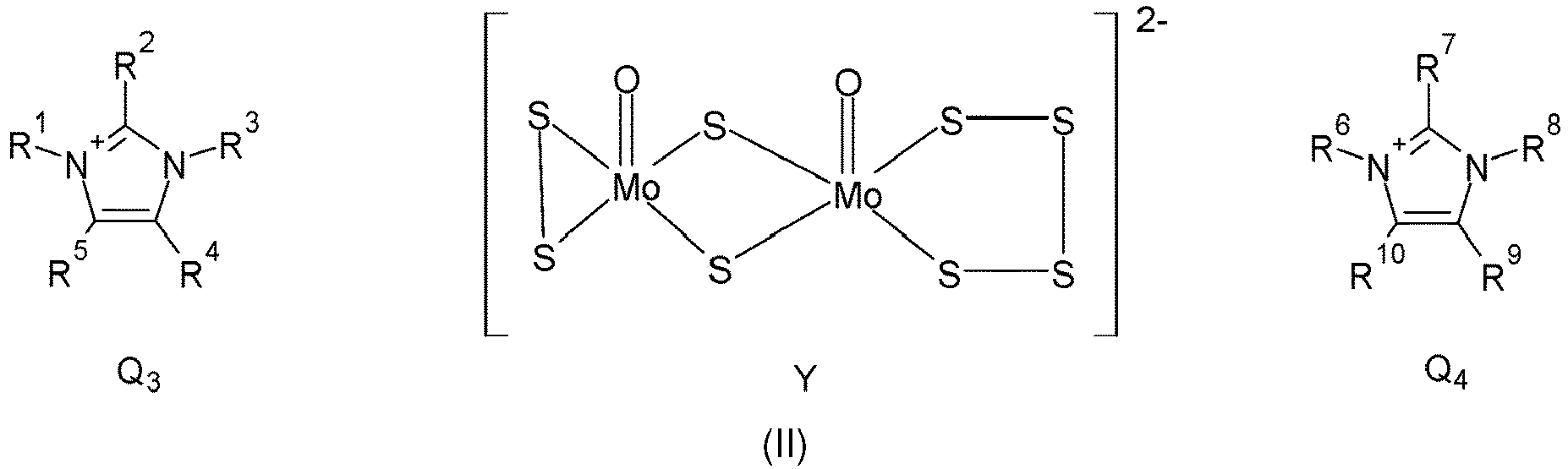
R1 to R5 and R6 to R10, which may be identical or different, are selected from the group consisting of H, and hydrocarbyl groups, in a manner such that the total number of carbon atoms of Q3 and Q4 is comprised between 62 and 166 ; - or the mixture thereof.
- Preferably, the oxothiomolybdate salt is a compound having the formula (I).
- Preferably, the oxothiomolybdate salt is a compound having the formula (II).
- In the context of the present invention, for the compounds having the formula (I) the term "hydrocarbyl" is understood to refer to hydrocarbon compounds, which may be linear, branched or cyclic, saturated or unsaturated, and comprising from 1 to 18 carbon atoms, for example from 2 to 16 carbon atoms.
- Q1 and Q2 may be identical to, or different from each other, the molar ratio between Q1 and Q2 may be comprised between 100:0 and 0:100.
- In the compound having the formula (I), preferably, the total number of carbon atoms is comprised between 42 and 110.
- Preferably, the Mo content is comprised between 8.0 and 13.5, and more preferably the Mo content is comprised between 8.0 and 12.6%.
- Preferably Q1 and Q2 are identical to each other and are selected from among tetra-n-octylammonium, hexadecyltrimethylammonium, tetradecyltrimethylammonium, octadecyltrimethylammonium, di(tetradecyl)dimethylammonium, di(hexadecyl)dimethylammonium, di(octadecyl)dimethylammonium, tri(tetradecyl)methylammonium, tri(hexadecyl)methylammonium, tri(octadecyl)methylammonium and di(hydrogenated tallowalkyl)dimethylammonium, preferably di(hydrogenated tallowalkyl)dimethylammonium.
- Preferably, the compound having the formula (I) is present in an amount that makes it possible to deliver from 10 to 1500 ppm, more preferentially from 280 to 1,400 ppm, for example from 280 to 840 ppm, or from 500 to 1,000 ppm, in particular from 500 to 900 ppm, for example 840 ppm of Mo in the finished product.
- The compounds having the formula (I) and the method of preparation thereof are described in particular in the patent document
US10,059,901 - Preferably, in the compounds having the formula (II), the total number of carbon atoms of Q3 and Q4 is comprised between 62 and 166, preferably from 62 to 142, more preferentially from 62 to 118, most preferably from 78 to 118.
- In the context of the present invention, for the compounds having the formula (II), the term "hydrocarbyls" is understood to refer to hydrocarbon compounds, which may be linear, branched or cyclic, saturated or unsaturated, and comprising from 0 (in this case it is an H) with 18 carbon atoms, preferably from 1 to 18 carbon atoms..
- Q3 and Q4 may be identical to, or different from each other, the molar ratio between Q3 and Q4 may be comprised between 100:0 and 0:100.
- In the compound having the formula (II), preferably, the total number of carbon atoms is comprised between 62 and 150.
- Preferably, the Mo content is comprised between 7.3 and 13.7%
- In one preferred embodiment, in the compound having the formula (II) the total number of total carbon atoms of Q3 and Q4 is comprised between 62 and 78 and the Mo content is comprised between 11.8 and 13.7%.
- Preferably Q3 and Q4 are identical to each other and are selected from among 1,3-di-tetradecylimidazolium, 1,3-dihexadecylimidazolium, and 1,3 dioctadecylimidazolium.
- Preferably, the compound having the formula (II) is present in an amount that makes it possible to deliver from 10 to 1500 ppm, preferably from 280 to 1,400 ppm, or from 500 to 1,000 ppm, in particular from 500 to 900 ppm, for example 840 ppm of Mo in the finished product.
- The compounds having the formula (II) and the method of preparation thereof are described in particular in the patent document
US 9,902,915 - The lubricating composition of the invention comprises from 0.008% to 1.875% by weight of the compound having the formula (I) or (II), preferably from 0.222% to 1.75% by weight, or from 0.040% to 1.25%, more preferentially from 0.667% to 1.05%.
- The base oil used in the lubricating compositions of the invention may be oils of mineral or synthetic origin belonging to the groups I to V according to the classes defined by the API (American Petroleum Institute) classification (or their equivalents according to the ATIEL (Association Technique de l'Industrie Européenne des Lubrifiants/Technical Association of the European Lubricants Industry) classification (Table 1) or the mixtures thereof.
Table 1 Content of Saturated Substances Sulfur Content Viscosity Index (VI) Group I Mineral Oils < 90% > 0.03% 80 ≤ VI <120 Group II Hydrocracked Oils ≥ 90% ≤ 0.03% 80 ≤ VI <120 Group III Hydro-Isomerised Oils ≥ 90% ≤ 0.03% ≥ 120 Group IV Polyalphaolefins (PAO) Group V Esters and other bases not included IV in the Groups I to - The mineral base oils of the invention include any type of base oil that is obtained by means of atmospheric distillation and vacuum distillation of crude oil, followed by refining operations such as solvent extraction, solvent deasphalting, solvent dewaxing, hydrotreating, hydrocracking, hydroisomerisation and hydrofinishing.
- Mixtures of synthetic and mineral oils may also be used.
- The base oils of the lubricating compositions according to the invention may also be selected from among synthetic oils, such as certain esters of carboxylic acids and alcohols, and polyalphaolefins. The polyalphaolefins used by way of base oil are for example obtained from monomers comprising from 4 to 32 carbon atoms, for example from octene or decene, and for which the viscosity at 100°C. is comprised between 1.5 and 15 mm2.s-1 according to the standard (from the international standards organization) ASTM D445. Their average molar mass is generally comprised between 250 and 3,000 according to the standard ASTM D5296.
- The lubricating composition according to the invention may comprise at least 50% by weight of base oil in relation to the total weight of the composition. In a more advantageous manner, the lubricating composition according to the invention comprises at least 60% by weight, or even at least 70% by weight, of base oils in relation to the total weight of the lubricating composition. More preferably, the lubricating composition according to the invention comprises from 75 to 97% by weight of base oils in relation to the total weight of the composition.
- The composition of the invention may also comprise at least one additive.
- A large number of additives may be used in the lubricating compositions according to the invention.
- The preferred additives for the lubricating composition according to the invention are selected from among detergent additives, friction modifying additives other than the molybdenum compounds defined here above, antioxidants, extreme pressure additives, dispersants, pour point enhancers, anti-foam agents, thickeners and the mixtures thereof.
- Preferably, the lubricating compositions according to the invention comprise at least one extreme pressure additive, or a mixture.
- The anti-wear additives and extreme pressure additives provide protection with respect to friction of surfaces by forming a protective film adsorbed on its surfaces.
- There exists a wide variety of anti-wear additives. Preferably, for the lubricating compositions of the invention, the anti-wear additives are selected from additives that comprise phosphorous and sulfur such as metal alkylthiophosphates, in particular zinc alkylthiophosphate, and more precisely zinc dialkyldithiophosphate or ZnDTP. The preferred compounds are those having the formula Zn((SP(S)(OR)(OR'))2, in which R and R', which may be identical to or different from each other, independently represent an alkyl group, preferably an alkyl group containing from 1 to 18 carbon atoms.
- Amine phosphates are also anti-wear additives which may be used in the lubricating compositions of the invention. However, the phosphorous atoms provided by these additives could have the effect of a poison for the catalytic systems of automobiles since they generate ash. It is possible to minimize these effects by substituting a portion of the amine phosphates with additives that do not provide phosphorous, such as for example polysulfides in particular olefins containing sulfur.
- Advantageously, the lubricating compositions according to the invention may comprise from 0.01 to 6% by weight, preferably from 0.05 to 4% by weight, more preferentially from 0.1 to 2% by weight in relation to the total weight of the lubricating composition, anti-wear additives and extreme pressure additives.
- Advantageously, the lubricating compositions according to the invention comprise from 0.01 to 6% by weight, preferably from 0.05 to 4% by weight, more preferentially from 0.1 to 2% by weight in relation to the total weight of the lubricating composition, anti-wear additives (or anti-wear compound).
- Advantageously, the compositions according to the invention may comprise at least one friction modifying additive that is different from the molybdenum compounds of the invention. The friction modifying additives may in particular be selected from the compounds that provide metal elements and ash-free compounds. Among the compounds providing metal elements, mention may be made of transition metal complexes such as Mo, Sb, Sn, Fe, Cu, Zn for which the ligands may be hydrocarbon compounds containing atoms of oxygen, nitrogen, sulfur or phosphorous. The ash-free friction modifying additives are generally organic in origin or may be selected from among fatty acid monoesters and polyol monoesters, alkoxylated amines, alkoxylated fatty amines, fatty epoxides, borates of fatty epoxides, fatty amines or glycerol acid esters. According to the invention, the fatty compounds that comprise at least one hydrocarbon group contain from 10 to 24 carbon atoms.
- Advantageously, the lubricating composition according to the invention may comprise from 0.01 to 2% by weight or from 0.01 to 5% by weight, preferably from 0.1 to 1.5% by weight, or from 0.1 to 2% by weight in relation to the total weight of the lubricating composition, friction-modifying additive other than the molybdenum compounds according to the invention.
- Advantageously, the lubricating composition according to the invention may comprise at least one antioxidant additive.
- The antioxidant additives generally serve to retard the degradation of the lubricating composition. This degradation is most often manifested in the formation of deposits, by the presence of sludge or by an increase in the viscosity of the lubricating composition.
- The antioxidant additives generally act as radical scavenger inhibitors or hydroperoxide destroyer inhibitors. Among the antioxidants commonly used, mention may be made of types of antioxidants such as phenolic antioxidants, amine antioxidants, and antioxidants containing sulfur and phosphorous. Certain of these antioxidants, for example those containing sulfur and phosphorous can generate ash. The phenolic antioxidant additives may be free of ash or indeed may be in the form of basic or neutral metal salts. The antioxidant additives may in particular be selected from among sterically hindered phenols, esters of sterically hindered phenols, sterically hindered phenols containing a thioether bridge, diphenylamines, diphenylamines substituted with at least one C1 to C12 alkyl group, N,N'-dialkyl-aryl-diamines and the mixtures thereof.
- Preferably according to the invention, the sterically hindered phenols are selected from compounds comprising a phenol group for which at least one of the carbon atoms in the vicinity of the carbon atom carrying the alcohol functional group is substituted by at least one C1 to C10 alkyl group, preferably one C1 to C6 alkyl group, preferably one C4 alkyl group, most preferably one tert-butyl group.
- Amine compounds are another class of antioxidant additives that may be used, optionally in combination with phenolic antioxidant additives. Examples of amine compounds are aromatic amines, for example aromatic amines having the formula NRaRbRc in which Ra represents an aliphatic group or an aromatic group, optionally substituted, Rb represents an aromatic group, optionally substituted, Rc represents a hydrogen atom, an alkyl group, an aryl group or a group having the formula RdS(O)zRe in which Rd represents an alkylene or alkenylene group, Re represents an alkyl group, an alkenyl group, or an aryl group, and z represents 0, 1 or 2.
- The alkyl phenols containing sulfur or the alkali or alkaline earth metal salts thereof may also be used as antioxidant additives.
- Other classes of antioxidant additives are compounds containing copper, for example copper thio-phosphate or copper dithio-phosphate, salts of copper and carboxylic acids, dithiocarbamates, sulfonates, phenates, copper acetylacetonates. salts of copper I and copper II, salts of succinic acid or succinic anhydride may also be used.
- The lubricating compositions according to the invention may also comprise any type of antioxidant known to the person skilled in the art.
- Advantageously, the lubricating composition comprises at least one antioxidant additive that is ash-free.
- Also advantageously the lubricating composition according to the invention comprises from 0.1 to 2% by weight in relation to the total weight of the composition, of at least one antioxidant additive.
- The lubricating composition according to the invention may also comprise at least one detergent additive.
- The detergent additives generally serve the purpose of reducing the formation of deposits of metal parts on the surface by dissolving the secondary products of oxidation and combustion.
- The detergent additives which may be used in the lubricating compositions according to the invention are generally known to the person skilled in the art. The detergent additives may be anionic compounds comprising a long lipophilic hydrocarbon chain and a hydrophobic head. The associated cation can be a metal cation of an alkali or alkaline earth metal.
- The detergent additives are preferably selected from among alkali or alkaline earth metal salts of carboxylic acid, sulfonates, salicylates, naphthenates, as well as salts of phenates. The alkali and alkaline earth metals are preferably calcium, magnesium, sodium or barium.
- These metal salts generally contain the metal in a stoichiometric amount or in an excess amount, that is to say, in a content level greater than the stoichiometric content. These are then overbased detergents the excess of metal implying the overbased nature of the detergent additive is generally in the form of a metal salt that is insoluble in oil, for example carbonate, hydroxide, oxalate, acetate, glutamate, preferably carbonate.
- Advantageously, the lubricating composition according to the invention may comprise from 0.5 to 8% or from 2 to 4% by weight of overbased detergent additives in relation to the total weight of the lubricating composition.
- Also in an advantageous manner, the lubricating composition according to the invention may also comprise an additive for reducing the pour point temperature - i.e.pour point depressant additive.
- By slowing down the formation of paraffin crystals, the pour point depressant additive generally improves the cold behavior of the lubricating composition according to the invention.
- By way of an example of a pour point depressant additive, mention may be made of alkyl polymethacrylates, polyacrylates, polyarylamides, polyalkylphenols, polyalkylnaphthalene, and alkyl polystyrenes.
- Advantageously, the lubricating composition according to the invention may also comprise a dispersing agent.
- The dispersing agents may be selected from Mannich bases, succinimides and the derivatives thereof.
- Also in an advantageous manner, the lubricating composition according to the invention may comprise from 0.2 to 10% by weight of dispersing agent in relation to the total weight of the lubricating composition.
- Advantageously, the lubricating composition according to the invention may also comprise at least one additional polymer that improves the viscosity index. By way of an example of an additional polymer that improves the viscosity index, mention may be made of polymeric esters, homopolymers or copolymers, either hydrogenated or not, of styrene, butadiene, and isoprene; and polymethacrylates (PMA). Also, advantageously, the lubricating composition according to the invention may comprise from 1 to 15% by weight in relation to the total weight of the lubricating composition, of the additive that improves the viscosity index.
- The lubricating composition according to the invention may also comprise at least one thickening agent.
- The lubricating composition according to the invention may also comprise an anti-foaming agent and a demulsifying agent.
- Preferably, the lubricating composition of the invention additionally also comprises at least one anti-wear agent, in particular a Zinc-based agent, in particular ZnDTP.
- The present invention also relates to the use of the lubricating composition according to the invention in order to reduce the friction of the mechanical parts of an internal combustion engine, at least one of the parts comprising an amorphous carbon type coating, preferably hydrogenated amorphous carbon.
- The present invention also relates to a method for reducing the wear and tear on mechanical parts in an internal combustion engine, the method comprising at least one contacting step of bringing the mechanical parts in contact with a lubricating composition according to the invention, at least one of the mechanical parts comprising an amorphous carbon type coating, preferably a hydrogenated amorphous carbon coating.
- Preferably, the mechanical parts are mechanical parts of an engine, in particular of a motor vehicle engine, for example a 2-stroke engine or a 4-stroke engine.
- The invention will now be described with the aid of the non-limiting examples give here below.
- The lubricating compositions according to Table 2 here below were prepared.
Table 2 Lubricating Composition Formulated base oil of grade 0W-08 (% by weight) Molybdenum Trimer (% by weight) MoDTC (% by weight) Oxo Thiomolybdate dimethyl dihydrogenat ed tallow ammonium (% by weight) Mo ester (% by weight) ZnDTP (% by weight) CC1 98.7 0.5 0.8 CC2 98.7 0.5 0.8 CL1 98.7 0.5 0.8 CL2 98.2 1.0 0.8 CC3 98.2 1.0 0.8 CL3 99.5 0.5 CC4 99.5 0.5 CC5 99.5 0.5 CC6 99.5 0.5 - An HFRR tribological test was carried out for each of the lubricating compositions described in Table 2.
- The HFRR (abbreviation for High Frequency Reciprocating Rig, or alternatively ball/plate tribometer) test is carried out on the PCS Instruments HFRR. The test consists of a sliding back and forth movement between a ball measuring 6 mm in diameter and a flat (plate) section with a maximum pressure of 1.4 GPa. The ball is a steel ball covered with a DLC layer and the flat section is made of steel.
- The conditions of the test are as follows :
- Load (N): 10
- Maximum Hertzian stress (GPa): 1.4
- Stroke length (mm): 1
- Frequency (Hz): 10
- Cycles : 144000
- Quantity of Oil (ml): 2
- Temperature (°C): 80.
- The results of these tests are given in Table 3 here below.
Lubricatin 9 Compositi on Observations Measurement of depth of wear of the DLC-coated ball CC1 Steel almost visible (almost worn out layer) 212 µm CC2 No major wear and low friction 175 µm CL1 No major wear and low friction 139 µm CL2 No major wear and low friction 185 µm CC3 Heavy wear and punctured layer, friction increases 258 µm CL3 (start of wear on layer) and unstable friction high/low 244 µm CC4 Steel visible (worn out layer) and friction that increases to 0.1 250 µm CC5 Steel visible, layer punctured and no low friction 206 µm CC6 Steel visible, layer punctured and friction that rises 263 µm - The results show that the lubricating compositions of the invention (CL3) make it possible to effectively reduce the wear and tear on the parts comprising a DLC surface in comparison to the conventional anti-friction additives (CC4, CC5 and CC6).
- The results also show that the addition of ZnDTP to the lubricating compositions of the invention (CL1 and CL2), in combination with the oxothiomolybdate salts, makes it possible to improve the properties which serve to reduce the wear and tear of parts that comprise a DLC surface, as compared to the compositions having no ZnDTP (CL3) and as compared to conventional anti-friction additives (CC1, CC2 and CC3).
Claims (10)
- A method for reducing wear and tear on mechanical parts that are in contact with each other in an internal combustion engine by using a lubricating composition comprising:- At least one base oil;- At least one oxothiomolybdate salt; and- At least one anti-wear compound;wherein at least one of the said parts includes a surface that comprises an amorphous carbon type coating.
- The said method according to claim 1, in which the oxothiomolybdate salt is an ammonium salt or an imidazolium salt, or a mixture thereof.
- The said method according to claim 2, in which the ammonium oxothiomolybdate salt is a compound having the formula (I)

R1 to R4 and R5 to R8, which may be identical or different, are selected from the group consisting of hydrocarbyl groups, in a manner such that the total number of carbon atoms of Q1 and Q2 is comprised between 42 and 110. - The said method according to claim 2, in which the imidazolium oxothiomolybdate salt is a compound having the formula (II)

R1 to R5 and R6 to R10, which may be identical or different, are selected from the group consisting of H, and hydrocarbyl groups, in a manner such that the total number of carbon atoms of Q3 and Q4 is comprised between 62 and 166. - The said method according to claim 3, in which Q1 and Q2 are identical to each other and are selected from among tetra-n-octylammonium, hexadecyltrimethylammonium, tetradecyltrimethylammonium, octadecyltrimethylammonium, di(tetradecyl)dimethylammonium, di(hexadecyl)dimethylammonium, di(octadecyl)dimethylammonium, tri(tetradecyl)methylammonium, tri(hexadecyl)methylammonium, tri(octadecyl)methylammonium) and di(hydrogenated tallowalkyl)dimethylammonium, preferably preferably di(hydrogenated tallowalkyl)dimethylammonium.
- The said method according to claim 4, in which Q3 and Q4 are identical to each other and are selected from 1,3-di-tetradecylimidazolium, 1,3-dihexadecylimidazolium, and 1,3-dioctadecylimidazolium,
- The said method according to any one of claims 1 to 6, in which the lubricating composition comprises from 0.008% to 1.875% by weight of oxothiomolybdate salt.
- The said method according to any of claims 1 to 7, wherein the anti-wear compound is ZnDTP.
- A method for reducing the wear and tear on mechanical parts, in an internal combustion engine, the method comprising at least one contacting step of bringing the mechanical parts in contact with a lubricating composition as described according to any one of claims 1 to 8, at least one of the mechanical parts comprising an amorphous carbon type coating.
- The use of oxothiomolybdate salt in a lubricating composition in order to reduce the wear and tear on parts that are in contact with each other, in an internal combustion engine, at least one of the said parts including a surface that comprises an amorphous carbon type coating.
Priority Applications (7)
| Application Number | Priority Date | Filing Date | Title |
|---|---|---|---|
| EP20305428.3A EP3907268A1 (en) | 2020-05-04 | 2020-05-04 | Lubricating composition for reducing wear and tear on dlc parts used in internal combustion engines |
| CN202180033404.9A CN115551974A (en) | 2020-05-04 | 2021-05-04 | Lubricating composition for reducing wear of DLC components used in internal combustion engines |
| US17/923,023 US12152217B2 (en) | 2020-05-04 | 2021-05-04 | Lubricating composition for reducing wear and tear on dlc parts used in internal combustion engines |
| JP2022567030A JP2023524726A (en) | 2020-05-04 | 2021-05-04 | Lubricating composition for reducing wear and tear on DLC components used within internal combustion engines |
| PCT/EP2021/061692 WO2021224237A1 (en) | 2020-05-04 | 2021-05-04 | Lubricating composition for reducing wear and tear on dlc parts used in internal combustion engines |
| KR1020227042455A KR20230005366A (en) | 2020-05-04 | 2021-05-04 | Lubricating composition for reducing wear of DLC parts used in internal combustion engines |
| EP21722488.0A EP4146775B1 (en) | 2020-05-04 | 2021-05-04 | Lubricating composition for reducing wear and tear on dlc parts used in internal combustion engines |
Applications Claiming Priority (1)
| Application Number | Priority Date | Filing Date | Title |
|---|---|---|---|
| EP20305428.3A EP3907268A1 (en) | 2020-05-04 | 2020-05-04 | Lubricating composition for reducing wear and tear on dlc parts used in internal combustion engines |
Publications (1)
| Publication Number | Publication Date |
|---|---|
| EP3907268A1 true EP3907268A1 (en) | 2021-11-10 |
Family
ID=70802819
Family Applications (2)
| Application Number | Title | Priority Date | Filing Date |
|---|---|---|---|
| EP20305428.3A Withdrawn EP3907268A1 (en) | 2020-05-04 | 2020-05-04 | Lubricating composition for reducing wear and tear on dlc parts used in internal combustion engines |
| EP21722488.0A Active EP4146775B1 (en) | 2020-05-04 | 2021-05-04 | Lubricating composition for reducing wear and tear on dlc parts used in internal combustion engines |
Family Applications After (1)
| Application Number | Title | Priority Date | Filing Date |
|---|---|---|---|
| EP21722488.0A Active EP4146775B1 (en) | 2020-05-04 | 2021-05-04 | Lubricating composition for reducing wear and tear on dlc parts used in internal combustion engines |
Country Status (6)
| Country | Link |
|---|---|
| US (1) | US12152217B2 (en) |
| EP (2) | EP3907268A1 (en) |
| JP (1) | JP2023524726A (en) |
| KR (1) | KR20230005366A (en) |
| CN (1) | CN115551974A (en) |
| WO (1) | WO2021224237A1 (en) |
Citations (7)
| Publication number | Priority date | Publication date | Assignee | Title |
|---|---|---|---|---|
| JPS5925890B2 (en) | 1980-12-19 | 1984-06-22 | イエアン・ヴアルテルシヤイト・ゲゼルシヤフト・ミツト・ベシユレンクテル・ハフツング | On the other hand, Clutch |
| JP2000273481A (en) | 1999-03-23 | 2000-10-03 | New Japan Chem Co Ltd | Lubricating oil composition |
| EP1462508A1 (en) * | 2003-03-26 | 2004-09-29 | Infineum International Limited | Use of an organomolybdenum compound containing composition for the lubrication of diamond-like carbon coated surfaces |
| US20170240838A1 (en) * | 2016-02-23 | 2017-08-24 | Vanderbilt Chemicals, Llc | Quaternary ammonium sulfur-containing binuclear molybdate salts as lubricant additives |
| US20170240837A1 (en) * | 2016-02-23 | 2017-08-24 | Vanderbilt Chemicals, Llc | Imidazolium sulfur-containing binuclear molybdate salts as lubricant additives |
| WO2017149119A1 (en) * | 2016-03-03 | 2017-09-08 | Total Marketing Services | Lubricant composition based on neutralized amines and molybdenum |
| US20190390131A1 (en) * | 2017-02-01 | 2019-12-26 | Exxonmobil Research And Engineering Company | Lubricant composition |
Family Cites Families (6)
| Publication number | Priority date | Publication date | Assignee | Title |
|---|---|---|---|---|
| ATE440932T1 (en) * | 2003-03-26 | 2009-09-15 | Infineum Int Ltd | USE OF A COMPOSITION CONTAINING ORGANOMOLYBDENUM COMPOUND FOR THE LUBRICATION OF DIAMOND-LIKE CARBON LAYERS |
| JP2011252073A (en) * | 2010-06-01 | 2011-12-15 | Idemitsu Kosan Co Ltd | Lubricant composition for low-friction slide material, and sliding mechanism using the same |
| WO2012073717A1 (en) * | 2010-11-30 | 2012-06-07 | 本田技研工業株式会社 | Sliding structural members |
| JP2013087197A (en) * | 2011-10-18 | 2013-05-13 | Idemitsu Kosan Co Ltd | Sliding mechanism |
| FR2983867B1 (en) * | 2011-12-09 | 2014-08-22 | Total Raffinage Marketing | ENGINE LUBRICANT FOR HYBRID OR MICRO-HYBRID MOTOR VEHICLES |
| US10767134B1 (en) * | 2019-05-17 | 2020-09-08 | Vanderbilt Chemicals, Llc | Less corrosive organomolybdenum compounds as lubricant additives |
-
2020
- 2020-05-04 EP EP20305428.3A patent/EP3907268A1/en not_active Withdrawn
-
2021
- 2021-05-04 EP EP21722488.0A patent/EP4146775B1/en active Active
- 2021-05-04 WO PCT/EP2021/061692 patent/WO2021224237A1/en not_active Ceased
- 2021-05-04 JP JP2022567030A patent/JP2023524726A/en active Pending
- 2021-05-04 KR KR1020227042455A patent/KR20230005366A/en active Pending
- 2021-05-04 US US17/923,023 patent/US12152217B2/en active Active
- 2021-05-04 CN CN202180033404.9A patent/CN115551974A/en active Pending
Patent Citations (9)
| Publication number | Priority date | Publication date | Assignee | Title |
|---|---|---|---|---|
| JPS5925890B2 (en) | 1980-12-19 | 1984-06-22 | イエアン・ヴアルテルシヤイト・ゲゼルシヤフト・ミツト・ベシユレンクテル・ハフツング | On the other hand, Clutch |
| JP2000273481A (en) | 1999-03-23 | 2000-10-03 | New Japan Chem Co Ltd | Lubricating oil composition |
| EP1462508A1 (en) * | 2003-03-26 | 2004-09-29 | Infineum International Limited | Use of an organomolybdenum compound containing composition for the lubrication of diamond-like carbon coated surfaces |
| US20170240838A1 (en) * | 2016-02-23 | 2017-08-24 | Vanderbilt Chemicals, Llc | Quaternary ammonium sulfur-containing binuclear molybdate salts as lubricant additives |
| US20170240837A1 (en) * | 2016-02-23 | 2017-08-24 | Vanderbilt Chemicals, Llc | Imidazolium sulfur-containing binuclear molybdate salts as lubricant additives |
| US9902915B2 (en) | 2016-02-23 | 2018-02-27 | Vanderbilt Chemicals, Llc | Imidazolium sulfur-containing binuclear molybdate salts as lubricant additives |
| US10059901B2 (en) | 2016-02-23 | 2018-08-28 | Vanderbilt Chemicals, Llc | Quaternary ammonium sulfur-containing binuclear molybdate salts as lubricant additives |
| WO2017149119A1 (en) * | 2016-03-03 | 2017-09-08 | Total Marketing Services | Lubricant composition based on neutralized amines and molybdenum |
| US20190390131A1 (en) * | 2017-02-01 | 2019-12-26 | Exxonmobil Research And Engineering Company | Lubricant composition |
Also Published As
| Publication number | Publication date |
|---|---|
| US20230272298A1 (en) | 2023-08-31 |
| KR20230005366A (en) | 2023-01-09 |
| US12152217B2 (en) | 2024-11-26 |
| CN115551974A (en) | 2022-12-30 |
| EP4146775A1 (en) | 2023-03-15 |
| JP2023524726A (en) | 2023-06-13 |
| WO2021224237A1 (en) | 2021-11-11 |
| EP4146775B1 (en) | 2024-07-10 |
Similar Documents
| Publication | Publication Date | Title |
|---|---|---|
| EP1996683B1 (en) | Nitrogen-containing dispersant as an ashless tbn booster for lubricants | |
| US20240400929A1 (en) | Lubricating composition for preventing or reducing abnormal combustion in an engine | |
| US10982169B2 (en) | Polyalkylene glycol-based lubricant composition | |
| WO2011077811A1 (en) | System lubricant oil composition for crosshead-type diesel engine | |
| EP2348093A1 (en) | Lubricant oil composition in contact with a silver-containing material | |
| EP4263767B1 (en) | Use of an alcohol ethoxylated phosphate ester compound in a lubricating composition to prevent corrosion and/ or tribocorrosion of metallic parts in an engine | |
| US11697785B2 (en) | Lubricant composition for a gas engine | |
| KR20150142670A (en) | Lubricating composition based on aminated compounds | |
| JP5414513B2 (en) | System lubricant composition for crosshead type diesel engine | |
| EP3645688B1 (en) | Lubricating oil composition | |
| EP4146775B1 (en) | Lubricating composition for reducing wear and tear on dlc parts used in internal combustion engines | |
| KR102336568B1 (en) | Polyalkylene glycol-based lubricating composition | |
| JP2023534529A (en) | Lubricating oil composition for automotive transmission with improved anti-corrosion properties | |
| KR20250112239A (en) | Lubricating composition for automobile drive train | |
| US11499115B2 (en) | Lubricant composition | |
| US20220145205A1 (en) | Use of a lubricant composition for transmission | |
| US20190300809A1 (en) | Lubricating composition comprising glycerol monoethers | |
| CN103173262A (en) | Marine engine lubrication | |
| EP4559995A1 (en) | Amine compounds as antiwear agents | |
| US20130165357A1 (en) | Lubricant compositions for SI-AL alloy surfaces and methods for using | |
| KR20250129223A (en) | Composition of Engine oil | |
| KR20240031711A (en) | Composition of Engine oil | |
| KR20250112242A (en) | Lubricating composition for automobile transmission | |
| WO2025109156A1 (en) | Use of glycerol ester as antiwear agent | |
| US20230303945A1 (en) | Lubricant composition for oxidation-stable automotive transmission |
Legal Events
| Date | Code | Title | Description |
|---|---|---|---|
| PUAI | Public reference made under article 153(3) epc to a published international application that has entered the european phase |
Free format text: ORIGINAL CODE: 0009012 |
|
| STAA | Information on the status of an ep patent application or granted ep patent |
Free format text: STATUS: THE APPLICATION HAS BEEN PUBLISHED |
|
| AK | Designated contracting states |
Kind code of ref document: A1 Designated state(s): AL AT BE BG CH CY CZ DE DK EE ES FI FR GB GR HR HU IE IS IT LI LT LU LV MC MK MT NL NO PL PT RO RS SE SI SK SM TR |
|
| B565 | Issuance of search results under rule 164(2) epc |
Effective date: 20201106 |
|
| STAA | Information on the status of an ep patent application or granted ep patent |
Free format text: STATUS: THE APPLICATION IS DEEMED TO BE WITHDRAWN |
|
| 18D | Application deemed to be withdrawn |
Effective date: 20220511 |