EP3907227A1 - Trilobine derivatives and their use thereof in the treatment of malaria - Google Patents
Trilobine derivatives and their use thereof in the treatment of malaria Download PDFInfo
- Publication number
- EP3907227A1 EP3907227A1 EP20305456.4A EP20305456A EP3907227A1 EP 3907227 A1 EP3907227 A1 EP 3907227A1 EP 20305456 A EP20305456 A EP 20305456A EP 3907227 A1 EP3907227 A1 EP 3907227A1
- Authority
- EP
- European Patent Office
- Prior art keywords
- alkyl
- membered
- group selected
- optionally substituted
- methyl
- Prior art date
- Legal status (The legal status is an assumption and is not a legal conclusion. Google has not performed a legal analysis and makes no representation as to the accuracy of the status listed.)
- Withdrawn
Links
- 201000004792 malaria Diseases 0.000 title claims abstract description 44
- XZAXGQMTBGFTFE-SVBPBHIXSA-N Trilobine Chemical class C([C@@H]1NCC2)C(C=C3)=CC=C3OC(=C3)C(OC)=CC=C3C[C@@H](C3=C4)N(C)CCC3=CC3=C4OC4=C1C2=CC(OC)=C4O3 XZAXGQMTBGFTFE-SVBPBHIXSA-N 0.000 title abstract description 19
- 239000003814 drug Substances 0.000 claims abstract description 22
- 229940079593 drug Drugs 0.000 claims abstract description 21
- 125000000008 (C1-C10) alkyl group Chemical group 0.000 claims description 123
- 125000002496 methyl group Chemical group [H]C([H])([H])* 0.000 claims description 111
- 125000004169 (C1-C6) alkyl group Chemical group 0.000 claims description 75
- 229910052736 halogen Inorganic materials 0.000 claims description 65
- 150000002367 halogens Chemical class 0.000 claims description 65
- 150000001875 compounds Chemical class 0.000 claims description 64
- 244000045947 parasite Species 0.000 claims description 32
- 239000012634 fragment Substances 0.000 claims description 27
- 229910052705 radium Inorganic materials 0.000 claims description 26
- 229910052701 rubidium Inorganic materials 0.000 claims description 26
- WHTVZRBIWZFKQO-AWEZNQCLSA-N (S)-chloroquine Chemical compound ClC1=CC=C2C(N[C@@H](C)CCCN(CC)CC)=CC=NC2=C1 WHTVZRBIWZFKQO-AWEZNQCLSA-N 0.000 claims description 24
- 229960003677 chloroquine Drugs 0.000 claims description 24
- WHTVZRBIWZFKQO-UHFFFAOYSA-N chloroquine Natural products ClC1=CC=C2C(NC(C)CCCN(CC)CC)=CC=NC2=C1 WHTVZRBIWZFKQO-UHFFFAOYSA-N 0.000 claims description 24
- -1 (C1-C10)-alkyl-R4 Chemical group 0.000 claims description 21
- WKSAUQYGYAYLPV-UHFFFAOYSA-N pyrimethamine Chemical compound CCC1=NC(N)=NC(N)=C1C1=CC=C(Cl)C=C1 WKSAUQYGYAYLPV-UHFFFAOYSA-N 0.000 claims description 21
- 125000006652 (C3-C12) cycloalkyl group Chemical group 0.000 claims description 20
- 125000006374 C2-C10 alkenyl group Chemical group 0.000 claims description 20
- 125000004043 oxo group Chemical group O=* 0.000 claims description 19
- 229960000611 pyrimethamine Drugs 0.000 claims description 19
- 125000000172 C5-C10 aryl group Chemical group 0.000 claims description 18
- 229910003827 NRaRb Inorganic materials 0.000 claims description 17
- 125000004076 pyridyl group Chemical group 0.000 claims description 15
- BLUAFEHZUWYNDE-NNWCWBAJSA-N artemisinin Chemical compound C([C@](OO1)(C)O2)C[C@H]3[C@H](C)CC[C@@H]4[C@@]31[C@@H]2OC(=O)[C@@H]4C BLUAFEHZUWYNDE-NNWCWBAJSA-N 0.000 claims description 14
- 229930101531 artemisinin Natural products 0.000 claims description 14
- 239000000203 mixture Substances 0.000 claims description 14
- 125000004193 piperazinyl group Chemical group 0.000 claims description 14
- 229960004191 artemisinin Drugs 0.000 claims description 13
- 125000001797 benzyl group Chemical group [H]C1=C([H])C([H])=C(C([H])=C1[H])C([H])([H])* 0.000 claims description 13
- 229910052739 hydrogen Inorganic materials 0.000 claims description 13
- 150000003839 salts Chemical class 0.000 claims description 13
- 125000001495 ethyl group Chemical group [H]C([H])([H])C([H])([H])* 0.000 claims description 11
- 229960001962 mefloquine Drugs 0.000 claims description 10
- XEEQGYMUWCZPDN-DOMZBBRYSA-N (-)-(11S,2'R)-erythro-mefloquine Chemical compound C([C@@H]1[C@@H](O)C=2C3=CC=CC(=C3N=C(C=2)C(F)(F)F)C(F)(F)F)CCCN1 XEEQGYMUWCZPDN-DOMZBBRYSA-N 0.000 claims description 9
- 239000008194 pharmaceutical composition Substances 0.000 claims description 9
- 125000000719 pyrrolidinyl group Chemical group 0.000 claims description 8
- 239000012453 solvate Substances 0.000 claims description 8
- 241000223960 Plasmodium falciparum Species 0.000 claims description 7
- 125000003725 azepanyl group Chemical group 0.000 claims description 6
- 239000003430 antimalarial agent Substances 0.000 claims description 5
- 125000001997 phenyl group Chemical group [H]C1=C([H])C([H])=C(*)C([H])=C1[H] 0.000 claims description 5
- UCRHFBCYFMIWHC-UHFFFAOYSA-N piperaquine Chemical compound ClC1=CC=C2C(N3CCN(CC3)CCCN3CCN(CC3)C=3C4=CC=C(C=C4N=CC=3)Cl)=CC=NC2=C1 UCRHFBCYFMIWHC-UHFFFAOYSA-N 0.000 claims description 5
- 229950006717 piperaquine Drugs 0.000 claims description 5
- JYEUMXHLPRZUAT-UHFFFAOYSA-N 1,2,3-triazine Chemical compound C1=CN=NN=C1 JYEUMXHLPRZUAT-UHFFFAOYSA-N 0.000 claims description 4
- 241000224016 Plasmodium Species 0.000 claims description 4
- LOUPRKONTZGTKE-WZBLMQSHSA-N Quinine Chemical compound C([C@H]([C@H](C1)C=C)C2)C[N@@]1[C@@H]2[C@H](O)C1=CC=NC2=CC=C(OC)C=C21 LOUPRKONTZGTKE-WZBLMQSHSA-N 0.000 claims description 4
- FIHJKUPKCHIPAT-AHIGJZGOSA-N artesunate Chemical compound C([C@](OO1)(C)O2)C[C@H]3[C@H](C)CC[C@@H]4[C@@]31[C@@H]2O[C@@H](OC(=O)CCC(O)=O)[C@@H]4C FIHJKUPKCHIPAT-AHIGJZGOSA-N 0.000 claims description 4
- 229960004991 artesunate Drugs 0.000 claims description 4
- LOUPRKONTZGTKE-UHFFFAOYSA-N cinchonine Natural products C1C(C(C2)C=C)CCN2C1C(O)C1=CC=NC2=CC=C(OC)C=C21 LOUPRKONTZGTKE-UHFFFAOYSA-N 0.000 claims description 4
- QMNFFXRFOJIOKZ-UHFFFAOYSA-N cycloguanil Chemical compound CC1(C)N=C(N)N=C(N)N1C1=CC=C(Cl)C=C1 QMNFFXRFOJIOKZ-UHFFFAOYSA-N 0.000 claims description 4
- LNEPOXFFQSENCJ-UHFFFAOYSA-N haloperidol Chemical compound C1CC(O)(C=2C=CC(Cl)=CC=2)CCN1CCCC(=O)C1=CC=C(F)C=C1 LNEPOXFFQSENCJ-UHFFFAOYSA-N 0.000 claims description 4
- 208000015181 infectious disease Diseases 0.000 claims description 4
- LOUPRKONTZGTKE-LHHVKLHASA-N quinidine Chemical compound C([C@H]([C@H](C1)C=C)C2)C[N@@]1[C@H]2[C@@H](O)C1=CC=NC2=CC=C(OC)C=C21 LOUPRKONTZGTKE-LHHVKLHASA-N 0.000 claims description 4
- 241000223801 Plasmodium knowlesi Species 0.000 claims description 3
- 241000223821 Plasmodium malariae Species 0.000 claims description 3
- 241001505293 Plasmodium ovale Species 0.000 claims description 3
- 241000223810 Plasmodium vivax Species 0.000 claims description 3
- WVTKBKWTSCPRNU-KYJUHHDHSA-N (+)-Tetrandrine Chemical compound C([C@H]1C=2C=C(C(=CC=2CCN1C)OC)O1)C(C=C2)=CC=C2OC(=C2)C(OC)=CC=C2C[C@@H]2N(C)CCC3=CC(OC)=C(OC)C1=C23 WVTKBKWTSCPRNU-KYJUHHDHSA-N 0.000 claims description 2
- SGKRLCUYIXIAHR-AKNGSSGZSA-N (4s,4ar,5s,5ar,6r,12ar)-4-(dimethylamino)-1,5,10,11,12a-pentahydroxy-6-methyl-3,12-dioxo-4a,5,5a,6-tetrahydro-4h-tetracene-2-carboxamide Chemical compound C1=CC=C2[C@H](C)[C@@H]([C@H](O)[C@@H]3[C@](C(O)=C(C(N)=O)C(=O)[C@H]3N(C)C)(O)C3=O)C3=C(O)C2=C1O SGKRLCUYIXIAHR-AKNGSSGZSA-N 0.000 claims description 2
- MDLAAYDRRZXJIF-UHFFFAOYSA-N 1-[4,4-bis(4-fluorophenyl)butyl]-4-[4-chloro-3-(trifluoromethyl)phenyl]-4-piperidinol Chemical compound C1CC(O)(C=2C=C(C(Cl)=CC=2)C(F)(F)F)CCN1CCCC(C=1C=CC(F)=CC=1)C1=CC=C(F)C=C1 MDLAAYDRRZXJIF-UHFFFAOYSA-N 0.000 claims description 2
- ZAVJTSLIGAGALR-UHFFFAOYSA-N 2-(2,2,2-trifluoroacetyl)cyclooctan-1-one Chemical compound FC(F)(F)C(=O)C1CCCCCCC1=O ZAVJTSLIGAGALR-UHFFFAOYSA-N 0.000 claims description 2
- AEUAEICGCMSYCQ-UHFFFAOYSA-N 4-n-(7-chloroquinolin-1-ium-4-yl)-1-n,1-n-diethylpentane-1,4-diamine;dihydrogen phosphate Chemical compound OP(O)(O)=O.ClC1=CC=C2C(NC(C)CCCN(CC)CC)=CC=NC2=C1 AEUAEICGCMSYCQ-UHFFFAOYSA-N 0.000 claims description 2
- WREVVZMUNPAPOV-UHFFFAOYSA-N 8-aminoquinoline Chemical compound C1=CN=C2C(N)=CC=CC2=C1 WREVVZMUNPAPOV-UHFFFAOYSA-N 0.000 claims description 2
- OVCDSSHSILBFBN-UHFFFAOYSA-N Amodiaquine Chemical compound C1=C(O)C(CN(CC)CC)=CC(NC=2C3=CC=C(Cl)C=C3N=CC=2)=C1 OVCDSSHSILBFBN-UHFFFAOYSA-N 0.000 claims description 2
- XNCOSPRUTUOJCJ-UHFFFAOYSA-N Biguanide Chemical compound NC(N)=NC(N)=N XNCOSPRUTUOJCJ-UHFFFAOYSA-N 0.000 claims description 2
- 229940123208 Biguanide Drugs 0.000 claims description 2
- 235000001258 Cinchona calisaya Nutrition 0.000 claims description 2
- MQJKPEGWNLWLTK-UHFFFAOYSA-N Dapsone Chemical compound C1=CC(N)=CC=C1S(=O)(=O)C1=CC=C(N)C=C1 MQJKPEGWNLWLTK-UHFFFAOYSA-N 0.000 claims description 2
- HCYAFALTSJYZDH-UHFFFAOYSA-N Desimpramine Chemical compound C1CC2=CC=CC=C2N(CCCNC)C2=CC=CC=C21 HCYAFALTSJYZDH-UHFFFAOYSA-N 0.000 claims description 2
- FOHHNHSLJDZUGQ-VWLOTQADSA-N Halofantrine Chemical compound FC(F)(F)C1=CC=C2C([C@@H](O)CCN(CCCC)CCCC)=CC3=C(Cl)C=C(Cl)C=C3C2=C1 FOHHNHSLJDZUGQ-VWLOTQADSA-N 0.000 claims description 2
- LBHLFPGPEGDCJG-UHFFFAOYSA-N N(4)-{2,6-dimethoxy-4-methyl-5-[3-(trifluoromethyl)phenoxy]quinolin-8-yl}pentane-1,4-diamine Chemical compound COC=1C=C(NC(C)CCCN)C2=NC(OC)=CC(C)=C2C=1OC1=CC=CC(C(F)(F)F)=C1 LBHLFPGPEGDCJG-UHFFFAOYSA-N 0.000 claims description 2
- 206010035501 Plasmodium malariae infection Diseases 0.000 claims description 2
- 206010035502 Plasmodium ovale infection Diseases 0.000 claims description 2
- PJSFRIWCGOHTNF-UHFFFAOYSA-N Sulphormetoxin Chemical compound COC1=NC=NC(NS(=O)(=O)C=2C=CC(N)=CC=2)=C1OC PJSFRIWCGOHTNF-UHFFFAOYSA-N 0.000 claims description 2
- 239000004098 Tetracycline Substances 0.000 claims description 2
- 229960001444 amodiaquine Drugs 0.000 claims description 2
- UVNHKOOJXSALHN-ILQPJIFQSA-N artelinic acid Chemical compound O([C@@H]1[C@H](C)[C@@H]2CC[C@H]([C@@H]3CC[C@]4(C)O[C@H]([C@]23OO4)O1)C)CC1=CC=C(C(O)=O)C=C1 UVNHKOOJXSALHN-ILQPJIFQSA-N 0.000 claims description 2
- 229960000981 artemether Drugs 0.000 claims description 2
- NLYNIRQVMRLPIQ-XQLAAWPRSA-N artemotil Chemical compound C1C[C@H]2[C@H](C)CC[C@H]3[C@@H](C)[C@@H](OCC)O[C@H]4[C@]32OO[C@@]1(C)O4 NLYNIRQVMRLPIQ-XQLAAWPRSA-N 0.000 claims description 2
- 229960002970 artemotil Drugs 0.000 claims description 2
- KUCQYCKVKVOKAY-CTYIDZIISA-N atovaquone Chemical compound C1([C@H]2CC[C@@H](CC2)C2=C(C(C3=CC=CC=C3C2=O)=O)O)=CC=C(Cl)C=C1 KUCQYCKVKVOKAY-CTYIDZIISA-N 0.000 claims description 2
- 229960003159 atovaquone Drugs 0.000 claims description 2
- MQTOSJVFKKJCRP-BICOPXKESA-N azithromycin Chemical compound O([C@@H]1[C@@H](C)C(=O)O[C@@H]([C@@]([C@H](O)[C@@H](C)N(C)C[C@H](C)C[C@@](C)(O)[C@H](O[C@H]2[C@@H]([C@H](C[C@@H](C)O2)N(C)C)O)[C@H]1C)(C)O)CC)[C@H]1C[C@@](C)(OC)[C@@H](O)[C@H](C)O1 MQTOSJVFKKJCRP-BICOPXKESA-N 0.000 claims description 2
- 229960002328 chloroquine phosphate Drugs 0.000 claims description 2
- ISZNZKHCRKXXAU-UHFFFAOYSA-N chlorproguanil Chemical compound CC(C)\N=C(/N)N=C(N)NC1=CC=C(Cl)C(Cl)=C1 ISZNZKHCRKXXAU-UHFFFAOYSA-N 0.000 claims description 2
- 229950000764 chlorproguanil Drugs 0.000 claims description 2
- 229950004734 cycloguanil Drugs 0.000 claims description 2
- 229960000860 dapsone Drugs 0.000 claims description 2
- 229960003914 desipramine Drugs 0.000 claims description 2
- SXYIRMFQILZOAM-HVNFFKDJSA-N dihydroartemisinin methyl ether Chemical compound C1C[C@H]2[C@H](C)CC[C@H]3[C@@H](C)[C@@H](OC)O[C@H]4[C@]32OO[C@@]1(C)O4 SXYIRMFQILZOAM-HVNFFKDJSA-N 0.000 claims description 2
- 239000003166 dihydrofolate reductase inhibitor Substances 0.000 claims description 2
- IZEKFCXSFNUWAM-UHFFFAOYSA-N dipyridamole Chemical compound C=12N=C(N(CCO)CCO)N=C(N3CCCCC3)C2=NC(N(CCO)CCO)=NC=1N1CCCCC1 IZEKFCXSFNUWAM-UHFFFAOYSA-N 0.000 claims description 2
- 229960002768 dipyridamole Drugs 0.000 claims description 2
- 229960003722 doxycycline Drugs 0.000 claims description 2
- 229960003242 halofantrine Drugs 0.000 claims description 2
- 229960003878 haloperidol Drugs 0.000 claims description 2
- 229960002927 hydroxychloroquine sulfate Drugs 0.000 claims description 2
- BCGWQEUPMDMJNV-UHFFFAOYSA-N imipramine Chemical compound C1CC2=CC=CC=C2N(CCCN(C)C)C2=CC=CC=C21 BCGWQEUPMDMJNV-UHFFFAOYSA-N 0.000 claims description 2
- 229960004801 imipramine Drugs 0.000 claims description 2
- 239000003112 inhibitor Substances 0.000 claims description 2
- FYHCHSNOXWVJJT-UHFFFAOYSA-N n-debutylhalofantrine Chemical compound FC(F)(F)C1=CC=C2C(C(O)CCNCCCC)=CC3=C(Cl)C=C(Cl)C=C3C2=C1 FYHCHSNOXWVJJT-UHFFFAOYSA-N 0.000 claims description 2
- 229960004505 penfluridol Drugs 0.000 claims description 2
- 239000000546 pharmaceutical excipient Substances 0.000 claims description 2
- 229940067631 phospholipid Drugs 0.000 claims description 2
- 150000003904 phospholipids Chemical class 0.000 claims description 2
- 230000002265 prevention Effects 0.000 claims description 2
- 229960005179 primaquine Drugs 0.000 claims description 2
- INDBQLZJXZLFIT-UHFFFAOYSA-N primaquine Chemical compound N1=CC=CC2=CC(OC)=CC(NC(C)CCCN)=C21 INDBQLZJXZLFIT-UHFFFAOYSA-N 0.000 claims description 2
- 229960005385 proguanil Drugs 0.000 claims description 2
- SSOLNOMRVKKSON-UHFFFAOYSA-N proguanil Chemical compound CC(C)\N=C(/N)N=C(N)NC1=CC=C(Cl)C=C1 SSOLNOMRVKKSON-UHFFFAOYSA-N 0.000 claims description 2
- 229950011262 pyronaridine Drugs 0.000 claims description 2
- 229930183339 qinghaosu Natural products 0.000 claims description 2
- 229960001404 quinidine Drugs 0.000 claims description 2
- 229960000948 quinine Drugs 0.000 claims description 2
- 229960004673 sulfadoxine Drugs 0.000 claims description 2
- 229960000468 sulfalene Drugs 0.000 claims description 2
- KXRZBTAEDBELFD-UHFFFAOYSA-N sulfamethopyrazine Chemical compound COC1=NC=CN=C1NS(=O)(=O)C1=CC=C(N)C=C1 KXRZBTAEDBELFD-UHFFFAOYSA-N 0.000 claims description 2
- 229940124530 sulfonamide Drugs 0.000 claims description 2
- 150000003456 sulfonamides Chemical class 0.000 claims description 2
- 150000003457 sulfones Chemical class 0.000 claims description 2
- 229950000856 tafenoquine Drugs 0.000 claims description 2
- 229960002180 tetracycline Drugs 0.000 claims description 2
- 229930101283 tetracycline Natural products 0.000 claims description 2
- 235000019364 tetracycline Nutrition 0.000 claims description 2
- 150000003522 tetracyclines Chemical class 0.000 claims description 2
- 150000002118 epoxides Chemical class 0.000 claims 9
- DJUFPMUQJKWIJB-UHFFFAOYSA-N pyronaridine Chemical compound C12=NC(OC)=CC=C2N=C2C=C(Cl)C=CC2=C1NC(C=C(CN1CCCC1)C=1O)=CC=1CN1CCCC1 DJUFPMUQJKWIJB-UHFFFAOYSA-N 0.000 claims 1
- 229940126585 therapeutic drug Drugs 0.000 abstract description 2
- OKKJLVBELUTLKV-UHFFFAOYSA-N Methanol Chemical compound OC OKKJLVBELUTLKV-UHFFFAOYSA-N 0.000 description 63
- ZMANZCXQSJIPKH-UHFFFAOYSA-N Triethylamine Chemical compound CCN(CC)CC ZMANZCXQSJIPKH-UHFFFAOYSA-N 0.000 description 41
- 239000000243 solution Substances 0.000 description 34
- 239000011541 reaction mixture Substances 0.000 description 33
- IAZDPXIOMUYVGZ-WFGJKAKNSA-N Dimethyl sulfoxide Chemical compound [2H]C([2H])([2H])S(=O)C([2H])([2H])[2H] IAZDPXIOMUYVGZ-WFGJKAKNSA-N 0.000 description 32
- XEKOWRVHYACXOJ-UHFFFAOYSA-N Ethyl acetate Chemical compound CCOC(C)=O XEKOWRVHYACXOJ-UHFFFAOYSA-N 0.000 description 32
- 230000015572 biosynthetic process Effects 0.000 description 29
- 238000003786 synthesis reaction Methods 0.000 description 29
- UIIMBOGNXHQVGW-UHFFFAOYSA-M Sodium bicarbonate Chemical compound [Na+].OC([O-])=O UIIMBOGNXHQVGW-UHFFFAOYSA-M 0.000 description 25
- HEDRZPFGACZZDS-MICDWDOJSA-N Trichloro(2H)methane Chemical compound [2H]C(Cl)(Cl)Cl HEDRZPFGACZZDS-MICDWDOJSA-N 0.000 description 24
- 239000012044 organic layer Substances 0.000 description 21
- XLYOFNOQVPJJNP-UHFFFAOYSA-N water Substances O XLYOFNOQVPJJNP-UHFFFAOYSA-N 0.000 description 18
- 238000005160 1H NMR spectroscopy Methods 0.000 description 17
- 239000000047 product Substances 0.000 description 16
- IAZDPXIOMUYVGZ-UHFFFAOYSA-N Dimethylsulphoxide Chemical compound CS(C)=O IAZDPXIOMUYVGZ-UHFFFAOYSA-N 0.000 description 15
- 235000019439 ethyl acetate Nutrition 0.000 description 15
- 238000001644 13C nuclear magnetic resonance spectroscopy Methods 0.000 description 13
- WEVYAHXRMPXWCK-UHFFFAOYSA-N Acetonitrile Chemical compound CC#N WEVYAHXRMPXWCK-UHFFFAOYSA-N 0.000 description 13
- 238000004128 high performance liquid chromatography Methods 0.000 description 13
- 238000000034 method Methods 0.000 description 12
- 239000012047 saturated solution Substances 0.000 description 12
- 229910000030 sodium bicarbonate Inorganic materials 0.000 description 12
- 239000007832 Na2SO4 Substances 0.000 description 11
- VYPSYNLAJGMNEJ-UHFFFAOYSA-N Silicium dioxide Chemical compound O=[Si]=O VYPSYNLAJGMNEJ-UHFFFAOYSA-N 0.000 description 11
- PMZURENOXWZQFD-UHFFFAOYSA-L Sodium Sulfate Chemical compound [Na+].[Na+].[O-]S([O-])(=O)=O PMZURENOXWZQFD-UHFFFAOYSA-L 0.000 description 11
- 238000003818 flash chromatography Methods 0.000 description 11
- 239000000741 silica gel Substances 0.000 description 11
- 229910002027 silica gel Inorganic materials 0.000 description 11
- 229910052938 sodium sulfate Inorganic materials 0.000 description 11
- ILAHWRKJUDSMFH-UHFFFAOYSA-N boron tribromide Chemical compound BrB(Br)Br ILAHWRKJUDSMFH-UHFFFAOYSA-N 0.000 description 10
- 239000010410 layer Substances 0.000 description 10
- DFRAKBCRUYUFNT-UHFFFAOYSA-N 3,8-dicyclohexyl-2,4,7,9-tetrahydro-[1,3]oxazino[5,6-h][1,3]benzoxazine Chemical compound C1CCCCC1N1CC(C=CC2=C3OCN(C2)C2CCCCC2)=C3OC1 DFRAKBCRUYUFNT-UHFFFAOYSA-N 0.000 description 8
- 125000004432 carbon atom Chemical group C* 0.000 description 8
- 150000002924 oxiranes Chemical class 0.000 description 8
- XZAXGQMTBGFTFE-UHFFFAOYSA-N D-Trilobin Natural products C1CNC2CC(C=C3)=CC=C3OC(=C3)C(OC)=CC=C3CC(C3=C4)N(C)CCC3=CC3=C4OC4=C2C1=CC(OC)=C4O3 XZAXGQMTBGFTFE-UHFFFAOYSA-N 0.000 description 7
- DJAWTLHBPPQMPV-UHFFFAOYSA-N Methyl-Cocsoline Natural products C1CN(C)C2CC(C=C3)=CC=C3OC(=C3)C(OC)=CC=C3CC(C3=C4)NCCC3=CC3=C4OC4=C2C1=CC(OC)=C4O3 DJAWTLHBPPQMPV-UHFFFAOYSA-N 0.000 description 7
- 125000000623 heterocyclic group Chemical group 0.000 description 7
- 229910052757 nitrogen Inorganic materials 0.000 description 7
- IIWFTBFEFXXRQB-UHFFFAOYSA-N Nortrilobine Natural products C1CNC2CC(C=C3)=CC=C3OC(=C3)C(OC)=CC=C3CC(C3=C4)NCCC3=CC3=C4OC4=C2C1=CC(OC)=C4O3 IIWFTBFEFXXRQB-UHFFFAOYSA-N 0.000 description 6
- SMWDFEZZVXVKRB-UHFFFAOYSA-N Quinoline Chemical class N1=CC=CC2=CC=CC=C21 SMWDFEZZVXVKRB-UHFFFAOYSA-N 0.000 description 6
- 210000004369 blood Anatomy 0.000 description 6
- 239000008280 blood Substances 0.000 description 6
- 230000000694 effects Effects 0.000 description 6
- RAXXELZNTBOGNW-UHFFFAOYSA-N imidazole Natural products C1=CNC=N1 RAXXELZNTBOGNW-UHFFFAOYSA-N 0.000 description 6
- IIWFTBFEFXXRQB-UIOOFZCWSA-N nortrilobine Chemical compound C([C@@H]1NCC2)C(C=C3)=CC=C3OC(=C3)C(OC)=CC=C3C[C@@H](C3=C4)NCCC3=CC3=C4OC4=C1C2=CC(OC)=C4O3 IIWFTBFEFXXRQB-UIOOFZCWSA-N 0.000 description 6
- 239000007858 starting material Substances 0.000 description 6
- 230000004083 survival effect Effects 0.000 description 6
- 229910015845 BBr3 Inorganic materials 0.000 description 5
- YLQBMQCUIZJEEH-UHFFFAOYSA-N Furan Chemical compound C=1C=COC=1 YLQBMQCUIZJEEH-UHFFFAOYSA-N 0.000 description 5
- 208000009182 Parasitemia Diseases 0.000 description 5
- 208000030852 Parasitic disease Diseases 0.000 description 5
- 230000034994 death Effects 0.000 description 5
- 231100000517 death Toxicity 0.000 description 5
- 238000002474 experimental method Methods 0.000 description 5
- 239000000843 powder Substances 0.000 description 5
- 239000002904 solvent Substances 0.000 description 5
- FCEHBMOGCRZNNI-UHFFFAOYSA-N 1-benzothiophene Chemical compound C1=CC=C2SC=CC2=C1 FCEHBMOGCRZNNI-UHFFFAOYSA-N 0.000 description 4
- LJQNMDZRCXJETK-UHFFFAOYSA-N 3-chloro-n,n-dimethylpropan-1-amine;hydron;chloride Chemical compound Cl.CN(C)CCCCl LJQNMDZRCXJETK-UHFFFAOYSA-N 0.000 description 4
- HBAQYPYDRFILMT-UHFFFAOYSA-N 8-[3-(1-cyclopropylpyrazol-4-yl)-1H-pyrazolo[4,3-d]pyrimidin-5-yl]-3-methyl-3,8-diazabicyclo[3.2.1]octan-2-one Chemical class C1(CC1)N1N=CC(=C1)C1=NNC2=C1N=C(N=C2)N1C2C(N(CC1CC2)C)=O HBAQYPYDRFILMT-UHFFFAOYSA-N 0.000 description 4
- BJDCWCLMFKKGEE-KDTBHNEXSA-N Dihydroartemisinin (DHA) Chemical compound C([C@](OO1)(C)O2)C[C@H]3[C@H](C)CC[C@@H]4[C@@]31[C@@H]2O[C@@H](O)[C@@H]4C BJDCWCLMFKKGEE-KDTBHNEXSA-N 0.000 description 4
- LFQSCWFLJHTTHZ-UHFFFAOYSA-N Ethanol Chemical compound CCO LFQSCWFLJHTTHZ-UHFFFAOYSA-N 0.000 description 4
- SIKJAQJRHWYJAI-UHFFFAOYSA-N Indole Chemical compound C1=CC=C2NC=CC2=C1 SIKJAQJRHWYJAI-UHFFFAOYSA-N 0.000 description 4
- SVMNNRZZJAFEJM-UHFFFAOYSA-N Isotrilobine Natural products C1CN(C)C2CC(C=C3)=CC=C3OC(=C3)C(OC)=CC=C3CC(C3=C4)N(C)CCC3=CC3=C4OC4=C2C1=CC(OC)=C4O3 SVMNNRZZJAFEJM-UHFFFAOYSA-N 0.000 description 4
- KYQCOXFCLRTKLS-UHFFFAOYSA-N Pyrazine Chemical compound C1=CN=CC=N1 KYQCOXFCLRTKLS-UHFFFAOYSA-N 0.000 description 4
- JUJWROOIHBZHMG-UHFFFAOYSA-N Pyridine Chemical compound C1=CC=NC=C1 JUJWROOIHBZHMG-UHFFFAOYSA-N 0.000 description 4
- KAESVJOAVNADME-UHFFFAOYSA-N Pyrrole Chemical compound C=1C=CNC=1 KAESVJOAVNADME-UHFFFAOYSA-N 0.000 description 4
- WYURNTSHIVDZCO-UHFFFAOYSA-N Tetrahydrofuran Chemical compound C1CCOC1 WYURNTSHIVDZCO-UHFFFAOYSA-N 0.000 description 4
- YTPLMLYBLZKORZ-UHFFFAOYSA-N Thiophene Chemical compound C=1C=CSC=1 YTPLMLYBLZKORZ-UHFFFAOYSA-N 0.000 description 4
- 238000003556 assay Methods 0.000 description 4
- IOJUPLGTWVMSFF-UHFFFAOYSA-N benzothiazole Chemical compound C1=CC=C2SC=NC2=C1 IOJUPLGTWVMSFF-UHFFFAOYSA-N 0.000 description 4
- 201000010099 disease Diseases 0.000 description 4
- 208000037265 diseases, disorders, signs and symptoms Diseases 0.000 description 4
- 125000001072 heteroaryl group Chemical group 0.000 description 4
- AWJUIBRHMBBTKR-UHFFFAOYSA-N isoquinoline Chemical compound C1=NC=CC2=CC=CC=C21 AWJUIBRHMBBTKR-UHFFFAOYSA-N 0.000 description 4
- SVMNNRZZJAFEJM-NSOVKSMOSA-N isotrilobine Chemical compound C([C@@H]1N(C)CC2)C(C=C3)=CC=C3OC(=C3)C(OC)=CC=C3C[C@@H](C3=C4)N(C)CCC3=CC3=C4OC4=C1C2=CC(OC)=C4O3 SVMNNRZZJAFEJM-NSOVKSMOSA-N 0.000 description 4
- 239000007788 liquid Substances 0.000 description 4
- 238000002360 preparation method Methods 0.000 description 4
- XSCHRSMBECNVNS-UHFFFAOYSA-N quinoxaline Chemical compound N1=CC=NC2=CC=CC=C21 XSCHRSMBECNVNS-UHFFFAOYSA-N 0.000 description 4
- 239000007787 solid Substances 0.000 description 4
- 239000000725 suspension Substances 0.000 description 4
- 239000003039 volatile agent Substances 0.000 description 4
- KWYUFKZDYYNOTN-UHFFFAOYSA-M Potassium hydroxide Chemical compound [OH-].[K+] KWYUFKZDYYNOTN-UHFFFAOYSA-M 0.000 description 3
- DNIAPMSPPWPWGF-UHFFFAOYSA-N Propylene glycol Chemical compound CC(O)CO DNIAPMSPPWPWGF-UHFFFAOYSA-N 0.000 description 3
- RWRDLPDLKQPQOW-UHFFFAOYSA-N Pyrrolidine Chemical compound C1CCNC1 RWRDLPDLKQPQOW-UHFFFAOYSA-N 0.000 description 3
- HEMHJVSKTPXQMS-UHFFFAOYSA-M Sodium hydroxide Chemical compound [OH-].[Na+] HEMHJVSKTPXQMS-UHFFFAOYSA-M 0.000 description 3
- DTQVDTLACAAQTR-UHFFFAOYSA-N Trifluoroacetic acid Chemical compound OC(=O)C(F)(F)F DTQVDTLACAAQTR-UHFFFAOYSA-N 0.000 description 3
- 150000004945 aromatic hydrocarbons Chemical class 0.000 description 3
- 125000003118 aryl group Chemical group 0.000 description 3
- 210000004027 cell Anatomy 0.000 description 3
- 230000022131 cell cycle Effects 0.000 description 3
- 239000003153 chemical reaction reagent Substances 0.000 description 3
- GOYCVNCWKXBQBF-SVBPBHIXSA-N cocsuline Chemical compound C([C@@H]1N(C)CCC=2C=C(C=3OC=4C=C5CCN(C)[C@H](C5=CC=4OC=3C=21)CC=1C=C(C(=CC=1)O)O1)OC)C2=CC=C1C=C2 GOYCVNCWKXBQBF-SVBPBHIXSA-N 0.000 description 3
- 239000013078 crystal Substances 0.000 description 3
- 238000005534 hematocrit Methods 0.000 description 3
- 238000001727 in vivo Methods 0.000 description 3
- 230000005764 inhibitory process Effects 0.000 description 3
- 230000004048 modification Effects 0.000 description 3
- 238000012986 modification Methods 0.000 description 3
- YPPBBFYXLAHWRV-UHFFFAOYSA-N n-[3-(diethylamino)propyl]imidazole-1-carboxamide Chemical compound CCN(CC)CCCNC(=O)N1C=CN=C1 YPPBBFYXLAHWRV-UHFFFAOYSA-N 0.000 description 3
- IJGRMHOSHXDMSA-UHFFFAOYSA-N nitrogen Substances N#N IJGRMHOSHXDMSA-UHFFFAOYSA-N 0.000 description 3
- 125000004433 nitrogen atom Chemical group N* 0.000 description 3
- QJGQUHMNIGDVPM-UHFFFAOYSA-N nitrogen group Chemical group [N] QJGQUHMNIGDVPM-UHFFFAOYSA-N 0.000 description 3
- 230000035755 proliferation Effects 0.000 description 3
- 125000006239 protecting group Chemical group 0.000 description 3
- 208000024891 symptom Diseases 0.000 description 3
- 239000003826 tablet Substances 0.000 description 3
- 238000012360 testing method Methods 0.000 description 3
- 0 *c1cc(CC(c2c3)N(*)CCc2cc2c3Oc3c(C(Cc(cc4)ccc4O4)N(*)CC5)c5c(*)c(O*)c3O2)cc4c1O* Chemical compound *c1cc(CC(c2c3)N(*)CCc2cc2c3Oc3c(C(Cc(cc4)ccc4O4)N(*)CC5)c5c(*)c(O*)c3O2)cc4c1O* 0.000 description 2
- CSNIZNHTOVFARY-UHFFFAOYSA-N 1,2-benzothiazole Chemical compound C1=CC=C2C=NSC2=C1 CSNIZNHTOVFARY-UHFFFAOYSA-N 0.000 description 2
- KTZQTRPPVKQPFO-UHFFFAOYSA-N 1,2-benzoxazole Chemical compound C1=CC=C2C=NOC2=C1 KTZQTRPPVKQPFO-UHFFFAOYSA-N 0.000 description 2
- BCMCBBGGLRIHSE-UHFFFAOYSA-N 1,3-benzoxazole Chemical compound C1=CC=C2OC=NC2=C1 BCMCBBGGLRIHSE-UHFFFAOYSA-N 0.000 description 2
- QWENRTYMTSOGBR-UHFFFAOYSA-N 1H-1,2,3-Triazole Chemical compound C=1C=NNN=1 QWENRTYMTSOGBR-UHFFFAOYSA-N 0.000 description 2
- HYZJCKYKOHLVJF-UHFFFAOYSA-N 1H-benzimidazole Chemical compound C1=CC=C2NC=NC2=C1 HYZJCKYKOHLVJF-UHFFFAOYSA-N 0.000 description 2
- BAXOFTOLAUCFNW-UHFFFAOYSA-N 1H-indazole Chemical compound C1=CC=C2C=NNC2=C1 BAXOFTOLAUCFNW-UHFFFAOYSA-N 0.000 description 2
- HZAXFHJVJLSVMW-UHFFFAOYSA-N 2-Aminoethan-1-ol Chemical compound NCCO HZAXFHJVJLSVMW-UHFFFAOYSA-N 0.000 description 2
- KECMLGZOQMJIBM-UHFFFAOYSA-N 2-[2-(2-chloroethoxy)ethoxy]ethanol Chemical compound OCCOCCOCCCl KECMLGZOQMJIBM-UHFFFAOYSA-N 0.000 description 2
- LUBUTTBEBGYNJN-UHFFFAOYSA-N 4-amino-n-(5,6-dimethoxypyrimidin-4-yl)benzenesulfonamide;5-(4-chlorophenyl)-6-ethylpyrimidine-2,4-diamine Chemical group CCC1=NC(N)=NC(N)=C1C1=CC=C(Cl)C=C1.COC1=NC=NC(NS(=O)(=O)C=2C=CC(N)=CC=2)=C1OC LUBUTTBEBGYNJN-UHFFFAOYSA-N 0.000 description 2
- NSPMIYGKQJPBQR-UHFFFAOYSA-N 4H-1,2,4-triazole Chemical compound C=1N=CNN=1 NSPMIYGKQJPBQR-UHFFFAOYSA-N 0.000 description 2
- OKKJLVBELUTLKV-MZCSYVLQSA-N Deuterated methanol Chemical compound [2H]OC([2H])([2H])[2H] OKKJLVBELUTLKV-MZCSYVLQSA-N 0.000 description 2
- YNAVUWVOSKDBBP-UHFFFAOYSA-N Morpholine Chemical compound C1COCCN1 YNAVUWVOSKDBBP-UHFFFAOYSA-N 0.000 description 2
- 241000699670 Mus sp. Species 0.000 description 2
- ZCQWOFVYLHDMMC-UHFFFAOYSA-N Oxazole Chemical compound C1=COC=N1 ZCQWOFVYLHDMMC-UHFFFAOYSA-N 0.000 description 2
- PCNDJXKNXGMECE-UHFFFAOYSA-N Phenazine Natural products C1=CC=CC2=NC3=CC=CC=C3N=C21 PCNDJXKNXGMECE-UHFFFAOYSA-N 0.000 description 2
- NBIIXXVUZAFLBC-UHFFFAOYSA-N Phosphoric acid Chemical compound OP(O)(O)=O NBIIXXVUZAFLBC-UHFFFAOYSA-N 0.000 description 2
- GLUUGHFHXGJENI-UHFFFAOYSA-N Piperazine Chemical compound C1CNCCN1 GLUUGHFHXGJENI-UHFFFAOYSA-N 0.000 description 2
- NQRYJNQNLNOLGT-UHFFFAOYSA-N Piperidine Chemical compound C1CCNCC1 NQRYJNQNLNOLGT-UHFFFAOYSA-N 0.000 description 2
- 241000223980 Plasmodium falciparum NF54 Species 0.000 description 2
- WTKZEGDFNFYCGP-UHFFFAOYSA-N Pyrazole Chemical compound C=1C=NNC=1 WTKZEGDFNFYCGP-UHFFFAOYSA-N 0.000 description 2
- CZPWVGJYEJSRLH-UHFFFAOYSA-N Pyrimidine Chemical compound C1=CN=CN=C1 CZPWVGJYEJSRLH-UHFFFAOYSA-N 0.000 description 2
- CDBYLPFSWZWCQE-UHFFFAOYSA-L Sodium Carbonate Chemical compound [Na+].[Na+].[O-]C([O-])=O CDBYLPFSWZWCQE-UHFFFAOYSA-L 0.000 description 2
- FZWLAAWBMGSTSO-UHFFFAOYSA-N Thiazole Chemical compound C1=CSC=N1 FZWLAAWBMGSTSO-UHFFFAOYSA-N 0.000 description 2
- 239000002253 acid Substances 0.000 description 2
- 239000007864 aqueous solution Substances 0.000 description 2
- 229960002521 artenimol Drugs 0.000 description 2
- BJDCWCLMFKKGEE-ISOSDAIHSA-N artenimol Chemical compound C([C@](OO1)(C)O2)C[C@H]3[C@H](C)CC[C@@H]4[C@@]31[C@@H]2O[C@H](O)[C@@H]4C BJDCWCLMFKKGEE-ISOSDAIHSA-N 0.000 description 2
- 239000012298 atmosphere Substances 0.000 description 2
- QVGXLLKOCUKJST-UHFFFAOYSA-N atomic oxygen Chemical group [O] QVGXLLKOCUKJST-UHFFFAOYSA-N 0.000 description 2
- RFRXIWQYSOIBDI-UHFFFAOYSA-N benzarone Chemical compound CCC=1OC2=CC=CC=C2C=1C(=O)C1=CC=C(O)C=C1 RFRXIWQYSOIBDI-UHFFFAOYSA-N 0.000 description 2
- GDTBXPJZTBHREO-UHFFFAOYSA-N bromine Chemical compound BrBr GDTBXPJZTBHREO-UHFFFAOYSA-N 0.000 description 2
- 239000002775 capsule Substances 0.000 description 2
- 238000006243 chemical reaction Methods 0.000 description 2
- 239000003795 chemical substances by application Substances 0.000 description 2
- 238000002648 combination therapy Methods 0.000 description 2
- 229930016266 dihydroartemisinin Natural products 0.000 description 2
- 238000010790 dilution Methods 0.000 description 2
- 239000012895 dilution Substances 0.000 description 2
- 238000003821 enantio-separation Methods 0.000 description 2
- 210000003743 erythrocyte Anatomy 0.000 description 2
- 239000000796 flavoring agent Substances 0.000 description 2
- 235000013355 food flavoring agent Nutrition 0.000 description 2
- 238000009650 gentamicin protection assay Methods 0.000 description 2
- 125000001183 hydrocarbyl group Chemical group 0.000 description 2
- FDGQSTZJBFJUBT-UHFFFAOYSA-N hypoxanthine Chemical compound O=C1NC=NC2=C1NC=N2 FDGQSTZJBFJUBT-UHFFFAOYSA-N 0.000 description 2
- 230000001965 increasing effect Effects 0.000 description 2
- PZOUSPYUWWUPPK-UHFFFAOYSA-N indole Natural products CC1=CC=CC2=C1C=CN2 PZOUSPYUWWUPPK-UHFFFAOYSA-N 0.000 description 2
- RKJUIXBNRJVNHR-UHFFFAOYSA-N indolenine Natural products C1=CC=C2CC=NC2=C1 RKJUIXBNRJVNHR-UHFFFAOYSA-N 0.000 description 2
- 150000007529 inorganic bases Chemical class 0.000 description 2
- ZLTPDFXIESTBQG-UHFFFAOYSA-N isothiazole Chemical compound C=1C=NSC=1 ZLTPDFXIESTBQG-UHFFFAOYSA-N 0.000 description 2
- CTAPFRYPJLPFDF-UHFFFAOYSA-N isoxazole Chemical compound C=1C=NOC=1 CTAPFRYPJLPFDF-UHFFFAOYSA-N 0.000 description 2
- 239000000463 material Substances 0.000 description 2
- BDAGIHXWWSANSR-UHFFFAOYSA-N methanoic acid Natural products OC=O BDAGIHXWWSANSR-UHFFFAOYSA-N 0.000 description 2
- 150000007530 organic bases Chemical class 0.000 description 2
- 229910052760 oxygen Inorganic materials 0.000 description 2
- 239000001301 oxygen Chemical group 0.000 description 2
- 125000004430 oxygen atom Chemical group O* 0.000 description 2
- PBMFSQRYOILNGV-UHFFFAOYSA-N pyridazine Chemical compound C1=CC=NN=C1 PBMFSQRYOILNGV-UHFFFAOYSA-N 0.000 description 2
- TXQWFIVRZNOPCK-UHFFFAOYSA-N pyridin-4-ylmethanamine Chemical compound NCC1=CC=NC=C1 TXQWFIVRZNOPCK-UHFFFAOYSA-N 0.000 description 2
- UMJSCPRVCHMLSP-UHFFFAOYSA-N pyridine Natural products COC1=CC=CN=C1 UMJSCPRVCHMLSP-UHFFFAOYSA-N 0.000 description 2
- JWVCLYRUEFBMGU-UHFFFAOYSA-N quinazoline Chemical compound N1=CN=CC2=CC=CC=C21 JWVCLYRUEFBMGU-UHFFFAOYSA-N 0.000 description 2
- 238000001953 recrystallisation Methods 0.000 description 2
- 238000004366 reverse phase liquid chromatography Methods 0.000 description 2
- 229920006395 saturated elastomer Polymers 0.000 description 2
- 239000011734 sodium Substances 0.000 description 2
- 125000003003 spiro group Chemical group 0.000 description 2
- 238000010561 standard procedure Methods 0.000 description 2
- 239000000375 suspending agent Substances 0.000 description 2
- 230000001360 synchronised effect Effects 0.000 description 2
- DYHSDKLCOJIUFX-UHFFFAOYSA-N tert-butoxycarbonyl anhydride Chemical compound CC(C)(C)OC(=O)OC(=O)OC(C)(C)C DYHSDKLCOJIUFX-UHFFFAOYSA-N 0.000 description 2
- 230000001225 therapeutic effect Effects 0.000 description 2
- 229930192474 thiophene Natural products 0.000 description 2
- 150000003852 triazoles Chemical class 0.000 description 2
- HFVMEOPYDLEHBR-UHFFFAOYSA-N (2-fluorophenyl)-phenylmethanol Chemical compound C=1C=CC=C(F)C=1C(O)C1=CC=CC=C1 HFVMEOPYDLEHBR-UHFFFAOYSA-N 0.000 description 1
- YONLFQNRGZXBBF-ZIAGYGMSSA-N (2r,3r)-2,3-dibenzoyloxybutanedioic acid Chemical compound O([C@@H](C(=O)O)[C@@H](OC(=O)C=1C=CC=CC=1)C(O)=O)C(=O)C1=CC=CC=C1 YONLFQNRGZXBBF-ZIAGYGMSSA-N 0.000 description 1
- BJEPYKJPYRNKOW-REOHCLBHSA-N (S)-malic acid Chemical compound OC(=O)[C@@H](O)CC(O)=O BJEPYKJPYRNKOW-REOHCLBHSA-N 0.000 description 1
- OQJVXNHMUWQQEW-UHFFFAOYSA-N 1,2,3,4-tetrahydropyrazine Chemical class C1CNC=CN1 OQJVXNHMUWQQEW-UHFFFAOYSA-N 0.000 description 1
- JQIZHNLEFQMDCQ-UHFFFAOYSA-N 1,2,3,4-tetrahydropyridazine Chemical class C1CC=CNN1 JQIZHNLEFQMDCQ-UHFFFAOYSA-N 0.000 description 1
- FIDRAVVQGKNYQK-UHFFFAOYSA-N 1,2,3,4-tetrahydrotriazine Chemical class C1NNNC=C1 FIDRAVVQGKNYQK-UHFFFAOYSA-N 0.000 description 1
- OYWRDHBGMCXGFY-UHFFFAOYSA-N 1,2,3-triazinane Chemical compound C1CNNNC1 OYWRDHBGMCXGFY-UHFFFAOYSA-N 0.000 description 1
- WCFAPJDPAPDDAQ-UHFFFAOYSA-N 1,2-dihydropyrimidine Chemical compound C1NC=CC=N1 WCFAPJDPAPDDAQ-UHFFFAOYSA-N 0.000 description 1
- AUERUDPETOKUPT-UHFFFAOYSA-N 1-(3-chloropropyl)-4-methylpiperazine Chemical compound CN1CCN(CCCCl)CC1 AUERUDPETOKUPT-UHFFFAOYSA-N 0.000 description 1
- GOWUDHPKGOIDIX-UHFFFAOYSA-N 2-(4-methyl-1-piperazinyl)ethanamine Chemical compound CN1CCN(CCN)CC1 GOWUDHPKGOIDIX-UHFFFAOYSA-N 0.000 description 1
- JKMHFZQWWAIEOD-UHFFFAOYSA-N 2-[4-(2-hydroxyethyl)piperazin-1-yl]ethanesulfonic acid Chemical compound OCC[NH+]1CCN(CCS([O-])(=O)=O)CC1 JKMHFZQWWAIEOD-UHFFFAOYSA-N 0.000 description 1
- 125000003903 2-propenyl group Chemical group [H]C([*])([H])C([H])=C([H])[H] 0.000 description 1
- CUYKNJBYIJFRCU-UHFFFAOYSA-N 3-aminopyridine Chemical compound NC1=CC=CN=C1 CUYKNJBYIJFRCU-UHFFFAOYSA-N 0.000 description 1
- BMYNFMYTOJXKLE-UHFFFAOYSA-N 3-azaniumyl-2-hydroxypropanoate Chemical compound NCC(O)C(O)=O BMYNFMYTOJXKLE-UHFFFAOYSA-N 0.000 description 1
- SIBFQOUHOCRXDL-UHFFFAOYSA-N 3-bromopropane-1,2-diol Chemical compound OCC(O)CBr SIBFQOUHOCRXDL-UHFFFAOYSA-N 0.000 description 1
- OSWFIVFLDKOXQC-UHFFFAOYSA-N 4-(3-methoxyphenyl)aniline Chemical compound COC1=CC=CC(C=2C=CC(N)=CC=2)=C1 OSWFIVFLDKOXQC-UHFFFAOYSA-N 0.000 description 1
- NUKYPUAOHBNCPY-UHFFFAOYSA-N 4-aminopyridine Chemical compound NC1=CC=NC=C1 NUKYPUAOHBNCPY-UHFFFAOYSA-N 0.000 description 1
- ZCYVEMRRCGMTRW-UHFFFAOYSA-N 7553-56-2 Chemical group [I] ZCYVEMRRCGMTRW-UHFFFAOYSA-N 0.000 description 1
- 241000256186 Anopheles <genus> Species 0.000 description 1
- COVZYZSDYWQREU-UHFFFAOYSA-N Busulfan Chemical compound CS(=O)(=O)OCCCCOS(C)(=O)=O COVZYZSDYWQREU-UHFFFAOYSA-N 0.000 description 1
- 125000000882 C2-C6 alkenyl group Chemical group 0.000 description 1
- 238000011740 C57BL/6 mouse Methods 0.000 description 1
- VFJYZVKMAACBPK-UHFFFAOYSA-N CC(Oc(ccc(CC(c1c2)N(C)CCc1cc1c2Oc(c(C(C2)N(C)CC3)c3cc3OC)c3O1)c1)c1Oc1ccc2cc1)=O Chemical compound CC(Oc(ccc(CC(c1c2)N(C)CCc1cc1c2Oc(c(C(C2)N(C)CC3)c3cc3OC)c3O1)c1)c1Oc1ccc2cc1)=O VFJYZVKMAACBPK-UHFFFAOYSA-N 0.000 description 1
- GTWIFWFNARKIAI-UHFFFAOYSA-N CCN(CC)CCOC(C(C1)Oc2ccc(CC3N(C)CC4)cc2)=CC=C1CC1N(C)CCc(cc2OC56)c1cc2OC5(C)C3=C4C=C6OC Chemical compound CCN(CC)CCOC(C(C1)Oc2ccc(CC3N(C)CC4)cc2)=CC=C1CC1N(C)CCc(cc2OC56)c1cc2OC5(C)C3=C4C=C6OC GTWIFWFNARKIAI-UHFFFAOYSA-N 0.000 description 1
- NYYRRBOMNHUCLB-UHFFFAOYSA-N CN(C)CCCCl Chemical compound CN(C)CCCCl NYYRRBOMNHUCLB-UHFFFAOYSA-N 0.000 description 1
- UGGXFWUVZWNNPR-UHFFFAOYSA-N CN(C)CCCOc1ccc(CC2N(C)CCc3c2cc2Oc(c(C(C4)NCC5)c5cc5OC)c5Oc2c3)cc1Oc1ccc4cc1 Chemical compound CN(C)CCCOc1ccc(CC2N(C)CCc3c2cc2Oc(c(C(C4)NCC5)c5cc5OC)c5Oc2c3)cc1Oc1ccc4cc1 UGGXFWUVZWNNPR-UHFFFAOYSA-N 0.000 description 1
- KTDVCRJFPYIMNU-UHFFFAOYSA-N CN(CC1)C(Cc(cc2)cc(Oc3ccc(CC4N(C)CCc(cc5OC)c44)cc3)c2OC2CCN(C)CCC2)c2c1cc1Oc5c4Oc1c2 Chemical compound CN(CC1)C(Cc(cc2)cc(Oc3ccc(CC4N(C)CCc(cc5OC)c44)cc3)c2OC2CCN(C)CCC2)c2c1cc1Oc5c4Oc1c2 KTDVCRJFPYIMNU-UHFFFAOYSA-N 0.000 description 1
- IACMHPDFABRFRV-WFOHXBHASA-N CN(CC1)[C@@H](Cc(cc2Oc(cc3)ccc3/C=C3/NCCc(cc4OC)c33)ccc2O)c2c1cc1Oc4c3Oc1c2 Chemical compound CN(CC1)[C@@H](Cc(cc2Oc(cc3)ccc3/C=C3/NCCc(cc4OC)c33)ccc2O)c2c1cc1Oc4c3Oc1c2 IACMHPDFABRFRV-WFOHXBHASA-N 0.000 description 1
- BBGJWDFLEYBPQU-UHFFFAOYSA-N CN(CCc1c2)C(Cc(cc3)cc(Oc4ccc(CC5N(C)CCc(cc6OC)c55)cc4)c3OCC3OC3)c1cc1c2Oc6c5O1 Chemical compound CN(CCc1c2)C(Cc(cc3)cc(Oc4ccc(CC5N(C)CCc(cc6OC)c55)cc4)c3OCC3OC3)c1cc1c2Oc6c5O1 BBGJWDFLEYBPQU-UHFFFAOYSA-N 0.000 description 1
- ZMFKWCVOCDSEST-UHFFFAOYSA-N CN(CCc1c2)C(Cc(cc3Oc4ccc(CC5N(C)CCc(cc6O)c55)cc4)ccc3O)c1cc1c2Oc6c5O1 Chemical compound CN(CCc1c2)C(Cc(cc3Oc4ccc(CC5N(C)CCc(cc6O)c55)cc4)ccc3O)c1cc1c2Oc6c5O1 ZMFKWCVOCDSEST-UHFFFAOYSA-N 0.000 description 1
- QFZRCHDBJCJXQC-UHFFFAOYSA-N CN1C(CCOc(ccc(CC(c2c3)N(C)CCc2cc2c3Oc3c(C(C4)N(C)CC5)c5cc(OC)c3O2)c2)c2Oc2ccc4cc2)CCC1 Chemical compound CN1C(CCOc(ccc(CC(c2c3)N(C)CCc2cc2c3Oc3c(C(C4)N(C)CC5)c5cc(OC)c3O2)c2)c2Oc2ccc4cc2)CCC1 QFZRCHDBJCJXQC-UHFFFAOYSA-N 0.000 description 1
- CHMFDTRXYPCQRF-UHFFFAOYSA-N CN1CCN(CCCOc(ccc(CC2N(C)CCc3c2cc2Oc(c(C(C4)N(C)CC5)c5cc5OC)c5Oc2c3)c2)c2Oc2ccc4cc2)CC1 Chemical compound CN1CCN(CCCOc(ccc(CC2N(C)CCc3c2cc2Oc(c(C(C4)N(C)CC5)c5cc5OC)c5Oc2c3)c2)c2Oc2ccc4cc2)CC1 CHMFDTRXYPCQRF-UHFFFAOYSA-N 0.000 description 1
- KZBUYRJDOAKODT-UHFFFAOYSA-N Chlorine Chemical compound ClCl KZBUYRJDOAKODT-UHFFFAOYSA-N 0.000 description 1
- 206010010071 Coma Diseases 0.000 description 1
- 208000035473 Communicable disease Diseases 0.000 description 1
- FBPFZTCFMRRESA-FSIIMWSLSA-N D-Glucitol Natural products OC[C@H](O)[C@H](O)[C@@H](O)[C@H](O)CO FBPFZTCFMRRESA-FSIIMWSLSA-N 0.000 description 1
- FBPFZTCFMRRESA-JGWLITMVSA-N D-glucitol Chemical compound OC[C@H](O)[C@@H](O)[C@H](O)[C@H](O)CO FBPFZTCFMRRESA-JGWLITMVSA-N 0.000 description 1
- 206010059866 Drug resistance Diseases 0.000 description 1
- KCXVZYZYPLLWCC-UHFFFAOYSA-N EDTA Chemical compound OC(=O)CN(CC(O)=O)CCN(CC(O)=O)CC(O)=O KCXVZYZYPLLWCC-UHFFFAOYSA-N 0.000 description 1
- IAYPIBMASNFSPL-UHFFFAOYSA-N Ethylene oxide Chemical compound C1CO1 IAYPIBMASNFSPL-UHFFFAOYSA-N 0.000 description 1
- PXGOKWXKJXAPGV-UHFFFAOYSA-N Fluorine Chemical compound FF PXGOKWXKJXAPGV-UHFFFAOYSA-N 0.000 description 1
- WSFSSNUMVMOOMR-UHFFFAOYSA-N Formaldehyde Chemical compound O=C WSFSSNUMVMOOMR-UHFFFAOYSA-N 0.000 description 1
- 108010010803 Gelatin Proteins 0.000 description 1
- CEAZRRDELHUEMR-URQXQFDESA-N Gentamicin Chemical compound O1[C@H](C(C)NC)CC[C@@H](N)[C@H]1O[C@H]1[C@H](O)[C@@H](O[C@@H]2[C@@H]([C@@H](NC)[C@@](C)(O)CO2)O)[C@H](N)C[C@@H]1N CEAZRRDELHUEMR-URQXQFDESA-N 0.000 description 1
- 229930182566 Gentamicin Natural products 0.000 description 1
- 239000007995 HEPES buffer Substances 0.000 description 1
- VEXZGXHMUGYJMC-UHFFFAOYSA-N Hydrochloric acid Chemical compound Cl VEXZGXHMUGYJMC-UHFFFAOYSA-N 0.000 description 1
- UGQMRVRMYYASKQ-UHFFFAOYSA-N Hypoxanthine nucleoside Natural products OC1C(O)C(CO)OC1N1C(NC=NC2=O)=C2N=C1 UGQMRVRMYYASKQ-UHFFFAOYSA-N 0.000 description 1
- 241000124008 Mammalia Species 0.000 description 1
- 241001465754 Metazoa Species 0.000 description 1
- 208000034486 Multi-organ failure Diseases 0.000 description 1
- 208000010718 Multiple Organ Failure Diseases 0.000 description 1
- MBBZMMPHUWSWHV-BDVNFPICSA-N N-methylglucamine Chemical compound CNC[C@H](O)[C@@H](O)[C@H](O)[C@H](O)CO MBBZMMPHUWSWHV-BDVNFPICSA-N 0.000 description 1
- GRYLNZFGIOXLOG-UHFFFAOYSA-N Nitric acid Chemical compound O[N+]([O-])=O GRYLNZFGIOXLOG-UHFFFAOYSA-N 0.000 description 1
- 241000224021 Plasmodium berghei ANKA Species 0.000 description 1
- 239000002202 Polyethylene glycol Substances 0.000 description 1
- 206010037660 Pyrexia Diseases 0.000 description 1
- 239000012980 RPMI-1640 medium Substances 0.000 description 1
- 239000006146 Roswell Park Memorial Institute medium Substances 0.000 description 1
- CGNLCCVKSWNSDG-UHFFFAOYSA-N SYBR Green I Chemical compound CN(C)CCCN(CCC)C1=CC(C=C2N(C3=CC=CC=C3S2)C)=C2C=CC=CC2=[N+]1C1=CC=CC=C1 CGNLCCVKSWNSDG-UHFFFAOYSA-N 0.000 description 1
- 206010041660 Splenomegaly Diseases 0.000 description 1
- NINIDFKCEFEMDL-UHFFFAOYSA-N Sulfur Chemical group [S] NINIDFKCEFEMDL-UHFFFAOYSA-N 0.000 description 1
- QAOWNCQODCNURD-UHFFFAOYSA-N Sulfuric acid Chemical compound OS(O)(=O)=O QAOWNCQODCNURD-UHFFFAOYSA-N 0.000 description 1
- FEWJPZIEWOKRBE-UHFFFAOYSA-N Tartaric Acid Chemical compound [H+].[H+].[O-]C(=O)C(O)C(O)C([O-])=O FEWJPZIEWOKRBE-UHFFFAOYSA-N 0.000 description 1
- GSEJCLTVZPLZKY-UHFFFAOYSA-N Triethanolamine Chemical compound OCCN(CCO)CCO GSEJCLTVZPLZKY-UHFFFAOYSA-N 0.000 description 1
- DPXJVFZANSGRMM-UHFFFAOYSA-N acetic acid;2,3,4,5,6-pentahydroxyhexanal;sodium Chemical compound [Na].CC(O)=O.OCC(O)C(O)C(O)C(O)C=O DPXJVFZANSGRMM-UHFFFAOYSA-N 0.000 description 1
- 230000021736 acetylation Effects 0.000 description 1
- 238000006640 acetylation reaction Methods 0.000 description 1
- 230000009471 action Effects 0.000 description 1
- 229910001413 alkali metal ion Inorganic materials 0.000 description 1
- 229910001420 alkaline earth metal ion Inorganic materials 0.000 description 1
- 125000002877 alkyl aryl group Chemical group 0.000 description 1
- WNROFYMDJYEPJX-UHFFFAOYSA-K aluminium hydroxide Chemical compound [OH-].[OH-].[OH-].[Al+3] WNROFYMDJYEPJX-UHFFFAOYSA-K 0.000 description 1
- 229910021502 aluminium hydroxide Inorganic materials 0.000 description 1
- 229910000147 aluminium phosphate Inorganic materials 0.000 description 1
- REDXJYDRNCIFBQ-UHFFFAOYSA-N aluminium(3+) Chemical compound [Al+3] REDXJYDRNCIFBQ-UHFFFAOYSA-N 0.000 description 1
- 208000007502 anemia Diseases 0.000 description 1
- 230000003432 anti-folate effect Effects 0.000 description 1
- 229940127074 antifolate Drugs 0.000 description 1
- 125000002029 aromatic hydrocarbon group Chemical group 0.000 description 1
- 125000004429 atom Chemical group 0.000 description 1
- ZSIQJIWKELUFRJ-UHFFFAOYSA-N azepane Chemical compound C1CCCNCC1 ZSIQJIWKELUFRJ-UHFFFAOYSA-N 0.000 description 1
- 239000002585 base Substances 0.000 description 1
- 239000011230 binding agent Substances 0.000 description 1
- 229910052794 bromium Inorganic materials 0.000 description 1
- 125000004369 butenyl group Chemical group C(=CCC)* 0.000 description 1
- AXCZMVOFGPJBDE-UHFFFAOYSA-L calcium dihydroxide Chemical compound [OH-].[OH-].[Ca+2] AXCZMVOFGPJBDE-UHFFFAOYSA-L 0.000 description 1
- 239000000920 calcium hydroxide Substances 0.000 description 1
- 229910001861 calcium hydroxide Inorganic materials 0.000 description 1
- 125000003178 carboxy group Chemical group [H]OC(*)=O 0.000 description 1
- 239000001768 carboxy methyl cellulose Substances 0.000 description 1
- 229910052801 chlorine Inorganic materials 0.000 description 1
- 239000000460 chlorine Substances 0.000 description 1
- 239000003086 colorant Substances 0.000 description 1
- 229940125773 compound 10 Drugs 0.000 description 1
- 238000007796 conventional method Methods 0.000 description 1
- 239000012043 crude product Substances 0.000 description 1
- WZHCOOQXZCIUNC-UHFFFAOYSA-N cyclandelate Chemical compound C1C(C)(C)CC(C)CC1OC(=O)C(O)C1=CC=CC=C1 WZHCOOQXZCIUNC-UHFFFAOYSA-N 0.000 description 1
- 230000002354 daily effect Effects 0.000 description 1
- ZBCBWPMODOFKDW-UHFFFAOYSA-N diethanolamine Chemical compound OCCNCCO ZBCBWPMODOFKDW-UHFFFAOYSA-N 0.000 description 1
- 125000004925 dihydropyridyl group Chemical group N1(CC=CC=C1)* 0.000 description 1
- 239000003085 diluting agent Substances 0.000 description 1
- XHFGWHUWQXTGAT-UHFFFAOYSA-N dimethylamine hydrochloride Natural products CNC(C)C XHFGWHUWQXTGAT-UHFFFAOYSA-N 0.000 description 1
- 125000002147 dimethylamino group Chemical group [H]C([H])([H])N(*)C([H])([H])[H] 0.000 description 1
- IQDGSYLLQPDQDV-UHFFFAOYSA-N dimethylazanium;chloride Chemical compound Cl.CNC IQDGSYLLQPDQDV-UHFFFAOYSA-N 0.000 description 1
- 230000003292 diminished effect Effects 0.000 description 1
- 239000003937 drug carrier Substances 0.000 description 1
- VHBABGAFHUKREU-ICKLFXEKSA-N duo-cotecxin Chemical compound C([C@](OO1)(C)O2)C[C@H]3[C@H](C)CC[C@@H]4[C@@]31[C@@H]2O[C@H](O)[C@@H]4C.ClC1=CC=C2C(N3CCN(CC3)CCCN3CCN(CC3)C=3C4=CC=C(C=C4N=CC=3)Cl)=CC=NC2=C1 VHBABGAFHUKREU-ICKLFXEKSA-N 0.000 description 1
- 239000000839 emulsion Substances 0.000 description 1
- 230000002255 enzymatic effect Effects 0.000 description 1
- 230000008029 eradication Effects 0.000 description 1
- 238000011156 evaluation Methods 0.000 description 1
- 230000003203 everyday effect Effects 0.000 description 1
- 239000012467 final product Substances 0.000 description 1
- 238000005188 flotation Methods 0.000 description 1
- 238000000684 flow cytometry Methods 0.000 description 1
- 239000011737 fluorine Substances 0.000 description 1
- 229910052731 fluorine Inorganic materials 0.000 description 1
- 239000004052 folic acid antagonist Substances 0.000 description 1
- 235000019253 formic acid Nutrition 0.000 description 1
- 238000010575 fractional recrystallization Methods 0.000 description 1
- 125000000524 functional group Chemical group 0.000 description 1
- 239000008273 gelatin Substances 0.000 description 1
- 229920000159 gelatin Polymers 0.000 description 1
- 235000019322 gelatine Nutrition 0.000 description 1
- 235000011852 gelatine desserts Nutrition 0.000 description 1
- 230000014509 gene expression Effects 0.000 description 1
- 239000008187 granular material Substances 0.000 description 1
- 230000036541 health Effects 0.000 description 1
- 125000005842 heteroatom Chemical group 0.000 description 1
- 125000006038 hexenyl group Chemical group 0.000 description 1
- 150000004677 hydrates Chemical class 0.000 description 1
- 238000011534 incubation Methods 0.000 description 1
- 230000001939 inductive effect Effects 0.000 description 1
- 238000002347 injection Methods 0.000 description 1
- 239000007924 injection Substances 0.000 description 1
- 238000011081 inoculation Methods 0.000 description 1
- 229910052740 iodine Inorganic materials 0.000 description 1
- SURQXAFEQWPFPV-UHFFFAOYSA-L iron(2+) sulfate heptahydrate Chemical compound O.O.O.O.O.O.O.[Fe+2].[O-]S([O-])(=O)=O SURQXAFEQWPFPV-UHFFFAOYSA-L 0.000 description 1
- SUMDYPCJJOFFON-UHFFFAOYSA-N isethionic acid Chemical compound OCCS(O)(=O)=O SUMDYPCJJOFFON-UHFFFAOYSA-N 0.000 description 1
- 125000000959 isobutyl group Chemical group [H]C([H])([H])C([H])(C([H])([H])[H])C([H])([H])* 0.000 description 1
- 125000001449 isopropyl group Chemical group [H]C([H])([H])C([H])(*)C([H])([H])[H] 0.000 description 1
- ZLVXBBHTMQJRSX-VMGNSXQWSA-N jdtic Chemical compound C1([C@]2(C)CCN(C[C@@H]2C)C[C@H](C(C)C)NC(=O)[C@@H]2NCC3=CC(O)=CC=C3C2)=CC=CC(O)=C1 ZLVXBBHTMQJRSX-VMGNSXQWSA-N 0.000 description 1
- JVTAAEKCZFNVCJ-UHFFFAOYSA-N lactic acid Chemical compound CC(O)C(O)=O JVTAAEKCZFNVCJ-UHFFFAOYSA-N 0.000 description 1
- 239000000314 lubricant Substances 0.000 description 1
- VZCYOOQTPOCHFL-UPHRSURJSA-N maleic acid Chemical compound OC(=O)\C=C/C(O)=O VZCYOOQTPOCHFL-UPHRSURJSA-N 0.000 description 1
- 229910021645 metal ion Inorganic materials 0.000 description 1
- 229920000609 methyl cellulose Polymers 0.000 description 1
- 239000001923 methylcellulose Substances 0.000 description 1
- 235000010981 methylcellulose Nutrition 0.000 description 1
- 150000007522 mineralic acids Chemical class 0.000 description 1
- TXXHDPDFNKHHGW-UHFFFAOYSA-N muconic acid Chemical compound OC(=O)C=CC=CC(O)=O TXXHDPDFNKHHGW-UHFFFAOYSA-N 0.000 description 1
- 208000029744 multiple organ dysfunction syndrome Diseases 0.000 description 1
- 125000004108 n-butyl group Chemical group [H]C([H])([H])C([H])([H])C([H])([H])C([H])([H])* 0.000 description 1
- 125000001280 n-hexyl group Chemical group C(CCCCC)* 0.000 description 1
- 125000000740 n-pentyl group Chemical group [H]C([H])([H])C([H])([H])C([H])([H])C([H])([H])C([H])([H])* 0.000 description 1
- 125000004123 n-propyl group Chemical group [H]C([H])([H])C([H])([H])C([H])([H])* 0.000 description 1
- KVBGVZZKJNLNJU-UHFFFAOYSA-N naphthalene-2-sulfonic acid Chemical compound C1=CC=CC2=CC(S(=O)(=O)O)=CC=C21 KVBGVZZKJNLNJU-UHFFFAOYSA-N 0.000 description 1
- 125000001624 naphthyl group Chemical group 0.000 description 1
- 229930014626 natural product Natural products 0.000 description 1
- 239000013642 negative control Substances 0.000 description 1
- 229910017604 nitric acid Inorganic materials 0.000 description 1
- 231100000252 nontoxic Toxicity 0.000 description 1
- 230000003000 nontoxic effect Effects 0.000 description 1
- 150000007524 organic acids Chemical class 0.000 description 1
- 235000005985 organic acids Nutrition 0.000 description 1
- 150000002894 organic compounds Chemical class 0.000 description 1
- AHHWIHXENZJRFG-UHFFFAOYSA-N oxetane Chemical compound C1COC1 AHHWIHXENZJRFG-UHFFFAOYSA-N 0.000 description 1
- 238000007911 parenteral administration Methods 0.000 description 1
- 125000002255 pentenyl group Chemical group C(=CCCC)* 0.000 description 1
- 230000000144 pharmacologic effect Effects 0.000 description 1
- IUGYQRQAERSCNH-UHFFFAOYSA-N pivalic acid Chemical compound CC(C)(C)C(O)=O IUGYQRQAERSCNH-UHFFFAOYSA-N 0.000 description 1
- 229940118768 plasmodium malariae Drugs 0.000 description 1
- 229920001223 polyethylene glycol Polymers 0.000 description 1
- 239000013641 positive control Substances 0.000 description 1
- 230000003389 potentiating effect Effects 0.000 description 1
- 230000008569 process Effects 0.000 description 1
- 125000004368 propenyl group Chemical group C(=CC)* 0.000 description 1
- 230000005180 public health Effects 0.000 description 1
- 238000000746 purification Methods 0.000 description 1
- YFYLPWJKCSESGB-UHFFFAOYSA-N pyronaridine Chemical compound C=12NC(OC)=CC=C2NC2=CC(Cl)=CC=C2C=1N=C(C=C(CN1CCCC1)C1=O)C=C1CN1CCCC1 YFYLPWJKCSESGB-UHFFFAOYSA-N 0.000 description 1
- IUVKMZGDUIUOCP-BTNSXGMBSA-N quinbolone Chemical compound O([C@H]1CC[C@H]2[C@H]3[C@@H]([C@]4(C=CC(=O)C=C4CC3)C)CC[C@@]21C)C1=CCCC1 IUVKMZGDUIUOCP-BTNSXGMBSA-N 0.000 description 1
- 230000009467 reduction Effects 0.000 description 1
- 239000011347 resin Substances 0.000 description 1
- 229920005989 resin Polymers 0.000 description 1
- 230000004044 response Effects 0.000 description 1
- 229930195734 saturated hydrocarbon Natural products 0.000 description 1
- 125000002914 sec-butyl group Chemical group [H]C([H])([H])C([H])([H])C([H])(*)C([H])([H])[H] 0.000 description 1
- 238000013207 serial dilution Methods 0.000 description 1
- 238000010898 silica gel chromatography Methods 0.000 description 1
- 238000009097 single-agent therapy Methods 0.000 description 1
- 229910000029 sodium carbonate Inorganic materials 0.000 description 1
- 235000019812 sodium carboxymethyl cellulose Nutrition 0.000 description 1
- 229920001027 sodium carboxymethylcellulose Polymers 0.000 description 1
- 239000007909 solid dosage form Substances 0.000 description 1
- 229960002920 sorbitol Drugs 0.000 description 1
- 241000894007 species Species 0.000 description 1
- 230000003595 spectral effect Effects 0.000 description 1
- 230000007480 spreading Effects 0.000 description 1
- 239000003381 stabilizer Substances 0.000 description 1
- 230000000707 stereoselective effect Effects 0.000 description 1
- 239000008223 sterile water Substances 0.000 description 1
- 239000000126 substance Substances 0.000 description 1
- 125000001424 substituent group Chemical group 0.000 description 1
- 238000006467 substitution reaction Methods 0.000 description 1
- 239000000829 suppository Substances 0.000 description 1
- 125000000999 tert-butyl group Chemical group [H]C([H])([H])C(*)(C([H])([H])[H])C([H])([H])[H] 0.000 description 1
- 125000004853 tetrahydropyridinyl group Chemical class N1(CCCC=C1)* 0.000 description 1
- 150000005326 tetrahydropyrimidines Chemical class 0.000 description 1
- 238000002560 therapeutic procedure Methods 0.000 description 1
- 239000002562 thickening agent Substances 0.000 description 1
- JOXIMZWYDAKGHI-UHFFFAOYSA-N toluene-4-sulfonic acid Chemical compound CC1=CC=C(S(O)(=O)=O)C=C1 JOXIMZWYDAKGHI-UHFFFAOYSA-N 0.000 description 1
- 125000003944 tolyl group Chemical group 0.000 description 1
- 230000009466 transformation Effects 0.000 description 1
- 238000000844 transformation Methods 0.000 description 1
- LENZDBCJOHFCAS-UHFFFAOYSA-N tris Chemical compound OCC(N)(CO)CO LENZDBCJOHFCAS-UHFFFAOYSA-N 0.000 description 1
- 229960000281 trometamol Drugs 0.000 description 1
- 229930195735 unsaturated hydrocarbon Natural products 0.000 description 1
- 239000003981 vehicle Substances 0.000 description 1
- 125000000391 vinyl group Chemical group [H]C([*])=C([H])[H] 0.000 description 1
- 239000011345 viscous material Substances 0.000 description 1
Images
Classifications
-
- C—CHEMISTRY; METALLURGY
- C07—ORGANIC CHEMISTRY
- C07D—HETEROCYCLIC COMPOUNDS
- C07D491/00—Heterocyclic compounds containing in the condensed ring system both one or more rings having oxygen atoms as the only ring hetero atoms and one or more rings having nitrogen atoms as the only ring hetero atoms, not provided for by groups C07D451/00 - C07D459/00, C07D463/00, C07D477/00 or C07D489/00
- C07D491/22—Heterocyclic compounds containing in the condensed ring system both one or more rings having oxygen atoms as the only ring hetero atoms and one or more rings having nitrogen atoms as the only ring hetero atoms, not provided for by groups C07D451/00 - C07D459/00, C07D463/00, C07D477/00 or C07D489/00 in which the condensed system contains four or more hetero rings
-
- Y—GENERAL TAGGING OF NEW TECHNOLOGICAL DEVELOPMENTS; GENERAL TAGGING OF CROSS-SECTIONAL TECHNOLOGIES SPANNING OVER SEVERAL SECTIONS OF THE IPC; TECHNICAL SUBJECTS COVERED BY FORMER USPC CROSS-REFERENCE ART COLLECTIONS [XRACs] AND DIGESTS
- Y02—TECHNOLOGIES OR APPLICATIONS FOR MITIGATION OR ADAPTATION AGAINST CLIMATE CHANGE
- Y02A—TECHNOLOGIES FOR ADAPTATION TO CLIMATE CHANGE
- Y02A50/00—TECHNOLOGIES FOR ADAPTATION TO CLIMATE CHANGE in human health protection, e.g. against extreme weather
- Y02A50/30—Against vector-borne diseases, e.g. mosquito-borne, fly-borne, tick-borne or waterborne diseases whose impact is exacerbated by climate change
Definitions
- the present invention is in the field of therapeutic drugs to treat malaria.
- the invention provides trilobine derivatives per se, and trilobine derivatives for use in the treatment of malaria, for example drug-resistant malaria.
- Malaria is a devastating infectious disease which affect each year more than 200 million people and claimed 435,000 deaths worldwide in 2018.
- Africa Asia, the Middle East, and Central and South America, about 40% of the world's population live in areas where malaria is transmitted. Approximately 90% of both cases and deaths occurred in Africa, mostly among children, 78% of reported deaths belonging to children below 5 years age.
- Malaria is caused by blood protozoa of the genus Plasmodium, transmitted by Anopheles spp., and shows symptoms such as intermittent paroxysm of fever, anemia, splenomegaly, etc.
- the five known species of Plasmodium genus that causes malaria in human are Plasmodium falciparum, Plasmodium vivax, Plasmodium malariae, Plasmodium ovale, and Plasmodium knowlesi.
- P. falciparum is the most virulent parasite, with high mortality and morbidity rate, causing the most severe symptoms: it progresses to severe malaria easily at 1 or 2 days after the onset of disease, accompanied with coma and multiple organ failure that eventually leads to the death of the patients.
- CQ chloroquine
- CQ was replaced with sulfadoxine/pyrimethamine (SP, of the antifolate class) as the first-line of treatment for malaria; however, parasite became resistant to SP and spread widely.
- SP sulfadoxine/pyrimethamine
- Use of antimalarial drugs as combination therapy instead of monotherapy has been in practice to increase the efficacy of drug and to delay the emergence of drug resistance parasite.
- artemisinin-based combination therapies ACTs
- resistance to ACTs (Artesunate-Mefloquine and Dihydroartemisinin-Piperaquine) has been reported in Southeast Asia (Greater Mekong Subregion, GMS) increasing the global alarm for malaria treatment and control.
- Drug resistant malaria is thus a serious clinical and public health problem. Therefore, novel pharmaceutical compositions which kill drug-resistant malaria parasites, are needed for successful therapy.
- the term "pharmaceutically acceptable” is intended to mean what is useful to the preparation of a pharmaceutical composition, and what is generally safe and non-toxic, for a pharmaceutical use.
- pharmaceutically acceptable salt or solvate is intended to mean, in the framework of the present invention, a salt or solvate of a compound which is pharmaceutically acceptable, as defined above, and which possesses the pharmacological activity of the corresponding compound.
- the pharmaceutically acceptable salts comprise:
- Acceptable solvates for the therapeutic use of the compounds of the present invention include conventional solvates such as those formed during the last step of the preparation of the compounds of the invention due to the presence of solvents.
- solvates due to the presence of water these solvates are also called hydrates) or ethanol.
- compounds of the present invention may exist in various stereoisomeric forms.
- the compounds of the present invention include both diastereomers and enantiomers.
- the compounds are normally prepared as racemates and can conveniently be used as such, but individual enantiomers can be isolated or synthesized by conventional techniques if so desired. Such racemates and individual enantiomers and mixtures thereof form part of the present invention.
- Stereoisomers can be prepared by stereospecific synthesis using enantiomerically pure or enantiomerically enriched starting materials.
- the specific stereoisomers of either starting materials or products can be resolved and recovered by techniques known in the art, such as resolution of racemic forms, normal, reverse-phase, and chiral chromatography, recrystallization, enzymatic resolution, or fractional recrystallization of addition salts formed by reagents used for that purpose.
- compounds of the invention are for example (1S, 2S), (1R, 2R), (1R, 2S), or (1S, 2R), and in particular (1S, 2S).
- (C 1 -C 6 )alkyl refers to a straight or branched saturated hydrocarbon chain containing from 1 to 6 carbon atoms including, but not limited to, methyl, ethyl, n-propyl, iso-propyl, n-butyl, iso-butyl, sec-butyl, t-butyl, n-pentyl, n-hexyl, and the like.
- (C 2 -C 6 )alkenyl refers to a straight or branched unsaturated hydrocarbon chain containing from 2 to 6 carbon atoms and comprising at least one double bond, notably one double bond, including, but not limited to, ethenyl, propenyl, butenyl, pentenyl, hexenyl and the like. It can be in particular an allyl group.
- aryl refers to an aromatic hydrocarbon group comprising preferably 6 to 10 carbon atoms and comprising one or more, notably 1 or 2, fused rings, such as, for example, a phenyl or naphtyl group.
- fused rings such as, for example, a phenyl or naphtyl group.
- it will be a phenyl group.
- aryl-(C 1 -C 6 )alkyl refers to an aryl group as defined above bound to the molecule via a (C 1 -C 6 )alkyl group as defined above.
- the aryl-(C 1 -C 6 )alkyl group is a benzyl group.
- (C 1 -C 6 )alkyl-aryl refers to a (C 1 -C 6 )alkyl group as defined above bound to the molecule via an aryl group as defined above. In particular, it can be a tolyl group (-Ph-CH 3 ).
- heterocycle refers to a saturated, unsaturated or aromatic hydrocarbon monocycle or polycycle (comprising fused, bridged or spiro rings), such as a bicycle, in which one or more, advantageously 1 to 4, and more advantageously 1 or 2, carbon atoms have each been replaced with a heteroatom selected from nitrogen, oxygen and sulphur atoms, and notably being a nitrogen atom.
- the heterocycle comprises 5 to 15, notably 5 to 10 atoms in the ring(s).
- the ring(s) of the heterocycle has/have advantageously 5 or 6 members.
- the heterocycle is a saturated, unsaturated or aromatic hydrocarbon monocycle or bicycle (comprising fused, bridged or spiro rings, notably fused rings), each cycle having 5 or 6 members and 1 to 4, notably 1 or 2, carbon atoms having each been replaced with a nitrogen or oxygen atom, notably a nitrogen atom.
- a heterocycle can be notably thiophene, furan, pyrrole, imidazole, pyrazole, oxazole, isoxazole, thiazole, isothiazole, triazoles (1,2,3-triazole and 1,2,4-triazole), benzofuran, indole, benzothiophene, benzimidazole, indazole, benzoxazole, benzisoxazole, benzothiazole, benzisothiazole, pyridine, pyrimidine, pyridazine, pyrazine, triazine, quinoline, isoquinoline, quinoxaline, quinazoline, piperidine, piperazine, triazinane, morpholine, pyrrolidine, azepane, dihydropyridines, dihydropyrimidines (notably 1,2- dihydropyrimidine), dihydropyridazines, dihydropyrazines, dihydro
- a heterocycle can also be notably tetrahydrofuran, oxetane, or oxirane.
- heterocycle-(C 1 -C 6 )alkyl refers to a heterocycle group as defined above bound to the molecule via a (C 1 -C 6 )alkyl group as defined above.
- heteroaryl refers to an aromatic heterocycle as defined above.
- the heteroaryl is an aromatic hydrocarbon monocycle or bicycle (i.e. comprising fused rings), each cycle having 5 or 6 members, notably 6 members, and 1 to 4, notably 1 or 2, carbon atoms having each been replaced with a nitrogen or oxygen atom, notably a nitrogen atom.
- a heteroaryl can be notably thiophene, furan, pyrrole, imidazole, pyrazole, oxazole, isoxazole, thiazole, isothiazole, triazoles (1,2,3-triazole and 1,2,4-triazole), benzofuran, indole, benzothiophene, benzimidazole, indazole, benzoxazole, benzisoxazole, benzothiazole, benzisothiazole, pyridine, pyrimidine, pyridazine, pyrazine, triazine, quinoline, isoquinoline, quinoxaline, quinazoline, etc.
- heteroaryl-(C 1 -C 6 )alkyl refers to a heteroaryl group as defined above bound to the molecule via a (C 1 -C 6 )alkyl group as defined above.
- halogen refers to a fluorine, bromine, chlorine or iodine atom.
- Y 1 and/or Y 2 are H.
- R 3 is H or methyl, in particular methyl.
- R 3 is H, R 1 being in particular H.
- Y 1 and Y 2 are H, and R 3 is methyl.
- At least one of R 1 , R 2 and X 1 is not H nor methyl.
- one of R 1 , R 2 and X 1 is not H nor methyl, the two others being H or methyl.
- one of R 1 , R 2 and X 1 is not H nor methyl, the two others being methyl.
- R 1 is not H nor methyl, R 2 and X 1 being in particular independently H or methyl.
- R 1 is not H nor methyl, R 2 and X 1 being methyl.
- R 2 is not H nor methyl, R 1 and X 1 being in particular independently H or methyl.
- R 2 is not H nor methyl, R 1 and X 1 being methyl.
- X 1 is not H nor methyl, R 1 and R 2 being in particular independently H or methyl.
- X 1 is not H nor methyl, R 1 and R 2 being methyl.
- X 1 and R 2 are not H nor methyl, X 1 and R 2 being in particular identical, R 1 being notably H or methyl.
- X 1 and R 2 are not H nor methyl, X 1 and R 2 being in particular identical, R 1 being methyl.
- R 1 , R 2 , R 3 and X 1 are independently chosen from H and methyl, with R 3 being H, R 1 being in particular H.
- R 1 , R 2 , R 3 and X 1 are independently chosen from H and methyl, with R 3 being H, R 1 and R 2 being in particular H.
- R 5 is a group chosen among (C 1 -C 10 )-alkyl-R 6 and (3-12)-membered-heteroaryl, in particular pyridyl.
- R 6 is NR c R d , (3-12)-membered-heteroaryl, in particular pyridyl, or (3-12)-membered-heterocycle, in particular piperazinyl, in which the fragment (3-12)-membered-heteroaryl or (3-12)-membered-heterocycle is optionally substituted by at least one group selected from (C 1 -C 10 )-alkyl;
- R 4' is NR c R d .
- R 5' is a group chosen among (C 1 -C 10 )-alkyl-R 6' , benzyl, and, only when R 1 and X 1 are not H, Me.
- R 6' is NR c R d .
- R 7 is (C 1 -C 10 )-alkyl, (C 5 -C 10 )-aryl.
- the compound as defined above is of following formula (IIa-1) Wherein:
- the compound as defined above is of following formula (IIa-2) Wherein:
- R 1 , R 2 , R 3 and X 1 are independently chosen from H and methyl, then R 1 and R 3 are H, and R 2 is H.
- the compound as defined above is selected from the following compounds:
- the malaria is caused by a parasite that is a drug-sensitive or drug-resistant parasite, in particular a drug-resistant malaria parasite.
- the drug-sensitive or drug-resistant malaria parasite is a chloroquine-resistant; a chloroquine and pyrimethamine-resistant; a chloroquine, pyrimethamine and mefloquine-resistant; a chloroquine, pyrimethamine, mefloquine and artemisinin-resistant; a chloroquine, pyrimethamine, piperaquine and artemisinin-resistant malaria parasite.
- malaria is caused by infection with Plasmodium, in particular by Plasmodium falciparum, P. vivax, P. ovale, or P. malariae, P. knowlesi more particularly by Plasmodium falciparum.
- the invention concerns a combination of a compound as defined above with at least one other antimalarial agent for the treatment of malaria with simultaneous administration, separate or spread out over time.
- the other antimalarial agent is selected from chloroquine, artemesin, qinghaosu, 8-aminoquinoline, amodiaquine, arteether, artemether, artemisinin, artesunate, artesunic acid, artelinic acid, atovaquone, azithromycine, biguanide, chloroquine phosphate, chlorproguanil, cycloguanil, dapsone, desbutyl halofantrine, desipramine, doxycycline, dihydrofolate reductase inhibitors, dipyridamole, halofantrine, haloperidol, hydroxychloroquine sulfate, imipramine, mefloquine, penfluridol, phospholipid inhibitors, primaquine, proguanil, pyrimethamine, pyronaridine, quinine, quinidine, quinacrine-artemisinin, sulfonamides, s,
- the present invention concerns a method for the treatment of malaria comprising the administration to a person in need thereof of an effective dose of a compound as defined above.
- the present invention concerns a pharmaceutical composition
- a pharmaceutical composition comprising:
- the compound of formula (III) or the pharmaceutical composition of the present invention may be administered in the form of a conventional pharmaceutical composition by any route including orally, intramuscularly, subcutaneously, topically, intranasally, intraperitoneally, intrathoracially, intravenously, epidurally, intrathecally, intracerebroventricularly and by injection into the joints.
- the dosage will depend on the route of administration, the severity of the disease, age and weight of the patient and other factors normally considered by the attending physician, when determining the individual regimen and dosage level at the most appropriate for a particular patient.
- inert, pharmaceutically acceptable carriers can be either solid or liquid.
- Solid form preparations include powders, tablets, dispersible granules, capsules, cachets, and suppositories.
- a solid carrier can be one or more substances, which may also act as diluents, flavouring agents, solubilizers, lubricants, suspending agents, binders, or tablet disintegrating agents; it can also be an encapsulating material.
- Tablets, powders, cachets, and capsules can be used as solid dosage forms suitable for oral administration.
- Liquid form compositions include solutions, suspensions, and emulsions.
- sterile water or propylene glycol solutions of the active compounds may be liquid preparations suitable for parenteral administration.
- Liquid compositions can also be formulated in solution in aqueous polyethylene glycol solution.
- Aqueous solutions for oral administration can be prepared by dissolving the active component in water and adding suitable colorants, flavouring agents, stabilizers, and thickening agents as desired.
- Aqueous solutions for oral use can be made by dispersing the finely divided active component in water together with a viscous material such as natural synthetic gums, resins, methyl cellulose, sodium carboxymethyl cellulose, and other suspending agents known to the pharmaceutical formulation art.
- the pharmaceutical composition will according to one embodiment of the present invention include 0.05% to 99% weight (percent by weight), according to an alternative embodiment from 0.10 to 50% weight, of the compound of the present invention, all percentages by weight being based on total composition.
- a therapeutically effective amount for the practice of the present invention may be determined, by the use of known criteria including the age, weight and response of the individual patient, and interpreted within the context of the disease which is being treated or which is being prevented, by one of ordinary skills in the art.
- the present invention concerns a compound of following formula (III): Wherein,
- At least one of R 1 , R 2 , R 3 and X 1 is not H or methyl, with R 1 , R 2 , R 3 and X 1 being such as:
- the compound as defined above is selected from the following compounds:
- a range of values in the form "x-y” or “x to y”, or “x through y”, include integers x, y, and the integers therebetween.
- the phrases “1-6", or “1 to 6” or “1 through 6” are intended to include the integers 1, 2, 3, 4, 5, and 6.
- Preferred embodiments include each individual integer in the range, as well as any subcombination of integers.
- preferred integers for "1-6” can include 1, 2, 3, 4, 5, 6, 1-2, 1-3, 1-4, 1-5, 2-3, 2-4, 2-5, 2-6, etc.
- the term "patient” or “subject” refers to a warm blooded animal such as a mammal, preferably a human, or a human child, which is afflicted with, or has the potential to be afflicted with one or more diseases and conditions described herein.
- drug-susceptible malaria is meant a case wherein malaria is treated or prevented when the recommended drug dosage is used.
- drug-resistant malaria is meant a case wherein malaria is not treated or prevented when the recommended drug dosage is used.
- the compounds of the present invention may be prepared in a number of methods well known to those skilled in the art, including, but not limited to those described below, or through modifications of these methods by applying standard techniques known to those skilled in the art of organic synthesis.
- the appropriate modifications and substitutions will be readily apparent and well known or readily obtainable from the scientific literature to those skilled in the art. In particular, such methods can be found in R.C. Larock, Comprehensive Organic Transformations, Wiley-VCH Publishers, 1999 .
- the compounds of the present invention may contain one or more asymmetrically substituted carbon atoms, and may be isolated in optically active or racemic forms.
- optically active or racemic forms all chiral, diastereomeric, racemic forms, isomeric forms of a structure are intended, unless the specific stereochemistry or isomeric form is specifically indicated.
- mixtures of stereoisomers may be separated by standard techniques including, but not limited to, resolution of racemic forms, normal, reverse-phase, and chiral chromatography, preferential salt formation, recrystallization, and the like, or by chiral synthesis either from chiral starting materials or by deliberate synthesis of target chiral centers.
- reagents and starting materials are commercially available, or readily synthesized by well-known techniques by one of ordinary skill in the arts.
- Compound 10 was obtained by acetylation of cocsuline by methods well known from the skilled in the art.
- Example 1 Inhibition activity of the proliferation of asynchronous asexual cultures
- P. falciparum parasite are cultured using standard protocol ( Trager and Jensen, Science 1976, 193(4254), 673-675 ). Briefly, parasites are cultured at 4% hematocrit (O+ human blood, Etableau für du Sang, France) in RPMI1640 complemented with 0.1% Albumax I, HEPES buffer, hypoxanthine, and gentamycin. They are incubated at 37°C under an atmosphere of 5% CO2 and 5% O2.
- IC50 Compounds inducing less than 40% survival at 5 ⁇ M were assayed for IC50 in duplicate using a 7-concentration range with 3-fold dilutions, in the same conditions. For the most active compounds, three independent experiments were realized using a range with 2-fold dilutions. IC50 were determined using Graphpad Prism 6 software. Dihydroartemisinin (starting concentration 50nM) and DMSO were used as positive and negative controls.
- Table 1 - Inhibition activity of the proliferation of asynchronous asexual cultures of P.falciparum NF54. Entry Structure % survival @5uM Malaria CI 50 nM 10 11,7 470+/-62 23 13,4 223+/-58 27 12,7 383+/-173 28 14,4 504+/-134 31 14,8 151+/-21 42 12,9 437+/-83 43 13,3 438+/-95 46 14,2 169+/-10 48 11,8 195+/-55 60 15,4 227+/-59 68 14,8 189 73 15,8 299+/-25 74 14,7 297+/-42 75 14,9 352+/-54 78 12,6 331+/-29 82 13,4 260+/-34 84 14,9 130+/-35 137 87 11,3 441+/-67 88 14,7 297+/-31 89 14,4 428+/-77 110 146+/-39 113 153+/-58 116 263+/-50
- Compounds 63 and 84 were evaluated regarding the inhibition of the proliferation of multi-resistant field isolates adapted to culture.
- a panel of four Cambodian strains bearing different molecular markers of resistance were selected: 3D7: Laboratory strain, drug-sensitive, 5150: Cambodian isolate resistant to Chloroquine and Pyrimethamine, 6591: Cambodian isolate resistant to Chloroquine, Pyrimethamine, 5248: Cambodian isolate resistant to Chloroquine, Pyrimethamine, Mefloquine and Artemisinin, 6320: Cambodian isolate resistant to Chloroquine, Pyrimethamine, Piperaquine and Artemisinin.
- IC 50 were obtained against asynchronous asexual stages using SYBR-green assay after 72h of incubation with a serial dilution of the compounds. Data represents the mean and SD of 3 independent experiments ran in triplicates. Table 2 illustrates mean IC 50 values and their standard deviation in nanomolar. Table 2 IC50 nM Strain 6591 Strain 5248 Strain 5150 Strain 6320 Lab.
- Example 3 Stage-specificity during the asexual cell cycle.
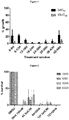
- asexual NF54 parasites were tightly synchronized (0 to 3h post-invasion) using gelatin flotation and 5% D-sorbitol-treatment 3h later. These parasites were then dispensed in 48-well plates (500 ⁇ L per well at 2% hematocrit, 0.5% starting parasitemia) and incubated for six hours with different concentration of the compounds (corresponding to one time, two times and three times the IC 50 value), either directly (0-6h treatment window) or after 6h, 12h, 18h, 24h, 30h, 36h, or 42h.
- Example 4 Ring-stage Survival Assay (RSA).
- 0-3h synchronized ring-stage parasites were exposed to a treatment of 6h with either DMSO, 700nM dihydroartemisinin (DHA), three times the IC 50 value of the compound to test or 700nM DHA in combination with three times the IC 50 value of the compound to test.
- Parasitemia was assessed at 72 hours post-synchronization using giemsa-stained thin blood smears. Percentage of survival was calculated in comparison to a DMSO-treated control. The data were obtained in three independent experiments.
- Compound 84 kills resistant rings using three times the IC 50 value in a similar manner whichever the strain considered, as observed on sensitive cell line NF54 ( figure 2 , 0-6h treatment window). This compound is able to kill the parasites of all the tested strains in combination with 700nM dihydroartemisinin (DHA).
- DHA dihydroartemisinin
- Example 5 Evaluation of the parasite reduction rate (time needed for the compounds of the invention to kill the parasites).
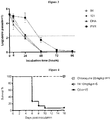
- Parasites are incubated (see for example Sanz et al. PLoS ONE 7, e30949 (2012 )) with a compound of the invention (or a reference) for different time-windows, washed, and diluted serially in 96-well plates in fresh red blood cells. Parasites are kept in culture for 3 to 4 weeks, when growth is assessed to evaluate the number of parasites that survive-correlated to the number of wells where growth is found. Survival curves are obtained by plotting the duration of treatment versus the log of the number of viable parasites ( figure 3 ).
- Compounds 84 and 121 of the invention act as fast as dihydroartemisinin (DHA), which is the fastest killer described so far, whereas pyrimethamine (PYR) is known as a slow killer.
- DHA dihydroartemisin
- PYR pyrimethamine
- mice were infected intraperitoneally (i.p.) with 10 5 P. berghei ANKA strain GFP-expressing parasites ( Ishino et al. Cell. Mol. Microbiol. 2006, 59 (4), 1175-1184 ). Two hours post-infection, mice were treated i.p.
- mice do not develop severe malaria symptoms and are able to survive until day 16 after inoculation.
Landscapes
- Chemical & Material Sciences (AREA)
- Organic Chemistry (AREA)
- Pharmaceuticals Containing Other Organic And Inorganic Compounds (AREA)
Abstract
The present invention is in the field of therapeutic drugs to treat malaria. In particular, the invention provides trilobine derivatives per se, and trilobine derivatives for use in the treatment of malaria, for example drug-resistant malaria.
Description
- The present invention is in the field of therapeutic drugs to treat malaria. In particular, the invention provides trilobine derivatives per se, and trilobine derivatives for use in the treatment of malaria, for example drug-resistant malaria.
- Malaria is a devastating infectious disease which affect each year more than 200 million people and claimed 435,000 deaths worldwide in 2018. As a major health concern in Africa, Asia, the Middle East, and Central and South America, about 40% of the world's population live in areas where malaria is transmitted. Approximately 90% of both cases and deaths occurred in Africa, mostly among children, 78% of reported deaths belonging to children below 5 years age.
- Malaria is caused by blood protozoa of the genus Plasmodium, transmitted by Anopheles spp., and shows symptoms such as intermittent paroxysm of fever, anemia, splenomegaly, etc. The five known species of Plasmodium genus that causes malaria in human are Plasmodium falciparum, Plasmodium vivax, Plasmodium malariae, Plasmodium ovale, and Plasmodium knowlesi. Among them, P. falciparum is the most virulent parasite, with high mortality and morbidity rate, causing the most severe symptoms: it progresses to severe malaria easily at 1 or 2 days after the onset of disease, accompanied with coma and multiple organ failure that eventually leads to the death of the patients.
- The discovery of the synthetic drug chloroquine (CQ, first of the quinoline class) in the 1940s helped to treat and prevent malaria throughout the world in 1950s. However, the therapeutic efficacy of CQ and efforts to eradicate malaria worldwide were diminished due to the occurrence of CQ resistance. The failure of these eradication programs led to re-emergence of malaria and spread of CQ-resistant parasite from Southeast Asia and South America to Africa. Due to the lack of potent and affordable drug for malaria treatment, the spread of CQ-resistant parasite to Africa around 1980s claimed 2-3-fold increase in malaria-related deaths. Hence, CQ was replaced with sulfadoxine/pyrimethamine (SP, of the antifolate class) as the first-line of treatment for malaria; however, parasite became resistant to SP and spread widely. Use of antimalarial drugs as combination therapy instead of monotherapy has been in practice to increase the efficacy of drug and to delay the emergence of drug resistance parasite. Since 2001, artemisinin-based combination therapies (ACTs) has been most widely and effectively used for malaria treatment. Recently, resistance to ACTs (Artesunate-Mefloquine and Dihydroartemisinin-Piperaquine) has been reported in Southeast Asia (Greater Mekong Subregion, GMS) increasing the global alarm for malaria treatment and control.
- The risk of ACT-resistant parasites spreading from the Greater Mekong Subregion to Africa is extremely worrisome, as it happened previously with chloroquine- and sulfadoxine/pyrimethamine-resistant parasites.
- Drug resistant malaria is thus a serious clinical and public health problem. Therefore, novel pharmaceutical compositions which kill drug-resistant malaria parasites, are needed for successful therapy.
- The present invention thus concerns a compound of following formula (I)

- Y1 and Y2 are each independently H or (C1-C10)-alkyl, in which the fragments (C1-C10)-alkyl are optionally substituted by at least one group selected from NRY1RY2;
- RY1 and RY2 are each independently H or (C1-C10)-alkyl;
- X1 is H, methyl, ethyl, (C1-C10)-alkyl-R4, (C2-C10)-alkenyl, (C2-C10)-alkenyl-R4, CONHR5, (CH2-CH2O)m-H with m=2-4, in which the fragments (C1-C10)-alkyl are optionally substituted by at least one group selected from halogens;
- and N-X1 optionally represents N+-O-;
- R2 is chosen from H, methyl, ethyl, (C1-C10)-alkyl-R4-, (C2-C10)-alkenyl, (C2-C10)-alkenyl-R4', CONHR5', (CH2-CH2O)m-H with m=2-4, (C1-C10)-alkyl substituted by at least one group selected from halogen, -OH and -O-(C1-C10)-alkyl;
- R4 is OH, O-(C1-C10)-alkyl, O-(C5-C10)-aryl, NO2, CN, (3-12)-membered-heterocycle, O-((CH2)2O)n-H with n=1-3, CONRcRd, halogen, COORc, CF3, or (C3-C12)-cycloalkyl, in which (C5-C10)-aryl and (3-12)-membered-heterocycle are optionally substituted by at least one group selected from NRcRd, ORe, (C1-C10)-alkyl, halogen and oxo (=O);
- R5 is H, or a group chosen among (C1-C10)-alkyl-R6, (C3-C12)-cycloalkyl, (C2-C10)-alkenyl, and a (3-12)-membered-heteroaryl, said group being optionally substituted by at least one group selected from halogen, CN, NRcRd, NO2, CONRcRd, COORc, CF3, ORe,
- R4' is OH, O-(C1-C10)-alkyl, O-(C5-C10)-aryl, NO2, CN, NRcRd, (3-12)-membered-heterocycle, O-((CH2)2O)n-H with n=1-3, CONRcRd, halogen, COORc, CF3, or (C3-C12)-cycloalkyl, in which (C5-C10)-aryl and (3-12)-membered-heterocycle are optionally substituted by at least one group selected from NRcRd, ORc, (C1-C10)-alkyl, halogen and oxo (=O);
- R5' is H, or a group chosen among (C1-C10)-alkyl-R6', (C3-C12)-cycloalkyl, (C2-C10)-alkenyl, benzyl, and, only when R1 and X1 are not H, Me, said groups being optionally substituted by at least one group selected from halogen, CN, NRcRd, NO2, CONRcRd, COORc, CF3, ORe;
- R6 is NRcRd, (3-12)-membered-heteroaryl or (3-12)-membered-heterocycle, in which the fragment (3-12)-membered-heteroaryl or (3-12)-membered-heterocycle is optionally substituted by at least one group selected from NRcRd, ORe, (C1-C10)-alkyl, (C1-C10)-alkyl-(3-12)-membered-heterocycle, halogen and oxo;
- R6' is NRcRd or (3-12)-membered-heterocycle, in which the (3-12)-membered-heterocycle is optionally substituted by at least one group selected from (C1-C10)-alkyl;
- R1 is H, methyl, -(C1-C6) alkyl-NRaRb, COR7, (3-12)-membered-azaheterocycle optionally substituted by at least one group selected from (C1-C10)-alkyl, or (C1-C6)-alkyl substituted by at least one group selected from epoxide and (3-12)-membered-azaheterocycle, both optionally substituted by at least one group selected from (C1-C10)-alkyl,
- Ra and Rb are independently from each other (C1-C6) alkyl or H, at least one of Ra and Rb being a (C1-C6) alkyl;
- Rc, Rd and Re are for each occurence independently from each other (C1-C6) alkyl or H; R3 is H, (C1-C6) alkyl, (C1-C6) alkyl substituted by NRcRd;
- R7 is (C1-C10)-alkyl, (C5-C10)-aryl;
- in case Y1 and Y2 are H, and R1, R2, R3 and X1 are independently chosen from H and methyl, then R3 is H and R2 is H;
or a pharmaceutically acceptable salt or solvate thereof,
for use in the treatment and/or prevention of malaria. - For the purpose of the invention, the term "pharmaceutically acceptable" is intended to mean what is useful to the preparation of a pharmaceutical composition, and what is generally safe and non-toxic, for a pharmaceutical use.
- The term "pharmaceutically acceptable salt or solvate" is intended to mean, in the framework of the present invention, a salt or solvate of a compound which is pharmaceutically acceptable, as defined above, and which possesses the pharmacological activity of the corresponding compound.
- The pharmaceutically acceptable salts comprise:
- (1) acid addition salts formed with inorganic acids such as hydrochloric, hydrobromic, sulfuric, nitric and phosphoric acid and the like; or formed with organic acids such as acetic, benzenesulfonic, fumaric, glucoheptonic, gluconic, glutamic, glycolic, hydroxynaphtoic, 2-hydroxyethanesulfonic, lactic, maleic, malic, mandelic, methanesulfonic, muconic, 2-naphtalenesulfonic, propionic, succinic, dibenzoyl-L-tartaric, tartaric, p-toluenesulfonic, trimethylacetic, and trifluoroacetic acid and the like, and
- (2) base addition salts formed when an acid proton present in the compound is either replaced by a metal ion, such as an alkali metal ion, an alkaline-earth metal ion, or an aluminium ion; or coordinated with an organic or inorganic base. Acceptable organic bases comprise diethanolamine, ethanolamine, N-methylglucamine, triethanolamine, tromethamine and the like. Acceptable inorganic bases comprise aluminium hydroxide, calcium hydroxide, potassium hydroxide, sodium carbonate and sodium hydroxide.
- Acceptable solvates for the therapeutic use of the compounds of the present invention include conventional solvates such as those formed during the last step of the preparation of the compounds of the invention due to the presence of solvents. As an example, mention may be made of solvates due to the presence of water (these solvates are also called hydrates) or ethanol.
- It is recognized that compounds of the present invention may exist in various stereoisomeric forms. As such, the compounds of the present invention include both diastereomers and enantiomers. The compounds are normally prepared as racemates and can conveniently be used as such, but individual enantiomers can be isolated or synthesized by conventional techniques if so desired. Such racemates and individual enantiomers and mixtures thereof form part of the present invention.
- It is well known in the art how to prepare and isolate such optically active forms. Specific stereoisomers can be prepared by stereospecific synthesis using enantiomerically pure or enantiomerically enriched starting materials. The specific stereoisomers of either starting materials or products can be resolved and recovered by techniques known in the art, such as resolution of racemic forms, normal, reverse-phase, and chiral chromatography, recrystallization, enzymatic resolution, or fractional recrystallization of addition salts formed by reagents used for that purpose. Useful methods of resolving and recovering specific stereoisomers described in Eliel, E. L.; Wilen, S.H. Stereochemistry of Organic Compounds; Wiley: New York, 1994, and Jacques, J, et al. Enantiomers, Racemates, and Resolutions; Wiley: New York, 1981, each incorporated by reference herein in their entireties.
- About the two following asymmetric carbon atoms:

- The term "(C1-C6)alkyl", as used in the present invention, refers to a straight or branched saturated hydrocarbon chain containing from 1 to 6 carbon atoms including, but not limited to, methyl, ethyl, n-propyl, iso-propyl, n-butyl, iso-butyl, sec-butyl, t-butyl, n-pentyl, n-hexyl, and the like.
- The term "(C2-C6)alkenyl", as used in the present invention, refers to a straight or branched unsaturated hydrocarbon chain containing from 2 to 6 carbon atoms and comprising at least one double bond, notably one double bond, including, but not limited to, ethenyl, propenyl, butenyl, pentenyl, hexenyl and the like. It can be in particular an allyl group.
- The term "aryl", as used in the present invention, refers to an aromatic hydrocarbon group comprising preferably 6 to 10 carbon atoms and comprising one or more, notably 1 or 2, fused rings, such as, for example, a phenyl or naphtyl group. Advantageously, it will be a phenyl group.
- The term "aryl-(C1-C6)alkyl", as used in the present invention, refers to an aryl group as defined above bound to the molecule via a (C1-C6)alkyl group as defined above. In particular, the aryl-(C1-C6)alkyl group is a benzyl group.
- The term "(C1-C6)alkyl-aryl", as used in the present invention, refers to a (C1-C6)alkyl group as defined above bound to the molecule via an aryl group as defined above. In particular, it can be a tolyl group (-Ph-CH3).
- The term "heterocycle" as used in the present invention refers to a saturated, unsaturated or aromatic hydrocarbon monocycle or polycycle (comprising fused, bridged or spiro rings), such as a bicycle, in which one or more, advantageously 1 to 4, and more advantageously 1 or 2, carbon atoms have each been replaced with a heteroatom selected from nitrogen, oxygen and sulphur atoms, and notably being a nitrogen atom. Advantageously, the heterocycle comprises 5 to 15, notably 5 to 10 atoms in the ring(s). The ring(s) of the heterocycle has/have advantageously 5 or 6 members.
- According to a particular embodiment, the heterocycle is a saturated, unsaturated or aromatic hydrocarbon monocycle or bicycle (comprising fused, bridged or spiro rings, notably fused rings), each cycle having 5 or 6 members and 1 to 4, notably 1 or 2, carbon atoms having each been replaced with a nitrogen or oxygen atom, notably a nitrogen atom.
- A heterocycle can be notably thiophene, furan, pyrrole, imidazole, pyrazole, oxazole, isoxazole, thiazole, isothiazole, triazoles (1,2,3-triazole and 1,2,4-triazole), benzofuran, indole, benzothiophene, benzimidazole, indazole, benzoxazole, benzisoxazole, benzothiazole, benzisothiazole, pyridine, pyrimidine, pyridazine, pyrazine, triazine, quinoline, isoquinoline, quinoxaline, quinazoline, piperidine, piperazine, triazinane, morpholine, pyrrolidine, azepane, dihydropyridines, dihydropyrimidines (notably 1,2- dihydropyrimidine), dihydropyridazines, dihydropyrazines, dihydrotriazines, tetrahydropyridines, tetrahydropyrimidines, tetrahydropyridazines, tetrahydropyrazines, tetrahydrotriazines, etc.
- A heterocycle can also be notably tetrahydrofuran, oxetane, or oxirane.
- The term "heterocycle-(C1-C6)alkyl", as used in the present invention, refers to a heterocycle group as defined above bound to the molecule via a (C1-C6)alkyl group as defined above.
- The term "heteroaryl" as used in the present invention refers to an aromatic heterocycle as defined above.
- According to a particular embodiment, the heteroaryl is an aromatic hydrocarbon monocycle or bicycle (i.e. comprising fused rings), each cycle having 5 or 6 members, notably 6 members, and 1 to 4, notably 1 or 2, carbon atoms having each been replaced with a nitrogen or oxygen atom, notably a nitrogen atom.
- A heteroaryl can be notably thiophene, furan, pyrrole, imidazole, pyrazole, oxazole, isoxazole, thiazole, isothiazole, triazoles (1,2,3-triazole and 1,2,4-triazole), benzofuran, indole, benzothiophene, benzimidazole, indazole, benzoxazole, benzisoxazole, benzothiazole, benzisothiazole, pyridine, pyrimidine, pyridazine, pyrazine, triazine, quinoline, isoquinoline, quinoxaline, quinazoline, etc.
- The term "heteroaryl-(C1-C6)alkyl", as used in the present invention, refers to a heteroaryl group as defined above bound to the molecule via a (C1-C6)alkyl group as defined above.
- The term "halogen", as used in the present invention, refers to a fluorine, bromine, chlorine or iodine atom.
- In a particular embodiment, Y1 and/or Y2, in particular Y1 and Y2, are H.
- In a particular embodiment, R3 is H or methyl, in particular methyl.
- In a particular embodiment, R3 is H, R1 being in particular H.
- In a particular embodiment, Y1 and Y2, are H, and R3 is methyl.
- In a particular embodiment, at least one of R1, R2 and X1 is not H nor methyl.
- In a particular embodiment, one of R1, R2 and X1 is not H nor methyl, the two others being H or methyl.
- In a particular embodiment, one of R1, R2 and X1 is not H nor methyl, the two others being methyl.
- In a particular embodiment, R1 is not H nor methyl, R2 and X1 being in particular independently H or methyl.
- In a particular embodiment, R1 is not H nor methyl, R2 and X1 being methyl.
- In a particular embodiment, R2 is not H nor methyl, R1 and X1 being in particular independently H or methyl.
- In a particular embodiment, R2 is not H nor methyl, R1 and X1 being methyl.
- In a particular embodiment, X1 is not H nor methyl, R1 and R2 being in particular independently H or methyl.
- In a particular embodiment, X1 is not H nor methyl, R1 and R2 being methyl.
- In a particular embodiment, X1 and R2 are not H nor methyl, X1 and R2 being in particular identical, R1 being notably H or methyl.
- In a particular embodiment, X1 and R2 are not H nor methyl, X1 and R2 being in particular identical, R1 being methyl.
- In a particular embodiment, R1, R2, R3 and X1 are independently chosen from H and methyl, with R3 being H, R1 being in particular H.
- In a particular embodiment, R1, R2, R3 and X1 are independently chosen from H and methyl, with R3 being H, R1 and R2 being in particular H.
- In a particular embodiment, X1 is H, methyl, CONHR5, or (CH2-CH2O)m-H with m=2-4.
- In a particular embodiment, R5 is a group chosen among (C1-C10)-alkyl-R6 and (3-12)-membered-heteroaryl, in particular pyridyl.
- In a particular embodiment, R6 is NRcRd, (3-12)-membered-heteroaryl, in particular pyridyl, or (3-12)-membered-heterocycle, in particular piperazinyl, in which the fragment (3-12)-membered-heteroaryl or (3-12)-membered-heterocycle is optionally substituted by at least one group selected from (C1-C10)-alkyl;
- In a particular embodiment R2 is chosen from H, methyl, (C1-C10)-alkyl-R4', CONHR5', and (CH2-CH2O)m-H with m=2-4, (C1-C10)-alkyl being optionally substituted by at least one -OH.
- In a particular embodiment, R4' is NRcRd.
- In a particular embodiment, R5' is a group chosen among (C1-C10)-alkyl-R6', benzyl, and, only when R1 and X1 are not H, Me.
- In a particular embodiment, R6' is NRcRd.
- In a particular embodiment, R7 is (C1-C10)-alkyl, (C5-C10)-aryl.
- In a particular embodiment, the compound as defined above is of following formula (II)

- Y1, Y2 and R3 are as defined above, Y1 and Y2, being in particular H, and R3 being in particular methyl,
- X1 is H, methyl, CONHR5, (CH2-CH2O)m-H with m=2-4;
- R2 is chosen from H, methyl, (C1-C10)-alkyl-R4-, CONHR5', and (CH2-CH2O)m-H with m=2-4, (C1-C10)-alkyl being optionally substituted by at least one -OH;
- R5 is a group chosen among (C1-C10)-alkyl-R6, and (3-12)-membered-heteroaryl, in particular pyridyl;
- R4' is NRcRd;
- R5' is a group chosen among (C1-C10)-alkyl-R6', benzyl, and, only when R1 and X1 are not H, Me;
- R6 is NRcRd, (3-12)-membered-heteroaryl, in particular pyridyl, or (3-12)-membered-heterocycle, in particular piperazinyl, in which the fragment (3-12)-membered-heteroaryl or (3-12)-membered-heterocycle is optionally substituted by at least one group selected from (C1-C10)-alkyl;
- R6' is NRcRd;
- R1 is H, methyl, -(C1-C6)alkyl-NRaRb, COR7, (3-12)-membered-azaheterocycle, in particular azepanyl, optionally substituted by at least one group selected from (C1-C10)-alkyl, or (C1-C6)-alkyl substituted by at least one group selected from epoxide and (3-12)-membered-azaheterocycle, in particular pyrrolidinyl or piperazinyl, both epoxide and (3-12)-membered-azaheterocycle being optionally substituted by at least one group selected from (C1-C10)-alkyl,
- Ra and Rb are independently from each other (C1-C6) alkyl or H, at least one of Ra and Rb being a (C1-C6) alkyl;
- Rc, Rd and Re are for each occurence independently from each other (C1-C6) alkyl or H;
- R7 is (C1-C10)-alkyl, (C5-C10)-aryl, in particular (C1-C10)-alkyl;
- in case Y1 and Y2 are H, and R1, R2, R3 and X1 are independently chosen from H and methyl, then R3 is H and R2 is H.
- In a particular embodiment, the compound as defined above is of following formula (IIa)

- R3 is as defined above, R3 being in particular H or methyl;
- X1 is H, methyl, CONHR5;
- R2 is chosen from H, methyl, (C1-C10)-alkyl-R4', (C1-C10)-alkyl being optionally substituted by at least one or two -OH;
- R5 is a group chosen among (C1-C10)-alkyl-R6;
- R4' is NRcRd;
- R6 is (3-12)-membered-heteroaryl, in particular pyridyl, , in which the fragment (3-12)-membered-heteroaryl is optionally substituted by at least one group selected from (C1-C10)-alkyl;
- R1 is H, methyl, -(C1-C6)alkyl-NRaRb, in particular -(C3)alkyl-NRaRb, or (C1-C6)-alkyl substituted by at least one group selected from (3-12)-membered-azaheterocycle, in particular pyrrolidinyl or piperazinyl, said (3-12)-membered-azaheterocycle being optionally substituted by at least one group selected from (C1-C10)-alkyl,
- Ra and Rb are independently from each other (C1-C6) alkyl or H, at least one of Ra and Rb being a (C1-C6) alkyl;
- Rc, Rd and Re are for each occurence independently from each other (C1-C6) alkyl or H;
- in case R1, R2, R3 and X1 are independently chosen from H and methyl, then R3 is H, R2 is H, and X1 is H.
- In a particular embodiment, the compound as defined above is of following formula (IIa-1)

- R3 is methyl;
- X1 is methyl, CONHR5;
- R2 is chosen from methyl, (C1-C10)-alkyl-R4', (C1-C10)-alkyl being optionally substituted by at least one or two -OH;
- R5 is a group chosen among (C1-C10)-alkyl-R6;
- R4' is NRcRd;
- R6 is (3-12)-membered-heteroaryl, in particular pyridyl, in which the fragment (3-12)-membered-heteroaryl is optionally substituted by at least one group selected from (C1-C10)-alkyl;
- R1 is methyl, -(C1-C6)alkyl-NRaRb, in particular -(C3)alkyl-NRaRb, or (C1-C6)-alkyl substituted by at least one group selected from (3-12)-membered-azaheterocycle, in particular pyrrolidinyl or piperazinyl, said (3-12)-membered-azaheterocycle being optionally substituted by at least one group selected from (C1-C10)-alkyl,
- Ra and Rb are independently from each other (C1-C6) alkyl or H, at least one of Ra and Rb being a (C1-C6) alkyl;
- Rc, Rd and Re are for each occurence independently from each other (C1-C6) alkyl or H; with the proviso that R1, R2, R3 and X1 are not all independently chosen from H and methyl.
- In a particular embodiment, the compound as defined above is of following formula (IIa-2)

- R1
- is H, methyl, or -(C1-C6)alkyl-NRaRb, in particular -(C3)alkyl-NRaRb;
- R3
- is H;
- X1
- is H or methyl;
- R2
- is H or methyl;
- R1
- is H;
- R3
- is H;
- X1
- is H or methyl;
- R2
- is H.
- In a particular embodiment, in case R1, R2, R3 and X1 are independently chosen from H and methyl, then R1 and R3 are H, and R2 is H.
- In a particular embodiment, the compound as defined above is selected from the following compounds:


- In a particular embodiment, the malaria is caused by a parasite that is a drug-sensitive or drug-resistant parasite, in particular a drug-resistant malaria parasite.
- In a particular embodiment, the drug-sensitive or drug-resistant malaria parasite is a chloroquine-resistant; a chloroquine and pyrimethamine-resistant; a chloroquine, pyrimethamine and mefloquine-resistant; a chloroquine, pyrimethamine, mefloquine and artemisinin-resistant; a chloroquine, pyrimethamine, piperaquine and artemisinin-resistant malaria parasite.
- In a particular embodiment, malaria is caused by infection with Plasmodium, in particular by Plasmodium falciparum, P. vivax, P. ovale, or P. malariae, P. knowlesi more particularly by Plasmodium falciparum.
- In another aspect, the invention concerns a combination of a compound as defined above with at least one other antimalarial agent for the treatment of malaria with simultaneous administration, separate or spread out over time.
- In particular, the other antimalarial agent is selected from chloroquine, artemesin, qinghaosu, 8-aminoquinoline, amodiaquine, arteether, artemether, artemisinin, artesunate, artesunic acid, artelinic acid, atovaquone, azithromycine, biguanide, chloroquine phosphate, chlorproguanil, cycloguanil, dapsone, desbutyl halofantrine, desipramine, doxycycline, dihydrofolate reductase inhibitors, dipyridamole, halofantrine, haloperidol, hydroxychloroquine sulfate, imipramine, mefloquine, penfluridol, phospholipid inhibitors, primaquine, proguanil, pyrimethamine, pyronaridine, quinine, quinidine, quinacrine-artemisinin, sulfonamides, sulfones, sulfadoxine, sulfalene, tafenoquine, tetracycline, tetrandine, triazine, salts and mixture thereof.
- In another aspect, the present invention concerns a method for the treatment of malaria comprising the administration to a person in need thereof of an effective dose of a compound as defined above.
- According to another aspect, the present invention concerns a pharmaceutical composition comprising:
- a compound of formula (III) as defined below, or
- a stereoisomeric form, a mixture of stereoisomeric forms or a pharmaceutically acceptable salt form thereof,
- in admixture with at least one pharmaceutically acceptable excipient.
- The compound of formula (III) or the pharmaceutical composition of the present invention may be administered in the form of a conventional pharmaceutical composition by any route including orally, intramuscularly, subcutaneously, topically, intranasally, intraperitoneally, intrathoracially, intravenously, epidurally, intrathecally, intracerebroventricularly and by injection into the joints.
- The dosage will depend on the route of administration, the severity of the disease, age and weight of the patient and other factors normally considered by the attending physician, when determining the individual regimen and dosage level at the most appropriate for a particular patient.
- For preparing pharmaceutical compositions from the compounds of the present invention, inert, pharmaceutically acceptable carriers can be either solid or liquid. Solid form preparations include powders, tablets, dispersible granules, capsules, cachets, and suppositories.
- A solid carrier can be one or more substances, which may also act as diluents, flavouring agents, solubilizers, lubricants, suspending agents, binders, or tablet disintegrating agents; it can also be an encapsulating material.
- Tablets, powders, cachets, and capsules can be used as solid dosage forms suitable for oral administration.
- Liquid form compositions include solutions, suspensions, and emulsions. For example, sterile water or propylene glycol solutions of the active compounds may be liquid preparations suitable for parenteral administration. Liquid compositions can also be formulated in solution in aqueous polyethylene glycol solution.
- Aqueous solutions for oral administration can be prepared by dissolving the active component in water and adding suitable colorants, flavouring agents, stabilizers, and thickening agents as desired. Aqueous solutions for oral use can be made by dispersing the finely divided active component in water together with a viscous material such as natural synthetic gums, resins, methyl cellulose, sodium carboxymethyl cellulose, and other suspending agents known to the pharmaceutical formulation art.
- Depending on the mode of administration, the pharmaceutical composition will according to one embodiment of the present invention include 0.05% to 99% weight (percent by weight), according to an alternative embodiment from 0.10 to 50% weight, of the compound of the present invention, all percentages by weight being based on total composition. A therapeutically effective amount for the practice of the present invention may be determined, by the use of known criteria including the age, weight and response of the individual patient, and interpreted within the context of the disease which is being treated or which is being prevented, by one of ordinary skills in the art.
- According to another aspect, the present invention concerns a compound of following formula (III):
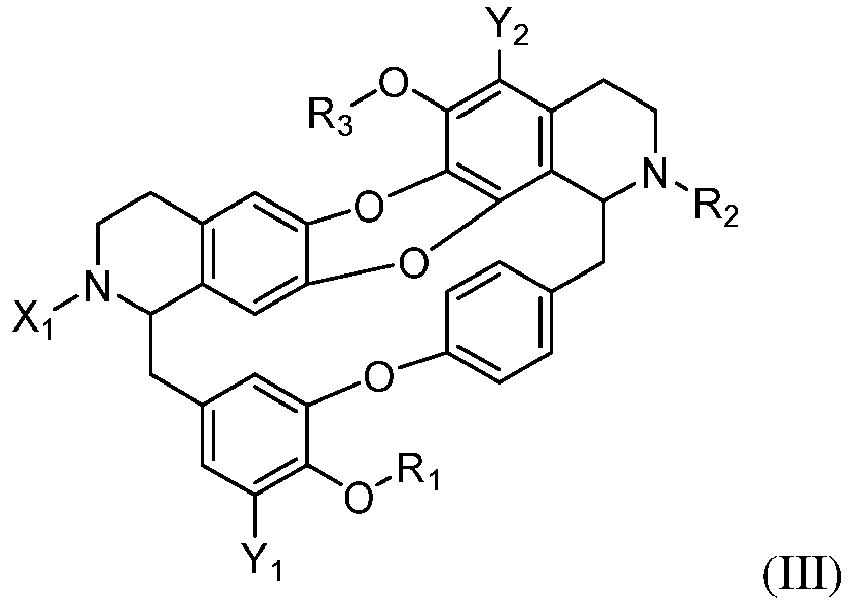
- Y1 and Y2 are each independently H or (C1-C10)-alkyl, in which the fragments (C1-C10)-alkyl are optionally substituted by at least one group selected from NRY1RY2;
- RY1 and RY2 are each independently H or (C1-C10)-alkyl;
- X1 is H, methyl, ethyl, (C1-C10)-alkyl-R4, (C2-C10)-alkenyl, (C2-C10)-alkenyl-R4, CONHR5, (CH2-CH2O)m-H with m=2-4, in which the fragments (C1-C10)-alkyl are optionally substituted by at least one group selected from halogens;
- and N-X1 optionally represents N+-O-;
- R2 is chosen from H, methyl, ethyl, (C1-C10)-alkyl-R4-, (C2-C10)-alkenyl, (C2-C10)-alkenyl-R4', CONHR5', (CH2-CH2O)m-H with m=2-4, (C1-C10)-alkyl substituted by at least one group selected from halogen, -OH and -O-(C1-C10)-alkyl;
- R4 is OH, O-(C1-C10)-alkyl, O-(C5-C10)-aryl, NO2, CN, (3-12)-membered-heterocycle, O-((CH2)2O)n-H with n=1-3, CONRcRd, halogen, COORc, CF3, or (C3-C12)-cycloalkyl, in which (C5-C10)-aryl and (3-12)-membered-heterocycle are optionally substituted by at least one group selected from NRcRd, ORe, (C1-C10)-alkyl, halogen and oxo (=O);
- R5 is H, or a group chosen among (C1-C10)-alkyl-R6, (C3-C12)-cycloalkyl, (C2-C10)-alkenyl, and a (3-12)-membered-heteroaryl, said group being optionally substituted by at least one group selected from halogen, CN, NRcRd, NO2, CONRcRd, COORc, CF3, ORe,
- R4' is OH, O-(C1-C10)-alkyl, O-(C5-C10)-aryl, NO2, CN, NRcRd, (3-12)-membered-heterocycle, O-((CH2)2O)n-H with n=1-3, CONRcRd, halogen, COORc, CF3, or (C3-C12)-cycloalkyl, in which (C5-C10)-aryl and (3-12)-membered-heterocycle are optionally substituted by at least one group selected from NRcRd, ORc, (C1-C10)-alkyl, halogen and oxo (=O);
- R5' is H, or a group chosen among (C1-C10)-alkyl-R6', (C3-C12)-cycloalkyl, (C2-C10)-alkenyl, benzyl, and, only when R1 and X1 are not H, Me, said groups being optionally substituted by at least one group selected from halogen, CN, NRcRd, NO2, CONRcRd, COORc, CF3, ORe;
- R6 is NRcRd, (3-12)-membered-heteroaryl or (3-12)-membered-heterocycle, in which the fragment (3-12)-membered-heteroaryl or (3-12)-membered-heterocycle is optionally substituted by at least one group selected from NRcRd, ORe, (C1-C10)-alkyl, (C1-C10)-alkyl-(3-12)-membered-heterocycle, halogen and oxo;
- R6' is NRcRd or (3-12)-membered-heterocycle, in which the (3-12)-membered-heterocycle is optionally substituted by at least one group selected from (C1-C10)-alkyl;
- R1 is H, methyl, -(C1-C6) alkyl-NRaRb, COR7, (3-12)-membered-azaheterocycle optionally substituted by at least one group selected from (C1-C10)-alkyl, or (C1-C6)-alkyl substituted by at least one group selected from epoxide and (3-12)-membered-azaheterocycle, both optionally substituted by at least one group selected from (C1-C10)-alkyl,
- Ra and Rb are independently from each other (C1-C6) alkyl or H, at least one of Ra and Rb being a (C1-C6) alkyl;
- Rc, Rd and Re are for each occurence independently from each other (C1-C6) alkyl or H; R3 is H, (C1-C6) alkyl, (C1-C6) alkyl substituted by NRcRd;
- R7 is (C1-C10)-alkyl, (C5-C10)-aryl;
- With the proviso that:
- R3 is H, and R2 is H; or
- At least one of Y1 and Y2 is not H; or
- At least one of R1, R2, R3 and X1 is not H or methyl, with R1, R2, R3 and X1 being such as:
- X1 is H, methyl, CONHR5, (CH2-CH2O)m-H with m=2-4, in which the fragments (C1-C10)-alkyl are optionally substituted by at least one group selected from halogens;
- R2 is chosen from H, methyl, (C1-C10)-alkyl-R4-, CONHR5', (CH2-CH2O)m-H with m=2-4, (C1-C10)-alkyl substituted by at least one or two groups selected from halogen, -OH and -O-(C1-C10)-alkyl, in particular -OH;
- R5 is a group chosen among (C1-C10)-alkyl-R6, and a (3-12)-membered-heteroaryl, in particular pyridyl, said group being optionally substituted by at least one group selected from halogen, CN, NRcRd, NO2, CONRcRd, COORc, CF3, ORe,
- R4' is NRcRd;
- R5' is H, or a group chosen among (C1-C10)-alkyl-R6' and benzyl, said groups being optionally substituted by at least one group selected from halogen, CN, NRcRd, NO2, CONRcRd, COORc, CF3, ORe;
- R6 is (3-12)-membered-heteroaryl, in particular pyridyl, or (3-12)-membered-heterocycle, in particular piperazinyl, in which the fragment (3-12)-membered-heteroaryl or (3-12)-membered-heterocycle is optionally substituted by at least one group selected from NRcRd, ORe, (C1-C10)-alkyl, (C1-C10)-alkyl-(3-12)-membered-heterocycle, halogen and oxo;
- R6' is (3-12)-membered-heterocycle, in which the (3-12)-membered-heterocycle is optionally substituted by at least one group selected from (C1-C10)-alkyl;
- R1 is H, methyl, -(C1-C6)alkyl-NRaRb, COR7, (3-12)-membered-azaheterocycle, in particular azepanyl, optionally substituted by at least one group selected from (C1-C10)-alkyl, or (C1-C6)-alkyl substituted by at least one group selected from epoxide and (3-12)-membered-azaheterocycle, in particular pyrrolidinyl or piperazinyl, both epoxide and (3-12)-membered-azaheterocycle being optionally substituted by at least one group selected from (C1-C10)-alkyl,
- Ra and Rb are independently from each other (C1-C6) alkyl or H, at least one of Ra and Rb being a (C1-C6) alkyl;
- Rc, Rd and Re are for each occurence independently from each other (C1-C6) alkyl or H; R3 is H, (C1-C6) alkyl, in particular methyl;
- R7 is methyl or phenyl, in particular methyl.
- All embodiments mentioned above, for example related to formula (I) or (II), apply here as well, alone or in combination.
- In a particular embodiment, at least one of R1, R2, R3 and X1 is not H or methyl, with R1, R2, R3 and X1 being such as:
- X1 is H, methyl, CONHR5, in which the fragments (C1-C10)-alkyl are optionally substituted by at least one group selected from halogens;
- R2 is chosen from H, methyl, (C1-C10)-alkyl-R4-, CONHR5', (C1-C10)-alkyl substituted by at least one or two groups selected from halogen, -OH and -O-(C1-C10)-alkyl, in particular -OH;
- R5 is a group chosen among -CH2-pyridyl, (C1-C10)-alkyl-piperazinyl, and pyridyl, said group being optionally substituted by at least one group selected from NRcRd, ORe, (C1-C10)-alkyl, (C1-C10)-alkyl-(3-12)-membered-heterocycle, halogen and oxo;
- R4' is N(CH3)2;
- R5' is H, or a group chosen among (C1-C10)-alkyl-R6' and benzyl, said groups being optionally substituted by at least one group selected from halogen, CN, NRcRd, NO2, CONRcRd, COORc, CF3, ORe;
- R6' is (3-12)-membered-heterocycle, in which the (3-12)-membered-heterocycle is optionally substituted by at least one group selected from (C1-C10)-alkyl;
- R1 is H, methyl, -(C1-C6)alkyl-NRaRb, azepanyl, optionally substituted by at least one group selected from (C1-C10)-alkyl, or (C1-C6)-alkyl substituted by at least one group selected from epoxide and pyrrolidinyl or piperazinyl, both epoxide and (3-12)-membered-azaheterocycle being optionally substituted by at least one group selected from (C1-C10)-alkyl,
- Ra and Rb are independently from each other (C1-C6) alkyl or H, at least one of Ra and Rb being a (C1-C6) alkyl;
- Rc, Rd and Re are for each occurence independently from each other (C1-C6) alkyl or H; R3 is H, (C1-C6) alkyl, in particular methyl.
- In a particular embodiment, the compound as defined above is selected from the following compounds:


- The following terms and expressions contained herein are defined as follows:
As used herein, a range of values in the form "x-y" or "x to y", or "x through y", include integers x, y, and the integers therebetween. For example, the phrases "1-6", or "1 to 6" or "1 through 6" are intended to include theintegers - As used herein, the term "patient" or "subject" refers to a warm blooded animal such as a mammal, preferably a human, or a human child, which is afflicted with, or has the potential to be afflicted with one or more diseases and conditions described herein.
- By drug-susceptible malaria is meant a case wherein malaria is treated or prevented when the recommended drug dosage is used.
- By drug-resistant malaria is meant a case wherein malaria is not treated or prevented when the recommended drug dosage is used.
- The compounds of the present invention may be prepared in a number of methods well known to those skilled in the art, including, but not limited to those described below, or through modifications of these methods by applying standard techniques known to those skilled in the art of organic synthesis. The appropriate modifications and substitutions will be readily apparent and well known or readily obtainable from the scientific literature to those skilled in the art. In particular, such methods can be found in R.C. Larock, Comprehensive Organic Transformations, Wiley-VCH Publishers, 1999.
- All processes disclosed in association with the present invention are contemplated to be practiced on any scale, including milligram, gram, multigram, kilogram, multikilogram or commercial industrial scale.
- It will be appreciated that the compounds of the present invention may contain one or more asymmetrically substituted carbon atoms, and may be isolated in optically active or racemic forms. Thus, all chiral, diastereomeric, racemic forms, isomeric forms of a structure are intended, unless the specific stereochemistry or isomeric form is specifically indicated. It is well-known in the art how to prepare and isolate such optically active forms. For example, mixtures of stereoisomers may be separated by standard techniques including, but not limited to, resolution of racemic forms, normal, reverse-phase, and chiral chromatography, preferential salt formation, recrystallization, and the like, or by chiral synthesis either from chiral starting materials or by deliberate synthesis of target chiral centers.
- Compounds of the present invention may be prepared by a variety of synthetic routes. The reagents and starting materials are commercially available, or readily synthesized by well-known techniques by one of ordinary skill in the arts. All substituents, unless otherwise indicated, are as previously defined.
- In the reactions described hereinafter, it may be necessary to protect reactive functional groups, for example hydroxy, amino, imino, thio or carboxy groups, where these are desired in the final product, to avoid their unwanted participation in the reactions. Conventional protecting groups may be used in accordance with standard practice, for examples see T.W. Greene and P. G. M. Wuts in Protective Groups in Organic Chemistry, 3rd ed., John Wiley and Sons, 1999; J. F. W. McOmie in Protective Groups in Organic Chemistry, Plenum Press, 1973.
- The reagents and starting materials are commercially available, or readily synthesized by well-known techniques by one of ordinary skill in the arts.
- In particular, the compounds defined above are obtained according to the procedures described in patent applications
WO2017/055632 andWO2017/055633 . -
-
Figure 1 illustrates the assay of stage-specificity ofcompound 84 during the asexual cell cycle, as described in example 3. -
Figure 2 illustrates the ring-stage survival (RSA) assays ofcompound 84, as described in example 4. -
Figure 3 illustrates the speed of action ofcompounds -
Figure 4 illustrates the in vivo activity ofcompound 84 according to the invention, as described in example 6. -

- To a suspension of NaH (90%) (11.7 mg, 0.44 mmol, 5.0 equiv) in dry DMF (1.0 mL) was added Cocsuline (50 mg, 0.088, 1.0 equiv) in dry DMF (2.0 mL) at 0 °C and was stirred for 30 min at RT. To the reaction mixture 3-dimethylaminopropylchloride hydrochloride (41.9 mg, 0.26 mmol, 3.0 equiv) and a crystal of KI (1.0 mg) was added and stirred at 80 °C overnight.. The reaction mixture was quenched by drops of a saturated solution of NaHCO3 and the volatiles were removed under reduced pressure. The residue was partitioned between ethyl acetate and a saturated solution of NaHCO3. The organic layer was separated and the aqueous layer was extracted 3 time with EtOAc. The combined organic layers were dried over Na2SO4 and the solvent was removed under reduced pressure. The residue was purified by silica gel flash chromatography using a linear gradient of DCM/methanol (NH3) (0 to 20%). The desired
product 84 was obtained as a yellow powder (41 mg, 72%).
Rf = 0.51 (DCM/(MeOH/NH 3 10%) 90/10).
1H NMR (DMSO-d6 , 500 MHz): δ (ppm) = 7.62 (d, 1H, J = 10 Hz), 7.25-7.19 (m, 2H), 6.89-6.88 (m, 1H), 6.67 (s, 1H), 6.53 (s, 1H), 6.47 (s, 1H), 6.01 (s, 1H), 4.12 (t, 2H, J = 5 Hz), 3.96 (s br, 1H), 3.81 (s, 3H), 3.35 (s, br, 2H), 3.28 (d, 1H, J = 15 Hz), 3.09 (s, br, 1H), 3.06-3.02 (m, 1H), 2.90-2.79 (m, 4H), 2.64-2.59 (m, 4H), 2.44 (t, 3H, J = 5 Hz), 2.53-2.50 (m, 4H), 2.31 (s, 6H), 2.19 (s, 3H), 1.96-1.91 (m, 2H).
13C NMR (DMSO-d6 , 125 MHz): δ (ppm) = 156.4, 153.1, 149.0, 148.7, 142.9, 141.9, 141.9, 141.5, 138.6, 137.9, 134.2, 133.4, 131.6, 131.3, 131.0, 125.4, 124.8, 124.7, 123.3, 119.6, 116.5, 110.1, 70.4, 70.1, 62.7, 58.9, 58.8, 58.0, 52.9, 48.3, 47.8, 45.89, 44.70, 44.19, 30.63, 30.19, 26.64.
MS (ESI): [M+H]+ C40H46N3O5: calcd. 648.3, found 648.3. - Compounds 73, 74, 75, 78 and 82 were obtained similarly, using the corresponding R-Cl starting material instead of 3-dimethylaminopropylchloride hydrochloride.
-
Compound 10 was obtained by acetylation of cocsuline by methods well known from the skilled in the art. -

- Step 1: To a stirred solution containing Iso-trilobine (100 mg, 0.17 mmol, 1.0 equiv) in DCM (10 mL) was added mCPBA 77% (85 mg, 0.38 mmol, 2.2 eq.). The reaction mixture was stirred at RT for 2 h, then diluted with DCM and a saturated solution of NaHCO3. The organic layer was separated and the aqueous layer was extracted 3 times with EtOAc . The combined organic layers were dried over Na2SO4 then concentrated under reduced pressure. The residue was used without further purification.
- Step 2: To a stirred solution of the crude product of
Step 1 in MeOH at 0°C (25.0 mL) was added FeSO4.7H2O (144.3 mg, 0.51 mmol, 3.0 equiv). The reaction mixture was stirred at RT overnight, then concentrated under reduced pressure and the residue was dissolved with EDTA (5 mL - 0.1M), adjusted to pH=10 with NH3 solution and extracted 3 times with EtOAc . The combined organic layers were dried over Na2SO4 then concentrated under reduced pressure to give a crude mixture of main three products (the starting Iso-trilobine, Trilobine and Nor-trilobine). The crude residue was purified by silica gel chromatography using a linear gradient of DCM/methanol (NH3) (0 to 20%) to give the desired Nor-Trilobine product (30 mg, 32%). The spectral data is in agreement with the reported natural product. - 1H NMR (Methanol-d 4, 500 MHz): δ (ppm) = 7.58 (dd, 1H, J = 8.4, 2.2 Hz), 7.20 (dd, 1H, J = 8.3, 2.6 Hz), 7.07 (dd, 1H, J = 8.3, 2.2 Hz), 7.04 (d, 1H, J = 8.4 Hz), 7.02 (dd, 1H, J = 8.3, 2.0 Hz), 6.74 (dd, 1H, J = 8.4, 2.5 Hz), 6.62 (s, 1H), 6.61 (d, 1H, J = 1.8 Hz), 6.57 (s, 1H), 6.27 (s, 1H), 4.37 (dd, 1H, J = 5.8, 1.5 Hz), 3.91 (s, 3H), 3.80 (m, 1H), 3.79 (s, 3H), 3.45-3.34 (m, 3H), 3.19 (m, 1H), 3.12-2.98 (m, 3H), 2.93-2.88 (m, 3H), 2.83 (m, 1H), 2.71 (m, 1H).
13C NMR (Methanol-d 4, 125 MHz): δ (ppm) = 157.3, 151.3, 149.8, 148.7, 142.0, 141.0, 139.9, 138.4, 133.8, 133.5, 132.7, 130.9, 130.5, 128.6, 124.2, 123.6, 122.3, 119.6, 119.2, 117.2, 114.8, 114.6, 108.9, 59.7, 57.0, 56.9, 54.3, 44.2, 42.6, 40.8, 38.2, 27.6, 26.9.
HRMS (ESI): [M+H]+ C34H33N2O5: calcd. 549.2384, found 549.2388. -
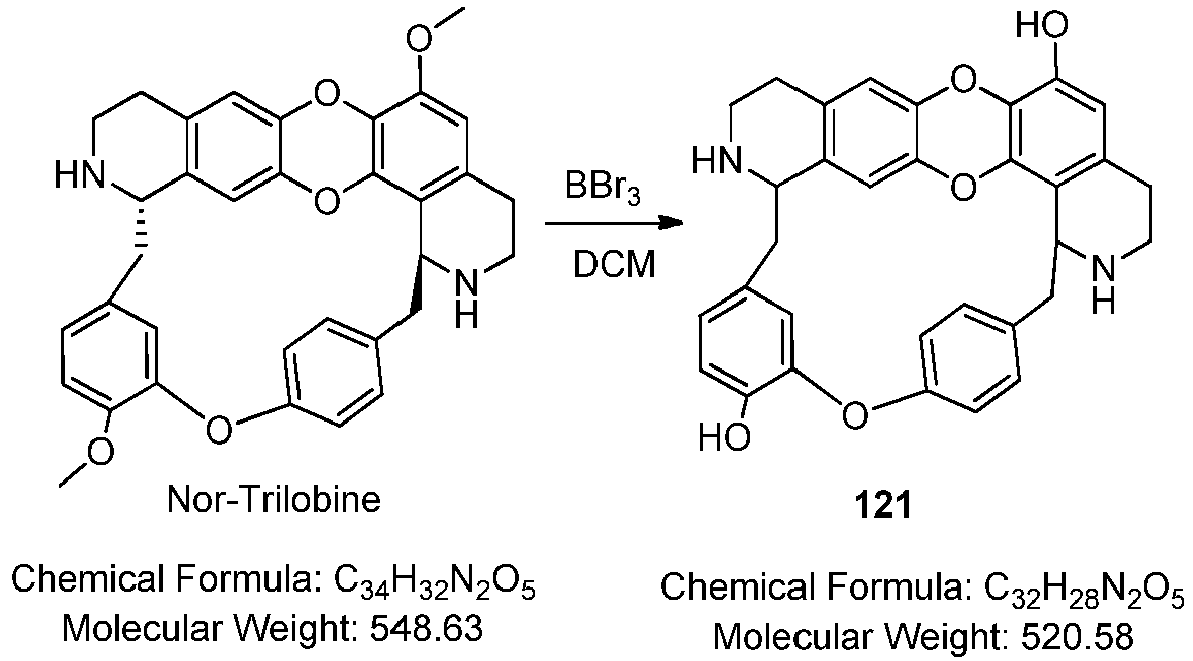
- To a stirred solution containing Nor-Trilobine (56 mg, 0.10 mmol, 1.0 eq.) in dry DCM (10.0 mL) was added BBr3 (1M in DCM) (0.30 mL, 0.30 mmol, 3.0 eq.). The reaction mixture was stirred at RT for 16 h then was diluted with DCM and a saturated solution of NaHCO3. The organic layer was separated and the aqueous layer extracted 3 times with EtOAc. The combined organic layers were dried over Na2SO4 and concentrated under reduced pressure. The residue was purified by silica gel flash chromatography using a linear gradient (DCM/MeOH (NH3) 70/30) to give the desired product 121 (52 mg, 98%).
Rf = 0.32 (DCM/(MeOH/NH 3 10%) 80/20).
1H NMR (DMSO-d6 , 500 MHz): δ (ppm) 10.02 (s br, 1H), 9.45 (s, br, 2H), 7.35 (d, 1H, J = 10 Hz), 7.27-7.25 (m, 1H), 7.09-7.08 (m, 1H), 6.99-6.98 (m, 1H), 6.91-6.88 (m, 2H), 6.73-6.71 (m, 1H), 6.59 (m, 1H), 6.49 (s, 1H), 6.35 (s, 1H), 4.45 (d, 1H, J = 5 Hz), 4.01 (d, 1H, J = 10 Hz), 3.46-3.37 (m, 4H), 3.17 (d, 1H, J = 5 Hz), 3.09-2.79 (m, 8H).
13C NMR (DMSO-d6 , 125 MHz): δ (ppm) 158.9, 150.5, 148.9, 148.2, 143.4, 141.9, 141.3, 137.7, 135.1, 134.2, 133.2, 131.8, 131.1, 129.6, 126.8, 125.1, 123.6, 122.0, 120.3, 118.9, 116.2, 114.6, 59.1, 58.0, 54.5, 51.6, 38.7, 38.4, 27.6, 26.5.
MS (ESI): [M+H]+ C32H29N2O5: calcd. 521.6, found 521.5. -

- To a suspension of NaH (90%) (50 mg, 0.088 mmol, 5.0 equiv) in dry DMF (1.0 mL) was added Trilobine (50 mg, 0.088, 1.0 equiv) in dry DMF (2.0 mL) at 0 °C. The reaction mixture was stirred for 30 min and 3-dimethylaminopropylchloride hydrochloride (41.9 mg, 0.26 mmol, 3.0 equiv) and a crystal of KI (1.0 mg) were added. The reaction mixture was stirred at 80°C overnight. The reaction mixture was quenched by drops of a saturated solution of NaHCO3 and the volatiles were removed under reduced pressure. The residue was partitioned between EtOAc and a saturated solution of NaHCO3. The organic layer was separated and the aqueous layer extracted 3 times with EtOAc. The combined organic layers were dried over Na2SO4 and concentrated under reduced pressure. The residue was purified by silica gel flash chromatography using a linear gradient of DCM/methanol (NH3) (0 to 20%). The desired product was obtained 46 as a yellow powder (49 mg, 85%).
Rf = 0.74 (DCM/(MeOH/NH 3 10%) 90/10).
1H NMR (DMSO-d6 , 500 MHz): δ (ppm) 7.59 (d, 1H, J = 10 Hz), 7.21 (d, 1H, J = 10 Hz), 7.18-7.16 (dd, 1H, J = 5, 10 Hz), 7.01-6.99 (dd, 1H, J = 5, 10 Hz), 6.96 (d, 1H, J =10 Hz), 6.83 (d, 1H, J =10 Hz), 6.61 (s, 1H), 6.48 (s, 1H), 6.44 (s, 1H), 5.93 (s, 1H), 3.90 (s, br, 1H), 3.84 (s, 3H), 3.79 (s, 3H), 3.49-3.31 (m, 3H), 3.42-3.21 (d, 1H, J = 15), 3.00-2.96 (m, 1H), 2.87-2.77 (m, 4H), 2.60-2.55 (m, 4H), 2.47 (s, 3H), 2.33-2.24 (m, 3H), 2.18 (s, 6H), 1.51-1.44 (m, 2H).
13C NMR (DMSO-d6 , 125 MHz): δ (ppm) 153.1, 149.6, 146.5, 145.5, 139.9, 138.9, 138.6, 135.8, 134.9, 131.2, 130.3, 128.9, 128.5, 128.1, 122.2, 121.5, 121.4, 120.0, 116.0, 115.3, 113.5, 112.5, 64.9, 59.6, 56.6, 55.8, 55.7, 50.1, 44.9, 44.7, 44.5, 41.5, 41.1, 40.9, 26.7, 24.1, 23.5.
MS (ESI): [M+H]+ C40H46N3O5: calcd. 648.3, found 648.3. -

- To a stirred solution containing Iso-Trilobine (50 mg, 0.086 mmol, 1.0 eq.) in dry DCM (10.0 mL) was added BBr3 (1M in DCM) (0.26 mL, 0.26 mmol, 3.0 eq.). The reaction mixture was stirred at RT for 16 h, then diluted with DCM and saturated solution of NaHCO3. The organic layer was separated and the aqueous layer extracted 3 times with EtOAc. The combined organic layers were dried over Na2SO4 and concentrated under reduced pressure. The residue was purified by silica gel flash chromatography using a linear gradient (DCM/MeOH (NH3) 80/20) to give the desired product 110 (42 mg, 89%).
Rf = 0.35 (DCM/(MeOH/NH 3 10%) 80/20).
1H NMR (DMSO-d6 , 500 MHz): δ (ppm) 9.48 (s br, 1H), 9.32 (s br, 1H), 7.57 (d, 1H, J = 10 Hz), 7.20-7.15 (m, 2H), 7.02 (d, 1H, J = 5 Hz), 6.81-6.79 (m, 1H), 6.75-6.73 (m, 1H), 6.60 (s, 1H), 6.41 (s, 1H), 6.30 (s, 1H), 6.00 (s, 1H), 4.08 (s br, 1H), 3.90 (s br, 1H), 3.26-3.23 (d, 1H, J = 15 Hz), 3.17 (s, 2H), 3.09 (s br, 1H), 3.02-2.98 (m, 1H), 2.85-2.74 (m, 3H), 2.67-2.54 (m, 3H), 2.49 (s, 3H), 2.42-2.36 (m, 1H), 2.28 (s, 3H).
13C NMR (DMSO-d6 , 125 MHz): δ (ppm) 156.8, 151.7, 147.4, 146.5, 142.7, 142.1, 142.0, 141.7, 136.0, 134.1, 133.2, 131.3, 131.0, 130.7, 125.4, 125.0, 124.6, 119.8, 119.5, 118.3, 116.5, 113.7, 70.4, 62.7, 58.0, 53.0, 51.7, 47.7, 44.6, 44.1, 30.4, 26.3. MS (ESI): [M+H]+ C34H33N2O5: calcd. 549.6, found 549.6. -

- To a stirred solution of compound 84 (10 mg, 0.015mmol, 1.0 eq.) in dry DCM (3.0 mL) was added BBr3 (1M in DCM) (0.045 mL, 0.045 mmol, 3.0 eq.). The reaction mixture was stirred at RT for 16 h and was then diluted with DCM and a saturated solution of NaHCO3. The organic layer was separated and the aqueous layer extracted 3 times with EtOAc. The combined organic layers were dried over Na2SO4 and concentrated under reduced pressure. The residue was purified by silica gel flash chromatography using a linear gradient (DCM/MeOH (NH3) 80/20) to give the desired product 113 (2 mg, 25%).
Rf = 0.35 (DCM/(MeOH/NH 3 10%) 80/20).
1H NMR (DMSO-d6 , 500 MHz): δ (ppm) = 9.48 (s br, 1H), 7.58 (d, 1H, J = 10 Hz), 7.21 (d, 1H, J = 10 Hz), 7.18-7.16 (dd, 1H, J = 5, 10 Hz), 7.04-7.02 (dd, 1H, J = 5, 10 Hz), 6.98 (d, 1H, J = 10 Hz), 6.68 (d, 1H, J = 10 Hz), 6.60 (s, 1H), 6.44 (s, 1H), 6.29 (s, 1H), 5.98 (s, 1H), 4.09 (t, 2H, J = 5 Hz), 3.90 (s br, 1H), 3.06 (s br, 1H), 3.01-2.98 (m, 1H), 2.88-2.85 (m, 1H), 2.78-2.72 (m, 3H), 2.63-2.56 (m, 4H), 2.48 (s, 3H), 2.44-2.36 (m, 5H), 2.28 (s, 3H), 2.17 (s, 6H), 1.94-1.88 (m, 2H).
13C NMR (DMSO-d6 , 125 MHz): δ (ppm) 156.3, 153.1, 149.0, 146.4, 144.7, 143.0, 142.1, 142.0, 141.8, 138.4, 137.9, 134.2, 133.2, 131.3, 131.0, 130.8, 124.8, 124.7, 121.7, 119.5, 118.3, 113.7, 70.4, 70.0, 62.7, 58.8, 52.9, 52.1, 48.3, 47.8, 46.4, 45.8, 44.7, 44.2, 30.1, 26.4.
MS (ESI): [M+H]+ C39H44N3O5: calcd. 634.7, found 634.7. -

- To a stirred solution of Trilobine (50 mg, 0.088 mmol, 1.0 eq.) in dry DCM (10.0 mL) was added BBr3 (1M in DCM) (0.26 mL, 0.26 mmol, 3.0 eq.). The reaction mixture was stirred at RT for 16 h and then diluted with DCM and saturated solution of NaHCO3. The organic layer was separated and the aqueous layer extracted 3 times with EtOAc. The combined organic layers were dried over Na2SO4 and concentrated under reduced pressure. The residue was purified by silica gel flash chromatography using a linear gradient (DCM/MeOH (NH3) 80/20) to give the desired product 122 (35 mg, 74%).
Rf = 0.26 (DCM/(MeOH/NH 3 10%) 80/20).
1H NMR (DMSO-d6 , 500 MHz): δ (ppm) = 9.63 (s br, 1H), 9.32 (s br, 1H), 7.68 (d, 1H, J = 10 Hz), 7.20-7.19 (m, 2H), 7.02-7.00 (dd, 1H, J = 5, 10 Hz), 6.80-6.79 (m, 1H), 6.74-6.72 (m, 1H), 6.58 (s, 1H), 6.39 (s, 1H), 6.32 (s, 1H), 6.02 (s, 1H), 4.34 (s br, 1H), 3.29-3.26 (m, 4H), 3.15 (m, 2H), 3.09 (s br, 2H), 2.45-2.24 (m, 1H), 2.82-2.68 (m, 4H), 2.62-2.53 (m, 3H), 2.28 (s, 3H).
13C NMR (DMSO-d6 , 125 MHz): δ (ppm) = 157.1, 151.6, 147.5, 147.1, 142.0, 141.8, 141.5, 137.5, 136.1, 134.1, 133.3, 131.7, 131.2, 126.0, 125.1, 125.1, 124.5, 119.9, 119.6, 118.3, 116.5, 113.9, 70.3, 55.9, 52.5, 51.7, 45.7, 43.9, 40.5, 33.8, 30.4.
MS (ESI): [M+H]+ C33H31N2O5: calcd. 535.6, found 535.6. -

- Step 1: To a stirred solution containing 2'-NorCocsuline (50 mg, 0.091 mmol, 1.0 equiv) in DCM (5.0 mL), Boc2O (21.8 mg, 0.10 mmol, 1.1 equiv) and Et3N (15 µL, 0.140 mmol, 1.1 equiv) were added and the reaction mixture was stirred at RT. for 24h. The solvent was evaporated and the residue was purified by silica gel flash chromatography using a linear gradient (DCM/MeOH 95/5) to give the desired protected product (35 mg, 60%).
- Step 2: To a suspension of NaH (90%) (7.1 mg, 0.26 mmol, 5.0 equiv) in dry DMF (1.0 mL) was added the product of step 1 (35 mg, 0.053, 1.0 equiv) in dry DMF (2.0 mL) at 0 °C. The reaction mixture was stirred at RT for 30 min and then 3-dimethylaminopropylchloride hydrochloride (25.13 mg, 0.26 mmol, 3.0 equiv) and a crystal of KI (1.0 mg) were added. The reaction mixture was stirred at 80 °C overnight and then quenched by drops of a saturated solution of NaHCO3. Volatiles were removed under reduced pressure and the residue was partitioned between ethyl acetate and saturated solution of NaHCO3. The organic layer was separated and the aqueous layer extracted 3 times with EtOAc. The combined organic layers were dried over Na2SO4 and concentrated under reduced pressure. The residue was purified by silica gel flash chromatography using a linear gradient of DCM/methanol (NH3) (0 to 20%). The desired product was obtained as a yellow powder (30 mg, 77%).
- Step 3: To a solution of the product of step 2 (10 mg, 0.013 mmol) in DCM (1.0 mL) was added TFA (0.5 mL). The reaction mixture was stirred overnight at RT. The volatiles were evaporated and the residue was purified by silica gel flash chromatography using a linear gradient (DCM/MeOH(NH3) 8/2) to give the desired product as white solid 116 (8 mg, 97%).
Rf = 0.19 (DCM/(MeOH/NH 3 10%) 80/20).
1H NMR (DMSO-d6 , 500 MHz): δ (ppm) = 7.64 (d, 1H, J = 5), 7.19-7.18 (m, 2H), 7.01-6.95 (m, 2H), 6.84-6.82 (m, 1H), 6.61 (s, 1H), 6.45-6.42 (m, 2H), 6.01 (s, 1H), 4.16 (s br, 1H), 4.07 (t, 2H, J = 5 Hz), 3.75 (s, 3H), 3.18-3.16 (d, 1H, J = 15), 3.09 (s br, 1H), 3.00-2.95 (m, 2H), 2.88-2.85 (m, 2H), 2.76-2.96 (m, 3H), 2.61-2.51 (m, 4H), 2.39 (m, 3H), 2.30 (s, 3H), 2.14 (s, 6H), 1.90-1.87 (m, 2H).
13C NMR (DMSO-d6 , 125 MHz): δ (ppm) 153.3, 149.9, 146.0, 145.4, 140.3, 138.8, 138.0, 135.8, 134.9, 131.1, 130.0, 129.1, 128.4, 128.1, 121.9, 121.8, 121.3, 116.5, 115.2, 114.3, 113.5, 107.2, 67.1, 67.0, 55.8, 55.7, 54.9, 49.0, 45.2, 44.6, 42.8, 41.1, 38.1, 27.7, 27.4, 27.1.
MS (ESI): [M+H]+ C39H44N3O5: calcd. 634.78, found 634.7. -

- To a stirred solution of 46 (5 mg, 0.0036 mmol, 1.0 eq.) in dry DCM (2.0 mL) was added BBr3 (1M in DCM) (0.010 mL, 0.010 mmol, 3.0 eq.). The reaction mixture was stirred at room temperature for 16 h and was then diluted with DCM and a saturated solution of NaHCO3. The organic layer was separated and the aqueous layer extracted with EtOAc 3 times. The combined organic layers were dried over Na2SO4 and concentrated under reduced pressure. The residue was purified by silica gel flash chromatography using a linear gradient (DCM/MeOH (NH3) 80/20) to give the desired product 124 (2 mg, 86%).
Rf = 0.21 (DCM/(MeOH/NH 3 10%) 80/20).
1H NMR (DMSO-d6 , 500 MHz): δ (ppm) 9.50 (s br, 1H), 9.32 (s br, 1H), 7.60 (m, 1H), 7.23-7.21 (m, 2H), 7.02-7.01 (m, 2H), 6.81-6.79 (m, 1H), 6.60 (s, 1H), 6.73 (s, 1H), 6.30 (s, 1H), 5.97 (s, 1H), 4.09 (s br, 2H), 3.89 (s br, 1H), 3.17 (s, 2H), 2.85-.273 (m, 6H), 2.63-2.51 (m, 7H), 2.48 (s, 3H), 2.40 (s, 6H), 2.19-2.16 (m, 2H)
13C NMR (DMSO-d6 , 125 MHz): δ (ppm) 153.6, 148.6, 144.3, 143.4, 139.1, 138.8, 138.8, 135.5, 134.6, 133.3, 131.6, 131.1, 130.2, 130.1, 128.1, 127.9, 123.3, 121.8, 120.1, 116.6, 116.4, 115.2, 69.7, 65.0, 59.7, 56.2, 56.0, 49.7, 48.5, 44.9, 43.6, 41.5, 31.2, 29.0, 28.6.
MS (ESI): [M+H]+ C38H42N3O5: calcd. 620.7, found 620.7. -

- To a stirred solution containing HH_1225 (10 mg, 0.018 mmol, 1.0 equiv) in EtOH (2.0 mL) was added dimethyl amine hydrochloride (7.4 mL, 0.091 mmol, 5.0 equiv) and para formaldhyde (5.40 mg, 0.18 mmol, 10 equiv). The reaction mixture was stirred at 90 °C for 16 h. Solvent was removed under vaccum and the residue was diluted with EtOAc and a solution of saturated NaHCO3. The organic layer was separated and the aqueous layer extracted 3 times with EtOAc. The combined organic layers were dried over Na2SO4 and concentrated under reduced pressure. The residue was purified by silica gel flash chromatography using a linear gradient (DCM/MeOH (NH3) 90/10) to give the desired product 123 (5.0 mg, 60%).
MS (ESI): [M+H]+ C40H47N4O5: calcd. 663.8, found 663.8. -

- To a solution of nortrilobine (6.3 mg, 11.49 (µmol) in 500 µL of DCM were added N-(3-(diethylamino)propyl)-1H-imidazole-1-carboxamide (10.32 mg, 46.00 (µmol) and triethylamine (6 µL, 44.44µmol). The mixture was stirred at RT for 24 hours., then concentrated under reduced pressure and the residue was purified by HPLC semi-preparative X-Terra RP-18, eluting with a linear gradient H2O/MeCN with 0.02% triethylamine (80:20 to 0:100), to give 87 (3.1 mg, 3.60 µmol, 31%).
1H NMR (500MHz, CDCl3) δ 8.16 (1H, br d, J = 8.5 Hz,), 7.30 (1H, dd, J = 8.4 Hz, J = 2.7 Hz), 7.16 (1H, br dd, J = 8.2 Hz, J = 1.9 Hz), 7.05 (1H, dd, J = 8.2 Hz, J = 2.5 Hz), 6.90 (1H, d, J = 8.3 Hz), 6.79 (1H, dd, J = 8.3 Hz, 25 J = 1.8 Hz), 6.62 (1H, d, J = 2.0 Hz), 6.61 (1H, s), 6.32 (1H, s), 6.11 (1H, s), 5.80 (1H, br), 4.65 (1H, br), 4.26 (1H, br d, J = 12.0Hz), 4.01 (1H, m), 3.98 (3H, s), 3.85 (3H, s), 3.44 (4H, m), 3.33 (1H, br d, J = 15.5 Hz), 3.19 (1H, m), 3.06-2.92 (5H, m), 2.89-2.76 (8H, m), 2.73 (1H, m), 2.69-2.61 (5H, m), 2.51 (1H, br d, J = 16.3 Hz), 1.92 (2H, m), 1.73 (2H, m), 1.16 (12H, m).
13C NMR (125MHz, CDCl3) δ 157.3, 157.2, 154.2, 150.8, 147.7, 146.4, 139.9, 139.3, 139.2, 134.6, 131.1, 130.2, 129.8, 128.5, 123.2, 121.8, 121.5, 121.2, 116.8, 116.1, 114.2, 112.3, 106.7, 58.4 , 56.6, 56.3, 52.2, 50.0, 46.5, 46.0, 45.4, 39.2, 38.1, 28.2, 27.4, 25.5, 24.8, 15 9.8, 9.4.
HRMS-ESI (m/z) calculated for C50H65N6O7 [M+H]+: 862.4909; Found: 862.4892. -

- To a solution of O-methylcocsoline (10.5 mg, 18.68 (µmol) in 500 µL of THF were added N-(3-(diethylamino)propyl)-1H-imidazole-1-carboxamide (2.5 mg, 36.55 (µmol) and triethylamine (5 µL, 37.03 µmol). The mixture was stirred at RT for 24 hours. The reaction mixture was concentrated under reduced pressure and the residue was purified by HPLC semi-preparative X-Terra RP-18, eluting with a linear gradient H2O/MeCN with 0.02% triethylamine (85:15 to 70:30), to give 88 (12 mg, 16.71 µmol, 89%).
1H NMR (500MHz, CDCl3) δ 7.66 (1H, br d, J = 7.8 Hz), 7.28 (1H, br), 7.17 (1H, br d, J = 7.9 Hz), 7.11 (1H, br d, J = 7.9 Hz), 6.91 (1H, d, J = 8.1 Hz), 6.78 (1H, br d, J = 7.9 Hz), 6.67 (1H, br), 6.63 (1H, s), 6.33 (1H, s), 6.12 (1H, s), 4.77 (1H, br), 4.26 (1H, br d, J = 11.6 Hz), 4.09 (1H, br), 3.98 (3H, s), 3.87 (3H, s), 3.41(1H, br d, J = 15.3 Hz), 3.29-3.18 (3H, m,), 3.08-2.94 (8H, m), 2.88 (2H, m,), 2.82-2.73 (3H, m, H-4), 2.63 (3H, s,), 2.54 (2H, m), 1.87 (2H, m,), 1.24 (6H, t, J = 7.1 Hz).
13C NMR (125MHz, CDCl3) δ 157.2, 154.4, 150.5, 147.8, 146.5, 140.0, 139.8, 139.7, 134.6, 131.5, 130.2, 129.8, 128.4, 127.3, 122.8, 122.0, 121.8, 119.5, 116.9, 116.2, 114.1, 112.5, 106.6, 61.0, 58.0, 56.5, 56.4, 48.9, 46.5, 45.6, 45.2, 42.1, 41.5, 38.2, 38.1, 28.2, 24.7, 23.3, 8.5.
HRMS-ESI (m/z) calculated for C43H51N4O6 [M+H]+: 719.3803; Found: 719.3794. -

- To a solution of trilobine (10.5 mg, 18.68 (µmol) in 500 µL of DCM were added N-(3-(diethylamino)propyl)-1H-imidazole-1-carboxamide (8.4 mg, 37.44 (µmol) and triethylamine (5 µL, 37.03µmol). The mixture was stirred at RT for 24 hours, then concentrated under reduced pressure and the residue was purified by HPLC semi-preparative X-Terra RP-18, eluting with a linear gradient H2O/MeCN with 0.1% formic acid (85:15 to 70:30), to give 89 (8 mg, 11.14 µmol, 59%).
1H NMR (500MHz, CDCl3) δ 7.96 (1H, br d, J = 7.4 Hz), 7.19 (1H, br d, J = 7.4 Hz), 6.97 (2H, br m), 6.88 (2H, br m), 6.67 (1H, s), 6.60 (1H, br), 6.43 (1H, s), 6.35 (1H, s), 5.67 (1H, br d, J = 5.8 Hz), 3.94 (3H, s), 3.88 (3H, s), 3.69-3.59 (3H, m), 3.49-3.40 (2H, m3.28 (2H, m), 3.11 (1H, br d, J = 14.4 Hz), 3.04-2.97 (6H, m), 2.94-2.83 (4H, m), 2.74- 2.66 (3H, m), 2.35 (3H, s), 2.01 (2H, m), 1.25 (6H, t, J = 7.0 Hz).
13C NMR (125MHz, CDCl3) δ 157.8, 154.4, 149.8, 147.7, 146.5, 140.6, 139.7, 138.7, 137.6, 132.7, 131.3, 131.0, 130.8, 130.6, 129.9, 129.7, 123.1, 122.8, 121.3, 120.3, 117.4, 115.8, 114.8, 112.5, 106.8, 64.8, 56.6 , 56.3, 51.4, 50.9, 49.1, 49.2, 45.6, 40.9, 39.5, 38.1, 37.3, 28.3, 26.3, 24.6, 8.6.
HRMS-ESI (m/z) calculated for C43H51N4O6 [M+H]+: 719.3803; Found: 719.3794. -

- To a solution of NaH (1.28 mg, 0.053 mmol, 3.0 equiv) in DMF (200 µL) were added Cocsuline (10.0 mg, 0.018 mmol, 1.0 equiv) and 1-(3-chloropropyl)-4-methylpiperazine (3.14 mg, 0.018 mmol) The mixture was stirred at RT for 24h, then concentrated under reduced pressure and the residue was purified by HPLC semi-preparative X-Terra RP-18, eluting with a linear gradient H2O/MeCN (85:15 to 70:30), to give 68 (5 mg, 40%).
1H NMR (500MHz, CDCl3) δ 7.60 (dd, 1H), 7.28 (s, 1H), 7.22-7.15 (m, 1H), 7.0 (m, 1H), 6.90 (d, 1H), 6.85-6.80 (1H), 6.65 (s, 1H), 6.60 (s, 1H), 6.33 (s, 1H), 6.15 (s, 1H), 4.20 (t, 2H), 4.05 (m, 1H), 3.78 (s, 3H), 3.49 (s, 6H), 3.38-3.33 (m, 1H), 3.25 (s br, 1H), 3.21-3.16 (m, 1H), 2.99-2.85 (m. 4H), 2.81-2.67 (m, 4 H), 2.63-2.48 (m. 11H), 2.41 (s, 4H), 2.30 (s, 3H), 2.14-2.07 (m, 2H).
13C NMR (125MHz, CDCl3) δ 154.3, 150.9, 146.6, 146.2, 139.9, 139.8, 139.6, 139.5, 135.5, 135.4, 131.3, 130.0, 129.7, 128.5, 127.5, 122.8, 121.8, 120.7, 117.6, 115.8, 114.6, 114.2, 106.7, 60.57, 56.4, 55.3, 55.2, 53.3, 50.5, 46.2, 45.3, 42.9, 42.1, 42.1,41.5, 27.8, 27.0, 23.8.
MS-ESI (m/z) calculated for C43H51N4O5 [M+H]+: 703.2; Found: 703.4. -

- A solution containing 1-(2-aminoethyl)-4-methylpiperazine (4µL - 27 (µmol) and (500µL), 1,1carbonyldimidazole (4.5 mg - 28 (µmol) in DCM was stirred at RT for 2h. Next O-methylcocsoline (5.0 mg - 8.9 (µmol) was added at solution. The reaction mixture was stirred in at RT for 12h, then concentrated under reduced pressure and the residue was purified by HPLC semi-preparative X-Terra RP-18, eluting with a linear gradient H2O/MeCN with (65:35 to 0:100), to give 60 (1.2 mg, 18%).
1H NMR (500MHz, CDCl3) δ 7.65-7.63 (m, 1H), 7.28-7.7.20 (m, 1H), 6.88-6.85 (m, 1H), 6.81-6.79 (m, 1H), 6.68-6.66 (m, 1H), 6.33 (s, 1H), 6.10 (s, 1H), 4.65-4.60 (m, 1H), 4.48-4.45 (m, 1H), 4.42-4.39 (m, 1H), 4.08-4.05 (m, 1H), 3.97 (s, 3H), 3.87 (s, 3H), 3.39-3.33 (m, 1H), 3.30-3.26 (m,1H), 3.21-3.12 (m, 2H), 3.08-3.04 (m, 1H), 2.98-2.90 (m, 3H), 2.85-2.80 (m, 1H), 2.75-2.70 (m, 2H), 2.62 (s, 3H), 2.55-2.48 (m, 2H), 2.35-2.29 (m, 2H), 2.26 (s, 3H).
MS-ESI (m/z) calculated for C43H50N5O6 [M+H]+: 732.8; Found: 732.4. -

- To a stirred solution of Trilobine (5 mg - 8.9 (µmol) in DMF (500 µL), 3-bromopropane-1,2-diol (4.0 µL, 46 µmol), KI (1 mg, 6.0 (µmol) and Et3N (4.0 µL, 30 (µmol) were added and the reaction mixture was stirred at 65°C for 24h. The reaction mixture was concentrated under reduced pressure and the residue was purified by HPLC semi-preparative X-Terra RP-18, eluting with a linear gradient H2O/MeCN (80:20 to 0:100), to give 48 (2.0 mg, 38%).
1H NMR (500MHz, CDCl3) δ 7.63-7.50 (m, 1H), 7.29-2.20 (m, 4H), 7.18-7.11 (m, 2H), 7.00-6.95 (m, 1H), 6.88-6.82 (m, 3H), 6.60-6.53 (m, 2H), 6.30-3.28 (m, 1H), 6.14-6.12 (m, 1H), 4.11-4.09 (m, 1H), 4.08-3.98 (m, 2H), 3.97 (s, 3H), 3.94-3.92 (m, 1H), 3.88 (s, 3H), 3.82-3.78 (m, 1H), 3.65-3.64 (m, 1H), 3.62-3.59 (m, 1H), 3.38-3.35 (m, 1H), 3.25-3.23 (m, 2H), 3.11-2.42 (m, 15 H), 2.40 (s, 3H).
MS-ESI (m/z) calculated for C38H41N2O7 [M+H]+: 637.7; Found: 637.2. -

- To a stirred solution containing O-methylcocsoline (5.0 mg, 8.9 (µmol) in DMF (500µL), 3-chloro-N,Ndim6thylpropan-1-amine chloride (7.0 mg, 44.0 µmol), KI (1.0 mg, 6.0 (µmol) and triethylamine (10.0 µL - 75.0 (µmol) were added and the reaction mixture was stirred at 65°C for 24h. The reaction mixture was concentrated under reduced pressure and the residue was purified by HPLC semi-preparative X-Terra RP-18, eluting with a linear gradient H2O/MeCN (80:20 to 0:100), to give 47 (1.2 mg, 21%).
1H NMR (500MHz, CDCl3) δ 7.61-7.58 (m, 1H), 7.27-7.25 (m, 1H), 7.18-7.15 (m, 1H), 7.02-6.98 (m, 1H), 6.85-6.79 (m, 2H), 6.60-6.58 (m, 1H), 6.39 (s, 1H), 6.07 (s, 1H), 4.05-4.03 (m, 1H), 3.97 (s, 3H), 3.88 (s, 3H), 3.49 (s, 3H), 3.48-3.45 (m, 1H), 3.42-3.39 (m, 1H), 3.28-3.20 (m, 3H), 2.92-2.85 (m, 5H), 2.75-2.60 (m, 5 H), 2.58 (s, 3H), 2.52-2.48 (m, 3H), 2.92-2.85 (m, 2H), 2.25-2.22 (m, 2H), 2.18 (s, 3H).
MS-ESI (m/z) calculated for C40H46N3O5 [M+H]+: 648.8; Found: 648.3. -

- To a stirred solution containing Trilobine (5.0 mg, 8.9 µmol) in DMF (500 µL), 2-(2-(2-chloroethoxy)ethoxy)ethanol (3.0µL, 21 µmol), KI (1.0 mg - 6.0 µmol) and Et3N (4.0 µL - 30 µmol) were added and the reaction mixture was stirred at 65°C for 24h. The reaction mixture was purified by HPLC semi-preparative X-Terra RP-18, eluting with a linear gradient H2O/MeCN with 0.02% TEA (80.20 to 0:100), to give 42 (1.2 mg, 1.7 µmol, 19%).
HRMS-ESI (m/z) calculated for C41H46N2O8Na [M+Na]+: 717.3146; Found: 717.3142. -

- To a stirred solution containing O-methylcocsoline (5.0 mg - 8.9 µmol) in DMF (500 µL), 2-(2-(2-chloroethoxy)ethoxy)ethanol (3.0 µL - 21.0 µmol), KI (1.0 mg - 6.0 µmol) and Et3N (4.0 µL - 30 µmol) were added and the reaction mixture was stirred at 65°C for 24h. The reaction mixture was purified by HPLC semi-preparative X-Terra RP-18, eluting with a linear gradient H2O/MeCN with 0.02% TEA (80.20 to 0:100), to give 43 (1.7 mg, 2.4 µmol, 27%).
MS-ESI (m/z) calculated for C41H47N2O8 [M+H]+: 695.81; Found: 695.1. -
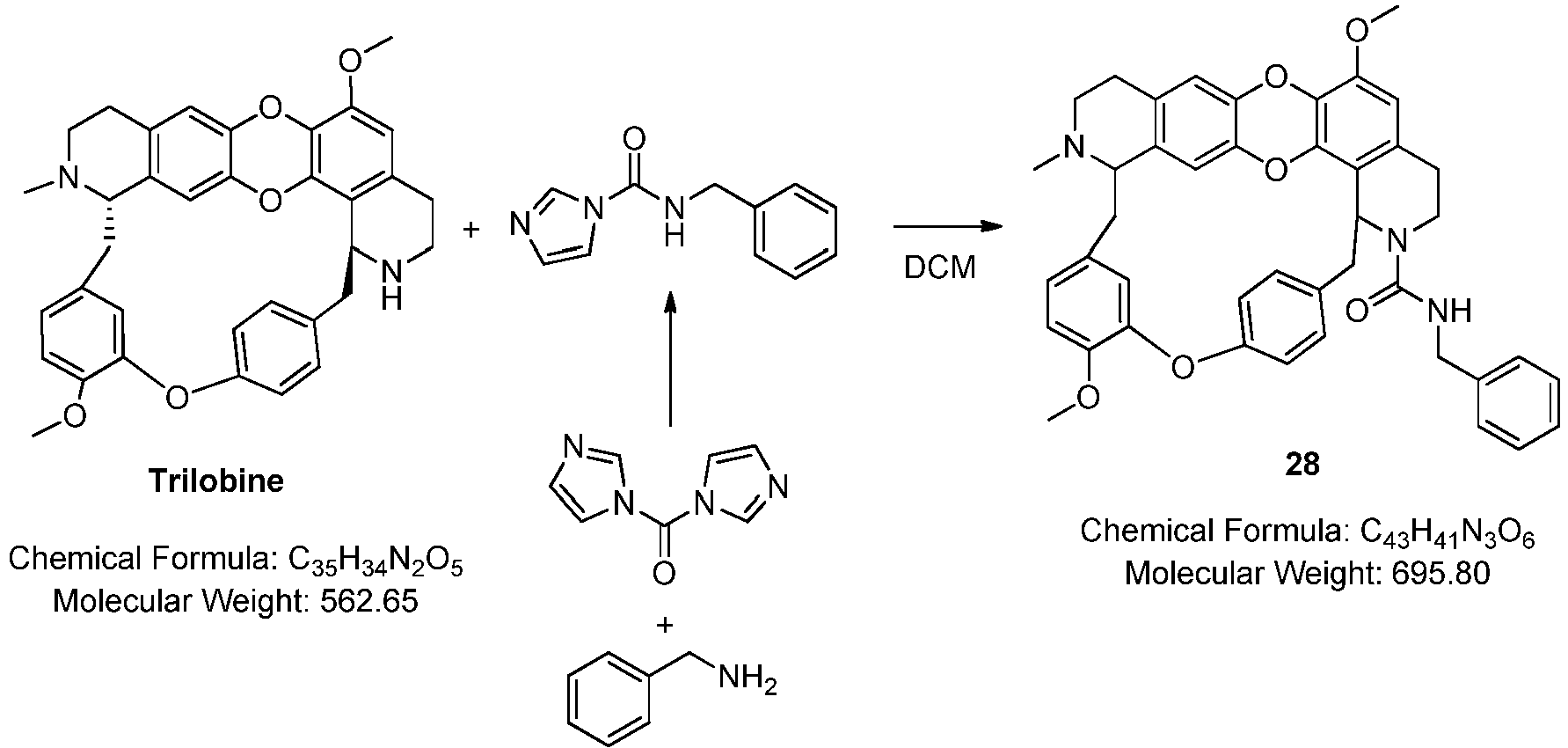
- A solution containing pyridine-4-methanamine (3.1 µL, 28.0 µmol) and 1,1carbonyldimidazole (4.5 mg - 28.0 µmol) in DCM (500µL), was stirred at RT for 2 h. Next, Trilobine (5.0 mg, 8.9 µmol) was added to the solution. The reaction mixture was stirred at RT for 12 h., then purified by HPLC semi-preparative X-Terra RP-18, eluting with a linear gradient H2O/MeCN with 0.02% TEA (80:20 to 0:100), to give 28 (1.6 mg, 2.3 µmol, 26%).
HRMS-ESI (m/z) calculated for C42H41N4O6 [M+H]+: 696.3068; Found: 696.3047. -
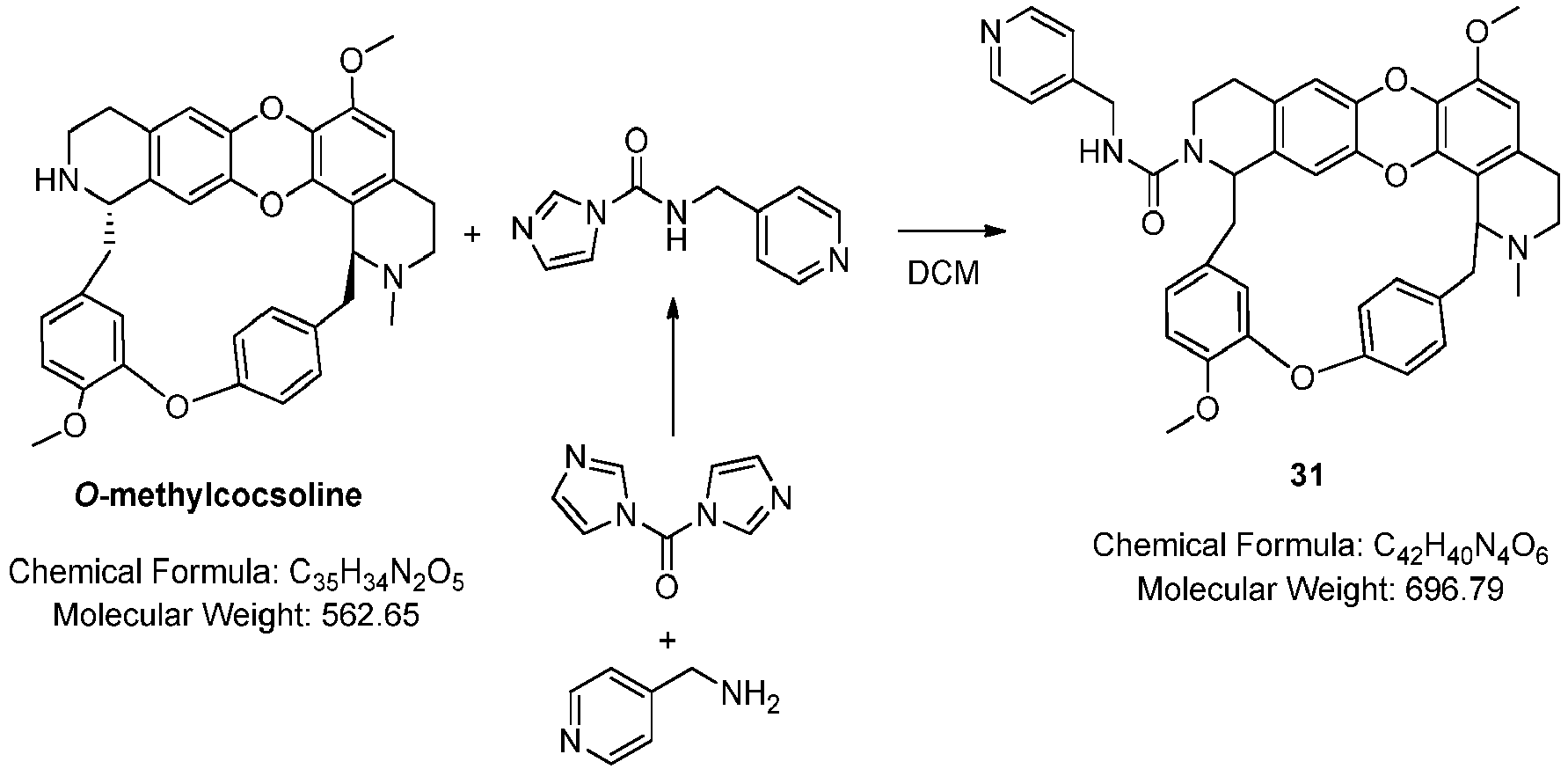
- A stirred solution containing pyridine-4-methanamine (2.9 µL, 29.0 µmol) and 1,1carbonyldimidazole (4.5 mg - 28.0 µmol in DCM (500µL),) was stirred at RT for 2 h. Next, O-methylcocsoline (5.0 mg, 8.9 µmol) was added to the solution. The reaction mixture was stirred at RT for 48 h. The reaction mixture was purified by HPLC semi-preparative X-Terra RP-18, eluting with a linear gradient H2O/MeCN with 0.02% TEA (65:35 to 15:85), to give 31 (1.1 mg, 1.6 µmol, 17%).
1H NMR (500MHz, CDCl3) δ 8.83-8.51 (m, 4H), 7.64-7.61(m, 2H), 7.23-7.21 (m, 1H), 7.19-7.18 (m, 1H), 7.08-7.00 (m, 2H), 6.65-6.55 (m, 3H), 6.41 (s, 1H), 6.05 (s, 1H), 4.48-4.41 (m, 2H), 4.38-4.30 (m, 2H), 4.22-4.18 (m, 2H), 4.08-4.05 (m ,1H), 3.89 (s, 3H), 3.85 (s, 3H), 3.49 (s br, 1H), 3.38-3.35 (m, 2H), 3.19-3.08 (m, 3H), 2.98-2.85 (m, 3H) 2.82-2.68 (m, 4H), 2.39 (s, 3H), 2.55-2.45 (m, 3H).
HRMS-ESI (m/z) calculated for C42H41N4O6 [M+H]+: 697.3021; Found: 697.3328. -

- A solution containing pyridine-4-amine (2.7 mg, 29 µmol) in DCM (500 µL), 1,1carbonyldimidazole (4.5 mg - 28 µmol) was stirred at RT for 2 h. Next, O-methylcocsoline (5.0 mg, 8.9 µmol) was added to the solution. The reaction mixture was stirred at RT for 48 h. The reaction mixture was purified by HPLC semi-preparative X-Terra RP-18, eluting with a linear gradient H2O/MeCN with 0.02% TEA (65.35 to 15:85), to give 23 (2.6 mg, 3.8 µmol, 43%).
HRMS-ESI (m/z) calculated for C41H39N4O6 [M+H]+: 682.2864; Found: 683.2854. -

- A solution containing 3-amino-pyridin (2.7 mg - 29.0 µmol) in DCM (500 µL), 1,1carbonyldimidazole (4.5 mg - 28.0 µmol) was stirred at RT for 2 h. Next, O-methylcocsoline (5.0 mg - 8.9 µmol) was added to the solution. The reaction mixture was stirred at RT for 48h, then purified by HPLC semi-preparative X-Terra RP-18, eluting with a linear gradient H2O/MeCN with 0.02% TEA (65.35 to 15.85), to give 27 (1.7 mg, 2.5 µmol, 28%).
HRMS-ESI (m/z) calculated for C41H39N4O6 [M+H]+: 683.2864; Found: 683.2853. - Compounds were provided at a concentration of 10 mM in DMSO.
- P. falciparum parasite are cultured using standard protocol (Trager and Jensen, Science 1976, 193(4254), 673-675). Briefly, parasites are cultured at 4% hematocrit (O+ human blood, Etablissement Français du Sang, France) in RPMI1640 complemented with 0.1% Albumax I, HEPES buffer, hypoxanthine, and gentamycin. They are incubated at 37°C under an atmosphere of 5% CO2 and 5% O2.
- Compounds of the invention were assayed for a first screen at 5µM in duplicate against asynchronous asexual cultures of P. falciparum NF54 (drug-sensitive line) containing mostly rings (2% hematocrit. 0.5% starting parasitemia). Plates were incubated for 72h at 37°C under a reduced oxygen atmosphere. Parasite growth was assessed using the SYBR Green I based assay.
- Compounds inducing less than 40% survival at 5µM were assayed for IC50 in duplicate using a 7-concentration range with 3-fold dilutions, in the same conditions. For the most active compounds, three independent experiments were realized using a range with 2-fold dilutions. IC50 were determined using
Graphpad Prism 6 software. Dihydroartemisinin (starting concentration 50nM) and DMSO were used as positive and negative controls. -
Table 1 - Inhibition activity of the proliferation of asynchronous asexual cultures of P.falciparum NF54. entry Structure % survival @5uM Malaria CI50 nM 10 
11,7 470+/-62 23 
13,4 223+/-58 27 
12,7 383+/-173 28 
14,4 504+/-134 31 
14,8 151+/-21 42 
12,9 437+/-83 43 
13,3 438+/-95 46 
14,2 169+/-10 48 
11,8 195+/-55 60 
15,4 227+/-59 68 
14,8 189 73 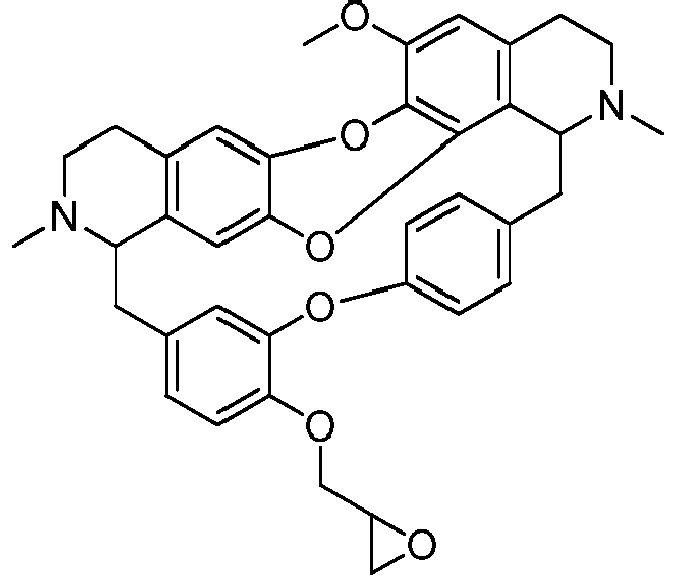
15,8 299+/-25 74 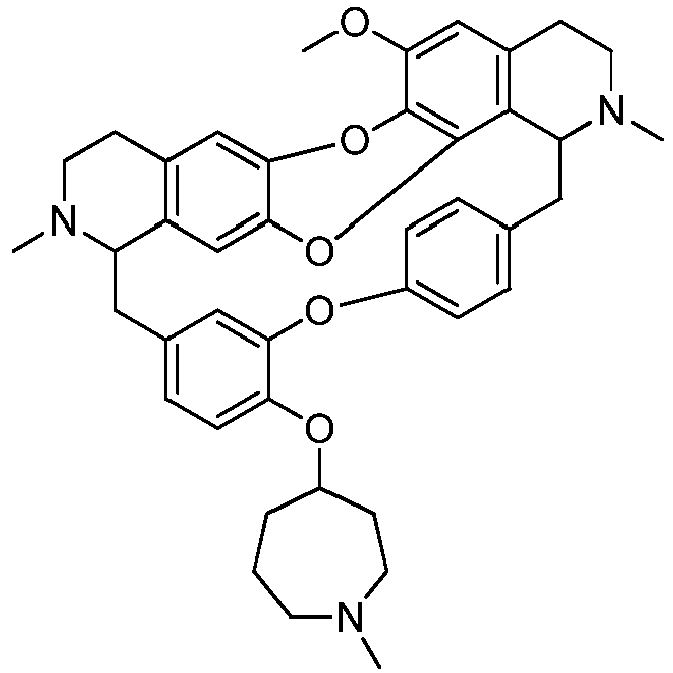
14,7 297+/-42 75 
14,9 352+/-54 78 
12,6 331+/-29 82 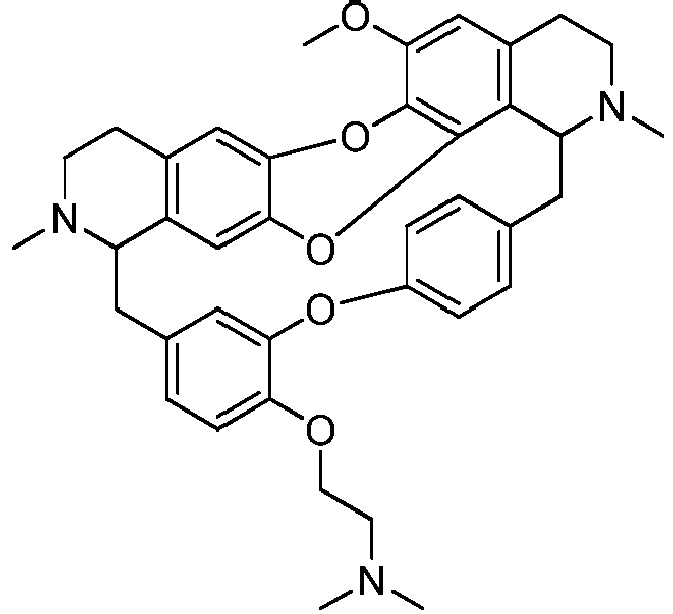
13,4 260+/-34 84 
14,9 130+/-35 137 87 
11,3 441+/-67 88 
14,7 297+/-31 89 
14,4 428+/-77 110 
146+/-39 113 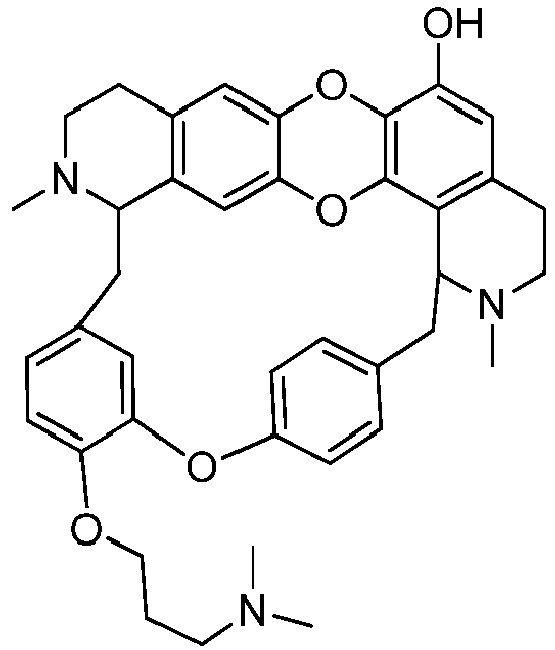
153+/-58 116 
263+/-50 121 
115+/-55 122 
248+/-58 123 
283+/-155 124 
423+/-239 - The following results were also obtained, in the same conditions than the ones described above:
mean IC50 +/- SD (nM) Nortrilobine 1220 ± 130 Isotrilobine 1775 -
Compounds 63 and 84 were evaluated regarding the inhibition of the proliferation of multi-resistant field isolates adapted to culture. A panel of four Cambodian strains bearing different molecular markers of resistance were selected: 3D7: Laboratory strain, drug-sensitive, 5150: Cambodian isolate resistant to Chloroquine and Pyrimethamine, 6591: Cambodian isolate resistant to Chloroquine, Pyrimethamine, 5248: Cambodian isolate resistant to Chloroquine, Pyrimethamine, Mefloquine and Artemisinin, 6320: Cambodian isolate resistant to Chloroquine, Pyrimethamine, Piperaquine and Artemisinin. - IC50 were obtained against asynchronous asexual stages using SYBR-green assay after 72h of incubation with a serial dilution of the compounds. Data represents the mean and SD of 3 independent experiments ran in triplicates. Table 2 illustrates mean IC50 values and their standard deviation in nanomolar.
Table 2 IC50 nM Strain 6591 Strain 5248Strain 5150Strain 6320Lab. Strain 3D7 mean* SD mean* SD mean* SD mean* SD mean* SD 84 167 27 346 165 251 74 183 8 136 42 Pyrimethamine >5000 >5000 >5000 >5000 30 4 Chloroquine 64 5 98 20 55 9 109 3 13 6 Piperaquine 34 2 33 9 26 5 >200 41 17 * mean value of three replicates - To assess stage specificity of compounds of the invention, asexual NF54 parasites were tightly synchronized (0 to 3h post-invasion) using gelatin flotation and 5% D-sorbitol-treatment 3h later. These parasites were then dispensed in 48-well plates (500µL per well at 2% hematocrit, 0.5% starting parasitemia) and incubated for six hours with different concentration of the compounds (corresponding to one time, two times and three times the IC50 value), either directly (0-6h treatment window) or after 6h, 12h, 18h, 24h, 30h, 36h, or 42h. Following the 6h-treatment, the corresponding cells were pelleted, washed with 10ml RPMI, and put back into culture in 500uL of complete media in a new plate. Parasitemia was assessed at 72 hours post-synchronization using giemsa-stained thin blood smears. Percentage of survival was calculated in comparison to a DMSO-treated control. The data were obtained in three independent experiments.
Compound 84 is active throughout the 48h cycle with an increased efficiency between 12 and 42h post-invasion (Figure 1 ). This compound is active starting from the concentration corresponding to 3 times the IC50 value. - Since compounds of the invention are active on early ring stage as shown by the experiments on the cell cycle, their ability to kill artemisinin-resistant parasites in the ring-stage survival assay was tested (
strains Figure 2 ). - 0-3h synchronized ring-stage parasites were exposed to a treatment of 6h with either DMSO, 700nM dihydroartemisinin (DHA), three times the IC50 value of the compound to test or 700nM DHA in combination with three times the IC50 value of the compound to test. Parasitemia was assessed at 72 hours post-synchronization using giemsa-stained thin blood smears. Percentage of survival was calculated in comparison to a DMSO-treated control. The data were obtained in three independent experiments.
-
Compound 84 kills resistant rings using three times the IC50 value in a similar manner whichever the strain considered, as observed on sensitive cell line NF54 (figure 2 , 0-6h treatment window). This compound is able to kill the parasites of all the tested strains in combination with 700nM dihydroartemisinin (DHA). - Parasites are incubated (see for example Sanz et al. PLoS ONE 7, e30949 (2012)) with a compound of the invention (or a reference) for different time-windows, washed, and diluted serially in 96-well plates in fresh red blood cells. Parasites are kept in culture for 3 to 4 weeks, when growth is assessed to evaluate the number of parasites that survive-correlated to the number of wells where growth is found. Survival curves are obtained by plotting the duration of treatment versus the log of the number of viable parasites (
figure 3 ).Compounds - In vivo activity was determined as previously described (Malmquist et al. Antimicrob. Agents Chemother. 2015, 59 (2), 950-959) following the Peters 4-day suppressive test (Peters, Ann. Trop. Med. Parasitol. 1975, 69 (2), 155-171), with slight modifications. C57BL/6 mice were infected intraperitoneally (i.p.) with 105 P. berghei ANKA strain GFP-expressing parasites (Ishino et al. Cell. Mol. Microbiol. 2006, 59 (4), 1175-1184). Two hours post-infection, mice were treated i.p. with a daily regimen of 10mg/kg of
compound 84, or 25mg/kg of chloroquine, or the equivalent vehicle control (distillated water) for four days. Parasitemia was quantified from blood samples collected every day by flow cytometry of 50,000 RBCs and confirmed by Giemsa-stained blood smears. When treated withcompound 84 at 10mg/kg, the mice do not develop severe malaria symptoms and are able to survive untilday 16 after inoculation.
Claims (14)
- A compound of following formula (I)
 Y1 and Y2 are each independently H or (C1-C10)-alkyl, in which the fragments (C1-C10)-alkyl are optionally substituted by at least one group selected from NRY1RY2;RY1 and RY2 are each independently H or (C1-C10)-alkyl;X1 is H, methyl, ethyl, (C1-C10)-alkyl-R4, (C2-C10)-alkenyl, (C2-C10)-alkenyl-R4, CONHR5, (CH2-CH2O)m-H with m=2-4, in which the fragments (C1-C10)-alkyl are optionally substituted by at least one group selected from halogens;and N-X1 optionally represents N+-O-;R2 is chosen from H, methyl, ethyl, (C1-C10)-alkyl-R4', (C2-C10)-alkenyl, (C2-C10)-alkenyl-R4', CONHR5', (CH2-CH2O)m-H with m=2-4, (C1-C10)-alkyl substituted by at least one group selected from halogen, -OH and -O-(C1-C10)-alkyl;R4 is OH, O-(C1-C10)-alkyl, O-(C5-C10)-aryl, NO2, CN, (3-12)-membered-heterocycle, O-((CH2)2O)n-H with n=1-3, CONRcRd, halogen, COORc, CF3, or (C3-C12)-cycloalkyl, in which (C5-C10)-aryl and (3-12)-membered-heterocycle are optionally substituted by at least one group selected from NRcRd, ORe, (C1-C10)-alkyl, halogen and oxo (=O);R5 is H, or a group chosen among (C1-C10)-alkyl-R6, (C3-C12)-cycloalkyl, (C2-C10)-alkenyl, and a (3-12)-membered-heteroaryl, said group being optionally substituted by at least one group selected from halogen, CN, NRcRd, NO2, CONRcRd, COORc, CF3, ORe,R4' is OH, O-(C1-C10)-alkyl, O-(C5-C10)-aryl, NO2, CN, NRcRd, (3-12)-membered-heterocycle, O-((CH2)2O)n-H with n=1-3, CONRcRd, halogen, COORc, CF3, or (C3-C12)-cycloalkyl, in which (C5-C10)-aryl and (3-12)-membered-heterocycle are optionally substituted by at least one group selected from NRcRd, ORc, (C1-C10)-alkyl, halogen and oxo (=O);R5' is H, or a group chosen among (C1-C10)-alkyl-R6', (C3-C12)-cycloalkyl, (C2-C10)-alkenyl, benzyl, and, only when R1 and X1 are not H, Me, said groups being optionally substituted by at least one group selected from halogen, CN, NRcRd, NO2, CONRcRd, COORc, CF3, ORe;R6 is NRcRd, (3-12)-membered-heteroaryl or (3-12)-membered-heterocycle, in which the fragment (3-12)-membered-heteroaryl or (3-12)-membered-heterocycle is optionally substituted by at least one group selected from NRcRd, ORe, (C1-C10)-alkyl, (C1-C10)-alkyl-(3-12)-membered-heterocycle, halogen and oxo;R6' is NRcRd or (3-12)-membered-heterocycle, in which the (3-12)-membered-heterocycle is optionally substituted by at least one group selected from (C1-C10)-alkyl;R1 is H, methyl, -(C1-C6) alkyl-NRaRb, COR7, (3-12)-membered-azaheterocycle optionally substituted by at least one group selected from (C1-C10)-alkyl, or (C1-C6)-alkyl substituted by at least one group selected from epoxide and (3-12)-membered-azaheterocycle, both optionally substituted by at least one group selected from (C1-C10)-alkyl,Ra and Rb are independently from each other (C1-C6) alkyl or H, at least one of Ra and Rb being a (C1-C6) alkyl;Rc, Rd and Re are for each occurence independently from each other (C1-C6) alkyl or H; R3 is H, (C1-C6) alkyl, (C1-C6) alkyl substituted by NRcRd;R7 is (C1-C10)-alkyl, (C5-C10)-aryl;With the proviso that:- in case Y1 and Y2 are H, and R1, R2, R3 and X1 are independently chosen from H and methyl, then R3 is H and R2 is H;or a pharmaceutically acceptable salt or solvate thereof,
for use in the treatment and/or prevention of malaria. - The compound for use according to claim 1, wherein it is a compound of one of the following formulae:

- The compound for use according to anyone of claims 1 to 2, wherein :- Y1 and/or Y2, in particular Y1 and Y2, are H; and/or- R3 is H or methyl, in particular methyl.
- The compound for use according to anyone of claims 1 to 3, wherein :- one of R1, R2 and X1 is not H nor methyl, the two others being notably H or methyl;- R1 is not H nor methyl, R2 and X1 being in particular independently H or methyl;- R2 is not H nor methyl, R1 and X1 being in particular independently H or methyl;- X1 is not H nor methyl, R1 and R2 being in particular independently H or methyl; or- X1 and R2 are not H nor methyl, X1 and R2 being in particular identical, R1 being notably H or methyl.
- The compound for use according to anyone of claims 1 to 3, of following formula (II)
 Y1, Y2 and R3 are as defined in claim 1, Y1 and Y2, being in particular H, and R3 being in particular methyl,X1 is H, methyl, CONHR5, (CH2-CH2O)m-H with m=2-4;R2 is chosen from H, methyl, (C1-C10)-alkyl-R4', CONHR5', and (CH2-CH2O)m-H with m=2-4, (C1-C10)-alkyl being optionally substituted by at least one -OH;R5 is a group chosen among (C1-C10)-alkyl-R6, and (3-12)-membered-heteroaryl, in particular pyridyl;R4' is NRcRd;R5' is a group chosen among (C1-C10)-alkyl-R6', benzyl, and, only when R1 and X1 are not H, Me;R6 is NRcRd, (3-12)-membered-heteroaryl, in particular pyridyl, or (3-12)-membered-heterocycle, in particular piperazinyl, in which the fragment (3-12)-membered-heteroaryl or (3-12)-membered-heterocycle is optionally substituted by at least one group selected from (C1-C10)-alkyl;R6' is NRcRd;R1 is H, methyl, -(C1-C6)alkyl-NRaRb, COR7, (3-12)-membered-azaheterocycle, in particular azepanyl, optionally substituted by at least one group selected from (C1-C10)-alkyl, or (C1-C6)-alkyl substituted by at least one group selected from epoxide and (3-12)-membered-azaheterocycle, in particular pyrrolidinyl or piperazinyl, both epoxide and (3-12)-membered-azaheterocycle being optionally substituted by at least one group selected from (C1-C10)-alkyl,Ra and Rb are independently from each other (C1-C6) alkyl or H, at least one of Ra and Rb being a (C1-C6) alkyl;Rc, Rd and Re are for each occurence independently from each other (C1-C6) alkyl or H;R7 is (C1-C10)-alkyl, (C5-C10)-aryl;with the proviso that:- in case R1, R2, R3 and X1 are independently chosen from H and methyl, then R3 is H and R2 is H.
 - The compound for use according to anyone of claims 1 to 5, wherein in case R1, R2, R3 and X1 are independently chosen from H and methyl, then R3 is H, and R2 is H, R1 being in particular H.
- The compound for use according to claim 1, wherein it is selected from the following compounds:


- The compound for use according to any one of claims 1 to 7, wherein the malaria is caused by a drug sensitive or drug resistant malaria parasite, in particular a drug resistant malaria parasite.
- The compound for use according to claim 8, wherein the drug-sensitive or drug-resistant malaria parasite is a chloroquine-sensitive; a chloroquine-resistant; a chloroquine and pyrimethamine-sensitive; a chloroquine and pyrimethamine-resistant; a chloroquine, pyrimethamine and mefloquine-sensitive; a chloroquine, pyrimethamine and mefloquine-resistant; a chloroquine, pyrimethamine, mefloquine and artemisinin-sensitive; a chloroquine, pyrimethamine, mefloquine and artemisinin-resistant; a chloroquine, pyrimethamine, piperaquine and artemisinin-sensitive; a chloroquine, pyrimethamine, piperaquine and artemisinin-resistant malaria parasite.
- The compound for use according to claim any one of claims 1 to 9, wherein malaria is caused by infection with Plasmodium, in particular by Plasmodium falciparum, P. vivax, P. ovale, or P. malariae, P. knowlesi more particularly by Plasmodium falciparum.
- A combination of a compound according to any one of claims 1 to 7, with at least one other antimalarial agent for use in the treatment of malaria with simultaneous administration, separate or spread out over time.
- The combination for use according to claim 11, wherein the other antimalarial agent is selected from chloroquine, artemesin, qinghaosu, 8-aminoquinoline, amodiaquine, arteether, artemether, artemisinin, artesunate, artesunic acid, artelinic acid, atovaquone, azithromycine, biguanide, chloroquine phosphate, chlorproguanil, cycloguanil, dapsone, desbutyl halofantrine, desipramine, doxycycline, dihydrofolate reductase inhibitors, dipyridamole, halofantrine, haloperidol, hydroxychloroquine sulfate, imipramine, mefloquine, penfluridol, phospholipid inhibitors, primaquine, proguanil, pyrimethamine, pyronaridine, quinine, quinidine, quinacrineartemisinin, sulfonamides, sulfones, sulfadoxine, sulfalene, tafenoquine, tetracycline, tetrandine, triazine, salts and mixture thereof.
- A pharmaceutical composition comprising a compound of following formula (III):
 Y1 and Y2 are each independently H or (C1-C10)-alkyl, in which the fragments (C1-C10)-alkyl are optionally substituted by at least one group selected from NRY1RY2;RY1 and RY2 are each independently H or (C1-C10)-alkyl;X1 is H, methyl, ethyl, (C1-C10)-alkyl-R4, (C2-C10)-alkenyl, (C2-C10)-alkenyl-R4, CONHR5, (CH2-CH2O)m-H with m=2-4, in which the fragments (C1-C10)-alkyl are optionally substituted by at least one group selected from halogens;and N-X1 optionally represents N+-O-;R2 is chosen from H, methyl, ethyl, (C1-C10)-alkyl-R4', (C2-C10)-alkenyl, (C2-C10)-alkenyl-R4', CONHR5', (CH2-CH2O)m-H with m=2-4, (C1-C10)-alkyl substituted by at least one group selected from halogen, -OH and -O-(C1-C10)-alkyl;R4 is OH, O-(C1-C10)-alkyl, O-(C5-C10)-aryl, NO2, CN, (3-12)-membered-heterocycle, O-((CH2)2O)n-H with n=1-3, CONRcRd, halogen, COORc, CF3, or (C3-C12)-cycloalkyl,in which (C5-C10)-aryl and (3-12)-membered-heterocycle are optionally substituted by at least one group selected from NRcRd, ORe, (C1-C10)-alkyl, halogen and oxo (=O);R5 is H, or a group chosen among (C1-C10)-alkyl-R6, (C3-C12)-cycloalkyl, (C2-C10)-alkenyl, and a (3-12)-membered-heteroaryl, said group being optionally substituted by at least one group selected from halogen, CN, NRcRd, NO2, CONRcRd, COORc, CF3, ORe,R4' is OH, O-(C1-C10)-alkyl, O-(C5-C10)-aryl, NO2, CN, NRcRd, (3-12)-membered-heterocycle, O-((CH2)2O)n-H with n=1-3, CONRcRd, halogen, COORc, CF3, or (C3-C12)-cycloalkyl, in which (C5-C10)-aryl and (3-12)-membered-heterocycle are optionally substituted by at least one group selected from NRcRd, ORc, (C1-C10)-alkyl, halogen and oxo (=O);R5' is H, or a group chosen among (C1-C10)-alkyl-R6', (C3-C12)-cycloalkyl, (C2-C10)-alkenyl, benzyl, and, only when R1 and X1 are not H, Me, said groups being optionally substituted by at least one group selected from halogen, CN, NRcRd, NO2, CONRcRd, COORc, CF3, ORe;R6 is NRcRd, (3-12)-membered-heteroaryl or (3-12)-membered-heterocycle, in which the fragment (3-12)-membered-heteroaryl or (3-12)-membered-heterocycle is optionally substituted by at least one group selected from NRcRd, ORe, (C1-C10)-alkyl, (C1-C10)-alkyl-(3-12)-membered-heterocycle, halogen and oxo;R6' is NRcRd or (3-12)-membered-heterocycle, in which the (3-12)-membered-heterocycle is optionally substituted by at least one group selected from (C1-C10)-alkyl;R1 is H, methyl, -(C1-C6) alkyl-NRaRb, COR7, (3-12)-membered-azaheterocycle optionally substituted by at least one group selected from (C1-C10)-alkyl, or (C1-C6)-alkyl substituted by at least one group selected from epoxide and (3-12)-membered-azaheterocycle, both optionally substituted by at least one group selected from (C1-C10)-alkyl,Ra and Rb are independently from each other (C1-C6) alkyl or H, at least one of Ra and Rb being a (C1-C6) alkyl;Rc, Rd and Re are for each occurence independently from each other (C1-C6) alkyl or H;R3 is H, (C1-C6) alkyl, (C1-C6) alkyl substituted by NRcRd;R7 is (C1-C10)-alkyl, (C5-C10)-aryl;
With the proviso that:- R3 is H, and R2 is H; or- At least one of Y1 and Y2 is not H; or- At least one of R1, R2, R3 and X1 is not H or methyl, with R1, R2, R3 and X1 being such as:X1 is H, methyl, CONHR5, (CH2-CH2O)m-H with m=2-4, in which the fragments (C1-C10)-alkyl are optionally substituted by at least one group selected from halogens;R2 is chosen from H, methyl, (C1-C10)-alkyl-R4', CONHR5', (CH2-CH2O)m-H with m=2-4, (C1-C10)-alkyl substituted by at least one or two groups selected from halogen, -OH and -O-(C1-C10)-alkyl, in particular -OH;R5 is a group chosen among (C1-C10)-alkyl-R6, and a (3-12)-membered-heteroaryl, in particular pyridyl, said group being optionally substituted by at least one group selected from halogen, CN, NRcRd, NO2, CONRcRd, COORc, CF3, ORe,R4' is NRcRd;R5' is H, or a group chosen among (C1-C10)-alkyl-R6' and benzyl, said groups being optionally substituted by at least one group selected from halogen, CN, NRcRd, NO2, CONRcRd, COORc, CF3, ORe;R6 is (3-12)-membered-heteroaryl, in particular pyridyl, or (3-12)-membered-heterocycle, in particular piperazinyl, in which the fragment (3-12)-membered-heteroaryl or (3-12)-membered-heterocycle is optionally substituted by at least one group selected from NRcRd, ORe, (C1-C10)-alkyl, (C1-C10)-alkyl-(3-12)-membered-heterocycle, halogen and oxo;R6' is (3-12)-membered-heterocycle, in which the (3-12)-membered-heterocycle is optionally substituted by at least one group selected from (C1-C10)-alkyl;R1 is H, methyl, -(C1-C6)alkyl-NRaRb, COR7, (3-12)-membered-azaheterocycle, in particular azepanyl, optionally substituted by at least one group selected from (C1-C10)-alkyl, or (C1-C6)-alkyl substituted by at least one group selected from epoxide and (3-12)-membered-azaheterocycle, in particular pyrrolidinyl or piperazinyl, both epoxide and (3-12)-membered-azaheterocycle being optionally substituted by at least one group selected from (C1-C10)-alkyl,Ra and Rb are independently from each other (C1-C6) alkyl or H, at least one of Ra and Rb being a (C1-C6) alkyl;Rc, Rd and Re are for each occurence independently from each other (C1-C6) alkyl or H;R3 is H, (C1-C6) alkyl, in particular methyl;R7 is methyl or phenyl, in particular methyl, ora stereoisomeric form, a mixture of stereoisomeric forms or a pharmaceutically acceptable salt form thereof,in admixture with at least one pharmaceutically acceptable excipient. - Compound of the following formula (III):
 Y1 and Y2 are each independently H or (C1-C10)-alkyl, in which the fragments (C1-C10)-alkyl are optionally substituted by at least one group selected from NRY1RY2;RY1 and RY2 are each independently H or (C1-C10)-alkyl;X1 is H, methyl, ethyl, (C1-C10)-alkyl-R4, (C2-C10)-alkenyl, (C2-C10)-alkenyl-R4, CONHR5, (CH2-CH2O)m-H with m=2-4, in which the fragments (C1-C10)-alkyl are optionally substituted by at least one group selected from halogens;and N-X1 optionally represents N+-O-;R2 is chosen from H, methyl, ethyl, (C1-C10)-alkyl-R4', (C2-C10)-alkenyl, (C2-C10)-alkenyl-R4', CONHR5', (CH2-CH2O)m-H with m=2-4, (C1-C10)-alkyl substituted by at least one group selected from halogen, -OH and -O-(C1-C10)-alkyl;R4 is OH, O-(C1-C10)-alkyl, O-(C5-C10)-aryl, NO2, CN, (3-12)-membered-heterocycle, O-((CH2)2O)n-H with n=1-3, CONRcRd, halogen, COORc, CF3, or (C3-C12)-cycloalkyl, in which (C5-C10)-aryl and (3-12)-membered-heterocycle are optionally substituted by at least one group selected from NRcRd, ORe, (C1-C10)-alkyl, halogen and oxo (=O);R5 is H, or a group chosen among (C1-C10)-alkyl-R6, (C3-C12)-cycloalkyl, (C2-C10)-alkenyl, and a (3-12)-membered-heteroaryl, said group being optionally substituted by at least one group selected from halogen, CN, NRcRd, NO2, CONRcRd, COORc, CF3, ORe,R4' is OH, O-(C1-C10)-alkyl, O-(C5-C10)-aryl, NO2, CN, NRcRd, (3-12)-membered-heterocycle, O-((CH2)2O)n-H with n=1-3, CONRcRd, halogen, COORc, CF3, or (C3-C12)-cycloalkyl, in which (C5-C10)-aryl and (3-12)-membered-heterocycle are optionally substituted by at least one group selected from NRcRd, ORc, (C1-C10)-alkyl, halogen and oxo (=O);R5' is H, or a group chosen among (C1-C10)-alkyl-R6', (C3-C12)-cycloalkyl, (C2-C10)-alkenyl, benzyl, and, only when R1 and X1 are not H, Me, said groups being optionally substituted by at least one group selected from halogen, CN, NRcRd, NO2, CONRcRd, COORc, CF3, ORe;R6 is NRcRd, (3-12)-membered-heteroaryl or (3-12)-membered-heterocycle, in which the fragment (3-12)-membered-heteroaryl or (3-12)-membered-heterocycle is optionally substituted by at least one group selected from NRcRd, ORe, (C1-C10)-alkyl, (C1-C10)-alkyl-(3-12)-membered-heterocycle, halogen and oxo;R6' is NRcRd or (3-12)-membered-heterocycle, in which the (3-12)-membered-heterocycle is optionally substituted by at least one group selected from (C1-C10)-alkyl; R1 is H, methyl, -(C1-C6) alkyl-NRaRb, COR7, (3-12)-membered-azaheterocycle optionally substituted by at least one group selected from (C1-C10)-alkyl, or (C1-C6)-alkyl substituted by at least one group selected from epoxide and (3-12)-membered-azaheterocycle, both optionally substituted by at least one group selected from (C1-C10)-alkyl,Ra and Rb are independently from each other (C1-C6) alkyl or H, at least one of Ra and Rb being a (C1-C6) alkyl;Rc, Rd and Re are for each occurence independently from each other (C1-C6) alkyl or H;R3 is H, (C1-C6) alkyl, (C1-C6) alkyl substituted by NRcRd;R7 is (C1-C10)-alkyl, (C5-C10)-aryl;
With the proviso that:- R3 is H, and R2 is H; or- At least one of Y1 and Y2 is not H; or- At least one of R1, R2, R3 and X1 is not H or methyl, with R1, R2, R3 and X1 being such as:X1 is H, methyl, CONHR5, (CH2-CH2O)m-H with m=2-4, in which the fragments (C1-C10)-alkyl are optionally substituted by at least one group selected from halogens;R2 is chosen from H, methyl, (C1-C10)-alkyl-R4', CONHR5', (CH2-CH2O)m-H with m=2-4, (C1-C10)-alkyl substituted by at least one or two groups selected from halogen, -OH and -O-(C1-C10)-alkyl, in particular -OH;R5 is a group chosen among (C1-C10)-alkyl-R6, and a (3-12)-membered-heteroaryl, in particular pyridyl, said group being optionally substituted by at least one group selected from halogen, CN, NRcRd, NO2, CONRcRd, COORc, CF3, ORe,R4' is NRcRd;R5' is H, or a group chosen among (C1-C10)-alkyl-R6' and benzyl, said groups being optionally substituted by at least one group selected from halogen, CN, NRcRd, NO2, CONRcRd, COORc, CF3, ORe;R6 is (3-12)-membered-heteroaryl, in particular pyridyl, or (3-12)-membered-heterocycle, in particular piperazinyl, in which the fragment (3-12)-membered-heteroaryl or (3-12)-membered-heterocycle is optionally substituted by at least one group selected from NRcRd, ORe, (C1-C10)-alkyl, (C1-C10)-alkyl-(3-12)-membered-heterocycle, halogen and oxo;R6' is (3-12)-membered-heterocycle, in which the (3-12)-membered-heterocycle is optionally substituted by at least one group selected from (C1-C10)-alkyl;R1 is H, methyl, -(C1-C6)alkyl-NRaRb, COR7, (3-12)-membered-azaheterocycle, in particular azepanyl, optionally substituted by at least one group selected from (C1-C10)-alkyl, or (C1-C6)-alkyl substituted by at least one group selected from epoxide and (3-12)-membered-azaheterocycle, in particular pyrrolidinyl or piperazinyl, both epoxide and (3-12)-membered-azaheterocycle being optionally substituted by at least one group selected from (C1-C10)-alkyl,Ra and Rb are independently from each other (C1-C6) alkyl or H, at least one of Ra and Rb being a (C1-C6) alkyl;Rc, Rd and Re are for each occurence independently from each other (C1-C6) alkyl or H;R3 is H, (C1-C6) alkyl, in particular methyl;R7 is methyl or phenyl, in particular methyl.
Priority Applications (2)
| Application Number | Priority Date | Filing Date | Title |
|---|---|---|---|
| EP20305456.4A EP3907227A1 (en) | 2020-05-07 | 2020-05-07 | Trilobine derivatives and their use thereof in the treatment of malaria |
| PCT/EP2021/062218 WO2021224491A1 (en) | 2020-05-07 | 2021-05-07 | Trilobine derivatives and their use thereof in the treatment of malaria |
Applications Claiming Priority (1)
| Application Number | Priority Date | Filing Date | Title |
|---|---|---|---|
| EP20305456.4A EP3907227A1 (en) | 2020-05-07 | 2020-05-07 | Trilobine derivatives and their use thereof in the treatment of malaria |
Publications (1)
| Publication Number | Publication Date |
|---|---|
| EP3907227A1 true EP3907227A1 (en) | 2021-11-10 |
Family
ID=71103307
Family Applications (1)
| Application Number | Title | Priority Date | Filing Date |
|---|---|---|---|
| EP20305456.4A Withdrawn EP3907227A1 (en) | 2020-05-07 | 2020-05-07 | Trilobine derivatives and their use thereof in the treatment of malaria |
Country Status (2)
| Country | Link |
|---|---|
| EP (1) | EP3907227A1 (en) |
| WO (1) | WO2021224491A1 (en) |
Citations (2)
| Publication number | Priority date | Publication date | Assignee | Title |
|---|---|---|---|---|
| WO2017055633A1 (en) | 2015-10-02 | 2017-04-06 | Pierre Fabre Medicament | Hemi-synthetic trilobine analogs for use as a drug |
| WO2017055632A1 (en) | 2015-10-02 | 2017-04-06 | Pierre Fabre Medicament | Trilobine and its natural analogs for use as a drug |
-
2020
- 2020-05-07 EP EP20305456.4A patent/EP3907227A1/en not_active Withdrawn
-
2021
- 2021-05-07 WO PCT/EP2021/062218 patent/WO2021224491A1/en not_active Ceased
Patent Citations (2)
| Publication number | Priority date | Publication date | Assignee | Title |
|---|---|---|---|---|
| WO2017055633A1 (en) | 2015-10-02 | 2017-04-06 | Pierre Fabre Medicament | Hemi-synthetic trilobine analogs for use as a drug |
| WO2017055632A1 (en) | 2015-10-02 | 2017-04-06 | Pierre Fabre Medicament | Trilobine and its natural analogs for use as a drug |
Non-Patent Citations (10)
| Title |
|---|
| ELIEL, E. L.WILEN, S.H.: "Stereochemistry of Organic Compounds", 1994, WILEY |
| INUBUSHI Y ET AL: "Total synthesis of bisbenzylisoquinoline alkaloids, trilobine and obaberine", TETRAHEDRON LETTERS, ELSEVIER LTD, AMSTERDAM, NL, vol. 17, no. 33, 1 August 1976 (1976-08-01), pages 2857 - 2860, XP002755269, ISSN: 0040-4039, [retrieved on 20010523], DOI: 10.1016/S0040-4039(01)85520-9 * |
| ISHINO ET AL., CELL. MOL. MICROBIOL., vol. 59, no. 4, 2006, pages 1175 - 1184 |
| JACQUES, J ET AL.: "Enantiomers, Racemates, and Resolutions", 1981, WILEY |
| KURODA H ET AL: "Antitumor effect of bisbenzylisoquinoline alkaloids", CHEMICAL AND PHARMACEUTICAL BULLETIN, PHARMACEUTICAL SOCIETY OF JAPAN, JP, vol. 24, no. 10, 1 October 1976 (1976-10-01), pages 2413 - 2420, XP002753563, ISSN: 0009-2363 * |
| MALMQUIST ET AL., ANTIMICROB. AGENTS CHEMOTHER, vol. 59, no. 2, 2015, pages 950 - 959 |
| PETERS, ANN. TROP. MED. PARASITOL., vol. 69, no. 2, 1975, pages 155 - 171 |
| SANZ ET AL., PLOS ONE, vol. 7, 2012, pages e30949 |
| T.W. GREENEP. G. M. WUTS: "Protective Groups in Organic Chemistry", 1973, WILEY-VCH PUBLISHERS |
| TRAGERJENSEN, SCIENCE, vol. 193, no. 4254, 1976, pages 673 - 675 |
Also Published As
| Publication number | Publication date |
|---|---|
| WO2021224491A1 (en) | 2021-11-11 |
Similar Documents
| Publication | Publication Date | Title |
|---|---|---|
| CN119350242B (en) | Substituted quinolinone compound targeting KRASG12D and application thereof | |
| Aminake et al. | Synthesis and evaluation of hybrid drugs for a potential HIV/AIDS-malaria combination therapy | |
| WO2014165128A2 (en) | Hepatitis b antiviral agents | |
| CZ288752B6 (en) | Benzonaphthyridine derivatives and pharmaceutical preparation containing thereof | |
| TW201726678A (en) | Pyrimidone derivatives and their use in the treatment, amelioration or prevention of a viral disease | |
| CN107011287A (en) | The ketone derivatives of 2 piperazine, 1 base 4H, 1,3 benzothiazines 4 and its purposes for treating mammalian infections | |
| JP2010095550A (en) | Quinoline derivative | |
| EP0299349A2 (en) | N-substituted-5,6-dimethoxy-1,2-benzisoxazole-3-propanamine and related compounds, a process for their preparation and their use as medicaments | |
| EP0741569A1 (en) | Naphthylisoquinoline alkaloids, pharmaceutical compositions containing them and their use for the treatment of malaria | |
| EP0809504B1 (en) | Anti-viral triazacyclododecane | |
| JP2004526712A (en) | 6-phenylbenzonaphthyridine | |
| CN112118891B (en) | Condensed polycyclic pyridone compounds as inhibitors of influenza virus replication | |
| WO2021224491A1 (en) | Trilobine derivatives and their use thereof in the treatment of malaria | |
| CA1207774A (en) | 1-phenylindazol-3-one compounds, a method of preparing them and pharmaceutical compositions containing these compounds | |
| EP0735024A1 (en) | Antidepressant N-(Heteroarylaminoalkyl)-4-napthyl substituted piperidines and tetrahydroperidines | |
| CN111087409A (en) | Quinolone compound and preparation method and application thereof | |
| KR20250137136A (en) | Novel phenylquinolone compounds having antibacterial and anticancer functions, and their preparation | |
| US3671537A (en) | Certain 3-(2,6-dichlorophenyl)-2-iminothiazolidines | |
| CN115160281A (en) | A kind of isocoumarin derivatives and its application in antimalarial drugs | |
| WO2023003862A1 (en) | Cxcr4 modulators and uses related thereto | |
| EP0826686A2 (en) | Tricyclic compounds, their production and use | |
| JP2781073B2 (en) | Novel quinoline derivative and anticancer drug effect enhancer containing the same as active ingredient | |
| CN113527331B (en) | Nitroimidazole derivative and preparation method and application thereof | |
| KR20150024329A (en) | Amidophenoxypropanolamines | |
| AU1580492A (en) | Reissert compounds as anti-hiv agents |
Legal Events
| Date | Code | Title | Description |
|---|---|---|---|
| PUAI | Public reference made under article 153(3) epc to a published international application that has entered the european phase |
Free format text: ORIGINAL CODE: 0009012 |
|
| STAA | Information on the status of an ep patent application or granted ep patent |
Free format text: STATUS: THE APPLICATION HAS BEEN PUBLISHED |
|
| AK | Designated contracting states |
Kind code of ref document: A1 Designated state(s): AL AT BE BG CH CY CZ DE DK EE ES FI FR GB GR HR HU IE IS IT LI LT LU LV MC MK MT NL NO PL PT RO RS SE SI SK SM TR |
|
| B565 | Issuance of search results under rule 164(2) epc |
Effective date: 20200914 |
|
| STAA | Information on the status of an ep patent application or granted ep patent |
Free format text: STATUS: THE APPLICATION IS DEEMED TO BE WITHDRAWN |
|
| 18D | Application deemed to be withdrawn |
Effective date: 20220511 |