EP3907109B1 - Vehicle logo assembly and vehicle - Google Patents
Vehicle logo assembly and vehicle Download PDFInfo
- Publication number
- EP3907109B1 EP3907109B1 EP19904043.7A EP19904043A EP3907109B1 EP 3907109 B1 EP3907109 B1 EP 3907109B1 EP 19904043 A EP19904043 A EP 19904043A EP 3907109 B1 EP3907109 B1 EP 3907109B1
- Authority
- EP
- European Patent Office
- Prior art keywords
- coating
- lens
- vehicle logo
- vehicle
- inner lens
- Prior art date
- Legal status (The legal status is an assumption and is not a legal conclusion. Google has not performed a legal analysis and makes no representation as to the accuracy of the status listed.)
- Active
Links
Images

Classifications
-
- G—PHYSICS
- G09—EDUCATION; CRYPTOGRAPHY; DISPLAY; ADVERTISING; SEALS
- G09F—DISPLAYING; ADVERTISING; SIGNS; LABELS OR NAME-PLATES; SEALS
- G09F13/00—Illuminated signs; Luminous advertising
- G09F13/04—Signs, boards or panels, illuminated from behind the insignia
- G09F13/08—Signs, boards or panels, illuminated from behind the insignia using both translucent and non-translucent layers
-
- B—PERFORMING OPERATIONS; TRANSPORTING
- B60—VEHICLES IN GENERAL
- B60R—VEHICLES, VEHICLE FITTINGS, OR VEHICLE PARTS, NOT OTHERWISE PROVIDED FOR
- B60R13/00—Elements for body-finishing, identifying, or decorating; Arrangements or adaptations for advertising purposes
- B60R13/005—Manufacturers' emblems, name plates, bonnet ornaments, mascots or the like; Mounting means therefor
-
- G—PHYSICS
- G09—EDUCATION; CRYPTOGRAPHY; DISPLAY; ADVERTISING; SEALS
- G09F—DISPLAYING; ADVERTISING; SIGNS; LABELS OR NAME-PLATES; SEALS
- G09F13/00—Illuminated signs; Luminous advertising
- G09F13/04—Signs, boards or panels, illuminated from behind the insignia
- G09F13/0418—Constructional details
- G09F13/044—Signs, boards or panels mounted on vehicles
-
- G—PHYSICS
- G09—EDUCATION; CRYPTOGRAPHY; DISPLAY; ADVERTISING; SEALS
- G09F—DISPLAYING; ADVERTISING; SIGNS; LABELS OR NAME-PLATES; SEALS
- G09F21/00—Mobile visual advertising
- G09F21/04—Mobile visual advertising by land vehicles
Definitions
- the present application relates to a vehicle logo assembly and a vehicle having the vehicle logo assembly.
- Vehicle logo assemblies capable of emitting light are being used more and more in motor vehicles, in order to present a unique and attractive appearance.
- a light-emitting logo system is known from the document US6174075 ; this comprises a light-emitting device and a logo.
- the light-emitting device includes a polyvinyl chloride (PVC) plate and a light source device; the bottom of the PVC plate has a cavity for accommodating the light source device, the light source device comprises an LED and a power source, and the logo is attached to a surface of the PVC plate.
- PVC polyvinyl chloride
- the light source device comprises an LED and a power source
- the logo is attached to a surface of the PVC plate.
- a light beam shines into the PVC plate and diffuses through it, thereby illuminating the logo attached to the surface thereof.
- a prior art example of a logo assembly corresponding to the preamble of claim 1 is disclosed in WO 2018/121855 A1 .
- An object of the present application is to provide a vehicle logo assembly and a vehicle having the vehicle logo assembly, which can achieve a good display effect of the vehicle logo assembly in a cost-effective manner and with a simple structure.
- the object is achieved as follows: the vehicle logo assembly has a lens, a light source and a support, the light source being arranged in a space enclosed by the lens and the support, and a vehicle logo pattern being formed in the lens, wherein the lens comprises an outer lens and an inner lens superposed one on top of the other, a first coating is applied to that side of the outer lens which faces the inner lens, a second coating is applied to that side of the inner lens which faces the outer lens, and in an assembled state of the outer lens and inner lens, a light-transmitting part in the form of the vehicle logo pattern is formed between the first coating and the second coating.
- this solution can also effectively protect the vehicle logo pattern, to prevent it from being scratched, and has a particularly good visual effect.
- a depression is formed on that side of the outer lens which faces the inner lens, with the first coating being applied in a region other than the depression; and a protrusion is formed on that side of the inner lens which faces the outer lens, with the second coating being applied to a surface of the protrusion, wherein the depression and the protrusion are shape-fitted to each other, and the inner lens and the outer lens are in a close fit.
- a coating material can be effectively prevented from entering the depression undesirably by merely inserting a corresponding mold into the depression, thus enabling cost-effective manufacture.
- the first coating is a paint layer, e.g. a black paint layer; the second coating is a water-electroplated layer, e.g. a silver-colored metal layer.
- the vehicle logo pattern itself is prominently presented due to the obvious color difference between the coatings. When the light source is lit, the light source penetrates and passes through the light-transmitting part, and this presents a good visual effect.
- the inner lens is a two-component injection-molded member, wherein a portion that forms the protrusion of the inner lens is formed of acrylonitrile butadiene styrene copolymer (ABS) or a mixture of ABS and polycarbonate (PC), and other portions are formed of other light-transmitting plastic (e.g. PC, polymethyl methacrylate (PMMA)).
- ABS acrylonitrile butadiene styrene copolymer
- PC polycarbonate
- PMMA polymethyl methacrylate
- the second coating is a metal plated layer, such as a metal chromium layer or a metal aluminum layer.
- a metal chromium layer it is appropriate to select trivalent chromium, in order to meet environmental protection requirements.
- the first coating gradually becomes thinner in a direction toward the depression. This further prevents the incursion of coating material into a wall part forming the depression during the coating process.
- a light diffusion plate is arranged between the light source and the lens. This is conducive to a uniform light output effect in all directions, especially when the light source is a point light source.
- multiple light sources are provided, being arranged on a common printed circuit board.
- the light source may be a light emitting diode, and the color thereof can be freely selected according to needs, e.g. white, red, yellow or other colors.
- a heat sink for the light source is provided, to further facilitate the dissipation of heat from the light source.
- the thicknesses of the first coating and the second coating are 8-10 ⁇ m.
- a vehicle having the vehicle logo assembly described above.
- Fig. 1 shows schematically an exploded view of the vehicle logo assembly according to the present application.
- the vehicle logo assembly 1 mainly comprises a lens 2, a circuit board assembly 30 and a support 50, which are stacked in an assembled state.
- a vehicle logo pattern is provided in the lens 2.
- the circuit board assembly comprises a light source 31 and a printed circuit board 32 accommodating the light source, the circuit board assembly is arranged in a space enclosed by the lens 2 and the support 50, and mounted on the support 50.
- the light source 31 may be an LED light source, e.g. a white LED or an LED of other color.
- multiple light sources may be arranged on the printed circuit board.
- a driver 41 is provided, being connected to an on-board power supply.
- the vehicle logo assembly additionally has a heat sink 40, which is arranged between the printed circuit board and the support.
- the light source is alternatively arranged on the heat sink 40 directly; this further facilitates heat dissipation.
- a recess(not shown) for accommodating the driver 41 may be provided in the support 50, in order to achieve as compact a structure as possible.
- a through-hole 51 for electrically conductive components is also provided in the support 50.
- a light diffusing element may be arranged between the light source and the lens, in order to achieve a uniform light output effect in all directions.
- the light diffusing element may be formed of a light-transmitting plastic matrix and diffusing particles mixed in the matrix.
- the light diffusing element is a PC diffusing plate, the required transmittance of which can be achieved by selecting the content of diffusing particles therein. In general, a smaller number of diffusing particles results in higher transmittance and lower haze, whereas a higher content of diffusing particles results in lower transmittance and higher haze.
- the lens 2 comprises an outer lens 10 and an inner lens 20, which are both made of a plastic with high light transmission, wherein the course of an inside surface of the outer lens is matched to the course of an outside surface of the inner lens, thereby ensuring a close fit between the outer lens 10 and inner lens 20.
- the vehicle logo pattern is achieved through corresponding structural processing of the inside surface of the outer lens 10 and the outside surface of the inner lens 20; this will be expounded in detail below.
- the outer lens 10 shown in Fig. 1 substantially takes the form of a shroud and has a light output side 12, with an opening thereof being covered by the support 50.
- the support 50 may be basin-shaped, having a recess for accommodating other elements of the vehicle logo; here, the outer lens 10 may take the form of a plate.
- a first coating 13 is applied to that side of the outer lens 10 which faces the inner lens 20, i.e. that side which is opposite the light output side 12, wherein the first coating 13 does not cover the whole inner side of the outer lens 10, i.e. the inner side of the outer lens 10 has an uncoated part, as shown schematically by the dotted-line region in Fig.
- the uncoated region takes the form of a combined pattern of an approximate V-shape and a ring shape.
- Light cannot pass through the first coating 13, which is a paint layer, such as black paint or a paint layer of another color. Thus, light can pass out through the uncoated part.
- a second coating 23 is applied to that side of the inner lens 20 which faces the outer lens 10.
- the course of an outer contour of the second coating is matched to the course of an outer contour of the uncoated part of the outer lens 10, but a gap exists between the adjacent outer contours. Light is likewise unable to pass through the second coating 23.
- the combined pattern of an approximate V-shape and a ring shape can be seen in Fig. 1 .
- a light-transmitting part 24 in the form of the vehicle logo pattern is formed between the first coating 13 and the second coating 23.
- the second coating 23 may be an electroplated layer, in particular a water-electroplated layer. Compared with vacuum plating, which involves a complex technological procedure and high environmental and equipment requirements, water electroplating is more cost-effective.
- the second coating 23 is preferably a metal plated layer, e.g. a metal plated layer formed by water electroplating, such as a chromium layer or aluminum layer.
- a metal plated layer e.g. a metal plated layer formed by water electroplating, such as a chromium layer or aluminum layer.
- a chromium layer trivalent chromium is preferred, in order to meet environmental protection requirements.
- the metal plated layer is for example high-gloss silver-colored, dull silver-colored, grey-silver-colored, gunmetal-colored, gold-colored, black-chrome-colored, semi-gloss chrome, etc.
- the inner lens 20 is be formed of a two-component material by injection molding; for example, that region of the inner lens which is coated with the second coating 23 is formed of ABS or a mixture of ABS and PC. Other regions of the inner lens are formed of PC, PMMA or other suitable light-transmitting material. Especially in the case that the outer lens and the other regions of the inner lens are formed of PC, as PC has approximately the same linear expansion coefficient as ABS, it is possible to ensure that the lens as a whole is substantially not adversely affected by temperature while guaranteeing good light transmission and a good coating effect.
- a depression 11 is formed on that side of the outer lens 10 which faces the inner lens 20, with the first coating 13 being applied in a region other than the depression 11.
- a protrusion 22 is formed on that side of the inner lens 20 which faces the outer lens 10, with the second coating 23 being applied to a surface of the protrusion 22.
- the depression 11 and protrusion 22 are shape-fitted to each other, and the inner lens and outer lens are in a close fit.
- the protrusion 22 may be formed of the abovementioned material which has good adhesion to the second coating.
- the outer contour of the second coating 23 is separated from an edge of the protrusion 22 by a predetermined gap, which forms the light-transmitting part 24.
- a mold can be inserted into the depression 11 of the outer lens 10; here, a portion of the mold that is inserted into the depression 11 has an outer contour precisely matches with an inner contour of the depression, so as to prevent a coating material from undesirably entering a wall part forming the depression during the coating process. It is appropriate for the first coating 13 to gradually become thinner in a direction toward the depression 11, and the thinnest region thereof should satisfy the minimum thickness for the condition that light cannot pass through.
- That region of the inner lens which does not need to be coated may for example be stuck with adhesive paper.
- the corresponding adhesive paper may be removed.
- the thicknesses of the first coating and second coating are 8 - 10 ⁇ m.
- a top view of the assembled vehicle logo assembly can be seen in Fig. 2 .
- the second coating 23 on the inner lens can have an obvious color difference relative to the first coating 13 on the outer lens, e.g. the second coating is a high-gloss silver-colored coating, and the first coating is a black paint layer, thereby achieving exceptionally prominent display of the vehicle logo pattern.
- other coating colors can also be set as required.
- the present application further relates to a vehicle having the vehicle logo assembly described above.
Landscapes
- Engineering & Computer Science (AREA)
- Physics & Mathematics (AREA)
- General Physics & Mathematics (AREA)
- Theoretical Computer Science (AREA)
- Mechanical Engineering (AREA)
- Business, Economics & Management (AREA)
- Accounting & Taxation (AREA)
- Marketing (AREA)
- Illuminated Signs And Luminous Advertising (AREA)
- Vehicle Waterproofing, Decoration, And Sanitation Devices (AREA)
Description
- The present application relates to a vehicle logo assembly and a vehicle having the vehicle logo assembly.
- Vehicle logo assemblies capable of emitting light are being used more and more in motor vehicles, in order to present a unique and attractive appearance.
- For example, a light-emitting logo system is known from the document
US6174075 ; this comprises a light-emitting device and a logo. The light-emitting device includes a polyvinyl chloride (PVC) plate and a light source device; the bottom of the PVC plate has a cavity for accommodating the light source device, the light source device comprises an LED and a power source, and the logo is attached to a surface of the PVC plate. When the light source device emits light, a light beam shines into the PVC plate and diffuses through it, thereby illuminating the logo attached to the surface thereof. A prior art example of a logo assembly corresponding to the preamble of claim 1 is disclosed inWO 2018/121855 A1 . - An object of the present application is to provide a vehicle logo assembly and a vehicle having the vehicle logo assembly, which can achieve a good display effect of the vehicle logo assembly in a cost-effective manner and with a simple structure.
- According to one aspect of the present application, the object is achieved as follows: the vehicle logo assembly has a lens, a light source and a support, the light source being arranged in a space enclosed by the lens and the support, and a vehicle logo pattern being formed in the lens, wherein the lens comprises an outer lens and an inner lens superposed one on top of the other, a first coating is applied to that side of the outer lens which faces the inner lens, a second coating is applied to that side of the inner lens which faces the outer lens, and in an assembled state of the outer lens and inner lens, a light-transmitting part in the form of the vehicle logo pattern is formed between the first coating and the second coating. By arranging the vehicle logo pattern on coordinated contact faces of the inner lens and the outer lens, it is possible to prevent corrosion of component parts of the vehicle logo pattern, in particular made of metal, due to the influence of the external environment, e.g. moisture. In addition, this solution can also effectively protect the vehicle logo pattern, to prevent it from being scratched, and has a particularly good visual effect.
- According to the invention, a depression is formed on that side of the outer lens which faces the inner lens, with the first coating being applied in a region other than the depression; and a protrusion is formed on that side of the inner lens which faces the outer lens, with the second coating being applied to a surface of the protrusion, wherein the depression and the protrusion are shape-fitted to each other, and the inner lens and the outer lens are in a close fit. This can ensure the precise positioning of the outer lens relative to the inner lens, and further simplifies assembly. In addition, in this embodiment, when applying the coating to the outer lens, a coating material can be effectively prevented from entering the depression undesirably by merely inserting a corresponding mold into the depression, thus enabling cost-effective manufacture.
- The first coating is a paint layer, e.g. a black paint layer; the second coating is a water-electroplated layer, e.g. a silver-colored metal layer. The vehicle logo pattern itself is prominently presented due to the obvious color difference between the coatings. When the light source is lit, the light source penetrates and passes through the light-transmitting part, and this presents a good visual effect.
- According to the present invention, the inner lens is a two-component injection-molded member, wherein a portion that forms the protrusion of the inner lens is formed of acrylonitrile butadiene styrene copolymer (ABS) or a mixture of ABS and polycarbonate (PC), and other portions are formed of other light-transmitting plastic (e.g. PC, polymethyl methacrylate (PMMA)). This is particularly suitable as the second coating applied to the protrusion is a water-electroplated layer; this material selection can ensure a good coating adhesion result.
- According to the invention, the second coating is a metal plated layer, such as a metal chromium layer or a metal aluminum layer. In the case of a metal chromium layer, it is appropriate to select trivalent chromium, in order to meet environmental protection requirements.
- According to an embodiment of the present invention, the first coating gradually becomes thinner in a direction toward the depression. This further prevents the incursion of coating material into a wall part forming the depression during the coating process.
- According to an embodiment of the present application, a light diffusion plate is arranged between the light source and the lens. This is conducive to a uniform light output effect in all directions, especially when the light source is a point light source.
- According to an embodiment of the present application, multiple light sources are provided, being arranged on a common printed circuit board. The light source may be a light emitting diode, and the color thereof can be freely selected according to needs, e.g. white, red, yellow or other colors.
- According to an embodiment of the present application, a heat sink for the light source is provided, to further facilitate the dissipation of heat from the light source.
- According to an embodiment of the present application, the thicknesses of the first coating and the second coating are 8-10 µm.
- According to another aspect of the present application, a vehicle is proposed, having the vehicle logo assembly described above.
- The present application is expounded further below with the aid of the accompanying drawings. In the drawings:
-
Fig. 1 shows schematically an exploded view of the vehicle logo assembly according to the present application; -
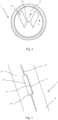
Fig. 2 shows schematically a top view of the vehicle logo assembly according to the present application; -
Fig. 3 shows a partial sectional view of the lens of the vehicle logo assembly along section line A-A inFig. 2 . - Embodiments of the present application are explained demonstratively below. As those skilled in the art should realize, the embodiments explained may be amended in various ways without departing from the concept of the present application. Thus, the accompanying drawings and the Description are in essence demonstrative and non-limiting. In the following text, identical drawing reference labels generally indicate functionally identical or similar elements.
-
Fig. 1 shows schematically an exploded view of the vehicle logo assembly according to the present application. The vehicle logo assembly 1 mainly comprises alens 2, acircuit board assembly 30 and asupport 50, which are stacked in an assembled state. A vehicle logo pattern is provided in thelens 2. The circuit board assembly comprises alight source 31 and a printedcircuit board 32 accommodating the light source, the circuit board assembly is arranged in a space enclosed by thelens 2 and thesupport 50, and mounted on thesupport 50. - The
light source 31 may be an LED light source, e.g. a white LED or an LED of other color. Here, multiple light sources may be arranged on the printed circuit board. For lighting up the light source, adriver 41 is provided, being connected to an on-board power supply. - To facilitate the dissipation of heat from the light source, the vehicle logo assembly additionally has a
heat sink 40, which is arranged between the printed circuit board and the support. Here, the light source is alternatively arranged on theheat sink 40 directly; this further facilitates heat dissipation. - A recess( not shown) for accommodating the
driver 41 may be provided in thesupport 50, in order to achieve as compact a structure as possible. A through-hole 51 for electrically conductive components is also provided in thesupport 50. - Optionally, a light diffusing element, not shown, may be arranged between the light source and the lens, in order to achieve a uniform light output effect in all directions. The light diffusing element may be formed of a light-transmitting plastic matrix and diffusing particles mixed in the matrix. For example, the light diffusing element is a PC diffusing plate, the required transmittance of which can be achieved by selecting the content of diffusing particles therein. In general, a smaller number of diffusing particles results in higher transmittance and lower haze, whereas a higher content of diffusing particles results in lower transmittance and higher haze.
- The
lens 2 comprises anouter lens 10 and aninner lens 20, which are both made of a plastic with high light transmission, wherein the course of an inside surface of the outer lens is matched to the course of an outside surface of the inner lens, thereby ensuring a close fit between theouter lens 10 andinner lens 20. Here, the vehicle logo pattern is achieved through corresponding structural processing of the inside surface of theouter lens 10 and the outside surface of theinner lens 20; this will be expounded in detail below. - The
outer lens 10 shown inFig. 1 substantially takes the form of a shroud and has alight output side 12, with an opening thereof being covered by thesupport 50. Alternatively, thesupport 50 may be basin-shaped, having a recess for accommodating other elements of the vehicle logo; here, theouter lens 10 may take the form of a plate. Afirst coating 13 is applied to that side of theouter lens 10 which faces theinner lens 20, i.e. that side which is opposite thelight output side 12, wherein thefirst coating 13 does not cover the whole inner side of theouter lens 10, i.e. the inner side of theouter lens 10 has an uncoated part, as shown schematically by the dotted-line region inFig. 1 ; here, the uncoated region takes the form of a combined pattern of an approximate V-shape and a ring shape. Light cannot pass through thefirst coating 13, which is a paint layer, such as black paint or a paint layer of another color. Thus, light can pass out through the uncoated part. - A
second coating 23 is applied to that side of theinner lens 20 which faces theouter lens 10. The course of an outer contour of the second coating is matched to the course of an outer contour of the uncoated part of theouter lens 10, but a gap exists between the adjacent outer contours. Light is likewise unable to pass through thesecond coating 23. The combined pattern of an approximate V-shape and a ring shape can be seen inFig. 1 . - In an assembled state of the
outer lens 10 andinner lens 20, a light-transmittingpart 24 in the form of the vehicle logo pattern is formed between thefirst coating 13 and thesecond coating 23. - In order that the vehicle logo pattern can present a good metallic texture and have good electrical, thermal and corrosion-resistant properties, the
second coating 23 may be an electroplated layer, in particular a water-electroplated layer. Compared with vacuum plating, which involves a complex technological procedure and high environmental and equipment requirements, water electroplating is more cost-effective. - The
second coating 23 is preferably a metal plated layer, e.g. a metal plated layer formed by water electroplating, such as a chromium layer or aluminum layer. In the case of a chromium layer, trivalent chromium is preferred, in order to meet environmental protection requirements. Depending on needs, the metal plated layer is for example high-gloss silver-colored, dull silver-colored, grey-silver-colored, gunmetal-colored, gold-colored, black-chrome-colored, semi-gloss chrome, etc. - Here, in order to guarantee good light transmission and good second coating adhesion, the
inner lens 20 is be formed of a two-component material by injection molding; for example, that region of the inner lens which is coated with thesecond coating 23 is formed of ABS or a mixture of ABS and PC. Other regions of the inner lens are formed of PC, PMMA or other suitable light-transmitting material. Especially in the case that the outer lens and the other regions of the inner lens are formed of PC, as PC has approximately the same linear expansion coefficient as ABS, it is possible to ensure that the lens as a whole is substantially not adversely affected by temperature while guaranteeing good light transmission and a good coating effect. - Preferably, referring to
Fig. 3 , adepression 11 is formed on that side of theouter lens 10 which faces theinner lens 20, with thefirst coating 13 being applied in a region other than thedepression 11. Aprotrusion 22 is formed on that side of theinner lens 20 which faces theouter lens 10, with thesecond coating 23 being applied to a surface of theprotrusion 22. Thedepression 11 andprotrusion 22 are shape-fitted to each other, and the inner lens and outer lens are in a close fit. Theprotrusion 22 may be formed of the abovementioned material which has good adhesion to the second coating. In this design solution, through the fitting of the corresponding depression and protrusion of the outer lens and inner lens, it is possible to achieve precise positioning of the outer lens and inner lens relative to each other. Here, the outer contour of thesecond coating 23 is separated from an edge of theprotrusion 22 by a predetermined gap, which forms the light-transmittingpart 24. - In order to apply the
first coating 13, a mold can be inserted into thedepression 11 of theouter lens 10; here, a portion of the mold that is inserted into thedepression 11 has an outer contour precisely matches with an inner contour of the depression, so as to prevent a coating material from undesirably entering a wall part forming the depression during the coating process. It is appropriate for thefirst coating 13 to gradually become thinner in a direction toward thedepression 11, and the thinnest region thereof should satisfy the minimum thickness for the condition that light cannot pass through. - In order to apply the
second coating 23, in particular in order to form the light-transmittingpart 24, that region of the inner lens which does not need to be coated may for example be stuck with adhesive paper. When coating is complete, the corresponding adhesive paper may be removed. - The thicknesses of the first coating and second coating are 8 - 10µm. A top view of the assembled vehicle logo assembly can be seen in
Fig. 2 . When the light source is energized, light can be transmitted out through the light-transmittingpart 24 located at the periphery of the second coating, and thereby present the desired display effect. Preferably, thesecond coating 23 on the inner lens can have an obvious color difference relative to thefirst coating 13 on the outer lens, e.g. the second coating is a high-gloss silver-colored coating, and the first coating is a black paint layer, thereby achieving exceptionally prominent display of the vehicle logo pattern. Of course, other coating colors can also be set as required. - The present application further relates to a vehicle having the vehicle logo assembly described above.
- The present application is not limited to the structure described above; various other variants could also be used. Although the present application has already been described by means of a limited number of embodiments, those skilled in the art could, drawing benefit from this disclosure, design other embodiments which do not depart from the scope of protection of the present application disclosed herein. Thus, the scope of protection of the present application should be defined by the attached claims alone.
Claims (8)
- A vehicle logo assembly (1), having a lens (2), a light source (31) and a support (50), the light source being arranged in a space enclosed by the lens (2) and the support (50), and a vehicle logo pattern being formed in the lens (2), characterized in that the lens (2) comprises an outer lens (10) and an inner lens (20) superposed one on top of the other, a first coating (13) is applied to that side of the outer lens (10) which faces the inner lens (20), a second coating (23) is applied to that side of the inner lens (20) which faces the outer lens (10), and in an assembled state of the outer lens (10) and inner lens (20), a light-transmitting part (24) in the form of the vehicle logo pattern is formed between the first coating (13) and the second coating (23), a depression (11) is formed on that side of the outer lens (10) which faces the inner lens (20), with the first coating (13) being applied in a region other than the depression (11); and a protrusion (22) is formed on that side of the inner lens (20) which faces the outer lens (10), with the second coating (23) being applied to a surface of the protrusion (22), wherein the depression (11) and the protrusion (22) are shape-fitted to each other, and the inner lens and the outer lens are in a close fit,
characterized in that the first coating (13) is a paint layer, the second coating (23) is a water-electroplated layer and in that the inner lens (20) is a two-component injection-molded member, wherein a portion that forms the protrusion (22) of the inner lens (20) is formed of acrylonitrile butadiene styrene copolymer (ABS) or a mixture of ABS and polycarbonate (PC), and other portions are formed of PC or polymethyl methacrylate (PMMA). - The vehicle logo assembly (1) as claimed in claim 1, characterized in that the second coating (23) is a metal coating.
- The vehicle logo assembly (1) as claimed in claim 1, characterized in that the first coating (13) gradually becomes thinner in a direction toward the depression (11).
- The vehicle logo assembly (1) as claimed in claim 1, characterized in that a light diffusion plate is arranged between the light source (31) and the lens (2).
- The vehicle logo assembly (1) as claimed in claim 1, characterized in that the vehicle logo assembly (1) further comprises multiple light sources (31), being arranged on a common printed circuit board (32).
- The vehicle logo assembly (1) as claimed in claim 1, characterized in that the vehicle logo assembly (1) further comprises a heat sink (40) for the light source (31).
- The vehicle logo assembly (1) as claimed in claim 1, characterized in that the thicknesses of the first coating and the second coating are 8 - 10 µm.
- A vehicle, having the vehicle logo assembly (1) as claimed in any one of the preceding claims.
Applications Claiming Priority (2)
| Application Number | Priority Date | Filing Date | Title |
|---|---|---|---|
| CN201822222312.3U CN209650187U (en) | 2018-12-27 | 2018-12-27 | Logo component and vehicle |
| PCT/CN2019/127713 WO2020135379A1 (en) | 2018-12-27 | 2019-12-24 | Vehicle logo assembly and vehicle |
Publications (3)
| Publication Number | Publication Date |
|---|---|
| EP3907109A1 EP3907109A1 (en) | 2021-11-10 |
| EP3907109A4 EP3907109A4 (en) | 2022-10-26 |
| EP3907109B1 true EP3907109B1 (en) | 2024-11-27 |
Family
ID=68519159
Family Applications (1)
| Application Number | Title | Priority Date | Filing Date |
|---|---|---|---|
| EP19904043.7A Active EP3907109B1 (en) | 2018-12-27 | 2019-12-24 | Vehicle logo assembly and vehicle |
Country Status (3)
| Country | Link |
|---|---|
| EP (1) | EP3907109B1 (en) |
| CN (1) | CN209650187U (en) |
| WO (1) | WO2020135379A1 (en) |
Families Citing this family (10)
| Publication number | Priority date | Publication date | Assignee | Title |
|---|---|---|---|---|
| CN209650187U (en) * | 2018-12-27 | 2019-11-19 | 法雷奥市光(中国)车灯有限公司 | Logo component and vehicle |
| US11415294B2 (en) * | 2019-09-26 | 2022-08-16 | Flex-N-Gate Advanced Product Development, Llc | Light source including modified multi-layer lenses |
| CN113071427B (en) * | 2020-01-03 | 2026-01-09 | 法雷奥市光(中国)车灯有限公司 | Vehicle sign component and method for forming vehicle sign component |
| CN114694534B (en) * | 2020-12-29 | 2023-07-14 | 比亚迪股份有限公司 | Lighting device and vehicle having same |
| EP4074551B1 (en) * | 2021-04-16 | 2026-02-18 | OPmobility SE | Automotive bodywork part comprising an ornamental motif |
| EP4334174A1 (en) | 2021-05-07 | 2024-03-13 | SRG Global Liria, S.L. | Illuminated emblem assemblies and methods of manufacture |
| WO2022234535A1 (en) * | 2021-05-07 | 2022-11-10 | Srg Global Liria, S.L. | Illuminated emblem assemblies and methods of manufacture |
| DE102023104659A1 (en) | 2023-02-26 | 2024-08-29 | Audi Aktiengesellschaft | Display system |
| FR3164668A1 (en) * | 2024-07-22 | 2026-01-23 | Flex-N-Gate France | Upholstery element comprising a decorative area with a backlit outline |
| US20260029098A1 (en) * | 2024-07-25 | 2026-01-29 | PO Lighting Czech, s.r.o. | Lamp module including a bio-polycarbonate resin cover |
Citations (1)
| Publication number | Priority date | Publication date | Assignee | Title |
|---|---|---|---|---|
| WO2018121855A1 (en) * | 2016-12-28 | 2018-07-05 | Zanini Auto Grup, S.A. | Radome for vehicles |
Family Cites Families (5)
| Publication number | Priority date | Publication date | Assignee | Title |
|---|---|---|---|---|
| US6174075B1 (en) | 1998-10-28 | 2001-01-16 | Luminary Logic Ltd | Illuminated ornamentation/amusement device |
| US8266833B2 (en) * | 2009-09-03 | 2012-09-18 | Ford Global Technologies, Llc | Showcase display badge |
| US9784427B2 (en) * | 2015-01-09 | 2017-10-10 | GM Global Technology Operations LLC | Backlit illuminated device with lighting through decorative plated surfaces |
| DE202016000238U1 (en) * | 2016-01-18 | 2016-02-03 | Gerhardi Kunstofftechnik Gmbh | Illuminated brand emblem |
| CN209650187U (en) * | 2018-12-27 | 2019-11-19 | 法雷奥市光(中国)车灯有限公司 | Logo component and vehicle |
-
2018
- 2018-12-27 CN CN201822222312.3U patent/CN209650187U/en active Active
-
2019
- 2019-12-24 WO PCT/CN2019/127713 patent/WO2020135379A1/en not_active Ceased
- 2019-12-24 EP EP19904043.7A patent/EP3907109B1/en active Active
Patent Citations (1)
| Publication number | Priority date | Publication date | Assignee | Title |
|---|---|---|---|---|
| WO2018121855A1 (en) * | 2016-12-28 | 2018-07-05 | Zanini Auto Grup, S.A. | Radome for vehicles |
Also Published As
| Publication number | Publication date |
|---|---|
| CN209650187U (en) | 2019-11-19 |
| WO2020135379A1 (en) | 2020-07-02 |
| EP3907109A1 (en) | 2021-11-10 |
| EP3907109A4 (en) | 2022-10-26 |
Similar Documents
| Publication | Publication Date | Title |
|---|---|---|
| EP3907109B1 (en) | Vehicle logo assembly and vehicle | |
| CN111527009B (en) | Radar transparent trim panel for front grille of motor vehicle | |
| US10906220B2 (en) | Method for producing a luminescent 3D radar module cover, and injection-molding system | |
| EP3257038B1 (en) | Light assembly for illuminating an emblem | |
| US12122305B2 (en) | Vehicle logo assembly and method for forming vehicle logo assembly | |
| US10988094B2 (en) | Textured coherent reflection component | |
| US20170023723A1 (en) | Decorative lighting apparatus | |
| CN103155020B (en) | Planar light-emitting device | |
| CN105782784A (en) | Backlit Illuminated Device With Lighting Through Decorative Plated Surfaces | |
| KR101985374B1 (en) | A smart garnish for an automobile and method of producing the same | |
| CN117561561A (en) | Method for manufacturing shiny components for vehicles | |
| US20230347816A1 (en) | Trim element for a vehicle and method of manufacturing such a device | |
| JP5149727B2 (en) | Illuminated panel and manufacturing method thereof | |
| CN113602208A (en) | Decorative element comprising two separate backlit areas | |
| CN214580873U (en) | Optical device and vehicle | |
| US9469079B2 (en) | Film insert molded product | |
| CN113212318A (en) | Display system with multiple visual display, automobile luminous decorative strip and grille | |
| US20200183072A1 (en) | Light guide and printed circuit board film positioner | |
| US12098818B2 (en) | Light emitting emblem | |
| KR102405782B1 (en) | Emblem for a vehicle | |
| CN215706081U (en) | Display system with multiple visual display, automobile luminous decorative strip and grille | |
| US20250229709A1 (en) | Device and method for trim lighting in vehicle | |
| US10656323B1 (en) | Preformed light guide with pockets for light emitting diodes mounted to a printed circuit board | |
| CN223045667U (en) | Illuminated logo components and vehicles | |
| CN220548989U (en) | vehicle logo lights and vehicle |
Legal Events
| Date | Code | Title | Description |
|---|---|---|---|
| STAA | Information on the status of an ep patent application or granted ep patent |
Free format text: STATUS: THE INTERNATIONAL PUBLICATION HAS BEEN MADE |
|
| PUAI | Public reference made under article 153(3) epc to a published international application that has entered the european phase |
Free format text: ORIGINAL CODE: 0009012 |
|
| STAA | Information on the status of an ep patent application or granted ep patent |
Free format text: STATUS: REQUEST FOR EXAMINATION WAS MADE |
|
| 17P | Request for examination filed |
Effective date: 20210716 |
|
| AK | Designated contracting states |
Kind code of ref document: A1 Designated state(s): AL AT BE BG CH CY CZ DE DK EE ES FI FR GB GR HR HU IE IS IT LI LT LU LV MC MK MT NL NO PL PT RO RS SE SI SK SM TR |
|
| DAV | Request for validation of the european patent (deleted) | ||
| DAX | Request for extension of the european patent (deleted) | ||
| A4 | Supplementary search report drawn up and despatched |
Effective date: 20220928 |
|
| RIC1 | Information provided on ipc code assigned before grant |
Ipc: G09F 13/04 20060101ALI20220922BHEP Ipc: B60R 13/00 20060101AFI20220922BHEP |
|
| P01 | Opt-out of the competence of the unified patent court (upc) registered |
Effective date: 20230528 |
|
| STAA | Information on the status of an ep patent application or granted ep patent |
Free format text: STATUS: EXAMINATION IS IN PROGRESS |
|
| 17Q | First examination report despatched |
Effective date: 20230926 |
|
| GRAP | Despatch of communication of intention to grant a patent |
Free format text: ORIGINAL CODE: EPIDOSNIGR1 |
|
| STAA | Information on the status of an ep patent application or granted ep patent |
Free format text: STATUS: GRANT OF PATENT IS INTENDED |
|
| INTG | Intention to grant announced |
Effective date: 20240617 |
|
| GRAS | Grant fee paid |
Free format text: ORIGINAL CODE: EPIDOSNIGR3 |
|
| GRAA | (expected) grant |
Free format text: ORIGINAL CODE: 0009210 |
|
| STAA | Information on the status of an ep patent application or granted ep patent |
Free format text: STATUS: THE PATENT HAS BEEN GRANTED |
|
| AK | Designated contracting states |
Kind code of ref document: B1 Designated state(s): AL AT BE BG CH CY CZ DE DK EE ES FI FR GB GR HR HU IE IS IT LI LT LU LV MC MK MT NL NO PL PT RO RS SE SI SK SM TR |
|
| REG | Reference to a national code |
Ref country code: GB Ref legal event code: FG4D |
|
| REG | Reference to a national code |
Ref country code: CH Ref legal event code: EP |
|
| REG | Reference to a national code |
Ref country code: IE Ref legal event code: FG4D |
|
| REG | Reference to a national code |
Ref country code: DE Ref legal event code: R096 Ref document number: 602019062766 Country of ref document: DE |
|
| REG | Reference to a national code |
Ref country code: LT Ref legal event code: MG9D |
|
| REG | Reference to a national code |
Ref country code: NL Ref legal event code: MP Effective date: 20241127 |
|
| PG25 | Lapsed in a contracting state [announced via postgrant information from national office to epo] |
Ref country code: PT Free format text: LAPSE BECAUSE OF FAILURE TO SUBMIT A TRANSLATION OF THE DESCRIPTION OR TO PAY THE FEE WITHIN THE PRESCRIBED TIME-LIMIT Effective date: 20250327 Ref country code: HR Free format text: LAPSE BECAUSE OF FAILURE TO SUBMIT A TRANSLATION OF THE DESCRIPTION OR TO PAY THE FEE WITHIN THE PRESCRIBED TIME-LIMIT Effective date: 20241127 Ref country code: IS Free format text: LAPSE BECAUSE OF FAILURE TO SUBMIT A TRANSLATION OF THE DESCRIPTION OR TO PAY THE FEE WITHIN THE PRESCRIBED TIME-LIMIT Effective date: 20250327 |
|
| PG25 | Lapsed in a contracting state [announced via postgrant information from national office to epo] |
Ref country code: FI Free format text: LAPSE BECAUSE OF FAILURE TO SUBMIT A TRANSLATION OF THE DESCRIPTION OR TO PAY THE FEE WITHIN THE PRESCRIBED TIME-LIMIT Effective date: 20241127 Ref country code: NL Free format text: LAPSE BECAUSE OF FAILURE TO SUBMIT A TRANSLATION OF THE DESCRIPTION OR TO PAY THE FEE WITHIN THE PRESCRIBED TIME-LIMIT Effective date: 20241127 |
|
| REG | Reference to a national code |
Ref country code: AT Ref legal event code: MK05 Ref document number: 1745421 Country of ref document: AT Kind code of ref document: T Effective date: 20241127 |
|
| PG25 | Lapsed in a contracting state [announced via postgrant information from national office to epo] |
Ref country code: BG Free format text: LAPSE BECAUSE OF FAILURE TO SUBMIT A TRANSLATION OF THE DESCRIPTION OR TO PAY THE FEE WITHIN THE PRESCRIBED TIME-LIMIT Effective date: 20241127 |
|
| PG25 | Lapsed in a contracting state [announced via postgrant information from national office to epo] |
Ref country code: ES Free format text: LAPSE BECAUSE OF FAILURE TO SUBMIT A TRANSLATION OF THE DESCRIPTION OR TO PAY THE FEE WITHIN THE PRESCRIBED TIME-LIMIT Effective date: 20241127 |
|
| PG25 | Lapsed in a contracting state [announced via postgrant information from national office to epo] |
Ref country code: NO Free format text: LAPSE BECAUSE OF FAILURE TO SUBMIT A TRANSLATION OF THE DESCRIPTION OR TO PAY THE FEE WITHIN THE PRESCRIBED TIME-LIMIT Effective date: 20250227 |
|
| PG25 | Lapsed in a contracting state [announced via postgrant information from national office to epo] |
Ref country code: LV Free format text: LAPSE BECAUSE OF FAILURE TO SUBMIT A TRANSLATION OF THE DESCRIPTION OR TO PAY THE FEE WITHIN THE PRESCRIBED TIME-LIMIT Effective date: 20241127 Ref country code: AT Free format text: LAPSE BECAUSE OF FAILURE TO SUBMIT A TRANSLATION OF THE DESCRIPTION OR TO PAY THE FEE WITHIN THE PRESCRIBED TIME-LIMIT Effective date: 20241127 Ref country code: GR Free format text: LAPSE BECAUSE OF FAILURE TO SUBMIT A TRANSLATION OF THE DESCRIPTION OR TO PAY THE FEE WITHIN THE PRESCRIBED TIME-LIMIT Effective date: 20250228 |
|
| PG25 | Lapsed in a contracting state [announced via postgrant information from national office to epo] |
Ref country code: PL Free format text: LAPSE BECAUSE OF FAILURE TO SUBMIT A TRANSLATION OF THE DESCRIPTION OR TO PAY THE FEE WITHIN THE PRESCRIBED TIME-LIMIT Effective date: 20241127 |
|
| PG25 | Lapsed in a contracting state [announced via postgrant information from national office to epo] |
Ref country code: RS Free format text: LAPSE BECAUSE OF FAILURE TO SUBMIT A TRANSLATION OF THE DESCRIPTION OR TO PAY THE FEE WITHIN THE PRESCRIBED TIME-LIMIT Effective date: 20250227 |
|
| PG25 | Lapsed in a contracting state [announced via postgrant information from national office to epo] |
Ref country code: SM Free format text: LAPSE BECAUSE OF FAILURE TO SUBMIT A TRANSLATION OF THE DESCRIPTION OR TO PAY THE FEE WITHIN THE PRESCRIBED TIME-LIMIT Effective date: 20241127 |
|
| PG25 | Lapsed in a contracting state [announced via postgrant information from national office to epo] |
Ref country code: DK Free format text: LAPSE BECAUSE OF FAILURE TO SUBMIT A TRANSLATION OF THE DESCRIPTION OR TO PAY THE FEE WITHIN THE PRESCRIBED TIME-LIMIT Effective date: 20241127 |
|
| PG25 | Lapsed in a contracting state [announced via postgrant information from national office to epo] |
Ref country code: EE Free format text: LAPSE BECAUSE OF FAILURE TO SUBMIT A TRANSLATION OF THE DESCRIPTION OR TO PAY THE FEE WITHIN THE PRESCRIBED TIME-LIMIT Effective date: 20241127 |
|
| PG25 | Lapsed in a contracting state [announced via postgrant information from national office to epo] |
Ref country code: RO Free format text: LAPSE BECAUSE OF FAILURE TO SUBMIT A TRANSLATION OF THE DESCRIPTION OR TO PAY THE FEE WITHIN THE PRESCRIBED TIME-LIMIT Effective date: 20241127 |
|
| PG25 | Lapsed in a contracting state [announced via postgrant information from national office to epo] |
Ref country code: SK Free format text: LAPSE BECAUSE OF FAILURE TO SUBMIT A TRANSLATION OF THE DESCRIPTION OR TO PAY THE FEE WITHIN THE PRESCRIBED TIME-LIMIT Effective date: 20241127 |
|
| PG25 | Lapsed in a contracting state [announced via postgrant information from national office to epo] |
Ref country code: CZ Free format text: LAPSE BECAUSE OF FAILURE TO SUBMIT A TRANSLATION OF THE DESCRIPTION OR TO PAY THE FEE WITHIN THE PRESCRIBED TIME-LIMIT Effective date: 20241127 |
|
| PG25 | Lapsed in a contracting state [announced via postgrant information from national office to epo] |
Ref country code: IT Free format text: LAPSE BECAUSE OF FAILURE TO SUBMIT A TRANSLATION OF THE DESCRIPTION OR TO PAY THE FEE WITHIN THE PRESCRIBED TIME-LIMIT Effective date: 20241127 |
|
| REG | Reference to a national code |
Ref country code: CH Ref legal event code: PL |
|
| PG25 | Lapsed in a contracting state [announced via postgrant information from national office to epo] |
Ref country code: LU Free format text: LAPSE BECAUSE OF NON-PAYMENT OF DUE FEES Effective date: 20241224 |
|
| REG | Reference to a national code |
Ref country code: DE Ref legal event code: R097 Ref document number: 602019062766 Country of ref document: DE |
|
| PG25 | Lapsed in a contracting state [announced via postgrant information from national office to epo] |
Ref country code: SE Free format text: LAPSE BECAUSE OF FAILURE TO SUBMIT A TRANSLATION OF THE DESCRIPTION OR TO PAY THE FEE WITHIN THE PRESCRIBED TIME-LIMIT Effective date: 20241127 |
|
| PG25 | Lapsed in a contracting state [announced via postgrant information from national office to epo] |
Ref country code: MC Free format text: LAPSE BECAUSE OF FAILURE TO SUBMIT A TRANSLATION OF THE DESCRIPTION OR TO PAY THE FEE WITHIN THE PRESCRIBED TIME-LIMIT Effective date: 20241127 |
|
| PLBE | No opposition filed within time limit |
Free format text: ORIGINAL CODE: 0009261 |
|
| STAA | Information on the status of an ep patent application or granted ep patent |
Free format text: STATUS: NO OPPOSITION FILED WITHIN TIME LIMIT |
|
| REG | Reference to a national code |
Ref country code: BE Ref legal event code: MM Effective date: 20241231 |
|
| PG25 | Lapsed in a contracting state [announced via postgrant information from national office to epo] |
Ref country code: BE Free format text: LAPSE BECAUSE OF NON-PAYMENT OF DUE FEES Effective date: 20241231 |
|
| PG25 | Lapsed in a contracting state [announced via postgrant information from national office to epo] |
Ref country code: CH Free format text: LAPSE BECAUSE OF NON-PAYMENT OF DUE FEES Effective date: 20241231 |
|
| PG25 | Lapsed in a contracting state [announced via postgrant information from national office to epo] |
Ref country code: IE Free format text: LAPSE BECAUSE OF NON-PAYMENT OF DUE FEES Effective date: 20241224 |
|
| GBPC | Gb: european patent ceased through non-payment of renewal fee |
Effective date: 20250227 |
|
| 26N | No opposition filed |
Effective date: 20250828 |
|
| PG25 | Lapsed in a contracting state [announced via postgrant information from national office to epo] |
Ref country code: GB Free format text: LAPSE BECAUSE OF NON-PAYMENT OF DUE FEES Effective date: 20250227 |
|
| PGFP | Annual fee paid to national office [announced via postgrant information from national office to epo] |
Ref country code: FR Payment date: 20251230 Year of fee payment: 7 |
|
| PGFP | Annual fee paid to national office [announced via postgrant information from national office to epo] |
Ref country code: DE Payment date: 20251231 Year of fee payment: 7 |