EP3906235B1 - Method for preparing sulfonamides drugs - Google Patents
Method for preparing sulfonamides drugs Download PDFInfo
- Publication number
- EP3906235B1 EP3906235B1 EP20736131.2A EP20736131A EP3906235B1 EP 3906235 B1 EP3906235 B1 EP 3906235B1 EP 20736131 A EP20736131 A EP 20736131A EP 3906235 B1 EP3906235 B1 EP 3906235B1
- Authority
- EP
- European Patent Office
- Prior art keywords
- formula
- compound
- carried out
- reaction
- those
- Prior art date
- Legal status (The legal status is an assumption and is not a legal conclusion. Google has not performed a legal analysis and makes no representation as to the accuracy of the status listed.)
- Active
Links
Classifications
-
- A—HUMAN NECESSITIES
- A61—MEDICAL OR VETERINARY SCIENCE; HYGIENE
- A61P—SPECIFIC THERAPEUTIC ACTIVITY OF CHEMICAL COMPOUNDS OR MEDICINAL PREPARATIONS
- A61P35/00—Antineoplastic agents
-
- C—CHEMISTRY; METALLURGY
- C07—ORGANIC CHEMISTRY
- C07D—HETEROCYCLIC COMPOUNDS
- C07D401/00—Heterocyclic compounds containing two or more hetero rings, having nitrogen atoms as the only ring hetero atoms, at least one ring being a six-membered ring with only one nitrogen atom
- C07D401/02—Heterocyclic compounds containing two or more hetero rings, having nitrogen atoms as the only ring hetero atoms, at least one ring being a six-membered ring with only one nitrogen atom containing two hetero rings
- C07D401/12—Heterocyclic compounds containing two or more hetero rings, having nitrogen atoms as the only ring hetero atoms, at least one ring being a six-membered ring with only one nitrogen atom containing two hetero rings linked by a chain containing hetero atoms as chain links
-
- C—CHEMISTRY; METALLURGY
- C07—ORGANIC CHEMISTRY
- C07D—HETEROCYCLIC COMPOUNDS
- C07D207/00—Heterocyclic compounds containing five-membered rings not condensed with other rings, with one nitrogen atom as the only ring hetero atom
- C07D207/02—Heterocyclic compounds containing five-membered rings not condensed with other rings, with one nitrogen atom as the only ring hetero atom with only hydrogen or carbon atoms directly attached to the ring nitrogen atom
- C07D207/30—Heterocyclic compounds containing five-membered rings not condensed with other rings, with one nitrogen atom as the only ring hetero atom with only hydrogen or carbon atoms directly attached to the ring nitrogen atom having two double bonds between ring members or between ring members and non-ring members
- C07D207/34—Heterocyclic compounds containing five-membered rings not condensed with other rings, with one nitrogen atom as the only ring hetero atom with only hydrogen or carbon atoms directly attached to the ring nitrogen atom having two double bonds between ring members or between ring members and non-ring members with hetero atoms or with carbon atoms having three bonds to hetero atoms with at the most one bond to halogen, e.g. ester or nitrile radicals, directly attached to ring carbon atoms
-
- C—CHEMISTRY; METALLURGY
- C07—ORGANIC CHEMISTRY
- C07D—HETEROCYCLIC COMPOUNDS
- C07D207/00—Heterocyclic compounds containing five-membered rings not condensed with other rings, with one nitrogen atom as the only ring hetero atom
- C07D207/02—Heterocyclic compounds containing five-membered rings not condensed with other rings, with one nitrogen atom as the only ring hetero atom with only hydrogen or carbon atoms directly attached to the ring nitrogen atom
- C07D207/30—Heterocyclic compounds containing five-membered rings not condensed with other rings, with one nitrogen atom as the only ring hetero atom with only hydrogen or carbon atoms directly attached to the ring nitrogen atom having two double bonds between ring members or between ring members and non-ring members
- C07D207/34—Heterocyclic compounds containing five-membered rings not condensed with other rings, with one nitrogen atom as the only ring hetero atom with only hydrogen or carbon atoms directly attached to the ring nitrogen atom having two double bonds between ring members or between ring members and non-ring members with hetero atoms or with carbon atoms having three bonds to hetero atoms with at the most one bond to halogen, e.g. ester or nitrile radicals, directly attached to ring carbon atoms
- C07D207/36—Oxygen or sulfur atoms
-
- C—CHEMISTRY; METALLURGY
- C07—ORGANIC CHEMISTRY
- C07D—HETEROCYCLIC COMPOUNDS
- C07D211/00—Heterocyclic compounds containing hydrogenated pyridine rings, not condensed with other rings
- C07D211/04—Heterocyclic compounds containing hydrogenated pyridine rings, not condensed with other rings with only hydrogen or carbon atoms directly attached to the ring nitrogen atom
- C07D211/06—Heterocyclic compounds containing hydrogenated pyridine rings, not condensed with other rings with only hydrogen or carbon atoms directly attached to the ring nitrogen atom having no double bonds between ring members or between ring members and non-ring members
- C07D211/36—Heterocyclic compounds containing hydrogenated pyridine rings, not condensed with other rings with only hydrogen or carbon atoms directly attached to the ring nitrogen atom having no double bonds between ring members or between ring members and non-ring members with hetero atoms or with carbon atoms having three bonds to hetero atoms with at the most one bond to halogen, e.g. ester or nitrile radicals, directly attached to ring carbon atoms
- C07D211/40—Oxygen atoms
- C07D211/44—Oxygen atoms attached in position 4
- C07D211/46—Oxygen atoms attached in position 4 having a hydrogen atom as the second substituent in position 4
Definitions
- the present invention relates to a method for preparing sulfonamides drugs (referred to as sulfonamides for simplicity) which are inhibitors for Bcl-2/Bcl-xL, especially relates to (3R)-1-(3-(4-(4-(4-(4-(3-(2-(4-chlorophenyl)-1-isopropyl-4-methylsulfonyl-5-methy I-1H-pyrrol-3-yl)-5-fluorophenyl)piperazin-1-yl)-phenylaminosulfonyl)-2-trifluoro methylsulfonyl-anilino)-4-phenylthio-butyl)-4-hydroxyl-piperidine.
- Compound (3R)-1-(3-(4-(4-(4-(4-(4-(4-(3-(2-(4-chlorophenyl)-1-isopropyl-4-methylsulfonyl-5-methyl-1H-pyrrol-3-yl)-5-fluorophenyl)piperazin-1-yl)-phenylaminos ulfonyl)-2-trifluoromethylsulfonyl-anilino)-4-phenylthio-butyl)-4-hydroxyl-piperidine (hereinafter abbreviated as Compound 1) is a sulfonamide which can be used as a Bcl-2/Bcl-xL inhibitor, and its structural formula is as follows.
- Compound 1 is a potential inhibitor for Bcl-2 and/or Bcl-xL (see US8691 184B ).
- the compound is effective in inducing apoptosis of cancer cells and has a mechanism of action that is highly consistent with targeting Bcl-2 and Bcl-xL, which can treat various cancers including, but not limited to, bladder cancer, breast cancer, colon cancer, kidney cancer, liver cancer, lung cancer, ovarian cancer, prostate cancer, testicular cancer, genitourinary tract cancer, lymphatic system cancer, rectal cancer, laryngeal cancer, pancreatic cancer, esophageal cancer, stomach cancer, gallbladder cancer, cervical cancer, thyroid cancer, renal cancer and skin cancer; hematopoietic tumors of lymphoid system; hematopoietic tumors of myeloid lineage; tumors of central and peripheral nervous system; tumors of interstitial origin; and other tumors.
- Patent US8691184B discloses a method for preparing Compound 1, using a dangerous reagent such as n-BuLi, requiring severe temperature control conditions, such as a low temperature condition of -78°C, which has safety hazards and produces toxic by-products, causing environmental pollution, using solvents that are prone to environmental pollution, having high cost, long cycle, low total yield and limited batch capacity.
- Compound 1 is obtained by a high-performance liquid phase preparation, which is costly and unsuitable for production on a large scale. Therefore, there is an urgent need for a method for preparing Compound 1, which is suitable for production on a large scale, can solve the technical problems existing in the prior art.
- the method can avoid the use of dangerous reagents, such as n-BuLi and Pd/C, as well as severe temperature control conditions, such as low temperature conditions of -78°C, produce no or less toxic by-products, use no or less solvents that are prone to environmental pollution, reduce emissions of organic solvent waste, reduce or eliminate the use of column chromatography purification, reduce or eliminate the use of liquid phase purification and freeze-drying operations, reduce costs, shorten cycle time, increase yield, and increase batch capacity.
- dangerous reagents such as n-BuLi and Pd/C
- severe temperature control conditions such as low temperature conditions of -78°C
- WO 2012/103059 and Aguilar A et al., J Med Chem, 2013, 56(7), 3048-3067 relates to Bcl-2/Bcl-xL inhibitors and their synthesis by preparing the key nitro intermediate by reaction of an alkylsulfonyl pyrrole intermediate with 4-nitro-phenly-piperazine to introduce the terminal pyrrole substituent.
- dangerous n-BuLi and Pd/C and severe temperature control conditions for example low temperature conditions of -78°C
- use safer reagents such as iron powder, Raney-Ni reduction conditions instead of dangerous Pd/C reduction
- Method I a specific preparation method
- Method I can reduce or eliminate the use of column chromatography purification, reduce or eliminate the use of liquid phase purification and freeze-drying operations, reduce costs, shorten cycle time, elevate yield, and increase batch capacity.
- the present invention has been completed based on these findings.
- the invention relates to a method for preparing a compound of the following Formula (I) or a pharmaceutically acceptable salt thereof,
- the invention relates to a method for preparing a compound of the Formula (I) or a pharmaceutically acceptable salt thereof (hereinafter referred to as Method I), wherein,
- the above method comprises the following steps:
- step 1) relative to 1 molar equivalent (eq) of the compound of Formula 1, the compound of Formula 2 is about 1.5 to 3.0 eq, preferably about 1.5 to 2.0 eq; the reaction is carried out in the presence of an organic base such as triethylamine, N-methylmorpholine, N,N-diisopropylethylamine (DIPEA), preferably about 2.0 to 4.0 eq, more preferably about 3.0 eq of DIPEA, and/or in an organic solvent such as ethylene glycol dimethyl ether, dimethylsulfoxide and dimethylformamide, preferably dimethylformamide.
- DIPEA triethylamine, N-methylmorpholine, N,N-diisopropylethylamine
- DIPEA diisopropylethylamine
- organic solvent such as ethylene glycol dimethyl ether, dimethylsulfoxide and dimethylformamide, preferably dimethylformamide.
- the compound of Formula 2' has a molar equivalent of about 1 to 2.5 eq, preferably about 1.5 to 2.0 eq, relative to 1 molar equivalent of the compound of Formula 1'.
- the step 1') is carried out in a polar solvent such as tetrahydrofuran, or a mixture of two or more polar solvents such as tetrahydrofuran and dichloromethane, preferably, carried out in a mixture of tetrahydrofuran and dichloromethane.
- a polar solvent such as tetrahydrofuran, or a mixture of two or more polar solvents such as tetrahydrofuran and dichloromethane, preferably, carried out in a mixture of tetrahydrofuran and dichloromethane.
- the concentration of the compound of Formula 1' is 0.01-0.03 M, more preferably 0.02 M.
- the step 1') is carried out in the presence of an organic base, for example in the presence of pyridine, triethylamine, N-methylmorpholine, and diisopropylethylamine, for example, in the presence of pyridine in an amount of about 1.0 eq to 3.0 eq, preferably about 1.5-2.5 eq, relative to 1 eq of the compound of Formula 1'.
- an organic base for example in the presence of pyridine, triethylamine, N-methylmorpholine, and diisopropylethylamine, for example, in the presence of pyridine in an amount of about 1.0 eq to 3.0 eq, preferably about 1.5-2.5 eq, relative to 1 eq of the compound of Formula 1'.
- the step 1') is carried out at a temperature of about -10°C to 10°C, preferably in the range of about -10°C to 0°C.
- the alkyl sulfonate salt (e.g., R 1 Na) is about 10 to 15 eq, preferably about 10 to 12 eq, relative to 1 eq of the compound Formula 1".
- the step 1" is carried out in the presence of a catalyst, such as metal iodide, preferably Cul, preferably Cul in an amount of about 0.5 to 1.0 eq, preferably about 0.6 to 0.8 eq, relative to the compound of Formula 1", L-proline, preferably L-proline in an amount of about 0.5 to 1.5 eq, relative to the compound of Formula 1", a base such as a hydroxide, preferably alkali metal hydroxide such as NaOH, KOH, for example, alkali metal hydroxide such as NaOH or KOH in an amount of about 1.5 eq to 2.5 eq (preferably about 2.0 eq), relative to the compound of Formula 1", and/or in an organic solvent such as DMSO, (preferably,
- the step 2") employs a catalyst such as Raney nickel (e.g. 1.0-3.0 g/g of the compound of Formula 2"), iron powder, more preferably, Raney nickel.
- a catalyst such as Raney nickel (e.g. 1.0-3.0 g/g of the compound of Formula 2"), iron powder, more preferably, Raney nickel.
- the step 2" is carried out in a polar solvent, preferably tetrahydrofuran (e.g. 1 eq).
- preparation of the compound of Formula 1" comprises the following steps:
- the concentration of the compound of Formula 1′′′ in the organic solvent is 0.4 to 0.5 M, the amount of the compound of Formula 2′′′ is 1.1 eq; the reaction is carried out in the presence of an organic base such as triethylamine, tetrahydropyrrole or piperidine, preferably piperidine in an amount of about 0.01-0.5 ml/g of the compound of Formula 1′′′, and/or in the presence of AcOH, preferably AcOH in an amount of about 0.03-0.5 ml/g of the compound of Formula 1′′′, and/or in an organic solvent such as toluene (preferably, the concentration of the compound of Formula 1′′′ in an organic solvent such as toluene is 1.2 to 1.7 M), under reflux, for about 18-20 hours.
- an organic base such as triethylamine, tetrahydropyrrole or piperidine, preferably piperidine in an amount of about 0.01-0.5 ml/g of the compound of Formula 1′′′, and/or in
- the compound of Formula 4′′′ in the step 2′′′), relative to 1 eq of the compound of Formula 3′′′, is used in an amount of about 1 eq.
- the step 2′′′) is carried out in the presence of an organic base such as triethylamine, tetrahydropyrrole or piperidine, for example triethylamine in an amount of about 1.5-2.5 eq relative to the compound of Formula 3′′′, 3-ethyl-5-(2-hydroxyethyl)-4-methylthiazolium bromide, such as 3-ethyl-5-(2-hydroxyethyl)-4-methylthiazolium bromide in an amount of about 0.1-0.2 eq relative to compound of Formula 3′′′, and/or in a polar solvent such as methanol, isopropanol, dimethyl sulfoxide, ethanol, propanol, and/or at about 60-80°C, preferably about 70°C, for 18-20 hours, and/or the concentration of the compound of Formula 3′′′ in the aforementioned solvent is about 0.6-0.7 M.
- an organic base such as triethylamine, tetrahydropyrrole or
- the amount of the compound of Formula 6′′′ is about 8-15 eq, for example about 10 eq, relative to the compound of Formula 5′′′.
- the step 3′′′) is carried out in a polar solvent such as isopropanol, dimethyl sulfoxide, ethanol, methanol.
- a polar solvent such as isopropanol, dimethyl sulfoxide, ethanol, methanol.
- the step 3′′′) is carried out in the presence of an organic acid such as AcOH, preferably AcOH in an amount of about 8-10 eq relative to the compound of Formula 5′′′, and/or at about 40-70°C (e.g., 50°C), for about 18 to 20 hours.
- an organic acid such as AcOH, preferably AcOH in an amount of about 8-10 eq relative to the compound of Formula 5′′′, and/or at about 40-70°C (e.g., 50°C), for about 18 to 20 hours.
- the compound of Formula 7′′′ reacts with 1-(nitrophenyl)piperazine, preferably 1-(nitrophenyl)piperazine in an amount of about 1.8 to 2 eq relative to the compound of Formula 7′′′.
- the step 4′′′) is carried out in the presence of a catalyst, preferably a metal iodide, more preferably Cul, preferably Cul in an amount of about 0.5 to 1.0 eq, preferably about 0.6 to 0.8 eq, relative to the compound of Formula 7′′′, L-proline, preferably L-proline in an amount of 0.5-0.7 eq relative to the compound of Formula 7′′′, a carbonate salt, preferably K 2 CO 3 , preferably K 2 CO 3 in an amount of 2.5 eq relative to the compound of Formula 7′′′, and/or in an organic solvent, preferably DMSO (preferably, the concentration of the compound of Formula 7′′′ in the organic solvent, preferably in DMSO, is 0.2 M), and/or at about 110-130°C, for example about 120°C, and/or 18-20 hours.
- a catalyst preferably a metal iodide, more preferably Cul, preferably Cul in an amount of about 0.5 to 1.0 eq, preferably
- the amount of the compound of Formula 8′′′ in step 5′′′) is 1.0 eq.
- the step 5′′′) is carried out in the presence of a base such as a hydroxide, preferably an alkali metal hydroxide such as NaOH, KOH, for example, NaOH or KOH in an amount of 50 eq relative to the compound of Formula 8′′′.
- a base such as a hydroxide, preferably an alkali metal hydroxide such as NaOH, KOH, for example, NaOH or KOH in an amount of 50 eq relative to the compound of Formula 8′′′.
- the reflux is carried out for about 40-50 hours, for example about 48 hours.
- the step 7′′′) is carried out in the presence of N-iodosuccinimide (NIS), preferably N-iodosuccinimide in an amount of 1.2 eq relative to the compound of Formula 10"', and/or in an organic solvent, preferably DMF (more preferably, the concentration of the compound of Formula 10′′′ in the aforementioned solvent is 0.1M), and/or at 0°C to RT.
- NIS N-iodosuccinimide
- DMF more preferably, the concentration of the compound of Formula 10′′′ in the aforementioned solvent is 0.1M
- the steps 1') and 2") are carried out in a one-pot process.
- the method of the invention produces no or less toxic by-products, reduces or eliminates the use of solvents which are prone to environment pollution, reduces or eliminates the use of column chromatography purification, reduces or eliminates the use of liquid phase purification and freeze-drying operations, reduces costs, shortens cycle time, increases yield and increases batch capacity.
- the final product prepared by the method of the present invention has an unexpected technical effect compared to the compounds known in the prior art. Specifically, the comparative data in the following effect tests demonstrate that the compound of Formula has unexpected technical effects in comparison with the compounds known in the prior art.
- the novel final product of the present invention has unexpected technical effects of inhibiting Bcl-2 and/or Bcl-xL, and inhibiting and treating cancers. Specifically, the comparative data in the following effect tests prove the new final product has unexpected technical effects compared to the compounds known in the prior art.
- the present invention is further illustrated by specific preparation examples and effect experiments.
- reaction mixture was added with ethyl acetate for dilution, the ethyl acetate phase was washed with 1M hydrochloric acid and water, respectively, the organic phase was dried over anhydrous magnesium sulfate, subjected to rapid column purification, and then concentrated to obtain 202 g of a colorless oil as the product, yield 86%.
- the intermediate Compound 007 to which the present invention relates was produced by the following method:
- the reaction mixture was washed with 1N hydrochloric acid, water and saline, respectively. After layering, the obtained organic phase was dried over sodium sulfate and filtrated, the filtrate was desolvated under reduced pressure, and purified by column chromatography to obtain the target compound.
- the synthesis method of the invention reduces steps.
- the reagents, solvents and temperature used in the method greatly reduces the production cost, shortens the production cycle, increases the yield, and increases the batch capacity.
- test 1-1 Three batches of tests numbered 1-1, 1-2 and 1-3 were carried out, wherein the specific reaction procedures of the test 1-1 were identical to those for the preparation of Compound 1-07A from Compound 1-06A in Preparation Example 1; the reaction operations used in tests 1-2 and 1-3 were similar to those for the preparation of Compound 1-07A from Compound 1-06A in Preparation Example 1, except that the reaction temperatures were 130°C and 180°C, respectively.
- the results showed that the yield of the test 1-1 was 71%, while the yields of tests 1-2 and 1-3 were 59% and 19%, respectively.
- test 2-1 and 2-2 Two batches of tests numbered 2-1 and 2-2 were carried out, wherein the specific reaction procedures of test 2-2 were identical to those for preparing Compound 1-09A from Compound 1-07A in Preparation Example 1 above, and the operations of test 2-1 were similar to those for preparing Compound 1-09A from Compound 1-07A in Preparation Example 1, except that pyridine was used in the preparation of Compound 1-08A from Compound 1-07A, and tetrahydrofuran was used in the preparation of Compound 1-09A from Compound 1-07A, while such selection of solvents was exactly the same as that used in Patent 1 above.
Landscapes
- Chemical & Material Sciences (AREA)
- Organic Chemistry (AREA)
- Health & Medical Sciences (AREA)
- Chemical Kinetics & Catalysis (AREA)
- General Chemical & Material Sciences (AREA)
- Medicinal Chemistry (AREA)
- Nuclear Medicine, Radiotherapy & Molecular Imaging (AREA)
- Pharmacology & Pharmacy (AREA)
- Life Sciences & Earth Sciences (AREA)
- Animal Behavior & Ethology (AREA)
- General Health & Medical Sciences (AREA)
- Public Health (AREA)
- Veterinary Medicine (AREA)
- Pharmaceuticals Containing Other Organic And Inorganic Compounds (AREA)
Description
- The present invention relates to a method for preparing sulfonamides drugs (referred to as sulfonamides for simplicity) which are inhibitors for Bcl-2/Bcl-xL, especially relates to (3R)-1-(3-(4-(4-(4-(3-(2-(4-chlorophenyl)-1-isopropyl-4-methylsulfonyl-5-methy I-1H-pyrrol-3-yl)-5-fluorophenyl)piperazin-1-yl)-phenylaminosulfonyl)-2-trifluoro methylsulfonyl-anilino)-4-phenylthio-butyl)-4-hydroxyl-piperidine.
- Compound (3R)-1-(3-(4-(4-(4-(3-(2-(4-chlorophenyl)-1-isopropyl-4-methylsulfonyl-5-methyl-1H-pyrrol-3-yl)-5-fluorophenyl)piperazin-1-yl)-phenylaminos ulfonyl)-2-trifluoromethylsulfonyl-anilino)-4-phenylthio-butyl)-4-hydroxyl-piperidine (hereinafter abbreviated as Compound 1) is a sulfonamide which can be used as a Bcl-2/Bcl-xL inhibitor, and its structural formula is as follows.

- Compound 1 is a potential inhibitor for Bcl-2 and/or Bcl-xL (see
US8691 184B ). The compound is effective in inducing apoptosis of cancer cells and has a mechanism of action that is highly consistent with targeting Bcl-2 and Bcl-xL, which can treat various cancers including, but not limited to, bladder cancer, breast cancer, colon cancer, kidney cancer, liver cancer, lung cancer, ovarian cancer, prostate cancer, testicular cancer, genitourinary tract cancer, lymphatic system cancer, rectal cancer, laryngeal cancer, pancreatic cancer, esophageal cancer, stomach cancer, gallbladder cancer, cervical cancer, thyroid cancer, renal cancer and skin cancer; hematopoietic tumors of lymphoid system; hematopoietic tumors of myeloid lineage; tumors of central and peripheral nervous system; tumors of interstitial origin; and other tumors. - Patent
US8691184B (hereinafter referred to as Patent 1 for simplicity) discloses a method for preparing Compound 1, using a dangerous reagent such as n-BuLi, requiring severe temperature control conditions, such as a low temperature condition of -78°C, which has safety hazards and produces toxic by-products, causing environmental pollution, using solvents that are prone to environmental pollution, having high cost, long cycle, low total yield and limited batch capacity. Compound 1 is obtained by a high-performance liquid phase preparation, which is costly and unsuitable for production on a large scale. Therefore, there is an urgent need for a method for preparing Compound 1, which is suitable for production on a large scale, can solve the technical problems existing in the prior art. The method can avoid the use of dangerous reagents, such as n-BuLi and Pd/C, as well as severe temperature control conditions, such as low temperature conditions of -78°C, produce no or less toxic by-products, use no or less solvents that are prone to environmental pollution, reduce emissions of organic solvent waste, reduce or eliminate the use of column chromatography purification, reduce or eliminate the use of liquid phase purification and freeze-drying operations, reduce costs, shorten cycle time, increase yield, and increase batch capacity. -
WO 2012/103059 and Aguilar A et al., J Med Chem, 2013, 56(7), 3048-3067relates to Bcl-2/Bcl-xL inhibitors and their synthesis by preparing the key nitro intermediate by reaction of an alkylsulfonyl pyrrole intermediate with 4-nitro-phenly-piperazine to introduce the terminal pyrrole substituent. - It is an object of the present invention to provide a method for preparing sulfonamides, including the compound of formula (I), in particular Compound 1; the method can avoid the use of dangerous n-BuLi and Pd/C and severe temperature control conditions, for example low temperature conditions of -78°C, use safer reagents, such as iron powder, Raney-Ni reduction conditions instead of dangerous Pd/C reduction, use no or less severe temperature control conditions, such as, for example, low temperature conditions of -78°C, produce no or less toxic by-products, use no or less solvents that are prone to environmental pollution, reduce or eliminate the use of column chromatography purification, reduce or eliminate the use of liquid phase purification and freeze-drying operations, reduce costs, shorten cycles, elevate yield, and increase batch capacity. The inventors have surprisingly found that the use of a specific preparation method (i.e., Method I, as described below) can reduce or eliminate the use of column chromatography purification, reduce or eliminate the use of liquid phase purification and freeze-drying operations, reduce costs, shorten cycle time, elevate yield, and increase batch capacity. The present invention has been completed based on these findings.
- Specifically, the invention relates to a method for preparing a compound of the following Formula (I) or a pharmaceutically acceptable salt thereof,
- 1. A method for preparing a compound of the following Formula (I) or a pharmaceutically acceptable salt thereof,

- R1 is SO2R',
- R2 is C1-4alkyl,
- R3 is C1-4alkyl,
- R4 is halogen,
- R5 is halogen,
- R6 is selected from the group consisting of H, halogen, C1-4alkyl,
- R7 is hydroxyl, C1-4alkoxyl or C1-4alkoxylcarbonyl,
- Rb is hydrogen or C1-4alkyl,
- n, r and s each are each independently 1, 2, 3, 4, 5 or 6, preferably, r and s each are 2 and n is 3, 4 or 5, more preferably, n, r and s each are 2,
- R' is C1-4alkyl, more preferably methyl, propyl, isopropyl,
- X is carbon,
- the method comprises the following steps:
- 1) reacting a compound of Formula 1 with a compound of Formula 2 to produce a compound of Formula I,
-

-

- wherein the preparation of the compound of Formula 1 comprises the following steps:
- 1') reacting a compound of Formula 1' with a compound of Formula 2' to produce a compound of Formula 1,
-

-

- 1") reacting a compound of Formula 1" with an alkyl sulfonate salt (e.g., R1Na) to produce a compound of Formula 2",
-

-

- 2") producing the compound of Formula 1' from the compound of Formula 2".
-
- 1) reacting a compound of Formula 1 with a compound of Formula 2 to produce a compound of Formula I,
- 2. The method of the above item 1, wherein C1-4alkyl is selected from the group consisting of methyl, propyl or isopropyl; halogen is selected from the group consisting of fluorine, chlorine; and C1-4alkoxylcarbonyl is tert-butoxycarbonyl.
- 3. The method of the above item 1, comprising:
in the step 1), the compound of Formula 2 is in an amount of about 1.5 to 3.0 eq relative to 1 molar equivalent of the compound of Formula 1; and the reaction is performed in the presence of a catalyst such as N,N-diisopropylethylamine (DIPEA), for example about 2.0 to 4.0 eq of DIPEA, and/or in an organic solvent such as DMF. - 4. The method of the above item 1 comprising one or more of the following characteristics:
- in the step 1'), the compound of Formula 2' has a molar equivalent of about 1.5 to 3.0 eq relative to 1 molar equivalent of the compound of Formula 1';
- In the step 1'), the reaction is carried out in a polar solvent or a mixture of a plurality of polar solvents, preferably tetrahydrofuran, or a mixture of tetrahydrofuran and dichloromethane;
- in the step 1'), the reaction is carried out in the presence of an organic base;
- in the step 1'), the reaction is carried out at a temperature ranging from about -10°C to 10°C.
- 5. The method of the above item 1, comprising one or more of the following characteristics:
- in the step 1"), the alkyl sulfonate salt (for example, R1Na) is used in an amount of about 10 to 15 eq, relative to 1 molar equivalent of the compound of the Formula 1";
- in the step 1"), the reaction is carried out in the presence of a catalyst such as metal iodide in an amount of about 0.5 to 1.0 eq, L-proline in an amount of about 1.0-1.3 eq, relative to 1 molar equivalent of the compound of the Formula 1", and an alkali metal hydroxide, and/or in an organic solvent, at about 80-110°C; and/or
- in the step 2"), a catalyst is used, which is selected from the group consisting of Raney nickel, iron powder;
- in the step 2"), the reaction is carried out in a polar solvent such as tetrahydrofuran.
- 6. The method of the above item 1 or 5, comprising one or more of the following characteristics:
preparation of the compound of Formula 1" comprises the following steps:- 1‴) reacting a compound of Formula 1‴ with a compound of Formula 2‴ to form a compound of Formula 3‴,

-

-

- 2‴) reacting the compound of Formula 3‴ with a compound of Formula 4‴ to form a compound of Formula 5"',


- 3‴) reacting the compound of Formula 5‴ with a compound of Formula 6‴ to form a compound of Formula 7"',


- 4‴) forming a compound of Formula 8" from the compound of Formula 7ʺʺ,

- 5‴) forming a compound of Formula 9‴ from the compound of Formula 8‴,

- 6‴) forming a compound of Formula 10‴ from the compound of Formula 9‴,
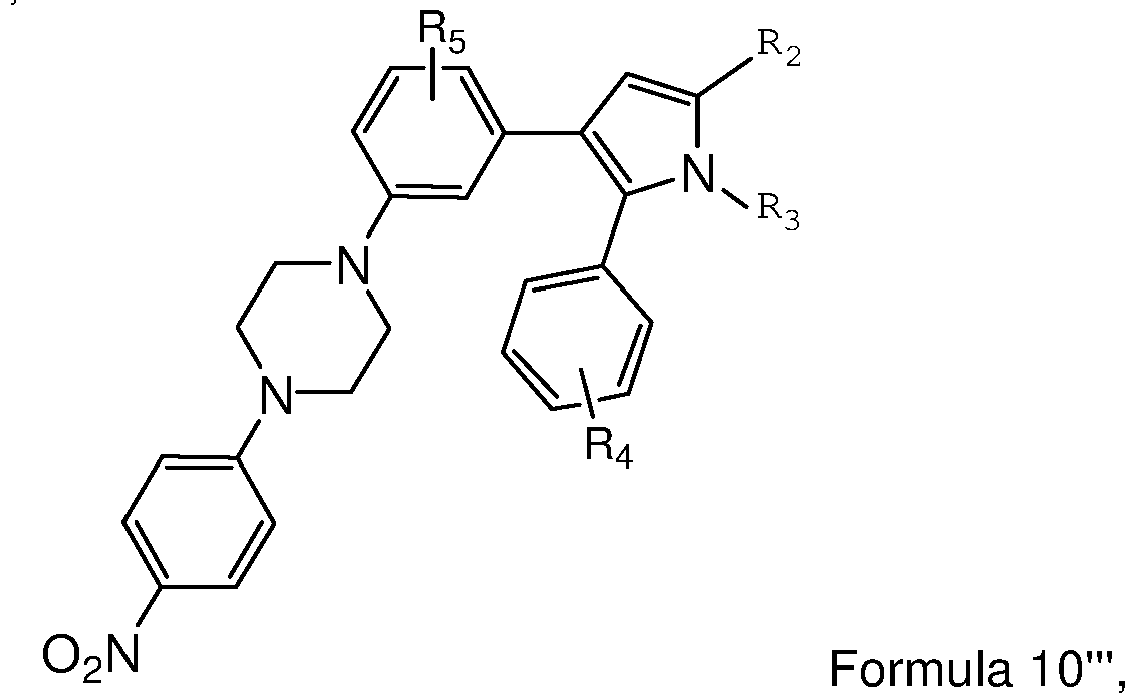
- 7‴) forming the compound of Formula 1" from the compound of Formula 10‴.
- 1‴) reacting a compound of Formula 1‴ with a compound of Formula 2‴ to form a compound of Formula 3‴,
- 7. The method of the above item 6, wherein, in Formula 1‴, Formula 3‴, Formula 5‴ and Formula 7"', phenyl ring is substituted in the meta position by R5, or phenyl ring is substituted in the meta positions by R5 and Br.
- 8. The method of the above item 6 or 7, comprising one or more of the following characteristics:
- in the step 1‴), the concentration of the compound of Formula 1‴ in the organic solvent is about 0.4 to 0.5 M;
- in the step 1‴), the reaction is carried out in the presence of an organic base such as tetrahydropyrrole, piperidine, and/or in the presence of AcOH, and/or in an organic solvent, under reflux, for about 18-20 hours;
- in the step 2‴), the reaction is carried out in the presence of an organic base, 3-ethyl-5-(2-hydroxyethyl)-4-methylthiazolium bromide, and/or in the presence of a polar solvent, at 60-80°C, preferably about 70°C, for 18-20 hours;
- in the step 3‴), the amount of the compound of Formula 6‴ is 8-15 eq relative to the compound of Formula 5‴;
- the step 3‴) is carried out in a polar solvent, preferably methanol, ethanol, isopropanol;
- the step 3‴) is carried out in the presence of AcOH, preferably in the presence of about 10 eq of AcOH relative to the compound of Formula 5"', and/or at 40-70°C, for example 50°C, for about 18-20 hours;
- in the step 4‴), the compound of Formula 7‴ reacts with 1-(nitrophenyl)piperazine, preferably about 1.8 to 2 eq of 1-(nitrophenyl)piperazine relative to the compound of Formula 7‴;
- the step 4‴) is carried out in the presence of a catalyst such as metal iodide, L-proline, carbonate salt,, and/or in an organic solvent at 110-130°C for about 18-20 hours;
- in the step 5‴), the reaction is carried out in the presence of an excess of a base such as an hydroxide;
- in the step 5‴), the reaction is carried out in a mixed solvent such as dioxane: ethanol: water = 1:1:1;
- in the step 5‴), the reaction is carried under reflux for about 40-50 hours;
- the step 6‴) is carried out in TFA and DCM for about 30 minutes to 1 hour;
- the step 7‴) is carried out in the presence of N-iodosuccinimide (NIS), and/or in an organic solvent, at 0°C to RT;
- the steps 1') and 2") are carried out in a one-pot process.
- 9. The method of the above item 1 or 4, comprising one or more of the following characteristics:
- in the step 1"), the alkyl sulfonate salt (for example, R1 Na) is used in an amount of about 10 to 15 eq, relative to 1 molar equivalent of the compound of Formula 1";
- in the step 1"), the reaction is carried out in the presence of a catalyst such as metal iodide in an amount of about 0.5 to 1.0 eq, L-proline in an amount of about 1.0-1.3 eq, relative to 1 molar equivalent of the compound of Formula 1", in the presence of an alkali metal hydroxide, and/or in an organic solvent, at 80-110°C;
- in the step (2"), a catalyst is used, which is selected from the group consisting of Raney nickel, iron powder;
- the step (2") is carried out in a polar solvent such as ethanol or isopropanol.
- 10. The method of the above item 9, comprising one or more of the following characteristics:
preparation of the compound of Formula 1" comprises the following steps:- (1‴) reacting a compound of Formula 1‴ with a compound of Formula 2‴ to form a compound of Formula 3"',

- in the Formula 1‴, R5 is defined as that for Formula (I);

- in the Formula 2"', R2 is defined as that for Formula (I);

- in the Formula 3"', R2 and R5 are defined as those for Formula (I);
- in the Formula 1‴, R5 is defined as that for Formula (I);
- 2‴) reacting the compound of Formula 3‴ with a compound of Formula 4‴ to form a compound of Formula 5"',

- in the Formula 4"', R4 is defined as that for Formula (I);

- in the Formula 5‴, R2, R4 and R5 each are defined as those for Formula (I);
- in the Formula 4"', R4 is defined as that for Formula (I);
- 3‴) reacting the compound of Formula 5‴ with a compound of Formula 6‴ to form a compound of Formula 7"',

- in the Formula 6"', R3 is defined as that for Formula (I);

- in the Formula 7"', R2, R3, R4 and R5 each are defined as those for Formula (I);
- in the Formula 6"', R3 is defined as that for Formula (I);
- 4‴-a) forming a compound of Formula 11‴ from the compound of Formula 7‴,

- 5‴-a) forming a compound of Formula 12‴ from the compound of Formula 11‴,

- 6‴-a) forming a compound of Formula 10‴ from the compound of Formula 12‴,

- 7‴) forming a compound of Formula 1" from the compound of Formula 10‴.
- (1‴) reacting a compound of Formula 1‴ with a compound of Formula 2‴ to form a compound of Formula 3"',
- 11. The method of the above item 9, wherein, in Formula 3‴, Formula 5‴, Formula 7‴, Formula 11‴ and Formula 12‴, phenyl ring is substituted in the meta position by R5, or phenyl ring is substituted in the meta positions by R5 and Br.
- 12. The method of any one of the above items 8-11, comprising one or more of the following characteristics:
- in the step 1‴), the reaction is carried out in the presence of an organic base such as piperidine and/or an organic acid such as AcOH, and/or in an organic solvent, under reflux, for 18-20 hours;
- the step 2‴) is carried out in the presence of an organic base such as triethylamine, 3-ethyl-5-(2-hydroxyethyl)-4-methylthiazolium bromide, and/or in a polar solvent, at about 60-80°C, for 18-20 hours;
- in the step 3‴), the amount of the compound of Formula 6‴ is about 8-15 eq, relative to 1 molar equivalent of the compound of Formula 5‴;
- the step 3‴) is carried out in a polar solvent;
- the step 3‴) is carried out in the presence of AcOH, and/or at about 40-70°C, for about 18-20 hours;
- the step 4‴-a) is carried out in the presence of a base;
- the step 4‴-a) is carried out in a mixed solution of polar solvents such as 1,4-dioxane, ethanol and water;
- the step 5‴-a) is carried out in an organic solvent;
- the step 5‴-a) is carried out in the presence of a strong acid such as hydrochloric acid, sulfuric acid or trifluoroacetic acid;
- in the step 6‴-a), the compound of Formula 12‴ reacts with 1-(nitrophenyl)piperazine;
- the step 6‴-a) is carried out in the presence of a catalyst such as metal iodide, [(2,6-dimethylphenyl)amino](oxo)acetic acid (DMPAO), carbonate salt;
- the step 7‴) is carried out in N-iodosuccinimide (NIS), and/or in DMF, at 0°C to RT.
- The term "about" as used herein refers to ±10%, more preferably ±5%, and most preferably ±2% of the value modified by the term, so that one of ordinary skill in the art can clearly determine the scope of the term "about" according to the modified value.
-
- iPr refers to isopropyl.
- DCM refers to dichloromethane.
- THF refers to tetrahydrofuran.
- eq refers to molar ratio.
- M refers to molar concentration. In the text, the unit of molar concentration is mol/L unless otherwise defined.
- TLC refers to thin layer chromatography.
- DMF refers to dimethylformamide.
- SM refers to the starting material.
- Raney-Ni refers to Raney Nickel.
- The invention relates to a method for preparing a compound of the Formula (I) or a pharmaceutically acceptable salt thereof (hereinafter referred to as Method I),

- R1 is SO2R',
- R2 is an alkyl, preferably C1-4alkyl, more preferably methyl, propyl, isopropyl,
- R3 is an alkyl, preferably C1-4alkyl, more preferably methyl, propyl, isopropyl,
- R4 is a halogen, preferably fluorine, chlorine,
- R5 is a halogen, preferably fluorine, chlorine,
- R6 is selected from the group consisting of H, halogen, alkyl, preferably fluorine, chlorine, C1-4alkyl, more preferably methyl, propyl, isopropyl,
- R7 is hydroxyl, alkoxyl, preferably C1-4alkoxyl or alkoxylcarbonyl, preferably C1-4alkoxylcarbonyl, more preferably butoxycarbonyl, most preferably tert-butoxycarbonyl,
- Rb is hydrogen or alkyl, preferably C1-4alkyl, more preferably methyl, propyl, isopropyl,
- n, r and s independently are 1, 2, 3, 4, 5 or 6, preferably, r and s both are 2 and n is 3, 4 or 5, more preferably, n, r and s each are 2,
- R' is an alkyl, preferably C1-4alkyl, more preferably methyl, propyl, isopropyl,
- X is carbon,
- The above method comprises the following steps:
- 1) reacting a compound of Formula 1 with a compound of Formula 2 to form a compound of Formula I,
-

-

- wherein the preparation of the compound of Formula 1 comprises the following steps:
- 1') reacting a compound of Formula 1' with a compound of Formula 2' to produce a compound of Formula 1,
-

-

- wherein the preparation of the compound of Formula 1' comprises the following steps:
- 1") reacting a compound of Formula 1" with an alkyl sulfonate salt (e.g., R1 Na) to produce a compound of Formula 2",
-

-

-
- 2") producing the compound of Formula 1' from the compound of Formula 2".
- 1") reacting a compound of Formula 1" with an alkyl sulfonate salt (e.g., R1 Na) to produce a compound of Formula 2",
-
- 1') reacting a compound of Formula 1' with a compound of Formula 2' to produce a compound of Formula 1,
-
- In some embodiments, in step 1), relative to 1 molar equivalent (eq) of the compound of Formula 1, the compound of Formula 2 is about 1.5 to 3.0 eq, preferably about 1.5 to 2.0 eq; the reaction is carried out in the presence of an organic base such as triethylamine, N-methylmorpholine, N,N-diisopropylethylamine (DIPEA), preferably about 2.0 to 4.0 eq, more preferably about 3.0 eq of DIPEA, and/or in an organic solvent such as ethylene glycol dimethyl ether, dimethylsulfoxide and dimethylformamide, preferably dimethylformamide.
- In some embodiments, the compound of Formula 2' has a molar equivalent of about 1 to 2.5 eq, preferably about 1.5 to 2.0 eq, relative to 1 molar equivalent of the compound of Formula 1'.
- In some embodiments, the step 1') is carried out in a polar solvent such as tetrahydrofuran, or a mixture of two or more polar solvents such as tetrahydrofuran and dichloromethane, preferably, carried out in a mixture of tetrahydrofuran and dichloromethane.
- In some embodiments, in the step 1'), the concentration of the compound of Formula 1' is 0.01-0.03 M, more preferably 0.02 M.
- In some embodiments, the step 1') is carried out in the presence of an organic base, for example in the presence of pyridine, triethylamine, N-methylmorpholine, and diisopropylethylamine, for example, in the presence of pyridine in an amount of about 1.0 eq to 3.0 eq, preferably about 1.5-2.5 eq, relative to 1 eq of the compound of Formula 1'.
- In some embodiments, the step 1') is carried out at a temperature of about -10°C to 10°C, preferably in the range of about -10°C to 0°C.
- In some embodiments, in the step 1"), the alkyl sulfonate salt (e.g., R1Na) is about 10 to 15 eq, preferably about 10 to 12 eq, relative to 1 eq of the compound Formula 1". Further, the step 1") is carried out in the presence of a catalyst, such as metal iodide, preferably Cul, preferably Cul in an amount of about 0.5 to 1.0 eq, preferably about 0.6 to 0.8 eq, relative to the compound of Formula 1", L-proline, preferably L-proline in an amount of about 0.5 to 1.5 eq, relative to the compound of Formula 1", a base such as a hydroxide, preferably alkali metal hydroxide such as NaOH, KOH, for example, alkali metal hydroxide such as NaOH or KOH in an amount of about 1.5 eq to 2.5 eq (preferably about 2.0 eq), relative to the compound of Formula 1", and/or in an organic solvent such as DMSO, (preferably, the concentration of the compound of Formula 1" in the aforementioned solvent is 0.14-0.25 g/ml), at 80°C to 110°C, preferably at 90°C to 100°C.
- In some embodiments, the step 2") employs a catalyst such as Raney nickel (e.g. 1.0-3.0 g/g of the compound of Formula 2"), iron powder, more preferably, Raney nickel.
- In some embodiments, the step 2") is carried out in a polar solvent, preferably tetrahydrofuran (e.g. 1 eq).
- In some embodiments, preparation of the compound of Formula 1" comprises the following steps:
- 1‴) reacting a compound of Formula 1‴ with a compound of Formula 2‴ to form a compound of Formula 3"',


- 2‴) reacting the compound of Formula 3‴ with a compound of Formula 4‴ to form a compound of Formula 5‴,


- 3‴) reacting the compound of Formula 5‴ with a compound of Formula 6‴ to form a compound of Formula 7‴,


- 4‴) forming a compound of Formula 8‴ from the compound of Formula 7‴,
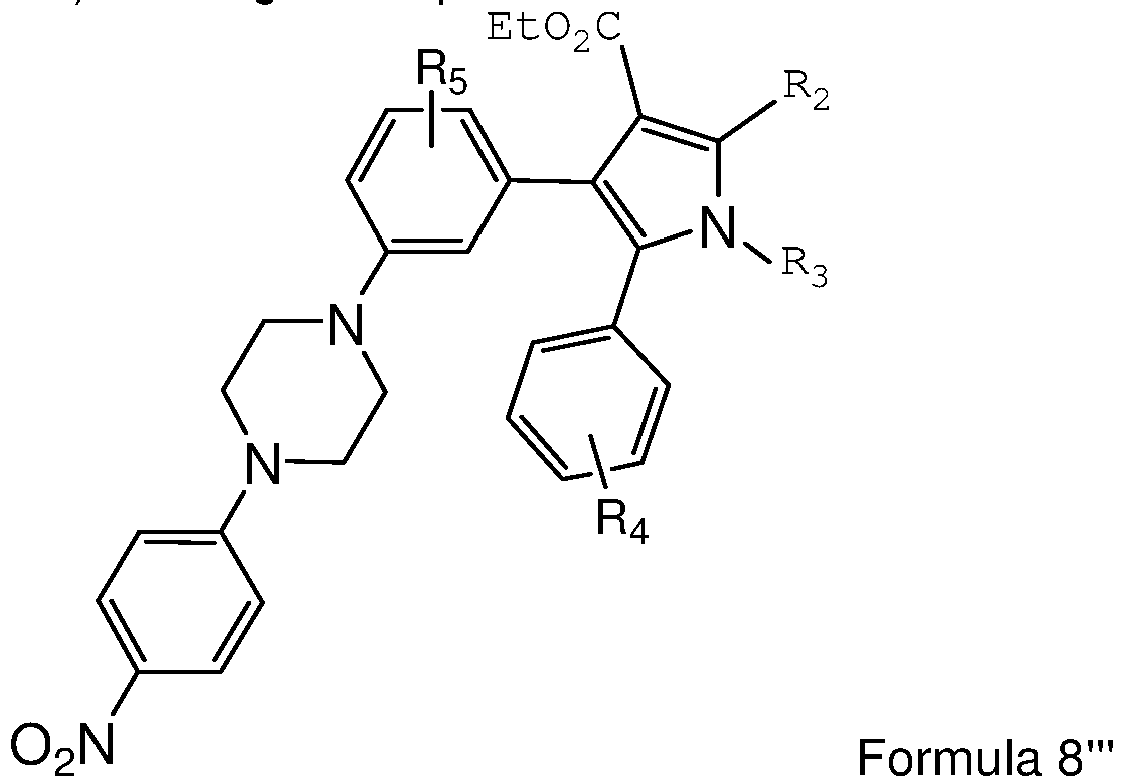
- 5‴) forming a compound of Formula 9‴ from the compound of Formula 8‴,

- 6‴) forming a compound of Formula 10‴ from the compound of Formula 9‴,

- 7‴) forming a compound of Formula 1" from the compound of Formula 10‴.
- In some embodiments, in the step 1‴), relative to 1.0 eq of the compound of Formula 1‴, the concentration of the compound of Formula 1‴ in the organic solvent is 0.4 to 0.5 M, the amount of the compound of Formula 2‴ is 1.1 eq; the reaction is carried out in the presence of an organic base such as triethylamine, tetrahydropyrrole or piperidine, preferably piperidine in an amount of about 0.01-0.5 ml/g of the compound of Formula 1‴, and/or in the presence of AcOH, preferably AcOH in an amount of about 0.03-0.5 ml/g of the compound of Formula 1‴, and/or in an organic solvent such as toluene (preferably, the concentration of the compound of Formula 1‴ in an organic solvent such as toluene is 1.2 to 1.7 M), under reflux, for about 18-20 hours.
- In some embodiments, in the step 2‴), relative to 1 eq of the compound of Formula 3‴, the compound of Formula 4‴ is used in an amount of about 1 eq.
- In some embodiments, the step 2‴) is carried out in the presence of an organic base such as triethylamine, tetrahydropyrrole or piperidine, for example triethylamine in an amount of about 1.5-2.5 eq relative to the compound of Formula 3‴, 3-ethyl-5-(2-hydroxyethyl)-4-methylthiazolium bromide, such as 3-ethyl-5-(2-hydroxyethyl)-4-methylthiazolium bromide in an amount of about 0.1-0.2 eq relative to compound of Formula 3‴, and/or in a polar solvent such as methanol, isopropanol, dimethyl sulfoxide, ethanol, propanol, and/or at about 60-80°C, preferably about 70°C, for 18-20 hours, and/or the concentration of the compound of Formula 3‴ in the aforementioned solvent is about 0.6-0.7 M.
- In some embodiments, in the step 3‴), the amount of the compound of Formula 6‴ is about 8-15 eq, for example about 10 eq, relative to the compound of Formula 5‴.
- In some embodiments, the step 3‴) is carried out in a polar solvent such as isopropanol, dimethyl sulfoxide, ethanol, methanol.
- In some embodiments, the step 3‴) is carried out in the presence of an organic acid such as AcOH, preferably AcOH in an amount of about 8-10 eq relative to the compound of Formula 5‴, and/or at about 40-70°C (e.g., 50°C), for about 18 to 20 hours.
- In some embodiments, in the step 4‴), the compound of Formula 7‴ reacts with 1-(nitrophenyl)piperazine, preferably 1-(nitrophenyl)piperazine in an amount of about 1.8 to 2 eq relative to the compound of Formula 7‴.
- In some embodiments, the step 4‴) is carried out in the presence of a catalyst, preferably a metal iodide, more preferably Cul, preferably Cul in an amount of about 0.5 to 1.0 eq, preferably about 0.6 to 0.8 eq, relative to the compound of Formula 7‴, L-proline, preferably L-proline in an amount of 0.5-0.7 eq relative to the compound of Formula 7‴, a carbonate salt, preferably K2CO3, preferably K2CO3 in an amount of 2.5 eq relative to the compound of Formula 7‴, and/or in an organic solvent, preferably DMSO (preferably, the concentration of the compound of Formula 7‴ in the organic solvent, preferably in DMSO, is 0.2 M), and/or at about 110-130°C, for example about 120°C, and/or 18-20 hours.
- In some embodiments, the amount of the compound of Formula 8‴ in step 5‴) is 1.0 eq.
- In some embodiments, the step 5‴) is carried out in the presence of a base such as a hydroxide, preferably an alkali metal hydroxide such as NaOH, KOH, for example, NaOH or KOH in an amount of 50 eq relative to the compound of Formula 8‴.
- In some embodiments, the step 5‴) is carried out in a mixed solvent, more preferably in a mixed solvent of dioxane: ethanol: water = 1:1:1, and/or the concentration of the compound of Formula 8‴ in the aforementioned mixed solvent is 0.9-1.0M.
- In some embodiments, in the step 5‴), the reflux is carried out for about 40-50 hours, for example about 48 hours.
- In some embodiments, step 6‴) is carried out in trifluoroacetic acid and dichloromethane, preferably trifluoroacetic acid: dichloromethane = 3:1 (more preferably the concentration of the compound of Formula 9‴ in the aforementioned solvent is 0.2M) for about 30 minutes to 1 hour.
- In some embodiments, the step 7‴) is carried out in the presence of N-iodosuccinimide (NIS), preferably N-iodosuccinimide in an amount of 1.2 eq relative to the compound of Formula 10"', and/or in an organic solvent, preferably DMF (more preferably, the concentration of the compound of Formula 10‴ in the aforementioned solvent is 0.1M), and/or at 0°C to RT.
- In some embodiments, the steps 1') and 2") are carried out in a one-pot process.
- The aforementioned embodiments can be optionally combined.
- The method of the invention produces no or less toxic by-products, reduces or eliminates the use of solvents which are prone to environment pollution, reduces or eliminates the use of column chromatography purification, reduces or eliminates the use of liquid phase purification and freeze-drying operations, reduces costs, shortens cycle time, increases yield and increases batch capacity.
- The final product prepared by the method of the present invention has an unexpected technical effect compared to the compounds known in the prior art. Specifically, the comparative data in the following effect tests demonstrate that the compound of Formula has unexpected technical effects in comparison with the compounds known in the prior art.
- The novel final product of the present invention has unexpected technical effects of inhibiting Bcl-2 and/or Bcl-xL, and inhibiting and treating cancers. Specifically, the comparative data in the following effect tests prove the new final product has unexpected technical effects compared to the compounds known in the prior art.
- The present invention is further illustrated by specific preparation examples and effect experiments.
- In this example, Compound 1 was prepared, and the specific preparation method comprises the following steps, and the method corresponds to Method I:

- 600 ml of toluene, 106.5 g of ethyl acetoacetate, 13.6 ml of acetic acid, 4.5 ml of piperidine, 150 g of 3-bromo-5-fluoro-benzaldehyde were added into a flask, and the reaction was carried out under heating and reflux to remove water for 18-20 hours, and TLC showed that the reaction was complete. The reaction mixture was added with ethyl acetate for dilution, the ethyl acetate phase was washed with 1M hydrochloric acid and water, respectively, the organic phase was dried over anhydrous magnesium sulfate, subjected to rapid column purification, and then concentrated to obtain 202 g of a colorless oil as the product, yield 86%.
- 1 L of absolute ethanol, 202 g of Compound 17-03A, 90.1 g of p-chlorobenzaldehyde, 129.5 g of triethylamine and 24.3 g of 3-ethyl-5-(2-hydroxyethyl)-4-methylthiazolium bromide were added in a flask, stirred at 70°C overnight. TLC was used to monitor the completion of reaction of the compound 17-03A. The reaction mixture was diluted with ethyl acetate. The organic phase was washed with 1M hydrochloric acid, washed with water, saturated aqueous sodium hydrogen carbonate solution, and washed with saturated saline. The obtained organic phase was dried over anhydrous magnesium sulfate, concentrated under a reduced pressure to obtain 314 g of crude product as an oil, yield 100%. The crude product was used in the next step without further purification.
- 1 L of methanol, 194.2 g of Compound 1-01A and 255.9 g of acetic acid were added into a flask, and then 251.9 g of isopropylamine was added dropwise to the reaction mixture, and stirred at 50°C. After TLC showed that the reaction was completed, methanol was removed by concentration under reduced pressure. Ethyl acetate was added into the reaction mixture for dilution. The organic phase was washed, dried over anhydrous magnesium sulfate, concentrated under reduced pressure to obtain 106.8 g of crude product as an oil, yield 89%, which was directly used in the next step without purification.
- 46 g of Compound 1-02A, 35.8 g of 1-(4-nitro-phenyl)-piperazine, 9.2 g of Cul, 5.5 g of L-proline and 33.2 g of potassium carbonate were added into a flask, then added with 500 ml of dimethylsulfoxide, the reaction mixture was stirred at 120°C for 18-20 hours. After TLC showed that the reaction of Compound 1-02A was complete, the reaction solution was cooled to 0°C. Ethyl acetate was added into the mixture for extracting the reaction solution. The combined organic phase was washed, dried over magnesium sulfate, concentrated under reduced pressure to obtain an oil, which was purified by column chromatography to obtain 24.2 g of product, and the total yield of the above three steps was 40%.
- 52.8 g of Compound 1-03A, 300 ml of 1,4-dioxane, 300 ml of ethanol and 300 ml of water were added into a flask, and then 174.5 g of sodium hydroxide was slowly added, and the reaction solution was refluxed for 48 hours. After TLC showed that the reaction of Compound 1-03A was complete, the reaction solution was cooled to 0°C, the pH of the reaction solution was adjusted to about 1, a large amount of solid appeared and was filtered, and the solid was dried to obtain 50.2 g of product, yield 99%.
- 39 g of Compound 1-04A was placed in a flask, then 270 ml of trifluoroacetic acid and dichloromethane were added, and the reaction mixture was stirred. After TLC showed that the reaction of Compound 1-04A was completed, the reaction mixture was extracted with dichloromethane, the organic phase was washed, dried over anhydrous magnesium sulfate and concentrated under reduced pressure to give 39 g of product, yield 91%.
- 15.4 g of Compound 1-05A, 250 ml of dimethylformamide were added into a flask, and then the mixture was cooled to 0°C. To the mixture was added 7.8 g of N-iodosuccinimide. The mixture was stirred overnight. After TLC showed that the reaction of Compound 1-05A was completed, dimethylformamide was removed by concentration under reduced pressure to give an oil. The oil was washed with a mixture solvent (ethyl acetate / n-hexane = 3/1), and a large amount of solid appeared, and was filtered and dried to give 14.1 g of solid, yield 74%.
- 3.8 g of Compound 1-06A, 28 ml of dimethylsulfoxide, 5.8 g of sodium methylsulfonate, 0.65 g of cuprous iodide, 0.66 g of L-proline and 0.46 g of sodium hydroxide were added into a flask. The reaction mixture was stirred under N2 and at 90°C. After TLC showed that the reaction was completed, the reaction mixture was cooled to room temperature. 50 ml of saturated ammonium chloride was slowly added to the reaction mixture. Extraction was carried by ethyl acetate. The combined organic phases were dried over anhydrous magnesium sulfate, concentrated under reduced pressure to give an oil, which was purified by column chromatography (eluent: n-hexane: ethyl acetate: dichloromethane = 8: 1: 1; 5: 1: 1; 3: 1: 1) to give 2.5 g of a product, yield 71%.
- 10 g of Compound 1-07A, 150 ml of tetrahydrofuran and 10 g of Raney nickel were added into a flask, and the reaction mixture was stirred at room temperature under hydrogen gas. After TLC showed that the reaction was completed, Raney nickel was removed by filtration, and the filtrate (containing Compound 1-08A) was used in the next step without further purification. 8.0 g of the filtrate, 150 ml of dichloromethane, and 3.16 g of Compound 011 were added into a flask. The reaction mixture was stirred at -5°C. After TLC showed that the reaction of Compound 1-08A was completed, dichloromethane was added for dilution, then washed with water and saturated saline, respectively, dried over anhydrous magnesium sulfate and concentrated under reduced pressure. The obtained oil was purified by column purification to give 10.5 g of product, yield 73%.
- The intermediate Compound 007 to which the present invention relates was produced by the following method:

- A solution of Compound 007-n (1.0 eq.) and N-methylmorpholine (1.1 eq.) in ethylene glycol dimethyl ether was cooled to -15°C, and isobutyl chloroformate (1.0 eq.) was slowly added. After that, it was raised to 0°C over about 30 minutes. The precipitated N-methylmorpholine hydrochloride was removed by filtration, and the filter cake was washed with ethylene glycol dimethyl ether. The filtrate and washing solution were combined in a large flask, and cooled to -15°C. An aqueous solution of sodium borohydride (5.0 eq.) was added to the reaction solution to generate a large amount of gas, water was added immediately to precipitate a large amount of white solid, which was filtered and dried under vacuum to give Compound 007-01A as white solid.
- To a solution of tributylphosphine (2.0 eq.) and Compound 007-01A (1.0 eq.) in dichloromethane, diphenyldisulfide (2.0 eq.) was added and the reaction mixture was stirred at room temperature for 24 hours. After TLC showed the completion of the reaction, the reaction mixture was washed three times with water until the pH of the aqueous phase was about 7. The dichloromethane phase was dried over anhydrous sodium sulfate, filtered and concentrated under reduced pressure to remove solvent to give a residue (oil) as a crude product of 007-02A.
- The above crude product of Compound 007-02A was dissolved in dichloromethane, and trifluoroacetic acid was added to the solution. The reaction mixture was stirred at room temperature overnight. After TLC showed that the reaction was completed, the reaction mixture was washed with water. The dichloromethane was dried over anhydrous sodium sulfate, then dichloromethane was removed to give a large amount of white solid, which was filtrated. The obtained white solid was washed twice with a mixture solvent (ethyl acetate : hexane = 1:6) and filtrated to obtain Compound 007-03A.
- To a solution of Compound 007-03A (1.0 eq.) in dichloromethane, oxalyl chloride and some dimethylformamide were added at 0°C. The reaction mixture was stirred at room temperature for about 2 hours. After TLC showed that the reaction was completed, solvent was removed under reduced pressure. The residue was dissolved in dichloromethane, cooled to 0°C, added with a solution of piperidine-4-ol (1.5 eq.) in dichloromethane at 0°C, the pH of the reaction mixture was adjusted with piperidin-4-ol to 8-9, and the reaction solution was stirred at 0° for 10-20 minutes. After TLC showed that the reaction was completed, the reaction mixture was washed with 1N hydrochloric acid, water and saline, respectively. After layering, the obtained organic phase was dried over sodium sulfate and filtrated, the filtrate was desolvated under reduced pressure, and purified by column chromatography to obtain the target compound.
- A solution of BCI-007-04A (1.0 eq) in acetonitrile was treated with diethylamine (20 eq) under stirring. After TLC showed that the reaction was completed, the reaction mixture was concentrated to obtain a residue. The residue was used in the next step without further purification.
- A mixture of Compound 007-05A (1.0 eq) and 1 M borane in tetrahydrofuran was stirred at room temperature. After TLC showed that the reaction was completed, the pH of the solution was then adjusted to 10 with 4N aqueous potassium carbonate solution. The mixture was extracted for three times with dichloromethane. The organic phase was dried over anhydrous sodium sulfate. The solvent was removed under reduced pressure to give residue. The residue was purified by column chromatography to obtain the target compound (Compound 007).
- 10.5 g of Compound 1-09A, 5.9 g of Compound 007, 4.5 g of N,N-diisopropylethylamine were added into a flask. To the reaction mixture was added 90 ml of dimethylformamide, and the reaction mixture was stirred at room temperature. After TLC showed that the reaction of Compound 1-09A was completed, the solvent was removed under reduced pressure to give a residue, which was purified by column chromatography to give 11.6 g of Compound 1, yield 85%.
- The nuclear magnetic data of Compound 1 were as follows: 1HNMR (400MHz, DMSO-d6) δ 9.77(s, 1H),7.80(d,J=2Hz, 1H), 7.58(dd, J1 =1.6, J2=8.0 1H), 7.38(d,J=8.8 2H), 7.30-7.16(m, 7H), 6.97-6.84(m,6H),6.57(d J=12,1H),6.53(s,1H),6.37(d J=8,1H),4.54(bra,1H), 4.36-4.29( m, 1H), 4.03(bra,1H), 3.4-3.5(m,5H),3.30-3.32(m,1H), 3.14-3.08(m,8H), 2.9(s,3H), 2.67(s,3H), 2.41-1.60(m,9H),1.36(s,3H),1.34(s,3H), 1.28-1.26(m,2H), m/z (M+1): 1131.0.
- The synthesis method of the invention reduces steps. The reagents, solvents and temperature used in the method greatly reduces the production cost, shortens the production cycle, increases the yield, and increases the batch capacity.
- Proofs for the effects of the preferable reaction conditions of the various steps of the present invention.
- 1. Corresponding to the preferable reaction conditions for the preparation of Compound 1-07A from Compound 1-06A in Method I above.

- Three batches of tests numbered 1-1, 1-2 and 1-3 were carried out, wherein the specific reaction procedures of the test 1-1 were identical to those for the preparation of Compound 1-07A from Compound 1-06A in Preparation Example 1; the reaction operations used in tests 1-2 and 1-3 were similar to those for the preparation of Compound 1-07A from Compound 1-06A in Preparation Example 1, except that the reaction temperatures were 130°C and 180°C, respectively. The results showed that the yield of the test 1-1 was 71%, while the yields of tests 1-2 and 1-3 were 59% and 19%, respectively.
- The above data show that the yield of test 1-1 is the highest, nearly three times that of the worst batch, which confirms the reaction conditions used in test 1-1 show an unexpected technical effect.
- 2. Corresponding to the preferable reaction conditions for the preparation of Compound 1-09A from Compound 1-07A in Method I above.
- Two batches of tests numbered 2-1 and 2-2 were carried out, wherein the specific reaction procedures of test 2-2 were identical to those for preparing Compound 1-09A from Compound 1-07A in Preparation Example 1 above, and the operations of test 2-1 were similar to those for preparing Compound 1-09A from Compound 1-07A in Preparation Example 1, except that pyridine was used in the preparation of Compound 1-08A from Compound 1-07A, and tetrahydrofuran was used in the preparation of Compound 1-09A from Compound 1-07A, while such selection of solvents was exactly the same as that used in Patent 1 above.
- As a result, it was found that the yield of test 2-2 was 72.9%, while the yield of test 2-1 was 50%.
- The above test results demonstrate that the yield of using tetrahydrofuran and dichloromethane as the solvent in the present invention is improved by about 20% in comparison with the solvent used in the patent, which confirms that the reaction conditions of test 2-2 show unexpected technical effect.
Claims (12)
- A method for preparing a compound of the following Formula (I) or a pharmaceutically acceptable salt thereof,
 R1 is SO2R',R2 is C1-4alkyl,R3 is C1-4alkyl,R4 is halogen,R5 is halogen,R6 is selected from the group consisting of H, halogen, C1-4alkyl,R7 is hydroxyl, C1-4alkoxyl or C1-4alkoxylcarbonyl,Rb is hydrogen or C1-4alkyl,n, r and s each are each independently 1, 2, 3, 4, 5 or 6, preferably, r and s each are 2 and n is 3, 4 or 5, more preferably, n, r and s each are 2,R' is C1-4alkyl, more preferably methyl, propyl, isopropyl,X is carbon,the method comprises the following steps:1) reacting a compound of Formula 1 with a compound of Formula 2 to produce a compound of Formula I,
 wherein the preparation of the compound of Formula 1 comprises the following steps:
1') reacting a compound of Formula 1' with a compound of Formula 2' to produce a compound of Formula 1,
 1") reacting a compound of Formula 1" with an alkyl sulfonate salt (e.g., R1Na) to produce a compound of Formula 2",
 2") producing the compound of Formula 1' from the compound of Formula 2".
 - The method according to claim 1, wherein C1-4alkyl is selected from the group consisting of methyl, propyl or isopropyl; halogen is selected from the group consisting of fluorine, chlorine; and C1-4alkoxylcarbonyl is tert-butoxycarbonyl.
- The method according to claim 1, comprising:
in the step 1), the compound of Formula 2 is in an amount of about 1.5 to 3.0 eq relative to 1 molar equivalent of the compound of Formula 1; and the reaction is carried out in the presence of a catalyst such as N,N-diisopropylethylamine (DIPEA), for example about 2.0 to 4.0 eq of DIPEA, and/or in an organic solvent such as DMF. - The method according to claim 1, comprising one or more of the following characteristics:in the step 1'), the compound of Formula 2' has a molar equivalent of about 1.5 to 3.0 eq relative to 1 molar equivalent of the compound of Formula 1';in the step 1'), the reaction is carried out in a polar solvent or a mixture of a plurality of polar solvents, preferably tetrahydrofuran, or a mixture of tetrahydrofuran and dichloromethane;in the step 1'), the reaction is carried out in the presence of an organic base;in the step 1'), the reaction is carried out at a temperature ranging from about -10°C to 10°C.
- The method according to claim 1, comprising one or more of the following characteristics:in the step 1"), the alkyl sulfonate salt (for example, R1Na) is used in an amount of about 10 to 15 eq, relative to 1 molar equivalent of the compound of the Formula 1";in the step 1"), the reaction is carried out in the presence of a catalyst such as metal iodide in an amount of about 0.5 to 1.0 eq, L-proline in an amount of about 1.0-1.3 eq, relative to 1 molar equivalent of the compound of the Formula 1", and an alkali metal hydroxide, and/or in an organic solvent, at about 80-110°C; and/orin the step 2"), a catalyst is used, which is selected from the group consisting of Raney nickel, iron powder;in step 2"), the reaction is carried out in a polar solvent such as tetrahydrofuran.
- The method according to claim 1 or 5, comprising one or more of the following characteristics:
preparation of the compound of Formula 1" comprises the following steps:1‴) reacting a compound of Formula 1‴ with a compound of Formula 2‴ to form a compound of Formula 3"',

 2‴) reacting the compound of Formula 3‴ with a compound of Formula 4‴ to form a compound of Formula 5"',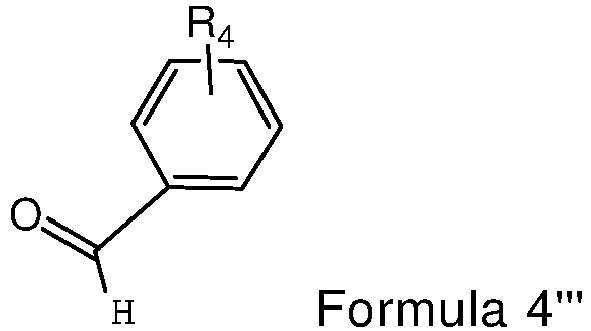
 3‴) reacting the compound of Formula 5‴ with a compound of Formula 6‴ to form a compound of Formula 7‴,
 4‴) forming a compound of Formula 8" from the compound of Formula 7‴,
 5‴) forming a compound of Formula 9‴ from the compound of Formula 8‴,
 6‴) forming a compound of Formula 10‴ from the compound of Formula 9‴,
 7‴) forming the compound of Formula 1" from the compound of Formula 10‴.
 - The method according to claim 6, wherein, in Formula 1‴, Formula 3‴, Formula 5‴ and Formula 7‴, phenyl ring is substituted in the meta position by R5, or phenyl ring is substituted in the meta positions by R5 and Br.
- The method according to claim 6 or 7, comprising one or more of the following characteristics:in the step 1‴), the concentration of the compound of Formula 1‴ is about 0.4 to 0.5 M;in the step 1‴), the reaction is carried out in the presence of an organic base such as tetrahydropyrrole, piperidine, and/or in the presence of AcOH, and/or in an organic solvent, under reflux, for about 18-20 hours;in the step 2‴), the reaction is carried out in the presence of an organic base, 3-ethyl-5-(2-hydroxyethyl)-4-methylthiazolium bromide, and/or in the presence of a polar solvent, at 60-80°C, preferably about 70°C, for 18-20 hours;in the step 3‴), the amount of the compound of Formula 6‴ is 8-15 eq relative to the compound of Formula 5‴;the step 3‴) is carried out in a polar solvent, preferably methanol, ethanol, isopropanol;the step 3‴) is carried out in the presence of AcOH, preferably in the presence of about 10 eq of AcOH relative to the compound of Formula 5"', and/or at 40-70°C, for example 50°C, for about 18-20 hours;in the step 4‴), the compound of Formula 7‴ reacts with 1-(nitrophenyl)piperazine, preferably about 1.8 to 2 eq of 1-(nitrophenyl)piperazine relative to the compound of Formula 7‴;the step 4‴) is carried out in the presence of a catalyst such as metal iodide, L-proline, carbonate salt,, and/or in an organic solvent at 110-130°C for about 18-20 hours;in the step 5‴), the reaction is carried out in the presence of an excess of a base such as an hydroxide;in the step 5‴), the reaction is carried out in a mixed solvent such as dioxane: ethanol: water = 1:1:1;in the step 5‴), the reaction is carried under reflux for about 40-50 hours;the step 6‴) is carried out in TFA and DCM for about 30 minutes to 1 hour;the step 7‴) is carried out in the presence of N-iodosuccinimide (NIS),and/or in an organic solvent, at 0°C to RT;the steps 1') and 2") are carried out in a one-pot process.
- The method according to claim 1 or 4, comprising one or more of the following characteristics:in the step 1"), the compound of Formula 2" is used in an amount of about 10 to 15 eq, relative to 1 molar equivalent of the compound of Formula 1";in the step 1"), the reaction is carried out in the presence of a catalyst such as metal iodide in an amount of about 0.5 to 1.0 eq, L-proline in an amount of about 1.0-1.3 eq, relative to 1 molar equivalent of the compound of Formula 1", an alkali metal hydroxide, and/or in an organic solvent, at 80-110°C;in the step (2"), a catalyst is used, which is selected from the group consisting of Raney nickel, iron powder;the step (2") is carried out in a polar solvent such as ethanol or isopropanol.
- The method according to claim 9, comprising one or more of the following characteristics:
preparation of the compound of Formula 1" comprises the following steps:(1‴) reacting a compound of Formula 1‴ with a compound of Formula 2‴ to form a compound of Formula 3‴,

 2‴) reacting the compound of Formula 3‴ with a compound of Formula 4‴ to form a compound of Formula 5‴,
 3‴) reacting the compound of Formula 5‴ with a compound of Formula 6‴ to form a compound of Formula 7‴,
 4‴-a) forming a compound of Formula 11‴ from the compound of Formula 7‴,
 5‴-a) forming a compound of Formula 12‴ from the compound of Formula 11‴,
 6‴-a) forming a compound of Formula 10‴ from the compound of Formula 12‴,
 7‴) forming a compound of Formula 1" from the compound of Formula 10‴.
 - The method according to claim 10, wherein, in Formula 3‴, Formula 5‴, Formula 7‴, Formula 11‴ and Formula 12‴, phenyl ring is substituted in the meta position by R5, or phenyl ring is substituted in the meta positions by R5 and Br.
- The method according to any one of claims 8-11, comprising one or more of the following characteristics:in the step 1‴), the reaction is carried out in the presence of an organic base such as piperidine and/or AcOH, and/or in an organic solvent, under reflux, for 18-20 hours;in the step 2‴) is carried out in the presence of an organic base such as triethylamine, 3-ethyl-5-(2-hydroxyethyl)-4-methylthiazolium bromide, and/or in a polar solvent, at about 60-80°C, for 18-20 hours;in the step 3‴), the amount of the compound of Formula 6‴ is about 8-15 eq, relative to 1 molar equivalent of the compound of Formula 5‴;the step 3‴) is carried out in a polar solvent;the step 3‴) is carried out in the presence of AcOH, and/or at about 40-70°C, for about 18-20 hours;the step 4‴-a) is carried out in the presence of a base;the step 4‴-a) is carried out in a mixed solution of polar solvents such as 1,4-dioxane, ethanol and water;the step 5‴-a) is carried out in an organic solvent;the step 5‴-a) is carried out in the presence of a strong acid such as hydrochloric acid, sulfuric acid or trifluoroacetic acid;in the step 6‴-a), the compound of Formula 12‴ reacts with 1-(nitrophenyl)piperazine;the step 6‴-a) is carried out in the presence of a catalyst such as metal iodide, [(2,6-dimethylphenyl)amino](oxo)acetic acid (DMPAO), carbonate salt;the step 7‴) is carried out in the presence of N-iodosuccinimide (NIS), and/or in DMF, at 0°C to RT.
Applications Claiming Priority (2)
| Application Number | Priority Date | Filing Date | Title |
|---|---|---|---|
| CN2019070514 | 2019-01-04 | ||
| PCT/CN2020/070164 WO2020140957A1 (en) | 2019-01-04 | 2020-01-03 | Method for preparing sulfonamides drugs |
Publications (3)
| Publication Number | Publication Date |
|---|---|
| EP3906235A1 EP3906235A1 (en) | 2021-11-10 |
| EP3906235A4 EP3906235A4 (en) | 2022-02-23 |
| EP3906235B1 true EP3906235B1 (en) | 2023-03-15 |
Family
ID=71406871
Family Applications (1)
| Application Number | Title | Priority Date | Filing Date |
|---|---|---|---|
| EP20736131.2A Active EP3906235B1 (en) | 2019-01-04 | 2020-01-03 | Method for preparing sulfonamides drugs |
Country Status (5)
| Country | Link |
|---|---|
| US (1) | US11414400B2 (en) |
| EP (1) | EP3906235B1 (en) |
| CN (1) | CN111410650B (en) |
| TW (1) | TWI731540B (en) |
| WO (1) | WO2020140957A1 (en) |
Family Cites Families (5)
| Publication number | Priority date | Publication date | Assignee | Title |
|---|---|---|---|---|
| PL2342205T4 (en) | 2008-08-27 | 2016-12-30 | Substituted tricyclic acid derivatives as s1p1 receptor agonists useful in the treatment of autoimmune and inflammatory disorders | |
| KR101762724B1 (en) | 2011-01-25 | 2017-07-28 | 더 리젠츠 오브 더 유니버시티 오브 미시건 | Bcl-2/bcl-xl inhibitors and therapeutic methods using the same |
| TW201416348A (en) * | 2012-08-29 | 2014-05-01 | Gruenenthal Chemie | Fluoromethyl-substituted pyrrole carboxamides |
| EP2945940B1 (en) * | 2013-01-16 | 2020-07-15 | The Regents of The University of Michigan | Bcl-2/bcl-xl inhibitors and their use in the treatment of cancer |
| WO2019213151A1 (en) * | 2018-04-30 | 2019-11-07 | Unity Biotechnology | Phosphonamidates that are bcl family antagonists for use in clinical management of conditions caused or mediated by senescent cells and for treating cancer |
-
2020
- 2020-01-03 TW TW109100127A patent/TWI731540B/en active
- 2020-01-03 EP EP20736131.2A patent/EP3906235B1/en active Active
- 2020-01-03 CN CN202010004745.0A patent/CN111410650B/en active Active
- 2020-01-03 US US16/955,013 patent/US11414400B2/en active Active
- 2020-01-03 WO PCT/CN2020/070164 patent/WO2020140957A1/en not_active Ceased
Also Published As
| Publication number | Publication date |
|---|---|
| US11414400B2 (en) | 2022-08-16 |
| TW202039430A (en) | 2020-11-01 |
| EP3906235A1 (en) | 2021-11-10 |
| TWI731540B (en) | 2021-06-21 |
| EP3906235A4 (en) | 2022-02-23 |
| CN111410650A (en) | 2020-07-14 |
| US20210221788A1 (en) | 2021-07-22 |
| WO2020140957A1 (en) | 2020-07-09 |
| CN111410650B (en) | 2020-12-08 |
Similar Documents
| Publication | Publication Date | Title |
|---|---|---|
| EP4279488A1 (en) | Synthesis method for aminopyrimidine fak inhibitor compound | |
| CN113880834B (en) | Synthesis method of N- (phenylsulfonyl) benzamide compound and intermediate thereof | |
| NZ761158A (en) | Intermediates useful for the synthesis of a selective inhibitor against protein kinase and processes for preparing the same | |
| CN114805314A (en) | Synthesis method of Ensaitevir | |
| CN107200741B (en) | Preparation method of anaplastic lymphoma kinase inhibitor | |
| RU2762891C2 (en) | Methods for producing benzodiazepine cytotoxic derivatives | |
| JP2019147763A (en) | Manufacturing method of proline amide compound | |
| CN111410666A (en) | Process for preparing sulfonamide compound | |
| JP7205529B2 (en) | Method for producing oxazolidinone compound | |
| CN108191849B (en) | Preparation method of anti-epidermal growth factor receptor drug resistance mutation inhibitor, related intermediate and application | |
| US11414400B2 (en) | Method for preparing sulfonamides drugs | |
| AU2017387801B2 (en) | Methods for the preparation of 6-aminoisoquinoline | |
| HK40031447A (en) | Method for preparing sulfonamides drugs | |
| HK40031447B (en) | Method for preparing sulfonamides drugs | |
| CN115819412B (en) | A synthetic method of N-heterocyclic BET bromodomain inhibitor and its intermediates | |
| JP5279449B2 (en) | Process for producing 5- {4- [2- (5-ethyl-2-pyridyl) ethoxy] benzyl} -2,4-thiazolidinedione hydrochloride | |
| JP7279134B2 (en) | Method for producing prolinamide compound | |
| EP4375282A1 (en) | Preparation method for hepatitis b virus nucleocapsid inhibitor | |
| CN122036557A (en) | Cycloserine intermediate and application thereof | |
| HK40122859A (en) | Method for preparing alk inhibitor compound and intermediate thereof | |
| CN113024454A (en) | Synthesis method of brigatinib intermediate | |
| CN117658986A (en) | Preparation method of AR antagonist TRC-253 | |
| CN119431209A (en) | A preparation method and application of a key intermediate of Vibelon | |
| CN121293155A (en) | Preparation method of intermediates for dallotamine | |
| CN117510471A (en) | A kind of synthesis method of abeciclib |
Legal Events
| Date | Code | Title | Description |
|---|---|---|---|
| STAA | Information on the status of an ep patent application or granted ep patent |
Free format text: STATUS: THE INTERNATIONAL PUBLICATION HAS BEEN MADE |
|
| PUAI | Public reference made under article 153(3) epc to a published international application that has entered the european phase |
Free format text: ORIGINAL CODE: 0009012 |
|
| STAA | Information on the status of an ep patent application or granted ep patent |
Free format text: STATUS: REQUEST FOR EXAMINATION WAS MADE |
|
| 17P | Request for examination filed |
Effective date: 20210716 |
|
| AK | Designated contracting states |
Kind code of ref document: A1 Designated state(s): AL AT BE BG CH CY CZ DE DK EE ES FI FR GB GR HR HU IE IS IT LI LT LU LV MC MK MT NL NO PL PT RO RS SE SI SK SM TR |
|
| A4 | Supplementary search report drawn up and despatched |
Effective date: 20220126 |
|
| RIC1 | Information provided on ipc code assigned before grant |
Ipc: A61P 35/00 20060101ALI20220120BHEP Ipc: A61K 31/496 20060101ALI20220120BHEP Ipc: C07D 403/14 20060101ALI20220120BHEP Ipc: C07D 403/10 20060101AFI20220120BHEP |
|
| DAV | Request for validation of the european patent (deleted) | ||
| DAX | Request for extension of the european patent (deleted) | ||
| GRAP | Despatch of communication of intention to grant a patent |
Free format text: ORIGINAL CODE: EPIDOSNIGR1 |
|
| STAA | Information on the status of an ep patent application or granted ep patent |
Free format text: STATUS: GRANT OF PATENT IS INTENDED |
|
| INTG | Intention to grant announced |
Effective date: 20221004 |
|
| GRAS | Grant fee paid |
Free format text: ORIGINAL CODE: EPIDOSNIGR3 |
|
| GRAA | (expected) grant |
Free format text: ORIGINAL CODE: 0009210 |
|
| STAA | Information on the status of an ep patent application or granted ep patent |
Free format text: STATUS: THE PATENT HAS BEEN GRANTED |
|
| AK | Designated contracting states |
Kind code of ref document: B1 Designated state(s): AL AT BE BG CH CY CZ DE DK EE ES FI FR GB GR HR HU IE IS IT LI LT LU LV MC MK MT NL NO PL PT RO RS SE SI SK SM TR |
|
| REG | Reference to a national code |
Ref country code: CH Ref legal event code: EP Ref country code: GB Ref legal event code: FG4D |
|
| REG | Reference to a national code |
Ref country code: DE Ref legal event code: R096 Ref document number: 602020008902 Country of ref document: DE |
|
| REG | Reference to a national code |
Ref country code: IE Ref legal event code: FG4D |
|
| REG | Reference to a national code |
Ref country code: AT Ref legal event code: REF Ref document number: 1553957 Country of ref document: AT Kind code of ref document: T Effective date: 20230415 |
|
| REG | Reference to a national code |
Ref country code: LT Ref legal event code: MG9D |
|
| REG | Reference to a national code |
Ref country code: NL Ref legal event code: MP Effective date: 20230315 |
|
| PG25 | Lapsed in a contracting state [announced via postgrant information from national office to epo] |
Ref country code: RS Free format text: LAPSE BECAUSE OF FAILURE TO SUBMIT A TRANSLATION OF THE DESCRIPTION OR TO PAY THE FEE WITHIN THE PRESCRIBED TIME-LIMIT Effective date: 20230315 Ref country code: NO Free format text: LAPSE BECAUSE OF FAILURE TO SUBMIT A TRANSLATION OF THE DESCRIPTION OR TO PAY THE FEE WITHIN THE PRESCRIBED TIME-LIMIT Effective date: 20230615 Ref country code: LV Free format text: LAPSE BECAUSE OF FAILURE TO SUBMIT A TRANSLATION OF THE DESCRIPTION OR TO PAY THE FEE WITHIN THE PRESCRIBED TIME-LIMIT Effective date: 20230315 Ref country code: LT Free format text: LAPSE BECAUSE OF FAILURE TO SUBMIT A TRANSLATION OF THE DESCRIPTION OR TO PAY THE FEE WITHIN THE PRESCRIBED TIME-LIMIT Effective date: 20230315 Ref country code: HR Free format text: LAPSE BECAUSE OF FAILURE TO SUBMIT A TRANSLATION OF THE DESCRIPTION OR TO PAY THE FEE WITHIN THE PRESCRIBED TIME-LIMIT Effective date: 20230315 |
|
| REG | Reference to a national code |
Ref country code: AT Ref legal event code: MK05 Ref document number: 1553957 Country of ref document: AT Kind code of ref document: T Effective date: 20230315 |
|
| PG25 | Lapsed in a contracting state [announced via postgrant information from national office to epo] |
Ref country code: SE Free format text: LAPSE BECAUSE OF FAILURE TO SUBMIT A TRANSLATION OF THE DESCRIPTION OR TO PAY THE FEE WITHIN THE PRESCRIBED TIME-LIMIT Effective date: 20230315 Ref country code: NL Free format text: LAPSE BECAUSE OF FAILURE TO SUBMIT A TRANSLATION OF THE DESCRIPTION OR TO PAY THE FEE WITHIN THE PRESCRIBED TIME-LIMIT Effective date: 20230315 Ref country code: GR Free format text: LAPSE BECAUSE OF FAILURE TO SUBMIT A TRANSLATION OF THE DESCRIPTION OR TO PAY THE FEE WITHIN THE PRESCRIBED TIME-LIMIT Effective date: 20230616 Ref country code: FI Free format text: LAPSE BECAUSE OF FAILURE TO SUBMIT A TRANSLATION OF THE DESCRIPTION OR TO PAY THE FEE WITHIN THE PRESCRIBED TIME-LIMIT Effective date: 20230315 |
|
| PG25 | Lapsed in a contracting state [announced via postgrant information from national office to epo] |
Ref country code: SM Free format text: LAPSE BECAUSE OF FAILURE TO SUBMIT A TRANSLATION OF THE DESCRIPTION OR TO PAY THE FEE WITHIN THE PRESCRIBED TIME-LIMIT Effective date: 20230315 Ref country code: RO Free format text: LAPSE BECAUSE OF FAILURE TO SUBMIT A TRANSLATION OF THE DESCRIPTION OR TO PAY THE FEE WITHIN THE PRESCRIBED TIME-LIMIT Effective date: 20230315 Ref country code: PT Free format text: LAPSE BECAUSE OF FAILURE TO SUBMIT A TRANSLATION OF THE DESCRIPTION OR TO PAY THE FEE WITHIN THE PRESCRIBED TIME-LIMIT Effective date: 20230717 Ref country code: ES Free format text: LAPSE BECAUSE OF FAILURE TO SUBMIT A TRANSLATION OF THE DESCRIPTION OR TO PAY THE FEE WITHIN THE PRESCRIBED TIME-LIMIT Effective date: 20230315 Ref country code: EE Free format text: LAPSE BECAUSE OF FAILURE TO SUBMIT A TRANSLATION OF THE DESCRIPTION OR TO PAY THE FEE WITHIN THE PRESCRIBED TIME-LIMIT Effective date: 20230315 Ref country code: CZ Free format text: LAPSE BECAUSE OF FAILURE TO SUBMIT A TRANSLATION OF THE DESCRIPTION OR TO PAY THE FEE WITHIN THE PRESCRIBED TIME-LIMIT Effective date: 20230315 Ref country code: AT Free format text: LAPSE BECAUSE OF FAILURE TO SUBMIT A TRANSLATION OF THE DESCRIPTION OR TO PAY THE FEE WITHIN THE PRESCRIBED TIME-LIMIT Effective date: 20230315 |
|
| PG25 | Lapsed in a contracting state [announced via postgrant information from national office to epo] |
Ref country code: SK Free format text: LAPSE BECAUSE OF FAILURE TO SUBMIT A TRANSLATION OF THE DESCRIPTION OR TO PAY THE FEE WITHIN THE PRESCRIBED TIME-LIMIT Effective date: 20230315 Ref country code: PL Free format text: LAPSE BECAUSE OF FAILURE TO SUBMIT A TRANSLATION OF THE DESCRIPTION OR TO PAY THE FEE WITHIN THE PRESCRIBED TIME-LIMIT Effective date: 20230315 Ref country code: IS Free format text: LAPSE BECAUSE OF FAILURE TO SUBMIT A TRANSLATION OF THE DESCRIPTION OR TO PAY THE FEE WITHIN THE PRESCRIBED TIME-LIMIT Effective date: 20230715 |
|
| REG | Reference to a national code |
Ref country code: DE Ref legal event code: R097 Ref document number: 602020008902 Country of ref document: DE |
|
| PLBE | No opposition filed within time limit |
Free format text: ORIGINAL CODE: 0009261 |
|
| STAA | Information on the status of an ep patent application or granted ep patent |
Free format text: STATUS: NO OPPOSITION FILED WITHIN TIME LIMIT |
|
| PG25 | Lapsed in a contracting state [announced via postgrant information from national office to epo] |
Ref country code: SI Free format text: LAPSE BECAUSE OF FAILURE TO SUBMIT A TRANSLATION OF THE DESCRIPTION OR TO PAY THE FEE WITHIN THE PRESCRIBED TIME-LIMIT Effective date: 20230315 Ref country code: DK Free format text: LAPSE BECAUSE OF FAILURE TO SUBMIT A TRANSLATION OF THE DESCRIPTION OR TO PAY THE FEE WITHIN THE PRESCRIBED TIME-LIMIT Effective date: 20230315 |
|
| 26N | No opposition filed |
Effective date: 20231218 |
|
| PG25 | Lapsed in a contracting state [announced via postgrant information from national office to epo] |
Ref country code: IT Free format text: LAPSE BECAUSE OF FAILURE TO SUBMIT A TRANSLATION OF THE DESCRIPTION OR TO PAY THE FEE WITHIN THE PRESCRIBED TIME-LIMIT Effective date: 20230315 |
|
| PG25 | Lapsed in a contracting state [announced via postgrant information from national office to epo] |
Ref country code: MC Free format text: LAPSE BECAUSE OF FAILURE TO SUBMIT A TRANSLATION OF THE DESCRIPTION OR TO PAY THE FEE WITHIN THE PRESCRIBED TIME-LIMIT Effective date: 20230315 |
|
| PG25 | Lapsed in a contracting state [announced via postgrant information from national office to epo] |
Ref country code: MC Free format text: LAPSE BECAUSE OF FAILURE TO SUBMIT A TRANSLATION OF THE DESCRIPTION OR TO PAY THE FEE WITHIN THE PRESCRIBED TIME-LIMIT Effective date: 20230315 |
|
| REG | Reference to a national code |
Ref country code: CH Ref legal event code: PL |
|
| PG25 | Lapsed in a contracting state [announced via postgrant information from national office to epo] |
Ref country code: LU Free format text: LAPSE BECAUSE OF NON-PAYMENT OF DUE FEES Effective date: 20240103 |
|
| PG25 | Lapsed in a contracting state [announced via postgrant information from national office to epo] |
Ref country code: LU Free format text: LAPSE BECAUSE OF NON-PAYMENT OF DUE FEES Effective date: 20240103 |
|
| PG25 | Lapsed in a contracting state [announced via postgrant information from national office to epo] |
Ref country code: BE Free format text: LAPSE BECAUSE OF NON-PAYMENT OF DUE FEES Effective date: 20240131 |
|
| PG25 | Lapsed in a contracting state [announced via postgrant information from national office to epo] |
Ref country code: CH Free format text: LAPSE BECAUSE OF NON-PAYMENT OF DUE FEES Effective date: 20240131 |
|
| PG25 | Lapsed in a contracting state [announced via postgrant information from national office to epo] |
Ref country code: CH Free format text: LAPSE BECAUSE OF NON-PAYMENT OF DUE FEES Effective date: 20240131 Ref country code: BE Free format text: LAPSE BECAUSE OF NON-PAYMENT OF DUE FEES Effective date: 20240131 |
|
| REG | Reference to a national code |
Ref country code: BE Ref legal event code: MM Effective date: 20240131 |
|
| PG25 | Lapsed in a contracting state [announced via postgrant information from national office to epo] |
Ref country code: BG Free format text: LAPSE BECAUSE OF FAILURE TO SUBMIT A TRANSLATION OF THE DESCRIPTION OR TO PAY THE FEE WITHIN THE PRESCRIBED TIME-LIMIT Effective date: 20230315 |
|
| PG25 | Lapsed in a contracting state [announced via postgrant information from national office to epo] |
Ref country code: BG Free format text: LAPSE BECAUSE OF FAILURE TO SUBMIT A TRANSLATION OF THE DESCRIPTION OR TO PAY THE FEE WITHIN THE PRESCRIBED TIME-LIMIT Effective date: 20230315 |
|
| PG25 | Lapsed in a contracting state [announced via postgrant information from national office to epo] |
Ref country code: IE Free format text: LAPSE BECAUSE OF NON-PAYMENT OF DUE FEES Effective date: 20240103 |
|
| PG25 | Lapsed in a contracting state [announced via postgrant information from national office to epo] |
Ref country code: IE Free format text: LAPSE BECAUSE OF NON-PAYMENT OF DUE FEES Effective date: 20240103 |
|
| PG25 | Lapsed in a contracting state [announced via postgrant information from national office to epo] |
Ref country code: CY Free format text: LAPSE BECAUSE OF FAILURE TO SUBMIT A TRANSLATION OF THE DESCRIPTION OR TO PAY THE FEE WITHIN THE PRESCRIBED TIME-LIMIT; INVALID AB INITIO Effective date: 20200103 |
|
| PG25 | Lapsed in a contracting state [announced via postgrant information from national office to epo] |
Ref country code: HU Free format text: LAPSE BECAUSE OF FAILURE TO SUBMIT A TRANSLATION OF THE DESCRIPTION OR TO PAY THE FEE WITHIN THE PRESCRIBED TIME-LIMIT; INVALID AB INITIO Effective date: 20200103 |
|
| PG25 | Lapsed in a contracting state [announced via postgrant information from national office to epo] |
Ref country code: TR Free format text: LAPSE BECAUSE OF FAILURE TO SUBMIT A TRANSLATION OF THE DESCRIPTION OR TO PAY THE FEE WITHIN THE PRESCRIBED TIME-LIMIT Effective date: 20230315 |
|
| PGFP | Annual fee paid to national office [announced via postgrant information from national office to epo] |
Ref country code: GB Payment date: 20260123 Year of fee payment: 7 |
|
| PGFP | Annual fee paid to national office [announced via postgrant information from national office to epo] |
Ref country code: DE Payment date: 20260121 Year of fee payment: 7 |
|
| PGFP | Annual fee paid to national office [announced via postgrant information from national office to epo] |
Ref country code: FR Payment date: 20260123 Year of fee payment: 7 |