EP3905695A1 - Video encoding, and video decoding - Google Patents
Video encoding, and video decoding Download PDFInfo
- Publication number
- EP3905695A1 EP3905695A1 EP19901742.7A EP19901742A EP3905695A1 EP 3905695 A1 EP3905695 A1 EP 3905695A1 EP 19901742 A EP19901742 A EP 19901742A EP 3905695 A1 EP3905695 A1 EP 3905695A1
- Authority
- EP
- European Patent Office
- Prior art keywords
- prediction mode
- current block
- coded
- intra
- block
- Prior art date
- Legal status (The legal status is an assumption and is not a legal conclusion. Google has not performed a legal analysis and makes no representation as to the accuracy of the status listed.)
- Pending
Links
- 238000000034 method Methods 0.000 claims abstract description 73
- 241000023320 Luma <angiosperm> Species 0.000 claims description 72
- OSWPMRLSEDHDFF-UHFFFAOYSA-N methyl salicylate Chemical compound COC(=O)C1=CC=CC=C1O OSWPMRLSEDHDFF-UHFFFAOYSA-N 0.000 claims description 72
- 238000004590 computer program Methods 0.000 claims description 24
- 230000004044 response Effects 0.000 claims description 19
- 239000013598 vector Substances 0.000 claims description 14
- PXFBZOLANLWPMH-UHFFFAOYSA-N 16-Epiaffinine Natural products C1C(C2=CC=CC=C2N2)=C2C(=O)CC2C(=CC)CN(C)C1C2CO PXFBZOLANLWPMH-UHFFFAOYSA-N 0.000 claims description 7
- 238000001914 filtration Methods 0.000 claims description 2
- 238000010586 diagram Methods 0.000 description 8
- 230000009977 dual effect Effects 0.000 description 6
- 238000004891 communication Methods 0.000 description 4
- 238000005192 partition Methods 0.000 description 4
- 230000003287 optical effect Effects 0.000 description 3
- 230000006835 compression Effects 0.000 description 2
- 238000007906 compression Methods 0.000 description 2
- 230000003247 decreasing effect Effects 0.000 description 2
- 230000000694 effects Effects 0.000 description 2
- 238000005516 engineering process Methods 0.000 description 2
- 230000008569 process Effects 0.000 description 2
- 230000002123 temporal effect Effects 0.000 description 2
- 230000002457 bidirectional effect Effects 0.000 description 1
- 238000010276 construction Methods 0.000 description 1
- 230000006872 improvement Effects 0.000 description 1
- 230000004048 modification Effects 0.000 description 1
- 238000012986 modification Methods 0.000 description 1
- 239000007787 solid Substances 0.000 description 1
Images


Classifications
-
- H—ELECTRICITY
- H04—ELECTRIC COMMUNICATION TECHNIQUE
- H04N—PICTORIAL COMMUNICATION, e.g. TELEVISION
- H04N19/00—Methods or arrangements for coding, decoding, compressing or decompressing digital video signals
- H04N19/10—Methods or arrangements for coding, decoding, compressing or decompressing digital video signals using adaptive coding
- H04N19/134—Methods or arrangements for coding, decoding, compressing or decompressing digital video signals using adaptive coding characterised by the element, parameter or criterion affecting or controlling the adaptive coding
- H04N19/157—Assigned coding mode, i.e. the coding mode being predefined or preselected to be further used for selection of another element or parameter
- H04N19/159—Prediction type, e.g. intra-frame, inter-frame or bidirectional frame prediction
-
- H—ELECTRICITY
- H04—ELECTRIC COMMUNICATION TECHNIQUE
- H04N—PICTORIAL COMMUNICATION, e.g. TELEVISION
- H04N19/00—Methods or arrangements for coding, decoding, compressing or decompressing digital video signals
- H04N19/10—Methods or arrangements for coding, decoding, compressing or decompressing digital video signals using adaptive coding
- H04N19/169—Methods or arrangements for coding, decoding, compressing or decompressing digital video signals using adaptive coding characterised by the coding unit, i.e. the structural portion or semantic portion of the video signal being the object or the subject of the adaptive coding
- H04N19/186—Methods or arrangements for coding, decoding, compressing or decompressing digital video signals using adaptive coding characterised by the coding unit, i.e. the structural portion or semantic portion of the video signal being the object or the subject of the adaptive coding the unit being a colour or a chrominance component
-
- H—ELECTRICITY
- H04—ELECTRIC COMMUNICATION TECHNIQUE
- H04N—PICTORIAL COMMUNICATION, e.g. TELEVISION
- H04N19/00—Methods or arrangements for coding, decoding, compressing or decompressing digital video signals
- H04N19/10—Methods or arrangements for coding, decoding, compressing or decompressing digital video signals using adaptive coding
- H04N19/102—Methods or arrangements for coding, decoding, compressing or decompressing digital video signals using adaptive coding characterised by the element, parameter or selection affected or controlled by the adaptive coding
- H04N19/103—Selection of coding mode or of prediction mode
- H04N19/107—Selection of coding mode or of prediction mode between spatial and temporal predictive coding, e.g. picture refresh
-
- H—ELECTRICITY
- H04—ELECTRIC COMMUNICATION TECHNIQUE
- H04N—PICTORIAL COMMUNICATION, e.g. TELEVISION
- H04N19/00—Methods or arrangements for coding, decoding, compressing or decompressing digital video signals
- H04N19/10—Methods or arrangements for coding, decoding, compressing or decompressing digital video signals using adaptive coding
- H04N19/102—Methods or arrangements for coding, decoding, compressing or decompressing digital video signals using adaptive coding characterised by the element, parameter or selection affected or controlled by the adaptive coding
- H04N19/119—Adaptive subdivision aspects, e.g. subdivision of a picture into rectangular or non-rectangular coding blocks
-
- H—ELECTRICITY
- H04—ELECTRIC COMMUNICATION TECHNIQUE
- H04N—PICTORIAL COMMUNICATION, e.g. TELEVISION
- H04N19/00—Methods or arrangements for coding, decoding, compressing or decompressing digital video signals
- H04N19/10—Methods or arrangements for coding, decoding, compressing or decompressing digital video signals using adaptive coding
- H04N19/134—Methods or arrangements for coding, decoding, compressing or decompressing digital video signals using adaptive coding characterised by the element, parameter or criterion affecting or controlling the adaptive coding
- H04N19/146—Data rate or code amount at the encoder output
- H04N19/147—Data rate or code amount at the encoder output according to rate distortion criteria
-
- H—ELECTRICITY
- H04—ELECTRIC COMMUNICATION TECHNIQUE
- H04N—PICTORIAL COMMUNICATION, e.g. TELEVISION
- H04N19/00—Methods or arrangements for coding, decoding, compressing or decompressing digital video signals
- H04N19/10—Methods or arrangements for coding, decoding, compressing or decompressing digital video signals using adaptive coding
- H04N19/169—Methods or arrangements for coding, decoding, compressing or decompressing digital video signals using adaptive coding characterised by the coding unit, i.e. the structural portion or semantic portion of the video signal being the object or the subject of the adaptive coding
- H04N19/17—Methods or arrangements for coding, decoding, compressing or decompressing digital video signals using adaptive coding characterised by the coding unit, i.e. the structural portion or semantic portion of the video signal being the object or the subject of the adaptive coding the unit being an image region, e.g. an object
- H04N19/176—Methods or arrangements for coding, decoding, compressing or decompressing digital video signals using adaptive coding characterised by the coding unit, i.e. the structural portion or semantic portion of the video signal being the object or the subject of the adaptive coding the unit being an image region, e.g. an object the region being a block, e.g. a macroblock
-
- H—ELECTRICITY
- H04—ELECTRIC COMMUNICATION TECHNIQUE
- H04N—PICTORIAL COMMUNICATION, e.g. TELEVISION
- H04N19/00—Methods or arrangements for coding, decoding, compressing or decompressing digital video signals
- H04N19/46—Embedding additional information in the video signal during the compression process
-
- H—ELECTRICITY
- H04—ELECTRIC COMMUNICATION TECHNIQUE
- H04N—PICTORIAL COMMUNICATION, e.g. TELEVISION
- H04N19/00—Methods or arrangements for coding, decoding, compressing or decompressing digital video signals
- H04N19/50—Methods or arrangements for coding, decoding, compressing or decompressing digital video signals using predictive coding
- H04N19/593—Methods or arrangements for coding, decoding, compressing or decompressing digital video signals using predictive coding involving spatial prediction techniques
-
- H—ELECTRICITY
- H04—ELECTRIC COMMUNICATION TECHNIQUE
- H04N—PICTORIAL COMMUNICATION, e.g. TELEVISION
- H04N19/00—Methods or arrangements for coding, decoding, compressing or decompressing digital video signals
- H04N19/70—Methods or arrangements for coding, decoding, compressing or decompressing digital video signals characterised by syntax aspects related to video coding, e.g. related to compression standards
-
- H—ELECTRICITY
- H04—ELECTRIC COMMUNICATION TECHNIQUE
- H04N—PICTORIAL COMMUNICATION, e.g. TELEVISION
- H04N19/00—Methods or arrangements for coding, decoding, compressing or decompressing digital video signals
- H04N19/42—Methods or arrangements for coding, decoding, compressing or decompressing digital video signals characterised by implementation details or hardware specially adapted for video compression or decompression, e.g. dedicated software implementation
-
- H—ELECTRICITY
- H04—ELECTRIC COMMUNICATION TECHNIQUE
- H04N—PICTORIAL COMMUNICATION, e.g. TELEVISION
- H04N19/00—Methods or arrangements for coding, decoding, compressing or decompressing digital video signals
- H04N19/50—Methods or arrangements for coding, decoding, compressing or decompressing digital video signals using predictive coding
- H04N19/503—Methods or arrangements for coding, decoding, compressing or decompressing digital video signals using predictive coding involving temporal prediction
- H04N19/51—Motion estimation or motion compensation
- H04N19/573—Motion compensation with multiple frame prediction using two or more reference frames in a given prediction direction
-
- H—ELECTRICITY
- H04—ELECTRIC COMMUNICATION TECHNIQUE
- H04N—PICTORIAL COMMUNICATION, e.g. TELEVISION
- H04N19/00—Methods or arrangements for coding, decoding, compressing or decompressing digital video signals
- H04N19/50—Methods or arrangements for coding, decoding, compressing or decompressing digital video signals using predictive coding
- H04N19/503—Methods or arrangements for coding, decoding, compressing or decompressing digital video signals using predictive coding involving temporal prediction
- H04N19/51—Motion estimation or motion compensation
- H04N19/577—Motion compensation with bidirectional frame interpolation, i.e. using B-pictures
-
- H—ELECTRICITY
- H04—ELECTRIC COMMUNICATION TECHNIQUE
- H04N—PICTORIAL COMMUNICATION, e.g. TELEVISION
- H04N19/00—Methods or arrangements for coding, decoding, compressing or decompressing digital video signals
- H04N19/90—Methods or arrangements for coding, decoding, compressing or decompressing digital video signals using coding techniques not provided for in groups H04N19/10-H04N19/85, e.g. fractals
- H04N19/91—Entropy coding, e.g. variable length coding [VLC] or arithmetic coding
Definitions
- the present disclosure relates to video coding and decoding technology, and in particular to intra block copy technology.
- Prediction coding is a common coding method in video compression.
- Commonly used prediction coding modes may include an intra prediction mode (also named as MODE_INTRA) and an inter prediction mode (also named as MODE_INTER).
- Intra prediction indicates a prediction realized by using only data elements of a current picture (such as sample values).
- Inter prediction indicates a prediction realized by using data elements of coded pictures other than the current picture (such as sample values or motion vectors).
- slice types in a video may include I slice (intra coding slice), P slice (forward prediction coding slice), or B slice (bidirectional prediction coding slice)
- Intra block copy technique has been proposed.
- a coded reconstruction area of the current picture is taken as a reference area for prediction coding.
- a prediction mode of a coding unit that is coded in the intra block copy technique may be inter prediction.
- the intra block copy technique can be used for coding various slices including an I slice, a P slice, and a B slice. For an I slice, if the intra block copy technique is allowed for coding it, the slice type of it may be modified to P slice.
- a video coding method performed by a video coder, including: in response to determining that a current block is coded in intra block copy prediction mode, carrying first indication information and second indication information in bitstream data corresponding to the current block, wherein the first indication information specifies that a prediction mode of the current block is intra prediction, the second indication information specifies that the current block is coded in intra block copy prediction mode; and sending the bitstream data with the first indication information and the second indication information.
- a video decoding method performed by a video decoder, including: acquiring bitstream data corresponding to a current block; and in response to determining that first indication information and second indication information is carried in the bitstream data, determining that the current block is coded in intra block copy prediction mode, wherein the first indication information specifies that a prediction mode of the current block is intra prediction, the second indication information specifies that the current block is coded in intra block copy prediction mode.
- a video coder including: a memory for storing computer programs; and a processor, configured to execute the computer programs stored in the memory to implement the above video coding method.
- a video decoder including: a memory for storing computer programs; and a processor, configured to execute the computer programs stored in the memory to implement the above video decoding method.
- a storage medium having computer programs stored thereon, wherein when the computer programs are executed by a processor, the processor is caused to perform the above video coding method.
- a storage medium having computer programs stored thereon, wherein when the computer programs are executed by a processor, the processor is caused to perform the above video decoding method.
- efficiency of a video decoder to know that a data block is coded in intra block copy prediction mode may be improved, and consistence between syntax and semantics when prediction coding/decoding the data block in intra block copy prediction mode may be ensured.
- FIG. 1 is a flowchart of a video coding method according to an embodiment of the present disclosure. The method may be performed by a video coder, and may include steps S100 to S110.
- first indication information and second indication information is carried in bitstream data corresponding to the current block.
- the first indication information specifies that a prediction mode of the current block is intra prediction.
- the second indication information specifies that the current block is coded in intra block copy prediction mode.
- bitstream data with the first indication information and the second indication information is sent.
- the bitstream data can be sent to a video decoder or a device for storing the bitstream data.
- first indication information that specifies that the data block is coded in intra prediction
- second indication information that specifies that the data block is coded in intra block copy prediction mode is carried in bitstream data corresponding to the data block.
- the intra prediction may include, but is not limited to, a Planar mode, a DC mode, an angular mode, a cross-component prediction mode, an intra block copy prediction mode, and so on.
- the inter prediction may include, but is not limited to, a Merge mode, an Advanced Motion Vector Prediction (AMVP for short) mode, a Skip mode, affine model-based motion compensation, and so on.
- AMVP Advanced Motion Vector Prediction
- an intra block copy prediction mode is no longer a mode of inter prediction, but a mode of intra prediction.
- an intra block copy prediction mode is allowed for intra prediction of a data block in an I slice. If there is a data block to be coded in intra prediction in a B slice or a P slice, the intra block copy prediction mode is also allowed for coding the data block.
- the first indication information may include a flag (referred to as a first flag herein) that specifies a slice in which the current block is located is I slice. That is, by using the first flag that specifies a slice in which the current block is located is I slice, a video coder can specify that the current block is coded in intra prediction, without additionally carrying specific information that specifies that the current block is coded in intra prediction. This reduces bit rate cost of the current block and improves coding performance.
- a flag referred to as a first flag herein
- the video coder when determining that the current block is to be coded in intra prediction, can determine respective rate distortion costs of various intra prediction modes, and choose an intra prediction mode with the lowest rate distortion cost as the intra prediction mode for coding the current block.
- the video coder can determine respective rate distortion costs for coding the current block in intra block copy prediction mode, DC mode, Planar mode, angular mode, cross-component prediction mode, etc., and choose an intra prediction mode with the lowest rate distortion cost as the intra prediction mode for coding the current block.
- the video coder can determine that the current block is to be coded in intra block copy prediction mode.
- a video coder in order to avoid the effect on coding bits of the inter prediction mode, can use a separate flag bit to explicitly specify whether a current block is coded in intra block copy prediction mode.
- the second indication information may include a second flag. If a value of the second flag is a first value, the second flag specifies that the current block is coded in intra block copy prediction mode.
- the video coder may carry a flag bit (referred to as a second flag herein) in bitstream data of the current block, so to specify whether the current block is coded in intra block copy prediction mode.
- a flag bit referred to as a second flag herein
- the second flag may specify that the current block is coded in intra block copy prediction mode.
- the value of the second flag is a second value (for example, 0)
- the second flag may specify that the current block is not coded in intra block copy prediction mode.
- an I slice may adopt dual tree mode, in which there are independent block partition structures for luma and chroma respectively.
- an explicit flag bit can specify whether the block is coded in intra block copy prediction mode.
- the second flag may specify that the luma coding unit or the chroma coding unit is coded in intra block copy prediction mode.
- a prediction mode adopted for coding the chroma coding unit can be determined according to a prediction mode adopted for coding a luma coding unit corresponding to the chroma coding unit (specific implementation examples will be described in detail later). Therefore, whether the chroma coding unit is coded in intra block copy prediction mode, it can be implicitly specified by corresponding luma component mode information (for example, a DM flag bit), thereby avoiding additional coding flag bits for the chroma coding unit and saving coding bits.
- DM corresponding luma component mode
- the second indication information includes a third flag, where the third flag specifies that corresponding luma component mode information of the chroma coding unit.
- intra block copy prediction mode may be disabled, and only slices I are allowed to be coded in intra block copy prediction mode.
- slice type of the I slice may be modified to P slice. That is, for a slice whose slice type is identified as P slice, its actual slice type may be I slice and accordingly it can be referred to as pseudo slice P. Further, an I slice is not allowed to be coded by using any reference picture other than a current picture as a prediction reference. Therefore, a P slice represents a slice whose slice type is identified as P slice and for which a reference picture other than the current picture is used as a prediction reference.
- a common syntax element of a slice that is allowed to be coded in intra block copy prediction mode and a slice for which intra block copy prediction mode is disabled can maintain the same entropy coding context initial value, so that setting the entropy coding context initial value can be improved to be more reasonable and consistent with definition of the entropy coding context initial value.
- respective common syntax elements of the first slice and the second slice maintain the same entropy coding context initial value.
- the first slice is an I slice that is allowed to be coded in intra block copy prediction mode
- the second slice is an I slice for which intra block copy prediction mode is disabled.
- the intra block copy prediction mode is a kind of intra prediction mode. Therefore, when a video coder prediction codes a current block in intra block copy prediction mode, carrying information of an inter prediction mode in which a non-current picture is taken as a reference picture in bitstream data of the current block may not significantly improve decoding performance. Therefore, for a data block that is coded in intra block copy prediction mode, information of an inter prediction mode in which a non-current picture is taken as a reference picture may be not carried in the bitstream data, so as to reduce bit rate cost and improve coding performance.
- information of an inter prediction mode in which a non-current picture is taken as a reference picture may not be coded.
- the inter prediction mode may include at least one of: a merge mode with motion vector difference (also named as MVD for short), affine model-based motion compensation, affine model-based motion compensation or a Triangle mode.
- a merge mode with motion vector difference also named as MVD for short
- affine model-based motion compensation affine model-based motion compensation
- affine model-based motion compensation affine model-based motion compensation
- a Triangle mode a merge mode with motion vector difference
- the present disclosure considering that there is no temporal candidate in intra block copy prediction mode, and that spatial correlation in intra block copy prediction mode is also weaker than spatial correlation in inter prediction mode, for a data block that is coded in intra block copy prediction mode, it may reduce the number of candidates in a merge list which is constructed in merge mode, thereby decreasing coding bits of candidate index values.
- the candidates in the merge list may include one or more of a spatial domain candidate, a time domain candidate, a merge candidate, and a zero motion vector of a current block.
- the number of candidates in a merge list which is constructed in merge mode for the first data block is smaller than the number of candidates in a merge list which is constructed in merge mode for the second data block.
- coding performance of prediction coding a data block in intra block copy prediction mode is also affected by reconstructed area information of a slice in which the data block is located. Therefore, in a case that a video coder and a video decoder have negotiated judgment strategy in advance or in a case that the video coder and the video decoder are configured with the same judgment strategy, whether a data block is coded in intra block copy prediction mode, it can be determined from the reconstructed area information of the slice in which the data block is located. Therefore, it can be effectively determined whether the data block is coded in intra block copy prediction mode without carrying specific indication information in bitstream data of the data block.
- determining whether the current block is coded in intra block copy prediction mode may include: determining whether the current block is coded in intra block copy prediction mode according to the reconstructed area information of the slice in which the current block is located.
- the reconstructed area information may include at least one of: a gradient value of surrounding area of a current block, or mode information of adjacent data blocks of the current block.
- the surrounding area of the current block may include left M columns and upper N rows of the current block in the slice in which the current block is located, where M and N are both positive integers.
- determining whether the current block is coded in intra block copy prediction mode according to the reconstructed area information of the slice in which the current block is located may include: if the gradient value of surrounding area of the current block is greater than a first preset threshold, determining that the current block is coded in intra block copy prediction mode; if the gradient value of surrounding area of the current block is less than a second preset threshold, determining that the current block is not coded in intra block copy prediction mode, where the first preset threshold value is greater than the second preset threshold value.
- the video coder may calculate the gradient value of surrounding area of the current block and compare the gradient value of surrounding area of the current block with a preset threshold. If the gradient value of surrounding area of the current block is greater than a first preset threshold, which can be set according to actual requirements, the video coder can determine that the current block is to be coded in intra block copy prediction mode. If the gradient value of surrounding area of the current block is less than a second preset threshold, which can be set according to actual requirements and is less than the first preset threshold, the video coder can determine that the current block is not to be coded in intra block copy prediction mode.
- a preset threshold which can be set according to actual requirements
- determining whether the current block is coded in intra block copy prediction mode according to the reconstructed area information of the slice in which the current block is located may include: if a proportion which indicates how many adjacent data blocks of the current block are coded in inter prediction mode exceeds a third preset threshold, determining that the current block is not coded in intra block copy prediction mode.
- the video coder may calculate a proportion which indicates how many the adjacent data blocks of the current block are coded in inter prediction mode according to mode information of respective adjacent data blocks of the current block (that is, a ratio of a number of adjacent data blocks of the current block which are coded in inter prediction mode to a number of all adjacent data blocks of the current block) and compare the proportion with a preset threshold (referred to as a third preset threshold herein, which can be set according to actual requirements, such as 50%). If the proportion exceeds the third preset threshold, the video coder can determine that the current block is not to be coded in intra block copy prediction mode.
- a preset threshold referred to as a third preset threshold herein, which can be set according to actual requirements, such as 50%.
- the video coder can use other strategies to determine whether the current block is to be coded in intra block copy prediction mode, such as determining whether the current block is to be coded in intra block copy prediction mode according to the rate distortion cost as described above.
- adjacent data blocks of a current block are spatial adjacent blocks, including a lowermost spatial adjacent block on left side of the current block, a rightmost spatial adjacent block on upper side of the current block, a nearest spatial adjacent block on upper right corner of the current block, a nearest spatial adjacent block on lower left corner of the current block, and a nearest spatial adjacent block on upper left corner of the current block.
- FIG. 2 is a flowchart of a video decoding method according to an embodiment of the present disclosure. The method may be performed by a video decoder, and may include steps S200 to S210.
- bitstream data corresponding to a current block is acquired.
- a video decoder may acquire the bitstream data by receiving the bitstream data sent from a video coder, or may acquire the bitstream data from a device for storing the bitstream data.
- step S210 when it is determined that first indication information and second indication information is carried in the bitstream data corresponding to the current block, it is determined that the current block is coded in intra block copy prediction mode, where the first indication information specifies that a prediction mode of the current block is intra prediction, and the second indication information specifies that the current block is coded in intra block copy prediction mode.
- a video decoder when decoding a current block, may determine whether first indication information and second indication information is carried in bitstream data corresponding to the current block. When the first indication information and the second indication information is carried in the bitstream data corresponding to the current block, the video decoder may determine that the current block is coded in intra block copy prediction mode.
- the current block is coded in intra block copy prediction mode based on first indication information and second indication information carried in bitstream data corresponding to a data block.
- efficiency of a video decoder to know that the data block is coded in intra block copy prediction mode may be improved, and consistence between syntax and semantics when prediction coding/decoding the data block in intra block copy prediction mode may be ensured.
- the first indication information may include a first flag, where the first flag specifies that a slice in which a current block is located is I slice.
- a video decoder when determining that a flag (referred to as a first flag herein) that specifies that a slice in which a current block is located is I slice is carried in bitstream data of the current block, a video decoder can efficiently and accurately determine that the current block is coded in intra prediction.
- a flag referred to as a first flag herein
- the second indication information may include a second flag, and if a value of the second flag is a first value, the second flag may specify that the current block is coded in intra block copy prediction mode.
- the video decoder may determine whether the current block is coded in intra block copy prediction mode according to the value of the second flag carried in the bitstream data of the current block. If the value of the second flag carried in the bitstream data of the current block is the first value (for example, 1), the video decoder may determine that the current block adopts the intra block copy prediction mode.
- the video decoder may determine that the luma coding unit or the chroma coding unit is coded in intra block copy prediction mode.
- the second indication information includes a third flag, where the third flag specifies that corresponding luma component mode information of the chroma coding unit.
- the video decoder may know, by acquiring the third flag in the bitstream data of the current block, that the corresponding luma component mode is set as "on” for the current block, and may determine a prediction mode for coding the chroma coding unit according to a prediction mode for coding a luma coding unit corresponding to the chroma coding unit (specific implementation will be described in detail later).
- the video decoder when determining that a slice in which the current block is located is P slice or B slice, the video decoder can determine that the current block is not coded in intra block copy prediction mode.
- a video decoder when decoding a current block, may calculate a gradient value of surrounding area of a current block, and compare the gradient value of surrounding area of the current block with a preset value. If the gradient value of surrounding area of the current block is greater than a first preset threshold, the video decoder may determine that the current block is coded in intra block copy prediction mode. If the gradient value of surrounding area of the current block is less than a second preset threshold (the second preset threshold value is less than the first preset threshold value), the video decoder may determine that the current block is not coded in intra block copy prediction mode.
- a video coder when decoding a current block, may calculate a proportion which indicates how many adjacent data blocks of the current block are coded in inter prediction mode according to mode information of respective adjacent data blocks of the current block and compare the proportion with a third preset threshold. If the proportion exceeds the third preset threshold, the video coder can determine that the current block is not coded in intra block copy prediction mode. When the proportion does not exceed the third preset threshold, the video coder may determine whether the current block is coded in intra block copy prediction mode according to whether the first indication information and the second indication information is carried in bitstream data of the current block.
- First indication information that specifies that a prediction mode of the current block is intra prediction (in the embodiment, pred_mode_flag is taken as an example) and second indication information that specifies that the current block is coded in intra block copy prediction mode (in the embodiment, cpr_flag is taken as an example) is carried in bitstream data of the current block.
- pred_mode_flag when the value of pred mode flag is 1, it specifies that the prediction mode of the current block is intra prediction; when the value of cpr_flag is 1, it specifies that the current block is coded in intra block copy prediction mode.
- pred_mode_flag and cpr_flag in the bitstream data of the current block can be acquired. For example, if the values of pred _mode_flag and cpr_flag are both 1, it can be determined that the prediction mode of the current block is intra prediction, and the intra block copy prediction mode is adopted for coding the current block.
- pred _mode_flag if the value of pred _mode_flag is 0, it specifies that the prediction mode of the current block is inter prediction; if pred _mode_flag does not exist, it can be inferred that the prediction mode of the current block is intra prediction.
- the boundary strength is not set to a certain preset value (for example, a constant of 2), but the boundary strength is determined according to factors regarding such as a reference picture or a block vector of the current block, as for an inter prediction mode.
- the boundary strength can be set to a preset value. If the block P or the block Q is coded in intra block copy prediction mode, a boundary strength value may be determined based on relevant factors such as whether the block P or the block Q contains a non-zero transform coefficient, whether the same reference picture is used for the block P and the block Q, and a number of motion vectors (mv) or block vectors (bv) of the block P is the same as a number of motion vectors (mv) or block vectors (bv) of the block Q.
- a slice in which a current block is located is I slice and an intra block copy prediction mode is allowed for coding the current block
- slice type of the slice is not modified to P slice, but is still I slice.
- a first flag that specifies that a slice in which the current block is located is I slice and a second flag that specifies that the current block is coded in intra block copy prediction mode (in the embodiment, cpr_flag is taken as an example) is carried in bitstream data of the current block.
- cpr_flag is 1, it specifies that the current block is coded in intra block copy prediction mode.
- the first flag and cpr_flag in the bitstream data of the current block can be acquired.
- the first flag it is determined that the slice in which the current block is located is I slice. Because only intra prediction is allowed for coding a block of I slice, it can be determined that a prediction mode of the current block is intra prediction.
- cpr_flag is acquired, and the value of cpr_flag is 1, it can be determined that the current block is coded in intra block copy prediction mode.
- I slice type is still identified as I slice, and an I slice flag is used as indication information that specifies that the data block is coded in intra prediction. This ensures consistence between syntax and semantics and reduces bit rate cost.
- Each luma coding unit or chroma coding unit (a chroma coding unit contains a Cb block and a Cr block) can be regarded as a data block.
- bitstream data of each luma coding unit or chroma coding unit may carry a flag bit (corresponding to the second flag, taking cpr_flag as an example) that specifies whether the block is coded in intra block copy prediction mode.
- cpr_flag When the value of cpr_flag is 1, it specifies that the luma coding unit or the chroma coding unit is coded in intra block copy prediction mode.
- the flag bit can be coded in equiprobability mode, or it can be coded in entropy coding mode.
- cpr_flag is carried in bitstream data corresponding to a current luma coding unit or chroma coding unit, and the value of cpr_flag is 1, it can be determined that the luma coding unit or chroma coding unit is coded in intra block copy prediction mode.
- an explicit flag bit specifies whether the luma coding unit or the chroma coding unit is coded in intra block copy prediction mode. In this way, the effect on coding bits of the inter prediction mode is avoided, and efficiency of a video decoder to determine whether the luma coding unit or the chroma coding unit is coded in intra block copy prediction mode is improved.
- an explicit flag bit (corresponding to the second flag, taking cpr_flag as an example) may specify whether the luma coding unit is coded in intra block copy prediction mode.
- corresponding luma component mode information (for example, a DM flag bit) can be used to implicitly specify whether the chroma coding unit is coded in intra block copy prediction mode.
- a current chroma coding unit is coded in intra block copy prediction mode, it can be indicated by indicating that the current chroma coding unit is coded in corresponding luma component mode.
- the DM flag bit can be carried in bitstream data of the current chroma coding unit, and the value of the DM flag bit can be set to true (it can be negotiated with a video decoder in advance, such as 1 for true and 0 for false).
- the current chroma coding unit is coded in corresponding luma component mode (for example, the DM flag bit is carried in the bitstream data corresponding to the current chroma coding unit, and the value of the DM flag bit is true), and if a luma coding unit of which a luma coordinate position corresponds to a specific point coordinate (for example, a center point coordinate) of the chroma coding unit is coded in intra block copy prediction mode, it is determined that the chroma coding unit is coded in intra block copy prediction mode.
- an explicit flag bit (corresponding to the second flag, taking cpr_flag as an example) may specify whether the luma coding unit is coded in intra block copy prediction mode.
- corresponding luma component mode information (for example, a DM flag bit) can be used to implicitly specify whether the chroma coding unit is coded in intra block copy prediction mode.
- a current chroma coding unit is coded in intra block copy prediction mode, it can be indicated by indicating that the current chroma coding unit is coded in corresponding luma component mode.
- the DM flag bit can be carried in bitstream data of the current chroma coding unit, and the value of the DM flag bit can be set to true.
- an intra prediction mode adopted for coding the current chroma coding unit can be determined according to following rules:
- a luma coding unit of which a luma coordinate position corresponds to a center point coordinate of the current chroma coding unit is coded in Planar mode, a DC mode, an angular mode or a cross-component prediction mode (that is, an intra prediction mode other than the intra block copy prediction mode is adopted for coding a block)
- a luma coding unit of which a luma coordinate position corresponds to a center point coordinate of the current chroma coding unit is coded in intra block copy prediction mode, and among the plurality of luma coding units of which respective luma coordinate positions correspond to all coordinates in the current chroma coding unit, there is a luma coding unit that is not coded in intra block copy prediction mode, it is determined that the current chroma coding unit is coded in preset intra prediction mode, such as the Planar mode, the DC mode, the angular mode, or the cross-component prediction mode.
- preset intra prediction mode such as the Planar mode, the DC mode, the angular mode, or the cross-component prediction mode.
- a luma coding unit of which a luma coordinate position corresponds to a center point coordinate of the current chroma coding unit is block A
- luma coding units of which respective luma coordinate positions correspond to all coordinates in the current chroma coding unit include block A, block B, block C, block D and block E.
- intra block copy prediction mode may be disabled, and only slices I are allowed to be coded in intra block copy prediction mode.
- a slice in which the current block is located is P slice or B slice, and a reference picture other than a current picture is used as a prediction reference, it is determined that the current block is not coded in intra block copy prediction mode.
- a slice in which the current block is located is P slice or B slice, and a reference picture other than a current picture is used as a prediction reference, it is determined that the current block is not coded in intra block copy prediction mode.
- a first slice intra block copy prediction mode is disabled for it;
- a second slice allowed to be coded in intra block copy prediction mode.
- a common syntax element of the first slice and the second slice can maintain the same entropy coding context initial value.
- a slice A meets following conditions: 1. slice type is P slice; 2. a current picture supports dual tree mode; 3. the current picture is allowed to be coded in intra block copy prediction mode.
- a B slice meets following conditions: 1. the slice type is I slice; 2. the current picture supports dual tree mode; 3. for the current picture, intra block copy prediction mode is disabled.
- the common syntax element of A slice and B slice can maintain the same entropy coding context initial value.
- an original syntax element can maintain original entropy coding context initial value, and an entropy coding context initial value of newly added syntax element may be the same as slices P or slices B, or may be different from both the slices P and the slice B.
- the slice types of the two slices are essentially the same, the same entropy coding context initial value is more reasonable and consistent with definition of the entropy coding context initial value.
- a data block is coded in intra block copy prediction mode
- information of an inter prediction mode that uses a non-current picture as a reference picture can be disabled. That is, the data block that is coded in intra block copy prediction mode may not code the information of the inter prediction mode in which the non-current picture is taken as the reference picture. This reduces bit rate cost and improves coding performance.
- the information of the inter prediction mode in which the non-current picture is taken as the reference picture may not be coded.
- the information of the inter prediction mode may include a merge mode with motion vector difference (also named as MVD for short) of the current block, affine model-based motion compensation, affine model-based motion compensation and/or a Triangle mode.
- MVD motion vector difference
- the information of the inter prediction mode may no longer be acquired from the bitstream data, but directly deduced to that the information of the inter prediction mode is disabled.
- a number of candidates in a merge list which is constructed in merge mode for a data block that is coded in intra block copy prediction mode is smaller than a number of candidates in a merge list which is constructed in merge mode for a data block that is not coded in intra block copy prediction mode.
- There is no temporal candidate in intra block copy prediction mode and that spatial correlation in intra block copy prediction mode is also weaker than spatial correlation in inter prediction mode.
- X valid candidates when constructing the merge list of the intra block copy prediction mode with the same construction logic at the coding end and the decoding end, only first X valid candidates can be selected, where X ⁇ Y, and Y is the number of candidates in a merge list for a data block that is not coded in intra block copy prediction mode.
- the candidates in the merge list may include, but are not limited to, one or more of a spatial domain candidate, a time domain candidate, a merge candidate, and a zero motion vector.
- the reconstructed area information may include, but is not limited to: a gradient value of surrounding area of a current block, or mode information of adjacent data blocks of the current block.
- the gradient value of surrounding area of the current block is greater than a preset threshold A, it is directly determined that the current block is coded in intra block copy prediction mode; if the gradient value of surrounding area of the current block is less than a preset threshold B, it is directly determined that the current block is not coded in intra block copy prediction mode, where the surrounding area of the current block may include: left M columns and upper N rows of the current block in a slice in which the current block is located, where M and N are both positive integers, and the preset threshold A is greater than the preset threshold B.
- a proportion which indicates how many adjacent data blocks of the current block are coded in inter prediction mode exceeds a preset proportion threshold (such as 50%)
- a preset proportion threshold such as 50%
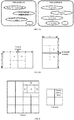
- the adjacent data blocks of the current block are spatial adjacent blocks, including a lowermost spatial adjacent block on left side of the current block (that is, a left block in FIG. 5 ), a rightmost spatial adjacent block on upper side of the current block(that is, a upper block in FIG. 5 ), a nearest spatial adjacent block on upper right corner of the current block (that is, a upper right block in FIG. 5 ), a nearest spatial adjacent block on lower left corner of the current block (that is, a lower left block in FIG. 5 ), and a nearest spatial adjacent block on upper left corner of the current block (that is, a upper left block in FIG. 5 ).
- a video coder and a video decoder use the same strategy to determine whether the current block is coded in intra block copy prediction mode. If it fails to determine whether the current block is coded in intra block copy prediction mode according to the strategy, other strategies can be used to further determine whether the current block is coded in intra block copy prediction mode.
- the coding end it can be determined whether the current block is to be coded in intra block copy prediction mode according to a rate distortion cost, that is, determining an mode with a lowest rate distortion cost as an intra prediction mode for coding the current block from the intra block copy prediction mode, a DC mode, a Planar mode, an angular mode, and a cross-component prediction mode.
- a rate distortion cost that is, determining an mode with a lowest rate distortion cost as an intra prediction mode for coding the current block from the intra block copy prediction mode, a DC mode, a Planar mode, an angular mode, and a cross-component prediction mode.
- FIG. 6 is a schematic structural diagram of a video coding apparatus according to an exemplary embodiment of the present disclosure.
- the video coding apparatus may include a processor 601, a communication interface 602, a memory 603, and a system bus 604.
- the processor 601, the communication interface 602, and the memory 603 may communicate with each other via the system bus 604.
- Computer programs are stored in the memory 603.
- the processor 601 may implement video coding methods according to the above method embodiments by executing the computer programs stored in the memory 603.
- the memory 603 may be an electronic, magnetic, optical or other physical storage device, and may contain or store information such as executable instructions, data, and the like.
- the memory 603 may include volatile memory (such as Random Access Memory (RAM)), non-volatile memory (such as flash memory, storage drive (such as hard disk drive), solid state hard disk, optical memory (such as Compact Disc Read-Only Memory (CD-ROM), Digital Versatile Disc (DVD), etc.), or combinations thereof.
- RAM Random Access Memory
- non-volatile memory such as flash memory
- storage drive such as hard disk drive
- solid state hard disk such as Compact Disc Read-Only Memory (CD-ROM), Digital Versatile Disc (DVD), etc.
- CD-ROM Compact Disc Read-Only Memory
- DVD Digital Versatile Disc
- An embodiment of the present disclosure may further provide a machine-readable storage medium storing computer programs, for example, the memory 603 in FIG. 6 .
- the processor may be caused to implement video coding methods according to the above method embodiments.
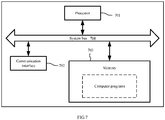
- FIG. 7 is a schematic structural diagram of a video decoding apparatus according to an exemplary embodiment of the present disclosure.
- the video decoding apparatus may include a processor 701, a communication interface 702, a memory 703, and a system bus 704.
- the processor 701, the communication interface 702, and the memory 703 may communicate with each other via the system bus 704.
- the memory 703 may be an electronic, magnetic, optical or other physical storage device on which computer programs are stored.
- the processor 701 may implement video decoding methods according to the above method embodiments by executing the computer programs stored in the memory 703.
- An embodiment of the present disclosure can further provide a machine-readable storage medium storing computer programs, for example, the memory 703 in FIG. 7 .
- the processor may be caused to implement video decoding methods according to the above method embodiments.
Landscapes
- Engineering & Computer Science (AREA)
- Multimedia (AREA)
- Signal Processing (AREA)
- Compression Or Coding Systems Of Tv Signals (AREA)
Abstract
Description
- The present disclosure relates to video coding and decoding technology, and in particular to intra block copy technology.
- Prediction coding is a common coding method in video compression. Commonly used prediction coding modes may include an intra prediction mode (also named as MODE_INTRA) and an inter prediction mode (also named as MODE_INTER). Intra prediction indicates a prediction realized by using only data elements of a current picture (such as sample values). Inter prediction indicates a prediction realized by using data elements of coded pictures other than the current picture (such as sample values or motion vectors). According to relevant video compression standard, slice types in a video may include I slice (intra coding slice), P slice (forward prediction coding slice), or B slice (bidirectional prediction coding slice)
- Intra block copy technique has been proposed. In the intra block copy technique, also named as intra block matching, a coded reconstruction area of the current picture is taken as a reference area for prediction coding. A prediction mode of a coding unit that is coded in the intra block copy technique may be inter prediction. The intra block copy technique can be used for coding various slices including an I slice, a P slice, and a B slice. For an I slice, if the intra block copy technique is allowed for coding it, the slice type of it may be modified to P slice.
- According to a first aspect of the embodiments of the present disclosure, there is provided a video coding method performed by a video coder, including: in response to determining that a current block is coded in intra block copy prediction mode, carrying first indication information and second indication information in bitstream data corresponding to the current block, wherein the first indication information specifies that a prediction mode of the current block is intra prediction, the second indication information specifies that the current block is coded in intra block copy prediction mode; and sending the bitstream data with the first indication information and the second indication information.
- According to a second aspect of the embodiments of the present disclosure, there is provided a video decoding method performed by a video decoder, including: acquiring bitstream data corresponding to a current block; and in response to determining that first indication information and second indication information is carried in the bitstream data, determining that the current block is coded in intra block copy prediction mode, wherein the first indication information specifies that a prediction mode of the current block is intra prediction, the second indication information specifies that the current block is coded in intra block copy prediction mode.
- According to a third aspect of the embodiments of the present disclosure, there is provided a video coder, including: a memory for storing computer programs; and a processor, configured to execute the computer programs stored in the memory to implement the above video coding method.
- According to a fourth aspect of the embodiments of the present disclosure, A video decoder, including: a memory for storing computer programs; and a processor, configured to execute the computer programs stored in the memory to implement the above video decoding method.
- According to a fifth aspect of the embodiments of the present disclosure, A storage medium having computer programs stored thereon, wherein when the computer programs are executed by a processor, the processor is caused to perform the above video coding method.
- According to a sixth aspect of the embodiments of the present disclosure, A storage medium having computer programs stored thereon, wherein when the computer programs are executed by a processor, the processor is caused to perform the above video decoding method.
- According to the embodiments of the present disclosure, efficiency of a video decoder to know that a data block is coded in intra block copy prediction mode may be improved, and consistence between syntax and semantics when prediction coding/decoding the data block in intra block copy prediction mode may be ensured.
-
-
FIG. 1 is a flowchart of a video coding method according to an exemplary embodiment of the present disclosure; -
FIG. 2 is a flowchart of a video decoding method according to an exemplary embodiment of the present disclosure; -
FIG. 3A is a schematic diagram illustrating prediction mode classification according to an exemplary embodiment of the present disclosure; -
FIG. 3B is a schematic diagram illustrating blocks which are used as reference(s) in acquiring boundary strength according to an exemplary embodiment of the present disclosure; -
FIG. 4 is a schematic diagram illustrating a positional correspondence between luma and chroma according to an exemplary embodiment of the present disclosure; -
FIG. 5 is a schematic diagram illustrating adjacent data blocks of a current block according to an exemplary embodiment of the present disclosure; -
FIG. 6 is a schematic structural diagram of a video coding apparatus according to an exemplary embodiment of the present disclosure; -
FIG. 7 is a schematic structural diagram of a video decoding apparatus according to an exemplary embodiment of the present disclosure. - Exemplary embodiments will be described in detail herein, which are schematically shown in the accompanying drawings. For the following description related to the drawings, unless otherwise indicated, the same reference numerals in different drawings represent the same or similar elements. The embodiments described in the following do not represent all embodiments consistent with the present disclosure. Rather, they are merely examples of devices and methods consistent with some aspects of the present disclosure as described in the appended claims.
- The terms used in the present disclosure are used for the purpose of describing particular embodiments only while not intended to limit the present disclosure. The singular forms "a", "said", and "the" used in the present disclosure and the appended claims shall be interpreted as also covering plural forms, unless the context clearly indicates other meanings.
- In order to make the above objectives, features and advantages of the present disclosure more apparent, various embodiments of the present disclosure will be described in detail below in conjunction with the accompanying drawings.
-
FIG. 1 is a flowchart of a video coding method according to an embodiment of the present disclosure. The method may be performed by a video coder, and may include steps S100 to S110. - At step S100, when it is determined that a current block is coded in intra block copy prediction mode, first indication information and second indication information is carried in bitstream data corresponding to the current block. The first indication information specifies that a prediction mode of the current block is intra prediction. The second indication information specifies that the current block is coded in intra block copy prediction mode.
- At step S110, the bitstream data with the first indication information and the second indication information is sent. For example, the bitstream data can be sent to a video decoder or a device for storing the bitstream data.
- According to the embodiment, for a data block that is prediction coded in intra block copy prediction mode, first indication information that specifies that the data block is coded in intra prediction and second indication information that specifies that the data block is coded in intra block copy prediction mode is carried in bitstream data corresponding to the data block. In this way, efficiency of a video decoder to know that the data block is coded in intra block copy prediction mode may be improved, and consistence between syntax and semantics when prediction coding/decoding the data block in intra block copy prediction mode may be ensured.
- According to an embodiment of the present disclosure, the first indication information may include a first flag, where the first flag specifies that a slice to which a slice in which the current block is located is I slice. Determining that the current block is to be coded in intra block copy prediction mode may include: when it is determined that an intra prediction mode with a lowest rate distortion cost is the intra block copy prediction mode, determining that the current block is to be coded in intra block copy prediction mode.
- In an embodiment of the present disclosure, prediction mode classification is shown in
FIG. 3A . The intra prediction may include, but is not limited to, a Planar mode, a DC mode, an angular mode, a cross-component prediction mode, an intra block copy prediction mode, and so on. The inter prediction may include, but is not limited to, a Merge mode, an Advanced Motion Vector Prediction (AMVP for short) mode, a Skip mode, affine model-based motion compensation, and so on. - That is, in an embodiment of the present disclosure, an intra block copy prediction mode is no longer a mode of inter prediction, but a mode of intra prediction.
- In an embodiment of the present disclosure, an intra block copy prediction mode is allowed for intra prediction of a data block in an I slice. If there is a data block to be coded in intra prediction in a B slice or a P slice, the intra block copy prediction mode is also allowed for coding the data block.
- In the embodiment, considering that only intra prediction is allowed for coding a block of I slice, for a data block in an I slice, the first indication information may include a flag (referred to as a first flag herein) that specifies a slice in which the current block is located is I slice. That is, by using the first flag that specifies a slice in which the current block is located is I slice, a video coder can specify that the current block is coded in intra prediction, without additionally carrying specific information that specifies that the current block is coded in intra prediction. This reduces bit rate cost of the current block and improves coding performance.
- In the embodiment, when determining that the current block is to be coded in intra prediction, the video coder can determine respective rate distortion costs of various intra prediction modes, and choose an intra prediction mode with the lowest rate distortion cost as the intra prediction mode for coding the current block.
- For example, the video coder can determine respective rate distortion costs for coding the current block in intra block copy prediction mode, DC mode, Planar mode, angular mode, cross-component prediction mode, etc., and choose an intra prediction mode with the lowest rate distortion cost as the intra prediction mode for coding the current block. When determining that the rate distortion cost of the intra block copy prediction mode for coding the current block is the lowest, the video coder can determine that the current block is to be coded in intra block copy prediction mode.
- According to an embodiment of the present disclosure, in order to avoid the effect on coding bits of the inter prediction mode, a video coder can use a separate flag bit to explicitly specify whether a current block is coded in intra block copy prediction mode. Correspondingly, the second indication information may include a second flag. If a value of the second flag is a first value, the second flag specifies that the current block is coded in intra block copy prediction mode.
- In the embodiment, the video coder may carry a flag bit (referred to as a second flag herein) in bitstream data of the current block, so to specify whether the current block is coded in intra block copy prediction mode. When the value of the second flag is the first value (for example, 1), the second flag may specify that the current block is coded in intra block copy prediction mode. In addition, when the value of the second flag is a second value (for example, 0), the second flag may specify that the current block is not coded in intra block copy prediction mode.
- In an example, for an I slice, it may adopt dual tree mode, in which there are independent block partition structures for luma and chroma respectively. For both the chroma coding unit and the luma coding unit, an explicit flag bit can specify whether the block is coded in intra block copy prediction mode. Accordingly, in the example, when the current block is a luma coding unit or a chroma coding unit, if the value of the second flag of the current block is the first value, the second flag may specify that the luma coding unit or the chroma coding unit is coded in intra block copy prediction mode.
- In addition, in an embodiment of the present disclosure, considering that available modes of a chroma coding unit may include a corresponding luma component mode (DM, Direct Mode), when the corresponding luma component mode is set as "on", a prediction mode adopted for coding the chroma coding unit can be determined according to a prediction mode adopted for coding a luma coding unit corresponding to the chroma coding unit (specific implementation examples will be described in detail later). Therefore, whether the chroma coding unit is coded in intra block copy prediction mode, it can be implicitly specified by corresponding luma component mode information (for example, a DM flag bit), thereby avoiding additional coding flag bits for the chroma coding unit and saving coding bits.
- In an example, when the current block is a chroma coding unit, the second indication information includes a third flag, where the third flag specifies that corresponding luma component mode information of the chroma coding unit.
- In addition, in an embodiment of the present disclosure, considering that slices P and slices B can be prediction coded in inter prediction, disabling slices P and slices B from being coded in intra block copy prediction mode may cause a relatively low coding performance loss but can reduce complexity of coding slices P and slices B. Therefore, for P slice and B slice, intra block copy prediction mode may be disabled, and only slices I are allowed to be coded in intra block copy prediction mode.
- In addition, considering that in existing prediction coding scheme, when an intra block copy prediction mode is used for prediction coding an I slice, slice type of the I slice may be modified to P slice. That is, for a slice whose slice type is identified as P slice, its actual slice type may be I slice and accordingly it can be referred to as pseudo slice P. Further, an I slice is not allowed to be coded by using any reference picture other than a current picture as a prediction reference. Therefore, a P slice represents a slice whose slice type is identified as P slice and for which a reference picture other than the current picture is used as a prediction reference.
- Besides, in an embodiment of the present disclosure, a common syntax element of a slice that is allowed to be coded in intra block copy prediction mode and a slice for which intra block copy prediction mode is disabled can maintain the same entropy coding context initial value, so that setting the entropy coding context initial value can be improved to be more reasonable and consistent with definition of the entropy coding context initial value.
- According to an embodiment of the present disclosure, for a first slice that is allowed to be coded in intra block copy prediction mode and a second slice for which intra block copy prediction mode is disabled, respective common syntax elements of the first slice and the second slice maintain the same entropy coding context initial value.
- In an example, the first slice is an I slice that is allowed to be coded in intra block copy prediction mode, and the second slice is an I slice for which intra block copy prediction mode is disabled.
- In addition, the intra block copy prediction mode is a kind of intra prediction mode. Therefore, when a video coder prediction codes a current block in intra block copy prediction mode, carrying information of an inter prediction mode in which a non-current picture is taken as a reference picture in bitstream data of the current block may not significantly improve decoding performance. Therefore, for a data block that is coded in intra block copy prediction mode, information of an inter prediction mode in which a non-current picture is taken as a reference picture may be not carried in the bitstream data, so as to reduce bit rate cost and improve coding performance.
- According to an embodiment of the present disclosure, after it is determined that a current block is coded in intra block copy prediction mode, information of an inter prediction mode in which a non-current picture is taken as a reference picture may not be coded.
- In an example, the inter prediction mode may include at least one of: a merge mode with motion vector difference (also named as MVD for short), affine model-based motion compensation, affine model-based motion compensation or a Triangle mode.
- In addition, in an embodiment of the present disclosure, considering that there is no temporal candidate in intra block copy prediction mode, and that spatial correlation in intra block copy prediction mode is also weaker than spatial correlation in inter prediction mode, for a data block that is coded in intra block copy prediction mode, it may reduce the number of candidates in a merge list which is constructed in merge mode, thereby decreasing coding bits of candidate index values.
- In an example, the candidates in the merge list may include one or more of a spatial domain candidate, a time domain candidate, a merge candidate, and a zero motion vector of a current block.
- According to an embodiment of the present disclosure, for a first data block that is coded in intra block copy prediction mode and a second data block that is not coded in intra block copy prediction mode, the number of candidates in a merge list which is constructed in merge mode for the first data block is smaller than the number of candidates in a merge list which is constructed in merge mode for the second data block.
- In addition, in an embodiment of the present disclosure, considering that coding performance of prediction coding a data block in intra block copy prediction mode is also affected by reconstructed area information of a slice in which the data block is located. Therefore, in a case that a video coder and a video decoder have negotiated judgment strategy in advance or in a case that the video coder and the video decoder are configured with the same judgment strategy, whether a data block is coded in intra block copy prediction mode, it can be determined from the reconstructed area information of the slice in which the data block is located. Therefore, it can be effectively determined whether the data block is coded in intra block copy prediction mode without carrying specific indication information in bitstream data of the data block.
- According to an embodiment of the present disclosure, determining whether the current block is coded in intra block copy prediction mode may include: determining whether the current block is coded in intra block copy prediction mode according to the reconstructed area information of the slice in which the current block is located.
- In some embodiments, the reconstructed area information may include at least one of: a gradient value of surrounding area of a current block, or mode information of adjacent data blocks of the current block.
- For example, the surrounding area of the current block may include left M columns and upper N rows of the current block in the slice in which the current block is located, where M and N are both positive integers.
- In an example, when the reconstructed area information includes a gradient value of surrounding area of the current block, determining whether the current block is coded in intra block copy prediction mode according to the reconstructed area information of the slice in which the current block is located, may include: if the gradient value of surrounding area of the current block is greater than a first preset threshold, determining that the current block is coded in intra block copy prediction mode; if the gradient value of surrounding area of the current block is less than a second preset threshold, determining that the current block is not coded in intra block copy prediction mode, where the first preset threshold value is greater than the second preset threshold value.
- In the example, for coding the current block, the video coder may calculate the gradient value of surrounding area of the current block and compare the gradient value of surrounding area of the current block with a preset threshold. If the gradient value of surrounding area of the current block is greater than a first preset threshold, which can be set according to actual requirements, the video coder can determine that the current block is to be coded in intra block copy prediction mode. If the gradient value of surrounding area of the current block is less than a second preset threshold, which can be set according to actual requirements and is less than the first preset threshold, the video coder can determine that the current block is not to be coded in intra block copy prediction mode.
- In another example, when the reconstructed area information includes the mode information of adjacent data blocks of the current block, determining whether the current block is coded in intra block copy prediction mode according to the reconstructed area information of the slice in which the current block is located, may include: if a proportion which indicates how many adjacent data blocks of the current block are coded in inter prediction mode exceeds a third preset threshold, determining that the current block is not coded in intra block copy prediction mode.
- In the example, for coding the current block, the video coder may calculate a proportion which indicates how many the adjacent data blocks of the current block are coded in inter prediction mode according to mode information of respective adjacent data blocks of the current block (that is, a ratio of a number of adjacent data blocks of the current block which are coded in inter prediction mode to a number of all adjacent data blocks of the current block) and compare the proportion with a preset threshold (referred to as a third preset threshold herein, which can be set according to actual requirements, such as 50%). If the proportion exceeds the third preset threshold, the video coder can determine that the current block is not to be coded in intra block copy prediction mode.
- It should be noted that in the example, when the proportion does not exceed the third preset threshold, the video coder can use other strategies to determine whether the current block is to be coded in intra block copy prediction mode, such as determining whether the current block is to be coded in intra block copy prediction mode according to the rate distortion cost as described above.
- In some embodiments, in the example, adjacent data blocks of a current block are spatial adjacent blocks, including a lowermost spatial adjacent block on left side of the current block, a rightmost spatial adjacent block on upper side of the current block, a nearest spatial adjacent block on upper right corner of the current block, a nearest spatial adjacent block on lower left corner of the current block, and a nearest spatial adjacent block on upper left corner of the current block.
- The video coding methods according to various embodiments of the present disclosure are described above, and corresponding video decoding methods will be described below.
-
FIG. 2 is a flowchart of a video decoding method according to an embodiment of the present disclosure. The method may be performed by a video decoder, and may include steps S200 to S210. - At step S200, bitstream data corresponding to a current block is acquired. For example, a video decoder may acquire the bitstream data by receiving the bitstream data sent from a video coder, or may acquire the bitstream data from a device for storing the bitstream data.
- At step S210, when it is determined that first indication information and second indication information is carried in the bitstream data corresponding to the current block, it is determined that the current block is coded in intra block copy prediction mode, where the first indication information specifies that a prediction mode of the current block is intra prediction, and the second indication information specifies that the current block is coded in intra block copy prediction mode.
- In an embodiment of the present disclosure, when decoding a current block, a video decoder may determine whether first indication information and second indication information is carried in bitstream data corresponding to the current block. When the first indication information and the second indication information is carried in the bitstream data corresponding to the current block, the video decoder may determine that the current block is coded in intra block copy prediction mode.
- According to the embodiment, it may be determined that the current block is coded in intra block copy prediction mode based on first indication information and second indication information carried in bitstream data corresponding to a data block. In this way, efficiency of a video decoder to know that the data block is coded in intra block copy prediction mode may be improved, and consistence between syntax and semantics when prediction coding/decoding the data block in intra block copy prediction mode may be ensured.
- According to an embodiment of the present disclosure, the first indication information may include a first flag, where the first flag specifies that a slice in which a current block is located is I slice.
- In the embodiment, considering that only intra prediction is allowed for coding a block of I slice, when determining that a flag (referred to as a first flag herein) that specifies that a slice in which a current block is located is I slice is carried in bitstream data of the current block, a video decoder can efficiently and accurately determine that the current block is coded in intra prediction.
- According to an embodiment of the present disclosure, the second indication information may include a second flag, and if a value of the second flag is a first value, the second flag may specify that the current block is coded in intra block copy prediction mode.
- When decoding the current block, the video decoder may determine whether the current block is coded in intra block copy prediction mode according to the value of the second flag carried in the bitstream data of the current block. If the value of the second flag carried in the bitstream data of the current block is the first value (for example, 1), the video decoder may determine that the current block adopts the intra block copy prediction mode.
- In an example, when the current block is a luma coding unit or a chroma coding unit, if the second flag is carried in the bitstream data of the current block, and the value of the second flag is the first value, the video decoder may determine that the luma coding unit or the chroma coding unit is coded in intra block copy prediction mode.
- In an example, when the current block is a chroma coding unit, the second indication information includes a third flag, where the third flag specifies that corresponding luma component mode information of the chroma coding unit.
- In the example, when the current block is a chroma coding unit and a corresponding luma component mode is set as "on" for the current block, the video decoder may know, by acquiring the third flag in the bitstream data of the current block, that the corresponding luma component mode is set as "on" for the current block, and may determine a prediction mode for coding the chroma coding unit according to a prediction mode for coding a luma coding unit corresponding to the chroma coding unit (specific implementation will be described in detail later).
- According to an embodiment of the present disclosure, corresponding to the coding end, when determining that a slice in which the current block is located is P slice or B slice, the video decoder can determine that the current block is not coded in intra block copy prediction mode.
- According to an embodiment of the present disclosure, corresponding to the coding end, when decoding a current block, a video decoder may calculate a gradient value of surrounding area of a current block, and compare the gradient value of surrounding area of the current block with a preset value. If the gradient value of surrounding area of the current block is greater than a first preset threshold, the video decoder may determine that the current block is coded in intra block copy prediction mode. If the gradient value of surrounding area of the current block is less than a second preset threshold (the second preset threshold value is less than the first preset threshold value), the video decoder may determine that the current block is not coded in intra block copy prediction mode.
- According to an embodiment of the present disclosure, corresponding to the coding end, when decoding a current block, a video coder may calculate a proportion which indicates how many adjacent data blocks of the current block are coded in inter prediction mode according to mode information of respective adjacent data blocks of the current block and compare the proportion with a third preset threshold. If the proportion exceeds the third preset threshold, the video coder can determine that the current block is not coded in intra block copy prediction mode. When the proportion does not exceed the third preset threshold, the video coder may determine whether the current block is coded in intra block copy prediction mode according to whether the first indication information and the second indication information is carried in bitstream data of the current block.
- To make those skilled in the art better understand the present disclosure, some embodiments of the present disclosure are described in detail below.
- At the coding end, if it is determined that a current block is coded in intra block copy prediction mode, its prediction mode is intra prediction. First indication information that specifies that a prediction mode of the current block is intra prediction (in the embodiment, pred_mode_flag is taken as an example) and second indication information that specifies that the current block is coded in intra block copy prediction mode (in the embodiment, cpr_flag is taken as an example) is carried in bitstream data of the current block.
- Correspondences between values of pred_mode_flag and cpr_flag and prediction modes may be negotiated and determined by a video coder and a video decoder. For example, when the value of pred mode flag is 1, it specifies that the prediction mode of the current block is intra prediction; when the value of cpr_flag is 1, it specifies that the current block is coded in intra block copy prediction mode.
- At the decoding end, pred_mode_flag and cpr_flag in the bitstream data of the current block can be acquired. For example, if the values of pred _mode_flag and cpr_flag are both 1, it can be determined that the prediction mode of the current block is intra prediction, and the intra block copy prediction mode is adopted for coding the current block.
- In addition, in the embodiment, if the value of pred _mode_flag is 0, it specifies that the prediction mode of the current block is inter prediction; if pred _mode_flag does not exist, it can be inferred that the prediction mode of the current block is intra prediction.
- In the embodiment, when the video decoder calculates a boundary strength in order to perform deblocking filtering on the current block, if it is determined that the prediction mode of the current block is intra prediction and the intra block copy prediction mode is adopted for coding the current block, the boundary strength is not set to a certain preset value (for example, a constant of 2), but the boundary strength is determined according to factors regarding such as a reference picture or a block vector of the current block, as for an inter prediction mode.
- For example, referring to
FIG. 3B , if respective prediction modes of data blocks on both sides of the boundary (such as a block P and a block Q as shown inFIG. 3B ) are intra prediction other than the intra block copy prediction mode, the boundary strength can be set to a preset value. If the block P or the block Q is coded in intra block copy prediction mode, a boundary strength value may be determined based on relevant factors such as whether the block P or the block Q contains a non-zero transform coefficient, whether the same reference picture is used for the block P and the block Q, and a number of motion vectors (mv) or block vectors (bv) of the block P is the same as a number of motion vectors (mv) or block vectors (bv) of the block Q. - At the coding end, if a slice in which a current block is located is I slice and an intra block copy prediction mode is allowed for coding the current block, slice type of the slice is not modified to P slice, but is still I slice. A first flag that specifies that a slice in which the current block is located is I slice and a second flag that specifies that the current block is coded in intra block copy prediction mode (in the embodiment, cpr_flag is taken as an example) is carried in bitstream data of the current block. When the value of cpr_flag is 1, it specifies that the current block is coded in intra block copy prediction mode.
- At the decoding end, the first flag and cpr_flag in the bitstream data of the current block can be acquired. When the first flag is acquired, it is determined that the slice in which the current block is located is I slice. Because only intra prediction is allowed for coding a block of I slice, it can be determined that a prediction mode of the current block is intra prediction. When cpr_flag is acquired, and the value of cpr_flag is 1, it can be determined that the current block is coded in intra block copy prediction mode.
- In the embodiment, for a data block of I slice that is coded in intra block copy prediction mode, its slice type is still identified as I slice, and an I slice flag is used as indication information that specifies that the data block is coded in intra prediction. This ensures consistence between syntax and semantics and reduces bit rate cost.
- When an I slice is coded in dual tree mode, there are independent block partition structures for luma and chroma respectively. Each luma coding unit or chroma coding unit (a chroma coding unit contains a Cb block and a Cr block) can be regarded as a data block. At the coding end, bitstream data of each luma coding unit or chroma coding unit may carry a flag bit (corresponding to the second flag, taking cpr_flag as an example) that specifies whether the block is coded in intra block copy prediction mode. When the value of cpr_flag is 1, it specifies that the luma coding unit or the chroma coding unit is coded in intra block copy prediction mode. The flag bit can be coded in equiprobability mode, or it can be coded in entropy coding mode.
- At the decoding end, when it is parsed that cpr_flag is carried in bitstream data corresponding to a current luma coding unit or chroma coding unit, and the value of cpr_flag is 1, it can be determined that the luma coding unit or chroma coding unit is coded in intra block copy prediction mode.
- In the embodiment, an explicit flag bit specifies whether the luma coding unit or the chroma coding unit is coded in intra block copy prediction mode. In this way, the effect on coding bits of the inter prediction mode is avoided, and efficiency of a video decoder to determine whether the luma coding unit or the chroma coding unit is coded in intra block copy prediction mode is improved.
- When an I slice is coded in dual tree mode, there are independent block partition structures for luma and chroma respectively. For a luma coding unit, an explicit flag bit (corresponding to the second flag, taking cpr_flag as an example) may specify whether the luma coding unit is coded in intra block copy prediction mode. For a chroma coding unit, corresponding luma component mode information (for example, a DM flag bit) can be used to implicitly specify whether the chroma coding unit is coded in intra block copy prediction mode.
- At the coding end, if a current chroma coding unit is coded in intra block copy prediction mode, it can be indicated by indicating that the current chroma coding unit is coded in corresponding luma component mode. For example, the DM flag bit can be carried in bitstream data of the current chroma coding unit, and the value of the DM flag bit can be set to true (it can be negotiated with a video decoder in advance, such as 1 for true and 0 for false).
- At the decoding end, if it is parsed that the current chroma coding unit is coded in corresponding luma component mode (for example, the DM flag bit is carried in the bitstream data corresponding to the current chroma coding unit, and the value of the DM flag bit is true), and if a luma coding unit of which a luma coordinate position corresponds to a specific point coordinate (for example, a center point coordinate) of the chroma coding unit is coded in intra block copy prediction mode, it is determined that the chroma coding unit is coded in intra block copy prediction mode.
- When an I slice is coded in dual tree mode, there are independent block partition structures for luma and chroma respectively. For a luma coding unit, an explicit flag bit (corresponding to the second flag, taking cpr_flag as an example) may specify whether the luma coding unit is coded in intra block copy prediction mode. For a chroma coding unit, corresponding luma component mode information (for example, a DM flag bit) can be used to implicitly specify whether the chroma coding unit is coded in intra block copy prediction mode.
- At the coding end, if a current chroma coding unit is coded in intra block copy prediction mode, it can be indicated by indicating that the current chroma coding unit is coded in corresponding luma component mode. For example, the DM flag bit can be carried in bitstream data of the current chroma coding unit, and the value of the DM flag bit can be set to true.
- At the decoding end, if it is parsed that the current chroma coding unit is coded in corresponding luma component mode (for example, the DM flag bit is carried in the bitstream data corresponding to the current chroma coding unit, and the value of the DM flag bit is true), an intra prediction mode adopted for coding the current chroma coding unit can be determined according to following rules:
- 1. if a plurality of luma coding units of which respective luma coordinate positions correspond to all coordinates in the current chroma coding unit are all coded in intra block copy prediction mode, it is determined that the current chroma coding unit is coded in intra block copy prediction mode;
- 2. if a luma coding unit of which a luma coordinate position corresponds to a center point coordinate of the current chroma coding unit is coded in Planar mode, a DC mode, an angular mode or a cross-component prediction mode (that is, an intra prediction mode other than the intra block copy prediction mode is adopted for coding a block), it is determined that the current chroma coding unit and the luma coding unit is coded in the same intra prediction mode;
- 3. if a luma coding unit of which a luma coordinate position corresponds to a center point coordinate of the current chroma coding unit is coded in intra block copy prediction mode, and among the plurality of luma coding units of which respective luma coordinate positions correspond to all coordinates in the current chroma coding unit, there is a luma coding unit that is not coded in intra block copy prediction mode, it is determined that the current chroma coding unit is coded in preset intra prediction mode, such as the Planar mode, the DC mode, the angular mode, or the cross-component prediction mode.
- For example, referring to a positional correspondence between luma and chroma shown in
FIG. 4 , a luma coding unit of which a luma coordinate position corresponds to a center point coordinate of the current chroma coding unit is block A, and luma coding units of which respective luma coordinate positions correspond to all coordinates in the current chroma coding unit include block A, block B, block C, block D and block E. - Considering that slices P and slices B can be prediction coded in inter prediction, disabling slices P and slices B from being coded in intra block copy prediction mode may cause a relatively low coding performance loss but can reduce complexity of coding slices P and slices B. Therefore, for slices P and slices B, intra block copy prediction mode may be disabled, and only slices I are allowed to be coded in intra block copy prediction mode.
- At the coding end, if it is determined that a slice in which the current block is located is P slice or B slice, and a reference picture other than a current picture is used as a prediction reference, it is determined that the current block is not coded in intra block copy prediction mode.
- At the decoding end, if it is determined that a slice in which the current block is located is P slice or B slice, and a reference picture other than a current picture is used as a prediction reference, it is determined that the current block is not coded in intra block copy prediction mode.
- A first slice: intra block copy prediction mode is disabled for it;
- A second slice: allowed to be coded in intra block copy prediction mode.
- At the coding end and the decoding end, a common syntax element of the first slice and the second slice can maintain the same entropy coding context initial value.
- For example, assuming that a slice A meets following conditions: 1. slice type is P slice; 2. a current picture supports dual tree mode; 3. the current picture is allowed to be coded in intra block copy prediction mode. A B slice meets following conditions: 1. the slice type is I slice; 2. the current picture supports dual tree mode; 3. for the current picture, intra block copy prediction mode is disabled.
- At the coding end and the decoding end, the common syntax element of A slice and B slice (such as SplitFlag, BTSplitFlag, etc.) can maintain the same entropy coding context initial value.
- In the embodiment, after the intra block copy prediction mode is allowed for coding slices I, an original syntax element can maintain original entropy coding context initial value, and an entropy coding context initial value of newly added syntax element may be the same as slices P or slices B, or may be different from both the slices P and the slice B.
- In the embodiment, for a slice that is allowed to be coded in intra block copy prediction mode and a slice for which intra block copy prediction mode is disabled, if no new reference information source is added, the slice types of the two slices are essentially the same, the same entropy coding context initial value is more reasonable and consistent with definition of the entropy coding context initial value.
- If a data block is coded in intra block copy prediction mode, information of an inter prediction mode that uses a non-current picture as a reference picture can be disabled. That is, the data block that is coded in intra block copy prediction mode may not code the information of the inter prediction mode in which the non-current picture is taken as the reference picture. This reduces bit rate cost and improves coding performance.
- At the coding end, when it is determined that the current block is coded in intra block copy prediction mode, the information of the inter prediction mode in which the non-current picture is taken as the reference picture may not be coded. The information of the inter prediction mode may include a merge mode with motion vector difference (also named as MVD for short) of the current block, affine model-based motion compensation, affine model-based motion compensation and/or a Triangle mode. At the decoding end, when it is parsed or deduced from bitstream data that the current block is coded in intra block copy prediction mode, the information of the inter prediction mode may no longer be acquired from the bitstream data, but directly deduced to that the information of the inter prediction mode is disabled.
- A number of candidates in a merge list which is constructed in merge mode for a data block that is coded in intra block copy prediction mode is smaller than a number of candidates in a merge list which is constructed in merge mode for a data block that is not coded in intra block copy prediction mode. There is no temporal candidate in intra block copy prediction mode, and that spatial correlation in intra block copy prediction mode is also weaker than spatial correlation in inter prediction mode. For the data block that is coded in intra block copy prediction mode, it may reduce the number of candidates in a merge list which is constructed in merge mode, thereby decreasing coding bits of candidate index values.
- For example, when constructing the merge list of the intra block copy prediction mode with the same construction logic at the coding end and the decoding end, only first X valid candidates can be selected, where X<Y, and Y is the number of candidates in a merge list for a data block that is not coded in intra block copy prediction mode.
- The candidates in the merge list may include, but are not limited to, one or more of a spatial domain candidate, a time domain candidate, a merge candidate, and a zero motion vector.
- It may be directly determined whether a current block is coded in intra block copy prediction mode by pre-analyzing reconstructed area information of a slice in which the current block is located, without carrying a flag that specifies whether the current block is coded in intra block copy prediction mode in bitstream data, thereby saving coding bits. The reconstructed area information may include, but is not limited to: a gradient value of surrounding area of a current block, or mode information of adjacent data blocks of the current block.
- In an example, if the gradient value of surrounding area of the current block is greater than a preset threshold A, it is directly determined that the current block is coded in intra block copy prediction mode; if the gradient value of surrounding area of the current block is less than a preset threshold B, it is directly determined that the current block is not coded in intra block copy prediction mode, where the surrounding area of the current block may include: left M columns and upper N rows of the current block in a slice in which the current block is located, where M and N are both positive integers, and the preset threshold A is greater than the preset threshold B.
- In another example, if a proportion which indicates how many adjacent data blocks of the current block are coded in inter prediction mode exceeds a preset proportion threshold (such as 50%), it is directly determined that the current block is not coded in intra block copy prediction mode.
- Referring to
FIG. 5 , the adjacent data blocks of the current block are spatial adjacent blocks, including a lowermost spatial adjacent block on left side of the current block (that is, a left block inFIG. 5 ), a rightmost spatial adjacent block on upper side of the current block(that is, a upper block inFIG. 5 ), a nearest spatial adjacent block on upper right corner of the current block (that is, a upper right block inFIG. 5 ), a nearest spatial adjacent block on lower left corner of the current block (that is, a lower left block inFIG. 5 ), and a nearest spatial adjacent block on upper left corner of the current block (that is, a upper left block inFIG. 5 ). - It should be noted that in the embodiment, a video coder and a video decoder use the same strategy to determine whether the current block is coded in intra block copy prediction mode. If it fails to determine whether the current block is coded in intra block copy prediction mode according to the strategy, other strategies can be used to further determine whether the current block is coded in intra block copy prediction mode.
- For example, assuming that the gradient value of surrounding area of the current block is greater than the preset threshold B but less than the preset threshold A, at the coding end, it can be determined whether the current block is to be coded in intra block copy prediction mode according to a rate distortion cost, that is, determining an mode with a lowest rate distortion cost as an intra prediction mode for coding the current block from the intra block copy prediction mode, a DC mode, a Planar mode, an angular mode, and a cross-component prediction mode. When it is determined that the mode with the lowest rate distortion cost is the intra block copy prediction mode, it is determined that the current block is to be coded in intra block copy prediction mode, and second indication information is carried in the bitstream data of the current block. At the decoding end, if it is parsed that the second indication information is carried in the bitstream data of the current block, it is determined that the current block is coded in intra block copy prediction mode.
- The methods according to embodiments of the present disclosure have been described above. Apparatuses according to embodiments of the present disclosure will be described below.
-
FIG. 6 is a schematic structural diagram of a video coding apparatus according to an exemplary embodiment of the present disclosure. The video coding apparatus may include aprocessor 601, acommunication interface 602, amemory 603, and a system bus 604. Theprocessor 601, thecommunication interface 602, and thememory 603 may communicate with each other via the system bus 604. Computer programs are stored in thememory 603. Theprocessor 601 may implement video coding methods according to the above method embodiments by executing the computer programs stored in thememory 603. - The
memory 603 may be an electronic, magnetic, optical or other physical storage device, and may contain or store information such as executable instructions, data, and the like. For example, thememory 603 may include volatile memory (such as Random Access Memory (RAM)), non-volatile memory (such as flash memory, storage drive (such as hard disk drive), solid state hard disk, optical memory (such as Compact Disc Read-Only Memory (CD-ROM), Digital Versatile Disc (DVD), etc.), or combinations thereof. - An embodiment of the present disclosure may further provide a machine-readable storage medium storing computer programs, for example, the
memory 603 inFIG. 6 . When the computer programs are executed by the processor, the processor may be caused to implement video coding methods according to the above method embodiments. -
FIG. 7 is a schematic structural diagram of a video decoding apparatus according to an exemplary embodiment of the present disclosure. The video decoding apparatus may include aprocessor 701, acommunication interface 702, amemory 703, and a system bus 704. Theprocessor 701, thecommunication interface 702, and thememory 703 may communicate with each other via the system bus 704. Similar to thememory 603 described above, thememory 703 may be an electronic, magnetic, optical or other physical storage device on which computer programs are stored. Theprocessor 701 may implement video decoding methods according to the above method embodiments by executing the computer programs stored in thememory 703. - An embodiment of the present disclosure can further provide a machine-readable storage medium storing computer programs, for example, the
memory 703 inFIG. 7 . When the computer programs are executed by the processor, the processor may be caused to implement video decoding methods according to the above method embodiments. - It should be noted that, in this context, terms such as first and second, etc. are merely used to distinguish one entity or operation from another entity or operation, and do not necessarily require or imply that there is any such actual relationship or order between these entities or operations. Moreover, the terms "comprising", "including" or any other variation thereof, are intended to cover non-exclusive inclusion such that a process, method, article or device including a series of elements may include not only those elements, but also other elements not explicitly listed. Without more limitation, the elements defined by the statement "including a...." do not preclude the presence of additional identical elements in the process, method, article or device including the elements.
- The above descriptions are merely some embodiments of the present disclosure, and are not intended to limit the present disclosure. Any modification, equivalent replacement and improvement etc. made within the spirit and principle of the present disclosure should be included within the scope of protection of the present disclosure.
Claims (35)
- A video coding method performed by a video coder, comprising:in response to determining that a current block is coded in intra block copy prediction mode, carrying first indication information and second indication information in bitstream data corresponding to the current block, whereinthe first indication information specifies that a prediction mode of the current block is intra prediction,the second indication information specifies that the current block is coded in intra block copy prediction mode; andsending the bitstream data with the first indication information and the second indication information.
- The method according to claim 1, whereinthe second indication information comprises a second flag, andthe second flag being of a first value specifies that the current block is coded in intra block copy prediction mode.
- The method according to claim 1, wherein
in response to determining that a slice in which the current block is located is I slice, the first indication information comprises a first flag, wherein the first flag specifies that the slice in which the current block is located is I slice. - The method according to claim 2, wherein
in a case that the current block is a luma coding unit, the second flag being of the first value specifies that the luma coding unit is coded in intra block copy prediction mode. - The method according to claim 2, wherein
in a case that the current block is a chroma coding unit, the second flag being of the first value specifies that the chroma coding unit is coded in intra block copy prediction mode. - The method according to claim 4, wherein
in a case that the current block is a chroma coding unit, the second indication information comprises a third flag, wherein the third flag specifies corresponding luma component mode information of the chroma coding unit. - The method according to claim 1, further comprises:
in response to determining that a slice in which the current block is located is P slice or B slice, and a reference picture other than a current picture is used as a prediction reference, determining that the current block is not coded in intra block copy prediction mode. - The method according to claim 1, further comprises:
making a common syntax element of a first slice that is allowed to be coded in intra block copy prediction mode and a second slice for which intra block copy prediction mode is disabled to maintain a same entropy coding context initial value. - The method according to claim 1, further comprises:in response to determining that the current block is coded in intra block copy prediction mode, not coding information of an inter prediction mode in which a non-current picture is taken as a reference picture,wherein the information of the inter prediction mode comprises at least one of: a merge mode with motion vector difference MVD of the current block, affine model-based motion compensation, combined inter-picture merge and intra-picture prediction or a Triangle mode.
- The method according to claim 1, wherein
for a first data block that is coded in intra block copy prediction mode and a second data block that is not coded in intra block copy prediction mode, a number of candidates in a merge list constructed in merge mode for the first data block is smaller than a number of candidates in a merge list constructed in merge mode for the second data block. - The method according to claim 1, wherein determining that the current block is coded in intra block copy prediction mode comprises:
determining whether the current block is coded in intra block copy prediction mode according to reconstructed area information of a slice in which the current block is located. - The method according to claim 11, wherein the reconstructed area information comprises at least one of:a gradient value of surrounding area of the current block; ormode information of adjacent data blocks of the current block.
- The method according to claim 12, whereinthe reconstructed area information comprises the gradient value of surrounding area of the current block;determining whether the current block is coded in intra block copy prediction mode according to the reconstructed area information of the slice in which the current block is located, comprises:in response to that the gradient value of surrounding area of the current block is greater than a first preset threshold, determining that the current block is coded in intra block copy prediction mode; andin response to that the gradient value of surrounding area of the current block is less than a second preset threshold, determining that the current block is not coded in intra block copy prediction mode,wherein the first preset threshold is greater than the second preset threshold.
- The method according to claim 12, whereinthe reconstructed area information comprises the mode information of adjacent data blocks of the current block;determining whether the current block is coded in intra block copy prediction mode according to the reconstructed area information of the slice in which the current block is located, comprises:
in response to that a proportion which indicates how many adjacent data blocks of the current block are coded in inter prediction mode exceeds a third preset threshold, determining that the current block is not coded in intra block copy prediction mode. - A video decoding method performed by a video decoder, comprising:acquiring bitstream data corresponding to a current block; andwhen it is determined that first indication information and second indication information, determining that the current block is coded in intra block copy prediction mode, whereinthe first indication information specifies that a prediction mode of the current block is intra prediction,the second indication information specifies that the current block is coded in intra block copy prediction mode.
- The method according to claim 15, whereinthe second indication information comprises a second flag, andthe second flag being of a first value specifies that the current block is coded in intra block copy prediction mode.
- The method according to claim 15, wherein
in a case that a slice in which the current block is located is I slice, the first indication information comprises a first flag, wherein the first specifies that the slice in which the current block is located is I slice. - The method according to claim 16, wherein
in a case that the current block is a luma coding unit, the second flag being of the first value specifies that the luma coding unit is coded in intra block copy prediction mode. - The method according to claim 16, wherein
in a case that the current block is a chroma coding unit, the second flag being of the first value specifies that the chroma coding unit is coded in intra block copy prediction mode. - The method according to claim 18, whereinin a case that the current block is a chroma coding unit, the second indication information comprises a third flag, wherein the third flag specifies corresponding luma component mode information of the chroma coding unit;determining that the current block is coded in intra block copy prediction mode comprises:
in response to that a luma coding unit of which a luma coordinate position corresponds to a center point coordinate of the chroma coding unit is coded in intra block copy prediction mode, determining that the chroma coding unit is coded in intra block copy prediction mode. - The method according to claim 18, whereinin a case that the current block is a chroma coding unit, the second indication information comprises a third flag, wherein the third flag specifies corresponding luma component mode information of the chroma coding unit;determining that the current block is coded in intra block copy prediction mode comprises:
in response to that a plurality of luma coding units of which respective luma coordinate positions correspond to all coordinates in the chroma coding unit are all coded in intra block copy prediction mode, determining that the chroma coding unit is coded in intra block copy prediction mode. - The method according to claim 21, further comprises:in response to thata luma coding unit of which a luma coordinate position corresponds to a center point coordinate of the chroma coding unit is coded in intra block copy prediction mode, andamong the plurality of luma coding units of which respective luma coordinate positions correspond to all coordinates in the chroma coding unit, there is a luma coding unit that is not coded in intra block copy prediction mode,determining that the chroma coding unit is coded in preset intra-prediction mode.
- The method according to claim 22, further comprises:
in response to that the luma coding unit of which the luma coordinate position corresponds to the center point coordinate of the chroma coding unit is coded in inter prediction mode other than the intra block copy prediction mode, determining that the chroma coding unit is coded in same intra prediction mode as the intra prediction mode for coding the luma coding unit. - The method according to claim 15, further comprises:
in response to determining that the current block is coded in intra block copy prediction mode, determining a boundary strength for deblocking filtering of the current block according to factors regarding at least one of a reference picture or a block vector of the current block. - The method according to claim 15, further comprises:in response to determining thata slice in which the current block is located is P slice or B slice, anda reference picture other than a current picture is used as a prediction reference,determining that the current block is not coded in intra block copy prediction mode.
- The method according to claim 15, further comprises:in response to determining that the current block is coded in intra block copy prediction mode, determining that information of an inter prediction mode in which a non-current picture is taken as a reference picture is not decoded,wherein the information of the inter prediction mode comprises at least one of: a merge mode with motion vector difference MVD of the current block, affine model-based motion compensation, combined inter-picture merge and intra-picture prediction or a Triangle mode.
- The method according to claim 15, wherein
for a first data block that is coded in intra block copy prediction mode and a second data block that is not coded in intra block copy prediction mode, a number of candidates in a merge list constructed in merge mode for the first data block is smaller than a number of candidates in a merge list constructed in merge mode for the second data block. - The method according to claim 15, further comprises:
before determining that the second indication information is carried in the bitstream data corresponding to the current block, determining whether the current block is coded in intra block copy prediction mode according to reconstructed area information of a slice in which the current block is located. - The method according to claim 28, wherein the reconstructed area information comprises at least one of:a gradient value of surrounding area of the current block; ormode information of adjacent data blocks of the current block.
- The method according to claim 29, whereinthe reconstructed area information comprises the gradient value of surrounding area of the current block;determining whether the current block is coded in intra block copy prediction mode according to the reconstructed area information of the slice in which the current block is located, comprises:in response to that the gradient value of surrounding area of the current block is greater than a first preset threshold, determining that the current block is coded in intra block copy prediction mode; andin response to that the gradient value of surrounding area of the current block is less than a second preset threshold, determining that the current block is not coded in intra block copy prediction mode,wherein the first preset threshold is greater than the second preset threshold.
- The method according to claim 29, whereinthe reconstructed area information comprises the mode information of adjacent data blocks of the current block;determining whether the current block is coded in intra block copy prediction mode according to the reconstructed area information of the slice in which the current block is located, comprises:
in response to that a proportion indicates how many adjacent data blocks of the current block are coded in inter prediction mode exceeds a third preset threshold, determining that the current block is not coded in intra block copy prediction mode. - A video coder, comprising:a memory for storing computer programs; anda processor, configured to execute the computer programs stored in the memory to implement the video coding method according to any one of claims 1-14.
- A video decoder, comprising:a memory for storing computer programs; anda processor, configured to execute the computer programs stored in the memory to implement the video decoding method according to any one of claims 15-31.
- A storage medium having computer programs stored thereon, wherein when the computer programs are executed by a processor, the processor is caused to perform the video coding method according to any one of claims 1-14.
- A storage medium having computer programs stored thereon, wherein when the computer programs are executed by a processor, the processor is caused to perform the video decoding method according to any one of claims 15-31.
Applications Claiming Priority (2)
| Application Number | Priority Date | Filing Date | Title |
|---|---|---|---|
| CN201811628690.XA CN111385570B (en) | 2018-12-28 | 2018-12-28 | Encoding method, decoding method and device |
| PCT/CN2019/122362 WO2020134880A1 (en) | 2018-12-28 | 2019-12-02 | Video encoding, and video decoding |
Publications (2)
| Publication Number | Publication Date |
|---|---|
| EP3905695A1 true EP3905695A1 (en) | 2021-11-03 |
| EP3905695A4 EP3905695A4 (en) | 2022-02-23 |
Family
ID=66377120
Family Applications (1)
| Application Number | Title | Priority Date | Filing Date |
|---|---|---|---|
| EP19901742.7A Pending EP3905695A4 (en) | 2018-12-28 | 2019-12-02 | VIDEO CODING AND VIDEO DECODING |
Country Status (4)
| Country | Link |
|---|---|
| US (1) | US11570447B2 (en) |
| EP (1) | EP3905695A4 (en) |
| CN (4) | CN109743576B (en) |
| WO (4) | WO2020134882A1 (en) |
Families Citing this family (32)
| Publication number | Priority date | Publication date | Assignee | Title |
|---|---|---|---|---|
| CN109743576B (en) * | 2018-12-28 | 2020-05-12 | 杭州海康威视数字技术股份有限公司 | Encoding method, decoding method and device |
| US10958904B2 (en) * | 2019-02-01 | 2021-03-23 | Tencent America LLC | Method and apparatus for video coding |
| CN113826390B (en) * | 2019-05-16 | 2024-03-08 | 字节跳动有限公司 | Intra-frame block copy for screen content codec |
| WO2020238838A1 (en) | 2019-05-25 | 2020-12-03 | Beijing Bytedance Network Technology Co., Ltd. | Constraints on merge candidates in intra-block copy coded blocks |
| WO2020244503A1 (en) * | 2019-06-03 | 2020-12-10 | Beijing Bytedance Network Technology Co., Ltd. | Intra block copy with triangular partitions |
| CN113924783A (en) * | 2019-06-03 | 2022-01-11 | 北京字节跳动网络技术有限公司 | Combined intra and intra block copy prediction for video coding |
| CN113994698B (en) * | 2019-06-04 | 2023-11-24 | 北京字节跳动网络技术有限公司 | Conditionally implementing a motion candidate list construction procedure |
| CN117395397A (en) | 2019-06-04 | 2024-01-12 | 北京字节跳动网络技术有限公司 | Motion candidate list construction using neighboring block information |
| CN113453013B (en) * | 2019-06-21 | 2022-02-18 | 杭州海康威视数字技术股份有限公司 | Method and device for decoding and encoding prediction mode |
| CN113382251B (en) * | 2019-06-21 | 2022-04-08 | 杭州海康威视数字技术股份有限公司 | A kind of encoding and decoding method, apparatus, equipment and storage medium |
| CN114175636B (en) | 2019-07-14 | 2024-01-12 | 北京字节跳动网络技术有限公司 | Indication of adaptive loop filtering in adaptive parameter sets |
| CN117241033A (en) * | 2019-08-06 | 2023-12-15 | 北京字节跳动网络技术有限公司 | Video encoding and decoding using screen content encoding tools |
| KR102778652B1 (en) | 2019-08-23 | 2025-03-07 | 두인 비전 컴퍼니 리미티드 | Clipping in reference picture resampling |
| CN114979630B (en) * | 2019-08-26 | 2024-11-05 | 腾讯科技(深圳)有限公司 | Data decoding method, device and data encoding method, device |
| WO2021043157A1 (en) | 2019-09-02 | 2021-03-11 | Beijing Bytedance Network Technology Co., Ltd. | Coding mode determination based on color format |
| CN110719467B (en) * | 2019-09-18 | 2022-04-19 | 浙江大华技术股份有限公司 | Prediction method of chrominance block, encoder and storage medium |
| KR102649584B1 (en) | 2019-09-21 | 2024-03-21 | 베이징 바이트댄스 네트워크 테크놀로지 컴퍼니, 리미티드 | Size limitations based on chroma intra mode |
| CN114450959B (en) | 2019-09-28 | 2024-08-02 | 北京字节跳动网络技术有限公司 | Geometric partitioning modes in video coding and decoding |
| JP7395727B2 (en) | 2019-10-23 | 2023-12-11 | 北京字節跳動網絡技術有限公司 | Methods, devices and storage methods for processing video data |
| EP4035356A4 (en) | 2019-10-23 | 2022-11-30 | Beijing Bytedance Network Technology Co., Ltd. | Signaling for reference picture resampling |
| CN115362676B (en) | 2020-03-07 | 2025-10-28 | 抖音视界有限公司 | Processing of Transform Skip Mode in Video Codec |
| WO2021180163A1 (en) | 2020-03-11 | 2021-09-16 | Beijing Bytedance Network Technology Co., Ltd. | Adaptation parameter set signaling based on color format |
| EP4118831A4 (en) | 2020-04-10 | 2023-12-27 | Beijing Bytedance Network Technology Co., Ltd. | MINIMUM QUANTIZATION ALLOWED FOR TRANSFORMATION SKIP BLOCKS IN VIDEO CODING |
| JP7514330B2 (en) * | 2020-05-31 | 2024-07-10 | 北京字節跳動網絡技術有限公司 | Palette mode with local dual tree mode type definition |
| CN112087634B (en) * | 2020-08-11 | 2022-03-08 | 北京博雅慧视智能技术研究院有限公司 | Optimal angle judgment method and system |
| WO2022037700A1 (en) | 2020-08-21 | 2022-02-24 | Beijing Bytedance Network Technology Co., Ltd. | Coding mode dependent selection of transform skip mode |
| CN111953973B (en) * | 2020-08-31 | 2022-10-28 | 中国科学技术大学 | General video compression coding method supporting machine intelligence |
| WO2022111507A1 (en) | 2020-11-24 | 2022-06-02 | Beijing Bytedance Network Technology Co., Ltd. | Position dependent coefficient reordering in coded video |
| US11736708B2 (en) | 2020-12-16 | 2023-08-22 | Tencent America LLC | Method and apparatus for video coding |
| US12160562B2 (en) * | 2021-09-15 | 2024-12-03 | Tencent America LLC | On propagating intra prediction mode information of IBC block by using block vector |
| WO2024213142A1 (en) * | 2023-04-13 | 2024-10-17 | Douyin Vision Co., Ltd. | Method, apparatus, and medium for video processing |
| CN121603678A (en) * | 2024-08-14 | 2026-03-03 | 中兴通讯股份有限公司 | Method for predicting video block, video code stream processing method and related equipment |
Family Cites Families (27)
| Publication number | Priority date | Publication date | Assignee | Title |
|---|---|---|---|---|
| US20130156099A1 (en) * | 2010-09-30 | 2013-06-20 | Panasonic Corporation | Image decoding method, image coding method, image decoding apparatus, image coding apparatus, program, and integrated circuit |
| PL3751854T3 (en) * | 2011-05-24 | 2023-08-28 | Sun Patent Trust | Image encoding method, image encoding apparatus, image decoding method, image decoding apparatus |
| US9654772B2 (en) * | 2012-01-19 | 2017-05-16 | Qualcomm Incorporated | Context adaptive entropy coding with a reduced initialization value set |
| US10021419B2 (en) * | 2013-07-12 | 2018-07-10 | Qualcomm Incorported | Rice parameter initialization for coefficient level coding in video coding process |
| US9503715B2 (en) * | 2013-08-30 | 2016-11-22 | Qualcomm Incorporated | Constrained intra prediction in video coding |
| AU2013228045A1 (en) | 2013-09-13 | 2015-04-02 | Canon Kabushiki Kaisha | Method, apparatus and system for encoding and decoding video data |
| WO2015074047A1 (en) * | 2013-11-18 | 2015-05-21 | Arris Enterprises, Inc. | Intra block copy for intra slices in high efficiency video coding (hevc) |
| US20150271515A1 (en) * | 2014-01-10 | 2015-09-24 | Qualcomm Incorporated | Block vector coding for intra block copy in video coding |
| KR101908205B1 (en) * | 2014-02-21 | 2018-10-15 | 미디어텍 싱가폴 피티이. 엘티디. | Method of video coding using prediction based on intra picture block copy |
| US10432928B2 (en) * | 2014-03-21 | 2019-10-01 | Qualcomm Incorporated | Using a current picture as a reference for video coding |
| EP3140989A4 (en) * | 2014-05-22 | 2017-07-05 | MediaTek Inc. | Method of intra block copy with flipping for image and video coding |
| JP6482191B2 (en) * | 2014-06-12 | 2019-03-13 | キヤノン株式会社 | Image encoding device, image encoding method and program, image decoding device, image decoding method and program |
| US10327001B2 (en) | 2014-06-19 | 2019-06-18 | Qualcomm Incorporated | Systems and methods for intra-block copy |
| KR102576562B1 (en) | 2014-06-19 | 2023-09-07 | 마이크로소프트 테크놀로지 라이센싱, 엘엘씨 | Unified intra block copy and inter prediction modes |
| CN105208396B (en) * | 2014-06-20 | 2019-01-15 | 联想(北京)有限公司 | A kind of encoding and decoding method and apparatus of video frame |
| US10412387B2 (en) * | 2014-08-22 | 2019-09-10 | Qualcomm Incorporated | Unified intra-block copy and inter-prediction |
| CN105392008B (en) * | 2014-08-22 | 2018-09-25 | 中兴通讯股份有限公司 | A kind of prediction coding and decoding method and corresponding coding and decoding device and electronic equipment |
| KR102034938B1 (en) * | 2014-09-01 | 2019-10-21 | 에이치에프아이 이노베이션 인크. | Method of intra picture block copy for screen content and video coding |
| CN107615763B (en) * | 2015-05-28 | 2020-09-11 | 寰发股份有限公司 | A method and apparatus for managing a decoded image buffer |
| US10638140B2 (en) * | 2015-05-29 | 2020-04-28 | Qualcomm Incorporated | Slice level intra block copy and other video coding improvements |
| US10148961B2 (en) * | 2015-05-29 | 2018-12-04 | Qualcomm Incorporated | Arithmetic coder with multiple window sizes |
| GB2539212A (en) * | 2015-06-08 | 2016-12-14 | Canon Kk | Handling of non-correct block vectors generated for intra block copy coding mode |
| US10306240B2 (en) * | 2015-06-08 | 2019-05-28 | Vid Scale, Inc. | Intra block copy mode for screen content coding |
| CA2993104C (en) * | 2015-07-27 | 2021-03-02 | Mediatek, Inc. | Method of system for video coding using intra block copy mode |
| CN108449599B (en) * | 2018-03-23 | 2021-05-18 | 安徽大学 | Video coding and decoding method based on surface transmission transformation |
| CN118945321A (en) * | 2018-09-07 | 2024-11-12 | 有限公司B1影像技术研究所 | Method and recording medium for encoding/decoding images |
| CN109743576B (en) | 2018-12-28 | 2020-05-12 | 杭州海康威视数字技术股份有限公司 | Encoding method, decoding method and device |
-
2018
- 2018-12-28 CN CN201910104803.4A patent/CN109743576B/en active Active
- 2018-12-28 CN CN201910104802.XA patent/CN109819264B/en active Active
- 2018-12-28 CN CN201910104801.5A patent/CN109874011B/en active Active
- 2018-12-28 CN CN201811628690.XA patent/CN111385570B/en active Active
-
2019
- 2019-12-02 WO PCT/CN2019/122368 patent/WO2020134882A1/en not_active Ceased
- 2019-12-02 WO PCT/CN2019/122373 patent/WO2020134884A1/en not_active Ceased
- 2019-12-02 WO PCT/CN2019/122362 patent/WO2020134880A1/en not_active Ceased
- 2019-12-02 US US17/418,700 patent/US11570447B2/en active Active
- 2019-12-02 WO PCT/CN2019/122372 patent/WO2020134883A1/en not_active Ceased
- 2019-12-02 EP EP19901742.7A patent/EP3905695A4/en active Pending
Also Published As
| Publication number | Publication date |
|---|---|
| WO2020134882A1 (en) | 2020-07-02 |
| CN111385570B (en) | 2021-11-02 |
| CN111385570A (en) | 2020-07-07 |
| CN109743576B (en) | 2020-05-12 |
| CN109874011B (en) | 2020-06-09 |
| WO2020134883A1 (en) | 2020-07-02 |
| CN109874011A (en) | 2019-06-11 |
| CN109743576A (en) | 2019-05-10 |
| WO2020134880A1 (en) | 2020-07-02 |
| CN109819264B (en) | 2020-05-12 |
| EP3905695A4 (en) | 2022-02-23 |
| WO2020134884A1 (en) | 2020-07-02 |
| US11570447B2 (en) | 2023-01-31 |
| CN109819264A (en) | 2019-05-28 |
| US20220070473A1 (en) | 2022-03-03 |
Similar Documents
| Publication | Publication Date | Title |
|---|---|---|
| US11570447B2 (en) | Video coding and video decoding | |
| CN103329528B (en) | Error recovery Improved video encoding and decoding | |
| US10616584B2 (en) | Method and apparatus for encoding and decoding a texture block using depth based block partitioning | |
| CN110572643B (en) | Method and apparatus for utilizing adaptive motion vector precision | |
| US8699562B2 (en) | Method and an apparatus for processing a video signal with blocks in direct or skip mode | |
| CN107079161B (en) | Method for Intra Picture Block Copying for Screen Content and Video Coding | |
| US10070126B2 (en) | Method and apparatus of intra mode coding | |
| WO2017016468A1 (en) | Method of system for video coding using intra block copy mode | |
| US11050902B2 (en) | Video encoding and decoding | |
| CN110999295B (en) | Boundary forced partition improvement | |
| WO2008091117A1 (en) | A method and an apparatus for processing a video signal | |
| CN112601089A (en) | Method for managing a buffer of decoded pictures and video encoder or video decoder | |
| CN121773619A (en) | Method and apparatus for inheriting cross-component models from non-intra-frame codec blocks to perform cross-component prediction merging modes. | |
| TW202539235A (en) | Method and apparatus for coding colour pictures or video using coding tools |
Legal Events
| Date | Code | Title | Description |
|---|---|---|---|
| STAA | Information on the status of an ep patent application or granted ep patent |
Free format text: STATUS: THE INTERNATIONAL PUBLICATION HAS BEEN MADE |
|
| PUAI | Public reference made under article 153(3) epc to a published international application that has entered the european phase |
Free format text: ORIGINAL CODE: 0009012 |
|
| STAA | Information on the status of an ep patent application or granted ep patent |
Free format text: STATUS: REQUEST FOR EXAMINATION WAS MADE |
|
| 17P | Request for examination filed |
Effective date: 20210629 |
|
| AK | Designated contracting states |
Kind code of ref document: A1 Designated state(s): AL AT BE BG CH CY CZ DE DK EE ES FI FR GB GR HR HU IE IS IT LI LT LU LV MC MK MT NL NO PL PT RO RS SE SI SK SM TR |
|
| REG | Reference to a national code |
Ref country code: DE Ref legal event code: R079 Free format text: PREVIOUS MAIN CLASS: H04N0019593000 Ipc: H04N0019700000 |
|
| A4 | Supplementary search report drawn up and despatched |
Effective date: 20220126 |
|
| RIC1 | Information provided on ipc code assigned before grant |
Ipc: H04N 19/176 20140101ALI20220120BHEP Ipc: H04N 19/147 20140101ALI20220120BHEP Ipc: H04N 19/107 20140101ALI20220120BHEP Ipc: H04N 19/593 20140101ALI20220120BHEP Ipc: H04N 19/70 20140101AFI20220120BHEP |
|
| DAV | Request for validation of the european patent (deleted) | ||
| DAX | Request for extension of the european patent (deleted) | ||
| STAA | Information on the status of an ep patent application or granted ep patent |
Free format text: STATUS: EXAMINATION IS IN PROGRESS |
|
| 17Q | First examination report despatched |
Effective date: 20240905 |