EP3905610A1 - Network communication method and system - Google Patents
Network communication method and system Download PDFInfo
- Publication number
- EP3905610A1 EP3905610A1 EP19901849.0A EP19901849A EP3905610A1 EP 3905610 A1 EP3905610 A1 EP 3905610A1 EP 19901849 A EP19901849 A EP 19901849A EP 3905610 A1 EP3905610 A1 EP 3905610A1
- Authority
- EP
- European Patent Office
- Prior art keywords
- data
- port
- docker container
- application
- channel
- Prior art date
- Legal status (The legal status is an assumption and is not a legal conclusion. Google has not performed a legal analysis and makes no representation as to the accuracy of the status listed.)
- Granted
Links
Images



Classifications
-
- H—ELECTRICITY
- H04—ELECTRIC COMMUNICATION TECHNIQUE
- H04L—TRANSMISSION OF DIGITAL INFORMATION, e.g. TELEGRAPHIC COMMUNICATION
- H04L49/00—Packet switching elements
- H04L49/70—Virtual switches
-
- G—PHYSICS
- G06—COMPUTING OR CALCULATING; COUNTING
- G06F—ELECTRIC DIGITAL DATA PROCESSING
- G06F9/00—Arrangements for program control, e.g. control units
- G06F9/06—Arrangements for program control, e.g. control units using stored programs, i.e. using an internal store of processing equipment to receive or retain programs
- G06F9/44—Arrangements for executing specific programs
- G06F9/455—Emulation; Interpretation; Software simulation, e.g. virtualisation or emulation of application or operating system execution engines
- G06F9/45533—Hypervisors; Virtual machine monitors
- G06F9/45558—Hypervisor-specific management and integration aspects
-
- H—ELECTRICITY
- H04—ELECTRIC COMMUNICATION TECHNIQUE
- H04L—TRANSMISSION OF DIGITAL INFORMATION, e.g. TELEGRAPHIC COMMUNICATION
- H04L45/00—Routing or path finding of packets in data switching networks
- H04L45/38—Flow based routing
-
- H—ELECTRICITY
- H04—ELECTRIC COMMUNICATION TECHNIQUE
- H04L—TRANSMISSION OF DIGITAL INFORMATION, e.g. TELEGRAPHIC COMMUNICATION
- H04L45/00—Routing or path finding of packets in data switching networks
- H04L45/64—Routing or path finding of packets in data switching networks using an overlay routing layer
-
- H—ELECTRICITY
- H04—ELECTRIC COMMUNICATION TECHNIQUE
- H04L—TRANSMISSION OF DIGITAL INFORMATION, e.g. TELEGRAPHIC COMMUNICATION
- H04L45/00—Routing or path finding of packets in data switching networks
- H04L45/74—Address processing for routing
-
- H—ELECTRICITY
- H04—ELECTRIC COMMUNICATION TECHNIQUE
- H04L—TRANSMISSION OF DIGITAL INFORMATION, e.g. TELEGRAPHIC COMMUNICATION
- H04L65/00—Network arrangements, protocols or services for supporting real-time applications in data packet communication
- H04L65/60—Network streaming of media packets
- H04L65/65—Network streaming protocols, e.g. real-time transport protocol [RTP] or real-time control protocol [RTCP]
-
- H—ELECTRICITY
- H04—ELECTRIC COMMUNICATION TECHNIQUE
- H04L—TRANSMISSION OF DIGITAL INFORMATION, e.g. TELEGRAPHIC COMMUNICATION
- H04L65/00—Network arrangements, protocols or services for supporting real-time applications in data packet communication
- H04L65/60—Network streaming of media packets
- H04L65/75—Media network packet handling
- H04L65/762—Media network packet handling at the source
-
- G—PHYSICS
- G06—COMPUTING OR CALCULATING; COUNTING
- G06F—ELECTRIC DIGITAL DATA PROCESSING
- G06F9/00—Arrangements for program control, e.g. control units
- G06F9/06—Arrangements for program control, e.g. control units using stored programs, i.e. using an internal store of processing equipment to receive or retain programs
- G06F9/44—Arrangements for executing specific programs
- G06F9/455—Emulation; Interpretation; Software simulation, e.g. virtualisation or emulation of application or operating system execution engines
- G06F9/45533—Hypervisors; Virtual machine monitors
- G06F9/45558—Hypervisor-specific management and integration aspects
- G06F2009/45595—Network integration; Enabling network access in virtual machine instances
Definitions
- the present disclosure relates to, but not limited to, communication technology, and in particular, to a method and a system for network communication.
- Microservice architecture has become one of the mainstream modes in software system development and deployment.
- Docker container is usually used to deploy services for rapid deployment of services and dynamic scaling of instances.
- Docker is an open source application container engine, allowing developers to package applications into containers.
- Kubernetes is usually used to manage and schedule a cluster of containers, while some network plug-ins, for example, Flannel, are used to realize network interconnection between Docker containers.
- Flannel some network plug-ins
- the service functions of the applications may be relatively monotonous, and the overall capacity requirement is not high.
- UDP User Datagram Protocol
- the Docker container itself provides docker-proxy to realize data packet forwarding for container applications.
- its implementation mechanism is to provide each container port port-mapped with a docker-proxy process for data packet forwarding, in the case of a large number of port mappings, a large number of docker-proxy processes need to be run, the circumstances of inefficiency and high difficulty in operation and maintenance management may also occur.
- a method and a system for network communication are provided, which can reduce the complexity of port management of a Docker container and improve the efficiency of data transmission.
- a method for network communication including: determining a data forwarding rule of a Docker container, where a pair of first ports of the Docker container are mapped to ports of a host computer in which the Docker container is located; according to the data forwarding rule, forwarding a data packet received via first ports to an application deployed in the Docker container, or forwarding a data packet sent by the application deployed in the Docker container to an external device via the first port.
- a system for network communication including a data distribution unit and a network application unit.
- the data distribution unit and the network application unit are deployed in a Docker container, a pair of first ports of the Docker container are mapped to ports of a host computer in which the Docker container is located, and the network application unit includes at least one application.
- the data distribution unit is configured to: determine a data forwarding rule of the Docker container; and according to the data forwarding rule, forward a data packet received via first ports to an application in the network application unit, or forward a data packet sent by the application in the network application unit to an external device via the first port.
- a network device including a processor and a memory.
- the memory is configured to store a network communication program which, when executed by the processor, causes the processor to perform the method for network communication described above.
- a computer readable medium storing a network communication program.
- the network communication program when executed by a processor, causes the processor to perform the method for network communication described above.
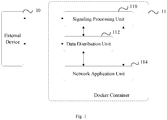
- Fig. 1 is a schematic diagram of a system for network communication according to an embodiment of the present disclosure.
- Fig. 2 is an implementation flow diagram of the system for network communication according to an embodiment of the present disclosure.
- the system for network communication of the embodiment includes a data distribution unit 112 and a network application unit 114 which are deployed in a Docker container 11.
- the Docker container 11 can be deployed on a network device (which may be called a host computer), and multiple Docker containers can be deployed on one network device at the same time.
- At least one application may be deployed in the Docker container 11, for example, different network applications can be instantiated according to different business scenarios.
- the network application unit 114 may include at least one application, such as application 1, application 2 and application n in Fig. 2 , where application 1 is bound to port a, application 2 is bound to port b and application n is bound to port n.
- a pair of first ports (illustrated by port B in Fig. 2 ) of the Docker container 11 are mapped to ports of a host computer in which the Docker container is located.
- the pair of first ports may include a Realtime Transport Protocol (RTP) port and a Realtime Transport Control Protocol (RTCP) port, and the pair of first ports of the Docker container 11 is configured to transmit data.
- RTP Realtime Transport Protocol
- RTCP Realtime Transport Control Protocol
- the Docker container 11 may expose a pair of first ports on the host computer in which the Docker container 11 is located through port mapping at startup, and the exposed pair of first ports is configured to receive a data packet from an external device 10, or send a data packet to the external device 10.
- the Docker container 11 may initialize a corresponding relationship between an address of the Docker container and an Internet Protocol (IP) address of the host computer in which the Docker container 11 is located, and a mapping relation between the first ports of the Docker container 11 and the ports on the host computer in which the Docker container 11 is located. Based on this, the Docker container 11 can realize data interaction with the external device 10.
- IP Internet Protocol
- the data distribution unit 112 is configured to determine a data forwarding rule of the Docker container 11; and according to the data forwarding rule, forward a data packet received via a first port (for example, port B in Fig. 2 ) to an application in the network application unit 114, or forward a data packet sent by the application in the network application unit 114 to the external device 10 via the first port.
- a first port for example, port B in Fig. 2
- the external device 10 may include other objects besides the Docker container 11, such as other network devices or other Docker containers.
- the present disclosure is not limited to this.
- the Docker container 11 may only need to expose a pair of first ports, and the exposed pair of first ports is configured to transmit data. No matter how many channels of data exist between the external device 10 and the network application unit 114, data will be transmitted via the first ports, and the exposed ports will not be dynamically increased, only the data forwarding rule of the Docker container 11 will be dynamically changed.
- the data distribution unit 112 may add a data forwarding rule, while when a channel of data is deleted, the data distribution unit 112 may delete a corresponding data forwarding rule.
- the data forwarding rule may be used to record information of a data source and a data destination of each channel of data, where the data source or the data destination may be an application in the network application unit 114.
- the information of the data source may include a source address and a source port; and the information of the data destination may include a destination address and a destination port; where the source port or the destination port may be a port to which an application in the network application unit 114 is bound.
- the information of the data source may include: an address of the Docker container in which the application is located, a port to which the application is bound, and an Identity Document (ID) of the application.
- ID Identity Document
- the destination address of the channel of data may be the IP address of the host computer in which the Docker container is located, and the destination port of the channel of data may be the port to which the application deployed in the Docker container is bound.
- the source address of the channel of data may be the IP address of the host computer in which the Docker container is located, and the destination port of the channel of data may be the port to which the application deployed in the Docker container is bound.
- the data distribution unit 112 may be configured to forward, according to the data forwarding rule, the data packet received via the first port to the application deployed in the Docker container 11 by: determining the destination port corresponding to both the source address and the source port carried by the data packet received via the first port by querying the data forwarding rule; and forwarding the data packet to the application bound to the destination port in the network application unit 114.
- the data distribution unit 112 receives a data packet carrying a source address and a source port via port B.
- the data packet is forwarded in the Docker container 11 according to the queried destination port.
- the data distribution unit 112 forwards the received data packet to the application 1 bound to the port a; or, in the case that there is no record of the source address and the source port in the data forwarding rule, the received data packet is directly discarded.
- the data distribution unit 112 can forward, according to the data forwarding rule, the data packet sent by the application deployed in the Docker container 11 to the external device 10 via the first port by: determining an IP address and a port of the external device corresponding to the port to which the application sending the data packet in the Docker container is bound by querying the data forwarding rule; and forwarding the data packet to the external device via the first port.
- the data distribution unit 112 after receiving the data packet sent by the application 1 in the network application unit 114, the data distribution unit 112 queries whether there is a destination address and a destination port corresponding to the port a from the data forwarding rule. In the case where it is queried that the IP address and port of the external device 10 correspond to the port a, the data distribution unit 112 forwards the data packet to the external device 10 via the port B; or, in the case that there is no queried record corresponding to the port a, the received data packet is directly discarded.
- the system for network communication may further include a signaling processing unit 110 configured to acquire communication link information of each channel of data and send the communication link information to the data distribution unit 112.
- the data distribution unit 112 may be configured to determine the data forwarding rule of the Docker container 11 according to the communication link information of each channel of data.
- a second port (e.g., port A in Fig. 2 ) of the Docker container 11 is mapped to a port of the host computer in which the Docker container 11 is located, and the second port is configured to transmit signaling.
- the signaling processing unit 110 may be configured to acquire the communication link information of each channel of data by one of the following modes.
- Mode 1 by performing signaling interaction with an external device (such as the external device 10) via the second port, determining a source address and a source port (e.g., the IP address and the port of the external device 10) of any channel of data to be received via the first port; acquiring, from the application for receiving the channel of data, an address and a port of the Docker container to which the application is bound; and determining the communication link information of the channel of data according to the source address and the source port of the channel of data, and the address and the port of the Docker container to which the application is bound;
- Mode 2 receiving a request message sent by the external device via the second port, and parsing a destination address and a destination port (e.g., the IP address and the port of the external device 10) of any channel of data to be sent via the first port, and an application for sending the channel of data, from the request message; acquiring the address and the port of the Docker container to which the application is bound from the application for sending the channel of data; and determining the communication link information of the channel of data according to the destination address and the destination port of the channel of data, and the address and the port of the Docker container to which the application is bound.
- a destination address and a destination port e.g., the IP address and the port of the external device
- the signaling processing unit 110 is configured to interact with an external device (e.g., the external device 10) to complete data negotiation through standard signaling which may generally include Session Initiation Protocol (SIP), Real Time Streaming Protocol (RTSP), Media Gateway Control Protocol (MGCP), etc.
- a signaling transmission channel can support Transmission Control Protocol (TCP), User Datagram Protocol (UDP) and other modes. Since the signaling processing unit 110 needs to communicate with an external device (e.g., the external device 10), a port (i.e., the above-mentioned second port, e.g., port A in Fig. 2 ) for transmitting signaling is exposed to the host computer through port mapping. For the whole Docker container, as there is usually only one port for signaling transmission, there is no impact on data packet forwarding by the host computer based on iptables rules.
- the data distribution unit 112 is configured to communicate with the external device 10 through a standard data transmission protocol, receiving and forwarding the data packet based on the data forwarding rule.
- the data distribution unit 112 may expose a pair of ports (i.e., the first ports mentioned above, e.g., port B in Fig. 2 ) for data packet transmission on the host computer through port mapping. For the whole Docker container, only a pair of ports needs to be exposed for data transmission, so there is no impact on data packet forwarding by the host computer based on iptables rules.
- the data forwarding rule can be created or updated according to the communication link information sent by the signaling processing unit 110.
- the data distribution unit 112 can determine, according to the source address and the source port carried by the data packet, which port in the Docker container or which external device to forward the data packet to by querying the data forwarding rule.
- the network application unit 114 is configured to interact with the data distribution unit 112, and can be instantiated into different network applications (for example, application 1, application 2, and application n) according to different business scenarios.
- the network application unit 114 can receive a data packet forwarded by the data distribution unit 112 or send a data packet to the data distribution unit 112.
- the network application unit 114 can be started with the Docker container 11, or can be created by other units (for example, the signaling processing unit 110).
- the network application unit 114 and the data distribution unit 112 may usually need to bind a pair of ports (including an RTP port and an RTCP port) for each channel of data (for example, video or audio data). For example, in Fig.
- application 1 is bound to port a
- application 2 is bound to port b
- application n is bound to port n.
- multiple pairs of ports may need to be bound.
- the network application unit 114 and the data distribution unit 112 can communicate with each other through a socket in the Docker container.
- the signaling processing unit 110 may initiate a data session establishment request from the port A, which may be SIP, RTSP, MGCP or other protocols, and record the source address and source port (e.g., IP address and port number of the external device 10) of opposite end data after the signaling negotiation is completed.
- a receiving address of local end data may be the IP address of the host computer in which the Docker container is located and the port B of the Docker container exposed on the host computer.
- the signaling processing unit 110 informs the network application unit 114, and the network application unit 114 creates a new application 1 bound to the port a.
- the new application 1 informs the signaling processing unit 110 of the address and the port a of the Docker container to which the new application 1 is bound for data processing.
- the signaling processing unit 110 informs the data distribution unit 112 of the data address pair to be forwarded (including the source address and the source port of the peer end data, and the address and the port a of the Docker container to which the data destination application 1 is bound).
- the data distribution unit 112 creates, according to the received information, a data distribution mapping table, in which the following corresponding relationships are recorded: the source address, the source port, the IP address of the host computer in which the Docker container is located, and the port to which the application 1 is bound, as a data forwarding rule.
- the data distribution unit 112 starts to receive the data packet, queries the data forwarding rule in the data distribution mapping table according to the source address and the source port carried by the data packet, and forwards the received data packet to the port a in the Docker container according to the queried result.
- the application 1 bound to the port a can perform corresponding services, such as video analysis tasks.
- iptables-based forwarding and application distribution are combined, allowing the Docker container to realize multi-channel data transmission with a pair of ports exposed only.
- the complexity of Docker container port management is reduced, the efficiency of data packet transmission is improved, and thus the operation and maintenance management is facilitated and the reliability is improved.
- Fig. 3 is a flow chart of a method for network communication according to an embodiment of the present disclosure.
- the method for network communication of this embodiment can be applied to a Docker container deployed on a host computer, where a pair of first ports of the Docker container are mapped to ports of the host computer in which the Docker container is located.
- a pair of first ports of the Docker container are mapped to ports of the host computer in which the Docker container is located.
- the method for network communication of this embodiment includes step S201 and step S202.
- a data forwarding rule of a Docker container is determined.
- a data packet received via a first port is forwarded to an application deployed in the Docker container, or a data packet sent by the application deployed in the Docker container is forwarded to an external device via the first port.
- a pair of first ports of the Docker container are mapped to ports of a host computer in which the Docker container is located.
- the data packet received via the first port is forwarded to the application deployed in the Docker container, or the data packet sent by the application deployed in the Docker container is forwarded to the external device via the first ports.
- the Docker container may only need to expose a pair of first ports on the host computer for data packet transmission, which not only reduces the complexity of port management, but also improves the efficiency of data transmission.
- the data forwarding rule can be configured to record information of a data source and a data destination of each channel of data, where the data source or the data destination is the application deployed in the Docker container.
- the information of the data source may include a source address and a source port
- the information of the data destination may include a destination address and a destination port, where the source port or the destination port is a port to which the application deployed in the Docker container is bound.
- the present disclosure is not limited to this.
- the information of the data source may include the address of the Docker container in which the application is located, the port to which the application is bound, and the ID of the application.
- the data packet is forwarded in the Docker container according to the queried destination port.
- the destination port corresponding to the source address and the source port e.g., the IP address and the port of the external device 10
- the received data packet can be forwarded to the application 1 bound to the port a; or, if there is no records of the source address and the source port in the data forwarding rule, the received data packet is directly discarded.
- forwarding the data packet sent by the application deployed in the Docker container to the external device via the first port may include: determining the IP address and the port of the external device corresponding to the port to which the application sending the data packet in the Docker container is bound by querying the data forwarding rule; and forwarding the data packet to the external device via the first port.
- the source port of a channel of data recorded in the data forwarding rule may be the port to which the application deployed in the Docker container is bound
- the destination address and the destination port of the channel of data may be the IP address and the port of the external device.
- the data forwarding rule determines whether there is a destination address and a destination port corresponding to the port to which the application is bound. If there is a queried record of corresponding destination address and port, such as the IP address and the port of the external device, the data packet is forwarded to the external device via the first port; and if there is no corresponding records, the received data packet is discarded directly.
- the method for network communication may further include: acquiring communication link information of each channel of data.
- step S201 may include: determining the data forwarding rule of the Docker container according to the communication link information of each channel of data.
- the Docker container exposes the first ports and the second port through port mapping during initialization.
- the first ports are configured to transmit data and the second port is configured to transmit signaling.
- the whole Docker container as there is usually only one port for signaling transmission, there is no impact on data packet forwarding by the host computer based on iptables rules.
- the whole Docker container as only a pair of ports (the first ports) may need to be exposed for data transmission, there is no impact on data packet forwarding by the host computer based on iptables rules.
- the Docker container may only need to expose a pair of first ports for data transmission. No matter how many channels of data exist between the application deployed in the Docker container and the external device, data will be transmitted via the first ports, and the exposed ports will not be dynamically increased, only the data forwarding rule of the Docker container will be dynamically changed.
- a channel of data is added, a record may be added in the data forwarding rule, while when a channel of data is deleted, a record may be deleted in the data forwarding rule.
- iptables-based forwarding and application distribution are combined, allowing the Docker container to realize multi-channel data transmission with only a pair of ports being exposed.
- the complexity of Docker container port management is reduced and the efficiency of data packet transmission is improved, and thus the operation and maintenance management is facilitated and the reliability is improved.
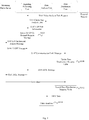
- Fig. 4 is an exemplary flow chart of a method for network communication according to another embodiment of the present disclosure.
- the method can be applied to the following scenarios: the system for network communication pulls data stream from a GB28181 server (i.e., streaming media server) through Session Initiation Protocol (SIP), and the data stream is used for video analysis tasks.
- the network application unit may include a data analysis unit.
- the method for network communication in this example may include steps S101 to S114.
- a signaling processing unit receives a video analysis task request.
- the video analysis task request may be triggered by a click operation on a web page corresponding to the system for network communication.
- the present disclosure is not limited to this.
- the signaling processing unit After receiving the video analysis task request, the signaling processing unit creates a data analysis unit.
- the data analysis unit sends the address of the Docker container and UDP port information (e.g., port number) to which the data analysis unit is bound to the signaling processing unit, and the signaling processing unit records the address of the Docker container and the UDP port information (e.g., port number) to which the data analysis unit is bound.
- UDP port information e.g., port number
- the signaling processing unit parses the video analysis task request and assembles a standard SIP on demand request message.
- the SIP on demand request message includes a Session Description Protocol (SDP) message, and the SDP message includes a destination address and a destination port number.
- SDP Session Description Protocol
- the destination address is the IP address of the host computer in which the Docker container is located
- the destination port number is the port number of the first port mapped by docker container to the host computer (e.g., the port number of port B in Fig. 2 ).
- the signaling processing unit sends the SIP on demand request message to the streaming media server.
- the streaming media server sends a 200OK message to the signaling processing unit, which also includes an SDP message, and the SDP message includes a source address and a source port number of a requested video data.
- the source address and the source port number are an IP address and a port number of a camera.
- the signaling processing unit assembles the address and the port number of the Docker container to which the data analysis unit is bound with the IP address and the port number of the corresponding camera into a communication link message, and sends the communication link message to a data distribution unit.
- the data distribution unit receives the communication link message, and updates a data distribution mapping table according to the communication link message, that is, a new data forwarding rule is added to the data distribution mapping table. For example, the corresponding relationship between the IP address of the host computer in which the data analysis unit is located and the port number bound in the Docker container and the IP address and the port number of the corresponding camera can be recorded.
- the IP address of the host computer in which the data analysis unit is located can be determined according to the address of the Docker container to which the data analysis unit is bound and the corresponding relationship between the address of the Docker container established during the initialization of the Docker container and the IP address of the host computer in which the Docker container is located.
- the data distribution unit sends an Acknowledge character (ACK) message to the signaling processing unit.
- ACK Acknowledge character
- the signaling processing unit sends the ACK message to the streaming media server.
- the streaming media server sends the data of the corresponding camera to the data distribution unit.
- the streaming media server can send the data of the camera according to the destination address and the destination port number carried in the SIP on demand request message (that is, the IP address of the host computer in which the Docker container is located and the port number of the first ports mapped by the Docker container to the host computer).
- the data distribution unit searches the data distribution mapping table. In the case that the destination port number corresponding to both the source address and the source port number carried by the data packet can be found in the data distribution mapping table, the data distribution unit forwards the received data packet to the data analysis unit corresponding to the destination port number at step S113; or, in the case that the destination port number corresponding to both the source address and the source port number carried by the data packet cannot be found in the data distribution mapping table, the data packet is discarded directly.
- the data analysis unit executes the video data analysis task.
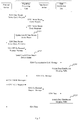
- Fig. 5 is an exemplary flow chart of a method for network communication according to yet another embodiment of the present disclosure.
- the method can be applied to the following scenarios: as a data stream server, the system for network communication supports GB28181 protocol, and sends data stream to an external device in response to a request of the external device.
- the network application unit may include a data stream device.
- the method for network communication in this example may include steps S201 to S216.
- a signaling processing unit receives a data stream device query request message sent by an external device.
- the signaling processing unit sends a device status query request message to all managed data stream devices.
- the data stream device in a working state i.e., normal data stream device
- the data stream device in a working state returns a device status query response message to the signaling processing unit.
- the device status query response message returned by any normal data stream device may include an ID of the data stream device, an address and a port number of a Docker container to which the data stream device is bound.
- the signaling processing unit updates a list of data stream device status according to the received device status query response message, and assembles the list of data stream device status in a working state into a data stream device query response message.
- the IDs of all data stream devices in a working state can be recorded in the list of data stream device status in a working state.
- the signaling processing unit sends the data stream device query response message to the external device.
- the signaling processing unit receives a SIP on demand request message sent by the external device.
- the signaling processing unit parses out the IP address and the port number of the external device and the ID of the data stream device to be on demand from the SIP on demand request message.
- the ID of the data stream device to be on demand is queried in the list of data stream device status.
- the signaling processing unit assembles the IP address and the port number of the external device with the address and the port number of the Docker container to which the data stream device corresponding to the ID is bound into a communication link message, and executes step S208; otherwise (that is, the data stream device corresponding to the ID is in a non-working state (that is, there is an exception)), the signaling processing unit feeds back an exception notification to the external device.
- the signaling processing unit sends the communication link message to a data distribution unit.
- the data distribution unit parses the communication link message and updates a data distribution mapping table according to the communication link message. That is, a new data forwarding rule is added to the data distribution mapping table. For example, the IP address and the port number of the external device, and the corresponding relationship between the IP address of the host computer bound to the ID of the data stream device to be on demand and the port number bound in the Docker container can be recorded.
- the IP address of the host computer in which the data stream device is located can be determined according to the address of the Docker container to which the data stream device is bound and the corresponding relationship between the address of the Docker container established during the initialization of the Docker container and the IP address of the host computer in which the Docker container is located.
- the data distribution unit After updating the data distribution mapping table, the data distribution unit returns an ACK message to the signaling processing unit.
- the signaling processing unit sends a 200OK message to the external device, which may include a SDP message, and the SDP message may include the ID of the data stream device to be on demand.
- the external device sends the ACK message to the signaling processing unit.
- the signaling processing unit After receiving the ACK message, the signaling processing unit sends an on-demand request message to the data stream device corresponding to the ID to be on demand.
- the data stream device corresponding to the ID to be on demand sends data to the data distribution unit.
- the data distribution unit searches the data distribution mapping table. In the case that the destination address and the destination port number corresponding to both the source address and the source port number carried by the data packet can be found in the data distribution mapping table, the data distribution unit forwards the data packet to the corresponding external device at step S216; or, in the case that the destination address and the destination port number corresponding to both the source address and the source port number carried by the data packet cannot be found in the data distribution mapping table, the data packet is directly discarded.
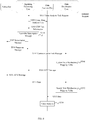
- Fig. 6 is an exemplary flow chart of a method for network communication according to another embodiment of the present disclosure. The method can be applied to the following scenarios: a system for network communication acquires a data stream through GAT1400 protocol for a video analysis task.
- the network application unit may include a data analysis unit.
- the method for network communication in this example may include steps S301 to S314.
- a signaling processing unit receives a video analysis task request.
- the video analysis task request may be triggered by a click operation on a web page corresponding to the system for network communication.
- the present disclosure is not limited to this.
- the signaling processing unit After receiving the video analysis task request, the signaling processing unit creates a data analysis unit.
- the data analysis unit sends the address of the Docker container and UDP port information (e.g., port number) to which the data analysis unit is bound to the signaling processing unit, and the signaling processing unit records the address of the Docker container and the UDP port information (e.g., port number) to which the data analysis unit is bound.
- UDP port information e.g., port number
- the signaling processing unit parses the video analysis task request and assembles a subscription message.
- the subscription message may include a destination address and a destination port number.
- the destination address is the IP address of the host computer in which the Docker container is located
- the destination port number is the port number of the first port mapped by docker container to the host computer (e.g., the port number of port B in FIG. 2 ).
- the signaling processing unit sends the subscription message, such as HTTP POST/VIID/Subscribes, to a subscriber.
- the subscription message such as HTTP POST/VIID/Subscribes
- a subscribed view library returns a response message of whether the subscription is successful or not to the signaling processing unit, where the response message carries a source address and a source port number of the subscribed video data.
- the source address and the source port number of the subscribed video data are the IP address and the port number of the subscribed view library.
- the signaling processing unit assembles the address and the port number of the Docker container to which the data analysis unit is bound and the IP address and the port number of the corresponding view library into a communication link message in the case of a successful subscription, and sends the communication link message to a data distribution unit.
- the data distribution unit receives the communication link message and updates a data distribution mapping table according to the communication link message. That is, a new data forwarding rule is added to the data distribution mapping table. For example, the corresponding relationship between the IP address of the host computer in which the data analysis unit is located and the port number bound in the Docker container and the IP address and the port number of the subscribed view library can be recorded.
- the IP address of the host computer in which the data analysis unit is located can be determined according to the address of the Docker container to which the data analysis unit is bound and the corresponding relationship between the address of the Docker container established during the initialization of the Docker container and the IP address of the host computer in which the Docker container is located.
- the data distribution unit After updating the data distribution mapping table, the data distribution unit sends an ACK message to the signaling processing unit.
- the signaling processing unit sends the ACK message to the view library.
- the view library sends the subscribed data to the data distribution unit.
- the view library can send a data packet according to the destination address and the destination port number carried in the subscription message (that is, the IP address of the host computer in which the Docker container is located and the port number of the first port mapped by the Docker container to the host computer).
- the data distribution unit searches the data distribution mapping table. In the case that the destination port number corresponding to both the source address and the source port number carried by the data packet can be found in the data distribution mapping table, the data distribution unit forwards the data packet to the data analysis unit corresponding to the destination port number at step S313; or, in the case that the destination port number corresponding to both the source address and the source port number carried by the packet cannot be found in the data distribution mapping table, the data packet is discarded directly.
- the data analysis unit executes the video data analysis task.
- Fig. 7 is an exemplary flow chart of a method for network communication according to still yet another embodiment of the present disclosure.
- the method can be applied to the following scenarios: as a data stream server, the system for network communication supports GAT1400 protocol, and send a data stream to an external device in response to a request of the external device.
- the network application unit may include a data stream device.
- the method for network communication in this example may include steps S401 to S416.
- a signaling processing unit receives a data stream device query request message sent by an external device.
- the signaling processing unit sends a device status query request message to all managed data stream devices.
- the data stream device in a working state i.e., normal data stream device
- the data stream device in a working state returns a device status query response message to the signaling processing unit.
- the device status query response message returned by any normal data stream device may include an ID of the data stream device, an address and a port number of a Docker container to which the data stream device is bound.
- the signaling processing unit updates a list of data stream device status according to the received device status query response message, and assembles the list of data stream device status in a working state into a data stream device query response message.
- the IDs of all data stream devices in a working state can be recorded in the list of data stream device status in a working state.
- the signaling processing unit sends the data stream device query response message to the external device.
- the signaling processing unit receives a subscription message from the external device, such as an HTTP POST /VIID/Subscribes message.
- the signaling processing unit parses out the IP address and the port number of the external device and the ID of the data stream device to be on demand from the subscription message.
- the signaling processing unit queries the ID of the data stream device to be on demand in the list of data stream device status.
- the signaling processing unit assembles the IP address and the port number of the external device with the address and the port number of the Docker container to which the data stream device corresponding to the ID is bound into a communication link message, and executes step S408; otherwise (that is, the data stream device corresponding to the ID is in a non-working state (that is, there is an exception)), the signaling processing unit feeds back an exception notification to the external device.
- the signaling processing unit sends the communication link message to a data distribution unit.
- the data distribution unit parses the communication link message and updates a data distribution mapping table according to the communication link message. That is, a new data forwarding rule is added to the data distribution mapping table. For example, the IP address and the port number of the external device, and the corresponding relationship between the IP address of the host computer bound to the ID of the data stream device to be on demand and the port number bound in the Docker container can be recorded.
- the IP address of the host computer in which the data stream device is located can be determined according to the address of the Docker container to which the data stream device is bound and the corresponding relationship between the address of the Docker container established during the initialization of the Docker container and the IP address of the host computer in which the Docker container is located.
- the data distribution unit After updating the data distribution mapping table, the data distribution unit returns an ACK message to the signaling processing unit.
- the signaling processing unit After receiving the ACK message, the signaling processing unit sends a subscription response message to the external device, which may include the ID of the data stream device to be on demand.
- the external device sends the ACK message to the signaling processing unit.
- the signaling processing unit After receiving the ACK message, the signaling processing unit sends an on-demand request message to the data stream device corresponding to the ID to be on demand.
- the data stream device corresponding to the ID to be on demand sends data to the data distribution unit.
- the data distribution unit searches the data distribution mapping table. In the case that the destination address and the destination port number corresponding to both the source address and the source port number carried by the data packet can be found in the data distribution mapping table, the data distribution unit forwards the data packet to the corresponding external device at step S416; or, in the case that the destination address and the destination port number corresponding to both the source address and the source port number carried by the data packet cannot be found in the data distribution mapping table, the data packet is directly discarded.
- the iptables-based forwarding and the application forwarding are combined, such that for realizing the data forwarding of multiple ports in the Docker container, the Docker container only needs to expose a pair of first ports on the host computer, and the pair of first ports are configured to transmit data, whereby the complexity of Docker container port management is reduced, the efficiency of data transmission is improved, the operation and maintenance management is facilitated and the reliability of the Docker container is improved.
- Fig. 8 is a schematic diagram of a network device according to an embodiment of the present disclosure.
- the network device 800 is provided (e.g., a host device in which a Docker container is deployed), including a memory 801 and a processor 802.
- the memory 801 is configured to store a network communication program which, when executed by the processor 802, causes the processor 802 to perform the methods for network communication according to the above embodiments, for example, the steps shown in Fig. 3 .
- the structures shown in Fig. 8 are some structures related to the scheme of the present disclosure, and does not constitute a limitation of the network device 800 to which the scheme of the present disclosure is applied.
- the network device 800 may include more or fewer components, a combination of some components, or a different arrangement of components than shown in Fig. 8 .
- the processor 802 may include, but is not limited to, a processing device such as a Microcontroller Unit (MCU) or a Field Programmable Gate Array (FPGA).
- the memory 801 is configured to store software programs and modules of application software, such as program instructions or modules corresponding to the method for network communication in this embodiment.
- the processor 802 runs the software programs and modules stored in the memory 801 to execute various functional applications and data processing, such as realizing the method for network communication of this embodiment.
- the memory 801 may include a high-speed random-access memory, and may also include a non-volatile memory, such as at least one magnetic storage device, flash memory, or other non-volatile solid-state memory.
- the memory 801 may include memories remotely located with respect to the processor 802, and these remote memories may be connected to the network device 800 over a network.
- Examples of the above network include, but are not limited to, Internet, intranet, local area network (LAN), mobile communication network and combinations thereof.
- a computer readable medium which stores a network communication program which, when executed by a processor, causes the processor to perform the methods for network communication according to the above embodiments, for example, the steps shown in Fig. 3 .
- Such software may be distributed on a computer readable media, which may include a computer storage media (or non-transitory media), and a communication media (or transitory media).
- a computer storage media or non-transitory media
- a communication media or transitory media.
- computer storage medium includes volatile and non-volatile, removable and non-removable media for storing information (such as computer readable instructions, data structures, program modules or other data) implemented in any method or technology.
- the computer storage media include, but are not limited to, random access memory (RAM), read-only memory (ROM), electrically erasable programmable read-only Memory, EEPROM), flash memory or other memory technologies, compact disc read-only memory (CD-ROM), digital video disc (DVD) or other optical disc storage, magnetic box, magnetic tape, magnetic disk storage or other magnetic storage devices, or any other medium that can be used to store desired information and can be accessed by a computer.
- the communication media typically contains computer readable instructions, data structures, program modules or other data in a modulated data signal such as a carrier wave or other transmission mechanism, and may include any information delivery media.
Landscapes
- Engineering & Computer Science (AREA)
- Computer Networks & Wireless Communication (AREA)
- Signal Processing (AREA)
- Multimedia (AREA)
- Software Systems (AREA)
- Theoretical Computer Science (AREA)
- Physics & Mathematics (AREA)
- General Engineering & Computer Science (AREA)
- General Physics & Mathematics (AREA)
- Data Exchanges In Wide-Area Networks (AREA)
Abstract
Description
- The present disclosure claims priority to
Chinese patent application No. 201811617423.2, filed December 28, 2018 - The present disclosure relates to, but not limited to, communication technology, and in particular, to a method and a system for network communication.
- Microservice architecture has become one of the mainstream modes in software system development and deployment. In microservice application scenarios, Docker container is usually used to deploy services for rapid deployment of services and dynamic scaling of instances. Docker is an open source application container engine, allowing developers to package applications into containers. In general scenarios, Kubernetes is usually used to manage and schedule a cluster of containers, while some network plug-ins, for example, Flannel, are used to realize network interconnection between Docker containers. However, in many application scenarios for small and medium-sized enterprises, the service functions of the applications may be relatively monotonous, and the overall capacity requirement is not high. In this case, if Kubernetes and Flannel are used in management and network interconnection for a cluster of Docker containers, the overall workload of the system will be increased, and the whole system will become more complex, the difficulty and cost of operation and maintenance management of the whole system are consequently increased. Therefore, in such an application scenario, usually only Docker basic service is used to deploy application microservices, and a container management interface provided by the Docker basic service is used to implement container management. Docker container network is usually built by using a bridge pattern. When the Docker container needs to expose service ports, ports in the Docker container are mapped to ports of a host computer through port mapping and exposed at the startup of the Docker container. The implementation mechanism of this port mapping is realized by adding a rule chain to the iptables.
- However, in the case of multi-port exposure in the Docker container, especially in some data transmission scenarios, such as video conferencing, video analysis, media server and the like, data is transmitted based on User Datagram Protocol (UDP), and usually at least a pair of ports need to be exposed for a channel of data. If the port mapping is still used, port management will become more complicated. An actual verification test shows that the port mapping and packet forwarding based on iptables are extremely inefficient and give rises to an increased delay, the business functions of the applications in the containers are seriously affected.
- In addition, the Docker container itself provides docker-proxy to realize data packet forwarding for container applications. However, its implementation mechanism is to provide each container port port-mapped with a docker-proxy process for data packet forwarding, in the case of a large number of port mappings, a large number of docker-proxy processes need to be run, the circumstances of inefficiency and high difficulty in operation and maintenance management may also occur.
- According to some embodiments of the present disclosure, a method and a system for network communication are provided, which can reduce the complexity of port management of a Docker container and improve the efficiency of data transmission.
- According to a first aspect of the present disclosure, a method for network communication is provided, including: determining a data forwarding rule of a Docker container, where a pair of first ports of the Docker container are mapped to ports of a host computer in which the Docker container is located; according to the data forwarding rule, forwarding a data packet received via first ports to an application deployed in the Docker container, or forwarding a data packet sent by the application deployed in the Docker container to an external device via the first port.
- According to a second aspect of the present disclosure, a system for network communication is provided, including a data distribution unit and a network application unit. The data distribution unit and the network application unit are deployed in a Docker container, a pair of first ports of the Docker container are mapped to ports of a host computer in which the Docker container is located, and the network application unit includes at least one application. The data distribution unit is configured to: determine a data forwarding rule of the Docker container; and according to the data forwarding rule, forward a data packet received via first ports to an application in the network application unit, or forward a data packet sent by the application in the network application unit to an external device via the first port.
- According to a third aspect of the present disclosure, a network device is provided, including a processor and a memory. The memory is configured to store a network communication program which, when executed by the processor, causes the processor to perform the method for network communication described above.
- According to a fourth aspect of the present disclosure, a computer readable medium storing a network communication program is provided. The network communication program, when executed by a processor, causes the processor to perform the method for network communication described above.
-
-
Fig. 1 is a schematic diagram of a system for network communication according to an embodiment of the present disclosure; -
Fig. 2 is an implementation flow diagram of the system for network communication according to an embodiment of the present disclosure; -
Fig. 3 is a flow chart of a method for network communication according to an embodiment of the present disclosure; -
Fig. 4 is an exemplary flow chart of a method for network communication according to another embodiment of the present disclosure; -
Fig. 5 is an exemplary flow chart of a method for network communication according to yet another embodiment of the present disclosure; -
Fig. 6 is an exemplary flow chart of a method for network communication according to yet another embodiment of the present disclosure; -
Fig. 7 is an exemplary flow chart of a method for network communication according to yet another embodiment of the present disclosure; and -
Fig. 8 is a schematic diagram of a network device according to an embodiment of the present disclosure. - The steps shown in the flow charts of the drawings may be performed in a computer system containing a set of computer-executable instructions. Moreover, although a logical order is shown in the flow charts, in some cases, the steps shown or described may be performed in a different order than here.
- It should be noted that, the terms "first", "second" and the like in the present disclosure are used to distinguish different objects, rather than to describe a specific order.
-
Fig. 1 is a schematic diagram of a system for network communication according to an embodiment of the present disclosure.Fig. 2 is an implementation flow diagram of the system for network communication according to an embodiment of the present disclosure. As shown inFigs. 1 and2 , the system for network communication of the embodiment includes adata distribution unit 112 and anetwork application unit 114 which are deployed in aDocker container 11. The Dockercontainer 11 can be deployed on a network device (which may be called a host computer), and multiple Docker containers can be deployed on one network device at the same time. At least one application may be deployed in the Dockercontainer 11, for example, different network applications can be instantiated according to different business scenarios. As shown inFig. 2 , thenetwork application unit 114 may include at least one application, such asapplication 1,application 2 and application n inFig. 2 , whereapplication 1 is bound to port a,application 2 is bound to port b and application n is bound to port n. - In this embodiment, a pair of first ports (illustrated by port B in
Fig. 2 ) of the Dockercontainer 11 are mapped to ports of a host computer in which the Docker container is located. The pair of first ports may include a Realtime Transport Protocol (RTP) port and a Realtime Transport Control Protocol (RTCP) port, and the pair of first ports of the Dockercontainer 11 is configured to transmit data. As an example, the Dockercontainer 11 may expose a pair of first ports on the host computer in which the Dockercontainer 11 is located through port mapping at startup, and the exposed pair of first ports is configured to receive a data packet from anexternal device 10, or send a data packet to theexternal device 10. It should be noted that at the startup of the Dockercontainer 11, the Dockercontainer 11 may initialize a corresponding relationship between an address of the Docker container and an Internet Protocol (IP) address of the host computer in which theDocker container 11 is located, and a mapping relation between the first ports of theDocker container 11 and the ports on the host computer in which the Dockercontainer 11 is located. Based on this, theDocker container 11 can realize data interaction with theexternal device 10. - In this embodiment, the
data distribution unit 112 is configured to determine a data forwarding rule of theDocker container 11; and according to the data forwarding rule, forward a data packet received via a first port (for example, port B inFig. 2 ) to an application in thenetwork application unit 114, or forward a data packet sent by the application in thenetwork application unit 114 to theexternal device 10 via the first port. - In this embodiment, the
external device 10 may include other objects besides the Dockercontainer 11, such as other network devices or other Docker containers. However, the present disclosure is not limited to this. - In this embodiment, the Docker
container 11 may only need to expose a pair of first ports, and the exposed pair of first ports is configured to transmit data. No matter how many channels of data exist between theexternal device 10 and thenetwork application unit 114, data will be transmitted via the first ports, and the exposed ports will not be dynamically increased, only the data forwarding rule of theDocker container 11 will be dynamically changed. When a channel of data is added, thedata distribution unit 112 may add a data forwarding rule, while when a channel of data is deleted, thedata distribution unit 112 may delete a corresponding data forwarding rule. - In an embodiment, the data forwarding rule may be used to record information of a data source and a data destination of each channel of data, where the data source or the data destination may be an application in the
network application unit 114. - In an embodiment, the information of the data source may include a source address and a source port; and the information of the data destination may include a destination address and a destination port; where the source port or the destination port may be a port to which an application in the
network application unit 114 is bound. The present disclosure is not limited to this. For example, in other implementations, in the case that the data source is an application in the network application unit, the information of the data source may include: an address of the Docker container in which the application is located, a port to which the application is bound, and an Identity Document (ID) of the application. - As an example, in the case that the source address and the source port of a channel of data are an IP address and a port of an external device, the destination address of the channel of data may be the IP address of the host computer in which the Docker container is located, and the destination port of the channel of data may be the port to which the application deployed in the Docker container is bound. As an example, in the case that the destination address and the destination port of a channel of data are an IP addresses and a port of an external device, the source address of the channel of data may be the IP address of the host computer in which the Docker container is located, and the destination port of the channel of data may be the port to which the application deployed in the Docker container is bound.
- In an embodiment, the
data distribution unit 112 may be configured to forward, according to the data forwarding rule, the data packet received via the first port to the application deployed in theDocker container 11 by: determining the destination port corresponding to both the source address and the source port carried by the data packet received via the first port by querying the data forwarding rule; and forwarding the data packet to the application bound to the destination port in thenetwork application unit 114. - In this embodiment, as shown in
Fig. 2 , thedata distribution unit 112 receives a data packet carrying a source address and a source port via port B. In the case that there is a record of a destination address and a destination port corresponding to the source address and the source port in the data forwarding rule, the data packet is forwarded in theDocker container 11 according to the queried destination port. For example, in the case that there is a record in the data forwarding rule that the destination port corresponding to the source address and the source port is port a, thedata distribution unit 112 forwards the received data packet to theapplication 1 bound to the port a; or, in the case that there is no record of the source address and the source port in the data forwarding rule, the received data packet is directly discarded. - In an exemplary embodiment, the
data distribution unit 112 can forward, according to the data forwarding rule, the data packet sent by the application deployed in theDocker container 11 to theexternal device 10 via the first port by: determining an IP address and a port of the external device corresponding to the port to which the application sending the data packet in the Docker container is bound by querying the data forwarding rule; and forwarding the data packet to the external device via the first port. - In this exemplary embodiment, as shown in
Fig. 2 , after receiving the data packet sent by theapplication 1 in thenetwork application unit 114, thedata distribution unit 112 queries whether there is a destination address and a destination port corresponding to the port a from the data forwarding rule. In the case where it is queried that the IP address and port of theexternal device 10 correspond to the port a, thedata distribution unit 112 forwards the data packet to theexternal device 10 via the port B; or, in the case that there is no queried record corresponding to the port a, the received data packet is directly discarded. - In an embodiment, as shown in
Figs. 1 and2 , the system for network communication according to this embodiment may further include asignaling processing unit 110 configured to acquire communication link information of each channel of data and send the communication link information to thedata distribution unit 112. Thedata distribution unit 112 may be configured to determine the data forwarding rule of theDocker container 11 according to the communication link information of each channel of data. - In this embodiment, a second port (e.g., port A in
Fig. 2 ) of theDocker container 11 is mapped to a port of the host computer in which theDocker container 11 is located, and the second port is configured to transmit signaling. Thesignaling processing unit 110 may be configured to acquire the communication link information of each channel of data by one of the following modes. - Mode 1: by performing signaling interaction with an external device (such as the external device 10) via the second port, determining a source address and a source port (e.g., the IP address and the port of the external device 10) of any channel of data to be received via the first port; acquiring, from the application for receiving the channel of data, an address and a port of the Docker container to which the application is bound; and determining the communication link information of the channel of data according to the source address and the source port of the channel of data, and the address and the port of the Docker container to which the application is bound;
- Mode 2: receiving a request message sent by the external device via the second port, and parsing a destination address and a destination port (e.g., the IP address and the port of the external device 10) of any channel of data to be sent via the first port, and an application for sending the channel of data, from the request message; acquiring the address and the port of the Docker container to which the application is bound from the application for sending the channel of data; and determining the communication link information of the channel of data according to the destination address and the destination port of the channel of data, and the address and the port of the Docker container to which the application is bound.
- In this embodiment, the
signaling processing unit 110 is configured to interact with an external device (e.g., the external device 10) to complete data negotiation through standard signaling which may generally include Session Initiation Protocol (SIP), Real Time Streaming Protocol (RTSP), Media Gateway Control Protocol (MGCP), etc. A signaling transmission channel can support Transmission Control Protocol (TCP), User Datagram Protocol (UDP) and other modes. Since thesignaling processing unit 110 needs to communicate with an external device (e.g., the external device 10), a port (i.e., the above-mentioned second port, e.g., port A inFig. 2 ) for transmitting signaling is exposed to the host computer through port mapping. For the whole Docker container, as there is usually only one port for signaling transmission, there is no impact on data packet forwarding by the host computer based on iptables rules. - In this embodiment, the
data distribution unit 112 is configured to communicate with theexternal device 10 through a standard data transmission protocol, receiving and forwarding the data packet based on the data forwarding rule. Thedata distribution unit 112 may expose a pair of ports (i.e., the first ports mentioned above, e.g., port B inFig. 2 ) for data packet transmission on the host computer through port mapping. For the whole Docker container, only a pair of ports needs to be exposed for data transmission, so there is no impact on data packet forwarding by the host computer based on iptables rules. The data forwarding rule can be created or updated according to the communication link information sent by thesignaling processing unit 110. When receiving the data packet, thedata distribution unit 112 can determine, according to the source address and the source port carried by the data packet, which port in the Docker container or which external device to forward the data packet to by querying the data forwarding rule. - In this embodiment, the
network application unit 114 is configured to interact with thedata distribution unit 112, and can be instantiated into different network applications (for example,application 1,application 2, and application n) according to different business scenarios. Thenetwork application unit 114 can receive a data packet forwarded by thedata distribution unit 112 or send a data packet to thedata distribution unit 112. Thenetwork application unit 114 can be started with theDocker container 11, or can be created by other units (for example, the signaling processing unit 110). Thenetwork application unit 114 and thedata distribution unit 112 may usually need to bind a pair of ports (including an RTP port and an RTCP port) for each channel of data (for example, video or audio data). For example, inFig. 2 ,application 1 is bound to port a,application 2 is bound to port b, and application n is bound to port n. In to the case of sending and receiving multiple channels of data, multiple pairs of ports may need to be bound. Thenetwork application unit 114 and thedata distribution unit 112 can communicate with each other through a socket in the Docker container. - The implementation flow of the system for network communication according to the embodiment is illustrated by an example based on
Fig. 2 . In this example, thesignaling processing unit 110 may initiate a data session establishment request from the port A, which may be SIP, RTSP, MGCP or other protocols, and record the source address and source port (e.g., IP address and port number of the external device 10) of opposite end data after the signaling negotiation is completed. In the negotiation signaling, a receiving address of local end data may be the IP address of the host computer in which the Docker container is located and the port B of the Docker container exposed on the host computer. Then, thesignaling processing unit 110 informs thenetwork application unit 114, and thenetwork application unit 114 creates anew application 1 bound to the port a. Thenew application 1 informs thesignaling processing unit 110 of the address and the port a of the Docker container to which thenew application 1 is bound for data processing. Thesignaling processing unit 110 informs thedata distribution unit 112 of the data address pair to be forwarded (including the source address and the source port of the peer end data, and the address and the port a of the Docker container to which thedata destination application 1 is bound). Thedata distribution unit 112 creates, according to the received information, a data distribution mapping table, in which the following corresponding relationships are recorded: the source address, the source port, the IP address of the host computer in which the Docker container is located, and the port to which theapplication 1 is bound, as a data forwarding rule. It should be noted that since the Docker container initializes the corresponding relationship between the address of the Docker container and the IP address of the host computer in which the Docker container is located at startup, the IP address of the host computer in which the Docker container is located can be determined based on the address of the Docker container and the above initialized corresponding relationship. Then, thedata distribution unit 112 starts to receive the data packet, queries the data forwarding rule in the data distribution mapping table according to the source address and the source port carried by the data packet, and forwards the received data packet to the port a in the Docker container according to the queried result. After receiving the data packet forwarded by thedata distribution unit 112, theapplication 1 bound to the port a can perform corresponding services, such as video analysis tasks. - Through the system for network communication of this embodiment, iptables-based forwarding and application distribution are combined, allowing the Docker container to realize multi-channel data transmission with a pair of ports exposed only. For small-scale government and enterprise application scenarios, when Docker container is used to deploy microservices, with the system for network communication of this embodiment, the complexity of Docker container port management is reduced, the efficiency of data packet transmission is improved, and thus the operation and maintenance management is facilitated and the reliability is improved.
-
Fig. 3 is a flow chart of a method for network communication according to an embodiment of the present disclosure. The method for network communication of this embodiment can be applied to a Docker container deployed on a host computer, where a pair of first ports of the Docker container are mapped to ports of the host computer in which the Docker container is located. For the description of the Docker container and the first ports, reference is made to the above description of the system for network communication, which will not be repeated here. - As shown in
Fig. 3 , the method for network communication of this embodiment includes step S201 and step S202. - At step S201, a data forwarding rule of a Docker container is determined.
- At step S202, according to the data forwarding rule, a data packet received via a first port is forwarded to an application deployed in the Docker container, or a data packet sent by the application deployed in the Docker container is forwarded to an external device via the first port.
- In an embodiment of the present disclosure, a pair of first ports of the Docker container are mapped to ports of a host computer in which the Docker container is located. According to the data forwarding rule of the Docker container, the data packet received via the first port is forwarded to the application deployed in the Docker container, or the data packet sent by the application deployed in the Docker container is forwarded to the external device via the first ports. In this embodiment, the Docker container may only need to expose a pair of first ports on the host computer for data packet transmission, which not only reduces the complexity of port management, but also improves the efficiency of data transmission.
- In an embodiment, the data forwarding rule can be configured to record information of a data source and a data destination of each channel of data, where the data source or the data destination is the application deployed in the Docker container.
- In an embodiment, the information of the data source may include a source address and a source port, and the information of the data destination may include a destination address and a destination port, where the source port or the destination port is a port to which the application deployed in the Docker container is bound. However, the present disclosure is not limited to this. For example, in other implementations, if the data source is an application in the network application unit, the information of the data source may include the address of the Docker container in which the application is located, the port to which the application is bound, and the ID of the application.
- In an embodiment, in step S202, forwarding, according to the data forwarding rule, the data packet received via the first port to the application deployed in the Docker container may include: determining the destination port corresponding to the source address and the source port carried by the data packet received via the first ports by querying the data forwarding rule; and forwarding the data packet to the application bound to the destination port in the Docker container.
- As an example, after a data packet carrying a source address and a source port is received via the first port and there is a record of a destination address and a destination port corresponding to the source address and the source port in a data forwarding rule, the data packet is forwarded in the Docker container according to the queried destination port. For example, in
Fig. 2 , if there is a record in the data forwarding rule that the destination port corresponding to the source address and the source port (e.g., the IP address and the port of the external device 10) is port a, the received data packet can be forwarded to theapplication 1 bound to the port a; or, if there is no records of the source address and the source port in the data forwarding rule, the received data packet is directly discarded. - In an embodiment, in step S202, according to the data forwarding rule, forwarding the data packet sent by the application deployed in the Docker container to the external device via the first port may include: determining the IP address and the port of the external device corresponding to the port to which the application sending the data packet in the Docker container is bound by querying the data forwarding rule; and forwarding the data packet to the external device via the first port. In this embodiment, the source port of a channel of data recorded in the data forwarding rule may be the port to which the application deployed in the Docker container is bound, and the destination address and the destination port of the channel of data may be the IP address and the port of the external device.
- As an example, after receiving a data packet sent by an application deployed in the Docker container, whether there is a destination address and a destination port corresponding to the port to which the application is bound is queried from the data forwarding rule; if there is a queried record of corresponding destination address and port, such as the IP address and the port of the external device, the data packet is forwarded to the external device via the first port; and if there is no corresponding records, the received data packet is discarded directly.
- In an embodiment, before step S201, the method for network communication may further include: acquiring communication link information of each channel of data. In this case, step S201 may include: determining the data forwarding rule of the Docker container according to the communication link information of each channel of data.
- In an embodiment, a second port of the Docker container is mapped to a port of the host computer in which the Docker container is located; and acquiring the communication link information of each channel of data may include one of the followings:
- Mode 1: performing signaling interaction with an external device (such as the external device 10) via the second port; determining a source address and a source port (e.g., the IP address and the port of the external device 10) of any channel of data to be received via the first port; acquiring, from the application for receiving the channel of data, an address and a port of the Docker container to which the application is bound; and determining the communication link information of the channel of data according to the source address and the source port of the channel of data, and the address and the port of the Docker container to which the application is bound; and
- Mode 2: receiving, via the second port, a request message sent by the external device; parsing, from the request message, a destination address and a destination port (e.g., the IP address and the port of the external device 10) of any channel of data to be sent via the first port, and an application for sending the channel of data; acquiring, from the application for sending the channel of data, the address and the port of the Docker container to which the application is bound; and determining the communication link information of the channel of data according to the destination address and the destination port of the channel of data, and the address and the port of the Docker container to which the application is bound.
- For the description of the second port, reference is made to the relevant description of the system for network communication described above, which will not be repeated here.
- In this embodiment, the Docker container exposes the first ports and the second port through port mapping during initialization. The first ports are configured to transmit data and the second port is configured to transmit signaling. For the whole Docker container, as there is usually only one port for signaling transmission, there is no impact on data packet forwarding by the host computer based on iptables rules. For the whole Docker container, as only a pair of ports (the first ports) may need to be exposed for data transmission, there is no impact on data packet forwarding by the host computer based on iptables rules.
- In this embodiment, the Docker container may only need to expose a pair of first ports for data transmission. No matter how many channels of data exist between the application deployed in the Docker container and the external device, data will be transmitted via the first ports, and the exposed ports will not be dynamically increased, only the data forwarding rule of the Docker container will be dynamically changed. When a channel of data is added, a record may be added in the data forwarding rule, while when a channel of data is deleted, a record may be deleted in the data forwarding rule.
- Through the method for network communication of this embodiment, iptables-based forwarding and application distribution are combined, allowing the Docker container to realize multi-channel data transmission with only a pair of ports being exposed. For small-scale government and enterprise application scenarios, when Docker container is used to deploy microservices, with the system for network communication of this embodiment, the complexity of Docker container port management is reduced and the efficiency of data packet transmission is improved, and thus the operation and maintenance management is facilitated and the reliability is improved.
- The method and the system for network communication of the present disclosure will be described by several embodiments with reference to
Figs. 1 and2 . -
Fig. 4 is an exemplary flow chart of a method for network communication according to another embodiment of the present disclosure. The method can be applied to the following scenarios: the system for network communication pulls data stream from a GB28181 server (i.e., streaming media server) through Session Initiation Protocol (SIP), and the data stream is used for video analysis tasks. In this example, the network application unit may include a data analysis unit. - As shown in
Fig. 4 , the method for network communication in this example may include steps S101 to S114. - At step S101, a signaling processing unit receives a video analysis task request. For example, the video analysis task request may be triggered by a click operation on a web page corresponding to the system for network communication. However, the present disclosure is not limited to this.
- At step S102, after receiving the video analysis task request, the signaling processing unit creates a data analysis unit.
- At step S103, the data analysis unit sends the address of the Docker container and UDP port information (e.g., port number) to which the data analysis unit is bound to the signaling processing unit, and the signaling processing unit records the address of the Docker container and the UDP port information (e.g., port number) to which the data analysis unit is bound.
- At step S104, the signaling processing unit parses the video analysis task request and assembles a standard SIP on demand request message. The SIP on demand request message includes a Session Description Protocol (SDP) message, and the SDP message includes a destination address and a destination port number. In this example, the destination address is the IP address of the host computer in which the Docker container is located, and the destination port number is the port number of the first port mapped by docker container to the host computer (e.g., the port number of port B in
Fig. 2 ). - At step S105, the signaling processing unit sends the SIP on demand request message to the streaming media server.
- At step S106, while the streaming media server is ready, the streaming media server sends a 200OK message to the signaling processing unit, which also includes an SDP message, and the SDP message includes a source address and a source port number of a requested video data. In this example, the source address and the source port number are an IP address and a port number of a camera.
- At step S107, the signaling processing unit assembles the address and the port number of the Docker container to which the data analysis unit is bound with the IP address and the port number of the corresponding camera into a communication link message, and sends the communication link message to a data distribution unit.
- At step S108, the data distribution unit receives the communication link message, and updates a data distribution mapping table according to the communication link message, that is, a new data forwarding rule is added to the data distribution mapping table. For example, the corresponding relationship between the IP address of the host computer in which the data analysis unit is located and the port number bound in the Docker container and the IP address and the port number of the corresponding camera can be recorded. The IP address of the host computer in which the data analysis unit is located can be determined according to the address of the Docker container to which the data analysis unit is bound and the corresponding relationship between the address of the Docker container established during the initialization of the Docker container and the IP address of the host computer in which the Docker container is located.
- At step S109, after updating the data distribution mapping table, the data distribution unit sends an Acknowledge character (ACK) message to the signaling processing unit.
- At step S110, the signaling processing unit sends the ACK message to the streaming media server.
- At step S111, after receiving the ACK message, the streaming media server sends the data of the corresponding camera to the data distribution unit. The streaming media server can send the data of the camera according to the destination address and the destination port number carried in the SIP on demand request message (that is, the IP address of the host computer in which the Docker container is located and the port number of the first ports mapped by the Docker container to the host computer).
- At step S112, after receiving the data packet via the first ports, the data distribution unit searches the data distribution mapping table. In the case that the destination port number corresponding to both the source address and the source port number carried by the data packet can be found in the data distribution mapping table, the data distribution unit forwards the received data packet to the data analysis unit corresponding to the destination port number at step S113; or, in the case that the destination port number corresponding to both the source address and the source port number carried by the data packet cannot be found in the data distribution mapping table, the data packet is discarded directly.
- At step S114, after receiving the data packet, the data analysis unit executes the video data analysis task.
-
Fig. 5 is an exemplary flow chart of a method for network communication according to yet another embodiment of the present disclosure. The method can be applied to the following scenarios: as a data stream server, the system for network communication supports GB28181 protocol, and sends data stream to an external device in response to a request of the external device. In this example, the network application unit may include a data stream device. - As shown in
Fig. 5 , the method for network communication in this example may include steps S201 to S216. - At step S201, a signaling processing unit receives a data stream device query request message sent by an external device.
- At step S202, the signaling processing unit sends a device status query request message to all managed data stream devices.
- At step S203, the data stream device in a working state (i.e., normal data stream device) returns a device status query response message to the signaling processing unit. The device status query response message returned by any normal data stream device may include an ID of the data stream device, an address and a port number of a Docker container to which the data stream device is bound.
- At step S204, the signaling processing unit updates a list of data stream device status according to the received device status query response message, and assembles the list of data stream device status in a working state into a data stream device query response message. The IDs of all data stream devices in a working state can be recorded in the list of data stream device status in a working state.
- At step S205, the signaling processing unit sends the data stream device query response message to the external device.
- At step S206, the signaling processing unit receives a SIP on demand request message sent by the external device.
- At step S207, the signaling processing unit parses out the IP address and the port number of the external device and the ID of the data stream device to be on demand from the SIP on demand request message. The ID of the data stream device to be on demand is queried in the list of data stream device status. When the data stream device corresponding to the ID is in a working state, the signaling processing unit assembles the IP address and the port number of the external device with the address and the port number of the Docker container to which the data stream device corresponding to the ID is bound into a communication link message, and executes step S208; otherwise (that is, the data stream device corresponding to the ID is in a non-working state (that is, there is an exception)), the signaling processing unit feeds back an exception notification to the external device.
- At step S208, the signaling processing unit sends the communication link message to a data distribution unit.
- At step S209, the data distribution unit parses the communication link message and updates a data distribution mapping table according to the communication link message. That is, a new data forwarding rule is added to the data distribution mapping table. For example, the IP address and the port number of the external device, and the corresponding relationship between the IP address of the host computer bound to the ID of the data stream device to be on demand and the port number bound in the Docker container can be recorded. The IP address of the host computer in which the data stream device is located can be determined according to the address of the Docker container to which the data stream device is bound and the corresponding relationship between the address of the Docker container established during the initialization of the Docker container and the IP address of the host computer in which the Docker container is located.
- At step S210, after updating the data distribution mapping table, the data distribution unit returns an ACK message to the signaling processing unit.
- At step S211, after receiving the ACK message, the signaling processing unit sends a 200OK message to the external device, which may include a SDP message, and the SDP message may include the ID of the data stream device to be on demand.
- At step S212, the external device sends the ACK message to the signaling processing unit.
- At step S213, after receiving the ACK message, the signaling processing unit sends an on-demand request message to the data stream device corresponding to the ID to be on demand.
- At step S214, after receiving the on-demand request message, the data stream device corresponding to the ID to be on demand sends data to the data distribution unit.
- At step S215, after receiving the data packet, the data distribution unit searches the data distribution mapping table. In the case that the destination address and the destination port number corresponding to both the source address and the source port number carried by the data packet can be found in the data distribution mapping table, the data distribution unit forwards the data packet to the corresponding external device at step S216; or, in the case that the destination address and the destination port number corresponding to both the source address and the source port number carried by the data packet cannot be found in the data distribution mapping table, the data packet is directly discarded.
-
Fig. 6 is an exemplary flow chart of a method for network communication according to another embodiment of the present disclosure. The method can be applied to the following scenarios: a system for network communication acquires a data stream through GAT1400 protocol for a video analysis task. In this example, the network application unit may include a data analysis unit. - As shown in
Fig. 6 , the method for network communication in this example may include steps S301 to S314. - At step S301, a signaling processing unit receives a video analysis task request. For example, the video analysis task request may be triggered by a click operation on a web page corresponding to the system for network communication. However, the present disclosure is not limited to this.
- At step S302, after receiving the video analysis task request, the signaling processing unit creates a data analysis unit.
- At step S303, the data analysis unit sends the address of the Docker container and UDP port information (e.g., port number) to which the data analysis unit is bound to the signaling processing unit, and the signaling processing unit records the address of the Docker container and the UDP port information (e.g., port number) to which the data analysis unit is bound.
- At step S304, the signaling processing unit parses the video analysis task request and assembles a subscription message. The subscription message may include a destination address and a destination port number. In this example, the destination address is the IP address of the host computer in which the Docker container is located, and the destination port number is the port number of the first port mapped by docker container to the host computer (e.g., the port number of port B in
FIG. 2 ). - At step S305, the signaling processing unit sends the subscription message, such as HTTP POST/VIID/Subscribes, to a subscriber.
- At step S306, a subscribed view library returns a response message of whether the subscription is successful or not to the signaling processing unit, where the response message carries a source address and a source port number of the subscribed video data. In this example, the source address and the source port number of the subscribed video data are the IP address and the port number of the subscribed view library.
- At step S307, the signaling processing unit assembles the address and the port number of the Docker container to which the data analysis unit is bound and the IP address and the port number of the corresponding view library into a communication link message in the case of a successful subscription, and sends the communication link message to a data distribution unit.
- At step S308, the data distribution unit receives the communication link message and updates a data distribution mapping table according to the communication link message. That is, a new data forwarding rule is added to the data distribution mapping table. For example, the corresponding relationship between the IP address of the host computer in which the data analysis unit is located and the port number bound in the Docker container and the IP address and the port number of the subscribed view library can be recorded. The IP address of the host computer in which the data analysis unit is located can be determined according to the address of the Docker container to which the data analysis unit is bound and the corresponding relationship between the address of the Docker container established during the initialization of the Docker container and the IP address of the host computer in which the Docker container is located.
- At step S309, after updating the data distribution mapping table, the data distribution unit sends an ACK message to the signaling processing unit.
- At step S310, the signaling processing unit sends the ACK message to the view library.
- At step S311, after receiving the ACK message, the view library sends the subscribed data to the data distribution unit. The view library can send a data packet according to the destination address and the destination port number carried in the subscription message (that is, the IP address of the host computer in which the Docker container is located and the port number of the first port mapped by the Docker container to the host computer).
- At step S312, after receiving the data packet, the data distribution unit searches the data distribution mapping table. In the case that the destination port number corresponding to both the source address and the source port number carried by the data packet can be found in the data distribution mapping table, the data distribution unit forwards the data packet to the data analysis unit corresponding to the destination port number at step S313; or, in the case that the destination port number corresponding to both the source address and the source port number carried by the packet cannot be found in the data distribution mapping table, the data packet is discarded directly.
- At step S314, after receiving the data packet, the data analysis unit executes the video data analysis task.
-
Fig. 7 is an exemplary flow chart of a method for network communication according to still yet another embodiment of the present disclosure. The method can be applied to the following scenarios: as a data stream server, the system for network communication supports GAT1400 protocol, and send a data stream to an external device in response to a request of the external device. In this example, the network application unit may include a data stream device. - As shown in
Fig. 7 , the method for network communication in this example may include steps S401 to S416. - At step S401, a signaling processing unit receives a data stream device query request message sent by an external device.
- At step S402, the signaling processing unit sends a device status query request message to all managed data stream devices.
- At step S403, the data stream device in a working state (i.e., normal data stream device) returns a device status query response message to the signaling processing unit. The device status query response message returned by any normal data stream device may include an ID of the data stream device, an address and a port number of a Docker container to which the data stream device is bound.
- At step S404, the signaling processing unit updates a list of data stream device status according to the received device status query response message, and assembles the list of data stream device status in a working state into a data stream device query response message. The IDs of all data stream devices in a working state can be recorded in the list of data stream device status in a working state.
- At step S405, the signaling processing unit sends the data stream device query response message to the external device.
- At step S406, the signaling processing unit receives a subscription message from the external device, such as an HTTP POST /VIID/Subscribes message.
- At step S407, the signaling processing unit parses out the IP address and the port number of the external device and the ID of the data stream device to be on demand from the subscription message. The signaling processing unit queries the ID of the data stream device to be on demand in the list of data stream device status. When the data stream device corresponding to the ID is in a working state, the signaling processing unit assembles the IP address and the port number of the external device with the address and the port number of the Docker container to which the data stream device corresponding to the ID is bound into a communication link message, and executes step S408; otherwise (that is, the data stream device corresponding to the ID is in a non-working state (that is, there is an exception)), the signaling processing unit feeds back an exception notification to the external device.
- At step S408, the signaling processing unit sends the communication link message to a data distribution unit.
- At step S409, the data distribution unit parses the communication link message and updates a data distribution mapping table according to the communication link message. That is, a new data forwarding rule is added to the data distribution mapping table. For example, the IP address and the port number of the external device, and the corresponding relationship between the IP address of the host computer bound to the ID of the data stream device to be on demand and the port number bound in the Docker container can be recorded. The IP address of the host computer in which the data stream device is located can be determined according to the address of the Docker container to which the data stream device is bound and the corresponding relationship between the address of the Docker container established during the initialization of the Docker container and the IP address of the host computer in which the Docker container is located.
- At step S410, after updating the data distribution mapping table, the data distribution unit returns an ACK message to the signaling processing unit.
- At step S411, after receiving the ACK message, the signaling processing unit sends a subscription response message to the external device, which may include the ID of the data stream device to be on demand.
- At step S412, the external device sends the ACK message to the signaling processing unit.
- At step S413, after receiving the ACK message, the signaling processing unit sends an on-demand request message to the data stream device corresponding to the ID to be on demand.
- At step S414, after receiving the on-demand request message, the data stream device corresponding to the ID to be on demand sends data to the data distribution unit.
- At step S415, after receiving the data packet, the data distribution unit searches the data distribution mapping table. In the case that the destination address and the destination port number corresponding to both the source address and the source port number carried by the data packet can be found in the data distribution mapping table, the data distribution unit forwards the data packet to the corresponding external device at step S416; or, in the case that the destination address and the destination port number corresponding to both the source address and the source port number carried by the data packet cannot be found in the data distribution mapping table, the data packet is directly discarded.
- It can be known from the above that, according to the method and the system for network communication of the embodiments, for the scene of Docker container application deployment, the iptables-based forwarding and the application forwarding are combined, such that for realizing the data forwarding of multiple ports in the Docker container, the Docker container only needs to expose a pair of first ports on the host computer, and the pair of first ports are configured to transmit data, whereby the complexity of Docker container port management is reduced, the efficiency of data transmission is improved, the operation and maintenance management is facilitated and the reliability of the Docker container is improved.
-
Fig. 8 is a schematic diagram of a network device according to an embodiment of the present disclosure. As shown inFig. 8 , thenetwork device 800 is provided (e.g., a host device in which a Docker container is deployed), including amemory 801 and aprocessor 802. Thememory 801 is configured to store a network communication program which, when executed by theprocessor 802, causes theprocessor 802 to perform the methods for network communication according to the above embodiments, for example, the steps shown inFig. 3 . It can be understood by those having ordinary skills in the art that, the structures shown inFig. 8 are some structures related to the scheme of the present disclosure, and does not constitute a limitation of thenetwork device 800 to which the scheme of the present disclosure is applied. Thenetwork device 800 may include more or fewer components, a combination of some components, or a different arrangement of components than shown inFig. 8 . - The
processor 802 may include, but is not limited to, a processing device such as a Microcontroller Unit (MCU) or a Field Programmable Gate Array (FPGA). Thememory 801 is configured to store software programs and modules of application software, such as program instructions or modules corresponding to the method for network communication in this embodiment. Theprocessor 802 runs the software programs and modules stored in thememory 801 to execute various functional applications and data processing, such as realizing the method for network communication of this embodiment. Thememory 801 may include a high-speed random-access memory, and may also include a non-volatile memory, such as at least one magnetic storage device, flash memory, or other non-volatile solid-state memory. In some examples, thememory 801 may include memories remotely located with respect to theprocessor 802, and these remote memories may be connected to thenetwork device 800 over a network. Examples of the above network include, but are not limited to, Internet, intranet, local area network (LAN), mobile communication network and combinations thereof. - In addition, according to some embodiments of the present disclosure, a computer readable medium is also provided, which stores a network communication program which, when executed by a processor, causes the processor to perform the methods for network communication according to the above embodiments, for example, the steps shown in
Fig. 3 . - It can be understood by those having ordinary skill in the art that all or some of the steps of the methods, systems and functional modules/units in the devices disclosed above may be implemented as software, firmware, hardware and appropriate combinations thereof. In the hardware implementation, the division between functional modules/units mentioned in the above description does not necessarily correspond to the division of physical components. For example, a physical component may have multiple functions, or a function or a step may be performed by several physical components in cooperation. Some or all of the components may be implemented as software executed by a processor, such as a digital signal processor or a microprocessor, or as hardware, or as an integrated circuit, such as an application specific integrated circuit. Such software may be distributed on a computer readable media, which may include a computer storage media (or non-transitory media), and a communication media (or transitory media). As well known to those having ordinary skills in the art, the term "computer storage medium" includes volatile and non-volatile, removable and non-removable media for storing information (such as computer readable instructions, data structures, program modules or other data) implemented in any method or technology. The computer storage media include, but are not limited to, random access memory (RAM), read-only memory (ROM), electrically erasable programmable read-only Memory, EEPROM), flash memory or other memory technologies, compact disc read-only memory (CD-ROM), digital video disc (DVD) or other optical disc storage, magnetic box, magnetic tape, magnetic disk storage or other magnetic storage devices, or any other medium that can be used to store desired information and can be accessed by a computer. In addition, it is well known to those having ordinary skills in the art that the communication media typically contains computer readable instructions, data structures, program modules or other data in a modulated data signal such as a carrier wave or other transmission mechanism, and may include any information delivery media.
Claims (14)
- A method for network communication, comprising:determining a data forwarding rule in a Docker container, wherein a pair of first ports of the Docker container are mapped to ports of a host computer in which the Docker container is located; andaccording to the data forwarding rule, forwarding a data packet received via the first ports to an application deployed in the Docker container, or forwarding a data packet sent by the application deployed in the Docker container to an external device via the first ports.
- The method of claim 1, wherein the pair of first ports are configured to transmit at least one channel of data, and the data forwarding rule is configured to record information of a data source and a data destination of each channel of data; and wherein the data source or the data destination is the application deployed in the Docker container.
- The method of claim 2, wherein the information of the data source comprises a source address and a source port, and the information of the data destination comprises a destination address and a destination port; and wherein the source port or the destination port is a port to which the application deployed in the Docker container is bound.
- The method of claim 3, wherein, according to the data forwarding rule, forwarding the data packet received via the first ports to the application deployed in the Docker container comprises:determining the destination port corresponding to both the source address and the source port carried by the data packet received via the first ports by querying the data forwarding rule; andforwarding the data packet to the application bound to the destination port in the Docker container.
- The method of claim 3, wherein, according to the data forwarding rule, forwarding the data packet sent by the application deployed in the Docker container to the external device via the first ports comprises:determining an Internet Protocol address and a port of the external device corresponding to the port to which the application sending the data packet in the Docker container is bound by querying the data forwarding rule; andforwarding the data packet to the external device via the first ports.
- The method of claim 1, wherein, the pair of first ports are configured to transmit at least one channel of data, and the method further comprises: acquiring communication link information of each channel of data; andwherein, determining the data forwarding rule of the Docker container comprises:determining, according to the communication link information of each channel of data, the data forwarding rule of the Docker container.
- The method of claim 6, wherein, the Docker container has a second port mapped to a port of the host computer in which the Docker container is located; and
acquiring the communication link information of each channel of data comprises:determining a source address and a source port for a channel of data to be received via the first ports, by performing signaling interaction with the external device via the second port; acquiring an address and a port of the Docker container to which the application is bound, from the application to receive the channel of data; and determining the communication link information of the channel of data according to the source address and the source port for the channel of data, and the address and the port of the Docker container to which the application is bound; or,receiving a request message sent by the external device via the second port, and parsing, a destination address and a destination port for a channel of data to be sent via the first ports, and an application to send the channel of data, from the request message; acquiring the address and the port of the Docker container to which the application is bound, from the application to send the channel of data; and determining the communication link information of the channel of data according to the destination address and the destination port of the channel of data, and the address and the port of the Docker container to which the application is bound. - A system for network communication, comprising a data distribution unit and a network application unit, wherein the data distribution unit and the network application unit are deployed in a Docker container, wherein a pair of first ports of the Docker container are mapped to ports of a host computer in which the Docker container is located, and the network application unit comprises at least one application; and
the data distribution unit is configured to determine a data forwarding rule of the Docker container, and configured to, according to the data forwarding rule, forward a data packet received via the first ports to an application in the network application unit, or forward a data packet sent by the application in the network application unit to an external device via the first ports. - The system of claim 8, wherein the pair of first ports are configured to transmit at least one channel of data, and the data forwarding rule is configured to record information of a data source and a data destination of each channel of data; and wherein the data source or the data destination is the application in the network application unit.
- The system of claim 9, wherein the information of the data source comprises a source address and a source port, and the information of the data destination comprises a destination address and a destination port; and wherein the source port or the destination port is a port to which the application in the network application unit is bound.
- The system of claim 8, wherein the pair of first ports is configured to transmit at least one channel of data, and the system further comprises:a signaling processing unit, configured to acquire communication link information of each channel of data and send the communication link information to the data distribution unit;the data distribution unit is configured to determine the data forwarding rule of the Docker container according to the communication link information of each channel of data.
- The system of claim 11, wherein the Docker container has a second port mapped to a port of the host computer in which the Docker container is located; and
the signaling processing unit is configured to acquire the communication link information of each channel of data by:determining a source address and a source port for a channel of data to be received via the first ports by performing signaling interaction with the external device via the second port; acquiring, from an application to receive the channel of data, an address and a port of the Docker container to which the application is bound; and determining the communication link information of the channel of data according to the source address and the source port for the channel of data, and the address and the port of the Docker container to which the application is bound; or,receiving a request message sent by the external device via the second port, and parsing a destination address and a destination port of a channel of data to be sent via the first ports, and an application to send the channel of data, from the request message; acquiring, from the application to send the channel of data, the address and the port of the Docker container to which the application is bound; and determining the communication link information of the channel of data according to the destination address and the destination port of the channel of data, and the address and the port of the Docker container to which the application is bound. - A network device, comprising a processor and a memory, wherein the memory is configured to store a network communication program which, when executed by the processor, causes the processor to perform the method for network communication of one of claims 1 to 7.
- A computer readable medium storing a network communication program which, when executed by a processor, causes the processor to perform the method for network communication of one of claims 1 to 7.
Applications Claiming Priority (2)
| Application Number | Priority Date | Filing Date | Title |
|---|---|---|---|
| CN201811617423.2A CN109842559B (en) | 2018-12-28 | 2018-12-28 | Network communication method and system |
| PCT/CN2019/129787 WO2020135856A1 (en) | 2018-12-28 | 2019-12-30 | Network communication method and system |
Publications (3)
| Publication Number | Publication Date |
|---|---|
| EP3905610A1 true EP3905610A1 (en) | 2021-11-03 |
| EP3905610A4 EP3905610A4 (en) | 2022-03-02 |
| EP3905610B1 EP3905610B1 (en) | 2024-04-03 |
Family
ID=66883430
Family Applications (1)
| Application Number | Title | Priority Date | Filing Date |
|---|---|---|---|
| EP19901849.0A Active EP3905610B1 (en) | 2018-12-28 | 2019-12-30 | Method and system for network communicaton |
Country Status (3)
| Country | Link |
|---|---|
| EP (1) | EP3905610B1 (en) |
| CN (1) | CN109842559B (en) |
| WO (1) | WO2020135856A1 (en) |
Cited By (1)
| Publication number | Priority date | Publication date | Assignee | Title |
|---|---|---|---|---|
| US11513830B2 (en) * | 2020-04-02 | 2022-11-29 | Vmware, Inc. | Introspection into workloads running within virtual machines |
Families Citing this family (9)
| Publication number | Priority date | Publication date | Assignee | Title |
|---|---|---|---|---|
| CN109842559B (en) * | 2018-12-28 | 2021-04-09 | 中兴通讯股份有限公司 | Network communication method and system |
| CN110943914B (en) * | 2019-11-28 | 2022-01-21 | 中国南方电网有限责任公司 | Intelligent gateway of power distribution room and control method |
| CN113765799B (en) * | 2020-06-05 | 2024-12-06 | 中兴通讯股份有限公司 | Method for sending and receiving container messages, storage medium, and container communication system |
| CN114286051B (en) * | 2021-12-17 | 2025-06-06 | 武汉众智数字技术有限公司 | A method and system for upgrading and transforming a GB28181 monitoring system based on the GB35114 protocol |
| CN114363092B (en) * | 2022-03-17 | 2022-05-17 | 万商云集(成都)科技股份有限公司 | Gateway and method for cloud container engine micro-service deployment |
| CN115617450A (en) * | 2022-08-30 | 2023-01-17 | 武汉光庭信息技术股份有限公司 | Ivshmem-based communication method, system, device and storage medium |
| CN115567285B (en) * | 2022-09-22 | 2025-08-22 | 深圳前海微众银行股份有限公司 | Containerized service vulnerability detection method, device and server |
| CN116074309B (en) * | 2023-03-06 | 2023-06-16 | 深圳前海环融联易信息科技服务有限公司 | Access method of operating system in cross-platform container and related equipment |
| CN119484467A (en) * | 2023-07-28 | 2025-02-18 | 杭州阿里云飞天信息技术有限公司 | Method, device, electronic device and storage medium for communication between container and external network |
Family Cites Families (13)
| Publication number | Priority date | Publication date | Assignee | Title |
|---|---|---|---|---|
| GB191328181A (en) | 1913-12-06 | 1914-05-21 | Thomas Matthew Munro | Improvements in Distributors for Sand Pump Dredgers and the like. |
| CN102932568B (en) * | 2012-11-23 | 2014-03-12 | 上海市共进通信技术有限公司 | Embedded VoIP telephone system and method for realizing voice quality management of VoIP telephone |
| EP3101966B1 (en) * | 2015-06-05 | 2019-08-21 | Alcatel Lucent | A network, a cloud-based server, and a method of registering for a service |
| US10892942B2 (en) * | 2016-01-22 | 2021-01-12 | Equinix, Inc. | Container-based cloud exchange disaster recovery |
| CN106130990B (en) * | 2016-06-29 | 2019-06-18 | 中国联合网络通信集团有限公司 | Container access control method and device |
| CN106656980A (en) * | 2016-10-21 | 2017-05-10 | 郑州云海信息技术有限公司 | Method for automatically configuring accessing control of Docker container |
| US10530747B2 (en) * | 2017-01-13 | 2020-01-07 | Citrix Systems, Inc. | Systems and methods to run user space network stack inside docker container while bypassing container Linux network stack |
| US10356048B2 (en) * | 2017-03-17 | 2019-07-16 | Verizon Patent And Licensing Inc. | Container deployment for a network |
| CN107465765B (en) * | 2017-09-21 | 2020-07-14 | 深圳市视维科技股份有限公司 | An implementation method of intelligent application gateway based on container cloud |
| CN107608763A (en) * | 2017-09-26 | 2018-01-19 | 中国科学院声学研究所 | A kind of method for entering Docker container operations by Web browser |
| CN108600282A (en) * | 2017-11-30 | 2018-09-28 | 深圳市牛鼎丰科技有限公司 | Micro services dissemination method, device, storage medium and computer equipment |
| CN108932153A (en) * | 2018-07-06 | 2018-12-04 | 杭州涂鸦信息技术有限公司 | A kind of method and apparatus that more Docker examples dynamically distribute host port |
| CN109842559B (en) * | 2018-12-28 | 2021-04-09 | 中兴通讯股份有限公司 | Network communication method and system |
-
2018
- 2018-12-28 CN CN201811617423.2A patent/CN109842559B/en active Active
-
2019
- 2019-12-30 EP EP19901849.0A patent/EP3905610B1/en active Active
- 2019-12-30 WO PCT/CN2019/129787 patent/WO2020135856A1/en not_active Ceased
Cited By (1)
| Publication number | Priority date | Publication date | Assignee | Title |
|---|---|---|---|---|
| US11513830B2 (en) * | 2020-04-02 | 2022-11-29 | Vmware, Inc. | Introspection into workloads running within virtual machines |
Also Published As
| Publication number | Publication date |
|---|---|
| CN109842559A (en) | 2019-06-04 |
| CN109842559B (en) | 2021-04-09 |
| WO2020135856A1 (en) | 2020-07-02 |
| EP3905610A4 (en) | 2022-03-02 |
| EP3905610B1 (en) | 2024-04-03 |
Similar Documents
| Publication | Publication Date | Title |
|---|---|---|
| EP3905610B1 (en) | Method and system for network communicaton | |
| EP1508238B1 (en) | Peer to peer network communication with network address translation | |
| US10693791B2 (en) | Software-defined network-based method and system for implementing content distribution network | |
| US10742777B2 (en) | UDP protocol acceleration method and system | |
| TWI245192B (en) | Method, system and storage medium for passing through network address translation device | |
| CN113630439B (en) | Real-time communication RTC connection method, server and storage medium | |
| WO2019128682A1 (en) | Convergent messaging system and message processing method | |
| CN111147534B (en) | Communication method and system under micro-service architecture | |
| CN114501593B (en) | Network slice access method, device, system and storage medium | |
| CN115001846A (en) | Method, isolation device, device and medium for cross-network data transmission | |
| CN108737505A (en) | A kind of method of resource downloading, system and terminal device | |
| JP2017208797A (en) | Unified data networking across heterogeneous networks | |
| CN118301214A (en) | Method, system, storage medium and electronic device for transmitting target service data | |
| US20070180079A1 (en) | Method and system for peer-to-peer stream | |
| CN108173928A (en) | Method, apparatus, storage medium and the terminal device of UDP message transmission | |
| US20170187882A1 (en) | Text Translation of an Audio Recording During Recording Capture | |
| JP2017201776A (en) | Content delivery across heterogeneous networks | |
| CN108833469A (en) | A terminal-to-terminal resource transmission method, device and terminal equipment | |
| CN111543028B (en) | Method and management node for managing the switching of packet flow descriptors | |
| US20090122790A1 (en) | Voice communication method and system in ubiquitous robotic companion environment | |
| CN105610619B (en) | A kind of network element managing method and apparatus | |
| CN117354019A (en) | System and method for realizing intercommunication between Virtual Private Cloud (VPCs) | |
| CN114866810A (en) | Streaming video downloading method and device, storage medium and electronic device | |
| KR100750583B1 (en) | Network system that provides streaming service | |
| KR100612262B1 (en) | Method and device for data management of data communication service providing system |
Legal Events
| Date | Code | Title | Description |
|---|---|---|---|
| STAA | Information on the status of an ep patent application or granted ep patent |
Free format text: STATUS: THE INTERNATIONAL PUBLICATION HAS BEEN MADE |
|
| PUAI | Public reference made under article 153(3) epc to a published international application that has entered the european phase |
Free format text: ORIGINAL CODE: 0009012 |
|
| STAA | Information on the status of an ep patent application or granted ep patent |
Free format text: STATUS: REQUEST FOR EXAMINATION WAS MADE |
|
| 17P | Request for examination filed |
Effective date: 20210728 |
|
| AK | Designated contracting states |
Kind code of ref document: A1 Designated state(s): AL AT BE BG CH CY CZ DE DK EE ES FI FR GB GR HR HU IE IS IT LI LT LU LV MC MK MT NL NO PL PT RO RS SE SI SK SM TR |
|
| A4 | Supplementary search report drawn up and despatched |
Effective date: 20220201 |
|
| RIC1 | Information provided on ipc code assigned before grant |
Ipc: H04L 49/00 20220101ALI20220126BHEP Ipc: H04L 45/74 20220101ALI20220126BHEP Ipc: H04L 45/64 20220101ALI20220126BHEP Ipc: H04L 45/00 20220101ALI20220126BHEP Ipc: G06F 9/455 20180101ALI20220126BHEP Ipc: H04L 65/65 20220101ALI20220126BHEP Ipc: H04L 65/60 20220101ALI20220126BHEP Ipc: H04L 61/00 20220101AFI20220126BHEP |
|
| DAV | Request for validation of the european patent (deleted) | ||
| DAX | Request for extension of the european patent (deleted) | ||
| REG | Reference to a national code |
Ref country code: DE Ref legal event code: R079 Free format text: PREVIOUS MAIN CLASS: H04L0012741000 Ipc: H04L0065750000 Ref country code: DE Ref legal event code: R079 Ref document number: 602019049770 Country of ref document: DE Free format text: PREVIOUS MAIN CLASS: H04L0012741000 Ipc: H04L0065750000 |
|
| GRAP | Despatch of communication of intention to grant a patent |
Free format text: ORIGINAL CODE: EPIDOSNIGR1 |
|
| STAA | Information on the status of an ep patent application or granted ep patent |
Free format text: STATUS: GRANT OF PATENT IS INTENDED |
|
| RIC1 | Information provided on ipc code assigned before grant |
Ipc: H04L 65/65 20220101ALI20231129BHEP Ipc: H04L 49/00 20220101ALI20231129BHEP Ipc: H04L 45/74 20220101ALI20231129BHEP Ipc: H04L 45/64 20220101ALI20231129BHEP Ipc: H04L 45/00 20220101ALI20231129BHEP Ipc: G06F 9/455 20180101ALI20231129BHEP Ipc: H04L 65/75 20220101AFI20231129BHEP |
|
| INTG | Intention to grant announced |
Effective date: 20231215 |
|
| RAP3 | Party data changed (applicant data changed or rights of an application transferred) |
Owner name: ZTE CORPORATION |
|
| GRAS | Grant fee paid |
Free format text: ORIGINAL CODE: EPIDOSNIGR3 |
|
| GRAA | (expected) grant |
Free format text: ORIGINAL CODE: 0009210 |
|
| STAA | Information on the status of an ep patent application or granted ep patent |
Free format text: STATUS: THE PATENT HAS BEEN GRANTED |
|
| AK | Designated contracting states |
Kind code of ref document: B1 Designated state(s): AL AT BE BG CH CY CZ DE DK EE ES FI FR GB GR HR HU IE IS IT LI LT LU LV MC MK MT NL NO PL PT RO RS SE SI SK SM TR |
|
| REG | Reference to a national code |
Ref country code: CH Ref legal event code: EP |
|
| REG | Reference to a national code |
Ref country code: IE Ref legal event code: FG4D |
|
| REG | Reference to a national code |
Ref country code: DE Ref legal event code: R096 Ref document number: 602019049770 Country of ref document: DE |
|
| REG | Reference to a national code |
Ref country code: LT Ref legal event code: MG9D |
|
| REG | Reference to a national code |
Ref country code: NL Ref legal event code: MP Effective date: 20240403 |
|
| REG | Reference to a national code |
Ref country code: AT Ref legal event code: MK05 Ref document number: 1673643 Country of ref document: AT Kind code of ref document: T Effective date: 20240403 |
|
| PG25 | Lapsed in a contracting state [announced via postgrant information from national office to epo] |
Ref country code: NL Free format text: LAPSE BECAUSE OF FAILURE TO SUBMIT A TRANSLATION OF THE DESCRIPTION OR TO PAY THE FEE WITHIN THE PRESCRIBED TIME-LIMIT Effective date: 20240403 |
|
| PG25 | Lapsed in a contracting state [announced via postgrant information from national office to epo] |
Ref country code: NL Free format text: LAPSE BECAUSE OF FAILURE TO SUBMIT A TRANSLATION OF THE DESCRIPTION OR TO PAY THE FEE WITHIN THE PRESCRIBED TIME-LIMIT Effective date: 20240403 |
|
| PG25 | Lapsed in a contracting state [announced via postgrant information from national office to epo] |
Ref country code: IS Free format text: LAPSE BECAUSE OF FAILURE TO SUBMIT A TRANSLATION OF THE DESCRIPTION OR TO PAY THE FEE WITHIN THE PRESCRIBED TIME-LIMIT Effective date: 20240803 |
|
| PG25 | Lapsed in a contracting state [announced via postgrant information from national office to epo] |
Ref country code: BG Free format text: LAPSE BECAUSE OF FAILURE TO SUBMIT A TRANSLATION OF THE DESCRIPTION OR TO PAY THE FEE WITHIN THE PRESCRIBED TIME-LIMIT Effective date: 20240403 |
|
| PG25 | Lapsed in a contracting state [announced via postgrant information from national office to epo] |
Ref country code: HR Free format text: LAPSE BECAUSE OF FAILURE TO SUBMIT A TRANSLATION OF THE DESCRIPTION OR TO PAY THE FEE WITHIN THE PRESCRIBED TIME-LIMIT Effective date: 20240403 Ref country code: FI Free format text: LAPSE BECAUSE OF FAILURE TO SUBMIT A TRANSLATION OF THE DESCRIPTION OR TO PAY THE FEE WITHIN THE PRESCRIBED TIME-LIMIT Effective date: 20240403 |
|
| PG25 | Lapsed in a contracting state [announced via postgrant information from national office to epo] |
Ref country code: GR Free format text: LAPSE BECAUSE OF FAILURE TO SUBMIT A TRANSLATION OF THE DESCRIPTION OR TO PAY THE FEE WITHIN THE PRESCRIBED TIME-LIMIT Effective date: 20240704 |
|
| PG25 | Lapsed in a contracting state [announced via postgrant information from national office to epo] |
Ref country code: PT Free format text: LAPSE BECAUSE OF FAILURE TO SUBMIT A TRANSLATION OF THE DESCRIPTION OR TO PAY THE FEE WITHIN THE PRESCRIBED TIME-LIMIT Effective date: 20240805 |
|
| PG25 | Lapsed in a contracting state [announced via postgrant information from national office to epo] |
Ref country code: ES Free format text: LAPSE BECAUSE OF FAILURE TO SUBMIT A TRANSLATION OF THE DESCRIPTION OR TO PAY THE FEE WITHIN THE PRESCRIBED TIME-LIMIT Effective date: 20240403 |
|
| PG25 | Lapsed in a contracting state [announced via postgrant information from national office to epo] |
Ref country code: CZ Free format text: LAPSE BECAUSE OF FAILURE TO SUBMIT A TRANSLATION OF THE DESCRIPTION OR TO PAY THE FEE WITHIN THE PRESCRIBED TIME-LIMIT Effective date: 20240403 |
|
| PG25 | Lapsed in a contracting state [announced via postgrant information from national office to epo] |
Ref country code: AT Free format text: LAPSE BECAUSE OF FAILURE TO SUBMIT A TRANSLATION OF THE DESCRIPTION OR TO PAY THE FEE WITHIN THE PRESCRIBED TIME-LIMIT Effective date: 20240403 |
|
| PG25 | Lapsed in a contracting state [announced via postgrant information from national office to epo] |
Ref country code: PL Free format text: LAPSE BECAUSE OF FAILURE TO SUBMIT A TRANSLATION OF THE DESCRIPTION OR TO PAY THE FEE WITHIN THE PRESCRIBED TIME-LIMIT Effective date: 20240403 |
|
| PG25 | Lapsed in a contracting state [announced via postgrant information from national office to epo] |
Ref country code: LV Free format text: LAPSE BECAUSE OF FAILURE TO SUBMIT A TRANSLATION OF THE DESCRIPTION OR TO PAY THE FEE WITHIN THE PRESCRIBED TIME-LIMIT Effective date: 20240403 |
|
| PG25 | Lapsed in a contracting state [announced via postgrant information from national office to epo] |
Ref country code: PT Free format text: LAPSE BECAUSE OF FAILURE TO SUBMIT A TRANSLATION OF THE DESCRIPTION OR TO PAY THE FEE WITHIN THE PRESCRIBED TIME-LIMIT Effective date: 20240805 Ref country code: PL Free format text: LAPSE BECAUSE OF FAILURE TO SUBMIT A TRANSLATION OF THE DESCRIPTION OR TO PAY THE FEE WITHIN THE PRESCRIBED TIME-LIMIT Effective date: 20240403 Ref country code: NO Free format text: LAPSE BECAUSE OF FAILURE TO SUBMIT A TRANSLATION OF THE DESCRIPTION OR TO PAY THE FEE WITHIN THE PRESCRIBED TIME-LIMIT Effective date: 20240703 Ref country code: LV Free format text: LAPSE BECAUSE OF FAILURE TO SUBMIT A TRANSLATION OF THE DESCRIPTION OR TO PAY THE FEE WITHIN THE PRESCRIBED TIME-LIMIT Effective date: 20240403 Ref country code: IS Free format text: LAPSE BECAUSE OF FAILURE TO SUBMIT A TRANSLATION OF THE DESCRIPTION OR TO PAY THE FEE WITHIN THE PRESCRIBED TIME-LIMIT Effective date: 20240803 Ref country code: HR Free format text: LAPSE BECAUSE OF FAILURE TO SUBMIT A TRANSLATION OF THE DESCRIPTION OR TO PAY THE FEE WITHIN THE PRESCRIBED TIME-LIMIT Effective date: 20240403 Ref country code: GR Free format text: LAPSE BECAUSE OF FAILURE TO SUBMIT A TRANSLATION OF THE DESCRIPTION OR TO PAY THE FEE WITHIN THE PRESCRIBED TIME-LIMIT Effective date: 20240704 Ref country code: FI Free format text: LAPSE BECAUSE OF FAILURE TO SUBMIT A TRANSLATION OF THE DESCRIPTION OR TO PAY THE FEE WITHIN THE PRESCRIBED TIME-LIMIT Effective date: 20240403 Ref country code: ES Free format text: LAPSE BECAUSE OF FAILURE TO SUBMIT A TRANSLATION OF THE DESCRIPTION OR TO PAY THE FEE WITHIN THE PRESCRIBED TIME-LIMIT Effective date: 20240403 Ref country code: CZ Free format text: LAPSE BECAUSE OF FAILURE TO SUBMIT A TRANSLATION OF THE DESCRIPTION OR TO PAY THE FEE WITHIN THE PRESCRIBED TIME-LIMIT Effective date: 20240403 Ref country code: BG Free format text: LAPSE BECAUSE OF FAILURE TO SUBMIT A TRANSLATION OF THE DESCRIPTION OR TO PAY THE FEE WITHIN THE PRESCRIBED TIME-LIMIT Effective date: 20240403 Ref country code: AT Free format text: LAPSE BECAUSE OF FAILURE TO SUBMIT A TRANSLATION OF THE DESCRIPTION OR TO PAY THE FEE WITHIN THE PRESCRIBED TIME-LIMIT Effective date: 20240403 Ref country code: RS Free format text: LAPSE BECAUSE OF FAILURE TO SUBMIT A TRANSLATION OF THE DESCRIPTION OR TO PAY THE FEE WITHIN THE PRESCRIBED TIME-LIMIT Effective date: 20240703 |
|
| REG | Reference to a national code |
Ref country code: DE Ref legal event code: R097 Ref document number: 602019049770 Country of ref document: DE |
|
| PG25 | Lapsed in a contracting state [announced via postgrant information from national office to epo] |
Ref country code: DK Free format text: LAPSE BECAUSE OF FAILURE TO SUBMIT A TRANSLATION OF THE DESCRIPTION OR TO PAY THE FEE WITHIN THE PRESCRIBED TIME-LIMIT Effective date: 20240403 |
|
| PG25 | Lapsed in a contracting state [announced via postgrant information from national office to epo] |
Ref country code: EE Free format text: LAPSE BECAUSE OF FAILURE TO SUBMIT A TRANSLATION OF THE DESCRIPTION OR TO PAY THE FEE WITHIN THE PRESCRIBED TIME-LIMIT Effective date: 20240403 |
|
| PG25 | Lapsed in a contracting state [announced via postgrant information from national office to epo] |
Ref country code: RO Free format text: LAPSE BECAUSE OF FAILURE TO SUBMIT A TRANSLATION OF THE DESCRIPTION OR TO PAY THE FEE WITHIN THE PRESCRIBED TIME-LIMIT Effective date: 20240403 Ref country code: SK Free format text: LAPSE BECAUSE OF FAILURE TO SUBMIT A TRANSLATION OF THE DESCRIPTION OR TO PAY THE FEE WITHIN THE PRESCRIBED TIME-LIMIT Effective date: 20240403 |
|
| PG25 | Lapsed in a contracting state [announced via postgrant information from national office to epo] |
Ref country code: SM Free format text: LAPSE BECAUSE OF FAILURE TO SUBMIT A TRANSLATION OF THE DESCRIPTION OR TO PAY THE FEE WITHIN THE PRESCRIBED TIME-LIMIT Effective date: 20240403 |
|
| PG25 | Lapsed in a contracting state [announced via postgrant information from national office to epo] |
Ref country code: SM Free format text: LAPSE BECAUSE OF FAILURE TO SUBMIT A TRANSLATION OF THE DESCRIPTION OR TO PAY THE FEE WITHIN THE PRESCRIBED TIME-LIMIT Effective date: 20240403 Ref country code: SK Free format text: LAPSE BECAUSE OF FAILURE TO SUBMIT A TRANSLATION OF THE DESCRIPTION OR TO PAY THE FEE WITHIN THE PRESCRIBED TIME-LIMIT Effective date: 20240403 Ref country code: RO Free format text: LAPSE BECAUSE OF FAILURE TO SUBMIT A TRANSLATION OF THE DESCRIPTION OR TO PAY THE FEE WITHIN THE PRESCRIBED TIME-LIMIT Effective date: 20240403 Ref country code: EE Free format text: LAPSE BECAUSE OF FAILURE TO SUBMIT A TRANSLATION OF THE DESCRIPTION OR TO PAY THE FEE WITHIN THE PRESCRIBED TIME-LIMIT Effective date: 20240403 Ref country code: DK Free format text: LAPSE BECAUSE OF FAILURE TO SUBMIT A TRANSLATION OF THE DESCRIPTION OR TO PAY THE FEE WITHIN THE PRESCRIBED TIME-LIMIT Effective date: 20240403 |
|
| PLBE | No opposition filed within time limit |
Free format text: ORIGINAL CODE: 0009261 |
|
| STAA | Information on the status of an ep patent application or granted ep patent |
Free format text: STATUS: NO OPPOSITION FILED WITHIN TIME LIMIT |
|
| 26N | No opposition filed |
Effective date: 20250106 |
|
| PG25 | Lapsed in a contracting state [announced via postgrant information from national office to epo] |
Ref country code: SI Free format text: LAPSE BECAUSE OF FAILURE TO SUBMIT A TRANSLATION OF THE DESCRIPTION OR TO PAY THE FEE WITHIN THE PRESCRIBED TIME-LIMIT Effective date: 20240403 |
|
| PG25 | Lapsed in a contracting state [announced via postgrant information from national office to epo] |
Ref country code: MC Free format text: LAPSE BECAUSE OF FAILURE TO SUBMIT A TRANSLATION OF THE DESCRIPTION OR TO PAY THE FEE WITHIN THE PRESCRIBED TIME-LIMIT Effective date: 20240403 |
|
| REG | Reference to a national code |
Ref country code: CH Ref legal event code: PL |
|
| PG25 | Lapsed in a contracting state [announced via postgrant information from national office to epo] |
Ref country code: LU Free format text: LAPSE BECAUSE OF NON-PAYMENT OF DUE FEES Effective date: 20241230 |
|
| PG25 | Lapsed in a contracting state [announced via postgrant information from national office to epo] |
Ref country code: SE Free format text: LAPSE BECAUSE OF FAILURE TO SUBMIT A TRANSLATION OF THE DESCRIPTION OR TO PAY THE FEE WITHIN THE PRESCRIBED TIME-LIMIT Effective date: 20240403 |
|
| PG25 | Lapsed in a contracting state [announced via postgrant information from national office to epo] |
Ref country code: CH Free format text: LAPSE BECAUSE OF NON-PAYMENT OF DUE FEES Effective date: 20241231 |
|
| PG25 | Lapsed in a contracting state [announced via postgrant information from national office to epo] |
Ref country code: IE Free format text: LAPSE BECAUSE OF NON-PAYMENT OF DUE FEES Effective date: 20241230 |
|
| PGFP | Annual fee paid to national office [announced via postgrant information from national office to epo] |
Ref country code: DE Payment date: 20251211 Year of fee payment: 7 |
|
| PGFP | Annual fee paid to national office [announced via postgrant information from national office to epo] |
Ref country code: GB Payment date: 20251219 Year of fee payment: 7 |
|
| PGFP | Annual fee paid to national office [announced via postgrant information from national office to epo] |
Ref country code: FR Payment date: 20251229 Year of fee payment: 7 |
|
| PGFP | Annual fee paid to national office [announced via postgrant information from national office to epo] |
Ref country code: BE Payment date: 20251219 Year of fee payment: 7 |
|
| PG25 | Lapsed in a contracting state [announced via postgrant information from national office to epo] |
Ref country code: IT Free format text: LAPSE BECAUSE OF FAILURE TO SUBMIT A TRANSLATION OF THE DESCRIPTION OR TO PAY THE FEE WITHIN THE PRESCRIBED TIME-LIMIT Effective date: 20240403 |