EP3905400B1 - Membrane humidifier for fuel cell - Google Patents
Membrane humidifier for fuel cell Download PDFInfo
- Publication number
- EP3905400B1 EP3905400B1 EP19906004.7A EP19906004A EP3905400B1 EP 3905400 B1 EP3905400 B1 EP 3905400B1 EP 19906004 A EP19906004 A EP 19906004A EP 3905400 B1 EP3905400 B1 EP 3905400B1
- Authority
- EP
- European Patent Office
- Prior art keywords
- fluid
- gas
- cartridge
- cartridges
- hollow fiber
- Prior art date
- Legal status (The legal status is an assumption and is not a legal conclusion. Google has not performed a legal analysis and makes no representation as to the accuracy of the status listed.)
- Active
Links
Images




Classifications
-
- H—ELECTRICITY
- H01—ELECTRIC ELEMENTS
- H01M—PROCESSES OR MEANS, e.g. BATTERIES, FOR THE DIRECT CONVERSION OF CHEMICAL ENERGY INTO ELECTRICAL ENERGY
- H01M8/00—Fuel cells; Manufacture thereof
- H01M8/04—Auxiliary arrangements, e.g. for control of pressure or for circulation of fluids
- H01M8/04082—Arrangements for control of reactant parameters, e.g. pressure or concentration
- H01M8/04089—Arrangements for control of reactant parameters, e.g. pressure or concentration of gaseous reactants
- H01M8/04119—Arrangements for control of reactant parameters, e.g. pressure or concentration of gaseous reactants with simultaneous supply or evacuation of electrolyte; Humidifying or dehumidifying
- H01M8/04126—Humidifying
- H01M8/04149—Humidifying by diffusion, e.g. making use of membranes
-
- B—PERFORMING OPERATIONS; TRANSPORTING
- B01—PHYSICAL OR CHEMICAL PROCESSES OR APPARATUS IN GENERAL
- B01D—SEPARATION
- B01D46/00—Filters or filtering processes specially modified for separating dispersed particles from gases or vapours
- B01D46/0027—Filters or filtering processes specially modified for separating dispersed particles from gases or vapours with additional separating or treating functions
-
- B—PERFORMING OPERATIONS; TRANSPORTING
- B01—PHYSICAL OR CHEMICAL PROCESSES OR APPARATUS IN GENERAL
- B01D—SEPARATION
- B01D53/00—Separation of gases or vapours; Recovering vapours of volatile solvents from gases; Chemical or biological purification of waste gases, e.g. engine exhaust gases, smoke, fumes, flue gases, aerosols
- B01D53/02—Separation of gases or vapours; Recovering vapours of volatile solvents from gases; Chemical or biological purification of waste gases, e.g. engine exhaust gases, smoke, fumes, flue gases, aerosols by adsorption, e.g. preparative gas chromatography
- B01D53/04—Separation of gases or vapours; Recovering vapours of volatile solvents from gases; Chemical or biological purification of waste gases, e.g. engine exhaust gases, smoke, fumes, flue gases, aerosols by adsorption, e.g. preparative gas chromatography with stationary adsorbents
- B01D53/0407—Constructional details of adsorbing systems
-
- B—PERFORMING OPERATIONS; TRANSPORTING
- B01—PHYSICAL OR CHEMICAL PROCESSES OR APPARATUS IN GENERAL
- B01D—SEPARATION
- B01D63/00—Apparatus in general for separation processes using semi-permeable membranes
- B01D63/02—Hollow fibre modules
-
- B—PERFORMING OPERATIONS; TRANSPORTING
- B01—PHYSICAL OR CHEMICAL PROCESSES OR APPARATUS IN GENERAL
- B01D—SEPARATION
- B01D69/00—Semi-permeable membranes for separation processes or apparatus characterised by their form, structure or properties; Manufacturing processes specially adapted therefor
- B01D69/08—Hollow fibre membranes
-
- H—ELECTRICITY
- H01—ELECTRIC ELEMENTS
- H01M—PROCESSES OR MEANS, e.g. BATTERIES, FOR THE DIRECT CONVERSION OF CHEMICAL ENERGY INTO ELECTRICAL ENERGY
- H01M8/00—Fuel cells; Manufacture thereof
- H01M8/06—Combination of fuel cells with means for production of reactants or for treatment of residues
- H01M8/0662—Treatment of gaseous reactants or gaseous residues, e.g. cleaning
- H01M8/0687—Reactant purification by the use of membranes or filters
-
- B—PERFORMING OPERATIONS; TRANSPORTING
- B01—PHYSICAL OR CHEMICAL PROCESSES OR APPARATUS IN GENERAL
- B01D—SEPARATION
- B01D2253/00—Adsorbents used in seperation treatment of gases and vapours
- B01D2253/25—Coated, impregnated or composite adsorbents
-
- B—PERFORMING OPERATIONS; TRANSPORTING
- B01—PHYSICAL OR CHEMICAL PROCESSES OR APPARATUS IN GENERAL
- B01D—SEPARATION
- B01D2257/00—Components to be removed
- B01D2257/30—Sulfur compounds
- B01D2257/302—Sulfur oxides
-
- B—PERFORMING OPERATIONS; TRANSPORTING
- B01—PHYSICAL OR CHEMICAL PROCESSES OR APPARATUS IN GENERAL
- B01D—SEPARATION
- B01D2257/00—Components to be removed
- B01D2257/40—Nitrogen compounds
-
- B—PERFORMING OPERATIONS; TRANSPORTING
- B01—PHYSICAL OR CHEMICAL PROCESSES OR APPARATUS IN GENERAL
- B01D—SEPARATION
- B01D2257/00—Components to be removed
- B01D2257/40—Nitrogen compounds
- B01D2257/404—Nitrogen oxides other than dinitrogen oxide
-
- B—PERFORMING OPERATIONS; TRANSPORTING
- B01—PHYSICAL OR CHEMICAL PROCESSES OR APPARATUS IN GENERAL
- B01D—SEPARATION
- B01D2257/00—Components to be removed
- B01D2257/40—Nitrogen compounds
- B01D2257/406—Ammonia
-
- B—PERFORMING OPERATIONS; TRANSPORTING
- B01—PHYSICAL OR CHEMICAL PROCESSES OR APPARATUS IN GENERAL
- B01D—SEPARATION
- B01D2258/00—Sources of waste gases
- B01D2258/02—Other waste gases
- B01D2258/0208—Other waste gases from fuel cells
-
- B—PERFORMING OPERATIONS; TRANSPORTING
- B01—PHYSICAL OR CHEMICAL PROCESSES OR APPARATUS IN GENERAL
- B01D—SEPARATION
- B01D2311/00—Details relating to membrane separation process operations and control
- B01D2311/04—Specific process operations in the feed stream; Feed pretreatment
-
- B—PERFORMING OPERATIONS; TRANSPORTING
- B01—PHYSICAL OR CHEMICAL PROCESSES OR APPARATUS IN GENERAL
- B01D—SEPARATION
- B01D2311/00—Details relating to membrane separation process operations and control
- B01D2311/26—Further operations combined with membrane separation processes
- B01D2311/2626—Absorption or adsorption
-
- B—PERFORMING OPERATIONS; TRANSPORTING
- B01—PHYSICAL OR CHEMICAL PROCESSES OR APPARATUS IN GENERAL
- B01D—SEPARATION
- B01D2313/00—Details relating to membrane modules or apparatus
- B01D2313/20—Specific housing
-
- B—PERFORMING OPERATIONS; TRANSPORTING
- B01—PHYSICAL OR CHEMICAL PROCESSES OR APPARATUS IN GENERAL
- B01D—SEPARATION
- B01D2313/00—Details relating to membrane modules or apparatus
- B01D2313/20—Specific housing
- B01D2313/201—Closed housing, vessels or containers
-
- B—PERFORMING OPERATIONS; TRANSPORTING
- B01—PHYSICAL OR CHEMICAL PROCESSES OR APPARATUS IN GENERAL
- B01D—SEPARATION
- B01D2313/00—Details relating to membrane modules or apparatus
- B01D2313/44—Cartridge types
-
- B—PERFORMING OPERATIONS; TRANSPORTING
- B01—PHYSICAL OR CHEMICAL PROCESSES OR APPARATUS IN GENERAL
- B01D—SEPARATION
- B01D2313/00—Details relating to membrane modules or apparatus
- B01D2313/54—Modularity of membrane module elements
-
- Y—GENERAL TAGGING OF NEW TECHNOLOGICAL DEVELOPMENTS; GENERAL TAGGING OF CROSS-SECTIONAL TECHNOLOGIES SPANNING OVER SEVERAL SECTIONS OF THE IPC; TECHNICAL SUBJECTS COVERED BY FORMER USPC CROSS-REFERENCE ART COLLECTIONS [XRACs] AND DIGESTS
- Y02—TECHNOLOGIES OR APPLICATIONS FOR MITIGATION OR ADAPTATION AGAINST CLIMATE CHANGE
- Y02E—REDUCTION OF GREENHOUSE GAS [GHG] EMISSIONS, RELATED TO ENERGY GENERATION, TRANSMISSION OR DISTRIBUTION
- Y02E60/00—Enabling technologies; Technologies with a potential or indirect contribution to GHG emissions mitigation
- Y02E60/30—Hydrogen technology
- Y02E60/50—Fuel cells
Definitions
- the present disclosure relates to a membrane humidifier for a fuel cell, and more particularly to a membrane humidifier for a fuel cell capable of removing gas, such as nitrogen oxide (NO x ), sulfur oxide (SO x ), and ammonia (NH 3 ), during a humidification process without a separate gas filter device, whereby it is possible to prevent deterioration in performance of the fuel cell.
- gas such as nitrogen oxide (NO x ), sulfur oxide (SO x ), and ammonia (NH 3 .
- a fuel cell is a power generation cell that combines hydrogen and oxygen to generate electricity.
- Such a fuel cell has advantages in that it is possible to continuously generate electricity as long as hydrogen and oxygen are supplied, unlike a general chemical cell such as a dry cell, a storage cell, and so on, and in that there is no heat loss, whereby efficiency of the fuel cell is about twice as high as efficiency of an internal combustion engine.
- the fuel cell directly converts chemical energy generated by combination of hydrogen and oxygen into electrical energy, whereby the amount of contaminants that are discharged is small. Consequently, the fuel cell has advantages in that the fuel cell is environmentally friendly and in that a concern about depletion of resources due to an increase in energy consumption can be reduced.
- such a fuel cell may generally be classified as a polymer electrolyte membrane fuel cell (PEMFC), a phosphoric acid fuel cell (PAFC), a molten carbonate fuel cell (MCFC), a solid oxide fuel cell (SOFC), or an alkaline fuel cell (AFC).
- PEMFC polymer electrolyte membrane fuel cell
- PAFC phosphoric acid fuel cell
- MCFC molten carbonate fuel cell
- SOFC solid oxide fuel cell
- AFC alkaline fuel cell
- PEMFC polymer electrolyte membrane fuel cell
- PEMFC polymer electrolyte membrane fuel cell
- MEA membrane electrode assembly
- a bubbler humidification method of filling a pressure-resistant container with water and allowing a target gas to pass through a diffuser in order to supply moisture 2) a direct injection method of calculating the amount of moisture to be supplied that is necessary for fuel cell reaction and directly supplying moisture to a gas stream pipe through a solenoid valve, and 3) a humidification membrane method of supplying moisture to a gas fluid bed using a polymer separation membrane are used as methods of humidifying the polymer electrolyte membrane or the proton exchange membrane.
- the humidification membrane method which provides water vapor to a gas that is supplied to the polymer electrolyte membrane or the proton exchange membrane by means of a membrane configured to selectively transmit only water vapor included in off-gas in order to humidify the polymer electrolyte membrane or the proton exchange membrane, is advantageous in that it is possible to reduce the weight and size of a humidifier.
- a hollow fiber membrane having large transmission area per unit volume is suitable for the permselective membrane used in the humidification membrane method. That is, in the case in which a membrane humidifier is manufactured using a hollow fiber membrane, high integration of the hollow fiber membrane having large contact surface area is possible, whereby it is possible to sufficiently humidify a fuel cell even in the case of a small capacity, it is possible to use a low-priced material, and it is possible to collect moisture and heat included in off-gas discharged from the fuel cell at a high temperature and to reuse the collected moisture and heat through the humidifier.
- a hollow fiber membrane is accommodated in a housing unit, and the hollow fiber membrane is fixed to the inner wall of the housing unit by means of a potting portion.
- a certain number of hollow fiber membranes are accommodated in the housing unit depending on a desired output of a stack, and are fixed to the housing unit by means of the potting portion. High-temperature air from a blower and high-temperature and high-humidity air from the stack are introduced into the membrane humidifier for a fuel cell.
- a separate gas filter device configured to remove such substances is generally installed at the front or rear end of the air compressor.
- gas such as nitrogen oxide (NO x ), sulfur oxide (SO x ), ammonia (NH 3 ) and so on during a humidification process without a separate gas filter device, whereby it is possible to prevent deterioration in performance of the fuel cell.
- a membrane humidifier for a fuel cell according to the present disclosure to accomplish the above object is defined in claim 1.. Preferred embodiments are described in the dependent claims.
- the gas filter includes a non-woven fabric and a gas capture material coated on the non-woven fabric.
- the membrane humidifier includes a plurality of the first cartridges, and the gas filter is A mounted in the housing unit as defined in claim 1.
- the gas capture material may be any one selected from the group consisting of biochar, charcoal, active carbon, an acidic polymer, zeolite, platinum, a mixture of copper sulfate and titanium sulfate, niobium (Nb), sodium bicarbonate, and a mixture of two or more thereof.
- the acidic polymer may be any one selected from the group consisting of poly(perfluorosulfonic acid) (PFSA), sulfonated polyethersulfone (S-PES), sulfonated polyarylethersulfone (S-PAES), sulfonated polystyrene (S-PS), sulfonated polyetherketone (S-PEK), sulfonated polyetheretherketone (S-PEEK), and a mixture of two or more thereof.
- PFSA poly(perfluorosulfonic acid)
- S-PES sulfonated polyethersulfone
- S-PAES sulfonated polyarylethersulfone
- S-PS sulfonated polystyrene
- S-PEK sulfonated polyetherketone
- S-PEEK sulfonated polyetheretherketone
- the membrane humidifier for a fuel cell according to the present disclosure described above is capable of removing gas, such as nitrogen oxide (NO x ), sulfur oxide (SO x ), ammonia (NH 3 ), and so on during a humidification process without a separate gas filter device, whereby it is possible to prevent deterioration in performance of a fuel cell.
- gas such as nitrogen oxide (NO x ), sulfur oxide (SO x ), ammonia (NH 3 )
- FIG. 1 is an exploded perspective view of a membrane humidifier for a fuel cell according to an embodiment of the present disclosure
- FIG. 2 is a sectional view showing a membrane humidifier according to a first embodiment of the present disclosure, not according to invention
- FIG. 3 is a sectional view showing embodiments relating to the type of a gas filter.
- the membrane humidifier for a fuel cell includes a housing unit and a plurality of cartridges 150 installed in the housing unit. At least one of the cartridges 150 is a first cartridge having a plurality of hollow fiber membranes 160 therein.
- a middle case 110 and a cap case 120 may be coupled to each other in order to form the housing unit, or the housing unit may be formed as one body.
- the middle case 110 is coupled to a pair of cap cases 120 at opposite sides thereof to define the external appearance of the membrane humidifier.
- Each of the middle case 110 and the cap cases 120 may be made of hard plastic, such as polycarbonate, or metal.
- the lateral sectional shape of each of the middle case 110 and the cap cases 120 may be a polygon as shown in FIG. 1 , or the lateral sectional shape thereof may be a circle.
- the polygon may be a rectangle, a square, a trapezoid, a parallelogram, a pentagon, a hexagon, and so on, and the corners of the polygon may be rounded.
- the circle may be an oval.
- the middle case 110 is provided with a second fluid inlet 112 through which a second fluid is introduced and a second fluid outlet 113 through which the second fluid is discharged.
- One of the cap cases 120 coupled to opposite ends of the middle case 110 has a first fluid inlet 121, and the other cap case 120 has a first fluid outlet 122.
- a first fluid introduced into the housing unit through the first fluid inlet 121 passes through an inner pipeline of each of the hollow fiber membranes 160 accommodated in the first cartridge 150 and is then discharged through the first fluid outlet 122.
- the first fluid inlet 121 and the first fluid outlet 122 may switch with each other so that the first fluid flows in the reverse direction.
- Each of the hollow fiber membranes 160 may be a hollow fiber membrane made of, for example, Nafion, polyetherimide, polyimide (PI), polyphenylsulfone, polysulfone (PS), or polyethersulfone (PES).
- PI polyimide
- PS polysulfone
- PES polyethersulfone
- a mesh portion 152 configured to allow the second fluid introduced into the membrane humidifier through the second fluid inlet 112 to be introduced into the first cartridge 150 is formed at one side of the first cartridge 150, and a mesh portion 152 configured to allow the second fluid that has performed moisture exchange in the hollow fiber membrane cartridge 150 to be discharged out of the first cartridge 150 is formed at the other side of the first cartridge 150.
- the first cartridge 150 is provided at opposite ends thereof with potting portions configured to bind the hollow fiber membranes 160 and to fill the gaps between the hollow fiber membranes 160. In this way, the opposite ends of the first cartridge 150 are blocked by the potting portions, respectively, whereby a flow passage configured to allow the second fluid to pass therethrough is defined therein.
- Each of the potting portions is made of a known material, and a detailed description thereof will be omitted here.
- the middle case 110 has the second fluid inlet 112 and the second fluid outlet 113.
- the first fluid may be a low-humidity fluid (e.g. external air supplied by a blower), and the second fluid may be a high-humidity fluid (e.g. high-humidity off-gas discharged from a fuel cell stack).
- the second fluid may be low-humidity external air, and the first fluid may be high-humidity off-gas.
- a plurality of insertion ports 140 configured to allow the plurality of cartridges 150 to be mounted therein may be formed in the middle case 110, and each of the cartridges 150 may be inserted into a corresponding one of the insertion ports 140.
- a gas filter that is configured to capture harmful gas included in at least one of the first and second fluids and that has a different shape from the hollow fiber membranes 160 is provided, for example, between the inner circumferential surface of the housing unit and the first cartridge 150.
- the harmful gas includes nitrogen oxide (NO x ), sulfur oxide (SO x ), ammonia (NH 3 ), or a mixture of two or more thereof. Since the gas filter is provided in the housing unit, the membrane humidifier 100 for a fuel cell according to the embodiment of the present disclosure can capture the harmful gas during a humidification process without a separate gas filter device, whereby it is possible to prevent deterioration in performance of a fuel cell.
- the plurality of cartridges 150 may include at least one first cartridge having a plurality of hollow fiber membranes 160 therein and at least one second cartridge filled only with the gas filter.
- FIG. 2 there is shown an embodiment in which hollow fiber membranes 160 are disposed in two first cartridges among three cartridges 150 mounted in the middle case 110, and a plurality of filter members 210 are disposed in one second cartridge. If four or more cartridges 150 are mounted in the middle case 110, however, the filter members 210 may be accommodated in two or more cartridges 150.
- low-humidity air is introduced into the housing unit through the second fluid inlet 112.
- a portion of the low-humidity air passes through the second cartridge 140 having the filter members 210 therein so that harmful gas is captured and thus filtered.
- the other portion of the air exchanges moisture with the first fluid, i.e., high-humidity off-gas, and becomes humidified.
- the filtered air and humidified air produced as the result of passing through the respective cartridges 150 are brought together and discharged through the second fluid outlet 113 so as to be supplied to the fuel cell stack.
- FIG. 3 shows two types of gas filters.
- the gas filter shown in FIG. 3(a) includes a non-woven fabric 213 and a gas capture material 211 coated on the non-woven fabric 213.
- the non-woven fabric 213 is formed not by weaving fibers but by binding them into a form of cloth via a mechanical, chemical, or thermal process.
- the non-woven fabric is also referred to as an adhesive cloth.
- the non-woven fabric 213 has a form of a sheet or a film and serves as a substrate for fixing the gas capture material 211.
- the gas filter may be produced by dissolving or dispersing the gas capture material 211 in a liquid phase, applying the same to the non-woven fabric 213, and drying the same, or may be manufactured by spraying a gas capture material 211 of powder type on the non-woven fabric 213.
- the gas capture material 211 is coated on the non-woven fabric 213 and then the gas capture material 211 is covered with the other non-woven fabric 213. The reason for this is that such structure can prevent loss of the gas capture material 211.
- a filter member 210 formed by coating the gas capture material 211 on a non-woven fabric 213 may be cut into a length equal to or less than that of the hollow fiber membrane 160 and a predetermined width, and may be disposed and potted so as to be fixed in the first and/or second cartridge 150.
- the gas filter shown in FIG. 3(b) (not according to the invention) includes a yarn 214 and a gas capture material 212 coated on the yarn 214.
- the yarn 214 may be a monofilament or a multifilament formed of at least one selected from the group consisting of polyvinylidene fluoride, polycarbonate, polystyrene, polyester, polyolefin, polyamide, polymethylmethacrylate, polyvinyl chloride, and glass fiber, or a thread including both the monofilament and the multifilament.
- the gas capture material 212 may be of the same kind as the gas capture material 211 of FIG. 3(a) .
- the gas filter of FIG. 3(b) may be produced by applying a gas capture material 212 of liquid type to the outer circumferential surface of the yarn 214 having a circular section and then drying the same.
- the gas capture materials 211 and 212 may be any one selected from the group consisting of biochar, charcoal, active carbon, an acidic polymer, zeolite, platinum, a mixture of copper sulfate and titanium sulfate, niobium (Nb), sodium bicarbonate, and a mixture of two or more thereof.
- the acidic polymer may be any one selected from the group consisting of poly(perfluorosulfonic acid) (PFSA), sulfonated polyethersulfone (S-PES), sulfonated polyarylethersulfone (S-PAES), sulfonated polystyrene (S-PS), sulfonated polyetherketone (S-PEK), sulfonated polyetheretherketone (S-PEEK), and a mixture of two or more thereof.
- PFSA poly(perfluorosulfonic acid)
- S-PES sulfonated polyethersulfone
- S-PAES sulfonated polyarylethersulfone
- S-PS sulfonated polystyrene
- S-PEK sulfonated polyetherketone
- S-PEEK sulfonated polyetheretherketone
- FIG. 4 is a sectional view of a membrane humidifier according to a second embodiment of e present disclosure (not according to invention).
- a filter member 220 of a gas filter may be arranged in a first cartridge 150 together with a plurality of hollow fiber membranes 160.
- the filter member 220 may be a type formed by coating the gas capture material 211 on a non-woven fabric 213 or a type formed by coating the gas capture material 212 on an outer circumferential surface of a yarn 214, as shown in FIG. 3 .
- a plurality of hollow fiber membranes 160 and a plurality of filter members 220 are arranged together in each of three first cartridges 150 such that the filter members are interposed respectively between the hollow fiber membranes, and then potted together.
- Low-humidity air is introduced into the housing unit through the second fluid inlet 112, and then (i) is humidified while flowing along the lumens of the hollow fiber membranes 160 or (ii) is filtered while passing through the filter members 220.
- the humidified or filtered air comes out of the respective cartridges 150, and then is discharged through the second fluid outlet 113 so as to be supplied to a fuel cell stack.
- FIG. 5 is a sectional view of a membrane humidifier according to a third embodiment of the present disclosure
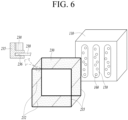
- FIG. 6 is a schematic view showing the structure of a gas filter mounted in a middle case of the membrane humidifier.
- the membrane humidifier 100 includes a plurality of first cartridges 150 each having a plurality of hollow fiber membranes 160 therein, and a filter member 230 of the gas filter is mounted in a housing unit in such a way as to surround the first cartridges 150 together.
- the filter member 230 since the filter member 230 must have a shape capable of simultaneously surrounding the plurality of first cartridges 150, it is formed by coating a gas capture material on a non-woven fabric.
- the gas capture material may be the same material as described above, and it is preferable for the gas filter 230 to have a sandwich structure in which the gas capture material is interposed between non-woven fabrics.
- the filter member 230 may be mounted on the outer circumferential surface of a filter frame having a shape of polygonal or circular pipe.
- the filter frame may include a pair of main frame portions 235 defining the outer circumferential surface of a quadrangular pipe, the main frame portions being disposed at opposite ends of the hollow fiber membrane, and a plurality of connection frame portions 232 configured to connect the pair of main frame portions 235 to each other.
- a filter fixing recess 236 may be formed in each of the inner sides of the pair of main frame portions 235 that face each other, whereby an edge of the filter member 230 may be inserted into and fixed to the filter fixing recess 236.
- a sealing member 238 is preferably disposed on the outer circumferential portion of the main frame portion 235.
- the sealing member 238 may be made of an elastic material such as rubber and may be compressed between the main frame portion 235 and the inner surface of the middle case 110 such that a tight seal without any gap can be provided therebetween.
- the filter member 230 formed by coating the gas capture material on the non-woven fabric is mounted in such a way as to wrap the frame, as described above, it is possible to maintain the shape of the filter member 230 constantly and to easily mount or separate the gas filter 230 to or from the inner circumferential surface of the middle case 110.
- FIG. 7 is a sectional view of a membrane humidifier according to a fourth embodiment of the present disclosure
- FIG. 8 is a schematic view showing a structure in which the gas filter is mounted inside or outside a cartridge of the membrane humidifier.
- a filter member 240 of the gas filter is mounted over the inner circumferential surface or the outer circumferential surface of each of a plurality of first cartridges 150 in such a way as to surround a plurality of hollow fiber membranes 160.
- FIGS. 7 and 8(a) show a filter member 240 mounted over the inner circumferential surface of the first cartridge 150. Since the filter member 240 must have a shape corresponding to that of the inner circumferential surface of the first cartridge 150, it is formed by coating a gas capture material on a non-woven fabric.
- the first cartridge 150 has a shape of a pipe that is open at opposite ends thereof.
- Mesh portions 152 are formed in at least two side surfaces of the first cartridge such that a second fluid is introduced through one of the mesh portions 152 and discharged through the other mesh portion 152.
- a module may be manufactured by inserting a filter member 240 into the first cartridge 150 so as mount it over the inner circumferential surface thereof, arranging a plurality of hollow fiber membranes 160 therein, and then potting the hollow fiber membranes 160, the filter member 240, and the first cartridge 150 together.
- the filter member 240 may be mounted in such a way as to entirely block the mesh portions 152 in order to make sure that the second fluid passes through the filter member 240 when introduced into or discharged from the first cartridge 150.
- a filter member 242 is mounted over the outer circumferential surface of the first cartridge 150.
- a plurality of filter members 242 may be mounted in such a way as to block the mesh portions 152 of the first cartridge 150 at the outside thereof.
- the filter member 242 Since the filter member 242 must have a shape corresponding to that of at least a portion of the outer circumferential surface of the first cartridge 150, it is formed by coating a gas capture material on a non-woven fabric.
- the first cartridge 150 may be provided with a plurality of projecting ribs around the mesh portions 152 in order to allow the filter member 242 to be mounted thereon.
- a module may be manufactured by mounting the filter member(s) 242 over the outer circumferential surface of the first cartridge 150, arranging a plurality of hollow fiber membranes 160 therein, and potting the hollow fiber membranes 160, the first cartridge 150, and the filter member(s) 242 together.
- the gas capture material may be the same material as described in the previous embodiments.
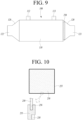
- FIG. 9 is a sectional view of a membrane humidifier according to a fifth embodiment of the present disclosure (not according to the invention), and FIG. 10 is a schematic view showing the structure of a gas filter mounted between a middle case and a cap case of the membrane humidifier.
- a filter member 250 of the gas filter is mounted in a housing unit in such a way that a first fluid introduced through a first fluid inlet 121 passes through the filter member 250 of the gas filter before being introduced into the lumens of the hollow fiber membranes 160 of the first cartridge 150.
- the housing unit may be configured to have a structure in which the middle case 110 is coupled to a pair of cap cases 120.
- the filter member 250 of the gas filter may be separably mounted in a cap case 120 having the first fluid inlet 121 or between the middle case 110 and the cap case 120 having the first fluid inlet 121.
- the filter member 250 may be mounted in the cap case 120 having the first fluid inlet 121, and then the middle case 110 having the first cartridges 150 mounted therein may be coupled to the cap case 120.
- FIG. 9 shows that only the cap case 120 having the first fluid inlet 121 is provided with a filter member 250 therein, a cap case 120 having the first fluid outlet 122 may also be provided with a filter member 250 therein. If so, the filter member 250 may capture harmful gas from the first fluid introduced into the membrane humidifier 100 and may also capture harmful gas from the first fluid discharged from the membrane humidifier 100.
- the filter member 250 may include a filter portion formed by coating a gas capture material on a non-woven fabric and a frame portion 255 which is coupled to the filter portion in such a way as to surround the filter portion.
- the filter member 150 may further include a sealing member 258 provided at an end of the frame portion 255, particularly at the end of the frame portion to be coupled to the cap case 120 having the first fluid inlet 121.
- the sealing member 258 may be made of an elastic material such as rubber and may be compressed when the filter member 250 is mounted inside the cap case 120 such that any leakage of gas through a gap between the filter member 250 and the cap case 120 can be prevented.
- a film type filter member was manufactured as a gas filter by coating a polyethylene terephthalate (PET) non-woven fabric having a thickness of 100 ⁇ m with PFSA, applying zeolite and niobium particles thereto, and then attaching a PET non-woven fabric having a thickness of 100 ⁇ m thereto by melting it.
- PET polyethylene terephthalate
- the filter member manufactured as described above was cut according to the shape of each embodiment.
- a membrane humidifier including four cartridges was manufactured by potting 250 filter members each cut to a size of 10 mm x 300 mm in one cartridge and placing and potting hollow fiber membranes for humidification in the other three cartridges. Subsequently, three kinds of dry air including 10 ppm of NH 3 , 10 ppm of NO 3 , and 10 ppm of SO 2 , respectively, were introduced into the membrane humidifier through a second fluid inlet 112, the gas discharged through a second fluid outlet 113 was captured, and the concentrations of the harmful gases therein were measured in order to determine the effect of the gas filter. [Table 1] Concentration in Inflow gas (ppm) Concentration in Outflow gas (ppm) NH 3 10 3.6 NO 3 10 6.2 SO 2 10 5.8
- the gas capture performance of the gas filter according to the first embodiment was 64%, 38%, and 42% for the harmful gases. It can be seen that gas capture performance was best for NH 3 .
- humidification was performed by supplying dry air (Flow: 3500 sLPM, Temperature: 80°C, Relative humidity: 5 to 10 %RH, and Absolute pressure: 1.8 bar) and wet air (Flow: 3500 sLPM, Temperature: 80°C, Relative humidity: 80 %RH, and Absolute pressure: 1.6 bar) into the membrane humidifier.
- the dew point of the humidified air discharged from the membrane humidifier was 54°C.
- a membrane humidifier including three cartridges was manufactured by placing and potting 80 filter members each cut to a size of 10 mm x 300 mm in each cartridge together with a plurality of hollow fiber membranes. Subsequently, the effect of the gas filter was determined using the same method as in the first embodiment described above.
- the gas capture performance of the gas filter according to the second embodiment was 72%, 59%, and 63% for the harmful gases. It can be seen that gas capture performance was best for NH 3 .
- a membrane humidifier including three cartridges was manufactured by mounting a filter member cut to a size of 120 mm x 460 mm between a housing unit and the three cartridges. Subsequently, the effect of the gas filter was determined using the same method as in the first embodiment described above.
- the gas capture performance of the gas filter according to the third embodiment was 91%, 89%, and 87% for the harmful gases. It can be seen that gas capture performance was best for NH 3 .
- the gas capture performance of the third embodiment was better than those of the first and second embodiments. The reason for this is that, while only a portion of the introduced dry air passed through the gas filter in the first and second embodiments, the third embodiment was configured such that the entire dry air passed through the gas filter.
- a membrane humidifier including three cartridges was manufactured by mounting a filter member cut to a size of 280 mm x 220 mm over the inner circumference surface of each cartridge and potting the same together with a bundle of hollow fiber membranes. Subsequently, the effect of the gas filter was determined using the same method as in the first embodiment described above.
- the gas capture performance of the gas filter according to the fourth embodiment was 94%, 93%, and 94% for the harmful gases. It can be seen that gas capture performance was best for NH 3 and SO 2 .
- the gas capture performance of the fourth embodiment was better than those of the first and second embodiments. The reason for this is that, while only a portion of the introduced dry air passed through the gas filter in the first and second embodiments, the fourth embodiment was configured such that the entire dry air passed through the gas filter.
- a membrane humidifier including three cartridges was manufactured by mounting a filter member cut to a size of 170 mm x 170 mm between a cap case and a middle case. Subsequently, three kinds of dry air including 10 ppm of NH 3 , 10 ppm of NO 3 , and 10 ppm of SO 2 , respectively, were introduced into the membrane humidifier through a first fluid inlet 121, the gas discharged through a first fluid outlet 122 was captured, and the concentrations of the harmful gases therein were measured in order to determine the effect of the gas filter. [Table 5] Concentration in Inflow gas (ppm) Concentration in Outflow gas (ppm) NH 3 10 0.5 NO 3 10 0.4 SO 2 10 0.4
- the gas capture performance of the gas filter according to the fifth embodiment was 95%, 96%, and 96% for the harmful gases. It can be seen that gas capture performance was best for NO 3 and SO 2 .
- the gas capture performance of the fifth embodiment was better than those of the first and second embodiments. The reason for this is that, while only a portion of the introduced dry air passed through the gas filter in the first and second embodiments, the fifth embodiment was configured such that the entire dry air passed through the gas filter.
- the dew points of the humidified air discharged from the membrane humidifier were 54 to 57°C, which shows that the embodiments have similar levels of humidification performance.
- a gas filter capable of capturing and filtering a large portion of harmful gas included in the dry air while maintaining the humidification performance is integrated in the membrane humidifier.
Landscapes
- Chemical & Material Sciences (AREA)
- Chemical Kinetics & Catalysis (AREA)
- Engineering & Computer Science (AREA)
- General Chemical & Material Sciences (AREA)
- Life Sciences & Earth Sciences (AREA)
- Manufacturing & Machinery (AREA)
- Sustainable Development (AREA)
- Sustainable Energy (AREA)
- Electrochemistry (AREA)
- Oil, Petroleum & Natural Gas (AREA)
- Analytical Chemistry (AREA)
- Fuel Cell (AREA)
- Separation Using Semi-Permeable Membranes (AREA)
- Separation Of Gases By Adsorption (AREA)
Description
- The present disclosure relates to a membrane humidifier for a fuel cell, and more particularly to a membrane humidifier for a fuel cell capable of removing gas, such as nitrogen oxide (NOx), sulfur oxide (SOx), and ammonia (NH3), during a humidification process without a separate gas filter device, whereby it is possible to prevent deterioration in performance of the fuel cell.
- A fuel cell is a power generation cell that combines hydrogen and oxygen to generate electricity. Such a fuel cell has advantages in that it is possible to continuously generate electricity as long as hydrogen and oxygen are supplied, unlike a general chemical cell such as a dry cell, a storage cell, and so on, and in that there is no heat loss, whereby efficiency of the fuel cell is about twice as high as efficiency of an internal combustion engine.
- In addition, the fuel cell directly converts chemical energy generated by combination of hydrogen and oxygen into electrical energy, whereby the amount of contaminants that are discharged is small. Consequently, the fuel cell has advantages in that the fuel cell is environmentally friendly and in that a concern about depletion of resources due to an increase in energy consumption can be reduced.
- Based on the kind of an electrolyte that is used, such a fuel cell may generally be classified as a polymer electrolyte membrane fuel cell (PEMFC), a phosphoric acid fuel cell (PAFC), a molten carbonate fuel cell (MCFC), a solid oxide fuel cell (SOFC), or an alkaline fuel cell (AFC).
- These fuel cells are operated fundamentally by the same principle, but are different from each other in terms of the kind of fuel that is used, operating temperature, catalyst, and electrolyte. Among these fuel cells, the polymer electrolyte membrane fuel cell (PEMFC) is known as being the most favorable to a transportation system as well as small-scale stationary power generation equipment, since the polymer electrolyte membrane fuel cell is operated at a lower temperature than the other fuel cells and the output density of the polymer electrolyte membrane fuel cell is high, whereby it is possible to miniaturize the polymer electrolyte membrane fuel cell.
- One of the most important factors in improving the performance of the polymer electrolyte membrane fuel cell (PEMFC) is to supply a predetermined amount or more of moisture to a polymer electrolyte membrane or a proton exchange membrane (PEM) of a membrane electrode assembly (MEA) in order to retain moisture content. The reason for this is that, in the case in which the polymer electrolyte membrane or the proton exchange membrane is dried, power generation efficiency is abruptly reduced.
- 1) A bubbler humidification method of filling a pressure-resistant container with water and allowing a target gas to pass through a diffuser in order to supply moisture, 2) a direct injection method of calculating the amount of moisture to be supplied that is necessary for fuel cell reaction and directly supplying moisture to a gas stream pipe through a solenoid valve, and 3) a humidification membrane method of supplying moisture to a gas fluid bed using a polymer separation membrane are used as methods of humidifying the polymer electrolyte membrane or the proton exchange membrane.
- Among these methods, the humidification membrane method, which provides water vapor to a gas that is supplied to the polymer electrolyte membrane or the proton exchange membrane by means of a membrane configured to selectively transmit only water vapor included in off-gas in order to humidify the polymer electrolyte membrane or the proton exchange membrane, is advantageous in that it is possible to reduce the weight and size of a humidifier.
- In the case in which a module is formed, a hollow fiber membrane having large transmission area per unit volume is suitable for the permselective membrane used in the humidification membrane method. That is, in the case in which a membrane humidifier is manufactured using a hollow fiber membrane, high integration of the hollow fiber membrane having large contact surface area is possible, whereby it is possible to sufficiently humidify a fuel cell even in the case of a small capacity, it is possible to use a low-priced material, and it is possible to collect moisture and heat included in off-gas discharged from the fuel cell at a high temperature and to reuse the collected moisture and heat through the humidifier.
- In a conventional membrane humidifier for a fuel cell, a hollow fiber membrane is accommodated in a housing unit, and the hollow fiber membrane is fixed to the inner wall of the housing unit by means of a potting portion. A certain number of hollow fiber membranes are accommodated in the housing unit depending on a desired output of a stack, and are fixed to the housing unit by means of the potting portion. High-temperature air from a blower and high-temperature and high-humidity air from the stack are introduced into the membrane humidifier for a fuel cell.
- In a fuel cell system, when high-temperature air generated by a compressor or a blower is introduced into a stack via a humidifier, the substances such as nitrogen oxide (NOx), sulfur oxide (SOx), ammonia (NH3), etc. included in the air are introduced into the fuel cell stack and may deteriorate the performance of the stack. For this reason, a separate gas filter device configured to remove such substances is generally installed at the front or rear end of the air compressor.
-
- 1.
Korean Patent Application Publication No. 10-2009-0013304 - 2.
Korean Patent Application Publication No. 10-2009-0057773 - 3.
Korean Patent Application Publication No. 10-2009-0128005 - 4.
Korean Patent Application Publication No. 10-2000-0108092 - 5.
Korean Patent Application Publication No. 10-2000-0131631 - 6.
Korean Patent Application Publication No. 10-2001-0001022 - 7.
Korean Patent Application Publication No. 10-2001-0006122 - 8.
Korean Patent Application Publication No. 10-2001-0006128 - 9.
Korean Patent Application Publication No. 10-2001-0021217 - 10.
Korean Patent Application Publication No. 10-2001-0026696 - 11.
Korean Patent Application Publication No. 10-2001-0063366 - 12:
KR 2014 0038223 A - 13:
JP 2009507350 A - 14:
KR 2013 0029306 A - 15:
KR 2015 0113503 A - 16:
KR 2014 0003182 A - 17:
DE 10 2014 205029 A1 - 18:
WO 2019/240481 A1 - 19:
US 2011/239866 A1 - 20:
US 2018/145357 A1 - It is an object of the present disclosure to provide a membrane humidifier for a fuel cell capable of removing gas such as nitrogen oxide (NOx), sulfur oxide (SOx), ammonia (NH3) and so on during a humidification process without a separate gas filter device, whereby it is possible to prevent deterioration in performance of the fuel cell.
- A membrane humidifier for a fuel cell according to the present disclosure to accomplish the above object is defined in claim 1.. Preferred embodiments are described in the dependent claims.
- The gas filter includes a non-woven fabric and a gas capture material coated on the non-woven fabric.
- The membrane humidifier includes a plurality of the first cartridges, and the gas filter is A mounted in the housing unit as defined in claim 1.
- The gas capture material may be any one selected from the group consisting of biochar, charcoal, active carbon, an acidic polymer, zeolite, platinum, a mixture of copper sulfate and titanium sulfate, niobium (Nb), sodium bicarbonate, and a mixture of two or more thereof.
- The acidic polymer may be any one selected from the group consisting of poly(perfluorosulfonic acid) (PFSA), sulfonated polyethersulfone (S-PES), sulfonated polyarylethersulfone (S-PAES), sulfonated polystyrene (S-PS), sulfonated polyetherketone (S-PEK), sulfonated polyetheretherketone (S-PEEK), and a mixture of two or more thereof.
- The membrane humidifier for a fuel cell according to the present disclosure described above is capable of removing gas, such as nitrogen oxide (NOx), sulfur oxide (SOx), ammonia (NH3), and so on during a humidification process without a separate gas filter device, whereby it is possible to prevent deterioration in performance of a fuel cell.
-
-
FIG. 1 is an exploded perspective view of a membrane humidifier for a fuel cell according to an embodiment of the present disclosure. -
FIG. 2 is a sectional view of a membrane humidifier according to a first embodiment of the present disclosure (not according to invention). -
FIG. 3 is a sectional view of embodiments relating to the type of a gas filter. -
FIG. 4 is a sectional view of a membrane humidifier according to a second embodiment of the present disclosure (not according to invention). -
FIG. 5 is a sectional view of a membrane humidifier according to a third embodiment of the present disclosure. -
FIG. 6 is a schematic view showing the structure of a gas filter mounted in a middle case of the membrane humidifier. -
FIG. 7 is a sectional view of a membrane humidifier according to a fourth embodiment of the present disclosure. -
FIG. 8 is a schematic view showing a structure in which the gas filter is mounted inside or outside a cartridge of the membrane humidifier. -
FIG. 9 is a sectional view of a membrane humidifier according to a fifth embodiment of the present disclosure (not according to the invention). -
FIG. 10 is a schematic view showing the structure of a gas filter mounted between the middle case and a cap case of the membrane humidifier (not according to the invention). -
FIG. 1 is an exploded perspective view of a membrane humidifier for a fuel cell according to an embodiment of the present disclosure,FIG. 2 is a sectional view showing a membrane humidifier according to a first embodiment of the present disclosure, not according to invention, andFIG. 3 is a sectional view showing embodiments relating to the type of a gas filter. - The membrane humidifier for a fuel cell according to the embodiment of the present disclosure includes a housing unit and a plurality of
cartridges 150 installed in the housing unit. At least one of thecartridges 150 is a first cartridge having a plurality ofhollow fiber membranes 160 therein. Amiddle case 110 and acap case 120 may be coupled to each other in order to form the housing unit, or the housing unit may be formed as one body. - The
middle case 110 is coupled to a pair ofcap cases 120 at opposite sides thereof to define the external appearance of the membrane humidifier. Each of themiddle case 110 and thecap cases 120 may be made of hard plastic, such as polycarbonate, or metal. The lateral sectional shape of each of themiddle case 110 and thecap cases 120 may be a polygon as shown inFIG. 1 , or the lateral sectional shape thereof may be a circle. The polygon may be a rectangle, a square, a trapezoid, a parallelogram, a pentagon, a hexagon, and so on, and the corners of the polygon may be rounded. In addition, the circle may be an oval. - The
middle case 110 is provided with a secondfluid inlet 112 through which a second fluid is introduced and a secondfluid outlet 113 through which the second fluid is discharged. - One of the
cap cases 120 coupled to opposite ends of themiddle case 110 has a firstfluid inlet 121, and theother cap case 120 has a firstfluid outlet 122. A first fluid introduced into the housing unit through the firstfluid inlet 121 passes through an inner pipeline of each of thehollow fiber membranes 160 accommodated in thefirst cartridge 150 and is then discharged through the firstfluid outlet 122. The firstfluid inlet 121 and the firstfluid outlet 122 may switch with each other so that the first fluid flows in the reverse direction. - Each of the
hollow fiber membranes 160 may be a hollow fiber membrane made of, for example, Nafion, polyetherimide, polyimide (PI), polyphenylsulfone, polysulfone (PS), or polyethersulfone (PES). - A
mesh portion 152 configured to allow the second fluid introduced into the membrane humidifier through the secondfluid inlet 112 to be introduced into thefirst cartridge 150 is formed at one side of thefirst cartridge 150, and amesh portion 152 configured to allow the second fluid that has performed moisture exchange in the hollowfiber membrane cartridge 150 to be discharged out of thefirst cartridge 150 is formed at the other side of thefirst cartridge 150. - The
first cartridge 150 is provided at opposite ends thereof with potting portions configured to bind thehollow fiber membranes 160 and to fill the gaps between thehollow fiber membranes 160. In this way, the opposite ends of thefirst cartridge 150 are blocked by the potting portions, respectively, whereby a flow passage configured to allow the second fluid to pass therethrough is defined therein. Each of the potting portions is made of a known material, and a detailed description thereof will be omitted here. - The
middle case 110 has the secondfluid inlet 112 and the secondfluid outlet 113. - The first fluid may be a low-humidity fluid (e.g. external air supplied by a blower), and the second fluid may be a high-humidity fluid (e.g. high-humidity off-gas discharged from a fuel cell stack). Alternatively, the second fluid may be low-humidity external air, and the first fluid may be high-humidity off-gas.
- A plurality of
insertion ports 140 configured to allow the plurality ofcartridges 150 to be mounted therein may be formed in themiddle case 110, and each of thecartridges 150 may be inserted into a corresponding one of theinsertion ports 140. - In the present disclosure, a gas filter that is configured to capture harmful gas included in at least one of the first and second fluids and that has a different shape from the
hollow fiber membranes 160 is provided, for example, between the inner circumferential surface of the housing unit and thefirst cartridge 150. The harmful gas includes nitrogen oxide (NOx), sulfur oxide (SOx), ammonia (NH3), or a mixture of two or more thereof. Since the gas filter is provided in the housing unit, themembrane humidifier 100 for a fuel cell according to the embodiment of the present disclosure can capture the harmful gas during a humidification process without a separate gas filter device, whereby it is possible to prevent deterioration in performance of a fuel cell. - In a fuel cell system, high-temperature air supplied from a compressor or a blower is introduced into a stack via a humidifier. If harmful substance included in the air, such as (i) nitrogen oxide (NOx) such as nitric oxide (NO), nitrogen dioxide (NO2), dinitrogen monoxide (N2O), dinitrogen trioxide (N2O3), dinitrogen tetroxide (N2O4), dinitrogen pentoxide (N2O5), etc., (ii) sulfur oxide (SOx) such as sulfur dioxide (SO2), sulfur trioxide (SO3), sulfurous acid (H2SO3), sulfuric acid (H2SO4), etc., (iii) ammonia (NH3), and so on is introduced into the stack of the fuel cell, performance of the stack may be deteriorated. In the present disclosure, the gas filter provided in the
membrane humidifier 100 captures the harmful substances when the air is humidified, whereby it is possible to prevent deterioration in performance of the fuel cell. - In the first embodiment of the present disclosure, as shown in
FIG. 2 , not according to invention, the plurality ofcartridges 150 may include at least one first cartridge having a plurality ofhollow fiber membranes 160 therein and at least one second cartridge filled only with the gas filter. - In
FIG. 2 , there is shown an embodiment in which hollowfiber membranes 160 are disposed in two first cartridges among threecartridges 150 mounted in themiddle case 110, and a plurality offilter members 210 are disposed in one second cartridge. If four ormore cartridges 150 are mounted in themiddle case 110, however, thefilter members 210 may be accommodated in two ormore cartridges 150. - In the
membrane humidifier 100 according to the first embodiment, low-humidity air is introduced into the housing unit through the secondfluid inlet 112. A portion of the low-humidity air passes through thesecond cartridge 140 having thefilter members 210 therein so that harmful gas is captured and thus filtered. When passing through thefirst cartridge 150 having thehollow fiber membranes 160 therein, the other portion of the air exchanges moisture with the first fluid, i.e., high-humidity off-gas, and becomes humidified. The filtered air and humidified air produced as the result of passing through therespective cartridges 150 are brought together and discharged through the secondfluid outlet 113 so as to be supplied to the fuel cell stack. -
FIG. 3 shows two types of gas filters. The gas filter shown inFIG. 3(a) includes anon-woven fabric 213 and a gas capture material 211 coated on thenon-woven fabric 213. Thenon-woven fabric 213 is formed not by weaving fibers but by binding them into a form of cloth via a mechanical, chemical, or thermal process. The non-woven fabric is also referred to as an adhesive cloth. Thenon-woven fabric 213 has a form of a sheet or a film and serves as a substrate for fixing the gas capture material 211. - The gas filter may be produced by dissolving or dispersing the gas capture material 211 in a liquid phase, applying the same to the
non-woven fabric 213, and drying the same, or may be manufactured by spraying a gas capture material 211 of powder type on thenon-woven fabric 213. In particular, it is more preferable that the gas capture material 211 is coated on thenon-woven fabric 213 and then the gas capture material 211 is covered with the othernon-woven fabric 213. The reason for this is that such structure can prevent loss of the gas capture material 211. - A
filter member 210 formed by coating the gas capture material 211 on anon-woven fabric 213 may be cut into a length equal to or less than that of thehollow fiber membrane 160 and a predetermined width, and may be disposed and potted so as to be fixed in the first and/orsecond cartridge 150. - The gas filter shown in
FIG. 3(b) (not according to the invention) includes ayarn 214 and agas capture material 212 coated on theyarn 214. Theyarn 214 may be a monofilament or a multifilament formed of at least one selected from the group consisting of polyvinylidene fluoride, polycarbonate, polystyrene, polyester, polyolefin, polyamide, polymethylmethacrylate, polyvinyl chloride, and glass fiber, or a thread including both the monofilament and the multifilament. - The
gas capture material 212 may be of the same kind as the gas capture material 211 ofFIG. 3(a) . The gas filter ofFIG. 3(b) may be produced by applying agas capture material 212 of liquid type to the outer circumferential surface of theyarn 214 having a circular section and then drying the same. - The
gas capture materials 211 and 212 may be any one selected from the group consisting of biochar, charcoal, active carbon, an acidic polymer, zeolite, platinum, a mixture of copper sulfate and titanium sulfate, niobium (Nb), sodium bicarbonate, and a mixture of two or more thereof. - The acidic polymer may be any one selected from the group consisting of poly(perfluorosulfonic acid) (PFSA), sulfonated polyethersulfone (S-PES), sulfonated polyarylethersulfone (S-PAES), sulfonated polystyrene (S-PS), sulfonated polyetherketone (S-PEK), sulfonated polyetheretherketone (S-PEEK), and a mixture of two or more thereof.
-
FIG. 4 is a sectional view of a membrane humidifier according to a second embodiment of e present disclosure (not according to invention). - In the membrane humidifier according to the second embodiment, a
filter member 220 of a gas filter may be arranged in afirst cartridge 150 together with a plurality ofhollow fiber membranes 160. - The
filter member 220 may be a type formed by coating the gas capture material 211 on anon-woven fabric 213 or a type formed by coating thegas capture material 212 on an outer circumferential surface of ayarn 214, as shown inFIG. 3 . - In the embodiment of
FIG. 4 , a plurality ofhollow fiber membranes 160 and a plurality offilter members 220 are arranged together in each of threefirst cartridges 150 such that the filter members are interposed respectively between the hollow fiber membranes, and then potted together. - Low-humidity air is introduced into the housing unit through the second
fluid inlet 112, and then (i) is humidified while flowing along the lumens of thehollow fiber membranes 160 or (ii) is filtered while passing through thefilter members 220. The humidified or filtered air comes out of therespective cartridges 150, and then is discharged through the secondfluid outlet 113 so as to be supplied to a fuel cell stack. -
FIG. 5 is a sectional view of a membrane humidifier according to a third embodiment of the present disclosure, andFIG. 6 is a schematic view showing the structure of a gas filter mounted in a middle case of the membrane humidifier. - The
membrane humidifier 100 according to the third embodiment includes a plurality offirst cartridges 150 each having a plurality ofhollow fiber membranes 160 therein, and afilter member 230 of the gas filter is mounted in a housing unit in such a way as to surround thefirst cartridges 150 together. - In the third embodiment, since the
filter member 230 must have a shape capable of simultaneously surrounding the plurality offirst cartridges 150, it is formed by coating a gas capture material on a non-woven fabric. - The gas capture material may be the same material as described above, and it is preferable for the
gas filter 230 to have a sandwich structure in which the gas capture material is interposed between non-woven fabrics. - It is preferable for the
filter member 230 to be mounted on the outer circumferential surface of a filter frame having a shape of polygonal or circular pipe. In the embodiment ofFIG. 6 , the filter frame may include a pair ofmain frame portions 235 defining the outer circumferential surface of a quadrangular pipe, the main frame portions being disposed at opposite ends of the hollow fiber membrane, and a plurality ofconnection frame portions 232 configured to connect the pair ofmain frame portions 235 to each other. - A
filter fixing recess 236 may be formed in each of the inner sides of the pair ofmain frame portions 235 that face each other, whereby an edge of thefilter member 230 may be inserted into and fixed to thefilter fixing recess 236. - In addition, a sealing
member 238 is preferably disposed on the outer circumferential portion of themain frame portion 235. The sealingmember 238 may be made of an elastic material such as rubber and may be compressed between themain frame portion 235 and the inner surface of themiddle case 110 such that a tight seal without any gap can be provided therebetween. - Since the
filter member 230 formed by coating the gas capture material on the non-woven fabric is mounted in such a way as to wrap the frame, as described above, it is possible to maintain the shape of thefilter member 230 constantly and to easily mount or separate thegas filter 230 to or from the inner circumferential surface of themiddle case 110. -
FIG. 7 is a sectional view of a membrane humidifier according to a fourth embodiment of the present disclosure, andFIG. 8 is a schematic view showing a structure in which the gas filter is mounted inside or outside a cartridge of the membrane humidifier. - In the membrane humidifier according to the fourth embodiment, a
filter member 240 of the gas filter is mounted over the inner circumferential surface or the outer circumferential surface of each of a plurality offirst cartridges 150 in such a way as to surround a plurality ofhollow fiber membranes 160. -
FIGS. 7 and8(a) show afilter member 240 mounted over the inner circumferential surface of thefirst cartridge 150. Since thefilter member 240 must have a shape corresponding to that of the inner circumferential surface of thefirst cartridge 150, it is formed by coating a gas capture material on a non-woven fabric. - The
first cartridge 150 has a shape of a pipe that is open at opposite ends thereof.Mesh portions 152 are formed in at least two side surfaces of the first cartridge such that a second fluid is introduced through one of themesh portions 152 and discharged through theother mesh portion 152. - A module may be manufactured by inserting a
filter member 240 into thefirst cartridge 150 so as mount it over the inner circumferential surface thereof, arranging a plurality ofhollow fiber membranes 160 therein, and then potting thehollow fiber membranes 160, thefilter member 240, and thefirst cartridge 150 together. At this time, thefilter member 240 may be mounted in such a way as to entirely block themesh portions 152 in order to make sure that the second fluid passes through thefilter member 240 when introduced into or discharged from thefirst cartridge 150. - According to the fourth embodiment of the present disclosure illustrated in
FIG. 8(b) , afilter member 242 is mounted over the outer circumferential surface of thefirst cartridge 150. In this case, a plurality offilter members 242 may be mounted in such a way as to block themesh portions 152 of thefirst cartridge 150 at the outside thereof. - Since the
filter member 242 must have a shape corresponding to that of at least a portion of the outer circumferential surface of thefirst cartridge 150, it is formed by coating a gas capture material on a non-woven fabric. - Although not shown, the
first cartridge 150 may be provided with a plurality of projecting ribs around themesh portions 152 in order to allow thefilter member 242 to be mounted thereon. - A module may be manufactured by mounting the filter member(s) 242 over the outer circumferential surface of the
first cartridge 150, arranging a plurality ofhollow fiber membranes 160 therein, and potting thehollow fiber membranes 160, thefirst cartridge 150, and the filter member(s) 242 together. - In the third and fourth embodiments, the gas capture material may be the same material as described in the previous embodiments.
-
FIG. 9 is a sectional view of a membrane humidifier according to a fifth embodiment of the present disclosure (not according to the invention), andFIG. 10 is a schematic view showing the structure of a gas filter mounted between a middle case and a cap case of the membrane humidifier. - In the membrane humidifier according to the fifth embodiment, a
filter member 250 of the gas filter is mounted in a housing unit in such a way that a first fluid introduced through a firstfluid inlet 121 passes through thefilter member 250 of the gas filter before being introduced into the lumens of thehollow fiber membranes 160 of thefirst cartridge 150. - As described above, the housing unit may be configured to have a structure in which the
middle case 110 is coupled to a pair ofcap cases 120. Thefilter member 250 of the gas filter may be separably mounted in acap case 120 having the firstfluid inlet 121 or between themiddle case 110 and thecap case 120 having the firstfluid inlet 121. - For example, the
filter member 250 may be mounted in thecap case 120 having the firstfluid inlet 121, and then themiddle case 110 having thefirst cartridges 150 mounted therein may be coupled to thecap case 120. - Although
FIG. 9 shows that only thecap case 120 having the firstfluid inlet 121 is provided with afilter member 250 therein, acap case 120 having the firstfluid outlet 122 may also be provided with afilter member 250 therein. If so, thefilter member 250 may capture harmful gas from the first fluid introduced into themembrane humidifier 100 and may also capture harmful gas from the first fluid discharged from themembrane humidifier 100. - As shown in
FIG. 10 , thefilter member 250 may include a filter portion formed by coating a gas capture material on a non-woven fabric and aframe portion 255 which is coupled to the filter portion in such a way as to surround the filter portion. - The
frame portion 255 may have an overall shape of polygon or circle which corresponds to the sectional shape of the housing unit. - As shown in the partially enlarged section view of
FIG. 10 , theframe portion 255 may be provided in the inner circumferential surface thereof with afilter fixing recess 256 into which the edge of thefilter member 250 is supposed to be inserted. - In addition, it is preferable for the
filter member 150 to further include a sealing member 258 provided at an end of theframe portion 255, particularly at the end of the frame portion to be coupled to thecap case 120 having the firstfluid inlet 121. The sealing member 258 may be made of an elastic material such as rubber and may be compressed when thefilter member 250 is mounted inside thecap case 120 such that any leakage of gas through a gap between thefilter member 250 and thecap case 120 can be prevented. - Hereinafter, the results of performance tests of the gas filters of the membrane humidifiers according to the above embodiments will be described.
- First, in each embodiment, a film type filter member was manufactured as a gas filter by coating a polyethylene terephthalate (PET) non-woven fabric having a thickness of 100 µm with PFSA, applying zeolite and niobium particles thereto, and then attaching a PET non-woven fabric having a thickness of 100 µm thereto by melting it.
- The filter member manufactured as described above was cut according to the shape of each embodiment.
- A membrane humidifier including four cartridges was manufactured by potting 250 filter members each cut to a size of 10 mm x 300 mm in one cartridge and placing and potting hollow fiber membranes for humidification in the other three cartridges. Subsequently, three kinds of dry air including 10 ppm of NH3, 10 ppm of NO3, and 10 ppm of SO2, respectively, were introduced into the membrane humidifier through a second
fluid inlet 112, the gas discharged through a secondfluid outlet 113 was captured, and the concentrations of the harmful gases therein were measured in order to determine the effect of the gas filter.[Table 1] Concentration in Inflow gas (ppm) Concentration in Outflow gas (ppm) NH3 10 3.6 NO3 10 6.2 SO2 10 5.8 - As shown in Table 1, the gas capture performance of the gas filter according to the first embodiment was 64%, 38%, and 42% for the harmful gases. It can be seen that gas capture performance was best for NH3.
- Also, in order to evaluate humidification performance, humidification was performed by supplying dry air (Flow: 3500 sLPM, Temperature: 80°C, Relative humidity: 5 to 10 %RH, and Absolute pressure: 1.8 bar) and wet air (Flow: 3500 sLPM, Temperature: 80°C, Relative humidity: 80 %RH, and Absolute pressure: 1.6 bar) into the membrane humidifier. The dew point of the humidified air discharged from the membrane humidifier was 54°C.
- A membrane humidifier including three cartridges was manufactured by placing and potting 80 filter members each cut to a size of 10 mm x 300 mm in each cartridge together with a plurality of hollow fiber membranes. Subsequently, the effect of the gas filter was determined using the same method as in the first embodiment described above.
[Table 2] Concentration in Outflow gas (ppm) Concentration in Outflow gas (ppm) NH3 10 2.8 NO3 10 4.1 SO2 10 3.7 - As shown in Table 2, the gas capture performance of the gas filter according to the second embodiment was 72%, 59%, and 63% for the harmful gases. It can be seen that gas capture performance was best for NH3.
- In addition, the evaluation of the humidification performance using the same method as in the first embodiment described above showed that the dew point of the humidified air discharged from the membrane humidifier was 56°C.
- A membrane humidifier including three cartridges was manufactured by mounting a filter member cut to a size of 120 mm x 460 mm between a housing unit and the three cartridges. Subsequently, the effect of the gas filter was determined using the same method as in the first embodiment described above.
[Table 3] Concentration in Inflow gas (ppm) Concentration in Outflow gas (ppm) NH3 10 0.9 NO3 10 1.1 SO2 10 1.3 - As shown in Table 3, the gas capture performance of the gas filter according to the third embodiment was 91%, 89%, and 87% for the harmful gases. It can be seen that gas capture performance was best for NH3. The gas capture performance of the third embodiment was better than those of the first and second embodiments. The reason for this is that, while only a portion of the introduced dry air passed through the gas filter in the first and second embodiments, the third embodiment was configured such that the entire dry air passed through the gas filter.
- The evaluation of the humidification performance using the same method as in the first embodiment described above showed that the dew point of the humidified air discharged from the membrane humidifier was 55°C.
- A membrane humidifier including three cartridges was manufactured by mounting a filter member cut to a size of 280 mm x 220 mm over the inner circumference surface of each cartridge and potting the same together with a bundle of hollow fiber membranes. Subsequently, the effect of the gas filter was determined using the same method as in the first embodiment described above.
[Table 4] Concentration in Inflow gas (ppm) Concentration in Outflow gas (ppm) NH3 10 0.6 NO3 10 0.7 SO2 10 0.6 - As shown in Table 4, the gas capture performance of the gas filter according to the fourth embodiment was 94%, 93%, and 94% for the harmful gases. It can be seen that gas capture performance was best for NH3 and SO2. The gas capture performance of the fourth embodiment was better than those of the first and second embodiments. The reason for this is that, while only a portion of the introduced dry air passed through the gas filter in the first and second embodiments, the fourth embodiment was configured such that the entire dry air passed through the gas filter.
- The evaluation of the humidification performance using the same method as in the first embodiment described above showed that the dew point of the humidified air discharged from the membrane humidifier was 56°C.
- A membrane humidifier including three cartridges was manufactured by mounting a filter member cut to a size of 170 mm x 170 mm between a cap case and a middle case. Subsequently, three kinds of dry air including 10 ppm of NH3, 10 ppm of NO3, and 10 ppm of SO2, respectively, were introduced into the membrane humidifier through a first
fluid inlet 121, the gas discharged through a firstfluid outlet 122 was captured, and the concentrations of the harmful gases therein were measured in order to determine the effect of the gas filter.[Table 5] Concentration in Inflow gas (ppm) Concentration in Outflow gas (ppm) NH3 10 0.5 NO3 10 0.4 SO2 10 0.4 - As shown in Table 5, the gas capture performance of the gas filter according to the fifth embodiment was 95%, 96%, and 96% for the harmful gases. It can be seen that gas capture performance was best for NO3 and SO2. The gas capture performance of the fifth embodiment was better than those of the first and second embodiments. The reason for this is that, while only a portion of the introduced dry air passed through the gas filter in the first and second embodiments, the fifth embodiment was configured such that the entire dry air passed through the gas filter.
- The evaluation of the humidification performance using the same method as in the first embodiment described above showed that the dew point of the humidified air discharged from the membrane humidifier was 57°C.
- In the first to fifth embodiments, the dew points of the humidified air discharged from the membrane humidifier were 54 to 57°C, which shows that the embodiments have similar levels of humidification performance.
- In the membrane humidifier for a fuel cell according to the present disclosure, a gas filter capable of capturing and filtering a large portion of harmful gas included in the dry air while maintaining the humidification performance is integrated in the membrane humidifier.
Claims (3)
- A membrane humidifier (100) for a fuel cell, the membrane humidifier (100) comprising:a housing unit comprising a first fluid inlet (121) for introduction of a first fluid, a first fluid outlet (122) for discharge of the first fluid, a second fluid inlet (112) for introduction of a second fluid, and a second fluid outlet (113) for discharge of the second fluid, humidity of the first fluid introduced through the first fluid inlet (121) being different from humidity of the second fluid introduced through the second fluid inlet (112);a plurality of cartridges (150) installed in the housing unit wherein at least one of the cartridges (150) is a first cartridge having a plurality of hollow fiber membranes (160) therein,wherein the housing unit comprises a middle case (110) having the plurality of cartridges (150) mounted therein and a pair of cap cases (120) coupled to opposite sides of the middle case (110), the middle case (110) being provided with the second fluid inlet (112) and the second fluid outlet (113), one of the cap cases (120) having the first fluid inlet (121) and the other thereof having the first fluid outlet (122) such that the first fluid introduced into the housing unit through the first fluid inlet (121) passes through an inner pipeline of each of the hollow fiber membranes (160) accommodated in the first cartridge (150) and is then discharged from the housing unit through the first fluid outlet (122),wherein the first cartridge (150) has a first mesh portion (152) formed at one side thereof and a second mesh portion (152) formed at the other side thereof, the first mesh portion (152) being configured to allow the second fluid introduced into the middle case (110) through the second fluid inlet (112) to be introduced into the first cartridge (150), the second mesh portion (152) being configured to allow the second fluid having performed moisture exchange in the first cartridge (150) to be discharged out of the first cartridge (150), andwherein the first cartridge (150) is further provided at opposite ends thereof with potting portions configured to bind the hollow fiber membranes (160) and to fill gaps between the hollow fiber membranes (160), such that the opposite ends of the first cartridge (150) are blocked by the potting portions, respectively, and a flow passage configured to allow the second fluid introduced into the first cartridge (150) through the first mesh portion (152) to pass only outside the hollow fiber membranes (160) is defined therein; anda gas filter (230, 240) having a different shape from the hollow fiber membranes (160),wherein the gas filter (230, 240) is configured to capture harmful gas included in the second fluid, the harmful gas comprising nitrogen oxide (NOx), sulfur oxide (SOx), ammonia (NH3), or a mixture of two or more thereof,wherein the gas filter (230, 240) is mounted in the housing unit having a plurality of first cartridges (150)(i) in such a way as to surround the plurality of first cartridges (150) together or(ii) (a) over an inner circumferential surface of each of the plurality of first cartridges (150) in such a way as to surround the plurality of hollow fiber membranes (160) of each of the plurality of first cartridges (150), wherein the gas filter (240) has a shape corresponding to that of the inner circumferential surface of the first cartridge (150), or(ii) (b) over an outer circumferential surface of each of the plurality of first cartridges (150) in such a way as to surround the plurality of hollow fiber membranes (160) of each of the plurality of first cartridges (150), andwherein the gas filter (230, 240) comprises a non-woven fabric (213) and a gas capture material (211) coated on the non-woven fabric (213).
- The membrane humidifier (100) according to claim 1, wherein the gas capture material (211) is any one selected from the group consisting of biochar, charcoal, active carbon, an acidic polymer, zeolite, platinum, a mixture of copper sulfate and titanium sulfate, niobium (Nb), sodium bicarbonate, and a mixture of two or more thereof.
- The membrane humidifier (100) according to claim 2, wherein the acidic polymer is any one selected from the group consisting of poly(perfluorosulfonic acid) (PFSA), sulfonated polyethersulfone (S-PES), sulfonated polyarylethersulfone (S-PAES), sulfonated polystyrene (S-PS), sulfonated polyetherketone (S-PEK), sulfonated polyetheretherketone (S-PEEK), and a mixture of two or more thereof.
Priority Applications (1)
| Application Number | Priority Date | Filing Date | Title |
|---|---|---|---|
| EP24197195.1A EP4445994A3 (en) | 2018-12-28 | 2019-12-20 | Membrane humidifier for fuel cell |
Applications Claiming Priority (2)
| Application Number | Priority Date | Filing Date | Title |
|---|---|---|---|
| KR20180171473 | 2018-12-28 | ||
| PCT/KR2019/018173 WO2020138854A1 (en) | 2018-12-28 | 2019-12-20 | Membrane humidifier for fuel cell |
Related Child Applications (1)
| Application Number | Title | Priority Date | Filing Date |
|---|---|---|---|
| EP24197195.1A Division EP4445994A3 (en) | 2018-12-28 | 2019-12-20 | Membrane humidifier for fuel cell |
Publications (3)
| Publication Number | Publication Date |
|---|---|
| EP3905400A1 EP3905400A1 (en) | 2021-11-03 |
| EP3905400A4 EP3905400A4 (en) | 2022-10-19 |
| EP3905400B1 true EP3905400B1 (en) | 2024-09-11 |
Family
ID=71129159
Family Applications (2)
| Application Number | Title | Priority Date | Filing Date |
|---|---|---|---|
| EP19906004.7A Active EP3905400B1 (en) | 2018-12-28 | 2019-12-20 | Membrane humidifier for fuel cell |
| EP24197195.1A Pending EP4445994A3 (en) | 2018-12-28 | 2019-12-20 | Membrane humidifier for fuel cell |
Family Applications After (1)
| Application Number | Title | Priority Date | Filing Date |
|---|---|---|---|
| EP24197195.1A Pending EP4445994A3 (en) | 2018-12-28 | 2019-12-20 | Membrane humidifier for fuel cell |
Country Status (7)
| Country | Link |
|---|---|
| US (1) | US12191540B2 (en) |
| EP (2) | EP3905400B1 (en) |
| JP (2) | JP7196303B2 (en) |
| KR (2) | KR102427722B1 (en) |
| CN (2) | CN119361751A (en) |
| DK (1) | DK3905400T3 (en) |
| WO (1) | WO2020138854A1 (en) |
Families Citing this family (16)
| Publication number | Priority date | Publication date | Assignee | Title |
|---|---|---|---|---|
| KR102768554B1 (en) * | 2020-11-04 | 2025-02-17 | 코오롱인더스트리 주식회사 | Cartridge of Humidifier for Fuel Cell and Humidifier for Fuel Cell |
| US12592403B2 (en) * | 2020-12-23 | 2026-03-31 | Kolon Industries, Inc. | Humidifier system for fuel cell |
| WO2022145702A1 (en) * | 2020-12-30 | 2022-07-07 | 코오롱인더스트리 주식회사 | Cartridge of fuel cell humidifier, and fuel cell humidifier |
| KR102755442B1 (en) * | 2021-01-28 | 2025-01-21 | 코오롱인더스트리 주식회사 | Fuel cell humidifier and fuel cell system comprising it |
| KR102926479B1 (en) * | 2021-01-29 | 2026-02-10 | 코오롱인더스트리 주식회사 | Fuel cell humidifier comprising it |
| EP4300641A4 (en) * | 2021-05-17 | 2024-12-11 | Kolon Industries, Inc. | Cartridge for fuel cell humidifier, and fuel cell humidifier |
| KR102844832B1 (en) * | 2021-09-02 | 2025-08-08 | 코오롱인더스트리 주식회사 | Cartridge for membrane humidifier and fuel cell humidifier comprising it |
| KR102926188B1 (en) * | 2021-09-06 | 2026-02-10 | 코오롱인더스트리 주식회사 | Cartridge for membrane humidifier and fuel cell humidifier comprising it |
| KR102886570B1 (en) * | 2021-09-30 | 2025-11-13 | 코오롱인더스트리 주식회사 | Hollow fiber membrane cartridge and Hollow fiber membrane module having the same |
| KR102447975B1 (en) * | 2021-12-13 | 2022-09-27 | 주식회사 디에스필터 | Membrane humidifier for fuel cell |
| CN115888422B (en) * | 2022-06-02 | 2025-11-21 | 杭州科百特过滤器材有限公司 | High-moisture-permeability low-air-permeability hollow fiber membrane and preparation method and application thereof |
| EP4331713A1 (en) * | 2022-09-02 | 2024-03-06 | Mann+Hummel Life Sciences & Environment Holding Singapore Pte. Ltd. | Acid-base polymer blend membranes for selective separation of gas |
| DE102023123852A1 (en) * | 2023-09-05 | 2025-03-06 | Mahle International Gmbh | Humidifier for a fuel cell system and method for providing the humidifier and use of the humidifier in a fuel cell system for a motor vehicle |
| KR102622265B1 (en) * | 2023-10-20 | 2024-01-09 | 주식회사 디에스필터 | Cartridge for membrane humidifier |
| KR20250101161A (en) | 2023-12-27 | 2025-07-04 | 주식회사 하이어스 | Bubbler humidifier for fuel cell evaluation |
| KR20250177364A (en) * | 2024-06-14 | 2025-12-23 | 코오롱인더스트리 주식회사 | A membrane humidifier for fuel cell |
Family Cites Families (32)
| Publication number | Priority date | Publication date | Assignee | Title |
|---|---|---|---|---|
| JPH0632175Y2 (en) * | 1988-11-29 | 1994-08-24 | 宇部興産株式会社 | Hollow fiber membrane module cartridge |
| GB2324214A (en) | 1997-04-08 | 1998-10-14 | Power X Limited | Synchronising arrangements |
| JP4249268B2 (en) | 1997-04-14 | 2009-04-02 | トムソン コンシューマ エレクトロニクス インコーポレイテッド | Method of forming a program guide for program content available in a video decoder system |
| KR100316710B1 (en) | 1999-06-01 | 2001-12-12 | 윤종용 | Method and Apparatus for Instruction issuing in Out-of-Order for Parallel Processor |
| JP3777893B2 (en) | 1999-08-05 | 2006-05-24 | セイコーエプソン株式会社 | Liquid crystal display |
| KR20010026696A (en) | 1999-09-08 | 2001-04-06 | 이중구 | Method for automatically measuring line of balance and apparatus thereof |
| KR100394827B1 (en) | 1999-12-22 | 2003-08-21 | 엘지전자 주식회사 | Program and data down loading method for restating processor of mobile communication exchage system |
| KR100394849B1 (en) * | 2000-10-20 | 2003-08-19 | 한국에너지기술연구원 | Catalytic Non-woven Fabric Filters used for a Temperature Range of 150∼250℃ and Methods for Applying Catalysts to Non-woven Fabric |
| EP1469544A1 (en) * | 2003-04-11 | 2004-10-20 | Matsushita Electric Industrial Co., Ltd. | Method of operating a fuel cell, air purifying apparatus and fuel cell |
| US7258717B2 (en) | 2004-06-28 | 2007-08-21 | 3M Innovative Properties Company | Filter cross brace |
| US20090117415A1 (en) * | 2005-09-05 | 2009-05-07 | Carl Freudenberg Kg | Arrangement for supplying a fuel cell with recycled reaction gas |
| DE102005042407A1 (en) * | 2005-09-06 | 2007-03-08 | Carl Freudenberg Kg | Arrangement for supplying fuel cell with reaction gas, comprises humidifier having two inlets, and filter arrangement connected in front of first inlet and/or second inlet |
| JP2007285600A (en) * | 2006-04-17 | 2007-11-01 | Toyota Motor Corp | Humidifier |
| JP2008004437A (en) | 2006-06-23 | 2008-01-10 | Toyota Motor Corp | Fuel cell system |
| DE202006020287U1 (en) | 2006-11-07 | 2008-03-06 | Carl Freudenberg Kg | Filter element with deep-drawn frame |
| KR101278398B1 (en) | 2007-08-01 | 2013-06-24 | 코오롱인더스트리 주식회사 | Hollow Fiber Membrane and Method for Manufacturing The Same |
| KR101398779B1 (en) | 2007-12-03 | 2014-05-28 | 코오롱인더스트리 주식회사 | Fuel Cell Humidifier with Improved Cold Resistance |
| KR20090128005A (en) | 2008-06-10 | 2009-12-15 | 주식회사 코오롱 | Humidification system for fuel cell and fuel cell system using same |
| WO2011126786A1 (en) | 2010-04-05 | 2011-10-13 | Generon Igs, Inc. | Integrated membrane module for gas dehydration and gas separation |
| CN102751526B (en) * | 2011-04-21 | 2014-06-11 | 李铁流 | Hydrogen fuel cell, system and method thereof for dynamic varying humidity control |
| JP3169785U (en) | 2011-05-23 | 2011-08-18 | イチプラ株式会社 | Deodorizing material and deodorizing device |
| KR101337904B1 (en) | 2011-09-14 | 2013-12-09 | 기아자동차주식회사 | Humidification device for fuel cell |
| KR101908456B1 (en) * | 2012-06-29 | 2018-10-16 | 코오롱인더스트리 주식회사 | Humidifier for fuel cell |
| KR101393558B1 (en) | 2012-09-20 | 2014-05-09 | 기아자동차 주식회사 | Humidification device for fuel cell |
| KR102002386B1 (en) * | 2013-04-18 | 2019-07-23 | 코오롱인더스트리 주식회사 | Hollow fiber membrane module |
| DE102014205029A1 (en) * | 2014-03-18 | 2015-09-24 | Volkswagen Ag | Conditioning unit for conditioning an operating medium and fuel cell assembly with such |
| KR102017256B1 (en) * | 2014-03-31 | 2019-09-02 | 코오롱인더스트리 주식회사 | Fluid exchange membrane module |
| KR101996477B1 (en) * | 2014-12-23 | 2019-07-04 | 코오롱인더스트리 주식회사 | Hollow Fiber Membrane Humidifier Module of Cartridge Type and Method for Manufacturing thereof |
| US20180145357A1 (en) * | 2016-11-18 | 2018-05-24 | GM Global Technology Operations LLC | Mitigation strategies for enhanced durability of pfsa-based sheet style water vapor transfer devices |
| JP6894103B2 (en) | 2017-05-31 | 2021-06-23 | 住江織物株式会社 | Deodorant filter and air purifier equipped with the deodorant filter |
| CN108325335B (en) * | 2018-03-05 | 2019-12-03 | 瑞安市雏鹰文学艺术培训学校 | Gasoline taste adsorptive purifier |
| JP7224372B2 (en) * | 2018-06-12 | 2023-02-17 | コーロン インダストリーズ インク | Composite hollow fiber membrane, manufacturing method thereof, hollow fiber membrane cartridge containing the same, and fuel cell membrane humidifier |
-
2019
- 2019-12-20 EP EP19906004.7A patent/EP3905400B1/en active Active
- 2019-12-20 KR KR1020190171367A patent/KR102427722B1/en active Active
- 2019-12-20 CN CN202411382625.9A patent/CN119361751A/en active Pending
- 2019-12-20 JP JP2021529782A patent/JP7196303B2/en active Active
- 2019-12-20 CN CN201980086012.1A patent/CN113228359B/en active Active
- 2019-12-20 EP EP24197195.1A patent/EP4445994A3/en active Pending
- 2019-12-20 US US17/417,768 patent/US12191540B2/en active Active
- 2019-12-20 WO PCT/KR2019/018173 patent/WO2020138854A1/en not_active Ceased
- 2019-12-20 DK DK19906004.7T patent/DK3905400T3/en active
-
2022
- 2022-07-27 KR KR1020220093255A patent/KR102458460B1/en active Active
- 2022-12-13 JP JP2022198721A patent/JP7507841B2/en active Active
Also Published As
| Publication number | Publication date |
|---|---|
| CN113228359B (en) | 2024-10-25 |
| WO2020138854A1 (en) | 2020-07-02 |
| EP3905400A1 (en) | 2021-11-03 |
| EP4445994A2 (en) | 2024-10-16 |
| KR20220111227A (en) | 2022-08-09 |
| JP2022513641A (en) | 2022-02-09 |
| JP2023027263A (en) | 2023-03-01 |
| CN119361751A (en) | 2025-01-24 |
| DK3905400T3 (en) | 2024-09-23 |
| EP4445994A3 (en) | 2024-12-18 |
| JP7507841B2 (en) | 2024-06-28 |
| US12191540B2 (en) | 2025-01-07 |
| EP3905400A4 (en) | 2022-10-19 |
| CN113228359A (en) | 2021-08-06 |
| KR102427722B1 (en) | 2022-08-01 |
| JP7196303B2 (en) | 2022-12-26 |
| KR102458460B1 (en) | 2022-10-26 |
| US20220013798A1 (en) | 2022-01-13 |
| KR20200083250A (en) | 2020-07-08 |
Similar Documents
| Publication | Publication Date | Title |
|---|---|---|
| EP3905400B1 (en) | Membrane humidifier for fuel cell | |
| JP7325163B2 (en) | fuel cell membrane humidifier | |
| US11876259B2 (en) | Composite hollow fiber membrane, manufacturing method therefor, hollow fiber membrane cartridge including same, and fuel cell membrane humidifier | |
| US7985279B2 (en) | Gas separator and operating method for the same | |
| EP3903913B1 (en) | Membrane humidifier for fuel cell, comprising multi-channel hollow fiber membranes | |
| EP3124106A1 (en) | Hollow-fiber membrane module | |
| CA3175026C (en) | Fuel cell humidifier | |
| EP4273975B1 (en) | Humidifier for a fuel cell | |
| US20230402627A1 (en) | Cartridge of humidifier for fuel cell and humidifier for fuel cell | |
| KR102819950B1 (en) | Cartridge of Humidifier for Fuel Cell and Humidifier for Fuel Cell | |
| KR102858567B1 (en) | Cartridge of Humidifier for Fuel Cell and Humidifier for Fuel Cell | |
| KR102926185B1 (en) | Fuel cell membrane humidifier and fuel cell system comprising it | |
| JP2004039483A (en) | Fuel cell | |
| EP4629354A1 (en) | Cartridge for fuel cell humidifier, and fuel cell humidifier | |
| JP2007194070A (en) | Humidifier for fuel cell |
Legal Events
| Date | Code | Title | Description |
|---|---|---|---|
| STAA | Information on the status of an ep patent application or granted ep patent |
Free format text: STATUS: THE INTERNATIONAL PUBLICATION HAS BEEN MADE |
|
| PUAI | Public reference made under article 153(3) epc to a published international application that has entered the european phase |
Free format text: ORIGINAL CODE: 0009012 |
|
| STAA | Information on the status of an ep patent application or granted ep patent |
Free format text: STATUS: REQUEST FOR EXAMINATION WAS MADE |
|
| 17P | Request for examination filed |
Effective date: 20210629 |
|
| AK | Designated contracting states |
Kind code of ref document: A1 Designated state(s): AL AT BE BG CH CY CZ DE DK EE ES FI FR GB GR HR HU IE IS IT LI LT LU LV MC MK MT NL NO PL PT RO RS SE SI SK SM TR |
|
| DAV | Request for validation of the european patent (deleted) | ||
| DAX | Request for extension of the european patent (deleted) | ||
| A4 | Supplementary search report drawn up and despatched |
Effective date: 20220919 |
|
| RIC1 | Information provided on ipc code assigned before grant |
Ipc: B01D 63/02 20060101ALI20220913BHEP Ipc: B01D 46/00 20060101ALI20220913BHEP Ipc: B01D 69/08 20060101ALI20220913BHEP Ipc: H01M 8/0662 20160101ALI20220913BHEP Ipc: H01M 8/04119 20160101AFI20220913BHEP |
|
| STAA | Information on the status of an ep patent application or granted ep patent |
Free format text: STATUS: EXAMINATION IS IN PROGRESS |
|
| 17Q | First examination report despatched |
Effective date: 20230623 |
|
| GRAP | Despatch of communication of intention to grant a patent |
Free format text: ORIGINAL CODE: EPIDOSNIGR1 |
|
| STAA | Information on the status of an ep patent application or granted ep patent |
Free format text: STATUS: GRANT OF PATENT IS INTENDED |
|
| INTG | Intention to grant announced |
Effective date: 20240402 |
|
| GRAS | Grant fee paid |
Free format text: ORIGINAL CODE: EPIDOSNIGR3 |
|
| GRAA | (expected) grant |
Free format text: ORIGINAL CODE: 0009210 |
|
| STAA | Information on the status of an ep patent application or granted ep patent |
Free format text: STATUS: THE PATENT HAS BEEN GRANTED |
|
| AK | Designated contracting states |
Kind code of ref document: B1 Designated state(s): AL AT BE BG CH CY CZ DE DK EE ES FI FR GB GR HR HU IE IS IT LI LT LU LV MC MK MT NL NO PL PT RO RS SE SI SK SM TR |
|
| REG | Reference to a national code |
Ref country code: GB Ref legal event code: FG4D |
|
| REG | Reference to a national code |
Ref country code: CH Ref legal event code: EP |
|
| REG | Reference to a national code |
Ref country code: DK Ref legal event code: T3 Effective date: 20240916 |
|
| REG | Reference to a national code |
Ref country code: SE Ref legal event code: TRGR |
|
| REG | Reference to a national code |
Ref country code: DE Ref legal event code: R096 Ref document number: 602019058930 Country of ref document: DE |
|
| REG | Reference to a national code |
Ref country code: IE Ref legal event code: FG4D |
|
| REG | Reference to a national code |
Ref country code: LT Ref legal event code: MG9D |
|
| PG25 | Lapsed in a contracting state [announced via postgrant information from national office to epo] |
Ref country code: NO Free format text: LAPSE BECAUSE OF FAILURE TO SUBMIT A TRANSLATION OF THE DESCRIPTION OR TO PAY THE FEE WITHIN THE PRESCRIBED TIME-LIMIT Effective date: 20241211 |
|
| REG | Reference to a national code |
Ref country code: NL Ref legal event code: MP Effective date: 20240911 |
|
| PG25 | Lapsed in a contracting state [announced via postgrant information from national office to epo] |
Ref country code: GR Free format text: LAPSE BECAUSE OF FAILURE TO SUBMIT A TRANSLATION OF THE DESCRIPTION OR TO PAY THE FEE WITHIN THE PRESCRIBED TIME-LIMIT Effective date: 20241212 Ref country code: FI Free format text: LAPSE BECAUSE OF FAILURE TO SUBMIT A TRANSLATION OF THE DESCRIPTION OR TO PAY THE FEE WITHIN THE PRESCRIBED TIME-LIMIT Effective date: 20240911 |
|
| PG25 | Lapsed in a contracting state [announced via postgrant information from national office to epo] |
Ref country code: BG Free format text: LAPSE BECAUSE OF FAILURE TO SUBMIT A TRANSLATION OF THE DESCRIPTION OR TO PAY THE FEE WITHIN THE PRESCRIBED TIME-LIMIT Effective date: 20240911 |
|
| PG25 | Lapsed in a contracting state [announced via postgrant information from national office to epo] |
Ref country code: LV Free format text: LAPSE BECAUSE OF FAILURE TO SUBMIT A TRANSLATION OF THE DESCRIPTION OR TO PAY THE FEE WITHIN THE PRESCRIBED TIME-LIMIT Effective date: 20240911 |
|
| PG25 | Lapsed in a contracting state [announced via postgrant information from national office to epo] |
Ref country code: HR Free format text: LAPSE BECAUSE OF FAILURE TO SUBMIT A TRANSLATION OF THE DESCRIPTION OR TO PAY THE FEE WITHIN THE PRESCRIBED TIME-LIMIT Effective date: 20240911 |
|
| PG25 | Lapsed in a contracting state [announced via postgrant information from national office to epo] |
Ref country code: ES Free format text: LAPSE BECAUSE OF FAILURE TO SUBMIT A TRANSLATION OF THE DESCRIPTION OR TO PAY THE FEE WITHIN THE PRESCRIBED TIME-LIMIT Effective date: 20240911 Ref country code: RS Free format text: LAPSE BECAUSE OF FAILURE TO SUBMIT A TRANSLATION OF THE DESCRIPTION OR TO PAY THE FEE WITHIN THE PRESCRIBED TIME-LIMIT Effective date: 20241211 |
|
| PG25 | Lapsed in a contracting state [announced via postgrant information from national office to epo] |
Ref country code: RS Free format text: LAPSE BECAUSE OF FAILURE TO SUBMIT A TRANSLATION OF THE DESCRIPTION OR TO PAY THE FEE WITHIN THE PRESCRIBED TIME-LIMIT Effective date: 20241211 Ref country code: NO Free format text: LAPSE BECAUSE OF FAILURE TO SUBMIT A TRANSLATION OF THE DESCRIPTION OR TO PAY THE FEE WITHIN THE PRESCRIBED TIME-LIMIT Effective date: 20241211 Ref country code: LV Free format text: LAPSE BECAUSE OF FAILURE TO SUBMIT A TRANSLATION OF THE DESCRIPTION OR TO PAY THE FEE WITHIN THE PRESCRIBED TIME-LIMIT Effective date: 20240911 Ref country code: HR Free format text: LAPSE BECAUSE OF FAILURE TO SUBMIT A TRANSLATION OF THE DESCRIPTION OR TO PAY THE FEE WITHIN THE PRESCRIBED TIME-LIMIT Effective date: 20240911 Ref country code: GR Free format text: LAPSE BECAUSE OF FAILURE TO SUBMIT A TRANSLATION OF THE DESCRIPTION OR TO PAY THE FEE WITHIN THE PRESCRIBED TIME-LIMIT Effective date: 20241212 Ref country code: FI Free format text: LAPSE BECAUSE OF FAILURE TO SUBMIT A TRANSLATION OF THE DESCRIPTION OR TO PAY THE FEE WITHIN THE PRESCRIBED TIME-LIMIT Effective date: 20240911 Ref country code: ES Free format text: LAPSE BECAUSE OF FAILURE TO SUBMIT A TRANSLATION OF THE DESCRIPTION OR TO PAY THE FEE WITHIN THE PRESCRIBED TIME-LIMIT Effective date: 20240911 Ref country code: BG Free format text: LAPSE BECAUSE OF FAILURE TO SUBMIT A TRANSLATION OF THE DESCRIPTION OR TO PAY THE FEE WITHIN THE PRESCRIBED TIME-LIMIT Effective date: 20240911 |
|
| PG25 | Lapsed in a contracting state [announced via postgrant information from national office to epo] |
Ref country code: NL Free format text: LAPSE BECAUSE OF FAILURE TO SUBMIT A TRANSLATION OF THE DESCRIPTION OR TO PAY THE FEE WITHIN THE PRESCRIBED TIME-LIMIT Effective date: 20240911 |
|
| PG25 | Lapsed in a contracting state [announced via postgrant information from national office to epo] |
Ref country code: PT Free format text: LAPSE BECAUSE OF FAILURE TO SUBMIT A TRANSLATION OF THE DESCRIPTION OR TO PAY THE FEE WITHIN THE PRESCRIBED TIME-LIMIT Effective date: 20250113 Ref country code: IS Free format text: LAPSE BECAUSE OF FAILURE TO SUBMIT A TRANSLATION OF THE DESCRIPTION OR TO PAY THE FEE WITHIN THE PRESCRIBED TIME-LIMIT Effective date: 20250111 |
|
| PG25 | Lapsed in a contracting state [announced via postgrant information from national office to epo] |
Ref country code: SM Free format text: LAPSE BECAUSE OF FAILURE TO SUBMIT A TRANSLATION OF THE DESCRIPTION OR TO PAY THE FEE WITHIN THE PRESCRIBED TIME-LIMIT Effective date: 20240911 Ref country code: RO Free format text: LAPSE BECAUSE OF FAILURE TO SUBMIT A TRANSLATION OF THE DESCRIPTION OR TO PAY THE FEE WITHIN THE PRESCRIBED TIME-LIMIT Effective date: 20240911 |
|
| PG25 | Lapsed in a contracting state [announced via postgrant information from national office to epo] |
Ref country code: EE Free format text: LAPSE BECAUSE OF FAILURE TO SUBMIT A TRANSLATION OF THE DESCRIPTION OR TO PAY THE FEE WITHIN THE PRESCRIBED TIME-LIMIT Effective date: 20240911 |
|
| PG25 | Lapsed in a contracting state [announced via postgrant information from national office to epo] |
Ref country code: PL Free format text: LAPSE BECAUSE OF FAILURE TO SUBMIT A TRANSLATION OF THE DESCRIPTION OR TO PAY THE FEE WITHIN THE PRESCRIBED TIME-LIMIT Effective date: 20240911 Ref country code: CZ Free format text: LAPSE BECAUSE OF FAILURE TO SUBMIT A TRANSLATION OF THE DESCRIPTION OR TO PAY THE FEE WITHIN THE PRESCRIBED TIME-LIMIT Effective date: 20240911 |
|
| PG25 | Lapsed in a contracting state [announced via postgrant information from national office to epo] |
Ref country code: IT Free format text: LAPSE BECAUSE OF FAILURE TO SUBMIT A TRANSLATION OF THE DESCRIPTION OR TO PAY THE FEE WITHIN THE PRESCRIBED TIME-LIMIT Effective date: 20240911 Ref country code: SK Free format text: LAPSE BECAUSE OF FAILURE TO SUBMIT A TRANSLATION OF THE DESCRIPTION OR TO PAY THE FEE WITHIN THE PRESCRIBED TIME-LIMIT Effective date: 20240911 |
|
| REG | Reference to a national code |
Ref country code: DE Ref legal event code: R097 Ref document number: 602019058930 Country of ref document: DE |
|
| PG25 | Lapsed in a contracting state [announced via postgrant information from national office to epo] |
Ref country code: MC Free format text: LAPSE BECAUSE OF FAILURE TO SUBMIT A TRANSLATION OF THE DESCRIPTION OR TO PAY THE FEE WITHIN THE PRESCRIBED TIME-LIMIT Effective date: 20240911 |
|
| PLBE | No opposition filed within time limit |
Free format text: ORIGINAL CODE: 0009261 |
|
| STAA | Information on the status of an ep patent application or granted ep patent |
Free format text: STATUS: NO OPPOSITION FILED WITHIN TIME LIMIT |
|
| REG | Reference to a national code |
Ref country code: CH Ref legal event code: PL |
|
| PG25 | Lapsed in a contracting state [announced via postgrant information from national office to epo] |
Ref country code: LU Free format text: LAPSE BECAUSE OF NON-PAYMENT OF DUE FEES Effective date: 20241220 |
|
| 26N | No opposition filed |
Effective date: 20250612 |
|
| REG | Reference to a national code |
Ref country code: BE Ref legal event code: MM Effective date: 20241231 |
|
| REG | Reference to a national code |
Ref country code: AT Ref legal event code: UEP Ref document number: 1723515 Country of ref document: AT Kind code of ref document: T Effective date: 20240911 |
|
| PG25 | Lapsed in a contracting state [announced via postgrant information from national office to epo] |
Ref country code: BE Free format text: LAPSE BECAUSE OF NON-PAYMENT OF DUE FEES Effective date: 20241231 |
|
| PG25 | Lapsed in a contracting state [announced via postgrant information from national office to epo] |
Ref country code: CH Free format text: LAPSE BECAUSE OF NON-PAYMENT OF DUE FEES Effective date: 20241231 |
|
| PG25 | Lapsed in a contracting state [announced via postgrant information from national office to epo] |
Ref country code: IE Free format text: LAPSE BECAUSE OF NON-PAYMENT OF DUE FEES Effective date: 20241220 |
|
| PGFP | Annual fee paid to national office [announced via postgrant information from national office to epo] |
Ref country code: DE Payment date: 20251105 Year of fee payment: 7 |
|
| PGFP | Annual fee paid to national office [announced via postgrant information from national office to epo] |
Ref country code: GB Payment date: 20251105 Year of fee payment: 7 |
|
| PGFP | Annual fee paid to national office [announced via postgrant information from national office to epo] |
Ref country code: AT Payment date: 20251105 Year of fee payment: 7 |
|
| PGFP | Annual fee paid to national office [announced via postgrant information from national office to epo] |
Ref country code: DK Payment date: 20251110 Year of fee payment: 7 |
|
| PGFP | Annual fee paid to national office [announced via postgrant information from national office to epo] |
Ref country code: FR Payment date: 20251111 Year of fee payment: 7 |
|
| PGFP | Annual fee paid to national office [announced via postgrant information from national office to epo] |
Ref country code: SE Payment date: 20251105 Year of fee payment: 7 |