EP3905274B1 - Solid electrolyte material and battery using same - Google Patents
Solid electrolyte material and battery using same Download PDFInfo
- Publication number
- EP3905274B1 EP3905274B1 EP19904814.1A EP19904814A EP3905274B1 EP 3905274 B1 EP3905274 B1 EP 3905274B1 EP 19904814 A EP19904814 A EP 19904814A EP 3905274 B1 EP3905274 B1 EP 3905274B1
- Authority
- EP
- European Patent Office
- Prior art keywords
- solid
- equal
- electrolyte material
- electrolyte
- less
- Prior art date
- Legal status (The legal status is an assumption and is not a legal conclusion. Google has not performed a legal analysis and makes no representation as to the accuracy of the status listed.)
- Active
Links
Images



Classifications
-
- C—CHEMISTRY; METALLURGY
- C01—INORGANIC CHEMISTRY
- C01F—COMPOUNDS OF THE METALS BERYLLIUM, MAGNESIUM, ALUMINIUM, CALCIUM, STRONTIUM, BARIUM, RADIUM, THORIUM, OR OF THE RARE-EARTH METALS
- C01F11/00—Compounds of calcium, strontium, or barium
-
- H—ELECTRICITY
- H01—ELECTRIC ELEMENTS
- H01B—CABLES; CONDUCTORS; INSULATORS; SELECTION OF MATERIALS FOR THEIR CONDUCTIVE, INSULATING OR DIELECTRIC PROPERTIES
- H01B1/00—Conductors or conductive bodies characterised by the conductive materials; Selection of materials as conductors
- H01B1/06—Conductors or conductive bodies characterised by the conductive materials; Selection of materials as conductors mainly consisting of other non-metallic substances
-
- H—ELECTRICITY
- H01—ELECTRIC ELEMENTS
- H01M—PROCESSES OR MEANS, e.g. BATTERIES, FOR THE DIRECT CONVERSION OF CHEMICAL ENERGY INTO ELECTRICAL ENERGY
- H01M10/00—Secondary cells; Manufacture thereof
- H01M10/05—Accumulators with non-aqueous electrolyte
- H01M10/052—Li-accumulators
- H01M10/0525—Rocking-chair batteries, i.e. batteries with lithium insertion or intercalation in both electrodes; Lithium-ion batteries
-
- H—ELECTRICITY
- H01—ELECTRIC ELEMENTS
- H01M—PROCESSES OR MEANS, e.g. BATTERIES, FOR THE DIRECT CONVERSION OF CHEMICAL ENERGY INTO ELECTRICAL ENERGY
- H01M10/00—Secondary cells; Manufacture thereof
- H01M10/05—Accumulators with non-aqueous electrolyte
- H01M10/056—Accumulators with non-aqueous electrolyte characterised by the materials used as electrolytes, e.g. mixed inorganic/organic electrolytes
- H01M10/0561—Accumulators with non-aqueous electrolyte characterised by the materials used as electrolytes, e.g. mixed inorganic/organic electrolytes the electrolyte being constituted of inorganic materials only
- H01M10/0562—Solid materials
-
- H—ELECTRICITY
- H01—ELECTRIC ELEMENTS
- H01M—PROCESSES OR MEANS, e.g. BATTERIES, FOR THE DIRECT CONVERSION OF CHEMICAL ENERGY INTO ELECTRICAL ENERGY
- H01M4/00—Electrodes
- H01M4/02—Electrodes composed of, or comprising, active material
- H01M4/13—Electrodes for accumulators with non-aqueous electrolyte, e.g. for lithium-accumulators; Processes of manufacture thereof
- H01M4/133—Electrodes based on carbonaceous material, e.g. graphite-intercalation compounds or CFx
-
- H—ELECTRICITY
- H01—ELECTRIC ELEMENTS
- H01M—PROCESSES OR MEANS, e.g. BATTERIES, FOR THE DIRECT CONVERSION OF CHEMICAL ENERGY INTO ELECTRICAL ENERGY
- H01M4/00—Electrodes
- H01M4/02—Electrodes composed of, or comprising, active material
- H01M4/36—Selection of substances as active materials, active masses, active liquids
- H01M4/58—Selection of substances as active materials, active masses, active liquids of inorganic compounds other than oxides or hydroxides, e.g. sulfides, selenides, tellurides, halogenides or LiCoFy; of polyanionic structures, e.g. phosphates, silicates or borates
- H01M4/583—Carbonaceous material, e.g. graphite-intercalation compounds or CFx
- H01M4/587—Carbonaceous material, e.g. graphite-intercalation compounds or CFx for inserting or intercalating light metals
-
- H—ELECTRICITY
- H01—ELECTRIC ELEMENTS
- H01M—PROCESSES OR MEANS, e.g. BATTERIES, FOR THE DIRECT CONVERSION OF CHEMICAL ENERGY INTO ELECTRICAL ENERGY
- H01M4/00—Electrodes
- H01M4/02—Electrodes composed of, or comprising, active material
- H01M4/62—Selection of inactive substances as ingredients for active masses, e.g. binders, fillers
-
- C—CHEMISTRY; METALLURGY
- C01—INORGANIC CHEMISTRY
- C01P—INDEXING SCHEME RELATING TO STRUCTURAL AND PHYSICAL ASPECTS OF SOLID INORGANIC COMPOUNDS
- C01P2002/00—Crystal-structural characteristics
- C01P2002/70—Crystal-structural characteristics defined by measured X-ray, neutron or electron diffraction data
- C01P2002/72—Crystal-structural characteristics defined by measured X-ray, neutron or electron diffraction data by d-values or two theta-values, e.g. as X-ray diagram
-
- C—CHEMISTRY; METALLURGY
- C01—INORGANIC CHEMISTRY
- C01P—INDEXING SCHEME RELATING TO STRUCTURAL AND PHYSICAL ASPECTS OF SOLID INORGANIC COMPOUNDS
- C01P2002/00—Crystal-structural characteristics
- C01P2002/70—Crystal-structural characteristics defined by measured X-ray, neutron or electron diffraction data
- C01P2002/77—Crystal-structural characteristics defined by measured X-ray, neutron or electron diffraction data by unit-cell parameters, atom positions or structure diagrams
-
- H—ELECTRICITY
- H01—ELECTRIC ELEMENTS
- H01M—PROCESSES OR MEANS, e.g. BATTERIES, FOR THE DIRECT CONVERSION OF CHEMICAL ENERGY INTO ELECTRICAL ENERGY
- H01M4/00—Electrodes
- H01M4/02—Electrodes composed of, or comprising, active material
- H01M2004/026—Electrodes composed of, or comprising, active material characterised by the polarity
- H01M2004/027—Negative electrodes
-
- H—ELECTRICITY
- H01—ELECTRIC ELEMENTS
- H01M—PROCESSES OR MEANS, e.g. BATTERIES, FOR THE DIRECT CONVERSION OF CHEMICAL ENERGY INTO ELECTRICAL ENERGY
- H01M4/00—Electrodes
- H01M4/02—Electrodes composed of, or comprising, active material
- H01M2004/026—Electrodes composed of, or comprising, active material characterised by the polarity
- H01M2004/028—Positive electrodes
-
- H—ELECTRICITY
- H01—ELECTRIC ELEMENTS
- H01M—PROCESSES OR MEANS, e.g. BATTERIES, FOR THE DIRECT CONVERSION OF CHEMICAL ENERGY INTO ELECTRICAL ENERGY
- H01M2300/00—Electrolytes
- H01M2300/0017—Non-aqueous electrolytes
- H01M2300/0065—Solid electrolytes
- H01M2300/0068—Solid electrolytes inorganic
- H01M2300/008—Halides
-
- Y—GENERAL TAGGING OF NEW TECHNOLOGICAL DEVELOPMENTS; GENERAL TAGGING OF CROSS-SECTIONAL TECHNOLOGIES SPANNING OVER SEVERAL SECTIONS OF THE IPC; TECHNICAL SUBJECTS COVERED BY FORMER USPC CROSS-REFERENCE ART COLLECTIONS [XRACs] AND DIGESTS
- Y02—TECHNOLOGIES OR APPLICATIONS FOR MITIGATION OR ADAPTATION AGAINST CLIMATE CHANGE
- Y02E—REDUCTION OF GREENHOUSE GAS [GHG] EMISSIONS, RELATED TO ENERGY GENERATION, TRANSMISSION OR DISTRIBUTION
- Y02E60/00—Enabling technologies; Technologies with a potential or indirect contribution to GHG emissions mitigation
- Y02E60/10—Energy storage using batteries
-
- Y—GENERAL TAGGING OF NEW TECHNOLOGICAL DEVELOPMENTS; GENERAL TAGGING OF CROSS-SECTIONAL TECHNOLOGIES SPANNING OVER SEVERAL SECTIONS OF THE IPC; TECHNICAL SUBJECTS COVERED BY FORMER USPC CROSS-REFERENCE ART COLLECTIONS [XRACs] AND DIGESTS
- Y02—TECHNOLOGIES OR APPLICATIONS FOR MITIGATION OR ADAPTATION AGAINST CLIMATE CHANGE
- Y02P—CLIMATE CHANGE MITIGATION TECHNOLOGIES IN THE PRODUCTION OR PROCESSING OF GOODS
- Y02P70/00—Climate change mitigation technologies in the production process for final industrial or consumer products
- Y02P70/50—Manufacturing or production processes characterised by the final manufactured product
Definitions
- the present disclosure relates to a solid-electrolyte material and a battery that includes the solid-electrolyte material.
- PTL 1 discloses a solid-state battery that includes a sulfide solid electrolyte material.
- US6187479 discloses an electrode active material comprising xLiF(1-x)CaCl 2 , xLiBr(1-x)CaCl 2 and use as anodes and cathodes in batteries.
- An object of the present disclosure is to provide a solid-electrolyte material having a high ionic conductivity.
- a solid-electrolyte material according to the present disclosure includes a crystal phase constituted by Li, M, X, and O.
- M is at least one element selected from the group consisting of Mg, Ca, and Sr.
- X is at least two elements selected from the group consisting of F, CI, Br, and I.
- the present disclosure provides a solid-electrolyte material having a high ionic conductivity.
- a solid-electrolyte material according to a first embodiment includes a crystal phase constituted by Li, M, X, and O.
- M is at least one element selected from the group consisting of Mg, Ca, and Sr.
- X is at least two elements selected from the group consisting of F, CI, Br, and I.
- the solid-electrolyte material according to the first embodiment has a high ionic conductivity.
- the solid-electrolyte material according to the first embodiment does not contain sulfur, it does not produce hydrogen sulfide when exposed to air. Thus, the solid-electrolyte material according to the first embodiment is excellent in terms of safety. Note that the sulfide solid electrolyte material disclosed in PTL 1 may produce hydrogen sulfide when exposed to air.
- the solid-electrolyte material according to the first embodiment does not contain any rare-earth elements, it may be produced at low costs.
- M may include Ca in order to increase the ionic conductivity of the solid-electrolyte material.
- M may be Ca in order to increase the ionic conductivity of the solid-electrolyte material.
- X may be Br and I in order to increase the ionic conductivity of the solid-electrolyte material.
- the crystal phase may further include M A in order to increase the ionic conductivity of the solid-electrolyte material.
- M A is at least one element selected from the group consisting of Na, K, Rb, and Cs.
- the crystal phase has a peak at a diffraction angle 2 ⁇ of greater than or equal to 25° and less than or equal to 29°, a diffraction angle 2 ⁇ of greater than or equal to 29° and less than or equal to 33°, and a diffraction angle 2 ⁇ of greater than or equal to 41° and less than or equal to 47° in an X-ray diffraction pattern obtained by an X-ray diffraction measurement using Cu-K ⁇ radiation.
- a first conversion pattern obtained by transforming the horizontal axis of the X-ray diffraction pattern of the solid-electrolyte material from diffraction angle 2 ⁇ to q on the basis of Expression q 4 ⁇ sin ⁇ / ⁇ (where ⁇ represents the wavelength of an X-ray used in the X-ray diffraction measurement), the value of q at which a peak is present at q of greater than or equal to 1.76 ⁇ -1 and less than or equal to 2.05 ⁇ -1 may be defined as qo and, in a second conversion pattern obtained by transforming the horizontal axis of the X-ray diffraction pattern from diffraction angle 2 ⁇ to q/qo, a peak may be present at q/qo of greater than or equal to 1.13 and less than or equal to 1.18 and q/qo of greater than or equal to 1.60 and less than or equal to 1.66.
- a crystal phase having such peaks has a high ionic conductivity.
- the above-described conversion enables the extraction of the ratio between the interlayer spacings of different diffraction planes from X-ray diffraction patterns. This eliminates the change in peak position caused due to the difference in lattice constant and makes the feature of an identical crystal structure more distinctive.
- the crystal structure of the crystal phase is not limited.
- Examples of the crystal structure include a rock-salt structure having a crystal structure belonging to the space group Fm-3m and a spinel or inverse-spinel structure having a crystal structure belonging to the space group Fd-3m.
- the sublattice constituted by anions may have a cubic closest packed structure or a distorted cubic closest packed structure.
- the elements in the crystals may occupy equivalent sites randomly or may be arranged regularly.
- the term "equivalent sites" used herein refers to positions that overlap each other by a symmetry operation defined by the space group.
- the solid-electrolyte material according to the first embodiment may include a crystal phase having a crystal structure different from that of the above crystal phase.
- the molar ratio of Li to M may be greater than or equal to 0.667 and less than or equal to 11.3 in order to increase the ionic conductivity of the solid-electrolyte material.
- the above molar ratio is greater than or equal to 0.667, a sufficiently large amount of lithium ions are present in the crystals. This facilitates the conduction of lithium ions.
- the above molar ratio is less than or equal to 11.3, the likelihood of the lithium ions in the crystals interfering with one another is reduced. This enables the pathways through which the lithium ions are conducted to be formed in a sufficient amount.
- the molar ratio of X to M may be greater than or equal to 2.66 and less than or equal to 13.34 in order to increase the ionic conductivity of the solid-electrolyte material.
- the above molar ratio is greater than or equal to 2.66, a sufficiently large amount of lithium ions are present in the crystals.
- the above molar ratio is less than or equal to 13.34, the pathways through which the lithium ions are conducted can be formed in the crystals in a sufficient amount.
- the molar ratio of M A to M may be greater than or equal to 0 and less than or equal to 1.33 in order to increase the ionic conductivity of the solid-electrolyte material.
- the above molar ratio is less than or equal to 1.33, it becomes easy to dissolve M in the crystals. In other words, the risk of collapse of the crystal structure is reduced.
- the above molar ratio may be greater than or equal to 0.110 and less than or equal to 1.33.
- the molar ratio of O to M may be greater than 0 and less than or equal to 0.2 in order to increase the ionic conductivity of the solid-electrolyte material.
- the risk of divalent anions blocking the conduction of lithium ions can be reduced.
- the molar ratio of Br to X may be greater than or equal to 0.375 and less than or equal to 0.625 in order to increase the ionic conductivity of the solid-electrolyte material. This enables the crystal structure having a high ionic conductivity to be maintained.
- the molar ratio of I to X may be greater than or equal to 0.375 and less than or equal to 0.625 in order to increase the ionic conductivity of the solid-electrolyte material. This enables the crystal structure having a high ionic conductivity to be maintained.
- the shape of the solid-electrolyte material according to the first embodiment is not limited. Examples of the above shape include acicular, spherical, and oval.
- the solid-electrolyte material according to the first embodiment may be particulate.
- the solid-electrolyte material according to the first embodiment may be formed in a pellet-like or plate-like shape.
- the solid-electrolyte material according to the first embodiment is particulate (e.g., spherical)
- the solid-electrolyte material may have a median diameter of greater than or equal to 0.1 ⁇ m and less than or equal to 100 ⁇ m and may desirably have a median diameter of greater than or equal to 0.5 ⁇ m and less than or equal to 10 ⁇ m.
- the solid-electrolyte material according to the first embodiment has a further high ionic conductivity.
- the solid-electrolyte material according to the first embodiment and materials other than the solid-electrolyte material can be dispersed in a suitable manner.
- the term "median diameter" used herein refers to the particle size at which the cumulative volume in a volume-basis particle size distribution is equal to 50%. The volume-basis particle size distribution can be measured with a laser diffraction analyzer or an image processor.
- the solid-electrolyte material according to the first embodiment may have a smaller median diameter than the active material.
- the solid-electrolyte material according to the first embodiment is produced by, for example, the following method.
- Powders of halide raw materials are mixed with one another such that the resulting mixture has an intended composition.
- a LiBr raw material powder and a CaI 2 raw material powder are mixed with each other at a molar ratio of 2:1.
- the combination of cation and anion may be changed in order to produce the same composition.
- a LiI raw material powder and a CaBr 2 raw material powder may be mixed with each other at a molar ratio of 2:1.
- the raw material powders may be mixed with each other at a specific molar ratio that has been determined such that the composition change that may occur in the synthesis process can be canceled out.
- the raw material powders are caused to react with each other mechanochemically (i.e., using mechanochemical milling) in a mixer, such as a planetary ball mill, to form a mixture.
- the product of the reaction may be baked in an atmosphere containing oxygen.
- the reaction product may be produced by baking the mixture of the raw material powders in an atmosphere containing oxygen.
- the concentration of the oxygen may be, for example, about 30 ppm.
- the baking treatment may be performed at a temperature of greater than or equal to 100°C and less than or equal to 700°C or at a temperature of greater than or equal to 400°C and less than or equal to 600°C.
- the solid-electrolyte material according to the first embodiment is produced by the above-described method.
- a second embodiment of the present disclosure is described below.
- the items described in the first embodiment are omitted as needed.
- a battery according to the second embodiment includes a positive electrode, an electrolyte layer, and a negative electrode.
- the electrolyte layer is interposed between the positive and negative electrodes.
- At least one selected from the group consisting of the positive electrode, the electrolyte layer, and the negative electrode includes the solid-electrolyte material according to the first embodiment.
- the battery according to the second embodiment includes the solid-electrolyte material according to the first embodiment, it has suitable charge-discharge characteristics.
- Fig. 1 is a cross-sectional view of a battery 1000 according to the second embodiment.
- the battery 1000 includes a positive electrode 201, an electrolyte layer 202, and a negative electrode 203.
- the positive electrode 201 includes a positive electrode active material particle 204 and a solid electrolyte particle 100.
- the electrolyte layer 202 is interposed between the positive electrode 201 and the negative electrode 203.
- the electrolyte layer 202 includes an electrolyte material (e.g., a solid-electrolyte material).
- an electrolyte material e.g., a solid-electrolyte material
- the negative electrode 203 includes a negative electrode active material particle 205 and a solid electrolyte particle 100.
- the solid electrolyte particle 100 is a particle including the solid-electrolyte material according to the first embodiment as a principal component.
- the expression "particle including the solid-electrolyte material according to the first embodiment as a principal component" refers to a particle the most abundant component of which is the solid-electrolyte material according to the first embodiment.
- the solid electrolyte particle 100 may be a particle composed of the solid-electrolyte material according to the first embodiment.
- the positive electrode 201 includes a material capable of occluding and releasing a metal ion (e.g., a lithium ion).
- a metal ion e.g., a lithium ion
- examples of such a material include a positive electrode active material (e.g., the positive electrode active material particles 204).
- Examples of the positive electrode active material include a lithium transition metal oxide, a transition metal fluoride, a polyanion material, a polyanion fluoride material, a transition metal sulfide, a transition metal oxyfluoride, a transition metal oxysulfide, and a transition metal oxynitride.
- Examples of the lithium transition metal oxide include Li(NiCoAl)O 2 , LiCoO 2 , and Li(NiCoMn)O 2 .
- the positive electrode active material particles 204 may have a median diameter of greater than or equal to 0.1 ⁇ m and less than or equal to 100 ⁇ m. When the positive electrode active material particles 204 have a median diameter of greater than or equal to 0.1 ⁇ m, the positive electrode active material particles 204 and the solid electrolyte particles 100 can be dispersed in the positive electrode in a suitable manner. This enhances the charge-discharge characteristics of the battery. When the positive electrode active material particles 204 have a median diameter of less than or equal to 100 ⁇ m, the rate at which lithium ions diffuse in the positive electrode active material particles 204 is increased. This enables high-power operation of the battery.
- the positive electrode active material particles 204 may have a larger median diameter than the solid electrolyte particles 100. In such a case, the positive electrode active material particles 204 and the solid electrolyte particles 100 can be dispersed in a suitable manner.
- the ratio of the volume of the positive electrode active material particles 204 to the total volume of the positive electrode active material particles 204 and the solid electrolyte particles 100 may be greater than or equal to 0.30 and less than or equal to 0.95.
- the positive electrode 201 may have a thickness of greater than or equal to 10 ⁇ m and less than or equal to 500 ⁇ m.
- the electrolyte layer 202 includes an electrolyte material.
- the electrolyte material include a solid-electrolyte material.
- the electrolyte layer 202 may be a solid-electrolyte layer.
- the solid-electrolyte material included in the electrolyte layer 202 may include the solid-electrolyte material according to the first embodiment.
- the electrolyte layer 202 may be composed only of the solid-electrolyte material according to the first embodiment.
- the electrolyte layer 202 may be composed only of a solid-electrolyte material different from the solid-electrolyte material according to the first embodiment.
- the solid-electrolyte material different from the solid-electrolyte material according to the first embodiment include Li 2 MgX' 4 , Li 2 FeX' 4 , Li(Al,Ga,In)X' 4 , Li 3 (Al,Ga,In)X' 6 , and LiX', where X' is at least one element selected from the group consisting of F, CI, Br, and I.
- first solid-electrolyte material the solid-electrolyte material according to the first embodiment
- second solid-electrolyte material the solid-electrolyte material different from the solid-electrolyte material according to the first embodiment
- the electrolyte layer 202 may include the second solid-electrolyte material in addition to the first solid-electrolyte material.
- the first and second solid-electrolyte materials may be dispersed uniformly.
- a layer composed of the first solid-electrolyte material and a layer composed of the second solid-electrolyte material may be stacked on top of each other in the direction in which the layers constituting the battery 1000 are stacked.
- the electrolyte layer 202 may have a thickness of greater than or equal to 1 ⁇ m and less than or equal to 100 ⁇ m. When the electrolyte layer 202 has a thickness of greater than or equal to 1 ⁇ m, the risk of short circuit between the positive electrode 201 and the negative electrode 203 is reduced. When the electrolyte layer 202 has a thickness of less than or equal to 100 ⁇ m, the battery can be operated at a high power.
- the negative electrode 203 includes a material capable of occluding and releasing a metal ion (e.g., a lithium ion).
- a metal ion e.g., a lithium ion
- examples of such a material include a negative electrode active material (e.g., the negative electrode active material particles 205).
- Examples of the negative electrode active material include a metal material, a carbon material, an oxide, a nitride, a tin compound, and a silicon compound.
- the metal material may be a simple substance or an alloy.
- Examples of the metal material include lithium metal or a lithium alloy.
- Examples of the carbon material include natural graphite, coke, graphitizing carbon, carbon fibers, spherical carbon, artificial graphite, and amorphous carbon.
- Examples of negative electrode active materials suitable in terms of capacity density include silicon (i.e., Si), tin (i.e., Sn), a silicon compound, and a tin compound.
- a negative electrode active material having a low average discharge voltage, such as graphite, may be used to increase the energy density of the battery.
- the negative electrode 203 may include the first solid-electrolyte material. Since the first solid-electrolyte material has high reduction resistance, it can be used in combination with a negative electrode active material, such as graphite or lithium metal.
- the negative electrode active material particles 205 may have a median diameter of greater than or equal to 0.1 ⁇ m and less than or equal to 100 ⁇ m.
- the negative electrode active material particles 205 have a median diameter of greater than or equal to 0.1 ⁇ m, the negative electrode active material particles 205 and the solid electrolyte particles 100 can be dispersed in the negative electrode in a suitable manner. This enhances the charge-discharge characteristics of the battery.
- the negative electrode active material particles 205 have a median diameter of less than or equal to 100 ⁇ m, the rate at which lithium ions diffuse in the negative electrode active material particles 205 is increased. This enables high-power operation of the battery.
- the ratio of the volume of the negative electrode active material particles 205 to the total volume of the negative electrode active material particles 205 and the solid electrolyte particles 100 may be greater than or equal to 0.30 and less than or equal to 0.95.
- the negative electrode 203 may have a thickness of greater than or equal to 10 ⁇ m and less than or equal to 500 ⁇ m.
- At least one selected from the group consisting of the positive electrode 201, the electrolyte layer 202, and the negative electrode 203 may include the second solid-electrolyte material in order to enhance ionic conductivity, chemical stability, and electrochemical stability.
- the second solid-electrolyte material include a sulfide solid electrolyte, an oxide solid electrolyte, a halide solid electrolyte, and an organic polymer solid electrolyte.
- Examples of the sulfide solid electrolyte include Li 2 S-P 2 S 5 , Li 2 S-SiS 2 , Li 2 S-B 2 S 3 , Li 2 S-GeS 2 , Li 3.25 Ge 0.25 P 0.75 S 4 , and Li 10 GeP 2 S 12 .
- oxide solid electrolyte examples include:
- halide solid electrolyte examples include, as described above, Li 2 MgX' 4 , Li 2 FeX' 4 , Li(Al,Ga,In)X' 4 , Li 3 (Al,Ga,In)X' 6 , and LiX'.
- Me is at least one element selected from the group consisting of metal and metalloid elements other than Li or Y, and m' represents the valence of Me.
- Z is at least one element selected from the group consisting of F, CI, Br, and I.
- metallicoid elements used herein refers to B, Si, Ge, As, Sb, and Te.
- metal elements refers to all the elements (except hydrogen) of Groups 1 to 12 in the periodic table and all the elements (except B, Si, Ge, As, Sb, Te, C, N, P, O, S, and Se) of Groups 13 to 16 in the periodic table.
- Me may be at least one element selected from the group consisting of Mg, Ca, Sr, Ba, Zn, Sc, Al, Ga, Bi, Zr, Hf, Ti, Sn, Ta, and Nb in consideration of the ionic conductivity of the halide solid electrolyte.
- Examples of the organic polymer solid electrolyte include a high-molecular-weight compound and a compound of a lithium salt.
- the high-molecular-weight compound may have an ethylene oxide structure. Since a high-molecular-weight compound having an ethylene oxide structure is capable of containing a large amount of lithium salt, ionic conductivity can be increased.
- Examples of the lithium salt include LiPF 6 , LiBF 4 , LiSbF 6 , LiAsF 6 , LiSO 3 CF 3 , LiN(SO 2 CF 3 ) 2 , LiN(SO 2 C 2 F 5 ) 2 , LiN(SO 2 CF 3 )(SO 2 C 4 F 9 ), and LiC(SO 2 CF 3 ) 3 . Only one type of lithium salt selected from the above lithium salts may be used alone. Two or more types of lithium salts selected from the above lithium salts may be used in a mixture.
- At least one selected from the group consisting of the positive electrode 201, the electrolyte layer 202, and the negative electrode 203 may include a nonaqueous electrolyte solution, a gel electrolyte, or an ionic liquid in order to facilitate the transfer of lithium ions and enhance the output characteristics of the battery.
- the nonaqueous electrolyte solution includes a nonaqueous solvent and a lithium salt dissolved in the nonaqueous solvent.
- nonaqueous solvent examples include a cyclic carbonate ester solvent, a chain carbonate ester solvent, a cyclic ether solvent, a chain ether solvent, a cyclic ester solvent, a chain ester solvent, and a fluorine solvent.
- examples of the cyclic carbonate ester solvent include ethylene carbonate, propylene carbonate, and butylene carbonate.
- Examples of the chain carbonate ester solvent include dimethyl carbonate, ethylmethyl carbonate, and diethyl carbonate.
- the cyclic ether solvent include tetrahydrofuran, 1,4-dioxane, and 1,3-dioxolane.
- Examples of the chain ether solvent include 1,2-dimethoxyethane and 1,2-diethoxyethane.
- Examples of the chain ester solvent include methyl acetate.
- Examples of the fluorine solvent include fluoroethylene carbonate, methyl fluoropropionate, fluorobenzene, fluoroethyl methyl carbonate, and fluorodimethylene carbonate. Only one type of nonaqueous solvent selected from the above nonaqueous solvents may be used alone. Two or more types of nonaqueous solvents selected from the above nonaqueous solvents may be used in a mixture.
- lithium salt examples include LiPF 6 , LiBF 4 , LiSbF 6 , LiAsF 6 , LiSO 3 CF 3 , LiN(SO 2 CF 3 ) 2 , LiN(SO 2 C 2 F 5 ) 2 , LiN(SO 2 CF 3 )(SO 2 C 4 F 9 ), and LiC(SO 2 CF 3 ) 3 .
- Only one type of lithium salt selected from the above lithium salts may be used alone. Two or more types of lithium salts selected from the above lithium salts may be used in the form of compound.
- the concentration of the lithium salt may be, for example, greater than or equal to 0.5 mol/liter and less than or equal to 2 mol/liter.
- the gel electrolyte may be a polymer material impregnated with a nonaqueous electrolyte solution.
- the polymer material include polyethylene oxide, polyacrylonitrile, polyvinylidene fluoride, polymethyl methacrylate, and a polymer including an ethylene oxide bond.
- Examples of the cation included in the ionic liquid include:
- Examples of the anion included in the ionic liquid include PF 6 - , BF 4 - , SbF 6 - , AsF 6 - , SO 3 CF 3 - , N(SO 2 CF 3 ) 2 - , N(SO 2 C 2 F 5 ) 2 - , N(SO 2 CF 3 )(SO 2 C 4 F 9 ) - , and C(SO 2 CF 3 ) 3 - .
- the ionic liquid may include a lithium salt.
- At least one selected from the group consisting of the positive electrode 201, the electrolyte layer 202, and the negative electrode 203 may include a binding agent in order to increase the adhesion between the particles.
- binding agent examples include polyvinylidene fluoride, polytetrafluoroethylene, polyethylene, polypropylene, an aramid resin, polyamide, polyimide, polyamide imide, polyacrylonitrile, polyacrylic acid, polymethyl acrylate ester, polyethyl acrylate ester, polyhexyl acrylate ester, polymethacrylic acid, polymethyl methacrylate ester, polyethyl methacrylate ester, polyhexyl methacrylate ester, polyvinyl acetate, polyvinylpyrrolidone, polyether, polyethersulfone, hexafluoropolypropylene, styrene, a butadiene rubber, and carboxymethyl cellulose.
- a copolymer may also be used as a binding agent.
- a binding agent include copolymers of two or more materials selected from the group consisting of tetrafluoroethylene, hexafluoroethylene, hexafluoropropylene, perfluoroalkyl vinyl ether, vinylidene fluoride, chlorotrifluoroethylene, acrylic acid, and hexadiene.
- a mixture of two or more materials selected from the above materials may be used as a binding agent.
- At least one selected from the group consisting of the positive electrode 201 and the negative electrode 203 may include a conductant agent in order to increase electron conductivity.
- Examples of the conductant agent include:
- the conductant agents (i) and (ii) may be used to reduce the costs.
- Examples of the shape of the battery according to the second embodiment include coin-like, cylindrical, rectangular, sheet-like, button-like, flat, and multilayer.
- LiBr and CaI 2 were prepared as raw material powders at a LiBr:CaI 2 molar ratio of 2:1 in an argon atmosphere having a dew point of less than or equal to - 60°C (hereinafter, referred to as "dry argon atmosphere"). These raw material powders were pulverized and mixed with each other in a mortar. Hereby, a mixed powder was prepared. The mixed powder was subsequently baked at 600°C for 30 minutes with a baking furnace in an argon atmosphere having a dew point of less than or equal to -60°C and an oxygen concentration of 20 ppm. A powder of a solid-electrolyte material of Example 1 was prepared in the above-described manner. The solid-electrolyte material prepared in Example 1 had the composition represented by Li 2 CaBr 2 I 2 .
- Fig. 2 includes graphs illustrating the X-ray diffraction patterns of solid-electrolyte materials. The results illustrated in Fig. 2 were measured by the following method.
- the X-ray diffraction pattern of the solid-electrolyte material prepared in Example 1 was measured with an X-ray diffractometer (Rigaku Corporation, MiniFlex 600) in a dry atmosphere having a dew point of less than or equal to - 45°C.
- the X-ray source used was Cu-K ⁇ radiation.
- the above peak angles substantially coincided with some of the peak angles observed in an X-ray diffraction pattern of an inverse-spinel structure having a lattice constant a of 12.01 ⁇ .
- Fig. 3 includes graphs obtained by transforming the horizontal axis of the respective X-ray diffraction patterns included in Fig. 2 from 2 ⁇ to q/qo.
- Fig. 3 includes graphs illustrating second conversion patterns.
- the peak observed at a diffraction angle 2 ⁇ of 25.60° is the peak corresponding to qo.
- a peak was present at q/qo values of 0.499, 1.155, and 1.635.
- the oxygen content in the solid-electrolyte material prepared in Example 1 was measured with an oxygen, nitrogen, and hydrogen analyzer (HORIBA, Ltd., EMGA-930) by a non-dispersive infrared absorption method.
- the solid-electrolyte material (12.7 mg) prepared in Example 1 was charged into a nickel capsule attached thereto.
- the capsule and Sn (500 mg) were then charged into a sample holder. Subsequently, the oxygen content was measured.
- the oxygen content was 0.530% by weight of the total amount of the solid-electrolyte material.
- the molar ratio of oxygen to Ca which was calculated from the above oxygen content was 0.156.
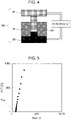
- Fig. 4 is a schematic diagram illustrating a pressure molding die 300 used for evaluating the ionic conductivity of the solid-electrolyte material.
- the pressure molding die 300 included a punch upper portion 301, a die 302, and a punch lower portion 303.
- the die 302 was composed of insulated polycarbonate.
- the punch upper and lower portions 301 and 303 were composed of electronically conductive stainless steel.
- the ionic conductivity of the solid-electrolyte material prepared in Example 1 was measured using the pressure molding die 300 illustrated in Fig. 4 by the following method.
- a powder of the solid-electrolyte material prepared in Example 1 (i.e., the solid-electrolyte material powder 101 in Fig. 4 ) was charged into the pressure molding die 300. Inside the pressure molding die 300, a pressure of 360 MPa was applied to the powder of the solid-electrolyte material prepared in Example 1 using the punch upper portion 301 and the punch lower portion.
- the punch upper and lower portions 301 and 303 were connected to a potentiostat (Biologic, VSP-300) equipped with a frequency response analyzer.
- the punch upper portion 301 was connected to the working electrode and a potential-measuring terminal.
- the punch lower portion 303 was connected to the counter electrode and the reference electrode.
- the ionic conductivity of the solid-electrolyte material was measured at room temperature by an electrochemical impedance measurement method.
- Fig. 5 is a graph illustrating the Cole-Cole plot of the results of measurement of the impedance of the solid-electrolyte material prepared in Example 1.
- the real part of the impedance at the measurement point at which the absolute value of phase of complex impedance was minimum was considered the resistance of the solid-electrolyte material to ionic conduction.
- the arrow R SE illustrated in Fig. 5 refer to the arrow R SE illustrated in Fig. 5 .
- Ionic conductivity was calculated from the above resistance using Expression (1) below.
- ⁇ R SE ⁇ S / t ⁇ 1
- ⁇ ionic conductivity
- S represents the area of a part of the solid-electrolyte material which comes into contact with the punch upper portion 301 (equal to the cross-sectional area of the hollowed part of the die 302 in Fig. 4 )
- R- SE represents the resistance of the solid-electrolyte material measured in the above impedance measurement
- t represents the thickness of the solid-electrolyte material to which the pressure has been applied (equal to the thickness of the layer formed of the solid-electrolyte material powder 101 in Fig. 4 ).
- the ionic conductivity of the solid-electrolyte material prepared in Example 1 which was measured at 25°C was 5.9 ⁇ 10 -5 S/cm.
- the solid-electrolyte material prepared in Example 1 and graphite, which served as a negative electrode active material, were prepared at a volume ratio of 50:50.
- the above materials were mixed with each other in an agate mortar to form a negative electrode mixture.
- a sulfide solid electrolyte 75Li 2 S-P 2 S 5 (80 mg) and the above negative electrode mixture (3.37 mg, including 2 mg of the negative electrode active material) were stacked on top of each other to form a multilayer body.
- a pressure of 360 MPa was applied to the multilayer body.
- a solid-electrolyte layer and a negative electrode were formed.
- a metal In foil (thickness: 200 ⁇ m), a metal Li foil (thickness: 200 ⁇ m), and a metal In foil (thickness: 200 ⁇ m) were stacked on and above the solid-electrolyte layer to prepare a multilayer body. Then, a pressure of 80 MPa was applied to the multilayer body. Hereby, a positive electrode was formed.
- a current collector formed of stainless steel was attached to the positive and negative electrodes.
- Current collection leads were attached to the respective current collectors.
- the inside of the insulated cylinder was isolated from the outside atmosphere using an insulated ferrule.
- the inside of the cylinder was hermetically sealed.
- a battery of Example 1 was prepared in the above-described manner.
- Fig. 6 includes graphs illustrating the initial charge-discharge characteristics of the battery prepared in Example 1. The results illustrated in Fig. 6 were measured by the following method.
- the battery prepared in Example 1 was charged to a voltage of -0.62 V at a current density of 26.1 ⁇ A/cm 2 . This current density corresponds to 0.025C rate.
- the term "charge” used herein refers to a state in which lithium ions flow in the direction from the In-Li alloy positive electrode to the negative electrode including graphite. Subsequently, the battery prepared in Example 1 was discharged to a voltage of 1.9 V at a current density of 26.1 ⁇ A/cm 2 . This current density corresponds to 0.025C rate.
- discharge used herein refers to a state in which lithium ions flow in the direction from the negative electrode including graphite to the In-Li positive electrode.
- Example 2 LiBr, CaBr 2 , and CaI 2 were prepared as raw material powders at a LiBr:CaBr 2 :CaI 2 molar ratio of 1.34:0.33:1.
- Example 3 LiBr, CaBr 2 , and CaI 2 were prepared as raw material powders at a LiBr:CaBr 2 :CaI 2 molar ratio of 1:0.5:1.
- Example 4 LiBr, Lil, and CaI 2 were prepared as raw material powders at a LiBr:Lil:Cal 2 molar ratio of 2:1:0.5.
- Example 5 LiBr, Lil, and CaI 2 were prepared as raw material powders at a LiBr:Lil:Cal 2 molar ratio of 2:1.4:0.3.
- Example 6 LiBr, Lil, and CaI 2 were prepared as raw material powders at a LiBr-Lil:Cal 2 molar ratio of 2.5:0.5:0.5.
- Example 7 LiBr and CaI 2 were prepared as raw material powders at a LiBr:CaI 2 molar ratio of 3:0.5.
- Example 8 LiBr, Lil, and Cal 2 were prepared as raw material powders at a LiBr:LiI:CaI 2 molar ratio of 1.5:1.5:0.5.
- Example 9 LiBr, Lil, and CaI 2 were prepared as raw material powders at a LiBr:LiI:CaI 2 molar ratio of 1:2:0.5.
- LiBr, CaBr 2 , and CaI 2 were prepared as raw material powders at a LiBr:CaBr 2 :CaI 2 molar ratio of 1.34:0.58:0.75.
- Example 11 CaBr 2 , Lil, and CaI 2 were prepared as raw material powders at a CaBr 2 :LiI:CaI 2 molar ratio of 0.75:1.34:0.58.
- Example 12 LiBr, KI, and CaI 2 were prepared as raw material powders at a LiBr:KI:CaI 2 molar ratio of 2:0.2:0.9.
- Example 13 LiBr, KI, and CaI 2 were prepared as raw material powders at a LiBr:KI:CaI 2 molar ratio of 2:0.4:0.8.
- Example 14 LiBr, Rbl, and CaI 2 were prepared as raw material powders at a LiBr:RbI:CaI 2 molar ratio of 2:0.1:0.95.
- Example 15 LiBr, Rbl, and CaI 2 were prepared as raw material powders at a LiBr:RbI:CaI 2 molar ratio of 2:0.2:0.9.
- Example 16 LiBr, Nal, and CaI 2 were prepared as raw material powders at a LiBr:NaI:CaI 2 molar ratio of 2:0.4:0.8.
- Example 17 LiBr, Nal, and CaI 2 were prepared as raw material powders at a LiBr:NaI:CaI 2 molar ratio of 2:0.8:0.6.
- Example 18 LiBr, Nal, Lil, and CaI 2 were prepared as raw material powders at a LiBr:NaI:LiI:CaI 2 molar ratio of 2:0.2:0.2:0.8.
- Example 19 LiBr, Nal, Lil, and CaI 2 were prepared as raw material powders at a LiBr:NaI:LiI:CaI 2 molar ratio of 2:0.4:0.4:0.6.
- Fig. 2 illustrates the X-ray diffraction patterns of the solid-electrolyte materials prepared in Examples 2 to 19.
- a peak was present at a diffraction angle 2 ⁇ of greater than or equal to 25° and less than or equal to 29°, a diffraction angle 2 ⁇ of greater than or equal to 29° and less than or equal to 33°, and a diffraction angle 2 ⁇ of greater than or equal to 41° and less than or equal to 47°.
- the above peak angles substantially coincided with the peak angles observed in an X-ray diffraction pattern of a rock-salt structure.
- Fig. 2 The horizontal axis of the X-ray diffraction patterns illustrated in Fig. 2 was transformed as in Example 1.
- the peaks present at a diffraction angle 2 ⁇ of greater than or equal to 25° and less than or equal to 29° are the peaks corresponding to qo.
- Fig. 3 illustrates the second conversion patterns of the solid-electrolyte materials prepared in Examples 2 to 19. In all of Examples 2 to 19, a peak was present at q/qo of greater than or equal to 1.13 and less than or equal to 1.18 and a q/qo of greater than or equal to 1.60 and less than or equal to 1.66.
- Example 1 The ionic conductivity of each of the solid-electrolyte materials prepared in Examples 2 to 19 was measured as in Example 1. Table 1 lists the measurement results.
- Table 1 lists the composition and evaluation results of each of the solid-electrolyte materials prepared in Examples 1 to 19.
- Example 2 1.01 - 1.00 1.50 1.50 0.132 1.8 ⁇ 10 -5
- Example 3 0.667 - 1.00 1.33 1.33 0.0562 4.8 ⁇ 10 -6
- Example 4 6.00 - 1.00 4.00 4.00 0.131 6.1 ⁇ 10 -5
- Example 5 11.3 - 1.00 6.67 6.67 0.170 1.7 ⁇ 10 -5
- Example 8 6.00 - 1.00 3.00 5.00 0.146 4.2 ⁇ 10 -5
- Example 9 6.00 - 1.00 2.00 6.00 0.100 7.4 ⁇ 10 -6
- Example 10 1.01 - 1.00
- the solid-electrolyte materials prepared in Examples 1 to 19 have a peak at a diffraction angle 2 ⁇ of greater than or equal to 25° and less than or equal to 29°, a diffraction angle 2 ⁇ of greater than or equal to 29° and less than or equal to 33°, and a diffraction angle 2 ⁇ of greater than or equal to 41° and less than or equal to 47° in the X-ray diffraction pattern obtained by the X-ray diffraction measurement using Cu-K ⁇ radiation. Furthermore, a peak was present at q/qo of greater than or equal to 1.13 and less than or equal to 1.18 and a q/qo of greater than or equal to 1.60 and less than or equal to 1.66 in each of the second conversion patterns. Accordingly, it is considered that the solid-electrolyte materials prepared in Examples 1 to 19 include a crystal phase having a rock-salt structure or a crystal structure analogous to a rock-salt structure.
- the solid-electrolyte materials prepared in Examples 1 to 19 do not contain any rare-earth elements.
- Example 1 When the solid-electrolyte material prepared in Example 1 was used for producing a battery that included graphite as an active material, the battery had suitable charge-discharge characteristics in terms of Li potential. This confirms that the solid-electrolyte material prepared in Example 1 has high reduction resistance.
- the solid-electrolyte material according to the present disclosure does not contain any of rare-earth elements and sulfur and has a high ionic conductivity and high reduction resistance.
- the solid-electrolyte material according to the present disclosure is appropriate for producing batteries that can be charged and discharged in a suitable manner.
- the solid-electrolyte material according to the present disclosure is used for producing solid-state lithium-ion secondary batteries and the like.
Landscapes
- Chemical & Material Sciences (AREA)
- Engineering & Computer Science (AREA)
- Chemical Kinetics & Catalysis (AREA)
- Electrochemistry (AREA)
- General Chemical & Material Sciences (AREA)
- Manufacturing & Machinery (AREA)
- Materials Engineering (AREA)
- Inorganic Chemistry (AREA)
- Condensed Matter Physics & Semiconductors (AREA)
- Physics & Mathematics (AREA)
- General Physics & Mathematics (AREA)
- Organic Chemistry (AREA)
- Geology (AREA)
- Life Sciences & Earth Sciences (AREA)
- Secondary Cells (AREA)
- Conductive Materials (AREA)
- Battery Electrode And Active Subsutance (AREA)
- Compounds Of Alkaline-Earth Elements, Aluminum Or Rare-Earth Metals (AREA)
Description
- The present disclosure relates to a solid-electrolyte material and a battery that includes the solid-electrolyte material.
-
PTL 1 discloses a solid-state battery that includes a sulfide solid electrolyte material.US6187479 discloses an electrode active material comprising xLiF(1-x)CaCl2, xLiBr(1-x)CaCl2 and use as anodes and cathodes in batteries. - PTL 1:
Japanese Unexamined Patent Application Publication No. 2011-129312 - An object of the present disclosure is to provide a solid-electrolyte material having a high ionic conductivity.
- A solid-electrolyte material according to the present disclosure includes a crystal phase constituted by Li, M, X, and O. M is at least one element selected from the group consisting of Mg, Ca, and Sr. X is at least two elements selected from the group consisting of F, CI, Br, and I.
- The present disclosure provides a solid-electrolyte material having a high ionic conductivity.
-
- [
Fig. 1] Fig. 1 is a cross-sectional view of abattery 1000 according to a second embodiment. - [
Fig. 2] Fig. 2 includes graphs illustrating the X-ray diffraction patterns of solid-electrolyte materials prepared in Examples 1 to 19 which were obtained by an X-ray diffraction measurement using Cu-Kα radiation. - [
Fig. 3] Fig. 3 includes graphs obtained by transforming the horizontal axis of the respective graphs included inFig. 2 from 2θ to q/qo. - [
Fig. 4] Fig. 4 is a schematic diagram illustrating a pressure molding die 300 used for evaluating the ionic conductivity of a solid-electrolyte material. - [
Fig. 5] Fig. 5 is a graph illustrating the Cole-Cole plot of the results of measurement of the impedance of a solid-electrolyte material prepared in Example 1. - [
Fig. 6] Fig. 6 includes graphs illustrating the initial discharge characteristics of a battery prepared in Example 1. - An embodiment of the present disclosure is described with reference to the attached drawings below.
- A solid-electrolyte material according to a first embodiment includes a crystal phase constituted by Li, M, X, and O. M is at least one element selected from the group consisting of Mg, Ca, and Sr. X is at least two elements selected from the group consisting of F, CI, Br, and I. The solid-electrolyte material according to the first embodiment has a high ionic conductivity.
- Since the solid-electrolyte material according to the first embodiment does not contain sulfur, it does not produce hydrogen sulfide when exposed to air. Thus, the solid-electrolyte material according to the first embodiment is excellent in terms of safety. Note that the sulfide solid electrolyte material disclosed in
PTL 1 may produce hydrogen sulfide when exposed to air. - Since the solid-electrolyte material according to the first embodiment does not contain any rare-earth elements, it may be produced at low costs.
- M may include Ca in order to increase the ionic conductivity of the solid-electrolyte material. M may be Ca in order to increase the ionic conductivity of the solid-electrolyte material.
- X may be Br and I in order to increase the ionic conductivity of the solid-electrolyte material.
- The crystal phase may further include MA in order to increase the ionic conductivity of the solid-electrolyte material. MA is at least one element selected from the group consisting of Na, K, Rb, and Cs.
- The crystal phase has a peak at a diffraction angle 2θ of greater than or equal to 25° and less than or equal to 29°, a diffraction angle 2θ of greater than or equal to 29° and less than or equal to 33°, and a diffraction angle 2θ of greater than or equal to 41° and less than or equal to 47° in an X-ray diffraction pattern obtained by an X-ray diffraction measurement using Cu-Kα radiation.
- In a first conversion pattern obtained by transforming the horizontal axis of the X-ray diffraction pattern of the solid-electrolyte material from diffraction angle 2θ to q on the basis of Expression q = 4πsinθ/λ (where λ represents the wavelength of an X-ray used in the X-ray diffraction measurement), the value of q at which a peak is present at q of greater than or equal to 1.76 Å-1 and less than or equal to 2.05 Å-1 may be defined as qo and, in a second conversion pattern obtained by transforming the horizontal axis of the X-ray diffraction pattern from diffraction angle 2θ to q/qo, a peak may be present at q/qo of greater than or equal to 1.13 and less than or equal to 1.18 and q/qo of greater than or equal to 1.60 and less than or equal to 1.66. A crystal phase having such peaks has a high ionic conductivity. The above-described conversion enables the extraction of the ratio between the interlayer spacings of different diffraction planes from X-ray diffraction patterns. This eliminates the change in peak position caused due to the difference in lattice constant and makes the feature of an identical crystal structure more distinctive.
- The crystal structure of the crystal phase is not limited. Examples of the crystal structure include a rock-salt structure having a crystal structure belonging to the space group Fm-3m and a spinel or inverse-spinel structure having a crystal structure belonging to the space group Fd-3m. The sublattice constituted by anions may have a cubic closest packed structure or a distorted cubic closest packed structure. The elements in the crystals may occupy equivalent sites randomly or may be arranged regularly. The term "equivalent sites" used herein refers to positions that overlap each other by a symmetry operation defined by the space group.
- The solid-electrolyte material according to the first embodiment may include a crystal phase having a crystal structure different from that of the above crystal phase.
- The molar ratio of Li to M may be greater than or equal to 0.667 and less than or equal to 11.3 in order to increase the ionic conductivity of the solid-electrolyte material. When the above molar ratio is greater than or equal to 0.667, a sufficiently large amount of lithium ions are present in the crystals. This facilitates the conduction of lithium ions. When the above molar ratio is less than or equal to 11.3, the likelihood of the lithium ions in the crystals interfering with one another is reduced. This enables the pathways through which the lithium ions are conducted to be formed in a sufficient amount.
- The molar ratio of X to M may be greater than or equal to 2.66 and less than or equal to 13.34 in order to increase the ionic conductivity of the solid-electrolyte material. The higher the content of anions in the crystals, the higher the content of lithium ions in the crystals; the lower the content of anions in the crystals, the lower the content of lithium ions in the crystals. When the above molar ratio is greater than or equal to 2.66, a sufficiently large amount of lithium ions are present in the crystals. When the above molar ratio is less than or equal to 13.34, the pathways through which the lithium ions are conducted can be formed in the crystals in a sufficient amount.
- The molar ratio of MA to M may be greater than or equal to 0 and less than or equal to 1.33 in order to increase the ionic conductivity of the solid-electrolyte material. When the above molar ratio is less than or equal to 1.33, it becomes easy to dissolve M in the crystals. In other words, the risk of collapse of the crystal structure is reduced. For example, the above molar ratio may be greater than or equal to 0.110 and less than or equal to 1.33.
- The molar ratio of O to M may be greater than 0 and less than or equal to 0.2 in order to increase the ionic conductivity of the solid-electrolyte material. When the above molar ratio is less than or equal to 0.2, the risk of divalent anions blocking the conduction of lithium ions can be reduced.
- The molar ratio of Br to X may be greater than or equal to 0.375 and less than or equal to 0.625 in order to increase the ionic conductivity of the solid-electrolyte material. This enables the crystal structure having a high ionic conductivity to be maintained.
- The molar ratio of I to X may be greater than or equal to 0.375 and less than or equal to 0.625 in order to increase the ionic conductivity of the solid-electrolyte material. This enables the crystal structure having a high ionic conductivity to be maintained.
- The shape of the solid-electrolyte material according to the first embodiment is not limited. Examples of the above shape include acicular, spherical, and oval. The solid-electrolyte material according to the first embodiment may be particulate. The solid-electrolyte material according to the first embodiment may be formed in a pellet-like or plate-like shape.
- In the case where the solid-electrolyte material according to the first embodiment is particulate (e.g., spherical), the solid-electrolyte material may have a median diameter of greater than or equal to 0.1 µm and less than or equal to 100 µm and may desirably have a median diameter of greater than or equal to 0.5 µm and less than or equal to 10 µm. In such a case, the solid-electrolyte material according to the first embodiment has a further high ionic conductivity. Furthermore, the solid-electrolyte material according to the first embodiment and materials other than the solid-electrolyte material can be dispersed in a suitable manner. The term "median diameter" used herein refers to the particle size at which the cumulative volume in a volume-basis particle size distribution is equal to 50%. The volume-basis particle size distribution can be measured with a laser diffraction analyzer or an image processor.
- In order to disperse the solid-electrolyte material according to the first embodiment and an active material in a suitable manner, the solid-electrolyte material according to the first embodiment may have a smaller median diameter than the active material.
- The solid-electrolyte material according to the first embodiment is produced by, for example, the following method.
- Powders of halide raw materials are mixed with one another such that the resulting mixture has an intended composition.
- For example, in the case where the intended composition is Li2CaBr2I2, a LiBr raw material powder and a CaI2 raw material powder are mixed with each other at a molar ratio of 2:1. The combination of cation and anion may be changed in order to produce the same composition. For example, a LiI raw material powder and a CaBr2 raw material powder may be mixed with each other at a molar ratio of 2:1. The raw material powders may be mixed with each other at a specific molar ratio that has been determined such that the composition change that may occur in the synthesis process can be canceled out.
- The raw material powders are caused to react with each other mechanochemically (i.e., using mechanochemical milling) in a mixer, such as a planetary ball mill, to form a mixture. The product of the reaction may be baked in an atmosphere containing oxygen. Alternatively, the reaction product may be produced by baking the mixture of the raw material powders in an atmosphere containing oxygen. The concentration of the oxygen may be, for example, about 30 ppm. The baking treatment may be performed at a temperature of greater than or equal to 100°C and less than or equal to 700°C or at a temperature of greater than or equal to 400°C and less than or equal to 600°C.
- The solid-electrolyte material according to the first embodiment is produced by the above-described method.
- A second embodiment of the present disclosure is described below. The items described in the first embodiment are omitted as needed.
- A battery according to the second embodiment includes a positive electrode, an electrolyte layer, and a negative electrode. The electrolyte layer is interposed between the positive and negative electrodes.
- At least one selected from the group consisting of the positive electrode, the electrolyte layer, and the negative electrode includes the solid-electrolyte material according to the first embodiment.
- Since the battery according to the second embodiment includes the solid-electrolyte material according to the first embodiment, it has suitable charge-discharge characteristics.
- A specific example of the battery according to the second embodiment is described below.
-
Fig. 1 is a cross-sectional view of abattery 1000 according to the second embodiment. - The
battery 1000 includes apositive electrode 201, anelectrolyte layer 202, and anegative electrode 203. - The
positive electrode 201 includes a positive electrodeactive material particle 204 and asolid electrolyte particle 100. - The
electrolyte layer 202 is interposed between thepositive electrode 201 and thenegative electrode 203. - The
electrolyte layer 202 includes an electrolyte material (e.g., a solid-electrolyte material). - The
negative electrode 203 includes a negative electrodeactive material particle 205 and asolid electrolyte particle 100. - The
solid electrolyte particle 100 is a particle including the solid-electrolyte material according to the first embodiment as a principal component. The expression "particle including the solid-electrolyte material according to the first embodiment as a principal component" refers to a particle the most abundant component of which is the solid-electrolyte material according to the first embodiment. Thesolid electrolyte particle 100 may be a particle composed of the solid-electrolyte material according to the first embodiment. - The
positive electrode 201 includes a material capable of occluding and releasing a metal ion (e.g., a lithium ion). Examples of such a material include a positive electrode active material (e.g., the positive electrode active material particles 204). - Examples of the positive electrode active material include a lithium transition metal oxide, a transition metal fluoride, a polyanion material, a polyanion fluoride material, a transition metal sulfide, a transition metal oxyfluoride, a transition metal oxysulfide, and a transition metal oxynitride. Examples of the lithium transition metal oxide include Li(NiCoAl)O2, LiCoO2, and Li(NiCoMn)O2.
- The positive electrode
active material particles 204 may have a median diameter of greater than or equal to 0.1 µm and less than or equal to 100 µm. When the positive electrodeactive material particles 204 have a median diameter of greater than or equal to 0.1 µm, the positive electrodeactive material particles 204 and thesolid electrolyte particles 100 can be dispersed in the positive electrode in a suitable manner. This enhances the charge-discharge characteristics of the battery. When the positive electrodeactive material particles 204 have a median diameter of less than or equal to 100 µm, the rate at which lithium ions diffuse in the positive electrodeactive material particles 204 is increased. This enables high-power operation of the battery. - The positive electrode
active material particles 204 may have a larger median diameter than thesolid electrolyte particles 100. In such a case, the positive electrodeactive material particles 204 and thesolid electrolyte particles 100 can be dispersed in a suitable manner. - In consideration of the energy density and power of the battery, in the
positive electrode 201, the ratio of the volume of the positive electrodeactive material particles 204 to the total volume of the positive electrodeactive material particles 204 and thesolid electrolyte particles 100 may be greater than or equal to 0.30 and less than or equal to 0.95. - In consideration of the energy density and power of the battery, the
positive electrode 201 may have a thickness of greater than or equal to 10 µm and less than or equal to 500 µm. - The
electrolyte layer 202 includes an electrolyte material. Examples of the electrolyte material include a solid-electrolyte material. Theelectrolyte layer 202 may be a solid-electrolyte layer. The solid-electrolyte material included in theelectrolyte layer 202 may include the solid-electrolyte material according to the first embodiment. - The
electrolyte layer 202 may be composed only of the solid-electrolyte material according to the first embodiment. - The
electrolyte layer 202 may be composed only of a solid-electrolyte material different from the solid-electrolyte material according to the first embodiment. Examples of the solid-electrolyte material different from the solid-electrolyte material according to the first embodiment include Li2MgX'4, Li2FeX'4, Li(Al,Ga,In)X'4, Li3(Al,Ga,In)X'6, and LiX', where X' is at least one element selected from the group consisting of F, CI, Br, and I. - Hereinafter, the solid-electrolyte material according to the first embodiment is referred to as "first solid-electrolyte material", and the solid-electrolyte material different from the solid-electrolyte material according to the first embodiment is referred to as "second solid-electrolyte material".
- The
electrolyte layer 202 may include the second solid-electrolyte material in addition to the first solid-electrolyte material. The first and second solid-electrolyte materials may be dispersed uniformly. - A layer composed of the first solid-electrolyte material and a layer composed of the second solid-electrolyte material may be stacked on top of each other in the direction in which the layers constituting the
battery 1000 are stacked. - The
electrolyte layer 202 may have a thickness of greater than or equal to 1 µm and less than or equal to 100 µm. When theelectrolyte layer 202 has a thickness of greater than or equal to 1 µm, the risk of short circuit between thepositive electrode 201 and thenegative electrode 203 is reduced. When theelectrolyte layer 202 has a thickness of less than or equal to 100 µm, the battery can be operated at a high power. - The
negative electrode 203 includes a material capable of occluding and releasing a metal ion (e.g., a lithium ion). Examples of such a material include a negative electrode active material (e.g., the negative electrode active material particles 205). - Examples of the negative electrode active material include a metal material, a carbon material, an oxide, a nitride, a tin compound, and a silicon compound. The metal material may be a simple substance or an alloy. Examples of the metal material include lithium metal or a lithium alloy. Examples of the carbon material include natural graphite, coke, graphitizing carbon, carbon fibers, spherical carbon, artificial graphite, and amorphous carbon. Examples of negative electrode active materials suitable in terms of capacity density include silicon (i.e., Si), tin (i.e., Sn), a silicon compound, and a tin compound. A negative electrode active material having a low average discharge voltage, such as graphite, may be used to increase the energy density of the battery.
- The
negative electrode 203 may include the first solid-electrolyte material. Since the first solid-electrolyte material has high reduction resistance, it can be used in combination with a negative electrode active material, such as graphite or lithium metal. - The negative electrode
active material particles 205 may have a median diameter of greater than or equal to 0.1 µm and less than or equal to 100 µm. When the negative electrodeactive material particles 205 have a median diameter of greater than or equal to 0.1 µm, the negative electrodeactive material particles 205 and thesolid electrolyte particles 100 can be dispersed in the negative electrode in a suitable manner. This enhances the charge-discharge characteristics of the battery. When the negative electrodeactive material particles 205 have a median diameter of less than or equal to 100 µm, the rate at which lithium ions diffuse in the negative electrodeactive material particles 205 is increased. This enables high-power operation of the battery. - In consideration of the energy density and power of the battery, in the
negative electrode 203, the ratio of the volume of the negative electrodeactive material particles 205 to the total volume of the negative electrodeactive material particles 205 and thesolid electrolyte particles 100 may be greater than or equal to 0.30 and less than or equal to 0.95. - In consideration of the energy density and power of the battery, the
negative electrode 203 may have a thickness of greater than or equal to 10 µm and less than or equal to 500 µm. - At least one selected from the group consisting of the
positive electrode 201, theelectrolyte layer 202, and thenegative electrode 203 may include the second solid-electrolyte material in order to enhance ionic conductivity, chemical stability, and electrochemical stability. Examples of the second solid-electrolyte material include a sulfide solid electrolyte, an oxide solid electrolyte, a halide solid electrolyte, and an organic polymer solid electrolyte. - Examples of the sulfide solid electrolyte include Li2S-P2S5, Li2S-SiS2, Li2S-B2S3, Li2S-GeS2, Li3.25Ge0.25P0.75S4, and Li10GeP2S12.
- Examples of the oxide solid electrolyte include:
- (i) NASICON-type solid electrolytes, such as LiTi2(PO4)3 and element substitution products thereof;
- (ii) perovskite-type solid electrolytes, such as (LaLi)TiO3;
- (iii) LISICON-type solid electrolytes, such as Li14ZnGe4O16, Li4SiO4, LiGeO4, and element substitution products thereof;
- (iv) garnet-type solid electrolytes, such as Li7La3Zr2O12 and element substitution products thereof; and
- (v) Li3PO4 and N-substitution products thereof.
- Examples of the halide solid electrolyte include, as described above, Li2MgX'4, Li2FeX'4, Li(Al,Ga,In)X'4, Li3(Al,Ga,In)X'6, and LiX'.
- Examples of the halide solid electrolyte further include a compound represented by LipMeqYrZ6, where p + m'q + 3r = 6 and r > 0 are satisfied. Me is at least one element selected from the group consisting of metal and metalloid elements other than Li or Y, and m' represents the valence of Me. Z is at least one element selected from the group consisting of F, CI, Br, and I. The term "metalloid elements" used herein refers to B, Si, Ge, As, Sb, and Te. The term "metal elements" used herein refers to all the elements (except hydrogen) of
Groups 1 to 12 in the periodic table and all the elements (except B, Si, Ge, As, Sb, Te, C, N, P, O, S, and Se) of Groups 13 to 16 in the periodic table. Me may be at least one element selected from the group consisting of Mg, Ca, Sr, Ba, Zn, Sc, Al, Ga, Bi, Zr, Hf, Ti, Sn, Ta, and Nb in consideration of the ionic conductivity of the halide solid electrolyte. - Examples of the organic polymer solid electrolyte include a high-molecular-weight compound and a compound of a lithium salt. The high-molecular-weight compound may have an ethylene oxide structure. Since a high-molecular-weight compound having an ethylene oxide structure is capable of containing a large amount of lithium salt, ionic conductivity can be increased. Examples of the lithium salt include LiPF6, LiBF4, LiSbF6, LiAsF6, LiSO3CF3, LiN(SO2CF3)2, LiN(SO2C2F5)2, LiN(SO2CF3)(SO2C4F9), and LiC(SO2CF3)3. Only one type of lithium salt selected from the above lithium salts may be used alone. Two or more types of lithium salts selected from the above lithium salts may be used in a mixture.
- At least one selected from the group consisting of the
positive electrode 201, theelectrolyte layer 202, and thenegative electrode 203 may include a nonaqueous electrolyte solution, a gel electrolyte, or an ionic liquid in order to facilitate the transfer of lithium ions and enhance the output characteristics of the battery. - The nonaqueous electrolyte solution includes a nonaqueous solvent and a lithium salt dissolved in the nonaqueous solvent.
- Examples of the nonaqueous solvent include a cyclic carbonate ester solvent, a chain carbonate ester solvent, a cyclic ether solvent, a chain ether solvent, a cyclic ester solvent, a chain ester solvent, and a fluorine solvent. Examples of the cyclic carbonate ester solvent include ethylene carbonate, propylene carbonate, and butylene carbonate. Examples of the chain carbonate ester solvent include dimethyl carbonate, ethylmethyl carbonate, and diethyl carbonate. Examples of the cyclic ether solvent include tetrahydrofuran, 1,4-dioxane, and 1,3-dioxolane. Examples of the chain ether solvent include 1,2-dimethoxyethane and 1,2-diethoxyethane. Examples of the chain ester solvent include methyl acetate. Examples of the fluorine solvent include fluoroethylene carbonate, methyl fluoropropionate, fluorobenzene, fluoroethyl methyl carbonate, and fluorodimethylene carbonate. Only one type of nonaqueous solvent selected from the above nonaqueous solvents may be used alone. Two or more types of nonaqueous solvents selected from the above nonaqueous solvents may be used in a mixture. Examples of the lithium salt include LiPF6, LiBF4, LiSbF6, LiAsF6, LiSO3CF3, LiN(SO2CF3)2, LiN(SO2C2F5)2, LiN(SO2CF3)(SO2C4F9), and LiC(SO2CF3)3. Only one type of lithium salt selected from the above lithium salts may be used alone. Two or more types of lithium salts selected from the above lithium salts may be used in the form of compound.
- The concentration of the lithium salt may be, for example, greater than or equal to 0.5 mol/liter and less than or equal to 2 mol/liter.
- The gel electrolyte may be a polymer material impregnated with a nonaqueous electrolyte solution. Examples of the polymer material include polyethylene oxide, polyacrylonitrile, polyvinylidene fluoride, polymethyl methacrylate, and a polymer including an ethylene oxide bond.
- Examples of the cation included in the ionic liquid include:
- (i) aliphatic chain quaternary salts, such as tetraalkylammonium and tetraalkylphosphonium;
- (ii) aliphatic cyclic ammoniums, such as a pyrrolidinium, a morpholinium, an imidazolinium, a tetrahydropyrimidinium, a piperazinium, and a piperidinium; and
- (iii) nitrogen-containing heterocyclic aromatic cations, such as a pyridinium and an imidazolium.
- Examples of the anion included in the ionic liquid include PF6 -, BF4 -, SbF6 -, AsF6 -, SO3CF3 -, N(SO2CF3)2 -, N(SO2C2F5)2 -, N(SO2CF3)(SO2C4F9)-, and C(SO2CF3)3 -.
- The ionic liquid may include a lithium salt.
- At least one selected from the group consisting of the
positive electrode 201, theelectrolyte layer 202, and thenegative electrode 203 may include a binding agent in order to increase the adhesion between the particles. - Examples of the binding agent include polyvinylidene fluoride, polytetrafluoroethylene, polyethylene, polypropylene, an aramid resin, polyamide, polyimide, polyamide imide, polyacrylonitrile, polyacrylic acid, polymethyl acrylate ester, polyethyl acrylate ester, polyhexyl acrylate ester, polymethacrylic acid, polymethyl methacrylate ester, polyethyl methacrylate ester, polyhexyl methacrylate ester, polyvinyl acetate, polyvinylpyrrolidone, polyether, polyethersulfone, hexafluoropolypropylene, styrene, a butadiene rubber, and carboxymethyl cellulose. A copolymer may also be used as a binding agent. Examples of such a binding agent include copolymers of two or more materials selected from the group consisting of tetrafluoroethylene, hexafluoroethylene, hexafluoropropylene, perfluoroalkyl vinyl ether, vinylidene fluoride, chlorotrifluoroethylene, acrylic acid, and hexadiene. Alternatively, a mixture of two or more materials selected from the above materials may be used as a binding agent.
- At least one selected from the group consisting of the
positive electrode 201 and thenegative electrode 203 may include a conductant agent in order to increase electron conductivity. - Examples of the conductant agent include:
- (i) graphite materials, such as natural graphite and artificial graphite;
- (ii) carbon black materials, such as acetylene black and Ketjenblack;
- (iii) conductive fibers, such as a carbon fiber and a metal fiber;
- (iv) carbon fluorides;
- (v) metal powders, such as aluminum;
- (vi) conductive whiskers, such as zinc oxide and potassium titanate;
- (vii) conductive metal oxides, such as titanium oxide; and
- (viii) conductive high-molecular-weight compounds, such as polyaniline, polypyrrole, and polythiophene.
- The conductant agents (i) and (ii) may be used to reduce the costs.
- Examples of the shape of the battery according to the second embodiment include coin-like, cylindrical, rectangular, sheet-like, button-like, flat, and multilayer.
- The present disclosure is described in further detail with reference to Examples below.
- LiBr and CaI2 were prepared as raw material powders at a LiBr:CaI2 molar ratio of 2:1 in an argon atmosphere having a dew point of less than or equal to - 60°C (hereinafter, referred to as "dry argon atmosphere"). These raw material powders were pulverized and mixed with each other in a mortar. Hereby, a mixed powder was prepared. The mixed powder was subsequently baked at 600°C for 30 minutes with a baking furnace in an argon atmosphere having a dew point of less than or equal to -60°C and an oxygen concentration of 20 ppm. A powder of a solid-electrolyte material of Example 1 was prepared in the above-described manner. The solid-electrolyte material prepared in Example 1 had the composition represented by Li2CaBr2I2.
-
Fig. 2 includes graphs illustrating the X-ray diffraction patterns of solid-electrolyte materials. The results illustrated inFig. 2 were measured by the following method. - The X-ray diffraction pattern of the solid-electrolyte material prepared in Example 1 was measured with an X-ray diffractometer (Rigaku Corporation, MiniFlex 600) in a dry atmosphere having a dew point of less than or equal to - 45°C. The X-ray source used was Cu-Kα radiation.
- In the X-ray diffraction pattern of the solid-electrolyte material prepared in Example 1, a peak was present at diffraction angles 2θ of 12.70°, 25.60°, 29.64°, and 42.48°.
- The above peak angles substantially coincided with some of the peak angles observed in an X-ray diffraction pattern of an inverse-spinel structure having a lattice constant a of 12.01 Å.
-
Fig. 3 includes graphs obtained by transforming the horizontal axis of the respective X-ray diffraction patterns included inFig. 2 from 2θ to q/qo. In other words,Fig. 3 includes graphs illustrating second conversion patterns. In the X-ray diffraction pattern of the solid-electrolyte material prepared in Example 1, the peak observed at a diffraction angle 2θ of 25.60° is the peak corresponding to qo. In the second conversion pattern of the solid-electrolyte material prepared in Example 1, a peak was present at q/qo values of 0.499, 1.155, and 1.635. - The oxygen content in the solid-electrolyte material prepared in Example 1 was measured with an oxygen, nitrogen, and hydrogen analyzer (HORIBA, Ltd., EMGA-930) by a non-dispersive infrared absorption method. The solid-electrolyte material (12.7 mg) prepared in Example 1 was charged into a nickel capsule attached thereto. The capsule and Sn (500 mg) were then charged into a sample holder. Subsequently, the oxygen content was measured. The oxygen content was 0.530% by weight of the total amount of the solid-electrolyte material. The molar ratio of oxygen to Ca which was calculated from the above oxygen content was 0.156.
-
Fig. 4 is a schematic diagram illustrating a pressure molding die 300 used for evaluating the ionic conductivity of the solid-electrolyte material. - The pressure molding die 300 included a punch
upper portion 301, adie 302, and a punchlower portion 303. Thedie 302 was composed of insulated polycarbonate. The punch upper andlower portions - The ionic conductivity of the solid-electrolyte material prepared in Example 1 was measured using the pressure molding die 300 illustrated in
Fig. 4 by the following method. - In an argon atmosphere having a dew point of less than or equal to -80°C, a powder of the solid-electrolyte material prepared in Example 1 (i.e., the solid-
electrolyte material powder 101 inFig. 4 ) was charged into the pressure molding die 300. Inside the pressure molding die 300, a pressure of 360 MPa was applied to the powder of the solid-electrolyte material prepared in Example 1 using the punchupper portion 301 and the punch lower portion. - While the pressure was applied to the powder, the punch upper and
lower portions upper portion 301 was connected to the working electrode and a potential-measuring terminal. The punchlower portion 303 was connected to the counter electrode and the reference electrode. The ionic conductivity of the solid-electrolyte material was measured at room temperature by an electrochemical impedance measurement method. -
Fig. 5 is a graph illustrating the Cole-Cole plot of the results of measurement of the impedance of the solid-electrolyte material prepared in Example 1. - In
Fig. 5 , the real part of the impedance at the measurement point at which the absolute value of phase of complex impedance was minimum was considered the resistance of the solid-electrolyte material to ionic conduction. For the above real part, refer to the arrow RSE illustrated inFig. 5 . - Ionic conductivity was calculated from the above resistance using Expression (1) below.

Fig. 4 ), R-SE represents the resistance of the solid-electrolyte material measured in the above impedance measurement, and t represents the thickness of the solid-electrolyte material to which the pressure has been applied (equal to the thickness of the layer formed of the solid-electrolyte material powder 101 inFig. 4 ). The ionic conductivity of the solid-electrolyte material prepared in Example 1 which was measured at 25°C was 5.9 × 10⁻⁵ S/cm. - In the dry argon atmosphere, the solid-electrolyte material prepared in Example 1 and graphite, which served as a negative electrode active material, were prepared at a volume ratio of 50:50. The above materials were mixed with each other in an agate mortar to form a negative electrode mixture.
- In an insulated cylinder having an inside diameter of 9.5 mm, a sulfide solid electrolyte 75Li2S-P2S5 (80 mg) and the above negative electrode mixture (3.37 mg, including 2 mg of the negative electrode active material) were stacked on top of each other to form a multilayer body. A pressure of 360 MPa was applied to the multilayer body. Hereby, a solid-electrolyte layer and a negative electrode were formed.
- Subsequently, a metal In foil (thickness: 200 µm), a metal Li foil (thickness: 200 µm), and a metal In foil (thickness: 200 µm) were stacked on and above the solid-electrolyte layer to prepare a multilayer body. Then, a pressure of 80 MPa was applied to the multilayer body. Hereby, a positive electrode was formed.
- A current collector formed of stainless steel was attached to the positive and negative electrodes. Current collection leads were attached to the respective current collectors.
- Finally, the inside of the insulated cylinder was isolated from the outside atmosphere using an insulated ferrule. Thus, the inside of the cylinder was hermetically sealed.
- A battery of Example 1 was prepared in the above-described manner.
-
Fig. 6 includes graphs illustrating the initial charge-discharge characteristics of the battery prepared in Example 1. The results illustrated inFig. 6 were measured by the following method. - The battery prepared in Example 1 was charged to a voltage of -0.62 V at a current density of 26.1 µA/cm2. This current density corresponds to 0.025C rate. The term "charge" used herein refers to a state in which lithium ions flow in the direction from the In-Li alloy positive electrode to the negative electrode including graphite. Subsequently, the battery prepared in Example 1 was discharged to a voltage of 1.9 V at a current density of 26.1 µA/cm2. This current density corresponds to 0.025C rate. The term "discharge" used herein refers to a state in which lithium ions flow in the direction from the negative electrode including graphite to the In-Li positive electrode.
- The results of the above charge-discharge test confirmed that the battery prepared in Example 1 had an initial charge-discharge efficiency of 90.3%.
- In Example 2, LiBr, CaBr2, and CaI2 were prepared as raw material powders at a LiBr:CaBr2:CaI2 molar ratio of 1.34:0.33:1.
- In Example 3, LiBr, CaBr2, and CaI2 were prepared as raw material powders at a LiBr:CaBr2:CaI2 molar ratio of 1:0.5:1.
- In Example 4, LiBr, Lil, and CaI2 were prepared as raw material powders at a LiBr:Lil:Cal2 molar ratio of 2:1:0.5.
- In Example 5, LiBr, Lil, and CaI2 were prepared as raw material powders at a LiBr:Lil:Cal2 molar ratio of 2:1.4:0.3.
- In Example 6, LiBr, Lil, and CaI2 were prepared as raw material powders at a LiBr-Lil:Cal2 molar ratio of 2.5:0.5:0.5.
- In Example 7, LiBr and CaI2 were prepared as raw material powders at a LiBr:CaI2 molar ratio of 3:0.5.
- In Example 8, LiBr, Lil, and Cal2 were prepared as raw material powders at a LiBr:LiI:CaI2 molar ratio of 1.5:1.5:0.5.
- In Example 9, LiBr, Lil, and CaI2 were prepared as raw material powders at a LiBr:LiI:CaI2 molar ratio of 1:2:0.5.
- In Example 10, LiBr, CaBr2, and CaI2 were prepared as raw material powders at a LiBr:CaBr2:CaI2 molar ratio of 1.34:0.58:0.75.
- In Example 11, CaBr2, Lil, and CaI2 were prepared as raw material powders at a CaBr2:LiI:CaI2 molar ratio of 0.75:1.34:0.58.
- In Example 12, LiBr, KI, and CaI2 were prepared as raw material powders at a LiBr:KI:CaI2 molar ratio of 2:0.2:0.9.
- In Example 13, LiBr, KI, and CaI2 were prepared as raw material powders at a LiBr:KI:CaI2 molar ratio of 2:0.4:0.8.
- In Example 14, LiBr, Rbl, and CaI2 were prepared as raw material powders at a LiBr:RbI:CaI2 molar ratio of 2:0.1:0.95.
- In Example 15, LiBr, Rbl, and CaI2 were prepared as raw material powders at a LiBr:RbI:CaI2 molar ratio of 2:0.2:0.9.
- In Example 16, LiBr, Nal, and CaI2 were prepared as raw material powders at a LiBr:NaI:CaI2 molar ratio of 2:0.4:0.8.
- In Example 17, LiBr, Nal, and CaI2 were prepared as raw material powders at a LiBr:NaI:CaI2 molar ratio of 2:0.8:0.6.
- In Example 18, LiBr, Nal, Lil, and CaI2 were prepared as raw material powders at a LiBr:NaI:LiI:CaI2 molar ratio of 2:0.2:0.2:0.8.
- In Example 19, LiBr, Nal, Lil, and CaI2 were prepared as raw material powders at a LiBr:NaI:LiI:CaI2 molar ratio of 2:0.4:0.4:0.6.
- The solid-electrolyte materials of Examples 2 to 19 were prepared as in Example 1, except for the above-described items.
- The X-ray diffraction pattern of each of the solid-electrolyte materials prepared in Examples 2 to 19 was measured as in Example 1.
-
Fig. 2 illustrates the X-ray diffraction patterns of the solid-electrolyte materials prepared in Examples 2 to 19. In all of Examples 2 to 19, a peak was present at a diffraction angle 2θ of greater than or equal to 25° and less than or equal to 29°, a diffraction angle 2θ of greater than or equal to 29° and less than or equal to 33°, and a diffraction angle 2θ of greater than or equal to 41° and less than or equal to 47°. The above peak angles substantially coincided with the peak angles observed in an X-ray diffraction pattern of a rock-salt structure. - In the X-ray diffraction patterns obtained in Examples 2, 3, 10, and 11, another peak was present at a diffraction angle 2θ of greater than or equal to 12° and less than or equal to 14°. The above peak angles substantially coincided with the peak angles observed in an X-ray diffraction pattern of an inverse-spinel structure. Accordingly, it is considered that the solid-electrolyte materials prepared in Examples 1 to 3, 10, and 11 include a crystal phase having an inverse-spinel structure.
- The horizontal axis of the X-ray diffraction patterns illustrated in
Fig. 2 was transformed as in Example 1. The peaks present at a diffraction angle 2θ of greater than or equal to 25° and less than or equal to 29° are the peaks corresponding to qo.Fig. 3 illustrates the second conversion patterns of the solid-electrolyte materials prepared in Examples 2 to 19. In all of Examples 2 to 19, a peak was present at q/qo of greater than or equal to 1.13 and less than or equal to 1.18 and a q/qo of greater than or equal to 1.60 and less than or equal to 1.66. - In the second conversion patterns obtained in Examples 2, 3, 10, and 11, another peak was present at q/qo of greater than or equal to 0.45 and less than or equal to 0.55.
- The solid-electrolyte materials prepared in Examples 2 to 19 were subjected to an elemental analysis as in Example 1. Table 1 lists the measurement results.
- The ionic conductivity of each of the solid-electrolyte materials prepared in Examples 2 to 19 was measured as in Example 1. Table 1 lists the measurement results.
- Table 1 lists the composition and evaluation results of each of the solid-electrolyte materials prepared in Examples 1 to 19.
[Table 1] Element ratio Ionic conductivity (S/cm) Li MA Ca Br I O Example 1 2.00 - 1.00 2.00 2.00 0.156 5.9×10⁻⁵ Example 2 1.01 - 1.00 1.50 1.50 0.132 1.8×10⁻⁵ Example 3 0.667 - 1.00 1.33 1.33 0.0562 4.8×10⁻⁶ Example 4 6.00 - 1.00 4.00 4.00 0.131 6.1×10⁻⁵ Example 5 11.3 - 1.00 6.67 6.67 0.170 1.7×10⁻⁵ Example 6 6.00 - 1.00 5.00 3.00 0.120 1.0×10⁻⁵ Example 7 6.00 - 1.00 6.00 2.00 0.157 1.1×10⁻⁶ Example 8 6.00 - 1.00 3.00 5.00 0.146 4.2×10⁻⁵ Example 9 6.00 - 1.00 2.00 6.00 0.100 7.4×10⁻⁶ Example 10 1.01 - 1.00 1.13 1.88 0.0473 2.9×10⁻⁶ Example 11 1.01 - 1.00 1.88 1.13 0.0577 1.3×10⁻⁵ Example 12 2.22 0.220 1.00 2.22 2.22 0.0844 2.7×10⁻⁵ Example 13 2.50 0.500 1.00 2.50 2.50 0.0994 5.3×10⁻⁶ Example 14 2.11 0.110 1.00 2.11 2.11 0.148 2.6×10⁻⁵ Example 15 2.22 0.220 1.00 2.22 2.22 0.152 1.8×10⁻⁵ Example 16 2.50 0.500 1.00 2.50 2.50 0.0425 2.9×10⁻⁵ Example 17 3.33 1.33 1.00 3.33 3.33 0.0588 1.6×10⁻⁵ Example 18 2.75 0.250 1.00 2.50 2.50 0.0382 4.8×10⁻⁵ Example 19 4.00 0.667 1.00 3.33 3.33 0.0416 5.0×10⁻⁵ - As is clear from the results listed in Table 1, all of the solid-electrolyte materials prepared in Examples 1 to 19 had a high ionic conductivity of greater than or equal to 1.0 x 10⁻⁶ S/cm.
- The solid-electrolyte materials prepared in Examples 1 to 19 have a peak at a diffraction angle 2θ of greater than or equal to 25° and less than or equal to 29°, a diffraction angle 2θ of greater than or equal to 29° and less than or equal to 33°, and a diffraction angle 2θ of greater than or equal to 41° and less than or equal to 47° in the X-ray diffraction pattern obtained by the X-ray diffraction measurement using Cu-Kα radiation. Furthermore, a peak was present at q/qo of greater than or equal to 1.13 and less than or equal to 1.18 and a q/qo of greater than or equal to 1.60 and less than or equal to 1.66 in each of the second conversion patterns. Accordingly, it is considered that the solid-electrolyte materials prepared in Examples 1 to 19 include a crystal phase having a rock-salt structure or a crystal structure analogous to a rock-salt structure.
- Since the solid-electrolyte materials prepared in Examples 1 to 19 do not contain sulfur, they do not produce hydrogen sulfide.
- The solid-electrolyte materials prepared in Examples 1 to 19 do not contain any rare-earth elements.
- When the solid-electrolyte material prepared in Example 1 was used for producing a battery that included graphite as an active material, the battery had suitable charge-discharge characteristics in terms of Li potential. This confirms that the solid-electrolyte material prepared in Example 1 has high reduction resistance.
- As described above, the solid-electrolyte material according to the present disclosure does not contain any of rare-earth elements and sulfur and has a high ionic conductivity and high reduction resistance. The solid-electrolyte material according to the present disclosure is appropriate for producing batteries that can be charged and discharged in a suitable manner.
- The solid-electrolyte material according to the present disclosure is used for producing solid-state lithium-ion secondary batteries and the like.
-
- 100 SOLID ELECTROLYTE PARTICLE
- 101 POWDER OF SOLID-ELECTROLYTE MATERIAL
- 201 POSITIVE ELECTRODE
- 202 ELECTROLYTE LAYER
- 203 NEGATIVE ELECTRODE
- 204 POSITIVE ELECTRODE ACTIVE MATERIAL PARTICLE
- 205 NEGATIVE ELECTRODE ACTIVE MATERIAL PARTICLE
- 300 PRESSURE MOLDING DIE
- 301 PUNCH UPPER PORTION
- 302 DIE
- 303 PUNCH LOWER PORTION
- 1000 BATTERY
Claims (14)
- A solid-electrolyte material comprising:a crystal phase constituted by Li, M, X, and O,wherein M is at least one element selected from the group consisting of Mg, Ca, and Sr,wherein X is at least two elements selected from the group consisting of F, CI, Br, and I, andwherein the crystal phase has a peak at a diffraction angle 2θ of greater than or equal to 25° and less than or equal to 29°, a diffraction angle 2θ of greater than or equal to 29° and less than or equal to 33°, and a diffraction angle 2θ of greater than or equal to 41° and less than or equal to 47° in an X-ray diffraction pattern obtained by an X-ray diffraction measurement using Cu-Kα radiation.
- The solid-electrolyte material according to Claim 1,
wherein M includes Ca. - The solid-electrolyte material according to Claim 1 or 2,
wherein X is Br and I. - The solid-electrolyte material according to any one of Claims 1 to 3,wherein the crystal phase further includes MA, andwherein MA is at least one element selected from the group consisting of Na, K, Rb, and Cs.
- The solid-electrolyte material according to any one of Claims 1 to 4,wherein, in a first conversion pattern obtained by transforming a horizontal axis of the X-ray diffraction pattern of the solid-electrolyte material from diffraction angle 2θ to q on the basis of Expression q = 4πsinθ/λ (where λ represents the wavelength of an X-ray used in the X-ray diffraction measurement), the value of q at which a peak is present at q of greater than or equal to 1.76 Å-1 and less than or equal to 2.05 Å-1 is defined as q0, andwherein, in a second conversion pattern obtained by transforming the horizontal axis of the X-ray diffraction pattern from diffraction angle 2θ to q/qo, a peak is present at q/qo of greater than or equal to 1.13 and less than or equal to 1.18 and q/qo of greater than or equal to 1.60 and less than or equal to 1.66.
- The solid-electrolyte material according to any one of Claims 1 to 5,
wherein a molar ratio of Li to M is greater than or equal to 0.667 and less than or equal to 11.3. - The solid-electrolyte material according to any one of Claims 1 to 6,
wherein a molar ratio of X to M is greater than or equal to 2.66 and less than or equal to 13.34. - The solid-electrolyte material according to any one of Claims 1 to 7,
wherein a molar ratio of O to M is greater than 0 and less than or equal to 0.2. - The solid-electrolyte material according to any one of Claims 4 to 8,
wherein a molar ratio of MA to M is greater than or equal to 0 and less than or equal to 1.33. - The solid-electrolyte material according to any one of Claims 1 to 9,
wherein a molar ratio of Br to X is greater than or equal to 0.375 and less than or equal to 0.625. - The solid-electrolyte material according to any one of Claims 1 to 10,
wherein a molar ratio of I to X is greater than or equal to 0.375 and less than or equal to 0.625. - A battery comprising:a positive electrode;a negative electrode; andan electrolyte layer interposed between the positive electrode and the negative electrode,wherein at least one selected from the group consisting of the positive electrode, the negative electrode, and the electrolyte layer includes the solid-electrolyte material according to any one of Claims 1 to 11.
- The battery according to Claim 12,
wherein the negative electrode includes the solid-electrolyte material. - The battery according to Claim 12 or 13,
wherein the negative electrode includes graphite.
Applications Claiming Priority (3)
| Application Number | Priority Date | Filing Date | Title |
|---|---|---|---|
| JP2018248583 | 2018-12-28 | ||
| JP2019190378 | 2019-10-17 | ||
| PCT/JP2019/046738 WO2020137356A1 (en) | 2018-12-28 | 2019-11-29 | Solid electrolyte material and battery using same |
Publications (3)
| Publication Number | Publication Date |
|---|---|
| EP3905274A1 EP3905274A1 (en) | 2021-11-03 |
| EP3905274A4 EP3905274A4 (en) | 2022-02-23 |
| EP3905274B1 true EP3905274B1 (en) | 2022-10-26 |
Family
ID=71127059
Family Applications (1)
| Application Number | Title | Priority Date | Filing Date |
|---|---|---|---|
| EP19904814.1A Active EP3905274B1 (en) | 2018-12-28 | 2019-11-29 | Solid electrolyte material and battery using same |
Country Status (5)
| Country | Link |
|---|---|
| US (1) | US11990582B2 (en) |
| EP (1) | EP3905274B1 (en) |
| JP (1) | JP7442144B2 (en) |
| CN (1) | CN113039616B (en) |
| WO (1) | WO2020137356A1 (en) |
Families Citing this family (1)
| Publication number | Priority date | Publication date | Assignee | Title |
|---|---|---|---|---|
| CN112838264A (en) * | 2020-12-31 | 2021-05-25 | 国联汽车动力电池研究院有限责任公司 | A kind of solid electrolyte material and preparation method thereof and solid-state lithium battery |
Family Cites Families (7)
| Publication number | Priority date | Publication date | Assignee | Title |
|---|---|---|---|---|
| US6187479B1 (en) * | 1998-03-06 | 2001-02-13 | Changle Liu | Ambient temperature, rechargeable cells with metal salt-based electrodes and a system of cell component materials for use therein |
| JP2001357845A (en) * | 2000-06-16 | 2001-12-26 | Canon Inc | Nickel-based secondary battery and method of manufacturing the secondary battery |
| JP5313543B2 (en) * | 2008-04-28 | 2013-10-09 | パナソニック株式会社 | Lithium battery |
| JP5141675B2 (en) * | 2009-12-16 | 2013-02-13 | トヨタ自動車株式会社 | Method for producing sulfide solid electrolyte material, sulfide solid electrolyte material, and lithium battery |
| JP2017188441A (en) | 2016-03-31 | 2017-10-12 | 日立金属株式会社 | Solid electrolyte for all-solid type lithium ion secondary battery, all-solid type lithium ion secondary battery using the same, and method for manufacturing solid electrolyte for all-solid type lithium ion secondary battery |
| JP2018055865A (en) | 2016-09-27 | 2018-04-05 | セイコーエプソン株式会社 | Ion conductor, method for producing ion conductor, battery, and electronic device |
| JP6952251B2 (en) * | 2016-11-15 | 2021-10-20 | パナソニックIpマネジメント株式会社 | Positive electrode active material for batteries and batteries |
-
2019
- 2019-11-29 EP EP19904814.1A patent/EP3905274B1/en active Active
- 2019-11-29 WO PCT/JP2019/046738 patent/WO2020137356A1/en not_active Ceased
- 2019-11-29 CN CN201980075077.6A patent/CN113039616B/en active Active
- 2019-11-29 JP JP2020562976A patent/JP7442144B2/en active Active
-
2021
- 2021-06-09 US US17/342,998 patent/US11990582B2/en active Active
Also Published As
| Publication number | Publication date |
|---|---|
| EP3905274A1 (en) | 2021-11-03 |
| EP3905274A4 (en) | 2022-02-23 |
| JPWO2020137356A1 (en) | 2021-11-18 |
| JP7442144B2 (en) | 2024-03-04 |
| US11990582B2 (en) | 2024-05-21 |
| CN113039616B (en) | 2023-04-21 |
| US20210305625A1 (en) | 2021-09-30 |
| WO2020137356A1 (en) | 2020-07-02 |
| CN113039616A (en) | 2021-06-25 |
Similar Documents
| Publication | Publication Date | Title |
|---|---|---|
| US11404718B2 (en) | Solid electrolyte material and battery | |
| US12095030B2 (en) | Solid-electrolyte material and battery including the same | |
| JP7417927B2 (en) | Solid electrolyte materials and batteries | |
| CN111295720B (en) | Solid Electrolyte Materials and Batteries | |
| JP7511150B2 (en) | Solid electrolyte material and battery | |
| JP7664530B2 (en) | Solid electrolyte material and battery using same | |
| CN114937812B (en) | Solid electrolyte materials and batteries | |
| EP4123746B1 (en) | Solid electrolyte material and cell using same | |
| EP3745421A1 (en) | Solid electrolyte material and battery | |
| EP3863027B1 (en) | Halide solid electrolyte material and battery using this | |
| WO2019135320A1 (en) | Solid electrolyte material and battery | |
| EP3940816B1 (en) | Solid electrolyte material and battery using same | |
| US12125972B2 (en) | Solid electrolyte material and battery using same | |
| JP7653606B2 (en) | Solid electrolyte material and battery using same | |
| EP3736832B1 (en) | Solid electrolyte material, and battery | |
| EP3736823A1 (en) | Solid electrolyte material, and battery | |
| EP4123745B1 (en) | Solid electrolyte material and battery in which same is used | |
| JP7731076B2 (en) | Solid electrolyte material and battery using the same | |
| US12308383B2 (en) | Solid electrolyte material and battery using same | |
| EP4123668B1 (en) | Solid electrolyte material and battery using same | |
| EP3940815B1 (en) | Solid electrolyte material and battery using same | |
| EP4186863B1 (en) | Solid electrolyte material, and battery using same | |
| CN115298753B (en) | Solid electrolyte material and battery using the same | |
| EP3905274B1 (en) | Solid electrolyte material and battery using same |
Legal Events
| Date | Code | Title | Description |
|---|---|---|---|
| STAA | Information on the status of an ep patent application or granted ep patent |
Free format text: STATUS: THE INTERNATIONAL PUBLICATION HAS BEEN MADE |
|
| PUAI | Public reference made under article 153(3) epc to a published international application that has entered the european phase |
Free format text: ORIGINAL CODE: 0009012 |
|
| STAA | Information on the status of an ep patent application or granted ep patent |
Free format text: STATUS: REQUEST FOR EXAMINATION WAS MADE |
|
| 17P | Request for examination filed |
Effective date: 20210611 |
|
| AK | Designated contracting states |
Kind code of ref document: A1 Designated state(s): AL AT BE BG CH CY CZ DE DK EE ES FI FR GB GR HR HU IE IS IT LI LT LU LV MC MK MT NL NO PL PT RO RS SE SI SK SM TR |
|
| A4 | Supplementary search report drawn up and despatched |
Effective date: 20220125 |
|
| RIC1 | Information provided on ipc code assigned before grant |
Ipc: H01M 10/0525 20100101ALI20220119BHEP Ipc: H01M 10/0562 20100101ALI20220119BHEP Ipc: H01M 4/62 20060101ALI20220119BHEP Ipc: H01M 4/133 20100101ALI20220119BHEP Ipc: C01F 11/34 20060101ALI20220119BHEP Ipc: H01B 1/06 20060101AFI20220119BHEP |
|
| DAV | Request for validation of the european patent (deleted) | ||
| DAX | Request for extension of the european patent (deleted) | ||
| GRAP | Despatch of communication of intention to grant a patent |
Free format text: ORIGINAL CODE: EPIDOSNIGR1 |
|
| STAA | Information on the status of an ep patent application or granted ep patent |
Free format text: STATUS: GRANT OF PATENT IS INTENDED |
|
| INTG | Intention to grant announced |
Effective date: 20220613 |
|
| GRAS | Grant fee paid |
Free format text: ORIGINAL CODE: EPIDOSNIGR3 |
|
| GRAA | (expected) grant |
Free format text: ORIGINAL CODE: 0009210 |
|
| STAA | Information on the status of an ep patent application or granted ep patent |
Free format text: STATUS: THE PATENT HAS BEEN GRANTED |
|
| AK | Designated contracting states |
Kind code of ref document: B1 Designated state(s): AL AT BE BG CH CY CZ DE DK EE ES FI FR GB GR HR HU IE IS IT LI LT LU LV MC MK MT NL NO PL PT RO RS SE SI SK SM TR |
|
| REG | Reference to a national code |
Ref country code: GB Ref legal event code: FG4D |
|
| REG | Reference to a national code |
Ref country code: CH Ref legal event code: EP |
|
| REG | Reference to a national code |
Ref country code: DE Ref legal event code: R096 Ref document number: 602019021275 Country of ref document: DE |
|
| REG | Reference to a national code |
Ref country code: AT Ref legal event code: REF Ref document number: 1527647 Country of ref document: AT Kind code of ref document: T Effective date: 20221115 |
|
| REG | Reference to a national code |
Ref country code: IE Ref legal event code: FG4D |
|
| REG | Reference to a national code |
Ref country code: LT Ref legal event code: MG9D |
|
| REG | Reference to a national code |
Ref country code: NL Ref legal event code: MP Effective date: 20221026 |
|
| REG | Reference to a national code |
Ref country code: AT Ref legal event code: MK05 Ref document number: 1527647 Country of ref document: AT Kind code of ref document: T Effective date: 20221026 |
|
| PG25 | Lapsed in a contracting state [announced via postgrant information from national office to epo] |
Ref country code: NL Free format text: LAPSE BECAUSE OF FAILURE TO SUBMIT A TRANSLATION OF THE DESCRIPTION OR TO PAY THE FEE WITHIN THE PRESCRIBED TIME-LIMIT Effective date: 20221026 |
|
| PG25 | Lapsed in a contracting state [announced via postgrant information from national office to epo] |
Ref country code: SE Free format text: LAPSE BECAUSE OF FAILURE TO SUBMIT A TRANSLATION OF THE DESCRIPTION OR TO PAY THE FEE WITHIN THE PRESCRIBED TIME-LIMIT Effective date: 20221026 Ref country code: PT Free format text: LAPSE BECAUSE OF FAILURE TO SUBMIT A TRANSLATION OF THE DESCRIPTION OR TO PAY THE FEE WITHIN THE PRESCRIBED TIME-LIMIT Effective date: 20230227 Ref country code: NO Free format text: LAPSE BECAUSE OF FAILURE TO SUBMIT A TRANSLATION OF THE DESCRIPTION OR TO PAY THE FEE WITHIN THE PRESCRIBED TIME-LIMIT Effective date: 20230126 Ref country code: LT Free format text: LAPSE BECAUSE OF FAILURE TO SUBMIT A TRANSLATION OF THE DESCRIPTION OR TO PAY THE FEE WITHIN THE PRESCRIBED TIME-LIMIT Effective date: 20221026 Ref country code: FI Free format text: LAPSE BECAUSE OF FAILURE TO SUBMIT A TRANSLATION OF THE DESCRIPTION OR TO PAY THE FEE WITHIN THE PRESCRIBED TIME-LIMIT Effective date: 20221026 Ref country code: ES Free format text: LAPSE BECAUSE OF FAILURE TO SUBMIT A TRANSLATION OF THE DESCRIPTION OR TO PAY THE FEE WITHIN THE PRESCRIBED TIME-LIMIT Effective date: 20221026 Ref country code: AT Free format text: LAPSE BECAUSE OF FAILURE TO SUBMIT A TRANSLATION OF THE DESCRIPTION OR TO PAY THE FEE WITHIN THE PRESCRIBED TIME-LIMIT Effective date: 20221026 |
|
| PG25 | Lapsed in a contracting state [announced via postgrant information from national office to epo] |
Ref country code: RS Free format text: LAPSE BECAUSE OF FAILURE TO SUBMIT A TRANSLATION OF THE DESCRIPTION OR TO PAY THE FEE WITHIN THE PRESCRIBED TIME-LIMIT Effective date: 20221026 Ref country code: PL Free format text: LAPSE BECAUSE OF FAILURE TO SUBMIT A TRANSLATION OF THE DESCRIPTION OR TO PAY THE FEE WITHIN THE PRESCRIBED TIME-LIMIT Effective date: 20221026 Ref country code: LV Free format text: LAPSE BECAUSE OF FAILURE TO SUBMIT A TRANSLATION OF THE DESCRIPTION OR TO PAY THE FEE WITHIN THE PRESCRIBED TIME-LIMIT Effective date: 20221026 Ref country code: IS Free format text: LAPSE BECAUSE OF FAILURE TO SUBMIT A TRANSLATION OF THE DESCRIPTION OR TO PAY THE FEE WITHIN THE PRESCRIBED TIME-LIMIT Effective date: 20230226 Ref country code: HR Free format text: LAPSE BECAUSE OF FAILURE TO SUBMIT A TRANSLATION OF THE DESCRIPTION OR TO PAY THE FEE WITHIN THE PRESCRIBED TIME-LIMIT Effective date: 20221026 Ref country code: GR Free format text: LAPSE BECAUSE OF FAILURE TO SUBMIT A TRANSLATION OF THE DESCRIPTION OR TO PAY THE FEE WITHIN THE PRESCRIBED TIME-LIMIT Effective date: 20230127 |
|
| REG | Reference to a national code |
Ref country code: CH Ref legal event code: PL |
|
| REG | Reference to a national code |
Ref country code: DE Ref legal event code: R097 Ref document number: 602019021275 Country of ref document: DE Ref country code: BE Ref legal event code: MM Effective date: 20221130 |
|
| PG25 | Lapsed in a contracting state [announced via postgrant information from national office to epo] |
Ref country code: SM Free format text: LAPSE BECAUSE OF FAILURE TO SUBMIT A TRANSLATION OF THE DESCRIPTION OR TO PAY THE FEE WITHIN THE PRESCRIBED TIME-LIMIT Effective date: 20221026 Ref country code: RO Free format text: LAPSE BECAUSE OF FAILURE TO SUBMIT A TRANSLATION OF THE DESCRIPTION OR TO PAY THE FEE WITHIN THE PRESCRIBED TIME-LIMIT Effective date: 20221026 Ref country code: MC Free format text: LAPSE BECAUSE OF FAILURE TO SUBMIT A TRANSLATION OF THE DESCRIPTION OR TO PAY THE FEE WITHIN THE PRESCRIBED TIME-LIMIT Effective date: 20221026 Ref country code: LI Free format text: LAPSE BECAUSE OF NON-PAYMENT OF DUE FEES Effective date: 20221130 Ref country code: EE Free format text: LAPSE BECAUSE OF FAILURE TO SUBMIT A TRANSLATION OF THE DESCRIPTION OR TO PAY THE FEE WITHIN THE PRESCRIBED TIME-LIMIT Effective date: 20221026 Ref country code: DK Free format text: LAPSE BECAUSE OF FAILURE TO SUBMIT A TRANSLATION OF THE DESCRIPTION OR TO PAY THE FEE WITHIN THE PRESCRIBED TIME-LIMIT Effective date: 20221026 Ref country code: CZ Free format text: LAPSE BECAUSE OF FAILURE TO SUBMIT A TRANSLATION OF THE DESCRIPTION OR TO PAY THE FEE WITHIN THE PRESCRIBED TIME-LIMIT Effective date: 20221026 Ref country code: CH Free format text: LAPSE BECAUSE OF NON-PAYMENT OF DUE FEES Effective date: 20221130 |
|
| PG25 | Lapsed in a contracting state [announced via postgrant information from national office to epo] |
Ref country code: SK Free format text: LAPSE BECAUSE OF FAILURE TO SUBMIT A TRANSLATION OF THE DESCRIPTION OR TO PAY THE FEE WITHIN THE PRESCRIBED TIME-LIMIT Effective date: 20221026 Ref country code: LU Free format text: LAPSE BECAUSE OF NON-PAYMENT OF DUE FEES Effective date: 20221129 Ref country code: AL Free format text: LAPSE BECAUSE OF FAILURE TO SUBMIT A TRANSLATION OF THE DESCRIPTION OR TO PAY THE FEE WITHIN THE PRESCRIBED TIME-LIMIT Effective date: 20221026 |
|
| PLBE | No opposition filed within time limit |
Free format text: ORIGINAL CODE: 0009261 |
|
| STAA | Information on the status of an ep patent application or granted ep patent |
Free format text: STATUS: NO OPPOSITION FILED WITHIN TIME LIMIT |
|
| 26N | No opposition filed |
Effective date: 20230727 |
|
| PG25 | Lapsed in a contracting state [announced via postgrant information from national office to epo] |
Ref country code: IE Free format text: LAPSE BECAUSE OF NON-PAYMENT OF DUE FEES Effective date: 20221129 |
|
| PG25 | Lapsed in a contracting state [announced via postgrant information from national office to epo] |
Ref country code: SI Free format text: LAPSE BECAUSE OF FAILURE TO SUBMIT A TRANSLATION OF THE DESCRIPTION OR TO PAY THE FEE WITHIN THE PRESCRIBED TIME-LIMIT Effective date: 20221026 Ref country code: FR Free format text: LAPSE BECAUSE OF NON-PAYMENT OF DUE FEES Effective date: 20221226 Ref country code: BE Free format text: LAPSE BECAUSE OF NON-PAYMENT OF DUE FEES Effective date: 20221130 |
|
| PG25 | Lapsed in a contracting state [announced via postgrant information from national office to epo] |
Ref country code: CY Free format text: LAPSE BECAUSE OF FAILURE TO SUBMIT A TRANSLATION OF THE DESCRIPTION OR TO PAY THE FEE WITHIN THE PRESCRIBED TIME-LIMIT Effective date: 20221026 |
|
| PG25 | Lapsed in a contracting state [announced via postgrant information from national office to epo] |
Ref country code: MK Free format text: LAPSE BECAUSE OF FAILURE TO SUBMIT A TRANSLATION OF THE DESCRIPTION OR TO PAY THE FEE WITHIN THE PRESCRIBED TIME-LIMIT Effective date: 20221026 Ref country code: IT Free format text: LAPSE BECAUSE OF FAILURE TO SUBMIT A TRANSLATION OF THE DESCRIPTION OR TO PAY THE FEE WITHIN THE PRESCRIBED TIME-LIMIT Effective date: 20221026 Ref country code: HU Free format text: LAPSE BECAUSE OF FAILURE TO SUBMIT A TRANSLATION OF THE DESCRIPTION OR TO PAY THE FEE WITHIN THE PRESCRIBED TIME-LIMIT; INVALID AB INITIO Effective date: 20191129 |
|
| PG25 | Lapsed in a contracting state [announced via postgrant information from national office to epo] |
Ref country code: TR Free format text: LAPSE BECAUSE OF FAILURE TO SUBMIT A TRANSLATION OF THE DESCRIPTION OR TO PAY THE FEE WITHIN THE PRESCRIBED TIME-LIMIT Effective date: 20221026 |
|
| GBPC | Gb: european patent ceased through non-payment of renewal fee |
Effective date: 20231129 |
|
| PG25 | Lapsed in a contracting state [announced via postgrant information from national office to epo] |
Ref country code: BG Free format text: LAPSE BECAUSE OF FAILURE TO SUBMIT A TRANSLATION OF THE DESCRIPTION OR TO PAY THE FEE WITHIN THE PRESCRIBED TIME-LIMIT Effective date: 20221026 |
|
| PG25 | Lapsed in a contracting state [announced via postgrant information from national office to epo] |
Ref country code: MT Free format text: LAPSE BECAUSE OF FAILURE TO SUBMIT A TRANSLATION OF THE DESCRIPTION OR TO PAY THE FEE WITHIN THE PRESCRIBED TIME-LIMIT Effective date: 20221026 |
|
| PG25 | Lapsed in a contracting state [announced via postgrant information from national office to epo] |
Ref country code: GB Free format text: LAPSE BECAUSE OF NON-PAYMENT OF DUE FEES Effective date: 20231129 |
|
| PG25 | Lapsed in a contracting state [announced via postgrant information from national office to epo] |
Ref country code: GB Free format text: LAPSE BECAUSE OF NON-PAYMENT OF DUE FEES Effective date: 20231129 |
|
| PGFP | Annual fee paid to national office [announced via postgrant information from national office to epo] |
Ref country code: DE Payment date: 20251119 Year of fee payment: 7 |