EP3905142A1 - Abstractive multi-document summarization through self-supervision and control - Google Patents
Abstractive multi-document summarization through self-supervision and control Download PDFInfo
- Publication number
- EP3905142A1 EP3905142A1 EP20305417.6A EP20305417A EP3905142A1 EP 3905142 A1 EP3905142 A1 EP 3905142A1 EP 20305417 A EP20305417 A EP 20305417A EP 3905142 A1 EP3905142 A1 EP 3905142A1
- Authority
- EP
- European Patent Office
- Prior art keywords
- input text
- training
- input
- neural network
- subset
- Prior art date
- Legal status (The legal status is an assumption and is not a legal conclusion. Google has not performed a legal analysis and makes no representation as to the accuracy of the status listed.)
- Ceased
Links
Images



Classifications
-
- G—PHYSICS
- G06—COMPUTING OR CALCULATING; COUNTING
- G06F—ELECTRIC DIGITAL DATA PROCESSING
- G06F16/00—Information retrieval; Database structures therefor; File system structures therefor
- G06F16/30—Information retrieval; Database structures therefor; File system structures therefor of unstructured textual data
- G06F16/34—Browsing; Visualisation therefor
- G06F16/345—Summarisation for human users
-
- G—PHYSICS
- G06—COMPUTING OR CALCULATING; COUNTING
- G06N—COMPUTING ARRANGEMENTS BASED ON SPECIFIC COMPUTATIONAL MODELS
- G06N20/00—Machine learning
- G06N20/10—Machine learning using kernel methods, e.g. support vector machines [SVM]
-
- G—PHYSICS
- G06—COMPUTING OR CALCULATING; COUNTING
- G06F—ELECTRIC DIGITAL DATA PROCESSING
- G06F16/00—Information retrieval; Database structures therefor; File system structures therefor
- G06F16/30—Information retrieval; Database structures therefor; File system structures therefor of unstructured textual data
- G06F16/35—Clustering; Classification
-
- G—PHYSICS
- G06—COMPUTING OR CALCULATING; COUNTING
- G06F—ELECTRIC DIGITAL DATA PROCESSING
- G06F40/00—Handling natural language data
- G06F40/40—Processing or translation of natural language
- G06F40/58—Use of machine translation, e.g. for multi-lingual retrieval, for server-side translation for client devices or for real-time translation
-
- G—PHYSICS
- G06—COMPUTING OR CALCULATING; COUNTING
- G06N—COMPUTING ARRANGEMENTS BASED ON SPECIFIC COMPUTATIONAL MODELS
- G06N3/00—Computing arrangements based on biological models
- G06N3/02—Neural networks
- G06N3/04—Architecture, e.g. interconnection topology
- G06N3/045—Combinations of networks
- G06N3/0455—Auto-encoder networks; Encoder-decoder networks
-
- G—PHYSICS
- G06—COMPUTING OR CALCULATING; COUNTING
- G06N—COMPUTING ARRANGEMENTS BASED ON SPECIFIC COMPUTATIONAL MODELS
- G06N3/00—Computing arrangements based on biological models
- G06N3/02—Neural networks
- G06N3/08—Learning methods
- G06N3/088—Non-supervised learning, e.g. competitive learning
-
- G—PHYSICS
- G06—COMPUTING OR CALCULATING; COUNTING
- G06N—COMPUTING ARRANGEMENTS BASED ON SPECIFIC COMPUTATIONAL MODELS
- G06N3/00—Computing arrangements based on biological models
- G06N3/02—Neural networks
- G06N3/08—Learning methods
- G06N3/0895—Weakly supervised learning, e.g. semi-supervised or self-supervised learning
-
- G—PHYSICS
- G06—COMPUTING OR CALCULATING; COUNTING
- G06N—COMPUTING ARRANGEMENTS BASED ON SPECIFIC COMPUTATIONAL MODELS
- G06N7/00—Computing arrangements based on specific mathematical models
- G06N7/01—Probabilistic graphical models, e.g. probabilistic networks
Definitions
- Control codes in neural generation models have been implemented to steer largescale language models towards desired traits ( Keskar et al. "CTRL: A conditional transformer language model for controllable generation”. CoRR abs/1909.05858. 2019 ). These approaches however rely on a predefined set of bags of control tokens collected manually or from dictionaries, which implies low domain coverage.
- the training data are employed to train a multi-input transformer neural network.
- the disclosed method involves generating control codes to ensure that the output reflects the input signal and thereby avoid "hallucinations".
- a method of generating enriched training data for multi-document summarization comprising creating, from a plurality of input text sets, training points each comprising an input text subset of the input text set and a corresponding reference input text from the input text set, wherein creating the training points comprises providing a similarity between the reference input text and the input text subset, wherein the size of the subset is a predetermined number.
- Creating the training points may comprise selecting the input text subset and the corresponding reference input text such that the input text subset and the corresponding reference input text achieve a maximum similarity measure.
- the method further comprises training a plurality of classifiers for a plurality of categorical labels, each classifier classifying whether an input text falls under a categorical label from the plurality of categorical labels.
- the method comprises collecting, for each training point, weights for reference feature from the plurality of trained classifiers, comprising selecting the reference features from the trained classifiers corresponding to categorical labels of the respective reference input text, and selecting, for each input text in the subsets of the training point, based on the weights for the reference features, control tokens from the reference features and enriching the input text with the selected control token to generate enriched training data.
- the method may in particular comprise collecting, for each training point, features of the trained classifiers corresponding to categorical labels of the respective reference input text and weights associated with the features, selecting, for each input text in the input text subsets of the training points, based on the collected weights and associated features, control tokens from the features and enriching the input text with the selected control token to generate enriched training data.
- the method may further comprise training a multi-source transformer neural network with the enriched training data, the multi-source transformer neural network comprising an encoder pipeline of multi-input encoder layers and a corresponding decoder pipeline of cross-attention decoder layers, wherein a number of encoders comprised in each of the encoder layers corresponds to the predetermined number (m), said multi-source transformer neural network adapted to generate a summary of input text when the input text is not in the plurality of input text sets.
- enriching the input text with the selected control token may comprise providing the respective control tokens to each cross-attention decoder layer of the multi-source transformer neural network to restrain an output of the cross-attention decoder layer.
- training the multi-source transformer neural network with the enriched training data may comprise feeding each of the encoders of a first encoder layer of the encoder pipeline with the enriched input text from the subsets.
- selecting, for each input text in the subsets of the training point, the control tokens may comprise selecting a predetermined number of highest weighted reference features that correspond to words in the corresponding reference input text.
- training the plurality of classifiers may comprise employing meta-data annotations of the input texts as categorical labels, and may also comprise employing a determined polarity of the input text.
- providing the similarity between the reference input texts and the corresponding subset of the input text may comprise, for each input text, selecting the input text subset to achieve a maximum similarity between the reference input text and the input text subset.
- the similarity may be determined as a sum of similarity measures between the reference input text and each of the input texts in the input text subset.
- providing a similarity between the reference input texts and the corresponding subset of the input text further may comprise ranking pairs of input texts and corresponding subsets by the similarity between the respective input text and the respective corresponding set of input texts and choosing a predetermined number of highest ranking pairs as the training points.
- optimizing the similarity between the reference input texts and the corresponding subset comprises employing a nearest neighbor search algorithm.
- training the plurality of classifiers for a plurality of categorical labels comprises training each of a plurality of linear support vector machines for classifying whether an input text falls under one of the categorical labels.
- training the plurality of classifiers comprises selecting the features of the classifier as the number of all unigrams and bigrams in the set of input texts.
- training the multi-source transformer neural network with the training data comprises calculating averages of keys and averages of values of each of the encoders and configuring a multi-head attention network to attend to a set of decoder queries and to the averages of keys and the averages of values.
- a machine-learning system for generating enriched training data for a multi-source transformer neural network for multi-document summarization summarizing input text.
- the system comprises a relevance analysis module configured to create, from an input text set, training points comprising a reference input text from the input text set and an input text subset of the input text set, wherein creating the training point comprises selecting an input texts as reference input text and optimizing the corresponding subset achieving a maximum similarity, a plurality of classifiers for classifying whether an input text falls under a categorical label, and means for collecting, for each training point, weighted reference feature weights from the plurality of classifiers, wherein the reference features are selected from classifiers corresponding to categorical labels of the respective reference input text.
- the system further comprises means for selecting, for each input text in the subsets of the training point, control tokens from the reference features and enriching each input text with the respectively selected control token to generate enriched training data.
- the system may comprise means for collecting, for each training point, features of the trained classifiers corresponding to categorical labels of the respective reference input text and weights associated with the features, and for selecting, for each input text in the input text subsets of the training points, based on the collected weights and associated features, control tokens from the features and for enriching the each input text with the respectively selected control token to generate enriched training data.
- the system may further comprise the multi-source transformer neural network adapted to generate a summary of input text when the input text is not in the plurality of input text sets, the multi-source transformer neural network comprising an encoder pipeline of multi-input encoder layers and a corresponding decoder pipeline of cross-attention decoder layers, wherein each cross-attention decoder layer comprises a multi-input multi-head attention network, wherein a number of encoders comprised in each of the encoder layers corresponds to a predetermined number.
- the multi-source multi-head attention network may comprise a plurality of multi-head attention network corresponding to the predetermined number, wherein each multi-head attention network is configured to receive keys and values from one of the encoders of the last multi-input encoder layer.
- the multi-source multi-head attention network may comprise an averaging component and a multi-head attention network, wherein the averaging component is configured to calculate averages of keys and averages of values, the keys and values respectively provided by the encoders of the last multi-input encoder layer, and wherein the multi-head attention network is configured to attend to a set of decoder queries and to the average of keys and the average of values provided by the averaging component.
- Methods and systems for training a deep learning system for generation of a summary of one or more passages of input text relating to a subject matter (e.g. an entity).
- the input texts can be reviews or user comments for a service offered by an entity at a venue such as a hotel or a product offered for sale or lease by an entity.
- a deep learning system i.e. a multi-source transformer neural network
- the input texts can be reviews or user comments for a service offered by an entity at a venue such as a hotel or a product offered for sale or lease by an entity.
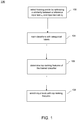
- Figure 1 illustrates a method 100 for generating a training data set that may be employed to train a machine-learning system (i.e., a deep-learning system) to generate summaries of a set of one or more input texts.
- the trained machine-learning system may then be employed to generate a summary of a passage (e.g., a set of user comments on a product), as described below with reference to Figure 3 .
- the disclosed training approach is based on self-supervision and does not require manual intervention to define a reference summary.
- Method 100 employs a plurality of input text sets ⁇ ⁇ , where each input text set is a collection of input texts relating to a same subject-matter, e.g. a particular venue or product of an entity, labelled with k.
- Method 100 comprises generating artificial examples by providing input texts (e.g. reviews) from that will act as target summaries s i and corresponding subsets D i of the input texts of the same entity labelled with n.
- the size of D i is fixed to be k and the method is focused on finding k good input texts D i for which s i is a good summary such that a relevancy measure or a similarity measure between D i and s i is maximized.
- the relevancy between D i and s i is measured according to the model of importance in summarization of Peyrard, "A Simple Theoretical Model of Importance for Summarization", in Proceedings of the 57th Annual Meeting of the Association for Computational Linguistics, pages 1059 to 1073, 2019 , which is hereby incorporated by reference in its entirety.
- the importance of a summary is based on the aspects of minimum redundancy, maximum relevance with the input document and maximum informativeness.
- the focus is on finding a relevant set of reviews D i for a summary s i .
- a predetermined number T of highest-ranking pairs are selected to be further processed to create training points (D i , s i ).
- informativeness is increased, because creation of training points where input texts and target output text are repetitive is reduced. For example, in reviews of a movie, the statement "great movie” may be used repetitively but has limited informative value.
- method step 102 which provides for a simple self-supervised solution of generating training points (D i , s i ), may be implemented efficiently using state-of-the-art nearest neighbor search libraries as, e.g., available from Python Scikit.
- the measure sim in Equations (1) and (2) is chosen as the cosine similarity over a TF-IDF bag of word representation of the input texts.
- Method 100 further comprises steps 104-108 to alleviate the problem of hallucinations.
- Hallucinations are pieces of generated text in summaries that bear no relationship to the text they were conditioned on. This may be caused by the training data containing a variety of contradictory signals or containing an excessive signal such as when a great number of input texts contain a similar statement such as "great movie”.
- the problem of hallucinations is exacerbated in approaches of the prior art that are self-supervised as the approach described in method step 102 above.
- the disclosed approach employs control tokens that represent desired traits of the output text to steer the generated text towards more input coherent summaries.
- the disclosed approach relies on control tokens inferred from metadata that are associated with each input text.
- Categorical metadata that represent the type of the entity the input text refers to such as "Deli”, “Beauty&Spa”, “Furniture store”, are employed.
- metadata labels such as "Deli”, "Beauty&Spa”, "Furniture store”.
- a subset of labelled examples is employed. Control tokens are then inferred by a trained classifier that has been trained employing the labelled examples.
- Other embodiments additionally employ metadata that represent a polarity of the input text.
- the polarity is a numerical value representing an average sentiment score of the input text.
- the disclosed approach relies on inferring control tokens that naturally occur in the input texts and represent informative aspects that occur therein.
- Ng. “Feature selection, L1 vs. L2 regularization, and rotational invariance”
- regularized classification models have intrinsic feature selection properties that have proven to generate relevant lexicons.
- Method 100 comprises training 104 a regularized linear classification model for each categorical token.
- the regularized linear classification model is trained with input texts having a given categorical token and negative examples sampled randomly from the rest of the input texts.
- the regularized linear classification model may comprise regularized linear classification models trained to classify a type of the entity the input text relates to and regularized linear classification models trained to classify a polarity of the input text.
- the regularized linear classification model is a linear support vector machine (SVM) classifier.
- SVM linear support vector machine
- the features of the SVMs are parameterized by the weight vector ⁇ l ⁇ R d , wherein d is the number of features.
- the features correspond to all unigrams and bigrams present in the plurality of input text sets.
- a squared hinge loss with L1 regularization over ⁇ i is employed to increase sparsity and force feature selection. The thereby obtained list is then trimmed to those features which correspond to positive weights and processed by renormalizing the weights.
- reference features that represents distinctive aspects of the given category corresponding to the categorical token are selected from the features of the trained regularized linear classification model.
- the reference features may be top-ranking words yielded from the classifiers corresponding to all categorical labels for the entity the input texts refer to.
- the labels of the entity correspond to the categorical labels of the reference summaries s i .
- Method step 106 involves collecting the features of the classifiers corresponding to the categorical labels of s i .
- Method step 106 may involve considering only these features that occur in the reference input text s i and selecting among these features the features with highest weight as a set of reference features.
- Method 100 further comprises step 108 of enriching each of the input texts in the input text subsets D i of the training points with tailored control codes from top-ranking words yielded from the classifiers corresponding to the entity to generate enriched training data.
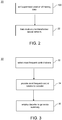
- Figure 2 illustrates a method for training a multi-sourced transformer neural network.
- Method 20 comprises creating, 100, enriched training data points according to the self-supervised approach, as described with reference to Figure 1 .
- Method 20 then comprises training 22 a multi-source transformer neural network employing the enriched training data, including the training points (D i , s i ), wherein the multi-source transformer neural network processes in parallel the input texts comprised in D i and is trained by setting the reference summary s i as a target.
- the multi-source transformer neural network employed will be described in detail with reference to Figures 5 to 8 below.
- the training of the multi-source transformer neural network may rely on a minimizing a log-likelihood loss with teacher forcing.
- Employing the enriched training data to train 22 the multi-source transformer neural network may comprise providing the respective control tokens to each cross-attention decoder layer of the multi-source transformer neural network to restrain an output of the cross-attention decoder layer.
- Figure 3 illustrates method steps of generating a summary of input texts at inference time.
- the trained machine-learning system is then configured to extract a short summary of multiple input texts (i.e. passages) that may, for example, reflect multiple opinions of humans on a product or service offered by an entity, such as a car, a hotel, or a movie.
- the most repeated control tokens from the input side are determined by determining the control tokens used for training and their frequency of usage.
- method step 34 the determined frequent control tokens are provided as a prefix to the decoder of the trained multi-source transformer neural network.
- the trained decoder of the multi-source transformer neural network generates a summary from the input texts.
- FIG 4 illustrates a block diagram of a system 40 for training a machine-learning system for multi-document summarization.
- System 40 comprises a relevance analysis module 42 that is configured to create training points of a reference input text and a maximally relevant subset of input texts, rank the pairs and select pairs with highest mutual relevancy, as described above with reference to step 102 of Figure 1 .
- System 40 further comprises regularized linear classification models 43 such as SVMs that are trained for classifying whether an input text belongs to a category defined by a categorical token of the corresponding reference input, as described with reference to step 104 of Figure 1 .
- regularized linear classification models 43 such as SVMs that are trained for classifying whether an input text belongs to a category defined by a categorical token of the corresponding reference input, as described with reference to step 104 of Figure 1 .
- Processing block 44 is configured to enrich the input texts with control tokens selected from the corresponding classifiers, as described with reference to steps 106 to 108 of Figure 1 to generate enriched training data.
- Multi-source transformer model 45 comprises an encoder pipeline of L multi-input encoder layers 46-1, 46-2, ..., 46-L, and a decoder pipeline of L cross-attention decoder layers 48-1,...,48-L.
- the first encoder layer 46-1 receives input of the multiple sources such as the subset of input texts D i during training.
- Each layer of multi-input encoder 46-i passes its output to the following layer 46-(i+1), up to the highest multi-input encoder layer 46-L.
- the top-most multi-input encoder layer 46-L is configured to provide its output to all layers of decoder pipeline 48-1, 48-2, ..., 48-L.
- the lowest decoder layer 48-1 receives input of the reference input texts s i that form a training point with a corresponding input text set D i fed to multi-input encoder layer 46-1.
- s i is right-shifted, so that multi-source transformer neural network 45 is trained in a teacher-forcing mode.
- Output of the top-most decoder layer 48-L is processed by a linear and softmax processing block 49 to produce output probabilities.
- Each cross-attention decoder layer 48-i may be configured to employ the control tokens of the enriched training data to train 22 as restraints for the output of the cross-attention decoder layer.
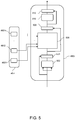
- Figure 5 illustrates the interaction of components of multi-source encoder layer 46-L and any of the cross-attention decoder layers 48-1 to 48-L.
- This architecture generalizes the transformer architecture of Vaswani et al, "Attention Is All You Need", 31st Conference on Neural Information Processing Systems, 2017 , which is hereby incorporated by reference in its entirety.
- each cross-attention decoder layer 480i processes its input by masked multi-head attention 502, which also receives direct input from the input of decoder 45. Then, signals are processed by multi-head attention network 506 which also receives m outputs of encoders 4601, 4602, ...460m comprised in multi-input encoder layer 46-L. Outputs of encoders 4601, 4602, ...460m correspond to the m input texts in D i , after subsequent processing by multi-input encoders 46-1, 46-2, ...46-L. Output of multi-head attention network 506 is processed by an add and norm block, which outputs to feedforward network 508 which is again followed by an add and norm block.
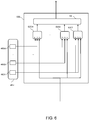
- Figure 6 illustrates an embodiment of a multi-source multi-head attention network 506 that comprises a plurality of multi-head attention networks 6201, ... 620m, where the plurality of multi-head attention networks 6201, ... 620m corresponds to the plurality of encoders 4601, ..., 460m.
- This embodiment is similar to the generalization of the Transformer model discussed in Libovicky, Helcl and Mare ⁇ ek, "Input Combination Strategies for a Multi-Source Transformer Decoder", in Proceedings of the 3rd Conference on Machine Translation: research papers, WMT2018, pages 253 to 260 , which is hereby incorporated by reference in its entirety.
- output of the plurality of encoders 4601, ..., 460m are processed in parallel by the corresponding multi-head attention network 6201, 6202,...,620m to produce a context between the inputs from the decoder pipeline and the encoder outputs.
- Each of the multi-heads attention networks 6201, 6202,...,620m comprises a number of heads that process in parallel the projections K i and V i of the output of the corresponding encoder 460i and a projection Q of the signal of the decoder pipeline.
- Projection Q of the signal of the decoder pipeline corresponds to signals passed from the previous decoder, or, for decoder 48-0, from input to the decoder pipeline.
- the projections are defined by learned parameter matrixes.
- Each of the parallel attention heads processes a reduced dimension of the size of the model. In embodiments the number of heads is 16, and the dimensions of K i , V i , Q is d model 16 .
- the decoder set of queries Q attends to each of the encoded inputs K i , V i separately.
- Figure 7 illustrates a block diagram of another embodiment of the multi-head attention network 506.
- output of all encoders 4601, ..., 460m is averaged by averaging component 72 before applying the attention mechanism.
- the set of keys K i and values V i coming from each input encoder 460i are aggregated using an average at each absolute position. Afterwards, the decoder set of queries attend to this aggregated set of keys and values.
- the decoder set of queries Q attend to this aggregated set of keys and values.
- Fig. 8 which comprises server 800 and one or more client devices 802 that communicate over a network 804 which may be wireless and/or wired, such as the Internet, for data exchange.
- Server 800 and the client devices 802 each include processor 812 and memory 813, such as a hard disk.
- Client devices 802 may be any devices that communicate with server 800, including autonomous vehicle 802b, robot 802b, computer 802d, or cell phone 802e. More precisely, in an embodiment, the system according to the embodiments of Figs. 1 and 2 may be implemented by server 800.
- Server 800 may implement the system 40 for training a machine-learning system for multi-document summarization. Server 800 may then perform generation of enriched training data, training of multi-source transformer neural network 45, and store training parameters of the multi-source transformer neural network 45. Server 800 may process a request received by a client device 802 for generation of a summary of input texts provided with the request. Server 800 may proceed according to method 300 described above, generate a summary of the input texts employing the stored trained multi-source transformer neural network 45 and provide the generated summary to the requesting client device 802.
- the embodiments described above may be implemented in hardware or in software.
- the implementation can be performed using a non-transitory storage medium such as a computer-readable storage medium, for example a floppy disc, a DVD, a Blu-Ray, a CD, a ROM, a PROM, and EPROM, an EEPROM or a FLASH memory.
- a computer-readable storage medium for example a floppy disc, a DVD, a Blu-Ray, a CD, a ROM, a PROM, and EPROM, an EEPROM or a FLASH memory.
- Such computer-readable media can be any available media that can be accessed by a general-purpose or special-purpose computer system.
- embodiments can be implemented as computer program products with a program code or computer-executable instructions, the program code or computer-executable instructions being operative for performing one of the methods when the computer program product runs on a computer.
- the program code or the computer-executable instructions may, for example, be stored on a computer-readable storage medium.
- a storage medium (or a data carrier, or a computer-readable medium) comprises, stored thereon, the computer program or the computer-executable instructions for performing one of the methods described herein when it is performed by a processor.
- SentencePiece Kudo and Richardson, "SentencePiece: A simple and language-independent subword tokenizer and de-tokenizer for neural text processing", in Proceedings of the 2018 Conference on Empirical Methods in Natural Language Processing .
- a Nesterov accelerated stochastic gradient descent optimizer with a learning rate of 0.01 has been used. All models have been trained for a total of 80,000 steps across 25 generations with a linear warm-up for the first 8,000 steps. For inference, a beam size of 35 was used and hypotheses that contain twice the same trigram, have been discarded.
- the disclosed model was evaluated for two large datasets, a Yelp dataset (Chu and Liu) containing approximately one million values for around 40,000 businesses, and a Rotten Tomatoes dataset constructed by Wang and Ling in "Neural Network based Abstract Generation for Opinions and Arguments", in Proceedings of the 2016 Conference of the North American Chapter of the Association for Competition Linguistics: Human language technologies, pages 47-55 .
- its eight most similar reviews have been taken to form the subset D i , as explained above.
- For the Yelp dataset around 440,000 training examples for 22,500 businesses is obtained.
- Table 1 shows a comparison of the disclosed system with three unsupervised comparison systems, TextRank (Mihalcea and Tarau, cited above), LexRank ( Radev et al, "Centroid-based Summarization of Multiple Documents", Information Processing and Management 46, 40(6):919 - 938, 2004 ), which are extractive systems based on the page rank algorithm, and Opinosis (Ganesan et al, cited above), which is an abstractive graph-based system.
- the openly available Python implementations for TextRank and LexRank are employed with default parameters of the implementations, while for Opinosis the publicly available version with default hyper-parameters is employed.
- Table 1 also comprises a comparison with neural unsupervised summarization systems of MeanSum (Chu and Liu) and H-VAE (Bra ⁇ inskas et al, cited above). For H-VAE, which is not available, results from the publication are employed, while for MeanSum the provided checkpoint is re-run. Table 1 shows ROUGE-F- ⁇ 1, 2, L ⁇ metrics ( Lin, "ROUGE: A Package for Automatic Evaluation of Summaries", in Text Summarization Branches Out, pp. 74-81, 2004 ).
- a BERTscore ( Zhang et al, "BERTScore: Evaluating Text Generation with BERT', in International Conference on Learning Representations, 2020 ) that employs a pre-trained BERT system to compute the semantic similarity between a candidate summary and the reference summary.
- Dist-n is an indicator for a repetitiveness within a single summary, while Dist c -n indicates the diversity of different generations.
- a classifier is used to assess the sentiment of the summary and check whether it is consistent with the sentiment of input reviews.
- Table 1 comprises results of a micro F-score of a multi-level category classifier to check whether the correct product category can be inferred from the summary.
- the disclosed multi-input self-supervised model consistently performs better in a Yelp dataset than the comparative models.
- the comparative models were chosen to only comprise the graph-based unsupervised methods because the released pre-trained MeanSum model does not cover the domain of movie reviews.
- the disclosed multi-input self-supervised model performs better, or at least equal, over all scores apart from the sentiment accuracy.
- the lower score in sentiment accuracy may be due to the fact that the summaries in the Rotten Tomatoes dataset are critical reviews that are written in a very different style than the reference summaries.
- Table 2 displays results of a referenceless evaluation where the number of distinct n-grams are scored on the summary level and on the corpus level.
- the disclosed model outperforms the comparative models which means that the multi-input self-supervised model is capable of generating richer and less repetitive summaries.
- the disclosed model generates text with more diversity than MeanSum.
- extractive models have more diversity on the corpus level as they directly copy from each input separately, while abstractive models tend to learn repetitive patterns present in the training set.
- Figure 9 shows summaries generated by different models from the same input.
- Text 902 is a text generated by the disclosed model. Words highlighted in darker shade are words that exactly match words from the input texts, while words highlighted in lighter shade have no support in the input texts.
- the disclosed model hence learned, in this example, to copy aspects of the input documents such as the restaurant's name, " Capriotti's ", and the menu item "the Bobbie” which can be attributed to the cross-attention mechanism in the disclosed model.
- a text 904 generated by MeanSum and a text 906 generated by TextRank are displayed which copy less aspects of the input documents to the summary.
- Table 3 Disclosed Model (DM) Quality Speed Train.
- Table 3 shows results of an ablation study of removing the control codes that are included in the training data, as described above. Removing the control codes degrades sentiment and category significantly and also degrades the ROUGE scores. Changing the decoder/encoder attention from the parallel implementation explained above with reference to Figure 7 , to the mean implementation described above with reference to Figure 8 , also degrades the ROUGE scores.
- Table 4 Faithfulness Gold Disclosed Model Meansum Correct 67 50 47 Incorrect 3 4 12 %Correct 95.71 92.59 79.66
- Table 4 shows results of a human evaluation of the summaries.
- a number of 94 summaries were annotated on a crowd sourcing platform.
- Three versions of summaries were compared, the reference summary, a summary generated by MeanSum and a summary produced by the disclosed model.
- Human users were asked if "the summary contains correct information, given the original reviews".
- 3 x 94 tasks were given, each task was labelled by three annotators, restricted to experienced English-speaking workers, who were paid 0.50 USD per annotation.
- 92.6% of the summaries generated by the disclosed system were considered factually correct, compared to 95.7% of the reference summaries and only 79.7% of the summaries generated with MeanSum.
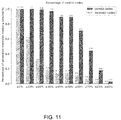
- Figures 10 and 11 relate to another analysis to score how rigidly the disclosed model follows the control codes.
- a set of 500 input reviews for 279 venues from the Yelp set were employed.
- 8 control tokens were randomly sampled from the control codes inferred as explained above. These 8 control tokens are referred to as "correct control tokens”.
- the decoder was run using the correct control tokens as prompt, and the proportion of the correct control tokens that also occur in the generated output text was counted. For comparison, this process is repeated with sampling 8 control tokens that do not occur in the input text, which are referred to as "incorrect control tokens".
- Figure 10 exemplarily shows summaries 1002, 1004 generated from a same input when the model is provided with correct control tokens, and summaries 1006, 1008 generated from the same input when the model is provided with incorrect control tokens. Words highlighted in darker shade are the correct control tokens, while words highlighted in lighter shade are the incorrect control tokens
- control codes are also learned in a self-supervised method and allow to steer an extended transformer model to produce high-quality summaries of input texts.
Landscapes
- Engineering & Computer Science (AREA)
- Theoretical Computer Science (AREA)
- Physics & Mathematics (AREA)
- General Physics & Mathematics (AREA)
- General Engineering & Computer Science (AREA)
- Data Mining & Analysis (AREA)
- Software Systems (AREA)
- Artificial Intelligence (AREA)
- Computational Linguistics (AREA)
- Evolutionary Computation (AREA)
- General Health & Medical Sciences (AREA)
- Mathematical Physics (AREA)
- Computing Systems (AREA)
- Health & Medical Sciences (AREA)
- Databases & Information Systems (AREA)
- Molecular Biology (AREA)
- Biophysics (AREA)
- Biomedical Technology (AREA)
- Life Sciences & Earth Sciences (AREA)
- Computer Vision & Pattern Recognition (AREA)
- Medical Informatics (AREA)
- Audiology, Speech & Language Pathology (AREA)
- Information Retrieval, Db Structures And Fs Structures Therefor (AREA)
- Machine Translation (AREA)
Abstract
Description
- Recently, unsupervised methods, relying on a bootstrapping approach of iteratively alternating between two representations and optimizing a reconstructional loss have led to breakthroughs in natural language processing applications (Artetxe et al, "Unsupervised neural machine translation", in 6th International Conference on Learning Representations, ICLR 2018; Lample et al, "Unsupervised machine translation using monolingual corpora only", in ICLR 2018 Conference Track Proceedings). A similar approach has been applied to video summarization (Yuan et al, "Cyclesum: cycle-consistent adversarial LSTM networks for unsupervised video summarization", in Proceedings of the AAAI Conference on Artificial Intelligence, volume 33, pp. 9143-9150, 2019), but unsupervised approaches of the prior art for summarization of text have relied mostly on extractive graph-based systems (Mihalcea and Tarau, "TextRank: Bringing order into text', in Proceedings of EMNLP 2004, pp. 404-411, 2004). Graph-based abstractive methods (Ganesan et al. "Opinosis: A graph based approach to abstractive summarization of highly redundant opinions". In Proceedings of the 23rd International Conference on Computational Linguistics 2010, pp. 340-348; Nayeem et al. "Abstractive unsupervised multi-document summarization using paraphrastic sentence fusion", in Proceedings of the 27th International Conference on Computational Linguistics, pp. 1191-1204) construct graphs whose nodes are the sentences from the input document and whose edges indicate a high word overlap between two sentences. A summary of an input document can be formed by finding salient paths in this type of graph such as by employing the PageRank algorithm.
- Abstractive methods for summarization in contrast involve generating new words and sentences that do not occur in the input document. Recently, methods for unsupervised abstractive summarization using autoencoders have been proposed in Braž̌̌̌inskas et al, "Multi-Document Opinion Summarization as Copycat-Review Generation", arXiv: 1911.02247, 2019. This approach however requires a complex combination of loss functions or hierarchical latent variables to ensure that the generated summaries remain within the topic of the text to be summarized.
- Unsupervised methods for abstractive summarization have been proposed in Chu and Liu, "Meansum: A neural model for unsupervised multi-document abstractive summarization", in Proceedings of the 36th International Conference on Machine Learning, ICML 2019, which employ a review autoencoder. According to this approach, every input document for a topic is encoded in a vector and the centroid of the vectors is employed to seed a decoder to generate a summary. However, averaging representations of input documents, that are sometimes contradictory, leads to the generation of "hallucinations" as output.
- To overcome the latter problem, Coavoux et al, "Unsupervised aspect-based multi-document abstractive summarization, in Proceedings of the 2nd Workshop on New Frontiers in Summarization, pp. 42-47, 2019 proposed to add a clustering to identify similar input documents and to generate one sentence per cluster, so that the averaging only targets similar input documents, overcoming the problem of the decoder hallucinations.
- Another approach to overcome the problem of hallucinations that has been investigated is the application of global constraints on text generation. According to methods discussed in the literature, policy gradient methods such as Reinforce (Williams, "Simple statistical gradient-following algorithms for connectionist reinforcement learning", Machine learning, 8(3-4):229-256, 1992) have been applied to numerous applications. In other approaches, control is applied only at inference time using weighted decoding (Holtzman et al, "Learning to write with cooperative discriminators", in Proceedings of the 56th Annual Meeting of the Association for Computational Linguistics, Volume 1, pp. 1638-1649), which however was shown to be challenging and implying low fluency and coherence.
- Control codes in neural generation models have been implemented to steer largescale language models towards desired traits (Keskar et al. "CTRL: A conditional transformer language model for controllable generation". CoRR abs/1909.05858. 2019). These approaches however rely on a predefined set of bags of control tokens collected manually or from dictionaries, which implies low domain coverage.
- In this disclosure, methods of self-supervised generation of enriched training data for a multi-source transformer neural network for multi-document summarization summarizing input text are described. In embodiments, the training data are employed to train a multi-input transformer neural network. The disclosed method involves generating control codes to ensure that the output reflects the input signal and thereby avoid "hallucinations".
- In an embodiment, a method of generating enriched training data for multi-document summarization is described, comprising creating, from a plurality of input text sets, training points each comprising an input text subset of the input text set and a corresponding reference input text from the input text set, wherein creating the training points comprises providing a similarity between the reference input text and the input text subset, wherein the size of the subset is a predetermined number. Creating the training points may comprise selecting the input text subset and the corresponding reference input text such that the input text subset and the corresponding reference input text achieve a maximum similarity measure.
- The method further comprises training a plurality of classifiers for a plurality of categorical labels, each classifier classifying whether an input text falls under a categorical label from the plurality of categorical labels.
- The method comprises collecting, for each training point, weights for reference feature from the plurality of trained classifiers, comprising selecting the reference features from the trained classifiers corresponding to categorical labels of the respective reference input text, and selecting, for each input text in the subsets of the training point, based on the weights for the reference features, control tokens from the reference features and enriching the input text with the selected control token to generate enriched training data. In embodiments, the method may in particular comprise collecting, for each training point, features of the trained classifiers corresponding to categorical labels of the respective reference input text and weights associated with the features, selecting, for each input text in the input text subsets of the training points, based on the collected weights and associated features, control tokens from the features and enriching the input text with the selected control token to generate enriched training data.
- According to an aspect, the method may further comprise training a multi-source transformer neural network with the enriched training data, the multi-source transformer neural network comprising an encoder pipeline of multi-input encoder layers and a corresponding decoder pipeline of cross-attention decoder layers, wherein a number of encoders comprised in each of the encoder layers corresponds to the predetermined number (m), said multi-source transformer neural network adapted to generate a summary of input text when the input text is not in the plurality of input text sets. According to an aspect, enriching the input text with the selected control token may comprise providing the respective control tokens to each cross-attention decoder layer of the multi-source transformer neural network to restrain an output of the cross-attention decoder layer.
- According to a further aspect, training the multi-source transformer neural network with the enriched training data may comprise feeding each of the encoders of a first encoder layer of the encoder pipeline with the enriched input text from the subsets.
- According to another embodiment, selecting, for each input text in the subsets of the training point, the control tokens may comprise selecting a predetermined number of highest weighted reference features that correspond to words in the corresponding reference input text.
- According to an aspect, training the plurality of classifiers may comprise employing meta-data annotations of the input texts as categorical labels, and may also comprise employing a determined polarity of the input text.
- According to yet another aspect, providing the similarity between the reference input texts and the corresponding subset of the input text may comprise, for each input text, selecting the input text subset to achieve a maximum similarity between the reference input text and the input text subset. The similarity may be determined as a sum of similarity measures between the reference input text and each of the input texts in the input text subset.
- According to a further aspect, providing a similarity between the reference input texts and the corresponding subset of the input text further may comprise ranking pairs of input texts and corresponding subsets by the similarity between the respective input text and the respective corresponding set of input texts and choosing a predetermined number of highest ranking pairs as the training points. According to an aspect, optimizing the similarity between the reference input texts and the corresponding subset comprises employing a nearest neighbor search algorithm.
- According to an embodiment, training the plurality of classifiers for a plurality of categorical labels comprises training each of a plurality of linear support vector machines for classifying whether an input text falls under one of the categorical labels.
- According to an aspect, training the plurality of classifiers comprises selecting the features of the classifier as the number of all unigrams and bigrams in the set of input texts.
- In an embodiment, training the multi-source transformer neural network with the training data comprises calculating averages of keys and averages of values of each of the encoders and configuring a multi-head attention network to attend to a set of decoder queries and to the averages of keys and the averages of values.
- In another embodiment, a machine-learning system for generating enriched training data for a multi-source transformer neural network for multi-document summarization summarizing input text is disclosed. The system comprises a relevance analysis module configured to create, from an input text set, training points comprising a reference input text from the input text set and an input text subset of the input text set, wherein creating the training point comprises selecting an input texts as reference input text and optimizing the corresponding subset achieving a maximum similarity, a plurality of classifiers for classifying whether an input text falls under a categorical label, and means for collecting, for each training point, weighted reference feature weights from the plurality of classifiers, wherein the reference features are selected from classifiers corresponding to categorical labels of the respective reference input text. The system further comprises means for selecting, for each input text in the subsets of the training point, control tokens from the reference features and enriching each input text with the respectively selected control token to generate enriched training data.
- In particular embodiments, the system may comprise means for collecting, for each training point, features of the trained classifiers corresponding to categorical labels of the respective reference input text and weights associated with the features, and for selecting, for each input text in the input text subsets of the training points, based on the collected weights and associated features, control tokens from the features and for enriching the each input text with the respectively selected control token to generate enriched training data.
- The system may further comprise the multi-source transformer neural network adapted to generate a summary of input text when the input text is not in the plurality of input text sets, the multi-source transformer neural network comprising an encoder pipeline of multi-input encoder layers and a corresponding decoder pipeline of cross-attention decoder layers, wherein each cross-attention decoder layer comprises a multi-input multi-head attention network, wherein a number of encoders comprised in each of the encoder layers corresponds to a predetermined number.
- According to a further aspect, the multi-source multi-head attention network may comprise a plurality of multi-head attention network corresponding to the predetermined number, wherein each multi-head attention network is configured to receive keys and values from one of the encoders of the last multi-input encoder layer.
- According to an alternative aspect, the multi-source multi-head attention network may comprise an averaging component and a multi-head attention network, wherein the averaging component is configured to calculate averages of keys and averages of values, the keys and values respectively provided by the encoders of the last multi-input encoder layer, and wherein the multi-head attention network is configured to attend to a set of decoder queries and to the average of keys and the average of values provided by the averaging component.
- The accompanying drawings are incorporated into the specification for the purpose of explaining the principles of the embodiments. The drawings are not to be construed as limiting the invention to only the illustrated and described embodiments or to how they can be made and used. Further features and advantages will become apparent from the following and, more particularly, from the description of the embodiments as illustrated in the accompanying drawings, wherein:
-
Figure 1 is a flow diagram of a method for self-supervised generation of enriched training data from a plurality of input text sets; -
Figure 2 shows a flow diagram of a method for training a multi-source transformer neural network; -
Figure 3 illustrates a flow diagram of a method employing a trained multi-source transformer neural network to generate a summary of a plurality of input texts; -
Figure 4 illustrates a block diagram of components employed for self-supervised generation of enriched training data from a set of input texts and for training a multi-source transformer neural network with the enriched generated training data; -
Figure 5 shows a block diagram of multi-input encoder layers and cross-attention decoder layers of a multi-source transformer neural network; -
Figure 6 shows a block diagram of a multi-source cross-attention network for parallel combination of multiple encoder output; -
Figure 7 shows a block diagram of a multi-source cross-attention network for mean combination of multiple encoder output; -
Figure 8 illustrates an example computing environment in which the disclosed methods may be performed; -
Figure 9 reproduces texts of summaries generated by systems of the prior art and by the here disclosed system; -
Figure 10 reproduces texts of summaries generated by the disclosed system employing correct or incorrect control tokens; and -
Figure 11 is a diagram showing the proportion of control codes that occur in the output text generated by the disclosed system. - Methods and systems for training a deep learning system (i.e. a multi-source transformer neural network) for generation of a summary of one or more passages of input text relating to a subject matter (e.g. an entity). For example, the input texts can be reviews or user comments for a service offered by an entity at a venue such as a hotel or a product offered for sale or lease by an entity. For purposes of explanation, examples and specific details are set forth in order to provide a thorough understanding of the embodiments. Embodiments, as defined by the claims, may include some or all of the features in these examples alone or in combination with the other features described below, and may further include modifications and the equivalence of the features and concepts described herein. The following description will refer to
Figures 1 to 11 , explaining embodiments and technical advantages in detail. -
Figure 1 illustrates amethod 100 for generating a training data set that may be employed to train a machine-learning system (i.e., a deep-learning system) to generate summaries of a set of one or more input texts. In embodiments, the trained machine-learning system may then be employed to generate a summary of a passage (e.g., a set of user comments on a product), as described below with reference toFigure 3 . The disclosed training approach is based on self-supervision and does not require manual intervention to define a reference summary. -
Method 100 employs a plurality of input text sets {}, where each input text set is a collection of input texts relating to a same subject-matter, e.g. a particular venue or product of an entity, labelled with k.
Method 100 comprises generating artificial examples by providing input texts (e.g. reviews) fromthat will act as target summaries si and corresponding subsets Di of the input texts of the same entity labelled with n. To limit the number of possible combinations of selecting Di and si, the size of Di is fixed to be k and the method is focused on finding k good input texts Di for which si is a good summary such that a relevancy measure or a similarity measure between Di and si is maximized.
- In embodiments, the relevancy between Di and si is measured according to the model of importance in summarization of Peyrard, "A Simple Theoretical Model of Importance for Summarization", in Proceedings of the 57th Annual Meeting of the Association for Computational Linguistics, pages 1059 to 1073, 2019, which is hereby incorporated by reference in its entirety. According to this approach, the importance of a summary is based on the aspects of minimum redundancy, maximum relevance with the input document and maximum informativeness. In the here disclosed approach, the focus is on finding a relevant set of reviews Di for a summary si.
- Accordingly,
step 102 comprises selecting a set rel(di) = {di1 , di2 ,..., dik } as a subset of Di of size m that maximizes the mutual similarity between si and the set rel(di) according to

- Then, a predetermined number T of highest-ranking pairs are selected to be further processed to create training points (Di, si). By limiting the number T of pairs for training, informativeness is increased, because creation of training points where input texts and target output text are repetitive is reduced. For example, in reviews of a movie, the statement "great movie" may be used repetitively but has limited informative value.
- In addition,
method step 102, which provides for a simple self-supervised solution of generating training points (Di, si), may be implemented efficiently using state-of-the-art nearest neighbor search libraries as, e.g., available from Python Scikit. In embodiments, the measure sim in Equations (1) and (2) is chosen as the cosine similarity over a TF-IDF bag of word representation of the input texts. -
Method 100 further comprises steps 104-108 to alleviate the problem of hallucinations. Hallucinations are pieces of generated text in summaries that bear no relationship to the text they were conditioned on. This may be caused by the training data containing a variety of contradictory signals or containing an excessive signal such as when a great number of input texts contain a similar statement such as "great movie". The problem of hallucinations is exacerbated in approaches of the prior art that are self-supervised as the approach described inmethod step 102 above. - The disclosed approach employs control tokens that represent desired traits of the output text to steer the generated text towards more input coherent summaries. The disclosed approach relies on control tokens inferred from metadata that are associated with each input text.
- Categorical metadata that represent the type of the entity the input text refers to, such as "Deli", "Beauty&Spa", "Furniture store", are employed. When, however, none of the input texts have metadata labels, as is the case in the Rotten Tomatoes data set employed for demonstrating the capabilities of the disclosed approach, a subset of labelled examples is employed. Control tokens are then inferred by a trained classifier that has been trained employing the labelled examples.
- Other embodiments additionally employ metadata that represent a polarity of the input text. The polarity is a numerical value representing an average sentiment score of the input text. The disclosed approach relies on inferring control tokens that naturally occur in the input texts and represent informative aspects that occur therein. As shown e.g. by Ng. "Feature selection, L1 vs. L2 regularization, and rotational invariance", in Proceedings of the 21th international conference on Machine learning, pp. 78, 2004, regularized classification models have intrinsic feature selection properties that have proven to generate relevant lexicons.
-
Method 100 comprises training 104 a regularized linear classification model for each categorical token. The regularized linear classification model is trained with input texts having a given categorical token and negative examples sampled randomly from the rest of the input texts. - In embodiments, the regularized linear classification model may comprise regularized linear classification models trained to classify a type of the entity the input text relates to and regularized linear classification models trained to classify a polarity of the input text.
- In an embodiment, the regularized linear classification model is a linear support vector machine (SVM) classifier. The features of the SVMs are parameterized by the weight vector

- In embodiments, the features correspond to all unigrams and bigrams present in the plurality of input text sets. In embodiments, a squared hinge loss with L1 regularization over θi is employed to increase sparsity and force feature selection. The thereby obtained list is then trimmed to those features which correspond to positive weights and processed by renormalizing the weights.
- The process of training a regularized linear classification model and selecting features to obtain a ranked list of features, is repeated for all categories defined by the categorical tokens.
- In
method step 106, for each training point, reference features that represents distinctive aspects of the given category corresponding to the categorical token are selected from the features of the trained regularized linear classification model. The reference features may be top-ranking words yielded from the classifiers corresponding to all categorical labels for the entity the input texts refer to. Here, the labels of the entity correspond to the categorical labels of the reference summaries si .Method step 106 involves collecting the features of the classifiers corresponding to the categorical labels of si .Method step 106 may involve considering only these features that occur in the reference input text si and selecting among these features the features with highest weight as a set of reference features. -
Method 100 further comprises step 108 of enriching each of the input texts in the input text subsets Di of the training points with tailored control codes from top-ranking words yielded from the classifiers corresponding to the entity to generate enriched training data. -
Figure 2 illustrates a method for training a multi-sourced transformer neural network.Method 20 comprises creating, 100, enriched training data points according to the self-supervised approach, as described with reference toFigure 1 . -
Method 20 then comprises training 22 a multi-source transformer neural network employing the enriched training data, including the training points (Di, si), wherein the multi-source transformer neural network processes in parallel the input texts comprised in Di and is trained by setting the reference summary si as a target. The multi-source transformer neural network employed will be described in detail with reference toFigures 5 to 8 below. The training of the multi-source transformer neural network may rely on a minimizing a log-likelihood loss with teacher forcing. - Employing the enriched training data to train 22 the multi-source transformer neural network may comprise providing the respective control tokens to each cross-attention decoder layer of the multi-source transformer neural network to restrain an output of the cross-attention decoder layer.
-
Figure 3 illustrates method steps of generating a summary of input texts at inference time. The trained machine-learning system is then configured to extract a short summary of multiple input texts (i.e. passages) that may, for example, reflect multiple opinions of humans on a product or service offered by an entity, such as a car, a hotel, or a movie. - In in
method step 32, the most repeated control tokens from the input side are determined by determining the control tokens used for training and their frequency of usage. - In
method step 34 the determined frequent control tokens are provided as a prefix to the decoder of the trained multi-source transformer neural network. Inmethod step 36, the trained decoder of the multi-source transformer neural network generates a summary from the input texts. -
Figure 4 illustrates a block diagram of asystem 40 for training a machine-learning system for multi-document summarization.System 40 comprises arelevance analysis module 42 that is configured to create training points of a reference input text and a maximally relevant subset of input texts, rank the pairs and select pairs with highest mutual relevancy, as described above with reference to step 102 ofFigure 1 . -
System 40 further comprises regularizedlinear classification models 43 such as SVMs that are trained for classifying whether an input text belongs to a category defined by a categorical token of the corresponding reference input, as described with reference to step 104 ofFigure 1 . - Processing
block 44 is configured to enrich the input texts with control tokens selected from the corresponding classifiers, as described with reference tosteps 106 to 108 ofFigure 1 to generate enriched training data. - The enriched training points are processed by multi-source transformer
neural network 45.Multi-source transformer model 45 comprises an encoder pipeline of L multi-input encoder layers 46-1, 46-2, ..., 46-L, and a decoder pipeline of L cross-attention decoder layers 48-1,...,48-L. The first encoder layer 46-1 receives input of the multiple sources such as the subset of input texts Di during training. Each layer of multi-input encoder 46-i passes its output to the following layer 46-(i+1), up to the highest multi-input encoder layer 46-L. In embodiments, L=6 is chosen. - The top-most multi-input encoder layer 46-L is configured to provide its output to all layers of decoder pipeline 48-1, 48-2, ..., 48-L. The lowest decoder layer 48-1 receives input of the reference input texts si that form a training point with a corresponding input text set Di fed to multi-input encoder layer 46-1. When inputting si to decoder layer 48-1, si is right-shifted, so that multi-source transformer
neural network 45 is trained in a teacher-forcing mode. Output of the top-most decoder layer 48-L is processed by a linear andsoftmax processing block 49 to produce output probabilities. - Each cross-attention decoder layer 48-i may be configured to employ the control tokens of the enriched training data to train 22 as restraints for the output of the cross-attention decoder layer.
-
Figure 5 illustrates the interaction of components of multi-source encoder layer 46-L and any of the cross-attention decoder layers 48-1 to 48-L. This architecture generalizes the transformer architecture of Vaswani et al, "Attention Is All You Need", 31st Conference on Neural Information Processing Systems, 2017, which is hereby incorporated by reference in its entirety. - As illustrated in
Figure 5 , eachcross-attention decoder layer 480i processes its input by maskedmulti-head attention 502, which also receives direct input from the input ofdecoder 45. Then, signals are processed bymulti-head attention network 506 which also receives m outputs ofencoders encoders multi-head attention network 506 is processed by an add and norm block, which outputs tofeedforward network 508 which is again followed by an add and norm block. -
Figure 6 illustrates an embodiment of a multi-sourcemulti-head attention network 506 that comprises a plurality ofmulti-head attention networks 6201, ... 620m, where the plurality ofmulti-head attention networks 6201, ... 620m corresponds to the plurality ofencoders 4601, ..., 460m. This embodiment is similar to the generalization of the Transformer model discussed in Libovicky, Helcl and Mareček, "Input Combination Strategies for a Multi-Source Transformer Decoder", in Proceedings of the 3rd Conference on Machine Translation: research papers, WMT2018, pages 253 to 260, which is hereby incorporated by reference in its entirety. - In the embodiment of
Figure 6 , output of the plurality ofencoders 4601, ..., 460m are processed in parallel by the correspondingmulti-head attention network multi-heads attention networks - As described in Vaswani et al., the projections are defined by learned parameter matrixes. Each of the parallel attention heads processes a reduced dimension of the size of the model. In embodiments the number of heads is 16, and the dimensions of Ki, Vi, Q is

- According to the embodiment of
Figure 7 , the outputs of the attention multi-heads 6201, 6202, ... 620m are averaged by averagingblock 64. Accordingly, the processing, according to the embodiment ofFigure 7 , corresponds to evaluating
Figure 6 , the decoder set of queries Q attends to each of the encoded inputs Ki, Vi separately. -
Figure 7 illustrates a block diagram of another embodiment of themulti-head attention network 506. In this embodiment, output of allencoders 4601, ..., 460m is averaged by averagingcomponent 72 before applying the attention mechanism. In this approach, the set of keys Ki and values Vi coming from each input encoder 460i are aggregated using an average at each absolute position. Afterwards, the decoder set of queries attend to this aggregated set of keys and values. Accordingly, instead of Equation 3, the multi-head attention network, according to the embodiment ofFigure 8 , corresponds to
- Hence, according to the embodiment of
Figure 7 , the decoder set of queries Q attend to this aggregated set of keys and values. - The above-mentioned systems, methods and embodiments may be implemented within an architecture such as that illustrated in
Fig. 8 , which comprisesserver 800 and one or more client devices 802 that communicate over anetwork 804 which may be wireless and/or wired, such as the Internet, for data exchange.Server 800 and the client devices 802 each include processor 812 and memory 813, such as a hard disk. Client devices 802 may be any devices that communicate withserver 800, includingautonomous vehicle 802b,robot 802b,computer 802d, orcell phone 802e. More precisely, in an embodiment, the system according to the embodiments ofFigs. 1 and2 may be implemented byserver 800. -
Server 800 may implement thesystem 40 for training a machine-learning system for multi-document summarization.Server 800 may then perform generation of enriched training data, training of multi-source transformerneural network 45, and store training parameters of the multi-source transformerneural network 45.Server 800 may process a request received by a client device 802 for generation of a summary of input texts provided with the request.Server 800 may proceed according to method 300 described above, generate a summary of the input texts employing the stored trained multi-source transformerneural network 45 and provide the generated summary to the requesting client device 802. - The embodiments described above may be implemented in hardware or in software. The implementation can be performed using a non-transitory storage medium such as a computer-readable storage medium, for example a floppy disc, a DVD, a Blu-Ray, a CD, a ROM, a PROM, and EPROM, an EEPROM or a FLASH memory. Such computer-readable media can be any available media that can be accessed by a general-purpose or special-purpose computer system.
- Generally, embodiments can be implemented as computer program products with a program code or computer-executable instructions, the program code or computer-executable instructions being operative for performing one of the methods when the computer program product runs on a computer. The program code or the computer-executable instructions may, for example, be stored on a computer-readable storage medium.
- In an embodiment, a storage medium (or a data carrier, or a computer-readable medium) comprises, stored thereon, the computer program or the computer-executable instructions for performing one of the methods described herein when it is performed by a processor.
- The model was implemented with PyTorch, fairseq and Scikit-learn for the classifiers. SentencePiece (Kudo and Richardson, "SentencePiece: A simple and language-independent subword tokenizer and de-tokenizer for neural text processing", in Proceedings of the 2018 Conference on Empirical Methods in Natural Language Processing.
- Parameters of the multi-source transformer model are size of the model, dmodel = 1024, number of heads nheads = 16, number of layers L = 6, and dropout = 0.1. In optimization, a Nesterov accelerated stochastic gradient descent optimizer with a learning rate of 0.01 has been used. All models have been trained for a total of 80,000 steps across 25 generations with a linear warm-up for the first 8,000 steps. For inference, a beam size of 35 was used and hypotheses that contain twice the same trigram, have been discarded.
- The disclosed model was evaluated for two large datasets, a Yelp dataset (Chu and Liu) containing approximately one million values for around 40,000 businesses, and a Rotten Tomatoes dataset constructed by Wang and Ling in "Neural Network based Abstract Generation for Opinions and Arguments", in Proceedings of the 2016 Conference of the North American Chapter of the Association for Competition Linguistics: Human language technologies, pages 47-55. From the Yelp dataset for each business, the best candidates have been used as reference summaries, either the top 15% or the top 100 reviews (T=100), whichever is smaller. For each reference summary, its eight most similar reviews have been taken to form the subset Di, as explained above. For the Yelp dataset, around 440,000 training examples for 22,500 businesses is obtained. Similarly, for the Rotten Tomatoes dataset, either the top 1% of best summaries or the top 150 top summaries (T=150), whichever is smaller, are selected. For each of these top-ranked summaries,

- 8 most similar reviews are selected as corresponding input text subsets, yielding around 170,000 training examples representing 3,700 movies.
- Table 1 shows a comparison of the disclosed system with three unsupervised comparison systems, TextRank (Mihalcea and Tarau, cited above), LexRank (Radev et al, "Centroid-based Summarization of Multiple Documents", Information Processing and ), which are extractive systems based on the page rank algorithm, and Opinosis (Ganesan et al, cited above), which is an abstractive graph-based system. The openly available Python implementations for TextRank and LexRank are employed with default parameters of the implementations, while for Opinosis the publicly available version with default hyper-parameters is employed.
- Table 1 also comprises a comparison with neural unsupervised summarization systems of MeanSum (Chu and Liu) and H-VAE (Bražinskas et al, cited above). For H-VAE, which is not available, results from the publication are employed, while for MeanSum the provided checkpoint is re-run. Table 1 shows ROUGE-F-{1, 2, L} metrics (Lin, "ROUGE: A Package for Automatic Evaluation of Summaries", in Text Summarization Branches Out, pp. 74-81, 2004). A BERTscore (Zhang et al, "BERTScore: Evaluating Text Generation with BERT', in International Conference on Learning Representations, 2020) that employs a pre-trained BERT system to compute the semantic similarity between a candidate summary and the reference summary. The metrics Dist-n and Distc-n (n = 1, 2, 3) score the percentage of distinct n-grams in the generated text on the summary level or the corpus level (Li et al, "A Diversity-Promoting Objective Function for Neural Conversation Models", in Proceedings of the 2016 Conference of the North American Chapter of the Association for Computational Linguistics: Human language technologies, pp. 110 to 119). Dist-n is an indicator for a repetitiveness within a single summary, while Distc-n indicates the diversity of different generations. Finally, a classifier is used to assess the sentiment of the summary and check whether it is consistent with the sentiment of input reviews. Finally, Table 1 comprises results of a micro F-score of a multi-level category classifier to check whether the correct product category can be inferred from the summary.
- As is evident from Table 1, the disclosed multi-input self-supervised model consistently performs better in a Yelp dataset than the comparative models.
- For the Rotten Tomatoes dataset, the comparative models were chosen to only comprise the graph-based unsupervised methods because the released pre-trained MeanSum model does not cover the domain of movie reviews. As is evident, the disclosed multi-input self-supervised model performs better, or at least equal, over all scores apart from the sentiment accuracy. The lower score in sentiment accuracy may be due to the fact that the summaries in the Rotten Tomatoes dataset are critical reviews that are written in a very different style than the reference summaries.

- Table 2 displays results of a referenceless evaluation where the number of distinct n-grams are scored on the summary level and on the corpus level. As is evident on the summary level, the disclosed model outperforms the comparative models which means that the multi-input self-supervised model is capable of generating richer and less repetitive summaries. On the level of all generations, the disclosed model generates text with more diversity than MeanSum. However, extractive models have more diversity on the corpus level as they directly copy from each input separately, while abstractive models tend to learn repetitive patterns present in the training set.
-
Figure 9 shows summaries generated by different models from the same input.Text 902 is a text generated by the disclosed model. Words highlighted in darker shade are words that exactly match words from the input texts, while words highlighted in lighter shade have no support in the input texts. The disclosed model hence learned, in this example, to copy aspects of the input documents such as the restaurant's name, "Capriotti's", and the menu item "the Bobbie" which can be attributed to the cross-attention mechanism in the disclosed model. For comparison, atext 904 generated by MeanSum, and atext 906 generated by TextRank are displayed which copy less aspects of the input documents to the summary.Table 3 Disclosed Model (DM) Quality Speed Train. (wps) ROUGE-1 ROUGE-2 ROUGE-L F BERT Sentiment Acc. F category DMParallel 32.8 8.7 18.8 86.8 83.9 55.2 3785 DMMean 29.4 5.3 17.2 87.6 83.4 56.2 8075 DMParallel - cntrl. 25.3 3.7 15.5 85.2 76.9 43.9 7609 DMMean cntrl. 27.5 5.3 17.1 87.3 80.0 52.1 8714 - Table 3 shows results of an ablation study of removing the control codes that are included in the training data, as described above. Removing the control codes degrades sentiment and category significantly and also degrades the ROUGE scores. Changing the decoder/encoder attention from the parallel implementation explained above with reference to
Figure 7 , to the mean implementation described above with reference toFigure 8 , also degrades the ROUGE scores.Table 4 Faithfulness Gold Disclosed Model Meansum Correct 67 50 47 Incorrect 3 4 12 %Correct 95.71 92.59 79.66 - Table 4 shows results of a human evaluation of the summaries. To produce the results of Table 4, a number of 94 summaries were annotated on a crowd sourcing platform. Three versions of summaries were compared, the reference summary, a summary generated by MeanSum and a summary produced by the disclosed model. Human users were asked if "the summary contains correct information, given the original reviews". In total, 3 x 94 tasks were given, each task was labelled by three annotators, restricted to experienced English-speaking workers, who were paid 0.50 USD per annotation. As Table 4 shows, 92.6% of the summaries generated by the disclosed system were considered factually correct, compared to 95.7% of the reference summaries and only 79.7% of the summaries generated with MeanSum.
-
Figures 10 and11 relate to another analysis to score how rigidly the disclosed model follows the control codes. A set of 500 input reviews for 279 venues from the Yelp set were employed. For each input example, 8 control tokens were randomly sampled from the control codes inferred as explained above. These 8 control tokens are referred to as "correct control tokens". The decoder was run using the correct control tokens as prompt, and the proportion of the correct control tokens that also occur in the generated output text was counted. For comparison, this process is repeated with sampling 8 control tokens that do not occur in the input text, which are referred to as "incorrect control tokens". -
Figure 10 exemplarily showssummaries summaries - In
Figure 11 , the proportion of fed control codes that occur in the generated output text is displayed. As is evident, the disclosed system tends to comply with the correct control tokens so that 89% of the summaries contain more than 50% of the control tokens found. The columns in lighter shade shows that fraction of incorrect control codes that occur in the output texts when the system is fed with incorrect control codes. - The results of
Figure 11 imply that the multi-source transformer neural network ignores control tokens when they do not occur in the input texts, i.e. when arbitrary codes are fed that are not constructed as explained above with reference toFigure 1 . - Thus, the methods and systems disclosed herewith allow for self-supervised training for multi-input summarization. Control codes are also learned in a self-supervised method and allow to steer an extended transformer model to produce high-quality summaries of input texts.
Claims (15)
- A method of generating enriched training data for a multi-source transformer neural network for generation of a summary of one or more passages of input text, the method comprising:creating (102), from a plurality of input text sets, training points each comprising an input text subset of the input text set and a corresponding reference input text from the input text set, wherein creating the training points comprises providing a similarity between the reference input text and the input text subset, wherein the size of the input text subset is a predetermined number (k);training (104) a plurality of classifiers for a plurality of categorical labels, each classifier classifying whether an input text falls under a categorical label from the plurality of categorical labels;collecting (106), for each training point, weights for reference features from the plurality of trained classifiers, comprising selecting the reference features from the trained classifiers corresponding to categorical labels of the respective reference input text; andselecting (108), for each input text in the input text subsets of the training points, based on the weights for the reference features, control tokens from the reference features and enriching the input text with the selected control tokens to generate enriched training data.
- The method of claim 1, further comprising training (22) a multi-source transformer neural network with the enriched training data, the multi-source transformer neural network comprising an encoder pipeline of multi-input encoder layers and a corresponding decoder pipeline of cross-attention decoder layers, wherein a number of encoders comprised in each of the encoder layers corresponds to the predetermined number (k), said multi-source transformer neural network adapted to generate a summary of passages of input text when the passages of input text are not in the plurality of input text sets.
- The method of claim 2, wherein enriching the input text with the selected control tokens comprises providing the respective control tokens to each cross-attention decoder layer of the multi-source transformer neural network to restrain an output of the cross-attention decoder layer.
- The method of claim 2, wherein training (24) the multi-source transformer neural network with the enriched training data comprises feeding each of the encoders of a first encoder layer of the encoder pipeline with the enriched input text from the subsets.
- The method of one of the preceding claims, wherein selecting (108), for each input text in the input text subsets of the training points, the control tokens comprises selecting a predetermined number of highest weighted reference features that correspond to words in the corresponding reference input text.
- The method of one of the preceding claims, wherein training (104) the plurality of classifiers comprises employing meta-data annotations of the input texts as categorical labels.
- The method of claim 6, wherein training (104) the plurality of classifiers further comprises employing a determined polarity of the input text.
- The method of one of the preceding claims, wherein providing the similarity between the reference input text and the input text subset comprises, for each input text, selecting the input text subset to achieve a maximum similarity between the reference input text and the input text subset, the similarity being determined as a sum of similarity measures between the reference input text and each of the input texts in the input text subset.
- The method of claim 8, wherein providing the similarity between the reference input text and the input text subset further comprises ranking pairs of input texts and corresponding subsets by the similarity between the respective input text and the respective corresponding input text subset and choosing a predetermined number of highest ranking pairs as the training points.
- The method of one of the preceding claims, wherein training (104) the plurality of classifiers for the plurality of categorical labels comprises training each of a plurality of linear support vector machines for classifying whether an input text falls under one of the categorical labels.
- The method of one of one of the preceding claims, wherein training (108) the multi-source transformer neural network with the training data comprises calculating averages of keys and averages of values of each of the encoders and configuring a multi-head attention network to attend to a set of decoder queries and to the averages of keys and the averages of values.
- A machine-learning system (40) for generating enriched training data for a multi-source transformer neural network for summarizing input text, the system comprising:a relevance analysis module (42) configured to create, from an input text set, training points comprising a reference input text from the input text set and an input text subset of the input text set, wherein creating the training point comprises selecting an input text as reference input text and optimizing a similarity of the corresponding input text subset;a plurality of classifiers (43) for classifying whether an input text falls under a categorical label; andmeans (44) for collecting, for each training point, weights for reference features from the plurality of trained classifiers, comprising selecting the reference features from the trained classifiers corresponding to categorical labels of the respective reference input text and for selecting, for each input text in the input text subsets of the training points, control tokens from the reference features and enriching the input text with the respectively selected control tokens to generate enriched training data.
- The system of claim 12, further comprising the multi-source transformer neural network (45) adapted to generate a summary of input text when the input text is not in the plurality of input text sets, the multi-source transformer neural network comprising an encoder pipeline of multi-input encoder layers (46-1,...,46-L) and a corresponding decoder pipeline of cross-attention decoder layers (48-1,... ,48-L), wherein each cross-attention decoder layer (48-1,...,48-L) comprises a multi-input multi-head attention network (506), wherein a number of encoders (4601, 4602, ..., 420m) comprised in each of the encoder layers (46-1,... ,46-L) corresponds to a predetermined number (m).
- The system of claim 13, wherein the multi-source multi-head attention network (506) comprises a plurality of multi-head attention network (6201, 6202,..., 620m) corresponding to the predetermined number, wherein each multi-head attention network (6201, 6202,..., 620m) is configured to receive keys and values from one of the encoders (4601, 4602, ..., 420m) of the last multi-input encoder layer (46-L).
- The system of claim 13, wherein the multi-source multi-head attention network (506) comprises an averaging component (72) and a multi-head attention network (74), wherein the averaging component (72) is configured to calculate averages of keys and averages of values, the keys and values respectively provided by the encoders of the last multi-input encoder layer, and wherein the multi-head attention network (74) is configured to attend to a set of decoder queries and to the average of keys and the average of values provided by the averaging component (72).
Priority Applications (2)
| Application Number | Priority Date | Filing Date | Title |
|---|---|---|---|
| EP20305417.6A EP3905142A1 (en) | 2020-04-30 | 2020-04-30 | Abstractive multi-document summarization through self-supervision and control |
| US17/193,748 US11797591B2 (en) | 2020-04-30 | 2021-03-05 | Abstractive multi-document summarization through self-supervision and control |
Applications Claiming Priority (1)
| Application Number | Priority Date | Filing Date | Title |
|---|---|---|---|
| EP20305417.6A EP3905142A1 (en) | 2020-04-30 | 2020-04-30 | Abstractive multi-document summarization through self-supervision and control |
Publications (1)
| Publication Number | Publication Date |
|---|---|
| EP3905142A1 true EP3905142A1 (en) | 2021-11-03 |
Family
ID=70802809
Family Applications (1)
| Application Number | Title | Priority Date | Filing Date |
|---|---|---|---|
| EP20305417.6A Ceased EP3905142A1 (en) | 2020-04-30 | 2020-04-30 | Abstractive multi-document summarization through self-supervision and control |
Country Status (2)
| Country | Link |
|---|---|
| US (1) | US11797591B2 (en) |
| EP (1) | EP3905142A1 (en) |
Cited By (3)
| Publication number | Priority date | Publication date | Assignee | Title |
|---|---|---|---|---|
| CN114398478A (en) * | 2022-01-17 | 2022-04-26 | 重庆邮电大学 | A Generative Automatic Summarization Method Based on BERT and External Knowledge |
| CN115293143A (en) * | 2022-07-12 | 2022-11-04 | 武汉大学 | Generation type multi-document summarization method using Entity display diagram |
| US20230004589A1 (en) * | 2021-06-30 | 2023-01-05 | Beijing Baidu Netcom Science Technology Co., Ltd. | Summary generation model training method and apparatus, device and storage medium |
Families Citing this family (15)
| Publication number | Priority date | Publication date | Assignee | Title |
|---|---|---|---|---|
| US11972232B2 (en) * | 2020-05-15 | 2024-04-30 | Microsoft Technology Licensing, Llc. | Neural method completion based on natural language and source code |
| JP7622508B2 (en) * | 2021-03-26 | 2025-01-28 | 富士通株式会社 | Training data generation program, training data generation method, and training data generation device |
| US12050882B2 (en) * | 2021-11-23 | 2024-07-30 | Baidu Usa Llc | Fused acoustic and text encoding for multimodal bilingual pretraining and speech translation |
| CN114357142A (en) * | 2022-01-12 | 2022-04-15 | 南京题麦壳斯信息科技有限公司 | Unsupervised English writing question assessment method, system and equipment |
| CN116821320B (en) * | 2022-03-16 | 2026-04-17 | 北京沃东天骏信息技术有限公司 | Machine learning model training methods, summarization generation methods and apparatus |
| US11482048B1 (en) * | 2022-05-10 | 2022-10-25 | INSEER Inc. | Methods and apparatus for human pose estimation from images using dynamic multi-headed convolutional attention |
| WO2024044258A1 (en) * | 2022-08-23 | 2024-02-29 | Google Llc | Personalized text-to-image diffusion model |
| CN115658882B (en) * | 2022-10-08 | 2023-05-30 | 重庆理工大学 | Abstract generation method combined with global subject information |
| US12118295B2 (en) * | 2022-10-11 | 2024-10-15 | Adobe Inc. | Text simplification with minimal hallucination |
| US12314302B2 (en) * | 2022-10-19 | 2025-05-27 | Verizon Patent And Licensing Inc. | Systems and methods for time-series query focused document summarization from multiple documents |
| CN115392260B (en) * | 2022-10-31 | 2023-04-07 | 暨南大学 | Social media tweet emotion analysis method facing specific target |
| US12347218B2 (en) * | 2022-12-09 | 2025-07-01 | Tencent America LLC | Salience-aware cross-attention for abstractive summarization |
| US12626287B2 (en) * | 2023-03-06 | 2026-05-12 | Maplebear Inc. | Processing crowd-sourced information using machine learning based language models |
| CN116775859B (en) * | 2023-06-29 | 2025-11-28 | 东南大学 | Anti-template decoupling-based unsupervised opinion abstract generation method and system |
| CN119415684B (en) * | 2025-01-03 | 2025-04-25 | 中国人民解放军国防科技大学 | Multi-document abstract generation system and method based on entity guidance |
Citations (1)
| Publication number | Priority date | Publication date | Assignee | Title |
|---|---|---|---|---|
| US20190287012A1 (en) * | 2018-03-16 | 2019-09-19 | Microsoft Technology Licensing, Llc | Encoder-decoder network with intercommunicating encoder agents |
Family Cites Families (2)
| Publication number | Priority date | Publication date | Assignee | Title |
|---|---|---|---|---|
| US20120303796A1 (en) | 2011-05-27 | 2012-11-29 | Alcate-Lucent Canada Inc. | Mapping accounting avps to monitoring keys for wireline subscriber management |
| US11934781B2 (en) * | 2020-08-28 | 2024-03-19 | Salesforce, Inc. | Systems and methods for controllable text summarization |
-
2020
- 2020-04-30 EP EP20305417.6A patent/EP3905142A1/en not_active Ceased
-
2021
- 2021-03-05 US US17/193,748 patent/US11797591B2/en active Active
Patent Citations (1)
| Publication number | Priority date | Publication date | Assignee | Title |
|---|---|---|---|---|
| US20190287012A1 (en) * | 2018-03-16 | 2019-09-19 | Microsoft Technology Licensing, Llc | Encoder-decoder network with intercommunicating encoder agents |
Non-Patent Citations (25)
| Title |
|---|
| ARTETXE ET AL.: "6th International Conference on Learning Representations, ICLR", 2018, article "Unsupervised neural machine translation" |
| BRAZINSKAS ET AL.: "Multi-Document Opinion Summarization as Copycat-Review Generation", ARXIV: 1911.02247, 2019 |
| CHULIU: "Meansum: A neural model for unsupervised multi-document abstractive summarization", PROCEEDINGS OF THE 36TH INTERNATIONAL CONFERENCE ON MACHINE LEARNING, ICML, 2019 |
| COAVOUX ET AL.: "Unsupervised aspect-based multi-document abstractive summarization", PROCEEDINGS OF THE 2ND WORKSHOP ON NEW FRONTIERS IN SUMMARIZATION, 2019, pages 42 - 47 |
| GANESAN ET AL.: "Opinosis: A graph based approach to abstractive summarization of highly redundant opinions", IN PROCEEDINGS OF THE 23RD INTERNATIONAL CONFERENCE ON COMPUTATIONAL LINGUISTICS, 2010, pages 340 - 348 |
| HOLTZMAN ET AL.: "Learning to write with cooperative discriminators", PROCEEDINGS OF THE 56TH ANNUAL MEETING OF THE ASSOCIATION FOR COMPUTATIONAL LINGUISTICS, vol. 1, pages 1638 - 1649 |
| KESKAR ET AL.: "CTRL: A conditional transformer language model for controllable generation", CORR ABS/1909.05858, 2019 |
| KUDORICHARDSON: "SentencePiece: A simple and language-independent subword tokenizer and de-tokenizer for neural text processing", PROCEEDINGS OF THE 2018 CONFERENCE ON EMPIRICAL METHODS IN NATURAL LANGUAGE PROCESSING |
| LAMPLE ET AL.: "Unsupervised machine translation using monolingual corpora only", ICLR 2018 CONFERENCE TRACK PROCEEDINGS |
| LI ET AL.: "A Diversity-Promoting Objective Function for Neural Conversation Models", PROCEEDINGS OF THE 2016 CONFERENCE OF THE NORTH AMERICAN CHAPTER OF THE ASSOCIATION FOR COMPUTATIONAL LINGUISTICS: HUMAN LANGUAGE TECHNOLOGIES, pages 110 - 119 |
| LIBOVICKYHELDMARECEK: "Input Combination Strategies for a Multi-Source Transformer Decoder", PROCEEDINGS OF THE 3RD CONFERENCE ON MACHINE TRANSLATION: RESEARCH PAPERS, WMT2018, pages 253 - 260 |
| LIN: "ROUGE: A Package for Automatic Evaluation of Summaries", TEXT SUMMARIZATION BRANCHES OUT, 2004, pages 74 - 81 |
| MIHALCEATARAU: "TextRank: Bringing order into text", PROCEEDINGS OF EMNLP 2004, 2004, pages 404 - 411, XP055470796 |
| NAYEEM ET AL.: "Abstractive unsupervised multi-document summarization using paraphrastic sentence fusion", PROCEEDINGS OF THE 27TH INTERNATIONAL CONFERENCE ON COMPUTATIONAL LINGUISTICS, pages 1191 - 1204 |
| NG: "Proceedings of the 21th international conference on Machine learning", 2004, article "Feature selection, L1 vs. L2 regularization, and rotational invariance", pages: 78 |
| PEYRARD: "Proceedings of the 57th Annual Meeting of the Association for Computational Linguistics", 2019, article "A Simple Theoretical Model of Importance for Summarization''", pages: 1059 - 1073 |
| RADEV ET AL.: "Centroid-based Summarization of Multiple Documents", INFORMATION PROCESSING AND MANAGEMENT, vol. 40, no. 6, 2004, pages 919 - 938, XP004532497, DOI: 10.1016/j.ipm.2003.10.006 |
| REINALD KIM AMPLAYO ET AL: "Unsupervised Opinion Summarization with Noising and Denoising", ARXIV.ORG, CORNELL UNIVERSITY LIBRARY, 201 OLIN LIBRARY CORNELL UNIVERSITY ITHACA, NY 14853, 21 April 2020 (2020-04-21), XP081649555 * |
| SANJEEV KUMAR KARN ET AL: "Generating Multi-Sentence Abstractive Summaries of Interleaved Texts", ARXIV.ORG, CORNELL UNIVERSITY LIBRARY, 201 OLIN LIBRARY CORNELL UNIVERSITY ITHACA, NY 14853, 5 June 2019 (2019-06-05), XP081373385 * |
| VASWANI ET AL.: "Attention Is All You Need", 31ST CONFERENCE ON NEURAL INFORMATION PROCESSING SYSTEMS, 2017 |
| WANGLING: "Neural Network based Abstract Generation for Opinions and Arguments", PROCEEDINGS OF THE 2016 CONFERENCE OF THE NORTH AMERICAN CHAPTER OF THE ASSOCIATION FOR COMPETITION LINGUISTICS: HUMAN LANGUAGE TECHNOLOGIES, pages 47 - 55 |
| WILLIAMS: "Simple statistical gradient-following algorithms for connectionist reinforcement learning", MACHINE LEARNING, vol. 8, no. 3-4, 1992, pages 229 - 256, XP055646574, DOI: 10.1007/978-1-4615-3618-5_2 |
| YAO JIN-GE ET AL: "Recent advances in document summarization", KNOWLEDGE AND INFORMATION SYSTEMS, SPRINGER VERLAG,LONDON, GB, vol. 53, no. 2, 28 March 2017 (2017-03-28), pages 297 - 336, XP036316101, ISSN: 0219-1377, [retrieved on 20170328], DOI: 10.1007/S10115-017-1042-4 * |
| YUAN ET AL.: "Cyclesum: cycle-consistent adversarial LSTM networks for unsupervised video summarization", PROCEEDINGS OF THE AAAI CONFERENCE ON ARTIFICIAL INTELLIGENCE, vol. 33, 2019, pages 9143 - 9150 |
| ZHANG ET AL.: "BERTScore: Evaluating Text Generation with BERT", INTERNATIONAL CONFERENCE ON LEARNING REPRESENTATIONS, 2020 |
Cited By (4)
| Publication number | Priority date | Publication date | Assignee | Title |
|---|---|---|---|---|
| US20230004589A1 (en) * | 2021-06-30 | 2023-01-05 | Beijing Baidu Netcom Science Technology Co., Ltd. | Summary generation model training method and apparatus, device and storage medium |
| US12093297B2 (en) * | 2021-06-30 | 2024-09-17 | Beijing Baidu Netcom Science Technology Co., Ltd. | Summary generation model training method and apparatus, device and storage medium |
| CN114398478A (en) * | 2022-01-17 | 2022-04-26 | 重庆邮电大学 | A Generative Automatic Summarization Method Based on BERT and External Knowledge |
| CN115293143A (en) * | 2022-07-12 | 2022-11-04 | 武汉大学 | Generation type multi-document summarization method using Entity display diagram |
Also Published As
| Publication number | Publication date |
|---|---|
| US11797591B2 (en) | 2023-10-24 |
| US20210342377A1 (en) | 2021-11-04 |
Similar Documents
| Publication | Publication Date | Title |
|---|---|---|
| US11797591B2 (en) | Abstractive multi-document summarization through self-supervision and control | |
| Shaik et al. | A review of the trends and challenges in adopting natural language processing methods for education feedback analysis | |
| Arnold et al. | SECTOR: A neural model for coherent topic segmentation and classification | |
| Ghosh et al. | Stance detection in web and social media: a comparative study | |
| Yang et al. | Stylistic chinese poetry generation via unsupervised style disentanglement | |
| EP4655716A1 (en) | Training dynamic hybrid ai networks | |
| Dehghani et al. | TACIT: An open-source text analysis, crawling, and interpretation tool | |
| WO2024243183A2 (en) | Training human-guided ai networks | |
| Chen et al. | Retrieval-style in-context learning for few-shot hierarchical text classification | |
| WO2025029526A2 (en) | Explainable adaptable artificial intelligence networks | |
| Bang et al. | Weighted support vector machine using k-means clustering | |
| Aliane et al. | A genetic algorithm feature selection based approach for Arabic sentiment classification | |
| Wijayanti et al. | Ensemble approach for sentiment polarity analysis in user-generated Indonesian text | |
| Kansal et al. | A literature review on cross domain sentiment analysis using machine learning | |
| Rateria et al. | Transparent, low resource, and context-aware information retrieval from a closed domain knowledge base | |
| Doğan et al. | Text summarization in social networks by using deep learning | |
| D’Silva et al. | Automatic text summarization of Konkani folk tales using supervised machine learning algorithms and language independent features | |
| Alzaidi et al. | Applied intelligence with deep learning assisted automated sarcasm recognition in twitter data | |
| Dessi | Knowledge extraction from textual resources through semantic web tools and advanced machine learning algorithms for applications in various domains | |
| Mutinda | Sentiment lexicon-augmented text representation model for social media text sentiment analysis | |
| Wang et al. | A novel feature-based text classification improving the accuracy of twitter sentiment analysis | |
| Shiva Prasad et al. | Text Mining: Classification of Text Documents Using Granular Hybrid Classification Technique | |
| Khosravani | Argument summarization: enhancing summary generation and evaluation metrics | |
| Upreti | A Comparative Analysis of NLP Algorithms for Implementing AI Conversational Assistants | |
| Upreti | A COMPARATIVE ANALYSIS OF NLP ALGORITHMS FOR IMPLEMENTING AI CONVERSATIONAL ASSISTANTS: Comparative Analysis of NLP Algorithms for NLI |
Legal Events
| Date | Code | Title | Description |
|---|---|---|---|
| PUAI | Public reference made under article 153(3) epc to a published international application that has entered the european phase |
Free format text: ORIGINAL CODE: 0009012 |
|
| STAA | Information on the status of an ep patent application or granted ep patent |
Free format text: STATUS: THE APPLICATION HAS BEEN PUBLISHED |
|
| AK | Designated contracting states |
Kind code of ref document: A1 Designated state(s): AL AT BE BG CH CY CZ DE DK EE ES FI FR GB GR HR HU IE IS IT LI LT LU LV MC MK MT NL NO PL PT RO RS SE SI SK SM TR |
|
| B565 | Issuance of search results under rule 164(2) epc |
Effective date: 20201028 |
|
| STAA | Information on the status of an ep patent application or granted ep patent |
Free format text: STATUS: REQUEST FOR EXAMINATION WAS MADE |
|
| 17P | Request for examination filed |
Effective date: 20220503 |
|
| RBV | Designated contracting states (corrected) |
Designated state(s): AL AT BE BG CH CY CZ DE DK EE ES FI FR GB GR HR HU IE IS IT LI LT LU LV MC MK MT NL NO PL PT RO RS SE SI SK SM TR |
|
| STAA | Information on the status of an ep patent application or granted ep patent |
Free format text: STATUS: THE APPLICATION HAS BEEN REFUSED |
|
| 18R | Application refused |
Effective date: 20241031 |