EP3904973A1 - Device and method for controlling a robot - Google Patents
Device and method for controlling a robot Download PDFInfo
- Publication number
- EP3904973A1 EP3904973A1 EP20172448.1A EP20172448A EP3904973A1 EP 3904973 A1 EP3904973 A1 EP 3904973A1 EP 20172448 A EP20172448 A EP 20172448A EP 3904973 A1 EP3904973 A1 EP 3904973A1
- Authority
- EP
- European Patent Office
- Prior art keywords
- scale
- fine
- coarse
- robot
- state
- Prior art date
- Legal status (The legal status is an assumption and is not a legal conclusion. Google has not performed a legal analysis and makes no representation as to the accuracy of the status listed.)
- Granted
Links
Images


Classifications
-
- G—PHYSICS
- G05—CONTROLLING; REGULATING
- G05D—SYSTEMS FOR CONTROLLING OR REGULATING NON-ELECTRIC VARIABLES
- G05D1/00—Control of position, course, altitude or attitude of land, water, air or space vehicles, e.g. using automatic pilots
- G05D1/02—Control of position or course in two dimensions
- G05D1/021—Control of position or course in two dimensions specially adapted to land vehicles
- G05D1/0231—Control of position or course in two dimensions specially adapted to land vehicles using optical position detecting means
- G05D1/0246—Control of position or course in two dimensions specially adapted to land vehicles using optical position detecting means using a video camera in combination with image processing means
- G05D1/0253—Control of position or course in two dimensions specially adapted to land vehicles using optical position detecting means using a video camera in combination with image processing means extracting relative motion information from a plurality of images taken successively, e.g. visual odometry, optical flow
-
- G—PHYSICS
- G05—CONTROLLING; REGULATING
- G05B—CONTROL OR REGULATING SYSTEMS IN GENERAL; FUNCTIONAL ELEMENTS OF SUCH SYSTEMS; MONITORING OR TESTING ARRANGEMENTS FOR SUCH SYSTEMS OR ELEMENTS
- G05B19/00—Program-control systems
- G05B19/02—Program-control systems electric
- G05B19/18—Numerical control [NC], i.e. automatically operating machines, in particular machine tools, e.g. in a manufacturing environment, so as to execute positioning, movement or co-ordinated operations by means of program data in numerical form
- G05B19/4155—Numerical control [NC], i.e. automatically operating machines, in particular machine tools, e.g. in a manufacturing environment, so as to execute positioning, movement or co-ordinated operations by means of program data in numerical form characterised by program execution, i.e. part program or machine function execution, e.g. selection of a program
-
- G—PHYSICS
- G05—CONTROLLING; REGULATING
- G05D—SYSTEMS FOR CONTROLLING OR REGULATING NON-ELECTRIC VARIABLES
- G05D1/00—Control of position, course, altitude or attitude of land, water, air or space vehicles, e.g. using automatic pilots
- G05D1/02—Control of position or course in two dimensions
- G05D1/021—Control of position or course in two dimensions specially adapted to land vehicles
- G05D1/0268—Control of position or course in two dimensions specially adapted to land vehicles using internal positioning means
- G05D1/0274—Control of position or course in two dimensions specially adapted to land vehicles using internal positioning means using mapping information stored in a memory device
-
- G—PHYSICS
- G05—CONTROLLING; REGULATING
- G05D—SYSTEMS FOR CONTROLLING OR REGULATING NON-ELECTRIC VARIABLES
- G05D1/00—Control of position, course, altitude or attitude of land, water, air or space vehicles, e.g. using automatic pilots
- G05D1/02—Control of position or course in two dimensions
- G05D1/021—Control of position or course in two dimensions specially adapted to land vehicles
- G05D1/0212—Control of position or course in two dimensions specially adapted to land vehicles with means for defining a desired trajectory
- G05D1/0214—Control of position or course in two dimensions specially adapted to land vehicles with means for defining a desired trajectory in accordance with safety or protection criteria, e.g. avoiding hazardous areas
-
- G—PHYSICS
- G05—CONTROLLING; REGULATING
- G05D—SYSTEMS FOR CONTROLLING OR REGULATING NON-ELECTRIC VARIABLES
- G05D1/00—Control of position, course, altitude or attitude of land, water, air or space vehicles, e.g. using automatic pilots
- G05D1/02—Control of position or course in two dimensions
- G05D1/021—Control of position or course in two dimensions specially adapted to land vehicles
- G05D1/0212—Control of position or course in two dimensions specially adapted to land vehicles with means for defining a desired trajectory
- G05D1/0221—Control of position or course in two dimensions specially adapted to land vehicles with means for defining a desired trajectory involving a learning process
-
- G—PHYSICS
- G05—CONTROLLING; REGULATING
- G05D—SYSTEMS FOR CONTROLLING OR REGULATING NON-ELECTRIC VARIABLES
- G05D1/00—Control of position, course, altitude or attitude of land, water, air or space vehicles, e.g. using automatic pilots
- G05D1/02—Control of position or course in two dimensions
- G05D1/021—Control of position or course in two dimensions specially adapted to land vehicles
- G05D1/0212—Control of position or course in two dimensions specially adapted to land vehicles with means for defining a desired trajectory
- G05D1/0223—Control of position or course in two dimensions specially adapted to land vehicles with means for defining a desired trajectory involving speed control of the vehicle
-
- G—PHYSICS
- G05—CONTROLLING; REGULATING
- G05D—SYSTEMS FOR CONTROLLING OR REGULATING NON-ELECTRIC VARIABLES
- G05D1/00—Control of position, course, altitude or attitude of land, water, air or space vehicles, e.g. using automatic pilots
- G05D1/02—Control of position or course in two dimensions
- G05D1/021—Control of position or course in two dimensions specially adapted to land vehicles
- G05D1/0255—Control of position or course in two dimensions specially adapted to land vehicles using acoustic signals, e.g. ultra-sonic singals
-
- G—PHYSICS
- G05—CONTROLLING; REGULATING
- G05D—SYSTEMS FOR CONTROLLING OR REGULATING NON-ELECTRIC VARIABLES
- G05D1/00—Control of position, course, altitude or attitude of land, water, air or space vehicles, e.g. using automatic pilots
- G05D1/02—Control of position or course in two dimensions
- G05D1/021—Control of position or course in two dimensions specially adapted to land vehicles
- G05D1/0257—Control of position or course in two dimensions specially adapted to land vehicles using a radar
-
- G—PHYSICS
- G05—CONTROLLING; REGULATING
- G05D—SYSTEMS FOR CONTROLLING OR REGULATING NON-ELECTRIC VARIABLES
- G05D1/00—Control of position, course, altitude or attitude of land, water, air or space vehicles, e.g. using automatic pilots
- G05D1/02—Control of position or course in two dimensions
- G05D1/021—Control of position or course in two dimensions specially adapted to land vehicles
- G05D1/0276—Control of position or course in two dimensions specially adapted to land vehicles using signals provided by a source external to the vehicle
-
- G—PHYSICS
- G05—CONTROLLING; REGULATING
- G05D—SYSTEMS FOR CONTROLLING OR REGULATING NON-ELECTRIC VARIABLES
- G05D1/00—Control of position, course, altitude or attitude of land, water, air or space vehicles, e.g. using automatic pilots
- G05D1/60—Intended control result
- G05D1/617—Safety or protection, e.g. defining protection zones around obstacles or avoiding hazards
-
- G—PHYSICS
- G06—COMPUTING OR CALCULATING; COUNTING
- G06N—COMPUTING ARRANGEMENTS BASED ON SPECIFIC COMPUTATIONAL MODELS
- G06N3/00—Computing arrangements based on biological models
- G06N3/02—Neural networks
- G06N3/04—Architecture, e.g. interconnection topology
- G06N3/045—Combinations of networks
-
- G—PHYSICS
- G06—COMPUTING OR CALCULATING; COUNTING
- G06N—COMPUTING ARRANGEMENTS BASED ON SPECIFIC COMPUTATIONAL MODELS
- G06N3/00—Computing arrangements based on biological models
- G06N3/02—Neural networks
- G06N3/04—Architecture, e.g. interconnection topology
- G06N3/0499—Feedforward networks
-
- G—PHYSICS
- G06—COMPUTING OR CALCULATING; COUNTING
- G06N—COMPUTING ARRANGEMENTS BASED ON SPECIFIC COMPUTATIONAL MODELS
- G06N3/00—Computing arrangements based on biological models
- G06N3/02—Neural networks
- G06N3/08—Learning methods
-
- G—PHYSICS
- G06—COMPUTING OR CALCULATING; COUNTING
- G06N—COMPUTING ARRANGEMENTS BASED ON SPECIFIC COMPUTATIONAL MODELS
- G06N3/00—Computing arrangements based on biological models
- G06N3/02—Neural networks
- G06N3/08—Learning methods
- G06N3/09—Supervised learning
-
- G—PHYSICS
- G06—COMPUTING OR CALCULATING; COUNTING
- G06N—COMPUTING ARRANGEMENTS BASED ON SPECIFIC COMPUTATIONAL MODELS
- G06N3/00—Computing arrangements based on biological models
- G06N3/02—Neural networks
- G06N3/08—Learning methods
- G06N3/092—Reinforcement learning
-
- G—PHYSICS
- G06—COMPUTING OR CALCULATING; COUNTING
- G06N—COMPUTING ARRANGEMENTS BASED ON SPECIFIC COMPUTATIONAL MODELS
- G06N7/00—Computing arrangements based on specific mathematical models
- G06N7/01—Probabilistic graphical models, e.g. probabilistic networks
-
- G—PHYSICS
- G05—CONTROLLING; REGULATING
- G05B—CONTROL OR REGULATING SYSTEMS IN GENERAL; FUNCTIONAL ELEMENTS OF SUCH SYSTEMS; MONITORING OR TESTING ARRANGEMENTS FOR SUCH SYSTEMS OR ELEMENTS
- G05B13/00—Adaptive control systems, i.e. systems automatically adjusting themselves to have a performance which is optimum according to some preassigned criterion
- G05B13/02—Adaptive control systems, i.e. systems automatically adjusting themselves to have a performance which is optimum according to some preassigned criterion electric
- G05B13/0265—Adaptive control systems, i.e. systems automatically adjusting themselves to have a performance which is optimum according to some preassigned criterion electric the criterion being a learning criterion
- G05B13/029—Adaptive control systems, i.e. systems automatically adjusting themselves to have a performance which is optimum according to some preassigned criterion electric the criterion being a learning criterion using neural networks and expert systems
-
- G—PHYSICS
- G05—CONTROLLING; REGULATING
- G05B—CONTROL OR REGULATING SYSTEMS IN GENERAL; FUNCTIONAL ELEMENTS OF SUCH SYSTEMS; MONITORING OR TESTING ARRANGEMENTS FOR SUCH SYSTEMS OR ELEMENTS
- G05B2219/00—Program-control systems
- G05B2219/30—Nc systems
- G05B2219/33—Director till display
- G05B2219/33002—Artificial intelligence AI, expert, knowledge, rule based system KBS
-
- G—PHYSICS
- G05—CONTROLLING; REGULATING
- G05B—CONTROL OR REGULATING SYSTEMS IN GENERAL; FUNCTIONAL ELEMENTS OF SUCH SYSTEMS; MONITORING OR TESTING ARRANGEMENTS FOR SUCH SYSTEMS OR ELEMENTS
- G05B2219/00—Program-control systems
- G05B2219/30—Nc systems
- G05B2219/39—Robotics, robotics to robotics hand
- G05B2219/39271—Ann artificial neural network, ffw-nn, feedforward neural network
-
- G—PHYSICS
- G05—CONTROLLING; REGULATING
- G05B—CONTROL OR REGULATING SYSTEMS IN GENERAL; FUNCTIONAL ELEMENTS OF SUCH SYSTEMS; MONITORING OR TESTING ARRANGEMENTS FOR SUCH SYSTEMS OR ELEMENTS
- G05B2219/00—Program-control systems
- G05B2219/30—Nc systems
- G05B2219/50—Machine tool, machine tool null till machine tool work handling
- G05B2219/50391—Robot
-
- G—PHYSICS
- G05—CONTROLLING; REGULATING
- G05D—SYSTEMS FOR CONTROLLING OR REGULATING NON-ELECTRIC VARIABLES
- G05D1/00—Control of position, course, altitude or attitude of land, water, air or space vehicles, e.g. using automatic pilots
- G05D1/0088—Control of position, course, altitude or attitude of land, water, air or space vehicles, e.g. using automatic pilots characterized by the autonomous decision making process, e.g. artificial intelligence, predefined behaviours
-
- G—PHYSICS
- G05—CONTROLLING; REGULATING
- G05D—SYSTEMS FOR CONTROLLING OR REGULATING NON-ELECTRIC VARIABLES
- G05D1/00—Control of position, course, altitude or attitude of land, water, air or space vehicles, e.g. using automatic pilots
- G05D1/20—Control system inputs
- G05D1/22—Command input arrangements
- G05D1/228—Command input arrangements located on-board unmanned vehicles
Definitions
- the present disclosure relates to devices and methods for controlling a robot.
- Reinforcement Learning is a machine learning paradigm that allows a machine to learn to perform desired behaviours with respect to a task specification, e.g. which control actions to take to reach a goal location in a robotic navigation scenario.
- Learning a policy that generates these behaviours with reinforcement learning differs from learning it with supervised learning in the way the training data is composed and obtained: While in supervised learning the provided training data consists of matched pairs of inputs to the policy (e.g. observations like sensory readings) and desired outputs (actions to be taken), there is no fixed training data provided in case of reinforcement learning.
- the policy is learned from experience data gathered by interaction of the machine with its environment whereby a feedback (reward) signal is provided to the machine that scores/asses the actions taken in a certain context (state).
- the data-efficiency of RL algorithms is low in case the provided reward signal is very sparse. As a result, the training to meet a certain quality criterion with the trained control policy may take very long.
- Value Iteration Networks by Tamar et al., March 20, 2017 , describes Value Iteration Networks (VIN) as a fully-differentiable planning module that learns an approximation of a value iteration planning algorithm.
- VIN Value Iteration Networks
- they hierarchically combine high-level VIN planning on a discrete, coarse, grid representation of the continuous environment with a low-level continuous control policy trained via guided policy search.
- the low-level policy receives a local excerpt of the value function (map) generated by the VIN planner as additional input.
- the HiDe algorithm described in " Learning Functionally Decomposed Hierarchies for Continuous Navigation Tasks” by Jendele et al., September 25, 2019 hierarchically combines Value Propagation Networks (VProp), an improvement of VIN, with reinforcement learning for solving continuous state and action space robotic navigation tasks.
- the high-level VProp planner generates sub-goals for the low-level reinforcement learning.
- the VProp planner receives a 2D bird's-eye view image (coarse, discrete map representation) of the environment as input and calculates a value map as output. The current 2D position of the agent falls into one of the discrete cells.
- the next target cell for the low-level (RL) policy is selected by choosing the neighboring cell with the highest value in the value map.
- a target vector is generated.
- This target vector is refined by an 'interface layer policy' before being provided as an input to the low-level continuous control RL policy that additionally receives the internal agent state as an input and calculates the continuous actions applied to the actuators of the agent.
- the whole hierarchical 3-level planning/policy is trained end-to-end via reinforcement learning.
- end-to-end reinforcement learning including learning the value iteration procedure itself requires a substantial training effort and in particular high amounts of training data.
- the method and the device with the features of the claims 1 and 4 allow controlling a robot by training with less observation data since only a transition probability model needs to be learned for the high-level planner (e.g. using supervised learning) as opposed to learning the value iteration procedure itself end-to-end (like in the HiDe approach mentioned above) with the low-level continuous control policy via reinforcement learning, which is a more difficult learning task (since a transition and reward function also have to be learned implicitly).
- Figure 1 shows a control scenario
- a robot 100 is located in an environment 101.
- the robot 100 has a start position 102 and should reach a goal position 103.
- the environment 101 contains obstacles 104 which should be avoided by the robot 100. For example, they may not be passed by the robot 100 (e.g. they are walls, trees or rocks) or should be avoided because the robot would damage or hurt them (e.g. pedestrians).
- the robot 100 has a controller 105 (which may also be remote to the robot 100, i.e. the robot 100 may be controlled by remote control).
- the goal is that the controller 105 controls the robot 100 to navigate the environment 101 from the start position 102 to the goal position 103.
- the robot 100 is an autonomous vehicle but it may also be a robot with legs or tracks or other kind of propulsion system (such as a deep sea or mars rover).
- embodiments are not limited to the scenario that a robot should be moved (as a whole) between positions 102, 103 but may also be used for the control of a robotic arm whose end-effector should be moved between positions 102, 103 (without hitting obstacles 104) etc.
- the controller 105 has learned a control policy that allows it to control the robot 101 successfully (from start position 102 to goal position 103 without hitting obstacles 104) for arbitrary scenarios (i.e. environments, start and goal positions) in particular scenarios that the controller 105 has not encountered before.
- Various embodiments thus relate to learning a control policy for a specified (distribution of) task(s) by interacting with the environment 101.
- the scenario in particular environment 101
- the scenario may be simulated but it will typically be real in deployment.
- Reinforcement Learning is a technique for learning a control policy.
- An RL algorithm iteratively updates the parameters ⁇ of a parametric policy ⁇ ⁇ ( a
- the policy interacts in rollouts episodically with the (possibly simulated) environment 101.
- the controller 105 executes, in every discrete time step an action a according to the current state s, which leads to a new state s' in the next discrete time step.
- a reward r is received, which it uses to update the policy.
- a (training) rollout ends once a goal state is reached, the accumulated (potentially discounted) rewards surpass a threshold, or the maximum number of time steps, the time horizon T , is reached.
- a reward-dependent objective function e.g. the discounted sum of of rewards received during a rollout
- the training ends once the policy meets a certain quality criterion with respect to the objective function, a maximum number of policy updates have been performed, or a maximum number of steps have been taken in the (simulation) environment.
- the data-efficiency of RL algorithms is low in case the provided reward signal is very sparse: For example, a binary reward that indicates task completion is only provided at the end of the interaction episodes. As a result, the training to meet a certain quality criterion with the policy may take very long, requiring many interaction steps in the (simulation) environment and/or policy updates, or fail.
- the combination of a planning algorithm that guides the reinforcement learning may be used in order to improve data-efficiency.
- the controller 105 uses high-level planning on a coarse, discrete (map) representation of the environment 101 to set (relative) sub-goals (target vectors) for a low-level controller trained via reinforcement learning that acts in the continuous state and action space of the environment 101.
- the coarse, discrete representation of the environment is for example a grid 106 (shown as dashed lines in figure 1 ) wherein each tile of the grid 106 is a state in the coarse representation of the environment.
- High-level is also referred to as coarse-scale.
- Low-level learning operates on a practically "continuous" (e.g. up to calculation or number representation accuracy) scale, i.e. a much finer representation.
- Low-level is also referred to as fine-scale.
- the tiles of the grid 106 are 10 meters x 10 meters while the low-scale has an accuracy of centimeters, millimeters or even below.
- planner parameters (representing the transition probabilities between high-level (i.e. coarse-scale) states) are inferred via supervised learning, which is a simpler learning problem than reinforcement learning, and the policy parameters are learned via reinforcement learning.
- supervised learning which is a simpler learning problem than reinforcement learning
- policy parameters are learned via reinforcement learning.
- VIN/VProp the exact value iteration planning algorithm is used instead of a learned approximation (VIN/VProp).
- VIN/VProp learned approximation
- This transition probability model reflects the current capabilities of the low-level reinforcement learning agent. It is learned from the data gathered during the reinforcement learning episodes. Different types of transition probability models are in principle possible. Specifically, according to various embodiments, a parametric model (neural network) is trained (whose parameters are the parameters of the planner) by supervised learning that works with local agent observation features and thereby generalizes across different environment layouts.
- MDPs Markov Decision Processes
- Start state s 0, m and goal state g m are sampled from the MDP specific state space S m ⁇ S .
- ⁇ is the discount factor and T the time horizon (maximum amount of steps to reach the goal state 103 from the start state 102).
- a surjective mapping transforms the continuous low-level state space into a finite high-level state space .
- the high-level action space consists of a finite number of temporally extended options o ⁇ O (which can be seen to correspond to subgoals).
- the ideal/intended outcome (next high-level state) of taking option o in high-level state z is denoted as z ( z , o ).
- the agent perceives local feature observations ⁇ ( s ext ) based on its external state.
- the robot 101 has sensors observing the robot's vicinity, e.g. the presence of obstacles 104 in its vicinity.
- a feature observation ⁇ f S ext z which may for example include information for each tile of a part of the coarse grid 106 around the robot 101 (e.g. in a 3x3 section of the coarse grid 106 with the robot at its centre). This may for example include information about the presence of obstacles in the respective coarse-grid tile, the type of tile (e.g. rough terrain, smooth terrain).
- a feature observation may also include other information of a coarse-scale state such as speed and orientation of the robot 101.
- the option-dependent low-level policy denotes ⁇ ⁇ o a
- the termination function denotes
- the option-dependent (sub-goal) reward function for the low-level reinforcement learning policy denotes with s 0 o being the agent state when option o was selected.
- Value iteration iteratively refines an estimate of the state value function V or the state-action value function Q.
- V k be the state value function of the kth iteration and let Q k be the state-action value function Q of the kth iteration.
- V 0 the value iteration starts with an arbitrary function (which can be seen as an initial guess) V 0 .
- s , a * V k s ⁇ V k s max a Q k s a
- s , a ) represents the transition dynamics to reach a next state s' from current states given the action a.
- the high-level planner runs value iteration to obtain the value map V ( z ).
- Options which implicitly define sub-goals for the lower-level reinforcement learning, are greedily selected by the policy over options
- the reward maximization in the objective is with respect to the parameters of the low-level reinforcement learning policy ⁇ and the parameters of (the learned high-level transition dynamics model for the) the high-level (value iteration) planner ⁇ :
- the controller 105 applies a hierarchical planning-guided RL control policy that comprises a high-level (coarse-scale) value iteration planner and a low-level (fine-scale) policy trained via reinforcement learning.
- the high-level value iteration planner carriers out value iteration planning in a coarse state space abstraction (high-level state space). Sub-goals for the low-level reinforcement learning are generated by selecting high-level actions (options) based on the generated (high-level) value map.
- the high-level planning maintains a transition probability model for the coarse-scale state space. This model may be of specific architecture as follows.
- Figure 2 shows a neural network 200 for predicting high-level states.
- the neural network 200 implements a classifier that predicts the next high-level state by selecting one of the (fixed amount of) neighboring high-level states provided, as input 201, the current high-level state (in terms of a feature observation for the current high-level state) and the selected option (from which the sub-goal for the low-level reinforcement learning is derived).
- the neural network 200 includes a plurality of hidden layers 202 followed by a softmax layer 203.
- the softmax probabilities 204 of the classifier are used as transition probabilities 204 to all possible neighboring high-level states and are used to determine the neural network's output 205.
- the low-level RL module includes the control policy that interacts with the environment and is rewarded for achieving the sub-goals set by the high-level planning. It may be trained by a reinforcement learning algorithm of choice, e.g. Q-learning, Deep Q-learning (DQN), Trust Region Policy Optimization (TRPO), Proximal Policy Optimization (PPO), Deep Deterministic Policy Gradient (DDPG), Twin Delayed DDPG (TD3), (Asynchronous) Advantage Actor Critic (A2C/A3C), etc.
- a reinforcement learning algorithm of choice e.g. Q-learning, Deep Q-learning (DQN), Trust Region Policy Optimization (TRPO), Proximal Policy Optimization (PPO), Deep Deterministic Policy Gradient (DDPG), Twin Delayed DDPG (TD3), (Asynchronous) Advantage Actor Critic (A2C/A3C), etc.
- the hierarchical policy is trained for several training iterations until a maximum number of training iterations is reached or it meets a pre-defined quality criterion with respect to the objective function. In every iteration:
- the controller 105 performs the following during deployment:
- a method for controlling a robot is provided as illustrated in figure 3 .
- Figure 3 shows a flow diagram 300 illustrating a method for controlling a robot.
- a coarse-scale value map is determined by value iteration, wherein the transition probabilities are determined using a transition probability model mapping coarse-scale states and coarse-scale actions to transition probabilities for coarse-scale states.
- a fine-scale sub-goal from the coarse-scale value map is determined in 304.
- the fine-scale sub-goal may correspond to a coarse-scale action, e.g. may be a reference fine-scale state for a coarse-scale state (e.g. the coarse-scale state's center in fine-scale coordinates) to be reached the the coarse-scale action.
- fine-scale control actions are performed to reach the determined fine-scale sub-goal and sensor data are obtained to determine the fine-scale states reached as a result of performing the fine-scale control actions for each fine-scale state of the resulting sequence of fine-scale states of the robot, starting from a current fine-scale state (e.g. an initial fine-scale state of the current coarse-scale state) of the robot and until the robot reaches the determined fine-scale sub-goal, the robot transitions to a different coarse-scale state, or a maximum sequence length of the sequence of fine-scale states has been reached.
- a current fine-scale state e.g. an initial fine-scale state of the current coarse-scale state
- the next coarse-scale state of the sequence of coarse-scale states is determined from the last fine-scale state of the sequence of fine-scale states is determined.
- robot control is split into (at least) two hierarchy levels, wherein the lower level performs fine-scale control given by a (fine-scale) control policy (trained via reinforcement learning such as Q-learning, Deep Q-learning (DQN), Trust Region Policy Optimization (TRPO), Proximal Policy Optimization (PPO), Deep Deterministic Policy Gradient (DDPG), Twin Delayed DDPG (TD3), (Asynchronous) Advantage Actor Critic (A2C/A3C)) and the higher level, also referred to as planner, performs value iteration. Value iteration can be seen as iterative application of the Bellman equation to generate a value map.
- a (fine-scale) control policy such as Q-learning, Deep Q-learning (DQN), Trust Region Policy Optimization (TRPO), Proximal Policy Optimization (PPO), Deep Deterministic Policy Gradient (DDPG), Twin Delayed DDPG (TD3), (Asynchronous) Advantage Actor Critic (A2C/A3C)
- planner performs value iteration.
- transition probabilities for the value iteration are given by a transition probability model which, according to various embodiments, is trainable by supervised learning, e.g. represented by a neural network.
- the parameters of the neural network e.g. the weights
- ⁇ in the examples above, can be seen as parameters of the planner.
- a control signal is determined based on the potentially pre-processed sensory input using the learned (hierarchical) control policy.
- the high-level planner generates (sub-goal) targets based on the provided coarse environment representation (e.g. map).
- the low-level control module operating according to the low-level control policy calculates the control signals (for performing the low-level control actions) given these targets and the potentially pre-processed sensory input.
- the coarse environment representation for the high level planner is for example a map (indicating obstacles) that is tiled such that a finite number of cells result, which are the potential sub-goals.
- the target vectors i.e. the sub-goals
- the low-level control module operating according to the low-level control policy receives this target vector along with the current potentially pre-processed sensory readings.
- the high-level planner may receive some sort of symbolic representation of the task (e.g. known subtasks that need to be fulfilled: mount a screw, move an object, ...) as coarse environment representation. It then generates a plan that sequences these sub-tasks (or maybe positional offset vectors for certain objects) which are the targets, i.e. the sub-goals, for the low-level policy.
- some sort of symbolic representation of the task e.g. known subtasks that need to be fulfilled: mount a screw, move an object, ...) as coarse environment representation. It then generates a plan that sequences these sub-tasks (or maybe positional offset vectors for certain objects) which are the targets, i.e. the sub-goals, for the low-level policy.
- the method of figure 3 as well as a method for training a robot controller to perform this method may be performed by one or more computers including one or more data processing units.
- the term "data processing unit" can be understood as any type of entity that allows the processing of data or signals.
- the data or signals may be treated according to at least one (i.e., one or more than one) specific function performed by the data processing unit.
- a data processing unit may include an analogue circuit, a digital circuit, a composite signal circuit, a logic circuit, a microprocessor, a micro controller, a central processing unit (CPU), a graphics processing unit (GPU), a digital signal processor (DSP), a programmable gate array (FPGA) integrated circuit or any combination thereof or be formed from it.
- robot can be understood to refer to any physical system (with a mechanical part whose movement is controlled), such as a computer-controlled machine, a vehicle, a household appliance, a power tool, a manufacturing machine, a personal assistant or an access control system.
- Sensor data may be data from pretty much any type of sensor, e.g. video, radar, LiDAR (light detection and ranging), ultrasonic, motion, thermal imaging camera etc.
- sensor e.g. video, radar, LiDAR (light detection and ranging), ultrasonic, motion, thermal imaging camera etc.
Landscapes
- Engineering & Computer Science (AREA)
- Physics & Mathematics (AREA)
- General Physics & Mathematics (AREA)
- Theoretical Computer Science (AREA)
- Radar, Positioning & Navigation (AREA)
- Remote Sensing (AREA)
- Automation & Control Theory (AREA)
- Aviation & Aerospace Engineering (AREA)
- Evolutionary Computation (AREA)
- Mathematical Physics (AREA)
- Data Mining & Analysis (AREA)
- Artificial Intelligence (AREA)
- Computing Systems (AREA)
- General Engineering & Computer Science (AREA)
- Software Systems (AREA)
- Health & Medical Sciences (AREA)
- Computational Linguistics (AREA)
- Biophysics (AREA)
- Biomedical Technology (AREA)
- Molecular Biology (AREA)
- Life Sciences & Earth Sciences (AREA)
- General Health & Medical Sciences (AREA)
- Manufacturing & Machinery (AREA)
- Human Computer Interaction (AREA)
- Mathematical Optimization (AREA)
- Mathematical Analysis (AREA)
- Computational Mathematics (AREA)
- Pure & Applied Mathematics (AREA)
- Algebra (AREA)
- Probability & Statistics with Applications (AREA)
- Acoustics & Sound (AREA)
- Computer Vision & Pattern Recognition (AREA)
- Multimedia (AREA)
- Electromagnetism (AREA)
- Manipulator (AREA)
- Feedback Control In General (AREA)
Abstract
Description
- The present disclosure relates to devices and methods for controlling a robot.
- Reinforcement Learning (RL) is a machine learning paradigm that allows a machine to learn to perform desired behaviours with respect to a task specification, e.g. which control actions to take to reach a goal location in a robotic navigation scenario. Learning a policy that generates these behaviours with reinforcement learning differs from learning it with supervised learning in the way the training data is composed and obtained: While in supervised learning the provided training data consists of matched pairs of inputs to the policy (e.g. observations like sensory readings) and desired outputs (actions to be taken), there is no fixed training data provided in case of reinforcement learning. The policy is learned from experience data gathered by interaction of the machine with its environment whereby a feedback (reward) signal is provided to the machine that scores/asses the actions taken in a certain context (state).
- The data-efficiency of RL algorithms is low in case the provided reward signal is very sparse. As a result, the training to meet a certain quality criterion with the trained control policy may take very long.
- The publication "Value Iteration Networks" by Tamar et al., March 20, 2017, describes Value Iteration Networks (VIN) as a fully-differentiable planning module that learns an approximation of a value iteration planning algorithm. In a continuous control task, they hierarchically combine high-level VIN planning on a discrete, coarse, grid representation of the continuous environment with a low-level continuous control policy trained via guided policy search. The low-level policy receives a local excerpt of the value function (map) generated by the VIN planner as additional input.
- The HiDe algorithm described in "Learning Functionally Decomposed Hierarchies for Continuous Navigation Tasks" by Jendele et al., September 25, 2019, hierarchically combines Value Propagation Networks (VProp), an improvement of VIN, with reinforcement learning for solving continuous state and action space robotic navigation tasks. The high-level VProp planner generates sub-goals for the low-level reinforcement learning. The VProp planner receives a 2D bird's-eye view image (coarse, discrete map representation) of the environment as input and calculates a value map as output. The current 2D position of the agent falls into one of the discrete cells. The next target cell for the low-level (RL) policy is selected by choosing the neighboring cell with the highest value in the value map. By subtracting the current 2D position from the target grid cell position, a target vector is generated. This target vector is refined by an 'interface layer policy' before being provided as an input to the low-level continuous control RL policy that additionally receives the internal agent state as an input and calculates the continuous actions applied to the actuators of the agent. The whole hierarchical 3-level planning/policy is trained end-to-end via reinforcement learning.
- However, end-to-end reinforcement learning including learning the value iteration procedure itself requires a substantial training effort and in particular high amounts of training data.
- In view of the above, more data-efficient approaches for controlling a robot are desirable.
- The method and the device with the features of the claims 1 and 4 allow controlling a robot by training with less observation data since only a transition probability model needs to be learned for the high-level planner (e.g. using supervised learning) as opposed to learning the value iteration procedure itself end-to-end (like in the HiDe approach mentioned above) with the low-level continuous control policy via reinforcement learning, which is a more difficult learning task (since a transition and reward function also have to be learned implicitly).
- The approach of the independent claims is also computationally more efficient than approaches learning a value iteration model (such as HiDe) since no backpropagation of gradients through the planner via the continuous control policy to update the (recurrent) planner is necessary.
- In the following, exemplary embodiments are given.
- Example 1 is a method for controlling a robot comprising receiving an indication of a target configuration (state) to be reached from an initial configuration (state) of the robot, determining a coarse-scale value map by value iteration, wherein the transition probabilities are determined using a transition probability model mapping coarse-scale states and coarse-scale actions to transition probabilities for coarse-scale states and for each coarse-scale state of a sequence of coarse-scale states of the robot, starting from an initial coarse-scale state determined from the initial configuration (state) of the robot and until the robot reaches the target configuration (state) or a maximum number of fine-scale states has been reached, determining a fine-scale sub-goal from the coarse-scale value map, performing, by an actuator of the robot, fine-scale control actions to reach the determined fine-scale sub-goal and obtaining sensor data to determine the fine-scale states reached as a result of performing the fine-scale control actions for each fine-scale state of the resulting sequence of fine-scale states of the robot, starting from a current fine-scale state of the robot and until the robot reaches the determined fine-scale sub-goal, the robot transitions to a different coarse-scale state, or a maximum sequence length of the sequence of fine-scale states has been reached and determining the next coarse-scale state of the sequence of coarse-scale states from the last fine-scale state of the sequence of fine-scale states.
- Example 2 is the method of Example 1, wherein the transition probability model is a model trainable by supervised learning.
- Example 3 is the method of Example 1 or 2, wherein the transition probability model is a neural network.
Using a model trainable by supervised learning such as a neural network for determining transition probabilities allows usage of value iteration planning on the high-level (i.e. coarse-scale) and thus a data-efficient training of the robot control. - Example 4 is a robot controller configured to perform a method of any one of Examples 1 to Example 3.
- Example 5 is a method for training a robot controller according to Example 4.
- Example 6 is the method for training a robot controller of Example 5 comprising training the transition probability model using supervised learning.
As mentioned above, learning a transition probability model for the value iteration using supervised learning is more data-efficient than learning to approximately perform the value iteration algorithm (which implicitly includes learning transition dynamics) end-to-end with the low-level control policy via reinforcement learning. - Example 7 is the method for training a robot controller of Example 6, comprising training the transition probability model by maximizing the probability of the transition probability model to predict a coarse-scale state reached by fine-scale actions performed to reach a sub-goal.
Training the transition probability model in this manner allows training the high-level planner together with performing reinforcement learning for the low-level policy, i.e. learning of the low-level control policy by performing training rollouts to gather data to update the policy. - Example 8 is the method for training a robot controller of any one of Examples 5 to 7, comprising training a fine-scale control policy via reinforcement learning that determines the fine-scale control actions to reach a sub-goal.
The low-level control can thus be trained using a reinforcement learning approach of choice (such as Q-learning, Deep Q-learning (DQN), Trust Region Policy Optimization (TRPO), Proximal Policy Optimization (PPO), Deep Deterministic Policy Gradient (DDPG), Twin Delayed DDPG (TD3), (Asynchronous) Advantage Actor Critic (A2C/A3C)). - Example 9 is a computer program comprising instructions which, when executed by a computer, makes the computer perform a method according to any one of Examples 1 to 3 or 5 to 8.
- Example 10 is a computer-readable medium comprising instructions which, when executed by a computer, makes the computer perform a method according to any one of Examples 1 to 3 or 5 to 8.
- In the drawings, similar reference characters generally refer to the same parts throughout the different views. The drawings are not necessarily to scale, emphasis instead generally being placed upon illustrating the principles of the invention. In the following description, various aspects are described with reference to the following drawings, in which:
-
Figure 1 shows a control scenario according to an embodiment. -
Figure 2 shows a neural network for predicting high-level states. -
Figure 3 shows a flow diagram illustrating a method for controlling a robot according to an embodiment. - The following detailed description refers to the accompanying drawings that show, by way of illustration, specific details and aspects of this disclosure in which the invention may be practiced. Other aspects may be utilized and structural, logical, and electrical changes may be made without departing from the scope of the invention. The various aspects of this disclosure are not necessarily mutually exclusive, as some aspects of this disclosure can be combined with one or more other aspects of this disclosure to form new aspects.
- In the following, various examples will be described in more detail.
-
Figure 1 shows a control scenario. - A
robot 100 is located in anenvironment 101. Therobot 100 has astart position 102 and should reach agoal position 103. Theenvironment 101 containsobstacles 104 which should be avoided by therobot 100. For example, they may not be passed by the robot 100 (e.g. they are walls, trees or rocks) or should be avoided because the robot would damage or hurt them (e.g. pedestrians). - The
robot 100 has a controller 105 (which may also be remote to therobot 100, i.e. therobot 100 may be controlled by remote control). In the exemplary scenario offigure 1 , the goal is that thecontroller 105 controls therobot 100 to navigate theenvironment 101 from thestart position 102 to thegoal position 103. For example, therobot 100 is an autonomous vehicle but it may also be a robot with legs or tracks or other kind of propulsion system (such as a deep sea or mars rover). - Furthermore, embodiments are not limited to the scenario that a robot should be moved (as a whole) between
positions positions 102, 103 (without hitting obstacles 104) etc. - Ideally, the
controller 105 has learned a control policy that allows it to control therobot 101 successfully (fromstart position 102 togoal position 103 without hitting obstacles 104) for arbitrary scenarios (i.e. environments, start and goal positions) in particular scenarios that thecontroller 105 has not encountered before. - Various embodiments thus relate to learning a control policy for a specified (distribution of) task(s) by interacting with the
environment 101. In training, the scenario (in particular environment 101) may be simulated but it will typically be real in deployment. - Reinforcement Learning (RL) is a technique for learning a control policy. An RL algorithm iteratively updates the parameters θ of a parametric policy πθ (a|s), for example represented by a neural network, that maps states s (e.g. (pre-processed) sensor signals) to actions a (control signals). During training, the policy interacts in rollouts episodically with the (possibly simulated)
environment 101. During a (simulated training) rollout in theenvironment 101, thecontroller 105, according to a current control policy, executes, in every discrete time step an action a according to the current state s, which leads to a new state s' in the next discrete time step. Furthermore, a reward r is received, which it uses to update the policy. A (training) rollout ends once a goal state is reached, the accumulated (potentially discounted) rewards surpass a threshold, or the maximum number of time steps, the time horizon T, is reached. During training a reward-dependent objective function (e.g. the discounted sum of of rewards received during a rollout) is maximized by updating the parameters of the policy. The training ends once the policy meets a certain quality criterion with respect to the objective function, a maximum number of policy updates have been performed, or a maximum number of steps have been taken in the (simulation) environment. - The data-efficiency of RL algorithms is low in case the provided reward signal is very sparse: For example, a binary reward that indicates task completion is only provided at the end of the interaction episodes. As a result, the training to meet a certain quality criterion with the policy may take very long, requiring many interaction steps in the (simulation) environment and/or policy updates, or fail.
- Assuming some prior knowledge about the (simulated) environment (e.g. the availability of a map in case of an robot/vehicle navigation task), the combination of a planning algorithm that guides the reinforcement learning may be used in order to improve data-efficiency.
- According to various embodiments, the
controller 105 uses high-level planning on a coarse, discrete (map) representation of theenvironment 101 to set (relative) sub-goals (target vectors) for a low-level controller trained via reinforcement learning that acts in the continuous state and action space of theenvironment 101. The coarse, discrete representation of the environment is for example a grid 106 (shown as dashed lines infigure 1 ) wherein each tile of the grid 106 is a state in the coarse representation of the environment. High-level is also referred to as coarse-scale. Low-level learning operates on a practically "continuous" (e.g. up to calculation or number representation accuracy) scale, i.e. a much finer representation. Low-level is also referred to as fine-scale. For example, for an autonomous driving scenario, the tiles of the grid 106 are 10 meters x 10 meters while the low-scale has an accuracy of centimeters, millimeters or even below. - Instead of trying to solve the difficult learning problem of learning a high-level planner and a low-level policy end-to-end via reinforcement learning, the learning of the planner and the policy parameters, respectively, is split into two (related) problems: planner parameters (representing the transition probabilities between high-level (i.e. coarse-scale) states) are inferred via supervised learning, which is a simpler learning problem than reinforcement learning, and the policy parameters are learned via reinforcement learning. Unlike the HiDe approach described above, the exact value iteration planning algorithm is used instead of a learned approximation (VIN/VProp). For this a model of the transition probabilities of transitioning between the coarse, discrete high-level states given a chosen neighboring target coarse-scale state and the current low-level reinforcement learning policy is trained and used. This transition probability model reflects the current capabilities of the low-level reinforcement learning agent. It is learned from the data gathered during the reinforcement learning episodes. Different types of transition probability models are in principle possible. Specifically, according to various embodiments, a parametric model (neural network) is trained (whose parameters are the parameters of the planner) by supervised learning that works with local agent observation features and thereby generalizes across different environment layouts.
- In the following, embodiments may be described in more detail.
- Consider a distribution of Markov Decision Processes (MDPs)that share the same state space

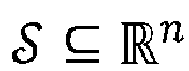


 are the MDP specific transition dynamics that model the transition from a state s to the next state s' given as a result of action a. γ is the discount factor and T the time horizon (maximum amount of steps to reach the
goal state 103 from the start state 102). - It is the objective to maximize the rewards (for task completion) in expectation for randomly sampled MDPs m with uniformly sampled start and goal states:

- The continuous low-level state spaceis split into an external part

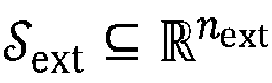


 into a finite high-level state space
 . Another mapping


z (z, o). - The agent perceives local feature observations φ(s ext) based on its external state. For example, the
robot 101 has sensors observing the robot's vicinity, e.g. the presence ofobstacles 104 in its vicinity. In particular, for each coarse-scale (i.e. high-level) state z (robot position on the coarse grid) there may be a feature observation
robot 101. - The option-dependent low-level policy denotes


- The initiation set denotes

- The termination function denotes

- The option-dependent (sub-goal) reward function for the low-level reinforcement learning policy denotes


- The low level-reinforcement learning policy πθ is trained using the sub-episodes that arise within the training episodes of horizon T from repeated option activation and termination. Therefore, the execution of an option o has a variable maximum time horizon To = T - to that depends on the time step to at which the option was activated.
- Value iteration iteratively refines an estimate of the state value function V or the state-action value function Q. Let Vk be the state value function of the kth iteration and let Qk be the state-action value function Q of the kth iteration. These can be defined recursively. The value iteration starts with an arbitrary function (which can be seen as an initial guess) V 0. Value iteration uses the following equations to get the functions for k+1


- P(s'|s, a)represents the transition dynamics to reach a next state s' from current states given the action a.
- When the high-level states

 , the model is learned with respect to the feature observations corresponding to the high-level states:

- The high-level planner runs value iteration to obtain the value map V(z). Options, which implicitly define sub-goals for the lower-level reinforcement learning, are greedily selected by the policy over options


- As a result, the reward maximization in the objective is with respect to the parameters of the low-level reinforcement learning policy θ and the parameters of (the learned high-level transition dynamics model for the) the high-level (value iteration) planner ψ:

- According to various embodiments, the
controller 105 applies a hierarchical planning-guided RL control policy that comprises a high-level (coarse-scale) value iteration planner and a low-level (fine-scale) policy trained via reinforcement learning. - The high-level value iteration planner carriers out value iteration planning in a coarse state space abstraction (high-level state space). Sub-goals for the low-level reinforcement learning are generated by selecting high-level actions (options) based on the generated (high-level) value map. The high-level planning maintains a transition probability model for the coarse-scale state space. This model may be of specific architecture as follows.
-
Figure 2 shows aneural network 200 for predicting high-level states. - The
neural network 200 implements a classifier that predicts the next high-level state by selecting one of the (fixed amount of) neighboring high-level states provided, asinput 201, the current high-level state (in terms of a feature observation for the current high-level state) and the selected option (from which the sub-goal for the low-level reinforcement learning is derived). Theneural network 200 includes a plurality ofhidden layers 202 followed by asoftmax layer 203. The softmax probabilities 204 of the classifier are used astransition probabilities 204 to all possible neighboring high-level states and are used to determine the neural network'soutput 205. - The low-level RL module includes the control policy that interacts with the environment and is rewarded for achieving the sub-goals set by the high-level planning. It may be trained by a reinforcement learning algorithm of choice, e.g. Q-learning, Deep Q-learning (DQN), Trust Region Policy Optimization (TRPO), Proximal Policy Optimization (PPO), Deep Deterministic Policy Gradient (DDPG), Twin Delayed DDPG (TD3), (Asynchronous) Advantage Actor Critic (A2C/A3C), etc.
- The hierarchical policy is trained for several training iterations until a maximum number of training iterations is reached or it meets a pre-defined quality criterion with respect to the objective function. In every iteration:
- I. Data is gathered by interacting with the (simulation) environment(s) for a number of episodes. In every episode:
- a. The specific (simulation) environment is provided/sampled as well as the start state and the desired goal state of the agent.
- b. Given the coarse representation of the environment, the desired agent goal state, and the current transition probability model, the value iteration planner is run, which generates a value map for the high-level states.
- c. Starting in the start state and being provided the initial sub-goal high-level state from the high-level planner, which is determined based on the initial agent state and the value map as one of the neighboring high-level states, the agent interacts with the (simulation) environment until the goal state is reached or the maximum interaction step number (time horizon) is reached. In every interaction step:
- i. The agent receives some observation (potentially pre-processed sensory information).
- ii. Based on the observation, the internal state of the agent, and the current sub-goal, the low-level RL policy calculates a control signal (action).
- iii. The control signal (action) is applied to the actuators of the agent.
- iv. As a result, the agent/environment is in a new state and the reward for this transition is provided by the (sub-goal-dependent) low-level reward function.
- v. The low-level transition <state, action, new state, reward> is stored in a low-level transition buffer. If not done in vi., the high-level transition <high-level state (feature observation), option (high level action), new high-level state (feature observation)> is stored in a high-level transition buffer.
- vi. If either the sub-goal high-level state is reached or the agent transitions to a wrong high-level state, the high-level planner provides a new sub-goal high-level state based on the current high-level state and the value map as one of the neighboring high-level states. If not done in v., the high-level transition <high-level state (feature observation), option (high level action), new high-level state (feature observation)> is stored in a high-level transition buffer.
- II. The low-level reinforcement learning policy is updated using the data in the low-level transition buffer using the reinforcement learning algorithm of choice.
- III. The transition probability model parameters are updated using the data in the high-level transition buffer. In case of the specific neural network architecture of
figure 2 , the network parameters are iteratively updated by an optimizer that - maximizes the prediction probability of the actual new high-level state given the high-level state (feature observation) and the option (high-level action) as network input. - Once the hierarchical policy is trained, the
controller 105 performs the following during deployment: - I. The specific (simulation) environment is provided/sampled as well as the start state and the desired goal state of the agent.
- II. Given the coarse representation of the environment, the desired agent goal state, and the current transition probability model, the value iteration planner is run, which generates a value map for the high-level states.
- III. Starting in the start state and being provided the initial sub-goal high-level state from the high-level planner, which is determined based on the initial agent state and the value map as one of the neighboring high-level states, the agent interacts with the (simulation) environment until the goal state is reached or the maximum interaction step number (time horizon) is reached. In every interaction step:
- a. The agent receives some observation (potentially pre-processed sensory information).
- b. Based on the observation, the internal state of the agent, and the current sub-goal, the low-level RL policy calculates a control signal (action).
- c. The control signal (action) is applied to the actuators of the agent.
- d. This is repeated until the agent/environment is in a new high-level state.
- e. If either the sub-goal high-level state is reached or the agent has transitioned to a wrong high-level state, the high-level planner provides a new sub-goal high-level state based on the current high-level state and the value map as one of the neighboring high-level states.
- In summary, according to various embodiments, a method for controlling a robot is provided as illustrated in
figure 3 . -
Figure 3 shows a flow diagram 300 illustrating a method for controlling a robot. - In 301, an indication of a target configuration to be reached from an initial configuration of the robot is received.
- In 302, a coarse-scale value map is determined by value iteration, wherein the transition probabilities are determined using a transition probability model mapping coarse-scale states and coarse-scale actions to transition probabilities for coarse-scale states.
- In 303, for each coarse-scale state of a sequence of coarse-scale states of the robot, starting from an initial coarse-scale state determined from the initial configuration of the robot and until the robot reaches the target configuration or a maximum number of fine-scale states has been reached, a fine-scale sub-goal from the coarse-scale value map is determined in 304. The fine-scale sub-goal may correspond to a coarse-scale action, e.g. may be a reference fine-scale state for a coarse-scale state (e.g. the coarse-scale state's center in fine-scale coordinates) to be reached the the coarse-scale action.
- In 305, by an actuator of the robot, fine-scale control actions are performed to reach the determined fine-scale sub-goal and sensor data are obtained to determine the fine-scale states reached as a result of performing the fine-scale control actions for each fine-scale state of the resulting sequence of fine-scale states of the robot, starting from a current fine-scale state (e.g. an initial fine-scale state of the current coarse-scale state) of the robot and until the robot reaches the determined fine-scale sub-goal, the robot transitions to a different coarse-scale state, or a maximum sequence length of the sequence of fine-scale states has been reached.
- In 306, the next coarse-scale state of the sequence of coarse-scale states is determined from the last fine-scale state of the sequence of fine-scale states is determined.
- According to various embodiments, in other words, robot control is split into (at least) two hierarchy levels, wherein the lower level performs fine-scale control given by a (fine-scale) control policy (trained via reinforcement learning such as Q-learning, Deep Q-learning (DQN), Trust Region Policy Optimization (TRPO), Proximal Policy Optimization (PPO), Deep Deterministic Policy Gradient (DDPG), Twin Delayed DDPG (TD3), (Asynchronous) Advantage Actor Critic (A2C/A3C)) and the higher level, also referred to as planner, performs value iteration. Value iteration can be seen as iterative application of the Bellman equation to generate a value map. The transition probabilities for the value iteration are given by a transition probability model which, according to various embodiments, is trainable by supervised learning, e.g. represented by a neural network. The parameters of the neural network (e.g. the weights), denoted by ψ in the examples above, can be seen as parameters of the planner.
- For example, a control signal is determined based on the potentially pre-processed sensory input using the learned (hierarchical) control policy. The high-level planner generates (sub-goal) targets based on the provided coarse environment representation (e.g. map). The low-level control module operating according to the low-level control policy calculates the control signals (for performing the low-level control actions) given these targets and the potentially pre-processed sensory input.
- In case of vehicles (e.g. cars) or mobile robots, the coarse environment representation for the high level planner is for example a map (indicating obstacles) that is tiled such that a finite number of cells result, which are the potential sub-goals. The target vectors (i.e. the sub-goals) are for example the difference between the position of the center of the chosen cell and the current vehicle position. The low-level control module operating according to the low-level control policy receives this target vector along with the current potentially pre-processed sensory readings.
- In case of a robotic task, the high-level planner may receive some sort of symbolic representation of the task (e.g. known subtasks that need to be fulfilled: mount a screw, move an object, ...) as coarse environment representation. It then generates a plan that sequences these sub-tasks (or maybe positional offset vectors for certain objects) which are the targets, i.e. the sub-goals, for the low-level policy.
- The method of
figure 3 as well as a method for training a robot controller to perform this method may be performed by one or more computers including one or more data processing units. The term "data processing unit" can be understood as any type of entity that allows the processing of data or signals. For example, the data or signals may be treated according to at least one (i.e., one or more than one) specific function performed by the data processing unit. A data processing unit may include an analogue circuit, a digital circuit, a composite signal circuit, a logic circuit, a microprocessor, a micro controller, a central processing unit (CPU), a graphics processing unit (GPU), a digital signal processor (DSP), a programmable gate array (FPGA) integrated circuit or any combination thereof or be formed from it. Any other way of implementing the respective functions, which will be described in more detail below, may also be understood as data processing unit or logic circuitry. It will be understood that one or more of the method steps described in detail herein may be executed (e.g., implemented) by a data processing unit through one or more specific functions performed by the data processing unit. - The term "robot" can be understood to refer to any physical system (with a mechanical part whose movement is controlled), such as a computer-controlled machine, a vehicle, a household appliance, a power tool, a manufacturing machine, a personal assistant or an access control system.
- Sensor data (i.e. observation data) may be data from pretty much any type of sensor, e.g. video, radar, LiDAR (light detection and ranging), ultrasonic, motion, thermal imaging camera etc.
- Although specific embodiments have been illustrated and described herein, it will be appreciated by those of ordinary skill in the art that a variety of alternate and/or equivalent implementations may be substituted for the specific embodiments shown and described without departing from the scope of the present invention. This application is intended to cover any adaptations or variations of the specific embodiments discussed herein. Therefore, it is intended that this invention be limited only by the claims and the equivalents thereof.
Claims (10)
- A method for controlling a robot comprising:Receiving an indication of a target configuration to be reached from an initial configuration of the robot;Determining a coarse-scale value map by value iteration, wherein the transition probabilities are determined using a transition probability model mapping coarse-scale states and coarse-scale actions to transition probabilities for coarse-scale states; andFor each coarse-scale state of a sequence of coarse-scale states of the robot, starting from an initial coarse-scale state determined from the initial configuration of the robot and until the robot reaches the target configuration or a maximum number of fine-scale states has been reached,Determining a fine-scale sub-goal from the coarse-scale value map;Performing, by an actuator of the robot, fine-scale control actions to reach the determined fine-scale sub-goal and obtaining sensor data to determine the fine-scale states reached as a result of performing the fine-scale control actions for each fine-scale state of the resulting sequence of fine-scale states of the robot, starting from a current fine-scale state of the robot and until the robot reaches the determined fine-scale sub-goal, the robot transitions to a different coarse-scale state, or a maximum sequence length of the sequence of fine-scale states has been reached;Determining the next coarse-scale state of the sequence of coarse-scale states from the last fine-scale state of the sequence of fine-scale states.
- The method of claim 1, wherein the transition probability model is a model trainable by supervised learning.
- The method of claim 1 or 2, wherein the transition probability model is a neural network.
- A robot controller configured to perform a method of any one of claims 1 to 3.
- A method for training a robot controller according to claim 4.
- The method for training a robot controller of claim 5 comprising training the transition probability model using supervised learning.
- The method for training a robot controller of claim 6, comprising training the transition probability model by maximizing the probability of the transition probability model to predict a coarse-scale state reached by fine-scale actions performed to reach a sub-goal.
- The method for training a robot controller of any one of claims 5 to 7, comprising training a fine-scale control policy via reinforcement learning that determines the fine-scale control actions to reach a sub-goal.
- A computer program comprising instructions which, when executed by a computer, makes the computer perform a method according to any one of claims 1 to 3 or 5 to 8.
- A computer-readable medium comprising instructions which, when executed by a computer, makes the computer perform a method according to any one of claims 1 to 3 or 5 to 8.
Priority Applications (3)
| Application Number | Priority Date | Filing Date | Title |
|---|---|---|---|
| EP20172448.1A EP3904973B1 (en) | 2020-04-30 | 2020-04-30 | Device and method for controlling a robot |
| US17/231,786 US11934176B2 (en) | 2020-04-30 | 2021-04-15 | Device and method for controlling a robot |
| CN202110471494.1A CN113671942B (en) | 2020-04-30 | 2021-04-29 | Equipment and methods for controlling robots |
Applications Claiming Priority (1)
| Application Number | Priority Date | Filing Date | Title |
|---|---|---|---|
| EP20172448.1A EP3904973B1 (en) | 2020-04-30 | 2020-04-30 | Device and method for controlling a robot |
Publications (2)
| Publication Number | Publication Date |
|---|---|
| EP3904973A1 true EP3904973A1 (en) | 2021-11-03 |
| EP3904973B1 EP3904973B1 (en) | 2025-06-25 |
Family
ID=70482413
Family Applications (1)
| Application Number | Title | Priority Date | Filing Date |
|---|---|---|---|
| EP20172448.1A Active EP3904973B1 (en) | 2020-04-30 | 2020-04-30 | Device and method for controlling a robot |
Country Status (3)
| Country | Link |
|---|---|
| US (1) | US11934176B2 (en) |
| EP (1) | EP3904973B1 (en) |
| CN (1) | CN113671942B (en) |
Cited By (4)
| Publication number | Priority date | Publication date | Assignee | Title |
|---|---|---|---|---|
| DE102022209845A1 (en) * | 2022-09-19 | 2024-03-21 | Robert Bosch Gesellschaft mit beschränkter Haftung | Method for training an agent |
| CN118672199A (en) * | 2024-08-26 | 2024-09-20 | 中国人民解放军国防科技大学 | Robot data driving control method and device based on strategy iteration solution |
| DE102023206970A1 (en) * | 2023-04-19 | 2024-10-24 | Robert Bosch Gesellschaft mit beschränkter Haftung | Method for training a control strategy |
| US20240370295A1 (en) * | 2023-05-05 | 2024-11-07 | Jpmorgan Chase Bank, N.A. | Method and system for generating a target pattern-based optimal scheduling policy |
Families Citing this family (6)
| Publication number | Priority date | Publication date | Assignee | Title |
|---|---|---|---|---|
| CN114139675B (en) * | 2021-12-08 | 2024-09-20 | 中国科学技术大学 | A method to improve the accuracy of selecting reliable actions in intelligent agent control |
| US12430564B2 (en) * | 2022-03-01 | 2025-09-30 | Nvidia Corporation | Fine-tuning policies to facilitate chaining |
| US20250200379A1 (en) * | 2022-06-07 | 2025-06-19 | Deepmind Technologies Limited | Hierarchical reinforcement learning at scale |
| US12393175B2 (en) * | 2023-11-16 | 2025-08-19 | Naver Corporation | Systems and methods for skill learning with multiple critics |
| CN117873089B (en) * | 2024-01-10 | 2024-08-02 | 南京理工大学 | A cooperative path planning method for multiple mobile robots based on clustering PPO algorithm |
| CN120800385B (en) * | 2025-07-10 | 2026-03-27 | 武汉工程大学 | An Autonomous Navigation System for Unmanned Aerial Vehicles Based on Hierarchical Reinforcement Learning Strategy |
Family Cites Families (11)
| Publication number | Priority date | Publication date | Assignee | Title |
|---|---|---|---|---|
| US9566710B2 (en) * | 2011-06-02 | 2017-02-14 | Brain Corporation | Apparatus and methods for operating robotic devices using selective state space training |
| US9956687B2 (en) * | 2013-03-04 | 2018-05-01 | Microsoft Technology Licensing, Llc | Adapting robot behavior based upon human-robot interaction |
| CN107748566B (en) * | 2017-09-20 | 2020-04-24 | 清华大学 | Underwater autonomous robot fixed depth control method based on reinforcement learning |
| JP6676030B2 (en) * | 2017-11-20 | 2020-04-08 | 株式会社安川電機 | Grasping system, learning device, gripping method, and model manufacturing method |
| US11475291B2 (en) * | 2017-12-27 | 2022-10-18 | X Development Llc | Sharing learned information among robots |
| US10730181B1 (en) * | 2017-12-27 | 2020-08-04 | X Development Llc | Enhancing robot learning |
| US11017317B2 (en) * | 2017-12-27 | 2021-05-25 | X Development Llc | Evaluating robot learning |
| CN109711529B (en) * | 2018-11-13 | 2022-11-08 | 中山大学 | A cross-domain federated learning model and method based on value iterative network |
| US11347613B2 (en) * | 2019-10-15 | 2022-05-31 | UiPath, Inc. | Inserting probabilistic models in deterministic workflows for robotic process automation and supervisor system |
| US20210165426A1 (en) * | 2019-12-02 | 2021-06-03 | Here Global B.V. | Method and apparatus for determining aerial routes based on mapping drone disabling instruments |
| US11531358B2 (en) * | 2020-04-17 | 2022-12-20 | Here Global B.V. | Method and apparatus for generating an aerial navigation route based on a payload survivability estimate |
-
2020
- 2020-04-30 EP EP20172448.1A patent/EP3904973B1/en active Active
-
2021
- 2021-04-15 US US17/231,786 patent/US11934176B2/en active Active
- 2021-04-29 CN CN202110471494.1A patent/CN113671942B/en active Active
Non-Patent Citations (6)
| Title |
|---|
| AVIV TAMAR ET AL: "Value Iteration Networks", PROCEEDINGS OF THE TWENTY-SIXTH INTERNATIONAL JOINT CONFERENCE ON ARTIFICIAL INTELLIGENCE, vol. 1602.02867, no. v7, 20 March 2017 (2017-03-20), California, US, pages 1 - 16, XP055601563, ISBN: 978-0-9992411-0-3, DOI: 10.24963/ijcai.2017/700 * |
| JENDELE ET AL., LEARNING FUNCTIONALLY DECOMPOSED HIERARCHIES FOR CONTINUOUS NAVIGATION TASKS, 25 September 2019 (2019-09-25) |
| LUKAS JENDELE ET AL: "Learning Functionally Decomposed Hierarchies for Continuous Control Tasks", ARXIV.ORG, CORNELL UNIVERSITY LIBRARY, 201 OLIN LIBRARY CORNELL UNIVERSITY ITHACA, NY 14853, 14 February 2020 (2020-02-14), XP081599712 * |
| MATTHIAS RUNGGER ET AL: "Multiscale Anticipatory Behavior by Hierarchical Reinforcement Learning", 1 January 2009, BIG DATA ANALYTICS IN THE SOCIAL AND UBIQUITOUS CONTEXT : 5TH INTERNATIONAL WORKSHOP ON MODELING SOCIAL MEDIA, MSM 2014, 5TH INTERNATIONAL WORKSHOP ON MINING UBIQUITOUS AND SOCIAL ENVIRONMENTS, MUSE 2014 AND FIRST INTERNATIONAL WORKSHOP ON MACHINE LE, ISBN: 978-3-642-17318-9, XP019120310 * |
| NANTAS NARDELLI ET AL: "Value Propagation Networks", ARXIV.ORG, CORNELL UNIVERSITY LIBRARY, 201 OLIN LIBRARY CORNELL UNIVERSITY ITHACA, NY 14853, 29 May 2018 (2018-05-29), XP081128275 * |
| TAMAR ET AL., VALUE ITERATION NETWORKS, 20 March 2017 (2017-03-20) |
Cited By (5)
| Publication number | Priority date | Publication date | Assignee | Title |
|---|---|---|---|---|
| DE102022209845A1 (en) * | 2022-09-19 | 2024-03-21 | Robert Bosch Gesellschaft mit beschränkter Haftung | Method for training an agent |
| DE102023206970A1 (en) * | 2023-04-19 | 2024-10-24 | Robert Bosch Gesellschaft mit beschränkter Haftung | Method for training a control strategy |
| US20240370295A1 (en) * | 2023-05-05 | 2024-11-07 | Jpmorgan Chase Bank, N.A. | Method and system for generating a target pattern-based optimal scheduling policy |
| US12608226B2 (en) * | 2023-05-05 | 2026-04-21 | Jpmorgan Chase Bank, N.A. | Method and system for generating a target pattern-based optimal scheduling policy |
| CN118672199A (en) * | 2024-08-26 | 2024-09-20 | 中国人民解放军国防科技大学 | Robot data driving control method and device based on strategy iteration solution |
Also Published As
| Publication number | Publication date |
|---|---|
| CN113671942A (en) | 2021-11-19 |
| US20210341904A1 (en) | 2021-11-04 |
| US11934176B2 (en) | 2024-03-19 |
| EP3904973B1 (en) | 2025-06-25 |
| CN113671942B (en) | 2026-03-20 |
Similar Documents
| Publication | Publication Date | Title |
|---|---|---|
| US11934176B2 (en) | Device and method for controlling a robot | |
| Liu et al. | Robot navigation in crowded environments using deep reinforcement learning | |
| CN115552430B (en) | Method and system for supporting policy learning | |
| EP3791324B1 (en) | Sample-efficient reinforcement learning | |
| JP7181415B2 (en) | Control agents for exploring the environment using the likelihood of observations | |
| WO2020065024A1 (en) | Stacked convolutional long short-term memory for model-free reinforcement learning | |
| US12311555B2 (en) | Robotic navigation and transport of objects | |
| EP3955080A1 (en) | Method and device for socially aware model predictive control of a robotic device using machine learning | |
| Quinones-Ramirez et al. | Robot path planning using deep reinforcement learning | |
| Sumiea et al. | Enhanced deep deterministic policy gradient algorithm using grey wolf optimizer for continuous control tasks | |
| Spaan et al. | Active cooperative perception in network robot systems using POMDPs | |
| Li et al. | Predictive hierarchical reinforcement learning for path-efficient mapless navigation with moving target | |
| Rottmann et al. | Adaptive autonomous control using online value iteration with gaussian processes | |
| Khlif et al. | Comparative Analysis of Modified Q-Learning and DQN for Autonomous Robot Navigation | |
| CN121007569A (en) | A method and system for intelligent AGV path planning using multi-sensor fusion | |
| Jevtić et al. | Reinforcement learning-based collision avoidance for uav | |
| US12436509B2 (en) | Device and method for controlling an agent | |
| Zhang et al. | Motion Planning and Control with Unknown Nonlinear Dynamics through Predicted Reachability | |
| Brandonisio | Ai-based guidance for spacecraft proximity operations around uncooperative targets | |
| Prasad et al. | Data-driven target tracking methods of uas/uam in dynamic environment | |
| Xie et al. | Learning with stochastic guidance for navigation | |
| EP4718319A1 (en) | Device and method for controlling an agent | |
| US20240408756A1 (en) | Systems and methods for spatial representations for navigation without reconstruction | |
| Shah et al. | Zero-shot option invention for robot planning under uncertainty | |
| Gao et al. | Hierarchical reinforcement learning-based mapless navigation with predictive exploration worthiness |
Legal Events
| Date | Code | Title | Description |
|---|---|---|---|
| PUAI | Public reference made under article 153(3) epc to a published international application that has entered the european phase |
Free format text: ORIGINAL CODE: 0009012 |
|
| STAA | Information on the status of an ep patent application or granted ep patent |
Free format text: STATUS: THE APPLICATION HAS BEEN PUBLISHED |
|
| AK | Designated contracting states |
Kind code of ref document: A1 Designated state(s): AL AT BE BG CH CY CZ DE DK EE ES FI FR GB GR HR HU IE IS IT LI LT LU LV MC MK MT NL NO PL PT RO RS SE SI SK SM TR |
|
| B565 | Issuance of search results under rule 164(2) epc |
Effective date: 20201119 |
|
| STAA | Information on the status of an ep patent application or granted ep patent |
Free format text: STATUS: REQUEST FOR EXAMINATION WAS MADE |
|
| 17P | Request for examination filed |
Effective date: 20220503 |
|
| RBV | Designated contracting states (corrected) |
Designated state(s): AL AT BE BG CH CY CZ DE DK EE ES FI FR GB GR HR HU IE IS IT LI LT LU LV MC MK MT NL NO PL PT RO RS SE SI SK SM TR |
|
| STAA | Information on the status of an ep patent application or granted ep patent |
Free format text: STATUS: EXAMINATION IS IN PROGRESS |
|
| 17Q | First examination report despatched |
Effective date: 20230622 |
|
| GRAP | Despatch of communication of intention to grant a patent |
Free format text: ORIGINAL CODE: EPIDOSNIGR1 |
|
| STAA | Information on the status of an ep patent application or granted ep patent |
Free format text: STATUS: GRANT OF PATENT IS INTENDED |
|
| RIC1 | Information provided on ipc code assigned before grant |
Ipc: G06N 3/045 20230101ALI20250130BHEP Ipc: G06N 3/08 20060101ALI20250130BHEP Ipc: G05D 1/00 20060101ALI20250130BHEP Ipc: G06N 3/00 20060101ALI20250130BHEP Ipc: G05B 13/02 20060101AFI20250130BHEP |
|
| INTG | Intention to grant announced |
Effective date: 20250304 |
|
| GRAS | Grant fee paid |
Free format text: ORIGINAL CODE: EPIDOSNIGR3 |
|
| GRAA | (expected) grant |
Free format text: ORIGINAL CODE: 0009210 |
|
| STAA | Information on the status of an ep patent application or granted ep patent |
Free format text: STATUS: THE PATENT HAS BEEN GRANTED |
|
| AK | Designated contracting states |
Kind code of ref document: B1 Designated state(s): AL AT BE BG CH CY CZ DE DK EE ES FI FR GB GR HR HU IE IS IT LI LT LU LV MC MK MT NL NO PL PT RO RS SE SI SK SM TR |
|
| REG | Reference to a national code |
Ref country code: GB Ref legal event code: FG4D |
|
| REG | Reference to a national code |
Ref country code: CH Ref legal event code: EP |
|
| REG | Reference to a national code |
Ref country code: DE Ref legal event code: R096 Ref document number: 602020053181 Country of ref document: DE |
|
| REG | Reference to a national code |
Ref country code: CH Ref legal event code: EP |
|
| REG | Reference to a national code |
Ref country code: IE Ref legal event code: FG4D |
|
| PG25 | Lapsed in a contracting state [announced via postgrant information from national office to epo] |
Ref country code: FI Free format text: LAPSE BECAUSE OF FAILURE TO SUBMIT A TRANSLATION OF THE DESCRIPTION OR TO PAY THE FEE WITHIN THE PRESCRIBED TIME-LIMIT Effective date: 20250625 |
|
| REG | Reference to a national code |
Ref country code: LT Ref legal event code: MG9D |
|
| PG25 | Lapsed in a contracting state [announced via postgrant information from national office to epo] |
Ref country code: NO Free format text: LAPSE BECAUSE OF FAILURE TO SUBMIT A TRANSLATION OF THE DESCRIPTION OR TO PAY THE FEE WITHIN THE PRESCRIBED TIME-LIMIT Effective date: 20250925 Ref country code: GR Free format text: LAPSE BECAUSE OF FAILURE TO SUBMIT A TRANSLATION OF THE DESCRIPTION OR TO PAY THE FEE WITHIN THE PRESCRIBED TIME-LIMIT Effective date: 20250926 |
|
| PG25 | Lapsed in a contracting state [announced via postgrant information from national office to epo] |
Ref country code: BG Free format text: LAPSE BECAUSE OF FAILURE TO SUBMIT A TRANSLATION OF THE DESCRIPTION OR TO PAY THE FEE WITHIN THE PRESCRIBED TIME-LIMIT Effective date: 20250625 |
|
| PG25 | Lapsed in a contracting state [announced via postgrant information from national office to epo] |
Ref country code: HR Free format text: LAPSE BECAUSE OF FAILURE TO SUBMIT A TRANSLATION OF THE DESCRIPTION OR TO PAY THE FEE WITHIN THE PRESCRIBED TIME-LIMIT Effective date: 20250625 |
|
| PG25 | Lapsed in a contracting state [announced via postgrant information from national office to epo] |
Ref country code: RS Free format text: LAPSE BECAUSE OF FAILURE TO SUBMIT A TRANSLATION OF THE DESCRIPTION OR TO PAY THE FEE WITHIN THE PRESCRIBED TIME-LIMIT Effective date: 20250925 |
|
| PG25 | Lapsed in a contracting state [announced via postgrant information from national office to epo] |
Ref country code: LV Free format text: LAPSE BECAUSE OF FAILURE TO SUBMIT A TRANSLATION OF THE DESCRIPTION OR TO PAY THE FEE WITHIN THE PRESCRIBED TIME-LIMIT Effective date: 20250625 |
|
| REG | Reference to a national code |
Ref country code: NL Ref legal event code: MP Effective date: 20250625 |
|
| PG25 | Lapsed in a contracting state [announced via postgrant information from national office to epo] |
Ref country code: NL Free format text: LAPSE BECAUSE OF FAILURE TO SUBMIT A TRANSLATION OF THE DESCRIPTION OR TO PAY THE FEE WITHIN THE PRESCRIBED TIME-LIMIT Effective date: 20250625 |
|
| PG25 | Lapsed in a contracting state [announced via postgrant information from national office to epo] |
Ref country code: PT Free format text: LAPSE BECAUSE OF FAILURE TO SUBMIT A TRANSLATION OF THE DESCRIPTION OR TO PAY THE FEE WITHIN THE PRESCRIBED TIME-LIMIT Effective date: 20251027 |
|
| REG | Reference to a national code |
Ref country code: AT Ref legal event code: MK05 Ref document number: 1807092 Country of ref document: AT Kind code of ref document: T Effective date: 20250625 |
|
| PG25 | Lapsed in a contracting state [announced via postgrant information from national office to epo] |
Ref country code: IS Free format text: LAPSE BECAUSE OF FAILURE TO SUBMIT A TRANSLATION OF THE DESCRIPTION OR TO PAY THE FEE WITHIN THE PRESCRIBED TIME-LIMIT Effective date: 20251025 |
|
| PG25 | Lapsed in a contracting state [announced via postgrant information from national office to epo] |
Ref country code: AT Free format text: LAPSE BECAUSE OF FAILURE TO SUBMIT A TRANSLATION OF THE DESCRIPTION OR TO PAY THE FEE WITHIN THE PRESCRIBED TIME-LIMIT Effective date: 20250625 Ref country code: SM Free format text: LAPSE BECAUSE OF FAILURE TO SUBMIT A TRANSLATION OF THE DESCRIPTION OR TO PAY THE FEE WITHIN THE PRESCRIBED TIME-LIMIT Effective date: 20250625 |
|
| PG25 | Lapsed in a contracting state [announced via postgrant information from national office to epo] |
Ref country code: CZ Free format text: LAPSE BECAUSE OF FAILURE TO SUBMIT A TRANSLATION OF THE DESCRIPTION OR TO PAY THE FEE WITHIN THE PRESCRIBED TIME-LIMIT Effective date: 20250625 |
|
| PG25 | Lapsed in a contracting state [announced via postgrant information from national office to epo] |
Ref country code: PL Free format text: LAPSE BECAUSE OF FAILURE TO SUBMIT A TRANSLATION OF THE DESCRIPTION OR TO PAY THE FEE WITHIN THE PRESCRIBED TIME-LIMIT Effective date: 20250625 |
|
| PG25 | Lapsed in a contracting state [announced via postgrant information from national office to epo] |
Ref country code: EE Free format text: LAPSE BECAUSE OF FAILURE TO SUBMIT A TRANSLATION OF THE DESCRIPTION OR TO PAY THE FEE WITHIN THE PRESCRIBED TIME-LIMIT Effective date: 20250625 |
|
| PG25 | Lapsed in a contracting state [announced via postgrant information from national office to epo] |
Ref country code: SK Free format text: LAPSE BECAUSE OF FAILURE TO SUBMIT A TRANSLATION OF THE DESCRIPTION OR TO PAY THE FEE WITHIN THE PRESCRIBED TIME-LIMIT Effective date: 20250625 |
|
| PG25 | Lapsed in a contracting state [announced via postgrant information from national office to epo] |
Ref country code: ES Free format text: LAPSE BECAUSE OF FAILURE TO SUBMIT A TRANSLATION OF THE DESCRIPTION OR TO PAY THE FEE WITHIN THE PRESCRIBED TIME-LIMIT Effective date: 20250625 |
|
| PG25 | Lapsed in a contracting state [announced via postgrant information from national office to epo] |
Ref country code: DK Free format text: LAPSE BECAUSE OF FAILURE TO SUBMIT A TRANSLATION OF THE DESCRIPTION OR TO PAY THE FEE WITHIN THE PRESCRIBED TIME-LIMIT Effective date: 20250625 |
|
| PG25 | Lapsed in a contracting state [announced via postgrant information from national office to epo] |
Ref country code: IT Free format text: LAPSE BECAUSE OF FAILURE TO SUBMIT A TRANSLATION OF THE DESCRIPTION OR TO PAY THE FEE WITHIN THE PRESCRIBED TIME-LIMIT Effective date: 20250625 |
|
| PLBE | No opposition filed within time limit |
Free format text: ORIGINAL CODE: 0009261 |
|
| STAA | Information on the status of an ep patent application or granted ep patent |
Free format text: STATUS: NO OPPOSITION FILED WITHIN TIME LIMIT |