EP3904446A1 - Nucleating agent for polyolefin resin, nucleating agent composition for polyolefin resin containing same, master batch for polyolefin resin, polyolefin resin composition, molded article thereof, film thereof, method for producing porous film, and package - Google Patents
Nucleating agent for polyolefin resin, nucleating agent composition for polyolefin resin containing same, master batch for polyolefin resin, polyolefin resin composition, molded article thereof, film thereof, method for producing porous film, and package Download PDFInfo
- Publication number
- EP3904446A1 EP3904446A1 EP19904176.5A EP19904176A EP3904446A1 EP 3904446 A1 EP3904446 A1 EP 3904446A1 EP 19904176 A EP19904176 A EP 19904176A EP 3904446 A1 EP3904446 A1 EP 3904446A1
- Authority
- EP
- European Patent Office
- Prior art keywords
- polyolefin resin
- nucleating agent
- film
- present
- group
- Prior art date
- Legal status (The legal status is an assumption and is not a legal conclusion. Google has not performed a legal analysis and makes no representation as to the accuracy of the status listed.)
- Granted
Links
- 0 C*C1C(*)C(*)C(*)C(*)C1* Chemical compound C*C1C(*)C(*)C(*)C(*)C1* 0.000 description 3
Classifications
-
- C—CHEMISTRY; METALLURGY
- C08—ORGANIC MACROMOLECULAR COMPOUNDS; THEIR PREPARATION OR CHEMICAL WORKING-UP; COMPOSITIONS BASED THEREON
- C08J—WORKING-UP; GENERAL PROCESSES OF COMPOUNDING; AFTER-TREATMENT NOT COVERED BY SUBCLASSES C08B, C08C, C08F, C08G or C08H
- C08J5/00—Manufacture of articles or shaped materials containing macromolecular substances
- C08J5/18—Manufacture of films or sheets
-
- B—PERFORMING OPERATIONS; TRANSPORTING
- B29—WORKING OF PLASTICS; WORKING OF SUBSTANCES IN A PLASTIC STATE IN GENERAL
- B29B—PREPARATION OR PRETREATMENT OF THE MATERIAL TO BE SHAPED; MAKING GRANULES OR PREFORMS; RECOVERY OF PLASTICS OR OTHER CONSTITUENTS OF WASTE MATERIAL CONTAINING PLASTICS
- B29B11/00—Making preforms
- B29B11/06—Making preforms by moulding the material
-
- B—PERFORMING OPERATIONS; TRANSPORTING
- B29—WORKING OF PLASTICS; WORKING OF SUBSTANCES IN A PLASTIC STATE IN GENERAL
- B29C—SHAPING OR JOINING OF PLASTICS; SHAPING OF MATERIAL IN A PLASTIC STATE, NOT OTHERWISE PROVIDED FOR; AFTER-TREATMENT OF THE SHAPED PRODUCTS, e.g. REPAIRING
- B29C55/00—Shaping by stretching, e.g. drawing through a die; Apparatus therefor
- B29C55/005—Shaping by stretching, e.g. drawing through a die; Apparatus therefor characterised by the choice of materials
-
- B—PERFORMING OPERATIONS; TRANSPORTING
- B29—WORKING OF PLASTICS; WORKING OF SUBSTANCES IN A PLASTIC STATE IN GENERAL
- B29C—SHAPING OR JOINING OF PLASTICS; SHAPING OF MATERIAL IN A PLASTIC STATE, NOT OTHERWISE PROVIDED FOR; AFTER-TREATMENT OF THE SHAPED PRODUCTS, e.g. REPAIRING
- B29C55/00—Shaping by stretching, e.g. drawing through a die; Apparatus therefor
- B29C55/02—Shaping by stretching, e.g. drawing through a die; Apparatus therefor of plates or sheets
-
- C—CHEMISTRY; METALLURGY
- C07—ORGANIC CHEMISTRY
- C07C—ACYCLIC OR CARBOCYCLIC COMPOUNDS
- C07C233/00—Carboxylic acid amides
- C07C233/57—Carboxylic acid amides having carbon atoms of carboxamide groups bound to carbon atoms of rings other than six-membered aromatic rings
- C07C233/63—Carboxylic acid amides having carbon atoms of carboxamide groups bound to carbon atoms of rings other than six-membered aromatic rings having the nitrogen atom of at least one of the carboxamide groups bound to a carbon atom of a hydrocarbon radical substituted by carboxyl groups
-
- C—CHEMISTRY; METALLURGY
- C07—ORGANIC CHEMISTRY
- C07C—ACYCLIC OR CARBOCYCLIC COMPOUNDS
- C07C233/00—Carboxylic acid amides
- C07C233/64—Carboxylic acid amides having carbon atoms of carboxamide groups bound to carbon atoms of six-membered aromatic rings
- C07C233/81—Carboxylic acid amides having carbon atoms of carboxamide groups bound to carbon atoms of six-membered aromatic rings having the nitrogen atom of at least one of the carboxamide groups bound to a carbon atom of a hydrocarbon radical substituted by carboxyl groups
- C07C233/82—Carboxylic acid amides having carbon atoms of carboxamide groups bound to carbon atoms of six-membered aromatic rings having the nitrogen atom of at least one of the carboxamide groups bound to a carbon atom of a hydrocarbon radical substituted by carboxyl groups with the substituted hydrocarbon radical bound to the nitrogen atom of the carboxamide group by an acyclic carbon atom
- C07C233/83—Carboxylic acid amides having carbon atoms of carboxamide groups bound to carbon atoms of six-membered aromatic rings having the nitrogen atom of at least one of the carboxamide groups bound to a carbon atom of a hydrocarbon radical substituted by carboxyl groups with the substituted hydrocarbon radical bound to the nitrogen atom of the carboxamide group by an acyclic carbon atom of an acyclic saturated carbon skeleton
-
- C—CHEMISTRY; METALLURGY
- C08—ORGANIC MACROMOLECULAR COMPOUNDS; THEIR PREPARATION OR CHEMICAL WORKING-UP; COMPOSITIONS BASED THEREON
- C08J—WORKING-UP; GENERAL PROCESSES OF COMPOUNDING; AFTER-TREATMENT NOT COVERED BY SUBCLASSES C08B, C08C, C08F, C08G or C08H
- C08J3/00—Processes of treating or compounding macromolecular substances
- C08J3/12—Powdering or granulating
-
- C—CHEMISTRY; METALLURGY
- C08—ORGANIC MACROMOLECULAR COMPOUNDS; THEIR PREPARATION OR CHEMICAL WORKING-UP; COMPOSITIONS BASED THEREON
- C08J—WORKING-UP; GENERAL PROCESSES OF COMPOUNDING; AFTER-TREATMENT NOT COVERED BY SUBCLASSES C08B, C08C, C08F, C08G or C08H
- C08J3/00—Processes of treating or compounding macromolecular substances
- C08J3/20—Compounding polymers with additives, e.g. colouring
- C08J3/22—Compounding polymers with additives, e.g. colouring using masterbatch techniques
- C08J3/226—Compounding polymers with additives, e.g. colouring using masterbatch techniques using a polymer as a carrier
-
- C—CHEMISTRY; METALLURGY
- C08—ORGANIC MACROMOLECULAR COMPOUNDS; THEIR PREPARATION OR CHEMICAL WORKING-UP; COMPOSITIONS BASED THEREON
- C08J—WORKING-UP; GENERAL PROCESSES OF COMPOUNDING; AFTER-TREATMENT NOT COVERED BY SUBCLASSES C08B, C08C, C08F, C08G or C08H
- C08J9/00—Working-up of macromolecular substances to porous or cellular articles or materials; After-treatment thereof
- C08J9/0014—Use of organic additives
- C08J9/0028—Use of organic additives containing nitrogen
-
- C—CHEMISTRY; METALLURGY
- C08—ORGANIC MACROMOLECULAR COMPOUNDS; THEIR PREPARATION OR CHEMICAL WORKING-UP; COMPOSITIONS BASED THEREON
- C08K—Use of inorganic or non-macromolecular organic substances as compounding ingredients
- C08K5/00—Use of organic ingredients
- C08K5/0008—Organic ingredients according to more than one of the "one dot" groups of C08K5/01 - C08K5/59
- C08K5/0083—Nucleating agents promoting the crystallisation of the polymer matrix
-
- C—CHEMISTRY; METALLURGY
- C08—ORGANIC MACROMOLECULAR COMPOUNDS; THEIR PREPARATION OR CHEMICAL WORKING-UP; COMPOSITIONS BASED THEREON
- C08K—Use of inorganic or non-macromolecular organic substances as compounding ingredients
- C08K5/00—Use of organic ingredients
- C08K5/16—Nitrogen-containing compounds
- C08K5/20—Carboxylic acid amides
-
- C—CHEMISTRY; METALLURGY
- C08—ORGANIC MACROMOLECULAR COMPOUNDS; THEIR PREPARATION OR CHEMICAL WORKING-UP; COMPOSITIONS BASED THEREON
- C08L—COMPOSITIONS OF MACROMOLECULAR COMPOUNDS
- C08L23/00—Compositions of homopolymers or copolymers of unsaturated aliphatic hydrocarbons having only one carbon-to-carbon double bond; Compositions of derivatives of such polymers
- C08L23/02—Compositions of homopolymers or copolymers of unsaturated aliphatic hydrocarbons having only one carbon-to-carbon double bond; Compositions of derivatives of such polymers not modified by chemical after-treatment
- C08L23/10—Homopolymers or copolymers of propene
- C08L23/12—Polypropene
-
- C—CHEMISTRY; METALLURGY
- C08—ORGANIC MACROMOLECULAR COMPOUNDS; THEIR PREPARATION OR CHEMICAL WORKING-UP; COMPOSITIONS BASED THEREON
- C08L—COMPOSITIONS OF MACROMOLECULAR COMPOUNDS
- C08L23/00—Compositions of homopolymers or copolymers of unsaturated aliphatic hydrocarbons having only one carbon-to-carbon double bond; Compositions of derivatives of such polymers
- C08L23/02—Compositions of homopolymers or copolymers of unsaturated aliphatic hydrocarbons having only one carbon-to-carbon double bond; Compositions of derivatives of such polymers not modified by chemical after-treatment
- C08L23/10—Homopolymers or copolymers of propene
- C08L23/14—Copolymers of propene
-
- C—CHEMISTRY; METALLURGY
- C08—ORGANIC MACROMOLECULAR COMPOUNDS; THEIR PREPARATION OR CHEMICAL WORKING-UP; COMPOSITIONS BASED THEREON
- C08L—COMPOSITIONS OF MACROMOLECULAR COMPOUNDS
- C08L23/00—Compositions of homopolymers or copolymers of unsaturated aliphatic hydrocarbons having only one carbon-to-carbon double bond; Compositions of derivatives of such polymers
- C08L23/02—Compositions of homopolymers or copolymers of unsaturated aliphatic hydrocarbons having only one carbon-to-carbon double bond; Compositions of derivatives of such polymers not modified by chemical after-treatment
- C08L23/16—Ethylene-propylene or ethylene-propylene-diene copolymers
-
- B—PERFORMING OPERATIONS; TRANSPORTING
- B29—WORKING OF PLASTICS; WORKING OF SUBSTANCES IN A PLASTIC STATE IN GENERAL
- B29L—INDEXING SCHEME ASSOCIATED WITH SUBCLASS B29C, RELATING TO PARTICULAR ARTICLES
- B29L2007/00—Flat articles, e.g. films or sheets
- B29L2007/008—Wide strips, e.g. films, webs
-
- C—CHEMISTRY; METALLURGY
- C08—ORGANIC MACROMOLECULAR COMPOUNDS; THEIR PREPARATION OR CHEMICAL WORKING-UP; COMPOSITIONS BASED THEREON
- C08J—WORKING-UP; GENERAL PROCESSES OF COMPOUNDING; AFTER-TREATMENT NOT COVERED BY SUBCLASSES C08B, C08C, C08F, C08G or C08H
- C08J2323/00—Characterised by the use of homopolymers or copolymers of unsaturated aliphatic hydrocarbons having only one carbon-to-carbon double bond; Derivatives of such polymers
-
- C—CHEMISTRY; METALLURGY
- C08—ORGANIC MACROMOLECULAR COMPOUNDS; THEIR PREPARATION OR CHEMICAL WORKING-UP; COMPOSITIONS BASED THEREON
- C08J—WORKING-UP; GENERAL PROCESSES OF COMPOUNDING; AFTER-TREATMENT NOT COVERED BY SUBCLASSES C08B, C08C, C08F, C08G or C08H
- C08J2323/00—Characterised by the use of homopolymers or copolymers of unsaturated aliphatic hydrocarbons having only one carbon-to-carbon double bond; Derivatives of such polymers
- C08J2323/02—Characterised by the use of homopolymers or copolymers of unsaturated aliphatic hydrocarbons having only one carbon-to-carbon double bond; Derivatives of such polymers not modified by chemical after treatment
- C08J2323/10—Homopolymers or copolymers of propene
- C08J2323/12—Polypropene
-
- C—CHEMISTRY; METALLURGY
- C08—ORGANIC MACROMOLECULAR COMPOUNDS; THEIR PREPARATION OR CHEMICAL WORKING-UP; COMPOSITIONS BASED THEREON
- C08J—WORKING-UP; GENERAL PROCESSES OF COMPOUNDING; AFTER-TREATMENT NOT COVERED BY SUBCLASSES C08B, C08C, C08F, C08G or C08H
- C08J2323/00—Characterised by the use of homopolymers or copolymers of unsaturated aliphatic hydrocarbons having only one carbon-to-carbon double bond; Derivatives of such polymers
- C08J2323/02—Characterised by the use of homopolymers or copolymers of unsaturated aliphatic hydrocarbons having only one carbon-to-carbon double bond; Derivatives of such polymers not modified by chemical after treatment
- C08J2323/10—Homopolymers or copolymers of propene
- C08J2323/14—Copolymers of propene
-
- C—CHEMISTRY; METALLURGY
- C08—ORGANIC MACROMOLECULAR COMPOUNDS; THEIR PREPARATION OR CHEMICAL WORKING-UP; COMPOSITIONS BASED THEREON
- C08J—WORKING-UP; GENERAL PROCESSES OF COMPOUNDING; AFTER-TREATMENT NOT COVERED BY SUBCLASSES C08B, C08C, C08F, C08G or C08H
- C08J2323/00—Characterised by the use of homopolymers or copolymers of unsaturated aliphatic hydrocarbons having only one carbon-to-carbon double bond; Derivatives of such polymers
- C08J2323/02—Characterised by the use of homopolymers or copolymers of unsaturated aliphatic hydrocarbons having only one carbon-to-carbon double bond; Derivatives of such polymers not modified by chemical after treatment
- C08J2323/16—Ethene-propene or ethene-propene-diene copolymers
-
- C—CHEMISTRY; METALLURGY
- C08—ORGANIC MACROMOLECULAR COMPOUNDS; THEIR PREPARATION OR CHEMICAL WORKING-UP; COMPOSITIONS BASED THEREON
- C08J—WORKING-UP; GENERAL PROCESSES OF COMPOUNDING; AFTER-TREATMENT NOT COVERED BY SUBCLASSES C08B, C08C, C08F, C08G or C08H
- C08J2423/00—Characterised by the use of homopolymers or copolymers of unsaturated aliphatic hydrocarbons having only one carbon-to-carbon double bond; Derivatives of such polymers
-
- C—CHEMISTRY; METALLURGY
- C08—ORGANIC MACROMOLECULAR COMPOUNDS; THEIR PREPARATION OR CHEMICAL WORKING-UP; COMPOSITIONS BASED THEREON
- C08J—WORKING-UP; GENERAL PROCESSES OF COMPOUNDING; AFTER-TREATMENT NOT COVERED BY SUBCLASSES C08B, C08C, C08F, C08G or C08H
- C08J2423/00—Characterised by the use of homopolymers or copolymers of unsaturated aliphatic hydrocarbons having only one carbon-to-carbon double bond; Derivatives of such polymers
- C08J2423/02—Characterised by the use of homopolymers or copolymers of unsaturated aliphatic hydrocarbons having only one carbon-to-carbon double bond; Derivatives of such polymers not modified by chemical after treatment
- C08J2423/04—Homopolymers or copolymers of ethene
- C08J2423/08—Copolymers of ethene
-
- C—CHEMISTRY; METALLURGY
- C08—ORGANIC MACROMOLECULAR COMPOUNDS; THEIR PREPARATION OR CHEMICAL WORKING-UP; COMPOSITIONS BASED THEREON
- C08J—WORKING-UP; GENERAL PROCESSES OF COMPOUNDING; AFTER-TREATMENT NOT COVERED BY SUBCLASSES C08B, C08C, C08F, C08G or C08H
- C08J2423/00—Characterised by the use of homopolymers or copolymers of unsaturated aliphatic hydrocarbons having only one carbon-to-carbon double bond; Derivatives of such polymers
- C08J2423/02—Characterised by the use of homopolymers or copolymers of unsaturated aliphatic hydrocarbons having only one carbon-to-carbon double bond; Derivatives of such polymers not modified by chemical after treatment
- C08J2423/10—Homopolymers or copolymers of propene
- C08J2423/12—Polypropene
-
- C—CHEMISTRY; METALLURGY
- C08—ORGANIC MACROMOLECULAR COMPOUNDS; THEIR PREPARATION OR CHEMICAL WORKING-UP; COMPOSITIONS BASED THEREON
- C08J—WORKING-UP; GENERAL PROCESSES OF COMPOUNDING; AFTER-TREATMENT NOT COVERED BY SUBCLASSES C08B, C08C, C08F, C08G or C08H
- C08J2423/00—Characterised by the use of homopolymers or copolymers of unsaturated aliphatic hydrocarbons having only one carbon-to-carbon double bond; Derivatives of such polymers
- C08J2423/02—Characterised by the use of homopolymers or copolymers of unsaturated aliphatic hydrocarbons having only one carbon-to-carbon double bond; Derivatives of such polymers not modified by chemical after treatment
- C08J2423/10—Homopolymers or copolymers of propene
- C08J2423/14—Copolymers of propene
-
- C—CHEMISTRY; METALLURGY
- C08—ORGANIC MACROMOLECULAR COMPOUNDS; THEIR PREPARATION OR CHEMICAL WORKING-UP; COMPOSITIONS BASED THEREON
- C08L—COMPOSITIONS OF MACROMOLECULAR COMPOUNDS
- C08L2201/00—Properties
- C08L2201/08—Stabilised against heat, light or radiation or oxydation
-
- C—CHEMISTRY; METALLURGY
- C08—ORGANIC MACROMOLECULAR COMPOUNDS; THEIR PREPARATION OR CHEMICAL WORKING-UP; COMPOSITIONS BASED THEREON
- C08L—COMPOSITIONS OF MACROMOLECULAR COMPOUNDS
- C08L2203/00—Applications
- C08L2203/16—Applications used for films
-
- C—CHEMISTRY; METALLURGY
- C08—ORGANIC MACROMOLECULAR COMPOUNDS; THEIR PREPARATION OR CHEMICAL WORKING-UP; COMPOSITIONS BASED THEREON
- C08L—COMPOSITIONS OF MACROMOLECULAR COMPOUNDS
- C08L2203/00—Applications
- C08L2203/18—Applications used for pipes
-
- C—CHEMISTRY; METALLURGY
- C08—ORGANIC MACROMOLECULAR COMPOUNDS; THEIR PREPARATION OR CHEMICAL WORKING-UP; COMPOSITIONS BASED THEREON
- C08L—COMPOSITIONS OF MACROMOLECULAR COMPOUNDS
- C08L2203/00—Applications
- C08L2203/20—Applications use in electrical or conductive gadgets
-
- C—CHEMISTRY; METALLURGY
- C08—ORGANIC MACROMOLECULAR COMPOUNDS; THEIR PREPARATION OR CHEMICAL WORKING-UP; COMPOSITIONS BASED THEREON
- C08L—COMPOSITIONS OF MACROMOLECULAR COMPOUNDS
- C08L2205/00—Polymer mixtures characterised by other features
- C08L2205/24—Crystallisation aids
-
- C—CHEMISTRY; METALLURGY
- C08—ORGANIC MACROMOLECULAR COMPOUNDS; THEIR PREPARATION OR CHEMICAL WORKING-UP; COMPOSITIONS BASED THEREON
- C08L—COMPOSITIONS OF MACROMOLECULAR COMPOUNDS
- C08L2205/00—Polymer mixtures characterised by other features
- C08L2205/24—Crystallisation aids
- C08L2205/242—Beta spherulite nucleating agents
-
- C—CHEMISTRY; METALLURGY
- C08—ORGANIC MACROMOLECULAR COMPOUNDS; THEIR PREPARATION OR CHEMICAL WORKING-UP; COMPOSITIONS BASED THEREON
- C08L—COMPOSITIONS OF MACROMOLECULAR COMPOUNDS
- C08L2310/00—Masterbatches
-
- Y—GENERAL TAGGING OF NEW TECHNOLOGICAL DEVELOPMENTS; GENERAL TAGGING OF CROSS-SECTIONAL TECHNOLOGIES SPANNING OVER SEVERAL SECTIONS OF THE IPC; TECHNICAL SUBJECTS COVERED BY FORMER USPC CROSS-REFERENCE ART COLLECTIONS [XRACs] AND DIGESTS
- Y02—TECHNOLOGIES OR APPLICATIONS FOR MITIGATION OR ADAPTATION AGAINST CLIMATE CHANGE
- Y02E—REDUCTION OF GREENHOUSE GAS [GHG] EMISSIONS, RELATED TO ENERGY GENERATION, TRANSMISSION OR DISTRIBUTION
- Y02E60/00—Enabling technologies; Technologies with a potential or indirect contribution to GHG emissions mitigation
- Y02E60/10—Energy storage using batteries
Definitions
- the present invention relates to: a nucleating agent for a polyolefin resin; a nucleating agent composition for a polyolefin resin, which contains the nucleating agent; a polyolefin resin masterbatch; and a polyolefin resin composition (hereinafter, also simply referred to as "nucleating agent”, “nucleating agent composition”, “masterbatch” and “resin composition”, respectively), as well as a molded article of the composition; a film of the composition; a method of producing a porous film; and a package.
- the present invention relates to: a nucleating agent for a polyolefin resin, which has an excellent ⁇ crystal-forming effect; a nucleating agent composition for a polyolefin resin, which contains the nucleating agent; a polyolefin resin masterbatch; a polyolefin resin composition; a molded article of the composition; a film of the composition; a method of producing a porous film; and a package.
- polyolefin resins are used in a wide range of applications because of their physical properties, moldability, cost and the like.
- polyolefin resins are capable of imparting their molded articles with excellent heat resistance, transparency, impact resistance, rigidity, gas barrier properties and the like; therefore, they are expected to be utilized in various fields.
- Polyolefin resins are crystalline resins that are known to form ⁇ crystals (trigonal crystals) in addition to thermodynamically most stable ⁇ crystals (monoclinic crystals) when crystallized in the presence of a specific nucleating agent.
- the ⁇ crystals of polyolefin resins are characterized by having, for example, a lower melting point, a lower specific gravity, a higher impact resistance, a superior stretchability and a superior heat resistance than the ⁇ crystals.
- Patent Document 1 discloses a nucleating agent containing N , N '-dicyclohexyl-2,6-naphthalene dicarboxamide.
- the nucleating agent proposed in Patent Document 1 is not necessarily satisfactory in terms of its ⁇ crystal-forming effect, and a novel nucleating agent having an excellent ⁇ crystal-forming effect is desired at present.
- an object of the present invention is to provide: a nucleating agent for a polyolefin resin, which has an excellent ⁇ crystal-forming effect; a nucleating agent composition for a polyolefin resin, which contains the nucleating agent; a polyolefin resin masterbatch; a polyolefin resin composition; a molded article of the composition; a film of the composition; a method of producing a porous film; and a package.
- the present inventors intensively studied to solve the above-described problems and consequently discovered that a specific compound containing an aspartic acid structure exhibits an excellent ⁇ crystal-forming effect on polyolefin resins, thereby completing the present invention.
- M is preferably lithium, sodium, potassium, magnesium, calcium, barium, aluminum, hydroxyaluminum, or dihydroxyaluminum.
- a nucleating agent composition for a polyolefin resin according to the present invention is characterized by containing: the nucleating agent for a polyolefin resin according to the present invention; and at least one additive selected from the group consisting of a phenolic antioxidant, a phosphorus-based antioxidant, a sulfur-based antioxidant, other antioxidant, a hindered amine compound, an ultraviolet absorber, a nucleating agent different from the compound represented by Formula (1), a flame retardant, a flame retardant aid, a lubricant, a filler, a hydrotalcite, a fatty acid metal salt, an antistatic agent, a fluorescent brightener, a pigment, and a dye.
- a polyolefin resin masterbatch of the present invention is characterized by containing: a polyolefin resin; and the nucleating agent for a polyolefin resin according to the present invention.
- a polyolefin resin composition of the present invention contains: a polyolefin resin; and the nucleating agent for a polyolefin resin according to the present invention, the composition being characterized in that a content of the nucleating agent for a polyolefin resin is 0.001 to 10 parts by mass with respect to 100 parts by mass of the polyolefin resin.
- the polyolefin resin is preferably a polypropylene resin. Further, in the resin composition of the present invention, the polyolefin resin preferably contains an ethylene-propylene copolymer. The resin composition of the present invention preferably further contains an elastomer. Moreover, the resin composition of the present invention preferably further contains a filler.
- a molded article of the present invention is characterized by containing the polyolefin resin composition of the present invention.
- the molded article of the present invention is preferably an automotive exterior component, an automotive interior component, a housing, a container, or a pipe.
- a film of the present invention is characterized by containing the polyolefin resin composition of the present invention.
- the film of the present invention is preferably a porous film containing voids, and is suitable as a light reflection film or a battery separator.
- a method of producing a porous film according to the present invention includes: a molding step of molding a polyolefin resin composition to obtain a film; and a step of heat-stretching the film obtained by the molding step, the method being characterized in that the polyolefin resin composition is the polyolefin resin composition of the present invention.
- a package of the present invention is characterized by containing the film of the present invention.
- a nucleating agent for a polyolefin resin which has an excellent ⁇ crystal-forming effect
- a nucleating agent composition for a polyolefin resin which contains the nucleating agent
- a polyolefin resin masterbatch a polyolefin resin composition
- a polyolefin resin composition a molded article of the composition
- a film of the composition a method of producing a porous film; and a package
- the nucleating agent for a polyolefin resin according to the present invention contains a compound represented by the following Formula (1) and has an excellent ⁇ crystal-forming effect.
- ⁇ represents a position at which each group is linked with Z of Formula (1);
- Y represents a direct bond or an alkylene group having 1 to 4 carbon atoms; and
- R 1 to R 10 each independently represent a hydrogen atom, a hydroxy group, a halogen atom, an alkyl group having 1 to 10 carbon atoms, a halogenated alkyl group having 1 to 10 carbon atoms, an alkoxy group having 1 to 10 carbon atoms, or an alkenyl group having 2 to 10 carbon atoms.
- examples of the alkylene group having 1 to 4 carbon atoms represented by Y include a methylene group, an ethylene, a propylene group, a butylene group, and an isobutylene group. From the standpoint of attaining an excellent ⁇ crystal-forming effect, Y is preferably a direct bond or a methylene group.
- examples of the halogen atom represented by R 1 to R 10 include fluorine, chlorine, bromine, and iodine. Thereamong, chlorine is particularly preferred.
- examples of the alkyl group having 1 to 10 carbon atoms represented by R 1 to R 10 include linear or branched alkyl groups, and cycloalkyl groups having 3 to 10 carbon atoms. Specific examples thereof a methyl group, an ethyl group, an n -propyl group, an isopropyl group, a cyclopropyl group, an n-butyl group, a sec-butyl group, a tert-butyl group, an isobutyl group, a cyclobutyl group, an n -amyl group, a tert -amyl group, a cyclopentyl group, an n -hexyl group, a cyclohexyl group, an n -heptyl group, a cycloheptyl group, an n -octyl group, an isooctyl group, a tert-octyl group, an
- examples of the halogenated alkyl group having 1 to 10 carbon atom represented by R 1 to R 10 include the above-exemplified alkyl groups in which some or all of hydrogen atoms are each substituted with a halogen atom, and examples of the halogen atom include fluorine, chlorine, bromine, and iodine.
- examples of the alkoxy group having 1 to 10 carbon atoms represented by R 1 to R 10 include linear or branched alkoxy groups, and cycloalkoxy groups having 5 to 10 carbon atoms. Specific examples thereof include a methoxy group, an ethoxy group, an n -propoxy group, an n -butoxy group, an n -hexyloxy group, a 1-methylethoxy group, a 2-methylpropoxy group, a 1-methylbutoxy group, a 4-methylpentyloxy group, and a cyclohexyloxy group.
- examples of the alkenyl group having 2 to 10 carbon atoms represented by R 1 to R 10 include vinyl, propenyl, butenyl, hexenyl, octenyl, and decenyl.
- the double bond thereof may be located internally or at the ⁇ - or ⁇ -position.
- R 1 to R 10 are each preferably a hydrogen atom or a halogen atom, particularly preferably a hydrogen atom.
- examples of M include metal atoms, such as lithium, sodium, potassium, magnesium, calcium, barium, and aluminum.
- the divalent or trivalent metal atoms may be bound with a hydroxy group.
- examples of the hydroxy group-bound divalent to trivalent metal atom include hydroxyaluminum and dihydroxyaluminum.
- M in Formula (1) is preferably lithium, sodium, potassium, magnesium, calcium, barium, aluminum, hydroxyaluminum or dihydroxyaluminum, more preferably lithium, sodium, potassium, calcium or hydroxyaluminum, particularly sodium.
- b is preferably 1, and x is preferably 1 or 2.
- Z is preferably a group represented by Formula (3).
- the nucleating agent of the present invention exhibits a superior ⁇ crystal-forming effect.
- the compound represented by Formula (1) can be produced by, for example, a method of allowing a metal salt of aspartic acid to react with a carboxylic acid chloride, such as benzoic acid chloride or cyclohexane carboxylic acid chloride, in the presence of a base.
- a carboxylic acid chloride such as benzoic acid chloride or cyclohexane carboxylic acid chloride
- the nucleating agent composition of the present invention contains: the nucleating agent of the present invention; and at least one additive selected from the group consisting of a phenolic antioxidant, a phosphorus-based antioxidant, a sulfur-based antioxidant, other antioxidant, a hindered amine compound, an ultraviolet absorber, a nucleating agent different from the compound represented by Formula (1), a flame retardant, a flame retardant aid, a lubricant, a filler, a hydrotalcite, a fatty acid metal salt, an antistatic agent, a fluorescent brightener, a pigment, and a dye.
- the nucleating agent composition of the present invention exhibits an excellent ⁇ crystal-forming effect.
- phenolic antioxidant examples include 2,6-di- tert -butyl-4-ethylphenol, 2- tert -butyl-4,6-dimethylphenol, styrenated phenol, 2,2'-methylene-bis(4-ethyl-6- tert -butylphenol), 2,2'-thiobis-(6- tert -butyl-4-methylphenol), 2,2'-thiodiethylene-bis[3-(3,5-di- tert -butyl-4-hydroxyphenyl)propionate], 2-methyl-4,6-bis(octylsulfanylmethyl)phenol, 2,2'-isobutylidene-bis(4,6-dimethylphenol), isooctyl-3-(3,5-di- tert -butyl-4-hydroxyphenyl)propionate, N , N '-hexane-1,6-diylbis[3-(3,5-di
- phenolic antioxidants may be used individually, or two or more thereof may be used in combination.
- the content of the phenolic antioxidant may be adjusted such that it is 0.001 to 5 parts by mass with respect to 100 parts by mass of a polyolefin resin when the nucleating agent composition of the present invention is incorporated into the polyolefin resin.
- Examples of the phosphorus-based antioxidant include triphenyl phosphite, diisooctyl phosphite, heptakis(dipropylene glycol)triphosphite, triisodecyl phosphite, diphenylisooctyl phosphite, diisooctylphenyl phosphite, diphenyltridecyl phosphite, triisooctyl phosphite, trilauryl phosphite, diphenyl phosphite, tris(dipropylene glycol)phosphite, dioleyl hydrogen phosphite, trilauryl trithiophosphite, bis(tridecyl)phosphite, tris(isodecyl)phosphite, tris(tridecyl)phosphite, diphenyldecyl
- phosphorus-based antioxidants may be used individually, or two or more thereof may be used in combination.
- the content of the phosphorus-based antioxidant may be adjusted such that it is 0.001 to 5 parts by mass with respect to 100 parts by mass of a polyolefin resin when the nucleating agent composition of the present invention is incorporated into the polyolefin resin.
- sulfur-based antioxidant examples include tetrakis [methylene-3 -(laurylthio)propionate] methane, bis(methyl-4-[3- n -alkyl(C12/C14)thiopropionyloxy]-5- tert -butylphenyl)sulfide, ditridecyl-3,3'-thiodipropionate, dilauryl-3,3'-thiodipropionate, dimyristyl-3,3'-thiodipropionate, distearyl-3,3'-thiodipropionate, lauryl/stearyl thiodipropionate, 4,4'-thiobis(6- tert -butyl- m -cresol), 2,2'-thiobis(6- tert -butyl- p -cresol), and distearyl disulfide.
- sulfur-based antioxidants may be used individually, or two or more thereof may be used in combination.
- the content of the sulfur-based antioxidant may be adjusted such that it is 0.001 to 10 parts by mass with respect to 100 parts by mass of a polyolefin resin when the nucleating agent composition of the present invention is incorporated into the polyolefin resin.
- nitrone compounds such as N -benzyl- ⁇ -phenyl nitrone, N -ethyl- ⁇ -methyl nitrone, N -octyl- ⁇ -heptyl nitrone, N -lauryl- ⁇ -undecyl nitrone, N -tetradecyl- ⁇ -tridecyl nitrone, N -hexadecyl- ⁇ -pentadecyl nitrone, N -octyl- ⁇ -heptadecyl nitrone, N -hexadecyl- ⁇ -heptadecyl nitrone, N -octadecyl- ⁇ -pentadecyl nitrone, N -heptadecyl- ⁇ -heptadecyl nitrone, N -octadec
- antioxidants may be used individually, or two or more thereof may be used in combination.
- the content of the other antioxidant may be adjusted such that it is 0.001 to 20 parts by mass with respect to 100 parts by mass of a polyolefin resin when the nucleating agent composition of the present invention is incorporated into the polyolefin resin.
- hindered amine compound examples include 2,2,6,6-tetramethyl-4-piperidyl stearate, 1,2,2,6,6-pentamethyl-4-piperidyl stearate, 2,2,6,6-tetramethyl-4-piperidyl benzoate, bis(2,2,6,6-tetramethyl-4-piperidyl)sebacate, tetrakis(2,2,6,6-tetramethyl-4-piperidyl)-1,2,3,4-butanetetracarboxylate, tetrakis(1,2,2,6,6-pentamethyl-4-piperidyl)-1,2,3,4-butanetetracarboxylate, bis(2,2,6,6-tetramethyl-4-piperidyl) ⁇ di(tridecyl)-1,2,3,4-butanetetracarboxylate, bis(1,2,2,6,6-pentamethyl-4-piperidyl) ⁇ di(tridecyl)-1,2,3,4-butanetetrac
- hindered amine compounds may be used individually, or two or more thereof may be used in combination.
- the content of the hindered amine compound may be adjusted such that it is 0.001 to 20 parts by mass with respect to 100 parts by mass of a polyolefin resin when the nucleating agent composition of the present invention is incorporated into the polyolefin resin.
- Examples of the ultraviolet absorber include 2-hydroxybenzophenones, such as 2,4-dihydroxybenzophenone and 5,5'-methylene-bis(2-hydroxy-4-methoxybenzophenone); 2-(2-hydroxyphenyl)benzotriazoles, such as 2-(2-hydroxy-5-methylphenyl)benzotriazole, 2-(2-hydroxy-5- tert -octylphenyl)benzotriazole, 2-(2-hydroxy-3,5-di- tert -butylphenyl)-5-chlorobenzotriazole, 2-(2-hydroxy-3- tert -butyl-5-methylphenyl)-5-chlorobenzotriazole, 2-(2-hydroxy-3,5-dicumylphenyl)benzotriazole, 2,2'-methylene-bis(4- tert -octyl-6-benzotriazolylphenol), polyethylene glycol esters of 2-(2-hydroxy-3- tert -butyl-5-carboxyphen
- ultraviolet absorbers may be used individually, or two or more thereof may be used in combination.
- the content of the ultraviolet absorber may be adjusted such that it is 0.001 to 20 parts by mass with respect to 100 parts by mass of a polyolefin resin when the nucleating agent composition of the present invention is incorporated into the polyolefin resin.
- Examples of the above-described other nucleating agent different from the compound represented by Formula (1) include metal carboxylates, such as sodium-2,2'-methylene-bis(4,6-di- tert -butylphenyl)phosphate, lithium-2,2'-methylene-bis(4,6-di- tert -butylphenyl)phosphate, aluminum hydroxybis[2,2'-methylene-bis(4,6-di- tert -butylphenyl)phosphate], sodium benzoate, 4- tert -butylbenzoate aluminum salt, sodium adipate, 2-sodium-bicyclo[2.2.1]heptane-2,3-dicarboxylate, and calcium cyclohexane-1,2-dicarboxylate; polyol derivatives, such as dibenzylidene sorbitol, bis(methylbenzylidene)sorbitol, bis(3,4-dimethylbenzylidene)sorbitol, bis(
- nucleating agent composition of the present invention contains other nucleating agent different from the compound represented by Formula (1)
- the content of the other nucleating agent may be adjusted such that it is 0.001 to 10 parts by mass with respect to 100 parts by mass of a polyolefin resin when the nucleating agent composition of the present invention is incorporated into the polyolefin resin.
- the flame retardant examples include aromatic phosphates, such as triphenyl phosphate, tricresyl phosphate, trixylenyl phosphate, cresyldiphenyl phosphate, cresyl-2,6-dixylenyl phosphate, resorcinol-bis(diphenylphosphate), (1-methylethylidene)-4,1-phenylene tetraphenyl diphosphate, and 1,3-phenylene-tetrakis(2,6-dimethylphenyl)phosphate, as well as "ADK STAB FP-500", “ADK STAB FP-600” and "ADK STAB FP-800" (trade names, manufactured by ADEKA Corporation); phosphonates, such as divinyl phenylphosphonate, diallyl phenylphosphonate, and (1-butenyl) phenylphosphonate; phosphinates, such as phenyl diphenylphosphin
- flame retardants are preferably used in combination with a drip inhibitor such as a fluorocarbon resin, and/or a flame retardant aid such as a polyhydric alcohol or hydrotalcite. These flame retardants may be used individually, or two or more thereof may be used in combination. In cases where the nucleating agent composition of the present invention contains a flame retardant, the content of the flame retardant may be adjusted such that it is 1 to 100 parts by mass with respect to 100 parts by mass of a polyolefin resin when the nucleating agent composition of the present invention is incorporated into the polyolefin resin.
- the lubricant is added for the purposes of imparting the surface of the resulting molded article with lubricity and improving the damage-preventing effect.
- the lubricant include unsaturated fatty acid amides, such as oleic acid amide and erucic acid amide; saturated fatty acid amides, such as behenic acid amide and stearic acid amide; butyl stearate; stearyl alcohols; stearic acid monoglyceride; sorbitan monopalmitate; sorbitan monostearate; mannitol; stearic acid; hardened castor oil; stearic acid amide; oleic acid amide; and ethylene-bis stearic acid amide.
- lubricants may be used individually, or two or more thereof may be used in combination.
- the content of the lubricant may be adjusted such that it is 0.01 to 2 parts by mass with respect to 100 parts by mass of a polyolefin resin when the nucleating agent composition of the present invention is incorporated into the polyolefin resin.
- the filler examples include talc, mica, calcium carbonate, calcium oxide, calcium hydroxide, magnesium carbonate, magnesium hydroxide, magnesium oxide, magnesium sulfate, aluminum hydroxide, barium sulfate, glass powder, glass fibers, clays, dolomite, silica, alumina, potassium titanate whiskers, wollastonite, and fibrous magnesium oxysulfate, and any of these fillers can be used by appropriately selecting the particle size (the fiber diameter, fiber length and aspect ratio in the case of a fibrous filler).
- talc is particularly preferably used since it can impart especially excellent rigidity to the resulting molded article and can be easily obtained.
- the filler to be used may be subjected to a surface treatment as required.
- the above-described fillers may be used individually, or two or more thereof may be used in combination.
- the content of the filler may be adjusted such that it is 0.01 to 80 parts by mass with respect to 100 parts by mass of a polyolefin resin when the nucleating agent composition of the present invention is incorporated into the polyolefin resin.
- the fatty acid metal salt is preferably a compound represented by the following Formula (4) from the standpoint of attaining heat resistance and dispersion effect of the nucleating agent in a resin.
- R 11 represents a linear or branched fatty acid residue having 12 to 20 carbon atoms, the fatty acid residue may be substituted with a hydroxy group
- M 2 represents a monovalent to trivalent metal atom which may be bound with a hydroxy group
- m represents an integer of 1 to 3.
- the content of the fatty acid metal salt may be adjusted such that it is 0.001 to 10 parts by mass with respect to 100 parts by mass of a polyolefin resin when the nucleating agent composition of the present invention is incorporated into the polyolefin resin.
- M 2 examples include sodium, potassium, lithium, calcium, zinc, barium, magnesium and hydroxyaluminum, among which sodium, potassium and lithium are particularly preferred.
- hydrotalcite is a complex salt compound which is known as a natural or synthetic product and composed of magnesium, aluminum, hydroxy groups, a carbonate group and arbitrary crystal water, and examples thereof include hydrotalcites in which some of the magnesium or aluminum atoms are substituted with other metal such as an alkali metal or zinc; and hydrotalcites in which the hydroxy group(s) and/or carbonate group is/are substituted with other anionic group(s), specifically hydrotalcites represented by the following Formula (5) in which a metal is substituted with an alkali metal: Mg z1 Zn z2 Al 2 (OH) 2(z1+z2)+4 (CO 3 )pH 2 O (5) wherein z1 and z2 each represent a number that satisfies the conditions represented by the following equations, and p represents 0 or a positive number: 0 ⁇ z2/zl ⁇ 10, and 2 ⁇ (z1 + z2) ⁇ 20.
- Formula (5) in which a metal is substituted with an
- Al-Li hydrotalcite a compound represented by the following Formula (6) can be used as well: [ Li 1/3 Al 2/3 (OH) 2 ] ⁇ [ A q- 1/3q ⁇ pH 2 O] (6) wherein A q- represents an anion having a valence of q; and p represents 0 or a positive number.
- a q- represents an anion having a valence of q; and p represents 0 or a positive number.
- the carbonate anions in these hydrotalcites may be partially substituted with other anions.
- hydrotalcites may be dehydrated crystal water or may be those coated with, for example, a higher fatty acid such as stearic acid, a higher fatty acid metal salt such as alkali metal oleate, a metal organic sulfonate such as alkali metal dodecylbenzenesulfonate, a higher fatty acid amide, a higher fatty acid ester, or a wax.
- a higher fatty acid such as stearic acid
- a higher fatty acid metal salt such as alkali metal oleate
- a metal organic sulfonate such as alkali metal dodecylbenzenesulfonate
- a higher fatty acid amide such as a higher fatty acid amide
- a higher fatty acid ester such as a wax.
- the hydrotalcite may be a naturally-occurring or synthetic hydrotalcite.
- a hydrotalcite synthesis method include known methods that are described in JPS46-2280B1, JPS50-30039B1, JPS51-29129B1, JPH3-36839B1, JPS61-174270A, JPH05-179052A, and the like.
- the above-exemplified hydrotalcites can be used without any restriction in terms of their crystal structure, crystal particles and the like. These hydrotalcites may be used individually, or two or more thereof may be used in combination.
- the content of the hydrotalcite may be adjusted such that it is 0.001 to 5 parts by mass with respect to 100 parts by mass of a polyolefin resin when the nucleating agent composition of the present invention is incorporated into the polyolefin resin.
- antistatic agent examples include low-molecular-weight antistatic agents based on nonionic, anionic, cationic or amphoteric surfactants, and high-molecular-weight antistatic agents based on polymer compounds.
- nonionic surfactants include polyethylene glycol-type nonionic surfactants, such as higher alcohol ethylene oxide adducts, fatty acid ethylene oxide adducts, higher alkylamine ethylene oxide adducts and polyolefin glycol ethylene oxide adducts; and polyhydric alcohol-type nonionic surfactants, such as polyethylene oxides, glycerin fatty acid esters, pentaerythritol fatty acid esters, sorbitol or sorbitan fatty acid esters, polyhydric alcohol alkyl ethers and alkanolamine aliphatic amides.
- anionic surfactants include carboxylates, such as alkali metal salts of higher fatty acids; sulfates, such as higher alcohol sulfates and higher alkyl ether sulfates; sulfonates, such as alkylbenzenesulfonates, alkyl sulfonates and paraffin sulfonates; and phosphates such as higher alcohol phosphates.
- carboxylates such as alkali metal salts of higher fatty acids
- sulfates such as higher alcohol sulfates and higher alkyl ether sulfates
- sulfonates such as alkylbenzenesulfonates, alkyl sulfonates and paraffin sulfonates
- phosphates such as higher alcohol phosphates.
- cationic surfactants include quaternary ammonium salts such as alkyltrimethyl ammonium salts
- amphoteric surfactants include amino acid-type amphoteric surfactants such as higher alkylaminopropionates, and betaine-type amphoteric surfactants, such as higher alkyl dimethylbetaines and higher alkyl dihydroxyethylbetaines.
- an anionic surfactant is preferred, and a sulfonate such as an alkylbenzenesulfonate, an alkylsulfonate, or a paraffin sulfonate is particularly preferred.
- antistatic agents may be used individually, or two or more thereof may be used in combination.
- the content of the low-molecular-weight antistatic agent may be adjusted such that it is 0.1 to 10 parts by mass with respect to 100 parts by mass of a polyolefin resin when the nucleating agent composition of the present invention is incorporated into the polyolefin resin.
- Examples of the high-molecular-weight antistatic agents include ionomers, and block polymers containing a polyethylene glycol as a hydrophilic moiety.
- Examples of the ionomers include the ionomer disclosed in JP2010-132927A .
- Examples of the polymers containing a polyethylene glycol as a hydrophilic moiety include the polyether ester amide disclosed in JPH07-10989A, the polymer disclosed in US6552131B1 which is composed of a polyolefin and a polyethylene glycol, and the polymer disclosed in JP2016-023254A which is composed of a polyester and a polyethylene glycol.
- These high-molecular-weight antistatic agents may be used individually, or two or more thereof may be used in combination.
- the content of the high-molecular-weight antistatic agent may be adjusted such that it is 3 to 60 parts by mass with respect to 100 parts by mass of a polyolefin resin when the nucleating agent composition of the present invention is incorporated into the polyolefin resin.
- the fluorescent brightener is a compound which enhances the whiteness or blueness of a molded article by a fluorescent action of absorbing ultraviolet rays of solar light and artificial light, converting the absorbed ultraviolet rays into visible light of purple to blue and radiating the visible light.
- Examples of the fluorescent brightener include C.I. Fluorescent Brightener 184, which is a benzoxazole-based compound; C.I. Fluorescent Brightener 52, which is a coumarin-based compound; and C.I. Fluorescent Brighteners 24, 85 and 71, which are diaminostyrylbenzyl sulfone-based compounds. These fluorescent brighteners may be used individually, or two or more thereof may be used in combination.
- the content of the fluorescent brightener may be adjusted such that it is 0.00001 to 0.1 parts by mass with respect to 100 parts by mass of a polyolefin resin when the nucleating agent composition of the present invention is incorporated into the polyolefin resin.
- the pigment is not particularly restricted, and any commercially available pigment may be used.
- the pigment include PIGMENT RED 1, 2, 3, 9, 10, 17, 22, 23, 31, 38, 41, 48, 49, 88, 90, 97, 112, 119, 122, 123, 144, 149, 166, 168, 169, 170, 171, 177, 179, 180, 184, 185, 192, 200, 202, 209, 215, 216, 217, 220, 223, 224, 226, 227, 228, 240, and 254; PIGMENT ORANGE 13, 31, 34, 36, 38, 43, 46, 48, 49, 51, 52, 55, 59, 60, 61, 62, 64, 65, and 71; PIGMENT YELLOW 1, 3, 12, 13, 14, 16, 17, 20, 24, 55, 60, 73, 81, 83, 86, 93, 95, 97, 98, 100, 109, 110, 113, 114, 117, 120, 125, 126, 127
- the dye examples include azo dyes, anthraquinone dyes, indigoid dyes, triarylmethane dyes, xanthene dyes, alizarin dyes, acridine dyes, stilbene dyes, thiazole dyes, naphthol dyes, quinoline dyes, nitro dyes, indamine dyes, oxazine dyes, phthalocyanine dyes and cyanine dyes, and these dyes may be used individually, or two or more thereof may be used in combination.
- a method of producing the nucleating agent composition of the present invention is not particularly restricted and, for example, a method of mixing the nucleating agent of the present invention with other additives may be employed.
- Examples of other method of producing the nucleating agent composition of the present invention include a method of mixing with heating the nucleating agent of the present invention and other additives along with a binder containing a polymer compound or a petroleum resin, homogenizing the resulting mixture in the presence of the binder in a molten state, and subsequently processing the resultant into a pellet form.
- the nucleating agent composition of the present invention that is uniform and has excellent ease of handling can be produced.
- the processing equipment to be used in this production method is also not restricted at all, and any well-known and commonly-used processing equipment, such as an extruder or a disk pelleter, may be employed.
- the resin composition of the present invention contains a polyolefin resin and a compound represented by Formula (1), and the content of the nucleating agent of the present invention is 0.001 to 10 parts by mass with respect to 100 parts by mass of the polyolefin resin.
- the resin composition of the present invention can allow its polyolefin resin to preferentially form ⁇ crystals.
- the polyolefin resin is preferably a polypropylene resin.
- the polypropylene resin include propylene homopolymers, ethylene-propylene copolymers (e.g., ethylene-propylene random copolymers), ethylene-propylene-1-butene terpolymers, copolymers of propylene and other ⁇ -olefin (e.g., 1-butene, 1-hexene, 1-octene, or 4-methyl-1-pentene), ethylene-propylene block copolymers containing an ethylene-propylene copolymer (e.g., impact copolymer polypropylenes and TPOs), and chlorinated products thereof.
- the polypropylene resin may be a blend, an alloy, or a block copolymer of two or more of these polymers.
- the polyolefin resin used in the resin composition of the present invention further contain an ethylene-propylene copolymer.
- the resulting molded article can be imparted with particularly excellent impact resistance.
- a polyolefin resin include the above-described ethylene-propylene copolymers (e.g., ethylene-propylene random copolymers) and ethylene-propylene block copolymers (e.g., impact copolymer polypropylenes and TPOs).
- the above-described polyolefin resins can be used regardless of, for example, the types and the presence or absence of a polymerization catalyst and a co-catalyst, the steric regularity, the average molecular weight, the molecular weight distribution, the presence or absence and the ratio of a component having a specific molecular weight, the specific gravity, the viscosity, the solubility in various solvents, the elongation rate, the impact strength, the crystallization degree, the X-ray diffraction, and the presence or absence of a modification/crosslinking treatment that is performed with an unsaturated carboxylic acid (e.g., maleic acid, itaconic acid, or fumaric acid) and a derivative thereof (e.g., maleic anhydride, maleic acid monoester, or maleic acid diester) or an organic peroxide, or by irradiation of an energy ray, or a combination of these treatments.
- an unsaturated carboxylic acid e.g
- the content of the nucleating agent of the present invention is 0.001 to 10 parts by mass with respect to 100 parts by mass of the polyolefin resin. From the standpoint of attaining a superior ⁇ crystal-forming effect, the content of the nucleating agent of the present invention is preferably not less than 0.005 parts by mass, more preferably not less than 0.02 parts by mass, with respect to 100 parts by mass of the polyolefin resin.
- the content of the nucleating agent of the present invention is preferably 1 part by mass or less, more preferably 0.5 parts by mass or less, still more preferably 0.3 parts by mass or less, with respect to 100 parts by mass of the polyolefin resin.
- the resin composition of the present invention preferably further contains an elastomer.
- the resulting molded article can be imparted with a superior impact resistance.
- the elastomer is not particularly restricted; however, it is preferably a copolymer of ethylene and a monomer other than ethylene since such an elastomer has excellent compatibility with polyolefin resins.
- the monomer other than ethylene may be, for example, a linear or branched ⁇ -olefin having 3 to 20 carbon atoms, an aromatic vinyl compound having 8 to 20 carbon atoms, other vinyl compound, a conjugated diene, a (meth)acrylic acid alkyl ester, or an alkoxy-acrylic acid alkyl ester. It is noted here that "(meth)acrylic acid alkyl ester” refers to an acrylic acid alkyl ester or a methacrylic acid alkyl ester. These monomers other than ethylene may be used individually, or two or more thereof may be used in combination.
- Examples of the ⁇ -olefin having 3 to 20 carbon atom include propylene, 1-butene, 3-methyl-1-butene, 3-ethyl-1-butene, 1-pentene, 3-methyl-1-pentene, 3-ethyl-1-pentene, 4,4-dimethyl-1-pentene, 1-hexene, 4-methyl-1-hexene, 4,4-dimethyl-1-hexene, 4-ethyl-1-hexene, 3-ethyl-1-hexene, 1-octene, 1-decene, 1-undecene, 1-dodecene, 1-tetradecene, 1-hexadecene, 1-octadecene and 1-eicosene, and the ⁇ -olefin is preferably, for example, propylene, 1-butene, 1-pentene, 1-hexene, or 1-octene.
- aromatic vinyl compound having 8 to 20 carbon atoms examples include styrene, o-methylstyrene, p -methylstyrene, m -methylstyrene, o -ethylstyrene, m -ethylstyrene, p -ethylstyrene, p - tert -butylstyrene, chloromethylstyrene and vinyltoluene, and the aromatic vinyl compound is preferably, for example, a mono- or poly-alkylstyrene.
- Examples of the other vinyl compound include halogenated olefins, unsaturated amines, unsaturated carboxylic acids, vinyl esters, unsaturated epoxy compounds, and ethylenically unsaturated silane compounds.
- halogenated olefins refers to the above-described ⁇ -olefins to which a halogen atom, such as chlorine, bromine or iodine, is added.
- Examples of the unsaturated amines include allylamine, 5-hexeneamine, and 6-hepteneamine.
- unsaturated carboxylic acids examples include (meth)acrylic acid, 3-butenoic acid, 4-pentenoic acid, 5-hexenoic acid, 6-heptenoic acid, 7-octenoic acid, 8-nonenoic acid, 9-decenoic acid and 10-undecenoic acid, and these unsaturated carboxylic acids may be substituted with a halogen atom.
- vinyl esters examples include aliphatic vinyl esters, such as vinyl formate, vinyl acetate, vinyl propionate, vinyl butyrate, vinyl isobutyrate, trimethyl vinyl acetate, vinyl pentanoate, vinyl decanoate, vinyl undecylate, vinyl laurate, vinyl myristate, vinyl pentadecylate, vinyl palmitate, vinyl stearate, and vinyl versatate (a mixture of carboxylic acids having 9 to 11 carbon atoms); and aromatic vinyl esters such as vinyl benzoate.
- Preferred examples of the vinyl esters include vinyl esters having 3 to 20 carbon atoms, and the vinyl esters may be, for example, more preferably vinyl esters having 4 to 10 carbon atoms, still more preferably vinyl acetate.
- Examples of the unsaturated epoxy compounds include 4-epoxy-1-butene, 5-epoxy-1-pentene, 6-epoxy-1-hexene, 7-epoxy-1-heptene, 8-epoxy-1-octene, 9-epoxy-1-nonene, 10-epoxy-1-decene, and 11-epoxy-1-undecene.
- Examples of the ethylenically unsaturated silane compounds include vinyltriethoxysilane, vinyltrimethoxysilane, 3-acryloxypropyltrimethoxysilane, and ⁇ -methacryloxypropyltrimethoxysilane.
- conjugated diene examples include 1,3-butadiene, isoprene, 1,3-pentadiene, 2-ethyl-1,3-butadiene, 2,3-dimethylbutadiene, 2-methylpentadiene, 4-methylpentadiene, 2,4-hexadiene, and 1,3-octadiene.
- Examples of the (meth)acrylic acid alkyl ester include methyl (meth)acrylate, ethyl (meth)acrylate, n -propyl (meth)acrylate, n -butyl (meth)acrylate, isobutyl (meth)acrylate, n -pentyl (meth)acrylate, isoamyl (meth)acrylate, n -hexyl (meth)acrylate, 2-methylpentyl (meth)acrylate, n -octyl (meth)acrylate, 2-ethylhexyl (meth)acrylate, n -decyl (meth)acrylate, n -dodecyl (meth)acrylate, and n -octadecyl (meth)acrylate.
- alkoxy-acrylic acid alkyl ester examples include 2-methoxyethyl acrylate, 2-ethoxyethyl acrylate, 2-(n-propoxy)ethyl acrylate, 2-(n-butoxy)ethyl acrylate, 3-methoxypropyl acrylate, 3-ethoxypropyl acrylate, 2-( n -propoxy)propyl acrylate, and 2-(n-butoxy)propyl acrylate.
- the elastomer may be a copolymer of any one of these monomers with ethylene, or a copolymer of a combination of two or more of these monomers with ethylene.
- ethylene-a olefin copolymer is preferred since it has excellent compatibility with olefin resins. Further, a copolymer of ethylene and vinyl ester is also preferred.
- an elastomer that is a copolymer of ethylene and a monomer other than ethylene include ethylene-propylene copolymers, ethylene-butene copolymers, block or random copolymers such as ethylene-octene copolymers, ethylene-methyl methacrylate copolymers, ethylene-methyl acrylate copolymers, ethylene-ethyl acrylate copolymers, ethylene-butyl acrylate copolymers, styrene-ethylene-butylene copolymers, styrene-ethylene-butylene-styrene copolymers, and ethylene-vinyl acetate copolymers.
- Examples of an elastomer other than the elastomer that is a copolymer of ethylene and a monomer other than ethylene include thermoplastic polyesters and thermoplastic polyurethanes.
- the above-described elastomers can be used regardless of, for example, the molecular weight, the polymerization degree, the density, the softening point, the insoluble component-to-solvent ratio, the degree of stereoregularity, the presence or absence of a catalyst residue, the type and blend ratio of a raw material monomer, and the type of a polymerization catalyst (e.g., a Ziegler catalyst or a metallocene catalyst).
- a polymerization catalyst e.g., a Ziegler catalyst or a metallocene catalyst
- the content of the elastomer is preferably 1 to 80 parts by mass with respect to 100 parts by mass of the polyolefin resin.
- the resin composition of the present invention can impart its molded article with superior impact resistance.
- the content of the elastomer is more preferably not less than 3 parts by mass, particularly preferably not less than 5 parts by mass, with respect to 100 parts by mass of the polyolefin resin.
- the content of the elastomer is more preferably 50 parts by mass or less, particularly preferably 40 parts by mass or less, with respect to 100 parts by mass of the polyolefin resin.
- the resin composition of the present invention preferably further contains a filler.
- the resulting molded article can be imparted with excellent rigidity.
- the filler include the same ones as those that can be used in the above-described nucleating agent composition.
- talc is particularly preferred since it can impart the molded article with especially excellent rigidity and is easy to obtain.
- the content of the filler is preferably 0.01 to 80 parts by mass with respect to 100 parts by mass of the polyolefin resin.
- the content of the filler is more preferably not less than 1 part by mass with respect to 100 parts by mass of the polyolefin resin. Further, the content of the filler is more preferably 50 parts by mass or less with respect to 100 parts by mass of the polyolefin resin.
- an additive(s) generally used in polyolefin resins such as a phenolic antioxidant, a phosphorus-based antioxidant, a sulfur-based antioxidant, other antioxidant, a hindered amine compound, an ultraviolet absorber, other nucleating agent different from the compound represented by Formula (1), a flame retardant, a flame retardant aid, a lubricant, a hydrotalcite, a fatty acid metal salt, an antistatic agent, a fluorescent brightener, a pigment and a dye, may further be incorporated.
- these additives include the same ones as those that can be used in the above-described nucleating agent composition.
- the amounts of these additives to be incorporated are not particularly restricted, and these additives may be incorporated such that they each exist at an appropriate concentration in the polyolefin resin.
- a method of producing the resin composition of the present invention is not particularly restricted, and examples thereof include a method of dry-blending the polyolefin resin in a powder or pellet form with the nucleating agent of the present invention and other additives; a method of melt-kneading a mixture obtained by dry-blending the polyolefin resin in a powder or pellet form with the nucleating agent of the present invention and other additives; and a method of processing the nucleating agent of the present invention and other additives into a pellet form and subsequently adding the pellet to the polyolefin resin.
- the nucleating agent of the present invention and other additives may be added to the polyolefin resin simultaneously or separately.
- the method of producing the resin composition of the present invention may be a method of incorporating the nucleating agent composition of the present invention into the polyolefin resin.
- Examples of other method of producing the resin composition of the present invention include a method of preparing the masterbatch of the present invention and incorporating this masterbatch into the polyolefin resin.
- the masterbatch of the present invention contains a polyolefin resin and the above-described nucleating agent of the present invention.
- the masterbatch of the present invention can allow its polyolefin resin to preferentially form ⁇ crystals.
- the masterbatch of the present invention may further contain other additives as required.
- the polyolefin resin contained in the masterbatch of the present invention is not particularly restricted, and examples thereof include the above-exemplified polyolefin resins.
- a method of producing the masterbatch of the present invention is not particularly restricted, and examples thereof include a method of melt-kneading a mixture obtained by dry-blending the polyolefin resin in a powder or pellet form with the nucleating agent of the present invention and other additives.
- the molded article of the present invention is composed of the resin composition of the present invention.
- the resin composition of the present invention can allow its polyolefin resin to preferentially form ⁇ crystals; therefore, the molded article of the present invention contains ⁇ crystals of the polyolefin resin.
- Examples of the molded article of the present invention include injection-molded articles, fibers, flat yarns, biaxially stretched films, uniaxially stretched films, unstretched films, sheets, thermoformed articles, extrusion blow-molded articles, injection blow-molded articles, injection stretch blow-molded articles, profile extrusion-molded articles, and rotary molded articles. More specific examples of the molded article of the present invention include automotive exterior components, automotive interior components, housings, containers, and pipes.
- a method of molding the molded article of the present invention is not particularly restricted, and examples thereof include injection molding, extrusion molding, blow molding, rotational molding, vacuum molding, inflation molding, calender molding, slush molding, dip molding, and thermoform molding.
- the resin composition of the present invention can allow its polyolefin resin to preferentially form ⁇ crystals; therefore, an automotive exterior component composed of the resin composition of the present invention has excellent impact resistance.
- the automotive exterior component include bumpers, radiator grilles, front grilles, front panels, fenders, pillars, pillar covers, door mirror stay covers, glass run channels, door mirror housings, lamp housings, wheel covers, spoilers, air spoilers, weather-strips, window moldings, belt moldings, sunroofs, front-end modules, door modules, back door modules, and outer plates.
- Examples of a method of molding the automotive exterior component include injection molding, thermoform molding, and blow molding.
- the resin composition of the present invention can allow its polyolefin resin to preferentially form ⁇ crystals; therefore, an automotive interior component composed of the resin composition of the present invention has excellent impact resistance.
- the automotive interior component include instrument panels, door trim panels, pillar trims, door trims, pillar garnishes, package trays, rear trays, console boxes, and air-conditioning ducts.
- Examples of a method of molding the automotive interior component include injection molding, thermoform molding, and blow molding.
- the resin composition of the present invention can allow its polyolefin resin to preferentially form ⁇ crystals; therefore, a housing composed of the resin composition of the present invention has excellent impact resistance.
- the housing include housings for home electric appliances, housings for arcade gaming machines, housings for home-use gaming machines, housing s for portable gaming machines, housings for cameras, housings for cellular phones, housings for smartphones, housings for electronic devices, housings for secondary batteries, and housings for safety breakers.
- Examples of a method of molding the housing include injection molding, thermoform molding, and blow molding.
- the resin composition of the present invention can allow its polyolefin resin to preferentially form ⁇ crystals; therefore, a container composed of the resin composition of the present invention has excellent impact resistance.
- the container include tableware; food containers, such as precooked food containers, frozen food containers, microwavable heat-resistant containers, frozen storage containers, retort containers, cups, and frozen dessert cups; bottle containers, such as beverage bottles, infusion bottles, and medical hollow bottles; containers for physicochemical tests, such as beakers and graduated cylinders; chemical containers; medical containers; detergent containers; cosmetic containers; perfume containers; and toner containers.
- Examples of a method of molding the container include blow molding, inflation molding, and thermoform molding.
- the resin composition of the present invention can allow its polyolefin resin to preferentially form ⁇ crystals; therefore, a pipe composed of the resin composition of the present invention has excellent impact resistance.
- the pipe include various pipes, such as infrastructure pipes (e.g., water pipes and gas pipes), plant utility pipes, vehicle fuel delivery pipes, and vehicle air intake pipes; various tubes, such as cosmetic/perfume spray tubes, medical tubes, and infusion tubes; various hoses, such as water hoses and vehicle air duct hoses.
- Examples of a method of molding the pipe include injection molding, extrusion molding, and rotomolding.
- the film of the present invention is composed of the resin composition of the present invention.
- the resin composition of the present invention can allow its polyolefin resin to preferentially form ⁇ crystals; therefore, the film of the present invention has excellent stretchability.
- the ⁇ crystals of the polyolefin resin have a lower melting point than ⁇ crystals, the film of the present invention has excellent heat sealing properties. Examples of a method of molding the film include extrusion molding, inflation molding, and cast molding.
- the porous film of the present invention can be produced by a production method that includes: the molding step of molding the resin composition of the present invention to obtain a film; and the step of heat-stretching the film obtained by the molding step, and the porous film of the present invention contains fine and uniform voids.
- the porous film of the present invention can be suitably used as, for example, a light reflection film or a battery separator.
- the temperature at which the film is heat-stretched is not particularly restricted, and it may be, for example, 80 to 120°C.
- the stretching may be performed uniaxially or biaxially.
- the stretching ratio is also not particularly restricted and may be, for example, 1.1 to 10.
- the porous film of the present invention contains fine and uniform voids; therefore, the light reflection film of the present invention that is composed of the film of the present invention exhibits excellent light reflection.
- the light reflection film of the present invention can be suitably used as, for example, a plate material integrated into a backlight of a liquid crystal display, specifically an edge light reflector, a direct-type backlight reflector, or a reflector around a cold-cathode tube, for a liquid crystal display.
- the porous film of the present invention contains fine and uniform voids; therefore, the battery separator of the present invention that is composed of the porous film of the present invention has excellent transparency.
- a battery separator can be suitably used in, for example, lithium secondary batteries, nickel-hydrogen batteries, nickel-cadmium batteries, and polymer batteries.
- the package of the present invention includes the film of the present invention.
- the film of the present invention has excellent heat sealing properties; therefore, the package of the present invention also has excellent heat sealing properties.
- the package of the present invention may consist of only the film of the present invention, or may be composed of a laminate in which the film of the present invention is laminated on a substrate. In the laminate, the film of the present invention may be laminated on the substrate via an intermediate layer made of a polyolefin film or the like.
- Examples of the substrate constituting the laminate include films of a polyolefin resin, a styrene resin, a polyester, or a polyamide; stretched films thereof; laminated films constituted by any of these films and a resin film having gas barrier properties, such as a polyamide film or an ethylene-vinyl alcohol copolymer film; metal foils such as an aluminum foil; and vapor-deposited films and papers, on which aluminum, silica or the like is vapor-deposited.
- Examples of a method of producing the laminate include dry lamination and coextrusion.
- the package of the present invention can be suitably used for packaging food products, electronic materials and the like, particularly for retort packaging and packaging using an automatic packaging machine.
- Comparative Example 1-1 granulation was performed in the same procedures as in Example 1-1, except that no nucleating agent for polyolefin resin was added. The thus granulated pellets were dried at 80°C for 8 hours and then evaluated under the below-described conditions.
- the "steric structure" of each nucleating agent for polyolefin resin represents the steric structure of an aspartic acid residue, and Z represents one of the following groups.
- the crystallization temperature (Tc) was measured using a differential scanning calorimeter (apparatus: DIAMOND, manufactured by PerkinElmer Co., Ltd.). Each pellet was heated from room temperature to 230°C at a rate of 50°C/min, maintained for 5 minutes and then cooled to 50°C at a rate of 10°C/min, and the crystallization temperature was determined as the temperature (°C) of an exothermic peak observed during the cooling process. The results thereof are shown in Table 1.
- each pellet was heated from room temperature to 230°C at a rate of 50°C/min, maintained for 20 minutes, cooled to 50°C at a rate of 10°C/min, further maintained for 5 minutes and then heated again to 230°C at a rate of 10°C/min and, in the second heating process, ⁇ crystals were judged to be "present” when both an endothermic peak having a peak top at about 150°C and an endothermic peak having a peak top at about 165°C were observed, while ⁇ crystals were judged to be "absent" when only an endothermic peak having a peak top at about 165°C was observed.
- Z represents one of the above-described groups.
- the thus granulated pellets were dried at 80°C for 8 hours, after which the crystallization temperature Tc [°C] and the ⁇ -crystal ratio were evaluated by the same procedures as in Example 1-1. The results thereof are shown in Table 3.
- PRIME POLYPRO J707G manufactured by Prime Polymer Co., Ltd.
- ENGAGE 8842 ethylene-octene copolymer elastomer
- Comparative Example 4-1 granulation was performed in the same procedures as in Example 4-1, except that no nucleating agent for polyolefin resin was added.
- the "steric structure" of each nucleating agent for polyolefin resin represents the steric structure of an aspartic acid residue, and Z represents one of the above-described groups.
- PRIME POLYPRO J707G manufactured by Prime Polymer Co., Ltd.
- ENGAGE 8842 ethylene-octene copolymer elastomer
- each nucleating agent for polyolefin resin represents the steric structure of an aspartic acid residue, and Z represents one of the above-described groups. It is noted here that in Comparative Example 5-1, granulation was performed in the same procedures as in Example 5-1, except that no nucleating agent for polyolefin resin was added.
- each nucleating agent for polyolefin resin represents the steric structure of an aspartic acid residue, and Z represents one of the above-described groups. It is noted here that in Comparative Example 6-1, granulation was performed in the same procedures as in Example 6-1, except that no nucleating agent for polyolefin resin was added.
- the crystallization temperature was evaluated by the same procedures as in Example 1-1, and the ⁇ -crystal ratio and the Charpy impact strength were also evaluated by the below-described procedures. The results thereof are shown in Tables 4 to 8.
- each pellet was heated from room temperature to 230°C at a rate of 50°C/min, maintained for 20 minutes, cooled to 50°C at a rate of 10°C/min, further maintained for 5 minutes and then heated again to 230°C at a rate of 30°C/min and, in the second heating process, ⁇ crystals were judged to be "present” when both an endothermic peak having a peak top at about 150°C and an endothermic peak having a peak top at about 165°C were observed, while ⁇ crystals were judged to be "absent" when only an endothermic peak having a peak top at about 165°C was observed.
- the pellets obtained above were each molded at a resin temperature of 230°C and a mold temperature of 50°C using an injection molding machine (apparatus: horizontal injection molding machine NEX80, manufactured by Nissei Plastic Industrial Co., Ltd.) to prepare test pieces for the measurement of Charpy impact strength (80 mm ⁇ 10 mm ⁇ 4 mm).
- the thus obtained test pieces were left to stand for 7 days in an incubator at a temperature of 23°C and a humidity of 60% RH, and a notch was subsequently made on each test piece.
- the thus notched test pieces were left to stand for 5 days in an incubator at a temperature of 23°C and a humidity of 60% RH, after which the test pieces were taken out of the incubator, and the Charpy impact strength (kJ/m 2 ) was measured in accordance with ISO179-1.
- each nucleating agent for polyolefin resin represents the steric structure of an aspartic acid residue, and Z represents one of the above-described groups.
- Comparative Example 7-1 granulation was performed in the same procedures as in Example 7-1, except that no nucleating agent for polyolefin resin was added. The thus granulated pellets were dried at 80°C for 8 hours, after which the pellets were each loaded to a uniaxial extruder equipped with a T-die and a roll, and molded into a 100 ⁇ m-thick film at a cylinder temperature of 200°C and a roll temperature of 120°C.
- the thus obtained films were each heat-stretched in the MD direction at a stretching ratio of 5 at a heating temperature of 100°C and a stretching rate of 1,000 mm/min.
- the resulting films were each further heat-stretched in the TD direction at a stretching ratio of 2 under the same conditions, whereby stretched films were obtained. Thereafter, the stretchability of each film and the void characteristics of each stretched film were evaluated by the below-described procedures. The results thereof are shown in Table 9.
- each stretched film obtained in the above-described manner was observed under a scanning electron microscope at a magnification of ⁇ 5,000, and the void characteristic was evaluated based on the following evaluation criteria.
- the nucleating agent for polyolefin resin according to the present invention was confirmed to have an excellent ⁇ crystal-forming effect.
Landscapes
- Chemical & Material Sciences (AREA)
- Organic Chemistry (AREA)
- Health & Medical Sciences (AREA)
- Chemical Kinetics & Catalysis (AREA)
- Medicinal Chemistry (AREA)
- Polymers & Plastics (AREA)
- Engineering & Computer Science (AREA)
- Manufacturing & Machinery (AREA)
- Materials Engineering (AREA)
- Mechanical Engineering (AREA)
- Crystallography & Structural Chemistry (AREA)
- Compositions Of Macromolecular Compounds (AREA)
- Processes Of Treating Macromolecular Substances (AREA)
- Manufacture Of Porous Articles, And Recovery And Treatment Of Waste Products (AREA)
- Manufacture Of Macromolecular Shaped Articles (AREA)
Abstract


Description
- The present invention relates to: a nucleating agent for a polyolefin resin; a nucleating agent composition for a polyolefin resin, which contains the nucleating agent; a polyolefin resin masterbatch; and a polyolefin resin composition (hereinafter, also simply referred to as "nucleating agent", "nucleating agent composition", "masterbatch" and "resin composition", respectively), as well as a molded article of the composition; a film of the composition; a method of producing a porous film; and a package. More particularly, the present invention relates to: a nucleating agent for a polyolefin resin, which has an excellent β crystal-forming effect; a nucleating agent composition for a polyolefin resin, which contains the nucleating agent; a polyolefin resin masterbatch; a polyolefin resin composition; a molded article of the composition; a film of the composition; a method of producing a porous film; and a package.
- As one of the plastic materials having the broadest application field among various thermoplastic resins that are commonly used, polyolefin resins are used in a wide range of applications because of their physical properties, moldability, cost and the like. Particularly, polyolefin resins are capable of imparting their molded articles with excellent heat resistance, transparency, impact resistance, rigidity, gas barrier properties and the like; therefore, they are expected to be utilized in various fields.
- Polyolefin resins are crystalline resins that are known to form β crystals (trigonal crystals) in addition to thermodynamically most stable α crystals (monoclinic crystals) when crystallized in the presence of a specific nucleating agent. The β crystals of polyolefin resins are characterized by having, for example, a lower melting point, a lower specific gravity, a higher impact resistance, a superior stretchability and a superior heat resistance than the α crystals. As a nucleating agent that allows such polyolefin resins to preferentially form β crystals, Patent Document 1 discloses a nucleating agent containing N,N'-dicyclohexyl-2,6-naphthalene dicarboxamide.
- However, the nucleating agent proposed in Patent Document 1 is not necessarily satisfactory in terms of its β crystal-forming effect, and a novel nucleating agent having an excellent β crystal-forming effect is desired at present.
- In view of the above, an object of the present invention is to provide: a nucleating agent for a polyolefin resin, which has an excellent β crystal-forming effect; a nucleating agent composition for a polyolefin resin, which contains the nucleating agent; a polyolefin resin masterbatch; a polyolefin resin composition; a molded article of the composition; a film of the composition; a method of producing a porous film; and a package.
- The present inventors intensively studied to solve the above-described problems and consequently discovered that a specific compound containing an aspartic acid structure exhibits an excellent β crystal-forming effect on polyolefin resins, thereby completing the present invention.
- That is, a nucleating agent for a polyolefin resin according to the present invention is characterized by containing a compound represented by the following Formula (1):


- In the nucleating agent of the present invention, M is preferably lithium, sodium, potassium, magnesium, calcium, barium, aluminum, hydroxyaluminum, or dihydroxyaluminum.
- A nucleating agent composition for a polyolefin resin according to the present invention is characterized by containing: the nucleating agent for a polyolefin resin according to the present invention; and at least one additive selected from the group consisting of a phenolic antioxidant, a phosphorus-based antioxidant, a sulfur-based antioxidant, other antioxidant, a hindered amine compound, an ultraviolet absorber, a nucleating agent different from the compound represented by Formula (1), a flame retardant, a flame retardant aid, a lubricant, a filler, a hydrotalcite, a fatty acid metal salt, an antistatic agent, a fluorescent brightener, a pigment, and a dye.
- Further, a polyolefin resin masterbatch of the present invention is characterized by containing: a polyolefin resin; and the nucleating agent for a polyolefin resin according to the present invention.
- Still further, a polyolefin resin composition of the present invention contains: a polyolefin resin; and the nucleating agent for a polyolefin resin according to the present invention,
the composition being characterized in that a content of the nucleating agent for a polyolefin resin is 0.001 to 10 parts by mass with respect to 100 parts by mass of the polyolefin resin. - In the resin composition of the present invention, the polyolefin resin is preferably a polypropylene resin. Further, in the resin composition of the present invention, the polyolefin resin preferably contains an ethylene-propylene copolymer. The resin composition of the present invention preferably further contains an elastomer. Moreover, the resin composition of the present invention preferably further contains a filler.
- A molded article of the present invention is characterized by containing the polyolefin resin composition of the present invention.
- The molded article of the present invention is preferably an automotive exterior component, an automotive interior component, a housing, a container, or a pipe.
- A film of the present invention is characterized by containing the polyolefin resin composition of the present invention.
- The film of the present invention is preferably a porous film containing voids, and is suitable as a light reflection film or a battery separator.
- A method of producing a porous film according to the present invention includes: a molding step of molding a polyolefin resin composition to obtain a film; and a step of heat-stretching the film obtained by the molding step,
the method being characterized in that the polyolefin resin composition is the polyolefin resin composition of the present invention. - A package of the present invention is characterized by containing the film of the present invention.
- According to the present invention, a nucleating agent for a polyolefin resin, which has an excellent β crystal-forming effect; a nucleating agent composition for a polyolefin resin, which contains the nucleating agent; a polyolefin resin masterbatch; a polyolefin resin composition; a molded article of the composition; a film of the composition; a method of producing a porous film; and a package can be provided.
- Embodiments of the present invention will now be described in detail. First, the nucleating agent for a polyolefin resin according to the present invention will be described.
- The nucleating agent for a polyolefin resin according to the present invention contains a compound represented by the following Formula (1) and has an excellent β crystal-forming effect.

- In Formula (1), M represents a monovalent to trivalent metal atom having a specific gravity of 4.0 or less, or a hydroxy group-bound divalent or trivalent metal atom having a specific gravity of 4.0 or less; a represents 1 or 2; b represents 1 or 3; x represents an integer of 1 to 3; ax = 2b is satisfied; and Z represents a group represented by the following Formula (2) or (3):


- In Formulae (2) and (3), ∗ represents a position at which each group is linked with Z of Formula (1); Y represents a direct bond or an alkylene group having 1 to 4 carbon atoms; and R1 to R10 each independently represent a hydrogen atom, a hydroxy group, a halogen atom, an alkyl group having 1 to 10 carbon atoms, a halogenated alkyl group having 1 to 10 carbon atoms, an alkoxy group having 1 to 10 carbon atoms, or an alkenyl group having 2 to 10 carbon atoms.
- In Formulae (2) and (3), examples of the alkylene group having 1 to 4 carbon atoms represented by Y include a methylene group, an ethylene, a propylene group, a butylene group, and an isobutylene group. From the standpoint of attaining an excellent β crystal-forming effect, Y is preferably a direct bond or a methylene group.
- In Formulae (2) and (3), examples of the halogen atom represented by R1 to R10 include fluorine, chlorine, bromine, and iodine. Thereamong, chlorine is particularly preferred.
- In Formulae (2) and (3), examples of the alkyl group having 1 to 10 carbon atoms represented by R1 to R10 include linear or branched alkyl groups, and cycloalkyl groups having 3 to 10 carbon atoms. Specific examples thereof a methyl group, an ethyl group, an n-propyl group, an isopropyl group, a cyclopropyl group, an n-butyl group, a sec-butyl group, a tert-butyl group, an isobutyl group, a cyclobutyl group, an n-amyl group, a tert-amyl group, a cyclopentyl group, an n-hexyl group, a cyclohexyl group, an n-heptyl group, a cycloheptyl group, an n-octyl group, an isooctyl group, a tert-octyl group, a 2-ethylhexyl group, an n-nonyl group, an isononyl group, and an n-decyl group.
- In Formulae (2) and (3), examples of the halogenated alkyl group having 1 to 10 carbon atom represented by R1 to R10 include the above-exemplified alkyl groups in which some or all of hydrogen atoms are each substituted with a halogen atom, and examples of the halogen atom include fluorine, chlorine, bromine, and iodine.
- In Formulae (2) and (3), examples of the alkoxy group having 1 to 10 carbon atoms represented by R1 to R10 include linear or branched alkoxy groups, and cycloalkoxy groups having 5 to 10 carbon atoms. Specific examples thereof include a methoxy group, an ethoxy group, an n-propoxy group, an n-butoxy group, an n-hexyloxy group, a 1-methylethoxy group, a 2-methylpropoxy group, a 1-methylbutoxy group, a 4-methylpentyloxy group, and a cyclohexyloxy group.
- In Formulae (2) and (3), examples of the alkenyl group having 2 to 10 carbon atoms represented by R1 to R10 include vinyl, propenyl, butenyl, hexenyl, octenyl, and decenyl. The double bond thereof may be located internally or at the α- or ω-position.
- In Formulae (2) and (3), R1 to R10 are each preferably a hydrogen atom or a halogen atom, particularly preferably a hydrogen atom.
- In Formula (1), examples of M include metal atoms, such as lithium, sodium, potassium, magnesium, calcium, barium, and aluminum. The divalent or trivalent metal atoms may be bound with a hydroxy group. Examples of the hydroxy group-bound divalent to trivalent metal atom include hydroxyaluminum and dihydroxyaluminum. From the standpoint of obtaining a nucleating agent that has an excellent β crystal-forming effect, M in Formula (1) is preferably lithium, sodium, potassium, magnesium, calcium, barium, aluminum, hydroxyaluminum or dihydroxyaluminum, more preferably lithium, sodium, potassium, calcium or hydroxyaluminum, particularly sodium.
- In Formula (1), b is preferably 1, and x is preferably 1 or 2.
- In Formula (1), Z is preferably a group represented by Formula (3). In this case, the nucleating agent of the present invention exhibits a superior β crystal-forming effect.
- Specific examples of the compound represented by Formula (1) include the followings. However, the nucleating agent of the present invention is not restricted thereto.


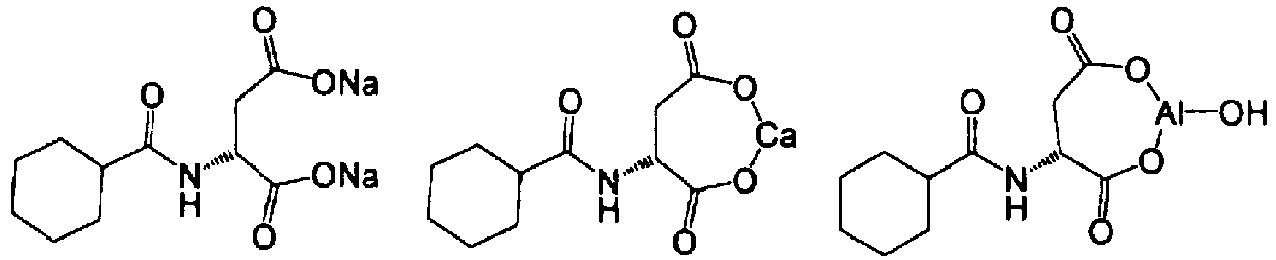
- The compound represented by Formula (1) can be produced by, for example, a method of allowing a metal salt of aspartic acid to react with a carboxylic acid chloride, such as benzoic acid chloride or cyclohexane carboxylic acid chloride, in the presence of a base.
- Next, embodiments of the nucleating agent composition for a polyolefin resin according to the present invention will be described. The nucleating agent composition of the present invention contains: the nucleating agent of the present invention; and at least one additive selected from the group consisting of a phenolic antioxidant, a phosphorus-based antioxidant, a sulfur-based antioxidant, other antioxidant, a hindered amine compound, an ultraviolet absorber, a nucleating agent different from the compound represented by Formula (1), a flame retardant, a flame retardant aid, a lubricant, a filler, a hydrotalcite, a fatty acid metal salt, an antistatic agent, a fluorescent brightener, a pigment, and a dye. The nucleating agent composition of the present invention exhibits an excellent β crystal-forming effect.
- Examples of the phenolic antioxidant include 2,6-di-tert-butyl-4-ethylphenol, 2-tert-butyl-4,6-dimethylphenol, styrenated phenol, 2,2'-methylene-bis(4-ethyl-6-tert-butylphenol), 2,2'-thiobis-(6-tert-butyl-4-methylphenol), 2,2'-thiodiethylene-bis[3-(3,5-di-tert-butyl-4-hydroxyphenyl)propionate], 2-methyl-4,6-bis(octylsulfanylmethyl)phenol, 2,2'-isobutylidene-bis(4,6-dimethylphenol), isooctyl-3-(3,5-di-tert-butyl-4-hydroxyphenyl)propionate, N,N'-hexane-1,6-diylbis[3-(3,5-di-tert-butyl-4-hydroxyphenyl)propionamide], 2,2'-oxamide-bis[ethyl-3-(3,5-di-tert-butyl-4-hydroxyphenyl)propionate], 2-ethylhexyl-3-(3',5'-di-tert-butyl-4'-hydroxyphenyl)propionate, 2,2'-ethylene-bis(4,6-di-tert-butylphenol), esters of 3,5-di-tert-butyl-4-hydroxy-benzenepropanoic acid and a C13-15 alkyl, 2,5-di-tert-amylhydroquinone, hindered phenol polymers (e.g., trade name "AO.OH.98" manufactured by ADEKA Polymer Additives Europe SAS), 2,2'-methylene-bis[6-(1-methylcyclohexyl)-p-cresol], 2-tert-butyl-6-(3-tert-butyl-2-hydroxy-5-methyl)-4-methylphenyl acrylate, 2-[1-(2-hydroxy-3,5-di-tert-pentylphenyl)ethyl]-4,6-di-tert-pentylphenyl acrylate, 6-[3-(3-tert-butyl-4-hydroxy-5-methyl)propoxy]-2,4,8,10-tetra-tert-butylbenzo[d,f][1,3,2]-dio xaphosphepin, hexamethylene-bis[3-(3,5-di-tert-butyl-4-hydroxyphenyl)propionate, calcium bis[monoethyl(3,5-di-tert-butyl-4-hydroxybenzyl)phosphonate], a reaction product between 5,7-bis(1,1-dimethylethyl)-3-hydroxy-2(3H)-benzofuranone and o-xylene, 2,6-di-tert-butyl-4-(4,6-bis(octylthio)-1,3,5-triazine-2-ylamino)phenol, DL-a-tocophenol (vitamin E), 2,6-bis(α-methylbenzyl)-4-methylphenol, bis[3,3-bis-(4'-hydroxy-3'-tert-butyl-phenyl)butyric acid]glycol ester, 2,6-di-tert-butyl-p-cresol, 2,6-diphenyl-4-octadecyloxyphenol, stearyl(3,5-di-tert-butyl-4-hydroxyphenyl)propionate, distearyl(3,5-di-tert-butyl-4-hydroxybenzyl)phosphonate, tridecyl-3,5-tert-butyl-4-hydroxybenzyl thioacetate, thiodiethylene-bis[(3,5-di-tert-butyl-4-hydroxyphenyl)propionate], 4,4'-thiobis(6-tert-butyl-m-cresol), 2-octylthio-4,6-di(3,5-di-tert-butyl-4-hydroxyphenoxy)-s-triazine, 2,2'-methylene-bis(4-methyl-6-tert-butylphenol), bis[3,3-bis(4-hydroxy-3-tert-butylphenyl)butyric acid]glycol ester, 4,4'-butylidene-bis(2,6-di-tert-butylphenol), 4,4'-butylidene-bis(6-tert-butyl-3-methylphenol), 2,2'-ethylidene-bis(4,6-di-tert-butylphenol), 1,1,3-tris(2-methyl-4-hydroxy-5-tert-butylphenyl)butane, bis[2-tert-butyl-4-methyl-6-(2-hydroxy-3-tert-butyl-5-methylbenzyl)phenyl]terephthalate, 1,3,5-tris(2,6-dimethyl-3-hydroxy-4-tert-butylbenzyl)isocyanurate, 1,3,5-tris(3,5-di-tert-butyl-4-hydroxybenzyl)isocyanurate, 1,3,5-tris(3,5-di-tert-butyl-4-hydroxybenzyl)-2,4,6-trimethylbenzene, 1,3,5-tris[(3,5-di-tert-butyl-4-hydroxyphenyl)propionyloxyethyl]isocyanurate, tetrakis[methylene-3-(3',5'-tert-butyl-4'-hydroxyphenyl)propionate]methane, 2-tert-butyl-4-methyl-6-(2-acryloyloxy-3-tert-butyl-5-methylbenzyl)phenol, 3,9-bis[2-(3-tert-butyl-4-hydroxy-5-methylhydrocinnamoyloxy)-1,1-dimethylethyl]-2,4,8,10-t etraoxaspiro[5.5]undecane, triethylene glycol-bis[β-(3-tert-butyl-4-hydroxy-5-methylphenyl)propionate], and 3-(3,5-dialkyl-4-hydroxyphenyl)propionic acid derivatives, such as stearyl-3-(3,5-di-tert-butyl-4-hydroxyphenyl)propionic acid amide, palmityl-3-(3,5-di-tert-butyl-4-hydroxyphenyl)propionic acid amide, myristyl-3-(3,5-di-tert-butyl-4-hydroxyphenyl)propionic acid amide and lauryl-3-(3,5-di-tert-butyl-4-hydroxyphenyl)propionic acid amide. These phenolic antioxidants may be used individually, or two or more thereof may be used in combination. In cases where the nucleating agent composition of the present invention contains a phenolic antioxidant, the content of the phenolic antioxidant may be adjusted such that it is 0.001 to 5 parts by mass with respect to 100 parts by mass of a polyolefin resin when the nucleating agent composition of the present invention is incorporated into the polyolefin resin.
- Examples of the phosphorus-based antioxidant include triphenyl phosphite, diisooctyl phosphite, heptakis(dipropylene glycol)triphosphite, triisodecyl phosphite, diphenylisooctyl phosphite, diisooctylphenyl phosphite, diphenyltridecyl phosphite, triisooctyl phosphite, trilauryl phosphite, diphenyl phosphite, tris(dipropylene glycol)phosphite, dioleyl hydrogen phosphite, trilauryl trithiophosphite, bis(tridecyl)phosphite, tris(isodecyl)phosphite, tris(tridecyl)phosphite, diphenyldecyl phosphite, dinonylphenyl-bis(nonylphenyl)phosphite, poly(dipropylene glycol)phenyl phosphite, tetraphenyldipropyl glycol diphosphite, trisnonylphenyl phosphite, tris(2,4-di-tert-butylphenyl)phosphite, tris(2,4-di-tert-butyl-5-methylphenyl)phosphite, tris[2-tert-butyl-4-(3-tert-butyl-4-hydroxy-5-methylphenylthio)-5-methylphenyl]phosphite, tri(decyl) phosphite, octyldiphenyl phosphite, di(decyl)monophenyl phosphite, mixtures of distearyl pentaerythritol and calcium stearate, alkyl(C10) bisphenol-A phosphite, tetraphenyl-tetra(tridecyl)pentaerythritol tetraphosphite, bis(2,4-di-tert-butyl-6-methylphenyl)ethyl phosphite, tetra(tridecyl)isopropylidene diphenol diphosphite, tetra(tridecyl)-4,4'-n-butylidene-bis(2-tert-butyl-5-methylphenol)diphosphite, hexa(tridecyl)-1,1,3-tris(2-methyl-4-hydroxy-5-tert-butylphenyl)butane triphosphite, tetrakis(2,4-di-tert-butylphenyl)biphenylene diphosphonite, 9,10-dihydro-9-oxa-10-phosphaphenanthrene-10-oxide, (1-methyl-1-propenyl-3-ylidene)tris(1,1-dimethylethyl)-5-methyl-4,1-phenylene)hexatridecyl phosphite, 2,2'-methylene-bis(4,6-di-tert-butylphenyl)-2-ethylhexyl phosphite, 2,2'-methylene-bis(4,6-di-tert-butylphenyl)-octadecyl phosphite, 2,2'-ethylidene-bis(4,6-di-tert-butylphenyl)fluorophosphite, 4,4'-butylidene-bis(3-methyl-6-tert-butylphenylditridecyl)phosphite, tris(2-[(2,4,8,10-tetrakis-tert-butyldibenzo[d,f][1,3,2]dioxaphosphepin-6-yl)oxy]ethyl)amine, 3,9-bis(4-nonylphenoxy)-2,4,8,10-tetraoxa-3,9-diphosphespiro[5.5]undecane, 2,4,6-tri-tert-butylphenyl-2-butyl-2-ethyl-1,3-propanediol phosphite, poly-4,4'-isopropylidene diphenol C12-15 alcohol phosphite, bis(diisodecyl)pentaerythritol diphosphite, bis(tridecyl)pentaerythritol diphosphite, bis(octadecyl)pentaerythritol diphosphite, bis(nonylphenyl)pentaerythritol diphosphite, bis(2,4-di-tert-butylphenyl)pentaerythritol diphosphite, bis(2,4,6-tri-tert-butylphenyl)pentaerythritol diphosphite, bis(2,6-di-tert-butyl-4-methylphenyl)pentaerythritol diphosphite, and bis(2,4-dicumylphenyl)pentaerythritol diphosphite. These phosphorus-based antioxidants may be used individually, or two or more thereof may be used in combination. In cases where the nucleating agent composition of the present invention contains a phosphorus-based antioxidant, the content of the phosphorus-based antioxidant may be adjusted such that it is 0.001 to 5 parts by mass with respect to 100 parts by mass of a polyolefin resin when the nucleating agent composition of the present invention is incorporated into the polyolefin resin.
- Examples of the sulfur-based antioxidant include tetrakis [methylene-3 -(laurylthio)propionate] methane, bis(methyl-4-[3-n-alkyl(C12/C14)thiopropionyloxy]-5-tert-butylphenyl)sulfide, ditridecyl-3,3'-thiodipropionate, dilauryl-3,3'-thiodipropionate, dimyristyl-3,3'-thiodipropionate, distearyl-3,3'-thiodipropionate, lauryl/stearyl thiodipropionate, 4,4'-thiobis(6-tert-butyl-m-cresol), 2,2'-thiobis(6-tert-butyl-p-cresol), and distearyl disulfide. These sulfur-based antioxidants may be used individually, or two or more thereof may be used in combination. In cases where the nucleating agent composition of the present invention contains a sulfur-based antioxidant, the content of the sulfur-based antioxidant may be adjusted such that it is 0.001 to 10 parts by mass with respect to 100 parts by mass of a polyolefin resin when the nucleating agent composition of the present invention is incorporated into the polyolefin resin.
- Examples of the above-described other antioxidant include nitrone compounds, such as N-benzyl-α-phenyl nitrone, N-ethyl-α-methyl nitrone, N-octyl-α-heptyl nitrone, N-lauryl-α-undecyl nitrone, N-tetradecyl-α-tridecyl nitrone, N-hexadecyl-α-pentadecyl nitrone, N-octyl-α-heptadecyl nitrone, N-hexadecyl-α-heptadecyl nitrone, N-octadecyl-α-pentadecyl nitrone, N-heptadecyl-α-heptadecyl nitrone, and N-octadecyl-α-heptadecyl nitrone; and benzofuran compounds, such as 3-arylbenzofuran-2(3H)-one, 3-(alkoxyphenyl)benzofuran-2-one, 3-(acyloxyphenyl)benzofuran-2(3H)-one, 5,7-di-tert-butyl-3-(3,4-dimethylphenyl)-benzofuran-2(3H)-one, 5,7-di-tert-butyl-3-(4-hydroxyphenyl)-benzofuran-2(3H)-one, 5,7-di-tert-butyl-3-14-(2-hydroxyethoxy)phenyl}benzofuran-2(3H)-one, 6-(2-(4-(5,7-di-tert-2-oxo-2,3-dihydrobenzofuran-3-yl)phenoxy)ethoxy)-6-oxohexyl-6-((6-hy droxyhexanoyl)oxy)hexanoate, and 5-di-tert-butyl-3-(4-((15-hydroxy-3,6,9,13-tetraoxapentadecyl)oxy)phenyl)benzofuran-2(3H) -one. These other antioxidants may be used individually, or two or more thereof may be used in combination. In cases where the nucleating agent composition of the present invention contains other antioxidant, the content of the other antioxidant may be adjusted such that it is 0.001 to 20 parts by mass with respect to 100 parts by mass of a polyolefin resin when the nucleating agent composition of the present invention is incorporated into the polyolefin resin.
- Examples of the hindered amine compound include 2,2,6,6-tetramethyl-4-piperidyl stearate, 1,2,2,6,6-pentamethyl-4-piperidyl stearate, 2,2,6,6-tetramethyl-4-piperidyl benzoate, bis(2,2,6,6-tetramethyl-4-piperidyl)sebacate, tetrakis(2,2,6,6-tetramethyl-4-piperidyl)-1,2,3,4-butanetetracarboxylate, tetrakis(1,2,2,6,6-pentamethyl-4-piperidyl)-1,2,3,4-butanetetracarboxylate, bis(2,2,6,6-tetramethyl-4-piperidyl)·di(tridecyl)-1,2,3,4-butanetetracarboxylate, bis(1,2,2,6,6-pentamethyl-4-piperidyl)·di(tridecyl)-1,2,3,4-butanetetracarboxylate, bis(1,2,2,4,4-pentamethyl-4-piperidyl)-2-butyl-2-(3,5-di-tert-butyl-4-hydroxybenzyl)malonate, 1-(2-hydroxyethyl)-2,2,6,6-tetramethyl-4-piperidinol/diethyl succinate polycondensate, 1,6-bis(2,2,6,6-tetramethyl-4-piperidylamino)hexane/2,4-dichloro-6-morpholino-s-triazine polycondensate, 1,6-bis(2,2,6,6-tetramethyl-4-piperidylamino)hexane/2,4-dichloro-6-tert-octylamino-s-triazin e polycondensate, 1,5,8,12-tetrakis[2,4-bis(N-butyl-N-(2,2,6,6-tetramethyl-4-piperidyl)amino)-s-triazine-6-yl]-1, 5,8,12-tetraazadodecane, 1,5,8,12-tetrakis[2,4-bis(N-butyl-N-(1,2,2,6,6-pentamethyl-4-piperidyl)amino)-s-triazine-6-yl] -1,5,8,12-tetraazadodecane, 1,6,11-tris[2,4-bis(N-butyl-N-(2,2,6,6-tetramethyl-4-piperidyl)amino)-s-triazine-6-yl]aminoun decane, 1,6,11-tris[2,4-bis(N-butyl-N-(1,2,2,6,6-pentamethyl-4-piperidyl)amino)-s-triazine-6-yl]amino undecane, bis{4-(1-octyloxy-2,2,6,6-tetramethyl)piperidyl}decanedionate, and bis{4-(2,2,6,6-tetramethyl-1-undecyloxy)piperidyl)carbonate. These hindered amine compounds may be used individually, or two or more thereof may be used in combination. In cases where the nucleating agent composition of the present invention contains a hindered amine compound, the content of the hindered amine compound may be adjusted such that it is 0.001 to 20 parts by mass with respect to 100 parts by mass of a polyolefin resin when the nucleating agent composition of the present invention is incorporated into the polyolefin resin.
- Examples of the ultraviolet absorber include 2-hydroxybenzophenones, such as 2,4-dihydroxybenzophenone and 5,5'-methylene-bis(2-hydroxy-4-methoxybenzophenone); 2-(2-hydroxyphenyl)benzotriazoles, such as 2-(2-hydroxy-5-methylphenyl)benzotriazole, 2-(2-hydroxy-5-tert-octylphenyl)benzotriazole, 2-(2-hydroxy-3,5-di-tert-butylphenyl)-5-chlorobenzotriazole, 2-(2-hydroxy-3-tert-butyl-5-methylphenyl)-5-chlorobenzotriazole, 2-(2-hydroxy-3,5-dicumylphenyl)benzotriazole, 2,2'-methylene-bis(4-tert-octyl-6-benzotriazolylphenol), polyethylene glycol esters of 2-(2-hydroxy-3-tert-butyl-5-carboxyphenyl)benzotriazole, 2-[2-hydroxy-3-(2-acryloyloxyethyl)-5-methylphenyl]benzotriazole, 2-[2-hydroxy-3-(2-methacryloyloxyethyl)-5-tert-butylphenyl]benzotriazole, 2-[2-hydroxy-3-(2-methacryloyloxyethyl)-5-tert-octylphenyl]benzotriazole, 2-[2-hydroxy-3-(2-methacryloyloxyethyl)-5-tert-butylphenyl]-5-chlorobenzotriazole, 2-[2-hydroxy-5-(2-methacryloyloxyethyl)phenyl]benzotriazole, 2-[2-hydroxy-3-tert-butyl-5-(2-methacryloyloxyethyl)phenyl]benzotriazole, 2-[2-hydroxy-3-tert-amyl-5-(2-methacryloyloxyethyl)phenyl]benzotriazole, 2-[2-hydroxy-3-tert-butyl-5-(3-methacryloyloxypropyl)phenyl]-5-chlorobenzotriazole, 2-[2-hydroxy-4-(2-methacryloyloxymethyl)phenyl]benzotriazole, 2-[2-hydroxy-4-(3-methacryloyloxy-2-hydroxypropyl)phenyl]benzotriazole, and 2-[2-hydroxy-4-(3-methacryloyloxypropyl)phenyl]benzotriazole; benzoates, such as phenyl salicylate, resorcinol monobenzoate, 2,4-di-tert-butylphenyl-3,5-di-tert-butyl-4-hydroxybenzoate, octyl(3,5-di-tert-butyl-4-hydroxy)benzoate, dodecyl(3,5-di-tert-butyl-4-hydroxy)benzoate, tetradecyl(3,5-di-tert-butyl-4-hydroxy)benzoate, hexadecyl(3,5-di-tert-butyl-4-hydroxy)benzoate, octadecyl(3,5-di-tert-butyl-4-hydroxy)benzoate, and behenyl(3,5-di-tert-butyl-4-hydroxy)benzoate; substituted oxanilides, such as 2-ethyl-2'-ethoxyoxanilide and 2-ethoxy-4'-dodecyloxanilide; cyanoacrylates, such as ethyl-α-cyano-β,β-diphenyl acrylate and methyl-2-cyano-3-methyl-3-(p-methoxyphenyl)acrylate; triazines, such as 2-(4,6-diphenyl-1,3,5-triazine-2-yl)-5-hexyloxyphenol, 2-(2-hydroxy-4-octoxyphenyl)-4,6-bis(2,4-dimethylphenyl)-1,3,5-triazine, trioctyl-2,2',2"-((1,3,5-triazine-2,4,6-triyl)tris(3-hydroxybenzene-4-,1-diyl)tripropionate), 2-(4,6-diphenyl-1,3,5-triazine-2-yl)-5-[2-(2-ethylhexanoyloxy)ethoxy]phenol, 2,4,6-tris(2-hydroxy-4-hexyloxy-3-methylphenyl)-1,3,5-triazine, and 1,12-bis[2-[4-(4,6-diphenyl-1,3,5-triazine-2-yl)-3-hydroxyphenoxy]ethyl]dodecane dioate; and a variety of metal salts and metal chelates, particularly salts and chelates of nickel and chromium. These ultraviolet absorbers may be used individually, or two or more thereof may be used in combination. In cases where the nucleating agent composition of the present invention contains an ultraviolet absorber, the content of the ultraviolet absorber may be adjusted such that it is 0.001 to 20 parts by mass with respect to 100 parts by mass of a polyolefin resin when the nucleating agent composition of the present invention is incorporated into the polyolefin resin.
- Examples of the above-described other nucleating agent different from the compound represented by Formula (1) include metal carboxylates, such as sodium-2,2'-methylene-bis(4,6-di-tert-butylphenyl)phosphate, lithium-2,2'-methylene-bis(4,6-di-tert-butylphenyl)phosphate, aluminum hydroxybis[2,2'-methylene-bis(4,6-di-tert-butylphenyl)phosphate], sodium benzoate, 4-tert-butylbenzoate aluminum salt, sodium adipate, 2-sodium-bicyclo[2.2.1]heptane-2,3-dicarboxylate, and calcium cyclohexane-1,2-dicarboxylate; polyol derivatives, such as dibenzylidene sorbitol, bis(methylbenzylidene)sorbitol, bis(3,4-dimethylbenzylidene)sorbitol, bis(p-ethylbenzylidene)sorbitol, bis(dimethylbenzylidene) sorbitol, and 1,2,3-trideoxy-4,6:5,7-bis-O-((4-propylphenyl)methylene)nonitol; and amide compounds, such as N,N,N'-tris[2-methylcyclohexyl]-1,2,3-propane tricarboxamide, N,N',N"-tricyclohexy1-1,3,5-benzene tricarboxamide, N,N-dicyclohexylnaphthalene dicarboxamide, and 1,3,5-tri(dimethylisopropoylamino)benzene. These other nucleating agents may be used individually, or two or more thereof may be used in combination. In cases where the nucleating agent composition of the present invention contains other nucleating agent different from the compound represented by Formula (1), the content of the other nucleating agent may be adjusted such that it is 0.001 to 10 parts by mass with respect to 100 parts by mass of a polyolefin resin when the nucleating agent composition of the present invention is incorporated into the polyolefin resin.
- Examples of the flame retardant include aromatic phosphates, such as triphenyl phosphate, tricresyl phosphate, trixylenyl phosphate, cresyldiphenyl phosphate, cresyl-2,6-dixylenyl phosphate, resorcinol-bis(diphenylphosphate), (1-methylethylidene)-4,1-phenylene tetraphenyl diphosphate, and 1,3-phenylene-tetrakis(2,6-dimethylphenyl)phosphate, as well as "ADK STAB FP-500", "ADK STAB FP-600" and "ADK STAB FP-800" (trade names, manufactured by ADEKA Corporation); phosphonates, such as divinyl phenylphosphonate, diallyl phenylphosphonate, and (1-butenyl) phenylphosphonate; phosphinates, such as phenyl diphenylphosphinate, methyl diphenylphosphinate, and 9,10-dihydro-9-oxa-10-phosphaphenanthlene-10-oxide derivatives; phosphazene compounds, such as bis(2-allylphenoxy)phosphazene and dicresyl phosphazene; phosphorus-based flame retardants, such as melamine phosphate, melamine pyrophosphate, melamine polyphosphate, melam polyphosphate, ammonium polyphosphate, piperazine phosphate, piperazine pyrophosphate, piperazine polyphosphate, phosphorus-containing vinylbenzyl compounds, and red phosphorus; metal hydroxides, such as magnesium hydroxide and aluminum hydroxide; and bromine-based flame retardants, such as brominated bisphenol A-type epoxy resins, brominated phenol novolac-type epoxy resins, hexabromobenzene, pentabromotoluene, ethylene-bis(pentabromophenyl), ethylene-bis-tetrabromophthalimide, 1,2-dibromo-4-(1,2-dibromoethyl)cyclohexane, tetrabromocyclooctane, hexabromocyclododecane, bis(tribromophenoxy)ethane, brominated polyphenylene ether, brominated polystyrene, 2,4,6-tris(tribromophenoxy)-1,3,5-triazine, tribromophenyl maleimide, tribromophenyl acrylate, tribromophenyl methacrylate, tetrabromobisphenol A-type dimethacrylate, pentabromobenzyl acrylate, and brominated styrene. These flame retardants are preferably used in combination with a drip inhibitor such as a fluorocarbon resin, and/or a flame retardant aid such as a polyhydric alcohol or hydrotalcite. These flame retardants may be used individually, or two or more thereof may be used in combination. In cases where the nucleating agent composition of the present invention contains a flame retardant, the content of the flame retardant may be adjusted such that it is 1 to 100 parts by mass with respect to 100 parts by mass of a polyolefin resin when the nucleating agent composition of the present invention is incorporated into the polyolefin resin.
- The lubricant is added for the purposes of imparting the surface of the resulting molded article with lubricity and improving the damage-preventing effect. Examples of the lubricant include unsaturated fatty acid amides, such as oleic acid amide and erucic acid amide; saturated fatty acid amides, such as behenic acid amide and stearic acid amide; butyl stearate; stearyl alcohols; stearic acid monoglyceride; sorbitan monopalmitate; sorbitan monostearate; mannitol; stearic acid; hardened castor oil; stearic acid amide; oleic acid amide; and ethylene-bis stearic acid amide. These lubricants may be used individually, or two or more thereof may be used in combination. In cases where the nucleating agent composition of the present invention contains a lubricant, the content of the lubricant may be adjusted such that it is 0.01 to 2 parts by mass with respect to 100 parts by mass of a polyolefin resin when the nucleating agent composition of the present invention is incorporated into the polyolefin resin.
- Examples of the filler include talc, mica, calcium carbonate, calcium oxide, calcium hydroxide, magnesium carbonate, magnesium hydroxide, magnesium oxide, magnesium sulfate, aluminum hydroxide, barium sulfate, glass powder, glass fibers, clays, dolomite, silica, alumina, potassium titanate whiskers, wollastonite, and fibrous magnesium oxysulfate, and any of these fillers can be used by appropriately selecting the particle size (the fiber diameter, fiber length and aspect ratio in the case of a fibrous filler). Among these fillers, talc is particularly preferably used since it can impart especially excellent rigidity to the resulting molded article and can be easily obtained. Further, the filler to be used may be subjected to a surface treatment as required. The above-described fillers may be used individually, or two or more thereof may be used in combination. In cases where the nucleating agent composition of the present invention contains a filler, the content of the filler may be adjusted such that it is 0.01 to 80 parts by mass with respect to 100 parts by mass of a polyolefin resin when the nucleating agent composition of the present invention is incorporated into the polyolefin resin.
- The fatty acid metal salt is preferably a compound represented by the following Formula (4) from the standpoint of attaining heat resistance and dispersion effect of the nucleating agent in a resin.

- In Formula (4), R11 represents a linear or branched fatty acid residue having 12 to 20 carbon atoms, the fatty acid residue may be substituted with a hydroxy group, M2 represents a monovalent to trivalent metal atom which may be bound with a hydroxy group, and m represents an integer of 1 to 3.
- In cases where the nucleating agent composition of the present invention contains a fatty acid metal salt, the content of the fatty acid metal salt may be adjusted such that it is 0.001 to 10 parts by mass with respect to 100 parts by mass of a polyolefin resin when the nucleating agent composition of the present invention is incorporated into the polyolefin resin.
- In Formula (4), specific examples of M2 include sodium, potassium, lithium, calcium, zinc, barium, magnesium and hydroxyaluminum, among which sodium, potassium and lithium are particularly preferred.
- The above-described hydrotalcite is a complex salt compound which is known as a natural or synthetic product and composed of magnesium, aluminum, hydroxy groups, a carbonate group and arbitrary crystal water, and examples thereof include hydrotalcites in which some of the magnesium or aluminum atoms are substituted with other metal such as an alkali metal or zinc; and hydrotalcites in which the hydroxy group(s) and/or carbonate group is/are substituted with other anionic group(s), specifically hydrotalcites represented by the following Formula (5) in which a metal is substituted with an alkali metal:
Mgz1Znz2Al2(OH)2(z1+z2)+4(CO3)pH2O (5)
wherein z1 and z2 each represent a number that satisfies the conditions represented by the following equations, and p represents 0 or a positive number: 0 ≤ z2/zl < 10, and 2 ≤ (z1 + z2) ≤ 20. - In addition, as an Al-Li hydrotalcite, a compound represented by the following Formula (6) can be used as well:
[Li1/3Al2/3(OH)2] · [Aq- 1/3q·pH2O] (6)
wherein Aq- represents an anion having a valence of q; and p represents 0 or a positive number. Further, the carbonate anions in these hydrotalcites may be partially substituted with other anions. - These hydrotalcites may be dehydrated crystal water or may be those coated with, for example, a higher fatty acid such as stearic acid, a higher fatty acid metal salt such as alkali metal oleate, a metal organic sulfonate such as alkali metal dodecylbenzenesulfonate, a higher fatty acid amide, a higher fatty acid ester, or a wax.
- The hydrotalcite may be a naturally-occurring or synthetic hydrotalcite. Examples of a hydrotalcite synthesis method include known methods that are described in JPS46-2280B1, JPS50-30039B1, JPS51-29129B1, JPH3-36839B1, JPS61-174270A, JPH05-179052A, and the like. Further, the above-exemplified hydrotalcites can be used without any restriction in terms of their crystal structure, crystal particles and the like. These hydrotalcites may be used individually, or two or more thereof may be used in combination. In cases where the nucleating agent composition of the present invention contains a hydrotalcite, the content of the hydrotalcite may be adjusted such that it is 0.001 to 5 parts by mass with respect to 100 parts by mass of a polyolefin resin when the nucleating agent composition of the present invention is incorporated into the polyolefin resin.
- Examples of the above-described antistatic agent include low-molecular-weight antistatic agents based on nonionic, anionic, cationic or amphoteric surfactants, and high-molecular-weight antistatic agents based on polymer compounds. Examples of the nonionic surfactants include polyethylene glycol-type nonionic surfactants, such as higher alcohol ethylene oxide adducts, fatty acid ethylene oxide adducts, higher alkylamine ethylene oxide adducts and polyolefin glycol ethylene oxide adducts; and polyhydric alcohol-type nonionic surfactants, such as polyethylene oxides, glycerin fatty acid esters, pentaerythritol fatty acid esters, sorbitol or sorbitan fatty acid esters, polyhydric alcohol alkyl ethers and alkanolamine aliphatic amides. Examples of the anionic surfactants include carboxylates, such as alkali metal salts of higher fatty acids; sulfates, such as higher alcohol sulfates and higher alkyl ether sulfates; sulfonates, such as alkylbenzenesulfonates, alkyl sulfonates and paraffin sulfonates; and phosphates such as higher alcohol phosphates. Examples of the cationic surfactants include quaternary ammonium salts such as alkyltrimethyl ammonium salts, and examples of the amphoteric surfactants include amino acid-type amphoteric surfactants such as higher alkylaminopropionates, and betaine-type amphoteric surfactants, such as higher alkyl dimethylbetaines and higher alkyl dihydroxyethylbetaines. In the polyolefin resin composition, an anionic surfactant is preferred, and a sulfonate such as an alkylbenzenesulfonate, an alkylsulfonate, or a paraffin sulfonate is particularly preferred. These antistatic agents may be used individually, or two or more thereof may be used in combination. In cases where the nucleating agent composition of the present invention contains a low-molecular-weight antistatic agent, the content of the low-molecular-weight antistatic agent may be adjusted such that it is 0.1 to 10 parts by mass with respect to 100 parts by mass of a polyolefin resin when the nucleating agent composition of the present invention is incorporated into the polyolefin resin.
- Examples of the high-molecular-weight antistatic agents include ionomers, and block polymers containing a polyethylene glycol as a hydrophilic moiety. Examples of the ionomers include the ionomer disclosed in
JP2010-132927A US6552131B1 which is composed of a polyolefin and a polyethylene glycol, and the polymer disclosed inJP2016-023254A - The fluorescent brightener is a compound which enhances the whiteness or blueness of a molded article by a fluorescent action of absorbing ultraviolet rays of solar light and artificial light, converting the absorbed ultraviolet rays into visible light of purple to blue and radiating the visible light. Examples of the fluorescent brightener include C.I. Fluorescent Brightener 184, which is a benzoxazole-based compound; C.I. Fluorescent Brightener 52, which is a coumarin-based compound; and C.I. Fluorescent Brighteners 24, 85 and 71, which are diaminostyrylbenzyl sulfone-based compounds. These fluorescent brighteners may be used individually, or two or more thereof may be used in combination. In cases where the nucleating agent composition of the present invention contains a fluorescent brightener, the content of the fluorescent brightener may be adjusted such that it is 0.00001 to 0.1 parts by mass with respect to 100 parts by mass of a polyolefin resin when the nucleating agent composition of the present invention is incorporated into the polyolefin resin.
- The pigment is not particularly restricted, and any commercially available pigment may be used. Specific examples of the pigment include PIGMENT RED 1, 2, 3, 9, 10, 17, 22, 23, 31, 38, 41, 48, 49, 88, 90, 97, 112, 119, 122, 123, 144, 149, 166, 168, 169, 170, 171, 177, 179, 180, 184, 185, 192, 200, 202, 209, 215, 216, 217, 220, 223, 224, 226, 227, 228, 240, and 254; PIGMENT ORANGE 13, 31, 34, 36, 38, 43, 46, 48, 49, 51, 52, 55, 59, 60, 61, 62, 64, 65, and 71; PIGMENT YELLOW 1, 3, 12, 13, 14, 16, 17, 20, 24, 55, 60, 73, 81, 83, 86, 93, 95, 97, 98, 100, 109, 110, 113, 114, 117, 120, 125, 126, 127, 129, 137, 138, 139, 147, 148, 150, 151, 152, 153, 154, 166, 168, 175, 180, and 185; PIGMENT GREEN 7, 10, and 36; PIGMENT BLUE 15, 15:1, 15:2, 15:3, 15:4, 15:5, 15:6, 22, 24, 29, 56, 60, 61, 62, and 64; and PIGMENT VIOLET 1, 15, 19, 23, 27, 29, 30, 32, 37, 40, and 50.
- Examples of the dye include azo dyes, anthraquinone dyes, indigoid dyes, triarylmethane dyes, xanthene dyes, alizarin dyes, acridine dyes, stilbene dyes, thiazole dyes, naphthol dyes, quinoline dyes, nitro dyes, indamine dyes, oxazine dyes, phthalocyanine dyes and cyanine dyes, and these dyes may be used individually, or two or more thereof may be used in combination.
- A method of producing the nucleating agent composition of the present invention is not particularly restricted and, for example, a method of mixing the nucleating agent of the present invention with other additives may be employed. Examples of other method of producing the nucleating agent composition of the present invention include a method of mixing with heating the nucleating agent of the present invention and other additives along with a binder containing a polymer compound or a petroleum resin, homogenizing the resulting mixture in the presence of the binder in a molten state, and subsequently processing the resultant into a pellet form. According to this production method, the nucleating agent composition of the present invention that is uniform and has excellent ease of handling can be produced. In this production method, there is no restriction on the processing conditions. Further, the processing equipment to be used in this production method is also not restricted at all, and any well-known and commonly-used processing equipment, such as an extruder or a disk pelleter, may be employed.
- Next, the polyolefin resin composition of the present invention will be described. The resin composition of the present invention contains a polyolefin resin and a compound represented by Formula (1), and the content of the nucleating agent of the present invention is 0.001 to 10 parts by mass with respect to 100 parts by mass of the polyolefin resin. The resin composition of the present invention can allow its polyolefin resin to preferentially form β crystals.
- Examples of the polyolefin resin contained in the resin composition of the present invention include α-olefin polymers, such as low-density polyethylenes (LDPE), linear low-density polyethylenes (L-LDPE), high-density polyethylenes (HDPE), isotactic polypropylenes, syndiotactic polypropylenes, hemi-isotactic polypropylenes, cycloolefin polymers, stereo block polypropylenes, poly-3-methyl-1-butenes, poly-3-methyl-1-pentenes, and poly-4-methyl-1-pentenes; α-olefin copolymers, such as ethylene-propylene copolymers, impact copolymer polypropylenes, ethylene-methyl methacrylate copolymers, ethylene-methyl acrylate copolymers, ethylene-ethyl acrylate copolymers, ethylene-butyl acrylate copolymers, ethylene-vinyl acetate copolymers, and ethylene-vinyl alcohol resins (EVOH); and chlorinated products thereof. The polyolefin resin may be a blend or an alloy of two or more of these polymers.
- The polyolefin resin is preferably a polypropylene resin. Examples of the polypropylene resin include propylene homopolymers, ethylene-propylene copolymers (e.g., ethylene-propylene random copolymers), ethylene-propylene-1-butene terpolymers, copolymers of propylene and other α-olefin (e.g., 1-butene, 1-hexene, 1-octene, or 4-methyl-1-pentene), ethylene-propylene block copolymers containing an ethylene-propylene copolymer (e.g., impact copolymer polypropylenes and TPOs), and chlorinated products thereof. The polypropylene resin may be a blend, an alloy, or a block copolymer of two or more of these polymers.
- It is more preferred that the polyolefin resin used in the resin composition of the present invention further contain an ethylene-propylene copolymer. In this case, the resulting molded article can be imparted with particularly excellent impact resistance. Examples of such a polyolefin resin include the above-described ethylene-propylene copolymers (e.g., ethylene-propylene random copolymers) and ethylene-propylene block copolymers (e.g., impact copolymer polypropylenes and TPOs).
- In the resin composition of the present invention, the above-described polyolefin resins can be used regardless of, for example, the types and the presence or absence of a polymerization catalyst and a co-catalyst, the steric regularity, the average molecular weight, the molecular weight distribution, the presence or absence and the ratio of a component having a specific molecular weight, the specific gravity, the viscosity, the solubility in various solvents, the elongation rate, the impact strength, the crystallization degree, the X-ray diffraction, and the presence or absence of a modification/crosslinking treatment that is performed with an unsaturated carboxylic acid (e.g., maleic acid, itaconic acid, or fumaric acid) and a derivative thereof (e.g., maleic anhydride, maleic acid monoester, or maleic acid diester) or an organic peroxide, or by irradiation of an energy ray, or a combination of these treatments.
- As described above, in the resin composition of the present invention, the content of the nucleating agent of the present invention is 0.001 to 10 parts by mass with respect to 100 parts by mass of the polyolefin resin. From the standpoint of attaining a superior β crystal-forming effect, the content of the nucleating agent of the present invention is preferably not less than 0.005 parts by mass, more preferably not less than 0.02 parts by mass, with respect to 100 parts by mass of the polyolefin resin. Further, from the standpoint of suppressing the occurrence of blooming and the extractability of the nucleating agent, the content of the nucleating agent of the present invention is preferably 1 part by mass or less, more preferably 0.5 parts by mass or less, still more preferably 0.3 parts by mass or less, with respect to 100 parts by mass of the polyolefin resin.
- The resin composition of the present invention preferably further contains an elastomer. In this case, the resulting molded article can be imparted with a superior impact resistance.
- The elastomer is not particularly restricted; however, it is preferably a copolymer of ethylene and a monomer other than ethylene since such an elastomer has excellent compatibility with polyolefin resins.
- The monomer other than ethylene may be, for example, a linear or branched α-olefin having 3 to 20 carbon atoms, an aromatic vinyl compound having 8 to 20 carbon atoms, other vinyl compound, a conjugated diene, a (meth)acrylic acid alkyl ester, or an alkoxy-acrylic acid alkyl ester. It is noted here that "(meth)acrylic acid alkyl ester" refers to an acrylic acid alkyl ester or a methacrylic acid alkyl ester. These monomers other than ethylene may be used individually, or two or more thereof may be used in combination.
- Examples of the α-olefin having 3 to 20 carbon atom include propylene, 1-butene, 3-methyl-1-butene, 3-ethyl-1-butene, 1-pentene, 3-methyl-1-pentene, 3-ethyl-1-pentene, 4,4-dimethyl-1-pentene, 1-hexene, 4-methyl-1-hexene, 4,4-dimethyl-1-hexene, 4-ethyl-1-hexene, 3-ethyl-1-hexene, 1-octene, 1-decene, 1-undecene, 1-dodecene, 1-tetradecene, 1-hexadecene, 1-octadecene and 1-eicosene, and the α-olefin is preferably, for example, propylene, 1-butene, 1-pentene, 1-hexene, or 1-octene.
- Examples of the aromatic vinyl compound having 8 to 20 carbon atoms include styrene, o-methylstyrene, p-methylstyrene, m-methylstyrene, o-ethylstyrene, m-ethylstyrene, p-ethylstyrene, p-tert-butylstyrene, chloromethylstyrene and vinyltoluene, and the aromatic vinyl compound is preferably, for example, a mono- or poly-alkylstyrene.
- Examples of the other vinyl compound include halogenated olefins, unsaturated amines, unsaturated carboxylic acids, vinyl esters, unsaturated epoxy compounds, and ethylenically unsaturated silane compounds.
- The "halogenated olefins" refers to the above-described α-olefins to which a halogen atom, such as chlorine, bromine or iodine, is added.
- Examples of the unsaturated amines include allylamine, 5-hexeneamine, and 6-hepteneamine.
- Examples of the unsaturated carboxylic acids include (meth)acrylic acid, 3-butenoic acid, 4-pentenoic acid, 5-hexenoic acid, 6-heptenoic acid, 7-octenoic acid, 8-nonenoic acid, 9-decenoic acid and 10-undecenoic acid, and these unsaturated carboxylic acids may be substituted with a halogen atom.
- Examples of the vinyl esters include aliphatic vinyl esters, such as vinyl formate, vinyl acetate, vinyl propionate, vinyl butyrate, vinyl isobutyrate, trimethyl vinyl acetate, vinyl pentanoate, vinyl decanoate, vinyl undecylate, vinyl laurate, vinyl myristate, vinyl pentadecylate, vinyl palmitate, vinyl stearate, and vinyl versatate (a mixture of carboxylic acids having 9 to 11 carbon atoms); and aromatic vinyl esters such as vinyl benzoate. Preferred examples of the vinyl esters include vinyl esters having 3 to 20 carbon atoms, and the vinyl esters may be, for example, more preferably vinyl esters having 4 to 10 carbon atoms, still more preferably vinyl acetate.
- Examples of the unsaturated epoxy compounds include 4-epoxy-1-butene, 5-epoxy-1-pentene, 6-epoxy-1-hexene, 7-epoxy-1-heptene, 8-epoxy-1-octene, 9-epoxy-1-nonene, 10-epoxy-1-decene, and 11-epoxy-1-undecene.
- Examples of the ethylenically unsaturated silane compounds include vinyltriethoxysilane, vinyltrimethoxysilane, 3-acryloxypropyltrimethoxysilane, and γ-methacryloxypropyltrimethoxysilane.
- Examples of the conjugated diene include 1,3-butadiene, isoprene, 1,3-pentadiene, 2-ethyl-1,3-butadiene, 2,3-dimethylbutadiene, 2-methylpentadiene, 4-methylpentadiene, 2,4-hexadiene, and 1,3-octadiene.
- Examples of the (meth)acrylic acid alkyl ester include methyl (meth)acrylate, ethyl (meth)acrylate, n-propyl (meth)acrylate, n-butyl (meth)acrylate, isobutyl (meth)acrylate, n-pentyl (meth)acrylate, isoamyl (meth)acrylate, n-hexyl (meth)acrylate, 2-methylpentyl (meth)acrylate, n-octyl (meth)acrylate, 2-ethylhexyl (meth)acrylate, n-decyl (meth)acrylate, n-dodecyl (meth)acrylate, and n-octadecyl (meth)acrylate.
- Examples of the alkoxy-acrylic acid alkyl ester include 2-methoxyethyl acrylate, 2-ethoxyethyl acrylate, 2-(n-propoxy)ethyl acrylate, 2-(n-butoxy)ethyl acrylate, 3-methoxypropyl acrylate, 3-ethoxypropyl acrylate, 2-(n-propoxy)propyl acrylate, and 2-(n-butoxy)propyl acrylate.
- The elastomer may be a copolymer of any one of these monomers with ethylene, or a copolymer of a combination of two or more of these monomers with ethylene.
- Among elastomers that are copolymers of ethylene and a monomer other than ethylene, an ethylene-a olefin copolymer is preferred since it has excellent compatibility with olefin resins. Further, a copolymer of ethylene and vinyl ester is also preferred.
- Specific examples of an elastomer that is a copolymer of ethylene and a monomer other than ethylene include ethylene-propylene copolymers, ethylene-butene copolymers, block or random copolymers such as ethylene-octene copolymers, ethylene-methyl methacrylate copolymers, ethylene-methyl acrylate copolymers, ethylene-ethyl acrylate copolymers, ethylene-butyl acrylate copolymers, styrene-ethylene-butylene copolymers, styrene-ethylene-butylene-styrene copolymers, and ethylene-vinyl acetate copolymers.
- Examples of an elastomer other than the elastomer that is a copolymer of ethylene and a monomer other than ethylene include thermoplastic polyesters and thermoplastic polyurethanes.
- The above-described elastomers can be used regardless of, for example, the molecular weight, the polymerization degree, the density, the softening point, the insoluble component-to-solvent ratio, the degree of stereoregularity, the presence or absence of a catalyst residue, the type and blend ratio of a raw material monomer, and the type of a polymerization catalyst (e.g., a Ziegler catalyst or a metallocene catalyst).
- The content of the elastomer is preferably 1 to 80 parts by mass with respect to 100 parts by mass of the polyolefin resin. In this case, the resin composition of the present invention can impart its molded article with superior impact resistance. The content of the elastomer is more preferably not less than 3 parts by mass, particularly preferably not less than 5 parts by mass, with respect to 100 parts by mass of the polyolefin resin. Further, from the standpoint of obtaining a molded article that has excellent impact resistance in low-temperature environments, the content of the elastomer is more preferably 50 parts by mass or less, particularly preferably 40 parts by mass or less, with respect to 100 parts by mass of the polyolefin resin.
- The resin composition of the present invention preferably further contains a filler. In this case, the resulting molded article can be imparted with excellent rigidity. Examples of the filler include the same ones as those that can be used in the above-described nucleating agent composition. Among such fillers, talc is particularly preferred since it can impart the molded article with especially excellent rigidity and is easy to obtain. The content of the filler is preferably 0.01 to 80 parts by mass with respect to 100 parts by mass of the polyolefin resin. The content of the filler is more preferably not less than 1 part by mass with respect to 100 parts by mass of the polyolefin resin. Further, the content of the filler is more preferably 50 parts by mass or less with respect to 100 parts by mass of the polyolefin resin.
- In the polyolefin resin composition, unless the performance thereof is not greatly deteriorated, an additive(s) generally used in polyolefin resins, such as a phenolic antioxidant, a phosphorus-based antioxidant, a sulfur-based antioxidant, other antioxidant, a hindered amine compound, an ultraviolet absorber, other nucleating agent different from the compound represented by Formula (1), a flame retardant, a flame retardant aid, a lubricant, a hydrotalcite, a fatty acid metal salt, an antistatic agent, a fluorescent brightener, a pigment and a dye, may further be incorporated. Examples of these additives include the same ones as those that can be used in the above-described nucleating agent composition. The amounts of these additives to be incorporated are not particularly restricted, and these additives may be incorporated such that they each exist at an appropriate concentration in the polyolefin resin.
- A method of producing the resin composition of the present invention is not particularly restricted, and examples thereof include a method of dry-blending the polyolefin resin in a powder or pellet form with the nucleating agent of the present invention and other additives; a method of melt-kneading a mixture obtained by dry-blending the polyolefin resin in a powder or pellet form with the nucleating agent of the present invention and other additives; and a method of processing the nucleating agent of the present invention and other additives into a pellet form and subsequently adding the pellet to the polyolefin resin. The nucleating agent of the present invention and other additives may be added to the polyolefin resin simultaneously or separately. Further, the method of producing the resin composition of the present invention may be a method of incorporating the nucleating agent composition of the present invention into the polyolefin resin.
- Examples of other method of producing the resin composition of the present invention include a method of preparing the masterbatch of the present invention and incorporating this masterbatch into the polyolefin resin. The masterbatch of the present invention contains a polyolefin resin and the above-described nucleating agent of the present invention. The masterbatch of the present invention can allow its polyolefin resin to preferentially form β crystals. The masterbatch of the present invention may further contain other additives as required. The polyolefin resin contained in the masterbatch of the present invention is not particularly restricted, and examples thereof include the above-exemplified polyolefin resins. A method of producing the masterbatch of the present invention is not particularly restricted, and examples thereof include a method of melt-kneading a mixture obtained by dry-blending the polyolefin resin in a powder or pellet form with the nucleating agent of the present invention and other additives.
- Next, the molded article of the present invention will be described. The molded article of the present invention is composed of the resin composition of the present invention. The resin composition of the present invention can allow its polyolefin resin to preferentially form β crystals; therefore, the molded article of the present invention contains β crystals of the polyolefin resin.
- Examples of the molded article of the present invention include injection-molded articles, fibers, flat yarns, biaxially stretched films, uniaxially stretched films, unstretched films, sheets, thermoformed articles, extrusion blow-molded articles, injection blow-molded articles, injection stretch blow-molded articles, profile extrusion-molded articles, and rotary molded articles. More specific examples of the molded article of the present invention include automotive exterior components, automotive interior components, housings, containers, and pipes.
- A method of molding the molded article of the present invention is not particularly restricted, and examples thereof include injection molding, extrusion molding, blow molding, rotational molding, vacuum molding, inflation molding, calender molding, slush molding, dip molding, and thermoform molding.
- Next, the automotive exterior component, automotive interior component, housing, container, and pipe according to the present invention will be described.
- The resin composition of the present invention can allow its polyolefin resin to preferentially form β crystals; therefore, an automotive exterior component composed of the resin composition of the present invention has excellent impact resistance. Examples of the automotive exterior component include bumpers, radiator grilles, front grilles, front panels, fenders, pillars, pillar covers, door mirror stay covers, glass run channels, door mirror housings, lamp housings, wheel covers, spoilers, air spoilers, weather-strips, window moldings, belt moldings, sunroofs, front-end modules, door modules, back door modules, and outer plates. Examples of a method of molding the automotive exterior component include injection molding, thermoform molding, and blow molding.
- The resin composition of the present invention can allow its polyolefin resin to preferentially form β crystals; therefore, an automotive interior component composed of the resin composition of the present invention has excellent impact resistance. Examples of the automotive interior component include instrument panels, door trim panels, pillar trims, door trims, pillar garnishes, package trays, rear trays, console boxes, and air-conditioning ducts. Examples of a method of molding the automotive interior component include injection molding, thermoform molding, and blow molding.
- The resin composition of the present invention can allow its polyolefin resin to preferentially form β crystals; therefore, a housing composed of the resin composition of the present invention has excellent impact resistance. Examples of the housing include housings for home electric appliances, housings for arcade gaming machines, housings for home-use gaming machines, housing s for portable gaming machines, housings for cameras, housings for cellular phones, housings for smartphones, housings for electronic devices, housings for secondary batteries, and housings for safety breakers. Examples of a method of molding the housing include injection molding, thermoform molding, and blow molding.
- The resin composition of the present invention can allow its polyolefin resin to preferentially form β crystals; therefore, a container composed of the resin composition of the present invention has excellent impact resistance. Examples of the container include tableware; food containers, such as precooked food containers, frozen food containers, microwavable heat-resistant containers, frozen storage containers, retort containers, cups, and frozen dessert cups; bottle containers, such as beverage bottles, infusion bottles, and medical hollow bottles; containers for physicochemical tests, such as beakers and graduated cylinders; chemical containers; medical containers; detergent containers; cosmetic containers; perfume containers; and toner containers. Examples of a method of molding the container include blow molding, inflation molding, and thermoform molding.
- The resin composition of the present invention can allow its polyolefin resin to preferentially form β crystals; therefore, a pipe composed of the resin composition of the present invention has excellent impact resistance. Examples of the pipe include various pipes, such as infrastructure pipes (e.g., water pipes and gas pipes), plant utility pipes, vehicle fuel delivery pipes, and vehicle air intake pipes; various tubes, such as cosmetic/perfume spray tubes, medical tubes, and infusion tubes; various hoses, such as water hoses and vehicle air duct hoses. Examples of a method of molding the pipe include injection molding, extrusion molding, and rotomolding.
- Next, a film will be described. The film of the present invention is composed of the resin composition of the present invention. The resin composition of the present invention can allow its polyolefin resin to preferentially form β crystals; therefore, the film of the present invention has excellent stretchability. In addition, since the β crystals of the polyolefin resin have a lower melting point than α crystals, the film of the present invention has excellent heat sealing properties. Examples of a method of molding the film include extrusion molding, inflation molding, and cast molding.
- Heating causes β crystals of a polyolefin resin to undergo a phase transition into α crystals. In addition, β crystals of a polyolefin resin have a lower density than α crystals. Therefore, the porous film of the present invention can be produced by a production method that includes: the molding step of molding the resin composition of the present invention to obtain a film; and the step of heat-stretching the film obtained by the molding step, and the porous film of the present invention contains fine and uniform voids. The porous film of the present invention can be suitably used as, for example, a light reflection film or a battery separator. The temperature at which the film is heat-stretched is not particularly restricted, and it may be, for example, 80 to 120°C. The stretching may be performed uniaxially or biaxially. The stretching ratio is also not particularly restricted and may be, for example, 1.1 to 10.
- The porous film of the present invention contains fine and uniform voids; therefore, the light reflection film of the present invention that is composed of the film of the present invention exhibits excellent light reflection. The light reflection film of the present invention can be suitably used as, for example, a plate material integrated into a backlight of a liquid crystal display, specifically an edge light reflector, a direct-type backlight reflector, or a reflector around a cold-cathode tube, for a liquid crystal display.
- The porous film of the present invention contains fine and uniform voids; therefore, the battery separator of the present invention that is composed of the porous film of the present invention has excellent transparency. Such a battery separator can be suitably used in, for example, lithium secondary batteries, nickel-hydrogen batteries, nickel-cadmium batteries, and polymer batteries.
- Next, the package of the present invention will be described. The package of the present invention includes the film of the present invention. The film of the present invention has excellent heat sealing properties; therefore, the package of the present invention also has excellent heat sealing properties. The package of the present invention may consist of only the film of the present invention, or may be composed of a laminate in which the film of the present invention is laminated on a substrate. In the laminate, the film of the present invention may be laminated on the substrate via an intermediate layer made of a polyolefin film or the like. Examples of the substrate constituting the laminate include films of a polyolefin resin, a styrene resin, a polyester, or a polyamide; stretched films thereof; laminated films constituted by any of these films and a resin film having gas barrier properties, such as a polyamide film or an ethylene-vinyl alcohol copolymer film; metal foils such as an aluminum foil; and vapor-deposited films and papers, on which aluminum, silica or the like is vapor-deposited. Examples of a method of producing the laminate include dry lamination and coextrusion. The package of the present invention can be suitably used for packaging food products, electronic materials and the like, particularly for retort packaging and packaging using an automatic packaging machine.
- The present invention will now be described more concretely by way of Examples thereof; however, the present invention is not restricted by the following Examples and the like by any means.
- To 200 g of a homopolypropylene (MFR at 230°C under a load of 2.16 kg = 8 g/10 min), 0.05% by mass of a phenolic antioxidant (tetrakis[methylene-3-(3',5'-di-tert-butyl-4'-hydroxyphenyl)propionate]methane), 0.1% by mass of a phosphorus-based antioxidant (tris(2,4-di-tert-butylphenyl)phosphite), 0.05% by mass of calcium stearate, and 0.1% by mass of the respective nucleating agents for polyolefin resin shown in Table 1 were added and manually blended for 3 minutes, and the resultants were each subsequently loaded to a uniaxial extruder (apparatus: LABO-PLASTOMILL µ, manufactured by Toyo Seiki Seisaku-sho, Ltd.) and granulated at a melt temperature of 230°C. It is noted here that in Comparative Example 1-1, granulation was performed in the same procedures as in Example 1-1, except that no nucleating agent for polyolefin resin was added. The thus granulated pellets were dried at 80°C for 8 hours and then evaluated under the below-described conditions. In Table 1, the "steric structure" of each nucleating agent for polyolefin resin represents the steric structure of an aspartic acid residue, and Z represents one of the following groups.


- For the thus obtained pellets, the crystallization temperature (Tc) was measured using a differential scanning calorimeter (apparatus: DIAMOND, manufactured by PerkinElmer Co., Ltd.). Each pellet was heated from room temperature to 230°C at a rate of 50°C/min, maintained for 5 minutes and then cooled to 50°C at a rate of 10°C/min, and the crystallization temperature was determined as the temperature (°C) of an exothermic peak observed during the cooling process. The results thereof are shown in Table 1.
- For the thus obtained pellets, the presence or absence of β crystals was determined and the β-crystal ratio was measured using a differential scanning calorimeter (apparatus: DIAMOND, manufactured by PerkinElmer Co., Ltd.). Specifically, each pellet was heated from room temperature to 230°C at a rate of 50°C/min, maintained for 20 minutes, cooled to 50°C at a rate of 10°C/min, further maintained for 5 minutes and then heated again to 230°C at a rate of 10°C/min and, in the second heating process, β crystals were judged to be "present" when both an endothermic peak having a peak top at about 150°C and an endothermic peak having a peak top at about 165°C were observed, while β crystals were judged to be "absent" when only an endothermic peak having a peak top at about 165°C was observed. When β crystals were judged to be "present", the area of the endothermic peak having a peak top at about 150°C and the area of the endothermic peak having a peak top at about 165°C were defined as "β-crystal area" and "a-crystal area", respectively, and the β-crystal ratio was calculated by the following equation:

- The results thereof are shown in Table 1.
- The thus obtained pellets were injection-molded at 200°C, and the presence or absence of coloration was visually determined for each of the resulting 1 mm-thick test pieces. The results thereof are shown in Table 1.
[Table 1] Nucleating agent for polyolefin resin Tc (°C) Presence or absence of β crystals β-crystal ratio(%) Coloration Z M x a b Steric structure Example 1-1 Ph Na 1 2 1 D 127.4 present 80.1 absent Example 1-2 Ph Ca 2 1 1 D 117.2 present 44.4 absent Example 1-3 Ph AlOH 2 1 1 D 116.4 present 3.4 absent Example 1-4 CyH Na 1 2 1 D 119.9 present 17.5 absent Example 1-5 pH Na 1 2 1 L 126.3 present 79.6 absent Example 1-6 CyH Na 1 2 1 L 124.0 present 54.8 absent Example 1-7 Mes Na 1 2 1 L 116.9 present 35.2 absent Example 1-8 mTolyl Na 1 2 1 L 117.0 present 22.1 absent Example 1-9 pTolyl Na 1 2 1 L 122.0 present 28.3 absent Example 1-10 ClBnz Na 1 2 1 L 118.8 present 51.3 absent Comparative Example 1-1 - - - - - - 113.7 absent - absent Comparative Example 1-2 pH Zn 2 1 1 D 115.9 absent - absent Comparative Example 1-3 CyH Zn 2 1 1 D 122.7 absent - absent Comparative Example 1-4 CyH Zn 2 1 1 L 123.0 absent - absent - To 200 g of a homopolypropylene (MFR at 230°C under a load of 2.16 kg = 8 g/10 min), 0.05% by mass of a phenolic antioxidant (tetrakis[methylene-3-(3',5'-di-tert-butyl-4'-hydroxyphenyl)propionate]methane), 0.1% by mass of a phosphorus-based antioxidant (tris(2,4-di-tert-butylphenyl)phosphite), 0.05% by mass of calcium stearate, and 0.1% by mass of the respective compounds shown in Table 2 were added and manually blended for 3 minutes, and the resultants were each subsequently loaded to a uniaxial extruder (apparatus: LABO-PLASTOMILL µ, manufactured by Toyo Seiki Seisaku-sho, Ltd.) and granulated at a melt temperature of 230°C. In Table 2, the "steric structure" of each nucleating agent for polyolefin resin represents the steric structure of an aspartic acid residue, and Z represents one of the above-described groups.
- The thus granulated pellets were dried at 80°C for 8 hours, after which the crystallization temperature Tc [°C], the β-crystal ratio, and the presence or absence of coloration were evaluated by the same procedures as in Example 1-1. The results thereof are shown in Table 2.
[Table 2] Nucleating agent for polyolefin resin Tc (°C) Presence or absence of β crystals β-crystal ratio(%) Coloration Z M x a b Steric structure Example 2-1 Ph Ca 2 1 1 racemic body 127.4 present 1.8 absent Example 2-2 Bn Ca 2 1 1 racemic body 116.6 present 19.7 absent Example 2-3 Mes Na 1 2 1 racemic body 118.4 present 54.4 absent Example 2-4 Mes Ca 2 1 1 racemic body 116.8 present 12.7 absent Example 2-5 Mes AlOH 2 1 1 racemic body 125.6 present 77.3 absent Example 2-6 pTolyl Na 1 2 1 racemic body 120.6 present 64.3 absent Example 2-7 ptBuBnz Na 1 2 1 racemic body 117.0 present 59.8 absent Example 2-8 ptBuBnz Ca 2 1 1 racemic body 117.3 present 2.9 absent Example 2-9 ptBuBnz AlOH 2 1 1 racemic body 117.4 present 1.1 absent Example 2-10 ClBnz Na 1 2 1 racemic body 118.5 present 28.1 absent Comparative Example 2-1 CyH Zn 2 1 1 racemic body 126.5 absent - absent Comparative Example 2-2 Mes Zn 2 1 1 racemic body 116.7 absent - absent Comparative Example 2-3 ptBuBnz Zn 2 1 1 racemic body 117.0 absent - absent Comparative Example 2-4 pTolyl Zn 2 1 1 racemic body 118.1 absent - absent Comparative Example 2-5 quinacridone - -∗ -∗ present ∗The Tc and the presence or absence of β- crystals were not evaluated due to severe coloration of quinacridone. - To 200 g of a homopolypropylene (MFR at 230°C under a load of 2.16 kg = 8 g/10 min), 0.05% by mass of a phenolic antioxidant (tetrakis[methylene-3-(3',5'-di-tert-butyl-4'-hydroxyphenyl)propionate]methane), 0.1% by mass of a phosphorus-based antioxidant (tris(2,4-di-tert-butylphenyl)phosphite), 0.05% by mass of calcium stearate, and 0.1% by mass of the respective comparative compounds represented by Formula (7) wherein Z was as shown in Table 3 were added and manually blended for 3 minutes, and the resultants were each subsequently loaded to a uniaxial extruder (apparatus: LABO-PLASTOMILL µ, manufactured by Toyo Seiki Seisaku-sho, Ltd.) and granulated at a melt temperature of 230°C. In Table 3 and Formula (7), Z represents one of the above-described groups. The thus granulated pellets were dried at 80°C for 8 hours, after which the crystallization temperature Tc [°C] and the β-crystal ratio were evaluated by the same procedures as in Example 1-1. The results thereof are shown in Table 3.

[Table 3] Comparative compound Tc (°C) Presence or absence of β crystals β-crystal ratio (%) Z Comparative Example 3-1 Ph 117.9 absent - Comparative Example 3-2 CyH 119.1 absent - Comparative Example 3-3 pTolyl 115.3 absent - Comparative Example 3-4 mTolyl 115.0 absent - Comparative Example 3-5 oTolyl 115.2 absent - Comparative Example 3-6 Mes 116.0 absent - - A resin mixture was prepared by blending 70 parts by mass of an impact copolymer polypropylene (PRIME POLYPRO J707G, manufactured by Prime Polymer Co., Ltd.), 10 parts by mass of an ethylene-octene copolymer elastomer (ENGAGE 8842, manufactured by The Dow Chemical Company), and 20 parts by mass of talc (water content = 0.1% by mass, particle size D50 determined by laser diffractometry = 14.0 µm, bulk specific gravity determined by the measurement method prescribed in JIS K5101 = 0.32 g/mL). To 2 kg of this resin mixture, 0.05% by mass of a phenolic antioxidant (tetrakis[methylene-3-(3',5'-tert-butyl-4'-hydroxyphenyl)propionate]methane), 0.1% by mass of a phosphorus-based antioxidant (tris(2,4-di-tert-butylphenyl)phosphite), 0.05% by mass of calcium stearate, and each nucleating agent for polyolefin resin shown in Table 4 or 5 in the shown in Table 4 or 5 were added and blended for 30 minutes using a rocking mixer (manufactured by Aichi Electric Co., Ltd.), after which resultants were each loaded to a biaxial extruder (TEX-25αIII, manufactured by The Japan Steel Works, Ltd.) and granulated at a melt temperature of 230°C. It is noted here that in Comparative Example 4-1, granulation was performed in the same procedures as in Example 4-1, except that no nucleating agent for polyolefin resin was added. In Tables 4 and 5, the "steric structure" of each nucleating agent for polyolefin resin represents the steric structure of an aspartic acid residue, and Z represents one of the above-described groups.
[Table 4] Nucleating agent for polyolefin resin Added amount (% by mass) Tc (°C) Presence or absence of β crystals β-crystal ratio (%) Z M x a b Steric structure Example 4-1 Ph Na 1 2 1 L 0.02 129 present 51 Example 4-2 Ph Na 1 2 1 L 0.05 130 present 53 Example 4-3 Ph Na 1 2 1 L 0.1 130 present 53 Example 4-4 CyH Na 1 2 1 L 0.05 130 present 36 Example 4-5 ClBnZ Na 1 2 1 L 0.05 129 present 34 Example 4-6 Ph Na 1 2 1 D 0.05 130 present 52 Example 4-7 Ph Ca 2 1 1 D 0.05 129 present 30 Example 4-8 pTolyl Na 1 2 1 racemic bodv 0.05 129 present 43 Example 4-9 Mes Al(OH) 2 1 1 racemic body 0.05 130 present 51 Comparative Example 4-1 - - - - - - 0 129 absent - Comparative Example 4-2 Ph Zn 2 1 1 D 0.05 130 absent - Comparative Example 4-3 CyH Zn 2 1 1 L 0.05 130 absent - Comparative Example 4-4 CyH Zn 2 1 1 racemic body 0.05 130 absent - [Table 5] Nucleating agent for polyolefin resin Added amount (% by mass) Charpy impact strength (kJ/m2) Z M x a b Steric structure Example 4-2 Ph Na 1 2 1 L 0.05 12 Example 4-4 CyH Na 1 2 1 L 0.05 10 Example 4-6 Ph Na 1 2 1 D 0.05 12 Example 4-8 pTolyl Na 1 2 1 racemic bodv 0.05 10 Example 4-9 Mes Al(OH) 2 1 1 racemic bodv 0.05 11 Comparative Example 4-1 - - - - - - 0 8 Comparative Example 4-2 Ph Zn 2 1 1 D 0.05 8 - A resin mixture was prepared by blending 60 parts by mass of an impact copolymer polypropylene (PRIME POLYPRO J707G, manufactured by Prime Polymer Co., Ltd.), 20 parts by mass of an ethylene-octene copolymer elastomer (ENGAGE 8842, manufactured by The Dow Chemical Company), and 20 parts by mass of talc (water content = 0.1% by mass, particle size D50 determined by laser diffractometry = 14.0 µm, bulk specific gravity determined by a measurement method prescribed in JIS K5101 = 0.32 g/mL). To 2 kg of this resin mixture, 0.05% by mass of a phenolic antioxidant (tetrakis[methylene-3-(3',5'-tert-butyl-4'-hydroxyphenyl)propionate]methane), 0.1% by mass of a phosphorus-based antioxidant (tris(2,4-di-tert-butylphenyl)phosphite), 0.05% by mass of calcium stearate, and each nucleating agent for polyolefin resin shown in Table 6 or 7 in the amount shown in Table 6 or 7 were added and blended for 30 minutes using a rocking mixer (manufactured by Aichi Electric Co., Ltd.), after which resultants were each loaded to a biaxial extruder (TEX-25αIII, manufactured by The Japan Steel Works, Ltd.) and granulated at a melt temperature of 230°C. In Tables 6 and 7, the "steric structure" of each nucleating agent for polyolefin resin represents the steric structure of an aspartic acid residue, and Z represents one of the above-described groups. It is noted here that in Comparative Example 5-1, granulation was performed in the same procedures as in Example 5-1, except that no nucleating agent for polyolefin resin was added.
[Table 6] Nucleating agent for polyolefin resin Added amount (% by mass) Tc (°C) Presence or absence of β crystals β-crystal ratio (%) Z M x a b Steric structure Example 5-1 Ph Na 1 2 1 L 0.02 130 present 53 Example 5-2 Ph Na 1 2 1 L 0.05 131 present 54 Example 5-3 Ph Na 1 2 1 L 0.1 131 present 54 Example 5-4 CyH Na 1 2 1 L 0.05 130 present 35 Example 5-5 ClBnZ Na 1 2 1 L 0.05 130 present 33 Example 5-6 Ph Na 1 2 1 D 0.05 131 present 52 Example 5-7 Ph Ca 2 1 1 D 0.05 130 present 31 Example 5-8 pTolyl Na 1 2 1 racemic body 0.05 130 present 42 Example 5-9 Mes Al(OH) 2 1 1 racemic body 0.05 130 present 52 Comparative Example 5-1 - - - - - - 0 130 absent - Comparative Example 5-2 Ph Zn 2 1 1 D 0.05 129 absent - Comparative Example 5-3 CyH Zn 2 1 1 L 0.05 129 absent - Comparative Example 5-4 CyH Zn 2 1 1 racemic body 0.05 130 absent - [Table 7] Nucleating agent for polyolefin resin Added amount (% by mass) Charpy impact strength(kJ/m2) Z M x a b Steric structure Example 5-2 Ph Na 1 2 1 L 0.05 41 Example 5-4 CyH Na 1 2 1 L 0.05 37 Example 5-6 Ph Na 1 2 1 D 0.05 41 Example 5-8 pTolyl Na 1 2 1 racemic body 0.05 37 Example 5-9 Mes Al(OH) 2 1 1 racemic body 0.05 39 Comparative Example 5-1 - - - - - - 0 34 Comparative Example 5-2 Ph Zn 2 1 1 D 0.05 34 - To 2 kg of an impact copolymer polypropylene (PRIME POLYPRO J707G, manufactured by Prime Polymer Co., Ltd.), 0.05% by mass of a phenolic antioxidant (tetrakis[methylene-3-(3',5'-di-tert-butyl-4'-hydroxyphenyl)propionate]methane), 0.1% by mass of a phosphorus-based antioxidant (tris(2,4-di-tert-butylphenyl)phosphite), 0.05% by mass of calcium stearate, and each nucleating agent for polyolefin resin shown in Table 8 in the amount shown in Table 8 were added and blended for 30 minutes using a rocking mixer (manufactured by Aichi Electric Co., Ltd.), after which resultants were each loaded to a biaxial extruder (TEX-25αIII, manufactured by The Japan Steel Works, Ltd.) and granulated at a melt temperature of 230°C. In Table 8, the "steric structure" of each nucleating agent for polyolefin resin represents the steric structure of an aspartic acid residue, and Z represents one of the above-described groups. It is noted here that in Comparative Example 6-1, granulation was performed in the same procedures as in Example 6-1, except that no nucleating agent for polyolefin resin was added.
[Table 8] Nucleating agent for polyolefin resin Added amount (% by mass) Tc (°C) Presence or absence of β crystals β-crystal ratio (%) Charpy impact strength (kJ/m2) Z M x a b Steric structure Example 6-1 Ph Na 1 2 1 L 0.05 123 present 99 12 Example 6-2 CyH Na 1 2 1 L 0.05 118 present 85 10 Example 6-3 pTolyl Na 1 2 1 racemic body 0.05 119 present 87 10 Example 6-4 Mes Al(OH) 2 1 1 racemic body 0.05 122 present 99 12 Comparative Example 6-1 - - - - - - 0 114 absent - 8 Comparative Example 6-2 Ph Zn 2 1 1 D 0.05 122 absent - 8 - The polyolefin resin composition pellets of Examples 4-1 to 4-9, Comparative Examples 4-1 to 4-4, Examples 5-1 to 5-9, Comparative Examples 5-1 to 5-4, Examples 6-1 to 6-4 and Comparative Examples 6-1 and 6-2, which were granulated in the above-described manner, were dried at 80°C for 8 hours. Using each of the thus dried polyolefin resin composition pellets, the crystallization temperature was evaluated by the same procedures as in Example 1-1, and the β-crystal ratio and the Charpy impact strength were also evaluated by the below-described procedures. The results thereof are shown in Tables 4 to 8.
- For the thus obtained pellets, the presence or absence of β crystals was determined and the β-crystal ratio was measured using a differential scanning calorimeter (apparatus: DIAMOND, manufactured by PerkinElmer Co., Ltd.). Specifically, each pellet was heated from room temperature to 230°C at a rate of 50°C/min, maintained for 20 minutes, cooled to 50°C at a rate of 10°C/min, further maintained for 5 minutes and then heated again to 230°C at a rate of 30°C/min and, in the second heating process, β crystals were judged to be "present" when both an endothermic peak having a peak top at about 150°C and an endothermic peak having a peak top at about 165°C were observed, while β crystals were judged to be "absent" when only an endothermic peak having a peak top at about 165°C was observed. When β crystals were judged to be "present", the area of the endothermic peak having a peak top at about 150°C and the area of the endothermic peak having a peak top at about 165°C were defined as "β-crystal area" and "a-crystal area", respectively, and the β-crystal ratio was calculated by the following equation:

- The pellets obtained above were each molded at a resin temperature of 230°C and a mold temperature of 50°C using an injection molding machine (apparatus: horizontal injection molding machine NEX80, manufactured by Nissei Plastic Industrial Co., Ltd.) to prepare test pieces for the measurement of Charpy impact strength (80 mm × 10 mm × 4 mm). The thus obtained test pieces were left to stand for 7 days in an incubator at a temperature of 23°C and a humidity of 60% RH, and a notch was subsequently made on each test piece. The thus notched test pieces were left to stand for 5 days in an incubator at a temperature of 23°C and a humidity of 60% RH, after which the test pieces were taken out of the incubator, and the Charpy impact strength (kJ/m2) was measured in accordance with ISO179-1.
- To 2 kg of a homopolypropylene (MFR at 230°C under a load of 2.16 kg = 3 g/10 min), 0.05% by mass of a phenolic antioxidant (tetrakis[methylene-3-(3',5'-di-tert-butyl-4'-hydroxyphenyl)propionate]methane), 0.1% by mass of a phosphorus-based antioxidant (tris(2,4-di-tert-butylphenyl)phosphite), 0.05% by mass of calcium stearate, and each nucleating agent for polyolefin resin shown in Table 9 in the amount shown in Table 9 were added and manually blended for 3 minutes, and the resultants were each subsequently loaded to a biaxial extruder (TEX-25αIII, manufactured by The Japan Steel Works, Ltd.) and granulated at a melt temperature of 230°C. In Table 9, the "steric structure" of each nucleating agent for polyolefin resin represents the steric structure of an aspartic acid residue, and Z represents one of the above-described groups. In Comparative Example 7-1, granulation was performed in the same procedures as in Example 7-1, except that no nucleating agent for polyolefin resin was added. The thus granulated pellets were dried at 80°C for 8 hours, after which the pellets were each loaded to a uniaxial extruder equipped with a T-die and a roll, and molded into a 100 µm-thick film at a cylinder temperature of 200°C and a roll temperature of 120°C. The thus obtained films were each heat-stretched in the MD direction at a stretching ratio of 5 at a heating temperature of 100°C and a stretching rate of 1,000 mm/min. The resulting films were each further heat-stretched in the TD direction at a stretching ratio of 2 under the same conditions, whereby stretched films were obtained. Thereafter, the stretchability of each film and the void characteristics of each stretched film were evaluated by the below-described procedures. The results thereof are shown in Table 9.
- The surface of each stretched film obtained in the above-described manner was visually observed, and the stretchability was evaluated based on the following evaluation criteria.
- ○: The whole film was uniformly stretched.
- ×: The whole film was not uniformly stretched and had irregularities in the stretched state.
- The surface of each stretched film obtained in the above-described manner was observed under a scanning electron microscope at a magnification of ×5,000, and the void characteristic was evaluated based on the following evaluation criteria.
- ○: Fine voids were observed throughout the film.
- △: Fine voids were observed in some parts of the film.
- ×: No void was observed.
- From the above, the nucleating agent for polyolefin resin according to the present invention was confirmed to have an excellent β crystal-forming effect.
| Nucleating agent for polyolefin resin | Added amount (% by mass) | Stretchability | Void characteristic | ||||||
| Z | M | x | a | b | Steric structure | ||||
| Example 7-1 | Ph | Na | 1 | 2 | 1 | L | 0.05 | ○ | ○ |
| Example 7-2 | pTolyl | Na | 1 | 2 | 1 | racemic bodv | 0.05 | ○ | ○ |
| Example 7-3 | Mes | Al(OH) | 2 | 1 | 1 | racemic bodv | 0.05 | ○ | ○ |
| Example 7-4 | CyH | Na | 1 | 2 | 1 | L | 0.05 | ○ | ○ |
| Comparative Example 7-1 | - | - | - | - | - | 0 | × | × | |
| Comparative Example 7-2 | N,N-dicyclohexyl-p-phenylene dicarboxamide | 0.1 | × | △ | |||||
| Comparative Example 7-3 | N,N'-dicyclohexyl-2,6-naphthalene dicarboxamide | 0.1 | × | △ | |||||
Claims (21)
- A nucleating agent for a polyolefin resin, comprising a compound represented by the following Formula (1):

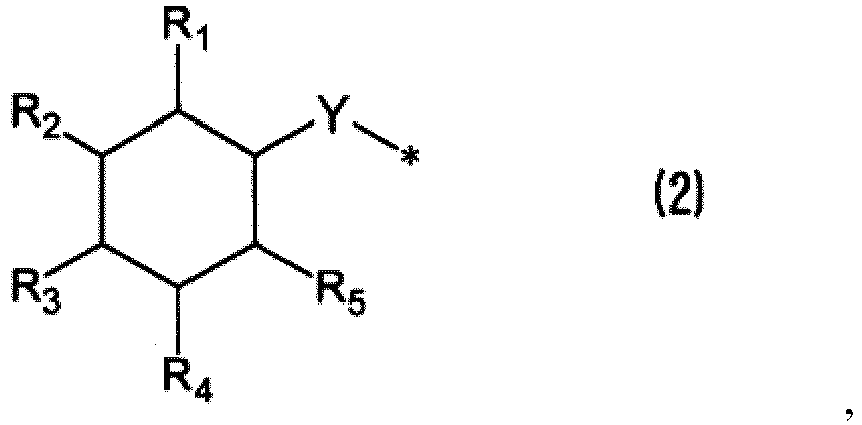
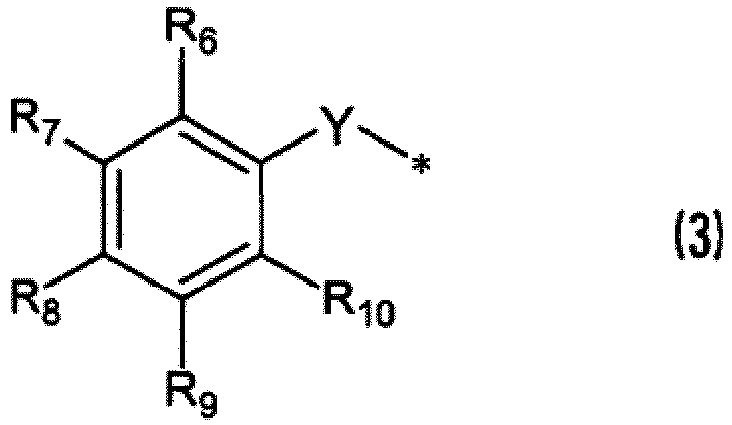
- The nucleating agent for a polyolefin resin according to claim 1, wherein M is lithium, sodium, potassium, magnesium, calcium, barium, aluminum, hydroxyaluminum, or dihydroxyaluminum.
- A nucleating agent composition for a polyolefin resin, comprising:the nucleating agent for a polyolefin resin according to claim 1 or 2; andat least one additive selected from the group consisting of a phenolic antioxidant, a phosphorus-based antioxidant, a sulfur-based antioxidant, other antioxidant, a hindered amine compound, an ultraviolet absorber, a nucleating agent different from the compound represented by Formula (1), a flame retardant, a flame retardant aid, a lubricant, a filler, a hydrotalcite, a fatty acid metal salt, an antistatic agent, a fluorescent brightener, a pigment, and a dye.
- A polyolefin resin masterbatch, comprising:a polyolefin resin; andthe nucleating agent for a polyolefin resin according to claim 1 or 2.
- A polyolefin resin composition, comprising:a polyolefin resin; andthe nucleating agent for a polyolefin resin according to claim 1 or 2,wherein a content of the nucleating agent for a polyolefin resin is 0.001 to 10 parts by mass with respect to 100 parts by mass of the polyolefin resin.
- The polyolefin resin composition according to claim 5, wherein the polyolefin resin is a polypropylene resin.
- The polyolefin resin composition according to claim 5 or 6, wherein the polyolefin resin comprises an ethylene-propylene copolymer.
- The polyolefin resin composition according to any one of claims 5 to 7, further comprising an elastomer.
- The polyolefin resin composition according to any one of claims 5 to 8, further comprising a filler.
- A molded article comprising the polyolefin resin composition according to any one of claims 5 to 9.
- The molded article according to claim 10, wherein the molded article is an automotive exterior component.
- The molded article according to claim 10, wherein the molded article is automotive interior component.
- The molded article according to claim 10, wherein the molded article is a housing.
- The molded article according to claim 10, wherein the molded article is a container.
- The molded article according to claim 10, wherein the molded article is a pipe.
- A film comprising the polyolefin resin composition according to any one of claims 5 to 9.
- The film according to claim 16, wherein the film is a porous film comprising voids.
- The film according to claim 17, wherein the film is a light reflection film.
- The film according to claim 17, wherein the film is a battery separator.
- A method of producing a porous film, the method comprising:a molding step of molding a polyolefin resin composition to obtain a film; anda step of heat-stretching the film obtained by the molding step,wherein the polyolefin resin composition is the polyolefin resin composition according to any one of claims 5 to 9.
- A package comprising the film according to claim 16.
Applications Claiming Priority (4)
| Application Number | Priority Date | Filing Date | Title |
|---|---|---|---|
| JP2018246275 | 2018-12-27 | ||
| JP2019070797 | 2019-04-02 | ||
| JP2019132216 | 2019-07-17 | ||
| PCT/JP2019/043540 WO2020137179A1 (en) | 2018-12-27 | 2019-11-06 | Nucleating agent for polyolefin resin, nucleating agent composition for polyolefin resin containing same, master batch for polyolefin resin, polyolefin resin composition, molded article thereof, film thereof, method for producing porous film, and package |
Publications (3)
| Publication Number | Publication Date |
|---|---|
| EP3904446A1 true EP3904446A1 (en) | 2021-11-03 |
| EP3904446A4 EP3904446A4 (en) | 2022-08-17 |
| EP3904446B1 EP3904446B1 (en) | 2025-07-30 |
Family
ID=71128995
Family Applications (1)
| Application Number | Title | Priority Date | Filing Date |
|---|---|---|---|
| EP19904176.5A Active EP3904446B1 (en) | 2018-12-27 | 2019-11-06 | Nucleating agent for polyolefin resin, nucleating agent composition for polyolefin resin containing same, master batch for polyolefin resin, polyolefin resin composition, molded article thereof, film thereof, method for producing porous film, and package |
Country Status (9)
| Country | Link |
|---|---|
| US (2) | US12234332B2 (en) |
| EP (1) | EP3904446B1 (en) |
| JP (1) | JP6728506B1 (en) |
| KR (1) | KR102942157B1 (en) |
| CN (2) | CN113072758B (en) |
| AU (1) | AU2019417011B2 (en) |
| SA (1) | SA521422219B1 (en) |
| TW (1) | TWI818113B (en) |
| WO (1) | WO2020137179A1 (en) |
Cited By (1)
| Publication number | Priority date | Publication date | Assignee | Title |
|---|---|---|---|---|
| EP4130128A4 (en) * | 2020-03-27 | 2024-04-24 | Adeka Corporation | Nucleating agent, resin composition, method for producing resin composition, and molded article |
Families Citing this family (5)
| Publication number | Priority date | Publication date | Assignee | Title |
|---|---|---|---|---|
| BR112023026336A2 (en) * | 2021-06-16 | 2024-03-05 | Adeka Corp | NUCLEATION AGENT COMPOSITION, RESIN COMPOSITION, MOLDED ARTICLE THEREOF AND RESIN COMPOSITION MANUFACTURING METHOD |
| KR102795387B1 (en) * | 2021-11-29 | 2025-04-11 | 롯데케미칼 주식회사 | Polypropylene resin composition with excellent thermal stability and rigidity and container comprising the same |
| CN114106529B (en) * | 2022-01-26 | 2022-04-19 | 广东顺德顺炎新材料股份有限公司 | Deformation-resistant high-performance flame-retardant reinforced PET modified engineering plastic and preparation method thereof |
| US12497497B2 (en) * | 2022-03-30 | 2025-12-16 | Hindustan Petroleum Corporation Limited | Process for preparation of bis-2-hydroxyethylene terephthalate based nucleated polypropylene masterbatch |
| TWI883740B (en) * | 2023-12-27 | 2025-05-11 | 南亞塑膠工業股份有限公司 | Flame-retardant film and decoration material film |
Family Cites Families (21)
| Publication number | Priority date | Publication date | Assignee | Title |
|---|---|---|---|---|
| JPS546038A (en) * | 1977-06-17 | 1979-01-17 | Mitsui Petrochem Ind Ltd | Additive for polyolefin and composition |
| US6235823B1 (en) | 1992-01-24 | 2001-05-22 | New Japan Chemical Co., Ltd. | Crystalline polypropylene resin composition and amide compounds |
| JP3243835B2 (en) | 1992-04-27 | 2002-01-07 | 新日本理化株式会社 | New amide compounds |
| JP3539526B2 (en) | 1996-01-23 | 2004-07-07 | チッソ株式会社 | Crystalline propylene polymer composition |
| ES2215235T3 (en) * | 1996-08-08 | 2004-10-01 | New Japan Chemical Co.,Ltd. | MOLECULAR CRYSTALS BASED ON COLONPHONY, NUCLEANT AGENT FOR POLYOLEFINIC RESINS, COMPOSITION OF POLYOLEFINIC RESIN AND MOLDED OF THIS. |
| EP1167425B1 (en) | 1999-02-10 | 2005-08-03 | Sanyo Chemical Industries, Ltd. | Block polymer and antistatic agent comprising the same |
| AU2003242561B2 (en) | 2002-05-30 | 2007-08-30 | Ciba Speciality Chemicals Holding Inc. | Beta crystaline polypropylenes |
| US7790793B2 (en) | 2003-02-14 | 2010-09-07 | Ciba Specialty Chem. Corp. | Amide nucleating agent compositions |
| JP4584349B2 (en) | 2007-12-07 | 2010-11-17 | 三井・デュポンポリケミカル株式会社 | Ionomer, resin composition containing the ionomer, unstretched film formed from the composition, sheet or molded body, and laminate having the unstretched film layer |
| JP5361041B2 (en) * | 2008-08-28 | 2013-12-04 | 株式会社Adeka | Crystal nucleating agent and polyolefin resin composition containing the same |
| CN102137893B (en) | 2008-08-28 | 2013-03-27 | 株式会社Adeka | Polyolefin resin composition |
| JP5461952B2 (en) | 2009-10-23 | 2014-04-02 | 株式会社Adeka | Polyolefin resin composition |
| TWI525139B (en) | 2010-07-23 | 2016-03-11 | 日產化學工業股份有限公司 | Crystalline resin composition |
| CN102558683B (en) | 2011-12-31 | 2014-01-22 | 广州呈和科技有限公司 | Polypropylene beta crystal form nucleating agent composition and application thereof |
| CN103289210A (en) * | 2012-01-23 | 2013-09-11 | 住友化学株式会社 | Polypropylene resin composition and molded body containing same |
| CN102976969B (en) * | 2012-11-27 | 2015-04-29 | 山西省化工研究所 | Preparation method for improving yield of fat dicarboxylic dihydrazide nucleating agent |
| CN103214736B (en) | 2013-03-29 | 2015-07-15 | 中科院广州化学有限公司 | Amides beta-crystal-form isotactic polypropylene nucleating agent as well as preparation method and application thereof |
| US9200144B2 (en) | 2013-09-23 | 2015-12-01 | Milliken & Company | Thermoplastic polymer composition |
| JP6377437B2 (en) | 2014-07-22 | 2018-08-22 | 株式会社Adeka | Antistatic agent, antistatic agent composition, antistatic resin composition and molded article |
| HK1249105A1 (en) * | 2015-07-17 | 2018-10-26 | 富士胶片富山化学株式会社 | Nitrogen-containing heterocyclic compound |
| WO2018163601A1 (en) * | 2017-03-09 | 2018-09-13 | 株式会社Adeka | Nucleating agent and resin composition containing same |
-
2019
- 2019-11-06 EP EP19904176.5A patent/EP3904446B1/en active Active
- 2019-11-06 CN CN202110443438.7A patent/CN113072758B/en active Active
- 2019-11-06 CN CN201980006822.1A patent/CN111630099B/en active Active
- 2019-11-06 JP JP2019568271A patent/JP6728506B1/en active Active
- 2019-11-06 US US17/279,034 patent/US12234332B2/en active Active
- 2019-11-06 KR KR1020207007611A patent/KR102942157B1/en active Active
- 2019-11-06 AU AU2019417011A patent/AU2019417011B2/en active Active
- 2019-11-06 WO PCT/JP2019/043540 patent/WO2020137179A1/en not_active Ceased
- 2019-11-07 TW TW108140426A patent/TWI818113B/en active
-
2021
- 2021-06-09 SA SA521422219A patent/SA521422219B1/en unknown
-
2025
- 2025-01-17 US US19/028,655 patent/US20250163227A1/en active Pending
Cited By (1)
| Publication number | Priority date | Publication date | Assignee | Title |
|---|---|---|---|---|
| EP4130128A4 (en) * | 2020-03-27 | 2024-04-24 | Adeka Corporation | Nucleating agent, resin composition, method for producing resin composition, and molded article |
Also Published As
| Publication number | Publication date |
|---|---|
| JPWO2020137179A1 (en) | 2021-02-18 |
| BR112021001632A2 (en) | 2021-05-04 |
| TWI818113B (en) | 2023-10-11 |
| AU2019417011A1 (en) | 2021-08-05 |
| CN111630099B (en) | 2021-04-20 |
| WO2020137179A1 (en) | 2020-07-02 |
| US12234332B2 (en) | 2025-02-25 |
| TW202033644A (en) | 2020-09-16 |
| US20210403655A1 (en) | 2021-12-30 |
| EP3904446B1 (en) | 2025-07-30 |
| AU2019417011B2 (en) | 2026-06-04 |
| CN113072758A (en) | 2021-07-06 |
| US20250163227A1 (en) | 2025-05-22 |
| CN111630099A (en) | 2020-09-04 |
| KR102942157B1 (en) | 2026-03-19 |
| SA521422219B1 (en) | 2023-12-05 |
| EP3904446A4 (en) | 2022-08-17 |
| CN113072758B (en) | 2025-09-12 |
| KR20210106340A (en) | 2021-08-30 |
| JP6728506B1 (en) | 2020-07-22 |
Similar Documents
| Publication | Publication Date | Title |
|---|---|---|
| EP3904446B1 (en) | Nucleating agent for polyolefin resin, nucleating agent composition for polyolefin resin containing same, master batch for polyolefin resin, polyolefin resin composition, molded article thereof, film thereof, method for producing porous film, and package | |
| EP3424993B1 (en) | Resin additive composition, thermoplastic resin composition, and molded article thereof | |
| JP7717214B2 (en) | Nucleating agent composition, olefin-based resin composition, molded article thereof, and method for producing olefin-based resin composition | |
| US20200263011A1 (en) | Composition, thermoplastic resin composition using same, and molded article thereof | |
| CN115335447B (en) | Nucleating agent, resin composition, manufacturing method of resin composition, and molded article | |
| WO2021125184A1 (en) | Resin composition, molded article thereof, and method for producing said resin composition | |
| CN115698164B (en) | Additive composition, resin composition containing the same, method for producing the same, and molded product | |
| RU2824600C2 (en) | Polyolefin resin crystallization nucleating agent, polyolefin resin nucleating agent composition, polyolefin resin masterbatch, polyolefin resin composition, molded article, polyolefin resin film, method of making porous film and packaging | |
| EP4357405A1 (en) | Nucleating agent composition, resin composition, molded article thereof, and method for manufacturing resin composition | |
| EP4190850A1 (en) | Additive composition, resin composition, method for producing resin composition, and molded article | |
| BR112021001632B1 (en) | NUCLEATING AGENT FOR POLYOLEFINE RESIN, NUCLEATING AGENT COMPOSITION FOR A POLYOLEFINE RESIN, POLYOLEFINE RESIN MASTERBATCH, POLYOLEFINE RESIN COMPOSITION, MOLDED ARTICLE, FILM, METHOD OF PRODUCING A POROUS FILM, PACKAGING, USE OF A COMPOUND FOR NUCLEATING AGENT FOR A POLYOLEFINE RESIN, USE OF A COMPOUND FOR COMPOSITION OF A NUCLEATING AGENT FOR A POLYOLEFIN RESIN, USE OF A COMPOUND FOR A POLYOLEFINE RESIN MASTERBATCH AND USE OF A COMPOUND FOR A POLYOLEFINE RESIN COMPOSITION |
Legal Events
| Date | Code | Title | Description |
|---|---|---|---|
| STAA | Information on the status of an ep patent application or granted ep patent |
Free format text: STATUS: THE INTERNATIONAL PUBLICATION HAS BEEN MADE |
|
| PUAI | Public reference made under article 153(3) epc to a published international application that has entered the european phase |
Free format text: ORIGINAL CODE: 0009012 |
|
| STAA | Information on the status of an ep patent application or granted ep patent |
Free format text: STATUS: REQUEST FOR EXAMINATION WAS MADE |
|
| 17P | Request for examination filed |
Effective date: 20210706 |
|
| AK | Designated contracting states |
Kind code of ref document: A1 Designated state(s): AL AT BE BG CH CY CZ DE DK EE ES FI FR GB GR HR HU IE IS IT LI LT LU LV MC MK MT NL NO PL PT RO RS SE SI SK SM TR |
|
| DAV | Request for validation of the european patent (deleted) | ||
| DAX | Request for extension of the european patent (deleted) | ||
| A4 | Supplementary search report drawn up and despatched |
Effective date: 20220718 |
|
| RIC1 | Information provided on ipc code assigned before grant |
Ipc: C08K 5/20 20060101ALI20220713BHEP Ipc: C08L 23/00 20060101AFI20220713BHEP |
|
| GRAP | Despatch of communication of intention to grant a patent |
Free format text: ORIGINAL CODE: EPIDOSNIGR1 |
|
| STAA | Information on the status of an ep patent application or granted ep patent |
Free format text: STATUS: GRANT OF PATENT IS INTENDED |
|
| INTG | Intention to grant announced |
Effective date: 20250219 |
|
| GRAS | Grant fee paid |
Free format text: ORIGINAL CODE: EPIDOSNIGR3 |
|
| GRAA | (expected) grant |
Free format text: ORIGINAL CODE: 0009210 |
|
| STAA | Information on the status of an ep patent application or granted ep patent |
Free format text: STATUS: THE PATENT HAS BEEN GRANTED |
|
| P01 | Opt-out of the competence of the unified patent court (upc) registered |
Free format text: CASE NUMBER: APP_29029/2025 Effective date: 20250618 |
|
| AK | Designated contracting states |
Kind code of ref document: B1 Designated state(s): AL AT BE BG CH CY CZ DE DK EE ES FI FR GB GR HR HU IE IS IT LI LT LU LV MC MK MT NL NO PL PT RO RS SE SI SK SM TR |
|
| REG | Reference to a national code |
Ref country code: GB Ref legal event code: FG4D |
|
| REG | Reference to a national code |
Ref country code: CH Ref legal event code: EP |
|
| REG | Reference to a national code |
Ref country code: DE Ref legal event code: R096 Ref document number: 602019073482 Country of ref document: DE |
|
| REG | Reference to a national code |
Ref country code: IE Ref legal event code: FG4D |
|
| REG | Reference to a national code |
Ref country code: NL Ref legal event code: MP Effective date: 20250730 |
|
| REG | Reference to a national code |
Ref country code: AT Ref legal event code: MK05 Ref document number: 1818894 Country of ref document: AT Kind code of ref document: T Effective date: 20250730 |
|
| PG25 | Lapsed in a contracting state [announced via postgrant information from national office to epo] |
Ref country code: PT Free format text: LAPSE BECAUSE OF FAILURE TO SUBMIT A TRANSLATION OF THE DESCRIPTION OR TO PAY THE FEE WITHIN THE PRESCRIBED TIME-LIMIT Effective date: 20251202 |
|
| PG25 | Lapsed in a contracting state [announced via postgrant information from national office to epo] |
Ref country code: IS Free format text: LAPSE BECAUSE OF FAILURE TO SUBMIT A TRANSLATION OF THE DESCRIPTION OR TO PAY THE FEE WITHIN THE PRESCRIBED TIME-LIMIT Effective date: 20251130 |
|
| PGFP | Annual fee paid to national office [announced via postgrant information from national office to epo] |
Ref country code: DE Payment date: 20251119 Year of fee payment: 7 |
|
| PG25 | Lapsed in a contracting state [announced via postgrant information from national office to epo] |
Ref country code: NO Free format text: LAPSE BECAUSE OF FAILURE TO SUBMIT A TRANSLATION OF THE DESCRIPTION OR TO PAY THE FEE WITHIN THE PRESCRIBED TIME-LIMIT Effective date: 20251030 |
|
| REG | Reference to a national code |
Ref country code: LT Ref legal event code: MG9D |
|
| PG25 | Lapsed in a contracting state [announced via postgrant information from national office to epo] |
Ref country code: AT Free format text: LAPSE BECAUSE OF FAILURE TO SUBMIT A TRANSLATION OF THE DESCRIPTION OR TO PAY THE FEE WITHIN THE PRESCRIBED TIME-LIMIT Effective date: 20250730 |
|
| PG25 | Lapsed in a contracting state [announced via postgrant information from national office to epo] |
Ref country code: FI Free format text: LAPSE BECAUSE OF FAILURE TO SUBMIT A TRANSLATION OF THE DESCRIPTION OR TO PAY THE FEE WITHIN THE PRESCRIBED TIME-LIMIT Effective date: 20250730 |
|
| PGFP | Annual fee paid to national office [announced via postgrant information from national office to epo] |
Ref country code: IT Payment date: 20251125 Year of fee payment: 7 |
|
| PG25 | Lapsed in a contracting state [announced via postgrant information from national office to epo] |
Ref country code: NL Free format text: LAPSE BECAUSE OF FAILURE TO SUBMIT A TRANSLATION OF THE DESCRIPTION OR TO PAY THE FEE WITHIN THE PRESCRIBED TIME-LIMIT Effective date: 20250730 Ref country code: HR Free format text: LAPSE BECAUSE OF FAILURE TO SUBMIT A TRANSLATION OF THE DESCRIPTION OR TO PAY THE FEE WITHIN THE PRESCRIBED TIME-LIMIT Effective date: 20250730 |
|
| PGFP | Annual fee paid to national office [announced via postgrant information from national office to epo] |
Ref country code: FR Payment date: 20251126 Year of fee payment: 7 |
|
| PG25 | Lapsed in a contracting state [announced via postgrant information from national office to epo] |
Ref country code: GR Free format text: LAPSE BECAUSE OF FAILURE TO SUBMIT A TRANSLATION OF THE DESCRIPTION OR TO PAY THE FEE WITHIN THE PRESCRIBED TIME-LIMIT Effective date: 20251031 |
|
| PG25 | Lapsed in a contracting state [announced via postgrant information from national office to epo] |
Ref country code: SE Free format text: LAPSE BECAUSE OF FAILURE TO SUBMIT A TRANSLATION OF THE DESCRIPTION OR TO PAY THE FEE WITHIN THE PRESCRIBED TIME-LIMIT Effective date: 20250730 |
|
| PG25 | Lapsed in a contracting state [announced via postgrant information from national office to epo] |
Ref country code: LV Free format text: LAPSE BECAUSE OF FAILURE TO SUBMIT A TRANSLATION OF THE DESCRIPTION OR TO PAY THE FEE WITHIN THE PRESCRIBED TIME-LIMIT Effective date: 20250730 |
|
| PG25 | Lapsed in a contracting state [announced via postgrant information from national office to epo] |
Ref country code: BG Free format text: LAPSE BECAUSE OF FAILURE TO SUBMIT A TRANSLATION OF THE DESCRIPTION OR TO PAY THE FEE WITHIN THE PRESCRIBED TIME-LIMIT Effective date: 20250730 Ref country code: PL Free format text: LAPSE BECAUSE OF FAILURE TO SUBMIT A TRANSLATION OF THE DESCRIPTION OR TO PAY THE FEE WITHIN THE PRESCRIBED TIME-LIMIT Effective date: 20250730 |
|
| PG25 | Lapsed in a contracting state [announced via postgrant information from national office to epo] |
Ref country code: RS Free format text: LAPSE BECAUSE OF FAILURE TO SUBMIT A TRANSLATION OF THE DESCRIPTION OR TO PAY THE FEE WITHIN THE PRESCRIBED TIME-LIMIT Effective date: 20251030 |
|
| PG25 | Lapsed in a contracting state [announced via postgrant information from national office to epo] |
Ref country code: ES Free format text: LAPSE BECAUSE OF FAILURE TO SUBMIT A TRANSLATION OF THE DESCRIPTION OR TO PAY THE FEE WITHIN THE PRESCRIBED TIME-LIMIT Effective date: 20250730 |
|
| PG25 | Lapsed in a contracting state [announced via postgrant information from national office to epo] |
Ref country code: RO Free format text: LAPSE BECAUSE OF FAILURE TO SUBMIT A TRANSLATION OF THE DESCRIPTION OR TO PAY THE FEE WITHIN THE PRESCRIBED TIME-LIMIT Effective date: 20250730 |
|
| PG25 | Lapsed in a contracting state [announced via postgrant information from national office to epo] |
Ref country code: SM Free format text: LAPSE BECAUSE OF FAILURE TO SUBMIT A TRANSLATION OF THE DESCRIPTION OR TO PAY THE FEE WITHIN THE PRESCRIBED TIME-LIMIT Effective date: 20250730 |
|
| PG25 | Lapsed in a contracting state [announced via postgrant information from national office to epo] |
Ref country code: DK Free format text: LAPSE BECAUSE OF FAILURE TO SUBMIT A TRANSLATION OF THE DESCRIPTION OR TO PAY THE FEE WITHIN THE PRESCRIBED TIME-LIMIT Effective date: 20250730 |
|
| PG25 | Lapsed in a contracting state [announced via postgrant information from national office to epo] |
Ref country code: CZ Free format text: LAPSE BECAUSE OF FAILURE TO SUBMIT A TRANSLATION OF THE DESCRIPTION OR TO PAY THE FEE WITHIN THE PRESCRIBED TIME-LIMIT Effective date: 20250730 |
|
| PG25 | Lapsed in a contracting state [announced via postgrant information from national office to epo] |
Ref country code: EE Free format text: LAPSE BECAUSE OF FAILURE TO SUBMIT A TRANSLATION OF THE DESCRIPTION OR TO PAY THE FEE WITHIN THE PRESCRIBED TIME-LIMIT Effective date: 20250730 Ref country code: SK Free format text: LAPSE BECAUSE OF FAILURE TO SUBMIT A TRANSLATION OF THE DESCRIPTION OR TO PAY THE FEE WITHIN THE PRESCRIBED TIME-LIMIT Effective date: 20250730 |
|
| REG | Reference to a national code |
Ref country code: DE Ref legal event code: R097 Ref document number: 602019073482 Country of ref document: DE |
|
| PLBE | No opposition filed within time limit |
Free format text: ORIGINAL CODE: 0009261 |
|
| STAA | Information on the status of an ep patent application or granted ep patent |
Free format text: STATUS: NO OPPOSITION FILED WITHIN TIME LIMIT |
|
| REG | Reference to a national code |
Ref country code: CH Ref legal event code: L10 Free format text: ST27 STATUS EVENT CODE: U-0-0-L10-L00 (AS PROVIDED BY THE NATIONAL OFFICE) Effective date: 20260611 |
|
| REG | Reference to a national code |
Ref country code: CH Ref legal event code: H13 Free format text: ST27 STATUS EVENT CODE: U-0-0-H10-H13 (AS PROVIDED BY THE NATIONAL OFFICE) Effective date: 20260623 |
|
| PG25 | Lapsed in a contracting state [announced via postgrant information from national office to epo] |
Ref country code: LT Free format text: LAPSE BECAUSE OF FAILURE TO SUBMIT A TRANSLATION OF THE DESCRIPTION OR TO PAY THE FEE WITHIN THE PRESCRIBED TIME-LIMIT Effective date: 20250730 Ref country code: MC Free format text: LAPSE BECAUSE OF FAILURE TO SUBMIT A TRANSLATION OF THE DESCRIPTION OR TO PAY THE FEE WITHIN THE PRESCRIBED TIME-LIMIT Effective date: 20250730 |
|
| 26N | No opposition filed |
Effective date: 20260501 |
|
| PG25 | Lapsed in a contracting state [announced via postgrant information from national office to epo] |
Ref country code: LU Free format text: LAPSE BECAUSE OF NON-PAYMENT OF DUE FEES Effective date: 20251106 Ref country code: CH Free format text: LAPSE BECAUSE OF NON-PAYMENT OF DUE FEES Effective date: 20251130 |