EP3904418A1 - Cyclo-olefin copolymer for medical devices, cyclo-olefin copolymer composition for medical devices, and molded body - Google Patents
Cyclo-olefin copolymer for medical devices, cyclo-olefin copolymer composition for medical devices, and molded body Download PDFInfo
- Publication number
- EP3904418A1 EP3904418A1 EP19903697.1A EP19903697A EP3904418A1 EP 3904418 A1 EP3904418 A1 EP 3904418A1 EP 19903697 A EP19903697 A EP 19903697A EP 3904418 A1 EP3904418 A1 EP 3904418A1
- Authority
- EP
- European Patent Office
- Prior art keywords
- olefin copolymer
- cyclic olefin
- ring
- structural unit
- medical instrument
- Prior art date
- Legal status (The legal status is an assumption and is not a legal conclusion. Google has not performed a legal analysis and makes no representation as to the accuracy of the status listed.)
- Pending
Links
Classifications
-
- C—CHEMISTRY; METALLURGY
- C08—ORGANIC MACROMOLECULAR COMPOUNDS; THEIR PREPARATION OR CHEMICAL WORKING-UP; COMPOSITIONS BASED THEREON
- C08G—MACROMOLECULAR COMPOUNDS OBTAINED OTHERWISE THAN BY REACTIONS ONLY INVOLVING UNSATURATED CARBON-TO-CARBON BONDS
- C08G61/00—Macromolecular compounds obtained by reactions forming a carbon-to-carbon link in the main chain of the macromolecule
- C08G61/12—Macromolecular compounds containing atoms other than carbon in the main chain of the macromolecule
- C08G61/122—Macromolecular compounds containing atoms other than carbon in the main chain of the macromolecule derived from five- or six-membered heterocyclic compounds, other than imides
-
- C—CHEMISTRY; METALLURGY
- C08—ORGANIC MACROMOLECULAR COMPOUNDS; THEIR PREPARATION OR CHEMICAL WORKING-UP; COMPOSITIONS BASED THEREON
- C08G—MACROMOLECULAR COMPOUNDS OBTAINED OTHERWISE THAN BY REACTIONS ONLY INVOLVING UNSATURATED CARBON-TO-CARBON BONDS
- C08G61/00—Macromolecular compounds obtained by reactions forming a carbon-to-carbon link in the main chain of the macromolecule
- C08G61/02—Macromolecular compounds containing only carbon atoms in the main chain of the macromolecule, e.g. polyxylylenes
- C08G61/04—Macromolecular compounds containing only carbon atoms in the main chain of the macromolecule, e.g. polyxylylenes only aliphatic carbon atoms
- C08G61/06—Macromolecular compounds containing only carbon atoms in the main chain of the macromolecule, e.g. polyxylylenes only aliphatic carbon atoms prepared by ring-opening of carbocyclic compounds
- C08G61/08—Macromolecular compounds containing only carbon atoms in the main chain of the macromolecule, e.g. polyxylylenes only aliphatic carbon atoms prepared by ring-opening of carbocyclic compounds of carbocyclic compounds containing one or more carbon-to-carbon double bonds in the ring
-
- A—HUMAN NECESSITIES
- A61—MEDICAL OR VETERINARY SCIENCE; HYGIENE
- A61J—CONTAINERS SPECIALLY ADAPTED FOR MEDICAL OR PHARMACEUTICAL PURPOSES; DEVICES OR METHODS SPECIALLY ADAPTED FOR BRINGING PHARMACEUTICAL PRODUCTS INTO PARTICULAR PHYSICAL OR ADMINISTERING FORMS; DEVICES FOR ADMINISTERING FOOD OR MEDICINES ORALLY; BABY COMFORTERS; DEVICES FOR RECEIVING SPITTLE
- A61J1/00—Containers specially adapted for medical or pharmaceutical purposes
- A61J1/14—Details; Accessories therefor
- A61J1/1468—Containers characterised by specific material properties
-
- C—CHEMISTRY; METALLURGY
- C08—ORGANIC MACROMOLECULAR COMPOUNDS; THEIR PREPARATION OR CHEMICAL WORKING-UP; COMPOSITIONS BASED THEREON
- C08G—MACROMOLECULAR COMPOUNDS OBTAINED OTHERWISE THAN BY REACTIONS ONLY INVOLVING UNSATURATED CARBON-TO-CARBON BONDS
- C08G2261/00—Macromolecular compounds obtained by reactions forming a carbon-to-carbon link in the main chain of the macromolecule
- C08G2261/10—Definition of the polymer structure
- C08G2261/12—Copolymers
-
- C—CHEMISTRY; METALLURGY
- C08—ORGANIC MACROMOLECULAR COMPOUNDS; THEIR PREPARATION OR CHEMICAL WORKING-UP; COMPOSITIONS BASED THEREON
- C08G—MACROMOLECULAR COMPOUNDS OBTAINED OTHERWISE THAN BY REACTIONS ONLY INVOLVING UNSATURATED CARBON-TO-CARBON BONDS
- C08G2261/00—Macromolecular compounds obtained by reactions forming a carbon-to-carbon link in the main chain of the macromolecule
- C08G2261/10—Definition of the polymer structure
- C08G2261/14—Side-groups
- C08G2261/141—Side-chains having aliphatic units
- C08G2261/1412—Saturated aliphatic units
-
- C—CHEMISTRY; METALLURGY
- C08—ORGANIC MACROMOLECULAR COMPOUNDS; THEIR PREPARATION OR CHEMICAL WORKING-UP; COMPOSITIONS BASED THEREON
- C08G—MACROMOLECULAR COMPOUNDS OBTAINED OTHERWISE THAN BY REACTIONS ONLY INVOLVING UNSATURATED CARBON-TO-CARBON BONDS
- C08G2261/00—Macromolecular compounds obtained by reactions forming a carbon-to-carbon link in the main chain of the macromolecule
- C08G2261/10—Definition of the polymer structure
- C08G2261/14—Side-groups
- C08G2261/148—Side-chains having aromatic units
-
- C—CHEMISTRY; METALLURGY
- C08—ORGANIC MACROMOLECULAR COMPOUNDS; THEIR PREPARATION OR CHEMICAL WORKING-UP; COMPOSITIONS BASED THEREON
- C08G—MACROMOLECULAR COMPOUNDS OBTAINED OTHERWISE THAN BY REACTIONS ONLY INVOLVING UNSATURATED CARBON-TO-CARBON BONDS
- C08G2261/00—Macromolecular compounds obtained by reactions forming a carbon-to-carbon link in the main chain of the macromolecule
- C08G2261/30—Monomer units or repeat units incorporating structural elements in the main chain
- C08G2261/32—Monomer units or repeat units incorporating structural elements in the main chain incorporating heteroaromatic structural elements in the main chain
- C08G2261/322—Monomer units or repeat units incorporating structural elements in the main chain incorporating heteroaromatic structural elements in the main chain non-condensed
- C08G2261/3225—Monomer units or repeat units incorporating structural elements in the main chain incorporating heteroaromatic structural elements in the main chain non-condensed containing one or more Se atoms as the only heteroatom
-
- C—CHEMISTRY; METALLURGY
- C08—ORGANIC MACROMOLECULAR COMPOUNDS; THEIR PREPARATION OR CHEMICAL WORKING-UP; COMPOSITIONS BASED THEREON
- C08G—MACROMOLECULAR COMPOUNDS OBTAINED OTHERWISE THAN BY REACTIONS ONLY INVOLVING UNSATURATED CARBON-TO-CARBON BONDS
- C08G2261/00—Macromolecular compounds obtained by reactions forming a carbon-to-carbon link in the main chain of the macromolecule
- C08G2261/30—Monomer units or repeat units incorporating structural elements in the main chain
- C08G2261/33—Monomer units or repeat units incorporating structural elements in the main chain incorporating non-aromatic structural elements in the main chain
- C08G2261/332—Monomer units or repeat units incorporating structural elements in the main chain incorporating non-aromatic structural elements in the main chain containing only carbon atoms
- C08G2261/3324—Monomer units or repeat units incorporating structural elements in the main chain incorporating non-aromatic structural elements in the main chain containing only carbon atoms derived from norbornene
-
- C—CHEMISTRY; METALLURGY
- C08—ORGANIC MACROMOLECULAR COMPOUNDS; THEIR PREPARATION OR CHEMICAL WORKING-UP; COMPOSITIONS BASED THEREON
- C08G—MACROMOLECULAR COMPOUNDS OBTAINED OTHERWISE THAN BY REACTIONS ONLY INVOLVING UNSATURATED CARBON-TO-CARBON BONDS
- C08G2261/00—Macromolecular compounds obtained by reactions forming a carbon-to-carbon link in the main chain of the macromolecule
- C08G2261/50—Physical properties
- C08G2261/60—Glass transition temperature
-
- C—CHEMISTRY; METALLURGY
- C08—ORGANIC MACROMOLECULAR COMPOUNDS; THEIR PREPARATION OR CHEMICAL WORKING-UP; COMPOSITIONS BASED THEREON
- C08G—MACROMOLECULAR COMPOUNDS OBTAINED OTHERWISE THAN BY REACTIONS ONLY INVOLVING UNSATURATED CARBON-TO-CARBON BONDS
- C08G2261/00—Macromolecular compounds obtained by reactions forming a carbon-to-carbon link in the main chain of the macromolecule
- C08G2261/70—Post-treatment
- C08G2261/72—Derivatisation
- C08G2261/724—Hydrogenation
Definitions
- the present invention relates to a cyclic olefin copolymer for a medical instrument, a cyclic olefin copolymer composition for a medical instrument, and a molded body.
- Patent Document 1 and Patent Document 2 describe resins excellent in high refraction, yellowing resistance and moldability obtained by ring-opening metathesis polymerization of monomers derived from tetracyclododecene and norbornene compounds. Further, Patent Document 3 describes that a resin having good breaking strength can be obtained by ring-opening metathesis polymerization of a 3-membered cyclopentene monomer.
- Patent Document 4 describes that in a biochemical instrument with which a biochemical substance sample comes into contact, a portion with which the biochemical substance sample comes into contact is made of a resin composition containing at least one cyclic olefin-based polymer selected from the group consisting of a copolymer of a cyclic olefin and a chain olefin, a ring-opening polymer of a cyclic olefin, and a hydrogenated product of a ring-opening polymer of a cyclic olefin, and an antioxidant, whereby adsorption of a biochemical substance can be favorably suppressed.
- a resin composition containing at least one cyclic olefin-based polymer selected from the group consisting of a copolymer of a cyclic olefin and a chain olefin, a ring-opening polymer of a cyclic olefin, and a hydrogenated product of a
- glass substitute resins are expected to be applied to various medical applications such as prefilled syringes in addition to lenses.
- Medical instruments such as syringes and chemical storage containers are usually sterilized and then filled with contents. During this sterilization, the instrument may be irradiated with electron beams or gamma rays. According to the studies by the present inventors, it has become clear that in a medical container using a conventional cyclic olefin-based resin, there is a possibility that radicals may be generated during sterilization by gamma ray irradiation and adversely affect the encapsulated chemical.
- the present invention has been made in view of such circumstances . That is, the present invention provides a cyclic olefin copolymer for a medical instrument, which have a glass transition temperature at which the cyclic olefin copolymer can be molded into a shape of a container or the like and generate a small amount of radicals during gamma ray irradiation.
- a cyclic olefin copolymer for a medical instrument a cyclic olefin copolymer composition for a medical instrument, and a molded body as described below.
- a cyclic olefin copolymer for a medical instrument a cyclic olefin copolymer composition for a medical instrument, and a molded body, which have a glass transition temperature at which the cyclic olefin copolymer can be molded into a shape of a container or the like and generate a small amount of radicals during gamma ray irradiation.
- the cyclic olefin copolymer (P) for a medical instrument according to the present embodiment is a cyclic olefin copolymer having an aromatic ring and is a cyclic olefin copolymer containing a structural unit (A).
- the cyclic olefin copolymer for a medical instrument of the present invention by including the structural unit (A) having an aromatic ring, the cyclic olefin copolymer for a medical instrument is allowed to have properties generally required for medical instruments, have a glass transition temperature at which the cyclic olefin copolymer can be molded into a shape of a container or the like and provide a molded body that generates a small amount of radicals during gamma ray irradiation.
- the cyclic olefin copolymer (P) according to the present invention is a cyclic olefin copolymer (P) for a medical instrument, and the properties generally required for medical instruments specifically mean good moldability at the time of molding, high transparency of molded body obtained therefrom, and the like.
- cyclic olefin copolymer for a medical instrument is also simply referred to as a cyclic olefin copolymer.
- the structural unit (A) includes at least one of the following structural units (Ia), (II), and (III).
- n is 0, 1 or 2.
- R 1 to R 14 are each independently a hydrogen atom, a halogen atom other than a fluorine atom, or a hydrocarbon group having 1 to 20 carbon atoms which may be substituted with a halogen atom other than a fluorine atom.
- At least one of R 11 to R 14 is a bond, and either (Ib) or (Ic) is independently bonded to one or a plurality of bonding species.
- R 15 to R 24 are each independently a hydrogen atom, a halogen atom other than a fluorine atom, or a hydrocarbon group having 1 to 20 carbon atoms which may be substituted with a halogen atom other than a fluorine atom.
- At least one of R 11 to R 14 in the formula (Ia) may be a hydrocarbon group having 1 to 20 carbon atoms which may be substituted with a halogen atom other than a fluorine atom.
- at least one of R 11 to R 14 when the formula (Ib) is bonded to at least one of R 11 to R 14 and in the formula (Ib), when n is 0 to 2, at least one of R 11 to R 14 is preferably a hydrocarbon group having 1 to 20 carbon atoms which may be substituted with a halogen atom other than a fluorine atom.
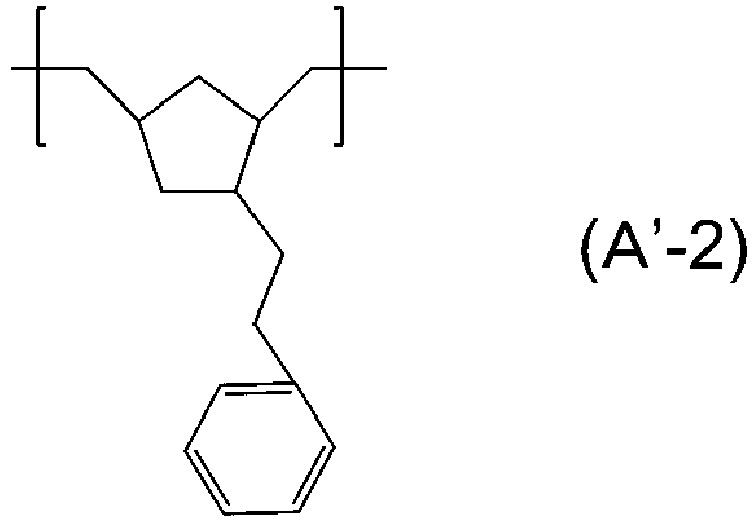
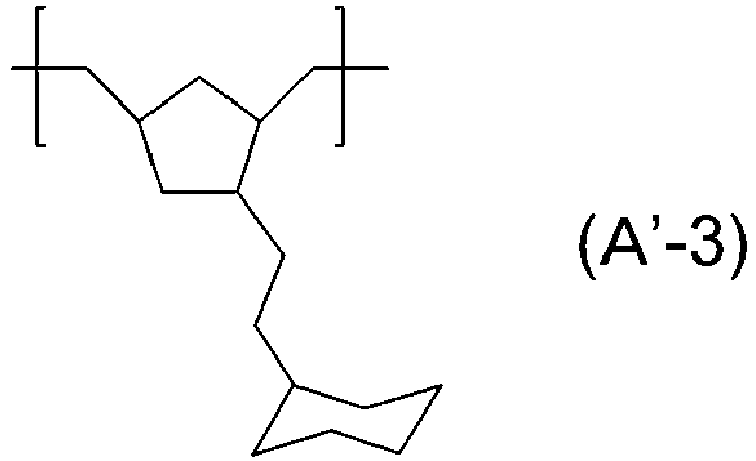
- the structural unit (A) may not include a structural unit represented by the following formula (A'-1), (A'-2), or (A'-3):
- n is 0 to 20
- m and g are each independently 0 to 10
- r is 1, 2 or 3.
- R 25 to R 35 are each independently a hydrogen atom, a halogen atom other than a fluorine atom, or a hydrocarbon group having 1 to 20 carbon atoms which may be substituted with a halogen atom other than a fluorine atom.
- n, m and g are each independently 0, 1 or 2, and r is 1, 2 or 3.
- R 36 to R 55 are each independently a hydrogen atom, a halogen atom other than a fluorine atom, or a hydrocarbon group having 1 to 20 carbon atoms which may be substituted with a halogen atom other than a fluorine atom.
- R 55 to R 68 are each independently a hydrogen atom, a halogen atom other than a fluorine atom, or a hydrocarbon group having 1 to 20 carbon atoms which may be substituted with a halogen atom other than a fluorine atom.
- Examples of the hydrocarbon group having 1 to 20 carbon atoms include, each independently, an alkyl group having 1 to 20 carbon atoms, a cycloalkyl group having 3 to 15 carbon atoms, and an aromatic hydrocarbon group. More specific examples of the alkyl group include a methyl group, an ethyl group, a propyl group, an isopropyl group, an amyl group, a hexyl group, an octyl group, a decyl group, a dodecyl group, and an octadecyl group, examples of the cycloalkyl group include a cyclohexyl group, and examples of the aromatic hydrocarbon group include an aryl group or an aralkyl group such as a phenyl group, a trill group, a naphthyl group, a benzyl group and a phenylethyl group. These hydrocarbon groups may be substituted with a halogen
- the structural unit (A) is preferably a structural unit derived from at least one selected from benzonorbornadiene, indene norbornene, phenyl norbornene, methylphenyl norbornene and the following general formula (A-5), and is particularly preferably a structural unit derived from benzonorbornadiene and indene norbornene.
- the structural unit derived from indene norbornene, the structural unit derived from benzonorbornadiene, and the structural unit derived from methylphenyl norbornene means structural units represented by the following formulas (A-2), (A-3), and (A-4), respectively.
- the structural unit (A) according to the present embodiment is preferably any of the following structural units (A-2), (A-3), and (A-4):
- the cyclic olefin copolymer according to the present embodiment may also contain a structural unit (B) derived from an olefin having 2 to 20 carbon atoms.
- the structural unit (B) may be a structural unit derived from a cyclic olefin having no aromatic ring.
- the structural unit (B) preferably has an alicyclic structure.
- the structural unit (B) has an alicyclic structure, it is possible to obtain a cyclic olefin copolymer for a medical instrument that has a glass transition temperature at which the cyclic olefin copolymer can be molded into a shape of a container or the like and that can provide a molded body that generates a small amount of radicals during gamma ray irradiation.
- the structural unit (B) more preferably has a 5-membered alicyclic structure.
- the time required for the reaction to form the structural unit (A) and the time required for the reaction to form the structural unit (B) can be substantially the same, and thus the cyclic olefin copolymer having the structural unit (A) and the structural unit (B) can be efficiently produced, which is preferable in terms of production.
- the structural unit (B) preferably contains a structural unit derived from a compound represented by the following formula (B-1) from the viewpoint of obtaining a cyclic olefin copolymer for a medical instrument that has a glass transition temperature at which the cyclic olefin copolymer can be molded into a shape of a container or the like and that can provide a molded body that generates a small amount of radicals during gamma ray irradiation.
- n is 0 or 1
- m is 0 or a positive integer
- q is 0 or 1
- R 1 to R 18 and R a and R b are each independently a hydrogen atom, a halogen atom, or a hydrocarbon group which may be substituted with a halogen atom
- R 15 to R 18 may be bonded to each other to form a monocyclic ring or a polycyclic ring, where the monocyclic ring or a polycyclic ring may have a double bond
- R 15 and R 16 or R 17 and R 18 may form an alkylidene group, provided that an aromatic ring is not included.
- the structural unit (B) preferably contains at least one structural unit selected from a structural unit derived from bicyclo[2.2.1]-2-heptene (abbreviation: NB), a structural unit derived from tetracyclo [4.4.0.1 2,5 .1 7,10 ]-3-dodecene (abbreviation: TD), a structural unit derived from hexacyclo[6,6,1,1 3,6 ,1 10,13 ,0 2,7 ,0 9,14 ]heptadecene-4, a structural unit derived from ethyl norbornene (abbreviation: ENB), a structural unit derived from dicyclopentadiene (abbreviation: DCPD), a structural unit derived from the hydride of DCPD, a structural unit derived from tricyclo undecene (abbreviation; TCU, 1,4,4a,5,6,7,8,8a-Octahydro-1,4-me
- the structural unit derived from tetracyclo[4.4.0.1 2,5 .1 7,10 ]-3-dodecene specifically means a structural unit represented by the following formula (B-2). That is, the structural unit (B) according to the present embodiment preferably includes a structural unit represented by the following formula (B-2):
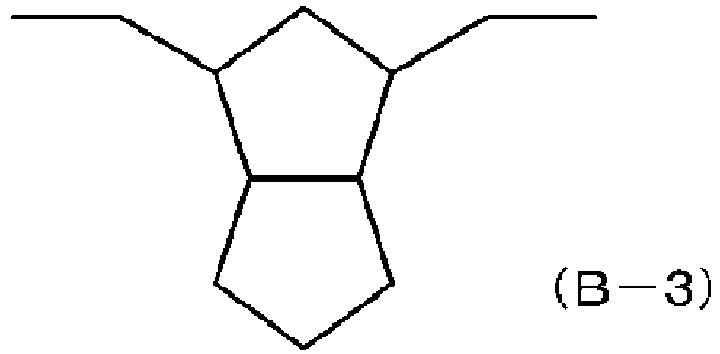
- the structural unit derived from DCPD specifically means a structural unit represented by the following formula (B-3) or formula (B-4).
- the content of the structural unit (A) is preferably 0.2 mol% or more and 100 mol% or less, more preferably 1 mol% or more and 100 mol% or less, and still more preferably 4 mol% or more and 80 mol% or less.
- the structural unit (A) in the cyclic olefin copolymer is preferably 0.5 mol% or more and 100 mol% or less, more preferably 1 mol% or more and 100 mol% or less, and still more preferably 4 mol% or more and 80 mol% or less.
- the contents of the structural unit (A) and the structural unit (B) can be measured, for example, by 1 H-NMR or 13 C-NMR.
- cyclic olefin copolymer (P) By setting the content of each structural unit contained in the cyclic olefin copolymer (P) within the above numerical range, it is possible to obtain a cyclic olefin copolymer for a medical instrument that has a glass transition temperature at which the cyclic olefin copolymer can be molded into a shape of a container or the like and that can provide a molded body that generates a small amount of radicals during gamma ray irradiation.
- the content of the aromatic ring is preferably 0.01 mol% or more and 71 mol% or less, more preferably 0.1 mol% or more and 65 mol% or less, and still more preferably 0.2 mol% or more and 60 mol% or less.
- the content of the aromatic ring can be determined by calculating the peak area of the hydrogen peak (6.7 to 7.3 ppm) derived from the aromatic ring relative to the total area of all hydrogen-derived peaks detected by 1 H-NMR.
- a cyclic olefin copolymer for a medical instrument that has a glass transition temperature at which the cyclic olefin copolymer can be molded into a shape of a container or the like and that can provide a molded body that generates a small amount of radicals during gamma ray irradiation.
- the copolymerization type of the cyclic olefin copolymer (P) according to the present embodiment is not particularly limited, but examples thereof include a random copolymer and a block copolymer.
- the cyclic olefin copolymer (P) according to the present embodiment is preferably a random copolymer from the viewpoint of obtaining a cyclic olefin copolymer for a medical instrument that has a glass transition temperature at which the cyclic olefin copolymer can be molded into a shape of a container or the like and that can provide a molded body that generates a small amount of radicals during gamma ray irradiation.
- the method for producing the cyclic olefin copolymer (P) according to the present embodiment is not particularly limited as long as the cyclic olefin copolymer containing at least one structural unit (A) of the above (Ia), (II), and (III) can be obtained, for example, by carrying out a step of obtaining a precursor polymer (precursor polymer polymerization step) and a step of partially hydrogenating the obtained precursor polymer (partial hydrogenation step).
- the hydrogenation step it is common to carry out a hydrogenation step.
- the hydrogenation step even if the precursor polymer serving as a raw material monomer or an intermediate has an aromatic ring (for example, a benzyl group), the aromatic ring does not remain in the obtained cyclic olefin copolymer because the benzyl group is reduced to a cyclohexane group in the hydrogenation step.
- the cyclic olefin copolymer (P) of the present invention can be obtained by using a monomer having a benzyl functional group as a raw material, subjecting the monomer to partial hydrogenation to obtain a cyclic olefin copolymer containing a cyclic olefin copolymer in a main chain and a specific structural unit (A) having a benzyl group in a side chain, thereby obtaining cyclic olefin copolymer for a medical instrument that has a glass transition temperature at which the cyclic olefin copolymer can be molded into a shape of a container or the like and that can provide a molded body that generates a small amount of radicals during gamma ray irradiation.
- the precursor polymer according to the present embodiment can be produced by selecting appropriate conditions according to methods disclosed in, for example, Japanese Unexamined Patent Publication No. S60-168708 , Japanese Unexamined Patent Publication No. S61-120816 , Japanese Unexamined Patent Publication No. S61-115912 , Japanese Unexamined Patent Publication No. S61-115916 , Japanese Unexamined Patent Publication No. S61-271308 , Japanese Unexamined Patent Publication No. S61-272216 , Japanese Unexamined Patent Publication No. S62-252406 , Japanese Unexamined Patent Publication No. S62-252407 , Japanese Unexamined Patent Publication No. 2007-314806 , and Japanese Unexamined Patent Publication No. 2010-241932 .
- Examples of methods for partial hydrogenation of the resulting precursor polymer include the methods disclosed in Stephen F. Hahn, An Improvement Method for the Diimide Hydrogenation of Butadiene and Isoprene Containing Polymers, Journal of Polymer Science Part A: polymer Chemistry, 30 (3) 1992 , or high-pressure hydrogenation with a palladium carbon catalyst.
- the glass transition temperature (DSC) of the cyclic olefin copolymer (P) according to the present embodiment measured by a differential scanning calorimeter (Tg) is preferably 80°C or more and 200°C or less, more preferably 100°C or more and 190°C or less, and still more preferably 110°C or more and 180°C or less, from the viewpoint of improving heat resistance while maintaining good transparency of the obtained medical instrument.
- the intrinsic viscosity [ ⁇ ] (in 135°C decalin) of the cyclic olefin copolymer (P) according to the present embodiment is, for example, 0.05 to 5.0 dl/g, preferably 0.1 to 4.0 dl/g, more preferably 0.2 to 2.0 dl/g, and particularly preferably 0.3 to 1.0 dl/g.
- the mechanical strength of the medical instrument can be improved. Further, when the intrinsic viscosity [ ⁇ ] is the upper limit value or less, the moldability can be improved.
- a cyclic olefin copolymer composition for a medical instrument according to the present embodiment contains the cyclic olefin copolymer (P) for a medical instrument according to the present embodiment, and may optionally include other components other than the cyclic olefin copolymer (P) for a medical instrument.
- the composition is also called a cyclic olefin copolymer composition for a medical instrument.
- the content of the cyclic olefin copolymer (P) for a medical instrument in the cyclic olefin copolymer composition for a medical instrument according to the present embodiment is preferably 50% by mass or more and 100% by mass or less, more preferably 70% by mass or more and 100% by mass or less, still more preferably 80% by mass or more and 100% by mass or less, and particularly preferably 90% by mass or more and 100% by mass or less, from the viewpoint of further improving the performance balance between the transparency, the heat resistance, and the density of the obtained molded body.
- the cyclic olefin copolymer composition for a medical instrument according to the present embodiment contains the cyclic olefin copolymer (P) for a medical instrument in the above-described ratio, it is possible to obtain a molded body having a glass transition temperature at which the cyclic olefin copolymer composition for a medical instrument can be molded into a shape of a container or the like and generating a small amount of radicals during gamma ray irradiation.
- the cyclic olefin copolymer composition according to the present embodiment may optionally contain a weathering stabilizer, a heat stabilizer, an antioxidant, a metal deactivator, a hydrochloric acid absorbent, an antistatic agent, a flame retardant, a slip agent, an anti-blocking agent, an anti-fogging agent, a lubricant, a natural oil, a synthetic oil, a wax, an organic or inorganic filler, and the like in an appropriate amount to the extent that objects of the present invention is not impaired.
- a weathering stabilizer e.g., a heat stabilizer, an antioxidant, a metal deactivator, a hydrochloric acid absorbent, an antistatic agent, a flame retardant, a slip agent, an anti-blocking agent, an anti-fogging agent, a lubricant, a natural oil, a synthetic oil, a wax, an organic or inorganic filler, and the like in an appropriate amount to the extent that objects of the
- the cyclic olefin copolymer composition according to the present embodiment may optionally contain a hindered amine-based compound [C].
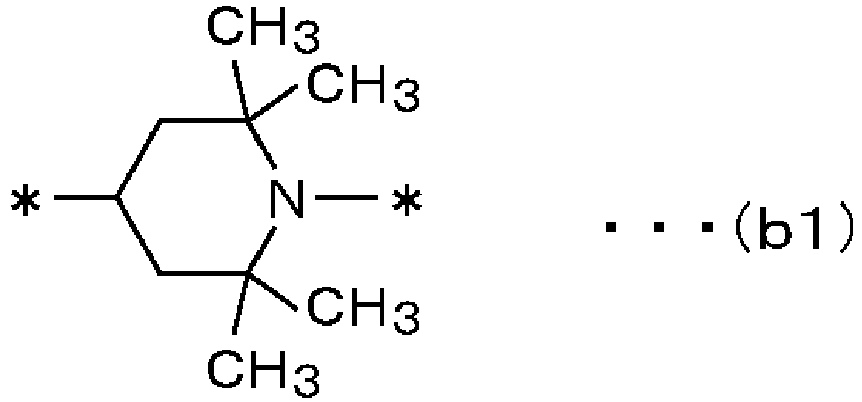
- hindered amine-based compound [C] (hereinafter, also simply referred to as compound [C] or [C]), a compound having one or two or more hindered amine structures (specifically, a partial structure represented by the following formula (b1)) can be appropriately used.
- a compound known as a hindered amine-based light stabilizer (abbreviated as HALS) or the like can be used.
- Examples of the compound [C] include hindered amine-based compounds disclosed in paragraphs 0058 to 0082 of International Publication WO2006/112434 , hindered amine compounds disclosed in paragraphs 0124 to 0186 of International Publication WO2008/047468 , piperidine derivatives or salts thereof disclosed in paragraphs 0187 to 0226 of International Publication WO2008/047468 , and polyamine derivatives or salts thereof disclosed in Japanese Unexamined Patent Publication No. 2006-321793 .
- the compound [C] is preferably a compound having a structural unit represented by the following general formula (b2).
- This compound is typically a polymer or oligomer. It is considered that by using the compound [C], which is a polymer or an oligomer such as this compound, the compatibility with the cyclic olefin copolymer (P) can be enhanced and the composition can be made more uniform. Further, it is considered that the structure is unlikely to change to have characteristic absorption by irradiation. It is considered that this makes it possible to reduce discoloration due to electron beam or gamma ray irradiation, and to reduce the generation of radicals due to electron beam or gamma ray irradiation.
- X 1 and X 2 each independently represent a divalent linking group.
- Examples of the divalent linking group of X 1 and X 2 include an alkylene group, a cycloalkylene group, an arylene group, and a group in which these groups are linked. Among these, an alkylene group is preferable, an alkylene group having 1 to 6 carbon atoms is more preferable, and an alkylene group having 1 to 4 carbon atoms is much more preferable.
- the compound having the structural unit represented by the general formula (b2) a commercially available product may be used, or the compound may be obtained by condensation polymerization of corresponding diols and dicarboxylic acids.
- the compound [C] may be used alone or in combination of two or more.
- the content of the cyclic olefin copolymer (P) is 100 parts by mass
- the content of the compound [C] in the composition is, for example, 0.01 to 2.0 parts by mass, preferably 0.05 to 1.5 parts by mass, and more preferably 0.10 to 1.0 parts by mass.
- the cyclic olefin copolymer composition according to the present embodiment may optionally contain a phosphorus-based compound [D].
- phosphorus-based compound [D] that can be used (hereinafter, also simply referred to as compound [D] or [D]).
- compound [D] or [D] a known phosphorus-based antioxidant can be used.
- the phosphorus-based antioxidant is not particularly limited, and a conventionally known phosphorus-based antioxidant (for example, a phosphite-based antioxidant) can be used.
- monophosphite compounds such as triphenyl phosphite, diphenylisodecyl phosphite, phenyldiisodecyl phosphite, tris(nonylphenyl)phosphite, tris(dinonylphenyl)phosphite, tris(2,4-di-t-butylphenyl)phosphite, tris(2-t-butyl-4-methylphenyl)phosphite, tris(cyclohexylphenyl)phosphite, 2,2-methylenebis(4,6-di-t-butylphenyl)octylphosphite, 9,10-dihydro-9-oxa-10-phosphaphenanthrene-10-oxide, 10-(3,5-di-t-butyl-4-hydroxybenzyl)-9,10-dihydro-9-oxa-10-phosp
- the compound [D] preferably used is a trivalent organic phosphorus compound. More specifically, the compound [D] is a compound having a structure in which three hydrogen atoms of phosphorous acid (P(OH) 3 ) are each substituted with the same or different organic groups.
- the compound [D] is preferably a compound represented by the following general formulas (c1), (c2) or (c3).
- the alkyl group for R 1 preferably has 1 to 10 carbon atoms, and is more preferably a t-butyl group.
- Examples of the aromatic group for R 2 include a phenyl group, a naphthyl group, and a group in which these are substituted with an alkyl group or the like.
- the number of carbon atoms of R 3 is preferably 1 to 30, more preferably 3 to 20, and still more preferably 6 to 18.
- R 3 is preferably an aryl group or an aralkyl group, and more preferably an aralkyl group.
- the aryl group or aralkyl group may be further substituted with a substituent (for example, an alkyl group having 1 to 6 carbon atoms or a hydroxy group).
- X is a divalent linking group
- X is preferably a single bond.
- the compound [D] may be used alone or in combination of two or more.
- the content of the compound [D] in the composition is, for example, 0.01 to 1.5 parts by mass, preferably 0.02 to 1.0 parts by mass, and more preferably 0.05 to 0.5 parts by mass. Within this range, it is possible to effectively reduce discoloration and radical generation due to electron beam or gamma ray irradiation while maintaining other performances (for example, moldability and mechanical strength).
- the content of the phosphorus-based compound [D] is preferably less than 0.05 parts by mass, more preferably 0.03 parts by mass or less, and still more preferably 0.02 parts by mass or less.
- the cyclic olefin copolymer composition according to the present embodiment may optionally contain a phenol-based stabilizer as a weathering stabilizer.
- phenol-based stabilizer examples include hindered phenol-based stabilizers such as 3,3',3",5,5',5"-hexa-tert-butyl-a,a',a"-(methylene-2,4,6-triy l)tri-p-cresol, 1,3,5-trimethyl-2,4,6-tris (3,5-di-tert-butyl-4-hydroxyphenyl)benzylbenzene, pentaerythritol tetrakis[3-(3,5-di-tert-butyl-4-hydroxyphenyl)propionate], octadecyl-3-(3,5-di-tert-butyl-4-hydroxyphenyl)propionate, and thiodiethylene bis[3-(3,5-di-tert-butyl-4-hydroxyphenyl)propionate];acrylate-ba sed phenolic compounds such as 2-t-butyl-6-(3-t-butyl)
- the content of the phenol-based stabilizer is preferably less than 0.05 parts by mass, more preferably 0.03 parts by mass or less, and still more preferably 0.02 parts by mass or less.
- the cyclic olefin copolymer composition according to the present embodiment can be obtained by a method of melt-kneading the cyclic olefin copolymer (P) and other components using a known kneading apparatus such as an extruder and a Banbury mixer; a method of dissolving the cyclic olefin copolymer (P) and other components in a common solvent and then evaporating the solvent; a method of adding a solution of the cyclic olefin copolymer (P) and other components in a poor solvent to cause precipitation; or the like.
- a molded body according to the present embodiment is a molded body containing the cyclic olefin copolymer (P) for a medical instrument according to the present embodiment.
- the content of the cyclic olefin copolymer (P) for a medical instrument in the molded body according to the present embodiment is preferably 50% by mass or more and 100% by mass or less, more preferably 70% by mass or more and 100% by mass or less, still more preferably 80% by mass or more and 100% by mass or less, and particularly preferably 90% by mass or more and 100% by mass or less, from the viewpoint of further improving the performance balance between the radiation resistance and the transparency of the molded body.
- the molded body according to the present embodiment can be obtained by molding a resin composition containing the cyclic olefin copolymer (P) into a predetermined shape.
- the method for obtaining a molded body by molding the resin composition containing the cyclic olefin copolymer (P) is not particularly limited, and a known method can be used. Depending on its use and shape, for example, extrusion molding, injection molding, compression molding, inflation molding, blow molding, extrusion blow molding, injection blow molding, press molding, vacuum molding, powder slush molding, calendar molding, foam molding and the like can be applied. Among these, the injection molding method is preferable from the viewpoint of moldability and productivity.
- the molding conditions are appropriately selected depending on the purpose of use or the molding method.
- the resin temperature in injection molding is appropriately selected in the range of usually 150°C to 400°C, preferably 200°C to 350°C, and more preferably 230°C to 330°C.
- the haze of the injection-molded sheet measured in accordance with JIS K7136 is preferably less than 5%.
- the molded body according to the present embodiment contains the cyclic olefin copolymer (P) for a medical instrument according to the present embodiment
- the molded body has good moldability and high transparency during molding, has a glass transition temperature at which the molded body can be molded into a shape of a container or the like, and generates a small amount of radicals during gamma ray irradiation. Therefore, it is suitable for medical instruments.
- the molded body according to the present embodiment can be made into, for example, a syringe, a chemical storage container, or a biochip.
- the medical instrument according to the present embodiment contains the cyclic olefin copolymer (P) or the cyclic olefin copolymer composition according to the present embodiment.
- the medical instrument according to the present embodiment contains the cyclic olefin copolymer (P), it is excellent in a performance balance between the transparency and gamma ray resistance or electron beam resistance. This medical instrument has little discoloration due to electron beam or gamma ray irradiation.
- radicals may be generated by electron beam or gamma ray irradiation in conventional medical instruments.
- the medical container such as a chemical storage container with the content.
- the medical instrument according to the present embodiment can reduce the amount of radicals generated by electron beam or gamma ray irradiation. Therefore, according to the medical instrument according to the present embodiment, it is possible to reduce the risk of deterioration of the contents.
- a gamma ray or electron beam irradiated object (medical instrument irradiated with gamma rays or electron beams) for the medical instruments. Since the medical instrument is sterilized by irradiation, the medical instrument is clean, and discoloration and generation of radicals are suppressed.
- the irradiation dose is not particularly limited, but is usually 5 to 100 kilogray (kGy), preferably 10 to 80 kilogray.
- Examples of the medical instruments include a catheter member, a sterilization sheet, a medical container, and a biochip.
- Examples of the medical container include a syringe barrel outer cylinder (hereinafter, syringe) of a syringe, a syringe used for a syringe barrel filled with a chemical or a drug (hereinafter, also referred to as a prefilled syringe), and a storage container used for a storage container filled with a chemical or a drug (hereinafter, also referred to as a chemical storage container.).
- syringe syringe barrel outer cylinder
- a syringe used for a syringe barrel filled with a chemical or a drug hereinafter, also referred to as a prefilled syringe
- a storage container used for a storage container filled with a chemical or a drug hereinafter, also referred to as a chemical storage container.
- the prefilled syringe is a syringe-shaped preparation that is pre-filled with a chemical or a drug, and there are a single-chamber type that is filled with one kind of solution and a double-chamber type that is filled with two kinds of drugs.
- Most prefilled syringes are single-chamber type, but there are two types of double-chamber syringes, which include either liquid/powder type preparations, which consist of powder and its solution, or liquid/liquid type preparations, which consist of two types of solution.
- Examples of the single-chamber type internal solution include a heparin solution.
- Examples of the syringe and a prefilled syringe used for a syringe include a prefillable syringe, a prefilled syringe for a vaccine, a prefilled syringe for an anticancer agent, and a needleless syringe.
- Examples of the chemical storage container include a wide-mouthed bottle, a narrow-mouthed bottle, a medicine bottle, a vial bottle, an infusion bottle, a bulk container, a petri dish, a test tube, and an analysis cell. More specific examples thereof include liquid, powder or solid drug containers such as ampoules, press-through packages, infusion bags, drip containers and eye drop containers; sample containers such as blood test sampling test tubes, blood collection tubes and specimen containers; analysis containers such as ultraviolet test cells; sterile containers for medical instruments such as scalpels, forceps, gauze and contact lenses; medical instruments such as disposable syringes and prefilled syringes; laboratory instruments such as beakers, vials, ampoules and test tube flasks; and artificial organ housings.
- liquid, powder or solid drug containers such as ampoules, press-through packages, infusion bags, drip containers and eye drop containers
- sample containers such as blood test sampling test tubes, blood collection tubes and specimen containers
- analysis containers such as ultraviolet test cells
- the biochip is one in which biomolecules such as DNA, protein, or sugar chain are immobilized thereon, and examples thereof include a DNA analysis chip, and a protein analysis chip, and as a test or diagnostic tool using the same. In a broad sense, biosensors are also included.
- the medical instrument according to present embodiment has good transparency. Transparency is assessed by internal haze.
- the light transmittance is good.
- the light transmittance is defined by the spectral light transmittance or the total light transmittance depending on the application.
- the total light transmittance in a state where the antireflection film is not provided on the surface is 85% or more, preferably 88 to 93%.
- the total light transmittance is 85% or more, a necessary amount of light can be secured.
- a known method can be applied to the total light transmittance measurement method and the measuring apparatus or the like is not limited, examples thereof include a method of molding the cyclic olefin copolymer composition according to the present embodiment into a sheet having a thickness of 3 mm and measuring the total light transmittance of the sheet obtained by molding the cyclic olefin copolymer composition according to the present embodiment using a haze meter according to ASTM D1003.
- the medical instrument according to the present embodiment has excellent light transmittance of light having a wavelength of 450 nm to 800 nm.
- the light transmittance can be further improved.
- a precursor polymer of a cyclic olefin copolymer was obtained by the following method.
- RTD-IndNB2 About 150 ml of the solution obtained after the reaction was added dropwise to 1400 ml of acetone for crystallization, filtered through Kiriyama filter paper (5B), and dried under reduced pressure at 80°C to obtain 13 g of the polymer.
- this polymer is referred to as RTD-IndNB2.
- RTD-IndNB5 About 150 ml of the solution obtained after the reaction was added dropwise to 1400 ml of acetone for crystallization, filtered through Kiriyama filter paper (5B), and dried under reduced pressure at 80°C to obtain 13 g of the polymer.
- this polymer is referred to as RTD-IndNB5.
- RTD-IndNB10 About 150 ml of the solution obtained after the reaction was added dropwise to 1400 ml of acetone for crystallization, filtered through Kiriyama filter paper (5B), and dried under reduced pressure at 80°C to obtain 13 g of the polymer.
- this polymer is referred to as RTD-IndNB10.
- RTD-IndNB About 150 ml of the solution obtained after the reaction was added dropwise to 1400 ml of acetone for crystallization, filtered through Kiriyama filter paper (5B), and dried under reduced pressure at 80°C to obtain 13 g of the polymer.
- this polymer is referred to as RTD-IndNB.
- RTD-BNBD2 About 150 ml of the solution obtained after the reaction was added dropwise to 1400 ml of acetone for crystallization, filtered through Kiriyama filter paper (5B), and dried under reduced pressure at 80°C to obtain 13 g of the polymer.
- this polymer is referred to as RTD-BNBD2.
- RTD-BNBD50 About 150 ml of the solution obtained after the reaction was added dropwise to 1400 ml of acetone for crystallization, filtered through Kiriyama filter paper (5B), and dried under reduced pressure at 80°C to obtain 13 g of the polymer.
- this polymer is referred to as RTD-BNBD50.
- RTD-MPNB50 About 150 ml of the solution obtained after the reaction was added dropwise to 1400 ml of acetone for crystallization, filtered through Kiriyama filter paper (5B), and dried under reduced pressure at 80°C to obtain 13 g of the polymer.
- this polymer is referred to as RTD-MPNB50.
- MePhNB methylphenyl norbornene
- the precursor polymers shown in Table 1 were obtained by the above method. Subsequently, the obtained precursor polymers were partially or fully hydrogenated by the following method.
- Partial hydrogenation step was carried out in the same manner as in the production of the cyclic olefin polymer P-1 except that the polymers shown in Table 1 were used instead of RTD-IndNB2 to obtain cyclic olefin polymers P-2 to 9.
- the aromatic rings remained, but other double bonds were almost eliminated.
- reaction solution was added dropwise to 1800 ml of acetone for crystallization, filtered through Kiriyama filter paper (5B), and dried under reduced pressure at 80°C to obtain 13 g of the polymer.
- Hydrogenation step was carried out in the same manner as in the production of the cyclic olefin polymer P-8 except that the polymers shown in Table 1 were used instead of RTD to obtain cyclic olefin polymers P-11 to 14.
- the polymers shown in Table 1 were used instead of RTD to obtain cyclic olefin polymers P-11 to 14.
- the intrinsic viscosity ([ ⁇ ]) was measured in decalin at 135°C.
- the DSC measurement was performed under the following conditions.
- the glass transition temperature was defined as the temperature at the point where a straight line equidistant from the extended straight line of each baseline in the vertical axis direction intersects with the curve of the stepwise change portion of the glass transition.
- the content of the structural unit (A) in the cyclic olefin copolymer and the content of the aromatic ring in the cyclic olefin copolymer when the total content of the structural unit (A) and the structural unit (B) was 100 mol% were calculated by the following method.
- the amount of hydrogens of the aromatic ring contained in the polymer was calculated by calculating the peak area of the peak of the hydrogens derived from the aromatic ring (6.7 to 7.3ppm) relative to the total area of all the peaks derived from hydrogens detected in 0.5ppm to 8ppm by 1 H-NMR manufactured by JEOL Ltd.
- the internal haze of the obtained square plate test piece having a thickness of 2 mm was measured, and the transparency was evaluated according to the following criteria.
- the internal haze was measured in benzyl alcohol using a haze meter (NDH-20D manufactured by Nippon Denshoku Industries Co., Ltd.) .
- Each of the obtained samples (2 mm thick square plate test piece) was irradiated with 20 kilogray of gamma rays, and the amount of radicals generated was measured.
- the amount of radicals was measured by an electron spin resonance (ESR) method.
- radical generation amount normalized value area of portion of spectrum corresponding to organic radical ( area of portion of spectrum corresponding to Mn 2 + second signal ⁇ amount of pellets
- the baseline of the ESR spectrum was corrected based on Mn 2+ (second signal).
- Mn 2+ third signal
Landscapes
- Chemical & Material Sciences (AREA)
- Health & Medical Sciences (AREA)
- Chemical Kinetics & Catalysis (AREA)
- Medicinal Chemistry (AREA)
- Polymers & Plastics (AREA)
- Organic Chemistry (AREA)
- Animal Behavior & Ethology (AREA)
- Life Sciences & Earth Sciences (AREA)
- Pharmacology & Pharmacy (AREA)
- General Health & Medical Sciences (AREA)
- Public Health (AREA)
- Veterinary Medicine (AREA)
- Medical Preparation Storing Or Oral Administration Devices (AREA)
- Compositions Of Macromolecular Compounds (AREA)
- Materials For Medical Uses (AREA)
- Polyoxymethylene Polymers And Polymers With Carbon-To-Carbon Bonds (AREA)
Abstract
Description
- The present invention relates to a cyclic olefin copolymer for a medical instrument, a cyclic olefin copolymer composition for a medical instrument, and a molded body.
- In recent years, in optical materials such as camera lenses for mobile phones and automobiles, the development of resins having excellent optical properties as a substitute for glass has been progressing. In addition, cyclic olefin hydrogenated ring-opening polymers and cyclic olefin addition copolymers, which have lower water absorption and less dimensional change than resins such as polycarbonate (PC) and polymethylmethacrylate (PMMA), have attracted attention among glass substitutes.
- For example, regarding the cyclic olefin hydrogenated ring-opening polymer, Patent Document 1 and Patent Document 2 describe resins excellent in high refraction, yellowing resistance and moldability obtained by ring-opening metathesis polymerization of monomers derived from tetracyclododecene and norbornene compounds. Further, Patent Document 3 describes that a resin having good breaking strength can be obtained by ring-opening metathesis polymerization of a 3-membered cyclopentene monomer. Further, Patent Document 4 describes that in a biochemical instrument with which a biochemical substance sample comes into contact, a portion with which the biochemical substance sample comes into contact is made of a resin composition containing at least one cyclic olefin-based polymer selected from the group consisting of a copolymer of a cyclic olefin and a chain olefin, a ring-opening polymer of a cyclic olefin, and a hydrogenated product of a ring-opening polymer of a cyclic olefin, and an antioxidant, whereby adsorption of a biochemical substance can be favorably suppressed.
-
- [Patent Document 1]
Japanese Unexamined Patent Publication No. 2007-137935 - [Patent Document 2]
International Publication No. WO2016/052302 - [Patent Document 3]
International Publication No. WO2017/051819 - [Patent Document 4]
International Publication No. WO2019/065149 - On the other hand, glass substitute resins are expected to be applied to various medical applications such as prefilled syringes in addition to lenses. Medical instruments such as syringes and chemical storage containers are usually sterilized and then filled with contents. During this sterilization, the instrument may be irradiated with electron beams or gamma rays. According to the studies by the present inventors, it has become clear that in a medical container using a conventional cyclic olefin-based resin, there is a possibility that radicals may be generated during sterilization by gamma ray irradiation and adversely affect the encapsulated chemical. In addition, although the influence of radicals generated by gamma ray irradiation decreases over time, a long period of time of several weeks is required until the influence of radicals disappears, which is not preferable from the viewpoint of improving productivity and shortening the process.
- It has also become clear that electron beam or gamma ray irradiation may cause discoloration.
- The present invention has been made in view of such circumstances . That is, the present invention provides a cyclic olefin copolymer for a medical instrument, which have a glass transition temperature at which the cyclic olefin copolymer can be molded into a shape of a container or the like and generate a small amount of radicals during gamma ray irradiation.
- As a result of intensive studies, the present inventors have found that the above problems can be solved by a cyclic olefin copolymer containing a specific structural unit (A) having an aromatic ring.
- That is, according to the present invention, there are provided a cyclic olefin copolymer for a medical instrument, a cyclic olefin copolymer composition for a medical instrument, and a molded body as described below.
- [1] A cyclic olefin copolymer for a medical instrument, including: at least one structural unit (A) of the following (Ia), (II), and (III) :


- [2] The cyclic olefin copolymer for a medical instrument according to [1], in which a content of the structural unit (A) is 0.2 mol% or more and 100 mol% or less.
- [3] The cyclic olefin copolymer for a medical instrument according to [1] or [2], further including a structural unit (B) derived from an olefin having 2 to 20 carbon atoms.
- [4] The cyclic olefin copolymer for a medical instrument according to [3], in which the structural unit (B) has an alicyclic structure.
- [5] The cyclic olefin copolymer for a medical instrument according to [3] or [4], in which when a total content of the structural unit (A) and the structural unit (B) is 100 mol%, a content of the structural unit (A) in the cyclic olefin copolymer is 0.5 mol% or more and 100 mol% or less.
- [6] The cyclic olefin copolymer for a medical instrument according to any one of [1] to [5], in which a glass transition temperature (Tg) of the cyclic olefin copolymer is 80°C or more and 200°C or less, as measured by a differential scanning calorimeter (DSC).
- [7] The cyclic olefin copolymer for a medical instrument according to any one of [1] to [6], in which the structural unit (A) is derived from at least one selected from benzonorbornadiene, indene norbornene and methylphenyl norbornene.
- [8] A cyclic olefin copolymer composition for a medical instrument, including the cyclic olefin copolymer for a medical instrument according to any one of [1] to [7].
- [9] A molded body including the cyclic olefin copolymer for a medical instrument according to any one of [1] to [7].
- [10] The molded body according to [9], which is a syringe or a chemical storage container.
- [11] The molded body according to [9], which is a biochip.
- According to the present invention, it is possible to provide a cyclic olefin copolymer for a medical instrument, a cyclic olefin copolymer composition for a medical instrument, and a molded body, which have a glass transition temperature at which the cyclic olefin copolymer can be molded into a shape of a container or the like and generate a small amount of radicals during gamma ray irradiation.
- Hereinafter, the present invention will be described based on embodiments. In the present embodiment, "A to B" indicating the numerical range represent A or more and B or less unless otherwise specified.
- First, a cyclic olefin copolymer (P) for a medical instrument according to the present embodiment will be described.
- The cyclic olefin copolymer (P) for a medical instrument according to the present embodiment is a cyclic olefin copolymer having an aromatic ring and is a cyclic olefin copolymer containing a structural unit (A). According to the cyclic olefin copolymer for a medical instrument of the present invention, by including the structural unit (A) having an aromatic ring, the cyclic olefin copolymer for a medical instrument is allowed to have properties generally required for medical instruments, have a glass transition temperature at which the cyclic olefin copolymer can be molded into a shape of a container or the like and provide a molded body that generates a small amount of radicals during gamma ray irradiation.
- The cyclic olefin copolymer (P) according to the present invention is a cyclic olefin copolymer (P) for a medical instrument, and the properties generally required for medical instruments specifically mean good moldability at the time of molding, high transparency of molded body obtained therefrom, and the like.
- Hereinafter, the cyclic olefin copolymer for a medical instrument is also simply referred to as a cyclic olefin copolymer.
- Hereinafter, the structural unit (A) according to the present embodiment will be described.
- The structural unit (A) according to the present embodiment includes at least one of the following structural units (Ia), (II), and (III).

- In the formula (Ia), n is 0, 1 or 2. R1 to R14 are each independently a hydrogen atom, a halogen atom other than a fluorine atom, or a hydrocarbon group having 1 to 20 carbon atoms which may be substituted with a halogen atom other than a fluorine atom. At least one of R11 to R14 is a bond, and either (Ib) or (Ic) is independently bonded to one or a plurality of bonding species.

- In the formula (Ib), n is 0 to 20, and q is 0, 1 or 2. R15 to R24 are each independently a hydrogen atom, a halogen atom other than a fluorine atom, or a hydrocarbon group having 1 to 20 carbon atoms which may be substituted with a halogen atom other than a fluorine atom. One of R17 to R24 is a bond, wherein when q = 0, R17 and R18, R18 and R19, R19 and R20, R20 and R21, R21 and R22, and R22 and R17 may be bonded to each other to form a monocyclic ring or a polycyclic ring and when q = 1 or 2, R17 and R18, R18 and R24, R24 and R24, R24 and R19, R19 and R20, R20 and R21, R21 and R22, R22 and R23, R23 and R23, and R23 and R17 may be bonded to each other to form a monocyclic ring or a polycyclic ring, where the monocyclic ring or the polycyclic ring may have a double bond, and the monocyclic ring or the polycyclic ring may be an aromatic ring.
- In the formula (Ia), when the formula (Ib) is bonded to at least one of R11 to R14, at least one of R11 to R14 in the formula (Ia) may be a hydrocarbon group having 1 to 20 carbon atoms which may be substituted with a halogen atom other than a fluorine atom. In particular, in the formula (Ia), when the formula (Ib) is bonded to at least one of R11 to R14 and in the formula (Ib), when n is 0 to 2, at least one of R11 to R14 is preferably a hydrocarbon group having 1 to 20 carbon atoms which may be substituted with a halogen atom other than a fluorine atom.
- Further, the structural unit (A) according to the present embodiment may not include a structural unit represented by the following formula (A'-1), (A'-2), or (A'-3):


- In the formula (Ic), n is 0 to 20, m and g are each independently 0 to 10, r is 1, 2 or 3. R25 to R35 are each independently a hydrogen atom, a halogen atom other than a fluorine atom, or a hydrocarbon group having 1 to 20 carbon atoms which may be substituted with a halogen atom other than a fluorine atom. When r = 1, R32 and R33, R33 and R34, and R34 and R35 may be bonded to each other to form a monocyclic ring or a polycyclic ring and when r = 2 or 3, R32 and R32, R32 and R33, R33 and R34, R34 and R35, and R35 and R35 may be bonded to each other to form a monocyclic ring or a polycyclic ring, where the monocyclic ring or the polycyclic ring may have a double bond, and the monocyclic ring or the polycyclic ring may be an aromatic ring.

- In the formula (II), n, m and g are each independently 0, 1 or 2, and r is 1, 2 or 3. R36 to R55 are each independently a hydrogen atom, a halogen atom other than a fluorine atom, or a hydrocarbon group having 1 to 20 carbon atoms which may be substituted with a halogen atom other than a fluorine atom. When r = 1, R52 and R53, R53 and R54, and R54 and R55 may be bonded to each other to form a monocyclic ring or a polycyclic ring and when r = 2 or 3, R52 and R52, R52 and R53, R53 and R54, R54 and R55, and R55 and R55 may be bonded to each other to form a monocyclic ring or a polycyclic ring, where the monocyclic ring or the polycyclic ring may have a double bond, and the monocyclic ring or the polycyclic ring may be an aromatic ring, and R48 and R50 may be bonded to each other to form a monocyclic ring or a polycyclic ring, where the monocyclic ring or the polycyclic ring may have a double bond, and the monocyclic ring or the polycyclic ring may be an aromatic ring.

- In the formula (III), n is 0, 1 or 2, and m is 1, 2 or 3. R55 to R68 are each independently a hydrogen atom, a halogen atom other than a fluorine atom, or a hydrocarbon group having 1 to 20 carbon atoms which may be substituted with a halogen atom other than a fluorine atom. When m = 1, R65 and R67, R67 and R68, and R68 and R66 may be bonded to each other to form a monocyclic ring or a polycyclic ring and when m = 2 or 3, R65 and R65, R65 and R67, R67 and R68, R68 and R66, and R66 and R66 may be bonded to each other to form a monocyclic ring or a polycyclic ring, where the monocyclic ring or the polycyclic ring may have a double bond, and the monocyclic ring or the polycyclic ring may be an aromatic ring.
- Examples of the hydrocarbon group having 1 to 20 carbon atoms include, each independently, an alkyl group having 1 to 20 carbon atoms, a cycloalkyl group having 3 to 15 carbon atoms, and an aromatic hydrocarbon group. More specific examples of the alkyl group include a methyl group, an ethyl group, a propyl group, an isopropyl group, an amyl group, a hexyl group, an octyl group, a decyl group, a dodecyl group, and an octadecyl group, examples of the cycloalkyl group include a cyclohexyl group, and examples of the aromatic hydrocarbon group include an aryl group or an aralkyl group such as a phenyl group, a trill group, a naphthyl group, a benzyl group and a phenylethyl group. These hydrocarbon groups may be substituted with a halogen atom other than a fluorine atom.
- The general formulas (Ia), (II), and (III) also include their respective resonance structures.
- Among these structural units, the structural unit (A) according to the present embodiment is preferably a structural unit derived from at least one selected from benzonorbornadiene, indene norbornene, phenyl norbornene, methylphenyl norbornene and the following general formula (A-5), and is particularly preferably a structural unit derived from benzonorbornadiene and indene norbornene.

- Specifically, the structural unit derived from indene norbornene, the structural unit derived from benzonorbornadiene, and the structural unit derived from methylphenyl norbornene means structural units represented by the following formulas (A-2), (A-3), and (A-4), respectively.
- That is, the structural unit (A) according to the present embodiment is preferably any of the following structural units (A-2), (A-3), and (A-4):


- The cyclic olefin copolymer according to the present embodiment may also contain a structural unit (B) derived from an olefin having 2 to 20 carbon atoms. The structural unit (B) may be a structural unit derived from a cyclic olefin having no aromatic ring.
- The structural unit (B) preferably has an alicyclic structure. When the structural unit (B) has an alicyclic structure, it is possible to obtain a cyclic olefin copolymer for a medical instrument that has a glass transition temperature at which the cyclic olefin copolymer can be molded into a shape of a container or the like and that can provide a molded body that generates a small amount of radicals during gamma ray irradiation.
- Further, the structural unit (B) more preferably has a 5-membered alicyclic structure. When the structural unit (B) is a structural unit having a 5-membered alicyclic structure, the time required for the reaction to form the structural unit (A) and the time required for the reaction to form the structural unit (B) can be substantially the same, and thus the cyclic olefin copolymer having the structural unit (A) and the structural unit (B) can be efficiently produced, which is preferable in terms of production.
- The structural unit (B) according to the present embodiment preferably contains a structural unit derived from a compound represented by the following formula (B-1) from the viewpoint of obtaining a cyclic olefin copolymer for a medical instrument that has a glass transition temperature at which the cyclic olefin copolymer can be molded into a shape of a container or the like and that can provide a molded body that generates a small amount of radicals during gamma ray irradiation.

- Among these structural units, the structural unit (B) according to the present embodiment preferably contains at least one structural unit selected from a structural unit derived from bicyclo[2.2.1]-2-heptene (abbreviation: NB), a structural unit derived from tetracyclo [4.4.0.12,5.17,10]-3-dodecene (abbreviation: TD), a structural unit derived from hexacyclo[6,6,1,13,6,110,13,02,7,09,14]heptadecene-4, a structural unit derived from ethyl norbornene (abbreviation: ENB), a structural unit derived from dicyclopentadiene (abbreviation: DCPD), a structural unit derived from the hydride of DCPD, a structural unit derived from tricyclo undecene (abbreviation; TCU, 1,4,4a,5,6,7,8,8a-Octahydro-1,4-methanonaphthalene) and the like, more preferably contains at least one structural unit selected from a structural unit derived from bicyclo[2.2.1]-2-heptene and a structural unit derived from tetracyclo [4.4.0.12,5.17,10]-3-dodecene, and particularly preferably contains a structural unit derived from tetracyclo[4.4.0.12,5.17,10]-3-dodecene.
- In addition, the structural unit derived from tetracyclo[4.4.0.12,5.17,10]-3-dodecene specifically means a structural unit represented by the following formula (B-2). That is, the structural unit (B) according to the present embodiment preferably includes a structural unit represented by the following formula (B-2):

- Further, the structural unit derived from DCPD specifically means a structural unit represented by the following formula (B-3) or formula (B-4).

- In the cyclic olefin copolymer (P) according to the present embodiment, the content of the structural unit (A) is preferably 0.2 mol% or more and 100 mol% or less, more preferably 1 mol% or more and 100 mol% or less, and still more preferably 4 mol% or more and 80 mol% or less.
- Further, in the cyclic olefin copolymer (P), when the total content of the structural unit (A) and the structural unit (B) is 100 mol%, the structural unit (A) in the cyclic olefin copolymer is preferably 0.5 mol% or more and 100 mol% or less, more preferably 1 mol% or more and 100 mol% or less, and still more preferably 4 mol% or more and 80 mol% or less.
- In the present embodiment, the contents of the structural unit (A) and the structural unit (B) can be measured, for example, by 1H-NMR or 13C-NMR.
- By setting the content of each structural unit contained in the cyclic olefin copolymer (P) within the above numerical range, it is possible to obtain a cyclic olefin copolymer for a medical instrument that has a glass transition temperature at which the cyclic olefin copolymer can be molded into a shape of a container or the like and that can provide a molded body that generates a small amount of radicals during gamma ray irradiation.
- In the cyclic olefin copolymer (P) according to the present embodiment, the content of the aromatic ring is preferably 0.01 mol% or more and 71 mol% or less, more preferably 0.1 mol% or more and 65 mol% or less, and still more preferably 0.2 mol% or more and 60 mol% or less. The content of the aromatic ring can be determined by calculating the peak area of the hydrogen peak (6.7 to 7.3 ppm) derived from the aromatic ring relative to the total area of all hydrogen-derived peaks detected by 1H-NMR.
- By setting the content of the aromatic ring contained in the cyclic olefin copolymer (P) within the above numerical range, it is possible to obtain a cyclic olefin copolymer for a medical instrument that has a glass transition temperature at which the cyclic olefin copolymer can be molded into a shape of a container or the like and that can provide a molded body that generates a small amount of radicals during gamma ray irradiation.
- The copolymerization type of the cyclic olefin copolymer (P) according to the present embodiment is not particularly limited, but examples thereof include a random copolymer and a block copolymer. In the present embodiment, the cyclic olefin copolymer (P) according to the present embodiment is preferably a random copolymer from the viewpoint of obtaining a cyclic olefin copolymer for a medical instrument that has a glass transition temperature at which the cyclic olefin copolymer can be molded into a shape of a container or the like and that can provide a molded body that generates a small amount of radicals during gamma ray irradiation.
- The method for producing the cyclic olefin copolymer (P) according to the present embodiment is not particularly limited as long as the cyclic olefin copolymer containing at least one structural unit (A) of the above (Ia), (II), and (III) can be obtained, for example, by carrying out a step of obtaining a precursor polymer (precursor polymer polymerization step) and a step of partially hydrogenating the obtained precursor polymer (partial hydrogenation step).
- That is, in the production of the cyclic olefin ring-opening polymer, it is common to carry out a hydrogenation step. In a case where the hydrogenation step is carried out, even if the precursor polymer serving as a raw material monomer or an intermediate has an aromatic ring (for example, a benzyl group), the aromatic ring does not remain in the obtained cyclic olefin copolymer because the benzyl group is reduced to a cyclohexane group in the hydrogenation step. It is considered that the cyclic olefin copolymer (P) of the present invention can be obtained by using a monomer having a benzyl functional group as a raw material, subjecting the monomer to partial hydrogenation to obtain a cyclic olefin copolymer containing a cyclic olefin copolymer in a main chain and a specific structural unit (A) having a benzyl group in a side chain, thereby obtaining cyclic olefin copolymer for a medical instrument that has a glass transition temperature at which the cyclic olefin copolymer can be molded into a shape of a container or the like and that can provide a molded body that generates a small amount of radicals during gamma ray irradiation.
- The precursor polymer according to the present embodiment can be produced by selecting appropriate conditions according to methods disclosed in, for example,
Japanese Unexamined Patent Publication No. S60-168708 Japanese Unexamined Patent Publication No. S61-120816 Japanese Unexamined Patent Publication No. S61-115912 Japanese Unexamined Patent Publication No. S61-115916 Japanese Unexamined Patent Publication No. S61-271308 Japanese Unexamined Patent Publication No. S61-272216 Japanese Unexamined Patent Publication No. S62-252406 Japanese Unexamined Patent Publication No. S62-252407 Japanese Unexamined Patent Publication No. 2007-314806 Japanese Unexamined Patent Publication No. 2010-241932 - Examples of methods for partial hydrogenation of the resulting precursor polymer include the methods disclosed in Stephen F. Hahn, An Improvement Method for the Diimide Hydrogenation of Butadiene and Isoprene Containing Polymers, Journal of Polymer Science Part A: polymer Chemistry, 30 (3) 1992, or high-pressure hydrogenation with a palladium carbon catalyst.
- The glass transition temperature (DSC) of the cyclic olefin copolymer (P) according to the present embodiment measured by a differential scanning calorimeter (Tg) is preferably 80°C or more and 200°C or less, more preferably 100°C or more and 190°C or less, and still more preferably 110°C or more and 180°C or less, from the viewpoint of improving heat resistance while maintaining good transparency of the obtained medical instrument.
- The intrinsic viscosity [η] (in 135°C decalin) of the cyclic olefin copolymer (P) according to the present embodiment is, for example, 0.05 to 5.0 dl/g, preferably 0.1 to 4.0 dl/g, more preferably 0.2 to 2.0 dl/g, and particularly preferably 0.3 to 1.0 dl/g.
- When the intrinsic viscosity [η] is the lower limit value or more, the mechanical strength of the medical instrument can be improved. Further, when the intrinsic viscosity [η] is the upper limit value or less, the moldability can be improved.
- A cyclic olefin copolymer composition for a medical instrument according to the present embodiment contains the cyclic olefin copolymer (P) for a medical instrument according to the present embodiment, and may optionally include other components other than the cyclic olefin copolymer (P) for a medical instrument. In the present embodiment, even in a case where the cyclic olefin copolymer composition for a medical instrument according to the present embodiment contains only the cyclic olefin copolymer (P) for a medical instrument, the composition is also called a cyclic olefin copolymer composition for a medical instrument.
- Further, when the total amount of the cyclic olefin copolymer composition for a medical instrument is 100% by mass, the content of the cyclic olefin copolymer (P) for a medical instrument in the cyclic olefin copolymer composition for a medical instrument according to the present embodiment is preferably 50% by mass or more and 100% by mass or less, more preferably 70% by mass or more and 100% by mass or less, still more preferably 80% by mass or more and 100% by mass or less, and particularly preferably 90% by mass or more and 100% by mass or less, from the viewpoint of further improving the performance balance between the transparency, the heat resistance, and the density of the obtained molded body.
- Since the cyclic olefin copolymer composition for a medical instrument according to the present embodiment contains the cyclic olefin copolymer (P) for a medical instrument in the above-described ratio, it is possible to obtain a molded body having a glass transition temperature at which the cyclic olefin copolymer composition for a medical instrument can be molded into a shape of a container or the like and generating a small amount of radicals during gamma ray irradiation.
- The cyclic olefin copolymer composition according to the present embodiment may optionally contain a weathering stabilizer, a heat stabilizer, an antioxidant, a metal deactivator, a hydrochloric acid absorbent, an antistatic agent, a flame retardant, a slip agent, an anti-blocking agent, an anti-fogging agent, a lubricant, a natural oil, a synthetic oil, a wax, an organic or inorganic filler, and the like in an appropriate amount to the extent that objects of the present invention is not impaired.
- The cyclic olefin copolymer composition according to the present embodiment may optionally contain a hindered amine-based compound [C].
- As the hindered amine-based compound [C] (hereinafter, also simply referred to as compound [C] or [C]), a compound having one or two or more hindered amine structures (specifically, a partial structure represented by the following formula (b1)) can be appropriately used.
- In the formula (b1), * represents a bond with another chemical structure.
- Specifically, as the compound [C], a compound known as a hindered amine-based light stabilizer (abbreviated as HALS) or the like can be used.
- Examples of the compound [C] include hindered amine-based compounds disclosed in paragraphs 0058 to 0082 of
International Publication WO2006/112434 , hindered amine compounds disclosed in paragraphs 0124 to 0186 ofInternational Publication WO2008/047468 , piperidine derivatives or salts thereof disclosed in paragraphs 0187 to 0226 ofInternational Publication WO2008/047468 , and polyamine derivatives or salts thereof disclosed inJapanese Unexamined Patent Publication No. 2006-321793 - Commercially available products such as Chimassorb 2020, Chimassorb 944, Tinuvin 622, Tinuvin PA144, Tinuvin 765, and Tinuvin 770 (all manufactured by BASF), Cyasorb UV-3853, Cyasorb UV-3529, Cyasorb UV-3346 and Cyasorb UV-531 (all manufactured by Cytec Industries Incorporated), ADK STAB LA-52, ADK STAB LA-57, ADK STAB LA-63P, ADK STAB LA-68, ADK STAB LA-72, ADK STAB LA-77Y, ADK STAB LA-81, ADK STAB LA-82 and ADK STAB LA-87 (all manufactured by ADEKA Corporation) can also be used.
- In the present embodiment, the compound [C] is preferably a compound having a structural unit represented by the following general formula (b2).
- This compound is typically a polymer or oligomer. It is considered that by using the compound [C], which is a polymer or an oligomer such as this compound, the compatibility with the cyclic olefin copolymer (P) can be enhanced and the composition can be made more uniform. Further, it is considered that the structure is unlikely to change to have characteristic absorption by irradiation. It is considered that this makes it possible to reduce discoloration due to electron beam or gamma ray irradiation, and to reduce the generation of radicals due to electron beam or gamma ray irradiation.

- In the general formula (b2), X1 and X2 each independently represent a divalent linking group.
- Examples of the divalent linking group of X1 and X2 include an alkylene group, a cycloalkylene group, an arylene group, and a group in which these groups are linked. Among these, an alkylene group is preferable, an alkylene group having 1 to 6 carbon atoms is more preferable, and an alkylene group having 1 to 4 carbon atoms is much more preferable.
- As the compound having the structural unit represented by the general formula (b2), a commercially available product may be used, or the compound may be obtained by condensation polymerization of corresponding diols and dicarboxylic acids.
- The compound [C] may be used alone or in combination of two or more.
- When the content of the cyclic olefin copolymer (P) is 100 parts by mass, the content of the compound [C] in the composition is, for example, 0.01 to 2.0 parts by mass, preferably 0.05 to 1.5 parts by mass, and more preferably 0.10 to 1.0 parts by mass. Within this range, it is possible to effectively reduce discoloration and radical generation due to electron beam or gamma ray irradiation while maintaining other performances (for example, moldability and mechanical strength).
- The cyclic olefin copolymer composition according to the present embodiment may optionally contain a phosphorus-based compound [D].
- There are no particular restrictions on the phosphorus-based compound [D] that can be used (hereinafter, also simply referred to as compound [D] or [D]). For example, a known phosphorus-based antioxidant can be used.
- The phosphorus-based antioxidant is not particularly limited, and a conventionally known phosphorus-based antioxidant (for example, a phosphite-based antioxidant) can be used.
- Specific examples thereof include monophosphite compounds such as triphenyl phosphite, diphenylisodecyl phosphite, phenyldiisodecyl phosphite, tris(nonylphenyl)phosphite, tris(dinonylphenyl)phosphite, tris(2,4-di-t-butylphenyl)phosphite, tris(2-t-butyl-4-methylphenyl)phosphite, tris(cyclohexylphenyl)phosphite, 2,2-methylenebis(4,6-di-t-butylphenyl)octylphosphite, 9,10-dihydro-9-oxa-10-phosphaphenanthrene-10-oxide, 10-(3,5-di-t-butyl-4-hydroxybenzyl)-9,10-dihydro-9-oxa-10-phosph aphenanthrene-10-oxide, and 10-decyloxy-9,10-dihydro-9-oxa-10-phosphaphenanthrene; and diphosphite compounds such as 4,4'-butylidene-bis(3-methyl-6-t-butylphenyl-di-tridecylphosphit e), 4,4'-isopropylidene-bis(phenyl-di-alkyl(C12 to C15)phosphite), 4,4'-isopropylidene-bis(diphenylmonoalkyl(C12 to C15)phosphite), 1,1,3-tris(2-methyl-4-di-tridecylphosphite-5-t-butylphenyl) butan e, tetrakis(2,4-di-t-butylphenyl)-4,4'- biphenylenediphosphite, cyclic neopentanetetraylbis(isodecyl phosphite), cyclic neopentanetetraylbis(nonylphenyl phosphite), cyclic neopentanetetraylbis(2,4-di-t-butylphenyl phosphite), cyclic neopentanetetraylbis(2,4-dimethylphenyl phosphite), and cyclic neopentanetetraylbis(2,6-di-t-butylphenyl phosphite).
- The compound [D] preferably used is a trivalent organic phosphorus compound. More specifically, the compound [D] is a compound having a structure in which three hydrogen atoms of phosphorous acid (P(OH)3) are each substituted with the same or different organic groups.
- More specifically, the compound [D] is preferably a compound represented by the following general formulas (c1), (c2) or (c3).


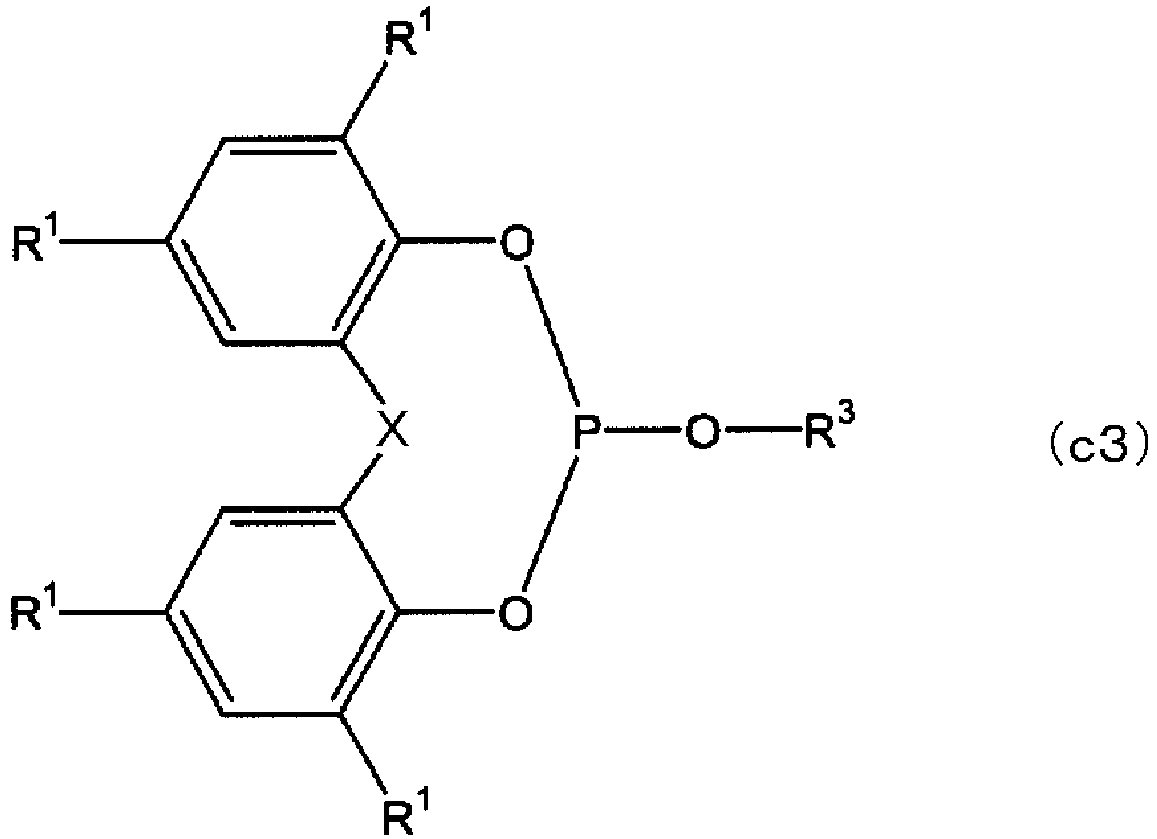
- In the general formulas (c1), (c2) and (c3),
- when there are a plurality of groups, each R1 independently represents an alkyl group,
- when there are a plurality of groups, each R2 independently represents an aromatic group,
- R3 represents an alkyl group, a cycloalkyl group, an aryl group or an aralkyl group, and
- X represents a single bond or a divalent linking group.
- The alkyl group for R1 preferably has 1 to 10 carbon atoms, and is more preferably a t-butyl group.
- Examples of the aromatic group for R2 include a phenyl group, a naphthyl group, and a group in which these are substituted with an alkyl group or the like.
- The number of carbon atoms of R3 is preferably 1 to 30, more preferably 3 to 20, and still more preferably 6 to 18.
- R3 is preferably an aryl group or an aralkyl group, and more preferably an aralkyl group. The aryl group or aralkyl group may be further substituted with a substituent (for example, an alkyl group having 1 to 6 carbon atoms or a hydroxy group).
- Specific examples thereof when X is a divalent linking group include an alkylene group (methylene group), and an ether group (-O-). X is preferably a single bond.
- The compound [D] may be used alone or in combination of two or more.
- When the amount of the cyclic olefin copolymer (P) is 100 parts by mass, the content of the compound [D] in the composition is, for example, 0.01 to 1.5 parts by mass, preferably 0.02 to 1.0 parts by mass, and more preferably 0.05 to 0.5 parts by mass. Within this range, it is possible to effectively reduce discoloration and radical generation due to electron beam or gamma ray irradiation while maintaining other performances (for example, moldability and mechanical strength).
- On the other hand, as another viewpoint, when the amount of the cyclic olefin copolymer (P) is 100 parts by mass, the content of the phosphorus-based compound [D] is preferably less than 0.05 parts by mass, more preferably 0.03 parts by mass or less, and still more preferably 0.02 parts by mass or less.
- The cyclic olefin copolymer composition according to the present embodiment may optionally contain a phenol-based stabilizer as a weathering stabilizer.
- Examples of the phenol-based stabilizer include hindered phenol-based stabilizers such as 3,3',3",5,5',5"-hexa-tert-butyl-a,a',a"-(methylene-2,4,6-triy l)tri-p-cresol, 1,3,5-trimethyl-2,4,6-tris (3,5-di-tert-butyl-4-hydroxyphenyl)benzylbenzene, pentaerythritol tetrakis[3-(3,5-di-tert-butyl-4-hydroxyphenyl)propionate], octadecyl-3-(3,5-di-tert-butyl-4-hydroxyphenyl)propionate, and thiodiethylene bis[3-(3,5-di-tert-butyl-4-hydroxyphenyl)propionate];acrylate-ba sed phenolic compounds such as 2-t-butyl-6-(3-t-butyl-2-hydroxy-5-methylbenzyl)-4-methylphenyl acrylate and 2,4-di-t-amyl-6-(1-(3,5-di-t-amyl-2-hydroxyphenyl)ethyl) phenyl acrylate disclosed in
Japanese Unexamined Patent Publication No. S63-179953 Japanese Unexamined Patent Publication No. H1-168643 - The content of the phenol-based stabilizer is preferably less than 0.05 parts by mass, more preferably 0.03 parts by mass or less, and still more preferably 0.02 parts by mass or less.
- The cyclic olefin copolymer composition according to the present embodiment can be obtained by a method of melt-kneading the cyclic olefin copolymer (P) and other components using a known kneading apparatus such as an extruder and a Banbury mixer; a method of dissolving the cyclic olefin copolymer (P) and other components in a common solvent and then evaporating the solvent; a method of adding a solution of the cyclic olefin copolymer (P) and other components in a poor solvent to cause precipitation; or the like.
- A molded body according to the present embodiment is a molded body containing the cyclic olefin copolymer (P) for a medical instrument according to the present embodiment.
- Further, when the total amount of the molded body is 100% by mass, the content of the cyclic olefin copolymer (P) for a medical instrument in the molded body according to the present embodiment is preferably 50% by mass or more and 100% by mass or less, more preferably 70% by mass or more and 100% by mass or less, still more preferably 80% by mass or more and 100% by mass or less, and particularly preferably 90% by mass or more and 100% by mass or less, from the viewpoint of further improving the performance balance between the radiation resistance and the transparency of the molded body.
- The molded body according to the present embodiment can be obtained by molding a resin composition containing the cyclic olefin copolymer (P) into a predetermined shape. The method for obtaining a molded body by molding the resin composition containing the cyclic olefin copolymer (P) is not particularly limited, and a known method can be used. Depending on its use and shape, for example, extrusion molding, injection molding, compression molding, inflation molding, blow molding, extrusion blow molding, injection blow molding, press molding, vacuum molding, powder slush molding, calendar molding, foam molding and the like can be applied. Among these, the injection molding method is preferable from the viewpoint of moldability and productivity. The molding conditions are appropriately selected depending on the purpose of use or the molding method. For example, the resin temperature in injection molding is appropriately selected in the range of usually 150°C to 400°C, preferably 200°C to 350°C, and more preferably 230°C to 330°C.
- Further, in the cyclic olefin copolymer (P) according to the present embodiment, from the viewpoint of further improving the transparency of a molded body to be obtained, when an inj ection-molded sheet having a thickness of 2.0mm is prepared from the cyclic olefin copolymer (P), the haze of the injection-molded sheet measured in accordance with JIS K7136 is preferably less than 5%.
- Since the molded body according to the present embodiment contains the cyclic olefin copolymer (P) for a medical instrument according to the present embodiment, the molded body has good moldability and high transparency during molding, has a glass transition temperature at which the molded body can be molded into a shape of a container or the like, and generates a small amount of radicals during gamma ray irradiation. Therefore, it is suitable for medical instruments. The molded body according to the present embodiment can be made into, for example, a syringe, a chemical storage container, or a biochip.
- Next, the medical instrument of the embodiment according to the present invention will be described.
- The medical instrument according to the present embodiment contains the cyclic olefin copolymer (P) or the cyclic olefin copolymer composition according to the present embodiment.
- Since the medical instrument according to the present embodiment contains the cyclic olefin copolymer (P), it is excellent in a performance balance between the transparency and gamma ray resistance or electron beam resistance. This medical instrument has little discoloration due to electron beam or gamma ray irradiation.
- Here, according to another study by the present inventors, it has become clear that radicals may be generated by electron beam or gamma ray irradiation in conventional medical instruments. As a result, there is a concern that there is a risk of deterioration of the contents after filling the medical container such as a chemical storage container with the content.
- On the other hand, the medical instrument according to the present embodiment can reduce the amount of radicals generated by electron beam or gamma ray irradiation. Therefore, according to the medical instrument according to the present embodiment, it is possible to reduce the risk of deterioration of the contents.
- Further, for example, by irradiating the medical instrument produced above with gamma rays or electron beams, it is possible to obtain a gamma ray or electron beam irradiated object (medical instrument irradiated with gamma rays or electron beams) for the medical instruments. Since the medical instrument is sterilized by irradiation, the medical instrument is clean, and discoloration and generation of radicals are suppressed. The irradiation dose is not particularly limited, but is usually 5 to 100 kilogray (kGy), preferably 10 to 80 kilogray.
- Examples of the medical instruments include a catheter member, a sterilization sheet, a medical container, and a biochip.
- Examples of the medical container include a syringe barrel outer cylinder (hereinafter, syringe) of a syringe, a syringe used for a syringe barrel filled with a chemical or a drug (hereinafter, also referred to as a prefilled syringe), and a storage container used for a storage container filled with a chemical or a drug (hereinafter, also referred to as a chemical storage container.).
- Here, the prefilled syringe is a syringe-shaped preparation that is pre-filled with a chemical or a drug, and there are a single-chamber type that is filled with one kind of solution and a double-chamber type that is filled with two kinds of drugs. Most prefilled syringes are single-chamber type, but there are two types of double-chamber syringes, which include either liquid/powder type preparations, which consist of powder and its solution, or liquid/liquid type preparations, which consist of two types of solution. Examples of the single-chamber type internal solution include a heparin solution. Examples of the syringe and a prefilled syringe used for a syringe include a prefillable syringe, a prefilled syringe for a vaccine, a prefilled syringe for an anticancer agent, and a needleless syringe.
- Examples of the chemical storage container include a wide-mouthed bottle, a narrow-mouthed bottle, a medicine bottle, a vial bottle, an infusion bottle, a bulk container, a petri dish, a test tube, and an analysis cell. More specific examples thereof include liquid, powder or solid drug containers such as ampoules, press-through packages, infusion bags, drip containers and eye drop containers; sample containers such as blood test sampling test tubes, blood collection tubes and specimen containers; analysis containers such as ultraviolet test cells; sterile containers for medical instruments such as scalpels, forceps, gauze and contact lenses; medical instruments such as disposable syringes and prefilled syringes; laboratory instruments such as beakers, vials, ampoules and test tube flasks; and artificial organ housings.
- The biochip is one in which biomolecules such as DNA, protein, or sugar chain are immobilized thereon, and examples thereof include a DNA analysis chip, and a protein analysis chip, and as a test or diagnostic tool using the same. In a broad sense, biosensors are also included.
- The medical instrument according to present embodiment has good transparency. Transparency is assessed by internal haze.
- Further, it is preferable that the light transmittance is good. The light transmittance is defined by the spectral light transmittance or the total light transmittance depending on the application.
- When assumed to be used for all light beams or a plurality of wavelength ranges, it is necessary to have a good total light transmittance, and the total light transmittance in a state where the antireflection film is not provided on the surface is 85% or more, preferably 88 to 93%. When the total light transmittance is 85% or more, a necessary amount of light can be secured. Although a known method can be applied to the total light transmittance measurement method and the measuring apparatus or the like is not limited, examples thereof include a method of molding the cyclic olefin copolymer composition according to the present embodiment into a sheet having a thickness of 3 mm and measuring the total light transmittance of the sheet obtained by molding the cyclic olefin copolymer composition according to the present embodiment using a haze meter according to ASTM D1003.
- Further, the medical instrument according to the present embodiment has excellent light transmittance of light having a wavelength of 450 nm to 800 nm.
- By providing a known antireflection film on the surface, the light transmittance can be further improved.
- Although the embodiments of the present invention have been described above, these are examples of the present invention, and various configurations other than the above can be adopted.
- Further, the present invention is not limited to the above-described embodiment, and modifications, improvements, and the like within the range in which the object of the present invention can be achieved are included in the present invention.
- Hereinafter, the present invention will be described in more detail with reference to Examples, but the present invention is not limited thereto.
- First, a precursor polymer of a cyclic olefin copolymer was obtained by the following method.
- Into a fully nitrogen-purged 500ml glass reactor, 17.3 ml of tetracyclododecene (tetracyclo[6.2.1.1(3,6).0(2,7)]dodeca-4-ene, see the formula (1) below, hereinafter also referred to as TD), 140 ml of dehydrated toluene, and 0.11 ml of hexadiene were added, and heated to 50°C, and stirred. As a catalyst, 5.9 mg of Grubbs Catalyst™ 2nd Generation was added and reacted with stirring. After 10 minutes, 1 ml of butyraldehyde was added dropwise to terminate the reaction.
- About 150 ml of the solution obtained after the reaction was added dropwise to 1400 ml of acetone for crystallization, filtered through Kiriyama filter paper (5B), and dried under reduced pressure at 80°C to obtain 13 g of the polymer. Hereinafter, this polymer is referred to as RTD.
- Into a fully nitrogen-purged 500ml glass reactor, 17.0 ml of tetracyclododecene, 0.4 ml of indene norbornene (1,4,4a,9a-tetrahydro-1,4-methanofluorene, see the formula (2) below, hereinafter also referred to as IndNB), 140 ml of dehydrated toluene, and 0.11 ml of hexadiene were added, and heated to 50°C, and stirred. As a catalyst, 5.9 mg of Grubbs Catalyst™ 2nd Generation was added and reacted with stirring. After 10 minutes, 1 ml of butyraldehyde was added dropwise to terminate the reaction.
- About 150 ml of the solution obtained after the reaction was added dropwise to 1400 ml of acetone for crystallization, filtered through Kiriyama filter paper (5B), and dried under reduced pressure at 80°C to obtain 13 g of the polymer. Hereinafter, this polymer is referred to as RTD-IndNB2.
- Into a fully nitrogen-purged 500ml glass reactor, 16.9 ml of tetracyclododecene, 0.9 ml of indene norbornene, 140 ml of dehydrated toluene, and 0.11 ml of hexadiene were added, and heated to 50°C, and stirred. As a catalyst, 5.9 mg of Grubbs Catalyst™ 2nd Generation was added and reacted with stirring. After 10 minutes, 1 ml of butyraldehyde was added dropwise to terminate the reaction.
- About 150 ml of the solution obtained after the reaction was added dropwise to 1400 ml of acetone for crystallization, filtered through Kiriyama filter paper (5B), and dried under reduced pressure at 80°C to obtain 13 g of the polymer. Hereinafter, this polymer is referred to as RTD-IndNB5.
- Into a fully nitrogen-purged 500ml glass reactor, 15.6 ml of tetracyclododecene, 1.9 ml of indene norbornene, 140 ml of dehydrated toluene, and 0.11 ml of hexadiene were added, and heated to 50°C, and stirred. As a catalyst, 5.9 mg of Grubbs Catalyst™ 2nd Generation was added and reacted with stirring. After 10 minutes, 1 ml of butyraldehyde was added dropwise to terminate the reaction.
- About 150 ml of the solution obtained after the reaction was added dropwise to 1400 ml of acetone for crystallization, filtered through Kiriyama filter paper (5B), and dried under reduced pressure at 80°C to obtain 13 g of the polymer. Hereinafter, this polymer is referred to as RTD-IndNB10.
- Into a fully nitrogen-purged 500ml glass reactor, 1618.8 ml of indene norbornene, 140 ml of dehydrated toluene, and 0.11 ml of hexadiene were added, and heated to 50°C, and stirred. As a catalyst, 5.9 mg of Grubbs Catalyst™ 2nd Generation was added and reacted with stirring. After 10 minutes, 1 ml of butyraldehyde was added dropwise to terminate the reaction.
- About 150 ml of the solution obtained after the reaction was added dropwise to 1400 ml of acetone for crystallization, filtered through Kiriyama filter paper (5B), and dried under reduced pressure at 80°C to obtain 13 g of the polymer. Hereinafter, this polymer is referred to as RTD-IndNB.
- Into a fully nitrogen-purged 500ml glass reactor, 17.0 ml of tetracyclododecene, 0.3 ml of benzonorbornadiene (see the formula (3) below, hereinafter also referred to as BNBD), 140 ml of dehydrated toluene, and 0.11 ml of hexadiene were added, and heated to 50°C, and stirred. As a catalyst, 5.9 mg of Grubbs Catalyst™ 2nd Generation was added and reacted with stirring. After 10 minutes, 1 ml of butyraldehyde was added dropwise to terminate the reaction.
- About 150 ml of the solution obtained after the reaction was added dropwise to 1400 ml of acetone for crystallization, filtered through Kiriyama filter paper (5B), and dried under reduced pressure at 80°C to obtain 13 g of the polymer. Hereinafter, this polymer is referred to as RTD-BNBD2.
- Into a fully nitrogen-purged 500ml glass reactor, 8.7 ml of tetracyclododecene, 6.7 ml of benzonorbornadiene, 140 ml of dehydrated toluene, and 0.11 ml of hexadiene were added, and heated to 50°C, and stirred. As a catalyst, 5.9 mg of Grubbs Catalyst™ 2nd Generation was added and reacted with stirring. After 10 minutes, 1 ml of butyraldehyde was added dropwise to terminate the reaction.
- About 150 ml of the solution obtained after the reaction was added dropwise to 1400 ml of acetone for crystallization, filtered through Kiriyama filter paper (5B), and dried under reduced pressure at 80°C to obtain 13 g of the polymer. Hereinafter, this polymer is referred to as RTD-BNBD50.
- Into a fully nitrogen-purged 500ml glass reactor, 16 ml of benzonorbornadiene, 140 ml of dehydrated toluene, and 0.11 ml of hexadiene were added, and heated to 50°C, and stirred. As a catalyst, 5.9 mg of Grubbs Catalyst™ 2nd Generation was added and reacted with stirring. After 10 minutes, 1 ml of butyraldehyde was added dropwise to terminate the reaction.
- About 150 ml of the solution obtained after the reaction was added dropwise to 1400 ml of acetone for crystallization, filtered through Kiriyama filter paper (5B), and dried under reduced pressure at 80°C to obtain 13 g of the polymer. Hereinafter, this polymer is referred to as RBNBD.
- Into a fully nitrogen-purged 500ml glass reactor, 8.7 ml of tetracyclododecene, 8.0 ml of methylphenyl norbornene (see the formula (4) below, hereinafter also referred to as MePhNB), 140 ml of dehydrated toluene, and 0.11 ml of hexadiene were added, and heated to 50°C, and stirred. As a catalyst, 5.9 mg of Grubbs Catalyst™ 2nd Generation was added and reacted with stirring. After 10 minutes, 1 ml of butyraldehyde was added dropwise to terminate the reaction.
- About 150 ml of the solution obtained after the reaction was added dropwise to 1400 ml of acetone for crystallization, filtered through Kiriyama filter paper (5B), and dried under reduced pressure at 80°C to obtain 13 g of the polymer. Hereinafter, this polymer is referred to as RTD-MPNB50.
- Into a fully nitrogen-purged 500ml glass reactor, 16 ml of methylphenyl norbornene (see the formula (4) below, hereinafter also referred to as MePhNB), 140 ml of dehydrated toluene, and 0.11 ml of hexadiene were added, and heated to 50°C, and stirred. As a catalyst, 5.9 mg of Grubbs Catalyst™ 2nd Generation was added and reacted with stirring. After 10 minutes, 1 ml of butyraldehyde was added dropwise to terminate the reaction.
- About 150 ml of the solution obtained after the reaction was added dropwise to 1400 ml of acetone for crystallization, filtered through Kiriyama filter paper (5B), and dried under reduced pressure at 80°C to obtain 13 g of the polymer. Hereinafter, this polymer is referred to as RMPNB.


- The precursor polymers shown in Table 1 were obtained by the above method. Subsequently, the obtained precursor polymers were partially or fully hydrogenated by the following method.
- Into a fully nitrogen-purged 1L glass reactor, 13 g of RTD-IndNB2 and 600 ml of o-xylene were added, dissolved, heated to 140°C with stirring, and refluxed. Then, 30.5 g of p-toluenesulfonyl hydrazide and 23.4 g of tri-n-propylamine were added to initiate the reaction. After 4 hours from the initiation of the reaction, the temperature was lowered to room temperature to terminate the reaction, and about 600 ml of the reaction solution was obtained. Similar to the above-described production example, the reaction solution was added dropwise to 1800 ml of acetone for crystallization, filtered through Kiriyama filter paper (5B), and dried under reduced pressure at 80°C to obtain 13 g of the polymer.
- When this polymer was observed by NMR, the aromatic rings remained, but other double bonds were almost eliminated.
- Partial hydrogenation step was carried out in the same manner as in the production of the cyclic olefin polymer P-1 except that the polymers shown in Table 1 were used instead of RTD-IndNB2 to obtain cyclic olefin polymers P-2 to 9. When each of the cyclic olefin polymers P-2 to P-9 was observed by NMR in the same manner as in the case of the cyclic olefin polymer P-1, the aromatic rings remained, but other double bonds were almost eliminated.
- Into a fully nitrogen-purged autoclave, 13 g of RTD, 277 g of cyclohexane, 0.08 g of bis(tricyclohexylphosphine)benzylidine ruthenium (IV) dichloride, and 4.7 g of ethyl vinyl ether were added, and the reaction was carried out by applying 8 atm of hydrogen pressure and raising the temperature to 120°C for 10 hours.
- Similar to the above-described production example, the reaction solution was added dropwise to 1800 ml of acetone for crystallization, filtered through Kiriyama filter paper (5B), and dried under reduced pressure at 80°C to obtain 13 g of the polymer.
- When this polymer was observed by NMR, aromatic rings and other double bonds were almost eliminated.
- Hydrogenation step was carried out in the same manner as in the production of the cyclic olefin polymer P-8 except that the polymers shown in Table 1 were used instead of RTD to obtain cyclic olefin polymers P-11 to 14. When each of the cyclic olefin polymers P-11 to 14 was observed by NMR in the same manner as the cyclic olefin polymers P-8, aromatic ring and other double bonds were almost eliminated.
- The intrinsic viscosity ([η]) was measured in decalin at 135°C.
- Specifically, a resin (about 20 mg) was dissolved in a decalin solvent (15 ml), and the specific viscosity ηsp was measured in an oil bath at 135°C. The decalin solution was diluted by adding 5 ml of decalin solvent, and then the specific viscosity ηsp was measured in the same manner as described above. This dilution operation was further repeated twice, and the value of ηsp/C when the sample concentration (C) was extrapolated to 0 was defined as the intrinsic viscosity [η].

- The DSC measurement was performed under the following conditions.
- Equipment: DSC7000 manufactured by SII Nanotechnology Co., Ltd.
- Measurement condition: in a nitrogen atmosphere, the temperature was raised from room temperature to 260°C at a heating rate of 10°C/min, and then held for 5 minutes. Then, the temperature was lowered to 30°C at a cooling rate of 10°C/min and then held for 5 minutes . Then, a DSC curve in the process of raising the temperature to 260°C at a heating rate of 10°C/min was obtained.
- In the obtained DSC curve, the glass transition temperature was defined as the temperature at the point where a straight line equidistant from the extended straight line of each baseline in the vertical axis direction intersects with the curve of the stepwise change portion of the glass transition.
- 1H-NMR measurement of the cyclic olefin polymer was carried out by the following method, and the presence or absence of an aromatic ring and the presence or absence of a double bond were confirmed.
- 1H-NMR manufactured by JEOL Ltd. was used to perform measurement at 0.5ppm to 8ppm, and the presence or absence of aromatic ring-derived hydrogen peaks (6.7 to 7.3ppm) and the presence or absence of other double bond-derived peaks.
- In addition, the content of the structural unit (A) in the cyclic olefin copolymer and the content of the aromatic ring in the cyclic olefin copolymer when the total content of the structural unit (A) and the structural unit (B) was 100 mol% were calculated by the following method.
- The amount of hydrogens of the aromatic ring contained in the polymer was calculated by calculating the peak area of the peak of the hydrogens derived from the aromatic ring (6.7 to 7.3ppm) relative to the total area of all the peaks derived from hydrogens detected in 0.5ppm to 8ppm by 1H-NMR manufactured by JEOL Ltd.
- The cyclic olefin polymers P-1 to P-14 was granulated using a twin-screw extruder BT-30 (screw diameter 30mm ϕ, L/D = 46) manufactured by Research Laboratory of Plastics Technology Co., Ltd under the conditions of a setting temperature of 270°C, a resin-extrusion amount of 80 g/min, and a screw rotation speed of 200 rpm to obtain various measurement pellets.
- The pellets obtained above were injection-molded using an injection molding machine IS-55 manufactured by Toshiba Machine Co., Ltd. under the conditions of a cylinder temperature = 270 to 290°C, an injection speed of 70 to 90%, a screw rotation speed of 70 to 100 rpm, and a mold temperature of 120°C, to prepare injection square plates having a thickness of 2 mm.
- The internal haze of the obtained square plate test piece having a thickness of 2 mm was measured, and the transparency was evaluated according to the following criteria.
- The internal haze was measured in benzyl alcohol using a haze meter (NDH-20D manufactured by Nippon Denshoku Industries Co., Ltd.) .
- ○: Internal haze is less than 6.0%
- X: The test piece is visually cloudy, or the internal haze is 6.0% or more.
- Each of the obtained samples (2 mm thick square plate test piece) was irradiated with 20 kilogray of gamma rays, and the amount of radicals generated was measured.
- The amount of radicals was measured by an electron spin resonance (ESR) method.
- Specifically, about 6 mg of a test piece immediately after gamma ray irradiation was cut out, placed in a test tube (details below), and the ESR spectrum was measured under the following conditions.
- Equipment: electron spin resonance equipment JES-TE200 manufactured by JEOL Ltd.
- Resonance frequency: 9.2 GHz
- Microwave input: 1mW
- Central magnetic field: 326.5 mT
- Sweep width: ± 15mT
- Modulation frequency: 100 kHz
- Sweep time: 8 min.
- Time constant: 0.1 sec
- Amplification: 25
- Sample tube: X-band compatible sample tube with quartz tip
- External aiming: Mn2+ standard sample supported on magnesium oxide
- External standard memory: 0, 700
- Measurement temperature: room temperature
- Measurement atmosphere: air
- For the relative comparison of the radical generation amount, the normalized value shown in the following equation was used.

- The baseline of the ESR spectrum was corrected based on Mn2+ (second signal).
- Usually, in the relative comparison of radical amounts, Mn2+ (third signal) is used for the area of the reference Mn2+ derived signal. However, since the spectrum of the radical derived from the organic radical and Mn2+ (third signal) overlap, Mn2+ (second signal) was used for all the measurements this time (external standard memory = 700) .
- Further, when the organic radical-derived signal overlapped with Mn2+ (third signal), calculation was performed using the ESR spectrum of external standard memory = 0.
[Table 1] Example 1 Example 2 Example 3 Example 4 Example 5 Example 6 Example 7 Example 8 Example 9 Comparative Example 1 Comparative Example 2 Comparative Example 3 Comparative Example 4 Comparative Example 5 Comonomer TD TD TD none TD TD none TD none TD TD none none none Aromatic ring-containing monomer IndNB IndNB IndNB IndNB BNBD BNBD BNBD MePhNB MePhNB none IndNB IndNB BNBD MePhNB Structural unit derived from aromatic ring-containing monomer mol% 2 5 10 100 2 50 100 50 100 0 20 100 100 100 Precursor polymer sample RTD-IndNB2 RTD-IndNB5 RTD-IndNB10 RIndNB RTD-BNBD2 RTD-BNBD50 RBNBD RTD-MPNB50 RMPNB RTD RTD-IndNB20 RIndNB RBNBD RMPNB Full hydrogenation/ Partial hydrogenation (hydrogenation of mair chain only) partial hydrogenation partial hydrogenation partial hydrogenation partial hydrogenation partial hydrogenation partial hydrogenation partial hydrogenation partial hydrogenation partial hydrogenation full hydrogenation full hydrogenation full hydrogenation full hydrogenation full hydrogenation cyclic olefin copolymer sample P-1 P-2 P-3 P-4 P-5 P-6 P-7 P-8 P-9 P-10 P-11 P-12 P-13 P-14 η dl/g 0.46 0.46 0.51 0.46 0.48 0.45 0.50 0.47 0.51 0.44 0.46 0.45 0.47 0.5 Tg °C 174 173 173 162 172 161 155 117 85 174 168 156 149 78 Aromatic ring content mol% 0.4 1.0 2.0 22.2 0.8 23.5 57.1 26.3 55.6 0.0 0.0 0.0 0.0 0.0 Transparency - ○ ○ ○ ○ ○ ○ ○ ○ ○ ○ ○ ○ ○ ○ Radical amount - 0.5 0.3 0.3 0.5 0.5 0.3 0.3 0.3 0.2 70 60 60 60 50 - This application claims priority on the basis of Japanese application
Japanese Patent Application No. 2018-245453 filed on December 27, 2018
Claims (11)
- A cyclic olefin copolymer for a medical instrument having an aromatic ring, comprising:
at least one structural unit (A) of the following (Ia), (II), and (III):


- The cyclic olefin copolymer for a medical instrument according to claim 1, wherein a content of the structural unit (A) is 0.2 mol% or more and 100 mol% or less.
- The cyclic olefin copolymer for a medical instrument according to claim 1 or 2, further comprising a structural unit (B) derived from an olefin having 2 to 20 carbon atoms.
- The cyclic olefin copolymer for a medical instrument according to claim 3, wherein the structural unit (B) has an alicyclic structure.
- The cyclic olefin copolymer for a medical instrument according to claim 3 or 4, wherein when a total content of the structural unit (A) and the structural unit (B) is 100 mol%, a content of the structural unit (A) in the cyclic olefin copolymer is 0.5 mol% or more and 100 mol% or less.
- The cyclic olefin copolymer for a medical instrument according to any one of claims 1 to 5, wherein a glass transition temperature (Tg) of the cyclic olefin copolymer is 80°C or higher and 200°C or lower, as measured by a differential scanning calorimeter (DSC).
- The cyclic olefin copolymer for a medical instrument according to any one of claims 1 to 6,
wherein the structural unit (A) is derived from at least one selected from benzonorbornadiene, indene norbornene and methylphenyl norbornene. - A cyclic olefin copolymer composition for a medical instrument, comprising the cyclic olefin copolymer for a medical instrument according to any one of claims 1 to 7.
- A molded body comprising the cyclic olefin copolymer for a medical instrument according to any one of claims 1 to 7.
- The molded body according to claim 9, which is a syringe or a chemical storage container.
- The molded body according to claim 9, which is a biochip.
Applications Claiming Priority (2)
| Application Number | Priority Date | Filing Date | Title |
|---|---|---|---|
| JP2018245453 | 2018-12-27 | ||
| PCT/JP2019/049439 WO2020137710A1 (en) | 2018-12-27 | 2019-12-17 | Cyclo-olefin copolymer for medical devices, cyclo-olefin copolymer composition for medical devices, and molded body |
Publications (2)
| Publication Number | Publication Date |
|---|---|
| EP3904418A1 true EP3904418A1 (en) | 2021-11-03 |
| EP3904418A4 EP3904418A4 (en) | 2022-09-14 |
Family
ID=71127696
Family Applications (1)
| Application Number | Title | Priority Date | Filing Date |
|---|---|---|---|
| EP19903697.1A Pending EP3904418A4 (en) | 2018-12-27 | 2019-12-17 | CYCLOOLEFIN COPOLYMER FOR MEDICAL DEVICES, CYCLOOLEFIN COPOLYMER COMPOSITION FOR MEDICAL DEVICES AND MOLDINGS |
Country Status (4)
| Country | Link |
|---|---|
| US (1) | US20220064369A1 (en) |
| EP (1) | EP3904418A4 (en) |
| JP (1) | JP7080351B2 (en) |
| WO (1) | WO2020137710A1 (en) |
Families Citing this family (3)
| Publication number | Priority date | Publication date | Assignee | Title |
|---|---|---|---|---|
| JP7509549B2 (en) * | 2020-02-20 | 2024-07-02 | 三井化学株式会社 | Cyclic olefin copolymer composition for medical device and molded article |
| JP2022054983A (en) * | 2020-09-28 | 2022-04-07 | 三井化学株式会社 | Cyclic olefin resin composition, molding and applications thereof |
| JP7576494B2 (en) * | 2021-03-17 | 2024-10-31 | 三井化学株式会社 | Optical Components |
Family Cites Families (33)
| Publication number | Priority date | Publication date | Assignee | Title |
|---|---|---|---|---|
| JPS60168708A (en) | 1984-02-03 | 1985-09-02 | Mitsui Petrochem Ind Ltd | Novel random copolymer and its production |
| JPS61115912A (en) | 1984-11-12 | 1986-06-03 | Mitsui Petrochem Ind Ltd | Novel random multicomponent copolymer |
| JPS61115916A (en) | 1984-11-12 | 1986-06-03 | Mitsui Petrochem Ind Ltd | Novel polymer |
| JPS61120816A (en) | 1984-11-19 | 1986-06-07 | Mitsui Petrochem Ind Ltd | Novel polymer |
| JPH062786B2 (en) * | 1985-05-28 | 1994-01-12 | 三井石油化学工業株式会社 | Preparation of cyclic olefin random copolymer |
| JPH0780973B2 (en) | 1986-04-26 | 1995-08-30 | 三井石油化学工業株式会社 | Cyclic olefin-based random copolymer |
| JPH0723411B2 (en) | 1986-04-26 | 1995-03-15 | 三井石油化学工業株式会社 | Cyclic olefin-based random copolymer |
| JPH07643B2 (en) | 1985-05-24 | 1995-01-11 | 三井石油化学工業株式会社 | Process for producing amorphous cyclic olefin random copolymer |
| JPS63179953A (en) | 1987-01-21 | 1988-07-23 | Asahi Chem Ind Co Ltd | Polymer composition |
| JPH02173013A (en) * | 1988-12-26 | 1990-07-04 | Tosoh Corp | Polymer |
| JP3237072B2 (en) * | 1992-05-11 | 2001-12-10 | 三井化学株式会社 | Cyclic olefin-based random multi-component copolymer and method for producing the same |
| JP3291857B2 (en) * | 1993-07-30 | 2002-06-17 | 日本ゼオン株式会社 | Norbornene-based ring-opened (co) polymer hydrogenated product, method for producing the same, and use thereof |
| JP2007314806A (en) | 1994-04-22 | 2007-12-06 | Mitsui Chemicals Inc | Production method of cycloolefin copolymer and copolymer produced thereby |
| JPH08217860A (en) * | 1995-02-17 | 1996-08-27 | Japan Synthetic Rubber Co Ltd | Method for producing norbornene-based polymer |
| JPH10139865A (en) * | 1996-11-11 | 1998-05-26 | Nippon Zeon Co Ltd | Norbornene-based polymer and method for producing the same |
| JP4881306B2 (en) | 2005-04-18 | 2012-02-22 | 三井化学株式会社 | Resin composition and optical component |
| JP4728869B2 (en) | 2005-04-18 | 2011-07-20 | 三井化学株式会社 | Polyamine derivatives |
| JP2007137935A (en) | 2005-11-15 | 2007-06-07 | Nippon Zeon Co Ltd | Tetracyclododecene ring-opened polymer hydride, method for producing the same, and optical material |
| JP4905644B2 (en) * | 2005-12-19 | 2012-03-28 | 日本ゼオン株式会社 | Method for producing radiation-sensitive resin composition |
| DE112007002467B4 (en) | 2006-10-17 | 2021-09-23 | Mitsui Chemicals, Inc. | Resin composition, its use, molded product obtained by molding the resin composition, and its use |
| WO2008063907A1 (en) * | 2006-11-13 | 2008-05-29 | Adherent Laboratories, Inc. | Disposable article hot melt adhesive |
| JP5346438B2 (en) * | 2007-01-24 | 2013-11-20 | 富士フイルム株式会社 | Norbornene polymer, film, polarizing plate and liquid crystal display device using norbornene polymer |
| JP2008214416A (en) * | 2007-03-01 | 2008-09-18 | Nippon Zeon Co Ltd | 5-Methyl-5-phenyl-bicyclo [2.2.1] hept-2-ene composition |
| JP5227237B2 (en) | 2009-04-03 | 2013-07-03 | 三井化学株式会社 | α-Olefin / Cyclic Olefin Copolymer, Process for Producing the Same, and Molded Body Containing α-Olefin / Cyclic Olefin Copolymer |
| JP5597102B2 (en) * | 2009-11-13 | 2014-10-01 | 三井化学株式会社 | Olefin polymerization catalyst and process for producing olefin polymer |
| JP5733392B2 (en) * | 2011-05-23 | 2015-06-10 | ウシオ電機株式会社 | Surface treatment method for molded body and molded body made of material containing cyclic olefin resin |
| WO2013043796A2 (en) * | 2011-09-23 | 2013-03-28 | Exxonmobil Chemical Patents Inc. | Modified polyethylene compositions |
| EP2904648B1 (en) * | 2012-10-04 | 2016-09-21 | Merck Patent GmbH | Passivation layers for organic electronic devices |
| WO2016052302A1 (en) | 2014-09-29 | 2016-04-07 | 日本ゼオン株式会社 | Cyclic olefin ring-opened polymer hydride, resin molded article, and optical member |
| CN108026377B (en) * | 2015-09-17 | 2021-09-07 | Jxtg能源株式会社 | Thermoplastic elastomer composition and method for producing the same |
| US20180244837A1 (en) | 2015-09-24 | 2018-08-30 | Zeon Corporation | Cyclopentene ring-opening copolymer |
| EP3690013A4 (en) | 2017-09-29 | 2021-06-23 | Zeon Corporation | Biochemical instrument |
| WO2019107363A1 (en) * | 2017-11-29 | 2019-06-06 | 三井化学株式会社 | Cyclic-olefin-based copolymer, cyclic-olefin-based copolymer composition, molded body, and medical container |
-
2019
- 2019-12-17 EP EP19903697.1A patent/EP3904418A4/en active Pending
- 2019-12-17 JP JP2020563118A patent/JP7080351B2/en active Active
- 2019-12-17 WO PCT/JP2019/049439 patent/WO2020137710A1/en not_active Ceased
- 2019-12-17 US US17/418,313 patent/US20220064369A1/en not_active Abandoned
Also Published As
| Publication number | Publication date |
|---|---|
| EP3904418A4 (en) | 2022-09-14 |
| US20220064369A1 (en) | 2022-03-03 |
| JPWO2020137710A1 (en) | 2021-10-21 |
| JP7080351B2 (en) | 2022-06-03 |
| WO2020137710A1 (en) | 2020-07-02 |
Similar Documents
| Publication | Publication Date | Title |
|---|---|---|
| US12240930B2 (en) | Cyclic olefin-based copolymer, cyclic olefin-based copolymer composition, molded article, and medical container | |
| EP3904418A1 (en) | Cyclo-olefin copolymer for medical devices, cyclo-olefin copolymer composition for medical devices, and molded body | |
| EP3042927A1 (en) | Method for producing sterilized medical molded body | |
| JP2021054905A (en) | Cyclic olefin copolymer composition and molded article | |
| JP7509549B2 (en) | Cyclic olefin copolymer composition for medical device and molded article | |
| JP2020105323A (en) | Cyclic olefin copolymer, cyclic olefin copolymer composition, and molding | |
| JP7133997B2 (en) | Medical container and cyclic olefin resin composition for medical container | |
| JP2022054983A (en) | Cyclic olefin resin composition, molding and applications thereof | |
| US20240158565A1 (en) | Vessel | |
| JP7309461B2 (en) | Molded articles and medical containers | |
| CN118185192A (en) | Medical pipette with gamma sterilization resistance and hydrophobic stability and preparation process thereof | |
| JP2005054123A (en) | Radiation-resistant alicyclic structure-containing polymer resin composition | |
| JP7074517B2 (en) | Cyclic olefin resin composition for gamma ray or electron beam irradiation, molded body and gamma ray or electron beam irradiated product of the molded body | |
| JP7010757B2 (en) | Molding materials and moldings containing cyclic olefin copolymers | |
| JP7080350B2 (en) | Cyclic olefin copolymer composition for optical members and molded product | |
| JP2020036711A (en) | Medical container and cyclic olefin copolymer composition for medical container | |
| US20240360294A1 (en) | Polypropylene composition having improved radiation stability | |
| JP2015183076A (en) | Material for medical equipment |
Legal Events
| Date | Code | Title | Description |
|---|---|---|---|
| STAA | Information on the status of an ep patent application or granted ep patent |
Free format text: STATUS: THE INTERNATIONAL PUBLICATION HAS BEEN MADE |
|
| PUAI | Public reference made under article 153(3) epc to a published international application that has entered the european phase |
Free format text: ORIGINAL CODE: 0009012 |
|
| STAA | Information on the status of an ep patent application or granted ep patent |
Free format text: STATUS: REQUEST FOR EXAMINATION WAS MADE |
|
| 17P | Request for examination filed |
Effective date: 20210622 |
|
| AK | Designated contracting states |
Kind code of ref document: A1 Designated state(s): AL AT BE BG CH CY CZ DE DK EE ES FI FR GB GR HR HU IE IS IT LI LT LU LV MC MK MT NL NO PL PT RO RS SE SI SK SM TR |
|
| DAV | Request for validation of the european patent (deleted) | ||
| DAX | Request for extension of the european patent (deleted) | ||
| A4 | Supplementary search report drawn up and despatched |
Effective date: 20220818 |
|
| RIC1 | Information provided on ipc code assigned before grant |
Ipc: C08G 61/12 20060101ALI20220811BHEP Ipc: C08G 61/08 20060101AFI20220811BHEP |
|
| RAP3 | Party data changed (applicant data changed or rights of an application transferred) |
Owner name: MITSUI CHEMICALS, INC. |
|
| STAA | Information on the status of an ep patent application or granted ep patent |
Free format text: STATUS: EXAMINATION IS IN PROGRESS |
|
| 17Q | First examination report despatched |
Effective date: 20250807 |