EP3903954B1 - Method for producing rectangular can - Google Patents
Method for producing rectangular can Download PDFInfo
- Publication number
- EP3903954B1 EP3903954B1 EP19903694.8A EP19903694A EP3903954B1 EP 3903954 B1 EP3903954 B1 EP 3903954B1 EP 19903694 A EP19903694 A EP 19903694A EP 3903954 B1 EP3903954 B1 EP 3903954B1
- Authority
- EP
- European Patent Office
- Prior art keywords
- rectangular
- manufacturing
- punch
- molded article
- sidewall
- Prior art date
- Legal status (The legal status is an assumption and is not a legal conclusion. Google has not performed a legal analysis and makes no representation as to the accuracy of the status listed.)
- Active
Links
Images




Classifications
-
- B—PERFORMING OPERATIONS; TRANSPORTING
- B21—MECHANICAL METAL-WORKING WITHOUT ESSENTIALLY REMOVING MATERIAL; PUNCHING METAL
- B21D—WORKING OR PROCESSING OF SHEET METAL OR METAL TUBES, RODS OR PROFILES WITHOUT ESSENTIALLY REMOVING MATERIAL; PUNCHING METAL
- B21D24/00—Special deep-drawing arrangements in, or in connection with, presses
- B21D24/16—Additional equipment in association with the tools, e.g. for shearing, for trimming
-
- B—PERFORMING OPERATIONS; TRANSPORTING
- B21—MECHANICAL METAL-WORKING WITHOUT ESSENTIALLY REMOVING MATERIAL; PUNCHING METAL
- B21D—WORKING OR PROCESSING OF SHEET METAL OR METAL TUBES, RODS OR PROFILES WITHOUT ESSENTIALLY REMOVING MATERIAL; PUNCHING METAL
- B21D22/00—Shaping without cutting, by stamping, spinning, or deep-drawing
- B21D22/20—Deep-drawing
- B21D22/30—Deep-drawing to finish articles formed by deep-drawing
-
- B—PERFORMING OPERATIONS; TRANSPORTING
- B21—MECHANICAL METAL-WORKING WITHOUT ESSENTIALLY REMOVING MATERIAL; PUNCHING METAL
- B21D—WORKING OR PROCESSING OF SHEET METAL OR METAL TUBES, RODS OR PROFILES WITHOUT ESSENTIALLY REMOVING MATERIAL; PUNCHING METAL
- B21D51/00—Making hollow objects
- B21D51/16—Making hollow objects characterised by the use of the objects
- B21D51/26—Making hollow objects characterised by the use of the objects cans or tins; Closing same in a permanent manner
-
- B—PERFORMING OPERATIONS; TRANSPORTING
- B21—MECHANICAL METAL-WORKING WITHOUT ESSENTIALLY REMOVING MATERIAL; PUNCHING METAL
- B21D—WORKING OR PROCESSING OF SHEET METAL OR METAL TUBES, RODS OR PROFILES WITHOUT ESSENTIALLY REMOVING MATERIAL; PUNCHING METAL
- B21D51/00—Making hollow objects
- B21D51/16—Making hollow objects characterised by the use of the objects
- B21D51/26—Making hollow objects characterised by the use of the objects cans or tins; Closing same in a permanent manner
- B21D51/2615—Edge treatment of cans or tins
-
- B—PERFORMING OPERATIONS; TRANSPORTING
- B21—MECHANICAL METAL-WORKING WITHOUT ESSENTIALLY REMOVING MATERIAL; PUNCHING METAL
- B21D—WORKING OR PROCESSING OF SHEET METAL OR METAL TUBES, RODS OR PROFILES WITHOUT ESSENTIALLY REMOVING MATERIAL; PUNCHING METAL
- B21D51/00—Making hollow objects
- B21D51/16—Making hollow objects characterised by the use of the objects
- B21D51/26—Making hollow objects characterised by the use of the objects cans or tins; Closing same in a permanent manner
- B21D51/2646—Of particular non cylindrical shape, e.g. conical, rectangular, polygonal, bulged
-
- H—ELECTRICITY
- H01—ELECTRIC ELEMENTS
- H01M—PROCESSES OR MEANS, e.g. BATTERIES, FOR THE DIRECT CONVERSION OF CHEMICAL ENERGY INTO ELECTRICAL ENERGY
- H01M50/00—Constructional details or processes of manufacture of the non-active parts of electrochemical cells other than fuel cells, e.g. hybrid cells
- H01M50/10—Primary casings; Jackets or wrappings
- H01M50/102—Primary casings; Jackets or wrappings characterised by their shape or physical structure
- H01M50/103—Primary casings; Jackets or wrappings characterised by their shape or physical structure prismatic or rectangular
-
- Y—GENERAL TAGGING OF NEW TECHNOLOGICAL DEVELOPMENTS; GENERAL TAGGING OF CROSS-SECTIONAL TECHNOLOGIES SPANNING OVER SEVERAL SECTIONS OF THE IPC; TECHNICAL SUBJECTS COVERED BY FORMER USPC CROSS-REFERENCE ART COLLECTIONS [XRACs] AND DIGESTS
- Y02—TECHNOLOGIES OR APPLICATIONS FOR MITIGATION OR ADAPTATION AGAINST CLIMATE CHANGE
- Y02E—REDUCTION OF GREENHOUSE GAS [GHG] EMISSIONS, RELATED TO ENERGY GENERATION, TRANSMISSION OR DISTRIBUTION
- Y02E60/00—Enabling technologies; Technologies with a potential or indirect contribution to GHG emissions mitigation
- Y02E60/10—Energy storage using batteries
Definitions
- the present disclosure relates to a manufacturing method for a rectangular can having a rectangular can body provided with a step on which a sealing lid is placed.
- a rectangular can has been used as a container in a secondary battery (power storage battery) or the like in view of accommodation capability and the like.
- a rectangular can includes a rectangular can body and a sealing lid for closing an opening of the rectangular can body.
- a step on which the sealing lid is to be placed is provided on an inner wall surface of the rectangular can.
- the sealing performance can be increased the closer an angle formed by a surface of the step and the inner wall surface is to 90 degrees.
- PTL 6 discloses a manufacturing method for a rectangular can having the features of the preamble of claim 1.
- An object of the present disclosure is to provide a manufacturing method for a rectangular can according to which brings an angle formed by a surface of a step provided on a rectangular can body and an inner wall surface of the rectangular can body closer to 90 degrees.
- the present disclosure employed the following means in order to achieve the object.
- the manufacturing method for a rectangular can of the present disclosure is a manufacturing method for a rectangular can including a rectangular can body that has a rectangular tube and a bottom, and a sealing lid for closing an opening of the rectangular can body, the manufacturing method including:
- the present disclosure it is possible to bring the angle formed by a surface of the step provided on the rectangular can body and the inner wall surface of the rectangular can body closer to 90 degrees by forming the step through multiple instances of the pressing operation performed by the punch.
- the outer wall surface of the sidewall formed in the step of manufacturing the intermediate molded article may be constituted by a level plane
- a movement amount of the punch moving toward the die may increase each instance of the pressing operation, which is performed repeatedly.
- a movement amount of the punch moving toward the die may increase in stages as the number of instances of the pressing operation, which is performed repeatedly, increases.
- a movement amount of the punch moving toward the die may also be the same for all pressing operations, which are performed repeatedly.
- connection surface formed in the step of manufacturing the intermediate molded article may be provided at positions reaching four corners of the rectangular tube, and the step may be formed also at the four corners in the step-forming step.
- the step of manufacturing the intermediate molded article may include a drawing and ironing step of molding the rectangular tube, and a step surface that is level with the step surface of the step may be formed in advance at the four corners of the rectangular tube through the drawing and ironing step.
- a trimming step of removing a portion, which is unneeded for a final product, on a side opposite to the bottom side of the intermediate molded article may be included after the step-forming step, and at least a part of the sidewall on which the step is to be formed in the portion to be removed in the trimming step may be removed in advance prior to the step-forming step.
- the present disclosure brings the angle formed by the surface of the step provided on the rectangular can body and the inner wall surface of the rectangular can body closer to 90 degrees.
- a manufacturing method for a rectangular can according to an embodiment of the present disclosure will be described with reference to Figs. 1 to 9 .
- a rectangular can obtained through the manufacturing method according to the present embodiment will be described before the manufacturing method for the rectangular can is described.
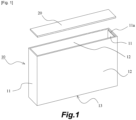
- FIG. 1 is a perspective view showing an overview of the rectangular can.
- Fig. 1 shows a state prior to a sealing lid 20 being attached to a rectangular can body 10.
- the rectangular can manufactured through the manufacturing method includes the rectangular can body 10, and the sealing lid 20 that closes an opening of the rectangular can body 10.
- the rectangular can body 10 and the sealing lid 20 are obtained by machining a metal plate such as an aluminum alloy, a cold rolled steel plate, or stainless steel.
- the rectangular can body 10 is constituted by a rectangular tube having two pairs of sidewalls (short sidewalls 11 and long sidewalls 12) that have inner wall surfaces that face each other, and a bottom 13. Note that the pair of sidewalls with a shorter width among the two pairs of sidewalls are called the short sidewalls 11 and the pair of sidewalls with a longer width are called the long sidewalls 12.
- Steps 11a are respectively provided on the inner wall surfaces of the pair of short sidewalls 11.
- the sealing lid 20 is fixed to the rectangular can body 10 through laser welding, arc welding or the like.
- the rectangular can according to the present embodiment can be suitably used as a container for a secondary battery (power storage battery).
- the sealing lid 20 is fixed after power generation elements constituting the battery, such as electrodes and separators, have been installed in the rectangular can body 10.
- the manufacturing method for the rectangular can includes a step of manufacturing the rectangular can body 10 and a step of fixing the pre-manufactured sealing lid 20 to the rectangular can body 10 as described above.
- the step of manufacturing the rectangular can body 10 is composed of a step of molding an intermediate molded article 100, a step of forming the above-described steps 11a in the intermediate molded article 100, and a trimming step of removing unnecessary portions.
- the step of manufacturing the intermediate molded article includes at least a step of carrying out punching on a metal plate in order to obtain a raw material (blank) with a predetermined outer shape, a step of carrying out drawing and ironing multiple times on the blank, and a pressing step of forming the above-described bottom 13.
- a known technique e.g., see Japanese Laid-Open Patent Publication No. 2018-51575
- description thereof is omitted.
- the trimming step a known technique may be employed as well, thus description thereof is omitted.
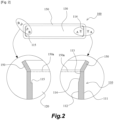
- Fig. 2 is an overall view of the intermediate molded article of the rectangular can.
- Fig. 2 shows a plan view of the intermediate molded article, and schematic cross-sectional views of two locations (a cross-sectional view taken along line AA and a cross-sectional view taken along line BB in the plan view).
- the intermediate molded article 100 includes a pair of portions 110 that are to be the short sidewalls 11 in a final product, a pair of portions 120 that are to be the long sidewalls 12 in the final product, a portion 130 that is to be the bottom 13 in the final product, and a portion 150 that is to be removed during the trimming step.
- a dotted line 150a in Fig. 2 shows a cutting surface that is to be cut in the trimming step.
- the portion 150 to be removed is on a side near the opening with respect to this dotted line 150a.
- a section constituted by the pair of short-sidewall-forming portions 110 and the pair of long-sidewall-forming portions 120 corresponds to the rectangular tube in the intermediate molded article 100, and the bottom-forming portion 130 corresponds to the bottom in the intermediate molded article 100.
- the steps 11a are formed on the inner wall surfaces of the short-sidewall-forming portions 110 serving as the sidewalls.
- the outer wall surface 111 of the short-sidewall-forming portion 110 is constituted by a level plane.
- the inner wall surface of the short-sidewall-forming portion 110 includes a first parallel surface 112 that is parallel to the outer wall surface 111, a second parallel surface 113 that is parallel to the outer wall surface 111 as well, and an inclined surface 114 serving as a connection surface that connects the first parallel surface 112 and the second parallel surface 113.
- the first parallel surface 112 is formed on a side near the bottom 13 (bottom-forming portion 130) with respect to the portion where the step 11a is to be formed.
- the second parallel surface 113 is formed on a side opposite to the bottom 13 side (i.e., on a side near the opening) with respect to the portion where the step 11a is to be formed.
- the second parallel surface 113 is constituted such that the distance to the outer wall surface 111 is shorter than the distance between the first parallel surface 112 and the outer wall surface 111.
- the short-sidewall-forming portion 110 is constituted such that the thickness of the portion at which the second parallel surface 113 is formed is less than the thickness of the portion at which the first parallel surface 112 is formed.
- a portion of the inclined surface 114 is compressed. Accordingly, a step surface 11b of the step 11a is formed at a position of a boundary between the first parallel surface 112 and the inclined surface 114.
- step surfaces 115 that are level with the step surfaces 11b of the step 11a are provided at four corners of the rectangular tube formed by the pair of short-sidewall-forming portions 110 and the pair of long-sidewall-forming portions 120.
- the step surfaces 115 are formed through the drawing and ironing step in the step of manufacturing the intermediate molded article.
- Fig. 3 is a schematic cross-sectional view of a machining apparatus to be used in the step-forming step in the manufacturing method for the rectangular can.
- Fig. 4 is an illustrative diagram illustrating a mechanism of the machining apparatus to be used in the step-forming step in the manufacturing method for the rectangular can, and more specifically, is a diagram illustrating a mechanism for driving a punch.
- Fig. 5 is a process diagram of the step-forming step in the manufacturing method for the rectangular can. Fig. 5 shows a cross section for each member.
- Figs. 6 to 8 are diagrams illustrating examples of a manner of driving the punch.
- the machining apparatus is constituted by an upper mold 300 and a lower mold 400.
- the upper mold 300 includes a die 310 and a bottom pad 320.
- the lower mold 400 includes a mandrel 410, a punch 420, a drive mechanism 470 that moves the punch 420 relative to the mandrel 410, and an air vacuum hole 450 for vacuuming when the mandrel 410 is to be inserted into the intermediate molded article 100 and sending air when the mandrel 410 is to be pulled out.
- the lower mold 400 also includes an upper platform 430 and a lower platform 440 that support the mandrel 410 and the punch 420.
- the upper mold 300 and the lower mold 400 are formed to move toward each other and away from each other in the vertical direction.
- the intermediate molded article 100 is placed on the mandrel 410 of the lower mold 400 with the portion 150 to be removed on a lower side.
- the bottom pad 320 is pressed to a lower surface of the bottom-forming portion 130 of the intermediate molded article 100 while an up-down stroke of pins 340 is guided by guides 330 provided on a frame of the upper mold 300 and pressing force of the bottom pad 320 is adjusted by an air cylinder 350. Accordingly, the intermediate molded article 100 is prevented from being misaligned in the vertical direction during machining.
- the die 310 is lowered while being guided by a guide 312, which is provided to move along pins 311.
- the die 310 lowers to a position facing both the punch 420 and a support portion 412 of the mandrel 410.
- the die 310 is lowered until a block 313 provided below the die 310 abuts on a block 441 provided on the lower platform 440, and thus the 310 is positioned.
- the mandrel 410 includes a guiding portion 411 that guides an inner peripheral surface of the intermediate molded article 100 when the intermediate molded article 100 is to be placed on the mandrel 410, and the support portion 412 that supports a part on a side near the bottom-forming portion 130 with respect to the step-forming portion.
- a lower surface of the support portion 412 of the mandrel 410 and an upper surface of the punch 420 are slidably in contact with each other and a height of a boundary line therebetween matches that of the step surface 11b of the step 11a formed in the intermediate molded article 100.
- the movement of the mandrel 410 is regulated by the die 310 across the intermediate molded article 100 when the punch 420 is moved in the horizontal direction by the drive mechanism 470 to be described.
- a positioning pin structure 460 is provided on the sliding surface between the mandrel 410 and the punch 420.
- the mandrel 410 and the punch 420 are automatically mutually positioned so that the mandrel 410 and the punch 420 return to a home position (origin) where the mandrel 410 and the punch 420 overlap at approximately the same position in a plan view.
- the sliding surface of the punch 420 is provided with a pin 461 that is pressed toward the sliding surface of the mandrel 410 by a pressing means 462 such as a spring and the sliding surface of the mandrel 410 is provided with a plate-shaped recess at a position facing a tip of the pin 461 when in the home position, the recess having a cross-section with a curvature greater than that of a spherical head of the tip of the pin and a diameter greater than that of the pin.
- the mandrel 410 and the punch 420 move relative to each other so as to enter a state in which the tip of the pin 416 comes into contact with the deepest portion (central portion) of the recess due to the pressing force of the pressing means 462, and thus the centers of the mandrel 410 and the punch 420 match.
- the drive mechanism 470 for driving the punch 420 will be described.
- the drive mechanism 470 is included in order to move the punch 420 in the horizontal direction relative to the fixed die 310 and the mandrel 410. More specifically, the drive mechanism 470 reciprocally moves multiple members in an integrated manner, the multiple members being surrounded by a thick dotted line U in Fig. 3 and including the punch 420, the upper platform 430, and the lower platform 440.
- the drive mechanism 470 is a linear motion mechanism using a so-called link mechanism (crank mechanism).
- the drive mechanism 470 includes a servomotor 471, an eccentric pin (crank shaft) 472 that is fixed to a rotation shaft 471a of the servomotor 471, and a connection member 473 and a link portion 474 that convert an axial rotational motion of the eccentric pin 472 into a linear reciprocal motion of the lower platform 440.
- the lower platform 440 is allowed to move only in a linear reciprocal direction.
- Fig. 4 is a diagram illustrating a mechanism for converting the rotational motion caused by the drive mechanism 470 into the linear reciprocal motion and main constituent members viewed from above.
- the central axis of the eccentric pin 472 in a portion fixed to the connection member 473 is formed to turn about a central axis of a rotation shaft 471a of the servomotor 471.
- Thick lines in Fig. 4 illustrate positions of the eccentric pin 472a, the connection member 473a, and the link portion 474a when the central axis of the eccentric pin 472a in the fixed portion described above is located directly upward in the drawing with respect to the central axis of the rotation shaft 471a of the servomotor 471.
- thin lines illustrate positions of the eccentric pin 472b, the connection member 473b, and the link portion 474b when the central axis of the eccentric pin 472b in the fixed portion described above is located rightmost in the drawing with respect to the central axis of the rotation shaft 471a of the servomotor 471.
- the fixed portion in the eccentric pin 472 turns in a direction illustrated by an arrow R in Fig. 4 according to the rotation position of the rotation shaft 471a of the servomotor 471.
- the connection member 473 moves, whereby the lower platform 440, which is allowed to move only in the linear reciprocal movement direction, moves reciprocally in a direction illustrated by an arrow L in Fig. 4 .
- the servomotor 471 can be controlled so that the rotation shaft 471a is rotated clockwise or counterclockwise at a desired angle. Accordingly, an amount of the reciprocal movement of the lower platform 440 can be controlled by rotating (swinging) the rotation shaft 471a at a desired angle. This enables a movement amount of the punch 420 to be controlled.
- FIG. 5A shows a state in which each member is located at the home position by the function of the positioning pin structure 460. At the home position, a minute gap is formed between the outer wall surface 111 of the short-sidewall-forming portion 110 of the intermediate molded product 100 and the die 310.
- the punch 420 moves toward the die 310.
- the support portion 412 of the mandrel 410 is moved toward the die 310 due to frictional resistance caused by the punch 420.
- the short-sidewall-forming portion 110 is also pressed by the support portion 412 and moves toward the die 310, and thus the short-sidewall-forming portion 110 enters a state of being sandwiched by the die 310 and the support portion 412 (see Fig. 5B ).
- the die 310 is provided on a side near the outer wall surface of the short-sidewall-forming portion 110, which is the sidewall on which the step 11a is to be formed, with respect to the intermediate molded article 100.
- the support portion 412 of the mandrel 410 and the die 310 sandwiches the sidewall (short-sidewall-forming portion 110) therebetween on the bottom 13 side (bottom-forming portion 130 side) relative to the portion where the step 11a is formed in the inner wall surface on which the step 11a is to be formed.
- the punch 420 presses a portion on a side opposite to the bottom 13 with respect to the portion where the step 11a is formed in the inner wall surface on which the step 11a is to be formed, and thus the sidewall (short-sidewall-forming portion 110) is compressed between the punch 420 and the die 310 (see Fig. 5C ).
- the step 11a is not formed through one instance of a compressing operation performed by the punch 420. That is, the punch 420 is controlled so as to compress the short-sidewall-forming portion 110 by a predetermined amount, and thereafter return in the direction of moving away from the die 310 (see Fig. 5D ). At this time, the punch 420 may be moved to such a degree that the state in which the support portion 412 of the mandrel 410 sandwiches the short-sidewall-forming portion 110 between the support portion 412 and the die 310 be maintained.
- the punch 420 is controlled to move toward the die 310, and the short-sidewall-forming portion 110 is further compressed by the punch 420 and the die 310.
- the compression amount of the short-sidewall-forming portion 110 is increased little by little due to multiple instances of the repeatedly performed pressing operation by the punch 420.
- the portion of the inclined surface 114 in the short-sidewall-forming portion 110 is compressed in the step-forming step.
- Fig. 5E shows a state in which a final pressing operation has been performed by the punch 420
- Fig. 5F shows a state in which the final pressing operation by the punch 420 has ended and the step 11a has been formed on the short-sidewall-forming portion 110.
- the step surface 11b of the step 11a is level with the step surfaces 115 that have already been formed at the four corners of the rectangular tube of the intermediate molded article 100.
- the movement amount of the punch 420 can be controlled by controlling the rotational angle of the rotation shaft 471a of the servomotor 471.
- the movement amount by which the punch 420 is moved toward the die 310 may be controlled by being increased each instance of the repeatedly performed pressing operations.
- Fig. 6 shows, using a graph, a relationship between an elapsed time and the movement amount of the punch 420 according to the example 1 of the control.
- the compression amount of the short sidewall formation portion 110 gradually increases due to the movement amount of the punch 420 being gradually increased each instance of the pressing operation. This makes it possible to form a step 11a having a desired shape without difficulty.
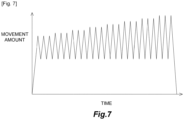
- the movement amount by which the punch 420 is moved toward the die 310 may be controlled by being increased in stages as a number of instances of the repeatedly performed pressing operations increases.
- Fig. 7 shows, using a graph, a relationship between an elapsed time and the movement amount of the punch 420 according to the example 2 of the control.
- the movement amount of the punch 420 is gradually increased every three instances of the pressing operation.
- the compression amount of the short-sidewall-forming portion 110 gradually increases. This makes it possible to form a step 11a having a desired shape without difficulty.
- the movement amount by which the punch 420 is moved toward the die 310 may be controlled such that it is identical for all pressing operations that are performed repeatedly.
- Fig. 8 shows, using a graph, a relationship between an elapsed time and the movement amount of the punch 420 according to the example 3 of the control.
- a step 11a having a desired shape with this kind of control as well.
- the manufacturing method according to the present embodiment due to the step 11a being formed by multiple instances of a pressing operation performed by the punch 420, it is possible to bring the angle formed by the step surface 11b of the step 11a provided in the rectangular can body and the inner wall surface of the rectangular can body closer to 90 degrees. This makes it possible to increase the sealing performance when the opening is closed by the sealing lid 20.
- the inclined surface 114 is provided in the intermediate molded article 100 in advance and the portion of the inclined surface 114 is compressed in the step-forming step, it is possible to form the step 11a with even less difficulty compared to a case of forming a step by simply performing multiple instances of a pressing operation performed by the punch 420 on a plate-shaped portion.
- Fig. 9 is an external view of an intermediate molded article 100X in the case where a part of the portion 150 to be removed of the intermediate molded article 100 shown in Fig. 2 has been removed in advance.
- this intermediate molded article 100X a part of the portion 150 to be removed, which is surrounded by a thick line 150X in Fig. 9 , has been removed in advance. This makes it easier for the material to move out when the short-sidewall-forming portion 110 is compressed by the punch 420 in the step-forming step, and therefore it is possible to form the step 11a with even less difficulty.
- the step of removing the part may be performed at any time, as long as it is before the step-forming step. For example, by removing the part in advance when punching is carried out on a metal plate in order to obtain a raw material (blank), the part can be removed without increasing a number of steps.
- steps 11a are formed on the pair of short sidewalls 11 in the embodiment described above, steps may also be formed on the pair of long sidewalls 12. The steps may be formed on both the pair of short sidewalls 11 and the pair of long sidewalls 12.
- the inclined surface 114 serving as the connection surface provided in the intermediate molded article 100 is constituted by a planar surface in the above-described embodiment. That is, the inclined surface 114 is represented by a straight line when viewed in a cross-sectional view taken along line AA in Fig. 2 .
- the connection surface is not limited to this.
- the connection surface may be constituted by an inclined surface with a curved surface shape. In this case, the inclined surface is indicated by a circular arc or an elliptical arc when viewed in a cross-sectional view taken along line AA in Fig. 2 .
- the connection surface may be constituted by a step-shaped surface.
- the inclined surface 114 is provided in advance in the intermediate molded article 100 and the portion of the inclined surface 114 is compressed in the step-forming step in the above-described embodiment.
- the step may be formed through only multiple instances of the pressing operation performed by the punch 420 without providing the inclined surface 114 depending on raw material, thickness, or the like of the product.
- at least a part of the portion 150 to be removed may be removed in advance.
- the step surface 115 that is level with the step surface 11b of the step 11a is formed at the four corners of the rectangular tube through the drawing and ironing step in the step of manufacturing the intermediate molded article in the above-described embodiment.
- the step surfaces provided at the four corners of the rectangular tube may also be formed through the above-described step-forming step.
- the inclined surface 114 serving as the connection surface formed in the step of manufacturing the intermediate molded article may be provided up to positions reaching the four corners of the rectangular tube in the intermediate molded article 100.
- the four corners of the rectangular tube may be constituted by curved surfaces (so-called "R surfaces").
- the step 11a is formed on not only the short-sidewall-forming portions 110, but also positions reaching the four corners of the rectangular tube.
- the machining apparatus of the above-described embodiment used in the step-forming step is merely an example, and another known technique may be employed when appropriate, as long as it is a machining apparatus with which the movement amount of the punch can be controlled.
- the punch 420 operates only through linear reciprocal movement in the above-described machining apparatus, a machining apparatus capable of operating through both linear reciprocal movement and rotational movement may be used. In this case, for example, coining process on the four corners of the rectangular tube may be performed by the machining apparatus.
- a known technique may be employed for a mechanism that simultaneously enables both linear reciprocal movement and rotational movement of the punch, such as the mechanism for driving a punch cutter disclosed in Japanese Laid-Open Patent Publication No. 2014-46313 , description thereof is omitted.
Landscapes
- Engineering & Computer Science (AREA)
- Mechanical Engineering (AREA)
- Chemical & Material Sciences (AREA)
- Chemical Kinetics & Catalysis (AREA)
- Electrochemistry (AREA)
- General Chemical & Material Sciences (AREA)
- Shaping Metal By Deep-Drawing, Or The Like (AREA)
- Sealing Battery Cases Or Jackets (AREA)
- Containers Having Bodies Formed In One Piece (AREA)
- Rigid Containers With Two Or More Constituent Elements (AREA)
Description
- The present disclosure relates to a manufacturing method for a rectangular can having a rectangular can body provided with a step on which a sealing lid is placed.
- A rectangular can has been used as a container in a secondary battery (power storage battery) or the like in view of accommodation capability and the like. Such a rectangular can includes a rectangular can body and a sealing lid for closing an opening of the rectangular can body. In the rectangular can, a step on which the sealing lid is to be placed is provided on an inner wall surface of the rectangular can. The sealing performance can be increased the closer an angle formed by a surface of the step and the inner wall surface is to 90 degrees. However, in a conventional manufacturing method, it has been difficult to bring the angle close to 90 degrees. PTL 6 discloses a manufacturing method for a rectangular can having the features of the preamble of
claim 1. -
- PTL 1:
JP 2014 203706 A - PTL 2:
JP 2013 196777 A - PTL 3:
JP 2001 179350 A - PTL 4:
JP H9 293487 A - PTL 5:
JP H9 265966 A - PTL 6:
JP 6 035796 B2 - An object of the present disclosure is to provide a manufacturing method for a rectangular can according to which brings an angle formed by a surface of a step provided on a rectangular can body and an inner wall surface of the rectangular can body closer to 90 degrees.
- The present disclosure employed the following means in order to achieve the object.
- That is, the manufacturing method for a rectangular can of the present disclosure is a manufacturing method for a rectangular can including a rectangular can body that has a rectangular tube and a bottom, and a sealing lid for closing an opening of the rectangular can body, the manufacturing method including:
- a step of manufacturing an intermediate molded article that has the rectangular tube and the bottom; and
- a step of forming respective steps on which the sealing lid is to be placed on at least a pair of facing inner wall surfaces among two pairs of facing inner wall surfaces in the rectangular tube, wherein
- in the step-forming step, using
- a die that is provided on an outer wall surface side of a sidewall on which the step is to be formed,
- a mandrel for sandwiching the sidewall between the mandrel and the die at a portion on a bottom side with respect to a portion where the step is to be formed in the inner wall surface on which the step is to be formed, and
- a punch for pressing a portion on a side opposite to the bottom side with respect to the portion where the step is to be formed in the inner wall surface on which the step is to be formed and compressing the sidewall between the punch and the die,
- According to the present disclosure, it is possible to bring the angle formed by a surface of the step provided on the rectangular can body and the inner wall surface of the rectangular can body closer to 90 degrees by forming the step through multiple instances of the pressing operation performed by the punch.
- The outer wall surface of the sidewall formed in the step of manufacturing the intermediate molded article may be constituted by a level plane,
- the inner wall surface of the sidewall formed in the step of manufacturing the intermediate molded article may include:
- a first parallel surface that is formed at a portion on the bottom side with respect to the portion where the step is to be formed and is parallel to the outer wall surface;
- a second parallel surface that is formed at a portion on the side opposite to the bottom side with respect to the portion where the step is to be formed and is parallel to the outer wall surface, the distance between the second parallel surface and the outer wall surface being shorter than a distance between the first parallel surface and the outer wall surface; and
- a connection surface that connects the first parallel surface and the second parallel surface, and
- in the step-forming step, a portion of the connection surface may be compressed.
- This makes the forming of the step less difficult compared to the case where the step is formed by simply performing multiple instances of the pressing operation performed by the punch on a plate-shaped portion.
- In the pressing operation performed by the punch, a movement amount of the punch moving toward the die may increase each instance of the pressing operation, which is performed repeatedly. In addition, in the pressing operation performed by the punch, a movement amount of the punch moving toward the die may increase in stages as the number of instances of the pressing operation, which is performed repeatedly, increases. Furthermore, in the pressing operation performed by the punch, a movement amount of the punch moving toward the die may also be the same for all pressing operations, which are performed repeatedly.
- The connection surface formed in the step of manufacturing the intermediate molded article may be provided at positions reaching four corners of the rectangular tube, and the step may be formed also at the four corners in the step-forming step.
- The step of manufacturing the intermediate molded article may include a drawing and ironing step of molding the rectangular tube, and
a step surface that is level with the step surface of the step may be formed in advance at the four corners of the rectangular tube through the drawing and ironing step. - A trimming step of removing a portion, which is unneeded for a final product, on a side opposite to the bottom side of the intermediate molded article may be included after the step-forming step, and
at least a part of the sidewall on which the step is to be formed in the portion to be removed in the trimming step may be removed in advance prior to the step-forming step. - As described above, the present disclosure brings the angle formed by the surface of the step provided on the rectangular can body and the inner wall surface of the rectangular can body closer to 90 degrees.
-
- [
Fig. 1 ]
Fig. 1 is a perspective view showing an overview of a rectangular can according to an embodiment of the present disclosure. - [
Fig. 2 ]
Fig. 2 is an overall view of an intermediate molded article of the rectangular can according to the embodiment of the present disclosure. - [
Fig. 3 ]
Fig. 3 is a schematic cross-sectional view of a machining apparatus provided in a step-forming step in a manufacturing method for the rectangular can according to the embodiment of the present disclosure. - [
Fig. 4 ]
Fig. 4 is an illustrative diagram illustrating a mechanism of the machining apparatus provided in the step-forming step in the manufacturing method for the rectangular can according to the embodiment of the present disclosure. - [
Fig. 5 ]
Fig. 5 is a process diagram of the step-forming step in the manufacturing method for the rectangular can according to the embodiment of the present disclosure. - [
Fig. 6 ]
Fig. 6 is a diagram illustrating an example of a manner of driving a punch according to the embodiment of the present disclosure. - [
Fig. 7 ]
Fig. 7 is a diagram illustrating an example of a manner of driving the punch according to the embodiment of the present disclosure. - [
Fig. 8 ]
Fig. 8 is a diagram illustrating an example of a manner of driving the punch according to the embodiment of the present disclosure. - [
Fig. 9 ]
Fig. 9 is an external view of a modified example of the intermediate molded article according to the embodiment of the present disclosure. - Hereinafter, a mode of carrying out the disclosure will be described illustratively and in detail based on an embodiment with reference to the drawings.
- A manufacturing method for a rectangular can according to an embodiment of the present disclosure will be described with reference to
Figs. 1 to 9 . A rectangular can obtained through the manufacturing method according to the present embodiment will be described before the manufacturing method for the rectangular can is described. - A rectangular can that is manufactured using the manufacturing method according to the present embodiment will be described with reference to
Fig. 1. Fig. 1 is a perspective view showing an overview of the rectangular can. For the sake of convenience in the description,Fig. 1 shows a state prior to a sealinglid 20 being attached to arectangular can body 10. The rectangular can manufactured through the manufacturing method includes therectangular can body 10, and the sealinglid 20 that closes an opening of therectangular can body 10. Therectangular can body 10 and the sealinglid 20 are obtained by machining a metal plate such as an aluminum alloy, a cold rolled steel plate, or stainless steel. Therectangular can body 10 is constituted by a rectangular tube having two pairs of sidewalls (short sidewalls 11 and long sidewalls 12) that have inner wall surfaces that face each other, and a bottom 13. Note that the pair of sidewalls with a shorter width among the two pairs of sidewalls are called theshort sidewalls 11 and the pair of sidewalls with a longer width are called thelong sidewalls 12. -
Steps 11a are respectively provided on the inner wall surfaces of the pair ofshort sidewalls 11. In a state in which the sealinglid 20 is placed on surfaces of thesteps 11a, the sealinglid 20 is fixed to therectangular can body 10 through laser welding, arc welding or the like. The rectangular can according to the present embodiment can be suitably used as a container for a secondary battery (power storage battery). In this case, the sealinglid 20 is fixed after power generation elements constituting the battery, such as electrodes and separators, have been installed in therectangular can body 10. - An overview of a manufacturing method for a rectangular can according to the present embodiment will be described below. The manufacturing method for the rectangular can includes a step of manufacturing the
rectangular can body 10 and a step of fixing thepre-manufactured sealing lid 20 to therectangular can body 10 as described above. The step of manufacturing therectangular can body 10 is composed of a step of molding an intermediate moldedarticle 100, a step of forming the above-describedsteps 11a in the intermediate moldedarticle 100, and a trimming step of removing unnecessary portions. - In addition, the step of manufacturing the intermediate molded article includes at least a step of carrying out punching on a metal plate in order to obtain a raw material (blank) with a predetermined outer shape, a step of carrying out drawing and ironing multiple times on the blank, and a pressing step of forming the above-described
bottom 13. Since a known technique (e.g., seeJapanese Laid-Open Patent Publication No. 2018-51575 - The intermediate molded
article 100 manufactured through the step of manufacturing the intermediate molded article will be described with reference toFig. 2. Fig. 2 is an overall view of the intermediate molded article of the rectangular can.Fig. 2 shows a plan view of the intermediate molded article, and schematic cross-sectional views of two locations (a cross-sectional view taken along line AA and a cross-sectional view taken along line BB in the plan view). The intermediate moldedarticle 100 includes a pair ofportions 110 that are to be theshort sidewalls 11 in a final product, a pair ofportions 120 that are to be thelong sidewalls 12 in the final product, aportion 130 that is to be the bottom 13 in the final product, and aportion 150 that is to be removed during the trimming step. Note that a dottedline 150a inFig. 2 shows a cutting surface that is to be cut in the trimming step. Theportion 150 to be removed is on a side near the opening with respect to this dottedline 150a. A section constituted by the pair of short-sidewall-formingportions 110 and the pair of long-sidewall-formingportions 120 corresponds to the rectangular tube in the intermediate moldedarticle 100, and the bottom-formingportion 130 corresponds to the bottom in the intermediate moldedarticle 100. - In the next step, that is, the step-forming step, the
steps 11a are formed on the inner wall surfaces of the short-sidewall-formingportions 110 serving as the sidewalls. Theouter wall surface 111 of the short-sidewall-formingportion 110 is constituted by a level plane. The inner wall surface of the short-sidewall-formingportion 110 includes a firstparallel surface 112 that is parallel to theouter wall surface 111, a secondparallel surface 113 that is parallel to theouter wall surface 111 as well, and aninclined surface 114 serving as a connection surface that connects the firstparallel surface 112 and the secondparallel surface 113. The firstparallel surface 112 is formed on a side near the bottom 13 (bottom-forming portion 130) with respect to the portion where thestep 11a is to be formed. The secondparallel surface 113 is formed on a side opposite to the bottom 13 side (i.e., on a side near the opening) with respect to the portion where thestep 11a is to be formed. The secondparallel surface 113 is constituted such that the distance to theouter wall surface 111 is shorter than the distance between the firstparallel surface 112 and theouter wall surface 111. Accordingly, the short-sidewall-formingportion 110 is constituted such that the thickness of the portion at which the secondparallel surface 113 is formed is less than the thickness of the portion at which the firstparallel surface 112 is formed. - In the step-forming step described hereinafter, a portion of the
inclined surface 114 is compressed. Accordingly, astep surface 11b of thestep 11a is formed at a position of a boundary between the firstparallel surface 112 and theinclined surface 114. - In the intermediate molded
article 110, step surfaces 115 that are level with the step surfaces 11b of thestep 11a are provided at four corners of the rectangular tube formed by the pair of short-sidewall-formingportions 110 and the pair of long-sidewall-formingportions 120. The step surfaces 115 are formed through the drawing and ironing step in the step of manufacturing the intermediate molded article. - The step-forming step will be described with reference to
Figs. 3 to 8 .Fig. 3 is a schematic cross-sectional view of a machining apparatus to be used in the step-forming step in the manufacturing method for the rectangular can.Fig. 4 is an illustrative diagram illustrating a mechanism of the machining apparatus to be used in the step-forming step in the manufacturing method for the rectangular can, and more specifically, is a diagram illustrating a mechanism for driving a punch.Fig. 5 is a process diagram of the step-forming step in the manufacturing method for the rectangular can.Fig. 5 shows a cross section for each member.Figs. 6 to 8 are diagrams illustrating examples of a manner of driving the punch. - An example of the machining apparatus that can be used in the step-forming step will be described with reference to
Figs. 3 and4 . The machining apparatus is constituted by anupper mold 300 and alower mold 400. Theupper mold 300 includes adie 310 and abottom pad 320. Thelower mold 400 includes amandrel 410, apunch 420, adrive mechanism 470 that moves thepunch 420 relative to themandrel 410, and anair vacuum hole 450 for vacuuming when themandrel 410 is to be inserted into the intermediate moldedarticle 100 and sending air when themandrel 410 is to be pulled out. Thelower mold 400 also includes anupper platform 430 and alower platform 440 that support themandrel 410 and thepunch 420. - The
upper mold 300 and thelower mold 400 are formed to move toward each other and away from each other in the vertical direction. The intermediate moldedarticle 100 is placed on themandrel 410 of thelower mold 400 with theportion 150 to be removed on a lower side. - The
bottom pad 320 is pressed to a lower surface of the bottom-formingportion 130 of the intermediate moldedarticle 100 while an up-down stroke ofpins 340 is guided byguides 330 provided on a frame of theupper mold 300 and pressing force of thebottom pad 320 is adjusted by anair cylinder 350. Accordingly, the intermediate moldedarticle 100 is prevented from being misaligned in the vertical direction during machining. After the intermediate moldedarticle 100 is positioned by thebottom pad 320, thedie 310 is lowered while being guided by aguide 312, which is provided to move along pins 311. Thedie 310 lowers to a position facing both thepunch 420 and asupport portion 412 of themandrel 410. Thedie 310 is lowered until ablock 313 provided below thedie 310 abuts on ablock 441 provided on thelower platform 440, and thus the 310 is positioned. - The
mandrel 410 includes a guidingportion 411 that guides an inner peripheral surface of the intermediate moldedarticle 100 when the intermediate moldedarticle 100 is to be placed on themandrel 410, and thesupport portion 412 that supports a part on a side near the bottom-formingportion 130 with respect to the step-forming portion. A lower surface of thesupport portion 412 of themandrel 410 and an upper surface of thepunch 420 are slidably in contact with each other and a height of a boundary line therebetween matches that of thestep surface 11b of thestep 11a formed in the intermediate moldedarticle 100. The movement of themandrel 410 is regulated by thedie 310 across the intermediate moldedarticle 100 when thepunch 420 is moved in the horizontal direction by thedrive mechanism 470 to be described. - A
positioning pin structure 460 is provided on the sliding surface between themandrel 410 and thepunch 420. When the regulation of the movement of themandrel 410 by thedie 310 is removed, themandrel 410 and thepunch 420 are automatically mutually positioned so that themandrel 410 and thepunch 420 return to a home position (origin) where themandrel 410 and thepunch 420 overlap at approximately the same position in a plan view. The sliding surface of thepunch 420 is provided with apin 461 that is pressed toward the sliding surface of themandrel 410 by a pressing means 462 such as a spring and the sliding surface of themandrel 410 is provided with a plate-shaped recess at a position facing a tip of thepin 461 when in the home position, the recess having a cross-section with a curvature greater than that of a spherical head of the tip of the pin and a diameter greater than that of the pin. In a state in which no external force in the horizontal direction is applied, themandrel 410 and thepunch 420 move relative to each other so as to enter a state in which the tip of the pin 416 comes into contact with the deepest portion (central portion) of the recess due to the pressing force of thepressing means 462, and thus the centers of themandrel 410 and thepunch 420 match. - Next, the
drive mechanism 470 for driving thepunch 420 will be described. Thedrive mechanism 470 is included in order to move thepunch 420 in the horizontal direction relative to the fixeddie 310 and themandrel 410. More specifically, thedrive mechanism 470 reciprocally moves multiple members in an integrated manner, the multiple members being surrounded by a thick dotted line U inFig. 3 and including thepunch 420, theupper platform 430, and thelower platform 440. - The
drive mechanism 470 is a linear motion mechanism using a so-called link mechanism (crank mechanism). Thedrive mechanism 470 includes aservomotor 471, an eccentric pin (crank shaft) 472 that is fixed to arotation shaft 471a of theservomotor 471, and aconnection member 473 and alink portion 474 that convert an axial rotational motion of theeccentric pin 472 into a linear reciprocal motion of thelower platform 440. Thelower platform 440 is allowed to move only in a linear reciprocal direction. -
Fig. 4 is a diagram illustrating a mechanism for converting the rotational motion caused by thedrive mechanism 470 into the linear reciprocal motion and main constituent members viewed from above. The central axis of theeccentric pin 472 in a portion fixed to theconnection member 473 is formed to turn about a central axis of arotation shaft 471a of theservomotor 471. Thick lines inFig. 4 illustrate positions of theeccentric pin 472a, theconnection member 473a, and thelink portion 474a when the central axis of theeccentric pin 472a in the fixed portion described above is located directly upward in the drawing with respect to the central axis of therotation shaft 471a of theservomotor 471. On the other hand, thin lines illustrate positions of theeccentric pin 472b, theconnection member 473b, and thelink portion 474b when the central axis of theeccentric pin 472b in the fixed portion described above is located rightmost in the drawing with respect to the central axis of therotation shaft 471a of theservomotor 471. - The fixed portion in the
eccentric pin 472 turns in a direction illustrated by an arrow R inFig. 4 according to the rotation position of therotation shaft 471a of theservomotor 471. Thus, theconnection member 473 moves, whereby thelower platform 440, which is allowed to move only in the linear reciprocal movement direction, moves reciprocally in a direction illustrated by an arrow L inFig. 4 . Theservomotor 471 can be controlled so that therotation shaft 471a is rotated clockwise or counterclockwise at a desired angle. Accordingly, an amount of the reciprocal movement of thelower platform 440 can be controlled by rotating (swinging) therotation shaft 471a at a desired angle. This enables a movement amount of thepunch 420 to be controlled. - A method for forming the
step 11a in the intermediate moldedarticle 100 using the machining apparatus configured as described above will be described with reference toFig. 5. Fig. 5A shows a state in which each member is located at the home position by the function of thepositioning pin structure 460. At the home position, a minute gap is formed between theouter wall surface 111 of the short-sidewall-formingportion 110 of the intermediate moldedproduct 100 and thedie 310. - When the movement of the
punch 420 is started by thedrive mechanism 470, thepunch 420 moves toward thedie 310. At this time, thesupport portion 412 of themandrel 410 is moved toward thedie 310 due to frictional resistance caused by thepunch 420. Accordingly, the short-sidewall-formingportion 110 is also pressed by thesupport portion 412 and moves toward thedie 310, and thus the short-sidewall-formingportion 110 enters a state of being sandwiched by thedie 310 and the support portion 412 (seeFig. 5B ). Thus, thedie 310 is provided on a side near the outer wall surface of the short-sidewall-formingportion 110, which is the sidewall on which thestep 11a is to be formed, with respect to the intermediate moldedarticle 100. Thesupport portion 412 of themandrel 410 and thedie 310 sandwiches the sidewall (short-sidewall-forming portion 110) therebetween on the bottom 13 side (bottom-formingportion 130 side) relative to the portion where thestep 11a is formed in the inner wall surface on which thestep 11a is to be formed. - Thereafter, by further moving toward the
die 310, thepunch 420 presses a portion on a side opposite to the bottom 13 with respect to the portion where thestep 11a is formed in the inner wall surface on which thestep 11a is to be formed, and thus the sidewall (short-sidewall-forming portion 110) is compressed between thepunch 420 and the die 310 (seeFig. 5C ). - The
step 11a is not formed through one instance of a compressing operation performed by thepunch 420. That is, thepunch 420 is controlled so as to compress the short-sidewall-formingportion 110 by a predetermined amount, and thereafter return in the direction of moving away from the die 310 (seeFig. 5D ). At this time, thepunch 420 may be moved to such a degree that the state in which thesupport portion 412 of themandrel 410 sandwiches the short-sidewall-formingportion 110 between thesupport portion 412 and thedie 310 be maintained. - Thereafter, once again, the
punch 420 is controlled to move toward thedie 310, and the short-sidewall-formingportion 110 is further compressed by thepunch 420 and thedie 310. In this manner, the compression amount of the short-sidewall-formingportion 110 is increased little by little due to multiple instances of the repeatedly performed pressing operation by thepunch 420. As shown inFig. 5 , the portion of theinclined surface 114 in the short-sidewall-formingportion 110 is compressed in the step-forming step. -
Fig. 5E shows a state in which a final pressing operation has been performed by thepunch 420, andFig. 5F shows a state in which the final pressing operation by thepunch 420 has ended and thestep 11a has been formed on the short-sidewall-formingportion 110. Note that thestep surface 11b of thestep 11a is level with the step surfaces 115 that have already been formed at the four corners of the rectangular tube of the intermediate moldedarticle 100. As described above, after thestep 11a is formed, the intermediate moldedarticle 100 is removed from the machining apparatus, and in the trimming step, theportion 150 to be removed is removed and the final product is obtained. - Here, several examples of methods for controlling the movement amount of the
punch 420 in the pressing operation performed by thepunch 420 will be described with reference toFigs. 6 to 8 . Note that as described above, the movement amount of thepunch 420 can be controlled by controlling the rotational angle of therotation shaft 471a of theservomotor 471. - The movement amount by which the
punch 420 is moved toward thedie 310 may be controlled by being increased each instance of the repeatedly performed pressing operations.Fig. 6 shows, using a graph, a relationship between an elapsed time and the movement amount of thepunch 420 according to the example 1 of the control. By this control, the compression amount of the shortsidewall formation portion 110 gradually increases due to the movement amount of thepunch 420 being gradually increased each instance of the pressing operation. This makes it possible to form astep 11a having a desired shape without difficulty. - The movement amount by which the
punch 420 is moved toward thedie 310 may be controlled by being increased in stages as a number of instances of the repeatedly performed pressing operations increases.Fig. 7 shows, using a graph, a relationship between an elapsed time and the movement amount of thepunch 420 according to the example 2 of the control. The movement amount of thepunch 420 is gradually increased every three instances of the pressing operation. By this control as well, the compression amount of the short-sidewall-formingportion 110 gradually increases. This makes it possible to form astep 11a having a desired shape without difficulty. - The movement amount by which the
punch 420 is moved toward thedie 310 may be controlled such that it is identical for all pressing operations that are performed repeatedly.Fig. 8 shows, using a graph, a relationship between an elapsed time and the movement amount of thepunch 420 according to the example 3 of the control. Depending on material, thickness, or the like of the product, it is possible to form astep 11a having a desired shape with this kind of control as well. - With the manufacturing method according to the present embodiment, due to the
step 11a being formed by multiple instances of a pressing operation performed by thepunch 420, it is possible to bring the angle formed by thestep surface 11b of thestep 11a provided in the rectangular can body and the inner wall surface of the rectangular can body closer to 90 degrees. This makes it possible to increase the sealing performance when the opening is closed by the sealinglid 20. - Since the
inclined surface 114 is provided in the intermediate moldedarticle 100 in advance and the portion of theinclined surface 114 is compressed in the step-forming step, it is possible to form thestep 11a with even less difficulty compared to a case of forming a step by simply performing multiple instances of a pressing operation performed by thepunch 420 on a plate-shaped portion. - Among the
portion 150 to be removed in the trimming step, at least a part of the sidewalls (short-sidewall-forming portions 110) on which thesteps 11a are to be formed may be removed in advance prior to the step-forming step. This will be described with reference toFig. 9. Fig. 9 is an external view of an intermediate moldedarticle 100X in the case where a part of theportion 150 to be removed of the intermediate moldedarticle 100 shown inFig. 2 has been removed in advance. In this intermediate moldedarticle 100X, a part of theportion 150 to be removed, which is surrounded by athick line 150X inFig. 9 , has been removed in advance. This makes it easier for the material to move out when the short-sidewall-formingportion 110 is compressed by thepunch 420 in the step-forming step, and therefore it is possible to form thestep 11a with even less difficulty. - Note that the step of removing the part may be performed at any time, as long as it is before the step-forming step. For example, by removing the part in advance when punching is carried out on a metal plate in order to obtain a raw material (blank), the part can be removed without increasing a number of steps.
- Although the
steps 11a are formed on the pair ofshort sidewalls 11 in the embodiment described above, steps may also be formed on the pair oflong sidewalls 12. The steps may be formed on both the pair ofshort sidewalls 11 and the pair oflong sidewalls 12. - The
inclined surface 114 serving as the connection surface provided in the intermediate moldedarticle 100 is constituted by a planar surface in the above-described embodiment. That is, theinclined surface 114 is represented by a straight line when viewed in a cross-sectional view taken along line AA inFig. 2 . However, the connection surface is not limited to this. For example, the connection surface may be constituted by an inclined surface with a curved surface shape. In this case, the inclined surface is indicated by a circular arc or an elliptical arc when viewed in a cross-sectional view taken along line AA inFig. 2 . The connection surface may be constituted by a step-shaped surface. - The
inclined surface 114 is provided in advance in the intermediate moldedarticle 100 and the portion of theinclined surface 114 is compressed in the step-forming step in the above-described embodiment. However, the step may be formed through only multiple instances of the pressing operation performed by thepunch 420 without providing theinclined surface 114 depending on raw material, thickness, or the like of the product. In this case, as shown inFig. 9 , at least a part of theportion 150 to be removed may be removed in advance. - The
step surface 115 that is level with thestep surface 11b of thestep 11a is formed at the four corners of the rectangular tube through the drawing and ironing step in the step of manufacturing the intermediate molded article in the above-described embodiment. However, the step surfaces provided at the four corners of the rectangular tube may also be formed through the above-described step-forming step. In this case, theinclined surface 114 serving as the connection surface formed in the step of manufacturing the intermediate molded article may be provided up to positions reaching the four corners of the rectangular tube in the intermediate moldedarticle 100. Note that the four corners of the rectangular tube may be constituted by curved surfaces (so-called "R surfaces"). In the step-forming step, thestep 11a is formed on not only the short-sidewall-formingportions 110, but also positions reaching the four corners of the rectangular tube. - Furthermore, the machining apparatus of the above-described embodiment used in the step-forming step is merely an example, and another known technique may be employed when appropriate, as long as it is a machining apparatus with which the movement amount of the punch can be controlled. Although the
punch 420 operates only through linear reciprocal movement in the above-described machining apparatus, a machining apparatus capable of operating through both linear reciprocal movement and rotational movement may be used. In this case, for example, coining process on the four corners of the rectangular tube may be performed by the machining apparatus. Note that since a known technique may be employed for a mechanism that simultaneously enables both linear reciprocal movement and rotational movement of the punch, such as the mechanism for driving a punch cutter disclosed inJapanese Laid-Open Patent Publication No. 2014-46313 -
- 10
- Rectangular can body
- 11
- Short sidewall
- 11a
- Step
- 11b
- Step surface
- 12
- Long sidewall
- 20
- Sealing lid
- 100, 100X
- Intermediate molded article
- 110
- Short-sidewall-forming portion
- 111
- Outer wall surface
- 112
- First parallel surface
- 113
- Second parallel surface
- 114
- Inclined surface
- 115
- Step surface
- 150
- Portion to be removed
- 310
- Die
- 410
- Mandrel
- 412
- Support portion
- 420
- Punch
- 470
- Drive mechanism
Claims (9)
- A manufacturing method for a rectangular can including a rectangular can body (10) that has a rectangular tube and a bottom (13), and a sealing lid (20) for closing an opening of the rectangular can body (10), the manufacturing method comprising:a step of manufacturing an intermediate molded article (100; 100X) that has the rectangular tube and the bottom (13); anda step of forming respective steps (11a) on which the sealing lid (20) is to be placed on at least a pair of facing inner wall surfaces (112, 113, 114) among two pairs of facing inner wall surfaces (112, 113, 114) in the rectangular tube,characterized in thatin the step-forming step, usinga die (310) that is provided on an outer wall surface side of a sidewall (11) on which the step (11a) is to be formed,a mandrel (410) for sandwiching the sidewall (11) between the mandrel (410) and the die (310) at a portion on a bottom side with respect to a portion where the step is to be formed in the inner wall surface (112, 113, 114) on which the step is to be formed, anda punch (420) for pressing a portion on a side opposite to the bottom side with respect to the portion where the step (11a) is to be formed in the inner wall surface (112, 113, 114) on which the step (11a) is to be formed and compressing the sidewall (11) between the punch (420) and the die (310),the step (11a) is formed by performing a plurality of instances of a pressing operation performed by the punch (420).
- The manufacturing method for a rectangular can according to claim 1, whereinthe outer wall surface (111) of the sidewall (11) formed in the step of manufacturing the intermediate molded article (100; 100X) is constituted by a level plane,the inner wall surface (112, 113, 114) of the sidewall (11) formed in the step of manufacturing the intermediate molded article (100; 100X) includes:a first parallel surface (112) that is formed at a portion on the bottom side with respect to the portion where the step (11a) is to be formed and is parallel to the outer wall surface (111);a second parallel surface (113) that is formed at a portion on the side opposite to the bottom side with respect to the portion where the step (11a) is to be formed and is parallel to the outer wall surface (111), the distance between the second parallel surface (113) and the outer wall surface (111) being shorter than a distance between the first parallel surface (112) and the outer wall surface (111); anda connection surface (114) that connects the first parallel surface (112) and the second parallel surface (113), andin the step-forming step, a portion of the connection surface (114) is compressed.
- The manufacturing method for a rectangular can according to claim 1 or 2, wherein in the pressing operation performed by the punch (420), a movement amount of the punch (420) moving toward the die (310) increases each instance of the pressing operation, which is performed repeatedly.
- The manufacturing method for a rectangular can according to claim 1 or 2, wherein in the pressing operation performed by the punch (420), a movement amount of the punch (420) moving toward the die (310) increases in stages as the number of instances of the pressing operation, which is performed repeatedly, increases.
- The manufacturing method for a rectangular can according to claim 1 or 2, wherein in the pressing operation performed by the punch (420), a movement amount of the punch (420) moving toward the die (310) is the same for all pressing operations, which are performed repeatedly.
- The manufacturing method for a rectangular can according to any one of claims 2 to 5, wherein the connection surface (114) formed in the step of manufacturing the intermediate molded article (100; 100X) is provided at positions reaching four corners formed by curved surfaces of the rectangular tube, and the step (11a) is formed also at the four corners in the step-forming step.
- The manufacturing method for a rectangular can according to any one of claims 1 to 5, whereinthe step of manufacturing the intermediate molded article (100; 100X) includes a drawing and ironing step of molding the rectangular tube, anda step surface (115) that is level with the step surface (11b) of the step (11a) is formed in advance at four corners of the rectangular tube through the drawing and ironing step.
- The manufacturing method for a rectangular can according to any one of claims 1 to 7, wherein
a trimming step of removing a portion (150), which is unneeded for a final product, on a side opposite to the bottom side of the intermediate molded article (100; 100X) is included after the step-forming step. - The manufacturing method for a rectangular can according to claim 8, wherein
at least a part (150X) of the sidewall (11) on which the step (11a) is to be formed in the portion (150) to be removed in the trimming step is removed in advance prior to the step-forming step.
Applications Claiming Priority (2)
| Application Number | Priority Date | Filing Date | Title |
|---|---|---|---|
| JP2018242516A JP7119988B2 (en) | 2018-12-26 | 2018-12-26 | Method for manufacturing square cans |
| PCT/JP2019/049108 WO2020137645A1 (en) | 2018-12-26 | 2019-12-16 | Method for producing rectangular can |
Publications (3)
| Publication Number | Publication Date |
|---|---|
| EP3903954A1 EP3903954A1 (en) | 2021-11-03 |
| EP3903954A4 EP3903954A4 (en) | 2022-09-14 |
| EP3903954B1 true EP3903954B1 (en) | 2025-02-12 |
Family
ID=71126239
Family Applications (1)
| Application Number | Title | Priority Date | Filing Date |
|---|---|---|---|
| EP19903694.8A Active EP3903954B1 (en) | 2018-12-26 | 2019-12-16 | Method for producing rectangular can |
Country Status (6)
| Country | Link |
|---|---|
| US (1) | US12070788B2 (en) |
| EP (1) | EP3903954B1 (en) |
| JP (1) | JP7119988B2 (en) |
| CA (1) | CA3125084C (en) |
| MX (1) | MX2021007629A (en) |
| WO (1) | WO2020137645A1 (en) |
Families Citing this family (1)
| Publication number | Priority date | Publication date | Assignee | Title |
|---|---|---|---|---|
| JP2024141507A (en) | 2023-03-29 | 2024-10-10 | アイダエンジニアリング株式会社 | Trimming device and method for rectangular container, and rectangular container |
Family Cites Families (20)
| Publication number | Priority date | Publication date | Assignee | Title |
|---|---|---|---|---|
| KR890002489B1 (en) * | 1982-03-08 | 1989-07-10 | 도오요오 세이깐 가부시기가이샤 | Method and apparatus for manufacturing metal can |
| JPS63239763A (en) * | 1986-12-05 | 1988-10-05 | Matsushita Electric Ind Co Ltd | square sealed battery |
| GB8906998D0 (en) * | 1989-03-28 | 1989-05-10 | Metal Box Plc | Maintaining preferred vibration mode in an annular article |
| JP3160755B2 (en) | 1996-02-27 | 2001-04-25 | 旭精機工業株式会社 | Method of forming prismatic battery can |
| JPH09265966A (en) | 1996-03-29 | 1997-10-07 | Sanyo Electric Co Ltd | External can for prismatic batteries |
| JPH09293487A (en) | 1996-04-26 | 1997-11-11 | Matsushita Electric Ind Co Ltd | Method for manufacturing sealed rectangular battery and container thereof |
| JP4415437B2 (en) | 1999-12-27 | 2010-02-17 | パナソニック株式会社 | Drawing step processing |
| JP5196898B2 (en) * | 2007-06-12 | 2013-05-15 | 株式会社田中産業 | Method for fixing lid member to container, metal sealed container and sealed battery |
| KR100983200B1 (en) | 2008-06-12 | 2010-09-20 | 삼성에스디아이 주식회사 | Secondary battery |
| DE102008028367B3 (en) * | 2008-06-13 | 2010-01-28 | Harting Electric Gmbh & Co. Kg | Locking device for connector housing |
| JP5652372B2 (en) * | 2011-10-24 | 2015-01-14 | トヨタ自動車株式会社 | Battery case |
| JP6035796B2 (en) | 2012-03-15 | 2016-11-30 | 東洋製罐株式会社 | Manufacturing method of battery outer can and manufacturing method of secondary battery |
| JP5480335B2 (en) | 2012-06-28 | 2014-04-23 | トヨタ自動車株式会社 | Square battery and method for manufacturing square battery |
| JP5488656B2 (en) | 2012-08-29 | 2014-05-14 | 東洋製罐株式会社 | Trimming method and apparatus for rectangular container |
| JP6160185B2 (en) * | 2013-04-05 | 2017-07-12 | 東洋製罐株式会社 | Rectangular container, method for manufacturing rectangular container, and method for manufacturing secondary battery |
| JP5777192B1 (en) | 2015-04-23 | 2015-09-09 | 旭精機工業株式会社 | Transfer press machine |
| JP6085058B1 (en) | 2016-08-02 | 2017-02-22 | 冨士発條株式会社 | Battery can and battery |
| JP6776768B2 (en) | 2016-09-27 | 2020-10-28 | 東洋製罐株式会社 | How to make a square can |
| US11370579B2 (en) * | 2017-02-07 | 2022-06-28 | Ball Corporation | Tapered metal cup and method of forming the same |
| JP6662363B2 (en) | 2017-07-31 | 2020-03-11 | 東洋製罐株式会社 | Can manufacturing method, apparatus for forming a three-dimensional molded part on the shoulder of a can, can, can manufacturing tool set |
-
2018
- 2018-12-26 JP JP2018242516A patent/JP7119988B2/en active Active
-
2019
- 2019-12-16 MX MX2021007629A patent/MX2021007629A/en unknown
- 2019-12-16 EP EP19903694.8A patent/EP3903954B1/en active Active
- 2019-12-16 US US17/417,914 patent/US12070788B2/en active Active
- 2019-12-16 WO PCT/JP2019/049108 patent/WO2020137645A1/en not_active Ceased
- 2019-12-16 CA CA3125084A patent/CA3125084C/en active Active
Also Published As
| Publication number | Publication date |
|---|---|
| WO2020137645A1 (en) | 2020-07-02 |
| EP3903954A1 (en) | 2021-11-03 |
| EP3903954A4 (en) | 2022-09-14 |
| JP7119988B2 (en) | 2022-08-17 |
| US12070788B2 (en) | 2024-08-27 |
| JP2020104122A (en) | 2020-07-09 |
| CA3125084A1 (en) | 2020-07-02 |
| MX2021007629A (en) | 2021-10-13 |
| US20220072599A1 (en) | 2022-03-10 |
| CA3125084C (en) | 2023-10-10 |
Similar Documents
| Publication | Publication Date | Title |
|---|---|---|
| US6973855B2 (en) | Method for manufacturing hair clipper blade | |
| US9764493B2 (en) | Method for trimming rectangular container | |
| KR101729321B1 (en) | Press machine | |
| CN109759523B (en) | Online cutting method for special-shaped end of automobile frame cross beam | |
| CN109954792A (en) | A kind of plate stamping technique and stamping equipment | |
| EP3903954B1 (en) | Method for producing rectangular can | |
| CN110883213A (en) | Continuous sheet metal machining method | |
| CN118719920A (en) | Square container trimming device, method, and square container | |
| CN110576116B (en) | Forming process of rotary opening cover of beer can | |
| CN108097797A (en) | A kind of motor mounting shell preparation method | |
| CN216461091U (en) | A metal drawing die | |
| JPH11114639A (en) | Composite press die | |
| CN209753811U (en) | Stamping die for punching part hole flanging synchronous chamfering | |
| CN106734408A (en) | A kind of swing type bending mechanism and its processing method | |
| CN209156868U (en) | A Progressive Die for Multidirectional Bending | |
| CN110732576A (en) | automobile swing arm stamping part end hole flanging die and flanging method thereof | |
| JP2010234415A (en) | Die and method of manufacturing container | |
| JPS6284849A (en) | Manufacture of ring | |
| CN214683724U (en) | Automobile motor shell convex hull machining device | |
| JP2013244517A (en) | Method and device for manufacturing forged component | |
| CN220920484U (en) | Automobile top cover side shaping structure | |
| CN214683824U (en) | Automatic thread punching die for lock support thread forming | |
| KR0179406B1 (en) | Paper cutter case forming device | |
| US7360384B1 (en) | Apparatus and method for hydroshearing and hydrotrimming for hydroforming die | |
| KR20020094548A (en) | Compound press system |
Legal Events
| Date | Code | Title | Description |
|---|---|---|---|
| STAA | Information on the status of an ep patent application or granted ep patent |
Free format text: STATUS: THE INTERNATIONAL PUBLICATION HAS BEEN MADE |
|
| PUAI | Public reference made under article 153(3) epc to a published international application that has entered the european phase |
Free format text: ORIGINAL CODE: 0009012 |
|
| STAA | Information on the status of an ep patent application or granted ep patent |
Free format text: STATUS: REQUEST FOR EXAMINATION WAS MADE |
|
| 17P | Request for examination filed |
Effective date: 20210705 |
|
| AK | Designated contracting states |
Kind code of ref document: A1 Designated state(s): AL AT BE BG CH CY CZ DE DK EE ES FI FR GB GR HR HU IE IS IT LI LT LU LV MC MK MT NL NO PL PT RO RS SE SI SK SM TR |
|
| DAV | Request for validation of the european patent (deleted) | ||
| DAX | Request for extension of the european patent (deleted) | ||
| A4 | Supplementary search report drawn up and despatched |
Effective date: 20220817 |
|
| RIC1 | Information provided on ipc code assigned before grant |
Ipc: B21D 51/26 20060101ALI20220810BHEP Ipc: B21D 24/00 20060101ALI20220810BHEP Ipc: B21D 22/30 20060101AFI20220810BHEP |
|
| GRAP | Despatch of communication of intention to grant a patent |
Free format text: ORIGINAL CODE: EPIDOSNIGR1 |
|
| STAA | Information on the status of an ep patent application or granted ep patent |
Free format text: STATUS: GRANT OF PATENT IS INTENDED |
|
| INTG | Intention to grant announced |
Effective date: 20240910 |
|
| RIC1 | Information provided on ipc code assigned before grant |
Ipc: H01M 50/103 20210101ALI20240903BHEP Ipc: B21D 24/16 20060101ALI20240903BHEP Ipc: B21D 51/26 20060101ALI20240903BHEP Ipc: B21D 24/00 20060101ALI20240903BHEP Ipc: B21D 22/30 20060101AFI20240903BHEP |
|
| GRAS | Grant fee paid |
Free format text: ORIGINAL CODE: EPIDOSNIGR3 |
|
| GRAA | (expected) grant |
Free format text: ORIGINAL CODE: 0009210 |
|
| STAA | Information on the status of an ep patent application or granted ep patent |
Free format text: STATUS: THE PATENT HAS BEEN GRANTED |
|
| P01 | Opt-out of the competence of the unified patent court (upc) registered |
Free format text: CASE NUMBER: APP_65126/2024 Effective date: 20241210 |
|
| AK | Designated contracting states |
Kind code of ref document: B1 Designated state(s): AL AT BE BG CH CY CZ DE DK EE ES FI FR GB GR HR HU IE IS IT LI LT LU LV MC MK MT NL NO PL PT RO RS SE SI SK SM TR |
|
| REG | Reference to a national code |
Ref country code: GB Ref legal event code: FG4D |
|
| REG | Reference to a national code |
Ref country code: CH Ref legal event code: EP |
|
| REG | Reference to a national code |
Ref country code: DE Ref legal event code: R096 Ref document number: 602019065957 Country of ref document: DE |
|
| REG | Reference to a national code |
Ref country code: IE Ref legal event code: FG4D |
|
| REG | Reference to a national code |
Ref country code: SE Ref legal event code: TRGR |
|
| REG | Reference to a national code |
Ref country code: NL Ref legal event code: MP Effective date: 20250212 |
|
| PG25 | Lapsed in a contracting state [announced via postgrant information from national office to epo] |
Ref country code: RS Free format text: LAPSE BECAUSE OF FAILURE TO SUBMIT A TRANSLATION OF THE DESCRIPTION OR TO PAY THE FEE WITHIN THE PRESCRIBED TIME-LIMIT Effective date: 20250512 |
|
| PG25 | Lapsed in a contracting state [announced via postgrant information from national office to epo] |
Ref country code: FI Free format text: LAPSE BECAUSE OF FAILURE TO SUBMIT A TRANSLATION OF THE DESCRIPTION OR TO PAY THE FEE WITHIN THE PRESCRIBED TIME-LIMIT Effective date: 20250212 |
|
| PG25 | Lapsed in a contracting state [announced via postgrant information from national office to epo] |
Ref country code: PL Free format text: LAPSE BECAUSE OF FAILURE TO SUBMIT A TRANSLATION OF THE DESCRIPTION OR TO PAY THE FEE WITHIN THE PRESCRIBED TIME-LIMIT Effective date: 20250212 |
|
| PG25 | Lapsed in a contracting state [announced via postgrant information from national office to epo] |
Ref country code: ES Free format text: LAPSE BECAUSE OF FAILURE TO SUBMIT A TRANSLATION OF THE DESCRIPTION OR TO PAY THE FEE WITHIN THE PRESCRIBED TIME-LIMIT Effective date: 20250212 |
|
| REG | Reference to a national code |
Ref country code: LT Ref legal event code: MG9D |
|
| PG25 | Lapsed in a contracting state [announced via postgrant information from national office to epo] |
Ref country code: IS Free format text: LAPSE BECAUSE OF FAILURE TO SUBMIT A TRANSLATION OF THE DESCRIPTION OR TO PAY THE FEE WITHIN THE PRESCRIBED TIME-LIMIT Effective date: 20250612 Ref country code: NO Free format text: LAPSE BECAUSE OF FAILURE TO SUBMIT A TRANSLATION OF THE DESCRIPTION OR TO PAY THE FEE WITHIN THE PRESCRIBED TIME-LIMIT Effective date: 20250512 |
|
| PG25 | Lapsed in a contracting state [announced via postgrant information from national office to epo] |
Ref country code: NL Free format text: LAPSE BECAUSE OF FAILURE TO SUBMIT A TRANSLATION OF THE DESCRIPTION OR TO PAY THE FEE WITHIN THE PRESCRIBED TIME-LIMIT Effective date: 20250212 |
|
| PG25 | Lapsed in a contracting state [announced via postgrant information from national office to epo] |
Ref country code: HR Free format text: LAPSE BECAUSE OF FAILURE TO SUBMIT A TRANSLATION OF THE DESCRIPTION OR TO PAY THE FEE WITHIN THE PRESCRIBED TIME-LIMIT Effective date: 20250212 |
|
| PG25 | Lapsed in a contracting state [announced via postgrant information from national office to epo] |
Ref country code: LV Free format text: LAPSE BECAUSE OF FAILURE TO SUBMIT A TRANSLATION OF THE DESCRIPTION OR TO PAY THE FEE WITHIN THE PRESCRIBED TIME-LIMIT Effective date: 20250212 Ref country code: PT Free format text: LAPSE BECAUSE OF FAILURE TO SUBMIT A TRANSLATION OF THE DESCRIPTION OR TO PAY THE FEE WITHIN THE PRESCRIBED TIME-LIMIT Effective date: 20250612 |
|
| PG25 | Lapsed in a contracting state [announced via postgrant information from national office to epo] |
Ref country code: GR Free format text: LAPSE BECAUSE OF FAILURE TO SUBMIT A TRANSLATION OF THE DESCRIPTION OR TO PAY THE FEE WITHIN THE PRESCRIBED TIME-LIMIT Effective date: 20250513 Ref country code: BG Free format text: LAPSE BECAUSE OF FAILURE TO SUBMIT A TRANSLATION OF THE DESCRIPTION OR TO PAY THE FEE WITHIN THE PRESCRIBED TIME-LIMIT Effective date: 20250212 |
|
| REG | Reference to a national code |
Ref country code: AT Ref legal event code: MK05 Ref document number: 1765624 Country of ref document: AT Kind code of ref document: T Effective date: 20250212 |
|
| PG25 | Lapsed in a contracting state [announced via postgrant information from national office to epo] |
Ref country code: SM Free format text: LAPSE BECAUSE OF FAILURE TO SUBMIT A TRANSLATION OF THE DESCRIPTION OR TO PAY THE FEE WITHIN THE PRESCRIBED TIME-LIMIT Effective date: 20250212 |
|
| PG25 | Lapsed in a contracting state [announced via postgrant information from national office to epo] |
Ref country code: DK Free format text: LAPSE BECAUSE OF FAILURE TO SUBMIT A TRANSLATION OF THE DESCRIPTION OR TO PAY THE FEE WITHIN THE PRESCRIBED TIME-LIMIT Effective date: 20250212 |
|
| PG25 | Lapsed in a contracting state [announced via postgrant information from national office to epo] |
Ref country code: IT Free format text: LAPSE BECAUSE OF FAILURE TO SUBMIT A TRANSLATION OF THE DESCRIPTION OR TO PAY THE FEE WITHIN THE PRESCRIBED TIME-LIMIT Effective date: 20250212 |
|
| PG25 | Lapsed in a contracting state [announced via postgrant information from national office to epo] |
Ref country code: AT Free format text: LAPSE BECAUSE OF FAILURE TO SUBMIT A TRANSLATION OF THE DESCRIPTION OR TO PAY THE FEE WITHIN THE PRESCRIBED TIME-LIMIT Effective date: 20250212 |
|
| PG25 | Lapsed in a contracting state [announced via postgrant information from national office to epo] |
Ref country code: EE Free format text: LAPSE BECAUSE OF FAILURE TO SUBMIT A TRANSLATION OF THE DESCRIPTION OR TO PAY THE FEE WITHIN THE PRESCRIBED TIME-LIMIT Effective date: 20250212 Ref country code: CZ Free format text: LAPSE BECAUSE OF FAILURE TO SUBMIT A TRANSLATION OF THE DESCRIPTION OR TO PAY THE FEE WITHIN THE PRESCRIBED TIME-LIMIT Effective date: 20250212 |
|
| PG25 | Lapsed in a contracting state [announced via postgrant information from national office to epo] |
Ref country code: RO Free format text: LAPSE BECAUSE OF FAILURE TO SUBMIT A TRANSLATION OF THE DESCRIPTION OR TO PAY THE FEE WITHIN THE PRESCRIBED TIME-LIMIT Effective date: 20250212 |
|
| PG25 | Lapsed in a contracting state [announced via postgrant information from national office to epo] |
Ref country code: SK Free format text: LAPSE BECAUSE OF FAILURE TO SUBMIT A TRANSLATION OF THE DESCRIPTION OR TO PAY THE FEE WITHIN THE PRESCRIBED TIME-LIMIT Effective date: 20250212 |
|
| REG | Reference to a national code |
Ref country code: DE Ref legal event code: R097 Ref document number: 602019065957 Country of ref document: DE |
|
| PLBE | No opposition filed within time limit |
Free format text: ORIGINAL CODE: 0009261 |
|
| STAA | Information on the status of an ep patent application or granted ep patent |
Free format text: STATUS: NO OPPOSITION FILED WITHIN TIME LIMIT |
|
| PGFP | Annual fee paid to national office [announced via postgrant information from national office to epo] |
Ref country code: DE Payment date: 20251211 Year of fee payment: 7 |
|
| PGFP | Annual fee paid to national office [announced via postgrant information from national office to epo] |
Ref country code: SE Payment date: 20251219 Year of fee payment: 7 |
|
| 26N | No opposition filed |
Effective date: 20251113 |