EP3902385B1 - Device for the engagement and disengagement of a power take-off in a vehicle with a trailer operatively joined thereto with a cardan - Google Patents
Device for the engagement and disengagement of a power take-off in a vehicle with a trailer operatively joined thereto with a cardan Download PDFInfo
- Publication number
- EP3902385B1 EP3902385B1 EP19839434.8A EP19839434A EP3902385B1 EP 3902385 B1 EP3902385 B1 EP 3902385B1 EP 19839434 A EP19839434 A EP 19839434A EP 3902385 B1 EP3902385 B1 EP 3902385B1
- Authority
- EP
- European Patent Office
- Prior art keywords
- cardan
- angle
- trailer
- arm
- power take
- Prior art date
- Legal status (The legal status is an assumption and is not a legal conclusion. Google has not performed a legal analysis and makes no representation as to the accuracy of the status listed.)
- Active
Links
Images

Classifications
-
- A—HUMAN NECESSITIES
- A01—AGRICULTURE; FORESTRY; ANIMAL HUSBANDRY; HUNTING; TRAPPING; FISHING
- A01B—SOIL WORKING IN AGRICULTURE OR FORESTRY; PARTS, DETAILS, OR ACCESSORIES OF AGRICULTURAL MACHINES OR IMPLEMENTS, IN GENERAL
- A01B61/00—Devices for, or parts of, agricultural machines or implements for preventing overstrain
- A01B61/02—Devices for, or parts of, agricultural machines or implements for preventing overstrain of the coupling devices between tractor and machine
- A01B61/025—Devices for, or parts of, agricultural machines or implements for preventing overstrain of the coupling devices between tractor and machine the driving connections
-
- A—HUMAN NECESSITIES
- A01—AGRICULTURE; FORESTRY; ANIMAL HUSBANDRY; HUNTING; TRAPPING; FISHING
- A01B—SOIL WORKING IN AGRICULTURE OR FORESTRY; PARTS, DETAILS, OR ACCESSORIES OF AGRICULTURAL MACHINES OR IMPLEMENTS, IN GENERAL
- A01B71/00—Construction or arrangement of setting or adjusting mechanisms, of implement or tool drive or of power take-off; Means for protecting parts against dust, or the like; Adapting machine elements to or for agricultural purposes
- A01B71/06—Special adaptations of coupling means between power take-off and transmission shaft to the implement or machine
-
- B—PERFORMING OPERATIONS; TRANSPORTING
- B60—VEHICLES IN GENERAL
- B60K—ARRANGEMENT OR MOUNTING OF PROPULSION UNITS OR OF TRANSMISSIONS IN VEHICLES; ARRANGEMENT OR MOUNTING OF PLURAL DIVERSE PRIME-MOVERS IN VEHICLES; AUXILIARY DRIVES FOR VEHICLES; INSTRUMENTATION OR DASHBOARDS FOR VEHICLES; ARRANGEMENTS IN CONNECTION WITH COOLING, AIR INTAKE, GAS EXHAUST OR FUEL SUPPLY OF PROPULSION UNITS IN VEHICLES
- B60K25/00—Auxiliary drives
- B60K25/06—Auxiliary drives from the transmission power take-off
-
- B—PERFORMING OPERATIONS; TRANSPORTING
- B60—VEHICLES IN GENERAL
- B60Y—INDEXING SCHEME RELATING TO ASPECTS CROSS-CUTTING VEHICLE TECHNOLOGY
- B60Y2200/00—Type of vehicle
- B60Y2200/20—Off-Road Vehicles
- B60Y2200/22—Agricultural vehicles
- B60Y2200/221—Tractors
Definitions
- the present invention relates to a device for the engagement and disengagement of a power take-off in a vehicle with a trailer operatively joined thereto with a cardan.
- the present invention is applicable, albeit not exclusively, to a tractor or a similar agricultural vehicle.
- Farming is one of man's oldest activities. The importance thereof is vital, since the survival itself of human beings to a large extent depends on the consumption of products from farming and zootechnical activities; also zootechnical activities partly depend on farming, with regard to feeding the animals.
- a farmer is required to perform various operations. The most important ones certainly are sowing and harvesting; no product can be obtained without the first and the fruits of the labor performed are not obtained without the second.
- a first step forward was obtained by subduing pairs of oxen and having them draw farm equipment to move and/or use it.
- the carried load is fastened to the three-point linkage, which is usually carried at the front by the tractor.
- the drawn load generally consists of a trailer, for the most part fastened to the so-called tractor drawbar; when the trailer carries agricultural machinery, same can be fed in an independent manner.
- the most common method for feeding power to agricultural machinery carried in a trailer drawn by a tractor is the one of connecting a shaft with a cardan joint, commonly called a cardan.
- One end of the cardan is fastened to a rotating shaft of the machine, so as to give it the power required, and the other end is fastened to the power take-off of the tractor: an extension shaft of the drive shaft of the tractor; thereby, the power required is drawn from the tractor, so as not to require the presence of a second motor system.
- the rotation of the tractor motor thus results in the rotation of the shaft and the operation of the drawn machine.
- the cardan joint ensures that any oscillations in the motion of the tractor and of the trailer, which as is known occur on usually uneven grounds, do not result in the breaking of the shaft which transmits the power.
- the cardan joints here are very effective, however they have limits: if the angle formed on the cardan between the two parts of the shaft is smaller than a given measurement, the rotation of the shaft necessarily results in the breaking of the cardan.
- the regular operating method of an operator of a tractor of this type provides keeping the angle that forms on the cardan under tight control: when it is noted that the two parts of the shaft narrow excessively, the operator uncouples the power take-off and puts it into idle position. Thereby, the rotation of the shaft stops, so that the cardan joint does not receive stresses with several components and remains integral, thus "closing". However, there is also the stop of the rotation of the motor of the drawn machine, which thus discontinues its activity until the power take-off is coupled again. This occurs as soon as the operator detects again that the angle is no longer dangerous .
- US2003/0 024 782 describes a tractor with load carried with a hydraulic coupling and capable of protecting the cardan from breaking, which would occur due to too small angles in lifting/lowering the load.
- the uncoupling occurs through a solenoid valve.
- WO2017/109 746 describes a vehicle with drawn trailer, operatively connected thereto with a cardan, comprising means for detecting the angle between vehicle and cardan or between vehicle and trailer or between trailer and cardan, and comparison means with a threshold value, apt to uncouple the power take-off below a threshold value and to couple it again above the threshold value, said means being arranged about the cardan.
- WO2017/050 265 resolves the problem of the disengagement and engagement of the power take-off using means for detecting the angle between the driving wheels and the vehicle axis and correlating such an angle with the angle on the cardan according to a specific algorithm.
- WO2017/000 234 provides for a magnetic emitter to be arranged on the vehicle or on the trailer, and there is an electronic bearing on the trailer or on the vehicle.
- the angle formed between the two magnetic devices is easily correlated to the angle on the cardan by virtue of a specific algorithm.
- the problem at the basis of the invention is to propose a disengagement and re-engagement system of the power take-off of a vehicle with trailer operatively connected thereto through a cardan which overcomes the mentioned drawbacks and which allows an accurate localization of the angle between vehicle and trailer so as to reach the disconnection of the power take-off only and for the whole time required.
- a device for the engagement and the disengagement of a power take-off in a vehicle with a trailer, operatively connected thereto through a cardan comprising a detection device of data pertaining to the angle between an arm of the cardan and the projection of the other arm of the cardan beyond the cardan itself and comparison means of the angle between one cardan arm and the projection of the other arm of the cardan beyond the cardan itself and one or more preset threshold angles, apt to disengage the power take-off when said angle between one cardan arm and the projection of the other arm of the cardan beyond the cardan itself is greater than a threshold angle and to engage it again when said angle between one cardan arm and the projection of the other arm of the cardan beyond the cardan itself is smaller than another threshold angle (equal to or different from the first one), characterized in that said detection device consists of a pair of position determining systems, arranged one in the vehicle area and one in the trailer area, and in that the angle to be compared against the threshold angles is calculated with the formula:
- Fig. 1 diagrammatically depicts a vehicle 1 with a trailer 2, to which a cardan 3 (also indicated by O) comprising two arms 4 and 5 is operatively connected.
- Vehicle 1 may be a farming tractor, but also any other vehicle capable of drawing a trailer and where the presence of a cardan is required.
- the connection by means of cardan 3 is purely operative, since drawing trailer 2 occurs through a hook connected to the eye of the tractor or the like.
- the trailer generally is a carriage which carries an agricultural operating machine of known type, such as a sprayer, a brush cutter, a reaper or other.
- an agricultural operating machine of known type, such as a sprayer, a brush cutter, a reaper or other.
- Arm 4 of cardan 3 generally is connected to the power take-off of the tractor so as to transmit the power to the machine on trailer 2 required for the operation thereof.
- Sensors advantageously may be provided on the two sides, the sensors being adapted to detect the presence of vegetation at the useful distance for performing the operation whereby a machine transported by trailer 2 is designed.
- the sensors may be arranged on vehicle 1, on trailer 2 or on both. Thereby, in addition to the angle on cardan 3, the actual need and possibility of carrying out work is taken into consideration.
- Said sensors preferably are arranged inclined with respect to the ground by such an angle so as to avoid detecting objects at too great a distance compared to the capabilities of the machine loaded on trailer 2.
- Said sensors are oriented from the bottom upwards.
- Sensors of any type may be used, for example selected among feelers, photoelectric cells, radars, MEMS and the like. Such sensors are easily available on the market, they are affordable and they generally are quite efficient.
- two position determining devices are arranged on vehicle 1 and on trailer 2. There is a distance M between the position determining device on vehicle 1 and cardan 3, and there is distance N between the position determining device arranged on trailer 2 and cardan 3.
- Any position determining device may be used according to the present invention, however said position determining systems preferably are global positioning systems, known as GPSs, given the efficiency and the broad availability on the market thereof.
- the two position determining devices communicate with a processing unit, such as an electronic processor, a microprocessor or a control unit, on board the vehicle itself. Said processing unit is connected to a device capable of controlling the engagement and disengagement of the power take-off of the vehicle.
- a device may be of any known type, for example a microswitch, a relay or a remote control switch.
- Fig. 1 vehicle 1 and trailer 2 are shown in rectilinear operation; the angle between the arms 4 and 5 of cardan 3 is 180°.
- Fig. 2 instead shows a circumstance in which vehicle 1 takes on a curve, thus creating an angle between the arms 4 and 5 which is smaller than 180°; the more narrow the curve, the smaller the angle.
- Fig. 2 shows four different angles: angle ⁇ is the angle between the arm 4 of cardan 3 and the rectilinear segment 6 which joins the two position determining devices, i.e. the one arranged on vehicle 1 and the one arranged on trailer 2; angle ⁇ is the angle between the arm 5 of cardan 3 and the rectilinear segment 6 which joins the two position determining devices, i.e.
- angle ⁇ is the angle between the arm 5 of cardan 3 and the projection of the arm 4 of cardan 3 beyond cardan 3 itself; and angle ⁇ ' is the angle between the arms 4 and 5.
- a segment h is also identified, which is the height starting from cardan 3 and reaching segment 6. Obviously, segment 6 and the angles ⁇ , ⁇ , ⁇ and ⁇ continuously vary during operation, in particular in curves.
- Angle ⁇ is to be compared with a threshold value: when the angle is greater than said threshold, cardan 3 risks breaking. For this reason, when angle ⁇ exceeds said threshold, the device according to the present invention is to disengage the power take-off so that the cardan stops rotating and any angle may be formed, without the risk of breaking.
- angle ⁇ when angle ⁇ , with the power take-off uncoupled, goes below a threshold (that may be equal to or different from the preceding one), the device according to the present invention intervenes to couple the power take-off again and operating resumes normally.
- the device according to the invention it is necessary for the device according to the invention to detect angle ⁇ and compare it with the uncoupling threshold (which is identified with letter S) and with the coupling threshold (identified with letter S').
- S>S' exists, so as to achieve increased safety.
- the thresholds S and S' do not have dimensions and are expressed in degrees, like the angles ⁇ , ⁇ , ⁇ and ⁇ '.
- angle ⁇ is to be measured in order to operate the device according to the present invention, since the comparison with the thresholds occurs in the processing system, according to methods known in the art and in computer science.
- segment 6 is divided, by height h, into two parts of length, L' and L", respectively.
- M is the distance between the position determining device on vehicle 1 and cardan 3
- N is the distance between the position determining device on trailer 2 and cardan 3.
- the sum of L' + L" results in length L of segment 6.
- the values of L', L", M and N are known; M and N when cardan 3 is connected to vehicle 1 and to trailer 2 (and are directly set in the processing unit of the device according to the present invention) and L' and L" from the position determining devices, moment by moment.
- the device constantly determines the value of L by virtue of the position determining devices on vehicle 1 and on trailer 2.
- the values are entered in a processing device, where also the values of M and N and the threshold values S and S' are recorded, set in known manner.
- S S' may be valid, wherein S and S' are the two preset threshold angles in the device, or S > S' may be valid, wherein S and S' are the two preset threshold angles in the device.
- the processing device receives the point target of L and, from this and the other data set beforehand, calculates the point target of ⁇ and compares it with the thresholds S and S'.
- the device sends a signal to a device which operates the uncoupling of cardan 3. If, with the power take-off uncoupled, ⁇ ⁇ S', the device sends a signal to the coupling/uncoupling device which couples the power take-off again. Thereby, there is an operation of cardan 3 in complete safety, minimizing the areas not subjected to processing normally performed by the machine carried by trailer 2.
- An acoustic signal, an optical signal, a command to a CAN-BUS, a command to a relay, a command to an actuator or the like, may be provided when S is exceeded and upon the return to below S'.
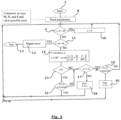
- step 7 The device according to the present invention is started up and the power take-off is coupled in step 7; the parameters M and N are entered in the processing unit and L is read in successive step 8.
- step 11 in which it is checked if L exceeds the value of the sum of M and N (indication of the detachment of trailer 2 from vehicle 1); here, in step 12, a signal of an abnormal state is sent to the system with any (acoustic or warning light) alarm signal or even with the stopping of the vehicle; the power take-off is certainly stopped in step 13. If the response is NO, then successive step 14 is performed.
- step 14 the value of ⁇ is calculated according to the equation (14).
- step 15 the value of ⁇ is compared with the value of the threshold angle S. If the value of ⁇ is smaller than the one of S, step 16 is performed, in which it is checked whether the power take-off is coupled. If it is coupled, then step 9 is returned to and the cycle is started again. If it is not coupled, as well as if ⁇ is greater than S, step 17 is performed, wherein the assessment is made whether ⁇ is greater than the second threshold value S', which normally is less than or equal to S. If the response is negative, step 18 is performed, wherein the power take-off is coupled and then step 9 is returned to.
- step 19 is performed, in which it is checked whether the power take-off is coupled. If it is not coupled, then step 9 is returned to and the cycle is started again. If it is coupled, then step 20 is performed, in which the power take-off is uncoupled, then step 9 is performed and the cycle is started again.
- the heart of the invention lies in the correct use of the equation (14) and in the comparison between the angle actually on cardan 3 and greater and lesser threshold angles (S and S').
- a series of sensors may be provided on each of the sides of vehicle 1 and/or trailer 2, the sensors being apt to detect the presence of vegetation in the operating area of vehicle 1 and of trailer 2.
- the presence of vegetation detected on both sides of vehicle 1 and/or of trailer 2 ensures the power take-off is left coupled and any machines on the trailer 2 continue operating.
- the signal of such an absence would be sent to the processing unit which would send a command to disengage the power take-off or to discontinue the processing on the side or on the sides where there was no vegetation.
- the processing unit would give the signal to restart the power take-off or to restart the discontinued processing. Therefore substantially when, despite the conditions existing for the operation of the power take-off, the absence of vegetation on one or both sides is verified, the device according to the invention sends a signal of such an absence to the processing unit which sends a command to disengage the power take-off or to discontinue the processing on the side or on the sides where there was no vegetation, and once the sensors detect the presence of vegetation again, the processing unit gives a signal to restart the power take-off or to restart the discontinued processing.
- the device according to the present invention thus allows the power take-off to be operated and the processing to be executed by a machine on trailer 2 for as long as possible, under maximum safety conditions and without using the operator in the tasks of the disengagement and engagement again of the power take-off, which could distract the operator from other maneuvers.
- there is increased safety both with regard to the integrity of the cardan and with regard to the operator him/herself; moreover, the risk is not run of needing to return to perform a passage in an area where the processing should have been performed and was not performed due to the distraction of the operator which resulted in the power take-off not being coupled again once the critical conditions were overcome.
- Position determining devices are devices which are highly easy to find and at a relatively low cost, whereby the device according to the present invention does not have prohibitive production costs, rather absolutely affordable costs, which is what makes the present invention even more appealing.
- This embodiment thus also allows the operation of the machine on trailer 2 to be automated. When the machine is a sprayer, material wastage will thereby be avoided.
Landscapes
- Engineering & Computer Science (AREA)
- Life Sciences & Earth Sciences (AREA)
- Mechanical Engineering (AREA)
- Soil Sciences (AREA)
- Environmental Sciences (AREA)
- Chemical & Material Sciences (AREA)
- Combustion & Propulsion (AREA)
- Transportation (AREA)
- Agricultural Machines (AREA)
- Control Of Position, Course, Altitude, Or Attitude Of Moving Bodies (AREA)
- Electric Propulsion And Braking For Vehicles (AREA)
- Current-Collector Devices For Electrically Propelled Vehicles (AREA)
Description
- The present invention relates to a device for the engagement and disengagement of a power take-off in a vehicle with a trailer operatively joined thereto with a cardan. In particular, the present invention is applicable, albeit not exclusively, to a tractor or a similar agricultural vehicle.
- Farming is one of man's oldest activities. The importance thereof is vital, since the survival itself of human beings to a large extent depends on the consumption of products from farming and zootechnical activities; also zootechnical activities partly depend on farming, with regard to feeding the animals.
- A farmer is required to perform various operations. The most important ones certainly are sowing and harvesting; no product can be obtained without the first and the fruits of the labor performed are not obtained without the second.
- However, there are many activities related to these two steps, which simply allow or facilitate them, for example by increasing productivity or avoiding damage to harvests from parasites and/or weeds. These operations include ploughing, spraying plants with anti-parasite or in any case, remedial substances, pruning, cutting and others.
- Agriculture was born when man decided to settle down and started selecting the seeds from which plants grew which were similar to those from which they were obtained, so as to obtain improved harvests as compared to the ones of wild products. Obviously, farming was entirely manual at that time. Manual ploughs were used for example, which are still used today in certain areas of Africa. They have contained costs, do not involve consumption; however, the use thereof results in rather poor results in relation to the associated hard work, with lengthy work times, since the operations are highly laborious and slow.
- A first step forward was obtained by subduing pairs of oxen and having them draw farm equipment to move and/or use it.
- Clear progress was obtained for the most part during the last century, with the change to modern agricultural machinery, in particular to tractors. Tractors practically replace the oxen in drawing the plough and other farm equipment. Modern tractors are vehicles provided with an internal combustion engine (spark-ignition or diesel engine), with large wheels or bets to obtain stability also on impervious ground, and they have hitches for various types of equipment. Generally, loads are transported according to two different methods: carried and drawn.
- The carried load is fastened to the three-point linkage, which is usually carried at the front by the tractor. The drawn load generally consists of a trailer, for the most part fastened to the so-called tractor drawbar; when the trailer carries agricultural machinery, same can be fed in an independent manner.
- The most common method for feeding power to agricultural machinery carried in a trailer drawn by a tractor however is the one of connecting a shaft with a cardan joint, commonly called a cardan. One end of the cardan is fastened to a rotating shaft of the machine, so as to give it the power required, and the other end is fastened to the power take-off of the tractor: an extension shaft of the drive shaft of the tractor; thereby, the power required is drawn from the tractor, so as not to require the presence of a second motor system. The rotation of the tractor motor thus results in the rotation of the shaft and the operation of the drawn machine. The cardan joint ensures that any oscillations in the motion of the tractor and of the trailer, which as is known occur on usually uneven grounds, do not result in the breaking of the shaft which transmits the power. The cardan joints here are very effective, however they have limits: if the angle formed on the cardan between the two parts of the shaft is smaller than a given measurement, the rotation of the shaft necessarily results in the breaking of the cardan.
- The regular operating method of an operator of a tractor of this type provides keeping the angle that forms on the cardan under tight control: when it is noted that the two parts of the shaft narrow excessively, the operator uncouples the power take-off and puts it into idle position. Thereby, the rotation of the shaft stops, so that the cardan joint does not receive stresses with several components and remains integral, thus "closing". However, there is also the stop of the rotation of the motor of the drawn machine, which thus discontinues its activity until the power take-off is coupled again. This occurs as soon as the operator detects again that the angle is no longer dangerous .
- Summarizing, it is highly important for the power take-off to be promptly uncoupled, otherwise the cardan will break, with the subsequent need for replacement, with all that such a replacement involves in terms of time, costs and slow-down of the work. However, it is just as important for the power take-off to be promptly coupled again, otherwise the work will be poorly done and will require repeating, also in this case with loss of time and costs and sometimes with damage to the harvest, associated for example with the excess or lack of a substance with which the plants are to be sprayed.
- Driving a tractor is a complex operation and involves various dangers: it is rather frequent for the operator not to have the required tranquility for performing these operations in the best way possible and breaks or work repetitions due to operator distractions unfortunately are an everyday affair.
-
US2003/0 024 782 describes a tractor with load carried with a hydraulic coupling and capable of protecting the cardan from breaking, which would occur due to too small angles in lifting/lowering the load. The uncoupling occurs through a solenoid valve. -
WO2017/109 746 describes a vehicle with drawn trailer, operatively connected thereto with a cardan, comprising means for detecting the angle between vehicle and cardan or between vehicle and trailer or between trailer and cardan, and comparison means with a threshold value, apt to uncouple the power take-off below a threshold value and to couple it again above the threshold value, said means being arranged about the cardan. -
WO2017/050 265 resolves the problem of the disengagement and engagement of the power take-off using means for detecting the angle between the driving wheels and the vehicle axis and correlating such an angle with the angle on the cardan according to a specific algorithm. - In a more sophisticated manner,
WO2017/000 234 provides for a magnetic emitter to be arranged on the vehicle or on the trailer, and there is an electronic bearing on the trailer or on the vehicle. The angle formed between the two magnetic devices is easily correlated to the angle on the cardan by virtue of a specific algorithm. - All these systems have significant merits but all have certain accuracy problems in identifying the mutual positions of the components, so that the threshold angle is to be set to such a value as to lengthen the discontinuation times of the work to have increased safety.
- Further examples of devices according to the prior art for the engagement and the disengagement of a power take-off for a vehicle with a trailer operatively connected to said vehicle by a cardan are known from prior art document
WO 2017/125863 . - The problem at the basis of the invention is to propose a disengagement and re-engagement system of the power take-off of a vehicle with trailer operatively connected thereto through a cardan which overcomes the mentioned drawbacks and which allows an accurate localization of the angle between vehicle and trailer so as to reach the disconnection of the power take-off only and for the whole time required. This object is achieved by a device for the engagement and the disengagement of a power take-off in a vehicle with a trailer, operatively connected thereto through a cardan, comprising a detection device of data pertaining to the angle between an arm of the cardan and the projection of the other arm of the cardan beyond the cardan itself and comparison means of the angle between one cardan arm and the projection of the other arm of the cardan beyond the cardan itself and one or more preset threshold angles, apt to disengage the power take-off when said angle between one cardan arm and the projection of the other arm of the cardan beyond the cardan itself is greater than a threshold angle and to engage it again when said angle between one cardan arm and the projection of the other arm of the cardan beyond the cardan itself is smaller than another threshold angle (equal to or different from the first one), characterized in that said detection device consists of a pair of position determining systems, arranged one in the vehicle area and one in the trailer area, and in that the angle to be compared against the threshold angles is calculated with the formula:

- wherein: M is the distance between one position determining system and the cardan joint,
- N is the distance between the other position determining system and the cardan joint,
L is the distance between the two position determining systems, - ε is the angle between the cardan arm and the projection of the other arm of the cardan beyond the cardan itself. The dependent claims describe preferential features of the invention.
- Further features and advantages of the invention will in any case be more apparent from the following detailed description of a preferred embodiment, given by mere way of non-limiting example and depicted in the accompanying drawings, in which:
-
fig. 1 is a diagrammatic depiction of a vehicle with a trailer, to which the device according to the present invention is applied, under rectilinear operating condition; -
fig. 2 is a diagrammatic depiction as infig. 1 , but under curved condition; and -
fig. 3 is a block diagram showing the operation of a device according to the present invention. -
Fig. 1 diagrammatically depicts avehicle 1 with atrailer 2, to which a cardan 3 (also indicated by O) comprising twoarms -
Vehicle 1 may be a farming tractor, but also any other vehicle capable of drawing a trailer and where the presence of a cardan is required. The connection by means ofcardan 3 is purely operative, since drawingtrailer 2 occurs through a hook connected to the eye of the tractor or the like. - The trailer generally is a carriage which carries an agricultural operating machine of known type, such as a sprayer, a brush cutter, a reaper or other.
-
Arm 4 ofcardan 3 generally is connected to the power take-off of the tractor so as to transmit the power to the machine ontrailer 2 required for the operation thereof. - Sensors (not depicted in the drawings) advantageously may be provided on the two sides, the sensors being adapted to detect the presence of vegetation at the useful distance for performing the operation whereby a machine transported by
trailer 2 is designed. The sensors may be arranged onvehicle 1, ontrailer 2 or on both. Thereby, in addition to the angle oncardan 3, the actual need and possibility of carrying out work is taken into consideration. - Said sensors preferably are arranged inclined with respect to the ground by such an angle so as to avoid detecting objects at too great a distance compared to the capabilities of the machine loaded on
trailer 2. Said sensors are oriented from the bottom upwards. Sensors of any type may be used, for example selected among feelers, photoelectric cells, radars, MEMS and the like. Such sensors are easily available on the market, they are affordable and they generally are quite efficient. - According to the present invention, two position determining devices are arranged on
vehicle 1 and ontrailer 2. There is a distance M between the position determining device onvehicle 1 andcardan 3, and there is distance N between the position determining device arranged ontrailer 2 andcardan 3. Any position determining device may be used according to the present invention, however said position determining systems preferably are global positioning systems, known as GPSs, given the efficiency and the broad availability on the market thereof. The two position determining devices communicate with a processing unit, such as an electronic processor, a microprocessor or a control unit, on board the vehicle itself. Said processing unit is connected to a device capable of controlling the engagement and disengagement of the power take-off of the vehicle. Such a device may be of any known type, for example a microswitch, a relay or a remote control switch. - The operation of the device according to the present invention is now described, additionally referring to the diagram in
fig. 3 , which specifically accompanies the present description for this purpose. - In
fig. 1 ,vehicle 1 andtrailer 2 are shown in rectilinear operation; the angle between thearms cardan 3 is 180°.Fig. 2 instead shows a circumstance in whichvehicle 1 takes on a curve, thus creating an angle between thearms Fig. 2 shows four different angles: angle ξ is the angle between thearm 4 ofcardan 3 and therectilinear segment 6 which joins the two position determining devices, i.e. the one arranged onvehicle 1 and the one arranged ontrailer 2; angle φ is the angle between thearm 5 ofcardan 3 and therectilinear segment 6 which joins the two position determining devices, i.e. the one arranged onvehicle 1 and the one arranged ontrailer 2; angle ε is the angle between thearm 5 ofcardan 3 and the projection of thearm 4 ofcardan 3 beyondcardan 3 itself; and angle ε' is the angle between thearms cardan 3 and reachingsegment 6. Obviously,segment 6 and the angles ξ, φ, ε and ε continuously vary during operation, in particular in curves. Angle ε is to be compared with a threshold value: when the angle is greater than said threshold, cardan 3 risks breaking. For this reason, when angle ε exceeds said threshold, the device according to the present invention is to disengage the power take-off so that the cardan stops rotating and any angle may be formed, without the risk of breaking. Similarly, when angle ε, with the power take-off uncoupled, goes below a threshold (that may be equal to or different from the preceding one), the device according to the present invention intervenes to couple the power take-off again and operating resumes normally. To obtain all this, it is necessary for the device according to the invention to detect angle ε and compare it with the uncoupling threshold (which is identified with letter S) and with the coupling threshold (identified with letter S'). Generally, S>S' exists, so as to achieve increased safety. The thresholds S and S' do not have dimensions and are expressed in degrees, like the angles ξ, φ, ε and ε'. First, angle ε is to be measured in order to operate the device according to the present invention, since the comparison with the thresholds occurs in the processing system, according to methods known in the art and in computer science. - From the most basic geometry, it is known that

- Again, from the basic geometry:

- Combining equations (1) and (2) results in:


- As seen in
fig. 2 ,segment 6 is divided, by height h, into two parts of length, L' and L", respectively. According to trigonometry, the following can be obtained:

vehicle 1 andcardan 3, and N is the distance between the position determining device ontrailer 2 andcardan 3. The sum of L' + L" results in length L ofsegment 6. The values of L', L", M and N are known; M and N whencardan 3 is connected tovehicle 1 and to trailer 2 (and are directly set in the processing unit of the device according to the present invention) and L' and L" from the position determining devices, moment by moment. Again from trigonometry, the following is obtained:
- Therefore:


- In the particular case in which M = N, the formula (9) is simplified, but this cannot occur in any circumstance and does not depend on an arbitrary selection of the individual assembling the device according to the present invention.
- According to what is indicated in Vicente Vàzquez Queipo, Madrid 1964,

- Dividing both items of the equation (10) by MN, the following is obtained:


- By multiplying both items of the equation (12) by -1 and dividing them by 2, the following is obtained:

- By including equation (13) in equation (1), the following is obtained:

vehicle 1 and ontrailer 2. - The device according to the present invention constantly determines the value of L by virtue of the position determining devices on
vehicle 1 and ontrailer 2. The values are entered in a processing device, where also the values of M and N and the threshold values S and S' are recorded, set in known manner. The relationship S = S' may be valid, wherein S and S' are the two preset threshold angles in the device, or S > S' may be valid, wherein S and S' are the two preset threshold angles in the device. Albeit theoretically possible and certainly falling within the scope of the present invention, the case of S < S' has such problems as not to be very practical: if S' is in the range which ensures safety forcardan 3, the work could be unnecessarily discontinued for too long a time, while if S is at the limit of the safety range for the integrity ofcardan 3, the risk of breaking thereof upon the engagement again of the power take-off would be too high. Using the formula (14), the processing device receives the point target of L and, from this and the other data set beforehand, calculates the point target of ε and compares it with the thresholds S and S'. If, with the power take-off coupled, ε > S, the device sends a signal to a device which operates the uncoupling ofcardan 3. If, with the power take-off uncoupled, ε < S', the device sends a signal to the coupling/uncoupling device which couples the power take-off again. Thereby, there is an operation ofcardan 3 in complete safety, minimizing the areas not subjected to processing normally performed by the machine carried bytrailer 2. An acoustic signal, an optical signal, a command to a CAN-BUS, a command to a relay, a command to an actuator or the like, may be provided when S is exceeded and upon the return to below S'. - To provide a better comprehension of the operation of the present invention, as mentioned above reference is now made to
fig. 3 . - The device according to the present invention is started up and the power take-off is coupled in step 7; the parameters M and N are entered in the processing unit and L is read in successive step 8. Step 9 checks whether L = N+M, which is the rectilinear operating circumstance of
vehicle 1 and oftrailer 2. If the response is YES,step 10 is performed, i.e. ε = 0 and the operation of the power take-off continues; then step 9 is returned to. If the response is NO, thensuccessive step 11 is performed, in which it is checked if L exceeds the value of the sum of M and N (indication of the detachment oftrailer 2 from vehicle 1); here, instep 12, a signal of an abnormal state is sent to the system with any (acoustic or warning light) alarm signal or even with the stopping of the vehicle; the power take-off is certainly stopped instep 13. If the response is NO, thensuccessive step 14 is performed. - In
step 14, the value of ε is calculated according to the equation (14). In thesuccessive step 15, the value of ε is compared with the value of the threshold angle S. If the value of ε is smaller than the one of S,step 16 is performed, in which it is checked whether the power take-off is coupled. If it is coupled, then step 9 is returned to and the cycle is started again. If it is not coupled, as well as if ε is greater than S, step 17 is performed, wherein the assessment is made whether ε is greater than the second threshold value S', which normally is less than or equal to S. If the response is negative,step 18 is performed, wherein the power take-off is coupled and then step 9 is returned to. If the response is affirmative, step 19 is performed, in which it is checked whether the power take-off is coupled. If it is not coupled, then step 9 is returned to and the cycle is started again. If it is coupled, then step 20 is performed, in which the power take-off is uncoupled, then step 9 is performed and the cycle is started again. - As seen from the preceding description, the heart of the invention lies in the correct use of the equation (14) and in the comparison between the angle actually on
cardan 3 and greater and lesser threshold angles (S and S'). - According to a preferred embodiment of the invention and as seen above, a series of sensors may be provided on each of the sides of
vehicle 1 and/ortrailer 2, the sensors being apt to detect the presence of vegetation in the operating area ofvehicle 1 and oftrailer 2. Should there be the conditions for coupling the power take-off downstream of the above-described process, the presence of vegetation detected on both sides ofvehicle 1 and/or oftrailer 2 ensures the power take-off is left coupled and any machines on thetrailer 2 continue operating. Should, despite the conditions existing for the operation of the power take-off, the absence of vegetation on one or both sides be verified, the signal of such an absence would be sent to the processing unit which would send a command to disengage the power take-off or to discontinue the processing on the side or on the sides where there was no vegetation. Should the sensors detect vegetation presence again, the processing unit would give the signal to restart the power take-off or to restart the discontinued processing. Therefore substantially when, despite the conditions existing for the operation of the power take-off, the absence of vegetation on one or both sides is verified, the device according to the invention sends a signal of such an absence to the processing unit which sends a command to disengage the power take-off or to discontinue the processing on the side or on the sides where there was no vegetation, and once the sensors detect the presence of vegetation again, the processing unit gives a signal to restart the power take-off or to restart the discontinued processing. - The device according to the present invention thus allows the power take-off to be operated and the processing to be executed by a machine on
trailer 2 for as long as possible, under maximum safety conditions and without using the operator in the tasks of the disengagement and engagement again of the power take-off, which could distract the operator from other maneuvers. Thereby, there is increased safety, both with regard to the integrity of the cardan and with regard to the operator him/herself; moreover, the risk is not run of needing to return to perform a passage in an area where the processing should have been performed and was not performed due to the distraction of the operator which resulted in the power take-off not being coupled again once the critical conditions were overcome. - The embodiment with the sensors, especially if a correct adjustment of the inclination thereof is made, allows avoiding the machine carried by
trailer 2 to operate empty, so as to avoid damage to the environment or equipment. Position determining devices, GPSs in particular, are devices which are highly easy to find and at a relatively low cost, whereby the device according to the present invention does not have prohibitive production costs, rather absolutely affordable costs, which is what makes the present invention even more appealing. This embodiment thus also allows the operation of the machine ontrailer 2 to be automated. When the machine is a sprayer, material wastage will thereby be avoided. - It is in any case intended for the invention not to be limited to the particular arrangement disclosed above, which is only one embodiment thereof, rather various variants are possible, all within the capability of those skilled in the art, without departing from the scope of protection of the invention itself, as defined by the following claims.
-
- 1
- Vehicle
- 2
- Trailer
- 3
- Cardan
- 4
- Arm (of 3)
- 5
- Arm (of 3)
- 6
- Distance between two sensors
- 7
- Process step
- 8
- Process step
- 9
- Process step
- 10
- Process step
- 11
- Process step
- 12
- Process step
- 13
- Process step
- 14
- Process step
- 15
- Process step
- 16
- Process step
- 17
- Process step
- 18
- Process step
- 19
- Process step
- 20
- Process step
- S
- First threshold angle
- S
- Second threshold angle
Claims (10)
- Device for the engagement and the disengagement of a power take-off for a vehicle (1) with a trailer (2), the trailer being operatively connected to the vehicle through a cardan (3), the device comprising a detection device of data pertaining to the angle (ε) between an arm (5) of the cardan and the projection of the other arm (4) of the cardan (3) beyond the cardan (3) itself and comparison means of the angle (ε) between one cardan arm (5) and the projection of the other arm (4) of the cardan (3) beyond the cardan (3) itself and one or more preset threshold angles (S, S'), apt to disengage the power take-off when said angle (ε) between one cardan arm (5) and the projection of the other arm (4) of the cardan (3) beyond the cardan (3) itself is greater than a threshold angle (S) and to engage it again when said angle (ε) between one cardan arm (5) and the projection of the other arm (4) of the cardan (3) beyond the cardan (3) itself is smaller than another threshold angle (S'), the other threshold angle (S') being equal to or different from the first one, characterized in that said detection device consists of a pair of position determining systems, suitable to be arranged one in the vehicle area and one in the trailer area, and in that the comparison means is configured such that the angle to be compared against the threshold angles is calculated with the formula:
 wherein: M is the distance between one position determining system and the cardan joint,N is the distance between the other position determining system and the cardan joint,L is the distance between the two position determining systems,
ε is the angle between the arm (5) of the cardan (3) and the projection of the other arm (4) of the cardan (3) beyond the cardan (3) itself. - Device as in claim 1), characterized in that said position determining systems are global positioning systems, known as GPSs.
- Device as in claim 1) or in claim 2), characterized in that sensors are provided on both sides of the vehicle (1) or of the trailer (2) or of both, apt to detect the presence of vegetation at the useful distance for performing the operation for which a machine transported by the trailer (2) is designed.
- Device as in claim 3), characterized in that said sensors are arranged inclined with respect to the ground by such an angle so as to avoid detecting objects at too great a distance compared to the capabilities of the machine loaded on the trailer (2).
- Device as in claim 3) or in claim 4), characterized in that one among feelers, photoelectric cells, radars, MEMS is chosen as sensor.
- Device as in any one of the preceding claims, characterized in that it is apt to signal an abnormal state and to arrest the power take-off if L exceeds the value of the sum of M and N.
- Device as in any one of claims from 3) to 6), characterized in that when, despite the conditions for the operation of the power take-off are met, absence of vegetation on one or both sides is checked, it sends a vegetation absence signal to the processing unit, which sends a command to disengage the power take-off or to discontinue processing on the side or on the sides where there is no vegetation.
- Device as in claim 7), characterized in that once the sensors detect vegetation presence again, the processing unit gives a signal to restart the power take-off or to restart the discontinued processing.
- Device as in any one of the preceding claims, characterized in that the relationship S = S' applies, where S and S' are the two threshold angles preset in the device.
- Device as in any one of claims 1) to 8), characterized in that the relationship S > S' applies, where S and S' are the two threshold angles preset in the device.
Applications Claiming Priority (2)
| Application Number | Priority Date | Filing Date | Title |
|---|---|---|---|
| IT102018000021169A IT201800021169A1 (en) | 2018-12-27 | 2018-12-27 | DEVICE FOR INSERTING AND DISCONNECTING A POWER SOCKET IN A VEHICLE WITH A TRAILER COMBINED OPERATIVELY WITH A CARDAN |
| PCT/IB2019/061298 WO2020136559A1 (en) | 2018-12-27 | 2019-12-23 | Device for the engagement and disengagement of a power take-off in a vehicle with a trailer operatively joined thereto with a cardan |
Publications (3)
| Publication Number | Publication Date |
|---|---|
| EP3902385A1 EP3902385A1 (en) | 2021-11-03 |
| EP3902385B1 true EP3902385B1 (en) | 2025-05-14 |
| EP3902385C0 EP3902385C0 (en) | 2025-05-14 |
Family
ID=66049573
Family Applications (1)
| Application Number | Title | Priority Date | Filing Date |
|---|---|---|---|
| EP19839434.8A Active EP3902385B1 (en) | 2018-12-27 | 2019-12-23 | Device for the engagement and disengagement of a power take-off in a vehicle with a trailer operatively joined thereto with a cardan |
Country Status (3)
| Country | Link |
|---|---|
| EP (1) | EP3902385B1 (en) |
| IT (1) | IT201800021169A1 (en) |
| WO (1) | WO2020136559A1 (en) |
Family Cites Families (8)
| Publication number | Priority date | Publication date | Assignee | Title |
|---|---|---|---|---|
| DE10131477B4 (en) | 2001-06-29 | 2005-05-04 | CNH Österreich GmbH | PTO drive train with regulation for the arrival and departure of a PTO stub on a land vehicle |
| ITBZ20030002U1 (en) * | 2003-01-30 | 2004-07-31 | Fae Italia Srl | AUTOMATIC ADJUSTMENT DEVICE FOR THE INCLINATION OF ONE OF TWO OPPOSED TRANSMISSION SHAFTS. |
| FR2990923B1 (en) * | 2012-05-22 | 2015-01-02 | Pellenc Sa | TRACTED MACHINE HAVING A DETACHED COUPLING DEVICE |
| WO2017000234A1 (en) | 2015-06-30 | 2017-01-05 | 程强 | Method for updating order when order information is updated and order system |
| WO2017050265A1 (en) | 2015-09-25 | 2017-03-30 | Telefonaktiebolaget Lm Ericsson (Publ) | Information bits packaging |
| ITUB20159734A1 (en) | 2015-12-22 | 2017-06-22 | Pierangelo Vercellino | Vehicle with trailer, operatively connected to it by means of a cardan shaft |
| ITUB20160353A1 (en) * | 2016-01-19 | 2017-07-19 | Valerio Raganelli | Vehicle with trailer, operatively connected to it by a cardan shaft |
| US11571967B2 (en) * | 2017-10-24 | 2023-02-07 | Etacarinae S.R.L. | Simplified system for disconnecting a power outlet of a cardan in a vehicle with a trailer |
-
2018
- 2018-12-27 IT IT102018000021169A patent/IT201800021169A1/en unknown
-
2019
- 2019-12-23 WO PCT/IB2019/061298 patent/WO2020136559A1/en not_active Ceased
- 2019-12-23 EP EP19839434.8A patent/EP3902385B1/en active Active
Also Published As
| Publication number | Publication date |
|---|---|
| IT201800021169A1 (en) | 2020-06-27 |
| EP3902385C0 (en) | 2025-05-14 |
| EP3902385A1 (en) | 2021-11-03 |
| WO2020136559A1 (en) | 2020-07-02 |
Similar Documents
| Publication | Publication Date | Title |
|---|---|---|
| EP4149836B1 (en) | Obstacle monitoring systems and methods for same | |
| EP3815480B1 (en) | System and method for detecting tool plugging of an agricultural implement based on residue differential | |
| Thomasson et al. | Autonomous technologies in agricultural equipment: a review of the state of the art | |
| US9220197B2 (en) | Self-propelled agricultural harvesting machine | |
| US11209824B1 (en) | Navigation system and method for guiding an autonomous vehicle through rows of plants or markers | |
| EP3634103B1 (en) | Improvements in or relating to vehicle-trailer combinations | |
| EP3827656B1 (en) | Harvesting head reel-mounted laser measurement | |
| Baillie et al. | A review of the state of the art in agricultural automation. Part III: Agricultural machinery navigation systems | |
| JP2016010372A (en) | Automatic control device for unmanned control combine | |
| EP3191320B1 (en) | Suspension | |
| US20240180063A1 (en) | Autonomous driver system for agricultural vehicle assemblies and methods for same | |
| KR101309745B1 (en) | Weeder using Side Weeding Unit | |
| JP2016010371A (en) | Combine-harvester | |
| EP3902385B1 (en) | Device for the engagement and disengagement of a power take-off in a vehicle with a trailer operatively joined thereto with a cardan | |
| EP3837952B1 (en) | Mower combination | |
| US20210195826A1 (en) | Vehicle with Trailer Operatively Connected Thereto With a Cardan | |
| Adams | Farm machinery automation for tillage, planting cultivation, and harvesting | |
| US10729056B2 (en) | Vehicle with trailer, operatively connected thereto through a cardan | |
| EP3700319B1 (en) | Simplified system for disconnection a power outlet of a cardan in a vehicle with trailer | |
| EP3837954B1 (en) | Mower combination | |
| US20210185921A1 (en) | Agricultural apparatus | |
| EP3878263A1 (en) | Agricultural apparatus | |
| DE102025137231A1 (en) | DEVICES, SYSTEMS AND METHODS FOR DETECTING AND TREATING MACHINERY CONDITIONS | |
| Powell et al. | Machine Vision for Autonomous Machine Guidance |
Legal Events
| Date | Code | Title | Description |
|---|---|---|---|
| STAA | Information on the status of an ep patent application or granted ep patent |
Free format text: STATUS: UNKNOWN |
|
| STAA | Information on the status of an ep patent application or granted ep patent |
Free format text: STATUS: THE INTERNATIONAL PUBLICATION HAS BEEN MADE |
|
| PUAI | Public reference made under article 153(3) epc to a published international application that has entered the european phase |
Free format text: ORIGINAL CODE: 0009012 |
|
| STAA | Information on the status of an ep patent application or granted ep patent |
Free format text: STATUS: REQUEST FOR EXAMINATION WAS MADE |
|
| 17P | Request for examination filed |
Effective date: 20210726 |
|
| AK | Designated contracting states |
Kind code of ref document: A1 Designated state(s): AL AT BE BG CH CY CZ DE DK EE ES FI FR GB GR HR HU IE IS IT LI LT LU LV MC MK MT NL NO PL PT RO RS SE SI SK SM TR |
|
| DAV | Request for validation of the european patent (deleted) | ||
| DAX | Request for extension of the european patent (deleted) | ||
| P01 | Opt-out of the competence of the unified patent court (upc) registered |
Effective date: 20230525 |
|
| GRAP | Despatch of communication of intention to grant a patent |
Free format text: ORIGINAL CODE: EPIDOSNIGR1 |
|
| STAA | Information on the status of an ep patent application or granted ep patent |
Free format text: STATUS: GRANT OF PATENT IS INTENDED |
|
| INTG | Intention to grant announced |
Effective date: 20240919 |
|
| GRAS | Grant fee paid |
Free format text: ORIGINAL CODE: EPIDOSNIGR3 |
|
| GRAA | (expected) grant |
Free format text: ORIGINAL CODE: 0009210 |
|
| STAA | Information on the status of an ep patent application or granted ep patent |
Free format text: STATUS: THE PATENT HAS BEEN GRANTED |
|
| AK | Designated contracting states |
Kind code of ref document: B1 Designated state(s): AL AT BE BG CH CY CZ DE DK EE ES FI FR GB GR HR HU IE IS IT LI LT LU LV MC MK MT NL NO PL PT RO RS SE SI SK SM TR |
|
| REG | Reference to a national code |
Ref country code: GB Ref legal event code: FG4D |
|
| REG | Reference to a national code |
Ref country code: CH Ref legal event code: EP |
|
| REG | Reference to a national code |
Ref country code: IE Ref legal event code: FG4D |
|
| REG | Reference to a national code |
Ref country code: DE Ref legal event code: R096 Ref document number: 602019070045 Country of ref document: DE |
|
| U01 | Request for unitary effect filed |
Effective date: 20250613 |
|
| U07 | Unitary effect registered |
Designated state(s): AT BE BG DE DK EE FI FR IT LT LU LV MT NL PT RO SE SI Effective date: 20250711 |
|
| PG25 | Lapsed in a contracting state [announced via postgrant information from national office to epo] |
Ref country code: ES Free format text: LAPSE BECAUSE OF FAILURE TO SUBMIT A TRANSLATION OF THE DESCRIPTION OR TO PAY THE FEE WITHIN THE PRESCRIBED TIME-LIMIT Effective date: 20250514 |
|
| PG25 | Lapsed in a contracting state [announced via postgrant information from national office to epo] |
Ref country code: NO Free format text: LAPSE BECAUSE OF FAILURE TO SUBMIT A TRANSLATION OF THE DESCRIPTION OR TO PAY THE FEE WITHIN THE PRESCRIBED TIME-LIMIT Effective date: 20250814 Ref country code: GR Free format text: LAPSE BECAUSE OF FAILURE TO SUBMIT A TRANSLATION OF THE DESCRIPTION OR TO PAY THE FEE WITHIN THE PRESCRIBED TIME-LIMIT Effective date: 20250815 |
|
| PG25 | Lapsed in a contracting state [announced via postgrant information from national office to epo] |
Ref country code: PL Free format text: LAPSE BECAUSE OF FAILURE TO SUBMIT A TRANSLATION OF THE DESCRIPTION OR TO PAY THE FEE WITHIN THE PRESCRIBED TIME-LIMIT Effective date: 20250514 |
|
| PG25 | Lapsed in a contracting state [announced via postgrant information from national office to epo] |
Ref country code: HR Free format text: LAPSE BECAUSE OF FAILURE TO SUBMIT A TRANSLATION OF THE DESCRIPTION OR TO PAY THE FEE WITHIN THE PRESCRIBED TIME-LIMIT Effective date: 20250514 |
|
| PG25 | Lapsed in a contracting state [announced via postgrant information from national office to epo] |
Ref country code: RS Free format text: LAPSE BECAUSE OF FAILURE TO SUBMIT A TRANSLATION OF THE DESCRIPTION OR TO PAY THE FEE WITHIN THE PRESCRIBED TIME-LIMIT Effective date: 20250814 |
|
| PG25 | Lapsed in a contracting state [announced via postgrant information from national office to epo] |
Ref country code: IS Free format text: LAPSE BECAUSE OF FAILURE TO SUBMIT A TRANSLATION OF THE DESCRIPTION OR TO PAY THE FEE WITHIN THE PRESCRIBED TIME-LIMIT Effective date: 20250914 |
|
| PG25 | Lapsed in a contracting state [announced via postgrant information from national office to epo] |
Ref country code: SM Free format text: LAPSE BECAUSE OF FAILURE TO SUBMIT A TRANSLATION OF THE DESCRIPTION OR TO PAY THE FEE WITHIN THE PRESCRIBED TIME-LIMIT Effective date: 20250514 |
|
| PG25 | Lapsed in a contracting state [announced via postgrant information from national office to epo] |
Ref country code: CZ Free format text: LAPSE BECAUSE OF FAILURE TO SUBMIT A TRANSLATION OF THE DESCRIPTION OR TO PAY THE FEE WITHIN THE PRESCRIBED TIME-LIMIT Effective date: 20250514 |
|
| PG25 | Lapsed in a contracting state [announced via postgrant information from national office to epo] |
Ref country code: SK Free format text: LAPSE BECAUSE OF FAILURE TO SUBMIT A TRANSLATION OF THE DESCRIPTION OR TO PAY THE FEE WITHIN THE PRESCRIBED TIME-LIMIT Effective date: 20250514 |
|
| PLBE | No opposition filed within time limit |
Free format text: ORIGINAL CODE: 0009261 |
|
| STAA | Information on the status of an ep patent application or granted ep patent |
Free format text: STATUS: NO OPPOSITION FILED WITHIN TIME LIMIT |
|
| REG | Reference to a national code |
Ref country code: CH Ref legal event code: L10 Free format text: ST27 STATUS EVENT CODE: U-0-0-L10-L00 (AS PROVIDED BY THE NATIONAL OFFICE) Effective date: 20260325 |
|
| 26N | No opposition filed |
Effective date: 20260217 |