EP3901837A1 - Optimization apparatus, optimization method, and optimization program - Google Patents
Optimization apparatus, optimization method, and optimization program Download PDFInfo
- Publication number
- EP3901837A1 EP3901837A1 EP21159239.9A EP21159239A EP3901837A1 EP 3901837 A1 EP3901837 A1 EP 3901837A1 EP 21159239 A EP21159239 A EP 21159239A EP 3901837 A1 EP3901837 A1 EP 3901837A1
- Authority
- EP
- European Patent Office
- Prior art keywords
- state
- spin
- energy
- value
- state change
- Prior art date
- Legal status (The legal status is an assumption and is not a legal conclusion. Google has not performed a legal analysis and makes no representation as to the accuracy of the status listed.)
- Granted
Links
Images




Classifications
-
- G—PHYSICS
- G06—COMPUTING OR CALCULATING; COUNTING
- G06N—COMPUTING ARRANGEMENTS BASED ON SPECIFIC COMPUTATIONAL MODELS
- G06N5/00—Computing arrangements using knowledge-based models
- G06N5/04—Inference or reasoning models
-
- G—PHYSICS
- G06—COMPUTING OR CALCULATING; COUNTING
- G06Q—INFORMATION AND COMMUNICATION TECHNOLOGY [ICT] SPECIALLY ADAPTED FOR ADMINISTRATIVE, COMMERCIAL, FINANCIAL, MANAGERIAL OR SUPERVISORY PURPOSES; SYSTEMS OR METHODS SPECIALLY ADAPTED FOR ADMINISTRATIVE, COMMERCIAL, FINANCIAL, MANAGERIAL OR SUPERVISORY PURPOSES, NOT OTHERWISE PROVIDED FOR
- G06Q10/00—Administration; Management
- G06Q10/04—Forecasting or optimisation specially adapted for administrative or management purposes, e.g. linear programming or "cutting stock problem"
-
- G—PHYSICS
- G06—COMPUTING OR CALCULATING; COUNTING
- G06N—COMPUTING ARRANGEMENTS BASED ON SPECIFIC COMPUTATIONAL MODELS
- G06N5/00—Computing arrangements using knowledge-based models
- G06N5/01—Dynamic search techniques; Heuristics; Dynamic trees; Branch-and-bound
-
- G—PHYSICS
- G06—COMPUTING OR CALCULATING; COUNTING
- G06N—COMPUTING ARRANGEMENTS BASED ON SPECIFIC COMPUTATIONAL MODELS
- G06N20/00—Machine learning
-
- G—PHYSICS
- G06—COMPUTING OR CALCULATING; COUNTING
- G06N—COMPUTING ARRANGEMENTS BASED ON SPECIFIC COMPUTATIONAL MODELS
- G06N7/00—Computing arrangements based on specific mathematical models
- G06N7/01—Probabilistic graphical models, e.g. probabilistic networks
-
- G—PHYSICS
- G06—COMPUTING OR CALCULATING; COUNTING
- G06Q—INFORMATION AND COMMUNICATION TECHNOLOGY [ICT] SPECIALLY ADAPTED FOR ADMINISTRATIVE, COMMERCIAL, FINANCIAL, MANAGERIAL OR SUPERVISORY PURPOSES; SYSTEMS OR METHODS SPECIALLY ADAPTED FOR ADMINISTRATIVE, COMMERCIAL, FINANCIAL, MANAGERIAL OR SUPERVISORY PURPOSES, NOT OTHERWISE PROVIDED FOR
- G06Q10/00—Administration; Management
- G06Q10/06—Resources, workflows, human or project management; Enterprise or organisation planning; Enterprise or organisation modelling
- G06Q10/067—Enterprise or organisation modelling
Definitions
- the embodiments discussed herein are related to an optimization apparatus, an optimization method, and an optimization program.
- the Ising calculation device is a calculation device that searches for a combination of variables that minimizes energy of an Ising model expressed by a predetermined evaluation formula.
- the variables are referred to as a spin
- values of the variables are referred to as a spin state
- a transition of the spin state is referred to as inversion.
- An Ising calculation device 1 is an optimizer that searches for a combination (x 0 , x 1 ,..., x n ) of variables x i that minimizes energy of the Ising model expressed by the formulas (1) to (4) that are evaluation functions.
- a variable x i in the formula (1) is a state variable and takes a value of zero or one.
- W ij is an interaction coefficient and b i is a value called magnetic field term.
- E represents energy
- ⁇ E i represents an energy change amount in a case where x i is inverted.
- h i represents a local field with x i
- ⁇ h i represents a change amount of the local field with x i .
- the energy change amount is represented as ⁇ E.
- the Ising calculation device determines, for each spin, presence or absence of inversion on the basis of an inversion determination formula, sequentially transitions the state, and searches for the minimum energy. Then, by formulating the actual problem into the Ising model energy formula and searching for the combination of spin states that minimizes the energy by the Ising calculation device, various types of combinatorial optimization problems can be solved.
- the Ising calculation device starts a search from an initial state in which zero or one is assigned to each variable of the evaluation function expressing a problem to be solved. Then, the Ising calculation device selects a state close to a current state from the current state of the combination of the variables, and considers a state transition.
- the state close to the current state is, for example, a state in which a state of one variable is changed.
- the Ising calculation device calculates the energy change amount for the state, and stochastically selects whether or not to adopt the state transition or to maintain the original state without adopting the state transition according to the calculated value.
- the state is averagely changed in the direction of decreasing the energy, and the Ising calculation device can finally reach the optimum solution or reach the energy close to the optimum solution. If deterministically adopting the state transition in the case of decreasing the energy and not adopting the state transition in the case of increasing the energy, the change in the energy monotonously decreases with respect to time in a broad sense. However, when the Ising calculation device reaches a local solution, no more state transition occurs, and it is difficult to expect to reach the optimum solution. Therefore, in the search in the combinatorial optimization problem, it is important to stochastically determine whether or not to adopt the state transition.
- a range constraint for variables when the Ising calculation device solves a problem for example, there is a knapsack problem in which target baggage to be put in a knapsack is selected within a range not exceeding the maximum capacity of the knapsack from a plurality of pieces of baggage with determined "capacity" and "value”, and a combination that maximizes the value of the put baggage is obtained.
- a known Ising calculation device introduces an auxiliary spin representing the range constraint into an evaluation formula.
- a condition of not exceeding the maximum capacity of the knapsack is added as a constraint term. Since the condition of not exceeding the maximum capacity of the knapsack means that the total capacity of the loaded baggage is equal to a certain value in a range that is equal to or larger than 0 and equal to or smaller than the maximum capacity, the second term is added as in the formula (5) so that a value k of the constraint term is added as a penalty in the case where the total capacity becomes a value other than the certain value.
- y0 to ym are auxiliary spins, and the total number of auxiliary spins having a value of 1 represents the range constraint.
- the auxiliary spins are prepared according to the number of possible values. Therefore, even if the number of range constraint conditions is one, many spins are used. For example, in a case of formulating a knapsack problem of putting six items in a knapsack with the maximum value of 190, using the auxiliary spins, 190 spins are introduced for the range constraint condition.
- the disclosed technology has been made in view of the foregoing, and an object is to provide an optimizer, an optimization method, and an optimization program that improve the process performance for the combinatorial optimization problem.
- a temperature control unit configured to control a temperature value indicating a temperature.
- An annealing unit configured to calculate a change amount of energy represented by an evaluation function of a case of changing a state of any one of a plurality of state variables so as to increase or decrease a value by 1 in a case of a state variable taking multiple values, the evaluation function representing the energy including the plurality of state variables in which the state variable is included, and determine whether to set a state change in the state variable as a candidate according to a correlation between a threshold and a total change amount, the threshold being calculated based on the temperature value and a random number value, the total change amount being obtained by the calculated change amount of energy.
- a determination unit configured to stochastically determine whether to adopt the state change set as the candidate.
- An energy calculation unit configured to calculate post-transition energy after executing a state transition of the state variable according to the state change.
- a search unit configured to obtain minimum energy by setting the post-transition energy as the minimum energy when the post-transition energy is less than the minimum energy.
- the present embodiments can improve the process performance for the combinatorial optimization problem.
- FIG. 1 is a block diagram of an Ising calculation device.
- An Ising calculation device 1 includes a plurality of annealing units 10, a temperature control unit 20, a threshold generation unit 30, a random number generation unit 40, an inverted spin selection unit 50, an energy calculation unit 60, and a search result holding unit 70.
- annealing units 10 are mounted on the single Ising calculation device 1.
- "Inversion" in the following description includes a change in a value of an auxiliary spin in addition to a known change in a spin state from 0 to 1 or 1 to 0.
- the Ising calculation device 1 is an optimizer that searches for a combination (x 0 , x 1 ,..., x n ) of variables x i that minimizes energy of an Ising model expressed by the formula (1) that is an evaluation function.
- E ⁇ ⁇ n p n x n + k y 0 ⁇ ⁇ n w n x n 2
- E in the formula (6) represents energy.
- the variable x i in the formula (6) is a state variable and takes a value of zero or one.
- the variable y 0 is a condition of a range constraint, and can take an arbitrary value in a preset range. Note that the variable y 0 is incremented or decremented by one at a time.
- k in the formula (6) is a coefficient of a constraint term.
- the variable x i is called “spin”, and the value of the variable x i is called “spin state”.
- the spin state is represented as 0 or 1.
- the variable y 0 is called “auxiliary spin”. That is, there is one auxiliary spin in this case. Then, since the variable y 0 takes an arbitrary value in a predetermined range, the value given to the variable y 0 is called spin state for the variable y 0 .
- transition of the spin state and change in the value of the auxiliary spin are referred to as "inversion”. That is, the inversion corresponds to transition of the spin state from 0 to 1, transition of the spin state from 1 to 0, change in the value of y 0 from M to M + 1, or a change in the value of y 0 from M to M - 1.
- FIG. 2 is a diagram illustrating a calculation example regarding auxiliary spins according to the first embodimet.
- a difference in the case of increasing the value of y 0 from M to M + 1 and a difference in a case of decreasing the value of y 0 from M to M - 1 from the transformed formula of the transformation 11 are expressed by the Equation 12. That is, an energy change amount in the case of increasing or decreasing the value of the auxiliary spin in this case is expressed by the following formula (7).
- a local field in the auxiliary spin is expressed by the following formula (8).
- h y 0 ⁇ 2 kM + 2 k ⁇ n w n x n
- a change amount in the local field in the auxiliary spin when spin inversion occurs is expressed by the following formula (9).
- the formula (9) expresses, from the top, the change amount in the local field in the case where the auxiliary spin increases by 1, the change amount in the local field in the case where the auxiliary spin decreases by 1, the change amount in the local field in the case where the spin state changes from 0 to 1, and the change amount in the local field in the case where the spin state changes from 1 to 0.
- the energy change amount in the case where the spin state changes in addition to the normal spin and the auxiliary spin are expressed by the following formula (11).
- the coefficient k of the constraint term in the formula (11) is set to "0" in the case of the normal spin.
- the change amount in the auxiliary bit changes by one at a time. Therefore, the auxiliary bit is set to be able to take multiple values but calculation of the value of the auxiliary bit in each operation is addition or subtraction of 1, and the calculation of the auxiliary bit does not become large. Then, regarding the value of the auxiliary bit, it is possible to cover the range of values that can be taken by the auxiliary bit by determining whether it is energetically advantageous when changing the value, and selecting the value of the auxiliary bit.
- the temperature control unit 20 is a circuit that controls a value of a temperature parameter.
- the temperature parameter is a temperature value used to control the temperature.
- T the temperature parameter
- the temperature control unit 20 lowers the temperature by gradually decreasing the value of the temperature parameter according to the number of iterations of the search, starting from a sufficiently high initial temperature, according to a simulated annealing method, for example. Starting from an initial state, the iteration is repeated while lowering the temperature by the temperature control unit 20. When a termination determination condition such as achievement of a certain number of iterations or a value of energy falling below a certain value is satisfied, the operation is terminated.
- the temperature control unit 20 can use a replica exchange method for searching for the minimum energy while switching a low temperature condition and a high temperature condition by executing several systems called replicas having different temperature conditions in parallel and exchanging the systems for each of the predetermined number of iterations.
- the random number generation unit 40 is a circuit that generates a random number value.
- the random number generation unit 40 outputs the generated random number to the threshold generation unit 30 and the inverted spin selection unit 50.
- the threshold generation unit 30 is a circuit that generates a threshold used for determining whether or not each spin becomes an inversion candidate.
- the threshold generation unit 30 acquires the temperature parameter from the temperature control unit 20. Furthermore, the threshold generation unit 30 acquires the random number value from the random number generation unit 40.
- inversion of the variables is adopted according to the following formula (13).
- the inversion of the variables is adopted with e - ⁇ E/T or 1, whichever is smaller, as an adoption probability.
- P min 1 e ⁇ ⁇ E T
- the inverted spin is stochastically adopted according to the formula (13) according to the random number generated by the random number generation unit 40.
- the condition that the adoption probability is according to the formula (13) is the same as that the inversion is adopted in a case where the following formula (14) is satisfied using a uniform random number r.
- the formula (14) is a formula for determining whether or not to adopt the inversion, and may be referred to as "inversion determination formula" below.
- the threshold generation unit 30 generates a value of a right side of the formula (14), using the temperature parameter and the random number value. Then, the threshold generation unit 30 outputs the generated value of the right side of the formula (14) to the annealing unit 10.
- the annealing unit 10 holds the spin state and the local field for one spin of the spin or the auxiliary spin.
- the spin or the auxiliary spin to be controlled by each annealing unit 10 is referred to as own spin.
- the annealing unit 10 is a circuit that determines whether or not the own spin becomes the inversion candidate on the basis of the energy change amount when the own spin is inverted. Details of the annealing unit 10 will be described below with reference to FIG. 2 .
- FIG. 3 is a block diagram illustrating details of the annealing unit. As illustrated in FIG. 1 , the plurality of annealing units 10 exists. Then, the respective annealing units 10 control different spins but execute the same process. Therefore, a specific annealing unit 10 will be described below.
- the annealing unit 10 includes a local field management unit 101, a spin state management unit 102, an energy change amount calculation unit 103, a constraint term coefficient holding unit 104, a flag generation unit 105, a constraint value holding unit 106, and a spin number holding unit 107.
- the spin number holding unit 107 holds a spin number for identifying the own spin.
- the spin number corresponds to a number for identifying i or the auxiliary spin y 0 in the case where the spin is represented as x i .
- the spin number holding unit 107 holds i as a spin number used to identify the spin x i .
- the spin number holding unit 107 holds i as the spin number for identifying the auxiliary spin y 0 . Then, the spin number holding unit 107 outputs the held spin number to the spin state management unit 102 and the inverted spin selection unit 50.
- the spin state management unit 102 holds the current spin state of the own spin and manages the spin state of the own spin. For example, the spin state management unit 102 receives setting of an initial value of the spin state of the own spin when an optimum solution search process is started. For example, in a case where the initial values of x i are all 0, the spin state management unit 102 of the annealing unit 10 in which the own spin is the spin x i acquires the value of 0 as the initial value. Furthermore, since the initial value of the constraint term is 0 in the present embodiment, the spin state management unit 102 of the annealing unit 10 in which the own spin is the auxiliary spin y 0 acquires the value of 0 as the initial value.
- FIG. 4 is a diagram illustrating an example of a file for an initial setting instruction.
- the initial values of the spin states of the respective spins are all 0, so the spin states in file 13 are all set to 0.
- the Ising calculation device 1 reads the file 13
- each spin state registered in the file 13 is set in each spin state management unit 102.
- the spin state management unit 102 acquires the spin number from the spin number holding unit 107. Then, the spin state management unit 102 outputs the spin state together with the spin number to the flag generation unit 105.
- the spin state management unit 102 receives an inverted spin determination notification together with the spin number of the inverted spin from the inverted spin selection unit 50. Furthermore, the spin state management unit 102 receives an input of either an addition flag representing inversion of adding 1 to the spin or a subtraction flag representing inversion of subtracting 1 from the auxiliary spin from the inverted spin selection unit 50. Then, the spin state management unit 102 executes the following process in the case where the inverted spin is the own spin. The spin state management unit 102 updates the held value with a value obtained by adding 1 to the current spin value as a new spin value in the case of the addition flag. Furthermore, the spin state management unit 102 updates the held value with a value obtained by subtracting 1 from the current spin value as a new spin value in the case of the subtraction flag.
- the local field management unit 101 holds information regarding a current local field and manages a local field corresponding to the own spin.
- the local field management unit 101 since the energy change amount in the case where the own spin is inverted can be calculated from the formula (11) on the basis of the local field and the spin state, the local field management unit 101 holds the information regarding the local field for each annealing unit 10 for allowing the annealing unit 10 to calculate the energy change amount. Then, the local field management unit 101 outputs the held local field to the energy change amount calculation unit 103.
- the local field management unit 101 receives setting of an initial value of the local field with respect to the own spin when the optimum solution search process is started. For example, when the Ising calculation device 1 reads the file 13 of FIG. 4 , the local field of each spin registered in the file 13 is set in the local field management unit 101. In addition, the local field management unit 101 may calculate the initial value of the local field with respect to the own spin by receiving an input of the initial value of each spin.
- the local field management unit 101 receives the inverted spin determination notification together with the spin number of the inverted spin from the inverted spin selection unit 50.
- the local field management unit 101 calculates a change amount of the local field, using the spin number of the inverted spin of which the inversion is determined in the formula (12).
- the local field management unit 101 calculates the local field with respect to the own spin, using the calculated change amount of the local field for the held information regarding the local field.
- the local field management unit 101 updates the held information regarding the local field with information regarding the calculated local field as information regarding the current local field.
- the constraint term coefficient holding unit 104 is, for example, a register. Then, the constraint term coefficient holding unit 104 holds a predetermined value of the coefficient of the constraint term corresponding to k in the formula (6). For example, when the Ising calculation device 1 reads the file 13 of FIG. 4 , the constraint term coefficient holding unit 104 stores a constraint term coefficient of each spin registered in the file 13. As illustrated in the file 13, 0 is set as the constraint term coefficient for the normal spin x i , and a predetermined value is set as the constraint term coefficient for the auxiliary spin y 0 . In the case of using the file 13, the constraint term coefficient for the auxiliary spin y 0 is set to 100.
- the energy change amount calculation unit 103 receives an input of the information regarding the local field from the local field management unit 101. Furthermore, the energy change amount calculation unit 103 acquires the coefficient of the constraint term corresponding to k in the formula (6) from the constraint term coefficient holding unit 104. Then, the energy change amount calculation unit 103 calculates the energy change amount by the inversion of the own spin, using the formula (11). After that, the energy change amount calculation unit 103 outputs the calculated energy change amount by the inversion of the own spin to the flag generation unit 105.
- the constraint value holding unit 106 is, for example, a register. Then, the constraint value holding unit 106 holds an upper limit value and a lower limit value in the range constraint. In the case where the own spin is the normal spin, the upper limit value is set to 1 and the lower limit value is set to 0, so that the spin state falls within the range of the range constraint. For example, when the Ising calculation device 1 reads the file 13 of FIG. 4 , the constraint value holding unit 106 stores the upper limit value and the lower limit value for each spin registered in the file 13. As illustrated in the file 13, 1 is set as the upper limit value and 0 is set as the lower limit value for the normal spin x i .
- predetermined values are set as the upper limit value and the lower limit value for the auxiliary spin y 0 .
- the upper limit value for the auxiliary spin y 0 is set to 190
- the lower limit value for the auxiliary spin y 0 is set to 0. This is a setting for solving the knapsack problem when packing items in the knapsack having the maximum capacity of 190, for example.
- the flag generation unit 105 receives an input of the spin state from the spin state management unit 102. Furthermore, the flag generation unit 105 acquires the upper limit value and the lower limit value in the range constraint from the constraint value holding unit 106. Furthermore, the flag generation unit 105 receives an input of the energy change amount from the energy change amount calculation unit 103. Moreover, the flag generation unit 105 receives an input of the value of the right side of the inversion determination formula expressed by the formula (14) from the threshold generation unit 30.
- the flag generation unit 105 determines whether or not the spin state after inversion is within the range of the upper limit value and the lower limit value. Then, the flag generation unit 105 determines that addition candidate determination is not possible in a case where the spin state matches the upper limit value, and determines that the addition candidate determination is possible in a case where the spin state is less than the upper limit value. Furthermore, the flag generation unit 105 determines that subtraction candidate determination is not possible in a case where the spin state matches the lower limit value, and determines that the subtraction candidate determination is possible in a case where the spin state exceeds the lower limit value.
- the flag generation unit 105 determines whether or not the energy change amount satisfies the inversion determination formula where the right side of the formula (14) is set to the value obtained from the threshold generation unit 30.
- the flag generation unit 105 In a case where the energy change amount satisfies the inversion determination formula, the flag generation unit 105 generates an inversion candidate flag indicating that the own spin is an inversion candidate. On the other hand, in a case where the energy change amount does not satisfy the inversion determination formula, the flag generation unit 105 generates an inversion candidate flag indicating that the own spin is not the inversion candidate. For example, the flag generation unit 105 sets the value of F to 1 in the case where the inversion candidate flag indicates that the own spin is the inversion candidate, and sets the value of F to 0 in the case where the inversion candidate flag indicates that the own spin is not the inversion candidate, where the inversion candidate flag is F.
- the flag generation unit 105 can transition to the spin state where 1 is added to the value of the current auxiliary spin y 0 , and to the spin state where 1 is subtracted from the value of the current auxiliary spin y 0 .
- the flag generation unit 105 selects the spin state of the case of addition as the candidate when the addition candidate determination is possible and the subtraction candidate determination is not possible.
- the flag generation unit 105 selects the spin state of the case of subtraction as the candidate when the addition candidate determination is not possible and the subtraction candidate determination is possible.
- the flag generation unit 105 selects either one of the spin states in the case where both the addition candidate determination and the subtraction candidate determination are possible. Then, the flag generation unit 105 generates the addition flag in the case of selecting the transition to the spin state of the case of addition. Furthermore, the flag generation unit 105 generates the subtraction flag in the case of selecting the transition to the spin state of the case of subtraction.
- the flag generation unit 105 outputs the generated inversion candidate flag, and the addition flag or the subtraction flag, if any, to the inverted spin selection unit 50.
- the inversion candidate flag, the addition flag, and the subtraction flag may be collectively referred to as flag(s).
- the inverted spin selection unit 50 acquires the spin number of the own spin in each annealing unit 10 from the spin number holding unit 107 of each annealing unit 10. Furthermore, the inverted spin selection unit 50 receives an input of the own spin in each annealing unit 10. Furthermore, the inverted spin selection unit 50 receives an input of a random number from the random number generation unit 40.
- the inverted spin selection unit 50 confirms the inversion candidate flag acquired from each annealing unit 10 and determines whether or not there is an inversion candidate spin that is a spin having the inversion candidate flag representing that the spin becomes the inversion candidate.
- the inverted spin selection unit 50 selects one inversion candidate spin from among inversion candidate spins acquired according to the acquired random number from the random number generation unit 40.
- the inverted spin selection unit 50 determines the selected inversion candidate spin as the inverted spin. Thereafter, the inverted spin selection unit 50 outputs the spin number and the spin state of the inverted spin together with the inverted spin determination notification to the energy calculation unit 60 and the search result holding unit 70. The inverted spin selection unit 50 outputs the spin number of the inverted spin together with the inverted spin determination notification to the annealing unit 10. At this time, in the case of including the addition flag or the subtraction flag, the inverted spin selection unit 50 outputs the included addition flag or subtraction flag to the annealing unit 10.
- the energy calculation unit 60 preliminarily includes the initial values of the respective spins where all the spin states are 0. Then, the energy calculation unit 60 obtains the energy, using the initial value of each spin in the formula (6) and holds the obtained energy.
- the energy calculation unit 60 receives inputs of the spin number and the spin state of the inverted spin together with the inverted spin determination notification from the inverted spin selection unit 50. Next, the energy calculation unit 60 inverts the spin state of the spin having the spin number notified from the inverted spin selection unit 50 in the spin state of each spin held in the energy calculation unit 60 and generates the spin state of each new spin. Furthermore, the energy calculation unit 60 acquires the energy change amount in the case where the spin state of the inverted spin is inverted from the inverted spin selection unit 50. Then, the energy calculation unit 60 adds the acquired energy change amount to the held energy value to calculate the energy of the case where the spin state of the inverted spin is inverted.
- the energy calculation unit 60 holds the spin state of each spin in the state where the spin state of the inverted spin is inverted. Moreover, the energy calculation unit 60 outputs the calculated energy in the state where the spin state of the inverted spin is inverted to the search result holding unit 70.
- the search result holding unit 70 receives an input of information of the calculated energy from the energy calculation unit 60. Moreover, the search result holding unit 70 receives the inputs of the spin number and the spin state of the inverted spin from the inverted spin selection unit 50. Then, in a case where minimum energy is not held, the search result holding unit 70 sets the acquired energy as the minimum energy. In this case, the search result holding unit 70 holds the spin state of each spin in the case of the minimum energy.
- the search result holding unit 70 compares the acquired energy with the holding minimum energy. In a case where the acquired energy is less than the minimum energy, the search result holding unit 70 sets the acquired energy as the minimum energy. Moreover, the search result holding unit 70 holds the spin state of each spin in the case of the acquired energy. Meanwhile, in a case where the acquired energy is equal to or more than the minimum energy, the search result holding unit 70 continues to hold the held minimum energy and the spin state of each spin as they are. However, initial energy may be set as the initial value of the minimum energy. In that case, the state where the search result holding unit 70 does not hold the minimum energy is not present, and the process starts from the case where the search result holding unit 70 already holds the minimum energy.
- the search result holding unit 70 corresponds to an example of a "search unit".
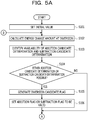
- FIG. 5A and 5B are flowcharts of the optimum solution search process by the Ising calculation device according to the first embodiment.
- the Ising calculation device 1 sets the initial value in each unit on the basis of, for example, the input file from an operator using an external terminal (not illustrated) or the like (step S101).
- the spin state management unit 102 of the annealing unit 10 sets the initial value of the spin state of the own spin.
- the spin number holding unit 107 sets the spin number of the own spin.
- the local field management unit 101 sets the initial value of the local field for the own spin.
- the value of the constraint term coefficient is set in the constraint term coefficient holding unit 104.
- the upper limit value and the lower limit value are set in the constraint value holding unit 106.
- the energy change amount calculation unit 103 of the annealing unit 10 acquires the information regarding the local field held by the local field management unit 101. Furthermore, the energy change amount calculation unit 103 acquires the value of the constraint term coefficient to be used in the own spin from the constraint term coefficient holding unit 104. Then, the energy change amount calculation unit 103 calculates the energy change amount, at the time when the own spin is inverted, using the formula (11) (step S102). Here, the energy change amount calculation unit 103 calculates both the energy change amount in the case of addition and the energy change amount in the case of subtraction in the case where the state transition in the case of addition and the state transition in the case of subtraction are present. Thereafter, the energy change amount calculation unit 103 outputs the calculated energy change amount at the time of inversion of the own spin to the flag generation unit 105.
- the flag generation unit 105 identifies availability of each of the addition candidate determination and the subtraction candidate determination (step S103).
- step S104 determines whether either the addition candidate determination or the subtraction candidate determination is possible.
- step S104 determines whether both the addition candidate determination and the subtraction candidate determination are not possible (step S104: negative).
- step S107 the optimum solution search process proceeds to step S107.
- steps S102 to S106 are performed in parallel in each annealing unit 10, and all the results are input to the inverted spin selection unit 50. That is, there may be different processes such as a certain annealing unit 10 obtaining the negative determination in step S104 and proceeding to step S107, whereas another annealing unit 10 obtaining the affirmative determination in step S104 and proceeding to step S107 through steps S105 and S106.
- the flag generation unit 105 generates the inversion candidate flag according to a comparison result between the energy change amount and the threshold input from the threshold generation unit 30 (step S105). Specifically, in the case where the energy change amount satisfies the inversion determination formula in which the threshold is substituted, the flag generation unit 105 generates the inversion candidate flag representing that each spin becomes the inversion candidate. On the contrary, in the case where the energy change amount does not satisfy the inversion determination formula in which the threshold is substituted, the flag generation unit 105 generates the inversion candidate flag representing not the inversion candidate.
- the flag generation unit 105 sets either the addition flag or the subtraction flag to be valid (step S106). Specifically, the flag generation unit 105 sets the addition flag to be valid in the case where the addition candidate determination is possible, or sets the subtraction flag to be valid in the case where the subtraction candidate determination is possible. Furthermore, in the case where both the addition candidate determination and the subtraction candidate determination are possible, the flag generation unit 105 selects either the addition flag or the subtraction flag and sets the selected flag to be valid. Thereafter, the flag generation unit 105 outputs the generated flag to the inverted spin selection unit 50.
- the inverted spin selection unit 50 receives an input of the spin number of the inversion candidate spin from the spin number holding unit 107. Furthermore, the inverted spin selection unit 50 receives an input of the flag from the flag generation unit 105. Then, the inverted spin selection unit 50 determines whether or not a spin with the valid inversion candidate flag is present (step S107). In a case where the spin with the valid inversion candidate flag is not present (step S107: negative), the optimum solution search process proceeds to step S114.
- the inverted spin selection unit 50 selects the spin according to the random number input from the random number generation unit 40 from among the spins with the valid inversion candidate flag and determines the inverted spin (step S108). Thereafter, the inverted spin selection unit 50 outputs the inverted spin determination notification together with the spin number to the annealing unit 10, the energy calculation unit 60, and the search result holding unit 70. Furthermore, in the case where either the addition flag or the subtraction flag is valid, the inverted spin selection unit 50 outputs the valid addition flag or subtraction flag to the annealing unit 10.
- the energy calculation unit 60 Inverts the spin state of the spin having the spin number acquired from the inverted spin selection unit 50 in the spin state of each held spin. Furthermore, the energy calculation unit 60 acquires the energy change amount in the case where the spin state of the inverted spin is inverted from the inverted spin selection unit 50. Then, the energy calculation unit 60 adds the acquired energy change amount to the held energy value to calculate the energy of the case where the spin state of the inverted spin is inverted. Thereafter, the energy calculation unit 60 updates the spin state of each spin and the held information regarding energy (step S109).
- the energy calculation unit 60 outputs the calculated energy to the search result holding unit 70.
- the search result holding unit 70 determines whether or not the energy acquired from the energy calculation unit 60 is less than the holding minimum energy (step S110). In a case where the energy acquired from the energy calculation unit 60 is equal to or larger than the held minimum energy (step S110: negative), the optimum solution search process proceeds to step S112.
- the search result holding unit 70 updates the held minimum energy with the energy acquired from the energy calculation unit 60 as the minimum energy. Moreover, the search result holding unit 70 stores the spin state of each spin in which the spin state of the inverted spin is inverted in the spin state of each held spin as the spin state of the new minimum energy (step S111).
- the annealing unit 10 receives an input of the determination of the inverted spin together with the spin number of the inverted spin from the inverted spin selection unit 50.
- the spin state management unit 102 updates the spin state of the own spin (step S112).
- the spin state management unit 102 updates the value of the spin according to the addition flag or the subtraction flag to update the spin state.
- the local field management unit 101 calculates the change amount of the local field, using the spin number of the inverted spin of which the inversion is determined in the formula (12).
- the local field management unit 101 calculates the change amount of the local field, using the interaction coefficient, according to the addition flag or the subtraction flag.
- the local field management unit 101 calculates the local field with respect to the own spin, using the calculated change amount of the local field for the held information regarding the local field.
- the local field management unit 101 updates the held information regarding the local field with information of the calculated local field as information of the current local field (step S113).
- the search result holding unit 70 determines whether or not a predetermined number of times of calculation is completed (step S114). In a case where the predetermined number of times of calculation is not completed (step S114: negative), the optimum solution search process returns to step S102. On the other hand, in a case where the predetermined number of times of calculation is completed (step S114: affirmative), the search result holding unit 70 determines the spin state with the minimum energy at that time as the optimum solution and terminates the optimum solution search process.
- FIG. 6 is an arrangement configuration diagram of the Ising calculation device.
- the Ising calculation device 1 corresponds to an annealing circuit 201 in FIG. 6 .
- the annealing circuit 201 is a functional unit capable of executing annealing.
- Each annealing circuit 201 includes a plurality of unit circuits 202 and a control circuit 203.
- one-thousand and twenty-four unit circuits 202 are mounted on the single annealing circuit 201.
- the unit circuit 202 is a unit of logic and implementation for single spin determination or state management and corresponds to the annealing unit 10 and the inverted spin selection unit 50.
- control circuit 203 is a circuit that controls the annealing circuit 201 and corresponds to the energy calculation unit 60, the search result holding unit 70, and the like. That is, when a flag is generated in the unit circuit 202 and the inverted spin is determined thereafter, the spin state and the local field are updated in the unit circuit 202.
- FIG. 7 is a diagram of a circuit image of the unit circuit.
- a register 211 illustrated in FIG. 7 corresponds to an example of the constraint term coefficient holding unit 104, and registers 216 and 217 correspond to examples of the constraint value holding unit 106.
- parts other than the registers 216 and 217 in the circuits 212 to 215 and 218 correspond to the energy change amount calculation unit 103 and the flag generation unit 105.
- the circuits in a region 221 of the unit circuit 202 are circuits on the spin inversion determination side.
- the circuit 212 obtains the local field of the case of subtracting the value of the auxiliary spin or the case where the spin state of the normal spin transitions from 1 to 0, and generates the inversion candidate flag using the inversion determination formula.
- the circuit 213 obtains the local field of the case of adding the value of the auxiliary spin or the case where the spin state of the normal spin transitions from 0 to 1, and generates the inversion candidate flag using the inversion determination formula.
- the circuit 215 determines whether the spin state after inversion is equal to or smaller than the upper limit value, and equal to or larger than the lower limit value, and identifies the availability of the addition candidate determination and the availability of the subtraction candidate determination.
- the circuit 215 generates the addition flag and the subtraction flag.
- the circuit 214 masks the spin state of the spin to which the inversion candidate flag is set not to exceed the constraint range, the inversion candidate flag representing that the spin becomes the inversion candidate according to the valid/invalid addition flag and the valid/invalid subtraction flag.
- the circuit 218 selects and outputs either one of them.
- the spin state takes multiple values but participates in a tournament with a value of 0 or 1. In this case, the value at the time of participating in the tournament is determined to represent, for example, 0 for addition and 1 for subtraction.
- the inverted spin selection unit 50 determines the inverted spin by the tournament using a signal output from the circuit 218.
- the circuit in a region 222 of the unit circuit 202 is a circuit of the spin state and the local field update side.
- the circuit in the region 222 is the circuit of the spin state and the local field update side, and updates the spin state and the local field, using the information of the determined inverted spin input from the inverted spin selection unit 50.
- the circuit in the region 222 corresponds to an example of the local field management unit 101 and the spin state management unit 102.
- the local field and the spin state output from the circuit in the region 222 are input to the circuits in the region 221 and used for the calculation at the next inversion.
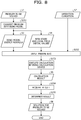
- FIG. 8 is a flowchart of a process when using the Ising calculation device.
- a user who uses the Ising calculation device 1 is referred to as a user.
- An overall flow of use of the Ising calculation device 1 by the user will be described with reference to FIG. 8 .
- step S151 There is a problem to be solved 51 that the user desires to solve.
- the user converts the problem to be solved into the Ising model using a computer or the like (step S151). With this conversion, an Ising model energy formula 53 expressed by the formula (1) is acquired. Moreover, initial values 54 of the spin state and the local field are acquired.
- the Ising model energy formula 53, the initial values 54 of the spin state and the local field, and operation conditions 52 for executing the optimum solution search process such as the number of iterations of operation are input to the Ising calculation device 1 as parameters (step S152).
- step S153 This process is the optimum solution search process by the Ising calculation device 1 described above. By executing this operation, a calculation result 56 is obtained.
- the user acquires the calculation result 56 (step S154). Then, the user interprets the acquired calculation result 56 (step S155). With the interpretation, the user obtains the calculation result 56 for the problem to be solved with respect to the problem to be solved 51.
- the Ising calculation device introduces the auxiliary spin capable of taking multiple values and performs the search process for the optimization problem having the range constraint.
- the auxiliary spin capable of taking multiple values and performs the search process for the optimization problem having the range constraint.
- an increase in resources for setting the conditions of the range constraint can be suppressed, and the scale of the problem to be dealt with can be increased.
- the ratio of the auxiliary spin to the normal spin can be suppressed to a low value, the search efficiency can be improved, and the time to reach the minimum energy can be shortened. Therefore, the processing performance of the Ising calculation device for the combinatorial optimization problem, particularly the processing performance for solving the optimization problem having the range constraint can be improved.
- the initial value of the auxiliary spin can be another value.
- the initial value of the auxiliary spin may be another lower limit value.
- the initial value of the auxiliary spin may be set to the lower limit value such as 0, it takes time for the auxiliary spin value to reach the upper limit value, so that extra time is needed when the vicinity of the upper limit value is close to the optimum solution. Therefore, the initial value of the auxiliary spin may be set to the upper limit value.
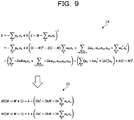
- FIG. 9 is a diagram illustrating a calculation example regarding the auxiliary spins according to the modification of the first embodiment.
- the difference in the case of increasing the value of y 0 from M to M + 1 and the difference in the case of decreasing the value of y 0 from M to M - 1 from the transformed formula of the transformation 14 are expressed by the formula 15.
- the energy change amount and the change amount in the value of the local field when the spin state has changed can be calculated by the formulas (11) and (12).
- the annealing unit 10, the inverted spin selection unit 50, the energy calculation unit 60, and the search result holding unit 70 can similarly perform the operation to the first embodiment and execute the optimum solution search process.
- the search time can be shortened when the optimum solution is obtained in a range close to the upper limit value.
- the capacity of the knapsack is the upper limit value, and the optimum solution can be obtained in the range close to the upper limit value. Therefore, the search time to reach the optimum solution can be shortened by adopting the method of decreasing the value from the upper limit value as in the modification.
- An Ising calculation device is different from that in the first embodiment in giving a priority in selecting which of an addition flag or a subtraction flag is made valid in a case where both of addition candidate determination and subtraction candidate determination are possible.
- An Ising calculation device 1 and an annealing unit 10 according to the present embodiment are also illustrated in FIGs. 1 and 3 . In the following description, description of operation of each unit similar to that of the first embodiment is omitted.
- a flag generation unit 105 of the annealing unit 10 has three selection methods of "addition priority”, “subtraction priority”, and “random” as the method of selecting the addition flag and the subtraction flag. Then, the flag generation unit 105 receives an instruction from the operator and adopts a selection method designated by the operator from the three "addition priority", “subtraction priority”, and "random”.
- the flag generation unit 105 receives inputs of a spin state of a case of adding 1 and an auxiliary spin of a case of subtracting 1. Then, the flag generation unit 105 identifies availability of addition candidate determination according to whether the spin state of a case of adding 1 is equal to or smaller than an upper limit value. Furthermore, the flag generation unit 105 identifies availability of subtraction candidate determination according to whether the spin state of a case of subtracting 1 is equal to or larger than a lower limit value. Then, the flag generation unit 105 generates an inversion candidate flag in a case where an energy change amount satisfies an inversion determination formula.
- the flag generation unit 105 selects either one of the determinations.
- the flag generation unit 105 preferentially selects and makes the addition flag valid.
- the flag generation unit 105 preferentially selects and makes the subtraction flag valid.
- the flag generation unit 105 randomly selects and makes the addition flag or the subtraction flag valid.
- the auxiliary spin is the capacity of the knapsack, and the total value of items is likely to become higher as the value is larger. Therefore, by giving priority to addition and obtaining the optimum solution with a value close to the upper limit value, a search time to reach the optimum solution can be shortened.
- a setting register may be prepared for each annealing unit 10 having each auxiliary spin as the own spin, so that a selection rule by the flag generation unit 105 can be switched according to a set value.
- the Ising calculation device can preferentially select either the addition or subtraction in the case where both the spin state where addition has been performed and the spin state where subtraction has been performed for the value of the auxiliary spin are selectable as an inverted spin.
- the time to reach the optimum solution can be shortened when giving priority to addition, or the time to reach the optimum solution can be shortened when giving priority to subtraction. Therefore, by giving priority and selecting addition or subtraction for the value of the auxiliary spin, the time to reach the optimum solution can be shortened, and the process performance of the Ising calculation device for the combinatorial optimization problem can be improved.
Landscapes
- Engineering & Computer Science (AREA)
- Theoretical Computer Science (AREA)
- Physics & Mathematics (AREA)
- General Physics & Mathematics (AREA)
- Business, Economics & Management (AREA)
- Software Systems (AREA)
- Human Resources & Organizations (AREA)
- Strategic Management (AREA)
- Evolutionary Computation (AREA)
- Artificial Intelligence (AREA)
- Computing Systems (AREA)
- General Engineering & Computer Science (AREA)
- Mathematical Physics (AREA)
- Data Mining & Analysis (AREA)
- Economics (AREA)
- Entrepreneurship & Innovation (AREA)
- Computational Linguistics (AREA)
- Game Theory and Decision Science (AREA)
- General Business, Economics & Management (AREA)
- Development Economics (AREA)
- Tourism & Hospitality (AREA)
- Quality & Reliability (AREA)
- Operations Research (AREA)
- Marketing (AREA)
- Computer Vision & Pattern Recognition (AREA)
- Medical Informatics (AREA)
- Algebra (AREA)
- Computational Mathematics (AREA)
- Educational Administration (AREA)
- Mathematical Analysis (AREA)
- Mathematical Optimization (AREA)
- Pure & Applied Mathematics (AREA)
- Probability & Statistics with Applications (AREA)
- Management, Administration, Business Operations System, And Electronic Commerce (AREA)
Abstract
Description
- The embodiments discussed herein are related to an optimization apparatus, an optimization method, and an optimization program.
- In our society, a large number of "combinatorial optimization problems" is present, in which an optimum combination is selected from among combinations of large number of elements under constraints such as limited people, time, or the like, regarding disaster recovery procedures, delivery route optimization, or the like. One of these methods of searching for an optimum solution of the combinatorial optimization problem is an Ising calculation device obtained by applying a simulated annealing method that is one type of Monte Carlo method and is a method for stochastically obtaining a solution using a random number value.
- The Ising calculation device is a calculation device that searches for a combination of variables that minimizes energy of an Ising model expressed by a predetermined evaluation formula. There are some cases where the variables are referred to as a spin, values of the variables are referred to as a spin state, and a transition of the spin state is referred to as inversion.
- An
Ising calculation device 1 is an optimizer that searches for a combination (x0, x1,..., xn) of variables xi that minimizes energy of the Ising model expressed by the formulas (1) to (4) that are evaluation functions. Here, a variable xi in the formula (1) is a state variable and takes a value of zero or one. Wij is an interaction coefficient and bi is a value called magnetic field term.
[Formula. 1]
[Formula. 2]
[Formula. 3]
[Formula. 4]
- Here, E represents energy, and ΔEi represents an energy change amount in a case where xi is inverted. Furthermore, hi represents a local field with xi, and δhi represents a change amount of the local field with xi. Furthermore, in the following description, there are some cases where the energy change amount is represented as ΔE.
- By formulating an actual problem into the Ising model energy formula expressed by the formula (1) and searching for a combination of spin states that minimizes the energy by the Ising calculation device, various types of combinatorial optimization problems can be solved.
- The Ising calculation device determines, for each spin, presence or absence of inversion on the basis of an inversion determination formula, sequentially transitions the state, and searches for the minimum energy. Then, by formulating the actual problem into the Ising model energy formula and searching for the combination of spin states that minimizes the energy by the Ising calculation device, various types of combinatorial optimization problems can be solved.
- Here, a minimum energy search method using the simulated annealing method will be simply described. The Ising calculation device starts a search from an initial state in which zero or one is assigned to each variable of the evaluation function expressing a problem to be solved. Then, the Ising calculation device selects a state close to a current state from the current state of the combination of the variables, and considers a state transition. The state close to the current state is, for example, a state in which a state of one variable is changed. Next, the Ising calculation device calculates the energy change amount for the state, and stochastically selects whether or not to adopt the state transition or to maintain the original state without adopting the state transition according to the calculated value. When setting an adoption probability of decreasing the energy to be higher than an adoption probability of increasing the energy, the state is averagely changed in the direction of decreasing the energy, and the Ising calculation device can finally reach the optimum solution or reach the energy close to the optimum solution. If deterministically adopting the state transition in the case of decreasing the energy and not adopting the state transition in the case of increasing the energy, the change in the energy monotonously decreases with respect to time in a broad sense. However, when the Ising calculation device reaches a local solution, no more state transition occurs, and it is difficult to expect to reach the optimum solution. Therefore, in the search in the combinatorial optimization problem, it is important to stochastically determine whether or not to adopt the state transition.
- Moreover, there may be a range constraint for variables when the Ising calculation device solves a problem. As such a problem, for example, there is a knapsack problem in which target baggage to be put in a knapsack is selected within a range not exceeding the maximum capacity of the knapsack from a plurality of pieces of baggage with determined "capacity" and "value", and a combination that maximizes the value of the put baggage is obtained. When solving such a problem to which the range constraint for variables is given, a known Ising calculation device introduces an auxiliary spin representing the range constraint into an evaluation formula.
- For example, to solve the knapsack problem using the Ising calculation device, the target to be minimized needs to be expressed by the mathematical formula (1). Therefore, it is assumed that whether or not to put each piece of baggage in the knapsack is represented by the variable xi, and the baggage is not put in the knapsack in the case of xi = 0, and the baggage is put in the knapsack in the case of xi = 1. Moreover, the capacity of each piece of baggage is represented by Wi and the value of the baggage is represented by pi, and the target to be minimized is represented by a value obtained by adding a minus sign to a total value of items put in the knapsack. The value is expressed by the first term of the following formula (5).
[Formula. 5]
- Moreover, a condition of not exceeding the maximum capacity of the knapsack is added as a constraint term. Since the condition of not exceeding the maximum capacity of the knapsack means that the total capacity of the loaded baggage is equal to a certain value in a range that is equal to or larger than 0 and equal to or smaller than the maximum capacity, the second term is added as in the formula (5) so that a value k of the constraint term is added as a penalty in the case where the total capacity becomes a value other than the certain value. Here, y0 to ym are auxiliary spins, and the total number of auxiliary spins having a value of 1 represents the range constraint.
- Note that, in performing the annealing method, there is a known technology of stochastically selecting a transition state after adding an offset to an energy change value so that an offset value of a local solution with minimum energy becomes larger than an offset value in a case where the energy is not minimum.
- [PTL 1] Japanese Laid-open Patent Publication No.
2018-63626 - However, in the method of introducing the auxiliary spins and solving a problem in which the range constraint for variables is given, the auxiliary spins are prepared according to the number of possible values. Therefore, even if the number of range constraint conditions is one, many spins are used. For example, in a case of formulating a knapsack problem of putting six items in a knapsack with the maximum value of 190, using the auxiliary spins, 190 spins are introduced for the range constraint condition.
- Furthermore, in this case, there is also a method of representing the range constraint by a value obtained by subtracting the value of the auxiliary spins from the maximum capacitance of the knapsack instead of representing the entire range of 0 to 190 by the 190-bit auxiliary spins, and narrowing the auxiliary spins to 10 bits and allowing 180 to 190, for example. However, this method still uses many auxiliary spins. Furthermore, the range is predicted and narrowed down before the problem is solved, but if this prediction is incorrect, the solution may not be reached.
- From the above discussion, when many spins are allocated to the auxiliary spins from among limited spins usable by the Ising calculation device, the scale of a problem to be handled is limited. Furthermore, when searching for the minimum energy, the auxiliary spins occupy a larger ratio than the normal spins, and tend to be easily selected in a case of inversion candidates. Therefore, the selection of the spin state is biased, the search efficiency is deteriorated, and the time to reach the minimum energy becomes long. As described above, the improvement of the process performance for the combinatorial optimization problem is difficult in the case where the range constraint is present.
- Furthermore, in the known technology of stochastically selecting the transition state after adding an offset to an energy change value, the auxiliary spins are introduced in the same manner and the improvement of the process performance for the combinatorial optimization problem is difficult in the case where the range constraint is present.
- The disclosed technology has been made in view of the foregoing, and an object is to provide an optimizer, an optimization method, and an optimization program that improve the process performance for the combinatorial optimization problem.
- In one aspect of an optimization device, optimization method and optimization program disclosed in the present application, a temperature control unit configured to control a temperature value indicating a temperature. An annealing unit configured to calculate a change amount of energy represented by an evaluation function of a case of changing a state of any one of a plurality of state variables so as to increase or decrease a value by 1 in a case of a state variable taking multiple values, the evaluation function representing the energy including the plurality of state variables in which the state variable is included, and determine whether to set a state change in the state variable as a candidate according to a correlation between a threshold and a total change amount, the threshold being calculated based on the temperature value and a random number value, the total change amount being obtained by the calculated change amount of energy. A determination unit configured to stochastically determine whether to adopt the state change set as the candidate. An energy calculation unit configured to calculate post-transition energy after executing a state transition of the state variable according to the state change. A search unit configured to obtain minimum energy by setting the post-transition energy as the minimum energy when the post-transition energy is less than the minimum energy.
- In one aspect, the present embodiments can improve the process performance for the combinatorial optimization problem.
-
-
FIG. 1 is a block diagram of an Ising calculation device; -
FIG. 2 is a diagram illustrating a calculation example regarding auxiliary spins according to a first embodiment; -
FIG. 3 is a block diagram illustrating details of an annealing unit; -
FIG. 4 is a diagram illustrating an example of a file for an initial setting instruction; -
FIG. 5A is a flowchart of an optimum solution search process by an Ising calculation device according to the first embodiment; -
FIG. 5B is a flowchart of an optimum solution search process by an Ising calculation device according to the first embodiment; -
FIG. 6 is an arrangement configuration diagram of the Ising calculation device; -
FIG. 7 is a diagram of a circuit image of a unit circuit; -
FIG. 8 is a flowchart of a process when using the Ising calculation device; and -
FIG. 9 is a diagram illustrating a calculation example regarding the auxiliary spins according to a modification of the first embodiment. - Hereinafter, examples of an optimizer, an optimization method, and an optimization program disclosed herein will be described in detail with reference to the drawings. Note that the following examples do not limit the optimizer, the optimization method, and the optimization program disclosed herein.
-
FIG. 1 is a block diagram of an Ising calculation device. AnIsing calculation device 1 includes a plurality ofannealing units 10, atemperature control unit 20, athreshold generation unit 30, a randomnumber generation unit 40, an invertedspin selection unit 50, anenergy calculation unit 60, and a search result holding unit 70. For example, one-thousand and twenty-fourannealing units 10 are mounted on the singleIsing calculation device 1. "Inversion" in the following description includes a change in a value of an auxiliary spin in addition to a known change in a spin state from 0 to 1 or 1 to 0. - The
Ising calculation device 1 according to the present embodiment is an optimizer that searches for a combination (x0, x1,..., xn) of variables xi that minimizes energy of an Ising model expressed by the formula (1) that is an evaluation function.
[Formal. 6]
- Here, E in the formula (6) represents energy. Then, the variable xi in the formula (6) is a state variable and takes a value of zero or one. Furthermore, the variable y0 is a condition of a range constraint, and can take an arbitrary value in a preset range. Note that the variable y0 is incremented or decremented by one at a time. Moreover, k in the formula (6) is a coefficient of a constraint term.
- In the following description, the variable xi is called "spin", and the value of the variable xi is called "spin state". The spin state is represented as 0 or 1. Furthermore, the variable y0 is called "auxiliary spin". That is, there is one auxiliary spin in this case. Then, since the variable y0 takes an arbitrary value in a predetermined range, the value given to the variable y0 is called spin state for the variable y0.
- Furthermore, hereinafter, transition of the spin state and change in the value of the auxiliary spin are referred to as "inversion". That is, the inversion corresponds to transition of the spin state from 0 to 1, transition of the spin state from 1 to 0, change in the value of y0 from M to M + 1, or a change in the value of y0 from M to M - 1.
- The formula (6) can be transformed as illustrated in the
transformation 11 inFIG. 2. FIG. 2 is a diagram illustrating a calculation example regarding auxiliary spins according to the first embodimet. A difference in the case of increasing the value of y0 from M to M + 1 and a difference in a case of decreasing the value of y0 from M to M - 1 from the transformed formula of thetransformation 11 are expressed by theEquation 12. That is, an energy change amount in the case of increasing or decreasing the value of the auxiliary spin in this case is expressed by the following formula (7).
[Formula. 7]
- Moreover, a local field in the auxiliary spin is expressed by the following formula (8).
[Formula. 8]
- Furthermore, a change amount in the local field in the auxiliary spin when spin inversion occurs is expressed by the following formula (9).
[Formula. 9]
- The formula (9) expresses, from the top, the change amount in the local field in the case where the auxiliary spin increases by 1, the change amount in the local field in the case where the auxiliary spin decreases by 1, the change amount in the local field in the case where the spin state changes from 0 to 1, and the change amount in the local field in the case where the spin state changes from 1 to 0.
- Here, a case where a value of an interaction coefficient Wij with respect to the auxiliary spin is expressed by the following formula (10) will be described.
[Formula. 10]
- In this case, the energy change amount in the case where the spin state changes in addition to the normal spin and the auxiliary spin are expressed by the following formula (11). The coefficient k of the constraint term in the formula (11) is set to "0" in the case of the normal spin.
[Formula. 11]
- Moreover, the change amount in the value of the local field in that case is expressed by the following formula (12).
[Formula. 12]
- Here, in the evaluation function according to the present embodiment, the change amount in the auxiliary bit changes by one at a time. Therefore, the auxiliary bit is set to be able to take multiple values but calculation of the value of the auxiliary bit in each operation is addition or subtraction of 1, and the calculation of the auxiliary bit does not become large. Then, regarding the value of the auxiliary bit, it is possible to cover the range of values that can be taken by the auxiliary bit by determining whether it is energetically advantageous when changing the value, and selecting the value of the auxiliary bit.
- In the present embodiment, a case of using a lower limit value of the range constraint represented by the auxiliary spin y0 as an initial value of the constraint term will be described.
- The
temperature control unit 20 is a circuit that controls a value of a temperature parameter. The temperature parameter is a temperature value used to control the temperature. Hereinafter, there are some cases where the temperature parameter is represented as T. - The
temperature control unit 20 lowers the temperature by gradually decreasing the value of the temperature parameter according to the number of iterations of the search, starting from a sufficiently high initial temperature, according to a simulated annealing method, for example. Starting from an initial state, the iteration is repeated while lowering the temperature by thetemperature control unit 20. When a termination determination condition such as achievement of a certain number of iterations or a value of energy falling below a certain value is satisfied, the operation is terminated. In addition, thetemperature control unit 20 can use a replica exchange method for searching for the minimum energy while switching a low temperature condition and a high temperature condition by executing several systems called replicas having different temperature conditions in parallel and exchanging the systems for each of the predetermined number of iterations. - The random
number generation unit 40 is a circuit that generates a random number value. The randomnumber generation unit 40 outputs the generated random number to thethreshold generation unit 30 and the invertedspin selection unit 50. - The
threshold generation unit 30 is a circuit that generates a threshold used for determining whether or not each spin becomes an inversion candidate. Thethreshold generation unit 30 acquires the temperature parameter from thetemperature control unit 20. Furthermore, thethreshold generation unit 30 acquires the random number value from the randomnumber generation unit 40. - Here, in the present embodiment, inversion of the variables is adopted according to the following formula (13). For example, the inversion of the variables is adopted with e-ΔE/T or 1, whichever is smaller, as an adoption probability.
[Formula. 13]
- In the present embodiment, the inverted spin is stochastically adopted according to the formula (13) according to the random number generated by the random
number generation unit 40. In this case, the condition that the adoption probability is according to the formula (13) is the same as that the inversion is adopted in a case where the following formula (14) is satisfied using a uniform random number r.
[Formula. 14]
- The formula (14) is a formula for determining whether or not to adopt the inversion, and may be referred to as "inversion determination formula" below.
- Therefore, the
threshold generation unit 30 generates a value of a right side of the formula (14), using the temperature parameter and the random number value. Then, thethreshold generation unit 30 outputs the generated value of the right side of the formula (14) to theannealing unit 10. - The
annealing unit 10 holds the spin state and the local field for one spin of the spin or the auxiliary spin. Hereinafter, the spin or the auxiliary spin to be controlled by each annealingunit 10 is referred to as own spin. Then, theannealing unit 10 is a circuit that determines whether or not the own spin becomes the inversion candidate on the basis of the energy change amount when the own spin is inverted. Details of theannealing unit 10 will be described below with reference toFIG. 2 .FIG. 3 is a block diagram illustrating details of the annealing unit. As illustrated inFIG. 1 , the plurality ofannealing units 10 exists. Then, therespective annealing units 10 control different spins but execute the same process. Therefore, aspecific annealing unit 10 will be described below. - As illustrated in
FIG. 3 , theannealing unit 10 includes a localfield management unit 101, a spinstate management unit 102, an energy changeamount calculation unit 103, a constraint termcoefficient holding unit 104, aflag generation unit 105, a constraintvalue holding unit 106, and a spinnumber holding unit 107. - The spin
number holding unit 107 holds a spin number for identifying the own spin. For example, the spin number corresponds to a number for identifying i or the auxiliary spin y0 in the case where the spin is represented as xi. If theannealing unit 10 has the own spin that is a spin xi, the spinnumber holding unit 107 holds i as a spin number used to identify the spin xi. Furthermore, in the case of theannealing unit 10 in which the own spin is the auxiliary spin y0, the spinnumber holding unit 107 holds i as the spin number for identifying the auxiliary spin y0. Then, the spinnumber holding unit 107 outputs the held spin number to the spinstate management unit 102 and the invertedspin selection unit 50. - The spin
state management unit 102 holds the current spin state of the own spin and manages the spin state of the own spin. For example, the spinstate management unit 102 receives setting of an initial value of the spin state of the own spin when an optimum solution search process is started. For example, in a case where the initial values of xi are all 0, the spinstate management unit 102 of theannealing unit 10 in which the own spin is the spin xi acquires the value of 0 as the initial value. Furthermore, since the initial value of the constraint term is 0 in the present embodiment, the spinstate management unit 102 of theannealing unit 10 in which the own spin is the auxiliary spin y0 acquires the value of 0 as the initial value. -
FIG. 4 is a diagram illustrating an example of a file for an initial setting instruction. In the present embodiment, the initial values of the spin states of the respective spins are all 0, so the spin states infile 13 are all set to 0. When theIsing calculation device 1 reads thefile 13, each spin state registered in thefile 13 is set in each spinstate management unit 102. - Furthermore, the spin
state management unit 102 acquires the spin number from the spinnumber holding unit 107. Then, the spinstate management unit 102 outputs the spin state together with the spin number to theflag generation unit 105. - Thereafter, in the case where the inversion is adopted by the inverted
spin selection unit 50, the spinstate management unit 102 receives an inverted spin determination notification together with the spin number of the inverted spin from the invertedspin selection unit 50. Furthermore, the spinstate management unit 102 receives an input of either an addition flag representing inversion of adding 1 to the spin or a subtraction flag representing inversion of subtracting 1 from the auxiliary spin from the invertedspin selection unit 50. Then, the spinstate management unit 102 executes the following process in the case where the inverted spin is the own spin. The spinstate management unit 102 updates the held value with a value obtained by adding 1 to the current spin value as a new spin value in the case of the addition flag. Furthermore, the spinstate management unit 102 updates the held value with a value obtained by subtracting 1 from the current spin value as a new spin value in the case of the subtraction flag. - The local
field management unit 101 holds information regarding a current local field and manages a local field corresponding to the own spin. Here, since the energy change amount in the case where the own spin is inverted can be calculated from the formula (11) on the basis of the local field and the spin state, the localfield management unit 101 holds the information regarding the local field for each annealingunit 10 for allowing theannealing unit 10 to calculate the energy change amount. Then, the localfield management unit 101 outputs the held local field to the energy changeamount calculation unit 103. - More specifically, the local
field management unit 101 receives setting of an initial value of the local field with respect to the own spin when the optimum solution search process is started. For example, when theIsing calculation device 1 reads thefile 13 ofFIG. 4 , the local field of each spin registered in thefile 13 is set in the localfield management unit 101. In addition, the localfield management unit 101 may calculate the initial value of the local field with respect to the own spin by receiving an input of the initial value of each spin. - After that, when the inversion is adopted by the inverted
spin selection unit 50 and the inverted spin is determined, the localfield management unit 101 receives the inverted spin determination notification together with the spin number of the inverted spin from the invertedspin selection unit 50. Next, the localfield management unit 101 calculates a change amount of the local field, using the spin number of the inverted spin of which the inversion is determined in the formula (12). Then, the localfield management unit 101 calculates the local field with respect to the own spin, using the calculated change amount of the local field for the held information regarding the local field. Thereafter, the localfield management unit 101 updates the held information regarding the local field with information regarding the calculated local field as information regarding the current local field. - The constraint term
coefficient holding unit 104 is, for example, a register. Then, the constraint termcoefficient holding unit 104 holds a predetermined value of the coefficient of the constraint term corresponding to k in the formula (6). For example, when theIsing calculation device 1 reads thefile 13 ofFIG. 4 , the constraint termcoefficient holding unit 104 stores a constraint term coefficient of each spin registered in thefile 13. As illustrated in thefile file 13, the constraint term coefficient for the auxiliary spin y0 is set to 100. - The energy change
amount calculation unit 103 receives an input of the information regarding the local field from the localfield management unit 101. Furthermore, the energy changeamount calculation unit 103 acquires the coefficient of the constraint term corresponding to k in the formula (6) from the constraint termcoefficient holding unit 104. Then, the energy changeamount calculation unit 103 calculates the energy change amount by the inversion of the own spin, using the formula (11). After that, the energy changeamount calculation unit 103 outputs the calculated energy change amount by the inversion of the own spin to theflag generation unit 105. - The constraint
value holding unit 106 is, for example, a register. Then, the constraintvalue holding unit 106 holds an upper limit value and a lower limit value in the range constraint. In the case where the own spin is the normal spin, the upper limit value is set to 1 and the lower limit value is set to 0, so that the spin state falls within the range of the range constraint. For example, when theIsing calculation device 1 reads thefile 13 ofFIG. 4 , the constraintvalue holding unit 106 stores the upper limit value and the lower limit value for each spin registered in thefile 13. As illustrated in thefile file 13, predetermined values are set as the upper limit value and the lower limit value for the auxiliary spin y0. In the case of using thefile 13, the upper limit value for the auxiliary spin y0 is set to 190, and the lower limit value for the auxiliary spin y0 is set to 0. This is a setting for solving the knapsack problem when packing items in the knapsack having the maximum capacity of 190, for example. - The
flag generation unit 105 receives an input of the spin state from the spinstate management unit 102. Furthermore, theflag generation unit 105 acquires the upper limit value and the lower limit value in the range constraint from the constraintvalue holding unit 106. Furthermore, theflag generation unit 105 receives an input of the energy change amount from the energy changeamount calculation unit 103. Moreover, theflag generation unit 105 receives an input of the value of the right side of the inversion determination formula expressed by the formula (14) from thethreshold generation unit 30. - Next, the
flag generation unit 105 determines whether or not the spin state after inversion is within the range of the upper limit value and the lower limit value. Then, theflag generation unit 105 determines that addition candidate determination is not possible in a case where the spin state matches the upper limit value, and determines that the addition candidate determination is possible in a case where the spin state is less than the upper limit value. Furthermore, theflag generation unit 105 determines that subtraction candidate determination is not possible in a case where the spin state matches the lower limit value, and determines that the subtraction candidate determination is possible in a case where the spin state exceeds the lower limit value. - Next, in a case where either one of or both of the addition candidate determination and the subtraction candidate determination are possible, the
flag generation unit 105 determines whether or not the energy change amount satisfies the inversion determination formula where the right side of the formula (14) is set to the value obtained from thethreshold generation unit 30. - In a case where the energy change amount satisfies the inversion determination formula, the
flag generation unit 105 generates an inversion candidate flag indicating that the own spin is an inversion candidate. On the other hand, in a case where the energy change amount does not satisfy the inversion determination formula, theflag generation unit 105 generates an inversion candidate flag indicating that the own spin is not the inversion candidate. For example, theflag generation unit 105 sets the value of F to 1 in the case where the inversion candidate flag indicates that the own spin is the inversion candidate, and sets the value of F to 0 in the case where the inversion candidate flag indicates that the own spin is not the inversion candidate, where the inversion candidate flag is F. - Next, in the case where the own spin is the auxiliary spin, the
flag generation unit 105 can transition to the spin state where 1 is added to the value of the current auxiliary spin y0, and to the spin state where 1 is subtracted from the value of the current auxiliary spin y0. In the case where transitions to two spin states are available, theflag generation unit 105 selects the spin state of the case of addition as the candidate when the addition candidate determination is possible and the subtraction candidate determination is not possible. On the contrary, theflag generation unit 105 selects the spin state of the case of subtraction as the candidate when the addition candidate determination is not possible and the subtraction candidate determination is possible. Furthermore, theflag generation unit 105 selects either one of the spin states in the case where both the addition candidate determination and the subtraction candidate determination are possible. Then, theflag generation unit 105 generates the addition flag in the case of selecting the transition to the spin state of the case of addition. Furthermore, theflag generation unit 105 generates the subtraction flag in the case of selecting the transition to the spin state of the case of subtraction. - Thereafter, the
flag generation unit 105 outputs the generated inversion candidate flag, and the addition flag or the subtraction flag, if any, to the invertedspin selection unit 50. Hereinafter, the inversion candidate flag, the addition flag, and the subtraction flag may be collectively referred to as flag(s). - Returning to
FIG. 1 , the description will be continued. The invertedspin selection unit 50 acquires the spin number of the own spin in each annealingunit 10 from the spinnumber holding unit 107 of each annealingunit 10. Furthermore, the invertedspin selection unit 50 receives an input of the own spin in each annealingunit 10. Furthermore, the invertedspin selection unit 50 receives an input of a random number from the randomnumber generation unit 40. - Then, the inverted
spin selection unit 50 confirms the inversion candidate flag acquired from each annealingunit 10 and determines whether or not there is an inversion candidate spin that is a spin having the inversion candidate flag representing that the spin becomes the inversion candidate. - In the case where the inversion candidate spin is present, the inverted
spin selection unit 50 selects one inversion candidate spin from among inversion candidate spins acquired according to the acquired random number from the randomnumber generation unit 40. - Then, the inverted
spin selection unit 50 determines the selected inversion candidate spin as the inverted spin. Thereafter, the invertedspin selection unit 50 outputs the spin number and the spin state of the inverted spin together with the inverted spin determination notification to theenergy calculation unit 60 and the search result holding unit 70. The invertedspin selection unit 50 outputs the spin number of the inverted spin together with the inverted spin determination notification to theannealing unit 10. At this time, in the case of including the addition flag or the subtraction flag, the invertedspin selection unit 50 outputs the included addition flag or subtraction flag to theannealing unit 10. - For example, the
energy calculation unit 60 preliminarily includes the initial values of the respective spins where all the spin states are 0. Then, theenergy calculation unit 60 obtains the energy, using the initial value of each spin in the formula (6) and holds the obtained energy. - Thereafter, the
energy calculation unit 60 receives inputs of the spin number and the spin state of the inverted spin together with the inverted spin determination notification from the invertedspin selection unit 50. Next, theenergy calculation unit 60 inverts the spin state of the spin having the spin number notified from the invertedspin selection unit 50 in the spin state of each spin held in theenergy calculation unit 60 and generates the spin state of each new spin. Furthermore, theenergy calculation unit 60 acquires the energy change amount in the case where the spin state of the inverted spin is inverted from the invertedspin selection unit 50. Then, theenergy calculation unit 60 adds the acquired energy change amount to the held energy value to calculate the energy of the case where the spin state of the inverted spin is inverted. - Thereafter, the
energy calculation unit 60 holds the spin state of each spin in the state where the spin state of the inverted spin is inverted. Moreover, theenergy calculation unit 60 outputs the calculated energy in the state where the spin state of the inverted spin is inverted to the search result holding unit 70. - The search result holding unit 70 receives an input of information of the calculated energy from the
energy calculation unit 60. Moreover, the search result holding unit 70 receives the inputs of the spin number and the spin state of the inverted spin from the invertedspin selection unit 50. Then, in a case where minimum energy is not held, the search result holding unit 70 sets the acquired energy as the minimum energy. In this case, the search result holding unit 70 holds the spin state of each spin in the case of the minimum energy. - On the other hand, in a case where the minimum energy has been already held, the search result holding unit 70 compares the acquired energy with the holding minimum energy. In a case where the acquired energy is less than the minimum energy, the search result holding unit 70 sets the acquired energy as the minimum energy. Moreover, the search result holding unit 70 holds the spin state of each spin in the case of the acquired energy. Meanwhile, in a case where the acquired energy is equal to or more than the minimum energy, the search result holding unit 70 continues to hold the held minimum energy and the spin state of each spin as they are. However, initial energy may be set as the initial value of the minimum energy. In that case, the state where the search result holding unit 70 does not hold the minimum energy is not present, and the process starts from the case where the search result holding unit 70 already holds the minimum energy. The search result holding unit 70 corresponds to an example of a "search unit".
- Next, a flow of the optimum solution search process by the
Ising calculation device 1 according to the present embodiment will be described with reference toFIG. 5A and5B .FIG. 5A and5B are flowcharts of the optimum solution search process by the Ising calculation device according to the first embodiment. - The
Ising calculation device 1 sets the initial value in each unit on the basis of, for example, the input file from an operator using an external terminal (not illustrated) or the like (step S101). For example, the spinstate management unit 102 of theannealing unit 10 sets the initial value of the spin state of the own spin. Furthermore, the spinnumber holding unit 107 sets the spin number of the own spin. Furthermore, the localfield management unit 101 sets the initial value of the local field for the own spin. Furthermore, the value of the constraint term coefficient is set in the constraint termcoefficient holding unit 104. Furthermore, the upper limit value and the lower limit value are set in the constraintvalue holding unit 106. - Next, the energy change
amount calculation unit 103 of theannealing unit 10 acquires the information regarding the local field held by the localfield management unit 101. Furthermore, the energy changeamount calculation unit 103 acquires the value of the constraint term coefficient to be used in the own spin from the constraint termcoefficient holding unit 104. Then, the energy changeamount calculation unit 103 calculates the energy change amount, at the time when the own spin is inverted, using the formula (11) (step S102). Here, the energy changeamount calculation unit 103 calculates both the energy change amount in the case of addition and the energy change amount in the case of subtraction in the case where the state transition in the case of addition and the state transition in the case of subtraction are present. Thereafter, the energy changeamount calculation unit 103 outputs the calculated energy change amount at the time of inversion of the own spin to theflag generation unit 105. - The
flag generation unit 105 identifies availability of each of the addition candidate determination and the subtraction candidate determination (step S103). - Next, the
flag generation unit 105 determines whether either the addition candidate determination or the subtraction candidate determination is possible (step S104). In the case where both the addition candidate determination and the subtraction candidate determination are not possible (step S104: negative), the optimum solution search process proceeds to step S107. Note that steps S102 to S106 are performed in parallel in each annealingunit 10, and all the results are input to the invertedspin selection unit 50. That is, there may be different processes such as acertain annealing unit 10 obtaining the negative determination in step S104 and proceeding to step S107, whereas anotherannealing unit 10 obtaining the affirmative determination in step S104 and proceeding to step S107 through steps S105 and S106. - Meanwhile, in the case where either the addition candidate determination or the subtraction candidate determination is possible (step S104: affirmative), the
flag generation unit 105 generates the inversion candidate flag according to a comparison result between the energy change amount and the threshold input from the threshold generation unit 30 (step S105). Specifically, in the case where the energy change amount satisfies the inversion determination formula in which the threshold is substituted, theflag generation unit 105 generates the inversion candidate flag representing that each spin becomes the inversion candidate. On the contrary, in the case where the energy change amount does not satisfy the inversion determination formula in which the threshold is substituted, theflag generation unit 105 generates the inversion candidate flag representing not the inversion candidate. - Moreover, the
flag generation unit 105 sets either the addition flag or the subtraction flag to be valid (step S106). Specifically, theflag generation unit 105 sets the addition flag to be valid in the case where the addition candidate determination is possible, or sets the subtraction flag to be valid in the case where the subtraction candidate determination is possible. Furthermore, in the case where both the addition candidate determination and the subtraction candidate determination are possible, theflag generation unit 105 selects either the addition flag or the subtraction flag and sets the selected flag to be valid. Thereafter, theflag generation unit 105 outputs the generated flag to the invertedspin selection unit 50. - The inverted
spin selection unit 50 receives an input of the spin number of the inversion candidate spin from the spinnumber holding unit 107. Furthermore, the invertedspin selection unit 50 receives an input of the flag from theflag generation unit 105. Then, the invertedspin selection unit 50 determines whether or not a spin with the valid inversion candidate flag is present (step S107). In a case where the spin with the valid inversion candidate flag is not present (step S107: negative), the optimum solution search process proceeds to step S114. - Meanwhile, in a case where the spin with the valid inversion candidate flag is present (step S107: affirmative), the inverted
spin selection unit 50 selects the spin according to the random number input from the randomnumber generation unit 40 from among the spins with the valid inversion candidate flag and determines the inverted spin (step S108). Thereafter, the invertedspin selection unit 50 outputs the inverted spin determination notification together with the spin number to theannealing unit 10, theenergy calculation unit 60, and the search result holding unit 70. Furthermore, in the case where either the addition flag or the subtraction flag is valid, the invertedspin selection unit 50 outputs the valid addition flag or subtraction flag to theannealing unit 10. - When receiving the inverted spin determination notification, the
energy calculation unit 60 inverts the spin state of the spin having the spin number acquired from the invertedspin selection unit 50 in the spin state of each held spin. Furthermore, theenergy calculation unit 60 acquires the energy change amount in the case where the spin state of the inverted spin is inverted from the invertedspin selection unit 50. Then, theenergy calculation unit 60 adds the acquired energy change amount to the held energy value to calculate the energy of the case where the spin state of the inverted spin is inverted. Thereafter, theenergy calculation unit 60 updates the spin state of each spin and the held information regarding energy (step S109). - Thereafter, the
energy calculation unit 60 outputs the calculated energy to the search result holding unit 70. The search result holding unit 70 determines whether or not the energy acquired from theenergy calculation unit 60 is less than the holding minimum energy (step S110). In a case where the energy acquired from theenergy calculation unit 60 is equal to or larger than the held minimum energy (step S110: negative), the optimum solution search process proceeds to step S112. - Meanwhile, in a case where the energy acquired from the
energy calculation unit 60 is less than the held minimum energy (step S110: affirmative), the search result holding unit 70 updates the held minimum energy with the energy acquired from theenergy calculation unit 60 as the minimum energy. Moreover, the search result holding unit 70 stores the spin state of each spin in which the spin state of the inverted spin is inverted in the spin state of each held spin as the spin state of the new minimum energy (step S111). - The
annealing unit 10 receives an input of the determination of the inverted spin together with the spin number of the inverted spin from the invertedspin selection unit 50. In the case where the inverted spin in which inversion is determined is the own spin, the spinstate management unit 102 updates the spin state of the own spin (step S112). Here, in the case where the addition flag or the subtraction flag is added, the spinstate management unit 102 updates the value of the spin according to the addition flag or the subtraction flag to update the spin state. - The local
field management unit 101 calculates the change amount of the local field, using the spin number of the inverted spin of which the inversion is determined in the formula (12). Here, in the case where the addition flag or the subtraction flag is added, the localfield management unit 101 calculates the change amount of the local field, using the interaction coefficient, according to the addition flag or the subtraction flag. Then, the localfield management unit 101 calculates the local field with respect to the own spin, using the calculated change amount of the local field for the held information regarding the local field. Thereafter, the localfield management unit 101 updates the held information regarding the local field with information of the calculated local field as information of the current local field (step S113). - Thereafter, the search result holding unit 70 determines whether or not a predetermined number of times of calculation is completed (step S114). In a case where the predetermined number of times of calculation is not completed (step S114: negative), the optimum solution search process returns to step S102. On the other hand, in a case where the predetermined number of times of calculation is completed (step S114: affirmative), the search result holding unit 70 determines the spin state with the minimum energy at that time as the optimum solution and terminates the optimum solution search process.
-
FIG. 6 is an arrangement configuration diagram of the Ising calculation device. TheIsing calculation device 1 according to the present embodiment corresponds to anannealing circuit 201 inFIG. 6 . Theannealing circuit 201 is a functional unit capable of executing annealing. Eachannealing circuit 201 includes a plurality ofunit circuits 202 and acontrol circuit 203. For example, one-thousand and twenty-fourunit circuits 202 are mounted on thesingle annealing circuit 201. Theunit circuit 202 is a unit of logic and implementation for single spin determination or state management and corresponds to theannealing unit 10 and the invertedspin selection unit 50. Furthermore, thecontrol circuit 203 is a circuit that controls theannealing circuit 201 and corresponds to theenergy calculation unit 60, the search result holding unit 70, and the like. That is, when a flag is generated in theunit circuit 202 and the inverted spin is determined thereafter, the spin state and the local field are updated in theunit circuit 202. - Furthermore,
FIG. 7 is a diagram of a circuit image of the unit circuit. Aregister 211 illustrated inFIG. 7 corresponds to an example of the constraint termcoefficient holding unit 104, and registers 216 and 217 correspond to examples of the constraintvalue holding unit 106. Furthermore, parts other than theregisters circuits 212 to 215 and 218 correspond to the energy changeamount calculation unit 103 and theflag generation unit 105. - The circuits in a
region 221 of theunit circuit 202 are circuits on the spin inversion determination side. Thecircuit 212 obtains the local field of the case of subtracting the value of the auxiliary spin or the case where the spin state of the normal spin transitions from 1 to 0, and generates the inversion candidate flag using the inversion determination formula. Furthermore, thecircuit 213 obtains the local field of the case of adding the value of the auxiliary spin or the case where the spin state of the normal spin transitions from 0 to 1, and generates the inversion candidate flag using the inversion determination formula. Thecircuit 215 determines whether the spin state after inversion is equal to or smaller than the upper limit value, and equal to or larger than the lower limit value, and identifies the availability of the addition candidate determination and the availability of the subtraction candidate determination. Then, thecircuit 215 generates the addition flag and the subtraction flag. Thecircuit 214 masks the spin state of the spin to which the inversion candidate flag is set not to exceed the constraint range, the inversion candidate flag representing that the spin becomes the inversion candidate according to the valid/invalid addition flag and the valid/invalid subtraction flag. Thereafter, in the case where both the inversion candidate flag on the addition side and the inversion candidate flag on the subtraction side are present, thecircuit 218 selects and outputs either one of them. Internally in theunit circuit 202, when the own spin is the auxiliary spin, the spin state takes multiple values but participates in a tournament with a value of 0 or 1. In this case, the value at the time of participating in the tournament is determined to represent, for example, 0 for addition and 1 for subtraction. Thereafter, the invertedspin selection unit 50 determines the inverted spin by the tournament using a signal output from thecircuit 218. - Furthermore, the circuit in a
region 222 of theunit circuit 202 is a circuit of the spin state and the local field update side. The circuit in theregion 222 is the circuit of the spin state and the local field update side, and updates the spin state and the local field, using the information of the determined inverted spin input from the invertedspin selection unit 50. The circuit in theregion 222 corresponds to an example of the localfield management unit 101 and the spinstate management unit 102. The local field and the spin state output from the circuit in theregion 222 are input to the circuits in theregion 221 and used for the calculation at the next inversion. -
FIG. 8 is a flowchart of a process when using the Ising calculation device. Here, a user who uses theIsing calculation device 1 is referred to as a user. An overall flow of use of theIsing calculation device 1 by the user will be described with reference toFIG. 8 . - There is a problem to be solved 51 that the user desires to solve. The user converts the problem to be solved into the Ising model using a computer or the like (step S151). With this conversion, an Ising
model energy formula 53 expressed by the formula (1) is acquired. Moreover,initial values 54 of the spin state and the local field are acquired. - Next, the Ising
model energy formula 53, theinitial values 54 of the spin state and the local field, and operation conditions 52 for executing the optimum solution search process such as the number of iterations of operation are input to theIsing calculation device 1 as parameters (step S152). - Thereafter, the
Ising calculation device 1 executes the operation (step S153). This process is the optimum solution search process by theIsing calculation device 1 described above. By executing this operation, acalculation result 56 is obtained. - The user acquires the calculation result 56 (step S154). Then, the user interprets the acquired calculation result 56 (step S155). With the interpretation, the user obtains the
calculation result 56 for the problem to be solved with respect to the problem to be solved 51. - As described above, the Ising calculation device according to the present embodiment introduces the auxiliary spin capable of taking multiple values and performs the search process for the optimization problem having the range constraint. As a result, an increase in resources for setting the conditions of the range constraint can be suppressed, and the scale of the problem to be dealt with can be increased. Furthermore, the ratio of the auxiliary spin to the normal spin can be suppressed to a low value, the search efficiency can be improved, and the time to reach the minimum energy can be shortened. Therefore, the processing performance of the Ising calculation device for the combinatorial optimization problem, particularly the processing performance for solving the optimization problem having the range constraint can be improved.
- The above description has been made using the case where the initial value of the auxiliary spin is 0, but the initial value of the auxiliary spin can be another value. For example, the initial value of the auxiliary spin may be another lower limit value. Moreover, in the case where the initial value of the auxiliary spin is set to the lower limit value such as 0, it takes time for the auxiliary spin value to reach the upper limit value, so that extra time is needed when the vicinity of the upper limit value is close to the optimum solution. Therefore, the initial value of the auxiliary spin may be set to the upper limit value.
- The evaluation function in the case where the initial value of the auxiliary spin is set to the upper limit value is expressed by the following formula (15). Here, C represents the upper limit value.
[Formula. 15]
- Here, in the case of M = Σym, the formula (15) can be transformed as in the
transformation 14 ofFIG. 9. FIG. 9 is a diagram illustrating a calculation example regarding the auxiliary spins according to the modification of the first embodiment. The difference in the case of increasing the value of y0 from M to M + 1 and the difference in the case of decreasing the value of y0 from M to M - 1 from the transformed formula of thetransformation 14 are expressed by theformula 15. In this case as well, by setting the term after the addition or subtraction after k as the local field in the auxiliary spin y0, the energy change amount and the change amount in the value of the local field when the spin state has changed can be calculated by the formulas (11) and (12). - Therefore, the
annealing unit 10, the invertedspin selection unit 50, theenergy calculation unit 60, and the search result holding unit 70 can similarly perform the operation to the first embodiment and execute the optimum solution search process. Note that, in this case, since the control to decrease the value setting the initial value of the auxiliary bit as the upper limit value is performed, the search time can be shortened when the optimum solution is obtained in a range close to the upper limit value. For example, in the case of a knapsack problem, the capacity of the knapsack is the upper limit value, and the optimum solution can be obtained in the range close to the upper limit value. Therefore, the search time to reach the optimum solution can be shortened by adopting the method of decreasing the value from the upper limit value as in the modification. - Next, a second embodiment will be described. An Ising calculation device according to the present embodiment is different from that in the first embodiment in giving a priority in selecting which of an addition flag or a subtraction flag is made valid in a case where both of addition candidate determination and subtraction candidate determination are possible. An
Ising calculation device 1 and anannealing unit 10 according to the present embodiment are also illustrated inFIGs. 1 and3 . In the following description, description of operation of each unit similar to that of the first embodiment is omitted. - A
flag generation unit 105 of theannealing unit 10 according to the present embodiment has three selection methods of "addition priority", "subtraction priority", and "random" as the method of selecting the addition flag and the subtraction flag. Then, theflag generation unit 105 receives an instruction from the operator and adopts a selection method designated by the operator from the three "addition priority", "subtraction priority", and "random". - In a case where an own spin is an auxiliary spin, the
flag generation unit 105 receives inputs of a spin state of a case of adding 1 and an auxiliary spin of a case of subtracting 1. Then, theflag generation unit 105 identifies availability of addition candidate determination according to whether the spin state of a case of adding 1 is equal to or smaller than an upper limit value. Furthermore, theflag generation unit 105 identifies availability of subtraction candidate determination according to whether the spin state of a case of subtracting 1 is equal to or larger than a lower limit value. Then, theflag generation unit 105 generates an inversion candidate flag in a case where an energy change amount satisfies an inversion determination formula. - Moreover, in the case where both the addition candidate determination and the subtraction candidate determination are possible, the
flag generation unit 105 selects either one of the determinations. At this time, when the addition priority is adopted as the selection method, theflag generation unit 105 preferentially selects and makes the addition flag valid. Furthermore, when the subtraction priority is adopted as the selection method, theflag generation unit 105 preferentially selects and makes the subtraction flag valid. In contrast, when the random is adopted as the selection method, theflag generation unit 105 randomly selects and makes the addition flag or the subtraction flag valid. - For example, a case of searching for an optimum solution of a knapsack problem will be described as an example. In this case, by giving priority to addition, more search processes for the optimum solution with a value closer to the upper limit value are executed than the case of random selection.
- In the case of a knapsack problem, the auxiliary spin is the capacity of the knapsack, and the total value of items is likely to become higher as the value is larger. Therefore, by giving priority to addition and obtaining the optimum solution with a value close to the upper limit value, a search time to reach the optimum solution can be shortened.
- Moreover, in a case of using a plurality of auxiliary spins taking multiple values, which of the addition or subtraction is prioritized may be different for each auxiliary spin. Therefore, a setting register may be prepared for each annealing
unit 10 having each auxiliary spin as the own spin, so that a selection rule by theflag generation unit 105 can be switched according to a set value. - As described above, the Ising calculation device according to the present embodiment can preferentially select either the addition or subtraction in the case where both the spin state where addition has been performed and the spin state where subtraction has been performed for the value of the auxiliary spin are selectable as an inverted spin. Depending on a target problem, for example, the time to reach the optimum solution can be shortened when giving priority to addition, or the time to reach the optimum solution can be shortened when giving priority to subtraction. Therefore, by giving priority and selecting addition or subtraction for the value of the auxiliary spin, the time to reach the optimum solution can be shortened, and the process performance of the Ising calculation device for the combinatorial optimization problem can be improved.
Claims (13)
- An optimization apparatus comprising:a temperature control unit configured to control a temperature value indicating a temperature;an annealing unit configured to calculate a change amount of energy represented by an evaluation function of a case of changing a state of any one of a plurality of state variables so as to increase or decrease a value by 1 in a case of a state variable taking multiple values, the evaluation function representing the energy including the plurality of state variables in which the state variable is included, and determine whether to set a state change in the state variable as a candidate according to a correlation between a threshold and a total change amount, the threshold being calculated based on the temperature value and a random number value, the total change amount being obtained by the calculated change amount of energy;a determination unit configured to stochastically determine whether to adopt the state change set as the candidate;an energy calculation unit configured to calculate post-transition energy after executing a state transition of the state variable according to the state change; anda search unit configured to obtain minimum energy by setting the post-transition energy as the minimum energy when the post-transition energy is less than the minimum energy.
- The optimization apparatus according to claim 1, wherein the annealing unit does not set the state change in the state variable as the candidate when the state of the state variable taking the multiple values in the case of changing the state does not fall within a range of an upper limit value or a lower limit value determined in advance.
- The optimization apparatus according to claim 2, wherein the annealing unit performs an addition state change of adding a value of 1 and a subtraction state change of subtracting a value of 1 when the state variable taking the multiple values, and selects and sets either the addition state change or the subtraction state change as the candidate when both the addition state change and the subtraction state change fall within the range.
- The optimization apparatus according to claim 3, wherein the annealing unit selects the addition state change or the subtraction state change, giving priority for selection to the addition state change and the subtraction state change.
- The optimization apparatus according to any one of claims 2 to 4, wherein the annealing unit sets the upper limit value or the lower limit value for an initial value of the state variable taking the multiple values.
- An optimization method comprising:controlling a temperature value indicating a temperature;calculating a change amount of energy represented by an evaluation function of a case of changing a state of any one of a plurality of state variables so as to increase or decrease a value by 1 in a case of a state variable taking multiple values, the evaluation function representing the energy including the plurality of state variables in which the state variable is included;determining whether to set a state change in the state variable as a candidate according to a correlation between a threshold and a total change amount, the threshold being calculated based on the temperature value and a random number value, the total change amount being obtained by the calculated change amount of energy;stochastically determining whether to adopt the state change set as the candidate;calculating post-transition energy after executing a state transition of the state variable according to the state change; andobtaining minimum energy by setting the post-transition energy as the minimum energy when the post-transition energy is less than the minimum energy.
- The optimization method according to claim 6, further comprising:performing an addition state change of adding a value of 1 and a subtraction state change of subtracting a value of 1 when the state variable taking the multiple values,wherein the determining includes selecting and setting either the addition state change or the subtraction state change as the candidate when both the addition state change and the subtraction state change fall within a range of an upper limit value or a lower limit value determined in advance.
- The optimization apparatus according to claim 7, wherein
the selecting includes:selecting the addition state change or the subtraction state change, andgiving priority for selection to the addition state change and the subtraction state change. - The optimization apparatus according to claims 7 to 8, wherein an initial value of the state variable is set to the upper limit value or the lower limit value.
- An optimization program executed by an optimization apparatus, the optimization program comprising:controlling a temperature value indicating a temperature;calculating a change amount of energy represented by an evaluation function of a case of changing a state of any one of a plurality of state variables so as to increase or decrease a value by 1 in a case of a state variable taking multiple values, the evaluation function representing the energy including the plurality of state variables in which the state variable is included;determining whether to set a state change in the state variable as a candidate according to a correlation between a threshold and a total change amount, the threshold being calculated based on the temperature value and a random number value, the total change amount being obtained by the calculated change amount of energy;stochastically determining whether to adopt the state change set as the candidate;calculating post-transition energy after executing a state transition of the state variable according to the state change; andobtaining minimum energy by setting the post-transition energy as the minimum energy when the post-transition energy is less than the minimum energy.
- The optimization program according to claim 1, further comprising:performing an addition state change of adding a value of 1 and a subtraction state change of subtracting a value of 1 when the state variable taking the multiple values, andthe determining includes selecting and setting either the addition state change or the subtraction state change as the candidate when both the addition state change and the subtraction state change fall within a range of an upper limit value or a lower limit value determined in advance.
- The optimization apparatus according to claim 11, wherein
the selecting includes:selecting the addition state change or the subtraction state change, andgiving priority for selection to the addition state change and the subtraction state change. - The optimization apparatus according to claims 11 to 12, wherein an initial value of the state variable taking the multiple values is set to the upper limit value or the lower limit value.
Applications Claiming Priority (1)
| Application Number | Priority Date | Filing Date | Title |
|---|---|---|---|
| JP2020077844A JP7528517B2 (en) | 2020-04-24 | 2020-04-24 | Optimization device, optimization method, and optimization program |
Publications (2)
| Publication Number | Publication Date |
|---|---|
| EP3901837A1 true EP3901837A1 (en) | 2021-10-27 |
| EP3901837B1 EP3901837B1 (en) | 2026-01-28 |
Family
ID=74758619
Family Applications (1)
| Application Number | Title | Priority Date | Filing Date |
|---|---|---|---|
| EP21159239.9A Active EP3901837B1 (en) | 2020-04-24 | 2021-02-25 | Optimization apparatus, optimization method, and optimization program |
Country Status (4)
| Country | Link |
|---|---|
| US (1) | US12614087B2 (en) |
| EP (1) | EP3901837B1 (en) |
| JP (1) | JP7528517B2 (en) |
| CN (1) | CN113554209A (en) |
Families Citing this family (2)
| Publication number | Priority date | Publication date | Assignee | Title |
|---|---|---|---|---|
| JP7795095B2 (en) * | 2022-03-31 | 2026-01-07 | 富士通株式会社 | Data processing device, program and data processing method |
| CN115858999B (en) * | 2023-02-07 | 2023-04-25 | 华南理工大学 | Combined optimization problem processing circuit based on improved simulated annealing algorithm |
Citations (3)
| Publication number | Priority date | Publication date | Assignee | Title |
|---|---|---|---|---|
| JP2018063626A (en) | 2016-10-14 | 2018-04-19 | 富士通株式会社 | Optimization device and control method of optimization device |
| US20190204794A1 (en) * | 2017-12-29 | 2019-07-04 | Fujitsu Limited | Optimization apparatus and optimization apparatus control method |
| EP3637202A1 (en) * | 2018-10-11 | 2020-04-15 | Fujitsu Limited | Optimization device and control method of optimization device |
Family Cites Families (8)
| Publication number | Priority date | Publication date | Assignee | Title |
|---|---|---|---|---|
| JP5864684B1 (en) | 2014-08-29 | 2016-02-17 | 株式会社日立製作所 | Semiconductor device |
| JP5865456B1 (en) | 2014-08-29 | 2016-02-17 | 株式会社日立製作所 | Semiconductor device |
| EP3398122B1 (en) * | 2015-12-30 | 2020-11-25 | Google LLC | Enhancing simulated annealing with quantum annealing |
| JP6892599B2 (en) * | 2017-07-05 | 2021-06-23 | 富士通株式会社 | Optimization device and control method of optimization device |
| JP6684259B2 (en) | 2017-10-19 | 2020-04-22 | 日本電信電話株式会社 | Potts model calculator |
| JP6993571B2 (en) * | 2018-01-17 | 2022-01-13 | 富士通株式会社 | Optimization device and control method of optimization device |
| JP7093009B2 (en) * | 2018-08-30 | 2022-06-29 | 富士通株式会社 | Optimization device, optimization device control method, and optimization device control program |
| JP7100257B2 (en) | 2018-10-04 | 2022-07-13 | 富士通株式会社 | Optimization device and control method of optimization device |
-
2020
- 2020-04-24 JP JP2020077844A patent/JP7528517B2/en active Active
-
2021
- 2021-02-25 EP EP21159239.9A patent/EP3901837B1/en active Active
- 2021-03-02 US US17/189,943 patent/US12614087B2/en active Active
- 2021-03-16 CN CN202110281645.7A patent/CN113554209A/en active Pending
Patent Citations (3)
| Publication number | Priority date | Publication date | Assignee | Title |
|---|---|---|---|---|
| JP2018063626A (en) | 2016-10-14 | 2018-04-19 | 富士通株式会社 | Optimization device and control method of optimization device |
| US20190204794A1 (en) * | 2017-12-29 | 2019-07-04 | Fujitsu Limited | Optimization apparatus and optimization apparatus control method |
| EP3637202A1 (en) * | 2018-10-11 | 2020-04-15 | Fujitsu Limited | Optimization device and control method of optimization device |
Non-Patent Citations (1)
| Title |
|---|
| SHAO WEI ET AL: "Multiple-Try Simulated Annealing Algorithm for Global Optimization", vol. 2018, 17 July 2018 (2018-07-17), CH, pages 1 - 11, XP055820066, ISSN: 1024-123X, Retrieved from the Internet <URL:https://downloads.hindawi.com/journals/mpe/2018/9248318.pdf> [retrieved on 20210804], DOI: 10.1155/2018/9248318 * |
Also Published As
| Publication number | Publication date |
|---|---|
| US20210334680A1 (en) | 2021-10-28 |
| US12614087B2 (en) | 2026-04-28 |
| JP7528517B2 (en) | 2024-08-06 |
| JP2021174260A (en) | 2021-11-01 |
| EP3901837B1 (en) | 2026-01-28 |
| CN113554209A (en) | 2021-10-26 |
Similar Documents
| Publication | Publication Date | Title |
|---|---|---|
| EP3757908B1 (en) | Optimization device and optimization method | |
| US9697471B2 (en) | Device and method for managing plant model | |
| US10885147B2 (en) | Optimization apparatus and control method thereof | |
| Aleti et al. | Test data generation with a Kalman filter-based adaptive genetic algorithm | |
| Fonseca et al. | On the computation of the empirical attainment function | |
| US20220343180A1 (en) | Learning device, learning method, and learning program | |
| EP3901837B1 (en) | Optimization apparatus, optimization method, and optimization program | |
| JP2016509271A (en) | Hierarchical hidden variable model estimation device | |
| EP3975032A1 (en) | Optimization apparatus, optimization method, and optimization program | |
| Zăvoianu et al. | Performance comparison of generational and steady-state asynchronous multi-objective evolutionary algorithms for computationally-intensive problems | |
| JPWO2016151620A1 (en) | SIMULATION SYSTEM, SIMULATION METHOD, AND SIMULATION PROGRAM | |
| Tang et al. | An improved genetic algorithm based on a novel selection strategy for nonlinear programming problems | |
| Langsari et al. | Optimizing effort parameter of COCOMO II using particle swarm optimization method | |
| Łapa | Meta-optimization of multi-objective population-based algorithms using multi-objective performance metrics | |
| Yang et al. | A new active learning method for reliability analysis based on local optimization and adaptive parallelization strategy | |
| Bierlaire et al. | A heuristic for nonlinear global optimization | |
| Chen et al. | HyperPlace: Harnessing a large language model for efficient hyperparameter optimization in GPU-accelerated VLSI placement | |
| Backenköhler et al. | Moment-based parameter estimation for stochastic reaction networks in equilibrium | |
| Arjmand et al. | Solving a multi-mode bi-objective resource investment problem using meta-heuristic algorithms | |
| EP4160489A1 (en) | Optimization program, optimization method, and optimization apparatus | |
| Hatherall et al. | Load prediction based remaining discharge energy estimation using a combined online and offline prediction framework | |
| Xu | Hybrid adaptive sequential sampling for reliability-based design optimization | |
| EP3896621B1 (en) | Optimization apparatus, optimization method, and optimization program | |
| Agostinelli | A Conflict-Driven Approach for Reaching Goals Specified with Negation as Failure | |
| US20240232646A1 (en) | Learning apparatus, prediction apparatus, learning method, prediction method and program |
Legal Events
| Date | Code | Title | Description |
|---|---|---|---|
| PUAI | Public reference made under article 153(3) epc to a published international application that has entered the european phase |
Free format text: ORIGINAL CODE: 0009012 |
|
| STAA | Information on the status of an ep patent application or granted ep patent |
Free format text: STATUS: THE APPLICATION HAS BEEN PUBLISHED |
|
| AK | Designated contracting states |
Kind code of ref document: A1 Designated state(s): AL AT BE BG CH CY CZ DE DK EE ES FI FR GB GR HR HU IE IS IT LI LT LU LV MC MK MT NL NO PL PT RO RS SE SI SK SM TR |
|
| B565 | Issuance of search results under rule 164(2) epc |
Effective date: 20210813 |
|
| STAA | Information on the status of an ep patent application or granted ep patent |
Free format text: STATUS: REQUEST FOR EXAMINATION WAS MADE |
|
| 17P | Request for examination filed |
Effective date: 20211221 |
|
| RBV | Designated contracting states (corrected) |
Designated state(s): AL AT BE BG CH CY CZ DE DK EE ES FI FR GB GR HR HU IE IS IT LI LT LU LV MC MK MT NL NO PL PT RO RS SE SI SK SM TR |
|
| STAA | Information on the status of an ep patent application or granted ep patent |
Free format text: STATUS: EXAMINATION IS IN PROGRESS |
|
| 17Q | First examination report despatched |
Effective date: 20241025 |
|
| REG | Reference to a national code |
Ref country code: DE Ref legal event code: R079 Free format text: PREVIOUS MAIN CLASS: G06N0005000000 Ipc: G06N0005010000 Ref country code: DE Ref legal event code: R079 Ref document number: 602021046592 Country of ref document: DE Free format text: PREVIOUS MAIN CLASS: G06N0005000000 Ipc: G06N0005010000 |
|
| GRAP | Despatch of communication of intention to grant a patent |
Free format text: ORIGINAL CODE: EPIDOSNIGR1 |
|
| STAA | Information on the status of an ep patent application or granted ep patent |
Free format text: STATUS: GRANT OF PATENT IS INTENDED |
|
| RIC1 | Information provided on ipc code assigned before grant |
Ipc: G06N 5/01 20230101AFI20250903BHEP Ipc: G06N 7/01 20230101ALI20250903BHEP |
|
| INTG | Intention to grant announced |
Effective date: 20250917 |
|
| GRAS | Grant fee paid |
Free format text: ORIGINAL CODE: EPIDOSNIGR3 |
|
| GRAA | (expected) grant |
Free format text: ORIGINAL CODE: 0009210 |
|
| STAA | Information on the status of an ep patent application or granted ep patent |
Free format text: STATUS: THE PATENT HAS BEEN GRANTED |
|
| AK | Designated contracting states |
Kind code of ref document: B1 Designated state(s): AL AT BE BG CH CY CZ DE DK EE ES FI FR GB GR HR HU IE IS IT LI LT LU LV MC MK MT NL NO PL PT RO RS SE SI SK SM TR |
|
| REG | Reference to a national code |
Ref country code: CH Ref legal event code: F10 Free format text: ST27 STATUS EVENT CODE: U-0-0-F10-F00 (AS PROVIDED BY THE NATIONAL OFFICE) Effective date: 20260128 Ref country code: GB Ref legal event code: FG4D |
|
| REG | Reference to a national code |
Ref country code: DE Ref legal event code: R096 Ref document number: 602021046592 Country of ref document: DE |
|
| REG | Reference to a national code |
Ref country code: IE Ref legal event code: FG4D |
|
| PGFP | Annual fee paid to national office [announced via postgrant information from national office to epo] |
Ref country code: GB Payment date: 20260225 Year of fee payment: 6 |
|
| PGFP | Annual fee paid to national office [announced via postgrant information from national office to epo] |
Ref country code: DE Payment date: 20260225 Year of fee payment: 6 |
|
| PGFP | Annual fee paid to national office [announced via postgrant information from national office to epo] |
Ref country code: FR Payment date: 20260225 Year of fee payment: 6 |