EP3901419B1 - Phonic wheel with output voltage tuning - Google Patents
Phonic wheel with output voltage tuning Download PDFInfo
- Publication number
- EP3901419B1 EP3901419B1 EP21175722.4A EP21175722A EP3901419B1 EP 3901419 B1 EP3901419 B1 EP 3901419B1 EP 21175722 A EP21175722 A EP 21175722A EP 3901419 B1 EP3901419 B1 EP 3901419B1
- Authority
- EP
- European Patent Office
- Prior art keywords
- phonic wheel
- sensor
- position markers
- physical configuration
- markers
- Prior art date
- Legal status (The legal status is an assumption and is not a legal conclusion. Google has not performed a legal analysis and makes no representation as to the accuracy of the status listed.)
- Active
Links
Images




Classifications
-
- F—MECHANICAL ENGINEERING; LIGHTING; HEATING; WEAPONS; BLASTING
- F01—MACHINES OR ENGINES IN GENERAL; ENGINE PLANTS IN GENERAL; STEAM ENGINES
- F01D—NON-POSITIVE DISPLACEMENT MACHINES OR ENGINES, e.g. STEAM TURBINES
- F01D17/00—Regulating or controlling by varying flow
- F01D17/02—Arrangement of sensing elements
- F01D17/06—Arrangement of sensing elements responsive to speed
-
- F—MECHANICAL ENGINEERING; LIGHTING; HEATING; WEAPONS; BLASTING
- F02—COMBUSTION ENGINES; HOT-GAS OR COMBUSTION-PRODUCT ENGINE PLANTS
- F02C—GAS-TURBINE PLANTS; AIR INTAKES FOR JET-PROPULSION PLANTS; CONTROLLING FUEL SUPPLY IN AIR-BREATHING JET-PROPULSION PLANTS
- F02C7/00—Features, components parts, details or accessories, not provided for in, or of interest apart form groups F02C1/00 - F02C6/00; Air intakes for jet-propulsion plants
-
- F—MECHANICAL ENGINEERING; LIGHTING; HEATING; WEAPONS; BLASTING
- F01—MACHINES OR ENGINES IN GENERAL; ENGINE PLANTS IN GENERAL; STEAM ENGINES
- F01D—NON-POSITIVE DISPLACEMENT MACHINES OR ENGINES, e.g. STEAM TURBINES
- F01D21/00—Shutting-down of machines or engines, e.g. in emergency; Regulating, controlling, or safety means not otherwise provided for
- F01D21/003—Arrangements for testing or measuring
-
- B—PERFORMING OPERATIONS; TRANSPORTING
- B64—AIRCRAFT; AVIATION; COSMONAUTICS
- B64C—AEROPLANES; HELICOPTERS
- B64C11/00—Propellers, e.g. of ducted type; Features common to propellers and rotors for rotorcraft
- B64C11/30—Blade pitch-changing mechanisms
-
- B—PERFORMING OPERATIONS; TRANSPORTING
- B64—AIRCRAFT; AVIATION; COSMONAUTICS
- B64C—AEROPLANES; HELICOPTERS
- B64C11/00—Propellers, e.g. of ducted type; Features common to propellers and rotors for rotorcraft
- B64C11/30—Blade pitch-changing mechanisms
- B64C11/301—Blade pitch-changing mechanisms characterised by blade position indicating means
-
- B—PERFORMING OPERATIONS; TRANSPORTING
- B64—AIRCRAFT; AVIATION; COSMONAUTICS
- B64C—AEROPLANES; HELICOPTERS
- B64C11/00—Propellers, e.g. of ducted type; Features common to propellers and rotors for rotorcraft
- B64C11/46—Arrangements of, or constructional features peculiar to, multiple propellers
- B64C11/50—Phase synchronisation between multiple propellers
-
- B—PERFORMING OPERATIONS; TRANSPORTING
- B64—AIRCRAFT; AVIATION; COSMONAUTICS
- B64D—EQUIPMENT FOR FITTING IN OR TO AIRCRAFT; FLIGHT SUITS; PARACHUTES; ARRANGEMENT OR MOUNTING OF POWER PLANTS OR PROPULSION TRANSMISSIONS IN AIRCRAFT
- B64D31/00—Power plant control systems; Arrangement of power plant control systems in aircraft
- B64D31/02—Initiating means
- B64D31/06—Initiating means actuated automatically
- B64D31/12—Initiating means actuated automatically for equalising or synchronising power plants
-
- F—MECHANICAL ENGINEERING; LIGHTING; HEATING; WEAPONS; BLASTING
- F02—COMBUSTION ENGINES; HOT-GAS OR COMBUSTION-PRODUCT ENGINE PLANTS
- F02C—GAS-TURBINE PLANTS; AIR INTAKES FOR JET-PROPULSION PLANTS; CONTROLLING FUEL SUPPLY IN AIR-BREATHING JET-PROPULSION PLANTS
- F02C9/00—Controlling gas-turbine plants; Controlling fuel supply in air- breathing jet-propulsion plants
-
- G—PHYSICS
- G01—MEASURING; TESTING
- G01D—MEASURING NOT SPECIALLY ADAPTED FOR A SPECIFIC VARIABLE; ARRANGEMENTS FOR MEASURING TWO OR MORE VARIABLES NOT COVERED IN A SINGLE OTHER SUBCLASS; TARIFF METERING APPARATUS; MEASURING OR TESTING NOT OTHERWISE PROVIDED FOR
- G01D5/00—Mechanical means for transferring the output of a sensing member; Means for converting the output of a sensing member to another variable where the form or nature of the sensing member does not constrain the means for converting; Transducers not specially adapted for a specific variable
- G01D5/12—Mechanical means for transferring the output of a sensing member; Means for converting the output of a sensing member to another variable where the form or nature of the sensing member does not constrain the means for converting; Transducers not specially adapted for a specific variable using electric or magnetic means
- G01D5/14—Mechanical means for transferring the output of a sensing member; Means for converting the output of a sensing member to another variable where the form or nature of the sensing member does not constrain the means for converting; Transducers not specially adapted for a specific variable using electric or magnetic means influencing the magnitude of a current or voltage
- G01D5/142—Mechanical means for transferring the output of a sensing member; Means for converting the output of a sensing member to another variable where the form or nature of the sensing member does not constrain the means for converting; Transducers not specially adapted for a specific variable using electric or magnetic means influencing the magnitude of a current or voltage using Hall-effect devices
- G01D5/145—Mechanical means for transferring the output of a sensing member; Means for converting the output of a sensing member to another variable where the form or nature of the sensing member does not constrain the means for converting; Transducers not specially adapted for a specific variable using electric or magnetic means influencing the magnitude of a current or voltage using Hall-effect devices influenced by the relative movement between the Hall device and magnetic fields
-
- G—PHYSICS
- G01—MEASURING; TESTING
- G01L—MEASURING FORCE, STRESS, TORQUE, WORK, MECHANICAL POWER, MECHANICAL EFFICIENCY, OR FLUID PRESSURE
- G01L3/00—Measuring torque, work, mechanical power, or mechanical efficiency, in general
- G01L3/02—Rotary-transmission dynamometers
- G01L3/04—Rotary-transmission dynamometers wherein the torque-transmitting element comprises a torsionally-flexible shaft
- G01L3/10—Rotary-transmission dynamometers wherein the torque-transmitting element comprises a torsionally-flexible shaft involving electric or magnetic means for indicating
- G01L3/101—Rotary-transmission dynamometers wherein the torque-transmitting element comprises a torsionally-flexible shaft involving electric or magnetic means for indicating involving magnetic or electromagnetic means
-
- G—PHYSICS
- G01—MEASURING; TESTING
- G01P—MEASURING LINEAR OR ANGULAR SPEED, ACCELERATION, DECELERATION, OR SHOCK; INDICATING PRESENCE, ABSENCE, OR DIRECTION, OF MOVEMENT
- G01P3/00—Measuring linear or angular speed; Measuring differences of linear or angular speeds
- G01P3/42—Devices characterised by the use of electric or magnetic means
- G01P3/44—Devices characterised by the use of electric or magnetic means for measuring angular speed
- G01P3/48—Devices characterised by the use of electric or magnetic means for measuring angular speed by measuring frequency of generated current or voltage
- G01P3/481—Devices characterised by the use of electric or magnetic means for measuring angular speed by measuring frequency of generated current or voltage of pulse signals
-
- F—MECHANICAL ENGINEERING; LIGHTING; HEATING; WEAPONS; BLASTING
- F05—INDEXING SCHEMES RELATING TO ENGINES OR PUMPS IN VARIOUS SUBCLASSES OF CLASSES F01-F04
- F05D—INDEXING SCHEME FOR ASPECTS RELATING TO NON-POSITIVE-DISPLACEMENT MACHINES OR ENGINES, GAS-TURBINES OR JET-PROPULSION PLANTS
- F05D2240/00—Components
- F05D2240/20—Rotors
- F05D2240/24—Rotors for turbines
-
- F—MECHANICAL ENGINEERING; LIGHTING; HEATING; WEAPONS; BLASTING
- F05—INDEXING SCHEMES RELATING TO ENGINES OR PUMPS IN VARIOUS SUBCLASSES OF CLASSES F01-F04
- F05D—INDEXING SCHEME FOR ASPECTS RELATING TO NON-POSITIVE-DISPLACEMENT MACHINES OR ENGINES, GAS-TURBINES OR JET-PROPULSION PLANTS
- F05D2270/00—Control
- F05D2270/01—Purpose of the control system
- F05D2270/02—Purpose of the control system to control rotational speed (n)
Definitions
- the present disclosure relates generally to engines, and more specifically to propeller control systems for gas turbine engines.
- Certain types of phonic wheels can be used to provide information regarding the phase of rotation of the propeller, usually by removing one of the markers, creating a "missing tooth" which can be detected, or by adding an additional marker which is distinguishable from the other markers.
- existing approaches can lead to inaccurate measurements.
- EP 2 876 046 A1 A prior art phonic wheel having the features of the preamble of claim 1 is disclosed in EP 2 876 046 A1 .
- EP 3 109 409 A1 also discloses a prior art phonic wheel.
- a phonic wheel for use in a gas turbine engine, as claimed in claim 1.
- the at least one second position marker having a second physical configuration different from the first physical configuration comprises the at least one second position marker having a height greater than that the first plurality of position markers.
- the at least one second position marker having a second physical configuration different from the first physical configuration comprises the at least one second position marker having a width greater than that of the first plurality of position markers.
- the at least one second position marker having a second physical configuration different from the first physical configuration comprises the at least one second position marker having a shape different from that of the first plurality of position markers.
- the at least one second position marker having a second physical configuration different from the first physical configuration comprises the at least one second position marker being fabricated from a material different than that from which the first plurality of position markers are fabricated.
- the at least one second position marker is positioned substantially equidistant between the two adjacent ones of the first plurality of position markers.
- the at least one second position marker is positioned closer to a particular one of the two adjacent ones of the first plurality of position markers than to a second one thereof.
- the circular disk has first and second opposing faces and defines a root surface that extends between and circumscribes the first and second faces, and the at least one second position marker is disposed at a 45° angle relative to the first plurality of position markers.
- a phonic wheel system for a gas turbine engine as claimed in claim 7.
- the at least one second position marker having a second physical configuration different from the first physical configuration comprises the at least one second position marker having at least one of a height, a width, and a shape different than that the first plurality of projections.
- the at least one second position marker is positioned substantially equidistant between the two adjacent ones of the first plurality of position markers.
- the at least one second position marker is positioned closer to a particular one of the two adjacent ones of the first plurality of position markers than to a second one thereof.
- the circular disk has first and second opposing faces and defines a root surface that extends between and circumscribes the first and second faces, and the at least one second position marker is disposed at a 45° angle relative to the first plurality of position markers.
- the at least one sensor is configured to sense passage of the first plurality of position markers and the at least one second position marker as the phonic wheel rotates. In some embodiments, the at least one sensor is configured to sense a relative passage of the first plurality of position markers and the at least one second position marker as the at least one sensor rotates.
- the phonic wheel defines a root surface that extends between and circumscribes first and second faces, and the at least one second position marker is disposed on the root surface at a 45° angle relative to the first plurality of position markers.
- the at least one second signal pulse is produced responsive to detecting the at least one second position marker having the second physical configuration comprising at least one of a second height, second width, and/or a second shape different from the first physical configuration comprising a corresponding at least one of a first height, a first width, and/or a first shape.
- the at least one second signal pulse is produced responsive to detecting the at least one second position marker fabricated from a second material different than a first material from which the first plurality of position markers are fabricated.
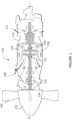
- Figure 1 depicts a gas turbine engine 110 of a type typically provided for use in subsonic flight.
- the engine 110 comprises an inlet 112 through which ambient air is propelled, a compressor section 114 for pressurizing the air, a combustor 116 in which the compressed air is mixed with fuel and ignited for generating an annular stream of hot combustion gases, and a turbine section 118 for extracting energy from the combustion gases.
- the turbine section 118 comprises a compressor turbine 120, which drives the compressor assembly and accessories, and at least one power or free turbine 122, which is independent from the compressor turbine 120 and rotatingly drives a rotor shaft 124 about a propeller shaft axis 'A' through a reduction gearbox 126. Hot gases may then be evacuated through exhaust stubs 128.
- the gas generator of the engine 110 comprises the compressor section 114, the combustor 116, and the turbine section 118.
- a rotor in the form of a propeller 130 through which ambient air is propelled, is hosted in a propeller hub 132.
- the rotor may, for example, comprise the propeller 130 of a fixed-wing aircraft, or a main (or tail) rotor of a rotary-wing aircraft such as a helicopter.
- the propeller 130 may comprise a plurality of circumferentially-arranged blades connected to a hub by any suitable means and extending radially therefrom. The blades are also each rotatable about their own radial axes through a plurality of blade angles, which can be changed to achieve modes of operation, such as feather, full reverse, and forward thrust.
- the system 200 provides for detection and measurement of rotational velocity of one or more rotating elements of the engine 110, for example the propeller 130, and of other propeller-related parameters, for instance propeller blade angle.
- the system 200 may interface to existing mechanical interfaces of typical propeller systems to provide a digital detection for electronic determination of the propeller blade angle.
- the present disclosure focuses on the use of the system 200 and the phonic wheel 204 in gas-turbine engines, similar techniques can be applied to other types of engines, including electric engines.
- the system 200 comprises an annular member 204 and one or more sensors 212 positioned proximate the annular member 204.
- Annular member 204 (referred to herein as a phonic wheel) has a plurality of position markers 202 provided thereon for detection by sensor 212.
- the phonic wheel 204 is mounted for rotation with propeller 130 and to move axially with adjustment of the blade angle of the blades of the propeller 130, and the sensor 212 is fixedly mounted to a static portion of the engine 110 and/or the propeller 130.
- the senor 212 is mounted for rotation with propeller 130 and to move axially with adjustment of the blade angle of the blades of the propeller 130, and the phonic wheel 204 is fixedly mounted to a static portion of the engine 110 and/or the propeller 130.
- the system 200 also includes a controller 220 communicatively coupled to the sensor 212.
- the sensor 212 is configured for producing a signal, for instance an electrical or optical signal, which is transmitted to or otherwise received by the controller 220, for example via a detection unit 222 thereof.
- the sensor 212 produces a series of signal pulses in response to detecting the presence of a position marker 202 in a sensing zone of the sensor 212.
- the sensor 212 operates on detecting changes in magnetic flux, and has a sensing zone which encompasses a circular or rectangular area or volume in front of the sensor 212.
- the magnetic flux in the sensing zone is varied by the presence of the position marker 202, and the sensor 212 can produce a signal pulse, which forms part of the signal.
- a side view of a portion of phonic wheel 204 and sensor 212 is shown.
- the sensor 212 is mounted to a flange 214 of a housing of the reduction gearbox 126, so as to be positioned adjacent the plurality of position markers 202.
- the sensor 212 is secured to the propeller 130 so as to extend away from the flange 214 and towards the position markers 202 along a radial direction, identified in Figure 2 as direction 'R'.
- Sensor 212 and flange 214 may be fixedly mounted, for example to the housing of the reduction gearbox 126, or to any other static element of the engine 110, as appropriate.
- a single sensor 212 is mounted in close proximity to the phonic wheel 204 and the position markers 202.
- one or more additional sensors which may be similar to the sensor 212, are provided.
- an additional sensor 212 may be mounted in a diametrically opposite relationship relative to the position markers 202, which extend away from the phonic wheel 204 and towards the sensor(s) 212.
- several position markers 202 may be spaced equiangularly about the perimeter of the phonic wheel 204. Other embodiments may apply.
- the phonic wheel 204 is embodied as a circular disk which rotates as part of the engine 110, for example with the output shaft 124 or with the propeller 130.
- the phonic wheel 204 comprises opposing faces 205 and defines a root surface 203 which extends between the opposing faces 205 and circumscribes them.
- the root surface 203 of the phonic wheel 204 is the outer periphery of the circular disk which spans between the two opposing faces 205.
- the position markers 202 can take the form of projections which extend from the root surface 203, as illustrated in Figures 4A-B and discussed in greater detail hereinbelow.
- the phonic wheel 204 is supported for rotation with the propeller 130, which rotates about the longitudinal axis 'A'.
- the phonic wheel 204 is also supported for longitudinal sliding movement along the axis A, e.g. by support members, such as a series of circumferentially spaced beta feedback rods 206 that extend along the longitudinal axis 'A'.
- a compression spring 208 surrounds an end portion of each rod 206.
- the propeller 130 comprises a plurality of angularly arranged blades 132, each of which is rotatable about a radially-extending axis 'R' through a plurality of adjustable blade angles, the blade angle being the angle between the chord line (i.e. a line drawn between the leading and trailing edges of the blade) of the propeller blade section and a plane perpendicular to the axis of propeller rotation.
- the propeller 130 is a reversing propeller, capable of operating in a variety of modes of operation, including feather, full reverse, and forward thrust.
- the blade angle may be positive or negative: the feather and forward thrust modes are associated with positive blade angles, and the full reverse mode is associated with negative blade angles.
- the phonic wheel 204 comprises the position markers 202, which can take the form of projections which extend from the root surface 203. As the phonic wheel 204 rotates, varying portions thereof enter, pass through, and then exit the sensing zone of the sensor 212. From the perspective of the sensor 212, the phonic wheel moves along direction 'F' as the phonic wheel rotates.
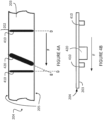
- the position markers 202 include a plurality of projections 410 which are arranged along direction 'D', which is substantially transverse to the opposing faces 205. Although only two projections 410 are illustrated in Figure 4A , it should be understood that any suitable number of projections 410 may be present across the whole of the root surface 203.
- the projections 410 can be substantially equally spaced from one another on the root surface 203.
- the projections 410 are of substantially a common shape and size, for example having a common volumetric size.
- the phonic wheel 204 also includes at least one supplementary projection 420 which is positioned between two adjacent ones of the projections 410.
- the projection 420 is oriented along direction 'E', which is at an angle relative to direction 'D'.
- the angle between directions 'D' and 'E' can be any suitable value between 1° and 89°, for example 30°, 45°, 60°, or any other value, as appropriate.
- the phonic wheel 204 includes only a single supplementary projection 420; in other embodiments, the phonic wheel 204 can include two, three, four, or more supplementary projections 420. In embodiments in which the phonic wheel 204 includes more than one supplementary projection 420, the supplementary projections can be oriented along a common orientation or can be oriented along one or more different orientations.
- the projection 420 can be located at substantially a midpoint between two adjacent projections 410, or can be located close to a particular one of two adjacent projections 410.
- the projection 420 is angled with respect to the projections 410, and the change in magnetic flux caused by the presence of the projection 420 may be different than that caused by the presence of the projection 410.
- the change in magnetic flux produced by the presence of the projection 420 may be less than the change in magnetic flux produced by the presence of one of the projections 410.
- the signal pulse (referred to herein as a second signal pulse) produced in response to the sensor 212 detecting the presence of the projection 420 may be smaller, or less pronounced, than a corresponding signal pulse (referred to herein as a first signal pulse) produced in response to the sensor 212 detecting the presence of the projection 410.
- the uneven nature of the first and second signal pulses can complicate signal processing of the signal produced by the sensor 212, for example for the controller 220, and can lead to inaccurate measurements.
- the projections 410 and the projection 420 are designed to have different physical configurations. That is to say, the projections 410 and the projection 420 can be of different shapes, different sizes, and/or made of different materials, so that the change in magnetic flux sensed by the sensor 212 and produced by the presence of the projection 420 in the sensing zone is substantially identical to the change in magnetic flux sensed by the sensor 212 and produced by the presence of any one of the projections 410.
- the projections 410, 420 extend to form a tip, and it is a tip shape of the projections 420 which is shaped differently from the tip shape of the projections 410.
- the projection 420 can have a dimension (e.g. a height, a width, and/or a length) that is greater than for the projections 410, such that the volumetric size of the projection 420 is greater than that of the projections 410.
- the projections 410 can be machined to be smaller, thinner, shorter, and/or of a different shape than the projections 420, and in some other cases, the projection 420 is formed to be taller, wider, longer, and/or of a different shape than the projections 410.
- the projection 420 can extend beyond a plane formed by one or both of the opposing faces 205. Any other suitable differentiation in dimensions between the projections 410, 420 is also considered.
- the sensor 212 may detect substantially the whole of one of the projections 410 when it enters the sensing zone of the sensor 212, but only a portion of the projection 420 when it enters the sensing zone.
- the portion of the projection 420 sensed by the sensor 212 in the sensing zone can be made comparable to that for the projections 410.
- the second signal pulse produced by the sensor 212 in response to the presence of the projection 420 can be tuned to be substantially equal to that produced in response to the presence of one of the projections 410.
- the terms “equal” and “equalize” are understood to refer to substantial equivalence to within a particular tolerance or range. For example, if the projections 410 produce electrical signal pulses having an amplitude of approximately 1 Volt (V), an electrical signal pulse produced by the projection 420 can be considered equal if it has an amplitude within a window of 1%, 5%, 10%, 15%, 20%, or any other suitable tolerance, around 1 V. For instance, if the projection 420 produces an electrical signal pulse with an amplitude of 0.95 V, this can be considered equal to the electrical signal pulse produced by the projections 410, and the magnetic flux response of the projections 410 and the projection 420 are said to be equalized.
- V Volt
- the shape of the projection 420, or the material of which it is composed, can be different than that of the projections 410.
- the projection 420 can be provided in a shape that increases the magnetic flux change observed by the sensor 212, such as a different rectangular shape, a trapezoidal shape, a pyramidal shape, and the like.
- the projection 420 can be fabricated with a material which produces a greater change in magnetic flux. For instance, if the projections 410 and the projection 420 are similarly sized, but the projection 420 is angled 45° with respect to the projections 410, the projection 420 can be made of a material which induces twice as much change in magnetic flux as the material used for the projections 410. Still other approaches are considered.
- the projection 420 is shown as being thicker than the projections 410.
- the projection 420 is shown as being taller than the projections 410.
- any combination of suitable changes to the projection 420, or to the projections 410, or both, can be employed in order to equalize the signal pulses produced by the sensor 212.
- the projection 420 can be both taller and wider than the projections 410.
- the projection 420 can be wider and of a different material than the projections 410. Still other combinations are considered.
- the dimensions of the projections 410 and/or the projection 420 is established iteratively, in order to produce projections 410, 420 which result in substantially equal signal pulses, when sensed by the sensor 212.
- the iterative process for determining the dimensions of the projections 410, 420 can be performed with physical phonic wheels and/or using modelling tools. Similar techniques can be applied when the material used to make the projections 410 and/or the projection 420 is varied.
- the signal pulses produced by the sensor 212 can be used to determine various operating parameters of the engine 110 and/or of the propeller 130.
- the series of first signal pulses can be indicative of the speed of rotation of the engine 110 and/or the propeller 130
- the second signal pulse can be indicative of a phase of the propeller 130.
- the sensor 212 which detects changes in magnetic flux due to the presence of one of the projections 410, 420 in the sensing zone of the sensor
- other types of sensors are also considered.
- an optical sensor which detects reflectivity of light off of position markers 202 can be used, and in this case the projections 420 can have a physical configuration which increases the reflectivity of the projections 420.
- an acoustic sensor which performs detection of position markers 202 using echoed sound waves can be used, and in this case the projections 420 can have a physical configuration which increases the degree to which incoming sound waves are reflected toward the acoustic sensor. Still other embodiments are considered.
- the present disclosure focuses primarily on embodiments in which the position markers 202 are projections, it should be noted that the techniques described herein may also be applied to other types of position markers 202.
- the position markers 202 are embedded in the circular disk portion of the phonic wheel 204, such that the phonic wheel 204 has a substantially smooth or uniform root surface 203.
- a position marker 202 can be a portion of the phonic wheel 204 which is made of a different material, or to which is applied a layer of a different material. The area of the different material can be varied in order to tune the pulses produced by the sensor 212. Still other embodiments are considered.
- a series of first signal pulses are produced via a sensor, for instance the sensor 212, in response to detecting a first plurality of projections, for example the projections 410.
- at least one second signal pulse is produced via the sensors 212 in response to detecting at least one second projection, for example the projection 420, which has a physical configuration different from that of the first projections.
- the time between sensing a first projection 410 and sensing the projection 420 can be substantially equal to the time between sensing the projection 420 and a sensing a subsequent one of the projections 410.
- the duration between detecting the particular projection 410 and the projection 420 may be shorter than the duration between detecting the projection 420 and the subsequent projection 410.
- a speed of the engine 110 and/or the propeller 130, and/or a phase of the propeller 130 can be determined based on the series of first signal pulses and based on the at least one second signal pulse, respectively.
- the method 500 may be implemented by a computing device 610, comprising a processing unit 612 and a memory 614 which has stored therein computer-executable instructions 616.
- the controller 220 may be embodied as the computing device 610.
- the processing unit 612 may comprise any suitable devices configured to implement the method 500 such that instructions 616, when executed by the computing device 610 or other programmable apparatus, may cause the functions/acts/steps performed as part of the method 500 as described herein to be executed.
- the processing unit 612 may comprise, for example, any type of general-purpose microprocessor or microcontroller, a digital signal processing (DSP) processor, a central processing unit (CPU), an integrated circuit, a field programmable gate array (FPGA), a reconfigurable processor, other suitably programmed or programmable logic circuits, or any combination thereof.
- DSP digital signal processing
- CPU central processing unit
- FPGA field programmable gate array
- reconfigurable processor other suitably programmed or programmable logic circuits, or any combination thereof.
- the memory 614 may comprise any suitable known or other machine-readable storage medium.
- the memory 614 may comprise non-transitory computer readable storage medium, for example, but not limited to, an electronic, magnetic, optical, electromagnetic, infrared, or semiconductor system, apparatus, or device, or any suitable combination of the foregoing.
- the memory 614 may include a suitable combination of any type of computer memory that is located either internally or externally to device, for example random-access memory (RAM), read-only memory (ROM), compact disc read-only memory (CDROM), electro-optical memory, magneto-optical memory, erasable programmable read-only memory (EPROM), and electrically-erasable programmable read-only memory (EEPROM), Ferroelectric RAM (FRAM) or the like.
- Memory 614 may comprise any storage means (e.g., devices) suitable for retrievably storing machine-readable instructions 616 executable by processing unit 612.
- the computing device 610 may be implemented as part of a FADEC or other similar device, including electronic engine control (EEC), engine control unit (EUC), and the like.
- EEC electronic engine control
- EUC engine control unit
- the method 500 and, more generally, the techniques described herein can be performed substantially in real-time, during operation of the engine 110.
- the monitoring of the engine 110 can be performed in real-time during a flight mission. The results of the monitoring can be reported to the operator and adjustments to the operational parameters of the engine 110 can also be performed in real-time.
- the phonic wheel and related systems and methods described herein may be implemented in a high level procedural or object oriented programming or scripting language, or a combination thereof, to communicate with or assist in the operation of a computer system, for example the computing device 610.
- the methods and systems described herein may be implemented in assembly or machine language.
- the language may be a compiled or interpreted language.
- Program code for implementing the methods and systems described herein may be stored on a storage media or a device, for example a ROM, a magnetic disk, an optical disc, a flash drive, or any other suitable storage media or device.
- the program code may be readable by a general or special-purpose programmable computer for configuring and operating the computer when the storage media or device is read by the computer to perform the procedures described herein.
- Embodiments of the methods and systems described herein may also be considered to be implemented by way of a non-transitory computer-readable storage medium having a computer program stored thereon.
- the computer program may comprise computer-readable instructions which cause a computer, or more specifically the processing unit 612 of the computing device 610, to operate in a specific and predefined manner to perform the functions described herein, for example those described in the method 500.
- Computer-executable instructions may be in many forms, including program modules, executed by one or more computers or other devices.
- program modules include routines, programs, objects, components, data structures, etc., that perform particular tasks or implement particular abstract data types.
- functionality of the program modules may be combined or distributed as desired in various embodiments.
Landscapes
- Engineering & Computer Science (AREA)
- Chemical & Material Sciences (AREA)
- Combustion & Propulsion (AREA)
- Mechanical Engineering (AREA)
- General Engineering & Computer Science (AREA)
- Physics & Mathematics (AREA)
- Aviation & Aerospace Engineering (AREA)
- General Physics & Mathematics (AREA)
- Electromagnetism (AREA)
- Transmission And Conversion Of Sensor Element Output (AREA)
Description
- The present disclosure relates generally to engines, and more specifically to propeller control systems for gas turbine engines.
- Certain types of phonic wheels can be used to provide information regarding the phase of rotation of the propeller, usually by removing one of the markers, creating a "missing tooth" which can be detected, or by adding an additional marker which is distinguishable from the other markers. However, existing approaches can lead to inaccurate measurements.
- Therefore, improvements are needed.
- A prior art phonic wheel having the features of the preamble of claim 1 is disclosed in
EP 2 876 046 A1 .EP 3 109 409 A1 also discloses a prior art phonic wheel. - In accordance with an aspect of the present invention, there is provided a phonic wheel for use in a gas turbine engine, as claimed in claim 1.
- In some embodiments, the at least one second position marker having a second physical configuration different from the first physical configuration comprises the at least one second position marker having a height greater than that the first plurality of position markers.
- In some embodiments, the at least one second position marker having a second physical configuration different from the first physical configuration comprises the at least one second position marker having a width greater than that of the first plurality of position markers.
- In some embodiments, the at least one second position marker having a second physical configuration different from the first physical configuration comprises the at least one second position marker having a shape different from that of the first plurality of position markers.
- In some embodiments, the at least one second position marker having a second physical configuration different from the first physical configuration comprises the at least one second position marker being fabricated from a material different than that from which the first plurality of position markers are fabricated.
- In some embodiments, the at least one second position marker is positioned substantially equidistant between the two adjacent ones of the first plurality of position markers.
- In some embodiments, the at least one second position marker is positioned closer to a particular one of the two adjacent ones of the first plurality of position markers than to a second one thereof.
- In some embodiments, the circular disk has first and second opposing faces and defines a root surface that extends between and circumscribes the first and second faces, and the at least one second position marker is disposed at a 45° angle relative to the first plurality of position markers.
- In accordance with another aspect of the present invention, there is provided a phonic wheel system for a gas turbine engine, as claimed in claim 7.
- In some embodiments, the at least one second position marker having a second physical configuration different from the first physical configuration comprises the at least one second position marker having at least one of a height, a width, and a shape different than that the first plurality of projections.
- In some embodiments, the at least one second position marker is positioned substantially equidistant between the two adjacent ones of the first plurality of position markers.
- In some embodiments, the at least one second position marker is positioned closer to a particular one of the two adjacent ones of the first plurality of position markers than to a second one thereof.
- In some embodiments, the circular disk has first and second opposing faces and defines a root surface that extends between and circumscribes the first and second faces, and the at least one second position marker is disposed at a 45° angle relative to the first plurality of position markers.
- In some embodiments, the at least one sensor is configured to sense passage of the first plurality of position markers and the at least one second position marker as the phonic wheel rotates.
In some embodiments, the at least one sensor is configured to sense a relative passage of the first plurality of position markers and the at least one second position marker as the at least one sensor rotates. - In accordance with a still further aspect of the present invention, there is provided a method for sensing a phonic wheel in a gas turbine engine, as claimed in claim 10.
In some embodiments, the phonic wheel defines a root surface that extends between and circumscribes first and second faces, and the at least one second position marker is disposed on the root surface at a 45° angle relative to the first plurality of position markers. - In some embodiments, the at least one second signal pulse is produced responsive to detecting the at least one second position marker having the second physical configuration comprising at least one of a second height, second width, and/or a second shape different from the first physical configuration comprising a corresponding at least one of a first height, a first width, and/or a first shape.
- In some embodiments, the at least one second signal pulse is produced responsive to detecting the at least one second position marker fabricated from a second material different than a first material from which the first plurality of position markers are fabricated.
- Features of the systems, devices, and methods described herein may be used in various combinations, in accordance with the embodiments described herein.
- Reference is now made to the accompanying figures in which:
-
Figure 1 is a schematic cross-sectional view of an example gas turbine engine; -
Figure 2 is a schematic diagram of an example system for sensing a phonic wheel; -
Figure 3 is a schematic diagram of the propeller ofFigure 1 with the phonic wheel ofFigure 2 , in accordance with an embodiment; -
Figures 4A-B are schematic bottom and side views, respectively, of embodiments of the phonic wheel ofFigure 2 ; -
Figure 5 is flowchart of an example method for monitoring vibration in an engine; and -
Figure 6 is a block diagram of an example computer system for implementing part or all of the method ofFigure 5 . - It will be noted that throughout the appended drawings, like features are identified by like reference numerals.
-
Figure 1 depicts agas turbine engine 110 of a type typically provided for use in subsonic flight. Theengine 110 comprises aninlet 112 through which ambient air is propelled, acompressor section 114 for pressurizing the air, acombustor 116 in which the compressed air is mixed with fuel and ignited for generating an annular stream of hot combustion gases, and aturbine section 118 for extracting energy from the combustion gases. - The
turbine section 118 comprises acompressor turbine 120, which drives the compressor assembly and accessories, and at least one power orfree turbine 122, which is independent from thecompressor turbine 120 and rotatingly drives arotor shaft 124 about a propeller shaft axis 'A' through areduction gearbox 126. Hot gases may then be evacuated throughexhaust stubs 128. The gas generator of theengine 110 comprises thecompressor section 114, thecombustor 116, and theturbine section 118. - A rotor, in the form of a
propeller 130 through which ambient air is propelled, is hosted in apropeller hub 132. The rotor may, for example, comprise thepropeller 130 of a fixed-wing aircraft, or a main (or tail) rotor of a rotary-wing aircraft such as a helicopter. Thepropeller 130 may comprise a plurality of circumferentially-arranged blades connected to a hub by any suitable means and extending radially therefrom. The blades are also each rotatable about their own radial axes through a plurality of blade angles, which can be changed to achieve modes of operation, such as feather, full reverse, and forward thrust. - With reference to
Figure 2 , asystem 200 for sensing aphonic wheel 204 will now be described. In some embodiments, thesystem 200 provides for detection and measurement of rotational velocity of one or more rotating elements of theengine 110, for example thepropeller 130, and of other propeller-related parameters, for instance propeller blade angle. Thesystem 200 may interface to existing mechanical interfaces of typical propeller systems to provide a digital detection for electronic determination of the propeller blade angle. It should be noted that although the present disclosure focuses on the use of thesystem 200 and thephonic wheel 204 in gas-turbine engines, similar techniques can be applied to other types of engines, including electric engines. - The
system 200 comprises anannular member 204 and one ormore sensors 212 positioned proximate theannular member 204. Annular member 204 (referred to herein as a phonic wheel) has a plurality ofposition markers 202 provided thereon for detection bysensor 212. In some embodiments, thephonic wheel 204 is mounted for rotation withpropeller 130 and to move axially with adjustment of the blade angle of the blades of thepropeller 130, and thesensor 212 is fixedly mounted to a static portion of theengine 110 and/or thepropeller 130. In other embodiments, thesensor 212 is mounted for rotation withpropeller 130 and to move axially with adjustment of the blade angle of the blades of thepropeller 130, and thephonic wheel 204 is fixedly mounted to a static portion of theengine 110 and/or thepropeller 130. - The
system 200 also includes acontroller 220 communicatively coupled to thesensor 212. Thesensor 212 is configured for producing a signal, for instance an electrical or optical signal, which is transmitted to or otherwise received by thecontroller 220, for example via adetection unit 222 thereof. In some embodiments, thesensor 212 produces a series of signal pulses in response to detecting the presence of aposition marker 202 in a sensing zone of thesensor 212. For example, thesensor 212 operates on detecting changes in magnetic flux, and has a sensing zone which encompasses a circular or rectangular area or volume in front of thesensor 212. When aposition marker 202 is present in the zone, or passes through the zone during rotation of thephonic wheel 204, the magnetic flux in the sensing zone is varied by the presence of theposition marker 202, and thesensor 212 can produce a signal pulse, which forms part of the signal. - In the example illustrated in
Figure 2 , a side view of a portion ofphonic wheel 204 andsensor 212 is shown. Thesensor 212 is mounted to aflange 214 of a housing of thereduction gearbox 126, so as to be positioned adjacent the plurality ofposition markers 202. In some embodiments, thesensor 212 is secured to thepropeller 130 so as to extend away from theflange 214 and towards theposition markers 202 along a radial direction, identified inFigure 2 as direction 'R'.Sensor 212 andflange 214 may be fixedly mounted, for example to the housing of thereduction gearbox 126, or to any other static element of theengine 110, as appropriate. - In some embodiments, a
single sensor 212 is mounted in close proximity to thephonic wheel 204 and theposition markers 202. In some other embodiments, in order to provide redundancy, one or more additional sensors, which may be similar to thesensor 212, are provided. For example, anadditional sensor 212 may be mounted in a diametrically opposite relationship relative to theposition markers 202, which extend away from thephonic wheel 204 and towards the sensor(s) 212. In yet another embodiment,several position markers 202 may be spaced equiangularly about the perimeter of thephonic wheel 204. Other embodiments may apply. - With reference to
Figure 3 , in some embodiments thephonic wheel 204 is embodied as a circular disk which rotates as part of theengine 110, for example with theoutput shaft 124 or with thepropeller 130. Thephonic wheel 204 comprises opposing faces 205 and defines aroot surface 203 which extends between the opposing faces 205 and circumscribes them. Put differently, theroot surface 203 of thephonic wheel 204 is the outer periphery of the circular disk which spans between the two opposing faces 205. In these embodiments, theposition markers 202 can take the form of projections which extend from theroot surface 203, as illustrated inFigures 4A-B and discussed in greater detail hereinbelow. - With continued reference to
Figure 3 , thephonic wheel 204 is supported for rotation with thepropeller 130, which rotates about the longitudinal axis 'A'. Thephonic wheel 204 is also supported for longitudinal sliding movement along the axis A, e.g. by support members, such as a series of circumferentially spacedbeta feedback rods 206 that extend along the longitudinal axis 'A'. Acompression spring 208 surrounds an end portion of eachrod 206. - As depicted in
Figure 3 , thepropeller 130 comprises a plurality of angularly arrangedblades 132, each of which is rotatable about a radially-extending axis 'R' through a plurality of adjustable blade angles, the blade angle being the angle between the chord line (i.e. a line drawn between the leading and trailing edges of the blade) of the propeller blade section and a plane perpendicular to the axis of propeller rotation. In some embodiments, thepropeller 130 is a reversing propeller, capable of operating in a variety of modes of operation, including feather, full reverse, and forward thrust. Depending on the mode of operation, the blade angle may be positive or negative: the feather and forward thrust modes are associated with positive blade angles, and the full reverse mode is associated with negative blade angles. - With reference to
Figures 4A-B , different embodiments of thephonic wheel 204 are illustrated. As discussed hereinabove, thephonic wheel 204 comprises theposition markers 202, which can take the form of projections which extend from theroot surface 203. As thephonic wheel 204 rotates, varying portions thereof enter, pass through, and then exit the sensing zone of thesensor 212. From the perspective of thesensor 212, the phonic wheel moves along direction 'F' as the phonic wheel rotates. - In
Figure 4A , a top-view of a portion of thephonic wheel 204 is shown. In the illustrated embodiment, theposition markers 202 include a plurality ofprojections 410 which are arranged along direction 'D', which is substantially transverse to the opposing faces 205. Although only twoprojections 410 are illustrated inFigure 4A , it should be understood that any suitable number ofprojections 410 may be present across the whole of theroot surface 203. Theprojections 410 can be substantially equally spaced from one another on theroot surface 203. In addition, theprojections 410 are of substantially a common shape and size, for example having a common volumetric size. - The
phonic wheel 204 also includes at least onesupplementary projection 420 which is positioned between two adjacent ones of theprojections 410. In the embodiment depicted inFigure 4A , theprojection 420 is oriented along direction 'E', which is at an angle relative to direction 'D'. The angle between directions 'D' and 'E' can be any suitable value between 1° and 89°, for example 30°, 45°, 60°, or any other value, as appropriate. - In some embodiments, the
phonic wheel 204 includes only a singlesupplementary projection 420; in other embodiments, thephonic wheel 204 can include two, three, four, or moresupplementary projections 420. In embodiments in which thephonic wheel 204 includes more than onesupplementary projection 420, the supplementary projections can be oriented along a common orientation or can be oriented along one or more different orientations. Theprojection 420 can be located at substantially a midpoint between twoadjacent projections 410, or can be located close to a particular one of twoadjacent projections 410. - The
projection 420 is angled with respect to theprojections 410, and the change in magnetic flux caused by the presence of theprojection 420 may be different than that caused by the presence of theprojection 410. For example, due to the shape of the sensing zone of thesensor 212, the change in magnetic flux produced by the presence of theprojection 420 may be less than the change in magnetic flux produced by the presence of one of theprojections 410. As a result, the signal pulse (referred to herein as a second signal pulse) produced in response to thesensor 212 detecting the presence of theprojection 420 may be smaller, or less pronounced, than a corresponding signal pulse (referred to herein as a first signal pulse) produced in response to thesensor 212 detecting the presence of theprojection 410. The uneven nature of the first and second signal pulses can complicate signal processing of the signal produced by thesensor 212, for example for thecontroller 220, and can lead to inaccurate measurements. - In order to equalize the signal pulses produced by the
sensor 212, theprojections 410 and theprojection 420 are designed to have different physical configurations. That is to say, theprojections 410 and theprojection 420 can be of different shapes, different sizes, and/or made of different materials, so that the change in magnetic flux sensed by thesensor 212 and produced by the presence of theprojection 420 in the sensing zone is substantially identical to the change in magnetic flux sensed by thesensor 212 and produced by the presence of any one of theprojections 410. In some embodiments, theprojections projections 420 which is shaped differently from the tip shape of theprojections 410. - For example, the
projection 420 can have a dimension (e.g. a height, a width, and/or a length) that is greater than for theprojections 410, such that the volumetric size of theprojection 420 is greater than that of theprojections 410. In some cases, theprojections 410 can be machined to be smaller, thinner, shorter, and/or of a different shape than theprojections 420, and in some other cases, theprojection 420 is formed to be taller, wider, longer, and/or of a different shape than theprojections 410. For example, theprojection 420 can extend beyond a plane formed by one or both of the opposing faces 205. Any other suitable differentiation in dimensions between theprojections - When the
projection 420 is angled with respect to theprojections 410, thesensor 212 may detect substantially the whole of one of theprojections 410 when it enters the sensing zone of thesensor 212, but only a portion of theprojection 420 when it enters the sensing zone. By providing different volumetric sizes for theprojections 410 and theprojection 420, whether as a result of different dimensions (e.g. heights, widths, and/or lengths), the portion of theprojection 420 sensed by thesensor 212 in the sensing zone can be made comparable to that for theprojections 410. Thus, the second signal pulse produced by thesensor 212 in response to the presence of theprojection 420 can be tuned to be substantially equal to that produced in response to the presence of one of theprojections 410. - It should be noted that, as used herein, the terms "equal" and "equalize" are understood to refer to substantial equivalence to within a particular tolerance or range. For example, if the
projections 410 produce electrical signal pulses having an amplitude of approximately 1 Volt (V), an electrical signal pulse produced by theprojection 420 can be considered equal if it has an amplitude within a window of 1%, 5%, 10%, 15%, 20%, or any other suitable tolerance, around 1 V. For instance, if theprojection 420 produces an electrical signal pulse with an amplitude of 0.95 V, this can be considered equal to the electrical signal pulse produced by theprojections 410, and the magnetic flux response of theprojections 410 and theprojection 420 are said to be equalized. - Alternatively, or in addition, the shape of the
projection 420, or the material of which it is composed, can be different than that of theprojections 410. For instance, theprojection 420 can be provided in a shape that increases the magnetic flux change observed by thesensor 212, such as a different rectangular shape, a trapezoidal shape, a pyramidal shape, and the like. In another example, theprojection 420 can be fabricated with a material which produces a greater change in magnetic flux. For instance, if theprojections 410 and theprojection 420 are similarly sized, but theprojection 420 is angled 45° with respect to theprojections 410, theprojection 420 can be made of a material which induces twice as much change in magnetic flux as the material used for theprojections 410. Still other approaches are considered. - In
Figure 4A , theprojection 420 is shown as being thicker than theprojections 410. With reference toFigure 4B , theprojection 420 is shown as being taller than theprojections 410. It should be noted that any combination of suitable changes to theprojection 420, or to theprojections 410, or both, can be employed in order to equalize the signal pulses produced by thesensor 212. For example, theprojection 420 can be both taller and wider than theprojections 410. In another example, theprojection 420 can be wider and of a different material than theprojections 410. Still other combinations are considered. - In some embodiments, the dimensions of the
projections 410 and/or theprojection 420 is established iteratively, in order to produceprojections sensor 212. The iterative process for determining the dimensions of theprojections projections 410 and/or theprojection 420 is varied. - The signal pulses produced by the
sensor 212, which form part of the signal received by thecontroller 220, can be used to determine various operating parameters of theengine 110 and/or of thepropeller 130. For example, the series of first signal pulses can be indicative of the speed of rotation of theengine 110 and/or thepropeller 130, and the second signal pulse can be indicative of a phase of thepropeller 130. - Although the preceding paragraphs focus on the use of the
sensor 212 which detects changes in magnetic flux due to the presence of one of theprojections position markers 202 can be used, and in this case theprojections 420 can have a physical configuration which increases the reflectivity of theprojections 420. In another example, an acoustic sensor which performs detection ofposition markers 202 using echoed sound waves can be used, and in this case theprojections 420 can have a physical configuration which increases the degree to which incoming sound waves are reflected toward the acoustic sensor. Still other embodiments are considered. - In addition, the present disclosure focuses primarily on embodiments in which the
position markers 202 are projections, it should be noted that the techniques described herein may also be applied to other types ofposition markers 202. For instance, in some embodiments, theposition markers 202 are embedded in the circular disk portion of thephonic wheel 204, such that thephonic wheel 204 has a substantially smooth oruniform root surface 203. For example, aposition marker 202 can be a portion of thephonic wheel 204 which is made of a different material, or to which is applied a layer of a different material. The area of the different material can be varied in order to tune the pulses produced by thesensor 212. Still other embodiments are considered. - With reference to
Figure 5 , there is illustrated a method for sensing a phonic wheel in an engine and/or of a propeller, for instance thephonic wheel 204. Atstep 502, a series of first signal pulses are produced via a sensor, for instance thesensor 212, in response to detecting a first plurality of projections, for example theprojections 410. Atstep 504, at least one second signal pulse is produced via thesensors 212 in response to detecting at least one second projection, for example theprojection 420, which has a physical configuration different from that of the first projections. - In embodiments where the
projection 420 is located substantially equidistantly betweenadjacent projections 410, the time between sensing afirst projection 410 and sensing theprojection 420 can be substantially equal to the time between sensing theprojection 420 and a sensing a subsequent one of theprojections 410. In embodiments where theprojection 420 is located closer to a particular one of theprojections 410 than to a subsequent one of theprojections 410, the duration between detecting theparticular projection 410 and theprojection 420 may be shorter than the duration between detecting theprojection 420 and thesubsequent projection 410. - Optionally, at steps 506 and 508, a speed of the
engine 110 and/or thepropeller 130, and/or a phase of thepropeller 130 can be determined based on the series of first signal pulses and based on the at least one second signal pulse, respectively. - With reference to
Figure 6 , themethod 500 may be implemented by acomputing device 610, comprising aprocessing unit 612 and amemory 614 which has stored therein computer-executable instructions 616. For example, thecontroller 220 may be embodied as thecomputing device 610. Theprocessing unit 612 may comprise any suitable devices configured to implement themethod 500 such thatinstructions 616, when executed by thecomputing device 610 or other programmable apparatus, may cause the functions/acts/steps performed as part of themethod 500 as described herein to be executed. Theprocessing unit 612 may comprise, for example, any type of general-purpose microprocessor or microcontroller, a digital signal processing (DSP) processor, a central processing unit (CPU), an integrated circuit, a field programmable gate array (FPGA), a reconfigurable processor, other suitably programmed or programmable logic circuits, or any combination thereof. - The
memory 614 may comprise any suitable known or other machine-readable storage medium. Thememory 614 may comprise non-transitory computer readable storage medium, for example, but not limited to, an electronic, magnetic, optical, electromagnetic, infrared, or semiconductor system, apparatus, or device, or any suitable combination of the foregoing. Thememory 614 may include a suitable combination of any type of computer memory that is located either internally or externally to device, for example random-access memory (RAM), read-only memory (ROM), compact disc read-only memory (CDROM), electro-optical memory, magneto-optical memory, erasable programmable read-only memory (EPROM), and electrically-erasable programmable read-only memory (EEPROM), Ferroelectric RAM (FRAM) or the like.Memory 614 may comprise any storage means (e.g., devices) suitable for retrievably storing machine-readable instructions 616 executable by processingunit 612. - It should be noted that the
computing device 610 may be implemented as part of a FADEC or other similar device, including electronic engine control (EEC), engine control unit (EUC), and the like. In addition, it should be noted that themethod 500 and, more generally, the techniques described herein can be performed substantially in real-time, during operation of theengine 110. For example, if theengine 110 is used as part of an aircraft, the monitoring of theengine 110 can be performed in real-time during a flight mission. The results of the monitoring can be reported to the operator and adjustments to the operational parameters of theengine 110 can also be performed in real-time. - The phonic wheel and related systems and methods described herein may be implemented in a high level procedural or object oriented programming or scripting language, or a combination thereof, to communicate with or assist in the operation of a computer system, for example the
computing device 610. Alternatively, the methods and systems described herein may be implemented in assembly or machine language. The language may be a compiled or interpreted language. Program code for implementing the methods and systems described herein may be stored on a storage media or a device, for example a ROM, a magnetic disk, an optical disc, a flash drive, or any other suitable storage media or device. The program code may be readable by a general or special-purpose programmable computer for configuring and operating the computer when the storage media or device is read by the computer to perform the procedures described herein. Embodiments of the methods and systems described herein may also be considered to be implemented by way of a non-transitory computer-readable storage medium having a computer program stored thereon. The computer program may comprise computer-readable instructions which cause a computer, or more specifically theprocessing unit 612 of thecomputing device 610, to operate in a specific and predefined manner to perform the functions described herein, for example those described in themethod 500. - Computer-executable instructions may be in many forms, including program modules, executed by one or more computers or other devices. Generally, program modules include routines, programs, objects, components, data structures, etc., that perform particular tasks or implement particular abstract data types. Typically the functionality of the program modules may be combined or distributed as desired in various embodiments.
- The above description is meant to be exemplary only, and one skilled in the art will recognize that changes may be made to the embodiments described without departing from the scope of the claims.
- Various aspects of the phonic wheel and related systems and methods described herein may be used alone, in combination, or in a variety of arrangements not specifically discussed in the embodiments described in the foregoing and is therefore not limited in its application to the details and arrangement of components set forth in the foregoing description or illustrated in the drawings. For example, aspects described in one embodiment may be combined in any manner with aspects described in other embodiments. Although particular embodiments have been shown and described, it will be apparent to those skilled in the art that changes and modifications may be made without departing from this invention in its broader aspects as defined in the appended claims.
Claims (13)
- A phonic wheel (204) for a gas turbine engine (110), the phonic wheel (204) comprising:a circular disk;a first plurality of position markers (410) disposed on the disk and oriented substantially parallel to an axis of rotation (A) of the circular disk, the first plurality of position markers (410) each having a first physical configuration and configured to produce a series of first signal pulses when detected within a sensing zone of at least one sensor (212); andat least one second position marker (420) disposed on the disk between two adjacent first position markers (410) and oriented at an angle relative to the first plurality of position markers (410), the at least one second position marker (420) configured to produce a second signal pulse when detected within the sensing zone of the at least one sensor (212),characterised in that:
the at least one second position marker (420) has a second physical configuration different from the first physical configuration such that the second signal pulse is substantially equalized with the first signal pulse. - The phonic wheel of claim 1, wherein the second physical configuration different from the first physical configuration comprises a height greater than that of the first plurality of position markers (410), and/or a width greater than that of the first plurality of position markers (410).
- The phonic wheel of claim 1 or 2, wherein the second physical configuration different from the first physical configuration comprises a shape different from that of the first plurality of position markers (410), and/or being fabricated from a material different than that from which the first plurality of position markers (410) are fabricated.
- The phonic wheel of claim 1, 2 or 3, wherein the at least one second position marker (420) is positioned substantially equidistant between the two adjacent ones of the first plurality of position markers (410).
- The phonic wheel of claim 1, 2, or 3, wherein the at least one second position marker (420) is positioned closer to a particular one of the two adjacent ones of the first plurality of position markers (410) than to a second one thereof.
- The phonic wheel of any preceding claim, wherein the circular disk has first and second opposing faces (205) and defines a root surface (203) that extends between and circumscribes the first and second faces (205), and the at least one second position marker (420) is disposed at a 45° angle relative to the first plurality of position markers (410).
- A phonic wheel system for a gas turbine engine (110), the system comprising:the phonic wheel (204) of any preceding claim; andat least one sensor (212) configured to detect a relative movement between the phonic wheel (204) and the at least one sensor (212).
- The phonic wheel system of claim 7, wherein the at least one sensor (212) is configured to sense passage of the first plurality of position markers (410) and the at least one second position marker (420) as the phonic wheel (204) rotates.
- The phonic wheel system of claim 7, wherein the at least one sensor (212) is configured to sense a relative passage of the first plurality of position markers (410) and the at least one second position marker (420) as the at least one sensor (212) rotates.
- A method for sensing a phonic wheel (204) in a gas turbine engine (110), the method comprising:producing a series of first signal pulses responsive to detecting, within a sensing zone of at least one sensor (212), a first plurality of position markers (410) disposed on the phonic wheel (204) and oriented substantially parallel to an axis of rotation (A) of the phonic wheel (204), the first plurality of position markers (410) having a first physical configuration, the series of first signal pulses forming part of a signal; andproducing at least one second signal pulse responsive to detecting, within the sensing zone of the at least one sensor (212), at least one second position marker (420) disposed on the phonic wheel (204) and oriented at an angle relative to the first plurality of position markers (410), the at least one second position marker (420) positioned between two adjacent first position markers (410), the at least one second signal pulse forming part of the signal,characterised in that:
the at least one second position marker (420) has a second physical configuration different from the first physical configuration, the first and second signal pulses being equalized due to a portion of the at least one second position marker (420) sensed in the sensing zone being substantially equivalent to a portion of one of the first position markers (410) sensed in the sensing zone, as a result of the first physical configuration being different from the second physical configuration. - The method of claim 10, wherein the phonic wheel (204) defines a root surface (203) that extends between and circumscribes first and second faces (205), and the at least one second position marker (420) is disposed on the root surface (203) at a 45° angle relative to the first plurality of position markers (410).
- The method of claim 10 or 11, wherein the at least one second signal pulse is produced responsive to detecting the at least one second position marker (420) having the second physical configuration comprising a second height, second width, and/or a second shape different from the first physical configuration comprising a corresponding first height, first width, and/or first shape.
- The method of claim 10, 11 or 12, wherein the at least one second signal pulse is produced responsive to detecting the at least one second position marker (420) fabricated from a second material different than a first material from which the first plurality of position markers (410) are fabricated.
Applications Claiming Priority (2)
| Application Number | Priority Date | Filing Date | Title |
|---|---|---|---|
| US16/023,072 US10801360B2 (en) | 2018-06-29 | 2018-06-29 | Phonic wheel with output voltage tuning |
| EP19183738.4A EP3587744B1 (en) | 2018-06-29 | 2019-07-01 | Phonic wheel with output voltage tuning |
Related Parent Applications (1)
| Application Number | Title | Priority Date | Filing Date |
|---|---|---|---|
| EP19183738.4A Division EP3587744B1 (en) | 2018-06-29 | 2019-07-01 | Phonic wheel with output voltage tuning |
Publications (2)
| Publication Number | Publication Date |
|---|---|
| EP3901419A1 EP3901419A1 (en) | 2021-10-27 |
| EP3901419B1 true EP3901419B1 (en) | 2024-10-23 |
Family
ID=67139644
Family Applications (2)
| Application Number | Title | Priority Date | Filing Date |
|---|---|---|---|
| EP19183738.4A Active EP3587744B1 (en) | 2018-06-29 | 2019-07-01 | Phonic wheel with output voltage tuning |
| EP21175722.4A Active EP3901419B1 (en) | 2018-06-29 | 2019-07-01 | Phonic wheel with output voltage tuning |
Family Applications Before (1)
| Application Number | Title | Priority Date | Filing Date |
|---|---|---|---|
| EP19183738.4A Active EP3587744B1 (en) | 2018-06-29 | 2019-07-01 | Phonic wheel with output voltage tuning |
Country Status (5)
| Country | Link |
|---|---|
| US (1) | US10801360B2 (en) |
| EP (2) | EP3587744B1 (en) |
| CN (1) | CN110657029A (en) |
| CA (1) | CA3044240A1 (en) |
| PL (2) | PL3587744T3 (en) |
Families Citing this family (4)
| Publication number | Priority date | Publication date | Assignee | Title |
|---|---|---|---|---|
| US10287006B1 (en) * | 2015-12-18 | 2019-05-14 | Amazon Technologies, Inc. | Adjustable propeller blades for sound control |
| US10829201B2 (en) * | 2019-03-20 | 2020-11-10 | Pratt & Whitney Canada Corp. | Blade angle position feedback system with extended markers |
| US12384523B2 (en) | 2023-06-15 | 2025-08-12 | General Electric Company | System and method for efficiently determining a phase shift in a propulsion system |
| US12264631B2 (en) | 2023-06-15 | 2025-04-01 | General Electric Company | System and method for synchrophasing a propulsion system using electric machines |
Family Cites Families (16)
| Publication number | Priority date | Publication date | Assignee | Title |
|---|---|---|---|---|
| JPS5436961A (en) * | 1977-08-29 | 1979-03-19 | Nissan Motor | Angleeoffrotation detector |
| GB8706905D0 (en) * | 1987-03-24 | 1987-04-29 | Schlumberger Electronics Uk | Shaft monitoring system |
| JP3368681B2 (en) * | 1994-09-13 | 2003-01-20 | 株式会社デンソー | Magnetic detector |
| JPH10111144A (en) * | 1996-10-04 | 1998-04-28 | Keihin Seiki Mfg Co Ltd | Crankshaft rotation reference position detection device |
| US6313625B1 (en) * | 1999-01-19 | 2001-11-06 | Ford Global Technologies, Inc. | Magnetic rotary position sensing |
| FR2931552B1 (en) | 2008-05-21 | 2010-07-30 | Turbomeca | TORQUE MEASURING DEVICE TRANSMITTED BY A POWER SHAFT |
| FR2944050B1 (en) * | 2009-04-02 | 2014-07-11 | Turbomeca | DISCHARGED BLADE TURBINE WHEEL COMPRISING A DAMPING DEVICE |
| FR2968038B1 (en) * | 2010-11-26 | 2012-12-28 | Snecma | SYSTEM FOR DETECTING A FUGACEOUS EVENT ON AN AIRCRAFT ENGINE BEARING WHEEL |
| CN102785742B (en) * | 2012-07-28 | 2014-02-05 | 成都宽和科技有限责任公司 | A power-assisted bicycle with multi-magnetic blocks unevenly distributed magnetic flux sensors on the flywheel |
| US9821901B2 (en) * | 2013-11-21 | 2017-11-21 | Pratt & Whitney Canada Corp. | System and method for electronic propeller blade angle position feedback |
| US10436056B2 (en) | 2015-06-23 | 2019-10-08 | General Electric Company | Relative position measurement |
| GB2540379A (en) | 2015-07-14 | 2017-01-18 | Weston Aerospace Ltd | Magnetic sensing system and method for detecting shaft speed |
| GB201611524D0 (en) | 2016-07-01 | 2016-08-17 | Rolls Royce Plc | Rotor blade damage |
| US10486827B2 (en) | 2016-08-17 | 2019-11-26 | Pratt & Whitney Canada Corp. | Apparatus and methods for aircraft propeller control |
| US10435140B2 (en) | 2016-08-17 | 2019-10-08 | Pratt & Whitney Canada Corp. | System and method for electronic propeller blade angle position feedback with angled pairs of teeth |
| CN106771324B (en) * | 2017-01-19 | 2023-08-11 | 中国第一汽车股份有限公司 | Anti-interference Hall type rotating speed sensor magnetic field detection structure and signal processing method |
-
2018
- 2018-06-29 US US16/023,072 patent/US10801360B2/en active Active
-
2019
- 2019-05-23 CA CA3044240A patent/CA3044240A1/en active Pending
- 2019-07-01 EP EP19183738.4A patent/EP3587744B1/en active Active
- 2019-07-01 PL PL19183738T patent/PL3587744T3/en unknown
- 2019-07-01 CN CN201910584824.0A patent/CN110657029A/en active Pending
- 2019-07-01 EP EP21175722.4A patent/EP3901419B1/en active Active
- 2019-07-01 PL PL21175722.4T patent/PL3901419T3/en unknown
Also Published As
| Publication number | Publication date |
|---|---|
| EP3587744B1 (en) | 2021-05-26 |
| US10801360B2 (en) | 2020-10-13 |
| PL3587744T3 (en) | 2021-10-04 |
| CN110657029A (en) | 2020-01-07 |
| CA3044240A1 (en) | 2019-12-29 |
| EP3901419A1 (en) | 2021-10-27 |
| US20200003074A1 (en) | 2020-01-02 |
| EP3587744A1 (en) | 2020-01-01 |
| PL3901419T3 (en) | 2025-01-07 |
Similar Documents
| Publication | Publication Date | Title |
|---|---|---|
| EP3967607B1 (en) | Propeller blade synchrophasing using phonic wheel | |
| EP3730902B1 (en) | Blade angle position feedback system with offset sensors | |
| EP3901419B1 (en) | Phonic wheel with output voltage tuning | |
| CA2976499C (en) | System and method for electronic propeller blade angle position feedback with angled pairs of teeth | |
| US11420772B2 (en) | System and method for determining an axial position of a feedback device | |
| US11685514B2 (en) | Pitch control assembly for an aircraft-bladed rotor | |
| US11835543B2 (en) | Blade angle position feedback system with embedded markers | |
| EP3789292B1 (en) | Signal amplification in blade angle position feedback system |
Legal Events
| Date | Code | Title | Description |
|---|---|---|---|
| PUAI | Public reference made under article 153(3) epc to a published international application that has entered the european phase |
Free format text: ORIGINAL CODE: 0009012 |
|
| STAA | Information on the status of an ep patent application or granted ep patent |
Free format text: STATUS: THE APPLICATION HAS BEEN PUBLISHED |
|
| AC | Divisional application: reference to earlier application |
Ref document number: 3587744 Country of ref document: EP Kind code of ref document: P |
|
| AK | Designated contracting states |
Kind code of ref document: A1 Designated state(s): AL AT BE BG CH CY CZ DE DK EE ES FI FR GB GR HR HU IE IS IT LI LT LU LV MC MK MT NL NO PL PT RO RS SE SI SK SM TR |
|
| B565 | Issuance of search results under rule 164(2) epc |
Effective date: 20210928 |
|
| STAA | Information on the status of an ep patent application or granted ep patent |
Free format text: STATUS: REQUEST FOR EXAMINATION WAS MADE |
|
| 17P | Request for examination filed |
Effective date: 20220318 |
|
| RBV | Designated contracting states (corrected) |
Designated state(s): AL AT BE BG CH CY CZ DE DK EE ES FI FR GB GR HR HU IE IS IT LI LT LU LV MC MK MT NL NO PL PT RO RS SE SI SK SM TR |
|
| REG | Reference to a national code |
Ref country code: DE Ref legal event code: R079 Free format text: PREVIOUS MAIN CLASS: F01D0017060000 Ipc: B64C0011500000 Ref country code: DE Ref legal event code: R079 Ref document number: 602019060997 Country of ref document: DE Free format text: PREVIOUS MAIN CLASS: F01D0017060000 Ipc: B64C0011500000 |
|
| RIC1 | Information provided on ipc code assigned before grant |
Ipc: F01D 17/06 20060101ALI20231030BHEP Ipc: B64C 11/30 20060101ALI20231030BHEP Ipc: G01P 3/481 20060101ALI20231030BHEP Ipc: G01D 5/14 20060101ALI20231030BHEP Ipc: B64D 31/12 20060101ALI20231030BHEP Ipc: B64C 11/50 20060101AFI20231030BHEP |
|
| GRAP | Despatch of communication of intention to grant a patent |
Free format text: ORIGINAL CODE: EPIDOSNIGR1 |
|
| STAA | Information on the status of an ep patent application or granted ep patent |
Free format text: STATUS: GRANT OF PATENT IS INTENDED |
|
| INTG | Intention to grant announced |
Effective date: 20231212 |
|
| GRAJ | Information related to disapproval of communication of intention to grant by the applicant or resumption of examination proceedings by the epo deleted |
Free format text: ORIGINAL CODE: EPIDOSDIGR1 |
|
| STAA | Information on the status of an ep patent application or granted ep patent |
Free format text: STATUS: REQUEST FOR EXAMINATION WAS MADE |
|
| GRAP | Despatch of communication of intention to grant a patent |
Free format text: ORIGINAL CODE: EPIDOSNIGR1 |
|
| STAA | Information on the status of an ep patent application or granted ep patent |
Free format text: STATUS: GRANT OF PATENT IS INTENDED |
|
| INTC | Intention to grant announced (deleted) | ||
| INTG | Intention to grant announced |
Effective date: 20240513 |
|
| GRAS | Grant fee paid |
Free format text: ORIGINAL CODE: EPIDOSNIGR3 |
|
| GRAA | (expected) grant |
Free format text: ORIGINAL CODE: 0009210 |
|
| STAA | Information on the status of an ep patent application or granted ep patent |
Free format text: STATUS: THE PATENT HAS BEEN GRANTED |
|
| AC | Divisional application: reference to earlier application |
Ref document number: 3587744 Country of ref document: EP Kind code of ref document: P |
|
| AK | Designated contracting states |
Kind code of ref document: B1 Designated state(s): AL AT BE BG CH CY CZ DE DK EE ES FI FR GB GR HR HU IE IS IT LI LT LU LV MC MK MT NL NO PL PT RO RS SE SI SK SM TR |
|
| REG | Reference to a national code |
Ref country code: GB Ref legal event code: FG4D |
|
| REG | Reference to a national code |
Ref country code: CH Ref legal event code: EP |
|
| REG | Reference to a national code |
Ref country code: DE Ref legal event code: R096 Ref document number: 602019060997 Country of ref document: DE |
|
| REG | Reference to a national code |
Ref country code: IE Ref legal event code: FG4D |
|
| REG | Reference to a national code |
Ref country code: LT Ref legal event code: MG9D |
|
| REG | Reference to a national code |
Ref country code: NL Ref legal event code: MP Effective date: 20241023 |
|
| REG | Reference to a national code |
Ref country code: AT Ref legal event code: MK05 Ref document number: 1734642 Country of ref document: AT Kind code of ref document: T Effective date: 20241023 |
|
| PG25 | Lapsed in a contracting state [announced via postgrant information from national office to epo] |
Ref country code: NL Free format text: LAPSE BECAUSE OF FAILURE TO SUBMIT A TRANSLATION OF THE DESCRIPTION OR TO PAY THE FEE WITHIN THE PRESCRIBED TIME-LIMIT Effective date: 20241023 |
|
| PG25 | Lapsed in a contracting state [announced via postgrant information from national office to epo] |
Ref country code: NL Free format text: LAPSE BECAUSE OF FAILURE TO SUBMIT A TRANSLATION OF THE DESCRIPTION OR TO PAY THE FEE WITHIN THE PRESCRIBED TIME-LIMIT Effective date: 20241023 |
|
| PG25 | Lapsed in a contracting state [announced via postgrant information from national office to epo] |
Ref country code: IS Free format text: LAPSE BECAUSE OF FAILURE TO SUBMIT A TRANSLATION OF THE DESCRIPTION OR TO PAY THE FEE WITHIN THE PRESCRIBED TIME-LIMIT Effective date: 20250223 Ref country code: PT Free format text: LAPSE BECAUSE OF FAILURE TO SUBMIT A TRANSLATION OF THE DESCRIPTION OR TO PAY THE FEE WITHIN THE PRESCRIBED TIME-LIMIT Effective date: 20250224 Ref country code: HR Free format text: LAPSE BECAUSE OF FAILURE TO SUBMIT A TRANSLATION OF THE DESCRIPTION OR TO PAY THE FEE WITHIN THE PRESCRIBED TIME-LIMIT Effective date: 20241023 |
|
| PG25 | Lapsed in a contracting state [announced via postgrant information from national office to epo] |
Ref country code: FI Free format text: LAPSE BECAUSE OF FAILURE TO SUBMIT A TRANSLATION OF THE DESCRIPTION OR TO PAY THE FEE WITHIN THE PRESCRIBED TIME-LIMIT Effective date: 20241023 |
|
| PG25 | Lapsed in a contracting state [announced via postgrant information from national office to epo] |
Ref country code: BG Free format text: LAPSE BECAUSE OF FAILURE TO SUBMIT A TRANSLATION OF THE DESCRIPTION OR TO PAY THE FEE WITHIN THE PRESCRIBED TIME-LIMIT Effective date: 20241023 |
|
| PG25 | Lapsed in a contracting state [announced via postgrant information from national office to epo] |
Ref country code: ES Free format text: LAPSE BECAUSE OF FAILURE TO SUBMIT A TRANSLATION OF THE DESCRIPTION OR TO PAY THE FEE WITHIN THE PRESCRIBED TIME-LIMIT Effective date: 20241023 |
|
| PG25 | Lapsed in a contracting state [announced via postgrant information from national office to epo] |
Ref country code: NO Free format text: LAPSE BECAUSE OF FAILURE TO SUBMIT A TRANSLATION OF THE DESCRIPTION OR TO PAY THE FEE WITHIN THE PRESCRIBED TIME-LIMIT Effective date: 20250123 |
|
| PG25 | Lapsed in a contracting state [announced via postgrant information from national office to epo] |
Ref country code: GR Free format text: LAPSE BECAUSE OF FAILURE TO SUBMIT A TRANSLATION OF THE DESCRIPTION OR TO PAY THE FEE WITHIN THE PRESCRIBED TIME-LIMIT Effective date: 20250124 Ref country code: LV Free format text: LAPSE BECAUSE OF FAILURE TO SUBMIT A TRANSLATION OF THE DESCRIPTION OR TO PAY THE FEE WITHIN THE PRESCRIBED TIME-LIMIT Effective date: 20241023 Ref country code: AT Free format text: LAPSE BECAUSE OF FAILURE TO SUBMIT A TRANSLATION OF THE DESCRIPTION OR TO PAY THE FEE WITHIN THE PRESCRIBED TIME-LIMIT Effective date: 20241023 |
|
| PG25 | Lapsed in a contracting state [announced via postgrant information from national office to epo] |
Ref country code: RS Free format text: LAPSE BECAUSE OF FAILURE TO SUBMIT A TRANSLATION OF THE DESCRIPTION OR TO PAY THE FEE WITHIN THE PRESCRIBED TIME-LIMIT Effective date: 20250123 |
|
| PG25 | Lapsed in a contracting state [announced via postgrant information from national office to epo] |
Ref country code: SM Free format text: LAPSE BECAUSE OF FAILURE TO SUBMIT A TRANSLATION OF THE DESCRIPTION OR TO PAY THE FEE WITHIN THE PRESCRIBED TIME-LIMIT Effective date: 20241023 |
|
| PG25 | Lapsed in a contracting state [announced via postgrant information from national office to epo] |
Ref country code: DK Free format text: LAPSE BECAUSE OF FAILURE TO SUBMIT A TRANSLATION OF THE DESCRIPTION OR TO PAY THE FEE WITHIN THE PRESCRIBED TIME-LIMIT Effective date: 20241023 |
|
| PGFP | Annual fee paid to national office [announced via postgrant information from national office to epo] |
Ref country code: GB Payment date: 20250619 Year of fee payment: 7 |
|
| PG25 | Lapsed in a contracting state [announced via postgrant information from national office to epo] |
Ref country code: EE Free format text: LAPSE BECAUSE OF FAILURE TO SUBMIT A TRANSLATION OF THE DESCRIPTION OR TO PAY THE FEE WITHIN THE PRESCRIBED TIME-LIMIT Effective date: 20241023 |
|
| PGFP | Annual fee paid to national office [announced via postgrant information from national office to epo] |
Ref country code: FR Payment date: 20250620 Year of fee payment: 7 |
|
| PG25 | Lapsed in a contracting state [announced via postgrant information from national office to epo] |
Ref country code: RO Free format text: LAPSE BECAUSE OF FAILURE TO SUBMIT A TRANSLATION OF THE DESCRIPTION OR TO PAY THE FEE WITHIN THE PRESCRIBED TIME-LIMIT Effective date: 20241023 |
|
| REG | Reference to a national code |
Ref country code: DE Ref legal event code: R097 Ref document number: 602019060997 Country of ref document: DE |
|
| PG25 | Lapsed in a contracting state [announced via postgrant information from national office to epo] |
Ref country code: SK Free format text: LAPSE BECAUSE OF FAILURE TO SUBMIT A TRANSLATION OF THE DESCRIPTION OR TO PAY THE FEE WITHIN THE PRESCRIBED TIME-LIMIT Effective date: 20241023 |
|
| PGFP | Annual fee paid to national office [announced via postgrant information from national office to epo] |
Ref country code: CZ Payment date: 20250625 Year of fee payment: 7 |
|
| PG25 | Lapsed in a contracting state [announced via postgrant information from national office to epo] |
Ref country code: IT Free format text: LAPSE BECAUSE OF FAILURE TO SUBMIT A TRANSLATION OF THE DESCRIPTION OR TO PAY THE FEE WITHIN THE PRESCRIBED TIME-LIMIT Effective date: 20241023 |
|
| PLBE | No opposition filed within time limit |
Free format text: ORIGINAL CODE: 0009261 |
|
| STAA | Information on the status of an ep patent application or granted ep patent |
Free format text: STATUS: NO OPPOSITION FILED WITHIN TIME LIMIT |
|
| PG25 | Lapsed in a contracting state [announced via postgrant information from national office to epo] |
Ref country code: SE Free format text: LAPSE BECAUSE OF FAILURE TO SUBMIT A TRANSLATION OF THE DESCRIPTION OR TO PAY THE FEE WITHIN THE PRESCRIBED TIME-LIMIT Effective date: 20241023 |
|
| 26N | No opposition filed |
Effective date: 20250724 |
|
| PGFP | Annual fee paid to national office [announced via postgrant information from national office to epo] |
Ref country code: DE Payment date: 20250620 Year of fee payment: 7 |
|
| PGFP | Annual fee paid to national office [announced via postgrant information from national office to epo] |
Ref country code: PL Payment date: 20250701 Year of fee payment: 7 |
|
| REG | Reference to a national code |
Ref country code: CH Ref legal event code: H13 Free format text: ST27 STATUS EVENT CODE: U-0-0-H10-H13 (AS PROVIDED BY THE NATIONAL OFFICE) Effective date: 20260224 |
|
| PG25 | Lapsed in a contracting state [announced via postgrant information from national office to epo] |
Ref country code: LU Free format text: LAPSE BECAUSE OF NON-PAYMENT OF DUE FEES Effective date: 20250701 |
|
| REG | Reference to a national code |
Ref country code: BE Ref legal event code: MM Effective date: 20250731 |
|
| PG25 | Lapsed in a contracting state [announced via postgrant information from national office to epo] |
Ref country code: BE Free format text: LAPSE BECAUSE OF NON-PAYMENT OF DUE FEES Effective date: 20250731 |
|
| PG25 | Lapsed in a contracting state [announced via postgrant information from national office to epo] |
Ref country code: CH Free format text: LAPSE BECAUSE OF NON-PAYMENT OF DUE FEES Effective date: 20250731 |