EP3901285A1 - Process for extracting double-stranded dna - Google Patents
Process for extracting double-stranded dna Download PDFInfo
- Publication number
- EP3901285A1 EP3901285A1 EP20305400.2A EP20305400A EP3901285A1 EP 3901285 A1 EP3901285 A1 EP 3901285A1 EP 20305400 A EP20305400 A EP 20305400A EP 3901285 A1 EP3901285 A1 EP 3901285A1
- Authority
- EP
- European Patent Office
- Prior art keywords
- double
- stranded dna
- dna
- compound
- formula
- Prior art date
- Legal status (The legal status is an assumption and is not a legal conclusion. Google has not performed a legal analysis and makes no representation as to the accuracy of the status listed.)
- Withdrawn
Links
- 108020004414 DNA Proteins 0.000 title claims abstract description 152
- 238000000034 method Methods 0.000 title claims abstract description 115
- 102000053602 DNA Human genes 0.000 title claims abstract description 90
- 150000001875 compounds Chemical class 0.000 claims description 73
- LFQSCWFLJHTTHZ-UHFFFAOYSA-N Ethanol Chemical compound CCO LFQSCWFLJHTTHZ-UHFFFAOYSA-N 0.000 claims description 67
- 239000000243 solution Substances 0.000 claims description 41
- 239000012472 biological sample Substances 0.000 claims description 31
- -1 -OH Chemical group 0.000 claims description 26
- 125000004435 hydrogen atom Chemical group [H]* 0.000 claims description 25
- 239000007853 buffer solution Substances 0.000 claims description 23
- 125000004169 (C1-C6) alkyl group Chemical group 0.000 claims description 21
- 239000000203 mixture Substances 0.000 claims description 13
- 239000002953 phosphate buffered saline Substances 0.000 claims description 12
- 125000004191 (C1-C6) alkoxy group Chemical group 0.000 claims description 10
- CPELXLSAUQHCOX-UHFFFAOYSA-M Bromide Chemical compound [Br-] CPELXLSAUQHCOX-UHFFFAOYSA-M 0.000 claims description 10
- 150000001450 anions Chemical class 0.000 claims description 9
- 125000003118 aryl group Chemical group 0.000 claims description 9
- 125000005862 (C1-C6)alkanoyl group Chemical group 0.000 claims description 8
- 150000004820 halides Chemical class 0.000 claims description 8
- 125000003545 alkoxy group Chemical group 0.000 claims description 7
- 150000008052 alkyl sulfonates Chemical class 0.000 claims description 7
- LOKCTEFSRHRXRJ-UHFFFAOYSA-I dipotassium trisodium dihydrogen phosphate hydrogen phosphate dichloride Chemical compound P(=O)(O)(O)[O-].[K+].P(=O)(O)([O-])[O-].[Na+].[Na+].[Cl-].[K+].[Cl-].[Na+] LOKCTEFSRHRXRJ-UHFFFAOYSA-I 0.000 claims description 7
- 125000001072 heteroaryl group Chemical group 0.000 claims description 7
- VEXZGXHMUGYJMC-UHFFFAOYSA-M Chloride anion Chemical compound [Cl-] VEXZGXHMUGYJMC-UHFFFAOYSA-M 0.000 claims description 6
- 125000000882 C2-C6 alkenyl group Chemical group 0.000 claims description 5
- 125000003601 C2-C6 alkynyl group Chemical group 0.000 claims description 5
- 125000002496 methyl group Chemical group [H]C([H])([H])* 0.000 claims description 5
- 125000002347 octyl group Chemical group [H]C([*])([H])C([H])([H])C([H])([H])C([H])([H])C([H])([H])C([H])([H])C([H])([H])C([H])([H])[H] 0.000 claims description 5
- 125000006652 (C3-C12) cycloalkyl group Chemical group 0.000 claims description 4
- 125000006707 (C3-C12) heterocycloalkyl group Chemical group 0.000 claims description 4
- LBLYYCQCTBFVLH-UHFFFAOYSA-M 2-methylbenzenesulfonate Chemical compound CC1=CC=CC=C1S([O-])(=O)=O LBLYYCQCTBFVLH-UHFFFAOYSA-M 0.000 claims description 4
- NHNBFGGVMKEFGY-UHFFFAOYSA-N Nitrate Chemical compound [O-][N+]([O-])=O NHNBFGGVMKEFGY-UHFFFAOYSA-N 0.000 claims description 4
- ZMZDMBWJUHKJPS-UHFFFAOYSA-M Thiocyanate anion Chemical compound [S-]C#N ZMZDMBWJUHKJPS-UHFFFAOYSA-M 0.000 claims description 4
- SRSXLGNVWSONIS-UHFFFAOYSA-M benzenesulfonate Chemical compound [O-]S(=O)(=O)C1=CC=CC=C1 SRSXLGNVWSONIS-UHFFFAOYSA-M 0.000 claims description 4
- 229940077388 benzenesulfonate Drugs 0.000 claims description 4
- XLJMAIOERFSOGZ-UHFFFAOYSA-M cyanate Chemical compound [O-]C#N XLJMAIOERFSOGZ-UHFFFAOYSA-M 0.000 claims description 4
- ZMZDMBWJUHKJPS-UHFFFAOYSA-N hydrogen thiocyanate Natural products SC#N ZMZDMBWJUHKJPS-UHFFFAOYSA-N 0.000 claims description 4
- 125000000449 nitro group Chemical group [O-][N+](*)=O 0.000 claims description 4
- 229910002651 NO3 Inorganic materials 0.000 claims description 3
- 125000005843 halogen group Chemical group 0.000 claims description 3
- 239000002608 ionic liquid Substances 0.000 abstract description 7
- 238000005119 centrifugation Methods 0.000 description 21
- 239000007864 aqueous solution Substances 0.000 description 15
- 210000002381 plasma Anatomy 0.000 description 15
- HEDRZPFGACZZDS-UHFFFAOYSA-N Chloroform Chemical compound ClC(Cl)Cl HEDRZPFGACZZDS-UHFFFAOYSA-N 0.000 description 14
- 241000699666 Mus <mouse, genus> Species 0.000 description 13
- 125000000217 alkyl group Chemical group 0.000 description 12
- PHTQWCKDNZKARW-UHFFFAOYSA-N isoamylol Chemical compound CC(C)CCO PHTQWCKDNZKARW-UHFFFAOYSA-N 0.000 description 12
- XLYOFNOQVPJJNP-UHFFFAOYSA-N water Substances O XLYOFNOQVPJJNP-UHFFFAOYSA-N 0.000 description 12
- 239000002585 base Substances 0.000 description 11
- 239000013612 plasmid Substances 0.000 description 10
- 210000004027 cell Anatomy 0.000 description 9
- 210000002966 serum Anatomy 0.000 description 8
- ISWSIDIOOBJBQZ-UHFFFAOYSA-N Phenol Chemical compound OC1=CC=CC=C1 ISWSIDIOOBJBQZ-UHFFFAOYSA-N 0.000 description 7
- FAPWRFPIFSIZLT-UHFFFAOYSA-M Sodium chloride Chemical compound [Na+].[Cl-] FAPWRFPIFSIZLT-UHFFFAOYSA-M 0.000 description 7
- 238000002835 absorbance Methods 0.000 description 7
- 125000000753 cycloalkyl group Chemical group 0.000 description 7
- 239000008188 pellet Substances 0.000 description 7
- 239000006228 supernatant Substances 0.000 description 7
- IJGRMHOSHXDMSA-UHFFFAOYSA-N Atomic nitrogen Chemical compound N#N IJGRMHOSHXDMSA-UHFFFAOYSA-N 0.000 description 6
- 238000011529 RT qPCR Methods 0.000 description 6
- 238000005056 compaction Methods 0.000 description 6
- 125000000592 heterocycloalkyl group Chemical group 0.000 description 6
- JUJWROOIHBZHMG-UHFFFAOYSA-N Pyridine Chemical class C1=CC=NC=C1 JUJWROOIHBZHMG-UHFFFAOYSA-N 0.000 description 5
- 235000014787 Vitis vinifera Nutrition 0.000 description 5
- 240000006365 Vitis vinifera Species 0.000 description 5
- 230000001580 bacterial effect Effects 0.000 description 5
- 125000004432 carbon atom Chemical group C* 0.000 description 5
- 235000002532 grape seed extract Nutrition 0.000 description 5
- 210000003734 kidney Anatomy 0.000 description 5
- 238000011084 recovery Methods 0.000 description 5
- 210000001519 tissue Anatomy 0.000 description 5
- 238000005406 washing Methods 0.000 description 5
- QTBSBXVTEAMEQO-UHFFFAOYSA-M Acetate Chemical compound CC([O-])=O QTBSBXVTEAMEQO-UHFFFAOYSA-M 0.000 description 4
- VYPSYNLAJGMNEJ-UHFFFAOYSA-N Silicium dioxide Chemical compound O=[Si]=O VYPSYNLAJGMNEJ-UHFFFAOYSA-N 0.000 description 4
- 108020004682 Single-Stranded DNA Proteins 0.000 description 4
- 125000001931 aliphatic group Chemical group 0.000 description 4
- 238000002983 circular dichroism Methods 0.000 description 4
- 238000000605 extraction Methods 0.000 description 4
- 229910052731 fluorine Inorganic materials 0.000 description 4
- 239000011737 fluorine Substances 0.000 description 4
- 239000007791 liquid phase Substances 0.000 description 4
- 108090000623 proteins and genes Proteins 0.000 description 4
- 150000003254 radicals Chemical class 0.000 description 4
- 239000000523 sample Substances 0.000 description 4
- 239000011780 sodium chloride Substances 0.000 description 4
- 159000000000 sodium salts Chemical class 0.000 description 4
- 239000007790 solid phase Substances 0.000 description 4
- QTBSBXVTEAMEQO-UHFFFAOYSA-N Acetic acid Chemical compound CC(O)=O QTBSBXVTEAMEQO-UHFFFAOYSA-N 0.000 description 3
- 238000007400 DNA extraction Methods 0.000 description 3
- YCKRFDGAMUMZLT-UHFFFAOYSA-N Fluorine atom Chemical compound [F] YCKRFDGAMUMZLT-UHFFFAOYSA-N 0.000 description 3
- PEDCQBHIVMGVHV-UHFFFAOYSA-N Glycerine Chemical compound OCC(O)CO PEDCQBHIVMGVHV-UHFFFAOYSA-N 0.000 description 3
- OKKJLVBELUTLKV-UHFFFAOYSA-N Methanol Chemical compound OC OKKJLVBELUTLKV-UHFFFAOYSA-N 0.000 description 3
- 241000699670 Mus sp. Species 0.000 description 3
- 239000007984 Tris EDTA buffer Substances 0.000 description 3
- 239000007983 Tris buffer Substances 0.000 description 3
- 125000002777 acetyl group Chemical group [H]C([H])([H])C(*)=O 0.000 description 3
- 238000000246 agarose gel electrophoresis Methods 0.000 description 3
- GDTBXPJZTBHREO-UHFFFAOYSA-N bromine Chemical compound BrBr GDTBXPJZTBHREO-UHFFFAOYSA-N 0.000 description 3
- 125000001589 carboacyl group Chemical group 0.000 description 3
- NEUSVAOJNUQRTM-UHFFFAOYSA-N cetylpyridinium Chemical compound CCCCCCCCCCCCCCCC[N+]1=CC=CC=C1 NEUSVAOJNUQRTM-UHFFFAOYSA-N 0.000 description 3
- 229960004830 cetylpyridinium Drugs 0.000 description 3
- 125000004093 cyano group Chemical group *C#N 0.000 description 3
- 239000003599 detergent Substances 0.000 description 3
- 229910052736 halogen Inorganic materials 0.000 description 3
- 150000002367 halogens Chemical class 0.000 description 3
- 210000004379 membrane Anatomy 0.000 description 3
- 239000012528 membrane Substances 0.000 description 3
- 229910052757 nitrogen Inorganic materials 0.000 description 3
- 102000039446 nucleic acids Human genes 0.000 description 3
- 108020004707 nucleic acids Proteins 0.000 description 3
- 150000007523 nucleic acids Chemical class 0.000 description 3
- 102000004169 proteins and genes Human genes 0.000 description 3
- 229920006395 saturated elastomer Polymers 0.000 description 3
- 239000003381 stabilizer Substances 0.000 description 3
- 125000001424 substituent group Chemical group 0.000 description 3
- LNKPCMOUFKLBCM-UHFFFAOYSA-M 1-octylpyridin-1-ium;bromide Chemical compound [Br-].CCCCCCCC[N+]1=CC=CC=C1 LNKPCMOUFKLBCM-UHFFFAOYSA-M 0.000 description 2
- XTEGARKTQYYJKE-UHFFFAOYSA-M Chlorate Chemical compound [O-]Cl(=O)=O XTEGARKTQYYJKE-UHFFFAOYSA-M 0.000 description 2
- PIICEJLVQHRZGT-UHFFFAOYSA-N Ethylenediamine Chemical compound NCCN PIICEJLVQHRZGT-UHFFFAOYSA-N 0.000 description 2
- KFZMGEQAYNKOFK-UHFFFAOYSA-N Isopropanol Chemical compound CC(C)O KFZMGEQAYNKOFK-UHFFFAOYSA-N 0.000 description 2
- AFVFQIVMOAPDHO-UHFFFAOYSA-M Methanesulfonate Chemical compound CS([O-])(=O)=O AFVFQIVMOAPDHO-UHFFFAOYSA-M 0.000 description 2
- NINIDFKCEFEMDL-UHFFFAOYSA-N Sulfur Chemical group [S] NINIDFKCEFEMDL-UHFFFAOYSA-N 0.000 description 2
- 150000001447 alkali salts Chemical class 0.000 description 2
- 125000003342 alkenyl group Chemical group 0.000 description 2
- 125000000304 alkynyl group Chemical group 0.000 description 2
- 238000004458 analytical method Methods 0.000 description 2
- 150000001449 anionic compounds Chemical class 0.000 description 2
- QVGXLLKOCUKJST-UHFFFAOYSA-N atomic oxygen Chemical compound [O] QVGXLLKOCUKJST-UHFFFAOYSA-N 0.000 description 2
- 125000002393 azetidinyl group Chemical group 0.000 description 2
- 210000004369 blood Anatomy 0.000 description 2
- 239000008280 blood Substances 0.000 description 2
- 210000001124 body fluid Anatomy 0.000 description 2
- 239000010839 body fluid Substances 0.000 description 2
- 229910052794 bromium Inorganic materials 0.000 description 2
- 239000011203 carbon fibre reinforced carbon Substances 0.000 description 2
- 238000006243 chemical reaction Methods 0.000 description 2
- 239000003153 chemical reaction reagent Substances 0.000 description 2
- 239000000460 chlorine Substances 0.000 description 2
- 229910052801 chlorine Inorganic materials 0.000 description 2
- 238000001142 circular dichroism spectrum Methods 0.000 description 2
- 125000001995 cyclobutyl group Chemical group [H]C1([H])C([H])([H])C([H])(*)C1([H])[H] 0.000 description 2
- 125000000113 cyclohexyl group Chemical group [H]C1([H])C([H])([H])C([H])([H])C([H])(*)C([H])([H])C1([H])[H] 0.000 description 2
- 125000001511 cyclopentyl group Chemical group [H]C1([H])C([H])([H])C([H])([H])C([H])(*)C1([H])[H] 0.000 description 2
- 125000001559 cyclopropyl group Chemical group [H]C1([H])C([H])([H])C1([H])* 0.000 description 2
- 125000002704 decyl group Chemical group [H]C([H])([H])C([H])([H])C([H])([H])C([H])([H])C([H])([H])C([H])([H])C([H])([H])C([H])([H])C([H])([H])C([H])([H])* 0.000 description 2
- ZUOUZKKEUPVFJK-UHFFFAOYSA-N diphenyl Chemical compound C1=CC=CC=C1C1=CC=CC=C1 ZUOUZKKEUPVFJK-UHFFFAOYSA-N 0.000 description 2
- 238000002474 experimental method Methods 0.000 description 2
- 125000003187 heptyl group Chemical group [H]C([*])([H])C([H])([H])C([H])([H])C([H])([H])C([H])([H])C([H])([H])C([H])([H])[H] 0.000 description 2
- 125000005842 heteroatom Chemical group 0.000 description 2
- 125000004051 hexyl group Chemical group [H]C([H])([H])C([H])([H])C([H])([H])C([H])([H])C([H])([H])C([H])([H])* 0.000 description 2
- XMBWDFGMSWQBCA-UHFFFAOYSA-N hydrogen iodide Chemical compound I XMBWDFGMSWQBCA-UHFFFAOYSA-N 0.000 description 2
- 125000002632 imidazolidinyl group Chemical group 0.000 description 2
- 125000002636 imidazolinyl group Chemical group 0.000 description 2
- 150000004693 imidazolium salts Chemical class 0.000 description 2
- 125000003387 indolinyl group Chemical group N1(CCC2=CC=CC=C12)* 0.000 description 2
- 229910001412 inorganic anion Inorganic materials 0.000 description 2
- 238000011862 kidney biopsy Methods 0.000 description 2
- 229910003002 lithium salt Inorganic materials 0.000 description 2
- 159000000002 lithium salts Chemical class 0.000 description 2
- 239000006166 lysate Substances 0.000 description 2
- 239000000463 material Substances 0.000 description 2
- 239000011159 matrix material Substances 0.000 description 2
- 238000005259 measurement Methods 0.000 description 2
- 125000002950 monocyclic group Chemical group 0.000 description 2
- 125000001400 nonyl group Chemical group [H]C([*])([H])C([H])([H])C([H])([H])C([H])([H])C([H])([H])C([H])([H])C([H])([H])C([H])([H])C([H])([H])[H] 0.000 description 2
- 150000002891 organic anions Chemical class 0.000 description 2
- 125000000160 oxazolidinyl group Chemical group 0.000 description 2
- 125000003566 oxetanyl group Chemical group 0.000 description 2
- 239000001301 oxygen Substances 0.000 description 2
- 229910052760 oxygen Inorganic materials 0.000 description 2
- 125000001147 pentyl group Chemical group C(CCCC)* 0.000 description 2
- VLTRZXGMWDSKGL-UHFFFAOYSA-M perchlorate Inorganic materials [O-]Cl(=O)(=O)=O VLTRZXGMWDSKGL-UHFFFAOYSA-M 0.000 description 2
- 125000001997 phenyl group Chemical group [H]C1=C([H])C([H])=C(*)C([H])=C1[H] 0.000 description 2
- 125000003386 piperidinyl group Chemical group 0.000 description 2
- 125000003367 polycyclic group Polymers 0.000 description 2
- 125000003072 pyrazolidinyl group Chemical group 0.000 description 2
- 125000002755 pyrazolinyl group Chemical group 0.000 description 2
- 125000000714 pyrimidinyl group Chemical group 0.000 description 2
- 125000000719 pyrrolidinyl group Chemical group 0.000 description 2
- 238000011160 research Methods 0.000 description 2
- 239000000377 silicon dioxide Substances 0.000 description 2
- 229910000162 sodium phosphate Inorganic materials 0.000 description 2
- 239000001488 sodium phosphate Substances 0.000 description 2
- 238000001228 spectrum Methods 0.000 description 2
- 230000000087 stabilizing effect Effects 0.000 description 2
- LENZDBCJOHFCAS-UHFFFAOYSA-N tris Chemical compound OCC(N)(CO)CO LENZDBCJOHFCAS-UHFFFAOYSA-N 0.000 description 2
- RYFMWSXOAZQYPI-UHFFFAOYSA-K trisodium phosphate Chemical compound [Na+].[Na+].[Na+].[O-]P([O-])([O-])=O RYFMWSXOAZQYPI-UHFFFAOYSA-K 0.000 description 2
- 238000002211 ultraviolet spectrum Methods 0.000 description 2
- 108091032973 (ribonucleotides)n+m Proteins 0.000 description 1
- 125000005940 1,4-dioxanyl group Chemical group 0.000 description 1
- HKDFRDIIELOLTJ-UHFFFAOYSA-N 1,4-dithianyl Chemical group [CH]1CSCCS1 HKDFRDIIELOLTJ-UHFFFAOYSA-N 0.000 description 1
- KVBQNFMTEUEOCD-UHFFFAOYSA-M 1-butylpyridin-1-ium;bromide Chemical compound [Br-].CCCC[N+]1=CC=CC=C1 KVBQNFMTEUEOCD-UHFFFAOYSA-M 0.000 description 1
- GKQHIYSTBXDYNQ-UHFFFAOYSA-M 1-dodecylpyridin-1-ium;chloride Chemical compound [Cl-].CCCCCCCCCCCC[N+]1=CC=CC=C1 GKQHIYSTBXDYNQ-UHFFFAOYSA-M 0.000 description 1
- PXSUMUYPXZEXDT-UHFFFAOYSA-M 1-phenyl-2-pyridin-1-ium-1-ylethanone;bromide Chemical compound [Br-].C=1C=CC=CC=1C(=O)C[N+]1=CC=CC=C1 PXSUMUYPXZEXDT-UHFFFAOYSA-M 0.000 description 1
- QKNYBSVHEMOAJP-UHFFFAOYSA-N 2-amino-2-(hydroxymethyl)propane-1,3-diol;hydron;chloride Chemical compound Cl.OCC(N)(CO)CO QKNYBSVHEMOAJP-UHFFFAOYSA-N 0.000 description 1
- JRRIBBUXMVLBIV-UHFFFAOYSA-M 3,5-dimethyl-1-octylpyridin-1-ium bromide Chemical compound [Br-].CCCCCCCC[N+]1=CC(C)=CC(C)=C1 JRRIBBUXMVLBIV-UHFFFAOYSA-M 0.000 description 1
- XKTYXVDYIKIYJP-UHFFFAOYSA-N 3h-dioxole Chemical compound C1OOC=C1 XKTYXVDYIKIYJP-UHFFFAOYSA-N 0.000 description 1
- ZCYVEMRRCGMTRW-UHFFFAOYSA-N 7553-56-2 Chemical group [I] ZCYVEMRRCGMTRW-UHFFFAOYSA-N 0.000 description 1
- 229920000936 Agarose Polymers 0.000 description 1
- 241000894006 Bacteria Species 0.000 description 1
- LSNNMFCWUKXFEE-UHFFFAOYSA-M Bisulfite Chemical compound OS([O-])=O LSNNMFCWUKXFEE-UHFFFAOYSA-M 0.000 description 1
- BTBUEUYNUDRHOZ-UHFFFAOYSA-N Borate Chemical compound [O-]B([O-])[O-] BTBUEUYNUDRHOZ-UHFFFAOYSA-N 0.000 description 1
- WKBOTKDWSSQWDR-UHFFFAOYSA-N Bromine atom Chemical compound [Br] WKBOTKDWSSQWDR-UHFFFAOYSA-N 0.000 description 1
- FERIUCNNQQJTOY-UHFFFAOYSA-M Butyrate Chemical compound CCCC([O-])=O FERIUCNNQQJTOY-UHFFFAOYSA-M 0.000 description 1
- BVKZGUZCCUSVTD-UHFFFAOYSA-L Carbonate Chemical compound [O-]C([O-])=O BVKZGUZCCUSVTD-UHFFFAOYSA-L 0.000 description 1
- KZBUYRJDOAKODT-UHFFFAOYSA-N Chlorine Chemical compound ClCl KZBUYRJDOAKODT-UHFFFAOYSA-N 0.000 description 1
- ZAMOUSCENKQFHK-UHFFFAOYSA-N Chlorine atom Chemical compound [Cl] ZAMOUSCENKQFHK-UHFFFAOYSA-N 0.000 description 1
- KRKNYBCHXYNGOX-UHFFFAOYSA-K Citrate Chemical compound [O-]C(=O)CC(O)(CC([O-])=O)C([O-])=O KRKNYBCHXYNGOX-UHFFFAOYSA-K 0.000 description 1
- 241000196324 Embryophyta Species 0.000 description 1
- 108010067770 Endopeptidase K Proteins 0.000 description 1
- 102000009024 Epidermal Growth Factor Human genes 0.000 description 1
- 101800003838 Epidermal growth factor Proteins 0.000 description 1
- KRHYYFGTRYWZRS-UHFFFAOYSA-M Fluoride anion Chemical compound [F-] KRHYYFGTRYWZRS-UHFFFAOYSA-M 0.000 description 1
- PXGOKWXKJXAPGV-UHFFFAOYSA-N Fluorine Chemical compound FF PXGOKWXKJXAPGV-UHFFFAOYSA-N 0.000 description 1
- VEXZGXHMUGYJMC-UHFFFAOYSA-N Hydrochloric acid Chemical compound Cl VEXZGXHMUGYJMC-UHFFFAOYSA-N 0.000 description 1
- FEWJPZIEWOKRBE-JCYAYHJZSA-L L-tartrate(2-) Chemical compound [O-]C(=O)[C@H](O)[C@@H](O)C([O-])=O FEWJPZIEWOKRBE-JCYAYHJZSA-L 0.000 description 1
- 241001465754 Metazoa Species 0.000 description 1
- 108020005196 Mitochondrial DNA Proteins 0.000 description 1
- 206010028980 Neoplasm Diseases 0.000 description 1
- 108091028043 Nucleic acid sequence Proteins 0.000 description 1
- MUBZPKHOEPUJKR-UHFFFAOYSA-N Oxalic acid Chemical compound OC(=O)C(O)=O MUBZPKHOEPUJKR-UHFFFAOYSA-N 0.000 description 1
- NQRYJNQNLNOLGT-UHFFFAOYSA-N Piperidine Chemical class C1CCNCC1 NQRYJNQNLNOLGT-UHFFFAOYSA-N 0.000 description 1
- 206010036790 Productive cough Diseases 0.000 description 1
- XBDQKXXYIPTUBI-UHFFFAOYSA-N Propionic acid Chemical compound CCC(O)=O XBDQKXXYIPTUBI-UHFFFAOYSA-N 0.000 description 1
- RWRDLPDLKQPQOW-UHFFFAOYSA-O Pyrrolidinium ion Chemical compound C1CC[NH2+]C1 RWRDLPDLKQPQOW-UHFFFAOYSA-O 0.000 description 1
- 108020001027 Ribosomal DNA Proteins 0.000 description 1
- 238000012300 Sequence Analysis Methods 0.000 description 1
- DBMJMQXJHONAFJ-UHFFFAOYSA-M Sodium laurylsulphate Chemical compound [Na+].CCCCCCCCCCCCOS([O-])(=O)=O DBMJMQXJHONAFJ-UHFFFAOYSA-M 0.000 description 1
- 125000000641 acridinyl group Chemical group C1(=CC=CC2=NC3=CC=CC=C3C=C12)* 0.000 description 1
- 125000002015 acyclic group Chemical group 0.000 description 1
- 125000005073 adamantyl group Chemical group C12(CC3CC(CC(C1)C3)C2)* 0.000 description 1
- 239000011543 agarose gel Substances 0.000 description 1
- 150000001350 alkyl halides Chemical class 0.000 description 1
- HSFWRNGVRCDJHI-UHFFFAOYSA-N alpha-acetylene Natural products C#C HSFWRNGVRCDJHI-UHFFFAOYSA-N 0.000 description 1
- 230000003321 amplification Effects 0.000 description 1
- 125000004429 atom Chemical group 0.000 description 1
- 125000003785 benzimidazolyl group Chemical group N1=C(NC2=C1C=CC=C2)* 0.000 description 1
- 125000000499 benzofuranyl group Chemical group O1C(=CC2=C1C=CC=C2)* 0.000 description 1
- 125000001164 benzothiazolyl group Chemical group S1C(=NC2=C1C=CC=C2)* 0.000 description 1
- 125000004196 benzothienyl group Chemical group S1C(=CC2=C1C=CC=C2)* 0.000 description 1
- 125000003354 benzotriazolyl group Chemical group N1N=NC2=C1C=CC=C2* 0.000 description 1
- 125000004935 benzoxazolinyl group Chemical group O1C(=NC2=C1C=CC=C2)* 0.000 description 1
- 238000011138 biotechnological process Methods 0.000 description 1
- 239000004305 biphenyl Substances 0.000 description 1
- 235000010290 biphenyl Nutrition 0.000 description 1
- 210000000601 blood cell Anatomy 0.000 description 1
- 210000000988 bone and bone Anatomy 0.000 description 1
- UDSAIICHUKSCKT-UHFFFAOYSA-N bromophenol blue Chemical compound C1=C(Br)C(O)=C(Br)C=C1C1(C=2C=C(Br)C(O)=C(Br)C=2)C2=CC=CC=C2S(=O)(=O)O1 UDSAIICHUKSCKT-UHFFFAOYSA-N 0.000 description 1
- 239000000872 buffer Substances 0.000 description 1
- QDHFHIQKOVNCNC-UHFFFAOYSA-N butane-1-sulfonic acid Chemical compound CCCCS(O)(=O)=O QDHFHIQKOVNCNC-UHFFFAOYSA-N 0.000 description 1
- 125000004369 butenyl group Chemical group C(=CCC)* 0.000 description 1
- 125000000484 butyl group Chemical group [H]C([*])([H])C([H])([H])C([H])([H])C([H])([H])[H] 0.000 description 1
- 125000000480 butynyl group Chemical group [*]C#CC([H])([H])C([H])([H])[H] 0.000 description 1
- 125000004063 butyryl group Chemical group O=C([*])C([H])([H])C([H])([H])C([H])([H])[H] 0.000 description 1
- 201000011510 cancer Diseases 0.000 description 1
- 125000000609 carbazolyl group Chemical group C1(=CC=CC=2C3=CC=CC=C3NC12)* 0.000 description 1
- 125000004452 carbocyclyl group Chemical group 0.000 description 1
- 150000007942 carboxylates Chemical class 0.000 description 1
- 238000006555 catalytic reaction Methods 0.000 description 1
- 239000013592 cell lysate Substances 0.000 description 1
- 230000001413 cellular effect Effects 0.000 description 1
- 210000001175 cerebrospinal fluid Anatomy 0.000 description 1
- 229960001927 cetylpyridinium chloride Drugs 0.000 description 1
- YMKDRGPMQRFJGP-UHFFFAOYSA-M cetylpyridinium chloride Chemical compound [Cl-].CCCCCCCCCCCCCCCC[N+]1=CC=CC=C1 YMKDRGPMQRFJGP-UHFFFAOYSA-M 0.000 description 1
- 229910001914 chlorine tetroxide Inorganic materials 0.000 description 1
- TVWHTOUAJSGEKT-UHFFFAOYSA-N chlorine trioxide Chemical compound [O]Cl(=O)=O TVWHTOUAJSGEKT-UHFFFAOYSA-N 0.000 description 1
- FOCAUTSVDIKZOP-UHFFFAOYSA-N chloroacetic acid Chemical compound OC(=O)CCl FOCAUTSVDIKZOP-UHFFFAOYSA-N 0.000 description 1
- 210000001612 chondrocyte Anatomy 0.000 description 1
- 125000003016 chromanyl group Chemical group O1C(CCC2=CC=CC=C12)* 0.000 description 1
- 125000004230 chromenyl group Chemical group O1C(C=CC2=CC=CC=C12)* 0.000 description 1
- 125000000259 cinnolinyl group Chemical group N1=NC(=CC2=CC=CC=C12)* 0.000 description 1
- 239000007979 citrate buffer Substances 0.000 description 1
- 230000000052 comparative effect Effects 0.000 description 1
- 238000009833 condensation Methods 0.000 description 1
- 230000005494 condensation Effects 0.000 description 1
- 210000002808 connective tissue Anatomy 0.000 description 1
- 238000007796 conventional method Methods 0.000 description 1
- 230000018044 dehydration Effects 0.000 description 1
- 238000006297 dehydration reaction Methods 0.000 description 1
- 230000029087 digestion Effects 0.000 description 1
- 125000005043 dihydropyranyl group Chemical group O1C(CCC=C1)* 0.000 description 1
- 125000004925 dihydropyridyl group Chemical group N1(CC=CC=C1)* 0.000 description 1
- 229920001971 elastomer Polymers 0.000 description 1
- 230000005518 electrochemistry Effects 0.000 description 1
- 210000001842 enterocyte Anatomy 0.000 description 1
- 229940116977 epidermal growth factor Drugs 0.000 description 1
- 210000000981 epithelium Anatomy 0.000 description 1
- CCIVGXIOQKPBKL-UHFFFAOYSA-M ethanesulfonate Chemical compound CCS([O-])(=O)=O CCIVGXIOQKPBKL-UHFFFAOYSA-M 0.000 description 1
- HHFAWKCIHAUFRX-UHFFFAOYSA-N ethoxide Chemical compound CC[O-] HHFAWKCIHAUFRX-UHFFFAOYSA-N 0.000 description 1
- 125000001495 ethyl group Chemical group [H]C([H])([H])C([H])([H])* 0.000 description 1
- 125000002534 ethynyl group Chemical group [H]C#C* 0.000 description 1
- 238000000855 fermentation Methods 0.000 description 1
- 230000004151 fermentation Effects 0.000 description 1
- 210000002950 fibroblast Anatomy 0.000 description 1
- 238000001914 filtration Methods 0.000 description 1
- 230000002538 fungal effect Effects 0.000 description 1
- 125000003838 furazanyl group Chemical group 0.000 description 1
- 125000002541 furyl group Chemical group 0.000 description 1
- 239000000499 gel Substances 0.000 description 1
- 230000002068 genetic effect Effects 0.000 description 1
- 210000003494 hepatocyte Anatomy 0.000 description 1
- 125000000623 heterocyclic group Chemical group 0.000 description 1
- FYAQQULBLMNGAH-UHFFFAOYSA-N hexane-1-sulfonic acid Chemical compound CCCCCCS(O)(=O)=O FYAQQULBLMNGAH-UHFFFAOYSA-N 0.000 description 1
- FUZZWVXGSFPDMH-UHFFFAOYSA-N hexanoic acid Chemical compound CCCCCC(O)=O FUZZWVXGSFPDMH-UHFFFAOYSA-N 0.000 description 1
- 125000003104 hexanoyl group Chemical group O=C([*])C([H])([H])C([H])([H])C([H])([H])C([H])([H])C([H])([H])[H] 0.000 description 1
- 125000006038 hexenyl group Chemical group 0.000 description 1
- 125000005980 hexynyl group Chemical group 0.000 description 1
- 210000005260 human cell Anatomy 0.000 description 1
- 238000009396 hybridization Methods 0.000 description 1
- 230000036571 hydration Effects 0.000 description 1
- 238000006703 hydration reaction Methods 0.000 description 1
- 150000002430 hydrocarbons Chemical group 0.000 description 1
- 125000002887 hydroxy group Chemical group [H]O* 0.000 description 1
- 125000002883 imidazolyl group Chemical group 0.000 description 1
- 239000012535 impurity Substances 0.000 description 1
- 238000000338 in vitro Methods 0.000 description 1
- 125000003453 indazolyl group Chemical group N1N=C(C2=C1C=CC=C2)* 0.000 description 1
- 125000003406 indolizinyl group Chemical group C=1(C=CN2C=CC=CC12)* 0.000 description 1
- 125000001041 indolyl group Chemical group 0.000 description 1
- 229910052500 inorganic mineral Inorganic materials 0.000 description 1
- 230000003993 interaction Effects 0.000 description 1
- ICIWUVCWSCSTAQ-UHFFFAOYSA-M iodate Chemical compound [O-]I(=O)=O ICIWUVCWSCSTAQ-UHFFFAOYSA-M 0.000 description 1
- 229910052740 iodine Inorganic materials 0.000 description 1
- 125000001977 isobenzofuranyl group Chemical group C=1(OC=C2C=CC=CC12)* 0.000 description 1
- 125000003384 isochromanyl group Chemical group C1(OCCC2=CC=CC=C12)* 0.000 description 1
- 125000004594 isoindolinyl group Chemical group C1(NCC2=CC=CC=C12)* 0.000 description 1
- 125000000904 isoindolyl group Chemical group C=1(NC=C2C=CC=CC12)* 0.000 description 1
- 125000001972 isopentyl group Chemical group [H]C([H])([H])C([H])(C([H])([H])[H])C([H])([H])C([H])([H])* 0.000 description 1
- 125000000555 isopropenyl group Chemical group [H]\C([H])=C(\*)C([H])([H])[H] 0.000 description 1
- 125000001449 isopropyl group Chemical group [H]C([H])([H])C([H])(*)C([H])([H])[H] 0.000 description 1
- 125000002183 isoquinolinyl group Chemical group C1(=NC=CC2=CC=CC=C12)* 0.000 description 1
- 125000004628 isothiazolidinyl group Chemical group S1N(CCC1)* 0.000 description 1
- 125000005969 isothiazolinyl group Chemical group 0.000 description 1
- 125000001786 isothiazolyl group Chemical group 0.000 description 1
- 125000003965 isoxazolidinyl group Chemical group 0.000 description 1
- 125000003971 isoxazolinyl group Chemical group 0.000 description 1
- 125000000842 isoxazolyl group Chemical group 0.000 description 1
- QSZMZKBZAYQGRS-UHFFFAOYSA-N lithium;bis(trifluoromethylsulfonyl)azanide Chemical compound [Li+].FC(F)(F)S(=O)(=O)[N-]S(=O)(=O)C(F)(F)F QSZMZKBZAYQGRS-UHFFFAOYSA-N 0.000 description 1
- 210000004880 lymph fluid Anatomy 0.000 description 1
- 239000012139 lysis buffer Substances 0.000 description 1
- 239000006249 magnetic particle Substances 0.000 description 1
- 238000005649 metathesis reaction Methods 0.000 description 1
- NBTOZLQBSIZIKS-UHFFFAOYSA-N methoxide Chemical compound [O-]C NBTOZLQBSIZIKS-UHFFFAOYSA-N 0.000 description 1
- 125000000956 methoxy group Chemical group [H]C([H])([H])O* 0.000 description 1
- 230000000813 microbial effect Effects 0.000 description 1
- 239000011707 mineral Substances 0.000 description 1
- 230000002438 mitochondrial effect Effects 0.000 description 1
- 125000002757 morpholinyl group Chemical group 0.000 description 1
- 210000004877 mucosa Anatomy 0.000 description 1
- 230000003387 muscular Effects 0.000 description 1
- 125000001624 naphthyl group Chemical group 0.000 description 1
- 125000004593 naphthyridinyl group Chemical group N1=C(C=CC2=CC=CN=C12)* 0.000 description 1
- 230000001537 neural effect Effects 0.000 description 1
- 210000002569 neuron Anatomy 0.000 description 1
- 238000003199 nucleic acid amplification method Methods 0.000 description 1
- 229920002113 octoxynol Polymers 0.000 description 1
- 239000003960 organic solvent Substances 0.000 description 1
- 210000000963 osteoblast Anatomy 0.000 description 1
- 125000002971 oxazolyl group Chemical group 0.000 description 1
- 125000004095 oxindolyl group Chemical group N1(C(CC2=CC=CC=C12)=O)* 0.000 description 1
- RJQRCOMHVBLQIH-UHFFFAOYSA-N pentane-1-sulfonic acid Chemical compound CCCCCS(O)(=O)=O RJQRCOMHVBLQIH-UHFFFAOYSA-N 0.000 description 1
- 125000002255 pentenyl group Chemical group C(=CCCC)* 0.000 description 1
- 125000005981 pentynyl group Chemical group 0.000 description 1
- VLTRZXGMWDSKGL-UHFFFAOYSA-N perchloric acid Chemical compound OCl(=O)(=O)=O VLTRZXGMWDSKGL-UHFFFAOYSA-N 0.000 description 1
- 125000005004 perfluoroethyl group Chemical group FC(F)(F)C(F)(F)* 0.000 description 1
- 238000005191 phase separation Methods 0.000 description 1
- 125000004934 phenanthridinyl group Chemical group C1(=CC=CC2=NC=C3C=CC=CC3=C12)* 0.000 description 1
- 125000004625 phenanthrolinyl group Chemical group N1=C(C=CC2=CC=C3C=CC=NC3=C12)* 0.000 description 1
- 125000001791 phenazinyl group Chemical group C1(=CC=CC2=NC3=CC=CC=C3N=C12)* 0.000 description 1
- 125000001484 phenothiazinyl group Chemical group C1(=CC=CC=2SC3=CC=CC=C3NC12)* 0.000 description 1
- 125000001644 phenoxazinyl group Chemical group C1(=CC=CC=2OC3=CC=CC=C3NC12)* 0.000 description 1
- 239000008363 phosphate buffer Substances 0.000 description 1
- 125000002265 phtalazinyl group Chemical group 0.000 description 1
- 125000004193 piperazinyl group Chemical group 0.000 description 1
- 125000005936 piperidyl group Chemical group 0.000 description 1
- 210000004180 plasmocyte Anatomy 0.000 description 1
- 238000006116 polymerization reaction Methods 0.000 description 1
- XAEFZNCEHLXOMS-UHFFFAOYSA-M potassium benzoate Chemical compound [K+].[O-]C(=O)C1=CC=CC=C1 XAEFZNCEHLXOMS-UHFFFAOYSA-M 0.000 description 1
- 239000002244 precipitate Substances 0.000 description 1
- 238000001556 precipitation Methods 0.000 description 1
- 238000004321 preservation Methods 0.000 description 1
- 238000012545 processing Methods 0.000 description 1
- BDERNNFJNOPAEC-UHFFFAOYSA-N propan-1-ol Chemical compound CCCO BDERNNFJNOPAEC-UHFFFAOYSA-N 0.000 description 1
- KCXFHTAICRTXLI-UHFFFAOYSA-N propane-1-sulfonic acid Chemical compound CCCS(O)(=O)=O KCXFHTAICRTXLI-UHFFFAOYSA-N 0.000 description 1
- 125000001325 propanoyl group Chemical group O=C([*])C([H])([H])C([H])([H])[H] 0.000 description 1
- 125000004368 propenyl group Chemical group C(=CC)* 0.000 description 1
- 125000001436 propyl group Chemical group [H]C([*])([H])C([H])([H])C([H])([H])[H] 0.000 description 1
- 125000002568 propynyl group Chemical group [*]C#CC([H])([H])[H] 0.000 description 1
- 125000001042 pteridinyl group Chemical group N1=C(N=CC2=NC=CN=C12)* 0.000 description 1
- 238000000746 purification Methods 0.000 description 1
- 125000000561 purinyl group Chemical group N1=C(N=C2N=CNC2=C1)* 0.000 description 1
- 125000004309 pyranyl group Chemical group O1C(C=CC=C1)* 0.000 description 1
- 125000003373 pyrazinyl group Chemical group 0.000 description 1
- 125000003226 pyrazolyl group Chemical group 0.000 description 1
- 125000002098 pyridazinyl group Chemical group 0.000 description 1
- UMJSCPRVCHMLSP-UHFFFAOYSA-N pyridine Natural products COC1=CC=CN=C1 UMJSCPRVCHMLSP-UHFFFAOYSA-N 0.000 description 1
- JUJWROOIHBZHMG-UHFFFAOYSA-O pyridinium Chemical compound C1=CC=[NH+]C=C1 JUJWROOIHBZHMG-UHFFFAOYSA-O 0.000 description 1
- 125000004076 pyridyl group Chemical group 0.000 description 1
- 125000001422 pyrrolinyl group Chemical group 0.000 description 1
- 125000000168 pyrrolyl group Chemical group 0.000 description 1
- 238000013441 quality evaluation Methods 0.000 description 1
- 125000002294 quinazolinyl group Chemical group N1=C(N=CC2=CC=CC=C12)* 0.000 description 1
- 125000002943 quinolinyl group Chemical group N1=C(C=CC2=CC=CC=C12)* 0.000 description 1
- 125000001567 quinoxalinyl group Chemical group N1=C(C=NC2=CC=CC=C12)* 0.000 description 1
- 238000003753 real-time PCR Methods 0.000 description 1
- 230000006798 recombination Effects 0.000 description 1
- 239000012146 running buffer Substances 0.000 description 1
- 239000002904 solvent Substances 0.000 description 1
- 210000003802 sputum Anatomy 0.000 description 1
- 208000024794 sputum Diseases 0.000 description 1
- BDHFUVZGWQCTTF-UHFFFAOYSA-M sulfonate Chemical compound [O-]S(=O)=O BDHFUVZGWQCTTF-UHFFFAOYSA-M 0.000 description 1
- 210000004243 sweat Anatomy 0.000 description 1
- 229940095064 tartrate Drugs 0.000 description 1
- 125000000999 tert-butyl group Chemical group [H]C([H])([H])C(*)(C([H])([H])[H])C([H])([H])[H] 0.000 description 1
- 125000003718 tetrahydrofuranyl group Chemical group 0.000 description 1
- 125000003039 tetrahydroisoquinolinyl group Chemical group C1(NCCC2=CC=CC=C12)* 0.000 description 1
- 125000001412 tetrahydropyranyl group Chemical group 0.000 description 1
- 125000000147 tetrahydroquinolinyl group Chemical group N1(CCCC2=CC=CC=C12)* 0.000 description 1
- 125000003507 tetrahydrothiofenyl group Chemical group 0.000 description 1
- 125000003831 tetrazolyl group Chemical group 0.000 description 1
- MPLHNVLQVRSVEE-UHFFFAOYSA-N texas red Chemical compound [O-]S(=O)(=O)C1=CC(S(Cl)(=O)=O)=CC=C1C(C1=CC=2CCCN3CCCC(C=23)=C1O1)=C2C1=C(CCC1)C3=[N+]1CCCC3=C2 MPLHNVLQVRSVEE-UHFFFAOYSA-N 0.000 description 1
- 125000004927 thianaphthalenyl group Chemical group S1C(C=CC2=CC=CC=C12)* 0.000 description 1
- 125000004627 thianthrenyl group Chemical group C1(=CC=CC=2SC3=CC=CC=C3SC12)* 0.000 description 1
- 125000001984 thiazolidinyl group Chemical group 0.000 description 1
- 125000002769 thiazolinyl group Chemical group 0.000 description 1
- 125000000335 thiazolyl group Chemical group 0.000 description 1
- 125000001544 thienyl group Chemical group 0.000 description 1
- 125000005032 thiofuranyl group Chemical group S1C(=CC=C1)* 0.000 description 1
- 125000004568 thiomorpholinyl group Chemical group 0.000 description 1
- 231100000331 toxic Toxicity 0.000 description 1
- 230000002588 toxic effect Effects 0.000 description 1
- 125000004306 triazinyl group Chemical group 0.000 description 1
- 125000001425 triazolyl group Chemical group 0.000 description 1
- 125000002948 undecyl group Chemical group [H]C([*])([H])C([H])([H])C([H])([H])C([H])([H])C([H])([H])C([H])([H])C([H])([H])C([H])([H])C([H])([H])C([H])([H])C([H])([H])[H] 0.000 description 1
- 210000002700 urine Anatomy 0.000 description 1
- VBEQCZHXXJYVRD-GACYYNSASA-N uroanthelone Chemical compound C([C@@H](C(=O)N[C@H](C(=O)N[C@@H](CS)C(=O)N[C@@H](CC(N)=O)C(=O)N[C@@H](CS)C(=O)N[C@H](C(=O)N[C@@H]([C@@H](C)CC)C(=O)NCC(=O)N[C@@H](CC=1C=CC(O)=CC=1)C(=O)N[C@@H](CO)C(=O)NCC(=O)N[C@@H](CC(O)=O)C(=O)N[C@@H](CCCNC(N)=N)C(=O)N[C@@H](CS)C(=O)N[C@@H](CCC(N)=O)C(=O)N[C@@H]([C@@H](C)O)C(=O)N[C@@H](CCCNC(N)=N)C(=O)N[C@@H](CC(O)=O)C(=O)N[C@@H](CC(C)C)C(=O)N[C@@H](CCCNC(N)=N)C(=O)N[C@@H](CC=1C2=CC=CC=C2NC=1)C(=O)N[C@@H](CC=1C2=CC=CC=C2NC=1)C(=O)N[C@@H](CCC(O)=O)C(=O)N[C@@H](CC(C)C)C(=O)N[C@@H](CCCNC(N)=N)C(O)=O)C(C)C)[C@@H](C)O)NC(=O)[C@H](CO)NC(=O)[C@H](CC(O)=O)NC(=O)[C@H](CC(C)C)NC(=O)[C@H](CO)NC(=O)[C@H](CCC(O)=O)NC(=O)[C@@H](NC(=O)[C@H](CC=1NC=NC=1)NC(=O)[C@H](CCSC)NC(=O)[C@H](CS)NC(=O)[C@@H](NC(=O)CNC(=O)CNC(=O)[C@H](CC(N)=O)NC(=O)[C@H](CC(C)C)NC(=O)[C@H](CS)NC(=O)[C@H](CC=1C=CC(O)=CC=1)NC(=O)CNC(=O)[C@H](CC(O)=O)NC(=O)[C@H](CC=1C=CC(O)=CC=1)NC(=O)[C@H](CO)NC(=O)[C@H](CO)NC(=O)[C@H]1N(CCC1)C(=O)[C@H](CS)NC(=O)CNC(=O)[C@H]1N(CCC1)C(=O)[C@H](CC=1C=CC(O)=CC=1)NC(=O)[C@H](CO)NC(=O)[C@@H](N)CC(N)=O)C(C)C)[C@@H](C)CC)C1=CC=C(O)C=C1 VBEQCZHXXJYVRD-GACYYNSASA-N 0.000 description 1
- NQPDZGIKBAWPEJ-UHFFFAOYSA-N valeric acid Chemical compound CCCCC(O)=O NQPDZGIKBAWPEJ-UHFFFAOYSA-N 0.000 description 1
- 125000003774 valeryl group Chemical group O=C([*])C([H])([H])C([H])([H])C([H])([H])C([H])([H])[H] 0.000 description 1
- 125000000391 vinyl group Chemical group [H]C([*])=C([H])[H] 0.000 description 1
- 230000003612 virological effect Effects 0.000 description 1
- 239000012224 working solution Substances 0.000 description 1
- 125000001834 xanthenyl group Chemical group C1=CC=CC=2OC3=CC=CC=C3C(C12)* 0.000 description 1
- 125000004933 β-carbolinyl group Chemical group C1(=NC=CC=2C3=CC=CC=C3NC12)* 0.000 description 1
Images


Classifications
-
- C—CHEMISTRY; METALLURGY
- C12—BIOCHEMISTRY; BEER; SPIRITS; WINE; VINEGAR; MICROBIOLOGY; ENZYMOLOGY; MUTATION OR GENETIC ENGINEERING
- C12N—MICROORGANISMS OR ENZYMES; COMPOSITIONS THEREOF; PROPAGATING, PRESERVING, OR MAINTAINING MICROORGANISMS; MUTATION OR GENETIC ENGINEERING; CULTURE MEDIA
- C12N15/00—Mutation or genetic engineering; DNA or RNA concerning genetic engineering, vectors, e.g. plasmids, or their isolation, preparation or purification; Use of hosts therefor
- C12N15/09—Recombinant DNA-technology
- C12N15/10—Processes for the isolation, preparation or purification of DNA or RNA
- C12N15/1003—Extracting or separating nucleic acids from biological samples, e.g. pure separation or isolation methods; Conditions, buffers or apparatuses therefor
-
- C—CHEMISTRY; METALLURGY
- C12—BIOCHEMISTRY; BEER; SPIRITS; WINE; VINEGAR; MICROBIOLOGY; ENZYMOLOGY; MUTATION OR GENETIC ENGINEERING
- C12Q—MEASURING OR TESTING PROCESSES INVOLVING ENZYMES, NUCLEIC ACIDS OR MICROORGANISMS; COMPOSITIONS OR TEST PAPERS THEREFOR; PROCESSES OF PREPARING SUCH COMPOSITIONS; CONDITION-RESPONSIVE CONTROL IN MICROBIOLOGICAL OR ENZYMOLOGICAL PROCESSES
- C12Q1/00—Measuring or testing processes involving enzymes, nucleic acids or microorganisms; Compositions therefor; Processes of preparing such compositions
- C12Q1/68—Measuring or testing processes involving enzymes, nucleic acids or microorganisms; Compositions therefor; Processes of preparing such compositions involving nucleic acids
- C12Q1/6806—Preparing nucleic acids for analysis, e.g. for polymerase chain reaction [PCR] assay
Definitions
- the present invention relates to a process for extracting double-stranded DNA from biological samples, using ionic liquids. It also relates to kits comprising such ionic liquids to implement such a process.
- Ionic liquids Due to their unusual properties, ionic liquids have been the topic of many research projects. Ionic liquids have been applied to a wide diversity of fields, such as polymerization, catalysis or electrochemistry, and their great potential in biotechnological processes is now recognized. More specifically, such particular compounds have been used for stabilizing, extracting and/or purifying biological molecules, such as DNA.
- Imidazolium salts have been used for extracting DNA.
- Nacham et al. (Anal. Chem. 2016, 88, 7813 ) describes a solid phase DNA extraction process coupled with quantitative PCR, using an absorbing solid phase comprising imidazolium-type ionic liquid moieties. However, this process requires the use of a sophisticated solid phase material, and low extraction yields are obtained with such a process.
- Wang et al. (Anal. Chem. 2007, 79, 620-625 ) describes a process for extracting double-stranded DNA, using 1-butyl-3-methylimidazolium hexafluorophosphate. However, low extraction yields are obtained with such a process.
- Pyridinium salts have also been used for stabilizing and/or extracting DNA.
- WO 2015/120447 describes a process for extracting genomic or plasmid DNA. Such a process comprises contacting a biological sample with a phase-separation solution containing a detergent, capturing DNA with a mineral matrix, such as a silica matrix, treating and washing the captured DNA.
- the detergent can, among others, be cetylpyridinium chloride or dodecylpyridinium chloride.
- such detergents are not highly selective and tend to form aggregate with proteins, which reduces the efficacy of the process for extracting DNA.
- US 2018/334703 describes a stabilizing agent for storing and preserving a nucleic acid, such as DNA or RNA.
- the stabilizing agent is a pyridinium salt, and can in particular be octylpyridinium bromide, butylpyridinium bromide or phenacylpyridinium bromide.
- a use of a commercially available kit comprising silica membranes which is quite expensive.
- the inventors have developed an efficient process for extracting double-stranded DNA using an ionic liquid-type compound of formula (I).
- the compounds of formula (I) are pyridinium salts that allow obtaining double-stranded DNA in large amounts, while preserving its native structure.
- the process of the invention comprises mere steps, including DNA precipitation and condensation steps, using readily available chemical reagents.
- the process of the invention is therefore easy to implement and safe for the user.
- the process of the invention is highly selective, allowing thereby to obtain pure samples of double-stranded DNA, which are thus substantially deprived of other biological molecules such as RNA or single-stranded DNA.
- the present invention relates to a process for extracting double-stranded DNA, comprising the following steps:
- Ri represents a C 7 -C 10 alkyl group, preferably an octyl group.
- R 2 , R 3 , R 4 , R 5 and R 6 represent each independently a hydrogen atom, or a (C 1 -C 6 )alkyl optionally substituted by -OH, -NH 2 , (C 1 -C 6 )alkoxy, or (Ci-C 6 )alkanoyl.
- R 2 , R 3 , R 4 , R 5 and R 6 represent each independently a hydrogen atom or a methyl.
- X - is a halide, a dicyanamide, a nitrate, a cyanate, a thiocyanate, a (C 1 -C 6 )alkanoate, a (C 1 -C 6 )alkylsulfonate, a benzenesulfonate or toluenesulfonate.
- X - represents a halide, more preferably a bromide or a chloride, and even more preferably a bromide.
- a compound of formula (I) is a compound of formula (Ia) or a compound of formula (Ib):
- the process of the invention comprises the following steps:
- said buffer solution is a phosphate-buffered saline solution.
- the alcohol solution in step (b3) comprises ethanol.
- the alcohol concentration of said at least one alcohol solution is greater than or equal to 70 % (v/v).
- the double-stranded DNA concentration is between 1 and 20 ng/mL, preferably between 5 and 10 ng/mL. In another particular embodiment, the double-stranded DNA has more than 50 base pairs, preferably more than 100 base pairs, more preferably more than 300 base pairs, even more preferably more than 1000 base pairs.
- the present invention also relates to a use of a compound of formula (I) as defined herein for extracting double-stranded DNA.
- Another object of the present invention is a kit for extracting double-stranded DNA comprising:
- C 1 -C 12 can also be used with lower numbers of carbon atoms such as C 1 -C 2 , C 1 -C 9 , or C 2 -C 5 . If, for example, the wording C 1 -C 12 is used for an aliphatic chain, then said aliphatic chain may comprise from 1 to 12 carbon atoms, especially 1, 2, 3, 4, 5, 6, 7, 8, 9, 10, 11, or 12 carbon atoms.
- alkyl refers to a saturated, linear or branched, acyclic hydrocarbon group.
- Examples of C 1 -C 6 alkyl include, but are not limited to, methyl, ethyl, propyl, isopropyl, butyl, tert-butyl, pentyl, or hexyl.
- Examples of C 5 -C 11 alkyl include, but are not limited to, pentyl, hexyl, heptyl, octyl, nonyl, decyl, or undecyl.
- Examples of C 7 -C 10 alkyl include, but are not limited to, heptyl, octyl, nonyl, or decyl.
- alkenyl refers to an unsaturated, linear or branched aliphatic group comprising at least one carbon-carbon double bond.
- Examples of “(C 2 -C 6 )alkenyl” include, but are not limited to, ethenyl, propenyl, isopropenyl, butenyl, isobutenyl, pentenyl, or hexenyl.
- alkynyl refers to an unsaturated, linear or branched aliphatic group comprising at least one carbon-carbon triple bond.
- Examples of “(C 2 -C 6 )alkynyl” include, but are not limited to, ethynyl, propynyl, isopropynyl, butynyl, isobutynyl, pentynyl, or hexynyl.
- cycloalkyl corresponds to a saturated or unsaturated mono-, bi- or tri-cyclic alkyl group comprising between 3 and 12 carbon atoms. It also includes fused, bridged, or spiro-connected cycloalkyl groups.
- cycloalkyl includes for instance cyclopropyl, cyclobutyl, cyclopentyl, and cyclohexyl.
- cycloalkyl may also refer to a 5-10 membered bridged carbocyclyl such as bicyclo[2,2,1]heptanyl, bicyclo[2,2,2]octanyl, or adamantyl, preferably bicyclo[2,2,1]heptanyl.
- the "cycloalkyl” is a cyclopropyl, cyclobutyl, cyclopentyl or a cyclohexyl.
- heterocycloalkyl corresponds to a saturated or unsaturated cycloalkyl group as above defined further comprising at least one heteroatom such as nitrogen, oxygen, or sulphur atom. It also includes fused, bridged, or spiro-connected heterocycloalkyl groups.
- heterocycloalkyl groups include, but are not limited to 3-dioxolane, benzo [1,3] dioxolyl, azetidinyl, oxetanyl, pyrazolinyl, pyranyl, thiomorpholinyl, pyrazolidinyl, piperidyl, piperazinyl, 1,4-dioxanyl, imidazolinyl, pyrrolinyl, pyrrolidinyl, piperidinyl, imidazolidinyl, morpholinyl, 1,4-dithianyl, pyrrolidinyl, oxozolinyl, oxazolidinyl, isoxazolinyl, isoxazolidinyl, thiazolinyl, thiazolidinyl, isothiazolinyl, isothiazolidinyl, dihydropyranyl, tetrahydropyranyl, tetrahydr
- heterocycloalkyl may also refer to a 5-10 membered bridged heterocyclyl such as 7-oxabicyclo[2,2,1]heptanyl. In a particular embodiment, it may also refer to spiro-connected heterocycloalkyl groups or spiroheterocycloalkyl groups such as for instance oxetanyl spiro-connected with azetidinyl or piperidinyl.
- aryl corresponds to a mono- or bi-cyclic aromatic hydrocarbon having from 6 to 14 carbon atoms. For instance, the term “aryl” includes phenyl, biphenyl, or naphthyl.
- the aryl is a phenyl.
- heteroaryl as used herein corresponds to an aromatic, mono- or poly-cyclic group comprising between 5 and 14 atoms and comprising at least one heteroatom such as nitrogen, oxygen or sulphur atom.
- Examples of such mono- and poly-cyclic heteroaryl group may be: pyridinyl, thiazolyl, thiophenyl, furanyl, pyrrolyl, pyrazolyl, imidazolyl, triazolyl, tetrazolyl, benzofuranyl, thianaphthalenyl, indolyl, indolinyl, quinolinyl, isoquinolinyl, benzimidazolyl, tetrahydroquinolinyl, tetrahydroisoquinolinyl, triazinyl, thianthrenyl, isobenzofuranyl, chromenyl, xanthenyl, phenoxanthinyl, isothiazolyl, isoxazolyl, pyrazinyl, pyridazinyl, indolizinyl, isoindolyl, indazolyl, purinyl, quinolizinyl, ph
- alkoxy or "alkyloxy” corresponds to an alkyl group as defined above attached to the rest of the molecule through a -O- bond.
- Examples of (C 1 -C 6 )alkoxy are methoxy, ethoxy, propyloxy, butyloxy, isopropyloxy, tertbutoxy, pentyloxy, hexyloxy.
- a preferred (Ci-C 6 )alkoxy is methoxy.
- alkanoyl corresponds to an alkyl group as defined above attached to the rest of the molecule through a -C(O)- bond.
- Examples of (C 1 -C 6 )alkanoyl are ethanoyl (also named “acetyl”), propanoyl, butanoyl, pentanoyl, hexanoyl.
- a preferred (C 1 -C 6 )alkanoyl is acetyl.
- halogen corresponds to a fluorine, chlorine, bromine, or iodine atom, preferably fluorine, chlorine or bromine.
- an "alkanoate” anion refers to an anion of formula (alkyl)-CO 2 - , where alkyl is as defined above.
- Examples of (C 1 -C 6 )alkanoate include, but are not limited to, ethanoate (also named “acetate"), propanoate, butanoate, pentanoate, or hexanoate.
- a preferred (Ci-C 6 )alkanoate is acetate.
- an “alkylsulfonate” anion refers to an anion of formula (alkyl)-SO 3 - , where alkyl is as defined above.
- Examples of (C 1 -C 6 )alkylsulfonate include, but are not limited to, methylsulfonate, ethylsulfonate, propylsulfonate, butylsulfonate, pentylsulfonate, or hexylsulfonate.
- a preferred (C 1 -C 6 )alkylsulfonate is methylsulfonate.
- a "halide" anion refers to a fluoride, a chloride, a bromide or an iodide, preferably a chloride or a bromide, more preferably a bromide.
- alkyl, alkenyl, alkynyl, alkoxy, cycloalkyl, heterocycloalkyl, aryl, and heteroaryl groups as defined above can be unsubstituted, or substituted by at least one substituent, for instance by one, two or three substituents.
- substituents include, but are not limited to, a (C 1 -C 6 )alkyl, a (C 2 -C 6 )alkenyl, a (C 2 -C 6 )alkynyl, a (C 1 -C 6 )alkoxy, a (C 3 -C 12 )cycloalkyl, a (C 3 -C 12 )heterocycloalkyl, an aryl, a heteroaryl, a hydroxy, a cyano, a nitro, - SH, or -NH 2 .
- the present invention relates to a process for extracting double-stranded DNA, comprising the following steps:
- R 1 represents a C 7 -C 10 alkyl group.
- R 1 is an octyl group.
- R 2 , R 3 , R 4 , R 5 and R 6 represent each independently a hydrogen atom, or a (C 1 -C 6 )alkyl optionally substituted by -OH, (C 1 -C 6 )alkoxy, (C 1 -C 6 )alkanoyl, or - NR'R" with R' and R" being independently a hydrogen atom or a (C 1 -C 6 )alkyl.
- R 2 , R 3 , R 4 , R 5 and R 6 represent each independently a hydrogen atom, or a (C 1 -C 6 )alkyl optionally substituted by -OH, -NH 2 , (C 1 -C 6 )alkoxy, or (Ci-C 6 )alkanoyl.
- R 2 , R 3 , R 4 , R 5 and R 6 represent each independently a hydrogen atom or a (C 1 -C 6 )alkyl group.
- R 2 , R 4 , and R 6 represent a hydrogen atom.
- R 2 , R 4 , and R 6 represent a hydrogen atom
- R 3 and R 5 represent each independently a hydrogen atom or a (C 1 -C 6 )alkyl optionally substituted by -OH, (C 1 -C 6 )alkoxy, (C 1 -C 6 )alkanoyl, or -NR'R" with R' and R" being independently a hydrogen atom or a (C 1 -C 6 )alkyl.
- R 2 , R 4 , and R 6 represent a hydrogen atom
- R 3 and R 5 represent each independently a hydrogen atom or a (C 1 -C 6 )alkyl.
- said (C 1 -C 6 )alkyl is a methyl.
- R 3 and R 5 are identical.
- R' and R" are independently a hydrogen atom or a methyl, more preferably a hydrogen atom.
- X - represents an organic or inorganic anion.
- organic anions include, but are not limited to, a carboxylate such as a (Ci-C 6 )alkanoate optionally substituted by at least one halogen (preferably fluorine), an oxalate, a citrate, or a tartrate, a sulfonate such as a (C 1 -C 6 )alkylsulfonate optionally substituted by at least one halogen (preferably fluorine), a benzenesulfonate or toluenesulfonate, an ICEate such as methanolate or ethanolate, a bis-trifluoromethanesulfonimidate, a dicyanamide (N(CN) 2 - ), a cyanate (OCN - ), a thiocyanate (SCN - ), a tris(perfluoroethyl)-trisfluorophosphate, a tetracyanoborate (B(CN) 4 - ), or
- inorganic anions include, but are not limited to, a halide such as chloride (Cl - ), bromide (Br - ), or iodide (I - ), a perhalate such as a perchlorate (ClO 4 - ), a halate such as a chlorate (ClO 3 - ) or a iodate (IO 3 - ), a nitrate (NO 3 - ), a tetrafluoroborate (BF 4 - ), a tetrachloroaluminate (AlCl 4 - ), a hexafluorophosphate (PF 6 - ), a hexafluoroantimonate (SbF 6 - ).
- a halide such as chloride (Cl - ), bromide (Br - ), or iodide (I - )
- a perhalate such as a perchlorate
- X - is a halide, a dicyanamide, a nitrate, a cyanate, a thiocyanate, a (C 1 -C 6 )alkanoate, a (C 1 -C 6 )alkylsulfonate, a benzenesulfonate or toluenesulfonate.
- X - is a halide, more preferably a bromide or a chloride, even more preferably a bromide.
- a compound of formula (I) is a compound of formula (Ia), or a compound of formula (Ib):
- a compound of formula (Ia) can also be referred to as N-octylpyridinium bromide.
- a compound of formula (Ib) can also be referred to as 3,5-dimethyl-N-octylpyridinium bromide.
- a compound of formula (I) is a compound of formula (Ia).
- Compounds of formula (I) can be prepared by any method known to the skilled artisan. For instance, such compounds can be prepared by a reaction of a pyridine compound with an alkyl halide, optionally followed by an anion metathesis. This method is in particular described by Papaiconomou et al. (J. Chem. Eng. 2007, 52, 833-840 ).
- the process of the invention implements the compounds of formula (I) as defined above, for extracting double-stranded DNA.
- the process comprises:
- extracting double-stranded DNA refers to the recovery of all or part of double-stranded DNA contained in a biological sample. Extracting said DNA allows to isolate said DNA from the rest of said biological sample.
- purifying double-stranded DNA may equivalently be used herein for “extracting double-stranded DNA”.
- double-stranded DNA refers to a DeoxyriboNucleic Acid molecule having two anti-parallel strands. Said double-stranded DNA may be linear or circular. Circular double-stranded DNA may also be referred to as "plasmid". In a particular embodiment, the double-stranded DNA is a bisulfited DNA.
- the process of the invention allows to extract about 10 times more bisulfited double-stranded DNA than a process implemented with commercial kits known in the art, such as Epitect Kit.
- the double-stranded DNA has more than 50 base pairs, preferably more than 100 base pairs, more preferably more than 300 base pairs, even more preferably more than 1000 base pairs.
- the double-stranded DNA has less than 30000 base pairs, preferably less than 10000 base pairs, more preferably less than 5000 base pairs.
- Step (a) comprises reacting a biological sample comprising double-stranded DNA with a compound of formula (I) as defined herein.
- the biological sample of step (a) may be any biological sample comprising double-stranded DNA.
- the biological sample may be obtained from a human, animal, vegetal, bacterial, algal, fungal, protozoal, or viral source.
- the biological sample may be obtained from microbial fermentation, cellular cultures, biological tissues, and/or biological body fluids.
- biological body fluids are blood, sputum, lymph fluid, cerebrospinal fluid, urine, serum, plasma, sweat, various aspirates.
- biological tissues are muscular tissues, bone tissues, mucosa, corneum, skin tissues, epithelium, connective tissues, or neural tissues.
- Cells of the biological sample may be eukaryotic or prokaryotic. Examples of cells are chondrocytes, osteoblasts, fibroblasts, blood cells, plasmocytes, neurons, hepatocytes, enterocytes, or cancer cells.
- the biological sample is selected from a cell lysate, a cell digest, blood, a serum sample and a plasma sample.
- step (a) can be prepared by any techniques known to the skilled artisan. It is understood that the process of the invention is carried out under in vitro conditions.
- step (a) of the process according to the invention is used under diluted conditions.
- the double-stranded DNA concentration is comprised between 1 and 20 ng/mL, preferably between 5 and 10 ng/mL.
- Step (a) is advantageously carried out at room temperature.
- room temperature refers to a temperature comprised between 5 °C and 40 °C, preferably between 15 °C and 30 °C.
- the compound of formula (I) may be used pure or in solution.
- the compound of formula (I) is used in solution, more preferably in an aqueous solution.
- step (a) comprises the compaction of double-stranded DNA contained in the biological sample.
- a "compaction" of double-stranded DNA refers to a dehydration of double-stranded DNA.
- the resulting DNA i.e. a compacted double-stranded DNA
- the double-stranded DNA obtained in step (a) is insoluble in water.
- Step (a) produces an aggregate (also called herein a "precipitate”).
- this aggregate comprises double-stranded DNA and a compound of formula (I) in the form of a complex.
- a "complex of double-stranded DNA and a compound of formula (I)” refers to a molecular entity wherein the double-stranded DNA and a compound of formula (I), in particular the pyridinium of said compound, interact with each other, for instance through ionic interactions.
- the process, and more particularly step (a) is DNA-selective.
- DNA-selective refers to the ability of a compound of formula (I) to selectively react with double-stranded DNA.
- the compound of formula (I) does not substantially react with other biological molecules, such as proteins, RNA, or single-stranded DNA, which may be present in the biological sample.
- the compound of formula (I) only reacts with double-stranded DNA.
- Step (b) of the process of the invention comprises recovering double-stranded DNA.
- step (b) comprises the following steps:
- purifying an aggregate refers to the recovery of said aggregate.
- isolated an aggregate can be equivalently used herein.
- the purifying step (b1) comprises a centrifugation step.
- Suitable conditions of centrifugation in particular the temperature, and the centrifugation speed and time, can be determined by the skilled artisan. For instance:
- Step (b2) comprises contacting the aggregate obtained in step (b1) with a buffer solution.
- the buffer solution used in step (b2) is advantageously alcohol-soluble.
- said buffer solution contains at least one alkali salt.
- alkali salt are a lithium salt, a sodium salt, or a potassium salt, preferably a lithium salt or a sodium salt, more preferably a sodium salt.
- sodium salt are sodium chloride or sodium phosphate.
- buffer solutions include, but are not limited to, phosphate-buffered saline solution, carbonate buffer solution, citrate buffer solution, monochloracetate buffer solution, acetate, buffer solution, or borate buffer solution.
- the buffer solution is a phosphate-buffered saline solution (also referred to as "PBS" solution).
- step (b2) comprises the un-compaction of the double-stranded DNA from the aggregate obtained in step (b1).
- an "un-compaction” or “decompaction” of double-stranded DNA refers to a hydration of double-stranded DNA.
- the resulting DNA i.e. an un-compacted double-stranded DNA
- the process further comprises: (b3) contacting the mixture obtained in step (b2) with at least one alcohol solution.
- Steps (b2) and (b3) may be carried out simultaneously or successively. Preferably, steps (b2) and (b3) are carried out successively.
- step (b3) comprises the following substeps:
- substep (b3-1) comprises the compaction of the double-stranded DNA obtained in step (b2).
- Substep (b3-1) produces an aggregate, which comprises double-stranded DNA.
- substep (b3-2) comprises a centrifugation step.
- substeps (b3-1) and (b3-2) are cyclically implemented several times, such as two, three or four times, preferably two times.
- the liquid phase produced by the centrifugation in substep (b3-2) (also referred to as "supernatant") is contacted with said first alcohol solution, and the aggregate obtained therefrom is isolated, preferably by centrifugation.
- the alcohol in the alcohol solution used in steps (b3), (b3-1), or (b3-3) is methanol, ethanol, propanol, isopropanol and/or a mixture thereof.
- said alcohol is ethanol.
- the alcohol solution is an aqueous solution.
- the alcohol solution comprises an alcohol as defined herein and water.
- the alcohol concentration in the alcohol solution is greater than or equal to 50 % (v/v), preferably greater than or equal to 70 % (v/v).
- the alcohol concentration of said first alcohol solution in step (b3-1) may be greater than or equal to 90 % (v/v), and more particularly, greater than or equal to 95 % (v/v).
- the first alcohol solution in step (b3-1) is an aqueous solution of ethanol having a concentration greater than or equal to 95 % (v/v).
- the alcohol concentration of said second alcohol solution in step (b3-3) may be comprised between 50 % and 95 % (v/v), and more particularly between 60 % and 80 % (v/v).
- the second alcohol solution in step (b3-3) is an aqueous solution of ethanol having a concentration between 60 % and 80 % (v/v).
- the optional washing step (b3-3) can be implemented several times, for instance, two times or three times.
- the washing steps may be separated by centrifugation steps.
- the process of the invention comprises the following steps:
- the process of the invention comprises the following steps:
- the process of the invention comprises the following steps:
- the process of the invention comprises the following steps:
- the process of the invention allows to extract double-stranded DNA.
- the double-stranded DNA extracted by a process according to the invention can be preserved in a dry state or in any suitable solution, such as water, or a buffer (e.g. Tris-EDTA buffer).
- the native structure of the double-stranded DNA extracted by a process according to the invention is substantially preserved.
- the preservation of the DNA structure can be measured by circular dichroism, or any other techniques known to the skilled artisan.
- the extraction yield may be greater than or equal to 40 %, preferably greater than or equal to 60 %, more preferably greater than or equal to 80 %.
- the extraction yield refers to the ratio of the weight of double-stranded DNA extracted from a biological sample by a process of the invention to the total weight of double-stranded DNA initially contained in said biological sample.
- An object of the invention is a method for extracting at least 40 %, preferably 60%, even more preferably 80%, of double-stranded DNA from a biological sample comprising the following steps of:
- the process of the invention may be implemented under manual or automated conditions.
- steps of the process may be carried out by means of well plates comprising membranes.
- membranes can resist organic solvents and allow filtering liquid phases and isolating solid phases.
- the removal of said liquid phase can be achieved by using a vacuum system (e.g. a pump) connected to the well plates.
- Another object of the invention is a use of a compound of formula (I) as defined herein, for extracting double-stranded DNA.
- Another object is a kit for extracting double-stranded DNA comprising a composition comprising a compound of formula (I) as defined herein.
- the kit further comprises a buffer solution as defined herein, and at least one alcohol solution, as defined herein.
- the kit of the invention comprises:
- composition or solution of the kit is advantageously contained in an individual compartment.
- the kit of the present invention is particularly suitable for implementing a process of the invention.
- a further object of the present invention is a use of a kit as defined herein for extracting double-stranded DNA.
- the Phosphate Buffer Saline pH 7.2 contained 150 mM NaCl and 150 mM sodium phosphate.
- Confluent MCF7 cells were scrapped in PBS from confluents T25 flasks with a rubber policeman and were next collected by centrifugation.
- Digests were prepared from MCF7 pellets, mice kidneys and from vitis vinifera leaves after digestion.
- One mg of each tissue was cut in small parts with scissors and immerged in 1 ml of lysis buffer (NaCl 5 M: 20 ⁇ l, Tris-HCl pH 8 1M: 10 ⁇ l, EDTA (Ethylene Diamine Tetra-Acetic 0.5 M pH 8: 50 ⁇ l and water: 910 ⁇ l) containing 5 ⁇ l Triton X and 5 ⁇ l of proteinase K aqueous solution (20 mg/ml).
- the tubes containing the digests were left in a water bath for 12 h at 55 °C. 900 ⁇ L of each digest were further treated by the process of the invention.
- DNA dosages a Cary 100 bio spectrophotometer was used for DNA dosage according to the manufacturer recommendations. The process of the invention was also surveyed by measuring all supernatants absorbance's at 260 nm as shown in Figure 1 .
- Circular dichroism Circular dichroism experiments were recorded at 20 °C on a Jasco J-810 instrument (Japan). All spectra were run in duplicate with 2 ⁇ g of the Ct-DNA obtained by the process of the invention using compound (Ia) and of Ct-DNA diluted in 500 ⁇ L PBS ( Figure 3 ).
- Agarose gel electrophoresis analysis 1, 2% agarose gel was run at 60 V for 60 min.
- the running buffer was TAE in which SYBR green was dissolved (TAE 50X at pH 8.5 i.e. Tris-base 0.04 M, acetic acid: 57.1 ml, Ethylene Diamine Tetra-Acetic 0.001 M in water). 3 ⁇ l of an aqueous solution of SYBR green (10 mg/ml) is added to 100 ml of tepid agarose in TAE IX. The DNA samples were mixed with 6 ⁇ L of sample medium (Sodium Dodecyl Sulfate: 1 % v/v, bromophenol blue: 0.1% v/v, 0.1 M EDTA and 50 % v/v glycerol).
- sample medium Sodium Dodecyl Sulfate: 1 % v/v, bromophenol blue: 0.1% v/v, 0.1 M EDTA and 50 % v/v glycerol.
- DNA quality and qPCR the DNAqual and Mitoc kits from Eurobio, France was used to evaluate the processed DNA quality (Bio-Rad qPCR (CFX96) machine). Briefly, the PCR mix contains 2 taqman probes, one being a calibrator (labelled with Texas red) and the other a target gene (labelled with Yakima yellow). For DNAqual the target genomic DNA is Epidermal Growth Factor 1, for Mitoc it is the mitochondrial genome. The experiments are run according to the manufacturer's instructions using the Bio-Rad amplifications reagents and vessels.
- the primers were chosen in the sequence of the ribosomal DNA: 5'-GAGAAACGGCTACCACATCCAAGG-3' (SEQ ID No: 1) and 5'-CCATGCACCACCACCCATAGAATC-3' (SEQ ID No: 2).
- Table 1 Ionic liquid-type compound % Ct-DNA recovery 80 % 40 %
- Figure 1 shows UV spectra of 10 ⁇ g Ct-DNA (starting DNA), and 10 ⁇ g Ct-DNA after implementing the process as described above (recovered DNA).
- Absorbance (A) was measured for compound (Ia) 300 ⁇ M aqueous solution and for the first, second, third and fourth supernatants obtained during the process.
- Compound (Ia) absorbance maximum is alike absorbance of DNA. This could be a pitfall since it disturbed DNA dosage, however, it allowed the follow up of the needed efficient Compound (Ia) stripping. This is almost achieved after the second wash as seen in the second supernatant after the second Ct-DNA compaction with absolute EtOH. It is complete after the fourth 70 % EtOH/30 % water (v/v) wash.
- a DNA-recovery yield of 80 % was obtained with Compound (Ia), and 40 % with Compound (Ib).
- the DNA recovery yield reached 60 % with Compound (Ia).
- Figure 2 shows some pictures of purified DNA obtained by at different stages of the process as described above, starting from frozen mouse sera and plasma samples without preconditioning, and from plasmid lysates:
- Figure 3 shows circular dichroism spectra of 2 ⁇ g of Ct-DNA (starting DNA) and 2 ⁇ g Ct-DNA duplicate obtained by the process of the invention (recovered 1 and 2). Two extremes were observed in spectra: one negative at ⁇ 248 nm and the other positive at ⁇ 275 nm. Circular dichroism demonstrates that recovered Ct-DNAs were as Ct-DNA in a B-conformation. This indicates that the process of the invention does not change the DNA conformation.
- Example 1 The process of the invention described in Example 1 was carried out using the following compounds, having various nitrogen-based rings and various alkyl chains:
- Figure 2B (left tube) shows 900 ⁇ L of lysed bacterial plasmids mixed with 100 ⁇ L 1M Cetyl pyridinium aqueous solution, after the first centrifugation. Contrary to compounds used in the present invention, cetyl pyridinium (C 16 alkyl chain) reacts with plasmid proteins as well as plasmid DNA, and is thus not DNA-selective.
- Table 2 shows DNA UV-absorbance and absorbance ratio (260 nm/280 nm) obtained with the process of the invention as described in Example 1 and known DNA purifications processes. Concentrations variations were of about 5 % with 3 different measurements.
- Duplicates samples were processed with the process of the invention of Example 1 (A), with the phenol/chloroform/isoamyl alcohol (25/24/1, v/v) process (B), or with the Qiagen kit (QIAamp DNA Mini Kit, QIAprep Spin Miniprep Kit, DNAeasy Plant Mini Kit) (C). Leaves of vitis vinifera were digested in duplicate and impurities were removed before further processing by either method by the first Qiagen column.
- Table 2 Process DNA type DNA Concentration (ng/( ⁇ L) 260 nm 280 nm 260/280 nm A Purified mouse kidney DNA 840 0.458 0.365 1.40 B Purified mouse kidney DNA 740 0.338 0.331 1.02 A Plasmid purified 7792 1.558 0.944 1.65 C Plasmid purified 3989 0.797 0.584 1.36 A MCF7 DNA purified 8 800 0.352 0.264 1.33 C MCF7 DNA purified 1230 0.246 0.211 1.16 A Vitis vinifera leaves purified 1 840 0.269 0.248 1.08 C Vitis vinifera leaves Qiagen purified 1 350 0.217 0.204 0.83 Table 2 shows that the process of the invention (A) is always more efficient that the corresponding Qiagen kit, and also better than the classical phenol/chloroform/isoamyl alcohol process.
- Table 3 shows DNA extraction from mouse and human sera and plasma. Duplicates samples were processed with the process of the invention as described in Example 1 (A) or with the phenol/chloroform/isoamyl alcohol process (B). Concentrations variations were of about 5 % with 3 different measurements.
- Process B Total ng
- Process A Total ng
- Yield (In folds)
- Mouse serum 1 84 1508 18 Frozen mouse serum 3 37 556 14.7 Frozen mouse serum 7 56 818 14.4
- Mouse plasma 4 160 1497 9.3
- Frozen mouse plasma 5 42 627 14.7 Frozen mouse plasma 6 77 4993 64 Human plasma 3 173 1119 6.4
- Frozen human plasma 6 41 804 19.6 The process of the invention (A) is always more efficient than the phenol/chloroform/isoamyl alcohol process (B) implemented here on duplicate samples.
- Figure 5 DNA quality was assessed via qPCR (top of Figure 5 : DNA qual - bottom of Figure 5 : Mitoc.) In light grey (left part), DNA from mice kidneys obtained by the process of the invention, and in dark grey (right part), phenol/chloroform/isoamyl alcohol purified duplicate DNA. Specific qPCRs were conducted using six different mouse kidney biopsies. Numbers are code for the kidney biopsies. The quality of Ct-DNAs obtained the process of the invention and by the phenol/chloroform/isoamyl process were equivalent in terms of genomic and mitochondrial DNA.
- RNA was prepared from MCF7 cells with the RNAzol kit following the manufacturer's instructions and 100 ⁇ g of RNA were subjected to the process as described in Example 1. No pellet appeared.
Landscapes
- Chemical & Material Sciences (AREA)
- Health & Medical Sciences (AREA)
- Engineering & Computer Science (AREA)
- Life Sciences & Earth Sciences (AREA)
- Organic Chemistry (AREA)
- Genetics & Genomics (AREA)
- Zoology (AREA)
- Wood Science & Technology (AREA)
- Biomedical Technology (AREA)
- Bioinformatics & Cheminformatics (AREA)
- Biotechnology (AREA)
- General Engineering & Computer Science (AREA)
- Analytical Chemistry (AREA)
- Molecular Biology (AREA)
- Microbiology (AREA)
- Biochemistry (AREA)
- Biophysics (AREA)
- General Health & Medical Sciences (AREA)
- Physics & Mathematics (AREA)
- Proteomics, Peptides & Aminoacids (AREA)
- Crystallography & Structural Chemistry (AREA)
- Plant Pathology (AREA)
- Immunology (AREA)
- Chemical Kinetics & Catalysis (AREA)
- Measuring Or Testing Involving Enzymes Or Micro-Organisms (AREA)
- Saccharide Compounds (AREA)
Abstract
The present invention relates to a process for extracting double-stranded DNA, using ionic liquids of formula (I). It also relates to kits comprising such ionic liquids to implement such a process.
Description
- The present invention relates to a process for extracting double-stranded DNA from biological samples, using ionic liquids. It also relates to kits comprising such ionic liquids to implement such a process.
- Tremendous breakthroughs in the genetic field have been achieved over the last decades, and many procedures such as DNA sequence analysis, genetic recombination, or clinical hybridization are implemented in research laboratories, nowadays. A simple and efficient access to high purity DNA is crucial for such procedures to be successful.
- Conventional methods for separating and purifying DNA from a biological sample are mostly column-based or are using functionalized magnetic particles. Such methods are however expensive and their average DNA extraction yields do not exceed 50 %. Also, manual methods imply a high number of handling steps and use of toxic solvents.
- Due to their unusual properties, ionic liquids have been the topic of many research projects. Ionic liquids have been applied to a wide diversity of fields, such as polymerization, catalysis or electrochemistry, and their great potential in biotechnological processes is now recognized. More specifically, such particular compounds have been used for stabilizing, extracting and/or purifying biological molecules, such as DNA.
- Imidazolium salts have been used for extracting DNA. Nacham et al. (Anal. Chem. 2016, 88, 7813) describes a solid phase DNA extraction process coupled with quantitative PCR, using an absorbing solid phase comprising imidazolium-type ionic liquid moieties. However, this process requires the use of a sophisticated solid phase material, and low extraction yields are obtained with such a process. Wang et al. (Anal. Chem. 2007, 79, 620-625) describes a process for extracting double-stranded DNA, using 1-butyl-3-methylimidazolium hexafluorophosphate. However, low extraction yields are obtained with such a process.
- Pyridinium salts have also been used for stabilizing and/or extracting DNA.
WO 2015/120447 describes a process for extracting genomic or plasmid DNA. Such a process comprises contacting a biological sample with a phase-separation solution containing a detergent, capturing DNA with a mineral matrix, such as a silica matrix, treating and washing the captured DNA. The detergent can, among others, be cetylpyridinium chloride or dodecylpyridinium chloride. However, such detergents are not highly selective and tend to form aggregate with proteins, which reduces the efficacy of the process for extracting DNA. -
US 2018/334703 describes a stabilizing agent for storing and preserving a nucleic acid, such as DNA or RNA. The stabilizing agent is a pyridinium salt, and can in particular be octylpyridinium bromide, butylpyridinium bromide or phenacylpyridinium bromide. In order to extract the nucleic acid stored in the stabilizing agent, a use of a commercially available kit comprising silica membranes, which is quite expensive. - Thus, there remains a need for providing a simple, cost-effective, and selective process for extracting double-stranded DNA with good yields, while preserving the native structure of DNA.
- In this context, the inventors have developed an efficient process for extracting double-stranded DNA using an ionic liquid-type compound of formula (I). The compounds of formula (I) are pyridinium salts that allow obtaining double-stranded DNA in large amounts, while preserving its native structure. The process of the invention comprises mere steps, including DNA precipitation and condensation steps, using readily available chemical reagents. The process of the invention is therefore easy to implement and safe for the user.
Contrary to the processes known in the art, the process of the invention is highly selective, allowing thereby to obtain pure samples of double-stranded DNA, which are thus substantially deprived of other biological molecules such as RNA or single-stranded DNA. - Hence, the present invention relates to a process for extracting double-stranded DNA, comprising the following steps:
- (a) reacting a biological sample comprising double-stranded DNA with a compound of formula (I):

- Ri represents a C5-C11 alkyl group,
- R2, R3, R4, Rs and R6 represent each independently:
- a hydrogen atom, a halogen atom, -OH, -CN, -NO2, -SH, -NR'R" with R' and R" being independently a hydrogen atom or a (C1-C6)alkyl, or
- a radical selected from the group consisting of a (C1-C6)alkyl, a (C2-C6)alkenyl, (C2-C6)alkynyl, a (C1-C6)alkoxy, a (C3-C12)cycloalkyl, a (C3-C12)heterocycloalkyl, an aryl, and a heteroaryl, said radical being optionally substituted by at least one -OH, (Ci-C6)alkoxy, (C1-C6)alkanoyl, or -NR'R" with R' and R" being independently a hydrogen atom or a (C1-C6)alkyl, and
- X- represents an anion; and
- (b) recovering double-stranded DNA.
- In a particular embodiment, Ri represents a C7-C10 alkyl group, preferably an octyl group.
In another particular embodiment, R2, R3, R4, R5 and R6 represent each independently a hydrogen atom, or a (C1-C6)alkyl optionally substituted by -OH, -NH2, (C1-C6)alkoxy, or (Ci-C6)alkanoyl.
In a further particular embodiment, R2, R3, R4, R5 and R6 represent each independently a hydrogen atom or a methyl.
In another particular embodiment, X- is a halide, a dicyanamide, a nitrate, a cyanate, a thiocyanate, a (C1-C6)alkanoate, a (C1-C6)alkylsulfonate, a benzenesulfonate or toluenesulfonate. Preferably, X- represents a halide, more preferably a bromide or a chloride, and even more preferably a bromide.
Preferably, a compound of formula (I) is a compound of formula (Ia) or a compound of formula (Ib):
- In a particular embodiment, the process of the invention comprises the following steps:
- (a) reacting a biological sample comprising double-stranded DNA with a compound of formula (I) as defined herein, to form an aggregate;
- (b1) purifying the aggregate obtained in step (a); and
- (b2) contacting the aggregate obtained in step (b1) with a buffer solution.
- In a particular embodiment, said buffer solution is a phosphate-buffered saline solution.
In a particular embodiment, the alcohol solution in step (b3) comprises ethanol.
In a particular embodiment, the alcohol concentration of said at least one alcohol solution is greater than or equal to 70 % (v/v). - In another particular embodiment, the double-stranded DNA concentration is between 1 and 20 ng/mL, preferably between 5 and 10 ng/mL.
In another particular embodiment, the double-stranded DNA has more than 50 base pairs, preferably more than 100 base pairs, more preferably more than 300 base pairs, even more preferably more than 1000 base pairs. - The present invention also relates to a use of a compound of formula (I) as defined herein for extracting double-stranded DNA.
- Another object of the present invention is a kit for extracting double-stranded DNA comprising:
- a composition comprising a compound of formula (I) as defined herein;
- a buffer solution, preferably a phosphate-buffered saline solution;
- at least one alcohol solution, preferably comprising ethanol; and optionally
- an instruction guide.
-
-
Figure 1 : UV spectra of 10 µg Ct-DNA (starting DNA), and 10 µg Ct-DNA extracted by the process of the invention. Absorbance (A) was measured for 300 µM aqueous solution of Compound (Ia) and for the first, second, third and fourth supernatants obtained during the process. -
Figure 2 : Photographs of samples obtained at different stages of the process of the invention-
Figure 2A : 900 µL samples of mouse serum or plasma were mixed with 100 µL of an aqueous solution of 1 M Compound (Ia) (after the first centrifugation); -
Figure 2B : 900 µL of lysed bacterial plasmids mixed with 100 µL 1M Compound (Ia) aqueous solution (right tube) or with 100 µL 1M Cetyl pyridinium aqueous solution (left tube), after the first centrifugation; -
Figure 2C : MCF7 cells digest after the last centrifugation.
-
-
Figure 3 : Circular dichroism spectra of 2 µg of Ct-DNA (starting DNA), and 2 µg Ct-DNA duplicate extracted by the process of the invention using Compound (Ia). -
Figure 4 : Agarose gel electrophoresis of Ct-DNA (B) and duplicate (C) extracted by the process of the invention using Compound (Ia) (A = Control). -
Figure 5 : Quality evaluation via qPCR of DNA extracted by the process of the invention (left part: DNA from mice kidneys obtained by the process of the invention; right part: phenol/chloroform/isoamyl alcohol purified duplicate DNA). -
Figure 6 : Scheme illustrating a process for extracting double-stranded DNA according to the invention. - The words mentioned herein with a prefix such as C1-C12 can also be used with lower numbers of carbon atoms such as C1-C2, C1-C9, or C2-C5. If, for example, the wording C1-C12 is used for an aliphatic chain, then said aliphatic chain may comprise from 1 to 12 carbon atoms, especially 1, 2, 3, 4, 5, 6, 7, 8, 9, 10, 11, or 12 carbon atoms.
As used herein, "alkyl" refers to a saturated, linear or branched, acyclic hydrocarbon group. Examples of C1-C6 alkyl include, but are not limited to, methyl, ethyl, propyl, isopropyl, butyl, tert-butyl, pentyl, or hexyl. Examples of C5-C11 alkyl include, but are not limited to, pentyl, hexyl, heptyl, octyl, nonyl, decyl, or undecyl. Examples of C7-C10 alkyl include, but are not limited to, heptyl, octyl, nonyl, or decyl.
As used herein, "alkenyl" refers to an unsaturated, linear or branched aliphatic group comprising at least one carbon-carbon double bond. Examples of "(C2-C6)alkenyl" include, but are not limited to, ethenyl, propenyl, isopropenyl, butenyl, isobutenyl, pentenyl, or hexenyl. - As used herein, "alkynyl" refers to an unsaturated, linear or branched aliphatic group comprising at least one carbon-carbon triple bond. Examples of "(C2-C6)alkynyl" include, but are not limited to, ethynyl, propynyl, isopropynyl, butynyl, isobutynyl, pentynyl, or hexynyl. As used herein, "cycloalkyl" corresponds to a saturated or unsaturated mono-, bi- or tri-cyclic alkyl group comprising between 3 and 12 carbon atoms. It also includes fused, bridged, or spiro-connected cycloalkyl groups. The term "cycloalkyl" includes for instance cyclopropyl, cyclobutyl, cyclopentyl, and cyclohexyl. The term "cycloalkyl" may also refer to a 5-10 membered bridged carbocyclyl such as bicyclo[2,2,1]heptanyl, bicyclo[2,2,2]octanyl, or adamantyl, preferably bicyclo[2,2,1]heptanyl. Preferably, the "cycloalkyl" is a cyclopropyl, cyclobutyl, cyclopentyl or a cyclohexyl.
As used herein, "heterocycloalkyl" corresponds to a saturated or unsaturated cycloalkyl group as above defined further comprising at least one heteroatom such as nitrogen, oxygen, or sulphur atom. It also includes fused, bridged, or spiro-connected heterocycloalkyl groups. Representative heterocycloalkyl groups include, but are not limited to 3-dioxolane, benzo [1,3] dioxolyl, azetidinyl, oxetanyl, pyrazolinyl, pyranyl, thiomorpholinyl, pyrazolidinyl, piperidyl, piperazinyl, 1,4-dioxanyl, imidazolinyl, pyrrolinyl, pyrrolidinyl, piperidinyl, imidazolidinyl, morpholinyl, 1,4-dithianyl, pyrrolidinyl, oxozolinyl, oxazolidinyl, isoxazolinyl, isoxazolidinyl, thiazolinyl, thiazolidinyl, isothiazolinyl, isothiazolidinyl, dihydropyranyl, tetrahydropyranyl, tetrahydrofuranyl, and tetrahydrothiophenyl. The term "heterocycloalkyl" may also refer to a 5-10 membered bridged heterocyclyl such as 7-oxabicyclo[2,2,1]heptanyl. In a particular embodiment, it may also refer to spiro-connected heterocycloalkyl groups or spiroheterocycloalkyl groups such as for instance oxetanyl spiro-connected with azetidinyl or piperidinyl.
As used herein, "aryl" corresponds to a mono- or bi-cyclic aromatic hydrocarbon having from 6 to 14 carbon atoms. For instance, the term "aryl" includes phenyl, biphenyl, or naphthyl. In a preferred embodiment, the aryl is a phenyl.
As used herein, "heteroaryl" as used herein corresponds to an aromatic, mono- or poly-cyclic group comprising between 5 and 14 atoms and comprising at least one heteroatom such as nitrogen, oxygen or sulphur atom. Examples of such mono- and poly-cyclic heteroaryl group may be: pyridinyl, thiazolyl, thiophenyl, furanyl, pyrrolyl, pyrazolyl, imidazolyl, triazolyl, tetrazolyl, benzofuranyl, thianaphthalenyl, indolyl, indolinyl, quinolinyl, isoquinolinyl, benzimidazolyl, tetrahydroquinolinyl, tetrahydroisoquinolinyl, triazinyl, thianthrenyl, isobenzofuranyl, chromenyl, xanthenyl, phenoxanthinyl, isothiazolyl, isoxazolyl, pyrazinyl, pyridazinyl, indolizinyl, isoindolyl, indazolyl, purinyl, quinolizinyl, phtalazinyl, naphthyridinyl, quinoxalinyl, quinazolinyl, cinnolinyl, pteridinyl, carbazolyl, β-carbolinyl, phenanthridinyl, acridinyl, pyrimidinyl, phenanthrolinyl, phenazinyl, phenothiazinyl, furazanyl, phenoxazinyl, isochromanyl, chromanyl, imidazolidinyl, imidazolinyl, pyrazolidinyl, pyrazolinyl, indolinyl, isoindolinyl, oxazolidinyl, benzotriazolyl, benzoisoxazolyl, oxindolyl, benzoxazolinyl, benzothienyl, benzothiazolyl, isatinyl, dihydropyridyl, pyrimidinyl, s-triazinyl, oxazolyl, or thiofuranyl.
As used herein, "alkoxy" or "alkyloxy" corresponds to an alkyl group as defined above attached to the rest of the molecule through a -O- bond. Examples of (C1-C6)alkoxy are methoxy, ethoxy, propyloxy, butyloxy, isopropyloxy, tertbutoxy, pentyloxy, hexyloxy. A preferred (Ci-C6)alkoxy is methoxy.
As used herein, "alkanoyl" corresponds to an alkyl group as defined above attached to the rest of the molecule through a -C(O)- bond. Examples of (C1-C6)alkanoyl are ethanoyl (also named "acetyl"), propanoyl, butanoyl, pentanoyl, hexanoyl. A preferred (C1-C6)alkanoyl is acetyl. As used herein, "halogen" corresponds to a fluorine, chlorine, bromine, or iodine atom, preferably fluorine, chlorine or bromine. - As used herein, an "alkanoate" anion refers to an anion of formula (alkyl)-CO2 -, where alkyl is as defined above. Examples of (C1-C6)alkanoate include, but are not limited to, ethanoate (also named "acetate"), propanoate, butanoate, pentanoate, or hexanoate. A preferred (Ci-C6)alkanoate is acetate.
As used herein, an "alkylsulfonate" anion refers to an anion of formula (alkyl)-SO3 -, where alkyl is as defined above. Examples of (C1-C6)alkylsulfonate include, but are not limited to, methylsulfonate, ethylsulfonate, propylsulfonate, butylsulfonate, pentylsulfonate, or hexylsulfonate. A preferred (C1-C6)alkylsulfonate is methylsulfonate.
As used herein, a "halide" anion refers to a fluoride, a chloride, a bromide or an iodide, preferably a chloride or a bromide, more preferably a bromide. - Unless otherwise indicated, the alkyl, alkenyl, alkynyl, alkoxy, cycloalkyl, heterocycloalkyl, aryl, and heteroaryl groups as defined above can be unsubstituted, or substituted by at least one substituent, for instance by one, two or three substituents. Examples of substituents include, but are not limited to, a (C1-C6)alkyl, a (C2-C6)alkenyl, a (C2-C6)alkynyl, a (C1-C6)alkoxy, a (C3-C12)cycloalkyl, a (C3-C12)heterocycloalkyl, an aryl, a heteroaryl, a hydroxy, a cyano, a nitro, - SH, or -NH2.
- The present invention relates to a process for extracting double-stranded DNA, comprising the following steps:
- (a) reacting a biological sample comprising double-stranded DNA with a compound of formula (I):
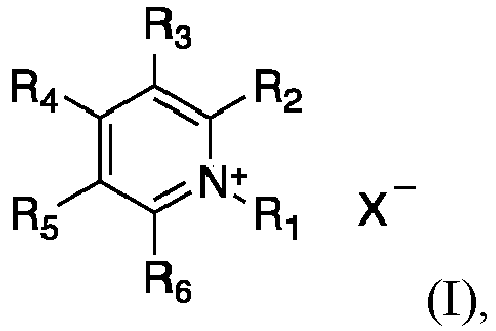
- R1 represents a C5-C11 alkyl group,
- R2, R3, R4, R5 and R6 represent each independently:
- a hydrogen atom, a halogen atom, -OH, -CN, -NO2, -SH, -NR'R" with R' and R" being independently a hydrogen atom or a (C1-C6)alkyl, or
- a radical selected from the group consisting of a (C1-C6)alkyl, a (C2-C6)alkenyl, a(C2-C6)alkynyl, a (C1-C6)alkoxy, a (C3-C12)cycloalkyl, a (C3-C12)heterocycloalkyl, an aryl, and a heteroaryl, said radical being optionally substituted by at least one -OH, (Ci-C6)alkoxy, (C1-C6)alkanoyl, or -NR'R" with R' and R" being independently a hydrogen atom or a (C1-C6)alkyl, and
- X- represents an anion; and
- (b) recovering double-stranded DNA.
- In a particular embodiment, R1 represents a C7-C10 alkyl group. Preferably, R1 is an octyl group.
- In a particular embodiment, R2, R3, R4, R5 and R6 represent each independently a hydrogen atom, or a (C1-C6)alkyl optionally substituted by -OH, (C1-C6)alkoxy, (C1-C6)alkanoyl, or - NR'R" with R' and R" being independently a hydrogen atom or a (C1-C6)alkyl.
In a more particular embodiment, R2, R3, R4, R5 and R6 represent each independently a hydrogen atom, or a (C1-C6)alkyl optionally substituted by -OH, -NH2, (C1-C6)alkoxy, or (Ci-C6)alkanoyl.
In an even more particular embodiment, R2, R3, R4, R5 and R6 represent each independently a hydrogen atom or a (C1-C6)alkyl group. - In another particular embodiment, R2, R4, and R6 represent a hydrogen atom.
- In a more particular embodiment, R2, R4, and R6 represent a hydrogen atom, and R3 and R5 represent each independently a hydrogen atom or a (C1-C6)alkyl optionally substituted by -OH, (C1-C6)alkoxy, (C1-C6)alkanoyl, or -NR'R" with R' and R" being independently a hydrogen atom or a (C1-C6)alkyl. In a preferred embodiment, R2, R4, and R6 represent a hydrogen atom, and R3 and R5 represent each independently a hydrogen atom or a (C1-C6)alkyl.
- Preferably, said (C1-C6)alkyl is a methyl.
- In a particular embodiment, R3 and R5 are identical.
- Preferably, R' and R" are independently a hydrogen atom or a methyl, more preferably a hydrogen atom.
- In a particular embodiment, X- represents an organic or inorganic anion.
- Examples of organic anions include, but are not limited to, a carboxylate such as a (Ci-C6)alkanoate optionally substituted by at least one halogen (preferably fluorine), an oxalate, a citrate, or a tartrate, a sulfonate such as a (C1-C6)alkylsulfonate optionally substituted by at least one halogen (preferably fluorine), a benzenesulfonate or toluenesulfonate, an alcoolate such as methanolate or ethanolate, a bis-trifluoromethanesulfonimidate, a dicyanamide (N(CN)2 -), a cyanate (OCN-), a thiocyanate (SCN-), a tris(perfluoroethyl)-trisfluorophosphate, a tetracyanoborate (B(CN)4 -), or a tetraphenylborate.
- Examples of inorganic anions include, but are not limited to, a halide such as chloride (Cl-), bromide (Br-), or iodide (I-), a perhalate such as a perchlorate (ClO4 -), a halate such as a chlorate (ClO3 -) or a iodate (IO3 -), a nitrate (NO3 -), a tetrafluoroborate (BF4 -), a tetrachloroaluminate (AlCl4 -), a hexafluorophosphate (PF6 -), a hexafluoroantimonate (SbF6 -).
- In a particular embodiment, X- is a halide, a dicyanamide, a nitrate, a cyanate, a thiocyanate, a (C1-C6)alkanoate, a (C1-C6)alkylsulfonate, a benzenesulfonate or toluenesulfonate.
- Preferably X- is a halide, more preferably a bromide or a chloride, even more preferably a bromide.
- In a preferred embodiment, a compound of formula (I) is a compound of formula (Ia), or a compound of formula (Ib):

- A compound of formula (Ia) can also be referred to as N-octylpyridinium bromide.
A compound of formula (Ib) can also be referred to as 3,5-dimethyl-N-octylpyridinium bromide. - In a more preferred embodiment, a compound of formula (I) is a compound of formula (Ia).
- Compounds of formula (I) can be prepared by any method known to the skilled artisan. For instance, such compounds can be prepared by a reaction of a pyridine compound with an alkyl halide, optionally followed by an anion metathesis. This method is in particular described by Papaiconomou et al. (J. Chem. Eng. 2007, 52, 833-840).
- The process of the invention implements the compounds of formula (I) as defined above, for extracting double-stranded DNA. The process comprises:
- (a) reacting a biological sample comprising double-stranded DNA with a compound of formula (I) as defined herein; and
- (b) recovering double-stranded DNA.
- As used herein, the expression "extracting double-stranded DNA" refers to the recovery of all or part of double-stranded DNA contained in a biological sample. Extracting said DNA allows to isolate said DNA from the rest of said biological sample. The expression "purifying double-stranded DNA" may equivalently be used herein for "extracting double-stranded DNA".
- As used herein, "double-stranded DNA" refers to a DeoxyriboNucleic Acid molecule having two anti-parallel strands. Said double-stranded DNA may be linear or circular. Circular double-stranded DNA may also be referred to as "plasmid". In a particular embodiment, the double-stranded DNA is a bisulfited DNA.
- The process of the invention allows to extract about 10 times more bisulfited double-stranded DNA than a process implemented with commercial kits known in the art, such as Epitect Kit.
- In a particular embodiment, the double-stranded DNA has more than 50 base pairs, preferably more than 100 base pairs, more preferably more than 300 base pairs, even more preferably more than 1000 base pairs. Preferably, the double-stranded DNA has less than 30000 base pairs, preferably less than 10000 base pairs, more preferably less than 5000 base pairs.
- Step (a) comprises reacting a biological sample comprising double-stranded DNA with a compound of formula (I) as defined herein.
- The biological sample of step (a) may be any biological sample comprising double-stranded DNA. In particular, the biological sample may be obtained from a human, animal, vegetal, bacterial, algal, fungal, protozoal, or viral source. The biological sample may be obtained from microbial fermentation, cellular cultures, biological tissues, and/or biological body fluids. Examples biological body fluids are blood, sputum, lymph fluid, cerebrospinal fluid, urine, serum, plasma, sweat, various aspirates. Examples of biological tissues are muscular tissues, bone tissues, mucosa, corneum, skin tissues, epithelium, connective tissues, or neural tissues. Cells of the biological sample may be eukaryotic or prokaryotic. Examples of cells are chondrocytes, osteoblasts, fibroblasts, blood cells, plasmocytes, neurons, hepatocytes, enterocytes, or cancer cells.
- In a particular embodiment, the biological sample is selected from a cell lysate, a cell digest, blood, a serum sample and a plasma sample.
- The biological sample of step (a) can be prepared by any techniques known to the skilled artisan. It is understood that the process of the invention is carried out under in vitro conditions.
- The biological sample subjected to step (a) of the process according to the invention, is used under diluted conditions. In a particular embodiment, the double-stranded DNA concentration is comprised between 1 and 20 ng/mL, preferably between 5 and 10 ng/mL.
Step (a) is advantageously carried out at room temperature. As used herein, the expression "room temperature" refers to a temperature comprised between 5 °C and 40 °C, preferably between 15 °C and 30 °C. - The compound of formula (I) may be used pure or in solution. Preferably, the compound of formula (I) is used in solution, more preferably in an aqueous solution.
- In a particular embodiment, step (a) comprises the compaction of double-stranded DNA contained in the biological sample.
As used herein, a "compaction" of double-stranded DNA refers to a dehydration of double-stranded DNA. The resulting DNA (i.e. a compacted double-stranded DNA) is insoluble in water. The double-stranded DNA obtained in step (a) is insoluble in water. - Step (a) produces an aggregate (also called herein a "precipitate"). Preferably, this aggregate comprises double-stranded DNA and a compound of formula (I) in the form of a complex. A "complex of double-stranded DNA and a compound of formula (I)" refers to a molecular entity wherein the double-stranded DNA and a compound of formula (I), in particular the pyridinium of said compound, interact with each other, for instance through ionic interactions.
- Advantageously, the process, and more particularly step (a), is DNA-selective. The expression "DNA-selective" refers to the ability of a compound of formula (I) to selectively react with double-stranded DNA. In particular, in a double-stranded DNA-selective process, the compound of formula (I) does not substantially react with other biological molecules, such as proteins, RNA, or single-stranded DNA, which may be present in the biological sample. In a preferred embodiment, the compound of formula (I) only reacts with double-stranded DNA.
- Step (b) of the process of the invention comprises recovering double-stranded DNA.
- In a particular embodiment, step (b) comprises the following steps:
- (b1) purifying the aggregate obtained in step (a); and
- (b2) contacting the aggregate obtained in step (b1) with a buffer solution.
- The expression "purifying an aggregate" refers to the recovery of said aggregate. The expression "isolating an aggregate" can be equivalently used herein.
- In a preferred embodiment, the purifying step (b1) comprises a centrifugation step.
Suitable conditions of centrifugation, in particular the temperature, and the centrifugation speed and time, can be determined by the skilled artisan. For instance: - the temperature may be comprised between 0 °C and 15 °C;
- the centrifugation speed may be comprised between 3000 rpm and 10000 rpm;
- the centrifugation time may be comprised between 1 min and 120 min.
- Step (b2) comprises contacting the aggregate obtained in step (b1) with a buffer solution.
- The buffer solution used in step (b2) is advantageously alcohol-soluble. In a particular embodiment, said buffer solution contains at least one alkali salt. Examples of alkali salt are a lithium salt, a sodium salt, or a potassium salt, preferably a lithium salt or a sodium salt, more preferably a sodium salt. Examples of sodium salt are sodium chloride or sodium phosphate. Examples of buffer solutions include, but are not limited to, phosphate-buffered saline solution, carbonate buffer solution, citrate buffer solution, monochloracetate buffer solution, acetate, buffer solution, or borate buffer solution. Preferably, the buffer solution is a phosphate-buffered saline solution (also referred to as "PBS" solution).
- In a particular embodiment, step (b2) comprises the un-compaction of the double-stranded DNA from the aggregate obtained in step (b1).
As used herein, an "un-compaction" (or "decompaction") of double-stranded DNA refers to a hydration of double-stranded DNA. The resulting DNA (i.e. an un-compacted double-stranded DNA) is soluble in water or in the buffer solution. - In a particular embodiment, the process further comprises:
(b3) contacting the mixture obtained in step (b2) with at least one alcohol solution. - Steps (b2) and (b3) may be carried out simultaneously or successively. Preferably, steps (b2) and (b3) are carried out successively.
- In a more particular embodiment, step (b3) comprises the following substeps:
- (b3-1) adding a first alcohol solution to the mixture obtained in step (b2);
- (b3-2) isolating the aggregate obtained in substep (b3-1); and
- (b3-3) optionally, washing the aggregate obtained in substep (b3-2) with a second alcohol solution.
- In a particular embodiment, substep (b3-1) comprises the compaction of the double-stranded DNA obtained in step (b2). Substep (b3-1) produces an aggregate, which comprises double-stranded DNA.
- Preferably, substep (b3-2) comprises a centrifugation step.
- In a particular embodiment, substeps (b3-1) and (b3-2) are cyclically implemented several times, such as two, three or four times, preferably two times. For instance, according to this embodiment, the liquid phase produced by the centrifugation in substep (b3-2) (also referred to as "supernatant") is contacted with said first alcohol solution, and the aggregate obtained therefrom is isolated, preferably by centrifugation.
- In a particular embodiment, the alcohol in the alcohol solution used in steps (b3), (b3-1), or (b3-3) is methanol, ethanol, propanol, isopropanol and/or a mixture thereof. Preferably, said alcohol is ethanol.
- In a preferred embodiment, the alcohol solution is an aqueous solution. According to this preferred embodiment, the alcohol solution comprises an alcohol as defined herein and water. In a particular embodiment, the alcohol concentration in the alcohol solution is greater than or equal to 50 % (v/v), preferably greater than or equal to 70 % (v/v).
- In particular, the alcohol concentration of said first alcohol solution in step (b3-1) may be greater than or equal to 90 % (v/v), and more particularly, greater than or equal to 95 % (v/v). In a preferred embodiment, the first alcohol solution in step (b3-1) is an aqueous solution of ethanol having a concentration greater than or equal to 95 % (v/v).
- In particular, the alcohol concentration of said second alcohol solution in step (b3-3) may be comprised between 50 % and 95 % (v/v), and more particularly between 60 % and 80 % (v/v). In a preferred embodiment, the second alcohol solution in step (b3-3) is an aqueous solution of ethanol having a concentration between 60 % and 80 % (v/v).
- The optional washing step (b3-3) can be implemented several times, for instance, two times or three times. The washing steps may be separated by centrifugation steps.
- In a particular embodiment, the process of the invention comprises the following steps:
- (a) reacting a biological sample comprising double-stranded DNA with a compound of formula (I) as defined herein, to form an aggregate;
- (b1) purifying the aggregate obtained in step (a); and
- (b2) contacting the aggregate obtained in step (b1) with a buffer solution.
- In a more particular embodiment, the process of the invention comprises the following steps:
- (a) reacting a biological sample comprising double-stranded DNA with a compound of formula (I) as defined herein, to form an aggregate;
- (b1) purifying the aggregate obtained in step (a);
- (b2) contacting the aggregate obtained in step (b1) with a buffer solution; and
- (b3) contacting the mixture obtained in step (b2) with at least one alcohol solution.
- In an even more particular embodiment, the process of the invention comprises the following steps:
- (a) reacting a biological sample comprising double-stranded DNA with a compound of formula (I) as defined herein, to form an aggregate;
- (b1) purifying the aggregate obtained in step (a);
- (b2) contacting the aggregate obtained in step (b1) with a buffer solution;
- (b3-1) adding a first alcohol solution to the mixture obtained in step (b2);
- (b3-2) isolating the aggregate obtained in substep (b3-1); and
- (b3-3) optionally, washing the aggregate obtained in substep (b3-2) with a second alcohol solution.
- In another particular embodiment, the process of the invention comprises the following steps:
- (α) compacting double-stranded DNA from a biological sample in the presence of a compound of formula (I) as defined herein;
- (β) un-compacting double-stranded DNA from step (α) in the presence of a buffer solution, preferably a PBS solution;
- (γ) re-compacting double-stranded DNA from step (β) in the presence of an alcohol solution, preferably ethanol; and
- (δ) recovering double-stranded DNA.
- The process of the invention allows to extract double-stranded DNA. The double-stranded DNA extracted by a process according to the invention can be preserved in a dry state or in any suitable solution, such as water, or a buffer (e.g. Tris-EDTA buffer).
- The native structure of the double-stranded DNA extracted by a process according to the invention, is substantially preserved. The preservation of the DNA structure can be measured by circular dichroism, or any other techniques known to the skilled artisan.
The extraction yield may be greater than or equal to 40 %, preferably greater than or equal to 60 %, more preferably greater than or equal to 80 %. The extraction yield refers to the ratio of the weight of double-stranded DNA extracted from a biological sample by a process of the invention to the total weight of double-stranded DNA initially contained in said biological sample. - An object of the invention is a method for extracting at least 40 %, preferably 60%, even more preferably 80%, of double-stranded DNA from a biological sample comprising the following steps of:
- (a) reacting a biological sample comprising double-stranded DNA with a compound of formula (I), and
- (b) recovering double-stranded DNA.
- The process of the invention may be implemented under manual or automated conditions. For automated conditions, steps of the process may be carried out by means of well plates comprising membranes. Such membranes can resist organic solvents and allow filtering liquid phases and isolating solid phases. The removal of said liquid phase can be achieved by using a vacuum system (e.g. a pump) connected to the well plates.
- Another object of the invention is a use of a compound of formula (I) as defined herein, for extracting double-stranded DNA.
- Another object is a kit for extracting double-stranded DNA comprising a composition comprising a compound of formula (I) as defined herein.
- In a particular embodiment, the kit further comprises a buffer solution as defined herein, and at least one alcohol solution, as defined herein.
- In a preferred embodiment, the kit of the invention comprises:
- a composition comprising a compound of formula (I) as defined herein;
- a buffer solution, preferably a phosphate-buffered saline solution; and
- at least one alcohol solution, preferably comprising ethanol.
- Each composition or solution of the kit is advantageously contained in an individual compartment.
- The kit of the present invention is particularly suitable for implementing a process of the invention.
- A further object of the present invention is a use of a kit as defined herein for extracting double-stranded DNA.
- The invention will also be described in further details in the following examples, which are not intended to limit the scope of this invention, as defined by the attached claims.
- The Phosphate Buffer Saline pH 7.2 contained 150 mM NaCl and 150 mM sodium phosphate. Calf-thymus DNA or "Ct-DNA" had an average size of 1800 bp and a verified high purity: 260nm/280nm= 1.9, and was used diluted in water at 1 µg/ml.
- Screened ionic liquid-type compounds described in Example 2 were prepared as previously described in Viboud et al. (J. Hazard. Mater. 2012, 40-48, 215-216).
- The 1M aqueous working solution of compound (Ia) was kept at 4°C for 12 months without demonstrating instability.
- Confluent MCF7 cells were scrapped in PBS from confluents T25 flasks with a rubber policeman and were next collected by centrifugation. Digests were prepared from MCF7 pellets, mice kidneys and from vitis vinifera leaves after digestion. One mg of each tissue was cut in small parts with scissors and immerged in 1 ml of lysis buffer (NaCl 5 M: 20 µl, Tris-
HCl pH 8 1M: 10 µl, EDTA (Ethylene Diamine Tetra-Acetic 0.5 M pH 8: 50 µl and water: 910 µl) containing 5 µl Triton X and 5 µl of proteinase K aqueous solution (20 mg/ml). The tubes containing the digests were left in a water bath for 12 h at 55 °C. 900 µL of each digest were further treated by the process of the invention. - DNA dosages: a
Cary 100 bio spectrophotometer was used for DNA dosage according to the manufacturer recommendations. The process of the invention was also surveyed by measuring all supernatants absorbance's at 260 nm as shown inFigure 1 .
Circular dichroism: Circular dichroism experiments were recorded at 20 °C on a Jasco J-810 instrument (Japan). All spectra were run in duplicate with 2 µg of the Ct-DNA obtained by the process of the invention using compound (Ia) and of Ct-DNA diluted in 500 µL PBS (Figure 3 ).
Agarose gel electrophoresis analysis: 1, 2% agarose gel was run at 60 V for 60 min. The running buffer was TAE in which SYBR green was dissolved (TAE 50X at pH 8.5 i.e. Tris-base 0.04 M, acetic acid: 57.1 ml, Ethylene Diamine Tetra-Acetic 0.001 M in water). 3 µl of an aqueous solution of SYBR green (10 mg/ml) is added to 100 ml of tepid agarose in TAE IX. The DNA samples were mixed with 6 µL of sample medium (Sodium Dodecyl Sulfate: 1 % v/v, bromophenol blue: 0.1% v/v, 0.1 M EDTA and 50 % v/v glycerol). The gels are examined under UV light and photographed with a numeric camera for archiving (MW= Molecular weight standards Promega, France).
DNA quality and qPCR: the DNAqual and Mitoc kits from Eurobio, France was used to evaluate the processed DNA quality (Bio-Rad qPCR (CFX96) machine). Briefly, the PCR mix contains 2 taqman probes, one being a calibrator (labelled with Texas red) and the other a target gene (labelled with Yakima yellow). For DNAqual the target genomic DNA isEpidermal Growth Factor 1, for Mitoc it is the mitochondrial genome. The experiments are run according to the manufacturer's instructions using the Bio-Rad amplifications reagents and vessels. For vitis vinifera a qPCR using SYBR Green was realized, the primers were chosen in the sequence of the ribosomal DNA: 5'-GAGAAACGGCTACCACATCCAAGG-3' (SEQ ID No: 1) and 5'-CCATGCACCACCACCCATAGAATC-3' (SEQ ID No: 2). - At room temperature, 100 µl of a 1 M aqueous solution of a ionic liquid-type compound was added to a biological sample (900 µL of all cell digests, bacterial lysates, Ct-DNA and MCF7 DNA bisulfited samples (with the EpiTect Bisulfite Kit and after the conversion step) and also directly to 900 µL of fresh and frozen sera and plasma). Obtained DNA aggregates were pelleted by 10 min centrifugation at 4 °C and 800 x g. Each pellet was then vortexed vigorously within 100 µL of added PBS and next re-condensed with addition, in the same tube, of 600 µL of absolute molecular grade EtOH (
EtOH 100%). As before, DNA aggregates were again pelleted by centrifugation. Pellets were finally washed twice with 500 µL of an EtOH/water solution (70 % / 30 %, v/v). The last pellet was left 5 min to dry at room temperature before addition of 100 µL of molecular grade water or pH 8.0 TE buffer.
Figure 6 shows a scheme illustrating a process for extracting double-stranded DNA according to the invention (the circular symbol represents a centrifugation step; pH 8.0 TE buffer [10 mM Tris · HCl (pH 8.0), 1 mM EDTA (pH 8.0)]; EtOH = ethanol.Table 1 Ionic liquid-type compound % Ct-DNA recovery 
80 % 
40 % -
Figure 1 shows UV spectra of 10 µg Ct-DNA (starting DNA), and 10 µg Ct-DNA after implementing the process as described above (recovered DNA). Absorbance (A) was measured for compound (Ia) 300 µM aqueous solution and for the first, second, third and fourth supernatants obtained during the process. Compound (Ia) absorbance maximum is alike absorbance of DNA. This could be a pitfall since it disturbed DNA dosage, however, it allowed the follow up of the needed efficient Compound (Ia) stripping. This is almost achieved after the second wash as seen in the second supernatant after the second Ct-DNA compaction with absolute EtOH. It is complete after the fourth 70 % EtOH/30 % water (v/v) wash. - A DNA-recovery yield of 80 % was obtained with Compound (Ia), and 40 % with Compound (Ib).
For short DNAs (100-300 bp), the DNA recovery yield reached 60 % with Compound (Ia). -
Figure 2 shows some pictures of purified DNA obtained by at different stages of the process as described above, starting from frozen mouse sera and plasma samples without preconditioning, and from plasmid lysates: -
Figure 2A : 900 µL samples of mouse serum or plasma were mixed with 100 µL of an aqueous solution of 1 M Compound (Ia) (after the first centrifugation); -
Figure 2B (right tube): 900 µL of lysed bacterial plasmids mixed with 100 µL 1M Compound (Ia) aqueous solution (after the first centrifugation).Figure 2B demonstrates that the compound used the process of the invention is DNA-selective. -
Figure 2C : MCF7 cells digest after the last centrifugation.Figure 2C demonstrates that all DNA are processable with the process of the invention, from serum, plasma, bacteria and human cells. -
Figure 3 shows circular dichroism spectra of 2 µg of Ct-DNA (starting DNA) and 2 µg Ct-DNA duplicate obtained by the process of the invention (recovered 1 and 2). Two extremes were observed in spectra: one negative at ∼ 248 nm and the other positive at ∼ 275 nm. Circular dichroism demonstrates that recovered Ct-DNAs were as Ct-DNA in a B-conformation. This indicates that the process of the invention does not change the DNA conformation. - As shown in
Figure 4 , Ct-DNA and the duplicate obtained by the process of the invention were compared through an agarose gel electrophoresis. This analysis demonstrates an apparent identity between the two samples. - The process of the invention described in Example 1 was carried out using the following compounds, having various nitrogen-based rings and various alkyl chains:
- pyrrolidinium and piperidinium compounds:


- imidazolium compounds:

- a pyridinium compound, having a C4 alkyl chain:

- pyridinium compounds, having C14 and C16 alkyl chains:

- a dimeric pyridinium compound:

- Contrary to the compounds of the invention, none of the above compounds were able to extract double-stranded DNA, selectively and/or with high yields.
- Also,
Figure 2B (left tube) shows 900 µL of lysed bacterial plasmids mixed with 100 µL 1M Cetyl pyridinium aqueous solution, after the first centrifugation. Contrary to compounds used in the present invention, cetyl pyridinium (C16 alkyl chain) reacts with plasmid proteins as well as plasmid DNA, and is thus not DNA-selective. - • Table 2 shows DNA UV-absorbance and absorbance ratio (260 nm/280 nm) obtained with the process of the invention as described in Example 1 and known DNA purifications processes. Concentrations variations were of about 5 % with 3 different measurements.
Duplicates samples were processed with the process of the invention of Example 1 (A), with the phenol/chloroform/isoamyl alcohol (25/24/1, v/v) process (B), or with the Qiagen kit (QIAamp DNA Mini Kit, QIAprep Spin Miniprep Kit, DNAeasy Plant Mini Kit) (C). Leaves of vitis vinifera were digested in duplicate and impurities were removed before further processing by either method by the first Qiagen column.Table 2 Process DNA type DNA Concentration (ng/(µL) 260 nm 280 nm 260/280 nm A Purified mouse kidney DNA 840 0.458 0.365 1.40 B Purified mouse kidney DNA 740 0.338 0.331 1.02 A Plasmid purified 7792 1.558 0.944 1.65 C Plasmid purified 3989 0.797 0.584 1.36 A MCF7 DNA purified 8 800 0.352 0.264 1.33 C MCF7 DNA purified 1230 0.246 0.211 1.16 A Vitis vinifera leaves purified 1 840 0.269 0.248 1.08 C Vitis vinifera leaves Qiagen purified 1 350 0.217 0.204 0.83
• Table 3 shows DNA extraction from mouse and human sera and plasma. Duplicates samples were processed with the process of the invention as described in Example 1 (A) or with the phenol/chloroform/isoamyl alcohol process (B). Concentrations variations were of about 5 % with 3 different measurements.Table 3 Origins (2 mL samples) Process B (Total ng) Process A (Total ng) Yield (In folds) Mouse serum 184 1508 18 Frozen mouse serum 3 37 556 14.7 Frozen mouse serum 7 56 818 14.4 Mouse plasma 4160 1497 9.3 Frozen mouse plasma 5 42 627 14.7 Frozen mouse plasma 677 4993 64 Human plasma 3 173 1119 6.4 Human plasma 7 154 711 4.6 Human plasma 9 115 475 4.1 Frozen human plasma 641 804 19.6
•Figure 5 : DNA quality was assessed via qPCR (top ofFigure 5 : DNA qual - bottom ofFigure 5 : Mitoc.) In light grey (left part), DNA from mice kidneys obtained by the process of the invention, and in dark grey (right part), phenol/chloroform/isoamyl alcohol purified duplicate DNA. Specific qPCRs were conducted using six different mouse kidney biopsies. Numbers are code for the kidney biopsies.
The quality of Ct-DNAs obtained the process of the invention and by the phenol/chloroform/isoamyl process were equivalent in terms of genomic and mitochondrial DNA. - RNA was prepared from MCF7 cells with the RNAzol kit following the manufacturer's instructions and 100 µg of RNA were subjected to the process as described in Example 1. No pellet appeared.
- 10 µg of single-stranded DNA were also subjected to the process as described in Example 1, however no pellet appeared.
- This demonstrates that the process of the invention using a compound of formula (I) cannot be used for extracting RNA or single-stranded DNA, and is thus selective to double-stranded DNA.

(b3) contacting the mixture obtained in step (b2) with at least one alcohol solution.
In a particular embodiment, the aggregate isolated in step (b1) is obtained in the form of pellets.
Claims (15)
- A process for extracting double-stranded DNA, comprising the following steps:(a) reacting a biological sample comprising double-stranded DNA with a compound of formula (I):
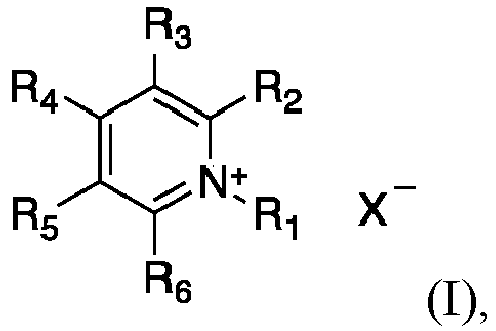 - R1 represents a C5-C11 alkyl group,- R2, R3, R4, R5 and R6 represent each independently:• a hydrogen atom, a halogen atom, -OH, -CN, -NO2, -SH, -NR'R" with R' and R" being independently a hydrogen atom or a (C1-C6)alkyl, or• a radical selected from the group consisting of a (C1-C6)alkyl, a (C2-C6)alkenyl, a (C2-C6)alkynyl, a (C1-C6)alkoxy, a (C3-C12)cycloalkyl, a (C3-C12)heterocycloalkyl, an aryl, a heteroaryl, said radical being optionally substituted by at least one -OH, (Ci-C6)alkoxy, or (C1-C6)alkanoyl, or -NR'R" with R' and R" being independently a hydrogen atom or a (C1-C6)alkyl, and- X- represents an anion; and(b) recovering double-stranded DNA.
 - The process according to claim 1, wherein R1 represents a C7-C10 alkyl group, preferably an octyl group.
- The process according to claim 1 or 2, wherein R2, R3, R4, R5 and R6 represent each independently a hydrogen atom, or a (C1-C6)alkyl optionally substituted by -OH, -NH2, (C1-C6)alkoxy, or (C1-C6)alkanoyl.
- The process according to any one of claims 1 to 3, wherein R2, R3, R4, R5 and R6 represent each independently a hydrogen atom or a methyl.
- The process according to any one of claims 1 to 4, wherein X- is a halide, a dicyanamide, a nitrate, a cyanate, a thiocyanate, a (C1-C6)alkanoate, a (C1-C6)alkylsulfonate, a benzenesulfonate or toluenesulfonate.
- The process according to any one of claims 1 to 5, wherein X- represents a halide, preferably a bromide or a chloride, more preferably a bromide.
- The process according to any one of claims 1 to 6, wherein a compound of formula (I) is a compound of formula (Ia), or a compound of formula (Ib):

- The process according to any of claims 1 to 7, wherein the process comprises the following steps:(a) reacting a biological sample comprising double-stranded DNA with a compound of formula (I) as defined in any one of claims 1 to 7, to form an aggregate;(b1) purifying the aggregate obtained in step (a); and(b2) contacting the aggregate obtained in step (b1) with a buffer solution.
- The process according to claim 8, wherein said buffer solution is a phosphate-buffered saline solution.
- The process according to claim 8 or 9, wherein the process further comprises:
(b3) contacting the mixture obtained in step (b2) with at least one alcohol solution, preferably comprising ethanol. - The process according to claim 10, wherein the alcohol concentration of said alcohol solution is greater than or equal to 70 % (v/v).
- The process according to any one of claims 11, wherein the double-stranded DNA concentration is between 1 and 20 ng/mL, preferably between 5 and 10 ng/mL.
- The process according to any one of claims 1 to 12, wherein said double-stranded DNA has more than 50 base pairs, preferably more than 100 base pairs, more preferably more than 300 base pairs, even more preferably more than 1000 base pairs.
- Use of a compound of formula (I) as defined in any one of claims 1 to 7, for extracting double-stranded DNA.
- A kit for extracting double-stranded DNA comprising:- a composition comprising a compound of formula (I) as defined in any one of claims 1 to 7;- a buffer solution, preferably a phosphate-buffered saline solution;- at least one alcohol solution, preferably comprising ethanol; and- optionally an instruction guide.
Priority Applications (4)
| Application Number | Priority Date | Filing Date | Title |
|---|---|---|---|
| EP20305400.2A EP3901285A1 (en) | 2020-04-23 | 2020-04-23 | Process for extracting double-stranded dna |
| EP21719926.4A EP4139481A1 (en) | 2020-04-23 | 2021-04-23 | Process for extracting double-stranded dna |
| PCT/EP2021/060623 WO2021214271A1 (en) | 2020-04-23 | 2021-04-23 | Process for extracting double-stranded dna |
| US17/920,423 US20230235311A1 (en) | 2020-04-23 | 2021-04-23 | Process for extracting double-stranded dna |
Applications Claiming Priority (1)
| Application Number | Priority Date | Filing Date | Title |
|---|---|---|---|
| EP20305400.2A EP3901285A1 (en) | 2020-04-23 | 2020-04-23 | Process for extracting double-stranded dna |
Publications (1)
| Publication Number | Publication Date |
|---|---|
| EP3901285A1 true EP3901285A1 (en) | 2021-10-27 |
Family
ID=70775294
Family Applications (2)
| Application Number | Title | Priority Date | Filing Date |
|---|---|---|---|
| EP20305400.2A Withdrawn EP3901285A1 (en) | 2020-04-23 | 2020-04-23 | Process for extracting double-stranded dna |
| EP21719926.4A Pending EP4139481A1 (en) | 2020-04-23 | 2021-04-23 | Process for extracting double-stranded dna |
Family Applications After (1)
| Application Number | Title | Priority Date | Filing Date |
|---|---|---|---|
| EP21719926.4A Pending EP4139481A1 (en) | 2020-04-23 | 2021-04-23 | Process for extracting double-stranded dna |
Country Status (3)
| Country | Link |
|---|---|
| US (1) | US20230235311A1 (en) |
| EP (2) | EP3901285A1 (en) |
| WO (1) | WO2021214271A1 (en) |
Citations (3)
| Publication number | Priority date | Publication date | Assignee | Title |
|---|---|---|---|---|
| WO2015120447A1 (en) | 2014-02-10 | 2015-08-13 | Zymo Research Corporation | Methods of nucleic acid capture |
| EP3252040A1 (en) * | 2015-01-27 | 2017-12-06 | BGI Shenzhen | Stabilizer for preserving biological samples |
| WO2019232465A1 (en) * | 2018-06-01 | 2019-12-05 | Hua Hui | Methods and systems for sample collection |
-
2020
- 2020-04-23 EP EP20305400.2A patent/EP3901285A1/en not_active Withdrawn
-
2021
- 2021-04-23 WO PCT/EP2021/060623 patent/WO2021214271A1/en not_active Ceased
- 2021-04-23 US US17/920,423 patent/US20230235311A1/en active Pending
- 2021-04-23 EP EP21719926.4A patent/EP4139481A1/en active Pending
Patent Citations (5)
| Publication number | Priority date | Publication date | Assignee | Title |
|---|---|---|---|---|
| WO2015120447A1 (en) | 2014-02-10 | 2015-08-13 | Zymo Research Corporation | Methods of nucleic acid capture |
| US20150225713A1 (en) * | 2014-02-10 | 2015-08-13 | Zymo Research Corporation | Methods for nucleic acid capture |
| EP3252040A1 (en) * | 2015-01-27 | 2017-12-06 | BGI Shenzhen | Stabilizer for preserving biological samples |
| US20180334703A1 (en) | 2015-01-27 | 2018-11-22 | Bgi Shenzhen | Stabilizer for Preserving Biological Samples |
| WO2019232465A1 (en) * | 2018-06-01 | 2019-12-05 | Hua Hui | Methods and systems for sample collection |
Non-Patent Citations (5)
| Title |
|---|
| MO HAN ET AL: "A novel affordable reagent for room temperature storage and transport of fecal samples for metagenomic analyses", MICROBIOME, BIOMED CENTRAL LTD, LONDON, UK, vol. 6, no. 1, 27 February 2018 (2018-02-27), pages 1 - 7, XP021253885, DOI: 10.1186/S40168-018-0429-0 * |
| NACHAM ET AL., ANAL. CHEM., vol. 88, 2016, pages 7813 |
| PAPAICONOMOU ET AL., J. CHEM. ENG., vol. 52, 2007, pages 833 - 840 |
| VIBOUD ET AL., J. HAZARD. MATER., vol. 40-48, 2012, pages 215 - 216 |
| WANG ET AL., ANAL. CHEM., vol. 79, 2007, pages 620 - 625 |
Also Published As
| Publication number | Publication date |
|---|---|
| US20230235311A1 (en) | 2023-07-27 |
| EP4139481A1 (en) | 2023-03-01 |
| WO2021214271A1 (en) | 2021-10-28 |
Similar Documents
| Publication | Publication Date | Title |
|---|---|---|
| CN103755703B (en) | A kind of synthetic and application of difunctional water-soluble perylene diimide derivatives | |
| CN108060159B (en) | A kind of DNA extraction method rich in polysaccharide polyphenol plant | |
| KR20070115874A (en) | Reagents and methods for storing and processing biological samples for DNA analysis | |
| Tong et al. | Aqueous two-phase system of cationic and anionic surfactant mixture and its application to the extraction of porphyrins and metalloporphyrins | |
| CN109678914A (en) | A kind of isolation and purification method of the pretreatment of sophorolipid fermentation liquid and different structure sophorolipid | |
| CN102206630B (en) | Method and kit for extracting total DNA of soil and sediment | |
| WO2023212336A1 (en) | Nucleic acid extraction and isolation with heat labile silanes and chemically modified solid supports | |
| US20230235311A1 (en) | Process for extracting double-stranded dna | |
| CN103030761B (en) | New member in cucurbituril family, namely hinged cucurbit (14) uril and synthesis and separation method thereof | |
| CN105199101B (en) | A kind of dipeptides polyethyleneimine polymers and preparation method and application | |
| CN103772460A (en) | Extraction process of cordycepin (active substance) from silkworm pupa cordyceps militaris | |
| CN101555253B (en) | Ruthenium polypyridine complex for inducing DNA condensation and preparation method and application thereof | |
| CN119842696A (en) | Method for extracting DNA from marine sediments | |
| CN102533688A (en) | Method for extracting and purifying lignin peroxidase by using reverse micelles | |
| CN111808843A (en) | DNA extraction kit and extraction method | |
| CN112479937B (en) | Preparation method of 2- [ [ tri (hydroxymethyl) methyl ] amino ] ethanesulfonic acid | |
| CN107021874A (en) | A kind of method of the butantriol of the separation and purification from microbial fermentation solution 1,2,4 | |
| Larpent et al. | Nonionic metal-chelating surfactants mediated solvent-free thermo-induced separation of uranyl | |
| CN117024633A (en) | Be used for detecting aquatic Cu 2+ Ionic antibacterial Schiff base modified polyvinyl alcohol | |
| CN116947950A (en) | A kind of preparation method of 2-O-methylguanosine | |
| Baum | Influence of hydrophobic interactions on the electrochemical selectivity ratios of liquid membranes responsive to organic ions | |
| CN102286069B (en) | Method for primarily purifying glutathione fermentation liquid by precipitation and separation with organic solvent | |
| CN101215559A (en) | A method for isolating and purifying an Arthrocyanobacterium plasmid | |
| CN105331357A (en) | 2,7-bis(4-vinylpyridine)-9-fluorenone salt two-photon fluorescent cell nucleus positioning probe material and preparation method and application thereof | |
| CN116947783B (en) | A method for purifying electronic media |
Legal Events
| Date | Code | Title | Description |
|---|---|---|---|
| PUAI | Public reference made under article 153(3) epc to a published international application that has entered the european phase |
Free format text: ORIGINAL CODE: 0009012 |
|
| STAA | Information on the status of an ep patent application or granted ep patent |
Free format text: STATUS: THE APPLICATION HAS BEEN PUBLISHED |
|
| AK | Designated contracting states |
Kind code of ref document: A1 Designated state(s): AL AT BE BG CH CY CZ DE DK EE ES FI FR GB GR HR HU IE IS IT LI LT LU LV MC MK MT NL NO PL PT RO RS SE SI SK SM TR |
|
| B565 | Issuance of search results under rule 164(2) epc |
Effective date: 20200916 |
|
| STAA | Information on the status of an ep patent application or granted ep patent |
Free format text: STATUS: THE APPLICATION IS DEEMED TO BE WITHDRAWN |
|
| 18D | Application deemed to be withdrawn |
Effective date: 20220429 |