EP3901161B1 - Cyclic dinucleotide prodrug molecule, preparation method therefor and application thereof - Google Patents
Cyclic dinucleotide prodrug molecule, preparation method therefor and application thereof Download PDFInfo
- Publication number
- EP3901161B1 EP3901161B1 EP20739193.9A EP20739193A EP3901161B1 EP 3901161 B1 EP3901161 B1 EP 3901161B1 EP 20739193 A EP20739193 A EP 20739193A EP 3901161 B1 EP3901161 B1 EP 3901161B1
- Authority
- EP
- European Patent Office
- Prior art keywords
- compound
- formula
- cyclic dinucleotide
- group
- drug
- Prior art date
- Legal status (The legal status is an assumption and is not a legal conclusion. Google has not performed a legal analysis and makes no representation as to the accuracy of the status listed.)
- Active
Links
Images



Classifications
-
- C—CHEMISTRY; METALLURGY
- C07—ORGANIC CHEMISTRY
- C07H—SUGARS; DERIVATIVES THEREOF; NUCLEOSIDES; NUCLEOTIDES; NUCLEIC ACIDS
- C07H19/00—Compounds containing a hetero ring sharing one ring hetero atom with a saccharide radical; Nucleosides; Mononucleotides; Anhydro-derivatives thereof
- C07H19/02—Compounds containing a hetero ring sharing one ring hetero atom with a saccharide radical; Nucleosides; Mononucleotides; Anhydro-derivatives thereof sharing nitrogen
- C07H19/04—Heterocyclic radicals containing only nitrogen atoms as ring hetero atom
- C07H19/16—Purine radicals
- C07H19/20—Purine radicals with the saccharide radical esterified by phosphoric or polyphosphoric acids
- C07H19/207—Purine radicals with the saccharide radical esterified by phosphoric or polyphosphoric acids the phosphoric or polyphosphoric acids being esterified by a further hydroxylic compound, e.g. flavine adenine dinucleotide or nicotinamide-adenine dinucleotide
-
- C—CHEMISTRY; METALLURGY
- C07—ORGANIC CHEMISTRY
- C07H—SUGARS; DERIVATIVES THEREOF; NUCLEOSIDES; NUCLEOTIDES; NUCLEIC ACIDS
- C07H21/00—Compounds containing two or more mononucleotide units having separate phosphate or polyphosphate groups linked by saccharide radicals of nucleoside groups, e.g. nucleic acids
-
- A—HUMAN NECESSITIES
- A61—MEDICAL OR VETERINARY SCIENCE; HYGIENE
- A61K—PREPARATIONS FOR MEDICAL, DENTAL OR TOILETRY PURPOSES
- A61K31/00—Medicinal preparations containing organic active ingredients
- A61K31/70—Carbohydrates; Sugars; Derivatives thereof
- A61K31/7088—Compounds having three or more nucleosides or nucleotides
-
- A—HUMAN NECESSITIES
- A61—MEDICAL OR VETERINARY SCIENCE; HYGIENE
- A61P—SPECIFIC THERAPEUTIC ACTIVITY OF CHEMICAL COMPOUNDS OR MEDICINAL PREPARATIONS
- A61P31/00—Antiinfectives, i.e. antibiotics, antiseptics, chemotherapeutics
- A61P31/04—Antibacterial agents
-
- A—HUMAN NECESSITIES
- A61—MEDICAL OR VETERINARY SCIENCE; HYGIENE
- A61P—SPECIFIC THERAPEUTIC ACTIVITY OF CHEMICAL COMPOUNDS OR MEDICINAL PREPARATIONS
- A61P31/00—Antiinfectives, i.e. antibiotics, antiseptics, chemotherapeutics
- A61P31/12—Antivirals
-
- A—HUMAN NECESSITIES
- A61—MEDICAL OR VETERINARY SCIENCE; HYGIENE
- A61P—SPECIFIC THERAPEUTIC ACTIVITY OF CHEMICAL COMPOUNDS OR MEDICINAL PREPARATIONS
- A61P35/00—Antineoplastic agents
-
- C—CHEMISTRY; METALLURGY
- C07—ORGANIC CHEMISTRY
- C07H—SUGARS; DERIVATIVES THEREOF; NUCLEOSIDES; NUCLEOTIDES; NUCLEIC ACIDS
- C07H1/00—Processes for the preparation of sugar derivatives
-
- C—CHEMISTRY; METALLURGY
- C07—ORGANIC CHEMISTRY
- C07H—SUGARS; DERIVATIVES THEREOF; NUCLEOSIDES; NUCLEOTIDES; NUCLEIC ACIDS
- C07H19/00—Compounds containing a hetero ring sharing one ring hetero atom with a saccharide radical; Nucleosides; Mononucleotides; Anhydro-derivatives thereof
- C07H19/02—Compounds containing a hetero ring sharing one ring hetero atom with a saccharide radical; Nucleosides; Mononucleotides; Anhydro-derivatives thereof sharing nitrogen
- C07H19/04—Heterocyclic radicals containing only nitrogen atoms as ring hetero atom
- C07H19/16—Purine radicals
- C07H19/20—Purine radicals with the saccharide radical esterified by phosphoric or polyphosphoric acids
- C07H19/213—Purine radicals with the saccharide radical esterified by phosphoric or polyphosphoric acids containing cyclic phosphate
-
- C—CHEMISTRY; METALLURGY
- C07—ORGANIC CHEMISTRY
- C07H—SUGARS; DERIVATIVES THEREOF; NUCLEOSIDES; NUCLEOTIDES; NUCLEIC ACIDS
- C07H21/00—Compounds containing two or more mononucleotide units having separate phosphate or polyphosphate groups linked by saccharide radicals of nucleoside groups, e.g. nucleic acids
- C07H21/04—Compounds containing two or more mononucleotide units having separate phosphate or polyphosphate groups linked by saccharide radicals of nucleoside groups, e.g. nucleic acids with deoxyribosyl as saccharide radical
-
- Y—GENERAL TAGGING OF NEW TECHNOLOGICAL DEVELOPMENTS; GENERAL TAGGING OF CROSS-SECTIONAL TECHNOLOGIES SPANNING OVER SEVERAL SECTIONS OF THE IPC; TECHNICAL SUBJECTS COVERED BY FORMER USPC CROSS-REFERENCE ART COLLECTIONS [XRACs] AND DIGESTS
- Y02—TECHNOLOGIES OR APPLICATIONS FOR MITIGATION OR ADAPTATION AGAINST CLIMATE CHANGE
- Y02P—CLIMATE CHANGE MITIGATION TECHNOLOGIES IN THE PRODUCTION OR PROCESSING OF GOODS
- Y02P20/00—Technologies relating to chemical industry
- Y02P20/50—Improvements relating to the production of bulk chemicals
- Y02P20/55—Design of synthesis routes, e.g. reducing the use of auxiliary or protecting groups
Definitions
- the invention relates to the field of medicines, in particular to a cyclic dinucleotide prodrug molecule, a preparation method of the cyclic dinucleotide prodrug molecule and application of the cyclic dinucleotide prodrug molecule.
- Cyclic dinucleotides a novel class of second messenger molecules found in bacteria and mammals. In mammalian cells, cyclic dinucleotides can bind to stimulator of interferon genes (STING) and stimulate an immune response. It can cause the expression of cell cytokines such as interferon- ⁇ and NF- ⁇ B, and promote the proliferation, differentiation and maturation of CD8 + T cells.
- STING stimulator of interferon genes
- cyclic dinucleotides have a powerful immune stimulatory effect, they can be used in the treatment of viral and bacterial infections as well as cancer. Especially, the combination with the traditional immunotherapy can show better anticancer effect.
- the cyclic dinucleotide has two phosphodiester bonds in the molecular structure.
- the phosphodiester bond with negative charge causes poor lipid solubility of the drug, which prevents the cyclic dinucleotide from effectively crossing cell membranes.
- the phosphodiester bond is easy to be hydrolyzed, thereby causing instability of the drug molecule in the circulatory system.
- auxiliary materials are mainly adopted for cyclic dinucleotide drug delivery systems.
- early literature reported that a cyclic dinucleotide synthetase using lentivirus or adenovirus is used to promote an immune response by enzymatically synthesizing the cyclic dinucleotide after entering a cell. But this method has a large risk and is not widely used.
- the current method for solving the problem of effective uptake of cyclic dinucleotide by cells clinically is intratumoral injection.
- intratumoral injection is reported in the article that the cyclic dinucleotide can be uptaken by the cells, the uptake efficiency is low, so that a larger dose of administration is needed.
- the administration of the large dose can cause over-activation of the immune system, thereby causing systemic or local inflammatory response.
- WQ2017093933A1 has disclosed a cyclic purine dinucleotide compound, compositions, combinations and drugs containing the compound, and methods for preparing them.
- the compound disclosed in the prior art can be applied to the treatment of diseases related to the regulation of STING (Stimulator of Interferon Genes), such as inflammation, allergic and autoimmune diseases, infectious diseases, human immunodeficiency virus (HIV) infection, AIDS, cancer, precancerous syndrome and as an immunogenic composition or vaccine adjuvant.
- STING Stimulator of Interferon Genes
- HIV human immunodeficiency virus
- the 2'-5' phosphodiester structure of the cyclic purine dinucleotide compound in the prior art has a large EC50 value, and its stability in vivo is poor, and its action time is short, so the therapeutic effect still needs to be improved.
- WO2011005761A1 has disclosed a nucleic acid prodrug, a nucleic acid prodrug containing a chiral phosphorus moiety, and a method for preparing and using the nucleic acid prodrug and the nucleic acid prodrug containing a chiral phosphorus moiety.
- the compound disclosed in the prior art can have a good application prospect in treating chronic fatigue syndrome, pancreatic cancer, prostate cancer and other diseases, but the synthetic method involved in the prior art needs activation, coupling, oxidation, esterification and the like, which is not only complicated in steps, but also low in reaction efficiency.
- the invention aims to overcome the defect that cyclic dinucleotides are difficult to be effectively taken up by cells in the prior art.
- the present invention provides a cyclic dinucleotide prodrug molecule, or a stereoisomer, a tautomer, a nitrogen oxide, a solvate, a pharmaceutically acceptable salt thereof, having a structure as shown in formula (11) or formula (12),
- the invention provides a method of preparing a cyclic dinucleotide prodrug molecule as herein before described, the method including:
- the present invention provides a cyclic dinucleotide prodrug molecule as described above, or a stereoisomer, a tautomer, a nitrogen oxide, a solvate, a metabolite, a pharmaceutically acceptable salt thereof, for the preparation of a drug.
- the cyclic dinucleotide prodrug molecule provided by the invention can automatically cross cell membranes and release the cyclic dinucleotide, and it has higher cell activity.
- the present invention provided a cyclic dinucleotide prodrug molecule, or a stereoisomer, a tautomer, a nitrogen oxide, a solvate, a pharmaceutically acceptable salt thereof.
- the inventor of the present invention unexpectedly found in the research that by introducing a phosphate ester protecting group containing a thioester structure and/or a disulfide bond structure as shown in Y 1 and/or Y 2 into a cyclic dinucleotide molecule to form a phosphotriester cyclic dinucleotide prodrug molecule, the influence of negative charges of phosphate can be eliminated, the protecting group can be removed in cytoplasm, and the cyclic dinucleotide molecule with biological activity can be released, thereby overcoming the defect that the cyclic dinucleotide is difficult to be effectively taken up by cells.
- the present invention provides a preferred embodiment, wherein the cyclic dinucleotide has a structure represented by formula (11),
- the cyclic dinucleotide has a structure represented by formula (12),
- a second aspect of the invention provided a method of preparing the cyclic dinucleotide prodrug molecule of the invention.
- the protecting group used in the preparation of the cyclic dinucleotide prodrug molecules according to the present invention is an acyl group, which may be, for example, a benzoyl group, an isobutyryl group, an acetyl group, a phenoxyacetyl group, a 4-isopropylphenoxyacetyl group or the like.
- the protecting group is selected from phenoxyacetyl or 4-isopropylphenoxyacetyl.
- the amount of each substance used in the method is not particularly limited, and can be selected by those skilled in the art according to the needs of each reaction.
- the conditions for carrying out the first contact reaction include: the temperature is 0°C to50°C and the time is 2h to 8h.
- the conditions for carrying out the second contact reaction include: the temperature is 0°C to50°C and the time is 2h to 8h.
- the first condensing agent and the second condensing agent are each independently selected from at least one of 1- (mesitylene-2-sulfone) -3-nitro-1, 2, 4-triazole, 2,4, 6-triisopropylphenylsulfone-3-nitro-1, 2, 4-triazole, 2,4, 6-triisopropylbenzenesulfonyl chloride, 2,4, 6-trimethylbenzenesulfonyl chloride, 1H-tetrazole, and N-methylimidazole.
- the first liquid reaction medium and the second liquid reaction medium are reaction media commonly used in the art, and for example, pyridine, dichloromethane, acetonitrile, dioxane, tetrahydrofuran, etc. can be used, and those skilled in the art can select them according to the type of reaction.
- the first condensing agent is used in an amount of 2mol to 3mol with respect to 1mol of the first nucleotide monomer compound.
- the second condensing agent is used in an amount of 4mol to 5mol with respect to 1mol of the linear dinucleotide intermediate.
- the alkaline conditions can be provided by, for example, triethylamine, tert-butylamine, diethylamine, diisopropylamine, etc., and particularly preferably, in order to obtain a higher yield of the target product, the alkaline conditions are provided by a solution of tert-butylamine in acetonitrile. Particularly preferably, the alkaline conditions are provided by a mixed solution of tert-butylamine and acetonitrile in a volume ratio of 1:(1 to 5).
- the deprotection group is reacted in the presence of a mixed solution of diisopropylamine and methanol in a volume ratio of 1: (5 to 20).
- the method of preparing the cyclic dinucleotide prodrug molecule of the present invention includes:
- the synthesis of the first nucleotide monomer compound and the second nucleotide monomer compound may be a method commonly used in the art, and those skilled in the art may design a synthetic route by himself or herself based on the structures represented by formula (13) to formula (16) provided in the present invention.
- the invention herein illustratively provides several specific synthetic methods:
- the first method includes the following steps:
- R is the tert-butyl group
- B is the adenine group
- the method includes the following steps:
- the second method includes the following steps:
- the second method includes the following steps:
- the amount of each substance used is not particularly limited, and can be selected by those skilled in the art according to the needs of the reaction.
- the present invention provided the cyclic dinucleotide prodrug molecule of the present invention, or a stereoisomer, a tautomer, a nitrogen oxide, a solvate, a pharmaceutically acceptable salt thereof, for the preparation of a drug.
- the drug is an antiviral drug, an antibacterial infection drug or an anticancer drug.
- the cyclic dinucleotide prodrug molecule can independently cross cell membranes and release the cyclic dinucleotide, the released cyclic dinucleotide can be combined with a stimulator of interferon genes (STING) to stimulate an immune response, and the cyclic dinucleotide prodrug molecule can be applied to preparation of antivira 1 drug, antibacterial infection drug and anticancer drug.
- STING interferon genes
- the reaction according to the second aspect of the present invention may be carried out by any of various post-treatment methods conventionally used in the art.
- Methods of such post-processing include, but are not limited to: extraction, recrystallization, washing, drying, filtration and the like.
- the present invention is not described in detail herein, and the post-processing methods mentioned in the embodiments are only used for exemplary enumeration and do not indicate that they are necessary operations, and those skilled in the art can substitute conventional other means.
- the anhydrous solvents required for the experiments were dried by conventional methods.
- the product separation and identification device and method are as follows: the thin layer chromatography silica gel GF254 is produced by Tianjin Silida company.
- TLC analysis is under UV light at 254nm, and column chromatography silica gel is produced by Qingdao ocean chemical company.
- the nuclear magnetic resonance spectrometer was obtained by Bruker AVANCE 400M Hz, TMS as internal standard.
- the high-resolution mass spectrum was obtained by Varian 7.0T FTMS Fourier transform plasma cyclotron resonance high-resolution mass spectrum.
- the normal temperature and the room temperature are both (25 ⁇ 3)°C.
- Example compounds 1-10 are reference compounds.
- MALDI-TOF-HRMS the relative molecular mass of C 34 H 50 N 10 O 11 P 2 S 2 was 900.2577, and a peak of [M+H ] + 901.2654 was found.
- cddA35 (structure shown in table 2) was prepared according to the method in the literature (Wang, B.; Wang, Z.; Javomik, U.; Xi, Z.; Plavec, J., Computational and NMR spectroscopy insights into the conformation of cyclic dinucleotides. Sci Rep 2017, 7 (1), 16550.).
- HPLC conditions the instrument used by an Agilent 1260 HPLC, column: Agilent ZORABX SB-C185 ⁇ m [4.6 ⁇ 150mm], column temperature 25°C, sample injection 10 ⁇ L, detection wavelength was 254nM, chromatographic gradient method as shown in Table 1 below.
- Table 1 HPLC liquid phase gradient method Time(min) Vol% A(10mM TEAA buffer solution) Vol% B(MeCN) Flow rate(mL/min) 1 98 2 1 6 0 100 1 10 0 100 1 13 98 2 1 15 98 2 1 TABLE 2 Compound Structure logP Compound8 1.93 ⁇ 0.01 Compound16 0.85 ⁇ 0.02 cddA35 -3.43 ⁇ 0.06
- the logP of the phosphate ester protected with the substituted mercaptoethanol is greatly improved.
- the logP value of the cddA35 is -3.43, and the cddA35 is basically free of lipid solubility.
- the logP of the compound 8 protected by thioacyl ethyl ester and the compound 16 protected by dimercapto ethanol is 1.93 and 0.85, respectively, so that the lipophilicity is greatly improved, and the compound is favorable for penetrating a cell membrane and entering cells to play an immune stimulator role.
- the principle is as follows: dual-fluorescence reporter gene experiments: After entering a cell, the cyclic dinucleotide prodrug molecule passes through thioesterase in the cytoplasm of the cell or a reducing environment, so that thioester bond breakage or disulfide bond breakage is carried out, then an intermediate is obtained, a sulfur atom at a ⁇ position can nucleophilically attack a carbon atom at the ⁇ position, cyclic thioethane is removed, cyclic dinucleotides with a phosphodiester structure of a parent drug with negative charges are released, the intracellular STING protein is combined and activated, interferon regulatory factor 3 (IRF3) is phosphorylated, phosphorylated IRF3 enters into the nucleus and combined with the promoter region of a interferon- ⁇ gene to cause the expression of interferon, and based on these, the interferon gene promoter is introduced into a promoter of firefly luciferase, so that
- the test method includes the following steps: HEK293T cells confluence reached about 70%, and the original culture medium is changed to 500mL of a serum-free culture medium opti-DMEM to be transferred.
- the above component solutions were prepared, which included pcDNA3.1-hsting-wt 2 ⁇ L, pGL3-IFN ⁇ 1 ⁇ L, pGL4.74-Rluc 1 ⁇ L, opti-DMEM medium supplemented 50 ⁇ L/well, four wells in parallel.
- the above solution mixture was mixed by adding 50 ⁇ L of 2/50 Lipo2000 transfection solution, the mixture was left to stand at room temperature for 15min and then mixed well, and 1OO ⁇ L/well of transfection was added and after 4h 1mL of DMEM medium at 37°C/well was added.
- the medium was further changed to 500mL opti-DMEM with or without serum.8 ⁇ L (5 ⁇ M) of the compound 8, the compound 16 or cddA35 and 92 ⁇ L of opti-DMEMmixed and left for 15min, transfected at 100 ⁇ L/well. After 4h, 1mL of DMEM medium at 37°C/well was added. After 24h, the dual-fluorescence results were detected, as shown in FIG. 1 .
- the test method includes the following steps: The THP-1-Lucia cells confluency reached about 80%, and the compound 8, the compound 16 and the drug ADU-S100 are directly dissolved into a culture medium according to a certain concentration and added into a 24-well plate, wherein four wells are parallel. The cells were maintained under the culture condition of 37°C and 5% CO 2 for 24h. After the end of the culture, luciferase activity was measured.
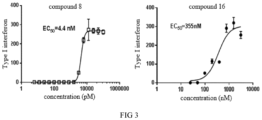
- the test results of the type I interferon of the compound 8, the compound 16 and the drug ADU-S100 in the monocyte cell line THP-1 under the action concentration of 10 ⁇ M are shown in FIG. 2 ; EC 50 values for the compound 8 and the compound 16 to cause type I interferon expression in THP-1 cell lines were then determined by dose-response curves for serial dilutions at various concentrations, as shown in FIG. 3 .
- both the compound 8 and the compound 16 cause strong expression of type I interferon in the monocyte THP-1 cell line at the action concentration of 10 ⁇ M without any transfection reagent, and the activity is much higher than that of the drug ADU-S100, which has entered clinical phase II.
- the EC 50 values of the compound 8 and the compound 16, which cause type I interferon expression in THP-1 cell line were 4.4nM and 355nM, respectively.
- the EC 50 value was 41.5 ⁇ M
- the EC 50 values of the compound 16 and the compound 8 were 9430-fold and 117-fold increased, respectively, and the activity was considerably increased.
- mice BABL/C female mice, weight 18g to 22g.
- the source is the animal experiment center in Guangdong province, and the mice are fed with pellet feed and freely eat and drink water.
- Tumor cell lines CT-26-Luc cells
- the cells are cultured and passaged, the cells are collected in the logarithmic phase of the cells and prepared into cell suspension with the concentration of (1.0 ⁇ 10 7 ) per milliliter, 0.1mL of cell suspension (the number of the cells is 1.0 ⁇ 10 6 per mouse) is injected into the armpit of the right forelimb, the tumor grows to be about 5mm in diameter successfully, and the mice are divided into three groups randomly after about 10days.
- the administration method includes the following steps: the administration was started at the 10 th day after tumor inoculation growth, and 50microliters/mouse was administered once every two days for a total of three times by intratumoral injection.
- the growth of tumors in mice was detected by chemiluminescence using the IVIS Spectrum Imaging System.
- small molecule fluorescein preparation an appropriate amount of 15mg/mL sodium fluorescein salt was prepared in PBS solution, and sodium fluorescein was ordered from Shanghai Yeasen Biotech Co., Ltd. Oxygen and isoflurane are prepared in advance.
- mice were placed in an anesthesia box by intraperitoneal injection of 100 ⁇ L of fluorescein, and after the animals were anesthetized, the mice were transferred to an imaging chamber in an imager. The posture of the mice was adjusted as needed.
- the imaging parameters are as follows: automatic exposure, wherein the Binning value is 2, and the F value is 8.
- the imaging time was chosen to be 10min.
- fluorescence values were converted to photon numbers and the total number of fluorescence photons for each experimental group was counted.
- the imager is an IVIS Spectrum imaging platform of Perkinelmer company. The results are shown in FIG. 4 . In which the numbers in FIG.
- FIG. 4a, FIG.4b , FIG.4c, FIG.4d , FIG.4e and FIG.4f represent the total number of fluorescence photons in the circular region (ROI, region of interest), and FIG. 4g and FIG.4h are statistical graphs of the total number of fluorescence photons for each experimental group, respectively.
- the tumor volume size and survival rate results for each group of mice are shown in FIG. 5 .
Landscapes
- Chemical & Material Sciences (AREA)
- Health & Medical Sciences (AREA)
- Organic Chemistry (AREA)
- Life Sciences & Earth Sciences (AREA)
- General Health & Medical Sciences (AREA)
- Molecular Biology (AREA)
- Biochemistry (AREA)
- Genetics & Genomics (AREA)
- Engineering & Computer Science (AREA)
- Biotechnology (AREA)
- Pharmacology & Pharmacy (AREA)
- Medicinal Chemistry (AREA)
- Animal Behavior & Ethology (AREA)
- Public Health (AREA)
- Veterinary Medicine (AREA)
- Chemical Kinetics & Catalysis (AREA)
- Nuclear Medicine, Radiotherapy & Molecular Imaging (AREA)
- General Chemical & Material Sciences (AREA)
- Oncology (AREA)
- Communicable Diseases (AREA)
- Epidemiology (AREA)
- Virology (AREA)
- Saccharide Compounds (AREA)
- Pharmaceuticals Containing Other Organic And Inorganic Compounds (AREA)
Description
- The invention relates to the field of medicines, in particular to a cyclic dinucleotide prodrug molecule, a preparation method of the cyclic dinucleotide prodrug molecule and application of the cyclic dinucleotide prodrug molecule.
- Cyclic dinucleotides, a novel class of second messenger molecules found in bacteria and mammals. In mammalian cells, cyclic dinucleotides can bind to stimulator of interferon genes (STING) and stimulate an immune response. It can cause the expression of cell cytokines such as interferon-β and NF-κB, and promote the proliferation, differentiation and maturation of CD8+ T cells.
- Because cyclic dinucleotides have a powerful immune stimulatory effect, they can be used in the treatment of viral and bacterial infections as well as cancer. Especially, the combination with the traditional immunotherapy can show better anticancer effect. Aduro Inc. and Novartis'ADU-S100currently enters clinical phase II and MK-1454 from MSD has already entered clinical phase I.
- The cyclic dinucleotide has two phosphodiester bonds in the molecular structure. The phosphodiester bond with negative charge causes poor lipid solubility of the drug, which prevents the cyclic dinucleotide from effectively crossing cell membranes. And the phosphodiester bond is easy to be hydrolyzed, thereby causing instability of the drug molecule in the circulatory system.
- Currently, auxiliary materials are mainly adopted for cyclic dinucleotide drug delivery systems. For example, early literature reported that a cyclic dinucleotide synthetase using lentivirus or adenovirus is used to promote an immune response by enzymatically synthesizing the cyclic dinucleotide after entering a cell. But this method has a large risk and is not widely used.
- Delivery of cyclic dinucleotide drugs by using liposomes or lipid nanoparticles, cell penetrating peptides, protein gels containing polycationic amino acids, etc. as carriers have been reported. But the use of such carriers may reduce drug loading efficiency, and the introduction of carriers may cause some potential cytotoxicity.
- The current method for solving the problem of effective uptake of cyclic dinucleotide by cells clinically is intratumoral injection. Although the direct intratumoral injection is reported in the article that the cyclic dinucleotide can be uptaken by the cells, the uptake efficiency is low, so that a larger dose of administration is needed. The administration of the large dose can cause over-activation of the immune system, thereby causing systemic or local inflammatory response.
- Therefore, there are still some problems how to solve the efficient uptake of cyclic dinucleotides by cells.
- WQ2017093933A1 has disclosed a cyclic purine dinucleotide compound, compositions, combinations and drugs containing the compound, and methods for preparing them. The compound disclosed in the prior art can be applied to the treatment of diseases related to the regulation of STING (Stimulator of Interferon Genes), such as inflammation, allergic and autoimmune diseases, infectious diseases, human immunodeficiency virus (HIV) infection, AIDS, cancer, precancerous syndrome and as an immunogenic composition or vaccine adjuvant. However, the 2'-5' phosphodiester structure of the cyclic purine dinucleotide compound in the prior art has a large EC50 value, and its stability in vivo is poor, and its action time is short, so the therapeutic effect still needs to be improved.
-
WO2011005761A1 has disclosed a nucleic acid prodrug, a nucleic acid prodrug containing a chiral phosphorus moiety, and a method for preparing and using the nucleic acid prodrug and the nucleic acid prodrug containing a chiral phosphorus moiety. The compound disclosed in the prior art can have a good application prospect in treating chronic fatigue syndrome, pancreatic cancer, prostate cancer and other diseases, but the synthetic method involved in the prior art needs activation, coupling, oxidation, esterification and the like, which is not only complicated in steps, but also low in reaction efficiency. - The invention aims to overcome the defect that cyclic dinucleotides are difficult to be effectively taken up by cells in the prior art.
- In order to achieve the above objects, the present invention provides a cyclic dinucleotide prodrug molecule, or a stereoisomer, a tautomer, a nitrogen oxide, a solvate, a pharmaceutically acceptable salt thereof, having a structure as shown in formula (11) or formula (12),

- In a second aspect, the invention provides a method of preparing a cyclic dinucleotide prodrug molecule as herein before described, the method including:
- a) carrying out a first contact reaction on a first nucleotide monomer compound, a second nucleotide monomer compound and a first condensing agent in a first liquid reaction medium to obtain a linear dinucleotide intermediate;
- b) under the alkaline condition, the linear dinucleotide intermediate is subjected to decyanoethyl reaction, and then the obtained reaction product and a second condensing agent are subjected to second contact reaction in a second liquid reaction medium;
- c) carrying out deprotection reaction on the cyclic dinucleotide prodrug molecule with the protecting group obtained after the second contact reaction is carried out; wherein the first nucleotide monomer compound has a structure represented by formula (13) or formula (14):

- the second nucleotide monomer compound has a structure represented by formula (15) or formula (16):


- In a third aspect, the present invention provides a cyclic dinucleotide prodrug molecule as described above, or a stereoisomer, a tautomer, a nitrogen oxide, a solvate, a metabolite, a pharmaceutically acceptable salt thereof, for the preparation of a drug.
- The cyclic dinucleotide prodrug molecule provided by the invention can automatically cross cell membranes and release the cyclic dinucleotide, and it has higher cell activity.
-
-
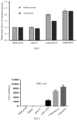
FIG. 1 is the results of the dual fluorescence test in Test Example 2; -
FIG. 2 is the results of the type I interferon test in the monocyte line THP-1 in Test Example 3; -
FIG. 3 is the EC50 value of the compound in Test Example 3 causing type I interferon expression in THP-1 cells; - In
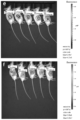
FIG. 4 , a is a graph of imaging of tumors atday 0 after administration of a hollow negative control group mouse in Test Example 4, b is a graph of imaging of tumors atday 0 after administration of an ADU-S 100 group mouse in Test Example 4, c is a graph of imaging of tumors atday 0 after administration of acompound 8 group mouse in Test Example 4, d is a graph of imaging of tumors atday 9 after administration of a negative control group mouse in Test Example 4, e is a graph of imaging of tumors atday 9 after administration of an ADU-S 100 group mouse in Test Example 4, f is a graph of imaging of tumors atday 9 after administration of acompound 8 group mouse in Test Example, g is a graph of statistics of total fluorescence amounts of tumors atday 0 after administration of each group mouse in Test Example 4, and h is a graph of statistics of total fluorescence amounts of imaging of tumors atday 9 after administration of each group mouse in Test Example 4; - In
FIG. 5 , a is the size of the tumor volume in the mice of the different experimental groups in Test Example 4, and b is the survival rate of the mice of the different experimental groups in Test Example 4. - The endpoints of the ranges and any values disclosed herein are not limited to the precise range or value, and these ranges or values should be understood to encompass values close to these ranges or values. For numerical ranges, each range between its endpoints and individual point values, and each individual point value can be combined with each other to give one or more new numerical ranges, and such numerical ranges should be construed as specifically disclosed herein.
- As previously mentioned, in a first aspect, the present invention provided a cyclic dinucleotide prodrug molecule, or a stereoisomer, a tautomer, a nitrogen oxide, a solvate, a pharmaceutically acceptable salt thereof.
- The inventor of the present invention unexpectedly found in the research that by introducing a phosphate ester protecting group containing a thioester structure and/or a disulfide bond structure as shown in Y1 and/or Y2 into a cyclic dinucleotide molecule to form a phosphotriester cyclic dinucleotide prodrug molecule, the influence of negative charges of phosphate can be eliminated, the protecting group can be removed in cytoplasm, and the cyclic dinucleotide molecule with biological activity can be released, thereby overcoming the defect that the cyclic dinucleotide is difficult to be effectively taken up by cells.
- The present invention provides a preferred embodiment, wherein the cyclic dinucleotide has a structure represented by formula (11),

- According to another preferred embodiment of the present invention, the cyclic dinucleotide has a structure represented by formula (12),

- As previously mentioned, a second aspect of the invention provided a method of preparing the cyclic dinucleotide prodrug molecule of the invention.
- The protecting group used in the preparation of the cyclic dinucleotide prodrug molecules according to the present invention is an acyl group, which may be, for example, a benzoyl group, an isobutyryl group, an acetyl group, a phenoxyacetyl group, a 4-isopropylphenoxyacetyl group or the like.
- Particularly preferably, the protecting group is selected from phenoxyacetyl or 4-isopropylphenoxyacetyl.
- Formula (13) and formula (14), DMTr-is 4, 4' -dimethoxytriphenylmethyl.
- In the present invention, the amount of each substance used in the method is not particularly limited, and can be selected by those skilled in the art according to the needs of each reaction.
- Preferably, the conditions for carrying out the first contact reaction include: the temperature is 0°C to50°C and the time is 2h to 8h.
- Preferably, the conditions for carrying out the second contact reaction include: the temperature is 0°C to50°C and the time is 2h to 8h.
- Preferably, the first condensing agent and the second condensing agent are each independently selected from at least one of 1- (mesitylene-2-sulfone) -3-nitro-1, 2, 4-triazole, 2,4, 6-triisopropylphenylsulfone-3-nitro-1, 2, 4-triazole, 2,4, 6-triisopropylbenzenesulfonyl chloride, 2,4, 6-trimethylbenzenesulfonyl chloride, 1H-tetrazole, and N-methylimidazole.
- In the present invention, the first liquid reaction medium and the second liquid reaction medium are reaction media commonly used in the art, and for example, pyridine, dichloromethane, acetonitrile, dioxane, tetrahydrofuran, etc. can be used, and those skilled in the art can select them according to the type of reaction.
- Preferably, in the step a), the first condensing agent is used in an amount of 2mol to 3mol with respect to 1mol of the first nucleotide monomer compound.
- Preferably, in the step b), the second condensing agent is used in an amount of 4mol to 5mol with respect to 1mol of the linear dinucleotide intermediate.
- In the step b), the alkaline conditions can be provided by, for example, triethylamine, tert-butylamine, diethylamine, diisopropylamine, etc., and particularly preferably, in order to obtain a higher yield of the target product, the alkaline conditions are provided by a solution of tert-butylamine in acetonitrile. Particularly preferably, the alkaline conditions are provided by a mixed solution of tert-butylamine and acetonitrile in a volume ratio of 1:(1 to 5).
- Preferably, the deprotection group is reacted in the presence of a mixed solution of diisopropylamine and methanol in a volume ratio of 1: (5 to 20).
- According to a preferred embodiment of the present invention, the method of preparing the cyclic dinucleotide prodrug molecule of the present invention includes:
- 1) adding the first nucleotide monomer compound, the second nucleotide monomer compound and 1- (mesitylene-2-sulfone) -3-nitro-1, 2, 4-triazole into pyridine, and reacting for 2h to 8h at 0°C to 50°C in an inert gas atmosphere to obtain a linear dinucleotide intermediate;
- 2) adding the linear dinucleotide intermediate obtained in the step 1) into a mixed solution of tert-butylamine and acetonitrile to react for 10min to 30min, evaporating the solvent to dryness, adding 1- (mesitylene-2-sulfone) -3-nitro-1, 2, 4-triazole, dissolving with pyridine, and reacting at 0°C to 50°C for 2h to 8h to obtain a cyclic dinucleotide prodrug molecule with a protecting group; in the mixed solution of the tert-butylamine and the acetonitrile, the volume ratio of the tert-butylamine to the acetonitrile is 1: (1 to 5);
- 3) dissolving the cyclic dinucleotide prodrug molecule with the protecting group into a mixed solution of diisopropylamine and methanol, and reacting at the temperature of 20°C to 30°C for 3h to 5h to obtain the cyclic dinucleotide prodrug molecule; in the mixed solution of diisopropylamine and methanol, the volume ratio of diisopropylamine to methanol is 1: (5 to20).
- In the present invention, the synthesis of the first nucleotide monomer compound and the second nucleotide monomer compound may be a method commonly used in the art, and those skilled in the art may design a synthetic route by himself or herself based on the structures represented by formula (13) to formula (16) provided in the present invention. The invention herein illustratively provides several specific synthetic methods:
- the first method includes the following steps:

- In the first method, R is the tert-butyl group B is the adenine group, X is -H and n=2. The method includes the following steps:
- (i) dissolving sulfhydryl substituted alcohol and triethylamine in dichloromethane, dripping dichloromethane solution of acyl chloride at(-80°C) to(-70°C), heating to 20°Cto 30°C, reacting for 1h to 3h, adding water for quenching, extracting by using an organic solvent, and performing column chromatography separation to obtain thioester substituted alcohol;
- (ii) adding a nucleoside phosphoramidite monomer, 5-(ethyltion)-1H-tetrazole and thioester substituted alcohol obtained in the step (i) into anhydrous acetonitrile, reacting for 1h to 3h in an inert gas atmosphere, adding tert-butylhydroperoxide, adding a sodium sulfite aqueous solution for quenching after 30min to 60min, extracting with an organic solvent, and performing column chromatography separation to obtain a nucleotide monomer with thioester protecting group;
- (iii) dissolving the nucleotide monomer with thioester protecting group obtained in the step (ii) with dichloromethane, adding dichloroacetic acid, reacting at 20°C to 30°Cfor 1h to 3h, and performing column chromatography to obtain the first nucleotide monomer compound;
- (iv) dissolving the nucleotide monomer with the thioester protecting group obtained in the step (ii) with acetonitrile, adding tert-butylamine, reacting at 20°Cto 30°C for 1h to 3h, and then drying the solvent to obtain the second nucleotide monomer compound.
- The second method includes the following steps:

- In the second method, R is the pyridyl group B is the adenine group, X is -H and n=2. The second method includes the following steps:
- (i) adding N-chlorosuccinimide acyl chloride and mercaptan (or thiophenol) into dichloromethane, reacting at 10°C to 35°C for 1h to 3h, adding mercapto substituted alcohol, continuing to react for 20h to 30h, adding water for quenching, extracting with an organic solvent, and performing column chromatography separation to obtain alcohol containing disulfide bond structure substitution;
- (ii) adding 3-hydroxypropionitrile, nucleoside phosphoramidite monomer and 5-(ethyltion)-1H-tetrazole into anhydrous acetonitrile, reacting for 1h to 3h in an inert gas atmosphere, adding tert-butylhydroperoxide, continuing to react for 30min to 60min, adding sodium bisulfite aqueous solution for quenching, extracting with an organic solvent, and performing column chromatography separation to obtain a dicyanoethyl protected nucleotide monomer;
- (iii) dissolving the dicyanoethyl protected nucleotide monomer obtained in the step (ii) with dichloromethane, adding tert-butylamine, stirring at 20°C to 30°C for 10min to 30min, then, spin-drying the solvent, adding 1- (mesitylene-2-sulfone) -3-nitro-1, 2, 4-triazole and alcohol containing disulfide bond structure substitution obtained in the step (i), dissolving anhydrous pyridine, reacting for 4h under the protection of inert gas, evaporating the solvent, extracting with an organic solvent, and performing column chromatography separation to obtain the nucleotide monomer with disulfide bond substituted alcohol protected phosphate ester;
- (iv) dissolving the nucleotide monomer with disulfide bond substituted alcohol protected phosphate ester obtained in the step (iii) with dichloromethane, adding dichloroacetic acid, reacting at 20°C to 30°C for 1h to 3h, and performing column chromatography separation to obtain the first nucleotide monomer compound;
- (v) dissolving the nucleotide monomer with disulfide bond substituted alcohol protected phosphate ester obtained in the step (iii) with acetonitrile, adding tert-butylamine, stirring at 20°C to 30°C for 10min to30min, and then spin-drying the solvent to obtain the second nucleotide monomer compound.
- In the first method and the second method, the amount of each substance used is not particularly limited, and can be selected by those skilled in the art according to the needs of the reaction.
- In a third aspect, the present invention provided the cyclic dinucleotide prodrug molecule of the present invention, or a stereoisomer, a tautomer, a nitrogen oxide, a solvate, a pharmaceutically acceptable salt thereof, for the preparation of a drug.
- Preferably, the drug is an antiviral drug, an antibacterial infection drug or an anticancer drug.
- The cyclic dinucleotide prodrug molecule can independently cross cell membranes and release the cyclic dinucleotide, the released cyclic dinucleotide can be combined with a stimulator of interferon genes (STING) to stimulate an immune response, and the cyclic dinucleotide prodrug molecule can be applied to preparation of
antivira 1 drug, antibacterial infection drug and anticancer drug. - The reaction according to the second aspect of the present invention may be carried out by any of various post-treatment methods conventionally used in the art. Methods of such post-processing include, but are not limited to: extraction, recrystallization, washing, drying, filtration and the like. The present invention is not described in detail herein, and the post-processing methods mentioned in the embodiments are only used for exemplary enumeration and do not indicate that they are necessary operations, and those skilled in the art can substitute conventional other means.
- The present invention will be described in detail below by way of examples. In the following examples, the solvents, starting materials and reagents used are all commercially available, either analytically pure or chemically pure, unless otherwise specified.
- The anhydrous solvents required for the experiments were dried by conventional methods.
- The product separation and identification device and method are as follows:
the thin layer chromatography silica gel GF254 is produced by Tianjin Silida company. - TLC analysis is under UV light at 254nm, and column chromatography silica gel is produced by Qingdao ocean chemical company.
- The nuclear magnetic resonance spectrometer was obtained by Bruker AVANCE 400M Hz, TMS as internal standard.
- The high-resolution mass spectrum was obtained by Varian 7.0T FTMS Fourier transform plasma cyclotron resonance high-resolution mass spectrum.
- The normal temperature and the room temperature are both (25±3)°C.
- Synthesis of cyclic dinucleotide prodrug molecules with pentanoyl thioethyl ester protection (compound 8).

- 1) In a 100mL flask, 2-mercaptoethanol 0.9mL, triethylamine 1.8mL and 10mL redistilled dichloromethane were added, pentaeryl chloride (1.6mL, dissolved in 10mL dichloromethane) was added dropwise at -78°C inhalf an hour. The reaction was continued for 1h, then slowly warmed to room temperature, and stirring was continued for 1h. Adding a proper amount of water to quench the reaction, extracting the water phase with dichloromethane twice, combining the organic phases, washing with saturated saline solution, drying with anhydrous sodium sulfate, filtering, concentrating, and separating by column chromatography to obtain the
compound 2. - The nuclear magnetic resonance data are:
1H NMR (400 MHz, CDCl3) δ 3.73 (t, J = 6.1 Hz, 9H), 3.04 (t, J = 6.1 Hz, 9H), 1.23 (s,41H). - 13C NMR (101 MHz in CDCl3) δ 207.36, 61.91, 46.57, 31.49, 27.40.
- The data indicate that the compound was synthesized correctly.
- 2) The compound 2 (1.12mmol), 5-(ethyltion)-1H-tetrazole (3.36mmol) and the compound 1 (1.12mmol) were added into a flask.10mL of anhydrous acetonitrile was added and stirring was carried out at room temperature for 1h, and then 1mL of 5.5M tert-butylhydroperoxide-decane solution was added. After further stirring at room temperature for 40min, an aqueous solution of sodium bisulfite solution was added and the mixture was stirred, and after repeated extraction with dichloromethane, the organic phases were combined, washed with saturated saline solution, dried over anhydrous sodium sulfate, filtered, concentrated, and separated by column chromatography to obtain the compound 3 (950mg).
- The nuclear magnetic resonance data are:
1H NMR (400 MHz, CDCl3) δ 9.59 (s, 1H), 8.77 (s, 1H), 8.17 (d, J = 7.2 Hz, 1H), 7.46 - 7.23 (m, 10H), 7.21 - 7.14 (m, 3H), 7.06 (t, J = 8.1 Hz, 3H), 6.89 - 6.76 (m, 4H), 6.46 (dd, J = 9.5, 5.3 Hz, 1H), 5.41 - 5.31 (m, 1H), 4.88 (s, 2H), 4.49 (d, J = 1.3 Hz, 1H), 4.38 - 4.29 (m, 2H), 4.18 (dd, J = 15.0, 6.9 Hz, 2H), 3.99 (dd, J = 13.0, 1.3 Hz, 1H), 3.89 (d, J = 13.1 Hz, 1H), 3.83 - 3.71 (m, 7H), 3.18 (t, J = 6.9 Hz, 4H), 3.05 (s, 1H), 2.81 (t, J = 6.0 Hz, 2H), 2.77 - 2.66 (m, 1H), 1.29 - 1.17 (m, 12H). - 13C NMR (101 MHz, CDCl3) δ 205.84, 205.76,166.70,158.57,158.37, 156.92, 152.07, 150.57, 149.10, 147.35, 143.09, 139.47, 136.15, 130.04, 129.86, 129.16, 129.13, 128.15,127.82,127.76,127.75,127.05,124.07,122.49, 116.44, 116.39, 114.91, 113.20, 113.12, 113.10, 113.09, 113.01, 87.79, 87.74, 87.40, 81.38, 80.69, 80.66, 77.37, 77.26, 77.05, 76.73, 68.07, 66.69, 66.67, 66.62, 63.04, 62.38, 62.33, 61.89, 55.24, 55.22, 55.19, 46.63, 39.06, 31.50, 30.95, 28.32, 28.28, 28.25, 27.45, 27.39, 27.30, 27.27,19.84,19.77.
- The data indicate that the compound was synthesized correctly.
- 3) After the compound 3 (0.5mmol) was added to the flask and dissolved by adding 10mL of dichloromethane, 10mL of 6vol% dichloroacetic acid-dichloromethane solution was added under ice bath. After reacting for 5min, adding a small amount of methanol to quench the reaction. Adding saturated aqueous solution of sodium bicarbonate to neutralize, extracting, drying, concentrating, and separating by column chromatography to obtain the compound 5 (330mg).
- The nuclear magnetic resonance data are:
1H NMR (400 MHz, CDCl3) δ 8.78 (s, 1H), 8.24 (d, J = 6.1 Hz, 1H), 7.43 - 7.31 (m, 2H), 7.06 (t, J = 8.0 Hz, 3H), 6.48 (dd, J = 9.4, 5.3 Hz, 1H), 5.35 (dd, J = 8.9, 5.3 Hz, 1H), 4.89 (s, 2H), 4.50 (d, J = 1.0 Hz, 1H), 4.44 - 4.27 (m, 2H), 4.18 (dd, J = 15.0, 6.9 Hz, 2H), 3.95 (ddd, J = 13.2, 12.1, 1.9 Hz, 2H), 3.18 (t, J = 6.8 Hz, 3H), 2.83 (t, J = 6.0 Hz, 2H), 2.72 (dt, J = 13.9, 5.4 Hz, 1H), 1.25 (s, 10H). - 13C NMR (101 MHz, CDCl3) δ 205.88, 205.79,166.81,156.94,152.09,150.58,149.05, 143.11, 129.87, 123.91, 122.49, 116.46, 116.41, 114.91, 87.78, 87.73, 87.37, 80.62, 80.59, 77.37, 77.26, 77.06, 76.74, 68.08, 66.71, 66.69, 66.65, 66.63, 63.00, 62.40, 62.35, 61.89, 46.63, 39.14, 39.10, 31.49, 28.35, 28.32, 28.28, 28.25, 27.39, 27.31, 19.87, 19.85, 19.80, 19.78.
- The data indicate that the compound was synthesized correctly.
- 4) In a flask, the compound 3 (0.27mmol), tert-butylamine/acetonitrile (1: 3, v/v) 10mL were added and stirred at room temperature for 20min, and then the solvent was removed by rotary evaporation to obtain the
compound 4. Adding the compound 2 (0.27mmol), 1- (mesitylene-2-sulfone) -3-nitro-1, 2, 4-triazole (1.63mmol) and 10mL of pyridine stirring at room temperature for 2h. Adding a small amount of water to quench the reaction, removing the solvent by rotary evaporation, adding 20mL of dichloromethane to dissolve the solution, adding a proper amount of 5wt% aqueous solution of oxalic acid, separating out an organic phase, drying, filtering and concentrating the organic phase, adding 3vol% dichloromethane solution of dichloroacetic acid, stirring for 5min, adding a proper amount of methanol and saturated aqueous solution of sodium bicarbonate to neutralize the solution, extracting, drying the organic phase, filtering, concentrating and separating by column chromatography to obtain the compound 6 (320mg). - The nuclear magnetic resonance data are:
1H NMR (400 MHz, CDCl3) δ 9.96 - 9.72 (m, 2H), 8.66 (dt, J = 7.8, 5.3 Hz, 2H), 8.35 (dd, J = 13.1, 6.2 Hz, 2H), 7.24 (ddd, J = 15.0, 10.1, 2.5 Hz, 5H), 7.05 - 6.81 (m, 7H), 6.49 (ddd, J = 25.0, 17.3, 8.7 Hz, 2H), 5.72 (s, 1H), 5.37 (s, 1H), 5.24 (q, J = 5.9 Hz, 2H), 4.90 (s, 4H), 4.51 (s, 1H), 4.46 - 4.21 (m, 6H), 4.20 - 3.99 (m, 5H), 3.84 (t, J = 14.1 Hz, 2H), 3.09 (ddd, J = 52.8, 29.8, 23.2 Hz, 7H), 2.81 (d, J = 5.2 Hz, 4H), 2.62 (td, J = 13.2, 4.7 Hz, 1H), 1.18 (dt, J = 9.7, 6.8 Hz, 22H). - 13C NMR (101 MHz, CDCl3) δ 205.70,205.69,205.64, 167.56, 157.15, 157.10, 157.06, 152.47, 151.75, 151.44, 151.35, 150.60, 150.56, 148.97, 148.57, 148.55, 143.66, 143.62,142.44,129.73,129.69, 123.57, 123.00, 122.15, 116.76, 116.73, 114.81, 114.77, 114.75, 87.44, 87.40, 86.79, 84.57, 83.67, 80.24, 78.10, 77.85, 77.58, 77.46, 77.26, 76.94, 68.29, 68.17, 66.88, 66.82, 66.61, 66.55, 62.76, 62.63, 62.58, 53.57, 46.56, 46.52, 38.90, 38.05, 37.86, 31.87, 29.64, 29.31, 28.38, 28.34, 28.30, 28.27, 28.20, 27.41, 27.25, 22.65, 19.79, 19.72, 14.14.
- The data indicate that the compound was synthesized correctly.
- 5) The compound 6 (0.22mmol) was added to tert-butylamine/acetonitrile (1: 3, v/v) of the reaction solution, stirring at room temperature for 20min, removing the solvent by rotary evaporation, adding 100mL of pyridine for dissolution, adding 1- (mesitylene-2-sulfone) -3-nitro-1, 2, 4-triazole (1.35mmol), reacting at room temperature for 4h, removing the solvent, adding 20mL of dichloromethane for dissolution, adding a proper amount of 5wt% aqueous solution of oxalic acid, separating out the organic phase, drying, filtering, concentrating, and separating by column chromatography to obtain the compound 7 (160mg).
- The nuclear magnetic resonance data are:
1H NMR (400 MHz, CDCl3) δ 9.69 (s, 2H), 8.80 (d, J = 3.2 Hz, 2H), 8.43 - 8.15 (m, 2H), 7.30 (td, J = 15.8, 8.5 Hz, 7H), 7.14 - 6.85 (m, 9H), 6.49 (ddd, J = 17.3, 11.7, 5.4 Hz, 2H), 5.67 - 5.33 (m, 2H), 4.91 (s, 4H), 4.78 (s, 1H), 4.65 (d, J = 4.9 Hz, 1H), 4.61 -4.30 (m, 6H), 4.26 -4.05 (m, 6H), 3.67 -3.36 (m, 2H), 3.16 (dt, J = 9.8, 7.1 Hz, 5H), 2.78 (td, J = 14.4, 5.6 Hz, 2H), 1.27 - 1.17 (m, 23H). - 13C NMR (101 MHz, CDCl3) δ 205.76, 205.74, 205.60, 205.53, 172.28, 167.03, 157.76, 157.05, 157.02, 156.60, 152.63, 152.57, 152.48, 152.38, 152.23, 151.49, 151.41, 151.31, 151.20, 148.70, 148.66, 148.58, 143.05, 142.75, 142.55, 142.32, 129.95, 129.81, 129.58, 129.54, 123.57, 123.44, 122.75, 122.38, 122.35, 122.33, 121.78, 121.58, 114.88, 114.77, 114.57, 114.55, 85.60, 85.18, 83.04, 82.55, 78.87, 77.30, 77.10, 76.78, 68.12, 67.19, 67.02, 66.96, 66.92, 66.88, 66.83, 66.74, 65.38, 65.24, 65.10, 52.28, 46.59, 46.56, 36.60, 36.34, 31.90, 29.67, 29.64, 29.34, 28.43, 28.36, 28.29, 28.22, 28.16, 27.29, 27.24, 27.23, 22.68, 14.13.
- The data indicate that the compound was synthesized correctly.
- 6) The compound 7 (150mg) was added into a flask, and 5mL of methanol was added to dissolve it, 500uL of diisopropylamine was added thereto, and stirred at room temperature for 4h, and the solvent was dried by spin drying, followed by direct column chromatography to separate the compound 8 (80mg).
- The nuclear magnetic resonance data are:
1H NMR (400 MHz, CDCl3) δ 8.33 (d, J = 8.4 Hz, 2H), 7.94 (d, J = 8.1 Hz, 2H), 6.41 (dd, J = 13.9, 7.4 Hz, 2H), 6.20 (d, J = 30.1 Hz, 4H), 5.45 (d, J = 59.0 Hz, 2H), 4.51 (dd, J = 16.6, 8.1 Hz, 3H), 4.39 (t, J = 8.3 Hz, 2H), 4.16 (tt, J = 9.5, 4.9 Hz, 5H), 3.17 (dd, J = 11.4, 6.6 Hz, 4H), 2.82 - 2.66 (m, 2H), 2.26 (s, 6H), 1.22 (d, J = 13.3 Hz, 18H). 13C NMR (101 MHz, CDCl3) δ 205.98, 205.90, 155.69, 155.61, 152.81, 149.41, 149.31, 139.68, 139.53, 120.21, 120.08, 85.29, 82.93, 82.55, 79.07, 77.91, 77.49, 77.38, 77.17, 76.85, 67.12, 67.05, 67.00, 65.48, 65.09, 50.41, 46.67, 46.63, 36.67, 36.61, 28.51, 28.44, 28.35, 28.28, 27.31, 27.27. - MALDI-TOF-HRMS: the relative molecular mass of C34H50N10O11P2S2 was 900.2577, and a peak of [M+H ]+901.2654 was found.
- The data indicate that the compound was synthesized correctly.
- Synthesis of cyclic dinucleotide prodrug molecules with pyridyldithio substituted ethyl ester protection (compound 16).
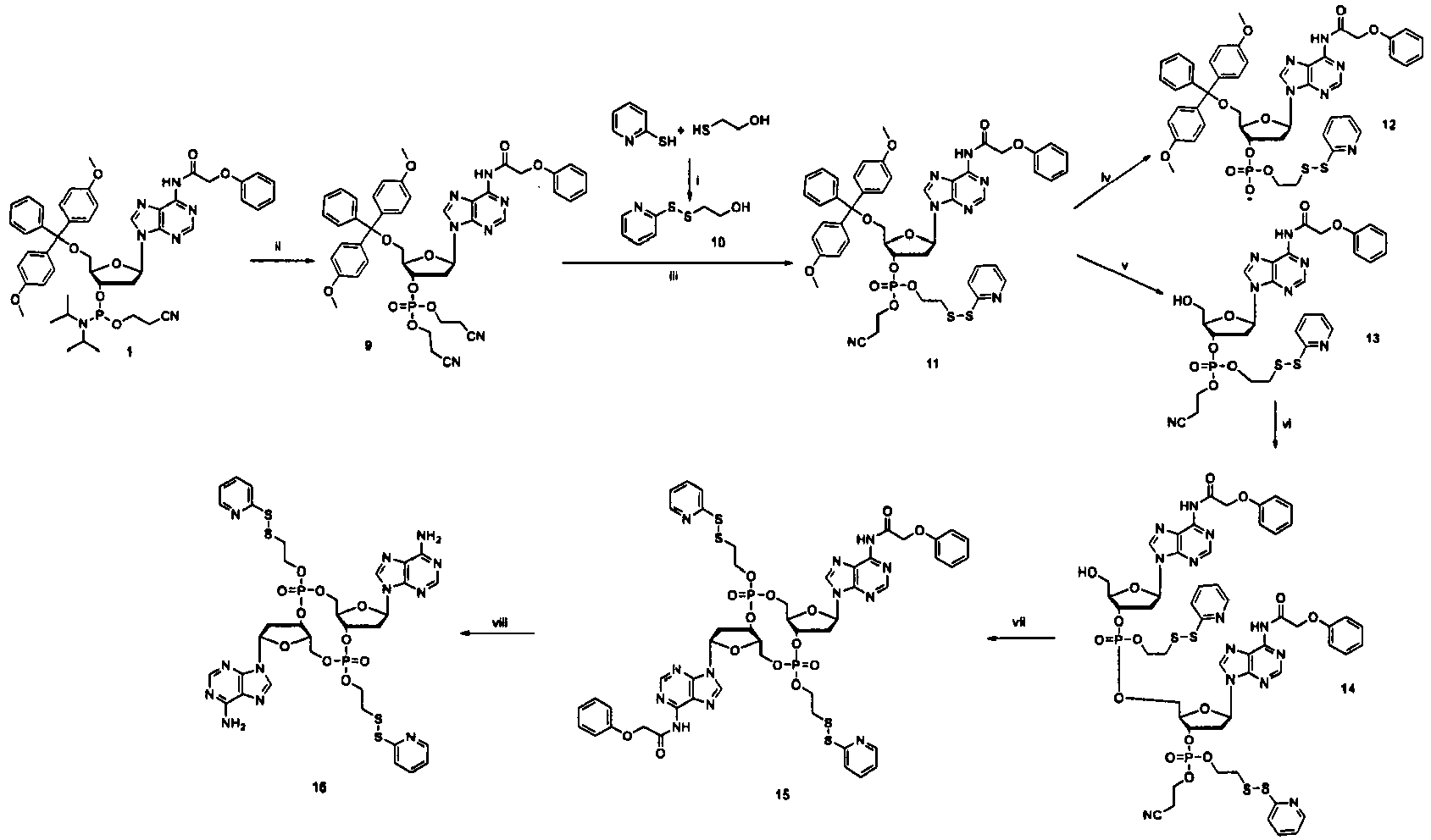
- 1) Adding 3.42g of N-chlorosuccinimide into a flask, adding 10mL of dry dichloromethane, dropwise adding 2.85g of 2-mercaptopyridine (dissolved in 5mL of dichloromethane) under ice bath, continuing to stir at low temperature for 1h after half an hour, dissolving 2g of 2-mercaptoethanol in 5mL of dichloromethane, dropwise adding into the flask under ice bath, and stirring at room temperature for 24h after dropwise adding. And after the reaction is finished, quickly separating by column chromatography to obtain the
compound 10. - The nuclear magnetic resonance data are:
1H NMR (400 MHz, DMSO) δ 9.32 (s, 2H), 8.52 (d, J = 4.6 Hz, 1H), 8.00 - 7.89 (m, 2H), 7.39 - 7.30 (m, 1H), 3.63 (t, J = 6.2 Hz, 2H), 2.96 (t, J = 6.2 Hz, 2H). - 13C NMR (101 MHz, DMSO) δ 159.40, 148.84, 139.51, 122.01, 120.57, 59.48, 41.77.
- The data indicate that the compound was synthesized correctly.
- 2) The compound 1 (1.68mmol), 5-(ethyltion)-1H-tetrazole (5.07mmol), 3-hydroxypropionitrile (1.68mmol), and 15mL of acetonitrile were added to a flask, and after stirring at room temperature for 1h, 1mL of 5.5M tert-butylhydroperoxide-decane solution was added, and after further stirring at room temperature for 40min, an appropriate amount of aqueous sodium bisulfite solution was added. Dichloromethane was extracted several times, the organic phases were combined and washed with saturated saline solution, dried over anhydrous sodium sulfate, filtered, concentrated, and separated by column chromatography to obtain the compound 9 (1.27g).
- The nuclear magnetic resonance data are:
1H NMR (400 MHz, CDCl3) δ 8.71 (dd, J = 31.2, 1.2 Hz, 1H), 8.21 - 8.10 (m, 1H), 8.01 (d, J = 7.2 Hz, 2H), 7.60 (t, J = 7.4 Hz, 1H), 7.50 (t, J = 7.5 Hz, 2H), 7.37 (d, J = 7.1 Hz, 1H), 7.26 (dd, J = 5.9, 2.4 Hz, 6H), 7.16 (d, J = 8.7 Hz, 2H), 6.87 - 6.75 (m, 4H), 6.57 - 6.37 (m, 1H), 5.36 (dd, J = 19.5, 14.0 Hz, 1H), 4.46 (d, J = 18.9 Hz, 1H), 4.41 - 4.21 (m, 4H), 3.93 (dd, J = 43.4, 12.6 Hz, 1H), 3.78 (d, J = 5.7 Hz, 6H), 3.53 - 3.37 (m, 1H), 3.18 (ddd, J = 15.2, 13.1, 8.8 Hz, 1H), 2.82 (t, J = 5.8 Hz, 3H), 2.79 - 2.65 (m, 2H). - 13C NMR (101 MHz, CDCl3) δ 164.63, 158.60, 152.16, 150.59, 150.26, 147.39, 142.67, 139.51,133.32,133.01,130.08,130.03,129.15,128.93, 128.11, 127.96, 127.84, 127.79, 127.06, 113.26, 113.14, 87.64, 87.24, 81.05, 77.38, 77.26, 77.06, 76.74, 62.92, 62.76, 62.70, 62.65, 55.26, 39.05, 19.88, 19.81.
- The data indicate that the compound was synthesized correctly.
- 3) The compound 9 (1.37mmol) was dissolved in 20mL of acetonitrile, 5mL of tert-butylamine was added, and the mixture was stirred at room temperature for 20min and then dried by spinning. The compound 10 (1.38mmol), 1- (mesitylene-2-sulfone) -3-nitro-1, 2, 4-triazole (6.86mmol) and 20mL of pyridine were added and dissolved, and the mixture was stirred at room temperature for 2h. Adding a proper amount of water to quench the reaction, removing most of the solvent by rotary evaporation, adding 30mL of dichloromethane to dissolve the solvent again, adjusting the pH value to 3 by using 5wt% of oxalic acid aqueous solution, separating an organic phase, washing the organic phase by using saturated saline solution, and drying the organic phase by using anhydrous sodium sulfate. Filtering, concentrating, and separating by column chromatography to obtain the compound 11 (1.05g).
- The nuclear magnetic resonance data are:
1H NMR (400 MHz, CDCl3) δ 9.57 (d, J = 50.7 Hz, 1H), 8.78 (s, 1H), 8.69 (s, 1H), 8.52 - 8.44 (m, 1H), 8.18 (dd, J = 13.4, 3.1 Hz, 1H), 8.04 (s, 1H), 7.71 - 7.61 (m, 2H), 7.42 - 7.33 (m, 4H), 7.32 - 7.23 (m, 6H), 7.21 - 7.17 (m, 2H), 7.11 - 7.02 (m, 4H), 6.92 - 6.76 (m, 4H), 6.54 - 6.40 (m, 1H), 5.41 - 5.26 (m, 1H), 4.89 (d, J = 5.5 Hz, 2H), 4.54 - 4.18 (m, 5H), 3.99 (d, J = 12.9 Hz, 1H), 3.88 (d, J = 12.9 Hz, 1H), 3.84 (s, 1H), 3.82-3.76(m, 5H),3.46 (dd, J = 17.1, 3.0 Hz, 1H), 3.25 - 3.01 (m, 3H), 2.88 - 2.63 (m, 3H). - 13CNMR(101 MHz, CDCl3) δ 159.66, 158.82, 158.79, 158.59, 158.55, 156.94, 152.03, 150.57, 149.80, 149.09, 147.36, 146.87, 144.23, 143.14, 141.13, 139.48, 137.32, 135.27, 132.51, 131.39, 130.03, 130.00, 129.85, 129.52, 129.13, 128.70, 128.32, 128.07,127.92,127.81,127.76,127.03,124.06, 122.46, 121.26, 121.16, 120.23, 116.47, 116.43, 114.92, 114.90, 113.55, 113.20, 113.13, 113.12, 113.10, 113.08, 113.00, 87.75, 87.69, 87.28, 81.36, 80.69, 80.09, 77.39, 77.27, 77.07, 76.75, 68.09, 65.92, 65.87, 65.83, 62.99, 62.45, 62.40, 55.36, 55.24, 39.07, 38.23, 38.16, 19.84, 19.77.
- The data indicate that the compound was synthesized correctly.
- 4) The compound 11 (0.8mmol) was added into a flask, dissolved in 10mL of dichloromethane, and added 6vol% dichloromethane solution of dichloroacetic acid in 10mL of ice-water bath. Stirring for 5min, adding small amount of methanol to quench reaction, fading red, neutralizing with saturated sodium bicarbonate solution, extracting, drying with anhydrous sodium sulfate, concentrating, and separating by column chromatography to obtain the compound 13 (540mg).
- The nuclear magnetic resonance data are:
1H NMR (400 MHz, CDCl3) δ 8.74 (s, 1H), 8.62 (d, J = 73.6 Hz, 1H), 8.45 (dd, J = 4.7, 3.5 Hz, 1H), 8.25 (d, J = 3.3 Hz, 1H), 8.04 - 7.96 (m, 3H), 7.64 (dt, J = 4.6, 1.5 Hz, 2H), 7.53 (ddd, J = 29.9, 14.9, 7.4 Hz, 4H), 7.10 (ddd, J = 5.2, 4.1, 2.4 Hz, 1H), 6.44 (dd, J = 9.1, 5.5 Hz, 1H), 5.34 (t, J = 5.5 Hz, 1H), 4.52 - 4.36 (m, 3H), 4.31 (dt, J = 12.3, 6.0 Hz, 2H), 3.90 (dd, J = 38.9, 12.8 Hz, 2H), 3.10 (t, J = 6.3 Hz, 2H), 2.80 (t, J = 6.0 Hz, 2H), 2.69 (dd, J = 14.1, 5.4 Hz, 1H). - 13C NMR (101 MHz, CDCl3) δ 166.62, 164.98, 158.92, 152.14, 152.10, 150.81, 150.07, 149.86, 145.25, 144.40, 142.96, 137.29, 133.60, 133.26, 133.10, 132.14, 129.17, 128.95, 127.95, 127.84, 124.24, 121.29, 120.32, 116.49, 116.45, 87.63, 87.58, 87.05, 80.51, 77.28, 66.03, 62.85, 62.54, 62.50, 39.15, 39.11, 38.34, 38.27, 19.87, 19.80.
- The data indicate that the compound was synthesized correctly.
- 5) The compound 11 (0.45mmol) was added into a flask, 6mL of acetonitrile and 2mL of tert-butylamine were added to the flask, and after stirring at room temperature for 30min, the solvent was removed by rotary evaporation to obtain the compound 12. The compound 13 (0.37mmol) and 1- (mesitylene-2-sulfone) -3-nitro-1, 2, 4-triazole (1.11mmol) were added thereto, and 15mL of super dry pyridine was added thereto, followed by stirring at room temperature for 2h. Adding a small amount of water to quench the reaction, removing the solvent by rotary evaporation, adding 20mL of dichloromethane to dissolve, adding a proper amount of 5wt% aqueous solution of oxalic acid, separating out the organic phase, drying, filtering, concentrating, adding 3vol% dichloromethane solution of dichloroacetic acid, stirring for 5min, adding a proper amount of methanol and saturated aqueous solution of sodium bicarbonate to neutralize, extracting, drying the organic phase, filtering, concentrating, and separating by column chromatography to obtain the compound 14 (350mg).
- The nuclear magnetic resonance data are:
1H NMR (400 MHz, CDCl3) δ 8.67 (dd, J = 29.4, 8.5 Hz, 2H), 8.51 - 8.20 (m, 4H), 7.96 (t, J = 8.9 Hz, 4H), 7.70 - 7.33 (m, 10H), 7.05 (dt, J = 11.0, 7.2 Hz, 2H), 6.51 (dd, J = 13.0,6.4 Hz, 1H), 6.45 - 6.33 (m, 1H), 5.38 (s, 1H), 5.24 (dd, J = 17.5, 5.5 Hz, 1H), 4.52 - 4.20 (m, 10H), 3.79 (dt, J = 19.8, 11.3 Hz, 3H), 3.23 - 2.89 (m, 6H), 2.78 (d, J = 18.5 Hz, 3H), 2.68 - 2.51 (m, 1H), 1.22 (s, 3H). - 13C NMR (101 MHz, CDCl3) δ 165.07, 158.84, 158.77, 158.70, 152.58, 151.94, 151.49, 150.64, 150.18, 149.83, 149.76, 143.02, 141.81, 137.32, 133.41, 133.36, 132.85, 132.77, 128.77, 128.75, 128.69, 128.08, 128.05, 124.14, 123.59, 121.28, 121.21, 120.21, 120.12, 116.73, 87.40, 86.64, 84.54, 80.22, 77.33, 66.06, 65.77, 62.67, 38.92, 38.15, 38.08, 29.69, 19.86, 19.79, 0.02.
- The data indicate that the compound was synthesized correctly.
- 6) The compound 14 (0.23mmol) was added to tert-butylamine/acetonitrile (1: 3, v/v) of the reaction solution, stirring at normal temperature for 20min, removing the solvent by rotary evaporation, adding 100mL of pyridine for dissolution, adding 1- (mesitylene-2-sulfone) -3-nitro-1, 2, 4-triazole (1.38mmol), reacting at normal temperature for 4h, removing the solvent, adding 20mL of dichloromethane for dissolution, adding a proper amount of 5wt% oxalic acid aqueous solution, separating out the organic phase, drying, filtering, concentrating, and separating by column chromatography to obtain the compound 15 (181mg).
- The nuclear magnetic resonance data are:
1H NMR (400 MHz, CDCl3) δ 9.76 (s, 2H), 8.76 (d, J = 9.7 Hz, 2H), 8.53 - 8.36 (m, 2H), 8.36 - 8.18 (m, 2H), 7.68 - 7.55 (m, 3H), 7.37 - 7.26 (m, 5H), 7.14 - 6.98 (m, 8H), 6.45 (dd, J = 13.8, 6.2 Hz, 2H), 5.71 - 5.36 (m, 2H), 4.93 (s, 4H), 4.66 - 4.32 (m, 9H), 4.12 (d, J = 5.1 Hz, 1H), 3.67 - 3.34 (m, 2H), 3.11 (t, J = 6.2 Hz, 4H), 2.73 (dd, J = 13.3, 7.5 Hz, 2H), 1.26 (s, 2H). - 13C NMR (101 MHz, CDCl3) δ 167.30,158.86,158.68,158.57,157.10,157.06,152.49, 152.42, 152.35, 151.38, 151.33, 151.24, 151.16, 149.81, 148.67, 148.60, 143.12, 142.92, 142.76, 142.55, 137.22, 137.18, 129.77, 123.49, 123.39, 123.28, 122.28, 122.26, 121.19, 120.10, 120.08, 114.85, 114.55, 85.58, 85.23, 83.03, 82.59, 79.03, 78.17, 77.84, 77.48, 77.36, 77.16, 76.84, 68.21, 66.14, 66.09, 65.93, 65.88, 65.44, 64.99, 53.52, 38.29, 38.23, 38.12, 38.05, 38.00, 36.29, 31.88, 29.65, 29.62, 29.32, 22.66, 14.13.
- The data indicate that the compound was synthesized correctly.
- 7) The compound 15 (100mg) was added into a flask, and 5mL of methanol was added to dissolve it, 500µL of diisopropylamine was added thereto, and the mixture was stirred at room temperature for 4h, followed by spin-drying of the solvent and direct column chromatography to separate the compound 16 (65mg).
- The nuclear magnetic resonance data are:
1H NMR (400 MHz, CDCl3) δ 8.33 (d, J = 8.4 Hz, 2H), 7.94 (d, J = 8.1 Hz, 2H), 6.41 (dd, J = 13.9, 7.4 Hz, 2H), 6.20 (d, J = 30.1 Hz, 4H), 5.45 (d, J = 59.0 Hz, 2H), 4.51 (dd, J = 16.6, 8.1 Hz, 3H), 4.39 (t, J = 8.3 Hz, 2H), 4.16 (tt, J = 9.5, 4.9 Hz, 5H), 3.17 (dd, J = 11.4, 6.6 Hz, 4H), 2.82 -2.66 (m, 2H), 2.26 (s, 6H), 1.22 (d, J = 13.3 Hz, 18H). MALDI-TOF-HRMS: the relative molecular mass of C34H38N12O10P2S4 was 964.1192, and a peak of [M+H]+ 965.1271 was found. - The data indicate that the compound was synthesized correctly.
- cddA35 (structure shown in table 2) was prepared according to the method in the literature (Wang, B.; Wang, Z.; Javomik, U.; Xi, Z.; Plavec, J., Computational and NMR spectroscopy insights into the conformation of cyclic dinucleotides. Sci Rep 2017, 7 (1), 16550.).
- cddA35 nuclear magnetic resonance data:
1H NMR (400 MHz, D2O) δ 8.15 (s, 2H), 7.80 (s, 2H), 6.16 (d, J = 6.4 Hz, 2H), 5.22 - 5.04 (m, 2H), 4.26 (d, J = 9.8 Hz, 4H), 4.02 (dd, J = 11.2,4.1 Hz, 2H), 3.05 - 2.98 (m, 2H), 2.75 - 2.62 (m, 2H). - 13C NMR (101 MHz, D2O) δ 154.39, 151.78, 146.71, 139.32, 118.08, 84.87, 83.30, 83.19, 70.16, 62.25, 46.71, 39.01, 8.26.
- The data indicate that the compound was synthesized correctly.
- Determination of the oil-water partition coefficient logP of the two cyclic dinucleotide prodrug molecules.
- 1) Preparing the compound solution: a certain amount of the
compound 8, thecompound 16 and the compound cddA35 were weighed and dissolved in DMSO solutions respectively to prepare mother solutions with a concentration of 1mg/mL. - 2) 20µL of the prepared mother liquor was added to an EP tube containing a mixture of 1mL of n-octanol and 1mL of purified water (10mM K2HPO4 pH7.0), vortexed for 2h with shaking, and allowed to stand overnight at 4°C for phase separation, and 400µL of solution from each phase was separated. Centrifuging at 3000rpm for 5min, filtering with corresponding 0.22µM filter membrane, measuring the two-phase absorption peak area under the same HPLC parameter condition, repeating the experiment for three times, and calculating log value of the peak area ratio of n-octyl alcohol phase and water phase to obtain the logP value of the target compound, as shown in Table 2.
- HPLC conditions: the instrument used by an Agilent 1260 HPLC, column: Agilent ZORABX SB-C185µm [4.6×150mm], column temperature 25°C, sample injection 10µL, detection wavelength was 254nM, chromatographic gradient method as shown in Table 1 below.
TABLE 1 HPLC liquid phase gradient method Time(min) Vol% A(10mM TEAA buffer solution) Vol% B(MeCN) Flow rate(mL/min) 1 98 2 1 6 0 100 1 10 0 100 1 13 98 2 1 15 98 2 1 TABLE 2 Compound Structure logP Compound8 
1.93 ± 0.01 Compound16 
0.85 ± 0.02 cddA35 
-3.43 ± 0.06 - As can be seen from the results in Table 2, the logP of the phosphate ester protected with the substituted mercaptoethanol is greatly improved. Compared with cddA35 without the exposed negative phosphate charge, the logP value of the cddA35 is -3.43, and the cddA35 is basically free of lipid solubility. And the logP of the
compound 8 protected by thioacyl ethyl ester and thecompound 16 protected by dimercapto ethanol is 1.93 and 0.85, respectively, so that the lipophilicity is greatly improved, and the compound is favorable for penetrating a cell membrane and entering cells to play an immune stimulator role. - The principle is as follows: dual-fluorescence reporter gene experiments: After entering a cell, the cyclic dinucleotide prodrug molecule passes through thioesterase in the cytoplasm of the cell or a reducing environment, so that thioester bond breakage or disulfide bond breakage is carried out, then an intermediate is obtained, a sulfur atom at a β position can nucleophilically attack a carbon atom at the α position, cyclic thioethane is removed, cyclic dinucleotides with a phosphodiester structure of a parent drug with negative charges are released, the intracellular STING protein is combined and activated, interferon regulatory factor 3 (IRF3) is phosphorylated, phosphorylated IRF3 enters into the nucleus and combined with the promoter region of a interferon-β gene to cause the expression of interferon, and based on these, the interferon gene promoter is introduced into a promoter of firefly luciferase, so that the cell activity of the prodrug molecule can be measured by using a dual-fluorescence reporter gene method.
-
- (1) preparing the compound solution: the
compound 8 and thecompound 16 were dissolved in DMSO, respectively, to obtain a final concentration of 1mM. cddA35 was dissolved in water and similarly prepared at a concentration of 1mM. - (2) Plasmid solution preparation: the pcDNA3.1-hSTING-wt plasmid was formulated to have a concentration of 400ng/µL, the pGL3-IFNβ plasmid was formulated to have a concentration of 400ng/µL, and the pGL4.74-Rluc plasmid was formulated to have a concentration of 100ng/µL.
- The test method includes the following steps:
HEK293T cells confluence reached about 70%, and the original culture medium is changed to 500mL of a serum-free culture medium opti-DMEM to be transferred. The above component solutions were prepared, which included pcDNA3.1-hsting-wt 2µL, pGL3-IFNβ 1µL, pGL4.74-Rluc 1µL, opti-DMEM medium supplemented 50µL/well, four wells in parallel. The above solution mixture was mixed by adding 50µL of 2/50 Lipo2000 transfection solution, the mixture was left to stand at room temperature for 15min and then mixed well, and 1OOµL/well of transfection was added and after 4h 1mL of DMEM medium at 37°C/well was added. After 18h, the medium was further changed to 500mL opti-DMEM with or without serum.8µL (5µM) of thecompound 8, thecompound 16 or cddA35 and 92µL of opti-DMEMmixed and left for 15min, transfected at 100µL/well. After 4h, 1mL of DMEM medium at 37°C/well was added. After 24h, the dual-fluorescence results were detected, as shown inFIG. 1 . - From the results shown in
FIG. 1 , it can be seen that the unmodified highly electronegative cyclic dinucleotide cddA hardly crosses cell membranes, and the twocyclic dinucleotide compound 8 andcompound 16 protected by phosphotriester provided by the present invention can autonomously cross cell membranes without any transfection reagent, and release the parent drug molecule cddA35 in cytoplasm due to thioesterase or reducing environment, so as to activate STING pathway and cause the expression of interferon. - Activity assay of two cyclic dinucleotide prodrug molecules in monocytic cell line THP-1 cells
- The test method includes the following steps:
The THP-1-Lucia cells confluency reached about 80%, and thecompound 8, thecompound 16 and the drug ADU-S100 are directly dissolved into a culture medium according to a certain concentration and added into a 24-well plate, wherein four wells are parallel. The cells were maintained under the culture condition of 37°C and 5% CO2 for 24h. After the end of the culture, luciferase activity was measured. Wherein, the test results of the type I interferon of thecompound 8, thecompound 16 and the drug ADU-S100 in the monocyte cell line THP-1 under the action concentration of 10µM are shown inFIG. 2 ; EC50 values for thecompound 8 and thecompound 16 to cause type I interferon expression in THP-1 cell lines were then determined by dose-response curves for serial dilutions at various concentrations, as shown inFIG. 3 . - From the results shown in
FIG. 2 , it can be seen that both thecompound 8 and thecompound 16 cause strong expression of type I interferon in the monocyte THP-1 cell line at the action concentration of 10µM without any transfection reagent, and the activity is much higher than that of the drug ADU-S100, which has entered clinical phase II. As can be seen fromFIG. 3 , the EC50 values of thecompound 8 and thecompound 16, which cause type I interferon expression in THP-1 cell line, were 4.4nM and 355nM, respectively. Compared to the EC50 value of the control drug ADU-S100 (reference compound 2'3' -RR-(A)(A) in patentCN108430503A , the EC50 value was 41.5µM), the EC50 values of thecompound 16 and thecompound 8 were 9430-fold and 117-fold increased, respectively, and the activity was considerably increased. - Mice: BABL/C female mice, weight 18g to 22g. The source is the animal experiment center in Guangdong province, and the mice are fed with pellet feed and freely eat and drink water.
- Establishing a mouse tumor model: the cells are cultured and passaged, the cells are collected in the logarithmic phase of the cells and prepared into cell suspension with the concentration of (1.0×10⁷) per milliliter, 0.1mL of cell suspension (the number of the cells is 1.0×10⁶ per mouse) is injected into the armpit of the right forelimb, the tumor grows to be about 5mm in diameter successfully, and the mice are divided into three groups randomly after about 10days.
- Negative control group: physiological saline solution
- Positive control group: ADU-S100 (clinical phase II drug) at a dose of 1mg/kg
- Experimental groups: the
compound 8 at a dose of 1mg/kg - The administration method includes the following steps: the administration was started at the 10thday after tumor inoculation growth, and 50microliters/mouse was administered once every two days for a total of three times by intratumoral injection. The growth of tumors in mice was detected by chemiluminescence using the IVIS Spectrum Imaging System. Before imaging, small molecule fluorescein preparation: an appropriate amount of 15mg/mL sodium fluorescein salt was prepared in PBS solution, and sodium fluorescein was ordered from Shanghai Yeasen Biotech Co., Ltd. Oxygen and isoflurane are prepared in advance. Mice were placed in an anesthesia box by intraperitoneal injection of 100µL of fluorescein, and after the animals were anesthetized, the mice were transferred to an imaging chamber in an imager. The posture of the mice was adjusted as needed. The imaging parameters are as follows: automatic exposure, wherein the Binning value is 2, and the F value is 8. The imaging time was chosen to be 10min. After imaging, fluorescence values were converted to photon numbers and the total number of fluorescence photons for each experimental group was counted. The imager is an IVIS Spectrum imaging platform of Perkinelmer company. The results are shown in
FIG. 4 . In which the numbers inFIG. 4a, FIG.4b ,FIG.4c, FIG.4d ,FIG.4e and FIG.4f represent the total number of fluorescence photons in the circular region (ROI, region of interest), andFIG. 4g and FIG.4h are statistical graphs of the total number of fluorescence photons for each experimental group, respectively. - The tumor volume size and survival rate results for each group of mice are shown in
FIG. 5 . Wherein, the tumor volume is measured by a vernier caliper to obtain the length and width of the tumor, and the tumor volume is calculated according to a formula (volume= length×width×width/2), and the survival rate= the value of mice with the tumor volume less than 2000 cubic millimeters in each experimental group/the total value of mice in each experimental group. - From the results shown in
FIG. 4 andFIG.5 , it can be seen that in the CT-26 mouse tumor model, the growth of the tumor in the mice were only controlled compared to the control drug ADU-S100 at the dose of 1mg/kg, and the tumor in the experimental group by using thecompound 8 of the present invention was substantially disappeared, thereby indicating that thecompound 8 has a better anti-tumor activity and an effect superior to that of the clinical drug ADU-S 100.
Claims (7)
- A cyclic dinucleotide prodrug molecule, or a stereoisomer, a tautomer, a nitrogen oxide, a solvate, a pharmaceutically acceptable salt thereof, wherein the cyclic dinucleotide prodrug molecule has a structure as shown in formula (11) or formula (12),

- A method of preparing the cyclic dinucleotide prodrug molecule as claimed in claims 1, including:a) carrying out a first contact reaction on a first nucleotide monomer compound, a second nucleotide monomer compound and a first condensing agent in a first liquid reaction medium to obtain a linear dinucleotide intermediate;b) under the alkaline condition, the linear dinucleotide intermediate is subjected to decyanoethylreaction, and then the obtained reaction product and a second condensing agent are subjected to second contact reaction in a second liquid reaction medium;c) carrying out deprotection reaction on the cyclic dinucleotide prodrug molecule with the protecting group obtained after the second contact reaction is carried out;wherein the first nucleotide monomer compound has a structure represented by formula (13) or formula (14):
 the second nucleotide monomer compound has a structure represented by formula (15) or formula (16):
 wherein Q represents a protecting group on an exocyclic amino group in the bases represented by B1 and B2, and each of Q in the formula (13) to formula (16) is independently an acyl group, both B1 and B2 are adenine groups, both X1 and X2 are - H, Y1 and Y2 are the same and selected from
- The method as claimed in claim 2, wherein the conditions for carrying out the first contact reaction include: the temperature is 0°C to50°C, and the time is 2h to 8h; preferably, the conditions for carrying out the second contact reaction include: the temperature is 0°C to 50°C, and the time is 2h to 8h.
- The method as claimed in claim 2, wherein the first condensing agent and the second condensing agent are each independently selected from at least one of 1-(mesitylene-2-sulfone) -3-nitro-1, 2, 4-triazole, 2,4, 6-triisopropylphenylsulfone-3-nitro-1, 2, 4-triazole, 2,4, 6-triisopropylbenzenesulfonyl chloride, 2,4, 6-trimethylbenzenesulfonyl chloride, 1H-tetrazole, and N-methylimidazole;preferably, in the step a), the first condensing agent is used in an amount of 2 mol to 3 mol with respect to 1mol of the first nucleotide monomer compound;preferably, in the step b), the second condensing agent is used in an amount of 4 mol to 5 mol with respect to 1mol of the linear dinucleotide intermediate.
- The method as claimed in claim 2, wherein in the step b), the alkaline conditions are provided by a solution of tert-butylamine in acetonitrile;
preferably, the alkaline conditions are provided by a mixed solution of tert-butylamine and acetonitrile in a volume ratio of 1:(1 to 5). - The method as claimed in claim 2, wherein the deprotection group reaction is reacted in the presence of a mixed solution of diisopropylamine and methanol in a volume ratio of 1: (5 to 20).
- Use of a cyclic dinucleotide prodrug molecule as claimed in claim 1, or a stereoisomer, a tautomer, a nitrogen oxide, a solvate, a pharmaceutically acceptable salt thereof, for the preparation of a drug;
preferably, the drug is an antiviral drug, an antibacterial infection drug or an anticancer drug.
Applications Claiming Priority (2)
| Application Number | Priority Date | Filing Date | Title |
|---|---|---|---|
| CN201910023472 | 2019-01-10 | ||
| PCT/CN2020/071329 WO2020143740A1 (en) | 2019-01-10 | 2020-01-10 | Cyclic dinucleotide prodrug molecule, preparation method therefor and application thereof |
Publications (4)
| Publication Number | Publication Date |
|---|---|
| EP3901161A1 EP3901161A1 (en) | 2021-10-27 |
| EP3901161A4 EP3901161A4 (en) | 2022-03-23 |
| EP3901161B1 true EP3901161B1 (en) | 2025-01-22 |
| EP3901161C0 EP3901161C0 (en) | 2025-01-22 |
Family
ID=71521968
Family Applications (1)
| Application Number | Title | Priority Date | Filing Date |
|---|---|---|---|
| EP20739193.9A Active EP3901161B1 (en) | 2019-01-10 | 2020-01-10 | Cyclic dinucleotide prodrug molecule, preparation method therefor and application thereof |
Country Status (6)
| Country | Link |
|---|---|
| US (1) | US12257265B2 (en) |
| EP (1) | EP3901161B1 (en) |
| JP (1) | JP7224688B2 (en) |
| KR (1) | KR102620495B1 (en) |
| CN (1) | CN111423483B (en) |
| WO (1) | WO2020143740A1 (en) |
Families Citing this family (3)
| Publication number | Priority date | Publication date | Assignee | Title |
|---|---|---|---|---|
| CN116253766B (en) * | 2023-03-27 | 2024-08-27 | 瑞阳(上海)新药研发有限公司 | Preparation method of cyclic dinucleotide 2',3' -cGAMP |
| CN119930724B (en) * | 2024-12-18 | 2025-10-28 | 湖南大学 | An induced activated self-delivery cyclic dinucleoside derivative and its preparation method and use in anti-tumor immunotherapy |
| CN120757600B (en) * | 2025-09-10 | 2025-11-11 | 天津法尔玛制药有限公司 | Cyclic dinucleotide 2′,3′-cG4′-MeAMP, its preparation method and its application in the preparation of innate immune activators |
Family Cites Families (12)
| Publication number | Priority date | Publication date | Assignee | Title |
|---|---|---|---|---|
| EP2451461A4 (en) * | 2009-07-06 | 2013-05-29 | Ontorii Inc | NOVEL NUCLEIC ACID PRECURSORS AND THEIR METHODS OF USE |
| CN102199183B (en) * | 2010-03-26 | 2013-12-18 | 北京大学 | C-di-GMP, analogues thereof and preparation method thereof |
| EA201590396A1 (en) * | 2012-12-13 | 2015-12-30 | Адуро Биотек, Инк. | COMPOSITION CONTAINING CYCLIC PURINE DYNUCLEOTIDES WITH A SPECIFIC STEREHEMISTRY, AND THE METHOD OF ITS PREPARATION AND APPLICATION |
| ME03586B (en) * | 2013-05-18 | 2020-07-20 | Univ California | Compositions and methods for activating "stimulator of interferon gene"-dependent signalling |
| EP3071209A4 (en) * | 2013-11-19 | 2017-08-16 | The University of Chicago | Use of sting agonist as cancer treatment |
| ES2764178T3 (en) * | 2014-12-16 | 2020-06-02 | Kayla Therapeutics | Fluorinated cyclic dinucleotides for cytokine induction |
| MX2018001814A (en) | 2015-08-13 | 2018-05-07 | Merck Sharp & Dohme | CYCLIC DINUCLEOTID COMPOUNDS AS AGONISTS OF THE INTERFERON GENE STIMULATOR. |
| UY36969A (en) | 2015-10-28 | 2017-05-31 | Novartis Ag | COMPOSITIONS AND METHODS TO ACTIVATE THE DEPENDENT SIGNALING OF THE INTERFERON GEN STIMULATOR |
| JP6411676B2 (en) * | 2015-12-03 | 2018-10-24 | グラクソスミスクライン、インテレクチュアル、プロパティー、ディベロップメント、リミテッドGlaxosmithkline Intellectual Property Development Limited | Cyclic purine dinucleotides as regulators of STING |
| KR102569881B1 (en) * | 2016-07-06 | 2023-08-22 | 에프-스타 테라퓨틱스 인코포레이티드 | Compounds, compositions and methods for treating disease |
| US9905856B1 (en) | 2016-12-28 | 2018-02-27 | Nanotek Instruments, Inc. | Flexible and shape-conformal rope-shape alkali metal-sulfur batteries |
| US10903527B2 (en) | 2017-05-08 | 2021-01-26 | Global Graphene Group, Inc. | Rolled 3D alkali metal batteries and production process |
-
2020
- 2020-01-10 WO PCT/CN2020/071329 patent/WO2020143740A1/en not_active Ceased
- 2020-01-10 CN CN202010025334.XA patent/CN111423483B/en active Active
- 2020-01-10 JP JP2021540248A patent/JP7224688B2/en active Active
- 2020-01-10 KR KR1020217025118A patent/KR102620495B1/en active Active
- 2020-01-10 EP EP20739193.9A patent/EP3901161B1/en active Active
- 2020-01-10 US US17/422,137 patent/US12257265B2/en active Active
Non-Patent Citations (2)
| Title |
|---|
| TAKAFUMI TEZUKA ET AL: "Synthesis of 2^|^prime;-Modified Cyclic Bis(3^|^prime;^|^ndash;5^|^prime;)diadenylic Acids (c-di-AMPs) and Their Promotion of Cell Division in a Freshwater Green Alga", CHEMISTRY LETTERS, vol. 41, no. 12, 1 January 2012 (2012-01-01), pages 1723 - 1725, XP055172477, ISSN: 0366-7022, DOI: 10.1246/cl.2012.1723 * |
| XIE ZHIQIANG ET AL: "S-acylthioalkyl ester (SATE)-based prodrugs of deoxyribose cyclic dinucleotides (dCDNs) as the STING agonist for antitumor immunotherapy", EUROPEAN JOURNAL OF MEDICINAL CHEMISTRY, ELSEVIER, AMSTERDAM, NL, vol. 243, 28 September 2022 (2022-09-28), XP087219154, ISSN: 0223-5234, [retrieved on 20220928], DOI: 10.1016/J.EJMECH.2022.114796 * |
Also Published As
| Publication number | Publication date |
|---|---|
| US20220125821A1 (en) | 2022-04-28 |
| KR102620495B1 (en) | 2024-01-04 |
| CN111423483A (en) | 2020-07-17 |
| CN111423483B (en) | 2025-01-17 |
| EP3901161C0 (en) | 2025-01-22 |
| EP3901161A1 (en) | 2021-10-27 |
| WO2020143740A1 (en) | 2020-07-16 |
| US12257265B2 (en) | 2025-03-25 |
| EP3901161A4 (en) | 2022-03-23 |
| KR20210113652A (en) | 2021-09-16 |
| JP7224688B2 (en) | 2023-02-20 |
| JP2022517592A (en) | 2022-03-09 |
Similar Documents
| Publication | Publication Date | Title |
|---|---|---|
| JP7848275B2 (en) | Lipids for the delivery of activators into lipid nanoparticles | |
| JP7789856B2 (en) | Lipids for lipid nanoparticle delivery of active agents | |
| EP3615510B1 (en) | Novel carbonyl lipids and lipid nanoparticle formulations for delivery of nucleic acids | |
| EP2646456B1 (en) | Process for the preparation of morpholinyl anthracycline derivatives | |
| CN115175894A (en) | Nano material | |
| EP4148083A1 (en) | Novel lipids and lipid nanoparticle formulations for delivery of nucleic acids | |
| CN108368028A (en) | Novel Lipid and Lipid Nanoparticle Formulations for Delivery of Nucleic Acids | |
| CN110759908B (en) | N-benzenesulfonyl benzamide compound for inhibiting Bcl-2 protein and composition and application thereof | |
| US12257265B2 (en) | Cyclic dinucleotide prodrug molecule, preparation method therefor and application thereof | |
| JP2025500860A (en) | dsRNA, its preparation method and use | |
| WO2021233133A1 (en) | Compound used as ret kinase inhibitor and application thereof | |
| EP4534539A1 (en) | Dideuterated camptothecin derivative and preparation method therefor | |
| EP4467645A1 (en) | Dsrna, use thereof and preparation method therefor | |
| CN118320117B (en) | Molecular-based drug delivery system for multicellular organ targeting and in situ release | |
| CN117924106B (en) | Ionizable lipid compounds | |
| WO2021047672A1 (en) | Triterpenoid compounds, pharmaceutical compositions thereof, and their use for treating nuclear receptor subfamily 4 group member 1-mediated disease | |
| CN112661801A (en) | Nucleoside analogue and deuteron thereof, and preparation method and application thereof | |
| CN120398766B (en) | Cationic lipid compounds, lipid nanoparticles thereof, compositions thereof, methods of making and uses thereof | |
| WO2025209467A1 (en) | Lipids and lipid nanoparticle formulations | |
| CN118878530A (en) | A NO donor glycoside and its preparation method and application | |
| CN120398793A (en) | Lipid compound, lipid nanoparticles thereof, composition thereof, preparation method and use thereof | |
| CN119331036A (en) | Three-cluster galactose compounds, conjugates, and preparation methods and uses thereof | |
| TW202115079A (en) | Dihydropyrimidine derivative and use thereof | |
| HK40082129A (en) | Nanomaterial | |
| CN116731097A (en) | Amino acid methyl ester substituted uridine and derivatives thereof, preparation method and application thereof |
Legal Events
| Date | Code | Title | Description |
|---|---|---|---|
| STAA | Information on the status of an ep patent application or granted ep patent |
Free format text: STATUS: THE INTERNATIONAL PUBLICATION HAS BEEN MADE |
|
| PUAI | Public reference made under article 153(3) epc to a published international application that has entered the european phase |
Free format text: ORIGINAL CODE: 0009012 |
|
| STAA | Information on the status of an ep patent application or granted ep patent |
Free format text: STATUS: REQUEST FOR EXAMINATION WAS MADE |
|
| 17P | Request for examination filed |
Effective date: 20210722 |
|
| AK | Designated contracting states |
Kind code of ref document: A1 Designated state(s): AL AT BE BG CH CY CZ DE DK EE ES FI FR GB GR HR HU IE IS IT LI LT LU LV MC MK MT NL NO PL PT RO RS SE SI SK SM TR |
|
| REG | Reference to a national code |
Ref country code: DE Ref legal event code: R079 Free format text: PREVIOUS MAIN CLASS: C07H0019207000 Ipc: C07H0021000000 Ref country code: DE Ref legal event code: R079 Ref document number: 602020045140 Country of ref document: DE Free format text: PREVIOUS MAIN CLASS: C07H0019207000 Ipc: C07H0021000000 |
|
| A4 | Supplementary search report drawn up and despatched |
Effective date: 20220204 |
|
| RIC1 | Information provided on ipc code assigned before grant |
Ipc: A61P 35/00 20060101ALI20220131BHEP Ipc: A61P 31/12 20060101ALI20220131BHEP Ipc: A61P 31/04 20060101ALI20220131BHEP Ipc: C07H 1/00 20060101ALI20220131BHEP Ipc: C07H 21/04 20060101ALI20220131BHEP Ipc: C07H 21/00 20060101AFI20220131BHEP |
|
| DA4 | Supplementary search report drawn up and despatched (deleted) | ||
| RIC1 | Information provided on ipc code assigned before grant |
Ipc: A61P 35/00 20060101ALI20220210BHEP Ipc: A61P 31/12 20060101ALI20220210BHEP Ipc: A61P 31/04 20060101ALI20220210BHEP Ipc: C07H 1/00 20060101ALI20220210BHEP Ipc: C07H 21/04 20060101ALI20220210BHEP Ipc: C07H 21/00 20060101AFI20220210BHEP |
|
| RA4 | Supplementary search report drawn up and despatched (corrected) |
Effective date: 20220218 |
|
| DAV | Request for validation of the european patent (deleted) | ||
| DAX | Request for extension of the european patent (deleted) | ||
| STAA | Information on the status of an ep patent application or granted ep patent |
Free format text: STATUS: EXAMINATION IS IN PROGRESS |
|
| 17Q | First examination report despatched |
Effective date: 20220914 |
|
| RAP1 | Party data changed (applicant data changed or rights of an application transferred) |
Owner name: SHENZHEN YING BIOPHARMACEUTICAL CO., LTD. |
|
| GRAP | Despatch of communication of intention to grant a patent |
Free format text: ORIGINAL CODE: EPIDOSNIGR1 |
|
| STAA | Information on the status of an ep patent application or granted ep patent |
Free format text: STATUS: GRANT OF PATENT IS INTENDED |
|
| INTG | Intention to grant announced |
Effective date: 20240905 |
|
| GRAS | Grant fee paid |
Free format text: ORIGINAL CODE: EPIDOSNIGR3 |
|
| GRAA | (expected) grant |
Free format text: ORIGINAL CODE: 0009210 |
|
| STAA | Information on the status of an ep patent application or granted ep patent |
Free format text: STATUS: THE PATENT HAS BEEN GRANTED |
|
| AK | Designated contracting states |
Kind code of ref document: B1 Designated state(s): AL AT BE BG CH CY CZ DE DK EE ES FI FR GB GR HR HU IE IS IT LI LT LU LV MC MK MT NL NO PL PT RO RS SE SI SK SM TR |
|
| REG | Reference to a national code |
Ref country code: GB Ref legal event code: FG4D |
|
| REG | Reference to a national code |
Ref country code: CH Ref legal event code: EP |
|
| REG | Reference to a national code |
Ref country code: IE Ref legal event code: FG4D |
|
| REG | Reference to a national code |
Ref country code: DE Ref legal event code: R096 Ref document number: 602020045140 Country of ref document: DE |
|
| U01 | Request for unitary effect filed |
Effective date: 20250220 |
|
| U07 | Unitary effect registered |
Designated state(s): AT BE BG DE DK EE FI FR IT LT LU LV MT NL PT RO SE SI Effective date: 20250227 |
|
| U1N | Appointed representative for the unitary patent procedure changed after the registration of the unitary effect |
Representative=s name: REUTELER & CIE SA; CH |
|
| PG25 | Lapsed in a contracting state [announced via postgrant information from national office to epo] |
Ref country code: RS Free format text: LAPSE BECAUSE OF FAILURE TO SUBMIT A TRANSLATION OF THE DESCRIPTION OR TO PAY THE FEE WITHIN THE PRESCRIBED TIME-LIMIT Effective date: 20250422 |
|
| PG25 | Lapsed in a contracting state [announced via postgrant information from national office to epo] |
Ref country code: PL Free format text: LAPSE BECAUSE OF FAILURE TO SUBMIT A TRANSLATION OF THE DESCRIPTION OR TO PAY THE FEE WITHIN THE PRESCRIBED TIME-LIMIT Effective date: 20250122 |
|
| PG25 | Lapsed in a contracting state [announced via postgrant information from national office to epo] |
Ref country code: ES Free format text: LAPSE BECAUSE OF FAILURE TO SUBMIT A TRANSLATION OF THE DESCRIPTION OR TO PAY THE FEE WITHIN THE PRESCRIBED TIME-LIMIT Effective date: 20250122 |
|
| PG25 | Lapsed in a contracting state [announced via postgrant information from national office to epo] |
Ref country code: NO Free format text: LAPSE BECAUSE OF FAILURE TO SUBMIT A TRANSLATION OF THE DESCRIPTION OR TO PAY THE FEE WITHIN THE PRESCRIBED TIME-LIMIT Effective date: 20250422 Ref country code: IS Free format text: LAPSE BECAUSE OF FAILURE TO SUBMIT A TRANSLATION OF THE DESCRIPTION OR TO PAY THE FEE WITHIN THE PRESCRIBED TIME-LIMIT Effective date: 20250522 |
|
| PG25 | Lapsed in a contracting state [announced via postgrant information from national office to epo] |
Ref country code: HR Free format text: LAPSE BECAUSE OF FAILURE TO SUBMIT A TRANSLATION OF THE DESCRIPTION OR TO PAY THE FEE WITHIN THE PRESCRIBED TIME-LIMIT Effective date: 20250122 |
|
| PG25 | Lapsed in a contracting state [announced via postgrant information from national office to epo] |
Ref country code: GR Free format text: LAPSE BECAUSE OF FAILURE TO SUBMIT A TRANSLATION OF THE DESCRIPTION OR TO PAY THE FEE WITHIN THE PRESCRIBED TIME-LIMIT Effective date: 20250423 |
|
| PG25 | Lapsed in a contracting state [announced via postgrant information from national office to epo] |
Ref country code: SM Free format text: LAPSE BECAUSE OF FAILURE TO SUBMIT A TRANSLATION OF THE DESCRIPTION OR TO PAY THE FEE WITHIN THE PRESCRIBED TIME-LIMIT Effective date: 20250122 |
|
| PG25 | Lapsed in a contracting state [announced via postgrant information from national office to epo] |
Ref country code: CZ Free format text: LAPSE BECAUSE OF FAILURE TO SUBMIT A TRANSLATION OF THE DESCRIPTION OR TO PAY THE FEE WITHIN THE PRESCRIBED TIME-LIMIT Effective date: 20250122 |
|
| PG25 | Lapsed in a contracting state [announced via postgrant information from national office to epo] |
Ref country code: SK Free format text: LAPSE BECAUSE OF FAILURE TO SUBMIT A TRANSLATION OF THE DESCRIPTION OR TO PAY THE FEE WITHIN THE PRESCRIBED TIME-LIMIT Effective date: 20250122 |
|
| PLBE | No opposition filed within time limit |
Free format text: ORIGINAL CODE: 0009261 |
|
| STAA | Information on the status of an ep patent application or granted ep patent |
Free format text: STATUS: NO OPPOSITION FILED WITHIN TIME LIMIT |
|
| U20 | Renewal fee for the european patent with unitary effect paid |
Year of fee payment: 7 Effective date: 20251120 |
|
| 26N | No opposition filed |
Effective date: 20251023 |