EP3897646B1 - Macitentan for the treatment of pulmonary arterial hypertension - Google Patents
Macitentan for the treatment of pulmonary arterial hypertension Download PDFInfo
- Publication number
- EP3897646B1 EP3897646B1 EP19832954.2A EP19832954A EP3897646B1 EP 3897646 B1 EP3897646 B1 EP 3897646B1 EP 19832954 A EP19832954 A EP 19832954A EP 3897646 B1 EP3897646 B1 EP 3897646B1
- Authority
- EP
- European Patent Office
- Prior art keywords
- macitentan
- per day
- pah
- treatment
- prevention
- Prior art date
- Legal status (The legal status is an assumption and is not a legal conclusion. Google has not performed a legal analysis and makes no representation as to the accuracy of the status listed.)
- Active
Links
Images
Classifications
-
- A—HUMAN NECESSITIES
- A61—MEDICAL OR VETERINARY SCIENCE; HYGIENE
- A61K—PREPARATIONS FOR MEDICAL, DENTAL OR TOILETRY PURPOSES
- A61K31/00—Medicinal preparations containing organic active ingredients
- A61K31/33—Heterocyclic compounds
- A61K31/395—Heterocyclic compounds having nitrogen as a ring hetero atom, e.g. guanethidine or rifamycins
- A61K31/495—Heterocyclic compounds having nitrogen as a ring hetero atom, e.g. guanethidine or rifamycins having six-membered rings with two or more nitrogen atoms as the only ring heteroatoms, e.g. piperazine or tetrazines
- A61K31/505—Pyrimidines; Hydrogenated pyrimidines, e.g. trimethoprim
- A61K31/513—Pyrimidines; Hydrogenated pyrimidines, e.g. trimethoprim having oxo groups directly attached to the heterocyclic ring, e.g. cytosine
-
- A—HUMAN NECESSITIES
- A61—MEDICAL OR VETERINARY SCIENCE; HYGIENE
- A61K—PREPARATIONS FOR MEDICAL, DENTAL OR TOILETRY PURPOSES
- A61K31/00—Medicinal preparations containing organic active ingredients
- A61K31/33—Heterocyclic compounds
- A61K31/395—Heterocyclic compounds having nitrogen as a ring hetero atom, e.g. guanethidine or rifamycins
- A61K31/495—Heterocyclic compounds having nitrogen as a ring hetero atom, e.g. guanethidine or rifamycins having six-membered rings with two or more nitrogen atoms as the only ring heteroatoms, e.g. piperazine or tetrazines
- A61K31/505—Pyrimidines; Hydrogenated pyrimidines, e.g. trimethoprim
- A61K31/506—Pyrimidines; Hydrogenated pyrimidines, e.g. trimethoprim not condensed and containing further heterocyclic rings
-
- A—HUMAN NECESSITIES
- A61—MEDICAL OR VETERINARY SCIENCE; HYGIENE
- A61K—PREPARATIONS FOR MEDICAL, DENTAL OR TOILETRY PURPOSES
- A61K31/00—Medicinal preparations containing organic active ingredients
- A61K31/33—Heterocyclic compounds
- A61K31/395—Heterocyclic compounds having nitrogen as a ring hetero atom, e.g. guanethidine or rifamycins
- A61K31/495—Heterocyclic compounds having nitrogen as a ring hetero atom, e.g. guanethidine or rifamycins having six-membered rings with two or more nitrogen atoms as the only ring heteroatoms, e.g. piperazine or tetrazines
- A61K31/4965—Non-condensed pyrazines
-
- A—HUMAN NECESSITIES
- A61—MEDICAL OR VETERINARY SCIENCE; HYGIENE
- A61K—PREPARATIONS FOR MEDICAL, DENTAL OR TOILETRY PURPOSES
- A61K31/00—Medicinal preparations containing organic active ingredients
- A61K31/33—Heterocyclic compounds
- A61K31/395—Heterocyclic compounds having nitrogen as a ring hetero atom, e.g. guanethidine or rifamycins
- A61K31/495—Heterocyclic compounds having nitrogen as a ring hetero atom, e.g. guanethidine or rifamycins having six-membered rings with two or more nitrogen atoms as the only ring heteroatoms, e.g. piperazine or tetrazines
- A61K31/4985—Pyrazines or piperazines ortho- or peri-condensed with heterocyclic ring systems
-
- A—HUMAN NECESSITIES
- A61—MEDICAL OR VETERINARY SCIENCE; HYGIENE
- A61K—PREPARATIONS FOR MEDICAL, DENTAL OR TOILETRY PURPOSES
- A61K45/00—Medicinal preparations containing active ingredients not provided for in groups A61K31/00 - A61K41/00
- A61K45/06—Mixtures of active ingredients without chemical characterisation, e.g. antiphlogistics and cardiaca
-
- A—HUMAN NECESSITIES
- A61—MEDICAL OR VETERINARY SCIENCE; HYGIENE
- A61K—PREPARATIONS FOR MEDICAL, DENTAL OR TOILETRY PURPOSES
- A61K47/00—Medicinal preparations characterised by the non-active ingredients used, e.g. carriers or inert additives; Targeting or modifying agents chemically bound to the active ingredient
- A61K47/06—Organic compounds, e.g. natural or synthetic hydrocarbons, polyolefins, mineral oil, petrolatum or ozokerite
- A61K47/08—Organic compounds, e.g. natural or synthetic hydrocarbons, polyolefins, mineral oil, petrolatum or ozokerite containing oxygen, e.g. ethers, acetals, ketones, quinones, aldehydes, peroxides
- A61K47/12—Carboxylic acids; Salts or anhydrides thereof
-
- A—HUMAN NECESSITIES
- A61—MEDICAL OR VETERINARY SCIENCE; HYGIENE
- A61K—PREPARATIONS FOR MEDICAL, DENTAL OR TOILETRY PURPOSES
- A61K47/00—Medicinal preparations characterised by the non-active ingredients used, e.g. carriers or inert additives; Targeting or modifying agents chemically bound to the active ingredient
- A61K47/06—Organic compounds, e.g. natural or synthetic hydrocarbons, polyolefins, mineral oil, petrolatum or ozokerite
- A61K47/26—Carbohydrates, e.g. sugar alcohols, amino sugars, nucleic acids, mono-, di- or oligo-saccharides; Derivatives thereof, e.g. polysorbates, sorbitan fatty acid esters or glycyrrhizin
-
- A—HUMAN NECESSITIES
- A61—MEDICAL OR VETERINARY SCIENCE; HYGIENE
- A61K—PREPARATIONS FOR MEDICAL, DENTAL OR TOILETRY PURPOSES
- A61K47/00—Medicinal preparations characterised by the non-active ingredients used, e.g. carriers or inert additives; Targeting or modifying agents chemically bound to the active ingredient
- A61K47/30—Macromolecular organic or inorganic compounds, e.g. inorganic polyphosphates
- A61K47/36—Polysaccharides; Derivatives thereof, e.g. gums, starch, alginate, dextrin, hyaluronic acid, chitosan, inulin, agar or pectin
-
- A—HUMAN NECESSITIES
- A61—MEDICAL OR VETERINARY SCIENCE; HYGIENE
- A61P—SPECIFIC THERAPEUTIC ACTIVITY OF CHEMICAL COMPOUNDS OR MEDICINAL PREPARATIONS
- A61P11/00—Drugs for disorders of the respiratory system
-
- A—HUMAN NECESSITIES
- A61—MEDICAL OR VETERINARY SCIENCE; HYGIENE
- A61P—SPECIFIC THERAPEUTIC ACTIVITY OF CHEMICAL COMPOUNDS OR MEDICINAL PREPARATIONS
- A61P9/00—Drugs for disorders of the cardiovascular system
- A61P9/12—Antihypertensives
Definitions
- the present invention relates to high doses of macitentan (INN), i.e. propylsulfamic acid [5-(4-bromo-phenyl)-6-[2-(5-bromo-pyrimidin-2-yloxy)-ethoxy]-pyrimidin-4-yl]-amide or pharmaceutically acceptable salts, solvates, hydrates or morphological forms thereof for use in the treatment and/or prevention of pulmonary arterial hypertension (PAH).
- PAN pulmonary arterial hypertension
- the present invention relates to a dosage regimen for the treatment and/or prevention of PAH as well as to a combination of macitentan with one or more phosphodiesterase type 5 (PDE5) inhibitors, prostacyclin analogues, prostacyclin receptor agonists or soluble guanylate cyclase stimulators.
- PAH is preferably mild or moderate PAH.
- the present invention relates to a pharmaceutical composition for the treatment of PAH comprising a high dose of macitentan as set out in the claims.
- Pulmonary hypertension was reported for the first time in 1891 when the autopsy of a patient with sudden death revealed right ventricular hypertrophy and pulmonary artery sclerosis without any apparent cause.
- Pulmonary arterial hypertension is a subgroup of PH and it is a progressive disease with elevated pulmonary vascular resistance (PVR) as the basic cause for increased right ventricular afterload and hypertrophy, which eventually proceeds to right ventricular dilatation and failure, and premature death.
- PVR pulmonary vascular resistance
- PH is clinically classified into five groups according to the World Health Organization (WHO) classification: pulmonary arterial hypertension (PAH) (group 1), PH related to left heart disease (group 2), PH due to lung disease and/or hypoxia (group 3), chronic thromboembolic PH and other pulmonary artery obstructions (group 4), and PH with unclear and/or multifactorial mechanisms (group 5) ( Roger Hullin, Cardiovascular Medicine (2016), 21(7-8):195-199 ; Simonneau et al., Haemodynamic definitions and updated clinical classification of pulmonary hypertension. Eur. Respir. J. (2016), Dec 13. pii: 1801913. doi: 10.1183/13993003.01913-2018. [Epub ahead of print ]).
- WHO World Health Organization
- the present invention focuses on PAH which is haemodynamically characterised by the presence of a mean pulmonary artery pressure (PAP) > 20 mm Hg, a pulmonary artery wedge pressure (PAWP) ⁇ 15 mm Hg and a PVR of equal to or more than (>) 3 Wood units, alternatively > 2 Wood units, all measured at rest.
- PAP mean pulmonary artery pressure
- PAWP pulmonary artery wedge pressure
- PAH which is haemodynamically characterised by the presence of a mean pulmonary artery pressure (PAP) ⁇ 25 mm Hg, a pulmonary artery wedge pressure (PAWP) ⁇ 15 mm Hg and a PVR of equal to or more than (>) 3 Wood units, alternatively > 2 Wood units, all measured at rest.
- PAP mean pulmonary artery pressure
- PAWP pulmonary artery wedge pressure
- the pathophysiology of PAH is characterised by an imbalance between molecules mediating vasoconstriction (e.g., endothelin or thromboxane) and/or molecules mediating vasodilation (e.g., prostacyclin and nitric oxide). Furthermore, mitogenic effects of these molecules, with specific pathomorphological changes in the pulmonary circulation are involved in disease progression.
- vasoconstriction e.g., endothelin or thromboxane
- vasodilation e.g., prostacyclin and nitric oxide
- PAH pulmonary arterial hypertension
- PAH pulmonary arterial hypertension
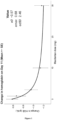
- Figure 1 is a dose-response curve showing the change in hemoglobin (HGB) in function of the dose of macitentan administered to a human.
- HGB hemoglobin
- the present inventors have recognized that, despite fears of clinically relevant hemoglobin decreases, blood pressure decreases and/or edema or fluid retention increases, it is possible and safe and effective to treat PAH patients with high doses of macitentan. In particular, it is possible to decrease the progress of the disease, or even to improve the status of the disease.
- macitentan is defined as propylsulfamic acid [5-(4-bromo-phenyl)-6-[2-(5-bromo-pyrimidin-2-yloxy)-ethoxy]-pyrimidin-4-yl]-amide, i.e. a compound of formula (I) or a pharmaceutically acceptable salt, solvate, hydrate or morphological form thereof.
- Macitentan is an endothelin receptor antagonist (ERA) that acts as an antagonist of two endothelin (ET) receptor subtypes, ET A and ET B ( Kholdani et al, Macitentan for the treatment of pulmonary arterial hypertension. Vasc. Health Risk Manag. (2014), 10, 665-673 ). Its half-life in humans is about 16 hours and steady state is reached by the third day of administration ( Bruderer et al., Absorption, distribution, metabolism, and excretion of macitentan, a dual endothelin receptor antagonist, in humans. Xenobiotica (2012), 42(9), 901-910 ).
- Macitentan dealkylates into the active metabolite ACT-132577, which reaches its peak plasma concentration about 30 hours after the first dose is administered, and it has a half-life of approximately 48 hours.
- ACT-132577 has a lower affinity for the ET receptors than its parent compound ( Iglarz et al., Pharmacology of macitentan, an orally active tissue-targeting dual endothelin receptor antagonist. J. Pharmacol. Exp. Ther. (2008), 327(3), 736-745 ), it maintains higher plasma concentrations than macitentan. Both compounds can be excreted from the body through the urine or feces.
- these dosages are applied once a day.
- PAH is defined as pulmonary arterial hypertension in human.
- PAH which is haemodynamically characterised by the presence of a mean pulmonary artery pressure (PAP) > 20 mm Hg, a pulmonary artery wedge pressure (PAWP) ⁇ 15 mm Hg and a PVR of equal to or more than (>) 3 Wood units, alternatively > 2 Wood units, all measured at rest.
- PAP mean pulmonary artery pressure
- PAWP pulmonary artery wedge pressure
- PVR PVR of equal to or more than (>) 3 Wood units, alternatively > 2 Wood units, all measured at rest.
- PAH is characterized clinically by the absence of overt left-sided heart disease, severe lung disease, or known chronic thromboembolic disease.
- PAH is characterized hemodynamically by a right heart catheterization as:
- PAH is characterized clinically by the absence of overt left-sided heart disease, severe lung disease, or known chronic thromboembolic disease.
- macitentan is currently administered as 10 mg oral dose once a day.
- a high dosage of macitentan in order to improve the disease status, prevent the occurrence of disease worsening, improve or stabilize the WHO functional class and improve long-term survival and/or decrease hospitalization rate.
- PAH pulmonary arterial hypertension
- a more detailed assessment for moderate PAH is determined as follows: (dmoderate) the aforementioned assessments of the (dmild) criteria and the (dsevere) criteria do neither allow to classify the patient's PAH as mild PAH nor allow to classify the patient's PAH as severe PAH.
- the concentration of NT-proBNP rather than the concentration of BNP, will be determined and used to decide whether the patient has mild, moderate or severe PAH according to the preceding more detailed assessment definitions.
- BNP is measured as follows: a plasma sample is collected and shipped frozen (-20°C or below) in a plastic EDTA tube and analyzed with an immunochemiluminometric assay (ICMA).
- ICMA immunochemiluminometric assay
- NT-proBNP is measured as follows: a serum or plasma sample is collected and shipped at ambient temperature if within 3 days of collection or frozen in a red-top tube, after centrifugation, and analyzed with an electrochemiluminescence immunoassay (ECLIA).
- ECLIA electrochemiluminescence immunoassay
- CI is measured as follows: CI reflects the flow of blood (liters / minute) through the heart, which is called cardiac output (CO), standardized to the patient's body surface area (BSA); the Cl is thus expressed in liters/minute/meter 2 .
- a right heart catheterization (RHC) is a standard procedure used to diagnose PAH. It is an invasive procedure during which a catheter is inserted through a large vein and then the catheter is advanced to the right side of the heart and then into the pulmonary artery.
- Fick cardiac index method or Thermodilution cardiac index method. These are standardized and well-established methods. The most accepted method is the thermodilution method.
- thermodilution (TD) method will be the specific method used to measure Cl.
- TD determines the CO based on how fast a set amount of fluids (typically at room temperature, i.e., 25°C) moves from the right atrium [injected into the proximal port of the pulmonary artery (PA) catheter] to the PA (detected by a thermo-sensor close to the tip of the distal part of the PA catheter).
- An area under the curve (AUC) of the change in temperature is generated. This is to be repeated at least 3 times, and then the average value will be calculated, but the values should be within (+/-) 10-15% of each other for these measurements to be valid.
- RAP is measured as follows: the RAP (occasionally referred to as mRAP, i.e. mean RAP) is also measured during the RHC procedure as outlined above for measuring the Cl.
- RAP (occasionally referred to as mRAP, i.e. mean RAP) is also measured during the RHC procedure as outlined above for measuring the Cl.
- SvO 2 is measured as follows: the SvO 2 is also measured during the RHC procedure as outlined above for measuring the Cl.
- the oxygen 'concentration' / 'content' partial pressure of oxygen in the blood
- the % of oxygenation in that blood sample is the SvO 2 . It is also a single measurement.
- a Wood Unit is the measure of a simplified system for measuring pulmonary vascular resistance (PVR) that uses increments of pressure. Measurement of PVR is made by subtracting pulmonary artery wedge pressure from the mean pulmonary arterial pressure and dividing by cardiac output in liters per minute.
- PVR pulmonary vascular resistance
- mild PAH is associated with a score of 1-7
- moderate PAH is associated with a score of 8 or 9.
- BMPR2 bone morphogenetic protein receptor type-2
- HPAH familial PAH
- the phenotype is not expressed in all generations, but when expressed, occurs at an earlier age and is associated with more severe and rapidly progressive disease.
- Many other genetic mutations have been identified to be associated with familial (heritable) PAH, but these are much less common than the BMPR2 mutation ( Morrell et al., Eur. Respir. J. (2016), Dec 13. pii: 1801899. doi: 10.1183/13993003.01899-2018. [Epub ahead of print ]).
- APAH-CTD PAH associated with connective tissue disease
- PAH connective tissue disease
- APAH-PoPH PAH associated with porto-pulmonary hypertension
- PAH PAH associated with portal hypertension
- Portal hypertension is defined as increased pressure in the portal vein as evidenced by an increase in the gradient of pressure between the portal vein and the hepatic vein by more than 5 mm Hg (it becomes clinically significant if the pressure gradient is ⁇ 10 mm Hg).
- the portal vein carries blood from the gastrointestinal system to the liver. Although this happens more often in the presence of advanced liver disease causing the portal hypertension, porto-pulmonary hypertension may happen in the absence of liver disease as long as there is portal hypertension.
- PoPH PAH associated with portal hypertension
- hepatopulmonary syndrome which is characterized by abnormal pulmonary vasodilation and hypoxaemia. However, overlaps between both conditions may occur.
- PoPH is associated with the presence of portal hypertension as defined above, not necessarily with the presence of liver disease. However, as cirrhotic liver disease is by far the most common cause of portal hypertension, PoPH is most frequently encountered in patients with cirrhosis.
- RHC right heart catheterization
- renal insufficiency is characterized by a glomerular filtration rate (GFR) below 90 ml/min/1.73 m 2 .
- GFR glomerular filtration rate
- SCr creatinine blood concentration
- the GFR obtained according to the equation above is expressed in mL/min per 1.73 m 2 body surface area. If the body surface area of the patient is different from 1.73 m 2 , the value obtained for the GFR through the MDRD equation above should be converted accordingly.
- Pericardial effusion is a collection of fluid around the heart. Normally, there should be a very thin, typically invisible to the normal eye, layer of fluid that acts as lubricant to prevent friction between the heart and the pericardium (fibrinous layer surrounding and protecting the heart). In the setting of advanced PH (as well as many other diseases), that fluid builds up and forms a collection around the heart, defined as pericardial effusion. The presence of such an effusion portends poor prognosis as it signifies advanced PH and right heart dysfunction / failure.
- DLCO is measured via pulmonary function tests. These tests are performed as described in Graham et al., 2017 ERS/ATS standards for single-breath carbon monoxide uptake in the lung, Eur. Respir. J. (2017), 49, 1600016 .
- RHC is an invasive, typically, outpatient procedure that involves inserting a catheter through a central vein and then passing it through the right sided heart chambers to reach the pulmonary artery. Different measurements are taken during this procedure including pressures and blood flow termed cardiac output.
- the dosage is 65 to 85 mg per day, more preferably the dosage is 70 to 80 mg per day and most preferably the dosage is 75 mg per day.
- each of the lower limits disclosed above may be combined with each of the upper limits, i.e. the dosage could also be from 60 to 85 mg, from 60 to 80 mg, or from 60 to 75 mg per day.
- dosages from 65 to 90 mg, or 65 to 75 mg per day. Further preferred ranges are 72 to 78 mg per day. According to a more preferred aspect, these dosages are applied once a day.
- these dosages relate to macitentan for use in the treatment and/or prevention of mild or moderate PAH, preferably moderate PAH.
- a further aspect of the present invention relates to macitentan for use in the treatment and/or prevention of PAH according to aspect (a) or (b), wherein the dosage of macitentan is 30 to 45 mg twice per day, more preferably 35 to 40 mg twice per day and most preferably 37.5 mg twice per day. It is to be understood that each of the lower limits disclosed above may be combined with each of the upper limits. Also disclosed are doses from 30 to 40 mg twice per day. Further preferred ranges are 36 to 39 mg twice per day.
- these dosages relate to macitentan for use in the treatment and/or prevention of mild or moderate PAH, preferably moderate PAH.
- a further aspect of the present invention relates to macitentan for use in the treatment and/or prevention of PAH according to aspect (a) or (b), wherein the dosage of macitentan is escalated from 10 mg per day, followed by 25 to 50 mg per day, preferably 37.5 mg per day, and followed by 60 to 90 mg per day, preferably 75 mg per day.
- the dosage is 30 to 45 mg per day, more preferably 35 to 40 mg per day and most preferably 37.5 mg per day. It is to be understood that each of the lower limits disclosed may be combined with each of the upper limits, i.e. the dosage could also be from 25 to 45 mg per day, or from 25 to 40 mg per day.
- doses from 30 to 50 mg, or 30 to 40 mg per day. Further preferred ranges are 36 to 39 mg per day. It is to be understood that any escalation to a higher dose may be followed by return to the lower dose in case the higher dose is not tolerated.
- the phrase "followed by 60 to 90 mg per day” means preferably, the dosage is 65 to 85 mg per day, more preferably the dosage is 70 to 80 mg per day and most preferably the dosage is 75 mg per day. It is to be understood that each of the lower limits disclosed above may be combined with each of the upper limits, i.e. the dosage could also be from 60 to 85 mg, from 60 to 80 mg, or from 60 to 75 mg per day. Also disclosed are dosages from 65 to 90 mg, or 65 to 75 mg per day. Further preferred ranges are 72 to 78 mg per day. It is to be understood that any escalation to a higher dose may be followed by return to the lower dose in case the higher dose is not tolerated.
- these dosages are applied once a day.
- the dosage of macitentan for use in the treatment of PAH is 10 mg per day. Patients obtaining this dosage may receive an immediate dose escalation to 37.5 mg per day, followed by 75 mg per day.
- a further aspect of the present invention relates to macitentan for use in the treatment and/or prevention of PAH according to aspect (a) or (b), wherein the dosage of macitentan is escalated from 10 mg per day, followed by 25 to 50 mg per day, preferably 37.5 mg per day, followed by 60 to 90 mg per day, preferably 75 mg per day, optionally followed by 110 to 200 mg per day, preferably 150 mg per day.
- 110 to 200 mg per day means preferably, the dosage is 125 to 175 mg per day, more preferably 140 to 160 mg per day and most preferably 150 mg per day. It is to be understood that each of the lower limits disclosed above may be combined with each of the upper limits, i.e. the dosage could also be from 110 to 175 mg per day, from 110 to 160 mg per day or from 110 to 150 mg per day. Also disclosed are doses from 125 to 160 mg or 140 to 175 mg per day. Further preferred ranges are 145 to 155 mg per day. According to a more preferred aspect, these dosages are applied once a day.
- these dosages relate to macitentan for use in the treatment and/or prevention of mild or moderate PAH, preferably moderate PAH.
- a further aspect of the present invention relates to macitentan for use in the treatment and/or prevention of PAH according to aspect (a) or (b), wherein the dosage of macitentan is escalated from 10 mg per day, followed by 60 to 90 mg per day, preferably 75 mg once per day or 37.5 mg twice a day.
- the dosage is 65 to 85 mg per day, more preferably the dosage is 70 to 80 mg per day and most preferably the dosage is 75 mg per day. It is to be understood that each of the lower limits disclosed above may be combined with each of the upper limits, i.e. the dosage could also be from 60 to 85 mg, from 60 to 80 mg, or from 60 to 75 mg per day. Also disclosed are dosages from 65 to 90 mg, or 65 to 75 mg per day. Further preferred ranges are 72 to 78 mg per day. It is to be understood that any escalation to a higher dose may be followed by return to the lower dose in case the higher dose is not tolerated.
- these dosages are applied once a day.
- a further aspect of the present invention relates to macitentan for use in the treatment and/or prevention of PAH according to aspect (a) or (b), wherein the dosage of macitentan is escalated from 10 mg per day, followed by 60 to 90 mg per day, preferably 75 mg once per day or 37.5 mg twice a day, optionally followed by 110 to 200 mg per day, preferably 150 mg per day.
- 110 to 200 mg per day means preferably, the dosage is 125 to 175 mg per day, more preferably 140 to 160 mg per day and most preferably 150 mg per day. It is to be understood that each of the lower limits disclosed above may be combined with each of the upper limits, i.e. the dosage could also be from 110 to 175 mg per day, from 110 to 160 mg per day or from 110 to 150 mg per day. Also disclosed are doses from 125 to 160 mg or 140 to 175 mg per day. Further preferred ranges are 145 to 155 mg per day. According to a more preferred aspect, these dosages are applied once a day.
- the dosage of macitentan for use in the treatment of PAH is 10 mg per day. Patients obtaining this dosage may receive an immediate dose escalation to 75 mg per day.
- these dosages relate to macitentan for use in the treatment and/or prevention of mild or moderate PAH, preferably moderate PAH.
- a further aspect of the present invention relates to macitentan for use in the treatment and/or prevention of PAH according to aspect (h), wherein the dosage of macitentan is escalated from 10 mg once per day, preferably for 15 to 45 days; followed by 25 to 50 mg per day, preferably 37.5 mg once per day, preferably for 15 to 45 days; and followed by 60 to 90 mg per day, preferably by 75 mg once per day or 37.5 mg twice per day. It is to be understood that any escalation to a higher dose may be followed by return to the lower dose in case the higher dose is not tolerated.
- 15 to 45 days means preferably 20 to 40 days, more preferably 21 to 35 days, and most preferably 28 to 30 days, i.e. about one month.
- the phrase "followed by 25 to 50 mg per day” means preferably, the dosage is 30 to 45 mg per day, more preferably 35 to 40 mg per day and most preferably 37.5 mg per day. It is to be understood that each of the lower limits disclosed may be combined with each of the upper limits, i.e. the dosage could also be from 25 to 45 mg per day, or from 25 to 40 mg per day. Also disclosed are doses from 30 to 50 mg, or 30 to 40 mg per day. Further preferred ranges are 36 to 39 mg per day.
- the phrase "followed by 60 to 90 mg per day” means preferably, the dosage is 65 to 85 mg per day, more preferably the dosage is 70 to 80 mg per day and most preferably the dosage is 75 mg per day. It is to be understood that each of the lower limits disclosed above may be combined with each of the upper limits, i.e. the dosage could also be from 60 to 85 mg, from 60 to 80 mg, or from 60 to 75 mg per day. Also disclosed are dosages from 65 to 90 mg, or 65 to 75 mg per day. Further preferred ranges are 72 to 78 mg per day, or 36 to 39 mg twice per day.
- these dosages are applied once a day.
- a further aspect of the present invention relates to macitentan for use in the treatment and/or prevention of PAH according to aspect (h), wherein the dosage of macitentan is escalated from 10 mg once per day, preferably for 15 to 45 days; followed by 25 to 50 mg per day, preferably 37.5 mg once per day, preferably for 15 to 45 days; followed by 60 to 90 mg per day, preferably by 75 mg once per day or 37.5 mg twice per day, preferably for 15 to 45 days; optionally followed by 110 to 200 mg per day, preferably 150 mg per day.
- 110 to 200 mg per day means preferably, the dosage is 125 to 175 mg per day, more preferably 140 to 160 mg per day and most preferably 150 mg per day. It is to be understood that each of the lower limits disclosed above may be combined with each of the upper limits, i.e. the dosage could also be from 110 to 175 mg per day, from 110 to 160 mg per day or from 110 to 150 mg per day. Also disclosed are doses from 125 to 160 mg or 140 to 175 mg per day. Further preferred ranges are 145 to 155 mg per day. According to a more preferred aspect, these dosages are applied once a day.
- these dosages relate to macitentan for use in the treatment and/or prevention of mild or moderate PAH, preferably moderate PAH.
- a further aspect of the present invention relates to macitentan for use in the treatment and/or prevention of PAH according to aspect (i), wherein the dosage of macitentan is escalated from 10 mg once per day, preferably for 15 to 45 days; followed by 60 to 90 mg per day, preferably by 75 mg once per day or 37.5 mg twice per day.
- 15 to 45 days means preferably 20 to 40 days, more preferably 21 to 35 days, and most preferably 28 to 30 days, i.e. about one month.
- the dosage is 65 to 85 mg per day, more preferably the dosage is 70 to 80 mg per day and most preferably the dosage is 75 mg per day. It is to be understood that each of the lower limits disclosed above may be combined with each of the upper limits, i.e. the dosage could also be from 60 to 85 mg, from 60 to 80 mg, or from 60 to 75 mg per day. Also disclosed are dosages from 65 to 90 mg, or 65 to 75 mg per day. Further preferred ranges are 72 to 78 mg per day, or 36 to 39 mg twice per day.
- a further aspect of the present invention relates to macitentan for use in the treatment and/or prevention of PAH according to (i), wherein the dosage of macitentan is escalated from 10 mg once per day, preferably for 15 to 45 days; followed by 60 to 90 mg per day, preferably by 75 mg once per day or 37.5 mg twice per day, preferably for 15 to 45 days; optionally followed by 110 to 200 mg per day, preferably 150 mg per day.
- the phrase "optionally followed by 110 to 200 mg per day” means preferably, the dosage is 125 to 175 mg per day, more preferably 140 to 160 mg per day and most preferably 150 mg per day. It is to be understood that each of the lower limits disclosed above may be combined with each of the upper limits, i.e.
- the dosage could also be from 110 to 175 mg per day, from 110 to 160 mg per day or from 110 to 150 mg per day. Also disclosed are doses from 125 to 160 mg or 140 to 175 mg per day. Further preferred ranges are 145 to 155 mg per day.
- these dosages are applied once a day.
- these dosages relate to macitentan for use in the treatment and/or prevention of mild or moderate PAH, preferably moderate PAH.
- a further aspect of the present invention relates to macitentan for use in the treatment and/or prevention of PAH according to any one of aspects (a) to (c), wherein the dosage of macitentan is escalated to 25 to 50 mg per day, preferably 37.5 mg per day; preferably for 15 to 45 days; followed by 60 to 90 mg per day, preferably by 75 mg per day; provided that the patient is already treated with an endothelin receptor antagonist preferably selected from bosentan and ambrisentan. It is to be understood that any escalation to a higher dose may be followed by return to the lower dose in case the higher dose is not tolerated.
- 15 to 45 days means preferably 20 to 40 days, more preferably 21 to 35 days, and most preferably 28 to 30 days, i.e. about one month.
- the phrase "followed by 25 to 50 mg per day” means preferably, the dosage is 30 to 45 mg per day, more preferably 35 to 40 mg per day and most preferably 37.5 mg per day. It is to be understood that each of the lower limits disclosed may be combined with each of the upper limits, i.e. the dosage could also be from 25 to 45 mg per day, or from 25 to 40 mg per day. Also disclosed are doses from 30 to 50 mg, or 30 to 40 mg per day. Further preferred ranges are 36 to 39 mg per day.
- the phrase "followed by 60 to 90 mg per day” means preferably, the dosage is 65 to 85 mg per day, more preferably the dosage is 70 to 80 mg per day and most preferably the dosage is 75 mg per day. It is to be understood that each of the lower limits disclosed above may be combined with each of the upper limits, i.e. the dosage could also be from 60 to 85 mg, from 60 to 80 mg, or from 60 to 75 mg per day. Also disclosed are dosages from 65 to 90 mg, or 65 to 75 mg per day. Further preferred ranges are 72 to 78 mg per day, or 36 to 39 mg twice per day.
- the dosage of macitentan can be further raised from 110 to 200 mg per day.
- the dosage is thereby escalated as in aspect (i), (j) or (k).
- these dosages are applied once a day.
- these dosages relate to macitentan for use in the treatment and/or prevention of mild or moderate PAH, preferably moderate PAH.
- a further aspect of the present invention relates to macitentan for use in the treatment and/or prevention of PAH according to any one of aspects (a) to (c), wherein the dosage of macitentan is 60 to 90 mg per day, preferably 75 mg per day; provided that the patient is already treated with an endothelin receptor antagonist preferably selected from bosentan, and ambrisentan.
- 60 to 90 mg per day means preferably, the dosage is 65 to 85 mg per day, more preferably the dosage is 70 to 80 mg per day and most preferably the dosage is 75 mg per day. It is to be understood that each of the lower limits disclosed above may be combined with each of the upper limits, i.e. the dosage could also be from 60 to 85 mg, from 60 to 80 mg, or from 60 to 75 mg per day. Also disclosed are dosages from 65 to 90 mg, or 65 to 75 mg per day. Further preferred ranges are 72 to 78 mg per day, or 36 to 39 mg twice per day.
- the dosage of macitentan can be further raised from 110 to 200 mg per day.
- the dosage is thereby escalated as in aspect (i), (j) or (k).
- these dosages are applied once a day.
- these dosages relate to macitentan for use in the treatment and/or prevention of mild or moderate PAH, preferably moderate PAH.
- a further aspect of the present invention relates to macitentan for use in the treatment and/or prevention of PAH according to any one of aspects (a) to (m), wherein macitentan is combined with a PDE5 inhibitor and/or a prostacyclin analogue, and/or a prostacyclin receptor agonist and/or a soluble guanylate cyclase stimulator.
- cGMP cyclic guanosine monophosphate
- phosphodiesterase type 5 results in vasodilation through the NO/cGMP pathway at sites expressing this enzyme. Since the pulmonary vasculature contains substantial amounts of phosphodiesterase type 5, the potential clinical benefit of phosphodiesterase type 5 inhibitors (PDE5is) has been investigated in PAH. In addition, PDE5is exert antiproliferative effects ( ESC/ERS Guidelines; European Heart Journal (2016), 37, 67-119 ).
- Prostacyclin is produced predominantly by endothelial cells and induces potent vasodilation of all vascular beds. This compound is the most potent endogenous inhibitor of platelet aggregation and also appears to have both cytoprotective and antiproliferative activities. Dysregulation of the prostacyclin metabolic pathways has been shown in patients with PAH as assessed by a reduction of prostacyclin synthase expression in the pulmonary arteries and of prostacyclin urinary metabolites. The clinical use of prostacyclin in patients with PAH has been extended by the synthesis of stable analogues that possess different pharmacokinetic properties but share qualitatively similar pharmacodynamic effects ( ESC/ERS Guidelines; European Heart Journal (2016), 37, 67-119 ).
- BCRP is an efflux pump located in the gut, liver canalicular membrane, and kidney, and is exposed to intracellular drug concentrations in the liver and the kidney.
- Macitentan and ACT-132577 activated human PXR with EC 50 values of 1.1 to 1.2 ⁇ M and 7.2 to 8.7 ⁇ M, respectively.
- human hepatocytes both compounds elicited concentration-dependent increases in CYP3A4 mRNA and enzyme activity.
- Predicted peak plasma concentrations of macitentan and ACT-132577 in PAH patients at 75 mg per day dose are expected to be around 5 ⁇ M and 14 ⁇ M, respectively, based on the PK Sub-study and assuming dose linearity. Taking into account the high degree of protein binding, free plasma concentrations are expected to be in the range of 0.02 ⁇ M to 0.07 ⁇ M for macitentan and ACT-132577, respectively. It is not likely that these unbound concentrations of macitentan and ACT-132577 result in any inhibition of BCRP in the liver or kidney or induction of CYP3A4 enzyme in the liver.
- the dosage of macitentan is 60 to 90 mg per day in aspect (n).
- the dosage is 65 to 85 mg per day, more preferably the dosage is 70 to 80 mg per day and most preferably the dosage is 75 mg per day.
- each of the lower limits disclosed above may be combined with each of the upper limits, i.e. the dosage could also be from 60 to 85 mg, from 60 to 80 mg, or from 60 to 75 mg per day.
- dosages from 65 to 90 mg, or 65 to 75 mg per day.
- a further preferred dosage range is 72 to 78 mg per day.
- the dosage of macitentan may be escalated from 10 mg per day, followed by 25 to 50 mg per day, preferably 37.5 mg per day, followed by 60 to 90 mg per day, preferably 75 mg per day, optionally followed by 100 to 200 mg per day, preferably 150 mg per day.
- these combinations relate to macitentan for use in the treatment and/or prevention of mild or moderate PAH, preferably moderate PAH.
- a further aspect of the present invention relates to macitentan for use in the treatment and/or prevention of PAH according to aspect (n), wherein the PDE5 inhibitor is selected from sildenafil, tadalafil, vardenafil, and udenafil; the prostacyclin analogue is selected from epoprostenol, treprostinil, iloprost, and beraprost; the prostacyclin receptor agonist is selected from selexipag and ralinepag; and the soluble guanylate cyclase stimulator is selected from riociguat and vericiguat.
- the PDE5 inhibitor is selected from sildenafil, tadalafil, vardenafil, and udenafil
- the prostacyclin analogue is selected from epoprostenol, treprostinil, iloprost, and beraprost
- the prostacyclin receptor agonist is selected from
- macitentan has a dosage or dosage regimen according to any one of aspects (a) to (l) and (n).
- these dosages relate to macitentan for use in the treatment and/or prevention of mild or moderate PAH.
- these combinations relate to macitentan for use in the treatment and/or prevention of mild or moderate PAH, preferably moderate PAH.
- a further aspect of the present invention relates to macitentan for use in the treatment and/or prevention of PAH according to aspect (n) or (o), wherein macitentan is combined with tadalafil and/or selexipag or ralinepag.
- macitentan is combined with tadalafil and/or selexipag.
- macitentan has a dosage or dosage regimen according to any one of aspects (a) to (k) and (n).
- these dosages relate to macitentan for use in the treatment and/or prevention of mild or moderate PAH.
- these combinations relate to macitentan for use in the treatment and/or prevention of mild or moderate PAH, preferably moderate PAH.
- a further aspect of the present invention relates to macitentan for use in the treatment and/or prevention of PAH according to aspect (p), wherein tadalafil, if applicable, has a dose of 20 to 40 mg per day, preferably 40 mg per day, selexipag, if applicable, has a dose of 0.2 to 1.6 mg twice per day, and ralinepag, if applicable, has a dose of 0.05 to 1.45 mg per day.
- macitentan has a dosage or dosage regimen according to any one of aspects (a) to (k) and (n).
- these dosages relate to macitentan for use in the treatment and/or prevention of mild or moderate PAH.
- these combinations relate to macitentan for use in the treatment and/or prevention of mild or moderate PAH, preferably moderate PAH.
- a further aspect of the present invention relates to a pharmaceutical composition for use in the treatment of PAH according to any one of aspects (a) to (c), comprising macitentan and at least a pharmaceutically acceptable excipient, containing macitentan in an amount of 37.5 mg or 75 mg, preferably 75 mg.
- the pharmaceutical composition is for use in the treatment and/or prevention of mild or moderate PAH.
- a further aspect of the present invention relates to the pharmaceutical composition according to aspect (r), which comprises
- a further aspect of the present invention relates to the pharmaceutical composition according to aspect (r) or (s), which is in the form of a capsule or a tablet (in particular in the form of a tablet, notably a tablet containing 75 mg of macitentan).
- a further aspect of the present invention relates to macitentan for use in the treatment and/or prevention of PAH according to any one of aspects (a) to (q), wherein the treatment and/or prevention means the reduction of morbidity and/or mortality risk of PAH. That is, this aspect of the present invention relates to macitentan for use in reducing morbidity and/or mortality risk of PAH, in which macitentan is used in a manner according to any one of aspects (a) to (q).
- the reduction of morbidity and/or mortality risk of PAH may be evaluated as the reduction of the composite morbidity/mortality risk, for example, by time to first clinical worsening up to 7 days after EOT (End of Treatment), defined as time from baseline to the first of the following events (the primary endpoint):
- the reduction of morbidity and/or mortality risk of PAH may be evaluated separately.
- the above evaluation may be made for example by a double blind test with the control group receiving the dosage of macitentan of 10 mg per day in the titration and maintenance period.
- the dosage of macitentan is 60 to 90 mg per day.
- the dosage is 65 to 85 mg per day, more preferably the dosage is 70 to 80 mg per day and most preferably the dosage is 75 mg per day.
- each of the lower limits disclosed above may be combined with each of the upper limits, i.e. the dosage could also be from 60 to 85 mg, from 60 to 80 mg, or from 60 to 75 mg per day.
- dosages from 65 to 90 mg, or 65 to 75 mg per day.
- a further preferred dosage range is 72 to 78 mg per day.
- the dosage of macitentan may be escalated from 10 mg per day, followed by 25 to 50 mg per day, preferably 37.5 mg per day, followed by 60 to 90 mg per day, preferably 75 mg per day, optionally followed by 100 to 200 mg per day, preferably 150 mg per day.
- Macitentan has an active metabolite, known under the code name ACT-132577 and the International Non-proprietary Name aprocitentan, which has the chemical formula whereby any weight amount of macitentan corresponds to a 5-fold weight amount of aprocitentan.
- Hemoglobin concentrations measured in the morning of Day 11 of macitentan treatment and at baseline on Day -1 were used in the analysis. Changes in hemoglobin concentrations compared to baseline were regressed against the different dose levels of macitentan, including placebo.
Landscapes
- Health & Medical Sciences (AREA)
- Chemical & Material Sciences (AREA)
- Life Sciences & Earth Sciences (AREA)
- Pharmacology & Pharmacy (AREA)
- Veterinary Medicine (AREA)
- Public Health (AREA)
- General Health & Medical Sciences (AREA)
- Medicinal Chemistry (AREA)
- Animal Behavior & Ethology (AREA)
- Epidemiology (AREA)
- General Chemical & Material Sciences (AREA)
- Chemical Kinetics & Catalysis (AREA)
- Engineering & Computer Science (AREA)
- Nuclear Medicine, Radiotherapy & Molecular Imaging (AREA)
- Bioinformatics & Cheminformatics (AREA)
- Organic Chemistry (AREA)
- Cardiology (AREA)
- Heart & Thoracic Surgery (AREA)
- Pulmonology (AREA)
- Oil, Petroleum & Natural Gas (AREA)
- Biochemistry (AREA)
- Molecular Biology (AREA)
- Inorganic Chemistry (AREA)
- Acyclic And Carbocyclic Compounds In Medicinal Compositions (AREA)
- Pharmaceuticals Containing Other Organic And Inorganic Compounds (AREA)
- Medicines That Contain Protein Lipid Enzymes And Other Medicines (AREA)
- Medicinal Preparation (AREA)
Description
- The present invention relates to high doses of macitentan (INN), i.e. propylsulfamic acid [5-(4-bromo-phenyl)-6-[2-(5-bromo-pyrimidin-2-yloxy)-ethoxy]-pyrimidin-4-yl]-amide or pharmaceutically acceptable salts, solvates, hydrates or morphological forms thereof for use in the treatment and/or prevention of pulmonary arterial hypertension (PAH). One aspect of the invention is set out in claim 1: macitentan for use in the treatment and/or prevention of pulmonary arterial hypertension (PAH) in human, wherein the dosage of macitentan is 60 to 90 mg per day. Other aspects are set out below and in the other claims. The present invention relates to a dosage regimen for the treatment and/or prevention of PAH as well as to a combination of macitentan with one or more phosphodiesterase type 5 (PDE5) inhibitors, prostacyclin analogues, prostacyclin receptor agonists or soluble guanylate cyclase stimulators. Therein, PAH is preferably mild or moderate PAH. Moreover, the present invention relates to a pharmaceutical composition for the treatment of PAH comprising a high dose of macitentan as set out in the claims.
- Pulmonary hypertension (PH) was reported for the first time in 1891 when the autopsy of a patient with sudden death revealed right ventricular hypertrophy and pulmonary artery sclerosis without any apparent cause. Pulmonary arterial hypertension (PAH) is a subgroup of PH and it is a progressive disease with elevated pulmonary vascular resistance (PVR) as the basic cause for increased right ventricular afterload and hypertrophy, which eventually proceeds to right ventricular dilatation and failure, and premature death. PH is clinically classified into five groups according to the World Health Organization (WHO) classification: pulmonary arterial hypertension (PAH) (group 1), PH related to left heart disease (group 2), PH due to lung disease and/or hypoxia (group 3), chronic thromboembolic PH and other pulmonary artery obstructions (group 4), and PH with unclear and/or multifactorial mechanisms (group 5) (Roger Hullin, Cardiovascular Medicine (2018), 21(7-8):195-199; Simonneau et al., Haemodynamic definitions and updated clinical classification of pulmonary hypertension. Eur. Respir. J. (2018), Dec 13. pii: 1801913. doi: 10.1183/13993003.01913-2018. [Epub ahead of print]).
- The present invention focuses on PAH which is haemodynamically characterised by the presence of a mean pulmonary artery pressure (PAP) > 20 mm Hg, a pulmonary artery wedge pressure (PAWP) ≤ 15 mm Hg and a PVR of equal to or more than (>) 3 Wood units, alternatively > 2 Wood units, all measured at rest.
- In particular, the present invention focuses on PAH which is haemodynamically characterised by the presence of a mean pulmonary artery pressure (PAP) ≥ 25 mm Hg, a pulmonary artery wedge pressure (PAWP) ≤ 15 mm Hg and a PVR of equal to or more than (>) 3 Wood units, alternatively > 2 Wood units, all measured at rest.
- The pathophysiology of PAH is characterised by an imbalance between molecules mediating vasoconstriction (e.g., endothelin or thromboxane) and/or molecules mediating vasodilation (e.g., prostacyclin and nitric oxide). Furthermore, mitogenic effects of these molecules, with specific pathomorphological changes in the pulmonary circulation are involved in disease progression.
- Currently available compounds approved for specific treatment of PAH are in three different groups: a) endothelin receptor antagonists, b) phosphodiesterase type 5 inhibitors (PDE5is) and soluble guanylate cyclase stimulators, and c) molecules interfering with the prostacyclin pathway. Treatment with these compounds in combination with general measures has increased 3-year survival after first diagnosis of idiopathic PAH from 48% in the 1980s to 74% in the last two decades, as shown in the REVEAL registry (Benza et al., An evaluation of long-term survival from time of diagnosis in pulmonary arterial hypertension from the REVEAL Registry. CHEST (2012), 142(2), 448-456; and CHEST (2012), 141(2):354-362).
- Bedan et al. "A Focus on Macitentan in the Treatment of Pulmonary Arterial Hypertension", BASIC & CLINICAL PHARMACOLOGY & TOXICOLOGY, 2018, vol. 123, no. 2, pages 103 - 113 focuses on the effect of macitentan in the treatment of pulmonary arterial hypertension compared to other endothelin receptor antagonists.
- Pulido et al. "Macitentan and Morbidity and Mortality in Pulomary Arterial Hypertension" THE NEW ENGLAND JOURNAL OF MEDICINE, 2013, vol. 369, no. 9, pages 809-818 relates to the Phase 3 SERAPHIN trial concerning macitentan at a once daily dose of 3 or 10 mg, or once daily placebo.
- Kunita-Takanezawa et al. "Novel Dual Endothelin Receptor Anatagonist Macitentan Reverses Severe Pulmonary Arterial Hypertension in Rats", J CARDIOVASC PHARMACOL, 2014, vol 63, no. 5, pages 473-480 relates to a study of macitentan conducted in a rat model of pulmonary arterial hypertension.
- It is an object of the present invention to provide a medication and/or treatment regimen for pulmonary arterial hypertension (PAH). In particular it is an object of the present invention to provide a medication and/or treatment regimen for the treatment of mild or moderate PAH. It is a further object of the present invention to provide a combination medication and/or treatment for PAH.
-
Figure 1 is a dose-response curve showing the change in hemoglobin (HGB) in function of the dose of macitentan administered to a human. - The present inventors have recognized that, despite fears of clinically relevant hemoglobin decreases, blood pressure decreases and/or edema or fluid retention increases, it is possible and safe and effective to treat PAH patients with high doses of macitentan. In particular, it is possible to decrease the progress of the disease, or even to improve the status of the disease.
- In the present invention, macitentan is defined as propylsulfamic acid [5-(4-bromo-phenyl)-6-[2-(5-bromo-pyrimidin-2-yloxy)-ethoxy]-pyrimidin-4-yl]-amide, i.e. a compound of formula (I)

- Macitentan is an endothelin receptor antagonist (ERA) that acts as an antagonist of two endothelin (ET) receptor subtypes, ETA and ETB (Kholdani et al, Macitentan for the treatment of pulmonary arterial hypertension. Vasc. Health Risk Manag. (2014), 10, 665-673). Its half-life in humans is about 16 hours and steady state is reached by the third day of administration (Bruderer et al., Absorption, distribution, metabolism, and excretion of macitentan, a dual endothelin receptor antagonist, in humans. Xenobiotica (2012), 42(9), 901-910). It is absorbed slowly into the plasma (Sidharta et al., Macitentan: entry-into-humans study with a new endothelin receptor antagonist. Eur. J. Clin. Pharmacol. (2011), 67, 977-984). Macitentan dealkylates into the active metabolite ACT-132577, which reaches its peak plasma concentration about 30 hours after the first dose is administered, and it has a half-life of approximately 48 hours. Although ACT-132577 has a lower affinity for the ET receptors than its parent compound (Iglarz et al., Pharmacology of macitentan, an orally active tissue-targeting dual endothelin receptor antagonist. J. Pharmacol. Exp. Ther. (2008), 327(3), 736-745), it maintains higher plasma concentrations than macitentan. Both compounds can be excreted from the body through the urine or feces.
- It has previously been reported that the maximal or near-maximal effect of macitentan in rats is 10 mg/kg. (European Medicines Agency, European Public Assessment Report for Opsumit, Procedure No. EMEA/H/C/002697/0000 (2013) at 20 ("EMA Assessment Report")). It has also previously been reported that the maximal effective dose of macitentan in rats is 30 mg/kg (Id; e.g., Iglarz et al., Comparison of Pharmacological Activity of Macitentan and Bosentan in Preclinical Models of Systemic and Pulmonary Hypertension. Life Sci. (2014), 118, 333-339; see also Kunita-Takanezawa et al., Novel Dual Endothelin Receptor Antagonist Macitentan Reverses Severe Pulmonary Arterial Hypertension in Rats. J. Cardiovasc. Pharmacol. (2014), 64(5), 473-480).
- In a multiple-ascending dose study evaluating 1 mg, 3 mg, 10 mg, and 30 mg dosages of macitentan in healthy human subjects, plasma ET-1 concentrations at steady-state showed a dose-dependent increase, with no further increase beyond the 10 mg oral dose, indicating blockade at this dosage. (Id. at 40). The evaluators concluded that the 10 mg dose appeared to be close to the plateau of the pharmacological effect. (Id. at 48). The European Medicines Agency and the U.S. Food and Drug Administration have approved the 10 mg daily oral dosage of macitentan for the treatment of patients with pulmonary arterial hypertension. (EMA, Summary of Product Characteristics for Opsumit (Oct. 29, 2019) at 2; FDA, Prescribing Information for Opsumit (April 2019) at 1).
- In the following, several aspects of the invention will be explained.
- (a) One aspect of the present invention relates to macitentan for use in the treatment and/or prevention of pulmonary arterial hypertension (PAH) in human, wherein the dosage of macitentan is 60 to 90 mg per day.
- According to a more preferred aspect, these dosages are applied once a day.
- In the present invention, PAH is defined as pulmonary arterial hypertension in human.
- The present invention focuses on PAH which is haemodynamically characterised by the presence of a mean pulmonary artery pressure (PAP) > 20 mm Hg, a pulmonary artery wedge pressure (PAWP) ≤ 15 mm Hg and a PVR of equal to or more than (>) 3 Wood units, alternatively > 2 Wood units, all measured at rest. In addition to the above hemodynamic characterization, PAH is characterized clinically by the absence of overt left-sided heart disease, severe lung disease, or known chronic thromboembolic disease.
- In particular, the invention's focus is on PAH is characterized hemodynamically by a right heart catheterization as:
- Mean pulmonary artery pressure (mPAP) ≥ 25 mm Hg
- Pulmonary occlusion wedge pressure (PAWP) ≤15 mm Hg
- Pulmonary vascular resistance equal to or more than (>) 3 Wood Units, alternatively > 2 Wood units.
- In addition to the above hemodynamic characterization, PAH is characterized clinically by the absence of overt left-sided heart disease, severe lung disease, or known chronic thromboembolic disease.
- As described above, macitentan is currently administered as 10 mg oral dose once a day. However, with the present invention it is suggested to administer a high dosage of macitentan in order to improve the disease status, prevent the occurrence of disease worsening, improve or stabilize the WHO functional class and improve long-term survival and/or decrease hospitalization rate. Advantageously, if for instance compared to bosentan, there are fewer to no side effects on liver function and no or insignificant hepatotoxicity.
- Further advantages are no further clinically relevant decrease in hemoglobin, no further clinically relevant decrease in blood pressure and/or no further clinically relevant increase in edema / fluid retention.
- (b) Another aspect of the present invention relates to macitentan for use in the treatment and/or prevention of pulmonary arterial hypertension (PAH) according to aspect (a), wherein the PAH is mild or moderate PAH, preferably moderate PAH.
- Surprisingly it has been found that in mild and moderate PAH, the disease status could be improved or stabilized; in particular, the WHO functional class could be improved in mild and moderate patients. Functional capacity, as measured with a 6-minute walk test, could also be improved.
- The term "mild PAH" approximately equates to WHO Functional Class I and II.
- The term "moderate PAH" approximately equates to WHO Functional Class III.
- In contrast thereto, WHO Functional Class IV equates to severe PAH.
- The WHO Functional Classes (WHO FC) are commonly known and defined as follows:
- WHO FC I: No symptoms of pulmonary arterial hypertension with exercise or at rest. It is rare for a patient to be diagnosed while still a class I. Patients that are being screened because of high risk factors for developing PAH, such as patients with scleroderma or family history of PAH, may rarely be diagnosed as class I. More often this classification is used to describe patients who have demonstrated a substantial response to therapy who were once a class II or III but have improved to a class I.
- WHO FC II: No symptoms at rest but uncomfortable, fatigued, or short of breath with normal activity such as climbing a flight of stairs, grocery shopping, or making the bed.
- WHO FC III: Patients may not have symptoms at rest but normal activities are greatly limited by shortness of breath, fatigue, or near fainting. Patients in this class have a difficult time doing normal chores around the house and have to take breaks while doing activities of daily living.
- WHO FC IV: Symptoms at rest or severe symptoms with any activity. Patients in this class may faint with activity or while bending over with their heads lowered. Many patients in this class are also volume overloaded with edema in their feet and ankles from right heart failure.
- A more detailed assessment for mild PAH is determined as follows:
(dmild): Fulfilling at least 3 of the following criteria: - WHO FC I or II;
- Six-minute walk distance (6MWD) > 440 m;
- B-type natriuretic peptide (BNP) < 50 ng/L or N-terminal pro-B-type natriuretic peptide (NT-proBNP) < 300 ng/L; or RAP < 8 mmg HG;
- CI ≥ 2.5 L/min/m2 or SvO2 > 65%;
- and not fulfilling any of the (dsevere) criteria.
- A more detailed assessment for severe PAH is determined as follows:
- (dsevere): Fulfilling at least two of the following features, including Cl or SvO2:
- WHO FC IV;
- 6MWD < 165 meters;
- BNP > 300 ng/L or NT-proBNP > 1400 ng/L; or RAP > 14 mmg HG
- Cl < 2.0 L/min/m2 or SvO2 < 60%.
- A more detailed assessment for moderate PAH is determined as follows:
(dmoderate) the aforementioned assessments of the (dmild) criteria and the (dsevere) criteria do neither allow to classify the patient's PAH as mild PAH nor allow to classify the patient's PAH as severe PAH. - Preferably, the concentration of NT-proBNP, rather than the concentration of BNP, will be determined and used to decide whether the patient has mild, moderate or severe PAH according to the preceding more detailed assessment definitions.
- BNP is measured as follows: a plasma sample is collected and shipped frozen (-20°C or below) in a plastic EDTA tube and analyzed with an immunochemiluminometric assay (ICMA). The principles of this ICMA assay are as follows:
- A commercially available kit (Triage® BNP test) with the following 3 working solutions / suspensions is used:
- ∘ S1a: paramagnetic particles coated with mouse omniclonal anti-human BNP antibody suspended in TRIS buffered saline solution (150 mM NaCl, 50 mM Tris-HCl, pH 7.6 aq. solution), with bovine serum albumin (BSA), 0.1% ProClin™ 300 (0.60-1.00% 2-methyl-4-isothiazolin-3-one and 2.10-2.80% 5-chloro-2-methyl-4-isothiazolin-3-one aq. solution) and < 0.1% sodium azide;
- ∘ S1b: purified mouse and goat IgG in Tris buffered saline solution (150 mM NaCl, 50 mM Tris-HCl, pH 7.6 aq. solution), with bovine serum albumin (BSA), 0.1% ProClin™ 300 (0.60-1.00% 2-methyl-4-isothiazolin-3-one and 2.10-2.80% 5-chloro-2-methyl-4-isothiazolin-3-one aq. solution) and < 0.1% sodium azide; and
- ∘ S1c: mouse monoclonal anti-human BNP antibody-alkaline phosphatase bovine conjugate in PBS buffered saline solution (pH 7.4; 137 mmol/L NaCl, 2.7 mmol/L KCI, 10 mmol/L Na2HPO4 and 1.8 mmol/L KH2PO4), with bovine serum albumin (BSA), 0.1% ProClin™ 300 (0.60-1.00% 2-methyl-4-isothiazolin-3-one and 2.10-2.80% 5-chloro-2-methyl-4-isothiazolin-3-one aq. solution) and < 0.1% sodium azide.
- The blood sample (500 µL) is collected from the patient and placed in a plastic blood draw tube containing K2EDTA as an anticoagulant. The blood sample should be mixed by gently inverting the tube several times.
- The suspension S1a and the solution S1c are placed in a reaction vessel and 55 µL of the blood sample is added thereto.
- After incubation in the reaction vessel, a magnetic field is used to hold the materials bound to the solid phase and unbound materials are washed away using the solution S1b.
- A chemiluminescent substrate, Lumi-Phos® 530 (Chemical Abstracts Substance No. 146239-76-1), is then added into the reaction vessel and light generated by the reaction is measured by a luminometer. The resulting light is proportional to the BNP concentration, thus allowing to determine the BNP concentration in the sample.
- To ensure accuracy of the ICMA assay results, the luminometer should regularly be calibrated with commercially available reference solutions.
- NT-proBNP is measured as follows: a serum or plasma sample is collected and shipped at ambient temperature if within 3 days of collection or frozen in a red-top tube, after centrifugation, and analyzed with an electrochemiluminescence immunoassay (ECLIA). The principles of this ECLIA assay are as follows:
- A commercially available kit with the following 3 working solutions / suspensions is used:
- ∘ S1: A suspension (6.5 mL) of streptavidin-coated microparticles (0.72 mg/mL) containing preservative;
- ∘ S2: A solution (9 mL) of Anti-NT-proBNP-Ab-biotin, containing Biotinylated monoclonal anti-NT-proBNP antibody (mouse) (1.1 µg/mL), phosphate buffer 40 mmol/L, pH 5.8 and preservative; and
- ∘ S3: A solution (9 mL) of Anti-NT-proBNP-Ab-Ru(bpy), containing a monoclonal NT-proBNP-specific antibody labeled with the tris(2,2'-bipyridyl)ruthenium(II) complex (Ru(bpy)) (1.1 µg/mL), phosphate buffer 40 mmol/L, pH 5.8 and preservative.
- The sample (15 µL) is first incubated with the solutions S2 and S3; the biotinylated monoclonal NT-proBNP-specific antibody and the monoclonal NT-proBNP-specific antibody labeled with a ruthenium complex form a sandwich complex.
- A second incubation is then performed, whereby, after addition of the suspension S1, the complex becomes bound to the solid phase via interaction of biotin and streptavidin.
- The reaction mixture is aspirated into the measuring cell where the microparticles are magnetically captured onto the surface of the electrode. Unbound substances are then removed. Application of a voltage to the electrode then induces chemiluminescent emission which is measured by a photomultiplier.
- Results are determined based on a calibration curve using commercially available reference solutions.
- CI is measured as follows: CI reflects the flow of blood (liters / minute) through the heart, which is called cardiac output (CO), standardized to the patient's body surface area (BSA); the Cl is thus expressed in liters/minute/meter2. A right heart catheterization (RHC) is a standard procedure used to diagnose PAH. It is an invasive procedure during which a catheter is inserted through a large vein and then the catheter is advanced to the right side of the heart and then into the pulmonary artery. There are different methods to measure the Cl, but the most common methods are Fick cardiac index method or Thermodilution cardiac index method. These are standardized and well-established methods. The most accepted method is the thermodilution method. According to this invention, the thermodilution (TD) method will be the specific method used to measure Cl. TD determines the CO based on how fast a set amount of fluids (typically at room temperature, i.e., 25°C) moves from the right atrium [injected into the proximal port of the pulmonary artery (PA) catheter] to the PA (detected by a thermo-sensor close to the tip of the distal part of the PA catheter). An area under the curve (AUC) of the change in temperature is generated. This is to be repeated at least 3 times, and then the average value will be calculated, but the values should be within (+/-) 10-15% of each other for these measurements to be valid. The curves should also be assessed to make sure the flow is smooth without sharp changes in the curve that may suggest erroneous injections or measurements. Based on the average AUC obtained and the patient's BSA, defined as follows

- RAP is measured as follows: the RAP (occasionally referred to as mRAP, i.e. mean RAP) is also measured during the RHC procedure as outlined above for measuring the Cl. There is a pressure sensor at the tip of the catheter that is inserted in a vein that makes its way into the right side of the heart. The sensor measures the pressure when the catheter tip is in the right atrium, and that measured pressure is the RAP. It is a single measurement.
- SvO2 is measured as follows: the SvO2 is also measured during the RHC procedure as outlined above for measuring the Cl. When the catheter tip is in a central vein or the right atrium, blood is withdrawn and the oxygen 'concentration' / 'content' (partial pressure of oxygen in the blood) in that blood sample is analyzed using standard blood gas analyzers / sensors; the % of oxygenation in that blood sample is the SvO2. It is also a single measurement.
- For more detailed assessment, mild and moderate PAH can be defined according to an algorithm which is based on the Registry to Evaluate Early and Long-term PAH Diseases Management (REVEAL Registry). The algorithm may be described as comprising the following steps:
- (i) Determination of the WHO Group I Subgroup of the patient and assigning
- +1 score for APAH-CTD (PAH associated with connective tissue disease),
- +2 scores for APAH-PoPH (PAH associated with porto-pulmonary hypertension),
- +2 scores for FPAH (familial PAH, which is currently referred to heritable PAH);
- 0 score for any other subgroups of PAH;
- (ii) Determination of demographics and comorbidities and assigning
- +1 score for renal insufficiency,
- +2 scores for male age > 60 years,
- 0 score for other patients;
- (iii) Determination of the WHO Functional Class and assigning
- -2 scores for WHO FC I
- 0 scores for WHO FC II
- +1 score for WHO FG III
- +2 scores for WHO FG IV
- (iv) Determination of vital signs and assigning
- +1 score for SBP (systolic systemic blood pressure) < 110 mmHg,
- +1 score for HR (heart rate) > 92 BPM (beats per minute),
- 0 score for any other cases;
- (v) Determination of the 6-minute walk distance and assigning
- -1 score for ≥ 440 meters,
- +1 score for < 165 meters,
- 0 scores for any other cases;
- (vi) Determination of BNP (brain natriuretic peptide) and assigning
- -2 scores for BNP < 50 pg/mL,
- +1 score for BNP > 180 pg/mL,
- 0 score for BNP from 50 pg/mL to 180 pg/mL;
- (vii) Determination of an echocardiogram and assigning
- +1 score for pericardial effusion,
- 0 scores for any other cases;
- (viii) Pulmonary function test and assigning
- -1 score for % predicted DLCO ≥ 80% (diffusing capacity of lung for Carbon monoxide),
- +1 score for % predicted DLCO ≤ 32%,
- 0 scores for % predicted DLCO between 32% and 80%;
- (ix) Right heart catherization and assigning
- +1 score for RAP (mean right arterial pressure) > 20 mm Hg within 1 year,
- +2 scores for PVR (pulmonary vascular resistance) > 32 Wood units,
- 0 scores for any other cases;
- (x) Summarize the scores obtained in steps (i) to (ix) and add the number 6;
- (xi) mild PAH is assigned for a score from 1 to 7, and
moderate PAH is assigned for a score of 8 or 9. - In the above algorithm "+" means to add, "-" means to subtract.
- A Wood Unit is the measure of a simplified system for measuring pulmonary vascular resistance (PVR) that uses increments of pressure. Measurement of PVR is made by subtracting pulmonary artery wedge pressure from the mean pulmonary arterial pressure and dividing by cardiac output in liters per minute.
- Hence, mild PAH is associated with a score of 1-7, and moderate PAH is associated with a score of 8 or 9.
- For further definitions, it is expressly pointed to the ESC/ERS Guidelines, European Heart Journal (2016), 37, 67-119.
- Hereditary transmission of PAH has been reported in approximately 6% to 10% of patients with PAH; in 50% to 90% of these individuals, mutations in BMPR2 (bone morphogenetic protein receptor type-2) have been identified. The mutations in BMPR2 in familial pulmonary arterial hypertension (FPAH) are characterized by genetic anticipation and incomplete penetrance. FPAH is also referred to as HPAH (hereditary PAH). The phenotype is not expressed in all generations, but when expressed, occurs at an earlier age and is associated with more severe and rapidly progressive disease. Many other genetic mutations have been identified to be associated with familial (heritable) PAH, but these are much less common than the BMPR2 mutation (Morrell et al., Eur. Respir. J. (2018), Dec 13. pii: 1801899. doi: 10.1183/13993003.01899-2018. [Epub ahead of print]).
- In the present invention, APAH-CTD (PAH associated with connective tissue disease) is characterized by PAH in someone who also has an autoimmune disease, also called connective tissue disease. The most common connective tissue diseases that are associated with PAH are scleroderma (systemic sclerosis), Lupus (systemic lupus erythematosus / SLE), mixed connective tissue diseases and Sjogren's disease.
- In the present invention, APAH-PoPH (PAH associated with porto-pulmonary hypertension) is characterized by PAH that is associated with portal hypertension. Portal hypertension is defined as increased pressure in the portal vein as evidenced by an increase in the gradient of pressure between the portal vein and the hepatic vein by more than 5 mm Hg (it becomes clinically significant if the pressure gradient is ≥ 10 mm Hg). The portal vein carries blood from the gastrointestinal system to the liver. Although this happens more often in the presence of advanced liver disease causing the portal hypertension, porto-pulmonary hypertension may happen in the absence of liver disease as long as there is portal hypertension.
- PAH associated with portal hypertension is commonly referred to as PoPH. This entity should not be confused with hepatopulmonary syndrome, which is characterized by abnormal pulmonary vasodilation and hypoxaemia. However, overlaps between both conditions may occur. As implied by the term, PoPH is associated with the presence of portal hypertension as defined above, not necessarily with the presence of liver disease. However, as cirrhotic liver disease is by far the most common cause of portal hypertension, PoPH is most frequently encountered in patients with cirrhosis.
- A complete diagnostic workup including a right heart catheterization (RHC) is required to assess disease severity, haemodynamic profile and other potential causes of PH, including lung disease, LHD or chronic thromboembolic disease (ESC/ERS Guidelines, European Heart Journal (2016), 37, 67-119).
- In the present invention, renal insufficiency is characterized by a glomerular filtration rate (GFR) below 90 ml/min/1.73 m2. The GFR is obtained by obtaining standardized creatinine blood concentration (SCr) from the patient and using the MDRD equation which is as follows:

- The GFR obtained according to the equation above is expressed in mL/min per 1.73 m2 body surface area. If the body surface area of the patient is different from 1.73 m2, the value obtained for the GFR through the MDRD equation above should be converted accordingly.
- Pericardial effusion is a collection of fluid around the heart. Normally, there should be a very thin, typically invisible to the normal eye, layer of fluid that acts as lubricant to prevent friction between the heart and the pericardium (fibrinous layer surrounding and protecting the heart). In the setting of advanced PH (as well as many other diseases), that fluid builds up and forms a collection around the heart, defined as pericardial effusion. The presence of such an effusion portends poor prognosis as it signifies advanced PH and right heart dysfunction / failure.
- DLCO is measured via pulmonary function tests. These tests are performed as described in Graham et al., 2017 ERS/ATS standards for single-breath carbon monoxide uptake in the lung, Eur. Respir. J. (2017), 49, 1600016.
- RHC is an invasive, typically, outpatient procedure that involves inserting a catheter through a central vein and then passing it through the right sided heart chambers to reach the pulmonary artery. Different measurements are taken during this procedure including pressures and blood flow termed cardiac output.
- (c) Another aspect of the present invention relates to macitentan for use in the treatment and/or prevention of PAH according to aspect (a) or (b), wherein the dosage of macitentan is 60 to 90 mg per day. Preferably, the dosage is 65 to 85 mg per day, more preferably the dosage is 70 to 80 mg per day and most preferably the dosage is 75 mg per day. It is to be understood that each of the lower limits disclosed above may be combined with each of the upper limits, i.e. the dosage could also be from 60 to 85 mg, from 60 to 80 mg, or from 60 to 75 mg per day. Also disclosed are dosages from 65 to 90 mg, or 65 to 75 mg per day. Further preferred ranges are 72 to 78 mg per day. According to a more preferred aspect, these dosages are applied once a day.
- In a preferred aspect, these dosages relate to macitentan for use in the treatment and/or prevention of mild or moderate PAH, preferably moderate PAH.
- (g) A further aspect of the present invention relates to macitentan for use in the treatment and/or prevention of PAH according to aspect (a) or (b), wherein the dosage of macitentan is 30 to 45 mg twice per day, more preferably 35 to 40 mg twice per day and most preferably 37.5 mg twice per day. It is to be understood that each of the lower limits disclosed above may be combined with each of the upper limits. Also disclosed are doses from 30 to 40 mg twice per day. Further preferred ranges are 36 to 39 mg twice per day.
- In a preferred aspect, these dosages relate to macitentan for use in the treatment and/or prevention of mild or moderate PAH, preferably moderate PAH.
- (h) A further aspect of the present invention relates to macitentan for use in the treatment and/or prevention of PAH according to aspect (a) or (b), wherein the dosage of macitentan is escalated from 10 mg per day, followed by 25 to 50 mg per day, preferably 37.5 mg per day, and followed by 60 to 90 mg per day, preferably 75 mg per day. Therein "followed by 25 to 50 mg per day" means preferably, the dosage is 30 to 45 mg per day, more preferably 35 to 40 mg per day and most preferably 37.5 mg per day. It is to be understood that each of the lower limits disclosed may be combined with each of the upper limits, i.e. the dosage could also be from 25 to 45 mg per day, or from 25 to 40 mg per day. Also disclosed are doses from 30 to 50 mg, or 30 to 40 mg per day. Further preferred ranges are 36 to 39 mg per day. It is to be understood that any escalation to a higher dose may be followed by return to the lower dose in case the higher dose is not tolerated.
- Moreover, the phrase "followed by 60 to 90 mg per day" means preferably, the dosage is 65 to 85 mg per day, more preferably the dosage is 70 to 80 mg per day and most preferably the dosage is 75 mg per day. It is to be understood that each of the lower limits disclosed above may be combined with each of the upper limits, i.e. the dosage could also be from 60 to 85 mg, from 60 to 80 mg, or from 60 to 75 mg per day. Also disclosed are dosages from 65 to 90 mg, or 65 to 75 mg per day. Further preferred ranges are 72 to 78 mg per day. It is to be understood that any escalation to a higher dose may be followed by return to the lower dose in case the higher dose is not tolerated.
- According to a more preferred aspect, these dosages are applied once a day.
- At present, the dosage of macitentan for use in the treatment of PAH is 10 mg per day. Patients obtaining this dosage may receive an immediate dose escalation to 37.5 mg per day, followed by 75 mg per day.
- A further aspect of the present invention relates to macitentan for use in the treatment and/or prevention of PAH according to aspect (a) or (b), wherein the dosage of macitentan is escalated from 10 mg per day, followed by 25 to 50 mg per day, preferably 37.5 mg per day, followed by 60 to 90 mg per day, preferably 75 mg per day, optionally followed by 110 to 200 mg per day, preferably 150 mg per day.
- The phrase "optionally followed by 110 to 200 mg per day" means preferably, the dosage is 125 to 175 mg per day, more preferably 140 to 160 mg per day and most preferably 150 mg per day. It is to be understood that each of the lower limits disclosed above may be combined with each of the upper limits, i.e. the dosage could also be from 110 to 175 mg per day, from 110 to 160 mg per day or from 110 to 150 mg per day. Also disclosed are doses from 125 to 160 mg or 140 to 175 mg per day. Further preferred ranges are 145 to 155 mg per day. According to a more preferred aspect, these dosages are applied once a day.
- In a preferred aspect, these dosages relate to macitentan for use in the treatment and/or prevention of mild or moderate PAH, preferably moderate PAH.(i) A further aspect of the present invention relates to macitentan for use in the treatment and/or prevention of PAH according to aspect (a) or (b), wherein the dosage of macitentan is escalated from 10 mg per day, followed by 60 to 90 mg per day, preferably 75 mg once per day or 37.5 mg twice a day.
- The phrase "followed by 60 to 90 mg per day" means preferably, the dosage is 65 to 85 mg per day, more preferably the dosage is 70 to 80 mg per day and most preferably the dosage is 75 mg per day. It is to be understood that each of the lower limits disclosed above may be combined with each of the upper limits, i.e. the dosage could also be from 60 to 85 mg, from 60 to 80 mg, or from 60 to 75 mg per day. Also disclosed are dosages from 65 to 90 mg, or 65 to 75 mg per day. Further preferred ranges are 72 to 78 mg per day. It is to be understood that any escalation to a higher dose may be followed by return to the lower dose in case the higher dose is not tolerated.
- According to a more preferred aspect, these dosages are applied once a day.
- A further aspect of the present invention relates to macitentan for use in the treatment and/or prevention of PAH according to aspect (a) or (b), wherein the dosage of macitentan is escalated from 10 mg per day, followed by 60 to 90 mg per day, preferably 75 mg once per day or 37.5 mg twice a day, optionally followed by 110 to 200 mg per day, preferably 150 mg per day.
- The phrase "optionally followed by 110 to 200 mg per day" means preferably, the dosage is 125 to 175 mg per day, more preferably 140 to 160 mg per day and most preferably 150 mg per day. It is to be understood that each of the lower limits disclosed above may be combined with each of the upper limits, i.e. the dosage could also be from 110 to 175 mg per day, from 110 to 160 mg per day or from 110 to 150 mg per day. Also disclosed are doses from 125 to 160 mg or 140 to 175 mg per day. Further preferred ranges are 145 to 155 mg per day. According to a more preferred aspect, these dosages are applied once a day.
- At present, the dosage of macitentan for use in the treatment of PAH is 10 mg per day. Patients obtaining this dosage may receive an immediate dose escalation to 75 mg per day.
- In a preferred aspect, these dosages relate to macitentan for use in the treatment and/or prevention of mild or moderate PAH, preferably moderate PAH.
- (j) A further aspect of the present invention relates to macitentan for use in the treatment and/or prevention of PAH according to aspect (h), wherein the dosage of macitentan is escalated from 10 mg once per day, preferably for 15 to 45 days; followed by 25 to 50 mg per day, preferably 37.5 mg once per day, preferably for 15 to 45 days; and followed by 60 to 90 mg per day, preferably by 75 mg once per day or 37.5 mg twice per day. It is to be understood that any escalation to a higher dose may be followed by return to the lower dose in case the higher dose is not tolerated.
- Therein, the term "15 to 45 days" means preferably 20 to 40 days, more preferably 21 to 35 days, and most preferably 28 to 30 days, i.e. about one month.
- Moreover, the phrase "followed by 25 to 50 mg per day" means preferably, the dosage is 30 to 45 mg per day, more preferably 35 to 40 mg per day and most preferably 37.5 mg per day. It is to be understood that each of the lower limits disclosed may be combined with each of the upper limits, i.e. the dosage could also be from 25 to 45 mg per day, or from 25 to 40 mg per day. Also disclosed are doses from 30 to 50 mg, or 30 to 40 mg per day. Further preferred ranges are 36 to 39 mg per day.
- Moreover, the phrase "followed by 60 to 90 mg per day" means preferably, the dosage is 65 to 85 mg per day, more preferably the dosage is 70 to 80 mg per day and most preferably the dosage is 75 mg per day. It is to be understood that each of the lower limits disclosed above may be combined with each of the upper limits, i.e. the dosage could also be from 60 to 85 mg, from 60 to 80 mg, or from 60 to 75 mg per day. Also disclosed are dosages from 65 to 90 mg, or 65 to 75 mg per day. Further preferred ranges are 72 to 78 mg per day, or 36 to 39 mg twice per day.
- According to a more preferred aspect, these dosages are applied once a day.
- A further aspect of the present invention relates to macitentan for use in the treatment and/or prevention of PAH according to aspect (h), wherein the dosage of macitentan is escalated from 10 mg once per day, preferably for 15 to 45 days; followed by 25 to 50 mg per day, preferably 37.5 mg once per day, preferably for 15 to 45 days; followed by 60 to 90 mg per day, preferably by 75 mg once per day or 37.5 mg twice per day, preferably for 15 to 45 days; optionally followed by 110 to 200 mg per day, preferably 150 mg per day.
- The phrase "optionally followed by 110 to 200 mg per day" means preferably, the dosage is 125 to 175 mg per day, more preferably 140 to 160 mg per day and most preferably 150 mg per day. It is to be understood that each of the lower limits disclosed above may be combined with each of the upper limits, i.e. the dosage could also be from 110 to 175 mg per day, from 110 to 160 mg per day or from 110 to 150 mg per day. Also disclosed are doses from 125 to 160 mg or 140 to 175 mg per day. Further preferred ranges are 145 to 155 mg per day. According to a more preferred aspect, these dosages are applied once a day.
- In a preferred aspect, these dosages relate to macitentan for use in the treatment and/or prevention of mild or moderate PAH, preferably moderate PAH.
- (k) A further aspect of the present invention relates to macitentan for use in the treatment and/or prevention of PAH according to aspect (i), wherein the dosage of macitentan is escalated from 10 mg once per day, preferably for 15 to 45 days; followed by 60 to 90 mg per day, preferably by 75 mg once per day or 37.5 mg twice per day.
- Therein, the term "15 to 45 days" means preferably 20 to 40 days, more preferably 21 to 35 days, and most preferably 28 to 30 days, i.e. about one month.
- The phrase "followed by 60 to 90 mg per day" means preferably, the dosage is 65 to 85 mg per day, more preferably the dosage is 70 to 80 mg per day and most preferably the dosage is 75 mg per day. It is to be understood that each of the lower limits disclosed above may be combined with each of the upper limits, i.e. the dosage could also be from 60 to 85 mg, from 60 to 80 mg, or from 60 to 75 mg per day. Also disclosed are dosages from 65 to 90 mg, or 65 to 75 mg per day. Further preferred ranges are 72 to 78 mg per day, or 36 to 39 mg twice per day.
- A further aspect of the present invention relates to macitentan for use in the treatment and/or prevention of PAH according to (i), wherein the dosage of macitentan is escalated from 10 mg once per day, preferably for 15 to 45 days; followed by 60 to 90 mg per day, preferably by 75 mg once per day or 37.5 mg twice per day, preferably for 15 to 45 days; optionally followed by 110 to 200 mg per day, preferably 150 mg per day. The phrase "optionally followed by 110 to 200 mg per day" means preferably, the dosage is 125 to 175 mg per day, more preferably 140 to 160 mg per day and most preferably 150 mg per day. It is to be understood that each of the lower limits disclosed above may be combined with each of the upper limits, i.e. the dosage could also be from 110 to 175 mg per day, from 110 to 160 mg per day or from 110 to 150 mg per day. Also disclosed are doses from 125 to 160 mg or 140 to 175 mg per day. Further preferred ranges are 145 to 155 mg per day.
- According to a more preferred aspect, these dosages are applied once a day.
- In a preferred aspect, these dosages relate to macitentan for use in the treatment and/or prevention of mild or moderate PAH, preferably moderate PAH.
- (l) A further aspect of the present invention relates to macitentan for use in the treatment and/or prevention of PAH according to any one of aspects (a) to (c), wherein the dosage of macitentan is escalated to 25 to 50 mg per day, preferably 37.5 mg per day; preferably for 15 to 45 days; followed by 60 to 90 mg per day, preferably by 75 mg per day; provided that the patient is already treated with an endothelin receptor antagonist preferably selected from bosentan and ambrisentan. It is to be understood that any escalation to a higher dose may be followed by return to the lower dose in case the higher dose is not tolerated.
- Therein, the term "15 to 45 days" means preferably 20 to 40 days, more preferably 21 to 35 days, and most preferably 28 to 30 days, i.e. about one month.
- Moreover, the phrase "followed by 25 to 50 mg per day" means preferably, the dosage is 30 to 45 mg per day, more preferably 35 to 40 mg per day and most preferably 37.5 mg per day. It is to be understood that each of the lower limits disclosed may be combined with each of the upper limits, i.e. the dosage could also be from 25 to 45 mg per day, or from 25 to 40 mg per day. Also disclosed are doses from 30 to 50 mg, or 30 to 40 mg per day. Further preferred ranges are 36 to 39 mg per day.
- Moreover, the phrase "followed by 60 to 90 mg per day" means preferably, the dosage is 65 to 85 mg per day, more preferably the dosage is 70 to 80 mg per day and most preferably the dosage is 75 mg per day. It is to be understood that each of the lower limits disclosed above may be combined with each of the upper limits, i.e. the dosage could also be from 60 to 85 mg, from 60 to 80 mg, or from 60 to 75 mg per day. Also disclosed are dosages from 65 to 90 mg, or 65 to 75 mg per day. Further preferred ranges are 72 to 78 mg per day, or 36 to 39 mg twice per day.
- It is to be understood, that optionally, the dosage of macitentan can be further raised from 110 to 200 mg per day. The dosage is thereby escalated as in aspect (i), (j) or (k).
- According to a more preferred aspect, these dosages are applied once a day.
- In a preferred aspect, these dosages relate to macitentan for use in the treatment and/or prevention of mild or moderate PAH, preferably moderate PAH.
- (m) A further aspect of the present invention relates to macitentan for use in the treatment and/or prevention of PAH according to any one of aspects (a) to (c), wherein the dosage of macitentan is 60 to 90 mg per day, preferably 75 mg per day; provided that the patient is already treated with an endothelin receptor antagonist preferably selected from bosentan, and ambrisentan.
- The phrase "60 to 90 mg per day" means preferably, the dosage is 65 to 85 mg per day, more preferably the dosage is 70 to 80 mg per day and most preferably the dosage is 75 mg per day. It is to be understood that each of the lower limits disclosed above may be combined with each of the upper limits, i.e. the dosage could also be from 60 to 85 mg, from 60 to 80 mg, or from 60 to 75 mg per day. Also disclosed are dosages from 65 to 90 mg, or 65 to 75 mg per day. Further preferred ranges are 72 to 78 mg per day, or 36 to 39 mg twice per day.
- It is to be understood, that optionally, the dosage of macitentan can be further raised from 110 to 200 mg per day. The dosage is thereby escalated as in aspect (i), (j) or (k).
- According to a more preferred aspect, these dosages are applied once a day.
- In a preferred aspect, these dosages relate to macitentan for use in the treatment and/or prevention of mild or moderate PAH, preferably moderate PAH.
- (n) A further aspect of the present invention relates to macitentan for use in the treatment and/or prevention of PAH according to any one of aspects (a) to (m), wherein macitentan is combined with a PDE5 inhibitor and/or a prostacyclin analogue, and/or a prostacyclin receptor agonist and/or a soluble guanylate cyclase stimulator.
- Inhibition of the cyclic guanosine monophosphate (cGMP) degrading enzyme phosphodiesterase type 5 results in vasodilation through the NO/cGMP pathway at sites expressing this enzyme. Since the pulmonary vasculature contains substantial amounts of phosphodiesterase type 5, the potential clinical benefit of phosphodiesterase type 5 inhibitors (PDE5is) has been investigated in PAH. In addition, PDE5is exert antiproliferative effects (ESC/ERS Guidelines; European Heart Journal (2016), 37, 67-119).
- Prostacyclin is produced predominantly by endothelial cells and induces potent vasodilation of all vascular beds. This compound is the most potent endogenous inhibitor of platelet aggregation and also appears to have both cytoprotective and antiproliferative activities. Dysregulation of the prostacyclin metabolic pathways has been shown in patients with PAH as assessed by a reduction of prostacyclin synthase expression in the pulmonary arteries and of prostacyclin urinary metabolites. The clinical use of prostacyclin in patients with PAH has been extended by the synthesis of stable analogues that possess different pharmacokinetic properties but share qualitatively similar pharmacodynamic effects (ESC/ERS Guidelines; European Heart Journal (2016), 37, 67-119).
- No Drug-Drug Interaction has been observed for macitentan and its active metabolite, ACT-132577 so far.
- For example, macitentan 10 mg per day o.d. has not shown any effect on the pharmacokinetics of 1 mg rosuvastatin, which suggests that BCRP transporters have not been inhibited. BCRP is an efflux pump located in the gut, liver canalicular membrane, and kidney, and is exposed to intracellular drug concentrations in the liver and the kidney.
- Macitentan and ACT-132577 activated human PXR with EC50 values of 1.1 to 1.2 µM and 7.2 to 8.7 µM, respectively. In human hepatocytes, both compounds elicited concentration-dependent increases in CYP3A4 mRNA and enzyme activity.
- Predicted peak plasma concentrations of macitentan and ACT-132577 in PAH patients at 75 mg per day dose are expected to be around 5 µM and 14 µM, respectively, based on the PK Sub-study and assuming dose linearity. Taking into account the high degree of protein binding, free plasma concentrations are expected to be in the range of 0.02 µM to 0.07 µM for macitentan and ACT-132577, respectively. It is not likely that these unbound concentrations of macitentan and ACT-132577 result in any inhibition of BCRP in the liver or kidney or induction of CYP3A4 enzyme in the liver.
- Therefore, the dosage of macitentan is 60 to 90 mg per day in aspect (n). Preferably, the dosage is 65 to 85 mg per day, more preferably the dosage is 70 to 80 mg per day and most preferably the dosage is 75 mg per day. It is to be understood that each of the lower limits disclosed above may be combined with each of the upper limits, i.e. the dosage could also be from 60 to 85 mg, from 60 to 80 mg, or from 60 to 75 mg per day. Also disclosed are dosages from 65 to 90 mg, or 65 to 75 mg per day. A further preferred dosage range is 72 to 78 mg per day.
- Further, the dosage of macitentan may be escalated from 10 mg per day, followed by 25 to 50 mg per day, preferably 37.5 mg per day, followed by 60 to 90 mg per day, preferably 75 mg per day, optionally followed by 100 to 200 mg per day, preferably 150 mg per day.
- In a preferred aspect, these combinations relate to macitentan for use in the treatment and/or prevention of mild or moderate PAH, preferably moderate PAH.
- (o) A further aspect of the present invention relates to macitentan for use in the treatment and/or prevention of PAH according to aspect (n), wherein the PDE5 inhibitor is selected from sildenafil, tadalafil, vardenafil, and udenafil; the prostacyclin analogue is selected from epoprostenol, treprostinil, iloprost, and beraprost; the prostacyclin receptor agonist is selected from selexipag and ralinepag; and the soluble guanylate cyclase stimulator is selected from riociguat and vericiguat.
- Therein, macitentan has a dosage or dosage regimen according to any one of aspects (a) to (l) and (n). In a preferred aspect, these dosages relate to macitentan for use in the treatment and/or prevention of mild or moderate PAH.
- In a preferred aspect, these combinations relate to macitentan for use in the treatment and/or prevention of mild or moderate PAH, preferably moderate PAH.
- (p) A further aspect of the present invention relates to macitentan for use in the treatment and/or prevention of PAH according to aspect (n) or (o), wherein macitentan is combined with tadalafil and/or selexipag or ralinepag. Preferably, macitentan is combined with tadalafil and/or selexipag.
- Therein, macitentan has a dosage or dosage regimen according to any one of aspects (a) to (k) and (n). In a preferred aspect, these dosages relate to macitentan for use in the treatment and/or prevention of mild or moderate PAH.
- In a preferred aspect, these combinations relate to macitentan for use in the treatment and/or prevention of mild or moderate PAH, preferably moderate PAH.
- (q) A further aspect of the present invention relates to macitentan for use in the treatment and/or prevention of PAH according to aspect (p), wherein tadalafil, if applicable, has a dose of 20 to 40 mg per day, preferably 40 mg per day, selexipag, if applicable, has a dose of 0.2 to 1.6 mg twice per day, and ralinepag, if applicable, has a dose of 0.05 to 1.45 mg per day.
- Therein, macitentan has a dosage or dosage regimen according to any one of aspects (a) to (k) and (n). In a preferred aspect, these dosages relate to macitentan for use in the treatment and/or prevention of mild or moderate PAH.
- In a preferred aspect, these combinations relate to macitentan for use in the treatment and/or prevention of mild or moderate PAH, preferably moderate PAH.
- (r) A further aspect of the present invention relates to a pharmaceutical composition for use in the treatment of PAH according to any one of aspects (a) to (c), comprising macitentan and at least a pharmaceutically acceptable excipient, containing macitentan in an amount of 37.5 mg or 75 mg, preferably 75 mg.In a preferred aspect, the pharmaceutical composition is for use in the treatment and/or prevention of mild or moderate PAH.
- (s) A further aspect of the present invention relates to the pharmaceutical composition according to aspect (r), which comprises
- i) macitentan in a total amount of 10 to 50% in weight based on the total weight of the pharmaceutical composition,
- ii) a filler, consisting of lactose monohydrate with microcrystalline cellulose, in a total amount of 10 to 85% in weight based on the total weight of the pharmaceutical composition,
- iii) a disintegrant, consisting of sodium starch glycolate or a combination of sodium starch glycolate and polyvinylpyrrolidone, in a total amount of 1 to 10% in weight based on the total weight of the pharmaceutical composition,
- iv) a surfactant, consisting of a polysorbate, in a total amount of 0.1 to 1% in weight based on the total weight of the pharmaceutical composition, and
- v) a lubricant, consisting of magnesium stearate, in a total amount of 0.05 to 5% in weight based on the total weight of the pharmaceutical composition.
- (t) A further aspect of the present invention relates to the pharmaceutical composition according to aspect (r) or (s), which is in the form of a capsule or a tablet (in particular in the form of a tablet, notably a tablet containing 75 mg of macitentan).
- (u) A further aspect of the present invention relates to macitentan for use in the treatment and/or prevention of PAH according to any one of aspects (a) to (q), wherein the treatment and/or prevention means the reduction of morbidity and/or mortality risk of PAH. That is, this aspect of the present invention relates to macitentan for use in reducing morbidity and/or mortality risk of PAH, in which macitentan is used in a manner according to any one of aspects (a) to (q).
- The reduction of morbidity and/or mortality risk of PAH may be evaluated as the reduction of the composite morbidity/mortality risk, for example, by time to first clinical worsening up to 7 days after EOT (End of Treatment), defined as time from baseline to the first of the following events (the primary endpoint):
- Death (all-cause mortality);
- Pulmonary hypertension related hospitalization (including for worsening of PAH, atrial septostomy, lung transplantation with or without heart transplantation, or initiation of parenteral prostacyclins);
- Worsening of PAH resulting in initiation of parenteral prostanoid therapy;
- Pulmonary hypertension related disease progression, defined as:
- For functional class II and III patients at baseline (both criteria have to be satisfied):
- More than 15% decrease in 6-minute walk distance (6MWD) from baseline, confirmed by two 6MWD tests performed on separate days within 2 weeks of each other;
- Initiation of additional PAH therapy or Worsening of WHO Functional Class;
- For functional class IV patients at baseline (both criteria have to be satisfied):
- More than 15% decrease in 6MWD from baseline, confirmed by two 6MWD tests performed on separate days within 2 weeks of each other;
- Initiation of additional PAH therapy.
- For functional class II and III patients at baseline (both criteria have to be satisfied):
- Alternatively, the reduction of morbidity and/or mortality risk of PAH may be evaluated separately.
- The above evaluation may be made for example by the following schedule:
- i) Run-in period (for example 4 weeks) with the dosage of macitentan of 10 mg per day;
- ii) Titration period (for example 4 weeks) with the dosage of macitentan of 37.5 mg per day;
- iii) Maintenance period with the dosage of macitentan of 75 mg per day.
- The above evaluation may be made for example by a double blind test with the control group receiving the dosage of macitentan of 10 mg per day in the titration and maintenance period.
- For reducing the morbidity and/or mortality risk of PAH, the dosage of macitentan is 60 to 90 mg per day. Preferably, the dosage is 65 to 85 mg per day, more preferably the dosage is 70 to 80 mg per day and most preferably the dosage is 75 mg per day. It is to be understood that each of the lower limits disclosed above may be combined with each of the upper limits, i.e. the dosage could also be from 60 to 85 mg, from 60 to 80 mg, or from 60 to 75 mg per day. Also disclosed are dosages from 65 to 90 mg, or 65 to 75 mg per day. A further preferred dosage range is 72 to 78 mg per day.
- Further, the dosage of macitentan may be escalated from 10 mg per day, followed by 25 to 50 mg per day, preferably 37.5 mg per day, followed by 60 to 90 mg per day, preferably 75 mg per day, optionally followed by 100 to 200 mg per day, preferably 150 mg per day.
- Macitentan has an active metabolite, known under the code name ACT-132577 and the International Non-proprietary Name aprocitentan, which has the chemical formula
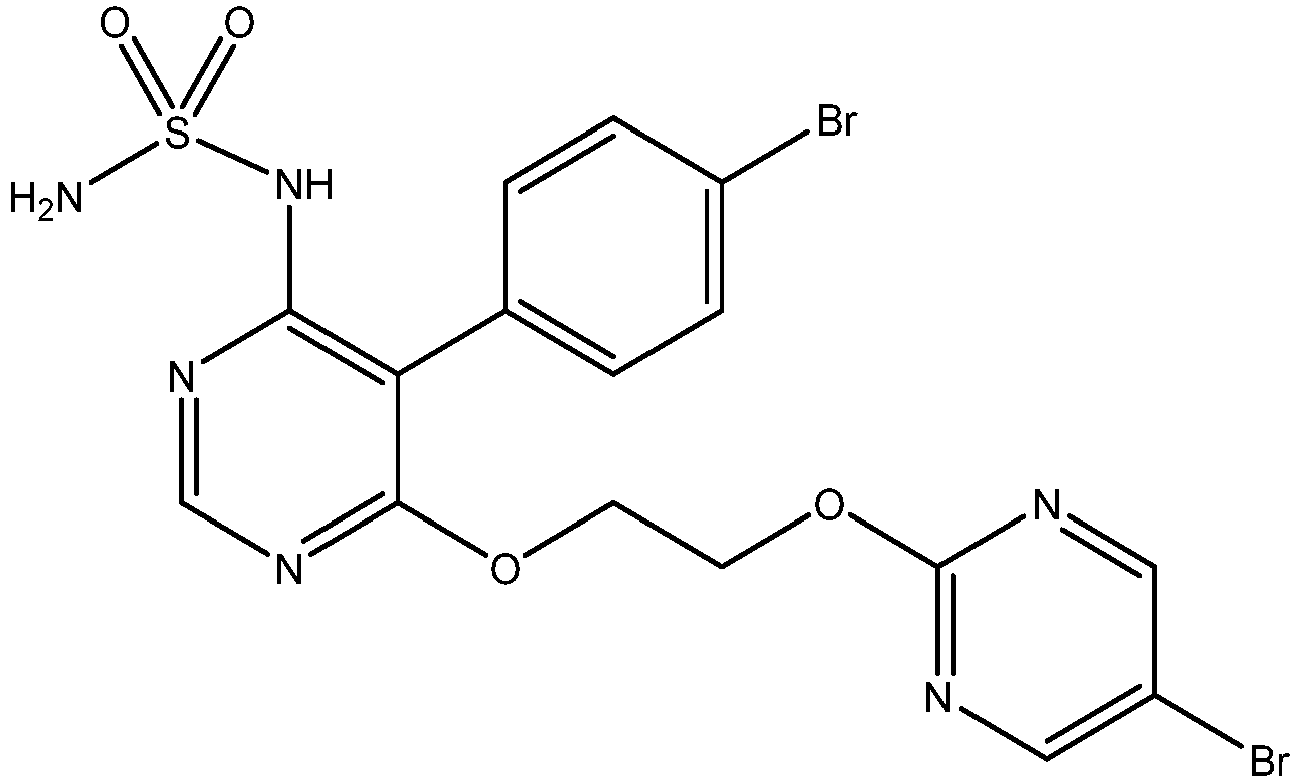
- Moreover, the following abbreviations are used throughout the present specification.
-
- APAH-CTD
- PAH associated with connective tissue disease
- APAH-PoPH
- PAH associated with porto-pulmonary hypertension
- aq.
- aqueous
- BNP
- brain natriuretic peptide
- BPM
- beats per minute
- CI
- cardiac index
- DLCO
- diffusing capacity of lung for CO (carbon monoxide)
- EDTA
- ethylenediaminetetraacetic acid
- ERA
- endothelin receptor antagonist
- ET
- endothelin
- FPAH
- familial PAH
- HR
- heart rate
- IgG
- immunoglobulin G
- K2EDTA
- ethylenediaminetetraacetic acid dipotassium salt
- mPAP
- mean pulmonary artery pressure
- 6MWD
- 6-minute walk distance
- NT-proBNP
- N-terminal pro-brain natriuretic peptide
- PAH
- pulmonary arterial hypertension
- PAOP
- pulmonary artery occlusion pressure, which is synonymous with PAWP
- PAWP
- pulmonary capillary wedge pressure, which is synonymous with PAOP
- PAP
- pulmonary artery pressure
- PBS
- phosphate buffered saline
- PD
- pharmacodynamics
- PDE5
- cyclic guanosine 3',5'-monophosphate (cGMP) phosphodiesterase type 5
- PDE5is
- PDE5 inhibitors
- PH
- pulmonary hypertension
- PK
- pharmacokinetics
- PVR
- pulmonary vascular resistance
- RAP
- right arterial pressure (sometimes also referred to as mRAP)
- RHC
- right heart catheterization
- SBP
- systolic systemic blood pressure
- SvO2
- mixed venous oxygen saturation
- Tris
- tris(hydroxymethyl)aminomethane
- WHO
- World Health Organization
- WHO FC
- World Health Organization Functional Class
- The following non-limitative examples illustrate the invention.
- Hemoglobin measurements were pooled from 3 Phase I clinical studies in healthy volunteers:
- Study AC-055-102: Investigation of the PK, PD, safety and tolerability of macitentan in male subjects (the study protocol is described in the following publication: Sidharta et al., Safety, tolerability, pharmacokinetics, and pharmacodynamics of macitentan, an endothelin receptor antagonist, in an ascending multiple-dose study in healthy subjects. J. Clin. Pharmacol. (2013), 53(11),1131-1138)
- Study AC-055-116: Investigation of the PK, PD, safety and tolerability of macitentan in male Japanese subjects (the study protocol is described in the following publication: Yokoyama et al., Tolerability, Safety, Pharmacokinetics, and Pharmacodynamics of Macitentan, a New Endothelin Receptor Antagonist, in Healthy Japanese Male Subjects. Rinsho yakuri/Japanese Journal of Clinical Pharmacology and Therapeutics (2016), 47, 143-150)
- Study AC-055-117: Investigation of the PK, PD, safety and tolerability of macitentan in male Korean subjects (the study protocol is described in the following publication: Ahn et al., Pharmacokinetic-pharmacodynamic relationships of macitentan, a new endothelin receptor antagonist, after multiple dosing in healthy Korean subjects, Am. J. Cardiovasc. Drugs (2014), 14(5), 377-385)
- Hemoglobin concentrations measured in the morning of
Day 11 of macitentan treatment and at baseline on Day -1 were used in the analysis. Changes in hemoglobin concentrations compared to baseline were regressed against the different dose levels of macitentan, including placebo. - An Emax curve with baseline was fitted and the following parameters were estimated by nonlinear regression:
- E0: Change in hemoglobin without macitentan
- Emax: Maximum change in hemoglobin theoretically could be elicited by macitentan
- ED50: the dose resulting in 50% reduction of hemoglobin
- The following formula was used:

- The resulting dose-response curve is shown in
Figure 1 . - Based on the analysis, the maximum effect of macitentan on hemoglobin decrease would be around 1.23 g/dL and the effect of macitentan on hemoglobin decrease plateaus already at the 10 mg dose (see
Figure 1 ). Therefore, no clinically relevant decrease in hemoglobin is expected above a 10 mg dose of macitentan in humans.
Claims (25)
- Macitentan for use in the treatment and/or prevention of pulmonary arterial hypertension (PAH) in human, wherein the dosage of macitentan is 60 to 90 mg per day.
- Macitentan for use in the treatment and/or prevention of PAH according to claim 1, wherein the dosage of macitentan is 70-80 mg per day.
- Macitentan for use in the treatment and/or prevention of PAH according to claim 1 or 2, wherein the dosage of macitentan is 75 mg per day.
- Macitentan for use in the treatment and/or prevention of PAH according to any one of claims 1 to 3, wherein the PAH is mild or moderate PAH, preferably moderate PAH.
- Macitentan for use in the treatment and/or prevention of PAH according to any one of claims 1 to 4, wherein the dosage of macitentan is 30 to 45 mg twice per day, preferably 35 to 40 mg twice per day.
- Macitentan for use in the treatment and/or prevention of PAH according to any one of claims 1 to 4, wherein the dosage of macitentan is 37.5 mg twice per day.
- Macitentan for use in the treatment and/or prevention of PAH according to any one of claims 1 to 4, wherein the dosage of macitentan is escalated from 10 mg per day, followed by 25 to 50 mg per day, preferably 37.5 mg per day, and followed by 60 to 90 mg per day, preferably 75 mg per day.
- Macitentan for use in the treatment and/or prevention of PAH according to claim 7, wherein the dosage of macitentan is escalated from 10 mg per day, followed by 37.5 mg per day, and followed by 75 mg per day.
- Macitentan for use in the treatment and/or prevention of PAH according to any one of claims 1 to 4, wherein the dosage of macitentan is escalated from 10 mg per day, followed by 60 to 90 mg per day.
- Macitentan for use in the treatment and/or prevention of PAH according to claim 9, wherein the dosage of macitentan is escalated from 10 mg per day, followed by 75 mg once per day or 37.5 mg twice a day.
- Macitentan for use in the treatment and/or prevention of PAH according to claim 8, wherein the dosage of macitentan is escalated from 10 mg once per day for 15 to 45 days; followed by 25 to 50 mg per day for 15 to 45 days; followed by 60 to 90 mg per day.
- Macitentan for use in the treatment and/or prevention of PAH according to claim 11, wherein the dosage of macitentan is escalated from 10 mg once per day for 15 to 45 days; followed by 37.5 mg once per day for 15 to 45 days; followed by 75 mg once per day or 37.5 mg twice per day.
- Macitentan for use in the treatment and/or prevention of PAH according to claim 9, wherein the dosage of macitentan is escalated from 10 mg once per day for 15 to 45 days; followed by 60 to 90 mg per day.
- Macitentan for use in the treatment and/or prevention of PAH according to claim 10, wherein the dosage of macitentan is escalated from 10 mg once per day for 15 to 45 days; followed by 75 mg once per day or 37.5 mg twice per day.
- Macitentan for use in the treatment and/or prevention of PAH according to any one of claims 1 to 4, wherein the dosage of macitentan is escalated from 25 to 50 mg per day, preferably 37.5 mg per day, preferably for 15 to 45 days; followed by 60 to 90 mg per day, preferably by 75 mg per day; provided that the patient is already treated with an endothelin receptor antagonist preferably selected from bosentan and ambrisentan.
- Macitentan for use in the treatment and/or prevention of PAH according to any one of claims 1 to 4, provided that the patient is already treated with an endothelin receptor antagonist preferably selected from bosentan and ambrisentan.
- Macitentan for use in the treatment and/or prevention of PAH according to any one of claims 1 to 16, wherein macitentan is combined with a PDE5 inhibitor and/or a prostacyclin analogue selected from epoprostenol, treprostinil, iloprost, and beraprost, and/or a prostacyclin receptor agonist and/or a soluble guanylate cyclase stimulator.
- Macitentan for the use in the treatment and/or prevention of PAH according to claim 17, wherein the PDE5 inhibitor is selected from sildenafil, tadalafil, vardenafil, and udenafil; the prostacyclin receptor agonist is selected from selexipag and ralinepag; and the soluble guanylate cyclase stimulator is selected from riociguat and vericiguat.
- Macitentan for the use in the treatment and/or prevention of PAH according to claim 17 or 18, wherein macitentan is combined with tadalafil and/or selexipag or ralinepag, preferably with tadalafil and/or selexipag.
- Macitentan for the use in the treatment and/or prevention of PAH according to claim 19, wherein tadalafil, if applicable, has a dose of 20 to 40 mg per day, preferably 40 mg per day, selexipag, if applicable, has a dose of 0.2 to 1.6 mg twice per day and ralinepag, if applicable, has a dose of 0.05 to 1.45 mg per day.
- Macitentan for use in the treatment and/or prevention of PAH according to any one of claims 1 to 20, wherein the treatment and/or prevention means the reduction of morbidity and/or mortality risk of PAH.
- A pharmaceutical composition for use in the treatment of PAH comprising macitentan and at least a pharmaceutically acceptable excipient, containing macitentan in an amount of 75 mg.
- Macitentan for use in the treatment of PAH according to claim 1, wherein the macitentan is administered in the form of a pharmaceutical composition, which contains macitentan in amount of 37.5 mg or 75 mg.
- The pharmaceutical composition for use according to claim 22 or the macitentan for use according to claim 23, wherein the pharmaceutical composition comprises(i) macitentan in a total amount of 10 to 50% in weight based on the total weight of the pharmaceutical composition,(ii) a filler, consisting of lactose monohydrate with microcrystalline cellulose, in a total amount of 10 to 85% in weight based on the total weight of the pharmaceutical composition,(iii) a disintegrant, consisting of sodium starch glycolate or a combination of sodium starch glycolate and polyvinylpyrrolidone, in a total amount of 1 to 10% in weight based on the total weight of the pharmaceutical composition,(iv) a surfactant, consisting of a polysorbate, in a total amount of 0.1 to 1% in weight based on the total weight of the pharmaceutical composition, and(v) a lubricant, consisting of magnesium stearate, in a total amount of 0.05 to 5% in weight based on the total weight of the pharmaceutical composition.
- The pharmaceutical composition for use according to any one of claims 22 or 24, or the macitentan for use according to claim 23, wherein the pharmaceutical composition is in the form of a capsule or a tablet.
Priority Applications (5)
| Application Number | Priority Date | Filing Date | Title |
|---|---|---|---|
| MA54522A MA54522B1 (en) | 2018-12-21 | 2019-12-20 | Pharmaceutical composition for the treatment of pulmonary arterial hypertension |
| SM20240274T SMT202400274T1 (en) | 2018-12-21 | 2019-12-20 | Macitentan for the treatment of pulmonary arterial hypertension |
| RS20240742A RS65689B1 (en) | 2018-12-21 | 2019-12-20 | Macitentan for the treatment of pulmonary arterial hypertension |
| SI201930781T SI3897646T1 (en) | 2018-12-21 | 2019-12-20 | Macitentan for the treatment of pulmonary arterial hypertension |
| HRP20240875TT HRP20240875T1 (en) | 2018-12-21 | 2019-12-20 | Macitentan for the treatment of pulmonary arterial hypertension |
Applications Claiming Priority (6)
| Application Number | Priority Date | Filing Date | Title |
|---|---|---|---|
| EP2018086724 | 2018-12-21 | ||
| EP2019051830 | 2019-01-25 | ||
| EP2019060151 | 2019-04-18 | ||
| EP2019066494 | 2019-06-21 | ||
| EP2019067186 | 2019-06-27 | ||
| PCT/EP2019/086754 WO2020128017A1 (en) | 2018-12-21 | 2019-12-20 | Pharmaceutical composition for the treatment of pulmonary arterial hypertension |
Publications (2)
| Publication Number | Publication Date |
|---|---|
| EP3897646A1 EP3897646A1 (en) | 2021-10-27 |
| EP3897646B1 true EP3897646B1 (en) | 2024-05-22 |
Family
ID=69147670
Family Applications (1)
| Application Number | Title | Priority Date | Filing Date |
|---|---|---|---|
| EP19832954.2A Active EP3897646B1 (en) | 2018-12-21 | 2019-12-20 | Macitentan for the treatment of pulmonary arterial hypertension |
Country Status (30)
| Country | Link |
|---|---|
| US (3) | US11234980B2 (en) |
| EP (1) | EP3897646B1 (en) |
| JP (2) | JP7871054B2 (en) |
| KR (1) | KR20210109558A (en) |
| CN (1) | CN113194953A (en) |
| AU (1) | AU2019410727B2 (en) |
| BR (1) | BR112021011999A2 (en) |
| CA (1) | CA3123990A1 (en) |
| CL (1) | CL2021001636A1 (en) |
| CO (1) | CO2021007186A2 (en) |
| DK (1) | DK3897646T3 (en) |
| ES (1) | ES2983314T3 (en) |
| FI (1) | FI3897646T3 (en) |
| HR (1) | HRP20240875T1 (en) |
| HU (1) | HUE067126T2 (en) |
| IL (1) | IL284136A (en) |
| JO (1) | JOP20210153B1 (en) |
| LT (1) | LT3897646T (en) |
| MA (1) | MA54522B1 (en) |
| MX (1) | MX2021007455A (en) |
| PH (1) | PH12021551371A1 (en) |
| PL (1) | PL3897646T3 (en) |
| PT (1) | PT3897646T (en) |
| RS (1) | RS65689B1 (en) |
| SG (1) | SG11202105098VA (en) |
| SI (1) | SI3897646T1 (en) |
| SM (1) | SMT202400274T1 (en) |
| TW (1) | TWI841649B (en) |
| WO (1) | WO2020128017A1 (en) |
| ZA (1) | ZA202105111B (en) |
Cited By (1)
| Publication number | Priority date | Publication date | Assignee | Title |
|---|---|---|---|---|
| WO2026089673A1 (en) * | 2024-10-24 | 2026-04-30 | Humanis Sağlik A.Ş. | Compositions for pulmonary arterial hypertension |
Families Citing this family (6)
| Publication number | Priority date | Publication date | Assignee | Title |
|---|---|---|---|---|
| UA126122C2 (en) | 2017-02-27 | 2022-08-17 | Ідорсія Фармасьютікалз Лтд | COMBINATIONS OF A 4-PYRIMIDINESULFAMIDE DERIVATIVE WITH ACTIVE INGREDIENTS FOR THE TREATMENT OF DISEASES RELATED TO ENDOTHELIN |
| WO2020074957A1 (en) * | 2018-10-12 | 2020-04-16 | Sanotize Research And Development Corp. | Gas-evolving compositions and container and delivery systems |
| EP3897646B1 (en) | 2018-12-21 | 2024-05-22 | Actelion Pharmaceuticals Ltd | Macitentan for the treatment of pulmonary arterial hypertension |
| TW202042818A (en) | 2019-01-25 | 2020-12-01 | 瑞士商艾克泰聯製藥有限公司 | Pharmaceutical composition for the treatment of chronic thromboembolic pulmonary hypertension |
| IL293271A (en) * | 2019-11-29 | 2022-07-01 | Actelion Pharmaceuticals Ltd | Methods of treating pulmonary arterial hypertension |
| WO2022180194A1 (en) * | 2021-02-26 | 2022-09-01 | Actelion Pharmaceuticals Ltd | Methods for treating pulmonary hypertension in patients with left ventricular assist device implantation |
Citations (3)
| Publication number | Priority date | Publication date | Assignee | Title |
|---|---|---|---|---|
| WO2010018549A2 (en) | 2008-08-13 | 2010-02-18 | Actelion Pharmaceuticals Ltd | Therapeutic compositions containing macitentan |
| WO2018089804A1 (en) | 2016-11-10 | 2018-05-17 | Arena Pharmaceuticals, Inc. | Methods of treating pah with combinations of ralinepag and other agents |
| WO2018153513A1 (en) | 2017-02-27 | 2018-08-30 | Idorsia Pharmaceuticals Ltd | Combinations of a 4-pyrimidinesulfamide derivative with active ingredients for the treatment of endothelin related diseases |
Family Cites Families (9)
| Publication number | Priority date | Publication date | Assignee | Title |
|---|---|---|---|---|
| EP1693372A1 (en) | 2000-12-18 | 2006-08-23 | Actelion Pharmaceuticals Ltd. | Novel Sulfamides and their use as endothelin receptor antagonists |
| ES2393117T3 (en) | 2005-09-12 | 2012-12-18 | Actelion Pharmaceuticals Ltd. | Stable pharmaceutical composition comprising a pyrimidine sulfamide |
| AR062501A1 (en) | 2006-08-29 | 2008-11-12 | Actelion Pharmaceuticals Ltd | THERAPEUTIC COMPOSITIONS |
| MX2010001837A (en) | 2007-08-17 | 2010-03-10 | Actelion Pharmaceuticals Ltd | DERIVATIVES OF 4-PYRIMIDINASULFAMIDA. |
| WO2018153925A1 (en) * | 2017-02-22 | 2018-08-30 | Amneal Pharmaceuticals Company Gmbh | Stable pharmaceutical compositions comprising macitentan |
| EP3897646B1 (en) | 2018-12-21 | 2024-05-22 | Actelion Pharmaceuticals Ltd | Macitentan for the treatment of pulmonary arterial hypertension |
| TW202042818A (en) | 2019-01-25 | 2020-12-01 | 瑞士商艾克泰聯製藥有限公司 | Pharmaceutical composition for the treatment of chronic thromboembolic pulmonary hypertension |
| TW202103703A (en) | 2019-04-05 | 2021-02-01 | 瑞士商艾克泰聯製藥有限公司 | Methods for treating portopulmonary hypertension |
| JOP20220126A1 (en) | 2019-11-26 | 2023-01-30 | Actelion Pharmaceuticals Ltd | Pharmaceutical composition for the treatment of pulmonary vascular disease and/or cardiac dysfunction in fontan-palliated patients |
-
2019
- 2019-12-20 EP EP19832954.2A patent/EP3897646B1/en active Active
- 2019-12-20 HU HUE19832954A patent/HUE067126T2/en unknown
- 2019-12-20 BR BR112021011999-0A patent/BR112021011999A2/en unknown
- 2019-12-20 ES ES19832954T patent/ES2983314T3/en active Active
- 2019-12-20 MA MA54522A patent/MA54522B1/en unknown
- 2019-12-20 WO PCT/EP2019/086754 patent/WO2020128017A1/en not_active Ceased
- 2019-12-20 KR KR1020217022508A patent/KR20210109558A/en not_active Ceased
- 2019-12-20 SG SG11202105098VA patent/SG11202105098VA/en unknown
- 2019-12-20 AU AU2019410727A patent/AU2019410727B2/en active Active
- 2019-12-20 TW TW108146917A patent/TWI841649B/en active
- 2019-12-20 HR HRP20240875TT patent/HRP20240875T1/en unknown
- 2019-12-20 SI SI201930781T patent/SI3897646T1/en unknown
- 2019-12-20 DK DK19832954.2T patent/DK3897646T3/en active
- 2019-12-20 LT LTEPPCT/EP2019/086754T patent/LT3897646T/en unknown
- 2019-12-20 CA CA3123990A patent/CA3123990A1/en active Pending
- 2019-12-20 MX MX2021007455A patent/MX2021007455A/en unknown
- 2019-12-20 PL PL19832954.2T patent/PL3897646T3/en unknown
- 2019-12-20 JP JP2021533836A patent/JP7871054B2/en active Active
- 2019-12-20 CN CN201980084868.5A patent/CN113194953A/en active Pending
- 2019-12-20 SM SM20240274T patent/SMT202400274T1/en unknown
- 2019-12-20 FI FIEP19832954.2T patent/FI3897646T3/en active
- 2019-12-20 RS RS20240742A patent/RS65689B1/en unknown
- 2019-12-20 PT PT198329542T patent/PT3897646T/en unknown
-
2021
- 2021-03-02 US US17/189,881 patent/US11234980B2/en active Active
- 2021-05-31 CO CONC2021/0007186A patent/CO2021007186A2/en unknown
- 2021-06-10 PH PH12021551371A patent/PH12021551371A1/en unknown
- 2021-06-16 JO JOJO/P/2021/0153A patent/JOP20210153B1/en active
- 2021-06-17 IL IL284136A patent/IL284136A/en unknown
- 2021-06-18 CL CL2021001636A patent/CL2021001636A1/en unknown
- 2021-07-20 ZA ZA2021/05111A patent/ZA202105111B/en unknown
- 2021-10-29 US US17/515,132 patent/US11464777B2/en active Active
-
2022
- 2022-09-27 US US17/953,530 patent/US20230020241A1/en not_active Abandoned
-
2024
- 2024-05-08 JP JP2024075949A patent/JP2024105450A/en not_active Withdrawn
Patent Citations (3)
| Publication number | Priority date | Publication date | Assignee | Title |
|---|---|---|---|---|
| WO2010018549A2 (en) | 2008-08-13 | 2010-02-18 | Actelion Pharmaceuticals Ltd | Therapeutic compositions containing macitentan |
| WO2018089804A1 (en) | 2016-11-10 | 2018-05-17 | Arena Pharmaceuticals, Inc. | Methods of treating pah with combinations of ralinepag and other agents |
| WO2018153513A1 (en) | 2017-02-27 | 2018-08-30 | Idorsia Pharmaceuticals Ltd | Combinations of a 4-pyrimidinesulfamide derivative with active ingredients for the treatment of endothelin related diseases |
Non-Patent Citations (38)
| Title |
|---|
| "Encyclopedia of Pharmaceutical Technology", 1 January 2007, article ARMSTRONG N.A.: "Tablet manufacture", pages: 3653 - 3672, XP055449024 |
| "Introduction to Pharmacokinetics and Pharmacodynamics - The Quantitative Basis of Drug Therapy", 1 January 2006, article TOZER THOMAS N., MALCOLM ROWLAND: "Chapter 12 - Initiating and Managing Therapy", pages: 249 - 265, XP093122437 |
| ANONYMOUS: "Australian Public Assessment Report for macitentan - Proprietary Product Name: Opsumit", AUSTRALIAN GOVERNMENT, XP093261700, Retrieved from the Internet <URL:https://www.tga.gov.au/sites/default/files/auspar-macitentan-140428.pdf> |
| ANONYMOUS: "CENTER FOR DRUG EVALUATION AND RESEARCH - APPLICATION NUMBER: 204410Orig1s000 - Opsumit Macitentan", FDA, vol. 62, no. Suppl 1, pages S358 - 6864, XP093261736, Retrieved from the Internet <URL:https://www.browserstack.com/guide/login-automation-using-selenium-webdriver> DOI: 10.1039/C6TB01730D |
| ANONYMOUS: "CENTER FOR DRUG EVALUATION AND RESEARCH APPLICATION NUMBER: 204410Orig1s000 - OPSUMIT ® macitentan", FDA, 1 January 2013 (2013-01-01), XP093261681 |
| ANONYMOUS: "Center for Drug Evaluation and Research. Clinical Pharmacology and Biopharmaceutics Review, application number. 204410Origls000", FDA.GOV, 1 January 2013 (2013-01-01), XP093034000, Retrieved from the Internet <URL:https://www.accessdata.fda.gov/drugsatfda_docs/nda/2013/204410Orig1s000ClinPharmR.pdf> [retrieved on 20230322] * |
| ANONYMOUS: "Clinical Study on Macitentan, RT and TMZ Concurrent Therapy Followed by Maintenance Macitentan and TMZ in Newly Diagnosed Glioblastoma - NCT02254954", CLINICAL TRIALS, CLINICALTRIALS.GOV, XP093261729, Retrieved from the Internet <URL:https://clinicaltrials.gov/study/NCT02254954?term=NCT02254954&rank=1&tab=history&a=1#version-content-panel> |
| ANONYMOUS: "Clinical Study on the Safety and Tolerability of Macitentan in Combination With Dose-dense Temozolomide in Patients With Recurrent Glioblastoma - NCT01499251", CLINICAL TRIALS, CLINICALTRIALS.GOV, XP093261724, Retrieved from the Internet <URL:https://clinicaltrials.gov/study/NCT01499251?term=NCT01499251%20&rank=1&tab=history&a=1#version-content-panel> |
| ANONYMOUS: "HIGHLIGHTS OF PRESCRIBING INFORMATION - OPSUMIT® (macitentan) tablets, for oral use", 1 October 2013 (2013-10-01), XP093261687 |
| ANONYMOUS: "Opsumit 10 mg film-coated tablets", EMA, PACKAGE LEAFLET: INFORMATION FOR THE USER, pages 1 - 6, XP055679353, Retrieved from the Internet <URL:https://www.actelion.com/documents/en-rebranded/our-products/opsumit-pil.pdf> [retrieved on 20200324] |
| ANONYMOUS: "Outcome Study Assessing a 75 Milligrams (mg) Dose of Macitentan in Patients With Pulmonary Arterial Hypertension (UNISUS) - NCT04273945", CLINICAL TRIALS, CLINICALTRIALS.GOV, XP093261739, Retrieved from the Internet <URL:https://clinicaltrials.gov/study/NCT04273945?term=NCT04273945%20&rank=1&tab=history&a=1#version-content-panel> |
| CYRUS A KHOLDANI, FARES WH, TROW TK: "Macitentan for the treatment of pulmonary arterial hypertension", VASCULAR HEALTH AND RISK MANAGEMENT, vol. 10, pages 665 - 673, XP055678823, DOI: 10.2147/VHRM.S33904 |
| D11 - Data report filed by then-applicant on 21 February 2023 |
| D16 - Data report filed by then-applicant on 18 October 2023 |
| D17 - Data report filed by then-applicant on 18 October 2023 |
| D27 - T 1592/12 |
| D30 - Submission of 18th October 2023 |
| D31 - Annex to the Summons to attend oral proceedings of 11 April 2023 |
| FUJIAN SONG: "What is indirect comparison? ", HAYWARD MEDICAL COMMUNICATIONS, pages 1 - 6, XP055701986, Retrieved from the Internet <URL:http://www.bandolier.org.uk/painres/download/whatis/What_is_ind_comp.pdf> [retrieved on 20200608] |
| HOEPER M. M.: "Liver toxicity: the Achilles' heel of endothelin receptor antagonist therapy?", EUROPEAN RESPIRATORY JOURNAL, EUROPEAN RESPIRATORY SOCIETY, LEEDS, vol. 34, no. 3, 1 September 2009 (2009-09-01), Leeds, pages 529 - 530, XP093261653, ISSN: 0903-1936, DOI: 10.1183/09031936.00094409 |
| KUNITA-TAKANEZAWA MUTSUMI ET AL: "Novel Dual Endothelin Receptor Antagonist Macitentan Reverses Severe Pulmonary Arterial Hypertension in Rats", JOURNAL OF CARDIOVASCULAR PHARMACOLOGY, vol. 64, no. 5, 1 November 2014 (2014-11-01), US, pages 473 - 480, XP093033664, ISSN: 0160-2446, DOI: 10.1097/FJC.0000000000000141 * |
| KUNITA-TAKANEZAWA MUTSUMI, ABE KOHTARO, HIROOKA YOSHITAKA, KUWABARA YUKIMITSU, HIRANO KATSUYA, OKA MASAHIKO, SUNAGAWA KENJI: "Novel Dual Endothelin Receptor Antagonist Macitentan Reverses Severe Pulmonary Arterial Hypertension in Rats", JOURNAL OF CARDIOVASCULAR PHARMACOLOGY, RAVEN PRESS, NEW YORK, NY, US, vol. 64, no. 5, 1 November 2014 (2014-11-01), US , pages 473 - 480, XP093033664, ISSN: 0160-2446, DOI: 10.1097/FJC.0000000000000141 |
| LI YOUNG AHN, KIM SUNG EUN, YI SOJEONG, DINGEMANSE JASPER, LIM KYOUNG SOO, JANG IN-JIN, YU KYUNG-SANG: "Pharmacokinetic–Pharmacodynamic Relationships of Macitentan, a New Endothelin Receptor Antagonist, After Multiple Dosing in Healthy Korean Subjects", AMERICAN JOURNAL OF CARDIOVASCULAR DRUGS, ADIS INTERNATIONAL,, NZ, vol. 14, no. 5, 1 October 2014 (2014-10-01), NZ , pages 377 - 385, XP055678918, ISSN: 1175-3277, DOI: 10.1007/s40256-014-0081-4 |
| MARTIN BEDAN, DANIELA GRIMM, MARKUS WEHLAND, ULF SIMONSEN, MANFRED INFANGER, MARCUS KRüGER: "A Focus on Macitentan in the Treatment of Pulmonary Arterial Hypertension", BASIC & CLINICAL PHARMACOLOGY & TOXICOLOGY, NORDIC PHARMACOLOGICAL SOCIETY, COPENHAGEN, DK, vol. 123, no. 2, 1 August 2018 (2018-08-01), COPENHAGEN, DK , pages 103 - 113, XP055679362, ISSN: 1742-7835, DOI: 10.1111/bcpt.13033 |
| PATRICIA N SIDHARTA ET AL: "Macitentan: entry-into-humans study with a new endothelin receptor antagonist", EUROPEAN JOURNAL OF CLINICAL PHARMACOLOGY, SPRINGER, BERLIN, DE, vol. 67, no. 10, 4 May 2011 (2011-05-04), pages 977 - 984, XP019949637, ISSN: 1432-1041, DOI: 10.1007/S00228-011-1043-2 * |
| PATRICIA N. SIDHARTA, VAN GIERSBERGEN PAUL L. M., DINGEMANSE JASPER: "Safety, tolerability, pharmacokinetics, and pharmacodynamics of macitentan, an endothelin receptor antagonist, in an ascending multiple-dose study in healthy subjects : The Journal of Clinical Pharmacology", THE JOURNAL OF CLINICAL PHARMACOLOGY, LIPPINCOTT CO, HAGERSTOWN, MD, US, vol. 53, no. 11, 1 August 2013 (2013-08-01), US , pages 1131 - 1138, XP055678913, ISSN: 0091-2700, DOI: 10.1002/jcph.152 |
| PATRICIA N. SIDHARTA; PAUL L. M. VAN GIERSBERGEN; ATEF HALABI; JASPER DINGEMANSE: "Macitentan: entry-into-humans study with a new endothelin receptor antagonist", EUROPEAN JOURNAL OF CLINICAL PHARMACOLOGY, SPRINGER, BERLIN, DE, vol. 67, no. 10, 4 May 2011 (2011-05-04), Berlin, DE , pages 977 - 984, XP019949637, ISSN: 1432-1041, DOI: 10.1007/s00228-011-1043-2 |
| POPOVTZER BARUCH , JASON N. SALAMON, JEREMY MAZUREK, MUHAMMAD SARDAR, RONALD ZOLTY: "Mortality in Primary Pulmonary Arterial Hypertension Stratified by Hemoglobin Levels", JOURNAL OF CARDIAC FAILURE, vol. 17, no. 8S, 1 August 2011 (2011-08-01), pages S96 - S96, XP093296589 |
| PULIDO TOMÁS ET AL: "Macitentan and Morbidity and Mortality in Pulmonary Arterial Hypertension", THE NEW ENGLAND JOURNAL OF MEDICINE, vol. 369, no. 9, 29 August 2013 (2013-08-29), US, pages 809 - 818, XP055970060, ISSN: 0028-4793, DOI: 10.1056/NEJMoa1213917 * |
| PULIDO TOMÁS, ADZERIKHO IGOR, CHANNICK RICHARD N., DELCROIX MARION, GALIÈ NAZZARENO, GHOFRANI HOSSEIN-ARDESCHIR, JANSA PAVEL, JING: "Macitentan and Morbidity and Mortality in Pulmonary Arterial Hypertension", THE NEW ENGLAND JOURNAL OF MEDICINE, MASSACHUSETTS MEDICAL SOCIETY, US, vol. 369, no. 9, 29 August 2013 (2013-08-29), US , pages 809 - 818, XP055970060, ISSN: 0028-4793, DOI: 10.1056/NEJMoa1213917 |
| RAMANI G.; LAM D.; PARK M.: "The Impact of Anemia on Survival in Pulmonary Arterial Hypertension", JOURNAL OF HEART AND LUNG TRANSPLANTATION, vol. 33, no. 4, 1 April 2014 (2014-04-01), AMSTERDAM, NL , XP028635098, ISSN: 1053-2498, DOI: 10.1016/j.healun.2014.01.597 |
| SHIEW-MEI HUANG, JUAN J.L. LERTORA, ARTHUR J. ATKINSON : "Principles of Clinical Pharmacology - 3rd Edition", 1 January 2012, ELSEVIER , ISBN: 978-0-12-385471-1, article LOWE ELIZABETH S, JUAN J.L. LERTORA: "Dose–Effect and Concentration–Effect Analysis", pages: 343 - 356, XP093296592, DOI: 10.1016/B978-0-12-385471-1.00020-9 |
| SOUTHWOOD MARK; MACKENZIE ROSS ROBERT V.; KUC RHODA E.; HAGAN GUY; SHEARES KAREN K.; JENKINS DAVID P.; GODDARD MARTIN; DAVENPORT A: "Endothelin ETAreceptors predominate in chronic thromboembolic pulmonary hypertension", LIFE SCIENCE, vol. 159, 10 February 2016 (2016-02-10), GB , pages 104 - 110, XP029688347, ISSN: 0024-3205, DOI: 10.1016/j.lfs.2016.02.036 |
| TOBA MICHIE, ALZOUBI ABDALLAH, O'NEILL KEALAN D., GAIRHE SALINA, MATSUMOTO YURI, OSHIMA KAORI, ABE KOHTARO, OKA MASAHIKO, MCMURTRY: "Temporal hemodynamic and histological progression in Sugen5416/hypoxia/normoxia-exposed pulmonary arterial hypertensive rats", AMERICAN JOURNAL OF PHYSIOLOGY HEART AND CIRCULATORY PHYSIOLOGY, AMERICAN PHYSIOLOGICAL SOCIETY, US, vol. 306, no. 2, 15 January 2014 (2014-01-15), US , pages H243 - H250, XP093261649, ISSN: 0363-6135, DOI: 10.1152/ajpheart.00728.2013 |
| TROW T K ET AL: "Endothelin receptor blockade in the management of pulmonary arterial hypertension: Selective and dual antagonism", RESPIRATORY MEDICINE, ELSEVIER, AMSTERDAM, NL, vol. 103, no. 7, 1 July 2009 (2009-07-01), pages 951 - 962, XP026168629, ISSN: 0954-6111, [retrieved on 20090321], DOI: 10.1016/J.RMED.2009.02.016 * |
| TROW, T.K. ; TAICHMAN, D.B.: "Endothelin receptor blockade in the management of pulmonary arterial hypertension: Selective and dual antagonism", RESPIRATORY MEDICINE, ELSEVIER, AMSTERDAM, NL, vol. 103, no. 7, 1 July 2009 (2009-07-01), AMSTERDAM, NL, pages 951 - 962, XP026168629, ISSN: 0954-6111, DOI: 10.1016/j.rmed.2009.02.016 |
| YOKOYAMA YOSHINARI, DINGEMANSE JASPER, HATTA MOTONORI, FUKASE HIROYUKI: "Tolerability, Safety, Pharmacokinetics, and Pharmacodynamics of Macitentan, a New Endothelin Receptor Antagonist, in Healthy Japanese Male Subjects ", JAPANESE JOURNAL OFCLINICAL PHARMACOLOGY AND THERAPEUTICS, NIHON RINSHO YAKURI GAKKAI, TOKYO, JP, vol. 47, no. 4, 1 January 2016 (2016-01-01), JP , pages 143 - 150, XP093261660, ISSN: 0388-1601, DOI: 10.3999/jscpt.47.143 |
| ZOLTY R, H. BRINK, K. DHAR, B. LOWES: "Endothelin-1 Levels in Exercise-Induced Pulmonary Hypertension", THE JOURNAL OF HEART AND LUNG TRANSPLANTATION, vol. 43, 1 January 2024 (2024-01-01), pages S409 - S409, XP093296601 |
Cited By (1)
| Publication number | Priority date | Publication date | Assignee | Title |
|---|---|---|---|---|
| WO2026089673A1 (en) * | 2024-10-24 | 2026-04-30 | Humanis Sağlik A.Ş. | Compositions for pulmonary arterial hypertension |
Also Published As
Similar Documents
| Publication | Publication Date | Title |
|---|---|---|
| US11464777B2 (en) | Pharmaceutical composition for the treatment of pulmonary arterial hypertension | |
| DK2500730T3 (en) | Soluble urokinase plasminogen activator receptor (suPAR) as a diagnostic marker for low-grade inflammation | |
| Reilly et al. | Inhibition of thromboxane formation in vivo and ex vivo: implications for therapy with platelet inhibitory drugs | |
| Satyan et al. | Relationships of N-terminal pro–B-natriuretic peptide and cardiac troponin T to left ventricular mass and function and mortality in asymptomatic hemodialysis patients | |
| Cheung | Plasma concentration of brain natriuretic peptide is related to diastolic function in hypertension | |
| Staub et al. | Use of N-terminal pro-B-type natriuretic peptide to detect myocardial ischemia | |
| Staub et al. | Use of copeptin in the detection of myocardial ischemia | |
| Villela-Torres et al. | Copeptin plasma levels are associated with decline of renal function in patients with type 2 diabetes mellitus | |
| Maurellet et al. | B-type natriuretic peptide in the management of heart failure | |
| WO2018007588A1 (en) | Adrenomedullin for assessing congestion in a subject with acute heart failure | |
| Büyükavci et al. | Hypo-and hypervolemic edema in children with steroid sensitive nephrotic syndrome | |
| HK40063595B (en) | Macitentan for the treatment of pulmonary arterial hypertension | |
| HK40063595A (en) | Macitentan for the treatment of pulmonary arterial hypertension | |
| CN105051533A (en) | Method of measuring insulin resistance with fatty acid combustion, and composition used herein | |
| Sadler et al. | Metabolic disposition and pharmacokinetics of [14C]‐amprenavir, a human immunodeficiency virus type 1 (HIV‐1) protease inhibitor, administered as a single oral dose to healthy male subjects | |
| EA044958B1 (en) | PHARMACEUTICAL COMPOSITION FOR TREATMENT OF PULMONARY ARTERIAL HYPERTENSION | |
| JP6116938B2 (en) | A novel marker of pulmonary hypertension | |
| JP5084481B2 (en) | Method for screening and evaluating blood pressure regulator | |
| Porta et al. | Plasma B-type natriuretic peptide levels are poorly related to the occurrence of ischemia or ventricular arrhythmias during symptom-limited exercise in low-risk patients | |
| Toprak et al. | Investigating the volume status before contrast nephropathy studies | |
| Raevens et al. | Hepatopulmonary Syndrome and Portopulmonary Hypertension | |
| WO2018088521A1 (en) | Method for assessing sugar uptake ability of liver | |
| Schuster | 22 Assessment of Pulmonary Function by PET | |
| EP4687674A2 (en) | Functional respiratory imaging analysis of seralutinib for the treatment of pulmonary arterial hypertension (pah) | |
| WO2019212935A1 (en) | Methods of monitoring, treating, and preventing renal inflammation associated with infection |
Legal Events
| Date | Code | Title | Description |
|---|---|---|---|
| REG | Reference to a national code |
Ref country code: HR Ref legal event code: TUEP Ref document number: P20240875T Country of ref document: HR |
|
| STAA | Information on the status of an ep patent application or granted ep patent |
Free format text: STATUS: UNKNOWN |
|
| STAA | Information on the status of an ep patent application or granted ep patent |
Free format text: STATUS: THE INTERNATIONAL PUBLICATION HAS BEEN MADE |
|
| PUAI | Public reference made under article 153(3) epc to a published international application that has entered the european phase |
Free format text: ORIGINAL CODE: 0009012 |
|
| STAA | Information on the status of an ep patent application or granted ep patent |
Free format text: STATUS: REQUEST FOR EXAMINATION WAS MADE |
|
| 17P | Request for examination filed |
Effective date: 20210721 |
|
| AK | Designated contracting states |
Kind code of ref document: A1 Designated state(s): AL AT BE BG CH CY CZ DE DK EE ES FI FR GB GR HR HU IE IS IT LI LT LU LV MC MK MT NL NO PL PT RO RS SE SI SK SM TR |
|
| REG | Reference to a national code |
Ref country code: HK Ref legal event code: DE Ref document number: 40063595 Country of ref document: HK |
|
| STAA | Information on the status of an ep patent application or granted ep patent |
Free format text: STATUS: EXAMINATION IS IN PROGRESS |
|
| 17Q | First examination report despatched |
Effective date: 20221017 |
|
| GRAP | Despatch of communication of intention to grant a patent |
Free format text: ORIGINAL CODE: EPIDOSNIGR1 |
|
| STAA | Information on the status of an ep patent application or granted ep patent |
Free format text: STATUS: GRANT OF PATENT IS INTENDED |
|
| INTG | Intention to grant announced |
Effective date: 20240313 |
|
| P01 | Opt-out of the competence of the unified patent court (upc) registered |
Effective date: 20240305 |
|
| GRAS | Grant fee paid |
Free format text: ORIGINAL CODE: EPIDOSNIGR3 |
|
| GRAA | (expected) grant |
Free format text: ORIGINAL CODE: 0009210 |
|
| STAA | Information on the status of an ep patent application or granted ep patent |
Free format text: STATUS: THE PATENT HAS BEEN GRANTED |
|
| AK | Designated contracting states |
Kind code of ref document: B1 Designated state(s): AL AT BE BG CH CY CZ DE DK EE ES FI FR GB GR HR HU IE IS IT LI LT LU LV MC MK MT NL NO PL PT RO RS SE SI SK SM TR |
|
| REG | Reference to a national code |
Ref country code: GB Ref legal event code: FG4D |
|
| REG | Reference to a national code |
Ref country code: CH Ref legal event code: EP |
|
| REG | Reference to a national code |
Ref country code: IE Ref legal event code: FG4D |
|
| REG | Reference to a national code |
Ref country code: DE Ref legal event code: R096 Ref document number: 602019052696 Country of ref document: DE |
|
| REG | Reference to a national code |
Ref country code: FI Ref legal event code: FGE Ref country code: RO Ref legal event code: EPE |
|
| REG | Reference to a national code |
Ref country code: DK Ref legal event code: T3 Effective date: 20240628 |
|
| REG | Reference to a national code |
Ref country code: PT Ref legal event code: SC4A Ref document number: 3897646 Country of ref document: PT Date of ref document: 20240708 Kind code of ref document: T Free format text: AVAILABILITY OF NATIONAL TRANSLATION Effective date: 20240702 |
|
| REG | Reference to a national code |
Ref country code: SE Ref legal event code: TRGR |
|
| REG | Reference to a national code |
Ref country code: MA Ref legal event code: VAGR Ref document number: 54522 Country of ref document: MA Kind code of ref document: B1 Ref country code: NL Ref legal event code: FP |
|
| REG | Reference to a national code |
Ref country code: SK Ref legal event code: T3 Ref document number: E 44364 Country of ref document: SK |
|
| REG | Reference to a national code |
Ref country code: GR Ref legal event code: EP Ref document number: 20240401593 Country of ref document: GR Effective date: 20240819 |
|
| REG | Reference to a national code |
Ref country code: EE Ref legal event code: FG4A Ref document number: E024358 Country of ref document: EE Effective date: 20240625 |
|
| REG | Reference to a national code |
Ref country code: HR Ref legal event code: T1PR Ref document number: P20240875 Country of ref document: HR |
|
| REG | Reference to a national code |
Ref country code: ES Ref legal event code: FG2A Ref document number: 2983314 Country of ref document: ES Kind code of ref document: T3 Effective date: 20241022 |
|
| REG | Reference to a national code |
Ref country code: HU Ref legal event code: AG4A Ref document number: E067126 Country of ref document: HU |
|
| REG | Reference to a national code |
Ref country code: HR Ref legal event code: ODRP Ref document number: P20240875 Country of ref document: HR Payment date: 20241106 Year of fee payment: 6 |
|
| PG25 | Lapsed in a contracting state [announced via postgrant information from national office to epo] |
Ref country code: AL Free format text: LAPSE BECAUSE OF FAILURE TO SUBMIT A TRANSLATION OF THE DESCRIPTION OR TO PAY THE FEE WITHIN THE PRESCRIBED TIME-LIMIT Effective date: 20240522 |
|
| PG25 | Lapsed in a contracting state [announced via postgrant information from national office to epo] |
Ref country code: AL Free format text: LAPSE BECAUSE OF FAILURE TO SUBMIT A TRANSLATION OF THE DESCRIPTION OR TO PAY THE FEE WITHIN THE PRESCRIBED TIME-LIMIT Effective date: 20240522 |
|
| REG | Reference to a national code |
Ref country code: DE Ref legal event code: R026 Ref document number: 602019052696 Country of ref document: DE |
|
| PLBI | Opposition filed |
Free format text: ORIGINAL CODE: 0009260 |
|
| PG2D | Information on lapse in contracting state deleted |
Ref country code: AL |
|
| PLBI | Opposition filed |
Free format text: ORIGINAL CODE: 0009260 |
|
| PLAX | Notice of opposition and request to file observation + time limit sent |
Free format text: ORIGINAL CODE: EPIDOSNOBS2 |
|
| 26 | Opposition filed |
Opponent name: SANDOZ AG Effective date: 20250207 |
|
| 26 | Opposition filed |
Opponent name: SANOVEL ILAC SANAYI VE TICARET ANONIM SIRKETI Effective date: 20250221 Opponent name: GENERICS (UK) LIMITED Effective date: 20250221 |
|
| VS25 | Lapsed in a validation state [announced via postgrant information from nat. office to epo] |
Ref country code: MD Free format text: LAPSE BECAUSE OF FAILURE TO SUBMIT A TRANSLATION OF THE DESCRIPTION OR TO PAY THE FEE WITHIN THE PRESCRIBED TIME-LIMIT Effective date: 20240522 |
|
| PLBB | Reply of patent proprietor to notice(s) of opposition received |
Free format text: ORIGINAL CODE: EPIDOSNOBS3 |
|
| PG25 | Lapsed in a contracting state [announced via postgrant information from national office to epo] |
Ref country code: AL Free format text: LAPSE BECAUSE OF FAILURE TO SUBMIT A TRANSLATION OF THE DESCRIPTION OR TO PAY THE FEE WITHIN THE PRESCRIBED TIME-LIMIT Effective date: 20240522 |
|
| VSFP | Annual fee paid to validation state [announced via postgrant information from national office to epo] |
Ref country code: MA Payment date: 20241210 Year of fee payment: 6 |
|
| PGFP | Annual fee paid to national office [announced via postgrant information from national office to epo] |
Ref country code: NL Payment date: 20251112 Year of fee payment: 7 |
|
| REG | Reference to a national code |
Ref country code: CH Ref legal event code: U11 Free format text: ST27 STATUS EVENT CODE: U-0-0-U10-U11 (AS PROVIDED BY THE NATIONAL OFFICE) Effective date: 20260101 |
|
| REG | Reference to a national code |
Ref country code: HR Ref legal event code: ODRP Ref document number: P20240875 Country of ref document: HR Payment date: 20251110 Year of fee payment: 7 |
|
| PGFP | Annual fee paid to national office [announced via postgrant information from national office to epo] |
Ref country code: IS Payment date: 20251215 Year of fee payment: 7 Ref country code: DE Payment date: 20251028 Year of fee payment: 7 |
|
| PGFP | Annual fee paid to national office [announced via postgrant information from national office to epo] |
Ref country code: LT Payment date: 20251118 Year of fee payment: 7 Ref country code: GB Payment date: 20251030 Year of fee payment: 7 |
|
| PGFP | Annual fee paid to national office [announced via postgrant information from national office to epo] |
Ref country code: NO Payment date: 20251210 Year of fee payment: 7 Ref country code: MC Payment date: 20251127 Year of fee payment: 7 |
|
| PGFP | Annual fee paid to national office [announced via postgrant information from national office to epo] |
Ref country code: SM Payment date: 20251127 Year of fee payment: 7 Ref country code: MK Payment date: 20251105 Year of fee payment: 7 Ref country code: PT Payment date: 20251218 Year of fee payment: 7 Ref country code: AT Payment date: 20251126 Year of fee payment: 7 |
|
| PGFP | Annual fee paid to national office [announced via postgrant information from national office to epo] |
Ref country code: IT Payment date: 20251121 Year of fee payment: 7 Ref country code: FI Payment date: 20251211 Year of fee payment: 7 Ref country code: DK Payment date: 20251212 Year of fee payment: 7 |
|
| PGFP | Annual fee paid to national office [announced via postgrant information from national office to epo] |
Ref country code: LU Payment date: 20251215 Year of fee payment: 7 Ref country code: HR Payment date: 20251110 Year of fee payment: 7 Ref country code: HU Payment date: 20251127 Year of fee payment: 7 Ref country code: FR Payment date: 20251110 Year of fee payment: 7 |
|
| PGFP | Annual fee paid to national office [announced via postgrant information from national office to epo] |
Ref country code: TR Payment date: 20251218 Year of fee payment: 7 Ref country code: AL Payment date: 20251216 Year of fee payment: 7 Ref country code: GR Payment date: 20251114 Year of fee payment: 7 Ref country code: BE Payment date: 20251117 Year of fee payment: 7 |
|
| PGFP | Annual fee paid to national office [announced via postgrant information from national office to epo] |
Ref country code: SE Payment date: 20251112 Year of fee payment: 7 |
|
| PGFP | Annual fee paid to national office [announced via postgrant information from national office to epo] |
Ref country code: IE Payment date: 20251111 Year of fee payment: 7 Ref country code: CZ Payment date: 20251205 Year of fee payment: 7 Ref country code: CY Payment date: 20251106 Year of fee payment: 7 |
|
| PGFP | Annual fee paid to national office [announced via postgrant information from national office to epo] |
Ref country code: MT Payment date: 20251223 Year of fee payment: 7 Ref country code: LV Payment date: 20251104 Year of fee payment: 7 |
|
| PGFP | Annual fee paid to national office [announced via postgrant information from national office to epo] |
Ref country code: PL Payment date: 20251105 Year of fee payment: 7 Ref country code: BG Payment date: 20251113 Year of fee payment: 7 |
|
| PGFP | Annual fee paid to national office [announced via postgrant information from national office to epo] |
Ref country code: EE Payment date: 20251110 Year of fee payment: 7 |
|
| PGFP | Annual fee paid to national office [announced via postgrant information from national office to epo] |
Ref country code: SK Payment date: 20251112 Year of fee payment: 7 Ref country code: RO Payment date: 20251128 Year of fee payment: 7 |
|
| PGFP | Annual fee paid to national office [announced via postgrant information from national office to epo] |
Ref country code: RS Payment date: 20251203 Year of fee payment: 7 |
|
| PGFP | Annual fee paid to national office [announced via postgrant information from national office to epo] |
Ref country code: SI Payment date: 20251113 Year of fee payment: 7 |
|
| VSFP | Annual fee paid to validation state [announced via postgrant information from national office to epo] |
Ref country code: MA Payment date: 20251226 Year of fee payment: 7 |
|
| REG | Reference to a national code |
Ref country code: AT Ref legal event code: UEP Ref document number: 1688237 Country of ref document: AT Kind code of ref document: T Effective date: 20240522 |
|
| PGFP | Annual fee paid to national office [announced via postgrant information from national office to epo] |
Ref country code: ES Payment date: 20260115 Year of fee payment: 7 |
|
| PGFP | Annual fee paid to national office [announced via postgrant information from national office to epo] |
Ref country code: CH Payment date: 20260101 Year of fee payment: 7 |
|
| PLCK | Communication despatched that opposition was rejected |
Free format text: ORIGINAL CODE: EPIDOSNREJ1 |