EP3896897A1 - Quantum cryptographic device, quantum cryptographic communication fee calculation system, and quantum cryptographic communication fee calculation method - Google Patents
Quantum cryptographic device, quantum cryptographic communication fee calculation system, and quantum cryptographic communication fee calculation method Download PDFInfo
- Publication number
- EP3896897A1 EP3896897A1 EP21157708.5A EP21157708A EP3896897A1 EP 3896897 A1 EP3896897 A1 EP 3896897A1 EP 21157708 A EP21157708 A EP 21157708A EP 3896897 A1 EP3896897 A1 EP 3896897A1
- Authority
- EP
- European Patent Office
- Prior art keywords
- key
- application
- quantum cryptographic
- information
- application key
- Prior art date
- Legal status (The legal status is an assumption and is not a legal conclusion. Google has not performed a legal analysis and makes no representation as to the accuracy of the status listed.)
- Granted
Links
Images





Classifications
-
- G—PHYSICS
- G06—COMPUTING OR CALCULATING; COUNTING
- G06Q—INFORMATION AND COMMUNICATION TECHNOLOGY [ICT] SPECIALLY ADAPTED FOR ADMINISTRATIVE, COMMERCIAL, FINANCIAL, MANAGERIAL OR SUPERVISORY PURPOSES; SYSTEMS OR METHODS SPECIALLY ADAPTED FOR ADMINISTRATIVE, COMMERCIAL, FINANCIAL, MANAGERIAL OR SUPERVISORY PURPOSES, NOT OTHERWISE PROVIDED FOR
- G06Q30/00—Commerce
- G06Q30/02—Marketing; Price estimation or determination; Fundraising
- G06Q30/0283—Price estimation or determination
-
- H—ELECTRICITY
- H04—ELECTRIC COMMUNICATION TECHNIQUE
- H04L—TRANSMISSION OF DIGITAL INFORMATION, e.g. TELEGRAPHIC COMMUNICATION
- H04L9/00—Cryptographic mechanisms or cryptographic arrangements for secret or secure communications; Network security protocols
- H04L9/08—Key distribution or management, e.g. generation, sharing or updating, of cryptographic keys or passwords
- H04L9/0816—Key establishment, i.e. cryptographic processes or cryptographic protocols whereby a shared secret becomes available to two or more parties, for subsequent use
- H04L9/0852—Quantum cryptography
- H04L9/0855—Quantum cryptography involving additional nodes, e.g. quantum relays, repeaters, intermediate nodes or remote nodes
-
- G—PHYSICS
- G06—COMPUTING OR CALCULATING; COUNTING
- G06F—ELECTRIC DIGITAL DATA PROCESSING
- G06F21/00—Security arrangements for protecting computers, components thereof, programs or data against unauthorised activity
- G06F21/10—Protecting distributed programs or content, e.g. vending or licensing of copyrighted material ; Digital rights management [DRM]
- G06F21/107—License processing; Key processing
- G06F21/1078—Logging; Metering
-
- H—ELECTRICITY
- H04—ELECTRIC COMMUNICATION TECHNIQUE
- H04L—TRANSMISSION OF DIGITAL INFORMATION, e.g. TELEGRAPHIC COMMUNICATION
- H04L12/00—Data switching networks
- H04L12/02—Details
- H04L12/14—Charging, metering or billing arrangements specially adapted for data communications, e.g. authentication, authorisation and accounting [AAA] framework
Definitions
- the present disclosure relates to a quantum cryptographic device, a quantum cryptographic communication fee calculation system, and a quantum cryptographic communication fee calculation method.
- Quantum cryptographic communication technology is expected to be implemented as a cryptographic technique that cannot be deciphered even if the computing power of a computer is improved.
- application key As a business model of security systems using quantum cryptographic communication, there is a business model that determines a service fee based on usage of application key transmitted in quantum cryptography communication (hereinafter referred to as "application key").
- application key In general, in a security system using quantum cryptographic communication, a service fee is calculated with the unit price per bit of the application key that is fixed.
- a quantum cryptographic device includes a tabulation unit, a calculation unit, and a display unit.
- the tabulation unit tabulates information on an application key transmitted and received by using a quantum cryptographic key and outputs an application-key information tabulation result.
- the calculation unit calculates a unit price of the application key based on the application-key information tabulation result.
- the display unit displays information that is display information including the unit price of the application key.
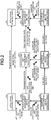
- FIG. 1 is a diagram illustrating a first example of the basic configuration of the quantum cryptographic communication system according to a first arrangement.
- a quantum cryptographic device 10a (starting node) transmits photons that are the source of a quantum cryptographic key to a quantum cryptographic device 10b (terminal node) via a quantum key distribution (QKD) link.
- the quantum cryptographic device 10a generates a quantum cryptographic key (starting node) based on the transmitted photons
- the quantum cryptographic device 10b generates a quantum cryptographic key (terminal node) based on the received photons.
- the quantum cryptographic key (starting node) and the quantum cryptographic key (terminal node) are shared bit data and are identical.
- the quantum cryptographic device 10a transmits the quantum cryptographic key (starting node) to an application-key management device 20a (starting node), and the quantum cryptographic device 10b transmits the quantum cryptographic key (terminal node) to an application-key management device 20b (terminal node).
- the application key is a cryptographic key used when an application 30a (starting node) encrypts and transmits application data.
- the sharing method is basically as described in non-patent literature " R. Takahashi, Y. Tanizawa, and A. Dixon, "A highspeed key management method for quantum key distribution network” 2019 Eleventh International Conference on Ubiquitous and Future Networks (ICUFN), Zagreb, Croatia, 2019, pp. 437-442 ", for example.
- the application-key management device 20a generates an application key by a random number generator and the like.
- the application-key management device 20a performs one time pad (OTP) encryption using a quantum cryptographic key on the application key and generates an OTP-encrypted application key.
- OTP one time pad
- the application-key management device 20a transmits the OTP-encrypted application key to the application-key management device 20b.
- the OTP-encrypted application key is transmitted and received via a transmission path (wired or wireless) corresponding to the QKD link.
- the application-key management device 20b performs OTP decryption using a quantum cryptographic key on the OTP-encrypted application key and decrypts the application key. In this way, the application key is shared by the application-key management devices 20a and 20b.
- the applications 30a and 30b acquire the application key from the application-key management devices 20a and 20b, respectively, at any desired timing. Specifically, after the application 30a retrieves the application key from the application-key management device 20a, the application 30b acquires from the application-key management device 20b the application key identical to the application key acquired by the application 30a.
- the application 30a After the application key is shared by the applications 30a and 30b, when the application 30a transmits application data, the application 30a performs encryption using the application key on the application data and transmits the application data.
- the devices on which the applications 30a and 30b operate are any device such as a smart device, a personal computer, and the like, for example. This is the description of the basic configuration.
- FIG. 1 although the starting node and the terminal node are directly connected, the basic operation is the same even when a relay node is interposed between the starting node and the terminal node.
- FIG. 2 illustrates the configuration in which one relay node is interposed between the starting node and the terminal node.
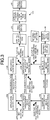
- FIG. 2 is a diagram illustrating a second example of the basic configuration of the quantum cryptographic communication system of the first arrangement.
- the number of QKD links is two.
- the quantum cryptographic device 10a (starting node) and the quantum cryptographic device 10c (relay node) share a quantum cryptographic key (QKD link 1)
- the quantum cryptographic device 10c (relay node) and the quantum cryptographic device 10b (terminal node) share a quantum cryptographic key (QKD link 2).
- the application-key management device 20a When the application 30a (starting node) and the application 30b (terminal node) share an application key, the application-key management device 20a first encrypts and transmits the application key to an application-key management device 20c, by using the quantum cryptographic key (QKD link 1). Then, the application-key management device 20c encrypts and transmits the application key to the application-key management device 20b, by using the quantum cryptographic key (QKD link 2). The applications 30a and 30b acquire the application key from the application-key management devices 20a and 20b, respectively, at any desired timing. This completes the sharing of the application key between the starting node and the terminal node. The operation of the applications 30a and 30b after sharing the application key is the same as that of FIG. 1 .
- FIG. 3 is a diagram illustrating an example of a device configuration of a quantum cryptographic communication fee calculation system 100 of the first arrangement.
- the quantum cryptographic communication fee calculation system 100 of the first arrangement includes the quantum cryptographic devices 10a and 10b, the application-key management devices 20a and 20b, the applications 30a and 30b, a route selection device 40, a tabulation device 50, and a calculation device 60.
- the route selection device 40, the tabulation device 50, and the calculation device 60 are each implemented by a server device on a network, for example.
- quantum cryptographic devices 10a and 10b The description of the quantum cryptographic devices 10a and 10b, the application-key management devices 20a and 20b, and the applications 30a and 30b is the same as that of FIG. 1 and thus is omitted.
- the application-key management device 20b transmits, each time transmitting an application key to the application 30b, the information on the relevant application key to the tabulation device 50.
- the route selection device 40 receives information on the QKD link from the quantum cryptographic device 10b, performs the selection (optimization) of an application-key sharing route, and determines the application-key sharing route corresponding to the application key.
- the application-key sharing route is a route of the QKD link used in sharing the application key. Then, the route selection device 40 transmits application-key sharing route information to the tabulation device 50.
- the tabulation device 50 then tabulates the information on the application key and the application-key sharing route information and outputs an application-key information tabulation result to the calculation device 60. Finally, based on the application-key information tabulation result, the calculation device 60 determines the service fee.
- the route selection device 40 receives the information on the QKD link 1 from the quantum cryptographic device 10c (relay node) and receives the information on the QKD link 2 from the quantum cryptographic device 10b (terminal node).
- quantum cryptographic devices 10a to 10c when the quantum cryptographic devices 10a to 10c, the application-key management devices 20a to 20c, and applications 30a and 30b are not distinguished, the foregoing is referred to simply as the quantum cryptographic communication device 10, the application-key management device 20, and the application 30, respectively.
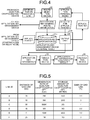
- FIG. 4 is a diagram for explaining the operation of the route selection device 40 and the application-key management device 20b of the first arrangement.
- the route selection device 40 acquires the information on each QKD link from the respective quantum cryptographic communication devices 10. Then, the route selection device 40 creates application-key sharing routes from the information on each QKD link.
- the route selection device 40 transmits the application-key sharing route information to the respective application-key management devices 20a to 20c (starting node, relay node, and terminal node).
- the reason why the application-key sharing route information is transmitted to the respective application-key management devices 20a to 20c is that each application-key management device 20 controls the route to transmit the application key.
- the application-key management device 20b receives the application key from the application-key management device 20a (starting node) or the application-key management device 20c (relay node).
- the application-key management device 20b stores the application key and the application-key sharing route information into an application-key information DB 21b.
- the application-key management device 20b retrieves, each time a request for an application key is received from the application 30b (terminal node), the application key from the application-key information DB 21b and transmits the relevant application key to the application 30b.
- the application-key management device 20b transmits to the tabulation device 50 the information on the application key that has been transmitted to the application 30b.
- the tabulation device 50 tabulates the information on the application key and the application-key sharing route information and outputs the application-key information tabulation result to the calculation device 60. Finally, based on the application-key information tabulation result, the calculation device 60 determines the service fee.
- FIG. 5 is a diagram illustrating an example of information on QKD links of the first arrangement.
- the information on QKD links includes a link ID, the distance of the QKD link, the generation rate of a quantum cryptographic key, the storage amount of the quantum cryptographic key, and a quantum bit error rate (QbER) of the QKD link.
- QbER quantum bit error rate
- the example in FIG. 5 indicates the information on each QKD link when a QKD network for which the number of QKD links is six is configured.
- the link ID is information that identifies a link.
- the distance of the QKD link is a distance of an optical fiber connecting between nodes.
- the generation rate of a quantum cryptographic key is a rate at which the quantum cryptographic key is generated, and is expressed by a bit amount per second of the quantum cryptographic key sent from the quantum cryptographic communication device 10 to the application-key management device 20, for example.
- the storage amount of the quantum cryptographic key is the amount of bit data indicating the quantum cryptographic key stored in the application-key management device 20.
- the QbER of the QKD link is a ratio of bit errors included in a quantum cryptographic key when generating the quantum cryptographic key.
- the case in FIG. 5 has been exemplified as an example of the information on QKD links, but the example of the information on QKD links is not limited to that of FIG. 5 .
- the storage amount of the application key may be the storage amount of the quantum cryptographic key.
- FIG. 6 is a diagram illustrating an example of the application-key sharing route information in the first arrangement.
- FIG. 7 is a diagram illustrating an example of a QKD network configuration of the first arrangement.
- the application-key sharing route information is a list of application-key sharing routes corresponding to the application key supplied to one terminal node.
- FIG. 6 illustrates, to one terminal node (in the examples of FIG. 6 and FIG. 7 , it is referred to as terminal node 4 for convenience), a configuration in which the number of nodes that may share the application key is three.
- the application-key sharing route information includes an application-key sharing destination node, the application-key sharing route, the distance, the number of relay nodes, a generation rate of the application key, and the storage amount of the application key.
- the application-key sharing destination node includes all nodes that may share the application key with the terminal node (in the case of FIG. 6 , starting node 1, starting node 2, and starting node 3).
- the application-key sharing route indicates a route of the QKD link for which the quantum cryptographic key used for OTP encryption of the application key is transmitted and received.
- the application-key sharing route included in the application-key sharing route information in FIG. 6 corresponds to the QKD network configuration in FIG. 7 .
- the application-key sharing route information between the starting node 1 and the terminal node 4 indicates passing from the starting node 1 through a QKD link (A), a relay node, and a QKD link (B), and reaching the terminal node 4.
- the application-key sharing route information between the starting node 2 and the terminal node 4 it indicates passing from the starting node 2 through a QKD link (C) and reaching the terminal node 4.
- the application-key sharing route information between the starting node 3 and the terminal node 4 it indicates passing from the starting node 3 through a QKD link (D), a relay node, a QKD link (E), a relay node, and a QKD link (F), and reaching the terminal node 4.
- D QKD link
- E QKD link
- F QKD link
- the number of relay nodes is the number of relay nodes present between the starting node and the terminal node.
- the number of relay nodes between the starting node 1 and the terminal node 4 is one
- the number of relay nodes between the starting node 2 and the terminal node 4 is zero
- the number of relay nodes between the starting node 3 and the terminal node 4 is two.
- the application-key generation rate is a generation rate of the application key shared between the starting node and the terminal node.
- the generation rate of the application key in each QKD link is equal to the generation rate of the quantum cryptographic communication of each QKD link.
- the QKD link (A) and the QKD link (B) are present, and according to FIG. 5 , the generation rates of the respective quantum cryptographic keys are 2 Mbps and 5 Mbps.
- the application-key generation rate between the starting node 1 and the terminal node 4 takes a minimum value out of them, it is 2 Mbps. This is because the application key generation of the QKD link (A) becomes a bottleneck.
- the application-key generation rate between the starting node 2 and the terminal node 4 is 500 Kbps
- the application-key generation rate between the starting node 3 and the terminal node 4 is 1 Mbps.
- the generation rate of the application key when there are a plurality of relay nodes relaying a QKD link through which photons used for the generation of a quantum cryptographic key are transmitted and received and the QKD link is divided into a plurality of partial QKD links by the relay nodes, is a lower generation rate of a partial quantum cryptographic key out of the generation rates of quantum cryptographic keys (partial quantum cryptographic keys) generated among the partial QKD links.
- the storage amount of the application key is the amount of the application key stored in the application-key management device 20.
- the storage amount of the application key is, out of storage amounts of the application key used among the partial transmission paths, a smaller storage amount of the application key.
- the application-key sharing route information varies depending on the status of the QKD link.
- the timing of changing the application-key sharing route information may be at regular intervals or the timing of changing may be variable depending on the situation. For example, when the communication is unstable, the timing of changing may be set shorter.
- FIG. 8 is a diagram illustrating an example of a functional configuration of the route selection device 40 of the first arrangement.
- the route selection device 40 includes evaluation-value calculation units 41a to 41c and determination units 42a to 42c.
- the information on each QKD link is input to the respective evaluation-value calculation unit 41a (for starting node 1), the evaluation-value calculation unit 41b (for starting node 2), and the evaluation-value calculation unit 41c (for starting node 3).
- the evaluation-value calculation unit 41a calculates each evaluation value on the combination of the routes reaching the terminal node 4 from the starting node 1 and inputs the relevant value to the determination unit 42a.
- the evaluation-value calculation unit 41b calculates each evaluation value on the combination of the routes reaching the terminal node 4 from the starting node 2 and inputs the relevant value to the determination unit 42b.
- the evaluation-value calculation unit 41c calculates each evaluation value on the combination of the routes reaching the terminal node 4 from the starting node 3 and inputs the relevant value to the determination unit 42c.
- the determination units 42a to 42c determine, based on the evaluation values of the application-key sharing routes, an optimum application-key sharing route and outputs the application-key sharing route information corresponding to each of the starting nodes 1 to 3.
- the route selection device 40 aggregates the application-key sharing route information corresponding to the respective starting nodes 1 to 3 and outputs the aggregated application-key sharing route information.
- the evaluation items on the application-key sharing route information include the distance, the number of relay nodes, the generation rate of the application key, and the storage amount of the application key. The descriptions of those items are as in the foregoing.
- the evaluation value is greater, it is prioritized as the application-key sharing route.
- the distance because the quantum cryptographic communication generates a quantum cryptographic key by transmitting and receiving one photon, the generation rate of the quantum cryptographic key is smaller as the distance is longer, and conversely, the generation rate of the quantum cryptographic key is greater as the distance is shorter. Accordingly, as the distance is shorter, the evaluation value on the relevant distance is calculated to be greater.
- the evaluation value on the relay nodes is calculated to be greater.
- the evaluation value on the generation rate of the application key is calculated to be greater.
- the evaluation value on the storage amount of the application key is calculated to be greater.
- the determination units 42a to 42c take the route for which those evaluation values are the maximum, as the application-key sharing route.
- the determination units 42a to 42c may take, by paying attention to one evaluation value, the route for which the relevant evaluation value is the maximum, as the application-key sharing route, for example.
- the determination units 42a to 42c may take, by paying attention to a plurality of evaluation values, the route for which the evaluation values equally weighted as the evaluation items are the maximum, as the application-key sharing route.
- the determination units 42a to 42c may take, by paying attention to a plurality of evaluation values, the route for which the evaluation values differently weighted for each evaluation item are the maximum, as the application-key sharing route.
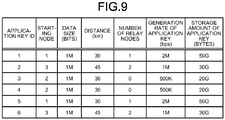
- FIG. 9 is a diagram illustrating an example of the application-key information DB 21b in the first arrangement.
- the application-key information DB 21b is a relational database and various types of data are stored in a list (table), for example. The description with the case of the terminal node 4 (see FIG. 7 ) will be continued.
- the application-key information DB 21b of the first arrangement includes an application key ID, the starting node, a data size, the distance, the number of relay nodes, the generation rate of the application key, and the storage amount of the application key.
- the application key ID is information that identifies an application key.
- the starting node indicates which starting node the application key is shared. For example, the application key for which the application key ID is 1 is the application key shared between the starting node 1 and the terminal node 4.
- the data size is the data size of the application key.
- the distance, the number of relay nodes, the generation rate of the application key, and the storage amount of the application key are the same as the distance, the number of relay nodes, the generation rate of the application key, and the storage amount of the application key included in the application-key sharing route information in FIG. 6 .
- the distance, the number of relay nodes, the generation rate of the application key, and the storage amount of the application key of the application-key sharing route information in FIG. 6 are written into the application-key information DB 21b as is.
- an output unit 22b retrieves the application key information corresponding to the application key ID and the relevant starting node from the application-key information DB 21b according to the designation. The output unit 22b then transmits the application key to the application 30b (terminal node) and transmits the application key information corresponding to the retrieved application key to the tabulation device 50.
- the application key information corresponding to the application key used in the application 30b (terminal node) is tabulated, and by a DB configuration identical to the application-key information DB in FIG. 9 , the application key information used is tabulated.
- FIG. 10 is a diagram illustrating an example of a functional configuration of the calculation device 60 of the first arrangement.
- the calculation device 60 of the first arrangement includes unit-price calculation units 61a to 61d, an application-key charge calculation unit 62, and a service-fee calculation unit 63.
- the unit-price calculation units 61a to 61d calculate the unit price of the application key when focusing on certain parameters only. Then, it is assumed that a parameter A is the distance, a parameter B is the number of relay nodes, a parameter C is the generation rate of the application key, and a parameter D is the storage amount of the application key. It is further assumed that the application-key information tabulation result input to the calculation device 60 is identical to the first row of the application-key information DB in FIG. 9 .
- the value corresponding to each of the parameters included in the application-key information tabulation result is input to the respective unit-price calculation units 61a to 61d.
- the value of the distance (km) for example, 30 km
- the unit-price calculation unit 61a calculates, based on the value of 30 km, the application-key unit price (parameter A) and inputs the relevant application-key unit price (parameter A) to the application-key charge calculation unit 62.
- the application-key unit price (parameter A) is the application-key unit price when considering only the parameter A.
- the unit-price calculation units 61b to 61d similarly perform this calculation of the application-key unit price also on the parameter B, the parameter C, and the parameter D.
- the application-key charge calculation unit 62 calculates, from the application-key unit price for each parameter, the application key charge (application-key unit price) when considering all parameters. For example, the application-key charge calculation unit 62 may calculate the application-key unit price by equally weighting for each parameter, or may calculate the application-key unit price by differently weighting for each parameter. By the application-key charge calculation unit 62, the application key charge for 1 Mbit of data considering the four parameters is calculated, and the relevant application key charge is input to the service-fee calculation unit 63.
- the service-fee calculation unit 63 accumulates the application key charge calculated by the application-key charge calculation unit 62. Then, the service-fee calculation unit 63 charges, when charging a user for the service fee, the user for the accumulated charges as the service fee. The foregoing is the flow up to the service fee charge.
- the unit-price calculation unit 61a increases the unit price of the application key as the distance is longer.
- the unit-price calculation unit 61b increases the unit price of the application key as the number of relay nodes is more. This is because the consumption of the quantum cryptographic keys in the relay nodes increases in addition to an increase in device cost as the number of the quantum cryptographic devices 10c (relay node) is increased when the number of relay nodes is more.
- the unit-price calculation unit 61c increases the unit price of the application key as the generation rate of the application key is smaller. This is because the sharing speed of the application key is smaller and rarer, as the generation rate of the application key is smaller.
- the unit-price calculation unit 61d increases the unit price of the application key as the storage amount of the application key is smaller. This is because the application key is rarer, as the storage amount of the application key is smaller.
- the unit price of the application key may be increased as the consumption speed of the application key is greater, for example. Conversely, because the usage amount of the application key is more as the consumption speed of the application key is greater, the unit price may be lowered for the user who uses the application key more.
- the output unit 22b acquires the consumption speed of the application key, sends the relevant consumption speed to the tabulation device 50, and the tabulation device 50 transmits the application-key information tabulation result including the relevant consumption speed to the calculation device 60.
- an application-key unit-price calculation unit for the consumption speed of the application key is provided and operates so as to calculate the application-key unit price (for parameter E) for the consumption speed of the application key and input the relevant application-key unit price (for parameter E) to the application-key charge calculation unit 62.
- the tabulation device 50 tabulates the information on the application key transmitted and received by using the quantum cryptographic key and outputs the application-key information tabulation result. Then, the calculation device 60 calculates the unit price of the application key based on the application-key information tabulation result.
- the quantum cryptographic communication fee calculation system 100 of the first arrangement it is possible to vary the unit price of the application key transmitted by the cryptographic communication using the cryptographic key generated by the quantum cryptographic communication system to a more appropriate value depending on the usage of the application key. As a result, it also has an effect in that, because the application key is valuable in a situation where the application key generated by using the quantum cryptographic communication system is exhausted, for example, the profit in the service fee is easily made as compared with the case of a fixed unit price.
- the service fee has been calculated from the application key information that is output from the application-key management device 20b, but it may be configured such that the service fee is calculated by outputting the application key information from the application 30b (terminal node).
- the calculation device 60 may display the display information indicating the unit price of the application key on a display device 70.
- FIG. 11 is a diagram illustrating an example of a device configuration of a quantum cryptographic communication fee calculation system 100-2 of the second arrangement.
- the quantum cryptographic communication fee calculation system 100-2 of the second arrangement includes the quantum cryptographic devices 10a and 10b, the application-key management devices 20a and 20b, the applications 30a and 30b, the route selection device 40, the tabulation device 50, the calculation device 60, and the display device 70.
- the display device 70 has been further added to the configuration of the first arrangement.
- the application 30b acquires the application key from the application-key management device 20b (terminal node) and also acquires the application key information at the same time, and subsequently, transmits the application key information on the application key that has been used to the tabulation device 50, which is the flow of calculating the service fee.
- the display device 70 displays display information indicating the unit price of the application key.
- FIG. 12 is a diagram illustrating an example of the display information in the second arrangement.
- the example in FIG. 12 indicates the case of displaying the unit price of the application key for each route.
- displayed are the distance of the QKD link, the generation rate of the quantum cryptographic key, the storage amount of the quantum cryptographic key, and the QbER of the QKD link.
- the distance of the QKD link is 20 km
- the generation rate of the quantum cryptographic key is 2 Mbps
- the storage amount of the quantum cryptographic key is 10 Gbytes
- the QbER of the QKD link is 3.5%.
- the tabulation device 50 and the calculation device 60 have been placed on the terminal node side, but the tabulation device 50 and the calculation device 60 may be placed on the starting node side.
- the processing the same as that in the first or the second arrangement is performed, each time the application 30a (starting node) acquires the application key from the application-key management device 20a (starting node).
- the application 30a (starting node) transmits a request for an application key to the application-key management device 20a (starting node), and each time the application key is acquired, the application-key management device 20a (starting node) transmits the application key information to the tabulation device 50, and the service fee is calculated (a modification of the first arrangement). Furthermore, the application 30a (starting node) acquires the application key from the application-key management device 20a (starting node) and also acquires the application key information at the same time. Then, the application 30a (starting node) transmits the application key information corresponding to the application key that has been consumed to the tabulation device 50 (a modification of the second arrangement).
- the route selection device 40 may be placed on the starting node side.
- the information on the QKD link is received from the quantum cryptographic device 10a (starting node).
- FIG. 14 is a diagram illustrating an example of the basic configuration of a quantum cryptographic communication system of the third arrangement.
- a network configuration of quantum cryptographic communication in the case of the configuration of a single starting node and a single terminal node, that is, the communication in which there is no relay node, it is possible to use the quantum cryptographic key (starting node) as the application key (starting node) and the quantum cryptographic key (terminal node) as the application key (terminal node).
- the burdens on the application-key management devices 20a and 20b are reduced.
- the configuration of the quantum cryptographic communication fee calculation system including the route selection device 40, the tabulation device 50, and the calculation device 60, it follows the configuration of the first arrangement (see FIG. 3 ) or the configuration of the second arrangement (see FIG. 11 ) .
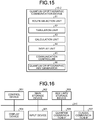
- FIG. 15 is a diagram illustrating an example of the functional configuration of a quantum cryptographic communication device 10-2 of the fourth arrangement.
- the quantum cryptographic communication device 10-2 of the fourth arrangement includes a route selection unit 11, a tabulation unit 12, a calculation unit 13, a display unit 14, a communication controller 15, and a quantum cryptographic key generator 16.
- the route selection unit 11 selects, when there are a plurality of routes of the transmission path where the application key is transmitted and received (QKD link where the quantum cryptographic key is transmitted and received), the route of a greater evaluation value evaluating the relevant route. For example, the route selection unit 11 increases the evaluation value as the distance of the route of the transmission path is smaller. For example, the route selection unit 11 increases the evaluation value as the number of relay nodes included in the route of the transmission path is smaller. For example, the route selection unit 11 increases the evaluation value for a route having a greater generation rate of the application key. For example, the route selection unit 11 increases the evaluation value for a route having a greater storage amount of the application key.
- the tabulation unit 12 tabulates the information on the application key transmitted and received by using the quantum cryptographic key and outputs the application-key information tabulation result. For example, the tabulation unit 12 receives, when the application-key management device 20b transmits the application key to the application 30b, the information on the application key from the application-key management device 20b. For example, the tabulation unit 12 receives, when the application 30b consumed the application key, the information on the application key from the application 30b.
- the calculation unit 13 calculates the unit price of the application key based on the application-key information tabulation result. For example, when the information on the application key includes the distance of the QKD link through which the photons used for the generation of the quantum cryptographic key are transmitted and received, the calculation unit 13 increases the unit price of the application key as the distance of the QKD link is greater. For example, when the information on the application key includes the number of relay nodes relaying the QKD link through which the photons used for the generation of the quantum cryptographic key are transmitted and received, the calculation unit 13 increases the unit price of the application key as the number of relay nodes is greater.
- the calculation unit 13 increases the unit price of the application key as the generation rate of the application key is slower. For example, when the information on the application key includes the storage amount of the application key, the calculation unit 13 increases the unit price of the application key as the storage amount of the application key is smaller. For example, when the information on the application key includes the consumption speed of the application key, the calculation unit 13 increases the unit price of the application key as the consumption speed of the application key is faster.
- the display unit 14 displays the display information (see FIG. 12 ) including the unit price of the application key.
- the communication controller 15 controls the communication of the quantum cryptographic communication device 10-2.
- the quantum cryptographic key generator 16 generates the quantum cryptographic key based on the photons transmitted and received via the QKD link.
- FIG. 16 is a diagram illustrating an example of the hardware configuration of a principal portion of the quantum cryptographic communication device 10 (10-2) of the first to the fourth arrangements.
- the quantum cryptographic communication device 10 (10-2) of the first to the fourth arrangements includes a control device 301, a main storage device 302, an auxiliary storage device 303, a display device 304, an input device 305, a quantum communication interface (IF) 306, and a classic communication IF 307.
- IF quantum communication interface
- the control device 301, the main storage device 302, the auxiliary storage device 303, the display device 304, the input device 305, the quantum communication IF 306, and the classic communication IF 307 are connected via a bus 310.
- the control device 301 executes a computer program that is read out from the auxiliary storage device 303 to the main storage device 302.
- the main storage device 302 is a memory such as a read only memory (ROM), a random access memory (RAM), and the like.
- the auxiliary storage device 303 is a hard disk drive (HDD), a memory card, and the like.
- the display device 304 displays the status and the like of the quantum cryptographic communication device 10 (10-2).
- the input device 305 receives the input from a user.
- the quantum communication IF 306 is an interface for connecting to a QKD link.
- the classic communication IF 307 is an interface for connecting to a transmission path.
- the computer programs executed in the quantum cryptographic communication device 10 (10-2) of the first to the fourth arrangements are recorded in a computer-readable recording medium such as a CD-ROM, a memory card, a CD-R, a digital versatile disc (DVD), and the like in a file of an installable or executable format and provided as a computer program product.
- a computer-readable recording medium such as a CD-ROM, a memory card, a CD-R, a digital versatile disc (DVD), and the like in a file of an installable or executable format and provided as a computer program product.
- the computer programs executed by the quantum cryptographic communication device 10 (10-2) of the first to the fourth arrangements may be stored in a computer connected to a network such as the Internet, and be provided by downloading via the network.
- the computer programs that the quantum cryptographic communication device 10 (10-2) of the first to the fourth arrangements execute may be provided, without downloading, via a network such as the Internet.
- the computer programs executed by the quantum cryptographic communication device 10 (10-2) of the first to the fourth arrangements may be provided by embedding in a ROM or the like in advance.
- the computer program executed in the quantum cryptographic communication device 10 (10-2) of the first to the fourth arrangements is in a modular configuration including, out of the functional configuration of the quantum cryptographic communication device 10 (10-2) of the first to the fourth arrangements, the functions that can be implemented by the computer program.
- the functions implemented by the computer program are loaded onto the main storage device 302, as the control device 301 reads out and executes the computer program from a storage medium such as the auxiliary storage device 303 and the like. That is, the functions implemented by the computer program are generated on the main storage device 302.
- a part or whole of the functions of the quantum cryptographic communication device 10 (10-2) of the first to the fourth arrangements may be implemented by the hardware such as an integrated circuit (IC) and the like.
- the IC is a processor that executes dedicated processing, for example.
- each processor may implement one out of the various functions or may implement two or more out of the various functions.
- the operation mode of the quantum cryptographic communication device 10 (10-2) of the first to the fourth arrangements may be in any desired mode.
- the quantum cryptographic communication device 10 (10-2) of the first to the fourth arrangements may be made to operate as a device that configures a cloud system on a network, for example.
Landscapes
- Engineering & Computer Science (AREA)
- Theoretical Computer Science (AREA)
- Business, Economics & Management (AREA)
- Physics & Mathematics (AREA)
- Signal Processing (AREA)
- Computer Networks & Wireless Communication (AREA)
- Computer Security & Cryptography (AREA)
- Development Economics (AREA)
- General Physics & Mathematics (AREA)
- Accounting & Taxation (AREA)
- Software Systems (AREA)
- Finance (AREA)
- Electromagnetism (AREA)
- Strategic Management (AREA)
- Game Theory and Decision Science (AREA)
- Marketing (AREA)
- General Business, Economics & Management (AREA)
- Economics (AREA)
- Multimedia (AREA)
- Entrepreneurship & Innovation (AREA)
- Technology Law (AREA)
- Computer Hardware Design (AREA)
- General Engineering & Computer Science (AREA)
- Data Exchanges In Wide-Area Networks (AREA)
- Financial Or Insurance-Related Operations Such As Payment And Settlement (AREA)
- Optical Communication System (AREA)
- Mobile Radio Communication Systems (AREA)
Abstract
Description
- The present disclosure relates to a quantum cryptographic device, a quantum cryptographic communication fee calculation system, and a quantum cryptographic communication fee calculation method.
- The advancement of information communication technology has led to the exchange of diverse data and ensuring the confidentiality, security, and the like of transmitted information has become a major issue. Quantum cryptographic communication technology is expected to be implemented as a cryptographic technique that cannot be deciphered even if the computing power of a computer is improved. As a business model of security systems using quantum cryptographic communication, there is a business model that determines a service fee based on usage of application key transmitted in quantum cryptography communication (hereinafter referred to as "application key"). In general, in a security system using quantum cryptographic communication, a service fee is calculated with the unit price per bit of the application key that is fixed.
- With the known method, it has been difficult to vary the unit price of the application key transmitted by cryptographic communication using a cryptographic key generated by a quantum cryptographic communication system to a more appropriate value depending on the usage of the application key.
-
-
FIG. 1 is a diagram illustrating a first example of a basic configuration of a quantum cryptographic communication system according to a first arrangement; -
FIG. 2 is a diagram illustrating a second example of the basic configuration of the quantum cryptographic communication system of the first arrangement; -
FIG. 3 is a diagram illustrating an example of a device configuration of a quantum cryptographic communication fee calculation system of the first arrangement; -
FIG. 4 is a diagram for explaining an operation of a route selection device and an application-key management device of the first arrangement; -
FIG. 5 is a diagram illustrating an example of information on QKD links of the first arrangement; -
FIG. 6 is a diagram illustrating an example of application-key sharing route information in the first arrangement; -
FIG. 7 is a diagram illustrating an example of a QKD network configuration of the first arrangement; -
FIG. 8 is a diagram illustrating an example of a functional configuration of the route selection device of the first arrangement; -
FIG. 9 is a diagram illustrating an example of an application-key information DB in the first arrangement; -
FIG. 10 is a diagram illustrating an example of a functional configuration of a calculation device of the first arrangement; -
FIG. 11 is a diagram illustrating an example of a device configuration of a quantum cryptographic communication fee calculation system according to a second arrangement; -
FIG. 12 is a diagram illustrating an example of display information in the second arrangement; -
FIG. 13 is a diagram for explaining an operation of a route selection device and an application-key management device of the second arrangement; -
FIG. 14 is a diagram illustrating an example of a basic configuration of a quantum cryptographic communication system according to a third arrangement; -
FIG. 15 is a diagram illustrating an example of a functional configuration of a quantum cryptographic communication device according to a fourth arrangement; and -
FIG. 16 is a diagram illustrating an example of a hardware configuration of a principal portion of the quantum cryptographic communication device of the first to the fourth arrangements. - According to an arrangement, a quantum cryptographic device includes a tabulation unit, a calculation unit, and a display unit. The tabulation unit tabulates information on an application key transmitted and received by using a quantum cryptographic key and outputs an application-key information tabulation result. The calculation unit calculates a unit price of the application key based on the application-key information tabulation result. The display unit displays information that is display information including the unit price of the application key.
- With reference to the accompanying drawings, the following describes in detail exemplary arrangements of a quantum cryptographic device, a quantum cryptographic communication fee calculation system, and a quantum cryptographic communication fee calculation method.
- First, examples of a basic configuration of a quantum cryptographic communication system will be described. First Example of Basic Configuration
-
FIG. 1 is a diagram illustrating a first example of the basic configuration of the quantum cryptographic communication system according to a first arrangement. First, a quantumcryptographic device 10a (starting node) transmits photons that are the source of a quantum cryptographic key to a quantumcryptographic device 10b (terminal node) via a quantum key distribution (QKD) link. The quantumcryptographic device 10a generates a quantum cryptographic key (starting node) based on the transmitted photons, and the quantumcryptographic device 10b generates a quantum cryptographic key (terminal node) based on the received photons. The quantum cryptographic key (starting node) and the quantum cryptographic key (terminal node) are shared bit data and are identical. Then, the quantumcryptographic device 10a transmits the quantum cryptographic key (starting node) to an application-key management device 20a (starting node), and the quantumcryptographic device 10b transmits the quantum cryptographic key (terminal node) to an application-key management device 20b (terminal node). - Subsequently, the application-
key management devices application 30a (starting node) encrypts and transmits application data. - A sharing method of application key will be described. The sharing method is basically as described in non-patent literature "R. Takahashi, Y. Tanizawa, and A. Dixon, "A highspeed key management method for quantum key distribution network" 2019 Eleventh International Conference on Ubiquitous and Future Networks (ICUFN), Zagreb, Croatia, 2019, pp. 437-442", for example. First, the application-
key management device 20a generates an application key by a random number generator and the like. Then, the application-key management device 20a performs one time pad (OTP) encryption using a quantum cryptographic key on the application key and generates an OTP-encrypted application key. The application-key management device 20a transmits the OTP-encrypted application key to the application-key management device 20b. The OTP-encrypted application key is transmitted and received via a transmission path (wired or wireless) corresponding to the QKD link. The application-key management device 20b performs OTP decryption using a quantum cryptographic key on the OTP-encrypted application key and decrypts the application key. In this way, the application key is shared by the application-key management devices - The
applications key management devices application 30a retrieves the application key from the application-key management device 20a, theapplication 30b acquires from the application-key management device 20b the application key identical to the application key acquired by theapplication 30a. - After the application key is shared by the
applications application 30a transmits application data, theapplication 30a performs encryption using the application key on the application data and transmits the application data. The devices on which theapplications - In
FIG. 1 , although the starting node and the terminal node are directly connected, the basic operation is the same even when a relay node is interposed between the starting node and the terminal node.FIG. 2 illustrates the configuration in which one relay node is interposed between the starting node and the terminal node. -
FIG. 2 is a diagram illustrating a second example of the basic configuration of the quantum cryptographic communication system of the first arrangement. When one quantum cryptographic device 10c (relay node) is interposed, the number of QKD links (optical fibers) is two. In aQKD link 1, the quantumcryptographic device 10a (starting node) and the quantum cryptographic device 10c (relay node) share a quantum cryptographic key (QKD link 1), and in aQKD link 2, the quantum cryptographic device 10c (relay node) and the quantumcryptographic device 10b (terminal node) share a quantum cryptographic key (QKD link 2). - When the
application 30a (starting node) and theapplication 30b (terminal node) share an application key, the application-key management device 20a first encrypts and transmits the application key to an application-key management device 20c, by using the quantum cryptographic key (QKD link 1). Then, the application-key management device 20c encrypts and transmits the application key to the application-key management device 20b, by using the quantum cryptographic key (QKD link 2). Theapplications key management devices applications FIG. 1 . - Next, a system configuration including a calculation function of a service fee of quantum cryptographic communication will be described.
-
FIG. 3 is a diagram illustrating an example of a device configuration of a quantum cryptographic communicationfee calculation system 100 of the first arrangement. The quantum cryptographic communicationfee calculation system 100 of the first arrangement includes thequantum cryptographic devices key management devices applications route selection device 40, atabulation device 50, and acalculation device 60. Theroute selection device 40, thetabulation device 50, and thecalculation device 60 are each implemented by a server device on a network, for example. - The description of the
quantum cryptographic devices key management devices applications FIG. 1 and thus is omitted. - The application-
key management device 20b transmits, each time transmitting an application key to theapplication 30b, the information on the relevant application key to thetabulation device 50. Meanwhile, theroute selection device 40 receives information on the QKD link from thequantum cryptographic device 10b, performs the selection (optimization) of an application-key sharing route, and determines the application-key sharing route corresponding to the application key. The application-key sharing route is a route of the QKD link used in sharing the application key. Then, theroute selection device 40 transmits application-key sharing route information to thetabulation device 50. - The
tabulation device 50 then tabulates the information on the application key and the application-key sharing route information and outputs an application-key information tabulation result to thecalculation device 60. Finally, based on the application-key information tabulation result, thecalculation device 60 determines the service fee. - As in
FIG. 2 , when there is a relay node, the information on the QKD link needs to be collected from the relay node also. For example, in the example inFIG. 2 , theroute selection device 40 receives the information on theQKD link 1 from the quantum cryptographic device 10c (relay node) and receives the information on theQKD link 2 from thequantum cryptographic device 10b (terminal node). - In the following description, when the
quantum cryptographic devices 10a to 10c, the application-key management devices 20a to 20c, andapplications cryptographic communication device 10, the application-key management device 20, and theapplication 30, respectively. - Next, the operation of the
route selection device 40 and the application-key management device 20b will be described. -
FIG. 4 is a diagram for explaining the operation of theroute selection device 40 and the application-key management device 20b of the first arrangement. Theroute selection device 40 acquires the information on each QKD link from the respective quantumcryptographic communication devices 10. Then, theroute selection device 40 creates application-key sharing routes from the information on each QKD link. Theroute selection device 40 transmits the application-key sharing route information to the respective application-key management devices 20a to 20c (starting node, relay node, and terminal node). The reason why the application-key sharing route information is transmitted to the respective application-key management devices 20a to 20c is that each application-key management device 20 controls the route to transmit the application key. - In addition, the application-
key management device 20b receives the application key from the application-key management device 20a (starting node) or the application-key management device 20c (relay node). The application-key management device 20b stores the application key and the application-key sharing route information into an application-key information DB 21b. Then, the application-key management device 20b retrieves, each time a request for an application key is received from theapplication 30b (terminal node), the application key from the application-key information DB 21b and transmits the relevant application key to theapplication 30b. At the same time, the application-key management device 20b transmits to thetabulation device 50 the information on the application key that has been transmitted to theapplication 30b. Then, thetabulation device 50 tabulates the information on the application key and the application-key sharing route information and outputs the application-key information tabulation result to thecalculation device 60. Finally, based on the application-key information tabulation result, thecalculation device 60 determines the service fee. - Next, an example of the information on each QKD link will be described.
-
FIG. 5 is a diagram illustrating an example of information on QKD links of the first arrangement. The information on QKD links includes a link ID, the distance of the QKD link, the generation rate of a quantum cryptographic key, the storage amount of the quantum cryptographic key, and a quantum bit error rate (QbER) of the QKD link. The example inFIG. 5 indicates the information on each QKD link when a QKD network for which the number of QKD links is six is configured. - The link ID is information that identifies a link. The distance of the QKD link is a distance of an optical fiber connecting between nodes. The generation rate of a quantum cryptographic key is a rate at which the quantum cryptographic key is generated, and is expressed by a bit amount per second of the quantum cryptographic key sent from the quantum
cryptographic communication device 10 to the application-key management device 20, for example. The storage amount of the quantum cryptographic key is the amount of bit data indicating the quantum cryptographic key stored in the application-key management device 20. The QbER of the QKD link is a ratio of bit errors included in a quantum cryptographic key when generating the quantum cryptographic key. - In the first arrangement, the case in
FIG. 5 has been exemplified as an example of the information on QKD links, but the example of the information on QKD links is not limited to that ofFIG. 5 . For example, in a one-to-one network configuration (seeFIG. 14 described later), if the number of QKD links is one, the storage amount of the application key may be the storage amount of the quantum cryptographic key. - Next, the application-key sharing route information will be described.
-
FIG. 6 is a diagram illustrating an example of the application-key sharing route information in the first arrangement.FIG. 7 is a diagram illustrating an example of a QKD network configuration of the first arrangement. The application-key sharing route information is a list of application-key sharing routes corresponding to the application key supplied to one terminal node.FIG. 6 illustrates, to one terminal node (in the examples ofFIG. 6 and FIG. 7 , it is referred to asterminal node 4 for convenience), a configuration in which the number of nodes that may share the application key is three. - The application-key sharing route information includes an application-key sharing destination node, the application-key sharing route, the distance, the number of relay nodes, a generation rate of the application key, and the storage amount of the application key.
- The application-key sharing destination node includes all nodes that may share the application key with the terminal node (in the case of
FIG. 6 , startingnode 1, startingnode 2, and starting node 3). - The application-key sharing route indicates a route of the QKD link for which the quantum cryptographic key used for OTP encryption of the application key is transmitted and received. The application-key sharing route included in the application-key sharing route information in
FIG. 6 corresponds to the QKD network configuration inFIG. 7 . For example, the application-key sharing route information between the startingnode 1 and theterminal node 4 indicates passing from the startingnode 1 through a QKD link (A), a relay node, and a QKD link (B), and reaching theterminal node 4. Regarding the application-key sharing route information between the startingnode 2 and theterminal node 4, it indicates passing from the startingnode 2 through a QKD link (C) and reaching theterminal node 4. Regarding the application-key sharing route information between the startingnode 3 and theterminal node 4, it indicates passing from the startingnode 3 through a QKD link (D), a relay node, a QKD link (E), a relay node, and a QKD link (F), and reaching theterminal node 4. - Next, the description will move on to the distance, the number of relay nodes, the generation rate of the application key, and the storage amount of the application key in
FIG. 6 . For the sake of convenience of explanation, it is assumed that the parameters of the QKD link (A) through the QKD link (F) follow the information on the QKD links inFIG. 5 . - First, the distance will be described. The distance indicates the distance (total distance) for which the distance of the optical fiber of each QKD link is added together. For example, in the case between the starting
node 1 and theterminal node 4, because the distance of the optical fiber of the QKD link (A) is 20 km and the distance of the optical fiber of the QKD link (B) is 10 km, the distance is 20 km + 10 km = 30 km. - Next, the number of relay nodes will be described. The number of relay nodes is the number of relay nodes present between the starting node and the terminal node. For example, the number of relay nodes between the starting
node 1 and theterminal node 4 is one, the number of relay nodes between the startingnode 2 and theterminal node 4 is zero, and the number of relay nodes between the startingnode 3 and theterminal node 4 is two. - Next, the application-key generation rate will be described. The application-key generation rate is a generation rate of the application key shared between the starting node and the terminal node. When sharing the application key, as the OTP-encrypted transmission using a quantum cryptographic key is performed, the generation rate of the application key in each QKD link is equal to the generation rate of the quantum cryptographic communication of each QKD link.
- For example, between the starting
node 1 and theterminal node 4, the QKD link (A) and the QKD link (B) are present, and according toFIG. 5 , the generation rates of the respective quantum cryptographic keys are 2 Mbps and 5 Mbps. As the application-key generation rate between the startingnode 1 and theterminal node 4 takes a minimum value out of them, it is 2 Mbps. This is because the application key generation of the QKD link (A) becomes a bottleneck. In a similar way, the application-key generation rate between the startingnode 2 and theterminal node 4 is 500 Kbps, and the application-key generation rate between the startingnode 3 and theterminal node 4 is 1 Mbps. That is, the generation rate of the application key, when there are a plurality of relay nodes relaying a QKD link through which photons used for the generation of a quantum cryptographic key are transmitted and received and the QKD link is divided into a plurality of partial QKD links by the relay nodes, is a lower generation rate of a partial quantum cryptographic key out of the generation rates of quantum cryptographic keys (partial quantum cryptographic keys) generated among the partial QKD links. - The storage amount of the application key is the amount of the application key stored in the application-
key management device 20. When there are a plurality of relay nodes relaying a transmission path through which the application key is transmitted and received and the transmission path is divided into a plurality of partial transmission paths by the relay nodes, the storage amount of the application key is, out of storage amounts of the application key used among the partial transmission paths, a smaller storage amount of the application key. - The application-key sharing route information varies depending on the status of the QKD link. The timing of changing the application-key sharing route information may be at regular intervals or the timing of changing may be variable depending on the situation. For example, when the communication is unstable, the timing of changing may be set shorter.
- Next, the
route selection device 40 of the first arrangement will be described. -
FIG. 8 is a diagram illustrating an example of a functional configuration of theroute selection device 40 of the first arrangement. In the example inFIG. 8 , it is assumed that, as the starting nodes sharing the application key with theterminal node 4, there are the startingnode 1, the startingnode 2, and the startingnode 3. In the example inFIG. 8 , theroute selection device 40 includes evaluation-value calculation units 41a to 41c anddetermination units 42a to 42c. First, the information on each QKD link is input to the respective evaluation-value calculation unit 41a (for starting node 1), the evaluation-value calculation unit 41b (for starting node 2), and the evaluation-value calculation unit 41c (for starting node 3). - The evaluation-
value calculation unit 41a calculates each evaluation value on the combination of the routes reaching theterminal node 4 from the startingnode 1 and inputs the relevant value to thedetermination unit 42a. Similarly, the evaluation-value calculation unit 41b calculates each evaluation value on the combination of the routes reaching theterminal node 4 from the startingnode 2 and inputs the relevant value to the determination unit 42b. Likewise, the evaluation-value calculation unit 41c calculates each evaluation value on the combination of the routes reaching theterminal node 4 from the startingnode 3 and inputs the relevant value to the determination unit 42c. - Then, the
determination units 42a to 42c determine, based on the evaluation values of the application-key sharing routes, an optimum application-key sharing route and outputs the application-key sharing route information corresponding to each of the startingnodes 1 to 3. Finally, theroute selection device 40 aggregates the application-key sharing route information corresponding to therespective starting nodes 1 to 3 and outputs the aggregated application-key sharing route information. - Next, the evaluation value of the application-key sharing route will be described. The evaluation items on the application-key sharing route information include the distance, the number of relay nodes, the generation rate of the application key, and the storage amount of the application key. The descriptions of those items are as in the foregoing.
- In the first arrangement, as the evaluation value is greater, it is prioritized as the application-key sharing route. Regarding the distance, because the quantum cryptographic communication generates a quantum cryptographic key by transmitting and receiving one photon, the generation rate of the quantum cryptographic key is smaller as the distance is longer, and conversely, the generation rate of the quantum cryptographic key is greater as the distance is shorter. Accordingly, as the distance is shorter, the evaluation value on the relevant distance is calculated to be greater.
- Regarding the number of relay nodes, as more relay nodes are relayed, the consumption of the quantum cryptographic keys at the relay nodes increases, and it is undesirable from the perspective of the quantum cryptographic communication network. Accordingly, as the number of relay nodes is smaller, the evaluation value on the relay nodes is calculated to be greater.
- Regarding the generation rate of the application key, as the generation rate of the application key is higher, the evaluation value on the generation rate of the application key is calculated to be greater.
- Regarding the storage amount of the application key, as the storage amount of the application key is higher, the evaluation value on the storage amount of the application key is calculated to be greater.
- Next, the method of determining the application-key sharing route information will be described. In the above description, four evaluation values of the evaluation value on the distance, the evaluation value on the number of relay nodes, the evaluation value on the generation rate of the application key, and the evaluation value on the storage amount of the application key have been mentioned. In determining the application-key sharing route, the
determination units 42a to 42c take the route for which those evaluation values are the maximum, as the application-key sharing route. Thedetermination units 42a to 42c may take, by paying attention to one evaluation value, the route for which the relevant evaluation value is the maximum, as the application-key sharing route, for example. Furthermore, for example, thedetermination units 42a to 42c may take, by paying attention to a plurality of evaluation values, the route for which the evaluation values equally weighted as the evaluation items are the maximum, as the application-key sharing route. For example, thedetermination units 42a to 42c may take, by paying attention to a plurality of evaluation values, the route for which the evaluation values differently weighted for each evaluation item are the maximum, as the application-key sharing route. - Next, the application-key information DB in the application-
key management device 20b (terminal node) will be described. -
FIG. 9 is a diagram illustrating an example of the application-key information DB 21b in the first arrangement. The application-key information DB 21b is a relational database and various types of data are stored in a list (table), for example. The description with the case of the terminal node 4 (seeFIG. 7 ) will be continued. - The application-
key information DB 21b of the first arrangement includes an application key ID, the starting node, a data size, the distance, the number of relay nodes, the generation rate of the application key, and the storage amount of the application key. - The application key ID is information that identifies an application key. The starting node indicates which starting node the application key is shared. For example, the application key for which the application key ID is 1 is the application key shared between the starting
node 1 and theterminal node 4. The data size is the data size of the application key. - The distance, the number of relay nodes, the generation rate of the application key, and the storage amount of the application key are the same as the distance, the number of relay nodes, the generation rate of the application key, and the storage amount of the application key included in the application-key sharing route information in
FIG. 6 . When storing the application key information in the application-key information DB 21b, the distance, the number of relay nodes, the generation rate of the application key, and the storage amount of the application key of the application-key sharing route information inFIG. 6 are written into the application-key information DB 21b as is. - Then, when a request for an application key including the designation of an application key ID and a starting node is received from the
application 30b (terminal node), anoutput unit 22b retrieves the application key information corresponding to the application key ID and the relevant starting node from the application-key information DB 21b according to the designation. Theoutput unit 22b then transmits the application key to theapplication 30b (terminal node) and transmits the application key information corresponding to the retrieved application key to thetabulation device 50. - In the
tabulation device 50, the application key information corresponding to the application key used in theapplication 30b (terminal node) is tabulated, and by a DB configuration identical to the application-key information DB inFIG. 9 , the application key information used is tabulated. - Next, the
calculation device 60 of the first arrangement will be described. -
FIG. 10 is a diagram illustrating an example of a functional configuration of thecalculation device 60 of the first arrangement. Thecalculation device 60 of the first arrangement includes unit-price calculation units 61a to 61d, an application-keycharge calculation unit 62, and a service-fee calculation unit 63. - In the first arrangement, the case in which, for calculating the unit price of the application key, there are four parameters to consider will be described. The unit-
price calculation units 61a to 61d calculate the unit price of the application key when focusing on certain parameters only. Then, it is assumed that a parameter A is the distance, a parameter B is the number of relay nodes, a parameter C is the generation rate of the application key, and a parameter D is the storage amount of the application key. It is further assumed that the application-key information tabulation result input to thecalculation device 60 is identical to the first row of the application-key information DB inFIG. 9 . - First, the value corresponding to each of the parameters included in the application-key information tabulation result is input to the respective unit-
price calculation units 61a to 61d. For example, when performing the calculation concerning the parameter A (distance), the value of the distance (km) (for example, 30 km) is input to the unit-price calculation unit 61a (for parameter A). Then, the unit-price calculation unit 61a calculates, based on the value of 30 km, the application-key unit price (parameter A) and inputs the relevant application-key unit price (parameter A) to the application-keycharge calculation unit 62. The application-key unit price (parameter A) is the application-key unit price when considering only the parameter A. The unit-price calculation units 61b to 61d similarly perform this calculation of the application-key unit price also on the parameter B, the parameter C, and the parameter D. - Next, the application-key
charge calculation unit 62 calculates, from the application-key unit price for each parameter, the application key charge (application-key unit price) when considering all parameters. For example, the application-keycharge calculation unit 62 may calculate the application-key unit price by equally weighting for each parameter, or may calculate the application-key unit price by differently weighting for each parameter. By the application-keycharge calculation unit 62, the application key charge for 1 Mbit of data considering the four parameters is calculated, and the relevant application key charge is input to the service-fee calculation unit 63. - The service-
fee calculation unit 63 accumulates the application key charge calculated by the application-keycharge calculation unit 62. Then, the service-fee calculation unit 63 charges, when charging a user for the service fee, the user for the accumulated charges as the service fee. The foregoing is the flow up to the service fee charge. - Next, the method of calculating the application-key unit price will be described.
- When the parameter is the distance, because the optical fiber costs more in a longer distance, the unit-
price calculation unit 61a increases the unit price of the application key as the distance is longer. - When the parameter is the number of relay nodes, the unit-
price calculation unit 61b increases the unit price of the application key as the number of relay nodes is more. This is because the consumption of the quantum cryptographic keys in the relay nodes increases in addition to an increase in device cost as the number of the quantum cryptographic devices 10c (relay node) is increased when the number of relay nodes is more. - When the parameter is the generation rate of the application key, the unit-
price calculation unit 61c increases the unit price of the application key as the generation rate of the application key is smaller. This is because the sharing speed of the application key is smaller and rarer, as the generation rate of the application key is smaller. - When the parameter is the storage amount of the application key, the unit-
price calculation unit 61d increases the unit price of the application key as the storage amount of the application key is smaller. This is because the application key is rarer, as the storage amount of the application key is smaller. - As the parameters to consider when calculating the application key charge, the four parameters of the distance, the number of relay nodes, the generation rate of the application key, and the storage amount of the application key have been mentioned, but the other possible parameter is the consumption speed of the application key that the application (terminal node) consumes. In this case, the unit price of the application key may be increased as the consumption speed of the application key is greater, for example. Conversely, because the usage amount of the application key is more as the consumption speed of the application key is greater, the unit price may be lowered for the user who uses the application key more. As for the tabulation of the consumption speed of the application key, the
output unit 22b acquires the consumption speed of the application key, sends the relevant consumption speed to thetabulation device 50, and thetabulation device 50 transmits the application-key information tabulation result including the relevant consumption speed to thecalculation device 60. - Regarding the application key charge, by defining a parameter E, for example, an application-key unit-price calculation unit for the consumption speed of the application key is provided and operates so as to calculate the application-key unit price (for parameter E) for the consumption speed of the application key and input the relevant application-key unit price (for parameter E) to the application-key
charge calculation unit 62. - As in the foregoing, in the quantum cryptographic communication
fee calculation system 100 of the first arrangement, thetabulation device 50 tabulates the information on the application key transmitted and received by using the quantum cryptographic key and outputs the application-key information tabulation result. Then, thecalculation device 60 calculates the unit price of the application key based on the application-key information tabulation result. - According to the quantum cryptographic communication
fee calculation system 100 of the first arrangement, it is possible to vary the unit price of the application key transmitted by the cryptographic communication using the cryptographic key generated by the quantum cryptographic communication system to a more appropriate value depending on the usage of the application key. As a result, it also has an effect in that, because the application key is valuable in a situation where the application key generated by using the quantum cryptographic communication system is exhausted, for example, the profit in the service fee is easily made as compared with the case of a fixed unit price. - Next, a second arrangement will be described. In the description of the second arrangement, the description the same as that of the first arrangement will be omitted and portions different from the first arrangement will be described.
- In the first arrangement, the service fee has been calculated from the application key information that is output from the application-
key management device 20b, but it may be configured such that the service fee is calculated by outputting the application key information from theapplication 30b (terminal node). In addition, thecalculation device 60 may display the display information indicating the unit price of the application key on adisplay device 70. -
FIG. 11 is a diagram illustrating an example of a device configuration of a quantum cryptographic communication fee calculation system 100-2 of the second arrangement. The quantum cryptographic communication fee calculation system 100-2 of the second arrangement includes thequantum cryptographic devices key management devices applications route selection device 40, thetabulation device 50, thecalculation device 60, and thedisplay device 70. In the second arrangement, thedisplay device 70 has been further added to the configuration of the first arrangement. - In the second arrangement, the
application 30b (terminal node) acquires the application key from the application-key management device 20b (terminal node) and also acquires the application key information at the same time, and subsequently, transmits the application key information on the application key that has been used to thetabulation device 50, which is the flow of calculating the service fee. - In addition, the
display device 70 displays display information indicating the unit price of the application key. Example of Display Information -
FIG. 12 is a diagram illustrating an example of the display information in the second arrangement. The example inFIG. 12 indicates the case of displaying the unit price of the application key for each route. Furthermore, for each QKD link, displayed are the distance of the QKD link, the generation rate of the quantum cryptographic key, the storage amount of the quantum cryptographic key, and the QbER of the QKD link. For example, in the QKD link (A), the distance of the QKD link is 20 km, the generation rate of the quantum cryptographic key is 2 Mbps, the storage amount of the quantum cryptographic key is 10 Gbytes, and the QbER of the QKD link is 3.5%. - In the above-described first and the second arrangements, the
tabulation device 50 and thecalculation device 60 have been placed on the terminal node side, but thetabulation device 50 and thecalculation device 60 may be placed on the starting node side. In the case of the starting node side, the processing the same as that in the first or the second arrangement is performed, each time theapplication 30a (starting node) acquires the application key from the application-key management device 20a (starting node). Specifically, theapplication 30a (starting node) transmits a request for an application key to the application-key management device 20a (starting node), and each time the application key is acquired, the application-key management device 20a (starting node) transmits the application key information to thetabulation device 50, and the service fee is calculated (a modification of the first arrangement). Furthermore, theapplication 30a (starting node) acquires the application key from the application-key management device 20a (starting node) and also acquires the application key information at the same time. Then, theapplication 30a (starting node) transmits the application key information corresponding to the application key that has been consumed to the tabulation device 50 (a modification of the second arrangement). - Similarly, the
route selection device 40 may be placed on the starting node side. In the case of the starting node side, the information on the QKD link is received from the quantumcryptographic device 10a (starting node). - Next, a third arrangement will be described. In the description of the third arrangement, the description the same as that of the first arrangement will be omitted and portions different from the first arrangement will be described. In the third arrangement, the case of using the quantum cryptographic key as the application key will be described.
-
FIG. 14 is a diagram illustrating an example of the basic configuration of a quantum cryptographic communication system of the third arrangement. As inFIG. 14 , in a network configuration of quantum cryptographic communication, in the case of the configuration of a single starting node and a single terminal node, that is, the communication in which there is no relay node, it is possible to use the quantum cryptographic key (starting node) as the application key (starting node) and the quantum cryptographic key (terminal node) as the application key (terminal node). - In the case of the third arrangement, as there is no need to perform the processing (processing of generating the application key, OTP encryption using the quantum cryptographic key, and transmission of the OTP-encrypted application key) performed in the application-
key management device 20a (starting node) described when explaining the first example (seeFIG. 1 ) of the basic configuration of the first arrangement and to perform the processing (OTP decryption and decryption processing of the application key) performed in the application-key management device 20b (terminal node), the burdens on the application-key management devices route selection device 40, thetabulation device 50, and thecalculation device 60, it follows the configuration of the first arrangement (seeFIG. 3 ) or the configuration of the second arrangement (seeFIG. 11 ) . - Next, a fourth arrangement will be described. In the description of the fourth arrangement, the description the same as that of the first arrangement will be omitted and portions different from the first arrangement will be described. In the fourth arrangement, the case where a quantum cryptographic communication device has the functions of the above-described
route selection device 40, thetabulation device 50, thecalculation device 60, and thedisplay device 70 will be described. -
FIG. 15 is a diagram illustrating an example of the functional configuration of a quantum cryptographic communication device 10-2 of the fourth arrangement. The quantum cryptographic communication device 10-2 of the fourth arrangement includes a route selection unit 11, atabulation unit 12, acalculation unit 13, a display unit 14, acommunication controller 15, and a quantum cryptographic key generator 16. - The route selection unit 11 selects, when there are a plurality of routes of the transmission path where the application key is transmitted and received (QKD link where the quantum cryptographic key is transmitted and received), the route of a greater evaluation value evaluating the relevant route. For example, the route selection unit 11 increases the evaluation value as the distance of the route of the transmission path is smaller. For example, the route selection unit 11 increases the evaluation value as the number of relay nodes included in the route of the transmission path is smaller. For example, the route selection unit 11 increases the evaluation value for a route having a greater generation rate of the application key. For example, the route selection unit 11 increases the evaluation value for a route having a greater storage amount of the application key.
- The
tabulation unit 12 tabulates the information on the application key transmitted and received by using the quantum cryptographic key and outputs the application-key information tabulation result. For example, thetabulation unit 12 receives, when the application-key management device 20b transmits the application key to theapplication 30b, the information on the application key from the application-key management device 20b. For example, thetabulation unit 12 receives, when theapplication 30b consumed the application key, the information on the application key from theapplication 30b. - The
calculation unit 13 calculates the unit price of the application key based on the application-key information tabulation result. For example, when the information on the application key includes the distance of the QKD link through which the photons used for the generation of the quantum cryptographic key are transmitted and received, thecalculation unit 13 increases the unit price of the application key as the distance of the QKD link is greater. For example, when the information on the application key includes the number of relay nodes relaying the QKD link through which the photons used for the generation of the quantum cryptographic key are transmitted and received, thecalculation unit 13 increases the unit price of the application key as the number of relay nodes is greater. - For example, when the information on the application key includes the generation rate of the application key, the
calculation unit 13 increases the unit price of the application key as the generation rate of the application key is slower. For example, when the information on the application key includes the storage amount of the application key, thecalculation unit 13 increases the unit price of the application key as the storage amount of the application key is smaller. For example, when the information on the application key includes the consumption speed of the application key, thecalculation unit 13 increases the unit price of the application key as the consumption speed of the application key is faster. - The display unit 14 displays the display information (see
FIG. 12 ) including the unit price of the application key. - The
communication controller 15 controls the communication of the quantum cryptographic communication device 10-2. The quantum cryptographic key generator 16 generates the quantum cryptographic key based on the photons transmitted and received via the QKD link. - Finally, an example of the hardware configuration of the quantum cryptographic communication device 10 (10-2) of the first to the fourth arrangements will be described. Example of Hardware Configuration
-
FIG. 16 is a diagram illustrating an example of the hardware configuration of a principal portion of the quantum cryptographic communication device 10 (10-2) of the first to the fourth arrangements. The quantum cryptographic communication device 10 (10-2) of the first to the fourth arrangements includes acontrol device 301, amain storage device 302, anauxiliary storage device 303, adisplay device 304, aninput device 305, a quantum communication interface (IF) 306, and a classic communication IF 307. - The
control device 301, themain storage device 302, theauxiliary storage device 303, thedisplay device 304, theinput device 305, the quantum communication IF 306, and the classic communication IF 307 are connected via abus 310. - The
control device 301 executes a computer program that is read out from theauxiliary storage device 303 to themain storage device 302. Themain storage device 302 is a memory such as a read only memory (ROM), a random access memory (RAM), and the like. Theauxiliary storage device 303 is a hard disk drive (HDD), a memory card, and the like. - The
display device 304 displays the status and the like of the quantum cryptographic communication device 10 (10-2). Theinput device 305 receives the input from a user. - The quantum communication IF 306 is an interface for connecting to a QKD link. The classic communication IF 307 is an interface for connecting to a transmission path.
- The computer programs executed in the quantum cryptographic communication device 10 (10-2) of the first to the fourth arrangements are recorded in a computer-readable recording medium such as a CD-ROM, a memory card, a CD-R, a digital versatile disc (DVD), and the like in a file of an installable or executable format and provided as a computer program product.
- Furthermore, the computer programs executed by the quantum cryptographic communication device 10 (10-2) of the first to the fourth arrangements may be stored in a computer connected to a network such as the Internet, and be provided by downloading via the network.
- The computer programs that the quantum cryptographic communication device 10 (10-2) of the first to the fourth arrangements execute may be provided, without downloading, via a network such as the Internet.
- The computer programs executed by the quantum cryptographic communication device 10 (10-2) of the first to the fourth arrangements may be provided by embedding in a ROM or the like in advance.
- The computer program executed in the quantum cryptographic communication device 10 (10-2) of the first to the fourth arrangements is in a modular configuration including, out of the functional configuration of the quantum cryptographic communication device 10 (10-2) of the first to the fourth arrangements, the functions that can be implemented by the computer program.
- The functions implemented by the computer program are loaded onto the
main storage device 302, as thecontrol device 301 reads out and executes the computer program from a storage medium such as theauxiliary storage device 303 and the like. That is, the functions implemented by the computer program are generated on themain storage device 302. - A part or whole of the functions of the quantum cryptographic communication device 10 (10-2) of the first to the fourth arrangements may be implemented by the hardware such as an integrated circuit (IC) and the like. The IC is a processor that executes dedicated processing, for example.
- When implementing various functions by using a plurality of processors, each processor may implement one out of the various functions or may implement two or more out of the various functions.
- Furthermore, the operation mode of the quantum cryptographic communication device 10 (10-2) of the first to the fourth arrangements may be in any desired mode. The quantum cryptographic communication device 10 (10-2) of the first to the fourth arrangements may be made to operate as a device that configures a cloud system on a network, for example.
- While certain arrangements have been described, these arrangements have been presented by way of example only, and are not intended to limit the scope of the claims. Indeed, the novel devices described herein may be embodied in a variety of other forms; furthermore various omissions, substitutions and changes in the form of the devices described herein may be made.
- Example 1. A quantum cryptographic device includes a tabulation unit, a calculation unit, and a display unit. The tabulation unit is configured to tabulate information on an application key transmitted and received by using a quantum cryptographic key and output an application-key information tabulation result. The calculation unit is configured to calculate a unit price of the application key based on the application-key information tabulation result. The display unit is configured to display information that is display information including the unit price of the application key.
- Example 2. In the quantum cryptographic device according to Example 1, the tabulation unit receives, when an application has consumed the application key, the information on the application key from the application.
- Example 3. In the quantum cryptographic device according to Example 1, the quantum cryptographic device is connected to an application-key management device configured to receive the application key from the quantum cryptographic device and to transmit the application key to an application, and the tabulation unit receives, when the application-key management device transmits the application key to the application, the information on the application key from the application-key management device.
- Example 4. In the quantum cryptographic device according to any one of Examples 1 to 3, the information on the application key includes a distance of a quantum key distribution (QKD) link through which photons used for generation of the quantum cryptographic key are transmitted and received, and the calculation unit increases the unit price of the application key as the distance of the QKD link is greater.
- Example 5. In the quantum cryptographic device according to any one of Examples 1 to 4, the information on the application key includes a number of relay nodes relaying a quantum key distribution (QKD) link through which photons used for generation of the quantum cryptographic key are transmitted and received, and the calculation unit increases the unit price of the application key as the number of relay nodes is greater.
- Example 6. In the quantum cryptographic device according to any one of Examples 1 to 5, the information on the application key includes a generation rate of the application key, and the calculation unit increases the unit price of the application key as the generation rate of the application key is slower.
- Example 7. In the quantum cryptographic device according to Example 6, when there are a plurality of relay nodes relaying a quantum key distribution (QKD) link through which photons used for generation of the quantum cryptographic key are transmitted and received and the QKD link is divided into a plurality of partial QKD links by the relay nodes, the generation rate of the application key is, out of generation rates of partial quantum cryptographic keys generated among the partial QKD links, a lower generation rate of the partial quantum cryptographic key.
- Example 8. In the quantum cryptographic device according to any one of Examples 1 to 7, the information on the application key includes a storage amount of the application key, and the calculation unit increases the unit price of the application key as the storage amount of the application key is smaller.
- Example 9. In the quantum cryptographic device according to Example 8, when there are a plurality of relay nodes relaying a transmission path through which the application key is transmitted and received and the transmission path is divided into a plurality of partial transmission paths by the relay nodes, the storage amount of the application key is, out of storage amounts of the application key used among the partial transmission paths, a smaller storage amount of the application key.
- Example 10. In the quantum cryptographic device according to Example 9, the quantum cryptographic device further includes a route selection unit configured to select, and when there are a plurality of routes of the transmission path, a route of a greater evaluation value evaluating the route.
- Example 11. In the quantum cryptographic device according to Example 10, the route selection unit increases the evaluation value as a distance of the route of the transmission path is smaller.
- Example 12. In the quantum cryptographic device according to Example 10 or 11, the route selection unit increases the evaluation value as a number of relay nodes included in the route of the transmission path is smaller.
- Example 13. In the quantum cryptographic device according to any one of Examples 10 to 12, the route selection unit increases the evaluation value for the route having a greater generation rate of the application key.
- Example 14. In the quantum cryptographic device according to any one of Examples 10 to 13, the route selection unit increases the evaluation value for the route having a greater storage amount of the application key.
- Example 15. In the quantum cryptographic device according to any one of Examples 1 to 14, the information on the application key includes a consumption speed of the application key, and the calculation unit increases the unit price of the application key as the consumption speed of the application key is faster.
- Example 16. A quantum cryptographic communication fee calculation system includes a tabulation device, a calculation device, and a display device. The tabulation device is configured to tabulate information on an application key transmitted and received by using a quantum cryptographic key and output an application-key information tabulation result. The calculation device is configured to calculate a unit price of the application key based on the application-key information tabulation result. The display device is configured to display information that is display information including the unit price of the application key.
- Example 17. A quantum cryptographic communication fee calculation method includes: tabulating, by a quantum cryptographic device, information on an application key transmitted and received by using a quantum cryptographic key and outputting an application-key information tabulation result; calculating, by the quantum cryptographic device, a unit price of the application key based on the application-key information tabulation result; and displaying, by the quantum cryptographic device, information that is display information including the unit price of the application key.
Claims (15)
- A quantum cryptographic device (10a, 10b, 10c) comprising:a tabulation unit (12) configured to tabulate information on an application key transmitted and received by using a quantum cryptographic key and output an application-key information tabulation result;a calculation unit (13) configured to calculate a unit price of the application key based on the application-key information tabulation result; anda display unit (14) configured to display information that is display information including the unit price of the application key.
- The quantum cryptographic device (10a, 10b, 10c) according to claim 1, wherein the tabulation unit (12) receives, when an application has consumed the application key, the information on the application key from the application.
- The quantum cryptographic device (10a, 10b, 10c) according to claim 1, wherein
the quantum cryptographic device (10a, 10b, 10c) is connected to an application-key management device (20a, 20b, 20c) configured to receive the application key from the quantum cryptographic device (10a, 10b, 10c) and to transmit the application key to an application, and
the tabulation unit (12) receives, when the application-key management device (20a, 20b, 20c) transmits the application key to the application, the information on the application key from the application-key management device. - The quantum cryptographic device (10a, 10b, 10c) according to any one of claims 1 to 3, wherein
the information on the application key includes a distance of a quantum key distribution (QKD) link through which photons used for generation of the quantum cryptographic key are transmitted and received, and
the calculation unit (13) increases the unit price of the application key as the distance of the QKD link is greater. - The quantum cryptographic device (10a, 10b, 10c) according to any one of claims 1 to 4, wherein
the information on the application key includes a generation rate of the application key, and
the calculation unit (13) increases the unit price of the application key as the generation rate of the application key is slower. - The quantum cryptographic device (10a, 10b, 10c) according to claim 5, wherein, when there are a plurality of relay nodes relaying a quantum key distribution (QKD) link through which photons used for generation of the quantum cryptographic key are transmitted and received and the QKD link is divided into a plurality of partial QKD links by the relay nodes, the generation rate of the application key is, out of generation rates of partial quantum cryptographic keys generated among the partial QKD links, a lower generation rate of the partial quantum cryptographic key.
- The quantum cryptographic device (10a, 10b, 10c) according to any one of claims 1 to 6, wherein
the information on the application key includes a storage amount of the application key, and
the calculation unit (13) increases the unit price of the application key as the storage amount of the application key is smaller. - The quantum cryptographic device (10a, 10b, 10c) according to claim 7, wherein, when there are a plurality of relay nodes relaying a transmission path through which the application key is transmitted and received and the transmission path is divided into a plurality of partial transmission paths by the relay nodes, the storage amount of the application key is, out of storage amounts of the application key used among the partial transmission paths, a smaller storage amount of the application key.
- The quantum cryptographic device (10a, 10b, 10c) according to claim 8, further comprising a route selection unit (11) configured to select, when there are a plurality of routes of the transmission path, a route of a greater evaluation value evaluating the route.
- The quantum cryptographic device (10a, 10b, 10c) according to claim 9, wherein the route selection unit (11) increases the evaluation value as a distance of the route of the transmission path is smaller.
- The quantum cryptographic device (10a, 10b, 10c) according to any one of claims 9 to 10, wherein the route selection unit (11) increases the evaluation value for the route having a greater generation rate of the application key.
- The quantum cryptographic device (10a, 10b, 10c) according to any one of claims 9 to 11, wherein the route selection unit (11) increases the evaluation value for the route having a greater storage amount of the application key.
- The quantum cryptographic device (10a, 10b, 10c) according to any one of claims 1 to 12, wherein
the information on the application key includes a consumption speed of the application key, and
the calculation unit (13) increases the unit price of the application key as the consumption speed of the application key is faster. - A quantum cryptographic communication fee calculation system comprising:a tabulation device (50) configured to tabulate information on an application key transmitted and received by using a quantum cryptographic key and output an application-key information tabulation result;a calculation device (60) configured to calculate a unit price of the application key based on the application-key information tabulation result; anda display device (70) configured to display information that is display information including the unit price of the application key.
- A quantum cryptographic communication fee calculation method comprising:tabulating, by a quantum cryptographic device (10a, 10b, 10c), information on an application key transmitted and received by using a quantum cryptographic key and outputting an application-key information tabulation result;calculating, by the quantum cryptographic device (10a, 10b, 10c), a unit price of the application key based on the application-key information tabulation result; anddisplaying, by the quantum cryptographic device (10a, 10b, 10c), information that is display information including the unit price of the application key.
Applications Claiming Priority (1)
| Application Number | Priority Date | Filing Date | Title |
|---|---|---|---|
| JP2020073718A JP7282713B2 (en) | 2020-04-16 | 2020-04-16 | Quantum Cryptography Device, Quantum Cryptography Communication Charge Calculation System, and Quantum Cryptography Communication Charge Calculation Method |
Publications (2)
| Publication Number | Publication Date |
|---|---|
| EP3896897A1 true EP3896897A1 (en) | 2021-10-20 |
| EP3896897B1 EP3896897B1 (en) | 2025-03-12 |
Family
ID=74666642
Family Applications (1)
| Application Number | Title | Priority Date | Filing Date |
|---|---|---|---|
| EP21157708.5A Active EP3896897B1 (en) | 2020-04-16 | 2021-02-17 | Quantum cryptographic device, quantum cryptographic communication fee calculation system, and quantum cryptographic communication fee calculation method |
Country Status (3)
| Country | Link |
|---|---|
| US (1) | US12198167B2 (en) |
| EP (1) | EP3896897B1 (en) |
| JP (1) | JP7282713B2 (en) |
Cited By (2)
| Publication number | Priority date | Publication date | Assignee | Title |
|---|---|---|---|---|
| EP4246874A1 (en) * | 2022-03-17 | 2023-09-20 | Kabushiki Kaisha Toshiba | Key management device, quantum cryptography communication system, and computer program product |
| EP4432601A3 (en) * | 2023-03-17 | 2024-11-13 | Kabushiki Kaisha Toshiba | Key manager, quantum cryptographic communication system, qkdn control device, information processing device, key management method, qkdn control method, information processing method, and computer program |
Families Citing this family (7)
| Publication number | Priority date | Publication date | Assignee | Title |
|---|---|---|---|---|
| JP7600059B2 (en) * | 2021-09-09 | 2024-12-16 | キオクシア株式会社 | Memory System |
| JP7669309B2 (en) * | 2022-03-15 | 2025-04-28 | 株式会社東芝 | Quantum cryptography communication system, key management device, and key management method |
| JP7679330B2 (en) | 2022-03-22 | 2025-05-19 | 株式会社東芝 | Key management device, quantum cryptography communication system and program |
| JP7787566B2 (en) * | 2022-03-31 | 2025-12-17 | 国立研究開発法人情報通信研究機構 | Network control device |
| JP7757267B2 (en) * | 2022-11-30 | 2025-10-21 | 株式会社東芝 | Quantum cryptography communication control device, quantum cryptography communication control method and program |
| JP7822990B2 (en) * | 2023-03-20 | 2026-03-03 | 株式会社東芝 | Key management device, QKDN control device, quantum cryptography communication system, key management method, QKDN control method and program |
| JP2025036945A (en) * | 2023-09-05 | 2025-03-17 | 株式会社東芝 | Information processing device, quantum cryptography communication system, key management device, information processing method and program |
Citations (1)
| Publication number | Priority date | Publication date | Assignee | Title |
|---|---|---|---|---|
| US20160197723A1 (en) * | 2015-01-06 | 2016-07-07 | Kabushiki Kaisha Toshiba | Communication device, communication system, and computer program product |
Family Cites Families (31)
| Publication number | Priority date | Publication date | Assignee | Title |
|---|---|---|---|---|
| JP3172398B2 (en) * | 1995-07-28 | 2001-06-04 | キヤノン株式会社 | Communication device and communication system |
| JP2002281029A (en) * | 2001-03-21 | 2002-09-27 | Japan Science & Technology Corp | Quantum cryptography communication system |
| JP2003124921A (en) | 2001-10-17 | 2003-04-25 | Super Contents Distrubutions Ltd | Content distribution method and system |
| US7706535B1 (en) * | 2003-03-21 | 2010-04-27 | Bbn Technologies Corp. | Systems and methods for implementing routing protocols and algorithms for quantum cryptographic key transport |
| US7512242B2 (en) * | 2003-03-21 | 2009-03-31 | Bbn Technologies Corp. | Systems and methods for quantum cryptographic key transport |
| US7653199B2 (en) * | 2004-07-29 | 2010-01-26 | Stc. Unm | Quantum key distribution |
| JP2006094241A (en) * | 2004-09-24 | 2006-04-06 | Fuji Xerox Co Ltd | Encryption apparatus, encryption processing method, program, and information protecting system using encryption apparatus |
| JP2014017595A (en) * | 2012-07-06 | 2014-01-30 | Toshiba Corp | Communication device, key generating device, communication method, program, and communication system |
| JP5694247B2 (en) * | 2012-07-17 | 2015-04-01 | 株式会社東芝 | Key generation apparatus, communication method, and communication system |
| JP2014068313A (en) * | 2012-09-27 | 2014-04-17 | Toshiba Corp | COMMUNICATION METHOD, APPLICATION DEVICE, PROGRAM, AND COMMUNICATION SYSTEM |
| JP2014103514A (en) * | 2012-11-19 | 2014-06-05 | Toshiba Corp | Communication device, communication system and program |
| JP6076752B2 (en) * | 2013-01-22 | 2017-02-08 | 株式会社東芝 | COMMUNICATION DEVICE, COMMUNICATION SYSTEM, AND PROGRAM |
| JP6054224B2 (en) * | 2013-03-25 | 2016-12-27 | 株式会社東芝 | COMMUNICATION DEVICE, COMMUNICATION SYSTEM, COMMUNICATION METHOD, AND PROGRAM |
| JP6192998B2 (en) * | 2013-06-11 | 2017-09-06 | 株式会社東芝 | COMMUNICATION DEVICE, COMMUNICATION METHOD, PROGRAM, AND COMMUNICATION SYSTEM |
| US9774448B2 (en) * | 2013-10-30 | 2017-09-26 | Duo Security, Inc. | System and methods for opportunistic cryptographic key management on an electronic device |
| JP6223884B2 (en) * | 2014-03-19 | 2017-11-01 | 株式会社東芝 | COMMUNICATION DEVICE, COMMUNICATION METHOD, AND PROGRAM |
| JP2016171530A (en) * | 2015-03-13 | 2016-09-23 | 株式会社東芝 | Communication apparatus, communication method, program and communication system |
| JP6400513B2 (en) * | 2015-03-18 | 2018-10-03 | 株式会社東芝 | Quantum key distribution device, quantum key distribution method and program |
| JP6478749B2 (en) * | 2015-03-24 | 2019-03-06 | 株式会社東芝 | Quantum key distribution apparatus, quantum key distribution system, and quantum key distribution method |
| JP2016192732A (en) | 2015-03-31 | 2016-11-10 | Kddi株式会社 | Path control device, path control method, and path control system |
| US9996996B2 (en) * | 2015-04-16 | 2018-06-12 | Siebels Asset Management Research Ltd. | Protected article management |
| JP6803620B2 (en) * | 2016-09-05 | 2020-12-23 | 国立大学法人北海道大学 | Quantum cryptography key output device, quantum cryptography key communication system and quantum cryptography key output method |
| KR101960426B1 (en) * | 2016-09-06 | 2019-03-20 | 한국전자통신연구원 | Apparatus for quantum key distribution for multi-users and method for using the same |
| GB2559801B (en) * | 2017-02-20 | 2021-04-28 | Toshiba Kk | An optical quantum communication system |
| EP3782325B1 (en) * | 2018-04-19 | 2024-01-10 | Telefonaktiebolaget Lm Ericsson (Publ) | Path computation engine and method of configuring an optical path for quantum key distribution |
| US11290368B2 (en) * | 2019-05-21 | 2022-03-29 | Red Hat, Inc. | Federated messaging for quantum systems through teleportation |
| US11258580B2 (en) * | 2019-10-04 | 2022-02-22 | Red Hat, Inc. | Instantaneous key invalidation in response to a detected eavesdropper |
| US11170318B2 (en) * | 2019-10-31 | 2021-11-09 | Nxgen Partners Ip, Llc | Multi-photon, multi-dimensional hyper-entanglement using higher-order radix qudits with applications to quantum computing, QKD and quantum teleportation |
| US11423141B2 (en) * | 2020-02-10 | 2022-08-23 | Red Hat, Inc. | Intruder detection using quantum key distribution |
| JP7693596B2 (en) * | 2022-03-17 | 2025-06-17 | 株式会社東芝 | Key management device, quantum cryptography communication system and program |
| KR102814559B1 (en) * | 2022-05-30 | 2025-05-29 | 한국과학기술정보연구원 | Network apparatus for quantum key distribution, and operation method for quantum key distribution network |
-
2020
- 2020-04-16 JP JP2020073718A patent/JP7282713B2/en active Active
-
2021
- 2021-02-17 EP EP21157708.5A patent/EP3896897B1/en active Active
- 2021-02-25 US US17/249,289 patent/US12198167B2/en active Active
Patent Citations (1)
| Publication number | Priority date | Publication date | Assignee | Title |
|---|---|---|---|---|
| US20160197723A1 (en) * | 2015-01-06 | 2016-07-07 | Kabushiki Kaisha Toshiba | Communication device, communication system, and computer program product |
Non-Patent Citations (3)
| Title |
|---|
| CAO YUAN ET AL: "Cost-efficient quantum key distribution (QKD) over WDM networks", JOURNAL OF OPTICAL COMMUNICATIONS AND NETWORKING, INSTITUTE OF ELECTRICAL AND ELECTRONICS ENGINEERS, US, vol. 11, no. 6, 1 June 2019 (2019-06-01), pages 285 - 298, XP011729309, ISSN: 1943-0620, [retrieved on 20190610], DOI: 10.1364/JOCN.11.000285 * |
| HYUNGSOO KIM KT CORP REPUBLIC OF KOREA: "AAP Additional Review comments for ITU-T Y.3800 (Y.QKDN_FR): "Framework for Networks supporting Quantum Key Distribution";TD289/WP3", vol. 16/13, 23 September 2019 (2019-09-23), pages 1 - 21, XP044274422, Retrieved from the Internet <URL:https://www.itu.int/ifa/t/2017/sg13/docs/191014/td/ties/wp3/T17-SG13-191014-TD-WP3-0289!!MSW-E.docx> [retrieved on 20190923] * |
| R. TAKAHASHIY. TANIZAWAA. DIXON: "A highspeed key management method for quantum key distribution network", 2019 ELEVENTH INTERNATIONAL CONFERENCE ON UBIQUITOUS AND FUTURE NETWORKS (ICUFN), ZAGREB, CROATIA, 2019, pages 437 - 442, XP033600768, DOI: 10.1109/ICUFN.2019.8806052 |
Cited By (2)
| Publication number | Priority date | Publication date | Assignee | Title |
|---|---|---|---|---|
| EP4246874A1 (en) * | 2022-03-17 | 2023-09-20 | Kabushiki Kaisha Toshiba | Key management device, quantum cryptography communication system, and computer program product |
| EP4432601A3 (en) * | 2023-03-17 | 2024-11-13 | Kabushiki Kaisha Toshiba | Key manager, quantum cryptographic communication system, qkdn control device, information processing device, key management method, qkdn control method, information processing method, and computer program |
Also Published As
| Publication number | Publication date |
|---|---|
| EP3896897B1 (en) | 2025-03-12 |
| US20210328784A1 (en) | 2021-10-21 |
| JP7282713B2 (en) | 2023-05-29 |
| JP2021170742A (en) | 2021-10-28 |
| US12198167B2 (en) | 2025-01-14 |
Similar Documents
| Publication | Publication Date | Title |
|---|---|---|
| US12198167B2 (en) | Quantum cryptographic device, quantum cryptographic communication fee calculation system, and quantum cryptographic communication fee calculation method | |
| US10291590B2 (en) | Communication system, communication apparatus, communication method, and computer program product | |
| Kotobi et al. | Blockchain-enabled spectrum access in cognitive radio networks | |
| JP5411994B2 (en) | Secret sharing system, secret sharing apparatus, secret sharing method, secret sorting method, secret sharing program | |
| US9755828B2 (en) | Communication device, communication method, computer program product, and communication system | |
| EP4246875A1 (en) | Key management device, quantum cryptography communication system, and computer program product | |
| US20140023192A1 (en) | Communication device, communication method, and communication system | |
| US12500750B2 (en) | Quantum key delivery service platform | |
| JP6834771B2 (en) | Communication device and communication method | |
| Bonald et al. | Calculating the flow level performance of balanced fairness in tree networks | |
| Maity et al. | TAQNet: Traffic-aware minimum-cost quantum communication network planning | |
| Popa et al. | Optimal key forwarding strategy in QKD behaviours | |
| EP4181458B1 (en) | Quantum cryptography storage system, distribution control device, and computer-readable medium | |
| EP4152684B1 (en) | Quantum cryptography communication system, quantum cryptography communication device, key management device, and computer-readable medium | |
| Álvarez Roa et al. | Decentralized key distribution versus on-demand relaying for QKD networks | |
| US20250038948A1 (en) | Control device for a switching voltage regulator and control method | |
| EP4432600A1 (en) | Control device, quantum cryptographic communication system, control method, and computer-readable medium | |
| Yang et al. | Less is more: Service profit maximization in geo-distributed clouds | |
| Kumar et al. | A Multi‐Constrained Green Routing Protocol for IoT‐Based Software‐Defined WSN | |
| JP2024134304A (en) | Quantum key distribution system, node, key relay path calculation engine, program, and quantum key distribution method | |
| EP4380099A1 (en) | Quantum cryptographic communication control device, quantum cryptographic communication control method, and program | |
| Ech Chkaf et al. | Applying Lightweight Elliptic Curve Cryptography ECC to Smart Energy IoT Platforms Based on the CoAP Protocol | |
| US20240323004A1 (en) | Key manager, qkdn control device, quantum cryptographic communication system, information processing device, key management method, qkdn control method, information processing method, and program product | |
| JP2021105680A (en) | Data storage system, data storage device, computer program, and data storage method | |
| Liu et al. | On energy-balanced backpressure routing mechanisms for stochastic energy harvesting wireless sensor networks |
Legal Events
| Date | Code | Title | Description |
|---|---|---|---|
| PUAI | Public reference made under article 153(3) epc to a published international application that has entered the european phase |
Free format text: ORIGINAL CODE: 0009012 |
|
| STAA | Information on the status of an ep patent application or granted ep patent |
Free format text: STATUS: REQUEST FOR EXAMINATION WAS MADE |
|
| 17P | Request for examination filed |
Effective date: 20210217 |
|
| AK | Designated contracting states |
Kind code of ref document: A1 Designated state(s): AL AT BE BG CH CY CZ DE DK EE ES FI FR GB GR HR HU IE IS IT LI LT LU LV MC MK MT NL NO PL PT RO RS SE SI SK SM TR |
|
| B565 | Issuance of search results under rule 164(2) epc |
Effective date: 20210803 |
|
| GRAP | Despatch of communication of intention to grant a patent |
Free format text: ORIGINAL CODE: EPIDOSNIGR1 |
|
| STAA | Information on the status of an ep patent application or granted ep patent |
Free format text: STATUS: GRANT OF PATENT IS INTENDED |
|
| INTG | Intention to grant announced |
Effective date: 20240513 |
|
| RAP3 | Party data changed (applicant data changed or rights of an application transferred) |
Owner name: KABUSHIKI KAISHA TOSHIBA |
|
| GRAJ | Information related to disapproval of communication of intention to grant by the applicant or resumption of examination proceedings by the epo deleted |
Free format text: ORIGINAL CODE: EPIDOSDIGR1 |
|
| STAA | Information on the status of an ep patent application or granted ep patent |
Free format text: STATUS: REQUEST FOR EXAMINATION WAS MADE |
|
| INTC | Intention to grant announced (deleted) | ||
| GRAP | Despatch of communication of intention to grant a patent |
Free format text: ORIGINAL CODE: EPIDOSNIGR1 |
|
| STAA | Information on the status of an ep patent application or granted ep patent |
Free format text: STATUS: GRANT OF PATENT IS INTENDED |
|
| INTG | Intention to grant announced |
Effective date: 20241029 |
|
| GRAS | Grant fee paid |
Free format text: ORIGINAL CODE: EPIDOSNIGR3 |
|
| GRAA | (expected) grant |
Free format text: ORIGINAL CODE: 0009210 |
|
| STAA | Information on the status of an ep patent application or granted ep patent |
Free format text: STATUS: THE PATENT HAS BEEN GRANTED |
|
| AK | Designated contracting states |
Kind code of ref document: B1 Designated state(s): AL AT BE BG CH CY CZ DE DK EE ES FI FR GB GR HR HU IE IS IT LI LT LU LV MC MK MT NL NO PL PT RO RS SE SI SK SM TR |
|
| REG | Reference to a national code |
Ref country code: GB Ref legal event code: FG4D |
|
| REG | Reference to a national code |
Ref country code: CH Ref legal event code: EP |
|
| REG | Reference to a national code |
Ref country code: DE Ref legal event code: R096 Ref document number: 602021027370 Country of ref document: DE |
|
| REG | Reference to a national code |
Ref country code: IE Ref legal event code: FG4D |
|
| PG25 | Lapsed in a contracting state [announced via postgrant information from national office to epo] |
Ref country code: RS Free format text: LAPSE BECAUSE OF FAILURE TO SUBMIT A TRANSLATION OF THE DESCRIPTION OR TO PAY THE FEE WITHIN THE PRESCRIBED TIME-LIMIT Effective date: 20250612 |
|
| PG25 | Lapsed in a contracting state [announced via postgrant information from national office to epo] |
Ref country code: FI Free format text: LAPSE BECAUSE OF FAILURE TO SUBMIT A TRANSLATION OF THE DESCRIPTION OR TO PAY THE FEE WITHIN THE PRESCRIBED TIME-LIMIT Effective date: 20250312 |
|
| PG25 | Lapsed in a contracting state [announced via postgrant information from national office to epo] |
Ref country code: ES Free format text: LAPSE BECAUSE OF FAILURE TO SUBMIT A TRANSLATION OF THE DESCRIPTION OR TO PAY THE FEE WITHIN THE PRESCRIBED TIME-LIMIT Effective date: 20250312 |
|
| REG | Reference to a national code |
Ref country code: LT Ref legal event code: MG9D |
|
| PG25 | Lapsed in a contracting state [announced via postgrant information from national office to epo] |
Ref country code: NO Free format text: LAPSE BECAUSE OF FAILURE TO SUBMIT A TRANSLATION OF THE DESCRIPTION OR TO PAY THE FEE WITHIN THE PRESCRIBED TIME-LIMIT Effective date: 20250612 |
|
| PG25 | Lapsed in a contracting state [announced via postgrant information from national office to epo] |
Ref country code: HR Free format text: LAPSE BECAUSE OF FAILURE TO SUBMIT A TRANSLATION OF THE DESCRIPTION OR TO PAY THE FEE WITHIN THE PRESCRIBED TIME-LIMIT Effective date: 20250312 |
|
| REG | Reference to a national code |
Ref country code: NL Ref legal event code: MP Effective date: 20250312 |
|
| PG25 | Lapsed in a contracting state [announced via postgrant information from national office to epo] |
Ref country code: LV Free format text: LAPSE BECAUSE OF FAILURE TO SUBMIT A TRANSLATION OF THE DESCRIPTION OR TO PAY THE FEE WITHIN THE PRESCRIBED TIME-LIMIT Effective date: 20250312 |
|
| PG25 | Lapsed in a contracting state [announced via postgrant information from national office to epo] |
Ref country code: BG Free format text: LAPSE BECAUSE OF FAILURE TO SUBMIT A TRANSLATION OF THE DESCRIPTION OR TO PAY THE FEE WITHIN THE PRESCRIBED TIME-LIMIT Effective date: 20250312 Ref country code: GR Free format text: LAPSE BECAUSE OF FAILURE TO SUBMIT A TRANSLATION OF THE DESCRIPTION OR TO PAY THE FEE WITHIN THE PRESCRIBED TIME-LIMIT Effective date: 20250613 |
|
| REG | Reference to a national code |
Ref country code: AT Ref legal event code: MK05 Ref document number: 1775946 Country of ref document: AT Kind code of ref document: T Effective date: 20250312 |
|
| PG25 | Lapsed in a contracting state [announced via postgrant information from national office to epo] |
Ref country code: NL Free format text: LAPSE BECAUSE OF FAILURE TO SUBMIT A TRANSLATION OF THE DESCRIPTION OR TO PAY THE FEE WITHIN THE PRESCRIBED TIME-LIMIT Effective date: 20250312 |
|
| PG25 | Lapsed in a contracting state [announced via postgrant information from national office to epo] |
Ref country code: SE Free format text: LAPSE BECAUSE OF FAILURE TO SUBMIT A TRANSLATION OF THE DESCRIPTION OR TO PAY THE FEE WITHIN THE PRESCRIBED TIME-LIMIT Effective date: 20250312 |
|
| PG25 | Lapsed in a contracting state [announced via postgrant information from national office to epo] |
Ref country code: SM Free format text: LAPSE BECAUSE OF FAILURE TO SUBMIT A TRANSLATION OF THE DESCRIPTION OR TO PAY THE FEE WITHIN THE PRESCRIBED TIME-LIMIT Effective date: 20250312 |
|
| PG25 | Lapsed in a contracting state [announced via postgrant information from national office to epo] |
Ref country code: PT Free format text: LAPSE BECAUSE OF FAILURE TO SUBMIT A TRANSLATION OF THE DESCRIPTION OR TO PAY THE FEE WITHIN THE PRESCRIBED TIME-LIMIT Effective date: 20250714 |
|
| PG25 | Lapsed in a contracting state [announced via postgrant information from national office to epo] |
Ref country code: PL Free format text: LAPSE BECAUSE OF FAILURE TO SUBMIT A TRANSLATION OF THE DESCRIPTION OR TO PAY THE FEE WITHIN THE PRESCRIBED TIME-LIMIT Effective date: 20250312 Ref country code: IT Free format text: LAPSE BECAUSE OF FAILURE TO SUBMIT A TRANSLATION OF THE DESCRIPTION OR TO PAY THE FEE WITHIN THE PRESCRIBED TIME-LIMIT Effective date: 20250312 |
|
| PG25 | Lapsed in a contracting state [announced via postgrant information from national office to epo] |
Ref country code: AT Free format text: LAPSE BECAUSE OF FAILURE TO SUBMIT A TRANSLATION OF THE DESCRIPTION OR TO PAY THE FEE WITHIN THE PRESCRIBED TIME-LIMIT Effective date: 20250312 |
|
| PG25 | Lapsed in a contracting state [announced via postgrant information from national office to epo] |
Ref country code: CZ Free format text: LAPSE BECAUSE OF FAILURE TO SUBMIT A TRANSLATION OF THE DESCRIPTION OR TO PAY THE FEE WITHIN THE PRESCRIBED TIME-LIMIT Effective date: 20250312 Ref country code: EE Free format text: LAPSE BECAUSE OF FAILURE TO SUBMIT A TRANSLATION OF THE DESCRIPTION OR TO PAY THE FEE WITHIN THE PRESCRIBED TIME-LIMIT Effective date: 20250312 |
|
| PG25 | Lapsed in a contracting state [announced via postgrant information from national office to epo] |
Ref country code: RO Free format text: LAPSE BECAUSE OF FAILURE TO SUBMIT A TRANSLATION OF THE DESCRIPTION OR TO PAY THE FEE WITHIN THE PRESCRIBED TIME-LIMIT Effective date: 20250312 |
|
| PG25 | Lapsed in a contracting state [announced via postgrant information from national office to epo] |
Ref country code: SK Free format text: LAPSE BECAUSE OF FAILURE TO SUBMIT A TRANSLATION OF THE DESCRIPTION OR TO PAY THE FEE WITHIN THE PRESCRIBED TIME-LIMIT Effective date: 20250312 |
|
| PG25 | Lapsed in a contracting state [announced via postgrant information from national office to epo] |
Ref country code: IS Free format text: LAPSE BECAUSE OF FAILURE TO SUBMIT A TRANSLATION OF THE DESCRIPTION OR TO PAY THE FEE WITHIN THE PRESCRIBED TIME-LIMIT Effective date: 20250712 |
|
| REG | Reference to a national code |
Ref country code: DE Ref legal event code: R097 Ref document number: 602021027370 Country of ref document: DE |
|
| PG25 | Lapsed in a contracting state [announced via postgrant information from national office to epo] |
Ref country code: DK Free format text: LAPSE BECAUSE OF FAILURE TO SUBMIT A TRANSLATION OF THE DESCRIPTION OR TO PAY THE FEE WITHIN THE PRESCRIBED TIME-LIMIT Effective date: 20250312 |
|
| PLBE | No opposition filed within time limit |
Free format text: ORIGINAL CODE: 0009261 |
|
| STAA | Information on the status of an ep patent application or granted ep patent |
Free format text: STATUS: NO OPPOSITION FILED WITHIN TIME LIMIT |
|
| REG | Reference to a national code |
Ref country code: CH Ref legal event code: L10 Free format text: ST27 STATUS EVENT CODE: U-0-0-L10-L00 (AS PROVIDED BY THE NATIONAL OFFICE) Effective date: 20260121 |
|
| 26N | No opposition filed |
Effective date: 20251215 |
|
| PGFP | Annual fee paid to national office [announced via postgrant information from national office to epo] |
Ref country code: GB Payment date: 20260106 Year of fee payment: 6 |
|
| PGFP | Annual fee paid to national office [announced via postgrant information from national office to epo] |
Ref country code: DE Payment date: 20251224 Year of fee payment: 6 |