EP3896895A1 - Method and apparatus for processing ciphertext based on homomorphic encryption - Google Patents
Method and apparatus for processing ciphertext based on homomorphic encryption Download PDFInfo
- Publication number
- EP3896895A1 EP3896895A1 EP21163199.9A EP21163199A EP3896895A1 EP 3896895 A1 EP3896895 A1 EP 3896895A1 EP 21163199 A EP21163199 A EP 21163199A EP 3896895 A1 EP3896895 A1 EP 3896895A1
- Authority
- EP
- European Patent Office
- Prior art keywords
- approximate polynomial
- samples
- modulus reduction
- polynomial
- differences
- Prior art date
- Legal status (The legal status is an assumption and is not a legal conclusion. Google has not performed a legal analysis and makes no representation as to the accuracy of the status listed.)
- Granted
Links
Images



Classifications
-
- H—ELECTRICITY
- H04—ELECTRIC COMMUNICATION TECHNIQUE
- H04L—TRANSMISSION OF DIGITAL INFORMATION, e.g. TELEGRAPHIC COMMUNICATION
- H04L9/00—Cryptographic mechanisms or cryptographic arrangements for secret or secure communications; Network security protocols
- H04L9/008—Cryptographic mechanisms or cryptographic arrangements for secret or secure communications; Network security protocols involving homomorphic encryption
-
- G—PHYSICS
- G06—COMPUTING OR CALCULATING; COUNTING
- G06F—ELECTRIC DIGITAL DATA PROCESSING
- G06F17/00—Digital computing or data processing equipment or methods, specially adapted for specific functions
- G06F17/10—Complex mathematical operations
- G06F17/11—Complex mathematical operations for solving equations, e.g. nonlinear equations, general mathematical optimization problems
-
- H—ELECTRICITY
- H04—ELECTRIC COMMUNICATION TECHNIQUE
- H04L—TRANSMISSION OF DIGITAL INFORMATION, e.g. TELEGRAPHIC COMMUNICATION
- H04L9/00—Cryptographic mechanisms or cryptographic arrangements for secret or secure communications; Network security protocols
- H04L9/30—Public key, i.e. encryption algorithm being computationally infeasible to invert or user's encryption keys not requiring secrecy
- H04L9/3093—Public key, i.e. encryption algorithm being computationally infeasible to invert or user's encryption keys not requiring secrecy involving Lattices or polynomial equations, e.g. NTRU scheme
Definitions
- the following description relates to a method and apparatus for processing a ciphertext based on homomorphic encryption.
- Fully homomorphic encryption is an encryption scheme that enables an arbitrary logical operation or a mathematical operation to be performed on encrypted data.
- a fully homomorphic encryption method maintains security in data processing.
- Fully homomorphic encryption enables customers to receive many services while preserving privacy.
- a method of processing a ciphertext based on homomorphic encryption includes determining an approximate polynomial corresponding to a modulus reduction for bootstrapping a ciphertext based on samples extracted from the modulus reduction, and bootstrapping the ciphertext based on the approximate polynomial.
- the determining may include determining a coefficient of the approximate polynomial such that current differences between the samples extracted from the modulus reduction and values of the approximate polynomial are less than a predetermined threshold.
- the determining may include verifying whether the current differences between the samples extracted from the modulus reduction and the values of the approximate polynomial are less than the predetermined threshold, and increasing, in response to the current differences being greater than or equal to the predetermined threshold, the number of samples or a degree of the approximate polynomial based on a comparison between the current differences and differences determined in a previous step.
- the determining may include increasing the number of samples, in response to a similarity between the current differences and the differences determined in the previous step being less than a predetermined threshold similarity, and increasing the degree of the approximate polynomial, in response to the similarity being greater than or equal to the predetermined threshold similarity.
- the differences between the samples and the values of the approximate polynomial may be determined based on an L2-norm between the samples and the values of the approximate polynomial.
- the determining may include determining the approximate polynomial including odd-order terms.
- the determining may include determining the approximate polynomial using the Chebyshev polynomials as a basis.
- the samples may be extracted from a piecewise continuous interval having a symmetric shape about a reference point in a function corresponding to the modulus reduction.
- the samples may be extracted from a portion divided by the reference point in the piecewise continuous interval.
- the bootstrapping may include bootstrapping the ciphertext by homomorphically evaluating the modulus reduction using the approximate polynomial.
- an apparatus for processing a ciphertext based on homomorphic encryption includes one or more processors, wherein the one or more processors are configured to determine an approximate polynomial corresponding to a modulus reduction for bootstrapping a ciphertext based on samples extracted from the modulus reduction, and bootstrap the ciphertext based on the approximate polynomial.
- a method in another general aspect, includes determining an initial approximate polynomial corresponding to a modulus reduction for bootstrapping a ciphertext based on an initial number of samples extracted from the modulus reduction; calculating an error between the initial approximate polynomial and the modulus reduction function; increasing one of the initial number of samples and a degree of the initial approximate polynomial based on the error; determining an updated approximate polynomial based on either the increased number of samples or the increased degree of the initial approximate polynomial; and homomorphically evaluating the modulus reduction using the updated approximate polynomial.
- the calculating of the error may include determining that differences between the initial number of samples extracted from the modulus reduction and values of the initial approximate polynomial are greater than or equal to a threshold.
- first, second, and the like may be used herein to describe components. Each of these terminologies is not used to define an essence, order or sequence of a corresponding component but used merely to distinguish the corresponding component from other component(s).
- a first component may be referred to as a second component, and similarly the second component may also be referred to as the first component.
- a third component may be “connected”, “coupled”, and “joined” between the first and second components, although the first component may be directly connected, coupled, or joined to the second component.
- FIG. 1 illustrates an example of the operation of a user terminal and a server for processing a ciphertext enciphered based on homomorphic encryption.
- the user terminal 110 is a device controlled by a user, and may include, for example, various computing devices such as a smart phone, a tablet, a laptop, and a personal computer, various wearable devices such as a smart watch and smart glasses, various home appliances such as a smart speaker, a smart TV, and a smart refrigerator, a smart vehicle, a smart kiosk, an Internet of Things (loT) device, a drone, a robot, and the like.
- the user terminal 110 may encrypt stored data based on homomorphic encryption and transmit the encrypted data to the server 120.
- the user terminal 110 may transmit data to the server 120 to use various services provided by the server 120.
- the data to be transmitted may be encrypted to protect information therein.
- the user terminal 110 may encrypt the data based on homomorphic encryption.
- Homomorphic encryption may be an encryption scheme that allows computation on encrypted data without decryption. Homomorphic encryption may handle encrypted data without decryption and thus, may be suitable for data-massive applications that require privacy protection.
- homomorphic encryption may be a Cheon-Kim-Kim-Song (CKKS) scheme, which will be described in detail later.
- CKKS Cheon-Kim-Kim-Song
- not-encrypted data may be referred to as a plaintext
- encrypted data may be referred to as a ciphertext.
- Homomorphic encryption contains noise, and the noise level may increase as an operation on a ciphertext is performed.
- noise processing that is, bootstrapping to refresh the noise may be performed.
- bootstrapping the parameter size and computation overhead may be fixed regardless of circuit depth.
- a ciphertext encrypted by homomorphic encryption has the maximum number of possible operations without bootstrapping, and the maximum number of possible operations may be denoted by a level / (0 ⁇ l ⁇ L ).
- Bootstrapping may be a process of generating a level-L ciphertext having the same message by refreshing a level-0 ciphertext on which an operation is not performable any further.
- the server 120 may perform various operations on the ciphertext through bootstrapping. At this time, decryption of the ciphertext is not required, and thus privacy is not invaded.
- the ciphertext operated by the server 120 may be transmitted back to the user terminal 110, and the user terminal 110 may provide data obtained by decrypting the ciphertext to the user or use the data for a subsequent operation.
- homomorphic evaluation of modulus reduction is important in bootstrapping. Only arithmetic operations may be evaluated as homomorphic. Since modulus reduction is not an arithmetic operation, a polynomial approximation for modulus reduction is required. Herein, homomorphic evaluation may also be expressed as obtaining a homomorphic value or performing homomorphically.
- the problem of finding an approximate polynomial for modulus reduction may be substituted for an L2-norm minimization problem of directly calculating an optimal solution. Therefore, the limitation due to polynomial approximation using a trigonometrical function (for example, a sine function, etc.) may be easily overcome.
- a discretized optimization method may be applied to obtain an approximate polynomial of modulus reduction. Through the solution of the modified discretization problem, it is possible to reduce the degree of the approximate polynomial for the modulus reduction while achieving a low margin of error. Further, the level loss of bootstrapping may be reduced, and a solution of the cast problem may be determined in an efficient way without iteration.
- FIG. 2 illustrates an example of a scaled modulus reduction function.
- vectors are denoted in boldface, such as x , and every vector may be a column vector.
- Matrices are denoted by boldfaced capital letter, for example, A.
- the inner product of two vectors is denoted by ⁇ , ⁇ > or simply • .
- Matrix multiplication is denoted by • or may be omitted when it is unnecessary.
- x [i] denotes an i-th element of a vector x .
- a [i; j] is an element of a matrix A in the i-th row and the j-th column.
- x ⁇ D denotes a sampling x according to a distribution D .
- a set is used instead of a distribution, it means that x is sampled uniformly at random among set elements.
- Chebyshev interpolation is a polynomial interpolation method that uses the Chebyshev polynomials as a basis of interpolation polynomial.
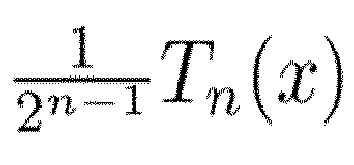
- the Chebyshev polynomial of a degree n has n distinct roots in an interval [-1, 1], and all extrema thereof may also be in [-1, 1]. Moreover, 1 2 n ⁇ 1 T n x may be a polynomial whose maximal absolute value is minimal among monic polynomials of a degree n and the absolute value is 1 2 n ⁇ 1 .
- n-th degree polynomial p n ( x ) may be represented as the sum of Chebyshev polynomials in the form as given below.
- p n ( x ) is an approximate polynomial for f ( x ) by interpolating n+1 points ⁇ X 0 , X 1 , ..., X n ⁇ .
- ⁇ M ( X ) may be an M -th cyclotomic polynomial of a degree N.
- M is a power of two
- M 2 N
- ⁇ M ( X ) X N + 1.
- the CKKS scheme and its residual number system (RNS) variants may provide homomorphic operations on real number data with error. This may be performed by canonical embedding and its inverse.
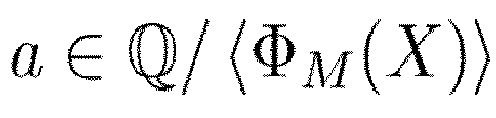
- the canonical embedding of a ⁇ Q / ⁇ ⁇ M X ⁇ into ⁇ may be a vector of evaluation values a at the roots of ⁇ M ( X ).
- Z M * may be a multiplicative group of integers modulo M .
- encoding C N / 2 ⁇ R and decoding will be described.
- ⁇ is a scaling factor
- ⁇ ⁇ ⁇ 1 z ⁇ ⁇ R denotes the discretization of into an element of ⁇ -1 (z).
- ⁇ M is an M-th root of unity
- Three distributions may be defined as follows.
- ⁇ > denotes the distribution of vectors in , whose entries may be sampled independently from discrete Gaussian distribution of a variance ⁇ 2 .
- ⁇ 2 is the set of signed binary vectors having a sign of ⁇ 0, ⁇ 1 ⁇ N with a Hamming weight h, and denotes the distribution of vectors from ⁇ 1 with probability ⁇ / 2 for each of 1 - ⁇ and probability being zero ⁇ 0, ⁇ 1 ⁇ N .
- ⁇ / 2 the distribution of vectors from ⁇ 1 with probability ⁇ / 2 for each of 1 - ⁇ and probability being zero ⁇ 0, ⁇ 1 ⁇ N .
- the level l denotes the maximum number of possible multiplications before bootstrapping.
- the base integer p may be a base ⁇ for scaling.
- the CKKS scheme may be defined with the following key generation, encryption, decryption, and corresponding homomorphic operations.
- KSGen sk ( s ').
- Dec sk ( c ). m ⁇ ⁇ c , sk ⁇ may be output.
- key switching techniques may be used to provide various operations such as complex conjugate and rotation.
- Bootstrapping for a CKKS scheme may include four steps of Modulus Raising (ModRaise), Putting Polynomial Coefficients in Plaintext Slots (CoeffToSlot), Evaluation of the Approximated Modulus Reduction (EvalMod), and Switching Back to the Coefficient Representation (SlotToCoeff).
- the following procedure may aim to compute the remainder of a coefficient of t ( X ) , that is, the remainder [ t ] q obtained by dividing t by q, homomorphically. Since the modulus reduction is not an arithmetic operation, the crucial point is to find a polynomial that approximates the modulus reduction.
- the size of the message may be controlled, and thus, ⁇ may be ensured for small m ⁇ ⁇ ⁇ q.
- the approximate homomorphic operations may be performed in plaintext slots.
- polynomial coefficients may need to be put in the plaintext slots.
- Ecd may be performed homomorphically using matrix multiplication, FFT-like operation using relationships of roots of unity, or a hybrid method of both.
- EvalMod step the elements of each slot may be considered from the viewpoint of single instruction multiple data (SIMD).
- SIMD single instruction multiple data
- EvalMod step approximated evaluation of [ t ] q may be performed.
- SlotToCoeff may be an inverse operation of CoeffToSlot.
- the key part of bootstrapping of the CKKS scheme is the homomorphic evaluation of modulus reduction.
- [ t ] q may be defined as t - k for t ⁇ I k .
- I k [ k - ⁇ , k + ⁇ ], and k may be an integer satisfying
- ⁇ may denote the ratio of the maximum coefficient of a message polynomial and a ciphertext modulus, that is, m q ⁇ ⁇ .
- the method may use least-squares estimation or L2-norm optimization.
- Such a polynomial may be referred to as a minimax polynomial.
- t i ⁇ may be sampled uniformly at intervals of ⁇ ⁇ ⁇ in each I k , namely, k - ⁇ , k - ⁇ + ⁇ ,..., k + ⁇ - ⁇ , k + ⁇ .
- N tot 2 K ⁇ 1 2 ⁇ ⁇ + 1 .
- the above objective function may be replaced with a loss function using the L2-norm. Then, the optimal solution for L2-norm minimization may be efficiently computed.
- L c may denote an L2-norm with a coefficient c . Then, c that minimizes the following may be found.
- the entries of T may have very large values or very small values close to zero as the degree n of the polynomial is high.
- the Chebyshev polynomials may be utilized as the basis of the polynomial instead of the power basis.
- t i ⁇ ⁇ k ⁇ K + 1 K ⁇ 1 I k
- t i K ⁇ 1 may be satisfied.
- the entries of T may be well-distributed in [-1, 1] rather than large values or small values around 0.
- c * arg min c L c
- the optimum solution c * may be at the gradient zero.
- the approximation error may be bounded by the multiplication of the maximum error of sampled points and O 1 + n N tot .
- E ( t ) may be a polynomial for a domain t ⁇ I k .
- E ( t ) ⁇ j ⁇ j x j may be denoted.
- for discrete points t i ⁇ s may be optimized.
- linear approximation 1 + ⁇ t t i j ⁇ 1 + j ⁇ t t i may be applied.
- the maximum error of sampled points may be close to the global maximum of the approximation error.
- the domain of the object function is the real numbers with error in the CKKS scheme, it may be reasonable to handle the sampled values.
- An L-infinity norm may be bounded by an L2-norm as follows. 1 N tot ⁇ x ⁇ 2 ⁇ ⁇ x ⁇ ⁇ ⁇ ⁇ x ⁇ 2
- minimizing the L2-norm may reduce the L-infinity norm. As it is not a tight bound, there may be room for optimization using a higher norm. However, the solution of the L2-norm may be clear and computed effortlessly. Although it is difficult to find a minimax polynomial of the modulus reduction function, it is possible to find the near-optimal solution of the minimax polynomial in a very efficient way without iteration through the L2-norm optimization problem.
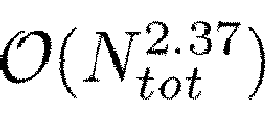
- the matrix inversion ( T T T ) - 1 may be the dominant computation.
- the time complexity may be O N tot 2.37 when the Coppersmith-Winograd algorithm is used. It is quite acceptable because c * is pre-computed and stored as a coefficient for the baby-step giant-step algorithm to be described later or for the Paterson-Stockmeyer algorithm.
- An approximate polynomial may be optimized with the Chebyshev polynomial as a basis.
- the baby-step giant-step algorithm and the modified Paterson-Stockmeyer algorithm may be applied for the efficient homomorphic evaluation of the proposed polynomial.
- p o ( t ) may be homomorphically evaluated with at most 2 l + 2 m-l + m-l- 3 nonscalar multiplications while consuming m depth.
- 2 m may be greater than the degree n.
- polynomials of a degree 2 l -1 may be evaluated, and there may be at most 2 m /2 l polynomials. However, when 2 m > n+1, there may be polynomials with all-zero coefficients. By ignoring them, there may be ⁇ ( n +1)/2 l ⁇ polynomials with a degree of at most 2 l -1 in the baby-step.
- N ( k ), k ⁇ 2 l denotes the number of nonscalar multiplications in the giant-step
- N ( k ) 0 for k ⁇ 2 l .
- the number of nonscalar multiplications may be given as ⁇ ( n +1)/2 l ⁇ -1+2 l -1+ m-l -1.
- the number of scalar multiplications may be ( n +1)- ⁇ ( n +1)/2 l ⁇ , and the number of additions may be n +2(2 l + m - l -2).
- the depth and the number of nonscalar multiplications may be minimized when m is the smallest integer satisfying 2 m > n and l ⁇ m /2.
- Maximum approximation errors may be similar to each other when the degrees of approximate polynomials are 2 n -1 and 2 n . This is because the target of approximation, the modulus reduction function [ t ] q , is an odd function. The following proposition shows that the minimax polynomial for an odd function is an odd function.
- P m denotes a subspace of a polynomial function of a degree of at most m
- f m ( t ) denotes a unique element of P m that is closest to f ( t ) in a supreme norm.
- the coefficient of even-order terms may have a very small value that is close to 0 in p o ( t ) . This is an evidence that the proposed method finds a polynomial near the minimax polynomial because the modulus reduction function is an odd function. Even terms may be a handicap in finding an approximate polynomial. Therefore, a more accurate approximate polynomial may be generated by approximating using only odd-order Chebyshev polynomials.
- One of the advantages of the proposed method is that it is possible to utilize the characteristics of the odd function.
- the odd function is symmetric about the origin, the L2-norm minimization may be solved only with samples with values greater than 0 (or samples with values less than 0). Accordingly, the number of rows and the number of columns of the matrix T may be respectively halved. Consequently, the time complexity of matrix inversion may be reduced to about 1/8. Further, some operations on even-order terms may be ignored during homomorphic evaluation.
- a more suitable parameter may be selected to reduce a level loss during bootstrapping.
- the proposed method may find a more accurate approximate polynomial if it is relatively greater than the previous best method.
- a method of selecting parameters based on these characteristics will be described.
- ⁇ bs may be different from a scaling factor of a message ⁇ . From Lemma 3 above, the total error of CoeffToSlot step may be when a sufficiently great P is selected.
- each component in a corresponding plaintext slot may contain t j + e j for a small error e j such as e j ⁇ O B rs . Since an approximate polynomial p o ( t j ) is evaluated with the scaling factor ⁇ bs , the approximation error may be as follows.
- an error after SlotToCoeff step may be bounded by O N ⁇ B rs .
- an error in bootstrapping may be independent of the scaling factor of the message ⁇ and bounded by O N h .
- the plaintext precision may be proportional to log ⁇ , where ⁇ may determine
- the level loss of bootstrapping may be approximately proportional to rather than . This is one of the advantages of the proposed method, which may overcome the limitations in the existing method and obtain more effects as a more accurate calculation is required.
- the plaintext precision may be obtained using a numerical method and be used to determine parameters.
- a relatively small q may be used, and thus in some cases, more levels may be left after bootstrapping.
- an approximate polynomial of the modulus reduction function for bootstrapping may be determined.
- the problem of finding an approximate polynomial for modulus reduction may be cast into an L2-norm minimization problem of which a solution may be directly found without an intermediate function such as a sine function.
- the approximation error in the proposed method is not subject to a sine function, it is possible to approximate the modulus reduction with high accuracy.
- a lower approximation error may be achieved even with a polynomial with a lower degree.
- the proposed polynomial may utilize the baby-step giant-step algorithm and the Paterson-Stockmeyer algorithm. It may be learned that the proposed polynomial reduces the required number of operations for homomorphic approximate modulus reduction, based on the numbers of nonscalar multiplications, scalar multiplications, and additions for the baby-step giant-step algorithm.
- the proposed method may offer a less-error bootstrapping especially when a large scaling factor is selected. Accordingly, the choice of parameters may be expanded. Most importantly, the proposed method may be essential for applications that require accurate approximation. Conversely, the proposed method does not have such as lower bound and thus, may select better parameters. Consequently, bootstrapping may consume lower levels when using the proposed method.
- FIG. 3 illustrates an example of determining an approximate polynomial.
- the number of samples N may be determined to be 16.
- the number of initial samples may be set in various manners according to circumstances.
- N samples t 1 , ..., t N(2K-1) may be extracted from each interval I k .
- I k k ⁇ ⁇ , k + ⁇ .
- an approximate polynomial T using the Chebyshev polynomials as a basis and a function value Y corresponding to a modulus reduction may be determined.
- T i ( ⁇ ) may denote an i-order Chebyshev polynomial of the first kind.
- an approximate polynomial p n ( t ) may be determined using the determined optimal coefficient vector c*.
- an error error between the determined approximate polynomial p n ( t ) and the modulus reduction function [ t ] q may be calculated.
- operation 307 whether the calculated error error is less than a target error e target may be determined. If the calculated error error is greater than or equal to the target error e target , operation 308 may be performed.
- operation 308 whether a similarity between the calculated error error and an error calculated in a previous step is less than a predetermined threshold similarity is determined. If the similarity is less than the predetermined threshold similarity, that is, if the error error calculated at the current step is reduced below the error calculated in the previous step and thus, they are not similar to each other, operation 309 may be performed to increase the number of samples N . Conversely, if the similarity is greater than or equal to the predetermined threshold similarity, that is, if the error error calculated in the current step is similar to the error calculated in the previous step, operation 310 may be performed to increase the degree n of the approximate polynomial.
- the degree n may be increased. As described above, since the approximate polynomial may include odd-order terms, the degree n may be increased by 2.
- operation 311 may be performed to finally determine and return the approximate polynomial p n ( t ) .
- the approximate polynomial expressed by the coefficients found using the method described above may be utilized for bootstrapping in fully homomorphic encryption through various methods including operations for reducing the depth or the number of operations, such as the baby-step giant-step algorithm or Paterson-Stockmeyer algorithm.
- Chebyshev polynomials of a portion of degrees may be used as the approximate polynomial for ease of operation.
- Legendre polynomials or powers of x may be used as a basis.
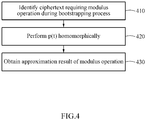
- FIG. 4 illustrates an example of bootstrapping using an approximate polynomial determined.
- a ciphertext requiring a modulus operation during a bootstrapping process may be identified.
- an approximate polynomial p(t) for the modulus reduction function determined in the example of FIG. 3 may be evaluated homomorphically.
- an approximation result of the modulus operation may be obtained.
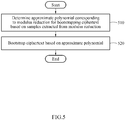
- FIG. 5 illustrates an example of a ciphertext processing method.
- FIG. 5 a ciphertext processing method performed by a processor provided in a ciphertext processing apparatus is shown.
- the ciphertext processing apparatus determine an approximate polynomial corresponding to a modulus reduction for bootstrapping a ciphertext based on samples extracted from the modulus reduction.
- the ciphertext processing apparatus may determine a coefficient of the approximate polynomial such that differences between the samples and values of the approximate polynomial are less than a predetermined threshold.
- the ciphertext processing apparatus may verify whether the differences between the samples and the values of the approximate polynomial are less than the predetermined threshold, and increase, in response to the differences being greater than or equal to the predetermined threshold, the number of samples or the degree of the approximate polynomial based on a comparison between the differences and differences determined in a previous step. For example, the ciphertext processing apparatus may increasing the number of samples, in response to a similarity between the differences and the differences determined in the previous step being less than a predetermined threshold similarity, and increase the degree of the approximate polynomial, in response to the similarity being greater than or equal to the predetermined threshold similarity.
- the differences between the samples and the values of the approximate polynomial may be determined based on an L2-norm between the samples and the values of the approximate polynomial.
- the ciphertext processing apparatus may determine the approximate polynomial including odd-order terms.
- the ciphertext processing apparatus may determine the approximate polynomial using the Chebyshev polynomials as a basis.
- the ciphertext processing apparatus bootstraps the ciphertext based on the approximate polynomial.
- the ciphertext processing apparatus may bootstrap the ciphertext by homomorphically evaluating the modulus reduction using the approximate polynomial.
- FIG. 6 illustrates an example of a ciphertext processing apparatus.
- a ciphertext processing apparatus 600 includes a memory 610 and a processor 620.
- the memory 610 and the processor 620 may communicate with each other through a bus 630.
- the memory 610 may include computer-readable instructions.
- the processor 620 may perform the operations described above when the instructions stored in the memory 610 are executed by the processor 620.
- the memory 610 may be a volatile memory or a non-volatile memory.
- the processor 620 is a device that executes the instructions or programs or that controls the ciphertext processing apparatus 600, and may include, for example, a central processing unit (CPU), a graphics processing unit (GPU), and the like.
- the processor 620 may determine an approximate polynomial corresponding to a modulus reduction for bootstrapping a ciphertext based on samples extracted from the modulus reduction, and bootstrap the ciphertext based on the approximate polynomial.
- the ciphertext processing apparatus 600 may be used in a process of bootstrapping a ciphertext in which a plaintext including real numbers or complex numbers is encrypted, during fully homomorphic encryption. If the degree of the approximate polynomial determined by the ciphertext processing apparatus 600 is lowered, the number of operations may be reduced. Thus, resources required for the ciphertext processing operation may be effectively reduced.
- the ciphertext processing apparatus 600 may be applied to the technical field of encryption/security, such as, for example, cloud computing, information protection machine learning, all other homomorphic encryption applications, network security, system (terminal) security, password/authentication, security management, content/information leakage prevention security, authentication service, and the like.
- encryption/security such as, for example, cloud computing, information protection machine learning, all other homomorphic encryption applications, network security, system (terminal) security, password/authentication, security management, content/information leakage prevention security, authentication service, and the like.
- the ciphertext processing apparatus 600 may process the operations described above.
- a processing device may be implemented using one or more general-purpose or special-purpose computers, such as, for example, a processor, a controller and an arithmetic logic unit (ALU), a DSP, a microcomputer, an FPGA, a programmable logic unit (PLU), a microprocessor or any other device capable of responding to and executing instructions in a defined manner.
- the processing device may run an operating system (OS) and one or more software applications that run on the OS.
- the processing device also may access, store, manipulate, process, and create data in response to execution of the software.
- OS operating system
- the processing device also may access, store, manipulate, process, and create data in response to execution of the software.
- a processing device may include multiple processing elements and multiple types of processing elements.
- a processing device may include multiple processors or a processor and a controller.
- different processing configurations are possible, such as parallel processors.
- the software may include a computer program, a piece of code, an instruction, or some combination thereof, to independently or uniformly instruct or configure the processing device to operate as desired.
- Software and data may be embodied permanently or temporarily in any type of machine, component, physical or virtual equipment, computer storage medium or device, or in a propagated signal wave capable of providing instructions or data to or being interpreted by the processing device.
- the software also may be distributed over network-coupled computer systems so that the software is stored and executed in a distributed fashion.
- the software and data may be stored by one or more non-transitory computer-readable recording mediums.
- the methods according to the above-described examples may be recorded in non-transitory computer-readable media including program instructions to implement various operations of the above-described examples.
- the media may also include, alone or in combination with the program instructions, data files, data structures, and the like.
- the program instructions recorded on the media may be those specially designed and constructed for the purposes of examples, or they may be of the kind well-known and available to those having skill in the computer software arts.
- non-transitory computer-readable media examples include magnetic media such as hard disks, floppy disks, and magnetic tape; optical media such as CD-ROM discs, DVDs, and/or Blue-ray discs; magneto-optical media such as optical discs; and hardware devices that are specially configured to store and perform program instructions, such as read-only memory (ROM), random access memory (RAM), flash memory (e.g., USB flash drives, memory cards, memory sticks, etc.), and the like.
- program instructions include both machine code, such as produced by a compiler, and files containing higher-level code that may be executed by the computer using an interpreter.
- the above-described devices may be configured to act as one or more software modules in order to perform the operations of the above-described examples, or vice versa.
Landscapes
- Engineering & Computer Science (AREA)
- Physics & Mathematics (AREA)
- Computer Security & Cryptography (AREA)
- Signal Processing (AREA)
- Computer Networks & Wireless Communication (AREA)
- General Physics & Mathematics (AREA)
- Mathematical Physics (AREA)
- Mathematical Optimization (AREA)
- Pure & Applied Mathematics (AREA)
- Theoretical Computer Science (AREA)
- Mathematical Analysis (AREA)
- Algebra (AREA)
- Data Mining & Analysis (AREA)
- Computational Mathematics (AREA)
- Databases & Information Systems (AREA)
- Software Systems (AREA)
- General Engineering & Computer Science (AREA)
- Operations Research (AREA)
- Computing Systems (AREA)
- Complex Calculations (AREA)
Abstract
Description
- The following description relates to a method and apparatus for processing a ciphertext based on homomorphic encryption.
- Fully homomorphic encryption is an encryption scheme that enables an arbitrary logical operation or a mathematical operation to be performed on encrypted data. A fully homomorphic encryption method maintains security in data processing. Fully homomorphic encryption enables customers to receive many services while preserving privacy.
- This Summary is provided to introduce a selection of concepts in a simplified form that are further described below in the Detailed Description. This Summary is not intended to identify key features or essential features of the claimed subject matter, nor is it intended to be used as an aid in determining the scope of the claimed subject matter.
- In one general aspect, a method of processing a ciphertext based on homomorphic encryption includes determining an approximate polynomial corresponding to a modulus reduction for bootstrapping a ciphertext based on samples extracted from the modulus reduction, and bootstrapping the ciphertext based on the approximate polynomial.
- The determining may include determining a coefficient of the approximate polynomial such that current differences between the samples extracted from the modulus reduction and values of the approximate polynomial are less than a predetermined threshold.
- The determining may include verifying whether the current differences between the samples extracted from the modulus reduction and the values of the approximate polynomial are less than the predetermined threshold, and increasing, in response to the current differences being greater than or equal to the predetermined threshold, the number of samples or a degree of the approximate polynomial based on a comparison between the current differences and differences determined in a previous step.
- The determining may include increasing the number of samples, in response to a similarity between the current differences and the differences determined in the previous step being less than a predetermined threshold similarity, and increasing the degree of the approximate polynomial, in response to the similarity being greater than or equal to the predetermined threshold similarity.
- The differences between the samples and the values of the approximate polynomial may be determined based on an L2-norm between the samples and the values of the approximate polynomial.
- The determining may include determining the approximate polynomial including odd-order terms.
- The determining may include determining the approximate polynomial using the Chebyshev polynomials as a basis.
- The samples may be extracted from a piecewise continuous interval having a symmetric shape about a reference point in a function corresponding to the modulus reduction.
- The samples may be extracted from a portion divided by the reference point in the piecewise continuous interval.
- The bootstrapping may include bootstrapping the ciphertext by homomorphically evaluating the modulus reduction using the approximate polynomial.
- In another general aspect, an apparatus for processing a ciphertext based on homomorphic encryption includes one or more processors, wherein the one or more processors are configured to determine an approximate polynomial corresponding to a modulus reduction for bootstrapping a ciphertext based on samples extracted from the modulus reduction, and bootstrap the ciphertext based on the approximate polynomial.
- In another general aspect, a method includes determining an initial approximate polynomial corresponding to a modulus reduction for bootstrapping a ciphertext based on an initial number of samples extracted from the modulus reduction; calculating an error between the initial approximate polynomial and the modulus reduction function; increasing one of the initial number of samples and a degree of the initial approximate polynomial based on the error; determining an updated approximate polynomial based on either the increased number of samples or the increased degree of the initial approximate polynomial; and homomorphically evaluating the modulus reduction using the updated approximate polynomial.
- The calculating of the error may include determining that differences between the initial number of samples extracted from the modulus reduction and values of the initial approximate polynomial are greater than or equal to a threshold.
- Other features and aspects will be apparent from the following detailed description, the drawings, and the claims.
-
-
FIG. 1 illustrates an example of the operation of a user terminal and a server for processing a ciphertext enciphered based on homomorphic encryption. -
FIG. 2 illustrates an example of a scaled modulus reduction function. -
FIG. 3 illustrates an example of determining an approximate polynomial. -
FIG. 4 illustrates an example of bootstrapping using an approximate polynomial determined. -
FIG. 5 illustrates an example of a ciphertext processing method. -
FIG. 6 illustrates an example of a ciphertext processing apparatus. - Throughout the drawings and the detailed description, unless otherwise described or provided, the same drawing reference numerals will be understood to refer to the same elements, features, and structures. The drawings may not be to scale, and the relative size, proportions, and depiction of elements in the drawings may be exaggerated for clarity, illustration, and convenience.
- The following detailed structural or functional description is provided as an example only and various alterations and modifications may be made to the examples. Accordingly, the examples are not construed as being limited to the disclosure and should be understood to include all changes, equivalents, and replacements within the technical scope of the disclosure.
- Terms, such as first, second, and the like, may be used herein to describe components. Each of these terminologies is not used to define an essence, order or sequence of a corresponding component but used merely to distinguish the corresponding component from other component(s). For example, a first component may be referred to as a second component, and similarly the second component may also be referred to as the first component.
- It should be noted that if it is described that one component is "connected", "coupled", or "joined" to another component, a third component may be "connected", "coupled", and "joined" between the first and second components, although the first component may be directly connected, coupled, or joined to the second component.
- The singular forms "a", "an", and "the" are intended to include the plural forms as well, unless the context clearly indicates otherwise. It will be further understood that the terms "comprises/comprising" and/or "includes/including" when used herein, specify the presence of stated features, integers, steps, operations, elements, and/or components, but do not preclude the presence or addition of one or more other features, integers, steps, operations, elements, components and/or groups thereof.
- Unless otherwise defined, all terms, including technical and scientific terms, used herein have the same meaning as commonly understood by one of ordinary skill in the art to which this disclosure pertains. Terms, such as those defined in commonly used dictionaries, are to be interpreted as having a meaning that is consistent with their meaning in the context of the relevant art, and are not to be interpreted in an idealized or overly formal sense unless expressly so defined herein.
- Hereinafter, examples will be described in detail with reference to the accompanying drawings. The following specific structural or functional descriptions are exemplary to merely describe the examples, and the scope of the examples is not limited to the descriptions provided in the present specification. Various changes and modifications can be made thereto by those of ordinary skill in the art. Like reference numerals in the drawings denote like elements, and a known function or configuration will be omitted herein.
-
FIG. 1 illustrates an example of the operation of a user terminal and a server for processing a ciphertext enciphered based on homomorphic encryption. - Referring to
FIG. 1 , auser terminal 110 and aserver 120 are shown. Theuser terminal 110 is a device controlled by a user, and may include, for example, various computing devices such as a smart phone, a tablet, a laptop, and a personal computer, various wearable devices such as a smart watch and smart glasses, various home appliances such as a smart speaker, a smart TV, and a smart refrigerator, a smart vehicle, a smart kiosk, an Internet of Things (loT) device, a drone, a robot, and the like. Theuser terminal 110 may encrypt stored data based on homomorphic encryption and transmit the encrypted data to theserver 120. Theuser terminal 110 may transmit data to theserver 120 to use various services provided by theserver 120. In this example, the data to be transmitted may be encrypted to protect information therein. For theserver 120 to process the encrypted data, theuser terminal 110 may encrypt the data based on homomorphic encryption. - Homomorphic encryption may be an encryption scheme that allows computation on encrypted data without decryption. Homomorphic encryption may handle encrypted data without decryption and thus, may be suitable for data-massive applications that require privacy protection. For example, homomorphic encryption may be a Cheon-Kim-Kim-Song (CKKS) scheme, which will be described in detail later. Herein, not-encrypted data may be referred to as a plaintext, and encrypted data may be referred to as a ciphertext.
- Homomorphic encryption contains noise, and the noise level may increase as an operation on a ciphertext is performed. In order to prevent noise from overwhelming the data, noise processing, that is, bootstrapping to refresh the noise may be performed. Through bootstrapping, the parameter size and computation overhead may be fixed regardless of circuit depth.
- A ciphertext encrypted by homomorphic encryption has the maximum number of possible operations without bootstrapping, and the maximum number of possible operations may be denoted by a level / (0 < l ≤ L). Bootstrapping may be a process of generating a level-L ciphertext having the same message by refreshing a level-0 ciphertext on which an operation is not performable any further.
- The
server 120 may perform various operations on the ciphertext through bootstrapping. At this time, decryption of the ciphertext is not required, and thus privacy is not invaded. In an example, the ciphertext operated by theserver 120 may be transmitted back to theuser terminal 110, and theuser terminal 110 may provide data obtained by decrypting the ciphertext to the user or use the data for a subsequent operation. - Homomorphic evaluation of modulus reduction is important in bootstrapping. Only arithmetic operations may be evaluated as homomorphic. Since modulus reduction is not an arithmetic operation, a polynomial approximation for modulus reduction is required. Herein, homomorphic evaluation may also be expressed as obtaining a homomorphic value or performing homomorphically.
- Herein, the problem of finding an approximate polynomial for modulus reduction may be substituted for an L2-norm minimization problem of directly calculating an optimal solution. Therefore, the limitation due to polynomial approximation using a trigonometrical function (for example, a sine function, etc.) may be easily overcome. A discretized optimization method may be applied to obtain an approximate polynomial of modulus reduction. Through the solution of the modified discretization problem, it is possible to reduce the degree of the approximate polynomial for the modulus reduction while achieving a low margin of error. Further, the level loss of bootstrapping may be reduced, and a solution of the cast problem may be determined in an efficient way without iteration.
-
FIG. 2 illustrates an example of a scaled modulus reduction function. - Herein, vectors are denoted in boldface, such as x, and every vector may be a column vector. Matrices are denoted by boldfaced capital letter, for example, A. The inner product of two vectors is denoted by <·, ·> or simply • . Matrix multiplication is denoted by • or may be omitted when it is unnecessary. Lp-norm of a vector is denoted by ∥ x ∥ p = (∑ i x [i] p ) -p . Here, x[i] denotes an i-th element of a vector x. Similarly, A[i; j] is an element of a matrix A in the i-th row and the j-th column. x ← D denotes a sampling x according to a distribution D. When a set is used instead of a distribution, it means that x is sampled uniformly at random among set elements.
- Chebyshev interpolation is a polynomial interpolation method that uses the Chebyshev polynomials as a basis of interpolation polynomial. The Chebyshev polynomial of the first kind, in short, the Chebyshev polynomial is defined by a recursive relation as follows.

- The Chebyshev polynomial of a degree n has n distinct roots in an interval [-1, 1], and all extrema thereof may also be in [-1, 1]. Moreover,

- In Chebyshev interpolation, the n-th degree polynomial pn (x) may be represented as the sum of Chebyshev polynomials in the form as given below.


- Selecting the points {X 0, X 1, ..., Xn } is key for good approximation.
- For a positive integer M, Φ M (X) may be an M-th cyclotomic polynomial of a degree N. Here, M is a power of two, M = 2N, and Φ M (X) = XN + 1.


- The CKKS scheme and its residual number system (RNS) variants may provide homomorphic operations on real number data with error. This may be performed by canonical embedding and its inverse. The canonical embeddingof

 . Here,


- Ecd(z; Δ). Encoding for an (N/2)-dimensional vector z may return the following.

- Here, Δ is a scaling factor, and
 into an element of π-1(z).
- Dcd(m; Δ). For an input polynomial


- An L-infinity norm of


- Three distributions may be defined as follows. For real γ > 0,denotes the distribution of vectors in
 , whose entries may be sampled independently from discrete Gaussian distribution of a variance γ2.
 is the set of signed binary vectors having a sign of {0, ±1} N with a Hamming weight h, and
 denotes the distribution of vectors from ±1 with probability ρ/2 for each of 1 - ρ and probability being zero {0, ±1} N . It may be assumed that there are ciphertexts of a level /for 0 < l ≤ L. Here, the level l denotes the maximum number of possible multiplications before bootstrapping. For ease of description, a base p>0 and a modulus q may be fixed, and ql = pl · q may be set. The base integer p may be a base Δ for scaling.
- The CKKS scheme may be defined with the following key generation, encryption, decryption, and corresponding homomorphic operations.
- KeyGen(1λ). Given the security parameter λ, M as a power of two, an integer h, an integer P, a real value γ, and the maximum ciphertext modulus Q such that Q ≥ qL may be determined, and sampling may be performed as follows.

- A secret key and a public key may be determined to be sk:= (1,s),

- KSGen sk (s').


- Enc pk (m).
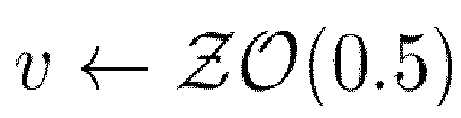

- Dec sk ( c ). m̅ =〈 c , sk〉 may be output.
- Add( c 1, c 2). For

- Mult evk ( c 1, c 2). For c 1 = (b 1 , a1 ),

- RS l→l' ( c ). For


- KS swk ( c ). For

- In addition to the operations above, key switching techniques may be used to provide various operations such as complex conjugate and rotation.
- The basic operations supported herein may similarly apply to full-RNS variants of CKKS. Hence, the methods described herein may apply to the CKKS scheme and all variants thereof.
- Bootstrapping for a CKKS scheme may include four steps of Modulus Raising (ModRaise), Putting Polynomial Coefficients in Plaintext Slots (CoeffToSlot), Evaluation of the Approximated Modulus Reduction (EvalMod), and Switching Back to the Coefficient Representation (SlotToCoeff).
- ModRaise may be the procedure to change the modulus of a ciphertext to a greater value. It may be assumed that ct is a ciphertext satisfying m(X) = [〈ct, sk〉] q. t(X) = <ct, sk>(mod XN +1) is one of the form t(X) = ql(X) + m(X) for ||I(X)||∞ < K with a bound


- In relation to CoeffToSlot, the approximate homomorphic operations may be performed in plaintext slots. Thus, in order to deal with t(X), polynomial coefficients may need to be put in the plaintext slots. In CoeffToSlot step, Ecd may be performed homomorphically using matrix multiplication, FFT-like operation using relationships of roots of unity, or a hybrid method of both. Then, two
ciphertexts encrypting 

combination thereof 
- In EvalMod step, the elements of each slot may be considered from the viewpoint of single instruction multiple data (SIMD). In other words, t = ql + m may denote an element in a slot. In EvalMod step, approximated evaluation of [t] q may be performed.
- SlotToCoeff may be an inverse operation of CoeffToSlot.
- As described above, the key part of bootstrapping of the CKKS scheme is the homomorphic evaluation of modulus reduction.
- As shown in
FIG. 2 , by scaling a modulus reduction function by 1/q, [t] q may be defined as t - k for t ∈ Ik . Here, Ik = [k - ∈, k + ∈], and k may be an integer satisfying |k| < K. Further, ∈ may denote the ratio of the maximum coefficient of a message polynomial and a ciphertext modulus, that is,


- Hereinafter, a method of directly finding an approximate polynomial po (t) of [t] q without using intermediate approximation such as a sine or cosine function will be described. The method may use least-squares estimation or L2-norm optimization. The goal may be to find the set of coefficients c = (c 0, c 1 , ..., cn ) to minimize ∥[t] q -p(t)∥∞. Here, a polynomial of a degree n may be defined by

- Here,

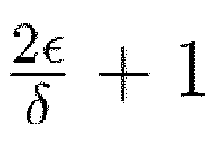

- In other words, Ik = [k - ∈, k + ∈] samples may be extracted respectively from the piecewise
continuous intervals 
FIG. 2 . As will be described later, in the modulus reduction function, each of the piecewise continuous intervals Ik = [k - ∈, k + ∈] may have a symmetrical shape around a reference point (for example, -2, -1, 0, 1, or 2). The approximate polynomial may be determined using only the samples extracted from a portion divided by the reference point in each of the piecewise continuous intervals Ik = [k - ∈, k + ∈] (for example, a portion having the value of the modulus reduction function greater than 0 or less than 0). - The object function to be minimized is given as follows.

- Here, T is an Ntot × (n + 1) matrix satisfying


- Unfortunately, the entries of T may have very large values or very small values close to zero as the degree n of the polynomial is high.
- Thus, the Chebyshev polynomials may be utilized as the basis of the polynomial instead of the power basis. In other words, the Ntot × (n + 1) matrix T may be redefined with entries


- Then, the optimal coefficient vector c* may be given as follows.

- As the loss is a convex function, the optimum solution c* may be at the gradient zero. The gradient of the loss function Lc may be given as follows.

- Setting the gradient to zero may produce the optimum coefficient as follows.

- To sum up, the modulus reduction function may be approximated as follows.


- The approximation error may be bounded by the multiplication of the maximum error of sampled points and

- For t ∈ Ik, the approximation error may be defined as an absolute value as follows.

- E(t) may be a polynomial for a domain t ∈ Ik . E(t) = ∑ jĉjxj may be denoted. |E(ti )| for discrete points

- [ti, ti + δ) for t in a small interval |E(t)| may be considered. Then, |E(t)| ≤ |E(ti )|+|E(t)-E(ti )| may be determined, and |E(t)-E(ti )| may be bounded as follows.
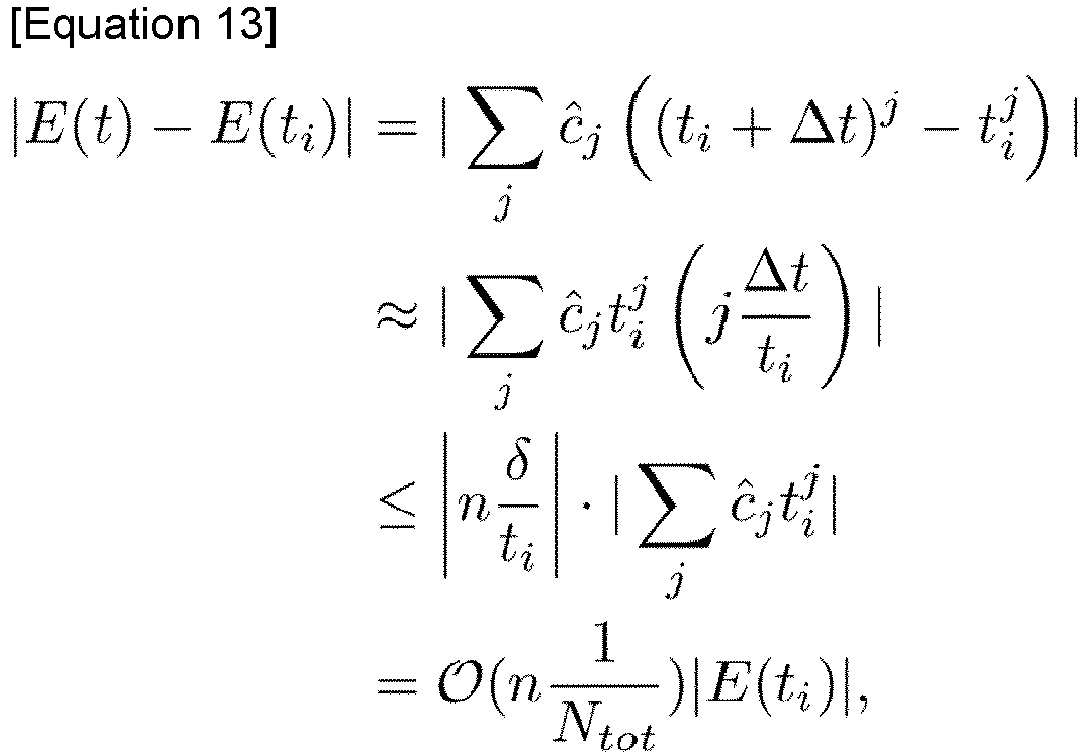
- Here, t ∈ [ti , ti + δ) may be built for Δt = t - ti. As Δt < δ << ti ,
linear approximation 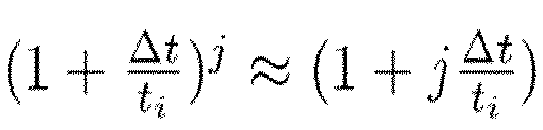


- Hence, the following equation may be derived.

- In summary, with fine sampling, the maximum error of sampled points may be close to the global maximum of the approximation error. Moreover, since the domain of the object function is the real numbers with error in the CKKS scheme, it may be reasonable to handle the sampled values.
- An L-infinity norm may be bounded by an L2-norm as follows.

- Thus, minimizing the L2-norm may reduce the L-infinity norm. As it is not a tight bound, there may be room for optimization using a higher norm. However, the solution of the L2-norm may be clear and computed effortlessly. Although it is difficult to find a minimax polynomial of the modulus reduction function, it is possible to find the near-optimal solution of the minimax polynomial in a very efficient way without iteration through the L2-norm optimization problem.
- Considering Ntot > n, the matrix inversion (T T T) -1 may be the dominant computation. Hence, the time complexity may be
- An approximate polynomial may be optimized with the Chebyshev polynomial as a basis. Hence, the baby-step giant-step algorithm and the modified Paterson-Stockmeyer algorithm may be applied for the efficient homomorphic evaluation of the proposed polynomial. Using the Algorithm baby-step giant-step algorithm, po (t) may be homomorphically evaluated with at most 2 l +2m-l +m-l-3 nonscalar multiplications while consuming m depth. Here, 2 m may be greater than the degree n.
- When the Chebyshev polynomials are evaluated through the baby-step giant-step algorithm,

- In baby-step of the baby-step giant-step algorithm, polynomials of a degree 2 l -1 may be evaluated, and there may be at most 2 m /2 l polynomials. However, when 2 m > n+1, there may be polynomials with all-zero coefficients. By ignoring them, there may be ┌(n+1)/2 l ┐ polynomials with a degree of at most 2 l -1 in the baby-step. In other words, as 2 m and n+1 differ, there may be 0·T 0(t)+0·T 1(t)+...+0·T 2
l-1 (t) polynomials corresponding to 2m-l-┌(n+1)/2 l ┐ in the baby-step giant-step algorithm. Hence, these zero polynomials may be ignored, and from the recursive structure, exactly 2m-l -┌(n+1)/2 l ┐ nonscalar multiplications may be ignored in the giant-step. Hence, by using 2 m' > n ≥ 2 m'-1>, N(n) = N(n-2 m'-1) + N(2 m'-1-1)+1 may be obtained, and N(n) = ┌(n+1)/2 l ┐-1 may be yielded. - Here, N(k), k ≥ 2 l denotes the number of nonscalar multiplications in the giant-step, and N(k) = 0 for k < 2 l . Thus, the number of nonscalar multiplications may be given as ┌(n+1)/2 l ┐-1+2 l -1+m-l-1.
- The number of scalar multiplications may be (n+1)-┌(n+1)/2 l ┐, and the number of additions may be n+2(2 l +m-l-2). The depth and the number of nonscalar multiplications may be minimized when m is the smallest integer satisfying 2 m > n and l ≈ m/2.
- Maximum approximation errors may be similar to each other when the degrees of approximate polynomials are 2n-1 and 2n. This is because the target of approximation, the modulus reduction function [t] q , is an odd function. The following proposition shows that the minimax polynomial for an odd function is an odd function.
- Proposition: If f(t) is an odd function, the best approximation among the polynomials of a degree n is also odd.
- Pm denotes a subspace of a polynomial function of a degree of at most m, and fm (t) denotes a unique element of Pm that is closest to f(t) in a supreme norm.
- p(t) ∈ Pm by


- If p(t) ≠ fm (t), it contradicts that fm (t) is the closest to f(t). Hence,

- Among the polynomial coefficients of the proposed method, the coefficient of even-order terms may have a very small value that is close to 0 in po (t). This is an evidence that the proposed method finds a polynomial near the minimax polynomial because the modulus reduction function is an odd function. Even terms may be a handicap in finding an approximate polynomial. Therefore, a more accurate approximate polynomial may be generated by approximating using only odd-order Chebyshev polynomials.
- One of the advantages of the proposed method is that it is possible to utilize the characteristics of the odd function. Using the fact that the odd function is symmetric about the origin, the L2-norm minimization may be solved only with samples with values greater than 0 (or samples with values less than 0). Accordingly, the number of rows and the number of columns of the matrix T may be respectively halved. Consequently, the time complexity of matrix inversion may be reduced to about 1/8. Further, some operations on even-order terms may be ignored during homomorphic evaluation.
- When the proposed method is used, a more suitable parameter may be selected to reduce a level loss during bootstrapping. As described above, the proposed method may find a more accurate approximate polynomial if it is relatively greater than the previous best method. Hereinafter, a method of selecting parameters based on these characteristics will be described.
- For noise estimation, the following lemmas may be used.
-
Lemma 2 Let c' ← RSl→l' ( c ) for a ciphertext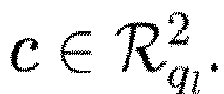


-
Lemma 3 Let


- In order to maintain the precision of values in slots, a sufficiently great scaling factor

Lemma 3 above, the total error of CoeffToSlot step may bewhen a sufficiently great P is selected.
- In EvalMod step, each component in a corresponding plaintext slot may contain tj +ej for a small error ej such as


- To bound an error in EvalMod step by, the following may need to be guaranteed.


- When the error in EvalMod step is bounded by, an error after SlotToCoeff step may be bounded by


- In
Lemma 2 above, an error in bootstrapping may be independent of the scaling factor of the message Δ and bounded by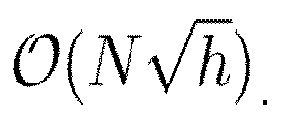 rather than
 . This is one of the advantages of the proposed method, which may overcome the limitations in the existing method and obtain more effects as a more accurate calculation is required.
- Various factors, such as the number of slots, may affect the plaintext precision. Thus, the plaintext precision may be obtained using a numerical method and be used to determine parameters. When the proposed method is used, a relatively small q may be used, and thus in some cases, more levels may be left after bootstrapping.
- Through the foregoing description, an approximate polynomial of the modulus reduction function for bootstrapping may be determined. The problem of finding an approximate polynomial for modulus reduction may be cast into an L2-norm minimization problem of which a solution may be directly found without an intermediate function such as a sine function.
- As the approximation error in the proposed method is not subject to a sine function, it is possible to approximate the modulus reduction with high accuracy. Using the Chebyshev polynomials as a basis, a lower approximation error may be achieved even with a polynomial with a lower degree. Further, the proposed polynomial may utilize the baby-step giant-step algorithm and the Paterson-Stockmeyer algorithm. It may be learned that the proposed polynomial reduces the required number of operations for homomorphic approximate modulus reduction, based on the numbers of nonscalar multiplications, scalar multiplications, and additions for the baby-step giant-step algorithm.
- The proposed method may offer a less-error bootstrapping especially when a large scaling factor is selected. Accordingly, the choice of parameters may be expanded. Most importantly, the proposed method may be essential for applications that require accurate approximation. Conversely, the proposed method does not have such as lower bound and thus, may select better parameters. Consequently, bootstrapping may consume lower levels when using the proposed method.
-
FIG. 3 illustrates an example of determining an approximate polynomial. - In
operation 301, the number of samples N, the degree n of an approximate polynomial, and a target error etarget may be determined. For example, the number of samples N may be determined to be 16. However, examples are not limited thereto. The number of initial samples may be set in various manners according to circumstances. - In
operation 302, N samples t1, ..., tN(2K-1) may be extracted from each interval Ik . Here,
- In
operation 303, an approximate polynomial T using the Chebyshev polynomials as a basis and a function value Y corresponding to a modulus reduction may be determined. Here, [t] q = t-k for t ∈ Ik and
- In
operation 304, an optimal coefficient vector c* that minimizes an L2-norm of the differences between modulus reduction function values [ti ] q and values p(t¡) = ∑ i∈[0,n] c[k]Tk (ti) of polynomials of a degree n may be determined for the respective samples. - In
operation 305, an approximate polynomial pn (t) may be determined using the determined optimal coefficient vector c*. - In
operation 306, an error error between the determined approximate polynomial pn (t) and the modulus reduction function [t] q may be calculated. - In
operation 307, whether the calculated error error is less than a target error etarget may be determined. If the calculated error error is greater than or equal to the target error etarget,operation 308 may be performed. - In
operation 308, whether a similarity between the calculated error error and an error calculated in a previous step is less than a predetermined threshold similarity is determined. If the similarity is less than the predetermined threshold similarity, that is, if the error error calculated at the current step is reduced below the error calculated in the previous step and thus, they are not similar to each other,operation 309 may be performed to increase the number of samples N. Conversely, if the similarity is greater than or equal to the predetermined threshold similarity, that is, if the error error calculated in the current step is similar to the error calculated in the previous step,operation 310 may be performed to increase the degree n of the approximate polynomial. As such, since the approximate polynomial may not approximate the modulus reduction function well if there are fewer samples, the number of samples N needs to be increased. That the error is not significantly reduced even when the number of samples is increased may indicate that the degree of the approximate polynomial is insufficient. Thus, the degree n may be increased. As described above, since the approximate polynomial may include odd-order terms, the degree n may be increased by 2. - If it is determined in
operation 307 that the calculated error error is less than the target error etarget,operation 311 may be performed to finally determine and return the approximate polynomial pn (t). - The approximate polynomial expressed by the coefficients found using the method described above may be utilized for bootstrapping in fully homomorphic encryption through various methods including operations for reducing the depth or the number of operations, such as the baby-step giant-step algorithm or Paterson-Stockmeyer algorithm.
- In some examples, only Chebyshev polynomials of a portion of degrees may be used as the approximate polynomial for ease of operation. Further, in addition to the Chebyshev polynomials, Legendre polynomials or powers of x may be used as a basis.
-
FIG. 4 illustrates an example of bootstrapping using an approximate polynomial determined. - In
operation 410, a ciphertext requiring a modulus operation during a bootstrapping process may be identified. Inoperation 420, an approximate polynomial p(t) for the modulus reduction function determined in the example ofFIG. 3 may be evaluated homomorphically. Inoperation 430, an approximation result of the modulus operation may be obtained. -
FIG. 5 illustrates an example of a ciphertext processing method. - Referring to
FIG. 5 , a ciphertext processing method performed by a processor provided in a ciphertext processing apparatus is shown. - In
operation 510, the ciphertext processing apparatus determine an approximate polynomial corresponding to a modulus reduction for bootstrapping a ciphertext based on samples extracted from the modulus reduction. The ciphertext processing apparatus may determine a coefficient of the approximate polynomial such that differences between the samples and values of the approximate polynomial are less than a predetermined threshold. - The ciphertext processing apparatus may verify whether the differences between the samples and the values of the approximate polynomial are less than the predetermined threshold, and increase, in response to the differences being greater than or equal to the predetermined threshold, the number of samples or the degree of the approximate polynomial based on a comparison between the differences and differences determined in a previous step. For example, the ciphertext processing apparatus may increasing the number of samples, in response to a similarity between the differences and the differences determined in the previous step being less than a predetermined threshold similarity, and increase the degree of the approximate polynomial, in response to the similarity being greater than or equal to the predetermined threshold similarity. The differences between the samples and the values of the approximate polynomial may be determined based on an L2-norm between the samples and the values of the approximate polynomial.
- The ciphertext processing apparatus may determine the approximate polynomial including odd-order terms. The ciphertext processing apparatus may determine the approximate polynomial using the Chebyshev polynomials as a basis.
- In
operation 520, the ciphertext processing apparatus bootstraps the ciphertext based on the approximate polynomial. The ciphertext processing apparatus may bootstrap the ciphertext by homomorphically evaluating the modulus reduction using the approximate polynomial. - The descriptions provided with reference to
FIGS. 1 to 4 may apply to the operations shown inFIG. 5 , and thus further detailed descriptions will be omitted. -
FIG. 6 illustrates an example of a ciphertext processing apparatus. - Referring to
FIG. 6 , aciphertext processing apparatus 600 includes amemory 610 and aprocessor 620. Thememory 610 and theprocessor 620 may communicate with each other through abus 630. - The
memory 610 may include computer-readable instructions. Theprocessor 620 may perform the operations described above when the instructions stored in thememory 610 are executed by theprocessor 620. Thememory 610 may be a volatile memory or a non-volatile memory. - The
processor 620 is a device that executes the instructions or programs or that controls theciphertext processing apparatus 600, and may include, for example, a central processing unit (CPU), a graphics processing unit (GPU), and the like. Theprocessor 620 may determine an approximate polynomial corresponding to a modulus reduction for bootstrapping a ciphertext based on samples extracted from the modulus reduction, and bootstrap the ciphertext based on the approximate polynomial. - The
ciphertext processing apparatus 600 may be used in a process of bootstrapping a ciphertext in which a plaintext including real numbers or complex numbers is encrypted, during fully homomorphic encryption. If the degree of the approximate polynomial determined by theciphertext processing apparatus 600 is lowered, the number of operations may be reduced. Thus, resources required for the ciphertext processing operation may be effectively reduced. - In addition, the
ciphertext processing apparatus 600 may be applied to the technical field of encryption/security, such as, for example, cloud computing, information protection machine learning, all other homomorphic encryption applications, network security, system (terminal) security, password/authentication, security management, content/information leakage prevention security, authentication service, and the like. - In addition, the
ciphertext processing apparatus 600 may process the operations described above. - The units described herein may be implemented using a hardware component, a software component and/or a combination thereof. A processing device may be implemented using one or more general-purpose or special-purpose computers, such as, for example, a processor, a controller and an arithmetic logic unit (ALU), a DSP, a microcomputer, an FPGA, a programmable logic unit (PLU), a microprocessor or any other device capable of responding to and executing instructions in a defined manner. The processing device may run an operating system (OS) and one or more software applications that run on the OS. The processing device also may access, store, manipulate, process, and create data in response to execution of the software. For purpose of simplicity, the description of a processing device is used as singular; however, one skilled in the art will appreciate that a processing device may include multiple processing elements and multiple types of processing elements. For example, a processing device may include multiple processors or a processor and a controller. In addition, different processing configurations are possible, such as parallel processors.
- The software may include a computer program, a piece of code, an instruction, or some combination thereof, to independently or uniformly instruct or configure the processing device to operate as desired. Software and data may be embodied permanently or temporarily in any type of machine, component, physical or virtual equipment, computer storage medium or device, or in a propagated signal wave capable of providing instructions or data to or being interpreted by the processing device. The software also may be distributed over network-coupled computer systems so that the software is stored and executed in a distributed fashion. The software and data may be stored by one or more non-transitory computer-readable recording mediums.
- The methods according to the above-described examples may be recorded in non-transitory computer-readable media including program instructions to implement various operations of the above-described examples. The media may also include, alone or in combination with the program instructions, data files, data structures, and the like. The program instructions recorded on the media may be those specially designed and constructed for the purposes of examples, or they may be of the kind well-known and available to those having skill in the computer software arts. Examples of non-transitory computer-readable media include magnetic media such as hard disks, floppy disks, and magnetic tape; optical media such as CD-ROM discs, DVDs, and/or Blue-ray discs; magneto-optical media such as optical discs; and hardware devices that are specially configured to store and perform program instructions, such as read-only memory (ROM), random access memory (RAM), flash memory (e.g., USB flash drives, memory cards, memory sticks, etc.), and the like. Examples of program instructions include both machine code, such as produced by a compiler, and files containing higher-level code that may be executed by the computer using an interpreter. The above-described devices may be configured to act as one or more software modules in order to perform the operations of the above-described examples, or vice versa.
- A number of examples have been described above. Nevertheless, it should be understood that various modifications may be made to these examples. For example, suitable results may be achieved if the described techniques are performed in a different order and/or if components in a described system, architecture, device, or circuit are combined in a different manner and/or replaced or supplemented by other components or their equivalents.
Claims (15)
- A method comprising:determining an approximate polynomial corresponding to a modulus reduction for bootstrapping a ciphertext based on samples extracted from the modulus reduction; andbootstrapping the ciphertext based on the approximate polynomial.
- The method of claim 1, wherein the determining comprises determining a coefficient of the approximate polynomial such that current differences between the samples extracted from the modulus reduction and values of the approximate polynomial are less than a predetermined threshold.
- The method of claim 2, wherein the determining comprises:verifying whether the current differences between the samples extracted from the modulus reduction and the values of the approximate polynomial are less than the predetermined threshold; andincreasing, in response to the current differences being greater than or equal to the predetermined threshold, the number of samples or a degree of the approximate polynomial based on a comparison between the current differences and differences determined in a previous step.
- The method of claim 3, wherein the determining comprises:increasing the number of samples, in response to a similarity between the current differences and the differences determined in the previous step being less than a predetermined threshold similarity; andincreasing the degree of the approximate polynomial, in response to the similarity being greater than or equal to the predetermined threshold similarity.
- The method of claim 2, wherein the differences between the samples extracted from the modulus reduction and the values of the approximate polynomial are determined based on an L2-norm between the samples extracted from the modulus reduction and the values of the approximate polynomial.
- The method of one of claims 1 to 5, wherein the determining comprises determining the approximate polynomial including odd-order terms, or determining the approximate polynomial using the Chebyshev polynomials as a basis, or
wherein the bootstrapping comprises bootstrapping the ciphertext by homomorphically
evaluating the modulus reduction using the approximate polynomial. - The method of one of claims 1 to 6, wherein the samples are extracted from a piecewise continuous interval having a symmetric shape about a reference point in a function corresponding to the modulus reduction, and
wherein the samples are extracted from a portion divided by the reference point in the piecewise continuous interval. - An apparatus for processing a ciphertext, the apparatus comprising:one or more processors,wherein the one or more processors are configured to:determine an approximate polynomial corresponding to a modulus reduction for bootstrapping a ciphertext based on samples extracted from the modulus reduction, andbootstrap the ciphertext based on the approximate polynomial.
- The apparatus of claim 8, wherein the one or more processors are configured to determine a coefficient of the approximate polynomial such that current differences between the samples extracted from the modulus reduction and values of the approximate polynomial are less than a predetermined threshold.
- The apparatus of claim 9, wherein the one or more processors are configured to:verify whether the current differences between the samples extracted from the modulus reduction and the values of the approximate polynomial are less than the predetermined threshold, andincrease, in response to the current differences being greater than or equal to the predetermined threshold, the number of samples or a degree of the approximate polynomial based on a comparison between the current differences and differences determined in a previous step.
- The apparatus of claim 10, wherein the one or more processors are configured to:increase the number of samples, in response to a similarity between the current differences and the differences determined in the previous step being less than a predetermined threshold similarity, andincrease the degree of the approximate polynomial, in response to the similarity being greater than or equal to the predetermined threshold similarity.
- The apparatus of claim 9, wherein the differences between the samples extracted from the modulus reduction and the values of the approximate polynomial are determined based on an L2-norm between the samples and the values of the approximate polynomial.
- The apparatus of one of claims 8 to 12, wherein the one or more processors are configured to determine the approximate polynomial including odd-order terms, or
wherein the one or more processors are configured to determine the approximate polynomial using the Chebyshev polynomials as a basis, or
wherein the samples are extracted from a piecewise continuous interval having a symmetric shape about a reference point in a function corresponding to the modulus reduction, or
wherein the samples are extracted from a portion divided by a reference point in a piecewise continuous interval. - A non-transitory computer-readable storage medium storing instructions that, when executed by a processor, cause the processor to perform the a method comprising:determining an initial approximate polynomial corresponding to a modulus reduction for bootstrapping a ciphertext based on an initial number of samples extracted from the modulus reduction;calculating an error between the initial approximate polynomial and the modulus reduction function;increasing one of the initial number of samples and a degree of the initial approximate polynomial based on the error;determining an updated approximate polynomial based on either the increased number of samples or the increased degree of the initial approximate polynomial; andhomomorphically evaluating the modulus reduction using the updated approximate polynomial.
- The computer-readable storage medium of claim 14, wherein calculating the error includes determining that differences between the initial number of samples extracted from the modulus reduction and values of the initial approximate polynomial are greater than or equal to a threshold.
Applications Claiming Priority (2)
| Application Number | Priority Date | Filing Date | Title |
|---|---|---|---|
| US202063010812P | 2020-04-16 | 2020-04-16 | |
| KR1020200137640A KR20210128313A (en) | 2020-04-16 | 2020-10-22 | Method and apparatus for processing ciphertext based on homogeneous encryption |
Publications (2)
| Publication Number | Publication Date |
|---|---|
| EP3896895A1 true EP3896895A1 (en) | 2021-10-20 |
| EP3896895B1 EP3896895B1 (en) | 2023-05-03 |
Family
ID=74947205
Family Applications (1)
| Application Number | Title | Priority Date | Filing Date |
|---|---|---|---|
| EP21163199.9A Active EP3896895B1 (en) | 2020-04-16 | 2021-03-17 | Method and apparatus for processing ciphertext based on homomorphic encryption |
Country Status (3)
| Country | Link |
|---|---|
| US (1) | US11546134B2 (en) |
| EP (1) | EP3896895B1 (en) |
| CN (1) | CN113541916B (en) |
Cited By (2)
| Publication number | Priority date | Publication date | Assignee | Title |
|---|---|---|---|---|
| CN115426206A (en) * | 2022-11-07 | 2022-12-02 | 中邮消费金融有限公司 | Graph anti-fraud capability enabling method and system based on homomorphic encryption technology |
| CN116388960A (en) * | 2023-04-06 | 2023-07-04 | 西北工业大学 | Bootstrap method for small interval interpolation fitting based on remainder system |
Families Citing this family (22)
| Publication number | Priority date | Publication date | Assignee | Title |
|---|---|---|---|---|
| JP2023518705A (en) * | 2020-03-17 | 2023-05-08 | ソニーグループ株式会社 | Verification of user data privacy protection |
| US12137158B2 (en) * | 2021-05-07 | 2024-11-05 | Duality Technologies, Inc. | Large-word approximate homomorphic encryption |
| US12463792B2 (en) * | 2021-06-28 | 2025-11-04 | Duality Technologies, Inc. | Accelerated division of homomorphically encrypted data |
| JP7228286B1 (en) * | 2021-10-20 | 2023-02-24 | 株式会社アクセル | Cryptographic processing device, cryptographic processing method, and cryptographic processing program |
| US12231531B2 (en) | 2021-11-11 | 2025-02-18 | Samsung Electronics Co., Ltd. | Homomorphic encryption system for supporting approximate arithmetic operation and method of operating the same |
| US12316736B2 (en) | 2021-11-11 | 2025-05-27 | Samsung Electronics Co., Ltd. | Device for supporting homomorphic encryption operation and operating method thereof |
| JP7228287B1 (en) * | 2021-11-15 | 2023-02-24 | 株式会社アクセル | Cryptographic processing device, cryptographic processing method, and cryptographic processing program |
| CN113965313B (en) * | 2021-12-15 | 2022-04-05 | 北京百度网讯科技有限公司 | Model training method, device, equipment and storage medium based on homomorphic encryption |
| EP4228197B1 (en) * | 2022-02-10 | 2024-10-23 | Seoul National University R & DB Foundation | Key management system for homomorphic encryption operation and method of operating the same |
| US12362904B2 (en) | 2022-02-18 | 2025-07-15 | Samsung Electronics Co., Ltd. | Homomorphic encryption operation accelerator, and operating method of homomorphic encryption operation accelerator |
| US20240039691A1 (en) * | 2022-07-26 | 2024-02-01 | International Business Machines Corporation | Management of accurate scales in fully-homomorphic encryption schemes |
| CN115941152B (en) * | 2022-08-27 | 2026-01-30 | 西北工业大学 | Homomorphic encryption bootstrapping method based on inter-small-area interpolation fitting approximation calculation |
| JP7649558B2 (en) * | 2022-11-24 | 2025-03-21 | 株式会社アクセル | Cryptographic processing device, cryptographic processing method, and cryptographic processing program |
| CN116776359B (en) * | 2023-08-23 | 2023-11-03 | 北京电子科技学院 | Ciphertext homomorphic comparison method and device based on homomorphic encryption |
| US12587355B2 (en) | 2023-09-05 | 2026-03-24 | International Business Machines Corporation | Polynomial evaluation under fully homomorphic encryption |
| US20250150256A1 (en) * | 2023-11-02 | 2025-05-08 | Crypto Lab Inc. | Server device for providing homomorphic encryption ai model and method thereof |
| EP4604445B1 (en) * | 2024-02-13 | 2026-04-29 | Crypto Lab Inc. | Method for processing homomorphic encryption and electronic apparatus |
| US20250274265A1 (en) * | 2024-02-28 | 2025-08-28 | International Business Machines Corporation | Ciphertext Nullification Operations |
| US12483383B2 (en) | 2024-02-28 | 2025-11-25 | International Business Machines Corporation | Approximate homomorphic cryptographic operations |
| US12562886B2 (en) | 2024-03-13 | 2026-02-24 | International Business Machines Corporation | Fast polynomial evaluation under fully homomorphic encryption by products of differences from roots using rotations |
| US12701002B2 (en) * | 2024-03-22 | 2026-08-04 | Chain Reaction, Ltd. | Method of optimizing linear transformation |
| EP4645746A1 (en) * | 2024-04-29 | 2025-11-05 | Crypto Lab Inc. | Electronic device and controlling method thereof |
Family Cites Families (24)
| Publication number | Priority date | Publication date | Assignee | Title |
|---|---|---|---|---|
| EP2097818A4 (en) * | 2006-11-22 | 2014-01-29 | Parkervision Inc | Multi-dimensional error correction for communications systems |
| JP5836773B2 (en) * | 2011-11-25 | 2015-12-24 | キヤノン株式会社 | Drawing apparatus and article manufacturing method |
| EP2667539A1 (en) * | 2012-05-21 | 2013-11-27 | Koninklijke Philips N.V. | Key sharing methods, device and system for configuration thereof. |
| KR101608515B1 (en) | 2013-10-14 | 2016-04-01 | 서울대학교기술지주 주식회사 | Computation Method of encrypted data using Homomorphic Encryption and Public Key Encryption and Server using the same |
| KR101618941B1 (en) | 2014-01-09 | 2016-05-09 | 서울대학교산학협력단 | Computation Method of encrypted data using Homomorphic Encryption and Pairing-based Encryption and Server using the same |
| KR102251697B1 (en) | 2014-04-23 | 2021-05-14 | 삼성전자주식회사 | Encryption apparatus, method for encryption and computer-readable recording medium |
| KR101600016B1 (en) | 2014-12-10 | 2016-03-15 | 서울대학교기술지주 주식회사 | method of encrypting data using Homomorphic Encryption and Computing device performing the method |
| US10333696B2 (en) | 2015-01-12 | 2019-06-25 | X-Prime, Inc. | Systems and methods for implementing an efficient, scalable homomorphic transformation of encrypted data with minimal data expansion and improved processing efficiency |
| CN106160995B (en) | 2015-04-21 | 2019-04-16 | 郑珂威 | The complete homomorphic cryptography method and system of multinomial based on coefficient mapping transformation |
| US9742556B2 (en) * | 2015-08-25 | 2017-08-22 | International Business Machines Corporation | Comparison and search operations of encrypted data |
| KR101971215B1 (en) | 2016-06-17 | 2019-04-22 | 서울대학교산학협력단 | Homomorphic Encryption Method Supporting Floating-Point Arithmetic and Floating-Point Arithmetic Method for Encrypted Message Generated by the Same |
| KR101861089B1 (en) | 2016-07-28 | 2018-05-25 | 서울대학교산학협력단 | Homomorphic Encryption Method of a Plurality of Messages Supporting Approximate Arithmetic of Complex Numbers |
| KR101919940B1 (en) | 2017-02-08 | 2018-11-19 | 서울대학교산학협력단 | Method for Processing Dynamic Data by Fully Homomorphic Encryption |
| CN107864033B (en) * | 2017-05-16 | 2020-04-24 | 中国人民武装警察部队工程大学 | Bootstrap type symmetrical fully homomorphic encryption method |
| US20190007196A1 (en) * | 2017-06-28 | 2019-01-03 | Qatar University | Method and system for privacy preserving computation in cloud using fully homomorphic encryption |
| US10728017B2 (en) | 2017-11-03 | 2020-07-28 | International Business Machines Corporation | Performing vector comparison operations in fully homomorphic encryption |
| KR101965628B1 (en) | 2017-12-15 | 2019-04-04 | 서울대학교산학협력단 | Terminal device for performing homomorphic encryption, server device for calculating encrypted messages, and methods thereof |
| KR102040106B1 (en) | 2018-10-29 | 2019-11-27 | 주식회사 크립토랩 | Method for homomorphic encryption of plain text in real numbers |
| US11032061B2 (en) * | 2018-04-27 | 2021-06-08 | Microsoft Technology Licensing, Llc | Enabling constant plaintext space in bootstrapping in fully homomorphic encryption |
| US11374736B2 (en) | 2018-06-20 | 2022-06-28 | Clemson University | System and method for homomorphic encryption |
| US11087223B2 (en) | 2018-07-11 | 2021-08-10 | International Business Machines Corporation | Learning and inferring insights from encrypted data |
| KR102040120B1 (en) | 2018-07-27 | 2019-11-05 | 주식회사 크립토랩 | Apparatus for processing approximate encripted messages and methods thereof |
| US11177935B2 (en) | 2018-08-31 | 2021-11-16 | Microsoft Technology Licensing, Llc | Homomorphic evaluation of tensor programs |
| CN110084063B (en) * | 2019-04-23 | 2022-07-15 | 中国科学技术大学 | A Gradient Descent Computation Method for Protecting Privacy Data |
-
2021
- 2021-02-10 US US17/172,643 patent/US11546134B2/en active Active
- 2021-03-09 CN CN202110257766.8A patent/CN113541916B/en active Active
- 2021-03-17 EP EP21163199.9A patent/EP3896895B1/en active Active
Non-Patent Citations (3)
| Title |
|---|
| HAO CHEN ET AL: "Improved Bootstrapping for Approximate Homomorphic Encryption", vol. 20181102:005546, 28 October 2018 (2018-10-28), pages 1 - 21, XP061026605, Retrieved from the Internet <URL:http://eprint.iacr.org/2018/1043.pdf> [retrieved on 20181028] * |
| JACOB ALPERIN-SHERIFF ET AL: "Faster Bootstrapping with Polynomial Error", IACR, INTERNATIONAL ASSOCIATION FOR CRYPTOLOGIC RESEARCH, vol. 20140614:002953, 14 June 2014 (2014-06-14), pages 1 - 18, XP061016271 * |
| YONGWOO LEE ET AL: "Near-optimal Polynomial for Modulus Reduction Using L2-norm for Approximate Homomorphic Encryption", vol. 20200428:121602, 27 April 2020 (2020-04-27), pages 1 - 9, XP061035774, Retrieved from the Internet <URL:http://eprint.iacr.org/2020/488.pdf> [retrieved on 20200427] * |
Cited By (2)
| Publication number | Priority date | Publication date | Assignee | Title |
|---|---|---|---|---|
| CN115426206A (en) * | 2022-11-07 | 2022-12-02 | 中邮消费金融有限公司 | Graph anti-fraud capability enabling method and system based on homomorphic encryption technology |
| CN116388960A (en) * | 2023-04-06 | 2023-07-04 | 西北工业大学 | Bootstrap method for small interval interpolation fitting based on remainder system |
Also Published As
| Publication number | Publication date |
|---|---|
| CN113541916B (en) | 2026-03-13 |
| EP3896895B1 (en) | 2023-05-03 |
| US20210328766A1 (en) | 2021-10-21 |
| US11546134B2 (en) | 2023-01-03 |
| CN113541916A (en) | 2021-10-22 |
Similar Documents
| Publication | Publication Date | Title |
|---|---|---|
| EP3896895B1 (en) | Method and apparatus for processing ciphertext based on homomorphic encryption | |
| US11700110B2 (en) | Approximate algebraic operations for homomorphic encryption | |
| EP3644544A1 (en) | Method for comparing ciphertext using homomorphic encryption and apparatus for executing thereof | |
| EP3893429B1 (en) | Apparatus and method for performing non-polynomial calculation on cryptogram | |
| KR20210128313A (en) | Method and apparatus for processing ciphertext based on homogeneous encryption | |
| JP7449911B2 (en) | Device that performs non-polynomial operations on isomorphic ciphertext | |
| US20120151205A1 (en) | Polynomial evaluation delegation | |
| EP3573039B1 (en) | Secure computing system, secure computing device, secure computing method, and program | |
| Tjell et al. | Privacy in distributed computations based on real number secret sharing | |
| WO2019124260A1 (en) | Secure computation system and method | |
| CN109190395A (en) | A kind of full homomorphic cryptography method and system based on data transformation | |
| WO2014021102A1 (en) | Encryption system, encryption method, encryption program and decryption device | |
| JP2012128398A (en) | Method and system for selecting sequence of encrypted elements with privacy protected | |
| US11799628B2 (en) | Apparatus and method for processing non-polynomial operation on encrypted messages | |
| Kuo et al. | A lattice attack on crystals-Kyber with correlation power analysis | |
| CN118643541A (en) | Data processing method, device, system, equipment, medium and program product | |
| CN115529120A (en) | A secure computing system | |
| EP3633656B1 (en) | Secret tampering detection system, secret tampering detection apparatus, secret tampering detection method, and program | |
| CN115065456A (en) | Improved homomorphic multiplication encryption method supporting floating-point operation | |
| Ren et al. | CKKS speech fully homomorphic encryption method based on GPU multi-threading | |
| KR20250045878A (en) | Apparatus and method for set intersection operation | |
| WO2022137447A1 (en) | Confidential information processing system, and confidential information processing method | |
| CN117254898B (en) | Batch-OT-based privacy set intersection method, system, electronic device and medium | |
| US10972283B2 (en) | System, method, and computer program product for zero round trip secure communications based on noisy secrets | |
| Wang et al. | High-throughput privacy-preserving GRU network with homomorphic encryption |
Legal Events
| Date | Code | Title | Description |
|---|---|---|---|
| PUAI | Public reference made under article 153(3) epc to a published international application that has entered the european phase |
Free format text: ORIGINAL CODE: 0009012 |
|
| STAA | Information on the status of an ep patent application or granted ep patent |
Free format text: STATUS: THE APPLICATION HAS BEEN PUBLISHED |
|
| AK | Designated contracting states |
Kind code of ref document: A1 Designated state(s): AL AT BE BG CH CY CZ DE DK EE ES FI FR GB GR HR HU IE IS IT LI LT LU LV MC MK MT NL NO PL PT RO RS SE SI SK SM TR |
|
| B565 | Issuance of search results under rule 164(2) epc |
Effective date: 20210820 |
|
| STAA | Information on the status of an ep patent application or granted ep patent |
Free format text: STATUS: REQUEST FOR EXAMINATION WAS MADE |
|
| 17P | Request for examination filed |
Effective date: 20220420 |
|
| RBV | Designated contracting states (corrected) |
Designated state(s): AL AT BE BG CH CY CZ DE DK EE ES FI FR GB GR HR HU IE IS IT LI LT LU LV MC MK MT NL NO PL PT RO RS SE SI SK SM TR |
|
| GRAP | Despatch of communication of intention to grant a patent |
Free format text: ORIGINAL CODE: EPIDOSNIGR1 |
|
| STAA | Information on the status of an ep patent application or granted ep patent |
Free format text: STATUS: GRANT OF PATENT IS INTENDED |
|
| INTG | Intention to grant announced |
Effective date: 20230111 |
|
| GRAS | Grant fee paid |
Free format text: ORIGINAL CODE: EPIDOSNIGR3 |
|
| GRAA | (expected) grant |
Free format text: ORIGINAL CODE: 0009210 |
|
| STAA | Information on the status of an ep patent application or granted ep patent |
Free format text: STATUS: THE PATENT HAS BEEN GRANTED |
|
| AK | Designated contracting states |
Kind code of ref document: B1 Designated state(s): AL AT BE BG CH CY CZ DE DK EE ES FI FR GB GR HR HU IE IS IT LI LT LU LV MC MK MT NL NO PL PT RO RS SE SI SK SM TR |
|
| REG | Reference to a national code |
Ref country code: GB Ref legal event code: FG4D |
|
| REG | Reference to a national code |
Ref country code: DE Ref legal event code: R096 Ref document number: 602021002112 Country of ref document: DE |
|
| REG | Reference to a national code |
Ref country code: AT Ref legal event code: REF Ref document number: 1565601 Country of ref document: AT Kind code of ref document: T Effective date: 20230515 Ref country code: CH Ref legal event code: EP |
|
| REG | Reference to a national code |
Ref country code: IE Ref legal event code: FG4D |
|
| P01 | Opt-out of the competence of the unified patent court (upc) registered |
Effective date: 20230530 |
|
| REG | Reference to a national code |
Ref country code: LT Ref legal event code: MG9D |
|
| REG | Reference to a national code |
Ref country code: NL Ref legal event code: MP Effective date: 20230503 |
|
| REG | Reference to a national code |
Ref country code: AT Ref legal event code: MK05 Ref document number: 1565601 Country of ref document: AT Kind code of ref document: T Effective date: 20230503 |
|
| PG25 | Lapsed in a contracting state [announced via postgrant information from national office to epo] |
Ref country code: SE Free format text: LAPSE BECAUSE OF FAILURE TO SUBMIT A TRANSLATION OF THE DESCRIPTION OR TO PAY THE FEE WITHIN THE PRESCRIBED TIME-LIMIT Effective date: 20230503 Ref country code: PT Free format text: LAPSE BECAUSE OF FAILURE TO SUBMIT A TRANSLATION OF THE DESCRIPTION OR TO PAY THE FEE WITHIN THE PRESCRIBED TIME-LIMIT Effective date: 20230904 Ref country code: NO Free format text: LAPSE BECAUSE OF FAILURE TO SUBMIT A TRANSLATION OF THE DESCRIPTION OR TO PAY THE FEE WITHIN THE PRESCRIBED TIME-LIMIT Effective date: 20230803 Ref country code: NL Free format text: LAPSE BECAUSE OF FAILURE TO SUBMIT A TRANSLATION OF THE DESCRIPTION OR TO PAY THE FEE WITHIN THE PRESCRIBED TIME-LIMIT Effective date: 20230503 Ref country code: ES Free format text: LAPSE BECAUSE OF FAILURE TO SUBMIT A TRANSLATION OF THE DESCRIPTION OR TO PAY THE FEE WITHIN THE PRESCRIBED TIME-LIMIT Effective date: 20230503 Ref country code: AT Free format text: LAPSE BECAUSE OF FAILURE TO SUBMIT A TRANSLATION OF THE DESCRIPTION OR TO PAY THE FEE WITHIN THE PRESCRIBED TIME-LIMIT Effective date: 20230503 |
|
| PG25 | Lapsed in a contracting state [announced via postgrant information from national office to epo] |
Ref country code: RS Free format text: LAPSE BECAUSE OF FAILURE TO SUBMIT A TRANSLATION OF THE DESCRIPTION OR TO PAY THE FEE WITHIN THE PRESCRIBED TIME-LIMIT Effective date: 20230503 Ref country code: PL Free format text: LAPSE BECAUSE OF FAILURE TO SUBMIT A TRANSLATION OF THE DESCRIPTION OR TO PAY THE FEE WITHIN THE PRESCRIBED TIME-LIMIT Effective date: 20230503 Ref country code: LV Free format text: LAPSE BECAUSE OF FAILURE TO SUBMIT A TRANSLATION OF THE DESCRIPTION OR TO PAY THE FEE WITHIN THE PRESCRIBED TIME-LIMIT Effective date: 20230503 Ref country code: LT Free format text: LAPSE BECAUSE OF FAILURE TO SUBMIT A TRANSLATION OF THE DESCRIPTION OR TO PAY THE FEE WITHIN THE PRESCRIBED TIME-LIMIT Effective date: 20230503 Ref country code: IS Free format text: LAPSE BECAUSE OF FAILURE TO SUBMIT A TRANSLATION OF THE DESCRIPTION OR TO PAY THE FEE WITHIN THE PRESCRIBED TIME-LIMIT Effective date: 20230903 Ref country code: HR Free format text: LAPSE BECAUSE OF FAILURE TO SUBMIT A TRANSLATION OF THE DESCRIPTION OR TO PAY THE FEE WITHIN THE PRESCRIBED TIME-LIMIT Effective date: 20230503 Ref country code: GR Free format text: LAPSE BECAUSE OF FAILURE TO SUBMIT A TRANSLATION OF THE DESCRIPTION OR TO PAY THE FEE WITHIN THE PRESCRIBED TIME-LIMIT Effective date: 20230804 |
|
| PG25 | Lapsed in a contracting state [announced via postgrant information from national office to epo] |
Ref country code: FI Free format text: LAPSE BECAUSE OF FAILURE TO SUBMIT A TRANSLATION OF THE DESCRIPTION OR TO PAY THE FEE WITHIN THE PRESCRIBED TIME-LIMIT Effective date: 20230503 |
|
| PG25 | Lapsed in a contracting state [announced via postgrant information from national office to epo] |
Ref country code: SK Free format text: LAPSE BECAUSE OF FAILURE TO SUBMIT A TRANSLATION OF THE DESCRIPTION OR TO PAY THE FEE WITHIN THE PRESCRIBED TIME-LIMIT Effective date: 20230503 |
|
| PG25 | Lapsed in a contracting state [announced via postgrant information from national office to epo] |
Ref country code: SM Free format text: LAPSE BECAUSE OF FAILURE TO SUBMIT A TRANSLATION OF THE DESCRIPTION OR TO PAY THE FEE WITHIN THE PRESCRIBED TIME-LIMIT Effective date: 20230503 Ref country code: SK Free format text: LAPSE BECAUSE OF FAILURE TO SUBMIT A TRANSLATION OF THE DESCRIPTION OR TO PAY THE FEE WITHIN THE PRESCRIBED TIME-LIMIT Effective date: 20230503 Ref country code: RO Free format text: LAPSE BECAUSE OF FAILURE TO SUBMIT A TRANSLATION OF THE DESCRIPTION OR TO PAY THE FEE WITHIN THE PRESCRIBED TIME-LIMIT Effective date: 20230503 Ref country code: EE Free format text: LAPSE BECAUSE OF FAILURE TO SUBMIT A TRANSLATION OF THE DESCRIPTION OR TO PAY THE FEE WITHIN THE PRESCRIBED TIME-LIMIT Effective date: 20230503 Ref country code: DK Free format text: LAPSE BECAUSE OF FAILURE TO SUBMIT A TRANSLATION OF THE DESCRIPTION OR TO PAY THE FEE WITHIN THE PRESCRIBED TIME-LIMIT Effective date: 20230503 Ref country code: CZ Free format text: LAPSE BECAUSE OF FAILURE TO SUBMIT A TRANSLATION OF THE DESCRIPTION OR TO PAY THE FEE WITHIN THE PRESCRIBED TIME-LIMIT Effective date: 20230503 |
|
| REG | Reference to a national code |
Ref country code: DE Ref legal event code: R097 Ref document number: 602021002112 Country of ref document: DE |
|
| PLBE | No opposition filed within time limit |
Free format text: ORIGINAL CODE: 0009261 |
|
| STAA | Information on the status of an ep patent application or granted ep patent |
Free format text: STATUS: NO OPPOSITION FILED WITHIN TIME LIMIT |
|
| 26N | No opposition filed |
Effective date: 20240206 |
|
| PG25 | Lapsed in a contracting state [announced via postgrant information from national office to epo] |
Ref country code: SI Free format text: LAPSE BECAUSE OF FAILURE TO SUBMIT A TRANSLATION OF THE DESCRIPTION OR TO PAY THE FEE WITHIN THE PRESCRIBED TIME-LIMIT Effective date: 20230503 |
|
| PG25 | Lapsed in a contracting state [announced via postgrant information from national office to epo] |
Ref country code: SI Free format text: LAPSE BECAUSE OF FAILURE TO SUBMIT A TRANSLATION OF THE DESCRIPTION OR TO PAY THE FEE WITHIN THE PRESCRIBED TIME-LIMIT Effective date: 20230503 Ref country code: IT Free format text: LAPSE BECAUSE OF FAILURE TO SUBMIT A TRANSLATION OF THE DESCRIPTION OR TO PAY THE FEE WITHIN THE PRESCRIBED TIME-LIMIT Effective date: 20230503 |
|
| REG | Reference to a national code |
Ref country code: CH Ref legal event code: PL |
|
| PG25 | Lapsed in a contracting state [announced via postgrant information from national office to epo] |
Ref country code: BG Free format text: LAPSE BECAUSE OF FAILURE TO SUBMIT A TRANSLATION OF THE DESCRIPTION OR TO PAY THE FEE WITHIN THE PRESCRIBED TIME-LIMIT Effective date: 20230503 |
|
| PG25 | Lapsed in a contracting state [announced via postgrant information from national office to epo] |
Ref country code: LU Free format text: LAPSE BECAUSE OF NON-PAYMENT OF DUE FEES Effective date: 20240317 |
|
| PG25 | Lapsed in a contracting state [announced via postgrant information from national office to epo] |
Ref country code: MC Free format text: LAPSE BECAUSE OF FAILURE TO SUBMIT A TRANSLATION OF THE DESCRIPTION OR TO PAY THE FEE WITHIN THE PRESCRIBED TIME-LIMIT Effective date: 20230503 |
|
| PG25 | Lapsed in a contracting state [announced via postgrant information from national office to epo] |
Ref country code: MC Free format text: LAPSE BECAUSE OF FAILURE TO SUBMIT A TRANSLATION OF THE DESCRIPTION OR TO PAY THE FEE WITHIN THE PRESCRIBED TIME-LIMIT Effective date: 20230503 Ref country code: LU Free format text: LAPSE BECAUSE OF NON-PAYMENT OF DUE FEES Effective date: 20240317 Ref country code: BG Free format text: LAPSE BECAUSE OF FAILURE TO SUBMIT A TRANSLATION OF THE DESCRIPTION OR TO PAY THE FEE WITHIN THE PRESCRIBED TIME-LIMIT Effective date: 20230503 |
|
| REG | Reference to a national code |
Ref country code: BE Ref legal event code: MM Effective date: 20240331 |
|
| PG25 | Lapsed in a contracting state [announced via postgrant information from national office to epo] |
Ref country code: BE Free format text: LAPSE BECAUSE OF NON-PAYMENT OF DUE FEES Effective date: 20240331 |
|
| PG25 | Lapsed in a contracting state [announced via postgrant information from national office to epo] |
Ref country code: IE Free format text: LAPSE BECAUSE OF NON-PAYMENT OF DUE FEES Effective date: 20240317 |
|
| PG25 | Lapsed in a contracting state [announced via postgrant information from national office to epo] |
Ref country code: IE Free format text: LAPSE BECAUSE OF NON-PAYMENT OF DUE FEES Effective date: 20240317 Ref country code: BE Free format text: LAPSE BECAUSE OF NON-PAYMENT OF DUE FEES Effective date: 20240331 Ref country code: CH Free format text: LAPSE BECAUSE OF NON-PAYMENT OF DUE FEES Effective date: 20240331 |
|
| PG25 | Lapsed in a contracting state [announced via postgrant information from national office to epo] |
Ref country code: CY Free format text: LAPSE BECAUSE OF FAILURE TO SUBMIT A TRANSLATION OF THE DESCRIPTION OR TO PAY THE FEE WITHIN THE PRESCRIBED TIME-LIMIT; INVALID AB INITIO Effective date: 20210317 |
|
| PG25 | Lapsed in a contracting state [announced via postgrant information from national office to epo] |
Ref country code: HU Free format text: LAPSE BECAUSE OF FAILURE TO SUBMIT A TRANSLATION OF THE DESCRIPTION OR TO PAY THE FEE WITHIN THE PRESCRIBED TIME-LIMIT; INVALID AB INITIO Effective date: 20210317 |
|
| PG25 | Lapsed in a contracting state [announced via postgrant information from national office to epo] |
Ref country code: TR Free format text: LAPSE BECAUSE OF FAILURE TO SUBMIT A TRANSLATION OF THE DESCRIPTION OR TO PAY THE FEE WITHIN THE PRESCRIBED TIME-LIMIT Effective date: 20230503 |
|
| PGFP | Annual fee paid to national office [announced via postgrant information from national office to epo] |
Ref country code: GB Payment date: 20260216 Year of fee payment: 6 |
|
| PGFP | Annual fee paid to national office [announced via postgrant information from national office to epo] |
Ref country code: DE Payment date: 20260211 Year of fee payment: 6 |
|
| PGFP | Annual fee paid to national office [announced via postgrant information from national office to epo] |
Ref country code: FR Payment date: 20260209 Year of fee payment: 6 |