EP3896822B1 - Method and a device for detecting the presence of a portable object - Google Patents
Method and a device for detecting the presence of a portable object Download PDFInfo
- Publication number
- EP3896822B1 EP3896822B1 EP20465520.3A EP20465520A EP3896822B1 EP 3896822 B1 EP3896822 B1 EP 3896822B1 EP 20465520 A EP20465520 A EP 20465520A EP 3896822 B1 EP3896822 B1 EP 3896822B1
- Authority
- EP
- European Patent Office
- Prior art keywords
- ping
- analog
- analog ping
- portable object
- transmission
- Prior art date
- Legal status (The legal status is an assumption and is not a legal conclusion. Google has not performed a legal analysis and makes no representation as to the accuracy of the status listed.)
- Active
Links
Images


Classifications
-
- H—ELECTRICITY
- H02—GENERATION; CONVERSION OR DISTRIBUTION OF ELECTRIC POWER
- H02J—ELECTRIC POWER NETWORKS; CIRCUIT ARRANGEMENTS OR SYSTEMS FOR SUPPLYING OR DISTRIBUTING ELECTRIC POWER; SYSTEMS FOR STORING ELECTRIC ENERGY
- H02J50/00—Circuit arrangements or systems for wireless supply or distribution of electric power
- H02J50/10—Circuit arrangements or systems for wireless supply or distribution of electric power using inductive coupling
- H02J50/12—Circuit arrangements or systems for wireless supply or distribution of electric power using inductive coupling of the resonant type
-
- H—ELECTRICITY
- H02—GENERATION; CONVERSION OR DISTRIBUTION OF ELECTRIC POWER
- H02J—ELECTRIC POWER NETWORKS; CIRCUIT ARRANGEMENTS OR SYSTEMS FOR SUPPLYING OR DISTRIBUTING ELECTRIC POWER; SYSTEMS FOR STORING ELECTRIC ENERGY
- H02J50/00—Circuit arrangements or systems for wireless supply or distribution of electric power
- H02J50/60—Circuit arrangements or systems for wireless supply or distribution of electric power responsive to the presence of foreign objects, e.g. detection of living beings
-
- H—ELECTRICITY
- H02—GENERATION; CONVERSION OR DISTRIBUTION OF ELECTRIC POWER
- H02J—ELECTRIC POWER NETWORKS; CIRCUIT ARRANGEMENTS OR SYSTEMS FOR SUPPLYING OR DISTRIBUTING ELECTRIC POWER; SYSTEMS FOR STORING ELECTRIC ENERGY
- H02J2105/00—Networks for supplying or distributing electric power characterised by their spatial reach or by the load
- H02J2105/30—Networks for supplying or distributing electric power characterised by their spatial reach or by the load the load networks being external to vehicles, i.e. exchanging power with vehicles
- H02J2105/33—Networks for supplying or distributing electric power characterised by their spatial reach or by the load the load networks being external to vehicles, i.e. exchanging power with vehicles exchanging power with road vehicles
-
- H—ELECTRICITY
- H02—GENERATION; CONVERSION OR DISTRIBUTION OF ELECTRIC POWER
- H02J—ELECTRIC POWER NETWORKS; CIRCUIT ARRANGEMENTS OR SYSTEMS FOR SUPPLYING OR DISTRIBUTING ELECTRIC POWER; SYSTEMS FOR STORING ELECTRIC ENERGY
- H02J2105/00—Networks for supplying or distributing electric power characterised by their spatial reach or by the load
- H02J2105/30—Networks for supplying or distributing electric power characterised by their spatial reach or by the load the load networks being external to vehicles, i.e. exchanging power with vehicles
- H02J2105/33—Networks for supplying or distributing electric power characterised by their spatial reach or by the load the load networks being external to vehicles, i.e. exchanging power with vehicles exchanging power with road vehicles
- H02J2105/37—Networks for supplying or distributing electric power characterised by their spatial reach or by the load the load networks being external to vehicles, i.e. exchanging power with vehicles exchanging power with road vehicles exchanging power with electric vehicles [EV] or with hybrid electric vehicles [HEV]
-
- H—ELECTRICITY
- H04—ELECTRIC COMMUNICATION TECHNIQUE
- H04L—TRANSMISSION OF DIGITAL INFORMATION, e.g. TELEGRAPHIC COMMUNICATION
- H04L25/00—Baseband systems
- H04L25/38—Synchronous or start-stop systems, e.g. for Baudot code
- H04L25/40—Transmitting circuits; Receiving circuits
- H04L25/49—Transmitting circuits; Receiving circuits using code conversion at the transmitter; using predistortion; using insertion of idle bits for obtaining a desired frequency spectrum; using three or more amplitude levels ; Baseband coding techniques specific to data transmission systems
- H04L25/4902—Pulse width modulation; Pulse position modulation
Definitions
- the invention relates to a method and a device for detecting the presence of a portable object (e.g. a mobile phone or key fob or coin etc), especially of its presence near a charger inside a vehicle.
- a portable object e.g. a mobile phone or key fob or coin etc
- An object of the invention is to allow reliable, efficient and safe detection of a portable object (e.g. a mobile phone or key fob or coin etc), especially of its presence near or on a (e.g. Qi) charger inside a vehicle.
- a portable object e.g. a mobile phone or key fob or coin etc
- Qi e.g. Qi
- Embodiments of the invention allow a reliable, efficient and safe detection of a portable object (e.g. a mobile phone or key fob or coin etc), wherein by the first and the (different, e.g. stronger) second analog ping and check of the related Q factor (antenna detuning factor) during both analog pings, it can be clarified whether the object might be a mobile phone and/or chargeable device, thus avoiding a stronger digital ping which without presence of a mobile phone and/or chargeable device, might disturb (e.g. regarding emission, or e.g. an analog radio which might show a brief disturbing sound).
- a portable object e.g. a mobile phone or key fob or coin etc
- a device transmits the digital ping with comparably high power, to make sure that a smartphone on MFST and/or chargeable device is detected even if smartphone coupling is not optimal as e.g. smartphone not precisely placed centrally on MFST, but this digital ping is too strong for some devices as e,g, a key fob and/or could be heared in an AM radio (especially if no smartphone on MFST as smartphone would adsorb most energy) .
- the digital ping is triggered with ⁇ 4.5V and the first analog ping with less than 1 00mV and the second analog ping with 0.3 - 0.8V.
- the power of the first and second analog ping is set to a level reducing radio emissions below ICNIRP limits also if no smartphone and/or portable object with a wireless charging coil is present.
- the first analog ping and the second analog ping are narrower and/or lower pulses than the digital ping, especially wherein both are delta pulses.
- a portable object is a mobile phone and/or a portable object with a wireless charging coil, and preferably after further verification and/or communication, charging of the portable object is started.
- a sent ping stronger than one or two named sent pings can mean that it is sent for a longer time and/or sent with more power than the other sent ping(s).
- FIG. 1 shows a vehicle 1 with a device 2 (e.g. a Qi charger and/or comprising a coil 3, and/or a smartphone) for
- Fig 2 illustrates, that this can help to reduce disturbing maximum (electromagnetic field) emissions of this process for detecting presence (and e.g. type, e.g. mobile phone or the like) of a portable object near the (charging and/or communication) device 2, as the strength (electromagnetic field energy and/or power and or duration) of the transmitted first analog pulse (ping) 6 and of the transmitted second analog pulse (ping) 7 can be much lower than of a transmitted a digital pulse (ping) 8, and as a digital pulse (ping) 8 transmitted to a detected nearby possible mobile phone portable object 4 (or an object with insofar only detected similar (Q) characteristic) might be adsorbed by a mobile phone better than by a coin and/or key fob etc.
- the first and second Q-factor measurements pulses (pings) 6, 7 preferably are much less strong (lower in power (e.g. transmitted energy) and/or duration time t) than the digital ping 8.
- an inverter for a coil 2 shown in Fig.3 for producing it can be supplied with ⁇ 4.5V, whereas for a first Q-measurement (Q6) with first analog ping 6 it could be supplied with less than 100mV, and for a second Q measurement (Q7) with a second analog ping 6 it could be supplied with 0.3 - 0.8V, in order to keep the EM emission at very low level during the first and second analog pings (pulses) 6, 7, whereas it can be stronger / higher for the digital ping (pulse 8) that would be adsorbed to a higher degree by a mobile phone portable object 4 than by a coin or key fob etc portable object 4.
- Fig. 3 shows some details of a possible embodiment of the invention in a device 2, with a coil 3 and a resonance capacitor 10 and an energy/voltage source 11 for creating analog pings 6, 7 and a digital ping 8 (and possibly for charging a portable object 4).
- OD object detection
- FOD foreign object detection
- the Q-factor measurement (here with a first analog pulse 6 and with a second analog pulse 7) shall be performed with very low (and/or briefly) injected (into the coil 2) voltage (V1, V2) in order to not trigger rectifier diodes of a receiving RX device (e.g. 4) and to charge a filter capacitor (this can affect the Q-factor measurement).
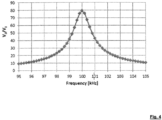
- a scanning (analog and/or digital) ping phase could e.g. generally look like in Fig. 4 ; an analog ping can be lower and/or narrower than a stronger (bigger and/or longer) digital ping.
- a wireless power charger device 2 theoretically could but should not reach the limits of ICNIRP during a digital ping 8, if there is no RX receiver (of e.g. a mobile phone portable object) placed on the surface (metallic parts from receiver and internal ferrite shielding foil will limit the electromagnetic field which can leak).
- RX receiver of e.g. a mobile phone portable object
- Analog pings 6,7 and Q factor measurement can be performed by generating low levels of magnetic field, but a digital ping shall be performed with a specific field level.
- digital ping shall be generated only when there is 100% (or alternatively near 100%) certainty that on the surface of the charger / device 2 a mobile phone and/or Qi compatible RX device is present.
- the presented solution is intended to solve the issue by detecting if on the surface of the wireless charger device 2, there is a smartphone and/or Qi receiver 2 or a (different) foreign object 2.
- the proposed solution acc to an embodiment of the invention implies to introduce a second Q-factor measurement scanning, but with higher (alternative lower with vice versa comparison) level of injected voltage V1 in Fig. 3 .
- the first Q-factor measurement (a1) is performed with low emitted electromagnetic field of a first analog ping 6 (e.g. to not trigger the diode bridge of a Qi RX device 2) and the second measurement Q2 is performed with a second analog ping with a higher level of electromagnetic field (to trigger the diode bridge of Qi RX device 2).
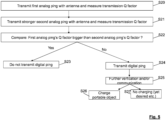
- FIG. 5 shows an example of the steps of a portable object detection according to an embodiment of the invention, especially for Qi charging.
- step S 20 transmitting an first analog ping 6 with an antenna 3 and measuring the related transmission Q factor Q6,
- step S23 If the first analog ping's 6 Q factor Q6 is bigger than or equal to the second analog ping's 7 transmission Q factor Q7 no digital ping is transmitted (step S23).
- step S23 If the first analog ping's 6 Q factor Q6 is smaller than the second analog ping's 7 transmission Q factor Q7 a digital ping is transmitted (step S23).
- Step 26 After (or without) further verification and or communication (of the device with the portable object), either wireless (especially Qi) charging of the portable object is allowed or started (Step 26) or no charging of the portable object is allowed or started (Step 27, e.g. as the portable object does not want charging or as the further verification has detected a problem).
Landscapes
- Engineering & Computer Science (AREA)
- Computer Networks & Wireless Communication (AREA)
- Power Engineering (AREA)
- Charge And Discharge Circuits For Batteries Or The Like (AREA)
- Near-Field Transmission Systems (AREA)
Description
- The invention relates to a method and a device for detecting the presence of a portable object (e.g. a mobile phone or key fob or coin etc), especially of its presence near a charger inside a vehicle.
- E.g.
US9124142B2 DE102011082623B3 of Continental Automotive GmbH disclose inductive charging of a mobile phone in a vehicle. Continental offers inductive charging of a mobile phone in a vehicle e.g. as visible online in https://www.continental-automotive.com/en-gl/Passenaer-Cars/Vehicle-Networking /Connectivity-Telematics/Smart-Device-Integration/Wireless-Power-Charging-(WP C)
US 2016/268842 A1 discloses a free resonance analog ping for wireless power transmission. - An object of the invention is to allow reliable, efficient and safe detection of a portable object (e.g. a mobile phone or key fob or coin etc), especially of its presence near or on a (e.g. Qi) charger inside a vehicle. This object is respectively achieved by the teaching of the independent patent claims.
- Embodiments of the invention allow a reliable, efficient and safe detection of a portable object (e.g. a mobile phone or key fob or coin etc), wherein by the first and the (different, e.g. stronger) second analog ping and check of the related Q factor (antenna detuning factor) during both analog pings, it can be clarified whether the object might be a mobile phone and/or chargeable device, thus avoiding a stronger digital ping which without presence of a mobile phone and/or chargeable device, might disturb (e.g. regarding emission, or e.g. an analog radio which might show a brief disturbing sound).
- The dependent patent claims describe some advantageous embodiment of the invention.
- According to another advantageous development of the invention, a device transmits the digital ping with comparably high power, to make sure that a smartphone on MFST and/or chargeable device is detected even if smartphone coupling is not optimal as e.g. smartphone not precisely placed centrally on MFST, but this digital ping is too strong for some devices as e,g, a key fob and/or could be heared in an AM radio (especially if no smartphone on MFST as smartphone would adsorb most energy) .
- Preferably the digital ping is triggered with ~4.5V and the first analog ping with less than 1 00mV and the second analog ping with 0.3 - 0.8V.
- Preferably the power of the first and second analog ping is set to a level reducing radio emissions below ICNIRP limits also if no smartphone and/or portable object with a wireless charging coil is present.
- Preferably the first analog ping and the second analog ping are narrower and/or lower pulses than the digital ping, especially wherein both are delta pulses.
- Preferably only in case of a decision that a portable object is a mobile phone and/or a portable object with a wireless charging coil, and preferably after further verification and/or communication, charging of the portable object is started.
- Preferably that a sent ping stronger than one or two named sent pings can mean that it is sent for a longer time and/or sent with more power than the other sent ping(s).
- Embodiments of the invention are described below with reference to the enclosed figures:
-
FIG. 1 shows a vehicle with a device for detecting presence of a nearby portable object, -
FIG. 2 shows a first analog pulse and a second analog pulse for detecting presence of a nearby portable object, and a digital pulse transmitted only if a measured characteristic (a transmission Q parameter) of the portable objects are those of e.g. a mobile phone and/or chargeable device, -
FIG. 3 shows some details of an embodiment of a device for detecting and classifying a portable object, -
FIG. 4 shows an example of a curve of a digital and/or (less strong / narrower and/or lower) analog pings, -
FIG. 5 shows an example of the steps of a portable object detection according to an embodiment of the invention, especially for Qi charging. -
FIG. 1 shows a vehicle 1 with a device 2 (e.g. a Qi charger and/or comprising acoil 3, and/or a smartphone) for - detecting (with a transmitted first analog pulse (ping) 6 and a transmitted second analog pulse (ping) 7) presence (nearby a charger device 2) of a portable object 4 (comprising a coil 5),
- deciding if a detected portable object 4 shows a characteristic (e.g. Q factor Q6 > Q factor Q7) of a mobile phone and/or chargeable device depending on the transmission quality factor Q6 of the first analog pulse and the transmission quality factor Q7 of the second
analog pulse 7,
and only if the detected nearby portable object 4 might be a mobile phone and/or chargeable device then transmitting a digital pulse (ping) 8, - and e.g. communicating with and/or
inductive charging 9 of the portable object 4 if (e.g. after further verification and communication) it is detected as a mobile phone and/or chargeable device . - In other words, a procedure for detecting a portable object 4 could be
- transmitting with a
coil 3 of a device 2 a firstanalogue ping 6 with (e.g. much) lower power than a possible laterdigital ping 8, - detecting by (e.g. by Q (Q6) factor) measurement with a measuring and controlling device 12 (shown only schematically), if any portable object appears possibly present on or nearby the (charging) device 2 (then Q factor and/or antenna resonance detuning can be increased or decreased compared to no present object)
- transmitting with a
coil 3 of the device 2 a stronger secondanalog ping 7 with same or preferably lower energy and/or power than a possible laterdigital ping 8 but stronger (more energy and/or power and/or wider) than the firstanalog ping 6, - detecting (e.g. by Q (Q7) factor measurement) which portable object 4 and/or which kind of portable object 2 seems present on or nearby the device 2, i.e.
- a) if a measured Q factor change (detuning indicator) related to the second
analog ping 7 is less than the Q factor change (detuning indicator) related to the first analog ping 6 (as a smartphone would adsorb more energy at higher sending power) then it is decided that a smart device (or something with similar Q characteristic) is located present on or nearby the device 2, and (only then) the device 2 continues with adigital ping 8, whereas - b) if the Q factor related to / during the second
analog ping 7 is (exactly or within a predetermined threshold) the same as related to / during the firstanalog ping 6 then nodigital ping 8 is necessary or transmitted.
- a) if a measured Q factor change (detuning indicator) related to the second
-
Fig 2 illustrates, that this can help to reduce disturbing maximum (electromagnetic field) emissions of this process for detecting presence (and e.g. type, e.g. mobile phone or the like) of a portable object near the (charging and/or communication) device 2, as the strength (electromagnetic field energy and/or power and or duration) of the transmitted first analog pulse (ping) 6 and of the transmitted second analog pulse (ping) 7 can be much lower than of a transmitted a digital pulse (ping) 8, and as a digital pulse (ping) 8 transmitted to a detected nearby possible mobile phone portable object 4 (or an object with insofar only detected similar (Q) characteristic) might be adsorbed by a mobile phone better than by a coin and/or key fob etc. - This might reduce e.g. AM etc radio noise and/or influence on present humans.
- The first and second Q-factor measurements pulses (pings) 6, 7 preferably are much less strong (lower in power (e.g. transmitted energy) and/or duration time t) than the
digital ping 8. - E.g. for a digital ping, an inverter for a coil 2 shown in
Fig.3 for producing it can be supplied with ~4.5V, whereas for a first Q-measurement (Q6) with firstanalog ping 6 it could be supplied with less than 100mV, and for a second Q measurement (Q7) with a secondanalog ping 6 it could be supplied with 0.3 - 0.8V, in order to keep the EM emission at very low level during the first and second analog pings (pulses) 6, 7, whereas it can be stronger / higher for the digital ping (pulse 8) that would be adsorbed to a higher degree by a mobile phone portable object 4 than by a coin or key fob etc portable object 4. -
Fig. 3 shows some details of a possible embodiment of the invention in a device 2, with acoil 3 and aresonance capacitor 10 and an energy/voltage source 11 for creatinganalog pings - Qi specifications describe a few methods for object detection (OD) and foreign object detection (FOD). For OD, short analog pings (here: 6, 7) and then checking the resonance shift or capacitance change can be used. For FOD, the most used method is to measure the quality factor (Q-factor) of the transmitter coil.
- The Q-factor measurement (here with a first
analog pulse 6 and with a second analog pulse 7) shall be performed with very low (and/or briefly) injected (into the coil 2) voltage (V1, V2) in order to not trigger rectifier diodes of a receiving RX device (e.g. 4) and to charge a filter capacitor (this can affect the Q-factor measurement). - A scanning (analog and/or digital) ping phase could e.g. generally look like in
Fig. 4 ; an analog ping can be lower and/or narrower than a stronger (bigger and/or longer) digital ping. - There are specific requirements (acc. ICNIRP), which limit the electromagnetic field which can be generated to provide protection against known adverse human health effects and/or other problems.
- A wireless power charger device 2, theoretically could but should not reach the limits of ICNIRP during a
digital ping 8, if there is no RX receiver (of e.g. a mobile phone portable object) placed on the surface (metallic parts from receiver and internal ferrite shielding foil will limit the electromagnetic field which can leak). -
Analog pings - In order to ensure the ICNIRP requirements, digital ping shall be generated only when there is 100% (or alternatively near 100%) certainty that on the surface of the charger / device 2 a mobile phone and/or Qi compatible RX device is present. The presented solution is intended to solve the issue by detecting if on the surface of the wireless charger device 2, there is a smartphone and/or Qi receiver 2 or a (different) foreign object 2.
- The proposed solution acc to an embodiment of the invention implies to introduce a second Q-factor measurement scanning, but with higher (alternative lower with vice versa comparison) level of injected voltage V1 in
Fig. 3 . - The first Q-factor measurement (a1) is performed with low emitted electromagnetic field of a first analog ping 6 (e.g. to not trigger the diode bridge of a Qi RX device 2) and the second measurement Q2 is performed with a second analog ping with a higher level of electromagnetic field (to trigger the diode bridge of Qi RX device 2).
- If a (different) foreign object (FO, e.g. no smartphone or something without Qi coil/receiver, e.g. a coin) is placed on surface, then the both Q-factor measurements shall be the same, but if a RX device (smartphone and/or device with a Qi charging receiver/coil) is present then the Q7 measurement value will be lower than Q6 due to additional loses in RX electronics.
- In this situation, if there are differences between both analog pings related Q factor measurements it can be decided to enable the
digital ping 8, else not. - Possible advantages of this method are:
- low complexity: simple and robust;
- good detection of Qi RX device vs. foreign metallic object;
- requirements of ICNIRP standard can be achieved.
-
FIG. 5 shows an example of the steps of a portable object detection according to an embodiment of the invention, especially for Qi charging. - After (step S 20) transmitting an first
analog ping 6 with anantenna 3 and measuring the related transmission Q factor Q6, - and after (step S 21) transmitting a second
analog ping 7 with anantenna 3 and measuring the related transmission Q factor Q7, - the first analog ping's 6 Q factor Q6 and the second analog ping's 7 transmission Q factor Q7 are compared (step S22).
- If the first analog ping's 6 Q factor Q6 is bigger than or equal to the second analog ping's 7 transmission Q factor Q7 no digital ping is transmitted (step S23).
- If the first analog ping's 6 Q factor Q6 is smaller than the second analog ping's 7 transmission Q factor Q7 a digital ping is transmitted (step S23).
- After (or without) further verification and or communication (of the device with the portable object), either wireless (especially Qi) charging of the portable object is allowed or started (Step 26) or no charging of the portable object is allowed or started (Step 27, e.g. as the portable object does not want charging or as the further verification has detected a problem).
Claims (12)
- Method for detecting the presence of a portable object (4) near a charger inside a vehicle (1),the detection being achieved by- transmitting with at least one coil (3) a first analog ping (6),characterized by- transmitting with at least one coil (3) a second analog ping (7) which is differently strong than the first analog ping (6),- comparing the transmission quality factor (Q6) of the first analog ping (6) and the transmission quality factor (Q7) of the second analog ping (7),- deciding that a portable object (4) is present which is a mobile phone and/or a portable object with a wireless charging coil (5)if the transmission quality factor (Q7) of the stronger analog ping (7) is lower than the transmission quality factor (Q7) of the other analog ping (6),- deciding that a portable object (4) is present which is not a mobile phone and/or a portable object with a wireless charging coil (5) if the transmission quality factor (Q) after the stronger analog ping (7) is not smaller than the transmission quality factor (Q) of the other analog ping (6),- sending with at least one coil (3) a digital ping (8) only after a decision that a portable object (4) is present which is a mobile phone and/or a portable object (4) with a wireless charging coil (5),wherein the digital ping (8), if sent, is stronger than the first analog ping (6) and stronger than the second analog ping (7).
- Method according to any of the preceding claims,
wherein the power (V1; V2) of the first second analog ping (6) and the power of the second analog ping (7) each are by a at least a factor of more than 10, especially by a factor of more than 30 lower than the power of the digital ping (8). - Method according to any of the preceding claims,
wherein the digital ping (8) is triggered with ~4.5V and the first analog ping (6) with less than 100mV and the second analog ping (7) with 0.3 - 0.8V. - Method according to any of the preceding claims,
wherein the power of the first and second analog ping (7) is set to a level reducing radio emissions below ICNIRP limits also if no smartphone and/or portable object (4) with a wireless charging coil (5) is present. - Method according to any of the preceding claims,wherein the first analog ping (6) and the second analog ping (7) are narrower and/or lower (V1, V2) pulses than the digital ping (8),especially wherein both (6, 7) are delta pulses.
- Method according to any of the preceding claims,wherein only in case of a decision that a portable object (4) is a mobile phone and/or a portable object (4) with a wireless charging coil (5),and preferably after further verification and/or communication,charging of the portable object (4) is started.
- Device (2) for detecting the presence of a portable object (4) inside a vehicle (1) near the device (2), said device (2) being a charging station and comprising:- a module (11, 10, 3, 2) for transmitting, with at least one coil (3), a first analog ping (6), and measuring a transmission parameter (Q6), characterized by comprising- a module (11, 10, 3, 2) for transmitting with at least one coil (3) a second analog ping (7), which is stronger or weaker than the first analog ping (6),- a module (11, 10, 3, 2) for comparing the transmission parameter (Q6) of the first analog ping (6) and the transmission parameter (Q7) of the second analog ping (7),- a module (11, 10, 3, 2) for deciding that a portable object (4) is present which is a mobile phone and/or a portable object with a wireless charging coil (5), if the transmission parameter (Q7) of the stronger analog ping (7) is smaller than the transmission parameter (Q6) of the other analog ping (6),- a module for deciding that a portable object (4) is present which is not a mobile phone and/or not a portable object with a wireless charging coil (5), if the transmission parameter (Q7) of the stronger analog ping (7) is bigger than or equal to the transmission parameter (Q6) of the other analog ping (6),- a module (11, 10, 3, 2) for transmitting, with at least one coil (3), a digital ping (8) only after a decision that a portable object (4) is present which (4) is a mobile phone and/or a portable object with a wireless charging coil (5),wherein the digital ping (8), if sent, is stronger than each of the first analog ping (6) and second analog ping (7).
- Device according to the preceding claim,
wherein the measured (12) transmission parameter (Q6) of the first analog ping (6) is a Q quality factor (Q6) and wherein the measured (12) transmission parameter (Q6) of the second analog ping (7) a Q quality factor (Q7). - Device according any of the preceding claims 7-8,
wherein the power of the first analog ping (6) and the power of the second analog ping (7) each are by a at least a factor of more than 10, especially by a factor of more than 30 lower than the power of the digital ping (8), wherein preferably a digital ping (8) is triggered by ~4.5V and a first analog ping (6) with less than 100mV and a second analog ping (7) with 0.3 - 0.8V. - Device according any of the preceding claims 7-9
wherein a sent ping (8) is insofar stronger than another sent ping (6, 7) that it (8) is sent for a longer time (t) and/or sent with more power than the other sent ping (6, 7). - Device according any of the preceding claims 7-10,
wherein the first analog ping (6) and second analog ping (7) are shorter (t) pulses than the digital ping (8), especially delta pulses. - Device according any of the preceding claims 7-11wherein either the transmission of the second analog ping (7) uses more power and/or time (t) than the transmission of the first analog ping (6), or the transmission of the first analog ping (6) uses more power and/or time (t) than the transmission of the second analog ping (7),wherein the second analog ping (7) is sent before or after the transmission of the first analog ping (6).
Priority Applications (1)
| Application Number | Priority Date | Filing Date | Title |
|---|---|---|---|
| EP20465520.3A EP3896822B8 (en) | 2020-04-16 | 2020-04-16 | Method and a device for detecting the presence of a portable object |
Applications Claiming Priority (1)
| Application Number | Priority Date | Filing Date | Title |
|---|---|---|---|
| EP20465520.3A EP3896822B8 (en) | 2020-04-16 | 2020-04-16 | Method and a device for detecting the presence of a portable object |
Publications (3)
| Publication Number | Publication Date |
|---|---|
| EP3896822A1 EP3896822A1 (en) | 2021-10-20 |
| EP3896822B1 true EP3896822B1 (en) | 2024-03-27 |
| EP3896822B8 EP3896822B8 (en) | 2024-05-01 |
Family
ID=70736774
Family Applications (1)
| Application Number | Title | Priority Date | Filing Date |
|---|---|---|---|
| EP20465520.3A Active EP3896822B8 (en) | 2020-04-16 | 2020-04-16 | Method and a device for detecting the presence of a portable object |
Country Status (1)
| Country | Link |
|---|---|
| EP (1) | EP3896822B8 (en) |
Families Citing this family (2)
| Publication number | Priority date | Publication date | Assignee | Title |
|---|---|---|---|---|
| TWI835391B (en) * | 2022-11-04 | 2024-03-11 | 立錡科技股份有限公司 | Wireless power transmitter circuit having low power groping and control circuit and method thereof |
| DE102024113694A1 (en) | 2024-05-16 | 2025-11-20 | Valeo Schalter Und Sensoren Gmbh | Control of a haptic actuator in a vehicle |
Family Cites Families (4)
| Publication number | Priority date | Publication date | Assignee | Title |
|---|---|---|---|---|
| DE102011082623B3 (en) | 2011-09-13 | 2013-02-07 | Continental Automotive Gmbh | Method for charging a battery installed in an electric motor vehicle |
| FR2981519B1 (en) | 2011-10-12 | 2015-04-03 | Continental Automotive France | DEVICE FOR INDUCTIVELY LOADING A PORTABLE DEVICE INTEGRATING A NEAR FIELD COMMUNICATION ANTENNA |
| CN106160253B (en) * | 2015-03-13 | 2020-09-04 | 恩智浦美国有限公司 | Free resonance analog exploration for wireless power transfer |
| CN116470664A (en) * | 2016-12-06 | 2023-07-21 | Lg伊诺特有限公司 | Method and device for detecting foreign matter |
-
2020
- 2020-04-16 EP EP20465520.3A patent/EP3896822B8/en active Active
Also Published As
| Publication number | Publication date |
|---|---|
| EP3896822A1 (en) | 2021-10-20 |
| EP3896822B8 (en) | 2024-05-01 |
Similar Documents
| Publication | Publication Date | Title |
|---|---|---|
| EP2894757B1 (en) | Non-contact charging device, and non-contact power supply system using same | |
| CN103947078B (en) | Signal recognition for wireless key fobs and interactive systems | |
| US9721404B2 (en) | Apparatus for a security system of a vehicle | |
| US8519569B2 (en) | Wireless power supply system and wireless power supply method | |
| US9912201B2 (en) | Systems and methods of detecting a change in object presence in a magnetic field | |
| US9608698B2 (en) | Wireless power and data transmission | |
| US9847678B2 (en) | Methods and systems for compatible operation between a wireless power transfer system and wirelessly communicating vehicle systems | |
| EP2717427A1 (en) | Non-contact power reception device, vehicle comprising same, non-contact power transmission device, and non-contact power transmission system | |
| EP3896822B1 (en) | Method and a device for detecting the presence of a portable object | |
| US9356457B2 (en) | Wireless charging using passive NFC tag and multiple antenna of differing shapes | |
| CN105980198A (en) | Field neutralization during inductive charging | |
| CN105850007A (en) | Resonant power-transfer system and resonant power-transmission device | |
| US9148189B2 (en) | Quality adjustment of a receiving circuit | |
| CN116436495A (en) | NFC device and method of operating NFC device | |
| WO2015179000A1 (en) | Active electromagnetic interference mitigation system and method | |
| KR102276504B1 (en) | Near Field Communication and Approach Detection Device | |
| JP5416065B2 (en) | Communication mode setting device | |
| WO2014118853A1 (en) | On-board system, communication device, power feeding device, and program | |
| JP5694901B2 (en) | Contactless charger | |
| US11824376B1 (en) | Wireless power transmitter which detects low coupling with a wireless power receiver, and methods for wireless power transmission | |
| CN115284919B (en) | Methods for detecting objects to be charged and associated charging equipment | |
| US20140055247A1 (en) | Reading Device for Contactless Communication with a Transponder Unit | |
| US20220179119A1 (en) | Method for detecting a parasitic metal object on a charging surface, and associated charging device | |
| US20230336027A1 (en) | Method for detecting an object to be charged and associated charging device | |
| US20080031317A1 (en) | Method for wireless data transmission between a base station and a transponder via inductive coupling |
Legal Events
| Date | Code | Title | Description |
|---|---|---|---|
| PUAI | Public reference made under article 153(3) epc to a published international application that has entered the european phase |
Free format text: ORIGINAL CODE: 0009012 |
|
| STAA | Information on the status of an ep patent application or granted ep patent |
Free format text: STATUS: THE APPLICATION HAS BEEN PUBLISHED |
|
| AK | Designated contracting states |
Kind code of ref document: A1 Designated state(s): AL AT BE BG CH CY CZ DE DK EE ES FI FR GB GR HR HU IE IS IT LI LT LU LV MC MK MT NL NO PL PT RO RS SE SI SK SM TR |
|
| B565 | Issuance of search results under rule 164(2) epc |
Effective date: 20200929 |
|
| STAA | Information on the status of an ep patent application or granted ep patent |
Free format text: STATUS: REQUEST FOR EXAMINATION WAS MADE |
|
| 17P | Request for examination filed |
Effective date: 20220420 |
|
| RBV | Designated contracting states (corrected) |
Designated state(s): AL AT BE BG CH CY CZ DE DK EE ES FI FR GB GR HR HU IE IS IT LI LT LU LV MC MK MT NL NO PL PT RO RS SE SI SK SM TR |
|
| RAP1 | Party data changed (applicant data changed or rights of an application transferred) |
Owner name: CONTINENTAL AUTOMOTIVE TECHNOLOGIES GMBH |
|
| RIC1 | Information provided on ipc code assigned before grant |
Ipc: H04L 25/49 20060101ALN20230921BHEP Ipc: H02J 50/60 20160101ALI20230921BHEP Ipc: H02J 50/12 20160101AFI20230921BHEP |
|
| RIC1 | Information provided on ipc code assigned before grant |
Ipc: H04L 25/49 20060101ALN20231009BHEP Ipc: H02J 50/60 20160101ALI20231009BHEP Ipc: H02J 50/12 20160101AFI20231009BHEP |
|
| GRAP | Despatch of communication of intention to grant a patent |
Free format text: ORIGINAL CODE: EPIDOSNIGR1 |
|
| STAA | Information on the status of an ep patent application or granted ep patent |
Free format text: STATUS: GRANT OF PATENT IS INTENDED |
|
| INTG | Intention to grant announced |
Effective date: 20231117 |
|
| GRAS | Grant fee paid |
Free format text: ORIGINAL CODE: EPIDOSNIGR3 |
|
| GRAA | (expected) grant |
Free format text: ORIGINAL CODE: 0009210 |
|
| STAA | Information on the status of an ep patent application or granted ep patent |
Free format text: STATUS: THE PATENT HAS BEEN GRANTED |
|
| P01 | Opt-out of the competence of the unified patent court (upc) registered |
Effective date: 20240214 |
|
| AK | Designated contracting states |
Kind code of ref document: B1 Designated state(s): AL AT BE BG CH CY CZ DE DK EE ES FI FR GB GR HR HU IE IS IT LI LT LU LV MC MK MT NL NO PL PT RO RS SE SI SK SM TR |
|
| REG | Reference to a national code |
Ref country code: GB Ref legal event code: FG4D |
|
| REG | Reference to a national code |
Ref country code: CH Ref legal event code: EP |
|
| REG | Reference to a national code |
Ref country code: DE Ref legal event code: R096 Ref document number: 602020027874 Country of ref document: DE |
|
| REG | Reference to a national code |
Ref country code: CH Ref legal event code: PK Free format text: BERICHTIGUNG B8 |
|
| RAP4 | Party data changed (patent owner data changed or rights of a patent transferred) |
Owner name: CONTINENTAL AUTOMOTIVE TECHNOLOGIES GMBH |
|
| REG | Reference to a national code |
Ref country code: IE Ref legal event code: FG4D |
|
| REG | Reference to a national code |
Ref country code: CH Ref legal event code: PK Free format text: DIE PUBLIKATION VOM 27.03.2024 WURDE AM 24.04.2024 IRRTUEMLICHERWEISE ERNEUT PUBLIZIERT. LA PUBLICATION DU 27.03.2024 A ETE REPUBLIEE PAR ERREUR LE 24.04.2024. LA PUBBLICAZIONE DEL 27.03.2024 E STATA ERRONEAMENTE RIPUBBLICATA IL 24.04.2024. |
|
| PG25 | Lapsed in a contracting state [announced via postgrant information from national office to epo] |
Ref country code: LT Free format text: LAPSE BECAUSE OF FAILURE TO SUBMIT A TRANSLATION OF THE DESCRIPTION OR TO PAY THE FEE WITHIN THE PRESCRIBED TIME-LIMIT Effective date: 20240327 |
|
| REG | Reference to a national code |
Ref country code: LT Ref legal event code: MG9D |
|
| PG25 | Lapsed in a contracting state [announced via postgrant information from national office to epo] |
Ref country code: GR Free format text: LAPSE BECAUSE OF FAILURE TO SUBMIT A TRANSLATION OF THE DESCRIPTION OR TO PAY THE FEE WITHIN THE PRESCRIBED TIME-LIMIT Effective date: 20240628 |
|
| PG25 | Lapsed in a contracting state [announced via postgrant information from national office to epo] |
Ref country code: HR Free format text: LAPSE BECAUSE OF FAILURE TO SUBMIT A TRANSLATION OF THE DESCRIPTION OR TO PAY THE FEE WITHIN THE PRESCRIBED TIME-LIMIT Effective date: 20240327 Ref country code: RS Free format text: LAPSE BECAUSE OF FAILURE TO SUBMIT A TRANSLATION OF THE DESCRIPTION OR TO PAY THE FEE WITHIN THE PRESCRIBED TIME-LIMIT Effective date: 20240627 |
|
| PG25 | Lapsed in a contracting state [announced via postgrant information from national office to epo] |
Ref country code: RS Free format text: LAPSE BECAUSE OF FAILURE TO SUBMIT A TRANSLATION OF THE DESCRIPTION OR TO PAY THE FEE WITHIN THE PRESCRIBED TIME-LIMIT Effective date: 20240627 Ref country code: NO Free format text: LAPSE BECAUSE OF FAILURE TO SUBMIT A TRANSLATION OF THE DESCRIPTION OR TO PAY THE FEE WITHIN THE PRESCRIBED TIME-LIMIT Effective date: 20240627 Ref country code: LT Free format text: LAPSE BECAUSE OF FAILURE TO SUBMIT A TRANSLATION OF THE DESCRIPTION OR TO PAY THE FEE WITHIN THE PRESCRIBED TIME-LIMIT Effective date: 20240327 Ref country code: HR Free format text: LAPSE BECAUSE OF FAILURE TO SUBMIT A TRANSLATION OF THE DESCRIPTION OR TO PAY THE FEE WITHIN THE PRESCRIBED TIME-LIMIT Effective date: 20240327 Ref country code: GR Free format text: LAPSE BECAUSE OF FAILURE TO SUBMIT A TRANSLATION OF THE DESCRIPTION OR TO PAY THE FEE WITHIN THE PRESCRIBED TIME-LIMIT Effective date: 20240628 Ref country code: FI Free format text: LAPSE BECAUSE OF FAILURE TO SUBMIT A TRANSLATION OF THE DESCRIPTION OR TO PAY THE FEE WITHIN THE PRESCRIBED TIME-LIMIT Effective date: 20240327 Ref country code: BG Free format text: LAPSE BECAUSE OF FAILURE TO SUBMIT A TRANSLATION OF THE DESCRIPTION OR TO PAY THE FEE WITHIN THE PRESCRIBED TIME-LIMIT Effective date: 20240327 |
|
| REG | Reference to a national code |
Ref country code: NL Ref legal event code: MP Effective date: 20240327 |
|
| PG25 | Lapsed in a contracting state [announced via postgrant information from national office to epo] |
Ref country code: SE Free format text: LAPSE BECAUSE OF FAILURE TO SUBMIT A TRANSLATION OF THE DESCRIPTION OR TO PAY THE FEE WITHIN THE PRESCRIBED TIME-LIMIT Effective date: 20240327 Ref country code: LV Free format text: LAPSE BECAUSE OF FAILURE TO SUBMIT A TRANSLATION OF THE DESCRIPTION OR TO PAY THE FEE WITHIN THE PRESCRIBED TIME-LIMIT Effective date: 20240327 |
|
| PG25 | Lapsed in a contracting state [announced via postgrant information from national office to epo] |
Ref country code: NL Free format text: LAPSE BECAUSE OF FAILURE TO SUBMIT A TRANSLATION OF THE DESCRIPTION OR TO PAY THE FEE WITHIN THE PRESCRIBED TIME-LIMIT Effective date: 20240327 |
|
| REG | Reference to a national code |
Ref country code: AT Ref legal event code: MK05 Ref document number: 1670859 Country of ref document: AT Kind code of ref document: T Effective date: 20240327 |
|
| PG25 | Lapsed in a contracting state [announced via postgrant information from national office to epo] |
Ref country code: NL Free format text: LAPSE BECAUSE OF FAILURE TO SUBMIT A TRANSLATION OF THE DESCRIPTION OR TO PAY THE FEE WITHIN THE PRESCRIBED TIME-LIMIT Effective date: 20240327 |
|
| PG25 | Lapsed in a contracting state [announced via postgrant information from national office to epo] |
Ref country code: IS Free format text: LAPSE BECAUSE OF FAILURE TO SUBMIT A TRANSLATION OF THE DESCRIPTION OR TO PAY THE FEE WITHIN THE PRESCRIBED TIME-LIMIT Effective date: 20240727 |
|
| PG25 | Lapsed in a contracting state [announced via postgrant information from national office to epo] |
Ref country code: PT Free format text: LAPSE BECAUSE OF FAILURE TO SUBMIT A TRANSLATION OF THE DESCRIPTION OR TO PAY THE FEE WITHIN THE PRESCRIBED TIME-LIMIT Effective date: 20240729 Ref country code: SM Free format text: LAPSE BECAUSE OF FAILURE TO SUBMIT A TRANSLATION OF THE DESCRIPTION OR TO PAY THE FEE WITHIN THE PRESCRIBED TIME-LIMIT Effective date: 20240327 |
|
| PG25 | Lapsed in a contracting state [announced via postgrant information from national office to epo] |
Ref country code: ES Free format text: LAPSE BECAUSE OF FAILURE TO SUBMIT A TRANSLATION OF THE DESCRIPTION OR TO PAY THE FEE WITHIN THE PRESCRIBED TIME-LIMIT Effective date: 20240327 |
|
| PG25 | Lapsed in a contracting state [announced via postgrant information from national office to epo] |
Ref country code: EE Free format text: LAPSE BECAUSE OF FAILURE TO SUBMIT A TRANSLATION OF THE DESCRIPTION OR TO PAY THE FEE WITHIN THE PRESCRIBED TIME-LIMIT Effective date: 20240327 Ref country code: CZ Free format text: LAPSE BECAUSE OF FAILURE TO SUBMIT A TRANSLATION OF THE DESCRIPTION OR TO PAY THE FEE WITHIN THE PRESCRIBED TIME-LIMIT Effective date: 20240327 |
|
| PG25 | Lapsed in a contracting state [announced via postgrant information from national office to epo] |
Ref country code: AT Free format text: LAPSE BECAUSE OF FAILURE TO SUBMIT A TRANSLATION OF THE DESCRIPTION OR TO PAY THE FEE WITHIN THE PRESCRIBED TIME-LIMIT Effective date: 20240327 |
|
| PG25 | Lapsed in a contracting state [announced via postgrant information from national office to epo] |
Ref country code: PL Free format text: LAPSE BECAUSE OF FAILURE TO SUBMIT A TRANSLATION OF THE DESCRIPTION OR TO PAY THE FEE WITHIN THE PRESCRIBED TIME-LIMIT Effective date: 20240327 |
|
| PG25 | Lapsed in a contracting state [announced via postgrant information from national office to epo] |
Ref country code: SK Free format text: LAPSE BECAUSE OF FAILURE TO SUBMIT A TRANSLATION OF THE DESCRIPTION OR TO PAY THE FEE WITHIN THE PRESCRIBED TIME-LIMIT Effective date: 20240327 |
|
| PG25 | Lapsed in a contracting state [announced via postgrant information from national office to epo] |
Ref country code: SM Free format text: LAPSE BECAUSE OF FAILURE TO SUBMIT A TRANSLATION OF THE DESCRIPTION OR TO PAY THE FEE WITHIN THE PRESCRIBED TIME-LIMIT Effective date: 20240327 Ref country code: SK Free format text: LAPSE BECAUSE OF FAILURE TO SUBMIT A TRANSLATION OF THE DESCRIPTION OR TO PAY THE FEE WITHIN THE PRESCRIBED TIME-LIMIT Effective date: 20240327 Ref country code: RO Free format text: LAPSE BECAUSE OF FAILURE TO SUBMIT A TRANSLATION OF THE DESCRIPTION OR TO PAY THE FEE WITHIN THE PRESCRIBED TIME-LIMIT Effective date: 20240327 Ref country code: PT Free format text: LAPSE BECAUSE OF FAILURE TO SUBMIT A TRANSLATION OF THE DESCRIPTION OR TO PAY THE FEE WITHIN THE PRESCRIBED TIME-LIMIT Effective date: 20240729 Ref country code: PL Free format text: LAPSE BECAUSE OF FAILURE TO SUBMIT A TRANSLATION OF THE DESCRIPTION OR TO PAY THE FEE WITHIN THE PRESCRIBED TIME-LIMIT Effective date: 20240327 Ref country code: IS Free format text: LAPSE BECAUSE OF FAILURE TO SUBMIT A TRANSLATION OF THE DESCRIPTION OR TO PAY THE FEE WITHIN THE PRESCRIBED TIME-LIMIT Effective date: 20240727 Ref country code: ES Free format text: LAPSE BECAUSE OF FAILURE TO SUBMIT A TRANSLATION OF THE DESCRIPTION OR TO PAY THE FEE WITHIN THE PRESCRIBED TIME-LIMIT Effective date: 20240327 Ref country code: EE Free format text: LAPSE BECAUSE OF FAILURE TO SUBMIT A TRANSLATION OF THE DESCRIPTION OR TO PAY THE FEE WITHIN THE PRESCRIBED TIME-LIMIT Effective date: 20240327 Ref country code: CZ Free format text: LAPSE BECAUSE OF FAILURE TO SUBMIT A TRANSLATION OF THE DESCRIPTION OR TO PAY THE FEE WITHIN THE PRESCRIBED TIME-LIMIT Effective date: 20240327 Ref country code: AT Free format text: LAPSE BECAUSE OF FAILURE TO SUBMIT A TRANSLATION OF THE DESCRIPTION OR TO PAY THE FEE WITHIN THE PRESCRIBED TIME-LIMIT Effective date: 20240327 |
|
| REG | Reference to a national code |
Ref country code: CH Ref legal event code: PL |
|
| PG25 | Lapsed in a contracting state [announced via postgrant information from national office to epo] |
Ref country code: IT Free format text: LAPSE BECAUSE OF FAILURE TO SUBMIT A TRANSLATION OF THE DESCRIPTION OR TO PAY THE FEE WITHIN THE PRESCRIBED TIME-LIMIT Effective date: 20240327 |
|
| PG25 | Lapsed in a contracting state [announced via postgrant information from national office to epo] |
Ref country code: LU Free format text: LAPSE BECAUSE OF NON-PAYMENT OF DUE FEES Effective date: 20240416 |
|
| REG | Reference to a national code |
Ref country code: BE Ref legal event code: MM Effective date: 20240430 |
|
| PG25 | Lapsed in a contracting state [announced via postgrant information from national office to epo] |
Ref country code: LU Free format text: LAPSE BECAUSE OF NON-PAYMENT OF DUE FEES Effective date: 20240416 Ref country code: IT Free format text: LAPSE BECAUSE OF FAILURE TO SUBMIT A TRANSLATION OF THE DESCRIPTION OR TO PAY THE FEE WITHIN THE PRESCRIBED TIME-LIMIT Effective date: 20240327 |
|
| REG | Reference to a national code |
Ref country code: DE Ref legal event code: R097 Ref document number: 602020027874 Country of ref document: DE |
|
| PG25 | Lapsed in a contracting state [announced via postgrant information from national office to epo] |
Ref country code: MC Free format text: LAPSE BECAUSE OF FAILURE TO SUBMIT A TRANSLATION OF THE DESCRIPTION OR TO PAY THE FEE WITHIN THE PRESCRIBED TIME-LIMIT Effective date: 20240327 |
|
| PG25 | Lapsed in a contracting state [announced via postgrant information from national office to epo] |
Ref country code: DK Free format text: LAPSE BECAUSE OF FAILURE TO SUBMIT A TRANSLATION OF THE DESCRIPTION OR TO PAY THE FEE WITHIN THE PRESCRIBED TIME-LIMIT Effective date: 20240327 |
|
| PG25 | Lapsed in a contracting state [announced via postgrant information from national office to epo] |
Ref country code: BE Free format text: LAPSE BECAUSE OF NON-PAYMENT OF DUE FEES Effective date: 20240430 |
|
| PG25 | Lapsed in a contracting state [announced via postgrant information from national office to epo] |
Ref country code: MC Free format text: LAPSE BECAUSE OF FAILURE TO SUBMIT A TRANSLATION OF THE DESCRIPTION OR TO PAY THE FEE WITHIN THE PRESCRIBED TIME-LIMIT Effective date: 20240327 Ref country code: DK Free format text: LAPSE BECAUSE OF FAILURE TO SUBMIT A TRANSLATION OF THE DESCRIPTION OR TO PAY THE FEE WITHIN THE PRESCRIBED TIME-LIMIT Effective date: 20240327 Ref country code: BE Free format text: LAPSE BECAUSE OF NON-PAYMENT OF DUE FEES Effective date: 20240430 Ref country code: CH Free format text: LAPSE BECAUSE OF NON-PAYMENT OF DUE FEES Effective date: 20240430 |
|
| PLBE | No opposition filed within time limit |
Free format text: ORIGINAL CODE: 0009261 |
|
| STAA | Information on the status of an ep patent application or granted ep patent |
Free format text: STATUS: NO OPPOSITION FILED WITHIN TIME LIMIT |
|
| 26N | No opposition filed |
Effective date: 20250103 |
|
| PG25 | Lapsed in a contracting state [announced via postgrant information from national office to epo] |
Ref country code: IE Free format text: LAPSE BECAUSE OF NON-PAYMENT OF DUE FEES Effective date: 20240416 |
|
| PG25 | Lapsed in a contracting state [announced via postgrant information from national office to epo] |
Ref country code: SI Free format text: LAPSE BECAUSE OF FAILURE TO SUBMIT A TRANSLATION OF THE DESCRIPTION OR TO PAY THE FEE WITHIN THE PRESCRIBED TIME-LIMIT Effective date: 20240327 |
|
| PGFP | Annual fee paid to national office [announced via postgrant information from national office to epo] |
Ref country code: DE Payment date: 20250430 Year of fee payment: 6 |
|
| PGFP | Annual fee paid to national office [announced via postgrant information from national office to epo] |
Ref country code: FR Payment date: 20250425 Year of fee payment: 6 |
|
| PG25 | Lapsed in a contracting state [announced via postgrant information from national office to epo] |
Ref country code: CY Free format text: LAPSE BECAUSE OF FAILURE TO SUBMIT A TRANSLATION OF THE DESCRIPTION OR TO PAY THE FEE WITHIN THE PRESCRIBED TIME-LIMIT; INVALID AB INITIO Effective date: 20200416 |
|
| PG25 | Lapsed in a contracting state [announced via postgrant information from national office to epo] |
Ref country code: HU Free format text: LAPSE BECAUSE OF FAILURE TO SUBMIT A TRANSLATION OF THE DESCRIPTION OR TO PAY THE FEE WITHIN THE PRESCRIBED TIME-LIMIT; INVALID AB INITIO Effective date: 20200416 |
|
| REG | Reference to a national code |
Ref country code: DE Ref legal event code: R081 Ref document number: 602020027874 Country of ref document: DE Owner name: AUMOVIO GERMANY GMBH, DE Free format text: FORMER OWNER: CONTINENTAL AUTOMOTIVE TECHNOLOGIES GMBH, 30175 HANNOVER, DE |
|
| PGFP | Annual fee paid to national office [announced via postgrant information from national office to epo] |
Ref country code: GB Payment date: 20260313 Year of fee payment: 7 |