EP3896616A1 - Method for optimizing a neural network model - Google Patents
Method for optimizing a neural network model Download PDFInfo
- Publication number
- EP3896616A1 EP3896616A1 EP20169370.2A EP20169370A EP3896616A1 EP 3896616 A1 EP3896616 A1 EP 3896616A1 EP 20169370 A EP20169370 A EP 20169370A EP 3896616 A1 EP3896616 A1 EP 3896616A1
- Authority
- EP
- European Patent Office
- Prior art keywords
- computer
- neural network
- optimizer
- loss
- minimum
- Prior art date
- Legal status (The legal status is an assumption and is not a legal conclusion. Google has not performed a legal analysis and makes no representation as to the accuracy of the status listed.)
- Granted
Links
Images

Classifications
-
- G—PHYSICS
- G06—COMPUTING OR CALCULATING; COUNTING
- G06N—COMPUTING ARRANGEMENTS BASED ON SPECIFIC COMPUTATIONAL MODELS
- G06N3/00—Computing arrangements based on biological models
- G06N3/02—Neural networks
- G06N3/08—Learning methods
- G06N3/09—Supervised learning
-
- G—PHYSICS
- G06—COMPUTING OR CALCULATING; COUNTING
- G06N—COMPUTING ARRANGEMENTS BASED ON SPECIFIC COMPUTATIONAL MODELS
- G06N3/00—Computing arrangements based on biological models
- G06N3/02—Neural networks
- G06N3/08—Learning methods
- G06N3/084—Backpropagation, e.g. using gradient descent
-
- G—PHYSICS
- G06—COMPUTING OR CALCULATING; COUNTING
- G06N—COMPUTING ARRANGEMENTS BASED ON SPECIFIC COMPUTATIONAL MODELS
- G06N3/00—Computing arrangements based on biological models
- G06N3/02—Neural networks
- G06N3/08—Learning methods
- G06N3/0985—Hyperparameter optimisation; Meta-learning; Learning-to-learn
-
- G—PHYSICS
- G06—COMPUTING OR CALCULATING; COUNTING
- G06N—COMPUTING ARRANGEMENTS BASED ON SPECIFIC COMPUTATIONAL MODELS
- G06N3/00—Computing arrangements based on biological models
- G06N3/02—Neural networks
- G06N3/04—Architecture, e.g. interconnection topology
Definitions
- the invention relates to a computer-implemented method for adapting a neural network model, a neural network, a use of the neural network for an automotive application, a computer program element, and a computer-readable medium.
- the learning rate is adapted to the gradient in each cycle. Cyclically changing the learning rate helps to traverse faster on the loss landscape through saddle points, i.e., where the gradient of the loss function is low. These methods, however, lose some of their potential when working with models that have a small number of parameters, compared to typical Deep Neural Network models to find global minima in models with few parameters. Repetitive restart techniques exploit the properties of a smooth convex function, in order to remove the ripples observed in the loss function in cases where the momentum has exceeded a critical value. These techniques are restricted to convex function-based properties to achieve accelerated convergence but do not cannot guarantee improved model performance as they do not seek a global minimum.
- the described embodiments similarly pertain to the method for configuring an artificial intelligence module, the system for configuring a neural network model, the computer program element and the computer-readable medium. Synergetic effects may arise from different combinations of the embodiments although they might not be described in detail.
- the invention is explained with a neural network, however, any artificial intelligence module may be used that exhibits non-convex loss surfaces, trained using gradient descent. Therefore, the term "neural network” stands for any such artificial intelligence module.
- a computer-implemented method for training a neural network comprising the following steps.
- a first step in a plurality of successive cycles a plurality of local minima in a loss landscape of a loss function are determined, and in a subsequent step, a globally optimal minimum in the loss landscape of the loss function is selected out of the plurality detected local minimum.
- the "loss landscape" of a loss function is to be understood as the multi-dimensional shape of the loss function which may have gradients so that there are one or more local minima and local maxima.
- hybrid means using optimization concepts from traditional convex function based optimization, and additionally using elements from non-convex global optimization.
- the first component of the hybrid training procedure searches for the local minima of the loss landscape.
- a usual gradient descent optimizer may be used to find local minima. It is not necessary to find all of the local minima of the loss landscape. There may exist conditions to stop the search as discussed further below.
- the second component which is gradient free, selects the lowest of the found local minima, which is termed the "globally optimal minimum". As the search may have been stopped before determining all of the local minima of the loss function, "globally optimal minimum" is to be understood as the lowest minimum among all of the determined local minima.
- the globally optimal minimum may be determined preferably by storing a current local minimum only if it is lower than the previous one, or, for example, by first storing all detected local minima and determining the lowest one in a second step.
- "Storing a global minimum” means besides storing the value and, maybe, an index or identifier of the minimum especially also storing the state of the network model, such that the network can be set into the state with the determined globally optimal minimum.
- the step of determining in a plurality of successive cycles a plurality of local minima in a loss landscape of a loss function comprises as an initial step resetting an optimizer state of an optimizer of the neural network.
- An optimizer is a central element in the neural network, for example, to vary the momentum, the learning rates, and parameters such as weights or biases of the neurons in the network layers, which is part of the gradient descent based learning process.
- the parameters that are varied by the optimizer to find a local minimum are reset in order to find a new local minimum.
- the resetting of the optimizer state is therefore performed once per local minimum to be found, before starting the optimization process for finding a local minimum.
- the step of detecting a local minimum in a loss landscape is performed using a gradient descent-type optimizer exhibiting a momentum-based behaviour.
- the optimizer may get stuck in a local minimum.
- the momentum term is therefore reset which enable the optimizer to escape the local minimum, and to find another local minimum.
- the gradient descent optimizer may therefore be a momentum-based optimizer or, more general, a gradient descent type optimizer that exhibits this behaviour. Further, by using a momentum, the efficiency of the optimizer is ensured and a jump-over of a local minimum is avoided.
- optimizers with second-order momentum terms may be used as, for example, the Adaptive Moment Estimation (Adam) optimizer that computes adaptive learning rates for each parameter.
- Adam In addition to storing an exponentially decaying average of past squared gradients, Adam also keeps an exponentially decaying average of past gradients, similar to momentum.
- the momentum based gradient descent-type optimizer is a fully adaptive optimizer, wherein the fully adaptive optimizer performs adaptive optimization for one cycle independently of other cycles. That is, for example, the learning rate adaptation, the momentum resetting and the learning rate scheduling in one cycle is performed without using any knowledge or information about previous cycles.
- the fully adaptive optimizer performs adaptive optimization for one cycle independently of other cycles. That is, for example, the learning rate adaptation, the momentum resetting and the learning rate scheduling in one cycle is performed without using any knowledge or information about previous cycles.
- search agent in the global optimization sense
- model state that is trained in a cycle. It further keeps memory of previously reached, locally optimal model states. Each locally optimal state is reached sequentially, by a potentially fully adaptive gradient descent cycle, or run, i.e., not by following a fixed, pre-determined schedule. Each local run can employ adaptive learning rate, momentum reset and even learning rate scheduling independently.
- the step of selecting a globally optimal minimum is performed using a gradient-free optimization, thereby enabling the selection of a globally optimal minimum.
- a gradient-free optimization is treated only as one component of this procedure, whereby a from-scratch training of efficient neural networks is enabled.
- the proposed method will reduce variance in the performance of a neural network as for example, a deep neural network, and thus improve the economic performance of products, such as an advanced driver assistance system (ADAS) product that relies on an efficient deep neural network (DNN).
- ADAS advanced driver assistance system
- the step of determining, in a plurality of successive cycles, a plurality of local minima further comprises a processing chain with following steps.
- a loss i.e., for example, a loss resulting from correctly and falsely detected categories when processing a training dataset or a validation dataset
- optimization parameters defining the state of the neural network are re-calculated, and the model is updated by providing the re-calculated optimization parameters to the neural network model.
- the processing chain of calculating the loss, determining if the local minimum is reached, re-calculating parameters, and updating the model is repeated until a stop criterion is reached.
- the stop criterion may, for example, be indicative of having found a local minimum.
- a stop criterion that indicates that a minimum is found may be that the gradient, i.e. the gradient of the loss function at the current dataset, turns from decreasing to increasing. Then, the previous update, i.e., the previous optimizer state may be seen as the state of the local minimum.
- the step of selecting a globally optimal minimum in the loss landscape is performed under the condition that the result of the determination, whether the local minimum is reached, is positive.
- Selecting a globally optimal minimum comprises the step determining, if a stopping criterion is reached. If the stopping criterion is not reached, the following above introduced steps of the first component of the hybrid training procedure are performed: resetting optimization parameters defining the optimizer state of the optimizer, updating the model by providing the reset optimization parameters to the neural network model, and determining, in a plurality of successive cycles a plurality of local minima, in the loss landscape of the loss function.
- the step of resetting the optimizer state comprises resetting intermediate parameters of the optimization state.
- Gradient descent-based optimizers such as Adam
- the optimizer's state can be represented by storing these parameters.
- the parameters may differ from optimizer to optimizer. examples are first and second order moment vectors, individual adaptive learning rates for different parameters of the model (weights) calculated from estimates of first and second moments of the gradients, the running average of recent magnitudes of the gradients for the weights (momentum), and the average of the second moments of the gradients.
- the parameters are not limited by the given examples.
- the stopping criterion is one of the following.
- a first criterion may be, whether there is no more improvement when comparing a current and a previous relevant performance metric measured on validation dataset in the model states S[i].
- a further criterion may be whether an improvement when comparing a current and a previous a relevant performance metric measured on validation dataset in the model states S[i] is less than a pre-defined minimum difference ⁇ KPImin.
- Other criteria may exist. For example, the number of resets or the number of parameter optimization may be limited to an absolute number.
- the presented conditions may be also combined in a logical manner to obtain a stop criterion.
- the stopping criterion may alternatively, or in combination with the above described criterion be a global key performance indicator, KPI.
- KPI global key performance indicator
- a global KPI may be, for example, the reached accuracy, mean intersection over union (mloU), classification performance, etc.
- a KPI as stopping criterion may be a parameter directly related to an Advanced Driver Assistance System, e.g., detection a distance, a recognized scene, etc.
- the step of detecting a local minimum in a loss landscape comprises hyper-parameter tuning and/or transfer learning.
- optimization techniques such as hyper-parameter tuning, i.e., optimizing, for example, the learning rate, the batch size, the momentum, and/or the weight decay, and transfer learning, where, e.g., the knowledge of a first domain is used to train a second domain, may be used to reduce the number of restarts needed to reach the optimal globally minimum, or an approximately global minimum.
- the neural network is a deep neural network, DNN.
- the method is especially suited for training a DNN from the scratch
- a neural network with a configuration achieved with a method as described above is provided.
- a use of the neural network for configuring a neural network for an automotive application, an Internet of Things application, a mobile application or for remote sensing is proposed.
- a data processing system e.g., a computer, comprising means for carrying out the steps of the method.
- the data processing system may comprise circuits without programmable logics or may be or comprise a micro controller, a field programmable gate array (FPGA), an ASIC, a Complex Programmable Logic Devices (CPLD), or any other programmable logic devices known to person skilled in the art.
- FPGA field programmable gate array
- ASIC ASIC
- CPLD Complex Programmable Logic Devices
- a computer program element that comprises instructions, which, when the program is executed by a computer, cause the computer to carry out the steps of the method.
- the computer program element may be part of a computer program, but it can also be an entire program by itself.
- the computer program element may be used to update an already existing computer program to get to the present invention.
- a computer-readable medium that comprises instructions which, when executed by a computer, cause the computer to carry out the steps of the method.
- the computer readable medium may be seen as a storage medium, such as for example, a USB stick, a CD, a DVD, a data storage device, a hard disk, or any other medium on which a program element as described above can be stored.
- the invention provides a training technique, especially the initialization of optimizer state during training, that can be used as a turn-key strategy for the from-scratch training of efficient neural networks that target automotive embedded hardware.
- the proposed method will reduce the variance in DNN performance and thus improve the economic performance of ADAS products that rely on efficient DNN.
- the proposed training procedure consists of a suitable number of restarts.
- Existing optimization techniques such as hyper-parameter tuning and transfer learning may be used to reduce the number of restarts needed to reach the global minimum, or an approximated global minimum.
- Fig. 1 shows a flow diagram of the computer-implemented method 100 for finding an globally optimal minimum of a loss function in a neural network 400.
- Method 100 comprises two main steps, which are determining 200, in a plurality of successive cycles, a plurality of local minima, in a loss landscape of a loss function, and subsequently selecting 300 a globally optimal minimum.
- a gradient descent algorithm is used to find local minima
- a gradient-free algorithm is used to select the optimal of the found local minima.
- the optimizer state is reset, so that the detection 200 can be restarted to find the next local minimum.
- the loss function may be a multi-dimensional function and may comprise loss values arising from an error of the output of the neural network with respect to a correct output, e.g. corresponding to a label of the input data, caused by the current state of the neural network.
- the loss function may, therefore, show gradients that depend on internal parameters as weights or biases for each of the neurons in each of the layers.
- the values of these parameters define the state of the neural network model.
- the multi-dimensional loss function may comprise several local minima, of which one may be a global minimum or a approximated global minimum. If one or more local minima have been found by step 200 or routine 200, respectively, then step or routine 300, is performed, where after checking a stop criterion the global minimum or an approximated global minimum is selected. It has to be noted that the case may occur, that after detecting the stop criterion, the absolute global minimum is not detected. However, the stop criterion may be chosen such that there is a good compromise between cost, i.e. essentially time, and improvement of performance of the neural network. The minimum found by this compromise is called “approximated global minimum” in this disclosure or “globally optimal minimum", which comprises also the absolute global minimum.
- Method 200 comprises calculating 202 a loss using the loss function, determining 204 if the local minimum is reached. If the local minimum is not reached, the parameters defining the state of the neural network are re-calculated 206, i.e. the optimizer state Oi is updated. Such parameters are, for example, the weight of each neuron and the bias.
- the model is updated 208.
- the routine goes back to the first step, where the loss is re-calculated 202, with the effect that the key performance indicators KPIv, i.e., the relevant performance metric measured on validation dataset, and KPIt, i.e., the relevant performance metric measured on a training dataset are updated. If, however, in step 204, it is detected that the local minimum is reached, then the process of method 100 jumps to routine 300, where in step 302 it is determined, whether an global KPI criterion or another stopping criterion is reached or not.
- Such a criterion may be formulated as "no more improvement in model state S[i] measured by KPIv” or "improvement is less than ⁇ KPImin", where KPIv is a relevant performance metric measured on a validation dataset, S[i] a list to hold dictionaries of model states s, and ⁇ KPImin is the minimum difference in validation KPI, which is considered as an improvement. If the global KPI criterion, or another stopping criterion, is not reached, then in step 310, the best state is selected from the list S[i] by comparing the corresponding KPIv values, the hyper-parameters are selected from a predefined list P[i], and the state of the optimizer O is reset to its initial state O0.
- the routine 300 then jumps back to the step of updating 208 the model of routine 200; and proceeding with a new cycle of the first method component 200, which is determining 200, in a plurality of successive cycles, a plurality of local minima in a loss landscape of a loss function, with the sub-steps 202, 204, and 206, 208 if in 204 the condition of having found a local minimum is not fulfilled. If in step 302 it is determined, that a global KPI criterion is reached, the globally optimal minimum is selected 312 out of the found local minima and the process of the method 100, i.e., the learning process is finished 314.
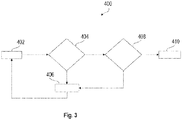
- Fig. 3 shows the method 100 in view of the neural network 400.
- the neural network 400 may comprise model states s[i] 402 of the DNN, which are initialized with random parameters in state s0. From these states of model 402, the losses are calculated and passed to the first determiner 404, which is configured to determine whether a local minimum is reached or not. If not, this is signalled to the optimizer 406, which is responsible for calculating new values for the internal parameters, as weights and biases. These parameter values are passed to the model 402 for updating the state of the model 402. If, however, the first determiner 404 detected that a local minimum is reached, a second determiner 408 checks, whether a global KPI criterion is reached.
- the second determiner 408 sends a signal to the optimizer 406 indicating that the optimizer has to be reset. If in 408 the KPI criterion is reached, in 410, the model uses the parameter values of the lowest local minimum, which is representing the globally optimal minimum, and uses the corresponding values of these parameters for its classification tasks. In this way, a momentum based gradient descent optimizer is used to find local minima in the loss landscape. From these minima, a globally optimal one is selected using gradient-free optimization. Possibly, there may be a further global minimum, which may have the same or even lower value. In this case, either the first global minimum or one of the further global minima is selected.
- the proposed concept may be described as "valley hopping", where “valleys” are local minima in the loss landscape that are found by a gradient descent-type optimizer.
- the model state "hops" between different local minima until the global minimum is found, or suitably approximated.
- a computer program may be stored/distributed on a suitable medium such as an optical storage medium or a solid-state medium supplied together with or as part of other hardware, but may also be distributed in other forms, such as via the Internet or other wired or wireless telecommunication systems. Any reference signs in the claims should not be construed as limiting the scope of the claims.
Landscapes
- Engineering & Computer Science (AREA)
- Theoretical Computer Science (AREA)
- Physics & Mathematics (AREA)
- Data Mining & Analysis (AREA)
- General Health & Medical Sciences (AREA)
- Biomedical Technology (AREA)
- Biophysics (AREA)
- Computational Linguistics (AREA)
- Life Sciences & Earth Sciences (AREA)
- Evolutionary Computation (AREA)
- Artificial Intelligence (AREA)
- Molecular Biology (AREA)
- Computing Systems (AREA)
- General Engineering & Computer Science (AREA)
- General Physics & Mathematics (AREA)
- Mathematical Physics (AREA)
- Software Systems (AREA)
- Health & Medical Sciences (AREA)
- Feedback Control In General (AREA)
Abstract
Description
- The invention relates to a computer-implemented method for adapting a neural network model, a neural network, a use of the neural network for an automotive application, a computer program element, and a computer-readable medium.
- For learning in neural networks, there exist several approaches to find a minimum of loss functions. For example, the learning rate is adapted to the gradient in each cycle. Cyclically changing the learning rate helps to traverse faster on the loss landscape through saddle points, i.e., where the gradient of the loss function is low. These methods, however, lose some of their potential when working with models that have a small number of parameters, compared to typical Deep Neural Network models to find global minima in models with few parameters. Repetitive restart techniques exploit the properties of a smooth convex function, in order to remove the ripples observed in the loss function in cases where the momentum has exceeded a critical value. These techniques are restricted to convex function-based properties to achieve accelerated convergence but do not cannot guarantee improved model performance as they do not seek a global minimum.
- There may, therefore, be a need to improve the performance of a neural network. The problem is solved by the subject-matter of the independent claims. Embodiments are provided by the dependent claims, the following description and the accompanying figures.
- The described embodiments similarly pertain to the method for configuring an artificial intelligence module, the system for configuring a neural network model, the computer program element and the computer-readable medium. Synergetic effects may arise from different combinations of the embodiments although they might not be described in detail. In this disclosure, the invention is explained with a neural network, however, any artificial intelligence module may be used that exhibits non-convex loss surfaces, trained using gradient descent. Therefore, the term "neural network" stands for any such artificial intelligence module.
- Further on, it shall be noted that all embodiments of the present invention concerning a method, might be carried out with the order of the steps as described, nevertheless this has not to be the only and essential order of the steps of the method. The herein presented methods can be carried out with another order of the disclosed steps without departing from the respective method embodiment, unless explicitly mentioned to the contrary hereinafter.
- Technical terms are used by their common sense. If a specific meaning is conveyed to certain terms, definitions of terms will be given in the following in the context of which the terms are used.
- According to a first aspect, a computer-implemented method for training a neural network, is provided, comprising the following steps. In a first step, in a plurality of successive cycles a plurality of local minima in a loss landscape of a loss function are determined, and in a subsequent step, a globally optimal minimum in the loss landscape of the loss function is selected out of the plurality detected local minimum.
- The "loss landscape" of a loss function is to be understood as the multi-dimensional shape of the loss function which may have gradients so that there are one or more local minima and local maxima.
- Thus, a hybrid training procedure with two components is introduced. "Hybrid" means using optimization concepts from traditional convex function based optimization, and additionally using elements from non-convex global optimization. The first component of the hybrid training procedure searches for the local minima of the loss landscape. A usual gradient descent optimizer may be used to find local minima. It is not necessary to find all of the local minima of the loss landscape. There may exist conditions to stop the search as discussed further below. The second component, which is gradient free, selects the lowest of the found local minima, which is termed the "globally optimal minimum". As the search may have been stopped before determining all of the local minima of the loss function, "globally optimal minimum" is to be understood as the lowest minimum among all of the determined local minima. The globally optimal minimum may be determined preferably by storing a current local minimum only if it is lower than the previous one, or, for example, by first storing all detected local minima and determining the lowest one in a second step. "Storing a global minimum" means besides storing the value and, maybe, an index or identifier of the minimum especially also storing the state of the network model, such that the network can be set into the state with the determined globally optimal minimum.
- According to an embodiment, the step of determining in a plurality of successive cycles a plurality of local minima in a loss landscape of a loss function comprises as an initial step resetting an optimizer state of an optimizer of the neural network. An optimizer is a central element in the neural network, for example, to vary the momentum, the learning rates, and parameters such as weights or biases of the neurons in the network layers, which is part of the gradient descent based learning process. In other words, according to this embodiment, the parameters that are varied by the optimizer to find a local minimum are reset in order to find a new local minimum. The resetting of the optimizer state is therefore performed once per local minimum to be found, before starting the optimization process for finding a local minimum.
- According to an embodiment, the step of detecting a local minimum in a loss landscape is performed using a gradient descent-type optimizer exhibiting a momentum-based behaviour. At the end of a cycle, the optimizer may get stuck in a local minimum. The momentum term is therefore reset which enable the optimizer to escape the local minimum, and to find another local minimum. The gradient descent optimizer may therefore be a momentum-based optimizer or, more general, a gradient descent type optimizer that exhibits this behaviour. Further, by using a momentum, the efficiency of the optimizer is ensured and a jump-over of a local minimum is avoided.
- Good local minima may be clustered close together in the loss landscape to be located close together in the loss landscape, and thus warm starts from previously visited local minima are good initializations for further search. Preferably, optimizers with second-order momentum terms may be used as, for example, the Adaptive Moment Estimation (Adam) optimizer that computes adaptive learning rates for each parameter. In addition to storing an exponentially decaying average of past squared gradients, Adam also keeps an exponentially decaying average of past gradients, similar to momentum.
- According to an embodiment, the momentum based gradient descent-type optimizer is a fully adaptive optimizer, wherein the fully adaptive optimizer performs adaptive optimization for one cycle independently of other cycles. That is, for example, the learning rate adaptation, the momentum resetting and the learning rate scheduling in one cycle is performed without using any knowledge or information about previous cycles. Summarized, there is only a single "search agent" (in the global optimization sense) or model state that is trained in a cycle. It further keeps memory of previously reached, locally optimal model states. Each locally optimal state is reached sequentially, by a potentially fully adaptive gradient descent cycle, or run, i.e., not by following a fixed, pre-determined schedule. Each local run can employ adaptive learning rate, momentum reset and even learning rate scheduling independently.
- According to an embodiment, the step of selecting a globally optimal minimum is performed using a gradient-free optimization, thereby enabling the selection of a globally optimal minimum. I.e., no function as, for example, a loss function comprising a gradient is used, since such a function would result in a second landscape with second local minima so the global minimum would possibly not be found. The gradient descent technique is treated only as one component of this procedure, whereby a from-scratch training of efficient neural networks is enabled. Instead of basing the optimization process on concepts from the convex optimization field, it is proposed to use elements from non-convex global optimization. Among the found minima, which result from a locally convex shape of the loss function, a globally optimal one is selected using gradient-free optimization. The proposed method will reduce variance in the performance of a neural network as for example, a deep neural network, and thus improve the economic performance of products, such as an advanced driver assistance system (ADAS) product that relies on an efficient deep neural network (DNN).
- According to an embodiment, the step of determining, in a plurality of successive cycles, a plurality of local minima further comprises a processing chain with following steps. First, a loss, i.e., for example, a loss resulting from correctly and falsely detected categories when processing a training dataset or a validation dataset, is calculated based on the loss function. If it is determined that a local minimum has not been reached, optimization parameters defining the state of the neural network are re-calculated, and the model is updated by providing the re-calculated optimization parameters to the neural network model. The processing chain of calculating the loss, determining if the local minimum is reached, re-calculating parameters, and updating the model is repeated until a stop criterion is reached. The stop criterion may, for example, be indicative of having found a local minimum.
- For example a stop criterion that indicates that a minimum is found, may be that the gradient, i.e. the gradient of the loss function at the current dataset, turns from decreasing to increasing. Then, the previous update, i.e., the previous optimizer state may be seen as the state of the local minimum.
- According to an embodiment, the step of selecting a globally optimal minimum in the loss landscape is performed under the condition that the result of the determination, whether the local minimum is reached, is positive. Selecting a globally optimal minimum comprises the step determining, if a stopping criterion is reached. If the stopping criterion is not reached, the following above introduced steps of the first component of the hybrid training procedure are performed: resetting optimization parameters defining the optimizer state of the optimizer, updating the model by providing the reset optimization parameters to the neural network model, and determining, in a plurality of successive cycles a plurality of local minima, in the loss landscape of the loss function.
- According to an embodiment, the step of resetting the optimizer state comprises resetting intermediate parameters of the optimization state. In this way, new minima can be discovered effectively. Gradient descent-based optimizers such as Adam, may have a number of parameters which are updated on each optimization stage. The optimizer's state can be represented by storing these parameters. The parameters may differ from optimizer to optimizer. examples are first and second order moment vectors, individual adaptive learning rates for different parameters of the model (weights) calculated from estimates of first and second moments of the gradients, the running average of recent magnitudes of the gradients for the weights (momentum), and the average of the second moments of the gradients. As there are further parameters, the parameters are not limited by the given examples.
- According to an embodiment, the stopping criterion is one of the following. A first criterion may be, whether there is no more improvement when comparing a current and a previous relevant performance metric measured on validation dataset in the model states S[i]. A further criterion may be whether an improvement when comparing a current and a previous a relevant performance metric measured on validation dataset in the model states S[i] is less than a pre-defined minimum difference ΔKPImin. Other criteria may exist. For example, the number of resets or the number of parameter optimization may be limited to an absolute number. The presented conditions may be also combined in a logical manner to obtain a stop criterion.
- The stopping criterion may alternatively, or in combination with the above described criterion be a global key performance indicator, KPI. A global KPI may be, for example, the reached accuracy, mean intersection over union (mloU), classification performance, etc. Further, a KPI as stopping criterion may be a parameter directly related to an Advanced Driver Assistance System, e.g., detection a distance, a recognized scene, etc.
- According to a further embodiment, the step of detecting a local minimum in a loss landscape comprises hyper-parameter tuning and/or transfer learning. I.e., optimization techniques such as hyper-parameter tuning, i.e., optimizing, for example, the learning rate, the batch size, the momentum, and/or the weight decay, and transfer learning, where, e.g., the knowledge of a first domain is used to train a second domain, may be used to reduce the number of restarts needed to reach the optimal globally minimum, or an approximately global minimum.
- According to a further embodiment, the neural network is a deep neural network, DNN. The method is especially suited for training a DNN from the scratch
- According to a further aspect, a neural network with a configuration achieved with a method as described above is provided.
- According to a further aspect, a use of the neural network for configuring a neural network for an automotive application, an Internet of Things application, a mobile application or for remote sensing, is proposed.
- In an example, a data processing system, e.g., a computer, comprising means for carrying out the steps of the method is provided. The data processing system may comprise circuits without programmable logics or may be or comprise a micro controller, a field programmable gate array (FPGA), an ASIC, a Complex Programmable Logic Devices (CPLD), or any other programmable logic devices known to person skilled in the art.
- According to a further aspect, a computer program element is provided that comprises instructions, which, when the program is executed by a computer, cause the computer to carry out the steps of the method. The computer program element may be part of a computer program, but it can also be an entire program by itself.
- For example the computer program element may be used to update an already existing computer program to get to the present invention.
- According to a further aspect, a computer-readable medium is provided, that comprises instructions which, when executed by a computer, cause the computer to carry out the steps of the method. The computer readable medium may be seen as a storage medium, such as for example, a USB stick, a CD, a DVD, a data storage device, a hard disk, or any other medium on which a program element as described above can be stored.
- The invention provides a training technique, especially the initialization of optimizer state during training, that can be used as a turn-key strategy for the from-scratch training of efficient neural networks that target automotive embedded hardware. The proposed method will reduce the variance in DNN performance and thus improve the economic performance of ADAS products that rely on efficient DNN. The proposed training procedure consists of a suitable number of restarts. Existing optimization techniques such as hyper-parameter tuning and transfer learning may be used to reduce the number of restarts needed to reach the global minimum, or an approximated global minimum.
- These and other aspects of the present invention will become apparent from and elucidated with reference to the embodiments described hereinafter.
- Exemplary embodiments of the invention will be described in the following with reference to the following drawings.
-
Fig. 1 shows a flow diagram of the computer-implemented method according to an embodiment, -
Fig. 2 shows a neural network according to an embodiment, -
Fig. 3 shows the method in view of the neural network. - The figures are merely schematic representations and serve only to illustrate embodiments of the invention. Identical or equivalent elements are in principle provided with the same reference signs.
-
Fig. 1 shows a flow diagram of the computer-implementedmethod 100 for finding an globally optimal minimum of a loss function in aneural network 400. -
Method 100 comprises two main steps, which are determining 200, in a plurality of successive cycles, a plurality of local minima, in a loss landscape of a loss function, and subsequently selecting 300 a globally optimal minimum. In 200, a gradient descent algorithm is used to find local minima, and in 300, a gradient-free algorithm is used to select the optimal of the found local minima. After finding a local minimum, the optimizer state is reset, so that thedetection 200 can be restarted to find the next local minimum. The loss function may be a multi-dimensional function and may comprise loss values arising from an error of the output of the neural network with respect to a correct output, e.g. corresponding to a label of the input data, caused by the current state of the neural network. The loss function may, therefore, show gradients that depend on internal parameters as weights or biases for each of the neurons in each of the layers. The values of these parameters define the state of the neural network model. The multi-dimensional loss function may comprise several local minima, of which one may be a global minimum or a approximated global minimum. If one or more local minima have been found bystep 200 or routine 200, respectively, then step or routine 300, is performed, where after checking a stop criterion the global minimum or an approximated global minimum is selected. It has to be noted that the case may occur, that after detecting the stop criterion, the absolute global minimum is not detected. However, the stop criterion may be chosen such that there is a good compromise between cost, i.e. essentially time, and improvement of performance of the neural network. The minimum found by this compromise is called "approximated global minimum" in this disclosure or "globally optimal minimum", which comprises also the absolute global minimum. -
Fig. 2 shows the components, i.e., theroutines method 100 in more detail.Method 200 comprises calculating 202 a loss using the loss function, determining 204 if the local minimum is reached. If the local minimum is not reached, the parameters defining the state of the neural network are re-calculated 206, i.e. the optimizer state Oi is updated. Such parameters are, for example, the weight of each neuron and the bias. - In the next step, the model is updated 208. Once the model is updated, the routine goes back to the first step, where the loss is re-calculated 202, with the effect that the key performance indicators KPIv, i.e., the relevant performance metric measured on validation dataset, and KPIt, i.e., the relevant performance metric measured on a training dataset are updated. If, however, in
step 204, it is detected that the local minimum is reached, then the process ofmethod 100 jumps to routine 300, where instep 302 it is determined, whether an global KPI criterion or another stopping criterion is reached or not. Such a criterion may be formulated as "no more improvement in model state S[i] measured by KPIv" or "improvement is less than ΔKPImin", where KPIv is a relevant performance metric measured on a validation dataset, S[i] a list to hold dictionaries of model states s, and ΔKPImin is the minimum difference in validation KPI, which is considered as an improvement. If the global KPI criterion, or another stopping criterion, is not reached, then instep 310, the best state is selected from the list S[i] by comparing the corresponding KPIv values, the hyper-parameters are selected from a predefined list P[i], and the state of the optimizer O is reset to its initial state O0. - It has to be stressed, that the complete state is reset and not just a single hyper-parameter such as a cyclic learning rate. The routine 300 then jumps back to the step of updating 208 the model of
routine 200; and proceeding with a new cycle of thefirst method component 200, which is determining 200, in a plurality of successive cycles, a plurality of local minima in a loss landscape of a loss function, with the sub-steps 202, 204, and 206, 208 if in 204 the condition of having found a local minimum is not fulfilled. If instep 302 it is determined, that a global KPI criterion is reached, the globally optimal minimum is selected 312 out of the found local minima and the process of themethod 100, i.e., the learning process is finished 314. -
Fig. 3 shows themethod 100 in view of theneural network 400. Theneural network 400 may comprise model states s[i] 402 of the DNN, which are initialized with random parameters in state s0. From these states ofmodel 402, the losses are calculated and passed to thefirst determiner 404, which is configured to determine whether a local minimum is reached or not. If not, this is signalled to theoptimizer 406, which is responsible for calculating new values for the internal parameters, as weights and biases. These parameter values are passed to themodel 402 for updating the state of themodel 402. If, however, thefirst determiner 404 detected that a local minimum is reached, asecond determiner 408 checks, whether a global KPI criterion is reached. If not, thesecond determiner 408 sends a signal to theoptimizer 406 indicating that the optimizer has to be reset. If in 408 the KPI criterion is reached, in 410, the model uses the parameter values of the lowest local minimum, which is representing the globally optimal minimum, and uses the corresponding values of these parameters for its classification tasks. In this way, a momentum based gradient descent optimizer is used to find local minima in the loss landscape. From these minima, a globally optimal one is selected using gradient-free optimization. Possibly, there may be a further global minimum, which may have the same or even lower value. In this case, either the first global minimum or one of the further global minima is selected. - The proposed concept may be described as "valley hopping", where "valleys" are local minima in the loss landscape that are found by a gradient descent-type optimizer. The model state "hops" between different local minima until the global minimum is found, or suitably approximated.
- Other variations to the disclosed embodiments can be understood and effected by those skilled in the art in practicing the claimed invention, from the study of the drawings, the disclosure, and the appended claims. In the claims the word "comprising" does not exclude other elements or steps and the indefinite article "a" or "an" does not exclude a plurality. A single processor or other unit may fulfil the functions of several items or steps recited in the claims. The mere fact that certain measures are recited in mutually different dependent claims does not indicate that a combination of these measures cannot be used to advantage. A computer program may be stored/distributed on a suitable medium such as an optical storage medium or a solid-state medium supplied together with or as part of other hardware, but may also be distributed in other forms, such as via the Internet or other wired or wireless telecommunication systems. Any reference signs in the claims should not be construed as limiting the scope of the claims.
Claims (15)
- A computer-implemented method (100) for training a neural network model, comprising the steps:determining (200), in a plurality of successive cycles, a plurality of local minima in a loss landscape of a loss function; andselecting (300) a globally optimal minimum in the loss landscape of the loss function out of the plurality of determined local minima.
- The computer-implemented method (100) according to claim 1, wherein the step of determining (200) in a plurality of successive cycles a plurality of local minima in a loss landscape of a loss function comprises as an initial step for each cycle resetting (310) an optimizer state of an optimizer of the neural network.
- The computer-implemented method (100) according to claim 1 or 2, wherein the step of determining (200), in a plurality of successive cycles, a plurality of local minima in a loss landscape of a loss function is performed using a gradient descent-type optimizer exhibiting a momentum-based behaviour.
- The computer-implemented method (100) according to claim 3, wherein the gradient descent-type optimizer is a fully adaptive optimizer, wherein the fully adaptive optimizer performs adaptive optimization for one cycle independently of other cycles.
- The computer-implemented method (100) according to any of the previous claims, wherein the step selecting (300) a globally optimal minimum is performed using a gradient-free optimization.
- The computer-implemented method (100) according to any of the previous claims, wherein the step of determining (200), in a plurality of successive cycles, a plurality of local minima further comprises a processing chain with following steps:calculating (202) a loss based on the loss function;determining (204) whether the local minimum is reached; if the local minimum is not reached;re-calculating (206) optimization parameters defining the optimizer state of the optimizer; andupdating (208) the neural network model by providing the re-calculated optimization parameters to the neural network model;wherein the processing chain is repeated until a stop criterion is reached.
- The computer-implemented method (100) according to claim 5, wherein, the step of selecting (300) a globally optimal minimum in the loss landscape is performed under the condition that the result of the determination (204), whether the local minimum is reached, is positive; and selecting (300) a globally optimal minimum comprises the steps:determining (302), if stopping criterion is reached; if the global key performance indicator is not reached,performing the step of resetting (310) optimization parameters defining the optimizer state of the optimizer;performing the step of updating (208) the neural network model by providing the reset optimization parameters to the neural network model; andperforming the step determining (200), in a plurality of successive cycles a plurality of local minima, in the loss landscape of the loss function.
- The computer-implemented method (100) according to any of the previous claims, wherein the step of resetting (310) the optimizer state comprises resetting intermediate parameters of the optimization state.
- The computer-implemented method (100) according to claim 7, wherein the stopping criterion is:whether there is no more improvement when comparing a current and a previous relevant performance metric measured on a validation dataset in the model states S[i], orwhether an improvement when comparing a current and a previous a relevant performance metric measured on a validation dataset in the model states S[i] is less than a pre-defined minimum difference ΔKPImin between the previous and the relevant performance metric.
- The computer-implemented method (100) according to any of the previous claims, wherein the step detecting (200) a local minimum in a loss landscape comprises hyper-parameter tuning and/or transfer learning.
- The computer-implemented method (100) according to any of the previous claims, wherein the neural network is a deep neural network, DNN.
- A neural network (200) with a configuration achieved with a method according to any of the claims 1 to 11.
- Use of the neural network (200) according to claim 12 for an automotive application, an Internet of Things, loT application, a mobile application or for remote sensing.
- A computer program element, comprising instructions which, when the program element is executed by a computer, cause the computer to carry out the steps of the method (100) of any of claims 1 to 11.
- A computer-readable medium comprising instructions which, when executed by a computer, cause the computer to carry out the steps of the method (100) of any of claims 1 to 11.
Priority Applications (1)
| Application Number | Priority Date | Filing Date | Title |
|---|---|---|---|
| EP20169370.2A EP3896616B1 (en) | 2020-04-14 | 2020-04-14 | Method for optimizing a neural network model |
Applications Claiming Priority (1)
| Application Number | Priority Date | Filing Date | Title |
|---|---|---|---|
| EP20169370.2A EP3896616B1 (en) | 2020-04-14 | 2020-04-14 | Method for optimizing a neural network model |
Publications (2)
| Publication Number | Publication Date |
|---|---|
| EP3896616A1 true EP3896616A1 (en) | 2021-10-20 |
| EP3896616B1 EP3896616B1 (en) | 2026-02-18 |
Family
ID=70289547
Family Applications (1)
| Application Number | Title | Priority Date | Filing Date |
|---|---|---|---|
| EP20169370.2A Active EP3896616B1 (en) | 2020-04-14 | 2020-04-14 | Method for optimizing a neural network model |
Country Status (1)
| Country | Link |
|---|---|
| EP (1) | EP3896616B1 (en) |
-
2020
- 2020-04-14 EP EP20169370.2A patent/EP3896616B1/en active Active
Non-Patent Citations (3)
| Title |
|---|
| HAO YU ET AL: "Parallel Restarted SGD with Faster Convergence and Less Communication: Demystifying Why Model Averaging Works for Deep Learning", ARXIV.ORG, CORNELL UNIVERSITY LIBRARY, 201 OLIN LIBRARY CORNELL UNIVERSITY ITHACA, NY 14853, 17 July 2018 (2018-07-17), XP081426580 * |
| MICHAEL R ZHANG ET AL: "Lookahead Optimizer: k steps forward, 1 step back", 3 December 2019 (2019-12-03), XP055729952, Retrieved from the Internet <URL:https://arxiv.org/pdf/1907.08610.pdf> [retrieved on 20200911] * |
| PRANAY SHARMA ET AL: "Parallel Restarted SPIDER -- Communication Efficient Distributed Nonconvex Optimization with Optimal Computation Complexity", ARXIV.ORG, CORNELL UNIVERSITY LIBRARY, 201 OLIN LIBRARY CORNELL UNIVERSITY ITHACA, NY 14853, 12 December 2019 (2019-12-12), XP081550622 * |
Also Published As
| Publication number | Publication date |
|---|---|
| EP3896616B1 (en) | 2026-02-18 |
Similar Documents
| Publication | Publication Date | Title |
|---|---|---|
| CN110490717B (en) | Product recommendation method and system based on user session and graph convolutional neural network | |
| KR102153992B1 (en) | Method and apparatus for detecting cyber threats using deep neural network | |
| CN113204988B (en) | Small-sample viewpoint estimation | |
| Moore et al. | Deep collective inference | |
| WO2020164740A1 (en) | Methods and systems for automatically selecting a model for time series prediction of a data stream | |
| CN111783534A (en) | A sleep staging method based on deep learning | |
| CN109902619B (en) | Image closed-loop detection method and system | |
| US11295229B1 (en) | Scalable generation of multidimensional features for machine learning | |
| CN107783998A (en) | The method and device of a kind of data processing | |
| JP6846216B2 (en) | Scene change point model learning device, scene change point detection device and their programs | |
| CN112101156B (en) | A method, device and electronic device for target recognition | |
| US20180260396A1 (en) | Method and system for mapping attributes of entities | |
| CN113283632A (en) | Early battery fault warning method, system, device and storage medium | |
| US20240013061A1 (en) | Architecture search method and apparatus for large-scale graph, and device and storage medium | |
| US20240303497A1 (en) | Robust test-time adaptation without error accumulation | |
| WO2017157438A1 (en) | Method and device for real-time network event processing | |
| CN110675074A (en) | Travel target point identification method and device, and model development and evaluation method and device | |
| Ito et al. | An adaptive abnormal behavior detection using online sequential learning | |
| TW202427274A (en) | Node symmetry in machine learning compiler optimization | |
| CN115062779B (en) | Event prediction method and device based on dynamic knowledge graph | |
| CN103578274B (en) | A kind of traffic flow forecasting method and device | |
| EP4152336A1 (en) | Method and computing system for molecular design via multi-task reinforcement learning | |
| De Bock et al. | An efficient algorithm for estimating state sequences in imprecise hidden Markov models | |
| EP3896616B1 (en) | Method for optimizing a neural network model | |
| Yadav et al. | Performance analysis of stochastic gradient descent and adaptive moment estimation optimization algorithms for convolutional neural networks |
Legal Events
| Date | Code | Title | Description |
|---|---|---|---|
| PUAI | Public reference made under article 153(3) epc to a published international application that has entered the european phase |
Free format text: ORIGINAL CODE: 0009012 |
|
| STAA | Information on the status of an ep patent application or granted ep patent |
Free format text: STATUS: THE APPLICATION HAS BEEN PUBLISHED |
|
| AK | Designated contracting states |
Kind code of ref document: A1 Designated state(s): AL AT BE BG CH CY CZ DE DK EE ES FI FR GB GR HR HU IE IS IT LI LT LU LV MC MK MT NL NO PL PT RO RS SE SI SK SM TR |
|
| B565 | Issuance of search results under rule 164(2) epc |
Effective date: 20201001 |
|
| STAA | Information on the status of an ep patent application or granted ep patent |
Free format text: STATUS: REQUEST FOR EXAMINATION WAS MADE |
|
| 17P | Request for examination filed |
Effective date: 20220420 |
|
| RBV | Designated contracting states (corrected) |
Designated state(s): AL AT BE BG CH CY CZ DE DK EE ES FI FR GB GR HR HU IE IS IT LI LT LU LV MC MK MT NL NO PL PT RO RS SE SI SK SM TR |
|
| RAP1 | Party data changed (applicant data changed or rights of an application transferred) |
Owner name: CONTINENTAL AUTONOMOUS MOBILITY GERMANY GMBH |
|
| STAA | Information on the status of an ep patent application or granted ep patent |
Free format text: STATUS: EXAMINATION IS IN PROGRESS |
|
| 17Q | First examination report despatched |
Effective date: 20241107 |
|
| RAP3 | Party data changed (applicant data changed or rights of an application transferred) |
Owner name: AUMOVIO AUTONOMOUS MOBILITY GERMANY GMBH |
|
| REG | Reference to a national code |
Ref country code: DE Free format text: PREVIOUS MAIN CLASS: G06N0003080000 Ipc: G06N0003090000 Ref country code: DE Ref legal event code: R079 Ref document number: 602020066957 Country of ref document: DE Free format text: PREVIOUS MAIN CLASS: G06N0003080000 Ipc: G06N0003090000 |
|
| GRAP | Despatch of communication of intention to grant a patent |
Free format text: ORIGINAL CODE: EPIDOSNIGR1 |
|
| STAA | Information on the status of an ep patent application or granted ep patent |
Free format text: STATUS: GRANT OF PATENT IS INTENDED |
|
| RIC1 | Information provided on ipc code assigned before grant |
Ipc: G06N 3/09 20230101AFI20250922BHEP Ipc: G06N 3/096 20230101ALI20250922BHEP Ipc: G06N 3/0985 20230101ALI20250922BHEP |
|
| INTG | Intention to grant announced |
Effective date: 20251002 |
|
| GRAS | Grant fee paid |
Free format text: ORIGINAL CODE: EPIDOSNIGR3 |
|
| GRAA | (expected) grant |
Free format text: ORIGINAL CODE: 0009210 |
|
| STAA | Information on the status of an ep patent application or granted ep patent |
Free format text: STATUS: THE PATENT HAS BEEN GRANTED |
|
| AK | Designated contracting states |
Kind code of ref document: B1 Designated state(s): AL AT BE BG CH CY CZ DE DK EE ES FI FR GB GR HR HU IE IS IT LI LT LU LV MC MK MT NL NO PL PT RO RS SE SI SK SM TR |
|
| REG | Reference to a national code |
Ref country code: CH Ref legal event code: F10 Free format text: ST27 STATUS EVENT CODE: U-0-0-F10-F00 (AS PROVIDED BY THE NATIONAL OFFICE) Effective date: 20260218 Ref country code: GB Ref legal event code: FG4D |
|
| REG | Reference to a national code |
Ref country code: IE Ref legal event code: FG4D |
|
| REG | Reference to a national code |
Ref country code: DE Ref legal event code: R096 Ref document number: 602020066957 Country of ref document: DE |
|
| REG | Reference to a national code |
Ref country code: NL Ref legal event code: MP Effective date: 20260218 |
|
| PG25 | Lapsed in a contracting state [announced via postgrant information from national office to epo] |
Ref country code: RS Free format text: LAPSE BECAUSE OF FAILURE TO SUBMIT A TRANSLATION OF THE DESCRIPTION OR TO PAY THE FEE WITHIN THE PRESCRIBED TIME-LIMIT Effective date: 20260518 |
|
| PG25 | Lapsed in a contracting state [announced via postgrant information from national office to epo] |
Ref country code: ES Free format text: LAPSE BECAUSE OF FAILURE TO SUBMIT A TRANSLATION OF THE DESCRIPTION OR TO PAY THE FEE WITHIN THE PRESCRIBED TIME-LIMIT Effective date: 20260218 |
|
| PG25 | Lapsed in a contracting state [announced via postgrant information from national office to epo] |
Ref country code: PL Free format text: LAPSE BECAUSE OF FAILURE TO SUBMIT A TRANSLATION OF THE DESCRIPTION OR TO PAY THE FEE WITHIN THE PRESCRIBED TIME-LIMIT Effective date: 20260218 |
|
| PG25 | Lapsed in a contracting state [announced via postgrant information from national office to epo] |
Ref country code: GR Free format text: LAPSE BECAUSE OF FAILURE TO SUBMIT A TRANSLATION OF THE DESCRIPTION OR TO PAY THE FEE WITHIN THE PRESCRIBED TIME-LIMIT Effective date: 20260519 |
|
| REG | Reference to a national code |
Ref country code: LT Ref legal event code: MG9D |
|
| PG25 | Lapsed in a contracting state [announced via postgrant information from national office to epo] |
Ref country code: LT Free format text: LAPSE BECAUSE OF FAILURE TO SUBMIT A TRANSLATION OF THE DESCRIPTION OR TO PAY THE FEE WITHIN THE PRESCRIBED TIME-LIMIT Effective date: 20260218 |
|
| PGFP | Annual fee paid to national office [announced via postgrant information from national office to epo] |
Ref country code: DE Payment date: 20260430 Year of fee payment: 7 |
|
| PG25 | Lapsed in a contracting state [announced via postgrant information from national office to epo] |
Ref country code: NO Free format text: LAPSE BECAUSE OF FAILURE TO SUBMIT A TRANSLATION OF THE DESCRIPTION OR TO PAY THE FEE WITHIN THE PRESCRIBED TIME-LIMIT Effective date: 20260518 |
|
| PG25 | Lapsed in a contracting state [announced via postgrant information from national office to epo] |
Ref country code: AT Free format text: LAPSE BECAUSE OF FAILURE TO SUBMIT A TRANSLATION OF THE DESCRIPTION OR TO PAY THE FEE WITHIN THE PRESCRIBED TIME-LIMIT Effective date: 20260218 Ref country code: FI Free format text: LAPSE BECAUSE OF FAILURE TO SUBMIT A TRANSLATION OF THE DESCRIPTION OR TO PAY THE FEE WITHIN THE PRESCRIBED TIME-LIMIT Effective date: 20260218 Ref country code: SE Free format text: LAPSE BECAUSE OF FAILURE TO SUBMIT A TRANSLATION OF THE DESCRIPTION OR TO PAY THE FEE WITHIN THE PRESCRIBED TIME-LIMIT Effective date: 20260218 |
|
| REG | Reference to a national code |
Ref country code: AT Ref legal event code: MK05 Ref document number: 1888944 Country of ref document: AT Kind code of ref document: T Effective date: 20260218 |
|
| PG25 | Lapsed in a contracting state [announced via postgrant information from national office to epo] |
Ref country code: HR Free format text: LAPSE BECAUSE OF FAILURE TO SUBMIT A TRANSLATION OF THE DESCRIPTION OR TO PAY THE FEE WITHIN THE PRESCRIBED TIME-LIMIT Effective date: 20260218 |
|
| PG25 | Lapsed in a contracting state [announced via postgrant information from national office to epo] |
Ref country code: IS Free format text: LAPSE BECAUSE OF FAILURE TO SUBMIT A TRANSLATION OF THE DESCRIPTION OR TO PAY THE FEE WITHIN THE PRESCRIBED TIME-LIMIT Effective date: 20260618 Ref country code: PT Free format text: LAPSE BECAUSE OF FAILURE TO SUBMIT A TRANSLATION OF THE DESCRIPTION OR TO PAY THE FEE WITHIN THE PRESCRIBED TIME-LIMIT Effective date: 20260618 |
|
| PG25 | Lapsed in a contracting state [announced via postgrant information from national office to epo] |
Ref country code: NL Free format text: LAPSE BECAUSE OF FAILURE TO SUBMIT A TRANSLATION OF THE DESCRIPTION OR TO PAY THE FEE WITHIN THE PRESCRIBED TIME-LIMIT Effective date: 20260218 |
|
| PG25 | Lapsed in a contracting state [announced via postgrant information from national office to epo] |
Ref country code: LV Free format text: LAPSE BECAUSE OF FAILURE TO SUBMIT A TRANSLATION OF THE DESCRIPTION OR TO PAY THE FEE WITHIN THE PRESCRIBED TIME-LIMIT Effective date: 20260218 |
|
| PG25 | Lapsed in a contracting state [announced via postgrant information from national office to epo] |
Ref country code: BG Free format text: LAPSE BECAUSE OF FAILURE TO SUBMIT A TRANSLATION OF THE DESCRIPTION OR TO PAY THE FEE WITHIN THE PRESCRIBED TIME-LIMIT Effective date: 20260218 |