EP3896392B1 - Processing noise data for verifying or updating a map of a site - Google Patents
Processing noise data for verifying or updating a map of a site Download PDFInfo
- Publication number
- EP3896392B1 EP3896392B1 EP20169779.4A EP20169779A EP3896392B1 EP 3896392 B1 EP3896392 B1 EP 3896392B1 EP 20169779 A EP20169779 A EP 20169779A EP 3896392 B1 EP3896392 B1 EP 3896392B1
- Authority
- EP
- European Patent Office
- Prior art keywords
- noise
- capture
- area
- site
- location
- Prior art date
- Legal status (The legal status is an assumption and is not a legal conclusion. Google has not performed a legal analysis and makes no representation as to the accuracy of the status listed.)
- Active
Links
Images


Classifications
-
- G—PHYSICS
- G01—MEASURING; TESTING
- G01C—MEASURING DISTANCES, LEVELS OR BEARINGS; SURVEYING; NAVIGATION; GYROSCOPIC INSTRUMENTS; PHOTOGRAMMETRY OR VIDEOGRAMMETRY
- G01C21/00—Navigation; Navigational instruments not provided for in groups G01C1/00 - G01C19/00
- G01C21/38—Electronic maps specially adapted for navigation; Updating thereof
- G01C21/3804—Creation or updating of map data
- G01C21/3807—Creation or updating of map data characterised by the type of data
-
- G—PHYSICS
- G01—MEASURING; TESTING
- G01C—MEASURING DISTANCES, LEVELS OR BEARINGS; SURVEYING; NAVIGATION; GYROSCOPIC INSTRUMENTS; PHOTOGRAMMETRY OR VIDEOGRAMMETRY
- G01C21/00—Navigation; Navigational instruments not provided for in groups G01C1/00 - G01C19/00
- G01C21/38—Electronic maps specially adapted for navigation; Updating thereof
- G01C21/3804—Creation or updating of map data
- G01C21/3833—Creation or updating of map data characterised by the source of data
Definitions
- the invention relates to the field of verifying or updating a map of a site, in particular to the field of processing noise data for verifying or updating a map of a site.
- Maps for sites inside a building or a complex of buildings represent a model of the site like a floor map. Such maps often fail to indicate the current use of areas or locations on the site, for example because the use of the area or location has been changed or is not indicated by the map. To keep such maps up-to-date, the site could be manually surveyed on a regular basis which is however cumbersome and inefficient.
- US10488860B1 discloses systems and methods for collecting and geocoding object data, wherein the object data comprises content that may be associated with a location.
- the object data is audio data collected and associated with an object.
- a computer-implemented method is disclosed. The method is defined in claim 1.
- the disclosed method may be performed by an apparatus (e.g. an apparatus of the apparatuses disclosed below).
- an apparatus e.g. an apparatus of the apparatuses disclosed below.
- the site is at least partially inside a building or a complex of buildings.
- the building or the complex of buildings may be a shopping center, a parking garage, a train station, a bus station, an airport, a company site etc.
- Obtaining data may be understood to mean receiving (e.g. by means of a communication interface) or capturing (e.g. by means of a sensor like a noise sensor and/or a positioning sensor and/or a clock) or determining (e.g. by means of a processor) the data.
- Holding available data e.g. noise capture reports
- Position data may be understood to represent a position or an estimate of a position (e.g. a capture position) captured by a positioning sensor (e.g. a GNSS (Global Navigation Satellite System) sensor).
- a positioning sensor e.g. a GNSS (Global Navigation Satellite System) sensor
- the position data representing a position or an estimate of a position may be determined by using signals of opportunity available in the environment and captured by a sensor, for example (1) by using a radio positioning method like radio fingerprints and/or triangulation and/or trilateration based on available radio signals (e.g. WLAN radio signals) captured by a radio interface or (2) by using image signals (e.g. representing a visual scene containing one or more characteristic landmarks) captured by an image sensor (e.g.
- position data may represent such a position or such an estimate of a position in the form of geographic coordinates (e.g. longitude and latitude and, optionally, altitude or floor level).
- Noise is understood to be ambient noise or sound.
- Noise data are understood to represent one or more noise characteristics (e.g. sound characteristics) captured by a noise sensor (e.g. a sound sensor like a microphone).
- noise characteristics e.g. sound characteristics
- Non limiting examples for such a noise characteristic are a noise level (e.g.an average or maximum sound level) or a noise spectrum.
- the one or more noise characteristics may be represented as noise record captured by a microphone in encoded form, for example according to an audio encoding algorithm like MPEG-1 Audio Layer III or MPEG-2 Audio Layer III as specified by the Moving Picture Experts Group (MPEG).
- MPEG Moving Picture Experts Group
- Such a noise record may for example enable determining at least one of (1) a noise level and (2) a noise spectrum.
- a noise level may be understood to be a noise power level (e.g.
- noise spectrum may be understood to be a noise power spectrum, for example describing noise power distributed over frequency (e.g. over discrete frequencies or continuous range of frequencies in a predetermined frequency interval) of noise represented by such a noise record.
- the noise data may represent at least one of (1) a noise level) or (2) a noise spectrum captured by a noise sensor.
- Time stamp data are understood to represent a date and a time of day captured by a clock, for example in UNIX time format.
- the respective noise data of each noise capture report of the plurality of noise capture reports represent one or more respective noise characteristics, wherein the one or more respective noise characteristics are/were captured both (1) at the respective capture position an estimate of which is represented by the respective position data of the respective noise capture report and (2) at the respective capture time which is represented by the respective time stamp data of the respective noise capture report. It is to be understood that, for example due to measurement errors or inaccuracies, (1) the respective estimate of the respective capture position of the respective position data may deviate from the exact position where the one or more respective noise characteristics are/were captured and/or (2) the respective capture time of the respective time stamp data may deviate from the exact time when the one or more respective noise characteristics are/were captured.
- each noise capture report of the plurality of noise capture reports may be captured by a respective noise capture report collection device (e.g. a respective noise capture report collection device of a plurality of noise capture report collection devices) and includes (1) respective position data and (2) respective noise data and (3) respective time stamp data captured by the respective noise capture report collection device (e.g. by a respective sensor of the respective noise capture report collection device).
- the respective estimate of the respective capture position represented by the respective position data may be captured by a positioning sensor (e.g. a GNSS sensor) of the respective noise capture report collection device; and the one or more respective noise characteristics represented by the noise data may be captured by a noise sensor (e.g.
- the respective capture time represented by the time stamp data may be captured by a clock of the respective noise capture report collection device.
- the one or more respective noise characteristics represented by the noise data may be understood to be captured by a noise sensor (e.g. a microphone) of the respective noise capture report collection device at the respective capture position and at the respective capture time (i.e. when the respective noise capture report collection device was at the respective capture position).
- the respective observation report collection device may be one of (1) a mobile device which is moving on the site and (2) a fixed device which is installed at a fixed location on the site.
- a mobile device is a smartphone, a tablet computer, a notebook computer, a smart watch or a smart band.
- An example of such a fixed device is an Internet-of-Thing (IoT) device
- IoT Internet-of-Thing
- noise data further data (e.g. position data and/or time stamp data and/or sensor data) represented by the one or more noise capture reports of the plurality of noise capture reports may be processed to determine a respective noise context.
- position data and/or time stamp data represented by the one or more noise capture reports of the plurality of noise capture reports may be processed together with the noise data to determine a respective noise context.
- Each of the one or more noise capture reports of the plurality of noise capture reports includes respective position data representing a respective estimate of a respective capture position which is in or within a predetermined threshold distance from the respective area or location.
- the respective noise context represents one or more noise characteristics for the respective area or location which are expected to be typical for the respective area or location based on the noise data represented by the one or more noise capture reports of the plurality of noise capture reports.
- the respective noise context may for example represent at least one of (1) one or more average noise characteristics of the one or more respective noise characteristics represented by the noise data (i.e. the noise data represented by the one or more noise capture reports of the plurality of noise capture reports) or (2) one or more developments over time of the one or more noise characteristics represented by the noise (i.e. the noise data represented by the one or more noise capture reports of the plurality of noise capture reports).
- Such a noise context enables determining an intended use and/or a frequency of use of the respective area or location. For example, if the respective noise context represents an average noise level over time of the respective area or location which indicates an increased noise level at certain times of a day, the noise context may be considered to indicate that respective area or location is more frequently used at these times of the day than in the remaining times of the day. Moreover, if these times of the day are for example around breakfast time, lunch time and dinner time, the noise context may be considered to indicate that respective area or location may be an eating area or location like a kitchen. This information could for example be used to update or verify a map of the site, in particular to update or verify an intended use or frequency of use of the respective area or location indicated by the map of the site.
- an apparatus comprising means configured for performing the disclosed method.
- the apparatus is one of (1) a noise capture report collection device or (2) a module for noise capture report collection device or (3) a server or (4) a module for a server.
- the disclosed apparatus may comprise a single means for all functions, a common plurality of means for all functions, or a plurality of different means for different functions.
- the means of the disclosed apparatus may be implemented in hardware and/or software. They may comprise a processor for executing computer program code for realizing the required functions, a memory storing the computer program code, or both. Accordingly, the disclosed apparatus may comprise at least one processor and at least one memory containing computer program code, the at least one memory and the computer program code with the at least one processor configured to cause the respective apparatus at least to perform the respective method.
- the means of the disclosed apparatuses may comprise circuitry that is designed to realize the required functions, for example implemented in a chipset or a chip, like an integrated circuit.
- a computer program code is disclosed, wherein the computer program code when executed by a processor causes an apparatus to perform the disclosed method.
- a non-transitory computer readable storage medium in which computer program code is stored, wherein the computer program code causes an apparatus to perform the disclosed method when executed by a processor.
- the computer program code could be stored in the respective computer readable storage medium in the form of instructions encoding the respective computer-readable storage medium.
- the disclosed computer readable storage medium may be intended for taking part in the operation of a device (e.g. a mobile device or a server), like an internal or external hard disk of a computer, or be intended for distribution of the computer program code, like an optical disc.
- a device e.g. a mobile device or a server
- the computer program code like an optical disc.
- a system is disclosed.
- the system is defined in claim 11.
- the one or more noise capture report collection devices are configured for performing some steps of the disclosed method and that the one or more servers are configured for performing the other steps of the disclosed method.
- the one or more mobile devices are apparatuses according to the first aspect
- the one or more servers are apparatuses according to the second aspect.
- each noise capture report of the plurality of noise capture reports includes respective noise data representing the one or more respective noise characteristics by representing at least one of:
- the respective noise record may represent noise captured by a noise sensor at the respective capture position and at the respective capture time (e.g. capturing the noise may start at the respective capture time) for a capturing time period (e.g. a predetermined capturing period like 1 s or 0.5 s).
- An example for such a noise sensor may be a microphone.
- the respective noise data may represent the respective noise record in encoded form, for example encoded according to an audio encoding algorithm like MPEG-1 Audio Layer III or MPEG-2 Audio Layer III as specified by the Moving Picture Experts Group (MPEG).
- MPEG Moving Picture Experts Group
- Such a noise record may enable determining at least one of (1) a noise level and (2) a noise spectrum.
- the respective noise level may represent a noise power level (e.g. in W or dB) of noise captured by a noise sensor like a microphone at the respective capture position and at the respective capture time (e.g. capturing the noise may start at the respective capture time) for a capturing time period (e.g. a predetermined capturing period like 1 s or 0.5 s).
- the respective noise level may for example be an average or maximum noise power level of the noise captured by the noise sensor for the capturing time period.
- the respective noise spectrum may represent the noise power spectrum of noise captured by a noise sensor like a microphone at the respective capture position and at the respective capture time (e.g. capturing the noise may start at the respective capture time) for a capturing time period (e.g. a predetermined capturing period like 1 s or 0.5 s).
- the respective noise spectrum may for example be a noise power spectrum describing noise power distributed over frequency (e.g. over discrete frequencies or continuous frequencies in a predetermined frequency interval) of the noise captured by the noise sensor for the capturing time period.
- Such a noise power spectrum could be obtained by a Fourier transform (e.g. a Fast Fourier Transformation, FFT) of the noise captured by the noise sensor for the capturing time period.
- FFT Fast Fourier Transformation
- the respective noise context represents or enables determining, for the respective area or location on the site, at least one of:
- each noise capture report of the plurality of noise capture reports may include respective noise data representing at least one of (1) a respective noise record which enables determining a respective noise level or noise spectrum or (2) a respective noise level or (3) a respective noise spectrum.
- a noise level may be understood to be a noise power level (e.g. in W or dB), for example representing the maximum noise power or average noise power of noise; and
- a noise spectrum may be understood to be a noise power spectrum, for example describing noise power distributed over frequency (e.g. over discrete frequencies or continuous frequencies in a predetermined frequency interval).
- the respective noise level for the respective area or location on the site may be determined as average noise level and/or as noise level over time based on the respective noise records and/or the respective noise levels represented by the noise data of the one or more noise capture reports.
- An average noise level for the respective area or location on the site may be understood to be an arithmetic mean of the respective noise levels which are represented by and/or determinable based on the noise data of the one or more noise capture reports which are processed to determine the respective noise context.
- the average noise level may be obtained by determining an arithmetic mean of the respective noise levels which are represented by and/or determinable based on the noise data of the one or more noise capture reports which are processed to determine the respective noise context.
- a noise level over time for the respective area or location on the site may be understood to describe a development of the respective noise levels which are represented by and/or determinable based on the noise data of the one or more noise capture reports which are processed to determine the respective noise context over a day.
- the noise level over time may be obtained by determining, for each predetermined time interval of a day (e.g. for each 30 minute time interval of a day like 0:01 to 00:30; 00:31 to 01:00, 01:01 to 01:30 etc.), a respective average noise level based on the respective noise data of the one or more noise capture reports (i.e.
- the one or more noise capture reports which are processed to determine the respective noise context which have a capture time as represented by the time stamp data of the one or more noise capture reports which is in the respective predetermined time interval of a day (e.g. 01:00 to 01:30).
- the respective noise spectrum for the respective area or location on the site may be determined as average noise spectrum and/or as noise spectrum over time based on the respective noise records and/or the respective noise spectrums represented by the noise data of the one or more noise capture reports.
- An average noise spectrum for the respective area or location on the site may be understood to represent, for each frequency (e.g. each predetermined frequency of discrete frequencies or continuous frequencies in a predetermined frequency interval), a respective arithmetic mean of the respective noise powers for the respective frequency which are represented by and/or determinable based on the noise data of the one or more noise capture reports which are processed to determine the respective noise context.
- a noise spectrum over time for the respective area or location on the site may be understood to describe a development of the respective noise spectrums which are represented by and/or determinable based on the noise data of the one or more noise capture reports which are processed to determine the respective noise context over a day.
- the noise spectrum over time may be obtained by determining, for each predetermined time interval of a day (e.g.
- a respective average noise spectrum based on the respective noise data of the one or more noise capture reports which are processed to determine the respective noise context and which include time stamp data representing a respective time of a day as capture time which is in the respective predetermined time interval of a day (e.g. 01:00 to 01:30).
- the method further comprises:
- the map of the site may be understood to be a (e.g. two or three-dimensional) model of the site like a floor map and/or a radio positioning map.
- a floor map may be a geometric model of the site; and a positioning map may be a radio model of radio signals receivable on the site which may for example be used by mobile devices moving on the site to estimate their current position based on received radio signals.
- a representation of the respective area or location on the site may accordingly be understood to be a portion of such a model of the site corresponding to the respective area or location.
- the map may be represented by map data.
- Associating the respective noise context with the respective representation of the respective area or location included in the map of the site may for example be understood to mean that the respective noise context is stored together with or linked to the map data representing the portion of the model of the site corresponding to the respective area or location.
- the method further comprises:
- the map of the site may be understood to be a (e.g. two or three-dimensional) model of the site like a floor map and/or a radio positioning map.
- the grid system may be a predetermined grid system of the map of the site like a two or three dimensional grid (e.g. a square or cube grid).
- Each grid point of the grid system may correspond to a respective location on the site. It is to be understood that there may be more than one grid system, for example different grid systems may be included in the map for indoor and outdoor sections of the site.
- the map may be represented by map data.
- Associating the respective noise context with the respective grid point of the grid system of the map of the site may for example be understood to mean that the respective noise context is stored together with or linked to the map data representing the respective grid point.
- the respective noise context is associated with a respective area or location on the site.
- the respective grid point of the grid system of the map of the site corresponds to a location within the respective area on the site or to the respective location on the site.
- the method further comprises:
- a noise context enables determining an intended use and/or a frequency of use of the respective area or location.
- using the noise context to verify or update the map of the site comprises using the respective noise context to determine at least one of (1) an intended use or (2) a frequency of use of the respective area or location as disclosed in more detail below.
- the intended use and/or frequency of use of the respective area or location determined based on the respective noise context may be used to verify an intended use and/or a frequency of use indicated by the map for the respective area or location.
- an indication of the intended use and/or frequency of use of the respective area or location determined based on the respective noise context may be included into the map to update the map.
- the method further comprises:
- Using the respective noise context to determine at least one of (1) an intended use or (2) a frequency of use for the respective area or location is understood to mean that at least one of (1) an intended use or (2) a frequency of use is determined for the respective area or location based on the respective noise context. Thereby, the determining may be performed according to one or more predetermined algorithms.
- An example for such a predetermined algorithm may be a machine learning algorithm.
- noise contexts associated with areas or locations of which the respective intended use and/or the frequency of use is known may be used to train the machine learning algorithm.
- the accordingly trained machine learning algorithm may receive the respective noise context as input and provide the intended use and/or frequency of use for the respective area or location as output. It is to be understood that the intended use and/or frequency of use determined for the respective area or location according to the machine learning algorithm may deviate from the real intended use and/or frequency of use of the respective area or location.
- a further example for such a predetermined algorithm may be a matching algorithm or a pattern matching algorithm.
- a respective expected noise context may be predetermined.
- the matching algorithm may receive the respective noise context to determine the best matching expected noise context.
- the predetermined intended use and/or frequency of use for which the expected noise context is determined to best match the respective noise context associated with the respective area or location is then determined to be the intended use and/or frequency of use for the respective area or location.
- an intended use determined for the respective area or location may classify the respective area or location to be or to be part of or to comprise at least one of:
- the frequency of use determined for the respective area or location may describe the frequency of use over time, for example by describing the number of persons present in the respective area or at the respective location over time.
- the method further comprises:
- the intended use and/or frequency of use determined for the respective area or location based on the respective noise context may be used to verify an intended use and/or a frequency of use indicated by the map for the respective area or location.
- an indication of the intended use and/or frequency of use of the respective area or location determined based on the respective noise context may be included into the map to update the map.
- Each of the one or more noise capture reports of the plurality of noise capture reports includes respective position data representing a respective estimate of a respective capture position having a respective distance from the respective area or location on the site that is less than a predetermined distance threshold.
- only noise data of these one or more noise capture reports of the plurality of noise capture reports may be processed to determine the noise context associated with the respective area or location such that only noise data is processed which is estimated to be captured at an capture position on the site that is less than a predetermined distance threshold from the respective area or location.
- each noise capture report of the plurality of noise capture reports further includes respective sensor data representing respective one or more environmental characteristics captured in addition to the respective one or more noise characteristics at the respective capture position.
- the respective one or more environmental characteristics are/were captured by a sensor both (1) at the respective capture position an estimate of which is represented by the respective position data of the respective noise capture report and (2) at the respective capture time which is represented by the respective time stamp data of the respective noise capture report.
- the processing of the sensor data of a respective noise capture report of the plurality of noise capture reports could additionally consider at least one of (1) the noise data of the respective noise capture report or (2) the respective noise context determined by using the noise data of the respective noise capture report.
- the respective sensor data are or comprise at least one of:
- the respective noise data represent the one or more respective noise characteristics in form of:
- the method further comprises at least one of:
- processing noise data represented by one or more noise capture reports of the plurality of noise capture reports to determine a respective noise context associated with a respective area or location on the site is performed at least partially according to at least one of a machine learning algorithm or a matching algorithm or a pattern matching algorithm.
- the plurality of noise capture reports is/was captured by one or more noise capture report collection devices.
- Fig. 1 is a schematic high-level block diagram of an exemplary embodiment of a system 1 according to the present disclosure.
- system 1 serves for verifying or updating a map of a site which is at least partially inside a building or a complex of buildings like a shopping center, a parking garage, a train station, a bus station, an airport, a company site etc.
- the map of the site is a (e.g. two or three-dimensional) model of the site like a floor map.
- System 1 comprises a mobile device 2 and a server 3.
- Mobile device 2 and server 3 may communicate with each other via communication path 100.
- Communication path 100 may be a direct or indirect communication path.
- communication path 100 may comprise one or more hops, for example one or more communication links or communication connections.
- communication path 100 is a radio communication connection in a cellular network like a 2G/3G/4G/5G cellular communication network.
- the 2G/3G/4G/5G cellular radio communication standards are developed by the 3GPP and presently available under http://www.3gpp.org/. It is however to be understood that the present disclosure is not limited to this.
- Mobile device 2 may be a noise capture report collection device which is configured to collect (e.g. capture) one or more noise capture reports (e.g. a plurality of noise capture reports) and to provide (e.g. transmit) the collected noise capture reports to server 3 via communication path 100 for verifying or updating the map of the site. It is to be understood that system 1 is not limited to mobile device 2 as noise capture report collection device. Mobile device 2 may be part of a plurality of noise capture report collection devices comprising at least one of (1) one or more mobile devices which are moving on the site and (2) one or more fixed devices which are installed at fixed locations on the site. An example of such a mobile device is a smartphone, a tablet computer, a notebook computer, a smart watch or a smart band.
- Each noise capture report collection device of the plurality of noise capture report collection devices may be configured to collect (e.g. capture) respective noise capture reports and to provide (e.g. transmit) the collected respective noise capture reports to server 3 via communication path 100 for verifying or updating the map of the site.
- system 1 is not limited to a single server 3, but may optionally comprise a plurality of servers (e.g. forming a server cloud). Accordingly, server 3 may be part of such a plurality of servers (e.g. a server cloud). In particular, server 3 may be responsible for verifying or updating the map of the site. As disclosed below in more detail, server 3 is configured to obtain or hold available (e.g. receive and store) a plurality of noise capture reports (e.g. from mobile device 2 via communication path 100) for verifying or updating the map of the site.
- a plurality of noise capture reports e.g. from mobile device 2 via communication path 100
- Fig. 2 is a block diagram of an exemplary embodiment of mobile device 2 according to the present disclosure. In the following, it is assumed that mobile device 2 of system 1 of Fig. 1 corresponds to this mobile device 2.
- Mobile device 2 comprises a processor 200.
- Processor 200 may represent a single processor or two or more processors, which are for example at least partially coupled, for example via a bus.
- Processor 200 executes a computer program code stored in program memory 201 (e.g. computer program code causing mobile device 2 to collect (e.g. capture) one or more noise capture reports (e.g. a plurality of noise capture reports) and to provide (e.g. transmit) the collected noise capture reports to server 3 of system 1 of Fig. 1 ), and interfaces with a main memory, 202.
- Program memory 201 may also contain an operating system for processor 200 and further data like data of collected (e.g. captured) noise capture reports.
- Some or all of memories 201 and 202 may also be included into processor 200.
- One of or both of memories 201 and 202 may be fixedly connected to processor 200 or at least partially removable from processor 200, for example in the form of a memory card or stick.
- a program memory may for example be a non-volatile memory. It may for instance be a FLASH memory (or a part thereof), any of a ROM, PROM, EPROM, MRAM or a FeRAM (or a part thereof) or a hard disc (or a part thereof), to name but a few examples.
- a program memory may for instance comprise a first memory section that is fixedly installed, and a second memory section that is removable, for instance in the form of a removable SD memory card.
- a main memory may for example be a volatile memory. It may for example be a DRAM memory, to give non-limiting example. It may for instance be used as a working memory for a processor (e.g. processor 200) when executing an operating system and/or programs.
- a processor e.g. processor 200
- Radio interface(s) 203 further controls radio interface(s) 203.
- radio interface(s) 203 comprise a 2G/3G/4G/5G radio transceiver. It is however to be understood that the present disclosure is not limited to this.
- the 2G/3G/4G/5G radio transceiver of radio interface(s) 203 is configured and/or used for communicating via a cellular network, for example for transmitting and receiving data via communication path 100 of system 1 of Fig. 1 . Accordingly, mobile device 2 may use the 2G/3G/4G/5G radio transceiver of radio interface(s) 203 to communicate with server 3 of system 1 of Fig. 1 , for example to provide (e.g. transmit) the collected noise capture reports to server 3 of system 1 of Fig. 1 .
- processor 200 controls a noise sensor 204 like a microphone and a position sensor 205 like a GNSS sensor which are repeatedly used to determine a respective noise capture report.
- noise sensor 204 is configured or used for repeatedly capturing noise records.
- the positioning sensor 205 is configured or used for estimating a respective capture position for each noise record captured by the noise sensor.
- Each noise capture report determined by mobile device 2 accordingly includes (1) respective position data representing a respective estimate of a respective capture position estimated by positioning sensor 205 and (2) respective noise data representing a respective noise record captured by noise sensor 204 at the respective capture position. Moreover, each noise capture report determined by mobile device 2 additionally includes time stamp data representing a respective capture time of the respective noise record at said respective capture position.
- the respective position data may for example represent geographic coordinates (e.g. longitude and latitude and, optionally, altitude) of the respective estimate of the respective capture position.
- the respective noise data may represent the respective noise record in encoded form, for example according to an audio encoding algorithm like MPEG-1 Audio Layer III or MPEG-2 Audio Layer III as specified by the Moving Picture Experts Group (MPEG).
- MPEG Moving Picture Experts Group
- the respective time stamp data may represent the respective capture time in UNIX time format.
- any computer program code required for processing sensor captures to determine data of a respective noise capture report may be stored in an own memory of the respective sensor and executed by an own processor of the respective sensor or it may be stored for example in program memory 201 and executed for example by processor 200.
- the components 201 to 205 of mobile device 2 may for instance be connected with processor 200 by means of one or more serial and/or parallel busses.
- components 201 to 205 of mobile device 2 are part of most existing mobile devices like smartphones, tablet computers, notebook computers, smart watches or smart bands such that only software modifications are necessary to accordingly configure these existing mobile devices.
- mobile device 2 may comprise various other components like a user interface for receiving user input.
- Fig. 3 is a block diagram of an exemplary embodiment of server 3 according to the present disclosure. In the following, it is assumed that server 3 of system 1 of Fig. 1 corresponds to this server 3.
- Server 3 comprises a processor 300.
- Processor 300 may represent a single processor or two or more processors, which are for instance at least partially coupled, for instance via a bus.
- Processor 300 executes a computer program code (e.g. computer program code causing server 3 to perform any one embodiment of the disclosed method like the method described below with reference to Fig. 4 when executed on processor 300) stored in program memory 301, and interfaces with a main memory 302.
- Program memory 301 may also contain an operating system for processor 300.
- program memory 301 may contain further data like map data.
- Some or all of memories 301 and 302 may also be included into processor 300.
- One of or both of memories 301 and 302 may be fixedly connected to processor 300 or at least partially removable from processor 300, for example in the form of a memory card or stick.
- Processor 300 further controls a communication interface 303 which is configured to communicate via a communication network.
- Server 3 may use communication interface 303 to communicate with mobile device 2 of system 1 of Fig. 1 .
- communication interface 303 is a 2G/3G/4G/5G radio transceiver which is configured and/or used for communicating via a cellular network, for example for transmitting and receiving data via communication path 100 of system 1.
- the components 301 to 303 of server 3 may for example be connected with processor 300 by means of one or more serial and/or parallel busses.
- server 3 may comprise various other components like a user interface for receiving user input.
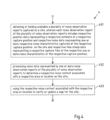
- Fig. 4 is a flow chart 4 illustrating an exemplary embodiment of a method according to the present disclosure. Without limiting the scope of the present disclosure, it is assumed in the following that server 3 as disclosed above with respect to system 1 of Fig. 1 performs the steps of flow chart 4.
- each noise capture report of the plurality of noise capture reports includes respective position data representing a respective estimate of a respective capture position and respective noise data representing one or more respective noise characteristics captured at the respective capture position on the site and respective time stamp data representing a respective capture time of the respective one or more noise characteristics at the respective capture position.
- each noise capture report determined by mobile device 2 includes (1) respective position data representing a respective estimate of a respective capture position estimated by positioning sensor 205 and (2) respective noise data representing a respective noise record captured by noise sensor 204 at the respective capture position and (3) time stamp data representing a respective capture time of the respective noise record at said respective capture position. It is however to be understood that the present disclosure is not limited to this and that the plurality of noise capture reports could be received from a plurality of noise capture report collection devices comprising mobile device 2.
- noise data represented by one or more noise capture reports of the plurality of noise capture reports are processed to determine a respective noise context associated with a respective area or location on the site.
- further data e.g. position data and/or time stamp data and/or sensor data
- the position data and/or the time stamp data represented by the one or more noise capture reports of the plurality of noise capture reports may be processed together with the noise data to determine the respective noise context in step 402.
- each of the one or more noise capture reports processed in step 402 includes position data representing a respective estimate of a respective capture position having a respective distance from said respective area or location on said site that is less than the predetermined distance threshold.
- the respective noise context respective noise context associated with a respective area or location on the site may be obtained as a result of the processing in step 402.
- the respective noise context associated with the respective area or location on the site represents or enables determining, for the respective area or location on the site, at least one of (1) a respective noise level and (2) a respective noise spectrum.
- the respective noise context associated with the respective area or location on the site represents, for the respective area or location on the site, a respective noise level over time.
- such a noise level over time for the respective area or location on the site may be understood to describe a development of the respective noise levels which are represented by and/or determinable based on the noise data of the one or more noise capture reports which are processed in step 402 over a day.
- the noise level over time represented by the respective noise context may be obtained by determining, for each predetermined time interval of a day (e.g. for each 30 minute time interval of a day like 0:01 to 00:30; 00:31 to 01:00, 01:01 to 01:30 etc.), a respective average noise level based on the respective noise data of the one or more noise capture reports, wherein, for each predetermined time interval of a day, only respective noise data having a respective capture time as represented by the time stamp data of data of the one or more noise capture reports which is in the respective predetermined time interval of a day are used to determine the respective average noise level.
- the respective average noise level for this predetermined time interval of a day may be determined by determining the respective average noise level represented by the noise records represented by the noise data of these two noise capture reports.
- step 403 the respective noise context associated with the respective area or location determined in step 402 is used to verify or update the map of the site.
- the respective noise context may be used to determine at least one of (1) an intended use for the respective area or location or (2) a frequency of use for the respective area or location in step 403. Thereby, the determining may be performed according to one or more predetermined algorithms like a machine learning algorithm or a matching algorithm.
- a matching algorithm is used to determine at least one of (1) an intended use for the respective area or location or (2) a frequency of use for the respective area or location in step 403. Accordingly, for each of a plurality of different predetermined intended uses and/or frequency of uses, a respective expected noise context representing a respective noise level over time may be predetermined and stored in memory 301. In step 403, the matching algorithm may receive the respective noise context to determine the best matching expected noise context. The predetermined intended use and/or frequency of use for which the expected noise context is determined to best match the respective noise context associated with the respective area or location is then determined to be the intended use and/or frequency of use for the respective area or location.
- an intended use determined for the respective area or location in step 403 may classify the respective area or location to be or to be part of or to comprise at least one of:
- the frequency of use determined for the respective area or location in step 403 may describe the frequency of use over time, for example by describing the number of persons present in the respective area or at the respective location over time.
- the intended use and/or the frequency of use determined for the respective area or location in step 403 is used to verify or update the map of the site.
- the intended use and/or frequency of use determined for the respective area or location based on the respective noise context may be used to verify an intended use and/or a frequency of use indicated by the map for the respective area or location.
- an indication of the intended use and/or frequency of use of the respective area or location determined based on the respective noise context may be included into the map to update the map.
- updated or verified map data representing the accordingly updated or verified map of the site may be obtained and for example stored in memory 301.
- steps 402 and 403 may be performed for a plurality of areas or locations on the site. For example, for each of these areas or locations, a respective noise context associated with the respective area or location on the site may be determined in step 402 by processing noise data; and, subsequently, the noise contexts determined in step 402 for these areas or locations may be used to verify or update the map of the site.
- the method of flow chart 4 of Fig. 4 thus uses noise data which can be collected by most existing mobile devices like smartphones, tablet computers, notebook computers, smart watches or smart bands to verify or update the map of the site. It thus provides a simple and efficient solution for verifying or updating the map of the site which does not require a manual survey of the site.
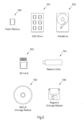
- Fig. 5 is a schematic illustration of examples of tangible and non-transitory computer-readable storage media according to the aspects that may for instance be used to implement memory 201 of Fig. 2 or 301 of Fig. 3 .
- Fig. 5 displays a flash memory 500, which may for instance be soldered or bonded to a printed circuit board, a solid-state drive 501 comprising a plurality of memory chips (e.g. Flash memory chips), a magnetic hard drive 502, a Secure Digital (SD) card 503, a Universal Serial Bus (USB) memory stick 504, an optical storage medium 505 (such as for instance a CD-ROM or DVD) and a magnetic storage medium 506.
- SD Secure Digital
- USB Universal Serial Bus
- circuitry refers to any of the following:
- circuitry' also covers an implementation of merely a processor (or multiple processors) or section of a processor and its (or their) accompanying software and/or firmware.
- the term 'circuitry' also covers, for example, a baseband integrated circuit or applications processor integrated circuit for a mobile phone.
- Any of the processors mentioned in this text could be a processor of any suitable type.
- Any processor may comprise but is not limited to one or more microprocessors, one or more processor(s) with accompanying digital signal processor(s), one or more processor(s) without accompanying digital signal processor(s), one or more special-purpose computer chips, one or more field-programmable gate arrays (FPGAS), one or more controllers, one or more application-specific integrated circuits (ASICS), or one or more computer(s).
- FPGAS field-programmable gate arrays
- ASICS application-specific integrated circuits
- the relevant structure/hardware has been programmed in such a way to carry out the described function.
- any of the actions or steps described or illustrated herein may be implemented using executable instructions in a general-purpose or special-purpose processor and stored on a computer-readable storage medium (e.g., disk, memory, or the like) to be executed by such a processor.
- a computer-readable storage medium e.g., disk, memory, or the like
- References to 'computer-readable storage medium' should be understood to encompass specialized circuits such as FPGAs, ASICs, signal processing devices, and other devices.
- A, or B, or C, or a combination thereof or "at least one of A, B and C” or “at least one of A, B or C” may be understood to be not exhaustive and to include at least the following: (1) A, or (2) B, or (3) C, or (4) A and B, or (5) A and C, or (6) B and C, or (7) A and B and C.
Landscapes
- Engineering & Computer Science (AREA)
- Radar, Positioning & Navigation (AREA)
- Remote Sensing (AREA)
- Automation & Control Theory (AREA)
- Physics & Mathematics (AREA)
- General Physics & Mathematics (AREA)
- Measurement Of Mechanical Vibrations Or Ultrasonic Waves (AREA)
Description
- The invention relates to the field of verifying or updating a map of a site, in particular to the field of processing noise data for verifying or updating a map of a site.
- Maps for sites inside a building or a complex of buildings represent a model of the site like a floor map. Such maps often fail to indicate the current use of areas or locations on the site, for example because the use of the area or location has been changed or is not indicated by the map. To keep such maps up-to-date, the site could be manually surveyed on a regular basis which is however cumbersome and inefficient.
- In the related art,
US10488860B1 - In this section, exemplary aspects of the invention are disclosed.
- According to an exemplary aspect, a computer-implemented method is disclosed. The method is defined in
claim 1. - The disclosed method may be performed by an apparatus (e.g. an apparatus of the apparatuses disclosed below).
- The site is at least partially inside a building or a complex of buildings. The building or the complex of buildings may be a shopping center, a parking garage, a train station, a bus station, an airport, a company site etc.
- Obtaining data (e.g. noise capture reports) may be understood to mean receiving (e.g. by means of a communication interface) or capturing (e.g. by means of a sensor like a noise sensor and/or a positioning sensor and/or a clock) or determining (e.g. by means of a processor) the data. Holding available data (e.g. noise capture reports) may be understood to mean storing the data (e.g. in storing means like a memory).
- Position data may be understood to represent a position or an estimate of a position (e.g. a capture position) captured by a positioning sensor (e.g. a GNSS (Global Navigation Satellite System) sensor). Alternatively or additionally the position data representing a position or an estimate of a position may be determined by using signals of opportunity available in the environment and captured by a sensor, for example (1) by using a radio positioning method like radio fingerprints and/or triangulation and/or trilateration based on available radio signals (e.g. WLAN radio signals) captured by a radio interface or (2) by using image signals (e.g. representing a visual scene containing one or more characteristic landmarks) captured by an image sensor (e.g. a camera) or (3) dead reckoning with inertial sensor data captured by one or more inertial sensors (e.g. gyroscope, accelerometer , magnetometer etc.). For example, position data may represent such a position or such an estimate of a position in the form of geographic coordinates (e.g. longitude and latitude and, optionally, altitude or floor level).
- Noise is understood to be ambient noise or sound. Noise data are understood to represent one or more noise characteristics (e.g. sound characteristics) captured by a noise sensor (e.g. a sound sensor like a microphone). Non limiting examples for such a noise characteristic are a noise level (e.g.an average or maximum sound level) or a noise spectrum. For example, the one or more noise characteristics may be represented as noise record captured by a microphone in encoded form, for example according to an audio encoding algorithm like MPEG-1 Audio Layer III or MPEG-2 Audio Layer III as specified by the Moving Picture Experts Group (MPEG). Such a noise record may for example enable determining at least one of (1) a noise level and (2) a noise spectrum. A noise level may be understood to be a noise power level (e.g. in W or dB), for example representing the maximum noise power or average noise power of noise represented by such a noise record. A noise spectrum may be understood to be a noise power spectrum, for example describing noise power distributed over frequency (e.g. over discrete frequencies or continuous range of frequencies in a predetermined frequency interval) of noise represented by such a noise record. Alternatively or additionally, the noise data may represent at least one of (1) a noise level) or (2) a noise spectrum captured by a noise sensor.
- Time stamp data are understood to represent a date and a time of day captured by a clock, for example in UNIX time format.
- The respective noise data of each noise capture report of the plurality of noise capture reports represent one or more respective noise characteristics, wherein the one or more respective noise characteristics are/were captured both (1) at the respective capture position an estimate of which is represented by the respective position data of the respective noise capture report and (2) at the respective capture time which is represented by the respective time stamp data of the respective noise capture report. It is to be understood that, for example due to measurement errors or inaccuracies, (1) the respective estimate of the respective capture position of the respective position data may deviate from the exact position where the one or more respective noise characteristics are/were captured and/or (2) the respective capture time of the respective time stamp data may deviate from the exact time when the one or more respective noise characteristics are/were captured. For example, each noise capture report of the plurality of noise capture reports may be captured by a respective noise capture report collection device (e.g. a respective noise capture report collection device of a plurality of noise capture report collection devices) and includes (1) respective position data and (2) respective noise data and (3) respective time stamp data captured by the respective noise capture report collection device (e.g. by a respective sensor of the respective noise capture report collection device). For example, the respective estimate of the respective capture position represented by the respective position data may be captured by a positioning sensor (e.g. a GNSS sensor) of the respective noise capture report collection device; and the one or more respective noise characteristics represented by the noise data may be captured by a noise sensor (e.g. a microphone) of the respective noise capture report collection device; and the respective capture time represented by the time stamp data may be captured by a clock of the respective noise capture report collection device. In particular, the one or more respective noise characteristics represented by the noise data may be understood to be captured by a noise sensor (e.g. a microphone) of the respective noise capture report collection device at the respective capture position and at the respective capture time (i.e. when the respective noise capture report collection device was at the respective capture position).
- For example, the respective observation report collection device may be one of (1) a mobile device which is moving on the site and (2) a fixed device which is installed at a fixed location on the site. An example of such a mobile device is a smartphone, a tablet computer, a notebook computer, a smart watch or a smart band. An example of such a fixed device is an Internet-of-Thing (IoT) device Processing noise data represented by one or more noise capture reports of the plurality of noise capture reports to determine a respective noise context is understood to mean that the noise context is determined by processing the noise data. Thereby, the noise data may be processed according to a predetermined algorithm. As a result of the processing, the noise context is obtained.
- It is to be understood that, in addition to the noise data, further data (e.g. position data and/or time stamp data and/or sensor data) represented by the one or more noise capture reports of the plurality of noise capture reports may be processed to determine a respective noise context. For example, the position data and/or the time stamp data represented by the one or more noise capture reports of the plurality of noise capture reports may be processed together with the noise data to determine a respective noise context.
- That the respective noise context is associated with the respective area or location on the site is understood to mean that only noise data captured in or within a predetermined threshold distance from the respective area or location is processed to determine the respective noise context. Each of the one or more noise capture reports of the plurality of noise capture reports (i.e. which represent the noise data processed to determine the respective noise context) includes respective position data representing a respective estimate of a respective capture position which is in or within a predetermined threshold distance from the respective area or location.
- The respective noise context represents one or more noise characteristics for the respective area or location which are expected to be typical for the respective area or location based on the noise data represented by the one or more noise capture reports of the plurality of noise capture reports. To this end, the respective noise context may for example represent at least one of (1) one or more average noise characteristics of the one or more respective noise characteristics represented by the noise data (i.e. the noise data represented by the one or more noise capture reports of the plurality of noise capture reports) or (2) one or more developments over time of the one or more noise characteristics represented by the noise (i.e. the noise data represented by the one or more noise capture reports of the plurality of noise capture reports).
- Such a noise context enables determining an intended use and/or a frequency of use of the respective area or location. For example, if the respective noise context represents an average noise level over time of the respective area or location which indicates an increased noise level at certain times of a day, the noise context may be considered to indicate that respective area or location is more frequently used at these times of the day than in the remaining times of the day. Moreover, if these times of the day are for example around breakfast time, lunch time and dinner time, the noise context may be considered to indicate that respective area or location may be an eating area or location like a kitchen. This information could for example be used to update or verify a map of the site, in particular to update or verify an intended use or frequency of use of the respective area or location indicated by the map of the site.
- In addition to the disclosed method, apparatuses, non-transitory computer readable storage mediums and computer program codes according to further exemplary aspects are disclosed in the following.
- According to a further exemplary aspect, an apparatus is disclosed, wherein the apparatus comprises means configured for performing the disclosed method. For example, the apparatus is one of (1) a noise capture report collection device or (2) a module for noise capture report collection device or (3) a server or (4) a module for a server.
- The disclosed apparatus may comprise a single means for all functions, a common plurality of means for all functions, or a plurality of different means for different functions.
- The means of the disclosed apparatus may be implemented in hardware and/or software. They may comprise a processor for executing computer program code for realizing the required functions, a memory storing the computer program code, or both. Accordingly, the disclosed apparatus may comprise at least one processor and at least one memory containing computer program code, the at least one memory and the computer program code with the at least one processor configured to cause the respective apparatus at least to perform the respective method.
- Alternatively or additionally, the means of the disclosed apparatuses may comprise circuitry that is designed to realize the required functions, for example implemented in a chipset or a chip, like an integrated circuit. According to a further exemplary aspect, a computer program code is disclosed, wherein the computer program code when executed by a processor causes an apparatus to perform the disclosed method.
- According to a further exemplary aspect, a non-transitory computer readable storage medium is disclosed, in which computer program code is stored, wherein the computer program code causes an apparatus to perform the disclosed method when executed by a processor. The computer program code could be stored in the respective computer readable storage medium in the form of instructions encoding the respective computer-readable storage medium.
- The disclosed computer readable storage medium may be intended for taking part in the operation of a device (e.g. a mobile device or a server), like an internal or external hard disk of a computer, or be intended for distribution of the computer program code, like an optical disc.
- According to a further exemplary aspect, a system is disclosed. The system is defined in claim 11. The one or more noise capture report collection devices are configured for performing some steps of the disclosed method and that the one or more servers are configured for performing the other steps of the disclosed method. For example, the one or more mobile devices are apparatuses according to the first aspect, and the one or more servers are apparatuses according to the second aspect.
- In the following, further exemplary embodiments of the exemplary aspects of the invention will be described.
- According to an exemplary embodiment of the aspects, each noise capture report of the plurality of noise capture reports includes respective noise data representing the one or more respective noise characteristics by representing at least one of:
- a respective noise record;
- a respective noise level; or
- a respective noise spectrum.
- The respective noise record may represent noise captured by a noise sensor at the respective capture position and at the respective capture time (e.g. capturing the noise may start at the respective capture time) for a capturing time period (e.g. a predetermined capturing period like 1 s or 0.5 s). An example for such a noise sensor may be a microphone. As disclosed above, the respective noise data may represent the respective noise record in encoded form, for example encoded according to an audio encoding algorithm like MPEG-1 Audio Layer III or MPEG-2 Audio Layer III as specified by the Moving Picture Experts Group (MPEG). Such a noise record may enable determining at least one of (1) a noise level and (2) a noise spectrum.
- The respective noise level may represent a noise power level (e.g. in W or dB) of noise captured by a noise sensor like a microphone at the respective capture position and at the respective capture time (e.g. capturing the noise may start at the respective capture time) for a capturing time period (e.g. a predetermined capturing period like 1 s or 0.5 s). The respective noise level may for example be an average or maximum noise power level of the noise captured by the noise sensor for the capturing time period.
- Likewise, the respective noise spectrum may represent the noise power spectrum of noise captured by a noise sensor like a microphone at the respective capture position and at the respective capture time (e.g. capturing the noise may start at the respective capture time) for a capturing time period (e.g. a predetermined capturing period like 1 s or 0.5 s). The respective noise spectrum may for example be a noise power spectrum describing noise power distributed over frequency (e.g. over discrete frequencies or continuous frequencies in a predetermined frequency interval) of the noise captured by the noise sensor for the capturing time period. Such a noise power spectrum could be obtained by a Fourier transform (e.g. a Fast Fourier Transformation, FFT) of the noise captured by the noise sensor for the capturing time period.
- According to an exemplary embodiment of the aspects, the respective noise context represents or enables determining, for the respective area or location on the site, at least one of:
- a respective noise level;
- a respective average noise level;
- a respective noise level over time;
- a respective noise spectrum;
- a respective average noise spectrum; or
- a respective noise spectrum over time.
- As disclosed above, each noise capture report of the plurality of noise capture reports may include respective noise data representing at least one of (1) a respective noise record which enables determining a respective noise level or noise spectrum or (2) a respective noise level or (3) a respective noise spectrum. Thereby, a noise level may be understood to be a noise power level (e.g. in W or dB), for example representing the maximum noise power or average noise power of noise; and a noise spectrum may be understood to be a noise power spectrum, for example describing noise power distributed over frequency (e.g. over discrete frequencies or continuous frequencies in a predetermined frequency interval).
- For example, if each of the noise data of the one or more noise capture reports which are processed to determine the respective noise context represent a respective noise record and/or a respective noise level, the respective noise level for the respective area or location on the site may be determined as average noise level and/or as noise level over time based on the respective noise records and/or the respective noise levels represented by the noise data of the one or more noise capture reports.
- An average noise level for the respective area or location on the site may be understood to be an arithmetic mean of the respective noise levels which are represented by and/or determinable based on the noise data of the one or more noise capture reports which are processed to determine the respective noise context. For example, the average noise level may be obtained by determining an arithmetic mean of the respective noise levels which are represented by and/or determinable based on the noise data of the one or more noise capture reports which are processed to determine the respective noise context.
- A noise level over time for the respective area or location on the site may be understood to describe a development of the respective noise levels which are represented by and/or determinable based on the noise data of the one or more noise capture reports which are processed to determine the respective noise context over a day. For example, the noise level over time may be obtained by determining, for each predetermined time interval of a day (e.g. for each 30 minute time interval of a day like 0:01 to 00:30; 00:31 to 01:00, 01:01 to 01:30 etc.), a respective average noise level based on the respective noise data of the one or more noise capture reports (i.e. the one or more noise capture reports which are processed to determine the respective noise context) which have a capture time as represented by the time stamp data of the one or more noise capture reports which is in the respective predetermined time interval of a day (e.g. 01:00 to 01:30).
- Likewise, if each of the noise data of the one or more noise capture reports which are processed to determine the respective noise context represent a respective noise record and/or a respective noise spectrum, the respective noise spectrum for the respective area or location on the site may be determined as average noise spectrum and/or as noise spectrum over time based on the respective noise records and/or the respective noise spectrums represented by the noise data of the one or more noise capture reports.
- An average noise spectrum for the respective area or location on the site may be understood to represent, for each frequency (e.g. each predetermined frequency of discrete frequencies or continuous frequencies in a predetermined frequency interval), a respective arithmetic mean of the respective noise powers for the respective frequency which are represented by and/or determinable based on the noise data of the one or more noise capture reports which are processed to determine the respective noise context.
- A noise spectrum over time for the respective area or location on the site may be understood to describe a development of the respective noise spectrums which are represented by and/or determinable based on the noise data of the one or more noise capture reports which are processed to determine the respective noise context over a day. For example, the noise spectrum over time may be obtained by determining, for each predetermined time interval of a day (e.g. for each 30 minute time interval of a day like 0:01 to 00:30; 00:31 to 01:00, 01:01 to 01:30 etc.), a respective average noise spectrum based on the respective noise data of the one or more noise capture reports which are processed to determine the respective noise context and which include time stamp data representing a respective time of a day as capture time which is in the respective predetermined time interval of a day (e.g. 01:00 to 01:30).
- According to an exemplary embodiment of the aspects, the method further comprises:
- associating the respective noise context with a respective representation of the respective area or location included in a map of the site.
- The map of the site may be understood to be a (e.g. two or three-dimensional) model of the site like a floor map and/or a radio positioning map. A floor map may be a geometric model of the site; and a positioning map may be a radio model of radio signals receivable on the site which may for example be used by mobile devices moving on the site to estimate their current position based on received radio signals. A representation of the respective area or location on the site may accordingly be understood to be a portion of such a model of the site corresponding to the respective area or location. For example, the map may be represented by map data. Associating the respective noise context with the respective representation of the respective area or location included in the map of the site may for example be understood to mean that the respective noise context is stored together with or linked to the map data representing the portion of the model of the site corresponding to the respective area or location.
- According to the aspects, the method further comprises:
- associating the respective noise context with a respective grid point of a grid system of a map of the site.
- As disclosed above, the map of the site may be understood to be a (e.g. two or three-dimensional) model of the site like a floor map and/or a radio positioning map. The grid system may be a predetermined grid system of the map of the site like a two or three dimensional grid (e.g. a square or cube grid). Each grid point of the grid system may correspond to a respective location on the site. It is to be understood that there may be more than one grid system, for example different grid systems may be included in the map for indoor and outdoor sections of the site. For example, the map may be represented by map data. Associating the respective noise context with the respective grid point of the grid system of the map of the site may for example be understood to mean that the respective noise context is stored together with or linked to the map data representing the respective grid point.
- As disclosed above, the respective noise context is associated with a respective area or location on the site.
- Accordingly, the respective grid point of the grid system of the map of the site corresponds to a location within the respective area on the site or to the respective location on the site.
- The method further comprises:
- using the respective noise context associated with the respective area or location to verify or update a map of the site.
- As disclosed above, a noise context enables determining an intended use and/or a frequency of use of the respective area or location. Accordingly, using the noise context to verify or update the map of the site comprises using the respective noise context to determine at least one of (1) an intended use or (2) a frequency of use of the respective area or location as disclosed in more detail below. For example, the intended use and/or frequency of use of the respective area or location determined based on the respective noise context may be used to verify an intended use and/or a frequency of use indicated by the map for the respective area or location. Alternatively or additionally, an indication of the intended use and/or frequency of use of the respective area or location determined based on the respective noise context may be included into the map to update the map.
- The method further comprises:
- using the respective noise context to determine at least one of:
- an intended use for the respective area or location; or
- a frequency of use for the respective area or location.
- Using the respective noise context to determine at least one of (1) an intended use or (2) a frequency of use for the respective area or location is understood to mean that at least one of (1) an intended use or (2) a frequency of use is determined for the respective area or location based on the respective noise context. Thereby, the determining may be performed according to one or more predetermined algorithms.
- An example for such a predetermined algorithm may be a machine learning algorithm. For example, noise contexts associated with areas or locations of which the respective intended use and/or the frequency of use is known may be used to train the machine learning algorithm. The accordingly trained machine learning algorithm may receive the respective noise context as input and provide the intended use and/or frequency of use for the respective area or location as output. It is to be understood that the intended use and/or frequency of use determined for the respective area or location according to the machine learning algorithm may deviate from the real intended use and/or frequency of use of the respective area or location.
- A further example for such a predetermined algorithm may be a matching algorithm or a pattern matching algorithm. For example, for each of a plurality of different predetermined intended uses and/or frequency of uses, a respective expected noise context may be predetermined. The matching algorithm may receive the respective noise context to determine the best matching expected noise context. The predetermined intended use and/or frequency of use for which the expected noise context is determined to best match the respective noise context associated with the respective area or location is then determined to be the intended use and/or frequency of use for the respective area or location.
- For example, an intended use determined for the respective area or location may classify the respective area or location to be or to be part of or to comprise at least one of:
- an area (e.g. a room) of the site having a dedicated use like a eating area (e.g. a kitchen), an office area (e.g. a single office room or an open plan office room), a meeting area (e.g. a meeting room), a transition area (e.g. a doorway, a passageway, a stairway, an escalator, an elevator hoistway or an elevator landing), a waiting area (e.g. a waiting room), a shopping area (e.g. a salesroom) etc.; or
- a point-of-interest like an automated-teller machine, a vending machine etc.
- The frequency of use determined for the respective area or location may describe the frequency of use over time, for example by describing the number of persons present in the respective area or at the respective location over time.
- The method further comprises:
- verifying or updating a map for the site at least partially based on at least one of the:
- intended use determined for the respective area or location; or
- frequency of use determined for the respective area or location.
- As disclosed above, the intended use and/or frequency of use determined for the respective area or location based on the respective noise context may be used to verify an intended use and/or a frequency of use indicated by the map for the respective area or location. Alternatively or additionally, an indication of the intended use and/or frequency of use of the respective area or location determined based on the respective noise context may be included into the map to update the map.
- Each of the one or more noise capture reports of the plurality of noise capture reports includes respective position data representing a respective estimate of a respective capture position having a respective distance from the respective area or location on the site that is less than a predetermined distance threshold. For example, only noise data of these one or more noise capture reports of the plurality of noise capture reports may be processed to determine the noise context associated with the respective area or location such that only noise data is processed which is estimated to be captured at an capture position on the site that is less than a predetermined distance threshold from the respective area or location.
- According to an exemplary embodiment of the aspects, each noise capture report of the plurality of noise capture reports further includes respective sensor data representing respective one or more environmental characteristics captured in addition to the respective one or more noise characteristics at the respective capture position. For example, the respective one or more environmental characteristics are/were captured by a sensor both (1) at the respective capture position an estimate of which is represented by the respective position data of the respective noise capture report and (2) at the respective capture time which is represented by the respective time stamp data of the respective noise capture report.
- For example, the processing of the sensor data of a respective noise capture report of the plurality of noise capture reports could additionally consider at least one of (1) the noise data of the respective noise capture report or (2) the respective noise context determined by using the noise data of the respective noise capture report.
- For example, the respective sensor data are or comprise at least one of:
- respective image data representing a respective image captured by an image sensor (e.g. at the respective capture position and at the respective capture time);
- respective radio data representing one or more radio characteristics captured by a radio interface (e.g. at the respective capture position and at the respective capture time); or
- respective LIDAR (Light Detection And Ranging) data representing one or more LIDAR captures performed by a LIDAR sensor (e.g. at the respective capture position and at the respective capture time).
- According to an exemplary embodiment of the aspects, the respective noise data represent the one or more respective noise characteristics in form of:
- a noise record;
- a noise level;
- a noise spectrum.
- According to an exemplary embodiment of the aspects, the method further comprises at least one of:
- compressing the noise data represented by the one or more noise capture reports of the plurality of noise capture reports; or
- compressing the respective noise context associated with the respective area or location on the site.
- For compressing noise data and/or noise contexts conventional compression methods like the Lempel-Ziv (LZ) compression method or a DCT (Discrete Cosine Transform) compression method could be used. In particular, the DCT compression method for compressing data about radio signals which is disclosed in
US Patent 10,520,579 - According to an exemplary embodiment of the aspects, processing noise data represented by one or more noise capture reports of the plurality of noise capture reports to determine a respective noise context associated with a respective area or location on the site is performed at least partially according to at least one of a machine learning algorithm or a matching algorithm or a pattern matching algorithm.
- According to an exemplary embodiment of the aspects, the plurality of noise capture reports is/was captured by one or more noise capture report collection devices.
- Other features of the present disclosure will become apparent from the following detailed description considered in conjunction with the accompanying drawings. It is to be understood, however, that the drawings are designed solely for purposes of illustration and not as a definition of the limits of the present disclosure, for which reference should be made to the appended claims. It should be further understood that the drawings are not drawn to scale and that they are merely intended to conceptually illustrate the structures and procedures described herein.
-
- Fig. 1
- is a block diagram of an exemplary embodiment of a system according to the present disclosure;
- Fig. 2
- is a block diagram of an exemplary embodiment of a mobile device according to the present disclosure;
- Fig. 3
- is a block diagram of an exemplary embodiment of a server according to the present disclosure;
- Fig. 4
- is a flow chart illustrating an exemplary embodiment of a method according to the present disclosure;
- Fig. 5
- is a schematic illustration of examples of tangible and non-transitory storage media according to the aspects.
- The following description serves to deepen the understanding of the present disclosure and shall be understood to complement and be read together with the description as provided in the above SUMMARY section of this specification.
-
Fig. 1 is a schematic high-level block diagram of an exemplary embodiment of asystem 1 according to the present disclosure. For exemplary purposes and without limiting the scope of the present disclosure, it is assumed in the following thatsystem 1 serves for verifying or updating a map of a site which is at least partially inside a building or a complex of buildings like a shopping center, a parking garage, a train station, a bus station, an airport, a company site etc. Moreover, it is assumed in the following that the map of the site is a (e.g. two or three-dimensional) model of the site like a floor map. -
System 1 comprises amobile device 2 and aserver 3.Mobile device 2 andserver 3 may communicate with each other viacommunication path 100.Communication path 100 may be a direct or indirect communication path. For example,communication path 100 may comprise one or more hops, for example one or more communication links or communication connections. In the following, it is assumed thatcommunication path 100 is a radio communication connection in a cellular network like a 2G/3G/4G/5G cellular communication network. The 2G/3G/4G/5G cellular radio communication standards are developed by the 3GPP and presently available under http://www.3gpp.org/. It is however to be understood that the present disclosure is not limited to this. -
Mobile device 2 may be a noise capture report collection device which is configured to collect (e.g. capture) one or more noise capture reports (e.g. a plurality of noise capture reports) and to provide (e.g. transmit) the collected noise capture reports toserver 3 viacommunication path 100 for verifying or updating the map of the site. It is to be understood thatsystem 1 is not limited tomobile device 2 as noise capture report collection device.Mobile device 2 may be part of a plurality of noise capture report collection devices comprising at least one of (1) one or more mobile devices which are moving on the site and (2) one or more fixed devices which are installed at fixed locations on the site. An example of such a mobile device is a smartphone, a tablet computer, a notebook computer, a smart watch or a smart band. An example of such a fixed device is an Internet-of-Thing (IoT) device. Each noise capture report collection device of the plurality of noise capture report collection devices may be configured to collect (e.g. capture) respective noise capture reports and to provide (e.g. transmit) the collected respective noise capture reports toserver 3 viacommunication path 100 for verifying or updating the map of the site. - Moreover, it is to be understood that
system 1 is not limited to asingle server 3, but may optionally comprise a plurality of servers (e.g. forming a server cloud). Accordingly,server 3 may be part of such a plurality of servers (e.g. a server cloud). In particular,server 3 may be responsible for verifying or updating the map of the site. As disclosed below in more detail,server 3 is configured to obtain or hold available (e.g. receive and store) a plurality of noise capture reports (e.g. frommobile device 2 via communication path 100) for verifying or updating the map of the site. -
Fig. 2 is a block diagram of an exemplary embodiment ofmobile device 2 according to the present disclosure. In the following, it is assumed thatmobile device 2 ofsystem 1 ofFig. 1 corresponds to thismobile device 2. -
Mobile device 2 comprises aprocessor 200.Processor 200 may represent a single processor or two or more processors, which are for example at least partially coupled, for example via a bus.Processor 200 executes a computer program code stored in program memory 201 (e.g. computer program code causingmobile device 2 to collect (e.g. capture) one or more noise capture reports (e.g. a plurality of noise capture reports) and to provide (e.g. transmit) the collected noise capture reports toserver 3 ofsystem 1 ofFig. 1 ), and interfaces with a main memory, 202.Program memory 201 may also contain an operating system forprocessor 200 and further data like data of collected (e.g. captured) noise capture reports. Some or all ofmemories processor 200. One of or both ofmemories processor 200 or at least partially removable fromprocessor 200, for example in the form of a memory card or stick. - A program memory (e.g. program memory 201) may for example be a non-volatile memory. It may for instance be a FLASH memory (or a part thereof), any of a ROM, PROM, EPROM, MRAM or a FeRAM (or a part thereof) or a hard disc (or a part thereof), to name but a few examples. For example, a program memory may for instance comprise a first memory section that is fixedly installed, and a second memory section that is removable, for instance in the form of a removable SD memory card.
- A main memory (e.g. main memory 202) may for example be a volatile memory. It may for example be a DRAM memory, to give non-limiting example. It may for instance be used as a working memory for a processor (e.g. processor 200) when executing an operating system and/or programs.
-
Processor 200 further controls radio interface(s) 203. In the following, it is assumed that radio interface(s) 203 comprise a 2G/3G/4G/5G radio transceiver. It is however to be understood that the present disclosure is not limited to this. - The 2G/3G/4G/5G radio transceiver of radio interface(s) 203 is configured and/or used for communicating via a cellular network, for example for transmitting and receiving data via
communication path 100 ofsystem 1 ofFig. 1 . Accordingly,mobile device 2 may use the 2G/3G/4G/5G radio transceiver of radio interface(s) 203 to communicate withserver 3 ofsystem 1 ofFig. 1 , for example to provide (e.g. transmit) the collected noise capture reports toserver 3 ofsystem 1 ofFig. 1 . - Moreover,
processor 200 controls anoise sensor 204 like a microphone and aposition sensor 205 like a GNSS sensor which are repeatedly used to determine a respective noise capture report. - To this end,
noise sensor 204 is configured or used for repeatedly capturing noise records. Moreover, thepositioning sensor 205 is configured or used for estimating a respective capture position for each noise record captured by the noise sensor. - Each noise capture report determined by
mobile device 2 accordingly includes (1) respective position data representing a respective estimate of a respective capture position estimated by positioningsensor 205 and (2) respective noise data representing a respective noise record captured bynoise sensor 204 at the respective capture position. Moreover, each noise capture report determined bymobile device 2 additionally includes time stamp data representing a respective capture time of the respective noise record at said respective capture position. - The respective position data may for example represent geographic coordinates (e.g. longitude and latitude and, optionally, altitude) of the respective estimate of the respective capture position. The respective noise data may represent the respective noise record in encoded form, for example according to an audio encoding algorithm like MPEG-1 Audio Layer III or MPEG-2 Audio Layer III as specified by the Moving Picture Experts Group (MPEG). The respective time stamp data may represent the respective capture time in UNIX time format.
- It is to be understood that any computer program code required for processing sensor captures to determine data of a respective noise capture report may be stored in an own memory of the respective sensor and executed by an own processor of the respective sensor or it may be stored for example in
program memory 201 and executed for example byprocessor 200. - The
components 201 to 205 ofmobile device 2 may for instance be connected withprocessor 200 by means of one or more serial and/or parallel busses. - The hardware of
components 201 to 205 ofmobile device 2 are part of most existing mobile devices like smartphones, tablet computers, notebook computers, smart watches or smart bands such that only software modifications are necessary to accordingly configure these existing mobile devices. - It is to be understood that
mobile device 2 may comprise various other components like a user interface for receiving user input. -
Fig. 3 is a block diagram of an exemplary embodiment ofserver 3 according to the present disclosure. In the following, it is assumed thatserver 3 ofsystem 1 ofFig. 1 corresponds to thisserver 3. -
Server 3 comprises aprocessor 300.Processor 300 may represent a single processor or two or more processors, which are for instance at least partially coupled, for instance via a bus.Processor 300 executes a computer program code (e.g. computer programcode causing server 3 to perform any one embodiment of the disclosed method like the method described below with reference toFig. 4 when executed on processor 300) stored inprogram memory 301, and interfaces with amain memory 302.Program memory 301 may also contain an operating system forprocessor 300. Moreover,program memory 301 may contain further data like map data. Some or all ofmemories processor 300. One of or both ofmemories processor 300 or at least partially removable fromprocessor 300, for example in the form of a memory card or stick. -
Processor 300 further controls acommunication interface 303 which is configured to communicate via a communication network.Server 3 may usecommunication interface 303 to communicate withmobile device 2 ofsystem 1 ofFig. 1 . In the following, it is assumed thatcommunication interface 303 is a 2G/3G/4G/5G radio transceiver which is configured and/or used for communicating via a cellular network, for example for transmitting and receiving data viacommunication path 100 ofsystem 1. - The
components 301 to 303 ofserver 3 may for example be connected withprocessor 300 by means of one or more serial and/or parallel busses. - It is to be understood that
server 3 may comprise various other components like a user interface for receiving user input. -
Fig. 4 is aflow chart 4 illustrating an exemplary embodiment of a method according to the present disclosure. Without limiting the scope of the present disclosure, it is assumed in the following thatserver 3 as disclosed above with respect tosystem 1 ofFig. 1 performs the steps offlow chart 4. - In a
step 401, a plurality of noise capture reports captured on a site is obtained or hold available, wherein each noise capture report of the plurality of noise capture reports includes respective position data representing a respective estimate of a respective capture position and respective noise data representing one or more respective noise characteristics captured at the respective capture position on the site and respective time stamp data representing a respective capture time of the respective one or more noise characteristics at the respective capture position. - In the following, it is assumed that the plurality of noise capture reports is received from
mobile device 2 viacommunication path 100 and stored inprogram memory 301 instep 401. As disclosed above, each noise capture report determined bymobile device 2 includes (1) respective position data representing a respective estimate of a respective capture position estimated by positioningsensor 205 and (2) respective noise data representing a respective noise record captured bynoise sensor 204 at the respective capture position and (3) time stamp data representing a respective capture time of the respective noise record at said respective capture position. It is however to be understood that the present disclosure is not limited to this and that the plurality of noise capture reports could be received from a plurality of noise capture report collection devices comprisingmobile device 2. - In a
step 402, noise data represented by one or more noise capture reports of the plurality of noise capture reports are processed to determine a respective noise context associated with a respective area or location on the site. It is to be understood that, in addition to the noise data, further data (e.g. position data and/or time stamp data and/or sensor data) represented by the one or more noise capture reports of the plurality of noise capture reports may be processed to determine the respective noise context. For example, the position data and/or the time stamp data represented by the one or more noise capture reports of the plurality of noise capture reports may be processed together with the noise data to determine the respective noise context instep 402. - That the respective noise context is associated with the respective area or location on the site may be understood to mean that only noise data captured in or within a predetermined threshold distance from the respective area or location is processed in
step 402 to determine the respective noise context. For example, each of the one or more noise capture reports processed instep 402 includes position data representing a respective estimate of a respective capture position having a respective distance from said respective area or location on said site that is less than the predetermined distance threshold. - The respective noise context respective noise context associated with a respective area or location on the site may be obtained as a result of the processing in
step 402. Thereby, the respective noise context associated with the respective area or location on the site represents or enables determining, for the respective area or location on the site, at least one of (1) a respective noise level and (2) a respective noise spectrum. Without limiting the scope of the present disclosure, it is assumed in the following that the respective noise context associated with the respective area or location on the site represents, for the respective area or location on the site, a respective noise level over time. As disclosed above, such a noise level over time for the respective area or location on the site may be understood to describe a development of the respective noise levels which are represented by and/or determinable based on the noise data of the one or more noise capture reports which are processed instep 402 over a day. - In
step 402, the noise level over time represented by the respective noise context may be obtained by determining, for each predetermined time interval of a day (e.g. for each 30 minute time interval of a day like 0:01 to 00:30; 00:31 to 01:00, 01:01 to 01:30 etc.), a respective average noise level based on the respective noise data of the one or more noise capture reports, wherein, for each predetermined time interval of a day, only respective noise data having a respective capture time as represented by the time stamp data of data of the one or more noise capture reports which is in the respective predetermined time interval of a day are used to determine the respective average noise level. For example, if two noise capture reports of the one or more noise capture reports have a respective capture time as represented by the time stamp data of data of these two noise capture reports which is in a predetermined time interval of a day, the respective average noise level for this predetermined time interval of a day may be determined by determining the respective average noise level represented by the noise records represented by the noise data of these two noise capture reports. - In an
optional step 403, the respective noise context associated with the respective area or location determined instep 402 is used to verify or update the map of the site. - To this end, the respective noise context may be used to determine at least one of (1) an intended use for the respective area or location or (2) a frequency of use for the respective area or location in
step 403. Thereby, the determining may be performed according to one or more predetermined algorithms like a machine learning algorithm or a matching algorithm. - Without limiting the scope of the present disclosure, it is assumed in the following that a matching algorithm is used to determine at least one of (1) an intended use for the respective area or location or (2) a frequency of use for the respective area or location in
step 403. Accordingly, for each of a plurality of different predetermined intended uses and/or frequency of uses, a respective expected noise context representing a respective noise level over time may be predetermined and stored inmemory 301. Instep 403, the matching algorithm may receive the respective noise context to determine the best matching expected noise context. The predetermined intended use and/or frequency of use for which the expected noise context is determined to best match the respective noise context associated with the respective area or location is then determined to be the intended use and/or frequency of use for the respective area or location. - For example, an intended use determined for the respective area or location in
step 403 may classify the respective area or location to be or to be part of or to comprise at least one of: - an area (e.g. a room) of the site having a dedicated use like a eating area (e.g. a kitchen), an office area (e.g. a single office room or an open plan office room), a meeting area (e.g. a meeting room), a transition area (e.g. a doorway, a passageway, a stairway, an escalator, an elevator hoistway or an elevator landing), a waiting area (e.g. a waiting room), a shopping area (e.g. a salesroom) etc.; or
- a point-of-interest like an automated-teller machine, a vending machine etc.
- The frequency of use determined for the respective area or location in
step 403 may describe the frequency of use over time, for example by describing the number of persons present in the respective area or at the respective location over time. - Subsequently, the intended use and/or the frequency of use determined for the respective area or location in
step 403 is used to verify or update the map of the site. For example, the intended use and/or frequency of use determined for the respective area or location based on the respective noise context may be used to verify an intended use and/or a frequency of use indicated by the map for the respective area or location. Alternatively or additionally, an indication of the intended use and/or frequency of use of the respective area or location determined based on the respective noise context may be included into the map to update the map. - As a result of
step 403, updated or verified map data representing the accordingly updated or verified map of the site may be obtained and for example stored inmemory 301. - It is to be understood that
steps step 402 by processing noise data; and, subsequently, the noise contexts determined instep 402 for these areas or locations may be used to verify or update the map of the site. - The method of
flow chart 4 ofFig. 4 thus uses noise data which can be collected by most existing mobile devices like smartphones, tablet computers, notebook computers, smart watches or smart bands to verify or update the map of the site. It thus provides a simple and efficient solution for verifying or updating the map of the site which does not require a manual survey of the site. -
Fig. 5 is a schematic illustration of examples of tangible and non-transitory computer-readable storage media according to the aspects that may for instance be used to implementmemory 201 ofFig. 2 or 301 ofFig. 3 . To this end,Fig. 5 displays aflash memory 500, which may for instance be soldered or bonded to a printed circuit board, a solid-state drive 501 comprising a plurality of memory chips (e.g. Flash memory chips), a magnetichard drive 502, a Secure Digital (SD)card 503, a Universal Serial Bus (USB)memory stick 504, an optical storage medium 505 (such as for instance a CD-ROM or DVD) and amagnetic storage medium 506. - Further, as used in this text, the term 'circuitry' refers to any of the following:
- (a) hardware-only circuit implementations (such as implementations in only analog and/or digital circuitry)
- (b) combinations of circuits and software (and/or firmware), such as: (1) to a combination of processor(s) or (2) to sections of processor(s)/ software (including digital signal processor(s)), software, and memory(ies) that work together to cause an apparatus, such as a mobile phone, to perform various functions) and
- (c) to circuits, such as a microprocessor(s) or a section of a microprocessor(s), that re-quire software or firmware for operation, even if the software or firmware is not physically present.
- This definition of 'circuitry' applies to all uses of this term in this text, including in any claims. As a further example, as used in this text, the term 'circuitry' also covers an implementation of merely a processor (or multiple processors) or section of a processor and its (or their) accompanying software and/or firmware. The term 'circuitry' also covers, for example, a baseband integrated circuit or applications processor integrated circuit for a mobile phone.
- Any of the processors mentioned in this text could be a processor of any suitable type. Any processor may comprise but is not limited to one or more microprocessors, one or more processor(s) with accompanying digital signal processor(s), one or more processor(s) without accompanying digital signal processor(s), one or more special-purpose computer chips, one or more field-programmable gate arrays (FPGAS), one or more controllers, one or more application-specific integrated circuits (ASICS), or one or more computer(s). The relevant structure/hardware has been programmed in such a way to carry out the described function.
- Moreover, any of the actions or steps described or illustrated herein may be implemented using executable instructions in a general-purpose or special-purpose processor and stored on a computer-readable storage medium (e.g., disk, memory, or the like) to be executed by such a processor. References to 'computer-readable storage medium' should be understood to encompass specialized circuits such as FPGAs, ASICs, signal processing devices, and other devices.
- The wording "A, or B, or C, or a combination thereof" or "at least one of A, B and C" or "at least one of A, B or C" may be understood to be not exhaustive and to include at least the following: (1) A, or (2) B, or (3) C, or (4) A and B, or (5) A and C, or (6) B and C, or (7) A and B and C.
Claims (11)
- A computer-implemented method comprising:- obtaining or holding available (401) a plurality of noise capture reports captured on a site, wherein said site is at least partially inside a building or a complex of buildings, wherein each noise capture report of said plurality of noise capture reports includes (i) respective position data representing a respective estimate of a respective capture position, (ii) respective noise data representing one or more respective noise characteristics captured at said respective capture position on said site, and (iii) respective time stamp data representing a respective capture time of said respective one or more noise characteristics at said respective capture position;- processing (402) noise data represented by one or more of said plurality of noise capture reports, said one or more noise capture reports including respective position data representing a respective estimate of a respective capture position having a respective distance from an area or location on said site, wherein said respective distance is less than a predetermined distance threshold;- determining, as a result of the processing, a respective noise context of said respective area or location, wherein the respective noise context represents one or more noise characteristics which are expected to be typical for the respective area or location;- using (403) said respective noise context to verify or update a map for said site by associating said respective noise context with a respective representation of said respective area or location included in the map, and/or by
associating said respective noise context with a respective grid point of a grid system of the map, wherein said respective grid point corresponds to said respective area or location;- using said respective noise context to determine an intended use and/or a frequency of use of said respective area or location; and- verifying or updating the map for said site at least partially based on the intended use and/or the frequency of use determined for said respective area or location. - The method according to claim 1, wherein said respective noise context represents, for said respective area or location on said site, at least one of:- a respective noise level;- a respective average noise level;- a respective noise level over time;- a respective noise spectrum;- a respective average noise spectrum; and- a respective noise spectrum over time.
- The method according to claim 1 or 2, wherein determining said intended use comprises classifying the respective area or location to be or to be part of or to comprise at least one of:- an area of the site having a dedicated use, in particular an eating area, an office area, a meeting area, a transition area, a waiting area, or a shopping area; or- a point-of-interest, in particular an automated-teller machine, or a vending machine.
- The method according to any of claims 1 to 3, wherein each noise capture report of said plurality of noise capture reports further includes respective sensor data representing one or more respective environmental characteristics captured in addition to said respective one or more noise characteristics at said respective capture position.
- The method according to claim 4, wherein said respective sensor data are or comprise at least one of:- respective image data representing a respective image captured by an image sensor;- respective radio data representing one or more radio characteristics captured by a radio interface; and- respective LIDAR data representing one or more LIDAR captures performed by a LIDAR sensor.
- The method according to any of claims 1 to 5, wherein said respective noise data represent said one or more respective noise characteristics by representing at least one of:- a noise record;- a noise level;- a noise spectrum.
- The method according to any of claims 1 to 6, wherein processing noise data represented by one or more noise capture reports of said plurality of noise capture reports to determine a respective noise context associated with a respective area or location on said site is performed at least partially according to at least one of a machine learning algorithm or a matching algorithm or a pattern matching algorithm.
- The method according to any of claims 1 to 7, wherein said plurality of noise capture reports is/was captured by one or more noise capture report collection devices (2).
- A computer program code, the computer program code when executed by a processor (200, 300) causing an apparatus (2, 3) to perform the method according to any of claims 1 to 8.
- An apparatus (2, 3) comprising means (200 - 205, 300 - 303) configured for performing the method according to any of claims 1 to 8.
- A system (1) comprising one or more servers (3) and one or more noise capture report collection devices (2) configured to collect said one or more noise capture reports and to provide the collected one or more noise capture reports to said one or more servers (3), wherein said one or more servers and said one or more noise capture report collection devices are configured to cooperate for performing the method according to any of claims 1 to 8.
Priority Applications (1)
| Application Number | Priority Date | Filing Date | Title |
|---|---|---|---|
| EP20169779.4A EP3896392B1 (en) | 2020-04-16 | 2020-04-16 | Processing noise data for verifying or updating a map of a site |
Applications Claiming Priority (1)
| Application Number | Priority Date | Filing Date | Title |
|---|---|---|---|
| EP20169779.4A EP3896392B1 (en) | 2020-04-16 | 2020-04-16 | Processing noise data for verifying or updating a map of a site |
Publications (2)
| Publication Number | Publication Date |
|---|---|
| EP3896392A1 EP3896392A1 (en) | 2021-10-20 |
| EP3896392B1 true EP3896392B1 (en) | 2025-04-02 |
Family
ID=70292822
Family Applications (1)
| Application Number | Title | Priority Date | Filing Date |
|---|---|---|---|
| EP20169779.4A Active EP3896392B1 (en) | 2020-04-16 | 2020-04-16 | Processing noise data for verifying or updating a map of a site |
Country Status (1)
| Country | Link |
|---|---|
| EP (1) | EP3896392B1 (en) |
Family Cites Families (2)
| Publication number | Priority date | Publication date | Assignee | Title |
|---|---|---|---|---|
| US10488860B1 (en) * | 2006-02-21 | 2019-11-26 | Automodality, Inc. | Geocoding data for an automated vehicle |
| EP3751304B1 (en) | 2015-05-12 | 2025-09-10 | HERE Global B.V. | Compressing and decompressing data about radio signals |
-
2020
- 2020-04-16 EP EP20169779.4A patent/EP3896392B1/en active Active
Also Published As
| Publication number | Publication date |
|---|---|
| EP3896392A1 (en) | 2021-10-20 |
Similar Documents
| Publication | Publication Date | Title |
|---|---|---|
| KR101440842B1 (en) | Method and apparatus for collecting information of wireless access point | |
| US11243288B2 (en) | Location error radius determination | |
| CN104378735B (en) | Indoor orientation method, client and server | |
| US11212649B2 (en) | Determining a non-GNSS based position of a mobile device | |
| US20130297198A1 (en) | Method for generating map data | |
| US11454501B2 (en) | Providing constraint to a position | |
| JP7163438B2 (en) | Updating radio maps based on arrays of radio fingerprints | |
| EP2672401A1 (en) | Method and apparatus for storing image data | |
| US10547983B2 (en) | Controlling radio fingerprint observation report collection | |
| US11272334B2 (en) | Determining a path of a mobile device in a public transportation building | |
| CN112348891A (en) | Image detection and positioning method and device, storage medium and electronic device | |
| US20170082440A1 (en) | Information processing system, information processing method, and non-transitory computer readable storage medium | |
| US11579237B2 (en) | Determining a plurality of installation positions of a plurality of radio devices | |
| JP6216353B2 (en) | Information identification system, information identification method, and program thereof | |
| EP3896392B1 (en) | Processing noise data for verifying or updating a map of a site | |
| US11160047B2 (en) | Determining motion information associated with a mobile device | |
| US12276729B2 (en) | Method, apparatus, and system for location sharing using a LiDAR-based location signature | |
| JP7756779B1 (en) | Structure identification system, structure identification method, and program | |
| US12468035B2 (en) | Method, apparatus, and system for providing a LiDAR path signature | |
| JP7793028B1 (en) | Structure identification system, structure identification method, and program | |
| KR20220008328A (en) | Location tracking method that combines real and virtual |
Legal Events
| Date | Code | Title | Description |
|---|---|---|---|
| PUAI | Public reference made under article 153(3) epc to a published international application that has entered the european phase |
Free format text: ORIGINAL CODE: 0009012 |
|
| STAA | Information on the status of an ep patent application or granted ep patent |
Free format text: STATUS: THE APPLICATION HAS BEEN PUBLISHED |
|
| AK | Designated contracting states |
Kind code of ref document: A1 Designated state(s): AL AT BE BG CH CY CZ DE DK EE ES FI FR GB GR HR HU IE IS IT LI LT LU LV MC MK MT NL NO PL PT RO RS SE SI SK SM TR |
|
| B565 | Issuance of search results under rule 164(2) epc |
Effective date: 20200924 |
|
| STAA | Information on the status of an ep patent application or granted ep patent |
Free format text: STATUS: REQUEST FOR EXAMINATION WAS MADE |
|
| 17P | Request for examination filed |
Effective date: 20220419 |
|
| RBV | Designated contracting states (corrected) |
Designated state(s): AL AT BE BG CH CY CZ DE DK EE ES FI FR GB GR HR HU IE IS IT LI LT LU LV MC MK MT NL NO PL PT RO RS SE SI SK SM TR |
|
| STAA | Information on the status of an ep patent application or granted ep patent |
Free format text: STATUS: EXAMINATION IS IN PROGRESS |
|
| 17Q | First examination report despatched |
Effective date: 20230724 |
|
| GRAP | Despatch of communication of intention to grant a patent |
Free format text: ORIGINAL CODE: EPIDOSNIGR1 |
|
| STAA | Information on the status of an ep patent application or granted ep patent |
Free format text: STATUS: GRANT OF PATENT IS INTENDED |
|
| INTG | Intention to grant announced |
Effective date: 20240605 |
|
| GRAJ | Information related to disapproval of communication of intention to grant by the applicant or resumption of examination proceedings by the epo deleted |
Free format text: ORIGINAL CODE: EPIDOSDIGR1 |
|
| STAA | Information on the status of an ep patent application or granted ep patent |
Free format text: STATUS: EXAMINATION IS IN PROGRESS |
|
| GRAP | Despatch of communication of intention to grant a patent |
Free format text: ORIGINAL CODE: EPIDOSNIGR1 |
|
| STAA | Information on the status of an ep patent application or granted ep patent |
Free format text: STATUS: GRANT OF PATENT IS INTENDED |
|
| INTC | Intention to grant announced (deleted) | ||
| INTG | Intention to grant announced |
Effective date: 20241029 |
|
| GRAS | Grant fee paid |
Free format text: ORIGINAL CODE: EPIDOSNIGR3 |
|
| GRAA | (expected) grant |
Free format text: ORIGINAL CODE: 0009210 |
|
| STAA | Information on the status of an ep patent application or granted ep patent |
Free format text: STATUS: THE PATENT HAS BEEN GRANTED |
|
| P01 | Opt-out of the competence of the unified patent court (upc) registered |
Free format text: CASE NUMBER: APP_5301/2025 Effective date: 20250131 |
|
| AK | Designated contracting states |
Kind code of ref document: B1 Designated state(s): AL AT BE BG CH CY CZ DE DK EE ES FI FR GB GR HR HU IE IS IT LI LT LU LV MC MK MT NL NO PL PT RO RS SE SI SK SM TR |
|
| REG | Reference to a national code |
Ref country code: GB Ref legal event code: FG4D |
|
| REG | Reference to a national code |
Ref country code: CH Ref legal event code: EP |
|
| REG | Reference to a national code |
Ref country code: DE Ref legal event code: R096 Ref document number: 602020048604 Country of ref document: DE |
|
| REG | Reference to a national code |
Ref country code: IE Ref legal event code: FG4D |
|
| REG | Reference to a national code |
Ref country code: NL Ref legal event code: FP |
|
| PGFP | Annual fee paid to national office [announced via postgrant information from national office to epo] |
Ref country code: DE Payment date: 20250408 Year of fee payment: 6 |
|
| REG | Reference to a national code |
Ref country code: AT Ref legal event code: MK05 Ref document number: 1781660 Country of ref document: AT Kind code of ref document: T Effective date: 20250402 |
|
| PG25 | Lapsed in a contracting state [announced via postgrant information from national office to epo] |
Ref country code: PT Free format text: LAPSE BECAUSE OF FAILURE TO SUBMIT A TRANSLATION OF THE DESCRIPTION OR TO PAY THE FEE WITHIN THE PRESCRIBED TIME-LIMIT Effective date: 20250804 Ref country code: ES Free format text: LAPSE BECAUSE OF FAILURE TO SUBMIT A TRANSLATION OF THE DESCRIPTION OR TO PAY THE FEE WITHIN THE PRESCRIBED TIME-LIMIT Effective date: 20250402 Ref country code: FI Free format text: LAPSE BECAUSE OF FAILURE TO SUBMIT A TRANSLATION OF THE DESCRIPTION OR TO PAY THE FEE WITHIN THE PRESCRIBED TIME-LIMIT Effective date: 20250402 |
|
| REG | Reference to a national code |
Ref country code: LT Ref legal event code: MG9D |
|
| PG25 | Lapsed in a contracting state [announced via postgrant information from national office to epo] |
Ref country code: GR Free format text: LAPSE BECAUSE OF FAILURE TO SUBMIT A TRANSLATION OF THE DESCRIPTION OR TO PAY THE FEE WITHIN THE PRESCRIBED TIME-LIMIT Effective date: 20250703 Ref country code: NO Free format text: LAPSE BECAUSE OF FAILURE TO SUBMIT A TRANSLATION OF THE DESCRIPTION OR TO PAY THE FEE WITHIN THE PRESCRIBED TIME-LIMIT Effective date: 20250702 |
|
| PG25 | Lapsed in a contracting state [announced via postgrant information from national office to epo] |
Ref country code: PL Free format text: LAPSE BECAUSE OF FAILURE TO SUBMIT A TRANSLATION OF THE DESCRIPTION OR TO PAY THE FEE WITHIN THE PRESCRIBED TIME-LIMIT Effective date: 20250402 |
|
| PG25 | Lapsed in a contracting state [announced via postgrant information from national office to epo] |
Ref country code: BG Free format text: LAPSE BECAUSE OF FAILURE TO SUBMIT A TRANSLATION OF THE DESCRIPTION OR TO PAY THE FEE WITHIN THE PRESCRIBED TIME-LIMIT Effective date: 20250402 |
|
| PG25 | Lapsed in a contracting state [announced via postgrant information from national office to epo] |
Ref country code: HR Free format text: LAPSE BECAUSE OF FAILURE TO SUBMIT A TRANSLATION OF THE DESCRIPTION OR TO PAY THE FEE WITHIN THE PRESCRIBED TIME-LIMIT Effective date: 20250402 |
|
| PG25 | Lapsed in a contracting state [announced via postgrant information from national office to epo] |
Ref country code: AT Free format text: LAPSE BECAUSE OF FAILURE TO SUBMIT A TRANSLATION OF THE DESCRIPTION OR TO PAY THE FEE WITHIN THE PRESCRIBED TIME-LIMIT Effective date: 20250402 |
|
| PG25 | Lapsed in a contracting state [announced via postgrant information from national office to epo] |
Ref country code: RS Free format text: LAPSE BECAUSE OF FAILURE TO SUBMIT A TRANSLATION OF THE DESCRIPTION OR TO PAY THE FEE WITHIN THE PRESCRIBED TIME-LIMIT Effective date: 20250702 |
|
| PG25 | Lapsed in a contracting state [announced via postgrant information from national office to epo] |
Ref country code: IS Free format text: LAPSE BECAUSE OF FAILURE TO SUBMIT A TRANSLATION OF THE DESCRIPTION OR TO PAY THE FEE WITHIN THE PRESCRIBED TIME-LIMIT Effective date: 20250802 |
|
| PG25 | Lapsed in a contracting state [announced via postgrant information from national office to epo] |
Ref country code: LV Free format text: LAPSE BECAUSE OF FAILURE TO SUBMIT A TRANSLATION OF THE DESCRIPTION OR TO PAY THE FEE WITHIN THE PRESCRIBED TIME-LIMIT Effective date: 20250402 |
|
| REG | Reference to a national code |
Ref country code: CH Ref legal event code: H13 Free format text: ST27 STATUS EVENT CODE: U-0-0-H10-H13 (AS PROVIDED BY THE NATIONAL OFFICE) Effective date: 20251125 |
|
| PG25 | Lapsed in a contracting state [announced via postgrant information from national office to epo] |
Ref country code: LU Free format text: LAPSE BECAUSE OF NON-PAYMENT OF DUE FEES Effective date: 20250416 |
|
| REG | Reference to a national code |
Ref country code: BE Ref legal event code: MM Effective date: 20250430 |
|
| REG | Reference to a national code |
Ref country code: DE Ref legal event code: R097 Ref document number: 602020048604 Country of ref document: DE |
|
| PG25 | Lapsed in a contracting state [announced via postgrant information from national office to epo] |
Ref country code: DK Free format text: LAPSE BECAUSE OF FAILURE TO SUBMIT A TRANSLATION OF THE DESCRIPTION OR TO PAY THE FEE WITHIN THE PRESCRIBED TIME-LIMIT Effective date: 20250402 Ref country code: SM Free format text: LAPSE BECAUSE OF FAILURE TO SUBMIT A TRANSLATION OF THE DESCRIPTION OR TO PAY THE FEE WITHIN THE PRESCRIBED TIME-LIMIT Effective date: 20250402 |
|
| PG25 | Lapsed in a contracting state [announced via postgrant information from national office to epo] |
Ref country code: BE Free format text: LAPSE BECAUSE OF NON-PAYMENT OF DUE FEES Effective date: 20250430 |
|
| PG25 | Lapsed in a contracting state [announced via postgrant information from national office to epo] |
Ref country code: CH Free format text: LAPSE BECAUSE OF NON-PAYMENT OF DUE FEES Effective date: 20250430 |
|
| PG25 | Lapsed in a contracting state [announced via postgrant information from national office to epo] |
Ref country code: CZ Free format text: LAPSE BECAUSE OF FAILURE TO SUBMIT A TRANSLATION OF THE DESCRIPTION OR TO PAY THE FEE WITHIN THE PRESCRIBED TIME-LIMIT Effective date: 20250402 |
|
| PG25 | Lapsed in a contracting state [announced via postgrant information from national office to epo] |
Ref country code: EE Free format text: LAPSE BECAUSE OF FAILURE TO SUBMIT A TRANSLATION OF THE DESCRIPTION OR TO PAY THE FEE WITHIN THE PRESCRIBED TIME-LIMIT Effective date: 20250402 |
|
| PG25 | Lapsed in a contracting state [announced via postgrant information from national office to epo] |
Ref country code: RO Free format text: LAPSE BECAUSE OF FAILURE TO SUBMIT A TRANSLATION OF THE DESCRIPTION OR TO PAY THE FEE WITHIN THE PRESCRIBED TIME-LIMIT Effective date: 20250402 Ref country code: SK Free format text: LAPSE BECAUSE OF FAILURE TO SUBMIT A TRANSLATION OF THE DESCRIPTION OR TO PAY THE FEE WITHIN THE PRESCRIBED TIME-LIMIT Effective date: 20250402 |
|
| PG25 | Lapsed in a contracting state [announced via postgrant information from national office to epo] |
Ref country code: IT Free format text: LAPSE BECAUSE OF FAILURE TO SUBMIT A TRANSLATION OF THE DESCRIPTION OR TO PAY THE FEE WITHIN THE PRESCRIBED TIME-LIMIT Effective date: 20250402 |
|
| PG25 | Lapsed in a contracting state [announced via postgrant information from national office to epo] |
Ref country code: MC Free format text: LAPSE BECAUSE OF FAILURE TO SUBMIT A TRANSLATION OF THE DESCRIPTION OR TO PAY THE FEE WITHIN THE PRESCRIBED TIME-LIMIT Effective date: 20250402 |
|
| PLBE | No opposition filed within time limit |
Free format text: ORIGINAL CODE: 0009261 |
|
| STAA | Information on the status of an ep patent application or granted ep patent |
Free format text: STATUS: NO OPPOSITION FILED WITHIN TIME LIMIT |
|
| REG | Reference to a national code |
Ref country code: CH Ref legal event code: L10 Free format text: ST27 STATUS EVENT CODE: U-0-0-L10-L00 (AS PROVIDED BY THE NATIONAL OFFICE) Effective date: 20260211 |
|
| 26N | No opposition filed |
Effective date: 20260105 |
|
| GBPC | Gb: european patent ceased through non-payment of renewal fee |
Effective date: 20250702 |
|
| PG25 | Lapsed in a contracting state [announced via postgrant information from national office to epo] |
Ref country code: GB Free format text: LAPSE BECAUSE OF NON-PAYMENT OF DUE FEES Effective date: 20250702 |
|
| PG25 | Lapsed in a contracting state [announced via postgrant information from national office to epo] |
Ref country code: IE Free format text: LAPSE BECAUSE OF NON-PAYMENT OF DUE FEES Effective date: 20250416 |
|
| PGFP | Annual fee paid to national office [announced via postgrant information from national office to epo] |
Ref country code: NL Payment date: 20260317 Year of fee payment: 7 |
|
| PG25 | Lapsed in a contracting state [announced via postgrant information from national office to epo] |
Ref country code: FR Free format text: LAPSE BECAUSE OF NON-PAYMENT OF DUE FEES Effective date: 20250602 |